Mother Jones: Posts

Mother Jones

RFK Jr. Is Already Taking Aim at Antidepressants

Hours after being confirmed as Secretary of the US Department of Health and Human Services, Robert F. Kennedy, Jr. issued a statement that laid out sweeping plans for his first 100 days in office. Chief among his goals, he wrote, was to combat what he called a “growing health crisis” of chronic disease. The document called for the federal government to investigate the “root causes” of a broad range of conditions, including autism, ADHD, asthma, obesity, multiple sclerosis, and psoriasis. Conspicuously absent was any explicit mention of childhood vaccines, which Kennedy has long railed against as the head of the anti-vaccine advocacy group Children’s Health Defense.

But the document did zero in on another one of his fixations: a class of widely prescribed drugs that treat depression, anxiety, and mood disorders. The government, he said, would “assess the prevalence of and threat posed by the prescription of selective serotonin reuptake inhibitors, antipsychotics, [and] mood stabilizers.”

Kennedy has repeatedly railed against what he sees as rampant overprescription of selective serotonin reuptake inhibitors, commonly known as SSRIs, which treat depression and anxiety and include medications like Prozac and Zoloft. As with his previous assertions about vaccines, many of his statements about these drugs are not backed by science. In a 2023 livestream on X with Elon Musk, he claimed that “tremendous circumstantial evidence” suggested that people taking antidepressants were more likely to commit school shootings. (Actually, most school shooters were not taking those drugs, evidence shows.) Kennedy has also called people who take SSRIs addicts—and then tried to claim he didn’t during his confirmation hearings.

When government researchers follow Kennedy’s orders to study SSRIs, they’ll find reams of research, including long-term studies, that have found that the drugs are safe and non-addictive. That’s good news for the 13 percent of American adults who use SSRIs to treat depression and anxiety. In addition to this well-documented track record of safety, manufacturers have closely monitored adverse reactions to the drugs in children and teens. The Food and Drug Administration already requires drug manufacturers to include warnings in packaging because of some evidence that SSRIs can cause a temporary increase in suicidal thoughts in pediatric patients (though evidence on this point is mixed).

So despite this evidence, what options does Kennedy offer in response to the supposed overprescription of and addiction to SSRIs? In a podcast appearance last July, Kennedy said he planned to dedicate money generated from a sales tax on cannabis products to “creating wellness farms—drug rehabilitation farms, in rural areas all over this country.” He added, “I’m going to create these wellness farms where they can go to get off of illegal drugs, off of opiates, but also illegal drugs, other psychiatric drugs, if they want to, to get off of SSRIs, to get off of benzos, to get off of Adderall, and to spend time as much time as they need—three or four years if they need it—to learn to get reparented, to reconnect with communities.” The farm residents would grow their own organic food because, he suggested, many of their underlying problems could be “food-related.”

In advance of Kennedy’s confirmation, 15,000 physicians signed an open letter opposing his appointment; the letter specifically mentioned his false claims “linking school shootings to antidepressants.” During the confirmation hearings, Sen. Tina Smith (D-MN) said Kennedy’s statements about antidepressants “reinforce the stigma that people who experience mental health [conditions]…face every single day.” Smith said she was “very concerned that this is another example of your record of sharing false and misleading information that actually really hurts people.”

Continue Reading…

Mother Jones

Trump’s “Iron Dome” Looks Like Another Payday for Elon Musk

When I first reported on President Donald Trump’s promise to “BUILD A GREAT IRON DOME MISSILE DEFENSE SHIELD,” an expert summed up the idea as “the insane ramblings of a senile old person.” But, with Trump in office, the “Iron Dome for America” plan is seemingly happening—and the project’s benefits for some of the most powerful people in the world are coming into focus.

In late January, Trump announced details for the Dome. A land-based missile-interceptor system—like the one Israel has—would not be possible to build for a country the size of the United States. Instead, military commentators coalesced around another plan: build a cloud of “satellite missile interceptors” similar to former President Ronald Reagan’s ill-fated 1980s “Star Wars” proposal.

In turn, the US Missile Defense Agency asked defense companies on January 31 to pitch space-based sensors and interceptors that could detect and defeat “advanced aerial threats” from low-space orbit. That means the proposed Iron Dome would almost certainly require thousands of satellites for putting interceptor weapons in space.

The company that currently dominates the market for such equipment? Elon Musk’s SpaceX.

“SpaceX is the only company that currently has the capacity to launch that many things,” Dr. Laura Grego of the Union of Concerned Scientists told Mother Jones. “They’re such a critical resource at this point that…if you’re going to launch a lot of things, SpaceX is going to be in the mix.”

There are—according to astrophysicist Jonathan McDowell, who maintains a count of pretty much everything orbiting this planet—just over 11,000 working satellites in orbit. 6998 of them are Starlink satellites. That means 62 percent of all working satellites orbiting this planet belong to a company started byElon Musk, a drastic increase from only 5 years ago. More critically: SpaceX has the necessary launch capacity to send thousands of load-bearing satellites into orbit. They already handle the majority of NASA’s launches, for billions of dollars each year.

“So, yeah, they’d make a ton of money,” Grego said. “And companies building these interceptors would make a ton of money.”

A paper published in February by the National Security Space Association—a military-industrial think tank—highlights this further: though it might not be capable of efficiently stopping intercontinental ballistic missiles (ICBMs), a satellite missile-interceptor system like the proposed American Iron Dome cloud would be uniquely capable of getting Elon Musk paid.

NSSA’s Chris Williams estimated that an Iron Dome for America would require about 1,500 “space-based interceptor” satellites in low-earth orbit. This, he said, would only be possible because “the advent of low-cost launch, enabled by SpaceX, significantly reduces the anticipated cost.”

Todd Harrison of the American Enterprise Institute put the likely cost at somewhere between $11 and $27 billion for such a system—and pointed out that despite all that money, the system would only be able to intercept up to two rockets at a time. (For context, two is a small number. The Center for Arms Control and Non-Proliferation estimates that China has over 100 ICBMS, Russia has over 300, and the US has over 400.)

“You need something like three interceptors to have a pretty good chance of taking down one incoming ICBM,” said John Erath, CACNP’s Policy Director. “So the numbers add up quickly, and the math isn’t good.”

While technology has improved since Reagan dreamed of space lasers, Erath said, “that does not necessarily make it easy.”

“You might say that protecting an American city from a nuclear attack is worth billions. That may be correct, but this is the kind of thing that needs to be discussed in Congress before it’s approved,” he added. “If you could even get to where a system like this could be made to work, the costs would be literally astronomical. That needs to be made clear to the taxpayers, who would be ultimately paying the bills.”

Pavel Podvig, a senior researcher at the United Nations Institute for Disarmament Research, said many missile-shield plans have come and gone since the first anti-ballistic missile system was proposed by Soviet scientists in the early 1960s. But outside of spatially limited cases like Israel’s, he’s never seen missile shield technology make anyone safer.

“Things are very different in the nuclear context,” he said. In practice, building elaborate missile shield systems might just encourage other countries to build more missiles. During the Cold War, he explained, the Soviet Union deployed a ground-based missile defense system around Moscow. And rather than deterring tensions, it inflamed them. “[The United States] knew there was a missile defense,” he said, so “they ended up allocating, I think, 60 warheads against Moscow.” (Now, Russian spokespeople are calling the American Iron Dome plan an attempt to turn space into “an arena of armed confrontation.”)

Grego, of the Union of Concerned Scientists, called the re-emergent idea a “fantasy,” more a branding attempt than a useful proposition.

“Invoking Iron Dome is just marketing, trying to manufacture credibility for something that has never worked,” she said. Instead of wasting money on the unachievable, she said, US efforts would be better spent on nuclear disarmament—something Trump threw his support behind this week. But paying companies like SpaceX to create an “American Iron Dome,” Grego argued, would have the opposite of that effect.

“Missile defenses are not a useful or long-term strategy for keeping the US safe from nuclear weapons,” she said.

Continue Reading…

Mother Jones

Trump Prepares to Wipe Out Years of Progress on Gun Violence

By the time Joe Biden became president in January 2021, guns were the top killer of children and teens in America, overtaking car crashes and cancer as the leading cause of death. As that trend continued, the Biden White House responded with gun safety policies to enforce existing laws and bolster gun-violence prevention programs. In June 2022, following mass shootings at a grocery store in Buffalo, NY, and an elementary school in Uvalde, Texas, Congress passed gun legislation for the first time in three decades. The Bipartisan Safer Communities Act strengthened background checks for some gun buyers and prohibitions for domestic abusers, and it dedicated about $15 billion for states to build mental health and violence intervention programs. The Biden White House later established the Office of Gun Violence Prevention and an initiative to help states implement “red flag” laws that allow for removing guns from troubled people who pose a danger to themselves or others.

These policies at a broad level have coincided with a reduction in gun violence nationally: By 2024, shooting homicides overall were in steady decline throughout the country. Mass shootings also declined, both by conservative and broader measures of the problem.

Now, President Donald Trump has moved quickly to undo the progress made with gun safety policies. He shut down the Office of Gun Violence Prevention immediately after taking office. And on Feb. 7, he signed an executive order directing US Attorney General Pam Bondi to “examine all orders, regulations, guidance, plans, international agreements, and other actions of executive departments and agencies” from Biden’s term, to assess whether those “infringe on the Second Amendment rights” of Americans. Within 30 days, Bondi is to give Trump “a plan of action.”

Trump made clear during his 2024 campaign what that plan is likely to do. At the National Rifle Association’s annual convention in Dallas last May, he vowed to “roll back every Biden attack on the Second Amendment.”

Areas at risk could include efforts to combat the emerging danger from untraceable firearms that are made from kits or using 3-D printers, known as “ghost guns.” Trump has a history from his first term in office of undermining regulation of these weapons. When Biden became president, crime involving ghost guns was skyrocketing. Biden moved to make such firearms subject to serial numbers and background checks, and later established an ATF task force to focus on the problem. (A gun industry-backed challenge to Biden’s ghost gun policy is currently at the Supreme Court.) By 2023, crimes using ghost guns began declining nationally.

The problem of ghost guns came back into stark view in December, when a disgruntled 26-year-old man allegedly used one to execute UnitedHealthcare CEO Brian Thompson on a street in New York City. That attack apparently was the first time a ghost gun was used for a high-profile assassination.

Trump’s supporters in the gun industry now anticipate a big political payoff.

Red flag laws, which have strong bipartisan support among voters and spread to nearly half of all states in recent years, are also vulnerable under Trump. In early 2024, then-Vice President Kamala Harris announced a new center based at Johns Hopkins University to provide technical and training support to states implementing the laws, an initiative funded with a grant from the US Justice Department. Studies in California and elsewhere have shown that these laws— which allow a civil court judge to remove guns temporarily based on evidence that a person poses a threat—are effective for preventing suicide and mass shootings.

Trump in fact openly supported red flag laws following a spate of gun massacres in summer 2019. But in 2022, he blasted the bipartisan Safer Communities Act, which provided states with funding for red flag laws, painting it as a nefarious gun grab by “Radical Left Democrats” and “RINO” senators including Mitch McConnell and John Cornyn.

Demagoguery from Trump and the firearms industry about government “gun grabs” is disconnected from the reality in the United States. There are more than 400 million guns in circulation today, far surpassing the total population. Americans buy more than a million guns every month, and in many states there are few restrictions on doing so. The number of civilian-owned AR-15s—a popular rifle that was designed for maximum killing in war and became a profit center for the industry—has ballooned to well over 20 million. In recent years those became the weapon of choice for mass shooters, too.

Trump’s supporters in the gun industry now anticipate a big political payoff.

“NRA members were instrumental, turning out in record numbers to secure his victory, and he is proving worthy of their votes, faith, and confidence in his first days in office,” NRA CEO Doug Hamlin said in a statement after Trump’s executive order.

The number of civilian-owned AR-15s—a rifle that was designed for maximum killing in war —has ballooned to well over 20 million.

“Gun owners fought hard to elect a president who would take a sledgehammer to Biden’s unconstitutional gun control policies, and today, President Trump proved he’s serious about that fight,” Aidan Johnston, a director for Gun Owners of America, said in a statement. “We hope that this executive order is just the first of many victories reestablishing our Second Amendment rights during the Trump administration.”

Gun safety advocates are sounding the alarm, including those galvanized by the devastating high school massacre that took place seven years ago Friday in Parkland, Florida.

“Trump’s priorities couldn’t be more clear. Spoiler: it’s not protecting kids. Gun deaths finally went down last year, and Trump just moved to undo the rules and laws that helped make that happen,” said Natalie Fall, Executive Director of March For Our Lives, in a statement. “He is going to get Americans killed in his thirst for vengeance and eagerness to please the gun lobby and rally armed extremists. Remember the next time that a mass shooting happens, Trump did everything in his power to enable it, not prevent it.”

Continue Reading…

Mother Jones

DOGE Website Features Data From a Climate Denial Group With Industry Ties

This story was originally published b_y Guardian a_nd is reproduced here as part of the Climate Desk collaboration.

Flanked by Donald Trump in the Oval Office this week, Elon Musk claimed his much-vaunted, but ill-defined Department of Government Efficiency (DOGE) was providing “maximum transparency” on its blitz through the federal government. Its official website was empty, however—until Wednesday, when it added elements including data from a controversial rightwing think tank recently sued by a climate scientist.

New elements include DOGE’s feed from X, Musk’s social network, and a blank section for savings identified by the agency, promised to be updated “no later than” Valentine’s Day. At the top of the website’s regulations page, DOGE used data published by the Competitive Enterprise Institute (CEI), a libertarian think tank that claims to fight “climate alarmism.”

The CEI’s “unconstitutionality index,” which it started in 2003, compares regulations or rules introduced by government agencies with laws enacted by Congress.

The CEI claims to fight “climate alarmism,” and has long worked to block climate-focused policies, successfully lobbying against the ratification of the international climate treaty the Kyoto Protocol in 1997 as well as the enactment of the 2009 Waxman-Markey bill, which aimed to place a cap on greenhouse gas emissions.

The think tank ran ads to counter Al Gore’s 2006 documentary, An Inconvenient Truth, claiming in one ad: “The Antarctic ice sheet is getting thicker, not thinner…Why are they trying to scare us?” In a second ad, the CEI said carbon dioxide was “essential to life,” adding: “They call it pollution. We call it life.” The campaign incited pushback from a scientist who said his research was misrepresented in the ads.

During Trump’s first term, the organization also successfully pushed him to pull the United States from the 2015 Paris climate treaty. Today, it regularly publishes arguments against the mandatory disclosure of climate-related financial risks and increased efficiency regulations on appliances.

Last January, the CEI lost a lawsuit filed against it by the climate scientist Dr Michael Mann for $1 million in punitive damages.

The think tank has extensive ties to the far-right network formed by the fossil fuel billionaire Charles Koch and his late brother David. In 2020, the network provided some $900,000 to CEI, public records show—a number that is likely an underestimate, as it does not include “dark money” contributions which need not be disclosed. CEI also accepted more than $640,000 from the Koch network between 1997 and 2015.

CEI’s other donors have included the nation’s top oil and gas lobbying group, American Petroleum Institute, and the fossil fuel giant ExxonMobil. It is an associate member of ultraconservative State Policy Network, which has also received funding from Koch-linked groups and whose members have fought to pass punitive anti-pipeline protest laws.

The White House and CEI were contacted for comment.

Continue Reading…

Mother Jones

Poet Aja Monet’s Cure for Loneliness

On the first brisk night of fall in Los Angeles, the self-described surrealist blues poet aja monet emerges onstage at the El Rey Theatre, an art deco movie house turned concert venue, to rapturous applause. Flanked by a double bassist, a saxophonist, a keyboard player, and a drummer, monet stares out in disbelief at the packed room. “I can’t believe y’all came,” she says to the crowd of roughly 500 people, visibly­ humbled.

If poets are often characterized as misanthropes toiling in obsessive solitude, monet instead sees her work as inseparable from the collective experience.

Moments later, she kicks off the show with a poem titled “why my love?” which wends its way through a sumptuous jazz groove. About midway through the song, monet begins to cry out “why” on loop, evoking a distinctly different emotion with each repetition, oscillating from care to frustration to elation. With nary a phone outside a pocket, the room of mostly twentysomethings collectively holds its breath. One woman places her hand over her heart and leaves it there. In that moment, monet transforms into a rock star. As her friend and collaborator V (formerly Eve Ensler) describes it, to see monet perform is to be in the presence of someone “channeling something.”

Only a handful of artists can bring together club kids, businessmen, and librarian types, on a chilly Wednesday no less, to stand reverentially as a poet leads a jazz band in electrifying spoken-word numbers. Fewer still can make a concert feel like a genuinely communal affair—a rare sight in a city that, by design, makes chance encounters and spontaneity difficult to come by. But monet, a New York City native who calls LA home, is uniquely situated to meet our divisive moment.

Monet, 37, draws from the lineage of the Black Arts Movement of the 1960s and ’70s, an era when gifted wordsmiths nurtured one another’s ideas, often performing in tandem with musicians. A poet since her teenage years, monet, who prefers lowercase letters because “they feel more feminine…and have less sharp corners,” won the coveted Nuyorican Poets Café Grand Slam title at 19—the youngest person at the time to have ever taken that crown. After racking up accolades like the NAACP’s Image Award for her acclaimed poetry collection My Mother Was a Freedom Fighter in 2018, she went on tour to showcase her Grammy-nominated 2023 album, when the poems do what they do, which features a jazz ensemble and several vocalists.

Like much of monet’s work, the album tackles polarizing systemic issues—environmental racism, exploitative labor practices, income inequality—in granular and galvanizing ways. In scintillating poems like “the devil you know,” these verses also explore the psychic barriers that prevent humans from truly accepting, and doling out, love. “Revolution is not a spectator sport,” she proclaims. “It begins with you loving you enough to love me as i am you.”

Another theme in her performance is technology’s all-consuming nature—and how algorithms help shield people from harsh truths by hiding them under filters, photographic and otherwise. One of the most gripping moments of the El Rey show came when monet urged her audience not to use their phones to hide from real experiences and emotions: “Let us not be too precious to be hurt, to have gone through a thing or two.”

Monet urged her audience not to use their phones to hide from real experiences and emotions: “Let us not be too precious to be hurt, to have gone through a thing or two.”

This tender and present approach is likely why monet has won over Gen Z fans. Logan Richardson, the alto saxophonist who tours in monet’s band, notes that monet wasn’t sure what the turnout might be at their Toronto Longboat Hall show in June 2024, given that she’d never been to the city before. “We looked out the window,” Richardson says, “and the line was all the way down the street.” In the past year, monet and her band performed at larger festivals like the Newport Jazz Festival and Montreal International Jazz Festival, thanks in part to her appearance on NPR’s Tiny Desk Concert series in December 2023. “At times, her words—gentle gut punches to the soul and psyche—had those in the audience whooping in agreement or silently weeping,” an NPR blog post observed.

Sometimes called “a poet of the people,” monet stands out because she counterprograms against the feelings of alienation coursing through our society. Amid a loneliness crisis and the decline of physical third spaces in American life, her work offers a radically different alternative for listeners: communion through grassroots gatherings. (She has dubbed this worldwide tour of her poetry “let’s be offline together.”)

If poets are often characterized as misanthropes toiling in obsessive solitude, monet instead sees her work as inseparable from the collective experience. She is not content just to publish volumes that a niche set of readers consume alone. “Most people think my path in poetry is very untraditional,” she tells me. “I think what was unique for me was that I always saw it as being a part of a community.”

And part of a long tradition. Back during the Black Arts Movement, poets such as Amiri Baraka and Jayne Cortez often performed spoken word pieces alongside inventive musicians and improvisers. (Cortez had her own band, known as the Firespitters.) New York City–based poet Saul Williams, a mentor and friend of monet’s, says that during that era such collaborations became “part of the tradition of Black poets in America,” and poets including Sonia Sanchez, Nikki Giovanni, and the Last Poets were “as revered as ­popular rappers.”

Born well after the movement’s heyday, in 1987, monet came to find resonance in these artists’ words after she began to interrogate her own history. Hailing from Cuban and Jamaican heritage, she was raised by her single mother in the Brooklyn neighborhood of East New York. Over Ethiopian food in Los Angeles one balmy summer afternoon, I ask monet about her childhood. She replies via a quote that’s long stuck with her: “Coincidence, if traced far back enough, becomes inevitable.” The circumstances of her early life were knotty, she says. She did not wish to elaborate, beyond adding that she went through a litany of events that no person should ever have to experience, causing her to turn within. “That’s what I think developed my strength as a poet,” she says. “How inward I was forced to go because of the things that were outside of my control.”

Monet also threw herself into school, where English class became a balm. “I was very inquisitive about what else was beneath words, and what was beneath what people were saying, and beneath gestures,” she says, biting into a piece of injera. “Language is such a big part of how I have navigated the world, and having to find language for the things that felt unlanguageable.” But save for Langston Hughes, the writers and poets she was introduced to were predominantly white and never fully reverberated. “My heroes were all the people that I was growing up around and speaking to and witnessing,” she says. “So when I saw that they weren’t showing up in the classroom, I was like, ‘Oh, y’all are missing so much about the world.’”

She penned one of her early poems, “Why I Write,” as a teenager. When she read it at a talent show, she felt struck by the audience’s reception. “That was the first time I felt like my teachers looked at me differently and were like, ‘Oh, this kid’s got something,’” she recalls. Monet won the competition. Shortly afterward, she started going to poetry slams and competitions all around the city. She had come home. “I found a whole community in that organization of other young people who are nerdy about poems, like myself,” she says. While monet now rejects the idea of “being scored for your poem,” being exposed to that scene as a young poet was “effective” for her, she says, “if only for the fact that it allowed you to see in real time how people were feeling about what you were saying, and it lets you learn how to read a room.”

She met Williams at Brave New Voices, a youth poetry festival, around 2005. He remembers the then-teenage monet’s work as standing out; she had “an old soul.” Even in the slam poetry era of the late 1990s and early 2000s, when Def Poetry Jam was airing on hbo, monet seemed to understand the poetic traditions of earlier decades. “I always heard Sonia Sanchez’s voice in her voice. And June Jordan’s voice in her voice,” Williams says.

Aja Monet performing in front of a microphone with her eyes closed and hands raised.

Aja Monet performs during 2022 BRIC celebrate Brooklyn at Lena Horne Bandshell at Prospect Park on July 08, 2022 in New York City. Jason Mendez/Getty

Monet started attending weekly salons at the home of Abiodun Oyewole, part of the Last Poets, a collective of poets and musicians whose rhymes were pivotal to how hip-hop evolved. She kept traveling, performing, competing, each time probing the way language could more precisely reflect the “real stuff” going on around her. One of her early poems, for instance, concerned a young man she’d heard about on the news who’d taken his own life.

But words were only part of her mission; in keeping with the slam poetry tradition she came up in, monet sees her poetry and her community organizing work as entwined forces. After stints in Chicago for graduate school and then Paris, in 2015, she moved to Miami and co-founded Smoke Signals Studio, a convening where people could gather, jam, record, plan events, and share music and ideas—an initiative inspired by the salons she attended at Oyewole’s house back in New York. Members of the community would come over to watch A Tribe Called Quest perform on Saturday Night Live or partake in a poetry open mic.

Over the years, comedian Hannibal Buress, author Mahogany L. Browne, musicians Talib Kweli and Yasiin Bey, poet Sanchez, and other cultural luminaries stopped by. Smoke Signals provided resources, such as guides for people to know their rights should ice come to their doorstep unannounced. She also began working with the nonprofit prison abolition group Dream Defenders, which soon led to a 2015 trip to Palestine that “politicized me in a way that there was no going back the same,” as she told the Los Angeles Times’ Image magazine. “I wasn’t going to just go back to trying to be a poet and publish some books.”

She continued her organizing work and kept nurturing relationships with other artists. “Working with [monet], I’ve reintegrated, in a refreshed way, the importance of people in community and grassroots—actual grassroots—­efforts,” Richardson, the alto saxophonist, says. “That is, for me, really the essence of the history of any art that has meaning: the people surrounding that thing and the culture that pushes that.”

After her 1996 play, The Vagina Monologues , became a phenomenon, V launched V-Day, an activist organization dedicated to ending violence against women and girls, which regularly puts on the show. When V decided it was time to pass the torch in 2020, she asked monet, whom she’d met a few years back, if she would put together a new kind of performance. Monet set about sourcing nearly 900 submissions from Black women around the world for the eventual audio play titled voices : a sacred sisterscape. V was floored by how monet reimagined the play. “She’s an amazing combination of this visionary, refuse to play by the rules, refuse to do what everyone expects you to do,” she says of monet. “And she’s one of the best organizers I’ve ever met.”

“She’s an amazing combination of this visionary, refuse to play by the rules, refuse to do what everyone expects you to do.”

Monet’s organizing work in Miami and the simultaneous healing and destructive qualities of water compose the backbone of her forthcoming poetry collection, Florida Water, which will hit shelves in June. When we meet this past summer, monet is agonizing over last-minute edits to the collection while facing another kind of challenging terrain: the dissolution of her former relationship. “The book is going to be far more personal,” she says.

For monet, insulating oneself from the painful realities of life, heartbreak and otherwise, is no way to live. “Hurt was here before we were,” she writes in “unhurt”; “someone you love will eventually disappoint you / maybe even break your heart or hurt your feelings / this will happen / accept it.” This ethos has helped her accept some of her childhood experiences, and it informs how she moves through the world. “We have to implement the sort of structures and support systems in our communities”—like art spaces, she later adds—“that allow us to see our struggles not necessarily as limitations, but as invitations for improvisation, creativity, and inspiration.” As she writes in her poem “castaway,” “the wound teaches us to remember where tomorrow glows.”

Black artists have been doing this for centuries, she notes. “Because of the hardships and the things that we’ve had to overcome, we’ve had to discover and create new pathways that were not there. And that innovation has allowed us to survive, to thrive, and to develop.”

That resilience is more essential than ever. Since the beginning of the pandemic, she says it has become especially difficult for young poets to find a foothold. Organizations like Brave New Voices, the youth poetry festival that monet continues to work with, are, in her view, “not at the scale at which it was when I was growing up, and they’re struggling with numbers post-Covid,” she says. Boosting participation in these international poetry slams, and amassing the funds necessary to do so, faces an uphill challenge in today’s political climate.

Arts organizations around the United States are bracing for potential animosity and budget cuts that a second Trump administration might bring: During his first term, President Donald Trump tried to axe federal arts funding (to no avail). The Heritage Foundation, the architects behind Project 2025, widely thought to be a policy blueprint for Trump’s second administration, has advocated that both the National Endowment for the Arts and the National Endowment for the Humanities be “eliminated.”

Young adults have consistently become lonelier over the past 40 years.

Simultaneously, monet has noticed that the young people she often works with feel “extremely lonely, extremely isolated” because of a confluence of factors, not limited to spending more time indoors alone, mental health struggles, and anxiety about the state of the world. Research has shown that younger people are more likely to feel a sense of loneliness compared with their older counterparts right now. According to a review of hundreds of studies, young adults have consistently become lonelier over the past 40 years. A study by Harvard’s Graduate School of Education found that lonely people say they lacked community and meaningful group activities.

Monet’s shows gently invite audience members to participate in a sense of collective connection, whether by galvanizing them to volunteer in their neighborhoods or simply absorb the words and sounds in the room. “It was so sweet to taste the joy of the moment in between the tears of the movement,” a fan who’d attended her LA performance commented on monet’s Instagram feed.

When the poet and her band eventually take their final bow on the fake flower–festooned stage at that show at El Rey, the room feels different, as though the audience had exhaled a collective, contented sigh. By virtue of contemplating and reveling in thoughtful art in a room with others, hundreds of people spill out onto the street, each of them turning over different ideas and ways of being—emerging, perhaps, a little transformed.

Continue Reading…

Mother Jones

Linda McMahon Just Showed the Senate How Little She Knows About Education

Former professional wrestling exec and billionaire GOP donor Linda McMahon faced tough questioning—and scattered protests—on Thursday during her confirmation hearing to head an Education Department that President Donald Trump is keen on abolishing.

During two-and-a-half hours of questioning (and opining) by senators, McMahon attempted to thread the needle between Trump’s plans to gut the 45-year-old US Department of Educationand federal laws and constitutional guardrails that stand in his (and Elon Musk’s) way.Even as she expressed support for key Trump policies—includingprivate-school voucher programs and bans on trans girls and women from sports—McMahon’s scant experience in education was on display as she misstated, or failed to answer key questions about, federal education law.

McMahon, who was head of the Small Business Administration during Trump’s first term, is best known for her role at World Wrestling Entertainment, which she co-founded and ran with her now-estranged husband, Vince. Her experience in education is limited: She earned a teaching certificate in college and was a student teacher for a semester. She served for a year on the Connecticut Board of Education, resigning in 2010 after the Hartford Courant found that she’d claimed an education degree she never obtained. She has spent more than a decade as a trustee of a private Catholic university. She also ran unsuccessfully for the US Senate in 2010 and 2012.

As board chair of theultra-conservative American First Policy Institute, McMahon now oversees a think tank that supports education-related policies including universal school-choice programs, parental review of all school curriculum, and removal of so-called “gender ideology” and “political activism” from coursework. If confirmed, she says she will boost support for technical schools and vocational programs and ban the teaching of critical race theory—all while emphasizing that education policy is best left to states and local school districts.

The Department of Education, which began operating in 1980, now ranks sixth among federal agencies in total spending, accounting for 4 percent of all federal spending in fiscal year 2024. As secretary, McMahon would oversee the distribution of tens of billions of dollars every year to a vast array of federal and state programs, including funding for early childhood education, kids with disabilities, low-income schools, and federal Pell Grants for college students. She would also be tasked with enforcing anti-discrimination laws and investigating schools and universities for alleged civil rights violations, including sexual harassment and racial discrimination.

The department has been one of the early targets of the Trump administration, with the new president calling for its immediate elimination, even as he has acknowledged that only Congress can actually dismantle it. Trump’s executive order on trans-inclusive sports and bathroom policies effectively rewrites Title IX policy. Meanwhile, Musk’s DOGE team has cut nearly $900 million for education research and policy evaluation, and staff in the civil rights and financial aid divisions have been fired en masse.

Between outbursts from protesters at the Senate hearing—most of whom identified themselves as teachers—McMahon did not say whether she supports Trump’s plan to get rid of the department. She vowed that important programs protected by statute, such as the Title I program for high-poverty schools, Pell Grants, and the Public Service Loan Forgiveness program, would continue.

McMahon suggested that other federal departments and agencies might be able to oversee key education-related programs.

But she also expressed support for downsizing the department and suggested that other federal departments and agencies might be able to oversee key education-related programs. For example, she said the department’s Office of Civil Rights, which enforces federal anti-discrimination laws including Title VI and Title IX, might be better managed by the Department of Justice. Disabled students might have their funding and protections overseen by the Department of Health and Human Services, she suggested.

When pressed on her understanding of federal education law, McMahon came up short. Under questioning by Sen. Tammy Baldwin (D-Wisconsin), she stated that schools are obligated to investigate sexual assaults that occur off campus. In fact, under Title IX rules promulgated during Trump’s first term and still in effect, schools are prohibited from investigating off-campus assaults. (It’s worth noting that McMahon, as WWE’s former CEO, is being sued for allegedly tolerating the sexual abuse of children by an employee of their company, a charge she has denied.)

McMahon also floundered when asked about the Obama-era Every Student Succeeds Act, one of the main laws governing K-12 education in the nation’s public schools. She didn’t know the specifics of funding required by another major statute, the Individuals with Disabilities Education Act. She falsely stated that “private schools aren’t taking federal dollars” (in fact, while private schools don’t directly receive federal funding, most do receive funds through grants).

When asked about choosing between upholding the law—for example, administering education funds already appropriated by Congress—and carrying out Trump’s directives, McMahon said that “the president will not ask me to do anything that is against the law.” She repeatedly asserted that defunding federal educational programs is not the Trump administration’s goal—ignoring Musk’s directive to slash funding, cancel grants, and end contracts.

“I believe the American people spoke loudly in the election last November to say they do want to look at waste, fraud and abuse in our government,” McMahon told the Senate Health, Education, Labor, and Pensions Committee, suggesting Musk’s budget cuts amount to an “audit.”

The committee will vote on whether to advance McMahon’s nomination after another hearing on February 20.

Continue Reading…

Mother Jones

JD Vance Used Catholic Theology to Justify Trump’s Immigrant Expulsion. The Pope Said He Was Wrong.

Reprinted by permission of National Catholic Reporter www.ncronline.org.

En route to Marseille, France, to headline a September 2023 migration conference, Pope Francis was speaking to reporters when he offered unsolicited praise for El Paso Bishop Mark Seitz and his strong support of migrants and refugees.

It wasn’t the first time he had singled out the Texas border bishop. “I do not know if he is conservative, or if he is progressive, if he is of the right or of the left, but he is a good pastor,” remarked the pope in a December 2022 interview.

Since the beginning of his papacy in 2013, there’s been a recurring accusation that Francis fails to understand the United States. While he may not regularly break bread with American neoconservatives the way that the past two popes were known to do, it’s an unfair and inaccurate charge to levy against history’s first pope from the Global South.

Francis’s knowledge is informed by regular conversations he has with US prelates who are frequent visitors to Rome and by meetings he convenes with groups like the West/Southwest Industrial Areas Foundation who have met with the pope the last three years for free-ranging conversations on the situation of migrants and US political life.

And to top it off, according to his public calendar, Francis meets every Saturday morning with Chicago-born Cardinal Robert Prevost, who advises the pope on bishops’ appointments around the world. Surely, he receives ample information from the US from these figures.

Given this context, it’s not exactly surprising that following the election of a US president who has pledged to deport millions of undocumented migrants, the pope might have a few things to say.

After all, this is a pontiff who chose to visit the tiny Italian island of Lampedusa on his very first trip outside of Rome following his election as pope to pay tribute to the lives of migrants lost at sea and spotlight the “globalization of indifference” towards their plight.

So this week, on February 11, when the Vatican published a letter from the pope to US bishops warning that Trump’s mass deportation plans would “end badly” and rejecting the administration’s characterization of migrants as criminals, no one should have been shocked by Francis’ concerns.

According to one senior Vatican official who spoke on the condition of anonymity, the pope has closely followed the response of US prelates to Trump’s attacks on migrants and he expects them to offer a united front in opposing any mass deportation efforts.

What is novel about this latest papal correspondence, however, is the manner in which the pope directly responded to a recent effort by Vice President JD Vance to use Catholic theology to justify the Trump administration’s immigration crackdown.

Vance, who converted to Catholicism in 2019, invoked the ancient theological concept of ordo amoris to argue in a Fox News interview and later on social media platform X that “You love your family, and then you love your neighbor, and then you love your community, and then you love your fellow citizens in your own country. And then after that, you can focus and prioritize the rest of the world.”

The pope didn’t buy it.

“It’s very shocking to see the pope disavowing what a Catholic vice president has said in an interview.”

“Christian love is not a concentric expansion of interests that little by little extend to other persons and groups,” Francis wrote in his letter to U.S. bishops. “The true ordo amoris that must be promoted is that which we discover by meditating constantly on the parable of the ‘Good Samaritan’ that is, by meditating on the love that builds a fraternity open to all, without exception.”

The Vatican-White House exchange is nearly unprecedented in modern history.

Catholic theologian Massimo Faggioli, author of the recently published book From God to Trump: Catholic Crisis and American Politics, told me, “It’s very shocking to see the pope disavowing what a Catholic vice president has said in an interview.”

While culture wars have always raged when it comes to questions of marriage and family, Faggioli said what’s new about this current moment is Vance’s choice to directly use Roman Catholic theology to push the White House’s agenda.

What may have once been a political conflict, has escalated into a theological one.

The eminent Italian church historian Alberto Melloni told me that Francis, in writing this letter to the American bishops, is using a similar tool to Pope Pius XI, when he condemned the Action Française in the 1920s—a nationalist French political movement buttressed by many of the country’s Catholics.

“If Trump believes that right-wing Catholics are a Trumpian Catholic Church, the pope of Rome tells him ‘go ahead, make my day,'” said Melloni of Francis’ letter.

Faggioli concurred with Melloni’s assessment, but offered another parallel: Pope Leo XIII’s 1899 letter, Testem Benevolentiae Nostrae (“Witness to our Good Will”), warning US Catholics of the dangers of “Americanism”—particularly expressed through an overzealous attachment to individual liberty.

“Right now this is something similar, but it’s more interesting,” Faggioli said. “Now Pope Francis is basically asking US Catholics to remember what America is about. And that’s an interesting twist of history.”

While Francis—and recent popes—have penned letters addressed to particular bishops’ conferences and countries, the scope of those letters have been markedly different. In 2018, Francis wrote to the Chilean bishops to address the mounting clergy abuse crisis in that country and, in 2024, Francis wrote to Catholics in Nicaragua to express his closeness as they endured religious persecution.

Yet in his latest letter, the pope is expressly concerned with what it means to be Catholic. According to Faggioli, it is an effort to safeguard that identity and ensure that the church’s theology isn’t perverted.

“The pope has ramped up the confrontation,” he said. “And here we have two moral views of the world that are clearly colliding.”

The National Catholic Reporter’s Rome Bureau is made possible in part by the generosity of Joan and Bob McGrath.

Continue Reading…

Mother Jones

Trump to Put in Top Military Post Podcaster Fired from Space Force for Self-Publishing Book About Marxism

In 2021, Matthew Lohmeier, a lieutenant colonel in the Space Force and former Air Force fighter pilot, self-published Irresistible Revolution: Marxism’s Goal of Conquest & the Unmaking of the American Military. The book, and Lohmeier’s decision to promote it on conservative talk shows, blindsided his superiors. A Space Force general general quickly, and predictably, fired the lieutenant colonel “due to loss of trust and confidence in his ability to lead.”

Now, Lohmeier is set to have far more power than he ever had in uniform. President Donald Trump has picked him to be the Under Secretary of the Air Force, the military branch’s second-highest civilian position.

Like Defense Secretary Pete Hegseth—who has obsessed over alleged wokeness in the military—Lohmeier’s greatest asset in today’s Republican party is not his service record but his belief that the military is being stabbed in the back by leftist infiltrators. In the eyes of MAGA, he is qualified for a senior military post precisely because he was previously pushed out of it. (Lohmeier did not respond to a request for comment.)

After leaving the Space Force—where he commanded a squadron responsible for detecting ballistic missile launches—Lohmeier was embraced by right-wing politicians. In particular, his cause was taken up by former Reps. Matt Gaetz (R-Fla.), Trump’s now abandoned pick for Attorney General, and Michael Waltz (R-Fla.), who is now the president’s National Security Advisor. Lohmeier made the rounds on right-wing podcasts and started one of his own, where he devoted the first three episodes to a painstaking reconstruction of why he was relieved of command before leaving the military. (In the first episode, he reads the entire complaint he sent to the Air Force Inspector General that he wrote before publishing his book.)

Lohmeier has not proven to be a natural in today’s world of right-wing trolling. On X, where he has posted only a few dozen times, he has fewer than 150 followers. On his podcast, he speaks at the plodding pace of an audiobook reader and gives off the earnestness of the former Mormon missionary he is.

Lohmeier—who served as an executive vice president of STARRS, a group of veterans “standing against CRT/Woke ideology in the military,” does not read as someone eager for a fight—but his decision to risk his career by publishing Irresistible Revolution is less surprising in light of his personal history of rebellion. In 2017, he explained in a four-part series for the talk show “Mormon Stories” that he converted to the Church of Latter-day Saints as a teenager. As an adult, his views diverged as he read more about the so-called Snufferites led by Denver Snuffer, a now-excommunicated Mormon. Around 2015, Lohmeier was excommunicated, too, after church leaders charged him with apostasy for teaching scripture that challenged their authority.

Following his excommunication, Lohmeier continued serving in the Air Force and later became part of the newly formed Space Force. It was his experience in the military in the wake of George Floyd’s murder—when fellow soldiers took up what he saw as a radical racial agenda—that led him to self-publish.

The book he ended up writing is not a good one. But it is useful for understanding both Lohmeier and the wider milieu he swims in—a group of Republicans who think that Marxism has begun a “destructive conquest” of the US military.

Lohmeier’s argument boils down to this logical chain: Critical race theory, which emphasizes system forms of racism, is an intellectual descendant of Marxism; some of the “Diversity and Inclusion” workshops and related material that he says soldiers were exposed to fit with a CRT agenda; therefore, the military and other parts of American society are being taken over by Marxism without many people even realizing it. As he puts in the book’s introduction, “Becoming aware of the Marxist conquest of American society, one will never again look at things in the same way. ”

To support his case, Lohmeier includes an anecdote about seeing a car on his base parking lot with a decal on the rear window that he says read “#BLM…SO BACK THE FUCK OFF.” He then writes of a chaplain at the base who wanted to share a “Race in America” workshop after Floyd was killed. The workshop would have included a discussion of systemic racism. These are galling examples presented of the military being corrupted by Marxism.

Another disturbing sign of extremism for Lohmeier is a policy proposal written during the summer of 2020 by West Point graduates—including multiple valedictorians and a Rhodes Scholar—designed to promote anti-racism at the military academy. (Lohmeier calls it a “manifesto” before labeling the authors, who were no longer cadets but fellow military officers, “merely parrots reciting the same talking points as other ideologically possessed, hand-me-down Marxists”

The details he omits are telling. Lohmeier does not include that the group of people hoping to fix racism at West Point detailed multiple instances of Black cadets at West Point being called the n-word. Nor does he mention that one of the authors, Simone Askew—the first Black woman to be named First Captain, the highest role for a West Point cadet—writes that soon after receiving that honor someone put a picture under her door that had a monkey’s face photoshopped over her own.

Lohmeier, instead, reserves his outrage for the treatment of Chase Standage, a former midshipman at the Naval Academy who faced potential expulsion after his disturbing and violent social media posts came to light. In one tweet, Standage who is white, wrote that Breonna Taylor received “justice” on the day she was killed by police in 2020. In other posts, he suggested delivering “Law and Order from 25,000 ft,” or blowing up fellow Americans with Hellfire missiles. (Standage, who reached a settlement after suing the Naval Academy, was eventually allowed to graduate and report to flight school.)

Lohmeier admits that Standage’s tweets were bad. But in a rare bit of empathy, he argues that the midshipman was caught up in the “social media frenzy” of the moment. Moreover, Lohmeier explains in a form of right-wing therapy speak that Standage was triggered: “The emotional connection Standage experiences in police-related dialogue is the result of his parents’ line of work—both are career Los Angeles Police Department officers.”

The author’s ability to spot Marxism and extremism is called further into question when he criticizes a fellow servicemember for praising a speech delivered by Michael Santiago Render, the rapper better known as Killer Mike, during the Black Lives Matter protests of 2020.

The speech begins with Killer Mike noting he is the son of an Atlanta police officer and the cousin of someone on the force. The prelude is part of an unmistakable theme running through the eight-minute speech: An argument that racism should be dismantled through peaceful political action—no matter how great the temptation to turn to violence. Render obviously did not mean for his t-shirt, which read “Kill Your Masters,” to be taken literally.

“It is time to beat up prosecutors you don’t like at the voting booth,” Render, the rapper, stressed. He added, “What I can tell you is that if you sit in your homes tonight instead of burning your home to the ground, you will have time to properly plot, plan, strategize and organize and mobilize in an effective way.” Two of the best ways to do that, he explained, were to register for the Census and to exercise one’s “political bully power” in service of “beating up” politicians at the ballot box.

Lohmeier quotes from that section of the speech in his book. But the repeated calls to express outrage at the polls were not necessarily peaceful in the mind of Lohmeier. Instead, the rhetoric could “understandably be interpreted as an incitement to violence,” the potential top Air Force official wrote. He adds ominously that Killer Mike’s call to strategize and organize is repeated several times.

Careful planning, peaceful protest, and voting. If these are the signs of creeping Marxism, then one can see how Lohmeier mistakenly came to believe America’s military was overrun by radicals.

Continue Reading…

Mother Jones

Does The State Department Want To Spend $400 Million on Elon’s Bad Cars?

Update February 13, 12:32 p.m.: After initial reports, the State Department said it had put plans to buy armored electric vehicles that could have benefited Elon Musk on hold.

The State Department said it could spend $400 million to buy Tesla Cybertrucks and cover them in armor this year, according to public records. This caused an understandable freakout. But the full story is a bit complicated.

As Drop Site News reported, in the late days of the Biden administration, after President Donald Trump won his election, the State Department listed a potential fiscal outlay of $400 million for “Armored Tesla (Procurement Units).” Late Wednesday, the State Department document listing planned vehicle purchases changed the label to remove the brand name. In the most recent version of the document, a secondary $40 million contract—for “Armored EV (Not Sedan)”—is also listed, bizarrely, under the category of “Ice Manufacturing.”

All the weird listings aside, the State Department is, according to available documents, potentially going to buy $400 million in what appears to be Cybertrucks and armor for Cybertrucks—causing a bevy of potential conflicts of interest. As Gizmodo notes, that does not mean the contract has yet been awarded.

Musk said he was unaware of the potential contract late Wednesday. “I’m pretty sure Tesla isn’t getting $400m,” he wrote. “No one mentioned it to me, at least.”

Musk, whose businesses have already received $13 billion in federal contracts over the past five years, spent $250 million to elect Donald Trump. He is also now the head of a government-axing initiative called the Department of Government Efficiency. White House Press Secretary Karoline Leavitt has said the billionaire’s involvement in government—as a major government contractor himself—shouldn’t worry anyone: He will essentially monitor his own conflicts of interest.

If the point of having armored vehicles is to keep State Department workers safe, then the potential choice of Tesla raises some questions. As my colleagues have reported, Telsas are not particularly safe cars. One study shows they are 17 times more deadly than the infamously-combustible Ford Pinto, and are known to rust quickly, lock drivers inside their cars, struggle in snowy conditions, and get stuck in the mud.

Some portion of that $400 million contract, as the New York Times reported, is likely destined for companies like Utah’s Armormax, which “installs bulletproof glass and other equipment to convert the Cybertruck passenger compartment into a ‘cocoon’ that protects occupants,” according to the Times.

However, it’s also not clear how well the Tesla Cybertruck performs in conflict zones. One Chechen warlord, who installed a machine gun on his Cybertruck and said he’d send it into battle in Ukraine back in 2022, was skewered online for retrofitting his truck into an “effectively useless” military vehicle.

Continue Reading…

Mother Jones

Chaos, Harassment, and Unpaid Bills: Inside Elon Musk’s War on USAID

Early in the morning of January 29, a few dozen US government employees and their families, clutching pets, small children, and whatever they could fit in a carry-on, left their homes in Kinshasa, the capital of the Democratic Republic of the Congo, and began an exhausting evacuation—by van, boat, and two planes—back to the United States.

Staffers at the mission had spent the first week of the Trump administration grappling with a series of confusing and debilitating new directives from Washington. They struggled to get answers to basic questions, like how to wind down programs they had been ordered to stop, and what kinds of work, if any, they were allowed to pay for. But the USAID workers in Kinshasa now had more pressing issues. The previous afternoon, demonstrators had attacked embassies in the city, and overrun the home of a USAID employee. Staff had been given an hour to pack their things.

When they landed at Dulles International Airport 48 hours later, State Department and USAID employees did their best to make the arrivals feel welcome. People were on hand with food, clean clothes, and balloons. But while the evacuees spent the weekend recovering at a Marriott near the airport, the message from the highest levels of the government was far less inviting. Staffers who had left almost all of their possessions behind and were scrambling to find housing and schools for their kids followed the news in horror, as Elon Musk bragged about “feeding USAID into the wood chipper” and called the agency’s civil servants “radical-left Marxists who hate America.”

“We’ve given up everything to serve our country overseas,” one evacuated USAID employee recalled thinking, “and we’re being maligned by the richest asshole in the world.”

Musk’s attacks have been working. While Secretary of State Marco Rubio has offered a softer tone in discussing the agency he now oversees, vowing to save, not destroy, foreign aid, nearly a dozen employees and contractors at USAID—who spoke on condition of anonymity, given the hostility they now face—told Mother Jones that directives from the new administration have already inflicted short- and long-term damage to the government’s ability to administer aid work and development programs. Musk’s threats and conspiracy theories have undermined their mission, while the demands of the Trump-ordered spending freeze have interrupted life-saving projects and shattered the foundations of the entire humanitarian aid industry. Above all, their experiences—working in what they describe as a culture of fear and mass confusion—reflect a world in which the complaints about waste and inefficiency have become self-fulfilling. DOGE was sold as a plan to fix bureaucracy. The story of USAID offers a glimpse of how to break one.

Career employees at USAID are used to dealing with new administrations and adjusting to their priorities. But they were caught off guard by the ferocity with which Trump and Musk moved to undo their work. On his first day in office, the president ordered a 90-day administrative review of all foreign-aid programs, followed not long after by internal instructions to stop work on ongoing projects. Then came DOGE.

While his team gained access to the agency’s books, Musk spent days spreading conspiracy theories about its work. He charged that the USAID was secretly underwriting Politico. He falsely accused the agency of starting the Covid-19 pandemic. In some cases, staffers noted, the White Househas even blamed USAID for programs that were instead run by the State Department.

“I don’t have the adequate words,” a veteran USAID official wrote to their team. “Please just know that your work was good, and it mattered.”

The blitzkrieg, magnified by Musk’s own social media platform, blindsided people in development circles. “We always joke that you come armed to an interagency knife fight with a spreadsheet,” said a former USAID employee who worked, until recently, as an agency contractor. “We’re like, ‘but the data say,’ and ‘the evidence shows.’”

Musk, on the other hand, was lobbing accusations at their work while stripping them of the tools to defend themselves. Much of the agency’s senior leadership had been put on leave early on—ostensibly for “insubordination.” The USAID website has been down for nearly two weeks. Many employees couldn’t even respond to their emails. “We can’t even fact-check,” complained one foreign service officer, who has worked in missions in multiple African countries.

In fact, the administration’s gut renovation has hampered the agency’s ability to prevent actual malfeasance. On Monday, USAID Inspector General Paul Martin released a report indicating, among other things, that reductions in available staff had left the agency “susceptible to inadvertently funding entities or salaries of individuals associated with U.S.-designated terrorist organizations.” Trump fired Martin the next day without explanation. (The State Department did not respond to a request for comment.)

Musk’s stated goal was to destroy the agency, and he came pretty close. Last week, not long after Trump announced that the agency would be absorbed into the State Department, a Trump appointee at USAID—following directions from Rubio’s office—informed staff that all but 290 members of the 14,000-person bureau, including almost all of those stationed abroad, would be placed on administrative leave.

“I don’t have the adequate words,” a veteran USAID official wrote to their team that week, in an email announcing that the agency’s entire Africa Bureau was being reduced to just 12 people across two continents.

“Please just know that your work was good, and it mattered.”

Hours before staffers were set to go on leave on Friday, a federal judge issued a temporary restraining order, blocking the purge, and restoring thousands of employees to full-time work. But the threat was emblematic of the chaos that the new administration’s efforts have unleashed.

The stereotype of bureaucracies is that it is easy to get lost in them. Indeed, the firehose of acronyms and elongated titles at USAID can sound, to the uninitiated, like a different language entirely. A long set of rules and procedures, though, is easier to make sense of than the absence of any. The reality of the Trump takeover of USAID is that it has produced the sort of mismanagement that his administration promised to roll back.
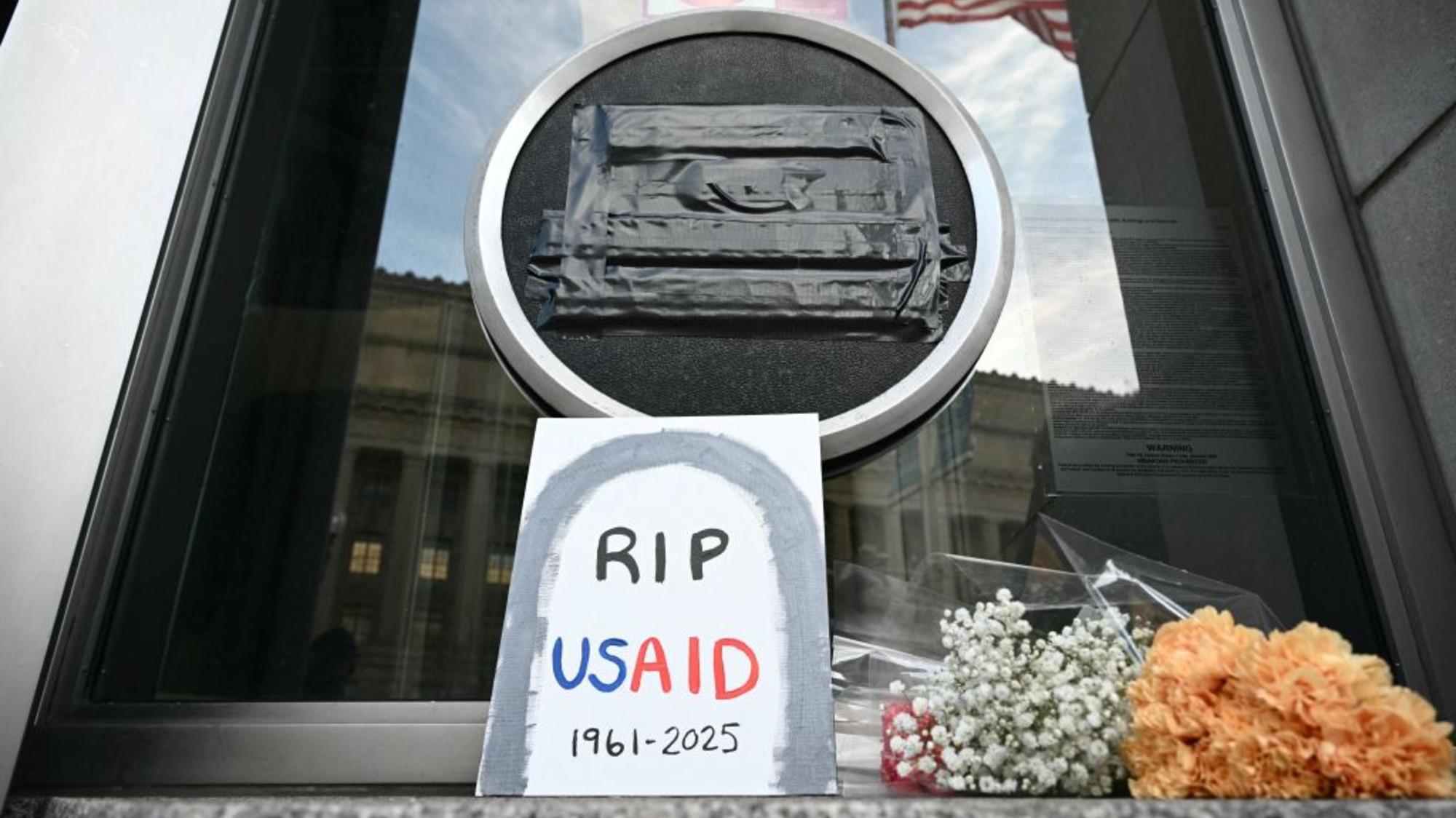
A trash bag is covering the USAID sign at the agency's DC headquarters. A poster in front says "RIP USAID."

Tributes are placed beneath the covered seal of USAID at their headquarters in Washington, DC, on February 7, 2025. US President Donald Trump on February 7, 2025 called for USAID to be shuttered, escalating his unprecedented campaign to dismantle the humanitarian agency. Photo by Mandel Ngan/AFP via Getty Images

DOGE has created a corner of government in which simple things don’t work. Several employees said they had scrambled to put in reimbursement requests before they lost access to the system—but their requests could not be processed because the people whose job it was to approve them were already on administrative leave. In one African country, housing for American workers abroad is running on a generator because funds haven’t come through to pay utilities. One employee in DC told Mother Jones she was locked out of her email without ever being informed she was on leave; even HR couldn’t say for sure what was happening.

The team from Kinshasa was stuck in a particularly cruel loop. Even as the State Department advised US citizens to “safely depart while commercial options are available,” USAID employees received guidance from Washington that in order to ensure compliance with the administration’s new spending dictates, the acting administrator would need to approve a waiver to cover the costs of their evacuation, according to an affidavit filed in federal court on Tuesday; by the time the waiver was approved, “the evacuation had already begun.” Upon arrival in the US, evacuees were instructed to find temporary housing in the DC area, in order to comply with a Trump order mandating that employees work at the office—but their office was closed, and they were about to be put on leave. All the while, they have been paying out of pocket for lodging the government is supposed to foot the bill for.

Staff in other foreign postings, many with pets or small kids, were kept in suspense for days, with no guidance about whether and how they would be asked to relocate if they were placed on leave, and what they might bring. While Rubio had said, prior to the injunction, that the agency’s recall would work to accommodate overseas staffers with extenuating circumstances, the disruptions have already hit workers hard. In an affidavit filed as part of a lawsuit challenging the purge, a pregnant foreign service officer in her third trimester identified as “Beth Doe” explained that the new directives forced her to find a new hospital in a different city, and “left us searching for high schools that will admit our children.”

The threats from the new administration instilled a fear bordering on paranoia. It felt like “psychological warfare,” said one person. Employees described a never-ending campaign of harassing emails, sometimes sent in the middle of the night, asking them to quit. “It’s just like Retire! Retire! Retire! Do this!,” said a USAID staffer who works on food assistance programs. “Oh you missed the ‘Fork in the Road’ email? Well, now we updated it with FAQs that don’t make sense!” When the staffer who was placed on leave without notification finally returned to work, she discovered the “Fork in the Road” emails had kept coming, even while she’d been locked out of the account.

The chaos has been just as debilitating for the work itself.At USAID, the people breaking stuff don’t seem to understand how and what they’re breaking. Take the “stop-work” orders. In aid and development work, staffers emphasize, you can’t just bring a program to an immediate halt; it has to be wound down, and in such a way that it can eventually be restarted at the end of the review period. For both legal and ethical reasons, partners have to be paid and services might have to be maintained. If you are transporting food or medication, it has to go somewhere. At the same time, a USAID employee who had been working at a mission in Africa said, staffers were given contradictory instructions to “not incur any cost whatsoever.”

“There was mass confusion about this in my office, in my bureau, across the agency, about what those guidelines and restrictions were,” another official said. “That also included things like, ‘Okay, so you’re telling us we have a stop work order, but does that mean that partners should fire all staff to help us implement these programs? Or is it just a pause?’”

DOGEhas pushed hard to end programs outright. At least 350 USAID programs have been cancelled permanently, says a USAID worker who has seen the lists. The staffer adds that managers were never given a chance to justify their programs’ existence. Some colleagues questioned whether DOGE simply did a keyword search for terms Musk doesn’t like—a tactic the administration has deployed at other federal agencies. “No one knows what the rhyme or reason is,” the staffer says about the canceled programs.

“I really think they think we just fly around in helicopters dropping packages on villages in the jungle.”

While their marching orders were perplexing, staffers did their best to follow them. “An analogy I’ve heard a few times is nobody wanted to be the tallest blade of grass,” one employee in Washington, DC, said. “Everyone was trying to lay low, thinking, ‘Okay, if we actually go through this review process, and this is in earnest, maybe we can get back online.’ And I think it’s very clear a lot of that was a farce. There is no review process.”

The consequences on the ground from all this chaos have been profound. The New York Times reported last week that children receiving experimental malaria vaccinations were no longer being monitored for adverse side effects. Millions of dollars of agricultural products have been wasting away in bins, and bednets for malaria prevention have been in limbo, presumably stuck in a warehouse somewhere.

Rubio has insisted that USAID’s work will go on, and has announced that he’s granting waivers for food aid and health programs such as PEPFAR, the George W. Bush-era program that has saved millions of lives by supporting HIV prevention and treatment programs. So far those have mostly been empty promises. One problem, agency insiders explained, was that there was a cumbersome process to obtain a waiver, and many of the links in that chain were now missing. Even if a waiver was approved, the work on the ground had to be restarted. In Sudan, where hundreds of thousands of citizens rely on assistance, aid was cut off for weeks, before a pause on World Food Program aid was lifted on Sunday.

To the extent that the Trump administration eventually allows more USAID operations to resume, there will be immense costs. People have to be re-hired. Programs have to be re-started. Supplies have to be repurchased. Relationships have to be repaired.

“Everything that’s happening at the top fundamentally misapprehends how any of this works,” said the staffer who was evacuated from the DRC. “I really think they think we just fly around in helicopters dropping packages on villages in the jungle.”

Bureaucratic delays are deadly. In a lawsuit filed Tuesday, challenging the administration’s authority to pause and redirect congressionally approved funding, eight contractors and nonprofits alleged that $150 million worth of medical supplies were awaiting shipment, and $89 million more health products were already in transit to USAID sites that can’t distribute them. Without logistical support, medications risk expiration, damage, and theft. The complaint stated that “[n]ot delivering these health commodities on time could potentially lead to as many as 566,000 deaths from HIV/AIDS, malaria, and unmet reproductive health needs, including 215,000 pediatric deaths.”

USAID contractor Democracy International had to stop providing medical care to hundreds of children in Bangladesh who were seriously injured in protests last year, according to Tuesday’s lawsuit. Human rights workers that track the persecution of Christians in Burkina Faso face increased risk of violence because Democracy International can no longer provide them food and shelter.

Some contractors whose work involved planning for PEPFAR’s supply chain lost their jobs weeks ago. Instead of working on one of the government’s flagship public health programs, one worker spent nine hours last week at the dentist—scrambling to get any necessary work done before their benefits expired.

It’s not just USAID on the chopping block. An entire line of work is at risk. The government effectively backstops the global development sector, comprising roughly 40 percent of all funding. Now it’s backing out of those commitments, while trying to lay off thousands of people who work in these fields. The administration has “destroyed basically the entire development industry,” as one staffer put it. By refusing to pay outstanding invoices—dating as far back as November—the government is already forcing some companies to shutter operations.

The global development company Chemonics had to furlough 600 employees as it awaits payment on $104 million worth of unpaid invoices from 2024, according to court filings.

“We’re one of the few that have been able to hang on this long,” said the former USAID employee, whose firm was expecting to furlough staff this week because the contractor can no longer make payroll. “The US government is not paying its bills just because some people arbitrarily decided they didn’t want to.”

Like late fees on cable bills, the US government’s nonpayment to contractors will likely lead to higher expenses down the road. “Class action from NGOs, from implementing partners, from staff, from people who have not gotten paid by the government—that is all going to cost massive amounts of taxpayer money,” a current USAID staffer said.

“The 60 years of goodwill that USAID has built around the world is gone. We no longer have that in two and a half weeks.”

Musk and his allies haven’t just blown up existing programs. They have poisoned the well for future ones. By spreading conspiracies about what USAID does, staffers believe the new administration undermined the country’s capacity for development projects for the foreseeable future, and undermined the national-security goals of their work.

USAID isn’t just a charity. It is the government’s mechanism for establishing symbiotic partnerships with nations that can later help us. “The nature of our work was to seek winning situations for both countries,” says one of the many laid-off USAID workers. “It’s through that sort of win-win relationship building that we gain real allyship with countries in the face of national security risks.”

It took decades to build up enough trust with partner countries before their citizens were open to accepting, for example, vaccines for their children.

“The 60 years of goodwill that USAID has built around the world is gone,” said one foreign service officer. “We no longer have that in two and a half weeks.”

In the meantime, USAID employees who are not on leave are still without a place to work. The few dozen employees who showed up at the Ronald Reagan Building in downtown Washington on Monday were turned away by security. USAID didn’t have a lease there anymore, they were informed. Black plastic bags had been draped over agency signage, and the windows inside had been papered over.

The space “will be repurposed for other government needs,” a Government Services Agency spokesperson told Mother Jones, but declined to say what might take its place. But USAID staffers who stuck around on Monday discovered a prospective new tenant was already eyeing the complex. It was an agency better suited to the administration’s relationship with the rest of the world: Customs and Border Protection.

Continue Reading…

Mother Jones

Foreign Money, Alleged Lies, and Extremism—What GOP Senators Voting for Kash Patel Ignored

Republicans on the Senate Judiciary Committee voted on Thursday morning to approve the nomination of Kash Patel to be FBI director, despite a host of issues that once would have sunk any nominee for this critical national security and law enforcement post. These include Patel’s reported role in a planned political purge of FBI agents and his apparent lies to the committee regarding that and other matters. And there’s much more. Patel has received payments from sources linked to Russia, China, Qatar, and other foreign interests that he has not explained, or, in one case, divested from. He has embraced false and dangerous conspiracy theories, including falsehoods about the 2020 election. He has endorsed using government power to seek revenge against his and Donald Trump’s political enemies. He has even seemingly encouraged violence against Trump critics.

Republicans don’t seem to care about any of this. In fact, they appear eager to confirm Patel before more damaging information about him emerges. Here is a rundown of some of the matters these Republicans are ignoring.

The purge

On January 30, the same day Patel appeared before the Senate Judiciary Committee for his confirmation hearing, news broke that Trump administration officials had ordered the firing of multiple senior FBI executives. The next day, reports emerged that Trump appointees were compiling a list of thousands of FBI agents who had worked on January 6 cases, with the possible aim of firing them.

Patel told the Judiciary Committee—under oath—that he was not involved in personnel issues nor in touch with the White House about any such decisions. He further claimed he would protect FBI officials from political retribution for past work.

But on Tuesday, Sen. Dick Durbin (Ill.), the Judiciary Committee’s top Democrat, accused Patel of lying about this. In a letter to the Justice Department’s inspector general, Durbin said he had learned from “multiple sources that Kash Patel has been personally directing the ongoing purge of career civil servants” at the FBI. In that letter and during a Senate floor speech, Durbin said whistleblowers told him that Acting Deputy Attorney General Emil Bove, a former personal lawyer for Trump, told top FBI officials in a January 29 meeting that Patel wanted the bureau to remove targeted employees quickly. “KP wants movement at FBI,” a person at the meeting wrote in notes that Durbin said he reviewed.

Durbin also said his sources reported that Patel, as he has awaited confirmation, has been receiving information from an advisory team at the FBI and then passing on instructions to White House Deputy Chief of Staff Stephen Miller, “who relays it to” Bove.

Sen. Chuck Grassley (R-Iowa), the chair of the Judiciary Committee, dismissed Durbin’s new charges as “hearsay.” He expressed no interest in gathering more information and rejected Democrats’ call for a second confirmation hearing where they could ask Patel directly about the firings of FBI officials.

Responding to Durbin’s letter and floor speech, a Patel spokesperson said, “The media is relying on anonymous sources and secondhand gossip to push a false narrative.” That was not a clear denial. When Mother Jones asked if Patel communicated with Miller about firing FBI personnel, neither Patel nor his spokesperson responded.

Possible perjury

During Patel’s confirmation hearing, Sen. Cory Booker (D-NJ) asked, “Are you aware of any plans or discussions to punish in any way, including termination, FBI agents or personnel associated with Trump investigations?” Patel said he was “not aware of that” and added: “I don’t know what’s going on right now over there.”

Patel made similar claims in written responses to questions that six Democratic senators sent to him after the hearing. Each of these senators submitted queries regarding whether Patel knew of plans to oust senior FBI officials and whether he was involved in that effort. He repeatedly answered that he could not recall any such conversations and claimed he was not involved in these decisions.

“Did you approve or have any role in the decision to terminate these senior FBI employees?” Sen. Alex Padilla (D-Calif.) asked. “No,” Patel responded.

Those replies, if Durbin is correct, were lies. But Grassley and other Republicans are unwilling to confront Patel about this possible perjury.

Other possible lies

Asked during his testimony about his promotion of a recording of a song performed by the so-called J6 Prison Choir, which was comprised of inmates at a DC jail who faced assorted charges for their participation in the January 6 insurrection, Patel said he was “not aware” that this group was composed of imprisoned rioters.He also testified that he “didn’t have anything to do with the recording.” In fact, Patel personally released the song on Steve Bannon’s War Room show,and told Bannon that he had overseen the song’s recording and mastering. And he hailed the J6 rioters as “political prisoners.”

Patel has insisted that the money he raised from the recording went to the families of January 6 prisoners who were not convicted of any violent offenses. In his written responses, he claimed “the financial details” on his use of the funds were in his organization’s public disclosures. That’s not true. Patel’s nonprofit, the Kash Foundation, says in an IRS filing that it gave “direct cash assistance” totaling $167,821 to 50 people, but it does not identify them. That leaves Patel’s claim that he did not support families of violent attackers impossible to verify.

Patel also said under oath that he was not familiar with Stew Peters, a far-right and antisemitic podcaster known for spreading false claims about Covid. Patel, however, has appeared at least eight times on Peters’ podcast. Following the hearing, Peters declared: “Clearly Kash Patel is lying.”

Ties to Russian propagandist

As Mother Jones first reported, Patel last year was paid $25,000 to appear in an anti-FBI documentary produced by a Ukrainian-American-Russian filmmaker with Kremlin ties. That filmmaker, Igor Lopatonok, worked on an overt Russian propaganda campaign funded by Vladimir Putin’s office, and in 2019 he produced a pro-Putin film partly financed by an Ukrainian oligarch and pro-Kremlin politician who had been sanctioned by the United States since 2014. Lopatonok also worked with an American who obtained political asylum in Russia and who has mounted extensive disinformation operations against the United States.

Patel declared in the documentary that the Russians had not intervened in the 2016 election—despite multiple investigations confirming they did so to assist Trump—and Patel said that he hoped to “shut down the FBI headquarters building and open it up as a museum of the “Deep State.” Patel later said that remark was “hyperbole.” He has not explained whether he knew of the filmmaker’s background as a Russian propagandist.

Foreign ties

In the financial disclosure form Patel submitted to the Senate, he revealed that he was paid an unspecified amount in 2024 for “consulting services” for Qatar. That raised the question of why Patel did not register with the Justice Department as a foreign agent. Patel has not addressed that subject. But a “source close to Patel’s confirmation” told the far-right Federalist that “his work for Qatar was limited to securing the 2022 FIFA World Cup and other security measures” and that this did not require him to register as foreign agent.

The problem with that explanation is that Patel reported working for Qatar until November 2024. That was two years after the World Cup took place there. And it includes the time Patel spent working as a surrogate for Trump’s most recent presidential campaign. Patel’s disclosure form notes that he was paid by the Qatari embassy in Washington, which runs the Gulf state’s US lobbying efforts, not Qatar’s Supreme Committee for Delivery & Legacy, which organized the nation’s World Cup effort and related programs. Spokespersons for Patel, the Supreme Committee, and the Qatari embassy did not answer questions regarding the details of Patel’s work for Qatar.

Patel’s financial disclosure report also revealed he worked for the Czechoslovak Group, a Prague-based arms company, as it was buying Vista Outdoor, a US company that owns assorted ammunition brands, including Remington. Senate Republicans previously argued that the Vista Outdoor purchase was a threat to national security. But none have publicly asked Patel to explain what he did for the Czechoslovak firm.

Patel also disclosed that he was given between $1 million and $5 million worth of unvested stock in Elite Depot Ltd. for consulting work he did not explain. Elite Deport is the Cayman Islands-based parent company of Shein, a Chinese fashion company. Patel has declined to divest his stake in the company—even as he prepares to oversee FBI counterintelligence operations against China. After Trump slapped a 10 percent tariff on Chinese imports, including Shein’s, Patel’s stake in the company means he has a personal interest aligned with Chinese business interests.

In a letter sent to Patel on Wednesday, five Democrats on the committee noted Shein has faced “criticism for its use of forced labor in China, including persecuted ethnic minorities and children.”

“Continuing to profit from forced labor by refusing to divest your financial interest in this company,” they wrote, “demonstrates a callous disregard for forced labor victims and calls into question your judgment and ability to impartially lead the FBI’s efforts to combat the scourge of human trafficking and the PRC’s foreign influence activities.”

A few years ago GOP senators aggressively opposed some Biden administration nominees for perceived links to, or past work for, Chinese businesses. But no Republicans have publicly pressed Patel about his plan to retain an interest in a Chinese manufacturer.

QAnon

Patel has pushed far-right conspiracy theories, including the lie that the 2020 election was stolen from Trump; the baseless claim that the January 6 riot was instigated by the FBI; and the false notion that there was no Russian effort to help Trump win the 2016 election. But perhaps his looniest far-right flirtation has been his past support for QAnon, the movement that holds that a cabal of global, Satanic, cannibalistic elitists and pedophiles—which includes Democratic politicians, Hollywood celebrities, and business tycoons—has been operating a child sex trafficking operation as it vies for world domination, with Trump secretly battling against them. And QAnon is not just a kooky theory; it has sparked multiple acts of violence.

Patel repeatedly has hailed QAnoners and promoted their unhinged narrative. On social media, he amplified QAnon messaging. He has been a guest on numerous QAnon-supporting shows to promote Trump’s Truth Social platform. On one show, Patel declared, “Whether it’s the Qs of the world, who I agree with some of what he does and I disagree with some of what he does, if it allows people to gather and focus on the truth and the facts, I’m all for it.” On another occasion, he agreed with a host who said Q had “been so right on so many things.” Patel chimed in: “There’s a lot of good to a lot of it.”

When Democratic senators inquired about those comments, Patel insisted his remarks were “taken out of context.” He asserted, “I do not support or promote QAnon.” His past comments show he did precisely that.

Retribution and violence

Patel has long portrayed himself as an avenging angel for Trump who has battled the supposed Deep State on Trump’s behalf. Appearing on Bannon’s podcast in 2023, he proclaimed, “We will go and find the conspirators—not just in government, but in the media. Yes, we’re going to come after the people in the media who lied about American citizens to help Joe Biden rig presidential elections. We’re going to come after you, whether its criminally or civilly.”

In his 2023 book Government Gangsters, Patel called for mounting “investigations” to “take on the Deep State.” In an appendix, Patel presented a list of 60 supposed members of the Deep State who were current or former executive branch officials and who presumably would be targeted. Patel listed names that would be the obvious purported cabalists for a MAGA activist, including Joe Biden, Kamala Harris, Merrick Garland, Hillary Clinton, former CIA chief John Brennan, and former chair of the Joint Chiefs of Staff Mark Milley. This line-up also included a number of Republicans and onetime Trump appointees: Bill Barr, who served as attorney general for Trump; John Bolton, one of Trump’s national security advisers during his first White House stint; and Mark Esper, a secretary of defense under Trump.

This roster has been characterized as Patel’s “enemies list” of people he might target for investigation or prosecution should he become FBI chief. During his confirmation hearing, Patel denied he had any intention of seeking revenge against Trump’s political foes. He referred to this list as merely a “glossary.”

When Senate Democrats challenged him on this characterization in written questions—noting he had told Bannon that “Deep Staters” would “be held accountable and prosecuted, criminal prosecutions” during a second Trump presidency—Patel sidestepped. “This language is taken out of context and does not accurately or fully represent my prior statements or positions,” he wrote. No Republican Senator has publicly expressed concern over Patel’s demonstrated desire to use government power to extract revenge.

One of the most absurd moments of the hearing came when Patel was questioned about a 2022 social media post he had amplified that showed an AI-generated video of him using a chainsaw to attack various Trump critics, including former Rep. Liz Cheney, Sen. Adam Schiff, and Anthony Fauci. He claimed this meme had been taken out of context—it hadn’t—and pointed out that he had not created it, as if that were mitigating. Asked about this meme in the written questions, Patel replied that he had reposted the “meme in question as a private citizen.” He added, “It was clearly intended as humor. A chainsaw as a symbol of government reform is not unusual.” He also stated that “reposting an individual’s perspective on a specific issue does not constitute my endorsement of how their views or other positions may be interpreted.”

Here was a nominee to be FBI director both justifying and downplaying his dissemination of a meme that could be read as encouraging violence against his political enemies, including Schiff, who sits on the Senate Judiciary Committee overseeing his nomination. It was just one more troubling thing for Senate Republicans to ignore.

Continue Reading…

Mother Jones

House Republicans Aim to Gut Spending and Cut Taxes (Mainly for the Rich) by $4.5 Trillion

The budget resolution released Wednesday by the House Republican caucus contains no concrete details, but it codifies a GOP strategy that should surprise absolutely no one.

In parallel with the mayhem playing out in the Executive Branch, the House lawmakers aim to gut agencies Donald Trump disfavors, boost spending for those that align with his agenda, renew and extend the 2017 tax cuts that enriched America’s most affluent—his latest proposals all told, by one estimate, would raise taxes on all but the top 5 percent. They also pay lip service to the deficit even as their proposals will increase it significantly, perhaps as a way to build political consensus for cuts to programs like Social Security and Medicare.

Specifically, the new resolution directs each House committee to submit recommendations, by March 25, to either cut or increase federal spending under its jurisdiction. The figures below cover the 10-year period from 2025 to 2034.

Cuts (“not less than…”)
Agriculture: $230 billion
Education and Workforce: $330 billion
Energy and Commerce: $880 billion
Financial Services: $1 billion
Natural Resources: $1 billion
Oversight and Government Reform: $50 billion
Transportation and Infrastructure: $10 billion

Total cuts: $1.5 trillion

Increases (“not more than…”)
Armed Services: $100 billion
Homeland Security: $90 billion
Judiciary: $110 billion

And the doozy: Ways and Means, the committee responsible for tax policy, “shall submit changes in laws within its jurisdiction that increase the deficit by not more than $4,500,000,000,000.”

That’s an invitation for a net $4.5 trillion in tax cuts.

Total increases: $4.8 trillion

If the total cuts from the group above don’t reach $2 trillion, the document states, the difference will come out of Ways and Means’ $4.5 trillion allowance. That would leave us with almost $3 trillion in deficit spending. But at least the rich will get their tax breaks, right?

The resolution also asks Ways and Means to request a $4 trillion increase in the debt limit.

In the past, House Republicans have talked a good game on balanced budgets. This would be anything but. Tellingly, their resolution makes a show of lamenting the growing federal debt, which “poses a significant risk to the country’s long-term fiscal sustainability, with implications for future generations.” The document points to the mandatory spending that accounts for more than 70 percent of the budget, noting that it has increased by 59 percent since 2019.

And yes, the growing debt is a problem, especially when interest rates are higher, which makes servicing payments expensive,but there are ways to narrow the deficit that the Republicans, along with Elon Musk and his DOGE bros, have largely ignored.

Indeed, the gripes about mandatory federal spending, especially in this context, sound like a pre-justification for cutting from the three biggest areas of mandatory spending: Social Security, Medicare, and Medicaid.

Republicans have already targeted Medicaid, the national health insurance program for the poor, by proposing work requirements—which evidence shows are little more than a cruel tactic to purge people from the rolls. Going after Social Security and Medicare would be messing with America’s seniors, who are relatively wealthy and politically engaged, driving up their health care costs.

Historically, the latter two have been political third rails, “but with this group, I kind of never know anymore,” says a Democratic aide who works with the House Ways and Means Commitee. “They’re already talking about doing things on Social Security and Medicare in a way that I never would have thought they would be talking about, but it’s definitely in the ether.”

Continue Reading…

Mother Jones

Sen. Elizabeth Warren’s Two-Word Plan to Save the CFPB From Elon Musk

Following the 2008 global financial crisis, the Consumer Financial Protection Bureau (CFPB) was established by Congress to reign in the subprime lending schemes and other bad practices that spurred the market implosion. Now, President Donald Trump, Elon Musk, and Russ Vought—who was confirmed as director of the Office of Management and Budget but also appointed by Trump as the acting head of CFPB—are attempting to dismember the financial watchdog.

Wired reported that dozens of CFPB employees were fired with generic emails Tuesday night and that DOGE’s assessment of CFPB’s internal systems is well underway. The remaining employees have been directed to cease all “enforcement actions.”

“RIP CFPB,” Musk posted on X last week, alongside a tombstone emoji.

Even before being elected as senator from Massachusetts, while she was still a Harvard Law School professor, Elizabeth Warren pitched the idea of the financial-protection bureau. Since its inception, the CFPB has enforced the accuracy of credit scores, penalized banks for junk fees, and restricted credit reporting agencies from including medical debt on credit reports, among other things. Warren’s advocacy of the enforcement agency helped her ascend in national politics to the Senate seat in 2012 that she now holds.

Amid a deluge of Wednesday reports about CFPB firings, I reached out to Sen. Warrenabout the stakes of the new administration’s dismantling of CFPB, their motivation, and what can be done to save it.

This interview has been lightly edited for length and clarity.

What prompted you to pitch the creation of a Consumer Financial Protection Bureau?

We had plenty of consumer protection laws, but nobody to enforce them, and the consequence was that more lenders figured out how to cheat people. They ultimately triggered a financial crash and a meltdown that cost 10 million families their homes, and millions of people lost their savings and their jobs. The CFPB is the cop on the beat to make sure that giant banks and sleazy fly-by-night lenders
don’t cheat American families.

“The CFPB is the cop on the beat to make sure that giant banks and sleazy fly-by-night lenders
don’t cheat American families.”

Can you tell me about the CFPB’s successes?

This little agency has uncovered more than $21 billion in scams that big banks and other lenders have used to cheat American families, and when it found those scams, it made those banks return the money directly to the people they cheated. That has put $21 billion back into the pockets of American families. In addition to that, it has handled more than 6 million complaints and given consumers who’ve been tricked on a car loan or cheated on by a credit card companysomeone on their side to help them get their money back. This little agency has proven that we can make government work, not just for the rich and powerful, but we can make it work for all people.

Who benefits from DOGE’s attempt to destroy the CFPB?

Giant banks hated this agency from the first time I ever talked about it, and the reason is pretty straightforward: it bites into the profits they would make from cheating people. So getting rid of it looks like another profit opportunity for them. But there’s another reason that Republicans in particular have fought against the CFPB: It’s living proof that we can make government work. They want to make the argument every day that thegovernment is bad, and if it just goes away, the whole country will run better. The CFPB shows we can put thegovernment on the side of people and it can help level the playing field so that people can build some real economic security.

What do you think is motivating Musk and Trump to prioritize dismantling it?

One possibility is that they’re looking for a way to distract Americans from their real plans, which arenot what they promised, [which was] cutting costs for American families. Instead, [they are] trying to ram through a big bill that would cut taxes for billionaires.

Musk has lost money hand over fist on X. So he has this idea of X [becoming] a big money platform where he would get everyone’s personal financial data. He faces one obstacle: the CFPB—the financial cops that make sure that he’s not cheating people and that he’s not sucking up their personal data that he’s not legally entitled to. He is moving to get the CFPB out of the way just before he launches his money platform. It’s a little like a bank robber managing to fire the cops just before he strolls into the lobby of the institution.

What recourse will working-class Americans have if lenders mistreat them and CFPB is gone?

Yesterday, the head of the Federal Reserve said [that] without the CFPB cops on the beat, there is no one making sure these scammers follow the law. That’s pretty scary. What Musk has done is illegal. The CFPB was created by Congress, and Congress—not Elon Musk, not Donald Trump—is the only one that can shut it down.

While running for president in 2020, you were known as the I-have-a-plan-for-that candidate. I’m curious if you have any plans to help save the CFPB now?

Yes, I have a plan, and it’s already the law. The CFPB cannot be shut down by Elon Musk, so we’re in the courts to make sure that Elon Musk and Donald Trump follow the law. The CFPB is still the law. It’s still funded. It’s still ready to go. Donald Trump and Elon Musk are illegally blocking it, and they need to get out of the way. The courts will enforce the law.

Continue Reading…

Mother Jones

How Trump and Musk’s War on Government Will Lead to More Abortions

In 2023, during a speech at a Washington, DC, gala for the far-right Faith & Freedom Coalition, Donald Trump declared that he was proud to be “the most pro-life president” in US history. Yet with the war on the federal government that he and his billionaire sidekick Elon Musk are now waging, one probable result will likely not please his conservative Christian allies: an increase in the number of abortions, perhaps by over 1 million.

The first target of the Trump-Musk crusade has been the US Agency for International Development, the federal agency that distributes foreign aid through programs that help millions of people defend against deadly diseases (such as malaria, AIDS, tuberculosis, Covid, and ebola), obtain clean water, gain access to health care, bolster democratic institutions, and build more productive local economies. Of its $23.4 billion budget for 2024, the agency earmarked $2.2 billion for health initiatives. About one-quarter of that was to be spent on clean-water programs. Two-hundred-and-forty-seven million dollars was committed to maternal and child health. Programs for family planning and reproductive health received $191 million. (Including other government programs, Congress in recent years has annually appropriated about $600 million in total for overseas family planning.)

President Trump’s executive order freezing most US foreign aid for 90 days has led to chaos within USAID and around the world, causing the suspension of programs that conduct clinical trials, provide food assistance, and aid war refugees. For some bizarre reason, Musk has venomously attacked USAID, spreading a baseless and vicious conspiracy theory that it is a diabolical and corrupt outfit covertly financing the media, Democrats, academia, and assorted components of the left in the United States. He has, of course, provided no evidence of this bunk, and boasted of “feeding U.S.A.I.D. into the wood chipper.”

The Trump administration also proclaimed it wants to gut the agency’s staff from about 10,000 to a few hundred. Last week, a federal judge temporarily blocked pieces of the Trump-Musk plan to shutter most of the agency, but the stop-work order regarding its programs and all foreign aid remained.

With everything else, family planning and reproductive health programs were halted. In one instance, a health clinic in Vulindlela, South Africa, called in women who were participating in the testing of a new device to prevent pregnancy and HIV infection. The USAID-funded program had lost its financial support and now had to remove the device, a silicone ring inserted into a vagina, from all the women in the program.

Since the 1973 passage of the Helms Amendment—named after ultra-right Sen. Jesse Helms of North Carolina—US foreign aid cannot be used to fund abortion. Instead, the United States has focused on supporting contraceptive services overseas that decrease unintended pregnancies, as well as abortions, which are unsafe in many regions.

According to the Guttmacher Institute, a research outfit that studies reproductive health issues, Trump’s stop-work order will over three months deny 11.7 million women and girls in low- and middle-income countries contraceptive care and lead to a rise in unintended pregnancies and abortions. “Of the estimated 4.2 million unintended pregnancies, there would be 1.3 million unsafe abortions,” the group estimates in a statement provided to Mother Jones. Guttmacher focuses on unsafe abortions—which include those performed using a non-recommended method or by an untrained provider—not all abortions. The total number of abortions will be higher than the 1.3 million figure.

Here’s one example of the freeze’s impact. Ben Bellows, a former researcher at the Population Council, runs a company called Nivi Inc. It had a six-figure contract for a program to help about 300,000 women in India receive reproductive health care information, digital counseling, and referrals to nearby pharmacies and clinics. With the loss of USAID funding, he says, “projects like ours are closing. He adds, “Fewer contraceptive options mean women stay on a method they don’t like but can’t quit or don’t take up any protection against unintended pregnancy. The end of our project and others like it will lead to more unintended pregnancies and more abortions.”

So far, there have been no big howls from the anti-abortion movement about the Trump-Musk assault on USAID and foreign aid and the resulting rise in abortions. This week, the website of the Susan B. Anthony Pro-Life America has featured multiple posts praising Trump for anti-abortion measures he has taken since returning to the White House. There was no mention of the USAID shutdown. Ditto for the National Right to Life Committee.

Four anti-abortion advocates did write a piece for the New York Times criticizing Trump’s foreign aid freeze for halting the work of the President’s Emergency Plan for AIDS Relief, a multibillion-dollar global health initiative known as PEPFAR started under President George W. Bush, which funds HIV/AIDS prevention and treatment in Africa. It has saved an estimated 25 million lives and prevented mother-to-child transmission of the virus, allowing nearly eight million babies to be born free of the disease. They did not address the cut-off in family-planning assistance.

At his recent confirmation hearings, Robert F. Kennedy Jr., the anti-vaxxer and conspiracy theory-monger whom Trump has tapped to lead the Department of Health and Human Services, said over and over that Trump considers every abortion “a tragedy.” By this measure, Trump and Musk, with their assault on USAID and foreign aid, will generate more than a million new tragedies.

Continue Reading…

Mother Jones

Waste.Gov is Literal Garbage

Amid their energetic vandalism spree across the federal government, the White House and Elon Musk’s DOGE team have focused special and virulent attention on the ideas that “waste” must be curbed, and that diversity, equity, inclusion, and accessibility efforts must be eliminated.

As Reuters reported earlier this month, on February 4, the White House registered two new .gov websites, dei.gov and waste.gov, likely meant to boast progress in achieving these goals. But now, a full week later, dei.gov only redirects to waste.gov—which displays an empty WordPress template theme advertising a fake architecture firm.

A screenshot of Waste.gov as it appears on Feb 12, 2025.

A screenshot of Waste.gov on February 12.

Reuters’ Raphael Satter was the first to report the sites’ registration, which were first spotted by Alexander Urbelis, an attorney who monitors the Domain Name System, a key piece of internet infrastructure. The government’s domain lookup system shows both sites were created on February 4 by the Cybersecurity and Infrastructure Security Agency, a division of the Department of Homeland Security.

Waste.gov is, per a tagline on the bottom of the page, dedicated to “Tracking government waste.” At the moment, however, Waste.gov is itself total trash. Apart from the tagline, it shows no other signs of having been edited, and still appears at first glance to be a website for an entirely fake “pioneering firm” called Études.

While this might be confusing for Americans looking for information on how tax dollars are purportedly being spent to reduce waste, it’s probably more confusing for companies actually called Études, which include a Belgian architecture firm and a Parisian fashion brand.

Another note at the bottom of the page shows that the site was designed with WordPress, but it’s unclear whether the site complies with federally mandated web design standards, or will in the future. Among other things, those standards are meant to ensure that sites are accessible to people with disabilities, clearly describe the government agency or product they’re representing, and are usable on mobile devices.

The White House didn’t immediately respond to a request for comment, nor did DOGE spokesperson Katie Miller.

On Tuesday, while speaking to reporters in the Oval Office, Musk claimed he was working “to be as transparent as possible,” including by posting a record of DOGE’s actions to its website. But the DOGE website also remains almost completely blank, apart from the name of the agency, a note that it is an official government website, and one sentence: “The people voted for major reform.”

Continue Reading…

Mother Jones

Elon Musk’s Dystopian Attacks on Federal Workplaces are Also “Incredibly Stupid”

As the United States Agency for International Development remains paralyzed after the Trump administration and Elon Musk’s attempts to murder it, employees cannot access the Ronald Reagan Building in Washington D.C., where the agency was located until earlier this month. The building, a USAID employee tells Mother Jones, is also the only place where they could receive and read classified cables. With their offices now inaccessible, they say, so too are whatever urgent communications that may be piling up behind locked doors and building security.

DOGE’s plans have reportedly been designed to “depress workforce morale and increase attrition.”

“We literally can’t get that info now,” the worker says—let alone get into the building. So, as court battles play out in the wake of a temporary injunction pausing USAID’s dismantling, the agency’s remaining employees have almost nothing they’re physically able to do.

It’s a example of how, in the grander process of trying to reshape the federal government to their liking, Trump, Elon Musk, and his Department of Government Efficiency team have quickly reached a far more achievable goal: making the working lives of federal employees infinitely worse, and thereby suspending crucial functions at their agencies.

At the General Services Administration, where very young DOGE employees installed by Musk have moved in bed pods and taken up long-term residence, an employee dryly tells Mother Jones that “Musk takes on such a new meaning.” (Interestingly, office “sleep pods” are explicitly prohibited under GSA regulations.)

At the same time, GSA employees can no longer access its headquarters by simply presenting their badges, as they have for years. Instead, the employee reports, they are to go through a magnetometer and send possessions through X-rays; with only one lane available, entry will likely be slowed to a crawl, deterring GSA employees from coming in. The GSA employee speculates the change serves two functions: limiting DOGE employees’ direct interactions with staff whose jobs they could help eliminate, while at the same time making it easier to eventually bar workers from the building entirely. “If I were to guess, it’s also to limit access to the building when they lock us out,” the GSA employee says.

At USAID, the worker there said, functions that should have resumed in light of a judicial injunction pausing the agency’s dismantling have not. “The staff are supposed to be reinstated, but some still can’t get into their email,” the worker says. “The rest of us can’t use most of the systems we work in and frankly have no work to do because of the Stop Work Orders. We’re getting paid but just sitting here. Our institutional support contractors are still furloughed. I don’t know if they are getting paid.”

The whole thing, they add, is “incredibly stupid. Every aspect of it.”

Long lines and shut do0rs are’t the only physical change taking place in federal buildings. At the Consumer Financial Protection Bureau, pride flags were removed along with signs that notified employees they could use whatever bathroom fit their gender identity. The bureau’s email system also removed the ability to display pronouns.

In some places, the transformation of office spaces to fit the Trump administration’s new anti-DEIA directives took on an element of farce. At an IRS office outside of D.C., “all the EEOC posters have been removed,” a worker there says, barring one display locked behind glass. “Apparently no one could find the key,” the worker says, “so the entire case was covered in white butcher paper with a sign saying not to tear or remove.”

While the whirlwind of changes have resulted in immaculately bleak visual metaphors, since sending out their first “Fork in the Road” email encouraging federal workers to quit their jobs Musk and DOGE have made it clear that their ultimate goal has been to inflict pain on federal workers. The Washington Post recently reported that officials familiar with DOGE’s plans say that office closures and bans on telework are meant to make workplaces unpleasant to reach and overcrowded so as “to depress workforce morale and increase attrition.”

While government workers and their unions have been fighting back, many federal employees, who are often motivated by a deep belief in their agencies’ missions, say they’re struggling.

“We’re all here for the impact,” the USAID worker said. “And being paid to sit at a laptop knowing I can’t do anything is worse than being fired.”

Continue Reading…

Mother Jones

“I Am Not Leaving My Patients”: What It’s Like to Treat Trans Kids Under Trump

On January 28, President Donald Trump signed an executive order attempting to sharply curtail access to gender-affirming care for transgender minors and 18-year-olds. The order has been decried and challenged by the ACLU and three Democratic state attorneys general; 15 others released a statement opposing Trump’s order. But even with the legality and ethics of the order in question, some hospitals are choosing to comply in advance.

Alex T. Dworak, a family medicine physician in Omaha, Nebraska, was stunned by the sheer scale of misinformation in the order. Dworak spends his days treating a variety of patients, including trans youth and adults—and what the order describes is as far from his everyday experience as it is from the expert consensus that such care is medically necessary and sometimes lifesaving. In addition to his seven years of standard medical training, Dworak opted to pursue more than 100 hours of continuing education from Harvard Medical School to better serve LGBTQ+ patients, and has led numerous panels on the topic.

Dworak emphasized how extensive the process to start gender-affirming care is—involving written consent by all of a young person’s legal guardians, and a letter of support by a therapist who has confirmed their diagnosis and ability to give informed assent, as well as the family’s.

Dworak explains that working with trans patients has made him a better doctor across the board. “My experience caring for trans youth has taught me a great deal about personalizing my care and not making assumptions,” he says, “It makes me even better at taking care of each patient as an individual.”

“When queer kids are involved, suddenly my professionalism, training, and dedication count for nothing.”

As a doctor who never skipped a day of work during COVID, and received praise for it, Dworak laments that “it remains extremely offensive to me that I am good enough to risk my life and save many lives” in his work on the front lines of the pandemic, “and yet when queer kids are involved, suddenly my professionalism, training, and dedication count for nothing.”

In an email conversation, Dworak set the record straight on some of the falsehoods in Trump’s executive order—and what it’s like to be a doctor for trans folks in the current climate.

This executive order is dense, so I’d like to unpack itphrase-by-phrase. Let’s start with “chemical and surgical mutilation.”

The terms used by the executive order are false. Transgender medical care uses the exact same medications used for non-trans adults and youth—and indeed, children. As far as surgeries, genital surgeries do not happen to trans children in my experience and would be outside the [previously existing] guidelines as well. The only surgery done on trans boys—which is still very rare—is top surgery or chest masculinization. The exact same surgery is done for cis boys—also rarely—with gynecomastia. There is no mention of these terms being applied to any children who are not trans for the exact same care; it is objectively discriminatory as well as sensationalist.

What does gender-affirming care actually involve?

Gender affirming care is personal, individualized and holistic care and actually happens for cis and trans people. For cis people, it involves health and nutrition counseling, defining and supporting individual health goals with the patient being in charge, hormone therapy with the hormone that suits and supports their gender identity (testosterone or estrogen) and lab monitoring, overall medical care in the case of deficiencies that can occur for a variety of reasons, as well as elective surgeries done with full informed consent for adults. These have beneficial physical and mental health effects.

It also involves treating people respectfully. It involves keeping an accurate anatomical inventory for age and body-part-appropriate cancer screening per expert consensus guidelines. It involves reproductive health and family planning as desired by each individual patient. It is interdisciplinary management with specialists and other health professionals as individually appropriate for the patient. Gender affirming care for trans people is exactly the same except that trans women also often choose testosterone suppression.

The order defines children as “individuals under 19 years of age.” Can you think of any medical reason for grouping 18-year-olds in with minors? Does that happen with any other care?

It is not clear to me why the order targets people under 19. My state of Nebraska treats 19 as the age of majority, but to my knowledge only four other states do so. Voting, military service, and other rights are nationally conferred at 18. If a person is mature enough to volunteer or be drafted for potentially deadly combat exposure, I do not know why medical care would be any different.

The order frequently uses the term “rapid-onset gender dysphoria,” a hypothesis that some adolescents experience gender dysphoria and identify as transgender due to social influences. As I understand, the research on this has been retracted. Is this correct? What else is there to understand about it?

Lead study author Lisa Littman conducted her research in a way so egregious that her paper was summarily retracted. Her assertions are not supported by more robust literature and do not comport with my clinical experience either. Her study was a questionnaire posted on anti-trans sites, soliciting the perceptions of parents who frequented those sites. This is both a selection bias and a basic error in that no input from the study population in question was obtained. Her site lists her as serving on the advisory board of Genspect, which is an SPLC-designated anti-LGBTQ hate group. For these reasons, I do not view her as a clinically neutral or trustworthy source of information.

The order also asserts that “Countless children soon regret that they have been mutilated.” In your own practice, have you seen many children experiencing such a feeling? What are the risks of detransition, and who detransitions?

Retransitions are uncommon in the literature in pediatric age groups specifically, and most often occurred before age 10 when they did happen, according to this study, which would be well before even reversible hormonal blockade would be indicated—and thus there would be zero bodily changes, making regret about one’s body from medical intervention impossible. The use of extreme, incorrect and misleading language associated with farm and industrial machinery accidents is again noted, and I believe it is intentional fearmongering.

The order also speaks several times about risks to fertility. What is the real risk to fertility for youth receiving gender-affirming care? How do clinicians work with youth and their families to preserve young people’s options to have children?

The focus on fertility treats people as valuable only insofar as they produce babies. This is a feature of right-wing European populist parties and also touted by American leaders on the right wing—and linked to efforts to ban abortion. In the care of transgender people, I always ask what each individual’s fertility and family goals are as I get to know them. I advise every patient considering gender-affirming hormone therapy of the effects on fertility and offer a trans-friendly expert OB-GYN and reproductive endocrinologist to them and their families by name. For youth presenting at the onset of puberty, I do additional counseling to highlight that not experiencing extensive natal puberty may impair future fertility compared to someone who starts gender-affirming hormone treatment later in puberty or adulthood, and have a nuanced discussion with the patient and their parents and/or guardians.

The order directs federal agencies to rescind guidance that relies on the World Professional Association of Transgender Healthcare‘s Standards of Care, which it characterizes as “junk science.”

The WPATH Standards are part of the extensive literature and guidelines I use in this care. WPATH standards are not “junk science.” They were carefully designed, refined from previous editions going back decades to the mid-20th century, and had interdisciplinary input from doctors, researchers, stakeholders and trans community members with an extensive revision process that is honest, community focused and intellectually sound.

The order directs the Secretary of Health and Human Services to publish a review on “existing literature on best practices for promoting the health of children who assert gender dysphoria, rapid-onset gender dysphoria, or other identity-based confusion.” A similar process happened in your state of Nebraska. What was the outcome? Do you have any concerns about this on a federal level?

I am extremely concerned about this process, given the overly partisan and hate-filled rhetoric of this administration. In Nebraska, a FOIA request led to my learning that problematic and overtly transphobic figures like Kenneth Zucker and Andre Van Mol were included on equal footing [in conducting the review] with trans people and clinicians that have earned and retained the trust of trans patients. [The Nebraska regulations] have a requirement for 40 hours of therapy prior to youth treatment—which has no foundation in the literature—and requires a seven-day waiting period. Otherwise, the [state] guidelines reflect my practice fairly closely, which I attribute to my speaking at length with the [state’s chief medical officer] about my clinic’s existing practices in the lead-up to Nebraska’s laws, and him listening to me.

Still, I believe we have great reason to be concerned, because the Trump administration has made extremely overtly hateful and erasing statements and picked uniquely unqualified individuals to nominate for positions of great public authority. The hand-picked authors of any “scientific review” that this administration publishes are extremely likely to be ultra-partisan and hateful.

The order directs “institutions receiving Federal research or education grants,” including medical schools and hospitals, to no longer perform gender-affirming care. A lot of folks don’t realize how much federal funding goes into the medical world. How widespread will the effect be?

Banning any federal funding going to any institution which provides pediatric gender-affirming care would have catastrophic nationwide effects. Teaching hospitals and university clinics, as well as federally qualified health centers and military health institutions would all be affected. If Medicare and Medicaid were also included, that would impact private clinics too. This would dramatically narrow options to receive care, and is already having a chilling effect in other states even before the order, where governors can intimidate institutions that receive state funds, essentially blackmailing them into abandoning trans people publicly by not advertising services or joining pride events. This would be catastrophic for youth and adults, and constitute an extreme government overreach into some of the most personal and private details of people’s medical care, in addition to violating parental rights.

Gender-affirming care for youth has already been restricted by legislation in your home state of Nebraska. What has that experience taught you?

In Nebraska, it has shown me that there are surprising amounts of compassion, understanding and a desire to learn with kindness in areas one might not expect. Of late, as certain Nebraska politicians have caught the nationwide transphobic fever—which is now pathognomonic of being part of the Republican majority—it has also given me endless opportunities to express my values and stand up for and with my patients.

I grew up in Nebraska as the son of a doctor and a nurse and the grandson of World War II veterans. I have done all my training and practice here, and have hundreds upon hundreds of other healthcare professionals across the state and elsewhere in the US whose careers it has been my privilege to assist.

“There is…abundant evidence that denial of medically necessary care is harmful and promotes suicidal ideation.”

When politicians with no medical training or expertise of any kind assert that they know better than me, and they control me, it has felt like I was in an abusive relationship with the great state that has been my only home, and where I hoped to eventually retire and live out my life. But there is still great kindness in Nebraska, and I decided to stay because of that, to be near my extended family, and because I got tired of ceding control in my mind and decided to say, “No. I am the doctor, and I am not leaving my patients and my community.”

Now, with this nationwide chaos and fear-based assault on trans rights and medical professionals like me who dare to buck the patriarchy by caring for trans people as actual human beings, I feel even more convinced that staying was the right move. This is where my roots and my connections are. This is my home and where I can make the biggest difference, And there is no safety anywhere, and so this is as good a place as any to stand and fight for my rights and my sincerely held beliefs and my patients.

Trump has issued an executive order attacking “social transitioning” in schools, which he equates to “unlawfully practicing medicine by offering diagnoses and treatment without the requisite license.” Is social transition medical care?

Social transition is an important part of gender care, but only insofar as accepting and being kind to and not bullying any child is important. If social transition is characterized as medical care, the absurdities quickly become apparent: Is calling a child by a nickname or by their middle name practicing medicine without a license? I have had long hair for most of my life; is that “radical left indoctrination and gender ideology”? Such nonsense.

There is no medicine or surgery involved and it is completely reversible. It is plainly clear that “gender ideology” really means “we hate all queer people and erroneously think that we can bully children into not being queer,” even though there is abundant evidence of harm in forcing people of any age to be inauthentic in important areas of their lives.

The journalist Mira Lazine has reported that hospitals are withdrawing access to gender-affirming care, but ~~leaving~~ retaining access to mental healthcare. Is there evidence that psychotherapy alone is effective in treating gender dysphoria?

There is no evidence that psychotherapy alone is effective in treating gender dysphoria, and abundant evidence that denial of medically necessary care is harmful and promotes suicidal ideation.

Anything else to add?

This care is some of the most careful and nuanced that I provide. It is done for fully assenting and consenting families. It is an important aspect of my care for the underserved, which along with teaching, have been the defining features of my career and which I hope will be my legacy. All of this I have done because I love learning—and my patients needed that service, so I became skilled to provide it.

Continue Reading…

Mother Jones

Scores of Local Leaders Urge Congress to Protect Biden’s Clean Energy Tax Credits

This story was originally published b_y Inside Climate News a_nd is reproduced here as part of the Climate Desk collaboration.

A letter signed by mayors and local leaders across 39 states is calling on Congress to protect all clean energy tax credits made available to state and local governments, which had been responsible for creating thousands of jobs and billions of dollars in investments before President Donald Trump froze the funds.

Those tax credits and the bill that enabled them—the Inflation Reduction Act, the Biden administration’s signature climate policy—helped launch 750 clean energy projects credited with creating 400,000 new jobs and more than $422 billion in investments. But it drew the ire of the Trump administration. One of Trump’s first acts was signing an executive order pausing further use of the tax credits.

Republican-led states have benefited the most from the credits, and freezing them will hurt communities across the country, the letter sent to congressional leaders in the Senate Finance and House Ways and Means committees late Friday warns.

Repealing the credits would raise Americans’ electric bills by about $489 a year, the letter stated.

“Repeal, rollback, or adjustment of any clean energy incentives will upend countless energy projects and jobs across our country, endangering millions of American jobs, increasing costs for everyday Americans, costing billions in taxpayer dollars, and potentially forcing American jobs overseas,” reads the letter, signed by 133 local leaders representing 25 million Americans across jurisdictions led by both Democrats and Republicans.

The IRA is the nation’s largest single investment in addressing climate change, allocating billions of dollars via grants, loans, and tax incentives to promote the energy transition away from fossil fuels. The bill passed without a single Republican voting for it and has continued to face partisan attacks, though some Republican members of Congress have come to support it as money began flowing into their communities. According to the letter from local leaders, 85 percent of announced investments and 53 percent of new clean energy jobs stemming from the IRA are in districts represented by Republicans.

The 13 tax credits the IRA created for state and local governments have led to the creation of charging stations for electric vehicles, solar installations on government buildings, and more. In just the first year of the tax credits being available, more than 500 local governments have taken advantage of them.

Kate Gallego, Phoenix’s mayor, said the pause in tax credits has created uncertainty for local governments and businesses regarding the status of funding for various projects. In many cases, the credits come in the form of reimbursements for cities, she said. Phoenix has already placed orders for hybrid-electric buses thanks to the incentives and received a $15 million grant for expanding its EV charging network and addressing the city’s air quality problems. The city is trying to find out if that funding will still be available as city leaders work on the budget for the upcoming fiscal year, she said.

Without certainty that the funding will be there, many of the projects can’t move forward. And if the IRA’s tax credits are repealed, it would raise electric bills for Americans across the country by roughly $489 a year as well as cutting jobs, the letter stated.

“Whether you care about helping people manage their energy consumption, or American innovation or energy independence for the United States, the clean energy tax credits and direct pay have advanced those agendas,” said Gallego, who is also chair of Climate Mayors, a network of mayors focused on climate action. Many of the letter’s signees are members.

The tax credits’ uncertain future is one consequence of the Trump administration’s funding freeze across the government, touching off court battles and warnings from experts that the country is in a full-blown constitutional crisis. Federal judges have ruled that the Trump administration cannot pause congressionally approved funds to state and local governments, but agencies are still holding money back.

That led a coalition of 22 Democratic state attorneys general to file a motion to enforce the judges’ rulings and a motion for a preliminary injunction in one of the court cases to stop the funding freeze. On Monday, a federal judge ruled that the Trump administration must immediately restore all frozen federal funding, a win for the states.

“This funding is owed by law to the people of Arizona,” said Arizona Attorney General Kris Mayes in a statement announcing the legal filing. “Trump can try every trick he has up his sleeve to evade the Constitution but I will be there to stop him.”

Continue Reading…

Mother Jones

Please Don’t Use Nancy Mace’s So-Called Victim Hotline, Advocates Say

On the House floor Monday night—in a speech that was jarring, graphic, and nearly an hour long—Rep. Nancy Mace (R-S.C.) made disturbing allegations of sexual abuse against four men from her home state, one of whom is her ex-fiancé.

Mace was emotional throughout: She prayed at the start, and paused to take deep breaths a few times. Mace’s formerfiancé and another accused man denied the allegations, and the other men do not appear to have spoken out.The allegations have not been independently corroborated and the men have not been charged. South Carolina’s Law Enforcement Division (SLED), the state police agency, said in a statement that it had opened an investigation into Mace’s ex-fiancé in December 2023 after being contacted by Capitol Police about allegations of “assault, harassment, and voyeurism,” and that the investigation remains ongoing and will be sent to a prosecutor for review upon completion.

Mace also alleged in the speech that South Carolina’s Republican Attorney General Alan Wilson—whom she would likely face in a primary for governor, a race she has said she is “seriously considering” entering—failed to properly investigate the allegations after she brought forth evidence, which allegedly included nonconsensual sexualimages of her and others. In a lengthy statement, Wilson’s office rejected Mace’s claims that it did not properly respond.

All of this has, unsurprisingly, attracted ample news coverage. But one aspect of the explosive speech has gone unexamined: A so-called hotline that Mace said she set up to encourage victims to come forward—which nobody actually answers, and which leading domestic and sexual violence advocates in Mace’s home state of South Carolina say they don’t want victims to call. Mother Jones is the first to report these details.

Mace began her speech on the House floor standing next to a giant pink poster with a South Carolina phone number advertising a “victim hotline.” The purpose of the number—whether it was for any victims of domestic or sexual violence, or only meant for people to share information related to her allegations—was unclear, and Mace’s spokesperson didn’t clarify when I asked. Nonetheless, Mace has continued to promote the number, sharing it across her social media channels and urging people to call (some of her posts suggest that many of the callers are from her district, and that they’re sharing information related to her case).

Some of Mace’s followers on social media joked about calling the number to report President Trump, who, in 2023, was found liable by a jury in a civil case for sexual abuse of writer E. Jean Carroll (Mace has since defended him); Trump has also famously bragged on tape about committing sexual assault. But others on social media seemed to earnestly praise Mace for setting up the phone line and said they had already used it to report allegations of abuse; one even offered to “field calls” as a volunteer in another state. (I reached out to multiple people who said on social media that they reached out to the hotline, seemingly to report allegations of abuse, but did not hear back.)

But when I called Mace’s hotline three different times—each time at least one hour apart—on Tuesday afternoon, it seemed to essentially be a glorified voicemail. Every time, the line rang repeatedly before ending with an automated message from Mace herself: “Hi, this is Congresswoman Nancy Mace, and you’ve reached our office victim hotline. Please note your information is confidential. Please leave a detailed message and we will contact you as soon as possible. You may also text us at this number.” Beep. (I did not leave a message, instead corresponding with her spokesperson through email.)

My text to the number—”Hi is this Nancy Mace’s victim hotline?”—went unanswered for 45 minutes. When they finally did respond, it was with little effort: “Yes, it is.”

Deborah Freel, executive director of Tri-County S.P.E.A.K.S., a sexual assault center in Charleston—part of Mace’s district—that operates its own 24/7 hotline, said her staff spent Tuesday testing out the number only to reach the voicemail whenever they called; they also fielded calls from community members concerned that Mace’s numberwas going unanswered, she said.

“It isn’t a hotline,” Freel told me. “It’s not connecting a survivor or someone with a concern to the resources that they need in that moment, which is really challenging. If the intention was to get them those resources, then it would be better for them to be directed to either a local or national resource.”

Just before I spoke to Freel by phone late Tuesday afternoon, Freel said she spoke to Mace’s staff by phone and advised them to remove the word “hotline” from the description and to direct people to local and national trauma-informed victim services organizations instead.(Mace’s office did publish some resources, including information about Freel’s organization—two minutes after I reached out via email with details of the local advocates’ allegations, according to the web page’s metadata.) Freel said her impression was that they had received an “enormous” number of calls in the less than 24 hours the number has existed, and that they were overwhelmed.

Laura Hudson, executive director of the nonprofit South Carolina Victim Assistance Network, said she felt that Mace “set us back about 25 years” by not directing survivors of abuse to proper resources—whether it be law enforcement or hotlines with specially-trained, trauma-informed staff. Victim service providers who answer domestic and sexual violence hotlines, whether paid staff or volunteers, go through hours of professional training and often get certified through their states; Hudson’s staff who answer calls, she said, are all certified by a program for victim service providers at the South Carolina attorney general’s office—the same office Mace lambasted in her speech on the House floor.

Hudson—who last year was honored in the state legislature for several years of work in supporting victims and lobbying to pass legislation on their behalf—described Mace’s effort as “giving false hope to a very vulnerable population, instead of publishing national and, most importantly, state resources.” Some of those resources include nearly two dozen hotlines throughout Mace’s state, included on a directory maintained by the South Carolina Coalition Against Domestic Violence and Sexual Assault; the National Domestic Violence Hotline, which can also be reached via text or online chat; and RAINN, the national sexual assault hotline, which is also available via phone or online chat.

Freel’s paid staff are certified by the same program as Hudson’s—the one administered by the attorney general’s office—and her organization’s 25 hotline volunteers have to go through 25 hours of training and a day of in-person training, and spend time shadowing staff, before they can start taking calls, she said.

“If you’re working on our hotline, not only are you receiving calls, but you have to be ready to go to the emergency room at our local hospital and accompany a survivor through sexual assault forensic evidence collection exam,” Freel said. “So you really have to know your stuff and be very experienced.” Last year, she said, the Tri-County S.P.E.AK.S.hotline received 1,400 calls.

Asking people to potentially disclose abuse or private information on a voicemail message, as Mace’s line does, “seems risky,” Hudson said. Mace’s office says that the information people leave on the voicemail would be “confidential,” and a spokesperson told me earlier Tuesday that outreach was monitored by staffers in the office. The spokesperson added that “per federal congressional office policy, we will get consent from constituents to provide their information to law enforcement as needed.”

Despite these assurances, Mace’s office is not bound by the same federal confidentiality requirements the Violence Against Women Act imposes on domestic and sexual violence treatment and prevention organizations that receive federal funding, as Sara Barber, executive director of the South Carolina Coalition Against Domestic Violence and Sexual Assault, which oversees the state’s 22 member organizations, pointed out.

Besides the confidentiality concerns, having specially-trained advocates available to answer phones on the spot is important because survivors may not call back again, or may need immediate emotional support, the advocates pointed out. “There is potential harm,” Freel said, “in a survivor calling with an expectation that they will be connected to someone who gets it and who is a trauma-informed individual.”

“When they call and get an answering machine,” she added, “that can immediately be disheartening and hurtful and can create a barrier for them to even want to even want to take another step forward in a process.”

So why did Mace introduce the so-called hotline in the first place? I asked her office and didn’t immediately hear back—on that question, or on the local advocates’ criticisms of the hotline. But it does align with Mace’s attempts to portray herself as a protector of women and girls (though, as she has made clear, that doesn’t include trans women).

Mace’s spokesperson told me earlier Tuesday that the line will stay active “as long as necessary.”

When I asked Hudson whether Mace’s office had reached out to her or the South Carolina Victim Assistance Network to ask for assistance or guidance in setting up the hotline, Hudson replied, “No. But I would be delighted to help her in any way.”

Continue Reading…

Mother Jones

Project 2025 Is Gutting Medical Funding That Helped Russell Vought’s Own Kid

The National Institutes of Health, the federal government’s leading medical research agency, came under attack by Project 2025 well before its architect, Russell Vought, was confirmed to Donald Trump’s second-term cabinet as head of the Office of Management and Budget. Vought’s pet project—the playbook for the Trump presidency—asserts that “funding for scientific research should not be controlled by a small group of highly paid and unaccountable insiders” and encourages “more modest federal funding through” NIH.

Last Friday, NIH announced that it would cap grants for “indirect” research costs—such as building-related and equipment expenses—at 15 percent, from a current average of around 30 percent. It’s far from the only health-related harm the Trump administration has brought about in less than a month: Robert F. Kennedy Jr., poised to take over the Department of Health and Human Services, is, of course, infamous for spreading vaccine disinformation, and cuts to the US Agency for International Development led to abrupt, damaging pauses in both HIV/AIDS research and medication distribution.

But some of the so-called insiders funding research that helped scientists better understand cystic fibrosis—research which led to Vertex Pharmaceuticals developing a cutting-edge treatment that Vought’s daughter Porter benefited from. In a 2021 Instagram post, Vought’s then-wife shared that the couple’s daughter had started Trikafta, a drug that has shown great promise in managing pulmonary issues associated with cystic fibrosis, which affects some 40,000 Americans.

Cystic fibrosis can lead to respiratory issues, including worsening lung function, even with the best non-experimental care. Trikafta is currently the focus of a study—backed by a $2.9 million grant from NIH—which seeks to understand what makes the drug so effective in some patients. NIH also funds other cystic fibrosis-related research, laying out $84 million annually to support research related to the disease. “We’re extremely grateful to live in a nation that leads the way on medical innovation,” Mary Vought wrote in her 2021 post.

Post from @mgvought which reads, "Today’s the day our little one starts #trikafta 🙌🏻!! Beyond grateful for this miracle drug. Thank you, @vertexpharmaceuticals & @cf_foundation. It’s fitting her first dose is on #IndependenceDay We’re extremely grateful to live in a nation that leads the way on medical innovation!! 🇺🇸"

Screenshot by Julia Métraux

“We sympathize greatly with those that can’t afford or struggle to pay for basic medical needs,” Vought and his wife wrote for an anti-abortion website after their daughter was born. “Our hearts break for sick children and their families in a new way.”

But Vought appears to be shutting that door firmly behind him, helping to mount a dizzying range of attacks on lifesaving medical research at (and beyond) NIH. Funding cuts to NIH across 28 states—such cuts are temporarily blocked in 22 others that sued over the move—means that research into rare diseases, already inadequate, may slow down. 95 percent of rare diseases, unlike cystic fibrosis, have no treatment, according to the National Organization for Rare Disorders, and most organizations lack the budget to fund drug research in partnership with pharmaceutical companies.

Neena Nizar, executive director and founder of Jansen’s Foundation, which pushes for treatment of Jansen’s metaphyseal chondrodysplasia, sees the Trump administration’s new cap on indirect costs “as a double-edged sword.” More money should go directly into research, Nizar said; but “indirect costs,” she continued, “are essential for keeping research labs running.”

For families of children with ultra-rare conditions, such as Jansen’s disease—which fewer than 30 people live with worldwide—NIH-led research could be the only path to care. One such project is the NIH-funded Rare Diseases Clinical Research Network, which has studied over 200 rare diseases since it was founded in 2003. Its exact impact is difficult to measure, but the network has clinical research sites in states where the Trump administration’s overhead budget cuts have not been blocked.

“As a community, we need to push for a system that sustains research, protects under-resourced institutions,” Nizar said, “and ensures that groundbreaking work—especially in rare diseases—continues without disruption.”

Continue Reading…

Mother Jones

Trump Won’t Enforce Law That Bars US Firms From Bribing Foreign Officials

The Trump administration won’t enforce one of the country’s strongest anti-bribery and corruption laws for at least the next six months, a radical departure that could devastate the international fight against corruption. Trump claimed the move would bring an immediate boost to US trade, but experts on the law say that it could actually undermine America’s competitiveness—and that it will certainly embolden corrupt foreign officials.

The Foreign Corrupt Practices Act (FCPA) has been on the books since 1977. Essentially, it prohibits American companies and their employees from paying bribes to do business in foreign countries. An amended version also allows US prosecutors to charge foreign firms for any acts of bribery that involve America’s financial system.

Proponents say the law—developed in the wake of a series of bribery scandals involving major US companies paying hundreds of millions of bribes to corrupt officials—protects corporate America from being targeted in corruption and extortion schemes.

Trump, whose own foreign real-estate dealings raise potentially serious conflicts of interest, has long objected to the law. As far back as 2012, he was on the record saying “the world is laughing at us” over the measure, and he took steps to relax its enforcement during his first term as president. On Monday night, he issued an executive order halting enforcement altogether.

The order says that the Department of Justice’s use of the law has been “stretched beyond proper bounds and abused in a manner that harms the interests of the United States.” Specifically, it claims, the statute has hindered American firms seeking access to minerals, deep water ports, and other key assets overseas.

The law itself remains in place—Trump is simply pausing enforcement for 180 days, although the order’s language suggests the pause could be extended.

For this reason, Jessica Tillipman, the dean of government procurement law at George Washington University, says she doesn’t think the enforcement respite will be of use to most major US companies. Paying bribes is still illegal, she notes, and companies will hesitate let their employees deploy such tactics, knowing enforcement could resume in the near future under Trump or the next administration—the law’s statute of limitations is five years.

“I don’t see many companies demanding this,” Tillipman says. “There are [some] companies out there that have no problem with this, and they are probably going to be overjoyed, but there are a lot of companies that have really robust internal compliance and ethics programs, and they’re not going to change.”

What will change, she says, is that US companies will have a harder time credibly invoking the FCPA to rebuff foreign officials soliciting bribes. “I think in many of these cases, bribery happens because the corrupt official demands it, not because you have household name companies wandering around the world with bags of cash,” Tillipman says.

In other words, when the law is vigorously enforced, companies have a solid rationale for rejecting extortionate demands—billions of excuses, given the enormous penalties some US firms have paid for FCPA violations in recent years.

Without the threat of legal enforcement to fend off bribe-seekers, some American executives will struggle to say no. “It’s a really good time to be a corrupt official in Russia or Asia,” Tillipman says.

Despite various amendments to the law, and healthy debate over how tightly it should be enforced (punitive actions have become more common in recent years) there has never been widespread pushback. Since 2010, in fact, more and more foreign countries have adopted complementary laws, effectively spreading the standard set by the FCPA, Tillipman says.

Trump has never clearly explained his dislike of the law, but his own business experiences may offer some hints. In 2008, for example, he began exploring plans to build a hotel project in Baku, Azerbaijan—a country that ranks 154th out of 180 on Transparency International’s corruption perception index.

His company wound up working with a firm run by family members of the country’s then-transportation minister, Ziya Mammadov. Leaked US diplomatic cables described Mammadov as “notoriously corrupt even for Azerbaijan,” and he was noted for his ties to companies controlled by Iran’s Revolutionary Guard.

The project was never completed. The hotel was built, but it sat empty and was never opened as a Trump property, despite the Trumps’ earning several million dollars in licensing fees. A 2017 New Yorker article raised the specter that the Trump Organization could bear some legal liability under the FCPA, as American companies can be charged if they profit from a relationship with corrupt officials.

Neither Trump nor his company were accused of wrongdoing related to the Baku deal and the company also denied any wrongdoing.

That deal fell apart before Trump took office in 2017, but now he’s back in the White House with his business operating in even more nations—including Brazil, India, and Turkey—where bribery is a concern. During Trump’s first term, his company vowed not to pursue foreign deals, but it has made no such promise for Trump 2.0. Now, at least for the next six months, the anti-bribery law won’t be part of the conversation.

Continue Reading…

Mother Jones

No Jail for Bannon After Fraud Plea Deal

Steve Bannon pleaded guilty Tuesday in a New York court to defrauding donors in a border wall scheme. But Bannon, a key Trump ally and former White House adviser, will avoid any jail time after striking a deal with prosecutors.

Bannon pleaded guilty to one count of a scheme to defraud, and prosecutors under Manhattan District Attorney Alvin Bragg agreed to drop five other charges against him, including money laundering and conspiracy allegations. New York Judge April Newbauer sentenced Bannon to a three-year conditional discharge. He could be imprisoned if he commits a crime during that period.

The seemingly lenient deal comes about a week after US Attorney General Pam Bondi launched a “Weaponization Working Group,” which she said would examine “federal cooperation with the weaponization” by Bragg and New York Attorney General Letitia James “to target President Trump, his family, and his businesses.” In remarks to reporters after his plea Tuesday, Bannon urged Bondi to launch criminal investigations into Bragg and James.

Bannon last year served four months in federal prison in Connecticut for contempt of Congress; he had refused to comply with a subpoena from the House January 6 committee. Bannon was also named last year as co-conspirator in a federal racketeering and fraud cases against Bannon’s former patron, exiled Chinese mogul Guo Wengui. Bannon was not charged in that case. Guo and another codefendant were convicted and remain imprisoned.

Federal prosecutors in 2020 charged Bannon and three other men with defrauding “hundreds of thousands of donors” to a crowdfunding campaign called “We Build the Wall,” which raised more than $25 million in private money to support Donald Trump’s promised border wall. Brian Kolfage, the founder and effort, had assured donors he would not take a salary, but prosecutors said that the defendants arranged to secretly pay Kolfage more than $350,000, in part with funds routed through a separate non-profit Bannon ran. Federal prosecutors alleged that Bannon—who was famously arrested aboard Guo’s $28 million yacht—also used We Build the Wall to pay his own personal expenses.

Hours before leaving office in 2021, Trump pardoned Bannon, who was a vocal supporter of Trump’s lies about the 2020 election. The other three defendants, who Trump did not pardon, received prison sentences of three to five years.

The Manhattan District Attorney’s office hit Bannon with similar charges in 2022, in a case Bannon has claimed was politically motivated. In a hearing in November, prosecutors in the case revealed that Bannon was initially wary of the wall fundraising effort.

“Isn’t this a scam?” Bannon wrote in an email read in court by Manhattan prosecutor Jeffrey Levinson. “You can’t build the wall for this much money.” Bannon, according to Levinson, later added: “Poor Americans shouldn’t be using hard-earned money to chase something not doable.”

Bannon changed his mind, Levinson said, after realizing that he could use the effort to make money for his own nonprofit group.

Continue Reading…

Mother Jones

Everything Elon Musk Touches Is a Conflict of Interest

In early February, President Donald Trump threatened to cut off “all future funding” to South Africa, alleging that the government was “treating certain classes of people very badly” by passing a law allowing for the expropriation of privately-owned land in certain cases. Right-wingers in both countries have framed the law as a discriminatory attack on white citizens, who comprise seven percent of the population but hold 70 percent of privately-owned land. When President Cyril Ramaphosa defended the policy on X, Elon Musk, the Pretoria-born tech billionaire who is currently leading the White House’s efforts to eliminate most forms of foreign aid, shot back.

“Why do you have openly racist ownership laws?” he asked.

Musk, who also spoke by phone with Ramaphosa last week, is not just a critic of South African ownership laws. One of his companies is actively working to get around them. Starlink, a subsidiary of SpaceX that provides phone and internet service via low-Earth-orbit satellites, has been trying for years to expand to Musk’s birth country. But he has been stymied by a post-apartheid law that requires telecom providers to be at least 30-percent owned by “historically disadvantaged groups”—namely, Black South Africans. Musk’s company, suffice it to say, is not. Starlink and Musk have reportedly lobbied for Ramaphosa’s government to change the requirement or consider a workaround—for instance, by granting an exemption as part of a deal for a Tesla battery plant. According to Bloomberg, Musk personally discussed Starlink with Ramaphosa at a meeting in New York last fall.

Would he be so interested in funding the UK Reform Party if the ruling Labour party hadn’t snubbed him from an investment conference? Is he feuding with half of Europe right now because their leaders have caught the “woke mind virus” or because the European Union has been investigating X since 2023 over violations of its Digital Services Act?

A top government official backing punitive measures against a foreign country he’s simultaneously negotiating a business deal with represents a major conflict of interest. For Musk, it is only one of many. With a net worth of around $400 billion, Musk brings to Washington the wealth of a nation-state, and the geopolitical entanglements of one too. He provides internet access to more than 100 countries. His cars are available across North America, Europe, Asia, and Australia. He gets raw materials from four continents; feuds with sovereign wealth funds; backchannels with heads of state; sends their satellites into space; censors communications at their request; and, increasingly, throws his support behind those who share his interests and attempts to remove from office the ones who don’t.

Civil servants and elected officials are often bound by tight disclosure requirements and ethics guidelines designed to curb conflicts of interest and prevent bureaucrats from profiting from their work. Michael Punke, the author of the book that was adapted into the Oscar-winning motion picture, The Revenant, was famously prohibited from even promoting the book while serving as US ambassador to the World Trade Organization.

Musk, who is operating as a “special government employee,” has not divested from his vast holdings. He has not stepped down from his companies. On Wednesday, White House press secretary Karoline Leavitt told reporters that Musk’s conflicts would be handled on something like an honor system: “If Elon Musk comes across a conflict of interest with the contracts and the funding that DOGE is overseeing…Elon will excuse himself from those contracts.” The sheer scope of Musk’s interests, though, means that everything that happens, anywhere in the world, is a potential conflict.

Take Starlink, a product so ubiquitous that according to a New York Times analysis, it accounts for more than half the satellites in the sky. Although South Africa’s ownership law is a unique product of the country’s Black Economic Empowerment program, Musk has frequently been stymied by local ownership requirements and licensing processes—particularly in Africa and Asia. In Vietnam, for instance, 2023 negotiations with Starlink fell apart over a law requiring telecom providers to have majority domestic ownership.

When Starlink users have circumvented national bans by taking advantage of roaming plans, governments have responded by seizing devices and ordering the company to cease and desist its service. In some cases, they have even argued that the service threatens their own national security interests. The Sudanese government, for instance, complained in 2024 that a militia group accused of crimes against humanity was able to bypass a government internet blackout by using Starlink roaming plans to conduct its operations. Meanwhile, many Sudanese citizens rely on food and medical programs from USAID —an agency that Musk has promised to send “into the woodchipper.”

Fights over telecom regulations slowed the company’s growth. Now things are looking up. Musk’s new role in the White House has made it “harder for some governments to resist Starlink,” Bloomberg recently reported. After three years of discussions, Chad granted approval one week after the November election. The effort in South Africa began picking up steam. Musk recently spoke with the president of Nepal about relaxing that country’s ownership laws. Everyone wants to meet with him now.

Part of what makes Starlink such a minefield of conflict of interests is that it’s so difficult to tell where Musk’s private interests end and his policy-making ambitions begin. The extra-special government employee who joined Trump on a post-election call with Ukrainian president Volodymyr Zelenskyy owns the satellite network that country is counting on to fight Russia. (Incidentally, some of the funding for those satellites came from USAID.) Musk has also held private phone calls with Russian president Vladimir Putin—who, according to the Wall Street Journal, discussed blocking Starlink in Taiwan as a favor to China. Taiwan, for its part, so distrusts Musk that it has already banned Starlink and is building its own network. In a post-election talk with an Iranian government official, Musk reportedly discussed the possibility of investing in the country. He has previously promised on X that he would seek an exemption from Treasury Department sanctions to bring Starlink to Tehran. Now he effectively controls the Treasury Department.

Tesla is another area where Musk’s interests are too vast to disentangle from his government work. He has sourced materials and parts for his cars from China, Indonesia, Mozambique, Tanzania, the Democratic Republic of Congo, New Caledonia, Australia, Canada, the US, and Japan, among other places. He builds them in China, the US, Canada, the Netherlands, and Germany. The list of places where he has looked into getting lithium or nickel, at setting up a plant, or at distributing Teslas is vast. Musk’s business depends on a lot of things happening a certain way across the world. A SpaceX supplier recently shifted operations from Taiwan to Thailand because of the geopolitical pressure on the former nation. Musk was forced to find a new source of aluminum after sanctions forced him to cut ties with a company controlled by Russian oligarch Oleg Deripaska.

If Musk has a stake in the rest of the world, the rest of the world also has a stake in Musk. Investors in X have included Qatar’s sovereign wealth fund and Saudia Arabia’s Prince Alwaleed Bin Talal Al Saud, as well as the prince’s investment house Kingdom Holding, which is partially owned by the country’s sovereign wealth fund. Kingdom Holding and Qatar—along with the sovereign wealth fund of Oman—are also backers of Musk’s AI startup, xAI. Norway’s sovereign wealth fund holds a 1-percent stake in Tesla. (Musk cancelled a visit to Oslo last year after the fund manager voted against a $56 billion compensation package for Musk twice; Musk then complained that the fund manager had leaked his angry texts, although they were in fact disclosed under public records laws.)

Then there’s China, which has banned X and does not permit Starlink to operate, but where Tesla has thrived with the blessing of the authoritarian state. Musk makes cars and sells cars there and has benefited enormously from a rule Tesla pushed for that allows the company to sell emissions credits, just as it does in California. Musk, meanwhile, has parroted the government’s talking points on Taiwan and defended its treatment of the Uyghurs. This has been a lucrative relationship for Musk, but also a very fragile one, as Tesla is increasingly caught between American protectionism and the growth of a rival electric-vehicle industry in China. You don’t have to imagine a scenario in which Musk pressures Trump and Congress to tank legislation that would hurt his interests in the country; he already did that last year.

With his hands-on control of X, Musk has demonstrated a willingness to throttle political speech when censorship benefits friendly leaders—Recep Tayyip Erdoğan of Turkey, Narendra Modi of India, Benjamin Netanyahu of Israel—while using his platform to foment a global right-wing movement. Over the last two years, Musk has backed right-wing leaders in Ireland, the United Kingdom, Argentina, Belgium, Brazil, Canada, El Salvador, Germany, Israel, and Italy. Musk has been demanding the release of Stephen Yaxley-Lennon, a far-right fraudster and stalker who goes by the pseudonym Tommy Robinson, and who was jailed for contempt of court last year after repeating claims about a Syrian refugee that had already been found to be defamatory. Musk’s platform provided fuel for anti-immigrant riots in the UK. He encouraged UFC fighter Conor McGregor to run for president of Ireland. And in recent weeks, Musk has aggressively promote the far-right German AfD party, whose membership he implored to set aside their “guilt” about the nation’s past.

Perhaps no one in American history has combined this many conflicts of interest across the globe with this much state power—legally authorized or not. Dick Cheney was chairman and CEO of Halliburton and later vice president of the United States, but he was not both at the same time. And these are merely his foreign entanglements; the inherent conflict in a major government contractor taking control of the federal government’s contracting process is almost too obvious to note.

For every Musk political stance, there’s a personal interest not far away. Would he be so interested in funding the UK Reform Party if the ruling Labour party hadn’t snubbed him from an investment conference? Is he feuding with half of Europe right now because their leaders have caught the “woke mind virus” or because the European Union has been investigating X over alleged violations of its Digital Services Act? Is he inserting himself into German politics because of his admiration for “German tribes” in the days of Julius Caesar, or because he makes a ton of cars there and is tired of fighting with his workers? Does he want USAID to to “die” because he thinks it’s wasteful or because its programs are a bulwark against the overseas autocracies he works with?

For that matter, does Musk want the government to replace its workers with artificial intelligence because it will improve service or because he’s in the AI business? Does he think that “regulations, basically, should be gone” because of some fine-tuned understanding of bureaucratic machinery or because regulators have penalized him and his companies for improperly transporting hazardous materials; improperly managing hazardous waste; violating the Clean Air Act; failing to control erosion; illegal dumping; pumping wastewater into wetlands; exaggerating the range estimates on his cars; refusing to cooperate with an anti-child-abuse law; securities fraud; failing to comply with safety regulations on a rocket launch (which SpaceX has appealed); improperly operating a conveyor belt, leading to a worker getting pinned to a car (which Tesla has appealed); forcing workers to walk through muck filled with chemical accelerants (which the Boring Company has appealed); and securities fraud (which Musk and Tesla settled with no admission of wrongdoing in 2018).

For years, Musk has paired an extraordinary degree of international influence with a defiance bordering on arrogance in the face of civil authorities. He once said that regulators who complain about Starlink operating in their country “can shake their fist at the sky.” These days, anyone who’s upset with Washington can shake their fist at him. When Trump briefly imposed tariffs on Canada last week, Ontario premier Doug Ford added his own addendum to the national government’s retaliatory actions. The province would be “ripping up” its $100 million deal with Starlink, Ford announced, if the Trump and Musk administration went through with its threat. If operating from outer space gave him a sense of being untouchable, operating from inside the White House, as a shadow secretary-of-state and everything-czar, has heightened both his power and his exposure: Musk is the state now, and L’État, c’est Musk.

Continue Reading…

Mother Jones

“Beyond Terrifying”—Being the Parent of a Trans Child with Trump in Office


Trump promised retribution in his second term. For our March+April issue, we spoke with those targeted about lessons from the first term, fears of a second, and plans to fight back. Read the whole package here.

Five years ago Minna Zelch and her then-15-year-old daughter, a transgender student, were elated when the state of Ohio granted her permission to play on her high school softball team. Just weeks later, legislation banning transgender athletes from participating in school sports was introduced in the statehouse. As the only transgender athlete who fit this category, Zelch says, her daughter overnight, “became the face of trans athletes in Ohio.” Now a 20-year-old college student out of state,her daughter, “spent more time her senior year of high school testifying at the state house than she did visiting colleges.” With the barrage of anti-trans legislation passed last year, her experience in Ohio foreshadowed the grim reality that young trans people and their families all over the country are experiencing as the Trump administration passes one executive order after another attacking trans rights.

Her story has been edited and condensed for clarity.

It’s just gotten steadily worse. Now we have an entire party whose members have basically said they want to eradicate a certain group of people. That’s beyond terrifying when your child is part of that group.

The main thing is to get your documents in order. And fortunately, for our daughter, as soon as soon as she turned 18, we had all the paperwork ready to go for everything. Her license was changed, her passport was changed, and so was her birth certificate.

We’re sending her back to college with her passport, in case she has to make a quick escape. I’ve talked to people about recommendations for immigration lawyers. Part of our fear is that her name is out there. She was actually doxxed at school last spring. If there’s a list, we’re on it. She does lots of things to be safe. She stays in groups, she doesn’t use public restrooms by herself. She finds places where she feels nobody here is gonna take her into the alley and beat her up. And she is fortunate. I hate to use this term, but she passes pretty well. If you didn’t know, you probably wouldn’t know. It’s still terrifying. People could easily find her, even though we’ve done as many things that we can to try and keep her identity somewhat secret.

I asked my daughter what she was worried most about the Trump administration. Her biggest fear is that, and I quote, “My identity will not be no longer be recognized, and that according to the government, trans people will cease to exist.”

“My identity will not be no longer be recognized, and that according to the government, trans people will cease to exist.”

Her safety is of the utmost importance to me and her father. Physical safety is obviously a big component, but also her mental health and emotional well-being. She’s been out of Ohio for a year and a half, and I’m just now understanding how much she was impacted by all the advocacy work she had to do as a teenager.

She sat in hearing rooms and stood in front of legislators when they called her, and people she knew, and her friends, the most horrible things. They told children that they were groomers and sexual perverts and shouldn’t be allowed near other people. And that’s just the things I can say to you over the phone and that you can put in print.

I don’t know if she will ever fully recover. Her personality has been completely changed because of what she had to do. And she’s not the only one. Children should not have to beg for basic human rights.

Part of me seeks some comfort in the fact that there’s a lot of us who are not going to stay quiet, we’re not going to let them do this to our children. They’re not going to get away without lots of people shedding light on their hatred and bigotry.

Continue Reading…

Mother Jones

Trump’s Pause on Cross-Border Collaboration Threatens Weather Forecasting and Fisheries Research

This story was originally published b_y the Canada’s National Observer a_nd is reproduced here as part of the Climate Desk collaboration.

Canadian climate and fisheries experts are reeling after the Trump administration ordered researchers with the National Oceanic and Atmospheric Administration (NOAA)—the US government agency in charge of weather forecasting, climate research, and fisheries—to temporarily stop communicating with “foreign nationals.”

The move, which was first reported Wednesday by Wired, could devastate weather and oceanic forecasting, climate change research, and Canada’s ability to manage and study key fish stocks like Pacific salmon and halibut, experts and advocates say.

“This is not a small blow for climate research—it is a body blow,” said Tzeporah Berman, a long-time Canadian climate advocate and expert. If implemented permanently, the move would hamstring some of the world’s most important climate monitoring data and modeling, making it hard to assess the scale of the crisis and craft effective responses.

“Neither Trump nor Musk have the power to secure the US’s borders against climate change,” Berman said. “The fires and floods know no borders and it is absolutely critical that the world share data and solutions on shared global threats. Trump and Musk constraining NOAA from collaborating threatens us all, including us citizens. It’s a dangerous, closed minded, knee jerk ideological policy that could literally cost lives.”

An internal email shared with Wired shows that employees at the National Marine Fisheries Service (NMFS) were told to “PAUSE ALL INTERNATIONAL ENGAGEMENT” (sic), including international commissions and emails with “foreign national colleagues.”

The ban extends to the National Environmental Satellite, Data and Information Service, which works extensively with international partners to collect climate and weather data that is vital to protect air, shipping and railways from extreme weather, in addition to its value for climate research. Both organizations are contained within NOAA.

The move could hide measurements from the Mauna Loa Observatory carbon dioxide monitoring program, widely considered the world’s benchmark measures. It could also eliminate a key global temperature record used by climate researchers worldwide, global monitoring for rising sea levels and ocean temperatures and lead to weaker climate modeling and forecasting. The move will also disrupt countries’ ability to meet their global climate commitments; and limit developing nations’ ability to prepare for climate disasters, Berman said.

While other organizations in Europe, Japan and the UK could help fill the hole, the loss of NOAA data would be a “major setback” for global climate science, Berman warned.

“Those data sets are not only of the US,” said Tianjia (Tina) Liu, a University of British Columbia geography professor who specializes in wildfire. “Having them is really beneficial for the entire region, and really helpful for managing natural disasters.”

In a statement, Environment and Climate Change Canada confirmed it has a “longstanding relationship” with NOAA in weather, climate, satellite, and water monitoring. It has “not officially been informed of any changes to its collaboration with NOAA.”

Villy Christensen, a professor at the University of British Columbia and founder of a decades-long approach to managing fisheries that focuses on ecosystem health long used by the NMFS emphasized that blocking collaborative efforts will harm research and management decisions in the US, Canada and other countries.

American isolationism could curtail some of the decades-old committees that manage key species in both Canada and the US. Take Pacific salmon and Pacific Halibut: The fish species migrate between the countries and sustain important fisheries on either side of the border. For years, they’ve been managed through a collaborative US-Canada process that relies heavily on US data.

“These are really important joint efforts between the US and Canada to manage, assess and manage and allocate fish stocks or catches,” said John Driscoll, a fisheries scientist and policy analyst with the David Suzuki Foundation. Even if the temporary pause is lifted, the disruption could have “disproportionate effects” on both countries’ ability to manage the fish.

Still, Christensen said that ultimately, if necessary Canada and global researchers can make do without the US. Last year, the country joined most of Horizon Europe, the world’s largest research and innovation funding scheme, which allows Canadian researchers to access funding and collaborate more closely with Europe.

But he was clear that’s not the goal of science. “[Scientists] depend on collaboration,” Christensen said. ” We stand on the shoulders of giants, they walk with us—and cooperation is absolutely a requirement.”

Continue Reading…

Mother Jones

Why a Renewable Energy Investor Thinks It Will Be Hard to Kill the IRA


Trump promised retribution in his second term. For our March+April issue, we spoke with those targeted about lessons from the first term, fears of a second, and plans to fight back. Read the whole package here.

Under President Donald Trump, Republicans have promised to cut key components of the Inflation Reduction Act, Biden’s signature green legislation. The bill pledged $370 billion in funding for clean energy investments. About a third of that money has been invested in the last two years. A majority of it went to Republican districts—about 85 percent of project investments. Yet, Trump still has vowed to “rescind all unspent funds under the misnamed Inflation Reduction Act.”

Mother Jones spoke with Carl Weatherley-White, Head of Capital Markets for Greenbacker, in January, before the beginning of the second term, about the potential impacts of the next administration repealing the IRA. Greenbacker is a renewable energy investing company with over 450 projects around the US.

This interview has been edited for clarity and condensed.

Do you think existing renewable energy projects will be hit by a new Trump administration repealing the IRA?

In the unlikely event that the IRA is repealed, then you have a lot of turmoil. A lot of projects that are under development will have to either renegotiate their power purchase agreements to get higher pricing. If they cannot do that, they would have to kill the projects.

How do you prepare for a full repeal?

We’ve accelerated some of our development so that we can grandfather projects. We have a pipeline of projects under development and under construction that work under the current tax law. I think if the change did happen, then we would revisit our development pipeline, and prioritize projects. We’d have to really rerun the numbers on all our projects and decide which ones still are still financeable and which ones aren’t.

How would the repeal trickle down to the public?

It basically gets at the cost of electricity. You have utilities that are delivering electricity, and they set rates at a level that create a return on their investment that is established by regulators. If a tax credit goes away, then they would have to increase rates to cover their costs. And so given the amount of electricity predicted to come from renewable energy, without a tax credit I think you’d likely see significant pressure to increase electricity prices.

And honestly, that would create another political problem for any administration.

Is there anticipation of some of these projects that have been funded by IRA facing increased scrutiny or auditing?

I don’t think so. The rules are very detailed. There’s already a lot of scrutiny, not only by the Internal Revenue Service, but also by all of the market participants: lawyers, accounts, bankers, investors. They’re all very careful to make sure that the products are well structured and they’re safe. It already is a pretty robust ecosystem.

Continue Reading…

Mother Jones

How Elon Musk and His DOGE Goons Are Following the Private Equity Playbook

For some, the chaos wrought by Elon Musk and his ironically-named Department of Government Efficiency feels strangely familiar.

Mysterious outside consultants roaming the halls? The kind who appear to know nothing about the business they’re supposedly auditing for efficiency? Who push cuts into what they presume is fat, but is actually muscle, connective tissue, and Medicaid?

The whole thing smells a lot like private equity.

They don’t know anything but are acting like they know everything.”

Several DOGE figures have experience doing this kind of thing before: Tom Krause, a Silicon Valley executive linked to the project, presided over a brutal round of private-equity backed cuts at Citrix, a cloud computing company. And while Musk and DOGE mostly aren’t directly representative of the industry that looted Americ, a lot of their tactics are deeply familiar to anyone whose workplace has been devoured by a private equity firm. Even the stated goals are the same: at their core, private equity firms buy supposedly failing businesses and promise to flip them for a profit. But many of the businesses they buy, from toy stores to hospitals to real estate companies, end up going bankrupt; some sources estimate that businesses that are part of a private equity portfolio are ten times as likely to file for bankruptcy protection as those who aren’t.

Having worked at Gizmodo Media Group when it was bought by the private equity firm Great Hill Partners, I recognize some of the dynamics and tactics now playing out across the federal workforce. To explain it all, I reached out to another GMG alum, Megan Greenwell, whose forthcoming book, Bad Company, explores how private equity has reshaped American industry. Greenwell and I talked about how DOGE tactics resemble those of private equity firms, and what federal workers and the American public can learn from how the stories of PE-owned companies have played out.

Our conversation has been lightly edited for length and clarity.

This feeling right now, of things falling apart in weird ways, is very familiar to those of us who have had private equity buy our workplaces. What tends to happen when private equity comes in? Are there stages or a pattern?

It depends a lot from industry to industry. One early sign that feels very familiar to me in the federal government, is random people you have never seen before just start walking around your office and asking the dumbest questions possible. In most offices, they’re not like 17-to-20 year olds, like they seem to be in the federal government, but that feeling of “What are all these strangers doing? How come they don’t know anything but are acting like they know everything?” is a very common first step.

Another one is that things just tend to stop working. When we worked together at the former Gizmodo Media Group, they pretty quickly stopped quality assurance measures, like technical stuff to make sure that the website worked. So the website started breaking all the time. That also feels very familiar here. A lot of stuff is breaking because they’re really breaking it out of malice. But some stuff they’re like, ‘Oh shit, we probably shouldn’t have broken that one,’ right?

There is no systemic thinking. There is no larger plan. They’re just randomly punching buttons to find out what does what and then only realizing the ramifications once things break. So those are two very early ones. That’s day one stuff. Welcome, federal government employees.

What do workers at private equity-bought companies tend to experience?

Budget cuts are the biggest thing. The idea that someone like Elon Musk knows better than people who have worked in this world for decades and decades about what you should be spending money on and what you shouldn’t, that is so common. It’s very common to see severe budget cuts including serious, serious layoffs immediately. If there are not huge layoffs immediately, they’re probably coming later. The budget cuts that do go through are the types of things that are, again, going to break systems and make things work a lot less well.

A classic example is Toys R Us, which I write about in the book. They actually didn’t have that many layoffs for the first few years. They closed some underperforming stores, but it wasn’t a huge focus. But they didn’t have enough money to spend on upgrades, because they had taken out so many loans that all of the company’s earnings were going to debt payments. These things were actively making the company worse because they weren’t spending money on them.

For example, Toys R Us had had this vaunted money back warranty program which they replaced that with something much, much worse. Obviously customers are furious, and when customers are furious, they call the stores to complain. They don’t know how to reach the private equity executives in charge. The only people to complain to are these workers, so the workers’ satisfaction is going way down. The in-store experience was getting worse and worse and worse, which meant that they were selling less, which was ostensibly the goal of the company.

Budget cuts are sometimes necessary. But in a lot of cases, they really are just shooting you in the foot because they’re undermining your ability to do the basics of the job. Budget cutting that feels nonsensical and is not based in research and not based in what’s actually making you money is super common.

What have you learned from your research that could be helpful for folks going through this on a worker level?

Had I known what I know now, I would have quit working for Gizmodo Media Group on day one. So part of me is tempted to say, you just gotta quit. On the other hand, many people who work in the federal government are so mission-driven, right? I really loved my job, but it was not the only thing I could ever see myself doing—whereas a lot of career federal government employees, they’re really coming at it from a perspective of, ‘I have bought into this work at a deep level, and I never want to do anything else.’ For those kinds of people, it does feel kind of glib to say quit day one—and listen, as a citizen of this country, I would strongly prefer some reasonable people stuck around. It’s gonna suck a lot, but if you have it in you to fight, great! Please fight. Do what you can to undermine and obfuscate and allow the good work to keep going on.

One of the things I’ve really admired about several of the characters in my book is that they fought. I would not say in any of the primary cases they won—it’s not like they single-handedly took down their private equity company. These folks in the federal government are probably not going to single-handedly take down Elon Musk. But we’ve seen judges say, ‘No, actually you can’t do this,’ and that’s going to keep happening.

Some of these people might have legal protections as civil servants that we certainly didn’t have as bloggers.

Totally. And more investment too, right? We were small in the grand scheme of things. The federal government is not small, and so even individual stories tell a much larger tale and matter in a way that like Deadspin dying didn’t—as much as I loved them.

It didn’t have the same impact on the entire world like the EPA ceasing to function will.

Right. You know, one thing about private equity is they do really operate in the shadows. That is what they like. That is how they get away with so much. You can’t do that when you’re the federal government, as we’ve seen. There’s going to be a spotlight on absolutely everything. I think anybody who’s worked for a private equity-owned company would tell you if there had been a spotlight, a lot of things would have felt very different.

Why does this feel so familiar? Why does this feel so much like private equity?

One of the big things is being unable to tease out what is malice and what is just sheer incompetence. This woman I’m writing about at Toys R Us, she was a normal store worker. She was like, ‘OK, the only things you have to do to keep this store running are like X, Y, and Z. So why are you breaking X, Y and Z? It really makes you feel crazy. You feel like, ‘Am I an idiot? The things I know that work, they don’t actually work?’

That feels really familiar—these 19 year olds walking around ruining everything and you can’t exactly figure out why. Like, yes, of course they’re shutting off AIDS medications in Africa because they have determined those lives are not worthy or whatever.

But there are other things where it’s like, you can’t kill all of the things that affect all of your voters, right? Medicaid is really, really, really popular. In that case, it does feel like they’re breaking it because they’re too stupid not to rather than because they’re trying to alienate everybody in the country.

That feeling of what is up and what is down, and what is malice and what is incompetence, is super, super haunting to me.

What is the terminal stage of a private equity owned company?

Unfortunately, in a disproportionate number of the cases, the company does no longer exist but the private equity fund makes a ton of money. Hopefully that will not be true with the US government. Although, let’s see.

Let’s see!

It also just results in a lot of people having measurably worse lives, and that is clearly going to be an outcome here. There’s a character in my book whose private equity landlord evicted her purely out of spite, because they did not like the way she was speaking to them when they were being real assholes. There’s another story in my book about this rural hospital where services were stripped and you can’t get basic medical treatment—you’re looking at going 30 or 40 miles in any sort of emergency. Almost always, everything gets worse up to the point of shutting down.

Well, Megan, in my opinion, that shouldn’t be legal. What do you think?

Right. I don’t think it should be legal. With the federal government stuff, it seems like at least some of it certainly isn’t legal, and we just have to wait for the court system to catch up with the 19 year olds.

They’re very spry.

Yeah, they have endless energy, I guess, with all the Red Bulls.

Something like that.

You know, the reason it’s legal in private equity is because the industry has spent so much money in Washington making sure it’s so. Do you want to know the number of senators and Congress members that get no private equity money?

No.

It’s 12 percent. So 88 percent of people on the Hill in both parties took some private equity industry money in the last cycle. This is a pretty universal problem. I got some questions when Trump was first elected about how much worse is it gonna be now—and honestly I’m not sure it’s actually gonna be much worse. Everything else is, but I didn’t see a lot of prospect for more private equity regulation under a Kamala Harris administration either, frankly.

There are certainly attempts to make maybe not the entire industry illegal, but the worst parts of it illegal. Elizabeth Warren has valiantly proposed this Stop Wall Street Looting Act several times and it just never goes anywhere.

So yeah, that’s why it’s legal. Will it ever be illegal? I certainly hope so, but it is going to take a pretty dramatic change in who is representing us.

Bad Company is set to be released on June 10.

Continue Reading…

Mother Jones

Elon Musk Keeps Boosting White Nationalists on X

In the three weeks since Donald Trump took office, Elon Musk has posted on X at the pace of an iPad-addicted child. During a roughly two-hour stretch on Friday morning, Musk tweeted more than 40 times—about once every three minutes—on X, the social media platform he bought for $44 billion in 2022.

When looked at as a whole Musk’s posts since Inauguration Day tell a clear story: The richest man in the world—who has now installed unqualified loyalists throughout the US government—is getting much of his information from far-right sources who present a world in which “Western Civilization” is in an existential struggle against Black and brown invaders. These views fit neatly within his work, too. As the head of the Department of Government Efficiency, Musk has put USAID into the “wood chipper” and supported blocking assistance to his native South Africa in defense of fellow whites.

To fully understand what Musk is seeing and sharing, it helps to focus on the accounts he has interacted with. Some of the people the billionaire is responding to—Sen. Ted Cruz (R-Texas), Vice President JD Vance, and Hungarian strongman Viktor Orbán—are more or less household names for those who pay attention to politics in the United States.

Others are far-right trolls and anonymous posters that only the most nauseatingly online of Americans would ever know. They are the source of some of the most extreme information Musk is taking in and sharing with his more than 216 million followers.

This is a look at a few of the posters who Musk is sharing information from, and interacting with, on X and what they have written in the past.

A Racist and Anti-Semite “Impressed” by the Holocaust

On Monday morning, the anonymous account iamyesyouareno, which has more than 430,000 followers on X, called the Anti-Defamation League a “disgusting anti-white organization” for cataloging “The Racist Obsession with South African ‘White Genocide.'” Ten minutes later, Musk, who has been fixated on false claims about the plight of white South Africans, replied to iamyesyouareno. He wanted to know if the ADL still held this position on white South Africans.

The iamyesyouareno account’s attack against the ADL fits with its deep antisemitism. In August, the account responded to a post asking if “jews [will] ever be satisfied with not fully enslaving the world” by declaring, “They will not.” Another post from the account reads, “The Holocaust happened. I’m very impressed by the numbers though.”

It is hard to convey the racism of many posts from iamyesyouareno. On dozens of occasions, the account has captioned videos or images of Black people doing something bad, such as defecating in public, with some version of the conclusion: “There’s no fixing this” or “There’s no fixing this mentality.” Another regular bit is to describe something done by a Black person as evidence of them having a “Room temp IQ.” The poster has also written: “Black men did not abolish slavery, White people did. Be thankful.”

Musk recently shared a post from the account iamyesyouareno featuring a news article from December 2023 about how a Black man had reportedly been awarded rights to a vacant home that belonged to a white pensioner in the United Kingdom after squatting in it.

An Irish Anti-Immigrant Troll

Musk recently replied to two videos posted by Michael O’Keeffe, an anti-immigrant troll whose bio on X site states, “Banned by Twitter regime. Restored by Elon and X.” In one of the videos, which Musk shared with the caption “Wow,” an Irish woman complained about being surrounded by immigrants and said that she rarely leaves home due to fears of being attacked by foreigners.

Musk responded with exclamation points to a post by O’Keeffe calling on “all European men to stand together and remember what our ancestors fought for.” (The video in O’Keeffe’s post was about the Crusades.)

!!

— Elon Musk (@elonmusk) January 30, 2025

Some of the posts from O’Keefe last week that Musk did not share claimed: “Ireland fought the British for 800 years just to give the country away to Islam”; “Mass immigration from the 3rd world is making Ireland unrecognisable”; and “Dublin is about to get 10 new migrant plantations!”

An Anonymous Poster Obsessed With Race and IQ

Musk has replied to at least two posts this month from an X user who goes by Crémieux. The account has more than 200,000 followers and is known for writing about purported genetic differences between racial groups. A typical post from the account claims that Black NFL players have lower IQs than white NFL players; other posts strongly imply that Black people are genetically inferior to whites. As my former colleague Ali Breland noted in The Atlantic, Crémieux has been praised on the far-right for tracing “the genetic pathways of crime” and “explaining why poverty is not a good causal explanation.” Referring to Medicare payments, Musk wrote in response to Crémieux on Wednesday that “this is where the big money fraud is happening.”

The Man Who Helped Lies About Haitians in Springfield Go Viral

On Wednesday, Musk replied “Yes” when the anonymous account named Captive Dreamer asked: “So USAID has been propping up the global left via US taxpayer dollars? Even in Poland?” Captive Dreamer, who has said his past accounts were banned numerous times for violating Twitter’s terms of use, is perhaps best known for digging up anything he could find to support the lie that Haitians in Springfield, Ohio, were eating people’s pets.

Other posts from him about Black people aren’t much different. One satirical example denigrating Black fathers reads: “my black father helped me learn a lot about the legal system, correctional visits and how to navigate child support. Invaluable lessons.” He has also written positively on multiple occasions about “HBD,” an abbreviation for “human biodiversity,” a moniker used by racists who focus on alleged genetic differences across populations.

Captive Dreamer also appeared on a podcast with Bronze Age Pervert, or BAP, whose ideology the writer John Ganz has described as “perhaps not even fascism, but Nazism.” On the podcast, Captive Dreamer told BAP that he’d spent formative years of his life in places like Springfield and that, as a result, attacking the Haitians there was personal for him.

Far-Right Danish, Dutch, German, and Swedish Posters

Musk wrote earlier in February that the AfD, a hard-right German political party whose leaders have a history of using Nazi slogans and downplaying the Holocaust, is the country’s “only hope.” Musk was responding to Naomi Seibt, an X user with roughly 400,000 followers who frequently promotes AfD politicians.

On Thursday, Seibt shared a chart that showed people from Arab nations commit crimes at far higher rates than people of European descent. “Wow,” Musk replied. The billionaire has also been sharing content from far-right white posters from the Netherlands and Sweden.

As I previously reported, Musk has also been attacking land reform efforts in South Africa. He endorsed a post calling for “more immigration of White South Africans” on the grounds that they are “one of the few population groups that are fiscally positive when immigrating to Europe.” (The Danish man Musk was responding to in the middle of the night has written that “Non-Western immigration to Northern European countries is morally indefensible.”)

Yes https://t.co/9JCkwqXdav

— Elon Musk (@elonmusk) February 4, 2025

A Western Chauvinist Troll

Musk has frequently shared posts from an account called Inevitable West with an X bio that calls on people to “Follow [it] to uphold the legacy of the West!” Aside from its obvious biases, the account’s posts are notably dumb, even by the standards of right-wing engagement farming. One of the posts Musk shared this week claimed that the “legacy media” had been “silent” about the mass shooting in Sweden that left at least 10 people dead. The shooting was covered by essentially every major news outlet.

The BBC has reported that the Inevitable West account, which now has more than 200,000 followers, did not exist until late last year. The only thing the account owner would tell the BBC about their identity was that they were “Gen Z” and “not Russian.”

A DOGE staffer

On Thursday, the Wall Street Journal reported that Marko Elez, a 25-year-old DOGE staffer, had resigned after the paper linked him to racist posts from an anonymous account. “Just for the record, I was racist before it was cool,” the account posted in July. “You could not pay me to marry outside of my ethnicity,” it added in September. “Normalize Indian hate.”

On Friday morning, Musk launched a survey on X asking whether the DOGE staffer who made “inappropriate statements via a now-deleted pseudonym” should be reinstated. Vice President JD Vance responded on X that he didn’t think “stupid social media activity should ruin a kid’s life.” In reality, Elez was well into his twenties when he made those statements.

Nevertheless, Vance, who is married to the daughter of Indian immigrants, added, “I say bring him back.” Later on Friday, Musk responded to Vance by declaring Elez would indeed be “brought back.”

Continue Reading…

Mother Jones

“A Real Estate Development for the Future”: Trump Doubles Down on Plan to Take Over Gaza

President Donald Trump is doubling down—in strikingly transactional and inhumane terms—on his stated plan to take over Gaza, force out Palestinians, and block them from returning after the devastating war with Israel.

In a new clip previewing a forthcoming interview with Fox News host Bret Baier, Trump described his widely panned plan to “own” and develop the Gaza Strip while forcibly relocating two million Palestinians to Egypt or Jordan.

“I would own this,” he said. “Think of it as a real estate development for the future. It would be a beautiful piece of land, no big money spent.”

Trump claimed that the eventual goal would be to build “safe communities”—but did not specify who they would be for, where they would be located, or if Palestinians would be welcome there.

“We’ll build beautiful communities for the 1.9 million people. We’ll build beautiful communities, safe communities. Could be five, six. Could be two. But we’ll build safe communities—a little bit away from where they are, where all of this danger is,” Trump told Baier, without offering further specifics.

“Would the Palestinians have the right to return?” Baier interrupted to ask.

BAIER: Would the Palestinians have the right to return to Gaza?

TRUMP: No, they wouldn't pic.twitter.com/kL8ZhWXMPa

— Aaron Rupar (@atrupar) February 10, 2025

“No, they wouldn’t,” Trump replied bluntly, “because they’re going to have much better—in other words, I’m talking about building a permanent place for them. Because if they have to return now, it’ll be years before you could have a—it’s not habitable. It would be years before it could happen. I’m talking about starting to build. I think I could make a deal with Jordan, I think I could make a deal with Egypt—we give them billions and billions of dollars a year.”

Thousands of displaced Palestinians began returning to northern Gaza last month.Naaman Omar/APA/ZUMA

Trump made similar comments on Air Force One on Sunday, en route to the Super Bowl in New Orleans: “I’m committed to buying and owning Gaza,” he said. “The place is a demolition site. The remainder will be demolished…we’ll make it into a very good site for future development by somebody. We’ll let other countries develop parts of it, it’ll be beautiful. People can come from all over the world and live there. But we’re going to take care of the Palestinians,” he claimed, without elaborating on where they would live. He went on to passively describe Gaza as “the most dangerous site anywhere in the world to live in,” without acknowledging Israel’s role in the war—prompted by the Oct. 7, 2o23 Hamas attack that killed approximately 1,200 Israelis and took 250 hostages—that has reportedly killed more than 62,000 Palestinians, including more than 17,000 children, as my colleague Noah Lanard pointed out last week.

President Trump committed to “buying and owning Gaza” in Air Force One comments#trump #gaza #military pic.twitter.com/2WiC0660QL

— Military Times (@MilitaryTimes) February 10, 2025

The latest comments amount to Trump’s doubling down on a plan that the United Nations Secretary-General António Guterres described as “ethnic cleansing” after Trump first floated it last week at a press conference with Israeli Prime Minister Benjamin Netanyahu during his visit to the White House. Trump’s comments then—that the US would “take over” the Gaza Strip and turn it into “the Riviera of the Middle East”—caused such alarm that administration officials quickly appeared to walk them back. White House Press Secretary Karoline Leavitt said at a subsequent press briefing: “The president has not committed to putting boots on the ground in Gaza” and that the US wouldn’t pay for the rebuilding of Gaza. Eventually, she conceded that Trump’s proposal was “an out-of-the-box idea.”

In northern Gaza, returning Palestinian encountered scenes of rubble and destruction.Habboub Ramez/Abaca/Zuma

Secretary of State Marco Rubio suggested that if Palestinians were relocated, it would be temporary—but Trump’s latest comments, to Baier, suggest he envisions the Palestinians’ potential expulsion from the land as permanent. (While a reporter asked at last week’s press conference whether or not Trump would support Palestinians returning, he did not answer directly.) Several congressional Republicans, including Trump allies, also raised concerns about the feasibility of the plan—which Hamas, the Palestinian Authority, Egypt, and Jordan have all rejected.

The White House did not immediately respond to questions Monday seeking clarification.

The doubling down on such a controversial plan makes clear that, as Noah wrote last week:

Trump sees the world through the lens of real estate deals, not morality or international law. That was obvious in the press conference. “We have an opportunity to do something that could be phenomenal,” he explained about his Gaza proposal. “And I don’t want to be cute. I don’t want to be a wise guy. But the riviera of the Middle East, this could be something that could be so—this could be so magnificent.” His rhetoric was in line with that of his son-in-law Jared Kushner, who has gushed about how Gaza’s “waterfront property could be very valuable.”

While Trump ponders violating international law, thousands of internally displaced Palestinians have been returning to northern Gaza. Mohammed al-Faran, 40, told the Washington Post last month that he and his wife, three kids, mother, and nephew walked seven hours in a draining journey from Deir al-Balah to Gaza City.

The scene he returned to, he told the newspaper, was “devastating — worse than I had imagined.” Even so, “we were determined to return from the very first day,” al-Farhan said, “unsure of what the future holds.”

Continue Reading…

Mother Jones

Canada’s Trump Card in a Tariff War: Turning Off the Oil Taps

This story was originally published b_y the Canada’s National Observer a_nd is reproduced here as part of the Climate Desk collaboration.

US tariffs on Canada are on hold for at least 30 days, but the threat of economic war is a Damoclean sword that continues to dangle over Canadians.

Canadian officials are attempting to convince the White House to abandon its tariff threat, but a bruising trade war is still on the table and experts say Ottawa must thoughtfully consider its options. Restricting or taxing oil and gas exports into the United States is a major point of leverage Canada could use that its federal officials have not ruled out, despite calls to do so from the oilpatch and Alberta government.

Using fossil fuels as leverage could inflict pressure on the American economy, though it’s controversial—and some say could backfire.

The US needs Canada’s oil because their refineries aren’t tooled to refine anything else, said Stuart Trew, trade researcher with the Canadian Centre for Policy Alternatives in an interview with Canada’s National Observer. “It’s an absolute dependency at this point, and we should be leveraging that.”

“The goal, first and foremost, is financial pressure on these importing companies, which will put financial pressure on the entire economy and Trump administration.”

Unlike tariffs, which tax imports, an export tax is paid to the government by the company that wants to export its goods. By putting export taxes on oil exports, the Canadian government could increase its revenue and make it more expensive for US refineries to purchase Canadian crude.

The argument for an export tax is that US refineries, particularly in the Midwest, have few other options. If refineries could purchase heavy crude from elsewhere, an export tax would only incentivize them to do so—but most can’t. Canadian crude makes up virtually 100 percent of Midwest oil imports, according to the US Energy Information Administration (EIA).

Underscoring the point, in August the EIA noted Canadian oil imports have become increasingly important to US refineries across the country. “In 2023, 60 percent of US crude oil imports originated in Canada, up from 33 percent in 2013,” the agency found.

Because the Americans are a captive consumer for Canadian crude, one option for Canada in a trade war would be to put export taxes on oil and gas to ratchet the price for US refineries to the point where it’s no longer profitable. In that scenario, the US would be staring down the barrel of fuel shortages or companies forced to operate at a loss, creating enormous economic pressure on President Trump.

Lisa Young, a political science professor with the University of Calgary, said she understands the appeal of an export tax given it’s quick and impactful, but warned there could be significant blowback. For her, the two issues are how Americans would respond, and whether Canadian national unity could withstand the stress.

Young said Canada’s approach to the tariff threat to date has involved pointing out to Americans—whether through official channels like government officials meeting their counterparts in Washington or talking to US media to speak more directly to the public—that tariffs are damaging to US consumers as well.

“It’s one thing to be able to point to something really immediate like an increase in the price of gas in the Midwest to say ‘this is a consequence of a decision the American government made, and Canada has nothing to do with this,’” she said. “But if it’s an export tax, then I worry it feeds into the notion that Canada is trying to take advantage of Americans…and you might see a rallying of American public opinion against Canada, in the way that Canadian public opinion has rallied against the United States over the past week.”

The US might very well retaliate by ramping up tariffs in response, as Trump has threatened. Another potential risk of export taxes is that Canada (particularly, Ontario, Quebec, and New Brunswick) also reimport crude oil from the United States to refine, potentially pushing up the cost for Canadian consumers.

“Canada would need some kind of plan for keeping costs down in Canada for this kind of move,” Trew said.

Canadian labor leaders support increasing pressure on the United States if a trade war breaks out. The Canadian Labour Congress said in a statement the US must feel immediate consequences for targeting the Canadian economy and called for a “full-scale” response including dollar-for-dollar retaliatory tariffs, support for impacted workers, and cutting the US off from Canadian resources including electricity, lumber, critical minerals, oil, and gas.

Similarly, Lana Payne, national president of Unifor, the country’s largest private sector union, and a member of the Prime Minister’s Council on Canada-US relations, called Trump’s tariff announcement a “turning point for our country.”

Not everyone favors the use of fossil fuel exports as leverage. Following the pause on tariff implementation, Alberta Premier Danielle Smith, who previously warned of a national unity crisis if the federal government restricted oil and gas exports, said she was once again calling on federal officials and other premiers to “de-escalate rhetoric, abandon any non-tariff measures for the time being, and turn our efforts entirely to advocacy and good-faith negotiation.”

Her position was echoed by the Pathways Alliance, whose member companies (Suncor Energy, Canadian Natural Resources, Cenovus Energy, Imperial Oil, MEG Energy and ConocoPhillips Canada) represent 95 percent of oil sands production. In a statement ahead of expected tariffs, the alliance’s president Kendall Dilling urged the federal government to “avoid worsening the situation by restricting energy trade or imposing export tariffs on Canadian energy to the US.”

In Alberta there is a sense of suspicion and frustration at the federal government built over many years that could be exacerbated if Ottawa uses oil and gas as leverage, Young said.

Using oil “to win this fight, to protect Ontario manufacturing, is going to press so many buttons in Alberta and parts of Western Canada around national unity that it’s going to spark something that looks like a crisis at a time when unity is a strategic advantage,” she said.

Asa McKercher, research chair in Canada-US relations at St. Francis Xavier University, told Canada’s National Observer that Ottawa would likely consider an export tax on oil if not for the domestic political struggle.

“The nastiness of Danielle Smith when it comes to asserting Alberta independence within the federation is the thing preventing that lever from being pulled,” he said. “But if the tariffs go through, and there’s no negotiation, or negotiations go nowhere, or Trump says the only thing I’ll accept is if you become the 51st state, pulling that lever will be more and more attractive to a Liberal government.”

McKercher said the language used by Trump in his tariff directive “gives the game away.” Essentially, by proposing 25 per cent tariffs on Canadian goods, except energy which was set at 10 per cent, Trump is revealing the country’s dependency on cheap Canadian energy and a concern about prices rising too high for Americans.

“Oil is the trump card, to use a terrible term,” he said.

This week the Canadian Centre for Policy Alternatives (CCPA) published a list of a dozen strong responses Canada could adopt, including export taxes on energy products of at least 15 per cent, taking over US-owned assets, implementing an aggressive green industrial strategy, and targeting US oligarchs and Trump allies—like blocking, freezing, or punitively taxing Elon Musk-owned companies including X, Starlink, and Tesla.

President Trump has given a plethora of reasons for the tariffs, ranging from fentanyl and immigrants crossing the border to a desire to annex Canada to a lowering of the trade deficit. Regardless of what reasons Trump publicly uses to threaten economic war, McKercher said it’s clear the real reason is to disrupt the country’s major trading partners to the US’s economic advantage. This is leading to a paradigm shift in the relationship between the two countries, he said.

“The fentanyl issue is just a smokescreen for what is a long term goal of reshoring American jobs and reshoring American investment, and stirring up the shitstorm of uncertainty for investors, ” McKercher said.

If Trump’s goal is indeed to bring investment back to the US by deterring investment in Canada by making cross-border trade more expensive using tariffs, or simply sowing uncertainty for investors, Canadians will be in for a rough economic ride with no clear short term path out, McKercher said. That’s because if Trump wants to bring industries back to the United States, Canadian industries could be hit hard, and there is no incentive on either side to give in during negotiations.

“I think we should be looking seriously at decoupling as much as possible to lessen our susceptibility to future grunts by the beast,” he said. “Canadian governments have talked a lot about trade diversification, have talked a lot about internal trade barriers, and I think we’re literally staring down the barrel of economic ruin, so I think this is a good time to be doing that and thinking about those things.”

For McKercher, delaying tariffs for a month, like both Canada and Mexico have now secured, doesn’t achieve much in the grand scheme of things because the tariff threat remains.

Monday afternoon, Prime Minister Justin Trudeau said Canada would commit $1.5 billion ($200 million more than what he announced in December) for border security to deal with fentanyl and illegal border crossings. McKercher characterized it as a “largely symbolic gesture to give Trump an off-ramp,” given most of the measures were ones Canada had already announced.

“I’d like to think that the tough Canadian response gave Trump pause,” he said. “In his tariff announcement Trump stated that he would increase the tariffs if Canada retaliated and instead he put this pause in place. So, he blinked.”

Continue Reading…