Mother Jones: Posts

Mother Jones

Elon Musk, Apartheid, and America’s New Boycott Movement

In the fall of 1984, when I was a senior in high school in Washington, DC, the protests at the South African Embassy began. Civil rights leaders met with the ambassador of South Africa on Thanksgiving Eve. Timed for maximum press coverage, that meeting became a sit-in, and that sit-in launched a movement. Soon, there were protests at consulates across the country. College students held rallies, built “shantytowns,” and pushed their schools to divest.

Area high school kids like me got in on protesting the embassy too. And we had a soundtrack. “Free Nelson Mandela” had been released by the Specials in March. The leader of that British ska band, Jerry Dammers, later admitted he didn’t know much about Mandela before he went to an anti-apartheid concert in the UK, where a long-simmering boycott movement was rolling into a boil. The DC music scene was pretty wild then—a bouillabaisse of go-go, R&B, punk, New Wave; there was breakdancing in the hallways during lunch hour—and for some of us, ska was sort of a unified field theory. Musically but also culturally. (If you have a racist friend / now is the time, now is the time for your friendship to end.)

Anti-Apartheid protester holding a sign.

An anti-apartheid demonstrator in Hyde Park in London, June 2, 1984PA Images/Getty

But it wasn’t just kids who cosplayed in checked socks or porkpie hats. In 1985, a month after I started college, Artists Against Apartheid recorded Steven Van Zandt’s “(I Ain’t Going to Play) Sun City”—essentially the music world launching its own boycott on South Africa. The song was not (like, at all) great, but the wild cross-genre supergroup—DJ Kool Herc, Lou Reed, Bonnie Raitt, Gil Scott-Heron, Pat Benatar, Bono, and Miles Davis to name but a very, very few—guaranteed continual rotation on a relatively new cultural phenomenon: MTV.

We were getting a collective education: Because South Africa was so dependent on Black labor and exports, if industrialized nations withheld trade and investments, we could backstop Black South Africans who’d been directly resisting the Afrikaner regime for decades. So, suddenly, amazingly, we did. By 1986, Congress had imposed sanctions on South Africa and banned direct flights to it, Coca-Cola became the first major company to pull out of South Africa. Sports teams joined the musicians in refusing to play there. Divestment battles raged on campuses and boardrooms for the rest of the ’80s. And they worked. South Africa’s economy ground to a near halt. Mandela was freed in 1990, and negotiations to wind down apartheid began. By 1994, free elections were held and Mandela became president.

Stevie Wonder wearing a fur coat getting arrested.

Singer Stevie Wonder outside the South African embassy in Washington, D.C., Feb. 14, 1985. Wonder was arrested along with a group of anti-apartheid demonstrators with the “Free South Africa” organization.Ron Edmonds/AP

I found myself reconstructing this history recently, as the protests and boycotts against Tesla began. Do you need a reminder as to why? Okay: Tesla CEO Elon Musk—the world’s richest man, and Trump’s biggest campaign donor; an unelected, ketamine-happy, video game cheating, transphobic, subsidyguzzling, deadbeat dad—is leading a bunch of scythe-wielding mini-me shitposters through innards of the federal government, harvesting and compromising the most essential data of every taxpayer, government contractor, and NGO in America. Oh, and he’s also supporting fascists, using apparent Nazi salutes, and blasting antisemitic and racist theories to his millions of followers.

Anyway, the dude is bad news. And he’s threatening to use his hundreds of billions—again, money he would not have without US subsidies—to take out any politician, foreign or domestic, who opposes his and Trump’s agenda, which is a mix of toxic masculinity, grift, and a seeming desire to return to a gauzy form of racial apartheid.

Musk, who was under federal investigation for racial discrimination in his Tesla factories—that is, until Trump took over—is supporting extremist movements across the world.

Words like “apartheid” and “Nazi” shouldn’t be tossed around lightly. Musk has denied he’s a Nazi, and that his salute was a Nazi salute. But clear-eyed commentators aren’t buying it, and white nationalists like Nick Fuentes are downright jubilant: “That was a straight up, like, Sieg Heil, like loving Hitler energy.” And then there’s Musk’s history. His maternal grandparents were, according to Musk’s own father, members of the Canadian neo-Nazi party who decamped to South Africa because they were fans of racial oppression. Musk has been pretty mum about what it was like to grow up in South Africa and the influence that had on him. (Today he holds US, Canadian, and South African citizenship.) But the fact is that many white South Africans who left at that time did so because their position of privilege was coming to an end.

In any case, once in the States, Musk joined forces with fellow South Africans Peter Thiel, David Sacks, and Roelof Botha—grandson of former South African leader Pik Botha; now the head of venture capital giant Sequoia Capital—to form PayPal. And they revealed themselves to be racial reactionaries. Thiel (who, according to his biographer, once called critiques of apartheid “overblown”) and Sacks wrote “The Case Against Affirmative Action” for Stanford Magazine in 1996. They’ve led concerted, organized attacks on DEI. Musk, who was under federal investigation for racial discrimination in his Tesla factories—that is, until Trump took over—is supporting extremist movements across the world, using Holocaust Remembrance Day to tell Germans they should no longer feel “guilt” over it, and echoing South Africans who claim they’re victims of “white genocide.”

So yes, some people are too quick to label people they don’t like as Nazis. But also, people who don’t want to be called Nazis should avoid giving Nazi salutes.
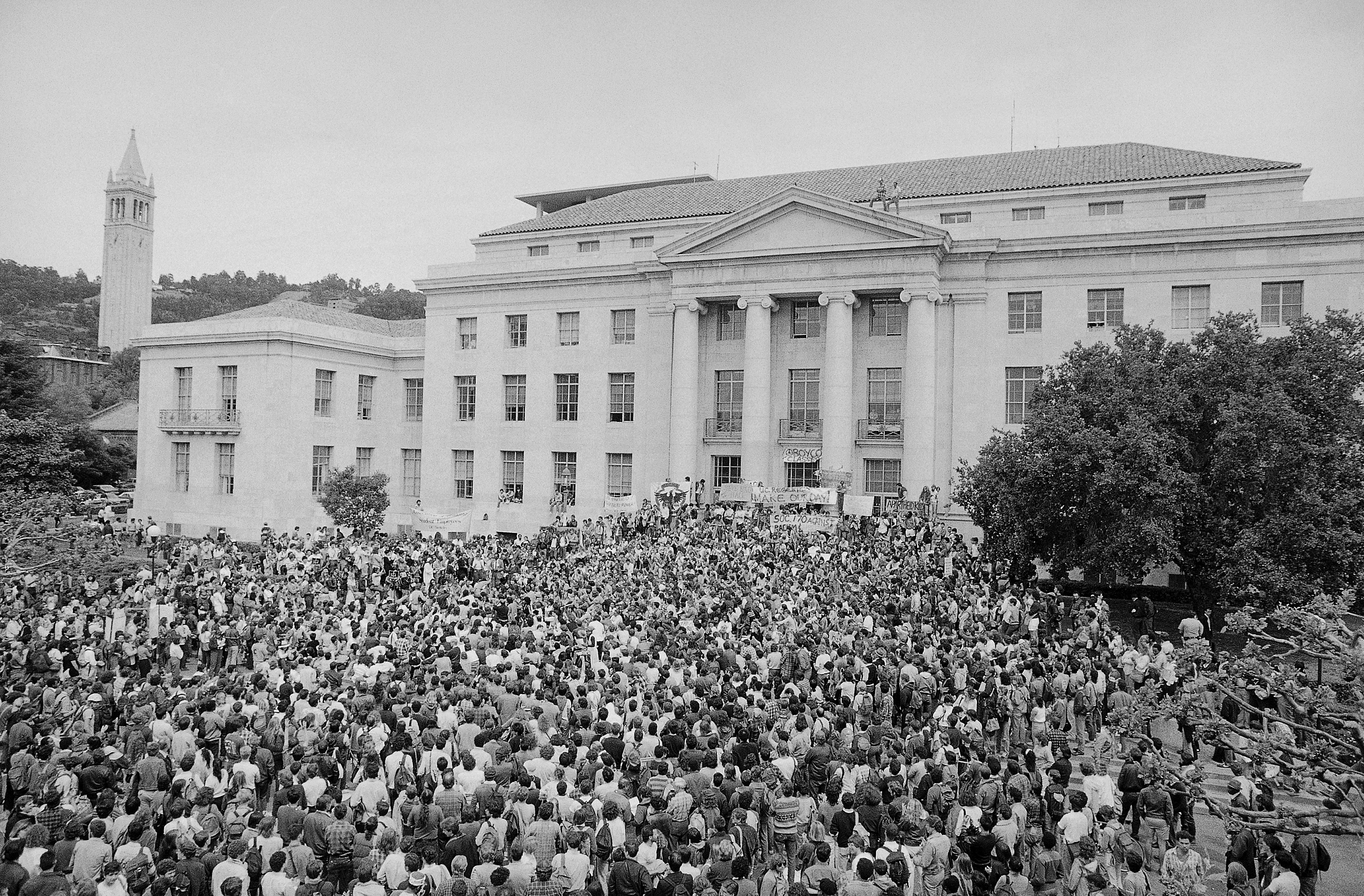
Large crowd of people surrounding a school building.

Several thousand students jam into Sproul Plaza on the University of California Berkeley campus to protest the university’s business ties with apartheid South Africa, April 16, 1985.Paul Sakuma/AP

Now I want to talk about something else that was happening in the mid-’80s. Something else that gathered up musical supergroups and was big on MTV.

It was famine. In Ethiopia, between 1983 and 1985, maybe a million people died. The nightly news was full of images of dying skeleton children, all the time. The causes were complex, but the immediate answer was simple: food. Again, it was musicians who rallied the world to the cause, with huge concerts like Live Aid, famous for Freddie Mercury’s last transcendent performance, and cross-genre protest song collaborations. The Brits, led by Bob Geldof (who also produced Live Aid), went first with “Do They Know It’s Christmas.” And then Michael Jackson, Lionel Richie, Quincy Jones, and Harry Belafonte gathered up a who’s-who of American singers for “We Are the World.” And yes, some of that plays as very cringe these days—Ethiopians are mostly Christian, for starters. And weren’t totally blind to it back then either, as someone who played Cyndi Lauper in a high school send-up of “We Are the World” can attest.

But when you’re trying to rally the world to the cause of dying children, corny works. All these efforts did raise millions for food relief, and, more importantly, focused the world’s attention. In 1985, the United States Agency for International Development created the Famine Early Warning Systems Network so the world would never be caught so flat-footed about famine again.

Until now. Musk has gutted USAID, and its early famine warning system specifically, even as starvation stalks the people of Sudan. Thanks to his DOGE bros, almost 80 percent of emergency food kitchens in Sudan have been closed, and “people are screaming from hunger in the streets,” reports the BBC.

Musk and Trump wanted to start with what they saw as the weakest, wokest government agency, to slaughter it and hang it on a pike as a warning not to disobey the king.

What does the world’s richest man have against the agency that helps the world’s poorest people? Well, it was investigating his satellite company Starlink’s contracts in Ukraine. But also, in their quest to cut trillions from the federal budget to finance tax cuts for billionaires like themselves, Musk and Trump have to believe they can get that money from things other than Social Security and Medicaid. So they’re tapping into of American’s collective misbelief that we spend about a quarter of the budget on foreign aid—in actuality, it is about 1 percent—to claim they can square that math. And they’re flooding the zone with disinformation with claims of USAID “waste and abuse,” because this is their playbook. Never mind that they clearly don’t know what USAID does, or that gutting it is also having devastating impacts on US farmers, who grow a lot of the food we provide as relief.

Who benefits from eviscerating USAID? Basically foreign dictators like Vladimir Putin, who hates that this “soft power” was part of America’s Ukrainian relief effort, or Xi Jinping, who sees our food aid to African countries as a plot to undermine China’s “belt and road” program of development. We don’t just lose moral stature when we renounce foreign aid, we lose our competitive advantage in global relations too. So when Trump states in an executive order that USAID efforts “destabilize world peace by promoting ideas in foreign countries that are directly inverse to harmonious and stable relations internal to and among countries,” please realize that this is echoing the talking points of Putin and Xi.

But no matter, Musk and Trump wanted to start with what they saw as the weakest, wokest government agency, to slaughter it and hang it on a pike as a warning not to disobey the king. Slashing USAID scratches a racist itch central to the MAGA cause. Let’s not forget how Trump slurred “shithole countries.” Trump, who says Hitler did some “great things,” and says he wants generals like Hitler had. Trump, who believes he has “good genes.” Trump, you know the list: housing discrimination, Central Park Five, birtherism, Mexican “rapists,” “very fine people,” “go back” where they “came” from, “they’re eating the dogs, they’re eating the cats.”

In the ’80s, the American public had a much more rudimentary understanding of colonialism’s dependence on racism than it does today. But even kids in high school knew that apartheid was wrong, and famine was wrong, and that these two things happening in Africa were somehow connected, and connected to America’s dark racial history, and to the music we listened to and the future we hoped we represented. Our parents didn’t have childhood friendships across races and sexes—that would have been mostly impossible. But we did. We were naive (the white kids far more than the Black kids, it must be said) but not wrong in feeling that, even as we eye-rolled and camped it up when we sang along, that we are the children…we’re saving our own lives / It’s true we’ll make a better day, just you and me.

Young person standing below a Tesla dealership sign waving an upside down American flag.

Ronan, 11, waves an upside down flag, a symbol of distress, outside a Tesla dealership during a protest in San Francisco, Feb. 17, 2025.Carlos Avila Gonzalez/San Francisco Chronicle/Getty

On Valentine’s Day, Sheryl Crow put her Tesla on a flatbed and donated the sale’s proceeds to NPR. The following day, I went to the local Tesla dealership to witness the first in what has become an ongoing series of protests in San Francisco and across the country. The “Tesla Takedown” movement is, as such movements usually are, organized by an oddball coalition of folks, including documentary filmmaker Alex Winter (also “Bill” of Bill & Ted fame) and disinformation scholar Joan Donovan, who alleges that a donation from the Chan Zuckerberg Initiative prompted Harvard to cancel her research on Meta’s role in online extremism. The goal is to get people to protest at dealerships, sell their cars, divest from any stock. Indivisible has joined the effort, organizing “Musk or Us” protests.

There’s a real strategy here: essentially that Tesla’s stock is wildly overpriced—it’s both an automaker and a memestock, as John Herman notes—and were it to approach a more reality-based level, Musk, who’s super leveraged, could see his fortune decline precipitously. That could push a shareholder revolt and also weaken his threat to use his vast fortune to fund a primary against anybody who opposes Trump. And in any case, people need a place to locate their anger and fear.

There are signs this is working. Tesla sales in Europe are catastrophically down50 percent lower in January than from a year earlier, even as EV sales overall rose 34 percent. January sales were 12 percent down in California, too, and that’s before DOGE started playing havoc with the country. Tesla’s stock price has fallen 37 percent since its peak in December, knocking tens of billion off of Musk’s wealth; 23 percent of that is in the last few weeks. And people are taking their rage out on individual Teslas, stickering and even vandalizing “swasticars,” especially cybertrucks, which were already performing horribly, in terms of sales and just…performance.

Opposition movements always seem hopeless until they’re not. Apartheid existed for decades and then came crashing down rapidly.

Talking to protestors at the San Francisco dealership, I was struck by how many of them had never been to any kind of protest before_._ Some of them were Tesla owners. One guy told me he wasn’t able to sell his car right now, but he was posting to Tesla owner forums to tell people to turn off features so as to deny the company revenue, or to be an activist shareholder if they were one.

In less than two weeks, such protests have spread all over the country. The news is full of tales of Tesla owners with buyer’s remorse. Etsy shops are selling bumper stickers that say things like: “I bought this before I knew Elon was crazy.” On a walk through my neighborhood last weekend, I saw a woman purposefully lead her dog over to pee on a cybertruck, and a Tesla sedan with a handwritten sign that said: “Hi! I also think Elon sucks. I bought this car 5 years ago. Please stop keying my car for your protest. I agree with you [heart].” Less than half a block later I came across another Tesla sedan, freshly keyed. “We hate him too,” read a sign hung from the offices above the Tesla dealership showroom.

We are in early days. Trump has been in office just over a month. “Big Balls” and the rest of the DOGE marauders have only been at it a few weeks. Tesla protests are even newer. It’s possible that even if a boycott were to wipe out some of Musk’s wealth, sketchy government contracts for things like $400 million in armored Teslas, or a $2 billion FAA deal for Starlink, will more than make up for it. Mass movements require mass awareness, and we’re not collectively tuning into the same newscasts or music videos, and Musk meanwhile owns a disinformation factory. Boycotts rarely have the kind of impact activists hope for, they tend to be too diffuse or too hotly contested.

But opposition movements always seem hopeless until they’re not. Apartheid existed for decades and then came crashing down rapidly. We didn’t know that its heirs would be wreaking havoc on this country four decades later, but history isn’t an unbroken line that goes up and to the right. Some of the bad stuff comes back and has to be fought again.

The South Africa apartheid regime was defeated. Maybe one South African can be too.

Continue Reading…

Mother Jones

Perhaps the Biggest Winner in Germany’s Election: Nuclear Power

_This story was originally published on the author’s substack, Field Notes with Alexander C Kaufman, to which you can subscribe here.

Germany’s conservatives won the national election on Sunday, while the far-right Alternative für Deutschland (AfD) party nearly doubled its share of the vote from the last election to secure a strong second-place finish.

Nuclear energy may be the big winner.

Europe’s largest economy shuttered its last reactors two years ago in what was meant to be an irreversible exit from atomic energy. But surging energy prices and electricity demand are driving calls to revive Germany’s nuclear power industry.

As the victorious Christian Democratic Union (CDU) and its sister party in Bavaria, the Christian Social Union, wrote in their party manifesto, “We are resolved to stick with the nuclear energy option, counting on research on nuclear energy in its 4th and 5th generation, small modular reactors, and fusion reactors. We are assessing the resumption of operation of the recently-shut-down nuclear power plants.”

The CDU’s leader and Germany’s likely next chancellor, Friedrich Merz, said last month he regrets withdrawing from nuclear power. “We are examining whether we should build these small modular reactors—perhaps together with France,” Merz told the weekly magazine Der Spiegel.

In an interview last week on CNBC, Klaus Wiener, a CDU lawmaker in the Bundestag, called the country’s nuclear phaseout “a huge mistake.”

“They were technically sound, they were doing well, and safe—but the government has, for ideological reasons, decided to shut them down,” he said. “We should have used them longer. That would have made a big difference in energy prices and supply.”

Yet Wiener cautioned that turning the shuttered plants back on was unlikely, echoing statements Germany’s biggest utilities made in recent calls with investors. “Now unfortunately, three years down the road, these nuclear power plants, they can be recovered but that would be very hard,” he said. “It takes three to five years, possibly, and it’ll take a lot of money. If we want to reengage again with nuclear energy, it will not be about this generation of nuclear power plants.”

That the CDU—the party once led by former Chancellor Angela Merkel, who oversaw the nuclear exit—is now willing to support atomic energy is a major shift. A poll taken in 2022 found 53 percent of Germans opposed quitting nuclear. By the eve of the final shutdowns the following April, 59 percent said the phaseout was “wrong.”

While it’s likely only a small factor in its sobering rise to power, the AfD—whose ties to neo-Nazis and defenses of the Gestapo proved too radical even for their former political allies in France (though not for Elon Musk or Vice President JD Vance) has long been the lone party representing that majority view. Founded two years after the Fukushima disaster, the AfD previously stood as the only party to oppose the phaseout pushed by everyone from the center-right, which initiated the shut-downs, to the center-left and Greens—under whose leadership the last plants closed.

Now the AfD is pushing to completely reverse the closures and undo policies that support renewables such as wind and solar power. (Nuclear is not renewable, because the uranium fuel is spent in the power-generation process.)

“What our government is doing…they’re destroying—they’re blowing them up—our nuclear plants,” Beatrix von Storch, an AfD member of the Bundestag, said in an interview on Deutsche Welle last month. “We can see our energy is no longer stable. It’s far too expensive.”

Merz has ruled out any coalition government with the AfD. Last month, however, the German parliament narrowly approved a nonbinding resolution Merz put forward to call to turn away more migrants, thanks to support from AfD lawmakers.

The big question now is whether Merz will lower his “firewall” against working with the AfD to bring back nuclear power.

Continue Reading…

Mother Jones

The Reason Nobody Can Afford a Lawyer? It’s Lawyers.

One day about 10 years ago, Alicia Mitchell-Mercer experienced one of those moments that change the course of a person’s life. She was a longtime paralegal in Charlotte, North Carolina, working for a consulting company that helps law firms with project management. In the lobby of a client firm that day, she overheard a troubling conversation.

A receptionist was explaining the firm’s rates to a caller who was clearly in distress. Ray (a pseudonym) was a single father and fast-food manager with three girls between the ages of 7 and 12. His estranged common-law wife, struggling with addiction, had moved in with a man who’d done prison time. Ray had heard she was planning to leave town with him and take the kids, and he was desperate to prevent it. Despite the urgency of his situation, the receptionist was telling Ray the firm would be unable to help—he couldn’t afford their fees.

Mitchell-Mercer reached out to Ray. It turned out he’d already been to the sheriff’s office and had consulted with a court advocate. Both said he needed an emergency custody order—and a lawyer. She knew how to help him, but she couldn’t do it on her own. Laws in all 50 states forbid what’s known as “unauthorized practice of law.” UPL statutes generally preclude the provision of legal services by nonlawyers, even old hands like Mitchell-Mercer, who, in addition to her decades as a paralegal, has served in state and national legal organizations and volunteered as a court-appointed child guardian.

For Ray, she found a workaround. On her own time, she ghostwrote a complaint and had an attorney she knew review it. Ray filed the complaint as an unrepresented litigant and got his emergency order. But by the time his daughters were located, several weeks after Mitchell-Mercer reached out, the girls were living in another state and said they’d been assaulted and sexually abused. Mitchell-Mercer dreads to imagine how much worse things might have been had she not intervened. “This man had gone to everyone under the sun to try and get help and wasn’t able to,” she said. “That was one of the first times I realized how broken things were.”

With that realization, she would soon find herself drawn into an unusual coalition of left-leaning academics, grassroots activists, and libertarian lawyers, all striving to democratize civil legal services by suing states, including her own, to roll back their UPL laws. Strange bedfellows, to be sure, but their timing is impeccable. As the pendulum swings in favor of deregulation, even some progressive politicians and traditional fans of zealous government oversight have cast a skeptical eye on overbearing restrictions, like the zoning and environmental codes that are thwarting construction of desperately needed housing and clean energy projects.

Depending on whom you ask, if Mitchell-Mercer and her allies can put their arguments before the Supreme Court, they could either smash barriers that have left millions of Americans helpless against abusive partners, bad landlords, and heartless corporations or usher in a bonanza of poverty predation—or both. Either way, their efforts have the potential to change the legal landscape profoundly.

The failings of America’s criminal justice system are common knowledge, but our civil legal system, which affects even more people, is no less compromised—and there’s no civil equivalent to the Sixth Amendment’s right to counsel in criminal cases. A 2022 report from the Legal Services Corporation (LSC), a nonprofit that Congress established during the 1970s to fund free civil legal aid for the poor, notes that “low-income Americans do not get any or enough legal help for 92 percent of their substantial civil legal problems.”

More than 70 percent of low-income families encounter at least one such issue a year, the LSC reports. As in Ray’s case, these are often true emergencies—domestic violence, eviction, predatory debt collection—with life-altering stakes. A 2018 study found, for example, that tenants facing eviction in the Minneapolis area were four to five times more likely to be forcibly removed from their home if they lacked legal representation. But lawyers charge around $300 an hour on average, putting their services out of reach for even much of the middle class.

State legal aid organizations, meanwhile, are independent nonprofits and, despite some government support, are badly underfunded. In Mitchell-Mercer’s home state, there is only one Legal Aid attorney for every 8,000 eligible people—those with annual household income of no more than $39,000 for a family of four (125 percent of the federal poverty level). The National Center for Access to Justice ranked North Carolina the third-worst state for access to civil attorneys—only Mississippi and South Dakota scored lower. About half of its counties are legal deserts, with fewer than one lawyer per 1,000 residents.

This dearth of affordable representation affects communities of color disproportionately, and Mitchell-Mercer, who is Black, is regularly approached by members of her church. A woman needs assistance getting a restraining order. A family facing eviction doesn’t know how to respond to court papers. The immediate solutions are often straightforward—a matter of properly filing standard legal documents—and well within her realm of expertise. But even such minimal assistance is verboten.

In theory, the UPL laws are in the public interest—conceived, in part, to protect people from predatory charlatans and incompetent practitioners. But they’re also the primary mechanism by which lawyers maintain their monopoly on legal advice. Even as Americans have grown used to receiving basic medical care from physician assistants and nurse practitioners—including diagnoses, treatment, and prescriptions—UPL rules ensure that no equivalents exist for legal services. Most of the statutes are extremely broad, encompassing everything from giving legal advice to drafting documents and appearing in court. They are vigilantly policed by the state bars, and violating them exposes nonlawyers like Mitchell-Mercer to sanctions, even including jail time. Which is why, when someone comes to her for help, there’s often little she can do.

To a degree unmatched by other professions, American law is a self-governing fiefdom. There are no federal rules for lawyers. Officially, state supreme courts act as industry overseers, but as a practical matter, regulation is largely delegated to state bars. These are the licensing bodies that lawyers join upon passing the bar exam, as opposed to bar associations, which are professional groups. State bars determine not only who may practice law but what constitutes that practice—including tasks that people without a law degree are quite capable of handling.

Stanford law professor Nora Freeman Engstrom and researcher James Stone trace the current regime back to the 1930s, when bar associations launched a fusillade of litigation against unions, homeowners associations, and auto clubs that provided legal services to members, accusing them of violating incipient UPL laws. “In state after state,” Engstrom and Stone wrote in the Yale Law Journal, the bar associations prevailed, eliminating competition and decimating “a once-thriving system for the provision of group legal services to ordinary Americans.”

The industry’s evolution over the past half-century has only made access to lawyers more exclusive, said James Sandman, a Penn Law School lecturer and former LSC president. In 1973, less than half of law firm revenue came from corporate clients, as opposed to individuals; by 2023, the figure was nearly 75 percent. “They’re going after the clients that can afford to pay,” Sandman said. “Individuals who don’t have lawyers have to navigate an unbelievably complicated, opaque system designed by lawyers for lawyers.” He continued, “But the image people have of what goes on in a courtroom, where both parties have lawyers arguing facts on behalf of their clients, is a fiction in more than three-quarters of civil cases.”

“I’m not going to jail for you or anybody else,” says a social worker who helps with visitation and custody issues at a free legal clinic. “People say, ‘What would you do?’ Well, I can’t tell you.”

The legal industry fiercely resists incursions onto its turf. In response to a 2008 proposal to loosen UPL restrictions in Washington, the state bar association claimed the move would create “second class, separate but unequal, justice” and deprive less-affluent lawyers of work. The North Carolina bar issued a cease-and-desist letter that year to LegalZoom, saying the tech firm’s document-creation service violated UPL law. (The company, which has faced similar challenges elsewhere—most recently in New Jersey—then sued the North Carolina bar and later settled, agreeing to have lawyers vet all of its documents.)

Meanwhile, a 2015 proposal to relax California’s UPL rules would, one foe argued, be “detrimental to the honest attorneys who are trying to make a living.” But the image of a general-practice lawyer hanging a shingle on Main Street is largely a relic of the past. Today’s median lawyerly income is roughly $150,000, and law is increasingly a business of corporate specialists. From 2013 to 2023, the number of lawyers working at firms that have more than 500 attorneys increased by 36 percent.

The bar’s proposed solutions to the affordability crisis—increasing legal aid funding and expanding pro bono requirements—are woefully inadequate. “Providing even one hour of attorney time to every American household facing a legal problem would cost on the order of $40 billion,” legal scholars Gillian Hadfield and Deborah Rhode wrote in 2016—almost 30 times the overall legal aid expenditures in 2013. To provide even this minimal level of counsel, they calculated, every licensed attorney in the United States would have to clock more than 200 pro bono hours a year.

To make a dent in the problem, legal aid organizations would need a massive increase in support. Last year, Congress approved only $560 million for the Legal Services Corporation, about a third of its budget request. And even if LSC were fully funded, lots of low-income litigants would be stuck on the sidelines. Those who are ineligible for financial or other reasons, and who can’t find other pro bono legal help, are left to navigate a patchwork of free clinics and courthouse services that vary greatly in quantity and quality. Concentrated in urban areas, these clinics are generally staffed by nonlawyers who cannot offer clients any actual legal advice.

Daniel Stolle

On a recent morning at a courthouse in downtown Raleigh, employees of the Wake County Legal Support Center were helping people fill out standard forms and offering instructions on how to serve court papers. The center, one of the few of its kind in North Carolina, opened in January 2023. A local judge had estimated that 2,000 people might use it each year. In 2024, it served almost 14,000.

Seated at a long plastic table, a court advocate who specializes in domestic violence issues was especially busy. “Does she have a concealed carry permit?” she asked a bearded Black man in an orange construction shirt and mud-caked boots. The man shook his head. He was filing for an emergency protective order against his partner for himself and his child. Still, he said, “she could tweak out at any moment.” He left the center visibly relieved, an envelope of completed forms tucked under his arm. But the two young women who came next couldn’t decide how to proceed. They wanted the advocate to advise them, but she wasn’t allowed. Both left empty-handed.

This happens all the time, Norma Boyd, who was sitting at an adjacent table, told me. Boyd, a veteran social worker whom everyone calls Ms. Norma, handles questions about child custody and visitation. Often, she said, people have difficulty understanding basic legal terms. “I ask, ‘Are you the plaintiff or the defendant?’ They don’t know.” Even if they file initial paperwork, their cases are frequently dismissed when, without further guidance, they miss follow-up steps such as serving documents and filing certificates of service. For people without an attorney, the courtroom is an intensely frustrating, alienating place. “I felt like this street rat showing up to a cocktail party uninvited, and everybody knows what’s going on except me,” one North Carolinian who’d represented himself in a custody trial against a lawyered-up former partner told me.

Boyd, with her proximity to family law, often knows perfectly well what the center’s clients ought to do. But “I’m not going to jail for you or anybody else,” she said. “People say, ‘What would you do?’ Well, I can’t tell you. I tell people, ‘These are your options.’ People want you to tell them what to do, and I can’t.”

Mitchell-Mercer’s quest to reform the system took shape in 2020, when she and another paralegal, S.M. Kernodle-Hodges, founded a nonprofit called the North Carolina Justice for All Project. They were inspired by policy changes in a handful of other states, notably Arizona, Utah, and Washington, that permit nonlawyers who’ve undergone special licensing programs to provide limited legal assistance. In Utah, they can work on family law matters, including domestic abuse, child custody, and divorce, plus eviction and debt collection cases. In Arizona, they can handle certain criminal and juvenile law issues. In both states, they can give advice; review, draft, sign, and file documents; and accompany clients to court. (Similar programs are now under consideration in about a half-dozen other states.)

Kernodle-Hodges, a former deputy sheriff who calls everyone by their last name—she goes by “Kernodle”—had been thinking about bringing such a program to North Carolina. On a colleague’s recommendation, she reached out to Mitchell-Mercer, who had served a stint in the Army and written her master’s thesis on legal services.

They proved a good fit. Kernodle, too, is Black and a court advocate. Both women are extraordinarily disciplined and scheduled to the hilt with professional and volunteer obligations. Both have a precise, punctuated way of speaking and a kind of regal poise.

In January 2021, they proposed a program comparable to those in Arizona and Utah to the North Carolina bar. At more than 100 pages, their plan was deeply researched, with rigorous citations. The bar’s Subcommittee Studying Regulatory Change, of which Mitchell-Mercer and Kernodle were members, held a series of meetings and hosted outside experts to vet the proposal.

“When you have this many disparate parties involved, the Supreme Court is going to have to resolve it…It’s going to be one of the first big economic regulation cases of our era.”

In January 2022, the subcommittee issued a report fully endorsing it. But the authors weren’t convinced they would get a fair shake. “What we were hearing was that there was some hesitancy to move forward,” Mitchell-Mercer recalled. “Our ideas were getting explained to other bar committees, and not necessarily being well received.”

Indeed, the bar went on to create another subgroup, supposedly to address the access question, from which the two women were excluded. When that committee first met, in October 2022, they posted a message to the Justice for All Project’s website: “We are concerned that this new committee was formed solely to appear that state bar leaders are doing something about the access to justice crisis and to appear empathetic to the plight of North Carolinians,” they wrote. And “there is reasonable concern that North Carolina State Bar officers have no serious intention of acting on previously discussed initiatives.”

A prominent lawyer sympathetic to Kernodle and Mitchell-Mercer told them that bar leaders were describing them as “angry and aggressive,” an offensive stereotype. Mitchell-Mercer tried to take it in stride. Kernodle was upset. “Mercer is a look-at-the-bright-side person,” Kernodle explained. “She will give you the very proper language about everything. My thing is: What’d you say?!” But they had been careful not to frame their proposal in racial terms. “No matter how cordial we were, it was still upsetting to them,” Kernodle said.

The bar took no further action, in any case. And so, in 2023, the women submitted a similar proposal to the state legislature, backed by more than a dozen legal entities, including the US Department of Justice, whose antitrust division commended their “thoughtful analysis and policy recommendations and looks forward to reviewing any related bills that ultimately are introduced to the North Carolina legislature.”

None were forthcoming. Kernodle and Mitchell-Mercer had encouraging talks with several lawmakers, but their proposal, which asserted that UPL laws gave attorneys “no meaningful incentive to provide affordable services,” clearly ruffled some feathers.

Amy Galey, a Republican state senator and an attorney, sent the women a blistering email that March, copying her Republican colleagues: “So you want to create a two-tiered system of legal representation, one of well-educated licensed lawyers for people who can afford them, and a second tier of unlicensed, unregulated people of questionable education for low income people,” she wrote. “If your response would be no, they would be licensed, and we would regulate them, and they would be required to have a certain education—yes we have that already, and they are called attorneys.” She went on: “Your proposal would create an A-team and a B-team…and ultimately solve nothing.” Asked for further comment, Galey replied, “That’s a really good quote, glad I said it, and I don’t have anything to add.”

Her message effectively ended the discussion. Kernodle and Mitchell-Mercer heard nothing more from the legislature.

Even as they contemplated defeat, the women were introduced to an unexpected ally, Paul Sherman, a senior attorney with the Institute for Justice, an influential libertarian public-interest law firm. Founded in 1991 as a nonprofit with a $350,000 grant from Charles Koch’s foundation, the IJ now spends about $44 million a year, much of it litigating in federal courts to “protect the constitutional rights of Americans” against what its funders and principals view as regulatory overreach.

Professional licensing laws are among the firm’s favorite targets. In Louisiana, Florida, Kentucky, and elsewhere, the IJ has successfully challenged what it argued were onerous licensing laws for engineers, diet coaches, florists, and tour guides. Since the late 2000s, it has increasingly framed professional licensing as a violation of the First Amendment, relying on a series of Supreme Court decisions that eroded the right to limit certain kinds of speech.

In one 2015 case, Reed v. Town of Gilbert, the court held that an Arizona town’s attempts to restrict public signage based on its content were unconstitutional. In another, National Institute of Family and Life Advocates v. Becerra, in 2018, the justices rejected the idea that professional speech and commercial speech enjoy less protection than personal speech. “There’s never been a better time in American history to be litigating free speech cases,” Sherman told me. “The court has adopted a more or less libertarian interpretation of the speech clauses of the First Amendment.”

Without adequate guardrails, “there can be consumer fraud. There can be a whole variety of issues…We need to be focused on: What’s good for the public?

In January 2024, Sherman filed a First Amendment lawsuit on behalf of the Justice for All Project that challenges the scope of North Carolina’s UPL prohibitions. Naming five local district attorneys and the president of the state bar as defendants, it builds on the IJ’s suit against New York state—where the firm represents a pastor and a legal-tech nonprofit called Upsolve, arguing that they should be able to advise clients battling debt collectors—and a similar case brought by the NAACP in South Carolina that centered on eviction. The Upsolve case is under review by the 2nd Circuit after a lower court issued a preliminary injunction in the nonprofit’s favor, and the South Carolina Supreme Court has granted the NAACP permission to train nonlawyers to provide eviction-related advice.

But the North Carolina claims are substantially broader, asserting the right of nonlawyers to advise clients on a spectrum of issues and charge for their services. This is by design. “The goal is for the Supreme Court to make clear that advice, no matter what the topic, is protected by the First Amendment,” Sherman said.

Legal experts figure this case, or a similar one, has a good shot at getting in front of the high court, and soon. “It’s not going to stop in North Carolina,” said Lucy Ricca, executive director of the Deborah L. Rhode Center on the Legal Profession at Stanford. “These cases have the potential to blow through” the political morass. “When you have this many disparate parties involved, the Supreme Court is going to have to resolve it,” concurred Dan Rodriguez, a professor at Northwestern Law School. “It’s going to be one of the first big economic regulation cases of our era.”

Sherman acknowledges that taking on the bar is, well, a high bar. “We tried to think of occupations that are composed largely of speech, and of course, one of the first that occurred to us was our own: the practice of law,” he said, but “before we could challenge that system, we had to have some victories involving other occupations to establish the legal principles in a setting that would be less scary to judges.”

He now believes the Institute for Justice has the precedents it needs. It doesn’t hurt that at least one Supreme Court justice has expressed displeasure with the status quo. Lawyers “have used the expansive UPL rules they’ve sought and won to combat competition from outsiders seeking to provide routine but arguably ‘legal’ services at low or no cost to consumers,” Neil Gorsuch wrote in a 2016 article. “It seems well past time to reconsider our sweeping UPL prohibitions.”

A Supreme Court ruling favoring the IJ in the North Carolina case could greatly expand access to civil justice for the people whom Mitchell-Mercer and Kernodle aim to help. But even some access-to-justice proponents are wary. If you wipe out all restrictions on providing legal advice, “there’s no logical stopping place,” Northwestern’s Rodriguez told me. That’s part of why more than a dozen civil legal services and rights groups in New York oppose the IJ’s suit there, including Legal Services NYC, the nation’s largest provider of free civil legal assistance.

“When we started making these arguments, people laughed at the idea that the First Amendment could apply to professional speech…People aren’t laughing at these arguments anymore.”

“Plaintiffs would immediately relegate low-income New Yorkers, including low-income New Yorkers of color, to receiving questionable legal advice,” the groups wrote in an amicus brief. “The consequences,” they argue, “can be disastrous.” Incompetent legal guidance could pave the way for “creditors and debt collectors to secure an unaffordable settlement agreement or an easy judgment that they can then use to freeze bank accounts and garnish wages.” Critics also fear that artificial intelligence would unleash a firehose of dubious counsel.

Without adequate guardrails, “there can be consumer fraud. There can be a whole variety of issues,” Andrew Perlman, the dean of Suffolk University Law School, told me. It’s not hard to imagine entrepreneurs akin to payday lenders and skeezy tax preparers opening outlets in low-income neighborhoods to peddle legal help. “We need to be focused on: What’s good for the public?” Perlman said.

The fact that Sherman’s group takes money from dynasties like the Kochs and the DeVoses doesn’t exactly ease liberals’ concerns. “Open their books and it’s a cornucopia of ProPublica’s worst nightmares!” Rodriguez quipped. “There are going to be people drafting on these sympathetic plaintiffs, looking for economic advantage. You think you’re protecting access to justice, but actually, you’re feeding the Koch brothers’ wildest fever dreams!”

Hadfield, who teaches at Johns Hopkins University and is an influential voice on the access issue, is skeptical of the First Amendment framing. “I don’t think that [just] anybody should be able to say anything to anybody about legal matters,” she told me, and merely empowering competent nonlawyers to provide advice isn’t enough, given the scope of the problem. She dreams of a future in which large nonprofits and businesses harness technology, including AI, to furnish reliable, ethical, low-cost legal assistance on a massive scale.

Many academics who study civil legal access share a similar vision. You could have Amazon get in on the act, and also retailers like Walmart, whose customers might one day obtain a simple will or even a divorce while picking up their prescriptions. “We’re worried about the impact of these companies in communities, but they’re also just better at serving consumers than lawyers are,” said Stanford’s Ricca. “Lawyers think we’re really, really special—a privileged class. But we’re just not serving regular people anymore.”

Qualms aside, Hadfield does hope the First Amendment cases succeed, “because we need to break open a very, very harmful set of practices: this stranglehold that the legal bar has.” There’s no evidence that litigants have been harmed in the states that have relaxed UPL rules, she added—and a scorched-earth approach may well be a necessary first step in creating a more equitable and thoughtfully regulated industry.

The Justice for All Project hit a snag in December, when a federal judge dismissed its case. The court ruled that North Carolina’s UPL statutes regulate “conduct”—the practice of law—with only “an incidental impact on speech,” and thus do not violate the First Amendment. The decision relied, in part, on a recent appellate ruling against another IJ client, a drone photography company that North Carolina targeted for the “unlicensed practice of land surveying.” The December ruling is “disappointing but not surprising,” Sherman told me, arguing that both decisions clearly misapply Supreme Court precedent.

He is appealing the Justice for All case while the high court considers whether to review the drone case. For Sherman, both losses are merely temporary setbacks: “We’ve been litigating these cases for 15 years. What’s amazing is when we started making these arguments, people laughed at the idea that the First Amendment could apply to professional speech. The Supreme Court agreed with us. People aren’t laughing at these arguments anymore.”

Mitchell-Mercer, too, was skeptical of Sherman’s strategy at first. “I had never thought of this as a First Amendment issue,” she told me. But she’s come around, even adopting some of the language of her libertarian allies. “People should be trusted to know that they’re gonna get what they pay for,” she said. “Prohibiting people from even having a conversation is almost a weaponizing of paternalism. Telling people that we’re going to control who you can talk to about your issue, who you can hear from, is not benefiting the public. It benefits the lawyers.”

Continue Reading…

Mother Jones

Trump Posts AI Video of Ethnically Cleansed Gaza

On Tuesday, just before midnight, Donald Trump posted a grotesque AI-generated video on social media that depicts a future Gaza as his proposed “Riviera of the Middle East.” A sleek palm-tree-lined boulevard, in the video, is watched over by an enormous gold statue of the American president. Palestinians, it seems, are absent—aside from maybe a few belly dancers. In their place, a yassified Elon Musk eats hummus while Trump and Israeli Prime Minister Benjamin Netanyahu lounge by the pool. A chintzy “Trump Gaza” hotel and cloying chant of “Trump Gaza is finally here!” round out the fantasy of Trump’s promise to criminally expel roughly two million people and take ownership of the enclave.

The video’s aesthetics, which mix the glass towers of Miami with the Dear-Leaderism of Saddam Hussein’s Baghdad, distract from a more fundamental reality: The president of the United States is using AI slop to sell war crimes and a potential genocide he considers a real estate deal. It is pitching ethnic cleansing with a meme.

Trump just posted a “Trump Gaza” propaganda video featuring a giant golden statue of himself, dancing bearded women, and himself partying with a woman who is not his wife. pic.twitter.com/4FWn175PSj

— No Lie with Brian Tyler Cohen (@NoLieWithBTC) February 26, 2025

Gazans, most of whom are refugees descended from residents expelled from what is now Israel, have made abundantly clear that they do not want to be forced from their land once again. Nor, as Trump has called for doing, do they want to be barred from ever returning—particularly to make way for an American-owned Mediterranean style escape for global elites.

The only way to accomplish Trump’s plan would be to commit atrocities that evoke some of the darkest moments in contemporary history. And it would require doing so in the wake of a war in which Israel—with the help of American bombs—has reduced much of Gaza to rubble and killed more than 62,000 Palestinians, including more than 17,000 children.

On paper, Trump’s plan is being taken seriously by his underlings. The Wall Street Journal reported last week that Steve Witkoff, Trump’s Middle East envoy, and Jared Kushner, his son-in-law, are talking about bringing real estate executives together to hatch a plan to rebuild the enclave. The pair reportedly want to hold a White House summit devoted to the topic that, according to the Journal, “would include a public display, potentially with large cranes and other showy pieces of equipment.” The planning follows Trump’s claim during the campaign that Gaza could be “better than Monaco” because it has “the best location in the Middle East, the best water, the best everything.”

For now, Trump’s vision of America controlling an ethnically cleansed Gaza appears to be mostly fantasy. The more immediate risk is the signal sent to Netanyahu and his hard-right allies. Extreme Jewish supremacists like Knesset member Itamar Ben-Gvir, who has been calling for Israel to resettle Gaza, now know they have even less reason to fear that the United States will do anything if and when they steal even more land from Palestinians.

Continue Reading…

Mother Jones

The Pope Is Critically Ill. Far Right Catholic Trolls Are Out in Force.

Over the weekend, the Vatican announced serious complications in the recovery of Pope Francis. The 88-year-old pontiff, who has been hospitalized for 10 days, is battling pneumonia and on Sunday also appeared to be in the early stages of kidney failure, the Vatican said.

Throughout the world, mainstream Catholic leaders responded to the news with prayers for the pope’s healing. But for some US members of the ascendant Catholic traditionalist movement, Francis’ decline presented an opportunity to criticize him and demand that the Vatican reverse course on what they see as a dangerous tack to the left. Some leaders in those circles took to social media to spread their messages—along with conspiracy theories that accused the ailing pope of being part of a criminal alliance and secretly fathering a child.

Traditionalist Catholics—sometimes called “trad Caths” on social media—advocate for the church, which is the largest denomination within Christianity with approximately 1.3 billion Catholics worldwide, to return to the time before the modernizing influences of Vatican II. In the early 1960s, Pope John XXIII led a series of reforms, including instructing priests to conduct mass in the language of their community rather than Latin and to face the congregation rather than turning away. Crucially, Vatican II also emphasized racial and ethnic diversity as beneficial to the Church, denounced antisemitism, and encouraged harmonious relationships with other faiths.

Critics of these sweeping changes have been grumbling for decades, but the papacy of Francis, the first Jesuit pope and the most socially liberal one since Vatican II, appears to have reenergized them. Traditionalists have railed against Francis’ progressive views, which include support for the fight against climate change and strong opposition to rampant consumerism. Francis also permitted priests to bless LGBTQ Catholics (though he didn’t sanction gay marriage and once used a slur to refer to gay priests).

When Francis spoke out against the revival of the Latin mass in 2021 because he believed it represented “the peril of division” in the church, the traditionalist floodgates opened. In the Catholic journal One Peter Five, the traditionalist writer Mark Nowakowski called the pope “a father who vacillates between abuse, tyrannical overreach, being absent, and then some moments of tenderness or apparent resolve, followed by gaslighting masquerading as mercy.” In a New York Times op-ed, National Review writer Brendan Michael Dougherty accused Francis of “tearing the Catholic Church apart.” Last year, historian Massimo Faggioli, the author of a biography of Francis, called the pope’s tensions with his traditionalist American critics “unprecedented.” He told Newsweek, “It started immediately after his election, and there was a clear sense that this pope was really different from the previous ones.”

In the last few years, the traditionalists have become not only increasingly vocal but also politically ascendant. Today, prominent American traditionalists include conservative pundit Candace Owens, rightwing provocateur Milo Yiannapoulos, and former Trump strategist Steve Bannon.

Vice President JD Vance isn’t technically a traditionalist; his school of Catholic thought is influenced more by intellectuals like political theorist Patrick Deneen and journalist Sohrab Ahmari who characterize themselves as being part of the post-liberal movement. As the National Catholic Register reports, post-liberal thought emphasizes “stability, nationalism, and communal duty” over personal freedoms. Yet Vance has expressed support for some traditionalist values, such as a return to the Latin mass. As Kathryn Joyce wrote in her 2022 article, traditionalist Catholics are quickly becoming the “ideological center of the Christian right.” (Traditionalists are not to be confused with another conservative force in the Catholic church: Opus Dei, a controversial yet powerful institution that emphasizes personal sacrifice and holds that everyone should strive for sainthood.)

On Monday, in a statement rife with unfounded allegations, Italian former archbishop Carlo Maria Viganò, who served as an Apostolic Nuncio to the United States during the papacy of notoriously conservative Pope Benedict XVI, called Francis “a corrupt and maneuverable character” and an “emissary of globalism.” Viganò, who was excommunicated last year after the Vatican accused him of trying to create a schism within the church, alleged that Francis was working with “an international criminal alliance,” including members of Hillary Clinton’s presidential campaign, to unseat Benedict XVI, who had stepped down in 2013 because of age and poor health. (No pope had resigned in more than 600 years.) He also suggested without evidence that Francis was “already deceased,” had sexually abused children in Argentina, and was secretly the father of a boy who had died in 2014. Viganò posted a link to the statement on X, where he has 91,000 followers, and it was then reposted on X by prominent traditionalist Catholic accounts, including that of podcaster and author Taylor Marshall, who has 198,000 followers.

“If a candidate similar to Francis, or one with even more extreme views, were elected, it could have grave consequences, potentially leading many souls astray through false doctrine.”

On Monday, Joseph Strickland, who was removed in 2023 from his post as a bishop in Tyler, Texas, after he repeatedly criticized Pope Francis, urged his 231,000 followers on X to “prayerfully review” an article from the traditionalist site Life Site News about Francis’ successor. The article warned, “If a candidate similar to Francis, or one with even more extreme views, were elected, it could have grave consequences, potentially leading many souls astray through false doctrine.” In 2022, Strickland had promoted a video produced by Michael Matt, editor of the traditionalist publication The Remnant, who referred to Francis as a “diabolically disoriented clown.” Strickland referred to former president Joe Biden as “evil” and spoke at a “Stop the Steal” rally in 2020.

Matt, the Remnant editor, shared his thoughts about Francis’ illness on Monday in a post to his 51,000 followers on X. “Some have asked the question: Are we obligated to pray for a quick and full recovery of Pope Francis?” he wrote. “I would answer that question with another question: Why would we pray for God to grant Francis more time on this earth to reset the Church in the image and likeness of Globalism?”

Other traditionalist Catholics stopped short of actually criticizing Pope Francis as he declined but instead issued oblique calls for him to repent. In a since-deleted tweet, Marshall asked his followers to “Pray a Rosary for him to die in the arms of Jesus with the true faith and charity in his heart.”

On Monday, the Vatican announced that the pope had shown some slight improvement and was working from the hospital. On Sunday, he posted a message on X to his 18.4 million followers “I urge you to continue your apostolate with joy and to be a sign of a love that embraces everyone,” he wrote. “Do not be afraid to take risks for love!”

Continue Reading…

Mother Jones

USDA Layoffs Are Wasting Public Money and Decimating Popular Programs

This story was originally published by WIRED a_nd is reproduced here as part of the_ Climate Desk collaboration.

The widespread layoff of Department of Agriculture (USDA) scientists has thrown vital research into disarray, according to former and current employees of the agency. Scientists hit by the layoffs were working on projects to improve crops, defend against pests and disease, and understand the climate impact of farming practices. The layoffs also threaten to undermine billions of taxpayer dollars paid to farmers to support conservation practices, experts warn.

The USDA layoffs are part of the Trump administration’s mass firing of federal employees, mainly targeting people who are in their probationary periods ahead of gaining full-time status, which for USDA scientists can be up to three years. The agency has not released exact firing figures, but they are estimated to include many hundreds of staff at critical scientific subagencies and a reported 3,400 employees in the Forest Service.

Employees were told of their firing in a blanket email sent on February 13 and seen by WIRED. “The Agency finds, based on your performance, that you have not demonstrated that your further employment at the Agency would be in the public interest,” the email says.

“Stopping or hamstringing efforts midway is a huge waste of resources that have already been spent.”

One laid-off employee described the weeks preceding the firing as “chaos,” as the USDA paused (in response to orders from the Trump administration) and then unpaused (in response to a court order) work connected to the Inflation Reduction Act—the landmark 2022 law passed under President Joe Biden that set aside large amounts of federal money for climate policies. “It was just pause, unpause, pause, unpause. After four or five business days of that, I’m thinking, I literally can’t get anything done,” says the former employee, who worked on IRA-linked projects and asked to remain anonymous to protect them from retribution.

The IRA provided the USDA with $300 million to help with the quantification of carbon sequestration and greenhouse gas emissions from agriculture. This money was intended to support the $8.5 billion in farmer subsidies authorized in the IRA to be spent on the Environmental Quality Incentives Program—a plan to encourage farmers to take up practices with potential environmental benefits, such as cover cropping and better waste storage. At least one contracted farming project funded by EQIP has been paused by the Trump administration, Reuters reports.

The $300 million was supposed to be used to establish an agricultural greenhouse gas network that could monitor the effectiveness of the kinds of conservation practices funded by EQIP and other multibillion-dollar conservation programs, says Emily Bass, associate director of federal policy, food, and agriculture at the environmental research center the Breakthrough Institute. This work was being carried out in part by the National Resources Conservation Service (NRCS) and the Agricultural Research Service (ARS), two of the scientific sub-agencies hit heavily by the federal layoffs.

“That’s a ton of taxpayer dollars, and the quantification work of ARS and NRCS is an essential part of measuring those programs’ actual impacts on emissions reductions,” says Bass. “Stopping or hamstringing efforts midway is a huge waste of resources that have already been spent.”

One current ARS scientist, who spoke to WIRED anonymously, as they were not authorized to talk to the press, claims that at their unit almost 40 percent of scientists have been fired along with multiple support staff. Many of their unit’s projects are now in disarray, the scientist says, including work that has been planned out in five-year cycles and requires close monitoring of plant specimens. “In the short term we can keep that material alive, but we can’t necessarily do that indefinitely if we don’t have anybody on that project.”

In a press release, the USDA has said its plan is to “optimize its workforce,” with this including “relocating employees out of the National Capital region into our nation’s heartland to allow our rural communities to flourish.” But ARS units are located across the US, each one specializing in crops that are important to local farmers as well as bringing jobs to the region. “We’ve always been very popular in rural areas because the farmers and growers actually want what we’re doing,” says the ARS scientist. The USDA did not respond to WIRED’s request for comment.

The hollowing-out of staff capacity will limit the USDA’s ability to implement IRA policies, says Bass, but it is not clear that this was the sole intention of the cuts. “This seems to be a sledgehammer to the workforce in a way that will just roll back the number of folks on payroll,” she says.

The purge could also indirectly hit farmers in red states, who are the main beneficiaries of proposals such as EQIP. “It was necessary research to preserve our agricultural lands and fight climate change,” says one ARS employee who was fired last week after serving more than two years of their three-year-long probation. “Compared to the rest of the government, ARS is tiny,” they say. “But we were able to get a lot done with relatively little money.”

On her first full day in office, US secretary of agriculture Brooke Rollins told USDA staffers gathered at its headquarters in Washington that she supported the Department of Government Efficiency’s attempt to optimize the USDA workforce. “I welcome DOGE’s efforts at USDA, because we know that its work makes us better, stronger, faster, and more efficient,” she told the gathering.

But Bass warns that blanket firing of USDA employees is hardly a pathway toward a more efficient agency. “This approach of wide-swath firings throws the USDA and affiliated agricultural research enterprise into a world of uncertainty,” she says. “Projects that cannot be seen out to the end, cannot result in a peer-reviewed research paper or technical expertise being provided, are a waste of taxpayer dollars.”

Continue Reading…

Mother Jones

The DOGE Acting Administrator Isn’t New to the Trump World

The White House today announced the name of the acting administrator of the Department of Government Efficiency: Amy Gleason, the US government’s problem solver in the early days of the data-starved response to the Covid pandemic and a seasoned worker in the health space. The White House named Gleason after it argued in court that Elon Musk is not really the head of DOGE, and faced pressure from a federal judge to say who is. How long Gleason has been the acting administrator, and if Musk was an unofficial one before today’s announcement, is unclear.

This is Gleason’s second time working in US Digital Services, now turned DOGE. In her first tour, which started in 2018 and carried through the frenzied and chaotic pandemic response, she pushed the bounds of existing bureaucracy to meet the crisis’ demand. Gleason was interviewed on the Reveal podcast’s Covid Tracking Project series, where she described long hours and the frequent hurdles she encountered in an effort to create an effective emergency response.

“We would leave at four in the morning from the White House,” Gleason recalled. “You could take a shower, maybe you got a 30-minute nap and you had to be right back there. So everybody was kind of running on fumes.”

But Gleason was creative in battling bureaucratic hurdles. She described an early, maddening challenge: in the midst of lockdowns, she couldn’t get access to needed federal data without finding a notary.

“You walk in DC it looks like an apocalypse, exponential growth of cases and deaths,” she said. “And so then the shock of somebody saying, ‘I’m sorry. I can’t give you access until you get this form notarized.’ Well, where am I supposed to get a notary to sign this? It’s like the horror of this situation and then to constantly face these walls of, “Oh, we can’t do that because we can’t do that, because we can’t do that because,” starts to get you to be really frustrated.”

The issue led her to create HHS Protect, a data system that eventually became a comprehensive hospital data tracker, though it first generated outcry from the CDC and the public over delays in information. Like Musk, Gleason very much sees data as an efficient way to get work done. “We put hundreds of people into that system in the first two weeks, hundreds of federal users so that they could start to be able to see the data,” she said about her work with HHS Protect.

Gleason was undoubtedly impacted by her work in the early, chaotic months of the Covid-19 pandemic. “You hear about people coming back from battles or major catastrophes, an earthquake or a tsunami or something, and they have that kind of haunting thing, and I have that,” Gleason told Reveal. “I would try to go to sleep, and that’s all you could think about is how many people are dying right now of this thing and what could I do to stop that?…I felt the weight.”

Fast forward to 2025, and Gleason is now at the helm of one of the most controversial and constitutionally questionable initiatives in recent memory, administering an agency that’s leading mass firings, gutting health agencies and issuing return-to-office orders.

The New York Times reported that Gleason “was scheduled to be on vacation in Mexico on Tuesday and told associates that she was not aware ahead of time that the White House planned to make public her role.” Gleason did not return a request for comment.

Among the agencies threatened by DOGE is the National Institutes of Health. Its research into rare diseases is particularly at risk since the relatively small numbers of people with each condition may not seem as “efficient.” AI models embraced by Musk don’t exactly understand the nuances of the importance of health research. But Gleason is familiar with all this as founder of a company called Care Sync, which helped patients get all their health information into one place. It was inspired by her experience trying to solve the medical record issues that arose from her daughter’s diagnosis of the rare inflammatory disease called juvenile dematomysitis.

This company’s success resulted in her receiving a “Champion of Change” award from then-President Barack Obama in 2015. In a blog on the Obama White House, Gleason said that “my challenge to our entire healthcare system, and especially the innovators looking to make it better, put the patient in the center.” DOGE, ironically, in comparison seems to be antithetical to this framework, as it puts so-called productivity over people.

In a February 2019 blog post, which has since been made private, Gleason wrote positively about Rare Disease Day, emphasizing that “many families and charity organizations are the only way that rare disease research happens.” But these organizations, including the Cure JM Foundation that advocates for the disease her daughter was diagnosed with, push for research to be done through NIH grants. Gleason also volunteered as the Cure JM Foundation’s VP for Research.

Now, fellow parents fighting for their kids with rare diseases to have better treatment options may be hit with even more barriers.

Continue Reading…

Mother Jones

Amid Chaos, New Report Reveals 40 Percent of DOGE Cuts Save No Money

Elon Musk appears to be flailing these days. Now, after trolling federal workers over the weekend**,** only to get undercut by the Trump administration, and then watching his bid to propel Germany’s far-right party to victory fall flat, a new report reveals that Musk’s so-called Department of Government Efficiency (DOGE) also appears to be struggling to fulfill its mission.

An analysis conducted by the Associated Press found that nearly 40 percent of the cuts allegedly enacted by Musk’s so-called Department of Government Efficiency (DOGE) are not expected to save the government any money.

The AP—which is suing three Trump administration officials over their blockage from the Oval Office and Air Force One over the AP’s refusal to use the term “Gulf of America” to refer to the Gulf of Mexico—analyzed data published on DOGE’s website, where it maintains a so-called “Wall of Receipts” that purport to show the alleged savings that come from contracts DOGE claims to have canceled. It found that over 790 of the more than 2,200 contract cancellations have not produced any savings; the AP attributes this to the fact thatthe government is legally required to spend the funds or may have already done so.

In other words, these 790 are all but certain to never produce savings.

The data undermines Trump officials’ near-constant refrain that the DOGE bros are cutting “waste, fraud, and abuse” across government. Some of the canceled contracts were for agency subscriptions to media outlets and academic journals, which federal workers say they need to stay informed, the data shows; others were for software, training, research studies, and office furniture and cleanings, the AP reports.

While the DOGE webpage claims the cuts have produced an estimated $65 billion in savings, the cuts haveinsteadunleashed chaos across the government, as my colleagues and I have covered. The upheaval includes mass firings and layoffs, the undermining of critical research, and the gutting of international humanitarian aid provided by the government.

The chaos has continued in recent days, as President Donald Trump, Musk, and federal officials have all sent mixed messaging after Musk’s Saturday email that seemingly directed the Office of Personnel Management to inform federal employees that they must send a list of five things they got done last week by Monday night or risk resignation if they failed to respond. Several agency heads—including newly-confirmed FBI Director Kash Patel—then reminded employees that Musk is not their boss and directed them not to respond to the email**,** prompting a spokesperson for the Office of Personnel Managementto tell the press “[a]gencies will determine any next steps.” But that guidance again seemed to be discarded Monday, when Trump told reporters that employees who did not respond to the email would be “semi-fired” or “fired“; Musk later added even more confusion to the mix, writing on X: “Subject to the discretion of the President, they will be given another chance. Failure to respond a second time will result in termination.”

At the White House Press Briefing on Monday, Press Secretary Karoline Leavitt defended the mass email, saying more than one million workers—including herself—had responded. But she also reiterated the claim that agency heads would decide on employees’ futures, which runs counter to both Trump’s and Musk’s Monday comments.

Adding to the chaos on Tuesday was the reported resignations of more than 20 civil service employees from DOGE, who refused to “dismantle critical public services.”

“We swore to serve the American people and uphold our oath to the Constitution across presidential administrations,” 21 staffers wrote in a resignation letter obtained by the AP. “However, it has become clear that we can no longer honor those commitments.”

In a post on X, Musk claimed, “These were Dem political holdovers who refused to return to the office. They would have been fired had they not resigned.” According to the AP, the staffers were formerly employed by the US Digital Service, which was created by former President Obama in 2014 to fix technical problems on Healthcare.gov.

Spokespeople for the White House did not immediately respond to questions from Mother Jones on Tuesday afternoon.

For all the drama that he is bringing, it’s worth noting that, according to the White House, Musk isn’t even DOGE’s official administrator. The White House won’t say who that person is. But on Tuesday, Press Secretary Karoline Levitt once again claimed that this is the most transparent White House in history.

Continue Reading…

Mother Jones

This Marine Wanted to Help Fellow Vets. DOGE Fired Him Instead.

On February 13, Andrew Lennox, an administrative officer for the Department of Veterans Affairs in Michigan, learned from an email he had been fired. The news shocked him. Lennox had deployed to Afghanistan, Iraq, and Syria during his ten years as a Marine infantryman and recruiter. Now, he was a veteran helping fellow vets. He had assumed that he would be safe from the chaos of Elon Musk’s DOGE purges.

But Lennox discovered he was one of roughly 1,000 VA workers fired earlier this month via form email. The message falsely stated that the employees were being terminated for performance-based reasons. The real reason was that Lennox, and others, were probationary employees who had recently been hired or promoted, which made it easier to get rid of them. Lennox began working at the VA in December 2024.

“You want this to be a traumatic experience for government employees, thirty percent of whom are veterans?”

The VA stated in a press release that people in “mission-critical positions” such as doctors and nurses were exempted from the firings. However, three VA workers I interviewed made clear that no effort was made to understand what the people the department was firing actually did—or whether it made sense to eliminate their positions.

One contract specialist, who has now been reinstated, told me their portfolio included a renovation of currently unusable operation rooms and an effort to remove mold from VA facilities. He estimated that he had saved the government tens of millions of dollars during more than 15 years of service. (The Department of Veterans Affairs, which announced additional dismissals on Monday, did not respond to a request for comment.)

Lennox’s story, then, is one of many. I spoke with him last Friday about his time in the Marines, his work at the VA, and how he is trying to get his and other workers’ jobs back.

This interview has been edited for length and clarity.

The election had already happened when you started at the VA in December. Were you worried about your job, or did you think the department would be safe from cuts?

My thought process was: This is the VA. We are going to be at the very end of the list. And it might sound kind of selfish, but I thought_, I’m a vet. I’m safe_. It’s in my paperwork that I’m protected from a reduction in force because it’s something they have to take into account when choosing who to let go.

What did you do for the VA?

I was an administrative officer for our primary care department. My responsibility was to support our care providers. So it was certifying and verifying all hours and pay to make sure we didn’t overpay people. It was to ensure that our doctors had the right credentialing so that when they wrote a prescription, it wouldn’t get denied by the DEA. It was ordering equipment. Making sure that we got the best prices on the equipment so we didn’t waste taxpayer dollars. It was just trying to remove all of the red tape and unnecessary stuff so our doctors and nurses could do their jobs.

What were the days leading up to you getting fired like?

It was kind of the same situation. It was like, All right. DOGE is happening. This is terrible for the other agencies.

My wife works for a federal agency as well. We were at home. There were a bunch of people talking in group chats about getting weird emails—not termination emails. So I was like, let me check my work phone real quick, see if I got fired. I meant it as a joke. Then I opened up my email and saw I’d been fired.

Did the email claim you were being fired for performance?

Yeah. I immediately called my supervisor. He had heard nothing about that. Neither did our chief of staff. Neither did the director of our hospital. Nobody knew this was happening. If I’m a poor performer, go ahead and fire me. But bring the receipts. There was no paperwork. I was doing well. Nobody had any complaints. They literally said, You’re doing a great job.

“I would like some accountability for those that are denigrating the people that keep the lights on in this country.”

Every single person got the same copy and pasted email. There were people that were on probationary periods because they were recently promoted for outstanding performance. That’s what really angered me: everybody else that had been there for a long time.

What do you know about your employment status and the details of your firing?

I have heard absolutely nothing from the VA. I called this morning. I left a voicemail with our HR director. Nothing yet. I have great leadership. I don’t want to sound like I’m throwing them under the bus. The problem is they had no idea.

What have you heard from other people since being fired? Are you looking for other work?

People from my past, throughout my Marine Corps career—even people that are on, say, the other political side of this situation—are like: Man, I can’t believe this. When we thought of stuff like this happening, we never thought it’d be someone like you.

And I’ve gotten a ton of support from people in terms of encouragement and suggestions on employment afterward. But I want my job back. I want to help vets. I would love to work for the government again. It doesn’t have to be perfect to be worth defending. And I hope everybody that has more seniority gets their jobs back first.

Are you planning to appeal or take any legal action?

I don’t have much hope for this going through the traditional means like appeals and lawsuits. Because if we look at the actors involved in this, their modus operandi is to not follow through with their contractual obligations and then to let it die in court.

It’s David versus Goliath. I don’t have enough money to pay a lawyer for the next year. We don’t have the luxury of years of litigation that the other side of this equation has. This is what they do: Yeah, I’m not going to pay the rest of what I owe you for this contract. Sue me. I’ll outlast you. Meanwhile, our families have to eat.

And, again, there are people in worse situations. That’s why I want to talk to as many people as possible. I feel like the only effective thing is the court of public opinion.

What was the career path that led you to the VA?

I got my Bachelor’s in Middle Eastern Studies and Arabic, and that led me to moving to Egypt during the Arab Spring. I was a kindergarten teacher—and was working teaching English for a nonprofit over there for about a year. Watching the country transition from dictatorship to military junta to the Muslim Brotherhood becoming the elected party, it was kind of like, Man, I really love home. And I’d always wanted to join the military and figured the clock was ticking. I finished the year out at my school, then enlisted as soon as I flew back to Michigan.

I was an infantryman. I love being tired, dirty, and outside. I love leading Marines. I love all the mentors that I had. It was fantastic. It’s the greatest thing I’ve done in my life. I left after 10 years in 2023. I loved the Marine Corps, but I wanted to start a family, and the deployments are not very conducive to that.

After the Marines, I worked in the civilian sector for a little bit at a natural gas distribution company doing employee relations and HR. It was a great experience but I was laid off as a result of corporate restructuring. But they treated me with a lot of respect and dignity. They made sure I had a severance. They told me when my health care would expire. They shook my hand.

What else do you think is important for people to know about what’s happening?

The biggest thing bothering me is the argument building up to this. It was this campaign of trying to demonize and vilify the “deep state bureaucrats” and “draining the swamp.” Look at the director of OMB right now, Russ Vought, and those clips that are going around where this guy is literally standing behind a podium with people laughing as he says, We want to make life so miserable that these people don’t want to come to work every day. I want it to be a traumatic experience.

You want this to be a traumatic experience for government employees, thirty percent of whom are veterans? How could you stand behind a podium—and now stand in a position where there’s the flag of the United States behind you—and say that to people who dedicated their lives to serving this country both in uniform and out of uniform? It’s cowardly.

I would like some accountability for those that are denigrating the people that keep the lights on in this country. People that make sure our water is not poisoned. The people that make sure our veterans get their medications. Because, as they’re giggling, saying they want government service to be a traumatic experience, those are the people they’re talking about.

How long are you going to keep fighting for you and others to get their jobs back?

Until people stop listening. It sounds cliche, but we’re Marines. We’re service people. This is what we do. There are people that deserve their jobs back a lot more than me. But, unfortunately, sometimes “Marine veteran terminated” is what can get attention.

And all I want to do is help my colleagues that deserve better treatment than this.

If I get my job back, that’s awesome. But right now, I’d rather take care of the people that have been taking care of our veterans for a really long time. So I’ll do this as long as I can. And, one day, if I’m able to work for the government again if I’m not persona non grata, I’d love to do it.

Continue Reading…

Mother Jones

Trump Wants Zelenskyy to Buy US Protection With “Rare Earths.” Is That Even Possible?

This story was originally published on Vince Beiser’s Substack, Power Metal, to which you can subscribe here.

Just days before President Trump called Ukrainian president Volodymyr Zelenskyy a “dictator” who was somehow to blame for Russia’s invasion of his country, Trump floated the only slightly less controversial idea that Kyiv should pay the US for protection, in the form of Ukrainian minerals. “I told them I want the equivalent of like, $500 billion worth of rare earth, and they’ve essentially agreed to do that,” he said on Fox News on February 10. “We have to get something.”

Besides the glaring moral questions this proposal raises, there’s a practical one: Can Ukraine actually deliver what Trump wants?

Breaking China’s critical metal dominance “is one of the main geopolitical drivers in Washington right now.”

First, as the author of a recent book that covers the global trade and geopolitics of metals, I’m sure Trump is not talking only about rare earths. This is a term that confuses many people; it’s often mistakenly applied to all the critical metals we need for the Electro-Digital Age. In fact, rare earths are a subset of those critical metals.

Rare earths are a group of 17 obscure, esoterically named elements, like praseodymium and yttrium, that are crucial for electric car motors, cellphones, wind turbines, and a range of health and military technologies. The more familiar-sounding critical metals, like lithium, cobalt, nickel, and copper, are not rare earths.

Anyway, Ukraine does have some rare earths. But no one knows exactly how much, or even where they are. Ukraine’s claims about its mineral riches are based on Soviet-era exploration that was carried out decades ago. “Unfortunately, there is no modern assessment” of rare earth reserves in Ukraine, the former director general of the Ukrainian Geological Survey told S&P Global. And there aren’t any active rare earth mines, either.

We do know that Ukraine holds sizable deposits of several other important metals and minerals, including:

  • Lithium, graphite, and to a lesser extent nickel and cobalt, all of which are needed for the batteries that run EVs, cell phones and other cordless electronics
  • Titanium, important for many military technologies
  • Gallium and germanium, essential for semiconductors, TV and phone screens, solar panels, and military gear

In theory, gaining access to Ukraine’s minerals could not only make America money but help it reduce its dependence on China for these substances. The danger of that dependence was highlighted in December when Beijing banned exports of gallium and germanium. Breaking China’s critical metal dominance “is one of the main geopolitical drivers in Washington right now,” Bryan Bille, a policy expert at Benchmark Mineral Intelligence, tells me.

And Ukraine is willing to cut some kind of deal. Kyiv has been courting American investment since 2023. According to the New York Times, that push included a Trump-Zelensky meeting and visits to the US from Ukrainian officials pitching deals for lithium and titanium. The US and Ukraine are still discussing some kind of metals-for-security deal.

Whatever happens at the abstract heights of international diplomacy, however, there are major obstacles on the ground. Ukraine’s metals aren’t piled up in a treasure chamber somewhere. They’re in the ground—often in ground that Russian troops are standing on.

As much as half of Ukraine’s total mineral resources are estimated to be in the four eastern regions largely occupied by Russia. At least two established lithium deposits are in Russian-held territory, and another is just a few miles from the current front line. Few investors want to put their cash into mines within artillery range of a war zone.

Mines also require lots of energy, and the war has mauled Ukraine’s power grid. Ditto for roads and other transportation infrastructure. Plus there’s the inevitable environmental damage to be considered. Critical metal mining in Ukraine “has the potential to impact wetlands and rivers, old-growth forest and steppe,” cautions the Conflict and Environment Observatory.

“Given these barriers to mining and investment, we don’t expect any new substantial critical mineral supply anytime soon,” says Bille. Nor, it seems, should Ukraine expect any substantial new help from America anytime soon. Indeed, amid the negotiations over Ukraine’s future, Russian president Vladimir Putin, eager to reciprocate America’s newly friendly attitude toward his country, has extended a metallic olive branch.

On Monday, the Times reported, Putin bragged on state TV that “Russia’s deposits of rare earth minerals used in high-tech manufacturing were ‘orders of magnitude’ greater than Ukraine’s. He said Russia could work with American companies to help develop those deposits, even inside Russian-occupied Ukraine.”

Continue Reading…

Mother Jones

The Old Republican Idea at the Center of Vivek Ramaswamy’s Run for Governor of Ohio

On Monday afternoon, former Republican presidential candidate, short-lived adviser to President Donald Trump’s plans to slash government spending, and one-time “libertarian-minded rap artist” Vivek Ramaswamy announced his bid for Ohio governor.

In his effort, Ramaswamy is promising something specific: to bring Ohio the same cost-cutting measures that Trump is implementing in the federal government. “President Trump is reviving our conviction in America,” Ramaswamy said. “We require a leader here at home who will revive our conviction in Ohio.”

“I spent most of last year working tirelessly to help send Donald Trump back to the White House because it was a fork in the road for the future of the country,” Ramaswamy said on Monday—conjuring up the “fork in the road” emails that the Office of Personnel Management sent to federal government employees that offered a resignation option to “retain all pay and benefits” or risk layoffs.

While he didn’t explicitly mention the group by name—possibly due to the over 55,000 civilian federal employees in Ohio as of March 2024—the Republicanhinted at the Department of Government Efficiency (DOGE), the body tasked by a day-one executive order to eliminate wasteful spending, in his speech. Ramaswamy calls his vision more “expansive” than DOGE. But perhaps that is because of the potential unpopularity brewing. In just over a month, it has already slashed government departments and agencies—some even to the point of nonfunctioning.

As I previously wrote, DOGE plays with a rehash of conservative austerity. Is it really that innovative for Republicans to want to cut government programs? Although Ramaswamy has since left the initiative for tech billionaire Elon Musk to run on his own, he is still pushing discipline for poor folks under the guise of “government efficiency.”

“We’re going to end the war on work in America—starting right here in Ohio—by reattaching work requirements to Medicaid and welfare,” Ramaswamy said on Monday, assuring the crowd that doing so would address the state’s apparent worker shortage.

“It’s not compassion to make somebody more dependent on the government,” he continued. “The compassionate thing to do is to help them achieve their independence from it.”

Here, Ramaswamy echoes former House Speaker Paul Ryan talking about his Path to Prosperity budget proposals or Ronald Reagan blaming people who needed government assistance on becoming “virtual wards of the State…that robs them of dignity and opportunity.”

But Amy Acton, the former health department director who led Ohio’s initial response to the Covid pandemic and the only Democratic gubernatorial candidate in the reliably-red state so far, took issue with Ramaswamy’s perspective. “Where he sees an opportunity to gut Medicare, Medicaid, and attack a woman’s right to choose—I know my job as governor will be to stand up for Ohioans against powerful billionaires,” she said in a statement on Monday.

Like the president, Ramaswamy vowed to return people back to their former glory. “This is our modern-day Northwest Ordinance,” Ramaswamy stated on Monday. According to him, at the turn of the century, Ohio was the third-most populous state in the country and was an economic powerhouse, pioneering industries like steel, rubber, and glass, as well as pork. But since then, there has been a “national identity crisis” where taxes, regulations, and a bureaucratic government have scaled back prosperity.

At the forefront of Ramaswamy’s proposals were economic and education reforms. He called for more capitalism so that Ohio’s manufacturing industries would flourish as the leader of a “Second Industrial Revolution” and financial insecurity would vanish, and he demanded policies like school choice and merit-based pay for teachers and administrators as the equalizer that builds a path for families to “realize their American Dream” through hard work.

Both Trump and Musk endorsed his candidacy late Monday night.

Continue Reading…

Mother Jones

Black Viewers Rally Around Joy Reid

A day after winning an NAACP Image Award, one of MSNBC’s highest rated shows is done. The cancellation of Joy Reid’s primetime show, The ReidOut, has sparked outrage and confusion among viewers and fans.

Some of them are committed to letting the network know that they aren’t happy by “turning the TV off.”

Announced across social media, organizers, activists and allies of Reid are calling for viewers to tune into the final episode of The ReidOut tonight, February 24, 2025, and then immediately change the channel at the conclusion of the program.

On Sunday, more than 10,000 viewers tuned into an impromptu call to action organized by Win With Black Women and We Win With Black Men, digital organizing collectives known for rallying support for high-profile figures like former Vice President Kamala Harris and Supreme Court Justice Ketanji Brown Jackson. Reid joined the call, too. “I am not sorry and I am so proud of what we did,” she said of her award-winning show, which ran for five years.

Also on the call were frequent guests of her MSNBC show, including political analysts Tiffany Cross and Angela Rye, along with longtime organizer Rashad Robinson.

“When we don’t speak up in these moments we continue to allow the line to be moved,” said Rashad Robinson, an well-known organizer who joined the call.

In a video on social media, Karen Attiah described the protest as a way to show support for Reid as well as a way to send a clear message of dissent to MSNBC. As the only Black woman to host a primetime show on cable television, MSNBC’s decision has been seen through the lens of a spate of other cancelations over the years, including shows hosted by Tamron Hall, Melissa Harris-Perry and Tiffany Cross, all Black women.

View this post on Instagram

A post shared by Karen Attiah (@karenattiah)

This move comes amid larger shifts within MSNBC and NBC Universal. Among the rumored changes, Symone Sanders-Townsend, Alicia Menendez and Michael Steele, hosts of MSNBC’s The Weekend, are expected to take Reid’s 7p ET time slot.

Continue Reading…

Mother Jones

SCOTUS Just Gave Abortion Clinics a Rare Win

On Monday, the Supreme Court handed abortion rights advocates a rare win when they declined to take up a pair of cases seeking to challenge a decades-old decision limiting protesters’ actions near the entrances of abortion clinics. But, experts say that even though this result is positive,the decision’s reach is limited and does nothing to roll back the near impunity the Trump administration has extended to anti-abortion protesters who target abortion clinics.

Anti-abortion activists who brought the cases sought to overrule Hill v. Colorado, a 2000 decision in which a majority of the justices upheld a Colorado law requiring that abortion protesters obtain consent before coming within eight feet of another person to speak to them or distribute leaflets within 100 feet of the entrance of a health care clinic, including abortion clinics. That decision came after two decades of escalating violence—including bombings and murders—that abortion opponents perpetrated against abortion clinics and providers. The Hill decision paved the way for more cities and states to enact “buffer zone” laws restricting protests outside clinics, which have become even more relevant following the court’s June 2022 decision in Dobbs v. Jackson Women’s Health Organization that overruled Roe v. Wade. In the year after Dobbs, violence and threats against abortion providers and clinics skyrocketed, according to the National Abortion Federation, a professional network of abortion providers.

The cases seeking to challenge the Hill decision were also aimed at local buffer zone laws in Illinois and New Jersey. In the Illinois case, an anti-abortion group challenged a since-repealed 2023ordinance passed by the city of Carbondale, which largely mimicked the law cited in Hill. The Carbondale City Council wound up repealing that law last July, with local officials arguing that there had been no violations since its passage. (The legal challenge against the ordinance was also already underway at the time of the repeal.) In the New Jersey case, a conservative Christian legal organization challenged eight-foot buffer zone restrictions outside bothhealth care and transitional facilities—such as domestic violence shelters—that the city of Englewood established in 2014.

In Monday’s decision, Justices Clarence Thomas and Samuel Alito said they would have taken up both cases. In his dissent in the Illinois case, Thomas wrote that the Hill decision had been weakened by both Dobbs—in which the majority characterized Hill as having “distorted First Amendment doctrines”—and the court’s ruling in McCullen v. Coakley, a 2014 case in which the justices unanimously agreed that a Massachusetts buffer zone law violated the First Amendment. “Hill has been seriously undermined, if not completely eroded, and our refusal to provide clarity is an abdication of our judicial duty,” Thomas wrote in his dissent Monday, adding, “I would have taken this opportunity to explicitly overrule Hill.”

Abortion rights advocates took the court’s rejection of the cases as a win, albeit a limited one.

Katie O’Connor, director of federal abortion policy at the National Women’s Law Center, said that while the organization was “relieved” to hear about the court’s decision, “anti-abortion extremists are now more emboldened” thanks to Trump.

Last month, for example, Trump’s DOJ announced it would limit enforcement of the Freedom of Access to Clinic Entrances (FACE) Act, a 1994 federal law that prohibits physical force, threats, or intimidation against people trying to access reproductive health clinics. While the law has been used to prosecute both anti-abortion protesters targeting abortion clinics and abortion rights protesters targeting anti-abortion crisis pregnancy centers, Trump baselessly claimed the Biden administration “selectively weaponized [the law] against Christians.” The new DOJ guidance—which says the FACE Act should only be used in “extraordinary circumstances” or cases involving “death, serious bodily harm, or serious property damage”—reportedly has abortion providers bracing for more intense protests and fearing more violence. (The DOJ’s directive to limit FACE Act enforcement, though, does not override the legality of buffer zones, which are controlled by state and local law enforcement.)

And, of course, Trump also pardoned nearly two dozen people who were charged with violating the FACE Act just a few days after assuming office. One of them, Paulette Harlow, Trump falsely said “was put in jail because she was praying”—a claim that even her former attorney said was untrue. As I previously reported, court records state that Harlow was part of a group of people who broke into a DC abortion clinic in October 2020 and livestreamed it on Facebook. Once inside, Harlow body-slammed a clinic manager, chained herself to other protesters, and resisted arrest. (Harlow denied the allegations against her at trial, despite video evidence proving otherwise.)

According to Amy Friedrich-Karnik, director of federal policy at the reproductive rights research and policy organizationtheGuttmacher Institute, those actions from the Trump administration “made its stance on violence against abortion clinics and providers clear”—making buffer zones “more important than ever.”

“No patient should have to encounter threats, intimidation, and attacks while seeking health care—and no medical provider or health center staff should be threatened because of their work to deliver abortion care to patients in need,” Alexis McGill Johnson, president and CEO of Planned Parenthood Federation of America, said in a statement, adding that buffer zones “help to create a safer environment for patients, providers, and staff.”

As David Cohen, a law professor at Drexel University who has written extensively about reproductive rights law and violence against abortion providers, pointed out, the significance of Monday’s decision is limited partly because he estimates there are fewer than a dozen buffer zone laws nationwide. He also cautioned against reading too much into the Supreme Court declining to take up the case, given that it only hears a tiny fraction of the cases that appear before it.

But, still, Cohen said the decision is meaningful for allowing buffer zones to stand at all given the on-the-ground power they wield when enforced by local law enforcement. “I think what [Trump has] done with respect to FACE means that there is even more importance on these local buffer zones,” he told me. “The message that his actions around the FACE Act send to anti-abortion extremists are potentially very scary for the next several years.”

Continue Reading…

Mother Jones

NIH Is Again Throttling Research Funding in Defiance of a Federal Court Order

This story was originally published on Judd Legum’s Substack, Popular Information, to which you can subscribe here.

The National Institutes of Health (NIH) is still blocking most ongoing scientific funding over concerns about “diversity, equity and inclusion” (DEI), according to NIH sources and internal NIH correspondence. The freeze has continued even after top NIH officials acknowledged that continuing to block the funding would violate a federal court order.

Last month, the Trump administration issued a memo, through the Office of Management and Budget (OMB), requiring federal agencies to “temporarily pause all activities related to obligation or disbursement of all Federal financial assistance,” including “grants and loans.” The purpose of the spending freeze was to ensure compliance with President Trump’s executive orders prohibiting funding for “DEI,” “woke gender ideology,” and other topics.

The directive was quickly challenged in federal court by a coalition of 22 states. The federal court issued a temporary restraining order (TRO) on January 31, which “restrained and prohibited” the Trump administration “from reissuing, adopting, implementing, or otherwise giving effect to the OMB Directive under any other name or title.”

Grant funding by the National Cancer Institute from February 1 through February 22 is one-sixth of what it was for the same period last year.

A February 12 memo by two top NIH officials, which was not released publicly but was obtained by Popular Information, acknowledged that the TRO prohibited the agency from freezing funding to implement Trump’s executive order on DEI. “We recognize that NIH programs fall under [the] recently issued Temporary Restraining Order,” the officials wrote and, therefore, “grant management staff” can “proceed with issuing awards for all…grants.”

That has not happened.

Another memo issued by the same officials on February 13, obtained by Popular Information through an NIH source, provided “supplemental guidance.” The February 13 memo imposed “hard restrictions on awards… where the program promotes or takes part in [DEI] initiatives.”

The restrictions apply to “new and continuation awards made on or after February 14, 2025.” The freeze will “remain in place until the agency conducts a review” to determine whether “funding of the activities/programs are…consistent with current policy priorities.”

According to another NIH source, the agency conducted a keyword search to identify “DEI” grants. All funding for these grants has been frozen. Internally, NIH staff believes these grants may be canceled entirely, the source told Popular Information. Further, in some of the NIH’s institutes and centers, according to internal NIH correspondence reviewed by Popular Information, all grants have been frozen pending the creation of anti-DEI language that can be added to applications. Thus far, the language has not been provided to grant management staff.

The freeze has impacted the funding of most continuing grants at NIH. These grants fund ongoing research, including many studies involving human subjects in clinical trials. Since Congress provides funding annually, these grants must be extended each year, but it is normally a routine administrative process.

Freezing this funding to implement the administration’s DEI policies does not comply with the federal court’s TRO. It also jeopardizes critical research on cancer treatments, heart disease prevention, stroke intervention, and other potentially life-saving topics.

David Moorman, a brain researcher and professor at the University of Massachusetts-Amherst, has not had his annual grant renewed. It is now three weeks late. “At some point, our money will run out and if it doesn’t get renewed, we will have to start firing people in my lab and this research will die,” Moorman told the Boston Globe.

From February 1 to February 12 there was a total freeze on the issuing of continuing grants, according to publicly reported data. After the issuance of the February 12 memo, some continuing grants have been funded. Between February 13, 2025, and February 22, 2025, there were 335 continuing grants issued with a total value of $200,235,780. However, the data shows that most continuing grants are still being blocked. Over the same nine-day period in 2024, there were 823 grants issued with a total value of $484,709,831.

Funding for continuing grants administered by the National Cancer Institute has dropped from $162 million between February 1, 2024, and February 22, 2024, to $27 million over the same period this year.

Continue Reading…

Mother Jones

Elon Musk’s Email Was an Excuse to Troll Federal Workers

Unelected bureaucrat Elon Musk spent his weekend pushing the federal workforce into further chaos, masterminding a bizarre email sent out through the Office of Personnel Management. The email, which was sent to virtually all civil federal workers, demanded “approx. five bullets” documenting what they had done during the week. While the heads of many federal agencies ultimately instructed their employees not to respond, Musk’s real aim immediately became clear: using the email as a way to troll those workers online—and to test just who would comply with his demands.

“How much time and energy has been wasted over this pointless fucking email?”

The new email bore significant similarities to the Musk-authored “Fork in the Road” email sent out weeks ago by OPM, which told employees to voluntarily resign or face layoffs. Like many Musk directives, it was sent outside work hours and normal channels, set an arbitrary deadline, and didn’t make clear how anyone would follow up on the information received. This weekend’s email went out on Saturday, and set a deadline of 11:59 EST on Monday night for workers to respond; while it told them not to send “classified information,” it contained no further detail on how their responses would be used, or even who would read them.

“It’s insulting on many fronts,” one federal worker who got the email told Mother Jones, and who said they wouldn’t respond unless expressly directed to by their agency’s leadership. Another person who works in intelligence told Mother Jones that any reply would violate their non-disclosure agreement.

On X, Musk made it abundantly clear that the real value of the email was seeing which employees would bend to his will, writing that failure to respond to the email “will be considered a resignation.” The text of the email did not contain this threat, meaning that federal employees would only have known their jobs were at risk if they are in the habit of browsing the hundreds of tweets Musk posts daily.

“This was basically a check to see if the employee had a pulse and was capable of replying to an email. This mess will get sorted out this week,” Musk wrote, explaining the move. “Lot of people in for a rude awakening and strong dose of reality. They don’t get it yet, but they will.”

Unlike the federal workers he spent the weekend spamming and threatening, though, Musk’s own job rests on questionable legal foundations. He does not have hiring or firing power over anyone, except perhaps the youthful employees serving in DOGE.

But Musk used the gigantic mess he himself had created with the email to paint federal workers as lazy and in need of a threatened mass-firing—a public relations goal that seemed to be baked in from the start.

“Many do not read their email at all,” Musk claimed, further criticizing federal workers. He also reshared a News Nation segment praising the email, adding, “Those who do not take this email seriously will soon be furthering their career elsewhere.”

Musk also shamelessly used the email to gin up engagement on X, the social media platform he owns, by, for instance, posting an unscientific vanity poll asking whether workers should have to respond, then using it to claim that “the public” was “overwhelmingly in favor” of the email. The email played as a chunk of red meat thrown to his real base: the right-wing X accounts he spends all day engaging with online. “This is exactly what I voted for,” enthused Chaya Raichik of the far-right account Libs of TikTok.

Multiple agencies asserted independence from Musk’s DOGE and its new influence over the OPM, directing their employees not to respond while they conducted internal reviews of the email. They included the Department of Defense, who also shared that guidance on X, and the FBI, whose newly-installed director, Trump loyalist Kash Patel, sent out an email telling them, “When and if further information is required, we will coordinate the responses.”

Others waffled; as The Bulwark‘s Sam Stein reported, HHS, which is now led by anti-vaccine activist and energetic Trump booster Robert F. Kennedy Jr., initially told employees to respond before backtracking and telling them to “pause” those responses. And a few hours after workers at the Social Security Administration were told to respond, they received a followup message from their HR department, telling them replying was voluntary and clarifying that a non-response wouldn’t be considered a resignation.

On Monday morning, federal workers at the Treasury Department and the General Services Administration told Mother Jones that they too had been instructed to respond to the email. In the case of Treasury, the directive telling staff to respond to the email was signed by John W. York, a former Heritage Foundation policy analyst; the email did not specify his job at the department.

Even with some federal agencies choosing to bend the knee, several federal workers told Mother Jones it was obvious that the larger goal had been to simply scare them and waste their time— something that didn’t work as well as Musk may have hoped.

Many employees simply forwarded the email to their managers and unions. The email has already been cited in an amended union-backed lawsuit filed against DOGE, which argued OPM had rolled out a “new mandatory reporting program” for federal workers, but hadn’t compiled with the procedures required to put one into place.

“No notice was published,” the amended complaint noted, “in the Federal Register or anywhere else, regarding any OPM program, rule, policy, or regulation requiring all federal employees to provide a report regarding their work to OPM.”

“Obviously, everything about DOGE is horseshit,” another federal worker told Mother Jones. “They aren’t actually concerned with ‘rooting out waste’ as much as they are with taking a sledgehammer to crucial agencies, but I can’t help but think about how much time and energy has been wasted over this pointless fucking email.”

Continue Reading…

Mother Jones

LGBTQ Federal Workers Brace for a McCarthyist Purge

When ​​Michael first started working in the Department of the Interior over a decade ago, he hid the fact that he was gay from his co-workers. “It can be an old boys’ club,” explains Michael, who still works in the department and requested to use a pseudonym to protect himself from retaliation. “People who were queer kept it to themselves so as not to rock the boat.” But his agency grew more diverse over the years, and eventually he came out to a small group of co-workers after learning that one was a lesbian. It was important to know he would be accepted and safe, he says, and “to have a few people that I could be myself with.”

Then, during Donald Trump’s first term, Michael remembers a meeting when a seasonal worker came out as transgender and asked the staff to use he/him pronouns. “His voice was cracking, his hands were shaking,” Michael still recalls. It reminded him of his own early days on the job. “I thought, There needs to be a group for community and support. I need to do this.”

So Michael started working with other queer people in his agency to form a monthly group for LGBTQ employees and anyone else who wanted to join. They organized Pride Month events, surveyed members on barriers they were facing in their jobs, and problem-solved with management, like helping get an employee’s official nametag changed when they came out as transgender.

Hundreds of organizations like Michael’s exist throughout the federal government—not just for LGBTQ workers, but also for veterans, Black and Hispanic workers, people with disabilities, and others who share a connection around a fundamental part of their identity. Known as “employee resource groups,” they’ve long been officially recognized and approved by federal agencies; the first federal Pride employee resource group, at the Smithsonian, was founded in 1988, at the height of the AIDS epidemic. During Trump’s first term, leadership urged employees to join them. “Employee Organizations can serve as sounding boards around strategic diversity and inclusion matters,” reads an April 2017 Interior Department bulletin, “and provide a support system that offers employees a sense of community, camaraderie, and connection to the organization.”

But since returning to power, Trump and his allies have cast these same groups as subversive and even illegal, an example of “radical” and “discriminatory” programspromoting diversity, equality, and inclusiveness. On February 5, the Office of Personnel Management—essentially the executive branch’s HR department—issued a memorandum telling agencies to “prohibit” employee resource groups that promote “unlawful DEIA initiatives” or “employee retention agendas based on protected characteristics.”

The OPM memo is just one of many Trump actions generating fear of a new “Lavender Scare”—a purge that could roll back decades of LGBTQ gains and send those who remain in the government back into the closet. While Trump has appointed a couple of token gay officials—Treasury Secretary Scott Bessent and special missions envoy Ric Grenell—he’s simultaneously declared war on transgender people, issuing edicts against so-called “gender ideology” and an onslaught of executive orders attempting to impose widespread discrimination against trans people in schools, hospitals, sports, homeless shelters, and prisons.

“People came to us because they needed community, needed connection. We were trying to keep each other safe. Now, we’re all just this big target.”

The new administration’s anti-LGBTQ hostility doesn’t stop at the transgender community. On his second day in office, Trump rescinded a nearly 60-year-old order prohibitingdiscrimination by federal contractors. His appointees at the Equal Employment Opportunity Commission have halted that agency’s investigations of anti-LGBTQ discrimination. Last week, the Department of Homeland Security said it will now allow its agents to conduct surveillance based solely on a target’s gender identity or sexual orientation. And OPM opened a tipline for federal workers to report colleagues who have worked on DEI—a callback to an earlier era when employees were encouraged to report and out their gay coworkers.

In the US Department of Agriculture, multiple people have been asked to report the names of LGBTQ employee resource group leaders to higher-ranking officials, according to interviews with workers and a document reviewed by Mother Jones. In the Interior Department, too, Michael says that an official has informed him that they’ve been asked to produce the names of at least some participants in employee resource groups.

“I never thought my involvement in an after-work group would land me here,” a board member of a USDA queer employee resource group says.

“They’re not coming out and saying, ‘We want to fire the queers,’” Michael says. “They’re not asking people, ‘Are you gay? Are you lesbian?’ They’re asking, ‘Who is participating in DEI?’ But in the end it’s going to have the same effect.”

In interviews with Mother Jones, queer and trans workers who hold wide-ranging roles in the federal government, some with more than a decade of public service, say they have been living and working in fear since Trump regained office—afraid of being targeted or even fired for their gender identity, sexual orientation, or past efforts to support other LGBTQ employees. All eight federal workers interviewed for this story requested anonymity to protect themselves or their colleagues from workplace retaliation.

Transgender workers, in particular, tell Mother Jones they’re afraid of being fired every day simply for being who they are. “I don’t feel safe in my job,” says a trans woman who has spent more than a decade working as a civilian in the Department of Defense. Trump has already issued an executive order declaring her trans counterparts in the military unfit to serve, claiming that being trans “conflicts with a soldier’s commitment to an honorable, truthful, and disciplined lifestyle.” Another new Trump order proclaims that the government will no longer recognize people’s gender identity, only their sex, as defined as their reproductive biology.

“It’s a persecution,” the DOD employee says. “The government no longer recognizes my medical condition or acknowledges my existence as a transgender woman.”

Seventy years ago, at the height of the McCarthy era—when federal employees with left-wing views were routinely interrogated and fired for being suspected communists—a related purge of queer workers was underway. In 1953, President Dwight D. Eisenhower signed an executive order listing “sexual perversion” as a basis for terminating federal civil service employees, on the theory that gay men and lesbians were susceptible to blackmail by the country’s enemies. In what became known as the Lavender Scare, at least 5,000 federal workers were fired for suspected homosexuality over the next two decades.

“More people were targeted during that period for being gay or for engaging in same-sex intimacy than were targeted for being communist,” says San Francisco State University professor Marc Stein. The firings rippled out to state and local governments and the private sector, he adds, “accompanied by notions that the gay people were weak, were divisive in workplaces, were not strong representatives of a moral United States.” It’s taken decades since then for LGBTQ people to gain acceptance in public life, including in the federal workforce. Not until the Obama administration was Eisenhower’s executive order formally rescinded. Today, an estimated 314,000 federal employees, USPS workers, and federal contractors are LGBTQ, according to the Williams Institute. Meanwhile, the number Americans who identify as LGBTQ is growing. A new Gallup report found that 9.3 percent of U.S. adults identified as LGBTQ+ in 2024, up from 7.6 percent the previous year.

“I went through and deleted a bunch of emails and contacts, because I have lists of queer employees, and I am afraid if someone in the Trump administration gets their hands on it.”

Now, the very programs and support groups that have helped queer folks integrate could create risks for their participants. Employee resource groups like Michael’s have been shutting down operations and wiping their websites, afraid of putting their members at risk in the openly hostile Trump administration.

“We’ve gone dark,” a former LGBTQ resource group leader in the Department of Agriculture tells Mother Jones. “We have pulled our contact lists off of government systems. Personally, as someone who has been very involved in queer spaces, I went through and deleted a bunch of emails and contacts, because I have lists of queer employees, and I am afraid if someone in the Trump administration gets their hands on it.”

“I’m scared for the people I’ve been trying to help,”says a trans worker for the Interior Department who is involved in employee resource groups. “People came to us because they needed community, needed connection. We were trying to keep each other safe. Now, we’re all just this big target.”

The requests for names of LGBTQ resource group leaders are taking place against a backdrop of mass firings across the government. Over the last few weeks, the Trump administration, with help from Elon Musk’s Department of Government Efficiency, have set about terminating vast swaths of the federal workforce—some because their jobs were centered on DEI, and others simply because they were were new on the job and on probationary status, with fewer protections from being fired.

These efforts have swept up queer and trans employees like Anna, a military veteran working at a national security agency who had recently changed from being a contractor to a full-time employee. When Trump won reelection in November, Anna decided it was time to accelerate her gender transition. She’d started medically transitioning in 2023, but hadn’t yet legally changed her name or the gender marker on her identity and personnel documents. “When the results of the election came in, I realized I had to step on the gas, make a lot of those changes,” Anna says, “before the chance to be myself was taken away.”

She applied to a court to change her name in her home state and worked with her agency’s HR department to eliminate references to her as male from her personnel records. But she was too late. Her legal name change—a prerequisite for other document changes—wasn’t granted until shortly before Trump’s inauguration. As a result, her HR documents were only partially updated before Trump declared, on his first day in office, that the federal government would only recognize sex based on reproductive biology.

Anna continued reporting to the office, sure she would be fired any day. “It feels, for lack of a better term, like the sword of Damocles is over the top of me,” Anna told me in early February.

“Someone like me? I’m just waiting for them to find me,” says a queer civil engineer. “It’s only a matter of time.”

But ultimately, Anna—who was still on probationary status, despite her years as a contractor—was caught up in a different purge. One recent afternoon, a director pulled her into a conference room with other workers and informed her she and other probationary employees were being terminated. She returned to her office, shell shocked, to pack a cardboard box and share a final goodbye with stunned colleagues. “It feels like I just got punched in the back of the head,” she told me that evening.

Despite the name change, when she received her termination notice late that night, it addressed her by her dead name.

When the new administration terminated federal DEI positions and programs on Inauguration Day, employees on DEI teams, or who had previously held those jobs, were swiftly placed on administrative leave and their access cut off to federal computers and systems. Some of those workers have since received notices that they have been officially fired. “They got disappeared,” says a nonbinary USDA worker I’ll call Ryan, who regularly worked with the agency’s DEI team as part of their job responsibilities. “I can’t look up their name in the system. All chats with them have been deleted.”

Late last week, a federal judge in Maryland issued a preliminary injunction blocking the parts of Trumps anti-DEI orders that threatened to cut off “equity-related” federal grants and funding for contractors. Yet the federal employees remain vulnerable—and it has become clear that the Trump administration’s DEI purge is far from over. Documents uncovered by the Washington Post show that DOGE plans to identify and fire workers who do not hold DEI-related jobs but could be “tied to diversity initiatives through unspecified other means,” as the Post put it. Dozens of employees in the Education Department have already been put on administrative leave for attending a DEI training during the first Trump administration, even though participation had, back then, been encouraged.

“Someone like me? I’m just waiting for them to find me,” says a queer civil engineer, who was previously assigned to work part-time on a program to mitigate anti-LGBTQ discrimination. “It’s only a matter of time. Those of us like me who have done trainings and are out, we’re afraid. It makes it incredibly hard to concentrate and focus at work.”

“The Lavender Scare was done under the guise of loyalty to the government, to protect the government from security breaches,” the engineer adds. “Now, it’s about loyalty to the president.”

“I don’t know how to stop being who I am anymore. I am devastated and barely holding it together most of the time.”

Even those who never worked on DEI, or participated in employee resource groups, worry about other ways they could be targeted—for example, through new rules like the January 29 OPM directive requiring that “intimate spaces” be “designated by biological sex and not gender identity.” The trans woman working in the Department of Defense, for instance, says she is determined to continue using the women’s restroom after going through the painstaking process of medical transition—including diagnosis, therapy, testing, and surgery. “I have been dehumanized so much,” she says. “I’m not going to stop using women’s facilities.” But she knows she could be reported and subject to discipline as a result. “That that exposes me to anyone who has a grudge against me or doesn’t support me,” she worries.

Even amid this terror campaign, support continues to exist for queer and trans federal workers—much of it quiet and behind the scenes. Several employees say their managers have privately expressed a desire to protect them; co-workers have been sending sympathetic messages.

And just because employee resource groups are taking down their websites and cancelling meetings doesn’t mean their networks have disappeared. Some groups are organized as nonprofits funded by member dues, which means they exist as separate entities from the government. In private messages and non-work email groups, queer federal employees are continuing to offer solidarity and advice on how to protect themselves. One former resource group leader says she’s been urging employees to download their entire electronic personnel files, track down copies of their degrees and professional licenses, and gather information about the complaint process at their agencies, before their access to computer systems is cut off.

“The other advice is to find people that you can be safe with and build community,” she adds. “As scared as I am to lose my job, I also have a network around me that is feeding me information, and that is helping me be prepared.”

“The Lavender Scare was done under the guise of loyalty to the government, to protect the government from security breaches. Now, it’s about loyalty to the president.”

Thankfully, there is no easy way for the federal government to identify gay and trans workers, according to a federally employed scientist with knowledge of the matter. A few agencies, including the Environmental Protection Agency, and the Consumer Financial Protection Bureau—have, in the past, piloted small surveys with questions about LGBTQ status. But by and large, the scientist says, agencies do not keep data on the sexual orientation or transgender status of civil service employees.

Designing systems to collect such data was once the goal of a project, initiated in 2021 under the Biden administration, to analyze barriers faced by LGBTQ workers. But the Office of Personnel Management never finalized guidelines on how agencies should collect the data. To the scientist, that failure, once a source of frustration, is now reason for relief. “Had we been able to successfully have self-disclosed sexual orientation and gender identity in personnel documents,” she adds, “it [still] would take years before LGBTQ populations would willingly self-identify.”

That was the case for Ryan, the nonbinary employee in the USDA. Though they’d been sure of their identity for over a decade, they didn’t share it at work until two years ago, when they moved into a new role with new coworkersand finally decided to add “they/them” to the bottom of their emails. “That was my big ‘ripping the band-aid off,’” they say. “It was scary, but exhilarating.”

Then, at a recent staff meeting, employees were instructed to use a standard email signature that required them to remove their pronouns. Ryan broke down crying in front of their team. “I don’t know how to stop being who I am anymore,” they tell Mother Jones. “I am devastated and barely holding it together most of the time.”

But, Ryan adds, “I’m not quitting. I’m going to make them fire me if they want me to go away.”

Continue Reading…

Mother Jones

Democrats Are MIA—Just When the Country Needs Them to Counter the Trump-Musk Blitzkrieg

The below article first appeared in David Corn’s newsletter, Our Land_. The newsletter comes out twice a week (most of the time) and provides behind-the-scenes stories and articles about politics, media, and culture. Subscribing costs just $5 a month—but you can sign up for a free 30-day trial._

On Thursday afternoon, before I began to write this newsletter, I searched Hakeem Jeffries in Google News. I found but a handful of recent entries for the House Democratic leader from New York. On Sunday, he had appeared on ABC News’ This Week and slapped President Donald Trump and the Republicans for having done nothing to lower the cost of living for Americans and for preparing to push more tax cuts for the wealthy. Three days later, Axios reported that Jeffries, during a call with House Democrats, advised his colleagues to bring guests to Trump’s address to Congress next month who have been negatively affected by the administration.

This search also turned up reports that Jeffries earlier in the month had criticized Trump’s comments on DEI and the DOGE attack on the federal workforce and had compared the Democrats to New York Yankee Aaron Judge, noting they ought to be patient: “He waits for the right one—and then he swings. We’re not going to swing at every pitch. We’re going to swing at the ones that matter for the American people.” Another story noted that Jeffries said at a press briefing, “I’m trying to figure out what leverage we actually have. What leverage do we have? Republicans have repeatedly lectured America—they control the House, the Senate and the presidency. It’s their government.” And on Wednesday he was in the news for cooking up a nickname for Trump—“Captain Chaos”—which to some ears might sound somewhat appealing.

That’s about it. Do these intermittent bursts of criticism strike you as the exertions of a leader who’s fighting a war of survival?

Jeffries and Chuck Schumer, the top Democrat in the Senate, are the two leaders of their party now. And they appear to be mainly watching as Trump and Musk mount an all-out blitzkrieg on the federal government, the rule of law, and democracy. Each day, El-Don launches a fusillade against agencies that provide critical services—USAID, IRS, EPA, FAA, NIH, CDC, USDA, EEOC, CFPB, USPS, NOAA, NASA, the Labor Department, Veterans Affairs, the National Science Foundation, the US Forest Service, the National Park Service,the Social Security Administration, the Substance Abuse and Mental Health Services Administration, and more—and it’s all part of a grand scheme: to demolish the one entity than can counter the forces of oligarchy and autocracy.

I previously wrote that Democrats are bringing a teaspoon to a gunfight. But it’s unclear if most Ds even recognize they’re in a gunfight.

This is not your father’s GOP push for lower taxes for the plutocrats and less regulation for corporate pirates and polluters. Musk is seeking to dismantle government to make way for the libertarian dystopia he seeks in which the disruptors and robber-barons of today are free to do whatever they like, as an authoritarian (who’s their pal) rules without restraint. The goal is not government efficiency but government emasculation—and the obliteration of the political party that has called for utilizing government to address such crucial matters as economic inequity, inadequate health care, high prescription drug prices, environmental despoilation, education disparities, crappy infrastructure, housing shortages, and climate change.

The targets so far have generally been government agencies and departments that are perceived as liberal outposts (as if preventing malaria in Africa is a left-wing project). Check out this chart posted by Adam Bonica, a professor of political science at Stanford:

The DOGE firings have nothing to do with “efficiency” or “cutting waste.” They’re a direct push to weaken federal agencies perceived as liberal. This was evident from the start, and now the data confirms it: targeted agencies overwhelmingly those seen as more left-leaning. 🧵⬇

Adam Bonica (@adambonica.bsky.social) 2025-02-20T02:18:23.875Z

Yet in the face of this onslaught—amid this existential battle—Jeffries and Schumer display little sense of urgency. The same goes for many other elected Democratic officials. I previously wrote that Democrats are bringing a teaspoon to a gunfight. But it’s unclear if most Ds even recognize they’re in a gunfight.

Trump and Musk are initiating assaults on multiple fronts every day (including weekends!). They are using their platforms and bullhorns to proclaim nonstop that they are vanquishing waste, fraud, abuse, and inefficiency. This is their narrative, and as good propagandists they repeat this line incessantly to justify their slash-a-thon that is defenestrating tens of thousands of government workers and ending or hindering programs and departments that bring food, clean water, and medical care to the needy; that address climate change; that safeguard workers in their workplaces; that protect consumers from vulturous financial firms; that collect revenue for the government; that prevent the pollution of our air and water; that research diseases; that control air traffic; that serve our veterans; that guard nuclear weapons; that inspect our food; and that do much more.

Where’s the counterpunch? Where’s the Democrats’ narrative? Are they in the ring 24/7 explaining to the public that DOGE is a dodge? Just a front for a top-down revolution of elites who want to be unfettered by rules, regulations, or laws? If they are not matching Trump and Musk syllable for syllable, they are losing. A crusade to slim down bloated government sounds good to many Americans. By not loudly calling BS on this, the Democrats lose any chance they might have of winning. Waiting for Trump and Musk to overreach, looking for strategic openings—ah, they really screwed the pooch by killing that veterans program!—is not going to do the trick in the face of this hostile takeover of the federal government by a power-mad autocrat and the world’s No. 1 oligarch. This is a recipe for being crushed. Rope-a-dope is not going to work. Neither will waiting for Trump and Musk to slip in the polls, which appears to be happening.

Your people are demanding action. They look to Washington and to the folks at the top of the party and scream in exasperation, “Where are you? What are you doing? What is the plan?”

The destruction being wreaked upon the government will not be easily undone or repaired, should the tables ever be turned. Many of the fired—people with expertise—won’t come back. Necessary programs will not be revived. Young people will not apply for jobs in a workforce that can be dismantled on a whim. This is the time for a robust response. The barbarians are not at the gate; they’re inside, burning and pillaging. Worrying about guests for a presidential speech two weeks from now is like fretting about your ride home from the dock when your ship is sinking mid-journey.

Then there’s this: Your people are demanding action. There’s polling data and plenty of anecdotal evidence that Democratic and Democratic-leaning voters across the land are yearning for leadership. They look to Washington and to the folks at the top of the party and scream in exasperation, “Where are you? What are you doing? What is the plan?” After the election, there was the usual post-loss chattering about what the party should do. Go left? Go right? Reach out to pissed-off white working-class guys? Focus on message delivery mechanisms? Downplay the social issues (say, trans rights) and zero in on bread-and-butter matters?

Those are all good questions for cogitation, and folks thought they had some time before the next election to reflect on all this. Yet now a crisis is at hand—for the nation and the party. A much different conversation is required—as is an action plan. And there’s a craving for it. On Thursday night, Jeffries was in Chicago for an event promoting his illustrated book, The ABCs of Democracy. Outside protesters chanted, “We don’t need a book tour” and called on Jeffries to “stand up right now” to the Trump-Musk assault. I don’t know if this is a sign of a burgeoning populist uprising of progressives against the Democratic Party. But, as much as I’m in favor of authors promoting their work, this is no time for a book tour.

There are institutional obstacles for the Democrats. Out-of-power parties in America tend not to have paramount leaders with national standing who can go toe-to-toe with a president or a run-amok billionaire. The job descriptions for Schumer and Jeffries do not cover this. They were elected to serve their constituents, not the nation, and, as congressional leaders, their jobs are to manage and wrangle their caucuses, each of which contain members with different needs, different perspectives, and different amounts of political courage. And there are no 2028 Democratic contenders who presently can command as much attention as the liar who stands behind the presidential podium. Some governors are trying—see Gov. JB Pritzker of Illinois—while California Gov. Gavin Newsom, once a mighty Trump foe, has been pinned down by the tragic wildfires in Los Angeles.

Certainly, some Democrats understand this is a five-alarm, break-glass moment. When Musk and his minions were shutting down USAID, several House members and senators, including Rep. Jamie Raskin (D-Md.), showed up at its headquarters to protest. And in recent days, a few Democratic legislators have demonstrated fierceness. Rep. Alexandria Ocasio-Cortez of New York is one. She got the story right at a recent rally: “[Musk] is trying to gut everything good in America for his own private profit. This is the culmination of what oligarchy is all about…the fusion and the capture of the billionaire class of our democracy.”

"[Musk] is trying to gut everything good in America for his own private profit. This is the culmination of what oligarchy is all about…the fusion and the capture of the billionaire class of our democracy." – @aoc.bsky.social with @fedworkersunited.bsky.social today #SaveOurServices

Waleed Shahid (@waleedshahid.bsky.social) 2025-02-20T01:33:57.980Z

Sen. Chris Murphy of Connecticut also understands this is a battle for the narrative: “The question is can you work with Republicans in the middle of a constitutional crisis when democracy is on the line? And right now, I think that this crisis is serious and deepening in its seriousness, that our job No.1, No. 2, and No. 3 is to save our democracy.”

@chrismurphyct.bsky.social: "The question is can you work with Republicans in the middle of a constitutional crisis when democracy is on the line? And right now, I think that this crisis is serious and deepening in its seriousness, that our job #1, #2, and #3 is to save our democracy."

Brian Tyler Cohen (@briantylercohen.bsky.social) 2025-02-16T20:15:26.628Z

But the absence of a top-dog Democrat swinging hard means the party must fashion a collective response to Trump and Musk. And the newly elected Democratic National Committee chair, Ken Martin, is not the answer. His job is mainly to serve the state committee chairs in managing the internal workings of the DNC, not serve as the party’s gladiator.

As I suggested weeks ago, the Dems need a war room that organizes a daily counterassault with those kickass House members and senators—and prominent experts and figures—who are stoked to fight their way into every news cycle to combat the Musk-MAGA propaganda. To point out the consequences of these firings. To promote the overarching message that a campaign to eviscerate government for the benefit of the elites is underway. This can’t be done just by a flurry of press releases. These pols need to be warriors blitzing across social media platforms with posts and video. They must hit whatever news outlets will have them. They must orchestrate PR stunts and events featuring fired workers whose work was essential. And they must do this over and over. There’s a simple strategy to adopt: Everything, everywhere, all at once.

It’s not quite rocket science to have Democratic legislators and leading scientists point out that cutbacks at NASA could help China or other nations gain an edge in space research and exploration or climate change technology. And then there’s another event the next hour on how the slashing at the USDA will lead to less safe food.

This is not going to be easy. Combatting fascism often isn’t. Some Democratic legislators—many?—are not street brawlers and would rather concoct insiderish strategies for how to deal with the pending spending legislation, arguably an important front. But the party as a whole needs to be on the battlefield and acting as if it is fighting for its political life—because that is what’s at stake, as well as the lives of many Americans across the country.

Here is John Oliver roasting Jeffries for his Aaron Judge comparison:

Nobody show Aaron Judge last night's episode of Last Week Tonight.

Roger Cormier (@yayroger.bsky.social) 2025-02-17T16:03:01.462Z

Continue Reading…

Mother Jones

The Anti-Abortion Movement Is Splintering

Earlier this month, Kristan Hawkins, the head of the influential anti-abortion group Students for Life, told her 85,000 followers on X that a particularly militant faction of anti-abortion activists worried hermore than pro-choice protesters. “The sad thing is the people I fear getting shot by, most of the time, aren’t crazy Leftists (most of them don’t have guns or how to use them, lol)…but ‘abolitionists,’” she posted. “Think about that.” The post appeared to be in response to allegations that Hawkins and other pro-life leaders had thwarted a recent bill in North Dakota that would have criminalized abortion.

Those accusations came from the group that Hawkins mentioned in her tweet: “Abolitionists,” or activists who believe that abortion should be completely illegal, with no exceptions. Since the Supreme Court ended federal protection for abortion access with its Dobbs decision in 2022, abolitionists have been pushing to criminalize abortion, with some of the most zealous arguing that the termination of a pregnancy should be considered a homicide and punished with the full force of the law.

Like their more mainstream pro-life counterparts, abolitionists often protest outside of abortion clinics—but abolitionists also target other protesters who theoretically are on the same side. They reasonthat the pro-life protesters are not sufficiently dedicated to eradicating abortion. “History will look back on ‘defund Planned Parenthood’ as the weakest demand in the face of a holocaust ever to exist,” reads one recent Instagram post from Abolitionists Rising, a group with 48,000 followers. Some abolitionists have used violent rhetoric to advance their cause. NBC reported last year that in a 2023 speech, abolitionist leader Jason Storms said, “Guns collecting dust on the shelves are not helping us.” Instead, he called for “peace through superior firepower.”

A group of extremists, many of whom were motivated by fervent religious convictions, abolitionists were once considered a fringe element in the anti-abortion movement, even doing more harm than good by attacking the very women that the anti-abortion movement claimed to want to protect. In 2022, the New York Times referred to abortion abolitionists as “the outer edge of the anti-abortion movement.” Yet Hawkins’ tweet drew immediate blowback—and not just from the handful of explicitly abolition-focused anti-abortion groups. The outcry reflects a developing trend that Cynthia Soohoo, co-director of the Human Rights and Gender Justice Clinic at the City University of New York School of Law, has observed over the past several years.

“Emboldened by Dobbs and their own rhetoric, abortion abolitionists now are pushing for laws based on their extremist, minority position that prenatal life should be treated as people.”

“Emboldened by Dobbs and their own rhetoric, abortion abolitionists now are pushing for laws based on their extremist, minority position that prenatal life should be treated as people,” she wrote in an email to Mother Jones. This concept, called fetal personhood, is gaining traction in the anti-abortion movement. Increasingly, Soohoo said, these abolitionist crusaders are winning the sympathy of pro-life lawmakers who, in turn, are proposing laws asserting that “abortion should be treated like homicide, with no exceptions and severe criminal penalties, and IVF should be banned.”

Over the last few years, several prominent and more mainstream supporters of the pro-life movement have embraced abolitionist rhetoric. In a 2023 episode of her podcast, “Relatable,” the conservative influencer Allie Beth Stuckey, hosted Foundation to Abolish Abortion head Bradley Pierce, who argued that abortion should be considered murder. When Stuckey asked him whether he thought the death penalty should be considered for women who have abortions, he responded, “I think it should be on the table as something for the jury to consider.” The episode, called “Is the Pro-Life Movement Fake?” racked up 44,000 views on YouTube. Lila Rose, who leads the anti-abortion group LiveAction, says she is pro-life, not abolitionist. Yet she declared on X last month to her 383,000 followers, “The pro-life movement will not settle for less than the abolition of abortion.”

One group that has been particularly vocal about their disdain for Hawkins was the TheoBros, a network of young, extremely online men who proudly call themselves Christian nationalists. For the TheoBros, Hawkins’ post was not only insufficiently pro-life, it was also evidence of one of their long-held and frequently discussed beliefs: Women should not hold leadership positions or opine on political and social issues. “This is wicked slander against abolitionists,” posted TheoBro podcaster and Texas pastor Joel Webbon. “Remove this woman from public service.” In a subsequent post, he added, “Abortion will not end until feminism is utterly despised.” Another TheoBro, former Daily Wire reporter Ben Zeisloft, wrote, “She is a feminist. As you know, feminism is the main reason why abortion exists and persists. We need Christian men leading the fight against abortion, not feminist women.”

Charles Haywood, a shampoo magnate-turned-TheoBro who runs a shadowy network called the Society for American Civic Renewal posted, “Abortion will go away when it is aggressively criminalized and results in social ostracism. That’s how men can ‘protect women and children’—by punishing the women who try to get abortions.” Smash Baals, an anonymous TheoBro X account with 67,000 followers, posted, “If women couldn’t vote abortion would’ve never been legalized.”

For Erin Matson, CEO of the reproductive rights group Reproaction, the TheoBros’ reactions are part of a broader backlash against women in leadership roles in the anti-abortion movement. “There was this strategic effort to put more women at the front of these groups,” she said, “and there are men who want to get away from that because they see this as rightfully their turf.” In a since-deleted post on X one of Hawkins’ critics wrote, “While she’s busy jet-setting and cos-playing as a baby-saving warrior, her husband is stuck at home playing both mom and dad.” In response, Hawkins wrote, “No civil conversation to be had with an asshole who posts this about me on their X.”

Activists and influencers are not the only champions of the abolitionist cause. Last year, Office of Management and Budget director Russell Vought, one of the main architects of the Heritage Foundation’s Project 2025 conservative policy roadmap, said during a hidden-camera interview aired on CNN that he didn’t “believe in” allowing abortions for pregnancies that resulted from rape or incest, or even for those that were necessary to save the life of the mother. As my colleague Sarah Szilagy has noted, Vice President JD Vance has advocated using medical records to investigate women who travel out of state to seek abortions.

The most effective arenas for abortion abolitionists are at the state level, where in at least 17 states they have worked with lawmakers to introduce bills that would treat abortion as homicide, according to the extremism watchdog group Political Research Associates. In 2023, the Colorado Times Recorder reported that abolitionist groups were urging their supporters to run for local office. “You need one of them to carry this [abortion abolition resolution] because they’ve got to introduce it, or you can run for that and become part of your County Republican executive committee,” Foundation to Abolish Abortion’s Pierce said at a 2023 rally in Kansas. Later that year, former Colorado State Rep. Dave Williams, who sponsored an abortion abolition bill, ran for and won the role of Colorado Republican Chair. Other prominent abolitionist legislators include state senators Rep. Dusty Deevers (R-OK), David Eastman (R-AK), and Emory Dunahoo (R-GA). In 2024, the Republican Party of Texas listed “Abolish abortion in Texas” as one of its legislative priorities. Some states have moved to resurrect “Zombie laws” that criminalize abortion; the Wisconsin state Supreme Court is in the process of deliberating over one such law from 1849.

As for President Trump, his record on abortion abolition is mixed. In 2016, he said he thought there should be “some sort of punishment” for women who have abortions, though he later backtracked and suggested the doctor performing the procedure was the one who should suffer. Last week, Trump drew strong criticism from abortion abolitionists when he vowed to protect access to IVF. Because the procedure often results in extra embryos that are ultimately discarded, most anti-abortion activists oppose it, but abolitionists for whom the embryo is still a “person” are especially against it. Wednesday on X, Abolitionists Rising called IVF “demonic,” saying “it must be abolished, not regulated.” White nationalist activist Nick Fuentes said in a livestream on Wednesday to his 126,000 followers on Rumble that although he himself was conceived through IVF, he believes that his parents committed a “great mortal sin.”

Meanwhile, Students for Life’s Hawkins has taken a comparatively moderate stance. “Shouldn’t a logical step for the Trump Administration be to regulate [IVF], at a minimum?” she asked on X. (IVF is already regulated in the United States.)

This tactic—adopting a more moderate position in order to seem reasonable by comparison—could be interpreted as similar to the one that Hawkins used in her abolition tweet. Reproaction’s Matson explained that by portraying abolitionists as radicals, Hawkins casts her “extreme position as somehow less extreme.” The criminalization of abortion remains broadly unpopular—just 16 percent of those surveyed in a Marist poll last year said they thought authorities should take legal action against women who have abortions. That’s likely why, in his hidden camera CNN interview, Project 2025 architect Russell Vought endorsed abortion criminalization. “I want to get to abolition, he explained, “but [we’ve] also got to win elections.” Hawkins appears to be taking a different tack. The abolitionist pile-on against her on social media may have made it seem to outsiders that Hawkins was getting canceled, Matson said, but it “actually plays right into her hand.”

Indeed, in a February 17 post on X, Hawkins explained that very strategy to her followers. “Remember this…successful & large social movements often develop a ‘right-wing’ of extremists,” she wrote. She noted as examples the Black Panthers of the civil rights movement, eco-terrorists in the environmental movement, and “‘abolitionists’ like John Brown” in the anti-slavery movement. “We aren’t fighting for our mere existence and free speech right (which would have been the case if Kamala Harris had won in November),” she wrote. “It means that our movement is moving forward and has great opportunities in the coming months.”

Continue Reading…

Mother Jones

Researchers “Shocked” as Trump Yanks Support for Grants That Mention Climate

This story was originally published by the Guardian a_nd is reproduced here as part of the_ Climate Desk collaboration.

The Trump administration is stripping away support for scientific research in the US and overseas that contains a word it finds particularly inconvenient: “climate.”

The government is withdrawing grants and other support for research that even references the climate crisis, academics have said, amid Donald Trump’s blitzkrieg upon environmental regulations and clean-energy development.

Trump, who has said that the climate crisis is a “giant hoax,” has already stripped mentions of climate change and global heating from government websites and ordered a halt to programs that reference diversity, equity, and inclusion. A widespread funding freeze for federally backed scientific work also has been imposed, throwing the US scientific community into chaos.

Researchers said work mentioning climate is being particularly targeted. One environmental scientist working in the western US who did not want to be named said their previously awarded grant from the Department of Transportation for climate-adaption research had been withdrawn, until they retitled it to remove the word “climate.”

“I still have the grant because I changed the title,” the scientist said. “I was told that I needed to do so before the title of the grant was published on the US DOT website in order to keep it. The explanation was that the priorities of the current administration don’t include climate change and other topics considered ‘woke’.”

“They want to return to an era where kids have polio, rivers are on fire, and cities are blanketed by pollution.”

The researcher said they were “shocked because the grant was already awarded and I would have risked losing it. I’m very concerned about science being politically influenced. If researchers can’t use certain words, it’s likely that some science will be biased.”

References to climate are being scrubbed elsewhere, too. Course materials at the National Disaster Preparedness Training Center at the University of Hawaii will delete mentions of “climate change,” leaked emails seen by the Guardian show. The alterations, at the behest of the Trump administration, affect about a dozen different course materials.

“Specifically, references to ‘climate change’ and DEI (Diversity, Equity, and Inclusion) have been removed or revised to align with the new priorities,” an administrator at the center wrote. “Please exercise caution when referencing these topics during instruction.”

The administration’s animus towards climate research has even extended overseas via the US’s Fulbright exchange program, which offers about 8,000 grants a year to American and foreign teachers and scholars.

Kaarle Hämeri, chancellor of the University of Helsinki in Finland, said the descriptions for Fulbright grants had been changed to remove or alter the words “climate change,” as well as “equitable society,” “inclusive societies,” and “women in society.”

Hämeri said that one grant to his university had already been withdrawn as a result of changes he said were also being imposed across other countries involved in the Fulbright program. Fulbright and the US state department were asked about the extent of the wording bans. “I understand that these actions are due to changed priorities in US government,” said Hämeri. “It will harm research in several important fields, especially as in many cases the US researchers are among the best in their field.”

At the National Science Foundation (NSF), a $9 billion federal agency that supports research in science and engineering, teams have been combing through active projects looking for dozens of words, including “women,” “biased” and “equality” that may violate Trump’s ban on certain grants.

The NSF, which has just fired about 10 percent of its workforce, did not respond to questions over whether climate is also on the banned list. Regardless, grants supporting an array of scientific work have been frozen amid this zealous mission to install a newspeak among scientists, despite a court order demanding the freeze be reversed.

“[The] NSF is working expeditiously to conduct a comprehensive review of our projects, programs and activities to be compliant with the existing executive orders,” a foundation spokesperson said.

The freeze on grants has upended scientific work across federal agencies, hospitals and universities, placing the future of hundreds of millions of dollars’ of research into question.

“The people most vulnerable in our society in terms of health and public safety are now even further at risk,” said Jennifer Jones, director of the center for science and democracy at the Union of Concerned Scientists.

“This administration doesn’t have a plan to advance science, they have a plan to remove obstacles for the oil and gas industry. They want to return to an era where kids have polio, rivers are on fire, and cities are blanketed by pollution.”

Jones said that the US government may be moving in the direction of Florida, where Republicans banned mention of climate change in state laws. “I live in a state where we are under threat more than ever from climate change but state employees can’t mention it,” she said. “This administration wants scientists to feel threatened. We’ve seen this before but Trump is doing it at an unprecedented scale now.”

The attack upon science “feels very personal right now” and may deter a new generation of young scientists from entering their areas of research, according to Joanne Carney, chief government affairs officer at the American Association for the Advancement of Science.

“We could see a reduction in whole fields of scientific research that will slow down our ability to understand the natural world and craft policies to protect society and national security,” Carney said.

“We’re concerned about the signal this is sending out to any young student interest in Stem [science, technology, engineering and mathematics] who might not think they can see a future in the US,” she said. “We need greater investment in science and technology to be a global leader at this moment. Our adversaries will be very happy with this.”

Continue Reading…

Mother Jones

Eighty Percent of Germans Voted Against the Far Right. Can That Happen Here?

The day before the German election, I was sobbing uncontrollably over a video that my German family sent me. It shows a table on a sidewalk, set with pretty porcelain and a sign “Feel like coffee like at Grandma’s?” As passersby sit down, a young man with a guitar carefully pours a cup and offers cream and sugar. Then he sings: “Oma, you’ve been gone a while, but I remember how you’d sit down at our kitchen table and say ‘Never again is now.’”

View this post on Instagram

A post shared by Omas gegen Rechts Leipzig (@omas.gegen.rechts.leipzig)

The viral video, created by a Hamburg singer as part of a day of action against the extreme right, is a little corny. It’s definitely part of the “remembrance culture” that some sneer at. But for, I dare say, anyone who grew up in Germany somewhere between the 1950s and 2000s, it’s a gut punch. The grandmother in the song would have been, give or take, my dad’s generation—someone who was a child during the Nazi era, maybe didn’t talk about it much, but when they did, had this to say: Never, ever, ever again.

Right now, even as we mourn the last of those who remember the Third Reich and the Holocaust, Germany and other countries are electing parties that are, at the very most generous, fascist-adjacent. Twenty percent of Germans voted for the far-right Alternative for Germany (AfD) party in Sunday’s election, twice as many as did so four years ago. That’s the gut punch part.

But tears are not going to get us out of here. So what will? From my perch here in the US—where I arrived decades ago, thinking that having grown up in a country that experienced fascism was never going to be relevant again—here are a couple of thoughts on what we might learn from the German election.

1: Multiparty democracy is a mess, but it has one big plus: It creates options for people who are mad at the status quo. The German campaign echoed a lot of Trump v. Harris 2024: Immigration and inflation were the drivers, and underneath that was the discontent with “those in charge” that has been a theme in virtually every recent election in the West. But unlike Americans, Germans who wanted to send a message to a government they didn’t like had options.

2: One of those options—but only one—was the AfD. Call them the Make Germany Great Again movement, but unlike MAGA they were not able to take over one of the dominant parties. They had to create their own. The AfD is where you’ll find traditional conservatives who’ve been radicalized, people who were always radical but couldn’t say so in polite society, and people who are simply mad as hell. It’s not a Nazi party: That would be illegal in Germany, and politically nonviable too, at least for now. But the AfD absolutely has created a space for fascist-adjacent politics and ideas, from forced “remigration” of immigrants including those with German citizenship, to rehabbing Third Reich slogans and questioning whether SS members were criminals.

3: Twenty percent for the AfD is about exactly what the polls predicted; they’d hoped for 25 percent, which would have been seismic. I can’t help thinking of my dad, who used to say that in any country, 20 percent of voters will vote for the nutbags, if nutbags are on offer. The big problem is when they sweep in a bunch of other folks.

4: But again, those other folks had options. The left-wing party (which has pretty thoroughly repudiated its roots in East Germany’s Communist Party) looks to be landing at close to 9 percent, up from just over 5. The libertarian party was punished for having been part of the unpopular governing coalition, but the new left-populist party BSW—anti-immigration, anti-aid to Ukraine, anti-pronoun, but pro-labor, pro-welfare state, and decidedly anti-Nazi—looks close to making it past the 5-percent threshold that would get it seats in Parliament. Think of BSW as if the Obama-Trump voters had made their own party. It’s a fascinating development and one we might see replicated elsewhere at some point.

5: More parties means more options for forming a non-fascist government. The “firewall” that Germany’s democratic parties have erected against the far right, pledging never to let them govern, has eroded, but it will hold. For now.

So what’s next? To be sure, being the strongest opposition party is the ideal scenario for the far right: They get to demagogue everything the government does and everything it can be blamed for, such as the soaring energy prices caused by its pal Putin and his war in Ukraine. That posture is where the far right is most comfortable (other than complete control). But throwing rocks also has its limits in a country that is divided not along a single line, but along a spectrum. Others, especially the emboldened left party, will challenge the AfD as the voice of protest.

And here’s who else turned out to be less popular than feared: Putin and Elon Musk. Musk, as my colleague Julianne McShane reported, campaigned hard for the AfD, and Putin’s courtship of them may have extended to paying one of its officials. But being the puppet of either an American billionaire or a Russian dictator is not a great look anywhere in Europe.

What should we take away from this for US politics? For one, that people vote in protest for lots of different reasons. It’s a mistake to assume (as Trump and Musk seem to believe, and some in the media too) that a MAGA victory means a MAGA country. America’s two-party system does a lot to mask the differences between voters, but that doesn’t mean they aren’t there.

And just as importantly, small-d democrats were an overwhelming majority in Germany—and they might be here, too. Eighty percent voted for parties that vowed not to make common cause with the far right. That can’t happen in the US in quite the same way because of the far right’s takeover of the GOP. But America’s small-d democratic coalition still exists, and capital-D Democrats might capitalize on that by showing that their tent is big enough. Disagreement is healthy, if you can agree on the most important part—that democracy is about agreeing to disagree.

The next few years will be hard on small-d democrats everywhere. Bad things will continue to happen—maybe another pandemic, almost certainly an economic slowdown, quite possibly more armed conflicts. Demagogues and authoritarians will exploit those things as hard as they can. But 20 percent is about their ceiling, unless they get extraordinarily lucky or democratic forces cave.

So let’s dust ourselves off and get to work. Because never again is now.

Continue Reading…

Mother Jones

Elon Musk’s Bid to Propel Germany’s Far-Right Party to Victory Has Failed

Elon Musk may be able to control—to some extent—the American government. But on Sunday, German voters showed he does not control theirs.

After polls closed Sunday in snap elections sparked by Chancellor Olaf Scholz’s vote of no-confidence in December, early exit polls showed the far-right Alternative for Germany (AfD) party—which Musk has been boosting for months—finishing in second place, with about 20 percent of the vote. In first place is the center-rightChristian Democratic Union, former Chancellor Angela Merkel’s old party, which garnered about 29 percent of the vote—a victory that meansparty leader Friedrich Merz will become Chancellor.

The racist, far-right, pro-Russia AfD—founded in 2013 as an anti-European Union party—is an outlier even among Europe’s nationalist parties. One senior leader has been twice convicted of using banned Nazi slogans; the party has also been under observation by the German domestic intelligence agency for suspected extremism.

Like Trump, the AfD supports mass deportations of immigrants and “unassimilated citizens,” which they term “remigration,” as my colleague Isabela Dias explained last year. As Mother Jones contributor Josh Axelrod, a Berlin-based reporter, wrote for us in December:

The AfD’s central pledge is to counteract the so-called Great Replacement, a conspiracy theory that claims white Europeans or Americans are the victims of a plot by nonwhite immigrants to “replace” them and poison their societies. It was the inspiration for shooters to take up arms and target Muslim victims in Christchurch, Jews in Pittsburgh, Black people in Buffalo, and gay people in Bratislava.

“It’s the thing that brings together the far-right in multiple countries,” Heidi Beirich, co-founder of the nonprofit Global Project Against Hate and Extremism, told Mother Jones.

For months, Musk has been warning that anything less than an AfD victory would bring about the destruction of Germany. “Only the AfD can save Germany,” he has repeatedly said. His efforts to boost the party have also included, as I have written, penning an op-ed in one of Germany’s biggest newspapers, Die Welt, about why he supports the party; interviewing party leader Alice Weidel on X last month; and making a video appearance at one of their rallies, at which he claimed Germans need to “move on” from “past guilt”—a comment many interpreted as referring to the Holocaust and subsequently condemned.

Musk continued his pro-AfD push this weekend in the lead-up to the election. When he wasn’t throwing the federal workforce into further disarray or asking elected officials—over whom he has no authority—what they got done this week, Musk spent much of the last couple of days boosting the AfD on X.

Despite coming in second, the results are still an unprecedented success for AfD, whose popularity has grown over the years at the same time as they have succeeded in pushing other German politicians further right. (As Axelrod explained for Mother Jones, the AfD has collaborated with the Christian Democrats in local government.) Weidel, the AfD party leader, is characterizing Sunday’s historic showing as a “success,” and said that they are prepared to be part of Germany’s next government—even though Merz has ruled out forming a governing coalition involving the AfD.

When Musk made his video appearance at the AfD rally last month, he lamented “too much control from [the] global elite” in German affairs. Through their elections, the German people have spoken—and it seems that, like many Americans, they don’t actually want the world’s richest man involved in their government.

Continue Reading…

Mother Jones

Trump Officials Remind Federal Employees That Elon Musk Is Not Their Boss

Early Saturday morning, President Donald Trump took to Truth Social to make a seemingly unprompted post egging on Elon Musk.

“ELON IS DOING A GREAT JOB,” the post says. “BUT I WOULD LIKE TO SEE HIM GET MORE AGGRESSIVE. REMEMBER, WE HAVE A COUNTRY TO SAVE, BUT ULTIMATELY, TO MAKE GREATER THAN EVER BEFORE. MAGA!”

“Will do, Mr. President!” Musk replied in a post on X.

Within hours, the unelected tech billionaire looked to be eagerly complying, by seemingly ordering the sending of an email to untold numbers of federal employees demanding they promptly respond with “approx. 5 bullets of what you accomplished last week and cc your manager.” The email, which is similar to one Musk sent to employees at X after he bought that company, was unsigned and came from a human resources account at the Office of Personnel Management. It told recipients the deadline was Monday at 11:59 p.m. ET.

“Failure to respond will be taken as a resignation,” Musk said in a post on X announcing the directive.

That’s unlikely to be the case. The email itself does not say that, and as a federal employment law expert [told][7] CNN, Musk doesn’t have the authority to force federal employees to resign—and if he tried to, they would have ample legal recourse.

But predictably, the email created even more mass chaos across a federal workforce that Musk has already [thrown][8] into [disarray][9] through [mass layoffs][10] prompted by his so-called Department of Government Efficiency (DOGE).

But the biggest surprise may have been the federal officials—including a couple of Trump loyalists—who sought to guard their own turf from Musk, even by quickly telling their staff to essentially ignore the email, because Musk is not their boss.

Among them are newly-confirmed FBI Director [Kash Patel][11], who wrote to staff Saturday night telling them to “please pause any responses” to the OPM email, while reminding them that the FBI will conduct its own internal reviews, NBC News [reported][12]. Interim US attorney for the District of Columbia [Ed Martin][13], who was one of three people [appointed][14] by the RNC and the Trump campaign to run the party’s 2024 platform committee, wrote to employees to undermine the email, telling them to “be general” in their responses, and adding, “If anyone gives you problems, I’ve got your back,” CNN [reported][15].

Ambassador Tibor Nagy, acting under secretary of management at the State Department, told staff that the department would respond on behalf of employees, adding, “No employee is obligated to report their activities outside of their Department chain of command,” NBC also [reported][16]. CNN reported, citing an anonymous source, that employees of the National Security Agency were told they should not respond until they get further guidance from the Department of Defense.

So far, it seems the only official who has publicly ordered employees to comply was Secret Service Director Sean Curran, who told employees that the email “requires your response,” according to CNN. Spokespeople for the White House and the Office of Personnel Management did not immediately respond to questions.

All of this—Musk’s overstepping of his authority and upending the federal workforce with uncertainty—is part of why GOP voters have turned out to recent town halls in droves to demand their Republican congresspeople answer how they would respond to how DOGE has accessed sensitive data and mass firings of federal workers, the Washington Post [reported][17] Friday.

As I have previously reported, [polls keep showing][18] that many Americans want Musk and DOGE out of government; new polls out this week from [CNN][19] and the [Washington Post][20], for example, show far more Americans disapprove of Musk’s role in government than approve of it.

[7]: http://a federal employment law expert [8]: https://www.motherjones.com/politics/2025/02/donald-trump-elon-musk-doge-war-on-usaid/ [9]: https://www.motherjones.com/politics/2025/02/cdc-elon-musk-doge-layoffs-trump-chaos/ [10]: https://www.motherjones.com/politics/2025/02/elon-musk-doge-private-equity/ [11]: https://www.motherjones.com/politics/2025/02/kash-patel-donald-trump-fbi-confirmation-financial-disclosure-marbury-shahin/ [12]: https://x.com/KenDilanianNBC/status/1893479494079410229 [13]: https://www.motherjones.com/politics/2024/07/rnc-platform-ed-martin-abortion-ban-softening-gop/ [14]: https://gop.com/press-release/rnc-trump-campaign-announce-leadership-for-2024-republican-national-conventions-platform-committee/ [15]: https://www.cnn.com/2025/02/22/politics/elon-musk-employees-emails/index.html [16]: https://x.com/Yamiche/status/1893517922586239358 [17]: https://www.washingtonpost.com/politics/2025/02/21/doge-georgia-town-hall-gop/ [18]: https://www.motherjones.com/politics/2025/02/polls-elon-doge-out-of-government/ [19]: https://s3.documentcloud.org/documents/25539589/cnn-poll-on-trumps-performance-so-far.pdf [20]: https://www.washingtonpost.com/politics/2025/02/20/trump-poll-unpopular-post-ipsos/

Continue Reading…

Mother Jones

North America’s Largest Solar Plant Is Taking Shape. Yep, in Canada.

This story was originally published by the Canada’s National Observer a_nd is reproduced here as part of the_ Climate Desk collaboration.

North America’s largest urban solar power park is set to take shape in Medicine Hat, Alberta., following the sale on Tuesday of a 325 megawatt (MW) project to the prairie city.

The Saamis project, progressed to this point by Irish renewables developer DP Energy, is a planned photovoltaic development on an old industrial site in the northeast of Gas City—as Medicine Hat is known, due the area’s vast fossil gas reserves.

The multistage project, if fully built out, would be able to meet the peak load demand for the city’s industrial and commercial facilities as well as its 65,000 residents, a city official said.

“This provides us with a strategic option to build a utility-scale renewables energy project that would—in the first phase—complement our current natural gas generation,” Travis Tuchscherer, Medicine Hat’s director of energy marketing and business analysis, told Canada’s National Observer.

Tuchscherer said a final decision would be made later this year on the lead-off phase of the PV project, expected to generate 75 MW at a cost of around $120 million. The total value of the sale to the city was not disclosed.

Medicine Hat—which has more days of sunlight in a year than any other Canadian city—is weighing the impact of Alberta’s ongoing electricity market restructuring and changes to provincial carbon legislation that could affect the project timeline, he said.

Damian Bettles, DP Energy’s North America head of development, said the Saamis project was a model for other small and mid-sized cities with “suitable land” and looking to add large-scale clean power production.

Saamis was among the projects caught up in Alberta’s renewables moratorium last February, which established no-go zones for projects on prime agricultural land and “pristine viewscapes,” including a 27,000-square-mile area between the Rocky Mountains and the city of Calgary.

“But ours was ultimately a well-sited project, so we got through once we dealt with the viewscapes, decommissioning and high-grade agricultural land stipulations” in later revised guidelines by the Alberta Utility Commission, Bettles said.

Alberta is Canada’s biggest solar power market, with 17 new projects totalling 402 MW of new capacity added to the grid in 2022—before the moratorium—that boosted provincial capacity to over almost 1,150 MW.

Saamis will be built on a 1,600-acre plot of contaminated land near the Medicine Hat Complex, the country’s largest fertilizer plant. The acreage, damaged by a solid waste byproduct of nitrogen production, will be capped with clay before the solar panels are installed.

“Not only is it a productive use of a large area of contaminated land with limited development potential, it now also has the potential to contribute to the city’s energy transition to clean, renewable power,” Beetles told Canada’s National Observer.

P Energy, based in Cork, Ireland, has five Canadian wind and solar projects, in Alberta, Ontario, and Nova Scotia, and a tidal power pilot in the Bay of Fundy, and renewable energy developments in its home country as well as the United Kingdom and Australia.

“There is great potential for solar in Canada,” Bettles said, pointing to clean energy procurement plans underway in BC, Ontario and Quebec. DP Energy is in talks to develop several utility-scale projects across the country, he said, without giving further details.

Canada’s installed solar power capacity reached nearly 6,500 MW in 2022, with over 4,300 gigawatt-hours of electricity generated, enough to supply almost 500,000 homes.

Tuchscherer said Medicine Hat is exploring how to best incorporate future solar, wind, and battery storage plants into the city’s energy transition.

“Overall we are looking for proven technologies that can provide affordable power to our rate base and our own internal carbon compliance,” he said, adding the city would consider a battery energy storage plant to deal with the variability of solar power production as the Saamis project moved ahead.

Aside from growing interest in renewable energy from Medicine Hat’s “largest industrial consumers,” Tuchscherer said they are also studying the future energy needs for hyperscale data centres.

“So while we don’t believe there is a direct play for data centres and the Saamis project, we are keeping all options open for clean power supply in the long-term for present and future customers.”

Continue Reading…

Mother Jones

Federal Judge to Trump: No, You Can’t Ban DEI

On Friday, a federal judge partly blocked President Donald Trump’s attempt to root out programs related to diversity, equity, and inclusion, or DEI, within the government.

That includes at least one far-reaching executive order titled, “Ending Illegal Discrimination and Restoring Merit-Based Opportunity,” in which the president claimed DEI programs are illegal. As my colleague Alex Nguyen reported at the time:

[The order] argues that DEI programs violate civil rights laws by illegally enforcing “dangerous, demeaning, and immoral race- and sex-based preferences” that “deny, discredit, and undermine the traditional American values of hard work, excellence, and individual achievement.” The White House also claimed that these policies are discriminatory because they select based on “how people were born instead of what they were capable of doing.”

As the New York Times has reported in detail, Maryland District Judge Adam B. Abelson barred the Trump administration from any effort to “pause, freeze, impede, block, cancel, or terminate any awards, contracts or obligations” related to diversity and inclusion, noting that such programs have been seen as “uncontroversially legal for decades.”

A coalition of academic institutions brought the lawsuit. In the initial complaint, as the Associated Press reports, the plaintiffs argued that “ordinary citizens” would “bear the brunt” of Trump’s DEI crackdown: “Plaintiffs and their members receive federal funds to support educators, academics, students, workers, and communities across the country,” it read. “As federal agencies make arbitrary decisions about whether grants are ‘equity-related,’ Plaintiffs are left in limbo.” After weeks of chaos within the educational system, the plaintiffs were granted some relief.

Continue Reading…

Mother Jones

Purged By Trump: A National Science Foundation Worker Speaks Out

On Tuesday, leaders at the National Science Foundation reportedly laid off about 170 employees, many via Zoom—an estimated 10 percent of the agency’s workers. One of those workers spoke to Mother Jones_, requesting anonymity, about the chaotic and emotional meeting, and what the job losses mean for the $9 billion agency, which is tasked with funding and supporting the country’s academic research. Here’s their account in their own words_.

At 9 a.m., we got an email from HR calling us for a meeting at 10 am. There was no agenda offered. But many of us suspected what it was.

Initially, the Zoom invitation listed all of the people who were going to be fired as co-hosts of the meeting, so they sent a second invite. Because of the confusion about which invitation was the correct one, a lot of people joined late. And so, at first, people who came late didn’t hear what the meeting was about.

They told us we were being terminated. People were angry. People were crying. It was just confusing, too. We were told, you could resign or you could be terminated. How do I know what to do? Some people had thought, I had finished my one-year probation. I am not a probationary employee. We were told the agency had made a mistake—it should have been two years, and they’d corrected that.

We had until 1 p.m., when our termination letters would be sent, and we’d be shut out of the system. So by the time the meeting was over, we had about two hours to get any information we needed from our computers and to coordinate handing off our workload to someone else.

Afterward, I think because of the mix-up with Zoom link, people were sent a recording of the meeting. You can hear leadership talking before it starts, and you can hear people in the room laughing. I don’t know what it was about. But it just added to this feeling of disregard for what was taking place.

Then there was the delay. We don’t have your letters ready. It’ll be 2:00 when we send the letter. Then, It’ll be 3:00. Meanwhile, people who haven’t been called into the meeting are finding out about it. Supervisors of people in the meeting did not know about [it]. To me, that is one of the most disturbing pieces of this. It didn’t feel like an agency decision at all. It’s like there was a shadow institution inside or surrounding the agency. Who is making decisions? On what basis are they making decisions?

The paranoia and fear are part of the erosion of our work. Getting emails from people you don’t know. The agency changing your personnel status without informing you. The idea that there’s a list going around of people on probation. Am I on the list? Are you on the list? That’s a straight-up McCarthy-era question.

I think sometimes science is too abstract for the public to immediately recognize the importance of what we do. And that’s not because they can’t. In fact, that’s part of our mission: to create a scientifically literate public who can understand and appreciate how we’re using their taxes to make a positive difference in society.

But the people terminated on Tuesday represent a cross-section of those essential to getting the agency’s work done. They were administrative staff, people who track expenditures, write policy, organize review panels, and ensure conflict of interest policies are being observed. Some were brought on to help the agency run more efficiently. The irony.

In the afternoon, when people were supposed to be leaving, other staff started coming down to the lobby. They applauded people as they left the building. For this spontaneous swell of people to come out like that, it was very moving. It was a demonstration of care and respect that I’d not felt from the agency.

Since being terminated, I feel relieved, to be honest. Part of the relief was knowing cuts were coming and not knowing who or when or how. But I love the agency. I loved working there. I was so proud to work there. And the last month has been so disorienting. I couldn’t recognize NSF’s mission. I didn’t feel that same sense of pride and loyalty and faith.

I’m not most upset about losing my job. It’s more just this feeling of concern for our credibility. Like, what rules are we following? Whose rules are we following?

This conversation has been lightly edited for length and clarity. National Science Foundation media officer Mike England provided the following statement:

“Earlier this month, the President issued Executive Order, Implementing the President’s ‘Department of Government Efficiency’ Workforce Optimization Initiative (‘Workforce Optimization E.O.’). To ensure compliance with this E.O., the National Science Foundation released 170 employees from Federal service effective Feb. 18. This action impacted most of our probationary employees and all our employees on expert appointments. We thank these employees for their service to NSF and their contributions to advance the agency mission.

Expert appointments are defined as one year or less, normally on intermittent work schedules. Although appointments may be for one year, individuals may not work more than 130 days in a service year (the 365-day period that begins on the effective date of the appointment).

Of the 170 staff released, 86 were classified probationary, 84 staff were classified as experts.

Continue Reading…

Mother Jones

Is This the End of USPS?

President Donald Trump is taking aim at the US Postal Service.

According to a Thursday report fromthe Washington Post‘s Jacob Bogage,the president plans to fire the members of USPS’ board and hand the keys to the agency over to the Department of Commerce.

Trump plans to make the move through executive order as early as this week, the Post reports. The board reportedly intends to take the administration to court if Trump carries out the firings or tries to take control, with postal experts telling the Washington Post that absorbing the independent agency would likely violate federal law. A White House spokesperson later denied the report.

After his re-election, Trump discussed privatizing the Postal Service with Howard Lutnick—later confirmed as Commerce Secretary—at his Mar-a-Lago resort in Florida, according to a separate Post article from December.

But Trump’s new target is actually an old one. During his first term, the White House pushed to break up and sell off the Post Office—one of the most favorably viewed government agencies—in a 2018 plan: “A privatized Postal Service would,” among other things, “make business decisions free from political interference.”

On February 20, Mark Dimondstein, the president of the American Postal Workers Union, which represents over 200,000 USPS employees and retirees, issued a statement calling Trump’s reported plan an “unlawful attack” that was “part of the billionaire oligarch coup.” The move would increase costs and threaten the livelihoods of more than 7 million workers, Dimondstein said.

“Call your senator,” the union posted on X on Friday. “Urge them to block this unconstitutional takeover and ensure the Postal Service remains independent and in the hands of the people!”

I previously spoke with Dimondstein about the threat Trumpand DOGEpresent to the Postal Service. People who rely on USPS for essentials like medicine could be particularly at risk if the agency is privatized or loses its political independence, Dimondstein told me. Instead of privatizing the USPS, Dimondstein thinks the government should consider expanding it, pointing to opportunities for offering financial services for tens of millions of Americans with low incomes who are unbanked or underbanked—long a norm in many other countries. According to the Center for American Progress, a public policy research and advocacy organization, USPS is an “equalizer institution” that could allow access to free or low-fee bank accounts, as well as loan and check cashing services. USPS also provides outsized jobopportunities for women, Black workers, other workers of color, and veterans, he said.

Then there’s the role USPS plays in elections. As my colleague Pema Levy pointed out at the time, Democrats wanted to increase funding for the service prior to the 2020 election,to help delivermail-in ballots at the height of the Covid pandemic—but Republicans dissented.

Louis DeJoy, the postmaster general of the USPS and a Trump donor who earlier this week announced plans to step down, caused an uproar during that time. DeJoy made significant changes just before the 2020 vote, including scaling back the number of mail sorting machines and limiting the ability of workers to make additional postal trips where they would draw overtime. Critics said that those decisions restricted the agency’sability to serve mail-in voters during the pandemic—something that disproportionately hurt Democrats (according to the Elections Performance Index, 58 percent of Democrats voted by mail, while only 29 percent of Republicans did so in 2020).

Despite the postal service’s mandate to exist independently—passed by Congress and signed into law by Richard Nixon in 1970—the agency may, if Trump can override Congress, become one more brick in the wall of expanded executive power.

Continue Reading…

Mother Jones

Republicans Once Supported “Green Banks.” Trump Aims to End Them.

This story was originally published by Grist a_nd is reproduced here as part of the_ Climate Desk collaboration.

Lee Zeldin, the head of the Environmental Protection Agency, announced last week that he had uncovered evidence of a massive fraud perpetrated by the Biden administration. In a video posted to social media, the former Republican congressman from New York said that Biden’s EPA had “parked” roughly $20 billion at a private bank, “rushing to get billions of your tax dollars out the door before Inauguration Day.”

The Biden administration’s plan, Zeldin said, was for the bank to distribute the money to a handful of nonprofits, which would then send it out to “NGOs and others” for climate-related spending. But he vowed to stop that plan. “The days of irresponsibly shoveling boatloads of cash to far-left activist groups in the name of environmental justice and climate equity are over,” he said.

But the scheme Zeldin described is not novel or a secret. The $20 billion he is trying to recover is money that Congress passed in 2022 for a program known as the “Greenhouse Gas Reduction Fund,” also known as the “green bank” initiative. This kind of program once enjoyed bipartisan support in states like Nevada, which opened a clean energy fund under a Republican governor in 2017, and Connecticut, where green bank legislation passed in 2011 with unanimous support from both parties. At least two centrist Republicans, Brian Fitzpatrick of Pennsylvania and Don Young of Alaska, endorsed a national green bank bill in 2021.

These banks appealed to a number of Republican priorities since it offered local governments and groups flexibility and catalyzed private investment, but congressional Republicans turned against the idea after the passage of the Inflation Reduction Act, the 2022 climate law that reduces carbon emissions through financial incentives. Now, the Trump administration is trying to cancel it altogether.

“The bank must immediately return all the gold bars that the Biden administration tossed off the Titanic,” he said in the video, adding that he would refer the matter to EPA’s internal watchdog and the Justice Department. The EPA now seems to be trying to seize the funds from Citibank, which received them months ago, though it has met with some resistance: A top Justice Department prosecutor reportedly resigned on Tuesday rather than sign an order demanding that a bank freeze federal clean energy funds. Even funded organizations themselves were unsure as of press time whether their funds were frozen.

The green bank program was designed to distribute billions of dollars to nonprofit lenders, who would then become banks for clean energy projects. These lenders would provide low-interest loans to tribes, companies, and local governments to build solar farms, improve energy efficiency, and reduce carbon emissions. The money would flow to places that were too disadvantaged or risky to attract private capital on their own—rural areas of Appalachia, for instance, or tribal reservations where income levels are low.

The program was modeled off successful funds in states like Rhode Island and Michigan, which respectively financed infrastructure repairs and homeowner energy upgrades. Although Republicans have described it as a left-wing “slush fund,” it incorporated the flexibility and private industry focus that have appealed to conservatives in several states, said Laura Gillam, a former senior policy adviser at the Senate’s Energy and Public Works committee who helped lead the drafting of the Inflation Reduction Act.

“The intention was very clear—to allow maximum flexibility for communities and to let the money leverage private investment,” she said. Because borrowers would pay back their loans over time, the initial $20 billion could be deployed over and over again, reducing the need for future climate spending.

An earlier version of the green bank proposal appeared in a bipartisan climate bill that was introduced in 2007 by former Republican senator Arlen Specter of Pennsylvania. It also appeared in Ed Markey’s cap-and-trade bill, which passed the House of Representatives in 2009 with support from a handful of Republicans but died in the Senate. The Inflation Reduction Act version is “technology-neutral,” meaning that money can go to support forms of clean energy like nuclear and hydrogen, which are more palatable to Republicans.

Times have changed. Zeldin is now alleging that the transfer of money to Citi, and the fact that so much money went to just a few institutions, is evidence of “waste and abuse” by the Biden administration. The federal government has been parking money at private banks since the 1980s through “financial agent agreements,” and the Biden administration distributed the money to Citi before Trump won the presidential election.

The “gold bars” metaphor Zeldin referenced in the video posted to social media was not his own invention—it came from a former EPA staffer named Brent Efron, who helped implement the Inflation Reduction Act during the Biden administration. In December, the right-wing media organization Project Veritas, which is known for its sting operations on liberal politicians and media figures, posted a hidden-camera video of Efron talking about his work to dole out funding.

“We’re throwing gold bars off the Titanic,” Efron says as he drinks what appears to be a glass of orange wine. “When the Project Veritas operative asks him who is getting the gold bars, he responds, “nonprofits, states, tribes.” Grist could not reach Efron for comment.

Even before the Project Veritas video, Republicans in Congress had already taken aim at the green bank program. Last January, the House Committee on Energy and Commerce called a top Biden EPA official to testify about what it called “Biden’s green bank giveaway.” The administration’s inspector general (whom Trump has since fired) had also pointed to the potential for fraud in the green bank and other programs, saying in a September letter to Congress that the “pace of spending [by the EPA] escalates not only the risk for fraud but also the urgency for oversight.”

Although the Biden administration parked most of the green bank money at Citi before Trump took office, grantees have so far drawn down very little of it, and only a few projects have gotten off the ground. Climate United, a coalition of financial nonprofits that received the largest single tranche of money from the green bank, issued a $32 million loan for what would be the biggest industrial solar development in Arkansas history. The solar system at the University of Arkansas would save the school around $120 million in energy costs over the next 25 years.

Citi may return the money to the EPA rather than risk a public spat with Trump, but if it does, funding recipients could sue the administration for breaching its contract and withholding obligated funds, said people involved with the green bank initiative. State attorneys general, for instance, could sue to recover money that they were supposed to receive under a $7 billion residential solar program that was part of the initiative. The EPA didn’t answer Grist’s questions about the legality of the clawback.

In a curious twist, Efron himself predicted that the administration might withhold funds in the very video that Zeldin cites as evidence of malfeasance. After the “gold bars” comment, he predicts that Trump will try to impound money that the Biden administration sent out.

“I think they will come in, and they will issue an order that all grants have to stop,” says Efron in the video. “They’ll say, ‘we’re reevaluating it,’ and then Congress will…pass a law that says, this money doesn’t exist anymore, that you wanted to give out.”

Continue Reading…

Mother Jones

GOP Activist Who Co-Hosted Podcast with White Nationalist Pushes Third Trump Term at CPAC

At the Conservative Political Action Conference, a new group pushed for President Donald Trump to serve an unconstitutional third term.

The effort, called the Third Term Project, is being led by Shane Trejo, who once co-hosted a neo-Nazi adjacent podcast called “Blood Soil and Liberty.” An episode of the now-deleted show was titled “Tanner Flake for Fuhrer,” an homage to a senator’s son who’d posted racist and anti-gay comments under the screen name “n1–erkiller.”

The imagery and language being used by the Third Term Project is transparently authoritarian. The group’s poster at CPAC features Trump in the style of Julius Caesar. Trejo told the independent journalist Ford Fischer on Thursday that the group did so because “Trump is the Caesar figure that America has needed.”

“We’re putting that out there, Trump as Caesar,” Trejo continued. “We think it’s great optics. We love the idea of Trump as our Julius Caesar-type figure.” He also argued that Trump is the “Napoleonic figure that has emerged to lead our country out of perdition and into greatness.”

  1. I asked Trejo about Trump as Julius Caesar.

"Trump is the Caesar figure that America has needed" he replied. "Trump is the Napoleonic figure that has emerged to lead our country out of perdition and into greatness."

"We think it's great optics!" pic.twitter.com/yaYHqhP6nY

— Ford Fischer (@FordFischer) February 21, 2025

In 2023, I ran into Trejo at an event in Big Rapids, Michigan, while reporting on how the state GOP had been taken over by right-wing grassroots activists. Unlike most people at the event, Trejo declined to be interviewed. I learned afterward that Trejo had hosted the “Blood Soil and Liberty” with Alex Witoslawski, a member of the white nationalist group Identity Evropa.

A description for the “Tanner Flake Fuhrer” episode.

The Daily Beast reported in 2021 that Trejo and Witoslawski launched the podcast, which is no longer available online, shortly after the 2017 Charlottesville neo-Nazi Unite the Right rally. A description for the podcast stated that it discussed “current events from a consistently uncucked perspective” and that its common targets included “commie trash, losertarians, cuckservatives, thots, tokens, welfare migrants, and the French.”

According to the Daily Beast, Witoslawski wrote an article for the podcast’s website calling for a white “ethnostate” with “an immigration system that virtually excludes non-European immigrants.” He argued that “Most Jews” and members of Black Lives Matter “should be encouraged through government policy to leave the country and resettle in their own ethnostates.”

On its own, the Third Term Project might not be not worth that much notice. It calls itself a “think-tank [sic] devoted to getting President Donald J Trump his rightful third term in office” but mostly seems to be Trejo and a fellow traveler or two. The bigger issue is that Trump has repeatedly floated the possibility of running again in recent weeks. (According to the New York Times, Trump tells his advisers that he is just trying to get attention and annoy Democrats.)

The third term Trejo is pushing is barred by the 22nd Amendment, which states: “No person shall be elected to the office of the President more than twice.” To get around that Rep. Andy Ogles (R-Tenn.) recently introduced a bill to allow Trump to run for a third term. (As I previously reported, the FBI seized Ogles’ phone last year after he admitted to lying about making a $320,000 loan to his 2022 campaign; Trump’s Justice Department abruptly pulled prosecutors off the case one week after Ogles introduced his third term bill in January.)

Ogles’ bill has no chance of becoming law but the Third Term Project does not feel bound by the clear meaning of the 22nd Amendment. The group’s website states that Trump could skirt the amendment by running for vice president in 2028 with the understanding that the presidential candidate would immediately resign the office to Trump upon taking office. “This plan while unorthodox, would show that MAGA cannot be stopped by any procedural rule,” the website states.

On Thursday, at an event to commemorate Black History Month, Trump talked once more about a potential third term. “Should I run again? You tell me,” the president asked. “There’s your controversy right there.”

Even if he was joking, his supporters in the audience didn’t necessarily think so. “Four more years,” they shouted back. “Four more years.”

Continue Reading…

Mother Jones

As Eric Adams Implodes, Can NYC Progressives Seize the Moment?

It’s hard to imagine a better opportunity to oust an incumbent than the one currently before the Democratic primary candidates challenging New York City Mayor Eric Adams. In the last few weeks, Adams has been engulfed in a growing scandal surrounding the Trump Justice Department’s decision to dismiss his federal corruption charges and the mayor’s corresponding willingness to cooperate with the administration’s mass deportation agenda. Though Adams has denied any quid pro quo, the administration’s border czar Tom Homan did threaten—on national television—to be “up [Adams’] butt” if the mayor doesn’t allow immigration enforcement officers on Rikers Island.

Adams—who is battling a crowded field of challengers in June’s mayoral primary—now faces escalating calls to resign or be removed from office. New York Gov. Kathy Hochul has decided against removing the mayor for now, but he could also be ousted by an “inability committee” made up of top city officials. Comptroller Brad Lander, who is running for mayor, has floated convening it. Adams, meanwhile, shows no sign of retreat, writing on X over the weekend, “I’m not stepping down, I’m stepping UP.”

If Adams does leave office before his term is up—voluntarily or not—he’d be replaced by New York City Public Advocate Jumaane Williams. According to the city charter, if that happens before March 27 (90 days before the primary), the city would hold a nonpartisan special election to replace Adams. If it happens afterward, Williams would remain acting mayor until the general election in November. Either way, both the primary and general election would proceed as normal. But the process is untested, and it’s not clear if Adams could run again if removed.

So where does that leave New York City’s sizeable but scattered progressive wing? They’re hoping to capitalize on Adams’ increasing vulnerability and what they see as a resurgence in anti-Trump momentum to elect one of several left-leaning candidates for mayor. But no definite frontrunner has appeared in the pack of progressive challengers. Instead, New Yorkers could see a familiar name atop the ballot in November: Andrew Cuomo.

George Albro, co-chair of the New York Progressive Action Network, described the former governor as the “500 pound gorilla about to enter the room.”

The former New York governor has yet to formally jump into the race, but it has been widely reported that he is meeting with donors and key constituent groups in preparation. Cuomo has dominated early polls despite resigning in 2021 under a cloud of sexual harassment allegations (which he denied) and facing heavy criticism for how his administration handled nursing home deaths during the pandemic. But many voters remember him fondly. On Valentine’s Day, Cuomo posted a video of his visit to an East Harlem community center, where his popularity among the city’s older women was on full display. He handed out roses, embraced supporters, and, in what was essentially a campaign speech, promised to “make this state safe for everyone.” A moderate like Adams, Cuomo stands to benefit the most from the mayor’s dwindling re-election odds. There is still time for a singularly compelling progressive candidate to rise to the occasion, but it’s starting to look like Cuomo’s race to lose.George Albro, co-chair of the New York Progressive Action Network, described the former governor as the “500 pound gorilla about to enter the room.”

There is no coherent center of power in New York City’s political left. The city’s progressive groups are diverse and have sometimes dissonant policy priorities—making it unlikely that they will vote as a bloc. Ana María Archila, co-chair of the state’s Working Families Party, is hoping to prevent the “fragmentation and division” that plagued the left during the 2021 mayoral election, when a leading contender didn’t emerge until the last minute. The party is among the most influential progressive groups and is using its endorsement process to encourage candidates to work more collaboratively under ranked-choice voting. But Archila acknowledged that progressives will have to eventually coalesce around a single candidate.

Progressive challengers have been clustered near the bottom of recent public polls, though many Democrats see Lander as the tentative frontrunner. The comptroller, who previously represented the Park Slope area in the city council, has been trying to court more moderate voters while campaigning on his experience managing the city’s finances. He will have to compete for the brownstone liberal vote with former comptroller Scott Stringer, whose 2021 mayoral campaign was derailed by a decades-old sexual assault allegation (which he has denied). A strong early contender was state Sen. Jessica Ramos, a former labor organizer representing Queens, though she is now trailing in fundraising.

State Sen. Zellnor Myrie is gaining popularity and earned a coveted endorsement from US Rep. Dan Goldman, who prosecuted Trump’s first impeachment case. Myrie, who represents Adams’ old district in central Brooklyn, is well-positioned to win over Black voters who may be disillusioned with the mayor and might otherwise support Cuomo. The breakout star, though, has been state Rep. Zohran Mamdani, a social media-savvy socialist representing Astoria, Queens. Riding a wave of viral videos about his proposals for city-owned grocery stores and a rent freeze for rent-stablized tenants, Mamdani raked in $640,000 over the last three-month fundraising period—more than any other candidate.

But candidates like Mamdami may struggle to gain widespread support among Democratic primary voters, who tend to be older, wealthier, and more highly educated. After a spate of high-profile violent incidents on the subways, these voters may be looking for a law and order candidate—like Cuomo, who has long framed himself as a protector. At the same time, rising rents remain an issue in a city experiencing a perennialhousing crisis. Progressive candidates have rolled out plans to dramatically increase housing supply, bolster public safety, and make childcare more affordable.“Often the issue on voters’ minds picks the winning candidate rather than candidates picking the most compelling issue to champion,” Laura Tamman, a political science professor at Pace University, said.

Some see Trump himself becoming a central issue in the mayoral primary, as outrage grows around Adams’ cooperation with the administration. “People have found it really unacceptable that Eric Adams is bending the knee,” Archila, the Working Families Party co-chair, said. “In the last few weeks, it has become more visible that people in New York City actually want a mayor who will fight back against Trump.”

Though the resistance is certainly not at 2016 levels—and Trump gained significant support in parts of New York City—large protests in the city have opposed the administration’s sweeping federal cuts, targeting of transgender youth, and immigration crackdowns. Some on the left hope that the momentum will help a progressive mayoral candidate rise to the top. Albro, co-chair of the New York Progressive Action Network, said that the Mamdani and Lander campaigns have started winning over younger progressives, who tend to be skeptical of electoral politics. “Part of it is the Trump effect,” Albro said, “and part of it is they have begun to realize that the electoral process is a major way you can make change.”

But if voters are looking for a mayor willing and able to brawl with Trump, they very well might turn to Cuomo. As governor, he developed a reputation as a “tough guy” with a “muscular” approach to politics, said Eric Lane, a law professor at Hofstra University. If Cuomo does run, he would be the only candidate truly familiar with the national stage. Cuomo’s daily Covid-19 briefings in the early days of the pandemic helped the governor cast himself as even-keeled and trustworthy—particularly in contrast to Trump’s chaotic pandemic response.

Still, John Mollenkopf, a political science professor at the City University of New York, warned against reading too much into Cuomo’s two-digit leads in early polls, which reflect a “high point for his standing, not necessarily a base from which he can rise.” Both opponents and progressive groups will do their best to remind primary voters of every ghost in Cuomo’s past. But political attention spans are short, and many of the men whose careers were derailed during the #MeToo movement are returning to public life. It’s unlikely that the former governor’s checkered history alone will dissuade supporters.

The possibility of Mayor Cuomo has sent some political players hunting for a Hail Mary candidate. This week, Politico reported a last-minute effort to recruit City Council Speaker Adrienne Adams, a moderate Democrat with no relation to the mayor.

The race will come into sharper focus in the next month, after the petitioning process begins on Monday. In order to appear on the ballot, candidates must collect several thousand signatures from registered Democratic voters by early April—the first real test of each campaign’s fundraising and organizing power.

Top image credits, from left: Julia Demaree Nikhinson/AP; Debra L. Rothenberg/Zuma; Tom Williams/CQ Roll Call/AP (2); NDZ/STAR MAX/IPx/AP; Steve Sanchez/Pacific Press/Zuma

Continue Reading…

Mother Jones

He Sued to Block a Biden Vaccine Mandate. Now He’s Helping Dismantle USAID.

When workers at the United States Agency for International Development got an emailearlier this month informing them they were soon to be put on administrative leave, veteran staffers took note of the name and title appended to the bottom—Peter Marocco, a former USAID political appointee now serving both as USAID’s deputy administrator and as director of foreign assistance in the State Department.

Thornton founded an organization that has promoted conspiracies and participated in Project 2025.

“All the AID people hate him—not because he’s a rightist or leftist, but because he’s an asshole,” says one person who worked in the agency during the first Trump administration. In 2018, while working for the State Department, Marocco took part in a secret meeting with Serbian separatist leaders, causing a diplomatic incident. After he moved to USAID two years later, his behavior prompted a 13-page “dissent” memo from agency staffers. Online sleuths have picked him out in photos of the crowdstorming the Capitol on January 6, 2021—an allegation he has called a “petty smear,” but not formally denied.

But Marocco is not the only State Department name that has raised eyebrows at USAID. According to adifferent email sent to agency staffers last week, another right-wing activist has been selected to play a key role in the dissolution of the agency Elon Musk said should “die” and President Donald Trump ordered to be folded into the State Department. Helping to lead the “Coordination Support Team” tasked with bringing home overseas USAID personnel, according to the memo, was Marcus Thornton, a “member of the Secretary of State’s Policy Planning Staff” reporting directly to Marocco. Until now, Thornton has been better known as the founder and president of Feds for Freedom. The group was founded to fight the Biden administration’s Covid-19 vaccine mandate for federal workers, and has since promoted conspiracies about public health, campaigned against DEI, and participated in the planning of Project 2025.

Thornton, who according to his Feds for Freedom bio joined the State Department as a foreign service officer in 2016 following a stint with Border Patrol, launched the group as “Feds 4 Medical Freedom” in 2021. On the organization’s podcast, “The Feds,” Thornton described himself during a 2023 appearance as “staunchly pro-life” and said that he was opposed to the mandate, in part, because “there were aborted fetal cells used in every single product on the market.” (As the New York Times has explained, while fetal cells were used to develop Covid vaccines, the vaccines themselves do not use or contain fetal cells.)

The organization led a lawsuit against the vaccine mandate on behalf of more than 50 government employees and contractors in 2021, winning an injunction from a federal judge in Texas before being blocked by the Fifth Circuit. Feds for Freedom appealed to the Supreme Court, but the end of the mandate in 2023 rendered the case moot.

That activism brought Thornton and his organization into a wider coalition that included prominent anti-vaccine activists and other conspiracy theorists. In 2022, Thornton spoke at a Stop the Mandates Rally in Los Angeles, where anti-vaccine activist and RFK Jr.-ally Del Bigtree claimed that 25,000 people had been killed by “the jab.” The official Feds for Freedom podcast recently featured an interview with a guest who argued that both the pandemic and the accompanying vaccines were part of a eugenicist global population control project. Other episodes have asked if “mRNA gene therapy supports one world government,” warned the US was “sliding into totalitarianism,” spread conspiracies about the “Deep State” and the Federal Reserve, said that the FBI was becoming a “secret police,” and called DEI “the manifestation of Marxism in America.” (The co-host of that last episode—Feds for Freedom’s then-vice-president—is now the interim director of FEMA.)

Years before he was helping to coordinate USAID’s recall program, it was Thornton who was being taken away from an overseas assignment against his wishes. In late 2023 he posted a video on YouTube from the airport in Bishkek, Kyrgyzstan, explaining how he was being sent home from his foreign service posting by the US ambassador as “reprisal and retaliation” for “exercising my constitutional rights”—in other words, because his political activism. (The State Department did not respond to a request for comment; Thornton responded to a request for comment by sending a version of Feds For Freedom’ mission statement.)

For both Thornton and his group, what started as resistance to the vaccine mandate has evolved into a larger structural attack. “What we found in the process of fighting this battle was that the vaccine mandates were just one symptom of deeper root issues within our government,” he told conservative podcaster Jerry Cirino Jr. in 2023. “The government as it is now primarily consists of an unelected bureaucracy that is not reflective of the values of the people that it serves.”

Thornton, who slammed his fellow bureaucrats as “unaccountable” and “untransparent,” said that reforms should focus on bringing the “level of fear and accountability that we have in the private sector and bring that to government.”

“All the AID people hate him—not because he’s a rightist or leftist, but because he’s an asshole.”

His more recent work has paired neatly with the Trump administration’s DOGE-driven efforts to radically transform both the State Department and the broader bureaucracy. Last year, in a Feds for FreedomYouTube video filmed outside Independence Hall, Thornton invited federal workers “to get involved in agency-level working groups” to identify “who the bad actors are” within the government. An op-ed he co-wrote in The American Conservative titled “A Plan to Infuse American Values Into State Department Hiring” proposed combating “DEIA extremism” by, among other things, replacing the current foreign-service recruitment process with a system in which members of Congress would nominate people from their districts. (Around the same time, the Heritage Foundation awarded Feds for Freedom a $100,000 “innovation prize,” for its work in what the think tank called “the pronoun fight.”)

The second Trump term has been a nightmare for many USAID staffers and their families, including those whose “orderly, safe, and voluntary return” is now part of Thornton’s remit. But it has represented a career-making opportunity for others. Early last year, Thornton and Feds for Freedom led a workshop to encourage federal employees to submit their resumesas part of the Heritage Foundation’s Project 2025, which produced a planning document for a new Trump administration that has served as a model for much of what’s unfolded over the last month.

“The 2025 Presidential Transition Project (Project 2025) was created to ensure the next administration can move quickly to execute badly needed government reforms,” Feds for Freedom wrote in a March 2024 Instagram post. “There is a pressing need for political appointees at all grade levels – not just executives, but starting from GS-7 and up – to carry out this critical mission. In January 2025, these appointments will be filled by PATRIOTS just like YOU.”

Continue Reading…