Mother Jones: Posts

Mother Jones

Legalizing Wolf Hunting in the US West Does Little to Prevent Livestock Loss

This story was originally published by the Guardian and is reproduced here as part of the Climate Desk collaboration.

Legalized wolf hunting in the western US has had only a minimal impact on preventing livestock loss, a new study led by the University of Michigan suggests.

The research, published in Science Advances, compared data from Montana and Idaho, two states where public wolf hunts have been permitted, with Oregon and Washington, where hunting remains illegal.

“Hunting, on the whole, is not removing negative impacts associated with wolves. It does have some effect on rates of livestock loss, but the effect is not particularly consistent, widespread or strong,” Neil Carter, senior author of the study, told University of Michigan News.

Montana and Idaho launched their first regulated wolf hunts in 2009. At the time, officials hoped that cutting wolf populations would ease conflicts with ranchers who were losing cattle and sheep to predation. The assumption was that fewer wolves would mean fewer livestock deaths.

But the data doesn’t seem to support this theory. Researchers reviewed trends in wolf numbers, government removals, and livestock depredation between 2005 and 2021. Their analysis showed that eliminating one wolf amounted to protecting only about 7% of a single cow.

Put another way, about 14 wolves would have to be killed to save one cow. Current wolf populations are estimated at about 1,100 in Montana and more than 1,200 in Idaho.

The study also revealed that state and federal wildlife agencies are not called on any less often to remove wolves, even where public hunts take place. In 2024, Montana hunters and trappers killed 297 wolves, while ranchers still reported losing 62 livestock animals to wolves, according to Montana Fish, Wildlife and Parks.

Wolf hunting itself has been subject to ongoing legal disputes. In 2020, the US Fish and Wildlife Service declared that gray wolves had recovered enough to be delisted from the Endangered Species Act, but a court reversed that decision in 2022.

However, the researchers are not aiming to have their findings be used in the wolf hunting debate. “This paper isn’t about whether or not we should be hunting,” Leandra Merz, a co-author of the study told NPR. “We’re talking about finding a management tool that will help ranchers manage livestock predation.”

Continue Reading…

Mother Jones

Trump Stays Silent on Gaza’s Famine

Two days after experts officially declared that a famine is unfolding in Gaza, President Donald Trump has yet to acknowledge the devastating new findings about the consequences of the US-backed war.

On Friday, an analysis released by the Integrated Food Security Phase Classification (IPC)—a coalition of 21 organizations, including Save the Children, UNICEF, the World Bank, and the World Health Organization—confirmed that an “entirely man-made” famine is, indeed, taking place in Gaza City, and that the nearby cities of Deir al-Balah and Khan Younis are also at risk of famine.

“The time for debate and hesitation has passed, starvation is present and is rapidly spreading,” the IPC report says. “There should be no doubt in anyone’s mind that an immediate, at-scale response is needed. Any further delay—even by days—will result in a totally unacceptable escalation of Famine-related mortality.”

More than a half million people in Gaza are facing “starvation, destitution and death,” and more than 600,000 are expected to face catastrophic conditions between now and the end of September, according to the IPC. In addition, at least 132,000 kids under five years old are expected to suffer from acute malnutrition between now and June 2026. The IPC defines famine as occurring when three conditions are met: When at least a fifth of households in a given area are facing an extreme lack of food; at least 30 percent of children are suffering from acute malnutrition, and two out of every 10,000 people are dying daily due to starvation or the combination of malnutrition and disease.

The assessment—just the fifth time the IPC has ever declared a famine—follows prior warnings from the IPC that increasing numbers of Palestinians were at risk of starvation in Gaza. That trend continued following the launch of the so-called Gaza Humanitarian Foundation, a US-backed Israeli aid distribution system that aid groups have decried as inefficient and dangerous. Israeli officials have defended that organization by claiming the system is required to prevent Hamas from interfering with food distribution, though officials have not provided evidence that this was ever happening at a large scale.

In the wake of the latest IPC findings, top aid officials called for immediate action. UN Relief Chief Tom Fletcher said the report offers “irrefutable testimony” that famine is happening in Gaza. In a direct appeal to Israeli Prime Minister Benjamin Netanyahu, Fletcher said: “For humanity’s sake, let us in.”

“All of Gaza is being systematically starved by design, and children are paying the highest price,” Inger Ashing, CEO of Save the Children, said in a statement.“Palestinian children are their society’s future—and that future, and theirs, has been irrevocably undermined.”

Erika Guevara Rosas, Amnesty International’s senior director for research, advocacy, policy and campaigns, said in a statement: “To even begin reversing the devastating consequences of Israel’s inhumane policies and actions, the world must take action now,” adding that Israel should lift its aid blockade and allow the UN to distribute unrestricted aid and that all parties must agree to a ceasefire.

Israel, for its part, dismissed the findings, alleging that the IPC’s methodology was flawed and that it overstated its findings. In an interview on CBS’ Face the Nation Sunday, Catherine Russell, executive director of UNICEF, called this claim “obscene,” adding, “We know children are dying.”

Trump has remained silent about the new report in recent days, instead posting on Truth Social about golfing with formerbaseball player Roger Clemens and potentially sending federal troops to Maryland. His silence is all the more notable given that he has seemingly recognized the seriousness of the situation in Gaza in the past. In May, Trump acknowledged that “a lot of people are starving” in Gaza; last month, he described the conditions there as “real starvation stuff.” But the fact that he has not commented on the latest findings, or publicly pressured Israel to change course and allow in unrestricted food and aid, suggests that his prior comments may not have signaled a sustained commitment to preventing starvation.

Spokespeople for the White House and the State Department did not immediately respond to requests for comment from Mother Jones on Sunday.

Continue Reading…

Mother Jones

Trump Threatens to Invade More American Cities

President Donald Trump’s DC takeover has proven to be broadly unpopular among residents and seemingly counterproductive.

But the president has never been deterred by facts—and he is now setting his sights on additional cities where violent crime has already been falling.

The Washington Post first reported on Saturday that the Pentagon has for weeks been developing plans for potential troop deployments in Chicago. The report came a day after Trump hinted at such a move himself, calling Chicago a “mess” and Mayor Brandon Johnson “incompetent.” Citing officials familiar, the Post reports that the plan could include mobilizing a few thousand members of the National Guard to take to Chicago’s streets by next month.

In a series of posts on X on Saturday night, Illinois Gov. JB Pritzker (D) said the Trump administration had not reached out to state officials to offer, or even ask if they needed, federal support. “There is no emergency that warrants the President of the United States federalizing the [Illinois National Guard], deploying the National Guard from other states, or sending active duty military within our own borders,” Pritzker said. “Donald Trump is attempting to manufacture a crisis, politicize Americans who serve in uniform, and continue abusing his power to distract from the pain he’s causing families.”

Johnson also affirmed in a statement Friday that the city had not received any indication from the federal government that such a deployment was in the works. He said it would be unnecessary, pointing to the fact that shootings, homicides, and robberies all declined by more than 30 percent in the first half of the year compared to last year.

On CNN’s State of the Union on Sunday morning, House Minority Leader Hakeem Jeffries (D-N.Y.) said Trump had “no basis, no authority” to send troops to Chicago and that he was trying “to manufacture a crisis.” And Rahm Emanuel, the city’s former mayor, said on CNN that such a deployment “would not be about fighting crime” but would instead be about facilitating Trump’s crackdown on cities with progressive immigration policies in pursuit of his mass deportation agenda.

.@hakeemjeffries on Trump's plan to send troops into Chicago: "there's no basis, no authority" for Trump to do this pic.twitter.com/rAYKrS4Stx

— State of the Union (@CNNSOTU) August 24, 2025

Chicago is not the only city that Trump apparently has his sights on. In a Sunday morning Truth Social rant, the president floated the idea of sending troops to Baltimore after Gov. Wes Moore (D-Md.) wrote a letter to the White House this week inviting him to visit Maryland to “discuss strategies for effective public safety policy” and go on a “public safety walk.” Moore also noted that homicides have dropped in the state in recent years and that the Baltimore Police Department reported an approximately 20-percent drop in homicides and nonfatal shootings in the first six months of the year. On CBS’ Face the Nation on Sunday morning, Moore told host Margaret Brennan that Trump was living in “blissful ignorance” and invoking “1980s scare tactics.”

Wes Moore: "The year before I became the governor, in 2022, Baltimore was averaging almost a homicide a day. I came in and I said I refuse to be a governor who just offers thoughts and prayers to that…The homicide rate in Maryland is down over 20%." pic.twitter.com/tyowz0G1m5

— The Bulwark (@BulwarkOnline) August 24, 2025

Indeed, it’s worth remembering that while Trump talks about cleaning up city streets and cutting down on crime, his administration has cut hundreds of millions of dollars to support victims of crimes; as my colleague Stephanie Mencimer pointed out, local organizations involved in violence reduction in DC lost more than a half million dollars as a result.

Continue Reading…

Mother Jones

The Tiny Ocean Organisms That Could Help the Climate in a Big Way

This story was originally published by Grist and is reproduced here as part of the Climate Desk collaboration.

Some of the littlest organisms in the ocean wield incredible influence, both on their ecosystems and on the planet. Like plants do on land, phytoplankton absorb sunlight and carbon dioxide and expel oxygen. They process so much of those two gases, in fact, that they’re responsible for half of the carbon sequestered by photosynthesis worldwide and half of the oxygen in the atmosphere. Phytoplankton also sit at the base of the food web as essential cuisine for their animal counterparts, the zooplankton, which in turn feed many other creatures, from fishes to crustaceans.

As humanity lags far behind where it should be in reducing its greenhouse gas emissions, researchers are turning to phytoplankton for help. They’re exploring how to fertilize the oceans like farmers fertilize crops, helping more of these microscopic organisms grow and eventually sink into the depths, taking carbon with them. But scientists are still exploring the many unknowns swirling around this sort of ocean fertilization, like where best to apply nutrients and in what forms, amounts, and proportions. And then they have to consider what unintended side effects might ripple through ecosystems.

“You can generate a lot of biomass with relatively small amounts of micronutrient introductions, predominantly iron, and therefore the cost effectiveness is potentially pretty promising as well,” said Eric Schwaab, senior fellow at Ocean Visions, which is exploring research directions for phytoplankton fertilization. “But obviously the big ‘but’ is the huge questions.”

To answer such questions, last month scientists published a study in the journal One Earth, in which they modeled the interaction between phytoplankton and nutrients in the Southern Ocean, which encircles Antarctica. Researchers have long known that adding iron to the sea leads to blooms of phytoplankton (back in the 1980s, one scientist declared: “Give me a half tanker of iron, and I will give you an ice age”), and they’ve done so on a small scale. But this modeling included other elements the organisms crave, like cobalt, zinc, and silicon.

That’s a critical consideration, the researchers say, because different species of phytoplankton use nutrients in different proportions. While all species need iron, a group known as diatoms rapidly consume zinc and silicon, the latter of which they use to build shells. But another group, the flagellates, more rapidly consume cobalt.

“We’re really interested in ensuring that the cure isn’t worse than the disease.”

So if researchers want to experiment with fertilizing the Southern Ocean, they might use this modeling to target diatoms, because they’re bigger than flagellates and can store more carbon. They also sink faster, due to their shells. “You can guide the development of one of the species more than the other by selecting the elements that they need, so that they will preferentially proliferate compared to the other ones,” said Willy Baeyens, an environmental scientist at the Free University of Brussels and lead author of the paper.

This is where the ecological considerations come in, as ecologists will have to study the implications of tinkering with nature. “Could we stimulate the wrong kinds of diatoms, like toxic Pseudo-nitzschia, that then produce a lot of domoic acid, and that’s damaging to the ecosystem?” asked Katherine Barbeau, an ocean biogeochemist at the Scripps Institution of Oceanography, who studies the interaction of metals and plankton but wasn’t involved in the research. (Domoic acid is a potent neurotoxin that sickens marine mammals like sea lions, and can reach humans through tainted seafood.) “Certainly, people have raised these types of concerns.”

And because these organisms are food for zooplankton, researchers must ensure a change in the population of a certain phytoplankton doesn’t cause further problems up the food web. Indeed, these zooplankton are essential for storing CO2: They gobble up the phytoplankton and excrete the carbon as fecal pellets, which sink to the seafloor.

Phytoplankton fertilization could also change ocean chemistry. When the tiny organisms die, bacteria feast on them and soak up oxygen from the water. When phytoplankton blooms get especially big they create “dead zones,” where fishes and other organisms perish en masse. “Of course, you would have to fertilize on a really large scale to cause those kinds of perturbations,” Barbeau said. “But I guess if you’re trying to also fertilize on a scale large enough to make a dent in atmospheric CO2, that’s what you’re aiming to do.”

Exactly how much carbon dioxide the technique can capture remains an open question. Scientists need to confirm, for instance, the amount of carbon that ends up in diatoms and gets packaged in zooplankton fecal pellets, how much of that sinks, and how long it stays on the seafloor. Models can predict these things, but researchers must do longer-term experiments in the ocean to confirm. “We believe in the potential of this as a technology to help stabilize the climate, but are very interested in addressing concerns about if it works, how it works, and what kinds of consequences there might be,” said Sarah Smith, an oceanographer and assistant professor at Moss Landing Marine Laboratories, who’s on the steering committee for the research group Exploring Ocean Iron Solutions. “We’re really interested in ensuring that the cure isn’t worse than the disease.”

Scientists have been able to observe what happens when the planet itself fertilizes the oceans. In 2019 and 2020, wildfires in Australia spewed iron-rich smoke that fell onto the Southern Ocean, creating massive phytoplankton blooms. And in 2019, Hawaiʻi’s Kīlauea released a five-mile-high plume of ash that created perhaps the largest bloom recorded in the North Pacific Ocean.

Humans, too, have been unknowingly running a vast phytoplankton-fertilizing experiment. When industries in East Asia smelt metals or burn coal, they release iron in air pollution, which rains down into the North Pacific Ocean: A recent study found that 39 percent of iron in seawater sampled there came from human activity, supercharging phytoplankton growth.

These natural and accidental experiments, though, were free. The Southern Ocean is far from just about everything, and deploying phytoplankton-fertilizing ships will come at a cost. Yet this body of water is an enticing target exactly because of its isolation: In other oceans bordered by plenty of land, like the Atlantic, rivers and winds gather metals from the landscape and dump them into the sea, providing nutrients for phytoplankton. With so little land around the Southern Ocean — Antarctica is locked in ice — there’s more potential to supplement the nutrients and encourage more growth. “You cannot go with a small rowing boat in the middle of the Southern Ocean,” Baeyens said. “That’s now the very big challenge, where to find sponsors that are interested in doing some pilot experiments.”

The experts exploring all of this are quick to note that humans can’t fertilize their way out of the climate crisis. Yes, the UN’s Intergovernmental Panel on Climate Change has said that countries will have to deploy these sorts of negative-emissions techniques, but they must first and foremost stop burning fossil fuels. “None of these things are useful at all if we don’t first get control over our climate pollution,” Schwaab said. “Never would any responsible person see this as a substitute for decarbonizing our economy to appropriate levels.”

Continue Reading…

Mother Jones

Trump’s Military Occupation of DC Crashes Into Reality—Literally

Watch out, Chicago drivers.

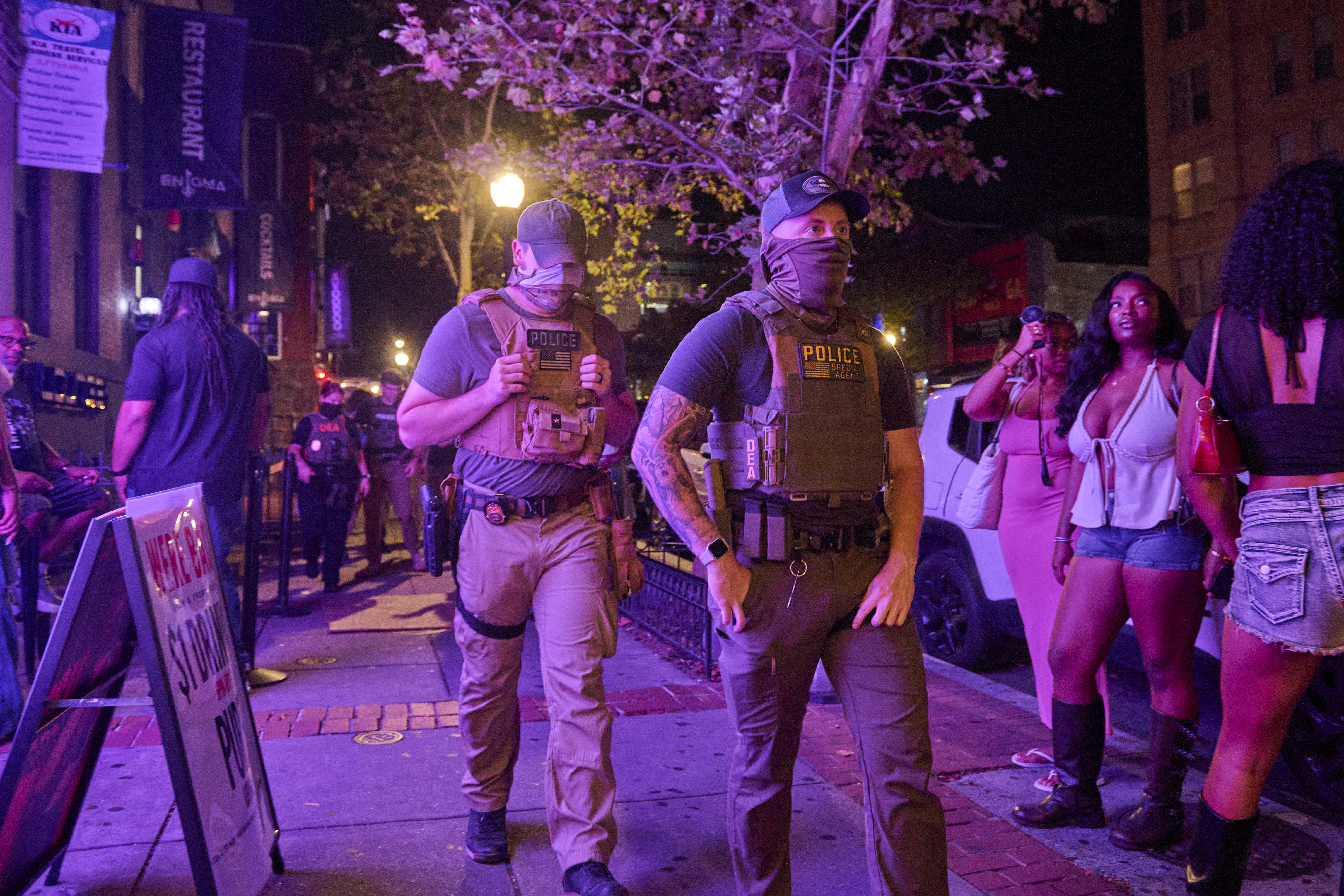
A recent collision of a red-light-running, 14-ton, mine-resistant armored vehicle with an SUV on Capitol Hill isn’t the biggest news involving the federal takeover of Washington, DC, but it’s a tidy metaphor reflecting the counter-productive, heavily militarized, anti-crime display that President Donald Trump has embarked on. Overriding Washington, DC’s, democracy in the process. And then on Friday, he threatened to repeat the effort in other locations, including the Windy City.

With no landmines or roadside bombs, Washington has no evident need for vehicles explicitly designed for those dangers. Nor has the city been “overtaken by violent gangs and bloodthirsty criminals,” as Trump said to justify his takeover of the police department and deployment of troops. But the president is nevertheless doubling down on the militarized occupation, and, as with the Capitol Hill incident, collateral damage is mounting.

The Army announced Thursday that the unidentified National Guardsman behind the wheel of the massive vehicle had already received a ticket for running a red light before the collision. The DC resident in the SUV, meanwhile, was reportedly trapped in their car and transported to a nearby hospital to treat a head laceration, which reportedly was not serious.

The military Joint Task Force overseeing troops in the District said after the incident that it “remains committed to the safety of our service members and the public.” But Defense Secretary Pete Hegseth’s order Friday for National Guard troops in the city to start carrying firearms, despite initial assurances they would be unarmed, struck many DC residents as further endangering their safety.

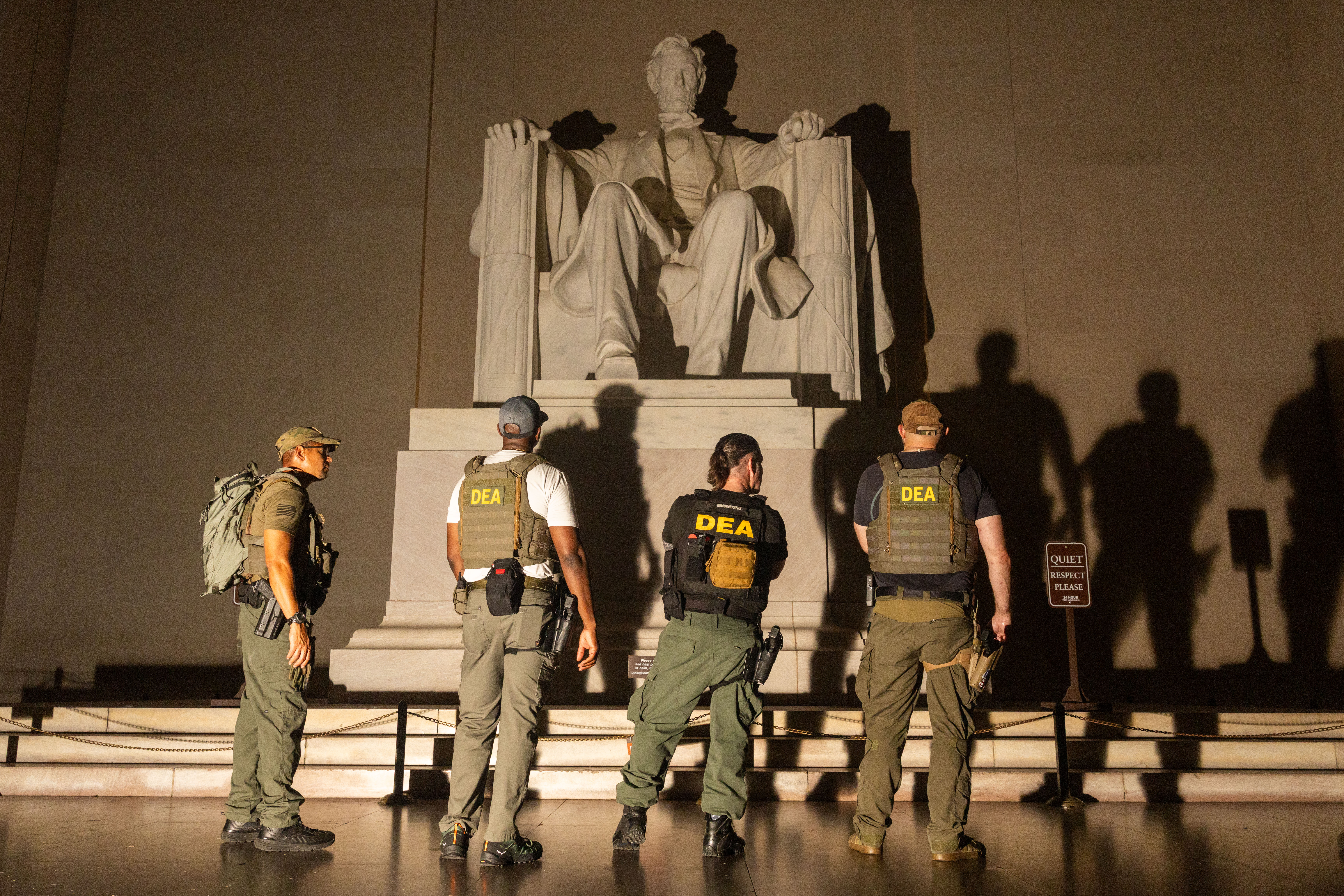
Vice President JD Vance, in a recent appearance at Union Station, said the train station needs National Guard protection against “vagrants,” “drug addicts,” “chronically homeless,” and “mentally ill” people. One DC resident posted a video Friday in which she described being sexually harassed while walking past Union Station, not by Vance’s “vagrants,” but by a Drug Enforcement agent.

Washington residents disagree. A Washington Post-Schar School poll released the same day found 79 percent of District residents oppose the takeover. Twenty-four percent called Trump’s occupation the city’s biggest problem, versus 22 percent who cited crime and violence as the top issue.

The White House has claimed arrests in DC are up since the takeover began, but they have refused to release detailed information backing those claims. And what data they have revealed suggests that arrests of undocumented immigrants, not violent criminals, account for the increase. The administration also asserts that the federal takeover has led to the dismantling of at least 48 homeless encampments, but lacking any plans for where the homeless will go, that effort appears to prioritize short-term aesthetics over longer-term solutions. Some tent-dwellers already appear to be returning to previously cleared areas.

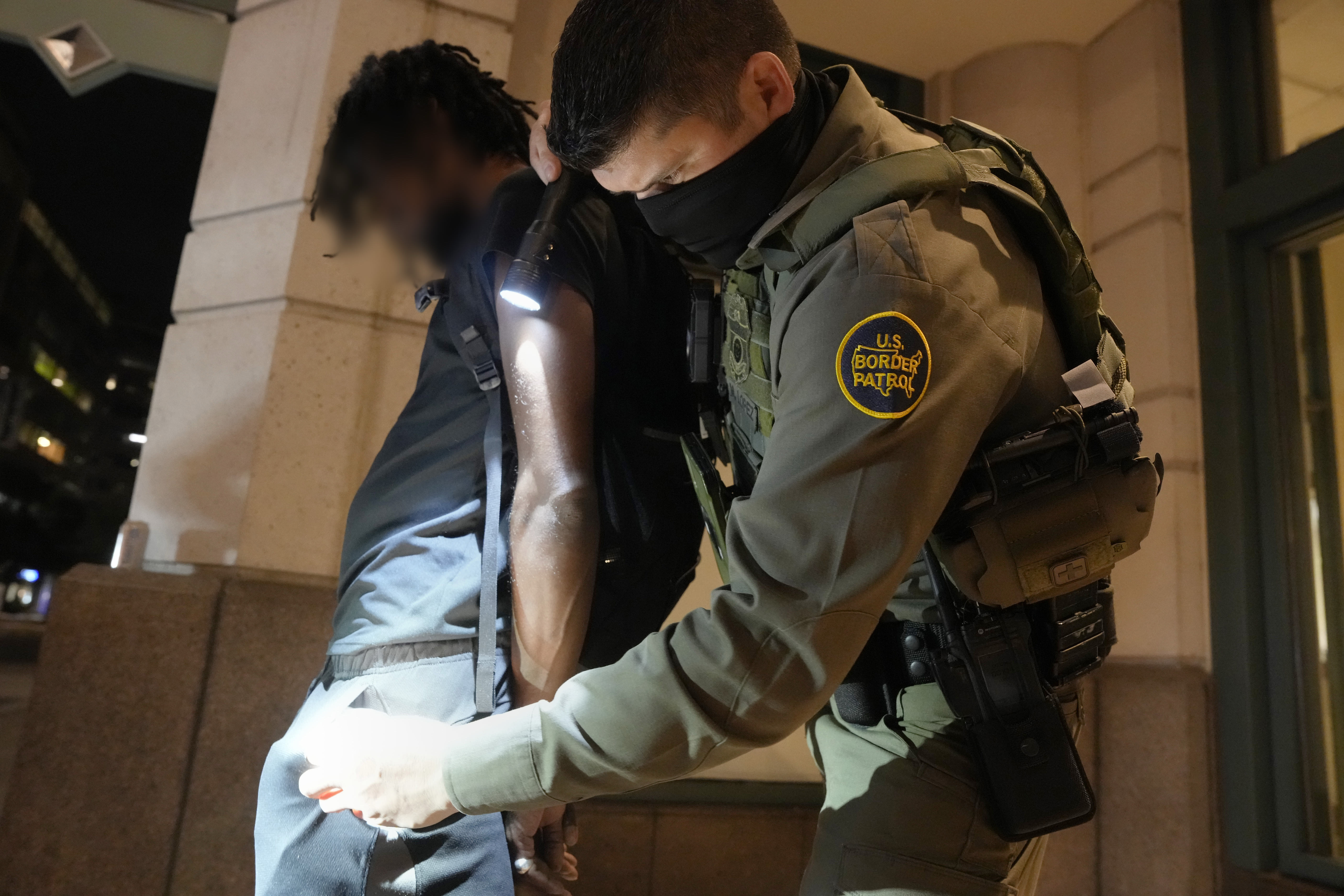
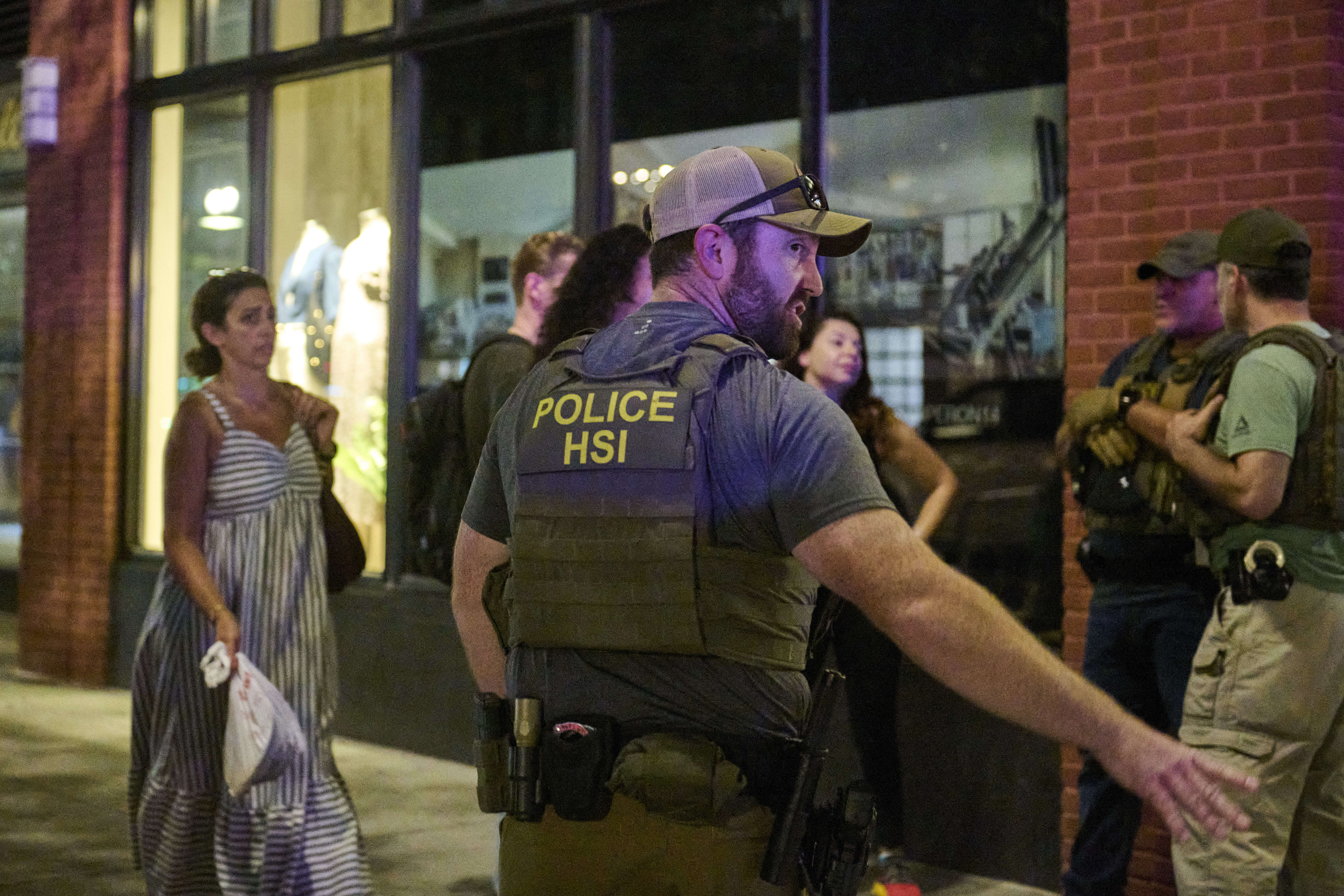
Residents of varied ages and races, contrary to administration claims, have expressed their displeasure about having federal agents patrolling DC streets, most of them seemingly in areas heavy on tourists and nightlife, as opposed to violent crime. Confrontations between the residents and the agents can be tense.

“You come to our city and this is what you do?” a woman yelled at National Guard troops in a video that showed the aftermath of the Capitol Hill armored car crash. “Seriously?”

On Thursday in the Mount Pleasant neighborhood, where federal agents appear to have left a dildo in the place of an anti-ICE banner they purloined a week before, residents confronted and pursued three apparently off-duty federal agents, cursing at them and taunting them about the sex toy. “Did you forget your dildo?” the woman shooting the video repeatedly asked.

On Friday night on U Street, an area full of bars and restaurants, a large group of FBI and other federal agents took part in arresting a single man for publicly smoking marijuana, according to witnesses. (Possession of marijuana is legal in the District, though public consumption is not.)

“There’s so much other shit happening in this city, and you guys are arresting him for smoking weed?” an onlooker asks feds, who appear embarrassed, in a video posted by independent journalist Hannah Gais. “For weed!”

Such scenesreflect the reality of the model that Trump now says he plans to export to other big cities. He does not seem to understand that his authority in Washington, a federal city with limited home rule, does not extend elsewhere.

But he clearly hopes that his tough-on-crime pose is a political winner, or, at least, a more salient topic than his relationship with Jeffrey Epstein or the wobbling economy.

“I think Chicago will be our next,” Trump said from the Oval Office Friday, “and then we’ll help with New York.”

Officials there quickly pushed back. “Donald Trump’s threat to bring the National Guard to Chicago isn’t about safety—it’s a test of the limits of his power and a trial run for a police state,” Illinois Governor J.B. Pritzker said in a post Friday. “Illinois has long worked with federal law enforcement to tackle crime, but we won’t let a dictator impose his will.”

As for DC, Trump said Friday that he intends to keep National Guard troops in town “as long as I want,” and threatened to fully take over governing the District—an act that would require congressional approval. DC Mayor Muriel Bowser “better get her act straight, ” Trump said, “or she won’t be mayor very long because we’ll take it over with the federal government running like it’s supposed to be run.”

Continue Reading…

Mother Jones

Ghislaine Maxwell Absolves Trump, and Everyone Else, in DOJ Interviews

Ghislaine Maxwell has delighted MAGA loyalists by asserting that she never saw the man she is hoping will spring her from a 20-year prison sentence “in any inappropriate setting” throughout the years he spent hanging out with the late convicted sex trafficker and pedophile Jeffrey Epstein.

But Maxwell, convicted of sex trafficking minors and conspiracy, among other charges, whom Trump has already rewarded with a move to a minimum-security prison camp, went further than that, according to transcripts of her interviews with Justice Department officials released Friday.

“I never, ever saw any man doing something inappropriate with a woman of any age,” she said, referring to her years of interactions with men who socialized with Epstein, her former companion. “I never saw inappropriate habits.”

“That would be a flat no to any man,” she added.

Maxwell was interviewed over two days by Deputy Attorney General Todd Blanche, whose past work as Trump’s personal attorney appears to create a sizeable conflict of interest. The former socialite continues to deny her own guilt in lining up sexual partners for Epstein, many of them underage, and is appealing her conviction. In her sessions with Blanche, conducted in July, she offered similarly worded exonerations of many of the prominent men whose relationships with Epstein have prompted accusations of wrongdoing. Nor, she said, was there any kind of a client list or instances of Epstein recording the men for whom he arranged sexual encounters.

Maxwell was bipartisan with her exonerations, claiming former president Bill Clinton, contrary to widespread speculation, was not close to Epstein, and did not visit Epstein’s notorious private island in the Caribbean.

“Absolutely never went,” she said. “And I can be sure of that because there’s no way he would’ve gone—I don’t believe there’s any way that he would’ve gone to the island, had I not been there. Because I don’t believe he had an independent friendship, if you will, with Epstein.”

“President Clinton was my friend, not Epstein’s friend,” Maxwell said.

Maxwell disputed claims by Epstein’s victim Virginia Giuffre—who died by suicide in 2025—that Prince Andrew, the brother of Britain’s King Charles, raped Giuffre during visits to an Epstein property, claiming the two never even met. (Andrew settled a lawsuit filed by Giuffre without admitting liability.)

What about the famous defense attorney and Harvard Law School professor Alan Dershowitz, who represented Epstein? Giuffre had leveled and then later retracted accusations against him that involved massages and a bathrobe. Did he, Blanche asked, ever do “anything inappropriate?”

“Absolutely not,” Maxwell said. “I don’t remember anything about him ever getting massaged. I don’t ever have any recall, I don’t believe I ever even saw him in a bathrobe. I have no knowledge of that.”

Nor did Maxwell recall if former Treasury Secretary Larry Summers, who socialized with Epstein while Summers was the president of Harvard University and Epstein was a donor, traveled on Epstein’s plane.

Blanche pressed Maxwell on a host of other famous men, including brothers Andrew and Chris Cuomo, the late Massachusetts senator Ted Kennedy, and former Secretary of State John Kerry. Despite speculation, Maxwell said Epstein knew none of them. Blanche even asked about George Soros, the billionaire financier, who features in a variety of far-right, antisemitic conspiracy theories, including some involving Epstein.

“I don’t think [Epstein] knew him,” Maxwell said.

One exception, however, is Robert Kennedy Jr., now the Health and Human Services Secretary. Maxwell said that Kennedy had joined Epstein on a “dinosaur bone hunting trip in the Dakotas in the 1980s. But, as with all the others: “I never saw anything inappropriate with Mr. Kennedy.”

Maxwell also said that she does not recall a suggestive birthday note that the Wall Street Journal reported Trump sent Epstein for his 50th birthday in 2003. Trump denies sending the letter and has sued the paper over its report. Maxwell does remember creating the “birthday book” for Epstein, which was reportedly filled with notes and testimonials from such luminaries as Clinton, Dershowitz, and financier Leon Black. The idea, Maxwell said, came from her mother. But she asserted that she could not remember whether Trump, or anyone specific, contributed.

“It’s been so long,” Maxwell said when asked to recall the names of contributors to the book. “I want to tell you, but I don’t remember.”

The trade here is obvious. Memory lapses that help the pardon-happy president try to move past speculation about his own involvement with late sex criminal offer Maxwell’s best bet for getting out of prison. Indeed, Maxwell, who federal prosecutors said lied “brazenly” under oath during her 2021 trial, has every reason to fib about Trump now. But laying it on so thick, in such a nakedly transactional exchange, may have the opposite of its intended outcome.

Continue Reading…

Mother Jones

A Baby Adopted, a Family Divided

In 2017, David Leavitt drove to the Northern Cheyenne reservation in Montana to adopt a baby girl. A few years later, during an interview with a documentary filmmaker, Leavitt, a wealthy Utah politician, told a startling story about how he went about getting physical custody of that child.

He describes going to the tribe’s president and offering to use his connections to broker an international sale of the tribe’s buffalo. At the same time, he was asking the president for his blessing to adopt the child.

That video eventually leaked to a local TV station, and the adoption became the subject of a federal investigation into bribery. To others, the adoption story seemed to run afoul of a federal law meant to protect Native children from being removed from their tribes’ care in favor of non-Native families.

This week on Reveal, reporters Andrew Becker and Bernice Yeung dig into the story of this complicated and controversial adoption, how it circumvented the mission of the Indian Child Welfare Act, and why some of the baby’s Native family and tribe were left feeling that a child was taken from them.

This episode was produced in collaboration with the Investigative Reporting Program at UC Berkeley’s Graduate School of Journalism.

This is an update of an episode that originally aired in August 2024.

Continue Reading…

Mother Jones

America’s Mines Are Literally Throwing Away Critical Metals

This story was originally published by Grist and is reproduced here as part of the Climate Desk collaboration.

The United States is home to dozens of active mines. Some extract copper, while others dig for iron. Whatever the resource, however, it usually makes up a small fraction of the rock pulled from the ground. The rest is typically ignored. Wasted.

“We’re only producing a few commodities,” said Elizabeth Holley, a professor of mining engineering at the Colorado School of Mines. “The question is: What else is in those rocks?”

The answer: a lot.

In a study published today by the journal Science, Holley and her colleagues aimed to quantify what else is in those rocks. They found that, across 70 critical elements at 54 active mines, the potential for recovery is enormous. There is enough lithium in one year of US mine waste, for example, to support 10 million electric vehicles. For manganese, it’s enough for 99 million. Those figures far surpass both U.S. import levels of those elements and current demand for them.

Even a 1 percent recovery rate, the study found, would “substantially reduce” import reliance for most elements.”

Critical minerals are essential to the production of lithium-ion batteries, solar panels, and other low- or zero-carbon technologies powering the clean energy transition. Where the US gets those minerals has long been a politically fraught topic.

The vast majority of lithium comes from Australia, Chile, and China, for example, while cobalt predominantly comes from the Democratic Republic of the Congo. While securing a domestic supply of rare or critical materials has been a US policy goal for decades, the push has intensified in recent years. Former president Joe Biden’s landmark climate legislation, the 2022 Inflation Reduction Act, included incentives for domestic critical mineral production, and this year, President Donald Trump signed an executive order invoking wartime powers that would allow more leasing and extraction on federal lands.

“Our national and economic security are now acutely threatened by our reliance upon hostile foreign powers’ mineral production,” the order read. “It is imperative for our national security that the United States take immediate action to facilitate domestic mineral production to the maximum possible extent.”

Trump also made critical minerals a cornerstone of continued support to Ukraine. Meanwhile, China recently expanded export controls on rare earth metals, underscoring the precarious nature of the global market.

“Mining is a very old-fashioned industry…Who is going to take the risk?”

Holley’s research indicates that increased domestic byproduct recovery could address this instability. Even a 1 percent recovery rate, it found, would “substantially reduce” import reliance for most elements. Recovering 4 percent of lithium would completely offset current imports.

“We could focus on mines that are already corporate and simply add additional circuits to their process,” said Holley. “It would be a really quick way of bringing a needed mineral into production.”

This latest research is “very valuable,” said Hamidreza Samouei, a professor of petroleum engineering at Texas A&M University who wasn’t involved in the study. He sees it as a great starting point for a multipronged approach to tackling the byproduct problem and moving toward a zero-waste system. Other areas that will need attention, he said, include looking beyond discarded rock to the “huge” amounts of water that a mine uses. He also believes that the government should play a more aggressive policy and regulatory role in pushing for critical mineral recovery.

“Mining is a very old-fashioned industry,” said Samouei. “Who is going to take the risk?”

The Department of Energy recently announced a byproduct recovery pilot program, and the Pentagon took a $400 million stake in the operator of the country’s only rare-earth metal mine. At the same time, Congress recently repealed large chunks of the Inflation Reduction Act, which would have driven demand for critical minerals, and has slashed federal funding to the US Geological Survey and the Department of Energy’s Office of Science, among other research arms.

The general thrust of the Science study is “not new,” said Isabel Barton, a professor of geological engineering at the University of Arizona. “It is a very hot topic in mining these days.”

The attention is contributing to a burgeoning shift in thinking, from an intense focus on the target mineral to consideration of what else could be produced, including critical minerals. “There are some that are probably relatively simple. There are others that are heinously difficult to get to,” said Barton, and whether a mineral is recovered will ultimately come down to cost. “Mining companies are there to make a profit.”

Figuring out the most economically viable way forward is exactly the next step Holley hopes this research will inform. Byproduct potential varies considerably by mine, and the analysis, she said, can help pinpoint where to potentially find which minerals. For instance, the Red Dog mine in Alaska appears to have the largest germanium potential in the country, while nickel could be found at the Stillwater and East Boulder mines in Montana.

“The [research and development] funding on critical minerals has been a little bit of a scattershot,” she said. “Our paper allows the development of a strategy.”

Continue Reading…

Mother Jones

The Resistance is Active in DC—You’re Just Not Looking Closely Enough

It’s 7 p.m. on Thursday and Elli, a 19-year-old transplant from Chattanooga, Tennessee, just took an Adderall. The DC resident, who goes by they/them pronouns and asked Mother Jones not to publish their last name, needed the boost of energy. They’re drained from spending the last several nights roving the city on foot to surveil the FBI and ICE agents who are—under the orders of President Donald Trump—surveilling the people of DC.

“Wherever there are people watching, law enforcement gets intimidated,” the lanky teenager explained of their efforts as we walked past tactical military vehicles in Navy Yard.

There is plenty of backlash—it’s just a grittier and less organized form of it, carried out by Washingtonians with cellphone cameras and some spare time.

Elli wouldn’t make it back to their apartment until 2 a.m. on Friday, after visiting six DC neighborhoods and uploading 10 social media posts alerting followers to various forms of law enforcement activity. In all, Elli’s iPhone shows they’ve walked upwards of 20,000 steps a day while documenting the federal takeover.

And Elli was just one of more than a dozen of self-appointed watchdogs I observed participating in what amounted to an after-dark patrol squad on Thursday night. The scene contrasted with what a columnist described as a “weirdly quiet” local response in a Politico piece titled, “Why Washington Residents Aren’t Flooding the Streets to Protest Trump,” published earlier that day.

While it’s accurate to say there hasn’t been anything close to a modern-day March on Washington since Trump brought in the National Guard to address DC’s purported crime problem, the DC locals who are wrestling with the increased presence of law enforcement say that’s for good reason. Megaphones and mass demonstrations are unlikely to mollify the hazards of a heightened police state—and these tactics may even exacerbate what Trump-opposing locals fear most: bigger dispatches of law enforcement, which could target more immigrants and other vulnerable populations.

“Being a middle-aged white man, I can be outside and keep an eye on what’s happening,” says Andrew Hall, a DC resident of 19 years who lingered around the corner of 14th and U St NW around 9:30 p.m., after a concert protesting the National Guard presence ended. “It’s not safe for others to be out in public, or even go to the grocery store right now.”

But what’s clear from merely existing in my city this week is that the “lack of street-level backlash” the Politico columnist lamented isn’t the full picture of DC’s response to the federal agents donning tactical vests near our landmarks. There is plenty of backlash—it’s just a grittier and less organized form of it, carried out by Washingtonians with cellphone cameras and some spare time. The DC resistance isn’t manifesting this week as recognizable members of Congress marching up and down Pennsylvania Avenue with CNN cameras in tow, but as an array of ordinary DC residents documenting what’s happening in their neighborhoods and mobilizing pop-up actions based on the information being shared.

In the densely populated Northwest DC neighborhood of Columbia Heights on Tuesday, for example, locals noticed about a dozen Homeland Security personnel outside a metro station. “ICE go home!” some 150-plus people chanted at the agents, several of whom had their faces covered with masks. The growing crowd and their pinpointed cameras were apparently enough to deter the ICE agents from the area, which has a high population of Black and Hispanic residents.

In Mount Pleasant, an even smaller display of opposition took place recently when a local woman approached what appeared to be a handful of off-the-clock federal agents sitting outside a restaurant. She repeatedly asked them if they were locals, where they lived, and what agency they worked for while filming them. Declining to answer her questions, the three or four individuals eventually walked to a black Hyundai Sonata with an out-of-state license plate. “Nobody likes you,” she yelled in a video shared by the news outlet Migrant Insider on Thursday. “Get the fuck out of my neighborhood!”

On Wednesday, Vice President JD Vance, Defense Secretary Pete Hegseth, and White House deputy chief of staff Stephen Miller took a field trip to visit the National Guard troops patrolling outside Union Station. While there, the politicians got some Shake Shack—plus a stupendous amount of heckling. The opposition included professional protestors who have shown up daily at the train station since May, as well as many residents who happened to be there for their daily commute.

In the days since, more and more DC locals have been trying to gather information what to do should they encounter the federal agents, or the politicians who ordered them here. On a Zoom call organized by the DC-statehood group Free DC Friday morning, more than 250 showed up and asked questions about best practices for fighting back. In break-out rooms, attendees discussed walking around their neighborhoods with signs alerting people to the presence of ICE, as well as joining ward-based Signal chats to organize response efforts among neighbors. In the Zoom chat, one attendee asked how they could warn others that ICE was in their area at that very moment.

DC residents are routinely reporting such sightings on ICEblock, an iPhone app tailor-made for locals to pinpoint ICE agents in real time. There’s also an emergency hotline (202-335-1183), which then shares the reports with the immigrant community. Beyond these dedicated spaces, I’m also seeing neighbors post sightings of law enforcement and police checkpoints on Nextdoor, which historically has been known as a watering hole for nosy neighbors and humdrum bigots, but in DC—at least recently—has turned into a space where people are trying to help strangers.

“On The Corner Of 4th And Rhode Island Ave RIGHT NOW,” one Nextdoor user posted alongside an image of an ICE-labeled vehicle on Thursday. “ICE is back in Mount Pleasant at Bancroft & Park Pleasant Apartments,” shared someone else.

“You don’t need to do what I’m doing to be helpful,” Elli says of the various ways DC residents can warn their neighbors. “All you need is a phone.”

Continue Reading…

Mother Jones

Donald Trump Is Waging a Whole-of-Government Retribution Campaign

The Trump administration’s campaign of vengeance against perceived political enemies escalated Friday morning when the FBI raided the home and office of former national security adviser John Bolton, a vocal Trump critic.

That search follows Attorney General Pam Bondi directing federal prosecutors to open a criminal investigation into whether former President Barack Obama and his aides concocted evidence about Russia’s efforts to help Trump in the 2016 election. Last month, the Justice Department said it was separately investigating former CIA Director John Brennan and former FBI Director James Comey, without specifying the allegations. Meanwhile, loyal Trump underlings— including DOJ official Ed Martin and Bill Pulte, a real estate heir running the Federal Housing Finance Agency—are using government power, along with social media gimmickry, to allege wrongdoing by frequent Trump foils.

The various investigations may differ in their legitimacy. But they are all the manifestation of Trump’s promises to use the White House to prosecute his enemies. The threat of an authoritarian president using his office and control of federal law enforcement to try to imprison critics is not hypothetical. It is happening, as Trump advisers race to please him by launching probes aimed at his foes.

These efforts are predicated on concocted claims that it was the administration’s Democratic predecessors who misused federal agencies for politics. The Trump administration is politicizing intelligence, law enforcement, and other government functions while pretending to be punishing politicization, as with the ironically named “Weaponization Working Group” that Martin now leads. That can feel a bit confusing, but it is more easily understood as a string of efforts by individual Trump advisers to their please boss by helping him crack down on dissent and deliver retribution.

Director of National Intelligence Tulsi Gabbard’s report on “Russiagate” was widely derided, but it came following reports that suggested Trump was considering firing her after she contradicted his claims about the danger of Iran’s nuclear program. The former Democratic representative appears to have protected her job by handing Trump a report that helped him try to shift attention amid scrutiny of his relationship with pedophile Jeffrey Epstein.

Bondi, too, has faced withering attacks from within MAGA over her botched handling the Epstein scandal. Her quickly launched investigation aimed at Obama may never meet the standards of federal judges, but it made her boss happy.

The search of Bolton’s home required a judge to find probable cause to issue a warrant. The FBI is reportedly looking into accusations that Bolton, who was investigated during the first Trump administration for revealing sensitive information in a book, had leaked national security information more recently.

Trump on Friday claimed he was not aware beforehand of the Bolton raid. But that claim, true or not, overlooks the reality that various Trump advisers appear to be using attacks on his enemies to win or keep the mercurial president’s favor.

Vice President J.D. Vance even weighed in on Bolton Friday. “If we think Ambassador Bolton committed a crime, of course eventually prosecutions will come,” Vance told NBC’s Meet the Press. Vance added that “classified documents are certainly part of it, but I think that there’s a broad concern about Ambassador Bolton.”

FBI director Kash Patel—who attacked Bolton in a 2024 book, complaining at length that Bolton had dragged his feet on hiring him during the first Trump administration—tweeted about the raid at the time it occurred, writing: “NO ONE is above the law…@FBI agents on mission.” Bondi then reposted Patel, adding, in part: “Justice will be pursued. Always.”

Such public pronouncements were once unusual for DOJ officials. But they are increasingly standard under Trump. Martin, who got his current position after the Senate declined to confirm him as US attorney for DC, is seeking presidential favor through highly public, if legally dubious, campaigns. He saidin a May press conference that he planned to use publicity to attack Trump foes. “If they can be charged, we’ll charge them,” he declared. “But if they can’t be charged, we will name them. And we will name them, and in a culture that respects shame, they should be people that are ashamed.”

Earlier this week, Martin appeared outside the Brooklyn home of New York Attorney General Letita James, where—clad in the trench coat he has attempted to make his signature—he posed for pictures taken by the New York Post, all part of an effort to call attention to claims that James committed fraud in private real estate dealings. In a letter to James’ lawyer, Martin said he would consider it “an act of good faith” if James resigned.

The New York Times recently noted that Martin’s actions violate a slew of DOJ rules and norms: “Prosecutors are barred from making investigative decisions based on politics; they are asked not to comment on specific cases; and they are supposed to avoid turning their investigations into public spectacles.”

But Martin took a similar tack this week in a letter he reportedly sent Federal Reserve Chair Jerome Powell urging him to fire Lisa Cook, a Federal Reserve Board member, over allegations that Cook had improperly claimed a property she owns in Atlanta as her residence. “Do it today before it is too late!” Martin wrote.

The allegations against Cook came from Pulte, the 37-year-old head of an agency that oversees Fannie Mae and Freddie Mac. Pulte has used his post to highlight unproven mortgage fraud accusations against James, Cook, and Sen. Adam Schiff (D-Calif.) and has issued letters asking the DOJ to investigate. (All three have denied breaking the law.) Martin reportedly met with Pulte early this month.

Pulte, who has 3 million followers on X, posted recently that he had “obtained” a document submitted to the government that he claims shows Cook committed fraud. Pulte’s accusation was quickly taken up by Trump, who is attempting to gain control of the Federal Reserve and oust Powell before his term ends, in effort to push for lower interest rates.

Bloomberg reported Friday that Pulte, who has been “struggling” to maintain influence with the White House” amid irritation by some officials there over his bombastic online behavior—including his habit of announcing significant policy changes via tweet—had returned to favor with the president through his attacks on Cook.

Trump’s efforts to target his critics also got help earlier this month from the Office of Special Counsel, or OSC, a small independent agency charged with enforcing federal rules. The office, which is not part of DOJ, announced that it was investigating whether Jack Smith, the federal prosecutor who twice indicted Trump, had violated a law barring federal workers from using their government jobs to engage in political activity.

Since the strongest sanction OSC can apply is to urge the firing of a federal employee, it cannot impose any real penalty on Smith, who resigned from his post in January. But the agency—whose previous head Trump fired earlier this year, and where Trump has tried to install a far-right loyalist—appears eager to ingratiate itself with the president.

Such efforts show how a president can attack officials he wants to oust—and how the vast powers of a sprawling federal government can be wielded against his critics. These attacks certainly reflect Trump’s own pathology. But they would be impossible without the collaboration of influence-seeking enablers using public positions to enact Trump’s vengeance agenda.

Continue Reading…

Mother Jones

Judge: Tear Down Alligator Alcatraz Within 60 Days

A federal judge in Miami has ruled that operations at the controversial detention facility Alligator Alcatraz must begin to wind down, ordering state and federal officials to stop transferring detainees there and relocate current detainees within 60 days.

Two weeks after US District Judge Kathleen Williams, an Obama appointee, ordered a temporary pause on any new construction at Alligator Alcatraz, in response to a suit by environmental groups,she has now ordered the dismantling of equipment at the detention camp, such as fencing, lighting, generators, and other infrastructure. Florida Attorney General James Uthmeier filed a notice indicating the state would appeal to the US Court of Appeals for the Eleventh Circuit.

The US Department of Homeland Security previously said in court filings that it was not in charge of operations at Alligator Alcatraz, and the facility was solely the responsibility of Florida, “using state funds on state lands under state emergency authority.” The state argued that the environmental groups that hadfiled the lawsuit are seeking relief under the National Environmental Policy Act, which does not apply to state agencies.

But in her 82-page ruling filed on Thursday night, Williams disagreed. “The project was requested by the federal government; built with a promise of full federal funding; constructed in compliance with ICE standards; staffed by deputized ICE Task Force Officers acting under color of federal authority and at the direction and supervision of ICE officials,” she wrote, “and exists for the sole purpose of detaining and deporting those subject to federal immigration enforcement.”

“While the Defendants repeatedly espouse the importance of immigration enforcement, they offered little to no evidence why this detention camp, in this particular location, is uniquely suited and critical to that mission.”

“While the Defendants repeatedly espouse the importance of immigration enforcement, they offered little to no evidence why this detention camp, in this particular location, is uniquely suited and critical to that mission,” the order continued.

As I wrote in June, two environmental groups filed a lawsuit in federal court against federal and state officials to halt the Alligator Alcatraz project. They argued that construction proceeded without an environmental review or opportunity for public comment, in violation of the National Environmental Policy Act. On Friday, the plaintiffs applauded Williams’s ruling. “This decision sends a clear message that environmental laws must be respected by leaders at the highest levels of our government—and there are consequences for ignoring them,” Eve Samples, executive director of Friends of the Everglades, said in a written statement.

For weeks, plaintiffs have filed declarations building their case for how the detention camp could potentially impact the neighboring ecosystems and wildlife. Traffic to and from the detention site increases the likelihood of panthers being struck by vehicles, according to court filings, and light pollution could destroy the nighttime foraging abilities of bats in the area.

Last week, Williams concluded a four-day hearing during which she heard testimony from ten witnesses and reviewed hundreds of exhibits. She questioned Jesse Panuccio, an attorney representing the state of Florida, asking for reasons to justify the decision to build a detention center in the Everglades in the first place, according to CNN. Florida wildlife experts also testified about the potential harm to animals in the area. Increased activity, one expert testified, would interfere with the mating habits of endangered panthers, UPI reported.

During the hearing, members of the environmental team from the Miccosukee Tribe of Indians testified that 80 percent of the Tribe’s “residences, two schools, and the Tribal governmental building, are all located in the Miccosukee Reserved Area, a few miles southeast” of the detention camp, Williams’s order states. Any “uncontained wastewater or run-off” leaving the site would likely flow into the Miccosukee Reserved Area.

From the beginning, the camp has been mired in controversy. Hastily erected in late Juneon a remote airfield by Big Cypress National Preserve, it is predicted to cost $450 million per year to run. As reported by family members, attorneys, and lawmakers, the facility has been fraught with malfunctioning air conditioners, scarce food, and rampant mosquitoes. Detainees are offered no recreational time and are held in large white tents, each containing 32 beds and three toilets. They are separated into chain-link fenced areas. State and federal officials running the center have previously stated that the camp would be for immigrants with criminal records, but as the Miami Herald reported in July, many detainees have no prior arrests. In July, nearly 1,000 detainees were being held at Alligator Alcatraz. This week, a Democraticlawmaker who visited the detention camp told reporters the number had dropped to 336.

Another Alligator Alcatraz ruling was issued this week. In a separate lawsuit filed in July, the American Civil Liberties Union alleged that attorneys could not reach their clients held at the detention camp. They reported being unable to schedule appointments with clients and the government’s failure to designate an immigration court that would accept filings from detainees held at Alligator Alcatraz. Earlier this week, a federal judge dismissed part of the lawsuit after the government designated an immigration court for Alligator Alcatraz detainees.

Meanwhile, Democrats continue to demand information about Alligator Alcatraz. More than 60 US lawmakers signed a letter sent to the Department of Homeland Security this week requesting details about its operations, the Florida Phoenix reported, including whether the facility is following federal standards for the treatment of detainees and details on inspections. “Given that DHS is working directly with the Florida state government on a detention facility with alarming implications,” the letter states, “DHS should ensure transparency and accountability surrounding the facility’s financing operations.” This request may be moot if Williams’s orders are obeyed, but given the state’s interest in appealing, the court case and the operations of Alligator Alcatraz will likely continue.

Continue Reading…

Mother Jones

FBI Raids the Home of John Bolton

The FBI on Friday raided the Maryland home of John Bolton, who served as national security adviser during President Donald Trump’s first term before becoming a vocal Trump critic. Agents were seen entering Bolton’s home around 7 am ET, nearly the exact same time that FBI Director Kash Patel posted on X: “NO ONE is above the law…@FBI agents on mission.”

The probe, which reportedly relates to a previous investigation launched during Trump’s first term over whether Bolton improperly handled classified information, is the latest escalation in the Trump administration’s use of law enforcement powers against perceived enemies. Though Patel’s Friday social media post did not explicitly refer to the Bolton raid, the two men have a fractious history. Bolton made several appearances in Patel’s 2024 book The Deep State, the Truth, and the Battle for Our Democracy, including in an infamous appendix listing “Members of the Executive Branch Deep State.” In the book, Patel also blasted Bolton as an “arrogant control freak” and personally blamed Bolton for delaying Patel’s hiring in the first Trump administration.

Bolton has been especially outspoken in recent weeks over Trump’s negotiations with Russian President Vladimir Putin. In turn, Trump attacked Bolton on Truth Social as “really dumb.”

This is a breaking news post. We’ll update as more developments become available.

Continue Reading…

Mother Jones

Public Commenters Overwhelmingly Oppose EPA’s Plan to Curtail Key Climate Protections

This story was originally published by Inside Climate News and is reproduced here as part of the Climate Desk collaboration.

Experts and members of the public on Tuesday voiced overwhelming opposition to the US Environmental Protection Agency’s plan to rescind its key greenhouse gas “endangerment finding” and vehicle emissions standards.

That pushback came during the first of four scheduled public hearings on the agency’s plan to overturn its prior finding that greenhouse gases endanger public health and welfare. The finding, in turn, allowed prior administrations to regulate emissions from motor vehicles, power plants and oil and gas operations for more than a decade.

The original finding followed a 2007 Supreme Court case, Massachusetts v. EPA, in which the court determined that greenhouse gas emissions qualify as air pollutants—and ordered the EPA to assess whether the emissions endangered public health.

In 2009, the EPA turned its determination into one of the most consequential actions the agency had taken to reduce greenhouse gas emissions and combat the growing climate crisis.

But in its new proposal, the agency has threatened to undo the very same environmental protections it once enabled.

“While the public comment period is necessary under law, personally, I believe that the decision at EPA has already been made.”

At the start of Tuesday’s hearing, Aaron Szabo, assistant administrator for the Office of Air and Radiation at the EPA, said that the agency is “committed to fulfilling President Trump’s promise to unleash American energy, lower costs for Americans, revitalize the American auto industry, restore the rule of law and give power back to states to make their own decisions.”

The EPA declined an interview request for this story. But in a July press release, the agency criticized the Obama administration for “mental leaps” that led it to determine that greenhouse gas emissions from automobiles contribute “some unspecified amount to climate change, which in turn creates some unspecified amount of endangerment to human health and welfare.”

According to the press release, the EPA’s new proposal to rescind that finding cites “new scientific and technological developments” that challenge the assumptions behind the endangerment finding. The EPA has justified the move by citing a Department of Energy report that top climate scientists have decried as “antiscientific.”

The report contains a variety of claims that contradict the scientific consensus on climate change. It instead says that the crisis “appears to be less damaging economically than commonly believed,” and it suggests that increased carbon dioxide levels could be a positive development by increasing crop yields and argues that climate model projections overestimate warming.

But the vast majority of speakers during the opening day of the EPA’s public hearings hit back at those claims and urged the agency not to overturn the 2009 finding. From attorneys general to clergy members, from physicians to federal and state lawmakers, the message to the EPA was resounding.

Out of roughly 200 people who testified on Tuesday, Inside Climate News counted fewer than 10 who spoke in favor of the EPA’s move.

The rest expressed significant concerns over the agency’s rationale for the repeal and highlighted the potential consequences for public health, the environment and the United States’ moral stature on the world stage.

The EPA’s proposal relies on an “unvetted, scientifically unsound report from the Department of Energy.”

Representatives from organizations including the American College of Physicians, the National Medical Association, and the American Public Health Association warned the agency that rescinding the finding would have a disastrous impact on the health of all Americans—especially those with medical conditions and from disadvantaged communities.

“In the case of climate change, things cannot be clearer: Greenhouse gases are driving climate change, which is harming people’s lungs across the country,” said Harold Wimmer, president and CEO of the American Lung Association.

“Standards that reduce greenhouse gas emissions from new vehicles have been used by EPA for decades under multiple administrators,” Wimmer said. “Repealing them would not only threaten an acceleration of climate change, it would also lead to increases in harmful air pollution that impact lung health.”

Dr. Ankush Bansal, president-elect of Physicians for Social Responsibility—a Nobel Peace Prize-winning nonprofit—drew a direct line between emissions from nonelectric motor vehicles and harms to human health.

And Khadijah Ameen, co-founder and director of policy and research at the Georgia nonprofit BLKHLTH, said that the ramifications of greenhouse gas emissions are “concentrated in communities that have already been historically excluded and under-resourced.”

Attorneys general and assistant attorneys general from eight states also decried the move as illegal and misguided.

The EPA’s proposal relies on an “unvetted, scientifically unsound report from the Department of Energy to attempt to override the abundant and growing science supporting its endangerment finding and motor vehicle [greenhouse gas] emissions standards,” California Attorney General Rob Bonta said.

“The reconsideration of the 2009 endangerment finding [of] greenhouse gas emissions is completely flawed,” said a Republican farmer.

Representatives from organizations including the American Petroleum Institute, National Automobile Dealers Association, American Trucking Associations, and the CO2 Coalition—a nonprofit advocacy organization that has been criticized for its climate change denialism—spoke in support of the EPA’s proposal.

“CO2 should be celebrated, not demonized,” said Gregory Wrightstone, CO2 Coalition’s executive director. “We don’t have too much CO2—we don’t have enough.”

Will Hupman, representing the American Petroleum Institute, thanked the EPA for its move to “unleash American energy,” adding that it will roll back “heavy-handed and one-size-fits-all vehicle mandates set by the previous administration.”

“We understand the importance of reducing emissions from the transportation sector, but believe the Biden administration took the wrong approach,” Hupman said. “Its approach favored a single technology over all others, and would have effectively mandated the sale of electric vehicles.

“This proposed rule takes a critical step towards restoring consumer choice and protecting the freedom of Americans to decide what to buy and drive to fit their personal needs.”

Public hearings are expected to continue through Friday, and experts anticipate that the change will be challenged in court if the agency moves forward with its plan to rescind the finding.

Despite the balance of testimony leaning heavily against the EPA’s proposal, it appears unlikely that the Trump administration will reverse course on a key component of its drive to deregulate and roll back environmental protections.

“The reconsideration of the 2009 endangerment finding [of] greenhouse gas emissions is completely flawed,” said Jason Touw, who identified himself as a farmer and a registered Republican.

“I want to say that while the public comment period is necessary under law, personally, I believe that the decision at EPA has already been made,” Touw said.

“I hope I am wrong.”

Continue Reading…

Mother Jones

Ugly Laws: The Blueprint For Trump’s Anti-Homeless Crusade

On July 24, President Donald Trump issued an executive order for a nationwide push to involuntarily commit unhoused people to institutions—claiming that roundups would “restore public order,” and demanding the reversal of legal precedents and consent decrees that “impede” the policy, a draconian move that disability rights groups argue violates civil liberties.

The resultant crackdown in Washington, DC—where an estimated 5,000 people live without permanent shelter, around 800 on the street—began on August 14. DC’s largest encampment was destroyed on Monday, and although it’s unclear how many people have been civilly committed, the sweep has left unhoused people scrambling to find new places to stay, often losing the few possessions they have.

Dr. Sam Tsemberis, who developed the evidence-based Housing First approach Trump has abandoned, spoke to my Reveal colleagues last week about the futility and violence of the White House’s crackdown. “People will get discharged from the hospital. They will get released from the jail. And they’ll be back out on the street and the thing will be going in a circle again,” Tsemberis said. “The only way to end homelessness is to provide housing.”

Trump has always backed brutal crackdowns on visible homelessness and disability, part of a lifelong pattern of hostility to poor people, disgust for disabled people, obsession with “good genes” and cleanliness, and a sense of Washington, DC—until fairly recently, a majority Black city—as a somehow fundamentally unsavory, unsightly place.

His encampment sweeps and ramp-up of policing mirror familiar scenes in the San Francisco Bay Area, where an influx of wealth has sparked a major housing crisis, intense economic inequality, and public hostility towards the growing ranks of homeless locals.

“Disability has always functioned as a rationale, an alibi, an excuse, and a bottom line for all kinds of oppression.”

In fact, there’s a throughline from San Francisco to Trump’s anti-disability, anti-homeless agenda: as far back as 1867, San Francisco was the epicenter of a spate of “Ugly Laws,” a legislative crackdown on poverty and disability that closely parallels the Trump program on housing and institutionalization.

Sparked in part by an influx of disabled Civil War veterans, ugly laws fined and enforced the arrest of poor, often disabled people for begging, or just existing, on city streets—often followed by institutionalization in brutal 19th-century facilities that offered little or nothing in the way of treatment.

Ugly laws quickly spread across the country, and never entirely went away. Pushes to police, incarcerate, or drive out unhoused and disabled people have been a constant in American life—and hardly just a Republican thing, with high-profile Democratic politicians like California Gov. Gavin Newsom or New York Mayor Eric Adams prominently endorsing encampment sweeps and forced institutionalization.

To understand more about the Ugly Laws and their legacy, I spoke with University of California, Berkeley professor emeritus Susan Schweik, who is also the author of the book The Ugly Laws: Disability in Public.

What societal issues contributed to the first Ugly Law in San Francisco in 1867?

Let me first say that we know about this law because of the disability movement in the 1970s. Franklin D. Roosevelt and Helen Keller were never going to get arrested under this ordinance, which prohibited diseased, maimed, deformed bodies from exposing themselves to public view. It was a status offense. This law was directed against poor people.

It’s extremely important to understand it as part of a big cluster of vagrancy laws that were being practiced in the South after the Civil War, and that US northern abolitionists who went down to fight slavery, unfortunately, saw the effectiveness of the vagrancy law in the South was being used to substitute for slavery.

Abolitionists brought that back up to the cities in the north, which were under all kinds of pressure. People no longer knew the people they passed on the street. Streets were crowded. Poverty was extreme. There were no safety nets. So it targeted poor people. It targeted poor people who were begging, or who were understood to be begging and disability. Being disabled on the street at all could be construed as begging; whether you were putting a hand out or shaking a cup or saying anything to anyone, it was possible to be understood as asking for people’s pity.

What types of punishments did poor, disabled people face under the Ugly Laws?

At some point, I realized that if I could figure out when a city opened its first almshouse or poor house, it was quite likely that the unsightly begging ordinance would happen, because they had a place to sweep people off the street.

Once big medicalized institutions for the so-called feeble-minded [were established], then it’s easier for a city to pass a law like this without somehow feeling or seeming heartless. It’s very tied to institutionalization and to shutting people away. People were much more likely to be stuck behind those walls for good when it was understood that they were being kind of medically and charitably helped by being given a place.

“Trump, many decades ago, cut his political teeth by trying to shut down vending stands by disabled veterans on Fifth Avenue.”

Very often, the law was unenforced. The police were uncomfortable with it. They didn’t want to do it. A huge thing was sorting out the deserving and the undeserving, and so police often didn’t do it. Even if police did do it, very often, courts didn’t sentence anybody. There’s very little evidence that anybody actually was legally penalized at the level of the municipal courts. [But] that didn’t mean it didn’t have major catastrophic effects.

I had thought for a long time that there was no record of resistance by disabled people to this oppression, and I was wrong. There was an amazing man who lived on the street named Arthur Franklin Fuller, who became the hero of my book, who traveled from town to town until he got kicked out. He self-published books, and one of them was like a legal treatise on the unconstitutionality of the unsightly beggar ordinances. I couldn’t believe it when I found it. It wasn’t like people didn’t try to organize. They did. There was an attempt to unionize disabled beggars in LA to negotiate with the city as a union.

How did the “othering” of disabled people lead to the Ugly Laws not getting the backlash that it should have?

I think the ugly laws were part of a variety of systems and structures, most notably institutionalization. They were tied to the development of various kinds of institutions that were eugenic because they very deliberately removed people from the social world where they might have relationships that might lead to childbearing.

Discrimination in the US has always justified itself on disability grounds. The great historian Douglas Baynton makes this very clear in the realm of immigration: when groups are excluded from being able to enter the US, there’s always a language of disability. They’re contagious, they’re feeble-minded, they’re weak, they’re going to be a burden on the state. Disability has always functioned as a rationale, an alibi, an excuse and a bottom line for all kinds of oppression. Women couldn’t vote because they were hysterical and too emotional. Black people were too volatile or cognitively impaired, or whatever term was going to be marshaled at the moment.

Donald Trump, many decades ago, cut his political teeth by trying to shut down vending stands by disabled veterans on Fifth Avenue, and he was absolutely explicit about them being repulsive and unsightly. He has a very long line of operating out of that terrorizing repulsion.

Did the fight for disability civil rights help lead to the dismantling of the Ugly Laws?

There was a case in the 1970s in Omaha where a policeman wanted to arrest an unhoused person and didn’t know how—so he goes to the ordinance books, finds this [ugly] law, and he’s like, “Oh, that guy has a scar, so I’ll use this.” He goes to court.

The judge was like, What does this mean? If my neighbor’s homely kids ask me for something, they should be arrested? Like, what? What is unsightly? Even though the judge threw it out of court, the DA held a press conference and said [it was] still a good law—and then it [was] reported as “Begging law punishes only the ugly.” Disability activists in Omaha read that headline, and working with disability activists in other Midwestern cities, decided that they were going to make a fuss about that law.

'41 Begging Law Punishes Only the Ugly By James Fogarty. An Omaha police officer recently arrested a man accused of begging on a downtown street. The man looked reaosnably well fed and clothed, the officer noted, and unlike most street beggars, the man was sober. This presented a legal problem, the officer said, because the customy charge in such cases is drunkeness or disorderly conduct. But upon checking the officer found a 1941 city ordinance which says, "it shall be unlawful for any person who is in anyway maimed mutiliated or in anyway deformed so as to be unsightly or disgusting object to expose himself or herself to public view for the purpose of socilicity aims or exciting sympathy, interest or curiosity.

An April 21, 1974 article from the Omaha World-Herald.Omaha World-Herald/Newspapers.com

Chicago disability activists went to their city council as a form of [political] theater, and said this law is still on the books. Nobody was being arrested under it, [but] nobody had ever cared about removing it, and so poor Chicago got a bad rep for being the site of the ugly law, when it really was the site of the activism.

So we know everything we know about these laws because of the disability movement in the ’70s, ’80s, and ’90s. It was invoked explicitly in the campaign for the Americans with Disabilities Act. There are books all over the country, city code books, where they’re still sitting.

Do you think that Trump’s executive order targeting homeless people with psychiatric disabilities is reminiscent of the Ugly Laws?

Two things that are conjoined in that executive order [are] endemic vagrancy and mental illness, the combination [that] the way in which these unsightly, bigger ordinances got passed after cities had institutions that could be stocked full of people who other people did not want to see on the street. How is endemic vagrancy and unsightly encampment and the presence of what gets called mental illness? How is it going to be tackled by the executive order? It’s going to be tackled by civil commitment, by institutionalization.

I think about the important disability advocate and activist Rebecca Cokley, who put out this call and pointed out that people were tending to reduce the possible impact of that executive order to the realm of homelessness or unhoused people or mental health, but that potentially it had a much broader reach. It could target dissent, and that was true of the history of unsightly beggar ordinances. Someone trans could be identified as a mentally ill person. There are so many ways to contain and hurt and banish immigrants, especially Black and brown people, and to disappear them, as Rebecca says.

Ugly laws basically disappeared after World War I, because the existence of large numbers of disabled veterans produced rehabilitation and systems that were, at least at in theory, meant to include people in every aspect of society. [But] here we are again.

This interview has been edited for length and clarity.

Continue Reading…

Mother Jones

“I Made a Mistake”—How Texas Officials Criminalized a Woman for Legal Abortion Care

This story was produced in partnership with CBS News.

A South Texas woman who was arrested on murder charges in 2022 after using medication to terminate her pregnancy has alleged new details about her case against a local sheriff and prosecutors, claiming they violated her constitutional rights.

Her August 12 court filing comes as the debate over medication abortion is heating up in Texas, with Attorney General Ken Paxton announcing a new effort to prevent the pill from being mailed into the state.

“These abortion drug organizations and radical activists are not above the law, and I have ordered the immediate end of this unlawful conduct,” Paxton said Wednesday.

The case of Lizelle Gonzalez was among the first to expose the complexities of criminalizing the use of medication to end a pregnancy. Starr County, located on the southern Texas border, launched an investigation into Gonzalez after hospital staff reported to law enforcement that she had taken medication to induce an abortion when she was 19 weeks pregnant. Three months later, she was indicted and arrested. Gonzalez spent three days in jail before her $500,000 bond was posted, and the charges were ultimately dropped.

While Texas has one of the strictest abortion bans in the country, it’s not a crime for a woman to obtain or seek abortion care for herself. The state’s restrictions on abortion target physicians and those who aid a woman in obtaining or seeking an abortion, whether it’s surgical or induced by use of abortion drugs like mifepristone and misoprostol.

According to new filings in the lawsuit made last week, District Attorney Gocha Ramirez dropped the charges against Gonzalez after public outcry over Gonzalez’s arrest. Included in an exhibit in the lawsuit was a text Ramirez wrote to his son, in which he admitted he’d made a mistake and even called Gonzalez to apologize, stating he “didn’t know what happened.”

In the most detailed account to date of the events surrounding Gonzalez’s arrest, her attorneys laid out in the 70-page lawsuit the events that they say led the Starr County district attorney, the assistant DA, and the sheriff to pursue a case against her, even though records suggest prosecutors knew her actions did not violate state law.

“They should have known from the very beginning that the conduct that they were investigating was not going to ever equal probable cause for homicide.”

“They should have known from the very beginning that the conduct that they were investigating was not going to ever equal probable cause for homicide,” said Lauren Johnson, director of the Abortion Criminal Defense Initiative at the American Civil Liberties Union. “The penal code is very clear that a pregnant person cannot be charged with—cannot be guilty of a crime, of a homicide, for ending a pregnancy themselves.”

According to the original complaint filed in March 2024, Gonzalez says she went to an emergency room in January 2022 after taking misoprostol, an abortion-inducing medication.

Less than an hour after she was discharged, she returned to the hospital with complaints of abdominal pain and vaginal bleeding. After an exam detected no fetal cardiac activity, doctors performed a cesarean section to deliver a stillborn fetus.

After the procedure, a nurse at the hospital called 911 and reported the procedure to local police, who then contacted the Starr County Sheriff’s Office. The nurse later said the hospital’s administrators directed her to report the incident “because, she said, abortions could now be considered murder due to a ‘change in the law,’” according to the complaint.

“It is not an overstatement to say that Lizelle’s life was entirely upended by what happened to her,” said Johnson, who is representing Gonzalez in the lawsuit. “She wanted to live her life and didn’t want to be criminalized and have her mugshot in her local community. And have something that should have been a very personal decision be something that was made public.”

In July, the Southern District Court of Texas denied Starr County officials’ attempts to have the lawsuit dismissed after the prosecutors and sheriff raised claims of absolute and qualified immunity, respectively. The immunity doctrine has been developed by the courts to restrict the legal liability of government officials, such as law enforcement, judges, and prosecutors. Absolute immunity applies a complete shield from legal action regardless of the legality or constitutionality of the official’s actions. Qualified immunity, however, cannot shield a government actor, like law enforcement, if they violate “clearly established” statutory or constitutional rights.

However, the court filings allege that all three county officials named in the suit—Ramirez, first assistant prosecutor Alexandria Barrera, and Sheriff Rene Fuentes—violated “clearly established” constitutional rights when they pursued a murder charge and arrest for an action the law clearly states is not a crime. And they allege that the prosecutors acted outside of their prosecutorial capacity by directing the investigation and providing legal advice to drive the indictment—which Gonzalez argues would exempt them from any immunity.

The ACLU says the hundreds of pages of evidence it has gathered contradict the claim by county officials that they didn’t know that it was not lawful to pursue a murder charge against Gonzalez. In a sworn deposition, an investigator with the sheriff’s office testified that she wasn’t ready to charge Gonzalez with murder but was instructed to do so by Barrera.

“No practices have been put in place or conduct changed to prevent something like this from happening or being done differently in the future,” says Johnson. “I think that part has been especially alarming and really does highlight the need for ways to shine a light on this conduct and also really force elected officials to follow the law when they’re using the immense power that they have.”

The Starr County District Attorney’s office has not yet responded to a request for comment.

This story was reported by CBS News and the Center for Investigative Reporting.

Continue Reading…

Mother Jones

The Springsteen Generation

The below article first appeared in David Corn’s newsletter, Our Land_. The newsletter comes out twice a week (most of the time) and provides behind-the-scenes stories and articles about politics, media, and culture. Subscribing costs just $5 a month—but you can sign up for a free 30-day trial._

I spent much of the summer of 1975 working on cars at my friend Jamie’s house. His older brother had a business renovating vintage sports coups—MGs, Triumphs, Jaguars—and Jamie and a group of his pals were the worker bees. The brother didn’t pay us—I was making money that summer pumping gas at an indie station—but every once in a whilewe earned a beer. Most of what we did was highly unskilled work: smoothing panels (by hand with sandpaper) and de-gunking disassembled motor parts. It was fun, and at night after quitting timethere’d be the usual underage drinking in the garage behind the house or the basement rec room.

On the evening of August 15, as we were finishing up, I suggested we find a radio. A somewhat new-to-the-scene musician named Bruce Springsteen was playing with his E Street Band at the legendary Bottom Line club in New York City, as part of a 10-concert showcase, and WNEW-FM was broadcasting this performance live. Springsteen was about to release his third album, Born To Run. His first two—Greetings from Asbury Park, N.J. and The Wild, The Innocent & the E Street Shuffle—had garnered critical acclaim and airplay on the hippest FM stations but weren’t commercial successes. Columbia had signed Springsteen as the new next-Dylan, but so far, he had not delivered. This new disc could be his last shot. A pre-release of the “Born to Run” single—an operatic, full-throttle rock anthem that incorporated the sounds of Phil Spector and R&B—had quickly become a favorite at WNEW and other taste-making outlets, and expectations were high for the new album, for which Columbia Records was spending a ton to promote.

Yet when I said we should listen to this show, my gang—which included Deadheads and aficionados of middle-of-the-road arena rock—said, no dice. “He’s just greaser music,” one offered, which I found amusing, given that we spent our days reviving junkers—which seemed adjacent to the car-centric mythology at the center of Springsteen’s universe. I can’t recall how much of an argument I put forward, but I ended up alone in Jamie’s bedroom, sitting on the floor in the dark, with the stereo tuned to WNEW. I hung on every note, hook, and riff. Little did I realize that I—and many others listening at that moment—were forging what would be a lifelong relationship with this scruffy dude from Jersey.

His Bottom Line performances and the Born to Run album launched Springsteen into rock ‘n’ roll stardom. Two months later, he was featured on the covers of Newsweek (“Making Of A Rock Star”) and Time (“Rock’s New Sensation”). Springsteen was on his way to becoming not just a rock luminary but a guiding light for millions. He was composing what would be for 50 years the soundtrack for their lives.

His timing was propitious. After a decade or so of accompanying social upheaval, rock had become bloated. In the middle of the 1970s, it was no longer the music of peace-and-love-and-protest, as it had been in the 1960s. And much of the optimism that had accompanied the chaos of those years had evaporated. Watergate. The oil embargo and the end of cheap gas. The defeat of the United States in Vietnam. A mood of cynicism had started to take hold. Those of us who had been born at the end of the Baby Boom had missed out on the fun of the ’60s (Sex! Drugs! Revolution!). Though we had been too young for the party, we now were saddled with the morning-after hangover. After the cultural and political spasms of the previous decade, the nation was still at odds with itself and still with no direction home.

With mainstream rock having become flabby, there were stirrings of a new sound: punk music. Lou Reed (formerly of the Velvet Underground), the New York Dolls, the Stooges, MC5, and others were kicking a new jam. Just as Springsteen-mania was hitting, Patti Smith, a beat-style poet who hooked up with garage-rock musicians, was finishing her pioneering Horses album, full of dark and mystical lyrics. At the core of this rock rebirth was a sense of alienation and anarchy. The nihilistic message of much of this music: It’s all shit. In England, the Sex Pistols were being slammed as a sign of civilization’s end. Soon the Ramones would show up singing about sniffing glue and beating up brats. The arrival of The Clash would add a dose of politics to this countercultural sneer. It was all powerful stuff—especially for anyone disaffected and wondering where the hell the world was heading.

Springsteen offered something different: aspiration.

His songs captured what had been the traditional essence of rock: yearning for more. That more could be more fun, more love, more freedom, more community. What had Elvis symbolized? The ability to break free of convention. Springsteen’s songs focused on a fundamental American ideal: the pursuit of happiness. That was the main moral of the myths he created about teenage racers, street toughs, and guitar-wielding gangs. The protagonist of Born to Run was desperately seeking to escape the “death trap” of a “runaway American dream” to find “that place” where he and his love could “walk in the sun.” You didn’t have to be a motorhead who could rebuild a Chevy to identify with this compelling sentiment. In fact, as he has acknowledged, Springsteen wasn’t one either. That was just the realm where he located his poetry and storytelling. More fundamental, he was tapping into a universal desire of young people as America was experiencing an unsettling backlash to the 1960s.

He did this by embodying the spirit of early rock ‘n’ roll. During that Bottom Line performance, Springsteen played several covers, including “Then She Kissed Me” (a gender-flipped version of the Crystals’ “Then He Kissed Me”), “Having a Party” (Sam Cooke), and “Quarter to Three” (Gary “U.S.” Bonds). Each had been a hit for a Black musical act. And just as significant, his long-term relationship with saxophonist Clarence Clemons, a towering Black man, rendered the E Street Band a multiracial endeavor, a not-so-common lineup in mainstream rock.

With such covers and original compositions that sought to capture the fire of his progenitors, Springsteen was honoring and building upon the past, not rejecting it—incorporating it into a modern retelling of American life. His mission was to show that music could be a positive and reaffirming spark in the lives of those who listened.As an ungainly and out-of-sorts teen reared in a home in which family love and dysfunction competed, rock had been his salvation. He believed it could be the same for others. Music was a way to cope with the disappointments, mysteries, and longings of life, as well as a source of exhilaration and delight.

Most important, Springsteen grew up with us—or we with him. On the albums that followed Born to Run, he expanded his palette from songs that chronicled the exuberance of youth to tracks that confronted the responsibilities and obstacles of adulthood. It wasn’t always pretty. His most recent album of original songs explored the sense of loss experienced by anyone who makes it into their mid-70s. Without mawkish sentimentality, he sung about the friends he had lost—including each member of his first band—and the inevitability of the final farewell.

Springsteen examined the hardships of life without ever giving up on hope. “And I believe in the promised land,” he would sing—for decades. Even though burdens and challenges only increase through the years, he constantly reminded his audience that it was crucial to seek, recognize, and celebrate moments of jubilation.

One of his basic rules remained untouched by time: Rock is supposed to be joyous. He demonstrated this whenever he hit the stage with his fellow E Streeters for one of his marathon concerts. He was always a hard-working showman dedicated to inspiring and uplifting those who cheered and applauded before him. He wanted to give them something to hang on to. On the dark and moody Nebraska, his unplugged solo album, he put it simply: “Still at the end of every hard day / People find some reason to believe.” The camaraderie he displayed with his bandmates extended to the audience. For decades and through various stages of life—his and ours—he reassured us: We’re all in this together.

As he and his audience matured, Springsteen became more attuned to the world outside the cosmos of his lyrics. He began addressing deindustrialization and the decline of blue-collar America (“Johnny 99,” “My Hometown, and “Youngstown”), the poor treatment of Vietnam veterans (“Born in the USA,” which was absurdly hailed by Ronald Reagan as a patriotic anthem), AIDS (“Streets of Philadelphia”), the cruelty of 1990s Republicans (“The Ghost of Tom Joad”), police violence (“41 Shots”), 9/11 (“The Rising”), and the Iraq War and the use of torture (“Long Walk Home”). On his 2006 album, We Shall Overcome: The Seeger Sessions, Springsteen offered his interpretation of 13 folk songs, including several protest songs, that Pete Seeger, the activist and folk musician, had popularized.

As a side gig, he became an articulate advocate for progressive American values. In May, during a show in Manchester, England, he introduced “Land of Hopes and Dream”—a quintessential Springsteen gospel-esque number that encourages optimism and faith—with a diatribe against Donald Trump: “In my home, the America I love, the America I’ve written about, that has been a beacon of hope and liberty for 250 years, is currently in the hands of a corrupt, incompetent, and treasonous administration. Tonight, we ask all who believe in democracy and the best of our American experiment to rise with us, raise your voices against authoritarianism and let freedom ring!”

The Springsteen generation came of age at a time when decline loomed. America seemed to be slipping on the world stage. The post–World War II economy that had birthed a powerful and secure middle class was no longer so mighty, and the wildness and thrills of the 1960s were heading toward the conventions and cultural conservatism of Reaganism. Fifty years ago this month, Springsteen unveiled Born to Run and offered a different path, presenting a revived rock ethos that would forge a bond with his fans for decades.

Springsteen maintained his relevance through all that time with deep respect for this relationship and with much discipline and mountains of hard work. He grabbed ahold of us long ago and took us on an exciting journey, as a ringleader and fellow seeker. It’s easy to poke fun at a certain demographic of white guys (and gals) for their devotion to Springsteen. But he mirrored our desires, transforming these notions into songs and stories that helped us better understand ourselves and our world, delivering both amusement and reflection. And he stayed with us, never letting go of that original dream, even though its contours inexorably changed as the years flew by. As an artist and an entertainer, he has been a faithful companion and a steady guide. He has held fast to that promise he presented half a century ago. He has given us a helluva ride.

Continue Reading…

Mother Jones

I Live Where DC Crime Actually Happens. Here’s What Trump Is Missing.

On August 3, someone was shot about five blocks from my house in Washington, DC. Just two nights before, we had called 911 because of gunfire nearby—not an unusual occurrence. A week later, someone was murdered six or seven blocks away, in broad daylight. My neighborhood also has the usual urban scourges: porch pirates, the CVS where everything is under lock and key, the ATV drivers who roar up and down the street doing wheelies and terrorizing motorists and pedestrians alike.

President Donald Trump has recently decided he would save us from all this. Last week, he moved to federalize DC’s Metropolitan Police Department (MPD) and sent hundreds of federal officers and National Guard soldiers into the city. Dozens of masked thugs arrived in my neighborhood, where they set up traffic checkpoints, abducted delivery drivers, and marched up and down the sidewalk in tactical gear, while confused residents and restaurant patrons looked on or called them fascists.

Waking up and discovering that in 2025 America, you live in a police state is deeply unsettling. (I’ll take the ATV riders any day, thank you very much.) It feels a little too similar to places like Argentina, circa 1974, as if we are just one sandwich-throw away from having these troops violently unleashed on people opposed to the regime. And, far from making us safer, it seems clear that this ill-conceived federal “crackdown” will ultimately make crime in DC worse—and might get some people killed.

“Virtually everything the administration is doing is pro-crime,” Elliot Currie, professor of criminology at the University of California, Irvine, says of Trump’s federal takeover. “It’s counterproductive and represents another tentacle of the creeping authoritarianism.”

The author of A Peculiar Indifference: The Neglected Toll of Violence on Black America, Currie seemed the right person to reach out to as some 850 new federal officers and National Guardsmen fanned out across the city, with hundreds more on the way from red states eager to join the occupation. He had many “unhappy thoughts” about what was happening in DC. “This is not going to work out well down the road,” he warned. “They’re sowing some bad seeds here—almost as if they’re trying to do it.”

“They’re sowing some bad seeds here—almost as if they’re trying to do it.”

Reducing crime, especially violent crime, Currie told me, requires a lot more work than just sending a bunch of FBI desk-jockeys in tactical gear to wander around the city hassling weed smokers. Consider one of MPD’s most chronic failures: Solving murders. There were 187 murders in DC in 2024, and a lot of those killers are getting away with it.

Last year, the DC homicide clearance rate—the share of cases that end in an arrest or are otherwise solved—was a dismal 60 percent, which, shockingly, is slightly better than the national average of 58 percent. It was even worse in 2023, when the city had a particularly bad surge in murders, and local police cleared barely 50 percent of the cases.

People dressed for a night out stand back from masked officers walking down the sidewalk.

Federal agents, on orders from President Donald Trump, patrol the U Street corridor of Washington DC, an area known for its popular bars and clubs on August 15, 2025.Dominic Gwinn/Zuma

“Some of the mechanisms by which we catch these people in the first place have weakened in recentyears,” says Currie. Usually, a crime is solved because “someone talks,” he explains. “But if any sort of trust or rapport between law enforcement and the community breaks down completely— as it has in many places—it makes it much harder to find who did it.”

DC residents have long had a contentious relationship with MPD, and the federal invasion is no doubt making it worse. “What Trump is doing is destroying relationships with cops and people who live here,” Currie says. If the administration really wanted to help lower the murder rate, he notes, it would address the low clearance rates. But to do that, you can’t just trade community work and sensitive policing for “those nine guys standing on the corner looking uncomfortable.”

By starving communities of the violence prevention, behavioral health services, and other investments that young people in particular need to flourish, Currie says, “We’re priming ourselves for another spike in crime.”

That is, of course, exactly what Trump has done. In April, his administration arbitrarily cancelled nearly 400 grants worth more than $800 million from the US Department of Justice’s Office of Justice Programs. The vast majority focused on violence prevention, community safety, and juvenile justice programs. In DC, local organizations involved in violence reduction lost more than $500,000.

Currie’s kumbaya approach to communities, of course, doesn’t lend itself to dramatic White House propaganda videos. Trump wants to take the cuffs off the police so they can bust some heads on TV. “They’re not allowed to do anything,” he complained at a press conference in early August. “But now they are allowed to do whatever the hell they want. They fight back until you knock the hell out of them.”

Trump had signaled his intention to unshackle cops in DC just three days into his second administration, when he pardoned two MPD officers who in 2020 engaged in an unauthorized chase of 20-year-old scooter-rider Karon Hylton-Brown. Hylton-Brown was killed by a car while fleeing the police. “They were arrested, put in jail for five years because they went after an illegal,” Trump falsely claimed after the pardon. (Hylton-Brown was born in DC.) “They arrested the two officers and put them in jail for going after a criminal.”

In fact, a jury had convicted Terrence Sutton of second-degree murder and both officers of obstruction of justice for covering up their actions. Sutton was sentenced to more than five years in prison, and his fellow officer got more than four years. Following Trump’s pardon, MPD Chief Pamela Smith reinstated them and allowed them to collect hundreds of thousands of dollars in back pay, in defiance of the department’s disciplinary recommendation.

An officer in green with a 'US Border Patrol' patch searches the pockets of a person dressed in all black.

A masked U.S. Border Patrol agent assigned to the D.C. Task Force detains a man suspected of possessing small amounts of a illegal drugs outside Union Station.Glenn Fawcett/Cbp/Planet Pix/Zuma

Hylton-Brown’s case shows why MPD restricts actions like police chases—they can be deadly. These guardrails can be frustrating for cops and residents alike, especially if you live along the dirt-bike corridor as I do. I have watched, enraged, as police stood by and did nothing as dozens of ATV drivers took over the road, gleefully—and recklessly—violating every traffic law on the books. Yet my neighbors and I understand that chasing ATV riders through our densely populated streets, lined with “streateries” full of outdoor diners, would be a good way to get someone killed.

MPD gets this, too. So instead, they’ve mostly attacked the problem with quotidian shoe-leather investigations, tracking suspects identified through security footage. They’ve offered rewards for tips and conducted even more thankless “unregistered vehicle enforcement.” It seems to be effective. I used to be able to set my watch by the ATV riders who barreled down 14th Street every Sunday around 5 pm, but they have been scarce in recent months.

Yet the new Trump troops are already ditching MPD’s constraints on car chases. Residents in a Northwest neighborhood reported to a local blog that Saturday night, federal officers pursued a driver in an allegedly stolen car. The fleeing vehicle sped through a narrow residential street, hit a speed bump, and flipped, hitting two parked vans in the process. The driver seems to have fled and, despite the presence of more than a dozen law enforcement vehicles from the FBI and the US Park Police, he got away. Miraculously, no one but a passenger in the car seems to have been injured.

“So instead of 1 stolen vehicle we have 1 totaled vehicle, another damaged, risked the lives of everyone on the streets of the chase, deployed all these officers and equipment ($$$), and still may not get the suspect,” a witness wrote. “Seems worth it.”

Waking up and discovering that in 2025 America,

you live in a police state is deeply unsettling.

Members of the Drug Enforcement Agency and Police patrol the Lincoln Memorial in Washington, DC.Alex Kent/The Washington Post/Getty

Shortly after Trump’s federal takeover of DC law enforcement, the White House held a press conference to brag about its first day successes. Among the 23 arrests White House Press Secretary Karoline Leavitt touted was one for “fare evasion.”

Failing to pay a transit fare in DC is not a crime. It’s a civil offense punishable by a $50 citation. Someone can be arrested for refusing to provide ID, so transit cops can issue the ticket, but it doesn’t happen often. On Monday, for instance, transit cops stopped about 70 people for fare evasion—out of about 410,000 riders—and only one of them was arrested.

Conservatives no doubt view this as yet another sign that our liberal city is soft on crime. But criminalizing fare evasion tended to over-police young Black men and homeless people. It also didn’t work all that well in getting people to pay their fares, a problem that had skyrocketed during the pandemic.

Rather than go to war with the fare jumpers, creative transit officials recently tried a simpler solution: they just put up taller fare gates in the subway that are much harder to hurdle. Fare evasion has dropped more than 80 percent, even as ridership has gone up. Now, transit police can focus on more serious crimes. In December, for instance, a transit cop arrested a man who refused to pay his bus fare after he discovered the man was carrying a loaded shotgun under his coat.

Fortunately, this happened before Trump’s new crime crackdown. Today, that armed man on the bus would have gone free because this week, federal prosecutors were ordered not to bring felony charges against people carrying shotguns or rifles in the city. Before Trump took over, crime in the Metro system had dropped to its lowest level since 2018, which might explain why the National Guard officers now patrolling it look so bored.

“You can have a massive police presence that you put in the communities, and you can let the cops behave very badly with people, mostly young people of color. They can really show some impressive optics when they do this.”

The idea of “unleashing the police” is seductive to politicians like Trump, Currie says, because it can result in a reduction of certain types of street crimes—in the short term. “You can have a massive police presence that you put in the communities, and you can let the cops behave very badly with people, mostly young people of color,” he says. “They can really show some impressive optics when they do this.”

He points to El Salvador, where President Nayib Bukele has made a great show of cracking down on crime, indiscriminately throwing poor people in the notorious CECOT prison and earning the enduring love of America’s right-wing politicians. “History tells us you can never sustain this for very long,” Currie says. “And that doesn’t even consider the ethical, moral implications of turning your society into that.”

Of course, Trump’s takeover was never really about making DC safer. There’s no better evidence of that than the Hero We Need—i.e., Sean Charles Dunn, the U Street clubgoer who, earlier this month, threw a submarine sandwich at a Border Patrol agent decked out in war gear.

pic.twitter.com/LeqyvYSAHT

— bobby salsa (@bobby_salsa_) August 12, 2025

The video makes clear just how useless many of these agents are. They lumber after the apparently very drunk man, who sprints away and evades them for blocks before they finally apprehend him. Dunn was processed that night at the Third District police station and appeared in DC Superior Court the next day, where the charges were dropped.

Two days later, embarrassed Trump officials obtained a new arrest warrant for him in federal court. Then they sent a half-dozen US Marshals, complete with riot shield, on a nighttime “raid” to “re-arrest” the dangerous sub-tosser at his Foggy Bottom apartment, with the cameras rolling. The White House posted the footage on social media under the heading “Operation Making DC Safe Again Edition.”

📹 Nighttime Routine: Operation Make D.C. Safe Again Edition pic.twitter.com/ngZsbgBpcz

— The White House (@WhiteHouse) August 14, 2025

The video of the agents protecting DC from the hoagie-throwing former Justice Department lawyer was not particularly dramatic. Dunn was charged with a felony, released, and is scheduled to appear in court on September 4.

Officers stand on guard, as passersby look on warily.

Federal agents patrol the U Street corridor of Washington D.C. Dominic Gwinn/Zuma

On Sunday night, a gaggle of federal agents was spotted patrolling the Lincoln Memorial on the National Mall. Dave Statter, a local who monitors DC police and EMS radio, noted on X that the last time he’d heard an EMS call from the Mall had been two days earlier—for a heat stroke victim. Meanwhile, now that Trump has ordered MPD to help Border Patrol officers protect the city from DoorDash drivers, Statter said it took 90 minutes that night for DC cops to respond to a car crash on I-295, leaving the fire department to try to manage traffic with a ladder truck.

The newly arrived federal troops seem extremely reluctant to venture into parts of DC that are dangerous. Despite the sporadic gunfire in my Ward 2 neighborhood, which includes most of downtown and is more than 60 percent white, there have been just four homicides this year there. Across the river, by contrast, there’ve been 38 murders in poor, majority-Black Ward 8—a homicide rate more than eight times that of Ward 2.

At a White House press conference Tuesday, Leavitt claimed that of the 450 arrests supposedly made as part of Trump’s DC takeover, nearly half of the non-immigration related arrests took place in Ward 7 and 8, “where we know there’s the highest rate of crime.”

The White House has refused to release the details of those arrests, but there’s good reason to be skeptical. Federal stormtroopers seem barely visible where the most crime is. Late Monday night, for instance, three people were shot in two different episodes along Martin Luther King Jr. Avenue SE, a well-known hot spot. But community members and reporters on the scene noted that not a single federal agent was on hand to intervene.

2 shootings wounding 3 people just 2 blocks apart on MLK Jr. Avenue in SE DC. We didn't see federal officers, just MPD. A White House Official pushed back on questions if federal officers are at crime hotspots, stating they spans every police district. More on @7NewsDC at 11. pic.twitter.com/FSyg7ODuFJ

— Christian Flores (@CFloresNews) August 19, 2025

The shootings, however, illustrate why Trump may still be winning the propaganda war. The city’s official response to Trump’s federal invasion has fixated on the fact that DC’s crime rate has fallen recently and therefore is not facing a crisis demanding this kind of federal intervention. “Violent crime in DC is at its lowest level in 30 years,” DC Mayor Muriel Bowser insisted. That defensive crouch seemed to miss the point.

Despite the recent decline, the city’s homicide rate, like much of the country’s, is still shockingly high, particularly in certain neighborhoods. “There is no city in the advanced industrial world that looks like that,” Currie says. “You have to go to Brazil, Jamaica, South Africa to find that kind of homicide rate.” And, he adds, “since we haven’t dealt with the underlying roots of the problem, there’s nothing to keep it from spiking up again two years, 10 years from now.”

This fact has not been lost on Trump supporters. “You tell the mother of the intern who was shot going out for McDonald’s near the Washington Convention Center, ‘Oh, crime is down,’” former Fox News host turned DC US Attorney Jeanine Pirro told reporters recently.

Liberals, Currie says, have been “trying to whitewash a terrible problem that is felt most deeply by the most vulnerable people in our society.” Unfortunately, what Trump is doing, he says, “is precisely the wrong way to try to tackle it.”

Continue Reading…

Mother Jones

Trump’s USDA Eliminates Support for Renewable Energy, a Lifeline for Farmers

This story was originally published by Inside Climate News and is reproduced here as part of the Climate Desk collaboration.

The US Department of Agriculture announced this week that it will stop funding wind and solar energy on American farmland, a move that continues the Trump administration’s attempts to kill incentives for renewables while it boosts support for fossil fuels and land-hungry, energy inefficient biofuels.

At the state fairgrounds in Lebanon, Tennessee, Agriculture Secretary Brooke Rollins said Monday that the agency will no longer allow “businesses to use your taxpayer dollars to fund solar projects on prime American farmland, and we will no longer allow solar panels manufactured by foreign adversaries to be used in our USDA-funded projects.”

The move is part of a broader effort by the administration to revoke or reduce Biden-era funding for the expansion of wind and solar through the Inflation Reduction Act, much of which benefited farmers and agricultural areas.

In July, President Donald Trump signed into law the One Big Beautiful Bill Act, slashing incentives for wind and solar while boosting support for biofuels, which consume the majority of the country’s cropland. The bill also restricts the use of Chinese-made solar components, a directive echoed in Rollins’ comments this week.

The USDA formally announced the wind and solar funding cuts on Tuesday. It did not respond to specific questions from Inside Climate News.

The agency and lawmakers supporting the move said their primary concern was safeguarding the country’s farmland and food. “Secretary Rollins understands that food security is national security, and preserving prime farmland for agricultural production is a key component of protecting our food supply,” said Glenn “GT” Thompson (R-Penn.), chairman of the House Committee on Agriculture, in a statement.

“It’s a step backwards for farmers and small businesses that are trying to make decisions that are good for the business and the environment.”

More than half the country’s cropland—178 million out of 328 million crop acres—is used to grow corn and soybeans, much of it for biofuels, not food. About one-third of the acres planted in corn are used for corn-based ethanol, which amounts to about 4 percent of the country’s fuel mix. More than 40 percent of the soybean supply is used for biofuels, despite biodiesel amounting to less than 1 percent of the fuel mix.

Most of the remaining corn and soy is fed to confined livestock, which are a major source of greenhouse gas emissions. Only about 2 percent of the country’s corn is used for direct human consumption.

“Tennessee farmland should be used to grow the crops that feed our state and country, not to house solar panels made by foreign countries like Communist China,” said Sen. Marsha Blackburn (R-Tenn.). “Secretary Rollins and President Trump are right to put an end to these Green New Deal subsidies that waste taxpayer dollars while threatening America’s food security. I applaud this administration for investing in rural communities across Tennessee and empowering them to prosper for years to come.”

The biggest agricultural land users in Tennessee are corn and soybeans, which are grown on about 2.5 million acres. A state commission found in 2024 that solar development did not threaten the state’s farmland.

The USDA said it would immediately disqualify wind and solar projects from its Rural Development Business and Industry Guaranteed Loan Program and disqualify any wind or solar systems that are not “right-sized for their facilities” from a loan program under the Rural Energy for America Program (REAP).

Earlier this year, the agency stopped distributing already promised REAP grants, prompting farmers to sue the administration.

The administration’s latest move could complicate the economic landscape for farmers, who have increasingly relied on the income from wind and solar installations on their land as commodity prices have fallen and climate-driven weather extremes threaten production.

In Iowa—the nation’s biggest corn-producing state—wind provides about 60 percent of electricity. “This is such a popular program—it saves them money and gives them a potential financial source,” said Richa Patel, a policy specialist at the National Sustainable Agriculture Coalition. “It’s a step backwards for farmers and small businesses that are trying to make decisions that are good for the business and the environment.”

Patel said she and her colleagues were still digging into the specifics about what the new limitations might mean and what type of solar facilities they will apply to.

In its statement Tuesday, the USDA said the number of solar panels on farmland has increased by nearly 50 percent since 2021. “That is why the Department is taking action,” the statement said.

A 2024 analysis by the USDA found that about 424,000 acres were used for wind and solar, about 0.05 percent of the 897 million total pasture, rangeland, and crop acres in the country.

The agency also found that agricultural land usually maintained similar characteristics and could still be used as farmland “even after the addition of solar or wind development.”

Continue Reading…

Mother Jones

Texas House Republicans Just Helped Trump Rig the Midterm Elections

After weeks of delays, protests, and threats of arrests, the Republican-led Texas House on Wednesday passed a highly contentious redistricting plan that could give the GOP five additional seats in the US House.

“This is racial gerrymandering at its worst. It is something that Jim Crow would be proud of, but it is something that John Lewis would be ashamed of,” Rep. Al Green told Mother Jones during the House proceedings, “That Dr. King would be ashamed of that. The former president of the United States, Lyndon Baines Johnson, who was from the state of Texas, would be ashamed of it.”

As my colleague Ari Berman wrote, the Trump-backed plan amounts to an effort to “rig the midterm elections before a single vote has been cast.” More than 50 Texas Democrats fled the state for nearly two weeks to delay the vote’s proceedings, prompting Gov. Greg Abbott to threaten Democrats with arrest. But Texas Democrats had no other choice but to leave the state to prevent Trump’s Texas takeover. Here’s what former Attorney General Eric Holder told Ari:

“In this moment of democracy survival, people need to be prepared to do anything in order to ensure that our constitutional system of government continues to exist,” former Obama Attorney General Eric Holder told me on Monday. “The authoritarian move that was dictated to Texas by the White House needs to be opposed by any means necessary.”

The Democratic protest eventually came to a close as Democrats returned to Austin on Monday. But new drama quickly unfolded, with Republicans prohibiting Democrats from leaving the Capitol building unless they were accompanied by a police escort. Rep. Nicole Collier refused these terms and was forced to stay on the House floor for two days.

“Those of you who feel like this is okay, get ready for the fight,” said Rep. Barbara Gervin-Hawkins during her dissent. “Because the fight ain’t over. It’s not over until we’ve energized America to save Democracy.”

Continue Reading…

Mother Jones

Israel Just Denied This Doctor From Entering Gaza With Food and Baby Formula

An American doctor who has volunteered for multiple medical missions in Gaza told Reveal and Mother Jones that after speaking out about what she witnessed over the past two years—including children shot by Israeli forces—the government of Israel has stopped her from re-entering Gaza. “We were just denied,” Dr. Mimi Syed told Reveal and Mother Jones from her hotel room in Jordan. “We were given no reason as to why.”

Mother Jones reached out for comment about Dr. Syed’s denial to both the World Health Organization and the Israeli military team that handles entry into Gaza. Neither has responded at the time of publication.

Dr. Syed is one of a handful of American doctors who have been vocal about the atrocities they have witnessed in Gaza. In the States, she is a board-certified emergency room physician who works out of Olympia, Washington. She has lobbied in front of the United States Congress and, earlier this year, sat across the table from UN Secretary General António Guterres, sharing an account of what she saw while working in Gaza.

“When doctors go in and we expose what’s happening. The less they have of us there, the better.”

Dr. Syed also contributed photos and testimony to a controversial New York Times op-ed written by fellow American doctor Feroze Sidwha, which shows a CT scan of a child with a bullet lodged in their skull.

This year, we spoke with Dr. Syed for Reveal’s “Kids Under Fire in Gaza” episode:

Dr. Syed was set to begin her third medical mission in Gaza, which was to last around 3 to 4 weeks. It would have been similar to her other medical missions, which took place in the summer and winter of 2024. The timing of her denial comes just as Israel plans to begin a ground invasion of Gaza City and as reports of starvation and famine continue to increase. Meanwhile, the US State Department has halted all medical-humanitarian visas from Palestinians to the States, citing the need for further review of the process. (The change in visas was made after the far-right pundit Laura Loomer spread unsubstantiated claims that Gazans were being imported into the US.)

“I think there are many reasons [for being denied entry to Gaza]. We have been very vocal [in the media],” said Dr. Syed in an interview with Mother Jones. “When doctors go in and we expose what’s happening. The less they have of us there, the better.”

Dr. Syed had brought with her an entire suitcase filled with baby formula, protein bars, and medical devices. At this point, she’s planning her return trip back to the States, a few weeks earlier than she had anticipated. And she’s bringing the suitcase with her as well.

“I’m going back Saturday, and all of this gets wasted,” she said. “They are limiting foreign workers to limit the exposure of what they’re doing, and because they can do it because they have complete and utter impunity.”

Continue Reading…

Mother Jones

The Spectacular Narcissism of Trump’s Unsuccessful Peace Negotiations

Amid starvation imposed by Israel on Gaza and deadly bombings in Ukraine, President Donald Trump’s narcissism is reaching new heights.

“I’ve done six wars, I’ve ended six wars,” he claimed on Monday in a meeting with Ukrainian President Volodymyr Zelenskyy and European leaders, taking credit for settling conflicts that the US began or saw little to no American involvement in their resolutions. Elsewhere in the Oval Office meeting, Trump forced guests to a viewing of hats emblazoned with “4 more years.”

Such stunning self-regard was once again on display Tuesday as Trump praised accused war criminal, Israeli Prime Minister Benjamin Netanyahu, as a “war hero” over his approval of Israel’s June airstrikes on Iranian nuclear sites, and then gave some love to himself. “I guess I am, too,” Trump told the conservative radio host Mark Levin despite having never fought in combat. “Nobody cares. But I am [a war hero] too. I mean, I sent those planes.” Similar omissions abounded throughout the conversation, with no mention of bone spurs or Trump’s public denigration of the late Sen. John McCain and Gold Star families.

Earlier in the day, Trump’s ego took on a more spiritual bent as the president mulled over his chances at salvation. “I want to try to get to heaven, if possible,” he said, referring to personal motivations for trying to broker peace between Russia and Ukraine. It was then, for a startling brief moment, that Trump seemed to consider his very long, very real record of sexual abuse, racism, ableism, and hatred.

“I’m hearing that I’m not doing well. I am really at the bottom of the totem pole,” Trump told Fox News. “But if I can get to heaven, this will be one of the reasons.”

Trump: "I want to try and get to heaven if possible. I hear I'm not doing well. I hear I'm really at the bottom of the totem pole." pic.twitter.com/y1izqVGM84

— Aaron Rupar (@atrupar) August 19, 2025

Trump’s impulse to see only himself in world events is neither surprising nor new. But it appears in overdrive in recent days as he seeks to convince the public that peace is within grasping reach because he specifically stepped in. Progress, of course, remains elusive; the president seems bored by the work involved in negotiating it. But, for now, he can at least relish in successfully elbowing the Jeffrey Epstein headlines out of the frame. Meanwhile, death rages on.

Continue Reading…

Mother Jones

Why Conservatives Are Trying to Kill the Voting Rights Act

The Voting Rights Act turned 60 years old this month. It’s a landmark piece of legislation designed to enforce voting rights protected by the Constitution, especially for Black Americans in Southern states with a history of suppressing racial minorities from voting. The act is considered one of the most effective laws ever passed to protect voting rights. Today, it’s a shell of itself.

Jamelle Bouie, a political columnist for The New York Times, often analyzes today’s political stories through the lens of a historian. He’s written about why the Dred Scott Supreme Court decision to exclude African Americans from becoming citizens still matters today and how the Trump administration’s war on the federal government is similar to the Iraq War’s “shock and awe” campaign. And he’s recently taken on the conservative movement’s successful effort to dismantle the Voting Rights Act.

“The notion that everyone deserves equal access to the ballot, that everyone deserves equal access to elections, that one person ought to mean one vote, and that there ought to be some measure of political equality has never really sat well with the political right in this country,” Bouie says.

On this week’s More To The Story, Bouie sits down with host Al Letson to talk about how the Voting Rights Act has been defanged by the Supreme Court, why the Democratic Party is made up of “a bunch of weenies,” and why he believes the country is now in a constitutional emergency.

This following interview was edited for length and clarity. More To The Story transcripts are produced by a third-party transcription service and may contain errors.

Al Letson: So this month marks the 60th anniversary of the Voting Rights Act being signed into law by President Lyndon B. Johnson. The Supreme Court seems to be dismantling it bit by bit. Tell me a little bit about the history of the act and how it’s changed over the years.

Jamelle Bouie: The Voting Rights Act is more or less drafted and passed and signed in the first half, more or less of 1965. It’s signed into law August 6th, 1965. Much of the work is done earlier in the year. And anyone who’s seen the movie Selma, who knows sort of basic civil rights chronology, knows that it was prompted, precipitated by movement efforts to demonstrate the high barriers to voting that still existed post 1964 Civil Rights Act.

And the signature piece of it, the piece of it that really made it transformative was section five, which is called pre-clearance. And pre-clearance simply meant that in jurisdictions covered by the law, if they wanted to change their voting rules, they had to go to the Justice Department, submit them and get approval. That’s it. But in practice it meant that lots of localities and municipalities and states that were looking for ways to dilute or otherwise undermine the voting power of black residents simply couldn’t because the federal government was maintaining kind of a sharp and watchful eye over their conduct.

And in the 2013 case, Shelby County Beholder, the Supreme Court basically gutted pre-clearance. Specifically the court said that the existing pre-clearance formula, which was based off of states that had histories of voting discrimination, was outdated. John Roberts essentially is saying, the chief justice, he wrote the opinion for the court. Roberts saying that, “Times have changed. It’s unfair to hold these states to account for actions taken in a previous generation.”

So in theory, a Congress could pass a new voting rights bill with a different formula for pre-clearance. You could have universal pre-clearance, which is something I would prefer, where all states had to submit voting plans prior to enactment, to make sure they’re not discriminating. But in practice, Congress just has not had a voting majority for any kind of serious voting rights bill. And so the Roberts Court decision and pre-clearance, and subsequent decisions from the court have weakened the law in other ways.

So in 2021, for example, in a decision written by Justice Samuel Alito, the court held that you needed to prove intent to discriminate in order to file suit under section two, which gives sort of a cause of action. You can sue under section two for voting discrimination.

And proving intent is so hard, the evidence of it you can see and clearly point to, but proving intent, I mean that’s a tough bar to reach.

That’s what made the decision in 2021 so absurd, because even at the height of voting discrimination in this country, lawmakers were smart enough not to say, “We’re doing this to discriminate against Black people or Hispanic people or whomever.” The 15th Amendment still exists. It explicitly bars discrimination in voting on race. And so obviously lawmakers figured out ways to get around it. And so to prove intent, it’s impossible.

I think people that are watching the way politics are playing out right now, especially if you’re not a student of history, you may not realize that all of these movements, everything that we’re seeing right now has been in the works for a very long time. Like Chief Justice Roberts hasn’t liked the Voting Rights Act since he was a young man working under Chief Justice William Rehnquist. So this is sort of fulfillment of a promise that was made many years ago, to shift society into this new place or maybe more accurately, to shift society back to an old place.

I think that’s right. I mean, Roberts has a long history of disliking the Voting Rights Act, but in general, the conservative movement has never liked the Voting Rights Act. It’s never liked the idea of a federal government exercising its authority in strong ways to curb states from shaping their electorates and shaping their elections.

The notion that everyone deserves equal access to the ballot, that everyone deserves equal access to elections, that one person ought to mean one vote, and that there ought to be some measure of political equality has never really sat well with the political right in this country. And with the Trump administration and with the Supreme Court, they are very clearly aiming to use this power to advance their vision of some people have more access than others.

So do you feel like we are in a constitutional crisis?

I mean, yeah, I’m very much of the view that we’re in some kind of constitutional emergency, whether you want to call it a constitutional crisis, whether you want to describe it as an ongoing assault on the constitutional structure, the term I like a lot, whether you want to see it as an acute instance of constitutional rot, the foundation is rotting under our feet, however you want to describe it, right? There’s different ways to talk about this. I think it’s clearly true that we’re in a state of constitutional emergency.

So I want to step back a little bit and just look at the Democratic Party. I’m curious if the struggles that you’re seeing right now, like what’s going on with the Voting Act, but also when we look at taking away women’s rights to choose, in red states, I’m curious if you think that the Democratic Party has just been a little bit too meek in the past and not been able to codify these things. I’ve heard many people say that the argument over Roe V. Wade, we didn’t even need to have that. It could have been codified to stop this from happening, but the Democrats never did it. I don’t know, what’s your thoughts on that?

I think you could fault the Democrats probably rightfully for not codifying Roe V. Wade when they had the chance, although it’s worth saying that probably the first time there was an actual voting majority, like a pro-choice voting majority in Congress was the most recent democratic trifecta, that people who remember the 2009 to 2011 cycle may recall that part of what almost killed the Affordable Care Act were pro-life Democrats who were demanded a promise that there would not be any funding for abortion in the law.

During the time when there was briefly a Democratic super majority, a chunk of that super majority constituted Democrats who probably would not vote to codify Roe V. Wade. So just for saying that. But the reason conservatives are anti-abortion isn’t because liberals support choice, they’re anti-abortion because they have a sincere belief that one should not be able to get a legal abortion. And I think it’s worth remembering that the other side gets a vote, right? The other side has agency, they don’t do things purely in reaction to their opponents, but they have an independent source of motivation.

Now having said that, do I think that the Democratic Party is a bunch of weenies? I do. Do I think that Democrats could use more fight in them? I absolutely do. I know you know this, but listeners who maybe have not watched The Wire or rewatched The Wire may not remember, I believe it’s a scene in season four, when the character Marlowe Stanfield goes into a convenience store and steals a lollipop just because he can.

And there’s a security guard there who sees him steal it and is like, “Hey man, could you just do me a solid and put it back, because I know you’re just kind of disrespecting me to disrespect me, but I have no choice, I have this job. This is what I do and you know I just can’t let you leave having stolen something.” And Marlowe, who is kind of like a murderer psychopath, and a powerful on the rise drug kingpin, looks at him and says to him, “You want it to be one way, but it’s the other way.”

And I think about that all the time with relation to Democrats. I think so many elected Democrats who are of a generation of lawmakers who came of age on the oldest side in the seventies, in the eighties and the nineties, in a period where even when the country’s politics were headed towards stark polarization, that would’ve been the nineties. There are still moderate Republicans, there are still conservative Democrats. There’s still kind of a bipartisan ethos in Washington. And there’s still the sense in their political upbringing that you could calm the common ground with your opponents, that you kind of basically wanted the same things, just had different ways of going about it.

And there was a sense as well that the country was generally kind of conservative, and so you just had to work around that. And so Democrats of that ilk, of that generation, I think are just dispositionally inclined to behave as if their Republican counterparts are operating in good faith, as if they don’t really mean the extreme things they say. And I think this belief is downstream of this view that kind of we’re all playing a game, but that’s not how it is. They want it to be one way, but it’s the other way. And the other way is that, “No, Republicans want to destroy you.” The Republican Party is out to win and win for the duration.

To your point, I think that many Democrats, including the current Democratic leadership, and when I say leadership, I’m talking about Chuck Schumer, they want to go back or they wholeheartedly believe that we are still living in the world of Tip O’Neill and Ronald Reagan, and I’m curious if you agree with this, the Democrats are very much entrenched in the idea of, whose turn is it? Instead of like, who’s got the sharpest blade? So they will push forward a candidate that they feel like, “Well, it’s their turn,” instead of the candidate that really has a blade that’s sharp and can go in and cut, and Republicans are the exact opposite.

So I do agree with this. I think that Hakeem Jeffries knows that we’re not in the era of Reagan and Tip O’Neill, but I think what we’re sensing from democratic leadership is that they imagine themselves in the face of this chaotic president and this transgressive political movement, they imagine themselves as the protector of the system. They’re defending the way things used to be so they can be restored. Unfortunately, this just reads as being weak and there’s no going back.

What it means is that you can’t do a game of seniority anymore. I think of the minor in the scheme of things, but revealing, the fight over who is going to be the ranking member in the House Oversight Committee. Initially Representative Alexandria Ocasio-Cortez was running for that spot and her opponent was Jerry Connolly. Now Ocasio-Cortez, I believe we’re about the same age, I think. So she’s like 36, 37. Jerry Connolly was 74 years old, and his supporters were like, “Yeah, he’s 74, but he’s like a young 74, cancer notwithstanding,” direct quote, “A young 74, cancer notwithstanding,” and Connolly-

It’s just a wild caveat. I mean, that’s just a wild caveat.

It’s comical. And he won and was promptly just like an inert and not particularly interesting chairman or ranking member. And he passed away recently. And it’s like that’s the problem.

I get it. I get it, older members. Leadership may not like AOC all that much. They may think that she is too aggressive, whatever, but she’s unquestionably one of the most media savvy and compelling people in the Democratic Party. Why wouldn’t you want her to be the ranking member on your oversight committee, which offers plenty of opportunities to make noise against your opponents? Why wouldn’t you want to do that?

And it demonstrates, as you said, it’s not even that they don’t want to elevate the person with the sharpest blade. They seem to be afraid of the blade, afraid of what it looks like to be that aggressive. You see this with the reaction to Zohran Mamdani, another compelling telegenic, charismatic Democrat, who you would think that any rational party would be like, “Yeah, let’s make this guy, let’s elevate this guy because he has it, whatever it is.”

But there’s all this fear, all this worry that like, “Oh, he’s Muslim. Oh, he’s kind of left-wing. So voters are going to be…” But there’s no understanding that political leadership is a thing that exists and that you can shape the environment in which voters understand your party and your candidates ,and the Democratic Party’s refusal to do this has left it in a situation where voters don’t know what it stands for, that people who identify as Democrats think the party is weak, and that Republicans and conservatives can just make up stuff and say, “Yeah, Democrats said it.” And people, I guess they did.

When you talk about Mamdani, I think about, if there was a, for lack of better term, a Bizarro Mamdani, where he was the exact opposite, but still charismatic and all of those things, he’d be a star in the Republican Party, and they’d be putting a lot of love behind him and pushing him forward. Whereas in the Democratic Party, they don’t want to touch him. And it’s just a really clear example of how party leadership seems to be out of step with the actual rank-and-file members of the party.

This is so true, and it’s interesting. So back in the eighties there was a conclusion, there are many more moderate Democrats who felt that the party elite was out of step with the rank-and-file by which they meant that it had moved too far to the left. And so things like the Democratic Leadership Council, guys like Bill Clinton were trying to realign the party leadership with what they believed to be the moderate base of the party.

And I’m not certain that they were wrong, because Clinton does end up winning two terms as president, Democrats have a pretty good [inaudible 00:17:25] so on, so forth. I think there’s a misalignment between the party base and the leadership, but I don’t think it’s an ideological misalignment, and I don’t think it’s an ideological misalignment because I think the figures who are rising to the top as people that rank-and-file Democrats are excited about, don’t have ideology in common. Zohran Mamdani, AOC, Bernie Sanders, Gavin Newsom, JB Pritzker, they’re all over the board of Democratic Party ideology.

But what they have in common is a willingness to treat Republicans not as wayward colleagues, but as opponents, as people you have to beat and to be willing to be creative and compelling in attempting to do that. And that’s I think, where the mismatch is. You see, there are a lot of polls right now showing Democratic Party’s low overall approval, but so much of it is driven by actual Democratic voters looking to Washington and just being frustrated with Chuck Schumer and Jeffries and aging and inert leadership.

If Democrats can solve that problem, if it can elevate people who understand that the moment that we’re in requires more fight, then those numbers are going to go up.

So Jamelle, there is one thing in politics that drives me absolutely crazy. Whenever there’s an election, I hear people say, “We need candidate X in office because he’s a good businessman and we need government to run like a business.” What do you think about that?

So I 100% agree about the notion that it’s absurd to want to think of government as a business. The goal of a business is to make a profit. The goal of a government is to deliver services. A businesses run like a little dictatorship, right? The CEO says, the boss says what goes. And the thing about businesses is a lot of them fail, but I’ll say that I think maybe one reason the public is so attracted to this notion of running the government like a business, aside from the way that our culture elevates the businessman as this figure of emulation, the entrepreneur.
But I think one reason perhaps is that our government does not do a good job of delivering services in a way that makes it clear that this is a product of the government. So much of what our government does is obscured under layers of tax credits and incentives and that kind of thing. Direct benefits, a one-to-one relationship between, we say we’re going to do this, and this happens to you, few and far between, and I think it creates the impression that the government isn’t doing anything.

I’m always struck by, people love social security, they love social security, they love Medicare, and I think one of the reasons is that social security is very simple. You see, in your check it says you pay your social security tax, and then when you turn 65 or 67, you get a check in return. It’s very straightforward.

Yep. Simple.

To go back to Mamdani, I’m convinced that part of his appeal isn’t even the substance of the policies, but the fact that they’re so simple. Free buses,. City grocery stores, rent control, that’s easy to understand. It’s simple. Our federal government doesn’t do this so well.

I also think, to your point, that what Trump has done very well is made his policies simple. It’s Make America Great Again, and these are all the things that I’m going to do to enact that. And also, say what you want about Trump, he is a master marketer and he has an innate understanding of his audience. And so when the COVID checks went out and he made sure that his name was on it, even though he was opposed to the checks going out, when people got those checks, they saw his name on it. But the fact that the effective political messaging keeps it simple is a huge part of it.

I think that’s absolutely right. I have a couple thoughts. The first is that, the example of Trump putting his name on the checks is such a great one. During the last year’s election, there was a rally where Obama was speaking, and Obama was praising Biden for not putting his name on his checks because that showed he was for the American people and not just for himself.

But I saw that and I was like, “That’s the dumbest thing I’ve ever heard,” that politics isn’t this game of showing how responsible you are. First of all, it’s winning elections, but second of all, it’s using rhetoric, public engagement, public speaking, public discourse to connect ordinary people to government and to persuade them that you will do better for them than the other guy. And that involves sending messages however you can. And so if writing your name on the check is what it takes to remind voters that you are doing something for them, you should do it.

This is the basic insight of the old 19th century political machines. You’re an Irish immigrant. You show up in New York and boss, the Tammany machine, greets you, says, “Hey, I represent this neighborhood. You need a job, you need a place to live? Come to me. We’ll get you a job.”

And the job is coming from Tammany, it’s coming from us, and the only thing we need from you is your support. Election comes along, give us a ballot. That’s all we need. That direct relationship, yeah, there’s corruption, whatever, but that represents a direct relationship between the representative, the system, and the voter. And Trump, I think kind of intuitively gets this. He’s very 19th century figure in a lot of ways. He intuitively gets this, and I’m not sure Democrats intuitively get this, some do, but I think that this older generation, existing leadership are too just acculturated in this era where that kind of directness seems like uncouth or inappropriate.

But no, it’s exactly what’s needed. And yes, does it mean maybe that you can’t have big complicated policies anymore? Probably, but that’s probably a good thing to begin with. Maybe there should be a return to just simplicity in our policymaking, rather than trying to figure out what kind of tax credits you’re going to get if you make this kind of money, just say, “Oh, every family gets a flat amount of money to help with their kids. Everyone gets access to a basic level of healthcare. Everyone gets a flat amount of money to help pay for housing.”

It’s simple and it’s direct thing. Roosevelt understood this. I mean, you go around the country, you’ll find buildings that still have that dude’s name stamped right in them, reminding you that you have this bill, you have this library, you have this courthouse, you have this playground because Franklin Delano Roosevelt wanted you to have it, and that’s powerful.

Find More To The Story on Apple Podcasts, Spotify, iHeartRadio, Pandora, or your favorite podcast app, and don’t forget to subscribe.

Continue Reading…

Mother Jones

Texas Democrat Forced to Sleep in Capitol After Refusing 24-Hour Police Escort

After weeks spent out-of-state in an effort to deny Texas Republicans a quorum for an extreme redistricting plan—designed at Donald Trump’s behest to give the GOP a five-seat advantage in the House of Representatives—the state’s Democrats are still refusing to back down.

After the Democrats’ departure,Gov. Greg Abbott went as far as signing arrest warrants for the absent lawmakers—and when several of the Democratic legislators returned on Monday to Austin, the state capital, they were immediately met with GOP retaliation. On Monday, Republican House Speaker Dustin Burrows ordered that the returning lawmakers could only leave the House floor with written permission and a 24-hour police escort until the House reconvened on Wednesday.

While many of her colleagues agreed to these terms, Democratic state Rep. Nicole Collier stood her ground. State Reps. Gene Wu and Vince Perez, who reportedly signed the agreement, joined Collier in her protest. She’s now suing the state legislature for unlawful imprisonment.

“If you leave the Capitol,” House Administration Committee Chair Charlie Geren told Collier, according to the lawsuit, “you are subject to arrest.”

On Monday night, state Reps. Collier, Wu, and Perez, who were among the returning Democrats, slept propped up on leather swivel chairs on the state House floor.

This was my night, bonnet and all, in the #txlege. #thisisme pic.twitter.com/46YgqbMUk8

— Nicole Collier (@NicoleCollier95) August 19, 2025

If the GOP redistricting plan succeeds, it would not only help the party maintain its narrow control of the House in the 2026 midterm elections, but would also guarantee the disenfranchisement of Black voters, of whom Texas has more than any other state.

View this post on Instagram

A post shared by Mother Jones (@motherjonesmag)

“My constituents sent me to Austin to protect their voices and rights,” Collier said according to ABC. “I refuse to sign away my dignity as a duly elected representative just so Republicans can control my movements and monitor me with police escorts.”

She added, “My community is majority-minority, and they expect me to stand up for their representation. When I press that button to vote, I know these maps will harm my constituents—I won’t just go along quietly with their intimidation or their discrimination.”

It was very cold spending on the #txlege Floor! Rep. @VinceMPerez & I joined @NicoleCollier95 in support of making #GoodTrouble! We know this is a #riggedredistricting process. Democrats are not giving up! Thanks for the support, standing with @TexasHDC, & we have coffee! pic.twitter.com/wlQTpYINTY

— Gene Wu (@GeneforTexas) August 19, 2025

Several of Collier’s fellow representatives supported her refusal to sign the agreement, including Rep. Sheryl Cole, who was threatened with arrest by her police escort after he lost track of her on her morning walk. It appears that Collier is still trapped inside Texas’s State Capitol, as an ongoing livestream records her movements on the state House floor.

Rep. Collier in House Chamber Live https://t.co/NOIIzgRYMK

— Nicole Collier (@NicoleCollier95) August 19, 2025

Continue Reading…

Mother Jones

Control of the Senate Could Be Decided in Maine. This Oyster Farmer Is Vying to Unseat Susan Collins

Graham Platner, a 40-year-old oyster farmer from Sullivan, Maine (pop. 1,219), announced a bid for the seat of incumbent GOP Senator Susan Collins on Tuesday.

A Marine and Army veteran who served in both Iraq and Afghanistan, Platner says he’s running his Democratic campaign on a message of economic populism. His goal, he says, is to “claw back wealth that was created by the labor and the consumption of working class Americans who have not shared in the riches they helped build.”

“The working class abandoned the Democratic Party, primarily because the Democratic Party abandoned the working class.”

To accomplish his mission, he will first have to win the party’s primary against at least two candidates: Democrats who have already announced their campaigns include Jordan Wood, the former chief of staff to then-Rep. Katie Porter, and David Costello, a former USAID worker who ran against Maine Independent Sen. Angus King in 2024. Maine Governor Janet Mills, who is term-limited in her current role, has also been floated as a strong possible Democratic contender should she decide to run.

If he wins the Democratic primary, Platner would likely face an even greater challenge: Collins, the only GOP Senator up for reelection from a state won by Kamala Harris in 2024. In a markedly polarized Congress, Collins is one of just a handful of Senators on either side who have dared to (on occasion) buck her party. She’s one of just three Republican Senators, for example, who rejected Trump’s One Big Beautiful Bill.

But her nay vote didn’t the stop the legislation, which 58 percent of Maine residents opposed; it merely required Vice President JD Vance make a quick trip to the Capitol to break the tie. In a state Trump lost by nearly 7 points in 2024, Democrats see an opportunity in Collins’ declining approval rating to oust a GOP Senator making only the faintest show of resistance against Trump’s controversial agenda. By contrast, ousting Collins could tip the Senate majority towards Democrats, which would help the party neutralize Trump moving forward.

In announcing his upstart bid, Platner is betting his broad embrace of the working class—and how he defines that group—could be the key to replacing her.

“When I talk about the American working class, I talk about the people who work, who labor and struggle, and have and build families, and cannot access the wealth that this country has,” Platner says in an interview. “Someone who’s making a couple hundred thousand dollars a year is far, far, closer to someone who makes below the poverty line than they are to the rich.”

In other words, reader, he most likely means you. He also means himself.

Platner has never run for office and seldom wears a suit. His closest connection to Congress before his campaign was serving glasses of Jameson to the late-Rep. Raúl Grijalva (D-Ariz.) while working a brief stint at the beloved DC dive bar, Tune Inn. More recently, he spends the vast majority of his days on—or in—the Atlantic Ocean, running Waukeag Neck Oyster Company from the town he grew up in.

By his telling, his oyster farm is not making bank: “I don’t make a lot of money,” he says. But he still counts himself lucky. After his military career ended, he said he found it difficult to make ends meet. It wasn’t until several years later that disability benefits from the Department of Veterans Affairs afforded him the financial breathing room to seek out a living he’d actually enjoy. “I didn’t have to go get a job just to get health insurance. I could find something that I might really love, and I could take a risk of starting a business,” he tells me.

Many Americans don’t have that luxury. Instead, they are often stuck working multiple jobs, or at least unfulfilling ones, that still don’t earn them enough to buy a house or comfortably afford basics like health care and groceries. Republicans, he says, obliterated Democrats in 2024 because they acknowledged these common adversities.

“Everybody down here knows that the system is screwing them,” he says. “The one thing the Republicans and, more importantly, I would say, Donald Trump, did, is they told people that they were right. They told people that they were getting screwed, that the system wasn’t helping them.”

Where Trump and other Republicans erred, Platner says, is by not pinning the blame on the billionaires and massive corporations with immense political pull that reap the largest rewards from the government.

Instead, Republicans “blamed minorities, immigrants, groups of people who live lives that are frankly, just as, if not more, full of suffering and pain than the rest of the American working class,” Platner says. “But at least they blamed somebody.”

He argues that addressing the woes of average Americans doesn’t mean abandoning the most marginalized groups; it just means listening to the concerns of all the other working-class Americans who are suffering too.

“The working class abandoned the Democratic Party, primarily because the Democratic Party abandoned the working class,” says Platner. “And if we are going to move things forward, we need to fix that.”

Continue Reading…

Mother Jones

National Park Visitors Are Not Keen on Donald Trump’s Effort to Sanitize History

This story was originally published by the Guardian and is reproduced here as part of the Climate Desk collaboration.

As part of his administration’s war on “woke,” Donald Trump has asked the American public to report anything “negative” about Americans in US national parks. But the public has largely refused to support a worldview without inconvenient historical facts, comments submitted from national parks and seen by the Guardian show.

Notices have been erected at every National Park Service (NPS) site, including 433 national parks, monuments and battlefields, following an order from May entitled “Restoring Truth and Sanity to American History,” issued by Trump’s Department of the Interior. The president had demanded a crackdown on any material that “inappropriately disparages Americans.”

The signs ask visitors to report any damage to parks as well as, via QR code, to identify “any signs or other information that are negative about either past or living Americans or that fail to emphasize the beauty, grandeur, and abundance of landscapes and other natural features.”

“What we’ve seen from these comments is that the public has said this is an insulting and misguided effort.”

But a trove of nearly 500 comments relating to the signs submitted across the US by the public in June and July, seen by the Guardian, show that visitors have mostly been reluctant to demand the removal of park materials about the darker chapters of America’s past, such as slavery or the mistreatment of Native tribes.

“Are we such weak, fragile people that we can’t view the full length and breadth of our history?” one visitor to Muir Woods in California wrote in July after a sign called “history under construction” was taken down. “Are we so afraid that we have to hide factual history from the telling of our past? Oh, please!!”

Another visitor to Cumberland Gap national historical park in Kentucky wrote in June that “the staff that work at this park are among the kindest, most knowledgeable people you will find anywhere.” They added: “I hate that this administration feels that history that may depict the United States in a bad light should be covered up.”

Many of the comments praise park rangers or call for more information on issues such as the Indigenous American experience or the climate crisis. Some complain about the decision to remove the ‘T’ from LGBT at New York’s Stonewall national monument, to exclude transgender people, while some visitors demanded the unvarnished truth be told at Manzanar, a California facility where Japanese-Americans were interned during the second world war.

“Sanitizing or downplaying this history does a disservice to those who lived through it,” one Manzanar tourist wrote. “Whoever authorized this sign should be fired,” added another visitor about the new signage. “History belongs to all people, and any attempt to rewrite or gloss over even our darkest days should not be tolerated.”

The QR code comments, a snapshot of public opinions that are filtered before being stored by the NPS, come at a tumultuous time for the park service. Nearly a quarter of NPS staff have departed the agency since Trump became president, leading to overstretched and potentially dangerous conditions at storied sites often referred to as “America’s best idea,” such as Yellowstone, the Everglades, and the Statue of Liberty.

“Americans have demonstrated they have a deep love affair with national parks and what we’ve seen from these comments is that the public has said this is an insulting and misguided effort,” said John Garder, a senior director at the National Parks Conservation Association.

“Rangers shouldn’t be intimidated to not talk about slavery and other things that have happened in America’s past. It’s outrageous and the American public have been deeply disturbed by it.”

However, not all of the submitted comments from what some park staff call “snitch signs” will be used to direct the revamp of park signage. Of the comments seen by the Guardian, fewer than 40 were “flagged for review” by the park service and of those, fewer than 10 were indicated to be definitely used as part of the response to the Interior Department order.

This small selection of comments mostly aligns with the administration’s perspective. One complains about “revisionist history based in woke religion” at Muir Woods, another criticizes “fashionable leftist jargon” and a third, from a visitor to Washington’s Rock Creek park, is upset that materials on Francis Newlands, a US senator around the time of the first world war, “disparage him as a white supremacist for holding what were common views at the time.”

“They want this virtue-washed version of history and they are trying to drive a wedge between us and the public,” said one senior NPS employee, who did not want to be named for fear for retribution.

“Every time there is a comment asking for more information on Indigenous people, it won’t be acknowledged. If there’s someone who says they are terribly offended by a sign, it will be flagged and sent for review.”

The NPS staffer, part of the “resistance rangers” movement within the Park Service comprising more than 1,000 off-duty rangers that has its own podcast to which they contribute anonymously, said that the composition of comments has become more pro-Trump since the Park Service noticed the public was mostly supportive of signs.

“I don’t think they expected so many of the comments to be positive, it backfired a bit on them.”

“It seems like an orchestrated effort was made; a lot of the comments appear the same or AI-generated,” said the employee. (The Guardian has seen no evidence that the public responses have been distorted by the administration in this way.)

“Overwhelmingly, we have a positive response from the public every day. People don’t want this. Every day I have people whisper to me, ‘we love the parks, we want to help.’”

The administration is expected to act soon to take down signs it deems inappropriate. On Monday, it began a separate monthlong process to review and remove other materials at national park sites, such as books and posters found in gift shops. “We have to review every single pamphlet, pin, and magnet,” said one NPS employee. “There are going to be hundreds of items that are going to be removed.”

A superintendent of a history-based park said there has been very little guidance on how to judge materials as problematic. “It’s on the park staff, who are already underresourced, to figure out what to censor, which is really troubling,” they said.

“I’ve tried to not delegate any of this because I don’t want to make staff do things that go against their values,” the superintendent said of the signs.

“This is a way to stop us talking about difficult topics and tie our hands behind our backs. Overwhelmingly, the public aren’t buying it. They don’t want this. When the department set this up I don’t think they expected so many of the comments to be positive, it backfired a bit on them.”

The purge is part of a wider push by the Trump administration to bend American historical, cultural, and scientific life to fit its ideological imperatives.

Military bases and statues will again bear the name of Confederate generals, climate science reports will be re-edited to potentially include discredited, fringe views while current and planned exhibitions at the Smithsonian Institution, the world’s largest museum and research complex, will be reviewed to “assess tone, historical framing, and alignment with American ideals.”

An NPS spokesperson said by September 18 signs found to be “inconsistent” with the Department of Interior order would be removed, covered up, or reinstated at a later date. “The National Park Service has received several substantive comments to date from across the country complimenting park programs or services, noting maintenance issues, or flagging potential inaccuracies or distortions of information out of context,” the spokesperson said.

“In implementing the order, the goal is to foster honest, respectful storytelling that educates visitors while honoring the complexity of our nation’s shared journey and park staff are only sent actionable comments related to that goal.”

Continue Reading…

Mother Jones

Trump’s Promise to End Vote-By-Mail Is Yet Another Attack on Disabled Voters

On Monday morning, President Trump returned to a longtime fixation, posting on Truth Social that he was “going to lead a movement to get rid of MAIL-IN BALLOTS” by “signing an EXECUTIVE ORDER to help bring HONESTY to the 2026 Midterm Elections.”

The post came just after Trump’s Friday summit with Russian President Vladimir Putin—not known for his love of free and fair elections—who allegedly counseled Trump that “your election was rigged because you have mail-in voting,” a message Trump promptly relayed to Fox News’ Sean Hannity.

Trump already led a movement to get rid of mail-in ballots, helping to push for a spate of anti-voter state laws both in the run-up to the 2020 election and after his loss. But each successive crackdown strips voting rights from disabled and aging voters, who disproportionately rely on absentee ballots and voter assistance laws to participate in democracy.

Some experts question whether the White House even has the power to take further steps to ban voting by mail; a plethora of lawsuits would likely follow any executive order against it.

“Eliminating this option through an executive order would not only be unconstitutional, it would add to the barriers many disabled voters already face, from inaccessible polling places to health risks,” said Casey Doherty, a policy analyst for the Center for American Progress’ Disability Justice Initiative. “Elected leaders should be expanding accessible voting options, not dismantling them.”

“Making sure that people have access to be able to vote by mail is really critical,” said Lisa Hassenstab, who leads Disability Rights Wisconsin’s voting rights program, “and to see it portrayed as a cause of fraud or anything like that—there’s no truth behind that.”

Not that Hassenstab was surprised. “The rhetoric around this from the President has been pretty consistent,” she said. “It’s still disappointing.”

Barrett Nuzum, a power wheelchair user in Oklahoma, started voting by mail in 2019—the state already requires him to have two witnesses present when he votes. Trump’s plan to double down with an executive order, Nuzum says, “drives me up a wall.”

Jen England, who lives in Pennsylvania, sits on the board of the myalgic encephalomyelitis (ME) group #MEAction: England’s wife lives with severe ME and votes by mail. England is concerned that people with conditions like ME, frequently associated with Long Covid, won’t be be able to qualify for exemptions when they need them.

“People in the community who are bed-bound know that if they can’t mail in a ballot, they’re not voting,” England. “You’re basically depriving people of their citizenship rights.”

An attack on mail ballots, of course, doesn’t just impact disabled people. Many people benefit from mail-in voting: people who are unable to get time off work to vote, those who live in areas with long lines and waits at the polls, and full-time caregivers who may not be able to find or afford someone else to take care of their loved one. If a lawsuit doesn’t stop the impending executive order, then any such voters, and disabled voters across the board, would likely vote in lower numbers.

“Absentee voting provides people with an option of how to have their voice heard, and we should make that as readily available as possible,” said Eric Welsby, advocacy director of Detroit Disability Power. “Not everyone can take an hour, half an hour or several hours off to go vote in person on Election Day.”

Hassenstab expects any exemptions to be limited—for example by requiring proof of disability, such as medical paperwork, which would also disproportionately lock out voters with less time, money, and job flexibility.

“There are so many complicating factors for people in terms of things like transportation or maybe a chronic condition, which would mean that sometimes they are able to get to the polls and sometimes they aren’t,” said Hassenstab.

Disabled people have the same range of political viewpoints as any other group of voters, Hassenstab said, and an executive order on against mail-in ballots “is really disenfranchising in terms of people’s ability to participate on both sides of the aisle.”

Continue Reading…

Mother Jones

States Sue Over DOJ Demand to Hand Crime Victims to ICE

More than 20 state attorneys general have filed suit against the Department of Justice (DOJ), alleging the Trump administration is unlawfully seeking to withhold critical funds for crime victims from states and nonprofits deemed noncompliant with its draconian immigration enforcement efforts.

The lawsuit, filed in federal district court in Rhode Island on Monday, centers on three notices that DOJ posted last month for funding allocated by a decades-old law called the Victims of Crime Act (VOCA). As I previously reported for Mother Jones, those funds have long been a critical source of support for organizations including domestic violence shelters, rape crisis centers, and child advocacy centers, which use the money to run emergency shelters and hotlines and provide therapy services, legal advocacy, and court accompaniment to abused people, particularly women and children. Another bucket of VOCA funding also goes directly to crime victims, who can use the funds for pay for services including mental health counseling, funeral expenses, and clean-ups of crime scenes.

“Playing politics with the lives of people who have suffered so greatly is reckless, it is cruel, and in this case—it is illegal.”

But under the Trump administration, this year’s round of $1.9 billion in funding comes with strings attached: It stipulates that grantees may not use the funds for any program or activity that, in DOJ’s opinion, “violates (or promotes or facilitates the violation of) federal immigration law…or impedes or hinders” enforcement.

While the funding announcements do not clarify what, exactly, would constitute such violations, the intent seems clear: Trump’s DOJ wants to essentially force states and the programs they fund to grant the Department of Homeland Security (DHS), which oversees Immigration and Customs Enforcement (ICE), unfettered access to the victims they serve—conditions that the lawsuit calls “unprecedented.”

“Playing politics with the lives of people who have suffered so greatly is reckless, it is cruel, and in this case—it is illegal,” said New Jersey Attorney General Matthew Platkin, the lead plaintiff, in a statement.

Advocates for crime victims say that, if enacted, these conditions could have a chilling effect on immigrant survivors of violence, who may avoid seeking help for fear of being deported. “One huge barrier for victims to leave an abusive situation is fear of their abusers reporting them to immigration, which is a real threat, even when the survivor has a path to lawful status,” Carmen McDonald, executive director of Survivor Justice Center, a Los Angeles organization that supports immigrant survivors of domestic violence, told me. “This will continue to cause victims to be unsafe at home and have devastating impacts for survivors.”

As I reported in June, McDonald and other domestic violence service providers in LA saw these impacts firsthand when ICE increased its presence in the city earlier this summer. Several providers told me that survivors were afraid to show up to court appointments and seek in-person help at shelters because they worried that it could put them at risk of deportation or detention from ICE.

These fears were worsened by the fact that Trump administration also rescinded Biden administration guidance characterizing domestic violence shelters and victim services centers, among others, as “protected spaces” where immigration enforcement should not take place due to the harm it could inflict on a community. It seems unsurprising, then, that a survey of more than 170 advocates and attorneys, conducted earlier this year by the Alliance for Immigrant Survivors, found that nearly 80 percent of advocates reported an increase in immigration-related questions from immigrant survivors since Trump’s election last year.

Now, the administration is trying to use another yet tool in its arsenal—billions in federal funding—to strong-arm nonprofits reliant on VOCA funds into cooperating with Trump’s mass deportation agenda. As I reported last year, VOCA funds come mostly from financial penalties levied in corporate criminal cases; the DOJ distributes a portion of the funds to states, while another portion of the funds are earmarked for direct compensation to eligible victims.

In the last fiscal year, the funds served more than 7 million victims, most of whom were women and victims of domestic violence, assault, and child sex abuse, according to DOJ data. That data does not specify how much of the funding went to immigration-related programs, but shows that it served millions through individual advocacy, legal advice, and referrals to other programs—all services that could theoretically include support for immigrants.

But the available VOCA funds have been declining as federal prosecutors have pursued more deferred and non-prosecution agreements, which allow defendantsmore time to pay up or avoid charges entirely if they cooperate with the government. That has alreadyleft organizations relying on VOCA funds stretched thin, with programs serving LGBTQ and immigrant survivors particularly difficult to fundraise for due to the hot-button politics around the clients they serve, sources previously told me.

If Trump’s DOJ prevails in court, that landscape is poised to get even worse. Krista Colon, executive director of the California Partnership to End Domestic Violence, said service providers “should not have to interrupt these services because of fears of running afoul of new, unrelated grant terms and conditions, just as they should not have to fear catastrophic cuts.”

The lawsuit alleges that the conditions seeking to mandate immigration enforcement are unlawful under various provisions of both the Constitution and the Administrative Procedure Act (APA), which governs how agencies operate; the complaint states, for example, that the DOJ does not have the authority to mandate compliance with federal enforcement due to the Constitution’s separation of powers, and that the requirements are “arbitrary and capricious,” in violation of the APA. It names as defendants Attorney General Pam Bondi and two of her subordinates, as well as the offices all three represent. A spokesperson for the Justice Department declined to comment on the lawsuit.

This is one of many times the Trump administration has threatened harm to survivors of crimes: The DOJ previously cancelled more than $800 million in grants for crime victim services, before restoring some following public outcry and reporting from Mother Jones. The latest lawsuit also follows another, similar suit, filed in June by 17 state domestic violence and sexual assault coalitions, which targeted anti-DEI conditions that Trump’s DOJ imposed on funding allocated by the Violence Against Women Act; earlier this month, a federal judge [issued][16] a preliminary stay, temporarily blocking the administration’s requirements on those grants.

Advocates are hoping plaintiffs in the latest lawsuit will find similar success. As Colon, executive director of the California Partnership to End Domestic Violence, put it: “Domestic violence does not discriminate.”

[16]: http://Court Blocks Trump-Vance Administration’s Unlawful Restrictions on Violence Against Women Act Grants

Continue Reading…

Mother Jones

Federal Budget Cuts Are Forcing Volunteers to Clean National Forest Toilets

This story was originally published by High Country News and is reproduced here as part of the Climate Desk collaboration.

On a private ranch in southeastern Wyoming in mid-June, mud squelched under our sterilized muck boots as we searched for one of North America’s most endangered amphibians. Adult Wyoming toads, raised in captivity by the US Fish and Wildlife Service, have been released here for years, and I had volunteered to help count how many had survived and reproduced. Along with several other volunteers, three Wyoming Game and Fish Department employees and a Fish and Wildlife Service seasonal technician, I slowly scanned the marshy banks.

About an hour into the search, I caught a little brown toad with a very grumpy face as it hopped from land to water. Wearing disposable blue gloves, I held the toad as the technician scanned for a pit tag; she found none, suggesting that the animal had been born or grew up outside captivity.

Since the 1970s, the Fish and Wildlife Service has worked with state biologists, the University of Wyoming, and legions of volunteers to help the Wyoming toad survive habitat destruction, drought, and the deadly chytrid fungus. As federal agencies struggle with budget cuts, hiring freezes, and draconian layoffs, the beleaguered toad needs even more help.

“I knew (Fish and Wildlife biologists) were short-handed, and I knew there were people who, if I asked in advance, could get out and help,” said Wendy Estes-Zumpf, the Wyoming Game and Fish Department’s herpetologist and current Wyoming toad recovery team leader.

As the federal land and wildlife agencies struggle to meet their responsibilities, volunteers and others are stepping up, not only to help endangered toads but also to maintain trail systems, host campgrounds, and even clean outhouses. Their assistance is crucial, but it’s not a permanent solution—and there are some jobs they just can’t do.

West of Albany Country, where the Wyoming toad clings to life, lies the Bridger-Teton National Forest. The third-largest national forest in the Lower 48, it’s known for its sheer granite rock faces, clear mountain streams, and grizzly bears, wolves, and elk.

Friends of the Bridger-Teton, which formed in 2019, organizes volunteers to clear trails and work as campground hosts and the “floating ambassadors” who educate visitors at trailheads and dispersed campsites. Scott Kosiba, the group’s executive director, said that even if the Forest Service hired more people, volunteers would still be needed.

So far this year, the Forest Service has lost about a quarter of its permanent staff on the Bridger-Teton, largely through deferred resignations and early retirements. The Pinedale Ranger District, one of the units within the Bridger-Teton, lost seven of its eight front-country rangers, leaving a single staffer to maintain trails, clear downed logs, and clean bathrooms.

In response, Friends of the Bridger-Teton boosted its volunteer programs and started a new program called Forest Corps, which hires experienced trail crews to work on the Bridger-Teton. Their first crew, which is all female, is made up of former Forest Service employees.

“Volunteers are valuable, but they’re no substitute for agency personnel.”

Some federal needs are even more urgent: In Utah County, Utah, county leaders voted to redirect $15,000 from a tourism tax fund toward pumping Forest Service outhouses ahead of the Fourth of July weekend. Nearly half of the outhouses in the popular Pleasant Grove Ranger District were full and closed because of budget cuts and red tape, Utah County Commissioner Amelia Powers Gardner told local TV station KSL-TV. County communications manager Richard Piatt called the move an “emergency measure” and said the Forest Service is working to resolve the issue.

When the Flathead National Forest in Montana lost most of its seasonal maintenance crew to budget cuts, three local rafting outfitters created a rotating calendar to clean 10 pit toilets and pick up garbage at boat launches along the Flathead River, said Nathan Hafferman, general manager of Glacier Guides and Montana Raft. The companies pay their guides to clean the toilets—a job that can require a four-hour round-trip drive on rough dirt roads—and even buy toilet paper.

Hafferman doesn’t know if the arrangement is a permanent solution, but points out that some of the toilets and launches are used by hundreds of visitors every day. “The sentiment so far is that everyone knows it needs to happen,” he said. “If there’s no funding in the future, I believe everyone would like to figure out how to get it done. Having them not cleaned is not an option.”

When I signed up to survey for Wyoming toads, I also volunteered to spend a weekend feeding tadpoles, which are cheaper to produce in captivity and ensure a variety of ages in the free-roaming population, said Rachel Arrick, a Fish and Wildlife Service biologist. To protect the tadpoles from predators, agency biologists place them in pens set up in wetlands near a pond—a soft release of sorts—and feed them daily until they metamorphose into toads. In previous years, the Fish and Wildlife Service hired Student Conservation Association interns to care for the tadpoles; this year, they turned to volunteers.

A toad in gloved hands.

A young Wyoming toad.Courtesy of USFWS

Once I’d committed to a weekend in mid-July, I received an email with directions to the site and instructions on what to do if any tadpoles appeared to have died. The day before I was set to go, however, the project’s technician informed me that fluctuations in the wetland’s water levels and other issues had made the task of feeding more complicated, and that it would be carried out by staff instead of volunteers.

That’s the hitch with volunteers: There’s only so much we can do. Volunteers can’t issue permits, analyze projects, create plans for tackling invasive species or act as law enforcement.

“Volunteers are valuable, but they’re no substitute for agency personnel,” said Josh Hicks, director of conservation campaigns for The Wilderness Society. And all volunteer efforts still need oversight from knowledgeable staffers—people who know which trails need clearing or can explain how to safely remove graffiti from a rock face.

“They don’t have the staff in many areas to do the monitoring to get volunteers plugged in,” Hicks said. “It’s an absolute mess out there.”

This story is part of High Country News’ Conservation Beyond Boundaries project, which is supported by the BAND Foundation.

Continue Reading…

Mother Jones

Is Trump’s America Ready for Hurricanes?

This story was originally published by Vox.com and is reproduced here as part of the Climate Desk collaboration.

The peak of the hurricane season is upon us and forecasters are still anticipating higher than normal levels of activity, despite a relatively calm season so far.

As of Wednesday afternoon, Tropical Storm Erin is churning in the Atlantic Ocean and moving toward the Caribbean, likely to become the season’s first hurricane, a storm with sustained winds above 74 miles per hour.

The National Hurricane Center says it’s too early to predict the storm’s impacts but advises people on the East Coast of the US “to ensure your preparedness plans are in place.”

The hurricane season officially runs from June 1 until November 30 and typically has 14 storms strong enough to be named, meaning with wind speeds above 39 mph. This year is anticipated to be busier than usual, with forecasters expecting up to 18 named storms, and up to five that will turn into major hurricanes. That’s due in part to the El Niño cycle, which is currently in its neutral phase, creating atmospheric conditions more favorable to tropical storms. The surface of the Atlantic Ocean remains at above-average temperatures, and since hurricanes are powered by hot water, Erin may become the first major hurricane of the year.

“As we enter the second half of the season, this updated hurricane outlook serves as a call to action to prepare now, in advance, rather than delay until a warning is issued,” acting NOAA Administrator Laura Grimm said in a news release.

But a tropical storm doesn’t have to reach hurricane strength to cause death and destruction. The remnants of Tropical Storm Barry last month stalled over Texas, where they converged with another weather system and caused a massive downpour that led to deadly flooding in the state’s hill country.

A key step to saving lives from tropical storms and hurricanes is to anticipate where they might go and get people out of the way. On this front, scientists have made tremendous strides in building longer lead times ahead of a storm’s landfall, and new tools are continuing to extend that lead. But the Trump administration’s recent cuts to departments that study and forecast weather are undermining this progress, while cuts to emergency agencies are slowing disaster responses.

Erin could be a major test of the results of these actions.

Meteorologists often describe hurricanes as heat engines, meaning that they use a temperature difference to generate wind and rain. But to start up, a hurricane needs sea surface temperatures to be around 80 degrees Fahrenheit or hotter. This is why the apex of hurricane activity tends to be in September, after the Atlantic Ocean has had all summer to heat up.

Generally, the hotter the water, the more powerful the resulting storm. “For every degree centigrade that you raise the ocean temperature, the wind speed in the hurricane goes up between 5 and 7 percent,” Kerry Emanuel, an emeritus professor of atmospheric science at the Massachusetts Institute of Technology, told Vox last year. With global average temperatures rising due to climate change, the potential for more powerful hurricanes is increasing.

A warmer planet also means rising sea levels as ice caps melt, adding more liquid to the seas. The ocean itself also expands as it gets hotter. So when a hurricane occurs, its winds create a larger storm surge as it pushes water inland. Warmer air can also hold onto more moisture, increasing the rainfall during a hurricane. The combined effects of storm surge and more intense rainfall can lead to more flooding, often the deadliest and most destructive aspect of a hurricane. And as the floods in Texas this year showed, even areas that are far inland can suffer severely from hurricane storm systems.

Since hurricanes spin counter-clockwise, these effects tend to be stronger on the right side of the storm—sometimes called the “dirty side”—where the wind is blowing in the same direction as the storm is moving.

On the other side of the equation, more people are living in the path of hurricanes. In the US, about 40 percent of the population lives in a coastal county, and the numbers are growing. So when a hurricane makes landfall, it threatens more lives and takes a bigger bite out of the economy.

The good news is that scientists have made huge strides in anticipating hurricanes and can now predict where they are going days in advance. A modern hurricane track forecast looking 72 hours ahead is better than a 24-hour forecast in the early 90s. Last year, the National Oceanic and Atmospheric Administration deployed a new prediction model called the Hurricane Analysis and Forecast System. It proved to be better than previous models at predicting a storm’s path and intensity.

In recent years, a number of hurricanes have undergone rapid intensification, where they gain more than 35 miles per hour in wind speed in less than 24 hours. It makes storms harder to predict, and makes evacuating people in their path more hasty and chaotic, as hurricanes surge in strength. Scientists are still trying to tease out the mechanisms behind rapid intensification, but the new model was able to see the rapid intensification coming in Hurricanes Helene and Milton from their earliest advisories, days before landfall.

But while NOAA has made improvements in its forecasts, the agency itself has faced big cuts from the Trump administration, including staff who work on hurricane modeling. The White House has proposed cutting its budget by a quarter, eliminating research divisions like the Office of Oceanic and Atmospheric Research, which studies hurricanes. Several field offices for the National Weather Service under NOAA currently lack lead meteorologists, and key forecasting tools like weather balloon launches have seen a decline. The National Weather Service is now scrambling to hire back hundreds of employees. All of this adds an unnecessary layer of chaos to an already dangerous situation.

The true scope of these vulnerabilities won’t be revealed until after a major hurricane. Already, emergency responders in some parts of the country are getting the message that help from higher up in the government isn’t coming, while homeowners are getting the sense that they’re on their own when facing extreme weather. And even if the US dodges the worst of Erin, there are still more than two months left in the hurricane season, which has yet to reach its peak.

Continue Reading…

Mother Jones

Laura Loomer’s Latest Victim: Visas For Critically Injured Palestinian Kids

Laura Loomer, the far-right provocateur and conspiracy theorist who has described herself as a “proud Islamophobe,” has proven to have particular sway with President Donald Trump.

The latest example came on Saturday, when the State Department halted all visitor visas to people from Gaza, including humanitarian medical visas for injured children. The announcement followed Loomer’s days-long posting spree, in which she baselessly alleged that Palestinian kids and their families arriving in the US for medical care were “a national security risk,” and that nonprofit organizations that facilitate their treatment in the US support Hamas. “They are not that sick if they can sit on a plane for 22 hours,” Loomer wrote.

Loomer posted videos of Palestinians arriving in the US this month via a group called Heal Palestine, a nonprofit organization founded last year that has brought injured children to the US for treatment. One of the videos, which Loomer claimed showed Palestinians arriving in Texas, shows a family arriving at the airport to cheers, with a teen boy on crutches who has one leg amputated below the knee. In another post, she claimed, without evidence, that Palestinian children who arrived in Texas—many of whom had lost limbs—and their families were “doing jihadi chants.” She posted that whoever approved the Palestinians’ visas at the State Department “should be fired,” and that Heal Palestine should be investigated.

The latest move comes as Israel’s aid blockade has caused widespread starvation in Gaza, with at least 100 children recently dying of hunger and malnutrition, according to Save the Children. Doctors have attested to evidence that the Israeli military may be deliberately targeting children in Gaza, with more than 40,000 reportedly killed or injured in the war, according to UNICEF. Earlier this year, UNICEF said the Gaza Strip had the highest number of child amputees per capita anywhere in the world.

Sara al-Borsh clutches a pen between her toes, carefully sketching a butterfly on the back of a recycled notebook page in June. She lost her arms, and her father, in an Israeli airstrike last year.Rizek Abdeljawad/Xinhua/ZUMA

A Reuters analysis of State Department data found that the US issued 3,800 visitor visas permitting medical treatment to people with travel documents from the Palestinian Authority so far this year. Heal Palestine told the New York Times that it has evacuated 63 injured kids for treatment to the US, including 11 who were flown to hospitals in nine American cities this month.

In a statement Sunday, Heal Palestine said it was “distressed” by the State Department’s decision, and that it is “a medical treatment program, not a refugee resettlement program.” The organization’s founder, Steve Sosebee, shared a photo with two child amputees, one of whom also lost his parents in a bombing, who Heal Palestine relocated to the US for medical treatment. “Where is our humanity in denying children like this access to medical care?” Sosebee wrote.

These are the kids that we bring for medical care they cannot get back in Gaza. Four year-old Adam lost his leg and parents in a bombing, and two year-old Seedra came for orthopedic surgery and will be fitted with artificial legs. She was born with a birth defect and has to have… pic.twitter.com/ueSPOeYUmY

— Steve Sosebee (@Stevesosebee) August 17, 2025

The Palestine Children’s Relief Fund, another American nonprofit founded by Sosebee, called the State Department’s decision “dangerous and inhumane,” adding, “Blocking visa access for the wounded and sick children of Gaza is not merely a bureaucratic measure, it is a denial of their most basic right to access medical care.” Executive Director of the Council on American-Islamic Relations Nihad Awad said the decision “is the latest sign that the intentional cruelty of President Trump’s ‘Israel First’ administration knows no bounds.”

Loomer, on the other hand, called the news “fantastic” in a post on X, adding, “Hopefully all GAZANS will be added to President Trump’s travel ban. There are doctors in other countries. The US is not the world’s hospital!”

On CBS’s Face the Nation on Sunday, Secretary of State Marco Rubio told host Margaret Brennan that the decision to halt the visas followed “outreach from multiple congressional offices,” adding that the State Department is “going to reevaluate how those visas are being granted, not just to the children, but how those visas are being granted to the people who are accompanying them.” In an X post on Friday, Rep. Chip Roy (R-Texas) responded to Loomer’s posts, saying he was “deeply concerned about the incoming flights—including to Texas—allegedly filled with folks from Gaza,” adding that he was “inquiring.” Sen. Mike Lee (R-Utah) also chimed in after Roy did, posting on X, “Oh, hell no!”

Rubio did not mention Loomer or those members of Congress by name, but claimed that “numerous congressional offices” have presented “evidence” that some of the organizations involved in bringing Palestinians to the US “have strong links to terrorist groups like Hamas.” But Loomer told the New York Times that she had spoken with Rubio on Friday night to flag the flights.

Spokespeople for the State Department did not immediately respond to questions from Mother Jones on Sunday, including about which congressional offices made these claims, what so-called evidence they provided, and what role Loomer played in the decision.

Loomer has consistently wielded a wild level of influence in the West Wing: In April, the president fired six members of his National Security Council after an Oval Office meeting in which she reportedly alleged they were disloyal to him; in May, Trump fired National Security Adviser Mike Waltz, with Loomer claiming credit in the aftermath.

To Loomer, though, the Trump administration could still go further in its latest move. “The GAZA visas don’t need to be temporarily halted,” she wrote in a post on X Sunday morning. “They need to be TERMINATED FOREVER.”

Continue Reading…