Mother Jones: Posts

Mother Jones

The Trump Administration’s Latest Power Grab: Your Voter Data

As the Trump administration vows to undertake a sweeping crackdown on liberal organizations following last week’smurder of MAGA influencerCharlie Kirk, the Justice Department on Tuesday sued two blue states, Maine and Oregon, to attempt to gain access to their full, unredacted voter registration lists, intensifying President Trump’s anti-voting efforts.

The DOJ has demanded voter registration databases, which include sensitive personal information like driver’s license and Social Security numbers, from at least 27 states. The department has never done this before. They have been rebuffed by red and blue states alike, who are reluctant to share this information with the Trump administration**.** But on Tuesday, the DOJsingled out Maine and Oregon with legal action, claiming the states both violated the National Voter Registration Act, Help America Vote Act, and the Civil Rights Act of 1960.

Both states vowed to fight back.

“It is absurd that the Department of Justice is targeting our state when Republican and Democratic secretaries all across the country are fighting back against this federal abuse of power just like we are,” Maine Secretary of State Shenna Bellows, a Democrat, said in response.

“If the President wants to use the DOJ to go after his political opponents and undermine our elections, I look forward to seeing them in court.”

“If the President wants to use the DOJ to go after his political opponents and undermine our elections, I look forward to seeing them in court,” added Oregon Secretary of State Tobias Read, who is also a Democrat.

President DonaldTrump tried this tactic in his first term, when he formed an “election integrity” commission after falsely claiming that he lost the popular vote in 2016 onlybecause three million people voted illegally in California. The commission demanded sensitive voter data from all 50 states, but the requestwas met with stiff resistance from both Republicans and Democrats; the Republican Secretary of State of Mississippi told the administration to “go jump in the Gulf of Mexico.”

But now Trump is using the Justice Department, whose Attorney General Pam Bondi has not been shy about retaliating against the president’s political opponents, to try again.

The administration is reportedly attempting to compile a national voter database, which could be weaponized to fuel the president’s false claims of widespread voter fraud. As the Brennan Center for Justice noted in a recent report:

The DOJ’s demands for the voter files are one element of the attempted federal takeover of federal elections. If its requests succeed, the department could amass a federal database of personal information about every registered voter in the country. The Trump administration may use such a database to further promote false claims about election fraud, target political opponents, or attempt to force states to remove voters from the rolls based on incomplete information. This vast collection of personal information could also easily be disclosed or misused by unauthorized individuals and become a prime target for hackers.

In particular, the DOJ appears eager to share state voter data with the Department of Homeland Security, in orderto comb through federal immigration databases to search for cases of ineligible voting or noncitizens on the voter rolls. Such databases are not designed for those purposes and will likely produce inaccurate results, especially becausesuch fraud is also exceedingly rare. Nonetheless, this will give them an opportunity to trumpet fake claims of fraud in order to advance Trump’s lies about the voting process.

“My guess is they want the voter files to be able to say we have the voter files and we know there are x or y fraudulent people on it,” says Justin Levitt, who served as the Deputy Assistant Attorney General in the DOJ’s Civil Rights Division under President Obama. “It will be fiction, but now they’ll say it because they have them. Even if they find an infinitesimal number of wrong people on the rolls, they will lie about the numbers. This administration cannot be trusted. They have an enormous problem with credibility and an even bigger problem with data.”

The DOJ has already taken steps to retaliate against Trump’s enemies, as I reported in my recent cover story for Mother Jones, including indicting Democratic officeholders and investigating Democratic-aligned organizations. There are widespread fears that such tactics will intensify following the administration’s pledge to target progressive groups following Kirk’s assassination.

As I wrote, it’s not hard to imagine the administration “ramping up plans to expand investigations into groups they view as a threat, including pro-democracy organizations, voter registration efforts, and get-out-the-vote initiatives.”

Such actions are straight out of the authoritarian playbook, and Trump is using the DOJ as his willing foot soldiers.

Continue Reading…

Mother Jones

Name the One Political Party Led by Those Who Call for Violence

The below article first appeared in David Corn’s newsletter, Our Land_. The newsletter comes out twice a week (most of the time) and provides behind-the-scenes stories and articles about politics, media, and culture. Subscribing costs just $5 a month—but you can sign up for a free 30-day trial._

After the past few days of jabbering about which political party is to blame for political violence, consider this:

Joe Biden, September 10, 2025: “There is no place in our country for this kind of violence. It must end now. Jill and I are praying for Charlie Kirk’s family and loved ones.”

There is no place in our country for this kind of violence. It must end now. Jill and I are praying for Charlie Kirk’s family and loved ones.

— Joe Biden (@JoeBiden) September 10, 2025

Charlie Kirk, July 24, 2023: “Joe Biden is a bumbling dementia filled Alzheimer’s corrupt tyrant who should honestly be put in prison and/or given the death penalty for his crimes against America.”

"Joe Biden is a bumbling, dementia-filled, Alzheimer's, corrupt tyrant who should honestly be put in prison and/or given the death penalty for his crimes against America."-Charlie Kirk (07/24/23)

Matt Novak (@paleofuture.bsky.social) 2025-09-14T14:49:14.176Z

In recent days, MAGA warriors, Republican officials, and conservative bellowers—led by their bellower-in-chief—have repeatedly proclaimed that harsh rhetoric from the left is the main source of political violence in the United States and led to the murder of Kirk. Some MAGA blowhards have gone so far as to call for a civil war to avenge Kirk’s death.

Even when someRepublicans dare to note that it’s time to dial down the fear and loathing, they refuse to recognize how much has come from Trump and his cult, trying to both-sides the issue.

The charging document for the alleged shooter, Tyler Robinson, indicates that he might have developed a left-of-center perspective before this horrific murder, but there’s more to learn about him and his motivation. Regardless of how that pans out, Donald Trump and his legions are hell-bent on gaslighting the nation into believing they are the only victims of the polarization that plagues the nation. And even when someRepublicans dare to note that it’s time to dial down the fear and loathing, they refuse to recognize how much has come from Trump and his cult, trying to both-sides the issue. Look at what House Speaker Mike Johnson said on Fox on Sunday:

People have got to stop framing simple policy disagreements in terms of existential threats to our democracy…You can’t call the other side fascists and enemies of the state and not understand that there are some deranged people in our society who will take that as cues to act and do crazy and dangerous things…So members of Congress and all public officials have an obligation to speak clearly into this and calm the waters. We can have vigorous disputes. Charlie Kirk was an expert at that. He loved debate. But Charlie also advanced another really important idea: that is that he loved the people on the other side of that table. He was never motivated by hate. He was motivated by truth and love.

Mike Johnson: "People have got to stop framing simple policy disagreements in terms of existential threats to our democracy. You can't call the other side fascists and enemies of the state and not understand that there are some deranged people in our society who will take that as cues to act."

Aaron Rupar (@atrupar.com) 2025-09-14T13:24:02.388Z

How does being motivated by truth and love propel a person to call for killing a political opponent? And where’s the truth and love in assailing, as Kirk did, four Black women—former First Lady Michelle Obama, commentator Joy Reid, the late Rep. Sheila Jackson Lee, and Supreme Court Justice Ketanji Brown Jackson—by saying they “do not have brain processing power to otherwise be taken really seriously. You had to go steal a white person’s slot to go be taken somewhat seriously.”

I could spew thousands of words merely quoting the hateful and racist comments Kirk has uttered over the years—no doubt, you’ve seen many of the clips on social media. And let’s not forget he was a prominent supporter, like Johnson, of a man who has for years baselessly claimed the Democrats are evil miscreants, communists, and radicals who stole an election from him and who are literally scheming to destroy the United States. There are no leading Democrats who have ever incited with lies thousands to assault the Capitol and beat the hell out of cops.

Show me a single speaker at a Democratic convention who called for putting a Republican to death. Kirk was a featured speaker at the GOP’s 2024 shindig.

Show me a single Democratic White House strategist or Democratic member of Congress or Democrat-appointed FBI director who has boosted an explicit call for killing a political opponent.

Kirk is hardly the only example of a MAGA star who has gone this far. In 2020, Steve Bannon called for beheading Dr. Anthony Fauci and then-FBI director Christopher Wray. Before she was elected to the House, Marjorie Taylor Greene endorsed social media posts that urged murdering Rep. Nancy Pelosi and FBI agents, and she expressed support for hanging Barack Obama and Hillary Clinton. The current FBI director, Kash Patel, reposted a video of himself taking a chainsaw to Trump’s political enemies, including former GOP Rep. Liz Cheney and Democratic Sen. Adam Schiff. (When he was asked about this hideous social media post at his confirmation hearing, Patel replied, “Senator, I had nothing to do with the creation of that meme”—a weaselly statement that did not address his amplification of the violent imagery.) In 2023, Trump suggested that Mark Milley, the chair of the Joint Chiefs of Staff, deserved to be executed. GOP Rep. Paul Gosar did the same.

Show me a single Democratic White House strategist or Democratic member of Congress or Democrat-appointed FBI director who has boosted an explicit call for killing a political opponent.

What’s crazy is that a movement led by an autocratic purveyor of hatred, paranoia, and bonkers conspiracy theories has not been held to account for its perversion of American politics. There certainly will be violent extremists on both sides of the spectrum. But far too many commentators and politicians relish both-sides-ing this issue, insisting the problem reaches across the partisan divide. Yet it’s not even-Steven. The leader of the Republican Party has expressed, embraced, and encouraged violent rhetoric and with his J6 pardons he has promoted acceptance of violent action—violent action on his behalf. There is nothing remotely comparable to this within the Democratic Party.

By not fixating on the brazen hypocrisy, Democrats and the mainstream media permit those whose politics have been based on demonizing Democrats to escape accountability.

It’s a failure of the commentariat and the Democratic Party that Trump and the Republicans have been able to get away with it. Elon Musk and Stephen Miller incessantly try to brand the left as the party of violence and murder, and they face little opprobrium for that. Democrats and progressives have the better (and a truthful) case that Trump and the MAGA right fuel extremism and hate. But they generally have not found an effective way to land that argument.

By failing to constantly highlight and slam the extremist rhetoric of the right, they have created space for it and allowed it to become normalized. And now, by not fixating on the brazen hypocrisy of GOP cries of both-sides-do-it, Democrats and the mainstream media permit those whose politics have been based on demonizing Democrats to escape accountability, and this also helps wily Trumpists limit a potent and necessary tactic for Democrats: calling out Trump as a fascist threat to America.Such talk, Trump and his crew contend, is reckless and causes violence and could be criminal. Their goal is to stifle criticism and perhaps impose a clampdown on opposition to Trump.

Countering the GOP exploitation and embrace of extremism is not easy. For decades, stretching back to McCarthyism, vilifying Democrats and liberals as anti-God, anti-family, anti-America has been an essential part of Republican strategy. It’s how the party has been able to convince millions of Americans to vote for candidates who oppose raising wages for workers, providing health coverage to those without, strengthening social welfare programs, enhancing environmental protections, restraining corporate power, and limiting tax cuts for the wealthy. Newt Gingrich advised his Republican comrades to deride Democrats as “traitors” and perilous for children. Sarah Palin called Barack Obama a pal of terrorists and a dangerous socialist. Glenn Beck said Obama planned to wreck the economy so he could become a dictator. Trump came along and turned the volume up to 11. (See my American Psychosis: A Historical Investigation of How the Republican Party Went Crazy.)

The best way to address the sickness of political violence is not with anodyne blather. The remedy must be based on a clear vision of the cause.

Continue Reading…

Mother Jones

His Book on Charlie Kirk Was About to Come Out. Then His Subject Was Murdered.

For the past several years, Matthew Boedy, an English professor at the University of North Georgia, has been working on a book about the Christian nationalist aims of the conservative powerhouse group Turning Point USA and its late founder, right-wing influencer Charlie Kirk. In his forthcoming book, The Seven Mountains Mandate: Exposing the Dangerous Plan to Christianize America and Destroy Democracy, Boedy argues that Kirk modeled Turning Point on the seven-mountain mandate, the idea that Christians are called to take over each of seven spheres of influence—from government to education to media and beyond.

Popularized by Texas business strategist and evangelical leader Lance Wallnau, the idea of the seven-mountain mandate has become especially influential in the New Apostolic Reformation, a loose network of charismatic, Christian nationalist churches that follow prophets and apostles who claim to receive divine messages from God. NAR leaders and ideas have become deeply entwined with American politics, both on the national and local levels. As I wrote last year:

They believe that Christians are called to wage a spiritual battle for control of the United States. In the vanguard of an ascendant Christian nationalist movement, they are seeking an explicitly Christian command of public schools, social policy, and all levels of the government, including the courts. Some scholars claim NAR is the fastest-growing spiritual movement in the United States. Evangelical writer C. Peter Wagner described it as the most significant shake-up in Protestantism since the Reformation. Its laser focus on starting a spiritual war to Christianize America has led the Southern Poverty Law Center to call NAR “the greatest threat to US democracy that you have never heard of.”

Boedy’s publication day was three weeks away when Kirk was assassinated in Utah—and what was initially going to be a book with a somewhat niche readership now has a national audience for its insights into Kirk’s rise to prominence and the people and ideas influencing the movement he built. In seven chapters, one for each of the mountains, Boedy describes an organization that touches almost every aspect of American life. “By each of its arms at the same time,” he writes, “Turning Point is fulfilling the mandate.”

Boedy unpacked some of that backstory for Mother Jones, and discussed what he believes is next for Turning Point USA (which didn’t respond to a request for comment). The conversation has been edited for clarity.

On hearing the news that Kirk had been shot: This was supposed to be a student conference week. A couple of them didn’t show up on Wednesday, so when I got the text from my wife, I went straight online, and sadly, just for a moment, caught the video. Shortly thereafter, got notified that he had died. I’m still sad in many ways, just knowing the horrible way in which he died, and having felt like I knew him really well. I never actually looked him in the eye or shook his hand, but we’ve been in several rooms together, and I certainly did not consider him my enemy or any type of negative thing. I thought about his children, because I have two small children. And as a person who’s been advocating against gun violence, I certainly know the lifelong impacts of having a family member die from that. Obviously, the impact on those children and his wife will not just be this week.

On his introduction to Charlie Kirk and Turning Point USA: Back in 2016, when I didn’t know what Turning Point was—I think very few people at all did—they came out with this professor watch list. Early on, Turning Point was kind of limited to Second Amendment support and anti-higher-education messages; these were most of the reasons people got on the initial list. I was put on it for writing an op-ed about a bill—now a law—that allows concealed firearms on college campuses. They created a profile of me on their web page. So I ended up on this list, one of the first people, and it has grown substantially to hundreds of people. I’ve been targeted by them for years for being on that list and also for writing about them. [This resulted in] a few bad emails over the years, but certainly nothing like some female and Black colleagues around the nation.

On deciding to write the book: I was familiar with Christian nationalism before Charlie Kirk and Turning Point turned into that lane, so when they did, I recognized it pretty quickly. They now have an arm of Turning Point for each of the seven “mountains,” the seven cultural institutions that they want to take over and take back for Jesus. Obviously, the mountain of government is electing people to office. There’s not a specific mountain of family, but they run Young Women’s leadership summits, and they have men’s summits, and they do a lot of gender ideology work. They have their own news organization called Frontlines, and they have a White House correspondent, so that’s the mountain of media. It is a wide-ranging operation—the people who think Turning Point is a mere college-student organization—they’re missing the big picture.

“It is a wide-ranging operation—the people who think Turning Point is a mere college-student organization—they’re missing the big picture.”

On how Charlie Kirk first learned about the seven mountains from California pastor Rob McCoy: [McCoy] was a retired pastor of a mega church in California called Godspeak Calvary Chapel. It’s in Thousand Oaks, and he was a pastor there for decades. He ran for state assembly in California and lost. He also ran and won as a city council member in Thousand Oaks, and resigned when Covid hit. But really, what is most interesting about Rob McCoy is that he is a disciple of a guy named David Lane. David Lane has spent his entire career trying to get pastors to run for office. He is a Christian dominionist, which is another way of saying seven mountains. [Lane] has traveled around the United States training pastors to run for office at the state and local level, and Rob McCoy was one of his biggest disciples. Rob McCoy then went and found a person to take on the mantle of seven mountains who was in the demographic of millennials—he found Charlie Kirk.

On Charlie Kirk and Turning Point USA’s connections to the Christian nationalist New Apostolic Reformation movement: The NAR is a sprawling network of different people, some more prominent than others. [Texas business strategist and NAR leader] Lance Wallnau [described] Charlie Kirk as the new face of Christian nationalism. Many of the people connected to the NAR have spoken at Turning Point events. Ché Ahn, the global megachurch leader from California, has spoken at a Turning Point pastor summit. He is a key figure in the NAR. He spoke at a January 5 prayer rally. Sean Feucht, the singer and the musical voice of the NAR, has done Turning Point events. You don’t really get inducted to the NAR with a badge and a plaque, but many of the churches that Charlie spoke at have connections to the seven mountains mandate. He kind of slyly introduced these NAR people at his pastors’ summits to a larger, broader audience who have no idea about this person. That’s how Charlie was really successful at taking the NAR language and translating it into a more mainstream audience. He specifically did not mention the seven mountains mandate because he understood the baggage that would havecome with that. He’s used similar language, but he did it in a way that made it more palatable to the audience that he was talking to.

On where Turning Point USA is headed: I don’t want to come across as negative at all toward [Charlie Kirk’s widow] Erica’s statement, but it was clear that she believes that Charlie Kirk’s agenda is the emotional center of everything now—doubling down on taking back the culture, doubling down on releasing an army of people to do that. They’re selling T-shirts that say, “I am Charlie Kirk.” That is referring to all the people who are going to replace Charlie Kirk. There isn’t going to be one person. They may name a CEO or whatever, but there are thousands or millions of Charlie Kirks now.

Turning Point now is built to last. It has these seven arms and all of these areas, and now it has followers in all these areas that have influenced those areas. So it will become even more of an indispensable organization, not just for the seven-mountain mandate and not just for Christian nationalism, but for the larger conservative movement. It was really overtaking the Republican Party to begin with, in terms of political organizing and campaigning, and now it has a much broader focus, and all these people who want to start chapters. Remember, these chapters are not just in high school and college. They have chapters in churches because of Turning Point Faith. You could have chapters in Christian businesses if you want, or you could have any type of things that would fit the other mountains.

On the “martyrdom” of Charlie Kirk: The “martyrdom” rhetoric, obviously, is energizing. It is really setting up a way in which we could be headed down a darker road. You add the president’s response—I do think [Trump] wants to seek retribution for this loss of his personal friend. So, it just gives divine approval to all the things that they want to do, and they won’t stop. They’re going to have to find specific ways in which to channel this energy, or we could see a lot of misplaced anger at different people or different groups of people, and we have seen that in the past. I don’t know where Turning Point goes from here specifically, but it is built to last, and it now has a martyr to honor.

Continue Reading…

Mother Jones

Senate Committee Seeks Intel on Polluters’ Efforts to Kill Critical EPA Rule

This story was originally published by the Guardian and is reproduced here as part of the Climate Desk collaboration.

In the wake of the Trump administration’s announcement that it will overturn the rule which underpins virtually all US climate regulations, a Senate committee has launched an investigation into a suspected lobbying push that led to the move.

On Tuesday, the Senate environment and public works committee sent letters to two dozen corporations, including oil giants, think tanks, law firms, and trade associations. The missives request each company to turn over documents regarding the 2009 declaration, known as the endangerment finding, which the Environmental Protection Agency (EPA) said in July that it will unmake.

The finding enshrined that carbon dioxide and five other greenhouse gases harm the health of Americans. “Rescinding the endangerment finding at the behest of industry is irresponsible, legally dubious, and deeply out of step with the EPA’s core mission of protecting human health and the environment, and the American public deserves to understand your role in advancing EPA’s dangerous decision,” wrote Sen. Sheldon Whitehouse (D-R.I,), the ranking member of the committee. “I am concerned about the role that fossil fuel companies, certain manufacturers, trade associations, polluter-backed groups, and others with much to benefit from the repeal of the endangerment finding—including your organization—played in drafting, preparing, promoting, and lobbying on the proposal.”

Fossil fuel companies and their allies are threatened by the endangerment finding because it confirms in law that carbon dioxide, which their products produce, are dangerous, Whitehouse told the Guardian. It also gives the EPA the authority to regulate those emissions under the Clean Air Act.

The letter, which asks for all relevant private communications between the day Trump was re-elected in November to the day the EPA announced plans to rescind the endangerment finding in July, was sent to oil giants ExxonMobil, Chevron, Shell, and BP, as well as coal producers, a rail giant, and two auto manufacturers whose business plans rely on fossil fuels.

“The only interests that benefit from undoing the endangerment finding are polluter interests, and specifically fossil fuel polluter interests,” Whitehouse said.

“The fossil fuel industry owns and controls the Trump administration on all matters that relate to their industry.”

The letter was also sent to trade associations and law firms representing big oil and auto companies. And it was sent to far-right, pro-fossil fuel think tanks Competitive Enterprise Institute, New Civil Liberties Alliance, the Heartland Institute, America First Policy Institute, and the Heritage Foundation, each of which challenge the authority of federal agencies, and some of which have directly praised the proposed endangerment finding rollback.

The Guardian has contacted each recipient for comment.

Because Republicans control the Senate, Democrats on the environment and public works committee lack the power to subpoena the documents. But the Senate committee still expects the companies to comply with their request.

The letter could send a signal to polluting sectors and right-wing firms that they are being watched and could set the stage for continued investigation if Democrats win back a congressional chamber in next November’s midterm elections.

Fossil fuel interests pushed back on the endangerment finding when it was first written, yet little is known about more recent advocacy to overturn it. Immediately following the EPA’s announcement of the rollback, the New York Times reported that groups have not “been clamoring in recent years for its reversal.” But Whitehouse believes that has changed since Trump was re-elected in November.

When Joe Biden was president and Democrats controlled at least one chamber of Congress, Whitehouse said “a request to rescind the endangerment finding would have just looked like useless, pointless, madness.”

“But now that they can actually do it in their desperation and with the mask of moderation pulled off, I think it’s very clear that they were directing this happen,” he said.

Under Trump, former lobbyists and lawyers for polluting industries such as oil, gas and petrochemicals have entered leadership positions at the EPA. “The fossil fuel industry owns and controls the Trump administration on all matters that relate to their industry, and they have subservient Republicans controlling both the House and the Senate,” said Whitehouse. “The change in power has allowed a change in tactics and attitude.”

Two environmental nonprofits have sued the Trump administration for “secretly” convening a group of climate contrarians to bolster its effort to topple the endangerment finding.

The EPA’s proposed undoing of the crucial legal conclusion comes as part of a larger war on the environment by the Trump administration, which has killed dozens of climate rules since re-entering the White House in January.

“The motive is to help fossil fuels survive,” said Whitehouse.

Continue Reading…

Mother Jones

Charlie Kirk and Trump’s Looming Political Crackdown

The shocking assassination of conservative activist Charlie Kirk last week was part of a wider, horrific trend: the rise of political violence in America. But Kirk’s murder also seemed to reveal something even darker. Before a suspect was found—when facts were scarce—the race for political retribution was already well underway.

On Tuesday, Utah prosecutors charged 22-year-old Tyler Robinson with seven counts related to Kirk’s death, including aggravated murder. The charging documents say Robinson described Kirk as someone who “spreads too much hate.” According to prosecutors, Robinson’s mother told investigators her son had started to lean to the left politically and that he was “becoming more pro-gay and trans-rights oriented.” She said her son was in a relationship with his roommate, and that the roommate was transitioning. Prosecutors also released a text exchange between Robinson and that roommate shortly after Kirk’s death, in which Robinson confesses to the crime.

Earlier this week, President Donald Trump and other top White House officials threatened to crack down on what they describe as a coordinated movement of left-wing organizations that are inciting violence against conservatives. So far, there is no evidence that Robinson was part of a larger plot targeting right-wing activists. But the political rhetoric coming from the White House is part of a scenario that experts have long warned about: using public tragedy to accelerate political division.

Trump “is immediately casting blame on his political opponents, demonizing and turning the heat up,” Mother Jones National Affairs Editor Mark Follman tells More To The Story host Al Letson. “And that is a recipe for more violence. The very top of our political leadership is stoking a political and cultural war.”

Reveal listeners might be familiar with Follman’s reporting from the episode “Lessons From a Mass Shooter’s Mother,” where he re-investigates a 2014 mass shooting in Isla Vista, Calif., through conversations with the shooter’s mother. On this week’s episode of More To The Story, Follman examines America’s spiraling political discourse, why early explanations of motive in gun violence incidents are almost always misguided, and why the Trump administration is cutting federal funding for programs meant to prevent violent incidents like Kirk’s assassination.

Find More To The Story on Apple Podcasts, Spotify, iHeartRadio, Pandora, or your favorite podcast app, and don’t forget to subscribe.

Continue Reading…

Mother Jones

Charlie Kirk’s Murder Fuels New Attacks on Higher Education

In the days following the murder of MAGA influencer Charlie Kirk, his friends and allies have called for revenge against all kinds of groups, including trans people and the so-called radical left, even as the motivations of the alleged shooter, who was reportedly raised in a Republican household, remain far from clear. Now, some of those same rightwing figures are homing in on another target: colleges and universities, which they blame for radicalizing both the alleged shooter and, more broadly, people they accuse of celebrating Kirk’s death.

“These universities should not receive a single American tax dollar.”

Tyler Robinson, the 22-year-old Utah man who is accused of shooting Kirk, reportedly attended just one semester of college at Utah State University in 2021. He later enrolled at a technical college, where he was a third-year electrical apprentice. Those facts make it clear that traditional higher education factually could not have played a meaningful role in what led him to allegedly shoot Kirk. But that logic hasn’t mattered to figures like MAGA activist and Trump confidante Laura Loomer, who tweeted on Sunday that it was “time to defund American universities. You don’t need to go to college. Charlie Kirk didn’t go to college.” (At 18, Kirk dropped out of an Illinois community college after one semester to dedicate his time to activism, with funding from Turning Point co-founder Bill Montgomery; after high school, Kirk unsuccessfully applied to West Point.)

In her tweet, Loomer tagged Harmeet Dhillon, an Assistant Attorney General for Civil Rights at the Department of Justice, who responded, “I’m on it. And all the other haters at our American funded schools.”

Dhillon is one of the Trump-appointed officials who has been deeply involved in the push to try to expose, embarrass, or fire anyone speaking ill of Kirk or seeming to celebrate his murder. She praised actions taken against faculty members at Clemson University, where one person has been fired and two instructors suspended after making what the university called “inappropriate” remarks about Kirk following his death.

Dhillon called Clemson’s actions “a good start,” adding, “Federal funding for higher education is a privilege, NOT a right. The government is not obligated to fund vile garbage with our tax dollars.”

This general line of argument—that federal funding should be pulled from universities whose employees say things Trump and his allies don’t like—has animated the administration’s long-standing attacks on higher education. But since Kirk’s death, it’s been widely repeated in a new context. Take Representative Nancy Mace (R-S.C.), who issued a press release on Monday calling on the Department of Education to cut off “every dime of federal funding to any elementary, secondary, or post-secondary school who refuses to remove or discipline staff who glorify or justify political violence.”

“This is why these universities should not receive a single American tax dollar,” tweeted Lara Logan, a former CBS journalist turned conspiracy theorist, while reposting a report about a University of Michigan professor accused of celebrating Kirk’s death. “They preach hatred of this country, which is Marxist doctrine. It is helping to destroy this country from within—wake up.”

Other figures, like Federalist editor-in-chief Molly Hemingway, called for what could credibly be described as affirmative action to make schools more conservative. “All public universities should be required to have minimum 50% of their staff be conservative professors by spring 2026,” she tweeted. “In each department.” When a journalist on the site asked if she supported affirmative action, Hemingway responded, “No, I want to remove the left-wing oppression that has destroyed American universities.”

Beyond calls to defund colleges and universities, other figures have said that such institutions need more surveillance and campus activism from conservative students. The group includes longtime sting video maker James O’Keefe, who said his company O’Keefe Media Group “will be distributing hidden cameras nationwide to those who are witness to abuse in their school and who are willing to expose it.” O’Keefe added that he would host a livestream this week “where we will put campus corruption on blast and issuing a clear call to action: it’s time to rip the rot out of America’s education system.”

American higher education has long been depicted on the right as a hotbed of Marxism. Yet Kirk’s organization Turning Point USA itself could not have been created without institutes of higher learning; it was explicitly created to promote conservative views in high school, college, and university campuses—and it has thrived on many. Kirk himself said earlier this year that he thought his messaging was working, tweeting that he felt college students were becoming more conservative, even if the institutions themselves remained more liberal.

The right’s renewed pledge to attack universities is just one piece of what the White House has said will be a government-wide push to dismantle “radical” organizations following Kirk’s murder, which Trump has repeatedly blamed on the “radical left.” In practice, this appears to mean threatening left-leaning organizations with defunding and investigation. Speaking on Monday as a guest host of Kirk’s podcast, Vice President JD Vance also threatened to “go after the NGO network that foments, facilitates and engages in violence.”

Continue Reading…

Mother Jones

North America’s First Battery-Grade Cobalt Refinery Is Proposed—in Canada

This story was originally published by Canada’s National Observer and is reproduced here as part of the Climate Desk collaboration.

Ontario is backing a $100-million investment to build North America’s first battery-grade cobalt refinery, aimed at supporting the country’s electric vehicle production at a time when the industry is struggling with slowing sales and a deepening trade war with the US.

Led by Toronto-based Electra Battery Materials, the plan is to build the refinery in Temiskaming Shores about 250 kilometers northeast of Sudbury.

The Ontario government says it will contribute $17.5 million through the Invest Ontario Fund to help fast-track construction. Once completed, the facility would produce 6,500 tonnes of cobalt sulphate a year—enough to support production of up to one million EVs.

The province did not provide details on when construction would begin or be completed.

Ontario Economic Development Minister Vic Fedeli said the project will link northern Ontario’s mineral wealth with southern Ontario’s manufacturing base. “Electra’s investment in Temiskaming Shores will establish an integral link in the province’s critical mineral processing supply chains and fuel the next stages of Ontario’s leadership in electric vehicle battery manufacturing,” said Fedeli in a statement.

The province says the refinery will create local jobs and become North America’s only cobalt sulphate processor—a critical material for lithium-ion batteries—marking a major step “towards the province’s goal of building a complete, made-in-Ontario, critical mineral supply chain.”

Electra CEO Trent Mell said the project is essential to reducing reliance on offshore suppliers, particularly China, which currently refines more than 90 per cent of the world’s cobalt. It will also help safeguard economic and energy security, and ensure Canada plays a leading role in the global energy transition, he added.

“Unless Volkswagen or another automaker is lined up, there’s no customer.”

Canada’s $100 billion EV-sector development strategy faces turbulence. Sales growth has slowed, federal EV mandates are being revised and auto-sector investments are under strain from US tariffs. Earlier this year, Swedish battery-maker Northvolt collapsed, underscoring risks in the sector.

Both Ontario and Ottawa have pledged billions to secure critical mineral projects as a counter to US trade threats, arguing it will create jobs and strengthen economic sovereignty.

The province has promised $500 million for mineral processing, while Ottawa has invested $3.8 billion in exploration, refining and recycling. Early this year, German tech giant Siemens announced a $150-million EV battery research hub in Ontario.

Still, a report from the Canadian Climate Institute warned Canada could lose out on a $12 billion-a-year critical minerals market by 2040 without at least $30 billion in new mining investment. Global demand for copper, nickel, lithium, graphite, cobalt, and rare earths is expected to hit $770 billion by that year.

Experts welcomed the cobalt announcement but raised concerns about execution and market realities.

Ian London, executive director of the Canadian Critical Minerals and Materials Alliance, an industry advocacy group, said the project sounds positive but questioned whether there are buyers lined up given the struggling EV market. “Where is the customer? Who has committed to buying the cobalt and at what price?” he asked. “Otherwise, this feels like a supply-push model rather than demand-pull. You can say the refinery will support EV battery plants, but unless Volkswagen or another automaker is lined up, there’s no customer.”

London said $100 million is likely not enough to build a refinery of this scale and Ontario’s $17.5-million contribution is only a term sheet—a nonbinding agreement that sets out intentions but does not guarantee funding. He cautioned while the plan sounds positive, the real question is whether the plant will actually be built.

He added the refinery could make sense if Ontario secured markets abroad, such as European battery plants, which would reduce dependence on US buyers.

London also stressed that critical mineral investments should be tied to real industrial demand. He pointed to the federal government’s “nation-building” projects, such as high-speed rail, nuclear power and energy infrastructure, that will require large amounts of copper, steel and aluminum, as areas where investment may be more urgently needed.

A recent report from the Financial Accountability Office warns Ontario’s auto industry, a key pillar of the province’s economy, could lose thousands of jobs this year because of the US trade war. The sector makes up $36 billion of Ontario’s $220.5 billion in exports, with 85 per cent of goods headed to the US and most of the 1.54 million vehicles built last year sold to American consumers.

Sheldon Williamson, a professor at Ontario Tech University who focuses on EV battery systems, said the refinery is a strategically important step. The project could strengthen Ontario’s role in the global EV supply chain by making the province more attractive to battery-makers, recycling plants and automakers looking for reliable local suppliers.

Williamson says most cobalt refining currently takes place in Asia, mainly China, leaving North American supply chains exposed to trade risks. “Building North America’s first battery-grade cobalt sulfate refinery on Ontario soil fills a clear gap in the battery supply chain,” he said.

The project shows Ontario is serious about building a domestic battery supply chain, but its success will depend on customers, partnerships and how fast the EV market evolves, he added.

Continue Reading…

Mother Jones

Can We Feed 10 Billion People Without Destroying the Planet in the Process?

This story was originally published by Grist in partnership with the Chicago public radio station WBEZ. It is reproduced here as part of the Climate Desk collaboration. .

When veteran journalist Michael Grunwald set out to write his third book, he was determined not to produce a “Debbie Downer.” And he hasn’t. That’s surprising considering his latest book, We’re Eating the Earth: The Race to Fix Our Food System, wrestles with an increasingly thorny question: Can the world’s food systems be transformed in time to feed everyone without destroying the ecosystems that sustain us?

The math is brutal. With the global population projected to hit 10 billion by 2050, experts warn we will need to produce at least 50 percent more calories than we did in 2010. That surge in demand, he writes, is the equivalent of handing a dozen extra Olive Garden breadsticks to everyone alive—every single day.

“I’m an idealistic enough optimist to think that these smart people are going to figure out some cool shit and bring it to scale at some point.”

But the food systems that produce, process, package, and distribute crops and meat will need to accommodate the staggering demand and are already a primary driver of the climate crisis. The industry is currently responsible for about a third of all greenhouse gas emissions. That footprint includes everything from methane in cows’ burps and decomposing food in landfills to nitrous oxide released by fertilizers.

To that end, Grunwald’s new book is a sustained search for the ideas that could kick off the next Green Revolution and provide new, climate-friendly ways of producing food. Many of these solutions, including using farmland to grow crops for biofuels instead of food, regenerative agriculture practices that restore carbon in soil, and replacing meat with fermented fungi, have fallen short, failed, or gone bankrupt. Still, Grunwald makes the case that it’s far too early to call it quits.

This conversation has been edited for length and clarity.

The book starts with your protagonist, Tim Searchinger, a longtime environmental lawyer on a crusade against ethanol, the biofuel made from crops like corn. What is it about ethanol that so effectively drives home agriculture’s climate problem?

The sort of punch line is that ethanol and other biofuels are eating an area about the size of Texas, and agriculture is eating about 75 Texases worth of the Earth. But what Tim discovered was that the climate analysis of ethanol was ignoring land use. The problem is that when you grow fuel instead of food, you are going to have to replace the food by growing more somewhere else, and it’s probably not going to be a parking lot. It’s going to be a forest, or a wetland, or some other carbon-storing piece of nature. That had been forgotten because the climate analysis just treated land as if it were free. The real message of the book is that land is not free—there’s a lot of it on Earth, but not an infinite amount.

So this gets to your idea that to feed our growing population, we’ll need to increase the yields of the farmland already in production or otherwise risk increasing our agricultural footprint. What does the drive to increase agricultural yield mean for the natural lands we have left?

Two out of every five acres of the planet are cropped or grazed, while only 1 out of every 100 acres is covered by cities or suburbs. Our natural planet has become an agricultural planet, and we’re going to need 50 percent more food by 2050. We’re on track to eat a lot more meat, which is the most land-intensive form of food. So we are on track to deforest another dozen Californias’ worth of land by 2050, and we don’t have another dozen Californias’ worth of forest to spare.

It’s a very simple idea—this notion that we need to make more food with less land—but it’s a really hard thing to do. We’re going to have to reduce our agricultural emissions 75 to 80 percent over the next 25 years, even as we produce more food. That means that we can’t keep doing the same thing and expecting different results.

So far, the Trump administration has increased the renewable fuel mandate—a 20-year-old rule, which requires gasoline sold in the US to be blended with renewable fuels like ethanol—and worked to make it harder to put wind and solar on farmland. Are we digging the hole deeper?

The first thing the Trump administration has done is call for a massive expansion of soy biodiesel, as well as an expansion of sustainable aviation fuel, which is mostly made from corn and soybeans. Meanwhile, the Department of Agriculture is on a campaign against the use of farmland for wind and solar. It’s incredibly short-sighted, because even though it is true that there is a cost to using land to make electricity rather than making food, it’s extraordinarily efficient compared to other forms of land use for energy, such as biofuels.

Because we are so far away from figuring out the food and climate problem, one of the things we really need to do is accelerate the parts of the energy and climate problem that we have figured out—particularly solar, and wind as well. Those are really efficient and quite cheap ways of solving our energy and climate problems. Obviously, Trump’s going the opposite direction.

You seem to have a real appreciation for the kind of output industrial agriculture can crank out. Where does Big Ag fit into the future of our food system?

Look, they treat people badly. They treat animals horribly. They often make a really big mess. They’re responsible for a lot of water pollution and air pollution. They use too many antibiotics. They’re always fighting climate action. Their politics really suck, right?

People hate factory farms, I get it. But factories are good at manufacturing a lot of stuff, and factory farms are good at manufacturing a lot of food, and agriculture’s number one job over the next 25 years is going to be manufacturing even more food than we’ve made over the last 12,000.

I don’t say that these industrial approaches are necessarily the only way to get high yields. I went to Brazil, and I saw how some ranches there are using some regenerative practices that are helping them get really kick-ass yields—and if they’re five times as productive as a degraded ranch, then they’re using only one-fifth as much of the Amazon. We’re going to need to make even more food with even less land and hopefully less mess as well.

You explore lots of big climate solutions, everything from plans to grow food indoors in vertical farms to meat alternatives made from fermented fungi. Each has hit a wall. Do you see this as a failure of political will or that people’s food preferences and personal diets are harder to change than previously imagined?

I wrote about two dozen really promising solutions, and none of them has panned out yet. That is a bummer. I say that kind of laughing; I do believe that human beings kind of suck at making sacrifices for the good of the planet, but we’re really good at inventing stuff. And some of these solutions, whether it’s alternative fertilizers made from gene-edited microbes, [using] alternative pesticides made from using the mRNA technology behind the COVID-19 vaccine to constipate beetles to death, or these guys who are trying to use artificial intelligence and supercomputers and genomics to reinvent photosynthesis, there are really smart people working on this stuff.

One thing you could also say is that a lot of government money went into helping to solve the energy problem, and you don’t see that right now in food. But these are solvable problems, and there are a lot of people smarter than me who think that there are technological solutions that can really move the needle. I’m an honest enough reporter to have to point out that none of these really has any traction yet, but I’m an idealistic enough optimist to think that these smart people are going to figure out some cool shit and bring it to scale at some point.

Continue Reading…

Mother Jones

That Fox Anchor’s Long History Of Having to Apologize For Awful Remarks

In yet another example of right-wingers calling for violence, a Fox News anchor this week suggested homeless people with mental illnesses should be killed. And while the anchor, Fox and Friends co-host Brian Kilmeade, has already apologized, a closer look at his history makes clear this is just of his many past incendiary—and often racist—remarks he has later walked back.

Kilmeade made the comments on air Wednesday morning, when the Fox and Friends anchors were talking about how to respond to homeless people with mental illnesses. The topic came up in a discussion about the killing of Iryna Zarutska, a Ukrainian refugee, on a train in North Carolina last month. The Trump administration and other Republicans have alleged Democrats are to blame for the killing, claiming that it was directly connected to the party for being what they describe as too “soft on crime.” The killer, who had a lengthy criminal history, is facing federal charges. His mother has told local media that he was diagnosed with schizophrenia and that he had been homeless.

Kilmeade made the comments after co-host Lawrence Jones said those homeless people should either “take the resources we’re gonna give you, or—you decide—that you’re gonna be locked up in jail. That’s the way it has to be now.”

Kilmeade then cut in: “Or, involuntary lethal injection, or something. Just kill them.”

Brian Kilmeade endorses euthanizing homeless people: "Involuntary lethal injection, or something. Just kill them." pic.twitter.com/on5NMereZQ

— Aaron Rupar (@atrupar) September 13, 2025

Kilmeade’s comments did not appear to go viral online until Saturday, when journalist Aaron Rupar shared the clip on X; by Sunday afternoon, it had 21 million views. By the time Rupar shared the clip, right-wingers, including members of the Trump administration, were deep into trying to punish those on the left who celebrated Charlie Kirk’s Wednesday killing or merely refused to “conform to the hagiography” of him, as my colleague Anna Merlan wrote.

So when Kilmeade’s comments started circulating, they prompted widespread outrage about the lack of consequences for right-wing calls to violence. Gun violence prevention advocate and Moms Demand Action founder Shannon Watts pointed to the fact that Kilmeade remained on air while MSNBC legal analyst Matthew Dowd was fired for saying Kirk promoted hate speech. Watts added: “This moral asymmetry in the media and online is destroying democracy.”

On Sunday, Kilmeade apologized on air “for that extremely callous remark.” He added: “I’m obviously aware that not all mentally ill homeless people act as the perpetrator did in North Carolina, and that so many mentally ill homeless people deserve our empathy and compassion.”

Indeed, research has shown that people experiencing homelessness, including those with severe mental illnesses, are more likely to be victims of crime than those who have stable housing. And with the Supreme Court essentially greenlighting the criminalization of homelessness last year, plus the Trump administration cutting mental health research and support and pushing for “long-term” involuntary institutionalization for mentally ill homeless people, the landscape is likely to get even worse.

But what has received less attention in recent days is Kilmeade’s history of inflammatory speech that has prompted subsequent apologies. And given the vast right-wing effort currently underway to unearth what they see as hateful speech, Kilmeade’s prior comments seem worth revisiting. Let’s take a walk down memory lane:

  • Kilmeade apologized in 2009 after making comments in which he complained about Americans marrying people from different cultures, as opposed to Swedish people, who he said have “pure genes.” Kilmede subsequently said he recognized his comments were “inappropriate,” adding, “America [is a] huge melting pot, and that is what makes us such a great country.”
  • In 2010, Kilmeade said, “not all Muslims are terrorists, but all terrorists are Muslim,” in response to a clip of Bill O’Reilly claiming on The View, “Muslims killed us on 9/11.” Kilmeade later said he “misspoke,” adding, “I don’t believe all terrorists are Muslims. I’m sorry about that if I offended or hurt anybody’s feelings.”
  • When the Trump administration was separating immigrant families during his first term, Kilmeade said: “Like it or not, these aren’t our kids. Show them compassion, but it’s not like [Trump] is doing this to the people of Idaho or Texas. These are people from another country.” He later claimed: “Of course I didn’t mean to make it seem like children coming into the U.S. illegally are less important because they live in another country. I have compassion for all children, especially for all the kids separated from their parents right now.”

.@kilmeade on children who have been split from their parents as a result of Trump administration policy: "Like it or not, these are not our kids. Show them compassion, but it's not like he's doing this to the people of Idaho or Texas. These are people from another country." pic.twitter.com/s24zwyDfNc

— Aaron Rupar (@atrupar) June 22, 2018

  • While Kilmeade was filling in for then Fox host Tucker Carlson in 2022, the network put up a photoshopped image of convicted sex offender and Epstein accomplice Ghislaine Maxwell giving a foot massage to the judge who approved the search warrant at Donald Trump’s Palm Beach residence, as my colleague Inae Oh covered at the time. Kilmeade later clarified in a post on X that the image was “a meme pulled from Twitter & wasn’t real. This depiction never took place & we wanted to make clear that we were showing a meme in jest.”

Spokespeople for Fox News did not immediately respond to a request for comment from Mother Jones on Sunday afternoon.

Continue Reading…

Mother Jones

Elon Musk Urges Brits to “Fight Back” Against Their Political Enemies

Just days after the killing of Charlie Kirk, Elon Musk joined other right-wingers in ratcheting up his rhetoric. In a bizarre, downright dystopian, and often factually inaccurate virtual speech to a massive far-right anti-immigrant rally in London on Saturday, Musk urged attendees to “fight back” against their political enemies.

Despite American officials’ bipartisan condemnations of political violence in the wake of Kirk’s killing, Musk and others on the right, including President Donald Trump, have baselessly blamed “the left” for the killing, even calling for “retribution” and “civil war.” Musk continued to stoke tensions in his virtual appearance Saturday, again claiming, “the left is the party of murder, and celebrating murder.” He later added, “Whether you choose violence or not, violence is coming to you. You either fight back, or you die.”

ELON MUSK: “See how much violence there is on the left, with our friend Charlie Kirk getting murdered in cold blood this week and people on the left celebrating it openly, the left is the party of murder and celebrating murder.” pic.twitter.com/gzN7EgYpE7

— America (@america) September 13, 2025

Musk’s broad pronouncements were generally lacking in specifics or evidence, and he seemed to be throwing out a word-salad of right-wing paranoia to see what stuck. (Consider, for example: “A lot of the woke stuff is actually super racist, it’s super sexist, and often it’s anti-religion but only anti-Christian.”)

But his main gripe seemed to be with immigration, which is the main concern of the rally’s organizer, Tommy Robinson, an anti-immigrant,Islamophobic activist who has served multiple terms in prison. Musk said he was drawn to speak at the event due to what he sees as “a destruction of Britain—initially a slow erosion, but a rapidly increasing erosion of Britain, with massive uncontrolled migration, a failure by the government to protect innocent people, including children who are getting gang-raped.” With that, Musk seemed to be reviving arguments he has previously made, including some false accusations he made about the British government’s response to a real child sex abuse scandal, as my colleague Anna Merlan explained earlier this year:

Musk has also promoted virulent anti-immigrant rhetoric from the UK, reposting a British Twitter user’s complaint about a sprawling child sexual abuse scandal in which gangs of men in the north of England and the Midlands sexually exploited children for at least a decade. Sometimes referred to as the Rotherham scandal, the perpetrators were overwhelmingly British-Pakistani men who exploited white girls; Andrew Norfolk, the journalist who uncovered the scandal in 2011, told the BBC recently that the case “was a dream story for the far-right,” adding, “They had no interest in solutions, they were interested in exploiting the situation.”

At the Saturday rally, Musk painted a picture of London as a hellscape that’s “filled with crime” and “often doesn’t feel like Britain at all.” While some crimes, like rape and drug trafficking, have been on the rise in London, several others, including knife crimes and burglaries, have recently fallen, the BBC reported last month. Overall crime in London has increased by more than 30 percent over the past decade, according to the BBC.

Musk also repeated the false claims he has made about Democrats in the United States, claiming that the UK’s center-left Labour government is importing voters through illegal immigration. All this, he said, requires the dissolution of Parliament and a vote to install a new government. Otherwise, he claimed earnestly, “there’s risk of this genuine risk of rape and murder and the destruction of the country and and dissolution of the entire way of life.”

The fact of the matter is that net migration to the UK decreased almost 50 percent from 2023 to 2024, according to official statistics, and Prime Minister Sir Keir Starmer is seeking to further reduce immigration to the UK.

Adding to the irony is that so much much of what Musk warned about is a problem on the right itself. Despite his condemnation of “so many on the left that are just trying to crush debate, and put people in prison just for talking,” that’s exactly what right-wingers, including members of the Trump administration, have been doing after Kirk’s killing, as Merlan chronicled this week. On top of that, some in the crowd Musk was speaking to turned out to be violent themselves: London’s Metropolitan Police said in a statement that more than two dozen people were arrested and twenty-six officers injured, including four seriously. The police called the event “a very challenging day that saw disorder [and] violence directed at officers.”

In a post on X Sunday, Starmer said that while officials welcome peaceful protest, “we will not stand for assaults on police officers doing their job or for people feeling intimidated on our streets because of their background or the colour of their skin.” All this is coming just days before Trump is due to visit the UK.

Continue Reading…

Mother Jones

The Data Center Building Boom Is Running Into Local Resistance

This story was originally published by the High Country News in partnership with the Puente News Collaborative and is reproduced here as part of the Climate Desk collaboration.

Sunland Park, New Mexico, is not a notably online community. Retirees have settled in mobile homes around the small border town, just over the state line from El Paso. Some don’t own computers—they make their way to the air-conditioned public library when they need to look something up.

Soon, though, their county’s economy could center around the internet. An Austin-based tech company, BorderPlex Digital Assets, plans to build a sprawling campus of data centers just down the road.

The firm’s “Project Jupiter” is the latest in a tidal wave of such projects popping up across the country. Once built, the giant buildings full of computer hardware work 24/7 to power artificial intelligence and web searches for companies like Amazon and Meta. BorderPlex Digital Assets declined to say whether there’s a client lined up to use this campus, but they’re planning to invest up to $165 billion in the effort—a figure that dwarfs spending for most similar projects.

In the meantime, they’re framing Project Jupiter as an industry model of sustainability and economic promise: Developers have pledged tens of millions of dollars towards local infrastructure improvements and said they’ll create 2,500 construction jobs and more than 750 permanent ones.

That would be a big deal for Doña Ana County. Here, where the Rio Grande peels away from the Mexican border, a quarter of the population lives below the poverty line. Sunland Park’s most prominent business is a racetrack and casino complex that looks out on a long string of strip malls leading into the desert below Mount Cristo Rey. To the west, the small town of Santa Teresa—the proposed home for Project Jupiter—has worked for decades to court development around its port of entry to rural Chihuahua.

Still, like the residents of dozens of other US communities facing the arrival of a data center, many in the county are wary. A large data center can require millions of gallons of drinking water a day to keep its equipment cool, and the industry already accounts for more than 4% of total U.S. electricity consumption in a given year.

BorderPlex Digital and a partner data center company, STACK Infrastructure, have promised to build their own microgrid and said they’ll use a small fraction of that water, but residents are urging caution.

A group of people gathered in a library.

Residents of Sunland Park, New Mexico, gathered in August at the local library to discuss the effects that a proposed $165 billion data center might have on their community.Alberto Silva Fernandez/Puente News Collaborative & High Country News

On a recent morning, about 15 people from Sunland Park met at the library to discuss the proposal, along with organizers from the local nonprofit Empowerment Congress. “I don’t understand much of the technology,” said one attendee, Alma Márquez, in Spanish. “But we have a lot of basic needs here in Sunland Park.”

“I don’t understand much of the technology. But we have a lot of basic needs here in Sunland Park.”

The city started as a group of colonias—unplanned settlements that emerged along the border in the 1980s and ’90s when developers sold off plots for low prices, often without ensuring that residents would have basic services. Decades later, people here and in Santa Teresa are still struggling to access clean water.

“This thing that’s coming consumes a lot of power, a lot of water,” Márquez said. “What’s going to happen with us, with that water we need clean?” Looking around the room, she asked, “And why here?”

Santa Teresa has long harbored dreams of becoming a hub for cross-border industry. BorderPlex Digital says its location on the edge of two states and two countries makes it a particularly attractive place to invest. “We firmly believe that the next wave of frontier tech belongs on the American frontier,” the company’s CEO said in a press release.

County officials seem poised to back the project: Last month, they voted to advance the proposal for an industrial revenue bond that would allow BorderPlex Digital to avoid paying property taxes on Project Jupiter for 30 years. In lieu of taxes, the company is pledging $300 million in payments to the county over that period.

But the county’s colonia residents aren’t convinced. And as a final vote on the deal approaches, they’re joining a growing number of communities around the country who see data centers as a threat, not a boon.

The proposed site for Project Jupiter is a flat stretch of scrub along the highway just north of the port of entry. Its closest neighbors include a set of industrial parks built to complement the maquiladoras across the border, and a new solar plant with thousands of panels pointing skyward.

As data centers proliferate, many are landing in rural or exurban areas like this, where open space abounds. And local leaders are often eager to welcome them. When Gov. Michelle Lujan Grisham first announced a partnership with BorderPlex Digital in February, she called it an opportunity to “position New Mexico as a leader in digital infrastructure.” In the same press release, Davin Lopez, president of the Mesilla Valley Economic Development Alliance, wrote that Project Jupiter is “precisely the type of development we’ve been working to attract—one that leverages innovation to strengthen our position as a key player in global trade.”

In the earliest phases of the AI boom, such developments were often quietly approved, with limited public input or outcry. But that’s changing. Data Center Watch, an industry research firm, has counted $64 billion of data center projects that have been delayed or paused amid local opposition in just two years.

Protests started in Virginia, now the data center capital of the world. But as the industry moves west, it’s facing increasing backlash in states from Texas to Oregon to California. In Cascade Locks, Oregon, voters recalled two local officials for supporting a $100 million data center. In Mesa, Arizona, the city government just passed new regulations restricting data center construction. The California legislature is currently considering multiple bills focused on the developments’ energy use.

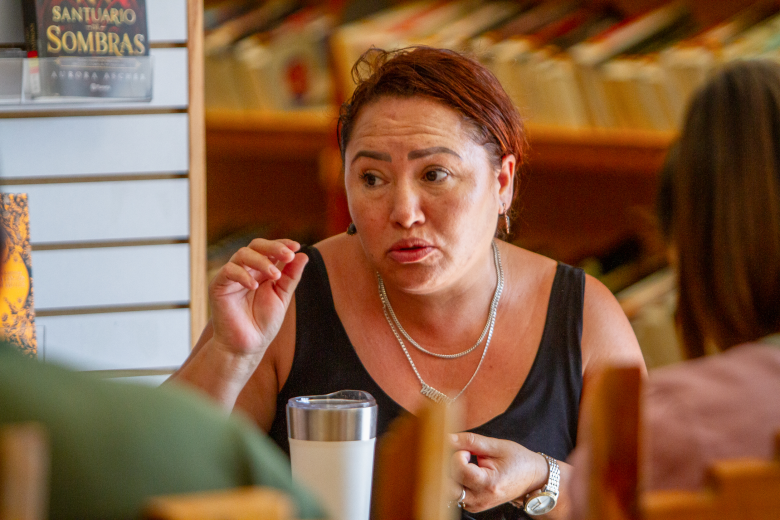
A woman with dark red hair speaks.

Paulina Reyna speaks during the gathering of Doña Ana County residents at a library in Sunland Park.Alberto Silva Fernandez/Puente News Collaborative & High Country News

As Data Center Watch notes, opposition cuts across party lines, with frustrated neighbors criticizing everything from tax breaks and rising utility costs to noise pollution and decreasing property values. In the arid Borderlands, water use tops the list of concerns. This summer, when Amazon attempted to quietly push through a massive data center near Tucson, hundreds of people showed up to city council meetings, bearing pamphlets that said, “Protect our water future.”

In Doña Ana County, the opposition has been led by colonia residents focused on an already too-dry present. In early 2024, after residents reported slimy water coming from their taps, a state investigation found dozens of violations by the local water utility—including evidence that it had been bypassing arsenic treatment for over a year, selling contaminated water to more than 19,000 customers.

“I don’t want a PowerPoint presentation that just says, ‘Don’t worry, we’re not going to use that much water.’ ”

The county has since ended its relationship with the utility, and the state has sued the organization over a decade of mismanagement. But residents cite continued issues with their water: yellow discoloration, sediment in the stream, taps that barely drip despite escalating bills.

At the community meeting in Sunland Park, Joe Anthony Martinez, 76, pointed to scars on his neck, where a surgeon removed skin cancer that he believes was caused by the water. Unwilling to trust the tap, he and his wife have spent years paying for filtered water. Now, as the county and city work towards establishing a new utility system, they worry that even if the water improves, it will go to the data center.

“We don’t want any of that,” Martinez said in Spanish. “What we want is quality water.”

As concerns about data centers’ resource use gain traction, the industry is working quickly to demonstrate its environmental consciousness. BorderPlex Digital says its campus will minimize water use by employing a cooling system that recycles water, rather than the more traditional system that evaporates it. A company spokesperson said in an email that their partner firm, STACK, currently operates data centers in Oregon using the same technology.

“The closed-loop cooling system requires only a one-time fill up and will therefore limit ongoing water use to domestic needs of employees (similar to an office building with 750 employees),” he wrote. The water source for the project is still being determined, he added, but the company is considering “non-potable or brackish wells (where suitable and approved), reclaimed water from the wastewater treatment facility or trucked water from alternate sources.”

In a public meeting this past week, developers reportedly said the initial fill would require about 10 million gallons of water, and that the system would use 7.2 million gallons annually. Daily water use for the campus would average around 20,000 gallons a day, capped at 60,000.

Daisy Maldonado, the director of Empowerment Congress, remains skeptical. “I want scientific reports about how a closed-loop system works and what is the level of water evaporation and recharge needed every year,” she said. “I don’t want a PowerPoint presentation that just says, ‘Don’t worry, we’re not going to use that much water.’ And I think the community deserves to know.”

In late August, Doña Ana’s commissioners voted 4-1 to advance the bond proposal for the project, setting a September 19 date for a final vote. Commissioners tried to alleviate residents’ concerns.

“One of the things that we insist on as part of this discussion is that…this data center is not going to have a negative impact on the water situation down in Santa Teresa and in Sunland Park,” County Commissioner Shannon Reynolds said, according to El Paso Matters. “If it does, then I promise you, we will be on top of it.”

In the weeks since, however, local tensions around the project have risen. On September 5, Reynolds posted the names of dozens of people who submitted public comments in opposition to the project on Facebook.

A woman wearing glasses and a hijab speaks

Empowerment Congress director, Daisy Maldonado, director of local nonprofit Empowerment Congress, is concerned that the massive infrastructure complex will cause more issues with the local water supply.Alberto Silva Fernandez/Puente News Collaborative & High Country News

In a press release, the New Mexico Environmental Law Center called the post “an act of intimidation intended to deter participation and silence community members exercising their right to participate in public and government processes.” Reynolds did not respond to a request for comment, but said on Facebook that he was naming the residents to thank them publicly.

Ahead of the September 19 hearing, BorderPlex Digital has hosted a series of community meetings around the county for residents to learn more about the project, and launched a website outlining their pitch.

Empowerment Congress organizers and colonia residents, meanwhile, are using this time to push the county to ask more questions about the kinds of development it seeks. Driving down McNutt Road, the main thoroughfare through Sunland Park, Maldonado pointed out more than a dozen cannabis dispensaries. A total of 43 have filled vacant storefronts and warehouses in the city since New Mexico legalized the drug in 2021, catering to customers from across the state line.

“You know how many grocery stores are in the city of Sunland Park, in Santa Teresa?” she asked. “It might be one. For a community of almost 20,000 people.”

She sighed.

“So how is New Mexico taking care of its residents? They’re failing the people in Sunland Park, in Santa Teresa, because all they can see is the dollar signs.”

Continue Reading…

Mother Jones

Trump’s Immigration Police State Is Growing at Warp Speed

When it passed the One Big Beautiful Bill Act in June, Congress handed nearly $75 billion to Immigration and Customs Enforcement. Some $30 billion of that money will be spent on enforcement and deportation—hiring spree incoming—and another $45 billion will go toward new detention centers, including 50 by the end of the year.

The OBBB immediately supercharged President Donald Trump’s mass deportation campaign, which already had been terrorizing immigrant communities and sending asylum seekers to a hellish prison in El Salvador. But an important part of the detention state ramp-up has flown under the radar: ICE’s increased cooperation with local law enforcement agencies.

At the end of the Biden presidency, ICE had just 135 287(g) deals in place; now there are 1,001—a 641 percent increase.

On Friday, ICE hit a new milestone: The agency has now signed more than 1,000 so-called 287(g) agreements nationwide. These agreements, which deputize local police and jails to perform certain immigration enforcement functions, have exploded under Trump. At the end of the Biden presidency, ICE had just 135 287(g) deals in place; now there are 1,001—a 641 percent increase.

About half of these agreements are what ICE calls task force agreements, which allow state and local cops to essentially act as immigration agents while fulfilling their regular police duties. If these sound familiar—and familiarly problematic—it’s because they were discontinued in 2012, following a Department of Justice investigation the year before that found widespread racial profiling by Maricopa County Sheriff’s Office, then led by the notorious Joe Arpaio. The Trump administration brought task forces back this year, and ICE has signed more than 500 of these particular agreements across 33 states.

As my colleague Laura C. Morel wrote in July, Florida has led the way in signing 287(g) agreements, as part of its larger push to be a leader in Trump’s deportation efforts (see also: the Alligator Alcatraz tent city). In fact, state legislators even passed into law a bill that requires county jails and the sheriff’s offices running those facilities to participate in 287(g). Local advocates told Laura they were worried about what all this would mean for immigrant communities across Florida:

Growing cooperation between ICE and police in Florida will affect the day-to-day lives of immigrant families. “It’s not just about [an immigrant asking]: ‘What happens if I have to have an interaction with a police officer in some sort of criminal context?’” Greer says. “Living your life and existing in this community is now an extreme risk to being able to come home and see your kids, being able to come home and see your family. It is incredibly frightening.”

State cooperation with federal immigration authorities can lead to “rippling harm” on the communities that police are meant to serve and protect, says Shayna Kessler, director of the Advancing Universal Representation Initiative at the Vera Institute of Justice. “It increases distrust in law enforcement. It increases fear in immigrant communities, it decreases the ability of immigrants to take care of their families, to support the economy, and to be strong and stable members of their communities.”

The federal government is already pumping billions of dollars into Trump’s anti-immigration crackdown, unleashing masked agents all across America. But in many places, undocumented immigrants will now also have to worry that any encounter with a police officer could lead to their deportation.

Continue Reading…

Mother Jones

Stephen Miller Pours Fuel on the Fire, Again

Subtlety is not one of Stephen Miller’s strong suits. Donald Trump’s deputy chief of staff for policy, who alternately has been called the administration’s “attack dog” and “the president’s id,” has a well-known penchant for the kind of breathless, overheated language that would make the hackiest of hacks blush. Scroll through his X feed and you’ll find some real doozies, everything from “The entire Democrat party is now operating in service of a single issue and objective: unlimited mass third world migration” to “We are living under a judicial tyranny” to “The days of China pillaging America are over.”

So it came as no surprise that he went The Full Miller in the wake of the killing of MAGA activist Charlie Kirk earlier this week. As conservative leaders, right-wing influencers, and even the federal government promised retribution on the left for its supposed complicity in and celebration of Kirk’s shooting, Miller ratcheted up the rhetoric in his own uniquely toxic way.

On Thursday morning, the day after the shooting at Utah Valley University, Miller tweeted:

There is an ideology that has steadily been growing in this country which hates everything that is good, righteous and beautiful and celebrates everything that is warped, twisted and depraved. It is an ideology at war with family and nature. It is envious, malicious, and soulless. It is an ideology that looks upon the perfect family with bitter rage while embracing the serial criminal with tender warmth. Its adherents organize constantly to tear down and destroy every mark of grace and beauty while lifting up everything monstrous and foul. It is an ideology that leads, always, inevitably and willfully, to violence — violence against those uphold order, who uphold faith, who uphold family, who uphold all that is noble and virtuous in this world. It is an ideology whose one unifying thread is the insatiable thirst for destruction.

We see the workings of this ideology in every posting online cheering the evil assassination that cruelly robbed this nation of one of its greatest men. Postings from those in positions of institutional authority — educators, healthcare workers, therapists, government employees — reveling in the vile and the sinister with the most chilling glee.

The fate of millions depends upon the defeat of this wicked ideology. The fate of our children, our society, our civilization hinges on it.

Now we devote ourselves, with love and unyielding determination, to finishing the indispensable work to which Charlie bravely devoted his life and gave his last measure of devotion.

We’ve come to take this sort of demonization and incendiary language for granted. But: It is not, in any way, normal. As Current Affairs wrote in a June piece titled, “The Brainless Propaganda of Stephen Miller,” “Even by the standards of right-wing rhetoric, Miller’s public statements are uncommonly shameless. He treats his audience as stupid and gullible.”

Miller’s tweet, though, was just a warm-up. Appearing on Fox News on Friday night, he threatened “all the domestic terrorists in this country spreading this evil hate”:

Stephen Miller: "The last message that Charlie Kirk gave to me before he joined his creator in heaven was he said that we have to dismantle and take on the radical left organizations in this country that are fomenting violence. That was the last message that he sent me … we are… pic.twitter.com/j0Gumd9V5i

— Aaron Rupar (@atrupar) September 13, 2025

The message here is clear: No matter the motives and political leanings of the suspected shooter, 22-year-old Tyler Robinson, Miller and the White House see Kirk’s death as an opportunity to go on the offensive against their perceived enemies.

How wide a net will they cast? For now, it’s still unclear. But a tweet on Saturday morning suggests Miller sees foes in every corner of American society:

In recent days we have learned just how many Americans in positions of authority—child services, law clerks, hospital nurses, teachers, gov’t workers, even DOD employees—have been deeply and violently radicalized. The consequence of a vast, organized ecosystem of indoctrination.

— Stephen Miller (@StephenM) September 13, 2025

Continue Reading…

Mother Jones

Given the Benefits of This California Solar Project, It’s Amazing How Rare It Is

This story was originally published by Canary Media and is reproduced here as part of the Climate Desk collaboration.

A novel solar power project just went online in California’s Central Valley, with panels that span across canals in the vast agricultural region.

The 1.6-megawatt installation, called Project Nexus, was fully completed late last month. The $20 million state-funded pilot has turned stretches of the Turlock Irrigation District’s canals into hubs of clean electricity generation in a remote area where cotton, tomatoes, almonds, and hundreds of other crops are grown.

Project Nexus is only the second canal-based solar array to operate in the United States—and one of just a handful in the world. America’s first solar-canal project started producing power in October 2024 for the Pima and Maricopa tribes, known together as the Gila River Indian Community, on their reservation near Phoenix, Arizona. Two more canal-top arrays are already in the works there.

In California, the solar-canal system was built in two phases, with a 20-foot-wide stretch completed in March and a roughly 110-foot-wide portion finished at the end of August. Researchers will study the project’s performance over time, while a new initiative led by California universities and the company Solar Aquagrid will push to fast-track the deployment of solar canals across the state.

Proponents of this emerging approach say it can provide overlapping benefits. Early research suggests that, along with producing power in land-constrained areas, putting solar arrays above water can help keep panels cool, in turn improving their efficiency and electricity output. Shade from the panels can also prevent water loss through evaporation in drought-prone regions and can limit algae growth in waterways.

Plus, solar canals could offer a faster path to clean energy development than utility-scale solar farms, especially in rural parts of the US where big renewables projects increasingly face community opposition. Placing solar panels atop existing infrastructure doesn’t require altering the landscape, and the relatively small installations can be plugged into nearby distribution lines, avoiding the cumbersome process of connecting to the higher-voltage wires required for bigger undertakings.

A solar panel mounted over a skinny stretch of a canal.

The 20-foot-wide section of Project Nexus came online in March 2025.Turlock Irrigation District

“Why disturb land that has sacred value when we could just put the solar panels over a canal and generate more efficient power?” said David DeJong, director of the Pima-Maricopa Irrigation Project, which is developing a water-delivery system for the Gila River Indian Community.

The purpose of these early arrays is primarily to power on-site canal equipment like pumps and gates. But such projects could eventually help clean up the larger grid, too. A coalition of US environmental groups previously estimated that putting panels over 8,000 miles of federally owned canals and aqueducts could generate over 25 gigawatts of renewable energy—enough to power nearly 20 million homes—and reduce water evaporation by possibly tens of billions of gallons.

Still, the technology isn’t an obvious choice for many canal operators.

Elevating solar panels over canals is more expensive and technically complex than installing conventional ground-mounted solar arrays on trackers, and it can involve using more concrete and steel. Wider canals may also require support structures for panels within the waterway, which can disrupt the flow of water.

Earlier this year, a senior engineer at Arizona’s Salt River Project recommended that the power and water utility not pursue a solar-canal pilot ​“based on cost estimates and project concerns,” after comparing the unique design to both rooftop and utility-scale solar alternatives.

Solar-canal developers are hoping they can still gain a toehold in irrigation districts that are grappling with high electricity costs and have limited options for generating cheap power, said Ben Lepley, the founder of engineering firm Tectonicus, which designed the Gila River Indian Community’s 1.3-MW system south of Phoenix.

The initial costs are ​“definitely higher…but it can actually be really fast as a project,” Lepley said. ​“By the next year, you can have really cheap electricity, and that gives [irrigation districts] stability over the 30-year life of the project.”

For its part, the Gila River Indian Community is building solar-canal projects as part of its broader mission to ​“generate enough renewable energy to completely offset the electrical use by the irrigation district,” said DeJong. He noted the district pays about $3 million a year for the 27 million kilowatt-hours of electricity it needs to pump, move, and store water.

The community built its first solar-canal project over the Casa Blanca Canal with a nearly $5.7 million grant provided by the Inflation Reduction Act—part of a $25 million provision that supplied funding for the U.S. Bureau of Reclamation to design, study, and deploy projects that put panels over waterways. Irrigation districts in California, Oregon, and Utah received the remaining funds to develop their own installations.

The Trump administration is unlikely to support future programs, given its focus on gutting clean energy incentives, but a handful of projects are already moving forward without such grants.

DeJong said that construction is 90 percent complete on the tribal community’s second solar-canal project, a nearly 0.9-MW array built in partnership with the US Army Corps of Engineers, which is slated to go online later this year. The community is self-funding a similar-sized project over the Santan Canal and is developing a floating solar array on one of its reservoirs, with both systems set to be up and running by early 2026. All told, the installations will provide 4 MW in local clean energy generation, he said.

“We have become really familiar with the economics of building these [canal] projects,” said Lepley, whose firm also worked on the Gila River Indian Community’s second and third solar-canal systems. ​“We have a pretty good playbook of how to continue these projects going forward, even without any grant funding from the federal government.”

Continue Reading…

Mother Jones

It’s Never Too Soon For the Right to Blame Trans People

When Utah authorities announced on Friday morning that 22-year-old Tyler Robinson had been apprehended in connection with the killing of conservative influencer Charlie Kirk, they quelleda storm of rumors and inaccurate reporting about the gender identity and motivations of Kirk’s shooter.

Almost immediately after Kirk was shot on Wednesday, right-wing social media accounts began speculating that his killer was transgender.

The next morning, unvettedclaims spreadbyright-wing political commentator Steven Crowder werequickly followed by a Wall Street Journal article claiming—based on an unquoted bulletin “circulated widely” by law enforcement officials—that expressions of “transgender ideology” wereengraved on the shooter’s ammo. An hour later, Rep. Nancy Mace, a South Carolina Republican who frequently promotes anti-trans legislation, was hurling slurs on camera.

For years, if not decades, voices demanding gun reform have been accused of “politicizing” violence—and of casting blame “too soon” in the wake of tragedy. When it wasn’t gun rights but trans people on the line, that rhetoric went out the window—for media outlets, public figures, and government representatives alike. Here’s how quickly the claims made their way from far-right speculation to the Wall Street Journal and a member of Congress.

September 10, 12:23 p.m.: Charlie Kirk is shot during an event at Utah Valley University after taking a question about transgender people and mass shootings. Right-wing accounts on X immediately begin speculating, without evidence, that the shooter is transgender. An online witch-hunt ensues.

September 10, 4:40 p.m.: President Donald Trump announces on Truth Social that Kirk has died from his injuries.

September 11, 8:35 a.m.: Right-wing commentator Steven Crowder posts a screenshot on X of a supposed “internal message” leaked from the Bureau of Alcohol, Tobacco, Firearms and Explosives alleging that law enforcement officials found gun cartridges at the scene engraved with unspecified “wording…expressing transgender and anti-fascist ideology.” Crowder’s post is viewed more than 25 million times.

September 11, 10:23 a.m.: The Wall Street Journal posts a link on X to a news story captioned: “Breaking: Ammunition engraved with transgender and antifascist ideology was found inside the rifle authorities believe was used in Kirk’s shooting, sources say.”

The article cites “an internal law enforcement bulletin and a person familiar with the investigation.” The post receives more than 11 million impressions. At 10:51 a.m., the Daily Beast publishes a story repeating the claims. At 11:20 a.m., the New York Post publishes a similar story.

September 11, 11:29 a.m.: Right-wing news outlet the Daily Caller posts a video of GOP Rep. Nancy Mace, an outspoken opponent of transgender rights.

“It sounds like the shooter was a tranny, or pro-tranny,” she tells the reporter. “And just because I want to protect women, that I’m worried about getting murdered? Are you fucking kidding me? It’s out of control, and enough is enough, and I’m going to double down on this.”

September 11, 1:18 p.m.: The New York Times reports that the internal bulletin has not been verified by ATF analysts and does not match other summaries of the evidence. According to a “senior law enforcement official with direct knowledge of the investigation,” such reports are usually not made public due to potentially inaccurate information.

September 11, 1:34 p.m.: The Trans Journalists’ Association “urges caution” in a statement urging outlets to reporting about the investigation, pushing outlets to “prioritize direct quotes and, to the greatest degree possible, identify the source and evidence” and emphasizingthat “transgender ideology” is “a term coined for and used in anti-trans political messaging.”

September 11, 3:28 p.m.: Citing “reporting in multiple outlets,” conservative talk show host Megyn Kelly uses Kirk’s death as an opportunity to attack trans people.

“Charlie Kirk’s killer engraved the ammunition used to murder him with pro-transgender ideology, according to reporting in multiple outlets—to the surprise of literally no one,” she said. “There’s one particular group that’s been running around killing Americans in the name of transgender ideology lately and it’s transgender activists or individuals or those who proclaim that they are.”

In an interview on Kelly’s show, Donald Trump Jr. says, “I can’t name, including probably, like, Al-Qaeda and the Taliban, a group that is more violent per capita than the radical trans moment.”

September 11, 4:43 p.m.: The UK-based Telegraph asserts that the killer’s ammunition was “engraved with pro-trans messages.”

September 11, 5:00 p.m., CNN reports that, according to two law enforcement sources, at least one cartridge was marked with arrows, which could have been misinterpreted by ATF analysts to be connected to the transgender community. By the following morning, the Wall Street Journal alters its story to include the New York Times and CNN reporting, adding “Some Sources Urge Caution” to its headline.

September 12, 10:10 a.m.: At a press conference, Utah Gov. Spencer Cox identifies the suspect in custody as 22-year-old Utah resident Tyler Robinson, whom neither Cox nor law enforcement claim is transgender. Cox reads the inscriptions from the recovered bullet casings, none of which reference transgender people in any way.

September 12, 10:36 a.m.: Rep. Mace calls for prayers for Robinson. “We know Charlie Kirk would want us to pray for such an evil, and lost individual,” she writes.

Shortly after the revelations at Cox’s Friday press conference, Human Rights Campaign launched a petition demanding the Wall Street Journal retract and apologize for its article on the shell casings.

“Jumping to those conclusions was reckless, irresponsible, and led to a wave of threats against the trans community…Many online who peddled rumors with incomplete and untrue details did not care about the facts,” HRC press secretary Brandon Wolf said in a statement.

At 2:46 p.m. ET on Friday, the_Wall Street Journal_ posted on X that it had appended an editor’s note to its original article acknowledging that Cox “gave no indication that the ammunition included any transgender references.” (The newspaper laid off five members of its standards and ethics team last year; its current deputy editor for standards did not reply to a request for comment.)

The phrase “transgender ideology” has “increasingly become a shorthand for everything that threatens the MAGA-preferred vision of the nation, of the people, of the family,” says Joanna Wuest, assistant professor of women’s, gender, and sexuality studies at Stony Brook University. Trump has led a policy crusade against transgender people since his first day in office, starting with an executive order against “gender ideology”—a move that has been used to limit trans people’s access to bathrooms, identification documents, and medical care, as well as their protections from discrimination in education and employment.

Those who use the phrase “gender ideology” are generally referring to the idea that someone can have a gender identity—a deeply felt, internal sense of gender—that differs from their sex assigned at birth. “There’s been this movement on the right, but also just in general, to frame that as an ideology,” says Saskia Brechenmacher, a senior fellow researching gender, civil society, and democratic governance at the Carnegie Endowment for International Peace. “Other people would say, ‘No, that’s just the way the world is.’”

Laurie Marhoefer, a professor of LGBTQ history and Nazi Germany at the University of Washington, says his transgender friends reacted with alarm as soon as news broke of the shooting. But the panic increased when the false statements about the shell casings came out. Friends began to check in with him, asking how worried they should be about retaliation.

“People are just terrified,” Marhoefer says. “I think we’re getting used to being terrified.”

Continue Reading…

Mother Jones

Shoulder-Checks and Smoking Weed: The Petty Crimes Being Prosecuted Under Trump’s DC Crackdown

“Good afternoon,” is how Magistrate Judge Heide Herrmann welcomed detainees into DC Superior Court room C-10 when it was their turn to stand in front of the bench on Monday.

But at 8:37 p.m., it was hardly “afternoon” anymore. Nor was it a good day for most of the inmates. They had been brought over from DC’s central cellblock, where accommodations consist of metal “beds” without mattresses. Some of the detainees were still in the pajamas they were wearing when they were first arrested. All were shackled at the wrists and ankles.

“MPD knows how to do this. The other law enforcement mentioned who are out making arrests apparently do not.”

Judge Herrmann was responsible for deciding whether they would continue to be held or released on the promise to appear at their next court date. The constitution requires defendants see a judge within 48 hours of arrest, but because superior court is closed on Sundays, Mondays consist of two days’ worth of criminal misdemeanor arraignments and felony presentments. It’s often the courtroom’s busiest day.

Several of the 105 cases Herrmann considered involved serious allegations: one defendant allegedly shot someone, requiring the victim to undergo bladder surgery, and there were also a litany of domestic violence charges. But since President Donald Trump has unleashed scores of federal law enforcement officers to help police DC’s modest population of 702,000, the caseload has been especially long—and often frivolous. Just a couple Mondays ago, it took a judge until almost 1:30 a.m. to get through what lawyers call the “lock-up list.” (A lawyer who sometimes represents defendants in C-10 says that before Trump’s crackdown, ending between 7-8 p.m. would have been considered an especially late Monday. )

The recent liveliness of C-10 should concern DC locals as well as the residents of blue cities that Trump has alluded to targeting next. But not because the room’s fullness proves Trump’s bold thesis that the entire city has been “overtaken by violent gangs and bloodthirsty criminals.” Rather, experts say, the surging volume of charges and the allegations therein indicates a different problem: overzealous and ineffectual prosecuting.

“We are in the in the DC Superior Court pretty much every day and have seen
enormous changes under Trump,” says Abbe Smith, the director of a Georgetown Law School clinic that provides criminal defense assistance to people who can’t afford other representation. “None of them good.”

The aggressive posturing is no doubt putting a tremendous strain on judges and public defenders.

“Aye yai yai,” grumbled one of about five public defenders in the room on Monday when she learned she had more than a dozen clients left to represent after 6 p.m.

At one point, even the stoic judge bemoaned the contents of some of the arrest affidavits. She attributed this to federal agents who, unlike members of the Metropolitan Police Department, are not accustomed to street patrol duty.

In this case, federal agents had helped apprehend a young man arrested for smoking weed in a park. Possession of marijuana is legal in DC, but public consumption of it is not (though it’s rarely prosecuted). After he was arrested, MPD and federal agents performed a subsequent search that led them to conclude the young man was storing THC wax—a more concentrated form of weed that isn’t legal in DC—in a backpack. Law enforcement tacked on a possession charge, but the affidavit said nothing about how agents knew the backpack (and the THC wax) belonged to the defendant.

“MPD knows how to do this,” the magistrate judge said of the incomplete affidavit. “The other law enforcement mentioned who are out making arrests apparently do not.”

In early September, another man was approached by law enforcement because DEA agents “observed a bulge consistent with a bag of marijuana coming from the pants pocket” of the individual, the affidavit says. He willingly showed the agents the bag of marijuana (which, again, is legal in DC). They then patted him down and noticed an “abnormal bulge” in his sock. It was a small bag containing what the agents described as five Oxycodone pills. They arrested the man for possession of a controlled substance.

This case was recently dismissed, but normally, such cases wouldn’t have been prosecuted in the first place. Instead, they are usually “no-papered,” meaning the prosecutor would opt against filing formal charges after the arrest. Smith says it was previously common for as many as a quarter or a third of cases to be no-papered misdemeanors because the allegations lack sufficient evidence to convict, or because there are questions about whether the defendant’s constitutional rights were violated. But now in DC, she says, “nearly every single misdemeanor is being papered.”

Anecdotally, law enforcement seem to be more aggressively pursuing searches that may not be legally justified. In one instance, federal agents approached a man in a lawn chair merely for being close to a miniature bottle of wine—the kind you can buy on an airplane. Moments later, he was thoroughly searched and then charged for drug possession and for carrying a handgun without a permit.

Less that two blocks from the superior court sits DC’s federal district court. Here, convictions are generally accompanied by stricter sentences. Yet, the federal charges defendants have faced in recent weeks haven’t necessarily been any more serious than those judged in local court.

In between a sprinkling of serious child pornography and narcotics hearings were more negligible matters, such as shoving and vague threats. A man who allegedly shoulder-checked a National Guard member and said “I’ll kill you” was initially charged with assault and threatening to kidnap or injure a person, which carries a penalty of up to 20 years in prison. (On Tuesday, a grand jury declined to indict him. Subsequently, DC US Attorney Jeanine Pirro’s office charged him with two misdemeanor counts instead.)

There was also a woman arrested for assault while protesting ICE agents in July. Amid efforts to restrain her, an FBI agent’s hand was allegedly scraped against a cement wall. Extraordinarily, a grand jury opted against indicting her for felony assault three times. She’s since been charged with a misdemeanor and awaits from home a trial in October.

Pirro’s office also won’t give up on convicting the infamous former Justice Department paralegal, Sean Dunn, accused of assault for tossing a wrapped Subway sandwich at the chest of a Customs and Border Patrol agent in August. A grand jury opted against indicting him, too. (He’s since been charged with misdemeanor assault; jury selection for the trial is slated to begin November 3.)

Shootings have continued amid the crime crackdown, but Trump and Pirro can count at least one win: Nobody in DC has thrown a sandwich at an officer since prosecutors tried to throw the book at Dunn. Our long national nightmare is over.

Continue Reading…

Mother Jones

The Saga of RFK Jr. and an Estonian Vaccine Skeptics Conference

Last week, organizers for the “European Conference of Health and Human Rights” announced a change: Their keynote speaker, US Health and Human Services Secretary Robert F. Kennedy Jr., had withdrawn after Estonian politicians reportedly called Kennedy a “quack” and “cuckoo.”

It was the end of an odd saga. A month earlier, organizers announced Kennedy was set to appear remotely as the keynote speaker at the conference hosted by the Estonian chapter of the World Council for Health (WCH), a group that promotes vaccine skepticism and bogus claims about the effectiveness of both ivermectin and hydroxychloroquine to treat Covid. Kennedy had featured prominently in promotion and in social media posts for the event, which began on Thursday.

But, earlier this month, the conference ran into trouble. According to a report from Estonian Public Broadcasting, the World Council for Health Estonia event was organized to be held at the Riigikogu, Estonia’s parliamentary building. Two Members of Parliament from the Estonian Conservative People’s Party (EKRE)—which has been described as “ultranationalist”—planned to attend. And the EPB report even described one EKRE MP, Martin Helme, as an organizer of the conference. (EKRE is known for its hardline stances against gay marriage, feminism, and immigration.)

This mixing of Estonian government resources with pseudoscience and Kennedy caused outrage. According to EPB, the country’s Minister of Social Affairs, Karmen Joller, objected strongly to the conference being held in the Riigikogu. She called the conference organizers a “bunch [who are] spreading pseudoscience” and said having the conference there would cause reputational damage. “Such an event would undoubtedly affect the reputation of Estonia as a state,” she reportedly wrote. The World Council for Health claimed that Social Minister Joller also publicly called Kennedy “cuckoo in the head.” (Joller did not respond to several requests for comment.)

On September 1, the WCH announced in a press release both Kennedy’s withdrawal and that the conference would also no longer be held in the Estonian parliamentary building.

Designed to look like a legitimate health organization with an anodyne name and bland logo, the WCH, which first appeared in 2022, was set up to serve as an international umbrella organization for groups that promote vaccine skepticism and Covid misinformation. WCH’s subgroups include the Front Line Covid-19 Critical Care Alliance, which promoted ivermectin use in the US (and which has since changed its name to the Independent Medical Alliance), and the BIRD Group, which pursues a similar agenda in Britain.

The schedule for the conference that Kennedy dropped out of shows the group’s focus on anti-vaccine material and medical freedom claims. The speakers include Dr. Peter McCullough, an American cardiologist whose board certifications were revoked after he spent years promoting Covid and vaccine misinformation. (His address is titled “Conseqences [sic] of Heart Damage after COVID-19 Vaccination.”).

Dr. Mark Trozzi, a Canadian doctor who has also been accused of promoting vaccine misinformation, is giving a speech about Covid vaccine injury.

A screenshot from WCH Estonia's Instagram, which shows the speakers at the conference; a large picture of Kennedy is in the very middle.

A screenshot showing the time slot in which Robert F. Kennedy Jr was meant to speak at the WCH conference; it has a picture of him next to the time, which reads 10:20-10:30

A spokesperson for HHS did not answer questions about why Kennedy agreed to appear at the conference, whether he considers WCH legitimate, or why he withdrew, confirming only that he was not participating in the conference.

“[D]ue to political and personal attacks directed at Robert F. Kennedy Jr., the U.S. Department of Health and Human Services (HHS) has withdrawn his video participation,” the release read, in part. “It is deeply concerning that in today’s Estonia, open dialogue on health-related matters is being suppressed, and fundamental freedoms, including freedom of speech, are increasingly disregarded at official levels.”

The conference is now taking place at a Radisson hotel in downtown Tallinn, a slightly less impressive venue than a parliamentary building.

Helme, the current EKRE member who was listed as an organizer of the conference, wrote on Facebook that Estonian politicians had been “beyond disrespectful” towards Kennedy, accusing them of referring to him as a “quack.” Helme also praised Kennedy as someone who “has stood firm against the corruption in the medical system for years and stepped up to protect children in the attempts of super powerful lobby groups to make money at the expense of children’s health.” (Helme’s statement also appears to refer to Kennedy as “a scientist,” which he is not.)

The planned content of Kennedy’s speech suggests that his health policy ambitions may go beyond the United States. In it, he speaks of his goal of further “collaboration” between the US and Europe.

A press release—still available on WCH Estonia’s website—gave extensive detail about what Kennedy hoped to discuss, saying he would focus on “key areas of international and regional relevance including the WHO Pandemic Treaty and the International Health Regulations (IHR). He will also likely discuss his perspective on why European countries should consider not ratifying the proposed WHO Pandemic Treaty, noting that the deadline for IHR amendments has already passed for most European nations.” (The WHO Pandemic Treaty was signed by member countries in May and is an agreement to work together to help prevent and respond to future pandemics; the United States did not sign it after President Trump announced the country’s withdrawal from the WHO in January.)

Additionally, the press release added, “[Kennedy] is anticipated to address the major issues shaping healthcare policy, including transparency, accountability and public trust, and explore opportunities to strengthen collaboration between Europe and the United States, particularly in areas of health sovereignty, policymaking, and the protection of human rights.”

Continue Reading…

Mother Jones

Mass Deportations Ensnare Immigrant Service Members and Veterans

In the months leading up to the 2024 presidential election, US Army veteran Sae Joon Park kept in mind a warning from an immigration officer: If Donald Trump were elected, Park would likely be at risk for deportation.

Park was just 7 when he came to the US from Seoul, South Korea. A green card holder, he joined the Army at 19 “to serve the country that I believed in,” he said. He received a Purple Heart after being shot twice while deployed in Panama, but after leaving the military, he lived with PTSD. That led to an addiction to crack cocaine and, ultimately, trouble with the law.

In 2009, he was arrested for drug possession. After he jumped bail, afraid he would fail a drug test, he served time in prison and was told he would be deported. However, because he was a veteran, he was granted deferred action upon his release, which allowed him to remain in the US as long as he checked in with immigration officials annually.
Photo of Sae Joon Park

Sae Joon Park joined the Army at 19 “to serve the country that I believed in,” he said. After living in the US for almost 50 years, he self-deported in June back to South Korea after learning the Trump administration planned to deport him.Sae Joon Park/News21

Sae Joon Park holding a gun in Panama during Operation Just Cause.

US Army veteran Sae Joon Park, pictured during Operation Just Cause in Panama, received a Purple Heart after being shot while deployed there. Park self-deported in June, after learning the Trump administration planned to deport him. Sae Joon Park/News21

For 14 years, he did just that while raising children and building a new life in Honolulu. In June, everything changed.

When Park went in for his regular appointment, he was told he had a removal order against him. After talking things over with his family and lawyer, he decided to self-deport because, he said, he worried he could not survive extended time in detention while fighting deportation.

“I could have ended up in ‘Alligator Alcatraz,’” Park said, referring to the Florida detention center that has come under fire for alleged inhumane conditions. “I was a legal resident. They allowed me to join, serve the country—front line, taking bullets for this country. That should mean something.”

Instead, he said, “This is how veterans are being treated.”

During his first term in office, Trump enacted immigration policies aimed at a group normally safe from scrutiny: noncitizens who serve in the US military. His administration sought to restrict typical avenues for immigrant service members to obtain citizenship and make it harder for green card holders to enlist—actions that ultimately were unsuccessful.

Now, as the second Trump administration engages in a campaign to detain and deport immigrants living in the US, military experts and veterans say service members are once again targets.

“President Trump campaigned on a promise of mass deportations, and he didn’t exempt military members, veterans and their families,” said retired Lt. Col. Margaret Stock, a lawyer who helps veterans facing deportation. “It harms military recruiting, military readiness and the national security of our country.”

Under the Biden administration, Immigration and Customs Enforcement issued a policy stating a noncitizen’s prior military service was a “significant mitigating factor” that must be considered in enforcement decisions, including deportation orders. The policy also offered protection to noncitizen family members of veterans or those on active duty.

In April, under the Trump administration, that policy was rescinded and replaced with one saying that while “ICE values the contributions of all those who have served in the US military … military service alone does not automatically exempt” one from enforcement actions.

The new policy directs agents to ask about military service during intake interviews and to document service. However, local ICE leaders have the authority to proceed with deportations of those who have served, though they may consider factors such as community ties and employment history.

Both policies barred enforcement actions against active-duty service members, absent significant aggravating factors. Under the new policy, noncitizen relatives of service members are not addressed at all.

In the wake of all of this, some service members, like Park, are choosing to self-deport. In other instances, immigrant family members of soldiers or veterans have been detained; those include Narciso Barranco, a father of three US Marines who was arrested in Santa Ana, California, while working the landscaping job he had held for three decades.

“Thousands of families like ours are being ripped apart,” Barranco’s son, veteran Alejandro Barranco, testified in July to a US Senate subcommittee on border security. “I want this committee to understand the human impact of the immigration policies of this administration. I want them to know that the people being ripped from our communities are hardworking, honest, patriotic people who are raising America’s teachers, nurses and Marines.

“Deporting them doesn’t just hurt my family,” he added. “It hurts all of us.”

There is no publicly available data on how many veterans are being affected, though ICE is supposed to track removals of service members and veterans and the Department of Homeland Security is typically required to share that information with Congress.

A 2019 federal report found at least 250 veterans had been placed in removal proceedings between 2013 and 2018, with at least 92 ultimately deported. The report said that while ICE had policies for handling cases of noncitizen veterans, it did not consistently identify and track actions against those individuals.

News21 could find only two DHS reports tracking removals of veterans. One, covering the first six months of 2022, said five veterans had been deported; another, for calendar year 2019, said three veterans had been deported.

In June, US Rep. Yassamin Ansari, an Arizona Democrat, and nine other members of Congress wrote to the secretaries of defense, veterans affairs and homeland security seeking the number of veterans currently facing deportation—noting “some estimates” put the overall number of deported veterans at 10,000.

In a news release, Ansari said all veterans “deserve to be treated with dignity and respect, not abandoned by an administration that turns their backs on their sacrifice.” Her office did not return messages from News21. DHS and ICE also did not respond to questions.

In past years, bills to do more to protect immigrant service members and their relatives have been introduced in Congress. One measure, introduced in May, would give green cards to parents of service members and allow those already deported to apply for a visa from abroad. It’s still in committee.

US Sen. Tammy Duckworth, an Illinois Democrat and Army veteran, has proposed several measures related to immigrant service members, but those bills have gone nowhere. Last year, for example, she reintroduced a bill to allow deported veterans who have completed the preliminary naturalization process to attend citizenship interviews at a port of entry, embassy or consulate instead of having to obtain parole to come back into the US. It died in committee.

For Duckworth, deported veterans are not a partisan issue.

“This is about the men and women who wore the uniform of our great nation, many of whom were promised a chance at citizenship by our government in exchange for their service,” she told News21. “It’s about doing the right thing and keeping our nation’s promise.”

‘I wanted to serve this country, this beautiful country’

As of February 2024, more than 40,000 foreign nationals were serving in active and reserve components of the Armed Forces, according to the Congressional Research Service. Another 115,000 were veterans living in the US.
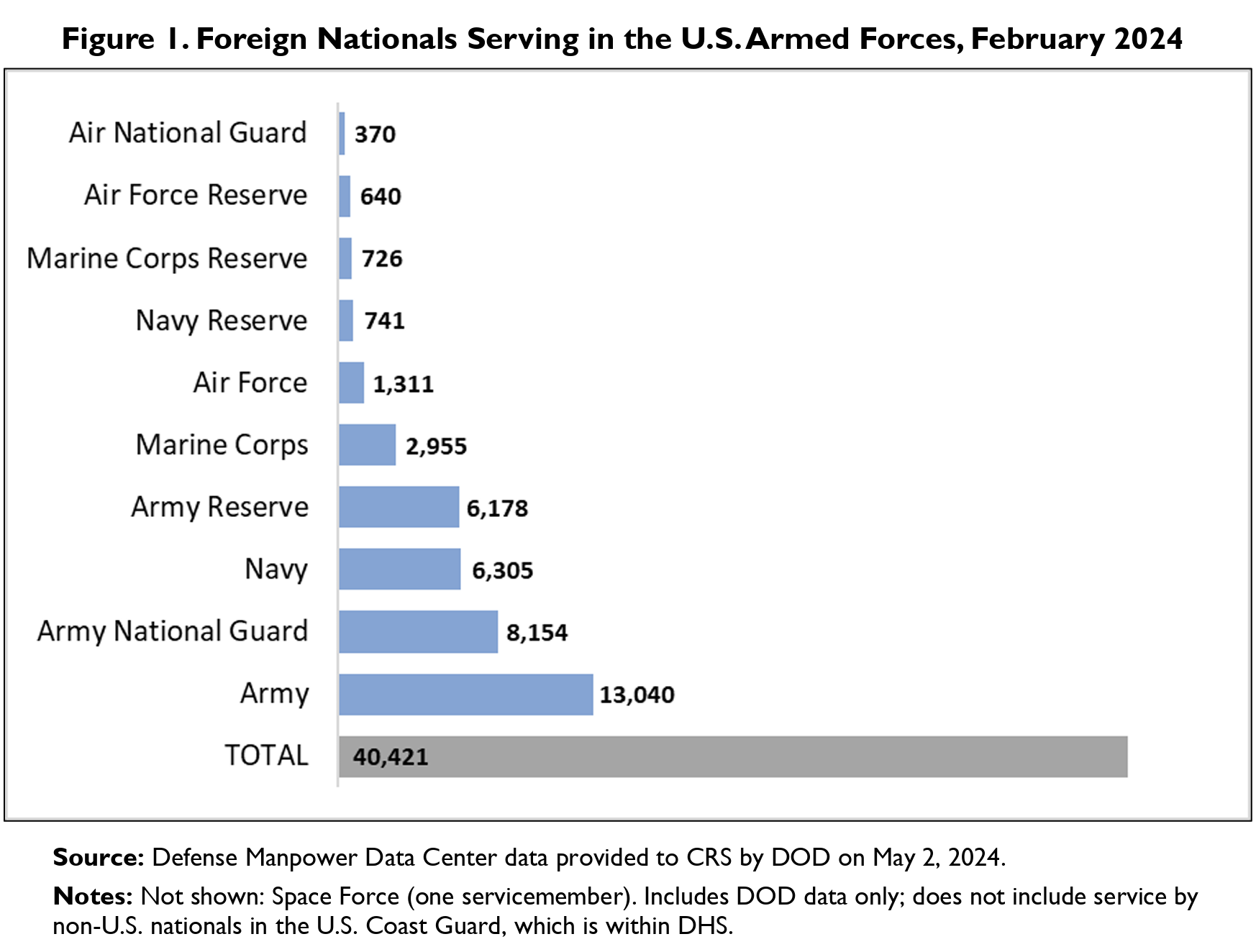
A 2024 Congressional Research Service graph of foreign nationals serving in the US armed forces. It shows that a total of 40,421 foreign nationals were sercinv in the US Armed Forces as of February 2024.

Credit: News21

Serving in the military has long been a pathway to citizenship, with provisions providing expedited naturalization for noncitizen service members dating back to the Civil War.

During World War I, according to US Citizenship and Immigration Services, foreign-born soldiers made up 18% of the Army. Some units even became known for their immigrant members; for example, the 77th Infantry Division was nicknamed the “Melting Pot Division.”

Since the end of World War I, more than 800,000 people have gained citizenship through military service, according to the CRS report. Since fiscal year 2020, service members from the

Philippines, Jamaica, Mexico, Nigeria and Ghana accounted for over 38% of service member naturalizations.

Generally, noncitizens who are permanent legal residents and who speak, read and write English fluently may join the armed forces. And during designated periods of hostility, noncitizens who serve honorably for any period of time—even one day—are eligible to apply for naturalization if they meet all criteria. The US is still considered to be in a period of hostility because of the post-9/11 war on terrorism.

Foreign-born soldiers posing together in 1918 in Washington, D.C.

National Archives

Foreign-born soldiers standing in 1918 in Washington, D.C.

Foreign-born soldiers are pictured at a 1918 naturalization ceremony in Washington, D.C. Countries represented include Armenia, Austria, Italy, Greece and Germany. National Archives/Courtesy of News21

Despite that longstanding policy, the Department of Defense, during Trump’s first term in office, tried to make it harder for service members to naturalize by forcing them to complete six months—rather than one day—before obtaining the “certification of honorable service” required to apply for citizenship. Naturalization applications subsequently plummeted by 72% from fiscal year 2017 to fiscal year 2018.

The American Civil Liberties Union sued, and in 2020, a federal judge struck down the change.

Plaintiffs, including then-Army Pfc. Ange Samma, celebrated. Samma, originally from Burkina Faso, had lived in the US on a green card since he was a teenager. In 2018, he enlisted in the Army.

“I wanted to serve this country, this beautiful country,” Samma told News21.

Over 14 months, even after he’d been assigned to Camp Humphreys in South Korea, Samma tried over and over to obtain certification of his honorable service—to no avail. He finally became naturalized not long after the 2020 court ruling.

This year, Samma earned his bachelor’s degree in electrical engineering. He’s living in Statesboro, Georgia, while hunting for jobs. Because he now has citizenship, “There are many more opportunities that are open for me,” he said. “It’s very rewarding to have it. You feel proud.”

The Biden administration wound up rescinding the six-month policy, according to ACLU attorney Scarlet Kim. As of now, military members can once again apply for naturalization as soon as their service begins.

However, Kim notes, “If you don’t get your citizenship while you’re serving and then you’re discharged, what has happened is that you can potentially become vulnerable to deportation … despite having served our country in the military for however long.”

That’s exactly the situation facing Army veteran Marlon Parris.

Parris, who was born in Trinidad, has been in the US with a green card since the 1990s. He served in the Army for six years, including two tours in Iraq, and received the Army Commendation Medal three times, according to records filed in federal court.
Army veteran Marlon Parris sitting.

Army veteran Marlon Parris, seen here in Iraq, was detained by immigration agents in January. Originally from Trinidad, he has lived in the US since the 1990s. As the second Trump administration engages in its campaign of mass deportations, military experts and veterans say immigrant troops and their relatives are not immune. Tanisha Hartwell-Parris/Courtesy of News21

Before his discharge in 2007, he was diagnosed with acute post-traumatic stress disorder, which was cited when Parris pleaded guilty in 2011 to conspiracy to distribute cocaine and was sentenced to federal prison.

Upon his release in 2016, he received a letter from the government stating he would not be deported, according to the group Black Deported Veterans of America. But on Jan. 22, just two days after Trump’s inauguration, agents detained Parris near his home in Laveen, outside of Phoenix. In May, a judge ruled that he was eligible for deportation.

His wife, Tanisha Hartwell-Parris, told News21 the couple plan to self-deport and bring along some of the seven children, ranging in age from 8 to 26, who are part of their blended family.

“I’m not going to put my husband in a situation to where he’s going to be a constant target, especially in the country that he fought for,” she said, adding that most people have no idea what immigrant service members face.

Army veteran Marlon Parris and his wife, Tanisha Hartwell-Parris pose for a photo together.

Army veteran Marlon Parris and his wife Tanisha Hartwell-Parris pose for a photograph at a friend’s wedding in 2022. Originally from Trinidad, Parris has lived in the US since the 1990s, but he was detained by immigration agents in January. Tanisha Hartwell-Parris/Courtesy of News21

“People think that just because you’re a veteran … you should automatically have gotten status as a United States citizen,” she said. But the military, she added, “is different for immigrants. …. You’re fighting the same fight, but it’s not the same battle.”

A report published last year by the Veterans Law Practicum at the University of California, Berkeley, School of Law noted the connections between PTSD, criminal behavior and the deportation of noncitizen veterans.

More than 20% of veterans with PTSD also have a substance use disorder, the report found, which can result in more exposure to the criminal justice system.

That situation is “the most common scenario in terms of how deportation is triggered,” said Rose Carmen Goldberg, an expert in veterans law who oversaw completion of the report and now teaches in the Veterans Legal Services Clinic at Yale Law School.

The report also noted that even though deportation does not disqualify veterans from health care and other benefits earned through service, “Geographic and bureaucratic barriers may ultimately stand in the way.”

In 2021, the Biden administration launched the Immigrant Military Members and Veterans Initiative (IMMVI) to ensure deported veterans could access Veterans Affairs benefits. The program offered parole on a case-by-case basis to those needing to return to the US for legal counsel or to access care, and it sought to facilitate naturalization services for immigrant service members.
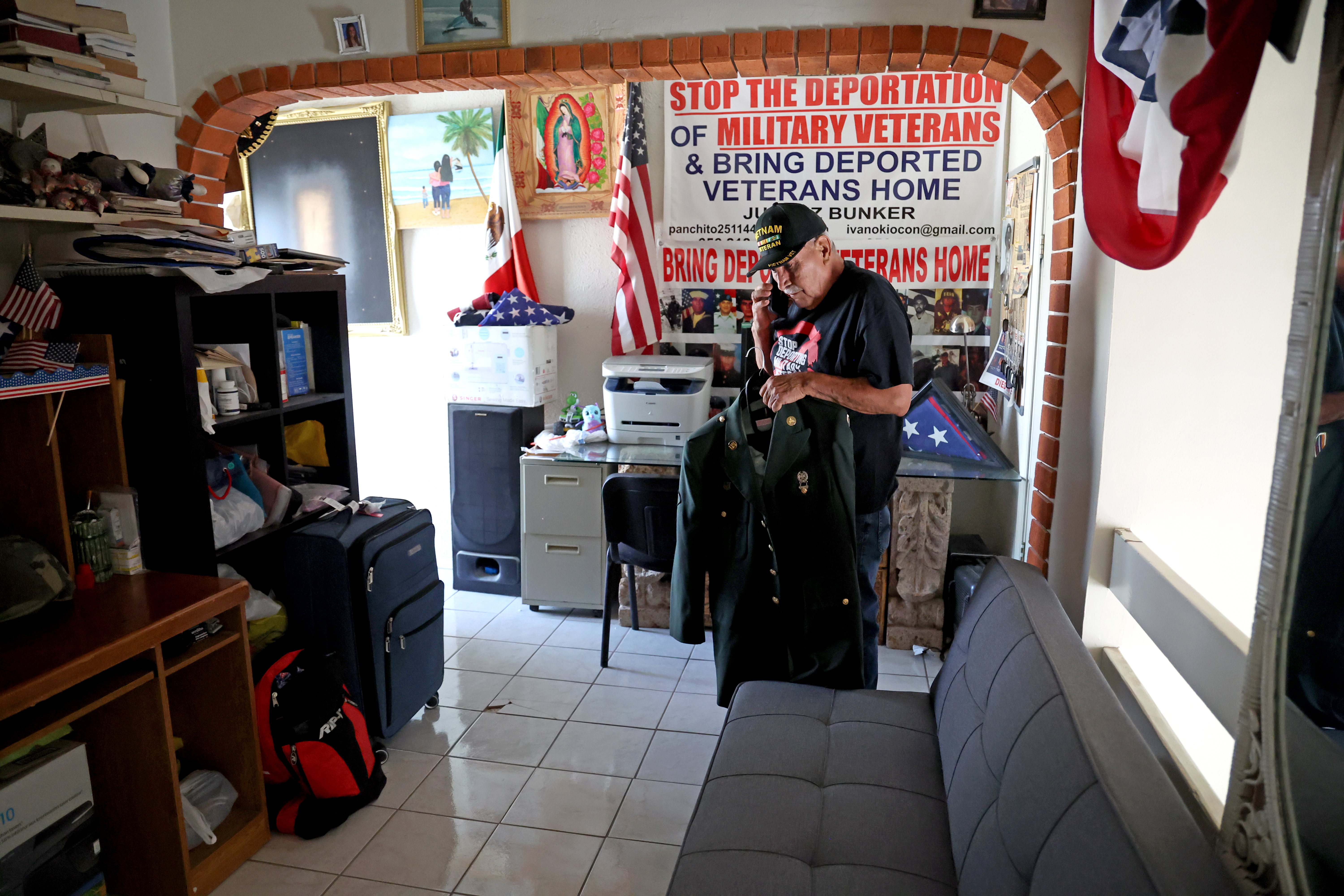
Veteran Jose Francisco Lopez holds his military uniform.

Jose Francisco Lopez holds his military uniform at the Deported Veterans Support House on Saturday, June 28, 2025, in Ciudad Juárez, Mexico. Lopez opened the home in 2017 to help veterans removed from the US, despite their service to the country. Sydney Lovan/News21/News21

In the program’s first year, 143 veterans living outside of the US reached out to IMMVI staff, according to congressional testimony. A 2022 story by the nonprofit newsroom The War Horse said 102 veterans had been allowed back to the US via the IMMVI parole program, and “over 30” had obtained citizenship.

In response to questions about the status of the IMMVI program, USCIS directed News21 to its website about the program.

Jennie Pasquarella, a lawyer with the Seattle Clemency Project, said the biggest flaw of the IMMVI program is that parole into the US is temporary – a “dead end” if a veteran doesn’t have a legal claim to restore legal residency or to naturalize.

“We had asked the Biden administration to do more to ensure that there was a further path towards restoring people’s lawful status beyond parole,” she said. “Basically, we didn’t succeed.”

A ‘lifeline’ for deported vets

In the absence of aid in the US, more and more veterans are turning to help elsewhere.

After serving in the Vietnam War with the Army, José Francisco Lopez, a native of Torreón, Mexico, experienced PTSD and struggled with addiction. He eventually went to prison for a drug-related crime and in 2003 was deported back to his home country.

For years, Lopez thought he was the only deported veteran in Mexico—until he met Hector Barajas, a deported Army veteran who in 2013 founded the Deported Veterans Support House in Tijuana.

Inspired, Lopez opened his own Deported Veterans Support House in Ciudad Juárez, across the border from El Paso.
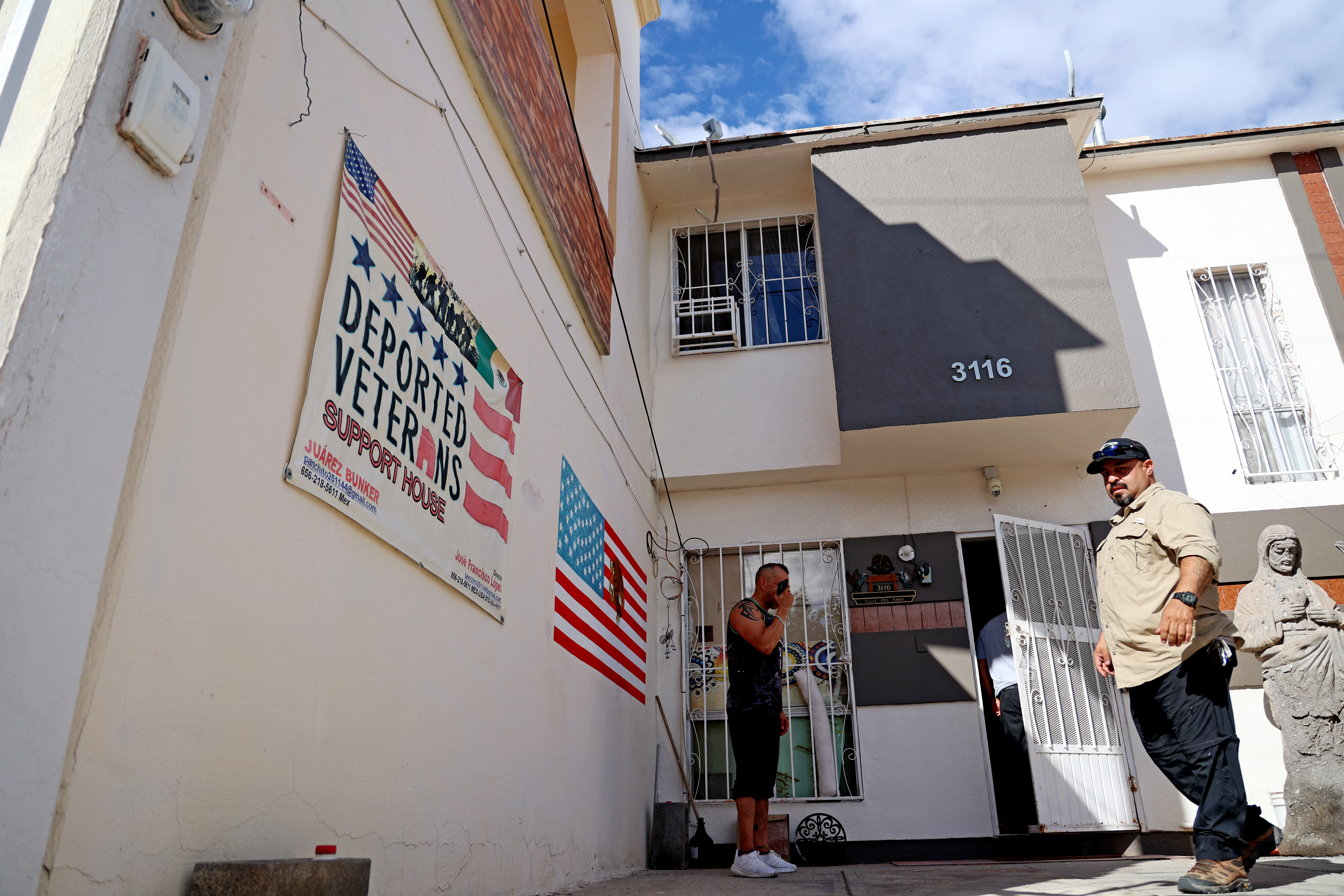
Michael Evans and Pedro Chagoya stand outside.

Michael Evans, left, and Pedro Chagoya stand outside of the Deported Veterans Support House on Saturday, June 28, 2025, in Ciudad Juárez, Mexico. In 2017, an Army veteran opened the home to help veterans removed from the US, despite their service to the country. Sydney Lovan/News21/News21

Today, Lopez, 80, is a legal resident of the US but splits his time between El Paso and Juárez, providing deported veterans housing, food and advice about how to apply for VA benefits. Since opening the support house in 2017, he’s helped about 20 people.

On a Saturday in June, four veterans stopped by to visit Lopez at the place they call “the bunker.” The gathering felt like a family reunion, with laughter filling the house as they shared memories of holidays spent together and other moments, both good and bad.

Said Ricardo Munoz, who came across Lopez and the bunker in 2019: “It’s kind of like being out in the ocean and someone throws a lifeline at you.”
Portrait of army veteran Ricardo Muñoz

Army veteran Ricardo Muñoz poses for a portrait on Saturday, June 28, 2025, at the Deported Veterans Support House in Ciudad Juárez, Mexico. Muñoz was deported in 2007 after serving time for marijuana possession. He has humanitarian parole to access health care in the US.Sydney Lovan/News21/News21
Silhouette of Air Force veteran Alfonso.

Air Force veteran Alfonso poses for a portrait on Monday, June 30, 2025, in El Paso, Texas. After being deported over two decades and living in Mexico, Alfonso obtained a green card and is now back in the US. He asked that his last name not be used because he is trying to naturalize and fears publicity could hurt those efforts.Sydney Lovan/News21/News21
Portrait of marine veteran Michael Evans.

Marine veteran Michael Evans poses for a portrait on Saturday, June 28, 2025, at the Deported Veterans Support House in Ciudad Juárez, Mexico. He was deported to his native Mexico in 2009 after a drug-related arrest. Sydney Lovan/News21/News21

Portrait of army veteran Jose Francisco Lopez.

Army veteran Jose Francisco Lopez poses for a portrait on Saturday, June 28, 2025, at the Deported Veterans Support House in Ciudad Juárez, Mexico. In 2017, Lopez opened the home to help veterans deported from the US, despite their service to the country. Sydney Lovan/News21/News21
Portrait of navy veteran Ruben Chagoya Talamantes.

Navy veteran Ruben Chagoya Talamantes poses for a portrait on Saturday, June 28, 2025, at the Deported Veterans Support House in Ciudad Juárez, Mexico. He was deported in 2014 after serving time in prison on a drug-related charge.Sydney Lovan/News21/News21
Portrait of Army veteran Jose Bustillo Chavez.

Army veteran Jose Bustillo Chavez poses for a portrait on Monday, June 30, 2025, in El Paso, Texas. Deported in 1999, Chavez is in the US on humanitarian parole but worries it won’t be extended under the Trump administration. Sydney Lovan/News21/News21

US Air Force veteran Alfonso, who enlisted in 1976, said he was shocked when he was deported in 2001 after being charged with driving under the influence in El Paso. He said he mistakenly thought he had automatically earned citizenship for serving. Alfonso asked that his last name not be used because he is now trying to naturalize and fears publicity could hurt those efforts.

After living and working in Juarez for decades, Alfonso, with Lopez’s support, obtained parole back to the US in 2024 via the IMMVI program. He got his green card and now lives in El Paso, near his daughter.

For Alfonso, military service was a family affair. His brother served in Vietnam, his niece has done multiple tours in the Middle East, one nephew is in the Coast Guard and another is a Marine.

Citizenship or not, he said, “I was an American already, because I was willing to give my life for it.”

He added, “When you’re willing to give your life for something that, you don’t know, in one second you might be dead—it’s something. It’s important.”

‘It’s a whole new world’

Sae Joon Park with his daughter.

Army veteran Sae Joon Park poses for a photo with his daughter in December 2024 in Las Vegas. Park self-deported in June, after learning the Trump administration planned to deport him.Sae Joon Park/News21

Back in Seoul, Park, 56, is adjusting to life in a country he hadn’t even visited in 30 years. When he first arrived, he said, he cried every morning for hours.

“I just couldn’t stop,” he said. “It’s a whole new world. I speak the language, but I don’t read or write, so I’m trying to really relearn everything.”

For now, he’s staying with his father, but he worries about his family back in the US. His daughter works for the state of California. His son—also a military veteran—lives in Hawaii, where he works in cybersecurity and helps care for Park’s 85-year-old mother.

“I don’t know how many more years she’s got,” Park said. “My daughter, if she ever gets married, I won’t be there for a wedding.”

Park’s attorney started a petition to urge prosecutors to dismiss his criminal convictions, part of an attempt to cancel his deportation order and allow him to return to the United States. More than 10,000 people have signed.
Sae Joon Park stands with his son in front of Waimea Canyon State Park.

Army veteran Sae Joon Park and his son pose for a photo earlier this year at Waimea Canyon State Park in Kauai, Hawaii. Park self-deported in June, after learning the Trump administration planned to deport him.Sae Joon Park/Courtesy of News21

Park said he’s grateful for the support but has little faith that the country he fought for will ever allow him to come back.

“I’m not blaming the military or VA – it’s literally the Trump administration,” he said. “What they’re doing is crazy.

“This is not the country that I volunteered and fought for,” he added. “This is just really wrong.”

News21 reporters Tristan E.M. Leach, Sydney Lovan and Gracyn Thatcher contributed to this story. This report is part of “Upheaval Across America,” an examination of immigration enforcement under the second Trump administration produced by Carnegie-Knight News21. For more stories, visit https://upheaval.news21.com/.

The border wall from El Paso, Texas.

The border wall, seen from El Paso, Texas, separates that city from Ciudad Juárez, Mexico, on Friday, June 27, 2025. In 2017, an Army veteran opened the Deported Veteran Support House in Juárez to help veterans removed from the US, despite their service to the country. Sydney Lovan/News21/News21

Continue Reading…

Mother Jones

Study Links Oil Giants’ Emissions Directly to Dozens of Deadly Heatwaves

This story was originally published by the Guardian and is reproduced here as part of the Climate Desk collaboration.

Carbon emissions from the world’s biggest fossil fuel companies have been directly linked to dozens of deadly heatwaves for the first time, according to a new analysis. The research has been hailed as a “leap forward” in the legal battle to hold big oil accountable for the damages being caused by the climate crisis.

The research found that the emissions from any one of the 14 biggest companies were by themselves enough to cause more than 50 heatwaves that would otherwise have been virtually impossible. The study shows, in effect, that those emissions caused the heatwaves.

The carbon pollution from ExxonMobil’s fossil fuels, for example, made 51 heatwaves at least 10,000 times more likely than in an unheated world, the researchers found, as did the emissions from Saudi Aramco.

“ We can now point to specific heatwaves and say, ‘Saudi Aramco did this. ExxonMobil did this.’ “

Global heating is making heatwaves more frequent and more intense across the globe, contributing to at least 500,000 heat-related deaths a year. The searing heatwave that struck the Pacific Northwest in 2021 was made almost 3C hotter, for example.

The new research found that the total emissions from the 180 “carbon major” companies included in the analysis were responsible for about half the increase in intensity, with emissions due to forest destruction making up most of the rest. It also found that the 213 heatwaves studied became 200 times more likely on average from 2010 to 2019 owing to the climate crisis.

“Being able to trace back the contribution of these single [carbon major] emitters and quantify their contribution could be very useful for establishing potential liability,” said Prof Sonia Seneviratne, at ETH Zurich university in Switzerland, a senior author of the report.

Dr Davide Faranda, a research director at the French National Centre for Scientific Research and not part of the study team, said: “This study adds a crucial new step: it connects the dots between specific climate disasters and the companies whose emissions made them possible. This bridge could become a cornerstone for legal and policy action to hold polluters accountable.”

Cassidy DiPaola, a spokesperson for the Make Polluters Pay campaign, said: “We can now point to specific heatwaves and say, ‘Saudi Aramco did this. ExxonMobil did this.’ When their emissions alone are triggering heatwaves that wouldn’t have happened otherwise, we’re talking about real people who died, real crops that failed, and real communities that suffered, all because of decisions made in corporate boardrooms.”

The world’s highest court, the International Court of Justice, ruled in July that failing to prevent climate harm could result in having to pay compensation, while a German high court set a legal precedent in May that fossil fuel companies could be held liable for their contribution. “Here’s the evidence the courts have been waiting for,” said DiPaola. “The bill is coming due, and it’s time these polluters pay for the damage they’ve done.”

The research, published in the journal Nature, used a type of analysis called attribution. This compares the hotter world today with the world before mass burning of fossil fuels to assess how emissions have driven up temperatures, using weather data and computer models.

The results are “a reminder that denial and anti-science rhetoric will not make climate liability go away.”

The scientists first worked out how much each carbon major’s emissions had pushed up temperatures and then how much these higher temperatures increased the likelihood of heatwaves. Previous research has linked hundreds of individual events to global heating, but this study is the first to systematically analyse a series of events.skip past newsletter promotion

“Climate change has made each of the 213 heatwaves more likely and more intense, and the situation has worsened over time,” said Dr Yann Quilcaille of ETH Zurich, the lead author of the study.

The research found the increase in average intensity of the heatwaves rose from 1.4C in 2000-09 to 2.2C in 2020-23. The 213 major heatwaves assessed happened from 2000 to 2023 and spanned every continent. The data on them was taken from the biggest disaster database, EM-DAT, but Africa and South America were significantly underrepresented due to lack of reporting and suitable weather data.

“The study’s findings likely underestimate the true scale of these events, and the real consequences are probably far greater,” said Dr Friederike Otto, at Imperial College London.

Even the emissions from the fossil fuel companies at the bottom of the list of carbon majors had a significant impact on heatwaves. The carbon pollution from each of these caused 16 heatwaves to become at least 10,000 times more likely than before the climate crisis.

“This study is a leap forward that could be used to support future climate lawsuits,” said Dr Karsten Haustein, at the University of Leipzig in Germany, and not part of the study team. “It is also a reminder that denial and anti-science rhetoric will not make climate liability go away.”

Carbon emissions are emitted when people use oil, gas or coal to heat their homes or power their transport, but Quilcaille said fossil fuel companies had a particular responsibility—they had pursued profit through disinformation and lobbying, despite having known since the 1980s that burning fossil fuels would lead to global heating.

However, no polluter had yet been held accountable in court and challenges remained, said Prof Michael Gerrard and Dr Jessica Wentz, of the Sabin Center for Climate Change Law at Columbia University.

“The problem is the various legal issues that must be resolved before scientists can take the witness stand,” they said in a commentary in Nature. The issues included which courts should hear the cases, whether fossil-fuel producers should be liable for their customers’ emissions, and if long campaigns of deception by some fossil fuel companies were relevant, Gerrard and Wentz said.

“The new study is one more building block, and a useful one, but the road to actual liability for the carbon majors is still littered with legal and evidentiary potholes,” they said.

ExxonMobil and Saudi Aramco did not respond to requests for comment.

Continue Reading…

Mother Jones

Pardoned Insurrectionists Are Using Charlie Kirk’s Death to Call for Civil War

In the aftermath of Wednesday’s assassination of right-wing youth leader Charlie Kirk, in the midst of more sober calls for mourning and moderation, many far-right influencers quickly began to call for revenge against the left—whom they blamed for Kirk’s death. They did so even though the shooter still has not been identified, nor their motivations revealed.

But it’s not just random individuals circulating such violent fantasies—leaders of prominent extremist groups and pardoned insurrectionists have issued calls to their networks to seek revenge. In an email to Mother Jones, Devin Burghart, executive director of the extremism research group Institute for Research and Education on Human Rights, expressed his concern that reactions to Kirk’s death could “energize the far-right to intensify political violence, from street clashes and armed paramilitarism to calls for racist terror.”

Consider the message from Stewart Rhodes, founder of the Oath Keepers militia group, who was convicted to 18 years in prison for his role in leading the Capitol insurrection on January 6, 2021, before being pardoned by President Donald Trump in January—along with nearly 1,600 others. On Wednesday, he said on Alex Jones’ Infowars podcast that he would be restarting his organization in the wake of Kirk’s killing. “I’m going to be rebuilding Oath Keepers,” Rhodes said, “and we will be doing protection again.” The group never formally disbanded but had receded from the spotlight after their leader’s conviction.

“One thing we will be doing is public protection of patriots again, like we used to—it’s incredibly necessary,” Rhodes added. “I’m sure the Proud Boys will agree—if we have to, we’ll go and ride the train again, just like the Guardian Angels did.” He was referring to the New York City vigilante group Republican mayoral candidate Curtis Sliwa started in 1979.

If his security team had been at Kirk’s event, Rhodes said, the 31-year-old founder of Turning Point USA would still be alive. He also urged men to “step up…do your tour of duty” and start their own vigilante groups. “It’s not just the responsibility of Oath Keepers and Proud Boys to protect Americans in this environment,” he continued, “it’s the responsibility of all American men.”

“It’s not just the responsibility of Oath Keepers and Proud Boys to protect Americans in this environment, it’s the responsibility of all American men.”

He then suggested that they should “start a neighborhood watch,” and should they find “someone who doesn’t belong, let ‘em know you’re watching them.” Threats weren’t even necessary, “but you can let ‘em know you’re watching,” Rhodes said. “Usually, that’s a deterrent.”

Several other convicted insurrectionists also said they plan to avenge Kirk’s death, noting that he had strenuously encouraged that they be freed from prison. “Charlie was a HUGE advocate for our unconditional release…He helped restore the lives of 1,600 of us,” wrote Enrique Tarrio, leader of the militia-like group theProud Boys, who was sentenced to 22 years in prison for his role in coordinating the attack on the Capitol. He, too, was pardoned by President Trump. “I think I can speak for ALL J6ers when I say THANK YOU…We carry the torch.”

Jake Lang, who was accused of beating officers at the Capitol but avoided going to trial before being pardonedand is currently running for US Senate in Florida, called for “a MILLION MAN MARCH on DC to show solidarity” with bothKirk and Iryna Zarutsk, a Ukrainian refugee who was killed on a train in North Carolina last month. The Trump administration and other Republicans have blamed Zarutsk’s murder on Democrats, alleging that the killing was directly connected to the party for being what they describe as too “soft on crime.” The killer, who had a lengthy criminal history, is facing federal charges. “THE TIME TO RISE IS NOW,” Lang wrote.

Chris Worrell, a member of the Proud Boys, was convicted of assaulting a group of police officers on January 6 and sparked a six-week-long manhunt while he tried to evade authorities. “The POLITICAL ASSASSINATION of [Kirk] MUST see RETRIBUTION!!” he wrote on X. Another convicted insurrectionist and Oath Keeper, Jessica Watkins, said, “Charlie Kirk’s assassination pulled me out of retirement. More work must be done.” Just twelve hours earlier, Watkins had writtento fellow Kirk fans who were upset about the shooting, “talks about Civil War are counterproductive. Please Stop. It’s not helping.”

The neo-Nazis weighed in with a post on X from Nationalist Network leader Ryan Sanchez: “Charlie Kirk must be avenged. We must destroy the Left once and for all!” In another tweet, he wrote, “WHITE MAN FIGHT BACK!” On his website, Sanchez says he is “fighting for J6 prisoners.”

WHITE MAN FIGHT BACK! pic.twitter.com/V3HQAWHEGg

— R. Augustine Sánchez 🏴‍☠️ (@ryanasanchez) September 11, 2025

As incendiary as these posts may appear, some experts do not believe the former insurrectionists pose as legitimate a threat as they did in 2021. “These people cry civil war when Cracker Barrel changes their logo,” said Jon Lewis, a research fellow at the Program on Extremism at George Washington University. He sees some of the loudest voices calling for retribution, like Rhodes and Tarrio, as mere “grifters,” adding, “I’m not worried about, like, the Oath Keepers bringing 1,000 guys to DC tomorrow.”

Lewis pointed to Tarrio’s recent announcement that he would not attend a DC court hearing scheduled for Thursday, where he was supposed to appear in connection with a lawsuit that the Metropolitan African Methodist Episcopal Church filed (and won) against the Proud Boys for vandalizing its Washington, DC, church building in 2020.“They want me to travel to totally unsafe DC in a time where conservative voices are under threat,” Tarrio posted.

John Rennie Short, professor emeritus of public policy at the University of Maryland, Baltimore County, and author of Insurrection: What the January 6 Assault on the Capitol Reveals About America and Democracy, sees the insurrectionists’ calls for retribution as an effort to “raise that anger level again” after losing their relevance with Trump’s return to office. “It’s a great business model for them,” he added.

What these experts are concerned about, though, is how these messages from influencers with such a wide onlinereach could inspire lone actors to inflict violence. “They’re now being told that the same people who tried to steal this country away from you just killed Charlie Kirk,” Lewis said, “and someone has to do something about that.”

“They’re now being told that the same people who tried to steal this country away from you just killed Charlie Kirk, and someone has to do something about that.”

There’s also concern that the Trump administration may use the insurrectionists’ sense of grievance to, as Burghart put it, “further [their] authoritarian plans.” After all, Attorney General Pam Bondi already fired multiple prosecutors who pursued cases against the insurrectionists, and both FBI Director Kash Patel and Deputy Director Dan Bongino have promoted conspiracy theories about the attack.

In an address to the nation Wednesday night, President Trump explicitly blamed his political opponents for Kirk’s death: “For years, those on the radical left have compared wonderful Americans like Charlie to Nazis and the world’s worst mass murderers and criminals,” he said. “This kind of rhetoric is directly responsible for the terrorism that we’re seeing in our country today, and it must stop right now.”

"For years those on the radical left have compared wonderful Americans like Charlie to Nazis and the world's worst mass murders and criminals. This kind of rhetoric is directly responsible for the terrorism that we're seeing in our country and it must stop right now." pic.twitter.com/q25tSplWQW

— CSPAN (@cspan) September 11, 2025

Rennie Short sees Trump’s baseless politicization of the tragedy as serving to distract from some of his own troubling political failures. “It takes attention away from the Epstein files,” he said, “from Israel bombing allies, or Putin continuing to savagely attack Ukraine.”

Nonetheless, this messaging from the insurrectionists and echoed by the highest officials in government could still have serious consequences. “Especially for people who already assaulted law enforcement on January 6 and were pardoned,” Lewis said, “there is certainly going to be an expectation that, if they answer the call again, they could have the same outcome.”

Continue Reading…

Mother Jones

No, Charlie Kirk Was Not Practicing Politics the Right Way

Tragedy is a powerful shaper of narratives. In the aftermath of the horrific assassination of MAGA champion Charlie Kirk, a husband and father of two, it was natural that his allies, including President Trump, lionized him as a patriot, free-speech advocate, and activist. And political opponents somberly denounced the terrible killing, as they should, with some hailing Kirk’s devotion to public debate. There’s a tendency in such a moment to look for the best in people or, at least, to not dwell on the negatives. That can be a good thing. Yet as Kirk is quickly canonized by Trump and his movement—on Thursday Trump announced he would bestow upon Kirk a posthumous Presidential Medal of Freedom—a full depiction of his impact on American politics is largely being sidestepped.

In promoting a story on the murder of Kirk—headlined “Charlie Kirk killing deepens America’s violent spiral”—Axios described him as a “fierce champion of the right to free expression” whose “voice was silenced by an assassin’s bullet.” New York Times opinion columnist Ezra Klein, wrote, “You can dislike much of what Kirk believed and the following statement is still true: Kirk was practicing politics in exactly the right way. He was showing up to campuses and talking with anyone who would talk to him. He was one of the era’s most effective practitioners of persuasion.” Klein added that he “envied” the political movement Kirk built and praised “his moxie and fearlessness.”

Kirk’s advocacy of vigorous debate ought not be separated from what he said while jousting in the public square.

Here’s the problem: Kirk built that movement with falsehoods. And his advocacy was laced with racist and bigoted statements. Recognizing this does not diminish the awfulness of this act of violence. Nor does it lessen our outrage or diminish our sympathy for his family, friends, and colleagues. Yet if this is an appropriate moment to assess Kirk and issue bold statements about his participation in America’s political life, there ought to be room for a true discussion.

Kirk, a right-wing provocateur who founded and led Turning Point USA, an organization of young conservatives, was a promoter of Trump’s destructive and baseless conspiracy theory that the 2020 election was stolen from him. Two days before the January 6 riot, Kirk boasted in a tweet that Students for Trump and Turning Point Action were “Sending 80+ buses full of patriots to DC to fight for this president.”

After the attack, Kirk deleted the tweet, and he claimed that the people his group transported to DC participated only in the rally that occurred before the assault on Congress—where Trump whipped up the crowd and encouraged it to march on the Capitol. The New York Times subsequently reported that Turning Point Action sent only seven buses to the event. Turning Point also paid the $60,000 speaking fee to Kimberly Guilfoyle, a MAGA personality, for the brief remarks she made at the rally. “We will not allow the liberals and the Democrats to steal our dream or steal our elections,” Guilfoyle told the crowd. (Kirk took the Fifth when he was deposed by the House January 6 committee.)

Even prior to the election, Kirk helped set the stage for Trump’s attempt to subvert the republic. In September 2020, the Washington Post reported that Turning Point Action was running a “sprawling yet secretive campaign” to disseminate pro-Trump propaganda “that experts say evades the guardrails put in place by social media companies to limit online disinformation of the sort used by Russia during the 2016 campaign.” The messages Turning Point generated spread the charge that Democrats were using mail balloting to steal the election and downplayed the threat from Covid. (Kirk’s group called the story a “gross mischaracterization.”)

Whatever Kirk’s group and supporters did on January 6, he was part of the MAGA crusade that largely broke US politics. Trump’s refusal to accept his 2020 loss, his conniving to stay in power, and his encouragement of a lie that led to massive political violence greatly undermined American democracy and exacerbated the already deep divide in the nation. Kirk was a part of that. Yet Klein overlooks that in praising Kirk. And a New York Times piece on Kirk’s political career made no mention of this, though it did report that he had been “accused” of “antisemitism, homophobia and racism, having blamed Jewish communities for fomenting hatred against white people, criticized gay rights on religious grounds and questioned the qualifications of Black airline pilots.”

Kirk’s advocacy of vigorous debate ought not be separated from what he said while jousting in the public square. He hosted white nationalists on his podcast. He posted racist comments on his X account, including this remark: “If I see a Black pilot, I’m going to be like, ‘Boy, I hope he’s qualified.'” He endorsed the white “replacement” conspiracy theory. After the October 7 attack on Israel, he compared Black Lives Matter to Hamas. He called for preserving “white demographics in America.” He asserted that Islam was not compatible with Western culture. He derided women who supported Kamala Harris 2024 for wanting “careerism, consumerism, and loneliness.” Or, as he also put it, “Democratic women want to die alone without children.” When Paul Pelosi, the husband of Rep. Nancy Pelosi, was brutally attacked in 2022, Kirk spread a conspiracy theory about the crime and called for an “amazing patriot” to bail out the assailant. He routinely deployed extreme rhetoric to demonize his political foes.

Kirk did enjoy debating others. He visited campuses and held events in which he took on all comers, arguing over a variety of contentious issues. He was a showman, and his commitment to verbal duking was admirable. He appeared proud of the harsh opinions he robustly shared. Which means there’s no reason now to be shy about them while pondering his legacy.

Moreover, as a movement strategist, he relied upon and advanced lies and bigotry—including falsehoods that fueled violence and an assault on our national foundation. That was not a side gig for Kirk. It was a core component of his organizing. He did not practice politics the right way. He used deceit to develop his movement and to weaken the United States. His assassination is heinous and frightening and warrants widespread condemnation. It should prompt reflection on what is happening within the nation and what needs to be done to prevent further political violence. It should not protect him or others who engage in such politics of extremism from critical review.

Continue Reading…

Mother Jones

Brazil’s Former President Jair Bolsonaro Found Guilty of Coup Attempt

A simple majority of Brazil’s Supreme Court justices voted to convict former far-right President Jair Bolsonaro of leading a coup attempt following his electoral defeat in 2022. Bolsonaro, painted by prosecutors as the orchestrator of the conspiracy, was found guilty on five counts, including coup d’état and attempted violent abolition of the democratic rule of law.

“Brazil nearly went back to being a dictatorship that lasted 20 years because a criminal organization made up of a political group doesn’t know how to lose elections.”

The historic decision marks the climax of a high-profile trial that has put the nation on edge. This is the first time a former Brazilian president has stood accused of crimes against democracy. The seventy-year-old Bolsonaro, who was previously ruled ineligible to run for office until 2030, faces 43 years in prison, with sentencing scheduled for Friday. His defense has denied all the charges.

As of Thursday, three justices in the five-member panel had voted to convict Bolsonaro and seven co-defendants, which included a close aide, senior members of the military, former Justice and Defense ministers, and the one-time head of Brazil’s intelligence agency. (A dissenting judge, Luis Fux, voted to acquit Bolsonaro.) The prosecution accused the defendants of integrating an armed criminal organization with the goal of undermining democracy and preventing then-President-elect Luiz Inácio Lula da Silva from taking office.

The conviction of Bolsonaro, a former army captain often described as the “Trump of the tropics,” is a monumental moment in the history of Brazil’s fraught democracy. It has only been 40 years since the country started the process of re-democratization after a two-decade military dictatorship that remains fresh in the public memory. Despite Brazil’s distinct context and past, observers and analysts have looked at the trial as a “test case” for other countries experiencing anti-democratic waves and the rise of populist movements, as well as a point of comparison to the United States.

Nowhere in the world, Justice Cármen Lúcia warned upon casting the decisive third vote in favor of convicting the defendants, “is there absolute immunity against the virus of authoritarianism.” The trial, in her words, represented an “encounter of Brazil with its past, its present, and its future.”

Justice Alexandre de Moraes, who presided over the trial, also referenced Brazil’s recent history. “Brazil nearly went back to being a dictatorship that lasted 20 years because a criminal organization made up of a political group doesn’t know how to lose elections,” he said. “Because a criminal organization led by Jair Bolsonaro doesn’t understand that the alternation of power is a principle of republican democracy.”

When explaining his vote for a conviction, Justice Moraes argued there was no doubt that there had been a coup attempt, laying out what he called Bolsonaro’s “authoritarian project” to hold on to power despite the election results. He pointed to the prosecution’s case showing a sequence of actions going back to 2021 that included threats to the judiciary, efforts to sow doubt on the electoral process, and unsupported claims of election fraud—including a now-infamous meeting with foreign diplomats where Bolsonaro spread fake news about Brazil’s electronic voting system. Moraes also mentioned a chilling plot dubbed “Operation Green and Yellow Dagger” to kidnap and assassinate his political rivals: Lula, vice-presidential running mate Geraldo Alckmin, and Justice Moraes himself.

The justice also cited, among other evidence, a coup-plotting draft decree that Bolsonaro would have discussed with commanders of the armed forces, who shot it down. The coordinated conspiracy didn’t cease after the 2022 presidential race, which Lula won by a very slim margin. Instead, prosecutors accused Bolsonaro of inciting his followers to rise up, leading to thousands storming government buildings in Brasília on January 8, 2023, in an attack eerily evocative of the failed US Capitol insurrection.

Bolsonaro’s allies in Congress, as well as his son Eduardo Bolsonaro—who has been tirelessly lobbying the US government and lawmakers on behalf of his father—are calling for amnesty for the former president and those convicted in connection with the violent riots. On Sunday, September 7, the day of Brazil’s Independence, Bolsonaro supporters, many carrying American flags, took to the streets, urging President Donald Trump to “save Brazil” and continue to escalate pressure on Brazilian authorities to quit what they see as a witch hunt against the one-time leader.

“Do people really believe that a tweet from an authority, from a foreign government, will change a Supreme Court ruling?” Flávio Dino, the second justice to vote in favor of a conviction, said, before alluding to tariffs and sanctions imposed by the Trump administration on Brazil and authorities like Justice Moraes. “Does anyone think that [losing access to] a credit card or Mickey Mouse will change the judgment?”

Continue Reading…

Mother Jones

The Cruel Catch-22 of Cash Aid

The Covid-19 pandemic’s stimulus checks and tax credits helped mainstream the idea that government could help unwealthy people through hard times by simply giving them cash—without conditions like work requirements or stringent income limits. Since then, the push for guaranteed income for the poorest Americans, for whom wage stagnation, inequality, and the disappearance of blue-collar jobs continue as a plodding catastrophe, has bloomed into a nationwide movement. Dozens of direct cash transfer pilots have sprung up, from rural Oregon to Chicago and South Texas, spearheaded by nonprofits, city governments, and even states.

There’s no shortage of evidence that no-strings-attached cash helps. Research has shown that, with extra money, participants buy necessities, increase savings, or even start businesses. They have an easier time holding onto housing and fleeing domestic violence.

Advocates for cash transfers argue they could be more efficient than aid programs that waste money administering rules that supposedly protect the government from being hoodwinked by the “undeserving” poor—like food stamps that can buy cold rotisserie chickens, but not hot ones. The punitive mindset that makes traditional welfare systems so unwieldy is also the reason guaranteed income hasn’t gained more of a foothold. Because even a slight rise in income can disqualify someone from receiving a wide array of public benefits, poor households considering enrolling in a GI program are often forced to choose between a cushion of cash or other income, health, or housing benefits—they can’t have both. Not only can that leave desperate people locked out of extra help, it has made the purported administrative advantages of the GI model harder to prove.

Among the many experiencing this guaranteed income dilemma is Portia, who was in high school in Flint, Michigan, estranged from her mother and bouncing between homes, when an autoimmune disease struck. The steroids doctors prescribed broke down her spine, leaving her in agony and paralyzed below the waist. She couldn’t manage the service jobs—Kohl’s, Walmart, McDonald’s—she’d come to rely on. It took a lawyer and more than a year before she was approved for the federal low-income disability benefits known as Supplemental Security Income (SSI).

Now a 27-year-old mother of a toddler and an infant, Portia, who asked that her real name not be used out of fear she could lose her $936 monthly check, says SSI barely covers their expenses—subsidized rent, clothes and diapers, medication, and groceries beyond what she buys with her meager SNAP benefits. Some months, it’s not enough, and her fridge runs empty.

Last year, Portia signed up for Rx Kids, a budding guaranteed income program in Flint giving $1,500 to expectant mothers, plus another $500 per month for the year after birth, with no work requirements or rules about other income. The goal of the program’s founders, prominent Flint pediatrician Dr. Mona Hanna and Luke Shaefer, a University of Michigan poverty researcher, was to combat “the lifelong consequences of early adversity.”

But the federal government doesn’t make handing cash to young mothers like Portia easy. Social Security would consider each $500 from Rx Kids income, triggering a nearly equal reduction in her monthly SSI. If Portia managed to save more than $2,000 of the money, she could be cut loose from the disability program altogether. But she couldn’t afford to think that far ahead. “If I wouldn’t have taken the $500, that would have been another two weeks before I was able to put anything in my refrigerator,” she told me. “These are the decisions that people are forced to make.”

Guaranteed income programs do their best to compensate. In Jackson, Mississippi, a program called Magnolia Mother’s Trust gives Black mothers living in subsidized housing $1,000 per month for up to a year, knowing that, after the state reduces other benefits like food assistance, it nets out at more like $700. “We do $1,000 a month because we wanted to make sure that we were doing good without harm,” says Aisha Nyandoro, the program’s founder.

The problem has been around since at least the early 1970s, when the federal government funded a series of “income maintenance” experiments in Seattle and Denver. Researchers were puzzled by the fact that, even though the programs offered more money than what was available through welfare, eligible residents passed. Why? Those who signed up not only lost other benefits, but their subsidized rents were raised, too. The program secured waivers from relevant agencies so participants could keep their benefits, but only after enacting a tangle of rules to prevent families from deliberately or accidentally double-dipping, creating a situation in which they could not receive public benefits and the income maintenance payments in the same month. The result was a frustrating and time-­consuming ad hoc bureaucracy.

The federal government doesn’t make handing cash to young mothers like Portia easy.

Some federal agencies and states have taken notice of the problem: The Department of Housing and Urban Development recently stopped counting up to a year of GI payments when calculating rental assistance, and last year started looking into using cash transfers to replace its cumbersome Section 8 housing vouchers. According to Shaefer, the Rx Kids program, recognizing the lessons from Seattle and Denver, worked with Michigan officials to waive income caps for state-run benefits like child care and energy assistance.

Despite these creatively structured pilots, researchers have found it difficult to properly study the potential of cash transfers to deliver public aid at scale. Stacia West, director of the University of Pennsylvania’s Center for Guaranteed Income Research, is coordinating a study of 35 GI pilots with roughly 20,000 participants nationwide. “We have the biggest dataset in the world of guaranteed income recipients,” West told me. But people on SSI, for example, more than half of whom have no other income, rarely opt into these studies for fear of losing their benefits, and West says they’re largely absent from the data. “I can’t research anything about how this may impact folks who are experiencing homelessness, veterans who might be on these benefits due to disability. All of these subpopulations that are impacted by a disability that would prevent them from being able to work are not included.”

West says the signal of GI’s efficiency often gets lost in the noise of the broader social safety net. Guaranteed income pilots are generally temporary, only running a year or two, and once the cash stops, participants often have to recertify their eligibility for benefits. Welfare agencies spend time calculating how much they overpaid guaranteed income recipients, then spend more clawing the money back.

All this red tape around GI efforts makes studying their net cost difficult, but it’s not clear that even reams of definitive data would matter. For all their talk of shrinking unnecessary bureaucracy, neither the Trump administration’s DOGE hatchet squad nor its allies in Congress seem interested in reducing administrative burdens in the welfare system. This past winter, Republican lawmakers weighed making it even more difficult to get public benefits by subjecting more SSI recipients to financial scrutiny and adding restrictions on their behavior—like disqualifying truant kids and people with outstanding felony warrants.

“All of these things would really burden [Social Security Administration] staff to implement, and at a time when they’re having trouble answering the phones,” says Kathleen Romig, who studies Social Security policy at the Center on Budget and Policy Priorities.

“Democrats and Republicans alike scream out for the need to simplify SSI,” says former Maryland Gov. Martin O’Malley, who served as Social Security Administration commissioner in the Biden administration. “Yet those same congresspeople want to make it harder than hard for anybody to stay on SSI.”

The Social Security Administration can, in some cases, act on its own. Last fall, Rx Kids appealed to the agency to update its regulations so that payments like theirs would not put recipients’ SSI benefits at risk—in essence, to ensure someone like Portia could keep both food in her fridge and clothes on her children. O’Malley was all for it.

“We were on our way to putting forward regulations that would make clear the fact that you don’t want [SSI], a program that helps the poorest of the poor, helping them less because they happen to live in a state where legislators, in their compassion, decide that they should receive more,” O’Malley told me. Romig, temporarily working at the agency, was helping iron out details.

Then the election happened, O’Malley soon resigned, and the effort to accommodate guaranteed income evaporated. “We were so close,” Romig says.

Continue Reading…

Mother Jones

When All Protest Is Terrorism

On September 8, at least 800 peaceful protesters holding signs that read “I oppose genocide/I support Palestine Action,” were arrested in London’s Parliament Square, some on grounds of supporting an illegal organization under the United Kingdom’s Terrorism Act. The Labour Party administration of Prime Minister Keir Starmer had banned Palestine Action (PA), a group that engages in property destruction as part of its campaign against the “Israeli apartheid regime,” after it repeatedly sabotaged the factories of arms contractor Elbit Systems. A key supplier to the Israel Defense Forces, Elbit produces state-of-the-art rockets and bombs, attack drones, and guidance systems the companies says are battle-tested on the proving grounds of Gaza and elsewhere.

The PA actionists hadn’t harmed any living beings, but since the group’s founding in 2020, they have cost Elbit hundreds of thousands of dollars in damage. In 2022, Elbit lost out on a series of defense contracts with the UK government worth some $340 million, a loss which PA claimed was because their disruptions had become so widespread that Elbit was now an “unreliable supplier.”

In September, Elbit suddenly shut down a facility that the group had targeted dozens of times. Members of PA charged with criminal damage to an Elbit subsidiary were acquitted in December by a jury sympathetic to their argument that they were impeding civilian deaths in an ongoing genocide. “It was about valuing the lives of Palestinians more than the property and tools used to massacre them,” Palestine Action co-founder Huda Ammori told me.

Then came the declaration in July that Palestine Action was to be considered on the same footing as Al Qaeda, Hezbollah, and ISIS, along with other groups banned in the UK under the Terrorism Act, like Boko Haram, the Irish Republican Army, and the neo-Nazi Maniac Murder Cult. The decision roiled the Starmer administration. “It’s being widely condemned as a blatant misuse of anti-terror laws for political purposes to clamp down on protests which are affecting the profits of arms companies,” an anonymous source in the Home Office—roughly the UK’s Department of Homeland Security—told the Guardian.

The British public seems to agree, gathering by the thousands in cities across the country to signal their support for PA, or at least their condemnation of government overreach. Starmer hit back with the mass arrests of August and September, which set records for the largest number of protesters rounded up during a single demonstration in London. The circle of arrestees now widened to include those whose only apparent crime was that they supported the right to assemble and be heard. A lay minister named Martin Clay held a placard that said: “I don’t support Palestine Action but I support the right to support them.” He was arrested for expressing support for a terrorist organization.

In Glasgow, a 64-year-old man was arrested because he held a sign that said “Genocide in Palestine, time to take action.” His ostensible crime was that “Palestine” and “action” had been printed in larger font than the other words on his sign—here, in the nation that gave the world Magna Carta, habeas corpus, the modern parliamentary system, and the first bill of rights. “The mother of all democracies, people,” said a sign holder in Parliament Square as he was dragged to a paddy wagon.

Protesters gather at Parliament Square holding signs.

Protesters sit in Parliament Square with placards stating ‘I Oppose Genocide, I Support Palestine Action’. Over a thousand people gathered to show support for the activist group—which has been banned under anti-terrorism laws—and for Palestine.Vuk Valcic/ZUMA

The United States government doesn’t ban political organizations outright, but it does have a legal apparatus, put in place almost a quarter-century ago, for transmogrifying protesters into prosecutable terrorists. Following September 11, right-wing lawmakers saw an opportunity to broaden the definition of terrorists well beyond the likes of Al Qaeda members. A day after the attacks, Rep. Greg Walden (R-Ore.), took to the House floor to decry the Earth Liberation Front (ELF), which he said constituted a threat “no less heinous than what we saw occur yesterday here in Washington and in New York.” Starting in the mid-1990s, Earth Liberation Front cells across the United States had firebombed animal testing labs, ski resorts, and auto dealerships; released captive animals from industrial farms; and, central to Walden’s concerns, sabotaged logging and roading equipment. According to the FBI, the roughly 600 criminal acts attributed to the group between 1996 and 2002 resulted in more than $40 million in damages—but not a single injury or death.

Nonetheless, by 2005, ELF and associated saboteurs including the Animal Liberation Front (ALF) had been named by the FBI as “the No. 1 domestic terrorist threat.” The bureau’s Joint Terrorism Task Force issued a booklet regarding “terrorism imagery recognition” that depicted Osama Bin Laden, a Hamas suicide bomber, and a masked member of the ALF holding a primate. By 2012, Senator Rick Santorum (R-Pa.) inveighed against the “reign of environmental terror” by “radical environmental groups” that opposed his state’s fracking industry. Michael Loadenthal, a post-doctoral research fellow at the University of Cincinnati who studies the criminalization of dissent, posits that the figure of the “eco-terrorist” was a useful bogeyman for a government hell-bent on expanding its powers of surveillance and policing public protest.

“From the passage of the USA PATRIOT ACT, to the establishment of the federal DHS, increased electronic surveillance and the militarisation of domestic policing, the spectre of eco-terrorism has been touted at press conferences and in Congressional testimonies to shape budgets, craft policy and allow the State a freer hand in waging the ‘War on Terror,’” writes Loadenthal. At the same time, the eco-terrorist, by targeting industrial and commercial interests, was considered a genuine threat to the capitalist order.

The Animal Enterprise Terrorism Act, passed in 2006, marked the high point of the reactionary assault on environmental protest. Under AETA, crimes that had been prosecuted as misdemeanors punishable with fines or short stints in jail could be bumped up to felony “terrorism enhancements” that threatened punishments of decades in prison or even life sentences. Any person who engaged in any kind of disruption of a business that involved animals could be charged as a terrorist: throwing red paint on a meat processing plant; filming inside a slaughterhouse; picketing in front of the house of a researcher involved in animal testing—all prosecutable as acts of terror.

AETA only added to an already formidable arsenal for prosecuting terrorists, supplementing statutes passed by Congress in the 1990s that provided for increased prison sentences if any vaguely defined “material support” for terrorism could be proven. According to one recent study by a criminology student at the University of Alabama, the number of counts of material support in all terrorism cases post 9/11 increased by 3,130 percent.

Fast-forward to 2016, when resistance against the Dakota Access Pipeline involved thousands of people at the Standing Rock Sioux Reservation who came under attack by militarized police and private security units for blockading construction. Catholic Worker activists Jessica Reznicek and Ruby Montoya secretly sabotaged the pipeline for more than a year before they went public with their crimes. In October of 2016, five members of Climate Direct Action simultaneously turned emergency shut-off valves in four American states and then awaited arrest. State governments rushed to expand the criminal penalties for those who protested or sabotaged oil and gas facilities.

In Florida, trespassing on property that houses pipelines became punishable by up to five years in prison, as opposed to 60 days if convicted of trespassing on any other property type. Ohio lawmakers mandated up to six years in prison for those brazen enough to graffiti a pipeline, and up to ten years for entering a pipeline facility with the mere intention of tampering with it. In Arkansas and Alabama, citizens who trespass in any area that contains “critical infrastructure” risk between one and six years in prison and up to a $10,000 fine. Louisiana prosecutors can now file RICO charges, which carry a possible 50-year sentence, against protesters who “damage” fossil fuel infrastructure. In Mississippi, a conviction for impeding access to a pipeline or a pipeline construction site carries a sentence of up to seven years. If you protest a pipeline in North Carolina and “impede or impair” its construction, you could face more than 15 years in prison and a mandatory $250,000 fine.

Woman laying on the ground being arrested by police.

Protesters are arrested by police officers in Parliament Square for holding placards in support of Palestine Action, which has been banned by the British government as a terrorist group.Ray Tang/London News Pictures/ZUMA

The new pipeline trespass laws constituted the first wave of repressive legislation that targeted dissent in the era of Trumpian authoritarianism. The second wave arrived shortly after the George Floyd rebellion of 2020-21, when lawmakers introduced more than a hundred bills to restrict protests and ratchet up potential prison time. Thirty-five of those bills passed in 19 states, effectively criminalizing groups that protest in concert; at least 20 other anti-protest laws came into effect between 2017 and 2020.

“Nearly half of all Americans now live in a state where it’s harder to protest than it was eight years ago,” said Elly Page, an attorney who runs the US Protest Law Tracker at the International Center for Not-for-Profit Law. Some of the bills mandated extreme punishments for those who slow-march in roadways and block motorists. If 25 or more people impede traffic in Florida, they can be charged with “rioting” and face 15 years. Tennessee mandates up to 12 years for people convicted of “knowingly” obstructing roadways. In Louisiana, if you help plan a protest that might impede traffic—even if the protest never comes to pass—you can be charged with conspiracy and get six months. In Iowa, a driver who rams into protesters is safe from prosecution if he can prove to authorities that “due care” was taken.

Congress followed suit with its introduction in June of the Safe and Open Streets Act, which would make it a federal crime, punishable by up to five years in prison, to “purposely obstruct, delay, or affect commerce…by blocking a public road or highway.”

Defenders of a protest encampment outside Atlanta, who organized to protect forest habitat that was to be paved over for the construction of a police training facility dubbed Cop City, have been charged as domestic terrorists. Proposed bills in New York, Arkansas, West Virginia, Virginia, North Carolina, Oregon, and Texas would make blockading of streets during protest assemblies an act of “domestic terrorism” or establish potential terrorism charges generally for non-violent protesters.

We are now in the midst of the third legislative wave, in which lawmakers have struck back at pro-Palestine encampments and rallies—though so far in the US there’s been little of the kind of sabotage that Palestine Action has mounted, and almost no property destruction beyond the occasional graffiti. Arizona and Texas this year enacted blanket bans on all protest encampments on the campuses of state universities and colleges, while New York has proposed mandatory sanctions for campus protesters. Republicans in Congress have introduced four new bills that would block financial aid to students who commit an ill-defined “riot” offense, bar many student protesters from federal loans and loan forgiveness, and provide for visa revocation and deportation of noncitizens involved in a protest “riot.”

Naturally, the old bogeyman of the protester-as-terrorist has returned to center stage. “Many of our ‘elite’ academic institutions have become hotbeds for…pro-terror ideologies,” said Sen. Jim Banks (R-Ind.), sponsor of a bill that would make federal funds in colleges and universities contingent on tamping down on campus protest.

Trump’s attack on foreign students involved in pro-Palestine dissent on college campuses is tinged with the same protester-as-terrorist rhetoric. He declared Columbia University student Mahmoud Khalil, arrested in March and held without charge for three months, a “terrorist sympathizer.”

“This is the first arrest of many to come,” Trump wrote on social media. “We know there are more students at Columbia and other Universities across the Country who have engaged in pro-terrorist, anti-Semitic, anti-American activity.”

More arrests did come—not just of students, nor even domestic protesters. In July, an Ohio children’s hospital chaplain named Ayman Soliman was stripped of asylum and incarcerated based on his affiliation, well over a decade ago, with an Islamic charity once linked with the Muslim Brotherhood; Soliman now faces deportation to Egypt, a US ally that repeatedly tortured him as a dissident journalist.

The question now is whether the Trump administration will continue to expand the use of terrorism material support statutes to go after protest of all kinds—whether for Palestine, for racial justice, or for climate and the environment.

Continue Reading…

Mother Jones

“THIS IS WAR”: Some Right-Wing Figures Call for Retribution Following Kirk Killing

Wednesday’s fatal shooting of conservative influencer Charlie Kirk was greeted with widespread grief, horror, and shock by many MAGA and right-wing figures, some of whom counted Kirk as a friend or cited him as an inspiration for their own work. But while many simply expressed their grief for Kirk and his family, and politicians on both sides of the aisle condemned the killing, some public figures used the moment to make incendiary claims.

On Wednesday evening, FBI Director Kash Patel said a “subject” was in custody, although the identity and potential motivations of this “person of interest” remain unknown. (By that point, far-fetched conspiracy theories about Kirk’s death were already emerging, including claims that Kirk was assassinated by the Israeli government.)

But that did not stop some figures from stoking outrage, particularly against “the left,” whom—despite lacking any evidence as to the shooter’s identity—they blamed for the killing. Former DOGE head and Tesla CEO Elon Musk posted to his 225 million followers, “The Left is the party of murder.”

“The goal for Republicans in the next ten years shouldn’t just be to win elections, but to destroy the Democrat Party entirely and salt the earth underneath it.”

Conservative activist and Trump confidant Laura Loomer sent a barrage of posts to her 1.7 million followers. In one, she called for the Trump administration to “shut down, defund, & prosecute every single Leftist organization,” adding, “The Left is a national security threat.” After Kirk’s death was confirmed, she wrote: “They sent a trained sniper to assassinate Charlie Kirk while he was sitting next to a table of hats that said 47.” It is unclear which “they” she was referring to.

“More people will be murdered if the Left isn’t crushed with the power of the state,” Loomer added.

Former White House staffer and current podcast host Katie Miller, wife of White House Deputy Chief of Staff Stephen Miller, wrote on X that liberals “have blood on your hands.” And Rep. Nancy Mace (R-S.C.) went so far as to blame the killing on the Democrats.

Nancy Mace's very first words to reporters on Charlie Kirk was "democrats own what happened today"

When @ryanobles followed up about if that means Republicans "own" the shooting of Minnesota lawmakers she says "are you kidding me?"

From moments ago on the House steps pic.twitter.com/H6RXJITtTv

— Leah V. (@LeahVredenbregt) September 10, 2025

Sean Davis, the CEO and co-founder of the Federalist, an influential conservative publication, posted on X: “I hope that Trump also orders the extermination of the entire anarcho-terrorist network that has been terrorizing Christians in this nation unabated for more than a decade.”

In a separate post, Davis wrote, “When Democrats lose elections they couldn’t steal, they murder the people they were unable to defeat.”

The knee-jerk arguments that the killing was somehow orchestrated by the left called to mind the baseless blaming of Democrats following the attempted assassinations of President Donald Trump last summer. As our colleague Mark Follman noted at the time, allies of Trump, including his sons, repeatedly and falsely blamed Democrats for the attempts—claims that threat assessment and law enforcement experts warned could give rise to more political violence.

Others blamed Kirk’s killing on an unnamed group of opponents. On Fox News, host Jesse Watters claimed: “Whether we want to accept it or not, they are at war with us. And what are we going to do about it? How much political violence are we going to tolerate?” Rep. Marjorie Taylor Greene (R-Ga.) wrote, “They just shot Charlie Kirk.” (It was unclear whom Watters and Greene were referring to.)

Jesse Watters goes full bloodlust in response to Charlie Kirk's death: "Whether we want to accept it or not, they are at war with us. And what are we going to do about it? How much political violence are we going to tolerate? … This is a turning point. And we know which direction we are going."

Justin Baragona (@justinbaragona.bsky.social) 2025-09-10T21:16:53.583Z

Andrew Tate, the British-American masculinity influencer turned far-right culture warrior, kept his message simple: “Civil war,” he wrote. Anti-abortion activist and president of Students for Life Kristan Hawkins also invoked civil war and seemed to imply that Kirk’s killing was a result of his opposition to abortion. “We all know the work we do to protect Life comes at a cost,” Hawkins said. In another X post, she wrote: “This is a new civil war. One that we must fight with love to restore a Culture of Life.”

Chaya Raichik, the creator of the far-right Libs of TikTok Twitter account, quickly began sharing posts that were meant to show left-wing and progressive people, including many who aren’t public figures, celebrating Kirk’s killing. In her own post on X, she wrote: “THIS IS WAR.”

Some commenters claimed the killing was proof that “the left” could not be stopped. Darryl Cooper, a far-right activist who posts and podcasts under the name “Martyr Made,” told his 350,000 X followers, “Fascism is just the word used by freaks and degenerates when normal people realize that the Left won’t stop unless it’s forced to.”

Texas firebrand pastor Joel Webbon, a self-proclaimed Christian nationalist, told his 51,000 followers, “The Left will not stop until they are forced to. The Right must gain power, keep power, and wield power righteously. @realDonaldTrump, you have been appointed by Providence. You are commanded by Scripture to be a TERROR to those who do evil. Give them hell.”

William Wolfe, another Christian nationalist and a former Trump administration official, posted a video of the shooting with the comment: “The. Left. Must. Be. Destroyed.” In a separate tweet, he wrote, “The Democrats and the Left must be crushed. The goal for Republicans in the next ten years shouldn’t just be to win elections, but to destroy the Democrat Party entirely and salt the earth underneath it.”

Many of the most incendiary tweets called for the Trump administration to use every available tool for legal and political retribution. Conservative activist Christopher Rufo, who made a name for himself opposing critical race theory, called for swift action. “The last time the radical Left orchestrated a wave of violence and terror, J. Edgar Hoover shut it all down within a few years,” he posted to his 832,000 followers on X. “It is time, within the confines of the law, to infiltrate, disrupt, arrest, and incarcerate all of those who are responsible for this chaos.”

Without directly calling for retribution, other MAGA figures made it clear Kirk’s killing would forever change their own political trajectory. “Congratulations,” wrote conservative activist Ryan Fournier, a co-founder of the group Students for Trump. “You have now made a radical out of me. You fuckers deserve it.”

Continue Reading…

Mother Jones

Conservative Influencer Charlie Kirk Shot in Utah

Conservative influencer Charlie Kirk was shot in Utah on Wednesday, officials said.

Kirk, 31, was speaking at Utah Valley University in the suburb of Orem, about 45 miles south of Salt Lake City, when he was shot. Videos circulating on social media appeared to show Kirk being struck in the neck while he was sitting on a stool addressing an outdoor crowd. Kirk’s condition was not immediately clear.

FBI Director Kash Patel said in a post on X that agents will be dispatched to the scene. Utah Gov. Spencer Cox said he was being briefed by law enforcement, adding, “Those responsible will be held fully accountable. Violence has no place in our public life. Americans of every political persuasion must unite in condemning this act.”

Kirk is the founder of Turning Point USA, an organization that tries to get young people into conservative politics. He is a close ally of President Donald Trump and spoke at the Republican National Convention last summer. Kirk is married and has two children.

Officials on both sides of the aisle, including Trump and Vice President JD Vance, condemned the violence and called for prayers for Kirk. “A great guy from top to bottom. GOD BLESS HIM!” Trump wrote on Truth Social. “Dear God, protect Charlie in his darkest hour,” Vance wrote on X.

Rep. Nancy Pelosi (D-Calif.), whose husband was a victim of political violence, wrote on X: “Political violence has absolutely no place in our nation. All Americans should pray for Charlie Kirk’s recovery and hold the entire UVU community in our hearts as they endure the trauma of this gun violence.” Gov. Gavin Newsom (D-Calif.), who hosted Kirk on his podcast earlier this year, called the shooting “disgusting, vile, and reprehensible.” Gov. Josh Shapiro (D-Penn.) wrote on X: “The attack on Charlie Kirk is horrifying and this growing type of unconscionable violence cannot be allowed in our society.”

Information on a suspect or whether anyone else was injured was not immediately available. Spokespeople for the university and state police did not immediately respond to requests for comment from Mother Jones.

This is a developing story. Check back for updates.

Continue Reading…

Mother Jones

Republicans Want More Pregnant Women in Prisons. A New Book Describes What It’s Like.

Women are the fastest-growing population of incarcerated people. And if Republicans get their way, more pregnant women will be joining their ranks.

That’s because conservatives are behind a growing push to criminalize pregnancy outcomes nationwide, in part by giving full rights to fetuses. And while abortion opponents have long claimed they do not want to criminalize abortion-seekers themselves, since the Supreme Court’s 2022 overruling of Roe v. Wade, a growing number of conservative lawmakers have begun introducing bills that would treat abortion as homicide and criminalize abortion-seekers. These laws will likely put more Black women and Latinas, who are already imprisoned at higher rates than white women, behind bars.

President Donald Trump’s immigration crackdown is also ensnaring pregnant immigrant women: A report issued last month by the office of Sen. Jon Ossoff (D-Ga.) alleged that officials identified more than a dozen credible reports of the mistreatment of pregnant women in Immigration and Customs Enforcement custody, which included not receiving adequate, or even urgent, medical care and being denied food. The Department of Homeland Security has disputed those allegations, saying in part, “Detention of pregnant women is rare and has elevated oversight and review.”

These recent events make Rebecca Rodriguez Carey’s new book, Birth Behind Bars: The Carceral Control of Pregnant Women in Prisons, incredibly timely. Based on in-depth interviews with nearly three dozen women who were incarcerated in prisons throughout the Midwest while pregnant, the book provides rare insight into the experiences of pregnant women behind bars—an issue that lacked federal data until the Bureau of Justice Statistics (BJS) issued its first report on the state of pregnant women in prisons earlier this year. But even the exact number of pregnant women in prisons remains unclear, in part because incarcerated women do not always have access to pregnancy tests: The BJS report, for example, cites more than 320 in state and federal custody in 2023, but past research from scholars and advocates has estimated about 3,000 pregnant people are admitted to U.S. prisons annually. “This invisibility,” Rodrigeuz Carey told me, “really contributes to systemic neglect.”

In her book, Rodriguez Carey, an associate professor of sociology and criminology at Emporia State University in Kansas, counters this historic invisibility by relaying women’s experiences being pregnant, laboring, and giving birth while in prison. Some stories convey the despair and desperation you may expect: Some women recounted purposefully committing crimes in order to be pregnant in prison rather than on the streets; others recalled falling into postpartum depression after being separated from their babies after giving birth while incarcerated. But the book also spotlights the surprising ways women managed to cultivate hope, by hosting makeshift baby showers and making plans for how they would make their children proud once released.

I spoke with Rodriguez Carey via Zoom last month about the state of abortion access in prisons post-Roe, the persistent problem of shackling incarcerated people during childbirth, and what most surprised her during the course of her research.

This interview has been lightly condensed and edited.

I was struck by the fact that some of the women you interviewed deliberately committed crimes in order to have their basic needs for food, shelter, and medical care met in prison during their pregnancies. What do these women’s experiences indicate about the state of pregnancy care in the US more broadly?

Well it’s really, really bad care when you have women who are seeking refuge in a carceral system. And that’s not to say that that the care in prison is optimal care by any means, but for those who are living at the margins of society, who are in extreme poverty and don’t know where their next meal is coming from, don’t know where they are staying each night, for them the mark of being a good mother is to ensure that those basic needs are met. And so that means turning to our criminal legal system. It’s really interesting to me that the incarcerated population are the only group of people in the US that are constitutionally guaranteed health care—that really says something.

“There’s an absence of a social safety net, and we have people turning to the criminal legal system to ensure their basic needs are met.“

You have some prisons being more progressive with their efforts to provide wraparound services, but then you have other prisons where there’s not a lot of prenatal and postpartum care, and so there’s really just a wide variation of care there from state to state, and even from facility to facility. I think that speaks to the larger picture of inequalities in the US. There’s an absence of a social safety net, and we have people turning to the criminal legal system to ensure their basic needs are met.

Even before the Dobbs decision that revoked the constitutional right to abortion, accessing it in prison was difficult. Only two percent of participants in the BJS report had abortions; other research has found an even lower rate. What sort of barriers did incarcerated people face when Roe was still the law of the land?

Many states have laws that prohibit any sort of state funding to go toward abortion. That includes travel—so if an incarcerated woman is looking to access an abortion out of state, typically you have to have a correctional officer accompany that woman. That would require state funding, to be in a correctional van for transportation and to provide the salary for the accompanying correctional officer. Many women who are incarcerated may not know that they are even pregnant until they come to prison, if they are living on the streets, for example, and haven’t had access to routine health care in some time. And so by the time they learn of their pregnancy, it’s often too late, because many states have laws that regulate the number of weeks that an abortion can be performed.

Many pregnant women in custody remain shackled while laboring and giving birth despite the fact that leading medical groups have denounced this practice. What did your interviewees say this experience was like for them?

They felt like they were caged animals. When you are in the state of giving birth, you are extremely vulnerable. You’re not necessarily at a risk of fleeing; there have been no documented cases to date of a woman trying to escape while in labor. Many of the women that I interviewed had cesarean sections, so they were on the operating table, numb from the waist down—you are not going anywhere at that moment.

Most women who are incarcerated are there on non-violent crimes, and even if a woman is pregnant who committed a violent crime, she’s not necessarily posing a risk to society while you’re in that vulnerable state of childbirth, where your legs are in stirrups and you have a correctional officer often in the room. Many of these correctional officers are men, and a lot of the women I interviewed talked about how they had experienced sexual abuse growing up, so that adds just another layer of harm when you’re in this very vulnerable state, often in layers of undress or completely naked.

Most states have laws on the books now restricting shackling during delivery. But how widespread of a problem does this remain?

It’s really hard to say. A state may have a policy, but then we know that the policy is often different from the reality of what takes place. Many states that have issued restrictions on shackling still leave it up to correctional officers if there is a point of threat or perceived harm. And I think when we look at the different layers here, of who is more likely to be considered harmful or posing a risk to society, that’s women of color. So you still have these tropes that are persisting behind bars.

What about prison nursery programs that allow mothers to parent their newborns in prison—what benefits do they offer and why aren’t they more common? [Editor’s note: There are currently eleven state-run prison nursery programs, plus two more operated by the federal Bureau of Prisons.]

The first prison nursery program has actually been in place since 1901, so this is not necessarily new. Women who go through a prison nursery program and have access to that oftentimes there are reduced recidivism rates, there’s improved maternal mental health and fetal health outcomes. Otherwise they’re meeting their children, and they’re saying goodbye all in a span of 24 hours, and so that’s going to have negative health implications for years to come.

There are no national mandates or standardized policies governing the incarceration of pregnant women. As a result, it’s up to individual states—and even specific correctional facilities—to decide whether to invest in such programs. Unfortunately, awareness among policymakers remains limited. Prior to the 1900s, reformatories often emphasized family bonds, allowing incarcerated women to live with their newborns—much like today’s prison nursery programs. But by the 1970s, most states moved toward a more punitive approach, passing legislation that effectively eliminated many of these programs.

Some of your interviewees used their incarcerations during pregnancy as a “transformative period” and sought to “optimize pregnancy and birth outcomes” despite their circumstances. Can you say more about how they did so?

Many of the women that I interviewed had been pregnant before. Some of them had also been incarcerated before, but this was the first time they were both pregnant and incarcerated. Many of them talked about how being pregnant and incarcerated was rock bottom, and that this was very much a wake up call to do right by their unborn child. Many of the women interviewed talked about how during previous pregnancies they were out on the streets, doing drugs, getting into trouble left and right. And so when they were in prison, it was really this time where they could focus on their pregnancy. So that was really special for them, and it was a time where they were doing their best to take advantage of different programs and initiatives that they maybe had access to in their prisons, like pregnancy support groups, for example, reading all the books and trying their best to implement that advice. The women talked about how when you’re incarcerated, all you have is time to think and make the best choices for your unborn child.

Is there anything that surprised you in doing this research?

I think one of the biggest takeaways from me was how much hope is found inside prisons, where you have women coming together, given the absence of maternal healthcare, given the absence of institutional resources and support, creating their own networks of community and care. Food was a huge topic; pregnant women in prison don’t have access all the time to regular and nutritious foods. So you have other women who are incarcerated helping them out and coming together and saying, “Hey, I don’t want my baked potato, you can have it because I know you’re pregnant and you need these calories.”

Women are also taking pregnant women, especially the younger ones, under their wings, and saying, “be sure to get a job in the kitchen while you’re incarcerated, because that way you have regular access to food.” So you see these informal networks of support.

After a woman gives birth, she’s sent back to prison, often within 24 to 48 hours of giving birth and asked to fall back in line as if nothing has happened, even though her world has just been rocked. So you have women who are incarcerated really coming together and rallying around the pregnant women to provide that support and care.

What gives you hope for pregnant people in prisons and their newborns?

The Kansas Children’s Discovery Center in Topeka has a program called Play Free, which allows incarcerated mothers and grandmothers to spend a day at the children’s museum playing with their kiddo, free of these cages and environments that are not child- and family-friendly at all. It’s been really great to see the transformation, where it started just as a partnership with the Topeka Correctional Facility, and has since expanded to the men’s facilities in Kansas. You have incarcerated fathers as well, and centering the children in all of this is important.

Continue Reading…

Mother Jones

The Most Eye-Popping Parts of Kamala Harris’s New Memoir—So Far

Kamala Harris is back…with a vengeance.

The first excerpt of her forthcoming memoir, 107 Days, about her history-making presidential campaign after President Joe Biden dropped out, published on Wednesday morning in The Atlantic. And it is unexpectedly juicy for Harris, who is typically known to equivocate—and who, until now, staunchly defended Biden’s decision to run for a second term.

In the excerpt, Harris repeatedly takes Biden and unnamed members of his “inner circle” to task, for what she alleges was their distrust of her ambitions; their failure to support her, and acknowledge her successes, as vice president; and their resistance to her growing popularity as Biden’s declined. “Their thinking was zero-sum,” she writes of Biden’s closest confidantes. “If she’s shining, he’s dimmed.” (The Biden camp does not yet appear to have commented.)

Below are some of the juiciest topics she tackles.

Biden’s decision to run for president again

For the first time, Harris publicly admits that she should have considered telling Biden not to run for a second term:

During all those months of growing panic, should I have told Joe to consider not running? Perhaps. But the American people had chosen him before in the same matchup. Maybe he was right to believe that they would do so again.

Later, she characterizes administration officials as being “hypnotized” and reckless for failing to push Biden to drop out earlier, even as outside pressure was mounting:

“It’s Joe and Jill’s decision.” We all said that, like a mantra, as if we’d all been hypnotized. Was it grace, or was it recklessness? In retrospect, I think it was recklessness. The stakes were simply too high. This wasn’t a choice that should have been left to an individual’s ego, an individual’s ambition. It should have been more than a personal decision.

Biden’s age

Harris rejects the “narrative of some big conspiracy at the White House to hide Joe Biden’s infirmity,” but concedes that he had gotten “tired”:

Here is the truth as I lived it. Joe Biden was a smart guy with long experience and deep conviction, able to discharge the duties of president. On his worst day, he was more deeply knowledgeable, more capable of exercising judgment, and far more compassionate than Donald Trump on his best. But at 81, Joe got tired. That’s when his age showed in physical and verbal stumbles.

Relationship with the White House

A vast portion of the excerpt features Harris’s complaints about deep-seated distrust she alleges Biden’s staff harbored towards her:

Because I’d gone after him over busing in the 2019 primary debate, I came into the White House with what we lawyers call a “rebuttable presumption.” I had to prove my loyalty, time and time again.

When Fox News attacked me on everything from my laugh, to my tone of voice, to whom I’d dated in my 20s, or claimed I was a “DEI hire,” the White House rarely pushed back with my actual résumé: two terms elected D.A., top cop in the second-largest department of justice in the United States, senator representing one in eight Americans.

Later, she describes her frustrations with the White House communications team and their failure to adequately fight back against her bad press:

They had a huge comms team; they had Karine Jean-Pierre briefing in the pressroom every day. But getting anything positive said about my work or any defense against untrue attacks was almost impossible.

[…]

Worse, I often learned that the president’s staff was adding fuel to negative narratives that sprang up around me. One narrative that took a stubborn hold was that I had a “chaotic” office and unusually high staff turnover during my first year…the first year in any White House sees staff churn. Working for the first woman vice president, my staff had the additional challenge of confronting gendered stereotypes, a constant battle that could prove exhausting.

[…]

And when the stories were unfair or inaccurate, the president’s inner circle seemed fine with it. Indeed, it seemed as if they decided I should be knocked down a little bit more.

One example she references: The criticisms over her work tackling the root causes of migration from the Northern Triangle of Central America:

When Republicans mischaracterized my role as “border czar,” no one in the White House comms team helped me to effectively push back and explain what I had really been tasked to do, nor to highlight any of the progress I had achieved.

[…]

Instead, I shouldered the blame for the porous border, an issue that had proved intractable for Democratic and Republican administrations alike. Even the breathtaking cruelty of Trump’s family-separation policy hadn’t deterred the desperate. It was an issue that absolutely demanded bipartisan cooperation at an impossibly partisan, most uncooperative time.

No one around the president advocated, Give her something she can win with.

Harris also writes that Biden’s inner circle resented her growing popularity:

When polls indicated that I was getting more popular, the people around him didn’t like the contrast that was emerging.

As one example, she refers to a speech she gave on “the humanitarian crisis in Gaza” in Selma, Alabama in March 2024:

It was a speech that had been vetted and approved by the White House and the National Security Council. It went viral, and the West Wing was displeased. I was castigated for, apparently, delivering it too well.

Their thinking was zero-sum: If she’s shining, he’s dimmed. None of them grasped that if I did well, he did well. That given the concerns about his age, my visible success as his vice president was vital. It would serve as a testament to his judgment in choosing me and reassurance that if something happened, the country was in good hands. My success was important for him. His team didn’t get it.

That’s the last line of the excerpt. It ends abruptly—almost as abruptly as democracy as we know it seems to have ended the day Trump was sworn into his second term.

But it’s almost certain that we can expect more tea spillage when the book publishes, on Sept. 23.

Continue Reading…

Mother Jones

Inside the Hidden Conservative Network Bankrolling an “Ecosystem” of Right-Wing News

“Now more than ever, the world needs an honest newsroom.” With these words, the little-known Informing America Foundation was awarded the $250,000 Gregor G. Peterson Prize in “venture philanthropy” last December for its “high-quality journalism.”

If few had heard of IAF, hinted the nonprofit’s CEO, Debbie Myers, it was by design. “We stay very much under the radar,” she said, accepting the prize at the 2024 annual summit of the American Legislative Exchange Council, the corporate-funded group that works to advance conservative policies at the state level. IAF’s goal, Myers explained, was to create an “ecosystem” of news. The group boasts of funding a network of thousands of platforms that have quietly shaped public opinion by stoking an array of right-wing conspiracy theories, from the alleged corruption of Joe Biden to the supposedly nefarious mission of the US Agency for International Development, along with more recent attacks on critics of President Donald Trump.

Myers, who once led Gingrich 360, Newt Gingrich’s multimedia production firm, is a longtime TV executive who helped produce shows such as Little People, Big World; Talk Soup; and Punkin Chunkin. Her “partner in crime” in launching IAF in 2021, as she described him as he joined her onstage, is John Solomon, a former investigative reporter for the Associated Press and Washington Post and a DC fixture who has drawn criticism for pushing right-wing stories and smearing Democrats with the kind of allegations that a Post ombudsman once described as “‘gotcha’ without a gotcha.”

In 2019, Solomon was at the forefront of efforts to tie Biden to shady dealings in Ukraine on his son Hunter’s behalf, penning a series of columns for The Hill that reported dubious information from Ukrainian prosecutors with an axe to grind. A 2020 review of his work by the paper called its reliability into question, concluding Solomon had “failed to identify important details about key Ukrainian sources, including the fact that they had been indicted or were under investigation.”

In the wake of the controversy, he set up the independent outlet Just the News and launched a podcast, John Solomon Reports. In an email, Solomon defended his Hill reporting’s accuracy and claimed he has no formal role at IAF, while confirming he provides it an office at the same K Street address as Just the News and another Solomon enterprise, Bentley Media Group. In 2021, Myers and Solomon also formed the Affinity Media Exchange, an advertising business that soon inked a deal with Trump’s Truth Social to be one of the platform’s ad representatives.

IAF’s tax filings, which say its mission is funding “investigative, explanatory, data-driven and multimedia journalism,” show it brought in close to $8 million in contributions during its first year, with the largest nonprofit donation coming from the family foundation of Diana Davis Spencer, whose late father, an investment banker, once chaired the Heritage Foundation. In subsequent years, millions have flowed to IAF through donor-advised charities that do not disclose the source of their initial contributions.

IAF, in turn, has doled out funds to an array of right-leaning outlets, including Just the News and Off the Press, run by Joseph Curl, a veteran of Drudge Report and the Washington Times. ADN América, aimed at Spanish speakers, received more than $1 million from IAF in the site’s first three years of operation. The foundation sent another million-plus to Performance One Media, which owns Real America’s Voice, the right-wing network best known for carrying Steve Bannon’s War Room. Real America’s Voice gave Solomon his own nightly show in 2022, which he has used to promote IAF allies.

IAF has also directed more than $1.7 million to Star News Digital Media, a conglomerate of 12 mostly battleground state sites whose names suggest a local focus but that actually push pro-GOP partisan news. Star News’ Tennessee Star, for instance, featured a section called “KamaLawfare” prior to the 2024 presidential election that highlighted incidents from Kamala Harris’ prosecutorial tenure in California, but seemed to ignore top news events in the state. One day this past June, the homepages of Star News outlets in Pennsylvania, Ohio, Georgia, and Virginia looked almost identical, all covering transgender youth health care in California, New York City’s mayoral race, and a Florida sheriff’s threats against anti-Trump protesters.

Media observers have dubbed such agenda-driven news sites “pink slime”—so named for by-products added as filler to ground beef. Pink slime news is a growing phenomenon, according to University of Cincinnati journalism professor Jeffrey Blevins, rising as partisan interests take advantage of the devastated newspaper market. “We saw these news deserts popping up,” he says. “It was very cheap to put in a website and say, ‘Okay, we’re doing local news.’ Local news is always seen as being more credible.” Sites like the Tennessee Star, he explains, use that perception to push “poor-quality” coverage “funded by some outside political interest.”

In 2023, the most recent year tax records are available, filings show IAF’s largest contribution—more than $1 million—went to the Institute for Citizen Focused Service, a secretive nonprofit set up by Interior Department officials from Trump’s first term. In turn, ICFS has funneled money to Pipeline Advisors, which holds a portfolio of local outlets—including the Midland Times, Austin Journal, Federal Newswire, and others—that have also been described as pink slime. All told, IAF says its news “ecosystem” includes “more than 2,000 hyperlocal platforms and 10 national platforms” reaching an audience of more than 50 million people.

One hallmark of IAF-connected organizations is that they often promote the same allegations and storylines. This is no accident: At the award ceremony last December, Myers provided a glimpse into how IAF works, explaining that each morning, the team gathers on a call to choose the stories they believe the mainstream media is ignoring. After hanging up, “we amplify each other,” she said, “and get it to the hands of the American people.”

Star News outlets regularly repackage Just the News articles. Just the News writes stories based on Off the Press coverage and vice versa. They do not disclose their financial links. For example, Just the News covered the 2021 launch of Off the Press without noting that either organization was funded by IAF.

The network’s thousands of platforms have quietly shaped public opinion by stoking an array of right-wing conspiracy theories.

Solomon’s podcast often features guests from the broader IAF universe, including Mike Benz, a right-wing influencer and former Trump State Department official whose attacks targeting USAID as a “censorship octopus” helped fuel Elon Musk’s crusade to feed the agency to the “wood chipper.” Benz, a onetime alt-right Twitter troll, has appeared on Solomon’s show to rail against social media censorship and US foreign aid. In such appearances, he’s been identified as the executive director of the Foundation for Freedom Online—which is not a foundation, but which launched as a project of an organization called Empower Oversight that has also been heavily funded by IAF. An Empower Oversight spokesperson said the group served as FFO’s fiscal sponsor through February 2023. That year, Benz was paid $253,889 by ICFS.

In 2022, Benz began issuing reports from his one-man think tank positing a conspiracy to silence conservatives online. IAF-funded outlets have presented a drumbeat of interviews with him, in which he argued that outfits battling online disinformation—from media watchdogs like NewsGuard to the US military and Big Tech—were actually undertaking a project to suppress conservative voices. The interviews presented Benz as an independent expert—“Mike Benz exposes State Department’s use of USAID as an ‘intelligence cloak,’” said one Just the News headline—without revealing that his think tank was little more than a website whose existence seems to have been made possible by IAF. The interviews got repackaged as news by other outlets in the IAF stable, expanding their reach.

Empower Oversight, the organization that originally backed Benz, was formed in Virginia in 2021, just one day before IAF was registered in Washington, DC. IAF supplied Empower Oversight with the sole grant it received that year, a $400,000 allocation whose purpose, according to tax filings, was to “develop an infrastructure to cultivate, protect and work with whistleblowers.” Since its founding, Empower Oversight has focused heavily on typical MAGA obsessions, including the Russian collusion probe, purported FBI involvement in January 6, and Hunter Biden.

Empower Oversight is headed by Jason Foster—a longtime aide to Republican Sen. Chuck Grassley—whom ProPublica exposed in 2018 as an inflammatory blogger who wrote under the handle “Extremist.” According to ProPublica, Foster, a “partisan combatant” known for his “conspiratorial thinking,” was the main force behind the Senate Judiciary Committee’s scrutiny of research firm Fusion GPS and ex–British spy Christopher Steele, author of the 2016 memos alleging collusion between Trump and Russia.

Empower Oversight, which continues to receive most of its funding from IAF, represented Gary Shapley, an IRS criminal investigator who alleged that the Biden administration sandbagged a tax fraud investigation into Hunter Biden. (Earlier this year, Shapley briefly served as Trump’s IRS director.) Shapley’s allegations were heavily promoted by members of the IAF network, including Just the News, the Tennessee Star, and other Star News outlets such as the Pennsylvania Daily Star and the Arizona Sun Times.

During the Biden years, Empower Oversight’s work followed a familiar formula: First, it would file a battery of Freedom of Information Act requests to a federal agency, usually related to some right-wing intrigue or a query Grassley’s Senate office had submitted to that department. Empower Oversight then would frequently follow up with a lawsuit alleging deficiencies in the agency’s response. With the help of Solomon’s Just the News, it turned routine records requests and civil complaints into a PR bonanza, while fueling a narrative that the Biden administration and its supposed deep state allies were suppressing information.

While Benz did not respond to our requests for comment—and hung up when we called—he’s arguably delivered the most impact for IAF’s supporters. In April, the State Department shuttered its Global Engagement Center, which focused on combating foreign disinformation but which Benz had alleged was a government tool of anti-conservative censorship.

Secretary of State Marco Rubio rewarded Benz with an exclusive interview announcing the move. The next day, Just the News announced that the “censorship nerve center” had been shut down, and multiple Star News platforms dutifully signal-boosted the news. All cited Benz as merely a “former State official.”

Flow chart with the title “vast right-wing conspiracy, the informing America foundation has funneled millions of dollars from wealthy funders to conservative media platforms. Here’s a portion of its sprawling network. Level 1: IAF Founders include DonorsTrust, an opaque right-wing group, and the US Oil & Gas Association. Level 2: The foundation filings boast of backing “journalist entities” with roughly $4.4 million. At this level, there are Empower Oversight, Institute for Citizen Focus, Performance One Media (War Room), Gingrich 260, Concerned Communities of America, Bentley Media Group (Just the News), Accuracy in Media, Ulloo Media, Franklin News Foundation (The Center Square), Michigan News Source, Star News Digital Media. Level 3a. There is a line that connects Institute for Citizen Focused and Empower Overisght to Pipeline Advisors and Foundation for Freedom Online with the description text “Founded by ex-Trump officials, ICFS has supported anti-USAIF figure Mike Benz. Level 4a. There is a line from Pipeline Advisors to New Mexico Sun, Global Banner, Midland Times, the Federal Newswire, Austin Journal, Houston Journal, and the Coachella Valley Times with the text “pipeline advisors, a private equity firm, supports “pink slime” outlets.” Level 3b. There is a line that goes from Ulloo Media to ADN America with text that says “ADN’s Gelet Fragela, a Cuban American refugee, owns Ulloo.” Level 3c. There’s a line from Franklin News Foundation, Michigan News Source and Star News Digital Media which connects to local news sites with the line “IAF has given $1.7 million to support these state sites.” The state sites are The Georgia News Star, the Wisconsin Daily Star, the South Carolinian Sun, The Tennessee Star, The Minnesota Sun, the Ohio Star, the Arizona Sun Times, The Pennsylvania Daily Star, The Florida Capitol Star, The Connecticut Star, The Virginia Star and the Michigan Star

Source: IRS

Continue Reading…

Mother Jones

The Threat That Could Destroy 20 Years of Progress in the Lower Ninth

This story was published in partnership with Capital B.

Willie Calhoun knows how to live with water. His home, cradled between the Mississippi River and a patchwork of canals, is split by the surging, ever-present current.

But it wasn’t always that way in New Orleans’ Ninth Ward. Before the city’s largest aqueduct, known as the Industrial Canal, was built, the stretch of land between the river and Lake Pontchartrain was a place meant for water, fish, and wading birds rather than for people.

The ground was soft and unstable, mostly swamp, dense cypress trees, and tangled undergrowth laced with meandering bayous. But in 1918, dredges cut through the wetlands, carving a straight channel that drained and filled the low ground, creating the Lower Ninth Ward and the impression that the land was ready for houses—and factories and ship traffic.

It then became home to Black families, who affectionally nicknamed the neighborhood the “Lower Ninth” or, simply, “the Nine.” They were drawn by promises of stability, only to inherit the vulnerabilities engineered into the landscape.

He still remembers a day, sitting at the dinner table when he was about 10. His longshoreman father, tired after a day on the barge, declared a warning almost as fact: “If a storm ever come up, it is gonna drown the Ninth Ward.”

An older African American man leans over pulpit. A wooden cross hangs on the wall behind him.

Willie Calhoun at Fairview Mission Baptist Church in the Lower Ninth WardTrenity Thomas

The storms did come. “He was right,” Calhoun said.

“Lower Nine was flooded. It drowned.”

Along Lake Pontchartrain, the river, and the navigation canals, levees and concrete floodwalls trace the edges like banks shaping the current. When storms press in, surge barriers and gates swing shut to calm the incoming rush, while pumps gather the rainfall and send it flowing back out.

It isn’t a single wall, but a braided system to protect the city below sea level. Roughly 350 miles of clay and concrete along the lake and river must all work in concert to keep the neighborhoods dry.

In 1965, when Calhoun was 15, the levees along the Industrial Canal failed when Hurricane Betsy struck New Orleans. Dozens of his neighbors trapped in their attics drowned as floodwaters rose to their rooftops.

Four decades later in 2005, Hurricane Katrina struck even harder. The Industrial Canal’s levees crumbled again. Water roared through the streets with enough force to rip houses from their foundations. Cars flipped, tricycles vanished beneath sludge, and bodies remained unrecovered for weeks.

Of the 1,300 people who died in Katrina, Calhoun lost two neighbors and one of his oldest friends.

Today, the sense of loss is palpable. On his block, just four homes remain.

A single-story white building, which serves as a church, is raised on stilts.

Fairview Mission Baptist ChurchTrenity Thomas

Calhoun, who is now the pastor of Fairview Mission Baptist Church, retired early from the federal government to rebuild a home for his mother in 2008, plunging into debt for the first time in his life. At 75, he is still paying for the honor to return.

Each flood and manmade catastrophe has demanded more than just rebuilding homes, Calhoun said.On some evenings, he stands in the neighborhood at the edge of the canal, sunlight gleaming off the concrete floodwalls rebuilt after Katrina. The shadows stretch across deserted fields and the shuttered Martin Luther King Jr. High School. The stillness feels uneasy: After all the storms he’s outlasted since his father first warned him of these waters, another threat is rising.

It is here where the US government is moving to restart a $4.7 billion canal reconstruction effort. This winter, on the heels of the 20th anniversary of Katrina and 68 years after the project was first approved by Congress in 1956, the US Army Corps of Engineers is expected to decide whether to seek funding for a plan to relocate the canal’s lock system, which transfers boats from the canal to the river and vice versa, and subsequently rebuild a portion of the canal’s flood protection system.

It would leave the city’s weakest flood defenses exposed for more than a decade and allow the Mississippi River—and its storm surges—to flow about a quarter of a mile deeper into the neighborhood. Supporters see it as a long‑delayed fix to a chokepoint vital to Gulf commerce; residents like Calhoun see years of disruption with uncertain protection and a fresh test of what “progress” means for Black families.

For decades, the construction had not moved forward due to sustained community opposition, environmental lawsuits, and shifting economic justification. (Over the last decade, the estimated cost has ballooned by $3.5 billion.)

But today, the Corps now finds itself in a more advantageous position. Lax environmental regulations, a steadily declining population, and the shifting priorities of federal policy have created fewer obstacles than ever before.

The decision will determine the neighborhood’s fate and signal the nation’s position on climate adaptation, equity, safety, and willingness to work with water instead of against it. If construction proceeds, the anticipated timeline would bring years of disruption, with uncertain guarantees. Benefits like job creation may come, but so might increased displacement and ecological harm.

Since Katrina, the rebuilding of his community has “been about how they can make a nickel or a dime off us,” Calhoun said. “And when you go back and you start looking at the history, you start looking at what’s really happening right now in all these 20 years, how is it that they have not produced more for the people here?”

“You can come back from water

if you respect it.”

Lower Ninth Ward in February 2006, six months after Hurricane Katrina.Mark Murrmann

The Choice at Water’s Edge

Across the Nine, weeds push through cracked sidewalks, power poles lean, and the hum of life is absent. The nearest full-service grocery store is miles away; small corner shops offer mostly canned goods and soda. Work is scarce. The neighborhood has less than half the number of working people as it did pre-Katrina, the starkest decline in the city. Unemployment is more than double the city’s rate, and most households earn less than half the national average.

Many blocks feel paused in time, as though the rush to rebuild never reached here.

Yet even as blocks stayed empty and storefronts went dark, the region poured roughly $14.5 billion into a fortified rim of levees, gates, and pumps meant to keep surge from ever reaching the Industrial Canal and the Lower Nine again. The Army Corps has been in charge of projects that have strengthened levees, floodwalls, and seagates and built the world’s largest pump station and storm surge barriers.

But that system now faces a cut in federal funding and will no longer receive regular monitoring, leaving the city more vulnerable to unnoticed weaknesses and potential disaster.

Already, parts of the new flood system are sinking by as much as 2 inches per year. Standing on the floodwall system in August, Calhoun could fit his finger through cracks in the slowly separating wall. The new project could worsen that decline. When levees settle unevenly, they crack, which weakens the city’s barrier against the fastest-rising sea levels in the United States.

The Corps knows this. “In New Orleans, you’re kind of building on pudding,” Ricky Boyett, a spokesperson for the Corps, said earlier this year. “If you build anything on that ground, it’s going to sink.”

A crane sitting in murky water lowers a large tarp over the edge of a sandy embankment.

Reconstruction of the levee in the Lower Ninth Ward in 2006Mark Murrmann

The Environmental Protection Agency knows it too.

Emails obtained through the Freedom of Information Act show that under the Biden administration, the regional office of the EPA privately voiced concerns about the project’s impact. Officials’ worries focused on the project’s potential to worsen flooding and pollution in a community already facing substantial environmental and health burdens. The emails also showed, at times, a hostile relationship with Corps staffers.

But the Port of New Orleans and the Industrial Canal form a vital gateway between America’s heartland and the world, channeling over $100 billion in economic impact and generating 1 in 5 jobs in Louisiana. In 2023, 81 million tons of grain, fossil fuels, and manufactured goods moved through the waterway, the fifth-largest amount for an American seaport.

To supporters of the project, the canal’s upgrade represents a lifeline for commerce: Every day, massive barges must wait hours—sometimes all day—to squeeze through the century-old lock that connects the canal to the river. The Corps and shipping companies argue that modernizing the waterway will finally break this bottleneck. They point to the stakes in simple terms: Without these improvements, a single stalled barge or shipment can delay millions of dollars in exports, slow deliveries to factories across the Midwest, and threaten the efficiency that keeps New Orleans at the heart of America’s trade with the world.

The port, having lost 15 percent of its volume to other Gulf ports in Texas, Alabama, and Mississippi since Katrina, has spent nearly a million dollars lobbying the Army Corps since 2020 for canal and harbor upgrades in hopes of maintaining its viability.

However, existentially, the project signals something even bigger, explained Rollin Black, a researcher and advocate focused on coastal restoration around New Orleans. In his view, the threats extend beyond the levees themselves.

For a century, the Gulf Coast has, on average, lost 1 yard of wetlands every single minute. And instead of bolstering coastal restoration or adapting to rising climate pressures, he warned, authorities are intensifying the city’s vulnerability by disrupting the very flows of water and sediment that sustain Louisiana’s wetlands against storms.

A green sign stands in a field near a floodwall with a brightly painted mural. The sign reads, "Industrial Canal Flood Wall," and summarizes the devastation that occurred when Hurricane Katrina breached the walls at the location.

A historical marker near the floodwall bordering the Lower Ninth WardTrenity Thomas

Recent environmental policy changes have weakened the safeguards that put this project on the Biden administration’s radar last year. Updates to the National Environmental Policy Act have cut public input and environmental justice reviews. The new EPA regional head who covers Louisiana, Scott Mason, was the main author of Project 2025’s EPA plan, which called for speeding up federal funding for water infrastructure by pushing for faster permitting and less environmental review for public works projects.

In response to several questions, Mason’s EPA office said it is working “closely with [the Army Corps] to ensure nearby residents of this project have their concerns addressed.”

But to Black, there is no addressing or mitigating the impact of this project.

“You can come back from water, if you respect it,” he said, but “I think if the canal project were to happen, it’d be a worse hit than Katrina.

“I don’t think they could come back from this project.”

This is in no small part due to the fact that every federal promise since Katrina—from reopened schools to genuine economic revival—has faded, he said.

It is the childhood fear of a forever-underwater Lower Ninth Ward that has kept Calhoun and his family against the project. When the project was first announced and floated throughout the 1960s, his parents were vehemently opposed.

“We understood then that the ground was sinking, that more and more of the waters were coming inland,” he said.

Calhoun argues the process is sidestepping Black elders. At a July public comment meeting, every local resident who spoke opposed the project, but only 15 percent were Black. Despite the community still being majority Black, the number of Black residents in the area is 67 percent less than it was in 2000.

The number of white residents has grown by 920 percent.

“They don’t understand the stakes,” Calhoun said.

While white transplants, drawn by cheap property and the neighborhood’s cultural cachet, now lead much of the opposition to the canal project, those voices, longtime residents said, can overshadow their own.

The Corps’ justification for the project relies partly on the neighborhood’s population change since the last flood, claiming the construction will have a lower human impact. Today, the area’s population is 7,500, down from 19,500 in 2000. It’s a circular logic, residents say: Destroy a community through incompetence, then use that destruction to justify further damage.

In response to questions, the Army Corps said it had developed two programs to mitigate risk, but that the lock expansion was “the least environmentally damaging practicable alternative under federal law.”

The federal government maintains that, though economic gains from the project may be debated, action is inescapable because the century-old lock is so deteriorated that it could fail unexpectedly. If it did, it could unleash floodwaters with catastrophic consequences for the community, regardless of whether the canal is upgraded or not. From their vantage along the river, officials argue that waiting is itself a gamble.

For residents like Calhoun, the compounding situation—the neglect, displacement, and erasure—raises questions about if the pre-Katrina community will ever have a say in its own destiny again.

“It’s about more than water,” he said. “We’re still Hurricane Betsy survivors. Still Katrina survivors. But who’s going to survive the next storm?”

“Twenty years after Katrina

We just want the Corps to focus on us for once.”

Lower Ninth Ward, February 2006Mark Murrmann

Crosscurrents in the Ninth Ward

As more muggy summer days surrender to dusk in the Lower Ninth Ward, the line between past and future blurs along the battered canal. Everyone in the neighborhood—old timers and newcomers—now stand at a crossroads shaped by water, memory, and power.

Across the neighborhood, there has been murmurs about what benefits the project could bring. Congress mandates allocating roughly 10 percent of the project’s cost, nearly $480 million in this case, for community-based projects. Proposed ideas from the Corps of Engineers include new green spaces, job training, support for youth and seniors, and historical markers recognizing Black community heritage.

Some arguments in support of the project rest on how federal infrastructure actually gets made. The Corps develops alternatives and mitigation packages through congressionally authorized studies and feasibility reviews, with public meetings and comment periods giving residents a way in. But the options are ultimately winnowed by cost‑benefit math, engineering risk, environmental review, and the politics of local sponsors and Congress. History here is instructive: pre‑Katrina canal decisions showed how neighborhood preferences could be sidelined when cheaper, faster designs won the day.

Opponents can delay a federal project through organizing, lawsuits, and relentless scrutiny, yet the decisive votes sit in Washington. And though neighborhood pushback has managed to postpone the canal project about six times since the 1960s, there’s a persistent fear that their objections will eventually be swept aside.

It is why many longtime residents, especially older Black homeowners directly affected by these decisions, have grown apathetic after decades of being ignored.

An older African American man sits in an overstuffed leather chair in a room full of framed art. On the floor next to him, a sign reads, "A Country Road, A Tree, Evening."

Robert Green, a survivor of Hurricane Katrina, sits in his home in the Lower Ninth Ward.Trenity Thomas

“Either you’re going to allow the project to happen and make it work for you, or you’re going to stand on the side and be frustrated, and it still happens,” said Robert Green, one of the few remaining homeowners on his street just two blocks from the canal. Katrina killed his mother and his 3-year-old granddaughter Shanai “Nai Nai” Green.

It is hard to get activated around the project, Green said, because he doesn’t have relationships with the people he sees leading the movement. Before Katrina, he knew all of his neighbors. Today, he does not.

Corps officials admit the greatest benefits of the canal expansion will go to navigation and shipping, not Lower Ninth residents, who will face years of upheaval. For many, it’s a familiar story: Black neighborhoods absorbing the health and environmental costs of Louisiana’s industrial corridor, reinforcing the region’s “sacrifice zone” status, even as calls rise to move away from fossil fuels.

“Twenty years after Katrina, we just want the Corps to focus on us for once,” said Chris Williams, a 46-year-old resident who attended the last public hearing.

Currently, half the canal’s cargo supports fossil fuel production, while an additional 38 percent serves other pollution-heavy industries. The powerful Gulf Intracoastal Canal Association, which backs the project, did not respond to requests for comment. The Port of New Orleans deferred all comments to the Army Corps.

No matter the outcome, grain, oil, gas, and coal will still flow through New Orleans tomorrow. The project, advocates argue, highlights the tension between economic promises and environmental reality. As global markets shift toward cleaner energy, in theory, these materials will go extinct soon.

A blue yard sign reads, "The canal will kill NOLA."

A sign in the Lower Ninth Ward protests the canal project.Trenity Thomas

Manufacturing and energy jobs anchor Louisiana’s economy, but since 2020, their stagnation has contributed to the state and New Orleans experiencing the steepest population loss in the country, said Allison Plyer, a demographer in New Orleans. Compared to 2004, the Lower Nine has 60 percent fewer industrial workers living in the neighborhood today. She urged greater scrutiny of whether new industrial projects truly reach locals. (The canal expansion would generate several hundred temporary positions.)

Andre Perry, director of the Center for Community Uplift at the Brookings Institution, noted that cities must pursue industries that provide income and protect local environments—a bar the Lower Ninth’s canal project may not clear. A joint report from Brookings and the Data Center warns that this fight plays out amid a deeper, decadeslong crisis. Despite post-Katrina investment, most Black neighborhoods remain close to toxic sites, air pollution, and soil laced with lead and arsenic. These are lasting scars that canal expansion could deepen.

The community closest to the canal is exposed to more pollution than 90 percent of the country. State records show that several major oil spills and fires have taken place in the canal since 2020, and at times, companies have been hesitant to follow state cleanup processes.

Federal documents received through FOIA also showed that soil at the bottom of the canal contains hazardous chemicals like DDT, a long‑lasting pesticide that can build up in fish and people, where it disrupts hormones, can harm the brain, and increases cancer risk. Plans to excavate and transport this contaminated soil have heightened neighbors’ fears about what further disruption the future may bring.

After Katrina washed the city with toxins, cleanup was slowest in these most polluted areas, prolonging health hazards and depressing property values. Now, with state regulators weakening enforcement and making it harder for communities to challenge polluters, these “sacrifice zones” remain locked in a cycle in which poverty magnifies pollution’s harm, and pollution in turn stifles recovery. The Brookings report calls for a new approach: Make polluters pay into a resilience fund, clean up the neighborhoods most burdened by industry, and channel investment into “green zones” that give residents a healthier, more secure future against the guarantee of more storms.

Portrait of an older woman sitting on couch in her home.

Deborah Campbell at her home in the Seventh WardTrenity Thomas

As it stands today, said Deborah Campbell, a 72-year-old lifelong resident who was thrust into activism after Katrina, “the only thing we’re looking forward to—what they’re trying to push in our backyard—is poor health and stress.”

Campbell’s group, A Community Voice, believes the project has greater legs under a Trump administration because President Donald Trump’s strongest Louisiana ally, Boysie Bollinger, is a major shipyard owner who operates extensively along the Gulf. In 2017, the Trump administration listed the canal project among its 50 most important infrastructure priorities. (Bollinger Shipyards did not respond to requests for comment.)

Since Trump’s return, the rules of the fight have shifted. The Supreme Court has tipped leverage away from regulators and toward industry in the most technical corners of environmental law. At the water’s edge, the Supreme Court’s 2023 guidance in Sackett v. EPA narrowed which wetlands the Clean Water Act still protects. Meanwhile, the Justice Department has stepped back from environmental justice enforcement.

Even the Corps’ civil works purse has become a battleground, with Democrats alleging that the Corps’ projects are being funded only in Republican districts, leaving coastal neighborhoods guessing who gets protected next.

In that opening, the canal’s backers see a clearer lane, and the people most exposed are again left to do what the government has not: Defend their health and their homes as they brace for the water to rise.

At Sankofa’s wetland park, rainwater seeps slowly into native grasses and cypress roots instead of rushing toward flooded streets, while families often stroll shaded trails where egrets rise from the reeds. Just down the road, neighbors gather at the Sankofa Market, trading recipes over baskets of locally grown and cost-friendly mustard greens, okra, and sweet potatoes.

Down the way, Freedom to Grow NOLA has turned a vacant lot into orderly rows of vegetables and herbs, where residents pull berries from bushes and learn how food connects to care for the land and each other. And along the edge of the city’s disappearing marsh, volunteers with Common Ground Relief, founded by a former Black Panther member days after Katrina hit, are planting mangrove seedlings, their roots anchoring the coast against the slow bite of the Gulf, before heading back to distribute bags of fresh produce and pantry staples to residents.

A blue building with a sign that reads, "Common Ground Relief Wetlands," surrounded by green trees and bushes.

Common Ground Relief in New OrleansTrenity Thomas

Together, these spaces are replacing scarcity with abundance and abandonment with stewardship, protecting both the landscape and the health of the community it sustains, residents have explained.

They understand that regardless of what decision the Corps makes, the canal’s waters will still divide New Orleans. The canal serves as a living line between what nature once claimed and what was claimed from it. It reminds Calhoun that here, the cost of development has mostly fallen on those Black families, and ultimately the question left hanging is existential: Whose safety, prosperity, and history does America choose to defend, not if, but when the water threatens to return again?

“New Orleans is surrounded by water, and it can either sustain us or kill us,” he said. “It seems like some people would rather continue to work against it, which only leaves one of those two options for us.”

Additional data analysis by Melissa Lewis.

Continue Reading…