Mother Jones: Posts

Mother Jones

The Supreme Court Just Took Legal Status from 300,000 Venezuelans

The Supreme Court’s Republican appointees on Friday let the Trump administration end the legal status of 300,000 Venezuelan immigrants who were granted Temporary Protected Status(TPS), a type of humanitarian relief for people whose home countries are in crisis, even as this group’s case continues to wind through the courts. The order is extraordinary—not least because it puts 300,000 people at the mercy of President Donald Trump’s increasingly brutal and uninhibited deportation forces.

Just this week, the American people saw images of an ICE raid on a Chicago apartment building with a significant Venezuelan population. Citizens had their doors bashed in and were zip-tied for hours. Pulled from their apartments in the middle of the night, mothers were separated from children, and children were zip-tied to each other, some naked. This type of raid is precisely what the Supreme Court allowed just last month when it said that ICE could use race to detain suspected immigrants. Nowwith Friday’s decision, they’ve all but ensured that many of the 300,000 Venezuelans will have no legal protection should they get detained.

Homeland Security Secretary Kristi Noem announced earlier this year that she was ending temporary protected status for Venezuelans, even though, by law, those protections run until October 2026. It was, as Mother Jones reported, “the largest delegalization campaign in modern US history.” Friday’s order pausedDistrict Court Judge Edward Chen’s ruling that the revocation of TPS violated federal law. The Trump administration asked the Supreme Court to allow its revocation of TPS for the Venezuelan immigrants anyway, and it did. Now, even as the district court’s decision is not final—the case’s appeal is working its way through the courts—300,000 people will suddenly lose legal immigration status. Many have been here for years and have had temporary protected status since 2021.

The Supreme Court opinion behind this was brief, unreasoned, and unsigned. It is another decision on the so-called emergency or shadow docket in which the GOP wing of the court disregards lower court rulings with little or no explanation. It also fits a pattern, now demonstrated in nearly two-dozen cases, in which the Republican appointees on the high court have decided thatwhen it comes to Trump policies whose legality is still being decided in the courts, they should proceed in the interim, with little regard for the harm to people whose lives may be upended as a result.This case is a dramatic example of that decision to privilege Trump’s interests above everyone else’s—even as ICE’s brutality plays out daily across the country.

The three Democratic appointees dissented, but only Justice Ketanji Brown Jackson chose to explain her objections. She criticized her colleagues misuse of their emergency powers. Jackson stressed the human toll that her colleagues decision will have, and then juxtaposed that harm with their unwillingness to even explain their decision.

“We once again use our equitable power (but not our opinion-writing capacity) to allow this Administration to disrupt as many lives as possible, as quickly as possible,” Jackson wrote. She points out that her colleagues, rather than prioritizing the harm to 300,000 people, instead privilege “the bald assertion of unconstrained executive power over countless families’ pleas for the stability our Government has promised them.”

“Because, respectfully, I cannot abide our repeated, gratuitous, and harmful interference with cases pending in the lower courts while lives hang in the balance,” she concluded, “I dissent.”

Continue Reading…

Mother Jones

Climate Scientists Raise a Middle Finger to Trump’s Censorship Efforts

This story was originally published by Inside Climate News and is reproduced here as part of the Climate Desk collaboration.

Researchers across the United States and the world who raced to protect climate data, public reports and other information from the Trump administration’s budget cuts, firings, and scrubbing of federal websites are launching their own climate information portals.

A group of scientists and other experts who formerly worked for the National Oceanic and Atmospheric Administration recently launched Climate.us, where they eventually hope to replicate much of the public-oriented climate content from Climate.gov.

In a parallel effort, two major scientific institutions, the American Geophysical Union and the American Meteorological Society, have started soliciting studies for a special “Climate Collection” to maintain momentum on the work that was already under way on a Congressionally mandated 6th National Climate Assessment, due in 2028, before all the scientists working on the report were fired and cabinet-level team that led the effort disbanded.

“It’s unbelievable…We were literally forced to word search our own website and take down articles because they didn’t want to read the word ‘equity’ “

The new efforts demonstrate how difficult it is to erase or obscure climate science from the public in an era when thousands of scientists and computers around the world are continuously calculating and measuring climate and greenhouse gas emissions. Other science rescue efforts have focused on preserving those data sets, but the public-facing portals are also important, experts said.

Current efforts by the US government to make it harder for people to get scientific information are a clear-cut case of censorship, said Haley Crim, currently a climate solutions researcher at MIT and one of the leaders of an effort to restore important climate information that officials in the Trump administration purged from federal websites.

Along with significant funding and personnel cuts to various federal climate programs and other scientific efforts, some scientists report facing increased harassment and threats online. Others worry that misleading, inaccurate and potentially dangerous misinformation is being posted on official government websites.

Gaining traction for new climate websites can be a challenge in a world filled with misleading and false scientific information, but the latest efforts have endorsements from leading scientists and scientific institutions. And the researchers working on the science preservation and restoration efforts say that, in the long run, the projects may result in new ways to store and share scientific information, and perhaps even better ways to make that information more relevant to the growing number of people experiencing deadly and disruptive climate impacts in the US and around the world.

During her last few months working on the Climate.gov website, Crim said she was ordered to remove articles mentioning diversity and other terms identified by political appointees. The altered version of the website remains online, but its future beyond the end of this year is uncertain.

A NOAA spokesperson said that changes to Climate.gov were made in compliance with an executive order, and that all research products from climate.gov will be relocated to Noaa.gov to “centralize and consolidate resources.”

“It’s unbelievable, and it is censorship, and I think people were afraid to say that for a long time,” Crim said. “We were literally forced to word search our own website and take down articles because they didn’t want to read the word ‘equity’, or other related terms.”

The administration could still use Climate.gov to publish misleading information, like a recent debunked climate report from Trump’s DOE.

On top of the censorship, Crim said she and others working on the new website fear that the Trump administration could lash out at them or their institutions, but she said she won’t be intimidated.

“There’s no other option for me,” she said. “I can’t sit back and watch this stuff be taken down because someone didn’t like it. It is state-of-the-art climate information and I’m not just going to let that go away.”

Any mentions of climate justice were also purged, said former Climate.gov editor Rebecca Lindsey, who is now working on the effort to restore the deleted information on the new website, Climate.us.

So far, a handful of people are coordinating the effort publicly, with dozens of others volunteering behind the scenes. The long-term goal is to ensure there is as complete a backup as possible, including censored material, if Climate.gov goes offline.

“They removed anything about trying to increase diversity in the sciences, and the fact that the impacts of human-caused climate change are going to be disproportionately felt by people who are already marginalized,” Lindsey said, adding that the team wants to revive that potentially life-saving information.

Through mid-September, crowdfunding efforts have enabled the volunteers to launch their new website and, in a big step, to post the Fifth National Climate Assessment.

The NCA5, published in 2023, is the most comprehensive federal report on human-caused warming and its impacts and serves as a critical resource for communities facing wildfires, rising sea levels and other climate-related challenges. It was relegated to an archival website in June when the administration shut down the interagency US Global Change Research Program, which had a congressional mandate to produce the report.

In a worst-case scenario, Lindsey added, the administration could use the popular Climate.gov portal to publish deliberately misleading information, like a recent debunked climate report from the US Department of Energy.

To establish the new website’s credibility, the team plans to partner with authoritative institutions, such as the World Meteorological Organization and the American Meteorological Society, and recruit an independent science advisory panel for expert review and oversight, she said.

Parallel to the efforts to re-create the Climate.gov information portal, the AGU and the AMS are working to ensure that climate information relevant to the United States’ interests is being properly cataloged in a format that could be used in a future national climate assessment.

Their project compensates for the potential discontinuation of work on a new congressionally mandated National Climate Assessment scheduled for 2028. The Trump administration defunded the interagency team and dismissed the scientists working on the assessment in April.

A federal task force coordinated the National Climate Assessment, but the new US climate collection will be more of a grassroots project, as the peer-reviewed contributions help define its shape.

Working “outside the federal fence” could open avenues for climate communications that weren’t previously an option.”

“One of the things that we in the broader science community can do in this moment is do what we do best, and that’s peer-reviewed, rigorous science,” said Costa Samaras, director of the Scott Institute for Energy Innovation and trustee professor of civil and environmental engineering at Carnegie Mellon University, who is helping to coordinate the collection.

“Information about how climate affects communities and resources is essential for both public understanding and for public and private decision making,” he said.

The collection can be a beacon for the scientific community to submit “high-quality, rigorous scientific research around climate that can be peer-reviewed and widely shared for free,” he said, “in a way that helps, our broader understanding of these issues, especially as climate impacts accelerate.”

He said some of the research likely will focus on questions like where extreme rains will lead to flooding in coming decades, and where sea level rise may take unexpectedly big bites out of coastal communities, as well as studies looking at overall ecosystem impacts and community impacts, with an eye toward how climate impacts “disproportionately affects marginalized communities, both here and around the world,” he said.

Co-organizer Bob Kopp, a climate researcher at Rutgers University who has also participated in several other major national and international climate assessments, said there has been significant research on systemic climate impacts that could be part of the collection, including effects on insurance and real estate markets, and how climate impacts strain municipal health infrastructure. Additionally, he said assessments of carbon dioxide removal and other negative-emissions technologies would be useful.

There are, for example, a lot of ways to think about climate impacts and climate solutions that “relate to the education sector, the IT sector, or the legal system. I personally would love to see things that haven’t been assessed as much,” he said. “New synthesis papers could really lay the groundwork for future assessments.”

Lindsey, the former NOAA contractor now working on the new public climate information portal, climate.us, said that working “outside the federal fence” could open avenues for climate communications that weren’t previously an option for the federal agency, including posting information about global warming and carbon dioxide mitigation, which was not part of the mission of the climate.gov website, she said.

“We see this as an opportunity to diversify our support, to get out from under potential political interference,” she said.

Continue Reading…

Mother Jones

Russ Vought Is Trump’s Shutdown Hero. His Neighbors Think His Work Is “Abhorrent.”

On Thursday night, President Donald Trump shared a music video on Truth Social. In it, an AI-generated Russ VoughtTrump’s director of the Office of Management and Budget and a Project 2025 mastermind—is the grim reaper, carrying a scythe along a hallway lined with portraits of Democratic leaders. Vought, the video’s soundtrack explains, “wields the pen, the funds, and the brain” to enforce the president’s plans to axe federal workers.

“Everyone still remembers when he said he wanted to cause maximum trauma to federal workers,” one neighbor said.

The budget chief has been in the spotlight lately as Trump’s shutdown enforcer. He is pressing on with threats to permanently cut federal workers en masse during this crisis. It is part of his long-held dream of shrinking the federal government and giving the president unrestrained powers. Vought’s combination of bureaucratic know-how and hardline ideology has made him a star in right-wing circles.

But on the quiet, residential street tucked in the Virginia suburb where Vought lives, the perception of him and his role in the shutdown is less than favorable. Several homes in the neighborhood have a yard sign in the front proudly declaring: “This house supports federal workers.” That includes the house right next door to his.

“So many people in this neighborhood are federal workers,” said Cathy Hunter, a 60-year-old archivist who has lived in the area since 1993. “They do really good work and they just feel so disrespected.”

Related

An illustration of the bureaucrat Russell Vought as an architect, drawing plans for a second Trump term. A large, partially completed edifice evocative of Donald Trump looms in the background.The Bureaucrat Who Could Make Trump’s Authoritarian Dreams Real

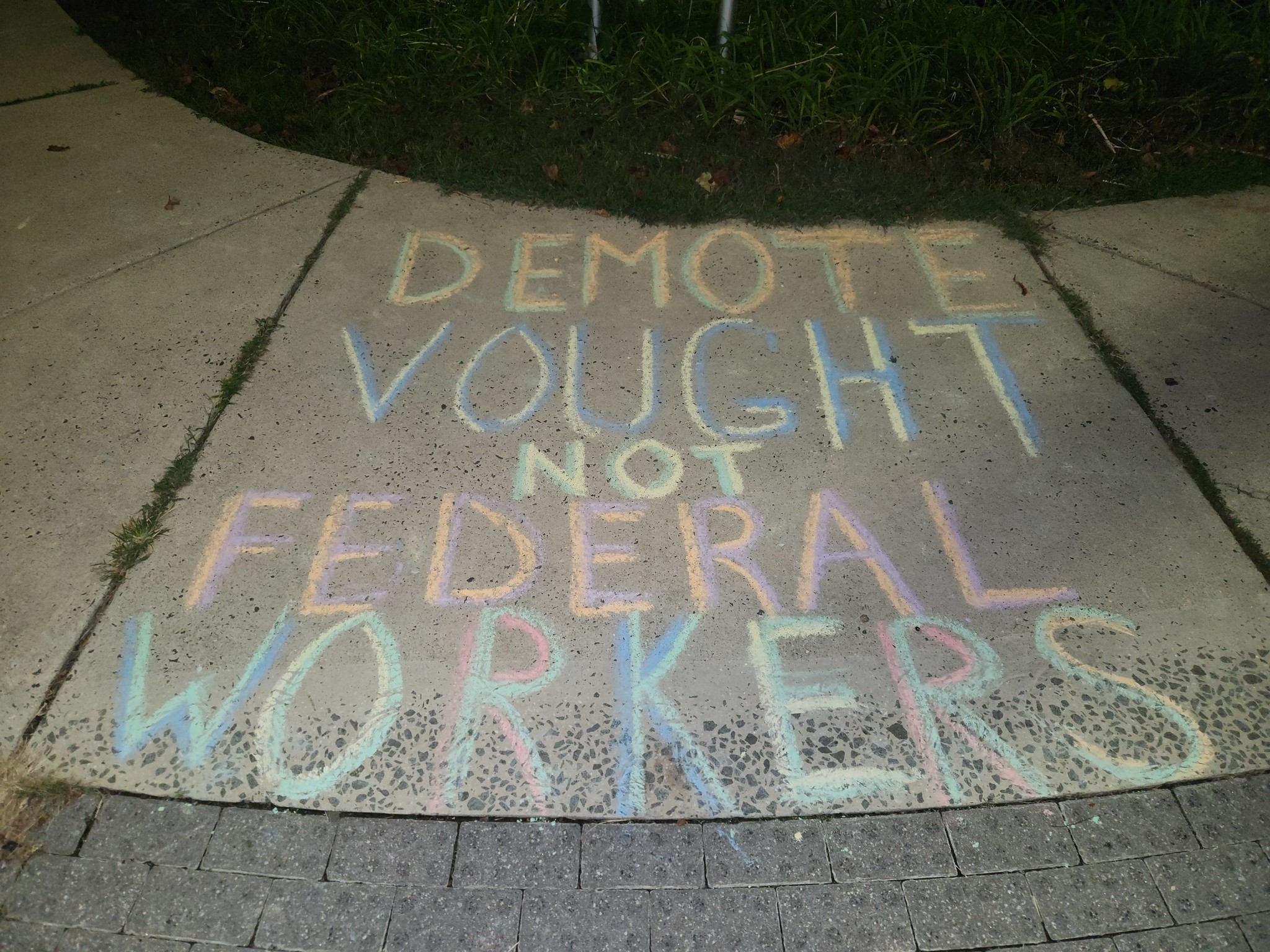
Residents said the signs started cropping up early on in the administration, after Elon Musk’s Department of Government Efficiency (DOGE) dismantled the US foreign aid agency and haphazardly purged government employees who are now being rehired by the hundreds. (A recent New York Times article included photos of a sidewalk chalk protest in the vicinity of Vought’s house that read: “I was hungry and the USA fed me. Until Vought cut USAID.”) Other chalk protests have popped up, too.

A chalk message in Russ Vought’s neighborhood.Courtesy of a neighbor

A chalk message in Russ Vought’s neighborhood.Courtesy of a neighbor

These days, the pro-federal worker signs have been sending an even louder message to Vought.

“People have strong feelings about him,” one person who lives further down the street told me, describing the neighborhood as solidly blue. “Everyone knows someone who lost their jobs.”

“He takes food and health care from the neediest and tries to, in his words, traumatize people—then he calls himself a Christian,” another neighbor told me. “Pretty despicable.”

Residents I talked to said that many federal employees, contractors, and active and retired military live in the area. “It’s a very friendly neighborhood,” one person said. “People look out for each other.” Of Vought, she said: “I don’t think he’s interacted with the neighbors at all.”

“Everyone still remembers when he said he wanted to cause maximum trauma to federal workers,” the neighbor said. “And that’s hard to forget.”

Most of Vought’s neighbors I talked to for this article declined to speak on the record or asked to remain anonymous. Some said they didn’t want to create a rift in an otherwise cordial neighborhood, while others worried about retribution or negative repercussions from their employers.

“I just wish he would have gotten to know us,” Hunter said. “We consider ourselves good Americans, we have good values. And I don’t think he’s been interested in getting to know any of us, in hearing if we might have a difference of opinion.”

Last week, Vought director sent around a memo blaming Democrats’ “insane demands” for the imminent lapse in funding and instructing agency heads to start making plans to cut non-mandatory programs “not consistent with the President’s priorities” and “use this opportunity to consider Reduction in Force.” Appearing on Fox Business, Vought claimed an “authority to make permanent change to the bureaucracy here in government” during the shutdown.

He has since announced pauses to funding for infrastructure projects in New York—home state of House Minority Leader Rep. Hakeem Jeffries (D-New York), who called Vought a “malignant political hack”—and slowdowns in clean energy projects in several blue states.

Vought, Republican Sen. Mike Lee of Utah said on Fox News, “has been dreaming about and preparing for his moment since puberty.”

AsIwrote in a profile of Vought from 2024, the bespectacled official spent years as a Washington insider and government bureaucrat before becoming the architect of a supersized second Trump presidency.

An avowed Christian nationalist and dedicated America First warrior, he once described the job of OMB director as the “keeper of ‘commander’s intent” and criticized the federal bureaucracy for standing in the way of the president’s agenda. During Trump’s first term, Vought tried to implement an executive order that would have made it easier for political appointees to fire career civil servants and replace them with MAGA loyalists. Now, he’s getting to realize his vision while earning points with the president.

For some of his neighbors, it is personal. “You stare it in the face when he’s there,” one person said. “This is the guy, you know.”

Another neighbor I talked to, who also asked not to be named, said many in the neighborhood find Vought’s policies and actions “abhorrent.”

“He takes food and health care from the neediest and tries to, in his words, traumatize people—then he calls himself a Christian,” the neighbor said. “Pretty despicable. You asked what it is like living near such a man. Frankly, I’d rather not, but this is a wonderful neighborhood and, unlike Mr. Vought himself, we do not want our neighbors (even Mr. Vought) to be traumatized. So we just live with it.”

Continue Reading…

Mother Jones

The “War-Ravaged” Portland Only Exists in Trump’s Head

First it was Los Angeles. Then, Washington, DC. Then, Memphis. Now, Portland, Oregon, is in President Donald Trump’s sights—just the latest Democratic city facing increased militarization.

Last week, Donald Trump announced on Truth Social he was authorizing Secretary of Defense Pete Hegseth “to provide all necessary Troops to protect War ravaged Portland” from what he called a “siege” by “Antifa.” At the center of this claim is Portland’s ICE facility, where protesters have been gathering acrosssummer.

I recently visited the ICE facility with my cameraand spoke with people there and across Portland—and the reality of what is happening on the streets is very different than what the administration wishes to portray.

“What you hear is music and you see bubbles,” Oregon state representative Willy Chotzen told me at demonstration featuring Governor Tina Kotek. “This is the true Portland and this is the Portland that shows up for each other.”

While there has been some damage to facilities and clashes between agents and demonstrators, it’s been largely peaceful. Video shows protesters gather to dance to the “Cha Cha Slide” and show up dressed in silly costumes—a familiar Portland scene. Even the local city police have stated in court that they see the feds “instigating” and causing a “ruckus.”

While the White House and its allies framed weeks-long demonstrations outside the Portland ICE facility as “violent riots,” and authorizing “full force if necessary,” Oregon and the City of Portland jointly sued the administration, arguing president cannot federalize Oregon’s Guard to protect federal property without meeting the narrow conditions—such as rebellion or foreign invasion.

“This is an illegal escalation of force against the city of Portland,” Portland city councilmember Mitch Green told me. “This is an attempt to normalize the rising fascism that’s going on.”

Continue Reading…

Mother Jones

For Furloughed Workers, Trump’s Partisan Shutdown Jabs Are Just the Latest Slight

In the past, for veteran federal employees, the weeks leading up to a potential shutdown situation have always involved a flurry of emails and meetings in preparation for a winding down of their agency. That, at least, has been the experience of an employee I spoke with at the National Institutes of Health (my former employer) who asked not to be named for fear of retribution. This time was very different, they told me: “I experienced absolutely none of that, because there’s nobody around me…I go to the office most days and it’s empty.”

One of the few communications this employee received was an email stating that “President Trump opposes a government shutdown” and that any lapse in funding was “forced by Congressional Democrats.” Emails of this nature have been sent to employees throughout the government, in addition to some agencies instructing their staffers to set up out-of-office emails containing similar language—some employees have even reported that their automated replies were altered without their consent.

Apart from violating an apolitical ethos that runs deep within the career federal workforce, this partisan framing is a likely violation of the Hatch Act, which prohibits federal employees from engaging in political activities. “Honestly, at this point, I don’t think me or my coworkers were shocked at the ethics violations,” says a State Department employee who also asked for anonymity.

The NIH employee wasn’t particularly surprised, either, they said, but given the workforce reductions and other administration actions that have impeded their work since January, “I liked the fact that I still had the capacity for disappointment.”

The Hatch Act isn’t some small stipulation buried away in an employee handbook. Impartiality is emphasized in the ethics training that federal workers take when they start their jobs and typically re-up every two years. And it’s something career civil servants take seriously.

“I, like every other federal employee, have gone through tons of hoops and given up tons of things,” the NIH employee said. For example, when invited to give lectures at other institutions, the employee had to fill out piles of paperwork and always declined any honorarium, as many federal workers are required to do. “And that didn’t bother me. That felt correct,” the employee said.

Of the Hatch Act and related ethics stipulations, they added, “Those aren’t laws for the sake of being laws. They actually were things that were worth believing in because they prevented real conflicts of interest.”

The Trump administration’s blatant disregard of the laws and traditions governing federalcommunications—rules that most employees follow dutifully throughout their careers—has left some workers with a bad taste in their mouth. “Not only is it insulting to the standards we’re all supposed to abide by,” the State Department employee said, “but it’s also insulting to our intelligence.”

It furthermore has added insult to injury. A shutdown is a pause to normal operations, but for those who have remained in the federal government through rounds of layoffs and reduction-in-force deals, normal operations ended a long time ago. “I can’t do the job I was hired to do now at all…because, you know, everyone I work with was fired,” the NIH employee said.

This is true for teams across the NIH and other agencies. For much of this year, the website of the NIH institute I used to work at had a banner alert saying it was not being updated because of “reduction in workforce efforts.” Now, a new banner blames the lack of updates on the shutdown, when the truth is that the entire team that managed that website is gone.

To claim the shutdown is the cause of government dysfunction—and to blame “the Radical Left in Congress,” as the Housing and Urban Development website does—is “factually untrue,” the NIH employee said.

This is something many Americans realize, even if they don’t share front row seats with dedicated federal workers. But the pain for those workers transcends the administration’s falsehoods: “There were reasons for the rules and the norms,” the NIH employee told me. “They created a sense of legitimacy…The institution doesn’t have the legitimacy it did six months ago.”

Continue Reading…

Mother Jones

Taking Stock of the Roberts Court at 20—and the Shadowy Forces That Built It

Chief Justice John Roberts has led the Supreme Court for 20 years now. In that time, his Republican-appointed majority has completely transformed America and its politics, with many of its most destructive opinions written by Roberts himself. Some effects are already visible in our everyday lives, others are only now coming into focus.

“This is now a MAGA court, and Roberts is at the helm.”

The court has rolled back voting rights and greenlit gerrymandering, at particular costs to nonwhite voters. It has allowed unlimited money to warp our politics and empowered the wealthiest elites at the expense of most Americans—a distortion that is reflected in growing inequality. The court ended affirmative action in higher education. It ended the right to an abortion. It made it harder for the government to issue the kinds of rules and regulations that safeguard our health and environment. It so aggressively expanded gun rights that virtually every American is now essentially entitled to a machine gun. It’s consistently weakened labor unions and consumer rights. The court has eviscerated the separation of church and state by inviting religious activities and opinions into public schools. And after significant wins for LGBTQ rights—over Roberts’ objection—the court has pivoted and begun to attack them, and transgender people in particular. It’s made public corruption great again. And then there is the court’s obsessive drive to increase presidential power, culminating in last year’s immunity decision, written by Roberts, in which the court granted the president sweeping new powers and general immunity from criminal prosecution, upsetting the separation of powers in our system of government. The decision was the most radical one in a series of holdings where, leading up to the 2024 election, the court repeatedly stepped in to help Trump escape accountability for alleged crimes and aid his return to power. Finally, in recent months, the court has unleashed Trump to act illegally by halting lower court injunctions—decisions which have resulted in illegal deportations to South Sudan, racial profiling by ICE, and the partial dismantling of multiple federal agencies, to name a few. In the face of district courts reining in Trump, the justices decided to strip lower court judges of their power to issue nationwide relief.

That’s quite a record.

Lisa Graves saw it coming. As chief nominations counsel to Sen. Patrick Leahy, when President George W. Bush first nominated Roberts to a seat on the federal bench, she believed Roberts had been selected by monied rightwing interests to rise the ranks and lead a conservative revolution on the Supreme Court. In her subsequent years as a researcher, she has sought to uncover the billionaire funding networks behind the hijacking of the court. This month, she published a book, Without Precedent, that lays out not just the damage wrought by the Roberts court, but also the behind-the-scenes machinations that created it. The details and context Graves provides—both as a witness and a player in nomination fights, and a researcher working with reporters—combine tocapture the movement to overtake the court with a wide aperture. Did you know, for example, that the parents of C. Boyden Gray, a Republican kingmaker and key Roberts backer, celebrated their upcoming wedding with a party in which some guests dressed as Nazis? I didn’t.

To Graves, the Roberts court is the right’s answer to the Warren court, which in the 1950s and 1960s issued a long list of opinions that expanded individual rights and promotedracial equality. Conservatives wanted to undo that progress, but their mission to take over the court sometimes hit roadblocks. In 1987, President Ronald Reagan tapped Robert Bork, but his reactionary views on civil rights sank his nomination. In 1990, President George W. Bush nominated David Souter, who would go on to vote with the liberal wing of the court. Rightwing interests, whose power was channeled largely through the Federalist Society’s Leonard Leo, redoubled their efforts. This meant firstly, no more Souters. Second, it meant ensuring none of their nominees could get “Borked.” Graves account of the Roberts court is as much a story of Roberts as it is the people, like Leo, who spent fortunesorchestrating this campaign.

“No Supreme Court majority in American history has ever been constructed the way the Roberts court has—with the help of big, dark secret money,” Graves writes. “The Roberts faction dominating the Supreme Court is quite the cast of characters. Each of them was carefully selected not because they were thought to be fair but because they were believed to be dependable votes for a revolution in the law—one Leo and his cohorts knew could be accomplished only by keeping Americans in the dark about their views.” They have succeeded, perhaps beyond their wildest dreams.

Lisa Graves leads the judicial watchdog group True North Research, is a frequent guest on MSNBC, and sits on several non-profit boards—including the Park Foundation, which has supported Mother Jones. I spoke with Graves about her book, her thoughts on Roberts’ legacy, and where the country goes from here.

You finished the book earlier this year, but events are moving at warp speed with this Supreme Court. Have your thoughts on the chief justice evolved in the last few months as the court hands Trump win after win? Or is the John Roberts that you document over decades the same John Roberts that you see all the way through?

The court’s aggressive action to overturn numerous temporary restraining orders by lower court judges—and to do so using the emergency docket this summer—just the amount of those interventions and disregard for the detailed findings of lower court judges, exceeded my worst fears. But we’re not done yet, and there’s more damage that this Court will do. I do think that that is in many ways very consistent with the through line of who Roberts is and was at the time of his confirmation.

One of the stories in the book is about how he was auditioning for the job on the Supreme Court, secretly interviewing with the Bush administration, as the Bush administration was litigating a case before him. The Bush administration was asserting that the president had the power to reinterpret the Geneva Conventions and subject [Salim Hamdan] to these military tribunals that Bush and [Vice President Dick] Cheney constructed. Roberts never told Hamdan’s lawyers that he was seeking a job from the administration while that case was pending. Had he recused himself, he might not have gotten the job. Had he ruled against them, he might not have gotten the job. The facts are that he interviewed with the Bush administration, with top officials, for more than 100 days while that case was pending. He joined the decision ruling in favor of [the Bush administration], and two days later, he was nominated for the Supreme Court. He interviewed with Bush basically as that decision had come down.

One of his first acts in getting power was to accept a very aggressive assertion of executive branch power, and he did so while he was trying to get a job from that president. So in that sense it’s not a surprise to me that we’re here now, where he is basically using the power of the court, along with his fellow Republican appointees, to expand the power of a Republican President.

Your research has focused a lot on the shadowy network of billionaires behind the conservative legal movement. When we think about the court’s entanglements with billionaires, we generally think of Clarence Thomas, or even Samuel Alito. Can you explain Roberts’ relationship with the moneyed interests that support the Federalist Society and a lot of the agenda that he’s implemented?

I observed that firsthand when I was the chief counsel for nominations for the Senate Judiciary Committee for Senator Leahy. Roberts was one of just over a dozen people who were nominated by George W. Bush on May 9, 2001, putting people in place for potential Supreme Court vacancies. [Roberts was nominated to the DC Circuit Court of Appeals.] We were not going to move him forward to a hearing or a vote. And the right wing groups were enraged. They started spending a lot of money to try to pressure Democrats to approve Roberts. He was almost always at the top of their talking points; he was their top horse in the race. That was Leonard Leo. It was C. Boyden Gray and some right wing groups actively pushing for Roberts’ confirmation.

“It’s so damaging, it’s so destructive—and he orchestrated it.”

Then, when he was nominated to the Supreme Court in 2005, those groups went into overdrive. There’s very little known about some of the donors to some of those groups. But we know, for example, that Charles Koch supported Roberts and Alito. He’s been a long-standing funder of the Federalist Society. And Leo was described in internal documents that were released as part of the [Brett] Kavanaugh Supreme Court nomination as leading the umbrella group that was marshaling and managing the confirmation process for Roberts to the DC Circuit and and then to help ensure that they got their guy on the Supreme Court.

To crystallize it, Roberts is really the beneficiary of the first billionaire-backed campaign to capture the US Supreme Court. And as the Chief Justice, he’s used the power of that court to advance an agenda that has been aligned with the regressive agenda of those billionaires that are funding the right’s legal movement that Leonard Leo has helped helm.

If you look at what big business interests want, that’s the result that Roberts votes for. And at this point, what the court votes for.

There’s statistics showing that he almost never rules against the Chamber [of Commerce].

Looking forward, the upcoming tariffs case and also the case over the firing of Federal Reserve Governor Lisa Cook feature clashes between the Leonard Leo side of the conservative legal movement and the MAGA side. Leo and Koch have both funded the group challenging Trump’s tariffs. A prominent Republican lawyer is on the brief opposing Lisa Cook’s removal. But Trump thinks he should be able to do whatever he wants, even if it’s taking over monetary policy, and using tariffs to destroy the economy. What do you think of Roberts’ predicament in these cases?

The immunity decision signaled that Roberts has moved more into MAGA land. He has really taken the driver’s wheel in terms of embracing a MAGA agenda, and that’s reflected in the January 6 trio of cases last year, and in particular the unprecedented immunity decision, and is reflected in the rulings this year, these emergency rulings. He is embracing the White House’s position on immigration in a way that is not consistent with most of the business community that does not support these sort of aggressive attacks on immigration and our employment systems.

Let me ask about the immunity decision, Trump v. United States, because I was surprised that they granted presidents immunity from criminal prosecution—and then how far it went beyond that. The more I learn about the opinion, the more extreme it is. How does Trump v. United States fit into Robert’s career? Does it stand out in a way that seems radical even for him?

At his confirmation hearings, he affirmed that no president is above the law, no one is above the law. And then when it mattered most for him to stand for that principle, he not only abandoned it, he aggressively wrote this very expansive opinion, ignoring the language of the Constitution that says in two places, the job of the president is to faithfully execute the law. And nothing could be less faithful than breaking the law.

When Richard Nixon asserted that ‘When the President does it, it’s by definition legal,’ no reasonable person accepted that assertion. It was the assertion of a crook. And here we are, almost 50 years since that outlandish claim by Nixon, with a court that has embraced it as a matter of law to say that if the President says that something is part of his so-called official acts, that he cannot be held accountable in a court of law. That ruling broke a key component of our democratic republic, which is that no president is above the law. It’s so damaging, it’s so destructive, and he orchestrated it. Now, why did he do this?

“Roberts has moved more into MAGA land.”

This is now a MAGA court, and Roberts is at the helm of it, and he is helping to drive this agenda that is aiding Trump and emboldening Trump at every turn. The cynical view of that would be this notion that there will be no accountability, because once Trump and the Republicans consolidate the levers of power, they will never let them go. That is the worry that I think a lot of people have. So they’re consequence-free in the sense of not having to face an impeachment or reforms in Congress. That’s sort of the cynical view. And I can’t say that it’s an irrational view.

We are in a whole new territory because of this Supreme Court basically paving the way for Trump’s return by blocking the trials of Trump, signaling to some subset of the American people that those charges were illegitimate when they were well-grounded in the law. And signaling to Trump and some of his followers that he could do no wrong, that he could not violate the law, or going forward, that he, as President, has vast powers.

You predict in the book that Roberts will go down as the worst chief justice in American history. That seems bold, maybe less bold by the day. But Roger Taney wrote Dred Scott and might have caused a Civil War. What is your pitch for why you think that you’ll be proven right?

I didn’t make that observation lightly, knowing how Roger Taney’s inflammatory, outlandish, outrageous ruling helped precipitate the Civil War. What John Roberts has been orchestrating, in particular with the immunity ruling, and then the actions this year, along with the Citizen United decision [on political spending], the Shelby County decision limiting the Voting Rights Act, the Rucho case on the [political] maps, the South Carolina case [on racial gerrymandering], Brnovich [on voting rights], I think that Roberts will go down in history as the most destructive chief justice when it comes to the rights of Americans in our democracy, to participate in our democracy, to have a fair and representative democracy. And the ruling he orchestrated for Trump in the immunity case will threaten whether our democracy will continue to exist.

Continue Reading…

Mother Jones

It May Be Hard to Stop Trump From Privatizing Our Public Lands

This story was originally published by High Country News and is reproduced here as part of the Climate Desk collaboration.

In June, a long-standing effort to sell off massive chunks of federal land grew closer to fruition than ever before when a provision mandating such sales was slipped into President Donald Trump’s “One Big Beautiful Bill.”

The bill passed, and selling public lands easily could have followed. But it didn’t, largely due to a fierce public outcry led not just by pro-public land progressives but by a surprisingly broad coalition that included horseback riders, ATVers, backpackers, birdwatchers, hunters, anglers and tribal nations—even podcaster Joe Rogan.

“The ones that want to see this sold only have to win once. And those of us that want to keep public lands public…have to win every time.”

Months later, pieces of that coalition continued to hold together. But not all of it, said Land Tawney, co-chair of American Hunters and Anglers, citing the administration’s recent attempts to overturn the Roadless Rule, which restricts road construction and logging on nearly 60 million acres of land managed by the US Forest Service.

“There’s a lot of people who aren’t speaking up about the Roadless Rule that did speak up about public lands,” he said. “So as far as (the coalition) pivoting to other things, I think it depends on the issue.”

David Willms, the National Wildlife Federation’s associate vice president for public lands, has even more to say. Willms spent over a decade working on land issues in the Wyoming attorney general’s office and served as former Gov. Matt Mead’s natural resources policy advisor. He recently spoke with High Country News about how the effort to sell public lands made it this far, why it faltered, and where we go from here.

This interview was edited for length and clarity.

Why didn’t the provision to sell public lands make it into the final version of the One Big Beautiful Bill?

It could be for a few reasons.

It was written in a way that called for the sale of a certain percentage of lands in Western states under the guise of affordable housing. But these lands weren’t really tied to places that needed affordable housing. And it was drafted in a way where you didn’t know who could purchase the land.

A second piece of it is how quickly it came about. There was really no opportunity for the public to engage in this. There wasn’t even a hearing.

And the third thing is: It became crystal clear that the public as a whole, from the far right to the far left and everything in between, does not support selling public lands, particularly for undefined development.

It’s hard to find anything right now that the majority of Americans can agree on. Do you think this coalition of people who opposed sale of public lands will hold to help manage public lands in the longer term?

Here’s my hope: I don’t believe that the existence of public lands is inherently political, and I think this whole process bears out that the public at large deeply cares for their public lands and wants to be able to have access to those lands.

When it comes to how public lands are managed, that becomes more political. So I hope that this same coalition is willing to come to the table and say, “We care about our public lands, and we want to see them exist in perpetuity for future generations to enjoy. That means having hard conversations about how we manage them.”

And maybe if we have that as our centerpiece, of keeping public lands in public hands, that it enables us to work together better on some of the harder issues.

What do you think it would take for that to happen? For all these parties to come together and continue to engage on all these other issues surrounding public lands?

That’s the million-dollar question that I don’t have a million-dollar answer to.

What should people who want public lands to remain public watch out for over the next few years or decades?

Watch for proposals that are more place-based rather than national in scope. Work with folks to make sure that the proposal is balancing all different needs.

On the executive branch side, I’d suggest watching the Federal Land Policy Management Act, because some of the lands that are on the “suitable for disposal” list may have been put on that list 30 years ago, when they were deemed difficult to manage because nobody knew how to access them. But with new technologies like onX (a popular GPS mapping application), many of those lands are accessible, and some of these parcels are really high-quality habitat for wildlife.

And then you have to watch for county commissions and state legislatures passing resolutions of support for transfers or sales of public lands. Those are elected officials representing their constituents. If enough do that, it’ll send the signal to Congress that there’s a lot of local support for sales or transfers.

There are also types of policies that could reduce the value of lands in a way to shift support away from ownership. So monitor those policies dictating how lands are managed and the resources that are allocated to agencies.

That’s a lot to keep track of. Do you think people will get exhausted and stop fighting?

I don’t think so. There’s a recognition that the ones that want to see this sold only have to win once. And those of us that want to keep public lands public for future generations have to win every time.

Once the lands are sold, they’re gone. You can’t just wait for the next election cycle to “fix it.” And that’s what keeps people motivated.

Continue Reading…

Mother Jones

Americans Aren’t Buying Trump’s Shutdown Blame Game

As Democrats and Republicans trade accusations over which party is responsible for the government shutdown, new polling suggests that President Donald Trump’s efforts to falsely claim—in social media posts, on television, on government agencies’ websites, and in internal directives to federal employees—that Democrats shut down the government because they want to provide “free health care for illegal aliens” are not working.

Nearly half of Americans blame the shutdown on Trump and Republicans in Congress, according to a new nationally representative poll of more than 1,000 Americans, conducted by the Washington Post on Wednesday. Meanwhile, 30 percent said they blame Democrats, and nearly a quarter of respondents said they are unsure of who to blame. Interestingly, eight percent of Republicans blame Trump and the GOP for the shutdown, higher than the two percent of Democrats who blame their own party.

The White House’s claims, of course, are not accurate. Undocumented immigrants are already mostly ineligible for federal health care, and Democrats are seeking to restore access to Medicaid and Affordable Care Act (ACA) subsidies for documented immigrants, including refugees and people granted asylum. The Republican spending bill passed this summer contains the Medicaid cuts, while the ACA subsidies are set to expire at the end of this year under the Inflation Reduction Act passed in 2022. Yet, Republicans ranging from Trump, to Vice President JD Vance, to House Speaker Mike Johnson (R-La.), to Senate Majority Leader John Thune (R-S.D.) have made the claim that Democrats shut down the government over efforts to provide health care to undocumented people.

I questioned Speaker Mike Johnson tonight on the claim being made by Republicans that Democrats want to give free health care to “illegal aliens” in the government shutdown fight. pic.twitter.com/sjvnQwxTKN

— Kaitlan Collins (@kaitlancollins) October 1, 2025

Polls recorded before the shutdown officially started found similar results. An NPR/PBS News/Marist poll of nearly 1,500 people, conducted last week, found that nearly 40 percent of respondents would blame Republicans for the shutdown, compared to only 27 percent who would blame Democrats. Just over thirty percent said they would blame both parties. And a New York Times/Siena poll of more than 1,300 registered voters, conducted last week, found a higher proportion of respondents said they would blame Trump and Republicans than Democrats for a shutdown—26 percent to 19 percent—though about a third said they would blame both parties equally. Just over a fifth of respondents said they had not heard enough to say.

But beyond the fact that Republicans control all three branches of government, it appears as though the substance of their legislative priorities are also unpopular. The same Washington Post poll found that a staggering _71 percent o_f respondents say that the federal subsidies that reduce the cost of ACA plans scheduled to expire at the end of the year—a sticking point for Democrats in the stalled negotiations that led to the shutdown—should be extended, and nearly half of respondents said Democrats should demand the extension “even if it continues a government shutdown.” When you crunch the numbers, this view makes sense: A KFF analysis found that last year, the subsidies saved enrollees an average of more than $700 last year. And a more recent analysis found that extending the subsidies would save enrollees an average of more than $1,000 in premium payments in 2026.

Democrats, for their part, have leaned on this context as they try to spin the shutdown in their favor. “Republicans shut down the government because they would rather make health care more expensive than keep the government running,” Sen. Elizabeth Warren (D-Mass.) said in a speech on the Senate floor. “That is literally where we are.”

Trump and Republicans shut down the government because they'd rather make healthcare more expensive than keep the government running.

Democrats are fighting to roll back the Republican cuts that will take away healthcare from millions.

Via @SenWarren pic.twitter.com/1yuLz7bjOV

— Senate Democrats (@SenateDems) October 1, 2025

Continue Reading…

Mother Jones

Jane Goodall’s Final, Urgent, Message

This story was originally published by Vox and is reproduced here as part of the Climate Desk collaboration.

Jane Goodall, one of the most influential environmental figures in human history, has died at 91 while doing what she’s done for most of her later years—touring the country to deliver an urgent message about nature and human existence.

Goodall, who revolutionized what we know about chimpanzees and animal intelligence, was interviewed as recently as last week, during New York City Climate Week. And her message was clear, consistent, and timely.

“It seems these days everybody is so involved with technology that we forget that we’re not only part of the natural world, we’re an animal like all the others,” Goodall, founder of the Jane Goodall Institute, a conservation group, said last week during the Forbes Sustainability Leaders Summit in NYC. “We’re an animal like all the others. But we depend on it for clean air, water, food, clothing—everything.”

And yet, “we’re destroying the planet,” she said.

In a separate conversation with the Wall Street Journal last week, Goodall said the problem is the pernicious idea that economic development should come before the environment. In reality, we’re on a planet with finite resources, and if we exhaust them, it could spell our own end. “Humans are not exempt from extinction,” Goodall said in the WSJ podcast, The Journal.

One of the most compelling messages from her last interviews is that while we’re the most “intellectual animals” to ever walk the planet, “we’re not intelligent,” said Goodall, who’s an expert in animal behavior. “Because intelligent creatures don’t destroy their only home.”

Ultimately, she said, it’s that intellect that gives us the best shot at saving ourselves and the planet. That’s what’s ushered in solutions to living in greater harmony with the natural world, Goodall said, including renewable energy and plant-based foods. She emphasized that we know what’s killing the planet: industrial agriculture, including livestock, and burning fossil fuels.

“We have a window of time,” Goodall, who’s authored more than two dozen books, said in The Journal. “But it’s not a very big window. If we don’t change the way we do things, the way we develop economically, then it will be too late.”

Continue Reading…

Mother Jones

Energy Department Tries to Stifle Workers’ Use of Climate-Related Words

This story was originally published by Guardian and is reproduced here as part of the Climate Desk collaboration.

The US Department of Energy has told employees in the Office of Energy Efficiency and Renewable Energy (EERE) to avoid using the words “climate change” in what seems to be the latest incident in a crackdown on discussing the climate crisis in the US government.

“Please ensure that every member of your team is aware that this is the latest list of words to avoid—and continue to be conscientious about avoiding any terminology that you know to be misaligned with the administration’s perspectives and priorities,” says an email from an agency acting director seen by the Guardian.

Employees of EERE, which is the government’s largest funder of carbon-slashing technologies, were told to avoid using the terms in internal dealings and public-facing work: “Whether you work directly on communications or not, this email applies to you,” says the email, which was first obtained by Politico.

“DOE leadership can choose to stick their heads in the sand, but that won’t make the climate crisis go away.”

It’s a continuation of the anti-environmental agenda Trump has pushed since entering the White House, said one anonymous agency staffer. It follows a move by Trump to gut EERE’s funding of green technologies. “My reaction was: same shit, different day,” the worker said.

In addition to “climate change,” the banned terms include “decarbonization,” “sustainable,” “emissions,” and “green.” Also on the list are “energy transition,” “‘clean’ or ‘dirty’ energy,” and “carbon/CO2 ‘footprint’.”

Another set of words to be avoided: “Tax breaks/tax credits/subsidies,” probably because of the terms’ association with Joe Biden’s efforts to subsidize green technologies, which the administration is clawing back.

“Banning the use of these words would silence key elements of DOE’s mission,” another anonymous current agency staffer told the Guardian. “But what is even more worrying is that Secretary Wright is also illegally freezing and cancelling programs that fund advanced research into solar, wind, and other clean energy technologies. DOE leadership can choose to stick their heads in the sand, but that won’t make the climate crisis go away or stop super storms and wildfires from destroying more homes.”

The Trump administration has this year asked agency leaders to avoidsome 200 terms—a list that also includes words like “activism” and “injustice.”

“Welcome to the Donald Trump post-truth world,” Dr Ali Khan, a retired US assistant surgeon general and a former director of the Office of Public Health Preparedness and Response at the Centers for Disease Control and Prevention, wrote on social media.

The Department of Energy’s press secretary denied the agency had instructed employees to avoid the use of specific terms.

“There is no directive at the energy department instructing employees to avoid using phrases such as ‘climate change’ or ‘emissions’,” Ben Dietderich, the agency’s press secretary, said in an emailed statement. “President Trump and Secretary Wright remain committed to transparency and fostering an open, honest dialogue about climate science. Reflecting that commitment, Secretary Wright regularly engages on these issues.”

Wright railed against climate policy at the United Nations general assembly last week. “The more people have gotten into so-called climate action, the more expensive their energy has become,” he said. “That lowers people’s quality of lives and reduces their life opportunities.”

He defended a July climate report produced by the energy department that experts say is riddled with misinformation, and announce the cancellation of $13 billion of funding for renewable energy projects.

The recommendations are the latest attempt by the Trump administration to minimize or silence discussions about the threats posed by the climate crisis. Upon retaking the White House in January, Trump stripped mentions of climate change and global heating from government websites and ended a slew of climate-focused government programs.

In a speech at the United Nations last week, the president called the crisis “the greatest con job ever perpetrated upon the world.”

“Countries are on the brink of destruction because of the green energy agenda,” he said.

Continue Reading…

Mother Jones

“If I Had Legs I’d Kick You” Invites You to Look Directly at a Woman’s Rage

What happens when a mother is pushed to the brink, when stresses both tedious and extraordinary break her beyond recognition? What happens is that she might look a lot like Rose Byrne.

That might seem impossible, given that Byrne is, after all, a beautiful A-list actor. The suggestion even borders on cruelty. But her knockout performance in If I Had Legs I’d Kick You, a new film from Mary Bronstein, is the stuff of terrifying relatability.Byrne plays Linda, a mother flailing in an increasing state of crisis after the ceiling of her apartment suddenly collapses, forcing her to take refuge in a gritty motel room with her young daughter, who suffers from a mysterious illness that requires feeding tubes. Meanwhile, Linda’s work as a therapist grinds on with multiple clients, including a missing mother in the throes of acute postpartum depression. Linda’s efforts to manage her own deteriorating mental health by seeking the help of a colleague, another therapist played chillingly by Conan O’Brien in his first dramatic acting role, are met with escalating antagonism. Meanwhile, her husband may be traveling for work, but his requests for updates on the ceiling are relentless. Wine is chugged, and drugs via the dark web are pursued.

If I Had Legs I’d Kick You is not an explicitly political film. With seven years in the making, it could not have predicted the landscape into which it premieres today. But the film arrives at an urgent moment,a shot-out-of-a-cannon rejoinder to the hostile suggestion that women in pain “tough it out.” Its ability to maintain darkly humorous, propulsive energy despite the anxiety-inducing twists speaks to Bronstein’s enormous skill as both a writer and director. Ahead of the film’s theatrical release, I talked to Bronstein about a woman’s rage, Courtney Love, and the radical beauty of an untouched middle-aged face.

Talk to me about some of the personal parallels that led to you writing Kick You.

I have a daughter, and she’s 15 now and doing great. But when she was 7 years old, she became very ill. We are New Yorkers, but to get her the treatment that she needed, we had to go to San Diego. When I spoke initially to the place in San Diego, I asked: “Well, how long does the treatment usually take? How long should I expect to be in San Diego?” And they responded, six, max eight weeks. We were there for eight months.

While we were there, my husband, Ronald Bronstein, needed to stay back in New York. He’s a filmmaker who is a close creative partner with Josh Safdie, and during this period, they were making Good Time. So he’s making this film with Rob Pattinson while I’m in San Diego in a really shitty, tiny hotel room as a roommate with my daughter. It was incredibly stressful for obvious reasons, but I’m also the type of person who thinks of things in existential terms all the time. Like, my husband would say to me: “You can’t have an existential crisis every day. You can’t dismantle your entire existence and life choices every day.” But that’s just how my brain works.

During this time, I had a strong sense of dread and anxiety all the time, and I couldn’t articulate it. And part of it was that I felt trapped. [My daughter] was young, so the lights would go out at 8 p.m., and I’d be in this tiny room. Now, I didn’t do the things that Linda does in this film. But what I did for my escape was I would go into the bathroom and turn on the light of this horrible, cheap hotel room and sit on the tiles of the bathroom floor, drink cheap wine, and scarf candy and junk food.

One night, I was suddenly able to pinpoint that I felt like I was completely disappearing into the caretaking of my daughter. The dread shifted from what the situation was to: Wait a minute, this situation is going to end. She’s going to get better, and we’re going to go back to New York, and then what? Then what? That’s the emotional and physical, literal place where the film started from. I actually started writing the script in that bathroom while going through the situation. No one knew I was writing it for myself at that point, and the rare beauty of a middle-aged woman.

“I literally went into a trance. Like, ‘tough it out?’ You’ve never been pregnant. You don’t know what it’s like. Also, don’t tell me what to do with my body.”

This is an unflinching portrayal of a woman in acute stress. Linda is seen literally begging for someone to just help her. But everyone around her seems to expect nothing but calm and order. What do you think makes us so blind to a woman in crisis, even when she is screaming for help?

That’s such a great question and a question I haven’t gotten before. I think that in American society, a woman’s rage is terrifying, and the idea is to quell it by any means. A lot of the advice that we get as little girls is: Be a good girl. The difference between you and a boy is that you are not disruptive in a classroom. That stays with us, right? You know that scene in Networkwhere [Howard Beale] goes, “I’m mad as hell, and I’m not going to take this anymore!” It’s like that. We suddenly don’t have room. And if a woman does have that personality and does have that boldness to do that, she’s villainized, and we don’t like her. We hate her.

I’m thinking of cultural things, too. I’m thinking about people like Courtney Love. Why was she hated? It wasn’t her music. She was hated because she was a woman who was loud and would say exactly what was on her mind. [Love] is the type of woman thatI’ve always been attracted to. My favorite feminist thinker of all time is bell hooks, and her work in Ain’t I a Woman. That no woman can write enough because there has not been enough. I think that right now, in 2025, is one of the scariest moments to be a woman. I don’t want to get political, because my work is not political in a literal sense, but we must acknowledge that this is a time in history where our rights are being taken away, and we are being told constantly in the media, “Just shut up.”

“You’re about to spend just under two hours with this woman, and you are going to watch her. You are going to deal with it. This is a woman who’s going through it. She is crying. It is on a giant screen. And instead of averting our eyes like we do in normal life, I’m making you deal with it.”

Meanwhile, our president is telling mothers to “tough it out.”

I was on a plane coming here to Los Angeles when I glanced over at a person’s TV screen, sort of diagonal from where I was sitting on the plane. I couldn’t hear it, but I saw the message at the bottom, the president telling pregnant people to “tough it out.” I literally went into a trance. Like, tough it out? You’ve never been pregnant. You don’t know what it’s like. Also, don’t tell me what to do with my body.

I think with my film, it’s “Don’t tell me what to do with my emotions.” Linda is screaming into the ether. “Is anything that I’m saying being heard or important to anybody? Can you hear me?” There’s a scene where she literally screams into her therapist’s face, this person who is supposed to help her, where she screams one inch from his face, “Help me!” And it still cannot be heard. It’s a moment where she is rejected in the most awful way. The filmmaking choices that I make in this film speak to the woman who doesn’t want to shut up or tough it out and instead wants to say: “No, this isn’t fair. No, I actually feel this way, and I’m going to make you listen to me.”

I open the film with an extreme close-up that keeps getting closer and closer until we’re right in Linda’s eye as she’s crying. That’s me saying to the viewer: “You’re about to spend just under two hours with this woman, and you are going to watch her. You are going to deal with it. This is a woman who’s going through it. She is crying. It is on a giant screen. And instead of averting our eyes like we do in normal life, I’m making you deal with it.” You’re going to see her tears, and you’re going to deal with it, and however it makes you feel, that’s not my business. It’s the viewer’s business. And it’s not me indicting the viewer. It’s really me, in quite a radical way, just saying this is a reality. Women have emotions. They’re not always polite; they’re often messy.

I want to talk more about the close-ups. One thing I loved about Kick You is how the close-ups of Rose Byrne let you see her real face. Like, that might be Rose Byrne, and she is gorgeous…

Oh, totally gorgeous. One of the most gorgeous women that we have in show business today. And I’m sorry to interrupt your question, but I want to say that one of the reasons that I cast her is because she and I are the same age. We’re middle-aged women, and she has a real face. She has the real face of a middle-aged woman.

Exactly! The shots captured her exhaustion. They felt radical. Like, yes, of course, Rose is beautiful. But I know that woman. She is exhausted and over it. That woman is me!

[Holding a C Magazine cover featuring Byrne] This is one version of what we are shown, and this is real, too. She is gorgeous. But for me, it was very, very important that I had a middle-aged woman who had not had work done on her face. I don’t disparage women who do, and I don’t judge women who do. By the way, Linda happens to be a gorgeous woman. She is a beautiful, gorgeous woman, but she’s going through it. What I wanted to do with the close-ups is that by the end of the movie, you know every pore on this woman’s face. Every pockmark when she smiles. How her eye crinkles when she cries. That’s disappearing in our society. What happens if everybody gets their face done? What are young people, especially young girls, seeing? Are they going to know what a middle-aged face even looks like? That’s something that freaks me out, but it was important to me. And Rose was so on board and not scared.

“The filmmaking choices that I make in this film speak to the woman who doesn’t want to shut up or tough it out and instead wants to say: ‘No, this isn’t fair. No, I actually feel this way, and I’m going to make you listen to me.’”

The other thing the close-ups are doing is exposing. Linda cannot hide from the camera. She’s trying to hide and run away from everything else. But she cannot run away from my camera. That was important, too. You’re trying to escape. But we see you. Maybe none of the other characters in the movie sees you. But we see you. The tragedy is that she doesn’t know that, because she’s inside the film. But we see her, and we see her cry, and we see the messiness. When the movie opens, that’s as good as it gets for Linda in both physical appearance and mental state. The de-evolution that follows is purposeful and calculated in a mathematical way that I worked out with the makeup and costume departments. By the end of the film, what I wanted her to really look like was a disheveled teenager, because that’s what she becomes emotionally. Actually, something that I don’t know if I’ve said in another press, but that band T-shirt that Rose wears, with the album Cheap Thrills by Big Brother and the Holding Company and Janis Joplin, is a T-shirt I bought when I was 14. At the start of the film, we see Linda wearing it as pajamas. But then she starts wearing it to work. By the end of the film, in that final therapy session, she’s wearing the shirt with a hoodie and looks like shit. But that’s where she’s at.

I have to give all kudos to Rose. She never, ever, ever had an issue with how I wanted her to look or how close the camera was going to get. She knew what it meant as an actress, as an artist, and she agreed with it. It shouldn’t be brave, but it is brave.

Definitely brave. I thought exactly the same thing, like, I am really seeing her face, a real face, the blemishes and all. It just felt like something I had never seen in movies before.

Thank you so much for bringing that up. Because nobody really brings it up, and I think some of that might be because I mostly talk with male journalists. Yes, I’ve talked with some wonderful female journalists. But filmmaking is a male-dominated space, and so is journalism. Maybe the question feels like it’s not polite to ask for some people, but it’s a very important question and something to talk about.

Let’s turn to Conan, who, I must admit, I did not expect to be so effective as a serious therapist. What were some of your thoughts that went into casting him?

How good is he? I want people to understand when they see his name on the poster that they know that this is not a cameo. It’s not him playing himself. It’s not him being the comic relief. He is turning in a proper dramatic performance that is on tit-for-tat with Rose as a scene partner. And what an extraordinary thing, because it started with me approaching O’Brien and him saying: “I am not an actor. I want to do it. I love the script. But I don’t know if I can do it.”

I don’t want to give away, but there’s a monologue that he does. And while I was writing it, I literally thought to myself, I am writing something that is not performable. I’m writing something so didactic, there’s no way it’s performable. So I’m going to have to work it out with whoever the actor is. But O’Brien performs that thing, and he kills it. And that is a testament to his talent. He radically availed himself of this totally unknown form that he had neverdone before. He was such a dream to work with.

Continue Reading…

Mother Jones

The End of the FBI—in One Act

A version of the below article first appeared in David Corn’s newsletter, Our Land_. The newsletter comes out twice a week (most of the time) and provides behind-the-scenes stories and articles about politics, media, and culture. Subscribing costs just $5 a month—but you can sign up for a free 30-day trial._

SCENE: An office at the headquarters of the Federal Bureau of Investigation. One side of it is a glass window through which other offices can be seen. On the wall are a collection of citations for meritorious service. There is a plant in the corner. It needs watering. On the desk are framed photos of a smiling middle-aged woman hiking a mountain trail and of identical twin girls of high school age in front of a sailboat. In walks Special Agent HENRY DOBSON. He’s 50-ish, with a square and solid build. His salt-and-pepper hair is thinning. He’s grinning. He sits at the desk and straightens the framed photos. He picks up the phone and dials.

DOBSON [into the phone]: Shelly, Hank. They just closed the bank. It’s done. After five years. Five fuckin’ years. He’s pleading. The Brazilians have it wrapped up. Nine years, no wiggle. Pretty good, right? Now on to the next scumbag…What? C’mon, you can’t be serious. That’s not what I do…No, no, no…What do I know about street patrols?…This is nuts—.

A YOUNG AGENT pokes her head in the office and tosses DOBSON a sealed manila envelope.

YOUNG AGENT: Someone dropped this off for you.

DOBSON: Who?

YOUNG AGENT: Didn’t say. Woman. Lots of jewelry. Big sunglasses. Floppy hat. Skedaddled quickly.

DOBSON [into the phone]: Hold on, Shelly.

DOBSON opens the envelope, takes out a sheaf of papers, and starts to flip through them.

DOBSON [murmuring]: Oh shit…Oh, I said, “Oh shit.” Someone just dropped off a stash of docs. Bank account summaries. Spreadsheets. Prospectus…With a memo explaining it all…It’s crypto…Sham deal…Dubai and Antigua…Looks like a fake ICO, maybe a rug pull…$34 million…SEC filings, transfers, phone numbers…Damn, the whole shebang…Ever get a silver-platter case like this?…Yeah, it says who did it…A guy named Carl, uh…Hold on, just hold on, let me do something.

A list of Google results come up. DOBSON clicks on the first one. A large headline appears: “Crypto Entrepreneurs Gather at Mar-a-Lago.” DOBSON immediately turns off his computer.

DOBSON puts down the phone without hanging up. He boots up his computer. The wallpaper image appears. It’s Kevin Costner playing Eliot Ness in The Untouchables_. DOBSON enters his password and goes to the Google homepage. He types in a few words._

DOBSON [loudly into the phone]: Hang on. Be right there. Just checking…

A list of Google results come up. DOBSON clicks on the first one. A large headline appears: “Crypto Entrepreneurs Gather at Mar-a-Lago.” DOBSON immediately turns off his computer.

DOBSON [to himself]: Oh shit.

DOBSON nervously looks around to see if anyone is watching him. He starts stuffing all the documents back into the envelope. He picks up the phone and cradles it between his face and shoulder and continues shoving the papers into the envelope.

DOBSON [into the phone]: Yeah, yeah, I’m still here…Oh, you know what? I don’t think this is anything…Yeah, I think it’s a prank…Yeah, the guys in laundering. They’re always doing shit like that…Yeah, yeah, should’ve looked more closely at first…But, please, Shelly, do me a favor: Don’t mention this to anyone, okay? Not anyone. I wouldn’t want them to know they got me…Yeah, okay, you’re the best…And, yeah, where should I report tonight?…Okay, got it. I know that Potbelly’s. It’s always real quiet around there…See ya later.

DOBSON reaches for a burn bag.

***

I don’t know if anything of the sort has happened at Kash Patel’s FBI. But it doesn’t take much imagination to wonder whether such scenes are occurring. The FBI has become a cauldron of vengeance, with scores of agents who worked on cases despised by Trump and his crew being canned—most notably, the gumshoes who pursued the Trump-Russia investigation or the January 6 insurrectionist rioters. Even bureau employees whose only sins were to be pals with agents who worked those cases have been booted.

Then there’s the absurd and troubling indictment of former FBI Director James Comey. Even though Comey’s decision to revive the Hillary Clinton email probe eleven days before Election Day in 2016 helped Donald Trump win the White House, Trump has been angling for years to take Comey down for having kick-started the FBI’s Russia investigation that morphed into the inquiry run by special counsel Robert Mueller. A US attorney and several assistant US attorneys refused to move the Comey indictment forward, contending there was no there there. So Trump forced out this US attorney, put in a lackey with absolutely no experience in prosecuting criminal cases (she specializes in insurance law), and—presto—he had his bullshit indictment of Comey. (I’ve been reading indictments for decades, and this slim two-pager is the worst and most amateurish indictment I’ve ever seen.)

If you’re an investigator at a federal agency, you’d have to be crazy to contemplate an inquiry that might involve an associate, friend, or crony of Trump, his family, or anyone in his inner or outer circle.

Comey is likely to beat the rap—perhaps easily. But this bogus act of retribution, the dismissal of all those FBI agents, and other get-even actions (such as Trump’s henchmen targeting New York Attorney Geneal Letitia James and Sen. Adam Schiff) are creating a chilling effect of Arctic proportions for all federal law enforcement.

If you’re an investigator at the FBI, the Securities and Exchange Commission, the Federal Trade Commission, the US Fish and Wildlife Service, or any federal agency, you’d have to be crazy to contemplate an inquiry that might involve an associate, friend, or crony of Trump, his family, or anyone in his inner or outer circle. You have 10 years until retirement, kids you want to put through college, parents that need home care—will you risk your job by looking at the possible misdeeds of a donor to Trump’s campaign or anyone with a connection to his crew, let alone Trump himself? Not even a former FBI director is safe. And Trump is now braying about going after Chris Wray, Comey’s successor at the FBI whom Trump appointed to the job.

Should you get a tip about possible wrongdoing involving anyone with a link to Trump, you’d be a fool to even mention it to a colleague or supervisor. Don’t put anything about this into an email. Find a narcotrafficker to chase instead—if you haven’t been reassigned to help round up migrants.

The Trump administration has signaled it doesn’t want the bureau bothering with whole categories of crime, such as foreign bribery or failure to register as foreign agents. Attorney General Pam Bondi shut down the task force investigating foreign influence operations. In February, the leadership of the public integrity section of the Justice Department quit instead of dropping the corruption charges that had been filed against New York City Mayor Eric Adams. After that, this section was downsized. That’s good news for dirty pols.

Should an FBI agent open an investigation that irks Trump, he or she would have to fear losing their job and more—possibly being harassed on social media by Trump and doxed by his MAGA army.

What all this means is that a host of wrongdoers, including crooked politicians and Trump chums, have a get-out-of-jail-free card—that is, license to cheat, grift, and crime with little fear of investigation or prosecution. And it’s a card that’s easy to obtain. In trouble with the law? Buy a million dollars of Trump’s crypto. That ought to keep the G-men at bay.

Should an FBI agent open an investigation that irks Trump, he or she would have to fear losing their job and more—possibly being harassed on social media by Trump and doxed by his MAGA army. And if a gutsy agent did move ahead with such a case, would the Trump Justice Department prosecute it against Trump’s wishes? Forget about it, Jake. There’s no percentage in starting such an inquiry. It will only lead to a world of hurt.

That’s the loud-and-clear signal that Trump and Patel have been sending to the FBI, while they shift agents to street crime tasks and ICE assistance. The Comey indictment is merely the exclamation point on the don’t-fuck-with-us message conveyed to all federal law enforcement. Special Agent Dobson is no fool. He knows the saying used to be that justice is blind. In Trump’s second term, it’s now justice is blind to the crimes of Trump and his gang—and if you dare take a glance in their direction, we’ll rip your eyes out.

Continue Reading…

Mother Jones

Another Shutdown Casualty: Medicare Telehealth Coverage

In 2001, Congress implemented partial Medicare coverage for telehealth, allowing remote visits with doctors and other forms of long-distance care—a response to the increasing need, in particular, for people in rural areas to reach specialists, and an essential service especially after the start of the Covid-19 pandemic, when lawmakers expanded that coverage to a broad range of services now used by a quarter of the country’s 68 million Medicare users.

But Wednesday’s federal budget impasse has halted that funding—and unlike other, temporary service cuts brought on by the shutdown, telehealth won’t be restored for long just by bringing the government back online.

As a consequence of the temporary way it was funded, Congress has had to renew Medicare telehealth coverage roughly annually, or even twice a year, since 2021.

This latest termination is linked to the government shutdown that began Wednesday: Medicare telehealth funds were tied to the failed continuing resolution for the federal budget, which would have funded government operations for just seven more weeks. But the repeated expirations of a program with bipartisan support, which Congress has repeatedly agreed to continue, look increasingly ridiculous to health care advocates and federal government observers.

Multiple bills across multiple recent sessions of Congress would have extended that coverage either for a two-year period or more permanently. The president of the American Medical Association has also argued in support of making telehealth coverage permanent for people on Medicare.

“Commercial payers generally follow Medicare guidance, and…this could eliminate coverage for telemedicine across the board for all Americans.”

Gin Jones, an author who lives in Massachusetts, is one of the millions of people affected. Jones has a rare genetic disorder, X-linked hypophosphatemia, which requires specialized treatment from an endocrinologist who lives four hours away. Her next visit, on Tuesday, is now in-person rather than remote; Jones doesn’t know what she is going to do about it. The long trip would be exhausting and painful and an “extraordinary waste of my time.”

“The big question is whether I go ahead and endure the four-hour round trip,” Jones said, “or switch to a closer endocrinologist who isn’t really qualified to treat me.”

Some smaller clinics are rescheduling their Medicare patients in person and suspending their telehealth appointments for Medicare patients, said Lydia Homovich, a policy analyst with the Center for Telehealth and eHealth Law.

Other patients are insulated, said Homovich, as some larger institutions are “going to continue providing these telehealth services as normal, even if they don’t get back payment for that if the waivers are reauthorized.”

Dr. Kanwar Kelley, the CEO and co-founder of Side Health, which focuses on virtual chronic disease management, said that his practice will be greatly impacted: most of his patients are on government insurance. “Unfortunately, given the uncertainty around whether we will be reimbursed, we are planning a dramatic reduction in workforce with furloughs,” Kelley said.

Homovich notes that some members of Congress may view a longer-term expansion of telehealth as too expensive—but ultimately, she says, it may actually be a cost-saver.

“Telehealth allows for the earlier detection and treatment of conditions that otherwise would be escalated to much more costly levels of care, like being admitted to a hospital or an emergency room,” Homovich said.

Kelley also cautioned that the expiration of Medicare telehealth waivers could have a knock-on impact for people on private health insurance.

“While this may not immediately affect patients with commercial insurance, commercial payers generally follow Medicare guidance,” Kelley said,” and depending on when or if the waivers are reinstated, this could eliminate coverage for telemedicine across the board for all Americans.”

Continue Reading…

Mother Jones

The Government Shutdown Means No Jobs Data—Conveniently for Trump

One of the many casualties of the government shutdown is the critical jobs report administered by the Bureau of Labor Statistics (BLS)—and much maligned by President Donald Trump—which economists say is especially neededin light of predictions that the US could soon enter a recession.

The BLS data, which features estimates of employment and earnings nationwide from the previous month, offers important information on the state of the economy for economists, policymakers, government officials, and employers. It was due to be released Friday, but the Department of Labor (DOL), which oversees BLS, said in its contingency plan that no data would be released during the shutdown. Trump politicized the report back in August, when he baselessly alleged that poor jobs numbers were evidence of “rigged” data and subsequently fired then-BLS Commissioner Erika McEntarfer.

Paul Schroeder, co-chair of the Friends of the BLS, a nonpartisan group of organizations and individuals that support the agency, saidon Wednesday that the employment data was“more critical now than in normal times.” That’s due to both the massive impacts of Trump’s tariffs and the large revisions to BLS data released last month, which showedthat almost a million fewer jobs had been created than previously thought in the 12-month period prior to March 2025. Those revisions, Schroeder added, mean “the economy is changing, and that’s what’s concerning.”

“Unfortunately, it looks like it’s going the wrong direction, not the right direction, and that’s why we need this data now,” said Schroeder, who is also executive director of the Council of Professional Associations on Federal Statistics. “People are on edge at the moment, economists are trying to figure out what’s going on and to lose this source of data at this critical time, it’s just a real problem.”

Erica Groshen, who served as BLS commissioner from 2013 to 2017, agreed with Schroeder, saying that “it’s a particularly fraught time because of the economic conditions right now.”

It’s unclear if the data will be released when the government re-opens, though economists hope it will. The DOL’s contingency plan says the data release would “likely be delayed if a lapse is prolonged.” Following a 16-day shutdown in 2013, BLS released the information when the government was back up and running, Groshen said.

The limited data we do have is not promising: A report released Wednesday by ADP showed that there was a loss of 32,000 private sector jobs last month, and that a prior estimate of 54,000 jobs added in August was adjusted to a loss of 3,000 jobs.

CNBC: "Very disappointing. It's a weak number. This is private sector jobs for September. The total comes in -32,000. And that was a surprise because economists were looking for an increase of 51,000. Also, the revision was not good. August now showing -3,000 compared to the initial read of 54,000"

Aaron Rupar (@atrupar.com) 2025-10-01T14:10:25.192Z

The future of the BLS is also uncertain after the White House withdrew Trump’s nominee to be its new commissioner on Tuesday. Trump named E.J. Antoni—a conservative economist at the Heritage Foundation, an architect of Project 2025, and longtime BLS critic—as his pick to run the agency after firing McEntarfer. Antoni’s nomination was controversial from the jump, as I previously explained:

Economists have called him “completely unqualified,” “an extreme partisan,” and “disastrously terrible.” Stan Veuger, a senior fellow at the conservative American Enterprise Institute, told Axios that Antoni’s work at the Heritage Foundation “frequently included elementary errors or nonsensical choices that all bias his findings in the same partisan direction.”

A look at Antoni’s public statements, writings, and politics suggest that, if confirmed, he will likely help remake the BLS—a wonky, heretofore nonpartisan agency housed within the Department of Labor (DOL)—in Trump’s image.

Unsurprisingly, then, some greeted the news that Antoni would not be in the running to lead the BLS as welcome. The Friends of the BLS said in a statement released on Tuesday that the next nominee “should demonstrate a commitment to gold standard statistics, strong management skills, excellent economics training, and a record of public support for the integrity of BLS products and standards.”

Groshen, who is also co-chair of the Friends of BLS, added that “the next BLS commissioner is going to face a very daunting job,” pointing to problems including understaffing, attacks from the Trump administration, and longstanding challenges to data collection.

“The agency will be better served the more that a new commissioner has a really deep grounding in economics and federal statistics, a commitment to following the principles and practices that make the statistics trustworthy, and the ability to protect the agency right from meddling and from unwarranted attack,” Groshen said.

Kevin Roberts, the president of the Heritage Foundation, said in a statement on Tuesday that Antoni’s “immense capabilities and insightful economic analysis have not changed—and we are very proud to have him on our team.”

“It is undeniable that BLS needs reform and [Antoni] was the right man for the job,” Roberts wrote, adding that Antoni “will keep calling for that reform.”

Spokespeople for the White House did not immediately respond to a request for comment from Mother Jones on Wednesday. An automated reply said responses could be delayed due to the government shutdown, adding, “As you await a response, please remember this could have been avoided if the Democrats voted for the clean Continuing Resolution to keep the government open.”

Such messages have become commonplace across the federal government—even though they may violate the Hatch Act, which prohibits engaging in political activity while in office. As Wired reported, the websites of several agencies blame the shutdown on Democrats, and employees at the Small Business Administration (SBA) were also told to blame Democrats in their out-of-office email responses. Additionally, emails viewed by Mother Jones show that the Office of Management and Budget also directed DOL employees to set out-of-office messages blaming Democrats for the shutdown.

Groshen said she was “pretty shocked” to see reports of the out-of-office messages instructing federal employees to blame Democrats.

To Schroeder, both the shutdown and the politicization of the BLS and similar agencies are “really damaging to our nation’s data infrastructure.”

“This damages the reputation of the independence and trustworthiness of the federal statistics that BLS puts out,” he added.

Continue Reading…

Mother Jones

Not Just “Medbeds”: How TruthSocial’s Bogus Medical Claims Fool Elderly Trump Fans

“I know in my heart that med beds [sic] are real,” a woman named Pam wrote recently on TruthSocial, the social media site owned by Trump Media and Technology Group, and President Donald Trump’s favorite place to post. “I’ve been hoping and at the same time thinking it’s too good to be true,” Pam confided. “But Trump is giving me back my hope.”

“I’ve been dreaming about this healing tool for a long time.”

Over the weekend, Trump posted an AI-generated video on the platform that touted purported “medbeds,” a non-existent healing technology that people falsely believe will miraculously cure all maladies. In the video, a robotic-sounding Lara Trump is seen heading a Fox News segment about medbeds, as footage of a fake Donald Trump proclaims, in part, “Every American will soon receive their own medbed card. With it, you’ll have guaranteed access to our new hospitals led by the top doctors in the nation, equipped with the most advanced technology in the world.”

Trump deleted the video without comment a few hours later. But even after it was taken down, his TruthSocial followers—who are among his most devoted fans—took the post as a sign that medbeds are about to be unveiled. They speculated about why the video had been deleted (one theory was that it had too many comments) and assured each other that the technology was indeed on its way.

“I’ve been dreaming about this healing tool for a long time,” one woman wrote. “I hope a ticket for me and my husband. [sic] Healing frequency and advancing healing technology is possible.”

“All citizens will get a card,” another wrote, “And I’m sure the waitlist will take the most acute first.”

All of this, of course, is a lie. “The medbed fantasy isn’t new,” says Jonathan Jarry, a science communicator at McGill University’s Office for Science and Society. “The promise is always that this fantastical technology will be rolled out tomorrow, and tomorrow never comes.”

Medbeds are just one outright fake or dubious health technology being promoted by TruthSocial accounts. TruthSocial users skew older and generally have a great deal of faith in Trump—demographics that suggest a less sophisticated approach to evaluating online claims. The site has become fertile ground for false or contested health claims, with TruthSocial users often proclaiming the miraculous healing benefits of ivermectin and hydroxychloroquine, both of which have been heavily promoted as fake Covid cures. On a recent day, for instance, a user calling herself “Oksana Trump” with 143,000 followers—a massive number for the site—shared a post about Florida’s plans to investigate ivermectin and other generic drugs as cancer treatments. Her replies were full of TruthSocial users proclaiming they already had used the drug to treat cancer, instead of chemotherapy or other scientifically-backed options. TruthSocial users also frequently promote or even provide links to places to buy what is called “vitamin B17,” a longstanding fake cancer cure often derived from apricot seeds, as well as “Indian black salve,” a product that falsely claims to cure skin cancer. The FDA warns that using black salve can result in disfigurement and infection while delaying actual treatment.

Even before Trump re-shared the AI-generated video, the medbed discourse was extremely active on TruthSocial. Users who seem to be would-be conspiracy entrepreneurs provide posts with what they claim are “medbed hospital updates” or assurances that “medbed cards” are being rolled out, sometimes accompanied with what look like AI-generated illustrations.

A drawing of a purported "medbed" with a large card next to it that reads "Medbed card" and the text "Medbed card live - reserve your priority access now. Thisis the official key for first-wave medbed deployments. Early holders get priority shipments, exclusive frequency updates and activation windows. Missing the first wave means waitlist delays. Act fast."

A TruthSocial post reading "Official Medbed Statement. Construction in final phase. The medbed hospital program is now entering its final stage. 96% of the United States is already covered with facilities. The last centers are being prepared and will soon be fully operational. Officially, the national MedBed hospital network is nearly complete -- access will be provided to the entire population. TRACYJALLEN

Several accounts on the platform claim to provide access to medbed reservations or hospitals. “This is not a rumor,” one such account proclaimed. “Not speculation. Not a future promise. Reservations are NOW open.” The link the account provides goes not to a medbed facility, but to a Telegram channel; Jarry has written about how social media users who claim to have access to medbeds will solicit a “registration fee” of hundreds of dollars from potential customers seeking appointments to use the technology—appointments that will, of course, never come.

TruthSocial, of course, is not alone: most social media sites are now filled with bad health information and dubious cures, as the companies have rolled back rules against health misinformation that were put in place during Covid. Twitter/X stopped policing Covid misinformation in 2022, while Meta moved to a “community notes” system for health misinformation in January—one that public health experts warned would likely lead to a rise in health misinformation on Meta’s platforms. This week, YouTube announced that it would reinstate accounts previously banned for making false claims about both Covid and the 2020 election.

But TruthSocial’s aging and especially Trump-devoted crowd represents a particular user base, one looking for any sign that the Trump administration will bring them the prosperity, deliverance, and even healing they’ve been promised. Long after Trump deleted the post, users there were still excitedly speculating about when, exactly, they would receive their medbed cards, and assuring each other the technology absolutely exists, but is kept secret.

“I know medbeds are already here,” wrote one TruthSocial user named Cyndi who, based on her online activity, appears to be an older white woman living in the Midwest. “I’ve seen facilities in several states. I believe medbeds are our future, not Big Pharma.”

When I reached out to her by email to ask about her confidence in the non-existent technology Cyndi replied, “All I can tell you is that I’ve done Google search on med beds, which showed me where the facilities are.” She added that she believes there’s “at least one in about every state,” sometimes using the name “Tesla Med Beds.” (The product neither exists, nor has any link to Elon Musk.)

“I’ve seen videos of people using med beds going back 10 years,” Cyndi added. “First article I saw was a facility out of Ohio. That’s all I know and that the military has been using med beds for decades. That’s all I can tell you.”

When the president posts a fake video promising a miraculous piece of healing technology, it speaks directly to the deepest hopes of some of his base. But, Jarry warns, it also opens the door for more scams.

What’s “remarkable” about Trump supporters’ belief in medbeds, Jarry explains, “is that it is one of the few optimistic conspiracy theories I have seen. Whereas most conspiracy theories center on a sinister goal, this one is benevolent in nature.”

But that doesn’t mean it isn’t harmful to the president’s fans. “Given that Trump has given this mythical technology the biggest publicity it has ever received,” Jarry warns., “I won’t be surprised to see entrepreneurs jumping on it to sell gadgets and services that will enrich them and impoverish desperate people.”

Continue Reading…

Mother Jones

How the Two-State Solution Became a “Big, Expedient Lie”

Former government officials rarely write good books. Whatever insights they may have acquired tend to be buried by self-justifying recriminations, personal loyalties, and the fear that unsolicited candor will prove disqualifying in some future administration.

Tomorrow Is Yesterday, a new book by the veteran peace negotiators Robert Malley and Hussein Agha, is an exception. The book tells the timely story of how the two-state solution in Israel-Palestine failed, despite its authors spending much of their careers trying to make it a reality.

Both are uniquely positioned to tell that story. Agha, a confidant of the late Palestine Liberation Organization chairman Yasser Arafat, was involved at the highest levels of Israeli-Palestinian peace talks for decades. Malley advised President Bill Clinton at the Camp David summit that brought together Arafat and Israeli Prime Minister Ehud Barak. Malley went on to be the lead negotiator for the 2015 Iran nuclear deal struck by Barack Obama’s administration.

“Over time, [the two-state solution] did become something that people greeted with a yawn—and then as a joke, or a lie.”

Agha has roots throughout the Middle East: Lebanon, Iraq, Iran. Despite his acceptance into the inner circle of the PLO, he is described in Tomorrow Is Yesterday as being Palestinian “by conviction,” rather than blood. After growing up in Beirut, he attended Oxford.

Malley was born with radical bonafides, but went on to obtain degrees from Yale, Oxford, and Harvard Law School. His mother is a Jewish woman from the Bronx who worked for the Algerian National Liberation Front at the United Nations in New York. He is the son of the late left-wing journalist Simon Malley, an iconoclastic Egyptian-born Jew whose devotion to anti-colonial liberation movements was combined with an intense anti-Zionism.

The older Malley, who was granted honorary Palestinian citizenship, decided never to set foot in Israel. His ties to revolutionary movements shaped his son’s initial exposure to the conflict; Arafat was the first person from Israel or Palestine that Robert Malley met in his youth. (The former government official spoke about his father’s influence—and their many differences—in a 2008 lecture later published by Jewish Currents.)

Malley and Agha have now been collaborating for decades. In 2001, they attracted international attention with a New York Review of Books essay that eviscerated the American conventional wisdom that Palestinians were to blame for the failure of the 2000 Camp David summit. Two decades later, they argue it is well past time to move beyond the binary of continued Israeli occupation, or an eventual and still vaguely defined Palestinian state. They resist specificprescriptions in favor of a broader call to go back to an earlier time when partition was not considered the only possible resolution.

I spoke with Malley—who is now a senior fellow at at the Yale Jackson School of Global Affairs—last Friday about the book, his skepticism about recent decisions to recognize Palestine by Western nations, and the ongoing catastrophe in Gaza.

The conversation has been edited for length and clarity.

In one of the more damning passages in the book, you and Hussein write that the two-state solution over the years has “evolved from abstract idea to colonial-inspired policy to seemingly viable diplomatic venture to ambivalent hope to joke and finally big, expedient lie.” How did you come to that conclusion?

That sentence reflects the tension at the core of the book, which is that we don’t say that the two-state solution was never possible. We question whether it really would have resolved the core of the conflict, but you may have been able to have both sides agree to partition at some point. But, over time, it did become something that people greeted with a yawn—and then as a joke, or a lie.

Why do we use the word lie? Because there did come a point where a number of people—particularly Americans—would invoke the two-state solution not because they thought it was going to happen.

Let me give one example: when the Biden administration spoke of two states and an irreversible pathway to Palestinian statehood, I think if you gave them a lie detector test, they would say, Yeah, we know we’re not there. But they used it because they felt that it was an important element of a different strategy, which was to get normalization between Israelis and Saudis, or at least to placate American public opinion over their enabling and support for Israel’s onslaught on Gaza. It was a convenient instrument to trot out when you needed it.

You and Hussein argue that a “two-state solution is not the natural resting place for either Israelis or Palestinians.” What do you mean by that?

I think particularly to Palestinian ears—but Israeli ears as well—both of them heard things that didn’t really resonate with them when Americans spoke about a two-state solution. Beyond whatever tactical mistakes or lack of leverage that was exercised, there’s a strong sense that the two-state solution was not an idea that either Palestinians or the Zionist movement came up with.

For the Palestinians, the notion was that all the land belongs to them, and that they had been deprived of their land during the Nakba, the War of 1948, what they call the catastrophe. The Palestinian movement was not born out of a desire to get a state on the borders of 1967. The borders of ’67 meant nothing to them in 1948. If Palestinians concede that this was just about the borders of ’67, then are they conceding that the struggle they were waging before was a tragic mistake?

By the same token, many Israelis today would say Hebron [in the West Bank] is far more significant to them than Tel Aviv. For them, what matters is full supremacy, basically. The Zionist movement and its origins—and many of those who are speaking today—their attachment is to all of the land. It’s not just to the land they had before 1967. So, partition doesn’t naturally respond to the deep-seated yearnings of both sides. Both have higher aspirations. Both have deeper historical attachment.

The most dynamic elements on both sides, the ones that have generally been excluded from the peace negotiations—the Islamists, the Palestinian refugees, the settlers, the religious Zionists; those who feel most strongly and therefore have the greatest ability to undo any effort—were sort of viewed as alien because they were not really in tune with what the peace process was trying to do. But, in some ways, they reflected the core of the conflict more accurately than those with whom, I admit, I felt more comfortable talking to.

What would you say to those who look at the efforts to achieve a two-state solution via Oslo and Camp David and conclude: That was the moment. If things had just gone a little differently, we could have solved this once and for all? What are the costs of seeing it through that lens?

The cost is where we are today. This may not be a straight line, but there certainly is a line that links the peace process and the failed efforts of the peace process to the absolute, unspeakable horrors that we’re witnessing today.

It’s not as if one is completely detached from the other, and that the government of Israel landed from Mars, or that Hamas landed from Mars. And that what happened on October 7 and what happened afterwards are completely disconnected from everything that’s happened beforehand.

“At the end of the day, on this issue, the US is not prepared to put its foot down.”

No, as we say in the book, and it’s a painful thing for people to hear, October 7 was welcomed by a large swath of Palestinian public opinion as Israel having a taste of its own medicine. There was really a sense of, Finally, we get to do to them what they’ve been doing to us. As we say, this is nothing new. Way before Hamas existed, there were attempts by Fatah, or by other movements, to do something like this, which is to sow fear in the minds of Israelis.

And by the same token, and I know it’s painful to hear, but it is a fact that a vast majority of Israelis are absolutely comfortable with and supportive of a war that an increasing number of organizations are calling a genocide.

Neither one of those appeared out of nowhere. They are the product of years of a failed effort to chase what has ended up being an illusory goal.

If we just go back and say, Okay, we didn’t try hard enough. We’re going to try again. Whoever embarks on that effort is going to create new illusions, which is going to lead to new disillusionment, which is going to lead to frustration and violence.

The book is quite critical of Joe Biden’s response to October 7. What do you think led to the decisions he took?

As we try to explain—and that’s why we call the book _Tomorrow Is Yesterday—_so much of what we’re seeing today is reminiscent of what we’ve seen in the past.

When it comes to the US, the reaction to October 7 and the war that followed was an exacerbated microcosm of American habits: To say things that either they don’t believe, or they shouldn’t believe, or that they should know that others won’t believe.

So, [the US says]: We are working tirelessly for a ceasefire. A ceasefire is around the corner. We care equally about Israeli and Palestinian lives. We’re on the verge of normalization between Israelis and Palestinians. We’re going to put forward an irreversible pathway to a Palestinian state.

Not one of those sentences really bore any resemblance to truth.

Now, why did the administration say those things? But also why did the administration take the stance that it took?

One is just that it’s born of an American foreign policy culture, an establishment culture, about how you look at Israel and how you look at the Palestinians. It’s sort of the playbook of how the United States reacts, in general, for the last few decades to instances of conflict between Israelis and Palestinians.

Added to that, you had a president who has been around for some time, who also has a fierce loyalty to Israel and to the Jewish people. He felt it very much in his guts. And the fact that he comes from a generation where an American politician, as a rule, could not pay a price for backing every Israeli policy, and always risked paying a price by taking his or her distance from Israeli policy.

I think it was very hard for the team to get out of that mentality, which is that we need to stick to Israel even if we have deep reservations about what they’re doing. If we’re going to deal with those reservations, it’s better to “bear hug” them because that’s the best way to get them to do what we want them to do—even though history has proven time and time again that the “hug” allows Israel to continue what they’re doing and then to dismiss the criticism that comes with it.

There has been a lot of news about recent moves to recognize a Palestinian state by Western nations. How does your understanding of the two-state solution—and the role the idea of it plays—impact how you see that?

It’s a little bit awkward because I feel more comfortable in the company of many who support recognition of a Palestinian state than those who oppose it. And I certainly don’t buy the argument that it’s a reward for Hamas, but I question the motivation and the end result of recognition.

It’s pretty clear that recognizing a Palestinian state today is not going to change the lives of a single Israeli or Palestinian. It’s not going to change what’s happening in Gaza. It’s not going to change what’s happening in the West Bank. And so it’s hard to see how it’s the adequate response to what we’re seeing today, when there are other responses in terms of putting real pressure on Israel and making them face the consequences of their actions.

Some countries are doing both, but many are choosing one rather than the other, which raises the question of the motivation. Is it to show that they’re doing something, even if it’s not something that’s going to make a difference? Is it to say, _Look, we’ve done our part_s?

Right now, it does look far more like a symbolic gesture that’s designed to make those who are under criticism for not having done enough to end what’s happening in Gaza feel like they’ve done something. And that’s the tendency that we described in the book: To use a two-state solution for purposes that have very little to do with its achievement.

You’ve talked about Vietnam being a watershed moment for your generation. For younger Americans, the war in Gaza may be playing a similar role. What possibilities do you think might open up in a world in which public opinion allows, or compels, the US government to use its leverage over Israel in the service of trying to resolve this conflict?

There has been a sea change in public attitudes. The polling reflects it. The position taken by growing numbers of members of Congress reflects it. Even the fact that you’re hearing former members of the Biden administration coming out in favor of conditioning or withholding aid to Israel. It comes in different shades, but all of that is a marker of those changes that have taken place.

I teach now, and I hear it in my students. This war—not just the war but also the US enabling of it, the hypocrisy, the moral indignation combined with, at best, feckless action, at worst, active complicity in the war. I think all of that is going to leave its imprint on a generation of future American policymakers. But, also, soon to be, if not already, voters.

And so what does it do to the composition of Congress? What does it do to the primaries for the next presidential election? Again, I don’t know. And there’ve been too many cases where I had hope in the past, and that hope didn’t quite pan out. But I do think we may be witnessing a different attitude.

I’m not saying that the US can impose a solution and dictate how Israelis and Palestinians are going to live. I think that would be another fallacy if we believe that we could just snap our fingers and either Israelis or Palestinians will do as we wish. But if Israel, in particular, didn’t feel the sense of impunity that it has felt, I think that starts changing something.

President Obama said in conversations with us when I was serving him, It’s hard to see why Israel will change course if it doesn’t incur the price of the policies it’s pursuing. It wouldn’t even make rational sense. So, that’s not condemning the Israeli government. If continuing with the status quo and continuing what they’re doing doesn’t cost them, then why wouldn’t they continue?

If there’s been a constant for the decades since I started working in the US government, it’s been: At the end of the day, on this issue, the US is not prepared to put its foot down. Does that begin to change? And if it changes, does it change the behavior on the ground in Israel-Palestine? I think there’s at least some reason to hope.

But again, I think that shouldn’t spare us—but mainly Israelis and Palestinians—the need to think about what are the most achievable and sustainable ways for Israelis and Palestinians to coexist. That’s a difficult conversation to have, but it needs to be had. Because even with a different US policy, you still need to have an outcome that most Israelis and most Palestinians are prepared to live with.

Continue Reading…

Mother Jones

The Joke’s On You at the Riyadh Comedy Festival

Any writer worth a damn will tell you that writing short is often a lot harder than writing long. You have to get the pacing, the structure, and the tone just right, but when it hits, it really hits. Capturing something essential about the modern world in 80,000 words is an accomplishment. The Riyadh Comedy Festival manages to do it in four.

The first-of-its-kind event, which is happening this week in Saudi Arabia, has brought some of America’s most famous comics to the autocratic Gulf State. Dave Chappelle, Kevin Hart, and Pete Davidson are there, as is Bill Burr, who once swore off the idea of “going over there and getting kidnapped and getting my head sawed off on fucking YouTube.” But Burr will have to keep those kinds of comments to himself while he’s in Riyadh. An offer shared by the comedian Atsuko Okatsuka (who is not attending), stipulated that participants would not perform perform “any material that may be considered to degrade, defame, or bring into public disrepute, contempt, scandal, embarrassment, or ridicule…The Kingdom of Saudi Arabia, including its leadership, public figures, culture, or people” and “The Saudi royal family, legal system, or government.” The whole thing feels like a bit: Did you hear what the anti-censorship guys said to the dictator? Nope.

As a glimpse of the state of mid-career comedians with Netflix specials, it’s quite grim. But the festival tells a story that goes well beyond this particular industry. It’s a stand-in for a broader capitulation to autocracy abroad that mirrors the acquiescence to autocracy here at home.

The whole thing feels like a bit: Did you hear what the anti-censorship guys said to the dictator? Nope.

Saudi Arabia’s strategy for accruing political and economic power under crown prince Muhammad bin Salman is pretty straightforward. It is not just a petro-state anymore. In just the last few years, the kingdom has launched a competitor to the PGA Tour; blown up the finances of European soccer and effectively taken control of FIFA; and cemented itself as a destination for boxing, UFC, and Formula 1. Its annual investor conference, known as “Davos in the Desert,” is a marquee event for that sort of crowd. Saudi Arabia’s sovereign wealth fund, the PIF, is a player in everything from alfalfa to video games to Jared Kushner. For a brief moment, in 2018, it seemed as if the state-sanctioned dismemberment of Washington Post journalist Jamal Khashoggi in Istanbul might cause people to keep their distance, but the assassination turned out to be little more than a blip for many American entertainers and businessmen.

This kind of mass capitulation marks a moral erosion in its own right. But you can also see, in the ways these deals and big events are often discussed, a kind of anti-politics at work. Influential Americans are not just willing to put up with bad state actors, but are genuinely dismissive of the idea that you shouldn’t. Self-respect and standards are weak and woke. It is virtue-signaling to care about dismemberment, or 9/11. This broad acquiescence to the Saudi rebrand reflects an avowed shamelessness couched in a right-wing moral relativism; acknowledging the complexity of the world becomes a way to never have to really believe in anything.

I’m not going to go so far as to say that the Riyadh Comedy Festival or LIV Golf—“Golf, but louder”—explains how Donald Trump got a second term, but I do think these things are on the same continuum. (For one thing, Trump did literally host LIV Golf tournaments.) The lesson is: A lot of Americans just aren’t as opposed to vengeful monarchs as you might have thought. Trump didn’t just rebrand himself via many of the same spectacles MBS embraced—fights, races, football, and “edgy” comedians. Like MBS and the oppressive state over which he presides, his ascent was the product of a lot of powerful people who once denounced him forsaking their purported ideals for an inside shot at a windfall. His movement is powered by a willingness to sell out. In Washington, as in Riyadh, it turns out that persuading people to make peace with an oppressive, anti-democratic regime dominated by an unspeakably wealthy ruling family is not as hard as you might think. All you have to do is make them rich.

Continue Reading…

Mother Jones

Team Trump Will Spend $625 Million and Open Public Lands to Revive a Dying Industry

This story was originally published by Guardian and is reproduced here as part of the Climate Desk collaboration.

The White House will open 13.1 million acres of public land to coal mining while providing $625 million for coal-fired power plants, the Trump administration has announced.

The efforts came as part of a suite of initiatives from the Department of the Interior, Department of Energy, and Environmental Protection Agency, aimed at reviving the flagging coal sector. Coal, the most polluting and costly fossil fuel, has been on a rapid decline over the past 30 years, with the US halving its production between 2008 and 2023, according to the Energy Information Administration (EIA).

“This is an industry that matters to our country,” Interior Secretary Doug Burgum said in a livestreamed press conference on Monday morning, alongside representatives from the other two departments. “It matters to the world, and it’s going to continue to matter for a long time.”

“This is a colossal waste of our money at a time when the federal government should be spurring along the new energy sources.”

Coal plants provided about 15 percent of US electricity in 2024—a steep fall from 50 percent in 2000—the EIA found, with the growth of gas and green power displacing its use. Last year, wind and solar produced more electricity than coal in the US for the first time in history, according to the International Energy Agency, which predicts that could happen at the global level by the end of 2026.

Despite its dwindling role, Trump has made the reviving the coal sector a priority of his second term amid increasing energy demand due to the proliferation of artificial intelligence data centers.

“The Trump administration is hell-bent on supporting the oldest, dirtiest energy source. It’s handing our hard-earned tax dollars over to the owners of coal plants that cost more to run than new, clean energy,” said Amanda Levin, director of policy analysis at the national environmental nonprofit Natural Resources Defense Council. “This is a colossal waste of our money at a time when the federal government should be spurring along the new energy sources that can power the AI boom and help bring down electricity bills for struggling families.”

The administration’s new $625 million investment includes $350 million to “modernize” coal plants, $175 million for coal projects it claims will provide affordable and reliable energy to rural communities, and $50 million to upgrade wastewater management systems to extend the lifespan of coal plants.

The efforts follow previous coal-focused initiatives from the Trump administration, which has greenlit mining leases while fast-tracking mining permits. It has also prolonged the life of some coal plants, exempted some coal plants from EPA rules, and falsely claimed that emissions from those plants are “not significant.”

The moves have sparked outrage from environmental advocates who note that coal pollution has been linked to hundreds of thousands of deaths across the past two decades. One study estimated that emissions from coal costs Americans $13-$26 billion a year in additional ER visits, strokes and cardiac events, and a greater prevalence and severity of childhood asthma events.

Continue Reading…

Mother Jones

So You Don’t Understand Crypto. Buckle Up.

The growth of crypto—decentralized digital currency that doesn’t rely on the backing of a bank or government—is one of the most transformative financial developments of the 21st century. And yet cryptocurrencies still baffle so many. How risky of an investment is it? Where do I buy it? And, wait, what is crypto again?

On this week’s More To The Story, host Al Letson sits down with independent journalist Molly White for some answers. She examines the growth of cryptocurrency in the US, how digital currencies have begun permeating American politics, and the extreme risks and rewards of investing in crypto as the Trump administration is deregulating the industry.

“We see these crypto bubbles happen over and over again, where crypto companies get very high, cryptocurrency companies proliferate, and everyday people are being increasingly brought into crypto,” White says. “And then things get out of hand because there’s very little oversight and bad behavior is very common. And at a certain point, things get untenable.”

White also recounts the epic rise and fall of FTX, the cryptocurrency exchange started by Sam Bankman-Fried, who was convicted of fraud in 2023. FTX’s collapse and ensuing bankruptcy is the focus of Reveal’s new two-part series, The Secret Story of FTX’s Rise and Ruin.

This following interview was edited for length and clarity. More To The Story transcripts are produced by a third-party transcription service and may contain errors.

So before we get too deep, I’d love to start off with the fundamentals, so what exactly is cryptocurrency and Bitcoin?

So cryptocurrency is a digital asset, meaning that it exists entirely in the digital world, there’s no physical representation of the asset, and people trade these assets, like Bitcoin or various other crypto assets, to try to speculate on the price, hoping that these very volatile assets will increase in price. They were created in 2009 or so with the advent of Bitcoin, which was the first cryptocurrency, but now there are thousands and thousands of them that people trade back and forth in hopes of earning a profit typically.

And so, what exactly is a blockchain and how does that relate to cryptocurrency?

The blockchain is the ledger on which all of these transactions are recorded. So this is basically a distributed, decentralized record of every transaction that happens, say, with a Bitcoin. And so, there is this system in which anyone can run one of these computers and contribute to maintaining this digital ledger, without, say, a centralized entity, like a bank, keeping track of every transaction or acting as a middleman in those transactions.

Okay, I think I grasp all of that. It’s a way of keeping big institutions, banks, out of the mix, so to speak.

Right. The idea is that a ton of different people will all contribute to maintaining this ledger, but no single person or entity controls that ledger, and so there is no bank telling you, “Oh, sorry, you can’t make that transaction,” for whatever reason, that was the original design of cryptocurrencies. Since then, it has evolved quite a lot, and so now there actually are a lot of intermediaries in the crypto world, but the fundamental design was to cut them out of the mix.

So right now, we’re in the middle of reporting on the collapse of the cryptocurrency exchange FTX, which at one time was valued at more than $30 billion. You’ve also done a lot of reporting about FTX, including about the way customers were paid out as part of the bankruptcy. Can you talk some about that?

Yeah. So this has been a bone of contention in a number of crypto bankruptcies, where instead of having their assets returned to them in the form that they had been holding them, people are being repaid with the dollar equivalent of those assets based on the time at which the company went bankrupt, and for FTX, this was an all-time low in crypto prices, there had been a very tumultuous year in the crypto industry, and so Bitcoin prices were low, other crypto asset prices were low. And now, years later, as creditors are being repaid, they would much rather get their Bitcoin back because those Bitcoins are worth many times what they were worth at the time of bankruptcy, but instead they’re being repaid in dollars, which means that they’ve lost a significant amount of value than if they had managed to hold onto their crypto assets for that time. But this is the risk that people take when they get involved in crypto, when they store assets on exchanges like FTX, is that there really aren’t protections that are ensuring that people get the outcome that they wish when catastrophes happen.

If the US had a better system in place, could that have prevented things like FTX crumbling?

Yeah. I think that there were regulatory failures that contributed to both FTX’s business operations, that were extremely high risk, that were very much out of the norm for a traditional financial institution, and issues that led to creditors not being repaid in ways that they maybe expected.

There has been very limited oversight of crypto firms like FTX, in part because FTX was based offshore, and so although they did have a branch of the company that was serving US customers, much of the company and its operations were not necessarily subject to US oversight, and there were very little regulations, like you see in traditional finance, that would aim to prevent the types of conflicts of interest that happened with FTX and its sister trading firm, which was called Alameda Research. Typically, you wouldn’t want a company that is holding customer funds to also be engaging in trading activities that could potentially be trading against those very same customers, you would want a very significant firewall around customer assets so that a company could not misuse those assets for their own expenditures or trading purposes, and those types of protections really were not in place, they did not prevent FTX from doing exactly that, which I think contributed to its downfall.

Since the collapse of FTX, how has crypto entered the bloodstream of American finance and investment?

Well, it’s been a pretty remarkable turnaround, I think, in the crypto world. After FTX, I think people were very disillusioned with cryptocurrency, especially the everyday person rather than the crypto enthusiast, they saw crypto as very high risk, not worth getting involved in, they saw FTX as a cautionary tale. But over the couple of years since then, crypto has really re-emerged in the American system as a major portion of the financial world, where we’re seeing big companies, traditional financial companies, embracing crypto. There are companies like Fidelity that have issued crypto ETFs, which are a way for people to essentially gain exposure to crypto assets through a traditional brokerage. We’ve seen a massive embrace of cryptocurrency from the President and the President’s administration, where the crypto industry has become very, very close with not only the President, but also the regulatory structure, and has exerted quite a lot of influence over upcoming legislation over the regulatory approach. And so, crypto has really reinserted itself, I would say, into the American consciousness as crypto prices have come back up and there has been this embrace of cryptocurrency from the political administration.

So if I wanted to buy crypto today, how risky of an investment is it?

Well, crypto is still a very risky investment for a couple of reasons. For one, it’s risky in the sense that crypto is extremely volatile, and so there are these huge swings in price, even in some of the most established cryptocurrencies. We see Bitcoin, for example, dramatically changing in price, both up and down. And so, there is risk in that sense, that you might put a lot of money into Bitcoin, and then the price goes down and you lose a considerable portion of your original investment.

But there are also risks in the crypto worlds that people are maybe not as used to from more traditional institutions, where you can actually lose all of your crypto assets, they can be stolen from you, or companies can go under and your assets may not be returned to you ever, or if they are returned, it can be much, much later or in a different form, and those risks, I think, are still fairly significant, even as companies try to present themselves as more legitimate versions of exchanges, like FTX.

When FTX was still doing business, they very much branded themselves as the safe and easy place to trade crypto. They tried to portray themselves as a place where you didn’t have to worry about the custody of your crypto assets, you could just log on to the exchange and they’d be right there. They tried to create trust among their customers that they were the legitimate, above board way of trading crypto, because FTX was not the first catastrophe in the crypto world, people had grown concerned about the legitimacy of these exchanges even prior to FTX.
And so nowadays, we’re seeing other cryptocurrency exchanges doing the same thing, where they claim that, “Okay, for real this time, we’re the place where we will actually take care of your assets and protect you,” but without much oversight still, and as the crypto industry is actually being deregulated rather than regulated, I remain very skeptical and cautious about those types of companies, because we see these catastrophes happening again and again and again, and without some sort of external force or oversight to stop that pattern, I think it will just repeat.

So Molly, another part of your research and reporting is the influence of cryptocurrency in politics, how did crypto affect the 2024 elections?

The crypto industry became incredibly politically active in 2024, and this had been happening over a period of a couple of years, where crypto firms, including FTX, actually, were becoming very politically active and trying to influence legislation and regulators so that they would have a more friendly environment under which to operate. But they really went into overdrive in 2024, where a coalition of cryptocurrency companies and executives raised over $100 million, they spent something like $130 million on congressional elections in the United States to either support candidates that they believed would be pro-crypto and who would support the legislation that the crypto industry wanted to see put into place.

But also to oppose candidates that they saw as threats to the crypto industry, people like Katie Porter in California, who lost her primary race for the California Senate seat, she was viewed as a ally of Elizabeth Warren, as someone who was maybe going to be skeptical of the crypto industry’s promises and its plans for a much looser regulatory regime. And so, they spent millions of dollars to unseat people like her, or Sherrod Brown in Ohio, and instead replace them with politicians who would be much friendlier to the crypto industry and would vote for legislation that they essentially drafted.

What kind of influence is crypto having on the upcoming midterms?

Well, we saw an incredible degree of crypto spending in the 2024 elections, and I think we are poised to see that again in 2026. The cryptocurrency Super PACs have already raised a significant amount of money, rivaling what they raised in 2024, and they’re continuing to accumulate funds to spend in the midterms. There’s already been some spending happening in special elections and other races that have happened a little bit earlier, and I think we will continue to see that even more so into the midterms as the crypto industry continues to exert influence.

The strategy last time was essentially to show force against candidates who might be skeptical of cryptocurrency or even just unwilling to sign on to the crypto industry agenda and essentially threaten them and say, “We will spend you out of office. We will support your opponents, and we will make sure that they are elected rather than you, unless get on board with our agenda.” And so, some people decided to acquiesce, they embraced cryptocurrency. Others were indeed up against huge spending, where their opponents were backed by the crypto industry because the industry didn’t want to see a skeptic or someone who is more focused on consumer protection put into office. So I think we’re going to see that pattern again, where candidates are being strong armed into at least going along with the crypto industry’s agenda, if not outwardly embracing it, in hopes of earning potentially millions and millions of dollars in campaign support.

Yeah. When you’ve got a candidate like Trump, who I think it’s fair to say has made a lot of money off of crypto, versus a candidate who maybe is not doing as much for the cryptocurrency, it’s clear where their alliance is going to go.

I think so. There was this perception from the crypto industry that the Biden administration was very anti-crypto, that it was because of Biden that we saw more enforcement in the crypto world, and there was this belief, or certainly the crypto industry contributed to this belief, that Kamala Harris would be an extension of that, and so if you supported her, you would essentially be putting your crypto assets at risk. Whereas Trump very much positioned himself as an ally to the crypto industry, he was describing himself as the pro-crypto president, he was launching his own tokens, he was building businesses where he was personally profiting from cryptocurrency. And so, I think many executives in the crypto world saw him as the obvious choice, because he wants to get rich from cryptocurrency, and so he will support policies that will allow anyone to get rich from running a cryptocurrency business, and they very much threw their lot in with Donald Trump as a result of that.

What’s Trump’s involvement with World Liberty Financial? It seems like he and his family have made large investments and have their own family token.

Right. So the Trump family has a whole portfolio of cryptocurrency companies and crypto-related investments at this point. World Liberty Financial was one of the first ones, and this was a project that was launched by the Trump sons, in collaboration with a couple of other crypto entrepreneurs, and the whole selling point was that they were going to create their own cryptocurrency trading platform that would address what they describe as debanking that they’ve experienced personally.

So the Trump sons have said that in the past, they were denied banking services due to their political beliefs, due to their family associations, and they see crypto as the way to answer that, where no bank can deny you service because it’s decentralized and you can just set up an account and go about your business, and that was the ideology behind World Liberty Financial. Although, the company so far has not actually launched anything besides a token called WLFI, from which the Trump family has made hundreds of millions of dollars. They’ve also launched a stablecoin called USD1, which is, again, a crypto asset that is pegged to the US dollar, that has also been very lucrative for them. But so far, the actual promises of the platform have yet to be realized.

Before we move on, I’m still having a hard time understanding exactly what a meme coin is. So a meme coin is just digital currency that somebody creates based around a meme, and those can have dramatic swings in how much they’re worth, is that correct?

Yes, that’s absolutely correct. Meme coins often start at extremely low prices, and then as interest is drawn to them, people are always looking for the next new meme coin, and so if someone is able to get some attention on a meme coin, it can spike in price, even if we’re talking about many, many fractions of a penny to a penny, and because of that, people try to make huge returns on them, even though often those spikes are very short-lived and people often lose a substantial amount of money trying to speculate on the next big meme coin. That is the model of meme coins is to pick the right one early and then hopefully make a profit.

So it’s like pick the right one, get in early and get out early as well, make the money in balance?

Right. And the people who are a little bit late to that party are the people who lose a lot of money, because they allow those early purchasers to get out with their profits.

So is this the same type of thing that the Hawk Tuah girl, I have no idea what her real name is, the Hawk Tuah woman did, she created her own meme coin, is that what it was?

Yep, that’s exactly right.

So she created a meme coin, and everybody got mad at her because she made a lot of money, or the people that were working with her made a lot of money, but everybody that came later to it kind of got screwed?

Right. And that is actually the most common trajectory for a meme coin, is the insiders who launch the token are the ones who make money, and everyone who comes in later tends to lose money. And there’s very little oversight or regulations around how meme coins are supposed to work, but people still get very angry when they perceive that the person who launched or endorsed a meme coin did it in the wrong way that caused them to lose money.

So let me ask you a really basic question then, if that’s the way it goes, why invest in a meme coin? I don’t understand. If you know that it’s an inside job, why invest in it? I’m really truly trying to understand.

Yeah. I think a lot of crypto investing is really not terribly rational. There is a lot of hope that they’re going to be one of those early buyers and they’re going to be the ones who make the money and not the ones who are allowing the insiders to make the money. In reality, it’s often not the case, and oftentimes, especially with meme coins, they are set up in such a way that you could never make money off of them, because the insiders just have a structural advantage that is not available to everyday people who are coming in later to purchase these tokens. But I think people get really hopeful. They see stories about a person just picking the right token and suddenly they’re a millionaire overnight, and they think that could be me, I just have to pick the right one. And sometimes they lose over and over and over again, and they get very upset when that is not happening for them, even if it’s not an entirely rational behavior.

Is there a safe strategy with crypto in general? I’m pulling out from meme coins, because it seems like what we’re saying with meme coins is it seems like it is the extreme Wild West, you’re almost playing the lottery, hoping that something will work out. Is there a crypto strategy that is a little bit more stable?

Well, staying out of it is certainly the safest option, I think.

That’s what I’m planning to do, I’ll just-

Yeah, that’s been my strategy as well.

My kid though is very much into crypto, so I’m just curious, is there another path?

Yeah, I think there are ways that people work to minimize risk. I think that some people view cryptocurrency as what it is, which is an extremely high risk investment choice, and they see that maybe there is some room in their portfolio for that type of asset, and so they allocate a small percentage of their investment strategy towards crypto, maybe they stick to some of the more mainstream coins, maybe they take custody of their assets personally so that they don’t have to worry about an exchange going under.

But ultimately, anyone who is involved in crypto speculation is taking on a significant amount of risk, both in the sense that it’s very volatile and it’s high risk in the sense that maybe high risk investments outside of crypto can be high risk. But there is also this additional layer of risk in crypto that people I think often don’t recognize, which is that, typically, if you buy a high risk stock, you can at least be sure that that stock is going to be in your brokerage account the next time you check, whereas in the crypto world, it is actually very common for companies to go under or for crypto exchanges to be hacked and have assets stolen. And so, that amount of risk is also a factor, and people maybe don’t recognize that quite as much.

You, like me, sound very skeptical about crypto. I would say I’m skeptical about crypto out of ignorance, I don’t know enough about this stuff, so I’m just like, yeah, I’ll keep my money. You sound skeptical about crypto with an abundance of knowledge. I’m curious though, what’s the flip side of it, why are there crypto enthusiasts, people who absolutely believe that this is the way of the future?

I would say it’s a mix of different ideologies that abound in crypto enthusiasts. Some of it is very ideological, and so it ties back to the early goals of crypto, which was to remove banks from the equation or make sure that governments were not even involved in issuing the asset. There are a lot of people who are digital equivalents of gold bugs, who think that we should have never left the gold standard, and they see Bitcoin as a similar asset class to gold because it has a limited supply, and so they think that it is a superior currency from a structural level.

There are a lot of people who love cryptocurrency because they think it’s their ticket to getting rich quick. There have been people who have made their fortunes in Bitcoin or other crypto assets because they got in early and they made a lot of money, and so people see those stories and they think, that could be me. And so, they get involved in crypto speculation, hoping for the same results. And then, I think there are people who have really bought into the idea that blockchains are a superior technology to the banking rails that we use today. That one, I think, I find the least convincing, just because the technological promises of blockchains have been fairly limited, and we’ve seen how little progress there has been towards making Bitcoin or some other crypto asset the currency of the future. But there are people who still believe that we just need a couple more years and it’ll be right around the corner.

What do you think is the future of regulation for cryptocurrency? Is it going to always be this lawless place?

Well, I think that remains to be seen. But we’ve certainly seen a lot of pressure in the United States to avoid regulations for the crypto industry, to even remove regulations that were in place, the few regulations that were being enforced prior to the Trump administration. And so, I think at least for the next couple of years, we’re going to see very little in the way of regulations, at least in the sense of regulations that protect consumers or prevent these businesses from engaging in abusive behaviors.

I think the regulations that are being put in place and that are coming out of the cryptocurrency industry, which often claims that it actually wants regulation, are solely regulations that benefit the cryptocurrency industry and the wealthy executives running these companies. They are not the types of protections that you would hope to see in financial institutions to ensure that they’re being fair and that customers are being protected. And so, I think that will be the trend, at least in the near future.

But I think we’ve also seen throughout history that what happens in the cryptocurrency world is that things get very, very inflated, we see these crypto bubbles happen over and over again, where crypto prices get very high, cryptocurrency companies proliferate and everyday people are being increasingly brought into crypto, and then things get out of hand, because there’s very little oversight and bad behavior is very common, and at a certain point, things get untenable. And so, we see catastrophes like we saw in 2022, when many, many, many companies collapsed, not just FTX, FTX was certainly the most high profile, but there were tons and tons of crypto companies that went under because they were engaging in very risky lending or they were outright frauds that eventually reached the end of their line. And so, a lot of people lost a ton of money, crypto prices came crashing back down. That is a cycle that we’ve seen over and over again in the cryptocurrency world, and I worry that it will only continue and become more dramatic as the sector continues to expand.

And so, I do think, unfortunately, there may be this natural boundary to the extent to which the crypto industry can grow under such a deregulated administration, and at some point, it will unfortunately self-correct in a way that is very, very painful for everyday people.

Find More To The Story on Apple Podcasts, Spotify, iHeartRadio, Pandora, or your favorite podcast app, and don’t forget to subscribe.

Continue Reading…

Mother Jones

A Reagan-Appointed Judge Just Wrote a Blistering Anti-Trump Decision

On Tuesday, William G. Young—a federal district court judge in Massachusetts and a Reagan appointee—issued a decision filled with obvious contempt for the unconstitutional actions of the current president of the United States.

The ruling comes in a case brought by academic associations seeking to block the Trump administration’s policy of targeting and arresting noncitizens protesting Israel’s actions in Gaza. Judge Young’s decision makes it absolutely clear that the First Amendment rights of students like Mahmoud Khalil and Rümeysa Öztürk were violated when federal agents detained them and sent them to faraway immigration detention centers.

“ICE goes masked for a single reason—to terrorize Americans into quiescence,” the Reagan appointed judge wrote.

The legal conclusions of the decision, which come after a nine-day trial involving 15 witnesses and hundreds of exhibits, are significant. As is the evidence uncovered in the case. It was revealed that the Trump administration was relying on information from shadowy websites like Canary Mission to determine who to target.

The judge wrote that a hearing on how the government can remedy its unconstitutional conduct will be scheduled “promptly.”

But what sets the ruling apart is its mix of unapologetic evisceration of Trump and admiration for the rights he has trampled on. That it is no ordinary ruling is apparent from the first words of the 161-page decision.

Young, who is 85 years old and was appointed to the bench four decades ago, begins by quoting a postcard he received on June 19 that reads: “TRUMP HAS PARDONS AND TANKS …. WHAT DO YOU HAVE?” Young replies in the ruling:

Dear Mr. or Ms. Anonymous,

Alone, I have nothing but my sense of duty. Together, We the People of the United States—you and me—have our magnificent Constitution. Here’s how that works out in a specific case—

The judge goes on to write that the case he is deciding is “perhaps the most important ever to fall within the jurisdiction of this district court.” He concludes that there was not an “ideological deportation policy” targeting pro-Palestine speech. Instead, there was something more sinister:

[T]he intent of the Secretaries was more invidious—to target a few for speaking out and then use the full rigor of the Immigration and Nationality Act (in ways it had never been used before) to have them publicly deported with the goal of tamping down pro-Palestinian student protests and terrorizing similarly situated non-citizen (and other) pro-Palestinians into silence because their views were unwelcome.

By defending that policy, Young writes, the president has violated his “sacred oath” to “preserve, protect and defend the Constitution of the United States.” That Trump is “for all practical purposes, totally immune from any consequences for this conduct,” Young adds, citing the Supreme Court’s 2024 immunity decision, “does not relieve this Court of its duty to find the facts.”

The Reagan appointee is similarly disdainful of Immigration and Customs Enforcement’s conduct under Trump. As he puts it:

Despite the meaningless but effective “worst of the worst” rhetoric, however, ICE has nothing whatever to do with criminal law enforcement and seeks to avoid the actual criminal courts at all costs. It is carrying a civil law mandate passed by our Congress and pressed to its furthest reach by the President. Even so, it drapes itself in the public’s understanding of the criminal law though its “warrants” are but unreviewed orders from an ICE superior and its “immigration courts” are not true courts at all but hearings before officers who cannot challenge the legal interpretations they are given. Under the unitary President theory they must speak with his voice. The People’s presence as jurors is unthinkable.

Young is particularly disturbed by ICE agents’ use of masks while detaining Öztürk and others—calling the government’s defense of the practice “disingenuous, squalid and dishonorable.” He explains:

ICE goes masked for a single reason—to terrorize Americans into quiescence. Small wonder ICE often seems to need our respected military to guard them as they go about implementing our immigration laws. It should be noted that our troops do not ordinarily wear masks. Can you imagine a masked marine? It is a matter of honor—and honor still matters. To us, masks are associated with cowardly desperados and the despised Ku Klux Klan. In all our history we have never tolerated an armed masked secret police.

Elsewhere in the decision, Young quotes an almost surreal defense mounted by the government at trial. While cross-examining Bernhard Nickel—a German citizen and Harvard philosophy professor who censored himself and abandoned a trip to visit a terminally ill brother abroad following Öztürk’s arrest—a government lawyer seemed to imply that Nickel was simply imagining things. Specifically, the lawyer quoted the Danish philosopher Søren Kierkegaard’s maxim that “anxiety is the dizziness of freedom.” As Young notes dryly, “It is an odd kind of freedom that compels one to leave writing unpublished, leadership positions unpursued, and terminally ill relatives unvisited.”

It is apparent throughout the decision that Young’s horror is born out of patriotism. He laments that the blatant First Amendment violations so carefully catalogued in the case are unlikely to inspire all that much outrage, but calls for a return to what he considers America’s ideals:

The United States is a great nation, not because any of us say so. It is great because we still practice our frontier tradition of selflessness for the good of us all. Strangers go out of their way to help strangers when they see a need. In times of fire, flood, and national disaster, everyone pitches in to help people we’ve never met and first responders selflessly risk their lives for others. Hundreds of firefighters rushed into the Twin Towers on 9/11 without hesitation desperate to find and save survivors. That’s who we are. And on distant battlefields our military “fought and died for the men [they] marched among.”

The final pages of the decision are as unorthodox as its first. They begin with a quote about how “[Trump] seems to be winning. He ignores everything and keeps bullying ahead.” The line, Young explains, comes from a “very wise woman.” Specifically, his wife.

Young then dissects its meaning and its consequences: “The Constitution, our civil laws, regulations, mores, customs, practices, courtesies—all of it; the President simply ignores it all when he takes it into his head to act.”

Young wraps up by quoting Reagan’s lines about how freedom is a “fragile thing” that is “never more than one generation away from extinction,” and that, as a result, it must be “fought for and defended constantly.”

Pulling out all the stops, the veteran judge writes:

As I’ve read and re-read the record in this case, listened widely, and reflected extensively, I’ve come to believe that President Trump truly understands and appreciates the full import of President Reagan’s inspiring message—yet I fear he has drawn from it a darker, more cynical message. I fear President Trump believes the American people are so divided that today they will not stand up, fight for, and defend our most precious constitutional values so long as they are lulled into thinking their own personal interests are not affected.

Is he correct?

Finally, on page 161, there is a coda addressed to the anonymous letter writer who boasted about Trump’s pardons and tanks. “I hope you found this helpful. Thanks for writing. It shows you care. You should. Sincerely & respectfully, Bill Young.”

Continue Reading…

Mother Jones

Hegseth Uses Extraordinary Meeting to Fat-Shame Generals

More than 800 members of the US military’s top brass, including hundreds of generals and admirals, gathered for an extraordinary meeting in Quantico, Virginia, on Tuesday, where they were greeted by Defense Secretary Pete Hegseth’s order to return to “the highest male standard” in military fitness tests and training exercises.

In the same breath, Hegseth disparaged women serving in the military, claiming they were physically incapable of meeting the same physical standards.

“I don’t want my son serving alongside troops who are out of shape or in combat units with females who can’t meet the same combat arms physical standards as men,” Hegseth said as the crowd remained virtually silent throughout the meeting. The former Fox weekend host included references to “woke garbage” and fat-shaming—”It’s completely unacceptable to see fat generals and admirals”—before all but announcing an end to formal processes that allow military personnel to register complaints of abuse.

“We are overhauling an inspector general process that has been weaponized, putting complainers and poor performers in the driver’s seat,” he said. “We are doing the same with the equal opportunity policies. No more frivolous complaints, no more anonymous complaints.”

A similar silence greeted President Donald Trump as he aired a characteristically discursive speech that at turns featured self-praise for his decision to send the National Guard to Portland, Orgeon, suggesting that such cities be used as “training grounds” for the military, misguided claims that he ended eight world wars, love for his own signature, and comparisons of “nuclear” power to the “n-word.”

Together, the dual speeches appeared to confirm suspicions leading up to Tuesday’s meeting that the country’s top military commanders were being forced from their posts around the world in order to attend what essentially boiled down to a MAGA pep rally—absent the cheering crowds.

Continue Reading…

Mother Jones

When Miscarriages Become Crimes

In early June, Sasha, who was around 16 weeks pregnant, started to bleed vaginally. She went to the emergency room, where doctors told her she was suffering from a “subchorionic hemorrhage,” diagnosed her with a “threatened miscarriage,” and sent her home.

A couple of weeks later, Sasha (whose name has been changed to protect her privacy) miscarried a tiny, non-viable, 18-week-old fetus in a South Carolina motel room. She later told a county coroner that she didn’t call for help at the time because she “was scared and did not know what to do.”

As it turned out, she was right to be fearful. The day after her miscarriage, Sasha continued to bleed and suffered from severe abdominal pain, so she returned to the hospital. There, her medical providers reported her to the state’s Department of Social Services, whose staff alerted the county sheriff’s office about a possible “child abuse” case, as they complied with South Carolina’s reporting mandates. According to the hospital, failure to report any suspicion of harm to a fetus, viable or not, can result in the provider being criminally liable. The sheriff’s office began an investigation and eventually found the pregnancy remains in a trash receptacle near the motel.

The Mayo Clinic estimates that 10 to 20 percent of known pregnancies end in miscarriage. Nonetheless, Sasha was arrested and jailed for the improper disposal of hers. A local abortion fund that had heard about the arrest on the news provided Sasha’s $10,000 bail.

Sasha’s arrest was not an isolated incident. A report released today by Pregnancy Justice—a research, legal, and advocacy group—shows that between June 2022 and June 2024, at least 412 people across the country have been charged for crimes related to their pregnancies, pregnancy losses, or even live births. Sasha’s case is not included in the report because her arrest occurred a year after the researchers’ 2024 cut-off date, as were at least four criminalization cases Mother Jones has identified. But collectively, experts say, these types of arrests show a concerning pattern: Amid a conservative movement to enshrine rights to fetuses, being pregnant is not just a health status. Sometimes, it’s a criminal liability.

“Four hundred and twelve women were charged with crimes that would not have been crimes if they were not pregnant. That is exactly what happens when we give rights and status to embryos and fetuses.”

“Four hundred and twelve women were charged with crimes that would not have been crimes if they were not pregnant,” says Dana Sussman, senior vice president at Pregnancy Justice. “That is exactly what happens when we give rights and status to embryos and fetuses.”

The pregnancy-related prosecutions tracked by Pregnancy Justice span 16 states, most having taken place where Republican state legislatures or courts have conferred legal rights to eggs, embryos, and fetuses: a conservative movement known as “fetal personhood.”

The 62 prosecutions that took place before Sasha’s in South Carolina followed a 1997 state supreme court decision that held child endangerment charges also applied to fetuses. In Oklahoma—where Pregnancy Justice identified 112 prosecutions—a state appeals court made a similar decision in 2020.

Pregnancy Justice counted 192 pregnancy-related prosecutions in Alabama, which was the first state to enshrine rights to unborn children in its constitution via a 2018 ballot measure. The Alabama state supreme court used this ballot measure to support its 2024 decision that even frozen embryos are considered “extrauterine children” with inalienable rights. (This ruling had vast implications for Alabama fertility clinics, some of which paused IVF services out of fear they’d be held liable for the “wrongful death” of embryos on ice. Facing backlash, Republicans spoke out in support of IVF. Alabama subsequently passed a law shielding fertility providers from liability.)

Roughly 90 percent of the charges catalogued by Pregnancy Justice accuse pregnant women of abuse, neglect, or endangerment—accusations that are bolstered by the conservative perception of fetuses having the same rights as children that result from live births.

Many of the abuse, neglect, and endangerment cases involved allegations of substance use during pregnancy. Evidence of meth and cocaine use was noted in some of the charging documents, according to Pregnancy Justice. So was the presence of marijuana, nicotine, and alcohol. In 68 of the cases, the nonprofit says, the only substance use alleged was marijuana.

Some defendants were charged for pregnancies they did not know existed. This was the case for Catherine, a 31-year-old woman in Alabama, who was arrested in 2023 for a pregnancy-related drug charge.

Catherine, who asked not to be identified by her last name, previously spoke to Mother Jones reporter Madison Pauly about her years-long ordeal. She said what began one day in 2021 as severe stomach pain quickly escalated to an intensity that led her to collapse in her bathroom, where she lay on the floor surrounded by blood and holding a stillborn baby. After calling 911 and being transported to a local hospital, law enforcement confiscated her phone, and the nurses asked for her password. They all were seeking evidence in order to charge her with “chemical endangerment” of her “unborn child.”

For many reasons, Catherine said she was shocked. She never tried to hide that she had a controlled substance in her system. (She admitted to battling drug addiction.) Nor was she trying to hide a pregnancy.

“I never knew that I was pregnant,” she told Mother Jones. “My body never showed signs. I never gained weight. I felt completely normal.”

Generally, most health experts would recommend that individuals battling substance abuse try to avoid becoming pregnant. But in real life, Sussman says, the scenarios are often far more nuanced. Some investigations have arisen from pregnant individuals using medications they had been prescribed; there have even been cases in which mothers who consumed poppy seed bagels were falsely charged with opioid abuse. In circumstances where pregnant women are actively battling addictions to substances like methamphetamines or fentanyl, Sussman argues that criminalization can be more harmful than helpful.

“Criminalization does not improve health outcomes,” Sussman says. “Ensuring that people can access prenatal care and go to the hospital when they need to, without worrying that they will be charged with a crime—that is the best intervention possible.”

“Criminalization does not improve health outcomes.”

A law Tennessee passed in 2014 illustrates the risks of criminalization. The statute allowed prosecutors to bring aggravated assault charges against women for using illicit narcotic drugs while pregnant, with penalties of potentially up to 15 years in prison.

While the law intended to reduce Neonatal Abstinence Syndrome and other complications, reproductive care advocates such as Pregnancy Justice say it discouraged pregnant people from seeking prenatal care or drug treatment, out of fear of prosecution.

According to a review by the Georgetown Law Journal, there was a “sharp decline in the receipt of prenatal care” around the time the fetal endangerment law was implemented, and fetal deaths increased. The law was also seen as being responsible for having a disproportionate impact on women in poverty and those with more limited access to treatment programs. As a result, the law was sunsetted in 2016.

The Trump administration’s recentamplification of a narrow research study suggesting that acetaminophen use during pregnancy can cause autism gives Pregnancy Justice additional concerns about what else could make pregnant women vulnerable to prosecution in the future. “We are moving into a place, potentially, where pregnant people’s behavior and exposure of their pregnancy to any risk—whether perceived or actual, justified by science or not—can further diminish their rights,” Sussman says.

As seen with both Sasha and Catherine, medical facilities and personnel potentially can play a significant role in the pregnancy criminalization surveillance system. In 264 of the 412 prosecutions Pregnancy Justice tracked between 2022 and 2024, health care providers contributed information to police that eventually was used as evidence against the defendants during their prosecutions.

Brittany Watts is one example. In September 2023, she repeatedly went to her local hospital in Ohio after her water broke prematurely. Her 22-week-old fetus registered a heartbeat, but doctors determined it was nonviable. Despite physician concerns that Watts could contract sepsis, hemorrhage, or even die, staff at the hospital delayed inducing her as they awaited input from the hospital’s ethics board. (Ohio banned abortion at 22 weeks.) Over the course of two days, Watts waited 18 hours at the hospital for an induction that never came. Frustrated by the delays, she went home to be more comfortable.

Less than 48 hours later, she miscarried in the toilet, attempted to flush, and returned to the hospital, where she was treated for dehydration and blood loss. But hospital staff also took it upon themselves to report Watts to the police.

“The nurse comes in and she’s rubbing my back and talking to me and saying, ‘Everything’s going to be OK. You’re going to be OK,'” Watts told CBS News last year in her first sit-down interview. “Little do I know, there’s a police officer who comes into the room a short time later. And I’m wondering, ‘Why is a police officer coming in here? I don’t recall doing anything wrong.’ And little do I know, the nurse comforting me and saying that everything was gonna be OK was the one who called the police.”

As Watts lay in a hospital bed, police searched her home, where they rummaged through her trash and disassembled her toilet to find evidence of the fetal remains, investigatory files obtained through public records requests show.

Photos taken by police as a part of the investigation reveal what anyone who has endured the trauma of a pregnancy loss might expect: blood-stained pants, soiled rags, a drug store receipt for Tylenol, and a discarded hospital bracelet. For the purported crime of experiencing a pregnancy loss in her bathroom, Watts could have faced a year in prison. Instead, a grand jury declined to indict her, leading prosecutors to drop the charges against her.

Amari Marsh risked a much longer sentence for her 2023 home miscarriage. Prosecutors initially charged the South Carolina woman with homicide through child abuse. Police erroneously suspected she had tried to induce an abortion. They also claimed that a proximate cause of death was her not removing the fetus from the toilet fast enough. An autopsy later determined thatan infection hadcaused the pregnancy loss, and a grand jurydeclined to indict Marsh. Had she been convicted, she could have faced 20 years to life in prison.

Fueling the issue, Sussman argues, is the public’s lack of knowledge around miscarriages: “How common it is, what it looks like, where it happens, how it happens.” Law enforcement might find something suspicious that is, in fact, “completely normal,” she says.

Pregnant women also can be in the dark, Sussman notes: “No one is given a pamphlet in their doctor’s office when they go for their first prenatal appointment that’s like, ‘By the way, if you miscarry, here’s the number to call, here’s the coroner’s office that you’re required to call.'”

Even when charges don’t result in convictions, pregnancy-related prosecutions can have enduring consequences for those accused. In a civil lawsuit Watts recently filed against the city that prosecuted her and the hospital that she went to for medical help, Watts claims to have suffered “deprivation of liberty, reputational harm, public humiliation, distress, pain, and suffering, for which she is entitled to compensatory damages, including damages for mental and emotional distress.”

And in the midst of dealing with legal issues, some women who have been prosecuted for pregnancy-related crimes are also mourning pregnancies they lost. According to her civil suit, Watts’ pregnancy was “very much wanted.” Catherine, who is in remission from drug addiction, says she misses her stillborn daughter every day. Sasha and her lawyer declined to be interviewed while her case is active, but in police records, she asserts that she was taking prenatal vitamins—another indication that she, too, was trying to have a healthy pregnancy.

Contained in these stories, experts say, is a painful irony. Pregnant women who fear becoming the next Watts, Catherine, or Sasha may choose to forgo medical help altogether, risking even worse outcomes for both them and their fetuses. “It’s not surprising,” Sussman says, “that the states that represent a lot of the arrests also have poor infant health outcomes.”

—with reporting by Sheena Samu, Rachel de Leon, and Laura Morel.

Continue Reading…

Mother Jones

Trump and His Minions Are Eyeing “Wholesale Destruction” of Environmental Science

This story was originally published by Bulletin of the Atomic Scientists and is reproduced here as part of the Climate Desk collaboration.

The United States is hurtling towards a potential government shutdown if Congress does not pass a budget or short-term funding bill by the end of the month, and the fate of the federal government’s Earth and climate science programs may hang in the balance.

President Donald Trump has proposed vast, devastating cuts to these agencies, many of which target programs dedicated to studying and preparing for climate change. In the event of a shutdown, the Office of Management and Budget, or OMB, has told agencies to consider layoffs or reductions in force for “all employees” in all “programs, projects, or activities” with lapsed funding that are “not consistent with the President’s priorities.”

As Sophia Cai notes in Politico, this is starkly different from how previous government shutdowns were handled, when federal workers were temporarily furloughed and returned to work when funding was restored. Senate Minority Leader Chuck Schumer characterized the memo as an “attempt at intimidation.”

“When you cut holes in the mosaic…It has an impact on people’s lives and their livelihoods….We are really hurting our civil defenses.”

Bobby Kogan, a former OMB official with the Biden administration, said the direction may not be legal. “It doesn’t seem to me that they would really be able to legally do that additional work during a shutdown—and it doesn’t seem to me that they’d be able to get it all done beforehand,” Kogan told the Federal News Network. “So either this is something they were planning to do anyway, and they are just using this as a pretext, or it’s a threat to try to get what they want.”

Organizations that represent the interests of public workers have been more explicit: “The plan to exploit a shutdown to purge federal workers is illegal, unconstitutional, and deeply disturbing,” Tim Whitehouse, the executive director of Public Employees for Environmental Responsibility, said in a statement. “A shutdown triggers furloughs, not firings. To weaponize it as a tool to destroy the civil service would mark a dangerous slide into lawlessness and further consolidate power in the Executive Branch.”

But illegality (or possible illegality) would not necessarily stop the Trump administration from choosing the layoff route if a budget deal is not reached. In any case, the memo obviously creates uncertainty and anxiety for the federal scientists whose work has been singled out for steep funding cuts or even elimination by the Trump administration.

“Either we all go home or it’s business as usual…nobody knows what’s going to happen,” one NASA scientist, who spoke on the condition of anonymity, told the Bulletin.

Earlier this year, the president submitted a budget request to Congress that would slash NASA’s overall 2026 budget by 24 percent. It is the clearest indication of what his priorities are going into a possible government shutdown. The steepest cuts were within science programs, which the president proposed reducing by more than 46 percent. Funding for Earth science programs specifically would be cut by more than half.

Proposed cuts to National Oceanic and Atmospheric Administration (NOAA) research are also severe, outright eliminating the entire budget for climate research, weather and air chemistry research, and the Office of Oceanic and Atmospheric Research (OAR). (In addition to cuts to Earth and climate science, the proposed budget recommends cutting all funding for habitat conservation and research, as well as ocean, coastal, and Great Lakes research.)

Although the White House recommended cutting NOAA’s budget by up to 30 percent, members of the House Appropriations Committee have recommended a much smaller cut of 6 percent. But by telling agencies to conduct layoffs based on the president’s priorities, the Trump administration could try to preempt Congress and reshape the federal government in line with their own vision and budget proposal during a shutdown.

Even without a government shutdown, a third of the US Geological Survey’s Climate Adaptation Science Centers could wind down or cease operations this week because the Interior Department is refusing to submit paperwork to release funding.

“This is a dismantling of efforts in the United States on climate science, and in fact, in large swaths of environmental science. And I don’t think that people know that,” Elisabeth Moyer, an atmospheric scientist at the University of Chicago, told the Bulletin. “This is wholesale destruction, what’s proposed.”

“We are not talking about trying to find water on Mars. We are talking about understanding what’s happening on our planet.”

There are at least 14 NASA Earth science missions that the Trump administration has proposed terminating. These include an array of satellite-related research (see: NASA missions at risk under the Trump administration).

The worst-case scenario would be if the government shuts down and agencies begin to comply with the administration’s budget proposal, including the termination of missions. According to a NASA scientist, people have already been instructed to do the preparatory work for ending these satellite and instrument programs, so this is not an impossibility.

The list of projects and programs that the Trump administration has proposed terminating at NOAA is, frankly, shocking. It includes the National Centers for Coastal Ocean Science, which conducts wide-ranging research on everything from aquaculture to corals to pollution; the National Coastal Resilience Fund; Habitat Conservation and Restoration; and OAR’s Regional Climate Data and Information program, which helps communities develop plans for dealing with climate crises like droughts and heat waves.

The budget also recommends terminating funding for OAR’s Climate Laboratories and Cooperative Institutes, which would result in the closure of the Atlantic Oceanographic & Meteorological Laboratory; the Air Resources Laboratory; the Chemical Sciences Laboratory; the Geophysical Fluid Dynamics Laboratory; the Global Monitoring Laboratory; the Pacific Marine Environmental Laboratory; and the Physical Sciences Laboratory.

NOAA has already been hard hit under the Trump administration this year. Rick Spinrad, a NOAA administrator under President Biden, said the agency has lost around 2,000 of its 12,000 employees to layoffs, buyouts, resignations, and retirement this year. (Exact figures are remarkably hard to find, but in March the New York Times reported that the agency was planning to fire another 1,000 workers in addition to the 1,300 workers that had already resigned or been laid off.) Some of the vacancies within the National Weather Service (which is part of NOAA) have resulted in reduced operations at some forecasting stations across the country.

Monica Medina, a principal deputy administrator of NOAA in the Obama administration, compared the work the National Weather Service does to issue weather forecasts to a mosaic. “When you cut holes in the mosaic…you’re losing pixels, and so the picture gets fuzzier,” she said. “It has an impact on people’s lives and their livelihoods. When key vacancies happen, when we cut holes, we are really hurting our civil defenses.”

The Trump administration has already withheld or rescinded several hundred million in funding for NOAA operations this year, Spinrad said. The Senate Appropriations Committee has been tracking federal funding that the Trump administration has frozen or cancelled (last updated September 8) totaling more than $400 million in NOAA funds, including those earmarked for disaster response and the procurement of weather radars and satellites.

“There are programs like the phased array radar program that have been pulled back—that was undoubtedly going to be one of the most important efforts in trying to improve observational capability for the National Weather Service,” Spinrad said. “So many of those kinds of programs are suffering, and that’s just what’s been done in [fiscal year] ‘25, I’m not even talking about the ‘26 budget.”

“We are not talking about trying to find water on Mars,” Medina said. “We are talking about understanding what’s happening on our planet, impacting people in their day to day lives today. We could be improving that in the face of these forces that are changing in our global environment. And instead, we’re taking away funding at the very moment when we need it most.”

Continue Reading…

Mother Jones

Trump’s Argentina Bailout Enriches One Well-Connected US Billionaire

This story was originally published by Popular Information, a substack publication to which you can subscribe here.

Last week, Treasury Secretary Scott Bessent announced a $20 billion package to rescue the Argentinian economy. The risky taxpayer-financed deal, which involves trading US dollars for Argentine pesos, has little upside for ordinary Americans. Argentina is not a significant US trading partner, and its economy, long in turmoil, has little impact on the United States.

However, Bessent’s announcement had massive economic benefits for one American: billionaire hedge fund manager Rob Citrone, who has placed large bets on the future of the Argentine economy. Citrone, the co-founder of Discovery Capital Management, is also a friend and former colleague of Bessent—a fact that has not been previously reported in US media outlets. Citrone, by his own account, helped make Bessent very wealthy.

Since Javier Milei, a right-wing populist, became president of Argentina in December 2023, Citrone has invested heavily in Argentina. Citrone has bought Argentine debt and purchased equity in numerous Argentine companies that are closely tied to the performance of the overall economy. Due to Argentina’s massive debt load and chaotic economic history—in 2023, Argentina’s inflation rate was over 200 percent—Citrone purchased Argentine bonds with an interest rate of nearly 20 percent. (Citrone has declined to detail exactly “how much of the $2.8 billion he manages is invested” in Argentina.)

In early September, days before Bessent’s bailout announcement, Citrone purchased more Argentine bonds.

Citrone, who is also a minority owner of the Pittsburgh Steelers, is effectively betting on Milei’s right-wing economic program, which emphasizes deregulation and sharply reduced government spending. Citrone viewed “the probability of default as minuscule,” even though Argentina has defaulted on its debts many times in the past.

In the short term, this appeared to be a savvy investment. After taking office, Milei fired tens of thousands of government workers, cut spending on welfare and research, and achieved fiscal balance. Inflation was reduced to around 40 percent, which spurred economic growth and foreign investment. Argentina’s economic rebound contributed to Discovery Capital’s 52 percent return in 2024.

Then it all came crashing down.

The austerity measures slowed economic growth, and unemployment spiked to nearly 8 percent. Millions had a harder time making ends meet after Milei reduced or eliminated subsidies for transportation, medicine, and other necessities. Milei’s popularity slumped, leading to speculation that his party could be routed in the 2025 midterm elections, which would hamstring Milei’s ability to implement his agenda. This created an economic panic, with investors dumping the peso and liquidating other Argentine assets.

Milei has desperately attempted to keep inflation in check. Last week Argentina’s “central bank spent more than $1 billion to shore up the peso.” But Argentina was running out of foreign currency. That spelled trouble for Citrone.

Then Bessent and the Trump administration came to the rescue, floating a $20 billion economic package that helped stabilize the Argentine peso and functioned as a political lifeline for Milei.

In early September, days before Bessent’s announcement, Citrone purchased more Argentine bonds.

Bessent’s personal and professional relationship with Citrone has spanned decades. In a May 14 appearance on the “Goldman Sachs Exchanges” podcast, Citrone revealed how he delivered a financial windfall for Bessent. They were both working for investor George Soros in 2013 when Citrone convinced Bessent and Soros to bet on the US dollar against the Japanese yen.

I think there’s special times every five or ten years where there’s a really spectacular trade in investment that we then will concentrate in a meaningful way. 2013, the dollar-yen, where we made over a billion dollars long dollar-yen. And, in fact, you know, we discussed it quite a bit with George, and I kind of convinced George and Scott Bessent at the time to go big in that. And, you know, Scott says I’m responsible for 75 percent of his bonus at Soros, kind of jokingly, over that time.

CE Noticias Financieras, a leading Latin American economic publication, describes Citrone as “a friend of the Secretary of the Treasury.” El Cronista, citing government sources, reported that Citrone “has a personal relationship as well as a past working relationship” with Bessent.

Citrone has also reportedly leveraged his relationship with Bessent to gain access to Trump. According to CE Noticias Financieras, in November, “Citrone gave a case of four red wines to Javier Milei during his visit to Mar-A-Lago, in Palm Beach, in his first meeting with Trump.”

When Argentina’s economy began to falter in April, it was Citrone who “intervened before Scott Bessent…to advocate for an IMF agreement with Argentina,” CE Noticias Financieras reported. Bessent subsequently played a key role in convincing the IMF to extend a separate $20 billion currency stabilization package. (That package ultimately proved insufficient to stabilize the Argentine peso.)

Shortly after the IMF deal was secured, Bessent traveled to Argentina to meet with Milei and other top Argentine officials. It was an unusual choice for the Treasury Secretary’s first foreign trip. Citrone arrived in Argentina at the same time as Bessent, meeting with Milei just before Bessent. During those meetings, Bessent emphasized US support for Argentina’s economic agenda.

Bessent’s September 24 announcement, thus far, has had the desired impact, increasing the value of Argentine assets, including bonds, stocks, and the peso. “It has helped tremendously that the US has come in to support Milei, and it will pay dividends for the US strategically,” Citrone said in an interview with Bloomberg.

Whether the US improves the prospects over the long term is a separate question. Propping up the value of the Argentine currency beyond what the market will support with yet another influx of foreign currency gives wealthy Argentines an opportunity to cash out. The Argentine elite now have the ability to convert their peso assets into dollars and move them abroad. This phenomenon, known as “capital flight,” is why the previous IMF bailout package proved insufficient.

Discovery Capital did not immediately return a request for comment about Citrone’s role in securing the US assistance package for Argentina.

Another overlooked aspect of the rescue package is the role of the organizers of the Conservative Political Action Conference (CPAC), an influential right-wing political group.

In November 2024, shortly after Trump’s election, key CPAC officials, including Matt Schlapp and Mercedes Schlapp, founded a new lobbying firm called Tactic Global. This is the same group that organized CPAC Argentina in December 2024, an event that featured Milei, Lara Trump, and other right-wing luminaries. CPAC has long played a key role in Trump’s political operation.

In February 2025, Tactic Global began representing the Argentine government as a foreign agent. According to the filing, “Tactic will serve as a liason [sic] between Presidencia de la Nacion de la Republica Argentina and its counterparts in the U.S. Tactic will coordinate meetings between officials of the two countries and offer strategic counsel to the Secretaria de Inteligencia de Estado.”

The contract specifies that Argentina pays Tactic $10,000 per month.

Tactic Global’s official name is Tactic COC because its parent company is COC Global Enterprise. Leonardo Scaturice, an Argentinian businessman and lobbyist who lives in the United States, is the chairman and CEO of COC Global Enterprise and a principal at Tactic Global.

In April 2025, Matt Schlapp traveled with Citrone to meet with Milei and other top Argentine officials, according to news reports. They arrived together in Scaturice’s private jet, a striking black Bombardier Global 5000. Also participating in the meetings was Soledad Cedro, the Managing Director of Tactic Global and the CEO of CPAC Latin America.

Scaturice once worked for Argentine intelligence, which may explain why Tactic Global’s contract was routed through the Argentine Secretariat of Intelligence. More recently, CE Noticias Financieras reported that Barry Bennett, a former Trump advisor and current Tactic Global principal, “became directly involved” in securing the US rescue package.

Although CPAC promotes itself as an “America First” organization, Tactic Global represents not only the government of Argentina but also Kyrgyzstan and Vietnam. After Bessent announced his rescue package for Argentina last week, CPAC promoted the deal on its social media accounts.

Continue Reading…

Mother Jones

The Secret Story of FTX’s Rise and Ruin: Part 1

Sam Bankman-Fried was once called the “crypto king.” But in November 2022, his company, FTX, imploded within a matter of days. All around the world, customers of the cryptocurrency exchange were suddenly cut off from their money.

“I tried to withdraw an amount, you know, and it would spin and say, your, your withdrawal is pending,” says Tareq Morad, an investor from Canada. “I remember myself doing that around 7, 8 o’clock at night, checking back, going to look: Okay, did it go through? Did it go through? No. No. No.”

Meanwhile, inside the company, employees were panicking. “All that we were told was there’s been a run on the bank and, somehow, money is missing and we don’t know who to trust,” remembers Caroline Papadopoulos, part of FTX’s accounting leadership at the time.

This week on Reveal, through prison interviews with Bankman-Fried, his parents, FTX insiders, and customers, we take you through the frantic week of FTX’s collapse and the controversial and less well-known bankruptcy that followed. At a cost of nearly $1 billion, it has become one of the most expensive in history.

Read the FTX bankruptcy estate’s on-the-record statement to Reveal.

Continue Reading…

Mother Jones

Trump’s Energy Policies Are Laughable. This Samuel L. Jackson Ad Proves It.

This story was originally published by the Guardian and is reproduced here as part of the Climate Desk collaboration.

Standing alone on a rocky coastline wearing a seaman-style knit hat, Samuel L. Jackson reaches into a snack bag and gazes intensely through binoculars. Wind turbines spin ominously on a watery horizon.

Motherfucking wind farms. Loud, ugly, harmful to nature,” the ​_Pulp Fiction_ actor says. Then, shaking his head knowingly and shifting his tone, he adds, ​“Who says that? These giants are standing tall against fossil fuels, rising up from the ocean like a middle finger to CO2.”

The 60-second ad, released in July, immediately went viral. It also ran on television channels in Finland, Sweden, Germany, and other European countries. It’s part of a marketing campaign launched by Vattenfall, a century-old Swedish energy giant whose clean energy portfolio includes a famous 11-turbine project built within view of President Donald Trump’s Scotland golf course.

The ad reached 600 million viewers across 33 countries within four days of its release, according to a Vattenfall spokesperson. Trump isn’t named in the video, but Jackson’s script is a comedic wink-and-nod to the president’s frequent anti-wind rants.

“So, what’s it going to be? ​‘Motherfucking wind farms’?” Jackson says in a mock angry voice at the end of the video. He then repeats the question, grinning widely and raising his eyebrows cheekily: ​“Or ​‘motherfucking wind farms’?”

Research shows that comedy plays a powerful role in making climate change information salient for public audiences. That’s especially useful now, as the Trump administration works to derail the clean energy transition, but such efforts also come at a fraught moment for comedy in America.

It’s a tough time for political satire. In July, CBS cancelled ​“The Late Show with Stephen Colbert” after Colbert used the phrase ​“big fat bribe” to describe a $16 million settlement the network’s parent company, Paramount, agreed to pay Trump. CBS said the show was killed for financial reasons, but the timing led to speculations that the decision may have been politically motivated.

Then, in mid-September, ABC pulled late-night host Jimmy Kimmel off the air ​“indefinitely” after comments he made related to the assassination of Charlie Kirk provoked a veiled threat from Trump-appointed Federal Communications Commission Chair Brendan Carr. The network’s parent company, Disney, reversed course on Monday following public backlash, and Kimmel was back on air Tuesday.

“There’s this tragedy of killing freedom of speech. … The reason this is happening is because [Trump officials] don’t have the superpower of comedy,” said Staci Roberts-Steele, a producer for the wildly successful film ​_Don’t Look Up_. The 2021 Netflix movie used satire to point out the absurdity of delaying climate action.

America now has a president pumping the brakes on the clean energy transition, most recently by attempting to scuttle numerous US offshore wind farms already in development.

Trump has called wind turbines ​“ugly,” ​“terrible for tourism,” and responsible for ​“driving the whales crazy.” His dislike of ​“windmills” dates back to his unsuccessful court battle in the UK to stop a Vattenfall offshore wind farm from being installed within view of his Aberdeen, Scotland, golf course. All 11 turbines were eventually built in 2018.

Some Americans who saw the foul-mouthed Jackson ad on social media relished a major Hollywood movie star poking fun at Trump’s favorite anti-climate talking points. Roberts-Steele said she is glad that big European companies like Vattenfall are turning to humor to call out climate disinformation—and that the content is finding American audiences. She hopes it emboldens US comedians and institutions to follow suit.

“The Europeans have been doing it much longer than us…That’s totally true,” she lamented, adding that US public relations firms and film studios have been less bold about taking big swings at climate skepticism.

Don’t Look Up was a rarity for Hollywood. But its chart-topping success mirrors Jackson’s ad in several ways. Both employed comedy to tackle the topic of climate change. Casting major Hollywood actors drew loads of viewers. Leonardo DiCaprio, Jennifer Lawrence, Meryl Streep, and Jonah Hill all starred in what became Netflix’s fourth most successful movie of all time.

Hollywood hasn’t generated a major climate comedy since.

At a press conference with UK’s prime minister last week, Trump went on a rant, saying, ​“We don’t do wind because wind is a disaster. It’s a very expensive joke, frankly.”

Roberts-Steele is now leading Yellow Dot Studios, a new nonprofit aimed at keeping the climate jokes coming. The studio hosts live comedy events, develops podcasts, and produces short-form videos that, among other things, mock the fossil-fuel industry.

But mainstreaming this kind of comedy isn’t easy, even with Hollywood director Adam McKay as the group’s founder and board member. “It hasn’t yet trickled up,” said Max Boykoff, a professor of environmental studies at the University of Colorado, Boulder, who studies the fusion of climate change and comedy. After years researching the topic, he’s now trying to catalyze it.

Boykoff and his students—in collaboration with CU Boulder theater professor Beth Osnes-Stoedefalke—are part of an ongoing collaboration with some of the nation’s top writers’ rooms.

They’ve been working with writers on ​“The Daily Show,” ​“The Late Show with Stephen Colbert,” and Comedy Central to make climate change news funny and memorable. On Saturday, Boykoff and his students produced a climate-themed comedy show with professional comedians in New York City, timed to coincide with Climate Week NYC.

“Comedy has this power to point out the contradictions in which we live,” said Boykoff. ​“It’s through comedy that people feel like they’re not being talked down to or lectured.”

With late-night shows facing intimidation under Trump, Boykoff said the involvement of independent academics—like himself—is more important than ever. He added that Europe’s role should not be discounted either.

The Samuel L. Jackson ad was the brainchild of the communications team at Vattenfall, a Swedish state-owned energy company that has been around for more than 100 years. It manages a wide range of projects, from hydroelectric dams to offshore wind farms. The company’s long-term goal with its outreach is to spread the idea of freedom from fossil fuels, said Monica Persdotter, vice president and head of brand.

Unlike past campaigns, she said, this one ​“took off.”

“We’ve always been very bold in the way that we present ourselves to the world, with the messages that we have, which always circles back to fossil-free energy and fossil freedom,” said Persdotter.

The ad hit Vattenfall’s core market—the UK and EU—where the offshore wind sector has grown steadily for decades. For example, offshore wind farms generated 17 percent of the UK’s electricity last year.

Vattenfall operates more than 1,400 turbines across 14 wind farms, with a total installed capacity of approximately 6.6 gigawatts in five European countries, according to Persdotter. Several other Vattenfall wind projects are also in the works.

Meanwhile, the US only has one large-scale offshore wind farm in operation. Four others are currently being built in America’s waters. Interior Secretary Doug Burgum abruptly paused construction on a fifth, Revolution Wind, in August, but this week, the project’s developer, Ørsted, a Danish state-owned company, won a court-ordered injunction lifting the freeze.

Given the contrast between Europe and the US, Jackson, a widely recognizable American actor, was a powerful choice for Vattenfall’s ad.

According to Persdotter, her team got a tip that Jackson had studied marine biology in college and, at one point, considered a career in the field. The actor, she said, liked the script, making just a few stylistic tweaks to better align with his voice.

The ad was filmed along the California coast to accommodate Jackson’s schedule. The Golden State has no wind turbines installed in its waters yet—though the Los Angeles Times reports that the state, despite losing some federal funding, has not backed down from its plans to deploy the technology. The ad’s wind turbines were superimposed post-production using video footage of a real Vattenfall wind farm in Denmark.

As for the snack bag Jackson dips into—that’s a nod to the fact that wind farms can provide benefits beyond generating carbon-free electricity, for example, serving as sites for seaweed farming. The seaweed snack Jackson is munching—which he calls ​“serious gourmet shit”—isn’t commercially available yet, but Persdotter said it was harvested from experimental seaweed farming ​“lines” strung between wind turbines at Vesterhav Syd, a Vattenfall project in Denmark’s waters. (Vattenfall sent Canary Media a bag of the prototype snack, and a reporter verified that it tasted like conventional seaweed snacks.)

Trump, who famously cannot take a joke, has continued to call for the silencing of comedians critical of his policies, and he’s also been ramping up his attacks on offshore wind.

Last week, during a press conference in England with the UK prime minister, the president went on an unprompted rant about the clean energy resource, saying, ​“We don’t do wind because wind is a disaster. It’s a very expensive joke, frankly.”

Trump may not like jokes. But if the popularity of Vattenfall’s video is any indication, Europeans are clearly having a laugh at him. Roberts-Steele said Americans will keep laughing, too, as long as comedians are free to make the jokes.

Continue Reading…

Mother Jones

On Its 25th Birthday, Mifepristone Is More Under Attack Than Ever

Twenty-five years ago today, the Food and Drug Administration approved the use of mifepristone for abortions. Now, the drug is more under threat than ever as anti-abortion Republicans seek to revoke FDA approval of the drug in a bid to further curtail abortion access nationwide.

The first of two drugs used in the standard abortion pill regimen, mifepristone blocks the pregnancy hormone progesterone; the second drug, misoprostol, causes the uterus to contract, expelling the pregnancy. Mifepristone’s FDA approvalon Sept. 28, 2000, came more than a decade after the drug was first approved in France, where it was invented.

After it finally was approved in the US, its impact was revolutionary, allowing pregnant people to have abortions in the quiet of their homes, rather than in a clinic, thereby avoiding anti-abortion protesters and opening up access to the procedure as never before.

While mifepristone was originally approved for use up to seven weeks of pregnancy, in 2016, the Obama-era FDA permitted its use throughten weeks’ gestation—although abortion rights activists arguing it is safe later in pregnancy, with the World Health Organization saying it can be used anytime in the first trimester.In December 2021, the Biden administration began allowing abortion drugs to be prescribed remotely rather than in person, a development that has made them even more accessible and less expensive.

Today, despite the Supreme Court’s 2022 decision in Dobbs v. Jackson Women’s Health Organization that overturned Roe v. Wade, mifepristone’s reach has only grown, thanks to telehealth and shield laws that protect providers in blue states from mailing pills into red states_._ Medication abortion now accounts for more than 60 percent of all abortions nationwide, according to the abortion rights research and advocacy organization the Guttmacher Institute. One in four abortions are now provided via pills prescribed through telehealth, and half of telehealth abortions last year were provided under shield laws, according to research from the Society of Family Planning.

Anti-abortion Republicans, including some in the Trump administration, have been doing everything they can to try to roll back access to the pills. Their strategy has been to cast doubt on the safety and efficacy of the drugs, even though more than 100 scientific studies have confirmed that mifepristone is safe and effective. As Carrie N. Baker, a Smith College professor and author of Abortion Pills: US History and Politics, told my colleague Nina Martin earlier this year, medication abortion “really is safer than Tylenol.” According to Baker, because of political opposition, the FDA took much longer to approve mifepristone than it did to approve most drugs at the time—”and now, decades later,” she adds, “anti-abortion groups are using the FDA’s [earlier] caution to argue that this drug is unsafe.”

Just this past week, Health and Human Services Secretary Robert F. Kennedy Jr. and FDA Commissioner Marty Makary announced that HHS would conduct a new review of mifepristone, after hinting they would do so back in May, as I reported at the time. In their announcement, which reportedly came as a response to a letter Republican attorneys general wrote to Kennedy and Makary back in July, the officials cited a report produced by the Ethics and Public Policy Center, a right-wing organization that was on the advisory board of Project 2025, which claims to have unearthed a higher-than-previously-reported rate of complications from the pills.

Experts have pointed out major flaws with the EPPC’s alleged findings, including the fact that it is not peer-reviewed, fails to fully clarify its methodology, and lacks standardized definitions of terms like “hemorrhage” and “serious adverse events,” which could inflate rates of so-called complications. Even so, abortion opponents promptly embracedthe report, which urges the FDA to make the pills more difficult to access and ultimately “reconsider [mifepristone’s] approval altogether.” Sen. Josh Hawley (R-Mo.), for example, asked Makary to “do a complete review” on mifepristone following the report’s publication.

Of course, efforts to reduce access to mifepristone were underway long before the EPPC report’s publication. As my colleague Madison Pauly and I reported back in January, anti-abortion groups sent letters to the Department of Justice and FDA requesting they roll back access to medication abortion by enforcing the 19th-century anti-obscenity Comstock Act, restoring the seven-week gestational limit, and rescinding the Biden-era telehealth regulation. Project 2025, the lengthy playbook for Trump’s second term, also recommended the DOJ enforce the dormant Comstock Act to ban the mailing of abortion pills, though President Donald Trump claimedlast year that it was “very unlikely” the FDA would roll back access or that the DOJ would enforce Comstock.

In 2022, an anti-abortion group calling itself the Alliance for Hippocratic Medicine sued in Texas, challenging the FDA’s initial approval of mifepristone as well as the agency’s later moves to expand access. The Supreme Court rejected the suit last year, saying the anti-abortion medical providers didn’t have standing to bring it. But attorneys general in at least six red states, including Texas and Florida, have since intervened in a bid to revive the case. Other suits are trying to curtail access by claiming mifepristone could contaminate drinking water.

There have also been myriad efforts to limit and penalize access at the state level. Last year, Louisiana became the first state to classify mifepristone and misoprostol as controlled substances, a move that one doctor predicted would also impact non-abortion-related care, including postpartum hemorrhages and IUD insertions. This month, Texas enacted a radical bill that allows allows private citizens to sue anyone who “manufactures, distributes, mails, transports, delivers, prescribes, or provides” abortion pills to Texans for at least $100,000. Officials in Texas and Louisiana have sought to punish doctors in New York and California who mailed abortion pills into their states under shield laws. Meanwhile, a handful of blue states with shield lawshave sought to strengthen those laws by allowing providers to keep their names off of prescriptions for abortion pills.

Ahead of mifepristone’s 25th birthday, reproductive rights advocates lauded the role the drug has played in helping people take control of their reproductive lives and blasted anti-abortion Republicans for trying to restrict access to it.

“Anti-abortion policymakers and activists are escalating attacks on medication abortion to continue their crusade against abortion for anyone and at any time through shoddy science, medically unnecessary restrictions, and punitive lawsuits and legislation,” said Kelly Baden, vice president of public policy at the Guttmacher Institute. “With abortion already banned or restricted in much of the country, safeguarding access to medication abortion using mifepristone and rejecting calls to reinstate outdated restrictions or revoke approval is critical.”

“As disinformation campaigns continue to try to scare the public, Planned Parenthood will remain unequivocal: Abortion is health care, mifepristone is safe and effective, and everyone deserves the right to make their own decisions about their body,” added Danika Severino Wynn, vice president of care and access at Planned Parenthood Federation of America.

In an op-ed published Sunday with Stat News, Elisa Wells, co-founder of Plan C, a website that provides information about how to access abortion pills, called mifepristone “a transformational and disruptive hero in the fight to modernize abortion access, even in the face of unjust political restriction of care.”

“Even if all of these barriers are put into place,” she added, referring to Republicans’ myriad attacks, “they will not stop access to abortion pills.”

Continue Reading…

Mother Jones

New York City’s Eric Adams Era Is Over

New York City Mayor Eric Adams announced on Sunday that he will abandon his chaotic reelection campaign to run the biggest city in the country. The move came after weeks of speculation that the Trump administration was pressuring Adams to drop out, in a bid to boost former Gov. Andrew Cuomo’s chances against frontrunner Zohran Mamdani.

In a bizarre start to the nearly nine-minute-long announcement video he posted to X, Adams walks down a set of stairs to the tune of Frank Sinatra’s “My Way” and plops down next to an oversized photo of his mother. He appears to blame his decision on negative media coverage and his inability to access matchingcampaign funds from the city—rather than the dismal polling that continually showed him trailing Mamdani, Cuomo, and even right-wing vigilante Curtis Sliwa.

“Despite all we’ve achieved, I cannot continue my reelection campaign,” Adams says in the video. “The constant media speculation about my future and the Campaign Finance Board’s decision to withhold millions of dollars have undermined my ability to raise the funds needed for a serious campaign.” (Last month, the CFB denied Adams’ request for matching funds for the 10th time, reportedly claiming the campaign had not submitted the required paperwork and may have violated the law.)

Only in America. Only in New York.
Thank you for making my story a reality. pic.twitter.com/efHuyBnITJ

— Eric Adams (@ericadamsfornyc) September 28, 2025

Predictably, Adams sought to write hisown political obituary, casting himself as an unlikely upstart who rose to great heights against all odds—and leaving out his fall from grace following a federal indictment and a doomed mayoral campaign that recently featured a since-suspended advisor appearing to try to pay off a reporter. “Who would have thought that a kid from South Jamaica Queens, growing up with learning disabilities, could one day become the mayor of the greatest city in the world,” Adams says in the video. “I cannot thank my mother enough for instilling in me the values she lived by. I hope every parent can use my life as an example for their child during challenging moments. Only in America can a story like this be told.

Adams also struck a decidedly Trumpian tone, characterizing himself as a martyr for New York City. He claimed, for example, that he “was wrongfully charged because I fought for this city”; in fact, he was charged with bribery and campaign finance offenses before the case was dropped earlier this year after Trump’s Department of Justice requested it so that Adams could help with the administration’s mass deportation agenda. Later in the video, when warning of rising political extremism, Adams echoes a Republican talking point: “Our children are being radicalized to hate our city and our country.”

“Major change is welcome and necessary, but beware of those who claim the answer to destroy the very system we built together over generations,” Adams says in the video.

And while he did not make an endorsement in the race, Adams appears to take swipes at Mamdani, the 33-year-old state assembly member and Democratic Socialistwho has campaigned on a series of sweeping changes to city government, including universal daycare, free buses, and city-run grocery stores. “Major change is welcome and necessary, but beware of those who claim the answer to destroy the very system we built together over generations,” Adams says in the video. “That is not change, that is chaos. Instead, I urge New Yorkers to choose leaders not by what they promised, but by what they have delivered.”

Mamdani, Cuomo, and Sliwa do not appear to have commented on Adams’ decision as of early Sunday afternoon. But the mayor’smove could play a key role in November’s election—particularly if Sliwa follows his lead in dropping out. A New York Times/Siena poll released earlier this month found that in a one-on-one matchup, Mamdani only leads Cuomo by four points, as opposed to the more than 20-point margin he enjoyed with all the candidates in the race. But Sliwa has pledged to stay in the race, which polling suggests will be good for Mamdani. A Quinnipiac poll released earlier this month, for example, suggested that Mamdani would maintain a 16-point lead over Cuomo and a nearly 30-point lead over Sliwa in a three-way race.

Adams does not address what’s next for him—though there has been speculation he may get a job in the Trump administration—but says that he “will continue to fight for this city as I have for 40 years since the day I joined the NYPD to make our streets safer and our systems fairer.”

Before he does, maybe he’ll take a vacation…perhaps to Istanbul.

Continue Reading…

Mother Jones

Trump Says He’ll Send Troops to Portland and Sanction “Full Force” Against Americans

President Donald Trump wrote on Truth Social Saturday that he was directing Secretary of Defense Pete Hegseth “to provide all necessary Troops to protect War ravaged Portland,” escalating his unprecedented use of military deployments to US cities. “I am also authorizing Full Force, if necessary,” he added.

Trump has already sent the National Guard to Los Angeles—which a federal court ruled illegalWashington, DC, and, recently, Memphis.

Mayor Keith Wilson said on Friday there had already been an increase in federal agents in the city in response to protests at an ICE facility in South Portland, Oregon. “We did not ask for them to come,” he said at a news conference.” They are here without precedent or purpose.”

The state’s leading politicians accused Trump of trying to provoke violence and unrest in the famously liberal town. “Portland is a peaceful, vibrant city with no need for federal agents on our streets,” Sen. Ron Wyden (D-Ore.) wrote on Bluesky. “I urge Oregonians not to fall into Trump’s attempt to incite violence.”

Trump’s legal authority to deploy troops to American cities without state consent is legally dubious at best—a red line few presidents have crossed. Abraham Lincoln did so early during the Civil War, for instance, in 1861, but that was in response to real crises, whereas Trump has been claiming made-up emergencies to justify his actions. The Posse Comitatus Act of 1878 bars the president from using federal troops to enforce domestic laws. In September, federal District Court Judge Charles Breyer ruled that Trump’s deployment of active-duty troops to Los Angeles “executed domestic law in…prohibited ways.”

Trump, Breyer warned, was “creating a national police force with the president as its chief.” The Trump administration is appealing his decision.

Trump’s new threat to send the military to Portland follows a sweeping executive order he issued on Monday, designating Antifa a domestic terrorism organization—although it is not an organization at all, but rather a loose-knit movement of people opposed to neo-fascist and neo-Nazi groups that have periodically come into cities like Portland aiming to provoke.

This past week, Mother Jones interviewed Chip Gibbons, a civil liberties expert advocate and critic of law enforcement overreach, who called Trump’s order “extremely disturbing,” in part because it could be used to justify a federal law enforcement campaign against progressive groups and individuals.

“The national security state is a wonderful tool for a skilled authoritarian to crush American democracy,” Gibbons said. “There’s very little question at this point that Trump is an authoritarian—the question is, how skilled is he? He has all these powers, from the FBI to the NSA to the DOJ to the DHS, to really do damage to our democracy. These are powers that should never have been given to the executive branch, but now he has them, and it’s terrifying.”

Continue Reading…

Mother Jones

The Justice Department Is Ramping Up Trump’s Election-Rigging Efforts

On Thursday evening, around the same time the Justice Department overruled career prosecutors in order to bring charges against former FBI Director James Comey, the DOJ’s Civil Rights Division sued six states—California, Michigan, Minnesota, New York, New Hampshire, and Pennsylvania—for failing to hand over their full, unredacted voter registration lists. The new legal actions signify a ramping up of the Trump administration’s voter-suppression agenda in the wake of similar lawsuits the department filed last week against Maine and Oregon.

Thelawsuits may seem unrelated to Comey’s indictment, but both developments show how the DOJ has been weaponized in an unprecedented way to target Trump’s political opponents and retaliate against those who resist his extreme MAGA agenda.

The DOJ has demanded voter registration lists, which include sensitive personal information like driver’s license and Social Security numbers, from at least 27 states, and is reportedly attempting to build a national voter database, which has never been done before. This could endanger voter privacy and become a prime target for hackers, while the DOJ could abuse such a list to retaliate against voters based on party affiliation and promote Trump’s debunked claims of widespread voter fraud.

I explained the risks in a recent article:

In particular, the DOJ appears eager to share state voter data with the Department of Homeland Security, in orderto comb through federal immigration databases to search for cases of ineligible voting or noncitizens on the voter rolls. Such databases are not designed for those purposes and will likely produce inaccurate results, especially becausesuch fraud is also exceedingly rare. Nonetheless, this will give them an opportunity to trumpet fake claims of fraud in order to advance Trump’s lies about the voting process.

“My guess is they want the voter files to be able to say we have the voter files and we know there are x or y fraudulent people on it,” says Justin Levitt, who served as the Deputy Assistant Attorney General in the DOJ’s Civil Rights Division under President Obama. “It will be fiction, but now they’ll say it because they have them. Even if they find an infinitesimal number of wrong people on the rolls, they will lie about the numbers. This administration cannot be trusted. They have an enormous problem with credibility and an even bigger problem with data.”

Both red and blue states have resisted sharing their voter data with the Trump administration. A similar demand during Trump’s first term from his “election integrity” commission sparked a national outcry, but the responses this time have been more muted. According to the Brennan Center for Justice, “few states have sent the DOJ their voter files, and those that did—at least 11—seem to have provided only the publicly available versions of their voter files.”

“The Justice Department’s demand for voters’ personal information, including driver’s license numbers and Social Security numbers, is unprecedented and unlawful, and we will vigorously fight the federal government’s overreach in court,” Al Schmidt, Pennsylvania’s Republican secretary of state, said in a statement. California Secretary of State Shirley Weber, a Democrat, called the DOJ lawsuit “a fishing expedition and pretext for partisan policy objectives.”

The demand for sensitive data is but one aspect of the Trump DOJ’s assault on voting rights. The department alsofiled a brief this week in a Louisiana redistricting case, urgingthe Supreme Court to dramatically gut the Voting Rights Act (VRA).

Under a court order, Louisiana drew a second majority-Black congressional district in advance of the 2024 election, which the Supreme Court allowed, despite legal challenges, at least for the time being. The state, which is about one-third Black, has six congressional districts. In its brief, the DOJ called the new map “a form of electoral race-based affirmative action” and urged the Court to make it far more difficult to draw districts that would allow voters of color to elect their candidates of choice, essentially dealing a death blow to the VRA. “Effectively, this is asking SCOTUS to gut the VRA without saying you are gutting the VRA,” Michael Li, a redistricting expert at the Brennan Center, wrote on Bluesky.

The DOJ has already weaponized the VRA to boost Republican gerrymandering efforts. In early July, the department sent a letter to Texas alleging that four congressional districts, all represented by Black or Hispanic Democrats, were “unconstitutional racial gerrymanders.” Texas Gov. Greg Abbott cited that letter as a justification for redrawing the state’s map this summer, on Trump’s orders, to give Republicans five more US House seats.

But in court documents filed this week, Texas threw the DOJ under the bus, denouncing its “ham-fisted legal conclusions,” which “apparently sought to provide political cover for Texas to engage in partisan redistricting.” The disavowal of the DOJ’s argument is particularly notable given how closely Texas worked with the Trump administration to redraw its map.

The partisan legal advocacy, meddling in state affairs, and similar actions by the DOJ have made it increasingly clear that the department, and the administration, intend to turn civil rights laws on their head, using them to target the very communities they were designed to protect.

Continue Reading…