Mother Jones: Posts

Mother Jones

Trump’s New Layoffs Hurt Disabled Kids

Last Friday, all but two senior staff members in the federal Department of Education’s Office of Special Education Programs (OSEP) received reduction-in-force notices, according to reporting from K-12 Drive. It was part of a scourge of layoffs. 460 people across the Department of Education received RIF notices. That is roughly one in five workers in the agency.

But OSEP’s evisceration is particularly harmful.

One of the major responsibilities of OSEP is to distribute funding connected to the Individuals with Disabilities Education Act **(**IDEA). This accounts for the money needed for the roughly 7.5 million disabled students on Individualized Education Plans, also known as IEPs.

The federal government is supposed to pay up to 40 percent of the costs of IEPs. The actual number is floating around 13 percent. But, despite that failure, there is still a ton of money flowing through the Education Department for these programs: the agency distributed around $15 billion to states to support disabled students in 2024.

One RIF-ed employee, who worked on IDEA funding and requested anonymity, told me that the layoffs of people handling money for disabled students “was a shock to everyone” and “not something we have ever discussed as a division.”

She is not aware of any contingency plans for how IDEA funds will be distributed to states and special projects in the case of mass layoffs.

The Education Department did not respond to my request for comment on the funding cuts. (I was sent an automated email saying that the press staff has been furloughed.)

One employee who was laid off worried there would be no system in place to distribute funds for disabled students.

In a March interview onCNN, Education Secretary Linda McMahon said that even [with the then-planned][5] dismantling of the Department of Education, funding for students with disabilities would be protected.

But it is now unclear if that is true.

“I am concerned [that] without the staff to distribute funds, they will not get to the states and local districts, creating a shortfall that will harm students with disabilities,” said Michael Gilberg, a special education attorney. “This is absolutely a violation of federal law since this is money obligated to the states that would not be delivered.”

Katy Neas, CEO of the Arc, said that it is important to recognize that IDEA funding isn’t just giving out funds. OSEP is also in charge of compliance related to IDEA.

“OSEP has a robust monitoring system that states have to provide data every year on how they are doing on certain indicators,” Neas, former deputy assistant secretary in the Office of Special Education and Rehabilitative Services, said. “It will go if you don’t have anybody to manage that function—it all goes away.

This is not the only recent attack on IDEA funding. In September, OSEP canceled grants which gave technical assistance for and support for Deaf-Blind students. In a letter led by the Council of Parent Attorneys and Advocates and the Council of Administrators of Special Education, sent to McMahon, the groups [argued][6] that these and other grants “ensure all children and youth with disabilities have the best opportunities to succeed in school and beyond.” ProPublica [reported][7] on Tuesday that the Education Department reversed the funding cut decision.

While these attacks are happening under a Republican administration, there is bipartisan support for disability education services. There are [companion bills][8][ in both the ][9]House and Senate to fund IEPs up to 40 percent.

Neas believes that it will be much harder for kids with disabilities to access the support they need, even if they do have support on paper.

“We need the adults to follow what the law requires of them,” Neas said, “and we need the government to be funded in a way that it can meet its obligations to these kids and families.”

[5]: http://Linda McMahon [6]: https://cdn.ymaws.com/www.copaa.org/resource/resmgr/docs/2025%5Fdocs%5F/copaa%5Fcase%5Fpart%5Fd%5F0925%5Ffinal.pdf [7]: https://www.propublica.org/article/trump-education-department-deafblind-students-funding-reversal [8]: https://www.congress.gov/bill/119th-congress/house-bill/2598 [9]: https://www.congress.gov/bill/119th-congress/senate-bill/1277

Continue Reading…

Mother Jones

Israeli Media’s Distorted View of the War in Gaza

In December 2023, nearly three months after the October 7 massacre, the Israeli Institute for National Security Studies gathered members of the country’s media. Run out of Tel Aviv University, in a modern building on the campus surrounded by well-kept lawns and native trees, the INSS had a controversial task for the congregated press: Assess how the media was responding to Israel’s war on Gaza.

For months on TV, nationalism, grief, and revenge had mixed freely. Israeli victims’ testimonies were common, as were first responders’ accounts. The idea of a second Holocaust, requiring a massive military response, was a regular talking point. But the suffering in Gaza was hardly noted. By mid-December, close to 20,000 people in Gaza had been killed. The group summoned by the INSS—keeping anonymous for fear of backlash—hoped to examine their own media’s self-imposed iron curtain on the disaster unfolding on the other side of the border.

The discussion, as revealed in an INSS report published months later, portrayed a startling scene: Israeli media had shown the public extensive images of destruction and rubble resulting from Israel’s retaliation for the October 7 terrorist attack, but had all but ignored the resulting humanitarian catastrophe.

On TV, and in mainstream newspapers, it was (and is) rare to see a dead child or a starving mother. While feeds in the United States, Europe, and Israel’s neighbors have been filled with ghastly images of death and harrowing casualty statistics, most of this information has not reached the audience that arguably needs to see it most: the Israeli public.

One media executive in Israel admitted that directors at her outlet “made a conscious decision…to hide what was happening in Gaza from Israeli readers and viewers.”

Across local media, Israeli troop movements are detailed, and impassioned analysis continues. But the mainstream press has steered far clear of questioning the high civilian death tolls and level of destruction in Gaza. Palestinian voices have been silenced, the report noted, and the Israelis who called for an end to the war were often canceled. On hard-right Israeli news, like Channel 14, when an image is shown of a dead Gazan, it is not to show the costs of the campaign. Instead, it is almost always to celebrate the effectiveness of the Israel Defense Forces or to illustrate the supposed ease of Hamas’ propaganda campaign in fooling a gullible Western press.

There have been “only a bare scattering of reports on the huge scale of the humanitarian crisis” on television, Anat Saragusti of the Union of Journalists in Israel, a labor organization, wrote in the liberal daily newspaper Haaretz. And there are only a “handful of reports on primetime mainstream media telling the story of Palestinian civilians.”

In the INSS report, one media executive admitted that the directors at her outlet “made a conscious decision…to hide what was happening in Gaza from Israeli readers and viewers.” In so doing, the outlet had become “part of [an] ongoing influence campaign waged by the State,” the report said. More broadly, Israeli news organizations “knowingly abandoned” journalistic norms to “make way for unity, patriotism, and much less criticism of those on the ground.”

Ayala Panievsky, a journalism scholar at City St George’s, University of London and author of the book The New Censorship, has data to back up Saragusti’s assertion. A random sample of hundreds of segments during the first six months of the war from Channel 12, the highest-rated newscast in Israel at the time, contained only four mentions of civilian casualties in Gaza.

As the number of casualties has continued to rise, the ratio of coverage has not noticeably changed. “We have been watching the news every day since,” she said, and “this hasn’t changed significantly.” Apart from Haaretz, “everything that’s happening in Gaza is very much absent from the mainstream media.”

The Israeli public has been left to form its opinions based on social media, independent outlets, and what it can cobble together from mainstream news items that hew to the IDF line. In a political atmosphere largely dominated by an explosive mix of grief and nationalism, foreign news reports on atrocities are regularly dismissed as “blood libel” driven by antisemitism. A poll conducted in May found that 64 percent of Israelis don’t want additional information on what happens in Gaza. The media, created by and for the people, is both complicit in constructing, and blinded by, this national ethos.

The erasure of Gazan pain has left a mark. While Israelis are increasingly weary of the war and its effects within the country, the way it has been conducted has rarely been discussed. The fate of the Palestinian population remains immaterial to most. Large protests—like the ones that accompanied the government’s attempted judicial coup before the war—are irregular. Antiwar activists focused mainly on the risk that the Gaza campaign posed to the return of hostages, not also on the death and suffering inflicted on Gazans. Absent the images of pain and despair, many Israelis can continue to see themselves as the only victims while dehumanizing those on the other side.

Broadcast journalists reported heroically on the October 7 Hamas-led terrorist attacks, at least initially, in some cases beating the army to the scene of massacres. For hours, as the only ones who knew what was going on, reporters functioned as an impromptu, ersatz police dispatch, coordinating assistance in the absence of any military presence in areas under attack, and providing moral support to Israelis hiding from Hamas as a horrified nation watched the events unfold live.

The mainstream Israeli media has not been averse to airing intense criticism of Prime Minister Benjamin Netanyahu’s government—at least when it comes to its alleged corruption or domestic incompetence. But journalists have largely failed to broadcast or publish criticisms of the war, or even the horrific images the rest of the world has grown accustomed to from Gaza—of gaunt faces and maimed civilians.

As Israel and Hamas take steps toward a potential end to the war in Gaza, the effect of the media’s complicity will continue to play out. It will shape how Israel understands the past two years of conflict, and how the world understands a nation that saw the war in starkly different terms.

A woman in a hijab sits on the floor, holding her emaciated child, who is skeletal and malnourished.

Naima Abu Ful sits for a photo with her 2-year-old malnourished child, Yazan, at their home in the Shati refugee camp in Gaza City, Wednesday, July 23, 2025.Jehad Alshrafi/AP

“Many people around worldwide are asking themselves what’s going on in the public opinion in Israel,” Panievsky says. “I think you cannot understand where it is without understanding the kind of blindness that the Israeli media promotes.”

It is not uncommon for media organizations to sanitize armed conflict. During the United States’ war on Iraq starting in 2003, the mainstream media vastly underreported the bloody toll inflicted by coalition forces, leading many in the States, according to one study, to make “grossly inaccurate” estimates of Iraqi civilian deaths. But the downplaying of deaths in Israeli coverage of the war on Gaza exceeds anything seen in democratic countries in half a century or more, observers say. “What we are seeing now is different,” Panievsky told us. The dissonance was “never [as] big” as in Israel today.

When civilian deaths have come up in Israeli news reports, they are usually invoked to examine how foreign media coverage is harming Israel. A July Channel 13 newscast ignored the realities of starvation in Gaza in favor of discussing the coverage of starvation by London’s Daily Express—while blurring an image the paper had published showing a child suffering from severe malnutrition. Photos and footage from Gaza are typically dismissed as Hamas propaganda or fictional creations of “Pallywood.” (The nationalistic Channel 14, which does not adhere to journalistic standards and hews to a right-wing line comparable to Newsmax or the One America News Network, tends to applaud—or ridicule—reports of Gazan death and suffering.)

Consider a Channel 11 segment that aired on August 2. Reporter Rubi Hammerschlag, embedded with IDF forces in Gaza, presents “rare footage of Hamas terrorists, surrendering to a battle group” in Beit Hanoun. The captured men come out of a tunnel surrounded by rubble. An army officer in full combat gear, his face hidden by a balaclava and sunglasses, explains that the army is ready to “continue its mission to uncover, hit and defeat, till all the [Hamas] bases are destroyed and the last terrorists have surrendered.”

The report continues with footage of humanitarian supplies being parachuted into Gaza, and crowds running toward the landing point. Hammerschlag reads aloud an IDF statement: “The deceitful starvation campaign is a willful attempt, well-timed and a lie. Its aim is to blame the IDF, a military with high moral standards, for war crimes. The one to blame for the deaths and suffering of Gaza’s inhabitants is Hamas.” Concurrent footage shows a woman preparing a soup and distributing it to a small group of children, including a toddler, whom she feeds with a spoon.

At nearly the same time, the New York Times reported a sharp increase in deaths around Israeli-managed aid distribution sites, and the BBC noted that “as the starvation crisis grows in Gaza…Israel itself has been accused by aid agencies of pushing Gaza towards famine by weaponizing food in its war against Hamas.” The latter report mentioned an investigation that cited “over 160 cases where children have been shot in Gaza and found that in 95 cases the child was shot in the head or chest.”

When Israeli broadcast journalists have questioned the IDF’s actions, the critiques almost always revolve around the safety of Israeli soldiers and the safe return of the hostages, but almost never Palestinian deaths. Oren Meyers, a former journalist and associate professor of communications at the University of Haifa, has dubbed these “reaffirming criticisms”—tools that allow domestic journalists to assert their professional independence “without challenging the establishment’s basic assumptions.”

The breadth and depth of the trauma of October 7 only begins to explain the news outlets’ attitude. Nearly every Israeli has a close connection to a victim of the attacks. Nir Hasson, a reporter for Haaretz, noted that the trauma is also “still going on because of the issue of the hostages.” (Last week, Israel and Hamas agreed to a ceasefire deal that would see Israeli hostages come home. Early Monday, the last 20 living hostages from Gaza returned to Israel.)

But journalists’ personal trauma and shared national memory and grief do not fully explain the self-censorship. In the lead-up to the war, for-profit media was also struggling to hold onto viewers. A decline in interest in TV news had taken hold. The response, in many cases, has been to engage viewers with nationalistic messages.

“Commercial television has to keep their viewers,” Saragusti told us, and while viewership is declining everywhere, experience has shown that “war is something that makes people glued to the television.”

A Knesset committee report of 2021, working on the Israeli broadcast regulations, confirmed that viewing habits in Israel follow the same trends in the rest of the world—the number of linear television viewers is in constant decline, with the increase in popularity of video on demand platforms, both local and international.

“You cannot understand [Israeli opinion on the war] without understanding the kind of blindness that the Israeli media promotes.”

There is also, as we have seen recently with corporate broadcasters in the United States, a fear of retribution by the government. Netanyahu—who has grown increasingly populist to strengthen his shaky political alliances with messianic extremists—has reinforced the media’s shift by introducing a package of legislation and intimidation campaigns.

One proposed law would privatize the public broadcaster Channel 11 and shutter its news division. Another would take control of the independent board that determines advertising rates based on viewership. By attempting to grab the purse strings of each channel’s economic viability, Netanyahu’s government is asserting direct influence on the media. Saragusti points to a “chilling effect” wherein some outlets “adopt a mode of censorship—and this is something that is very difficult to quantify.”

Beyond the financial threats are the intensifying political and personal attacks. Individual journalists and outlets have been subjected to a smear campaign orchestrated by citizens—reporters’ faces displayed on billboards “as enemies of the people, basically,” Panievsky says—and “ongoing digital harassment.”

Media that flatters the government has been rewarded. Channel 14, created in 2014 as an outlet dedicated to Jewish heritage, has repeatedly violated its license by broadcasting news before it had acquired a license to do so, which Israeli law requires. But the government has overlooked enforcement of license breaches and hate speech laws while Netanyahu’s successive governments have exempted it from paying fees that other channels are subject to, and pumped money into it through its own advertisements while reducing ads on competing stations.

On November 26, 2023, the return of a group of hostages was shown on a corner of the screen during a Channel 14 show called The Patriots, while a panelist, Itamar Fleischmann, intoned, “We will only win once the Jews destroy these antisemitic rats that did these things. Now what we need is total annihilation. Not to be afraid of words such as humanitarian disaster…Whomever did [the October 7 attacks], a humanitarian disaster is the best they can get from us.”

Smoke rises from an large building as it crumbles to the ground under Israeli airstrikes.

A thick column of smoke rises from Mushtaha Tower as it is destroyed in an Israeli airstrike in Gaza City, on September 5, 2025. Majdi Fathi/NurPhoto/AP

“We need to,” Fleischmann continued, “simply exterminate them.”

The more such rhetoric is voiced, the more accepted it becomes—on all of Israel’s major news channels. Those who complain publicly—or speak out in favor of Palestinian sovereignty or human rights more generally—pay a price. Arad Nir, foreign news editor for Channel 12, wrote on X earlier this year that he has been excluded from the channel’s flagship Friday evening discussion show ever since he called for an end to the war. In July, he again found himself critiqued when he compared Israel’s plan to build a “humanitarian city” in Rafah to the construction of a concentration camp. (Nir was compelled to apologize, and there were threats of an official disciplinary procedure against him and the Channel 12 news company. He declined a request for an interview.)

Given the media’s precarious position, Meyers said, such opinions are not easily voiced. Journalists “do not want to anger the public,” he noted, and “public sentiment has moved drastically to the right.” Since the war began, said Lee Aldar, director of political research at the aChord Center of the Hebrew University of Jerusalem, minority opinions in Israel are frequently silenced, and the collective silence gives pause to dissenters who might otherwise be inclined to express themselves. Indeed, Palestinian Israeli journalists and commentators, and even just the voices of everyday Palestinians in mainstream Israeli media, “have almost entirely just vanished,” Panievsky says.

A broadcast journalist who requested anonymity to speak freely blamed their channel’s failure to cover civilian deaths on a lack of reliable sources within Gaza. “The Palestinian media, you cannot rely on their numbers,” the journalist said. “They’ve proven unreliable many times.” Their outlet occasionally reports Palestinian Ministry of Health figures on child deaths, but those are “not reliable.” (A group of University of London–led researchers estimated that, in fact, the ministry is likely undercounting deaths.)

Israeli reports from Gaza have tended to have a militaristic tilt and often resemble propaganda more than they reflect journalistic values. Last November, for instance, Channel 12’s “Voices Out of Gaza” ran a long segment featuring Ohad Hemo, the channel’s Palestinian affairs correspondent. Hemo, embedded with an IDF unit, steps out of a tank in a helmet and a bulletproof vest and interviews Palestinians fleeing the Jabalia refugee camp in Gaza. A long column of humanity walks on a dusty path, with collapsed buildings all around them.

Hemo approaches a woman and asks about the situation inside the camp.

Woman: The situation is hard, my son. May God take revenge upon those who sent us away, who killed us in our houses.

Hemo [in Arabic]: Who killed you?

Woman: Hamas.

Hemo: Hamas killed you?

Woman: Hamas killed us. Hamas wounded me and killed us. Hamas.

Hemo: Hamas is responsible for all that we see here?

Woman: Everything.

Another woman calls out: May God take revenge upon Hamas…They ruined our lives, the lives of our children, ruined our houses. We had a life. Now we want you to rule here. We don’t want Hamas; the [Palestinian] people hate Hamas, they hurt us.

Hemo: So why don’t we hear your voices?

Woman: If we say anything, they will kill us. [She turns towards the other women and children around her in the column.] All of you, say it with me, Hamas are terrorists!

Some repeat her words warily: Hamas are terrorists.

Hemo then says to the viewer in a voiceover: “We turn toward them and let them speak, and they all speak in one voice…In 20 years, reporting from Gaza, this has never happened to me. They come to me, unload their pain and their hate. And it was impossible to confuse who they saw as their big enemy.”

The segment later shows IDF soldiers handing out bottles of water.

A boy walks toward Hemo: “Inshallah, may the Jews kill Hamas. The Jews are better. The Jews give us food; they bring us everything. They give us a humanitarian pathway.”

A second boy walks by, crying, begging for water.

Hemo: Who’s to blame in your situation?

The second boy: Hamas, Hamas! [He then cries, pleading] Do you have water? Please, water…

Hemo [taking a bottle of water from one of the soldiers and handing it to the boy]: There you go.

The soldiers start distributing water.

For the truly curious, there are “many, many ways to know what’s going on in Gaza,” Hasson, the Haaretz, reporter said, “from satellites to people there you can just call asking, ‘What’s going on?’ It’s really easy.” But other Israeli outlets, which generally fail to cite independent sources or on-the-ground sources in Gaza, claim Hamas is controlling narratives and images. Reports from foreign media, science journals, and international organizations—such as Amnesty International, Human Rights Watch, and the United Nations—are routinely ignored.

All of which means reporting by Gazan journalists—247 of whom have been killed since October 7, according to the UN—doesn’t make it into Israel. Their Israeli counterparts, concerned that Gazan reporters may be influenced by Hamas, refuse to engage with them and sometimes call the reporters “terrorists,” even as the same Israeli reporters embed regularly with the IDF.

Overhead shot of a group of mourners grieving the shrouded bodies of three Palestinian journalists—their press vests lay atop the shrouds.

Palestinians mourn the death of a journalist who was killed in an Israeli strike on Nasser Hospital in Khan Yunis. Gaza’s civil defence agency said five journalists were killed among at least 20 other people.Abed Rahim Khatib/picture-alliance/dpa/AP

Many in Israeli media know they are in a complicit position. Hasson has seen the logic play out: “You can hear some of them saying, ‘Yes, we know this is our job. We know this is a better journalism to cover all sides. But, on the other hand, we don’t think that our audience, our readers, they will be open for it, that they can bear it,’” he said.

This leaves reporters even willing to cover Israel’s atrocities with a more muted version of the story than foreigners see. Or Heller, the chief defense correspondent for Channel 13, notes that he has broadcast images of buildings being destroyed in Gaza. But that doesn’t evoke the same emotional response as an image of, say, a dead baby. It might even be viewed as a testament to the military’s effectiveness.

This is not to say the war is unseen. Army movements and the status of hostages are nightly topics on every channel. But Israelis can only enter Gaza while embedded with an IDF unit and accompanied by a spokesperson. Foreigners aren’t allowed in at all. “Journalists that cover the IDF are always considered to be very close to the IDF,” Hasson says.

In fact, many journalists are in the military reserves. They toggle between serving in and covering the military, Heller said, even broadcasting reports while doing their duty.

The way people get their news, of course, has changed immensely over the last decade. With apps and social media, what’s available in Brooklyn or Bristol is just as accessible in Haifa or Ashkelon. So how is it that so many Israelis don’t know what’s going on an hour’s drive south of Tel Aviv? “They are not going to the New York Times and the Guardian,” Hasson says. “So what they see in the Twitter, in Facebook, and in the news in Hebrew—this is the worldview that they have.”

Panievsky points to the algorithms. She splits her time between London and Tel Aviv, and notices how her feed changes when she switches location. “This is not a representative kind of sample [but] when we’re in Israel, what you see on social media is what your friends are seeing, and this is not, usually, horrors from Gaza,” she said.

Traditional media also colors what people perceive. When the odd image of an infant missing a leg sneaks into their newsfeed, Panievsky says that many Israeli residents “simply won’t believe it” because they have already been conditioned to believe “it’s all Hamas propaganda and Hamas’ fault.”

For many Israelis, what’s happening to their neighbors simply is not important enough to seek out additional information. The government has systematically disparaged Palestinians for decades. For many Israelis, “October 7 proved everything” they’d been told, Hasson says: “‘They are killing babies. They are rapists. They are whatever.’”

Ever since that horrific day of October 7, prominent Israelis have further vilified Palestinians, reinforcing the mainstream perception of this seemingly endless conflict: the notion that while Palestinian violence is always baseless and cruel, Israeli military action of any magnitude is a heroic defensive reaction.

For Israelis to tackle headlong the horrendous war in Gaza documented by Palestinian and foreign journalists, they must be willing to risk public and official demonization. “They are afraid; they’re terrorized,” Saragusti says. “They don’t want to put themselves in the front of this smear campaign.”

But there is at least one Israeli willing to step into the void left by most of the country’s journalists.

Adi Ronen Argov, an Israeli psychologist specializing in trauma, created a blog, Forcibly Involved, in which she catalogs the death of every child, Israeli or Palestinian, in the present conflict. If genocide is a dehumanization of the other, Ronen Argov resists by humanizing the children. She identifies them, publishes their photos from better times, and provides context to their lives. Names. Ages. Family members. The circumstances of their deaths.

Whatever emotional or social cost she may bear as a result, Argov remains undeterred. “I’m haunted by the pictures, by the videos, by their names. I have this pressure that I need to tell the story, but it’s never enough,” she says. “I can’t really save them. [But] it actually gives me meaning, like, I’m active. I’m not passive, and it helps me to cope with reality at the moment.”

Continue Reading…

Mother Jones

Local Governments Worked Hard to Hedge Against Climate Disaster. Florida Leaders Bigfooted Them.

This story was originally published by Inside Climate News and is reproduced here as part of the Climate Desk collaboration.

Manatee County’s commissioners didn’t expect to be threatened with removal from office for considering two measures meant to enhance disaster resilience in this fast-growing county on Florida’s Gulf Coast.

The measures, both amendments to the county’s comprehensive plan, were widely supported in the sizable county that stretches south from Tampa and east from the Gulf of Mexico, encompassing beachy barrier islands and bucolic inland communities. One of the measures was intended to protect the county’s wetlands and guard against future flooding by prohibiting development within 50 feet of the marshes. The other would control sprawl by addressing a loophole that allowed development east of the county’s long-established urban boundary line. Just last year, the county weathered three hurricanes: Debby, Helene and Milton.

The measures had been in the works for a long time. But this summer the commissioners learned they suddenly were in violation of a new state law that took effect July 1, SB 180. Now the commissioners were being advised they could be removed from office for moving ahead with the amendments. An official in the administration of Gov. Ron DeSantis, a Republican, sent letters that also threatened to withhold funding from the county.

Meanwhile, local developers already had filed suit over a separate commission action to raise impact fees, which developers pay toward local infrastructure improvements. The mounting legal and political pressures compelled the commissioners during an August meeting to put the comprehensive plan amendments on hold instead of approving them as they’d intended.

“It’s incredibly difficult and frustrating because we want people to live here, but we want people to live here safely, and you’re tying our hands. You’re basically saying you all but have to allow for unlimited growth and development,” Commission Chairman George Kruse told Inside Climate News. “They’re not letting me say, ‘OK, let’s learn from our mistakes.’”

Manatee County is among 25 local governments from across the state that have now joined to sue the DeSantis administration over SB 180, which the governor signed into law in June. The measure was billed by supporters during the spring legislative session as a means of helping hurricane-stricken communities recover by temporarily easing building rules. But a last-minute amendment goes further, the lawsuit argues, prohibiting local governments from enacting land development policies that are “more restrictive or burdensome.”

Lobbyist disclosure records show the law was supported by some of the largest builders in the state.

The law applies retroactively, to policies dating from Aug. 1, 2024 to Oct. 1, 2027. Because of the way the law is written and the widespread impacts of last year’s three hurricanes, it affects every county and municipality in Florida.

“This is the largest intrusion into home-rule authority in the history of Florida since the current constitution was adopted in 1968,” said Jamie Cole, the lead attorney representing the local governments in the litigation, which was filed in late September. “It basically freezes all local planning and zoning regulations in place as they were on Aug. 1, 2024, until Oct. 1, 2027.”

A second lawsuit, filed Tuesday on behalf of 1000 Friends of Florida, an environmental advocacy group focused on smart growth, and an Orange County resident, challenges the constitutionality of SB 180. The litigation argues, among other things, that the measure’s ban on more restrictive and burdensome land development policies is too vague. The complaint also claims the law is inconsistent with the Florida Constitution’s “natural resources” clause, by prohibiting local actions aimed at protecting the air, water and sensitive lands.

In a state uniquely vulnerable to more damaging storms, rising seas and flooding, the law threatens to upend local efforts at balancing climate impacts with rapid growth and development, said Kim Dinkins, policy and planning director at 1000 Friends of Florida.

“Everytime we have a large storm, communities learn more about what should be done,” she said, “and how to better manage their infrastructure in order to better deal with storms. If there is no way to implement those lessons learned, then we’re just going to continue to build and rebuild in a way that is not sustainable.”

SB 180 goes to the heart of a dialogue that takes place often after a destructive hurricane in Florida. Interspersed with the widespread resolve to rebuild are aspirations to build back better, smarter and more sustainably, out of an awareness of the inevitability of future storms. After Hurricane Andrew hit South Florida in 1992 as a devastating category 5 storm, building codes were strengthened, but such changes would not be allowed under the new law, Cole said.

“Developers are able to continue with the status quo and don’t have to bear any of the burden of making Florida more resilient,” he said. “The people this was intended to protect were homeowners and the citizens of Florida. It’s the ones they are leaving out because they have to deal with the consequences of when a storm hits and continued flooding and vulnerable infrastructure.”

“It’s counter to the overall goal of becoming a more resilient state. It’s going to result in a less resilient Florida overall.”

The law applies to counties listed in a federal disaster declaration that come at least partially within 100 miles of a storm’s path, and also to every municipality within those counties even when the municipalities did not sustain hurricane damage. The law prohibits the local governments from enacting construction or redevelopment moratoriums and prevents more restrictive or burdensome amendments to their comprehensive plans or development rules. The legislation also bans more restrictive or burdensome procedures when it comes to obtaining development permits, and it restricts changes to land development policies after future storms.

An analysis of SB 180 a lawyer prepared for 1000 Friends of Florida characterized the measure as “one of the most dangerous and ill-conceived pieces of planning-related legislation adopted in modern times in Florida.” Lobbyist disclosure records show the law was supported by some of the largest builders in the state, including Highland Homes, Homes by WestBay, North Lake Communities, On Top of the World Communities, the Tampa Bay Builders Association and The Kolter Group.

Both lawsuits were filed in Leon County Circuit Court and name as defendants Alex Kelly, state secretary of commerce; Kevin Guthrie, executive director of the Florida Division of Emergency Management; Wilton Simpson, state commissioner of agriculture; Jim Zingale, executive director of the state Department of Revenue, and Blaise Ingoglia, state chief financial officer.

Neither the DeSantis administration nor state Sen. Nick DiCeglie (R-St. Petersburg), the bill’s sponsor, responded to multiple requests for comment. During a September news conference in Hillsborough County, DeSantis noted he has both signed and vetoed bills in the past that assert state authority over local governments.

“On this one, the reason why I thought these people needed relief is because their home gets damaged by a major hurricane,” he said. “They want to go out and restore their home to what it was like before the storm hits, and the local governments are telling them, ‘You can’t do it. You gotta do something else.’

“What right do they have to tell you that you can’t rebuild your home?” he asked. “This isn’t California. This is Florida.”

In Florida local governments and regional groups such as the Southeast Florida Regional Climate Compact have shown some of the strongest leadership on climate issues as state leaders, many of them Republican, have refused to recognize the human role in the global problem. There is overwhelming scientific consensus that fossil fuel emissions are warming the planet and contributing to stronger, more volatile storms.

The DeSantis administration has touted the state’s $1.8 billion Resilient Florida program as a historic investment toward preparing communities for rising seas, more damaging storms and flooding. The program provides communities with funding for vulnerability assessments and adaptation projects. SB 180 appears to contradict these efforts, Dinkins said.

“It’s counter to the overall goal of becoming a more resilient state,” she said. “It’s going to result in a less resilient Florida overall.”

“If a community tries to enact a new regulation to protect their residents and homes from these disasters, essentially you can’t do that.”

Across Florida more than a dozen local governments have received letters from the Department of Commerce, which oversees land planning efforts in the state, declaring proposed development policies null and void under SB 180, according to 1000 Friends of Florida. Many of the changes were meant to strengthen stormwater management, protect natural resources and prevent urban sprawl.

Some of the local governments suing the DeSantis administration have been forced to pause work on planning and zoning changes even when the changes have nothing to do with hurricane damage, according to their complaint.

Leaders in Orange County, home to Orlando, received a letter in July from the Department of Commerce informing them that a comprehensive plan amendment that was years in the making suddenly was null and void ab initio, because it was more restrictive and burdensome, the lawsuit says. The county also is facing two lawsuits under the new law. Jupiter Island, Lake Park, Naples and Stuart also have been threatened with lawsuits.

In Deltona, a largely residential community 30 miles north of Orlando, SB 180 jeopardizes a nine-month moratorium on development implemented in June. The moratorium is aimed at pausing growth while city leaders contemplate issues such as flooding, which residents experienced after Hurricane Ian in 2022 and again after Hurricane Milton in 2024, said Dori Howington, a Deltona city commissioner. The community also is facing a lawsuit under the new state law filed by a developer over separate changes to local development regulations, she said.

“Every time we have a hurricane, we learn a little bit more about resilience and how do we build within communities that face these kinds of tragic events frequently. And we might learn, maybe you have to strap the roof down. Maybe you have to have more impact-resistent windows, or your doors have to open out,” Howington said. “If a community tries to enact a new regulation to protect their residents and homes from these disasters, essentially you can’t do that.”

In Manatee County, many residents were taken aback in August 2024 by Hurricane Debby’s heavy rains and floodwaters. Helene followed in September, carving a stunning swath of destruction from southwest Florida to western North Carolina. Milton made landfall 13 days after Helene a mere 30 miles to the south in Siesta Key, causing more wind and flood damage.

“We saw these people coming into our chambers crying because they didn’t have flood insurance,” said Kruse, the commission chairman.

That November voters ousted nearly every member of the county commission, replacing them with commissioners who sought to strengthen land development policies. In August of this year, the commissioners received two letters from the Department of Commerce about the proposed comprehensive plan amendments. The letters warned of potential litigation and increased public scrutiny if the commissioners moved forward with the measures. The letters also said discretionary funding such as grants could face “heightened scrutiny and possible delays.”

Kruse said the commissioners opted to put the amendments on hold rather than be removed from office, which could enable DeSantis to appoint commissioners with different values.

“This is just a bad bill that is tying everyone’s hands,” he said. “It’s terrible, and it needs to be fixed.”

Continue Reading…

Mother Jones

The White House Is Already Walking Back Hundreds of Federal Layoffs

In Donald Trump’s second term, federal workers have gotten used to being fired and re-hired, and, in some cases, even fired again. As one probationary employee at the Department of Housing and Urban Development (HUD) told me earlier this year, working for this administration is “emotionally very turbulent.”

This weekend, scores more federal workers are feeling the whiplash. After Project 2025 architect Russell Vought, director of the Office of Management and Budget (OMB), announced on Friday that the government had started issuing reduction in force (RIF) notices to federal employees more than a week into the ongoinggovernment shutdown, approximately 4,000 federal workers were laid off, as my colleague Tim Murphy wrote yesterday. Reports suggest that the RIFs primarily targeted HUD, the Department of Education, the Department of Health and Human Services (HHS), and the Treasury Department.

But already, hundreds of those fired employees have reportedly been reinstated.

The American Federation of Government Employees (AFGE), a union representing more than 800,000 federal and Washington, DC, government employees, told CNN on Sunday that of the approximately 1,300 Centers for Disease Control and Prevention (CDC) workers who received RIF notices on Friday, about 700 were reinstated on Saturday. Among the staffers fired and reinstated were those who publish CDC’s weekly Morbidity and Mortality Report, its incident commander for measles response, staff working on the Ebola response in the Democratic Republic of the Congo, and staff at the National Center for Immunization and Respiratory Diseases, CNN and Politico report. An anonymous HHS official told some news outlets that these staffers were mistakenly fired through a “coding error.”

To give a sense of the importance of the highly skilled workforce the government accidentally eliminated and is now scrambling to restore, consider what Tim wrote yesterday, before the news had broken of the White H0use walking back hundreds of layoffs:

The CDC’s Morbidity and Mortality Report is not just any old morbidity and mortality report—it’s a key part of America’s public health apparatus, something that has been published in some form by the government for almost 150 years. The most recent edition is titled, “Tularemia Antimicrobial Treatment and Prophylaxis: CDC Recommendations for Naturally Acquired Infections and Bioterrorism Response.” I don’t know what that means, but it doesn’t sound like the kind of public-health information you want to outsource to TikTok.

So the un-firing of these people generally seems like a good thing. But as former CDC senior official Dr. Demetre Daskalakis told the New York Times on Saturday, the harms of thegovernment’s slapdash approach cannot be entirely undone. “I’m happy people are back,” Daskalakis told the newspaper, “but this damage is not easy to repair both for current staff and for people who will lead public health in the future.”

On CBS’ Face the Nation on Sunday, Vice President JD Vance told host Margaret Brennan that the layoffs were the Democrats’ fault, and said the shutdown “inevitably leads to some chaos,” which he also blamed on Democrats.

When asked about the Trump administration mistakenly laying off hundreds of CDC scientists on Friday — including some involved with the federal measles response — and then telling them Saturday that wasn’t the case, Vice President JD Vance says, “I want to assure the American… pic.twitter.com/0pSjsYeRff

— Face The Nation (@FaceTheNation) October 12, 2025

The AFGE also said in a post on X that it hadfiled a lawsuit in response to the RIFs. A spokesperson for the union, and spokespeople for the White House and HHS, did not immediately respond to requests for comment on Sunday.

Continue Reading…

Mother Jones

Appeals Court: Trump Can’t Deploy National Guard on Chicago’s Streets

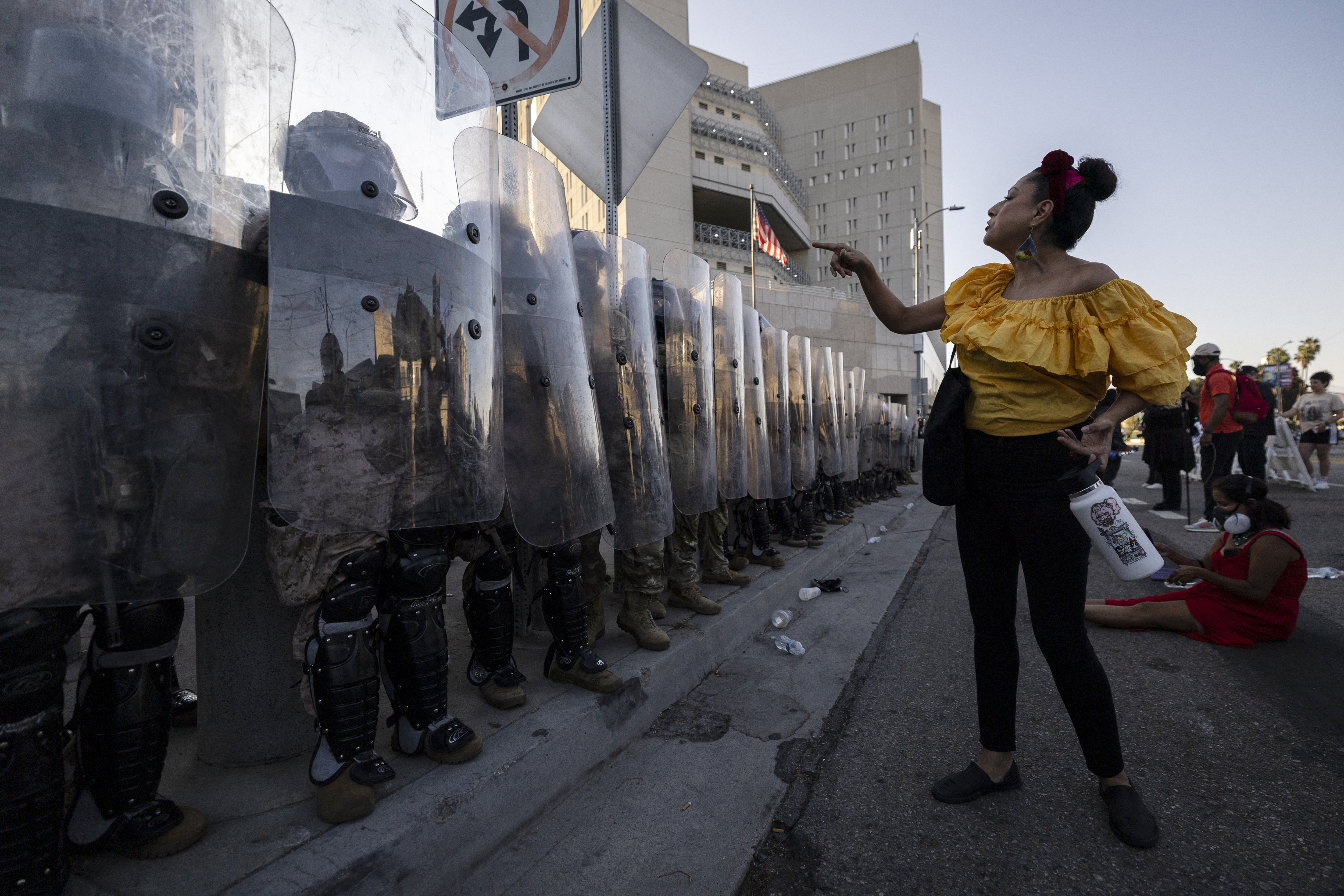
The Trump administration has suffered yet another in its series of recent legal losses—this time over its attempt to deploy National Guard troops in Illinois.

On Monday, state and local officials filed a lawsuit over federal officials’ attempt to take over and deploy National Guard troops in Illinois, alleging the move was “unlawful and dangerous.” The Department of Homeland Security (DHS) had said it was deploying the troops to supportImmigration and Customs Enforcement (ICE) agents, who have been carrying out what the agency calls “Operation Midway Blitz,” an enforcement effort that DHS says has led to more than 1,000 arrests. As my colleague Samantha Michaels and I have covered, the increased presence of ICE agents in the city has led to allegations that they are racially profiling residents, arresting Black and brown US citizens and using excessive force, particularlytear gas, to deter protesters and journalists outside a Chicago-area ICE facility.

In only six days since the suit was filed, federal officials have suffered a series of blows in the case. On Thursday, federal District Judge April Perry temporarily blocked federal officials’ moves to take over and deploy the troops. The Trump administration immediately appealed the decision, and on Saturday, an appeals court ruled that although the Trump administration could temporarily keep the Illinois and Texas National Guard troops under its control, it could not deploy them in the streets.

State officials characterized the recent rulings as wins: Illinois Attorney General Kwame Raoul called the Thursday ruling a “victory for our state…[and] for state and local law enforcement—who know their communities and who protect the right of their communities to speak truth to power.” The ACLU of Illinois also said in a statement that it applauded the decision. Mayor Johnson also called the ruling “a win for the people of Chicago and the rule of law,” adding, “Judge Perry echoed many of the points that we have made repeatedly: Trump’s deployment is illegal, unconstitutional, dangerous, and unnecessary. There is no rebellion in Chicago. There are just good people standing up for what is right.”Spokespeople for the White House and DHS did not respond to requests for comment on the rulings.

Illinois Governor JB Pritzker, a Democrat, said on ABC’s This Week on Sunday, “We hope to continue to win. We’ve got to rely on the courts to do the right thing.”

Illinois Gov. JB Pritzker says National Guard troops federalized by President Trump are not allowed “on the streets of Chicago right now because we have won the temporary restraining order.”

"We have got to rely on the courts to do the right thing.” https://t.co/eOdJcJQaan pic.twitter.com/Fv1xdzI5UW

— This Week (@ThisWeekABC) October 12, 2025

Meanwhile, Vice President JD Vance said on This Week that the administration plans to fight the rulings. When host George Stephanopoulos repeatedly asked Vance whether he agreed with Trump’s incendiary—and baseless—claim from earlier this week that both Pritzker and Chicago Mayor Brandon Johnson should be jailed, the vice president refused to answer directly, saying only that Pritzker “absolutely should suffer some consequence for the fact that there are thousands of innocent Chicagoans who are dead because he failed to do his job.” He later said he believes a judge and jury should decide whether Pritzker actually committed a crime.

“Why shouldn't federal troops empower the people in Chicago to live safe lives?”

Vice President JD Vance defends the Trump administration’s deployment of National Guard troops in Illinois. https://t.co/k1XIgv457E pic.twitter.com/xPjlWvT2Sy

— This Week (@ThisWeekABC) October 12, 2025

In his tour of the Sunday shows, Vance told host Kristen Welker, moderator of NBC’s Meet the Press, that the president was not ruling out invoking the Insurrection Act, an 18th-century law that allows the president to deploy the US military within the country to “suppress rebellion.” Trump has repeatedly floated invoking the act, including this week, when he told reporters he would consider it “if it was necessary.”

“The president’s looking at all of his options,” Vance told Welker. “Right now, he hasn’t felt he needed to.”

Back on ABC, Pritzker told Stephanopoulos: “If the Constitution means anything, the Insurrection Act cannot be invoked to send [troops] in because they want to fight crime.”

On President Trump’s threats to invoke the Insurrection Act as part of his efforts to deploy the National Guard in Chicago, Illinois Gov. JB Pritzker says, “The Insurrection Act is called the Insurrection Act for a reason. There has to be a rebellion.” https://t.co/eOdJcJQaan pic.twitter.com/2GKr0UYl16

— This Week (@ThisWeekABC) October 12, 2025

Continue Reading…

Mother Jones

The Oceans Act as a Toilet That Flushes Carbon Waste. Marine Heatwaves Are Clogging It Up.

This story was originally published by Grist and is reproduced here as part of the Climate Desk collaboration.

The planet would be a whole lot hotter if it weren’t for fecal pellets. Across the world’s oceans, tiny organisms known as phytoplankton harvest the sun’s energy, gobbling up carbon dioxide and releasing oxygen. They’re eaten by little animals called zooplankton, which poop out pellets that sink to the seafloor. What is essentially a giant toilet, then, flushes carbon at the surface into the depths, where it stays locked away from the atmosphere, thus keeping the amount of CO2 up there in check.

But as humans pump ever more carbon into the sky, relentlessly raising ocean temperatures, worrying signals are flashing that this commode could be changing in profound ways. Consider the northeastern Pacific, off the coast of Alaska, where two major heat waves took hold of the sea, one from 2013 to 2015 and the other from 2019 to 2020. A new study found the two events transformed the composition of phytoplankton and zooplankton, essentially clogging the toilet and preventing the downward transport of carbon into the depths.

“These long-term studies help put everything into context and also really sound the alarms,” said Anya Štajner, a PhD candidate in biological oceanography at the Scripps Institution of Oceanography, who wasn’t involved in the research. “The ocean is changing. And not only is it going to affect the ocean—it’s going to affect the life in the ocean. And eventually that’s going to affect us, because we rely on the ocean for our air, our food, our climate regulation.”

Of course, each bit of the world’s oceans has its own unique chemistry, biology, and ecology, so what happens there might not happen everywhere. But with these bursts of heat, this swath of the sea saw declines in its ability to sequester the gas that’s heating the planet. That’s a precarious situation, given that the oceans capture a quarter of humanity’s CO2 emissions. “While we can generalize that maybe what we saw here would happen in general across other marine heat waves in the ocean, like the carbon accumulation, I think it’s important to assess that regionally as well,” said Colleen Kellogg, a microbial oceanographer at Canada’s Hakai Institute and co-author of the paper, which published today in the journal Nature Communications.

The researchers tapped a decade of data from Biogeochemical Argo floats, which autonomously wander up and down the water column taking readings of ocean chemistry. When they reach the surface, they ping that data to a satellite. In this way, the scientists got a 10-year stream of readings without having to constantly be on a boat in the northeastern subarctic Pacific Ocean, which is not known for hospitable winters.

The two ocean heat waves started like those we experience on land, with the atmosphere warming things up. Indeed, the ocean has absorbed 90 percent of the additional heat that humans have created. Accordingly, while in the 19th century just 2 percent of the ocean surface experienced bouts of extreme temperatures, that figure is now well over 50 percent. Such events will only grow more common and more intense unless humanity dramatically reduces its greenhouse gas emissions, and fast. As it happens, the northern Pacific has once again been smashing records of late, perhaps in part due to regulations in 2020 cutting the amount of aerosols generated by ships, which usually cool the planet by reflecting the sun’s energy back into space.

Like our most ferocious atmospheric blasts of heat, a lack of wind during the two events made matters even worse. Typically, after the seawater warms in the spring and summer, winter winds blow across the surface, pushing it along. This forces deeper, cooler waters to race upward to fill the void, keeping the water column more uniform, temperature-wise. This didn’t happen during both heat waves, and the sea remained more stagnant, as it normally does later in the year.

Because warmer water is less dense, it remains at the surface, creating a sort of cap. “Then in the subsequent spring and summer, that water is even warmer, because it didn’t cool the winter before,” said Mariana Bif, a marine biogeochemist at the University of Miami and lead author of the paper. (Bif conducted the research while at the Monterey Bay Aquarium Research Institute.) “So the impact of marine heat waves starts in the atmosphere, and then it’s transferred into the ocean.”

The two heating events were not created equal, though. The first coincided with an El Niño—a band of warm water off the coast of South America—that raised temperatures in the northeast Pacific even higher. The second saw a marked decrease in salinity due to changes in ocean circulation. Because water with lower salinity is less dense, it hangs around the surface, as the saltier stuff sinks. This further strengthened the warm cap.

The lack of winter churning also meant the nutrients typically drawn from deeper waters were cut off, denying the phytoplankton in that cap of the elements they needed to grow. Together, the high heat and low nutrients at the surface totally changed the environment for the organisms living and processing carbon there.

That transformed the ecosystem. Like plants on land, different types of phytoplankton need different amounts of nutrients, and in different proportions. “Usually, for example, in areas where you have this great mixing and great nutrients, you have a bunch of large phytoplankton that produce a lot of carbon—a lot of biomass,” Bif said.

As conditions changed during the heat waves, it was the littlest of phytoplankton species that benefited. These needed less nutrients to bloom, so they proliferated as larger species declined. And because different species of zooplankton dine on differently sized phytoplankton, the smaller ones that ate the smaller species suddenly had much more sustenance. “Those guys are going to make smaller fecal pellets, which would kind of float in the water more than sink,” Kellogg said. “So that could be contributing to the reduction in carbon moving from the surface to the deep ocean.”

Because the researchers had access to that data up and down the water column, they could monitor how all that carbon was sinking during the heat waves. Or rather, how it wasn’t—because the ocean’s carbon toilet was malfunctioning. In the first event, carbon particles were piling up 660 feet deep, and in the second, between 660 and 1,320 feet. In these zones, zooplankton grazers continued to chew on the particles, breaking them into smaller bits that couldn’t sink. In the second marine heatwave, an increase in particularly small zooplankton meant more production of tinier, non-sinking fecal pellets.

Not only was the toilet not properly flushing carbon, but more and more waste was being added to these waters as the heat waves rolled on. This gave bacteria lots of organic matter to break down, adding CO2 back into the sea. Eventually, currents would bring that CO2-rich water back to the surface, where the gas can be released back into the atmosphere.

Now scientists will have to monitor more heat waves in other parts of the world’s oceans to see if the same dynamics are at play, and how much that might be hobbling the sea’s ability to sequester carbon. At the same time, phytoplankton and zooplankton are suffering through crises other than heat, like ocean acidification potentially interfering with some species’ ability to grow protective shells.

If there’s less phytoplankton, there will be less oxygen coming out of the oceans, and less food for the zooplankton that feed all manner of other animals in the sea, including whales. “Paying attention to what’s happening at the base of the food web is going to give us a lot of information,” Štajner said, “both about how things are going to trickle up to these larger marine animals that we care about, but also insights about our climate.”

Luckily, with thousands of Biogeochemical Argo floats collecting data around the planet, researchers are getting an ever-clearer picture of how seas are changing, and phytoplankton along with them. “The oceans are very under-sampled, very understudied,” Bif said. “But they play a central role in climate. We can’t understand what we can’t observe.”

Continue Reading…

Mother Jones

Donald Trump’s War on Public Health Enters a New Phase

Ever since a government shutdown first started to seem like a real possibility, President Donald Trump has been threatening to use an impasse on Capitol Hill as a pretext to go after the people and institutions he doesn’t like. His administration has moved to kill New York City’s biggest infrastructure project, announced his intent to cancel $8 billion in clean-energy funding for states he lost last November, and vowed to fire employees and gut programs at what he calls “Democrat agencies.” What are “Democrat agencies?” On Friday, we got an answer.

About 4,000 federal employees received layoff notices—including “nearly 100” Housing and Urban Development staffers tasked with investigating fair housing complaints, according to Bloomberg, and 466 employees at the Department of Education. The Department of Health and Human Services faced even steeper cuts, with over 1,000 people slated for termination. Among the public servants targeted by a “reduction in force” (or RIF), the New York Timesreported, were “[r]oughly 70” people who are colloquially known as “disease detectives,” and the team that publishes the CDC’s Morbidity and Mortality Weekly Report.

Trump’s presidency has been defined by a steady deterioration of public information sources, and the dismantling of public health institutions.

As with a lot of Trump administration actions, the ultimate outcome might end up diverging quite a bit from what’s been announced. Unions for federal employees are already fighting back in court (which is how we ended up with such precise numbers on the current round of RIFs to begin with). The idea that these RIFs are a necessity brought about by Democrats’ intransigence is undercut by the fact that current Office of Management and Budget director Russell Vought has been planning for this moment “since puberty,” according to Utah Republican Sen. Mike Lee, and laying the groundwork for layoffs for years, according to my colleague Isabela Dias. But as a symbol, the purge couldn’t be clearer. These moves track with a larger pattern: Since January, Trump’s presidency has been defined by a steady deterioration of public information sources, and the dismantling of public health institutions.

The administration’s deleting of datasets from formerly public websites was so widespread in the early days of his second term that it has its own Wikipedia page. It deleted data on gender identity, sexual orientation, and climate change and cut off funding en masse to research projects that aim to produce more data on the concepts Trump doesn’t like (including “the weather”). He has openly pushed to manipulate the census. More recently, Trump fired the head of the Bureau of Labor Statistics because he was upset about unfavorable monthly jobs reports. (Last Friday, BLS didn’t issue a jobs report at all, sending the private sector scrambling to fill in the gaps.) So firing the people who produce the Morbidity and Mortality Report certainly tracks.

The CDC’s Morbidity and Mortality Report is not just any old morbidity and mortality report—it’s a key part of America’s public health apparatus, something that has been published in some form by the government for almost 150 years. The most recent edition is titled, “Tularemia Antimicrobial Treatment and Prophylaxis: CDC Recommendations for Naturally Acquired Infections and Bioterrorism Response.” I don’t know what that means, but it doesn’t sound like the kind of public-health information you want to outsource to TikTok.

This is the kind of work that might otherwise be considered essential. But in Trump’s second term, people who work in public health have been treated as anything but, facing constant pressure from Trump, Vought, Elon Musk, and Health and Human Services Secretary Robert F. Kennedy Jr. One of Trump’s first acts was to freeze foreign aid funding, throwing into jeopardy overseas public-health programs that have saved millions of lives. (Some funding was eventually restored, but USAID, which helped administer those public health programs, was effectively dismantled after being thrown into a “woodchipper” by Musk.) Kennedy undercut another key public-health institution in June, when he replaced every member on the CDC’s Advisory Committee on Immunization Practices. In the meantime, he and Trump held a press conference to announce their novel finding that taking Tylenol during pregnancy might cause autism.

Nothing bad can happen, it can only good happen,” Trump said.

Why lean on published reports, when you can get that kind of health advice from the commander in chief himself?

Continue Reading…

Mother Jones

Immigrants on the Line

Mackenson Remy didn’t plan to bypass security when he drove into the parking lot of a factory in Greeley, Colorado. He’d never been there before. All he knew was this place had jobs—lots of jobs_._

Remy is originally from Haiti, and in 2023, he’d been making TikTok videos about job openings in the area for his few followers, mostly other Haitians.

What Remy didn’t know was that he had stumbled onto a meatpacking plant owned by the largest meat producer in the world, JBS. The video he made outside the facility went viral, and hundreds of Haitians moved for jobs at the plant.

But less than a year later, Remy and JBS were accused of human trafficking and exploitation by the union representing workers.

This week on Reveal, in an update of an episode that first aired in February 2025, reporter Ted Genoways with the Food & Environment Reporting Network assesses what has changed for these workers since our story first aired, including becoming targets of the Trump administration’s mass deportation agenda.

Continue Reading…

Mother Jones

Newsom Just Vetoed California Bills Meant to Make the Grid Reliable and Tackle High Costs

This story was originally published by Canary Media and is reproduced here as part of the Climate Desk collaboration.

Gov. Gavin Newsom of California has vetoed three bills that aimed to boost the use of virtual power plants, undermining an opportunity to decrease the state’s fast-rising electricity costs and increase its grid reliability.

On Friday, Newsom vetoed AB 44, AB 740, and SB 541, which were passed by large majorities in the state legislature last month. Each bill proposed a distinct approach to expanding the state’s use of rooftop solar, backup batteries, electric vehicles, smart thermostats, and other customer-owned energy technologies.

In three separate statements, Newsom argued that the bills would complicate state regulators’ existing efforts to use those technologies to meet clean energy and grid reliability goals. The moves come as utility costs reach crisis levels in California; its residents now pay roughly twice the US average for their power.

“We can’t afford to keep leaving these readily available and affordable solutions off the table.”

In response, Newsom did sign into law a package of bills aimed at combating cost increases at the state’s three major utilities: Pacific Gas & Electric, Southern California Edison, and San Diego Gas & Electric. But some supporters of the virtual power plant (VPP) bills speculated that these same utilities were to blame for Newsom’s vetoing legislation that could have further driven down costs, as the governor has received significant campaign contributions from PG&E and the policies would have eaten into utility profits.

“These vetoes effectively stall progress on key distributed energy and affordability strategies,” said Kurt Johnson, community energy resilience director​at the Climate Center, a nonprofit group. ​“Policies and programs in California continue to be killed because they threaten the economic interests of California’s powerful investor-owned utilities.”

Izzy Gardon, Newsom’s director of communications, declined to comment on these critiques in an email response to Canary Media, saying, ​“The Governor’s veto messages speak for themselves.”

But Edson Perez, who leads California legislative and political engagement for clean-energy trade group Advanced Energy United, argued that the justifications cited in the veto statements fail to adequately consider the value the state’s increasingly large numbers of rooftop solar systems, backup batteries, EVs, and smart appliances can deliver to the grid.

An August report from think tank GridLab and grid-data analytics startup Kevala found that California could cut energy costs for consumers by between $3.7 billion and $13.7 billion in 2030 by triggering home batteries, EV chargers, and smart thermostats to reduce summertime grid demand peaks that drive an outsize portion of utility grid costs.

The Brattle Group, a well-regarded energy consultancy, found in a 2024 analysis that VPPs could provide more than 15 percent of the state’s peak grid demand by 2035, delivering $550 million in annual utility customer savings. Simply put, paying homes and businesses for the grid value of devices they’ve already bought and installed is cheaper than the alternative of utilities building out new poles and wires and substations to serve peak demand.

“These distributed energy resources are already deployed, connected to customers, and connected to the internet,” Perez said. ​“The longer we wait to tap into this potential, the longer we waste away the savings.”

To date, the VPP programs run by California’s major utilities have failed to capture that savings value. In fact, the programs administered by the California Public Utilities Commission (CPUC) have seen their overall capacity fall over the past five years or so, even as installations of the underlying technologies have risen.

The saving grace for VPPs in California has been the Demand Side Grid Support program, which is administered by the California Energy Commission (CEC) and has expanded rapidly in the past three years. A Brattle Group study released in August found that the roughly 700 megawatts of capacity from solar-charged batteries in homes and businesses enrolled in the DSGS program could save California utility customers from $28 million to $206 million over the next four years.

But last month the DSGS program was stripped of its funding during last-minute negotiations between legislative leaders and Newsom’s staff, leaving its future in doubt.

That’s frustrating to companies like Sunrun, the leading US residential solar and battery installer, which has enlisted customers in California to supply hundreds of megawatts of DSGS capacity from their solar-charged batteries.

​“It is very disappointing that we can’t even have the agencies talk about this in a comprehensive way.”

“Do we want to leverage existing infrastructure—electrons in batteries that are already there—and nonratepayer capital to lower rates for everyone in creating a more efficient and smarter grid?” said Walker Wright, Sunrun’s vice president of public policy. ​“Yes or no?”

Because of changes made during closed-door negotiations in August, the VPP legislation vetoed by Newsom was relatively limited, but it still would have made a positive difference had it passed, said Gabriela Olmedo, regulatory affairs specialist at EnergyHub, a company that manages demand-side resources and virtual power plants in the US and Canada.

“These were unopposed bills that were pretty uncontroversial but would have made impactful steps toward enhancing load flexibility in California,” she said. ​“We can’t afford to keep leaving these readily available and affordable solutions off the table.”

SB 541, for instance, would have authorized the CEC to create regulations to track the progress toward a state-mandated goal of achieving 7 gigawatts of ​“load shift” capacity by 2030 across utilities, community energy providers, and other entities supplying power to customers. Newsom’s veto statement said the bill would have been ​“disruptive of existing and planned efforts” by the CPUC, CEC, and state grid operator CAISO.

“I’m disappointed in this veto,” state Sen, Josh Becker, the Democrat who authored SB 541, said in a statement to Canary Media. ​“This bill was about affordability,” he said. ​“Next year this area will be a focus of the clean energy community. Clearly we have some educating to do.”

AB 44 would have authorized the CEC to expand a method it has used to help some of California’s community choice aggregators (CCAs) tap VPPs to reduce peak demand.

Newsom’s veto statement declared that the bill ​“does not align” with the long-running effort by the CPUC to reform the Resource Adequacy program that sets the rules for how these grid needs are met. But critics say the CPUC has consistently failed to allow VPPs and other distributed energy resources to offset the increasingly high prices that utilities and CCAs are bearing to meet those needs.

AB 740 would have instructed the CEC to work with the CPUC, CAISO, and an advisory group representing disadvantaged communities to adopt a VPP deployment plan by November 2026.

Newsom’s veto statement declared that the bill would result in ​“costs to the CEC’s primary operating fund, which is currently facing an ongoing structural deficit.” But critics have pointed out that the text of the law would have instructed the VPP plan only to move forward ​“subject to available funding,” which would have forestalled any budget impacts.

“Even if it were signed, it would not have to be implemented unless the state budget proactively funded it,” Perez said. ​“It is very disappointing that we can’t even have the agencies talk about this in a comprehensive way. It’s kind of shocking that even that’s not allowed.”

Continue Reading…

Mother Jones

Scientists Suspect Fracking Contaminated This Pennsylvania Town’s Wells

This story was originally published by Inside Climate News and is reproduced here as part of the Climate Desk collaboration.

In the summer of 2022, John Stolz got a phone call asking for his help. This request—one of many the Duquesne University professor has fielded—came from the Center for Coalfield Justice, an environmental nonprofit in southwestern Pennsylvania.

They told him about New Freeport, a small town in Pennsylvania’s Greene County that had experienced what’s called a “frac-out,” when drilling fluids used in the fracking process escape their intended path and end up at the surface or elsewhere underground, in this case via an abandoned gas well nearby. Residents had noticed strange odors and discoloration in their well water. Their pets were refusing to drink it. Now they wondered if it was unsafe.

Stolz, who has been testing water for signs of pollution from fracking for more than 10 years, agreed to find out.

The testing that he and his colleagues carried out over the next two years shows that residents were right to be concerned. They found evidence for oil and gas contamination in a larger geographic area than was initially reported, according to a study published last month. Of the 75 samples tested, 71 percent contained methane.

“We found significant contamination,” Stolz said. “Essentially half of the people in our study had bad water.” Two of the wells registered “explosive levels of methane,” he said. “The homeowners had no clue it was that bad.”

Sarah Martik, the executive director at the Center for Coalfield Justice, said she was grateful for Stolz’s work. “Dr. Stolz has been one of the only people in our area that we can count on to come provide free water tests,” she said.

Stolz said the more people heard about the study, the bigger it got. “It started essentially on Main Street, where that initial report came in,” he said. “But I gave a couple of presentations down there with our preliminary results, and it grew, and people started calling and saying, ‘Would you test my water?’”

Guy Hostutler, the chairman of the Board of Supervisors in Freeport Township, where New Freeport is located, said at least 22 households there rely on holding tanks called water buffaloes right now because of contamination, and others are using five-gallon jugs brought in by the Center for Coalfield Justice. Some people have installed filter systems.

In addition to the pollution issues, some New Freeport residents have also recently noticed their wells are drying up.

In 2024, residents filed a class-action lawsuit against fracking company EQT, the owner of the well pad that is the alleged source of the frac-out. “I am hopeful that this publication is going to lend a lot of credibility to that fight,” Martik said. “This study is really a validation of what people already know. They have this thing that they’re able to point to now and say, ‘Hey, EQT, this did happen, and I have been impacted.’”

EQT has maintained that it bears no responsibility for the contamination. The company did not respond to a request for comment. When the Pennsylvania Department of Environmental Protection tested wells in New Freeport, the agency found that the water was not safe for human consumption but did not find a link to oil and gas drilling, according to spokesman Neil Shader.

“If you suspect that there’s ever going to be any drilling, get your water tested,” so you’ll have a baseline for comparison.

Stolz said he thought DEP had not “fully utilized the data they have” to make a determination on the source of the contamination, which is complicated by the fact that an abandoned conventional gas well was involved. “You have to look at the broader picture and the timeline of events,” he said. “It’s very clear that things changed after the frac-out.”

DEP is now investigating more recent complaints in the area that water sources have been contaminated by oil and gas.

New Freeport is not the only town in Pennsylvania to find its water contaminated after oil and gas drilling took place nearby. Its story mirrors that of Dimock, a community in the northeastern part of the state that has been without clean water for more than a decade. Dimock made headlines around the world after residents were filmed setting fire to their water. They’re still waiting for a promised public water line.

Groundwater contamination poses particularly acute public health dangers in Pennsylvania, where more than 25 percent of adults use private wells as their primary source for drinking water, 10 percentage points higher than the national average.

And the water in those private water wells—serving more than 3 million people—is rarely tested, according to Penn State University’s Drinking Water program.

“You’re looking at community after community across the state and in the tri-state region losing their water. What we’re trying to call attention to is these things happen, and somebody has to be accountable,” Stolz said.

Daniel Bain, a co-author of the study and a professor at the University of Pittsburgh, said companies’ denial of responsibility for contamination becomes increasingly difficult to swallow as the number of incidents rises. “They start to lose credibility. When they say there’s no problem, then you’re like, ‘Well, who do I trust? Do I trust my water ever again?’” he said.

Frac-outs are relatively rare, but Pennsylvania’s hundreds of thousands of abandoned and orphaned oil and gas wells make them more probable. These wells are not easily detectable, their locations are often unknown and they’re estimated to be more numerous here than in any other state.

DEP recorded 54 “communication” incidents, as frac-outs are called, between 2016 and 2024.

The Freeport township supervisors have one piece of advice for others who live near fracking. “If you suspect that there’s ever going to be any drilling, get your water tested,” said Tim Brady, the vice-chairman.

Residents can contact Penn State’s Agricultural Analytical Services Laboratory to get testing for oil and gas contaminants, which costs $75. “Pay the money to have the test done so you have it in hand,” Brady said. “It helps not only you, but it would also help your local government. Seventy-five dollars is worth its weight in gold whenever it comes to fighting a battle like this.”

With baseline test results, investigators can more easily pinpoint the source of the contamination, allowing them to distinguish between fracking pollution and other sources, like old coal mines and abandoned oil and gas wells.

Stolz and Bain’s approach relies on “the preponderance of evidence” to separate fracking contamination from legacy pollution caused by other fossil fuel extraction. The results in this paper present “compelling evidence that the frac-out profoundly changed local well water chemistry even without sample data prior to the event for comparison,” according to the authors.

Bain said the unpredictable nature of frac-outs means their impacts are more likely to evade regulatory scrutiny. According to state law, contamination within 2,500 feet of a fracking well is presumed to be caused by that drilling. But there is no such “zone of presumption” for frac-outs.

“If it were around a well, it would be 2,500 feet. But because it’s around a frac-out, it’s zero feet, and there’s no responsibility whatsoever,” Bain said.

Just last month, Freeport Township declared a disaster emergency, stating that the frac-out had “endangered or will endanger the health, safety and welfare of a substantial number of persons residing in Freeport Township.” Local officials are working to resolve the crisis on several fronts: opening a new investigation with DEP over the water quantity issues, raising money to build a public water line and talking to state and federal officials about what options they have for funding.

“We’re doing everything in our power,” Hostutler said. “We’re going to fight as long as we can.”

Hostutler said a few people have moved away in the three years since the frac-out happened, and others are trying to sell their houses. A water buffalo costs $3,000 a month, an expense many residents cannot afford. He worries about what will happen over the long term to the community, which he describes as a close-knit little village where everyone knows each other and looks out for one another.

“We’ve lost a lot of residents over the years. And we want to keep what we have,” Brady said. “It’s not going to be easy, but you just take a look at all the towns around here that’s lost water. They’re nonexistent anymore. We don’t want to end up like that. If you don’t have water, you don’t have anything.”

Continue Reading…

Mother Jones

American Gulag

An army of masked ICE agents snatching people when they show up to work, to church, to their child’s day care, to immigration court. A return of family separations. That deportation flight ASMR video the White House posted on X. Kristi Noem posing in front of ­tattooed detainees at El Salvador’s notorious CECOT prison.

When it comes to President Donald Trump’s immigration policy, cruelty has always been the point, but anti-immigrant animus is now being paired with unprecedented funding, manpower, and technology. The GOP-controlled Congress poured tens of billions of dollars into ICE’s coffers and set off a feeding frenzy: States are lining up behind Florida to run their own detention centers, while administration-friendly contractors are busily pitching iris-scanning apps, logistics expertise, fleets of deportation-ready aircraft—sometimes without competing bids.

The new immigration dragnet is everywhere, rife with conflicts, and it’s only just begun.

Illustration of a uniformed officer walking between two rows of people lying face down with their hands restrained behind their backs.The Vast, Terrifying Scale of Trump’s Detention State

With $75 billion and thousands of masked agents, ICE is just getting started.

Illustration of a woman holding a child’s hand while walking past police vehicles, with officers watching from a car and a van.Minority Report

Ballard Partners is helping companies cash in on the Trump administration’s immigration crackdown.

Illustration of detainees in green uniforms inside a crowded cell with bunk beds and chain-link walls, many holding or hanging their heads in distress.Inside the Hell of Alligator Alcatraz

Despite shocking conditions and rampant “psychological warfare,” copycats are popping up around the country.

Illustration of a hand gripping a locked chain-link fence with a padlock shaped like a dollar sign.How a Tiny, Inexperienced Firm Landed a $1.3 Billion Detention Deal

To hold 5,000 human beings.

Dee Maes-Sandoval, dressed in shorts and a T-shirt, stands in front of a painted mural. The mural depicts a woman in a white shawl holding a red rose, a man wearing a beige cowboy hat, and a house where a man hands a baby to a woman standing in the doorway.A Town Divided by ICE

Trump has unleashed a gold rush among immigrant-detaining private prison companies. In cash-strapped cities, residents aren’t sure the money is worth it.

Group of masked ICE agents standing in hallway.A Photographer's View of the Relentless Courthouse Arrests

The shattering of faith in America's goodness is the hardest part to watch.

A woman and a girl with frightened expressions face masked agents.Taken by ICE

“Being forced apart like this is tearing through the heart of our home and community.”

Continue Reading…

Mother Jones

“Fired for No Reason”: Former Immigration Judges Speak Out Against Trump’s Assault on the Courts

On a Friday afternoon in early September, Anam Rahman Petit sat in the Annandale immigration court in Virginia, ready to announce an oral decision on a complex family asylum case. Then, she got an email. It was a notice from the director of the Executive Office for Immigration Review (EOIR)—the Department of Justice’s agency that oversees the immigration courts—terminating her appointment as an immigration judge and instructing Petit to hand in all of her government property by the end of the day.

Nowhere in the email did it mention the reason she was being fired just short of completing two years on the bench and finishing her probationary period. Petit briefly stepped outside the courtroom and texted the bad news to her husband. Without waiting for a response, she put her phone in her robe’s pocket and walked back in to deliver the ruling. As she did, Petit remembers her voice cracking and hands shaking.

The Trump administration is “shrinking the courts because they don’t think they’re going to need them.”

“It was one of the hardest things I’ve ever had to do,” she said. “My mind was trying to run to different directions, and I just had to bring myself back to that case so I could get it done.” Later, Petit folded her robe and packed up her office as other immigration judges tried to console her. “It was a very emotional departure from the courthouse,” she recalled.

As the Trump administration works to fundamentally reshape the immigration system, US immigration courts have come to play an outsized role in the crackdown. Across the country, courthouses—previously considered off limits for immigration enforcement—have turned into sites of arrests by masked US Immigration and Customs Enforcement agents, and the very judges charged with resolving asylum and removal cases and, often, issuing deportation orders, are under assault.

Related

“The Entire System Will Collapse”: Inside the Purge of US Immigration Courts

The attack has been so sweeping that it has immigrant rights advocates, legal observers, and some former immigration judges wondering if the administration’s objective is to render the already overwhelmed courts so impaired that they can no longer serve their purpose.

Andrea R. Flores, who served as an immigration policy adviser during the Obama and Biden presidencies, described the firings of immigration judges as “confusing” for a White House that is trying to remove as many people as possible. Instead of empowering the courts to process more cases, the administration appears to be eviscerating the system to potentially undermine legal proceedings altogether.

“I think what alarms me about that is their hope that they’re going to massively expand the usage of expedited removal and deny people their right to see a judge,” she said of the administration’s push to fast-track deportations. “[They’re] shrinking the courts because they don’t think they’re going to need them.”

Petit had seen the writing on the wall months earlier. Back in February, her former supervisor, assistant chief immigration judge Rebecca Walters, who had been appointed during the Biden administration, was among several judges dismissed as part of an early purge of the courts. Then July came, and another 17 or so judges were reportedly terminated without cause, even as the nationwide backlog continued to grow to almost 3.8 million pending immigration cases.

In letters to EOIR’s director, Sirce E. Owen, Democratic Sen. Elizabeth Warren and others decried the firings as “indefensible” and voiced concern that decisions not to convert half of a class of judges—particularly those without an immigration enforcement background—to permanent positions “may have been made for politically motivated reasons.”

An attorney with private practice experience in the area of removal defense, Petit said she had completed around 800 cases, a hundred or so more than the 700 a year expected of immigration judges, before her abrupt termination. Petit’s supervisor later told her that her performance review noted she was a high-performing judge. But that didn’t protect her. “You think you’re going to be okay as long as you do a good job and just keep your head down, do your cases, and apply the law,” she said. “And then you start seeing more and more people get fired for no reason.”

The dismissal of judges like Petit is just one of the ways the Trump White House is upending the immigration courts to serve its mass deportation agenda. In late August, the administration issued a rule easing the qualification requirements for temporary immigration judges, allowing the Department of Justice to hire attorneys without adjudicatory or immigration law experience. It has also turned to recruiting hundreds of military lawyers to fill vacant seats for six-month assignments, a move that legal experts have warned could be unlawful and will likely undermine due process.

“I know some judges who had packed up their offices in anticipation of being fired.”

“I see more deportations of illegal immigrants in the near future,” Corey Lewandowski, an adviser to Homeland Security Secretary Kristi Noem, posted about the announcement that the Pentagon had authorized 600 military lawyers to act as temporary immigration judges. (Among the assistant chief immigration judges terminated in February were two former military attorneys, commonly referred to as JAGs after Judge Advocate General’s Corps.)

“That’s concerning because you’re going to have people who have not been trained making decisions with no immigration background,” said Alison Peck, director of the immigration law clinic at West Virginia University College of Law and author of The Accidental History of the US Immigration Courts: War, Fear, and the Roots of Dysfunction. “That judge isn’t going to know what hit them…It’s the steepest learning curve I’ve ever encountered in the legal profession.”

Peck has long argued the problem with immigration courts run much deeper than President Donald Trump’s moves. Because the immigration courts are nested within the Department of Justice and the executive branch, they are effectively an instrument of presidential policy and not true independent courts. “This is how the system is designed,” she said. The Trump administration is “pushing the edges” to disrupt the immigration courts. But “there are serious due process concerns with the system as a whole, and now we’re seeing how it can be manipulated by an administration that has a different policy agenda.”

As of late September, Petit estimated that as many as 16 judges from her 2023 class of 39 sworn-in appointees have been fired. They are among the more than 130 adjudicators who have been either terminated, transferred, or departed the force voluntarily since Trump returned to office. According to data from the National Association of Immigration Judges reported by CNN, September saw the highest number of dismissals, with 24 judges being let go.

“I know some judges who had packed up their offices in anticipation of being fired,” she said.

David K. S. Kim was in the middle of a hearing on September 4 when he received the termination email. He had to stop midway through and inform the parties that the case would be reassigned to a different judge. Originally from South Korea, Kim had been in the job for almost three years and had the highest asylum grant rate among judges at New York’s 26 Federal Plaza immigration court—96 percent, according to TRAC.

“I think I was preparing mentally, subconsciously…,” he said. “I wasn’t really shocked, although it was very disappointing.”

As a judge in the New York City court that has been dubbed the “nation’s capital of immigration courthouse arrests,” Kim saw firsthand the effects of the Trump administration’s policies, starting with giving ICE the green light to conduct arrests in or near courthouses. “It created chaos,” Kim said, explaining that judges had their hands tied if someone was arrested outside the courtroom.

“That was very difficult and definitely affected the morale of the court staff and some of the Homeland Security attorneys,” Kim said. He noted that some DHS lawyers asked judges to sit with their backs facing the wall instead of the courtroom entrance door, in case some altercation took place. “It was a complete change in environment in the way the hearings were held.”

Carmen Maria Rey Caldas, who also served as a judge in New York, said she noticed an increase in the number of immigrants missing their court hearings. “There were weeks when I would have 10 people show up for a master calendar of 60,” she said. Rey Caldas recalled instances of immigrants appearing outside the courthouse but not going in, instead asking if they could have their hearings remotely because of fear of being arrested by ICE.

Prior to joining the bench, Rey Caldas, who was born in Spain, had a long career practicing immigration law that included stints at nonprofits helping survivors of gender-based violence and, more recently, a role as the director of a program that represents refugees, including Afghan allies who had to be evacuated after the US withdrawal from the country. In 2022, when Rey Caldas was appointed to the immigration courts, House Republicans led by Rep. Elise Stefanik publicly opposed it, citing concerns over her advocacy work and alleging she had “contempt” for immigration enforcement and “disregard” for ICE.

Rey Caldas said she had never received anything other than exceptional feedback while on the bench. Yet, on August 21, she was terminated without explanation. She has since challenged her firing with the Merit Systems Protection Board, an independent agency that hears appeals on federal personnel cases. “You’re eliminating all potential defense within the agency,” Rey Caldas said of the firings of experienced judges and those with diverse backgrounds.

She described an atmosphere where immigration judges are under “constant threat” of getting fired if they don’t follow certain rules from leadership. As one example, she mentioned an email telling judges to eliminate the use of pronouns in their email signatures. For people dealing with “life and death cases,” Rey Caldas said, it was demoralizing. “It’s creating an environment where you’re constantly watching what you do and questioning your decisions.”

Mother Jones reached out to EOIR for comment, but received an automatic email reply from the agency’s spokesperson stating she had been furloughed and was out of the office.

Both Petit and Kim said immigration judges started bracing for policy guidance issued by EOIR’s director Owen on Fridays. One April policy memo, for instance, encouraged judges to “immediately resolve cases…that do not have viable legal paths for relief or protection from removal” and to drop asylum cases without holding a hearing if the application is “legally deficient.” Some judges, Kim said, took the guidance to mean they were being told to prioritize efficiency over due process and default to removal orders.

In another memo from June 27, Owen chastised immigration judges for “demonstrating bias or hostility toward” DHS and advised “judges who prefer to be policy advocates” to consider a different career path. “It leads to this climate of fear and intimidation,” Petit said.

“A lot of the actions being taken by this administration have materially changed the way that the courts function,” she added. “One thing that remains are really exceptional immigration judges who are doing their very best to apply the law fairly and apply due process. They’re really just holding it down right now.”

Continue Reading…

Mother Jones

It’s True: The Internet Skews the Reality of Women (and Men) in the Workforce

In the 1970s, when researchers asked children to draw a scientist, 99 percent of them drew a man. As this experiment was repeated over 50 years, the number of women drawn increased, and within the past decade, more than half of girls will draw a woman when asked what a scientist looks like.

Today, Google search results tend to agree with these children’s drawings. Type in an occupation, and you’ll be met by a wall of stock photos that tell a story of gender parity across many professions. But despite the apparent gender equality, the results capture other elements of societal expectations of women. A close observer might notice that many of the women depicted seem rather young—and the men tend to appear older.

It’s no secret that women are encouraged—by advertisers, popular media, and well-meaning comments of “you don’t look your age”—to appear youthful. Aging is often depicted as a negative for women, while older men are regarded as wiser and more experienced. Most women have encountered this personally, but data on the phenomenon has been scarce.

To find exactly how widespread this bias is, a team of Berkeleyresearchers surveyed images and text across some of the most well-trafficked places on the internet, such as ChatGPT, IMDb, Google, and Wikipedia and found that women are regularly depicted as younger than men—and devalued because of it.

This in itself didn’t surprise Solène Delecourt, an assistant professor at UC Berkeley’s Haas School of Business, and a co-author of the study published in Nature on Wednesday, but “the effects we see are much, much broader, and potentially carry effects in the labor market for women at a scale that was maybe more than I even expected,” she said.

The researchers analyzed over half a million images from Google search, in which women consistently appeared younger than men. This serves as a measure of cultural bias because “it’s basically trying to give you content that you’re most likely to click on,” added co-author Douglas Guilbeault, who is now an associate professor at Stanford. “That has a way of being prone to bias, because it ends up just amplifying whatever most people click on.”

Across the internet, women are most commonly shown in their 20s, while men are usually shown in their 40s and 50s. And it’s not just that women in the images look younger. Often, they are younger. On IMDb and Wikipedia, the researchers were able collect information about the actual ages of people in the photos, and this trend persisted.

“If you have biased data going in, you will in all likelihood replicate the bias. And we see this again and again.”

This reflects hiring biases in the entertainment industry, Guilbeault noted, but these are also the most visited pages. For the people looking up Hollywood profiles on IMDb, “the influence and attention is biased towards older men.”

In both online images and text, the researchers found similar, skewed depictions of men and women in thousands of occupations and other categories. But in census data, across most of the fields examined, there were no age differences among men and women. In the few professions where an age gap existed, the women were older, on average, than the men. But the online images presented an inverted picture.

“The pattern we see in the data just does not match reality,” Delecourt said. “The average woman in the US, and actually in the world, has a higher life expectancy. The average woman is older, so what we see in…online images and text and videos is wrong.”

This age-gap myth also affects how people view women in the workplace. As a part of the study, the researchers asked participants to find photos of people working in different professions. When the participants selected photos of women, they assumed that people with that job were generally younger and had less experience.

By influencing people’s perceptions, this pervasive imagery can have real-world consequences in hiring decisions. And the online age gaps were most extreme for higher-status and higher-earning positions, potentially contributing to the gender pay gap, which is more pronounced among people with post-graduate and professional degrees.

Online data is also used to train AI, which perpetuates biases. In the case of age and gender, the researchers found that ChatGPT assumed women were younger and less experienced and rated resumes from older men the best—a concerning fact as more and more companies use AI in hiring, from screening resumes to conducting and recording interviews.

“Computer-driven decisions have this veneer of objectivity,” said Hilke Schellmann, a professor at NYU and author of the book The Algorithm who was not involved in the study. “The problem lies in that we as humans often think the results of models seem objective, thematically correct, but in reality, if you have biased data going in, you will in all likelihood replicate the bias. And we see this again and again.”

The large AI models “require consuming all of the internet’s data,” Guilbeault told me. “When you start dealing with data at that scale of human culture, it’s inevitable that it’s going to just be fraught with biases and stereotypes and mythologies and illusions, and so it’s really problematic.”

And the stereotypes can become more deeply rooted as AI develops. “The model learns from the previous model, and if the bias is baked in, we have a lot of evidence that it may amplify the bias,” Schellmann said. There aren’t guardrails built into the models, and there’s very little oversight, she added.

The researchers studied age and gender because those were two categories they could confidently measure across the internet—but they are far from the only ways online data and AI models are biased. Other research has found that AI image generators often produce racist and sexist stereotypes, which more people will likely encounter as AI images and text pervade search results and the wider online landscape.

“People are increasingly relying on the internet and these algorithms to learn about their social world, to filter information, to give them images and videos and content that then they use to inform their views of who people are and how the world works,” Guilbeault said. “These popular algorithms used by millions and millions of people every day are entrenching these biases.”

Continue Reading…

Mother Jones

ICE Is Hounding Chicago Area Locals With Excessive Chemical Munitions

Federal officers are firing so much tear gas at protesters outside an ICE facility in Broadview, Illinois, that some nearby community members who aren’t even protesting are struggling to breathe when they leave their homes to run errands.

That’s according to a lawsuit filed this week by journalists and demonstrators who accuse the Department of Homeland Security of using “extreme brutality” to “intimidate and silence” them while they protest or report on protests outside the facility, about 12 miles west of downtown Chicago.

“Snipers with guns loaded with pepper balls, paintballs, and rubber bullets are stationed on the roof of the Broadview ICE facility with their weapons trained on the press and civilians,” the lawsuit states. “Federal agents have tackled and slammed people to the ground; they have lobbed flash grenades and tear gas canisters indiscriminately into the crowd.”

It continues: “No legitimate purpose exists for this brutality or for these arrests. The officers are not physically threatened. No government property is threatened.”

Broadview’s ICE facility is the main processing center for immigrants who are arrested throughout the Chicago area, and protests sprang up over the summer amid reports that it was holding people for longer than allowed in cramped and uncomfortable conditions; some protesters tried to block federal vehicles from driving out of the facility with detained immigrants.

In September, after the Trump administration expanded immigration enforcement in the Chicago area with “Operation Midway Blitz”—an operation that has since led to hundreds of arrests and a militarized overnight raid of an entire apartment building in Chicago, terrorizing residents—protests intensified. The lawsuit is filled with examples of people who injured by federal officers outside the Broadview facility. Here are a few from last month:

  • The Reverend David Black, a protester and pastor with the First Presbyterian Church of Chicago, was struck repeatedly by chemical pellets after he extended his arms, palms outstretched, toward ICE officers in a posture of prayer, he said: “It was clear to me that the officers were aiming for my head, which they struck twice.”
  • Raven Geary, a co-founder of Unraveled Press, a local media outlet covering the protests, was wearing press credentials and a helmet that said “PRESS” while standing in a public parking lot and photographing an ICE officer 30 feet away. The officer shot her in the face with a pepper ball.
  • Leigh Giancreco, a freelance reporter working for Block Club Chicago, was also shot in the head with pepper balls despite her helmet labeled PRESS and her neon yellow vest.
  • Stephen Held, another co-founder of Unraveled Press, was “tackled, thrown to the ground, handcuffed, and brought inside the Broadview facility,” according to the lawsuit, after he tried to film officers on a public parkway. He was then released without charges.

Federal officers “are acting to intimidate and silence the press and civilians engaged in protected First Amendment activities,” the plaintiffs argue in the suit. Their attorneys are also seeking a temporary restraining order against officers.

On October 2, Illinois State Police used concrete barriers to demarcate a “First Amendment zone” outside the facility, asking protesters to remain inside the area to avoid violence from officers. Many protesters ignored the zone and protested on the other side of the facility. The next day, Homeland Security Secretary Kristi Noem, who was visiting, commended officers for their “professionalism” and urged them to “hammer” protesters.

“We’re not taking this anymore,” she said. “The president’s sick of it. I’m sick of it. And we’re going to give you guys all the authority that you need to go out there and arrest these individuals who are advocating for violence against you.”

In Broadview, federal immigration officers have also harmed individuals who came to the ICE facility for business, according to the lawsuit:

  • In late September, officers armed with pepper balls shot a 16-year-old boy who was trying to drop off possessions for his immigrant dad, who was detained inside the building.
  • Broadview’s own police chief says federal agents “verbally abused” his officers.

“The relentless deployment of tear gas, pepper spray, and mace at the ICE facility is endangering nearby village residents, harming police officers, harming firefighters and American citizens exercising their First Amendment rights,” Mayor Katrina Thompson said in September.

The tear gas has a 200- to 700-foot radius when it’s deployed, but wind carries it farther, the mayor said. The lawsuit cites several Broadview residents who have struggled to breathe because of the noxious fumes, including Jose Juan Alvarado and his wife, who were “sickened and reduced to tears” when they went to the grocery store.

Dimeko Harden, who lives a block from the ICE facility, has been unable to retrieve mail or “engage in normal activities without experiencing pain and difficulty breathing,” the lawsuit adds. “She has been forced to keep her teenage son at home, because he suffers from asthma.”

On Monday, Thompson announced an order limiting protests at the facility from 9 am to 6 pm, citing the “escalation of violence by ICE” and the effect on residents. “People have to go to work, they have to get their children ready for school, our businesses have to serve their customers, and our residents with developmental disabilities, who have sensory issues, have suffered emotional meltdowns because of the chaotic environment when protests get disruptive,” she said.

As the so-called Operation Midway Blitz continues, protesters elsewhere have also been met with harsh tactics. Last week, when federal agents approached a Hispanic grocery store in Chicago, people started yelling at them and recording with their phones. According to the lawsuit, ICE officers called one protester a “faggot” and, after someone blocked their SUV, fired tear gas into the crowd without warning. Children at a nearby elementary school had to move inside for recess.

Continue Reading…

Mother Jones

Nice Little TV Network You Got There

“Should I start looking for work in Canada?” a friend in the Midwest, who is not easily flustered, texted me the week that Kimmel was suspended, and I could see why. Sure, it was just a TV network suspending a comedian, and it was also before the president declared that the military would use “full force” in “war-ravaged” Portland. But to a lot of people who aren’t otherwise following the crazy, this one hit home. The most basic American freedom, the first one enumerated in the Constitution, the right to say whatever the hell we please, including and especially about the powerful, was no longer reliable—for a celebrity employed by one of the world’s biggest media corporations, and thus for any of us.

This was different from the other moments of self-censorship we’ve seen lately, most recently when the Washington Post summarily fired columnist Karen Attiah, apparently for saying less-than-reverential things about white men. The Post justified this by claiming Attiah’s comments “potentially endanger the physical safety of our staff”; so did Disney, which let it be known that Kimmel just needed to “turn down the temperature” because people were getting death threats. (When a mob threatens violence, it’s the recipient who needs to turn it down.)

Kimmel did end up back in his job, and he celebrated in the most decent possible way. That’s good news, because the episode seems to have reminded Disney executives that Trump and MAGA are not nearly as popular as they think.

But what remains is that sinking feeling that bullying works—far better than anyone could have expected. All Federal Communications Commission Chair Brendan Carr had to do was growl that it’d be a shame if something happened to the license of stations airing Kimmel. Never mind that Carr doesn’t have the legal power to do anything about those licenses on that basis. The mere hint was enough.

Was this authoritarianism? Not exactly, if by authoritarianism we mean coercion by the state. This was something squishier: The state just leveraged fear and self-interest to get what it wanted (and then lied about it—just a joke! Haha). No outright coercion required. Call it anticipatory obedience… or maybe just the soft tyranny of like-mindedness. As Gore Vidal once put it, “They don’t have to conspire because they all think alike.” Not that every CEO is MAGA—not by a long stretch—but you could tell how relieved many of them were when Trump took a meat ax to anything smelling of “woke.”

Thus we got David Ellison, the new owner of Paramount and CBS News, paying $150 million for the anti-woke newsletter startup The Free Press and hiring its founder, Bari Weiss—who zero experience in television—as editor in chief (and, in case anyone missed the point, having her report directly to him, rather than to, say, the president of the news division, or CBS itself.

Mother Jones has substantially more paid subscribers than Bari Weiss’ The Free Press, so perhaps someone should put us in charge of a TV network.

Ellison—unlike his father and business partner, Larry Ellison—is not a Trump acolyte (nor, for the record, is Weiss) , but he is certainly signaling that what was wrong with CBS was that it was somehow too far left. Weeks before hiring Weiss, Ellison also installed Kenneth Weinstein, the former head of the conservative Hudson Institute, as CBS News’ ombudsman. Weiss’ first hire as deputy editor was Adam Rubenstein, who edited the infamous Tom Cotton _New York Time_s op-ed, which argued that Trump should invoke the Insurrection Act and unleash the military on Black Lives Matter protesters. (For the record, I think the paroxysm of recrimination against Rubenstein at the time was out of proportion to the flaws in the op-ed, but also, after five years, the backlash against overheated moments of 2020 has pretty much run its course.)

Ellison called The Free Press “one of the most dynamic news organizations in the country, one that resonates with audiences of all ages and perspectives… Their dedication to independent and fearless reporting has won the devotion of some 1.5 million readers—more than 170,000 of whom are now paid subscribers.” (Mother Jones has more than 220,000 paid subscribers and a total audience of about 10 million, plus an editor-in-chief who has decades of reporting and editing experience and a shelf full of awards and would do a killer job running a network news division. But we were not for sale, so I guess Ellison had to settle.)

Where was I? The Trump crew, it sometimes seems, can barely believe its luck at how well their “nice little network you got there” shakedowns have worked, and how quickly. But they’re certainly running with it, and why not? They don’t have the capacity to police all of the people (or even all of the comedians, all of the law firms, all of the universities) all of the time. Much easier to simply hint that there are some things that might get you into trouble, and leave everyone guessing—and self-censoring. FCC commissioner Anna Gomez says she regularly hears from broadcasters who wonder what they are “allowed” to report on.

Soft censorship is when we don’t know which station isn’t airing a story, which TV writer is not crafting a joke, because it’s just not worth the aggravation.

Network television is the perfect target for Trump. He knows it matters because it made him rich and famous, and also because TV news still carries information to a lot of people who aren’t news junkies. And, just as important, the networks are sitting ducks. Their business model is imploding as viewers and advertisers migrate to digital platforms. They people running these companies are not laying a foundation for the long term (let alone stand up for freedom of the press or democracy). They’re looking for an exit, a strategy to consolidate and unload. Nextstar plus Tegna, Paramount/CBS plus TikTok, CNN, and Warner Brothers—deals, deals, deals, all to put more media power in fewer hands.

From the vantage point of the dealmakers, the Trump administration looks like a business opportunity. They’re not going to slow down consolidation to protect media diversity—they’ll just ask for a vig and some light censorship. Surely caving now won’t mean that the next demand will follow, and then the next one after that. Surely there is nothing to be learned from the stories of media moguls like Mikhail Lesin, who founded Russia Today and was one of Vladimir Putin’s favorites until he wasn’t, and then he died under mysterious circumstances in a 1,200-dollar DC hotel room littered with minibar bottles.

But the men and women in the corner offices aren’t the only ones who get to decide things. In the military, they say the enemy has a vote—an army’s best-laid plans are only as good as the other side’s moves. In business, consumers get a vote. They exercised that vote with Disney, and with Tesla, and they might exercise it again with CBS, or Paramount, or whatever they’ve got in mind for New TikTok. Consumer boycotts by themselves will not stop authoritarianism, but they provide a powerful counterpoint to squishy self-censorship.

And there’s another thing you can do with your dollars, beyond withholding them from those who insult your values: Choose to spend them where you think they’re better invested. Corporate media has been on a trajectory to consolidation and self-censorship for decades—Mother Jones was founded nearly 50 years ago because of this, and we are still here because hundreds of thousands of independent-minded readers have kept us going. You can’t get to us by intimidating our corporate parent or shareholders, because there aren’t any. Our work exists because you believe in it.

And guess what: While an annual subscription to The Free Press’ newsletters and podcasts will run you about $80, over here $19.95 will get you a daily newsletter and a gorgeous print magazine and two weekly podcasts and the knowledge that you’re keeping truly independent and fearless reporting—dare I say the free press—alive. Can’t afford that either? No worries: We know the world needs truthful reporting at a time when so much of it is hidden behind a paywall, and so we make all of our journalism available for free on our website and any social channel of your choosing. Read, listen, and watch—and donate when you can. Thank you.

Continue Reading…

Mother Jones

ICE Is Sending People to a Prison in Africa’s Only Absolute Monarchy

Eswatini, the landlocked nation formerly known as Swaziland, is Africa’s last remaining absolute monarchy. It is the kind of place where King Mswati III—who took the throne as an 18-year-old four decades ago—can warn in a speech in 2023 that nobody should “complain if mercenaries kill” political activists. When one of the country’s leading human rights lawyers is murdered only hours later, the king’s representatives will suggest there is no connection. No one will be punished.

In other words, Eswatini is just the kind of country—small, untroubled by democracy, and presumably eager to avoid a superpower’s wrath—with which the Trump administration has been eager to do business.

In May, officials from the US and Eswatini signed a deal that allows the Trump administration to deport people from all over the world to the African nation. A copy of the arrangement I reviewed shows that the United States has agreed to pay Eswatini $5.1 million to take in up to 160 so-called “third country nationals”—immigrants who came to the US with no ties to the country to which they are being deported.

A practice that would have been unthinkable under past administrations is becoming normalized: Sending ICE detainees, without due process, to far-flung prisons.

In July, the first five of those men arrived in Eswatini, where they were sent to a maximum security prison and detained in the country without any clear legal basis. Last weekend, the Trump administration sent ten more people to the Eswatini prison. None of the fifteen men sent to the nation are from Eswatini. But they are now under the authority of its king.

The situation is a “legal black hole,” according to Tin Thanh Nguyen, a North Carolina-based attorney who is representing five men from Vietnam and Laos now imprisoned in the African country. As he explained in a statement on Monday, “I cannot call [my clients]. I cannot email them. I cannot communicate through local counsel because the Eswatini government blocks all attorney access.”

Two men stand in front of a gate holding candles, one holding a signs with a bloody hand print, the other holding a photo of a smiling man.

Activists hold candles and posters in tribute to the assassinated human right lawyer Thulani Maseko in Nakuru Town, Kenya. Maseko was brutally killed in front of his wife and two young children by unknown assailants at his home after agitating for the end of the monarchy in Eswatini.James Wakibia/SOPA Images/ZUMA

The arrangement with Eswatini, which has a population of 1.1 million, is similar to the deal that allowed the United States to send more than 200 Venezuelans to an infamous Salvadoran prison earlier this year. The Venezuelans sent to the Terrorism Confinement Center (CECOT)—most of whom had no criminal history—were released in July as part of a prisoner swap following sustained international outrage. (As we reported, ICE targeted many Venezuelans because of tattoos that the agency falsely claimed were evidence of gang membership.)

The CECOT disappearances led to international outrage. But the Trump administration’s efforts to offload people to a prison in Eswatini, along with similar arrangements with South Sudan and other African nations, have attracted much less attention.

A practice that would have been unthinkable under past administrations is becoming normalized: Sending ICE detainees, without due process, to far-flung prisons in countries with notorious human rights records.

The Department of Homeland Security did not respond to a request for comment. DHS Assistant Secretary Tricia McLaughlin warned in a statement last month: “If you come to our country illegally, you could end up in CECOT or a country you didn’t even know existed.” Eswatini’s US embassy also did not respond to a request for comment.

The legal pathway for third-country deportations became far easier this summer.

In May, the Trump administration tried to summarily remove a small group of third-country nationals to South Sudan, despite a preliminary injunction from a federal judge in Massachusetts that clearly blocked the move. At an emergency hearing in May, Judge Brian Murphy found that DHS’s conduct was “unquestionably violative” of his preliminary injunction. He ordered the men not to be handed over to South Sudan.

In late June, the Supreme Court removed the protections Murphy put in place—effectively rewarding the Trump administration for flagrantly disobeying court orders. Justice Sonia Sotomayor excoriated the move in a dissent joined by Justices Ketanji Brown Jackson and Elena Kagan.

“Apparently,” Sotomayor wrote, “the Court finds the idea that thousands will suffer violence in farflung locales more palatable than the remote possibility that a District Court exceeded its remedial powers.” (At another point, Sotomayor compared the administration’s legal nitpicking in the case to an “arsonist who calls 911 to report firefighters for violating a local noise ordinance.”)

DHS quickly took advantage of the power granted it by the Supreme Court’s conservative majority.

In July, the department followed through on the South Sudan removals andannounced the first five deportations to Eswatini. In a series of social media posts, DHS claimed the men were so “uniquely barbaric that their home countries refused to take them back.” The posts said that the men sent to Eswatini—who were from Cuba, Jamaica, Laos, Vietnam, and Yemen—had been convicted in the United States of serious criminal offenses, including murder and rape.

The severity of the crimes obscures the legal stakes of the case. All of the men DHS sent to Eswatini had served their sentences and been ordered deported. The question was (and is) not whether they can be deported—it is whether the Trump administration has the authority to send people anywhere it wants, without due process, and imprison them in countries where the detainees have never broken any law.

Trina Realmuto, one of the lead lawyers in the case before Murphy, stressed that all of the class members she is representing have rights regardless of their criminal histories.

“But make no mistake,” Realmuto, the executive director of the National Immigration Litigation Alliance, said, “this is going to happen to people without criminal convictions.”

DHS did not name the people it sent to Eswatini, but it did share their photos. Through those photos, family members and friends in the United States learned that their relatives had been sent to a small kingdom on the other side of the world. It would be about two weeks before they were able to speak with them.

Nguyen, the North Carolina immigration lawyer, and two other American lawyers who took the cases of the men in Eswatini quickly, began working with Sibusiso Nhlabatsi, who is well known in Eswatini for his work as a human rights lawyer.

Nhlabatsi was also a colleague and close friend of Thulani Maseko, the activist and lawyer killed in 2023 while watching television at home with his wife and two young children. No one has ever been held accountable for his friend’s murder, and Nhlabatsi said he fears for his own “safety every day” due to his work. “It’s a risk that you have to take,” he told me. “Unfortunately, sometimes you have to pay the highest price.”

“It’s a monarchy. Nobody wants to be the person who does the wrong thing or does the thing they’re not supposed to do. But nobody really knows what they’re supposed to be doing.”

So far, Nhlabatsi’s efforts to represent the people sent to Eswatini from the United States have been thwarted by the kingdom. For the first time in his career, Nhlabatsi said that prison officials have repeatedly denied him the chance to meet with his clients at the prison.

In response, Nhlabatsi filed suit to try to force the courts in Eswatini to allow him access to the men deported from the United States. But what has happened since has been Kafkaesque.

Smiling man in suit, waving, with a smiling woman dressed in pink standing next to him.

King Mswati III of Eswatini and one of his wives arrive ahead of the inauguration of South Africa’s Cyril Ramaphosa as President at the Union Buildings in Pretoria.Phill Magakoe/Pool/AFP/Getty

After taking the government to court, Nhlabatsi said a legal adviser for the country’s prison system told him that he would be able to meet his clients. But when he returned to the Matsapha Correctional Complex—which houses the maximum security prison where the men are being held—Nhlabatsi said he was “pushed from pillar to post” and made to wait hours. Finally, Nhlabatsi told me the head of the prison told him that he would not be able to meet with his clients after all. The reason was absurd: The prison director claimed the men were refusing to see him.

A close friend of Roberto Mosquera, the Cuban national sent to Eswatini in July, said Mosquera told her during a brief call that he never refused to meet with Nhlabatsi. She said that officials in Eswatini “just blatantly lie and say that Mr. Mosquera refuses counsel.”

Mia Unger, an immigration attorney at the Legal Aid Society in New York, represented a man sent to Eswatini named Orville Etoria. “He requested to speak with us numerous times, and he wasn’t allowed,” Unger said. “They didn’t allow him to call us.”

Etoria’s story is particularly galling because there appears to be no basis for DHS’s claim that Jamaica, his home country, refused to take him back. Unger said that Etoria, who was convicted of murder nearly three decades ago and released from prison in 2021, was asked by Immigration and Customs Enforcement to obtain a Jamaican passport at a check-in earlier this year. He got the passport, went to another ICE check-in in June, and was taken into custody. Unger said “there was never any question of whether he was able to go to Jamaica.” As a result, it should have been illegal to send him to Eswatini. (US law makes it clear that people can only be deported to third countries when it is “impracticable, inadvisable or impossible” to countries to which they have close ties.)

After Etoria arrived in Eswatini, Jamaica’s government immediately made clear that it had not refused to take him back. And in September, after being imprisoned for two months at Matsapha, Etoria returned to the Caribbean island. (A Mexican national sent to South Sudan was also repatriated after the Mexican government facilitated his return.)

Alma David, an immigration attorney with Novo Legal, is representing Mosquera and Kassim Saleh Wasil, a Yemeni national in Eswatini. She told me the head of the Matsapha prison said via WhatsApp that the only way to have an unmonitored conversation with her clients would be for her or another attorney to come in person. She noted that Nhlabatsi had tried, and that he had been repeatedly turned away. In response, David said the prison chief told her that Nhlabatsi needed to go to the US embassy to get permission to meet with his clients.

It is unclear what the actual policies are. “It’s a monarchy,” David explained. “Nobody wants to be the person who does the wrong thing or does the thing they’re not supposed to do. But nobody really knows what they’re supposed to be doing.”

“All of these people had served their sentences,” she stressed about the men sent to Eswatini. “They were living in the community, and were not considered a danger to anybody until one day they were picked up and sent to Eswatini.”

When we first spoke late last month, Nhlabatsi said that he would soon be in court to secure an order allowing him to meet with the men sent from the United States. Last Friday, he said that the court ordered him to have access. But it came with a major caveat: the government immediately appealed the judgment.

It means that Nhlabatsi is likely months away from being able to meet with his clients—if he is able to do so at all. The goal appears to be to try to stonewall until the men are removed from Eswatini, at which point their claims would become moot.

Nhlabatsi said that the case has become big news in his country. Many residents have not been happy to learn that their government is holding people convicted of serious crimes in the United States. In contrast to the propaganda video El Salvador released after Venezuelans arrived at CECOT, Eswatini’s government seems to have tried to draw as little attention as possible to what it’s doing on behalf of the United States. (Nhlabatsi said he does not believe that the men are being physically abused while in custody, but added that being in prison is bad enough.)

Line of people walking along the edge of a road.

Textile workers walk on a street after the end of their shifts at a nearby factory in Matsapha, Eswatini.Michele Spatari/AFP/Getty

ICE is now doubling down on these deportations. Nguyen, the North Carolina lawyer, said ICE told a group of men in detention in the United States last Friday that they were about to be deported to Eswatini. Nguyen said that the new group of deportees includes people from Cambodia, Chad, Cuba, the Philippines, and Vietnam. Flight tracking records indicate that the plane carrying them arrived in the nation around midnight on Monday. (Unlike the first five people sent to Eswatini, this group was able to make short calls after arriving in the country, according to Nguyen.)

Court records show that Mosquera, the Cuban national sent to Eswatini in July, was arrested in 1988 and later convicted for attempted first-degree murder. (ICE has incorrectly claimed that he was convicted of homicide.) He was later ordered deported, but the federal government was apparently unable to remove him to Cuba, which has often refused to accept deportees. Following additional arrests in 2008 and 2015, Mosquera was convicted of offenses including grand theft auto, assaulting a law enforcement official, and misdemeanor assault.

Mosquera’s close friend, who requested anonymity due to fear of potential retaliation by ICE, said Mosquera had “paid his dues to society” and had turned his life around by the time he was detained by ICE at a routine check-in this June. She said Mosquera, who came to the United States as a boy more than 40 years ago, should never have been sent to a prison in a country in which he has never committed any crime.

“I used to believe in the Constitution,” Mosquera’s friend said. “I used to believe that I lived in the greatest country in the world.” She explained that she was born in the United States after her parents left Cuba in the early 1960s. “But this is not the America that I grew up in,” she continued. “This is a whole different America.”

Continue Reading…

Mother Jones

As Troops Invade Chicago, Trump Threatens to Jail the Mayor and Governor

On Wednesday morning, President Donald Trump did something he has done many times before: He called for his perceived political enemies to be jailed.

Taking to Truth Social, Trump declared thatthe mayor of Chicago, Democrat Brandon Johnson, “should be in jail for failing to protect Ice Officers!”

“Governor Pritzker also!” Trump added.

Trump’s post comes on the heels of recent clashes between Illinois protesters and ICE officers, who have been carrying out what they call “Operation Midway Blitz,” an enforcement effort in Chicago that DHS says has led to more than 1,000 arrests. On Monday, Johnson signed an executive order prohibiting ICE from using city property in its immigration enforcement efforts.

And as I wrote on Sunday, Pritzker said this weekend that the Trump administration planned to deploy 300 National Guard troops to Illinois “against our will.” He later said the troops would be coming from Texas and called on Gov. Greg Abbott (R-Texas) to block the deployment; Abbott, for his part, said he authorized the move. Illinois leaders and the ACLU of Illinois have opposed the move. A majority of Americans, including Republicans, don’t think the National Guard should be deployed to cities without “external threats,” according to a new Reuters/Ipsos poll released on Wednesday. On Monday, Illinois’ Attorney General, Kwame Raoul, filed a lawsuit alleging the deployment of troops is “unconstitutional and/or unlawful.” Some troops have reportedly already arrived in Illinois.

Both Pritzker and Gov. Gavin Newsom (D-Calif.) are threatening to withdraw from the National Governors Association if the bipartisan organization does not more forcefully condemn Trump’s National Guard deployments to American cities—including Los Angeles, Washington, DC, and Portland (though a federal judge blocked the Portland deployment over the weekend). “This is precisely the federal and interstate overreach we warned against—gubernatorial authority being trampled, state sovereignty being ignored, and the constitutional balance between states being attacked,” Pritzker said in his statement criticizing the group. (The NGA did not immediately respond to a request for comment.)

In response to Trump’s latest post calling for him and Johnson to be jailed, Pritzker wrote on X Wednesday morning, “I will not back down.”

“What else is left on the path to full-blown authoritarianism?” the Illinois governor added.

Meanwhile, Johnson said: “This is not the first time Trump has tried to have a Black man unjustly arrested. I’m not going anywhere.” Trump has, for example, previously suggested that the Department of Justice should target former President Barack Obama.

If you think Trump’s latest threats are just bluster, consider that former FBI Director James Comey was arraigned today after being indicted last month by the DOJ—a longtime dream of Trump’s. Comey pleaded not guilty.

Continue Reading…

Mother Jones

Did MAGA Conspiracy Theories Doom the Lab-Grown Burger?

Scientists once predicted meat-making machines on every kitchen counter, but so far cultured meat—grown from the cells of an animal in a lab or factory—has only been seen at a handful of high-end restaurants. There are entirely practical reasons the stuff has yet to make its debut at McDonald’s, but also bizarre, conspiratorial ones; some states have already banned it for reasons that include “global elites” and “bugs.”

First imagined in 19th-century science fiction, cultured meat became a reality in the early 2000s when NASA grew fish tissue in a liquid serum. The first peer-reviewed paper on the topic, in 2005_,_ predicted that cultured meat could address consumer concerns over “nutrition-­related diseases, foodborne illnesses, resource use and pollution,” and the ethical implications of raising animals for meat.

The years that followed brought a mini-boom of research boosted by powerful investors like Bill Gates and Jeff Bezos. But the technology was pricey and the environmental gains didn’t pan out. While early ­analyses­ predicted that emissions from meat production could be reduced by up to 96 percent, those estimates were downgraded over the years; one paper even argued the environmental impact of lab-grown beef could be greater than that of cattle.

In 2022, Rep. Marjorie Taylor Greene asserted that the government was “surveilling” Americans with meat grown in petri dishes

Farmers didn’t take lab-grown meat seriously until about 10 years ago, when farmed animal protein was on the outs because of its association with climate change and heart disease. “Meatless Mondays” were in their Oprah-boosted heyday, plant-based burgers like Impossible and Beyond were exploding in popularity, and the agricultural giant Tyson Foods had invested in lab-grown meat startups and launched its own plant-based products. By 2019, the National Cattlemen’s Beef Association (NCBA) was lobbying states to pass laws limiting the use of terms like “hot dogs” and “burgers” to the marketing of farmed animal products. You’d have to say veggie “tubes” or “pucks.” (Tofurky sued, and the restrictions were deemed unconstitutional, except when the meat-related words were being used deceptively.)

The next year, Singapore became the first country to approve cultured meat for consumption. The United States followed in 2023, and two companies (including one backed by Gates) brought to market lab-grown chicken products, which are as yet too expensive for most consumers.

In the interim, right-wing trendsetters were busy spreading conspiracy theories about lab-grown meat. In 2022, Rep. Marjorie Taylor Greene asserted that the government was “surveilling” Americans with meat grown in petri dishes, and that the deep state would “zap” those who ate a real burger. Though widely mocked, Greene was tapping into a growing political movement that had begun the year before, with influencers going viral for promoting “real”—often raw—meat. The most famous one, Liver King, touted a meat-heavy “ancestral lifestyle” on TikTok that included eating raw organs and questionable “natural” supplements. He later admitted he was also ingesting copious amounts of steroids, but the trend stuck. Proponents, including doctors-turned-influencers, highlighted supposed benefits of animal meat—including increased testosterone and sperm count—and derided people who preferred plant-based options as “soy boys.”

Robert F. Kennedy Jr., who brags of his “caveman”-style carnivore diet, drummed up concern about lab-grown meat when he served as chair of the anti-vaccine nonprofit Children’s Health Defense, calling it a ­“catastrophe-in-the-making” and, weirdly, “the death knell to Thomas Jefferson’s vision of a democracy.” Soon white supremacists were posting that Gates and other supposed shadowy “globalists” were pushing the government to replace traditional meat with stuff made from bugs. Tucker Carlson seized upon this particular bit of lunacy, devoting an episode of his show to it and declaring, “Eating insects is repulsive and un-American.” One of his guests said the push for bugs was “because they want these farmers’ land.”

This was red meat for the MAGA base. In May 2024, Florida Gov. Ron DeSantis signed the first statewide lab-meat ban. “Florida is fighting back against the global elite’s plan to force the world to eat meat grown in a petri dish or bugs to achieve their authoritarian goals,” he proclaimed. Earlier this year, in the lead-up to ­Nebraska’s ban, a state senator warned that cultivated meat would “socially engineer” people away from farmed meat, while Gov. Jim ­Pillen declared it the result of “crazy far-left ideology.”

Despite such rants, the cattle ­industry seems less concerned now than it was a few years ago. The NCBA has reversed course and come out against the state bans, some of which have failed. Trump’s FDA recently approved a cultured salmon product from the Bezos-backed company Wildtype.

What’s behind the about-face? Politics might be part of it. Fourth-generation Nebraska rancher Dan Morgan recently told the Associated Press that banning meat alternatives seems antithetical to free-­market innovation. “It sounds like a bunch of right-wing Republicans echoing a bunch of left-wing Democrats,” he quipped.

What’s more, the whole idea of lab-grown meat appears to give folks the ick: In one 2022 survey, people deemed it “equally or more healthy, but more disgusting than conventional meat products.” As long as prices are high and consumers are weirded out, conventional producers have little to worry about. As the Cattlemen’s director of government affairs put it last year, “We’re not afraid of competing with these products in the marketplace.”

Continue Reading…

Mother Jones

Sunrise Movement’s New Focus: Fighting Authoritarianism

This story was originally published by the Guardian and is reproduced here as part of the Climate Desk collaboration.

As the Trump administration cracks down on both environmental policies and progressive activism, the Sunrise Movement, the youth-led climate justice organization that popularized calls for a Green New Deal, is widening its mission to fight authoritarianism.

“Every day, Donald Trump is seizing power and shredding the Constitution,” Sunrise’s executive director, Aru Shiney-Ajay, wrote in an open letter to Sunrise members, funders and allies. “What ordinary people do in the coming months will determine whether he and his billionaire cronies can cement their grip on power and turn this country into a playground for the rich and powerful.”

Unlike the majority of Sunrise’s past work, its newer efforts will not necessarily center the climate crisis. But Stevie O’Hanlon, a co-founder and spokesperson for Sunrise, said the projects will aim to build a world where climate action is possible.

“In order to win the bold action that we’ll need to prevent climate catastrophe, we’re going to need a country where we have the right to dissent and protest,” she said. “How are we going to win on climate under authoritarianism?”

One key focus will be campus organizing to urge schools to resist Trump’s attempts to control their curricula and rules around political dissent, the letter from Shiney-Ajay says. Another will be garnering rapid responses to the administration’s deployment of troops and immigration policies to cities, and attempts to “infringe on our First Amendment rights.” And a third expansion area will be training young activists to “recognize authoritarianism” and resist it using nonviolent tactics.

The missive formalizes work already underway at Sunrise. Last month, the group helped organize student walkouts at four Washington, DC, universities to protest Trump’s deployment of the National Guard and their intimidation of activists and immigrants. Two weeks later, the organization staged a comedy show-cum-demonstration outside ABC’s New York headquarters in response to the network’s temporary suspension of “Jimmy Kimmel Live!”.

Chapters have been taking on localized fights for free speech and immigrant rights, as well. At Duke University’s Sunrise chapter, activists have focused on protecting a beloved campus bus driver whose temporary protected status was revoked by the Trump administration last month—and who subsequently lost his job of 20 years. They are also urging school officials to overturn anti-protest policies and developing pro-worker campaigns alongside labor justice groups.

“In order to win a Green New Deal, climate justice, labor justice, racial justice, etc…we’re gonna need to defeat authoritarianism,” said Artivista Karlin, a junior at Duke University who organizes with the campus Sunrise chapter, who said that under Trump, the US has seen an “unprecedented manifestation of fascism.”

We need to overhaul our democracy “so that we are not in a situation where someone like Donald Trump can consolidate power in this kind of way ever again.”

Future Sunrise Movement efforts could include nationwide efforts to stop Immigration and Customs Enforcement (ICE) raids, campaigns to back city officials standing up to Trump, and actions to resist Republicans’ cuts to healthcare programs. The organization will also build toward a mass student mobilization on May 1, 2028, when United Auto Workers president Shawn Fain has called for a general strike.

The refocus comes seven years after Sunrise captured national headlines when its members stormed the office of then incoming House speaker Nancy Pelosi. Joined by then freshman New York representative Alexandria Ocasio-Cortez, the group demanded the rapid phase-out of fossil fuels, the creation of good jobs, and the strengthening of social programs across the US. The policy platform, which they called the Green New Deal, helped inspire some of Joe Biden’s green policies, most notably the Inflation Reduction Act.

O’Hanlon sees the new tactics as an outgrowth of the fight for a Green New Deal, which highlighted how climate is intertwined with all other major social issues.

“The Green New Deal is critical for laying out an alternative world from the one that Donald Trump is portraying,” she said. “We’re going to keep talking about that, keep fighting for that vision, but in the short term, we need to also be confronting, their assault on our communities and on our rights.”

The shift also comes as climate concerns slip slightly down the list of electoral concerns in favor of economic issues, though evidence shows most people still want to draw down emissions. “My guess is you’re not going to see a lot of politicians using the word ‘climate,’ because people see that as a nice-to-have [concern], not a must-have, and right now they’re in the must-have mode,” Biden’s energy secretary, Jennifer Granholm, told reporters in New York last month.

Democratic presidential hopeful Kamala Harris last year came under fire for messaging around the threat Trump poses to democracy, rather than economic concerns, with some blaming the shift for her loss of the 2024 election. But O’Hanlon says concerns about authoritarianism feel more potent to Americans amid current attacks from the administration, and that Sunrise’s new campaigns will be far more concrete than Harris’s.

“A lot of the messaging on the Harris campaign was focused on this abstract idea of democracy, of saving democracy, but I think most people in this country feel like democracy is pretty broken,” she said. “When you’re talking about saving democracy, then people understand that as saving a broken political system that very, very few people think is working, and Donald Trump was able to position himself as the person who is going to disrupt and change the broken system.”

Sunrise, by contrast, will focus on the need for major changes, including the removal of corporate interests such as the fossil fuel industry from politics.

“We’re being very clear that yes, we need to defend rights to free speech, [but] we also need to be serious about overhauling our democracy so that we are not in a situation where someone like Donald Trump can consolidate power in this kind of way ever again,” O’Hanlon said.

The expansion comes amid an all-out assault from the White House on both green protections and progressive organizing. Since January, the president has rolled back hundreds of environmental rules demolished Biden-era incentives for carbon-free technologies. In recent weeks he also designated the decentralized antifascist movement, antifa, a “terrorist organization,” and issued a memorandum aimed at reining in what he calls the radical leftwing domestic “terror network.”

Last week, Trump said George Soros, the billionaire philanthropist who funds the Open Society Foundations (OSF), is “a likely candidate” for prosecution for unspecified charges. Sunrise obtained $2.1 million from the foundations between 2019 and 2023, OSF’s website shows.

“We will raise our voices against this authoritarian abuse of power,” Shiney-Ajay said.

Trump this week also posted Trump 2028 hats on social media, indicating interest in a potential, unconstitutional third term. “We are just seeing outright disrespect for our constitutional rights, and we can’t accept that,” said O’Hanlon.

Continue Reading…

Mother Jones

The Race to Stop AI’s Threats to Democracy

OpenAI became the world’s most valuable private company last week after a stock deal pushed the value of the artificial intelligence developer to $500 billion. The company and its remarkable chatbot ChatGPT have single-handedly accelerated AI’s boom and threatened to upend much of how we work, create, learn, and communicate in the process.

But when OpenAI was founded a decade ago, the company’s approach to artificial intelligence wasn’t taken seriously in Silicon Valley. Tech journalist Karen Hao has been covering OpenAI’s astounding rise for years and recently wrote a book about the company, Empire of AI: Dreams and Nightmares in Sam Altman’s OpenAI. She says that while many in Silicon Valley warn of AI’s sci fi–like threats, the real risks are already here.

“We are allowing the tech industry to consolidate this extraordinary degree of resources unlike anything ever before,” she tells More To The Story host Al Letson. “We thought that they were already powerful during the social media era. In the AI era, the amount of resources and the amount of influence and domination that they now have is of a fundamentally different degree.”

The Center for Investigative Reporting, which produces Mother Jones, Reveal, and More To The Story, is currently suing OpenAI and Microsoft for copyright infringement.

On this week’s More To The Story, Hao sounds the alarm about the risks to the planet from AI’s growth, examines the Trump administration’s efforts to deregulate the industry, and explains why the version of AI being developed by Silicon Valley could destabilize democracy.

This following interview was edited for length and clarity. More To The Story transcripts are produced by a third-party transcription service and may contain errors.

Al Letson: I’m hoping that you can walk me back from the ledge, because I am so worried about my namesake, AI. So many times, someone will write AI, and I think they’re saying Al, and, “No, dummy. It’s AI.” But no, I tend to use AI often. I’m dyslexic. So I tend to use OpenAI or ChatGPT to proofread, especially if I’m sending out emails or whatever. I just want to make sure that all the dyslexia is taken out. And because I use it for those purposes, I see what it can do. And to be honest, it scares the hell out of me. So for me, when I work with ChatGPT, I am wondering, for lack of better terms, if we are close to the singularity, where everything changes and the world is no longer recognizable from what it used to be. And so, I think the question that I’m thinking about a lot is, are we nearing the singularity where everything is going to shift because of OpenAI?

Karen Hao: It’s such a good question, because there are so many different ways of answering it. One of the challenges of the AI discipline and the AI industry is that there’s sort of a lack of definitional clarity about what the milestones are for AI progress. And part of that is because the idea of artificial intelligence or recreating human intelligence in computers, we don’t have any scientific consensus around what human intelligence is, and then we don’t really have any scientific consensus around what it would mean if we actually did accomplish this goal of fundamentally simulating it in digital technologies.

And so, on one hand, if we were to define the singularity as that kind of moment, then there’s a raging debate within the AI research world about whether AI can actually even ever get there, and 75% of scientists who study this would actually say that current AI models and the existing techniques for advancing AI are probably not going to get us there, if AI can ever do that at all.

But if you were to define the singularity as just the technology having a kind of fundamental transformation on the way that we work and live and everything, I think that’s already happened. Everyone is already grappling with the impacts of AI in various different ways on the multifaceted landscape of their lives.

You said something earlier that really struck me. There’s no scientific consensus around human intelligence, which I would argue given the world we are in today, yeah. I don’t know if human intelligence is such a thing anymore, but if we can’t really judge human intelligence, if scientists, people who have more intelligence than me, cannot say specifically what human intelligence is, then I imagine it’s near impossible to say what computer intelligence or artificial intelligence is.

There’s a really dark history around attempts to quantify human intelligence. There’s basically never been any endeavor to quantify or rank human intelligence without some kind of insidious motivation behind it. So in general, yeah, this entire idea of recreating human intelligence is actually quite fraught. And also, one of the challenges that we’re facing now is, the AI industry has become so resource-rich that most of the AI researchers in the world now are bankrolled by the companies that are ultimately trying to just sell us their technologies.

And there has become this distortion in the fundamental science that is coming out of these researchers in terms of understanding the capabilities and limitations of AI today in the same way that you would imagine climate science would be deeply distorted if most climate scientists were bankrolled by the fossil fuel industry. You would just not get an accurate picture on the actual climate crisis.

And so, we are not actually getting an accurate picture on the capabilities of these systems and all of the different ways that they break down, because a lot of these companies now censor that kind of research or don’t even allow that research to be resourced. So there’s never any investigation along those lines.

You’ve been an AI insider for a while now. You’ve got a degree in mechanical engineering from MIT. When did you start reporting on AI, and are you surprised at how quickly the field has grown?

Yeah. I started reporting on AI in 2017, 2018. And in 2018, I took a job at MIT Technology Review to cover the fundamental AI research that was happening in academia and within corporate labs. And at that time, the AI industry really wasn’t… It didn’t really exist yet. I mean, there were certainly efforts to commercialize the technology, but it was primarily back-office tasks. It was things like Google improving its search engine or Facebook improving its recommendation algorithm, but not actually consumer AI products where you could talk with the AI model or type directly into this chat for it to generate images.

And I have been really surprised. I mean, it’s so interesting, because OpenAI, I was the first journalist to profile OpenAI back in… I embedded within their office for three days in 2019, and then my profile published in early 2020. And at that time, it’s hard to sort of explain to people today, OpenAI was sort of the laughingstock of the AI field and of the tech industry.

People did not take that company seriously, in part because the approach that they said that they were going to take to AI development, which is ultimately what has come to pass, was they were just going to take existing AI techniques and technologies and throw more data on it and use larger supercomputers to train it. And people didn’t think that that would lead to advancements that we see today.

They thought this is an intellectually lazy approach. That’s not real research. We’re not actually investing in real breakthroughs here. But in the end, it turns out that there is a lot of interesting things that happen when you do that. And because they took that approach, they were able to do it very, very quickly, far faster than anyone else could have imagined. So absolutely, I would have never predicted that we would be where we are.

I want to talk a little bit specifically about OpenAI. So it started off as an altruistic organization with a unique structure created by Sam Altman. Can you talk me through that a little bit? How did it start? What happened with the rise and fall and rise again of Sam Altman? That whole story.

Yeah. So OpenAI started as a nonprofit at the end of 2015, and it was co-founded by Elon Musk and Sam Altman. And the origin story for how the two of them came together is that Musk was deeply, deeply concerned about the fact that Google was starting to develop a monopoly on AI talent at the time. They had acquired some of the top AI researchers in the world through the buying out of three researchers that basically started the first AI revolution, AI industry revolution, and as well as the acquisition of DeepMind, the London-based AI lab.

And Musk thought if Google is going to have a controlling influence on this technology, and Google is a for-profit company, that could potentially lead to AI development going very sideways. And what Musk meant by it going very sideways is not that it would then be unsafe for consumers, that it might have bias and discrimination, that it might have huge environmental impacts. What he specifically meant was AI might develop consciousness and then turn against humans and destroy everyone, which is a very sci-fi premise that has taken hold in a lot of parts of the AI industry.

Altman, he was the president of Y Combinator at the time, and he is a very strategic person. He essentially starts cultivating this relationship with Musk, telling him that he agrees with all of these concerns. He also is worried about rogue AI. He’s also worried about Google having a control on this technology, and he essentially proposes to Musk after a bit of a courtship, “Well, why don’t we actually create an organization that is antithetical to everything Google stands for? It’ll be a nonprofit instead of a for-profit. It’ll be highly transparent instead of secretive. It’ll be very collaborative, work together with all of these different entities to ensure ultimately that this technology goes well for humanity.” And so, they create this organization. But key to this origin story, which I sort of didn’t quite articulate until years later, is there is a very egotistical element to that origin. Right? Musk and Altman were basically saying, “We’re the good guys. We want to be the ones that create AI in our image so that it goes well for everyone in humanity.”

And so, it sort of was a natural consequence that then one-and-a-half years into the organization, when they were thinking about, “How do we actually make sure that we dominate, not Google?” that they came to the conclusion that they needed to advance AI faster than Google, faster than anyone else, and the best way or the way to guarantee that was to take these existing techniques, throw extraordinary amounts of data and computational resources at it, and that meant that they just had to build larger supercomputers than had ever been built in history. And then suddenly, the bottleneck was cash. A nonprofit structure didn’t work anymore. They needed some kind of for-profit to raise that level of cash, and OpenAI started its transition away from nonprofit to what is now the most capitalistic organization today, nearing a $500 billion valuation. And basically, since then, Altman led the organization. Musk left.

And there have been these allegations that have continued to follow Altman through his time at OpenAI as well as through the rest of his career that he has this slipperiness about him where he tells people what they want to hear, the same way that he told Musk what he wanted to hear, to sort of extract what he needs out of them, but then he might shift course at any moment to just continue doing what he ultimately wants to do, and no one can quite ascertain what it is that is his actual endgame.

But that basically then led to this very dramatic moment of reckoning where a lot of people suddenly lost trust in his leadership as the head of OpenAI. The board decides to fire him. But then because Altman is just so good at fundraising and so good at amassing the kinds of resources that OpenAI foresaw themselves needing to continue perpetuating what they want to do, that then employees rallied around bringing him back again, because they were concerned that without him, they wouldn’t get access to those resources. And now, he’s, you could argue, stronger than ever.

Yeah. And him and Elon seemed to have beef with each other. I’ve seen both of them making snide remarks about the other. Is that because of the breakup with OpenAI?

It is. So at the time that Musk decided to part, it was amicable. But as OpenAI continued to succeed more and more and more, Musk became more and more frustrated that he was not part of that success, and he then started to feel that he had really been tricked by Altman, because it was originally Musk’s reputation and Musk’s money that allowed OpenAI to establish a strong foundation for its later success. And so, that is why they’re kind of at each other’s throats these days.

I want to talk to you about your reporting that focused on Africa and South America. So early on in the development of ChatGPT, the company hired people there to work on data annotation. Tell me about the work they were doing, and do you think they were exploited?

Absolutely they were exploited. So yeah, everything that an AI system can do, it’s not because the AI system learned how to do it completely on its own. It is because there were human beings that taught the system how to do that. And that means that in order for the entire AI industry enterprise to function, they need to hire huge teams of workers to teach ChatGPT how to chat. The fact that it can even chat was a design decision, and there were workers that had to show ChatGPT, “This is what dialogue looks like. This is how humans converse. One person says one thing. Another person responds with related information.”

And there’s also, they have to do content moderation to make sure that the chatbot won’t spew crazy, racist, hateful, or other abusive content out of it. Most of that labor initially came from the Global South, because the AI industry was looking for the cheapest possible labor in the world. And one of the things that I talk about in my book is that, initially, they thought, “Oh, we want to go to English-speaking countries.” So they went to places like Kenya. They went to places like the Philippines, that have a history of colonialism, and therefore speak English, and also an understanding of American culture.

And now, in the generative AI era, when we see the need now for content moderation on these chatbots, I mean, we are repeating all of the same types of exploitation of content moderators in the social media era. So I went and met workers in Kenya that OpenAI contracted there to build their content moderation filter, and those workers ended up with extreme PTSD. Their personalities completely changed. They went from being extroverted or loving individuals to highly socially anxious, highly isolated. And one man-

What was it that made them that way? What in the work shifted their personalities like that?

They were wading through reams and reams of text that represented the worst content on the internet, because these chatbots… OpenAI decided at some point that they were going to train these chatbots on the entirety of the English-language internet. So they’re scraping all of this stuff willy-nilly, and the datasets have grown so large that they don’t even know what’s in there.
It would take too long for them to manually audit what’s in there. So there’s just a bunch of incredibly awful material that’s in there that is never taken out, which means that when you train an AI model, that AI model is then at risk of regurgitating all of that awful stuff, which would then make their consumer product highly untenable.

And so, they took different examples, thousands and thousands of different examples, of just the awfulness of that, both examples that they were finding on the internet as well as AI-generated, examples where OpenAI was prompting its own models to say, “Imagine the most awful thing that you could imagine.” And then giving it to the workers so that they had to read and then put into a detailed taxonomy exactly what was the badness of that content.

Was this violent content? Was this sexual content? Was it sexual abuse content? Was it child sexual abuse content? And reading that kind of stuff for eight hours a day, every day of the week, just completely deteriorated their mental health, and not just their mental health, but these people belong to communities. And when they break down, the people who depend on them also break down.

So I just want to talk a little bit about the cost of AI, because I think it’s really easy to forget when you’re on your computer, you’ve got a screen up, and you’re asking ChatGPT, or any other AI model, some questions that maybe five years ago, we would have popped it into Google and not gotten a great answer or gotten in the area of what we were looking for. And now, you can pop it into ChatGPT and really kind of fine-tune what you’re looking for. That being said, that is a very easy thing to do. Then recently, I found out the cost of that. Can you kind of walk me through what the cost of that is, both financially, but really I’m thinking about the environmental footprint that’s left behind by AI?

Overall, because of the amount of energy that is used to first develop these systems originally and then to deploy them at scale, McKinsey recently had a report that projected that based on the current pace of data center and supercomputer development to support this, we would need to add two to six times the amount of energy consumed by California onto the global grid in five years, by 2030, and most of that will be fossil fuels, because these data centers have to run around the clock. They cannot just pause when they’re serving up these models or training these models, like xAI with Grok.

There have been a lot of phenomenal journalistic investigations on the supercomputer that they’ve been using in Memphis, Tennessee, that is just being run on 35 unlicensed methane gas turbines that’s pumping thousands of pounds of toxins into the working-class communities in Memphis, Tennessee, who have long had a history of environmental injustice where they are unable to access this fundamental right to clean air.

And then that’s just the energy and air pollution side. There’s also the freshwater side of things where most of these data centers are cooled by water. You can also cool them with just energy, basically running massive air-conditioning units, but it is way more energy. So companies usually opt to cool with water because it’s more energy-efficient, but the water has to be fresh water, because any other type of water leads to corrosion of the equipment or bacterial growth.

And so, Bloomberg recently had an investigation showing that two-thirds of these data centers are actually going into areas that already don’t have enough freshwater resources for the human population. So there are people around the world that are actively competing with computers for their life-sustaining resources. And one of the communities that I reported on in my book was facing this crisis in Montevideo, Uruguay, where residents were facing a historic level of drought to the point where the Montevideo city government was actively mixing salt water into the public drinking water supply just so people could have something come out of their taps.

And for people who were too poor to buy bottled water, that is what they were drinking, and women were having higher rates of miscarriages. People with chronic illnesses were having exacerbated symptoms, and it was in the middle of that that Google proposed to build a data center that would cool with their fresh water. And I point to the Global South and these communities there, but this is actually also happening in the U.S. as well. There are plenty of communities that are now struggling and trying to figure out how to essentially prevent their freshwater resources from being taken by Silicon infrastructure.

When you say that, it feels like the scale of the problem is so big, and yet we’re not really talking about it when we talk about AI. When we talk about AI, we tend to talk about the benefits and the questions of whether it’s going to turn into Skynet and we’ll have a Terminator monitoring our streets next week. But really, the insidious part of it is that it is sucking up natural resources that human beings need and giving it to a machine.

Right. Yeah. A lot of the discourse around AI risks and dangers is ultimately a distraction to the real risks and dangers. We do point to these sci-fi-like scenarios, and in part because Silicon Valley keeps trumpeting that as the scenario, and it is a very convenient one for them to trumpet, because then if people are worried about existential risk and Skynet appearing, they’re not going to worry about the climate.

But to me, the real existential risk is that we are literally leading to the overconsumption of our planet. We are leading to the enormous exploitation of labor in the production of these technologies as well as the application of these technologies and the economic fallout that it could have when it starts to automate away a lot of people’s jobs, and we are allowing the tech industry to consolidate this extraordinary degree of resources unlike anything ever before.
I mean, we thought that they were already powerful during the social media era. In the AI era, the amount of resources and the amount of influence and domination that they now have is of a fundamentally different degree. We are not actually getting innovation that is in the public interest, and we need to hold those companies and the people at the top accountable in order to actually get to a point where we do get technology in the public interest.

I guess looking at the world today, specifically looking at the United States today and where we are politically and also socially, do you think that’s possible? The idea that the government can come in and regulate and really hold these companies accountable.

I think it is possible, but it would not be from the government. So I used to say, when the government was more functional, that that was the endgame, that we really wanted to have the governments do top-down governance and implement legislation and regulation and so forth. Now, I very much believe that we need to shift to bottoms-up governance when there is a crisis of leadership at the top.

The beautiful thing about democracy is that you can still have leadership from the bottom. We have seen artists and writers suing these companies, saying, “You can’t just take our intellectual property and just decide not to credit or compensate us.” And they’re using now litigation as a form of trying to create new mechanisms of governance around data use, around copyright law. We’ve seen so many communities around the U.S. and around the world that are pushing back against unfettered data center development to support the development and deployment of AI.

And actually, just recently, there was a huge victory in Tucson where the residents there, they successfully blocked what was reportedly going to be a hyperscale data center project from Amazon, not because they said, “We just don’t want data centers at all, supercomputers at all.” But specifically, they said, “We cannot accept a project like this that is going to consume a lot of energy. It potentially will consume a lot of our freshwater resources, and have absolutely no transparency around who is using this infrastructure, who is building it, who is using it, what kind of energy and fresh water it might be using, how it might hike up our utility bills, how it might pollute our air quality if these facilities are going to be run on natural gas or other types of fossil fuels.”

And they were basically demanding, like, “Yeah. It can’t just be a top-down… We have no say. It has to be a democratic process of engaging with the community. What are the terms under which you would want this data center to be placed in?” We’re also seeing students and teachers starting to have discussions within classrooms, within universities about a more nuanced AI governance policy that’s in between everyone use it or no one use it at all. And all of these different types of discussions, protest, pushback, I see as different forms of democratic contestation along the sites of the AI supply chain that are really actively pushing the tech industry to start to respond to the fact that they can’t actually just do whatever they want without any resistance.

You’ve mentioned all these concerning aspects of AI. I’m curious how worried you are personally about the growth of this technology and where it’s going.

I really want to emphasize that the thing I’m most worried about is the unfettered expansion of Silicon Valley’s model of AI development, their approach to creating these large-scale, extremely consumptive AI models. But there are so many other AI technologies that actually do not have any of the problems that we talked about, do not have the need for content moderation, do not have the huge environmental and freshwater costs, and those are smaller, task-specific models that are meant to tackle a very specific challenge that actually lends itself to the computational strengths of AI.

So one example of a system like this is DeepMind’s AlphaFold, which was a system that was able to predict with high accuracy how an amino acid sequence would fold into a protein, which is a very, very important first step for then accelerating drug discovery and for understanding different diseases, and it ultimately won the Nobel Prize in Chemistry last year.

That system is far-flung from ChatGPT. It was not trained on the internet. It was trained on just amino acid sequence and protein folding data, and it did not need massive supercomputers. It just needed a few computer chips to create that type of AI technology. And so, I am extremely pessimistic about what would happen if we allowed Silicon Valley to keep building the technology the way that they want to.

I think that, ultimately, they would consolidate so many resources, so much power that it would be the greatest threat that we’ve seen to democracy to date. At the same time, I am extremely optimistic about the other types of AI technologies that are available to us, that if we are to invest more in those other AI technologies, we really can get to a place where AI is actually serving our needs, serving society rather than us being served up to the tech industry.

Find More To The Story on Apple Podcasts, Spotify, iHeartRadio, Pandora, or your favorite podcast app, and don’t forget to subscribe.

Continue Reading…

Mother Jones

Outcry as Trump Plots the Plunder of US Forests: “You Can Almost Hear the Chainsaws”

This story was originally published by Guardian and is reproduced here as part of the Climate Desk collaboration.

In 1999, Bill Clinton ascended one of the highest summits in Virginia to announce that “the last, best unprotected wild lands anywhere in our nation” would be shielded by a new rule that banned roads, drilling, and other disturbances within America’s most prized forests.

But today, this site in George Washington national forest, along with other near-pristine forests across the US that amount to 58 million acres, equivalent to the size of the UK, could soon see chainsaws whir and logging trucks rumble through them amid a push by Donald Trump to raze these ecosystems for timber.

The Trump administration has said it will rescind Clinton’s roadless rule, more than two decades after its introduction appeared to mark the end of the bitter battle between environmentalists and loggers over the future of America’s best remaining woodland.

The rule is “overly restrictive” and an “absurd obstacle” to development, according to Brooke Rollins, Trump’s secretary of agriculture, as she outlined its demise in June. The administration is in a hurry—an unusually short public comment period of 21 days for this rescission has just ended, following a Trump “emergency” order to swiftly fell trees across the US’s network of national forests, spanning 280 million acres.

“These are some of the best places to hunt and fish and recreate, but also the last refuge for a lot of endangered species and the headwaters for our drinking water.”

The president has slapped tariffs on lumber imports, and the recent Republican spending bill requires more wood to come from American forests—a 78 percent increase in the amount of timber sold from national forests in the next nine years, an escalation that could trigger a frenzy of new cutting.

“We are freeing up our forests so we are allowed to take down trees and make a lot of money,” Trump has said. “We have massive forests. We just aren’t allowed to use them because of the environmental lunatics who stopped us.”

Yet advocates of the roadless rule argue these areas should not be viewed as mere sources of timber, pointing to their crucial ecological role in protecting and filtering the streams and rivers that provide clean drinking water to millions of Americans. The gnarled old-growth trees that have stood untouched for centuries in these places also act as a home to hundreds of threatened species, and are a vast carbon store in an age of climate breakdown.

A map of the United States with green representing the 58 million acres at risk.

58 million acres of national forestland are subject to Trump’s Roadless Rule repeal.Guardian graphic. Source: US Forest Service

The rule protects select fragments of forest, most of it in the US west, that are some of the most treasured jewels of nature found outside America’s storied national parks.

“Public support for the roadless rule has only increased in the quarter century it has been in place.”

The largest roadless area, in the Tongass national forest in Alaska, is one of the most carbon-rich forests in the world and contains more brown bears than the entire lower 48 states, drawn to an abundance of salmon. Superior national forest in Minnesota, meanwhile, contains miles of crystal clear waters for canoeing, as well as moose, lynx, songbirds, and wolves.

Putting such places off limits to new roads and oil and gas drilling—although companies can still access them to push through power transmission or pipelines—came from a rethink in the 1980s and 1990s about the role of US national forests, which were being logged unsustainably.

Mike Dombeck, who was in charge of the US Forest Service when the roadless rule was drawn up, said there was a blossoming recognition of forest values other than extracting timber—such as recreation, unspoiled vistas, watershed protection, and tourism revenue.

“These are some of the best places to hunt and fish and recreate, but also the last refuge for a lot of endangered species and the headwaters for our drinking water,” he said. “There are these other values, too, such as solitude, that are harder to measure.”

“It is such a puzzling, chaotic approach this administration is taking,” Dombeck said. “We are losing this land rapidly. If we don’t conserve it, we will lose it.”

The Forest Service already oversees 370,000 miles of roads, enough to wrap around the world 14 times, and any new roads carved through forests will also have to be funded by an agency that has had its budget cut and has lost about 15% of its staff, some 5,000 people, from Trump’s purge of the federal workforce.

Sixty million Americans get their drinking water from sources that flow from protected roadless areas.

“It costs the public money to create these new roads and the Forest Service can barely maintain the roads it has,” said Dombeck. “Also, the easiest timber to get has already gone. We will be putting new, expensive roads into hard-to-reach areas, which will then erode and pollute the water supply. It just doesn’t make any sense.”

The roadless rule specifically targets roads because they act as a multiplier for forest destruction, often spawning further offshoot roads that slice up connected habitat, as the fishbone-pattern dismemberment of the Amazon rainforest has shown. These roads often bring in new invasive species that can choke out native plants and animals.

The Trump administration and the logging industry claim the prohibition of roads impedes fire suppression activities, although vehicles and other human activity on roads can cause new wildfires in forests which are becoming more prone to blazes due to the climate crisis. Since the 1990s, wildfires have been nearly four times as likely to start in forests that have roads compared to roadless areas, according to a recent analysis by the Wilderness Society.

But unfettered road building is now set to return to American forests, barring legal challenges. Ironically, the place that Clinton announced the roadless rule—called Reddish Knob, a graffiti-covered perch on Shenandoah mountain—could in coming years overlook a patchwork of land torn asunder by new logging, rather than the blanket of undisturbed trees that are the legacy of the rule.

Almost a quarter of the George Washington national forest, which is co-managed with the adjoining Jefferson national forest, is protected under the roadless rule, and local advocates fret over its future. Towering old-growth hemlock, oak, and maple is found in nearly 400,000 acres of roadless area that plunges up and down wooded peaks that can reach 4,000 feet, steep places once too difficult to access with horses and trucks but could now have trunks removed by helicopter.

Even during the recent, abbreviated, public comment period , 99 percent of respondents opposed the rollback of the Roadless Rule.

“A lot of wise management practices will be overlooked in this brazen rush for more timber,” said a long-term Forest Service manager at George Washington national forest who recently departed and did not want to be named for fear of retribution from the administration. “The roadless rule was this truce between competing user groups and it shouldn’t be struck down so quickly. They really want to open it up though. You can almost hear the chainsaws already.”

The roadless areas here contain critical headwaters that feed a large reservoir from which the local city of Harrisonburg draws its drinking supply. In all, more than 2 million people in Virginia—and 60 million people across the whole of the US—get their drinking water from sources that flow from protected roadless areas.

“We are getting more extreme storms and hurricanes, so having these roadless areas here with intact roots to absorb water as it comes in quickly is crucial,” said Ellen Stuart-Haentjens, executive director of the Virginia Wilderness Committee.

_“_Without the roadless rule we will have more intense flooding events, the water quality would go down, fish species like trout would suffer, and the tourism dollars for local towns will be affected too. Beyond that there’s the spiritual element, the enjoyment of going to hike and look out and not think, ‘Oh, that’s just been logged.’”

Although the Trump administration has demanded a ramp-up in logging, there are still hurdles in its way. The recent, abbreviated, public comment period for the rollback showed that 99 percent of respondents were against its removal, suggesting broad pushback to its plan. “Public support for the roadless rule has only increased in the quarter century it has been in place,” said Aaron Weiss, deputy director of the Center for Western Priorities.

Furthermore, the timber industry, which currently gets more than 90 pecent of its product from private, rather than federal, lands, may choose to not expand into all of the currently protected areas.

A spokesman for the American Forest Resource Council, which represents loggers, called the roadless rule removal “a long-overdue correction of a one-size-fits-all federal policy that has too often restricted necessary, science-based forest management.”

But he added that even if the Forest Service offers up fresh areas for logging in roadless zones, any new projects will not be immediate. _“_Even if the roadless rule is rescinded, we think it could take years for such a project to be planned and approved, if it happens at all,” he said.

Still, the revocation of the roadless rule reopens a chapter many thought was closed for good, much like worries over the ozone layer or whaling. A seemingly bygone age of industrial clear-cutting of forests, where muscular extraction was the primary, or only, thought has had an unlikely resurrection.

In seeking to turn the clock back, the Trump administration is waving away years of scientific understanding of the role of forests, as it has attempted to do with our knowledge of the dangers, or otherwise, of greenhouse gases, vaccines, and medicines. “If you show students today pictures of clear-cut areas of forest they will say, ‘Yeah, yeah, that’s in the past, we solved that,’” said Stuart-Haentjens. “To have this pop up again now is just shocking.”

Continue Reading…

Mother Jones

SCOTUS Wades Back Into the War on Trans Kids—And Considers Greenlighting Conversion Therapy

Since the early 2010s, amid a sea change of public acceptance of LGBTQ people, state after state banned the use of conversion therapy—the debunked, harmful practice of trying to change a person’s sexual orientation or gender identity—on children and teenagers. And for just as long, a tiny contingent of therapists on the fringes of their profession have been fighting to overturn those laws, arguing that they have a free-speech right to try to “treat” or “cure” LGBTQ youth.

Now, those therapists—and their powerful allies in the conservative Christian legal movement—are on the verge of success.

On Tuesday, the Supreme Court hearsarguments in Chiles v. Salazar, a case brought by a Christian therapist challenging a Colorado law that forbids licensed mental health professionals from attempting to change minors’ gender identity or sexual orientation. The case has the potential to overturn restrictions on conversion therapy in 23 states, greenlighting a practice shown through decades of research to put individuals at higher risk for suicidality and depression.

The science on conversion therapy is unambiguous: it’s both ineffective and dangerous.

The science on conversion therapy is unambiguous: it’s both ineffective and dangerous. All the way back in 2009, an American Psychological Association task force issued a landmark report documenting the lack of evidence behind sexual orientation “change efforts,” as scientists refer to them. Since then, APA has only strengthened its stance against both anti-gay and anti-trans conversion efforts. In October 2015, the federal Substance Abuse and Mental Health Services Administration published a report concluding that sexual orientation and gender identity change efforts were “coercive, can be harmful, and should not be part of behavioral health treatment.”

More recently, 28 major medical and psychological associations signed a joint statement condemning conversion therapy and pledging to eliminate it. “Decades of research findings and clinical expertise have revealed that variations in sexual orientation and gender identity are a normal part of human development across race, ethnicity, and socioeconomic status,” they wrote.

Before 1973, when homosexuality was still considered a psychological disorder, conversion therapy was the standard treatment. Some psychologists would administer electric shocks to patients, or give them nausea-inducing drugs, while showing them gay pornography. But once same-sex attraction was no longer pathologized, almost all therapists stopped trying to “cure” it, instead looking for ways to support their clients without changing their sexual orientation.

Still, as Mother Jones documented in an investigation last year, conversion therapy never really went away. Today, the practice usually takes the form of religious counseling or talk therapy.

When the harms of conversion therapy came to light, prominent “ex-gay” leaders disavowed their work, dissolved their organizations, and apologized.

“It is psychologically manipulative,” Simon Kent Fung, a conversion therapy survivor and advocate, said in 2023—instilling and deepening feelings of shame, isolation, and worthlessness.

In a prior interview with Mother Jones, conversion therapy survivor Myles Markham described the aftermath of conversion therapy as “a place of constant, albeit quiet, torment.”

“A lot of thoughts [were] placed into my head about how disturbing and gross and creepy people like me were,” a transgender survivor of conversion therapy, Lillian Lennon, said in the same series of interviews. “I internalized a lot of these projections.”

When the harms of conversion therapy came to light a decade ago, and a campaign to ban its use on children swept the nation, prominent leaders in the “ex-gay” movement disavowed their work, dissolved their organizations, and apologized. Today, those leaders are siding with Colorado at the Supreme Court.

“They cannot take back the harm they caused, but they recognize their unique obligation and opportunity to prevent future damage,” their lawyer wrote in a filing in August.

The case now before the Court was filed by Colorado Christian counselor Kaley Chiles. Her lawyers are affiliated with the Alliance Defending Freedom (ADF), a far-right legal powerhouse deeply involved in efforts to overturn Roe v. Wade and in a constant stream of legal attacks on trans rights.

ADF argues that because Chiles’ form of therapy consists only of talking with clients, Colorado’s Minor Conversion Therapy Law violates her constitutional right to free speech. Colorado, on the other hand, asserts that Chiles’ words during her therapy sessions constitute “professional conduct” subject to regulation.

Many of the arguments in the case dive deep into science, gender, and medicine. ADF and Chiles claim that “no reliable science” finds conversion therapy harmful or ineffective, citing several scholars who study how sexual orientation can shift over the course of a person’s lifetime. Yet two of those scholars, and the family of a deceased researcher, told the Guardian this week that ADF had “profoundly” misinterpreted and “distorted” their research, conflating naturally occurring sexual fluidity with forced repression.

If the justices rule for Chiles, conversion therapy bans across the country are also likely to fall.

“It’s erasing the fact that conversion therapy is motivated by shame, fear of disconnection, fear of expulsion, fear of the loss of God’s love, fear of abandonment,” Lisa Diamond, distinguished professor of psychology and gender studies at the University of Utah, told the Guardian. “Those are triggers of suicidality. That’s where the damage comes in.”

Chiles says she wants to use talk-based therapy to help minor clients “choose to align their sense of [gender] identity with their sex” and “to reduce or eliminate unwanted sexual attractions”—when the minors request it. She also claims the law prevents her from supporting clients who are detransitioning or speaking freely with them about their gender and sexuality. “Exploration is off-limits if the goal is change,” her lawyers write, “unless that change is a gender transition.”

Lawyers for the state of Colorado argue that the law forbids therapists from trying to force children to adopt a different sexual orientation or gender identity—cisgender or transgender, gay or straight. “What the therapist cannot do is try to achieve a predetermined gender identity for the minor,” they argue, “regardless of whether that is or isn’t a transgender identity.”

“[The laws] were developed in close conjunction with mental health professionals to make sure that they’re crafted very narrowly,” says Shannon Minter, legal director at the National Center for LGBTQ Rights, who has worked for years on efforts to ban the use of conversion therapy on minors. The practices prohibited are when a therapist is “trying to seek a predetermined outcome” around youth’s gender or sexuality. The law does “not restrict in any way, shape or form, any form of legitimate therapy,” Minter argues.

Fung, the survivor and advocate, says the fight to protect Colorado kids from conversion therapy has brought together unlikely allies. Catholic school educators, conservative therapists, and LGBTQ advocates are working hand-in-hand in the effort—like Christian therapist Julia Sadusky, who uses non-conversion therapy to help devout youth and co-authored a brief in support of Colorado. The law “hasn’t at all hindered me from being effective in my work with teens and with their families,” Sandusky said in an interview.

Now out as a gay man, Fung is still religious and wants young people to know there is a path through the pain of being told their religion conflicts with their sense of self. He says the side supporting Chiles uses “spiritual blackmail” to spread misinformation and fear.

But legal observers like Slate’s Marc Joseph Stern say it’s extremely likely the Supreme Court will side with ADF. After all, the court’s conservative majority has done the same in two previous cases in which ADF represented clients claiming that a Colorado law intended to protect the LGBTQ community infringed on their First Amendment rights as Christians. If the justices rule for Chiles, the remaining conversion therapy bans across the country are also likely to fall.

One party rooting for Chiles to succeed: the Trump administration. Last month, the court granted a motion from the Solicitor General to participate in Tuesday’s oral arguments.

It’s no surprise the administration is siding with conversion therapy proponents. When President Donald Trump took office and promptly purged mentions of “gender” from government documents, the Department of Health and Human Services took down the SAMHSA report that determined conversion therapy was “coercive” and “harmful.” A few months later, HHS issued a new report calling for doctors to withhold gender-affirming treatments from transgender young people. Instead, it endorsed “exploratory psychotherapy”—a euphemism embraced by conversion therapists for the work they do with trans children.

Continue Reading…

Mother Jones

A 90-Second Crash Course in Trump’s Betrayal of American Soy Farmers

Tomorrow, Donald Trump is expected to announce a significant aid package for soy farmers hurt by his trade war with China, according to Treasury Secretary Scott Bessent.

China is the world’s largest soybean importer and typically buys about half of the US crop—last year, that came to $12.6 billion. This summer, China has purchased zero dollars worth of soybeans from the United States and has no future orders planned.

Farmers are struggling. And worse, last week, Bessent announced thatTrump was giving $20 billion in economic aid to bail out the far-right government of Argentina, a main US competitor in the soybean market. The influx of cash from Trump allowed Argentina to remove its own export taxes on soybeans, so China is getting an even better deal from them.

Trump’s aid package to farmers is expected to be in the billions of dollars. But to some farmers, that misses the point. “The American farmer, especially myself included—we don’t want any payments. We want to work,” said Indiana soybean and corn farmer Brian Warpup to the Associated Press. “The worst thing we could ever want is a handout.”

In this video, I give a quick overview of the ongoing tension between the US, China, and Argentina, and explain how Trump is effectively pricing American farmers out of their own market.

Watch:

Continue Reading…

Mother Jones

It’s Time for Soft Secession

In 2013, venture capitalist Tim Draper launched a “Six Californias” ballot initiative. The upshot was that with some 40 million people, more than the population of the 20 smallest states combined, California was too big, too diverse, to be “efficiently” governed. So why not, Draper argued, break it up into six new “startups,” a.k.a. states? Instead of two senators, we erstwhile “Californians” would get 12.

Draper’s scheme was part of a long tradition—since California was admitted to the Union as part of the Compromise of 1850, there have been more than 220 proposals for it to divide or secede—but derided as a Silicon Valley ploy to create a libertarian deregulation zone. (Tellingly, the Bay Area state was to be named “Silicon Valley.”) And aside from the feasibility of making it happen, state and federal constitution-wise, people worried that it would cleave four rich populous states from two poorer rural states (fair) and weaken Democrats’ voting share in the Senate (in retrospect, nah). Draper’s measure gleaned valid signatures from some 753,000 people—more, it must be said, than the populations of America’s three smallest states—but in California, that wasn’t enough to get on the ballot.

After the 2016 election, which put the anti-majoritarian provisions of the US Constitution very much front of mind, Draper came back with a simpler proposal—three Californias, or Cal 3. This initiative got enough signatures to head to voters, but the day before the 2018 ballots were to be printed, the state Supreme Court blocked the measure—what about things like existing water treaties, the justices worried—and Draper eventually gave up.

While his motives were murky, Draper tapped into something now excruciatingly felt. The assignment of two senators per state, no matter its population, was always a deeply flawed (and deeply racist) proposition. But the unfairness has only gotten more acute. As my colleague Ari Berman has noted: “In 1790, the country’s most populous state, Virginia, had 12 times as many people as its least populous, Delaware. Today, California has 67 times the population of Wyoming. Fifteen small states with 41 million people combined now routinely elect 30 GOP senators; California, with 39 million residents, is represented by only two Democrats.” The Golden State is the fourth-largest economy in the world but doesn’t have political clout proportional to its population, let alone to our status as a global cultural, technological, and agricultural juggernaut.

In case it’s not obvious why I’m taking a leisurely drive down a byroad of California electoral history, let’s review some of the abuses and usurpations that President Donald Trump has visited upon us.

California, and the country, cannot await the outcome of the midterms to repel Trump’s siege on democracy. More drastic action is required.

The most vicious of those abuses has been over immigration. On June 6, at the urging of his deputy chief of staff, Stephen Miller, ICE escalated raids in California, hitting farms, factories, construction sites, and schools, separating families and detaining undocumented people, legal residents, and even citizens. Federal agents arrested and hospitalized David Huerta, the head of one of the state’s most powerful unions. When protests erupted, Trump jumped at the chance to federalize the National Guard against Gov. Gavin Newsom’s wishes—something that hasn’t been done since LBJ acted to protect civil rights protesters from segregationists. Border czar Tom Homan threatened to arrest Newsom, which Trump agreed was a “great” idea. When a reporter asked for what crime, Trump responded that his “primary crime is running for governor” and called protesters “insurrectionists.” Speaker of the House Mike Johnson chimed in that Newsom should be “tarred and feathered.” Then Trump sent Marines into LA. When California Sen. Alex Padilla—who was voted for by more Americans than 18 GOP senators combined—tried to ask Department of Homeland Security Secretary Kristi Noem questions at a press conference, federal officials knocked him down and cuffed him. One-quarter of California’s population are immigrants, and the continual attack on them—and anyone who is brown—is a moral injury that plays out in our streets and our feeds day after day after day.

A woman in a ruffled yellow shirt confronts in front of a line of troops dressed in riot gear and holding up clear shields.

A demonstrator faces US Marines and National Guard members in Los Angeles on July 4, 2025.Etienne Laurent/AFP/Getty

But the direct assaults on California are by no means limited to raids and those protesting raids. Trump has dragged his feet about providing federal aid to address the devastation of LA’s wildfires, saying he’d release it only if we pass a voter-ID law; taken our own National Guard off fire lines; and made bizarre claims about sending us water for the fires from the Pacific Northwest. He’s canceled our car efficiency and emissions rules, attacked our renewable energy plan, and zeroed out federal money for rooftop solar and high-speed rail. He’s revoked federal grants to UCLA over spurious charges of antisemitism, then gave the school a list of demands, including a $1 billion settlement and the end of ­gender-affirming care in its hospitals.

Amid all of that came Trump’s demand that Texas engage in midcycle redistricting to give the GOP five extra congressional seats that he says it’s “entitled to.” Newsom, both legitimately enraged and sensing an opportunity to help his presidential ambitions, has rallied California Democrats to mount a ballot initiative to temporarily set aside its nonpartisan redistricting commission and draw congressional maps to counterbalance Texas’ scheme.

We will vote on that initiative in November, and my bet is it will pass. But California, and the country, cannot await the outcome of the midterms to repel Trump’s siege on democracy. More drastic action is required.

Unfortunately, especially as Trump berates generals and admirals on “the enemy within” and suggests they use US cities as “training grounds,” it’s all too easy to imagine a world where the commanders of California’s military bases are compelled to choose sides. (If you think such scenarios are out of the realm of possibility, ask yourself why he and Pushup Pete Hegseth have been purging the brass.) Our boundaries of oceans and mountains and deserts, our copious natural resources, and our technological prowess make a return to an independent California Republic more feasible than it might be for other states. But in advance, and hopefully in lieu, of that, it’s time to start applying our economic muscle.

When Trump first said he was gutting federal funding to California’s public universities, a system that is the envy of the world, Newsom responded: “Californians pay the bills for the federal government. We pay over $80 BILLION more in taxes than we get back. Maybe it’s time to cut that off, @realDonaldTrump.”

Remember when Mitt Romney called 47 percent of Americans “takers,” layabouts who fed off the “makers” that he claimed to represent? (We do, since Mother Jones’ own David Corn broke that story, arguably changing the course of the 2012 election.) This persistent GOP talking point is especially odd when you consider the residents of 19 mostly blue states pay more to the US Treasury than they get in federal benefits; to Newsom’s point, none pays more than California. (This includes our undocumented residents, who pay billions in federal taxes and receive no federal benefits.) We’re mostly happy to do it because we believe in things like Social Security, public education, pandemic preparedness, and research institutions. But why should we sit by while you take our money, defund our priorities, and shit on our values?

California can’t claim no power in Congress, like DC—home to 700,000 people, more than either Vermont or Wyoming—can. But it’s time to think outside of the electoral box and start flexing our considerable leverage. We are the nation’s largest agricultural state—growing more than a third of the country’s vegetables and ­three-quarters of its fruits—and the fifth-largest food producer in the world. We produce the most milk and the most wine, copious amounts of rice and cattle, and, crucially, 90 percent of US avocados. Other states may be poster children for farms, but we’re No. 1. Hollywood is a $47.2 billion industry exerting, for better or worse, immeasurable global cultural power. The $623 billion tech sector is even mightier. Were California to secede, almost 15 percent of America’s GDP would go with it, and the US could slip behind China as the world’s biggest economy.

Short of actual secession, what could California do? It could learn from the Jimmy Kimmel showdown and lead a financial “countervalue” rebellion, using “the full weight of blue states’ market power, cultural influence and legal authority to raise the stakes of Republican red-state aggression,” Democratic strategists Arkadi Gerney and Sarah Knight wrote in the Washington Post, by imposing “regulatory and economic costs that bite hard enough to make the constituents of even the most insulated legislator feel the pain.” We could start by disinvesting our pension funds from red-state companies like AT&T, American Airlines, ExxonMobil, and Tesla. “The 15 blue trifectas (states where Democrats control the governor’s mansion and both houses of the state legislature), with their larger state budgets and more generous pensions, have state investments that total almost 75 percent more than the 23 red trifectas,” they note.

If that seems a reach, consider that Texas effectively got BlackRock to drop its “woke” investment and governance policies by blackballing it. Blue states could lure away techies, doctors, nurses, and electricians with relocation bonuses. We could institute tax and other incentives to pull new factories and data centers away from red states. We could selectively terminate professional licensing reciprocity. We could ease commerce between friendly states and make it difficult for unfriendly ones.

Economic retribution is just part of a broader constellation of tools that law professors Jessica Bulman-Pozen (Columbia) and Heather K. Gerken (Yale) call “uncooperative federalism” and others call “soft secession.” It’s not, writes Substacker Chris Armitage, “the violent rupture of 1861, but something else entirely. Blue states building parallel systems, withholding cooperation, and creating facts on the ground that render federal authority meaningless within their borders.” Some of this is already underway. Led by California’s Rob Bonta, the attorneys general of blue states have been having almost daily Zoom calls to plot strategy and file briefs and suits. Democratic governors have devoted tens of millions to hire lawyers for those fights and banded together to oppose Trump’s threats to send troops to their states. In early September, California, Oregon, and Washington created the West Coast Health Alliance to formulate their own vaccine standards and distribute shots, no matter what lunacy Health and Human Services Secretary Robert F. Kennedy Jr. unleashes. Hawaii signed on a day later. Other blue states are honing similar coalitions.

Unified action could further preserve what the federal government is destroying, law professors Aziz Z. Huq (University of Chicago) and Jon D. Michaels (UCLA) wrote in the Los Angeles Times. Blue states could create “large regional research consortia; re-create public-health and meteorology forecasting centers servicing member states; and finance pandemic planning.” (A proposal to do much of this is underway in Sacramento.) With the Justice Department doing little more than acting as Trump’s goon squad, states could also “mobilize interstate criminal task forces to track and prosecute corruption by politicians, ­lobbyists and government contractors (who invariably, when violating federal laws, run afoul of myriad state laws, too).” Ditto consumer and environmental investigations—the cost of which could be offset by fines, even as they lay the groundwork for federal prosecutions if America is ever restored to sanity.

But we need to be clear-eyed: Such a restoration may not come in time. So far, this year has been marked by a collective action problem. Media conglomerates, law firms, universities, banks, CEOs—too many powerful institutions and individuals have failed to meet the moment. This is why people all over the country, desperate for pushback against Trump’s autocracy, have embraced Newsom’s redistricting plan, whatever their broader opinions of him. With Trump provocatively sending troops into blue cities, and using recision and the shutdown to claw back congressionally appropriated funds from blue states, it’s time to turn the tables on him. Soft secession, powered by the presidential ambitions of multiple blue-state governors, could, should it come to that, be the proving ground of a new confederacy. Hopefully the threat of CalExit or a new Union will be enough. But that extreme measures might be necessary to ensure that American democracy shall not perish from the Earth is becoming more self-evident with every passing day.

Continue Reading…

Mother Jones

The “Dual State” Theory Was Invented to Describe Nazis. The Supreme Court Could Take Us There.

Perhaps the most brazenly illegal action of President Donald Trump’s second term so far took place on his first day in office: an order to deny birthright citizenship to thousands of newborns. Within months, the question had reached the Supreme Court. But rather than affirm the right to birthright citizenship, which is plainly enshrined in the Constitution, the high court used the case to strip lower courts of the ability to issue nationwide emergency relief in most cases—now only those who sue can get reprieve. Instead of halting the administration’s lawless action, the justices made it easier for Trump to get away with future illegal abuses.

The ‘dual state’ framework explains how a dictator can exercise power while life appears mostly ordinary.

In her dissent, Justice Ketanji Brown Jackson accused the majority of facilitating a two-track system of justice: One for those with the resources to challenge illegal actions, and a second where those without recourse are subjected to the president’s illegal whims. “The law-free zone that results from this Court’s near elimination of universal injunctions is not an unfamiliar archetype,” Jackson wrote. It is, she added, “eerily echoing history’s horrors” that “the zone of lawlessness the majority has now authorized will disproportionately impact the poor, the uneducated, and the unpopular.”

To eliminate any doubt about which historic “horrors” she had in mind,Jackson included a footnote citing Ernst Fraenkel, a Jewish labor lawyer who observed the transformation of the German legal system under Adolf Hitler. When Fraenkel fled Berlin in 1938, he smuggled out a manuscript on the legal mechanisms of Nazi authoritarianism. He eventually came to the University of Chicago and in 1941 published The Dual State: A Contribution to the Theory of Dictatorship. Fraenkel’s work has seen a resurgence of interest in the United States in recent months because it provides a framework for a phenomenon we are increasinglyexperiencingunder the second Trump administration: How a dictator can exercise unfettered power while life appears ordinary for most people. Or, as Jackson observed, how a “zone of lawlessness” can swallow some, while the rest go about their lives under the protection of the law.

In the Third Reich, Hitler’s will replacedGerman law. Whatever he wanted, he did. If anyone was perceived to threaten the Nazi project of a fascist ethno-state, no legal protection could save them. Fraenkel called this realm the “prerogative state.” But the broaderlegal system didn’t immediatelycrumble under arbitrary rule. To the contrary, the Nazis purposefully left some of the existing legal system intact in the 1930s and courts were allowed to function, particularly in areas of contracts and other economic concerns. This parallel “normative state,” Fraenkel observed, enabled Germany’s capitalist system to continue against the backdrop of an uninhibited regime. Most Germans generally lived in the law-bound normative state, while Jews and other disfavored people were victims of the arbitrary and violent prerogative state. The dual state is thus two-faced twice over:it is characterized by a bifurcation in the law, but also by the facade of normalcy obscuring the fact of an authoritarian state.

Life in the early months of Trump’s second presidency hews to this framework in important respects. How else to explain that most people enjoy a sense of normalcy while, for example, foreign students like Rümeysa Öztürk and green card holders like Mahmoud Khalil can be detained for their speech. Americans and immigrants alike can be terrorized by ICE, the federal government’s unleashed immigration force, if they speak Spanish, look nonwhite, or happen to be in the wrong place at the wrong time. The administration is sinking Venezuelan vessels and executing the civilians on board without any legal authorization—killings that look like war crimes or murder. The government demanded that Disney fire comedian Jimmy Kimmel as if the First Amendment didn’t exist. But at the same time,the Trump administration’s law-breaking in its war on immigrants, its crusade against dissent, its takeover of the machinery of the federal government, its unrestraineduse of the military, have not cannibalized the broader legal system or society—at least not yet.

While these actions augur the onset of a dual state, the Trump administration hasn’t gotten us to this pointalone. The Supreme Court, with its Republican-appointed 6-3 majority, has been a crucial facilitator. When the court blesses the administration’s disregard for the law while maintaining the appearance that the law still rules, it is enabling a dual state. When Jackson made explicit reference to Fraenkel,she was sounding an alarm on the court’s role in the shift toward a dual state. As Evan Bernick, a constitutional law professor at Northern Illinois University College of Law, puts it: “The reality is that the court is adjusting the law to make place for arbitrary power.”

“The court is adjusting the law to make place for arbitrary power.”

With the Supreme Court beginning its next term this week, the question hanging in the air is whether the Republican-appointed majority will finally draw legal boundaries to fence in the president or, confronted with Trump’s demands for ever-increasing power, it will revise or abandon the law to accommodate him. The results could consolidate adual state or, in the extreme, extend Trump’s leash so far that all Americans begin to feel the effects of his unbridled powers—the onset of an authoritarian state without the dual state’s pretense of normalcy.

In three major cases, the Supreme Court will be addressing a key feature of a dual state: the ability of the government to switch a person or entity from the normative state and the protection of the law to the prerogative state, where the laws do not apply. Emergency powers, like the ones Trump has cited in these cases, are a quintessential switch.

In November, the justices will hear oral arguments over Trump’s sweeping tariffs. In his first three months in office, Trump announced tariffs on dozens of countries. Tariffs are Congress’ bailiwick, but Trump claimed power to impose them under the 1977 International Emergency Economic Powers Act. That law gives presidents power to respond to “any unusual and extraordinary threat” from abroad, but does not explicitly name tariffs as an available tool. Citing the Roberts Court’s own recent precedents, the lower courts found that the president cannot unilaterally impose such a major policy—indeed, a policy that could hamstring both the United States and global economies. The question, as UC Berkeley Law Dean Erwin Chemerinsky wrote last month, is “Will the conservative justices adhere to what they have said and held recently, or will they just rubber stamp whatever Trump does?”

The case will be an important signal of whether the United States is operating as a dual state. If the justices abandon their legal principles in order to give the president more power, but do so under the color of law, then they will be bowing to the prerogative state while maintaining the illusion of the normative state.

Though it is not currently on the court’s docket, the justices will likely have to confront the question of whether Trump can once again use the specter of an emergency—even a pretend one—to round up and deport people. Since March, Trump has claimed the power to invoke the Alien Enemies Act with the baseless assertion that Tren de Aragua is invading the United States. This case, if it reaches the Supreme Court, will similarly test the justices’ willingness to maintain the guardrails around presidential power or whether, when it comes to the president’s targets, the law suddenly does not apply.

The justices will also consider the president’s attempt to remove Lisa Cook from the Federal Reserve Board of Governors even though her position is protected from firing except for cause. Trump claims sufficient cause in allegations of mortgage fraud—allegations that are factually weak and unproven. If the court blesses this as sufficient for immediate removal, even as the dispute moves forward in the lower courts, it will have ultimately handed control of the Federal Reserve to the president, unlocking Trump’s ability to control interest rates and transform the Fed’s coffers into a personal slush fund. Worse, Trump could use the Fed to withhold access to the financial system to any entity or individual who crosses him. It’s hard to overstate the degree to which the entire economy could tumble into the prerogative state if Trump were to stack the Federal Reserve Board with loyalists.

Should the court hand Trump the unchecked power to declare emergencies, invasions, and causes for removal, it would give him a legal tool that can nullify the law he claims to be invoking. As Aziz Huq, a constitutional scholar at the University of Chicago explains, in a dual state, the high “court’s role is in creating affordances within the law that operate as off switches for the law… The classic example of that is the emergency powers article in the Weimar Constitution that was used to switch off the Weimar Constitution.” It’s lawlessness dressed up as law.

“There’s no explanation…that’s one of the frightening things about the shadow docket.”

The Supreme Court is also facilitating the creation of a dual state through its emergency or “shadow” docket, where the court issues decisions in cases it has taken up outside of its typical procedures. In the first nine months of Trump’s second term, the six Republican-appointed justices have issued weakly or unexplained orders viathisdocket that switched off legal constraints on the president.They’ve blessed Trump’s firings of federal officials—despite those firings being illegal—enabling Trump to take control of bodies that Congress created to be bipartisan and independent, and to hollow out other agencies beyond what the law allows. It used it toreinstate Trump’s ban on transgender service members in the military, greenlighting a policy unconstitutionally animated by disdain for a minority group. In the realm of immigration enforcement, a shadow docket decision allowed the administration to violate federal and international law to send immigrants to dangerous places like South Sudan, and sanctioned the administration’s policy of racially profiling people as part of its immigration enforcement toolkit, subjecting both citizens and immigrants alike to harassment and inhumane detainment. The court even used the shadow docket in the birthright citizenship case to stop the lower courts from issuing universal relief from these abuses. When Trump refused to spend $4 billion in foreign aid appropriated by Congress, the Supreme Court used the shadow docket tolet him ignore the law and withhold the money—even though Congress is supposed to have the power of the purse.

“A prerogative state situation is a situation where it seems like there’s this rule that should apply and require X—and then all of a sudden, it’s Y,” says Bernick. “The court says it’s Y and there’s no explanation that’s given. That is a dual state situation. And that’s one of the frightening things about the shadow docket.”

In The Dual State, Fraenkel recounts how the German courts allowed landlords to stop renting to Jews in the 1930s, even though tenancy laws protected Jewish and Aryan renters alike. “The courts therefore had to choose between doing their duty and applying the law for the protection of the defenseless victim or sacrificing justice to the demands of National-Socialism,” Fraenkel wrote. Initially, courts protected Jewish renters. But after the Nazi press criticized those decisions, the courts changed their tune—not by reinterpreting the law, but by forgoing with the business of law entirely; a decision Fraenkel cites from the Appellate Court of Berlin held thatthe “question before the court is not a problem of the law of landlord and tenant, but a question involving a fundamental outlook on life.” In complying with the Third Reich, the courts elevated Nazi policies, as Fraenkel put it, “above the laws.”

It’s hard not to see echoes of this in the court’s current use of the shadow docket. Often, the court’s orders, issued with little or no explanation, don’t even attempt to find justification in the law. The law appears ignored. Take the decision last month to permit ICE officers to racially profile people who don’t look white. After years of decrying any state use of race to differentiate between people, the court allowed ICE to use race without any explanation. Only Justice Brett Kavanaugh attempted a justification, though it was the legal equivalent of swiss cheese.

“ICE is the face of a prerogative state, emerging or actual: It swoops in, it ignores safeguards, you can’t escape it,” says Bernick. “A Supreme Court that gets out of the way in that context, where the state is at its most brutal, and tries to manage everything else as normal, is a dual state Supreme Court.”

The key to understanding the Supreme Court’s interest in creating a dual state—and how close the United States actually is to becoming one—is that the normative state is not truly a safe zone. While the dual state framework generally refers to the law-bound normative state and the lawless prerogative state, that doesn’t capture the dual state Fraenkel described.

Under the Nazis, the normative state proved to be a fiction. As much as the Nazis wanted to use the courts to preserve the country’s capitalist economy, they would never be constrained by them. “Where the Prerogative State does not require jurisdiction, the Normative State is allowed to function,” Fraenkel wrote. “The limits of the Prerogative State are not imposed from the outside; they are imposed by the Prerogative State itself.”

Republican appointed justices prefer a hidden authoritarianism to one that is out in the open.

In such a dual state, the normative state remains a useful illusion, but it is not truly bound by the rule of law. Huq, who is working on a book about Fraenkel’s theory and today’s United States, suggests that Fraenkel thought of the prerogative state as something like a black hole: “It’s this void, but it’s a void that exerts a gravitational pull on everything around it. So there’s this constant distortion of what he calls the normative state. And there are these moments where some piece of the normative state just gets collapsed and blown away.”

As long as there are actual limits, a real safe zone, the United States is not a Fraenkelian dual state. Öztürk and Khalil were eventually released from detention on judges’ orders, while Kilmar Abrego Garcia, whom the administration deported in violation of a court order and then claimed it did not have to retrieve him, did finally bring him back. While these are signals that a true dual state hasn’t yetarrived, their situations remain touch-and-go, with the administration still attempting to deport Khalil and Abrego Garcia to farflung nations. Similarly, insofar as the Supreme Court actuallyis a critical facilitator of Donald Trump’s increasingly unfettered power—which would also mean it retains its authority to limit the administration’s actions—then Trump has not succeeded in creating a true prerogative state.

However, the justices appear to have a keen understanding, possibly intuitive, of Fraenkel’s dual state theory. In recent months, the court’s Republican wing has let Trump opt out of following the law virtually every time Trump has asked the justices for a hall pass. Covetous of their authority, this improbable winning streak—some 21 shadow docket cases—may actually signal the conservative justices’ unwillingness to cross him. They may realize that should Trump defy the court, it would mean that the court’s authority was, just as in Fraenkel’s world, an illusion of normalcy projected by the prerogative state to lull the masses into complacency.

The Republican appointed justices, to the extent the United States has become a dual state, would rather stave off such a collapse, not least because their legitimacy and power relies on such a mirage. Thus, they prefer a hidden authoritarianism to one that is out in the open. And more than anyone else, the justices are in the position to paper over Trump’s lawlessness or expose it. But this is precisely why the dual state is so dangerous: It allows the would-be autocrat to consolidate power under the cloak of democracy and norms.

Clearly, the Republican appointees are not mere victims of Trump’s authoritarian aims. Their role in the creation of a dual state began before Trump’s second term. Kim Lane Scheppele, an expert on authoritarian regimes at Princeton, has documented the ascendance of “autocratic legalism,” a modern form of authoritarianism that uses existing laws and constitutions to ultimately subvert those guardrails and establish an autocratic state. To succeed, she notes, autocrats must inherit an already weakened democracy or first weaken it substantially; a robust democracy is much harder to conquer.

Any account of America’s sclerotal democracy must include the Supreme Court. As often happens in backsliding democracies, the US’ highest court has been captured by loyalists to the autocrat. Between 2017 and 2020, Trump appointed three Supreme Court justices when, under historical precedent, at least one if not two of those seats should have gone to the Democratic president who either preceded or succeeded him. In other words, the current court is the result of a partisan plot to seize power through court appointments, enabled by a president who took office without majority support. But even before those appointments,the Supreme Court under John Roberts—he has been its chief for 20 years—was already facilitating the US’s democratic decline. From voting rights to campaign finance, the Roberts Court has repeatedly interfered with the machinery of a healthy democracy.

The Roberts court has given “the presidency the option, essentially, to opt out of statutory laws.”

A dual state is a legal artifice of authoritarianism, and under Chief Justice John Roberts, the Supreme Court inflated the powers of the president in case after case, as critics warned that the justices were paving the way to autocracy. The capstone in this progression was Roberts’ July 2024 opinion granting former presidents immunity from criminal prosecution for most official acts. “It’s basically saying Congress cannot constrain the President with criminal statutes,” Scheppele previously explained to Mother Jones. “So then why should Congress be able to constrain the President with appropriation statutes or anything else?”

You can look at these Roberts court opinions building up to the immunity decision, says Huq, as giving “the presidency the option, essentially, to opt out of statutory laws.” The opinions created a dual state mechanism wherein the Constitution itself could be used to switch off the law when it comes to the president. In his book, Fraenkel defined the “principle of the inviolability of law” as meaning that “once the sovereign has promulgated a law, he may not violate it at his discretion” and explained that its abandonment is quintessential to the prerogative state: “The complete abolition of the inviolability of law is the chief characteristic of the Prerogative State.” It’s likely no accident that a year after Trump was given the unregulable power to launch sham prosecutions of political enemies, he is doing just that.

Why would a dictator prefer a dual state to an overtly authoritarian regime? In Fraenkel’s telling, the normative state served the Nazis’ aims by maintaining an illusion of normalcy, especially in economics. Similarly, an American president with authoritarian ambitions would be more likely to realize them if people thought their lives wouldn’t be affected. The Republican wing of the Supreme Court has a self-interest in a dual state as well; without the illusion of the normative state, the justices’ are revealed to be pawns, not power brokers. Their authority wouldevaporate because it is based on the perception of the rule of law. But maintaining a stabledual state means that the prerogative state must hold itself back, particularly in when it comes to the economy—the black hole cannot grow too large.

The upcoming term contains key tests of whether this administration and this court canmaintainthe sort of dual state that reassures voters and financialmarkets. In May, the Supreme Court used the shadow docket to allow Trump to fire commissioners on the National Labor Relations Board and Merit Systems Protection Board, even though the law prohibited their removals. But in its order, the GOP appointees attempted to protect the similarly-situated Federal Reserve Board from Trump’s firing authority. “The Federal Reserve is a uniquely structured, quasi-private entity that follows in the distinct historical tradition of the First and Second Banks of the United States,” the opinion stated. That exemption isn’t actually grounded in any set of laws or precedents—and neither is the Fed board quasi-private. But the distinction’s utility in a dual state context is clear: hand Trump control of every other agency but reassure the markets by protecting the Fed. As Bernick put it, “It’s like the court is offering, ‘We’re going to help you. We’ll do this for you. And if you want to have a dual state, we’ll give it to you.’”

Unappeased, the administration is back before the court in the Lisa Cook case, again pushing it to hand Trump control of the Fed by allowing him to remove members for obviously pretextual “causes.” The dual state response would be to fashion a compromise in which the court both lets the administration remove Cook while also calming the markets by making it seem like a complete Trump takeover of the nation’s monetary policy is not about to happen. That balancing act may be impossible. “The paradox is that if the markets don’t believe you, because they see through it, then you don’t have a dual state,” says Bernick. “If it’s too transparent that what’s going on here is just capitulation to authoritarians who want to do whatever they want, then you don’t have the normative state. And then markets get spooked because they like the normative state.”

“You can read Fraenkel as a story of inevitability… The dual state eventually collapses.”

The tariff case carries the same economic perils for the dual state—and the administration seems to know it. Its reassurances in its briefs in both cases that its positions will only help the economy are likely its own attempt to calm both the justices and the markets. Similarly, Trump’s decision in April to back off his most extreme tariffs when bond prices began to wobble signals that the administration is aware, at least on some level, that a takeover of the machinery of the economy is self-defeating. And yet, the desire to seize this power and quite likely wield it in aggressive and economically disastrous ways has been a feature of Trump’s second term. “You can read Fraenkel as a story of inevitability; going back to the black hole, at some point the prerogative state just sucks everything in,” says Huq. “That’s one version of the story, where the dual state eventually collapses into a single prerogative state.”

Justice Jackson’s warning in the birthright citizenship case tries to halt the shift to authoritarianism before it is too late. In her dissent citing Fraenkel, she tells the public that the Republican appointees are not applying the law so much as clearing it out of Trump’s way. “To hear the majority tell it, this suit raises a mind-numbingly technical query” about the historical analogues to universal injunctions, she wrote. “But that legalese is a smokescreen. It obscures a far more basic question of enormous legal and practical significance: May a federal court in the United States of America order the Executive to follow the law?”

The dual state is dual in two respects: First, it divides the law into the prerogative and normative zones; next it uses the normative zone to create an illusion of normalcy to cover up an authoritarian reality. This “smokescreen” sustains the economy and fosters acceptance by the people until it’s too late. Jackson accuses her colleagues of creating this dual state on both tracks: first, by sanctioning a zone of lawlessness, and second, by pretending that doing so is business as usual. But, she warns, “Were courts unable or unwilling to command the Government to follow the law—they would ‘sanctio[n] a tyranny.’”

Jackson, in the court’s minority, cannot stop her colleagues from hastening this tyranny. But in her dissents, she can blow their cover.

Continue Reading…

Mother Jones

If You Want to Stay Healthy and Care About Humanity, Here’s What to Eat

This story was originally published by Guardian and is reproduced here as part of the Climate Desk collaboration.

Adoption of a plant-rich “planetary health diet” could prevent 40,000 early deaths a day across the world, according to a landmark report.

The diet—which allows moderate meat consumption—and related measures would also slash the food-related emissions driving global heating by half by 2050. Today, a third of greenhouse gas emissions come from the global food system and taming the climate crisis is impossible without changing how the world eats, the researchers said. Food production is also the biggest cause of the destruction of wildlife and forests and the pollution of water.

The planetary health diet (PHD) sets out how the world can simultaneously improve the health of people and the planet, and provide enough food for an expected global population of 9.6 billion people by 2050.

“This is not a deprivation diet…” It “could be delicious, aspirational and healthy.”

The diet is flexible, allowing it to be adapted to local tastes, and can include some animal products or be vegetarian or vegan. However, all versions advise eating more vegetables, fruits, nuts, legumes and whole grains than most people in the world currently eat. In many places, today’s diets are unhealthy and unsustainable due to too much meat, milk and cheese, animal fats and sugar.

People in the US and Canada eat more than seven times the PHD’s recommended amount of red meat, while it is five times more in Europe and Latin America, and four times more in China. However, in some regions where people’s diets are heavily reliant on starchy foods, such as sub-Saharan Africa, a small increase in chicken, dairy and eggs would be beneficial to health, the report found.

Two bar graphs comparing the Planetary Health Diet with the average North American diet, going line by line by different category. North Americans eat more animal products and less vegetables than reccomended.

North American adult diets in 2020 versus planetary health recommendation, daily per capita intake in grammesGuardian

Severe inequalities in the food system must also be ended to achieve healthy and sustainable diets, the researchers said. The wealthiest 30 percent of the world’s population generates more than 70 percent of food-related environmental damage, it found. Furthermore, 2.8 billion people cannot afford a healthy diet and 1 billion are undernourished, despite enough food being produced globally. The food system is also failing the 1 billion people living with obesity, the report said.

The report recommends shifting taxes to make unhealthy food more costly and healthy food cheaper, regulating the advertising of unhealthy food and using warning labels, and the shifting of today’s massive agricultural subsidies to healthier and more sustainable foods.

“What we put on our plates can save millions of lives, cut billions of tonnes of emissions, halt the loss of biodiversity, and create a fairer food system,” said Prof Johan Rockström, who co-chaired the EAT-Lancet Commission that produced the report. “The evidence is undeniable: transforming food systems is not only possible, it’s essential to securing a safe, just, and sustainable future for all.”

“This is not a deprivation diet,” said Prof Walter Willett of the Harvard TH Chan school of public health, and another commission co-chair. “This is something that could be delicious, aspirational and healthy. It also allows for cultural diversity and individual preferences, providing flexibility.”

“Our recommendations are grounded in scientific evidence and real-world experience.”

The report, published in the Lancet, was produced by 70 leading experts from 35 countries and six continents. It builds on the 2019 report that introduced the PHD, but includes new evidence of the health benefits of the diet.

“We have been able to look at this diet in relation to health outcomes such as total mortality, diabetes, respiratory diseases, heart disease, stroke, etc and we found very strong inverse relationships” said Willett. The diet was also linked to reduced cancer and neurodegenerative diseases.

Overall, the researchers estimated global adoption of the PHD could prevent 15m early deaths a year in adults. The estimate did not include the impact of the diet reducing obesity, meaning it is probably an underestimate.

The PHD recommends plant-rich, flexible diets, including:

  • Fruits and vegetables—at least five portions a day
  • Whole grains—three to four portions a day
  • Nuts—one portion per day
  • Legumes (beans, peas, lentils)—one portion per day
  • Dairy—one serving of milk, yoghurt or cheese portions a day
  • Eggs —three to four a week
  • Chicken—two portions a week
  • Fish—two portions a week
  • Red meat—one portion a week

Marco Springmann from UCL in the UK and an author of the report said the differences between the PHD and current diets vary: “What needs to be reduced differs a lot. In low income countries, it’s the starchy foods and grains, whereas in high income countries it is animal-sourced foods, sugar, saturated fats, and dairy. It’s insane how much dairy is consumed in Europe and North America.”

The data underlying the report is available online and can be used to tailor different planetary health diets for the tastes of people in specific countries and of different ages. The website also shows how much the diets reduce deaths, improve nutrition, and cut environmental impacts. “Hopefully this will lead to more science-based policymaking,” said Springmann.

The PHD is better than current average diets for many nutrients, including fatty acids, fibre, folate, magnesium and zinc. Adequate iron and vitamin B12 could be provided by green leafy vegetables, fermented soy foods and algae, the researchers said.

Moving diets towards the PHD could be achieved by helping consumers make better everyday choices, said Line Gordon, director of the Stockholm Resilience Centre, for example by shifting taxes to make healthy foods cheaper, and putting warning labels on unhealthy foods. “But it is not just about getting prices lower, it’s also about bringing purchasing power up so that people can afford a healthier diet” she said.

“Our recommendations are grounded in scientific evidence and real-world experience,” Gordon said. “Changes are already under way, from school meal programmes to regenerative agriculture and food waste reduction initiatives.” England banned price promotions on unhealthy foods on Wednesday and will ban advertising such foods online.

The report estimates that food-related ill health and environmental damage costs society about $15 trillion a year. It said investments to transform the food system would cost $200 billion to $500 billion a year, but save $5 trillion.

Alongside a shift in diets, the report calls for other changes to the food system, including cutting the loss and waste of food, greener farming practices, and decent working conditions, as a third of food workers earn below living wages.

The launch of the PHD in 2019 led to attacks from meat industry interests. Rockström said: “The [new report] is a landmark achievement. It is a state-of-the-art scientific assessment that quantifies healthy diets for all human beings in the world and the environmental boundaries all food systems need to meet to stay safe. So we have a really rigorous foundation for our [results]. We are ready to meet that assault.”

Continue Reading…

Mother Jones

“Authoritarian”: Trump Sending Troops to Another American City

President Donald Trump is making good on his promise to invade more American cities.

On Saturday, Gov. JB Pritzker (D-Ill.) announced that the Trump administration planned to deploy 300 National Guard troops to Illinois “against our will.” Gov. Pritzker added that Department of Defense officials had told him that if he did not call up the troops himself, they would.

“For Donald Trump, this has never been about safety. This is about control.”

“They will pull hardworking Americans out of their regular jobs and away from their families all to participate in a manufactured performance—not a serious effort to protect public safety,” Pritzker added. “For Donald Trump, this has never been about safety. This is about control.”

Earlier this week, Pritzker said the Department of Homeland Security (DHS) was requesting National Guard troops be sent to Illinois to protect ICE agents, who have been carrying out what they call “Operation Midway Blitz,” an enforcement effort that DHS says has led to more than 1,000 arrests.

It is unclear where or when the National Guard troops were deployed, and spokespeople for the White House and Pritzker’s office did not immediately respond to requests for comment from Mother Jones on Sunday afternoon.

Trump has already sent the National Guard to Washington, DC, Portland, Los Angeles, and Memphis, even though troops in some of these cities don’t appear to have much to do.

Related

Three National Guard troops in camouflage uniforms stand in a cluster under the shade of a building. Their faces are obscured in shadow and in sharp contrast to the sunlight.The National Guard Soldier Pissed About Trump’s DC Takeover

The Portland operation also hit a legal snag: On Saturday, a Trump-appointed federal judge temporarily blocked Trump’s deployment of the troops to the city, saying that the president’s allegations of unrest and his depiction of the city as “war-ravaged” were “untethered to facts.” The government, the judge said, “made a range of arguments that, if accepted, risk blurring the line between civil and military federal power—to the detriment of this nation.”

Trump has long been floating the idea of sending troops to Chicago, which he has called “a mess,” as I previously reported. Earlier this week, at Defense Secretary Pete Hegseth’s bizarre military meeting, Trump said he told Hegseth officials “should use some of these dangerous cities as training grounds” for the US military, adding, “we’re going into Chicago very soon. That’s a big city with an incompetent governor, stupid governor.”

On CNN’s State of the Union on Sunday, Pritzker told host Jake Tapper that residents are “booing” the presence of ICE, who are “just picking up people who are Brown and Black, and then checking their credentials.”

“We didn’t need them before they showed up,” he added.

Illinois Gov. JB Pritzker blasts the Trump administration over its immigration crackdown in Chicago: “They are the ones making it a war zone… They want mayhem on the ground. They want to create the war zone so that they can send in even more troops.” pic.twitter.com/UUTCV2PC69

— State of the Union (@CNNSOTU) October 5, 2025

Trump told reporters on Sunday that he believes Pritzker is “afraid for his life,” and baselessly claimed protesters in Chicago were “paid.”

Sen. Tammy Duckworth (D-Ill.) [said in a post on X][13] that Trump’s deployment of the troops was “authoritarian.” Sen. Dick Durbin (D-Ill.) [added][14], “History will recognize President Trump’s mobilization of our nation’s military in American cities for what it is—a vile abuse of power by a cruel President pushing us toward authoritarianism.”

Colleen K. Connell, executive director of the ACLU of Illinois, [called][15] the announcement “the latest escalation of attacks on people in the Chicago area,” adding, “The president clearly despises the reality that Chicago rejects his cruel policies, but we will not be intimidated.”

According to reports, tensions have been ramping up between people on the ground in Chicago and ICE agents. Pritzker and other officials referenced an overnight ICE raid at an apartment building in Chicago’s South Shore neighborhood this week, which reportedly [led][16] to the arrests of 37 people. Pritzker [said][17] the raid involved kids being zip-tied and separated from their parents. DHS officials [claimed][18] the area was frequented by gang members, but building residents told local media that they were swept up in the chaos regardless of whether or not they had any warrants out for their arrests.

On Saturday, DHS officials [said][19] Border Patrol agents shot an armed citizen after they were “attacked and rammed by vehicles and boxed in by 10 cars.” The woman, who DHS [says][20] has a history of doxxing federal agents, was released from the hospital and is in FBI custody.

Protests have also broken out at an ICE facility in Broadview, an area on the outskirts of Chicago. More than a dozen people were arrested there on Friday, when Noem made an in-person visit, CNN [reported][21].

On CNN on Sunday, Pritzker said the chaos is the point. “They want mayhem on the ground,” the governor said of the Trump administration. “They want to create the war zone so that they can send in even more troops.”

[13]: http://He’s terrorizing citizens in attempt to expand his power and punish opponents. That’s just not who we are. It’s authoritarian. [14]: https://x.com/SenatorDurbin/status/1974868683077173312 [15]: https://www.aclu.org/press-releases/aclu-and-aclu-of-illinois-slam-president-trumps-imminent-activation-of-300-troops-to-chicago [16]: https://www.cnn.com/2025/10/03/us/chicago-apartment-ice-raid [17]: https://gov-pritzker-newsroom.prezly.com/governor-pritzker-directs-state-agencies-to-evaluate-treatment-of-children-during-federal-raid-in-south-shore [18]: https://abc7chicago.com/post/ice-chicago-federal-agents-surround-south-shore-apartment-building-dhs-requests-military-deployment-illinois/17908911/ [19]: https://www.dhs.gov/news/2025/10/04/vehicles-again-used-weapon-attack-against-dhs-law-enforcement-officers-forced-fire [20]: https://www.dhs.gov/news/2025/10/04/update-dhs-deploys-special-operations-after-multiple-violent-attacks-federal-law [21]: https://www.cnn.com/2025/10/03/us/illinois-broadview-ice-protests

Continue Reading…

Mother Jones

ICE Will Be “All Over” the Super Bowl

In the latest reminder thatnowhere is safe, Immigration and Customs Enforcement (ICE) is planning to “be all over” the Super Bowl, according to Homeland Security Secretary Kristi Noem.

“They suck and we’ll win and God will bless us,” said a government official to a podcaster.

Noem made the announcement on podcaster Benny Johnson’s show on Friday. Right-wingers, including Johnson, have been freaking out over Bad Bunny’s recently announced performance during the halftime show at the February game in Santa Clara, California. The Puerto Rican rapper, who has been critical of Trump, has said he avoided touring in the mainland US because he was concerned about ICE enforcement targeting his fans.

In response to Johnson’s questions, Noem told the host of the Super Bowl and its halftime show, “We’ll be all over that place.”

“I think people should not be coming to the Super Bowl unless they’re law-abiding Americans who love this country,” she added.

When Johnson asked if Noem had a message to the NFL—alleging that by picking Bad Bunny it “seemed like they were trying to send a message to the Trump administration”—she replied: “They suck and we’ll win and God will bless us.”

Just two days earlier, Corey Lewandowski, one of Noem’s top aides, made similar comments to Johnson, calling Bad Bunny a “cross-dressing, America-hating, ICE-hating, Puerto Rican dude” and complained that “he doesn’t sing in English.” Lewandowski told Johnson, “It’s so shameful that [the NFL] decided to pick somebody who just seems to hate America so much to represent them at the halftime game.”

Bad Bunny hosted Saturday Night Live’s season premiere last night. But he did not address the plans for ICE enforcement at the Super Bowl. The closest he came was introducing a short montage of Fox anchors edited to say they love him and want him to be the next president (instead of the actual criticism the hosts spewed).

Bad Bunny's monologue! pic.twitter.com/pjS0Ejckcg

— Saturday Night Live – SNL (@nbcsnl) October 5, 2025

Later in the monologue, he made some comments in Spanish, which reportedly translated to thanking “all of the Latinos and Latinas in the world here in the United States who have worked to open doors.” He added: “Our footprints and our contribution in this country, no one will ever be able to take that away or erase it.” Then, he added in English: “If you didn’t understand what I just said, you have four months to learn.”

Neither Bad Bunny nor the NFL have appeared to respond to the Trump administration’s threats.

Continue Reading…

Mother Jones

Indigenous Nations Plan Tariff-Free Trade Corridor Across US-Canada border

This story was originally published by Canada’s National Observer and is reproduced here as part of the Climate Desk collaboration.

Just west of Fort Qu’Appelle in Saskatchewan, the Standing Buffalo Dakota Nation is working across the US border to revive centuries-old trade routes as part of a new Indigenous-governed trade corridor.

Trucks from the First Nation could soon be transporting food, furniture and even critical minerals south of the border along ancestral pathways once used to move buffalo hides and pemmican across the plains—without paying taxes or tariffs.

For generations, Indigenous peoples freely exchanged goods, knowledge and culture across the land that is now divided by the Canada–US border. Those networks were disrupted by colonial laws that divided families and communities but they are now being reimagined as a modern supply chain grounded in Indigenous law and sovereignty.

“We’re operationalizing our old corridors—taking ancient trade routes our elders told us about and articulating them in a modern context,” said Solomon Cyr, spokesperson for Standing Buffalo Dakota Nation.

The First Nation plans to formalize its partnership with the Fort Peck Sioux Tribes, in Montana, next week by signing a memorandum of understanding to advance the trade corridor and its infrastructure development.

The corridor intends to use traditional routes traversing Dakota territories in Saskatchewan, Alberta, Manitoba and into the United States, reviving the historic Oceti Sakowin trade network, a historic alliance of seven Dakota, Lakota and Nakota Indigenous groups united by kinship, language and spiritual beliefs. The shared trade routes historically facilitated economic and military ties across their territories. “We have a lot of history, and even to this day, ties linking us to our relatives,” said Rodger Redman, chief of the nation.

“There was a promise to our people that we would continue to trade and be allowed to trade in our traditional territories.”

Redman said this corridor is not symbolic, but rather an economic engine for the countries. Standing Buffalo is located in a region rich with critical minerals vital to global industries including renewable energy and technology. By owning the corridor, Indigenous nations can control the movement of these resources and expand economic opportunities for their communities.

The plan includes a $2-billion infrastructure proposal submitted to Canada’s Privy Council aimed at developing core projects such as a cross-border trade portal, renewable energy corridors and smart transportation networks.

“We’re not only talking about natural gas or oil pipelines,” Cyr said. “We’re talking about furniture, anything connected to the GDP that moves on trucks, trains or pipelines that can be tax exempt, so long as the products move from point A to point B.”

It is currently the only Indigenous nation actively pursuing a trade corridor of this kind, which could transform commerce between the United States and Canada. “It’s a very distinctive and powerful world-class application of an old Indigenous order of operations,” Cyr said.

Redman said the initiative is part of a centuries-old relationship with the British Crown and Indigenous allies, noting that the nation never ceded its land or jurisdiction.

“There was a promise to our people that we would continue to trade and be allowed to trade in our traditional territories. Today, we are operationalizing those promises made by the Crown that we would continue to trade in our personal territory,” he said.

The promise Redman is referring to is the Jay Treaty, a 1794 agreement between the United States and Great Britain that recognizes the right of Indigenous peoples to freely cross the US-Canada border for trade and travel.

Nadir André, a partner at JFK Law with extensive experience in Aboriginal Law, said the Jay Treaty is the only legal source that could facilitate such movement. But while the United States acknowledges and enforces the treaty’s provisions, Canada has never acknowledged the treaty. In fact, a Supreme Court decision from the early 2000s, known as the Mitchell case, found that the Jay Treaty is not enforceable in Canada.

The court also ruled that there is no clear Aboriginal right under Section 35 of the Canadian Constitution allowing Indigenous peoples to bring goods across the border for trade purposes. If a First Nation fuel company wanted to bring fuel from Canada to sell in the United States, under US law this is allowed without paying duty taxes or tariffs. However, the reverse—bringing goods from the US into Canada—is not legally recognized.

“We were called refugees and treated in a discriminatory fashion… Now, with constitutional protections, we’re asserting sovereignty.”

“If it’s not bilateral, then it defeats the purpose, because then it would only confer an advantage to Canadian First Nations doing trade in the ‘States and it would not be a counterpart for the American tribes to be able to trade in Canada,” he said.

John Desjarlais, executive director of the Indigenous Resource Network, believes this initiative could serve as another test of the Jay Treaty, which could set a precedent for other First Nations creating trade corridors and opportunities in resources such as timber, oil, and mining, as well as long-term manufacturing. However, many questions remain.

“We’re pushing jurisdictional boundaries and sovereignty within Canada. What does that mean in the broader turmoil of cross‑border trade between Canada and the US? What does protected, tax‑ and tariff‑free trade look like?”

André said there’s also concern that without clear verification processes, non-Indigenous companies could misuse the system by falsely claiming Indigenous status.

He said considerations for the corridor extend beyond customs lines, involving strict environmental, health and safety regulations, as well. Many products, such as lumber and drinking water, require adherence to such standards. “Would you allow drinkable water as a trade? Could you bring water by bulk from Canada to the States through this initiative? Or would it be limited to certain items that are already allowed for trading?”

Governance is another significant challenge. Canada’s trade regulations come under the jurisdiction of multiple layers of government—provinces, territories and federal departments—while the US adds its own complexity with 51 states, each having separate rules. Coordinating among all these authorities will be a daunting task.

André recalled that similar efforts have been made before, such as during the renegotiations of the North American Free Trade Agreement in 2016, but none succeeded.

For the nation, this initiative is a breakthrough.

Until 2024, the Standing Buffalo Dakota Nation was not officially recognized as an Indigenous nation in Canada. That year, the Canadian government apologized for this mistake and formally recognized Standing Buffalo and eight other Dakota and Lakota First Nations as Aboriginal peoples, granting them constitutional protections under Section 35. “We were called refugees and treated in a discriminatory fashion without rights or recognition. Now, with constitutional protections, we’re asserting sovereignty over our lands and trade,” Cyr said.

Redman has been actively advancing the trade corridor through international diplomacy, including high-level meetings in Mexico City with officials from CUSMA (Canada-United States-Mexico Agreement), which replaced the former NAFTA agreement. He said that while the nation continues to wait for Canada to formally recognize its sovereignty and legal framework, officials from Mexico and the US have shown greater openness to work together.

The nation has also established its own consultation frameworks and environmental oversight processes to ensure that its voices and rights remain central in developments on their lands. The funding for their initiative is expected to come from multiple sources including the First Nations Finance Authority, the federal Indigenous Loan Guarantee Program, nation’s capital, and other investment partnerships.

“We’re not begging for crumbs anymore. We’re demanding what’s rightly ours and share our responsibility to Mother Earth,” Redman said. “We’re asserting our sovereignty. We’re here to give them notice that we have our trade corridor and we’re implementing that.”

Continue Reading…

Mother Jones

Judge Says DOJ May Be Vindictively Prosecuting Kilmar Abrego Garcia

The case of Kilmar Abrego Garcia—the immigrant whose deportation to a Salvadoran prison in March caused national outrage—has taken a new turn. On Friday, a federal judge found that the Trump administration may be pursing charges against him out of vindictiveness. Now, the judge is allowing evidence gathering and a hearing to determine if the Justice Department’s criminal prosecution of Abrego Garcia should be dismissed as a “selective or vindictive prosecution.”

In March, the Trump administration sent Abrego Garcia, originally from El Salvador, to a notorious Salvadoran prison, despite a judge’s previous order preventing his return to his home country. The government acknowledged it removed him by mistake, but then refused for months to return him to the United States. The government finally returned Abrego Garcia to the United States once it had filed criminal charges against him in Tennessee in connection to a traffic stop there in 2022, in which he was pulled over for speeding and questioned about transporting other immigrants in the vehicle he was driving. He wasn’t charged then, but now, more than years later, the government alleges that he was part of a human smuggling operation, transporting undocumented people within the United States.

Abrego Garcia’s lawyers have argued that the case should be dismissed as a vindictive and selective prosecution. They noted that such dismissals are rarely granted, but argued that this should be one such rare case. Tennessee District Court Judge Waverly Crenshaw Jr., an Obama appointee, agreed that the matter should be explored.

In his opinion, Crenshaw pointed to public statements from several Trump administration officials celebrating Abrego Garcia’s indictment. Most telling, Crenshaw wrote, are the actions of Deputy Attorney General Todd Blanche.

After Abrego Garcia’s removal to El Salvador, he had sued for his release in Maryland. In a TV interview, Blanche later revealed that the Justice Department only launched the criminal investigation into Abrego Garcia after the judge in the Maryland case ruled in the man’s favor. The implication, then, is that the government may have launched criminal charges against Abrego Garcia as retaliation for the civil case where he questioned his deportation—and where the judge “found that it ‘had no right to deport him,’ and ‘accus[ed] [the government] of doing something wrong.'”

“The Fifth Amendment forbids the government from punishing Defendants for exercising their constitutional and statutory rights,” Crenshaw continued. “Consequently, Defendants may challenge the government’s charging decisions for actual or presumptive vindictiveness.”

This order comes at a perilous time for Abrego Garcia. After his return to the United States, he was jailed in Tennessee. At one point, his lawyers asked that he be allowed to remain in jail, because they feared the administration would deport him if released. Since August, the administration has been threatening to remove him to Uganda—a country where he’s never lived.This ispart of the government’s effort to deport people to far-away countries, with often dangerous conditions, if they cannot be returned to their country of origin. (This is one of many Trump policies that the Supreme Court has green lit on its shadow docket—usually brief and unexplained opinions made without a hearing.)

Now, Abrego Garcia is fighting his deportation even as the criminal prosecution against him in Tennessee proceeds. This week, an immigration judge in Baltimore denied his asylum request, which he has 30 days to appeal.

Even as his claims of vindictive prosecution move forward, the administration continues to work to remove him:“One thing is certain: This Salvadoran man is not going to be able to remain in our country,” Department of Homeland Security spokeswoman Tricia McLaughlin said in a statement to the Washington Post. Abrego Garcia will “never be loose on American streets.”

Continue Reading…