Mother Jones: Posts

Mother Jones

A Hostile Trump Administration Has Put Offshore Wind Into Reverse

This story was originally published by Yale e360 and is reproduced here as part of the Climate Desk collaboration.

Each year, the Sweeney Center for Public Policy at Rowan University in New Jersey hosts a conference on the state’s current and future energy landscape. In 2023 and 2024, the gatherings focused heavily on the rapidly accelerating development of offshore wind, which state officials then predicted would power some 2.5 million homes—about two-thirds of the state’s total housing units—by 2030. At this year’s event, however, the industry was barely mentioned, and when it was, its one-time advocates were subdued and almost eulogistic.

Tim Sullivan, the head of the New Jersey Economic Development Authority, which had been closely involved with the state’s efforts to develop offshore wind, sounded wistful. “I remain optimistic and confident that it gets done sometime in our lifetime,” he told the conference.

Optimism about the future of US offshore wind has collapsed since President Trump, a vehement critic of the industry, returned to office in January. In the ensuing nine months, his administration has accelerated the end of federal tax credits for wind development, imposed tariffs on turbines and other needed parts, and eliminated funds for building onshore port facilities for servicing wind farms.

Analysts say the administration’s policies will lead to $114 billion in offshore wind investments being canceled or delayed.

This has had a devastating effect, especially on the East Coast, where just two years ago some 30 utility-scale wind farm lease areas, spread across the continental shelf waters from Maine to South Carolina, were in the permitting and planning stages of development. According to a July 2024 report by the American Clean Power Association, investment in US offshore wind projects was predicted to hit $65 billion by 2030. By 2050, the report said, the country could be generating 86,000 megawatts of offshore-wind-generated electricity, enough to power roughly 40 million homes.

But in an April report, the market research firm BloombergNEF forecast a 56 percent decrease in offshore wind development by 2035 compared to its prediction the previous year. This reduction will delay or cancel some $114 billion in offshore wind investments, according to the report.

What remains of American offshore wind activity today are just seven farms off the Mid-Atlantic and Northeast coasts. The country’s first wind farm to be finished was a small, five-turbine array off Rhode Island’s Block Island, which became fully operational in 2016. The US’s first utility-scale farm, South Fork, came online just two years ago; it is located off Long Island, New York, and consists of 12 turbines capable of powering up to 70,000 homes.

The remaining five farms are still under construction. Massachusetts’ Vineyard Wind, located about 15 miles off the coast off Martha’s Vineyard, is the furthest along; about half of the project’s planned 62 turbines have been installed and are sending power to the grid. Connecticut and Rhode Island’s shared farm, Revolution Wind, has installed about 70 percent of its planned 65 turbines. New York’s Sunrise Wind and Empire Wind, located off western and eastern Long Island, respectively, have begun preparing the seabed for turbine and transmission cable installation. Further south, the 176-turbine Coastal Virginia Offshore Wind, located about 25 miles outside the mouth of the Chesapeake Bay, is expected to begin sending power to the state’s grid early next year.

Together, and running at full capacity, these seven farms should be able to power 2.6 million homes. That’s a substantial achievement for a country that had no offshore wind a decade ago. But it is a far cry from the Biden Administration’s goal of 10 million homes by 2030.

Opposing wind power of all kinds has been a cornerstone of President Trump’s domestic energy policy. On the first day of his second term, Trump issued an executive order temporarily withdrawing “all areas on the outer continental shelf from offshore wind leasing.” The order also required a review of the federal government’s leasing and permitting processes for wind projects.

Following Trump’s order, the myriad federal agencies with a hand in regulating offshore wind moved quickly. In March, the EPA revoked the air quality permit for Atlantic Shores, a partnership between the oil giant Shell and the renewable energy company EDF Group, which was planning a project off the southern New Jersey coast that could have had up to 200 turbines. The EPA’s action was enough for Atlantic Shores to pull the plug on the whole endeavor. In a statement to E&E News following the project’s cancellation, a spokesperson for Shell said the company “will not lead new offshore wind developments.” And, just last week, another major oil company, BP, and its partner Jera Nex announced that they were pausing its only planned US wind farm, Beacon, located off the Massachusetts coast.

In April, the Interior Department had issued a stop-work order to Empire Wind, the 54-turbine project in the early stages of development off Long Island, New York. Other than an almost entirely redacted 36-page draft analysis by the National Oceanic and Atmospheric Administration, presumably about Empire Wind’s impact on fisheries, no other information on the cause of the order was provided. Another stop order came in August, this time to Revolution Wind, the nearly completed 65-turbine farm located off the coasts of Rhode Island and Massachusetts. This time, the issuing agency was the Bureau of Ocean Energy Management (BOEM), which cited concerns about Revolution’s impact on national security. Other than the two-page order itself, BOEM provided no documentation justifying the decision.

Offshore wind development had already faced intense opposition from coastal communities and the fishing industry.

After direct negotiations between New York’s governor and top Trump administration officials, Empire Wind was allowed to resume construction in May. Revolution Wind was able to restart in September following an injunction issued by a federal judge. But significant economic damage was done. According to Kris Ohleth, director of the research group Special Initiative on Offshore Wind, the stop-work orders led to “several hundred people a day who are no longer working” and weekly losses for the companies that amounted to $20-30 million. Offshore wind developers right now “are essentially riding it out by laying off staff and going back to skeleton crews,” she said.

Under Trump’s “One Big Beautiful Bill,” the budget package passed by Congress in July, Biden-era federal tax credits for wind and solar developers, which would have expired no earlier than 2032, will now end in July 2026. This drastically shortened deadline spelled the end for the dozens of proposed offshore wind projects that were still in the planning stages, because, without the tax credits, they would be too expensive to build and maintain. To further jack up costs, the administration imposed a 50 percent tariff on wind turbine parts and components, most of which are produced in Europe and China.

In addition to tax credits, the Biden administration had made a massive investment in the onshore infrastructure to service the wind farms. Thirteen port projects were being built on both US coasts, most of which were in the Northeast. The facilities would have served as marshalling grounds for the turbines’ massive towers, blades, and engines before being loaded onto specially built transport ships. Other sites would have manufactured some of the parts needed to construct and service the turbines, transmission stations, and electrical cables.

But, in August, Sean Duffy, the secretary of the Department of Transportation, canceled $679 million in funding for offshore wind, $177 million of which was designated for port development. The money would instead be redirected to ship building. “Wasteful, wind projects are using resources that could otherwise go towards revitalizing America’s maritime industry,” Duffy said.

No onshore location is at more risk than New Bedford, Massachusetts, where the largest commercial fishing port in the US has been steadily transforming over the past decade into an offshore wind marshalling and manufacturing hub. Expansion plans for New Bedford have been scrapped or are on hold. “This was going to be a place that provided a substantial amount of jobs for a part of New England that is economically challenged,” said Elizabeth Wilson, a professor at Dartmouth College who studies the evolution of US offshore wind energy. “You have all of these manufacturing facilities that were planned but aren’t happening, so all of those jobs no longer exist.”

“Demand for electricity is growing nationally, driven by data centers that power the digital economy,” says a grid operator.

To be sure, the US offshore wind industry was already facing mounting challenges before Trump returned to office this year.

During the Biden years, offshore wind development was pushed along at breakneck speed. BOEM held six auctions that carved out over 30 offshore wind lease areas amounting to millions of acres of seafloor. In turn, states courted the streams of developers who had purchased the leases and needed to connect their farms to onshore transmission stations. In the case of some projects, seabed surveying—which uses sonar that could be loud enough to harm marine species, especially whales and dolphins—was conducted before environmental impact statements were done.

This ignited intense opposition from coastal communities and the fishing industry. Commercial fishermen argued that large swaths of their lucrative grounds would become off-limits due to habitat destruction and the risk of fishing gear being lost or damaged from snagging on transmission cables or other infrastructure. Some scientists and environmentalists, who otherwise supported clean energy, raised concerns about the cumulative impacts of thousands of huge, noisy turbines operating in the middle of the migration routes of critical marine and avian species.

Most critically, though, the Covid-19 pandemic and the war in Ukraine splintered the global supply chain, hiking the prices of many of the components needed for offshore wind development. The manufacturers were the first to back out of the US market—in 2023, Siemens Gamesa scrapped plans to build turbine blades in Virginia, while turbine engine manufacturer Vestas failed to establish a facility at a New Jersey port that would have assembled nacelles—engines— for turbines. And, in January, the Italy-based cable manufacturer Prysmian informed Massachusetts that it wouldn’t be moving forward with plans to repurpose a plant that once housed a coal-fired power generator into an offshore wind transmission cable factory.

The most significant blow came in New Jersey in 2023, when the Danish developer Ørsted canceled two massive projects off the state’s southern coast. Rather than endure the increasingly turbulent market conditions and a relentless campaign from opposition groups, Ørsted wrote off $4 billion in losses and focused on its smaller New York projects, Revolution and Sunrise Winds. After Atlantic Shores pulled the plug on its farm earlier this year, New Jersey’s offshore wind portfolio was reduced to zero.

The sinking fate of the US offshore wind industry comes at an inflection point for energy producers and providers on the East Coast and elsewhere in the country.

At the Rowan University conference, Asim Haque, a senior vice president at PJM Interconnected, the Northeast US’s grid operator and the largest in the country, noted that, after years of procuring energy supply far above projected demand, PJM just barely managed to secure the capacity it predicts it will need for 2026-27.

“Our current level of political and regulatory volatility does not support large projects that take a long time to build,” an expert says.

This, Haque said, is due to a confluence of factors. “Demand for electricity is growing nationally, driven by data centers that power the digital economy and the development of artificial intelligence,” he said in an interview. At the same time, Haque added, plants that generated power from fossil fuels or nuclear closed because they had either reached the end of the life cycle or were prematurely shuttered by state governments pushing to transition to renewable sources.

Many of the states in PJM’s footprint are a part of a regional power sharing agreement, which has allowed certain ones, like New Jersey, long unable to produce enough of the electricity it needs on its own, to buy cheap power from neighboring states with energy surpluses. (In 2024, the state imported more than 35 percent of its power.) Those days appear over. With the huge surge in demand, Haque said, states are keeping much more of their energy for themselves. High demand and limited supply, of course, equal rate hikes.

Ultimately, Haque’s message, as well as those of the other speakers at the Rowan conference, emphasized the need for an all-of-the-above approach to energy—a point that would have been anathema in previous years, when expectations for offshore wind and other renewable sources were high. “These policy swings over the last four or five years, for a grid operator that has to actually make sure that an electron is generated and delivered in real-time across a many-million-mile transmission system [that’s] trying to serve 67 million consumers—it’s very tough,” he said.

Wilson, the Dartmouth professor, said the effort to launch US offshore wind provides lessons about the country’s ability to build huge, modern infrastructure of any kind.

“Our current level of political and regulatory volatility does not support large projects that take a long time to build and cost billions of dollars,” Wilson said. “Having a policy system that changes day-to-day doesn’t allow you to develop and invest in something that takes a decade to build.”

In the meantime, zero carbon energy advocates are facing a tough reality. “PJM doesn’t pick and choose its resource mix,” Haque said of his company. “We operate the grid based on what we’ve got.”
Continue Reading…

Mother Jones

Jamaica Cowers as Category 5 Melissa Bears Down, Supercharged by Warming Seas

This story was originally published by Grist and is reproduced here as part of the Climate Desk collaboration.

History is unfolding in the Atlantic Ocean right now. Hurricane Melissa has spun up into an extraordinarily dangerous Category 5 storm with maximum sustained winds of 175 mph, and is set to strike Jamaica Monday night before marching toward Cuba. This is only the second time in recorded history that an Atlantic hurricane season has spawned three hurricanes in that category. Melissa has already killed at least three people in Haiti and another in the Dominican Republic.

The threats to Jamaica will come from all sides. The island could see up to 30 inches of rain as the storm squeezes moisture from the sky, like a massive atmospheric sponge, potentially causing “catastrophic flash flooding and numerous landslides,” according to the National Hurricane Center. Melissa also will bulldoze ashore a storm surge of up to 13 feet—essentially a wall of water that will further inundate coastal areas. “No one living there has ever experienced anything like what is about to happen,” writes Brian McNoldy, a hurricane scientist at the University of Miami.

Research has shown a huge increase in rapid intensification events close to shore, thanks to rising ocean temperatures.

It will take some time for scientists to determine exactly how much climate change supercharged Melissa, but they can already say that the storm has been feeding on warm ocean temperatures made up to 800 times more likely by global heating. This is how climate change is worsening these tropical cyclones overall: The hotter the ocean gets—the seas have absorbed 90 percent of the extra heat that humans have pumped into the atmosphere—the more energy that can transfer into a storm. “The role climate change has played in making Hurricane Melissa incredibly dangerous is undeniable,” Marc Alessi, a climate attribution science fellow at the Union of Concerned Scientists, said in a statement.

Scientists can already estimate that climate change has increased Melissa’s wind speeds by 10 mph, in turn increasing its potential damage by 50 percent. “We’re living in a world right now where human-caused climate change has changed the environment in which these hurricanes are growing up and intensifying,” said Daniel Gilford, a climate scientist at the research group Climate Central. “Increasing temperatures of the atmosphere is increasing how much moisture is in the atmosphere, which will allow Melissa to rain more effectively and efficiently over the Caribbean, and could cause more flooding than otherwise would have occurred.”

Making Melissa extra dangerous is the fact that it’s undergone rapid intensification, defined as a jump in sustained wind speeds of at least 35 mph in a day, having doubled its speed from 70 to 140 mph in less than 24 hours. This makes a hurricane all the more deadly not only because stronger winds cause more damage, but because it can complicate disaster preparations—officials might be preparing for a weaker storm, only to suddenly face one far worse. Research has shown a huge increase in the number of rapid intensification events close to shore, thanks to those rising ocean temperatures, with Atlantic hurricanes specifically being twice as likely now to rapidly intensify.

At the same time, hurricanes are able to produce more rainfall as the planet warms. For one, the atmosphere can hold 7 percent more moisture per degree Celsius of warming. And secondly, the faster the wind speeds, the more water a hurricane can wring out, like spinning a wet mop. Accordingly, hurricanes can now produce 50 percent more precipitation because of climate change. “A more intense hurricane has stronger updrafts and downdrafts, and the amount of efficiency by which the storm can rain basically scales with how intense the storm is,” Gilford said. Making matters worse, Melissa is a rather slow-moving storm, so it will linger over Jamaica, inundating the island and buffeting it with winds.

As Melissa drops rain from above, its winds will shove still more water ashore as a storm surge. The coastlines of the Caribbean have already seen significant sea level rise, which means levels are already higher than before. (Warmer oceans have an additional effect here, as hotter water takes up more space, a phenomenon known as thermal expansion.) All of this means the baseline water levels are already higher, which the storm surge will pile on top of. “Just small, incremental, marginal changes in sea level can really drive intense changes,” Gilford said.

Jamaica has an added challenge in its mountainous terrain. Whereas water will accumulate on flat terrain, it behaves much more unpredictably when it’s rushing downhill because it easily gains momentum. “When you get a storm like this that is approaching the higher echelons of what we have observed, it’s harrowing, especially because it is pointing at a populated island with complex terrain,” said Kim Wood, an atmospheric scientist at the University of Arizona. “You’re dealing with a funneling effect, where that water, as it falls, will then join other water that’s coming down the mountainside and exacerbate the impacts.”

Maybe the only good news here is that the National Hurricane Center was able to accurately predict that Melissa would rapidly intensify. And in general, scientists have gotten ever better at determining how climate change is supercharging hurricanes, so they can provide ever more accurate warnings to places like Jamaica. But that requires continuous governmental support for this kind of work, while the Trump administration has slashed scientific budgets and jobs. “We couldn’t do this without continued investment in the enterprise that supports advances in not just science, but forecasting and communicating the outcomes of those forecasts,” Wood said.

Continue Reading…

Mother Jones

Want Fluoride in Your Water? Too Bad.

This story was originally published by High Country News and is reproduced here as part of the Climate Desk collaboration.

On the evening of June 2, 2025, the city council meeting in Pasco, Washington, was winding down when Councilor Leo Perales piped up from his seat on the wood-trimmed dais.

“I know we’ve talked about fluoride a few times,” Perales said. “If we can just bring forward a vote in the next couple weeks to just remove it from our water without getting any staff presentation, or hearing, I think a lot of us feel that we should just take it out.” Perales had made local headlines a few months earlier when he released a plan to establish the Department of Pasco Efficiency, or “DOPE,” a deliberate echo of DOGE, the federal so-called Department of Government Efficiency.

Mayor Pete Serrano leaned toward his microphone. “I’m certainly in favor of removing it,” he said. Beside Serrano’s mic sat a blender cup advertising Titan Nutrition, a company that sells “Trigger Warning” supplement powder. The product’s label sports a dramatic image of President Donald Trump bleeding from his ear after an assassination attempt.

By the time of that council meeting, Robert F. Kennedy Jr., the United States secretary of Health and Human Services, had announced plans to tell the Centers for Disease Control and Prevention (CDC) to stop recommending fluoridation, the practice of adding the mineral to water supplies to help prevent dental decay. Dentists were alarmed: Fluoride strengthens tooth enamel, and without it, acids can cause holes to form, leading to cavities, difficulty eating and debilitating pain.

While high concentrations of fluoride can give teeth a mottled look and cause abdominal distress, or, in rare cases, even organ failure, Kennedy had long spread disproven conspiracy theories that it is a dangerous neurotoxin that lowers children’s IQs. As a cabinet member, he was making it a cornerstone of his Make America Healthy Again (MAHA) campaign.

“I’ve never seen a council disrespect the citizens of Pasco like this council is doing this evening.”

Since 1945, when Grand Rapids, Michigan, became the first American city to fluoridate its water, studies have documented marked drops in tooth decay and dental disease in communities that take up the practice. The CDC considers fluoridation one of the 20th century’s 10 great public health achievements, alongside things like widespread seatbelt adoption and declining tobacco use. Reversing course “will be hardest felt by Medicaid beneficiaries, including children and the most vulnerable Americans who often cannot afford routine oral care,” Brett Kessler, president of the American Dental Association, warned in a press release.

But since fluoridation began, conspiracy theories about it have been “an ongoing, never-ending American obsession,” wrote R. Allan Freeze and Jay H. Lehr in their 2008 book, The Fluoride Wars.

In the West—from Mesa, Arizona, to Port Angeles, Washington—communities have debated fluoridation for decades. Dentists testify about science. Opponents argue fluoride is poison, and many insist that “clean water” must be unfluoridated. In some states, a municipality’s decision to fluoridate is up to voters; in other places, residents must bring the issue to their council, which ultimately makes the decision.

Around the time of Kennedy’s pronouncement, however, Western lawmakers began sidestepping public input and unilaterally banning water fluoridation. In late 2024, the Aberdeen, Washington, city council passed an ordinance to stop fluoridation, ignoring a survey showing that local residents wanted it. This year, the council in Lynden, Washington, did the same after a motion to put the issue in front of residents for an advisory vote failed. And in March, Utah Gov. Spencer Cox signed the first statewide ban on fluoridating water in the nation, despite a poll showing that most Utahns support fluoride or think the issue should be decided by communities.

This summer, the Sweet Home, Oregon, city council also ended the practice. “Over the last few years, I’ve heard from a significant number of residents asking that fluoride be removed,” Mayor Susan Coleman wrote in an email to a resident.

Yet a public records request revealed that Coleman’s emails from 2020 to 2025 showed just a single email from one resident opposing fluoride. “Today, fluoride is widely available through toothpaste and rinses for those who choose to use it,” Coleman replied to a request for comment.

“I’ve never seen a council disrespect the citizens of Pasco like this council is doing this evening.”

Now Pasco, a city of nearly 82,000 with a majority Hispanic population located in the arid shrub-steppe of southeastern Washington, was considering doing the same.

At the June 2 meeting, after Perales and Serrano discussed ending fluoridation, then-interim City Manager Dave Zabell spoke into his microphone. “There are people who are strong believers in fluoride for dental health, and there’s strong believers opposed to fluoride,” he said. “My fear is that if you just make a decision without inviting input from those groups, it could just come back and bite ya.” The council ultimately decided to arrange a staff presentation on the matter and schedule two public feedback sessions.

The first public session took place on a hot, dry evening in early August. One by one, about 20 people took seats in chairs with fading red cushions in the council’s chambers. Many wore medical scrubs. They were dentists, a dental hygienist, a school nurse, parents. Most spoke of fluoride’s documented benefits, especially to low-income communities, children with developmental disabilities, people who lack dental insurance or any access to fluoride rinses. Just two people expressed a desire to halt fluoridation.

Spencer Jilek, who practiced dentistry in Pasco for 42 years, stepped up to the podium. “I was going to start off my speech by thanking the council members for being here,” he said, waving a hand toward the front of the room. But the chairs on the dais were empty: No council members had come to listen. “I’ve never seen a council disrespect the citizens of Pasco like this council is doing this evening.”

For drinkable water to run from Pasco’s taps, 15 million gallons are sucked up every day from the Columbia River and piped through two treatment plants, where it’s filtered and strained. Several chemicals are added to meet federal drinking water standards, including chlorine, which disinfects water to protect people from parasites and diseases, and permanganate, which makes water clear and removes funky tastes and smells. And, of course, there’s fluoride: Pasco spends $40,000 per year on fluoride to meet the federal standard of 0.7 parts per million.

Surveys show community support for fluoride; in 2009, an independent survey of 300 residents found that almost 80 percent supported continued fluoridation. A more recent poll is in progress, but in late June, staff members discussed early results over email: Of 991 residents surveyed, 52.5 percent opposed removing fluoride.

Pasco’s City Council is composed of seven members, the majority conservative. A review of members’ fluoride-related emails from January to June 2025, obtained through a public records request, showed little demand for removal, though one woman emailed a quote from the Book of Revelation in the Jehovah’s Witnesses New World Translation. “Hopefully the fluoride will go away!” she added.

“This will be a big community decision,” Perales replied to one person who wrote in support of fluoride. “Thank you for your input and I will definitely consider it.”

But late on the night of the June meeting, Perales emailed two other conservative council members, Charles Grimm and Peter Harpster, suggesting that his mind was made up. In the email—subject line: “FLOURIDE”—he laid out a plan for discontinuation: “This could be fast tracked and could be done by November if we move on it.”

“I say we keep it way more simple than that,” Grimm responded: He thought they should have a single presentation on the matter “and vote the next week.”

“Sounds good to me. If we have the votes, let’s do it,” Perales replied.

Not everyone on Pasco’s city council opposes fluoridation. “I do not support removal as I represent the many that have seen the benefits of this mineral in Pasco water,” Councilor Blanche Barajas emailed HCN.

Both Grimm and Perales declined to answer questions for this story. While Pasco has discussed fluoridation in the past, the recent debate came “out of nowhere,” said Janae Parent, district administrator of the Benton-Franklin Health District. Did the council come to the health district asking for information on fluoride? “No, they did not.”

“Having been born and raised here, I’ve got those conservative values in me as a leader,” she said. “But we’ve got some responsibility here as a community to also take a look at facts, take a look at studies, and understand where we want to be, not just what’s being said at a national level, and not have groupthink.”

“Why would you choose an issue that would actually hurt people?” Jilek, the dentist who testified to an empty dais in August, said later. “This is not the hill they should want to die on.”

Seth Cotlar, a history professor at Willamette University who writes about the history of far-right politics, wondered the same thing. “How does something that isn’t an issue become an issue?” he said. “And why would you want to make that thing an issue?”

He pointed out that, in the past, ultraconservative groups like the John Birch Society pushed conspiracy theories warning that fluoridation was part of a Communist plot. In the 1950s, the Los Angeles-based anti-Communist Keep America Committee distributed a leaflet naming what it believed were “The Unholy Three”: polio vaccines, mental hygiene and fluoridated water. By adopting fluoride, “every citizen will be at the mercy of the enemy—already within our gates,” it read.

“We’ve got some responsibility as a community to take a look at facts, take a look at studies, and understand where we want to be, not just what’s being said at a national level.”

Fluoride’s sudden revival as a hot-button issue is “connected to this generalized world of conspiracy, which MAHA has amplified,” Cotlar said. “(The podcast Conspirituality has) a line that I really like, which is that these MAHA people, they get the feelings right, but the facts wrong. Especially around health, there’s a real sense of vulnerability and uncertainty and fear and anxiety and mistrust of our health system.” That creates an environment, he said, “for people to rush in with simple answers.”

But it also plays into real concerns. Amarnath Amarasingam, an associate professor at the School of Religion and the Department of Political Studies at Queens University in Ontario, Canada, said Kennedy exploits real issues—water pollution, lack of access to healthy food to sow conspiracy theories and mistrust of science. “At the core, he’s saying we eat very unhealthy foods. Well, yeah, that’s true; all doctors have been saying that forever. And then it becomes ‘vaccines are bad for us…vaccines were produced by evil deep-state actors in order to keep us subservient.’ And now you’re in the conspiracy space.”

Amarasingam said that if people really believe fluoride is toxic but unavoidable, that could contribute to an overall feeling of powerlessness. “Anti-fluoride activism might be a symptom of this overwhelming sense that forest fires, pandemics, whatever else is going on—things are collapsing. All I can really do is protect the four walls around my kids and myself. It might be a symptom of this sense of chaos.”

As fall closed in, Pasco’s council changed, but the fluoride issue remained.

Serrano was tapped by the Trump administration to be the interim US Attorney of eastern Washington, and the council voted to replace him with Joe Cotta, a prominent conservative pastor.

In mid-September, the council held another listening session. This time, six members were present. Dentists, teachers, parents and the heads of the local and state dental associations all testified in favor of fluoride.

Lilo Black, a local dentist, stepped to the microphone first and brought up a recent decision by the council to honor Charlie Kirk, the conservative activist killed in September. “In your proclamation, you recounted how Charlie wanted people to think critically and engage civically…So I find it so perplexing that when it comes to the matter at hand, water fluoridation in Pasco, that you have completely diverged from the very tenets you espouse,” she said. “In fact, the origin of this issue seems to be a mystery.”

Just four locals spoke against fluoridation. “Fluoride is a neurotoxin,” Lacey Walter said. “I grew up with well water, my parents opted out of fluoride, I never used fluoridated toothpaste and my teeth are fine.”

No matter how strongly held their opinions or how great their expertise, the most that Pasco residents could do was testify. None would be able to vote on the issue directly.

After the meeting, Parent, the health district administrator, was hopeful. “The council was actively listening and asking questions,” she said. “So it’s possible we may have made some headway in having more thoughtful discussions moving forward.”

The council is set to vote on the issue in mid-November.

Continue Reading…

Mother Jones

Report: Anti-Abortion Leaders Helped Tank Trump’s Promise of Free IVF

Anti-abortion advocates haven’t just played key roles in rolling back abortion rights in recent years. They also helped tank President Donald Trump’s campaign-trail promise to make in vitro fertilization free.

That’s according to a new report published Saturday in Politico, which reveals that anti-abortion activists—some of whom are opposed to IVF because it involves discarding unused embryos—spent more than a year lobbying the Trump campaign, and then his administration, to ensure that officials did not subsidize or mandate coverage of the procedure. They got their wish earlier this month, when the president announced a far more limited initiative: a cost-cutting agreement with a leading fertility medication manufacturer to slash prices on a drug involved in the IVF process. Trump also announced the creation of a new fertility insurance benefit that employers could voluntarily offer to employees.

“There were letters and meetings and calls—a lot of activity,” Kristi Hamrick, vice president for media and policy at the anti-abortion groupStudents for Life of America, told Politico. “We told [the administration] that it would be an absolute violation of people’s conscience rights to force taxpayers to subsidize IVF, which has the business model that destroys more life than is ever born.”

Anti-abortion advocates had long been vocal about their opposition to Trump’s promises to promote IVF. After his February executive order—which claimed to expand access to the procedure but merely required an official to gather ideas on how to do so, as I reported at the time—several leading abortion opponents decried the move. But the Politico story indicates that anti-abortion advocates’ involvement in scaling back the administration’s moves on IVF was greater than previously known.

“A lot of people met with different people within the administration over the last eight months to say, ‘This is not pro-life. This is not going to raise birth rates. This pumps money into an industry that a lot of pro-lifers have great concerns over, because of the potential for eugenics. So let’s tap the brakes on this,'” Patrick Brown, a fellow at the conservative Ethics and Public Policy Center, told Politico.

Beyond the Ethics and Public Policy Center and Students for Life of America, other anti-abortion groups that were reportedly involved in pressuring the administration include Susan B. Anthony Pro-Life America and Americans United for Life. Those groups did not immediately respond to requests for comment from _Mother Jones o_n Sunday.

According to Politico, White House officials also gave the advocates a heads-up before Trump’s announcement of his IVF policies:

In a sign of how seriously they took the groups’ arguments, administration officials held a briefing call for a select group of activists ahead of last week’s announcement to address their fears of a coverage mandate. According to two anti-abortion advocates on the call, granted anonymity to discuss the private event, the White House did not take questions.

A White House official, granted anonymity to speak candidly about behind-the-scenes conversations, confirmed both the call and the key role anti-abortion groups played in developing the policy. Their influence ensured that no employer is obligated to cover IVF, that no federal funding supports it, and that new coverage options can include alternative fertility treatments promoted by groups who oppose abortion.

“It’s providing flexibility, not just in an ideological sense, but just in a medical sense,” the official said. “It would be bad policy just to push everyone onto IVF.”

Spokespeople for the White House did not immediately respond to Mother Jones.

Politico reports that anti-abortion advocates also pushed the White House Domestic Policy Council—which was tasked with coming up with suggestions to deliver to the president—to back “restorative reproductive medicine” (RRM), a loose group of approaches that allegedly tackles the root causes of infertility, as my colleague Kiera Butler wrote last year. Leading medical organizations have said that RRM is not evidence-based and that it is not a distinct concept, but instead a repackaging of work that fertility doctors already do to support patients.

During Trump’s Oval Office announcement, officials did not explicitly reference RRM, but they—including Health and Human Services Secretary Robert F. Kennedy, Jr.—did repeatedly say that they plan to address “the root causes” of infertility. An expert on IVF access who did not want to be named for fear of retribution previously told me they were concerned by these mentions: “On the one hand, we were happy because they didn’t say ‘restorative reproductive medicine.’ And on the other hand, we were concerned because they said ‘root causes’ several times.”

But for all the administration’s attempts to pander to every conceivable interest group, it could not manage to make everyone happy. Some on the left said that there was more Trump could do to expand access to IVF and that the announcement amounted to a failure to deliver on his campaign pledge.

On the anti-abortion side, the US Conference of Catholic Bishops called Trump’s announcement a “harmful government action” that could “push people of faith to be complicit in its evils.” Lila Rose, head of the anti-abortion group Live Action, said on X that Trump’s announcement is “not a solution to fertility struggles.” And Kristan Hawkins, president of Students for Life, called the announcement a “disappointment.”

Continue Reading…

Mother Jones

Donald Trump Got Mad at the TV, So Now Stuff Costs More

Last month, Donald Trump’s administration assured the US Supreme Court that the president’s massive tariffs were intended to address an “unusual and extraordinary threat” and were “essential to the country’s future.” This weekend, Trump announced that he was jacking up tariffs on Canadian goods by another 10 percent—because he was angry about a television ad that ran during the World Series.

Ten days ago, Ontario—Canada’s most populous province—released a TV spot featuring former President Ronald Reagan explaining at length why tariffs are generally bad. The ad edits the Gipper’s speech and omits a bit of nuance about his support for a narrower set of temporary tariffs imposed in 1987 on Japanese electronics. But overall, it provides a pretty accurate picture of the GOP icon’s free-market economic views.

MAGA world wasn’t happy. The Ronald Reagan Presidential Foundation and Institute insisted Thursday that the ad “misrepresents” Reagan’s words and threatened, absurdly, that the foundation was “reviewing its legal options.” Trump joined in hours later, calling the ad “fake” and an effort to “fraudulently” interfere with the ongoing legal battle over the tariffs. “Based on their egregious behavior,” the president declared on Truth Social, “ALL TRADE NEGOTIATIONS WITH CANADA ARE HEREBY TERMINATED.”

Ontario responded by agreeing to remove the ad—but not before it aired during the World Series this weekend. Enraged, Trump returned to Truth Social Saturday afternoon. “Because of their serious misrepresentation of the facts, and hostile act, I am increasing the Tariff on Canada by 10% over and above what they are paying now,” he wrote. “Thank you for your attention to this matter!”

Asked Sunday by NBC’s Kristen Welker why Trump is “setting trade policy based on a television ad he doesn’t like,” Treasury Secretary Scott Bessent claimed that Ontario’s actions represent “a kind of propaganda against US citizens.”

“It’s psyops,” Bessent said.

“This is interference in US sovereign matters,” he added on CBS, comparing the ad to foreign “election interference.”

Next month, the Supreme Court will hear arguments over whether the US president can unilaterally raise your taxes because he disagrees with how a province in a foreign country edited a 38-year-old radio address. While you’re waiting the hear what John Roberts thinks about that, you can watch Reagan’s complete remarks below and decide for yourself.

Continue Reading…

Mother Jones

To Save Madagascar’s One-of-a-Kind Ecosystems, You Have to Feed the People First

This story was originally published by Vox and is reproduced here as part of the Climate Desk collaboration.

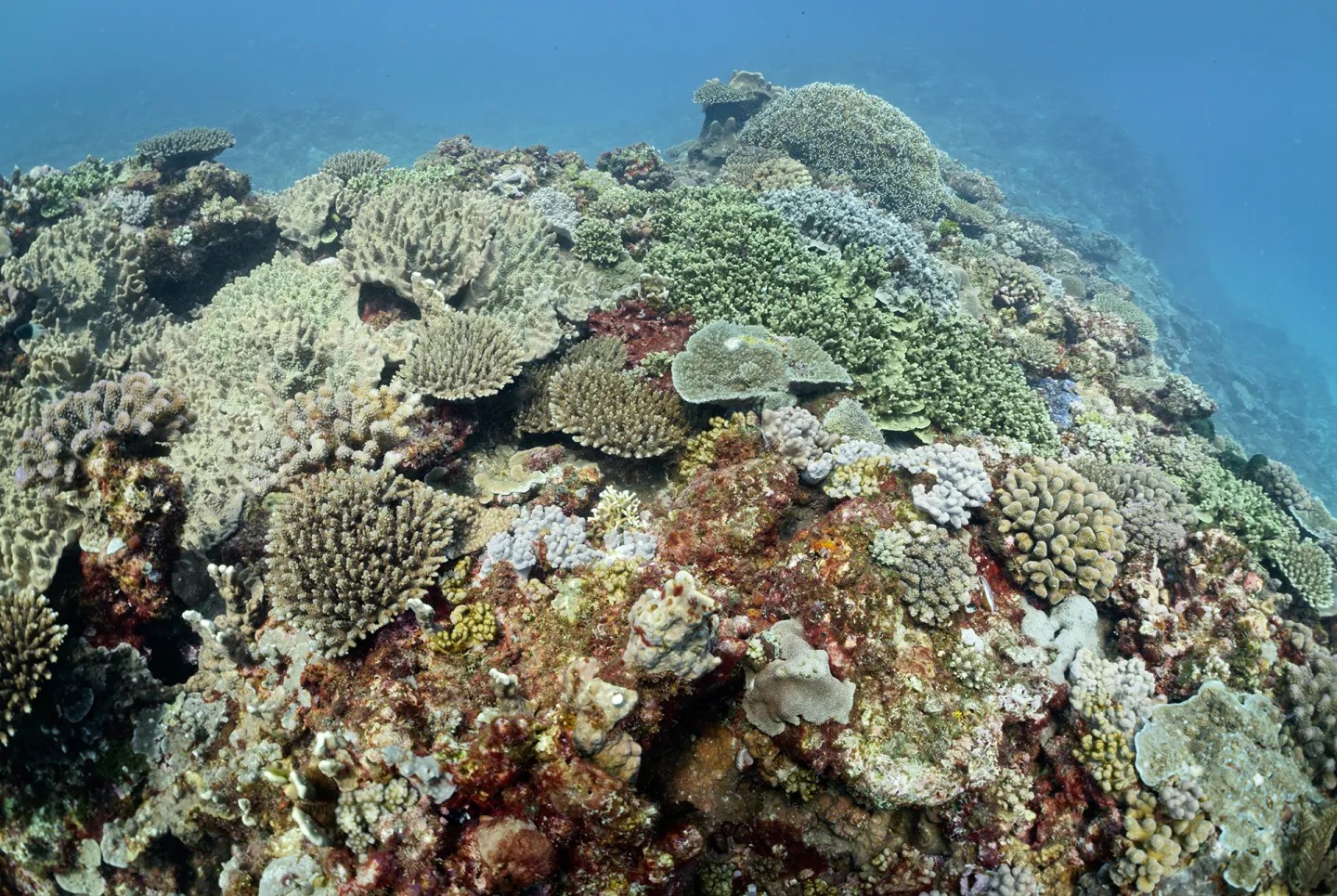
The coral reef itself was exquisite. Growing about 3 miles offshore in 50 feet of water, it was a rugged terrain of pinks, blues, and oranges, set against a backdrop of deep blue. The coral pieces, each a colony of living animals, took on a range of unusual forms, from cake platters and pencil shavings to antlers and brains.

But there was one obvious thing missing: fish. Like a city without people, the reef was mostly empty—not only of fish, but also of crabs, eels, and other typical marine life on a coral reef.

It was a sunny morning in September, and I was diving on a coral reef in southwest Madagascar, an island nation that sits east of continental Africa. And like many reefs in the region and across much of the world, it’s on the verge of collapse.

Overfishing has emptied the ocean here of fish, which over time will allow algae to take over and outcompete the corals. The increasing intensity of marine heat waves and cyclones, along with inland deforestation, also threatens the country’s reefs, which are among the most biologically diverse in the world.

Underwater coral

Corals on the barrier reef in the Bay of Ranobe. Overfishing has emptied the ocean of fish.Garth Cripps/Vox

This is a major problem for people along the coast of southwest Madagascar. Their livelihood depends on fishing—catching marine critters is an essential, and often the only, source of food and income—yet as the reef collapses, so does the fishery. The reef is where fish sleep, eat, and hide from predators, and without it, they struggle to survive. It’s a complicated situation: The health and well-being of people along the coast depends on fishing, yet too much fishing is a key reason why the reef, and the fishery it supports, is in decline.

This tension between human and wildlife survival is not unique to the coasts of southwest Madagascar. The island, home to about 33 million people, is among the poorest of poor nations, with some 80 percent of its population living on less than the equivalent of $2.15 a day. People often have no choice but to depend directly on ecosystems to meet their basic needs.

The government, meanwhile, has failed to provide even the most basic services like reliable electricity and water, let alone a pathway out of poverty and dependency on exploitation. That failure fueled weeks of youth-led protests this fall in Madagascar, where the median age is around 20. In response, Parliament impeached the president on October 14 and the military seized control of the government. What that power shift means for Madagascar, and for a generation demanding change, remains unclear.

Aerial view of a beach town.

An aerial view of Ambolimailaky.Garth Cripps/Vox

Under the sheer weight of human need, it’s no surprise, then, that many of the country’s iconic ecosystems are failing, too. Research suggests that since the turn of the century the country has lost as much as half of its live coral cover, and a similar extent of native forest. Nearly every species of lemur, a type of animal that you can only find in Madagascar, is now threatened with extinction.

The government and nonprofit groups have spent decades—and hundreds of millions of dollars in foreign aid—trying to address these challenges, often relying on traditional environmental approaches, like setting up reserves that restrict fishing. But what Madagascar shows is that conservation projects don’t usually work when they make it harder for desperately poor people to make a living. That may seem obvious, but it’s one reason why many environmental projects have failed in the world’s biodiversity hotspots, which are commonly found in poor nations.

Places like Madagascar underscore the need for a different conservation approach—one that truly centers people, and what they need to live healthy and fulfilling lives. That’s what ultimately brought me to the Bay of Ranobe, where I spent a week in September. Guided by fishers and a team of international researchers, a small organization is trying to restore the fishery and the food it provides, without actually restricting fishing. The goal of the project is to help people. Conservation is just a byproduct.

The ocean was calm and flecked with sails when I arrived one morning at the beach in Ambolimailaky, a fishing village in the Bay of Ranobe. The sails—often made of discarded rice bags stitched together—propelled fishermen to shore in wooden canoes known as pirogues.

As the fishermen neared the beach, I saw jumbles of mosquito nets in some of their boats. In Madagascar and elsewhere in Africa, it’s not uncommon for fishermen to repurpose mosquito nets—which are often donated by aid organizations to protect against malaria—to catch fish.

Fishermen on a small sailboat with a yellow sail.

Fishermen sail to shore in Ambolimailaky.

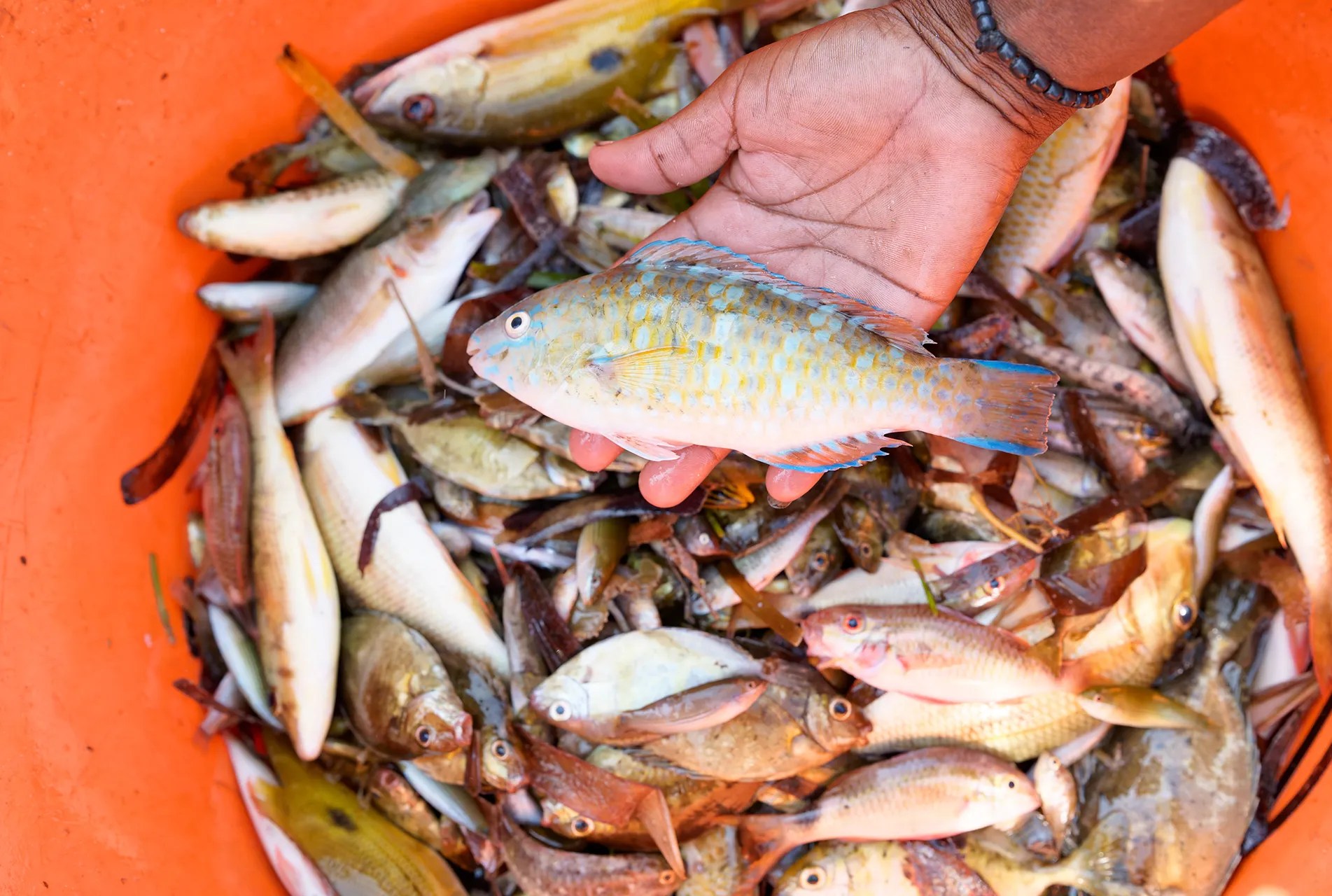
The fishermen showed me what they caught. Some of them had buckets of small anchovies that moved like liquid silver. Others had a bin filled up halfway with reef fish like triggerfish, lionfish, parrotfish, and baby barracudas. A group of young kids put a few that were still alive, including a clownfish, into a metal bowl to play with. A pair of school-age boys showed me a plastic bucket with a dozen juvenile octopuses they caught. The tentacles were tangled together and partially submerged in ink.

As someone from the US who doesn’t fish, I felt unsettled in the face of so many dead and dying creatures. I normally encounter reef fish and octopuses in aquariums, on snorkel trips, or in the marketing materials for conservation groups. But fishermen here have a different relationship with them—and for a very good reason.

In the Bay of Ranobe, fishing is the primary source of income and a vital source of nutrition in coastal villages, according to Aroniaina “Aro” Manampitahiana Falinirina, a doctoral researcher who studies fisheries at the University of Toliara’s marine research institute, IHSM. It’s how people pay for food, school supplies, and transportation. And among certain communities—namely, the Vezo, an ethnic group with deep ancestral ties to the sea—fishing has been a way of life for generations.

A Black man looks at the camera, unsmiling.

Nambokely, a farmer-turned-fisherman in Ambolimailaky, migrated to the coast roughly 20 years ago when changing weather conditions made farming untenable.Garth Cripps/Vox

Speaking through an interpreter, Nambokely, one of the fishermen I met on the beach, told me that if he doesn’t fish, he doesn’t eat. Fishermen in the Bay of Ranobe work around the clock to support their families.

One evening, just after the sun had slipped below the horizon, I boated out on the water with a few researchers who study coral reefs and fisheries. The ocean’s surface was full of bioluminescent microorganisms that lit up as the bow of our skiff cut through the waves. It was as if we were riding on fairy dust.

But the main light show was underwater. Once we were farther offshore, beams of light appeared below the waves, moving erratically in all directions—night fishermen. The fishermen spot their prey using waterproof torches, sometimes made by wrapping ordinary flashlights in a few condoms.

After surfacing with an eel on his spear, one fisherman, a Vezo man named Jean Batiste, told me he fishes at night because he can catch more compared to during the day.

A man wearing a wetsuit shines a light on a boat.

Sitting on the edge of our boat, Jean Batiste shows us the eel he just caught.

Yet as Batiste said—and as every fisher I spoke to in the Bay of Ranobe repeated—it’s becoming harder and harder to catch anything, and thus harder and harder to earn a living. “I’m worried,” Batiste told me that night on the water.

The fishery in the Bay of Ranobe, and across much of southwest Madagascar, is in decline, and perhaps even collapsing. A number of studies from the region show that fishermen are catching fewer fish, and fewer fish species, compared to three or four decades ago. Some species—including certain kinds of parrotfish, which can help limit the growth of coral-harming algae—have disappeared altogether from some areas. “It’s decreasing at a rate that has never been seen before,” said Gildas Todinanahary, a marine researcher and the director of IHSM.

The fish people are catching are also smaller, indicating that fishermen may be netting more juveniles—a clear sign of overfishing. If the adults and the juveniles are fished out, there’s nothing left to spawn the next generation.

An orange bucket with small silver fish.

A plastic bucket full of juvenile fish caught by beach seining, an indiscriminate fishing technique that involves dragging a net through the shallows.

A single fisherman was once able to earn, on a good day, around $10 or $15 in one outing, Nambokely told me. But today, groups of four or five fishermen will spend several hours on the water and might only catch enough to fill half a plastic wash basin with fish. That’s worth about $5 to $10, they told me, which they then have to split among themselves. A dozen small octopuses, meanwhile, are worth only around $2.

“People can’t get enough food in one day,” said Marcel Sebastian, an elderly fisherman I met in the village. He’s been fishing in southwest Madagascar for more than 50 years. “They used to have lunch and dinner. But now they only have dinner due to the scarcity of fish.”

The problem isn’t fishing. It’s overfishing—the forces that ramp up fishing to such an extreme that the reef and the life it supports have no time to recover. That’s what’s happening now in southwest Madagascar. There are simply too many people fishing for the same fish.

One reason for that is climate change. Rising temperatures are contributing to prolonged droughts that make it harder to grow crops in southern Madagascar. Meanwhile, widespread deforestation—which removes trees that stabilize the soil and help water seep underground—means that when it does rain, flooding can bury farmland under sediment. Faced with failing crops inland, farmers in southern Madagascar are increasingly migrating to the coasts in search of income from fishing instead. (Inland deforestation is also sending dirt into the ocean, which can smother coral reefs.)

This climate-driven migration is causing the coastal population to swell, putting pressure on the fishery. It’s hard to find reliable population estimates for the Bay of Ranobe, but a dissertation from 2019 estimated that villages here were growing at an average rate of about 4.5 percent per year, meaning the local population would roughly double in 15 years. The global average population growth rate is around 1 percent. “A lot of the time, people who are coming from inland don’t want to be here,” said Quinn Mitsuko Parker, a doctoral researcher at Stanford who studies fishing communities in the Bay of Ranobe. “They don’t want to be fishing. They’d rather be farming.”

Men pull a net out of the water.

Fishermen pull a net into their pirogue.

But people have no choice but to fish. Even though it’s no longer providing enough. Even though it’s hastening the decline of the reef and the source of income it provides.

One morning, around the new moon, I went out on the water with a few fishermen at low tide. The water got deeper at first, but as we motored farther out, it became shallow again—until it was so shallow we could walk. We were on top of the barrier reef. It was a bizarre image: Here we were, in what felt like the middle of the ocean, standing in just a few inches of water.

During especially low tides, part of the reef here is exposed, and fishers—in this case, mainly women—take advantage of these conditions. They search the reef by foot for octopuses, urchins, and other critters to eat or sell, an approach known as gleaning.

At least a dozen women were gleaning when we arrived, their eyes fixed downward as they paced around. Some of them wielded spears, to stab octopuses, or large conch-like snail shells, which they use to crack open urchins.

I approached a woman named Doseline, who wore mismatched sneakers and a wide-brimmed hat. As we talked, she poked a spear under rocks in search of octopuses, occasionally pausing to grab a snail and put it in her bag.

A woman walks along the shore

Doseline searches for octopuses on the reef in the Bay of Ranobe on September 22. Around the full and new moons, part of the reef is exposed, even though it’s a few miles offshore.

Doseline told me she’s catching half as many octopuses as she did 10 or 20 years ago. And while she knows gleaning can damage the coral—most of the exposed reef is already dead, in part because fishers sometimes crush corals under their feet or break them to grab hiding octopuses—she doesn’t have a choice, she said. Doseline is the sole provider for her son, who’s in school, she said. “My income [from fishing] is not enough,” she told me.

For more than an hour, I watched Doseline search the reef. We stepped over spiny red sea stars and a colorful slug called a nudibranch. I found discarded shells occupied by crabs that looked like creatures from another world. Doseline, who wore her hair in pigtails, didn’t have much luck. “I’m sad because I didn’t catch any octopuses, so I’ll go back home,” she told me.

Over the last three decades, Madagascar has attracted an enormous amount of attention from international environmental groups and foreign donors. The island’s wildlife is not only charismatic—lemurs! chameleons! coral reefs!—but also unique. Because Madagascar has been isolated from other land masses for millions of years, animals there have had plenty of time to evolve into new species. Today, around 90 percent of the country’s plants and animals are found nowhere else on Earth. That means if you lose them in Madagascar, you lose them everywhere.

With so much to lose, major international environmental groups ranging from Conservation International to WWF have been working for years on the island to try to curb forest loss, overfishing, and other kinds of environmental harm. And aid organizations have funneled hundreds of millions of dollars into Madagascar to help. Yet those threats are still getting worse, not better.
The main problem is poverty—the sheer demand put on the environment—which is closely linked to political unrest. But there are also serious problems with the traditional approach to conservation in Madagascar and other developing nations.

Historically, environmental groups, foreign scientists, and the government in Madagascar bet big on protected areas as a means to safeguard nature, such as parks, marine protected areas, and nature reserves. The Bay of Ranobe is, for example, technically part of an official marine protected area. But as research shows, those protection schemes have done little to stop environmental harm.

A white woman with curly brown hair.

Emma Gibbons, executive director of the Malagasy NGO Reef Doctor.

“The conservation of our biodiversity through Madagascar protected areas’ system for 30 years was a failure,” Madagascar’s former environmental minister, Baomiavotse Vahinala Raharinirina, said in 2020.

According to several environmental and development researchers I spoke to, that’s because parks often don’t address the reasons why people exploit nature in the first place. In some cases, they also disproportionately burden women fishers by restricting access to areas for gleaning, as Merrill Baker-Médard wrote in her book, Feminist Conservation: Politics and Power in Madagascar’s Marine Commons.

Another challenge is that NGOs in Madagascar, and to an extent worldwide, are often more accountable to their donors than they are to the local community, according to Emma Gibbons, who runs Reef Doctor, a small nonprofit in the Bay of Ranobe. Donors tend to fund short-term projects and they face few consequences if projects don’t actually help people or ecosystems, Gibbons said. These issues are especially pronounced in southern Madagascar, nicknamed the “cemetery of projects,” because so many of those projects—from establishing solar water pumps to beekeepinghave failed.

If there’s a chance of conservation working, it has to be owned or guided by the community, rooted in a deep understanding of the local culture, and aligned with what people want, said Gibbons, a British national who’s lived in Madagascar for two decades. Fishermen here certainly want to safeguard the fishery—it’s their livelihood, their survival—but they can’t afford to lose their fishing grounds in the process. Food security takes priority. “You can’t tell people not to eat,” Gibbons said.

It’s this perspective that’s informed the approach Gibbons is taking now. Instead of attempting to limit fishing as some traditional conservation has tried to do, she—along with members of the community and a team of local and foreign researchers—are trying to create more places to fish.

And to do that, they’re essentially building new coral reefs from scratch in the Bay of Ranobe. “Our hope is that we can increase the area that’s available to fish,” Gibbons said.

Building artificial reefs is simpler than it sounds: She and her collaborators sink massive chunks of limestone offshore, forming long underwater rows of rocks that are each about 57 meters. That’s roughly the length of a commercial airplane. They then “seed” those rocks with life using smaller constructions called autonomous reef monitoring structures (ARMS) that have spent several months accumulating corals, sponges, and other marine organisms on a natural reef. Those structures, made of stacked stone plates, are basically coral reef starter packs.

Coral growing underwater on a brick.

A young colony of branching coral growing from one of the ARMS on the artificial reef.

So far, Reef Doctor has finished building two artificial reefs that cover about half an acre. Each of them has four rows of rocks, known as spurs, seeded with ARMS.

The sea was calm and more green than blue when I arrived by boat above one of the artificial reefs, about a mile from shore, with marine biologist Mark Little. He’s studying microbes on the reef. The water was cloudy, so we could barely see the rocks below—not the most inviting conditions. But we strapped on tanks and plunged in.

As I sank down, the rows of rocks appeared dramatically through my foggy mask, as if I was descending on ruins of a lost city.

I swam up to a group of ARMS, from which fist-sized bits of coral sprouted like branches of a bonsai tree. Box fish, lionfish, and even young parrotfish—named for their bird-like beaks—crowded around them. At one point, a stingray appeared out of the murky beyond and passed right in front of me, before vanishing again. I was struck at that moment by the realization that we’ve damaged our environment so badly that we literally have to rebuild ecosystems we depend on from scratch. At least in this case, that approach seems to be working.

Pyramid shape structures under water make artificial reefs.

Layered, limestone structures called ARMS, shown here, are used to seed the artificial reefs with life from a natural reef.Garth Cripps/Vox

“It’s doing its job,” said Little, a postdoctoral researcher at Harvard University and Scripps Institute of Oceanography, when we were back in the boat. “There’s a lot of life.”

Early surveys of the artificial reef have detected hundreds of animals across tens of species, including giant clams and cone snails, according to Aaron Hartmann, an ecologist at the US-based Perry Institute for Marine Science, who’s closely involved in the project.

Over the next several years, a team of local and foreign researchers will study the impact of the artificial reefs on marine life and the fishery here—and how that, in turn, affects the physical and mental health of people in nearby villages. The study is among the largest in the world to link ecosystem health to human health, according to Chris Golden, a nutrition and global health researcher at the Harvard TH Chan School of Public Health, who’s closely involved in the project.

The purpose of this study is “to understand whether or not stewarding natural resources in this way can simultaneously benefit the ecosystem and benefit human nutrition and food security and human health,” Golden said. “We want to quantify the way that interventions like this—an environmental intervention—could be viewed as a public health intervention.”

I can’t help but feel like it’s just nowhere near enough. If the scale of fishing continues—or increases, as the coastal population swells—a few artificial reefs won’t be able to rescue the fishery. Even scientists involved in the project understand the limitations. “Within the broader situation, it’s not going to work,” said Todinanahary, who works closely with Gibbons.

Truly sustaining the reef and the fishery means providing coastal communities with other sources of income, Todinanahary told me. That means investing in education so people can learn new skills, like climate-resilient farming, and building out other non-exploitative industries. The country needs enormous, systemic change for conservation to really work. That requires good governance, and right now Madagascar hardly has a government.

A man wearing a blue shirt, standing in thigh-deep water, inspects a rope.

Gildas Todinanahary, director of the University of Toliara’s marine research institute, IHSM.

But as Todinanahary points out, NGOs and aid groups have poured millions of dollars into Madagascar for environmental projects. What if those groups had, instead, put all of that money toward education or health care? Sometimes, effective conservation doesn’t look like conservation at all.

Ultimately, what I saw in the Bay of Ranobe was more bleak than I had imagined. At times, it felt like watching an environmental and human crisis unfold in real time. Nonetheless, people like Gibbons, Todinanahary, and a growing number of smart Malagasy scientists are still determined to restore the fishery—because the stakes are just so high. When you’re actually a part of these communities, you’re accountable to them. That makes the consequences of doing nothing hard to stomach.

And it’s far from futile. The reef, and the fishery it supports, could still recover. There’s still life.

After diving on the artificial reef, Little and I boated to a natural reef nearby, called Vatosoa. Several years ago, Reef Doctor built a smaller artificial reef close to Vatosoa for people to fish on, and in exchange, local fishermen agreed to avoid this one, Gibbons told me.

Orange curly coral underwater

Vatosoa has rose-like coral colonies that form an underwater bouquet.Garth Cripps/Vox

My expectations were still low, especially after diving reefs here that had no fish. But it was spectacular. The reef was formed by a species that grows thin, curved sheets of coral in layers around each other, like petals of a rose. And there were dozens of these living structures packed in together, so it felt like we were swimming over a bouquet.

My mask kept fogging up, a deeply irritating problem that can ruin a dive. I flooded it with seawater and cleared it with bubbles a handful of times. When I could finally see clearly again, I noticed something floating in front of my face. It looked like a piece of seaweed, though it was attached to the unmistakable body of a cuttlefish, a cephalopod with eight arms and two tentacles.

Famous for its camouflage, the animal seemed to be using its arms to mimic a piece of debris. As I swam toward it, the cuttlefish reversed slowly. Moments later, perhaps after realizing it was not fooling me, it changed colors and sped off.

“The potential for recovery is still there,” Gibbons told me one evening, as we walked the beach at sunset, careful to avoid stepping on discarded spiny shells. “There’s huge biodiversity within the fishery. It’s not going to be there forever, but it’s still, at this moment, there.”

Continue Reading…

Mother Jones

From Texas to Tennessee, Even Trump Country Is Marching Against Trump

It’s been a week since an estimated 7 million people across 50 US states and the District of Columbia—and countless others all over the world—took part in the “No Kings” protests to speak up against the Trump administration’s policies and his leadership’sslide into authoritarianism. From Washington, DC, to Oakland, California, protesters proudly waved American flags and declared their love for the country. They spanned generations, and many were dressed in various inflatable costumes—ducks, SpongeBob Squarepants, dinosaurs, and more—borrowing from Portland’s example of defying the rhetoric from Republicans and the administration that vilified anyone who demonstrated as violent, Leftist, “haters” of America.

The peaceful October 18 pro-democracy protests, which naturally drew the ire of President Donald Trump and House Speaker Mike Johnson, marked one of the largest single-day demonstrations in US history. Two million more people than the previous “No Kings” gatherings from June showed up across 2,700 events in big Blue cities and, notably, in reliably Republican towns.

“Even my small, conservative hometown of Brenham, Texas, held a ‘No Kings’ Rally with at least a hundred people in attendance,” wrote the ACLU Justice Division leader Ellen Flenniken in a post about the protests, “and it was far from being the only small town to show up for our rights and for each other.” In Pella, Iowa, “a town where Trump reigns as king,” as Slate’s Lyz Lenz writes, somewhere between 150 and 200 people showed up to chant, “No kings! No crowns!”

“The current protest movement has already reached deeper into Trump country than at almost any point during the first Trump administration.”

While these may appear to be random anecdotes, in fact, they reflect a meaningful trend described in the findings of a new study from Harvard’s Kennedy School, published just before October 18. Researchers responsible for the study, titled “The Resistance Reaches into Trump Country,” concluded through data analysis that “protest events now occur across a wider range of US counties than we have observed since January 2017.”

To conduct this analysis, theresearchers matched protest participation data to county-level 2024 presidential election data and county population data from the US Census. What they found is that, although there has been a steady climb in the “cumulative number” of counties hosting an event in recent years, 2025 likely has the “most geographically widespread” protests in US history. The current surge has pushed the “cumulative share of protest-hosting counties well above 60 percent,” surpassing the summer of 2020 Black Lives Matter demonstrations, when protests were recordedin almost 40 percent of counties across the country.

The recent protests appear to be expanding to parts of the country that hadvotedfor Trump. Between April and August of this year, the researchers noted, “the median protest county in the US sent more votes to Trump in 2024 than [Kamala] Harris.” As an example, the research cites the 2,000 people who joined the June round of “No Kings” protests in Kingsport, a city with a population of about 55,000 in Tennessee’s Sullivan County, where Trump won almost 77 percent of the vote. Last Saturday, Kingsport held a protest once again. “America was founded because we didn’t want a king,” Kristina Runciman, an organizer with East Tennessee Voices, told a local station, “and we don’t want a king now.”

During the second Trump administration, researchers have found, the “share of counties hosting at least one anti-Trump protest has risen markedly…surpassing the historic spikes observed during his first term. And the current protest movement has already reached deeper into Trump country than at almost any point during the first Trump administration.”

Continue Reading…

Mother Jones

“Gringos, Go Home”: Latin America Reacts to Trump’s Expanding Military Campaign

On Friday, the Trump administration escalated its military presence in the Caribbean and South America by announcing the deployment of an aircraft carrier group to the region. Defense Secretary Pete Hegseth gave the green light to send the USS Gerald R. Ford—described by the US Navy as “the most capable, adaptable, and lethal combat platform in the world”—to “bolster US capacity to detect, monitor, and disrupt illicit actors and activities,” according to the Pentagon’s chief spokesperson.

Also on Friday, Hegseth said the United States had carried out yet another military strike on a boat in the Caribbean Sea, killing six people on board. He alleged that the vessel was operated by the Venezuelan gang Tren de Aragua, which the Trump administration has designated a terrorist organization alongside drug cartels. It has accused Venezuela’s President Nicolás Maduro of controlling the criminal group and enabling the smuggling ofdrugs into the United States. Since September, the administration has conducted at least 10 attacks against alleged drug boats, including in the Pacific Ocean. As many as 43 people have been killed so far.

The expanding campaign, which legal experts have warned violates international law and amounts to extrajudicial killings, has raised alarm in Latin America, worsening tensions between the Trump administration and leaders in the region, and reviving the specter of American meddling and intervention in other countries. Reacting to news of the deployment of the world’s largest aircraft carrier, Maduro charged the administration with “fabricating a new war.”

Speaking last month at the annual meeting of the UN General Assembly in New York, Colombia’s president Gustavo Petro condemned the attacks and called for an investigation into President DonaldTrump and other US officials involved in the strikes. “Launching missiles over two people in a small boat is a war crime,” Petro told CBS News this week.

In response, Trump described Petro as a “bad guy” and a “thug.” On Friday, the war of words escalated into action, as the administration imposed sanctions on the Colombian president and his family, claiming that he had allowed drug cartels to flourish. “What the US Treasury is doing is an arbitrariness typical of an oppressive regime,” Petro fired back on social media. The country’s interior minister, who was also targeted for sanctions, had strong words for the White House. “For the US, a nonviolent statement is the same as being a drug trafficker,” Armando Benedetti wrote on X. “Gringos, go home.”

“For the US, a nonviolent statement is the same as being a drug trafficker.”

Mexican President Claudia Sheinbaum has also opposed the Trump administration’s strikes. “Obviously, we do not agree,” she said of the military campaign during a recent press conference. “There are international laws on how to operate when dealing with the alleged illegal transport of drugs or guns on international waters, and we have expressed this to the government of the United States and publicly.”

As the Trump administration escalates the military build-up in the region to become the largest in decades—ostensibly to fight trafficking and stop the flow of drugs to the United States—government officials have, internally, clarified the goal of the campaign: to force Venezuelan President Nicolás Maduro out of power. Secretary of State Marco Rubio has accused Maduro of being the leader of a narco-terrorist organization and “responsible for trafficking drugs into the United States.”

In a recent interview with the AFP, Brazilian President Luiz Inácio Lula da Silva’s adviser Celso Amorim expressed concerns about what a potential direct military intervention in Venezuela to topple Maduro could mean for the rest of the region. “We cannot accept an outside intervention because it will trigger immense resentment,” he said. “It could inflame South America and lead to radicalization of politics on the whole continent.”

President Lula, who is expected to meet with Trump in Malaysia over the weekend, indicated to reporters on Friday that he could bring up the issue in conversation with his American counterpart. “If this becomes a trend,” he said, “if each one thinks they can invade another’s territory to do whatever they want, where is the respect for the sovereignty of nations?”

Continue Reading…

Mother Jones

As Winter Knocks, and the Shutdown Drags on, Poor Families May Have to Ration Heat

This story was originally published by the Guardian and is reproduced here as part of the Climate Desk collaboration.

Millions of Americans face having to ration heating this winter as the US federal government shutdown and mass layoffs by the Trump administration cause unprecedented delays in getting energy assistance aid to low-income households, a group that helps people pay energy bills has warned.

Congress approved about $4 billion for the Low-Income Home Energy Assistance Program (LIHEAP), after Trump’s proposal to cancel the life-saving heating and cooling scheme in this year’s budget was ultimately unsuccessful.

But with winter fast approaching, lawmakers have failed to reach a funding deal and appropriations remain stalled, which threaten to leave the most vulnerable families without critical energy aid as electricity and gas bills surge.

“No family should be forced to choose between heat and food because of a federal funding delay,” said Mark Wolfe, executive director of the National Energy Assistance Directors Association (NEADA), which represents the state directors of LIHEAP. “If the money isn’t released soon, it will cause real harm and people will suffer.”

LIHEAP is a chronically underfunded bipartisan program that helped almost 6 million households keep on top of energy bills last year, reaching only 17 percent of those eligible for assistance even before the current chaos.

Due to the seasonal nature of the program, previous administrations have typically allowed 90 percent of the LIHEAP funds to be distributed by the end of October—even while lawmakers wrangled over the annual appropriations bill.

This is year is different thanks to Trump’s “department of government efficiency” (DOGE). Even if the continuing resolution—or short-term spending fix—were to be agreed this week, states and tribes would probably not receive the funds until early December at the earliest due to unprecedented staff shortages.

Earlier this year, the entire staff running the decades-old bipartisan program was fired—as part of the Trump administration’s so-called “efficiency” drive which was overseen by the billionaire Republican donor Elon Musk.

This left no technical staff to apply the funding formula, which determines how much each state and tribe receives, and approve states’ plans on how the money will be allocated to households. The Guardian understands that the Department of Health and Human Services (HHS) led by Robert F Kennedy Jr. had been using external paid consultants and staff from other programs, some of whom were fired earlier this month.

With no indication that the government shutdown will end any time soon, the NEADA is urging utilities to immediately suspend disconnections for overdue bills—until the federal chaos is resolved and LIHEAP funds are released. “Utilities must act in the public interest and pause shutoffs until federal aid is available again,” said Wolfe.

In the first eight months of this year, New York’s monopoly energy provider alone disconnected 111,000 households. The national total is expected to hit 4 million shutoffs in 2025—up from 3 million in 2023, according to analysis of utility-reported data.

Trump declared a national energy emergency on his first day back in office, pledging to ramp up fossil-fuel production and slash regulations to bring consumer energy bills down.

In the past year, electricity bills have risen more than 15 percent in 10 states plus the District of Columbia, with the highest jumps in Illinois (28 percent), Indiana (25 percent) and JD Vance’s home state of Ohio (23 percent). The price hike is mostly down to the rising cost of fossil gas, utilities passing on the cost of investment in transmission and distribution systems to consumers, and the rapid unchecked growth of datacenters, which is increasing demand for electricity.

According to NEADA research, the cost of home-heating this winter is expected to rise by an average of 7.6 percent, increasing from $907 last winter to an estimated $976 this year.

About 21 million households—one in six—are currently behind on their energy bills. Household energy arrears rose by more than 30 percent, from $17.5 billion in December 2023 to $23 billion by June 2025.

A health department spokesperson said in a statement: “The Democrat-led shutdown is preventing states from receiving new funds under the Low-Income Home Energy Assistance Program (LIHEAP). The Trump Administration is committed to reopening the government for the American people.”

Continue Reading…

Mother Jones

A Midnight Phone Call. A Missing Movie. Decades of Questions.

Here at the Center for Investigative Reporting, we excel at finding things: government documents, contact information, the misdeeds people have tried to hide. It’s serious work that we use for serious tasks—but that gave us an idea. What would happen if we used these skills for things that are less about accountability and more about joy? If we turned our energy toward meaningful, personal questions?

That was the spark for our first-ever hour examining our favorite inconsequential investigations. We turned our tried and true journalistic strategies on our own biggest questions to see where the trail led.

This week, we take up Mother Jones video reporter Garrison Hayes’ quest to find the first short film he ever made, even though it was lost to the early 2000s internet. Yowei Shaw of the podcast Proxy brings us along as she meets her doppelganger and discovers the truth behind how people see her. And Reveal producer Ashley Cleek untangles her own biggest unsolved mystery: Did reclusive rock star Jeff Mangum really call into her college radio show, asking her for a favor?

We plan to do more “inconsequential investigations” like this. So, if you have a personal mystery that needs looking into, please email Inconsequential@revealnews.org.

Listen in the player above, and check out our guide to finding lost Google Videos.

Continue Reading…

Mother Jones

Big Tech Helped Bankroll the East Wing Destruction

Donald Trump is finishing what the British started. Despite promises that the White House would be unaffected by the addition of a $230 million ballroom, the historic East Wing has in fact been demolished. The images of the site are so jarring that the Treasury Department has reportedly ordered its employees to stop taking photos of it.

The president’s ambitions for the ballroom are not especially hard to parse: Trump wants to build something big that is undeniably his. “For more than 150 years,” he wrote on Truth Social on Monday, “every President has dreamt about having a Ballroom at the White House to accommodate people for grand parties.”

If the destruction of the East Wing is a shock, the money that’s paying for it might be even more of a scandal. The White House, eager to assure Americans that their tax dollars have not been diverted for a vanity project, has emphasized that the ballroom is being financed by individuals and major corporations. Instead of going through a process to obtain and disburse federal funds, Trump simply asked the companies his administration is supposed to be regulating to write checks. The list of donors released by the White House includes the usual deep-pocketed Republicans, such as casino magnate Miriam Adelson and private-equity mogul Stephen Schwarzman, but also a host of companies whose leaders have huge incentives to maintain good relations with an often vindictive head of state. They include telecom giants and the railroad giant Union-Pacific—which needs the Trump administration’s sign-off on a proposed $85 billion merger with Norfolk Southern. (Union-Pacific did not respond to a request for comment.) And then there’s the tech companies—Google, Apple, Microsoft, Amazon, and Meta.

If the destruction of the East Wing is a shock, the money that’s paying for it might be even more of a scandal.

The tech companies themselves have been awfully quiet about the project they’re helping to underwrite. Just to make sure they hadn’t missed it, I sent a photo of the demolished East Wing—and requests for comment—to representatives of all of these companies. A Microsoft spokesperson confirmed the company had made a contribution but offered no further comment. None of the others responded.

But Big Tech’s donations for Trump’s pet cause come at a time when the industry’s giants have a lot riding on their relationships with the White House. In a marked shift from Trump’s first term, tech leaders have spent most of the last 12 months singing the president’s praises as they navigate anti-trust cases, tariffs, and regulatory hurdles; fight for contracts; and push for policies that benefit their bottom lines. And one particular policy is rising above the others right now: All of these companies have staked their future to varying degrees on artificial intelligence. To accomplish what they want, they need to shore up supply chains, avoid new government restrictions, build a ton of stuff—power plants, transmission lines, data centers—and free up access to water and land. The Trump administration has made a big show of promising to help.

At a White House dinner earlier this year, a succession of tech company leaders took turns thanking Trump for his administration’s vow to cut “bureaucratic red tape” to “build, baby, build.” “Thank you so much for bringing us all together, and the policies that you have put in place for the United States to lead,” Microsoft’s Satya Nadella told Trump. “Thank you for setting the tone,” said Tim Cook, the CEO of Apple, another corporate ballroom contributor. (Apple’s build-out is by far the least capital-intensive of the bunch, but it is still both heavily invested in AI and very much not looking to pick a fight with the president, as evidenced by Cook’s recent gift to the president of a 24-karat gold plaque.) “Thanks for your leadership,” said Google CEO Sundar Pichai. Meta’s Mark Zuckerberg, who was also in attendance, gushed earlier this year that, “We now have a US administration that is proud of our leading companies, prioritizes American technology winning, and that will defend our values and interests abroad.”

Right now they’re on Trump’s good side—Trump has even extended his highest honor, praising the tech moguls for their own construction projects. But tech leaders don’t need a reminder of what happens to people on his bad side—they can just go back to the recent past, when he took several of them to court, and threatened to send Zuckerberg to prison. Meta already paid Trump $22 million, in the form of a donation to his presidential library, to settle a lawsuit earlier this year. In that context, is it so surprising that when the president asked them to cut checks for his pet project, they said yes?

These tech companies haven’t offered an explanation for their donations to the Trust for the National Mall, the non-profit serving as the conduit for ballroom donations, nor have they or the White House disclosed how much they chipped in. (With a notable exception: We do know that YouTube, a Google subsidiary, contributed $22 million as part of its settlement of a lawsuit Trump filed against the company in 2021.) Perhaps they share the president’s passion for large event spaces. Perhaps they simply disliked the symmetry of the old building.

But taste and decorum aren’t the only reasons why none of the other previous inhabitants of the White House have personally asked the companies they regulate to finance a home renovation. There’s no way to avoid the appearance of massive conflicts when the president of the United States asks the trillion-dollar corporations he’s threatened and cajoled for a favor.

Continue Reading…

Mother Jones

Meet the New Pentagon Press Corps

Last week, dozens of reporters covering the Pentagon staged a historic walkout, handing in their press badges rather than submit to restrictive new media policies promulgated by Defense Secretary Pete Hegseth. This week, there are still news outlets—in a manner of speaking—covering the Pentagon precisely the way Hegseth and his underlings would like to be covered. The results, fawning, uninformative, and insipid though they may be, offer a valuable look at what the Trump administration has in mind when it comes to news coverage.

Right-wing media figures “jumped at the chance” to sign a coverage pledge.

The Pentagon’s new rules for the press—a 21-page list including an absurd stipulation that journalists sign a pledge they won’t publish material not authorized for public release—made reporters who had long worked in the building worry they could be prosecuted for doing their jobs. But at least eighteen right-wing outlets, according to the Washington Post, signed on, ranging from obscure Substacks to longtime conspiracy pusher Gateway Pundit, through to MyPillow tycoon Mike Lindell’s LindellTV and Frontlines, the media arm of Turning Point USA, co-founded by recently assassinated activist Charlie Kirk. Together, they essentially function as megaphones for the Trump administration, part of the new state media that’s come to define the president’s second term.

As proof, just consider how they covered news of the Pentagon press corps overhaul. As the Economist’s Shashank Joshi pointed out on X, one of the newly credentialed outlets, a Substack blog called the Washington Reporter, wasted no time in praising Hegseth‘s changes. In an editorial, it dismissed the “media freakout” over the policies as “another example of Trump Derangement Syndrome. Our only concern is that the Department of War has waited until October to implement these new changes.”

The blog, which describes itself as providing “right-of-center news and commentary to a D.C. audience,” added, “We support these guidelines as sound policy. We have signed them. And we are grateful for Secretary Pete Hegseth’s leadership and his remarkable track record of success.”

In its coverage of the rules, the Post Millennial, a Canadian outlet best known for publishing right-wing provocateur Andy Ngo, praised Hegseth for “his approach for high standards, military readiness, and a ‘warrior ethos.'”

The Daily Signal, which was founded as a project of the Heritage Foundation before becoming independent in 2024, wrote that it had decided to obtain Pentagon press credentials “after consulting legal advisers, trusted industry colleagues, and national security experts, plus Department of War staff who crafted the policy and explained how it would impact our work.” The outlet accused some journalists who objected to the policy of “deliberately misrepresenting” it, and promised, “Nothing in the Pentagon’s updated guidelines can or will alter our methods and reporting, both of which are of paramount importance for our news organization.”

What the outlet considers “reporting,” though, is telling: Their “news” coverage on Thursday consisted of one story quoting White House Press Secretary Karoline Leavitt dismissing concerns about Trump’s plan to import Argentine beef, and a so-called “exclusive” parrotting State Department talking points defending plans to accept white South Africans as refugees.

The ways some of the remaining outlets approached one of the biggest storiesof Hegseth’s tenure makes clear that there’s little journalistic integrity left in the Pentagon press corps. When the secretary accidentally shared classified battle plans with a journalist in group chat, the National Pulse claimed the security breach only “exposed” Hegseth and other administration officials as “professional and focused.” Gateway Pundit blasted the news as a “Deep State leak.” When it was rumored Hegseth might be forced out after the scandal, the Federalist, which also reportedly signed the new Pentagon rules, backed him, declaring that “If Hegseth’s tenure as defense secretary thus far is what ‘total chaos’ is supposed to look like, then by all means keep it coming.”

Other outlets that now help make up the official Pentagon press corps have been more honest in essentially admitting the Pentagon’s requirements are little barrier, since they don’t really cover news. “Should a major story unexpectedly come our way that conflicts with press policies, we will prioritize the public’s right to know and transparency,” Far-right podcaster Tim Pool wrote on Twitter, making a pledge to the tens of people who get their news from his Timcast platform. “However, as we are not investigative reporters, we do not anticipate frequently encountering such situations.”

In a discussion on the far-right streaming channel Real America’s Voice, Jack Posobiec, a Pizzagate promoter turned self-styled journalist and a senior editor at Human Events, said that he had “jumped at the chance” to get press credentials and praised the Pentagon for curbing an “inappropriate” level of access and working to avoid further “very bad political leaks.”

He added, not quite convincingly, that Human Events would exercise its First Amendment rights and continue covering the news: “No one ever tells us what to write.” It would seem that they don’t really have to.

Continue Reading…

Mother Jones

Trump Claimed ​Wind Farms Kill Whales—and Then Quietly Axed Research Into the Issue

This story was originally published by Canary Media and is reproduced here as part of the Climate Desk collaboration.

The Trump administration has repeatedly blamed offshore wind farms for whale deaths, contrary to scientific evidence. Now the administration is quietly abandoning key research programs meant to protect marine mammals living in an increasingly busy ocean.

The New England Aquarium and the Massachusetts Clean Energy Center, both in Boston, received word from Interior Department officials last month stating that the department was terminating funds for research to help protect whale populations, effective immediately. The cut halted a 14-year-old whale survey program that the aquarium staff had been carrying out from small airplanes piloted over a swath of ocean where three wind farms—Vineyard Wind 1, Sunrise Wind, and Revolution Wind—are now being built.

Federal officials did not publicly announce the cancellation of funds. In a statement to Canary Media, a spokesperson for the New England Aquarium confirmed the clawback, saying that a letter from Interior’s Bureau of Ocean Energy Management dated September 10 had ​“terminated the remaining funds on a multi-year $1,497,453 grant, which totaled $489,068.”

“If you’re into whales…you don’t want windmills,” Trump said moments after signing an order that froze permitting and leasing for offshore wind.

The aquarium is currently hosting the annual meeting of the North Atlantic Right Whale Consortium, a network of scientists that study one of the many large whale species that reside in New England’s waters. News of the cut to the aquarium’s research project has dampened the mood there. And rumors have been circulating among attendees about rollbacks to an even larger research program, a public-private partnership led by BOEM that tracks whales near wind farm sites from New England to Virginia.

Government emails obtained by Canary Media indicate that BOEM is indeed shutting down the Partnership for an Offshore Wind Energy Regional Observation Network (POWERON). Launched last year, the program expanded on a $5.8 million effort made possible by the Inflation Reduction Act, deploying a network of underwater listening devices along the East Coast ​“to study the potential impacts of offshore wind facility operations on baleen whales,” referring to the large marine mammals that feed on small krill.

POWERON is a $4.7 million collaboration, still in its infancy, in which wind farm developers pay BOEM to manage the long-term acoustic monitoring for whales that’s required under project permits. One completed wind farm, South Fork Wind, and two in-progress projects, Revolution Wind and Coastal Virginia Offshore Wind, currently rely on POWERON to fulfill their whale-protecting obligations.

With POWERON poised to end, wind developers must quickly find third parties to do the work. Otherwise, they risk being out of compliance with multiple US laws, including the Marine Mammal Protection Act and the Endangered Species Act. Dominion Energy, one of the wind developers participating in POWERON, did not respond to a request for comment.

BOEM officials made no public announcement of POWERON’s cancellation and, according to internal emails, encouraged staffers not to put the news in writing.

“It essentially ended,” said a career employee at the Interior Department who was granted anonymity to speak freely for fear of retribution. The staffer described the government’s multimillion-dollar whale-monitoring partnership as ​“a body without a pulse.”

The grim news of cuts coincided with the release of some good news. On Tuesday, the North Atlantic Right Whale Consortium published a new population estimate for the North Atlantic right whale, an endangered species pushed to the brink of extinction by 18th-century whaling. After dropping to an all-time low of just 358 whales in 2020, the species, scientists believe, has now grown to 384 individuals.

Concern for the whale’s plight has been weaponized in recent years by anti–offshore wind groups, members of Congress, and even President Donald Trump in an effort to undermine the wind farms in federal court as well as in the court of public opinion.

“If you’re into whales…you don’t want windmills,” said Trump, moments after signing an executive order in January that froze federal permitting and new leasing for offshore wind farms.

This view stands in stark contrast with conclusions made by the federal agency tasked with investigating the causes of recent whale groundings.

A statement posted on the National Oceanic and Atmospheric Administration’s website reads: ​“At this point, there is no scientific evidence that noise resulting from offshore wind site characterization surveys could potentially cause whale deaths. There are no known links between large whale deaths and ongoing offshore wind activities.”

Continue Reading…

Mother Jones

Andrew Cuomo Goes Full Islamophobe

In the final stretch of New York’s mayoral race, Andrew Cuomo appeared to embrace the Islamophobic accusation that Zohran Mamdani—the socialist candidate who would be the city’s first Muslim mayor—would celebrate a hypothetical September 11-style terrorist attack.

“God forbid, another 9/11. Can you imagine Mamdani in the seat?” Cuomo said during an appearance on the conservative radio host Sid Rosenberg’s show on Thursday.

“I could. He’d be cheering,” Rosenberg replied, prompting Rosenberg’s own laughter.

The former governor chuckled at the remark, before adding, “That’s another problem.”

From a generous angle, one might be inclined to see the initial intention of Cuomo’s remarks as yet another attempt to brand his 34-year-old opponent as too inexperienced to lead the country’s largest city. But what quickly unfolded was the unmistakable suggestion that Mamdani, by virtue of being a Muslim man, was not a loyal American. That Mamdani’s identity as a Muslim meant that he naturally harbored a secret wish to see New York, and America, destroyed. For many, the remarks made explicit what had been percolating for months: the cynical racism animating Cuomo’s campaign, whether it be his repeated refusal to pronounce his opponent’s name correctly or an AI-generated ad that depicted “criminals for Zohran Mamdani.”

Asked to comment on Cuomo’s latest attack, a spokesperson for Cuomo’s campaign wrote: “He was referring to Mamdani’s close friend Hasan Piker, who said ‘America deserved 9/11,’ a statement 9/11 families called on Zohran Mamdani to denounce, but he refused for months.”

Cuomo did mention Piker during his interview with Rosenberg—but not until about 10 minutes after their Islamophobic exchange. Hours later, Eric Adams, who earlier on Thursday formally endorsed Cuomo in a bid to stop Mamdani, extended the overt Islamophobia.

“New York can’t be Europe, folks,” he told reporters. “I don’t know what’s wrong with people. You see what’s playing out in other countries because of Islamic extremism. Not Muslims. But those Islamist extremists that are burning churches in Nigeria, that are destroying communities in Germany.”

Adams: New York can’t be Europe folks… That is why I am here today to endorse Andrew Cuomo pic.twitter.com/uTPGvCiJe3

— Acyn (@Acyn) October 23, 2025

“That’s what I’m fighting for,” Adams said. “I’m fighting for the family of New York. That’s why I’m here to endorse Andrew Cuomo.”

Update, October 23: This post has been updated to include new comments from Eric Adams.

Continue Reading…

Mother Jones

Obama: California’s Prop 50 Is “Critical” for Democracy

On Wednesday, former President Barack Obama joined California Gov. Gavin Newsom in a livestream for volunteers in support of Proposition 50, the governor’s redistricting measure, and the sole question on the ballot in the November 4 special election.

As I reported last week in a story on the almost unprecedented spending around the measure:

Prop 50 is part of a larger redistricting fight unfolding across the country, as Democrats seek to retake the House of Representatives and Republicans try to retain their narrow majority in next year’s midterm elections. It all began in June, when President Donald Trump nudged Texas Republicans to redraw the state’s voting maps mid-decade, off the usual 10-year schedule, to swing five seats in the national party’s favor.

“This is in reaction to something unprecedented,” Newsom said at the start of Wednesday’s call. Proposition 50, Newsom said, is his attempt to counter Republican efforts to redraw congressional lines at the president’s behest, not just in Texas but in other states—like Indiana, Missouri, and North Carolina—with GOP-run legislatures.

Obama, the highest-profile of many Democratic political notables to throw their weight behind the measure, joined midway through the call to drive home Newsom’s message.

“The problem that we are seeing right now,” Obama said, is that Trump and his administration are brazenly saying that they want to “change the rules of the game midstream” to “give themselves an advantage.”

“This is not how American democracy is supposed to operate. And that’s what Prop 50 is about,” he added, noting that the measure “has critical implications not just for California but for the entire country.”

“As a consequence of California’s actions, we have a chance at least to create a level playing field in the upcoming midterm elections,” he said.

This comes days after Obama featured in the Yes on 50 campaign’s latest ad, and the same day that the Washington Post released a report about how the former president has been advocating for the measure behind the scenes since the summer.

As part of Saturday’s No Kings demonstrations, thousands of Bay Area protesters at San Francisco’s Ocean Beach showed their support for the proposal and opposition to Trump’s authoritarian policies by forming a human banner that read, “NO KINGS,” and below that, “YES ON 50.”

Continue Reading…

Mother Jones

Trump Claims He’d Give His $230 Million Justice Department Grift to Charity. Yeah, Right.

On Tuesday, shortly after the New York Times reported that President Donald Trump is demanding $230 million from the Department of Justice (DOJ) to reimburse him for legal costs related to earlier federal investigations against him, the president claimed he would donate any such funds to charity. “I’m not looking for money,” he told reporters. “I’d give it to charity or something. I would give it to charity, any money.”

Trump, almost as if unable to resist, then framed the demand as satisfying a personal grudge. “But look what they did,” he said, referring to the federal investigations against him. “They rigged the election.”

Does Trump grasp the impropriety at play? Hisbid to appear magnanimous suggests that he knows it doesn’t look good for a president to shake down the Justice Department for taxpayer money, particularly amid a shutdown, and especially as his administration slashes Medicaid and food stamps.

His effort to put a generous spin on this blatant grift—there is no compelling evidence that the DOJ’s investigations were launched improperly—belies Trump’s long, sordid history of stiffing contractors, and, even more notoriously, the court-ordered dissolution of his namesake charitable arm over a “shocking pattern of illegality.”

Let’s revisit some of that history, starting with the Trump Foundation, his tax-exempt nonprofit.

In 2019, a New York judge ordered the foundation to pay $2 million to an array of charities—and then shut itself down—after determining that Trump, along his children Don Jr., Eric, and Ivanka, misused the foundation to further their political and business interests.

That ruling came after various indications that Trump was misusing the organization. In January 2016, while running for president, he claimed during a fundraiser for veterans’ causes that he had personally donated $1 million via the foundation. After reporters revealed that no record of such a donation existed, Trump belatedly ponied up that amount to a foundation supporting fallen Marines and police officers.

Subsequent reporting by the Washington Post found that Trump had pledged more than $8.5 million to various charities over the previous 15 years, but had only delivered on a third of it.

In 2022, Trump’s 2017 inaugural committee, another nonprofit controlled by the president, along with his business, the Trump Organization, agreed to pay $750,000 to settle a lawsuit brought by the DC attorney general charging that the committee illegally misused funds to enrich the Trump family by “grossly overpaying” his companies “for use of event space at the Trump Hotel for certain inaugural events.”

Trump’s latest nonprofit, a foundation supposedly set up to oversee his planned presidential library, is already flashing warning signs. Trump and his aides have claimed that various donations he has received while president—including funds left over from the record $250 million his 2025 inaugural committee raised from corporations; proceeds from $1 million-a-plate fundraising dinners and $5 million one-on-one meetings with the president; and the large settlements that Meta, Disney, and Paramount have paid to settle seemingly extortionary Trump lawsuits—will go to the library.

Trump even claimed the $400 million plane that Qatar gifted him, and which the Air Force is spending heavily to upgrade, will go to the library when he leaves office.

But it isn’t clear as yet which, if any, funds or other valuables have been transferred to the library foundation. The organization was incorporated in May with the president’s son Eric; Michael Boulos, the husband of Trump’s daughter Tiffany; and a lawyer who works for the president in New York serving as trustees. This suggest the foundation will be controlled by Trump’s family, not independent outsiders.

Already, the State of Florida has attempted to transfer valuable property in Miami to the foundation for a library site that also could host a hotel, condos, or other commercial ventures that could benefit the president and his family financially. (A judge temporarily halted the transfer last week in response to a lawsuit challenging its legality. ) Any assets that do make it into the foundation’s coffers can be used, legally in most cases, to pay salaries to Trump family members, provide them with free office space, and fund certain travel, experts told Mother Jones.

Trump’s abysmal track record extends to his commercial activities as well. In 2016, hundreds of contractors—from carpenters, painters, and plumbers to corporate law firms—accused the then-presidential candidate of failing to pay bills he owed. Even his former personal lawyer, Rudy Giuliani, has publicly complained that the president barely paid him for his legal work.

If Trump does manage to coerce a settlement out of his loyal DOJ appointees—a prospect made more likely by the fact that one of them, Deputy Attorney General Todd Blanche, uset to be his personal lawyer—there’s nothing to indicate it’ll be used to pay anyone but himself.

Continue Reading…

Mother Jones

As Trump Plans to Steal $230 Million From Taxpayers, You Can Thank John Roberts

President Donald Trump is demanding that the Justice Department transfer $230 million in taxpayer dollars into his own personal bank account. He can do this, because thanks to the Supreme Court’s recent decisions, the executive branch could accurately be described by King Louis XIV—L’état, c’est Trump.

When Trump says this is his decision to make, he’s probably right.

At first you might think, ‘Can he do that? Can he just shakedown the DOJ for roughly a quarter of a billion dollars?’ And then you think about the Supreme Court opinions under Chief Justice John Roberts, in which the court has shifted the fundamental structure of American government such that federal agencies, including the Justice Department, are mere extensions of the president’s will. Trump, always on the lookout for the next grift, understands the immense power this bestows on him.

The colossal cash transfer he is demanding is being described ascompensation for investigations the department launched into Russia’s interventions in the 2016 election and Trump’s absconding with classified documents after his first term. Now that he’s back in the White House, Trump plans to make the government pay for its appropriate use of its ability to investigate and prosecute to safeguard our democracy. And he grasps the fact that he has the absolute power to do that.

“With the country, it’s interesting, because I’m the one that makes the decision,” Trump said Tuesday, responding to news of the impending payments. “That decision would have to go across my desk. And it’s awfully strange to make a decision where I’m paying myself.”

Trump: "It's awfully strange to make a decision where I'm paying myself. But I was damaged very greatly and any money I would get I would give to charity."

Aaron Rupar (@atrupar.com) 2025-10-21T21:17:21.012Z

Strange indeed—especially since, technically, it is senior Justice Department officials who would officially sign off on the payments, not the president: Breaking the story on Tuesday, the New York Times framed the ethical conflict around the fact that several of the DOJ officials who could sign off on the payments were formerly Trump’s personal lawyers.

That’s corruption, of course, but in the old school way of putting cronies in a position to help you. But we’re in a new world now, and Trump himself gets this: He decides, because he effectivelycontrols every decision made at every agency (with the possible exception of the Federal Reserve). If he doesn’t like a decision, he can fire the person responsible. Their desk is now his desk.

Don’t just take it from him: the Supreme Court said so. In a series of opinions, Chief Justice John Roberts has reinterpreted the Constitution to give Trump this power. This warping of our constitutional order is known as the unitary executive theory, and it posits that the framers gave the president complete control over the executive branch. Last summer, Roberts authored the infamous immunity decision, Trump’s forever Get Out of Jail Free card, which protected presidents from virtually all prosecution for official acts. That decision not only permitted Trump to break the law, it also gave him unfettered control over the investigative and prosecutorial functions of the DOJ—which presumably includes issuing payments to those he claims should be compensated for investigations gone awry. Which all is to say that when Trump says this is his decision to make, he’s probably right.

As Roberts has handed the presidency more and more power over every inch of the government, he has never copped to the fact that he was enabling corruption, theft, or autocracy. Absurdly, he claimed to be increasing democratic accountability. “The framers made the president the most democratic and politically accountable official in government,” he wrote in a 2020 decision, because “only the president (along with the vice president) is elected by the entire nation.” It’s hard to take this with a straight face; the electoral college allows a president to win fewer votes and still assume office, and a president in his second term will not face voters again. (Although Trump may try.)

Undeterred by these facts, Roberts wrote in a 2021 case that all executive branch decisions are ultimately the president’s to make: The executive power “acquires its legitimacy and accountability to the public through ‘a clear and effective chain of command’ down from the President, on whom all the people vote.”

The absurdity of Roberts’ decision was laid bare Tuesday: The president gets to pay himself hundreds of millions in taxpayer dollars, because he controls all executive branch personnel and all of their decisions, and there’s probably nothing anyone can do about it. It sure doesn’t feel like our democratic accountability has increased. Of course, Congress could and should pass a law prohibiting such payments, and dare the Supreme Court to strike it down—but this Congress is unlikely to do even that bare minimum in response.

What’s to stop Trump from paying allies the same way? Have them file a complaint with DOJ over some legal skirmish, and then order the department to pay them their reward. If Trump gains control of the Federal Reserve—as he is asking the Supreme Court to give him—he could similarly transform the country’s central bank into his own “bottomless slush fund,” as the Atlantic’s Rogé Karma reported last month. He could use the Fed to pay his businesses, his friends, and his donors. He could even keep ICE’s operations active by hiring private contractors during a government shutdown, Karma points out, circumventing Congress’ power of the purse.

If Trump will transfer a quarter billion dollars from the taxpayers to himself, it’s clear that he wouldn’t shy away from any of these uses—and probably find more ways to profit that we haven’t even dreamt.

Roberts can claim that he’s expanding democratic accountability. But at this point, we can all see the mess he’s created. A man who takes from the voters to line his pockets is not feeling all that accountable to anyone.

Continue Reading…

Mother Jones

Trump’s Minions Aim to Cut More Than 2,000 Interior Jobs During the Shutdown

This story was originally published by High Country News and is reproduced here as part of the Climate Desk collaboration.

More than 2,000 employees could be cut from the Department of Interior during the ongoing federal government shutdown if the Trump administration gets its way.

In a court filing on Monday, the administration listed plans that would target roles in research, conservation, national park management, water policy, grant and budget planning, communication staff, and wildlife management. The biggest hits would come to the Bureau of Land Management, Fish and Wildlife Service, National Park Service, and US Geological Survey.

The filing does not include any plans that outline a total clearing of any agency or bureau. It also does not show any plans for cuts at the Bureau of Indian Affairs, a possibly emerging pattern of relief for Indigenous nations under this administration.

“The administration’s move to fire thousands of federal employees who are already going without pay…is not only cruel but unlawful.”

Last week, US District Court Judge Susan Illston issued a temporary restraining order to stop the termination plans, and ordered the US Office of Management and Budget to provide an account of positions it wants to eliminate from the federal government through a process called reduction in force.

Rachel Barra, chief human capital officer at the Interior Department, filed the plans and stated that Ilston’s order has stopped reduction in force at the Interior, “absent an order from a higher court providing relief.”

Unions representing affected federal workers have pushed back against the plans to reduce the federal workforce, including the American Federation of Government Employees and the American Federation of State, County and Municipal Employees.

“The administration’s move to fire thousands of federal employees who are already going without pay during the government shutdown is not only cruel but unlawful,” AFGE President Everett Kelley said in a press release.

The court filing offers insight into the administration’s priorities for slashing the federal government; the cuts are in line with what President Donald Trump has advocated since taking office in January.

Still, Interior’s plans don’t give a total view of all federal agencies or programs, and it may not even be a complete picture of Interior Department cuts, whether planned, or already executed. Barra stated that the roles in the disclosure were targeted before the government shutdown on October 1, although she only started working in the human resources role at Interior just two days before the shutdown.

In the filing, Barra outlines 89 “competitive areas” in the Interior Department that put 14,212 employees up for termination review. The five unions in the case represent 4,833 of those workers, according to the court filing.

Out of the 2,050 positions proposed for elimination at Interior, 474 in total are at the Bureau of Land Management. That includes the following cuts at Bureau of Land Management state offices: 76 in California, 33 in Colorado, 48 in Idaho, 41 in Arizona, 95 in Oregon and 93 in Utah. The federal government has plans to abolish 87 of the 177 employee positions at the BLM’s National Operation Center in Denver.

At the US Fish and Wildlife Service, planned cuts include 35 positions out of the 269 that operate research and conservation at the Migratory Bird Program, an area Trump has criticized in the past.

The National Park Service could see at least 272 roles cut. That includes 57 in the Pacific Northwest and 122 in the Intermountain region. Right now, more than 9,000 out of the 14,500 parks employees are furloughed under the government shutdown. According to the National Parks Conservation Association, at least 24 percent of staff were already cut at the National Park Service since Trump took office in January.

The US Geological Survey, which had previously suffered large-scale layoffs, would also see drastic cuts nationwide to services in science research if the reduction-in-force orders go forward.

Over half the employees of the Fort Collins Science Center in Colorado—39 of 69—are targeted to be cut by the federal government. Similar or more drastic cuts are proposed at the Northern Prairie Wildlife Research Center in North Dakota, the Columbia Environmental Research Center in Missouri and the Great Lakes Science Center in Ohio.

Continue Reading…

Mother Jones

Al Letson at No Kings: Hope, Fury, and Inflatables

On October 18, roughly 2,700 No Kings demonstrations took place around the US. Organizers estimated that 7 million protesters came out to denounce what they described as America’s slide toward authoritarianism under President Donald Trump. One of the largest protests occurred right in the nation’s capital, where National Guard troops are patrolling the streets and many furloughed and fired federal workers are angry about the ongoing government shutdown.

That’s right where More To The Story’sAl Letson found himself this weekend. Al spoke with a handful of the thousands of protesters who attended to get a better sense of why they came out. Some had creative posters. Others wore inflatable costumes. But all of them told Al that they were concerned about the direction of the country in a second Trump term.

“I’m here for my neighbors who are furloughed and aren’t getting paid even though they’re still working for the federal government,” said a protester named Sarah. “I’m here for the LGBTQ+ community whose rights are being stripped away. I’m here for my children and the future I want for them in this world. I want a country where we are back to kindness and love and treating our neighbor with respect and dignity.”

On a special episode of More To The Story, Al speaks with No Kings protesters about Trump’s immigration raids, threats to free speech, federal workers being fired, and fears about the future of democracy in America.

Find More To The Story on Apple Podcasts, Spotify, iHeartRadio, Pandora, or your favorite podcast app, and don’t forget to subscribe.

This following interview was edited for length and clarity. More To The Story transcripts are produced by a third-party transcription service and may contain errors.

Al Letson: We are doing something a little different this week because these are extraordinary times. I’m reporting from the National Mall in Washington, D.C. for the October 18th No Kings Rally. I’m standing outside the Capitol building surrounded by thousands of protesters. They all have their own motivation for being here, but the common thread is to push back against Trump and the administration. Organizers call it a movement rising against his authoritarian power grabs.

Sarah, what brought you out here today?

Sarah: I want to stop the cruelty in our country. I’m here for my neighbors who are being terrorized by ICE, families getting ripped apart. I’m here for my neighbors who are furloughed and aren’t getting paid, even though they’re still working for the federal government. I’m here for the LGBTQ+ community whose rights are being stripped away. I’m here for my children and the future I want for them in this world. I want a country where we’re back to kindness and love and treating our neighbor with respect and dignity, and I believe that we are taught to love all our neighbors, no exceptions.

I want to go back in time a little bit. When January 6th happened with the insurrection that happened at the Capitol. I’m curious, when you were watching that, when did you think the trajectory of the country was from that point? Did you think we were going to end up here or do you think we would trample down on that sentiment?

Oh, I thought it was finally the end. I thought we had reached a climax where people would realize the insanity and that we had an armed insurrection against the United States government trying to overthrow the will of the people who had voted in a free and fair election. And we had plenty of leaders on both sides of the aisle at that time who spoke up against that treason who have now walked it back. People who were brutalizing, police officers who were defending the capitol are now pardoned and I feel like things have gotten a lot worse, so it’s pretty devastating.

When you think about the Democratic Party, what do you think they should be doing or are you happy with what the Democratic Party is doing?

I don’t know. I want as much action as possible. I want as much resistance. I feel like somehow Democrats struggle to control the narrative and we allow the conservative right and their media to dictate the narrative. And I wish we found a more successful way to show people that the Democratic Party is on their side. They’re here for working people, they’re here to protect our healthcare. Millions of people are going to be suffering very soon when their healthcare costs go way up. I like opportunities like today where we can mobilize and show our dissent and our unhappiness.

Last question for you, and this is just speaking to where we are as a country right now. You were hesitant to give your name and I’m wondering if it’s because you are fearful of the government. People are out here protesting, but I feel like there’s also a little bit of fear of what the government and what right-wing provocateurs might do.

Absolutely. I believe we have the right to peaceful protest, I believe a hundred percent in our mission today. I also believe there’s a lot of bad actors both in political power and just on media out in the world who are looking to target peaceful Americans exercising their vote. We have the Speaker of the House calling this a We Hate America rally and accusing us of being all sorts of hateful causes and people. And I do worry about people here being targeted.
And I think that’s really why we have to be here though, is because our civil rights, our right to free speech is under attack and we need to continue to exercise it. And I take a lot of inspiration from the people of Ukraine and the people all over the world who have fought and resisted and risked everything they have to protect their rights, their homes, and their families.

Hey guys, how you doing?

Protester 1: Hello.

All right, so my name is Al. I’m with Mother Jones and Reveal. And so we’re just asking people, I love this shirt. Just asking people what brings them out there.

I want to come out here, show support for all of us trying to fight back against the tyrannical government.

You have a pin on that says Statehood for D.C.

Absolutely.

I think here’s the thing about statehood for D.C. is that the states that are not close to D.C. I think that most people don’t even think about the fact-they don’t. That D.C. does not have statehood and basically that you are not equally represented in Congress because of it. Can you speak to that a little bit?

So that necessarily constitutes 700,000 people not having rights. And if we think about that in any other context, that’s actually literally crazy to really conceptualize.

So when we’re talking about D.C. statehood and especially addressing people from different states, I’m somebody who’s not from D.C. I came here so that I could go to Howard. I also graduated from American University for my master’s degree, and being in D.C. is special to me.

And living here all of this time and understanding what statehood means, especially given the occupation and also what’s happening in Chicago, what’s happening in LA, Portland, Memphis, all of these different places that are seeing what it looks like for a government to impose their right or their will upon the people without their consent. D.C., I’m sorry. D.C. is the starting ground for all of that. We were essentially here for them to be able to test that out.

So when we’re talking about state rights, when we’re talking about statehood for D.C. that’s why it’s important. We are not a full protected democracy if people in our country are not represented. If not everybody is represented, we are not a full and free democracy at all.

So are you concerned with the federal government cutting off funds to HBCUs?

I’m incredibly concerned. I think that it puts a lot of HBCUs in a bind to potentially feel that they can’t represent or speak to the issues that are going on in a public way because they don’t want to jeopardize their funding, which to a degree is understandable given everything that’s going on.

It puts them in a real complicated spot, right?

Yeah.

Because it’s like all of your students are being affected by what’s happening, but also if you want to keep educating those students, you kind of got to shut up.

You have to. But what I will say is that there are ways around it. There are ways for students individually to get involved. That’s something that I absolutely encourage. If you’re on an HBCU campus, you are in a community with organizations around you that do want to get active. So if you find that your institution itself can’t do anything, then you yourself can say something.
That’s something that I practiced when I was at Howard. I was a part of Cascade. That was a lot of where I did my activism and things like that. It really provided me a space for me to speak freely about how I feel about especially LGBTQ+ rights and all things concerning marginalized groups.

Absolutely. Talk to me, what brought you out here?

And so I’m Black, I’m queer, I’m a civil rights attorney, and I’ve dedicated my life both personally and professionally to the idea that we all are entitled to equal rights under the law. And part of that is being able to express our right to free speech. And if we don’t use that right, especially now, we will lose it.
And I think it’s really important to show up and to show that there’s strength in numbers and that this country still belongs to us and to not, we’ve talked about organizations and universities capitulating to the administration. It’s also important that we don’t capitulate to the administration within ourselves. And so the country is not theirs yet. We have not lost democracy yet. And it starts on a personal level of telling yourself that and then showing up and doing what you can.

Thank you guys. You guys were great. Thank you.

Let me ask you a question. I’m just curious, in the grand arc of time and what you’ve seen in this country, does this feel familiar to you?

Protester 2: Well, it’s familiar to the extent that I was born in the forties and grew up in the sixties. And so certainly in that era we had a lot of protests that were necessary. So that’s similar, but this is different because we don’t have, for example, I was alive when Nixon was forced to resign. He was forced to resign because people in his own party who believed in the law, who believed in the Constitution, said to him, “You got to go.” We don’t have that now. And so all of us have to stand up and force all of us, all us to face the reality of the loss of rights that are happening and to say that we will not be moved.

Yeah. Are you fearful for this country?

Yes, I am. But it’s not just this country. I’m fearful for all countries or all people in the world who looks to the United States. I’m not saying that we’ve been perfect, we’ve done some bad things, but what I’m saying is our ideals were worth fighting for and they’re still worth fighting for and for those in this country and in the world who believe that, this is a fearful time.

Yeah. Thank you so much for taking time to talk to us.

You’re welcome.

We are standing right now at the, pretty much the entrance of the protest. They have a stage set up. I couldn’t tell you how many people here, but it’s a lot. I mean, this place is packed. You’ve got to move slowly through the crowd to get through.

And right where the stage is, over the stage, is the building of the National Gallery. And if you look really carefully at the top of the building, it looks like three snipers standing, or at least from my vantage point right now, I can see two rifles, maybe three and three people moving around on the roof up there. And I’m pretty sure they’re government employees, but it’s a little bit surreal to be out here with all these people. There are American flags. There are flags that say, “Resist.” There are Palestinian flags. There are people with signs saying all sorts of things. Families out here. It’s definitely a peaceful protest and looming above it all are snipers, so it’s a little surreal.

Do you mind if I stick a microphone in your face while you hold the sign? So your sign says, “Hands off science. Stop the cuts to research and global vaccinations. Trump is making America sicker.” Can you talk a little bit about that?

Blanca: Yeah. Well, he’s firing employees from NOAA and NIH and just other agencies and also cutting funding for cancer research and other research areas, which really needed just to give tax cuts to his billionaire friends so we can’t stand for that.

Yeah, I was about to say, why do you think he’s doing it?

Yeah, just to give cuts and breaks to his billionaire friends and cutting social programs that we need. So no, that’s not okay and we can’t stand for it.

Do you think that this protest is going to be impactful in making that type of change, or is it more about just showing up and being seen?

I mean, I hope it doesn’t impact. I think still more people need to come out, but there’s power in numbers I think, and we need to reach a certain level so that there’s change. So I hope more people come out. I know people is afraid because that’s also what they’re trying to do, intimidate people with all his tactics of putting military people on the streets. That’s all for intimidation. So he has to do better. We’re not going to be just silent with all this happening. Also, the mass deportations. Yeah, no, not okay.

Can you talk a little bit about that?

Yeah. They’re just targeting people based on the color of their skin, based off if they hear an accent, they don’t know if it’s an American or not, which regardless, people are humans. They need to have some dignity. That is not okay. And not just immigrants. He’s also targeting students. Just for writing an article you’re targeted. So our freedom of speech is also not just immigrants, but also students, also law firms that are not doing his bidding, universities that don’t want to do his bidding. He’s just trying to silence everyone that is dissenting and that is not okay. We have freedom of speech in this country.

Thank you so much. What’s your name?

Blanca.

And where are you from?

Well, I’m Puerto Rican, but I live in Queens, New York.

So tell me what brought you out here today?

Protester 3: Well, I’m an American and I feel proud to protest as my right. And I love America, and I feel like these are dangerous times that we’re living in. And yeah, I’m here for my children. I’m here for the future of this country.

Are you fearful for your children for the way this country is heading?

I am, yes, very much so. I’m a proud immigrant. I teach them about world cultures. I’ve told them about how despots and dictators are overseas and seeing them here in their own home because we literally live in D.C. in their literal backyard. These are very dark times, and I hope that the dark times pass.

Being an immigrant, I mean, it must feel, and I think I definitely can relate being a Black man in America, but definitely it feels like we’re in a time where anybody who is not a white male definitely feels like you have a little bit of a target on your back.

Absolutely, yes. Being a Muslim immigrant, that target is especially bigger. My name is very different. So even though if my appearance may look different, my name is different. So yes, I do feel like that it’s a big target, especially being a person of color in this day and age.

Thank you very much.

So your sign says, “Free Palestine. Free-“

Isabel: “Free D.C., Free us all.”

Yes, yes, yes. Please talk to me a little bit about, well, A, you’ve been obviously following the situation in Palestine.

Yeah.

Tell me, how do you feel this administration has been handling it?

I mean not well, to put it simply. I think that there’s a blatant disregard of some of the greatest failures of humanity and humankind and being able to treat one another with respect and not commit genocides. And I think that’s a problem.

Before the election, did you ever imagine we would be in this place?

Yes and no. I don’t think I would’ve hoped that it would’ve been as scary as it is now, but I think unfortunately, it’s like a continuation of trends of overall leadership in the country where, sorry, I’m probably not being as eloquent as I could be about this, but where this is consistent bad policy throughout different administrations in this country that have gotten to this place of complacency and allowing something as bad as what’s happening in Gaza to happen.

Where do you think all this goes? I mean, I think that ultimately protesting is an act of hope, but if I’m reading the tea leaves, I don’t have a whole lot of hope that things will change.

Yeah. I mean, it’s just an interesting time because there’s been a lot of discourse right now about the point of No Kings. I’ve seen some people on the internet kind of adamantly against these kinds of rallies is not having clear feedback or clear policy points or next steps coming out of it.

But I think with this particular administration where the ego is so outsized, these kinds of demonstrations are still productive in a sense that they are, I think, outsize and outpace the rallies that we see in favor of a Donald Trump. And so even if there’s a lot of, we’ve got people from all different walks of life, even disagreeing perspectives at times here president at the rally, but I think it’s about showing the force in terms of numbers that are not okay with what’s happening right now. And so I think it’s still important to do that even if we’re not walking away with clear demands being met.

I think a lot about, obviously people compare where we are to what happened in Germany as it moved forward into Nazism. I think there are definitely some things that compare very well and other things that don’t.

I was just in a Lyft ride last night actually coming back from the airport, and I was kind of making the point that a lot of the ingredients that we see, and not only authoritarian Germany during World War II, in authoritarian Italy, during the Spanish Civil War, were all this, these ingredients that were happening then are happening now. And the Lyft driver was like, “No, no, I’m not worried. It’s not like that.” But I think a common narrative that we hear is, “How could anybody have known about what was happening in 1945 and not been absolutely outraged?” It’s like, “No, people get complacent.

It is a very weird thing in the sense that people are complacent, but they’re also scared. And they also think that if I keep my mouth shut, this will not affect me. And it always does.

It’s hard, and I’ll say this as someone who has also been scared in the past of coming to different rallies, I think this in some senses is very affirming because you see people, you see people with their children. You’re seeing people walking with canes at these like this No Kings rally in particular. And I think that is hopefully how people see that, no, this is a space for everyone to feel safe and comfortable. But then at the same time, you look over on that rooftop over there and they’ve got snipers somehow.

Yeah. The sniper thing is a little weird. It’s a little weird. Do you mind giving us your name and where you’re from?

Yeah. So I am originally from Houston, Texas, and my first name is Isabel.

Isabel, thank you so much for talking to me.

Continue Reading…

Mother Jones

ICE’s Spending on Weaponry Is Up More Than 700 Percent Over Last Year

This story was originally published by Popular Information, a substack publication to which you can subscribe here.

US Immigration and Customs Enforcement (ICE) has sharply increased its spending on weapons in 2025, according to an analysis of federal government contracting data by Popular Information. Records from the Federal Procurement Data System reveal that ICE has increased spending on “small arms, ordnance, and ordnance accessories manufacturing” by more than 700 percent compared to 2024 levels.

New spending in the small arms category from January 20, 2025, the day Trump was inaugurated, through October 18, totaled $71,515,762. Most of the spending was on guns and armor, but there have also been significant purchases of chemical weapons and “guided missile warheads and explosive components.”

On September 29, 2025, ICE made a $9,098,590 purchase from Geissele Automatics, which sells semi-automatic and automatic rifles. The total spending by ICE in the small arms category between January 20 and October 18 last year was $9,715,843.

Spending by ICE on guns and other weapons so far this year not only dwarfs its spending during the Biden administration but also during Trump’s first term. In 2019, for example, ICE spent $5.7 million on small arms through October 18. Average ICE spending on small arms during Trump’s first four years was about $8.4 million.

The data likely understates new spending on weaponry deployed in the Trump administration’s immigration crackdown, since many other federal agencies beyond ICE have been involved. But it provides a window into how ICE and other agencies are bringing an unprecedented number of high-powered weapons into American cities.

The surge in spending on ICE weaponry has coincided with a wave of violent incidents by ICE officers. Several dangerous situations have been captured on video.

Last month in Illinois, a pastor, Reverend David Black, was shot in the face with a pepper ball by an ICE officer. In another September incident, an ICE officer dropped his gun while violently making an arrest and then pointed it at bystanders.

An ICE officer also allegedly shot a pepper ball at the vehicle of a CBS News Chicago reporter in September. The reporter’s window was open, allowing chemical agents “to engulf the inside of her truck,” which “caused her to vomit.”

In August, US Marine Corps veteran Daryn Herzberg was hospitalized “after being tackled from behind by ICE agents while protesting outside a federal facility in Portland.”

At the time he was attacked, Herzberg was criticizing ICE officers “for firing down on unarmed protesters.” A video shows “an agent grabbing Herzberg by the hair and slamming his face into the ground multiple times while saying, ‘You’re not talking shit anymore are you?’”

An unarmed veteran was attacked from behind, sustaining injuries and being dragged into a Portland ice building.

Raider (@iwillnotbesilenced.bsky.social) 2025-08-15T15:27:49.197Z

In July, an aggressive ICE raid of a California cannabis farm left several workers injured and one dead. Jaime Alanís Garcia, who was not a target of the raid, climbed onto a greenhouse roof to escape the chaos and fell 30 feet to his death.

“What we’re seeing is a general escalation of violence and the use of excessive force by ICE officers,” Ed Yohnka of ACLU Illinois told NPR. Yohnka has filed a lawsuit on behalf of protesters, including Pastor Black, arguing that ICE’s tactics violate their constitutional rights.

“All over the country, federal agents have shot, gassed, and detained individuals engaged in cherished and protected activities,” the lawsuit says. It accuses ICE and other federal agencies of “the dangerous and indiscriminate use of near-lethal weapons such as tear gas, rubber bullets, pepper-balls, flash grenades, and other unwarranted and disproportionate tactics.”

ICE is stockpiling arms, including chemical weapons, guided missile warheads and explosive components. The spending dwarfs anything we've ever seen in the agency – a 700% increase.The President is building an army to attack his own country.

Senator Chris Larson (@senchrislarson.bsky.social) 2025-10-21T14:45:57.844Z

Continue Reading…

Mother Jones

Report: Trump Demands Taxpayers Hand Him $230 Million

Earlier this year, Mother Jones published an article headlined “10 Ways to Enrich the Trumps and the MAGA Movement.”

Examples included buying crypto with the proceeds filling Trump family pockets, paying up to a million dollars to a Trump PAC for access to the president, shelling out excessive settlements to end dubious lawsuits filed by the president, paying Melania Trump $40 million for a film about her—and ponying up funds, or a plane, supposedly for Trump’s presidential library, that could benefit Trump himself.

We failed, though, to consider that the president might simply force the US government, i.e. us taxpayers, to straight-up pay him hundreds of millions of dollars in compensation for the offense of investigating him for crimes.

The New York Times reported Tuesday that Trump “is demanding that the Justice Department pay him about $230 million in compensation for the federal investigations into him.” Those are DOJ probes into connections between Trump’s 2016 campaign and Russian intelligence activities intended to help him win that election, and Trump’s alleged violation of the Espionage Act, and other laws, by evading Justice Department efforts to recover highly classified documents that Trump lifted from the White House when he left office in 2021, some of which he apparently stored in a Mar-a-Lago bathroom.

The Mar-a-Lago case, which included a 2022 FBI raid of that property that Trump takes particular exception to, resulted in Trump’s 2023 indictment on dozens of counts. The case was later thrown out on a technicality by infamously pro-Trump Judge Aileen Cannon, a ruling that DOJ was appealing when Trump’s election effectively ended the case.

Whether Trump will get his payout is officially up to DOJ’s Deputy Attorney General, or the Associate Attorney General who oversees the agency’s civil division. Those jobs are held respectively by Todd Blanche, a former Trump lawyer who represented Trump on the Mar-a-Lago case, and Stanley Woodward, who represented a Trump co-defendant in that case, along with various current Trump aides.

The Times story requires little elaboration. It quotes an ethics professor, Bennett Gershman, of Pace University, who said, “The ethical conflict is just so basic and fundamental, you don’t need a law professor to explain it.”

But it’s worth noting that Trump is reportedly demanding a massive personal payment from the government he oversees after enacting legislation that slashed funding for Medicaid benefits and food stamps that benefit the poorest Americans. Meanwhile his administration is imposing legally questionable reductions in congressionally-approved funding for medical research and various other federal programs.

This year, amid a steady stream of reports on Trump and his family’s efforts to profit from his presidency, the White House has affected indignation, asserting that the presidency is actually costing Trump money.

“I think it’s frankly ridiculous that anyone in this room would even suggest that President Trump is doing anything for his own benefit,” White House Press Secretary Karoline Leavitt said during a May 9 media briefing. “He left a life of luxury and a life of running a very successful real estate empire for public service, not just once but twice.”

Asked Tuesday if Leavitt stood by that statement, the White House press office referred questions to the Justice Department and Trump’s personal attorneys, adding: “This is not a request for the WH.”

Continue Reading…

Mother Jones

Republicans Are Making One of the Most Gerrymandered States in the Nation Even More Rigged

The GOP-controlled North Carolina legislature, which has already gone to extreme lengths to undermine the will of the voters, is set to pass a new Trump-inspired gerrymandered congressional map this week that is expected to give Republicans one additional seat heading into the midterms. It will make one of the most gerrymandered states in the country even more gerrymandered, likely giving Republicans nearly 80 percent of US House seats in an otherwise closely divided swing state where Trump won 51 percent of the vote in 2024. The state senate passed the bill on Tuesday in near record time, with the state house to follow shortly thereafter.

The map targets the district of Democratic US House Rep. Don Davis, which has been represented by a Black member of Congress for more than three decades, shifting it from a district that Trump won by 3 points in 2024 to 12 points under the new lines. To make the district more Republican, majority-Black counties in eastern North Carolina’s Black Belt, including Davis’ home county, would be moved out of the district and replaced with majority-white counties that favor Trump.

“In the 2024 election with record voter turnout, NC’s First Congressional District elected both President Trump and me,” Davis said in a statement on Tuesday. “Since the start of this new term, my office has received 46,616 messages from constituents of different political parties, including those unaffiliated, expressing a range of opinions, views, and requests. Not a single one of them included a request for a new congressional map redrawing eastern North Carolina. Clearly, this new congressional map is beyond the pale.”

“Instead of nibbling at the margins of participation, today’s strategies are about cheating outright.”

The new map continues the trend of Republicans eliminating the seats of Democrats of color in their unprecedented bid to redraw districts in as many controlled states as possible in advance of the midterms; Missouri’s congressional gerrymanderer dismantled the district of Black Democrat Emanuel Cleaver while Texas’ map, which launched the GOP’s mid-decade redistricting frenzy, seeks to remove three Hispanic Democrats and one Black Democrat from office.

“Instead of nibbling at the margins of participation, today’s strategies are about cheating outright,” said Melissa Price Kromm, executive director of the pro-democracy group North Carolina For the People Action.

Republican leaders in North Carolina have openly admitted that they drew the new map to placate Trump, with reports alleging that Senate Majority Leader Phil Berger spearheaded the effort in exchange for Trump’s endorsement in his contested primary. “We are doing everything we can to protect President Trump’s agenda, which means safeguarding Republican control of Congress,” Berger said.

North Carolina has been ground zero for Republican gerrymandering schemes for more than a decade. The maps passed by North Carolina Republicans after the 2020 census were struck down by the Democratic majority on the North Carolina Supreme Court, leading to an even split in the state’s congressional delegation for the 2022 elections. But after Republicans won a majority on the state supreme court in that election, they overturned the court ruling blocking the gerrymandered map, allowing Republicans to pass a new gerrymander that gave the party three new seats in the 2024 election, which helped the GOP retain control of the US House.

“We would have been in the majority if North Carolina hadn’t egregiously redistricted and eliminated three Democratic seats,” House Minority Whip Katherine Clark (D-Mass.) said after the election.

That map, which earned an F from the Princeton Gerrymandering Project, attempted to oust Davis, a former Air Force captain and member of the state senate from 2013 to 2023, shifting his district from a Democratic advantage to narrowly favoring Republicans, but he survived in 2024, winning by two points even as Trump carried his district. A federal lawsuit alleges that his current district, which has been represented by a Black member of Congress since 1992, was drawn by Republicans to dilute Black voting strength.

But now Republicans are redoubling their efforts to oust Davis, turning an F map into an F-. “Racist maps make racist reps!” protesters at the North Carolina capitol chanted before the state senate passed the bill. (In 2023, the legislature snuck in a provision to the state budget shielding redistricting records from public view, which could make it harder to challenge the new gerrymander in court.)

“They want to lock in that no Democrat, especially no Black Democrat, can ever win again,” former Democratic Rep. Eva Clayton, who represented the first district from 1992 to 2003, as the first Black woman elected to Congress from North Carolina, said on Tuesday.

It was a case originating in North Carolina that led to the Supreme Court effectively greenlighting extreme partisan gerrymandering in 2019, which has allowed Trump and his Republican allies to redraw districts for partisan advantage in state after state this year.

In 2016, a federal court ruled that two of the state’s congressional districts were illegally racially gerrymandered. When Republicans, under the guidance of the late GOP redistricting godfather Tom Hofeller, redrew the congressional maps, legislative leaders openly admitted their top goal was to maintain a partisan advantage. “I propose that we draw the maps to give a partisan advantage to 10 Republicans and three Democrats, because I do not believe it’s possible to draw a map with 11 Republicans and two Democrats,” said GOP state Rep. David Lewis, who oversaw the redistricting process. He conceded: “I acknowledge freely that this would be a political gerrymander, which is not against the law.”

The case went all the way to the Supreme Court, with Chief Justice John Roberts holding in Rucho v. Common Cause that partisan gerrymandered claims couldn’t be brought in federal court—a decision that turbocharged gerrymandering across the country.

Roberts claimed that the Rucho decision did not bar efforts to outlaw racial gerrymandering. But the Supreme Court just heard arguments in a case that could end the Voting Rights Act’s ability to stop racial gerrymandering as well, which would kill the last remaining protection of the landmark civil rights law. Such a ruling could jeopardize majority-minority districts across the country, shifting up to 19 seats to the GOP.

North Carolina Republicans have long been at the forefront of GOP efforts to undermine democracy. The legislature convened a lame-duck session after the 2024 election that was supposed to focus on hurricane relief but instead stripped the state’s Democratic governor, Josh Stein, of the power to appoint a majority of members to the state and county election boards. The new state board is now controlled by Republicans with a long history of limiting access to the ballot who could use their authority to close polling places, cut early voting hours, and contest election outcomes. Already, a North Carolina Republican state supreme court justice, Jefferson Griffin, spent seven months trying to overturn the victory of his Democratic opponent Allison Riggs following the 2024 election.

“They’re abusing their power to take away the people’s power, the voters’ power, because they’re trying to decide for the voters who their congressperson is,” said Stein, who does not have the power to veto the redistricting bill.

Now, the GOP’s toxic attempt to oust a Black Democrat in North Carolina is a disturbing preview of what a post-Voting Rights Act America will look like.

Continue Reading…

Mother Jones

Portland Feds Are Escalating Chaos at ICE Protests

In another dizzying plot point around President Donald Trump’s attempts to federalize the National Guard, three judges on the federal Ninth Circuit Court of Appeals ruled in a 2–1 decision on Monday that Trump has the authority to deploy the Guard in Portland.

View this post on Instagram

A post shared by Mother Jones (@motherjonesmag)

The ruling represents another turning point in legal battles taking place across the country, from Chicago to Washington, DC, and Los Angeles—all of which have been involved in lawsuits related to Trump’s troop deployments.

While Oregon leaders continue to fight the Ninth Circuit’s decision, demanding a review by the full court, protesters have consistently shown up to the ICE facility in South Portland—driving the Trump administration’s ire and claims of a war-ravaged city underantifa siege.

But here’s the kicker: The ICE facility is just one block in a 145-square-mile city. Given that—and that even there, protests have been led by an army of inflatable animals—many question the validity of deploying the National Guard. After the No Kings protest on Saturday, hundreds flocked to the facility for a nonviolent protest, but federal agents had other plans.

“I’m a veteran who fought for my country,” Daryn Herzberg, 35, said. “I swore an oath to uphold the Constitution from enemies, foreign and domestic. And what I’m seeing right now is a terrorist in the White House trying to call us terrorists while we are out here trying to stop our friends and neighbors from getting kidnapped.”

In an intense confrontation, agents fired tear gas, flashbang grenades, and pepper balls for over five minutes straight. For many protesters, that aggression is nothing new—just another night at the facility.

Continue Reading…

Mother Jones

What Shutdown?

Mass federal layoffs that could soon become permanent. Food aid programs facing imminent disaster. Mounting recession indicators in an already stalling economy. The effects of the government shutdown, now in its fourth week, are becoming more pronounced with each day.

But while previous shutdowns saw late-night efforts at the White House to try and break the impasse, several high-profile Trump administration officials, including the president himself, are spending lavishly on self-serving priorities.

Consider the shocking images that emerged on Monday of demolition crews tearing down parts of the East Wing despite President Trump’s repeated assurances that he would not interfere with the White House’s existing facade as he pursues construction for his long-desired $250 million state ballroom. It was a broken promise, perhaps the most visceral, literal kind, that evinced a president ever preoccupied with gilded priorities, even as economic pain swells around him.

The same wildly out-of-touch priorities were again on display last week at a related White House dinner where Trump hosted dozens of wealthy donors to recognize their support for the 9,000 square-foot ballroom. (Trump has said that he and other “patriot donors” are footing the bill for the project, prompting warnings from ethics experts that the arrangement runs a high risk of ~~potential~~ corruption.) At the same dinner, the president unveiled models for a decadent triumphal arch he ostensibily wants built to commemorate the country’s 250th birthday next year. It’s unclear how the proposed arch will be paid for. Meanwhile, Trump has yet to meet with top Democrats in Congress again after their first meeting in September failed to avert the shutdown, yielding only in the president posting a racist, vulgar video mocking Chuck Schumer and Hakeem Jeffries.

“Construction has always been a part of the evolution of the White House,” White House communications director Steven Cheung posted on X. “Losers who are quick to criticize need to stop their pearl-clutching and understand the building needs to be modernized. Otherwise you’re just living in the past.”

But the president isn’t alone in the curious opulence coursing throughout the administration these days. The New York Times reported this weekend that Homeland Security Secretary Kristi Noem has purchased not one, but two new Gulfstream private jets, billed at $172 million in taxpayer dollars. The contract, which was signed on Friday, comes against wider concerns over Noem’s penchant for maximizing the perks of her powerful position as head of DHS. Those include living rent-free in a residence normally reserved for the US Coast Guard’s top admiral and using taxpayer money for trips to Las Vegas—Noem claimed “death threats” prompted her to retreat to the waterfront home—while instituting an onerous rule at the Department of Homeland Security that all spending over $100,000 requires her approval.

“In addition to raising serious questions about your ability to effectively lead an agency whose procurement strategies appear to vary on a whim, the procurement of new luxury jets for your use suggests that the [Coast Guard] has been directed to prioritize your own comfort above the [Coast Guard’s] operational needs, even during a government shutdown,” Democrats on the House Appropriations Committee wrote in a letter.

“We are deeply concerned about your judgment, leadership priorities, and responsibility as a steward of taxpayer dollars.”

Continue Reading…

Mother Jones

The Most Dangerous Man in the US Senate?

A version of the below article first appeared in David Corn’s newsletter, Our Land_. The newsletter comes out twice a week (most of the time) and provides behind-the-scenes stories and articles about politics, media, and culture. Subscribing costs just $5 a month—but you can sign up for a free 30-day trial._

It’s hard to define Trumpism without Donald Trump. So much of what Trump does arises from demagogic political self-interest, not ideology or well-formed policy.

He assaults elites and decries politicians for having screwed over middle America, while gold-plating the White House, grifting his way to billions, and pushing legislation that tosses big tax cuts to the well-heeled and raises the cost of health insurance for millions. He proclaims that politicians have betrayed the citizenry, but he guts safeguards that protect consumers, workers, investors, and retirees, allowing powerful corporations to run wild. He boasts he’s pursuing an America First policy, yet he’s spending up to $40 billion to bail out his pal in Argentina. Trumpism, as practiced and presented by Trump, is a hodgepodge—a mélange of impulses, insults, contradictions, and half-baked ideas, far from a coherent set of principles.

He signed an amicus brief that contended LGBTQ people were not protected by workplace discrimination bans. He filed lawsuits to kill the Affordable Care Act. He sued the Biden administration, alleging it was censoring anti-vaccine activism. He’s full MAGA.

But there are others who do a better job than Trump of shaping Trumpism into a coherent ideology that melds nativism and oligarchism. And they present as much danger—possibly more?—to American society as the undisciplined, erratic wannabe-autocrat who leads the MAGA cult. One of these Trumpers is Eric Schmitt.

Never heard of him? He’s the junior US senator from Missouri, a Republican, naturally. He was elected in the 2022 election. Prior to that he was the Show Me State’s attorney general. In that position, he championed Trump’s Big Lie about the 2020 election and supported failed lawsuits that tried to overturn the election results. He signed an amicus brief that contended LGBTQ people were not protected by workplace discrimination bans. He filed lawsuits to kill the Affordable Care Act. He sued the Biden administration, alleging it was censoring anti-vaccine activism. He’s full MAGA.

In the Senate, he has not yet become a national figure. But it’s clear this 50-year-old career politician has supersize ambitions. He demonstrated his ability to be a post-Trump leader of Trumpism with a speech he gave in September at the National Conservative Conference held in Washington, DC. It’s worth considering it in detail.

Proclaiming himself a champion of “national conservatism,” Schmitt defined this ideology as a “revolt,” within a “culture war,” against “the elites who rule everywhere but are not truly from anywhere.” Before explaining precisely what he meant by that, he assailed traditional (pre-Trump) conservatism for having gone along with the “Washington consensus” of foreign interventions, free trade, and pro-immigration policies that “undercut American wages, replace American workers, and transfer entire industries into the hands of foreign lobbies.”

This is standard fare for Trump acolytes who have tried to bend conservatism to fit into Trump’s mold. But Schmitt devoted much of his speech to the question of who is a true American. He derided those on the right and the left who have depicted America as an “idea,” noting:

For decades, the mainstream consensus on the left and the right alike seemed to be that America itself was just an “idea”—a vehicle for global liberalism. We were told that the entire meaning of America boiled down to a few lines in a poem on the Statue of Liberty, and five words about equality in the Declaration of Independence. Any other aspect of American identity was deemed to be illegitimate and immoral, poisoned by the evils of our ancestors. The true meaning of America, they said, was liberalism, multiculturalism, and endless immigration. In a speech in 1998, Bill Clinton said that the continuous influx of immigrants was—and I quote—a “reminder that our America is not so much a place as a promise.”

Real Americans, he asserted, have been betrayed: “Their true adversary did not live in the faraway sands of some foreign nation, but in the halls of their own government.”

Not really, Schmitt insisted. The foundational principles are critical to the nation, he said, but America was not “a universal proposition” available to just anyone. He told his audience, “That’s what set Donald Trump apart from the old conservatism and the old liberalism alike: He knows that America is not just an abstract ‘proposition,’ but a nation and a people, with its own distinct history and heritage and interests.” You see where he’s heading with this?

Real Americans, he asserted, have been betrayed: “Their true adversary did not live in the faraway sands of some foreign nation, but in the halls of their own government.” These Americans were heirs to a particular history:

The Continental Army soldiers dying of frostbite at Valley Forge, the Pilgrims struggling to survive in the hard winter soil of Plymouth, the pioneers striking out from Missouri for the wild and dangerous frontier, the outnumbered Kentucky settlers repelling wave after wave of Indian war band attacks from behind their stockade walls—all of them would be astonished to hear that they were only fighting for a “proposition.”

They believed they were forging a nation—a homeland for themselves and their descendants. They fought, they bled, they struggled, they died for us. They built this country for us.

The key word here is “descendants.” Schmitt was suggesting America belongs more to some than others. (In Animal Farm, the fascist regime declares, “Some animals are more equal than others.”) America, the senator said, is not a “universal nation” open to anyone who wishes to join.

After referring to the United States as “the most essentially Western nation,” he hammered this point: “We Americans are the sons and daughters of the Christian pilgrims that poured out from Europe’s shores to baptize a new world in their ancient faith. Our ancestors were driven here by destiny, possessed by urgent and fiery conviction, by burning belief, devoted to their cause and their God.” He celebrated the waves of European settlers in the 1800s, noting his own ancestors arrived in Missouri from Germany in the 1840s, and that it was the brave Christian souls who headed West “to build a home at the edge of the known world” who made America and—most important—bequeathed it to future Americans.

“We’re not sorry,” Schmitt said. “Why would we be sorry? America is the proudest and most magnificent heritage ever known to man.”

Schmitt denounced those who would dare take notice of the genocide of Indigenous people or other ills of America’s past:

For some time now, we’ve been taught to be ashamed of these things that defined us—to treat our curiosity, adventurousness, and ambition as a stain on our moral conscience. We’ve been taught that, by settling this continent and building our home here, we committed a world-historical sin, and that we should rue the day that our forefathers arrived in North America, and condemn their vision, their strength, and their will as an expression of something perverse and evil.

He added: “The American heritage is not a narrative of oppression and evil, but the unfolding story of our people’s pioneer spirit—a spirit that drives us to expand beyond limits, to assert ourselves upon the world…We’re not sorry. Why would we be sorry? America is the proudest and most magnificent heritage ever known to man.”

As for those who would raise questions about America’s glorious past—including those Americans who joined protests after George Floyd’s murder in 2020—Schmitt said, “America does not belong to them. It belongs to us. It’s our home. It’s a heritage entrusted to us by our ancestors. It is a way of life that is ours, and only ours, and if we disappear, then America, too, will cease to exist.” Who is the “we” in that declaration? The descendants of the European Christians who claimed the West.

The fight at hand, Schmitt contended, “is about whether our children will still have a country to call their own. It’s about whether America will remain what she was meant to be: the apex and the vanguard of Western civilization.”

Schmitt’s speech was an articulate and sophisticated embrace of blood and soil. His message was that America is a land not for those who have come here drawn by its ideals and promises but for those whose ancestors were on the wagon trains and who conquered the frontier. American greatness is derived from the legacy of those people, not whatever values and principles a diverse and pluralistic society shares and honors. (“If you imposed a carbon copy of the US Constitution on Kazakhstan tomorrow,” he said, “Kazakhstan wouldn’t magically become America. Because Kazakhstan isn’t filled with Americans. It’s filled with Kazakhstanis!”)

In his celebration of American history, Schmitt fixates on a particular set of ancestors who helped form this nation. His story does not include the contributions of enslaved people whose free labor generated much of its wealth, or the Chinese workers who laid the tracks for railroads that transformed the country, or the Mexican workers whose toil and sweat turned California into an agricultural powerhouse. Nor does his narrative include immigrants who arrived later from non-European countries. He is focused on—shall we say it?—white people.

Schmitt aptly combines explicit nativism, implied white supremacy, purported economic populism, and anti-elitism into a neat package, and he’s a damn good salesman for this noxious brew.

Schmitt deftly ties his skewed history lesson to the grievances held by white voters of today, arguing that those who don’t accept this particular view of American greatness are the same folks responsible for the economic policies and decisions that have hollowed out middle America and left many Main Streets in tatters. He is integrating racial and economic resentments, with a dash of Christian nationalism, into a coherent and divisive strategy for prosecuting the culture war against them: unidentified elites, critics of American society, and…well, fill in the blanks.

All of this is present in the Trumpism espoused by Dear Leader. But Schmitt more aptly combines explicit nativism, implied white supremacy, purported economic populism, and anti-elitism into a neat package, and he’s a damn good salesman for this noxious brew.

He’s a crafty and disingenuous fellow who’s skilled at performative politics. Two weeks after this speech and six days after the assassination of Charlie Kirk, at a Senate Judiciary Committee hearing where FBI Director Kash Patel was the witness, Schmitt used the occasion to describe America as in the grips of a titanic battle between good and evil, with the latter being a left that encourages political violence. He cited instances of violence committed by people with left-leaning agendas, but absent from his list were shootings and massacres perpetrated by those motivated by conservative beliefs, such as the killing of Democrats in Minnesota by a Trump supporter. He also ignored January 6, the largest act of insurrectionist violence since the Civil War.

Don’t give me this both-sides bullshit,” Schmitt angrily exclaimed. He claimed that political violence in the United States is happening on a “mass scale” and is “not organic.” It is part of a nefarious and orchestrated plot, he insisted,

the offspring of a dark clandestine system funded in part with our own tax dollars with a large network of foundations, NGOs, activist organizations, and front groups. This system lurks behind every radical leftist movement in our nation today. The George Soros empire has financed a vast ecosystem of radicals, all working together, dropping off bricks at riots, to unleash a tidal wave of violent anarchists on our streets and to prop it up in an army of researchers, experts, and journalists, and propagandists who downplay the political violence.

Schmitt’s fact-twisting—the claim that Soros’ organization supplies bricks to violent protesters has been debunked repeatedly but remains a right-wing article of faith—and his amnesia about January 6 and other horrific violence from the right show that he is yet just another MAGA fabulist willing to lie and misrepresent to exploit hate, paranoia, and distrust to score political points. Like you-know-who. But he is much better able than Trump to convey the ideology that animates Trump’s own political movement and that is the foundation for Trump’s march toward authoritarianism. That’s quite a talent, and Schmitt intends to put it to good use—that is, good for himself.

Continue Reading…

Mother Jones

Devastated by Israel, Gaza Faces an Environmental Crisis “Above Imagination”

This story was originally published by Grist and is reproduced here as part of the Climate Desk collaboration.

Over two years of nearly incessant bombardment, Israeli forces have killed more than 60,000 Palestinians, at least a third of whom are children. The human toll has been called genocide by human rights organizations around the world and by a UN commission, but a new report from an Israeli research center also points to environmental devastation: Gaza’s soil is polluted after the destruction of wastewater treatment plants, sewage contamination is widespread, and particulate matter left by exploded bombs is increasing rates of respiratory illness.

According to a new report by the Arava Institute, an environmental research institute based in Israel, Gaza is covered with an estimated 61 million tons of rubble, much of which contains asbestos, unexploded munitions, and unburied human remains. “The environmental situation in Gaza before October 7 was a disaster,” said Tareq Abuhamed, who leads the Arava Institute and is Palestinian. Rebuilding even to that prior state of disaster is likely to take decades.

A report from the UN, published in late September, estimated that nearly $70 billion in damage has been done to Gaza’s roads, buildings, and infrastructure over the past two years, while more than 80 percent of cropland has been destroyed. Less than 10 percent of all hazardous waste is being safely disposed of, and most, by necessity, is being burned or piled in open-air landfills. Untreated wastewater, meanwhile, is dumped directly on the land or into the sea.

“The garbage becomes mountains, and the mountains are a breeding site for mosquitos and rodents, which spread malaria,” said Yasser El-Nahhal, an environmental chemist and eco-toxicologist with the Islamic University of Gaza.

“I don’t think there’s any doubt in anybody’s mind that [Israel’s actions in Gaza have been] ecocidal.”

Long before Hamas’ attack on October 7, 2023, Israeli blockades prevented easy access to water, electricity, and food. Rolling blackouts have been common in Palestine for the last 20 years, and many residents relied on small-scale desalination units, plants that make seawater drinkable, and private water tankers to purchase potable water. Now, the aid organization Doctors Without Borders says that only 1 out of every 10 of their requests for water to be imported are approved by Israeli authorities.

“The environment [was] destroyed before the war,” said El-Nahhal. “But since the war, it has been destroyed several times above imagination.”

Palestinian researcher Mazin Qumsiyeh of Bethlehem University’s Palestine Institute for Biodiversity and Sustainability calls what is happening now ecocide: a term broadly defined as the severe, long-term, and widespread destruction of the environment. A growing coalition of countries hopes to legally define ecocide as a crime the International Criminal Court might prosecute.

“Gaza, of course, was a functioning society, even though it was subjected to significant sanctions in the past 16 years that limited supplies,” Qumsiyeh said. “They had a functioning society. They had schools, universities, sewage treatment facilities, and a desalination plant. All of this was destroyed in this genocidal, ecocidal war.”

Earlier this month, the International Union for the Conservation of Nature, the world’s largest conservation congress, signed a resolution asserting that ecocide should be treated as a criminal offense. Jojo Mehta, founder of the legal advocacy group Stop Ecocide International, said that while the resolution defines ecocide quite broadly, it could certainly be applied to Israel’s conduct in Gaza. “What’s been happening in terms of the environment in Gaza is horrific,” Mehta said. “I don’t think there’s any doubt in anybody’s mind that it’s ecocidal.”

Israeli officials did not return multiple requests for comment on this story.

The Arava report calls for unimpeded aid to Gaza, as well as potable water systems and personal hygiene kits to mitigate disease. The UN, in its September report, wrote that to make Gaza’s environment livable again “will require a cessation of hostilities. The first phase of recovery will focus on saving lives, through restoration of essential services and removal of debris.”

Nonetheless, Qumsiyeh of Bethlehem University said that Palestinians will continue to rebuild—even if, as he believes is likely, the current ceasefire falls apart. “I don’t claim we have a huge success rate,” he said, “But imagine your community being destroyed dozens of times, and you continue to rebuild. That shows an incredible amount of hopefulness.”

Continue Reading…

Mother Jones

The Secret Campaign to Silence Critics of a Hospital Real Estate Empire

By the spring of 2022, Ed Aldag was fed up. The 61-year-old CEO of a multibillion-dollar real estate company called Medical Properties Trust, Aldag is a high-society fixture in the company’s hometown of Birmingham, Alabama, where MPT has donated millions to local nonprofits and where he’s regularly listed as one of the city’s most influential businessmen. But for years, Aldag had watched as MPT faced tough questions from the federal government, investors, and, most recently, a series of articles in the Wall Street Journal.

MPT makes money by acting as a landlord: It buys hospitals and then rents the facilities back to providers. Over the previous year, the Journal had published several stories that focused on the company’s finances, including reporting that dug into MPT’s biggest tenant—Steward Health Care, then one of the largest for-profit hospital operators in the nation—and the unusually close financial relationship between the two companies.

The Journal’s pieces raised concerns about whether Steward was struggling—and whether MPT was engaging in secret transactions to keep it afloat. Mother Jones and others would later report howSteward’s financial mismanagement harmed hundreds of people: We found 83 deaths across its 39 hospitals, hundreds of malpractice lawsuits, and more than 700 patient care problems documented in federal hospital inspections. The Journal, meanwhile, was the first to notice this mismanagement at work, revealing that Steward hospitals owed nearly $1 billion to medical supply companies and other vendors.

In one tense email exchange in March 2022, Aldag wrote to a PR firm, “We cannot let a deranged pretend journalist tell a false story of MPT.”

That reporting was the beginning of years of intense scrutiny of MPT in the world of finance that hurt the company’s stock price and eventually led, earlier this month, to a trio of Democratic US senators proposing the “Stop Medical Profiteering and Theft (MPT) Act” to impose limits on the company’s business. But it was also the apparent start of an aggressive, previously unreported campaign by Steward, MPT, and other still-unknown actors to silence their critics. Internal documents obtained by the Organized Crime and Corruption Reporting Project (OCCRP) and shared with Mother Jones show that MPT amassed an army of crisis management professionals to protect its reputation, eventually working alongside three different crisis public relations firms, five law firms, and two private intelligence firms. The documents, along with information from sources close to this effort, show a major effort to control the narrative: In one tense email exchange in March 2022, Aldag wrote to a PR firm, “We cannot let a deranged pretend journalist tell a false story of MPT.”

As part of a social media push that used anonymous accounts to discredit and intimidate the growing chorus of journalists, investment analysts, and short sellers who questioned the company, an intelligence firm baitedMPT’s detractors online.And while the Boston Globe and OCCRP reported last year that Steward paid the British firm Audere International to surveil one particularly provocative MPT critic, new documents show a much broader tracking campaign, funded in part by Steward and other shadowy actors but focused on MPT, targeting a half dozen of the company’s skeptics.

“They were always looking for something explosive that would make things go away,” a source close to Audere wrote in messages reviewed by Mother Jones that were confirmed with the source directly. “Although Steward was the customer, it was clear that MPT was what Audere was protecting.”

An MPT spokesperson did not respond to a detailed list of questions but made clear in an emailed statement that the company disagrees with the many critics questioning its business practices. The company, the spokesperson said, “has unfailingly disclosed each of its transactions as and when required under applicable securities laws.”

The spokesperson also said that as criticism of MPT has mounted, its executives and their families have been harassed, including receiving death threats: “As any responsible company in that position would do, we have periodically engaged advisors to help navigate this situation.” The spokesperson added: “It is critical to note that MPT has never directly or indirectly engaged with detractors on social media, nor have we paid any third-party to do so.”

The company’s damage control started in earnest with the lead reporter behind the Journal’s stories, Brian Spegele. His reporting on MPT began in 2021, when a number of its tenant hospitals across the country—a Steward hospital in Pennsylvania, and ones owned by other for-profit operators in Wyoming and Rhode Island—all seemed to be running into financial issues. While these facilities struggled, MPT was hitting its highest stock price ever.

MPT leaders asked their PR firm to suss out the angle of Spegele’s upcoming article and questioned whether the Journal was working to short their stock.

Spegele emailed MPT with questions about how it was running its business—and how it might be affecting hospitals. He’d heard from insiders that MPT was overpaying for hospitals because higher sale values meant they could charge higher rents. Did the company want to comment? Why had one of their hospitals in Ohio shut down not long after it started renting from MPT? Did the company really have three corporate jets?

In dozens of leaked emails, Aldag strategized with other leaders over how to respond. They brought in the crisis PR firm Joele Frank to help, as well as a law firm that specializes in filing defamation cases against journalists, Clare Locke. They asked their PR firm to speak with Spegele and suss out the angle of his upcoming article and questioned whether the Journal was working to short their stock. Was the paper hinting to investors that MPT was going to fail?

In December 2021, Clare Locke sent a letter to the Journal’s legal team and top editors, threatening to sue the paper before Spegele had even published his next story and demanding that he reveal his sources. The following month, MPT’s stock hit a new high: about $24 per share. Not long after, the paper’s lawyer sent an email to Clare Locke, noting that Spegele had experienced “some security concerns,” and he wanted to discuss them on the phone. (Spegele declined to comment; a Wall Street Journal spokesperson did not answer specific questions but noted, “The safety and security of our reporters is of paramount importance. While we won’t discuss the details of the protective measures we take, we stand by the Journal’s in-depth and consequential reporting on Medical Properties Trust.” Clare Locke and Joele Frank also did not respond to questions.)

The Journal published Spegele’s piece in February 2022. It claimed that MPT was quietly infusing hundreds of millions into Steward through complex loans and other means, enabling its hospitals to continue to pay rent. This meant that MPT’s largest tenant was actually struggling, which boded poorly for MPT, as well. Yet the article also pointed out executives’ excessive spending on things like Aldag’s multimillion-dollar salary and the regular use of the company’s private jets. Investors started emailing and calling MPT, and its stock price began to slide.

“We already know what he is going to say and I refuse to let him tell the story…” Aldag wrote. “We need to devise a plan to be proactive in our storytelling.”

Spegele soon started working on another story, about an MPT-owned hospital in California. His continued requests for comment angered Aldag.

“I’m tired of this guy,” Aldag wrote, adding that the former employees Spegele had cited anonymously were “absolutely fake.” Then he called his team to action: “We already know what he is going to say and I refuse to let him tell the story…We need to devise a plan to be proactive in our storytelling outside of the WSJ.” He told his PR advisers that if this wasn’t a project they could take on, he imagined they could find other companies to help.

“Ladies,” he wrote, “it’s time we go on the offensive.”

Investment analyst Rob Simone thought there was something to the Journal’sstories. He worked at a research firm called Hedgeye, and soon he started digging into whatever public information he could find about MPT.

He was struck by the fact that MPT seemed to be at the root of Steward’s financial issues—and its hospitals’ increasing problems paying their bills. According to our own analysis, by 2022, at least four health care companies that had lease agreements with MPT had gone bankrupt, shutting down hospitals or throwing them into uncertainty.

Simone told Hedgeye’s paid subscribers in April 2022 that MPT was sinking hospitals instead of helping them, by saddling their operations with leases they couldn’t afford. He claimed that beneath its veneer of success, Steward “appears to be insolvent” and that its dwindling finances likely meant future trouble for MPT, which he suggested was quietly infusing money into Steward to help it pay rent. And he wondered about the compensation that MPT’s board of directors (which includes Aldag and the company’s CFO) had green-lit for executives, while Steward and some of their other tenants were financially struggling. He recommended shorting the stock.

“I just started doing work on this and became fascinated and thought it was a real problem—and that problem kept getting worse, and so I kept writing about it,” Simone told us when we spoke last year. “It never, never, ever improved.”

MPT leadership pilloried Simone’s research on the company’s next earnings call. But Simone’s reports about MPT continued to gain traction on Twitter and investing websites, especially as the company’s stock price started to dip, from around $20 to $15 in the summer of 2022.

But as more investors began to short MPT and drag down its stock price, Audere’s work increasingly focused on those critical of the publicly traded landlord.

And Simone wasn’t alone. A writer who called himself @BigRiverCapita1 was making similar claims on social media and Wall Street blogs. The account was anonymous but clearly well versed in finance, pointing out past bankruptcies of MPT’s tenants and questioning whether these hospitals were struggling, shutting down, or cutting back patient care due to their pricey leases with MPT.

Around then is when Audere, the British private intelligence firm, got involved. According to OCCRP and the Boston Globe, Steward had already been paying to surveil its critics for a few years—eventually spending more than $7 million on these operations. But as Big River’s posts and Simone’s research spread, and more investors began to short MPT and drag down its stock price, Audere’s work increasingly focused on those critical of the publicly traded landlord, even as its tenant Steward remained Audere’s client, according to leaked documents and sources close to Audere. (An Audere spokesperson told Mother Jones that the company cannot answer questions about its confidential work, but that Audere “takes its legal and regulatory compliance obligations seriously and acts in accordance with the same.”)

In June 2022, Audere hired a contractor to start looking into these critics, leaked emails show. They named the operation “Project Morden.” They told the contractor they had two main goals: Dig into why Rob Simone was writing about MPW (they referred to MPT by its stock ticker symbol), and identify the person behind @BigRiverCapita1:

![An email with redacted senders and recipients that reads:

Hi XXXX, Great to see you earlier.

As discussed, please find attached: (1) Rob Simone background and (2) WS' article, featuring Apollo Global Management Inc.

To reiterate, our aim is to:

  1. Understand Rob Simone's: (1) intentions regarding MPW, (2) whether this is a long-term investigation project for him or just temporarily, (3) what else is he planning to publish on MPW and (4) whether this is his own interest or past to him from his boss?
  2. Identify who is behind the Twitter account: @BigRiverCapita 1 Linked to the above, please let me know what time on Wednesday you would like to speak.

Many thanks and all the best, XXXX [There is an Audere email signature at the bottom]](https://www.motherjones.com/wp-content/uploads/2025/10/project-morden-redacted-email_20251020.jpg?w=642)

Leaked email regarding Project Morden

A strategy memo noted that “multiple financial professionals believe that RS [Rob Simone] does not have the capacity to drive MPW downward.” Still, the firm demanded an aggressive approach to Big River and Simone, whom they deemed Target 1 and Target 2.

“Uncover the subjects (sic) vulnerabilities and pressure points,” the memo urged, suggesting the contractor unearth details about “career, integrity, personal life and identify any potential misconduct.”

Anonymous Twitter accounts started to follow and harass Simone, asking if he had security and even tweeting, “his life [was] in danger.”

And that, Simone said, is when the trouble started.

Anonymous Twitter accounts started to follow and harass him, asking if he had security and even tweeting that “his life [was] in danger.” Simone’s company, Hedgeye, grew concerned about this safety and provided him with enhanced security, but neither they nor Simone ever figured out who was behind the accounts. One tweet even warned that if he didn’t stop reporting and tweeting about MPT, “he could end up like Daphne,” an allusion to the murder of the Maltese journalist Daphne Caruana Galizia, who was killed after reporting on a Steward hospital deal in Malta in 2017.

MPT’s leaders also began to meticulously track their detractors. By October 2022, they were keeping tabs on all the skeptics dialing in to their public earnings calls and even discussed not taking their questions: “Please make us a list of all the bad actors that listened in,” Aldag wrote to top executives in an email. They sent back a lengthy list that included nearly 20 professional financial analysts, including Simone.

Related

A hospital is crumbling under the weight of massive stacks of US dollarsWall Street Gutted Steward Health Care. Patients Paid the Price.

The following month, MPT received Audere’s intelligence reports over email. And soon, Audere further ramped up its campaign against Simone, even hiring a contractor to create a fake blog written from the perspective of a woman trying to hold investment analysts to account. But its true goal was to criticize just one player: Hedgeye. It was called “Hedge Spy.” (After Mother Jones and Reveal mentioned this contractor’s work in previous reporting, the blog was taken down from the internet.)

Initially the blog was populated with stories that cast doubt on a variety of firms, as the contract writer explained to Audere in emails reviewed by Mother Jones. “The more general content will disguise the blog’s objective,” wrote the contractor.

The contractor also launched a Reddit account, Loud-Peanut-7716, whose goal was “to actively engage in discussions and facilitate the conversations concerning Hedgeye.” In an email to Audere, the contractor listed some of the Reddit posts trying to discredit Simone’s firm:

“Can you recommend any research platforms? I tried Hedgeye but I don’t trust them after their recent dirty tricks stalking and intimidating their competitors”

“They don’t care about making us rich, they want to make THEMSELVES rich! DO YOUR OWN RESEARCH!”

At the start of 2023, a new critic took on MPT, publishing a series of reports with cheeky titles and provocative tweets that alleged MPT was committing a brazen financial fraud.

That voice was a British investor named Fraser Perring. Perring runs a short-selling firm called Viceroy Research that makes big financial bets on companies it thinks will fail, digging deep into their financials to see if they might be hiding something. He has tens of thousands of followers on social media, where he often posts his findings and claims of corporate wrongdoing.

Management soon would help fuel a conspiracy theory that was already growing at MPT: that their critics were working together to short their stock.

In January of that year, Viceroy published the first of what would be several reports on MPT. Titled “Medical Properties (dis)Trust,” the report arrived at many of the same conclusions that had been swirling around Wall Street: Steward was going belly up, and MPT seemed to be secretly funneling it money to stave off bankruptcy. And perhaps more clearly than anyone before, Viceroy accused MPT of “round-tripping”: Not only was it loaning money to help Steward pay rent, but it was then recording this rent as new earnings and not disclosing it, all to maintain the illusion that it was a healthy landlord.

Viceroy’s report sent MPT executives into a tizzy. Leaked documents show the company was scrutinizing Perring’s tweets alleging round-tripping, with executives furiously sharing them with one another and one of their PR firms compiling them all.

Management soon would help fuel a conspiracy theory that was already growing at MPT: that their critics—from Simone to the Wall Street Journal—were working together to short their stock and bring them down.

Around that time, social media trolling of Simone and Perring ramped up. On top of that, reporting from the Boston Globe and OCCRP shows that a security firm contracted by Audere videotaped Perring at his home and watched him around his neighborhood—even following him and his daughter on their way back from school. When MPT sued Viceroy the following month for defamation, it denied all of Perring’s findings, writing that they were “malicious fiction” and had “caused serious harm to MPT.” But during litigation, according to court documents, Viceroy’s lawyers said an impostor had called Perring’s bank in the weeks leading up to MPT’s suit and pretended to be him. It’s unclear who was behind the impostor, who was able to gain access to Perring’s financial transactions; soon those details were included in a report sent to Audere. No money was stolen, but in reports to Audere the impersonator tried to figure out what Perring was spending his money on. (MPT, which agreed to settle the defamation case last December, said in a statement that it hired Audere in late 2022 for work unrelated to Perring.)

They wondered if anyone in their “army of advisors” had an in with regulators. Included on that email chain was exactly that kind of connection: Mick Mulvaney.

A few months later, when JP Morgan recommended that investors view the company’s stock with caution, emails show that MPT’s top executives circulated a lengthy list of analysts they believed were somehow connected to each other. They named five different investment funds and investors, and the many possible ways they were “connected”—to each other, to a Journal reporter, to Hedgeye, to Viceroy, even to liberal megadonor George Soros. And they wondered if anyone in their “army of advisors” had an in with regulators. Included on that email chain was exactly that kind of connection, someone who used to run the Consumer Financial Protection Bureau: Mick Mulvaney.

Mulvaney, who also had been President Donald Trump’s acting chief of staff, was helping to run a consulting firm called Actum. Leaked emails show that MPT brought Actum on to help it “combat” what they saw as people conspiring to target the company. To counter their criticisms, Actum drafted a white paper praising MPT, calling it a company “investing in the future of health care and communities.” (Actum did not respond to questions from Mother Jones.)

Reputation management is common among publicly traded companies, notes Jo-Ellen Pozner, a professor of business at Santa Clara University who studies corporate conduct and ethics. But the scale and expense of the effort to manage MPT’s PR crises is “unequivocally not normal,” she says.

After years of high rents to MPT, hospitals had failed to pay on-call doctors, nurse staffing agencies, repairmen, and suppliers of everything from blood to hospital beds.

“The fact that these folks were so willing to waste company resources—spend significant amounts of money that could have been diverted to more productive uses—to investigate journalists, to investigate investment analysts, it suggests to me that they are spying, and think that everybody else is doing the same,” Pozner said.

While MPT focused on its value and reputation, patient care issues at its Steward hospitals began to reach crisis levels. Under the weight of years of high rents to MPT, these facilities had failed to pay on-call doctors, nurse staffing agencies, repairmen, and suppliers of everything from blood to hospital beds. Eventually, some Steward hospitals couldn’t afford to keep paying MPT rent and closed.

These troubles further drove MPT’s stock price down. In October 2023, when it dipped below $5, Aldag recorded a message to shareholders, telling them he remained confident in “MPT’s proven business model” for investing in and improving hospitals.

At one of them, St. Elizabeth’s in Massachusetts, a crisis had begun to unfold. The hospital owed more than $500,000 to a company that made devices used to stem internal bleeding called embolism coils; the supplier recently had come to repossess the coils.

Two weeks after Aldag posted the video reassuring shareholders, a first-time mom named Sungida Rashid delivered a baby girl at St. Elizabeth’s. Hours later, Rashid began to bleed severely, doctors discovered they didn’t have the embolism coil needed to treat her, and she died. Her family’s tragedy would set in motion articles and hearings and subpoenas trying to understand the financial dealings of MPT and Steward. It had taken years—and a mother’s life—for the story to finally come to light.

Video

Watch: Inside One of the Largest Hospital Scandals in US History

Continue Reading…

Mother Jones

Top Republicans Stand by President’s Poop Video

Late Saturday, as “No Kings” protests across the country came to a close, President Donald Trump emerged with what appeared to be his official response to the resoundingly peaceful demonstrations opposing his presidency: He posted a video of himself, as king, manning a fighter jet as it released shit-laden sludge onto his detractors.

The clip, which was reposted to his Truth Social account, was seemingly created via artificial intelligence. Its apparent aim—to mock protesters with self-regarding, intentionally asinine content—was nauseatingly obvious. But ask the top Republican in Congress about the president’s feces-dumping video, and one could easily mistake the remarks for a discussion of high art.

“The president uses social media to make a point,” Johnson told reporters Monday. “You can argue he’s probably the most effective person who has ever used social media for that. He is using satire to make a point.”

Q: What does it say that president released a video of him pooping on the American people?MIKE JOHNSON: You can argue he's probably the most effective person who has ever used social media. He's using satire to make a point. He's not calling for the murder of his political opponents.

Aaron Rupar (@atrupar.com) 2025-10-20T14:28:51.420Z

Johnson continued by using the foul clip to, once again, falsely brand “No Kings” participants as murderous, America-hating degenerates. “He is not calling for the murder of his political opponents,” he said, “and that’s what these people are doing.”

In the same press conference, Texas Rep. Chip Roy went further, labeling Trump’s critics as “Marxists, radicals, and Islamists” who could not handle what he called the truth of “Jesus Christ as king.” (It’s unclear if the Texas Republican had seen Saturday’s clip of Trump, not anyone’s god, as a shit-soaring king.) Meanwhile, Vice President JD Vance responded to his boss’s shit-posting with a variation of the same rancid behavior.

Together, Johnson’s absurd defense, Roy’s “Jesus is King” line, and our ever-online vice president crystallized what my colleague Anna Merlan accurately described as the official voice of the US government: cruel, gross, and weird. It’s 2025 agitprop as Trump imagines the world under his shit-dumping rule.

Continue Reading…

Mother Jones

Black Lung Keeps Killing America’s Coal Miners. Does Donald Trump Even Care?

This story was originally published by Inside Climate News and is reproduced here as part of the Climate Desk collaboration.

Coal miners, their family members, and union representatives rallied outside of the US Department of Labor’s headquarters in Washington one morning early last week, urging the Trump administration to enforce a rule that was meant to protect miners from serious health complications but has been on hold for months.

The rally, which included members of the National Black Lung Association and the United Mine Workers of America (UMWA), sought to highlight how lax industry standards for exposure to dangerous substances have impacted workers, and demand the government move forward with stricter protections.

A new Biden-era rule, which went into effect in June 2024, was meant to limit miners’ exposure to silica dust, which is released during the mining process. Those tiny silica particles can cause dangerous and irreversible damage to miners’ health, including black lung, silicosis, lung cancer and other diseases.

“If we don’t [enforce the rule], this is just going to be an earlier death sentence for our miners,” said Vonda Robinson, vice president of the National Black Lung Association. “Twenty-eight years old, 30, 35 years old and passing away—that shouldn’t be.”

“Put a pillow over your face, and that’s how these coal miners breathe. They smother every day.”

The rule requires mining companies to lower exposure limits for silica to half the previously permitted amount. It also requires mine operators to monitor workers’ exposures to silica dust, compel them to provide periodic health examinations at no cost to miners and update standards for respiratory protection.

For Robinson and many of the attendees, the fight is personal. Robinson’s husband was diagnosed with black lung at 47 years old and is now “totally disabled,” she said. Some attendees at the rally carried portable oxygen machines, while others held up pictures of loved ones who had died from the disease.

Black lung has been on the rise in the past 20 years, despite previously having been on the decline since the 1970s. In central Appalachia, the disease now affects one in five miners with 25 years of mining experience, according to the UMWA.

Coal mines were originally required to comply with the new rule by April 14, 2025. However, the Mine Safety and Health Administration (MSHA) pushed back that deadline by four months just days before it was set to be implemented, citing the administration’s restructuring of the National Institute for Occupational Safety and Health as the reason for the pause.

“Given the unforeseen NIOSH restructuring, and other technical reasons, MSHA offers this four-month temporary pause to provide time for operators to secure necessary equipment and otherwise come into compliance,” MSHA said at the time.

Legal challenges filed by industry groups, including the National Stone, Sand & Gravel Association (NSSGA) and the National Mining Association (NMA), prompted the Eighth US Circuit Court of Appeals to issue a temporary stay halting enforcement of the rule.

In a statement, NMA spokesperson Ashley Burke said that the association is “absolutely supportive of the new lower levels,” but that the rule “needs to allow for the use of administrative controls and personal protective equipment for compliance with the standard to supplement and enhance engineering controls.”

“The MSHA rule must align with the Occupational Safety and Health Administration’s silica rule on methods of compliance,” Burke said, adding that OSHA “has adopted a strict but workable approach to achieve these same silica levels; we are asking for consistency across government.”

Critics have said that those measures—such as rotating shifts and the use of respirators—are insufficient, arguing the practices would only increase the number of workers exposed to the dust and don’t sufficiently protect miners. The rule instead requires mining companies to implement engineering controls, such as ventilation and water sprays, as the primary method to meet lower exposure limits.

“President Trump loves to use coal miners as political props. But when the cameras are turned off, he couldn’t care less.”

MSHA chose not to defend the rule in court, instead asking the Eighth Circuit in August to keep the case on hold as it discusses a potential settlement with the industry groups.

The agency also successfully urged the court to reject attempts by the American Thoracic Society, UMWA and United Steelworkers to intervene in the case in defense of the rule.

The administration has now requested a third delay from the court due to the federal government shutdown.

To some of those present at Tuesday’s rally, those moves represented a backslide on Trump’s promises to support coal workers.

Trump is a vocal ally of the coal industry and has taken steps to boost production of the fuel in his first months in office. The president’s signature One Big Beautiful Bill Act mandated that millions of acres of federal lands be made available for mining, and his administration has consistently sought to prop up the industry in executive and regulatory actions.

“President Trump said we’re going to dig, baby dig,” said Robinson. “OK, we can do that, but let’s take care of the health and safety of our miners.”

“I would ask him—put a pillow over your face, and that’s how these coal miners breathe. They smother every day,” Robinson said.

In an emailed statement, White House spokesperson Anna Kelly said that “President Trump cares deeply about unleashing America’s energy potential, as well as standing up for those who fuel our country, such as hardworking coal miners.”

“Blue collar Americans played a key role in sending President Trump back to the White House because they know he has their back, and with the help of great leaders across the administration…he is working tirelessly to deliver policies that improve the livelihoods of working families across the nation,” Kelly said.

But Jason Walsh, a former Obama administration official and executive director of the BlueGreen Alliance, a coalition of labor unions and environmental organizations, said that Trump’s pro-coal rhetoric represented empty promises to the workers underpinning the industry.

“President Trump loves to use coal miners as political props. But when the cameras are turned off, he couldn’t care less whether they’re sick or healthy,” Walsh said.

“This is a guy who digs coal, loves coal, calls it beautiful. But what he really digs is coal industry profits. He really digs PAC checks from coal company CEOs. He couldn’t care less about miners or the communities they live in.”

Continue Reading…

Mother Jones

George Santos Is Already Back on Network TV

In a ridiculous social media post the day before he headed off to federal prison for what was supposed to be a more than seven-year sentence, disgraced ex-congressman and known fabulist George Santos wrote, “I may be leaving the stage (for now), but trust me legends never truly exit.”

Less than three months later, Santos is back, following President Donald Trump’s announcement Friday night that he was commuting Santos’ sentence for wire fraud and aggravated identity theft. And less than 48 hours after that, Santos is alreadyback in the limelight of the Sunday morning interview circuit.

He sat down with CNN’s Dana Bash on State of the Union to address questions about his pardon and his post-prison plans. Santos alternated between claiming prison humbled him and insisting his sentence was unfair.

He claimed he had “no expectations” for a pardon and that he only found out about it when fellow inmates told him they saw the news announced on TV. (Joseph Murray, Santos’ lawyer, told my colleague Noah Lanard that he was in “constant communication” with lawyers at the Justice Department’s pardon office.) He told Bash that his seven-year sentence—for participating in a credit card fraud scheme to boost his campaign finances and using some of those funds for personal purchases like designer clothing and OnlyFans content—was “disproportionate,” and called for a pardon for his former staffer Sam Miele, who was sentenced to a year in prison for wire fraud for his role in Santos’ scheme.

Santos essentially admitted to Bash he would not pay $370,000 in restitution to his victims, given that Trump’s pardon wipes out that obligation. “If it’s required of me by the law, yes, if it’s not, then no,” he said. “I will do whatever the law requires me to do.”

Santos described his time in prison “a great equalizer” and “very sobering.” And like many formerly incarcerated celebrities, Santos said he now wants to work on prison reform that he’s free. “I told this to the President, that I’d love to be involved with prison reform, and not in a partisan way, in a real human way, in a way that we effect it, that it helps society, it helps these individuals rebuild their lives, and we have a better system with less incarcerated people.”

Santos: “I told this to the president, that I'd love to be involved with prison reform, and not in a partisan way, in real human ways, in a way that we effect it, that it helps society, it helps these individuals rebuild their lives and we have a better system with less… pic.twitter.com/6qXkS9c3z3

— State of the Union (@CNNSOTU) October 19, 2025

He apologized to his constituents, supporters, and ex-colleagues, and said that he has no plans to run for office within the next decade.

Meanwhile, some of Santos’ fellow New York Republicans have been vocal about their opposition to Santos’ pardon.

Rep. Nick LaLota (R-N.Y.) wrote on X: “George Santos didn’t merely lie—he stole millions, defrauded an election, and his crimes (for which he pled guilty) warrant more than a three-month sentence. He should devote the rest of his life to demonstrating remorse and making restitution to those he wronged.” Rep. Andrew Garbarino (R-N.Y.), an Ethics Committee member who voted for Santos’ expulsion, said Santos “has shown no remorse,” adding, “The less than three months that he spent in prison is not justice.” In a statement provided to the New York Times, Rep. Nicole Malliotakis (R-N.Y.) called Santos “a convicted con artist,” adding, “That will forever be his legacy, and I disagree with the commutation.” On CNN Sunday, Malliotakis said she thought Santos’ sentence was too long but that the time he served was “not sufficient.”

New York Republican Congresswoman Nicole Malliotakis on Trump commuting George Santos’ prison sentence:

“I will give him the benefit of the doubt, and I hope he is a changed person who's going to focus on his second chance on doing good. I do not agree with the commutation. I… pic.twitter.com/I77ZfKoMw7

— State of the Union (@CNNSOTU) October 19, 2025

Asked by Bash about LaLota’s and Garbarino’s comments, Santos replied, “They’re entitled to their opinion.” He added that he is focused on the future. “I’ve learned a great deal and a very large slice of humble pie, if not the entire pie, for the experience I had [in prison].”

“I don’t know how much more humbled I can get before people believe I’m humbled or remorseful, but I can just do the best in my actions moving forward,” he added.

But later in the interview, Santos seemed to dismiss the critiques of his pardon, pointing to former President Joe Biden’s pardoning of his family members before leaving office. “Pardon me if I’m not paying too much attention to the pearl-clutching of the outrage of my of my critics and of the people, predominantly on the left, who are going to go out there and try to make a big deal out of something like this,” he said.

“I’m pretty confident if President Trump had pardoned Jesus Christ off the cross,” he added, “he would have had critics.”

George Santos shrugs off criticism of Trump commuting his prison sentence: “I'm pretty confident if President Trump had pardoned Jesus Christ off the cross, he would have had critics.” pic.twitter.com/YxjwjV5F6u

— State of the Union (@CNNSOTU) October 19, 2025

For all his talk about humility, though, Santos is already back to hawking direct-to-camera personalized videos on Cameo for $300 a pop. (He once tried to get me to buy one.) As of press time, he last recorded one just after 9 a.m. Sunday morning—likely just before, or after, he appeared on CNN.

Continue Reading…