Mother Jones: Posts

Mother Jones

“He’s One Of Us”: Muslim New Yorkers Greet Mamdani’s Victory With Pride

Timothy Rodriguez has lived in New York all his life. But the notion of a Muslim mayor never entered the realm of possibility for him.

That changed Tuesday when Zohran Mamdani’s victory made him New York’s first Muslim and South Asian mayor-elect.

“It’s a big win for New York City, of course, it’s a big win for Muslims,” Rodriguez, 35, told me after news of Mamdani’s win broke on Tuesday night. “I’m happy to see change and that these things are possible.”

I first met Timothy a few hours earlier, in downtown Brooklyn, outside the Al-Farooq Mosque. It sits on a block of Atlantic Avenue, home to two Middle Eastern grocery stores and shops selling goods such as spices, Islamic decorative arts, and clothing. When we spoke, he and his sister, Ally, 33, had just wrapped up the Asrprayer, one of the five daily prayers for observant Muslims. Neither had voted yet, but they both hoped to see Mamdani elected.

“A lot of Muslims don’t feel like they have a place here,” Timothy said. He hopes that, like former President Barack Obama, Mamdani can “inspire” other Muslim New Yorkers to run for office and help “break the stigma that Muslims aren’t good people.”

The siblings cited Mamdani’s relentless focus on affordability for their support. “Prices are high, rent is high,” Timothy said.

“Especially food,” Ally chimed in, her young daughter hoisted on her hip. The fact that Mamdani is also Muslim, she said, was merely “a bonus.”

Throughout his historic campaign, Mamdani has been outspoken about his faith. According to the New York Times, the 34-year-old democratic socialist visited more than 50 mosques on the campaign trail, with members of his campaign visiting nearly 200. Mamdani has also addressed Islamophobia head-on, in visits to city mosques and online, detailing his and his family members’ experiences with racist attacks after former New York Gov. Andrew Cuomo laughed at a conservative radio host’s suggestion that Mamdani would be “cheering” in the event of another 9/11. “That’s another problem,” Cuomo added. (Cuomo later rejected allegations of Islamophobia, claiming that Mamdani was trying to “divide people” by making an issue out of the radio exchange.)

But the comments by Cuomo were only the latest in a series of escalating attacks, which started in earnest on the night of Mamdani’s primary upset back in June. As I wrote at the time:

Rep. Elise Stefanik (R-N.Y.), Donald Trump Jr., Laura Loomer, and Charlie Kirk were among the right-wingers who fired off Islamophobic smears about Mamdani and Muslim New Yorkers to their millions of followers after Cuomo’s surprising concession. The posts come days after reports that Mamdani has faced threats and attacks prompting an investigation by the NYPD Hate Crimes Task Force.

Since then, others have piled on. Republican candidate Curtis Sliwa baselessly accused Mamdani of supporting a “global jihad.” Outgoing Mayor Eric Adams also decried the rise of “Islamic extremism” in Europe. Even on Tuesday, as New Yorkers headed to the polls, NBC News reported that a pro-Cuomo super PAC was running a last-minute ad depicting Mamdani in front of the Twin Towers on 9/11, accompanied by a quote from leftie streamer Hasan Piker, saying “America deserved 9/11.” (The Cuomo campaign has sought to tie Mamdani to those comments, even after Mamdani disavowed them as“objectionable and reprehensible.”)

“What a lot of this anti-Muslim rhetoric and Islamophobia has done for a lot of people in the city is that people feel like they have their Muslim identity on the sidelines,” Saman Waquad, president of the Muslim Democratic Club, of which Mamdani is a member, told me.

Though Waquad said that the racist attacks “put a target on all of our backs,” she was encouraged by Mamdani’s decision to stand proud in his identity as a Muslim New Yorker. “When we see Zohran show up as a Muslim and not shy away, it gives people more courage to come out for him,” she added. “In many ways, he’s one of us.”

Noting that the city is home to an estimated one million Muslims, Waquad added: “That’s a lot of folks that are going to feel seen.”

Tazul Islam, a 40-year-old office manager from Queens, whom I also met outside the Al-Farooq Mosque on Tuesday afternoon, told me he hopes Mamdani remains proud of his faith once he is officially sworn in as mayor.

“Hopefully, he can fix some of the misunderstandings and myths about the religion,” Islam said. The faith, he added, “has a lot more to do with making the world a more beautiful place than the scare tactics we hear.”

Continue Reading…

Mother Jones

Virginia’s GOP Went All In on Voter Suppression—And Still Got Wrecked

Despite years of voter suppression efforts by the state’s Republican Party, Virginians have spoken: It’s time for GOP gubernatorial candidate Lt. Gov. Winsome Earle-Sears to “go somewhere and sit down.”

Abigail Spanberger, a Democrat who represented the state’s 7th District in Congress until this year, defeated Earle-Sears in a highly anticipated race to become the first female governor in the Commonwealth’s centuries-long history.

VA Voter: Spanberger. She out there doing what she's supposed to do. That other lady? She needs to go somewhere and sit down. pic.twitter.com/72dNcvPWCT

— Acyn (@Acyn) November 4, 2025

Spanberger beat Earle-Sears by a staggering 12-point margin with close to 80 percent of votes counted, according to Associated Press projections. The 56-44 win—representing well over 300,000 votes—comes at a precarious time for the Democratic Party, with Virginia serving as a critical bellwether for the country’s feelings on President Donald Trump before national midterm elections next year.

For years, Virginia Republicans have been working overtime to suppress the state’s Democratic voters, including a blatantly illegal voter roll purge in 2023 orchestrated by then-Gov. Glenn Youngkin. In 2024, the Supreme Court’s conservative bloc ruled in Youngkin’s favor, forcing nearly 1,600 voters to fight for their registration to be reinstated. A year later, shortly after Trump’s re-election, the Justice Department voluntarily dismissed a lawsuit originally brought forth by the Biden administration that once again challenged the purge.

Spanberger’s victory is a promising sign for Virginia’s effort, alongside other Democratic-led legislatures, to redraw district lines after states like North Carolina and Texas were subjected to extreme gerrymandering by Republican legislators that functionally disenfranchised a huge swath of their voters. Alongside the governorship, all 100 seats in Virginia’s House of Delegates, the lower chamber of its state legislature, are also up for reelection—which will determine the GOP’s chances of leaving Democratic redistricting dead in the water.

Continue Reading…

Mother Jones

Zohran Mamdani Drags the Democratic Party Into the Future

Zohran Mamdani was elected mayor of New York City on Tuesday, defeating former Democratic Gov. Andrew Cuomo for the second time in five months and capping a stunning rise from obscurity to the helm of the nation’s largest city. A 34-year-old state democratic socialist assemblyman from Queens, Mamdani became the city’s first ever Muslim mayor—and the first immigrant mayor in half a century—with an obsessive and inimitable focus on “affordability.” In the process, he ushered in a new era of city politics and slammed the door shut on an old one.

Mamdani’s platform, his ubiquity, his alliances and relationships, and his identity helped him build a new winning coalition.

The throughline of Mamdani’s campaign was a willingness to meet people where they were, in physical and ideological ways. For a democratic socialist, that meant trading dogma for a slate of unavoidable policies tied to unavoidable things: Free childcare, a rent freeze, fast and free buses, and city-owned grocery stores. His hopes and policy prescriptions were things that every voter deals with, or knew someone struggling with. The message was so unavoidable that Democrats everywhere else in the country kept going off-message to argue with it.

Mamdani was the most relentlessly disciplined Democratic nominee for anything that I’ve seen in years. He was conversant in the language of the city, and also its literallanguages. (It was a good sign when Mamdani was falsely accused of using AI to film an ad in Spanish; it was a better sign when the candidate’s team promptly published an equally compelling set of outtakes.) You could accuse Mamdani of pandering, of course. But this is politics—the point is to pander in a way that makes voters feel seen and heard.

Heading into the primary, there was a common suspicion (shared by me) that for all of Cuomo’s weaknesses and Mamdani’s strengths, the coalition politics just weren’t there for a lefty challenger in New York City. But the returns then, and now, revealed a different story. Mamdani’s platform, his ubiquity, his alliances and relationships, and his identity helped him build a new winning coalition.

The DSA members in “the People’s Republic of Astoria” formed an organizing base that sustained him during the primary, but his campaign was equally at home in outer-borough neighborhoods like the two he featured in his launch video—working-class and home to large numbers of South Asian and Muslim communities whose residents had never been courted or seen to such a degree by a mayoral campaign. He won the primary convincingly, thanks in part to an alliance with the favorite son of North Brooklyn yuppies, the progressive Jewish comptroller Brad Lander. Mamdani’s coalition was historically young—this was the election where millennials finally seized control of the levers of power. But had crucial back-up from old-school leaders like US Rep. Jerry Nadler (who endorsed him immediately after the primary) and the Rev. Al Sharpton (who joined Mamdani at a rally in the final days).

Soccer fans were the Mamdani Coalition in a nutshell: a young, diverse, polyglot group that united immigrant communities and yuppies.

The videos and debate moments got all the attention, and the army of volunteers helped carry him across the finish line, but the nature of his coalition and of his unique style of campaigning was captured quite neatly, to my mind, by Mamdani’s attention to a subject candidates have traditionally ignored. A few weeks before the election, Mamdani held a soccer tournament on Coney Island with teams of varying skill sets from all over the city. Not long before that, he watched an Arsenal match with Spike Lee. He held a press conference to demand that FIFA make World Cup tickets available at a discount for New York City residents (again with the affordability), and reached out to a popular British soccer podcast to make the case to their listeners, too. No one has campaigned so thirstily for the votes of soccer fans in an American election, but soccer fans were the Mamdani Coalition in a nutshell: a young, diverse, polyglot group that united immigrant communities and yuppies.

This was a local race with national implications. I know that because national Democrats couldn’t stop offering unsolicited advice about what to do about Mamdani. The fact that the Democratic party’s brand tanked worse in New York City last year than basically anywhere else in the entire country is the type of thing that you might think would cause Democrats to perk up and take seriously a young and energetic challenger. Instead, a lot of powerful people whose job is to ostensibly think about the long-term health of the party argued that voters should rally behind a bully and a creep who helped tank the party’s brand in the first place.

But it’s instructive that while Sen. Chuck Schumer, the Senate minority leader from Park Slope, kept his distance, and Rep. Hakeem Jeffries, the House minority leader from Bed-Stuy, offered the most tepid of endorsements, Mamdani nonetheless did receive advice from another underdog candidate that Bill Clinton once tried to stop. President Barack Obama called to congratulate him after the primary, the New York Times reported, and spoke with Mamdani for half an hour on Saturday. Obama is better at politics than everyone else in his party, but also someone who knows from experience what it means to promise change in a party that doesn’t really want to. Sometimes, to build the future you want, you first have to shake free of the past.

As much as the race was a validation of Mamdani’s efforts, though, it also marked perhaps the final chapter for the man he twice defeated. In the days and weeks after that June defeat, Cuomo allowed that he may have miscalculated. Borrowing from Mamdani’s color settings, if not his charm, he filmed a soft-focus video walking through a Manhattan park, and sought to portray himself as an amiable ex-gov who fixed up strangers’ cars. His face contorted into a mechanical smile. The theory behind Cuomo’s second campaign was that Republicans would join more conservative Democratic factions in uniting behind him, while he spoke more deliberately about affordability, and made the case for why he could succeed and Mamdani would fail.

I don’t know that someone as damaged as Cuomo could have truly seized a second chance, but the candidate barely even tried. Throughout the campaign, the man who resigned in disgrace after a state attorney general’s report found that he had sexually harassed nearly a dozen women insisted that his biggest regret was leaving office. (He continues to deny any wrongdoing.) Asked at a debate what he had learned from his first rejection at the polls, he said he regretted not being better at social media.

The man who resigned in disgrace after a state attorney general’s report found that he had sexually harassed nearly a dozen women was asked if he had any regrets. He said he regretted not being better at social media.

Aside from a call for more cops and the obvious quest for redemption, you’d be hard-pressed to say what Cuomo was running for office to do. His stickiest policy proposal was that Mamdani should not be allowed to live in a rent-stabilized Queens apartment anymore—a situation that Mamdani will soon resolve by moving into an 18th-century mansion in Manhattan. That fight was instructive, both in its weirdly personal nature and the ignorance of everyday life in New York City it displayed. Cuomo alleged that Mamdani was taking housing from “a poor person.” But only a very rich person would think that a poor person should be paying $2,300-a-month for a one-bedroom in Astoria.

It was in the home stretch where the former governor’s true colors really showed. Cuomo ran a grim, miserable campaign rooted in cynicism and fear. He laughed at the idea that his Muslim opponent might cheer on the 9/11 attacks. He suggested that the dual-citizen who emigrated as a child “doesn’t understand the New York culture, the New York values, what 9/11 meant.” His campaign released an AI-generated video featuring Mamdani eating with his hands and a Black man thanking the Democratic nominee for allowing him to commit crimes. His spokesman shared a comment from a pro-Trump influencer calling Mamdani a “terrorist.” His top surrogate in the final days—the disgraced sitting mayor—evoked the spectre of “Islamic exstremist” in Nigeria and said that a vote for Mamdani would turn the city into Europe. At a debate, Cuomo explicitly appealed to Sunni Muslims to reject a Shiite candidate whose views, he said, were “haram.”

In the final hours of the race, Cuomo even tacitly welcomed the endorsement of Trump himself (while also, with characteristic forthrightness, denying he was doing so) by asserting that the best way to avoid an authoritarian crackdown would be to vote for the candidate the authoritarian preferred. To the end, he never learned to say his opponent’s last name.

Mario Cuomo, the candidate’s father, famously said that you campaign in poetry but govern in prose. But that, as it happens, is a false choice. An epitaph can be both.

Continue Reading…

Mother Jones

The Moment That Made Mamdani

A little more than four years ago, Zohran Mamdani announced from a lectern in Manhattan’s City Hall Park that he was about to go on hunger strike. He hoped that, by doing so, he would push politicians to provide debt relief for New York City cab drivers. “I will be on strike for as long as it takes,” Mamdani said. “We are going to be moving all of my meetings. All of my calls. All of my office duties. I will be taking them from this protest site.”

As I stood in the park that day, it wasn’t clear just how long “as long as it takes” might mean. Or if it would be enough at all. Mamdani had been an Assemblymember representing Astoria, Queens, for less than a year at that point. Fresh off a birthday, he was only three days clear of his twenties.

But when I spoke with Mamdani and taxi driver Richard Chow a few minutes after both stopped eating, there was uncommon resolve and humility. “What I will go through pales in comparison to what Richard is going to go through and what so many other of the drivers are going to go through,” Mamdani told me. “The face of this hunger strike are people who have ruined their bodies for the city. Sitting in a chair for up to 16 hours a day.”

Taxi workers dancing in 2021 to celebrate their victory following the 15-day hunger strike pic.twitter.com/736WtAvcV5

— Noah Lanard (@nlanard) November 4, 2025

Looking back, all the key elements of Mamdani’s mayoral campaign were there. Debt relief for taxi drivers who’d been the victims of financial schemes was, in many ways, a fight for a more affordable city. Then there was the already obvious charisma. The specific knowledge of New Yorker’s struggles. The message discipline. The moral core of solidarity rooted in leftist organizing. The contagious optimism. And, most importantly, the belief that he could win.

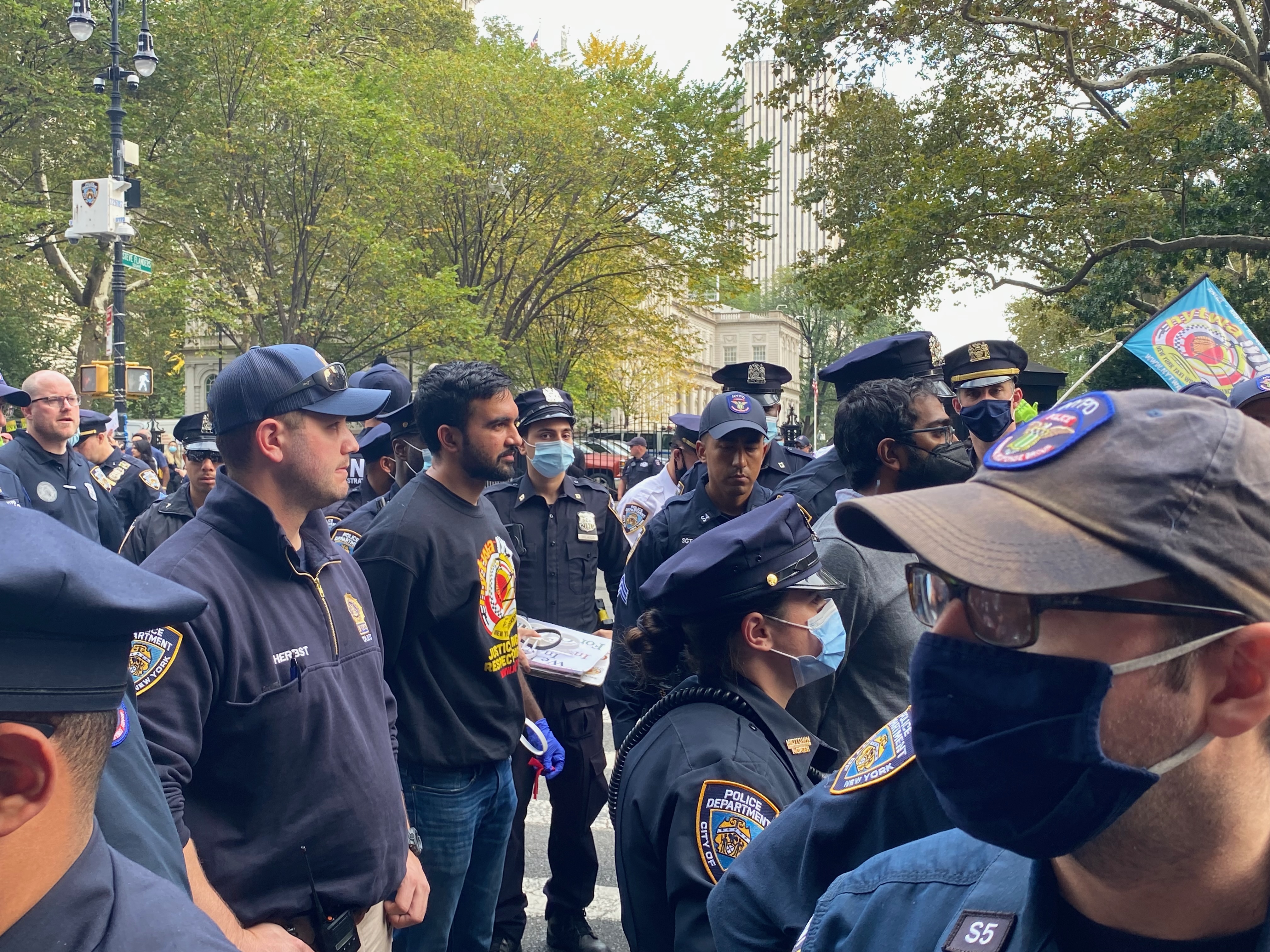
Five days later, Mamdani had traded his suit for jeans and a New York Taxi Workers Alliance sweatshirt. In an act of civil disobedience, he and other New York elected officials then sat down to block traffic in Lower Manhattan. With cameras watching, NYPD officers lifted them to their feet, zip-tied their hands, and loaded them into a waiting police van.

Mamdani being placed into a NYPD van following an act of civil disobedience.

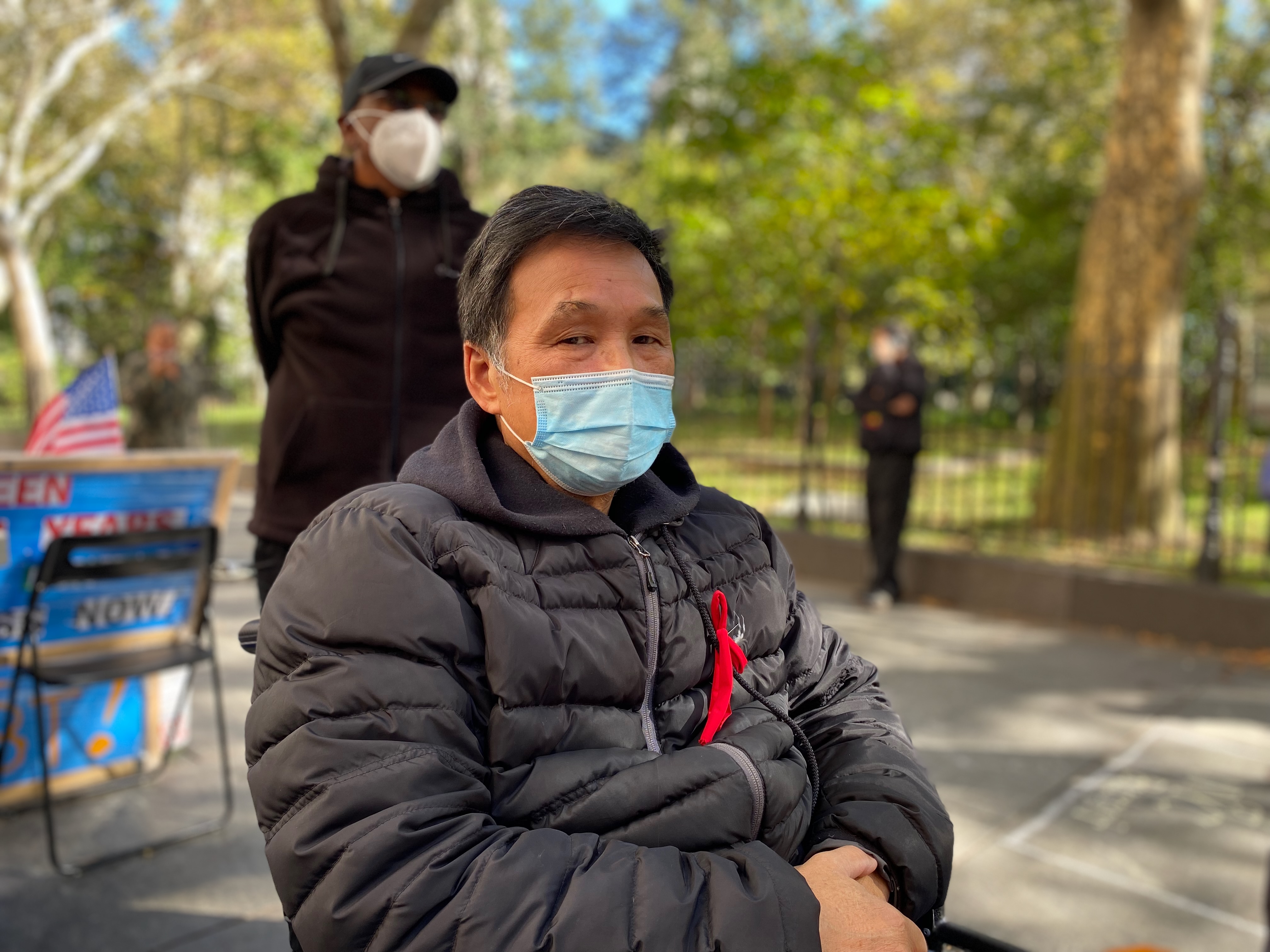
The next time I returned was Day 13. Chow, then 63 and living with diabetes, had started using a wheelchair. “We don’t have a choice,” he’d told me nearly two weeks before. “I don’t know how long I can stay here. This is our last moment to fight.” The fight was one tinged with tragedy for him. In 2018, Chow’s brother had died by suicide after purchasing a medallion for more than $750,000 and ending up deeply in debt.

It was not clear then, but the end was in sight. Two days later—on Day 15 of the hunger strike—the taxi drivers won.

Reversing course, Mayor Bill de Blasio agreed to a deal that capped debt loads at $170,000 and monthly payments at about $1,100. At the protest site, Mamdani took the bullhorn. “This is just the beginning of solidarity,” he shouted. “We are going to fight together until there is nothing left in this world to win.”

Moments later, Mamdani, Chow, and other hunger strikers broke the fast as they bit into halves of avocados. Chow stood briefly, then returned to his wheelchair—a fist raised in solidarity. Others celebrated with unrestrained joy.

Years later, in May 2025, I ran into Chow and his fellow taxi drivers again. This time, at a Williamsburg music venue, as they waited for Mamdani to take the stage at the first major rally of the campaign.

Mamdani was still the underdog at that point, but they’d seen him overcome the odds before. And soondid so again when Mamdani beat former Governor Andrew Cuomo in the primary.

On Thursday night, as his campaign came to a close, Mamdani was back where he began—with members of the Taxi Workers Alliance.

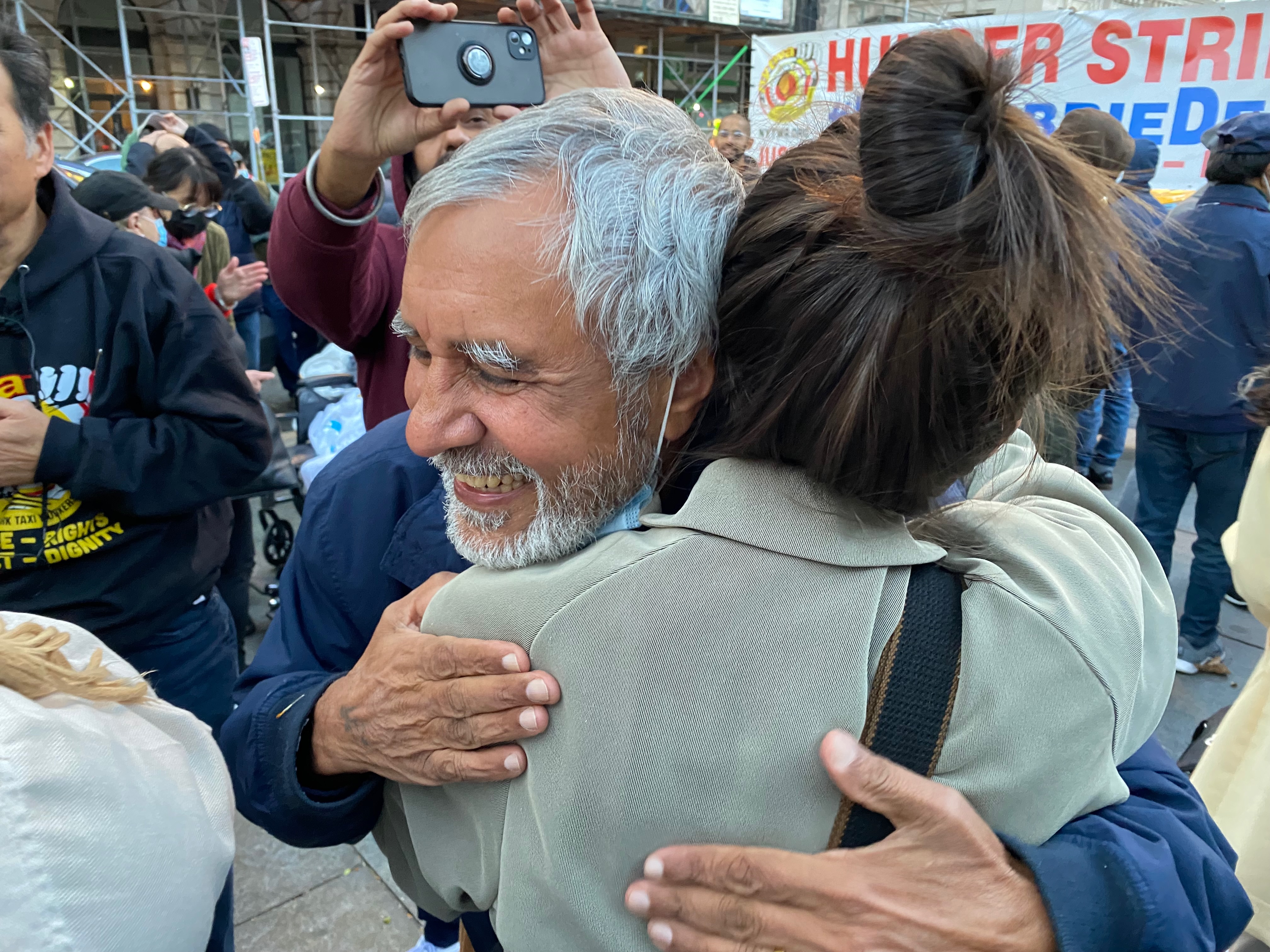
“Hello, Mr. Mayor Mamdani,” Chow said as they embraced. “I love you. We miss you.”

“I miss you, too,” Mamdani replied.

Continue Reading…

Mother Jones

Trump Sure Seems Eager to Starve the Poor

As the government shutdown slouches toward a historic milestone for the longest in US history, the high-stakes battle over SNAP—the country’s largest and most critical food aid program—once again devolved into chaos on Tuesday after the president issued his latest social media rant.

“SNAP BENEFITS, which increased by Billions and Billions of Dollars (MANY FOLD!) during Crooked Joe Biden’s disastrous term in office (Due to the fact that they were haphazardly ‘handed’ to anyone for the asking, as opposed to just those in need, which is the purpose of SNAP!), will be given only when the Radical Left Democrats open up government, which they can easily do, and not before!” he declared on Truth Social.

At first, the post appeared to be a stunning reversal of what had transpired almost exactly 24 hours earlier: On Monday, the Trump administration had said that it would comply with federal court orders to send at least partial payments to SNAP beneficiaries—after missing scheduled payments this weekend for the first time in the program’s 61-year history. (The administration, however, refused to use additional sources of funding that could provide full payments to the nearly 42 million Americans—39 percent of whom are children—who depend on the program.) Two judges last week found the government’s claim that it could not use any emergency funds to keep SNAP benefits flowing amid the shutdown to be meritless, with one ordering the government to draw up plans by noon on Monday for how it would restore payments.

So did Trump’s Tuesday social media post indicate that his administration was again reversing course and would now defy multiple federal judges? Asked to clarify on Tuesday, White House press secretary Karoline Leavitt told reporters that the administration still intended to “fully comply” with the court order. Leavitt said that she had spoken with the president and that—contrary to the plain meaning of his words—he was actually referring to future SNAP benefits once the contingency funds are exhausted.

One could argue that Trump’s Truth Social post was yet another effort to sow confusion, or that the president of the United States was once again posting without control—that it was harmless incompetence, even worth ignoring.But look closer and it distills the degree to which Trump and his Republican allies have been talking out of both sides of their mouths, as they lambast SNAP and its beneficiaries with misleading and often racist attacks, while arguing that it’s Democrats who are to blame for the pain.

Trump’s post also appears to evince his central stance in the fight over SNAP—that he is unwilling to help those in the greatest need purely because of politics, even when he is legally required to do so and when his own administration has already agreed to comply. That amid horrendously long lines at food banks around the country, the president is willing to let Americans go hungry.

Continue Reading…

Mother Jones

Dick Cheney and the Big Lie That Should Never Be Forgotten

In the final years of his life, Dick Cheney earned praise for breaking with his beloved Republican Party and defying Donald Trump, warning that Trump was a “threat to the republic.” That was commendable—and something of a counter to the efforts he made during his vice presidency to increase the power of the commander in chief and lay the foundation for the imperial presidency that Trump now seeks to establish. But Cheney, who died at the age of 84 on Monday, never addressed the worst transgression of his decades in politics and government: his deployment of lies to grease the way to the Iraq invasion that led to the deaths of more than 4,400 US soldiers and 200,000 or so Iraqi civilians.

There’s been much debate in the past two decades over whether Cheney and President George W. Bush, in the aftermath of the horrific 9/11 attack, lied to the public when they asserted that Iraqi dictator Saddam Hussein had built up an arsenal of weapons of mass destruction, was in league with Al Qaeda, and, thus, posed an imminent threat to the United States. Their defenders have long insisted that they merely relied on and conveyed bad intelligence produced by the intelligence community. But that case doesn’t hold up.

As Michael Isikoff and I showed in our 2006 book, Hubris: The Inside Story of Spin, Scandal, and the Selling of the Iraq War, Bush and Cheney repeatedly made false public statements about Saddam and the danger he presented that were unsupported by intelligence, and they routinely ignored the intelligence that raised questions about Saddam’s WMDs and his ties to Al Qaeada—which each turned out to be nonexistent. Cheney instructed his lieutenants within the national security establishment to cherry-pick bits of intelligence—often unconfirmed or contradicted—that supported the claims he and Bush were spewing. For instance, he cited Saddam’s possession of certain aluminum tubes as compelling evidence the Iraqi tyrant was enriching uranium for nuclear weapons—even though government scientists disputed this conclusion.

Whenever the question of Bush and Cheney’s selling of the war arises, their loyalists try to pin the blame on the CIA and others for the missing WMDs debacle. Langley, perhaps too eager to give Bush and Cheney what they craved, did, to a large extent, screw up the job. But Cheney was the guy who set that all in motion.

When assessing Cheney’s dishonesty, it’s only necessary to start at the beginning.

In the summer of 2002, as the first anniversary of 9/11 approached, the Bush-Cheney White House launched a campaign to persuade the American public that a war against Saddam was necessary. At the time, that was not a consensus view on Capitol Hill or among Americans. In fact, in mid-August, Senate Minority Leader Trent Lott (R-La.) called Cheney and told him that he believed public opinion was not yet with Bush and Cheney and that he himself didn’t believe the “predicate” for war had been established.

“Don’t worry,” Cheney told Lott, according to Lott’s memoir. “We’re about to fix all that.”

A short time later, on August 26, 2002, Cheney delivered a speech at a national convention of Veterans of Foreign Wars in Nashville, Tennessee, which was loaded with hair-raising rhetoric. “The Iraqi regime,” he declared, “has in fact been very busy enhancing its capabilities in the field of chemical and biological agents.” He proclaimed, “We now know that Saddam has resumed his efforts to acquire nuclear weapons… Many of us are convinced that Saddam will acquire nuclear weapons fairly soon.” He professed that nuclear weapons inspections would be pointless. He cut to the chase: “There is no doubt that Saddam Hussein now has weapons of mass destruction. There is no doubt he is amassing them to use against our friends, against our allies, and against us.”

No doubt. The veep said, no doubt. But he was lying. There was plenty of doubt.

Sitting on the stage for that speech was General Anthony Zinni, a former commander in chief of US Central Command who at the time was a special envoy to the Middle East. He later recalled,

It was a shock. It was a total shock. I couldn’t believe the vice president was saying this, you know? In doing work with the CIA on Iraq WMD, through all the briefings I heard at Langley, I never saw one piece of credible evidence that there was an ongoing program. And that’s when I began to believe they’re getting serious about this. They wanna go into Iraq.

Over the previous year and a half, top national security officials had repeatedly stated publicly and testified to Congress that Iraq was not a serious WMD threat to the United States. In March 2002, Vice Admiral Thomas Wilson, the director of the Defense Intelligence Agency, appeared before the Senate Armed Services Committee. Iraq was not among the five most pressing “near-term” security concerns for the United States that he listed. Wilson noted that UN sanctions and the American military presence in the region had succeeded in “restraining Saddam’s ambitions” and his military had been “significantly degraded.” He told the senators that Saddam might have “residual” amounts of weapons of mass destruction but no growing arsenal. He made no reference to any nuclear program or any ties Saddam might have to al Qaeda.

In his VFW speech, Cheney stated with no ambiguity that Saddam had assembled oodles of WMDs to use against the United States. The US government had no clear evidence of that. The iffy intelligence that Bush and Cheney would later cite was still to come. But this speech makes clear Cheney’s intent. He was willing to exaggerate and dissemble to get his war. He aimed to scare and bamboozle the American public with lies.

Cheney, who had been defense secretary for President George H.W. Bush during the first Gulf War, was hell-bent on launching this invasion to finish off Saddam. And like his boss, W., he did little to prepare for what would happen after US troops stormed into Iraq and toppled the Saddam. That was as big a transgression as the false sales pitch for the war. From the get-go, this was an enterprise of recklessness and deceit.

Cheney, as has been widely noted since his death was announced, had a remarkable career. He was a White House chief of staff (the youngest ever), a congressman, a Cabinet member, and a vice president, as well as the CEO of Halliburton. He did much to affect the world. (He encouraged the United States to engage in torture.) But the Iraq war was his most consequential action. It caused death, suffering, and loss for so many and created instability in the region that resonates to this day. It was a colossal miscalculation, one of the worse in US history. But more than that, it was one big lie. It was Dick Cheney’s lie.

Continue Reading…

Mother Jones

If the Trump Administration Wants More Babies, It Shouldn’t Let Poor Families Go Hungry

The Trump administration is thinking about your family.

This may come as a surprise, given that dozens of states and a coalition of nonprofits, local governments, and religious groups had to sue to compel the Department of Agriculture to release funding Congress set aside to keep food assistance (SNAP benefits) flowing to America’s poorest during a crisis, like the ongoing shutdown. (The agency now says it will comply, if only partially.)

Yes, this administration is thinking about your family—but in ways that are largely unhelpful and somewhat creepy.

Republican administrations have long obsessed over the integrity of the conventional nuclear family. From Ronald Reagan to Bush 43, presidents have engaged in quixotic (and expensive) campaigns to boost the marriage rate. The Trumpists, with Vice President JD Vance taking the lead, have a slightly different focus: They want to convince us to make more babies. Never mind that they aren’t taking care of the children we already have.

The pro-natalist movement is neither new nor restricted to conservatives, but the current iteration is a logical product of the Trumpian flirtation with blood-and-soil nationalism. The administration seeks to promote a culture of motherhood, educate women on how to get pregnant, and take one more shot at increasing the marriage rate—all in an attempt to counter leftist cultural changes that conservatives claim are responsible for smaller families and declining birthrates. It’s all red meat to the Great Replacement theorists in the GOP base.

Trump’s big bill will reduce the after-tax income of the bottom income quintile—the poorest fifth of American households—by an estimated 3 percent.

This push for natalism includes scattershot economic components. The administration has sought to prioritize funding for roads in places with higher birth rates, and to reserve a portion of federally funded scholarships such as the Fulbright for parents. More importantly, it intends to compensate mothers for giving birth.

The wildly unpopular One Big Beautiful Bill Act (OBBB), which Trump signed into law in July, guarantees each newborn a $1,000 “Trump account” and encourages parents to contribute up to $5,000 a year until the “baby” turns 18—at which point it changes into something like an individual retirement account. The law also increases the child tax credit and indexes it to inflation. Such initiatives are broadly popular and have at least some bipartisan appeal. (Democrats pushed for an expanded child credit under President Joe Biden last year, but Senate Republicans, who aimed to portray their rivals as, to quote Vance, “anti-family and anti-child,” killed the bill to deny the Democrats a win. Subsidies for college and retirement savings have proved popular with both parties, even though the benefits flow overwhelmingly to the rich.)

The average cost of raising a child in the United States is well over $15,000 a year, so every little bit helps. Still, as sociologists and coauthors of the recent book Thanks for Nothing: The Economics of Single Motherhood Since 1980, we were underwhelmed by the giveaways in Trump’s big bill, which takes a lot more than it gives—a fact underscored by the administration’s eagerness to withhold those food stamp benefits.

The baby bonds and child tax credit are weak sauce when held up against the bill’s drastic cuts to SNAP and Medicaid, which are to be accomplished largely through work requirements. Beneficiaries with children 14 or older are now required to work or volunteer at least 80 hours a month. And while that may sound reasonable, the real purpose, as Mother Jones has documented, is to impose new bureaucratic hurdles—think bewildering web portals and DOGE-decimated tech support conjoined by red tape—so onerous that tens of millions of otherwise eligible Americans will simply give up. When the nonpartisan Congressional Budget Office said as much in its analysis of the legislation, Trump and his congressional allies predictably responded by attacking the messenger.

The Republicans’ justification of work requirements to ensure that only the “truly needy”—the deserving poor—get government support, harks back to the Reagan-era war on government support for families. During the 1980s, bloviation about “welfare queens” and “government dependency” helped shift the political rhetoric away from economic policies that actually improve the lives of families with children—who make up more than one-third of SNAP recipients. (Curiously, neither the OBBB nor the shutdown has imperiled WIC, a separate program that provides limited additional assistance to new mothers.)

While government assistance has become less important for single mothers overall, it is a lifeline for those at the bottom.

The GOP’s supposed pro-natalist policies, meanwhile, grievously fail to account for the broader needs of families with children. The Yale Budget Lab calculated that Trump’s big bill will cost the bottom income quintile—the poorest fifth of US households—about 3 percent of their after-tax income when you factor in lost Medicaid and SNAP benefits. Those families will owe a little less tax on earned income but lose a lot more thanks to the spending cuts.

In addition, the Trump tariffs, which amount to a regressive sales tax, will fall hardest on families struggling to make ends meet, costing those bottom-quintile families about $1,000 more per year, according to the budget lab’s latest estimates.

Contrary to the pro-natalist rhetoric, the administration’s policies will wreak particular havoc on the lives of single mothers, who raise almost a quarter of the nation’s children. In the book, we show that family structure has a deep and abiding relationship to poverty. Not all single-parent families are poor, of course, but incomes within the single-mother category have grown increasingly unequal. This isn’t because a new, large class of uber-rich single moms has emerged, but rather because our nation has created a new underclass of uber-poor ones.

Federal policy has much to do with this. In the wake of Bill Clinton’s 1996 welfare reform legislation, many women successfully transitioned from government aid into the booming job market of the late 1990s, abetted by an expanded Earned Income Tax Credit (EITC), which gives cash back to low- and middle-income workers.

But wealth and income inequality, accelerated by decades of Republican “trickle-down” tax cuts, became even more pronounced as the bull economy petered out with the recessions of the 21st century. And although some single mothers thrived in the workforce, others didn’t earn enough to qualify for the EITC, and could no longer count on federal cash welfare. Now, with the passage of Trump’s signature legislation, many won’t qualify for Medicaid or food assistance either.

Why would any politician who claims to care about families support this? Well, Congress has taken Trump’s side in an ideological war over how the US government approaches its obligation to America’s children. The administration’s position is that it’s the government’s job to encourage people to have more kids, preach the merits of marriage (between an actual man and an actual woman), and give couples a little cash to start a family. Pro-natalism will, they believe, lead to economic growth and prosperous families that are solely responsible for their children’s welfare—if families are struggling, it’s because the parents aren’t working hard enough.

When it comes to alleviating poverty, offering tax cuts to families who don’t earn enough to benefit from them won’t cut it.

This theory of prosperity supplants the older social democratic ideal: that the purpose of family policy is to guarantee all children a minimum quality of life, and to help ensure they can achieve their potential in a capitalist society that inevitably leaves some families behind. Hardly a leftist, Benjamin Disraeli, who served two stints as Britain’s prime minister during the 1800s, articulated this ideal when he wrote that “power has only one duty: to secure the social welfare of the People.”

As we demonstrate in Thanks for Nothing, many single mothers do manage to make it in the labor market. Today mothers have more job experience and are more likely to work even when they have young children. They also have more education, and thus better jobs. Yet a subset of single mothers have fallen behind, especially the increasing proportion who have children out of wedlock. Surveys show that many would like to be married, but that’s just not always a viable option in communities of unemployed and under-employed men.

The median income for never-married mothers has remained essentially stagnant over the past 40 years, while the bottom 10 percent of this group has seen shrinking incomes and today basically has zero work income. While government assistance has become less important for single mothers overall, it is a lifeline for those at the bottom. The level of support was never great, but it provided essential subsistence. The bill Congress passed in July will make the lives of these women and children even worse, and the administration has made clear that it will make no effort to remedy that.

Mitigating family poverty requires federal action, not just reliance on the labor market as it’s currently constituted. The conversation lawmakers should be having involves debating which policies might actually make a difference. A universal basic income? The wage subsidies proposed by conservative think tanker Oren Cass? Or perhaps the refundable child tax credits proposed by then-senator Mitt Romney in 2019?

Reagan was not wrong when he praised the effectiveness of the EITC as an anti-poverty tool, but it’s clear that the labor market has failed many single mothers and their children. Offering tax cuts to families who don’t earn enough to benefit from them won’t cut it. Until the government can muster up real, honest discussions on how to support all American families, it’s hard to imagine the Trump administration’s policies moving anyone, except maybe MAGA trad wives, to procreate.

Continue Reading…

Mother Jones

The Tariffs Case Is About Power and Loyalty on the Right

On Wednesday, the Supreme Court will hear oral arguments over President Donald Trump’s decision to impose tariffs on almost every nation on earth, in ever-changing amounts, whenever he feels like it. Legally, this is a case about any number of complicatedquestions and legal doctrines, including the president’s ability to declare emergencies under the International Economic Emergency Powers Act, the court’s novel major questions doctrine, its dormant non-delegation doctrine, the proper venue for challenging the tariffs, and the proper statutory interpretation of IEEPA.

“This is not just a battle over tariffs.” It’s a battle over just who is in charge of the GOP.

But these questions will almost certainly be window-dressing on a decision driven by how Chief Justice John Roberts and the other five Republican appointees navigate between the two stakeholders in this case: the powerful billionaires and business interests behind the challenge to the tariffs and Trump’s desire to transform the economy into an arm of his personalist rule.

“This is not just a battle over tariffs,” explains Evan Bernick of the Northern Illinois University College of Law. “It is a battle between competing political economies within the American right. And how it works out will speak to just who ultimately has hegemony, who… is shaping the law of the United States.” While Bernick expects the businesses and states challenging the tariffs to prevail, “if they do not,” he says, “that tells me things about the relative power of these competing factions that I did not previously know.”

In February and again in April, Trump cited IEEPA when imposing his sweeping—and sometimes very high—tariffs, some of which he went on to pause. Whilethe Constitution grants Congress the power to impose tariffs, Trump claimed his actions were a legitimate use of that 1977 law, which gives presidents power to respond to “any unusual and extraordinary threat” from abroad, even though IEEPA doesn’t specifically name tariffs as an available tool. The court is hearing two consolidated cases brought by multiple small businesses. Some of the companies’ challenges were brought with support from ideologically conservative and libertarian nonprofits funded by wealthy Republican-allied donors, most notably the Koch network.

For decades,the Kochs and their fellow-traveling tycoons, along with the religious right, channeled millions of dollars into a project to capture the Supreme Court, successfullycreating a loyal 6-3 conservative majority. Beginning in 2005 with Roberts’ nomination, the Federalist Society vetted Republican nominees and their allies helped win their confirmations with lots of money. As Lisa Graves, who leads the judicial watchdog group True North Research and has published a new book on Roberts, recently told me, “Roberts is really the beneficiary of the first billionaire-backed campaign to capture the US Supreme Court.” He’s spent the last 20 years implementing their agenda.

The Roberts Court consistently rules for the interests of this small set of billionaire politicaldonors, whose money flowed to the Federalist Society and other activist groups that helped each of the Republican-appointed justices reach the high court. Further, under Roberts, these members of the court have increased the political power of the GOP and its wealthiest patrons. For example, the court has been dismantling the Voting Rights Act to the benefit of the GOP, a project they will likely finish in the next few months. It has alsocut the power of labor unions, and, by overturning the long-held practice of courts deferring to agency expertise, declared open season on federal regulations that industry dislikes. In its stead, the justices invented the major questions doctrine to justify striking down executive regulations the court decides are “major” and that don’t have clear authorization from Congress, and created increasingly radical interpretations of the unitary executive theory that have weakened agency independence so that partisan politics can destroy industry regulation.

This clear preference for moneyed interests was detailed by employment lawyer Scott Budow in a 2021 law review article on how the Roberts Court has changed labor and employment law. He discussed 15 cases in which the justices cast a collective 134 votes. “There is no unifying judicial philosophy—such as originalism or textualism—that neatly explains why conservative justices would reliably vote in one manner and liberal justices in the opposite manner for these cases,” he concluded. “Yet, if all one knew was that conservative justices favor employers and liberal justices favor workers, that person would have correctly predicted 132 of the 134 votes cast.” That is 98.5 percent of the time.

“Trying to interpret or anticipate what’s going to happen in cases involving Trump inside the four corners of legal reasoning will fail, and hasn’t really explained almost anything the Robert’s court [has done] for the last 20 years,” says Michael Podhorzer, the former political director of the AFL-CIO. “Instead, if you step back and think about the interests that elevated the six of them to the court, then that is really very clarifying.”

This case has big business going up against the president.

In their2022 book The Scheme: How the Right Wing Used Dark Money to Capture the Supreme Court, Sen. Sheldon Whitehouse (D-R.I.) and attorney Jennifer Mueller breakdown not only the story of how a small handful of rightwing families and groups channeled millions to put allies on the court, but how they also fund an array of legal outfits to bring cases and file amicus briefs—filings that help to signal to the justices which way their benefactors hope they will rule. As Whitehouse and Mueller write, between 2014 and 2020, 16 rightwing foundations gave nearly $69 million to 11 groups that filed amicus curiae briefsurging thecourt to hobble the Consumer Financial Protection Bureau, which guards against predatory financial industry practices, as well as more than $33 million to the Federalist Society. These groups include the Washington Legal Fund, the Pacific Legal Foundation, the New Civil Liberties Alliance, and the Liberty Justice Center—all of which have used Koch money to challenge labor unions and weaken government regulations. Repeatedly, the GOP wing of the court has handed theseorganizations, and their donors, major victories.

Those same four legal groups that worked so hard to disempower unions and destroy the regulatory state are now before the court with a new request: stop Trump’s arbitrary tariffs. They have a strong case, at least under the Roberts court’s precedents—after all, the justices have created a brand new doctrine, the major questions doctrine, and used it tostrike down regulations without clear statutory authorization that industry doesn’t like. Tariffs on nearly every nation are by every measure “major” actions that can make or break businesses and reshape both the US and world economies.

But unlike in other major questions doctrine cases, when industry was pitted against Democratic priorities like environmental regulations or student debt relief programs that the six conservative justices struck down, this case has the business community going up against the president.

Trump, too, has been on a winning streak before the six GOP justices, who have repeatedly used their emergency or shadow docket to greenlight the president’s agenda, from slashing the federal bureaucracy to detaining suspected immigrants based on the color of their skin. As of last month, Trump had won some 21 emergency appeals to the court. The Republican wing even restricted lower courts’ authority to grant relief from Trump’s policies. The logical conclusion is that the justices are either on board with Trump’s authoritarian project, protective of his political coalition, or possibly also afraid to cross him for fear he disobeys their orders.Perhaps it is a combination of these factors, but the result is a court that contorts itself—or remains completely silent—in order to repeatedly rule in Trump’s favor. As Justice Ketanji Brown Jackson wrote in a dissent in August, analogizing her colleagues jurisprudence to a make-believe game from Calvin and Hobbes: “Calvinball has only one rule: There are no fixed rules. We seem to have two: that one, and this Administration always wins.”

But this time, the administration is up against the court’s other preferred client, and one of their winning streaks must come to an end. One view of what’s coming starts with the solid premisethat while ultrawealthy business interests don’t agree with all of Trump’s agenda, they prefer him to a Democrat. If we presume that Roberts and the court’s other Federalist Society recruits similarly view Trump as an essential—even if often misguided—element of their project, then they will try to limit his tariffs without strongly rebuking him. “I think the calculus that they’re going through is basically, ‘Would trying to stop him there lead to electoral defeat, or not? Is it too damaging to them?’” says Podhorzer, who also expects the court “at a minimum” will “do something that trims or constrains” Trump’s claimed tariff powers.

“It’s important to look at whatever they end up doing as a reflection of where that business community is right now,” he adds. A decisive victory for Trump might signal that big business will tolerate a tariff regime in which they write multi-million dollar checks to Trump’s ballroom project in exchange for waivers—although they don’t seem to be there yet because, after all, they did helpbring this challenge in the first place. A big Trump win could also signal that the justices themselves sense a fundamental shift in where power lies on the right, from the moneyed interests that created the court to the openly authoritarian MAGA movement.

Legally, there are a lot of ways the justices could resolve this case. But it will be more illuminating to think of the Republican wing not as judges weighing arguments but as mediators seeking a compromise between two competing factions of the same team.

Continue Reading…

Mother Jones

For at Least One Small Iowa Rancher, This Shutdown May Prove the Final Straw

This story was originally published by Grist and is reproduced here as part of the Climate Desk collaboration.

Last June, record flooding swept through the rural town of Rock Valley, Iowa. As the wall of water began to overtake Chelsie Ver Mulm’s 10-acre plot of land, she rushed into action, rapidly evacuating her family’s gaggle of cows, sheep, chickens, pigs, horses, and goats to higher ground. When the floodwaters receded, Ver Mulm returned to find much of her family’s farm, equipment, and pasture destroyed. In the days and weeks that followed, more than a dozen animals died from stress and diseases contracted from the flood.

From there, the costs of rebuilding continued to climb. Because the flood had ravaged the surrounding areas, Orange Creek Farms also lost many of its customers, who were grappling with damages of their own and could no longer afford to buy local food. All the while, Ver Mulm kept applying to emergency USDA loans and disaster relief programs—only to be denied again and again as the tiny operation confronted burdensome application issues and eligibility restrictions.

Because of the steep costs of recovery, the farm has fallen behind on its bills, and caring for a bigger herd became too expensive. Now, Orange Creek Farms is down from 40 cattle to just four. All told, the flood put the business in a “really, really bad spot,” according to Ver Mulm.

So in April, almost a year after the flood, she made a last-ditch effort to turn things around, applying for a USDA Rural Development grant that she was hoping could help them offset their losses and keep the business afloat.

When the government shutdown began more than a month ago, the USDA furloughed the vast majority of the remaining workforce and brought most services to a sudden halt. Ver Mulm still hadn’t heard back about her application—and now the waiting is itself becoming the problem.

As the shutdown nears a historic, yet grim, milestone, the Congressional Budget Office estimates that it has already created financial losses of at least $7 billion for the US economy. Battling some of the most consequential impacts of these losses are those who grow and sell the food we eat—especially the farmers and ranchers also dealing with the compounding effects of extreme weather and an eroding federal safety net.

Approximately 20,000 Department of Agriculture staffers have lost their jobs this year—a rapid and radical transformation of the agency resulting in administrative struggles, overworked employees, and significant delays in processing of payments and financial assistance applications.

This summer, Agriculture Secretary Brooke Rollins released a controversial reorganization plan that experts expect to result in further staff reductions and a skeleton workforce. The USDA announced last week that approximately 2,100 county-level USDA Farm Service Agency offices would be reopened beginning Thursday, October 23, with two staffers reinstated per office, to help farmers get access to $3 billion in aid from existing programs, though further details about what programs, payments, and services will be resumed and to what extent remain unclear.

All the while, small farmers and ranchers have spent the last 10 months facing off against mounting pressures wrought by major administrative changes to food and agriculture policy that have exacerbated the nation’s exceedingly volatile farm economy.

The impact on producers, whose businesses require advance planning—in a time of the year normally filled with finalizing future growing plans, buying seeds and other resources, and shoring up winter reserves—will only grow the longer the shutdown persists.

And so will the broader economic and societal ripple effects unfurling nationwide: The Trump administration initially declared that it would not tap into billions of dollars in emergency funding that Congress set aside to maintain the Supplemental Nutrition Assistance Program during times of crisis. Without that funding, the USDA said that SNAP benefits, used by nearly 42 million Americans who struggle to afford groceries, would be suspended on November 1. (SNAP is also a crucial source of income for many small farmers.)

Last week, after more than two dozen states—and, separately, a coalition of local governments, nonprofits, and religious groups—sued the USDA, two federal courts ruled that the department must tap into those contingency funds to cover at least some of the SNAP benefits for November. On Monday, the Trump administration said it would comply, but would not fund the program further—and that there would be only partial payments this month.

Prior to the rulings, Secretary Rollins blamed Democrats for the shutdown and possible loss of benefits for millions of Americans, while stating (falsely) that the department did not have the legal authority to distribute the agency’s contingency funding. In a Friday press conference, she criticized SNAP, remarking that the shutdown exposed a program that, under the purview of the Biden administration, became “so corrupt.”

The USDA did not immediately respond to Grist’s request for comment.

Meanwhile, Hill policymakers have continued to sling accusations across the aisle in their budget standoff over federal healthcare. Trump has urged congressional Republicans to unilaterally end the shutdown by getting rid of the filibuster, an unprecedented move by the president, though many GOP senators remain in support of the rule. If Congress is still at an impasse come early next week, it would mark the longest shutdown in US history.

Every day of delay brings more prolonged uncertainty to farmers like Ver Mulm. Even if lawmakers manage to vote to reopen the government in the near future, the second-generation Iowa farmer worries that the backlog USDA staffers will be facing after all the time spent furloughed, compounded by the already-strained workforce, will translate to further bottlenecks.

Over the last year, Ver Mulm has drained her savings to stave off having to sell the farm, living off of credit cards. Now, her credit score is shot, and Orange Creek Farms is on the cusp of insolvency. And with each day that passes with the government remaining in limbo, the small window to save their farm gets smaller. Ver Mulm is emotionally preparing herself for what’s to come—a growing likelihood that her family will soon need to close the chapter on feeding their community. “We’ve exhausted all of our options,” she said. “This grant is our last chance to keep the farm going. It’s our last lifeline.”

This story was updated from the original version to reflect the latest news related to the emergency SNAP funding.

Continue Reading…

Mother Jones

What Tuesday’s Elections Mean for the Future of Abortion Access

Abortion may not technically beon the ballot in Tuesday’s off-year state elections, but in the post-Roe v. Wade era, abortion is always on the ballot. Since the US Supreme Court’s 2022 Dobbs ruling that ended the federal right to abortion, statewide elections have become opportunities for reproductive rights supporters and opponents alike to expand or limit access to care by voting on the politicians who create the laws, the judges who enforce them, and, sometimes, on the laws themselves.

When voters have had the opportunity to weigh in directly on ballot measures enshrining abortion protections, those measures have mostly won, even in red states. When the vote is indirect—that is, for people rather than policies—the results are much more mixed. Just consider what happened in 2024,when states that approved abortion-rights measures also went for anti-abortion judges and Donald Trump. This week’s elections are the first time that large numbers of voters can express their feelings about the country’s radical change in direction under Trump 2.0. In five states, the results will also have major statewide and even national implications for access to reproductive care.

CALIFORNIA

California’s Proposition 50, the blockbuster redistricting measure designed to stop Republicans from rigging next year’s midterm elections, will affect all kinds of democratic rights, including reproductive autonomy. Prop 50 would temporarily suspend California’s current congressional maps, which were drawn by an independent citizens commission, and allow the Democratic-controlled legislature to create new maps that would remain in place through 2030. Governor Gavin Newsom and his allies got the idea after Texas lawmakers, buckling to Trump’s demands, redrew their congressional map to elect more Republicans—potentially enough to keep the US House of Representatives under GOP control in 2026 and beyond. If approved by voters, Prop 50 could sufficiently alter the partisan makeup of California’s House delegation—currently 43 Democrats and nine Republicans—to effectively negate the Texas redistricting effort. Polls show that California voters are very much on board.

Republicans currently have a slim six-seat majority in the House; a wider margin could empower them to unleash all manner of new legislative horrors on the country, including, potentially, an extension of this year’s temporary defunding of Planned Parenthood and even a national ban on abortion after 15 or 20 weeks of pregnancy. A Democratic majority, on the other hand, would bring the GOP legislative machine in Congress grinding to a halt. With so much at stake, total spending by both sides is well north of $175 million. During a press call, Alexis McGill Johnson, president and CEO of Planned Parenthood Federation of America, described the GOP efforts to further gerrymander red states as “a naked attempt to steal congressional seats” and “an emergency for our democracy.” Prop 50, addedJohn Bisognano, president of the National Democratic Redistricting Committee, is “a defensive shield for our democracy and for reproductive rights.”

NEW JERSEY

New Jersey voters will pick a new governor and all 80 members of the General Assembly. With Democrats currently holding a 52-to-28 majority there—and a 25-15 margin in the state Senate—most of the attention has been on the tight race between Democratic congresswoman Mikie Sherrill and Republican ex-assemblyman Jack Ciattarelli, to replace termed-out Democratic Gov. Phil Murphy. Recent polls show Sherrill—a former Navy helicopter pilot and onetime federal prosecutor—narrowly ahead. But Ciattarelli, who nearly ousted Murphy in the 2021 race, is hoping he can ride Donald Trump’s 2024 coattails to victory on Tuesday. (Trump didn’t win the state but made huge gains compared to 2020.) New Jersey’s pattern of flip-flopping between Democratic and Republican governors may be another factor in Ciattarelli’s favor: No party has held the office for three consecutive terms since 1961.

Months before Roe was overturned, New Jersey lawmakers passed the Freedom of Reproductive Choice Act, enshrining protections for abortion care into state law; Sherrill would go further, adding these protections to the state constitution. Ciattarelli, by contrast, would ban abortion after 20 weeks (currently there are no gestational limits), end coverage under state Medicaid, and require parental consent for minors. A Democratic legislature, however, would thwart any efforts to put those policies in place.

But Ciattarelli would be able to stop new reproductive protections from becoming law—for example, potential legislative efforts to strengthen the state’s shield laws that protect abortion providers who care for out-of-state patients. Reproductive rights advocates point to what happened during the tenure of Gov. Chris Christie, a Republican who was in office from 2010 to 2018, during which he repeatedly vetoed funding for family planning. “We’ve been here before, and we know what we could expect under a Ciattarelli governorship,” Kaitlyn Wojtowicz of the Planned Parenthood Action Fund of New Jersey told the New Jersey Monitor. “It would be devastating for public health.”

PENNSYLVANIA

For decades after Roe v. Wade became the law of the land, Pennsylvania activists and politicians led the fight to narrow its reach—if not overturn it altogether. These days, despite Roe’s reversal, Pennsylvania continues to allow abortion through 23 weeks of pregnancy, albeit with significant restrictions, including a 24-hour waiting period, bans on Medicaid coverage, and a parental consent requirement for minors. The Pennsylvania Supreme Court demonstrated last year just how much the state has shifted, ruling that the 42-year-old Medicaid ban is a form of sex-based discrimination under the state’s Equal Rights Amendment. The decision suggested that courts might be open to throwing out other abortion restrictions that lawmakers—with Republicans controlling the Senate and Democrats holding a single-seat majority in the House—seem unlikely to repeal anytime soon.

On November 4, the Democratic justices responsible for that ruling—Kevin Dougherty, Christine Donohue, and David Wecht—will come before voters in a retention election with enormous consequences not just for abortion, but for next year’s midterm elections and the 2028 presidential election in a crucial swing state. This is the same court, after all, that struck down Pennsylvania’s congressional map in 2018 as an unconstitutional gerrymander and rejected complaints about election monitoring by Trump’s 2020 campaign.

The three justices were first elected in 2015, in a sweep that flipped the court to Democrats. If they win on Tuesday—and in the state’s history, only one justice has ever lost a retention vote—they will serve for up to another 10 years. If they lose, only two Democrats and two Republicans will remain, and the next judicial election will not take place until 2027. Political infighting in the meantime would hamper efforts by Democratic governor Josh Shapiro to appoint temporary replacements—a situation that Justice Donohue told the Associated Press could lead to “chaos.” Spending in the races is expected to exceed $15 million—far surpassing previous retention elections—as Democrats try to blunt Republican efforts to retake the court.

TEXAS

Texas parentshave long had the right to oversee their children’s education and health care and direct their upbringing. Those protections got a lot stronger this year, with the passage of Senate Bill 12—the “Texas Parents Bill of Rights”—which, among other things, requires schools to obtain parental consent before students can receive health services, including counseling, or participate in school clubs and organizations. But that bill—and a slew of other new laws that make it easier for parents to challenge the policies and curricula in schools that they don’t like—still weren’t enough for Texas’s parental-rights extremists. Lawmakers also approved Proposition 15, a constitutional amendment on Tuesday’s ballot that would enshrine a parent’s rights “to exercise care, custody, and control of the parent’s child, including the right to make decisions concerning the child’s upbringing. ” It would also enshrine a parent’s responsibility “to nurture and protect [their] child.”

Supporters claim the constitutional amendment is needed to ensure that parents’ rights can’t someday be repealed. Opponents say the amendment would make it even harder for minors to access contraception and sex education, and for LGBTQ kids to navigate an ever-more-hostile political environment. Prop 15’s vagueness and allusions to parental “responsibility” are also concerning. The measure would “open the door for another parent’s personal beliefs to strip rights from other people’s children and their families,” the reproductive justice group Avow Texas warns, and could lead to “delays in young people getting care, censorship in schools, and increased family policing.”

Opponents’ other big fear is that Prop 15 will inspire conservative lawmakers in other red states to pass copycat bills. Denise Rodriguez of the Texas Equal Access Fund says the ballot measure is “about perpetuating the culture wars” and conservatives’ desire to crush dissent: “They want to do everything that they can to control the way that people live.”

VIRGINIA

Virginians will choose a new governor to replace Republican Glenn Youngkin, who is barred from running for a second consecutive term, as well as a new lieutenant governor, attorney general, and members of the 100-seat House of Delegates. According to recent polls, Abigail Spanberger, a former CIA officer and three-term congresswoman, is leading her Republican opponent, current Lieutenant Gov. Winsome Earle-Sears, in the race to become the state’s first female governor. That comes as a relief to abortion rights supporters, given Earle-Sears’s past statements equating abortion to “genocide” and supporting a six-week ban. Virginia is the only Southern state that hasn’t restricted abortion in the post-Dobbs era; the procedure remains legal through 21 weeks of pregnancy, which has made it a destination for patients from around the South who can no longer obtain care where they live.

The real battle over the fate of abortion in Virginia is taking place in legislative races. Democrats now control both chambers of the General Assembly—the House of Delegates by a 51-48 margin and the state Senate by 21-19. That narrow majority allowed Democrats to pass a proposed ballot amendment this past winter that could let voters decide whether to enshrine abortion protections in the state constitution. But under Virginia law, legislators must pass the amendment again during the 2026 session; then voters will get the final say next November. Republicans are targeting a few key races in Tuesday’s election in hopes of flipping control of the House and derailing the constitutional amendment. (The next elections for the state Senate take place in 2027.)

The House of Delegates races alsocould affect two other proposed constitutional amendments passed by lawmakers this year. One would restore voting rights for people with past felony convictions. The other would remove a ban on same-sex marriage from the state constitution—a now-defunct “zombie” law that could potentially be revived if the Supreme Court were to overturn its 2015 ruling that gave gay couples the right to marry. It’s a lesson Democrats learned after the Dobbs ruling: Counting on the Supreme Court’s conservative supermajority to protect existing rights is dangerous. Especially when some of the same conservatives who worked so hard to overturn Roe are now gunning for gay marriage.

Continue Reading…

Mother Jones

Report: ICE Shot a US Citizen Trying to Help Kids

For the second time in a little over a week, Immigration and Customs Enforcement (ICE) officers reportedly shot someone in Los Angeles, California. This time, it was a US citizen who ICE officers shot from behind while he was driving a car, according to a report from the Los Angeles Times.

“He was telling them, ‘Excuse me. Can you guys please, you know, please wrap this up.’ And immediately, the masked agent pulls out a gun.”

The victim was a 25-year-old named Carlos Jimenez, who is a father of three. He was shot after getting out of his car to tell ICE agents, who had pulled over a vehicle, that children would soon be gathering in that spot for the school bus, his lawyer, Cynthia Santiago, told the newspaper. The agents’ cars had blocked a southern lane on the road and jutted into a second lane, according to the LA Times. “He was telling them, ‘Excuse me. Can you guys please, you know, please wrap this up.’ And immediately, the masked agent pulls out a gun and exchanges some words,” Santiago told the newspaper.

The lawyers allege that Jimenez then got in his car, reversed because he was afraid, and was shot in the back of his right shoulder, where a bullet remains lodged. “Use of deadly force is to be used as a last resort,” Santiago said. “Coming out to communities with guns drawn is the opposite.”

ICE, for its part, has offered a more sinister characterization of the events. Tricia McLaughlin, a spokesperson for the Department of Homeland Security (DHS), told the LA Times that Jimenez “attempted to run officers over by reversing directly at them without stopping” and that the shots were “defensive.” Jimenez was charged in federal court with assault on an officer and released on bond Friday.

In the ICE agent’s criminal complaint, filed in federal court on Friday, he claims Jimenez “engaged in a verbal altercation with the officers” and that the complaining officer then told Jimenez to leave and grabbed his pepper spray. As this unfolded, the complaint claims, Jimenez pulled his car forward and to the left, and then apparently turned and “rapidly accelerated in reverse.” One of the officers at the scene apparently “feared that the [Jimenez’s car] would hit [the officer]” and the car they had previously pulled over.

There does not yet appear to be any publicly available video of the incident. Jimenez’s condition was not immediately clear.

There have been other recent reports of immigration officers shootings. Between August and October, ICE officers reportedly shot into four cars—one in LA less than two weeks ago; two in Chicago, including one that was fatal; and one in San Bernardino.

McLaughlin, the DHS spokesperson, told the LA Times that the latest incident is “another example of the threats our ICE officers are facing day in and day out as they risk their lives to enforce the law and arrest criminals.”

But what it more likely indicates is even more proof that, as my colleague Noah Lanard wrote last week, ICE seems to pose a far greater danger to civilians than the other way around—contrary to the agency’s claims that they require the National Guard’s protection.

As he wrote:

A Mother Jones review shows that there is little evidence that ICE agents face such severe and widespread danger compared with other law enforcement agencies that they need military personnel to come to their aid or to break from centuries of public accountability by hiding behind masks.

The Trump administration has provided almost no information to back up its statements about rising assaults, which makes its claims hard to assess. But details about ICE officers who’ve died on the job are readily available on the agency’s website.

Those records show that none of ICE’s agents have ever been killed by an immigrant in the agency’s more than two-decade history. Instead, the leading cause of death by far among ICE officers is COVID-19.According to ICE’s data, the second leading cause of death is cancer linked to 9/11. (The pandemic and cancers connected to the September 11 terrorist attacks account for 75 percent of the deaths in ICE’s history.)

Continue Reading…

Mother Jones

Trump Brags He Could Invade Your City Whenever He Wants

In a wide-ranging Sunday night interview on CBS News’s “60 Minutes,” President Donald Trump put his desire for unchecked power on full display.

He bragged to correspondent Norah O’Donnell that, thanks to the Insurrection Act of 1792, he can invade your city whenever he wants. He said immigration raids—including acts of police violence such as using tear gas in residential neighborhoods, throwing people to the ground, and breaking car windows—”haven’t gone far enough.” And he said the government shutdown will last until Democrats in Congress bend to his will—or until Senate Majority Leader John Thune (R-S.D.) agrees to eliminate the filibuster, which Thune, so far, has rejected.

Here are some of the biggest takeaways from Trump’s comments on domestic policy:

Trump blamed the shutdown on the Democrats

As the federal government shutdown enters its fifth week—on pace to be the second-longest in history after the one that stretched from December 2018 into January 2019—O’Donnell had a straightforward question for Trump: “What are you doing as president to end the shutdown?” His answer? Blaming the Democrats.

“The Republicans are voting almost unanimously to end it, and the Democrats keep voting against ending it,” Trump said. “They’ve lost their way,” he added. “They become crazed lunatics.” Senate Democrats have said they will vote to reopen the government if the legislation includes an extension of Obamacare subsidies; without those, the health policy think tank KFF has estimated, average monthly premiums on people who get their insurance through the ACA marketplace would more than double.

Trump also claimed Obamacare is “terrible,” adding, “We can make it much less expensive for people and give them much better health care.” But, yet again, he failed to outline his alternative. (Remember his “concepts of a plan“?)

What is President Trump doing to end the government shutdown?

“What we're doing is we keep voting. I mean, the Republicans are voting almost unanimously to end, and the Democrats keep voting against ending it,” says Trump. pic.twitter.com/f6smwqi8Jn

— 60 Minutes (@60Minutes) November 3, 2025

He defended Immigration and Customs Enforcement’s violent tactics

Citing videos of ICE officers tackling a mother in court, using tear gas in a residential neighborhood in Chicago, and smashing car windows, O’Donnell asked Trump if some of the raids have “gone too far?” Trump gave what may have been his most direct answer of the interview: “No, I think they haven’t gone far enough,” he said. “We’ve been held backby the judges, by the liberal judges that were put in [the federal courts] by Biden and by Obama.”

“You’re okay with those tactics?” O’Donnell pressed.

“Yeah, because you have to get the people out,” he replied.

"I think they haven't gone far enough," says President Trump, defending ICE raids. In one case, ICE tackled a young mother and in another tear gas was used in a residential neighborhood. pic.twitter.com/b7tEYqWyUv

— 60 Minutes (@60Minutes) November 2, 2025

He bragged that he can send the military into any city, at any time

O’Donnell asked Trump what he meant when, at a speech in Japan last week, he said: “If we need more than the National Guard, we’ll send more than the National Guard.” Trump has already sent guardtroops into Washington, DC; Los Angeles; Portland, Ore.; Chicago; and Memphis, Tenn.

Trump seemed delighted to remind O’Donnell and viewers of what he sees as his vast power: “Well, if you had to send in the Army, or if you had to send in the Marines, I’d do that in a heartbeat. You know you have a thing called the Insurrection Act. You know that, right? Do you know that I could use that immediately, and no judge can even challenge you on that. But I haven’t chosen to do it because I haven’t felt we need it.”

“If you had to send in the Army or if you had to send in the Marines, I'd do that in a heartbeat,” says President Trump. He has ordered the National Guard to five major U.S. cities. https://t.co/GAtK4KJNAf pic.twitter.com/Yx0SoiGDFQ

— 60 Minutes (@60Minutes) November 3, 2025

This is not the first time Trump has threatened to use the Insurrection Act, which allows the president to override federal law that prohibitsthe military from acting as law enforcement, in order to “suppress rebellion.” But the law has not been used in more than three decades and is widely seen by legal experts as having a frightening potential for abuse.

“So you’re going to send the military into American cities?” O’Donnell pressed. “Well, if I wanted to, I could, if I want to use the Insurrection Act,” Trump responded. “The Insurrection Act has been used routinely by presidents, and if I needed it, that would mean I could bring in the Army, the Marines, I could bring in whoever I want, but I haven’t chosen to use it. I hope you give me credit for that.”

He claimed he has been “mild-mannered” when it comes to political retribution

In only nine months, Trump has made good on his long-running promise to prosecute his political enemies, including former FBI Director James Comey, former National Security Advisor John Bolton, and New York Attorney General Letitia James. “There’s a pattern to these names. They’re all public figures who have publicly denounced you. Is it political retribution?” O’Donnell asked.

Trump promptly played the victim: “You know who got indicted? The man you’re looking at,” he replied. “I got indicted and I was innocent, and here I am, because I was able to beat all of the nonsense that was thrown at me.” (He was, indeed, found guilty in New York last year on 34 felony counts in the Stormy Daniels hush-money case.)

“I think I've been very mild-mannered. You're looking at a man who was indicted many times, and I had to beat the rap,” says President Trump after the recent indictments of high-profile figures who have publicly denounced him. https://t.co/XHoIr77Eh1 pic.twitter.com/tLH0fxW2wI

— 60 Minutes (@60Minutes) November 3, 2025

Despite posting a Truth Social message in September demanding that Attorney General Pam Bondi speed up the prosecutions, just days before Comey was indicted and a couple weeks before Bolton and James were, Trump insisted he did not instruct the Department of Justice to pursue them. “No, you don’t have to instruct them, because they were so dirty, they were so crooked, they were so corrupt,” he said, proceeding to praise the work of Bondi and FBI Director Kash Patel.

“I think I’ve been very mild-mannered,” Trump continued. “You’re looking at a man who was indicted many times, and I had to beat the rap, otherwise I couldn’t have run for president.”

He think he’s “better looking” than Zohran Mamdani

Trump insisted that the frontrunner in New York City’s Tuesday mayoral election, 34-year-old self-described Democratic Socialist Zohran Mamdani, is a “Communist.” When O’Donnell asked Trump what he makes of comparisons between himself and Mamdani—”charismatic, breaking the old rules,” as O’Donnell put it—Trump replied: “I think I’m a much better-looking person than him.”

He then reiterated his threat to withhold federal funding from his home city if Mamdani wins over ex-Gov. Andrew Cuomo. “It’s going to be hard for me as the president to give a lot of money to New York, because if you have a Communist running New York, all you’re doing is wasting the money you’re sending there,” Trump said.

He claimed that he is “not a fan of Cuomo one way or the other,” but added, “If it’s going to be between a bad Democrat and a Communist, I’m going to pick the bad Democrat all the time, to be honest with you.”

Some have called Zohran Mamdani, the Democratic socialist front-runner for New York City mayor, a left-wing version of President Trump.

"I think I'm a much better looking person than him," says Trump, after calling Mamdani a "communist." pic.twitter.com/p9FDWNcoGs

— 60 Minutes (@60Minutes) November 2, 2025

Continue Reading…

Mother Jones

Obama’s Stumping for Democrats. Trump’s at Mar-a-Lago.

Where’s Obama, you ask? The better question may be, where’s Trump?

Former President Barack Obama spent Saturday supporting Democratic candidates in three of the most consequential races of this week’s elections. President Donald Trump, on the other hand, spent the weekend partying and golfing at Mar-a-Lago—a reflection of what has been his uncharacteristically reserved approach to Tuesday’s vote.

Obama delivered speeches in support of two congresswomen-turned-gubernatorial candidates: Mikie Sherrill in New Jersey and Abigail Spanberger in Virginia. In both, he lauded the candidates, criticized their opponents—former state assemblyman Jack Ciattarelli and current Lieutenant Governor Winsome Earle-Sears, respectively—and characterized votes for the Democrats as acts of resistance against the Trump administration.

“If you meet this moment, you will not just put New Jersey on a better path,” Obama said at the Newark rally for Sherrill, a former Navy helicopter pilot and federal prosecutor who currently represents the state’s 11th Congressional district. “You will set a glorious example for this nation.” In Norfolk, Virginia, he delivered a similar message about Spanberger, a former CIA officer who served three terms in Congress: “If you believe in that better story of America, don’t sit this one out. Vote. Vote for leaders like Abigail who believe it too. Vote for leaders who care about your freedoms and who will fight for your rights.”

Trump, meanwhile, spent Friday night hosting a Great Gatsby–themed Halloween party at Mar-a-Lago, just hours beforetens of millions were set to lose access to food stamps.

Also on Saturday, the former president called New York City mayoral frontrunner Zohran Mamdani—again—to wish him luck on election day and offer to be a “sounding board” in the future, the New York Times reported, citing two people familiar with the call. According to the Times:

Mr. Obama said that he was invested in Mr. Mamdani’s success beyond the election on Tuesday. They talked about the challenges of staffing a new administration and building an apparatus capable of delivering on Mr. Mamdani’s agenda of affordability in the city, the people said.

[…]

Mr. Obama spoke admiringly about how Mr. Mamdani has run his campaign, making light of his own past political missteps and noting how few Mr. Mamdani had made under such a bright spotlight.

“Your campaign has been impressive to watch,” Mr. Obama told Mr. Mamdani, according to the people.

According to the Times, Mamdani told Obama that his 2008 speech on raceinspired the mayoral candidate’s own recent speech on Islamophobia in response to comments made by his main opponent, ex–New York governor Andrew Cuomo. If he is elected, Mamdani would be the city’s first Muslim mayor—a fact that his critics, especially those on the right, have used as the basis for an onslaught of Islamophobic attacks against him for months now. Mamdani and Obama also reportedly discussed meeting in Washington DC at some point in the future.

Dora Pekec, a spokesperson for Mamdani, said in a statement to the Times that the candidate “appreciated President Obama’s words of support and their conversation on the importance of bringing a new kind of politics to our city.” The former president first called Mamdani back in June, after his primary upset, the Times reported.

Trump, meanwhile, spent Friday night hosting a Great Gatsby–themed Halloween party at Mar-a-Lago, just hours beforetens of millions of low-income Americans were set to lose access to food stamps due to the ongoing government shutdown and Republicans’ refusal to use contingency funds used to keep the Supplemental Nutrition Assistance Program (SNAP) operating in the interim. And on Saturday, Trump golfed and ranted on his Truth Social platform—but made no mention of Tuesday’s elections. While Trump endorsed Ciattarelli in the spring and participated in a telephone rally for him this week, he only voiced support for Earle-Sears last month and has yet to formally endorse her.

Spokespeople for the White House did not respond to questions about Trump’s activities this weekend and why he has not more strongly backed the Republican candidates. But polls may provide the answer: The Democrat candidates are leading in both Virginia, which is set to elect its first female governor regardless of who wins, and New Jersey, where the current Democratic governor is term-limited and no party has held the office for three consecutive terms since 1961.

Continue Reading…

Mother Jones

Tens of Millions of People Lost Their Food Stamps—For Now

Normally, the 42 million Americans who rely on food stamps (formally known as the Supplemental Nutrition Assistance Program, or SNAP) begin to receive money they can use to purchase certain groceries on the first day of each month.

But today, amid the 32-day-and-counting government shutdown, those funds weren’t there for the vast majority of recipients. (Governors in Virginia and Vermont pledged to use state funds to keep the program going for their respective residents, though both said brief delays were probable as they worked out technological challenges.)

This is the first time in the program’s 61-year history that this has happened. Not because there have never been long government shutdowns, but because past administrations (including the first Trump administration) used contingency funds to keep SNAP operating while Congress worked out its budget disputes.

After the US Department of Agriculture (USDA) released a memo indicating it would not use the contingency funds during this shutdown, more than 20 states sued, arguing that withholding already appropriated funds was illegal. A handful of cities and several nonprofit organizations filed a similar suit Thursday.

On Friday, two judges indicated support for their arguments.

In Rhode Island, US District Judge John McConnell issued an oral decision, affirming the plaintiffs’ argument that the Trump Administration “needlessly plunged SNAP into crisis,” and therefore has to use the reserve funds.

“There is no doubt that the six billion dollars in contingency funds are appropriated funds that are without a doubt necessary to carry out the program’s operation,” McConnell said, according to NBC News.

In a separate federal ruling Friday, US District Judge Indira Talwani wrote that the 20-plus states “are likely to succeed on their claim that Defendants’ suspension of SNAP benefits is unlawful.”

These rulings will not protect SNAP benefits forever. While $9 billion is needed to cover November benefits alone, there is only estimatedto be between $5 and $6 billion dollars in reserve funds. President Donald Trump has since asked the courts for guidance on how to proceed with limited funds.

“Even if we get immediate guidance, [funding] will unfortunately be delayed while States get the money out,” President Donald Trump wrote on social media Friday. “If we are given the appropriate legal direction by the Court, it will BE MY HONOR to provide the funding.”

In the meantime, food banks—like the one I visited in the greater Washington, DC, area earlier this week—have seen demand skyrocket as the 1 in 8 Americans who normally count on SNAP continue to face uncertainty about how much money will be deposited onto their debit-like benefits cards, and when.

For this, the administration places full blame on Democrats, stating on the homepage of the USDA’s website that “Senate Democrats have now voted 13 times to not fund the food stamp program…Bottom line, the well has run dry.”

But the latter part is not quite true. Contingency money for SNAP exists. Trump chose not to use it—at least, not until the courts made him.

Continue Reading…

Mother Jones

Heritage Foundation President Backs Tucker Carlson’s Chat With a Holocaust-Denying White Nationalist

Earlier this week, Tucker Carlson welcomed prominent white nationalist Nick Fuentes onto the former Fox News host’s video podcast.

As my colleague Kiera Butler described their conversation: Fuentes “made the case for the importance of Americans ‘to be pro-white,’ sang the praises of brutal Soviet dictator Josef Stalin, and bemoaned the problem of ‘organized Jewry in America.'”

Much of their friendly chat involved lambasting Republicans who support Christian Zionism—the belief among some evangelicals that Christians should support the state of Israel. Carlson said that Republican Christian Zionists like Texas Sen. Ted Cruz and US Ambassador to Israel Mike Huckabee were “seized by this brain virus.”

“I dislike them more than anybody,” Carlson added.

Butler has written extensively about Christian Zionism, and how, at its core, the movement does not embrace adherence to Judaism:

Once the Messiah arrives, many Christian Zionists are convinced that Jews will convert en masse to Christianity; in many versions, those who don’t convert will perish.

But this was not the reason Carlson and Fuentes disavowed Christian Zionism. Rather, Fuentes has routinely espoused antisemitic views, even expressing disbelief in the Holocaust.

“Six million cookies? I’m not buying it,” he said in 2019, for example, comparing baked goods to the six million Jews killed by Nazis. In 2022, Fuentes said that all he wanted was “revenge against my enemies and a total Aryan victory.”

But perhaps just as striking as Fuentes’ beliefs, or that Carlson gave him a massive platform from which to share them, was that Heritage Foundation President Kevin Roberts posted his own video later in the week on X, unapologetically supporting Carlson’s decision to have Fuentes on the show in the first place.

As conservatives split over Fuentes’ appearance, Roberts described the critics as a “venomous coalition” whose “attempt to cancel [Carlson] will fail.”

“Conservatives should feel no obligation to reflexively support any foreign government, no matter how loud the pressure becomes from the globalist class or from their mouthpieces in Washington,” said Roberts, whose organization published Project 2025, a blueprint of sorts for Trump’s second term in the White House. (To this, former Senate Majority Leader Mitch McConnell replied: “Last I checked, ‘conservatives should feel no obligation’ to carry water for antisemites and apologists for America-hating autocrats.”)

Carlson “always will be a close friend of the Heritage Foundation,” Roberts concluded his full-throated defense.

Roberts’ response only deepened the right’s rift over the Fuentes-Carlson interview. “Siding with Hitler and Stalin over Churchill is not conservative or consistent, no matter what Tucker claims,” conservative author Bethany Mandel wrote on X. “In deciding to side with him, Kevin Roberts has shifted the foundations on which the Heritage Foundation was built.”

The onslaught of negative feedback prompted Roberts to clarify his views about Fuentes with an X post Friday afternoon: “[T]he Heritage Foundation and I denounce and stand against his vicious antisemitic ideology, his Holocaust denial, and his relentless conspiracy theories that echo the darkest chapters of history,” Roberts said, before making a point to say antisemitism has “blossomed on the Left,” too.

But it’s not so easy to put the genie back in the bottle. As of Saturday morning, Roberts’ video supporting the objectionable Carlson-Fuentes interview has far more views (15.9 million) than the original interview itself (4.7 million).

Continue Reading…

Mother Jones

An Atrocity of War Goes Unpunished

In November 2005, a group of US Marines killed 24 civilians in Haditha, Iraq. The case against them became one of the most high-profile war crimes prosecutions in US history—but then it fell apart. Only one Marine went to trial for the killings, and all he received was a slap on the wrist. Even his own defense attorney found the outcome shocking.

“It’s meaningless,” said attorney Haytham Faraj. “The government decided not to hold anybody accountable. I mean, I don’t know, I don’t know how else to put it.”

The Haditha massacre, as it came to be known, is the subject of the third season of The New Yorker’s In the Dark podcast and this week’s episode of Reveal. Reporter Madeleine Baran and her team spent four years looking into what happened at Haditha and why no one was held accountable. They also uncovered a previously unreported killing that happened that same day, a 25th victim whose story had never before been told.

This is an update of an episode that originally aired in March 2025.

Continue Reading…

Mother Jones

Halloween Shocker: Trump Axes Work to Learn Whether Offshore Wind Farms Harm Bats

This story was originally published by Canary Media and is reproduced here as part of the Climate Desk collaboration.

It’s a known problem that onshore wind turbines kill bats. But it’s unclear whether the same issue applies to offshore wind installations—and the Trump administration just canceled groundbreaking research into the question.

Earlier this month, the nonprofit Electric Power Research Institute (EPRI) received a letter from the Department of Energy abruptly canceling its $1.6 million grant to study bat behavior in California waters earmarked for offshore wind development. Christian Newman, EPRI’s program manager for the grant, described it as a major hindrance to the research and said that the organization is actively looking for other funding sources.

The researchers had been two years into a study of bats in the territory California plans to dot with floating offshore wind turbines over the coming decades. There’s so little information about how North American bats use the ocean environment that, in 2021, Newman and his colleagues determined in a peer-reviewed study that predicting the number of bats potentially killed by US offshore wind development was ​“impossible”—at least until more data rolled in.

The bat project is one of 351 individual Energy Department awards, totalling nearly $16 billion in funding, that in early October appeared on a leaked list of potential grant terminations. News reports have since verified the cancellations of some awards on that list, including more than $700 million for batteries and manufacturing, according to Politico’s E&E News. The cancellation of EPRI’s bat research grant has not previously been reported.

The news comes as the Trump administration defunds other research investigating offshore wind’s impact on wildlife. In recent weeks, the Interior Department scuttled two programs, totalling over $5 million, that were actively monitoring the movement of whales in East Coast waters where five commercial-scale wind projects are currently being built.

The West Coast bat study, awarded federal funding in 2022, supported researchers from multiple organizations, including Bat Conservation International. The US-based conservation group has been at the forefront of bat and wind-energy research for over two decades. Until recently, almost all of that work was devoted to onshore wind turbines.

“Wind energy is a really important component of our global energy transition. Unfortunately, wind turbines kill millions of bats globally every year,” said Winifred Frick, chief scientist at Bat Conservation International.

She contributed to a study last year that estimated onshore wind farms killed nearly 800,000 bats every year in just four countries that took annual tallies—Canada, Germany, the UK, and the United States

It’s logical to expect fewer bat deaths might result from wind turbines spinning out in the ocean compared to ones operating on land. After all, according to Frick, even scientists like herself assumed that most species simply do not spend much time at sea.

But, at least on the West Coast, researchers had never scientifically checked. In fact, EPRI was collecting first-of-its-kind information on how the Mexican free-tailed bat interacts with the ocean, deepening scientists’ understanding of the species overall. The EPRI team detected the bats vocalizing while flying over a dozen miles off the coast of Southern California last year, thanks to an acoustic listening device attached to a small sailing drone they launched. Before this study, no one knew that this common and widespread species spent any time at sea.

“One of the things that we’re learning is that there are more bats flying out in the [ocean] environment than we might have otherwise expected,” said Frick.

And that means more bat species are potentially threatened by California’s future offshore turbines than previously thought. Frick added that a greater understanding of which species spend time at sea and when can inform the design of solutions that better minimize fatalities from wind farms.

One solution is called curtailment. Frick described this approach as changing the ​“cut-in speed,” which is the minimum wind speed at which operators allow turbine blades to begin spinning at certain times of day or year.

The modification does not typically lead to significant changes in energy generation for onshore wind farms but can make a big difference for bats, she said. For example, preventing turbine blades from spinning until the wind reaches 5 meters per second can reduce fatalities among many species by 62 percent on average, according to a study released last year by Frick and her colleagues.

Determining the best curtailment solutions for offshore wind turbines and North American bat species is still a work in progress. Energy Department-funded studies, like the EPRI effort, were seen as critical to determining which bat-saving modifications would work best for California’s unique vision to build floating turbines.

Frick called the grant’s termination ​“devastating” because the team may not get to finish the study. In the meantime, researchers are retrieving bat listening devices from spots along the West Coast.

Bat Conservation International continues its efforts to minimize bat deaths from turbines on land. It received a $2.4 million grant from the Energy Department last year to assess how new technology might help. That award also appeared on the leaked list of 351 DOE projects seemingly slated for cancellation. But, according to Frick, the federal government has yet to cut that research—​“it’s not officially terminated”—and she remains optimistic that it might endure.

Continue Reading…

Mother Jones

These Native Kids Were First to Witness the Mighty Klamath River’s Rebirth

This story was originally published by the [Guardian][1] and is reproduced here as part of the [Climate Desk][2] collaboration.

Ruby Williams’s pink kayak pierced the fog shrouding the mouth of the Klamath River, and she paddled harder. She was flanked on both sides by fellow Indigenous youth from across the basin, and their line of brightly colored boats would make history when they reached the Pacific Ocean on the other side of the sandy dunes—they were going to do it together.

The final of four hydroelectric dams was removed last year from the Klamath River, in the [largest project of its kind in US history][3]. The following July, 28 teenage tribal representatives completed a 30-day journey that spanned roughly 310 miles from the headwaters in the Cascades to the Pacific. They were the very first to kayak the entirety of the mighty river in more than a century.

It marked a new beginning for the once-imperiled river and its sprawling basin that straddles the California-Oregon border, an important biodiversity hotspot and a region that has been at the heart of local Indigenous culture for millennia. It also served as a bridge, bringing together river advocates from around the world eager to replicate the restoration happening on the Klamath.

“The river seemed to come alive right after dam removal.”

It’s been onlya year without the dams and the reservoirs created by them, and already there are successes to share. Just days after the dams were demolished, [threatened coho salmon][4] made it farther upriver than they had in the previous 60 years. Shortly after the one-year mark, Chinook salmon were spotted in headwaters [for the first time in more than a century][5].

Native seeds strewn across the riverbanks and their adjoining hillsides began to bloom. Scores of birds and animals—from bald eagles, to beavers, to bears—returned to the waterway. Insects, algae, and microscopic features of the flourishing systems that feed this ecosystem were sprouting.

“These kids will be the first generation who get to grow up alongside a clean Klamath River,” said Ren Brownell, the former spokesperson for the Klamath River Renewal Corporation, a nonprofit created to [oversee and implement the removal][6]. “They can now carry this momentum to other watersheds.”

That sentiment fueled the idea to have tribal youth be the first to navigate the river. The “Paddle Tribal Waters” program is part of Ríos to [Rivers][7], an advocacy organization that fosters environmental stewardship by connecting thousands of Indigenous students across seven countries.

For the finish, people traveled from China and the Bolivian Amazon. There were Māori people from New Zealand there and members of the Mapuche-Pehuenche tribe who live along the Biobío river in Chile. Representatives from the Shoshone-Bannock Tribes and the Nimiipuu (Nez Perce) Tribe in the Snake River Basin in the western US also joined.

Whilethe Klamath youth cultivated a deeper connection to their wild river being reborn, they also inspired Indigenous-led movements working to protect or restore other rivers around the world. “It is a great David-and-Goliath story,” Brownell added. “It turns out that you can win.”

A project of this scale had never been attempted before Klamath’s dams came down, and even with an abundance of hope and extensive modeling, there was uncertainty about how the river would rebound.

Even withyears of work left to do, the speed of recovery has surprised everyone.

Without the large reservoirs that kept waters stagnant and warm during the summers, toxic markers that used to consistently spike outside healthy ranges have stayed at safe levels through the seasons. Water temperatures too have returned to their natural regimes, providing the coolness fish need to migrate.

“The river seemed to come alive right after dam removal,” said Damon Goodman, the Mount Shasta-Klamath regional director for CalTrout during a meeting on the one-year anniversary. “There’s just fish jumping all over the place, bald eagles, all sorts of wildlife.”

“The river needed those kids—they are part of the solution.”

The unprecedented project required an equally unprecedented fish-monitoring effort that relied on a range of tools, including sonar, boat surveys, netting and tagging, and video—to observe adaptation, migration, spawning and habitat. “The data is coming out so fast it is hard to keep up with the findings,” Goodman said.

Barry McCovey Jr. is the senior fisheries biologist for the Yurok Tribe and has warned local communities and the public about the challenges that still lie ahead. Two dams remain on the river and it will take decades to heal “the massive scars” left by the dams that were removed, McCovey Jr. said, adding that what might seem like a happy ending is just the beginning.

A group of people pose in front of a sign that says Rios to Rivers. Many hold up their fists. They wear gear for kayaking and are standing in front of a river.

Ríos to Rivers is an advocacy organization that fosters environmental stewardship by connecting thousands of Indigenous students across seven countries.Erik Boomer/River Roots Productions

That doesn’t mean he isn’t celebrating.

“We called them footballs, they were so robust and healthy,” he said, referring to the fish now completing long journeys they haven’t been able to for more than a hundred years. One year in, “the big-picture update is the river is continuing to heal,” McCovey Jr. said. “It has a different feel to it now—and it is only going to get better.”

For McCovey Jr., the wins go beyond the fish getting a renewed chance to thrive, along with the ecosystems that support them. After working to restore this basin for most of his life, his son, who completed the first descent, is now connecting with the river as it rebounds.

“The river needed those kids—they are part of the solution,” he said. They will play an important role to lead restoration work needed into the future. But they are also helping to spread an important message.

“It’s always been part of the goal to show people around the world that something like this is possible,” McCovey Jr. said. “You just have to look to the Klamath to see that crazy things can happen.”

The removal of the four dams was still an abstract idea when Williams first began training for the adventure of a lifetime. She was one of about a dozen in the Klamath inaugural class, launched in 2022, when she was a sophomore in high school.

Williams mastered the kayaking skills required to traverse challenging and unknown rapids that would emerge from under the reservoirs—including the harrowing and awe-inspiring [K’íka·c’é·ki Canyon run][8], more than 2.5 miles of class IV rapids that winds through an ancient and steep basalt chasm, [held sacred to the Shasta Indian Nation][9]. It’s a run that sparked fear even among the most experienced guides.

She turned 18 early on in the journey, her birthday falling on a grueling day spent battling strong headwinds and sharp sunlight that left her eyes and skin burning. But the memories of exhaustion are outweighed by those of camaraderie. Williams said she still talks to the friends she made during the program nearly every day.

Weston Boyles, founder and director of Ríos to Rivers, said the program forged links among youth from across the Klamath basin: “Everyone within a basin is connected to that river. Through the love of a common sport like kayaking, you can connect communities.”

Boyles and others on his team hatched the plan to help Indigenous youth lead the first descent in 2021 along with Rush Sturges, a professional kayaker and film-maker who cut his teeth on a Klamath tributary, the Salmon River. The curriculum they designed not only gave kids the skills needed to paddle the river but also helped them engage with what they were studying.

An aerial view of kayakers on a river.

Kayakers on the Klamath.Erik Boomer/River Roots Productions

Students, including Williams, were also taken on trips around the world to meet other youth dedicated to fighting for their rivers. Among them were youth from the Bolivian Amazon, where dams being proposed would displace more than 5,000 Indigenous people and flood a portion of biodiverse Madidi national park.

“Our work in these rivers is allowing [people] to jump in a time machine and go to the future to see what could happen—what their basins would look like if the dams were built,” Boyles said. “We have all the information and we know all the answers here. There are actually solutions that are obtainable.”

A group of the students are heading to Cop30 in Brazil, petitioning the United Nations to stop recognizing dams as clean energy eligible to receive carbon offset funding. They were also the first to sign the [so-called Klamath River Accord][10], an agreement made to protect rivers around the world that “recognizes that the removal of these dams should serve as a model for future climate resilience efforts and a testament to the power of collective action.”

For Williams, who is a Quartz Valley tribal member and a Karuk person, paddling the entirety of this river was a protest in itself. Sherecalled the tears that filled her eyes as she reached the ocean andpulled her boat on to the shore, taking in the sound of beating drums and the generations of Native people smiling as they reached the sand on that cool July morning.

“For a split second we stood there, like what do we do now?” she said. “And then all at the same moment we looked at each other and sprinted up this hill as fast as we could and full-on jumped into the ocean.”

Williams, who started college this year majoring in environmental conservation and land management, is eager to lead the charge. Along with lifelong friendships she found on the Klamath’s first descent, she’s gained a calling to fight for her river, and others around the world.

“All rivers should be free,” she said.

[1]: http://This story was originally published by Yale e360 and is reproduced here as part of the Climate Desk collaboration. [2]: https://www.climatedesk.org/ [3]: https://www.theguardian.com/us-news/2025/jan/03/california-klamath-dam-removal [4]: https://wildlife.ca.gov/News/Archive/threatened-coho-salmon-return-to-upper-klamath-river-basin-for-first-time-in-more-than-60-years [5]: https://www.opb.org/article/2025/10/17/salmon-clear-klamath-dams/ [6]: https://klamathrenewal.org/ [7]: https://www.theguardian.com/environment/rivers [8]: https://www.americanwhitewater.org/content/River/view/river-detail/10976/main [9]: https://www.theguardian.com/us-news/2025/jun/07/klamath-river-trip-dam-removal [10]: https://drive.google.com/file/d/16-uAg8HjaSksXSXcdECcnqWhdbriZFaM/view

Continue Reading…

Mother Jones

The Shutdown Is Pushing Federal Workers to Food Banks—Just as SNAP Is Set to Expire

Pastor Oliver Carter is in a strange predicament. For the last few years, he’s run a food bank serving the needy through No Limits Outreach Ministries, his church in a Maryland suburb just outside of Washington, DC. Now, his family is among those struggling to make ends meet.

His wife, Pamelia, works for the US Department of Agriculture. As a result of the government shutdown, she is one of more than 700,000 federal employees who have been furloughed—or forced to take a temporary, unpaid leave of absence—since October 1. Her last paycheck was about half of its usual amount, and her most recent one was $0. That’s what she will receive until the government reopens.

“Thank God for the food bank,” Carter says, noting his family’s piling bills. “Because that’s one thing we don’t have to worry about.”

As we talk, hundreds of furloughed federal workers have lined up on a sidewalk outside the Hyattsville church. Even though food distribution won’t begin until noon, people began arriving in the brisk 40-degree weather with folding chairs and blankets as early as 7:30 AM. There’s only enough frozen meat—the most sought-after item—for the first 50 to 100 people of the nearly 500 who will likely appear. Everyone else will get shelf-stable items, like tuna pouches and peanut butter.

Near the front, a woman who was furloughed from the Department of Health and Human Services tells me that she’s been applying for second jobs to pay her daughter’s tuition and provide for her aging mother. She says she’d also apply for food stamps, but as of Saturday, the program won’t have any funds.

These struggles are replicated all over the country and embody the string of compounding food crises created by the government shutdown. While hundreds of thousands of furloughed workers are going without pay, food stamps (formally called the Supplemental Nutrition Assistance Program, or SNAP) are due to run out on Saturday. Normally, the federal government would use contingency money to keep SNAP going, but the Trump administration said last week it had no intention of doing so. (More than 20 states sued over the suspension of benefits on Tuesday, arguing that not making use of the available funds is illegal.) Virginia and New Mexico have announced plans to temporarily fund SNAP beneficiaries with electronic transfers, butthe vast majority of the 42 million Americans who rely on the program—including 14 million children and 1.2 million veterans—will lose their modest grocery assistance by the end of the week.

But there’s another wrinkle, too. As individuals look for help putting dinner on the table, the food banks themselves are also down resources because of previous budget cuts.

“There’s absolutely more need, but less food,” Carter tells me in his cluttered church office, located in a small strip mall. “It’s bad.”

A worker from the World Central Kitchen hands a free meal to an FBI agent.

A Federal Bureau of Investigation Police officer receives food as World Central Kitchen workers distribute free meals to federal employees and their families in Washington Canal Park in Washington, DC, on the 29th day of a government shutdown.Francis Chung/POLITICO/AP

Coincidentally, while DC-area federal workers lined up at the food bank in Hyattsville and atpop-up tents organized by José Andrés’ World Central Kitchen at theNavy Yard in the Southeast corner of the city, dozens of nonprofit leaders, members of Congress, food industry experts, and other stakeholders were convening at George Washington University for a previously planned food and agriculture policy summit.

There, keynote speakers and panels explored big-picture topics like food waste and sustainability. But in between sessions, attendees were also pondering more imminent problems.

“There’s the stuff happening on the plenary floor, and then there’s [the conversations] happening in the hallway corridors, where you have a lot of people who are preparing for a very different, challenging landscape next week,” explains Alexander Moore, the chief development officer at DC Central Kitchen, a nonprofitthat has prepared full meals forhomeless shelters and other food-insecure groups since it was created in 1989.

Moore says nonprofits like his are already operating at capacity. DC Central Kitchen, for example, serves 17,000 people daily andoperates around the clock seven days a week. And that is when government programs were still functioning. Anticipating increased demand once SNAP funding runs dry on November 1 and about 137,500 DC residents lose their benefits, the nonprofit is preparing to serve up to 500 additional meals per day.

“It’s hard to fathom this severe a blow to food security.”

“It’s hard to fathom this severe a blow to food security,” Moore says, adding that the last time things felt as dire was when the pandemic began.

Food banks are still recovering from earlier crises, too. Earlier this year, the Trump Administration canceled $500 million worth of food shipments from the Emergency Food Assistance Program (TEFAP). In DC, that resulted in 780,000 fewer meals, according to a spokesperson for Capital Area Food Bank, which distributes pallets of food to smaller food banks in the area, like Carter’s. In March, the Trump administration also ended the Local Food Purchase Agreement Program, a $1 billion outlay that enabled food banks and schools to purchase food from local farmers. Together, these two initiatives had been vital in helping food banks procure fresh produce and meat. USDA Secretary Brooke Rollins told Fox News that the latter program, which began during COVID, “was an effort by the left to continue spending taxpayer dollars that were not necessary.”

Back in Hyattsville, Carter has started to plan for the near future should the government shutdown extend into the holidays. Without SNAP and other programs, he has decided to reach out to grocery stores and local farmers, asking for anything they might be able to give.

Recently, he received six frozen turkeys from a donor. They are a drop in the bucket compared to the growing demand, but still cause for celebration. He leads me to the dual-purpose church worship room and food bank storage space to show them to me. A nearby freezer sits empty, ready to accommodate future donations, big or small. After all, Carter will have thousands more struggling people to feed over the next few weeks, especially as the holidays approach—including his own family.

Continue Reading…

Mother Jones

California Fights Trump’s Attempt to Steal the Midterms

When Sara Sadhwani, a Democratic member of California’s independent redistricting commission and a professor of political science at Pomona College, first heard of California Gov. Gavin Newsom’s vow to enact a new congressional redistricting map in response to Texas passing a mid-decade gerrymander inspired by President Donald Trump, she was skeptical.

“My initial response was, you don’t have that power,” Sadhwani told me. “The Constitution is very clear that neither the governor nor the legislature has that power, and so I just didn’t see how he thought he would do it.”

“California has felt the brunt of the out-of-control actions of this administration.”

But when she saw the details of the plan, Sadhwani began to change her mind. In 2010,California votershad overwhelmingly approved a ballot initiative giving an independent commission the power to draw the state’s congressional lines. (Sadhwani served on it for the post-2020 redistricting cycle.) Newsom’s unorthodox idea was to have the legislature quickly pass a new congressional map that would temporarily override the state’s commission through 2030—potentially giving Democrats up to five new US House seats—and ask voters to weigh in on it. After realizing what could be done, Sadhwani became a key supporter of the effort, now known as Prop 50.

“It’s not easy to see our hard work, our blood, sweat, and tears being thrown out,” Sadhwani says. “But I do believe that it is for a much greater cause in this moment.”

Sadhwani didn’t want to see the work of the independent commission put aside, but she believes that passing a new map, on a temporary basis, was the only way for Democrats to restore fairness to the race for the US House as Trumppressses state after state to gerrymander their maps in advance of the midterms to give his party as many new seats as possible. “There is a bit of a moral dilemma here,” she says. “It’s because I support democracy, it’s because I support good governance, that I support Prop 50.”

In a matter of months, Prop 50 has gone from an improbability to a near certainty. It’s one of the most important votes on the ballot this November. Democrats’ hopes of retaking the House in 2026 hinge on its approval. But the significance of Prop 50 goes beyond its initial goal of offsetting Texas’s gerrymander. California will be the first state in which voters have the power to approve a mid-decade redistricting plan, and Prop 50’s supporters hope its passage will inspire other Democratic-led states to make similar moves.

“If Prop 50 is successful, it should fortify in every Democratic elected official and leader that the voters are on the side of action in order to prevent a Republican takeover of the House of Representatives and the 2026 midterms,” says John Bisognano, executive director of the National Democratic Redistricting Committee, a group founded by former Attorney General Eric Holder that oversees the party’s redistricting strategy.

Bisognano notes that even if Prop 50 passes, Democrats could still end up six to ten seats behind Republicans in a redistricting arms race, since Missouri and North Carolina have already enacted new gerrymandered maps following Texas. Other Republican states, including Ohio, Florida, Indiana, Kansas, and Nebraska, could go next. That would make it much harder for Democrats to take back the House.

There are signs, however, that other Democratic states are finally starting to follow California’s lead. Virginia Democrats convened a special session this week to begin redrawing their map to boost Democratic representation, which would require approval in two sessions of the legislature, this year and early next year, followed by the backing of the voters, much like California. Democratic members of Illinois’ congressional delegation voiced their unanimous support for a new congressional map on Tuesday.

But some Democratic states remain on the sidelines. The Democratic leader of the Maryland state senate said his chamber wouldn’t redraw state lines before 2026. Other Democratic states, like New York and Colorado, are constrained by independent redistricting commissions that can’t be circumvented before the midterms. That has given Republicans, who are already more predisposed to engage in partisan and racial gerrymandering, more opportunities to do so.

Despite her distaste for mid-decade redistricting, Sadhwani hopes that the passage of Prop 50 inspires other Democratic-led states to move forward with new maps for the greater good of protecting the Constitution and providing a long-overdue check on Trump’s extreme use of executive authority.

“These off-cycle elections, not only Prop 50, but the mayor’s race in New York City and governors’ races in New Jersey and Virginia, these are a litmus test on the president and where the country has moved in one year since the presidential election,” Sadhwani says. “I think if we pass it here in California, my sense is other places might be more willing to move.”

With every recent poll showing Prop 50 passing, Republican opponents of the measure have largely given up on defeating it. More than 20 percent of mail-in ballots have already been returned as of Thursday, and Democrats make up 52 percent of that electorate, compared to 27 percent for Republicans. The yes side has outspent the no side $114 million to $47 million, with $32 million of the opposition coming from just one donor, Charlie Munger Jr., the son of Warren Buffett’s late partner at Berkshire Hathaway. Newsom went so far as to tell his supporters to stop donating to the effort, projecting an unusual level of confidence. A who’s who of high-profile Democrats appear in Prop 50’s closing ad, from former PresidentBarack Obama to Rep. Alexandria Ocasio-Cortez (D-N.Y.) to Sen.Elizabeth Warren (D-Mass.). “You have the power to give America a fair midterm,” Warren says.

But as California Republicans waive the white flag, the Trump administration is just getting started casting doubt on the legitimacy of the election.

The Justice Department is sending election monitors to five counties in California based on complaints from California Republicans, which Newsom called “voter suppression, period,” comparing it to Trump dispatching the National Guard and ICE to Los Angeles.

“Watch how totally dishonest the California Prop Vote is!” Trump wrote on Truth Social recently, amplifying his long-standing lies about the state’s voting system. “Millions of Ballots being ‘shipped.’”

The monitors are unlikely to have much of an impact, given how many ballots are returned by mail in California and how many staff members have left the Justice Department’s civil rights division. The administration seems less concerned with swaying the outcome of Prop 50 than laying the groundwork to challenge the legitimacy of future elections, particularly the midterms.

“I’m certainly concerned about it as a model for what they’re going to do in other places,” Sadhwani says. “It appears that they are trying to test run intimidation tactics on our special election in 2025 and perhaps in preparation for 2026.”

California has long been a bogeyman on the right—Trump came into office falsely claiming that he lost the popular vote in 2016 because three million people voted illegally in the state. More recently, Republicans have invoked Prop 50 to justify their own gerrymandering efforts, without even acknowledging that Texas began the mid-decade gerrymandering arms race.

“We are here today because California and the radical left launched a full-fledged coordinated attack, not only on North Carolina, but on the integrity of democracy itself,” North Carolina Republican state Rep. Brenden Jones claimed when Republicans passed a new gerrymander last week designed to oust a Black Democrat from office, never once mentioning Texas.

The California map is often compared to the one passed by Texas Republicans, but it differs in critical respects.

“Texas split 145 cities,” says Paul Mitchell, the Sacramento-based redistricting consultant who drew California’s map. “Texas changed all but one of their districts. Texas split minority communities. It was a capital-G gerrymander, just like the Republican states that followed it.” In contrast, “we changed five districts without eviscerating the independent commission’s plan.”

Those factors, along with the fact that Prop 50 must be approved by the voters, helps explain why good government groups like Common Cause and the League of Women Voters, who’ve long opposed gerrymandering, have stayed neutral on Prop 50. “California is only going to make this stand with a majority of voters supporting it,” Sadhwani says. “You don’t get more democratic than that.”

It’s fitting that the most concrete effort to push back on Trump’s election rigging is being led by California, which has been targeted by the Trump administration more than any other state, from National Guard deployments to ICE raids to economic retaliation. “Democrats recognize what is at stake in our country in this particular moment,” says Rusty Hicks, chair of the California Democratic Party. “California has felt the brunt of the out-of-control actions of this administration.”

Anger toward Trump, more than any other factor, is motivating voters to back Prop 50. But supporters recognize that the ballot measure is just a means to an end. The goal is not only for Democrats to take back the House in 2026, but to regain control of Washington with sufficient numbers so that they can finally enact a national ban on gerrymandering that will stop this race to the bottom once and for all.

“Federal legislation to ban partisan gerrymandering,” Bisognano says, “is the only end point I can see.”

Continue Reading…

Mother Jones

Tucker Carlson’s Lovefest With a White Nationalist Just Blew Up the Christian Right

Earlier this week, conservative commentator Tucker Carlson hosted far-right influencer Nick Fuentes on his livestream show. Carlson had undoubtedly anticipated a blockbuster interview, and Fuentes, the leader of the extremist “groyper” movement, delivered handsomely, offering a buffet of provocative sound bites designed to spread far and wide on social media. He made the case for the importance of Americans “to be pro-white,” sang the praises of brutal Soviet dictator Josef Stalin, and bemoaned the problem of “organized Jewry in America.”

But perhaps the most widely shared moments of the discussion had to do with Carlson and Fuentes’ shared distaste for Christian Zionism, the popular evangelical movement that calls Christians to support Israel. The conversation began with Carlson and Fuentes musing about the origins of the neoconservative movement—populated by such notables as William Kristol and Irving Podhoretz—that they blame for interventionist US foreign policy.

“It arises from Jewish leftists who were mugged by reality when they saw the surprise attack in the [1973] Yom Kippur war,” suggested Fuentes. This explanation didn’t satsify Carlson who countered, “But then how do you explain [US Israel ambassador] Mike Huckabee, [Texas senator] Ted Cruz, and [former national security adviser] John Bolton?” Carlson then went on to include, “George W. Bush, Karl Rove— all people I know personally who I’ve seen be seized by this brain virus. And they’re not Jewish. Most of them are self-described Christians.” He continued, “And then the Christian Zionists who are, well, Christian Zionists. What is that? I can just say for myself, I dislike them more than anybody, because it’s Christian heresy. And I’m offended by that as a Christian.”

The backlash by the right wing on X was swift. In a tweet to his 411,000 followers, Will Chamberlain, an organizer of the influential National Conservatism conference, accused Carlson of betraying the memory of avid Israel supporter the late Charlie Kirk. An anonymous account with the name Insurrection Barbie tweeted to a million followers. “Christian Zionist here and I’ll gamble my eternal salvation on my theology over that of Tucker Carlson all day.” US Ambassador to Israel Mike Huckabee told his two million followers, “Wasn’t aware that Tucker despises me. I do get that a lot from people not familiar with the Bible or history. Somehow, I will survive the animosity.” Jumping to Huckabee’s defense, Sen. Ted Cruz (R-TX), who has 7.1 million followers on X, tweeted, “Mike Huckabee is a pastor and a patriot who loves America, loves Israel, and loves Jesus. I’m proud to be in his company!”

There are, in fact, a lot of people in his company. In a recent piece, I wrote about the astounding size of this movement.

A 2013 poll by the Pew Research Center found that 82 percent of white American evangelicals believe that Israel was given to the Jewish people by God, compared with 81 percent of ultra-­Orthodox Jews and 44 percent of respondents overall. A 2024 survey by the Chicago Council on Global Affairs found that 64 percent of white evangelicals believed Israel’s actions in Gaza were justified, compared with 32 percent of the American public overall. Christians United for Israel, the evangelical Zionist group founded in 2006 by Texas pastor John Hagee, claims 10 million members, more than the entire population of 7.5 million Jews in the United States. The movement has enormous financial heft: A 2018 investigation by the Israeli newspaper Haaretz found that Christian groups had invested an estimated $50 to $65 million in Israeli settlements in the West Bank over the previous decade.

The online skirmish over Carlson’s remarks about Christian Zionists is only the latest evidence to emerge of a growing fissure on the right over the extent to which the United States should be involved in foreign conflicts, especially those in the Middle East. As I wrote in a piece around the time that the United States bombed Iran, Christian Zionism has everything to do with this schism:

Broadly speaking—though there are certainly exceptions—many of the most ardent supporters of Trump’s decision to bomb Iran identify as Christian Zionists, a group that believes that Israel and the Jewish people will play a key role in bringing about the second coming of the Messiah. As Christians, they are called to hasten this scenario, says Matthew Taylor, a senior scholar at the Institute for Islamic, Christian, and Jewish Studies in Baltimore and author of The Violent Take It by Force: The Christian Movement That Is Threatening Our Democracy. “The mission, so to speak, is to get the Jews back to Israel and to establish themselves within Israel,” he says. “Then you fulfill the preconditions, or one of the preconditions, for the second coming.”

Christian Zionists often profess to love both Israel and the Jewish people, but for many of them, this devotion is intrinsically tied to their beliefs about the fate of the Jews in the end times—and it’s not pretty:

During his first term, Taylor noted, Trump made strong connections with influential figures in the New Apostolic Reformation, or NAR, a charismatic Christian movement that teaches followers to take “dominion” over all aspects of society, including government. Over the last decade or so, Christian Zionism has become an important part of NAR theology—so much so that during worship, some adherents now wear Jewish prayer shawls and blow shofars, the ram’s horn instruments that ancient Israelites used to call troops to battle and still features in some Jewish holidays. This is an example of what Taylor refers to as philosemitism—the idea of loving Jewish customs and cultures. But within end-times theology lurks a dark side to Christian Zionists’ fixation on Judaism. Once the Messiah arrives, many Christian Zionists are convinced that Jews will convert en masse to Christianity; in many versions, those who don’t convert will perish.

It can be tricky to disentangle anti-interventionism from straight-up antisemitism—especially after the October 7 Hamas attacks that kicked off the catastrophic war in Gaza. But it’s worth noting that the Christian Zionist faction of the pro-interventionist side isn’t necessarily in it for the love of the Jewish people, either. “If you actually read up on antisemitism and philosemitism,” Taylor told me, “they really are two sides of the same coin.”

Image credit: Jason Koerner/Getty; Al Drago/CNP/Zuma, Bob Daemmrich/Zuma (2), Mattie Neretin/CNP/Zuma

Continue Reading…

Mother Jones

Sean Duffy’s Holy War at the Transportation Department

Sean Duffy has spent most of his adult life as a professional attention-seeker. He is a former reality TV star, for one, and also a former Fox News host. Tough luck, then, that in the second Trump administration, Duffy got stuck as secretary of the most dreary of federal agencies—transportation. When was the last time that the Federal Motor Carrier Safety Administration went viral?

But Duffy has found a way to turn even the most mundane highway procurement matters into an opportunity for pandering to the MAGA base—and getting back on Fox News. His secret sauce? He has been enthusiastically using the agency to spread the Gospel and advance his mission to make America fecund again. “In Trump 2.0,” laments Peter Montgomery, the research director at the nonprofit civil liberties group, People for the American Way, “every place is a place to wage holy war.”

Duffy was once the “resident playboy” on MTV’s “Real World,” where he danced naked, called a roommate a “bitch,” and talked about getting laid. Now, he’s a devout Catholic with nine children who never misses an opportunity to urge young men to get married and have big families. Legal experts say Duffy’s activities are a stark violation of the Constitution’s prohibition on mixing church and state, but his fervor seems to override his obligation to uphold the law.

Shortly after Duffy joined a Trump cabinet full of MAGA influencers, he made his first attempt to grab headlines and advance his religious mission by promising to prioritize transportation funding for areas with high birth and marriage rates. The policy was roundly panned as unworkable and failed to generate the sort of media coverage a camera-hungry secretary would like to see. Duffy was learning the hard way that, unlike other federal agencies—Health and Human Services, for instance, or Education—the Transportation Department is a tough spot from which to launch a culture war.

After toiling away for a few months to excise Biden-era “woke” procurement requirements and “Green New Scam” projects, Duffy finally landed on a more promising vehicle for his Christian worldview: The US Merchant Marine Academy in Kings Point, New York.

Something of an anachronism, USMMA is the only service academy that falls under the purview of the US Department of Transportation rather than the Defense Department. It trains midshipmen in marine engineering and other skills needed to run large commercial ships. Graduates serve as officers in various military branches and in the private maritime industry. But as the US merchant marine industry has dwindled to 188 ships, down from 282 in 2000, it has endured repeated calls to shut it down. “It’s an educational institution for an age that the US doesn’t participate in anymore,” Capt. John Konrad, the editor of the maritime industry blog, gCaptain, told the New York Times in 2012.

A string of sexual assault scandals threatened the academy’s accreditation in 2016. A survey highlighted in a 2017 congressional oversight hearing found that USMMA had the highest rate of sexual assaults but the lowest rate of formal reports of any of the nation’s five military service academies.

For all its shortcomings, the Merchant Marine academy’s backwater status has made it the perfect venue for Duffy’s one-man religious crusade. In early April, the secretary visited the academy and made an official DOT video for Good Friday in which he spoke “with an amazing group of young midshipmen about Jesus’ sacrifice for our sins.” The midshipmen—indeed, all men, even though the student body is more than 20 percent female—are shown talking to Duffy in the chapel, where they take turns quoting Bible passages to him.

On Good Friday, we commemorate the crucifixion of Jesus. During my visit to the US Merchant Marine Academy, I spoke with an amazing group of young midshipmen about Jesus’ sacrifice for our sins.

A complaint from ONE “concerned citizen” got the Academy’s beautiful & historic… pic.twitter.com/n66pgSLKOM

— Secretary Sean Duffy (@SecDuffy) April 18, 2025

During his visit, Duffy discovered the perfect controversy on which to focus his righteous outrage. In his video, Duffy highlighted “Christ on the Water,” a 1944 10-by-19-foot painting near the academy chapel by Hunter Alexander Wood, a lieutenant in the US Maritime Service. In it, a giant glowing Jesus stands on a vast body of water, presiding over an open lifeboat of the survivors of a sunken merchant ship.

The painting originally resided at the academy’s San Mateo, California, campus, but when it closed in 1947, “Christ on the Water” was moved to Kings Point and placed in Wiley Hall, a space that then served as a chapel. But in 1961, Wiley Hall became an administrative office, where for decades, midshipmen facing “honor boards” for misconduct were forced to sit in front of Jesus while they awaited disciplinary action.

In early 2023, a group of more than a dozen fed-up alumni, staff, faculty, and midshipmen reached out to Mikey Weinstein, the founder of the Military Religious Freedom Foundation, to complain about the overtly religious painting in the public space. Weinstein is a Jewish civil liberties lawyer and third-generation graduate of the US Air Force Academy, who spent 10 years working as a lawyer in the Judge Advocate General Corps and served as a legal counsel in the Reagan White House.

The pugnacious advocate has been a thorn in the side of religious fundamentalists in the military for more than two decades. “Jerry Falwell used to refer to me as ‘the field general of the godless armies of Satan,’” he told me in a call from his hospital bed, where he was recovering from surgery.

“Its location in the administration building implies that the Academy officially endorses Christianity over other faiths.”

Immediately recognizing the constitutional issues with the Jesus painting, Weinstein fired off a complaint to Vice Admiral Joanna M. Nunan, whom President Joe Biden had appointed as the first woman to serve as superintendent of the USMMA. The painting, he wrote, has denigrated non-Christians. “Its location in the administration building implies that the Academy officially endorses Christianity over other faiths,” he continued, noting that his clients were Jewish, Muslim, Protestant, Roman Catholic, Atheist, Agnostic, Buddhist, and one Native American Spiritualist.

Nunan quickly responded and hung drapes over the painting while plans were made to move it. The MAGA faithful in Congress were outraged. In February 2023, Sen. Ted Cruz (R-Texas) wrote to Nunan, suggesting that she was “overtly hostile to religion” and called Weinstein’s complaints an “objective absurdity.” (Nunan left her post a few months later.) Ohio Republican Rep. Mike Turner even got the House Armed Services Committee to insert language in a Defense authorization bill that would have made it illegal for servicemembers and Defense officials to communicate with Weinstein and MRFF. (The language failed to make it into the final bill.)

In September 2023, after a significant restoration, “Christ in the Water” was rehung in the academy’s chapel. But anger over the painting apparently festered, leaving Duffy an opportunity. During his April visit to the academy, he gave a speech in which he promised to get funding to improve the campus, and then closed by saying, “Could we bring Jesus up from the basement?” The room erupted into cheers, which Duffy encouraged while he assured the crowd he would restore the painting to its previous glory in Wiley Hall.

A few weeks later, the Newark airport had a massive meltdown, as air traffic controllers walked off the job and hundreds of flights were canceled for two straight weeks through the first part of May. Nonetheless, Duffy found time to keep the Jesus painting saga alive. He announced on his official government accounts that he had commissioned a replica of the painting to hang in his DOT office.

Moving the painting was “a personal affront to the midshipman at the academy,” he said in a DOT video. “This was such a touching story for me, I thought, ‘let’s get a replica of the painting and hang it in a place of prominence here at DOT.’ It looks beautiful.”

The @USMMAO Christ on the Water painting is a beautiful reminder of the power of faith when we need it most.

While we work on getting the piece out of the academy’s basement and back in a place of prominence, I figured there was no better place to hang a copy than right here at… pic.twitter.com/zrhtS6JRmw

— Secretary Sean Duffy (@SecDuffy) May 7, 2025

Coming to the rescue of “Jesus in the Water” allowed Duffy “to trash the Biden administration as woke (and by implication anti-Christian), something sure to win him points in the White House,” says Montgomery. “And it generated a whole lot of fawning coverage of Duffy in religious-right and right-wing media.”

Among those who weighed in was Ted Cruz. “Your statement—’Can we bring Jesus up from the basement?’—was more than rhetorical. I trust it will be seen as an imperative,” Cruz wrote in a letter covered in the conservative Daily Wire. “Thank you for your principled leadership, for defending our nation’s religious heritage, and for working to ensure that this government-commissioned memorial is returned to its rightful place.”

Duffy continued to use the academy for proselytizing. During his commencement speech in June, he offered graduates dating advice and urged them to “always work out,” get married, and have lots of kids. And then he declared, “There are two kinds of people in life: those who believe in God and those who think they’re God. There’s something beautiful, humbling, and properly ordered about a man and woman who understand that there is a power greater than themselves…A good sailor knows that in the end, only God can calm the seas and bring them to safety. So stay faithful and never underestimate the power of prayer.”

“There are two kinds of people in life: those who believe in God and those who think they’re God. There’s something beautiful, humbling, and properly ordered about a man and woman who understand that there is a power greater than themselves.”

His speech constituted “an astonishing violation of the Establishment Clause,” says Caroline Mala Corbin, a professor at the University of Miami law school. She says the First Amendment wasn’t just designed to separate church and state, but also to protect religious minorities, who may be coerced by a state-sanctioned religion to violate their own religious beliefs. “I’m willing to bet there are people in the Department of Transportation who have gone along with some religious activities that they felt really uncomfortable participating in,” she says. “And that’s why we have an Establishment Clause: So the government can’t force you to choose between your job and honoring your beliefs.”

Duffy, a lawyer and former Wisconsin congressman, doesn’t seem familiar with that particular part of the Constitution. During a July hearing, Rep. Jared Huffman (D-Calif.) grilled him about his pledge to return the Jesus painting to the hall. “You don’t think the Establishment Clause prohibits favoring a single religion over all others?” he asked.

Duffy responded, “I would just note that we have freedom of religion, not freedom from religion.”

Huffman attempted to probe further, asking, “What’s the message to Jews and Muslims and Hindus and non-religious folks in their disciplinary proceedings?” As the two talked over each other in a contentious exchange, Huffman concluded, grumbling, “We have a First Amendment for a reason.”

Duffy’s brazen use of government resources to promote his vision of Christianity doesn’t surprise some observers who’ve been warning of the creep of Christian nationalism in the US government for years. “It’s a pretty standard playbook among MAGA influencers to throw a little God into the mix if you want to make the base happy,” says Matthew Taylor, a senior Christian scholar at the nonprofit Institute for Islamic, Christian, and Jewish Studies. “It’s a great path to career advancement because it builds out their constituencies. [Duffy] just has a much more limited set of options than, say, Pete Hegseth.”

As Duffy has been hard at work imposing English-only requirements on truckers, banning rainbow crosswalks, and making official DOT videos blaming Democrats for shutting down the government, he has continued to visit the Merchant Marine academy to spread the Word. In early September, he showed up for a football game and made an official video of himself praying with the “Christian” players in the locker room before it started.

I was moved by this moment of prayer with the incredible young men of @USMMAFootball before their game on Friday. Thank you! God is good 🙏 pic.twitter.com/VoG6mzzpAa

— Secretary Sean Duffy (@SecDuffy) September 9, 2025

Then, he walked along the sidelines offering pregame analysis as if he worked for ESPN. “The excitement on this field for this Academy is remarkable,” he said in a video, as players jogged by. “They have the most amazing prayer. You have Christian men dedicated to country, ready for a great game. This is America at its finest.”

The video so enraged Weinstein that he dashed off an op-ed for the Daily Kos calling Duffy a “piece of shit” and noting that he’d “heard from Academy faculty, staff, midshipmen, and graduates who are neither Christians nor male and as you might imagine they are furious.”

Duffy seems impervious to such complaints. On September 29, he put out an official DOT press release celebrating the “restoration” of “Christ on the Water” at the USMMA. The agency also produced an official YouTube video entitled, “Jesus Has Risen at the Merchant Marine Academy!” One of the midshipmen in the video thanks Duffy “for allowing us the opportunity to glorify God on campus.”

Civil liberties groups find Duffy’s shameless use of federal resources to promote Christianity shocking. “The Department of Transportation’s duty is to serve the public—not to proselytize,” says Rachel Laser, President and CEO of Americans United for Separation of Church and State.

Weinstein was a little blunter. In a press release, he compared Duffy’s restoring the Jesus painting to “its original unconstitutional place” as “akin to a stray dog urinating on a neighborhood tree to mark its territory.” The Transportation secretary, he fumed, “is making sure to brand the Academy as conquered Christian nationalist territory. All others are not wanted and need not apply.”

Of all the madness coming out of the Trump administration this year— the ICE violence, the destruction of the East Wing, the extrajudicial killings of people on boats in the Caribbean—Duffy using his official perch to promote Christianity may seem mild by comparison. But legal experts say his targeting of the USMMA, and the spread of Christian nationalism in the military more broadly, is potentially very dangerous.

“Military officers are trained to resist unconstitutional orders,” explains Robert Tuttle, a professor of law and religion at George Washington University law school. “If you can have the troops believing they are fighting the cause of God and Christianity, you can get them to do things they might not do otherwise.” And in the current administration, where Trump has claimed the Lord saved him from an assassin’s bullet, he says, “You can very easily see how folks could get into a mindset that serving Trump is God’s will.”

As with so many of the norms smashed by the Trump regime, there is no easy remedy for Duffy’s religious crusade. The Supreme Court has made it much more difficult to bring lawsuits over Establishment Clause violations. Weinstein says he’s considering legal action over the Jesus painting, but he needs a midshipman at the academy willing to head up the litigation—an extremely difficult challenge for a young person, he says. “If you become a plaintiff in a military system like this,” Weinstein says, “you are putting yourself in a position where you are like a tarantula on a wedding cake.”

In the meantime, Weinstein has issued an alert urging parents to keep their kids away from the “unconstitutional, fundamentalist Christian nationalist filth-saturated institution that the US Merchant Marine Academy has tragically devolved into.” The Transportation Department, possibly too busy figuring out how to keep unpaid air traffic controllers on the job, did not respond to a request for comment.

Continue Reading…

Mother Jones

Trump Has Abandoned Global Climate Efforts, so US Groups Are Stepping Up

This story was originally published by the Guardian and is reproduced here as part of the Climate Desk collaboration.

Despite historic environmental rollbacks under a president who pulled the United States from a key international climate treaty—and recently called global warming “the greatest con job ever perpetrated on the world”—US civil society groups say they are gearing up to push for bold international climate action at a major UN conference next month.

“This is a really important moment to illustrate that Trump does not represent the entirety, or even anywhere near a majority, of us,” said Collin Rees, US program manager at the environmental nonprofit Oil Change International, who will attend the annual UN climate conference, known as Cop30**.**

The negotiations will take place in the Brazilian city of Belém near the Amazon delta. It is expected to convene delegations from nearly every government in the world to discuss the implementation of the 2015 Paris climate agreement.

Trump, who began the process of pulling the US from the Paris accord on his first day in office, is not expected to send a delegation to the negotiations. But hundreds of US activist organizations are planning to attend, despite widespread logistical challenges and high accommodation costs in a region with limited tourist infrastructure.

“Yes, the federal administration has changed radically…but the actual US climate movement is still here,” said John Noel, senior strategist at Greenpeace International who formerly worked on the US team.

The conference will take place amid growing awareness that the vast majority of the world’s population—as much as 89 percent, according to a recent study—want more to be done about the climate crisis but mistakenly assume their peers do not.In the US, the world’s largest historical emitter, three-quarters of those surveyed said their government should do more. But Donald Trump has pushed the country in the opposite direction.

The Trump administration’s anti-climate stance puts it out of step with many governments around the world who have realized that environmental action can deliver economic benefits. More than 100 countries, for instance, have been able to cut back on fossil fuel imports thanks to renewable energy growth, which has in turn enabled them to save $1.3 trillion since 2010, according to the International Energy Agency. The expansion of wind, solar, and other carbon-free power sources has also created millions of jobs. And many global south countries are upping their sales of electric vehicles, which lower fuel and maintenance costs.

“There are different trends showing that the rest of the world is still working towards getting their economy more resilient for a more prosperous future, and that prosperous future cannot happen without taking into account the climate,” said Yamide Dagnet, the Washington DC-based senior vice-president of international work at the Natural Resources Defense Council.

Unlike the US, other countries are also showing an increasing interest in international climate negotiations. Colombia last month offered to host the first-ever International Conference for the Phase-Out of Fossil Fuels in April 2026, after countries pushing for a Fossil Fuel Non-Proliferation Treaty called for such a meeting.

At Cop30, climate activists will work to support governments that have undertaken such action and push more officials to follow suit. And they will aim to highlight local- and state-level climate action taking place in the US, such asthe successful fightfor laws requiring polluters to pay climate damages in Vermont and New York last year.

“We want to put a spotlight on those ‘polluter pay’ mechanisms, and highlight that they are winnable and that other states are considering them,” said Noel. “And Cop presents a good opportunity to market those solutions.”

The Trump administration is urging the courts to strike those policies down, and though it will not officially participate in November’s UN negotiations, climate groups say the administration may also try to pressure countries not to take ambitious international climate action.

It’s something officials did as recently as last week: The US derailed the enactment of a global carbon fee on shipping at an international maritime meeting as Trump called the scheme a “Global Green New Scam” on social media. Washington also threatened to impose sanctions and visa restrictions on nations that supported the deal.

“If there’s a real inflection point and the US sees fossil fuel interests as somehow being constrained, it’s not hard to imagine that there’ll be some type of statements from the administration trying to color the negotiations from afar,” said Noel of Greenpeace.

The US worked to block strong international climate policy long before Trump entered office. It refused to ratify the Kyoto protocol in 1997, and more recently has underfunded international climate finance, opposed language to phase out fossil fuels, and worked to obstruct requirements to phase out fossil fuels.

Since re-entering the White House in January, Trump has placed dozens of fossil fuel allies in his cabinet. He has also waged broad attacks on climate and energy policies, as well as renewable energy expansion, despite data showing most Americans support the energy transition and the growth of carbon-free power. And the president has taken steps to dismantle climate research by an array of US agencies, something recent polls show is highly unpopular, even with Republicans.

Trump officials have also shown animosity for multilateralism. During the negotiations, activists will be on high alert for a potential announcement that the president intends to remove the country from the UN Framework Convention on Climate Change, a 1992 treaty serving as the structure for intergovernmental climate policies.

But in Belém, said Noel, US-based campaigners plan to “reassure our global comrades and colleagues that there’s still a robust movement in the states to maintain pressure around various forms of climate action.”

That will entail putting pressure on global leaders to commit to ambitious emissions reduction and climate adaptation schemes with vigorous and realistic plans to achieve them. “We’ve got to show the rest of the world that the administration’s assault on the climate is unpopular,” said Jean Su, energy justice director at the Center for Biological Diversity, who will attend Cop30.

“The United States…has always been a bad faith actor when it comes to climate action, and the biggest blocker of meaningful progress,” said Rachel Rose Jackson, a research director at Corporate Accountability. “It has walked away from doing its fair share time and time again; the only difference now is that its bad intentions are on public display for all to see more clearly.”

Jackson said she expected that even without an official delegation, the US will still have its “tentacles all over the UN climate talks,” working on the sidelines with other participants such as the EU and Canada to “orchestrate their great escape from climate action. And it still controls the purse strings.”

US campaigners can provide an important counterweight to that kind of pressure, activists say, from both the halls of the official Cop30 negotiations and from the demonstrations expected nearby in Belém. The protests are expected to be the largest seen at any Cop conference in years. “Those actions can help put pressure on negotiators,” said Rees. “And they can also help build people’s movements, build power and confidence to go back to national capitals and provincial capitals or state level capitals and continue that advocacy from the bottom up.”

Su, of the Center for Biological Diversity, said Cop30 provided a “powerful” opportunity to show the world that climate action is not only necessary, but also popular. Though activists are under no illusions that the negotiations will be the “pinnacle of democracy,” she said they would be an important time to exercise the right to free assembly—something guaranteed in Brazil and the US alike.

As experts—and the Brazilian president, Luiz Inácio Lula da Silva—warn that the US and other countries are creeping toward authoritarianism, Cop will allow activists to push for “people power,” Su said.

“During this dark turn,” Su said, “this type of physical collective showing humanity couldn’t be more important.”

Continue Reading…

Mother Jones

Hegseth Bars Bearded Troops From Air Force Event

Pete Hegseth appears to have found a great workaround for racial integration at military events: When the rules won’t allow you to put up a “No Coloreds” sign, you can just ban soldiers with shaving waivers instead.

The Pentagon boss—who now insists on being called the “Secretary of War”—is refusing entry to servicemen with beards at an upcoming meeting at Camp Humphreys in South Korea, according to a report from Task and Purpose.

On Sunday, an email from Osan Air Base reportedly stated that “members with shaving waivers are NOT authorized to attend” the event with Hegseth. A screenshot of the message, posted on an unofficial Facebook page, was later confirmed by an Air Force official to be real.

Hegseth’s disinvitation is just one more spiteful jab against primarily Black and brown military members who have already been the target of discriminatory anti-beard policies that were unveiled last month.

In September, the former Fox News host announced that he would be firing troops who would need a shaving waiver for longer than a year, a policy that would overwhelmingly affect Black armed forces members, who are far more likely to suffer from pseudofolliculitis barbae, a skin condition that makes daily shaving lead to cuts, sores, and scarring.

As I wrote at the time:

With more than 200,000 Black active-duty members serving in the military—historically one of the country’s few avenues of social mobility for the Black community—Hegseth’s grooming policy will no doubt have a devastating impact. That’s no accident.

A few weeks later, during a presentation in front of more than 800 of the highest-ranking officers in the military, he doubled down on this grooming standard, decrying there would be “no more beardos.” (Don’t worry, he also took the time to slam “females” and “fat troops” too.)

Hegseth also took potshots at troops in need of shaving waivers for religious reasons—stating, among other things, that we “don’t have a military full of Nordic pagans.”

According to Air and Space Forces magazine, soldiers in need of a religious exemption from shaving, like many Sikhs and Muslims, will be permitted to serve but flagged as “non-deployable,” which would “essentially end their careers” by making them subject to termination.

Hegseth’s press spokesman has yet to respond to an inquiry on whether soldiers with religious exemptions would be allowed into Hegseth’s event. (JD Vance’s beard also declined to comment.)

Continue Reading…

Mother Jones

House Candidate Kat Abughazaleh Calls Her Indictment for Protesting a “Political Prosecution”

On Wednesday, President Donald Trump’s Department of Justice unsealed an indictment against six protesters—including 26-year-old Democratic congressional candidate Kat Abughazaleh—for allegedly impeding an ICE officer outside of a federal immigration facility in Broadview, Illinois. The move is a stunning continuation of Trump’s weaponization of judicial and police power to crush dissent.

“This case is a major push by the Trump administration to criminalize protest and punish anyone who speaks out against them.”

Abughazaleh, a former Mother Jones video creator, is running a progressive campaign for the House seat currently held by 81-year-old Democratic Rep. Jan Schakowsky. In recent months, she has been an outspokenparticipant at anti-ICE protests sweeping Chicago. One viral video in September showed Abughazaleh being slammed to the ground by a masked ICE agent.

View this post on Instagram

A post shared by Kat Abughazaleh (@kabughazaleh)

In addition to Abughazaleh, the indictment names several other local Democratic leaders: Michael Rabbitt, Democratic committeeman in the 45th Ward in Chicago; Catherine Sharp, who is running for a seat on the Cook County Board of Commissioners and currently serves as chief of staff for Chicago Alderperson Andre Vasquez (40th Ward); and Brian Straw, a trustee for the village of Oak Park.

All of the defendants are charged with both interfering with a federal law enforcement officer and conspiring to impede or injure federal officers during a protest on September 23.

The alleged conspiracy includes actions such as “bang[ing] aggressively” on an ICE agent’s vehicle and “etching a message into the body of the vehicle, specifically the word ‘PIG.’” The indictment also claims the defendants “physically hindered and impeded” an ICE agent such that the vehicle was “forced to drive at an extremely slow rate of speed to avoid injuring any of the conspirators.”

Abughazaleh called the indictment from the Trump administration an attempt to stop anti-ICE protests. “This is a political prosecution, and a gross attempt to silence dissent,” Abughazaleh said in a video posted on her Instagram. “This case is a major push by the Trump administration to criminalize protest and punish anyone who speaks out against them.”

Others indicted had similar messages. “I am confident that a jury of my peers will see these charges for exactly what they are—another effort by the Trump administration to frighten people out of participating in protest and exercising their First Amendment rights,” said Sharp in a written statement. “As long as ICE is terrorizing members of our community and disregarding due process, I believe we must continue to speak out. I’m proud of my work organizing in our neighborhoods to keep our immigrant neighbors safe from harm.”

Trump’s DOJ has levied similar federal conspiracy charges against other prominent anti-ICE protesters in recent months.

Prosecutors brought a conspiracy charge against California labor leader David Huerta in Los Angeles, which was later reduced to a misdemeanor. Bajun “Baji” Mavalwalla II, a 35-year-old army veteran who served in Afghanistan, was charged with “conspiracy to impede or injure officers” at an anti-ICE protest in Spokane, Washington. On Wednesday, in addition to Abughazaleh’s indictment, the DOJ announced ten more arrests related to anti-ICE protests in Southern California, including two protesters charged with committing a conspiracy.

“I joined the protests at the Broadview ICE detention facility because of what is happening to our immigrant neighbors,” Straw said in a written statement. “The Trump Justice Department’s decision to seemingly hand-pick public officials like me for standing up against these inhumane policies will not deter me from fulfilling my oath of office.”

Continue Reading…

Mother Jones

How Dangerous Is It Really to Work for ICE?

The Trump administration has repeatedly claimed that it needs to send the military into American cities because of the unique danger faced by federal agents enforcing immigration laws. In October, President Donald Trump claimed the National Guard was required in Illinois to protect Immigration and Customs Enforcement agents facing a “coordinated assault by violent groups.” In September, Department of Homeland Security Assistant Secretary Tricia McLaughlin argued Guardsmen should be deployed in Oregon as a result of “violent riots at ICE facilities” and “assaults on law enforcement.”

But those, and many similar assertions from the Trump administration, are undercut by ICE’s own data. A Mother Jones review shows that there is little evidence that ICE agents face such severe and widespread danger compared with other law enforcement agencies that they need military personnel to come to their aid or to break from centuries of public accountability by hiding behind masks.

The Trump administration has provided almost no information to back up its statements about rising assaults, which makes its claims hard to assess. But details about ICE officers who’ve died on the job are readily available on the agency’s website.

Those records show that none of ICE’s agents have ever been killed by an immigrant in the agency’s more than two-decade history. Instead, the leading cause of death by far among ICE officers is COVID-19. According to ICE’s data, the second leading cause of death is cancer linked to 9/11. (The pandemic and cancers connected to the September 11 terrorist attacks account for 75 percent of the deaths in ICE’s history.)

Data show that the most recent ICE officer death attributed to something other than cancer or COVID-19 occurred in 2021. But that incident did not involve an immigrant, either. It occurred when a special agent died after his service weapon was accidentally discharged in a parking lot.

Data from ICE shows that none of its agents have ever been killed by an immigrant in the agency’s more than two-decade history.

In its history, two ICE officers have been shot to death by other people, according to ICE’s data. One was Jaime Jorge Zapata, who was killed by cartel members while on assignment in Mexico in 2011. The other was David Wilhelm, an ICE special agent who was killed at home in 2005 while off duty by a Baltimore-born man who had escaped from a Georgia courthouse.

Other deaths are similarly tragic but do not fit the Trump administration’s narratives. One happened when a special agent was hit by a drunk driver while getting into a taxi in Miami. Another resulted from a special agent contracting dengue fever while on assignment in Indonesia. The only case listed by the agency of an ICE official dying while attempting to apprehend an undocumented immigrant happened when an officer had a heart attack during a foot pursuit in 2016.

ICE’s Wall of Honor, which memorializes personnel who have died in the line of duty, also lists those who died when immigration laws were being enforced by other agencies prior to ICE’s creation. Those include more than a dozen cases of officers being shot or stabbed to death since 1915. The most recent case listed in ICE records in which an immigration agent was killed during an enforcement operation appears to have taken place in 1970. (ICE records do not cover deaths in the line of duty among Border Patrol agents.)

Immigration agents do face risks. In July, the Justice Department charged ten people with attempted murder after a Texas police officer was shot as part of what it has described as an “organized attack” on an ICE detention center. Days later, in July, a man carrying an assault rifle opened fire at a Texas Border Patrol facility, injuring a police officer before he was shot and killed. And in late September, a shooter attacked ICE’s Dallas field office—killing two people who were in the agency’s custody at the time.

But, given the lack of fatalities among ICE agents, the Trump administration has focused on the alleged increase in assaults—along with the threat of agents being “doxed”—to actually justify sending in the National Guard and letting agents wear masks.

In June, McLaughlin claimed that assaults on ICE officers were up by more than 400 percent. Two weeks later, DHS said that number had increased to nearly 700 percent. By September, the figure had passed 1,000 percent. Nevertheless, McLaughlin said, California was banning ICE agents from wearing masks in the state. It was “diabolical,” “disgusting,” and even a form of “dehumanization” to make ICE agents show their faces at such a perilous time.

DHS and ICE did not respond to a request asking for information about how many alleged assaults have occurred this year, as well as how many of those incidents have led to criminal charges being filed. DHS did share some data with Bill Melugin of Fox News by DHS in July. It showed that assaults against ICE and other federal agents enforcing immigrations laws jumped from 10 in 79 during the same periods of 2024 and 2025. That works out to a total of roughly fifteen alleged assaults against those immigrant enforcement officers per month across the entire country between January and June.

For comparison: The Federal Bureau of Investigation reported more than 85,000 assaults against law enforcement officers at agencies across the country last year. The FBI also reported a per capita assault rate of 13.5 per 100 officers in 2024, which is far greater than the rate among ICE officers suggested by the DHS data from July. Instead of making that clear, DHS presents a misleading picture by saying that “ICE officers are facing a more than 1000% increase in assaults.”

David Bier, the director of immigration studies at the libertarian Cato Institute, explained in June that the reported increase in assaults comes after ICE has increased “street arrests” by nearly 500 percent compared to a similar period of Trump’s first term. This change in street arrests—opposed to detaining people already in the custody of other law enforcement agencies—would help explain an increase in assaults. As Bier wrote in a follow-up earlier this month, masked DHS agents are being sent into communities to “detain random people” who might be in the country illegally.

“The result is chaos,” he continued. “DHS’ targets don’t know why they’re being approached or what their rights are. Agents don’t know what to expect, either, putting them on edge. Onlookers often believe they are watching masked men abducting their friends and attempt to intervene.”

There is also reason to doubt what the Trump administration is counting as an assault. In late July, ICE blasted out a photo of Sidney Lori Reid, of Washington, DC, on X. “Assault an officer or agent—get arrested,” the agency claimed. “It’s not rocket science.”

The Justice Department alleged that Reid assaulted FBI agent Eugenia Bates, while Bates was assisting two ICE officers outside a DC jail. Specifically, the US Attorney’s Office for the District of Columbia—which is led by former Fox News host Jeanine Pirro—asserted that Reid injured Bate’s hand through her “active resistance to being detained.” The photo of those injuries submitted in court painted a less dramatic picture.

Close-up of hand with two small abrasions on the top.

Nevertheless, the Justice Department charged Reid with felony assault. Then, in an embarrassing and unusual series of defeats, grand juries declined to indict Reid on three separate occasions. Rather than dropping the case, the US Attorney’s Office brought a misdemeanor assault charge against Reid, which did not require a grand jury indictment.

As the case made its way to trial, the government’s case was further undermined. The prosecution was forced to admit that Agent Bates had called the scrapes on her hand “boos boos” and labeled the defendant a “lib tard” in text messages. “I’m going to the attorneys [sic] office for a bystander that I tussled,” Bates wrote in another message. “[Officer] Dinko arrested her for ‘assault’ ughhhh.” (The prosecution unsuccessfully asked Judge Sparkle Sooknanan to deem the texts inadmissible at trial.)

Earlier this month, a DC jury found Reid not guilty.

“This verdict shows that this administration and their peons are not able to invoke fear in all citizens,” Reid said in a statement after her exoneration. Her lawyers added that the case was a warning that the Justice Department “will have the backs of ICE goons, even when three grand juries reject their baseless charging decisions.”

Other assault cases being pursued by the Justice Department and DHS have fallen apart, too.

In a late September press release, DOJ announced felony assault charges against four people who had been protesting outside ICE’s facility in Broadview, Illinois, along with a misdemeanor against a fifth person. The following week, the charges against four of the five people were dismissed. In two of those cases, a grand jury declined to issue an indictment. In two others, prosecutors dropped the charges on their own.

The only person named in the September press release who is still being charged is Dana Briggs, a 70-year-old former US Air Force officer. DOJ initially accused Briggs of felony assault, but later downgraded the case to a misdemeanor, which meant that the case did not have to be presented to a grand jury. (Briggs has pleaded not guilty and is scheduled to stand trial in December.)

Videos show Briggs with a bushy white beard, glasses, and a Panama hat as he stands outside the Illinois ICE facility last month. He then falls backward after a Border Patrol agent in tactical gear puts a hand on his chest. In one video, a bystander can be seen quickly asking Briggs if he needs an ambulance. The 70-year-old then hands his phone to the bystander, and appears to slap away the arm of a Border Patrol agent who tries to take the phone back.

“You’re going down motherfucker,” someone shouts in response. Then, multiple agents swarm Briggs and take him into custody. The Border Patrol agent who Briggs “made contact with” later vaguely claimed to have experienced pain in his wrist, according to the criminal complaint in the case.

For DHS, this is the kind of violence that justifies sending in the troops.

Continue Reading…

Mother Jones

Food Allergy Rates Are Falling. That’s a Problem for RFK Jr.’s Aluminum Vaccine Theory.

Last week, the New York Times reported a rare bright spot in public health: The number of children who suffer from potentially life-threatening food allergies has declined sharply since the government changed its guidelines around early exposure to products containing common allergens such as peanuts. Federal guidelines had long recommended that parents avoid feeding babies these products in a misguided effort to prevent allergies.

But in 2017, two years after a large trial found that early exposure to small amounts of the products actually seemed to protect against food allergies, the National Institute of Allergy and Infectious Diseases reversed its previous guidelines. Since then, a new study published in the journal Pediatrics found, the rate of food allergies has declined from about 1.5 percent of all American children in 2015 to .9 percent in 2020, a significant drop of more than a third.

The new findings would seem to complicate a theory, long championed by Health and Human Services Secretary Robert F. Kennedy Jr., that food allergies are caused by small amounts of aluminum present in routine childhood vaccines. During a fireside chat-style discussion about the Make America Healthy Again movement at the National Governors Association’s Colorado summit in July, Kennedy claimed that a group that he had helped found in the late 1990s, the Food Allergy Initiative, had once visited a lab at Mt. Sinai Hospital in New York, where a scientist had told him that a team of researchers had discovered that exposure to aluminum causes allergies.

“I asked the scientist there, ‘How do you induce an allergy in a rat?’ And he said, ‘It’s formulaic. You take aluminum adjuvant and inject it into that rat with a protein. If it’s a peanut protein, that rat will have a lifetime allergy to peanuts. If it’s a dairy protein, you’ll have a lifetime allergy to dairy. If it’s a latex protein, you’ll have a lifetime allergy to latex.’ That’s the same aluminum adjuvant that’s in the hepatitis B vaccine, and many of those vaccines contain peanut oil excipients.”

Curiously, though, a researcher who has been intimately involved in allergy studies at Mt. Sinai told Mother Jones in an email that he wasn’t sure what Kennedy could have been referring to. Dr. Hugh Sampson, a pediatrician who specializes in allergy and immunology, said he came to Mt. Sinai in 1997 to help found the institution’s Jaffe Food Allergy Institute. Dr. Sampson, whose lab used cholera toxins, not aluminum, to study anaphylaxis in mice, said his group had worked with the Food Allergy Initiative and that he recalled seeing Kennedy at Mt. Sinai. Possibly, Kennedy was referring to a different lab, but “I am not aware of any other lab at Mount Sinai that was doing this kind of work at that time,” he wrote.

The addition of aluminum to vaccines has been a longstanding practice by manufacturers, who use it because it boosts the immunization’s effectiveness. The American Academy of Pediatrics guidelines note that “The amount of aluminum in vaccines is safe, regulated, and comparable to the amount of aluminum infants are exposed to through human milk and formula feeding.”

Allergist and social media health communicator Dr. Zachary Rubin echoed those assertions, adding that “research consistently shows that early dietary introduction of allergens, not vaccine avoidance, is what helps prevent food allergies.” Experts’ confidence in the safety of aluminum hasn’t stopped Kennedy from insisting that it be reinvestigated; it’s listed in an October memo on questions to be considered by the Centers for Disease Control and Prevention’s newly reconstituted Advisory Committee on Immunization Practices (ACIP).

“Research consistently shows that early dietary introduction of allergens, not vaccine avoidance, is what helps prevent food allergies.”

At the Governors Association’s event, Colorado governor Jared Polis pushed back against Kennedy’s claims, citing the lower rate of peanut allergy in Israel, where babies are commonly fed a peanut-based snack as a first food. But Kennedy fired back that Israel’s Hepatitis B vaccine schedule was different. “They don’t give them early in life,” he said. This claim turns out not to be true. Israeli guidelines call for newborns to be vaccinated against Hepatitis B within the first 12 hours of life, the same as in the United States. Neither the US Department of Health and Human Services nor Food Allergy Research and Education, the group that grew out of Food Allergy Initiative, responded to a request for comment from Mother Jones.

In the same Colorado appearance, Kennedy referred to a 2017 study published in the Journal of Translational Science that he claimed further substantiated the link between aluminum in vaccines and food allergies. But that study suffered from poor methodology and dubious provenance: parents of the 666 homeschooled children self-reported vaccination status, and these subjects were hardly a representative sample. The study was funded in part by Generation Rescue, Inc., and the Children’s Medical Safety Research Institute, both of which are anti-vaccine advocacy groups.

The root cause of food allergy is likely complex, but Dr. J. Andrew Bird, a pediatric immunologist and chair of the American Academy of Pediatrics’ Section on Allergy and Immunology, told Mother Jones via email that there is “no credible evidence from high-quality studies that aluminum adjuvants in vaccines contribute to the development of any food allergy, including peanut allergy.”

Rather, Dr. Bird wrote, allergies are thought to be “influenced by factors such as genetic predisposition, delayed introduction of peanut in infancy, and disruption of the skin barrier associated with eczema.” He pointed to a Danish cohort study of 1.2 million children, which found no link between aluminum in vaccines and the development of food allergies.

Kennedy’s interest in food allergies is not new—in fact, it predates his anti-vaccine activism. A 2002 article in the celebrity gossip magazine 15 Minutes described a star-studded “food allergy ball” chaired by Kennedy, who told attendees that his own son was hospitalized multiple times due to his allergies to nuts, soy, and shellfish. The $2.1 million in proceeds from the event, 15 Minutes reported, were to be spent on finding a cure for food allergies. The option they planned to explore? A vaccine.

Continue Reading…

Mother Jones

“I Was Contaminated”: New Study Reveals Widespread Pesticide Exposure

This story was originally published by the Guardian and is reproduced here as part of the Climate Desk collaboration.

For decades, Khoji Wesselius has noticed the oily scent of pesticides during spraying periods when the wind has blown through his tiny farming village in a rural corner of the Netherlands.

Now, after volunteering in an experiment to count how many such substances people are subjected to, Wesselius and his wife are one step closer to understanding the consequences of living among chemical-sprayed fields of seed potato, sugar beet, wheat, rye and onion.

“We were shocked,” said Wesselius, a retired provincial government worker, who had exposure to eight different pesticides through his skin, with even more chemicals found through tests of his blood, urine and stool. “I was contaminated by 11 sorts of pesticides. My wife, who is more strict in her organic nourishment, had seven sorts of pesticides.”

Regulators closely monitor dietary intake of pesticides when deciding whether they are safe enough for the market, but little attention has been paid to the effects of breathing them in or absorbing them through the skin. According to a new study, even people who live far from farms are exposed to several different types of pesticides from non-dietary sources—including banned substances.

“What’s most surprising is that we cannot avoid exposure to pesticides: they are in our direct environment and our study indicates direct contact,” said Paul Scheepers, a molecular epidemiologist at Radboud University and co-author of the study. “The real question is how much is taken up [by the body] and that’s not so easy to answer.”

“The conclusions…are highly significant: Pesticides are ubiquitous, not only in agricultural areas but also in environments far from crop fields.”

The researchers got 641 participants in 10 European countries to wear silicone wristbands continuously for one week to capture external exposure to 193 pesticides. In laboratory tests, they detected 173 of the substances they tested for, with pesticides found in every wristband and an average of 20 substances for every person who took part.

Non-organic farmers had the highest number of pesticides in their wristbands, with a median of 36, followed by organic farmers and people who live near farms, such as Wesselius and his wife. Consumers living far from farms had the fewest, with a median of 17 pesticides.

“I’ve asked myself, was it worth it to know all this?” said Wesselius, who says some contractors for the farmers near his village do not seem to consider the wind direction when applying pesticides such as glyphosate and neonicotinoids. “It’s lingering in the back of my mind. Every time I see a tractor [with a spraying installation] there’s this kind of eerie feeling that I’m being poisoned.”

Pesticides have helped the world produce more food using less space—fouling the regions in which they are sprayed while reducing the area of land that needs to be exploited for food—but have worried doctors who point to a growing body of evidence linking them to disease. The EU scrapped a proposed target last year to halve pesticide use and risk by 2030 after lobbying from agriculture lobbies and some member states, who argued the cuts were too deep.

Bartosz Wielgomas, the head of the toxicology department at the Medical University of Gdańsk, who was not involved in the study, said the results were of “great value” but may even underestimate exposure to pesticides. The silicone wristbands do not absorb all substances to the same degree, he said, and the researchers tested for fewer than half of the pesticides approved in the EU.

“The conclusions of this study are highly significant: Pesticides are ubiquitous, not only in agricultural areas but also in environments far from crop fields,” he said.

The researchers found participants in the study were also exposed to pesticides that have been taken off the market, with breakdown products of DDT (dichlorodiphenyltrichloroethane), which was banned decades ago on health grounds, commonly found in the wristbands. They also detected some banned insecticides, such as dieldrin and propoxur.

While the presence of pesticides in the wristbands does not indicate direct health effects, the authors voiced concern about the number of different types. Researchers have suggested that some mixtures of different chemicals amplify their effects on the human body beyond what studies of isolated exposure find.

Wesselius, whose results have motivated him to eat more organic food, said: “It’s not a nice thing to know. But it’s even worse to continue this practice.”

Continue Reading…

Mother Jones

America Had a Black President. Then Came the Whitelash.

If you had to describe the last decade or so of political life in America, the list would likely include the following: The Black Lives Matter movement. The death of George Floyd. America’s first Black president. The rise of the MAGA movement. The election and reelection of Donald Trump. A resurgence of white nationalism. An erasure of Black history.

America in these last 10 years has experienced generational political upheaval, clashes over race and identity, and a battle over the very direction of the country itself. Few writers have charted these wild swings better than staff writer for The New Yorker and Columbia Journalism School Dean Jelani Cobb. And for Cobb, it all started when he was asked to write about an incident that was just beginning to make national news: the death of Trayvon Martin, an unarmed Black 17-year-old in Florida.

“At the time, I thought of Trayvon as this particularly resonant metaphor. But I didn’t understand that he was actually the start of something much bigger,” Cobb says. “I’m still kind of hearing the echoes of that moment.”

Cobb recently released Three or More Is a Riot: Notes on How We Got Here: 2012–2025, a collection of essays from more than a decade at The New Yorker, that all begin with that moment of national reckoning over Martin’s death. On this week’s episode, Cobb looks back at how the Trayvon Martin incident shaped the coming decade, reexamines the Black Lives Matter movement and President Obama’s legacy in the age of Donald Trump, and shares what he tells his journalism students at a time when the media is under attack.

Find More To The Story on Apple Podcasts, Spotify, iHeartRadio, Pandora, or your favorite podcast app, and don’t forget to subscribe.

This following interview was edited for length and clarity. More To The Story transcripts are produced by a third-party transcription service and may contain errors.

Al Letson: Tell me about that time when you started writing and reporting on Trayvon’s death and how it’s evolved into where it is today.

Jelani Cobb: That was a really striking moment, I think, partly because of the contrast. There was a Black president. We had seen circumstances like Trayvon’s, decades and centuries. We had never seen that in the context of it being an African-American president. The first thing that I ever wrote for The New Yorker was a piece called Trayvon Martin and the Parameters of Hope, and it was about exactly that contradiction. The fact that we could be represented in the highest office in the land, that we could look at Barack Obama and see in him a barometer of our progress, even though lots of things people agree or disagree with about him politically, but the mere fact that he could exist was a barometer of what had been achieved. And at the same time, we had this reminder of the way in which the judicial system can deliver these perverse outcomes, especially when there are cases that are refracted through the lens of race.

At the time I thought of Trayvon as this particularly resonant metaphor, but I didn’t understand that he was actually the start of something much bigger, because Black Lives Matter is an outgrowth. The phrase, the framing, that language, Black Lives Matter, came out of the aftermath of the verdict that exonerated George Zimmerman, who is the man who killed Trayvon Martin. And in a weird kind of bizarro world response, Trayvon Martin’s death was also cited as the impetus for Dylann Roof, who three years later killed nine people in the basement of the Emmanuel AME Church in Charleston, South Carolina, and he said he had been radicalized by the Trayvon Martin case.

And it went from there. Really both of those dynamics, those twin dynamics of this resurgence of white nationalism and this kind of volatile Christian nationalism and this very dynamic resonant movement for black equality or for racial equality, and almost the kind of crash the path that those two were put on in that moment.

Yeah. Three or More Is a Riot, is a collection of your past essays. After you were finished putting all this together, I’m just curious. What did you learn about the things that you had written, and also what did you learn about yourself? Because I think when I look back at old writing that I did I see myself in where I was, versus where I am today.

Yeah, I think writing is either intentionally or unintentionally autobiographical. You’re either putting it out there and saying, this is what I think at this moment about these things, or time does that for you. If you come back, you can go, oh wow, I was really naive about this, or I really saw this very clearly in the moment for what it was.

When I was combing back through these pieces, one conversation came to me, which was a discussion I had with my then editor, Amy Davidson Sorkin at The New Yorker. After I’d filed the first piece on Trayvon Martin, she said, “Why don’t you just stick with the story and see where it goes?” In effect, I’m still doing that. I’m still kind of hearing the echoes of that moment.

There are 59 pieces in this collection, some of them short, some of them lengthy, but in looking at each of these pieces, I started to plot out a path. And that’s why the subtitle for the book is Notes on How We Got Here: 2012 to 2025, because I started to plot out a path seeing the rise of Trumpism and the MAGA movement, seeing the backlash to Barack Obama, the mass shootings, the racialized mass shootings in El Paso and Pittsburgh and Buffalo, all of which I had written about, and the way that these things were culminating into a national political mood.

Yeah, yeah. I’m curious. I can remember when Obama was elected, I was volunteer/working with young black men, or boys at the time. Now they’re all grown up. But I was mentoring a group of black kids that were in a very poor neighborhood, and they were struggling to get by. The parents were. A lot of them had single parents, not for the reasons that most people prescribe. A lot of them had single parents because their other parent had passed away, and they were just trying to get by.

I remember when Barack Obama was elected, I felt like this sense of hope, and also a little bit of relief because I’d been telling these boys that they could be anything they wanted to be. And deep down inside, I felt like I had been selling them a lie, but I’d been selling them a lie for a higher purpose, like for them to reach for something bigger. And when Barack Obama got elected, I felt like, okay, I’m not lying anymore. This is a good thing. I felt hopeful. Over his first term, though, what I began to realize with working with these young men is that nothing in their life was changing. Nothing at all. Everything that was changing in their lives happened because of what they were doing, but nothing changed when it came to national politics or what the president can do.

I guess the question I have in saying all of that is how do you look back at the Obama years? Do you feel like in this weird way that it was a dream that never was really actualized, or was it a dream that was actualized? Did we see progress through that?

You know what’s interesting, and I hate to be this on the nose about it, but I actually kind of grapple with that question in one of the essays called Barack X. It’s a piece I wrote in the midst of the 2012 election because he was running for reelection, which didn’t have the same sort of resonance because we already knew that a black person could be elected president. We had seen that. And that motivation was different, and it was this question of whether or not people would stay the course, whether people would come out. Incumbency is a powerful advantage in American politics, but there’s also, even at that point, you could see these headwinds forming around Obama. In that piece, I grapple with the question of not only what Obama had done, but I think more substantively what it was possible for him to do in that moment.

It became this question for history I think. It takes 25 years after he’s left office to have a fair vantage point on what he reasonably could have done versus what he actually did. And the reason I say that is substantively, I think a lot of us felt that way, that things weren’t changing, that we were still grappling with the same sort of microaggressions at work, sometimes even worse. We were dealing with police who were behaving in a way that they were, and at the same time, this is the President of the United States who was called a liar while addressing Congress. This is a person who got stopped and frisked essentially, and had to show his birth certificate to prove that he was eligible to vote in the election he actually won. Not the question of whether he was eligible to be president, it was a question of whether or not it was even legal for him to vote in that election if he wasn’t a citizen.

And so when you stacked all of those things up, and you saw the entrenched opposition that had determined that their number one objective from the time that he was elected was for him to be a one-term president. That’s what Mitch McConnell said. That’s what the other kind of aligned forces in the Republican Party. Where the standard thing is, even if it’s just boilerplate, even if it’s just kind of standard political speech that they say, well, we’ll work with the president where we can, but we’ll stand by our principles, blah, blah, blah, blah, blah. That’s not what they said.

Yeah, normally they’re just like, well, we’re going to work for the good of the American people, and if the president lines up with us, we will be happy to work for him.

Yes, yes. Exactly.

Mitch was very clear.

That’s not what they said about him. And so balancing those two things, figuring out what the landscape of possibilities actually was, and then inside of that, what he achieved or failed to achieve relative to those things.

So when Barack Obama was running for election, I just didn’t believe it was going to happen, until the day it happened. I was in disbelief. I was shocked. On the flip side, all the black lash that we have gotten ever since his presidency ended, and during his presidency really, all the black lash, I was completely, yeah, that’s par for course with America. It’s so unsurprising to me. You can just look back to Reconstruction and see how all that ended to kind of understand where we’re going.

One of the things that Obama did in his political rhetoric period, was that he frequently denounced cynicism. He didn’t talk about racism very much, but he talked about cynicism a lot. And in fact, he often used the word cynicism in place of the word racism, that someone would do something racist, and he would say it was cynical. And it made sense because as the black president, you can’t be the person who’s calling out racism left and right. It just won’t work to your advantage politically. At the same time as his presidency unfolded, the people who he had called cynical, or at least people who were skeptical or maybe even pessimistic, began to have an increasingly accurate diagnosis of what he was up against.

I like to think that before he was elected, Barack Obama knew something that nobody else in black America knew, which was namely that the country was willing and capable of electing a black man to the presidency of the United States. But after he was elected, I think black America knew something that at times it seemed like Obama did not, which is that people will stop at no ends to make sure that you are not successful.

My father grew up in Jim Crow, Georgia, and he had the standard horror stories that everyone who grew up in Jim Crow had. And the message that he would give me is never be surprised by what people are willing to do to stop you as a black person, especially if you make them feel insecure about themselves. And it seemed like as the Obama presidency unfolded, that sentiment that he had dismissed as cynical became more and more relevant as the backlash intensified, as he was denied the unprecedented denial of a Supreme Court appointment, which was astounding. The tide of threats against his life that the Secret Service was dealing with. All of those things, when you pile all up together, it begins to look like a very familiar pattern in the history of this country, especially as it relates to race.

I was definitely taught those same lessons. Definitely. My father is a Baptist preacher who loves everybody, but was also very clear. You’ve got to work harder, you’ve got to be better, and don’t be surprised. And I feel like that is the thing that has stuck with me all these years.

It’s interesting, the right-wing political commentator, Megyn Kelly, recently said that basically that everything was good, and then Obama came and kind of broke us.

Oh, yeah.

And I just thought it was such a telling statement.

Well, it’s a very cynical statement to borrow a line from Obama.

Yes, it was a very cynical statement, and kind of telling on herself in the sense of, I think that that’s where the backlash is coming from, the idea that we had this black man as president, and now we have to get this country right.

Yeah. Well, the other thing about it, there was a kind of asymmetry from the beginning. There was this congratulation that was issued to white America or the minority of white America that voted for a black presidential candidate. And on the basis of this, people ran out and began saying, which is just an astounding statement to even think about now, they ran out and said, this was a post-racial nation.

Yeah, I remember that.

But the fact that it was, and I would point this out. A minority of white voters in 2008 and in 2012 voted for a presidential candidate who did not share their racial background. In short, a minority of white voters did, but the majority, the overwhelming majority of black voters had been doing since we’ve been allowed to vote. Since we had gotten the franchise in our newly emancipated hands, we had been voting for presidential candidates that did not share our racial backgrounds. No one looked at black people and said, oh, they’re post-racial. They’re willing to look past a candidate’s skin color to vote for someone. In fact, it was more difficult for African-American presidential candidates to get support from black voters than it was for white candidates to do so, which is the real kind of hidden story of Barack Obama’s success.

One of the lesser kind of noted things was that Barack Obama won the South Carolina primary with an overwhelmingly black electorate, but he won it after Iowa, after he had demonstrated that he had appealed to white voters. And I’ve long maintained that if those two primaries had been reversed, had they had been South Carolina first and then Iowa, he might’ve still won Iowa, but it is doubtful that he would’ve won South Carolina.

So the Black Lives Matter movement, it was like the rebirth of the civil rights movement, so to speak. But right now, we’re living in an era where Black Lives Matter signs are literally being demolished and black history… I’m a Floridian. I’m talking to you from Florida right now, and I could tell you the assault on black history specifically in schools is real.

Do you feel like Black Lives Matter as a movement failed? Do you see us coming back from this as a country, like being able to really talk about the history of this country, because it feels like we’re just running away from it now?

There’s an essay that I’m going to write about this, about what black history really has been, and what Black History Month really has been, and why Dr. Carter G. Woodson created what he then called Negro History Week in 1926 and became Black History Month in 1976 to mark the 50th anniversary. But they had very clear objectives, and these were explicitly political objectives that they were trying to create a landscape in which people would spend a dedicated amount of time studying this history for clues about how to navigate through the present. That first generation of black historians went through all manner of hell to produce the books, to produce the scholarly articles, to produce the speeches, to create a body of knowledge that redeemed the humanity of black people, and specifically made a case against Jim Crow, against disenfranchisement. They understood that history was a battleground, and that people were writing a history that would justify the politics of the present.

And so when you saw that black people had been written out of the history of the country, that slavery had been written out of the history of the Civil War, that the violent way in which people were eliminated from civic contention, had been whitewashed and airbrushed, and that what you saw in the day-to-day was segregation, poverty, exploitation, the denial of the franchise, the denial of the hard-won constitutional rights, there’s a reason, for instance, that the first two black people to get PhDs from Harvard University, and those two were W.E.B Du Bois and Carter G. Woodson, they both got their doctorates in history because they were trying to create a narrative that would counterbalance what was being done.
When I look at the circumstances that this field came into existence under, I’m less concerned about what’s happening now. I should say that what’s happening now is bad, but I think that we have a body of scholars. Now there are people who every spring a new crop of PhDs in this field is being minted, and people are promulgating this history in all kinds of ways and so on. And so I think this is a battle that has to be contested and has to be fought and ultimately has to be won, but I don’t lament about the resources and our ability to tell these stories.

You’re on faculty at Columbia University and the last couple of years it’s been center stage not only for protests-

Yeah, complicated.

Yeah, complicated. How do you manage that in the classroom?

I have to say that as a journalism school, there’s a very easy translation because the question is always, how do we cover this? What do we need to think about? What are the questions that need to be asked at this moment? After October 7th, when the wave of demonstrations and counter-demonstrations and the kind of solemn memorials on either side, I said to my students repeatedly, if I said it once, I said it 20 times, which is that you lean on your protocols at this point. You question yourself. You question your framing. You question how you approach this story. What is the question the person who disagrees with how you feel? What is the question that person would ask? And is that a fair question? And you relentlessly interrogate. And that’s also the job of your editors to relentlessly interrogate where you’re coming from on this story.

I kind of jokingly said to them, I said, “We have told you from the minute you got here to go out and find the story, and we forgot to tell you about the times that the story finds you.”

Yeah. How did you feel about Columbia’s administration’s response to the Trump threats?

The only thing I can say is that it was a very complicated situation. As a principal in life, I have generally been committed to not grading people harshly on tests that they never should have been required to take in the first place, if that makes sense.

Yeah.

There was a lot that I thought was the right thing. A lot of the decisions I thought were the right decisions to make. There were other decisions that I disagreed with, some that I disagreed with strongly. But the fundamental thing was always framed in the fact that the federal government should not be attacking a university. That was what my overarching kind of statement was. But I will say that also the journalism school has tried to navigate this while maintaining fidelity to our principles and our support of free speech and support of the free press.

Yeah. I think there’s a lot of hand-wringing among journalists right now. Fact-based reporting is being drowned out by misinformation and disinformation. What do you tell your students? How do you teach them in a time when journalism itself is under such threat?

Well, the thing that we teach is that this is indicative of how important journalism is. Powerful people don’t waste their time attacking things that are not important. And so we’re able to establish kind of narratives. And granted, we’ve lost a few rounds in this fight, that people not only have less trust in us, but they have more trust in people who are sometimes outright charlatans, or people who are demagogues, and that is a real kind of difficult circumstance.

But I also think that it’s reminiscent of the reasons that Joseph Pulitzer founded this school in the first place. The school was established in 1912 with a bequest from Joseph Pulitzer’s estate. Pulitzer understood at the time journalism was a very disreputable undertaking, and he had this vision of it being professionalized, of journalists adhering rigorously to a standard of ethics and thereby winning the trust of the public. And that was part of the reason that people actually did win the trust of the public over the course of the 20th century. Now we’ve had technologies and cultural developments and some other changes that have sent those numbers in the opposite direction, which I also will say this is not isolated. People distrust government; they distrust corporations; they distrust the presidency; they distrust all of these institutions that used to have a much higher degree of public trust.

My approach to this has been we should not ask the public to trust us. We should not anticipate ever regaining the level of trust we had once enjoyed. But I think that the alternative is that we now just show our work to the greatest extent possible. Sometimes we can’t because we have sources who can only give us information anonymously, but we should walk right up to the line of everything that we can divulge so that we say, don’t trust us. Read for yourself what we did. If you wanted to, you could follow up Freedom of Information Act and get these same documents that we are citing in this reporting. Or we should try to narrow the gap between what we’re saying and the degree to which people have to simply take us at our word.

America has obviously changed over the last 10 years. How have you changed?

Oh, what’s really interesting is that, and this is the kind of unintentional memoir part of it, I think that I’m probably more restrained as a writer now than I was 10 years ago. Keeping my eyebrow raised and kind of like, hmm, where’s this going? I try to be a little bit more patient, and to see that what the thing appears to be may not be the thing that it is. And at the same time, I’m probably more skeptical than I was 10 years ago. I haven’t given up on the idea of there being victory, of it being a better tomorrow, but I also think that it will exact a hell of a cost for us to get to that place.

Continue Reading…

Mother Jones

Another Big Reason to Worry About Bari Weiss’ Tenure at CBS News

A version of the below article first appeared in David Corn’s newsletter, Our Land_. The newsletter comes out twice a week (most of the time) and provides behind-the-scenes stories and articles about politics, media, and culture. Subscribing costs just $5 a month—but you can sign up for a free 30-day trial._

The appointment of Bari Weiss, the former New York Times opinion writer who started the heterodox Free Press website, to lead venerable CBS News set the media world in a tizzy. Since she had no experience in television broadcast news operations, David Ellison, the CEO of Paramount Skydance, must have selected her for ideological and editorial reasons. Weiss had positioned herself as the scourge of supposedly woke and DEI-driven liberal media, presumably a stance that appealed to Ellison, the son of tech billionaire Larry Ellison, a Trump supporter who put up much of the money that financed his son’s recent takeover of Paramount.

Weiss’ first days at the network yielded worrisome signs. She asked senior staff at 60 Minutes, why does the country think you’re biased? This query suggested she buys the right-wing narrative Donald Trump propels about the media. CBS News, according to recent polling, is actually one of the most trusted news outfits, and the overall decline in popular trust in the media has been fueled over the past few decades mostly by a steep decline among Republicans—who have been the target of a concerted campaign waged by Trump and, before him, other conservative leaders (and Fox News!) to discredit the media. (A loss of trust among Democrats and independents has occurred but it’s been less pronounced.) Trump and the right’s war on the media has largely succeeded. And Weiss, whose rise to power has been a result of her crusade against the libs, seemingly accepts Trump’s terms—not a good sign.

Weiss’ inexperience, her embrace of the right-wing assault on the media, and her eagerness to boost her political opinions over her network’s reporting are all reasons to worry about her tenure at CBS News.

Nor were other recent developments at CBS News that the New York Times reported: “In the two weeks that she has worked at the network, Ms. Weiss has not promoted any articles or reporting from CBS News on her X account, which reaches 1.1 million followers…As a Middle East peace deal came into view, Ms. Weiss shared numerous pro-Israel opinion pieces from The Free Press, and an editorial that said Zohran Mamdani, the Democratic nominee for New York City mayor, had failed ‘the Hamas test.’” She seemed more interested in opinion warfare than news reporting. And according to Status, Weiss has been considering hiring Fox News host Bret Baier and bringing back to CBS News Catherine Herridge, who was laid off from the network last year and whose past work included credulously reporting hyped-up Republican charges of Democratic misdeeds.

Weiss’ inexperience, her embrace of the right-wing assault on the media, and her eagerness to boost her political opinions over her network’s reporting are all reasons to worry about her tenure at CBS News. But there’s something else: artificial intelligence.

Larry Ellison is deeply involved in the AI gold rush. He’s chairman and founder of Oracle, a critical player in the AI boom, providing cloud computing and infrastructure for many AI applications and partnering with OpenAI. (He’s predicted, with enthusiasm, that AI will give us a surveillance state in which citizens “will be on their best behavior because we are constantly recording and reporting everything that’s going on.”) And David Ellison, like most CEOs these days, is looking to AI to turbocharge his company.

There’s much to worry about regarding AI—most notably, massive job displacement and assorted doomsday scenarios about the end of humanity. But at this moment, a potential peril is at hand: the end of truth.

AI may well be the biggest story of the coming years, and a news organization owned by a corporation with huge interests in the sector and run by a person plopped into the top slot because of her views, not her broadcasting know-how, might feel pressure on this front. But what’s most concerning is indeed the issue of trust—though perhaps not in the way Weiss has approached it.

We are on the cusp of a dangerous new world. There’s much to worry about regarding AI—most notably, massive job displacement and assorted doomsday scenarios about the end of humanity. But at this moment, a potential peril is at hand: the end of truth. You might have heard that before. The introduction of Photoshop years ago was going to make all photographs—and, thus, all news images—suspect. Yet we got on.

The threat now is more profound. A few weeks ago, OpenAI introduced a new version of Sora, its application that allows users to create short videos entirely through AI. You want a video of yourself reaching the top of Mt. Everest? No problem. Initial reviewers—it’s not yet widely available, but it soon will be—have praised the easy-to-use program and the realistic-looking videos it produces. Sam Altman, OpenAI’s leader, has proclaimed Sora “the most powerful imagination engine ever built.”

But just as Sora can manufacture fanciful creations, such as a dog conducting open-heart surgery, it can yield the deepest of deep fakes: videos of prominent people making statements they never said, of natural disasters or terrorist attacks that didn’t happen, of crimes that were not committed, or military strikes that did not occur. As the New York Times reported, “In its first three days, users of a new app from OpenAI deployed artificial intelligence to create strikingly realistic videos of ballot fraud, immigration arrests, protests, crimes and attacks on city streets—none of which took place.” The possibilities are endless—and damn scary. Faked videos could intensify or trigger conflicts, undermine elections, defraud consumers, swing financial markets, and frame people.

Sora has guardrails—for now. There is a watermark noting its videos are AI-generated. You may not produce videos of living people uttering words they did not speak. The production of videos with graphic violence is not permitted. But clever folks have already found ways to evade the limitations, and other systems won’t even bother with such restraints. Very soon our social media buckets will fill with AI slop. Much of it will be irrelevant and of no import. But there will be malicious disinformation produced to inflame, defame, mislead, and frighten for political advantage, for profit, or just for kicks. How will we know what’s real?

Who or what is left to protect reality? Who’s going to vet the AI-orchestrated falsehoods to come? This is what we need the media for.

In a less imperfect world, the government might be of use in this regard and monitor and address the most malevolent and consequential AI disinformation. But liberals would not want to see the Trump administration in charge of such fact-checking, and conservatives for years have viciously assailed and beaten back counter-disinformation efforts mounted by government agencies, colleges, nonprofits, and other entities, decrying them as Big Brother censorship aimed at silencing right-wingers. I understand their concern, for Trump has essentially turned MAGA into one big disinformation operation. It’s no wonder his allies attack endeavors to confront such propaganda.

Who or what is left to protect reality? Who’s going to vet the AI-orchestrated falsehoods to come? This is what we need the media for. Major news organizations will have to assume the task of quickly scrutinizing disinformation and misinformation, telling us whether the video of a tsunami heading toward the West Coast or another of thugs beating up a senator or one of explosions in downtown Chicago are legitimate. When a video appears of a political candidate confessing to a heinous crime or telling a racist joke, we will need to look to a source to determine whether that occurred. This should be the job of major news operations.

Of course, the big media outlets—the New York Times, CNN, broadcast news—tend to be for-profit enterprises. Who knows if becoming all-important arbiters of reality will fit their business models? But most important will be if their vetting is trusted. These institutions will have to be believed by large segments of the population—though there will always be people who will be unpersuadable.

As the AI Matrix approaches, we are going to need large institutions with influence and reach to help us prevent the truth from being wiped out by a flood of lies. And we will need somewhere to turn for guidance.

Thus, we return to Bari Weiss. She accurately points out that the news media has fallen on the trust scale. But she appears to have fallen for the false right-wing explanation: They’re too damn liberal. Though it’s early in her tenure at CBS News, her ideologically fueled appointment does not inspire confidence that Ellison (or the Ellisons) intend to direct CBS News in the direction where it could function as one of the essential vetters in this new and chaotic information ecosystem.

Like many in the non-mainstream media, I have long been critical of various aspects and actions of major news outlets, while recognizing they often produce wonderful and consequential works of journalism. Yet as the AI Matrix approaches, my hunch is that we are going to need large institutions with influence and reach (no matter if their audiences are smaller than they once were) to help us prevent the truth from being wiped out by a flood of lies. As consumers of information, we will have to learn not to accept the first impressions caused by AI disinformation and wait for confirmation—an exercise humans are not well designed for. (In the jungle eons ago, Homo sapiens could not afford to take their time to evaluate a possible threat. That could endanger them. Immediate absorption of information and snap judgments were essential for survival.) And we will need somewhere to turn for guidance.

CBS News is positioned to provide what might become the most valuable service of the news industry. Yet Weiss is not the obvious choice to guide it toward this mission. Perhaps she will surprise us. I’m rooting for what used to be called the Tiffany Network. But if we’re all left alone on the sea of AI slop, our democracy will drown.

Continue Reading…