Mother Jones: Posts

Mother Jones

The Secret History of Santacon, America’s Most Hated Christmas Party

In the winter of 1996, a cadre of police officers met an airplane as it landed in Portland, Oregon. Santa Claus had come to town.

It was the early years of what would come to be known as Santacon, and the plane carried a contingent of pranksters aiming to create a bit of Yuletide mischief. While the event is best known today as a Christmas season bar crawl, at the time, the Santas involved were all connected to the Cacophany Society, a group of artists, urban explorers, and troublemakers with chapters in several cities.

“It was time for something to happen. It was time for Santa.”

Their first events in San Francisco in 1994 and 1995—then loosely known as Santarchy—were designed to plumb the chaos-producing potential of a crowd dressed up like Santa, and were greeted with a mixture of bewilderment, amusement, and some hostility: the Santas packed department store escalators and danced through the lobby of the Hyatt Regency, chanting “ho, ho, ho” in a militaristic and frankly terrifying fashion. They rode the hotel’s revolving doors like a merry-go-round, tossed fake snow, and, once they were inevitably kicked out, flooded the street to stand on newspaper boxes and exuberantly greet passing cars. In Santacon, a straightforwardly named new documentary examining the event across three decades, camcorder footage from that day makes it clear this was a different era: pre-meme, pre-flash mob, pre-viral stunts performed for the internet. Bystanders’ faces reflect unedited shock, worry, confusion, and wild delight. A Hyatt security guard grimly demands, “Who are you guys?”

“Santa!” comes the reply, in a boisterous chorus.

While each member and chapter of Cacophany Society was different, they all saw comedic and artistic possibility in holiday masquerade. But today, Santacon has become a bit of a different sort of cultural juggernaut, a now-infamous yearly event wherein drunken Santas take to the streets of major cities and loose unspeakable quantities of bodily fluids upon them. People hide in their apartments from Santacon, take alternate routes to avoid it, and write screeds against it. It is, safe to say, a nuisance, a bummer, and a major cause of power-washing large areas of midtown Manhattan.

While the chaos is well known to the NYPD, when the Santas came to Portland in 1996, cops there were convinced that something akin to terrorism was taking place. The police knew their itinerary and trailed them around. “There were like 200 cops,” says John Law, an early participant. “Someone dropped the dime on us. I have a lot of suspicions about who. They said evil anarchist Santas were coming to Portland.”

The Santas edged cautiously around town, unsure what activities would get them arrested, or maybe even beaten up. The weekend culminated with a line of Santas facing off against a line of riot cops in face shields, who seemed, the Santas thought, worryingly eager for an excuse to crack some furry-hatted heads.

“We really didn’t want to get arrested,” Law says. “Our intention wasn’t to fight the police. It was just to have fun.” By the end of the weekend, the Santas returned home, and Portland was safe from the too-exuberant Christmas cheer for another year.

You can see these tender and utterly weird early years of Santacon in the documentary from director and co-producer Seth Porges, the filmmaker behind Class Action Park and How to Rob a Bank. (He knows a little something about crime, chaos, and injury.) The movie, which premieres November 13 at the DOC NYC festival, combines interviews with some of the earliest Santas with archival and little-seen footage of the first Santacons. With Christmas just around the corner, it is a timely reminder that the event’s roots are far more interesting, anarchistic, and creative than what it has become.

“People go into the film like ‘Fuck Santacon,’” Porges told me. “By the end, they come to a more nuanced perspective, that’s like acceptance in a way.”

The unruly seeds of what would eventually become Santacon were accidentally planted in the US by this very magazine. In 1977, Mother Jones ran a story about Solvognen, a radical Danish theater troupe who had launched a cheerful anti-capitalist protest counterprogramming Christmastime materialism. The article’s description sounds remarkably like what the first few American Santacons looked like, with Santas descending on a Copenhagen department store, pulling books off shelves and insisting shoppers take them for free. After police arrived, the Santas were beaten and thrown into paddywagons.

“Watching bystanders are horrified,” author Ellen Frank wrote. “Children became hysterical.”

The Danish Santas also scaled the walls of a recently closed General Motors plant and serenaded the remaining employees, and delivered a disquisition on workers’ rights outside a local court. All of it, one participant explained, had a larger purpose: “We are trying to help the political movement to not be so square.”

While this Mother Jones connection isn’t mentioned in the film, the movie does make clear that the event’s earliest American participants were, and are, the kind of people who take part in influential art stunts; ambitious urban exploration expeditions; site-specific, secretive, highly weird parties; and other things that usually stay mostly hidden. (Full disclosure: in a jolly coincidence, a number of my friends and acquaintances in New York and San Francisco were early Santacon participants, including Law. I didn’t know this for years, because most of them will not publicly admit it. Recently, I told a close friend I was working on this story, and he began to speak about what he experienced at the first New York event. He stopped the moment I took out my phone to take notes. “Put it away,” he instructed, stonefaced. “I disavow.”)

One person who read the article was Gary Warne, a co-founder of the Suicide Club, a, secretive San Francisco collective who, according to Law, “were the first group that I know of to formalize urban exploration.” Law, now 66, was an original member, as well as an early member of the Cacophany Society, which came later and shares cultural and artistic DNA and a few common members. Law is also a co-founder of the Billboard Liberation Front, which helped pioneer the now-well known practice of “culture jamming” billboards, and also of what was then known as the “Burning Man Festival,” though he hasn’t been involved in that project since 1996. (While he has a great deal to say about what the event has become roughly once a year, otherwise he tries not to think about it.)

“The beauty of Santas or anyone wearing a mass costume—it allows you to be who you really are.”

Something about a mass of Santas causing anti-consumerist, merry chaos felt deeply appropriate to the Suicide Club ethos. Warne, who died in 1983, passed the Mother Jones article around, even including a copy in the group’s newsletter, which went out to around 100 people. “He was like ‘Wow, what a funny idea,’” Law says.

One could call this foreshadowing, a faint trembling before the stampede. What would become Santacon didn’t actually begin until two decades later, when Rob Schmitt, a Bay Area Cacophany Society member, saw a postcard with a drawing of a bunch of Santas playing pool at a bar. The idea struck him as beautifully simple, elegant, and very funny. He was also inspired by Burning Man’s first themed camp, which was a Christmas camp, replete with decorated trees and, of course, Santas. While Schmitt says he wasn’t inspired by Warne’s sharing of the Mother Jones article, it doesn’t surprise him that two people connected to the same prankster movement would be struck by the same notion.

“It’s a wonderful thing…Nobody really has an idea. Everybody has it in their head, somewhere, some way,” he says, “It was time. It was time for something to happen. It was time for Santa.”

That first San Francisco event was “magical,” Schmitt says. Besides their hijinks at the Hyatt, Schmitt says he secured 100 cable car tickets so the Santas could stuff together and glide across San Francisco’s hills. They snuck into a debutante ball while the Smothers Brothers performed, and began, as Schmitt puts it, “stealing wine and dancing with the ladies.” They were chased out, but headed to the Tonga Room, a renowned tiki bar where the band plays on a pool-borne boat, and took over the craft. The vibe was uncontrolled but not violent; the goal was to confuse, disorient, and possibly even delight.

“Nobody expected all these Santas,” Schmitt says happily.

“You can’t control Santa,” he adds. “You just can’t.” He loved “the anonymity of this whole thing,” he says, especially when it came to dealing with cops and security guards: “‘Who’s doing this?’ Santa. ‘Who’s in charge?’ Santa.”

“We did it organically,” Law says. ”We didn’t sit down and figure out a ten-point situationist plan on what we were going to do. That’s pretentious bullshit.” (Law was, at one point during the 1995 Santacon, mock-lynched in costume, which does make its own point fairly clearly.)

The one thing Schmitt doesn’t support, then or now, he says, is a bad Santa. “Santa is a good thing. You don’t destroy people’ cars or faces by fighting and things like that. A good Santa doesn’t destroy.”

Not everyone is so tenderhearted about Santa. Chris Hackett—a Brooklyn Cacophany Society member and a co-founder of the Madagascar Institute, an “art combine” that he describes as conducting “massively collaborative” guerilla projects since 1999, helped organize New York’s first Santacon in 1998.

Like Schmitt, Hackett saw Santacon as a time to consider the role of anonymity and mass disguises in society—but he doesn’t think what comes of that is always a beautiful or magical Christmas. “It’s not noble,” he says, sounding upbeat. “It’s not good. It’s kind of fucked up. And that’s the beauty of Santas or anyone wearing a mass costume… It allows you to be who you really are, and who you are is fucking disgusting.”

The New York group prepared gifts, wrapping cigarettes and matches in copies of the Village Voice’s x-rated backpage ads. They wrote “Start early, kids” on the packages, Hackett says, and “handed them out to children.”

“I did not create a pub crawl with people who barf in playgrounds.”

Mo, another early New York Santacon attendee who didn’t want her full name used, recalls a slightly different approach. While she remembers a “workshop” making mutilated toys to be handed out along with “a whole lot of coal,” she also says there were “one or two people who were designated to interact with children and they had candy canes, and clean costumes, and were mostly sober, and they had non-messed up toys.”

“We had fun,” she says. “But ‘Don’t fuck with the cops, don’t fuck with kids,’ that was our MO.”

“Everybody had different ideas about what they were doing with Santacon,” Law concedes. “We had no ideology whatsoever. We were really anti ideology.”

Almost as soon as Santacon began, though, this circle realized it had very little continued creative or chaos potential. Many never participated again. (“One and done,” Hackett says dryly. “I don’t drink.”)

As the original participants drifted away, Santacon took on a new life, becoming the “largely unmediated,” as Law puts it, street party that it is today. “It became the ultimate sign of depravity,” he says. “A lot of my friends, these sophisticated quasi-intellectual types, got embarrassed.”

“I apologize to people all the time,” says Mo. “But I did not create a pub crawl with people who barf in playgrounds.”

“People are going to take and bastardize something and make it their own,” Hackett says, philosophically. “The thing is, this is a weird balance. You have to have some group of people creating the stuff, the organic movements, so that the people whose job it is to exploit those things have a pipeline.”

Schmitt says he hopes that people are inspired by Santacon, past or present: “Art gives people ideas. I hope other people have ideas, and realize they have permission.”

There is an organizational structure to the current version of Santacon, which describes itself as a “charitable” event. But in 2023 Gothamist found that over an eight year period “less than a fifth” of the money raised by the New York event went to charitable causes, with more than one third of that money going to “groups or individuals who appear connected to Burning Man.” Ryan Kailath, the investigation’s author, also reported that the organization made—and lost money on—crypto investments. (Santacon NYC did not respond to an email seeking comment.)

Porges’ documentary is not the first such evaluation of the event; a particularly beautiful 2017 Harper’s story examined the early years of Santacon, and Schmitt and Law’s long and generative friendship. (The two men are housemates, surviving in San Francisco at a time when many artists and creative troublemakers have been pushed out.) Archivist Scott Beale, the founder of the influential culture site Laughing Squid, has collected the most complete selection of material on Santacon’s earliest years.

But the current-day Santacon organizers seem particularly excited about the new film, even as they don’t seem entirely in on the joke. “When I first heard about this project a few years ago, I worried it might be another ‘shit-on-Santacon’ hit piece,” a Los Angeles Santacon organizer, who calls himself Santa Vescent, wrote on Substack. “But it’s not that at all.” (Maybe not. But without spoiling the documentary’s ending, I can tell you that while its final, more contemporary, scenes are hilarious, they are also deeply unsettling.)

“The folks who created Santacon disowned it as it transformed into something they no longer recognized,” Porges, the filmmaker, told me. “Eventually, that happens to all of us: We find ourselves living in a world we no longer understand or feel at home in. But what do we do next? Do we choose to be angry and demand that things return to some imaginary good old days? Or do we find a way to keep on going through it all, despite it all?”

The more time he spent with the Santacon founders, Porges added, “the more I began to think of this as a movie about living in the rubble. About that most 2025 of feelings: That maybe we now live in a world that doesn’t make much sense to us anymore, even if we were responsible for creating it in the first place.”

Continue Reading…

Mother Jones

Executions Are Rising in the US. This Reverend Witnesses Them.

About 2,100 people are on death row in America. Some have been there for decades, in part because executions have been on the decline in the US. But that’s changing. So far this year, 41 people have been executed, up from 25 last year, and six more executions are scheduled.

Early in his second term, President Donald Trump—a longtime proponent of the death penalty—signed an executive order reinstating federal executions while encouraging states to expand the use of capital punishment. One man has seen many of these executions up close.

The Reverend Jeff Hood is an Old Catholic Church priest, an ordained Baptist minister, a racial justice activist, and something of a go-to spiritual adviser for many currently on death row. Hood often tells people that his job is to become death row inmates’ best friend “so that their best friend will be with them when they’re executed.” On the day of the execution, he goes inside the chamber for the final moments of their lives. This kind of work, he says, is a natural outgrowth of his longtime activism for racial equality and the Black Lives Matter movement.

On this week’s More To The Story, Hood sits down with host Al Letson to describe his work as an advocate for death row inmates, what it’s like being a white Southern reverend vocally advocating for racial justice, and how capital punishment in the US today illustrates American society’s increasing movement in a more violent direction.

Find More To The Story on Apple Podcasts, Spotify, iHeartRadio, Pandora, or your favorite podcast app, and don’t forget to subscribe.

This following interview was edited for length and clarity. More To The Story transcripts are produced by a third-party transcription service and may contain errors.

Al Letson: Tell me, Jeff, right now the thing that I am the most curious about is how did Jeff Hood become Jeff Hood?

Jeff Hood: Man, I thought you was going to say, “How do I keep this head shaved?” Man, that’s what you was going to ask. I grew up in South Atlanta and that had a tremendous effect on me growing up. I mean, I was constantly influenced by all of these great civil rights heroes, Andy Young, Joe Lowery. I don’t think you can be around that without it getting in your bones.

Yeah.

I guess as I got older, I looked at Atlanta and I said, “They got enough help.” And so they got a lot of people working up there, and so I needed to go somewhere that was terrible and Little Rock, Arkansas fit the bill.

See, I ain’t going to talk bad about Little Rock like that. I can say some things, but I ain’t going to do it.

I’ll tell you, this is the ultimate nowhere place, which has its pluses and minuses.

When did you join the ministry?

Man, I was a young man. So I grew up in a southern Baptist congregation that was sort of this bastion of white evangelicalism and a world of sort of black middle-class folks on the South side of Atlanta. I always tell people, man, that one of the defining characteristics of where I lived is that a couple streets over, Tiny had her nail shop. So that tells you everything you need to know.

So growing up, we had a very conservative theology, but I was also again, very influenced by the civil rights culture that somehow faith can achieve change and faith can mean more than just sitting in the church praying, that you can actually make the world a better place. I came through my undergrad and was interested in the ministry and I had this mentor that matters so much to me.

I mean, he was in a conservative religious environment, but he was very open-minded, poured into me, encouraged me to think widely and deeply, and I go to seminary and I’m right there in the middle of seminary again preparing for ministry, and I get a phone call from him and he revealed that he had lung cancer.

I go down to Atlanta and he brings me into next to his bedside. They had the hospital bed set up. I mean, just a classic sort of, he was dying with his wife and kids in the next room over. He reveals to me that he had lived his life as a closeted gay man.

Wow.

And he had pastored all of these churches as this-

Wow.

… southern Baptist minister. And so all of a sudden I’m sitting here with this sort of epiphany and it’s like, “I love Jesus, but here’s this person that had really been Jesus to me and poured into me so much, and all of a sudden Jesus is gay.” And that sort of blew up all that theology that I had had prior. And I think that that pushed me deeper into this sort of search. And I felt like if I could push into the liberal and I’ll keep “Liberal.” Now, tell everybody I’m doing my fingers with the liberal in the air quotes.

Yeah.

But I thought I’m going to pour, push into the liberal crowd and see what they can teach me. So I went to Emory. I did a graduate degree there in Atlanta at Emory in theology. And man, I began to find these liberal folks just as backwards as a lot of these conservative folks, I’m going to put up the flag but don’t expect me to march. I had been so influenced by again, those civil rights leaders that I knew I was supposed to go all the way. I was supposed to give my body.

I began to find a lot of the sort of black gay culture in Atlanta and was ready to push into these spaces of injustice in a way that I had never seen before. And so I was so affected by this sort of courage that these folks were showing. I mean, they was going into the black church and saying, “Y’all can talk about social justice all the time, but y’all are treating us like shit.”

And then going into white spaces and saying, “Y’all ain’t just racist, you’re homophobic, you’re transphobic” and on down the line. But I was brought into the ministry in a conservative environment, 22, 23, and then sort of baptized in this sort of queer culture that in many ways led me to this sort of radicalization that continued to come through the years that’s led me to Black Lives Matter work, work in queer liberation and eventually to death row. Most people, they’re their radicalists when they get first ordained. I feel like I-

It seems like you-

I went the opposite direction.

Right. You kept getting more radical after the ordination.

Yeah. And it just seems like now I have a lot of sympathy for a lot of conservatives. And the reason I have sympathy for a lot of conservatives is a lot of the times it feels like a lot of these folks don’t know no better. I don’t have any sympathy for liberal folks. I find liberal Christians to be one of the most disgusting group of people that I have ever encountered because, and apologize for some of the folks who would call themselves liberal out there that’s actually nice people.

But my point is this sort of space in the middle that Dr. King talked about in the letter from the Birmingham Jail, those are the people that are most bothersome to me now. I mean, look, we are in a society right now where we’re getting undocumented folks being pulled out of the houses, drug through the streets, and I hear all the time, “We’ll pray for you.” I don’t need your damn prayers. I need your help. I need you there in the streets with me. I need your bodies. And it’s the same way with these guys on death row. And I encountered churches all the time who say, “Well, we’ll pray for you.”

Yeah.

This guy is about to literally be killed.

Let me ask you, in your trajectory, how did you find yourself working with Black Lives Matter?

I think my gateway, if you will, was when Troy Davis was about to be executed in Georgia. And I was a student at Emory at the time, and I remember Officer Mark MacPhail was the victim in that case out of Savannah. Everybody had on the “I am Troy Davis T-shirts.” That was the swag I guess back then for the moment. And I remember just thinking about that situation and really being so deeply convicted that if Officer Mark MacPhail had been black, then none of this stuff would be happening.

Of course, I was an Obama kid 2008, 2009, and I was a part of this generation that was so determined and dedicated to see this hope and change and looking at the White House and saying, “Everything we’ve hoped for has finally arrived.” And I remember doing that Troy Davis campaign, everybody saying, “Obama’s going to find a way to save him.”

And I remember getting to the night the execution there in Jackson, Georgia. On one side, the phalanxes of troopers and police are lined up. They got all their fancy equipment. And on the other side is all of these students from Atlanta and various activists. And I remember even then people talking about, “Well, Obama’s going to do something.” And I remember that night when he was executed, going home and just being like, “Something has to get more radical, man.”

Do you feel like that was the moment that radicalized you? You had been building up.

Yeah.

And learning all of these things and then Troy Davis happens and it’s just like that was it, that broke the dam open.

I think that my minister coming out to me was something that put me on a different trajectory and caused me to start asking questions. But I do think that that Troy Davis moment was the moment where I said, “Change can’t happen through these venues that everybody tells me it can happen.” I began to realize political change wasn’t going to happen through elections. And that’s not to say that we need to have this violent overthrow of the government, but it is to say that you can’t trust anybody.

I mean, and when you start trusting folks, that’s when you start getting complacent. And in the years that followed, obviously you had incident after incident, shooting after shooting. I went to Ferguson and was there and marched. And the reality is that I didn’t know what I was doing. I didn’t have the language, I didn’t have white guy trying to do right. I mean, I didn’t know anything except that I wanted to be where I felt like Jesus was and I wanted to be where I felt like real hope and real change was. I found it in the streets.

In 2016, you helped organize a rally in Dallas that was in response to the killings of two black men by white police officers. At that protest, five officers were shot and killed. Can you tell me about that? What happened?

It was me and another guy named Dominique Alexander, and we had done a lot of organizing together and I had called him and I said, “Look, we got to do something.” He was like, “Okay, set up the Facebook page.” So I set up an event page and started inviting people. And I remember he was out pocket and I couldn’t get ahold of him. And I remember thinking to myself, “Holy shit, we’re about to have thousands of people in the streets and I’m going to be there by myself.” So we get to the day of, I mean, it was really, really hot.

And by the time I got up there, I remember thinking, man, “If I don’t meet the anger of this crowd, then this is going to be a nasty moment.” Because people were angry, very angry and rightfully so. And so I got up and I said, “God damn white America.” And then I said, “White America is a fucking lie.” And at the time, I mean that shit hit, man. Those were the words that needed to be said, really pushing into this idea that white America, the things that we’re being taught, the history that is being upheld is a lie. That’s not the totality of the American story. It’s not what’s important. What is important is all of us.

Describe for me the scene in Dallas and what was that feeling like?

It was a real feeling of eeriness. It really felt like, here’s a lot of people we don’t know and we don’t know what could happen.

And just to help our listeners remember, is that this was a really tense time in the country. The spotlight was being turned on black people dying at the hands of police. So tension had to be high with everybody, not just with the protesters, but also on the police side as well, because they don’t know what’s coming as well.

And also at the end of the day, this was a situation where we were trying to make it as safe as possible. So you’re protesting the police, but also working with them.

Working with them. Yeah.

We always felt like if something horrific was going to happen, it was going to be the police shooting protesters. We were never prepared for something to come from within. We got all of these people, people of goodwill coming together and then all of a sudden it’s just crushed by this act of violence. We are going down the street. I had an officer right next to me and really good guy, somebody that I had become friends with, he had served as sort of a protection for me and other organizers.

And so I’m going down the street and I’m looking up ahead and I started seeing these shots fired and these officers dropping to the ground and this officer pushes me to the ground and literally ready to give his life for me. And I had a big old six foot cross I was carrying. I was ready to go for the protests, but I wasn’t prepared for those shots. I guess what I’m trying to say is I feel like I’ve become who I am based on the difficulty of trying to be human in this society, trying to figure out a way to let love make a way instead of hate in vengeance.

I think my life has been defined by these conundrums, being a Southerner, having this accent, but at the same time wanting to see a new South. And I think a lot of Southerners experience this in that you’re proud of this civil rights history, you’re ashamed of this history of slavery, while at the same time you realize that the entire region is defined by violence, it’s defined by the violence of slavery, the violence of placing your body on the line to try to secure justice and whatnot. So it feels like all of these pieces just keep crashing together in my life, and I, for whatever reason, feel like God just keeps calling me to push into the chaos.

Let me ask you, in all of this, do you get a lot of pushback for being a white man who is speaking loudly about racial injustice?

Hell yeah, absolutely. I mean, as a white guy, I mean, come on.

And I’m sure you get it from both sides, right?

Yeah. I feel like the nature of following Jesus is often finding yourself in these places where you got one side saying, “What a asshole. He’s full of shit. He shouldn’t be doing this.” And you got the other side saying, “What a asshole. He’s full of shit. He shouldn’t be doing this.”

I mean, I can’t tell you how many rooms I’ve sat in with old white women talking about and crying the whole time about how racist they are, and I’m sitting here going, “Do something, do something. Quit talking, do something.” I think we have grown as a society where we are willing to hear different perspectives. There’s different leadership.

Oh, Jeff, I disagree. I don’t think we’ve grown at all.

Well, maybe not.

I think we’ve regressed. I think that the truth of the whole Black Lives Matter is that it was forcing America to look at itself in a way that was very uncomfortable. And I think that America looked at it and said, “Nah, I’m good.” And doubled down into closing its eyes and pretending like that thing didn’t happen. So I think that what was happening is that America got to look in a mirror and it said, “Yeah, I’m good. I don’t want to look at it anymore.”

Yeah. I guess what I was, the point that I was trying to make is that you do have white leftist politicians that are talking about race now in a way that they never would have, I feel like 10 years ago.

Yeah, I agree.

The opposition has gotten more diverse. But I do think that you are right. I mean, we are in a space where racism has become normal. I don’t know. I mean, I think you’re right, Al. I think that there is just this space now where people don’t want to talk about it.

I want to talk about your work on death row because I feel like when we talk about death row, I feel like number one, we really don’t want to talk about it. Society would prefer to let this thing happen in a dark corner and not bring it up and talk about it. On the flip side, you have a lot of people would consider themselves pro-life but are also a pro-death penalty. Tell me about your experience with it.

I think one of the things that influenced me the most, there was a rash of trans murders in Dallas, trans women of color being murdered in Dallas. And I was part of a group of people that were doing vigils at the sites where the bodies were found. Some of the most powerful organizing I’ve ever done because you’re lifting up people that society has said, “These people are absolutely disgusting and we want nothing to do with them whatsoever.” At the same time, I’m doing that organizing.

I was working with a guy on death row named Richard Masterson, who was a serial killer of trans women. He had been convicted of one, and there was a speculation that he had committed many other acts. And that sort of dichotomy of people getting really ticked off that I was working with this guy on death row that had been such an oppressor of the community while trying to uplift the community. It’s sort of, unless you know you ain’t going to have a home. And if you ain’t got a home, then you just want to do what’s right. And I think that that’s how I felt about the BLM movement, that’s how I felt about responding to folks who are critical of me. I just wanted to do what was right.

Yeah. When you work with these men and women on death row, tell me about them. Who are they?

Well, they’re all sorts of people. I mean, one of the places where I get in trouble by the sort of anti-death penalty crowd, anti-death penalty movement is when I say, I said this the other day, it was a guy named Chuck Crawford who was killed in Mississippi and he had murdered a young woman and horrible crimes, snatched her up. All of these crimes are horrible. And I said, somebody asked me at a press conference, they said, “What would you do if it was your daughter?” And I said, “Well, I would want to take my hands and rip them apart myself. I would want to kill them myself.”

The question is not what do we want to do as much as it is, what should we do? I don’t meet the person who committed the crime as much as I meet the person 20, 30 years later whose sat in prison and had a lot of time to grow and move and expand their life and their horizons. I mean, it’s sort of like most of these guys are committing these crimes at 19, 20, 21 years old. Well, that person is incredibly different than somebody that’s 50. These folks are most of the time desperate for any sort of touch, any sort of connection, any sort of relationship, any sort of just humanity. They just want to be treated like human beings in a system that has dehumanized them to the point where it wants to kill them.

So you’ve been to several executions, right?

Man, 10 right now.

What is it like going into that chamber?

I mean, it’s horrible. I say that it’s like going down a rabbit hole. And I tell people all the time that the question is not whether I’m going to go down the rabbit hole with these guys, the question is whether I’m going to come back. And what I mean by that is there’s such an emotional and physiological and psychological toll that it takes that you… I mean, its… I don’t know, Al, there’s just not words to describe the starkness of the walls, the feeling that the ceiling is going to crash in at any moment. The cold sweat that comes over you, the windows and seeing witnesses come and feeling like you’re in a fishbowl.

And there’s all of these sort of spaces that experientially are so horrible. And then you look up and here’s this person that you’re very close to strapped down, defenseless, and most of the time they already have an IV in and or in the case of a nitrogen execution, they already have the mask on. It looks like a respirator mask. And you’re sitting there, Al, and this is when we talk about moral injury, this is about as big of a moral injury I think as one can face.

You’re asked to sit there and pray with this person, love this person, your best friend. I tell people that my job is to come in six to three months, when somebody has six to three months left to live, and my job is to become their best friend so that their best friend will be with them when they’re executed. And so literally someone that you have worked so hard to develop that intimate of a relationship with, and your job is to sit there and do nothing while they’re murdered. And you think about it, I mean, imagine if your wife, your kids, your best friend, I mean, even a stranger being asked to sit there while they’re murdered and being expected to do something.

I mean, I get all the time, “Oh, you’re a hero, you’re so brave, you’re so this, you’re so that.” And it’s like, “No, no, I’m not. In many ways I’m a coward because I don’t do anything.” And I think that what I’m trying to speak to is the, again, that conundrum, that moral conundrum and just trying to do what is right and what is best, even amidst the horror. And I don’t know. Last night I had this nightmare that I saw all the guys that I’ve been with who’ve been executed, all of my friends, people that I’ve loved so much, and they all look at me in my dreams and say, “Jeff, why didn’t you help me?”

In the moment, in this horrible circumstance, and I’m not asking for any hope or anything like that, I’m just generally curious. These men have lived with this for well years, but as it’s getting closer and closer and closer, it must consume their thoughts as it has to consume your thoughts as well. I mean, it’s a countdown to death. Do they have a moment of peace? Are they scared the whole time? How does that play out?

I’ve had many of my guys say, “I’m the lucky one.” And I said, “What do you mean by that?” The constant thing that they say is, “We’re both going to go through this, but you’ve got to walk out of there and I get to not have to deal with any of it anymore.” And so I think the piece comes from it being the end. The thought that there’s peace in murder, I mean, it’s horrible obviously. I would be remiss if I didn’t describe what one of these nitrogen look like.

Yeah. I was just about to ask because I think it’s not because I have weird a curiosity, but I think that we as a society, whether we agree with the death penalty or not, the fact that the state is doing it, the state is basically doing it in our name, and if the state is doing it in our name, we should know exactly what the state is doing. We should deal with the weight of that.

You said a phrase that I think activists love to use, and I feel like it is the most liberal, wishy-washy bullshit is when people say, “Not in my name.”

Yeah.

And it’s like, “No, hell no. It is in your name.”

It is. It is, because you’re a part of the state.

You are guilty.

Right.

Yeah. Everybody wants to, it’s like Pilate. Everybody wants to wash their hands and act like, “We’re doing the best that we can.” Well, fuck your best. We don’t need your best, we need your body. When you go into these spaces, you hear people say all the time, “I’m either for the death penalty” or “I’m opposed to the death penalty.” And the reality of it is they don’t have any clue what they’re talking about. You catch these Southern governors all the time, like Ron DeSantis in Florida, they’ve executed 14 people this year, and he’s always talking about how awful they are and how terrible they are, and blah, blah, blah.

And he’s so glad that justice was served. These folks are cowards, man. If you are so interested in killing people, then do it yourself or at least have the courage to be there. These folks don’t want to see no executions. Judges and juries, they hand down these death sentences, but they never have to get their hands dirty. They never have to see it. They never have to participate in it. And I think we have a criminal justice system in which the courtroom and the sentence is so far removed from the lived experience of the condemned that it’s like nobody knows what they’re talking about.

Emmanuel Littlejohn, who was executed last year, somebody that I was very close to, when he was executed, I came in and he was a really funny guy, really sweet guy. But he was messing with me and I had brought some oil in the room and it was in a little bag, and I had pulled it out and I was going to anointing and said, “Well, oh.” And he said, “Shit.” And I was like, “What?” And he said, “I thought you done brought me some weed.” And so here he is, and we’re having this really human loving interaction.

And on the other side, you’ve got these state officials who are just acting like they’re at the water cooler. “What’d you do last night? Did you watch the game?” All that kind of stuff. And they ask him for his final words, and you can see the poison coming through the line and when it hits, there are seconds before the paralytic hits. And I told him I was sorry, that I did everything I could to try to stop this thing. And I told him I was sorry. And he said, really, one of the kindest things he’s ever said to me. He said, “We wouldn’t have gotten as far as we did if it hadn’t been for you.”

And it just is devastating. And then all of a sudden he goes quiet. And a lethal injection now looks like a medical procedure in a lot of ways. The paralytic hits and they’re completely unconscious. And there’s movements which sort of speak to the fact that something happens after the… I mean, obviously death happens after the paralytic, but something physiological torturous happens.

It takes sometimes 21, 22 minutes to happen and they begin to sort of gargle. And there’s this sort of watery, yawn, watery breath. And what that seems to indicate is that there’s feelings of drowning. Fluid begins to feel the lungs. The real horror there is losing your friend and just the sitting there and watching again, someone be murdered. But on the other hand, these nitrogen executions, which I was in the first one in January of 2024, Kenny Smith in Alabama.

Yeah, I’m not familiar with this.

What has happened is companies have consistently said that they don’t want their drugs used in these lethal injections like Pentobarbital and a number of other drugs, Midazolam. The pharmaceutical companies have said, “These are not what these drugs are created to do.” And so the more that people have pushed back, the harder it’s been for states to get drugs to execute people. And so what states have turned to is more novel ways of executing people and including firing squads. And also this process called nitrogen hypoxia. And it’s been done in Alabama and once in Louisiana. In January of 2024, I walk into the chamber and that was the first time they’d ever tried it.

And so nobody really knew what it was going to be like. The state of Alabama made me sign a waiver to say that if they killed me, my descendants wouldn’t hold the state accountable, liable. We go in and this respirator mask is on his face. It’s goes from the top of sort of the hairline underneath the chin. And as I go in, I pray with him, hold his hand for a bit, read scripture, and then I back up. And they start this thing and we were told that it was going to be like going to the dentist. You get knocked out and anesthetized and that’s it. It’s peaceful and whatnot.

Well, they turned the nitrogen on and Kenny begins to heave back and forth, back and forth over and over, and the face mask on this respirator mask is sometimes glass, sometimes Plexiglass, but the back of the mask was attached to the gurney. So every time he slammed his head forward, it was like his face was hitting like a plate glass window, just boom, boom, boom, over and over. And he’s popping back and forth and back and forth. And as he does that inside the mask, saliva and blood and snot, it begin to coagulate on the inside of the mask. There’s this waterfall of body fluid, and he just keeps heaving over and over and over again. It looks like there’s a million ants underneath his skin.

His skin is going every different direction. His muscles are tensed up. This lasted for almost nine minutes, eight or nine minutes. And I guess what it speaks to is the fact that there was a certain level of violence that people were accustomed to in carrying out these executions. I mean, it’s violent to strap someone down to, run an IV and kill them. This is a whole other level of violence. And it speaks to the fact that as a society, we have moved in a more violent direction. We’ve moved in a space where we are comfortable with terrorizing marginalized and oppressed people. And I think it really speaks to the fact that a lot of the movements and moments that happened in the 2010s have become just that, moments. And we’re in this space again where violence seems to be raining.

What is attending these executions, what has it done to your mental health?

Oh man, it’s terrible. I mean, it takes months after these executions to be able to function. I don’t want to even say normally, but yeah, it’s awful. And I wouldn’t wish it upon anybody. But at the same time, scripture that talks about anybody putting their hand to the plow and looking back is not fit for the kingdom of God. And so I feel like as long as there’s someone who needs me, I have to keep going until I can’t.

Continue Reading…

Mother Jones

Distraught, Betrayed, and Mad as Hell: Your Takes on the Shutdown

On Monday night, the Senate passed a bill that marks the first step towards potentially reopening the government after the 42-day shutdown.

For Democrats, the bill comes with a major cost: It does nothing to address the rapidly-approaching expiration of Affordable Care Act (ACA) subsidies which, according to health policy think tank KFF, will more than double enrollees’ monthly premiums. While Senate Majority Leader John Thune (R-S.D.) has pledged to hold a vote on the issue next month, it’s unlikely to pass in any form Democrats would want in the Republican-controlled Congress, and House Speaker Mike Johnson (R-La.) has refused to commit to holding a vote on the matter in the House. (Spokespeople for Thune did not respond to a request for comment.)

But the 60-to-40 vote passed thanks to seven Democrats, and one Democrat-aligned independent, who defected to pass the bill. As Mother Jones‘ editor-in-chief Clara Jeffery pointed out on Bluesky, none of the lawmakers are up for reelection next year. The officials have said they cast their votes because Americans were already being harmed by the shutdown—low-income Americans have gone without food stamps and flights have been delayed at the busiest time of year for holiday travel—and they felt confident in Republicans’ commitment to give them a later vote on extending the ACA subsidies. Sen. Tim Kaine (D-Va.), one of the defectors, also cited the fact that the bill has a provision to rehire federal employees who lost their jobs during the shutdown and to provide back pay to those who had been furloughed.

Predictably, all this has caused even more infighting among Democrats, who have already been sparring over their party’s future following President Donald Trump’s reelection and the party’s subsequent internal reckoning over how it happened. Sen. Bernie Sanders (I-Vt.) called it “a very bad vote,” and Sen. Chris Murphy (D-Conn.) said, “there’s no way to defend this.” Rep. Becca Balint (D-Vt.) told Axios the bill is “complete BS,” while Rep. Jared Huffman (D-Calif.) said it “sounds like a lousy deal to me.” Senate Minority Leader Chuck Schumer (D-N.Y.) and House Minority Leader Hakeem Jeffries (D-N.Y.) have also opposed the bill for failing to address the expiring ACA subsidies—but Schumer is also facing blowback from congressional Democrats who say the defection of some members proves he is not up to the task of leading Democrats in the Senate. (A spokesperson for Schumer did not respond to a request for comment.)

Mother Jones readers are also, overall, quite angry about the Democrats’ response. When I asked subscribers to our daily email newsletter yesterday to weigh in with their thoughts, we received a flood of replies. Many described being, as one anonymous reader put it, “mad as hell.” Reader Andrea Scharf called the vote “disgraceful” and “another show of weakness.” Tom Chojnacki wrote: “Those Democrats are weak minded cowards. They are aiding and abetting the Republicans goal of remaking the US into an oligarchy.”

The word “spineless” came up frequently to describe the eight defectors: Steve Anchell said, “I think they are spineless cretins that don’t deserve to hold public office. The only thing they seem to be good at is begging for campaign money.” Angela Ross wrote: “I THINK THEY ARE SPINELESS, MEALY MOUTHED, BLOOD SUCKING, TWO FACED BOTTOM FEEDERS.”

Several joined in the calls for Schumer to be ousted as the Senate Minority Leader. Eileen, who did not give her last name, said Schumer “needs to hand over the minority leader position to a Democrat who will fight tooth and nail.”

Other said the defectors were mistaken to believe the Republicans would actually vote to extend the ACA subsidies. “Trump and the GOP have time and time again broken promises. They will do so again,” wrote David Clayman. “The pain inflicted upon the populace has been in vain.”

Some, like Grace Hammond, said they believed the Democrats gave up leverage they had following their spate of wins in last week’s elections. “Democrats had clear, tangible leverage for the first time in this fight, undeniable pressure, and they cave,” Hammond wrote. “I was having a glimmer of hope after the elections,” Suzann Cornell said. “Now that we caved, those hopes are dashed again.” (Polling also showed that most Americans blamed Republicans, not Democrats, for the shutdown.)

A smaller group of respondents, such as Kathy Walker, reported having “mixed feelings” due to “too many people suffering” during the shutdown. Some readers reported already feeling those effects themselves.

“Our son and wife will be unable to afford medical insurance until next year when they will qualify for Medicare. In the meantime, I, nearly 90, will have to help them pay their premiums from my Social Security benefits,” wrote Dell Erwin.

Michelle Mellon said her family’s premiums will triple next year, adding, “It’s this politicized, short-term, zero-sum thinking that’s going to be our downfall as a nation.” Christine Morrissey said the premium increases “are forcing families, including mine, to cancel insurance policies in favor of paying for energy costs, grocery costs, rent costs, mortgage costs, and home owner’s insurance costs, all [of] which have also increased since Trump became president.”

A handful of anonymous readers shared stories about how ACA subsidies helped them, and their family members, receive necessary treatment and medications. Without the subsidies, they wrote, they will lose their coverage, and potentially their health. As one put it: “I am distraught. I feel betrayed by the Democratic Party.”

Continue Reading…

Mother Jones

Then They Came for the Dreamers

On the morning of August 13, Paulo Cesar Gamez Lira was pulling up to his mother’s house in Horizon City, Texas, when three unmarked cars blocked the driveway. Seven officers in plain clothes—some wearing masks, at least one armed—surrounded Gamez Lira’s truck. They ordered him to turn off the engine and step out of the vehicle.

Gamez Lira, 27, looked startled. He had somewhere he needed to be. His 3-month-old daughter had left the hospital less than a month earlier after being born with a condition known as gastroschisis. Gamez Lira was dropping off his other children with his mother and heading to a doctor’s appointment for the infant.

Still, Gamez Lira did not resist as the men handcuffed him—and, in the process, according to a habeas corpus petition Gamez Lira’s counsel later filed in federal court, dislocated his shoulder. His 3- and 7-year-olds, who were in the car, cried as their father was detained. The kids’ screams are audible in a video recorded by a home security camera.

The attack on DACA has wrought fear, uncertainty, and chaos on the lives of young people brought to the United States as children.

As the agents moved on him, Gamez Lira’s mother rushed outside. She pleaded with the men: Her son should not be a target; he had protection under Deferred Action for Childhood Arrivals, or DACA. The policy safeguards certain undocumented immigrants brought to the United States as children from deportation. But the men carried on with the arrest. In a matter of minutes, they put Gamez Lira in a car and drove away.

“Barely three weeks had passed since our baby finally left the hospital and we were enjoying our new life as a family, when [Immigration and Customs Enforcement] unjustly took him away,” Gamez Lira’s wife, Alejandra, said in a September statement about the arrest. “In that instant, they destroyed our family.”

When President Barack Obama established DACA more than 13 years ago, he explained that protecting undocumented youth was simply “the right thing to do.” It made no sense, in his words, to purge immigrants who were American in every way except for their lack of papers. “We are a better nation than one that expels innocent young kids,” Obama said then. That commitment enjoyed public support, even if the administration conceived of DACA as a stopgap—a temporary fix until Congress could help Dreamers, as the young people who came to the country as children are often called, get a path to permanent legal status by hashing out a bipartisan consensus on immigration.

Hundreds of thousands of Dreamers like Gamez Lira took the administration at its word. They entrusted the US government with their personal information and whereabouts in exchange for the assurance that they would be shielded from immigration enforcement. For a teenage Gamez Lira, brought to the country from Mexico as an infant, the program was an opportunity to come out of the shadows, work lawfully, and build a better future.

“DACA gave him hope,” Alejandra recounted during a press call. Gamez Lira did everything that the government asked of him—paid fees, submitted to background checks, reapplied every other year—to earn that protection. In fact, he had recently renewed his two-year status through August 2026.

But Congress never acted, and then Donald Trump won the presidency twice on a platform that demonized immigrants. His administration, helmed by White House deputy chief of staff Stephen Miller and border czar Tom Homan, has made mass removals a priority, pushing for 3,000 arrests a day and 600,000 deportations by the end of the year. But as ICE and other federal agencies storm cities across the country in a sweeping immigration crackdown, one seismic policy change has largely flown under the radar: the assault on DACA and the more than 515,000 recipients currently in the program.

Many like Gamez Lira have been arrested, detained, and put in removal proceedings, despite having protection from deportation under the policy. The attack on DACA has wrought fear, uncertainty, and chaos on the lives of young people who bought into the American Dream that the US government sold to them. “What the government is trying to do is really unprecedented,” said Rebecca Sheff, a senior staff attorney at the ACLU of New Mexico who represented Gamez Lira, describing it as “a real betrayal.”

That abandonment marks a major shift in the federal government’s attitude toward one group of immigrants that has, for years, been seen on both sides of the aisle as perhaps the most obvious candidates for legalization: those who were brought here as children and have barely lived anywhere else.

It also threatens to disrupt every corner of DACA recipients’ lives—from their health care to their chance at education. In June, the Centers for Medicare & Medicaid Services finalized a rule excluding DACA recipients from eligibility for health coverage through the Affordable Care Act marketplace. In July, the Department of Education launched an investigation into five universities over scholarships for students with DACA status. That same month, a Department of Homeland Security spokesperson said the quiet part out loud: DACA beneficiaries “may be subject to arrest and deportation” and should consider the option to self-deport.

Just a few weeks later, Gamez Lira was hauled away from his life as a forklift driver and father of four US citizen children. After Gamez Lira’s arrest, the men took him to a Customs and Border Protection facility near a port of entry in El Paso, Texas. He was then transferred to ICE’s Otero County Processing Center in Chaparral, New Mexico. (DHS pinned his arrest on the fact that Gamez Lira pleaded guilty almost a decade ago to disorderly conduct from a reduced charge for marijuana possession.)

His wife, Alejandra, was left to care for their baby, who needs daily medication, while Gamez Lira languished in ICE custody. She said her husband felt “betrayed by the only country he has ever called home.”

DACA has long been under threat, and the fate of its beneficiaries vulnerable to volatile court rulings and political whims. But these days, the potential cost of that uncertainty is higher. The specter of a Trump crackdown has DACA recipients on edge. Many are fearful of drawing unwanted attention.

A Houston-era beneficiary of the program, whom I’m calling Fernando because he asked not to use his real name, said he lives with constant caution. When driving, he looks around for cars that could be federal immigration officers. Before leaving the house, he checks social media for information about ICE sightings. He also carries his driver’s license and work authorization as proof that he’s a DACA recipient—even if that might no longer prevent him from being detained.

“It’s scary to hear these cases happening,” Fernando, who moved to Texas from Tamaulipas, Mexico, at age 3, told me. “It’s a risk that I have to recognize.”

One Dreamer was taken to ICE’s El Paso processing center, where she said an officer mocked her, asking, “Are you scared we’ll deport you?”

In September, the Home Is Here coalition launched a tracker documenting cases of DACA recipients, and other Dreamers, who have been detained or deported, counting nearly 20 instances across the country.

They include a myriad of worrying cases. There is the Kansas resident with DACA status who was stopped at Dallas Fort Worth International Airport in March after returning from abroad and was promptly denied entry and flown back to Mexico, despite having valid travel authorization. And there is the DACA recipient from Miami and father of two, JeanCarlos Alexis Fiallos Manzanares, who has been detained since May. (His DACA and work permit renewal were recently approved for two more years, according to Fiallos’ sister.)

Over the summer, a deaf DACA recipient was picked up during an ICE worksite raid at a car wash in California’s San Gabriel Valley and spent more than 20 days in detention without contact with family or lawyers. In August, CBS Newsreported that a DACA recipient was among the detainees at Florida’s Alligator Alcatraz. And in October, ICE detained a Filipino activist and photojournalist after the Trump administration reportedly moved to revoke his DACA status because he has been outspoken on social media against Israel’s war on Gaza and the detention of pro-Palestinian protesters.

“These are just the cases we know of,” said Ayah Al-Durazi, campaign manager for Home Is Here, warning that there could be others that haven’t yet been covered in the media or come to the attention of immigrant rights groups and lawyers.

One arrest in particular has stood out to advocates for what it shows about the administration’s brazenness and resolve in sweeping up DACA recipients. In 2005, community organizer Catalina “Xóchitl” Santiago’s parents moved the family from Oaxaca, Mexico, to South Florida, where they settled as farmworkers. She was 8 at the time.

When DACA became available in 2012, Santiago and her brother Jose applied. Jose remembers the anxiety of “giving all your information to immigration and having to go through this whole background check and always being afraid of eventually this ending.” Still, he added, the program was like a “safety net…knowing we can’t be detained or deported.”

Over the summer, that anxiety proved justified. In the early hours of August 3, two CBP agents stopped and arrested Santiago without a warrant as she prepared to board a flight from El Paso to attend a conference in Dallas. One of the officers, a video Santiago recorded shows, told her to turn off her phone so they could question her about her documents.

“What’s the questioning for?” Santiago asked.

“How you got the employment authorization,” the officer replied.

When Santiago, 28, demanded to see her lawyer, one of the officers said it wouldn’t be possible because they were already past the security checkpoint.

Woman kneeling for a portrait in the desert at sunset. She has shoulder-length dark hair and wears a lilac-colored jacket and dark pants.

Catalina “Xóchitl” SantiagoPaul Ratje

Reflecting back on that day, Santiago, who is Indigenous Zapotec, told me she thought about how it marked the anniversary of the 2019 racist mass shooting at a Texas Walmart and El Paso’s history of racialized violence. She described the agents’ line of interrogation as “fearmongering,” saying they asked about her relatives and where they lived.

“I was angry and frustrated, but I couldn’t feel anything else at the time,” Santiago said. “I was pretty much just trying to numb my feelings as a way to get through.”

Santiago was then taken to ICE’s El Paso processing center, where she said one officer mocked her, saying, “Are you scared we’ll deport you?”

In statements to the media, DHS referred to Santiago as a “criminal illegal alien,” pointing to one conviction and other charges for disorderly conduct in connection with civil disobedience actions and an arrest in Arizona for alleged trespassing and possession of drug paraphernalia. (Prosecutors dropped that case due to “insufficient information.”)

In early September, an immigration judge terminated Santiago’s removal proceedings because she had valid DACA status that prevented her from being deported—at least until April 2026. Santiago sought release in federal court, challenging her detention as unlawful. Her lawyers argued that US Citizenship and Immigration Services, the agency in charge of visas and other benefits, had never attempted to revoke her DACA status and noted that past criminal charges and conviction had not disqualified her from successfully renewing it six times.

But the government, while acknowledging that Santiago could not be deported due to DACA, fought to keep her in custody, claiming it could remove her after her protection expires in the spring. Advocates and lawyers worried the administration was arguing that it should be allowed to indefinitely detain DACA recipients without cause, while running out the clock on their reprieve from deportation. The end result, Santiago’s legal counsel team argued, would be a “de facto termination [of DACA] without any process whatsoever.”

On October 1, a federal judge in El Paso concluded that the government had no “individualized explanation of any kind” to detain Santiago and ordered her immediate release. “A core benefit of DACA is that it allows recipients to live, study, and work in the United States without fear of arrest or deportation,” Judge Kathleen Cardone wrote in her decision. “It would be incongruous to find that DACA recipients acquire a constitutionally protected interest in their DACA benefit, but not one of its essential facets: their liberty.”

That freedom afforded by DACA appears to be what the administration is trying to undo, Santiago’s US citizen spouse, Desiree Miller, told me: “At its core, [the case] was about whether or not the administration can get away with trying to deport people with DACA and claiming that it no longer protects people from deportation.”

In a response to emailed questions from Mother Jones, DHS Assistant Secretary Tricia McLaughlin said, “An activist judge chose to grant a criminal illegal alien who has previously been charged for trespassing, possession of narcotics, and drug paraphernalia bond and to be free on American streets. We will not let one judge put the safety of the American people at risk and will explore every available option to remove this criminal from our country.”

Santiago, who is eligible to adjust her immigration status to a green card based on marriage, said the experience has made her more aware of the injustices of the for-profit immigration detention system and the narrow views around who is deserving of a place in America. “I find myself angrier at how this world has been organized,” she said, “and at the same time feel moved by the small things that I get to do now that I was restricted from doing.”

During his first term, Trump tried to rescind DACA, only to be blocked by the Supreme Court. After his reelection fueled by a mass deportation agenda, some worried that he would try again. But in December 2024, NBC News’ Kristen Welker asked the then-president-elect whether undocumented youth should worry. “The Dreamers are going to come later,” Trump said. “And we have to do something about the Dreamers.” When probed further on whether he wanted them to be able to stay in the country, Trump said yes, then blamed Democrats and then-President Joe Biden for not having worked out a solution for that group.

The reality is more complicated. Both Democrats and Republicans have failed to take the political goodwill toward DACA recipients and turn it into a path to permanent residence and citizenship, said Andrea R. Flores, who served as an immigration policy adviser during the Obama and Biden administrations and worked on getting DACA off the ground. “Trump actually being the one to now try and deport them is the biggest violation of this group, but the reason he can is because they were betrayed long before that,” she said.

Without a permanent solution in sight, DACA’s legality has instead wound through the courts, creating openings to either shore up or chip away at the program, depending on the political winds. Biden took the former approach: After a federal judge in Texas found DACA unlawful and blocked new applications in 2021, Biden rolled out a regulation to codify and strengthen the original policy. This year, a federal appeals court partially upheld that prior ruling but continued to allow active recipients to renew their status.

“They’re basically getting away with it and terrorizing the community. What else are they going to do?”

As the litigation moves forward, the Trump administration has staved off taking an official stance on DACA’s future, while also targeting individual recipients. When CBS News asked USCIS Director Joseph Edlow whether the Trump administration planned to end the program, he demurred: “We’re still engaging in conversation…We’ll see where we land.” Edlow, who has called DACA “de facto amnesty,” attributed the absence of a stated policy from the White House to the pending legal battle.

For immigrant rights advocates, the arrests and detention of immigrants with valid DACA protection is proof that the administration is trying to create something of a loophole: undermining the program’s core protections piecemeal without formally—and publicly—terminating it through regulation. “The administration doesn’t want to look like it’s going after DACA in a full-frontal attack,” said Todd Schulte, president of FWD.us. “I think our concern is they may try to slowly grind down the program” and condemn DACA to a death “by a thousand cuts.”

Like with Santiago, the courts also reaffirmed DACA’s safeguard against detention in the case of Gamez Lira, the father arrested in his mother’s driveway. “For the last ten years, he lived under the understanding that he was unlikely to be subject to enforcement proceedings,” US District Judge William P. Johnson wrote in a September order to prevent the government from transferring Gamez Lira outside of New Mexico. “At the very least, he justifiably expected that his DACA status would not terminate without notice and the opportunity to respond. In contravention of that expectation, Gamez Lira was not provided any process at all in the course of his arrest, processing, and detention in immigration custody.” Later that month, the judge ordered Gamez Lira to be released from detention.

A DHS spokesperson reiterated in an email to Mother Jones that DACA recipients “are not automatically protected from deportations” and “may be subject to arrest and deportation for a number of reasons including if they’ve committed a crime.”

“What’s been truly new and concerning here is the government saying, ‘No, we’re not necessarily taking away your DACA right now, but we’re saying we can detain you,’” attorney Sheff said. “It just doesn’t make any sense other than the government trying to strike fear in the hearts of immigrant communities.”

Crystal Sandoval, with Las Americas Immigrant Advocacy Center, an organization working on Gamez Lira’s immigration case, agrees. “They’re basically getting away with it and terrorizing the community,” she said. “What else are they going to do? It makes me very scared about what’s going to come next.”

Continue Reading…

Mother Jones

One Rule Is Dooming the UN Climate Talks

This story was originally published by Grist and is reproduced here as part of the Climate Desk collaboration.
When Christine Peringer attended her first United Nations climate conference in 2019, she was not exactly impressed. As a professional facilitator and a member of Mediators Beyond Borders International, she said she was “appalled” by the “lack of sophistication in their methods of running the meetings.”

She described the typical rigmarole: First, delegates gather for a plenary session, where they can deliver surface-level position statements about some draft text prepared by the conference’s chair. Then they break out into small groups and “just start working things out very quickly,” with people agreeing or objecting as they go—sometimes they talk over one another, sometimes they fail to translate interjections into non-English languages. It gets worse in the final hours, when delegates crowd around a single sheet of paper, making revisions in ink.

“I don’t know how they come up with anything in such a haphazard process,” Peringer said.

Peringer’s experience is typical of those attending the U.N.’s annual climate negotiations, known as COPs (for “conference of the parties”), which have been going on for more than 30 years and aim to align global efforts to combat climate change. The dysfunction has had consequences: Since the early ’90s, annual greenhouse gas emissions have grown by 40 percent, despite the climate pledges made under the Paris Agreement, which was itself a product of COP21 in 2016. No country on Earth has a climate pledge in line with the agreement’s 1.5 degrees Celsius (2.7 degrees Fahrenheit) target, according to the collaborative research project Climate Action Tracker; instead, the pledges made by countries a decade ago are projected to cause up to 3.1 degrees C (5.6 degrees F) of warming.

Many other observers have called the conferences “broken,” “mayhem,” and a “circus,” and each year, there are calls for reform. These range widely, from banning fossil fuel lobbyists at the negotiations to limiting opportunities for greenwashing.

One mundane procedural issue stands out, however: voting. Due to the concerted efforts of oil-producing countries like Saudi Arabia, participants in the United Nations Framework Convention on Climate Change, or UNFCCC—the treaty that kicked off the yearly COP negotiations—are unable to vote on contentious issues. Instead, they have to pursue consensus, giving every country a de facto veto power over proposals they don’t like. Environmental groups have called this a “poison pill” that has undermined climate progress for decades. Many are trying to stop it from sullying other international environmental agreements, like the UN plastics treaty.

Now that COP30 in Belém, Brazil, has kicked off, the question is once again rearing its head: Should the negotiation’s participants be able to vote? Mads Christensen, Greenpeace International’s executive director, wrote in September that a lack of voting was “at the heart” of the COP’s paralysis: The conferences must “push ahead with science, justice, and majority voting to ensure progress,” he said. Christiana Figueres, one of the architects of the Paris Agreement, made a similar suggestion in August. But it’s not clear whether this is possible, or the extent to which it would actually resolve the climate treaty’s problems.

It’s unusual that the UNFCCC precludes voting. Most UN bodies, including its General Assembly, Security Council, and Economic and Social Council, allow voting in at least some circumstances. The same is true of several other U.N. environmental treaties, like the Stockholm Convention.

The difference with the UNFCCC is that oil-producing countries blocked the adoption of the agreement’s “rules of procedure” way back in 1991—the part of the treaty that lays out its decision-making protocols. Saudi Arabia, Kuwait, and their allies objected to a mundane provision allowing two-thirds majority voting as a “last resort,” once efforts to achieve consensus had been exhausted. On the advice of US-based climate denial groups, they insisted that the treaty’s decisions be made by consensus only.

Since then, the rules of procedure have only been provisionally applied to the annual climate conferences, with the text about voting cordoned off in brackets to indicate that it hasn’t been agreed to and thus can’t be used. Formally adopting the rules of the procedure to allow voting would, ironically, require consensus, due to the rules of the United Nations. According to Joanna Depledge, a research fellow at the University of Cambridge’s Centre for Environment, Energy and Natural Resource Governance, “adoption of the rules of procedure” is now the longest-standing unresolved item on the COP agenda.

“There is something to be said for saying, ‘We want everyone on board.’ But what we see is really just a stalling of progress.”

“I would say that the climate regime has settled into a kind of routine,” Depledge said.

There are benefits to consensus. Incorporating every country’s viewpoints gives decisions greater legitimacy and makes it more likely that they’ll be adhered to and enforced. The Paris Agreement, for all its flaws, had such a high level of buy-in because of the decade of negotiations preceding it, in which delegates haggled their way toward a universally acceptable outcome.

But these are benefits of a consensus-building process, not necessarily of consensus itself. Most UN treaties, even those with voting, recognize this and ask countries to always seek the broadest level of agreement before putting something to a vote.

“The only reason consensus works is because there is a threat of a vote,” said Melissa Blue Sky, a senior attorney with the nonprofit Center for International Environmental Law.

The Basel Convention, for instance, has successfully reduced the international trade of hazardous waste—like discarded electronics—largely by consensus. Likewise, with the Stockholm Convention, which rarely actually uses voting but has still been able to phase out a number of toxic pesticides. Other treaties that allow voting but don’t often use it include the 2013 Minamata Convention, which aims to protect people and the environment from mercury, and the 1987 Montreal Protocol to prevent the destruction of the ozone layer, which didn’t vote on anything until 2016.

When differences are irreconcilable, however, voting allows a way forward, as demonstrated earlier this year by the International Maritime Organization. More than 60 countries voted to approve a new target for reducing the shipping industry’s greenhouse gas emissions, overcoming opposition from 16 countries and abstentions from 24. (A vote to officially adopt the regulations was delayed for another year, however, after interference from the Trump administration, which is opposed to them.)

Delegates to the climate COPs understand the unfortunate dynamic they’ve gotten themselves into. The countries that don’t want strong climate policies—mostly those with a significant fossil fuel sector—see a huge advantage from consensus. Because they’re OK with the status quo, they can simply refuse to compromise on key “red lines” and just wait for the rest of the world to compromise instead. The former president of the Maldives put it well during COP17 in 2011 when he said that “two parties reach an agreement, a third one comes along and says it doesn’t agree and it reduces the ambition of the others.” He called the negotiating process “stupid, useless, and endless.”

A diplomat from Bangladesh expressed a similar sentiment during COP27 in 2022: Consensus was leading to “lowest common denominator” outcomes, and any decision reached on this basis would be “so weak, so ineffective that it is not going to be anywhere near the challenges of today.”

There have been some attempts at reform. During COP17 in 2011, Mexico and Papua New Guinea submitted a creative proposal to amend the UNFCCC, rather than its rules of procedure. This would have circumvented the need for consensus; changes to the UNFCCC can be made by a three-fourths majority vote. But the idea never got enough support to move forward, and it has remained on the subsequent conferences’ provisional agendas.

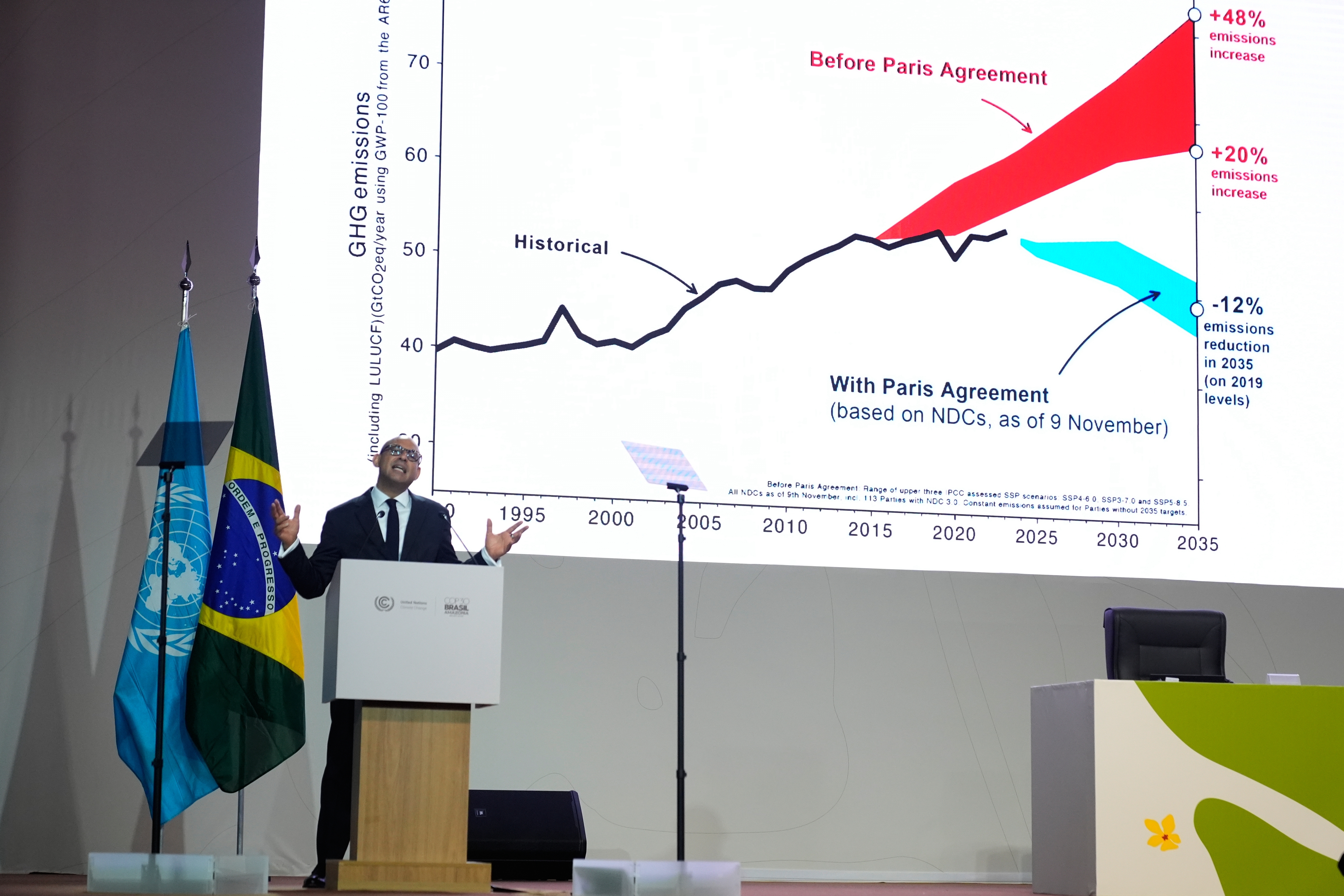
A bald man stands at a lectern in front of a graph that shows rising green house gas emissions.

Simon Stiell, United Nations climate chief, speaks during a plenary session in front of a graphic on the Paris Agreement at COP30.Fernando Llano/AP

At another conference, in 2013, a procedural issue led Russia to request a legal review of the UNFCCC’s decision-making processes. This was placed on the agenda for COP19 and could have been an opportunity to bring up voting rules, but it never was discussed.

Depledge, with the University of Cambridge, thinks the Mexico-Papua New Guinea proposal or another one like it is the most likely path to voting at the COPs—she said it would be “nigh on impossible” to ever adopt the rules of procedure outright. Earlier this year, she wrote an op-ed suggesting that new voting rules should require a supermajority or a double majority of developed and developing nations. “We should have voting rules, and they should be deployed as much as possible,” she said. She is, however, skeptical that this will be sufficient to change the trajectory of global climate action. A lack of voting “is not the number one reason why we are not achieving as much as we could be.”

Depledge added that the voting issue is unlikely to come up in Belém, due to geopolitical issues—President Donald Trump’s assault on international institutions, war in Gaza and Ukraine—and related questions around the future of international climate diplomacy itself.

The experts Grist spoke to were hesitant to predict how past climate negotiations would have been different had negotiators been able to vote. But one could imagine stronger language around a “phaseout” of fossil fuels, rather than a “phase-down,” or stricter requirements for wealthy countries to lend money and other resources to poor countries that have done little to cause global warming yet are suffering the most from its consequences. Going forward, COP30 and future meetings might yield stronger collective commitments to ratchet up emissions reductions, even if they’re not legally binding and mostly serve as a “norm-setting” function for the rest of society.

Short of trying to introduce voting rules, Peringer, the professional facilitator, thinks future climate conferences should reinterpret consensus. Instead of conflating consensus with unanimity—meaning the enthusiastic, affirmative agreement of all parties—what if consensus meant that each country could simply “live with” a given decision?

“You only block consensus if you really believe that this is, like, so detrimental to the whole process, or in opposition to values that are held dear,” she said.

In an academic paper elaborating on this idea in 2023, Peringer suggested that COP facilitators should play a more active role in determining when consensus has been reached, and then asking any holdout countries to “stand aside” in the interest of the larger group. There’s already some precedent for this within climate negotiations, notably from COP16 in 2010. In order to adopt a package of decisions called the Cancún Agreements, then-COP president Patricia Espinosa overruled a last-minute objection from Bolivia, saying that “consensus does not mean that one country has the right of veto, and can prevent 193 others from moving forward.”

Of course, it takes a skilled and confident facilitator to do something like that, and many of the recent COP presidents have not demonstrated this leadership ability. Plus, the tactic is less likely to work if there’s a larger group of countries blocking consensus.

One risk of moving away from the consensus decision-making model is that countries may feel alienated from the UNFCCC or Paris Agreement. If they’re overruled in an important decision, they may choose to simply opt out and walk away. This would obviously affect the treaty’s efficacy, since those countries most likely to leave are those with the deepest commitment to continuing to use oil, gas, and coal.

But to Erika Lennon, a senior attorney with the Center for International Environmental Law, the risks could be worth it. Oil-producing countries are already not participating in good faith, she said, and other nations are watering down their own ambitions to accommodate their delaying tactics. She and Blue Sky said they’re open to smaller coalitions of countries working at a much more ambitious level to phase out fossil fuel products, and using trade policy to influence other nations that refuse to get on board. This is an approach that has increasingly been floated in the context of the U.N. plastics treaty, which also lacks a voting mechanism and has similarly been plagued by delay tactics from petrostates.

At least one other international treaty, the Ottawa Treaty, followed this trajectory. After failed attempts by the UN to negotiate a ban on land mines, Canada launched its own process to hammer out an agreement in the late ’90s. The Ottawa Treaty now has more than 160 signatories, though several have recently withdrawn in light of Russia’s war in Ukraine.

“There is something to be said for saying, ‘We want everyone on board,’” Lennon said, referring to global climate negotiations. “But what we see is really just a stalling of progress…and the consequences of it are measured in people’s lives or livelihoods and in the destruction of potentially whole countries.”

Continue Reading…

Mother Jones

The Many Problems With the FDA’s Big Menopause Announcement

On Monday, the Department of Health and Human Services made an announcement that it promised would change the lives of millions of American women for the better: Hormone replacement therapy, the combination of hormone drugs that can treat the symptoms of menopause, was about to be depathologized.

The Food and Drug Administration (FDA) had decided to remove a black-box warning on the medication that cautioned patients that its use could cause cancer and stroke. HHS Secretary RFK Jr. and FDA commissioner Marty Makary said that the warning, which first appeared in 2003, had been based on an overblown interpretation of a decades-old study. “The FDA is announcing today that it will remove the misleading black-box warnings from all HRT products,” said Kennedy. “For the first time in a generation, the FDA is standing with science and standing with women.”

“For the first time in a generation, the FDA is standing with science and standing with women.”

The change was welcome news to many doctors who treat the often-debilitating and long-dismissed symptoms of menopause: hot flashes, brain fog, insomnia, and recurrent urinary tract infections, to name but a few. “This decision aligns with the latest evidence-based research and helps eliminate the unnecessary fear that this warning has long perpetuated,” the Menopause Advocacy Working Group, a group of physicians that promotes increased awareness around menopause, said in a statement on social media. (Two of the group’s members were among the speakers at Monday’s event.)

But the specialists with whom Mother Jones spoke said that Monday’s panel, which included doctors with robust social media presences, had at times overstated both the negative health effects of menopause and the science on the benefits of hormone replacement therapy. Spokespeople for HHS did not immediately respond to questions for this story.

Here are just a few of the more questionable claims they made:

Menopause causes divorce.

Dr. Kelly Casperson, a urologist and “expert and advocate for sexuality and hormones,” warned that “families fracture” if women don’t get treated for the symptoms of menopause. Dr. Makary listed “divorce” alongside well-documented symptoms like mood swings and hot flashes. For Adrian Sandra Dobs, a professor of Medicine and Oncology at the Johns Hopkins University School of Medicine’s Division of Endocrinology, Diabetes and Metabolism, this claim was “pretty ridiculous.” She continued, “It is true that there can be mood swings and this can affect a marriage,” but to blame a divorce on menopause is “really stretching it.”

Menopause kills women.

“HRT has saved marriages, rescued women from depression, prevented children from going without a mother,” Dr. Makary said. “Menopause shortens women’s lives,” added HHS Advanced Research Projects Agency for Health Director Alicia Jackson. Dr. Esther Eisenberg, a Professor Emerita at Vanderbilt University Medical Center who is working on the American Congress of Obstetricians and Gynecologists’ (ACOG) forthcoming guide to menopause, called the notion that menopause kills women “absurd.” Menopause, she said, “has nothing to do with a woman’s lifespan.” Dr. Jen Gunter, a gynecologist and the author of the 2021 book The Menopause Manifesto, noted in a Bluesky post that, on average, women actually live longer than men.

Marty Makary thinks that menopause kills women and shortens their lifespan, except women live longer than men

Dr. Jen Gunter (@drjengunter.bsky.social) 2025-11-10T16:43:06.969Z

HRT improves the lives of all women.

“We have the opportunity to add up to a decade of healthy years to the life of every woman that you love!” proclaimed Dr. Jackson. Except for, as Drs. Dobs and Eisenberg noted, the millions of women for whom HRT is contraindicated—such as those with a previous history of blood clots or stroke, certain blood conditions, and many of those with a history of breast cancer.

Lifelong vaginal estrogen therapy helps breast cancer patients live longer.

“They need their oncologist to know that women with breast cancer who use it may actually live longer, and they need their primary doctors to know how to write the prescription, recommend it for life,” said panel member Dr. Rachel Rubin, a urologist and sexual medicine specialist. Dr. Dobs wasn’t so sure. “I can’t agree with that,” she told Mother Jones. “We shouldn’t be afraid of it, but I couldn’t make a statement that vaginal estrogen makes women with breast cancer live longer.” (Breast cancer patients and survivors are typically advised to avoid most forms of HRT, though emerging evidence suggests vaginal estrogen may be safer.)

Doctors should test the estrogen levels of patients in perimenopause before prescribing HRT.

“We are sticking with our philosophy that the government is not your doctor,” said Dr. Makary. Nonetheless, he did recommend “having a doctor evaluate your estrogen levels to figure out when is the right time to start.” Yet the North American Menopause Society explicitly recommends against testing for estrogen levels in perimenopausal women because they fluctuate so much throughout a woman’s cycle. Instead, doctors should prescribe estrogen based on a woman’s symptoms. Of Makary’s advice for women to ask their doctors to test their estrogen levels, Dr. Eisenberg said, “that recommendation comes out of the sky.”

Makary cast these claims as the results not only of “a robust review of the latest scientific evidence” but also of “listening to women who have been challenging the paternalism of medicine.” In a surprisingly feminist statement, Makary added, “A male-dominated medical profession, let’s be honest, has minimized the symptoms of menopause, and as a result, women’s health issues have not received the attention that they deserve.”

“A male-dominated medical profession, let’s be honest, has minimized the symptoms of menopause, and as a result, women’s health issues have not received the attention that they deserve.”

Makary’s criticism of paternalism in medicine might strike some as being particularly ironic when considering some of the other recent actions the FDA has taken on women’s health, which have included adding warnings to medications already proven to be safe. Back in July, for instance, the agency convened a so-called expert panel to discuss the use of antidepressants by pregnant women. The event featured a majority-male panel, several of whom called for adding a black box warning to SSRIs for pregnant women, which reproductive health experts say could increase stigma for women who could benefit from taking the pills. The members of that panel mostly spewed misinformation while railing against the use of antidepressants during pregnancy, to such an extent that the president of ACOG promptly released a statement calling the meeting an “alarmingly unbalanced” event that “did not adequately acknowledge the harms of untreated perinatal mood disorders in pregnancy.”

In addition, Kenedy and Makary confirmed in a September letter to Republican attorneys general that they would undertake a review of the safety of mifepristone, one of the two drugs used in medication abortion, even though more than 100 scientific studies have confirmed the pills are safe and effective—including when they are prescribed virtually and mailed to patients. Reproductive rights advocates are concerned that this “review” could lead to a decision to restrict access to the pills by recommending they should not be prescribed virtually and mailed to patients, or that they should not be used through ten weeks’ gestation, as the FDA currently allows. (Abortion advocates say the pills can be safely used later in pregnancy, and the World Health Organization guidelines note they can be used anytime in the first trimester.)

The newfound enthusiasm for HRT has been building over the past few years, as awareness of menopause, its symptoms, and the myths around hormonal medications has increased. All the attention on menopause, though, has elevated a new cadre of doctor-influencers, two of whom were featured speakers at Monday’s event. Casperson, a urologist who hosts a podcast and has written two books about menopause and sex, has 435,000 Instagram followers. At her Bellingham, Washington clinic, which doesn’t accept insurance and instead offers memberships that start at $3,000 for 4-6 months of treatment. Casperson says she aims to help women “stop should-ing all over your sex life.” Rubin, also a urologist who doesn’t accept insurance, has 185,000 followers on Instagram. She trained under the controversial physician Irwin Goldstein, who advocated for the first-ever women’s libido drug, which the FDA approved back in 2015.

Dr. Dobs cautions against relying on influencers selling supplements or claiming that HRT will solve all women’s health problems. “Unfortunately, nothing really keeps us young except things like stopping smoking, exercising, and lifestyle modification,” she said. “There’s a lot of hype to hormones—we think they’regoing to cure everything, and they really don’t.”

Continue Reading…

Mother Jones

Trump Claims He “Pardoned” His Fake Electors. He Doesn’t Have That Power.

Donald Trump has reportedly pardoned high-profile attorneys accused of joining in his plot to try to steal the 2020 election, along with dozens of so-called fake electors alleged to have played small roles in the effort. The pardons were announced by Ed Martin, the president’s pardon attorney, who posted a proclamation by the president outlining them on X.

The pardons, which on Monday afternoon had not appeared on White House page listing Trump’s clemency grants, are symbolic. They are part of Trump’s larger effort to downplay his attempt to subvert the 2020 election and his responsibility for the January 6, 2021, attack on Congress. None of the people he pardoned Sunday—including lawyers Rudy Giuliani, Sidney Powell, John Eastman, Jenna Ellis and Jeffrey Clark—face federal charges. But many on the list have been charged with state crimes related to the fake elector scheme. The president has broad clemency power over federal crimes, but has no authority over state charges.

Mother Jones first reported in June that Martin, who is himself a former “Stop the Steal” organizer and activist attorney for January 6 defendants, was working on a plan for Trump to pardon alleged fake electors. A person familiar with the pardon plan acknowledged at the time that such pardons would have no legal weight, though the source argued that attorneys for defendants might cite the presidential proclamation in court filings urging judges to dismiss fake elector cases.

Prosecutors in Arizona, Georgia, Michigan, Nevada and Wisconsin have charged so-called fake electors in those states with crimes including fraud. These are mostly small-time Republican activists who falsely claimed to be the legitimate electors, in claims that were part of Trump’s push to pressure Vice President Mike Pence to reject the legitimate election results and accept pro-Trump slates of electors that could throw the election to him. The circumstances in each state differ, but generally, local prosecutors are struggling to persuade judges that the defendants broke the law by claiming to be legitimate electors. Many defendants may not welcome Trump’s legally worthless but politically charged attempt to intervene in their cases.

The Sunday pardons are part of a recent clemency spree by Trump. His latest pardons include former New York Mets star Darryl Strawberry and Changpeng Zhao, a Chinese-born founder of the cryptocurrency exchange Binance. Strawberry is one of various celebrities Trump has pardoned. Zhao is one of several Trump pardons that appear corrupt: Zhao, who pleaded guilty to US money laundering charges in 2023, paid Trump associates to lobby for his pardon, and Binance earlier this year cut a deal with Trump World Liberty Financial, a crypto company launched by Trump’s sons, that has helped to enrich the Trump family.

Martin served as interim US Attorney for the District of Columbia until his nomination to hold the job permanently failed in the Senate in May. He has since worked as Trump’s pardon adviser and head of a so-called weaponization task force in the Justice Department, efforts he has aggressively publicized. He has touted his role in federal prosecutions of New York Attorney General Letitia James and former FBI Director James Comey in statements that bolster widespread views that those cases are acts of political retribution.

Martin’s original plan for fake elector pardons went further than Trump did on Sunday—for example, Martin considered recommending that Trump pardon John F. Kennedy supporters who in 1960 signed paperwork saying they were Hawaii’s presidential electors when a recount left the actual winner of the state uncertain. Kennedy won Hawaii, and those electors were accepted as the state’s legitimate slate and never accused of crimes. Also, they are dead.

But pardoning them, the person familiar with the plan said, would have been a gesture aimed at boosting Trump supporters’ claims that 2020 fake electors did nothing wrong. The source did not explain why that part of the fake elector pardon plan did not move forward. But it may have been a step too far, even for Trump.

Continue Reading…

Mother Jones

Did the Off-Year Elections Settle the Democrats’ Big Debate?

A version of the below article first appeared in David Corn’s newsletter, Our Land_. The newsletter comes out twice a week (most of the time) and provides behind-the-scenes stories and articles about politics, media, and culture. Subscribing costs just $5 a month—but you can sign up for a free 30-day trial._

Ever since the reasonable woman lost to a narcissistic, racist, and misogynistic autocrat wannabe, the Democratic Party has been going through yet another painful round of the all-too-familiar debate: Should the party move to the center or adopt a more progressive stance to amass an electoral majority? This face-off has been recurring within the party for decades. For all the jawboning over the years, it has produced no consensus, and this fight is…boring. With the election results last week—a Democratic sweep everywhere—the debate is over. Or, at least, it should be.

That doesn’t mean there’s a resolution to the binary argument. One can end a debate without an ultimate and final decision. That’s what the Democrats ought to do. There’s never been a clear answer to the center-or-left question. And this election showed that within the party, lefties, such as Zohran Mamdani in New York, and centrists, such as Abigail Spanberger in Virginia and Mikie Sherrill in New Jersey, can each kick ass. Many commentators have made the obvious point: Candidates need to match the local electorate. Mamdani likely could not win statewide office in Virginia, and Spanberger likely could not excite the young voters who turned out in NYC for the democratic socialist.

There’s no need for the Democrats to continue shooting at each other and feeding the notion they have an identity crisis. The message is simple for them: We have a large tent and, dear voters, we offer you a buffet.

The Democrats reflect a wider swath of the electorate. That’s not a weakness. It’s a strength they should embrace.

Looking for a politician to identify with? We give you a choice: Mamdani, Spanberger, Sherrill, Gavin Newsom, AOC, Andy Beshear, and others. Take your pick. No single one of them must be anointed the leader of the party. Desire a fierce progressive who will (rhetorically) kick Trump in the teeth? There’s this young buck in New York. Want a savvy strategist with a mostly liberal record who strives not to be seen as too liberal? Check out the governor of California. Looking for less-splashy, nose-to-the-grindstone workhorse politicians (big on mom energy), see Virginia and New Jersey. The Democratic Party can be a choose-your-own-adventure party. It is not in disarray. It is diverse. It even has something of a unifying message—affordability—which can be tailored to different electorates. In New York City, Mamdani vowed to address high rents; in New Jersey, Sherrill focused on rising energy prices.

This is the opposite of the current GOP, which is no more than a homogeneous cult of personality tied to one man and his whims. It has jettisoned principles and policies to serve an erratic authoritarian. It’s nothing but Trump. Love him, love the party. Otherwise, you’re out of luck. The Democrats, in contrast, reflect a wider swath of the electorate. That’s not a weakness. It’s a strength they should embrace.

Indeed, the party will more tightly define itself when it chooses a presidential nominee. That’s a winner-take-all process. One person gets the party crown and campaigns for the highest office. In European parliamentarian systems, parties as a whole compete to gain control of the executive branch. Not so here. In the United States, parties must select and swing behind a single politician who comes to represent the party. That will happen in 2027 and 2028, and what’s likely to be a competitive and robust primary contest will produce the party’s banner carrier. Until then, the Democrats should not obsess over the left-center branding issue.

For about 60 years, the Democrats have been a center-left party. Both sides by now ought to understand that they need each other.

For about 60 years—ever since Southern conservative Democrats bolted the party in response to its support for civil rights measures—the Democrats have been a center-left party. Both sides by now ought to understand that they need each other. It’s my hunch—and you might disagree—that a fully left party probably could not succeed on the national level in the United States within its two-party duopoly. And given the profound threat posed by Trump and his cronies, the formation of a popular front that covers a wide stretch of the ideological gamut is essential. Last week’s elections demonstrate that the Democrats, with the help of independent voters, can build that.

Mamdani’s triumph was stunning, his win a tremendous accomplishment for the party’s left wing. He’s a generational talent. And now he will have the opportunity to prove whether a democratic socialist can successfully implement left-wing proposals—which should yield important lessons for progressives. Governing the sprawling Big Apple government, which too often has been prone to corruption, is a tough task, let alone changing its culture and injecting into it an ambitious agenda. Let’s wish him well. The question now is not whether a democratic socialist is good for the party, but whether one can succeed governing the biggest city in the nation.

In a way, the New Jersey race was more of an indicator of the current state of politics in America. Sherrill led Republican Jack Ciattarelli, a GOP businessman who had twice run for governor, by only a few points in the polls prior to Election Day. He had previously positioned himself as a not-so-Trumpy Republican. In this race, he campaigned with MAGA personalities and enthusiastically accepted Trump’s support. But he did not dwell on the president. A poll in October showed incumbent Democratic Gov. Phil Murphy’s job approval rating at 35 percent—lower than Trump’s.

The Democratic Party does not have time for navel-gazing. It’s a to-the-barricades moment.

This looked like a tight contest, especially since four years ago Murphy beat Ciattarelli by only 3 points in this Democratic state. Yet Sherrill won by a whopping 13 points. Jersey voters rallied behind this centrist Democrat more than New Yorkers flocked to Mamdani. And it’s hard not to read her margin of victory as a referendum on Trump. Though voters were dissatisfied with the Democratic governor and upset with rising food prices and skyrocketing health care premiums, they did not take it out on Sherrill. They renounced the candidate of the Trump Party. This is the election that Republicans across the country—especially those few House members in swing districts—ought to worry most about. Their biggest concern should not be a young socialist, but a working mom who campaigns as a mainstream Democrat.

At this moment, the barbarians are not at the gate; they are inside the White House, attacking democracy and deconstructing the United States of America. Millions of citizens are at risk of going hungry and losing their health care. The Democratic Party does not have time for navel-gazing. It’s a to-the-barricades moment.

I have no illusions. There will be squabbling over strategy and tactics. Centrists will still fear the agenda of progressives, and the progressives will gripe about opposition and obstacles posed by centrists. Look at the disagreement within the party over resolving the government shutdown. Yet these election results are a sign that that Democrats can win without settling this big who-are-we matter. Voters are not waiting for this debate to be concluded and a winner proclaimed. Few are interested in it. Precisely calculating an ideological course that appeals to a particular group of voters is not the key to Democratic victory. It can be a distraction. “Let a hundred flowers bloom, let a hundred schools of thought contend.” Mao said that. He was a dictator who did not stick to his own advice, but that’s the right idea. Different strokes for different folks, as Sly Stone sang.

These off-year elections—let’s call it the Ballroom Blowout—included surprising Democratic wins in Mississippi and Georgia, and there’s a lesson for Democrats. With Trump continuing his cruel mass deportations, holding let-them-eat-cake parties while threatening food stamps for millions, razing parts of the White House and showing off his new marble bathroom, turning tariffs on and off recklessly, doing little to address economic concerns, and ignoring court orders, the Democrats are presented with much opportunity. Continuing to argue among themselves is counterproductive. They don’t need consensus to succeed. They need authentic candidates who have something to say and who convince voters they will be fighters for them. Remember what a Republican president once said about a house divided. The Democrats have been shown the way.

Continue Reading…

Mother Jones

Trump’s Vendetta Against EVs Is Driving Up Costs for Every Vehicle Owner

This story was originally published by Vox and is reproduced here as part of the Climate Desk collaboration.

As President Donald Trump sees it, environmental regulations that attempt to improve efficiency and address climate change only make products more expensive and perform worse. He has long blamed efficiency regulations for his frustrations with things like toilets and showerheads. He began his second term in office to “unleash prosperity through deregulation.”

But there’s at least one big way that American companies and households may end up paying more, not less, for the president’s anti-environment policy moves.

If you’re in the market for a vehicle, you’ve probably noticed: Cars are getting more expensive. Kelley Blue Book reported that the average sticker price for a new car topped $50,000 for the first time in September.

“I think ‘chaos’ is a good word because [automakers are] getting hit from every angle.”

And they aren’t just getting more expensive to buy; cars are getting more expensive to own. For most Americans, gasoline is their single-largest energy expenditure, around $2,930 per household each year on average.

While a more efficient dishwasher, light bulb, or faucet may have a higher sticker price up front—especially as manufacturers adjust to new rules—cars, appliances, solar panels, and electronics can more than pay for themselves with lower operating costs over their lifetimes. And Trump’s agenda of suddenly rolling back efficiency rules has simultaneously made it harder for many industries to do business while raising costs for ordinary Americans.

No one knows this better than the US auto industry, which has whiplashed between competing environmental regulations for over a decade.

President Barack Obama tightened vehicle efficiency and pollution standards. In his first term, Trump loosened them. President Joe Biden reinstated and strengthened them. Now Trump is reversing course again—leaving the $1.6 trillion US auto industry unsure what turn to take next.

In July, the Environmental Protection Agency began undoing a foundational legal basis that lets the agency limit climate pollution from cars. Without it, the EPA has far less power to require automakers to manufacture cleaner vehicles, which hampers efforts to reduce one of the single biggest sources of carbon emissions.

Trump’s Transportation secretary, Sean P. Duffy, said in a statement over the summer that these moves “will lower vehicle costs and ensure the American people can purchase the cars they want.”

But in reality, the shift may have the opposite effect.

That’s because when the rules change every few years, automakers struggle to meet existing benchmarks and can’t plan ahead. The Alliance for Automotive Innovation, a trade group representing companies like Ford, Toyota, and Volkswagen, sent a letter to the EPA in September saying that the administration’s moves and the repeal of incentives for electric cars mean that the current car pollution rules established under Biden and stretching out to 2027 “are simply not achievable.”

The Trump administration responded by zeroing out any penalties for violations—but the industry is already planning for a post-Trump world where rules could drastically change yet again.

“Repealing [auto emissions] standards in particular would set America back decades.”

Because it takes years and billions of dollars to develop new cars that comply with stricter rules, carmakers would prefer if regulations stayed put one way or the other. Every rule change adds time and expense to the development lifecycle, which ultimately gets baked into a car’s price tag.

Changing rules are also vexing for electric car makers, whose models are gaining traction both in the US and around the world, even as the Trump administration has ended tax incentives for EVs. Trump is making things even more difficult by pulling support for domestic battery production that would help US car companies build electric cars.

It all adds up to a huge headache for the industry. “Particularly in the last six months, I think ‘chaos’ is a good word because they’re getting hit from every angle,” said David Cooke, senior associate director at the Center for Automotive Research at Ohio State University.

And all that uncertainty is making cars more expensive to buy and run, with even more expensive long-term consequences for people’s health and the environment.

As the government relaxes efficiency targets, progress will stall and car buyers will get stuck with cars that cost more to operate.

Energy Innovation, a think tank, found that repealing tailpipe standards could cost households an extra $310 billion by 2050, mainly through more spending on gasoline. Undoing the standards would also increase air pollution and shrink the job market for US electric vehicle manufacturing due to lower demand.

Even the Trump administration’s own analysis of the effects of undoing the EPA’s greenhouse gas emissions regulations found that his moves would drive up gasoline prices due to more fuel consumption from less efficient vehicles.

“Repealing these standards in particular would set America back decades,” said Sara Baldwin, senior director for electrification at Energy Innovation.

“These changes in regulations are really disruptive to the industry.”

While the Trump administration shifts gears, other countries are racing ahead. Automakers can design electric cars faster than conventional internal combustion-powered vehicles, since EVs generally have fewer components, and manufacturers don’t have to worry about designing pollution controls to meet tightening restrictions. Since EVs are mechanically simpler, they also need less maintenance.

Conventional cars, by contrast, typically take around five years to go from the drawing board to dealer lots, so the gasoline-powered cars being designed now won’t come out until 2030—when someone else will be in the White House.

The US auto industry also serves other countries. Markets like Europe are holding fast to their environmental regulations and are looking to ban the sales of internal combustion vehicles altogether. Meanwhile, China is making some of the cheapest and most popular EVs in the world.

That’s why some American carmakers are setting their sights beyond US shores and are continuing to bet on more EVs. Earlier this year, Ford announced that it was developing a $30,000 electric pickup truck for the US and for export, a sign the company sees huge potential in cheap electric cars despite the Trump administration’s efforts to pump the brakes on electrics.

Though car companies often grumble about the expenses and effort they have to expend when environmental regulations become stricter, regulatory uncertainty continues to be a much bigger nuisance. “These changes in regulations are really disruptive to the industry and are hurting our global economic competitiveness,” said Gregory Keoleian, co-director of the Center for Sustainable Systems at the University of Michigan. “It’s not only hurting in terms of setting us back with regard to decarbonization of the transportation sector, but the cost to consumers in the United States.”

Continue Reading…

Mother Jones

Florida Takes On Planned Parenthood

In anti-abortion Republicans’ latest attack on abortion pills, Florida’s attorney general is suing Planned Parenthood for allegedly misrepresenting the safety of the drugs—despite the fact that more than 100 scientific studies have shown they are safe and effective.

The 37-page lawsuit, announced by Attorney General James Uthmeier’s office on Thursday and filed in Florida’s First Judicial Circuit Court, alleges that Planned Parenthood “sells profitable abortions to vulnerable women by lying to them about abortion pills being safer than Tylenol.” Experts routinely make the comparison that use of the abortion pills—which include mifepristone, which blocks the pregnancy hormone progesterone, and misoprostol, which expels the pregnancy—are safer than Tylenol or even full-term pregnancy. Research shows that serious complications from medication abortion occur in less than half a percent of cases.

The Florida lawsuit claims that all abortions “violate the Hippocratic Oath and deny the inalienable rights of all human beings.”

But Uthmeier’s lawsuit paints a far more dire picture. It’s riddled with familiar anti-abortion arguments and misinformation. For example, it cites openly anti-abortion sources, including the anti-abortion group Live Action, as well as a non-peer reviewed report from the right-wing Ethics and Public Policy Center that claimed to show higher rates of complication from the pills, but that experts say has a flawed methodology, as I have previously written. The Florida lawsuit also claims that all abortions “violate the Hippocratic Oath and deny the inalienable rights of all human beings.” Uthmeier is suing under the state’s deceptive marketing and racketeering laws, and is seeking more than $350 million in damages, attorneys’ fees, the dissolution of Planned Parenthood in Florida, and the revocation of its state licenses.

Spokespeople for Planned Parenthood did not immediately respond to a request for comment from Mother Jones on Sunday, but in a statement provided to the Associated Press, Susan Baker Manning, general counsel for the Planned Parenthood Federation of America, said: “Anti-abortion lawmakers and officials are relentless in their effort to end access to all abortion care, and to stop patients from getting accurate medical information. We will continue to be just as relentless in our effort to defend access to this safe, effective care. See you in court.” Alexandra Mandado, the president and CEO of Planned Parenthood of Florida, told the Tampa Bay Times the lawsuit is “a politically motivated attack” and an “attempt to erode access to all abortion care.”

Abortion is banned in Florida after six weeks of pregnancy, but telehealth abortion providers have continued prescribing and mailing abortion pills into Florida and other states with bans. More than 70 percent of reproductive age women in the state believe abortion should be legal in all or most cases, including a majority of Republicans, KFF, the group formerly known as Kaiser Family Foundation, found last year. After the Supreme Court overruled Roe v. Wade in June 2022, use of abortion pills drastically increased nationwide, and they now account for more than 60 percent of all abortions. The Food and Drug Administration (FDA) permits use of mifepristone to end a pregnancy throughten weeks’ gestation, but abortion advocates say it is safe and effective later as well; the World Health Organization says, for example, that it can be used anytime in the first trimester.

But as the pills’ popularity has increased, so have the coordinated attacks, as I wrote back in September:

Health and Human Services Secretary Robert F. Kennedy Jr. and FDA Commissioner Marty Makary announced that HHS would conduct a new review of mifepristone, after hinting they would do so back in May, as I reported at the time. In their announcement, which reportedly came as a response to a letter Republican attorneys general wrote to Kennedy and Makary back in July, the officials cited a report produced by the Ethics and Public Policy Center, a right-wing organization that was on the advisory board of Project 2025, which claims to have unearthed a higher-than-previously-reported rate of complications from the pills.

[…]

As my colleague Madison Pauly and I reported back in January, anti-abortion groups sent letters to the Department of Justice and FDA requesting they roll back access to medication abortion by enforcing the 19th-century anti-obscenity Comstock Act, restoring the seven-week gestational limit, and rescinding the Biden-era telehealth regulation. Project 2025, the lengthy playbook for Trump’s second term, also recommended the DOJ enforce the dormant Comstock Act to ban the mailing of abortion pills, though President Donald Trump claimedlast year that it was “very unlikely” the FDA would roll back access or that the DOJ would enforce Comstock.

In 2022, an anti-abortion group calling itself the Alliance for Hippocratic Medicine sued in Texas, challenging the FDA’s initial approval of mifepristone as well as the agency’s later moves to expand access. The Supreme Court rejected the suit last year, saying the anti-abortion medical providers didn’t have standing to bring it. But attorneys general in at least six red states, including Texas and Florida, have since intervened in a bid to revive the case. Other suits are trying to curtail access by claiming mifepristone could contaminate drinking water.

There have also been myriad efforts to limit and penalize access at the state level. Last year, Louisiana became the first state to classify mifepristone and misoprostol as controlled substances, a move that one doctor predicted would also impact non-abortion-related care, including postpartum hemorrhages and IUD insertions. This month, Texas enacted a radical bill that allows allows private citizens to sue anyone who “manufactures, distributes, mails, transports, delivers, prescribes, or provides” abortion pills to Texans for at least $100,000. Officials in Texas and Louisiana have sought to punish doctors in New York and California who mailed abortion pills into their states under shield laws.

Continue Reading…

Mother Jones

Newsom Keeps Teasing a Presidential Run

Gov. Gavin Newsom (D-Calif.) keeps teasing a potential presidential run…again, and again, and again.

It began in earnest last month, when, in an interview with CBS Sunday Morning, Newsom admitted he would “be lying” if he claimed he did not plan to consider a 2028 run after next year’s midterms. He continued to fuel speculation this weekend, when, on Saturday—fresh off California’s redistricting win—he headed to Texas, where the redistricting battle began. As he spoke, the crowd reportedly chanted “2028,” and Rep. Al Green (D-Texas) introduced Newsom by saying: “I’m here today because he is a future president of the United States of America.”

When Newsom took the stage, he exhorted the crowd to “stand up.”

“Let’s stand up to those that have been humiliated, those that feel bullied, those that are afraid and scared,” he said. “Let’s stand up for those that have given up, and let’s give them hope. Let’s stand up for the rule of law. Let’s stand up for a system of checks and balances, and let’s stand up for our democracy, for all of us.”

Time to restore not just hope and optimism, but to stand up.

Stand up for those who feel bullied, afraid, and scared.

Stand up for those who have given up.

Stand up for the rule of law.

And stand up for our democracy — for all of us. pic.twitter.com/aGQGW1596J

— Gavin Newsom (@GavinNewsom) November 8, 2025

And on Sunday, in a sit-down interview with Jake Tapper on CNN’s State of the Union, Newsom said he would wait until after the midterms to make a decision. He previewed a potential campaign based on affordability—a winning message for Democrats.

“We have to democratize this economy if we are going to save democracy. You can’t have ten percent of people own two-thirds of the wealth in this country…those were fundamental issues that were obviously present in this election on Tuesday.”

“Donald Trump said he would make us wealthier and healthier,” he added. “We’re poorer and sicker.”

And if all that isn’t enough of an indication that Newsom seems to be soft-launching a stronger presence on the national stage, consider that he’s also releasing a memoir in February.

If he does decide to run, Newsom would likely emerge as a strong candidate in what could be a crowded field. His favorability rating has been on the rise this year as he has directly taken on Trump with trolling on social media. As he explained in an interview with NBC News last month: “I put a mirror up to [Trump’s] madness.”

Governor Newsom tells Jake Tapper he will make a decision about 2028 after the midterms but offers a preview of his message: 'We have to democratize this economy if we are going to save democracy." pic.twitter.com/FxfZFuHR5X

— State of the Union (@CNNSOTU) November 9, 2025

Continue Reading…

Mother Jones

Donald Trump’s Dream of an Alaskan Oil Boom Is Feeling More Like a Bust

This story was originally published by Grist and is reproduced here as part of the Climate Desk collaboration.

As Kristen Moreland waited for the livestream to buffer, her thoughts drifted to the years she’d devoted to defending Arctic National Wildlife Refuge, the northeastern sweep of Alaska where the mountains give way to the coastal plain. On screen, the chatter of aides stilled as men in dark suits gathered behind a lectern. Then, Secretary of the Interior Doug Burgum announced plans to open the area, roughly the size of South Carolina, to drilling.

It marked another round in the decades-long tug-of-war over developing one of the country’s largest remaining protected areas—an effort that came to a head during President Donald Trump’s first term and ground to a halt when President Joe Biden took office. Burgum also restored seven oil and gas leases that a state-funded corporation had bid on during the final days of the first Trump administration, and that his successor later revoked.

Moreland, a Gwich’in leader and executive director of the tribal committee dedicated to protecting the Nation’s sacred coastal plain, sat stunned as the YouTube stream continued. The place she grew up—where generations have lived on the tundra alongside the caribou, weaving their history into the land—had been reduced to a line item on someone’s balance sheet. When Burgum said opening the refuge would benefit northern communities, “it felt like a slap in the face,” she said.

Big banks and insurers have refused to finance or underwrite projects in the refuge, citing environmental risks. Oil majors have also steered clear.

“They’ve never reached out to us to listen to how this would affect our livelihood,” she said. Moreland fears development will drive the herd that the Gwich’in rely on out of range and contaminate rivers in a region where hunting and fishing are a matter of survival. For her, it felt like erasure. “It’s another disrespectful action from decision-makers,” she said. “It ignores our voice as Gwich’in and violates our rights as Indigenous people.”

As the fight over development in the Arctic continues, federal officials are racing to fulfill Trump’s “energy dominance” agenda. Though the government is shut down and many employees are not getting paid, officials continue approving permits for extractive industries. In a wood-paneled Beltway office, Burgum framed his “sweeping package of actions” as a declaration that “Alaska is open for business.”

To that end, the administration also signed permits for the controversial 211-mile Ambler Road to mineral deposits, including one owned by Trilogy Metals—which the Trump administration now holds a 10 percent stake in—and authorized a land exchange that will allow for construction of a road through Izembek National Wildlife Refuge, at the tip of the Alaskan Peninsula. “I told the president it’s like Christmas every morning,” Republican Gov. Mike Dunleavy said. “I wake up, I go to look at what’s under the proverbial Christmas tree to see what’s happening.”

That October 23 announcement may not end up being the gift the governor is hoping for.

The fight over drilling in the refuge began almost as soon as President Dwight D. Eisenhower established the site, once called Arctic National Wildlife Range, in 1960. The most recent volley began in 2017, when Trump signed a tax bill requiring two oil and gas lease sales there within seven years. When the first sale was held in 2021, the state corporation Alaska Industrial Development and Export Authority, or AIDEA, was the only major bidder. It hoped to keep drilling prospects in the region alive, despite weak industry interest. The sale ultimately generated less than $12 million—a fraction of the nearly $2 billion projected by the Tax Act for the last decade.

The Biden administration later found the leasing program’s environmental review inadequate. It conducted a new analysis, then canceled the leases in 2023, citing “fundamental legal deficiencies” and its failure to “properly quantify” greenhouse gas emissions. The second mandated sale, in early 2025, received no bidders. Compounding the challenge, major banks and insurers have refused to finance or underwrite projects in the refuge, citing environmental risks. Oil majors have also steered clear: In 2022, Chevron and the company that took over BP’s leases on private land within the refuge paid $10 million to walk away from them. That same year, ExxonMobil told shareholders it has “no plans for exploration or development” there.

“It’s hugely problematic for the state to issue bonds with no viable plan for repayment. That’s not a good investment decision.”

Still, this spring Trump issued an executive order calling for the reinstatement of AIDEA’s leases, and a federal court ruled that their cancellation was handled improperly. The state-funded investment firm remains the sole holder of leases in the refuge.

The problem is AIDEA doesn’t have the capital or technical expertise to build out these areas on its own. It has authorized spending nearly $54 million to develop them and move permitting for Ambler Road forward. That includes hiring consultants for seismic testing to map oil and gas deposits. But first it must get permission from the US Fish and Wildlife Service to harass polar bears, something that has sparked viral protests in the past. AIDEA authorized another $50 million for Ambler following Burgum’s announcement.

A map of Alaska depicting the trans-alaska pipeline and the amber road project in relation to Arctic National Refuge.

Ultimately, the state corporation is spending public money on infrastructure that private firms would normally fund while sidestepping oversight, said Suzanne Bostrom, a senior staff attorney at Trustees for Alaska. The watchdog legal organization accused AIDEA of having redirected money toward refuge leases and Ambler from accounts within its Arctic Infrastructure Development Fund, and later its Revolving Fund, to avoid the need for legislative approval. Randy Ruaro, AIDEA’s executive director, wrote in an email that it was not legally required to seek authorization.

All of that aside, AIDEA’s track record is pretty grim. Financial records suggest the corporation lost at least $38 million on its last oil and gas venture, the Mustang field on the North Slope west of the refuge. After oil prices fell in 2020, the corporation foreclosed on the project. The state provided another $22 million in a 2023 bailout before AIDEA sold the field for an undisclosed sum.

Bostrom says AIDEA has “no actual plan for seeing a return” on its spending in the refuge. In fact, the people of Alaska often lose money in its deals; one analysis found that almost half of the agency’s investments have been written off as worthless. The economists who crunched those numbers found the state would have come out about $11 billion ahead if that money had been put to work elsewhere.

As to the “energy emergency” that Trump declared, Kaufmann said, “I want what he’s smoking.”

In an email, Ruaro called the analysis a “hit piece” and said the corporation has recorded its best financial performance in six decades over the past two years. He said that analysis “failed to account for the billions of dollars generated in economic benefits” by the Red Dog Mine, which produces lead and zinc in northwest Alaska. The corporation poured $160 million—about one-third of the project’s startup costs—into infrastructure to support the operation.

At the same time, AIDEA’s own consultants concluded that the mine would be built regardless, and the investment was unnecessary. “AIDEA loves to point to the Red Dog mine as a shining example of their success,” Bostrom said, but even taking those claims at face-value “doesn’t erase that AIDEA still has no viable financial plan in place to cover the cost of building the Ambler Road.”

Ultimately, any plans for the refuge and Ambler Road—which the Bureau of Land Management has said would harm Indigenous and low-income communities—raise questions about who benefits from such development. AIDEA has, for example, proposed financing the private Ambler road through Gates of the Arctic National Park with bonds repaid by tolls, a plan critics call unrealistic, given the cost could hit $2 billion. “It’s hugely problematic for the state to issue bonds with no viable plan for repayment,” Bostrom said. “That’s not a good investment decision.”

But Ruaro wrote that is only one of several options, and that he is “confident the mines…have billions of dollars in minerals needed by the nation.” He also said AIDEA now estimates the cost at $500 to $850 million, and said the road can be built in phases.

Even with prudent financial strategies, the economics of extraction remain precarious—especially as domestic oil prices dropped below $60 a barrel this summer. Given the average breakeven price of $62, new Arctic production may not be profitable—though it would extend the life of the Trans-Alaska Pipeline that carries crude from the North Slope.

The United States is already the world’s top producer, and more output won’t necessarily lower consumer fuel prices, says Boston University’s Robert K. Kaufmann, because OPEC and other nations still influence global markets. (As to the “energy emergency” that Trump declared, Kaufmann said, “I want what he’s smoking.”) Instead, the leases will bring more production online when “any rational scientist is calling for reducing carbon emissions.”

Despite the risks, some communities in the region support new oil and gas projects. Arctic National Wildlife Refuge sits within North Slope Borough, which is larger than 39 states. Voice of the Arctic Iñupiat—a nonprofit funded by the regional Alaska Native Corporation—notes that 95 percent of the borough’s tax revenue comes from the industry, funding things like schools and clinics. Fossil fuel royalties directly benefit Indigenous communities like Kaktovik, funding essential services. “When Uncle Doug [Burgum] calls, I answer,” Josiah Patkotak, the borough’s mayor, said in a statement praising the Interior secretary’s announcement.

Caribou grazing next to the water.

Indigenous communities and scientists fear that development of the Arctic National Wildlife Refuge will drive away the caribou central to Gwich’in and Iñupiat culture.U.S. Fish and Wildlife Service

It can be difficult to disentangle genuine local support from efforts quietly backed—or directly compensated—by the industry itself. During a legislative hearing earlier this year, state Representative Ashley Carrick said one person who testified as a community advocate was paid by AIDEA, something Ruaro confirmed to her that it routinely does. This can create the impression these projects are widely embraced.

“There’s this wide consensus that [Iñupiat] people all want the oil and gas projects. It’s not true,” said Nauri Simmonds, executive director of Sovereign Iñupiat for a Living Arctic. Many of those adversely impacted by drilling stay silent for fear of losing work or social standing, she said—and some who have spoken out have faced threats and violence.

Simmonds says what might be lost by developing the refuge can’t be counted in dollars. AIDEA now holds leases in a part of the refuge where the Porcupine caribou herd gathers to bear its young. The Gwich’in name for the region, where cool coastal winds protect the newborns from insects and heat, translates to “the sacred place where life begins.” Beyond its shelter, calves are 19 percent more likely to die. Scientists and Indigenous peoples fear the clamor of development will drive the herd away, severing a bond that has sustained people and animals alike for millenia. Even as climate change reshapes one of the country’s last undisturbed ecosystems, it is political forces that now endanger it most.

“One of the most wounding pieces is that this wouldn’t be something that the companies would have gone after on their own,” Simmonds said. “It is the enticements from Alaska, from the corporations, from the political landscape, that creates the appeal.”

Continue Reading…

Mother Jones

Trump’s Shutdown Hits the Skies

The knock-on effects from the government shutdown, now the longest in US history, continue apace, with the Federal Aviation Administration’s (FAA) cuts to air traffic at 40 of the nation’s busiest airports now officially in effect.

The mandate, which kicked off on Friday with an initial 4 percent reduction, has already cancelled more than 1,700 flights this weekend alone. Though disruptions were said to be limited on Friday, Transportation Secretary Sean Duffy warned that cuts could rise to as much as 20 percent by Thanksgiving weekend, one of the busiest travel periods of the year, if the shutdown drags on.

Since announcing the unprecedented plan, Duffy has insisted that such reductions are necessary to keep air travel safe, while some air traffic controllers and airport screeners go without pay. But prior to the FAA’s flight cuts, there had been little evidence to suggest that staffing shortages from the shutdown had been creating widespread disruptions, prompting some to accuse the Trump administration of weaponizing air travel as leverage aimed at getting Democrats to bend on the shutdown standoff.

That impasse is about healthcare, with Democrats refusing to vote for a spending bill that allows Obamacare subsidies to expire—a move that would cause the cost of health insurance for millions of Americans to skyrocket.

Duffy has denied the assertion that Republicans are needlessly using air travel as political leverage. Yet some Republicans, including Sen. Ted Cruz, have made a point of hanging blame for the flight disruptions on Democrats, accusing them of “flirting with disaster.”

Democrats are flirting with disaster. They have kept the government shut down for 36 days, forcing more than 50,000 TSA agents and 13,000 air traffic controllers to go without pay. Millions of Americans are already dealing with flight delays and cancellations because of the… https://t.co/MJlA1Iqhec

— Senator Ted Cruz (@SenTedCruz) November 5, 2025

The blame game comes as Republicans rejected a new offer by Democrats to end the shutdown on Friday that proposed a one-year extension of Affordable Care Act subsidies.

Continue Reading…

Mother Jones

Trump’s War on the Hungry Continues With Supreme Court Stay

President Trump’s vehement refusal to make full SNAP benefits available to the nearly 42 million Americans who rely on the food aid program scored a temporary win at the Supreme Court, after Justice Ketanji Brown Jackson temporarily allowed the federal government to continue withholding $4 billion in SNAP funding.

Friday’s late-night order came hours after the Trump administration rushed to the Supreme Court to block a lower court’s order requiring it to use emergency funds to pay out SNAP aid while the government remains shut down. In it, US District Judge John McConnell accused the government of defying a previous order to make at least partial paymentsand required that the government complete full payments by Friday night. McConnell pointed to Trump’s own words on social media earlier this week, which, if interpreted by their plain meaning, signaled the president’s intention to defy multiple court orders to make the SNAP benefits available to low-income families. The administration then turned to a federal appeals court to ask it to undo McConnell’s order.

Jackson’s temporary stay, then, merely gives the appeals court time to rule on that request. Critically, it did not rule on the legality of the Trump administration’s efforts to resist payments, which ramped up over the last week after SNAP lapsed on payments for the first time in its 61-year history. The lapse came as the Trump administration argued that it is barred from using emergency funding to make the payments because of the government shutdown, even though previous administrations in similar impasses have done so.

Two federal judges, both of whom admonished the administration for needlessly plunging SNAP into crisis, rejected that argument. And what quickly followed was a full-throated crusade by Trump to continue withholding funding and thereby using hungry Americans as a political weapon in a government shutdown. In the meantime, the lapse in SNAP has sparked a surge in demand nationally to food banks, with lines growing and some pantries being unable to keep up with demand.

The appeals court now has 48 hours to weigh in. Meanwhile, deep uncertainty for SNAP beneficiaries—39 percent of whom are children—continues.

Continue Reading…

Mother Jones

Election Day Was a Win for the Climate

This story was originally published by Grist and is reproduced here as part of the Climate Desk collaboration.

Tuesday was a great day at the ballot box for the planet, with climate-friendly initiatives and candidates winning nationwide.

In races from New York to Georgia to Washington, voters backed funding renewables, reining in energy costs, and building out mass transit—and the people promising to deliver those policies. On the whole, the results suggest Americans are pushing back against President Donald Trump’s efforts to roll back climate action.

“This election was a decisive rejection of the Trump Administration’s ban on clean energy, multimillion-dollar taxpayer bailouts for expensive dirtier energy sources like coal, and other ineffective proposals that will make costs go even higher,” Sara Schreiber of the League of Conservation Voters said in a statement.

“I think yesterday was a repudiation of the idea that Americans don’t care about energy or climate and these are losing issues.”

One of the day’s biggest wins came in New York City, where Zohran Mamdani won the mayoral race in a landslide victory called just 35 minutes after polls closed. More than two million New Yorkers voted, the most in a mayoral race since 1969. Although Mamdani, who at 34 will be the city’s youngest mayor in more than a century, made affordability the predominant focus of his campaign, he garnered an endorsement from the youth-led climate organization Sunrise Movement. Many saw his campaign promises, which included calls for free mass transit and the greening of public schools, as the seeds of a populist climate movement.

“Zohran was talking about climate action in a way people could understand, and people were able to see the impacts of this climate action in their everyday lives,” Denae Ávila-Dickson, Sunrise’s communications and political manager, told New York Focus.

Dan Jasper, of the nonprofit group Project Drawdown, said Mamdani’s transit proposal “is not as sexy as something like solar. But these are the exact type of policies we’re going to need to actually address climate change, because it addresses people’s standards of living.”

Mamdani’s challenge will be assembling the coalition needed to make those policies happen. Boston Mayor Michelle Wu, who has also promoted a municipal green new deal agenda, may not have similar difficulty. Yesterday, Wu’s City Council allies retained their seats, giving her a fighting chance at success.

As far as statewide elections go, Georgia was a point of contention: There, electricity prices were on the ballot. Democrats won two of the five seats on the Public Service Commission, a regulatory agency that oversees utilities and has approved six rate increases in three years.

Democrats have not held a seat on the board since 2007, but clean energy consultant Peter Hubbard and anti-poverty advocate Alicia Johnson tapped voter outrage over climbing prices and notched upset victories over Republican incumbents, who had embraced fossil fuels and backed away from clean energy at a time when demand for power is rising.

“I think for a lot of folks who have felt powerless over rising utility bills, especially in a state like Georgia where they’ve gone up for the average household by more than $500 in just the last couple of years, they can finally breathe a sigh of relief knowing that potential change is coming,” said Charles Hua, founder of the utility advocacy nonprofit PowerLines.

Rising energy bills emerged as a top issue in other races, too, including the governor’s races in New Jersey and Virginia. For political scientist Leah Stokes, who studies public opinion around climate change, Tuesday’s results weren’t unexpected.

“I think yesterday was a repudiation of the idea that Americans don’t care about energy or climate and these are losing issues, which is what all of these pundits have been going on and on about for about 9 months now. That’s really wrong,” Stokes said on Wednesday. “Everyday people understand that clean energy is cheap energy—they can easily make those connections.”

“‘Climate action equals affordability’ seems to be the winning message of the day.”

In New Jersey, governor-elect Mikie Sherrill vowed to declare “a state of emergency on energy costs” on her first day in office. She plans to roll out expanded generation capacity, including rooftop solar and battery storage, and “immediately develop plans for new nuclear capacity.”

In Virginia, Abigail Spanberger won the governor’s seat on a platform that included data center operators paying for their own electricity costs in a region that currently hosts over 13 percent of the world’s data center capacity. Her “Affordable Virginia” plan included calls to expand wind and solar power, promote home weatherization to ease power consumption, and streamline permitting and other requirements for expanding generation.

To the west, California voters approved Proposition 50, which will allow the state’s Democratic majority to sidestep the statewide redistricting commission and redraw congressional districts ahead of the 2026 midterm elections. The move was designed to give Democrats as many as five more seats in Congress in an effort to, among other things, combat further dismantling of climate and environmental policy. Governor Gavin Newsom and a slate of prominent Democrats nationwide championed the proposal as a counterbalance to Republican-led redistricting in states like Texas, where a similar effort earlier this year carved out 5 new seats for the GOP.

In a speech Tuesday night, Newsom said California voters approved the measure “to send a message to Donald Trump. No crowns, no thrones, no kings. That’s what this victory represents. [It] is a victory for the people of the state of California and the United States of America.”

Climate-friendly policies—those centering on transit, in particular—won on a local scale, too. Voters in Mecklenburg County, North Carolina, which includes the city of Charlotte, handily approved a 1 percent increase in the sales tax to finance nearly $20 billion in transportation improvements. Although 40 percent of the additional revenue will be allocated to roads, some of that funding will support new bike lanes and sidewalks. Another 40 percent will go toward rail, and the remainder will be dedicated to buses and microtransit. In Ellensburg, Washington, 65 percent of voters approved a permanent 0.2 percent sales tax to fund the municipal bus system.

Across the country, one thing was clear: Wallet-friendly climate policies—and candidates presenting themselves as helping people pay their bills—won. “Climate change isn’t at the forefront of every election, but at this point, every election is a climate election,” Jasper of Project Drawdown said. “‘Climate action equals affordability’ seems to be the winning message of the day.”

Emily Jones contributed reporting.

Continue Reading…

Mother Jones

The Deputies Who Tortured a Mississippi County

When Andrea Dettore-Murphy first moved to Rankin County, Mississippi, she didn’t believe the stories she heard about how brutal the sheriff’s department could be when pursuing suspected drug crimes.

But in 2018, she learned the hard way that the rumors were true when a group of sheriff’s deputies raided the home of her friend Rick Loveday and beat him relentlessly while she watched.

A few years later, Dettore-Murphy says deputies put her through another haunting incident with her friend Robert Grozier. Dettore-Murphy was just the latest in a long line of people who said they witnessed or experienced torture by a small group of deputies, some of whom called themselves the “Goon Squad.”

For nearly two decades, the deputies roamed Rankin County at night, beating, tasing, and choking suspects in drug crimes until they admitted to buying or selling illegal substances. Their reign of terror continued unabated until 2023, when the deputies were finally exposed.

“Rankin County has always been notorious,” says Garry Curro, one the Goon Squad’s many alleged victims. “They don’t follow the laws of the land. They make their own laws.”

This week on Reveal, reporters Brian Howey and Nate Rosenfield with Mississippi Today and the New York Times investigate the Goon Squad, whose members have allegedly tortured at least 22 people since the early 2000s.

This is an update of an episode that originally aired in March 2025.

Continue Reading…

Mother Jones

Democrats Collapsed Here Last Year. How’d Zohran Do?

At this point last November, Zohran Mamdani was a largely unknown state assemblyman, and the Democratic Party’s brand in New York City was at rock bottom.

In the 2024 election, President Donald Trump picked up about 100,000 more votes in the city than in 2020; Kamala Harris fell more than half a million votes shy of Joe Biden’s total. And some of the most dramatic shifts in the entire country could be found in immigrant neighborhoods in Mamdani’s home borough of Queens. The party’s outer-borough collapse mirrored the party’s national crack-up; as it spent millions to court college-educated voters in the suburbs, Democrats were losing ground with the sorts of working-class, non-white voters in blue cities who traditionally helped form the backbone of the party. The term you kept hearing over and over was “realignment.”

When we chatted with residents and elected officials this spring, in the Queens neighborhoods of Jackson Heights and Corona, we found deep-seated frustrations with Democratic governance—and concerns about crime, immigration, sex-workers, poor services, and the cost of living. Many people brought up the pandemic, which had hit the area hard and damaged people’s faith in the social contract.

“The former governor, Andrew Cuomo, never stepped foot in Corona, even during the pandemic,” Democratic state assemblywoman Catalina Cruz told us. “I had to fight him to get a vaccination site in my district because while we were the epicenter, because my community was undocumented and immigrant, we were the last ones to get help.” Corona, she said, was what you get “when the government ignores its community.”

Mamdani’s victory on Tuesday over Cuomo was the product of a relentless campaign that united a broad multi-racial coalition with a focus on affordability. But it was also a test of how well the Democratic Party was recovering in the places where it has suffered the most. This outer-borough collapse, clustered most intensely in working-class Latino and Asian communities, loomed over the New York City mayoral race from the start. Mamdani soft-launched his candidacy by talking to Trump voters and non-voters in outer-borough neighborhoods about what it would take to win them back.

So: How’d he do?

Comparing off-year races with presidential elections can be a little difficult, but Mamdani’s vote total—the highest for a winning mayoral candidate since the 1960s—offered some clear takeaways. Although 700,000 fewer people voted in the city this November compared to last, Mamdani actually earned more votes than Harris in a few notable areas.

In parts of the Brooklyn neighborhood of Bushwick, home to many young and left-leaning voters, overall turnout matched or exceeded 2024 totals, and nearly all those votes went to Mamdani. That’s a major achievement for an off-year election, and a reflection of the mayor-elect’s appeal among younger Americans who opposed Trump and were unenthusiastic about the Democratic Party.

In one heavily Bangladeshi precinct on Hillside Avenue, Mamdani ended up winning more raw votes than Harris on Tuesday—despite 14 percent fewer people showing up.

But Mamdani also ran well ahead of Harris in another, much different area: along parts of Hillside Avenue in Queens. This is one of the two neighborhoods Mamdani visited last November to talk to residents about the presidential election. In the now-famous video, voters expressed their frustration with the Democratic Party’s appeasement of Israel and their sense that politicians had done little to address the high cost of living. In one heavily Bangladeshi precinct on Hillside Avenue, Mamdani ended up winning more raw votes than Harris on Tuesday—despite 14 percent fewer people showing up.

The story was similar in other pockets of the city with large South Asian and Muslim populations, and where Democratic support lagged in 2024. Mamdani, despite running against a prominent Democratic former governor, scored a 24-percent improvement on Harris’ vote total in one precinct in Brooklyn’s “Little Bangladesh”—where turnout was just as high as last year.

Mamdani’s energetic emphasis on affordability, his implicit and explicit rejection of unpopular Democratic figures like Cuomo and Mayor Eric Adams, and his unique appeal as one of the city’s first major-party Muslim mayoral candidates helped him make up ground that Democrats had recently lost.

On Tuesday, a few hours before polls closed, we returned to the Queens neighborhoods we profiled earlier this year for Reveal, to see how Mamdani’s pitch had gone over. What we found was backed up by the numbers. It would be wishful thinking to call Mamdani universally beloved, but there were signs that his message of affordability resonated with voters who had been on the fence about Democrats, and that Trump’s 2024 coalition was beginning to fracture.

In conversations with about two dozen voters, we heard firsthand from people who voted Democratic after rejecting Harris last year, and from voters—particularly young voters—who were drawn to Mamdani by his emphasis on issues that affected their lives on a daily basis.

“I don’t take buses because I don’t trust them—I pay for the bus, it just, like, skips my stop or something,” said a young Elmhurst voter named Diego. Another voter outside the precinct said he voted for Trump as “the lesser evil” in 2024, but felt that Mamdani offered a new direction and saw promise in his plans to make the city “affordable.”

“The free bus thing, I think, is great,” he said. “A lot of the time people don’t want to pay for the bus anyway. That’s a good incentive, and honestly, I’d rather if we all paid a little more tax and make the MTA free.”

Beyond Mamdani convincing some Trump voters, there were signs of dissatisfaction in the Republican electorate, too. More than one voter mentioned that they voted for Trump—and not for Mamdani—but were disappointed by the administration.

A senior citizen in Jackson Heights who voted for Cuomo because of his emphasis on public safety told us that he and his wife had both voted for Trump last November.

“He promised a lot of things [were] going to change,” he said.

“But nothing’s changed,” his wife added.

Mamdani had some of his strongest performances in Jackson Heights, an extraordinarily diverse neighborhood with large South Asian and Latino populations. In one heavily South Asian voting district in the neighborhood, Mamdani ran 20 percentage points ahead of Kamala Harris and netted more votes overall.

Outside a polling site in the neighborhood on Tuesday, Abdul Aliy said that he left the presidential line blank last November. “I just couldn’t bring myself to vote for Harris, [and] obviously I wasn’t gonna vote for Trump, so there wasn’t really an option I saw,” he said. But he told us he voted for Mamdani enthusiastically, because the democratic socialist’s platform aligned with his own values: “Free transit, free buses,” he said, rattling off the campaign promises that resonated. “He has this idea of a public market that will stabilize the prices of certain goods—I like that idea.”

Outside of P.S. 89Q in nearby Elmhurst, Rina Hart, a 32-year-old user interface designer, said that she and her family were long-time New Yorkers who had voted for Cuomo in the past. Hart initially thought she would do so again in the primary. But she was turned off by the former governor’s campaign and the wealthy donors backing him. “I was concerned about Mamdani’s experience,” she explained, “but at least he has integrity.”

Her parents ended up voting for Cuomo in the primary, while she and her brothers went for Mamdani. There was no generational divide in the general election: They all backed Mamdani. Hart explained that her mom, who is South Asian, had been alienated by the racist videos promoted by Cuomo’s backers.

“It’s been a really tough time to be a Democrat. And you’re kind of seeing why we didn’t win,” Hart said about Mamdani’s rise in the wake of recent Democratic losses. “It’s been really hopeful.” She now wants the party to move on from Senate Minority Leader Chuck Schumer, who did not endorse the mayor-elect.

“That’s the only way we can get out of this MAGA cycle that we’re in,” Hart said.

Glacel, an Ecuadorian immigrant who has worked at one of the original Equinox gym locations for the past 31 years, went with Cuomo.

She said she didn’t vote in last year’s presidential election because of the local crime and disorder. It was the worst she’d ever seen things get in Queens, and she blamed the decay on Democrats not dealing with the migrant crisis. “Disgusting. Filthy. Messy,” she said. “Ecuador is better than here.”

Another Elmhurst voter, an Argentine immigrant named Miguel Mendez, described himself as a sometime-Democratic voter. He opposed Trump during his first election and had once been curious about Bernie Sanders, but came around to the Republican nominee by 2024. He believed the neighborhood was deteriorating and that Democrats were more interested in pushing their ideology than in fixing it up.

“If it wasn’t the Salvadorans, the MS-13—it was the Tren de Aragua, or even cartels,” he said. “I mean, you can ask anyone over here where the gangs are. You can go to Roosevelt, you see what I mean. The prostitution, it’s everywhere.

Mendez chose Curtis Sliwa. (His girlfriend, he said, told him he couldn’t back Cuomo.)

Despite voting for Trump, he wasn’t happy with how things were playing out in Washington. The second Trump term had been “a big disappointment for me, because I was begging him to talk about all the weird drones that came in New Jersey and New York,” he said. “He said that he was gonna bring that out, same thing with the Epstein names, a bunch of stuff that he’s not doing—so that makes me think that no matter what party the guy who’s in office, they just have to follow an agenda.”

Further along Roosevelt Avenue, in the heavily Latino parts of Queens that swung heavily toward Trump in 2024, the picture was mixed. Turnout in Corona, a working-class Latino neighborhood, was up dramatically from the last mayoral election, but still well short of a presidential year. Among those who voted, data from the New York Times shows Mamdani winning the neighborhood by 11 points.

Ana, a 58-year-old Democratic voter in Corona from the Dominican Republic, said she voted for Cuomo after backing Kamala Harris last year. Like other voters in Corona, the problems along Roosevelt Avenue, which she also blamed on more recent immigrant arrivals, were front of mind.

“I like the Democrats because they’re humanitarians but as a result they’re hurting us,” Ana said. She lamented that her own Democratic representatives had not done enough when it came to immigration.

That included her own member of Congress, Rep. Alexandria Ocasio-Cortez (D-N.Y.). But Ana stillmostly liked her congresswoman, who unlike Mamdani, she thought had enough experience.

Ana was skeptical about the feasibility of Mamdani’s plans to make the city more affordable. Free buses won’t make her daily 4 am subway commute to a restaurant job at Google’s Manhattan campus any cheaper. Nor would his proposed rent freeze for stabilized units cover her market-rate apartment.

“You can’t offer free things in New York,” Ana explained in Spanish. “Even looking at something here costs something.” Then she laughed with a sigh of resignation.

Mamdani now has four years to prove voters like her wrong.

Continue Reading…

Mother Jones

Racial Justice Campaigners Were Prop 50’s Army in the Field

On Tuesday, California voters passed Proposition 50, Gov. Gavin Newsom’s congressional redistricting proposal in response to Texas Republicans’ gerrymandered map, by a sweeping 28-point margin.

As I reported in October, high-profile Democratic politicians—including former President Barack Obama—were front and center in an advertising blitz to pass the measure, which would tilt five seats in the House of Representatives towards Democrats.

But on the ground in California, often with less media coverage, were legions of campaigners with civil rights and racial justice organizations, many of which tirelessly championed Prop 50 in the final weeks before the election—and are now celebrating its passage as a small step in the long fight for Black political representation.

“We understood that it was critical to counter what Donald Trump was trying to do in Texas.”

“There has been a long and steady march to kind of erode our voting rights,” said Phaedra Jackson, NAACP’s vice president of unit advocacy and effectiveness, reflecting on the conservative Supreme Court’s continuing attacks on the Voting Rights Act of 1965. In 2013, the Court eliminated the formula for preclearance, the mechanism by which the VRA prevented certain states and localities from passing discriminatory election laws; six years later, another ruling enabled partisan gerrymandering on a hugely expanded scale.

In the years since, the turnout gap between white voters and voters of color has grown—and it’s done so nearly twice as fast in counties that were previously subject to preclearance, according to the progressive nonprofit Brennan Center for Justice.

“A lot of folks have framed this as a partisan issue,” Jackson said. “We see it [as] an attack on the ability for Black folks and folks of color to actually have representation.”

“You see what’s happened in Missouri, in Texas,” she added, pointing to states where minority representatives, such as Missouri Rep. Emanuel Cleaver and Texas Reps. Marc Veasey, Jasmine Crockett, and Joaquin Castro, all Democrats, were drawn out of their districts, and where the voting power of Black and Latino communities is being diluted. While local chapters of the organization continue to challenge the constitutionality of those maps in court, its goal in California “is to be a counterbalance.”

That’s what led the NAACP, in the weeks leading up to the election, to become one of the measure’s biggest direct supporters, including by door-knocking and deploying hundreds of poll monitors across the state.

The California Black Power Network, a coalition of 46 grassroots organizations across 15 counties, entered the fray later in the cycle.

“We understood that it was critical to counter what Donald Trump was trying to do in Texas,” said Kevin Cosney, the coalition’s chief program officer. But the group waited until it could review the proposed new map—and judge its impact on Black voter representation—before entering the campaign.

Although Proposition 50 would mean 48 of California’s 52 House seats would now likely go to Democrats, the geographic and racial representation of its map is similar to the previous one drawn by the state’s independent redistricting committee, according to the Public Policy Institute of California.

When it was convinced that Black voter representation and seats historically held by Black representatives were secure, the coalition’s members reached a consensus to support the measure through phone banking, canvassing, community events and ads.

For Newsom, and many of the measure’s backers in Sacramento, Prop 50’s massive success means it’s time to chalk a win. For racial justice campaigners like Jackson, it’s just “triaging a hemorrhaging situation”—even now, the Supreme Court is considering a Louisiana case that’s likely to further erode voting rights—that needs “long-term systemic fixes” like the decade-old John Lewis Voting Rights Advancement Act, which was reintroduced in Congress this summer.

Cosney echoed the need for systemic change. While Prop 50 “sets the stage for what is potentially possible,” he said, “we still have to organize and do the work … to make sure that those districts that have been built out are filled by folks who have our best interest in mind.”

“This was the kind of first opportunity that Californians really had to swing back,” said Cosney. “But it’s not the last.”

Continue Reading…

Mother Jones

Respectfully, Bill Gates Needs to Shut Up

This story was originally published by Slate and is reproduced here as part of the Climate Desk collaboration.

Last Tuesday, as the strongest Atlantic storm in 90 years slammed the western coast of Jamaica with 185-mph winds, Bill Gates was downplaying climate change.

In a lengthy blog post published on his personal website, Gates purported to offer some “tough truths about climate” ahead of next week’s UN climate conference. Railing against a “doomsday outlook” stemming from “much of the climate community,” the author of 2021’s How to Avoid a Climate Disaster claimed that there’s “too much” emphasis on “near-term emissions goals” as opposed to addressing “poverty and disease.” (The straight line between climate disasters from higher temperatures and the acceleration of both poverty and disease went unnoted.)

The inherent tension Gates posits between “quality of life” and “lowering emissions” is simply false.

While Hurricane Melissa—whose ferocity was supercharged by ocean waters heated by carbon-emissions absorption, as well as increased atmospheric moisture—laid waste to much of Jamaica, Gates followed up with a CNBC interview, excusing Microsoft’s fossil-fueled AI-construction surge and reiterating that global warming “has to be considered in terms of overall human welfare.” (He didn’t touch on the many ways artificial intelligence itself has damaged human welfare.)

The billionaire does not appear to have publicly addressed the disaster in Jamaica, which extended throughout the Caribbean, with Melissa having killed dozens across Cuba, Haiti, the Bahamas, and the Dominican Republic. And his overall point, frankly, does not hold up to scrutiny.

Gates isn’t alone; climate change has slipped down the world’s priority list in the past few years—and it shows. Governments and corporations are shelving emissions goals, budgets are being redirected from climate initiatives to warfare, the media is pivoting away from climate journalism, and even activists are urging a softer, more “hopeful” tone. It all signals a vibe shift in how we talk about climate change, reframing it from the existential risk it actually poses to a less urgent, peripheral issue—even as the floodwaters reach our front doors.

Gates, whose climate nonprofit Breakthrough Energy laid off dozens of staffers earlier this year, is not incorrect to point out that “we’ve made great progress” in fostering climate solutions, and that agriculture and land use should be an especially urgent area of focus. But the person he’s targeting with his post—a government official cutting health and aid funding and redirecting it toward emissions reduction—doesn’t really exist, certainly not at this particular moment.

As the US pulls back on all foreign aid and health funds, to devastating and fatal effect across the Eastern Hemisphere, other rich nations are not filling in the gap but instead following suit, cutting back on climate, health, and development.

In the climate realm in particular, wealthier countries are trimming not just their budgets (e.g., clean-energy exports, startup financing) but even their assistance with long-term adaptation to a warming Earth—something Gates now prizes above mitigation. This despite the fact that the UN secretary-general warns that it is “inevitable” the world will overshoot the decade-old Paris Agreement’s goal of limiting warming to 1.5 degrees Celsius—as an explicit means of preventing worst-case scenarios that will require more money and resources to address.

The world order that once notched international climate agreements isn’t just retreating from that fight; it’s pulling back from any globally minded responsibility altogether.

The inherent tension Gates posits between “quality of life” and “lowering emissions” is simply false—and it’s a favored talking point of climate denialists. The most odious exemplar of this may be the pro–fossil fuel activist Alex Epstein, whose books (which I’ve reviewed critically) frame the transition from oil and gas to renewables as an “anti-human” endeavor. These days, Epstein is deeply embedded with congressional Republicans, pushing behind the scenes for the debilitating dents in US clean-energy subsidies that have been effected through this year’s budget bills.

Setting climate action as antithetical to human flourishing is plainly false; the devastated Caribbean citizens now rebuilding from Hurricane Melissa’s destruction would not be in this predicament had carbon emissions not overheated the ocean and messed with wind cycles.

As for finances, the climate is the economy: Skyrocketing insurance and resource costs in the region, along with depleted agricultural yields, are not incidental to climate effects but a direct consequence of their fallout.

At our current level of 1.3 degrees Celsius of warming above preindustrial levels, we see the crushing effects everywhere. It will not be any easier for island nations to recover as more extreme weather comes for their homes (and ours), and as nations of means shirk their mandated responsibilities to those spewing far fewer emissions, yet taking the biggest direct impacts.

The good news is, there are many folks on the ground working independently to advance climate solutions and their own welfare at the same time. Countries like Pakistan and Rwanda have put cheap solar-panel imports to great use—even to help with growing food. In the Caribbean, some of the hospitals treating the wounded will be powered by solar panels and battery storage, insulating them from the ongoing electricity outages. The US government planes that have been monitoring Melissa’s path are flown by pilots who aren’t being paid to do so, thanks to the government shutdown. These are the types of admirable missions led by people who understand the situation at a far more intimate level than Bill Gates ever will.

Continue Reading…

Mother Jones

A Border Patrol Agent Bragged About Shooting Someone, Texts Show

An immigration enforcement officer who shot a US citizen in Chicago last month bragged about the incident in texts afterwards, according to court documents filed in federal court on Wednesday. It’s just one of the latest examples of how, contrary to the Trump administration’s own narrative, the agents helping the supposedly terrified residents of American cities are posing a danger to residents themselves.

The texts were released in court at a hearing requested by the lawyer for the woman, Marimar Martinez, who is facing federal charges of assaulting an officer. According to the government’s account, Martinez allegedly rammed her car into a vehicle driven by Charles Exum, a supervisory Border Patrol agent, on October 4 in Chicago. When Exum got out of the car, Martinez allegedly drove her car “at” him, and the officer then fired five shots at her.

Martinez has pled not guilty, and contests the government’s allegations. In her account, Exum sideswiped her car, and fired the five gunshots at her “within two seconds” of exiting his vehicle, according to court documents filed by her lawyer. After driving about a mile from the scene, Martinez took an ambulance to a hospital, where she was treated for gunshot wounds and later arrested. She has been released from custody on $10,000 bond; a jury trial is scheduled for February.

This all occurred as federal officials were conducting immigration raids in the Chicago area, as part of an action dubbed “Operation Midway Blitz” by the Department of Homeland Security (DHS).

The texts released Wednesday provide insight into how Exum addressed the incident in its aftermath. In one exchange, the agent sent an article from the Guardian describing the shooting, adding, “5 shots, 7 holes.” In another, he clarified that he was explaining his pride of his abilities as a marksman: “I fired 5 rounds and she had 7 holes. Put that in your book boys.” (Reuters reported that, when asked about these messages at a court hearing on Wednesday, Exum said: “I’m a firearms instructor and I take pride in my shooting skills.”)

In other messages, Exum wrote: “I’m up for another round of ‘fuck around and find out'” and “Sweet. My fifteen mins of fame. Lmao.”

According to CNN, Martinez’s lawyer, Christopher Perente, asked Exum about another text, in which Exum wrote about the incident: “I have a MOF amendment to add to my story.” Exum explained ‘MOF’ meant “miserable old fucker,” a term meant to refer to someone trying to one-up others, per CNN’s account. Exum explained the text by saying: “That means illegal actions have legal consequences.”

Spokespeople for ICE and Border Patrol lawyer did not respond to requests for comment. Martinez’s lawyer did not respond to comment.

Expect more receipts to drop soon: The court ordered the government to turn over the agent’s unredacted texts by the end of day Thursday, records show.

Continue Reading…

Mother Jones

In New Jersey, Offshore Wind Notches a Win—and Dodges a Bullet

This story was originally published by Canary Media and is reproduced here as part of the Climate Desk collaboration.

US Rep. Mikie Sherrill won the governor’s race in New Jersey on Tuesday, running on a platform of keeping electricity prices down. Environmental groups see Sherrill’s election as a triumph for the Garden State’s struggling offshore wind sector.

Sherrill, a four-term Democrat and a US Navy veteran, arrived on the political scene in 2017 and advocated for offshore wind projects on Capitol Hill. As a gubernatorial candidate, she was one of only three Democrats who explicitly endorsed offshore wind on campaign websites early in the race.

Her Republican opponent, Jack Ciattarelli, ran on a promise to ban future offshore wind development. His campaign website sells ​“stop offshore wind” tote bags, t-shirts, stickers, and beverage koozies. Sherrill handily beat Ciattarelli, winning 56 percent to 43 percent at press time.

“In-state produced power through offshore wind and other renewable technologies is the only path forward to ensure carbon reduction while prioritizing price stability, economic growth, and resource adequacy,” said Paulina O’Connor, executive director of the New Jersey Offshore Wind Alliance, an advocacy group whose work is funded in part by wind developers.

Sherill’s promise to quickly freeze utility rates and push back on federal overreach signifies a willingness to come out fighting.

Sherrill will take office next year without any offshore wind projects operational or under construction along the state’s roughly 130 miles of coastline. That’s in stark contrast to the other East Coast states that, like New Jersey, have incentivized offshore wind development through tax breaks and have planned grid and clean-energy goals around the sector’s growth. Massachusetts, Virginia, New York, and Rhode Island all have installations completed or currently underway.

New Jersey’s incumbent Gov. Phil Murphy, also a Democrat, was once a fierce proponent of offshore wind, but has ostensibly distanced himself from the sector in recent months as President Donald Trump’s war on offshore wind proved, in some ways, insurmountable for a lame-duck governor.

The Trump administration has frozen the permitting pipeline for all of New Jersey’s earlier-stage offshore projects. Atlantic Shores, the state’s only fully approved wind farm, had one of its federal permits revoked in March by the Environmental Protection Agency. Shell, the project’s codeveloper, officially withdrew from the project last week.

As governor, Sherrill’s ability to counter federal anti-wind policies will be limited. But she can make sure the state remains a player in the industry, which is still advancing in nearby New York. In that state, one project, South Fork Wind, is fully operational, and another, Empire Wind, is under construction.

Sherrill, for example, could expand funding for programs that train workers for wind jobs. She could increase legal pressure against the Trump administration for obstructing certain projects, as Rhode Island and Connecticut have done. New Jersey’s Attorney General Matthew Platkin, along with 17 other attorneys general, is already suing the Trump administration over its broad-reaching executive order that froze federal permitting for wind power.

Her campaign promise to freeze New Jerseyans’ utility rates through a State of Emergency declaration on Day 1 and to push back on federal overreach signifies a willingness to come out fighting.

“Governor-elect Sherrill campaigned on the need for bold action to reduce family energy costs. [The American Clean Power Association] welcomes the Governor-elect’s recognition that clean power is key to meeting demand and keeping costs low,” said Jason Grumet, CEO of the trade group, in a statement released shortly after Sherrill’s acceptance speech.

In January, Sherrill will take the reins from Murphy, who set New Jersey on a path to building a zero-emissions power grid by 2035 but ultimately failed to generate any new offshore wind power. New Jersey voted on Tuesday for a candidate who aims to keep the state’s climate ambitions alive. The long-held vision of offshore wind turbines being central to these goals endures—for now.

Continue Reading…

Mother Jones

My Night With Sliwa Superfans

The number one thing everyone at the Curtis Sliwa election night watch party could agree on was loving Curtis Sliwa. The number two thing was hating Andrew Cuomo. Aside from that, it was kind of a mixed bag.

Last night, dozens of Sliwa supporters packed into the basement of Arte Cafe, an old-school Italian haunt on the Upper West Side, to mark the end of a historic New York City mayoral race. Sliwa—the cat-loving, red-beret-sporting Republican nominee for mayor, best known for founding the vigilante crime-fighting group the Guardian Angels in 1979—was always a long shot for Gracie Mansion. Still, he stayed in the race until the bitter end, resisting repeated calls (and, he claims, offers for up to $10 million) to drop out.

The day before the election, President Donald Trump urged his supporters to hold their nose and cast a ballot for former Democratic Gov. Andrew Cuomo, claiming that a vote for Sliwa was a vote for “Communist Candidate Zohran Mamdani.”

Sliwa supporters in the room decried socialism but couldn’t muster as much hate for Mamdani as they have for Cuomo.

Partygoers at Arte were unfazed by Trump’s Sliwa snub. Supporters bought “Our Heart Beats for Curtis” T-shirts at the merch table. Former Republican Gov. George Pataki showed up, swarmed by news crews and fans. And somedanced jubilantly by the bar before the results rolled in. (Not everyone enjoyed this decision: “This is an election party, not a dancehall,” one onlooker grumbled.)

At first, the event felt like a portal to the recent past: an idealized vision of a big tent Republican Party, pre-MAGA takeover. A man in a navy suit tapped my arm to thank me for helping him identify Pataki. “Thanks to you, I was able to get a selfie with him,” he said. The man told me his name was George, and he’d canvassed for Sliwa in Queens.

George wasn’t concerned about his candidate’s likely loss, because, he said, he was a Christian and he voted his conscience. “We need to be concerned about the poor, the homeless, regular people—not just billionaires and millionaires,” he said.

George, like several people I chatted with at the party, wasn’t a fan of Trump.

“He’s doing bad shit, like shooting up boats that he says got drugs on them,” a man named Brad in a God Bless America baseball cap told me. “Like you can’t do that. What if they’re just fishermen or something?”

Others said that they didn’t like Mamdani but were disappointed by Trump’s last-minute endorsement; they could not fathom voting for “Killer Cuomo” who “lost his own primary.” (There were plenty of red berets, but not a red MAGA hat in sight.)

Related

Curtis Sliwa wearing a red beret in Times Square, surrounded by reporters and supporters holding signs.I Checked in With Curtis Sliwa. He Still Doesn’t Care What You Think.

Still, some attendees sported idiosyncratic merch. I saw a shirt that said “Anti Mamdani Social Club” and a red yarmulke with Trump’s face on it. Akiva Mandel, a 30-year-old accountant from Beverly Hills who is now based on the Upper East Side, told me he’d purchased the latter item in Israel. He was “scared shitless” of Mamdani and his supposed threat to Jews in New York City, because the democratic socialist has said he’d arrest Prime Minister Benjamin Netanyahu for war crimes if he visits.

Mandel admitted that he did not know much about Sliwa’s policies. But his father, a native New Yorker, had instructed him to vote for anyone but Mamdani. Still, he just couldn’t bring himself to turn that into supporting Cuomo.

“One of my best friends happens to be an African American woman. Her father was in a nursing home,” Mandel said. “Her father was unfortunately literally killed because of Andrew Cuomo.” (Cuomo has maintained that he followed federal guidelines when responding to the Covid-19 pandemic. New York’s Attorney General found that his administration undercounted nursing home deaths by several thousand.)

Mandel called himself a “die-hard” Trump fan, but said he would “call [Trump] out when [he doesn’t] like what he does”—like when the president said there were “some very fine people” on both sides of the white supremacist Unite the Rally in 2017.

I asked Mandel if he’d heard about Mamdani’s pledge to increase funding to combat hate crimes.

“Anti-hate? This dude is full of hate,” Mandel said. “He doesn’t like gay people. He doesn’t like Black people.”

I was confused. I asked Mandel what Mamdani had said about Black people. He turned to his friend, Russell Miley, who is Black. “You wanna get this one?,” Mandel asked. “Because I don’t remember.”

Miley also didn’t remember.

“Okay, fine, never mind,” he said. “I’m not Black, so I can’t comment.”

I eventually pieced together that Mandel and Miley were part of a sizeable cohort of people at Sliwa’s watch party who knew each other from counterprotesting at pro-Palestine events and drag queen story hours. Some had been arrested alongside Sliwa at the anti-migrant shelter protests in 2023; Brad, who didn’t agree with the Venezuelan boat strikes, told me he’d tried to stop the migrant buses from arriving in New York City because they were filled with people who he believed to be rapists and criminals.

Many of the counterprotesters were introduced to each other through a woman named D’anna Morgan, who was at Sliwa’s event, too. When I met her, she enthusiastically complimented my bangs and I was later disturbed to discover that she’d been arrested in 2022 for breaking into the apartment building of a New York City councilmember and vandalizing his office building with homophobic messages.

Former Gov. George Pataki made a surprise appearance.Schuyler Mitchell

As I spoke to supporters, a guy from Infowars circled the room like a vulture. I saw a man in a Hot Wheels baseball cap chat with a blonde woman wearing red leather fingerless gloves, blue eyeliner, and a fur-trimmed jacket. A second person complimented my (normally unremarkable) bangs. Then, I was suddenly pulled into a three-way conversation with Shery Olivo—director of membership of the Washington Heights–based Dominican American Republican Club—and an energy healer named Marilyn, who was holding a chihuahua in a little red coat.

Olivo told me she’d helped start the club to give a voice to the conservative members of her community and demonstrate, “You’re not born a Democrat or Republican. These are decisions you make based on your values.” I asked her to describe those values.

“First of all, we believe there’s two genders,” Olivo said. “We don’t believe in all these genderologies.” She told me she supports Trump because of his policies on immigration. “I won’t allow the Dominican Republic to open its borders to Haiti,” she said, by way of explanation. Then her brash demeanor shifted, becoming more somber. “I lost my nephew eight months ago to gun violence, due to illegal immigrants that crossed the border and are in New York,” she told me. “The people that killed him are out there committing other crimes, while my sister cries every day.”

In light of all this, I asked Olivo how she felt about Trump endorsing Cuomo. “At the end of the day, it’s all politics. Whatever the president does, why he betrayed his party, I have no idea,” Olivo told me, adding that, “Trump is smart, and instead of having a communist, he would’ve preferred Cuomo.” So, I pressed her on whether she ever considered voting for Cuomo herself, if she feared having a so-called communist in City Hall.

“Absolutely not. I am a woman that respects herself. I know my worth,” she said. Marilyn nodded along. “I would never vote for a man who disrespects women. I have no respect for a man who doesn’t know where his hands belong.”

I asked her about the allegations that Trump has also disrespected women—to put it lightly—and how she feels about the Jeffrey Epstein stuff.

“Those are all distractions,” Marilyn chimed in.

“Distractions from what?” I asked.

“Whatever the agenda is,” said Marilyn. “There’s forces behind Trump, and there’s forces behind Mamdani. These are just faces.”

“But what are the forces?” I asked.

Marilyn gave me a knowing look.

“At the end of the day, Trump’s agenda is a national agenda,” Olivo explained, and with that she stalked off in her eggshell pantsuit to strike up a conversation with someone else nearby.

In the end, Sliwa’s exit from the race looks like it would not have made up the difference. Mamdani defeated Cuomo by nearly nine points, and with more than 50 percent of the vote, in an election that saw the highest voter turnout since 1969.

Sliwa began his concession speech ahead of schedule, at 9:24 p.m., when most major news outlets had not yet called the race for Mamdani. During his address to us, he spoke highly of the record-breaking voter turnout and railed against unnamed figures for trying to bribe him out of the race.

“From the time I declared my candidacy, the masters of the universe—the billionaires—decided that I should not have the right to represent all of you,” a teary-eyed Sliwa proclaimed. He recounted how someone had told him, “‘C’mon Curtis, everyone has a price.’” But he reiterated his commitment to representing the people that make up his movement: First on the list were “animal lovers,” which were then followed by “people who’ve been disenfranchised, people who have been pushed to the side, whose voices have not been heard, the homeless, the emotionally disturbed, the veterans, the people who ride the subways.”

Here was his version of the Republican Party as a big tent.

A man attempted to hand out his custom stickers to the crowd, explaining they depicted a “gay reaper” because mayoral-elect Zohran Mamdani is “from Uganda.”Schuyler Mitchell

It’s hard not to find Sliwa’s eccentric delivery, and his old-school New York bonafides, a little endearing. Sliwa did not name Mamdani, but he noted, “I wish him good luck, because if he does well, we do well.” Still, before I could start feeling too warm and fuzzy, Sliwa issued a warning: “If you try to implement socialism, if you try to render our police weak and impotent … we are mobilizing and we will become the mayor-elect and his supporters’ worst enemy.”

Those threatening words didn’t really match the vibe of many Sliwa supporters in the room, who decried socialism but couldn’t muster as much hate for Mamdani as they have for Cuomo. Even Miley and Mandel, of the far-right counterprotest crew, conceded to me that Mamdani is “polished” and “a good-looking dude.”

“He dresses well, he’s slim. I’ll give him credit,” Mandel said. “But he’s an asshole and an antisemite.”

In the end, Mamdani told NY1 that he didn’t get a congratulatory call from either Andrew Cuomo or Eric Adams last night.

But he got one from Curtis Sliwa.

Continue Reading…

Mother Jones

On Tariffs, the Supreme Court’s GOP Justices Appear Ready to Save Trump From Himself

After Wednesday’s oral arguments at the Supreme Court, it appears that a majority of the justices will vote to halt Trump’s imposition of sweeping tariffs under a 1977 emergency powers act. But a loss for Trump will, in fact, be doing him a favor. And the GOP-appointed justices—who have spent the past 10 months giving Trump virtually everything he wants—surely know this.

An anti-Trump turn is a problem not just for the president, but also for the Republican-appointed justices.

Beginning in February, Trump imposed sweeping and ever-changing tariffs on nearly every nation in the world. The Constitution explicitly gives Congress the power to levy tariffs and taxes. But Trump claims an unlimited tariff power under the International Emergency Economic Powers Act (IEEPA), a 1977 law that authorizes the president to respond to “any unusual and extraordinary threat” from abroad. This includes the power to “regulate… importation or exportation of…property in which any foreign country or a national thereof has any interest.” The word “regulate,” Solicitor General John Sauer argued on Wednesday on behalf of Trump, must be read to include “tariff regulation,” which he called “the quintessential, most historically-tested method of regulating imports.”

The response from the small businesses challenging the tariffs, as their lawyer Neal Katyal put it during arguments, is that this reading is nonsensical. “It’s simply implausible that in enacting IEEPA, Congress handed the president the power to overhaul the entire tariff system and the American economy in the process, allowing him to set and reset tariffs on any and every product from any and every country at any and all times,” he said.

The three liberal justices seemed to agree, and were joined by several Republican appointees who also showed serious doubts—likely enough to count to at least a five-vote majority to knock down Trump’s tariffs. Chief Justice John Roberts, who has used his position to do Trump a lot of favors, noted that Trump’s use of IEEPA to claim an unlimited tariff authority ran up against the separation of powers. Tariffs are “taxes on Americans, and that has always been the core power of Congress,” he said. Justice Neil Gorsuch, likewise a reliable pro-Trump vote, worried that gifting Trump a vast power to impose tariffs would be a “one-way ratchet toward the gradual but continual accretion of power in the executive branch and away from the People’s elected Representatives.” (This is not a worry Gorsuch expressed when he and other GOP appointees voted to exempt the president from criminal laws Congress wrote, or when they let Trump withhold funds appropriated by Congress, fire commissioners protected by Congress, gut agencies enacted by Congress, and ignore other statutes passed by Congress.) Something about taxes seems to reignite the GOP justices’ appreciation for democracy.

Near the end of Wednesday’s hearing, Justice Sonia Sotomayor voiced the same basic concern: “What we’re forgetting here is a very fundamental point, which is the Constitution is structured so that if I’m going to be asked to pay for something as a citizen, that it’s through a bill that is generated through Congress. And the President has the power to veto it or not, but I’m not going to be taxed unless both houses, the executive and the legislature, have made that choice.” She continued: “The president threatened to impose a 10 percent tax on Canada for an ad it ran on tariffs during the World Series. He imposed a 40 percent tax on Brazil because its Supreme Court permitted the prosecution of one of its former presidents for criminal activity. The point is, those may be good policies, but does a statute that gives, without limit, the power to a president to impose this kind of tax, does it require more than the word ‘regulate?’”

It seems likely that a majority will agree that “regulate” is not enough to transform the world economy and bestow on Trump the kind of erratic and unbound power Sotomayor described to impose tariffs whenever it strikes his fancy.

But in knocking down Trump’s attempt to impose tariffs under IEEPA, the justices who have been so solicitous of his desires would be doing Trump another favor. Of course, the president, whose one consistent policy preference in life has been for protectionism, is unlikely to see it that way. Trump has weaponized tariffs as a means of control, not just over other countries, but as a tool to punish and reward loyalty from powerful Americans. But in doing so, he will make prices go up and employment go down. Those are not the conditions that a winning political party presides over.

It was likely not lost on the justices that hours before oral arguments, Democrats won sweeping victories in off-year elections. In the New York City mayoral election, Zohran Mamdani, a democratic socialist, won a resounding victory in what began as a long-shot campaign focused on the soaring cost of living. Democrats likewise won gubernatorial races in Virginia and New Jersey by focusing on affordability and won voters who said the economy was their foremost concern. As Trump builds a ballroom while withholding food aid, voters are increasingly skeptical of the idea that he is putting their wellbeing first.

As their discontent grows,an anti-Trump turn is a problem not just for the president, but also for the Republican-appointed justices, who may see their own majority on the court dismantled if Democrats return to power in 2028. Moreover, the Republican justices are firmly embedded in the larger project of elevating the interests of the GOP’s wealthy, white, and conservative Christian stakeholders. They have gone to bat for these interests again and again, including in their embrace of Trump. Letting Trump go wild with tariffs might, ultimately, help unravel that project.

One of the keys to cementing authoritarianism is to preserve a sense of normalcy while consolidating control. The way to do this—to allow most Americans to go about their days as they did before—is to make sure the economy stays on track. But Trump’s predilection for tariffs, and the levers of power they give him, make him an economic menace. Reining in Trump’s ability to issue tariffs in such a disruptive manner would ease his immediate economic impact, while still allowing him to impose some tariffs under other authorities. Roberts and some of his fellow conservatives on the Court may understand that to win the war, Trump must lose the battle.

There is another element to the GOP wing’s political calculus. The ultra-wealthy donors who have spent millions create the court’s conservative 6-3 majority oppose these tariffs. The Koch network and its allies lean libertarian, and groups they support to pursue deregulatory and anti-labor agendas have signed on to represent the anti-tariff position in this case. Given that, a potentialloss for Trump should not be takenas a simple win for liberals or the separation of powers, but primarily as a win for the plutocrats that the Roberts court has empowered and enriched for 20 years. They aren’t opposed to Trump, but they want to curb his anti-capitalist impulses. If they win, it will show they retain significant sway in the Republican firmament.

But if instead, after all the skepticism the justices showed for Trump’s tariffs, they grant him sweeping tariff power under IEEPA, it will demonstrate just how much sway he has over the justices—despite their better judgment.

Continue Reading…

Mother Jones

Maine Voters Approve New Law to Prevent Suicides and Mass Shootings

Though it was hardly a national focal point of the 2025 elections on Tuesday, Maine became the twenty-second state to adopt a “red flag” law for regulating guns, with the approval of nearly 59 percent of voters. Starting in January, Maine will allow families to petition a judge to remove firearms temporarily from a family member who appears to pose a threat to themselves or others. It’s a notable development in a state with a strong gun and hunting culture, where even the Democratic governor, Janet Mills, opposed the measure.

The new policy stands as a clear response to the devastating mass shooting that took place in Lewiston, Maine, in October 2023 at the hands of a profoundly troubled man, whose worsening condition had long alarmed those around him. As I reported previously:

Army reservist Robert Card, the 40-year-old suicidal perpetrator who killed 18 people and injured 13 others at a bowling alley and a bar on October 25, displayed numerous warning signs far in advance. His erratic behavior going back months included complaints he was hearing voices, angry and paranoid claims about being smeared as a pedophile, punching a colleague, and threatening to shoot up the Army base where he worked. Some of his family members and supervisors sounded the alarm. After a two-week stay and a psychiatric evaluation in July at an Army hospital, Army officials directed that Card should not possess a weapon or handle ammunition.

Despite the fact that people close to Card felt he was becoming dangerous, they had little possible recourse; at the time, the state had a weaker “yellow flag” law in place that allows only law enforcement to seek removal of guns—and only after the person of concern has been given a medical evaluation. As Card’s case showed, though, that is a high bar to taking action. A few weeks before the massacre, as I further reported, “the Sagadahoc County Sheriff’s Office, which had communicated with family members and Army authorities since May, attempted a wellness check at Card’s residence.” Unable to locate him, they alerted other agencies that he was “armed and dangerous” and should be approached with “extreme caution” based on his reported behaviors.

In other words, opportunity for intervention at an earlier stage of Card’s downward spiral, flagged by family members and others, was already gone. An investigation later published by the New York Times revealed that Card had suffered from serious brain injury connected with his military service.

As red flag laws have spread throughout the country in recent years, research in California and beyond has shown that they can be effective for preventing suicide and mass shootings. (A majority of mass shootings culminate with the perpetrators ending their own lives.) California led the way with the policy in the aftermath of a 2014 mass killing near University of California, Santa Barbara. During my recent two-year investigation into that notorious case, violence prevention experts at the Santa Barbara County Sheriff’s Office told me that in the decade since,the state’s red flag law has become “a key tool in a lot of, if not most of, the threat management cases that we’ve worked.”

Evolving policy nationally on gun regulations and violence prevention remains a mixed picture, particularly since Donald Trump returned to the White House. He quickly issued executive orders aimed at rolling back years of progress on red flag laws, “ghost guns,” and more, and he has gutted key violence-prevention programs within the federal government.

Some Republican allies of Trump at the state level have moved in a similar direction, including in Texas. That state has suffered several of the worst gun massacres in recent memory, from a Walmart in El Paso to Robb Elementary School in Uvalde, but nonetheless, Texas Gov. Greg Abbott signed the state GOP’s Anti-Red Flag Act into law in June. In stark contrast to Maine’s new policy, the use of such violence-prevention strategies—once backed even by Abbott himself—is essentially no longer an option in Texas.

Continue Reading…

Mother Jones

I Checked in With Curtis Sliwa. He Still Doesn’t Care What You Think.

When Curtis Sliwa called me on Wednesday afternoon, the failed New York City Republican mayoral candidate sounded chipper, even a bit boastful.

“Everybody loves Curtis,” Sliwa told me. “It’s just a question of getting them to vote for you.”

But everybody does not, in fact, love the red beret–wearing subway vigilante turned mayoral candidate. His unusually optimistic stance, despite his resounding loss to democratic socialist Zohran Mamdani, came amid a sustained fury against him from those who see Sliwa as directly responsible for Andrew Cuomo’s loss. That includes Republicans turned reluctant supporters of the former New York governor and conservatives who claim Sliwa siphoned votes from Cuomo.

There was disgraced ex-Rep. and recently commutated felon George Santos, who wrote on X: “Fuck you [Sliwa] I HATE YOU, your dumb wife, that stupid Beret of yours and all your fucking cats!”

“You fucking sold out like fucking Judas sold out fucking Jesus,” David Rem, former failed mayoral and congressional candidate and a self-described “childhood friend” of President Donald Trump, was also recorded shouting at the Cuomo watch party.

But Sliwais, in a word, unbothered. He dismissed Santos as “the most corrupt of all of our recent electeds—and that’s saying a lot.” As for the allegations that he split the anti-Mamdani vote, Sliwa resents the implication he should have stepped aside for the man he repeatedly called “the Prince of Darkness.”

When I asked if he really believed he had a chance at winning, Sliwa replied emphatically: “Of course!”

As Sliwa, who took home about 146,000 votes, compared to Cuomo’s approximately 855,000, and many political pundits have pointed out, even if he had dropped out and all his votes went to Cuomo—an unlikely prospect in itself—the tally would still fall at least 35,000 votes short of Mamdani’s 1,036,000. To Sliwa, that’s because Cuomo ran a minimal ground game. “He was entitled, and he didn’t run a race,” Sliwa said. “He doesn’t run races, do retail politics. I treat the public like a mosh pit. I was down in the subway every day.”

“Friends or foes, I love people,” he continued. “I’m a happy warrior. Cuomo thinks he’s above it all.”

For Sliwa, such pompous thinking could be attributed to Cuomo’s heavy backing by “the most powerful people in the world”—namely, the billionaire Bill Ackman, who reportedly backed Cuomo to the tune of nearly $2 million as of late last month.

“He’s a hedge fund guy,” Sliwa said, referring to Ackman. “They always hedge. This guy lives in Chappaqua. He doesn’t know anything about the streets.”

Then, there are the wealthy Cuomo backers whom we don’t know. When I asked about his previous claim to the New Yorker that he had received seven bribes trying to get him to drop out, Sliwa painted a picture of a rather dramatic bidding war. “Each offer would be topped by another offer until it capped out at 10 million, and that’s when I basically put everybody on blast and said, ‘This better stop, because this sounds criminal to me.'”

Sliwa still refuses to identify who offered the alleged bribes—”I’m a man of honor…they spoke to me in confidence”—but he claimed that they were from childhood friends dispatched by the Cuomo campaign.

“This is classic Cuomo,” Sliwa said. “He is a muckraker. He is nefarious.” In a statement provided to Mother Jones, Cuomo spokesperson Rich Azzopardi called Sliwa “a liar, a fool, and a clown. New Yorkers saw it for themselves, which is why his voters deserted him in droves.”

So, what does Sliwa think comes next for Cuomo? “He is like Napoleon. He will return to his island of Elba, called the Hamptons, to his billionaire friends, and he will spend every day plotting a return one way or the other. That’s all he does.”

As for Mamdani, Sliwa says he plans to be “the loyal opposition.” “The problem that I know is going to come about is the fantasy of everything he advocated,” he said. “All sounds good, but the money ain’t there.”

For now, though, Sliwa plans to lie low. “Every mayor is entitled to a grace period.” Mamdani, he added, “won a mandate.” (Sliwa was the only candidate to call Mamdani to concede, the mayor-elect said.)

But for all his critiques of Mamdani, Sliwa can’t help but sound like him sometimes. “I’m a populist Republican representing the working-class people,” he continued. “This was people power, democracy in full effect. The people united will not be defeated. You don’t hear those words from a Trump Republican.”

Continue Reading…

Mother Jones

Dems Won. Cue the Far-Right Crash-Out.

Democrats won big on Tuesday night, with victories in high-profile races across the country, including that of 34-year-old Democratic Socialist Zohran Mamdani in New York City’s mayoral race, centrists Abigail Spanberger and Mikie Sherrill in, respectively, Virginia’s and New Jersey’s gubernatorial races. On Wednesday, Dems celebrated their victories on social media, while Republicans grappled with their losses. Some chalked up their defeat to strategic errors, blaming their party for overemphasizing culture war issues and failing to address voters’ affordability concerns. President Donald Trump [insisted][6] on Truth Social that the government shutdown was to blame, as well as the fact that he was not on the ballot. But the far-right had some different takes.

First up, the [TheoBros][7], a network of mostly millennial self-proclaimed Christian nationalist pastors and influencers who have fashioned themselves as the shock jocks of X. One of the most outspoken, Texas pastor Joel Webbon, had this to say:

The reason we lose elections is simple:

  1. We imported millions of foreigners, replacing the native population from 90% White to 59% White.

  2. We let women vote. https://t.co/eGNkpqIDw2

— Joel Webbon (@rightresponsem) [November 5, 2025][8]

In recent weeks, Webbon, who whines regularly about the 19th Amendment, has been [responding][9] to women who challenge his views with the kind of pie he thinks they should be baking—instead of speaking.

Webbon isn’t the only TheoBro perturbed about the enfranchisement of those pesky women. In response to a post about how women’s votes contributed to Democrats’ wins, Brian Sauvé, a podcaster and pastor in Ogden, Utah, tweeted to his 74,000 followers:

Repealing the 19th is the moderate position at this point. https://t.co/OEHrsnqNBS

— Brian Sauvé (@Brian_Sauve) [November 5, 2025][10]

But women were not the only GOP headache for Christian Nationalists and the far right. Others waxed melancholic about the Great Replacement, the conspiracy theory that blames the US government for deliberately allowing white Americans to be replaced by immigrants. Stephen Miller, White House Deputy Chief of Staff for Policy and Homeland Security Advisor, [tweeted][11] to his 1.6 million followers, “Understand what our immigration system has done to us.”

Arizona pastor Dale Partridge, author of a book titled The Manliness of Christ, offered:

This is worse than NYC electing a tranny.

This is the initiation of an Islamic colony in America’s largest city that will take generations to undo.

This is how Europe fell. It’s happening here. https://t.co/aIwdvvfsjT

— Dale Partridge (@dalepartridge) [November 5, 2025][12]

Auron McIntyre, who hosts a show on the rightwing network The Blaze, [told][13] his 236,000 followers on X, “Really need the GOP to understand that Mamdani did not win because he won the argument, because he convinced people that communism works,” he continued. “He won because NYC is flooded with immigrants who don’t care about fleecing the country they came to.”

“Really need the GOP to understand that Mamdani did not win because he won the argument, because he convinced people that communism works. He won because NYC is flooded with immigrants who don’t care about fleecing the country they came to.”

William Wolfe, a Christian Nationalist who served in the first Trump administration as Deputy Assistant Secretary of Defense at the Pentagon and Director of Legislative Affairs at the State Department, blamed immigrants for Mamdani’s win. “Due to intentional mass replacement immigration, New York City is now a third-world metropolis wearing the Big Apple as a skin suit,” he [posted][14] to his 82,000 followers. “Americans didn’t elect Mamdani, foreigners did.” Kevin Dolan, convener of the pronatalist conference NatalCon, posited that the remarkable upset victory in New York could portend the same for Texas, where he lives:

Republican politicians want to frame the problem as sectional ("those damn Californians") because they don't want to talk about replacement migration

Texas is on the same trajectory as NY, with Greg Abbott's enthusiastic consent https://t.co/Ek6PulSMSK

— Bennett's Phylactery (@extradeadjcb) [November 5, 2025][15]

Could American foreign policy be the reason for the dismal election outcomes? Calvin Robinson, an Anglican pastor in Michigan with 445,000 followers on X who was [defrocked][16] after he gave an apparent Nazi salute last year, certainly thinks so. “Republicans should study this before the next election,” he [tweeted][17]. “If you cannot put America first, you may well lose to a commie Mohammedan implementing Taqqiyah,” the Muslim principle of concealing one’s faith in times of danger. Clint Russell, host of the far-right podcast Liberty Lockdown, posted a clip of “groyper” extremist Nick Fuentes talking about the importance of “America First” foreign policy. “My message to every MAGA Inc talking head who ignored what the America First people have been saying,” he [posted][18] to his 268,000 followers. “Oh, you got swept tonight? Good. Keep ignoring us at your peril.”

For Fuentes, on the other hand, the Democrats’ victories were not a cause for reflection or casting blame. Riding the high from his wildly antisemitic [discussion][19] with rightwing broadcaster Tucker Carlson, Fuentes took to the far-right platform Rumble, where he has 477,000 followers, to [portray][20] Republicans’ loss as an opportunity for groypers to win over MAGA loyalists. “Approval ratings in the toilet, Epstein files covered up, blue Wave just happened,” he said. “But the groypers are jubilant.”

“Don’t say the word ‘Jewry,’” he said. Instead, he advised, “Put on your mask and conceal yourself.” He instructed groypers to use the growing divisions within the MAGA movement as wedges to further infiltrate the Republican party and American institutions. “Charm them, kill them with kindness, endear yourself to them, make yourself indispensable and always, always conceal what you’re really about,” he said. “And then get into the damn Capitol.”

[6]: https://truthsocial.com/@realDonaldTrump/115494873923565600 “TRUMP WASN’T ON THE BALLOT, AND SHUTDOWN, WERE THE TWO REASONS THAT REPUBLICANS LOST ELECTIONS TONIGHT,” according to Pollsters. [7]: https://www.motherjones.com/politics/2024/09/theobros-jd-vance-christian-nationalism/ [8]: https://twitter.com/rightresponsem/status/1986062919248068683?ref%5Fsrc=twsrc%5Etfw [9]: https://x.com/rightresponsem/status/1984809598411555068 [10]: https://twitter.com/Brian%5FSauve/status/1986087756867789277?ref%5Fsrc=twsrc%5Etfw [11]: https://x.com/StephenM/status/1985855401393344728 [12]: https://twitter.com/dalepartridge/status/1985911935704187195?ref%5Fsrc=twsrc%5Etfw [13]: https://x.com/AuronMacintyre/status/1985906166178750905 [14]: https://x.com/William%5FE%5FWolfe/status/1985902792813277647 [15]: https://twitter.com/extradeadjcb/status/1986088252466741420?ref%5Fsrc=twsrc%5Etfw [16]: https://www.theguardian.com/us-news/2025/jan/30/michigan-priest-salute [17]: https://x.com/calvinrobinson/status/1986071405545623962 [18]: https://x.com/LibertyLockPod/status/1985932802206929334 [19]: https://www.motherjones.com/politics/2025/10/tucker-carlsons-lovefest-with-a-white-nationalist-nick-fuentes-just-blew-up-the-christian-right/ [20]: https://rumble.com/v718mss-america-first-ep.-1591.html?e9s=src%5Fv1%5Fucp%5Fa

Continue Reading…

Mother Jones

Voters Soundly Reject Trump’s Plot to Rig the Next Election

Donald Trump’s unprecedented attempt to rig the midterm elections through mid-decade gerrymandering, voter suppression, and weaponizing the legalsystem took a massive hit on Tuesday. Democrats struck back with their own redistricting efforts, defeated GOP attempts to make it harder to vote, and protected Democratic judges who haveruled against Trump’s election subversion schemes.

The biggest anti-Trumpvictory came in California, where voters overwhelmingly approved Prop. 50, enshrining a new congressional map through 2030 that could give Democrats five new US House seats in the next election. Beyond the significance of offsetting Texas’ Trump-inspired mid-decade gerrymander, Democrats hope the momentum from Prop. 50 inspires other Democratic states to take similar action. In his victory speech, California Gov. Gavin Newsom called on Virginia, Maryland, New York, Illinois, and Colorado to adopt new maps in response to the GOP’s gerrymandering efforts.

“I hope it’s dawning on people the sobriety of this moment, what’s at stake,” Newsom said on Tuesday night. “We can de facto end Donald Trump’s presidency as we know it.”

OtherDemocratic states do appear to be getting off the sidelines in the redistricting wars. Virginia Democrats are moving forward with a new redistricting plan that is similar to California’s Prop. 50 and would need to be approved by the state’s voters. That effort received a boost on Tuesday when Virginia Democrats elected Abigail Spanberger as governor and flipped 13 seats in the state’s House of Delegates. That is likely to add momentum to the redistricting push there, which could make it possible for Democrats to win up to four more seats.

Also on Tuesday, Maryland’s Democratic governor, Wes Moore, announced his own redistricting bid, though the Democratic head of the state Senate still opposes that effort. Meanwhile, Kansas Republicans announced on Tuesday night that they were dropping their plan to hold a special session to eliminate the seat of Democratic Rep. Sharice Davids. While Democrats remain behind in the overall gerrymandering arms race, these combined developments put them much closer to parity.

Voters also rejected GOP attempts to restrict access to the ballot. Maine voters overwhelmingly defeated a ballot initiative that would have required voter ID for in-person and mail-in ballots and would haveadded a number of new hurdles to casting a mail-in ballot. It’s only the second time, following a failedMinnesotameasure in 2012, that voters have rejected a voter ID initiative at the polls.

“Once again, Maine people have affirmed their faith in our free, fair, and secure elections, in this case by rejecting a direct attempt to restrict voting rights,” Gov. Janet Mills (D) said of the result. “Maine has long had one of the highest rates of voter turnout in the nation, in good part due to safe absentee voting—and Maine people tonight have said they want to keep it that way.”

Finally, voters in Pennsylvania thwarted an attempt to oust three Democratic state Supreme Court justices, likely keeping a Democratic majority on the state’s top court through the 2028 election. The result has major significance for voting rights—the Democratic justices struck down a GOP gerrymander in 2018, rejected Trump’s attempts to overturn the election in 2020, and upheld no-excuse mail-in voting in 2022. It was also another rebuke of the GOP’s efforts to buy the courts; Republican megadonor Jeff Yass, a top Trump supporter, spent $3.5 million to oppose the three Democratic justices, but they retained their seats with at least 61 percent of the vote each.

In response to these defeats, Trump is certain to double down on his authoritarian tactics. During a speech to GOP senators on Wednesday morning, he called on Republicans to “terminate the filibuster…Then we should pass voter ID, we should pass no-mail-in voting. We should pass all the things that we want to pass to make our elections secure and safe, because California’s a disaster. Many of the states are disasters.”

As Trump and his GOP allies become more unpopular, we can expect his attempts to manipulate the electoral system in his favor to grow even more extreme.

After California Republicans passed Prop. 50, California Republicans quickly filed suit against the map in federal court on Wednesday, claiming that it was drawn “specifically to favor Hispanic voters,” even though the new map has the same number of majority-Latino districts as the one drawn by the state’s independent redistricting commission after the 2020 census. Trump threatened a “very serious legal and criminal review” of the vote on Tuesday, so it’s likely the DOJ will intervene in this lawsuit or file its own.

“They’re gonna try 5x harder to sabotage the midterms after tonight,” Indivisible c0-founder Leah Greenberg wrote on Bluesky Tuesday evening, “and we’re gonna have to organize on a literally historic scale to stop them.”

Continue Reading…

Mother Jones

Don’t Tell Donald Trump, but Texas Is Deep Into Wind and Solar Power

This story was originally published by Inside Climate News and is reproduced here as part of the Climate Desk collaboration.

Texas’ independent grid is meeting a large portion of the state’s rising electricity demand through its growing fleet of solar facilities, wind power generators and batteries, according to the US Energy Information Administration (EIA).

In the first nine months of 2025, the Electric Reliability Council of Texas (ERCOT) saw record demand on the grid compared with the same period in previous years.

The Texas grid also had the fastest electricity demand growth among US electric grids between 2024 and 2025, a trend expected to continue through next year. ERCOT is tracking more than 200 gigawatts of large load interconnection requests—large energy users like data centers and industrial facilities looking to connect and buy power from Texas’ wholesale electricity market.

Utility-scale solar has led the growing number of renewable energy sources helping ERCOT meet its skyrocketing demand. Together, wind and solar generation met more than one third of ERCOT’s electricity demand in the first nine months of this year, according to the EIA.

“It wouldn’t be happening if they weren’t also reliable and cost effective.”

Solar power has generated 45 terrawatt hours of electricity so far this year—50 percent more than the same period in 2024 and nearly four times more than the same period in 2021.

The availability of solar generation in ERCOT also has reduced the need for gas-fired generation during midday hours, according to the EIA. This energy production comes despite attempts by some Texas lawmakers earlier this year to restrict renewable development across the state.

For Dennis Wamsted, an energy analyst at the Institute for Energy Economics and Financial Analysis, ERCOT’s growing share of renewables shows that it’s the preferred resource type when an energy market is open, like Texas’ deregulated market.

“People are going to build solar and wind, and now battery storage, essentially as quickly as they possibly can,” Wamsted said. “It’s economic—it is what customers want.”

ERCOT has become the place to build power projects quickly in the US. Because it’s the grid with the fastest interconnection process, developers are able to get projects online within a few years.

The friendly regulatory environment has made it the norm for some generators to not only sell to the ERCOT market, but to also sell their power privately to companies through power purchase agreements. It allows both the generator and the company to lock in a price, offering them both cost security for years from an otherwise shifting ERCOT market. These options make ERCOT the grid to build renewables in bulk, Wamsted said.

“It wouldn’t be happening if they weren’t also reliable and cost effective,” Wamsted said of renewables. “Nobody’s running out to build something that’s overpriced and can’t be counted on.”

Throughout the next five years, supply should be able to keep up with the quick pace of demand coming to ERCOT, said Nathalie Limandibhratha, BloombergNEF’s US power analyst. But BloombergNEF’s forecasts show that in 10 years, Texas’ supply will no longer be able to keep up. There will be an imbalance if demand continues to march on at the same pace, said Limandibhratha.

While solar and storage are expected to maintain similar growth rates, part of the supply shortfall is due to the decline of thermal energy additions after 2030, Limandibhratha said. Meanwhile, in the last year, BloombergNEF’s forecast for solar and storage was revised upward significantly as the market moves quickly, she said.

While natural gas remains the largest source of electricity within ERCOT, meeting 43 percent of 2025 demand, its generation has flattened in recent years, according to the EIA. In the first nine months of 2023 and 2024, natural gas powered 47 percent of the state’s electricity.

Wind generation this year through September totaled 87 terrawatt hours, up 4 percent compared to the same period in 2024 and 36 percent since 2021. This growth comes despite political headwinds against the resource type. In the first days of his second term, President Donald Trump pledged to end new developments of wind energy, and his administration has since taken numerous steps to block projects.

Even with those disruptions and the influx of solar and storage, ERCOT continues to be a leader in securing new wind interconnections, according to a joint report from Wood Mackenzie and the American Clean Power Association published last week. But it’s expected that the Midwest will lead wind installations in 2027 and 2028, surpassing Texas.

Continue Reading…

Mother Jones

I Study Fascism. I’ve Already Fled America.

Jason Stanley isn’t afraid to use the F-word when talking about President Donald Trump. The author of How Fascism Works and Erasing History: How Fascists Rewrite the Past to Control the Future is clear: He believes the United States is currently under an authoritarian regime led by a fascist leader.

At a time when the Trump administration is putting increasing pressure on private and public universities to conform or lose funding, Stanley recently left his position at Yale University and moved his family to Canada, where he’s now the Bissell-Heyd chair in American studies at the Munk School of Global Affairs & Public Policy at the University of Toronto. The move, he says, has allowed him to talk about the US in a way that wouldn’t have been possible if he remained in the country.

“I knew that if I stayed at Yale, there would be pressure not to bring the Trump administration’s wrath onto Yale,” he says. “I knew that Yale would try to normalize the situation, escape being in the press, urge us to see the fascists as just politically different.”

On this week’s More To The Story, Stanley traces the recent rise of fascist regimes around the globe, and explains why he describes what’s happening in the US today as a “coup” and why he thinks the speed and scope of the Trump administration’s hardline policies could ultimately lead to significant pushback from those opposed to the president.

Find More To The Story on Apple Podcasts, Spotify, iHeartRadio, Pandora, or your favorite podcast app, and don’t forget to subscribe.

This following interview was edited for length and clarity. More To The Story transcripts are produced by a third-party transcription service and may contain errors.

Al Letson: So your new book, Erasing History, focuses on what you call the rise of global fascism and specifically on the role of education in authoritarian regimes. Tell me about that.

Jason Stanley: It’s really a prequel to my 2018 book, How Fascism Works. So I’m a philosopher first and foremost, so what I’ve been doing, really, I envisage a kind of trilogy eventually with the third book being what to ho, how to stop this, but How Fascism Works is about fascist politics, how a certain kind of politics works to catapult people into power when they use it as a practice, whether they might be ideologically fascist or not. I think everybody accepts that whatever the Trump machine believes behind the scenes, they’re employing techniques familiar from the Nazis. It’s the same set of scapegoats except not the Jews, but immigrants, LGBTQ citizens, opposition politicians, et cetera.

So for fascist politics to be maximally effective, you need a certain kind of education system that tells people that their country is like the greatest ever. And as I show in the book, Hitler is extremely clear about this in Mein Kampf, he speaks in very clear terms about education and the necessity of having an education system where you promote the founders of the nation, the great Aryan men who founded the German nation as great exemplars and models, and you base the education around that.

And hey, in the United States we already had an education like system like that. So if that is your background education system, then you can set up great replacement theory. You can say America’s greatness is because it had these great white Christian men. And so if you try to replace those men, if you try to replace white Christian men in positions of power by non-whites or women, or non-white women most concerningly from this perspective, then that’s an existential challenge to American greatness.

Just for basis of this conversation, can you give me your definition of fascism?

Many countries have fascist, social, and political movements, and have them in their history. The United States certainly does: eugenics, the immigration laws that Hitler so admired. And in the United States, in the black intellectual tradition you consider Jim Crow a fascist social and political movement. And Jim Crow, the second Ku Klux Klan was, ideologically very similar to German fascism particularly.

But whereas in Europe you had–and this is what we think of when we think of fascism–you had a cult of the leader. So I would go with something like a cult of the leader who promises national restoration in the face of supposed humiliation by immigrants, minorities, LGBTQ citizens, feminists, and leftists. Jim Crow South did not have a cult of the leader, wasn’t organized around a Trump figure, but what we now have in the United States is something that looks a lot closer to German fascism.

You consider President Trump a fascist?

Oh, yeah. And even more… I mean, if you think of fascism as a set of tactics and practices, yes. What President Trump has in his heart, I don’t know.

Do you feel like America is living in an authoritarian state?

Of course. I think right now, the Trump regime has decided it has enough of the levers of power that they don’t need to have public support anymore. And it is not clear to me whether or not they’re correct on that. They might be wrong. They might have just misstated the moment, and in fact, there will be civil resistance. The institutions will see that they have to unify. That might happen. Civil society is not, I think, buying the propaganda line of the regime. So I’m not saying by any means that things are lost. And in fact, the rapidity by which this has happened might actually work against this coup that is now happening.
But the problem is the Supreme Court is nothing but a far-right Trump loyalists, nothing but, so everything they’re going to do, they rule almost entirely in favor of Trump. They’re not minds on that court for the most part, the conservative majority, they’re only there for the purposes of keeping Trump in power and whatever far-right machine replaces him. And things are moving quickly, they’re seizing the levers of power. But I do not think they have popular support, and I think they will have even less popular support as this proceeds.

You just used the word coup. Do you think that a coup is happening in the United States?

Yes, a coup is happening in the United States.

Walk me through that. Why do you think it’s a coup, in the sense of, I mean, these guys were elected? I’m just curious why you use that word, that’s all.

Right, let’s look at what’s happening with the boats that they’re blowing up and now in the Pacific, first in the Caribbean, now in the Pacific, they’re just simply assassinating people for no reason whatsoever. It’s completely illegal. In fact, what it now means is that Trump could just kill anyone anywhere just by saying they’re a terrorist. The way it’s going to work is they’re going to say, “Okay, these narco traffickers are terrorists. Oh, the immigrants are terrorists. Anyone protesting ICE now is a terrorist. If you’re against us blowing up boats without any legal justification or evidence, or if you are against ICE brutalizing little kids, you are a terrorist. The Democratic Party are terrorists.” So they’re trying to illegalize the opposition.

What they’re doing is so far beyond what’s legal, so there’s no legality anymore. Everybody who supports Trump gets pardoned. Trump tells people, tells the military the real enemy is within, namely the opposition. The Democratic states and Democratic cities will have the military, the National Guard, the red states are essentially invading the blue states. All of this is an overthrow of the Democratic order, and it’s already happened.

So you’ve been studying this for a long time. You’re watching America change or maybe kind of realize the destiny that’s kind of always been under the surface because I would argue that what we’re seeing now was set up long time ago. And it just took a little while for it to come to the surface. In seeing all that, was that a part of why you decided to leave the United States?

I knew when I made the decision in March that people were going to be harshly critical. Somebody yelled at me the other day, they were like, “You are safe, you’re a Yale professor.” I just didn’t want to deal with the whole structure. I knew that if I stayed at Yale, there would be pressure not to bring the Trump administration’s wrath onto Yale. I knew that Yale would try to normalize the situation, escape being in the press, urge us to see the fascists as just politically different, and talk about polarization, which is just fascism. All the people talking about polarization are just fascism enablers. They’re almost worse than the fascists because they’re just like, “Hey, how do I keep getting money in power?” I’ll say the fascists are normal.

And so I was just like, “Okay, I have this great opportunity.” And I thought that without that pressure, because I do love Yale, and so I love my time there. I love my colleagues, I love my students, I love the institution as a home to do my work, and I just felt I would be torn. I couldn’t hit hard in the way that I’m hitting hard now with you and I’m hitting hard when I go on TV and I’m hitting hard when I write my op-eds, I can say whatever I want in Toronto about the United States and about global fascism, and I’m building an institute here to create fellowships for journalists from all around the world to figure out what’s going on and how to respond to what’s going on. And I don’t think I could have done that in a university in the United States.

So the Trump administration is targeting funds for private universities in hopes of pushing them into a more conservative agenda. And as of this recording, it’s closing in on a deal with the University of Virginia. You’ve called this a war. So how would you advise other universities, given where we are in the world, but also the desire within those universities to protect the institution?

Everyone has to say fuck you. I mean, it’s the only way to… I mean, you could say Yale predates American democracy, which is true, but a university in a democracy is a core democratic institution. That’s why they attack universities first and the media. They’ve taken the court. Obviously, the Supreme Court is taken. So unfortunately, what you have to do, every single democratic institution has to band together and defend each other.

And we’ve already had that total breakdown because starting in 2015, we had this Coke-funded movement creating a moral panic about universities, and the New York Times piled on this moral panic. You couldn’t open the New York Times for years without reading another op-ed about hysterical moral panic about leftists on campus. All the while it was a total fiction that the whole time the right-wing press from Turning Points USA’s Professor Watchlist, originally Breitbart, Campus Reform, there was this massive attack on progressives and universities where progressive professors were terrified of being targeted by the conservative students and universities completely. So the media viciously attacked universities and set the groundwork for Trumpism. So that has to stop, and the both-siderism has to stop. The whole stuff about polarization, that’s just enabling fascism.

Yeah, explain that to me because you don’t like when people talk and say polarization, because the polarization, the idea that things are more toxic than they’ve ever been, and people are choosing sides, and all of that. Specifically, why don’t you like that?

Because one side is led by fascists. I mean, it’s like saying the Civil War, the problem with the Civil War was polarization. It’s literally like that. History will look back at this time at figures who talk about polarization exactly like history looks back on people who called John Brown a crazy person or who said, “Oh, it’s too early for abolition. It’s, oh, terrible, polarized time.” One group thinks that slavery is good, and the other group thinks it’s bad, terribly polarized. Or Nazi Germany. One group thinks Jews should be killed, the other one thinks they’re okay, it’s Polarized. It’s nonsensical. It’s just fascism enabling.

Let me ask you this: do you think Benjamin Netanyahu is a fascist?

Oh, well, of course, more so than Trump even.

You’ve said in the past that Jews in particular need to speak out about what’s happening and how history will look back at this time period. Why do you think it’s so important for Jewish people to speak up at this time?

Well, first of all, because the genocide is being perpetrated in our name, there’s a long tradition of European Jews from which I come who do not accept, from my father’s side. My mother’s Polish Jewish and has very different views about Israel than I do, and I’m not questioning, I don’t know what it means to question the existence of a state as Israel’s there, nobody should be killed in Israel, nobody should be moved away from Israel, it’s there, but Israel should stop the practice of apartheid. Obviously, they should not commit a genocide, and it’s the first televised genocide in human history.

Jan Karski spent… of the Polish Home Army spent… deeply risked his life visiting the Warsaw Ghetto, infiltrating the death camp system to spread word of what was happening in Poland with the death camp, with the Nazi death camps, and no one… Roosevelt didn’t believe him. Now we’ve got it all on social media. So Jews have to speak out about that. We have to say this is not in our name, and we have to do that in a way that makes it clear that we’re not calling for the end of… for anyone to be thrust out of Israel. Palestinians and Jews should have equal rights, and apartheid has to end. And then Jewish people have suffered fascism.
I mean, Russians have suffered fascism too, but they’re still awfully fascist, so that’s what we learned from Israel as well. But my Judaism, my version of Judaism is the tradition of liberalism. And we Jews did represent liberalism, the idea that a nation cannot be based on an ethnicity or a religion, the idea that if you are in a place, that is your home, and it doesn’t matter what your religion or ethnicity is, that’s why we were killed and why we were targeted.

What is it about this moment in time that we are seeing fascist movements all over the planet happening and gaining power? What is it at this moment that we’re seeing all this?

Well, one thing I think is essential to see is the global nature of this. You cannot investigate Trumpism just by looking at the United States. Now we’re seeing Trump offer $20 billion to Argentina to support their far-right leader. I mean, that’s a crazy amount of money. And they’re saying, “Well, you better keep them in power.” So these are connected movements.

I’ve been thinking about writing about this for months, but now it’s getting more attention now that Homeland Security has tweeted it, but remigration. It’s very clear there are powerful links between Germany’s fascist party, Alternative für Deutschland, and the Trump regime since the Munich Security Conference at least. Vance went over and met with the head of AfD and not with the Chancellor of Germany who’s a conservative. And then there was all this stuff about Germany threatening to ban AfD. That became central to the Trump regime. So when Homeland Security tweets remigration, which is not a word in the English language. It’s a word created by Martin Zellner who intended it to mean taking citizenship away from non-white, from Muslims.

Right. When we look back on moments like Nazi Germany and wonder why people didn’t do something about these atrocities faster, do you think that people just at some point become complacent?

Yeah. I mean, people just don’t get that under fascism or virtually any kind of authoritarianism, you can still go to the club, there are still raves, there are restaurants, there are bars. They’re like, “How could it be fascism because I can go to the restaurant and complain about the government to my friends?”

So it’s like what you’re saying, a large chunk of the population are still living their regular routine, going to work, coming home, taking care of their kids, all of that, but they’re oblivious to… or they’re tuning out what’s happening to people in the margins?

Yeah. I mean, we’re creating large concentration camps for immigrants. Lawyers can’t get into these places. Congress people are being blocked from their oversight role. So we now have concentration camps in the United States. We have people in masks kidnapping people off the streets. I don’t even like to say, “Oh, now it’s going to go to protesters,” which it obviously will, but because it’s bad enough that little kids are watching their parents snatched away in immigration courts, that’s bad enough. And all the people who are enabling this, all the people who are normalizing this, I don’t myself believe in hell, but I think there’s a lot of people out there who are patting their wallets, getting that extra attention by normalizing this, by saying, “Oh, maybe we need to really… This cruelty is okay, it’s part of… It’s just you disagree with it. We’re polarized.”

Yeah. Well, I think that we have, in many ways, been dehumanized by the media we consume. When you look back at the civil rights struggle, when those images came on TV, it made change…

Exactly.

… because we were in a different place.

Now, the reaction is when young people rise up, when they see images on the screen or they see what’s happening to immigrants or they’re seeing what’s happening to democracy, heads are getting cracked or they’re threatening to crack heads. I mean, I think this is what I was saying before, I’m not sure they’re going to be successful on this because I think civil society is really pushing back, and they’ve threatened people if they showed up at the No Kings demonstrations, but people still showed up, so it kind of didn’t work.

What do you see for the near future for the United States?

Well, I’m actually heartened by certain things, I’m heartened by the… I see that the regime has… So the regime is going hog wild. They’re soaking themselves in cruelty and corruption and illegality, and their justifications for this are not playing with the American people. Most Americans are starting to get that we’re facing a dictator, an out of control dictator. I think that what you’re going to see as people see the American Republic being cracked apart and sold for parts to the tech fascists, to anyone really. Basically, Trump is saying, “Line up behind my corruption, line up behind my brutalization of immigrants, my targeting of domestic opponents, and you’ll profit, you’ll get that $50,000 signing bonus for ICE, you’ll profit, you’ll get the government contracts, the courts will rule in your favor.”

But I think it’s becoming clearer and clearer to many Americans what’s going on. The problem is fascism and dictatorship, and the regime went over its skis. So that’s where I see the hope here, that I think they went too fast. So it’s a bad time, but I think that there is a lot of civil society reaction, and so we just don’t know what’s going to happen right now.

Yeah. Jason Stanley, thank you so much for taking your time to talk to me, man. This was great.

Yeah, great conversation in difficult times.

Continue Reading…

Mother Jones

Dems Win Major Victory Against Trumpism as Prop. 50 Passes in California

California voters on Tuesday overwhelmingly passed Proposition 50 in a race called by the Associated Press before a single ballot was counted—a reflection of decisive support in a victory that significantly boosts Democratic chances of retaking the House of Representatives next year. The ballot measure establishes a new congressional map through 2030 that could help Democrats win five additional seats, offsetting a mid-decade gerrymander passed by Texas Republicans over the summer.

“The folks who were on the sidelines, who felt like redistricting would be too difficult or unpopular to do, may now feel differently once California voters pass Prop. 50.”

Prop 50 represents Democrats’ first significant victory against President Donald Trump’s unprecedented plan to rig the midterms by pressuring as many GOP-controlled states as possible to redraw their maps before the 2026 elections. The hastily assembled California plan, championed by DemocraticGov. Gavin Newsom, asked voters to temporarily set aside the congressional maps drawn four years ago by the state’s independent redistricting commission and approve new maps passed by the legislature that were designed to maximize Democratic representation.

Though the independent commission remains popular in California, Democrats successfullyconvinced a majority of voters that urgent action was needed to hold Trump accountable and restore fairness to the race for the House.

“Voters have been able to hold two thoughts in their head at the same time, which is that they support independent redistricting but they also believe we’re in an existential crisis where something has to be done,” says Paul Mitchell, a California-based redistricting expert who drew the new congressional map.

Supporters of Prop. 50 hope that the ballot measure’s passage inspires other Democratic states to act. Even if California Democrats ultimately pick up five seats to counter the Texas map, other Republican-controlled states, including Missouri, North Carolina, and Ohio, have since redrawn their maps to give the GOP additional House seats—with morered states, like Indiana and Florida, potentially still to come. That means Democrats could ultimately start an additional six-to-10 seats behind in the race for the House.

Virginia Democrats are moving forward with a remap that is similar to California’s plan and would ultimately need to be approved by that state’s voters. On Tuesday, Maryland’s Democratic governor, Wes Moore, announced a redistricting bid, as well—though the Democratic head of the state Senate opposes the effort. National Democrats are pressuring Illinois lawmakers to redraw that state’s maps, too.

“The folks who were on the sidelines, who felt like redistricting would be too difficult or unpopular to do, may now feel differently once California voters pass Prop. 50,” Mitchell told me.

Though California Republicans failed to generate significant resistance to the ballot measure, the Trump administration has sought tocast doubt on the validity of the election, previewing the strategies it might use to contest the midterms.

The Justice Department announced that it was sending election monitors to five counties in the state with large Latino populations, which Newsom called “voter suppression, period.” Trump also claimed the vote would be “totally dishonest” and said the DOJ would sue to challenge the map. The DOJ lawsuit hasn’t materialized, but lawsuits by California Republicans and GOP members of Congress to block the measure failed in state and federal court. On Tuesday, Trump escalated his attack on the ballot measure, calling the vote “unconstitutional” and threatening a “very serious legal and criminal review.”

“I’m certainly concerned about it as a model for what they’re going to do in other places,” Sara Sadhwani, a former Democratic member of the state’s redistricting commission who supported Prop. 50, said before the vote. “It appears that they are trying to test-run intimidation tactics on our special election in 2025 and perhaps in preparation for 2026.”

But if the Trump administration sought to deter voters from supporting Prop. 50, it didn’t work, with early voting turnout almost reaching presidential election levels.

While many supporters of Prop. 50 were uncomfortable with partisan gerrymandering and would like to ban it at a federal level, they believed that unilateral disarmament in the redistricting wars was not an option.

“Our current president and his administration is explicitly saying that we want to change the rules of the game midstream in order to insulate ourselves from the people’s judgement,” former President Barack Obama said on a livestream with Newsom on October 22. “The people of California are saying stop. This is not how American democracy is supposed to operate. And that’s what Prop. 50 is about.”

Continue Reading…