Mother Jones: Posts

Mother Jones

The CDC’s New Autism Page Reads Like an Anti-Vax Blog

Despite the anti-vaccine proclivities of the US Department of Health and Human Services under its secretary Robert F. Kennedy Jr., the agency’s public-facing sites about vaccines had remained largely unchanged, reflecting scientific consensus.

That is, until Wednesday.

That’s when a new page from the Centers for Disease Control and Prevention on “Autism and Vaccines” appeared. Among other dubious assertions, it informed readers, “The claim ‘vaccines do not cause autism’ is not an evidence-based claim because studies have not ruled out the possibility that infant vaccines cause autism.” Also, it asserts, falsely, “Studies supporting a link have been ignored by health authorities.”

In an emailed response to a request for comment from Mother Jones, HHS Communications Director Andrew Nixon repeated those statements and added, “We are updating the CDC’s website to reflect gold standard, evidence-based science.”

The information on the new page directly conflicts with that on other CDC pages that are still up. For example, an existing page about thimerosal, a vaccine additive, stated, “Research does not show any link between thimerosal in vaccines and autism, a neurodevelopmental disorder.” A separate page about autism spectrum disorder states, “Many studies have looked at whether there is a relationship between vaccines and ASD. To date, the studies continue to show that vaccines are not associated with ASD.” A note at the end of the new site clarified the reason for the apparent contradiction, stating, “The header ‘Vaccines do not cause autism’ has not been removed due to an agreement with the chair of the US Senate Health, Education, Labor, and Pensions Committee that it would remain on the CDC website.”

The chair of this committee is Sen. Bill Cassidy (R-La.), who is also a physician and cast the deciding vote to confirm RFK Jr. to his post. On social media, critics of the new change have pointed out that Cassidy appeared to require the old language to stay on the site as a condition of his vote to confirm:

RFK Jr had committed to Bill Cassidy, as a condition to win his vote, that he would keep website language.Cassidy in February: “If confirmed… CDC will not remove statements on their website pointing out that vaccines do not cause autism.”Note the language in second photo.

Dan Diamond (@ddiamond.bsky.social) 2025-11-20T02:42:20.762Z

“We call on the CDC to stop wasting government resources to amplify false claims that sow doubt in one of the best tools we have to keep children healthy and thriving: routine immunizations.”

In response to the new page, Susan J. Kressly, president of the American Academy of Pediatrics, expressed strong disapproval. “The conclusion is clear and unambiguous: There’s no link between vaccines and autism,” she wrote in an emailed statement. “Anyone repeating this harmful myth is misinformed or intentionally trying to mislead parents. We call on the CDC to stop wasting government resources to amplify false claims that sow doubt in one of the best tools we have to keep children healthy and thriving: routine immunizations.”

In contrast, Children’s Health Defense, the anti-vaccine group Kennedy founded, cheered the change:

Children's Health Defense applauds the CDC's new "Autism and Vaccines" webpage, posted today, November 19.

Finally, the CDC is beginning to acknowledge the truth about this condition that affects millions, disavowing the bold, long-running lie that "vaccines do not cause… pic.twitter.com/f2AZGc0E58

— Children’s Health Defense (@ChildrensHD) November 20, 2025

On X, Informed Consent Action Network, the anti-vaccine advocacy group helmed by Del Bigtree, a TV and film producer and close Kennedy ally, took credit for the new addition. “This is the culmination of more than 6 years of work for @icandecide, which sued the CDC in 2020 to remove the unscientific claim from its website,” the group posted. “This represents vindication for the 40-70 percent of Autism Parents in America who have been marginalized because of that unsupported claim.”

The new page is just the latest move by Kennedy’s HHS to sow doubt about the scientific consensus on vaccines. As my colleague Anna Merlan and I wrote:

Long before he became secretary of the US Department of Health and Human Services under President Trump, Robert F. Kennedy Jr. was laying the groundwork for his war on vaccines. As the head of the anti-vaccine nonprofit Children’s Health Defense, Kennedy amplified once-fringe conspiracies about vaccine safety and joined a larger crusade against the Vaccine Injury Compensation Program, the government initiative that was established in the 1980s by Congress to compensate people who were able to prove a likely vaccine injury. In his current leadership role, Kennedy has leveraged political power, transforming conspiracy theories into action—and reshaping American vaccine policy in just a few short months.

Read our timeline of Kennedy’s anti-vaccine crusade here.

Continue Reading…

Mother Jones

How the Federal Shutdown Broke America’s Food Chain

This story was originally published by Grist and is reproduced here as part of the Climate Desk collaboration.

In a dramatic twist of political defections and contentious concessions, the longest ever federal shutdown came to a close last week as Congress finally managed to agree on a deal to reopen the government. Federal agencies are now beginning to resume operations, employees are returning to work, and payments are beginning to flow once again.

Experts say, though, that the shutdown has left behind fractures on the nation’s food system that are only beginning to appear. These cracks will only widen with time as they join with all of the other major food and farming policy changes enacted by the Trump administration—which altogether are affecting who eats what, where that food comes from, and which communities get left behind.

“The United States was definitely the leader in agricultural research in the entire world, and that’s slipping out of our grasp.”

“When agencies like the USDA or FDA halt or scale back operations, there are ripple effects through the supply chain because of the effect on crop payments, insurance, inspections, and nutrition programs,” said Ginni Braich, a data scientist studying food insecurity and climate change at the University of Colorado, Boulder. “These, along with unpredictable policies, can erode public trust and market transparency, weaken these support systems, and increase vulnerabilities to shocks like disease outbreaks or extreme climate events.”

Grist spoke to federal workers, farmers, economists, recipients of food benefits, and analysts throughout the country to piece together how the longest shutdown in US history is likely to affect America’s food system in the weeks, months, and years to come.

Among the furloughed federal staffers was Ethan Roberts, who represents the employee bargaining unit at the National Center for Agricultural Utilization Research as union president and also works for the Department of Agriculture as a physical science technician. After six weeks out of office, Roberts returned to work at the Agricultural Research Service in Peoria, Illinois, on Thursday.

Going into the shutdown, Roberts said his lab “mothballed” nearly all of their projects, including their work on fungal diseases, such as fumonisin toxin and wheat scab blight, in addition to finding new uses for crops: “Basically, we just lost, like, a month and a half worth of progress and work, and a lot of those things will have to be restarted.”

Some of Roberts’ colleagues had to file for unemployment to pay their bills. Many were forced to look for other work. More still might not return to the USDA at all. The losses only add to the cuts that the Trump administration made before the shutdown. Upward of 20,000 USDA staffers, or roughly a fifth of the agency’s workforce, have lost their jobs this year. Only a small group of staffers in Roberts’ lab stayed on through the shutdown to continue work that the USDA considered critical, including the cryogenic preservation of the largest publicly available collection of microorganisms in the world.

Without adequate federal financial support, “the nation’s food is on track to become more expensive and more limited in supply.”

The consequences of the lab’s dwindling administrative capacity will eventually reach the country’s ranchers and farmers. “It is our job to find new products, new uses, new everything for the crops that farmers produce,” said Roberts. “So if we’re not working on that for a month and a half, that’s time we weren’t working on solutions and implementations to assist these farmers.”

Fewer employees at labs like Roberts’, of course, also means that the USDA will fall further behind on agricultural research. “The United States was definitely the leader in agricultural research in the entire world, and that’s slipping out of our grasp,” he said. “In terms of ripple effects, it can’t get much bigger than that.”

This growing exodus of federal workers doesn’t just compromise research capacity, but also food safety oversight, putting Americans’ health at risk. Leading into the shutdown, federal food safety agencies had already faced significant staff losses threatening their ability to ensure the safety of the national food supply. Between January and April, the Food and Drug Administration lost around 4,000 staffers to mass layoffs, according to government data. Operational slowdowns during the shutdown then limited routine inspections, facility oversight, and ongoing food safety investigations.

Quietly tucked into the stopgap funding bill that will keep the government open through January 30 was a one-year extension of the 2018 farm bill and an annual USDA funding bill.

The two bills will get essential services—think farm loans, conservation assistance, and local food grants—operating after weeks of disruption. But the appropriations bill also cut more than $75 million from conservation technical assistance programs, while the farm bill extension removed payment limits for cost-sharing conservation programs. Combined, this is both bad news for climate-weary farmers and could result in inequitable distributions of those funding pots, according to Mike Lavender, policy director at the National Sustainable Agriculture Coalition.

All told, farm bankruptcies are soaring, and farm debt is set to hit a record high this year. Farmers are currently being squeezed by low commodity-crop prices, spiking interest rates, struggles following several successive federal funding cuts, blowback from the president’s tariffs on markets, and stubbornly high costs of energy and fertilizer, among other inputs. Livestock producers are confronting supply chain constraints, persistent droughts, and rising production costs. Climate change and extreme weather have been amplifying all of these existing issues—as has the shutdown. “When the government is closed for 43 days, it really does stunt the possibility of federal policy to provide more timely solutions,” said Lavender.

“When SNAP shrinks, the whole food economy shrinks.”

“The negative effects of the shutdown on the US agricultural industry, coupled with climate change-driven disruptions to agriculture in the US and globally, could create crop deficits and contribute to rising prices of food,” said Alla Semenova, an agricultural economist at St. Mary’s College of Maryland. Other typical effects of delayed climate adaptation include rising food production and transportation costs, falling nutritional quality of foods, and deteriorating population health.

The shutdown also further exposed the US agricultural sector’s high reliance on federal financial assistance, such as farm subsidies and loan programs. That reliance, warned Semenova, is at risk of only increasing over the next two years because of climate change.

“As the government shutdown froze financial assistance to farmers during the critical harvesting and crop-planning season,” Semenova said, it has created “potential risks to the US food supply chain in 2026 and 2027. Without adequate financial assistance from the federal government, the nation’s food is on track to become more expensive and more limited in supply.”

On Monday, USDA Deputy Secretary Stephen Vaden announced that the administration will release another tranche of the billions in emergency assistance to help struggling farmers authorized by Congress last December. According to Vaden, the agency is now opening up applications for another installment of a $16 billion pool for weather-related aid.

The effects of the shutdown have already begun reverberating throughout the supply chain. Nearly 42 million Americans who rely on programs like SNAP spent weeks waiting on their supplemental grocery stipends, while the Trump administration fought a series of legal battles to hold off on paying those benefits during the shutdown.

According to Parker Gilkesson, a senior policy analyst who researches SNAP at the Center for Law and Social Policy, every $1 in SNAP benefits generates up to $1.80 in economic activity. Even a single week’s suspension of the food stamp dollars, said Gilkesson, can drive lasting effects on everything from supplier relationships to business revenue.

She’s also near certain it will further inflate America’s rising food insecurity problem. New SNAP work requirements taking effect, alongside historically unprecedented program funding changes—now coupled with USDA warnings of an imminent program overhaul—threaten to push the nation’s food safety net to a breaking point. But tracking the fallout on food access will be close to impossible. That’s because, preceding the shutdown, the Trump administration got rid of the nation’s primary tool that would do so. “When SNAP shrinks, the whole food economy shrinks. And it doesn’t just affect households who receive SNAP. It affects every household,” said Gilkesson.

Jared Grant, an agricultural economist who specializes in food security at Ohio State University, said that the shutdown exposed vulnerabilities throughout the nation’s supply chain that could shift consumer behavior in the grocery stores and slow overall consumer spending. A new preliminary report from the University of Michigan found that consumer confidence dropped to its lowest point since June 2022 this month, largely driven by the shutdown.

“The government shutdown is going to affect consumers in their perception and behavior,” said Grant. “They might think they see higher prices on certain items.”

Continue Reading…

Mother Jones

The Anti-Vax Movement’s Wildest Claim Yet: Polio Wasn’t So Bad

Even in the house of horrors that is vaccine-preventable illnesses, polio stands out as particularly terrifying. Before the rollout of the vaccine in the 1950s, the disease paralyzed or killed more than 500,000 people worldwide every year. The disease was especially catastrophic for children, some of whom were confined for years to wheelchairs or a mechanical breathing chamber known ominously as the iron lung. Older people remember being forbidden to play outside during summer outbreaks for fear that they would catch the disease.

The darker chapters of public health history do not seem to faze anti-vaccine activists, who have long claimed that measles, a catastrophic disease, is no big deal. Now, it’s polio’s turn to be downplayed.

Over the last few months, a handful of influential anti-vaccine activists have dabbled in polio denialism. In September, for example, Larry Cook, founder of the anti-vaccine group Stop Mandatory Vaccination, falsely claimed to his 137,000 followers on X that polio “was cured with high dose vitamin C” and that “the polio vaccine NEVER stopped polio. We’ve been lied to for decades and decades.”

Then, in October, Suzanne Humphries, a holistic medicine practitioner and anti-vaccine activist, appeared on Joe Rogan’s wildly popular podcast. “The early injection caused more paralytic polio than it prevented,” she told Rogan. “And that’s the part that people don’t understand when they say, ‘What about polio? Because there’s no more iron lungs, there’s no more crippling, there’s no more of these poor little kids walking around with their casts.’ Well, that’s not true because the iron lung is now called a ventilator.” She went on to argue that “we still have polio that we had in 1953” because many of the cases back then weren’t technically polio but rather paralysis triggered by vaccines, tonsillectomies, and exposure to toxic substances like arsenic.

To call those claims dangerously misleading is an understatement, so let’s briefly dispense with them. The early injections were, in fact, remarkably effective, with cases declining by 90 percent within the first three years of the vaccine rollout; ventilators are not the same as iron lungs; polio was a distinct virus that scientists successfully isolated in stool samples.

Humphries isn’t the only one spreading misinformation about polio on Joe Rogan’s show. A month after her appearance, Gavin de Becker, a security specialist, mega-donor to RFK Jr.’s failed presidential campaign, and anti-vaccine activist, made similarly specious claims on the show. “Here’s the reality of polio, right from the CDC website: 99 percent of people who get polio never have any symptoms,” he said. What’s more, he said, polio killed just 500 people last year and paralyzed an additional 500, and many of the cases were actually caused by the live virus contained in vaccines. He went on to claim that historic cases of polio paralysis were actually caused by exposure to the pesticide DDT.

Again, a real grab bag here. First off, let’s address the outright falsehoods: polio paralysis, as Politifact and Factcheck.org confirm, was never caused by DDT. Now, for the more slippery assertions: Yes, it’s true that 99 percent of polio cases are asymptomatic and that only 1,000 people last year died of or were paralyzed by the disease. True as well that today, most polio cases are caused by the live virus in the vaccine.

What de Becker conveniently ignores is that all these current realities are actually strong arguments in favor of vaccination. The fact that the yearly death toll and paralysis numbers are so low is because of widespread vaccination efforts, which have resulted in polio infection decreasing by 99 percent worldwide since 1988 and led to it being considered as eradicated in all but two countries (Afghanistan and Pakistan). Even a paralysis rate of one percent is catastrophic at scale—let’s remember that the disease killed or paralyzed half a million people every year before vaccines. As for vaccine-derived polio, ironically, it is much more likely to spread and mutate in undervaccinated populations.

Anti-vaccine advocacy groups were quick to amplify Humphries’ and de Becker’s claims. Children’s Health Defense, the organization Health and Human Services Secretary Robert F. Kennedy, Jr. founded, jumped at the chance, as did the MAHA Institute, a group that focuses on fundraising and policy around Kennedy’s Make America Healthy Again initiative.

Then, earlier this week, a video of a man holding a baby while talking about polio made the rounds. In addition to repeating Humphries’ and de Becker’s dubious talking points, he claims that modern sanitation could stop the spread of polio. “You have to literally put the feces of a polio-infected human being into your mouth to contract polio,” he announces. “And that sounds more like a sanitation issue rather than a vaccination issue.” (Presumably the baby this guy is holding does not attend daycare, where the fecal-oral route of disease transmission is, uh, robust.) The video has been viewed 376,000 times on X and counting.

Only a generation or two back, someone who claimed that polio wasn’t so bad would have been swiftly shouted down—because most people knew someone for whom polio had indeed been very bad. It is precisely because of the success of vaccines that polio misinformation can now find a foothold. Last month, infectious disease doctor Neil Stone tweeted a photo of an iron lung. “This is an iron lung for polio victims,” he wrote. “Remember these? Me neither. It’s now in a museum…where it should stay. Why? Because vaccines work.”

Continue Reading…

Mother Jones

Inside the $3 Billion Industry Built on America’s School Shooting Epidemic

The entrepreneurs who are part of the booming school safety industry face a cruel irony: they are dependent on the uniquely American epidemic of school shootings.

“Every time there is a shooting, we see an uptick in business,” says one, featured in the new HBO documentary Thoughts and Prayers, who sells bulletproof wall art and skateboards. “Every time there is a tragedy, it economically benefits my family. That’s not what I wanted. We could be a $300 million company by the time this documentary airs.”

There are, as the documentary shows, bulletproof desks that can double as shields, blackout shutters to block visibility into classrooms, and video game simulations that test how teachers respond to a fake threat of a school shooter. The school safety industry has become an estimated $4 billionjuggernaut, aided in part by a $1 billion infusion from Congress in 2022 to support mental health services and infrastructure upgrades, instead of meaningful gun reform.

Despite the documentary’s critique of the American gun culture that has given rise to mass shootings, political debates and depictions of gun violence are absent from the film. Instead, there are sit-down interviews with teachers reluctantly learning how to shoot guns and kids learning to live with the looming threat of mass shootings. The filmmakers were also present for lockdown drills and a highly realistic mass casualty simulation at a school district in Oregon that included volunteer students portraying gunshot victims. For co-directors Jessica Dimmock and Zackary Canepari, the goal of making the documentary was to “look at what people are trying to do” to combat mass shootings, Dimmock told me, “and ask the audience to consider whether or not this is going to work. And do we want to live like this?”

I spoke with Dimmock and Canepari by Zoom on Monday to discuss their approach to making the film, the limits of the products they highlight, and what they learned from the kids they spoke to.

This interview has been lightly condensed and edited.

The film implicitly critiques these school safety products while also taking an earnest look at how they’re being used and why they were created. Why did you feel it was important to take this approach?

Jessica Dimmock: We wanted to make a gun violence film where gun violence doesn’t happen. I think we’ve all seen so much of it, and it’s so hard to take, so we knew we wanted to make a film where no one actually gets hurt, and everything you see is a simulation. There is, of course, some skepticism on our part that any of these products are going to be the way that we actually get through this issue. But that being said, a lot of people that are making products and programs are trying to come up with a solution in the absence of real gun reform.

One of the people you interviewed, a self-defense trainer and ex-Green Beret who goes by the name Thrasher, says he doesn’t think guns are the root cause of our country’s mass shooting epidemic, and that “family structures [and] the lack of tribalism” are, instead, to blame. Was this the view of most of the people selling these safety products who you interviewed, or were their assessments more mixed?

Zackary Canepari: Yeah, I think for the most part. It’s interesting—I don’t know if they would have brought up guns if we didn’t ask. I think one thing that we tried to do in the film was point out that a lot of the trainers and people running the programs have police and military backgrounds, so they’re already coming from a place in which violence is much more present than what we experience as civilians.

JD: They’re bringing that kind of militarized approach into a non-military setting.

ZC: Thrasher’s response was kind of intense, but very much in line with what we heard, which is that mental health crises, family structure issues, things like that, are the reasons that this is happening with such frequency. And the only group that had a clear response were the kids. For the most part, the kids just understood what the problem was. They were the ones who were experiencing it. They’ve all grown up in this world where gun violence is the norm and lockdown drills are something they’ve always done. They’re the ones who say to the audience that guns are the number one killer of kids in this country. It’s not the adults that are saying that.

What else did you learn from the kids you spoke to for the film about how they cope with the threat of school shootings?

JD: I think what’s so tragic, and the thing that we’ve heard over and over again, is that they are thinking about it all the time—when they are in school and out of school. Obviously, shootings don’t just happen at schools; they happen at supermarkets and churches and nightclubs and all types of places. We would hear over and over again, kids are preparing. They’re sitting there thinking about what the safest exit would be when they’re in a confined space. When they’re in theaters, they think about where they could run away. It’s just a mental noise going on all the time, and that’s very tragic. And then when you also think about what else could and should be filling that brain space, it’s really awful.

In the mass casualty simulation you follow, volunteer students become actors who scream for help while wearing makeup to depict fake gunshot wounds. It’s hard to watch. What kind of rationale did officials provide for why they felt it was important to do these reenactments, given that leading groups of gun safety and education advocates, and psychologists, say that drills should not simulate actual events and that children should not routinely be part of them? Who or what did you get the sense they were for?

ZC: I think they’re mostly for two groups. One is actual first responders. I think the second group is the more important one, which is that it’s training civilians to be first responders. In the case of our film, that’s teachers. It’s really about getting adults prepared, mentally and even physically, for what to do in an active shooter event.

The people that are there fastest are going to be the civilians, and so in order to save lives, those civilians need to be prepared to run, hide, fight, and also stop the bleeding and barricade and all these different skills that are being taught across the country.

The kids are there because the belief system amongst most of the people in this space is that—and this is literally the slogan of one of the companies—’your body can’t go where your mind has never been.’ The idea is that if you drill and there’s not this level of intensity and blood and screaming, the drills won’t be effective. So the kids are there to give that extra push to the participants, and they’re there also because they’re part of these communities as well.

Did your own perceptions of the simulation change after watching them unfold?

JD: It took a while for it to dawn on us that everything that we were seeing is practice and not prevention, and I think that was kind of a mental switch for us. At a certain point, you realize that everything you’re seeing is about practicing what to do when it eventually happens, and that’s so defeatist, and yet, that’s where we’re at.

ZC: A crazy byproduct of this is that often these communities are united in these drills. They do feel empowered by them because they’ve done it together, and that makes a lot of sense. I think they could do a lot of other things together besides this, but this is the void that they’re trying to fill.

One of the most chilling parts of the documentary for me was the footage, during the simulation, of school shooters in Parkland, Florida and Nashville, Tennessee entering the schools where they ended up killing nearly two dozen people combined. Viewers may not even realize what they’re watching. Why did you integrate those clips in that way?

We’re talking about a very real American thing, and it’s probably the most shameful part of our national makeup.

JD: It’s meant to be subtle. You want the audience to remember that after all of this theater, this is a reference to the real thing. We really wanted to make sure we made a film in which no one ever gets hurt, in part because we want audiences to actually be able to sit down and watch it. And yet, at the end of the day, we’re talking about a very real American thing, and it’s probably the most shameful part of our national makeup.

Lawmakers don’t really feature much in the film at all, other than a few clips early on of some of them debating assault weapons bans. Can you talk about this choice?

JD: I think we just knew that if we approached this politically, there would automatically be this whole section of an audience that just wouldn’t watch it. They don’t want to be told what to think, they don’t want to hear from one type of politician or the other.

We didn’t want to preach to people. We felt like if we did that, we’d be probably preaching to the choir. I want parents to see this film. I want teachers to see this film. I want students to show this film to their parents. I don’t want to get in a red or blue, Democrat or Republican debate here.

ZC:It’s one of the reasons why the film is kind of built around the statistic about guns being the number one killer of kids in America. We didn’t need politics to argue over that.

Continue Reading…

Mother Jones

This Ohio County Banned Commercial Wind and Solar. Not So Fast, Residents Said.

This story was originally published by Canary Media and is reproduced here as part of the Climate Desk collaboration.

Restrictions on solar and wind farms are proliferating around the country, with scores of local governments going as far as to forbid large-scale clean-energy developments.

Now, residents of an Ohio county are pushing back on one such ban on renewables—a move that could be a model for other places where clean energy faces severe restrictions.

Ohio has become a hotspot for anti-clean-energy rules. As of this fall, more than three dozen counties in the state have outlawed utility-scale solar in at least one of their townships.

In Richland County, the ban came this summer, when county commissioners voted to bar economically significant solar and wind projects in 11 of the county’s 18 townships. Almost immediately, residents formed a group called the Richland County Citizens for Property Rights and Job Development to try and reverse the stricture.

​“To me, it just is bad for the county — the whole county, not just one or two townships.”

By September, they’d notched a crucial first victory, collecting enough signatures to put the issue on the ballot. Next May, when Ohioans head to the polls to vote in primary races, residents of Richland County will weigh in on a referendum that could ultimately reverse the ban. It’s the first time a county’s renewable-energy ban will be on the ballot in Ohio.

From the very beginning, ​“it was just a whirlwind,” said Christina O’Millian, a leader of the Richland County group. Like most others, she didn’t know a ban was under consideration until shortly before July 17, when the commission voted on it.

“We felt as constituents that we just hadn’t been heard,” O’Millian said. She views renewable energy as a way to attract more economic development to the county while reining in planet-warming greenhouse gas emissions.

Brian McPeek, another of the group’s leaders and a manager for the local chapter of the International Brotherhood of Electrical Workers, sees solar projects as huge job opportunities for the union’s members. ​“They provide a ton of work, a ton of man-hours.”

Many petition signers ​“didn’t want the commissioners to make that decision for them,” said Morgan Carroll, a county resident who helped gather signatures. ​“And there was a lot of respect for farmers having their own property rights” to decide whether to lease their land.

While the Ohio Power Siting Board retains general authority over where electricity generation is built, a 2021 state law known as Senate Bill 52 lets counties ban solar and wind farms in all or part of their territories. Meanwhile, Ohio law prevents local governments from blocking fossil-fuel or nuclear projects.

The Richland County community group is using a process under SB 52 to challenge the renewable-energy ban via referendum. Under that law, the organization had just 30 days from the commissioners’ vote to collect signatures in support of the ballot measure.

All told, more than 4,300 people signed the petition, though after the county Board of Elections rejected hundreds of signatures as invalid, the final count ended up at 3,380—just 60 more than the required threshold of 8 percent of the number of votes in the last governor’s election.

Although the Richland County ban came as a surprise to many, it was months in the making.

In late January, Sharon Township’s zoning committee asked the county to forbid large wind and solar projects there. After discussion at their February 6 meeting, the county commissioners wrote to all 18 townships in Richland to see if their trustees also wanted a ban. A draft fill-in-the-blanks resolution accompanied the letter.

Signed resolutions came back from 11 townships. The commissioners then took up the issue again on July 17. Roughly two dozen residents came to the meeting, and a majority of those who spoke on the proposal were against it. Commissioners deferred to the township trustees.

“The township trustees who were in favor of the prohibition strongly believe that they were representing the wishes of their residents, who are farming communities, who are not fans of seeing potential farmland being taken up for large wind and solar,” Commissioner Tony Vero told Canary Media.

He pointed out that the ban doesn’t cover the seven remaining townships and all municipal areas. ​“I just thought it was a pretty good compromise,” he said.

The concerns over putting solar panels or wind turbines on potential farmland echo land-use arguments that have long dogged rural clean-energy developments—and which have been elevated into federal policy by the Trump administration this year. Groups linked to the fossil-fuel industry have pushed these arguments in Ohio and beyond.

“It’s a false narrative that they care about prime farmland,” said Bella Bogin, director of programs for Ohio Citizen Action, which helped the Richland County group collect signatures to petition for the referendum. Income from leasing some land for renewable energy can help farmers keep property in their families, and plenty of acreage currently goes to growing crops for fuel—not food. ​“We can’t eat ethanol corn,” she added.

Under Ohio’s SB 52, counties—not townships—have the authority to issue blanket prohibitions over large solar and wind farms, with limited exceptions for projects already in the grid manager’s queue.

In Richland County’s case, the commissioners decided to defer to townships even though they didn’t have to.

The choice shows how SB 52 has led to ​“an inconsistently applied, informal framework that has created confusion about the roles of counties, townships, and the Ohio Power Siting Board,” said Chris Tavenor, general counsel for the Ohio Environmental Council. Under the law, ​“county commissioners should be carefully considering all the factors at play,” rather than deferring to townships.

“I think it’s important for my children to have…the opportunities that go along with having wind and solar.”

Even without a restriction in place, SB 52 lets counties nix new solar or wind farms on a case-by-case basis before they’re considered by the Ohio Power Siting Board. And when projects do go to the state regulator, counties and townships appoint two ad hoc decision-makers who vote on cases with the rest of the board.

As electricity prices continue to rise across Ohio, Tavenor hopes the state’s General Assembly will reconsider SB 52, which he and other advocates say is unfairly restrictive toward solar and wind—two of the cheapest and quickest energy sources to deploy. “Lawmakers should be looking to repeal it and make a system that actually responds to the problems facing our electric grid right now,” he said.

Commissioner Vero, for his part, said he has mixed feelings about the referendum. “It’s America, and if there’s enough signatures to get on the ballot, more power to people,” he said. However, he objects to the fact that SB 52 allows voters countywide to sign the petition, even if they don’t live in one of the townships with a ban, and said he hopes the legislature will amend the law to prevent that from happening elsewhere.

Yet referendum supporters say the ban matters for the entire county. “It affects everybody, whether you live in a city, a township, or a village,” McPeek said.

As he sees it, restrictions will deter investment from not only companies that build wind and solar but also those that want to be able to access renewable energy. ​“To me, it just is bad for the county—the whole county, not just one or two townships.”

Renewable-energy projects also provide substantial amounts of tax revenue or similar PILOT payments for counties, helping fund schools and other local needs. ​“I think it’s important for my children to have more clean electric [energy] and all the opportunities that go along with having wind and solar,” Carroll said.

Now that the referendum is on the ballot, the Richland County group will work to build more support and get out the vote next spring. ​“Education and outreach in the community is basically what we’re going to focus on for the campaign coming up in the next few months,” O’Millian said.

“So now it goes to a countywide vote, and the population of the county gets to make that decision, instead of three guys,” McPeek said.

Continue Reading…

Mother Jones

This Is All John Roberts’ Fault

Imagine: you are at a baseball game, but something is off. When the blue team is at bat, the umpire calls every pitch a strike. But when the red team is up, the umpire won’t call a single one. When a red batter hits the ball into a blue player’s glove—out!—the umpire sends him to first base anyway. You can’t believe what you are seeing. This is crazy, right? This is crazy. You look around. Does everyone else see what is happening?

Twenty years ago, John Roberts promised that as chief justice of the Supreme Court, he would be like an umpire, calling balls and strikes. His promise charmed senators and the media, who believed that his predilection for executive power and long-held antipathy for civil rights could be moderated by this commitment to faithfully apply the law. The delusion was so powerful that for two decades, the media defaulted to portraying him as a moderate institutionalist, pointing to high-profile decisions—to uphold parts of the Affordable Care Act or striking down President Donald Trump’s attempt to ask about citizenship in the 2020 census—in which he broke from conservative orthodoxy. But those decisions were always the exception. Today, as the Roberts court rewrites the Constitution in the image of Trumpian autocracy, it’s become clear that Roberts’ promise to be a neutral umpire was a lie. We are watching a rigged game, and Roberts set it up.

Trump needed Roberts to win—and Trump’s victory came just in time for Roberts.

The Roberts court has spent Trump’s second term not applying the law so much as clearing it out of his way. In a matter of months, the court’s 6–3 GOP-aligned majority has permitted a long list of lawless actions, including firing independent agency commissioners, using racial profiling in immigration sweeps, disappearing immigrants to authoritarian and war-torn nations, and defying Congress’ power of the purse. But the court’s acquiescence to an antidemocratic America didn’t start in 2025. Roberts has been embedding white-dominant authoritarianism into the country’s source code for two decades. It’s impossible to imagine today’s crisis without the Roberts court having first undermined the foundations of our democracy.

“You really can trace, in so many ways, the moment we’re in to critical decisions surrounding our law of democracy,” says Ryan Doerfler, a Harvard Law professor who studies the judiciary’s role in a democratic system.

Democracies are built on the right to vote and choose representatives. The United States finally recognized this right for all people with the Voting Rights Act of 1965. But over the last five decades, Roberts has taken aim at the law, beginning as a young lawyer in President Ronald Reagan’s Justice Department fighting its reauthorization, when he claimed it would “lead to a quota system in all areas.” He lost that skirmish when Congress overwhelmingly voted to strengthen the VRA in 1982, but he won the larger battle decades later as chief justice, helping craft a string of rulings kneecapping the law, starting with his 2013 opinion in Shelby County v. Holder. The decision overruled Congress and freed states with histories of discrimination to change their voting rules, spurring the creation of 115 voter suppression laws in more than 30 states. Many were inspired by Trump’s election lies.

In 2019, Roberts toppled another pillar of democratic governance—if you don’t like a politician, you can vote them out—by writing in Rucho v. Common Cause that federal judges could not even review claims of partisan gerrymandering, deeming them “political questions beyond the reach of the federal courts.” In the decision, Roberts pinkie-swore that courts could still block “racial discrimination in districting,” but now the Supreme Court is on the verge of making that nearly impossible. After October’s oral arguments in a Louisiana redistricting case, observers expect Roberts and the GOP justices to declare that districts drawn to preserve representation for voters of color are either unconstitutional or subject to insurmountable barriers. It’s a decision that would turn the 14th and 15th Amendments—passed under Reconstruction to give formerly enslaved people citizenship and equal rights—on their heads, and turbocharge Trump’s gerrymandering push. Such redrawn maps could shift up to 19 seats to the GOP in 2026 and “really runs the threat of just creating permanent GOP control of Congress,” Doerfler warns.

Roberts didn’t just strip political power from ordinary people—he handed it to billionaires. His decisive vote in 2010’s Citizens United v. FEC lifted restrictions on political spending, while ludicrously insisting it would not “lead to, or create the appearance of, quid pro quo corruption.” Political spending by billionaires has since increased 160-fold. There’s a direct line between the ruling and Elon Musk buying Trump the White House with more than $290 million and being given free rein to fire his companies’ regulators in return.

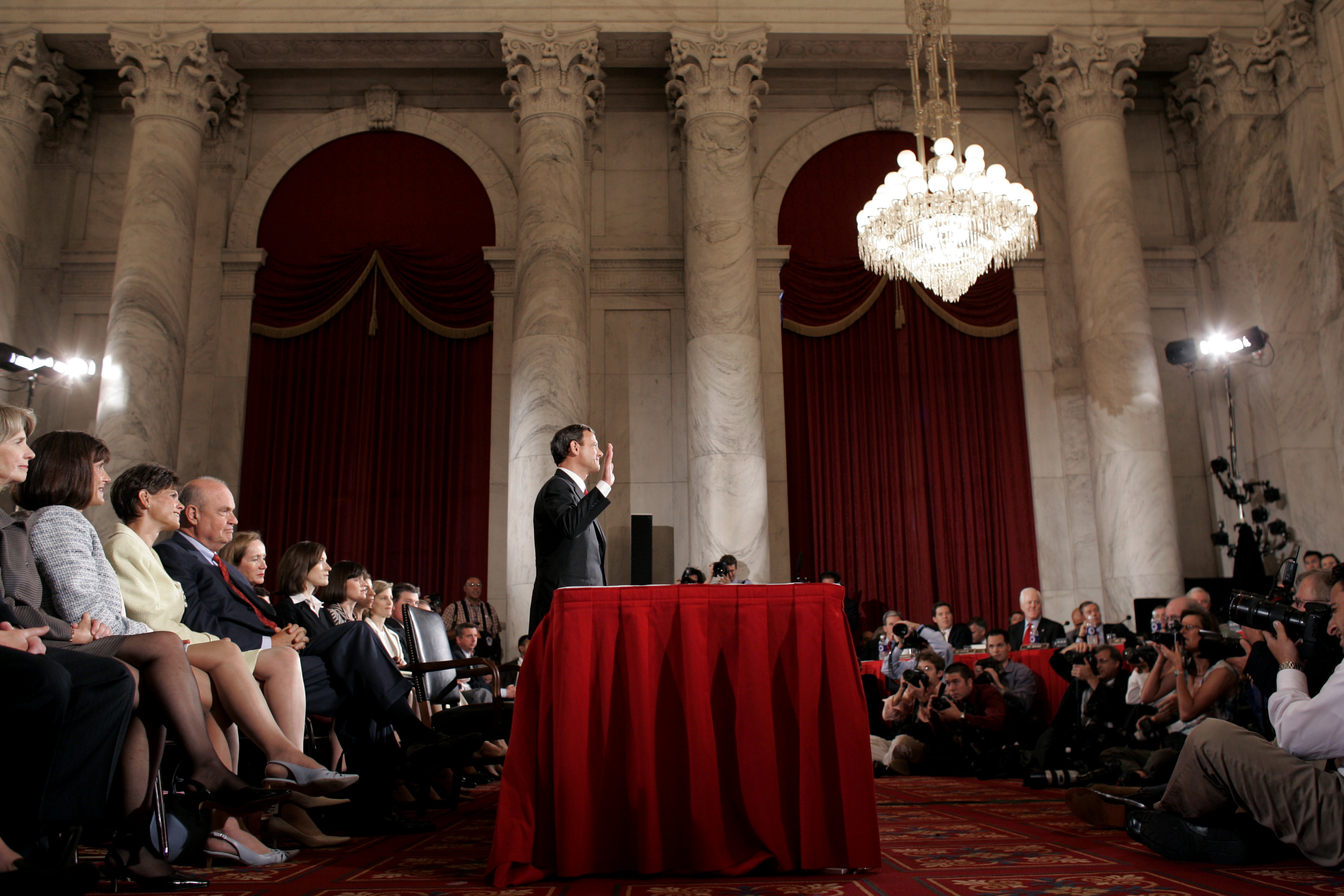
John Roberts raises his right hand in a large hearing room as he faces a crowd of photographers and members of the Senate Judiciary Committee.

Roberts is sworn in before his 2005 Senate hearings to join the Supreme Court as its chief justice.Brooks Kraft LLC/Corbis/Getty

The chief justice didn’t wait till he was on the Supreme Court to empower Republican presidents—he auditioned for the job by showing his willingness to break the rules and come through for his team. In 2004, as a DC appeals court judge, he landed on a panel in Hamdan v. Rumsfeld, President George W. Bush’s attempt to circumvent both the Geneva Conventions and the US justice system’s protections to try enemy combatants in military tribunals. As he considered the case, Roberts attended a series of secret meetings with top administration officials about joining the Supreme Court. Rather than recuse, and in violation of a federal conflict of interest law, Roberts signed on to a sweeping victory for Bush the same week his nomination was made official—a decision that endorsed vast new executive powers. His opinion went too far for his future colleagues on the Supreme Court, who soon struck it down. But it wouldn’t be the last time Roberts made such a bargain with the leader of his party.

The Roberts court has spent Trump’s second term not applying the law so much as clearing it out of his way.

Nor was it out of character. When Reagan entered the White House, Democrats controlled the House, and Roberts pitched in on Justice Department efforts to increase the president’s powers by cooking up the unitary executive theory—the idea that a president has absolute authority over the entire executive branch. Once he reached the high court, Roberts began to write the theory into law, usually by expanding the president’s power to fire officials Congress vested with independence. But even with the Roberts court’s increasingly radical record—from its elimination of the right to reproductive choice to allowing businesses to deny services to LGBTQ clients—many legal analysts argued that Roberts would draw the line at saying the Constitution protected presidents from criminal liability. As Trump’s lawyer conceded in a lower court, such a ruling would mean a president could order SEAL Team 6 to assassinate a political rival with impunity. But the assertions that the Roberts court wouldn’t go so far as to give the president the power of a king proved to be wishful thinking. On July 1, 2024, Roberts’ infamous decision in Trump v. United States granted presidents criminal immunity for official acts. Legal scholars were aghast. But University of Chicago law professor Aziz Huq notes that the decision is the capstone to a chain of Roberts’ opinions endorsing the unitary executive theory, thereby granting “the presidency the option, essentially, to opt out of statutory laws.”

Upon regaining office in January 2025, Trump immediately put this to the test, firing inspectors general, dismantling agencies created by Congress, withholding spending appropriated by Congress, removing regulators protected by Congress, and defying numerous other laws. As if to underline his lawyer’s courtroom admission on assassination, Trump has had boatloads of civilians killed over his baseless accusations that they were trafficking narcotics.

We are now operating under a Robertsian reimagining of the separation of powers, in which laws passed by Congress are mere suggestions for a monarchical president. “By creating out of whole cloth this ‘presidents can commit crimes with immunity’ doctrine that is anathema to the Constitution and rule of law, the Roberts court validated Trump’s view of himself as above the law, beholden to no one,” says Sarah Lipton-Lubet, president of Take Back the Court Action Fund, which advocates for adding justices to alter the court’s makeup.

Long before Roberts and his colleagues assented to Trump’s lawless second term, they helped him get one. Not since 2000, when the justices put George W. Bush in the White House, has the court done so much to pick a president. In March 2024, the court overruled Colorado’s decision to keep Trump off its ballot under Section 3 of the 14th Amendment, which bars oath-breaking insurrectionists from office. Given that Trump had sicced an armed mob on the US Capitol, Colorado’s Supreme Court found that he fit the bill, but the justices disagreed that the state could remove his name. In an unsigned decision, five conservative justices invented new law by saying only Congress could enforce Section 3, and only in the specific way the court dictated. Meanwhile, as special counsel Jack Smith waited to move Trump’s election interference case forward that spring, the court delayed reaching a decision on presidential immunity that could have allowed a trial. When it did, four months after the Colorado ruling, Roberts’ opinion instead effectively halted the prosecution. That November, Trump won.

By then, the Roberts court had handed Trump almost unlimited power to defy the law without accountability. And once Trump was back in office, it weaponized the shadow docket to bless his lawless actions, reversing lower court findings, often without a word of explanation. As of this writing, the right-wing majority has used the shadow docket to uphold Trump’s actions roughly 90 percent of the time, repeatedly bailing him out of any obligation to follow the law. These unexplained rulings have befuddled judges charged with applying the high court’s precedent. That’s because Roberts has totally replaced the rule of law with partisan loyalty—for example, ruling that ICE can consider race when seizing people off the street while colleges can’t when admitting students, which is consistent only insofar as both outcomes are supported by Republicans, or letting Trump withhold funds appropriated by Congress in defiance of the legislature’s spending power. In the birthright citizenship case, the 6–3 majority used the shadow docket not only to overrule lower courts’ orders blocking an obviously unconstitutional policy, but to more broadly strip them of authority to fully stop any lawless president—rigging the underlying system of checks and balances to help Trump.

“This is the third moment in the country’s history where court reform was a mainstream political topic.”

Trump needed Roberts to win, and Trump’s victory came just in time for Roberts. The court’s increasing radicalism had been fueling a movement for reform by adding justices or enacting term limits. The court had also spent the past year under an ethical cloud, beginning with the revelation that Justice Clarence Thomas had secretly taken millions of dollars in gifts, vacations, and loans from a handful of billionaires with interests before the court. Thomas also refused to recuse himself from January 6–related cases, even though his wife had fought to overturn Trump’s 2020 loss. Justice Samuel Alito also didn’t recuse, despite flying flags outside his homes that valorized Trump’s failed coup. Congress was demanding answers, and calls for an enforceable ethics code were growing. Moreover, Thomas and Alito were in their mid-70s, raising the odds that if Trump lost, the court could flip to a liberal majority. So Roberts did what he had done for Bush in 2005—he gave the president broad new powers, and in so doing secured them for himself.

His corrupt bargain has had an exorbitant cost, both for the nation and the court’s reputation. “The court has traded public legitimacy as a significant basis for its authority in favor of just alignment with the GOP,” Doerfler says. As the justices keep rushing to Trump’s aid, Democrats grow more open to reform if they return to power—and thus Roberts lashes himself more tightly to Trump’s mast. “It seems like what the court is trying to do is maximize the likelihood of future GOP control,” Doerfler says. Beyond likely finishing off the VRA this term, the court is weighing one of the last remaining limits on billionaires financing campaigns; it’s no mystery how the justices are likely to rule.

At this point, the court is in a love triangle with Republicans and billionaires, facilitating a jurisprudence that subordinates workers’ rights and responsive democracy to the whims of the ultra-rich. Beyond Thomas, Alito, too, has accepted private trips from Republican billionaires and recently began hobnobbing with a right-wing German princess. Justices Brett Kavanaugh and Neil Gorsuch, both from well-off families, enjoy summer jaunts in Europe paid for by the same billionaires who bankroll the conservative legal movement and its Supreme Court recruitment process. Roberts appears to have avoided such overtly compromising relationships, but he hasn’t needed them, with his wife bringing in millions as a legal recruiter for top law firms, including some that have argued cases before her husband.

The ethics scandals could explain some of Roberts’ and his colleagues’ recent decisions, like how they’ve consistently torn down public corruption law on the premise that bribery is just a part of politics. “The eager embrace and encouragement that you’ve seen from the Roberts court for Trump’s lawlessness is just marinating in the right-wing justices’ belief that rules don’t apply to them either,” Lipton-Lubet says. “Justices who are comfortable taking essentially undisclosed bribes from fellow ideologues end up deciding that the president they support is above the law. They’ve created this culture for themselves of­ ­accountability-free corruption, and that extends, I think, to the way that they view the administration.” She adds, “You can only live in a rule-free environment for so long before it cooks your brain.”

The question lingering over this mess is how it will end. The past may be instructive. “This is the third moment in the country’s history where court reform was a mainstream political topic,” Doerfler says. In 1857, the Supreme Court held in Dred Scott that Black people could not be citizens. The decision helped spur the Civil War and was overturned by the Reconstruction amendments, which ended slavery and aimed to extend political equality to the newly freed. When President Franklin Roosevelt’s administration fought the Depression, the Supreme Court struck down his initiatives, most notably attempts to regulate industrial policy and stabilize farming, as well as a minimum wage law. Ultimately, Roosevelt’s threat to pack the court cowed the justices, who permitted New Deal legislation like Social Security and labor laws to endure.

In the 1930s, the court itself changed. The justices chose to preserve the institution, with four retiring in quick succession, allowing Roosevelt to appoint new ones. But in the postbellum era, the opposite had occurred. Attempts to guarantee equality under the law and Constitution were rolled back by a Supreme Court that, by 1896’s Plessy v. Ferguson, officially gave Jim Crow the Constitution’s blessing.

Today’s court is on the same trajectory, bent on retrenching white political dominance. But it will go further. It will greenlight Trump’s corrupt, self-enriching behavior and unlawful power grabs. The majority will instinctively know that its fate is tied to the fate of Trump’s movement, and so it will protect it. The result will be a democracy in name only.

Under the Roberts court, it won’t be enough to rewrite the rules of the game. The umpires are the problem.

Continue Reading…

Mother Jones

At the Justice Department, Civil Rights Now Means Gun Rights

This story was co-published with The Trace, a nonprofit newsroom covering gun violence in America.

In September, the US Department of Justice sued the Los Angeles County Sheriff’s Department, alleging that it had deprived “thousands of law-abiding” Californians of their fundamental rights. The lawsuit—spearheaded by the DOJ’s storied Civil Rights Division—was unusual. It didn’t take aim at the notorious “deputy gangs” that have operated inside the sheriff’s department for decades. Nor did it target the department’s former leadership for allegedly stonewalling outside investigations of deputies suspected of abusing detainees. Instead, the DOJ accused LA County’s top cop of slow-walking concealed carry permits in a “systematic obstruction” of Second Amendment rights.

Under Trump and Dhillon, the Civil Rights Division has morphed into a potent weapon in MAGA’s nonstop culture battles.

The case—which the Trump administration touted as the DOJ’s first-ever “affirmative lawsuit in support of gun owners”—relies on a decades-old statute intended to help the feds crack down on local law enforcement agencies engaged in a “pattern or practice” of civil rights violations. It’s the latest sign that under President Donald Trump, the Civil Rights Division has made a hard break with its onetime commitment to protecting the politically disempowered and has morphed into a potent weapon in MAGA’s nonstop culture battles.

“First-of-its-kind lawsuit dropped—the Second Amendment rights of Californians will NOT be trampled,” Harmeet Dhillon, a Republican activist and lawyer Trump picked to lead the Civil Rights Division, posted on X after filing the suit.

🚨 First-of-its-kind lawsuit dropped—the Second Amendment rights of Californians will NOT be trampled. This @CivilRights Division will fight LA’s deliberate delays on concealed carry permits, defending your 2A rights!

🔗 https://t.co/Egh11Rivn5 pic.twitter.com/ArJXqCfNKL

— AAGHarmeetDhillon (@AAGDhillon) September 30, 2025

Seven months into Dhillon’s tenure, the Civil Rights Division is unrecognizable. Founded in 1957, it focused initially on ensuring that Black Americans in the South had access to the ballot. Its mandate grew with the 1964 Civil Rights Act and other legislation barring discrimination based on traits such as race, religion, sex, and national origin. Congress enacted the “pattern or practice” law in 1994, three years after the videotaped police beating of Rodney King in Los Angeles. The provision quickly became the DOJ’s chief tool for bringing oversight when officers engage in rampant, unchecked misconduct against marginalized groups.

Under the Obama administration, the DOJ used the law to force a settlement with the same LA Sheriff’s Department after finding in 2013 that officers had subjected Black and Latino people to brutal violence, illegal searches, and other forms of discrimination. Until this year, the law had never been invoked on behalf of gun owners, whose right to possess firearms for self-defense the Supreme Court recognized only in 2008.

In interviews, Civil Rights Division veterans who left during the current or previous administrations said various Trump executive orders—which often seek to undermine existing civil rights policies—are guiding enforcement. Christy Lopez, a professor at Georgetown Law who served in the division and led the Obama-era investigation of the LA sheriff, said, “It’s clear that they are co-opting the division to serve an agenda that is in some ways antithetical to civil rights.”

Dhillon has an appetite for provocation and dispute. In 1988, as the editor of Dartmouth College’s right-wing student paper, she cited the school’s “liberal fascism” in defense of her decision to publish a satirical opinion piece by another student that likened the college president to Adolf Hitler and campus conservatives to Holocaust victims.

She earned a law degree in 1993 from the University of Virginia, where she was president of the school’s Federalist Society. This year, Dhillon and a DOJ deputy who is also a UVA alum went after diversity efforts at the school, intensifying a broader conservative pressure campaign to get rid of university President James Ryan, who resigned in June.

“Gun owners are not in any way an oppressed minority.”

Dhillon’s advocacy work hasn’t always been on behalf of right-wing interests. After the September 11 terrorist attacks, Dhillon, a practicing Sikh who immigrated from India to London to the United States as a child, helped lead efforts to protect her community from growing harassment. “While my brother, a turbaned Sikh lawyer, was being called ‘Osama’ at Candlestick Park and Sikh taxi drivers were being assaulted, we made it a priority to keep Sikhs and other Americans safe from this irrational and discriminatory violence,” she told the Senate Judiciary Committee in a written questionnaire this year. “I spent hundreds of hours drafting legal memoranda and advocacy materials for publications, training for law enforcement, and more.” Her efforts drew the notice of the ACLU of Northern California, which appointed her to a two-year stint on its board.

In the Trump era, Dhillon has become a MAGA world star. She co-chaired Lawyers for Trump in 2020, spread doubts about that year’s election results, and called on the Supreme Court to intervene on Trump’s behalf. Her private San Francisco-based firm collected $10 million from Trump’s political operation in the 2024 cycle, and it has fought against gender transition for minors, alleged anti-white bias, and the perceived stifling of conservative speech.

Dhillon has drawn occasional heat from some extreme elements on the right. Her faith became an issue in a failed 2023 bid to chair the Republican National Committee. She told Politicoat the time that it had been hurtful to discover that “a handful of RNC members” had “chosen to question my fitness to run the RNC by using my devout Sikh faith as a weapon against me.” Dhillon delivered a Sikh prayer at the Republican National Convention in Milwaukee in 2024, prompting a particularly venomous response from some commentators.

But Dhillon retained Trump’s loyalty. She’s become a key figure in implementing the president’s legal agenda and has worked overtime to mollify powerful firearms groups that, at times, have criticized the Trump DOJ for being insufficiently aggressive in opposing gun control laws.

Satisfying the gun rights crowd is work that Dhillon—whose former private firm dabbles in Second Amendment law—touts publicly. Neither she nor the DOJ responded to written questions for this story. But in a recent issue of the Dartmouth alumni magazine, Dhillon suggested that the division’s gun rights work is just getting underway, telling an interviewer that “we’re forming a Second Amendment section of the Civil Rights Division. That’s never been done before.”

The concealed carry lawsuit against the LA Sheriff’s Department, which is the division’s highest-profile move on behalf of gun interests, isn’t frivolous. The county’s permit program has indeed been plagued by delays, and last year, in a lawsuit brought by gun rights groups, a federal judge found that the agency had likely violated the plaintiffs’ Second Amendment rights.

Yet the existence of a well-resourced private lawsuit highlights another way in which the Civil Rights Division’s intervention marks a departure from past practice. Historically, it has stepped in to uphold the rights of those with limited political clout and access to levers of power. “Proponents of Second Amendment rights have an abundance of political power that has allowed them to not only protect, but dramatically extend their rights,” said Lopez, the former DOJ official now at Georgetown. “Just because they don’t always get what they want, or because there are some process issues in getting them what they want, doesn’t mean they are a politically marginalized group.”

“It was extremely shocking to see the press release.”

Before bringing a pattern or practice suit, the DOJ typically issues a report that sums up evidence the government has collected. These reports alert the public to substantiated misconduct and can be a basis for settlements. When the DOJ settled with the LA sheriff in 2015, reforms were tailored to the findings that the DOJ had made public two years before. The DOJ released no such report before filing its concealed carry suit in September. In March, when the agency first announced its investigation of the permit delays, lawyers who specialized in law enforcement oversight were caught unaware, said several division attorneys who left this year. “It was extremely shocking to see the press release,” said one, who spoke anonymously to share internal details of the episode. “It was just such a sharp departure from the norm.”

Lopez has written critically of the division across administrations, arguing that it has too often favored symbolic gestures over aggressive enforcement and that it has been overly attuned to political considerations. Though imperfect, she said the division has done vital work. While allowing that a scenario like the permit delays in LA may lead to constitutional rights violations, she said the suit is a dubious use of limited resources. Lopez fears that such moves could undermine the legitimacy of the division and the broader federal government.

“I am worried that once this administration is gone, the ability of the division to enforce civil rights protections will be forever compromised,” Lopez said. “And it will be viewed as what it is now, this cynical, entirely political division, which is actually pushing an anti-equity agenda.”

Career staff and leadership have been forced out under Dhillon. Figures the DOJ gave Congress and a list of departures released in October by Justice Connection, a network of agency alumni, suggest that nearly 400 people, including 75 percent of attorneys, have left the division since January. When Dhillon gave an interview to her former client Tucker Carlson in May, she described the reaction of career DOJ attorneys to her arrival. “They had crying sessions, struggle sessions,” she said. “There was open crying in the halls.”

A recently departed DOJ lawyer, who spoke anonymously to provide details on the current situation, said: “It’s almost impossible to quantify losing three-quarters of the expertise of the Civil Rights Division. The people who are left, God bless them, are treading water and cannot pursue the work that is necessary to defend the constitutional rights of every American.”

The division’s focus, the lawyer noted, has shifted dramatically. Under Trump and Dhillon, “it has targeted universities that allowed peaceful student protests, rather than standing up to landlords extorting sex from vulnerable women, police departments engaged in widespread use of excessive force, and the jailing of people who are unable to pay petty fines.”

Before Trump was reelected, there were more than 30 attorneys in the unit enforcing the pattern or practice law, the lawyer said. There are now three, they said. In the private suit brought by gun groups against the LA sheriff—in which the parties reached a tentative settlement October 31—six attorneys represented the plaintiffs.

Lawyers newly tapped to serve in Dhillon’s division include an attorney who represented January 6 rioters and likened them to victims of the Nazis and a GOP activist from Florida who called Covid-19 vaccines “the mark of the beast.” There have been wholesale mission reversals. Citing concerns over “election integrity,” the division has sued to obtain voter information in blue states and dispatched staff to six heavily Latino counties in California and New Jersey to “ensure transparency, ballot security, and compliance with federal law.” Last week, the division joined a suit filed by the California GOP, alleging that congressional maps recently approved by state voters—an effort by Democrats to counteract recent Republican-led gerrymandering in Texas and elsewhere—are themselves illegal. Dhillon’s former law firm is representing the state GOP in the case, and Dhillon is recused from the case.

Entire areas of work, like oversight of police departments and prisons, have been largely shelved and the division’s work wholly subordinated, in Dhillon’s words, “to the priorities of the president.” Among those priorities, Dhillon’s focus on Second Amendment rights stands out as entirely new terrain for the division. In part, the modern gun rights movement arose in the 1970s amid a broader conservative reaction to the upheaval and shifting societal norms of the 1960s, which the Civil Rights Division reflected. In the decades since, gun advocates have adopted the resonant language and narratives of the civil rights struggle and deployed them on behalf of gun owners, who are predominantly white and male.

Timothy Zick, a professor at William & Mary Law School who has studied the rhetoric of the gun debate, said arguments that gun owners are misunderstood victims of discrimination and judicial bias are, like most underdog stories, potent. However, he said there are good reasons to doubt that the Second Amendment has been relegated to “second class” status, as advocates maintain. Most states now allow gun owners to carry in public without a permit and constrain local firearms restrictions. Many states have passed anti-discrimination laws to protect gun rights, and multiple jurisdictions nationwide have refused to enforce gun laws, declaring themselves Second Amendment sanctuaries.

“Gun owners are not in any way an oppressed minority,” Zick said. “If anything, the Supreme Court and lower courts are treating the Second Amendment as a super-right. It has privileged status.”

In a federal financial disclosure completed before being confirmed as head of the Civil Rights Division, Dhillon said she planned to sell her private firm to her brother. Since her departure, Dhillon Law Group has continued to bring suits against federal agencies, including one filed in May against the DOJ seeking agency records related to former President Joe Biden’s “mental fitness.”

At the Dhillon firm, gun rights litigation has been a modest part of the practice. Firm attorneys have sued over pandemic restrictions that stifled a gun rights rally on the grounds of California’s State Capitol building, a state data breach that exposed confidential personal details of gun permit holders, and San Jose’s requirement that gun owners carry liability insurance.

The firm’s highest-profile gun rights work has been representing Rare Breed Triggers in cases involving the DOJ. Rare Breed makes forced reset triggers, which allow certain semiautomatic rifles to fire more rapidly. The company’s founder is also behind an apparel company called Pipe Hitters Union—“pipe hitter” is slang for special operations military personnel—and another that sells Spartan- and Christian Crusader-themed AR-15 components.

In a complaint that Merrick Garland’s DOJ brought against Rare Breed in 2023, the government alleged that company principals were brazen in their defiance of the federal Bureau of Alcohol, Tobacco, Firearms and Explosives, continuing to sell forced reset triggers after being told it was illegal to do so. Rare Breed objected to the basis of the suit, arguing that the government’s classification of its product as an illegal machine gun was bogus.

In August 2021, the complaint states, the ATF received a call from a number associated with the law office of one of Rare Breed’s owners. The caller said that the government was engaging in “treasonous” behavior and that they planned to assemble and protest at an ATF office. “We are bringing the rocket launcher,” the caller said. The Rare Breed owner denied any involvement in the threatening call, and a federal judge ultimately found that the government had failed to prove otherwise.

Representing Rare Breed for Dhillon Law Group in those cases was David Warrington, a founder of the National Association for Gun Rights, which was involved in related DOJ litigation. Gary Lawkowski, another attorney at the firm, represented the gun rights association. Trump named Warrington, who had worked on his campaign, as White House counsel on December 4, 2024, and Lawkowski joined him as a deputy. Trump nominated Dhillon five days later.

On May 16, the DOJ announced a settlement with Rare Breed that allows the company to sell its triggers. The settlement requires Rare Breed to refrain from selling similar devices for handguns and “to take all reasonable efforts” to enforce its patent by seeking court injunctions against copycat manufacturers. Public safety is the stated rationale for these requirements, but some in the gun world have questioned the deal, suggesting that the DOJ awarded Rare Breed a market monopoly for a product the government had previously asserted was illegal.

Patent law experts I contacted were perplexed. “It’s just strange,” said David Schwartz, who teaches intellectual property at Northwestern University’s law school. “I’ve never seen an agreement to enforce a patent as part of a settlement with the government—and this is not even a patent case.” Schwartz said the agreement could help Rare Breed defend its turf. After finding that a patent has been infringed, courts balance several factors, including the public interest, when deciding whether an injunction is warranted, he said, and the settlement could bolster Rare Breed’s arguments.

Charles Duan, a law professor at American University, said by email that the settlement confers a clear edge. “Rare Breed’s device is now effectively safe-harbored from regulation, whereas other producers would still be at risk, giving the company a huge market advantage given the patent,” Duan wrote. “The question in my mind is: Are other companies going to lobby the DOJ now to favor their patents similarly?”

Warrington withdrew from the case days before Trump’s inauguration. According to a White House official who provided information on background, neither Warrington nor Lawkowski were involved in the settlement. There is no indication that Dhillon played any role in the case. Rare Breed officials and current Dhillon Law Group attorneys who represented the company did not respond to requests for comment.

Questioned on the settlement in a June interview posted to YouTube, Rare Breed’s president, Lawrence DeMonico, dismissed the notion that the DOJ had awarded a monopoly, saying Rare Breed had always intended to enforce its IP rights, settlement or not. “We already have a government-sanctioned monopoly,” he said. “It’s called a patent.”

In addition to filing suit against the LA sheriff, Dhillon, in her DOJ role, has filed several briefs in support of gun rights groups seeking to strike down firearms restrictions. On September 22, a federal appeals court heard arguments in a challenge to an Illinois law that restricts the sale of assault weapons and high-capacity magazines. The DOJ intervened, and Dhillon personally appeared in court to argue against the legislation.

“The United States has a strong interest in ensuring that the Second Amendment is not relegated to a second-class right,” she told the court, “and that all of the law-abiding citizens of this circuit remain able to enjoy the full exercise of their Second Amendment rights.” Dhillon chronicled her involvement on X, posting about her consuming preparation and noting that she was unwinding by making a needlepoint image of an eagle.

“The United States has a strong interest in ensuring that the Second Amendment is not relegated to a second-class right.”

In May, she filed a brief with the Supreme Court on behalf of challengers to a Hawaii law that restricts the carrying of guns on private property; the court will hear the case in January. Then in September, Dhillon filed a brief with the 3rd US Circuit Court of Appeals backing a challenge to New Jersey’s assault weapon and large-capacity magazine bans.

Until now, every appeals court to consider an assault weapon or high-capacity magazine challenge has upheld those laws, but judges in the Illinois and New Jersey cases have yet to rule. If the plaintiffs in either case prevail, it will increase the already-high likelihood that the Supreme Court will soon consider such bans, which could result in the prohibitions—one or both of which are in place in 14 Democratic-leaning states and the District of Columbia—being declared unconstitutional.

Still, gun rights groups have not been happy with all of the Trump DOJ’s moves on guns. In January, for instance, the 5th Circuit struck down a federal law that prohibits firearms dealers from selling handguns to those under 21. But the DOJ convinced a lower court to issue a narrow ruling applying only to the individual plaintiffs and members of the gun rights group behind the suit. The DOJ also urged the Supreme Court not to consider a separate challenge to the same law.

Andrew Willinger, executive director of the Duke Center for Firearms Law, said those moves are consistent with a broader pattern: Trump’s DOJ has been eager to challenge firearms restrictions in blue states, but quick to protect federal gun laws, particularly those that allow the government to prohibit certain classes of people—drug users and felons, for example—from owning guns.

“It seems as if they don’t want courts telling them whether these prohibitions are constitutional,” Willinger said of the DOJ, which is establishing a program that will allow some felons to have their gun rights restored. “They want to decide, as an executive branch matter, who is sufficiently reformed to get their guns back.”

Willinger said there’s an element of performance to the DOJ’s involvement in these cases—the agency clearly wants to be seen as crusading for gun rights. And he expects the DOJ to ally with gun rights groups in cases in which “it can most successfully characterize state or government actions as motivated by anti-gun animus.”

Among the Second Amendment groups expressing dissatisfaction with the DOJ has been the National Association for Gun Rights, the Dhillon Law Group client founded by Warrington, who now serves as White House counsel. On October 10, citing DOJ legal moves aimed at preserving federal gun laws, the group accused Attorney General Pam Bondi of having “failed the Second Amendment” and called for her firing, leading Dhillon to defend her boss.

“Please trust and believe that this is the most Second Amendment friendly Department of Justice in history,” Dhillon said in a video posted to X. “Yes, that’s a low bar, yet we’ve managed to rise way above it.”

Continue Reading…

Mother Jones

Why America Is Obsessed With True Crime

In 2001, John J. Lennon killed a man on a street in New York City. He was convicted of murder several years later and given the maximum sentence—25 years to life in prison—on top of three additional years for two other convictions. From behind bars, Lennon began reckoning with his crime through in-prison writing workshops and soon fell in love with journalism. He’s since made a name for himself as an incarcerated journalist and has been published in The Atlantic, Esquire, and the New York Times Magazine, often writing about the criminal justice system and conditions in correctional facilities, all from the inside.

In the decades Lennon’s been behind bars, America has become increasingly fixated on stories like his —true crime—through endless podcasts, documentary series, and streaming shows. But Lennon argues that tragedy is too often being turned into entertainment. “I think with true crime, it creates this thirst for punishment,” he says.

On this week’s More To The Story, Lennon joins with host Al Letson to discuss how his first book, The Tragedy of True Crime: Four Guilty Men and the Stories That Define Us, inverts the basic structure of the true crime genre. They also discuss how his portrayal on a cable news show hosted by Chris Cuomo inspired him to write the book and how Lennon now views the murder he committed almost a quarter-century ago.

Find More To The Story on Apple Podcasts, Spotify, iHeartRadio, Pandora, or your favorite podcast app, and don’t forget to subscribe.

This following interview was edited for length and clarity. More To The Story transcripts are produced by a third-party transcription service and may contain errors.

Al Letson: Can you tell me how you ended up in Sing Sing and all about your time there?

John J. Lennon: Yeah, for sure. I’m from Brooklyn and in 2001, at 24 I was involved in a criminal lifestyle, selling drugs and shot and killed a man on Brooklyn Street. And I was sent away with a 28 years to life sentence. Yeah, I mean, along the way I found myself. I guess a turning point for me was getting stabbed at a prison and transferring to another prison, finding a writing workshop. And that was around 2010, my first piece published in 2013 and just found journalism as something to help me with just my identity. Just helped me get a life and a place where you could really feel, frankly, like a loser, like you’ve screwed up your life and hurt a lot of people along the way. So journalism helped me with my identity.

I just want to break it down a little bit. So you were a part of a criminal lifestyle in Brooklyn for a while, and so correct me if I’m wrong, but in the state of New York, if you got, I think you said 28 to life, am I correct in that?

Yes. So I was convicted of, I was already serving time for selling drugs and I was already serving another sentence for possession of a gun. So I had a whole host of criminal charges. I’m on my 24th year right now and I’ll go to the parole board in about three-ish years.

So how long into your time in jail did the stabbing happen?

Yeah, so that was probably, it was around 2008. For me, that was the turn in my story, where I started at Sing Sing, went to other different prisons. In your first years, you’re finding yourself and honestly perpetuating that behavior. I was perpetuating the behavior that got me at doing drugs, selling drugs, just up to no good, gossiping in the yard. Prison was where I belonged in the beginning, and for me, that point, it was that point when I got stabbed pretty bad in the yard, it was retaliation for the man I killed in Brooklyn.

I mean, I knew the guy who stabbed me was his friend, and at that point I got hit pretty bad and you’re like, wow. I got hit in the lung and I was just like this is, everyone knew I was getting hit but me that day in the yard. And I was just like, this is a disgusting place and I’m a disgusting person. I just want to be better. It was just, at that point I transferred to Attica and in the worst prison in New York State, I’ve got sober and I joined that writing workshop.

Yeah. I think it’s really incredible that you came from the street, you’re in prison and you’re just doing what you’ve always done, just trying to survive in there, and then this moment where you get to reflect on your life and in probably one of the worst places in the world, a place that I think nobody ever wants to go, you realize that you have to make change. I mean, making change in those circumstances has to be really hard.

Yeah, it was ground zero. I had fantastically failed in life. Attica’s a tough joint, but I had a great 12-step meeting, though. Had these really cool volunteers, and if anything’s going on in prison, it’s always through the volunteer programs, people with a lot of decency that come in this nasty place and just try to show us some love. And I got sober around the same time that another volunteer came in and he was an English professor and he came in and started showing us, started tossing us some Best American Essays and started reading some of these pieces. And it was probably around that time, it was probably helpful that I was getting sober around the time that I was learning to write because it maybe edified, maybe, my voice a bit or at least gave me some clarity with my thoughts that I was doing some work on myself.

How did you gravitate towards journalism?

There was these pieces, again, there was these essays that I would write and that we were reading and I would see where these essays were published in these Best American Essay Collection and Best American Magazine Writing, that the professor would give us these books and I just started reading these pieces and I started subscribing to those magazines. It worked for me because I had a bit of a learning disability too. I wasn’t a great reader, but I loved story and magazine writing and my mom would subscribe to these different magazines and these different, the Atlantic, Esquire, [inaudible 00:08:04], all these different magazines. And interestingly, that’s the kind of writing I took to initially. So it was by reverse engineering and I also knew, I was self-aware enough to know that I had some personality issues. I was a mess.

So tell me about that first piece, the idea that someone who’s currently locked up could become a journalist and get published in The Atlantic, one of the most prestigious magazines in the country. How did it all take place?

I think you have to feel like you have something to say. I remember it was like 2013 at the time and it was this horrible shooting in Sandy Hook and I remember I had used the same gun in my crime and everyone was talking about gun control and I was just like, I know how to get guns easy. They don’t even know what they’re talking about. So I mean, I felt like I had something to say. It just clicked for me. From the beginning, I knew that I had a lot of conflict, but I knew to lean into that, and if I could write about this in a sober way and an accountable way, and I think people would listen to what I had to say.

So after the shooting at Sandy Hook Elementary happens, you feel like you have something to say. What was the process of writing the essay and submitting it for possible publication?

I wrote in my cell, I was workshopping it every two weeks, the workshop, sometimes every month. You’re hanging on the red ink, hanging on the words of the professor. His name is Doran Larson, he was a Hamilton College professor who would come in. And it was like five or six of us in the group and we would hang onto his words, but he would give me some red ink. I would go back and work it. I mean, eventually it looked clean and I kept reading it out loud in my cell. I’d read other op-eds, see how they read. It was a lot of reverse engineering and I sent it out just on a whim to the Atlantic. Even he was like, “Good luck, you’re shooting for this stars there.” And I got a letter back from David Graham, who’s a writer today for The Atlantic, and he said, “Man, I’d love to publish this piece.” My life changed after that.

Wow. And so did you send it out to anybody else or just the Atlantic?

Just one shot, the Atlantic.

Wow, that’s excellent. All right, so you write this piece, the Atlantic publishes it. Talk to me about that second piece, dying in Attica. What was that about and how did it come about? Because this is the first true reported piece.

That wasn’t really my second piece. I wrote … actually a piece on Nick Kristof’s blog, so it was another gun piece. But my instructor was like, “What, are you going to be the gun guy? Write something else.”

I wrote this piece about this guy, Lenny. He was dying of colon cancer on my tier and it was just so difficult for him because he had a colostomy bag and I was just like, wow. This was around the time that I got diagnosed with Crohn’s and my mother was always in my ear, saying, “That’s a terrible disease.” I actually have a mild case of it, but back then it was on my mind and I was thinking of this guy and I was seeing how he lived and I was seeing how people were holding their noses when he changed his bag because he was a few cells down, and it was just a terrible place, prison, to live with any kind of illness. I was just like, if I could capture that, and that would be cool.

After you were finished with that piece, I mean, I’m sure that just lit a fire and you just wanted to do more of this type of journalism.

Yeah, absolutely. I didn’t really realize how significant it was, but somebody said, “You could do something with this.” I felt like they gave me the rock and I was in the game and I was just like, I have to do something with it. I just started writing more and it was good timing that The Marshall Project opened at that time. Bill Keller who’s just, he runs the New York Times. In 2014, he shifts to open up The Marshall Project. I read that in one of my subscriptions my mom gave me, I’m connecting the dots. I’m like, oh, this is big. This could be something.

And I’m like, I reach out to him and then I write that story about Lenny, the bank robber. That was the first piece that wasn’t, I jumped in a little bit with relating to him, but I really made it about him. And if I was relating to him, it was about my own reflections. I mean, it’s not like I wasn’t incapable of empathy, but it was just the work itself boosted this idea of healing for others because prison’s a place where you mind your business. Journalism transcends that.

Can you tell me a little bit about A, how you came to think of true crime as a tragedy, and then also just about these men that you have talked to and written this book about?

Yeah, so we were talking about the kind of work that I was doing initially, which I thought, and which you framed as, I appreciate the way you put it. It was just substantive journalism. And I even took it further and I started writing long form features, like in magazines and Esquire and Vice. And by 2018, I had transferred from Attica to Sing Sing, and around that time, Bill Keller and I just wrote a piece in New York Magazine about a man who was suffering from schizophrenia, actually in this block. And so I was making my rounds, like who wants to talk? Maybe I could talk about this crisis on the radio. And we actually did, we did talk on the radio. So I had reached out to somebody I knew at CNN, but I didn’t know that they were working at H.L.M. And ultimately they had sent, I told them I wanted to talk up this crisis.

She lined me up with her colleagues and told me, and they had come to see me and they wanted to do a show about my redemption, they told me in this career that I had built for myself. It was a bait and switch. It was all a lie. It came up and it was really the show. They told me show was called Inside. It was Cuomo, and it was. The first season was, but the second season was called Inside Evil and the third season was the one that they were grooming me for, and they said it wasn’t going to be Inside Evil. They said it was going to be about our stories of redemption. And I was like, “Oh wow, this is great. I’m so glad you thought of me.” And by the time they came up with Chris Cuomo, it wasn’t about that at all. So that was my experience that I had. And I didn’t walk out on Chris Cuomo because …

Well, he’s Chris Cuomo.

Yeah. And it’s like brother’s the governor. It was just a lot.

Yeah, there’s a big power imbalance there. I mean, you are a prisoner. Chris Cuomo is a celebrity, CNN, at the time, guy and his brother, at the time, was the governor of the state that you are currently in prison. I mean, tell me if I’m wrong, but it’s possible that at the time the Governor Cuomo could have pardoned you, right?

Absolutely. And he was pardoning guys I knew. I’m talking about guys in the block, in cell blocks. I’ve seen guys right next to me walk right out. What happened was they showed me that they saw me as a murderer and not as a journalist. And the reason why I wrote this book was to show, well, twofold. Personally, I had a chip on my shoulders and I felt like I had something to say. It’s the first similar feeling that I had when I started writing. And I thought I could tell better stories than this dude and I have better access.

I’m not telling these stories from a perch, but I could tell fuller stories about the men I live with and the fuller stories, Al, included the punishment thing. You mentioned these other true crime shows, these podcasts. I mean they’re structured the same way, every story. You watch one, you watch them all. Bang, bang, police tape, 911 calls, drop back, you meet the characters. But I inverted that whole structure with The Tragedy of True Crime. So I write about three men. I introduce you to them where they are, in prison with me, at different timeline, and you get to know them before you learn about their crime. But I don’t shy away from their crime. I describe their crime, but I deliver it to the reader in a different structure than traditional true crime.

Do you feel like the structure is what separates what you’re doing from true crime? Or is it the structure is born out of the idea that you’re doing something different than true crime?

Well, it’s one of the things. Voice and agency is obviously the other. I write about three men who’ve also killed, but I would argue that the three men that I write about, one of whom has been the villain his whole life, and he hasn’t known how to overcome that. I was talking about Robert Chambers. Another one is a gay man named Michael Shane Hale, who, he’s an amazing person and killed his lover. And then the third is Milton Jones, who, at 17, killed two priests. These are different crimes, but ultimately I use my own agency to put myself, I don’t judge them. I tell their stories without, I would say, a lot different than how, say for example, Chris Cuomo told my story and told the stories of other people on that show, Inside Evil.

It’s ability to tell a story. I come clean about my own crime and I try to be candid with the reader and that enables me to be a trusted narrator. With that, I’m able to tell the stories of these other men, not judge them, and at times put myself beneath them in terms of just explaining, hey, I’m actually more culpable than Michael Shane Hale, who I call Shane, but why does Brooklyn decide to execute him? Why is he the first man selected in 1995, when New York brings back the death penalty, to execute? What’s that about? And I unpack that and I explain what happened in each of these cases. But you asked the question about voice and the narrator. I’m a narrator that’s done this as well. It’s pretty unusual. When you think of a trusted narrator, you don’t think of a guy in prison who’s killed a man. So I have to reckon with that, but I try to do that early on in the book and I tell the story, with my own woven through.

Yeah. So let me ask you, I think one of the complicated parts of talking about people’s stories, especially people that have killed somebody, is really that with that is the victim and what the victim’s family has gone through as well and how you handle both parts of it. There’s a story about redemption, which everybody wants to hear. I think that redemption stories are so powerful because we all want redemption. So I think that when you hear redemption stories, it pulls you in. On the other side of that redemption story, though, is a family who lost a family member. And I’m wondering how do you balance those two?

Yeah, I mean it’s difficult. Look, I mean, I knew going into this, this book was going to be more about me having access to these guys in here, showing you what the punishment side is. I do reach out to, I think doing the work, right? At a certain point, when we think about three of the men I write about, I reach out to the family members, people that they killed.

What about the family of the man you killed? Have you been able to reach out and talk to them?

It’s one of the toughest parts of my career. Yeah, I wrote a piece in Washington Post years ago about just trying to come to terms on my own of writing an apology letter. The sister of the man I killed, she rejected it and she asked, in a letter to the Washington Post, that I not use his name in my writing. That would serve her better than my apology. I’ve respected her wishes, and that’s why I don’t refer to him by name in the piece. But look, I don’t pretend to, I understand what brings me pride, writing, I mean, it may cause her and her family more pain. Look, that causes me shame. But that whole equation, at least for me, is this idea of remorse, because this inner conflict, there’s no easy answers to that.

Yeah. No, I mean, on one side of it, you should be able to talk about your story and the things that you’ve gone through. On the other side of it, there’s a family who lost a loved one, and I think it’s fair that they don’t want to hear it.

No easy answers.

So John, I want to go back a little bit and talk about true crime. I’m wondering, in your opinion, how has the genre influenced how we view crime and the people who commit those crimes?

I think with true crime, yeah, it creates this thirst for punishment. I started critiquing this stuff before I wrote the book, Al. I started developing these ideas, critiquing other writers of true crime, New York Review of Books and the New York Times Magazine, and I started really clocking the way we consume true crime and even critiquing Dick Wolf. And Rolling Stone, I had a big piece critiquing him. It’s just about who’s telling our story and how are they telling them? That’s one of the themes that runs through The Tragedy of True Crime. You zeroed in on, I think, a fair observation. Like, wait, dude, you’re a murderer. And it’s like, what if the people that I killed, the guy you killed, his family is not really digging this? What does it mean when people that are so disconnected … crimes are the ones that are telling, that are shaping the narratives?

He grew up on the Upper East Side. What does Chris Cuomo, this guy grew up in the governor’s [inaudible 00:26:02]. That’s who y’all are relying on? What if I can develop my voice and be fair-minded about it, give it to you guys real, and also be accountable? I’m just saying that. I’m not an activist, I’m a journalist. That’s not what I’m doing. I want to create an experience, but I want to just offer an experience. I’m a narrative journalist. I’m a guy that did a pretty terrible thing. I shot a man 10 times. I was deeply immersed in this lifestyle. I reckon with that on the page and people that read my stuff, and there’s a way that I connect with them and account for what I did, and I’m not blaming the system.

Do you wrestle with the possibility that you’re a little too close to these guys to write about them objectively? Is that something that you’re constantly thinking of as you you’re writing it?

I’d be lying to myself and the reader if I’m saying that I’m an objective journalist. I think we come to life and to our work with our life experiences, and I’m writing about men in prison who live behind bars, and I also go to sleep behind bars. So I think I’d be kidding myself and the reader to say I’m 100% writing an objective story. This is a first person, immersive, [inaudible 00:27:29] personal journalist. You call it what you want. It has many names, as you know, Al. I don’t know, was Hunter Thompson being asked, “Do you think you’re an objective journalist?” This guy’s riffing about all kinds of stuff. You know what I mean? But his work had value. And he had so many flaws. As do I.

I would just, can I just say something else about the objective thing?

Yeah, please. Please do, go ahead.

I would also like to think I’m being objective with scenic writing and with these riffs and these digressions that I do in the book. For example, there’s a scene in the book where guy just offers me some drugs. I deny it. I don’t want it. I’ve relapsed after I got sober. And it’s always a struggle to stay sober in prison. And prison, the heroin now in prison has fentanyl it all in it. I remember another guy, it was just stuff going around in a cell block and there was this guy that overdosed and the COs are running to his cell and the whole block is silent and they’re going to work on this guy, the COs, the guards.

They’re doing CPR, everything. They’re running in and the whole block is silent. And everyone knows there’s drugs in the block and everyone knows that it’s probably fentanyl, but it’s just this culture that we live in. It’s awful. We’re foul. There’s parts of us that are foul in here, and I acknowledge that in the book, that these COs are like, they’re working, they’re busting their ass trying to save this guy’s life. And it’s just like they’re contending with this foul culture and it’s just awful. And that’s the culture that we live in. And I think when you create those scenes, you show what it is. There’s a lot going on right there from that scene. There’s a lot.

Yeah. How do you rise above that culture? Everything you just described sounds really hard for somebody to figure out how to navigate that.

It’s harder at the end, Al. It’s harder at the end, when you know you’ve … I’m doing this interview with you, I’m outlining a piece for the New York Review of Books, and there’s just suffering and it’s a mix of just stupidity and suffering. Difficult to not get angry at it, and then just to have empathy. It’s really difficult when you can’t shake it, you can’t get away from it. It’s hard, Al. The time gets really hard at the end, when you’ve transcended this place and it’s just tough. I mean, it was so much easier when we started this interview and I came in and I was just like, wow, I am. I belong here. I’m a low life. This is where I belong. But fast-forward 24 years and where I am today, this is the toughest time.

You’re up for parole soon, two years from now. How are you feeling about it? I mean, you must know a lot of people who have gone through the parole process in the past, so what are your thoughts going into it?

I think one of my concerns is, it’s just the idea that I think society wants us to come to prison, get our lives together, and just not be criminals and get out. Just like go get a job, don’t be bad. I never went into this thinking writing would be a passport to freedom or anything like that. You know what I wanted? I wanted to just to get a life, not be a loser. I had some green lights along the way and this has become, I found some success and I’m grateful for that. But I just hope I’m not resented for that. That’s what I fear.

Continue Reading…

Mother Jones

Trump Meets Business Partner In the Oval Office

Donald Trump has never been particularly critical of the Saudis, despite a human rights record that has brought harsh condemnations from his predecessors. Unlike previous presidents and even many in his own party, Trump has generally struck a conciliatory, or even friendly, tone when dealing with the country’s ruler, Crown Prince Mohammed bin Salman. And he has always been very clear about the reasons why.

“Saudi Arabia, I get along with all of them,” Trump said at a campaign stop in 2015. “They buy apartments from me. They spend $40 million, $50 million. Am I supposed to dislike them? I like them very much.”

“They buy apartments from me. They spend $40 million, $50 million. Am I supposed to dislike them? I like them very much.”

The United Statesonce had a strong relationship with the kingdom dating back decades. But in recent years, the country’s abysmal human rights record—fomenting war in Yemen and feuding with Qatar—as well as its strong grip on the oil market, have led to an often tense relationship. At least, until Trump came along.

As that tension has receded, the business relationships between the Trump family and the Saudis have only grown closer—whether through state-owned enterprises, like the Saudi Public Investment Fund (PIF), which handles international investments of Saudi surplus money at the direction of MBS, or individual real estate developers who operate under the watchful eye of Saudi royals.

Trump’s love of golf has offered special opportunities for the Saudis. In 2022, after the PGA tour abandoned Trump for his divisive politics during his first term that culminated in the January 6 attack on the Capitol, the LIV Golf league brought its tour to Trump-owned golf courses. The LIV league, owned by PIF, challenged golf’s staid norms and paid players previously unheard of nine-figure salaries. It already has brought its tournament and likely multi-million dollar fees to Trump-owned golf courses seven times—with an eighth event planned in 2026 at Trump’s golf course outside Washington, D.C.

During a deposition in 2022 as part of New York Attorney General Letitia James’ civil fraud lawsuit against him, Trump even intimated that he could sell one of his Scottish golf courses to Saudi Arabia for an “astronomical” amount of money—far more than the course is actually worth, he said. Pressed on the idea, he quickly demurred and refused to offer further details.

As a real estate mogul, Trump has found other opportunities to work with them. Between his two terms, Trump struck a deal to build a handful of properties in partnership with Dar Global, a Saudi firm that grew out of a major Saudi real estate developer. The company’s CEO attended Trump’s inauguration in January, enthusiastically posting videos and pictures from exclusive events. Since then, the company’s plans with Trump have expanded to include a tower in Dubai, a golf course in Qatar, three resort properties in Oman, two projects in the Saudi capital of Riyadh, and another tower in Jeddah, the gateway city for Islam’s holy city of Mecca.

Ethics experts have roundly condemned Trump’s conflicts of interest in the Middle East—which, to be fair, involve several other countries, not just Saudi Arabia—as anything but appropriate.

Hours before MBS arrived in Washington, the Trump Organization announced its latest project with Dar Global. They plan to build a resort in the ultra-exclusive Maldives Islands in the Indian Ocean, using crypto to finance the project.

During Trump’s first term, Saudi operatives murdered and dismembered MBS critic and Washington Post columnist Jamal Khashoggi. In response, in the midst of global outrage, Trump offered a gentle condemnation.

“This is a bad situation, ” he said at the time, “We can not let this happen to reporters, to anyone.”

On Tuesday, during the Crown Prince’s White House visit, after seven years and many business deals, Trump offered a far less sympathetic view. When reporters asked the president, seated next to MBS, about Khashoggi, his reply was terse.

“A lot of people didn’t like that gentleman that you’re talking about, whether you like him or didn’t like him, things happen,” Trump said. He insisted that MBS knew nothing about the murder—a CIA assessment later found it highly likely that MBS actually ordered the killing—and complained that the press was embarrassing a guest.

As unsurprising as Trump’s about-face on Khashoggi was, his denial on Tuesday that there has been anything improper about his own personal and financial relationship with Saudi Arabia, was even more outlandish.

“What my family does is fine. They do business all over,” Trump told reporters. “They’ve done very little with Saudi Arabia actually, I’m sure they could do a lot.”

Continue Reading…

Mother Jones

Trump-Appointed Judge Blocks Trump’s Texas Gerrymander

In a bombshell decision on Tuesday, a federal court in Texas blocked a new congressional map that was created after President Donald Trump demanded that the state redraw district lines to hand Republicans five new seats.

“Substantial evidence shows that Texas racially gerrymandered the 2025 Map,” wrote Jeffrey Brown, a Trump-appointed district court judge. His opinion—backed by David Guaderrama, an Obama appointee and the district’s senior judge—found that Texas’ map violated the 14th and 15th Amendment by discriminating based on race. Judge Jerry E. Smith, a Reagan appointee, filed a dissenting opinion.

The decision is the latest defeat for Trump in the gerrymandering arms race.

The panel’s two-judge majority pointed specifically to a Justice Department letter from early July that claimed that four congressional districts where Black and Latino voters comprised a combined majority were “unconstitutional racial gerrymanders.” Texas Gov. Greg Abbott cited that letter as therationale when calling a special legislative session that month to redraw its congressional map. “The Governor explicitly directed the Legislature to redistrict based on race,” Judge Brown wrote.

Texas Republicans claimed the redistricting effort was motivated by partisan politics, a practice which the Supreme Court has said cannot be reviewed in federal court. But Brown concluded that “the letter instead commands Texas to change four districts for one reason and one reason alone: the racial demographics of the voters who live there.” The judge was unsparing in his criticism of the Justice Department, writing that the letter was “challenging to unpack” given its “many factual, legal, and typographical errors.”

The court concluded that the legislature “dramatically dismantled and left unrecognizable all four districts” targeted by the DOJ. The state ultimately eliminated seven “coalition districts” where two or more minority groups had joined forces to elect their preferred candidates, and turned them into districts where a single race predominated instead.

“It wasn’t enough for the map to merely improve Republican performance,” Brown wrote. “It also needed to convert as many coalition districts to single-race-majority districts as possible. That best explains the House bill’s authors’ comments during the legislative process and the map’s stark racial characteristics. The bill’s main proponents purposefully manipulated the districts’ racial numbers to make the map more palatable. That’s racial gerrymandering.”

Gene Wu, the Democratic leader in Texas’ House of Representatives, hailed the decision, praising the court for stopping “one of the most brazen attempts to steal our democracy that Texas has ever seen.”

Texas will appeal the decision directly to the Supreme Court, which is already weighing whether to destroy the remaining protections of the Voting Rights Act, whose provisions encourage the creation of districts where minority voters have an opportunity to gain political power. It’s very possible, perhaps even likely, that the Supreme Court will ultimately side with Texas; its justices have given the president king-like power and ruled in favor of Republicans in nearly every major voting dispute.

But for now, the decision on Tuesday is the latest in a string of defeats for Trump in the gerrymandering arms race he started. On November 4, California voters overwhelmingly approved a new map designed to offset the Texas gerrymander and give Democrats five new congressional seats. On November 10, a state judge in Utah ordered a map that creates a new pro-Democratic district. And on November 14, the head of the Indiana state Senate said he would not push forward a map that could have given Republicans a 9-0 advantage there. Taken together, the developments raise the prospect that Democrats could break even in—or even win—a redistricting war that was initiated by Republicans.

Continue Reading…

Mother Jones

Trump and Johnson Are Still Seething Over the Epstein Vote

After months of MAGA infighting and an unusual Republican break with President Donald Trump, the GOP-controlled House on Tuesday is expected to overwhelmingly pass a bill seeking to force the Justice Department to release a huge trove of files related to Jeffrey Epstein.

The bill’s passage—now seen as a foregone conclusion—appears to mark a rare legislative loss for Trump, who, after months of efforts to kill the measure, reversed course this weekend. Faced with certain defeat, he attempted to save face by directing House Republicans to back the bill after all. “Sure,” he even said when asked if he’d sign the legislation should it pass both chambers of Congress.

But Trump’s sudden acquiescence, as he stares down yet another humiliating news cycle tying him to a notorious pedophile, seems little more than a facade. The president’s own comments, just hours before the vote, betrayed significant anger.

“Quiet! Quiet, piggy,” Trump snapped at a female reporter on Monday when asked about the Epstein files. (The official White House transcript, which does not appear auto-generated, appears to skip the Epstein question, while leaving out “piggy” in Trump’s response.) Trump’s rage, wrapped in characteristic cruelty after failing to convince even his most loyal House supporters not to back the bill, was clear; this was not a man at peace.

A similar frustration animated Mike Johnson this morning, when the House speaker announced that he, too, would support the Epstein bill. “The move is a remarkable pivot for Johnson, who had urged Republicans to reject the effort,” is how Axios characterized it. That’s true, from one angle. But the hostility with which Johnson announced his reversal reveals, like Trump, a man still seething. Hours before the vote, Johnson once again blamed Democrats for “forcing a political show vote” that his own caucus overwhelmingly backs. He also released a memo outlining the alleged legal problems with the discharge petition, including privacy concerns for Epstein’s victims, even though the bill explicitly addresses such concerns.

With the bill likely careening toward the Senate, Johnson’s comments could be seen as a potential blueprint should Majority Leader John Thune wish to prevent the files from being released. As for Trump’s “piggy” remarks, they once again reveal the anger of a man on the eve of a vote that could potentially reveal more ties to the notorious pedophile who was once Trump’s close friend.

Continue Reading…

Mother Jones

New Report Indicates a Growing Public Resistance to Data Centers

This story was originally published by WIRED and is reproduced here as part of the Climate Desk collaboration.

On Election Day, Peter Hubbard was one of two Democratic candidates who took a decisive—and surprising—victory in Georgia. Hubbard was elected to the Georgia Public Service Commission (PSC), the body that regulates the state’s electric utility. It’s the first time Democrats have won statewide seats in statewide elections in Georgia in nearly two decades.

Residents have complained for years about a series of rate hikes from the PSC. But during Hubbard’s campaigning, he noticed another topic coming up again and again with his future constituents. “The number one issue was affordability,” he says. “But a very close second was data centers and the concern around them just sucking up the water, the electricity, the land—and not really paying any taxes.”

Georgia has become a hot spot for data center development over the past few years: Some research indicates it’s one of the fastest-growing markets for data center development in the country (thanks, in part, to some generous tax breaks). It’s also now a nexus for organizing against those same data centers. Community opposition to data centers, a new report finds, is on the rise across the country. And red states, including Georgia and Indiana, are leading this wave of bipartisan opposition.

The new report was released by Data Center Watch, a project run by AI security company 10a Labs that tracks community opposition to data centers across the country. The company has been keeping eyes on this topic since 2023, and released its first public findings earlier this year. (While 10a Labs does offer risk analysis for AI companies, report author Miquel Vila says that the Data Center Watch project is separate from the company’s main work, and is not paid for by any clients.) But this week’s report finds that the tide has turned sharply in the months since the group’s first public output. The second quarter of this year, the new report finds, represented “a sharp escalation” in data center opposition across the country.

“The little guy finally won, which rarely happens in any industry, let alone where the Magnificent Ten play.”

Data Center Watch’s first report covered a period from May 2024 to March of 2025; in that period, it found, local opposition had blocked or delayed a total of $64 billion in data center projects (six projects were blocked entirely, while 10 were delayed). But Data Center Watch’s new report found that opposition blocked or delayed $98 billion in projects from March to June of 2025 alone—eight projects, including two in Indiana and Kentucky, were blocked in those three months, while nine were delayed. One of those projects, a $17 billion development in the Atlanta suburbs, was put on hold in May after the county imposed a 180-day moratorium on data center development, following significant pushback from local residents.

There are some “methodological caveats” to the new Data Center Watch report, Vila acknowledges. The new report, which is based solely on public documents including media reports, legal filings, and social media, covers a period of time when data center construction in the US exploded: Industry website ConstructConnect estimates that US spending on data construction by August of this year exceeded all spending in 2024. More data center projects may simply mean more communities are reacting to ones coming to their backyards; more media attention on these projects also may juice up opposition. But the sharp increase in other data observed by Data Center Watch between March and June—including nearly 50,000 signatures on petitions opposing specific data centers across the country in that time period—indicates that there has been “a turning point” in the issue, Vila says.

“Before, [resistance] was something that could happen,” he says. “Now it seems that it’s very likely that when you are developing [a data center], potentially someone is going to organize.”

Hubbard, who won the Georgia PSC seat, isn’t the only political candidate who has had opposition to data centers play a role in their race, nor is Georgia the only battleground. In Virginia, the country’s data center hub, governor-elect Abigail Spanberger said she wanted to have data centers “pay their own way” for power. Last week, climate journalism site Heatmap profiled John McAuliff, a former Biden climate adviser who won his election based in large part on opposition to data centers. Separate polling from Heatmap, also released last week, shows that less than half of Americans from all political persuasions would support a data center.

Josh Thomas is a Virginia state delegate from Prince William County, which, the county claims, has the highest concentration of data centers in the world. He introduced multiple bills during the last legislative session to rein in data centers in Virginia, and data center issues figured prominently in his most recent election. (His opponent, a Republican, alleged that Thomas did not go far enough in trying to stop data center sprawl.)

Thomas, who won reelection last week, points to the local pushback against the proposed Prince William Digital Gateway, which would put more than 30 data centers on the edge of a national reserve located in the north of the state. A group of homeowners have challenged the project in court, and a judge voided zoning in August, which temporarily halted construction.

“The little guy finally won, which rarely happens in any industry, let alone where the Magnificent Ten play,” he says, referring to the US’s biggest tech companies. “I think that rallied people politically in Virginia.”

Thomas, like Hubbard, also says he sees a lot of his constituents concerned about how data centers will affect their electricity bill. “People are just a lot more cost-conscious,” he says. Energy bills, Thomas says “are something that was kept relatively static for a number of years.” But in Virginia, electricity load from data centers are helping to drive up utility bills, Thomas says.

“I have Republicans and Democrats coming to me saying, ‘How can we help with this issue?'”

Both Thomas and Hubbard are Democrats, but opposition to data centers, the Data Center Watch report stresses, has been thoroughly bipartisan. And some national Republican politicians, including Sen. Josh Hawley, Rep. Thomas Massie, and Rep. Marjorie Taylor Greene, have begun to speak out against them.

“People you have got to pay close attention to your local city, county, and state approvals of data centers and demand your water and energy bills be protected!!!” Greene, who has criticized data center expansion for months, posted on X on November 7.

Big tech companies have to date made few public statements about pushback to data center projects. While some, like Meta, provide public-facing information on their data centers, others in the industry lean heavily on nondisclosure agreements when building new data centers, providing little to no information to communities about these projects—including which tech companies may be involved.

In a statement, Dan Diorio, the vice president of state policy for the Data Center Coalition, a leading industry group, said that the industry is continuing to see “significant interest” from communities across the country in hosting data centers and that members are committed to “continued community engagement and stakeholder education,” as well as “being responsible and responsive neighbors in the communities where they operate.”

“The US data center industry provides significant benefits to local communities—creating hundreds of thousands of high-wage jobs across the nation, providing billions of dollars in economic investment, and generating significant local, state, and federal tax revenue that helps fund schools, transportation, public safety, and other community priorities,” Diorio said. “All told, US data centers supported 4.7 million jobs and contributed $162 billion in federal, state, and local taxes in 2023.”

The sea change in public sentiment may not be enough to stem the market enthusiasm for data center build-out. While $93 billion in delayed and blocked investments is certainly not a small number, it’s chump change compared to the massive influx of cash from big tech companies that is, analysts say, currently driving the US economy. (Meta alone said last week that it will invest $600 billion into AI infrastructure, including data centers, over the next three years.) And even though some communities are successfully pushing back against data centers, those wins can be temporary. The ruling on the Prince William Digital Gateway, for instance, was stayed in October, allowing construction to resume as the case moves towards trial next year.

Still, Thomas has big plans for data center reform in Virginia’s next legislative session, including reintroducing a reform bill of his that passed the legislature in May but was vetoed by Gov. Glenn Youngkin.

“I have Republicans and Democrats coming to me saying, ‘How can we help with this issue? My constituents are talking about it like they never have before,’” he says. “Our coalition of data center reform-minded legislators has just grown to a very large number.”

Continue Reading…

Mother Jones

Federal Cash for Lead Pipe Replacement Isn’t Making It to Illinois Communities

This story, a partnership between Grist, Inside Climate News, and Chicago-area public radio station WBEZ, is reproduced here as part of the Climate Desk collaboration.

Lead pipes are ubiquitous. At this point, no state has gotten rid of all of its toxic lead service lines, which pipe drinking water to homes and businesses. But some cities like Chicago, New York City, and Detroit have more lead plumbing than others, and replacing it can cost tens of thousands of dollars. The Infrastructure Investment and Jobs Act, the Biden-era infrastructure law, promised $15 billion for lead pipe replacements across the country to be disbursed over five years.

But in a letter to the Environmental Protection Agency sent earlier this week, a group of Illinois congressional delegates allege that $3 billion appropriated for lead pipe replacements nationwide for the fiscal year that ended in September has not reached communities yet. They warn that the delay is a “dangerous politicization” that puts children and families at risk.

“It feels like it’s targeting blue states or blue cities that might require more of this mitigation.”

“Federal resources are not partisan tools—they are vital lifelines intended to serve all Americans,” the letter notes. “Using federal funds as leverage against communities based on political considerations represents a dangerous abuse of power that undermines public trust and puts lives at risk.”

The move comes as communities in Illinois, which is among the top five states with the most lead service lines, and across the country are grappling with the overwhelming cost of removing the hazardous metal piping from water systems. The Trump administration has already withheld congressionally appropriated funding for infrastructure and energy projects from Democrat-led states like New York, Colorado, Minnesota, New York, and Massachusetts. Now, lawmakers fear money for lead pipes is stuck in Washington too.

“I think that they’re playing games,” said Rep. Raja Krishnamoorthi, one of the lawmakers who led the effort to send the letter. “It feels like it’s targeting blue states or blue cities that might require more of this mitigation than other parts of the country.”

Lead is toxic and dangerous to human health. Lead plumbing can flake and dissolve into drinking water, which can lead to brain damage, cardiovascular problems, and reproductive issues. The EPA advises that there is no safe level of lead exposure.

A spokesperson for the federal agency said it is “actively working” on allotments for lead service line replacements. The Illinois Environmental Protection Agency, which is responsible for disbursing the federal funds to local governments, did not respond to a request for comment. The Chicago Department of Water Management said it received $14 million from the Illinois EPA for the 2025 financial year and was approved for $28 million for the next fiscal year.

“The estimated replacement cost for the Chicago region alone is $12 billion or more, and statewide, it could be $14 billion,” Krishnamoorthi said. “Whatever amounts would come to Chicago would not be enough to do the entire job, but the federal component is vital to get the ball rolling.”

Chicago has more than 412,000 lead service lines, the most of any city in the country. So far, the city has replaced roughly 14,000 lead pipes at a cost of $400 million over the past five years. That’s due in part to the high cost of replacing lead pipes. In Chicago, a single lead pipe replacement can cost on average $35,000. Federal rules require that Chicago replace all its pipes by 2047, but city officials have cited concerns over the unfunded federal mandate.

“This is impacting people’s health,” said Chakena Sims, a senior policy advocate with Natural Resources Defense Council. “The federal government politicizing access to safe drinking water is an all-time low,” she added. “It’s encouraging to see our Illinois congressional leaders stand up for communities.”

Continue Reading…

Mother Jones

How the Right Uses “Gender Ideology” to Blame Trans People for Everything

Hours after being sworn in for a second term, President Donald Trump used his constitutionally vested powers to define “man” and “woman.” In an executive order, he said his administration would recognize only two immutable, biological sexes, determined at conception, in the name of “defending women” from a rising scourge: “gender ideology.”

It was the first-ever use of the phrase in an official White House statement, but it wasn’t new. Over the last decade, the fear of “gender ideology” has been used to mobilize right-wing movements from Argentina to Poland to Turkey. Now it’s a part of American parlance, too. It appeared in federal legislation in 2022, and Republicans have wielded it ever since to attack health care, picture books, and pronouns.

Like critical race theory and “wokeness,” “gender ideology” is both a bogeyman for the right and a reactionary backlash to social progress. The expression is generally used to scorn the idea that gender is a social construct different from biological sex (a distinction that has existed in the United States since at least the mid-20th century). For many people, this isn’t an ideology at all—just lived experience. But the Heritage Foundation describes “gender ideology” as a form of brainwashing: “the belief that children can be born in the wrong body,” which “inspires opaque proclamations like ‘transwomen are women.’”

In the right’s telling, the origins of this supposed ideology are varied: It is false consciousness, a leftist lie, a plot by globalist elites, a spiritual affront to the Lord—or all of these things combined. These ascribed meanings are both capacious and inconsistent, and that ambiguity is key to its weaponization. By condensing a range of anxieties into a single enemy, the phrase produces “existential fear”—your core values are under attack!—that “can then be exploited” by authoritarians, as philosopher Judith Butler argues in their 2024 book, Who’s Afraid of Gender?

The right seeks to cast gender identity not as something you are, but as something dangerous that you believe.

Butler traces the term’s provenance to the 1990s, when conservative Catholics began warning that the very concept of “gender” had subverted God’s will and “inspired ideologies” that were imperiling the nuclear family. In a 2004 letter to bishops, the Vatican decried homosexuality, railed against feminists for making women “adversaries” of men, and reaffirmed binary masculinity and femininity as the purest expression of God’s love. Any subversion of traditional gender roles wasn’t merely sinful. It wrought a culture, the Vatican said, that corrupted society at large.

The idea of a cancerous gender ideology really took off in the mid-2010s, appearing first in political debates in predominantly Catholic Latin American countries, and later getting cited by some of the world’s most notorious right-wing authoritarian leaders.

Brazil’s former President Jair Bolsonaro­—recently convicted of plotting a coup to stay in power—pledged in his 2019 inauguration speech to “combat gender ideology and rescue our values.” In an address to US Republicans at the 2022 Conservative Political Action Conference, Hungarian Prime Minister Viktor Orbán likened its spread to a foreign invasion. “We had to build not just a physical wall on our borders,” he said, “but a legal wall around our children to protect them from the ‘gender ideology’ that targets them.” Russia’s Vladimir Putin has repeatedly claimed that the notion of “gender freedoms” is a “decadent” threat, imported from the West.

The MAGA right deploys the phrase as an allegory for a broad liberal agenda it claims is polluting the nation—the idea is that trans people are part of “a corrupt elite that [have] imposed a whole bunch of ideologies from the top down on ‘regular people,’” explains Jules Gill-Peterson, a scholar of transgender history at Johns Hopkins University.

Trump famously exploited that notion­­ to rally his base, pinning economic hardship on trans people. One notable campaign ad opened with the line “Kamala supports taxpayer-funded sex changes for prisoners,” and concluded with: “Kamala is for they/them. President Trump is for you.” More recently, as the federal government shutdown caused SNAP benefits to lapse, the Trump administration saw an opportunity to blame trans people and immigrants for the imminent hunger of 42 million Americans. “Senate Democrats are withholding services to the American people in exchange for healthcare for illegals, gender mutilation, and other unknown ‘leverage’ points,” read a banner on the US Department of Agriculture’s website.

The right’s gripe isn’t just that trans people exist, but that their existence is tearing down the old world—of good men, obedient women, traditional family structures—and unleashing a new, godless age of chaos and precarity on you. Never mind that this idealized past of “American values” never existed. Trump and his allies stoke the fear of a false history’s destruction so they can, as Butler writes, “enter as forces of redemption and restoration.”

This is why Trump’s executive order promises specifically to “protect” women. And why the right echoes the rhetoric of trans-exclusionary radical feminists (TERFs), who have been some of the loudest voices calling for the eradication of “gender ideology.”

“There is a benefit for right-wing anti-feminist groups in adopting and legitimizing themselves [with] the vocabularies provided by feminism,” Sophie Lewis, author of Enemy Feminisms , told me. But, she notes, it’s not as straightforward as “a co-optation or a weaponization or a sort of bad-faith borrowing.” The same extinction panic animates TERFs and Republican politicians alike. Both claim trans people pose an eliminationist threat, endangering not just women’s physical safety, but womanhood as we know it.

This perceived existential battle is, in part, why the anti-trans movement has focused so much of its attention on children. Stripping trans kids of gender-affirming health care and banning certain books and curricula are part of how the right attempts to enact its vision for the nation’s future.

Of late, the anti-trans messaging has grown increasingly sinister. Prominent Republicans now frequently ­peddle the lie that trans people are violent, dangerous, and out for blood. Donald Trump Jr. has called trans people, who make up about 1 percent of the US population, “the most violent domestic terror threat, if not in America, probably [in] the entire world.” In September, conservative commentator Megyn Kelly claimed trans activists and individuals have “been running around killing Americans in the name of transgender ideology.”

With its hateful rhetoric, the right seeks to cast gender identity not as something you are, but as something dangerous that you believe. An escalating regime of persecution and repression is therefore justified; we aren’t against trans people, just their ideology. Yet the end goal is the same: to wipe out transness itself.

Continue Reading…

Mother Jones

How Many Republicans Will Defy Trump and Vote to Release the Epstein Files?

On Tuesday, the Republican-controlled House of Representatives will finally vote on the bipartisan Epstein Files Transparency Act. If passed, the bill would force the Department of Justice to release all unclassified records related to Jeffrey Epstein’s sex trafficking of minors, including flight logs, names of people and entities with ties to Epstein, sealed settlements, and internal DOJ communications related to the case.

The Tuesday vote—which was first reported by Politico on Friday, citing three anonymous sources—has been a long time coming. The bill was first introduced in the House by Rep. Ro Khanna (D-Calif.) in July; in early September, he and co-sponsor Rep. Thomas Massie (R-Ky.) put forth a discharge petition to force the legislation out of the Rules Committee for a floor vote. Last week, when House Speaker Mike Johnson (R-La.) finally swore in Rep. Adelita Grijalva (D-Ariz.), they secured the last signature needed to make the legislation eligible for a vote.

Now, the question is whether enough House Republicans will turn on President Donald Trump—who has been doing everything he can to tank the vote—to move the bill forward. Only four Republicans—Massie, Rep. Nancy Mace (R-S.C.), Rep. Marjorie Taylor Greene (R-Ga.), and Rep. Lauren Boebert (R-Colo.)—signed onto the discharge petition, and CNN reported that the White House held a meeting with Boebert in the Situation Room to pressure her to take her name off of it. (She declined.) Trump has called the effort to release the files “a Democrat hoax” but, confusingly, also ordered the DOJ on Friday to investigate Epstein’s ties to prominent Democrats.

But at least some on the right appear undeterred. On ABC’s This Week on Sunday morning, Massie said he expects “a deluge of Republicans” to vote for the bill, adding, “There could be 100 or more.” (On NBC’s Meet the Press on Sunday, Khanna offered a more conservative estimate, of at least 40 Republicans he expects to vote in support of the bill.)

Rep. Massie says that he expects a “deluge” of House Republicans will vote to compel the release of the Epstein files: “I’ve never said these documents will implicate Donald Trump. I think he’s trying to protect a bunch of rich and powerful friends.” https://t.co/DVClWBcAj0 pic.twitter.com/fPhMYOYabf

— This Week (@ThisWeekABC) November 16, 2025

Massie said he is hoping to secure a veto-proof majority in the House—which would require two-thirds of present members to vote to pass the bill—to ensure Trump could not tank it if it gets to his desk. But that would also require a veto-proof majority in the Republican-controlled Senate, which appears unlikely given that Majority Leader John Thune (R-S.D.) has refused to even commit to holding the vote. A handful of Senate Republicans, including Lindsey Graham (R-S.C.), Josh Hawley (R-Mo.), and Thom Tillis (R-Fla.), have called for the files’ release.

Still, Massie is hopeful. Senators, he said, could “force the vote in spite of the leadership’s effort” by inserting the language as an amendment to a larger bill to ensure it passes. “I just hope John Thune will do the right thing,” he said, adding, “the pressure’s going to be there if we get a big vote in the House.” (If the bill did pass the Senate, but without the two-thirds vote, Trump could still veto it.)

“I just hope John Thune will do the right thing.”

After championing a House vote, Rep. Thomas Massie tells @jonkarl there are “other ways” the release of the Epstein files can be brought up for a vote in the Senate. https://t.co/DVClWBcAj0 pic.twitter.com/V3uM3PvQwK

— This Week (@ThisWeekABC) November 16, 2025

Massie added that the investigations Trump ordered the DOJ to conduct on Friday against high-profile Democrats could be “a big smokescreen…as a last-ditch effort to prevent the release of the Epstein files.”

“I’ve never said these documents will implicate Donald Trump,” he said. “I think he’s trying to protect a bunch of rich and powerful friends, billionaires, donors to his campaign, friends in his social circles.”

“I don’t think we’ve had a scandal like this in this country, and what we’re asking for is justice for those survivors. So it’s not about Donald Trump—I don’t even know how involved Trump was.”

Massie added that, through conversations with the victims’ lawyers, he has learned that “there are at least 20 people in those files—there are politicians, billionaires, movie producers—who are implicated criminally who haven’t been investigated.”

“When I see Donald Trump announce a bunch of investigations,” Massie continued, “I don’t see him going after these rich elites that are implicated in these files, according to the survivors.”

Khanna, on Meet the Press, offered a similar assessment: “There is a group of rich and powerful men who abused young girls. It’s the one thing this country agrees was horrible. I don’t think we’ve had a scandal like this in this country, and what we’re asking for is justice for those survivors. So it’s not about Donald Trump—I don’t even know how involved Trump was.”

Spokespeople for Khanna and Thune did not immediately respond to requests for comment from Mother Jones on Sunday; a spokesperson for Massie referred questions to his appearance on ABC.

Survivors of Epstein’s sex trafficking and abuse are also hoping enough Republicans vote to pass the bill. In a letter Friday, a handful of them wrote: “Dear Esteemed Members of the Senate and the House of Representatives, You have the ability to vote to release the Epstein files, and with it, deliver a promise the American people have awaited far too long. We implore you to do so.”

Continue Reading…

Mother Jones

Don’t Be Fooled: Marjorie Taylor Greene Still Wants to Reconcile With Trump

There was a time when Rep. Marjorie Taylor Greene (R-Ga.) compared President Donald Trump to Jesus Christ and called him “the greatest President of my lifetime.”

Those days are over.As I wrote back in July, Greene has been increasingly critical of Trump’s second term in office: She has railed against his decision to launch strikes on Iran, his renewed support for Ukraine, and his backing of H-1B visas, which allow employers to sponsor immigrants for high-skill jobs, mostly in science and tech fields. Greene has alleged these decisions betray MAGA’s supposed “America First” philosophy. And while she has been calling for the Department of Justice to release the Epstein files for months now, she recently turned that talk into action, becoming one of only four Republicans to back a discharge petition that would force a vote requiring the DOJ to release the full files. (The petition finally got its last vote this past week, and the vote on the legislation is expected in the House on Tuesday.)

Greene’s critiques seem to have finally become too much for Trump to handle. On Friday night, the president officially disavowed Greene in a Truth Social rant, claiming, “all I see “Wacky” Marjorie do is COMPLAIN, COMPLAIN, COMPLAIN!” He went on to call her a “ranting Lunatic,” and claimed her change of heart “seemed to all begin when I sent her a Poll stating that she should not run for Senator, or Governor, she was at 12%, and didn’t have a chance (unless, of course, she had my Endorsement — which she wasn’t about to get!).” Greene ruled out runs for both offices earlier this year, and her current term in the House ends in 2027. But according to Trump, “if the right person runs” against her, “they will have my Complete and Unyielding Support.”

About 12 hours later, Trump couldn’t help but send one more break-up “Truth”: “Marjorie ‘Traitor’ Green is a disgrace to our GREAT REPUBLICAN PARTY!” he wrote.

“I don’t worship or serve Donald Trump,” Greene wrote on X.

Greene clapped back within the hour. “President Trump just attacked me and lied about me,” she wrote on X, attaching screenshots of texts she claimed were to him and his assistant explaining her calls to release the Epstein files. “Apparently this is what sent him over the edge.”

“I have supported President Trump with too much of my precious time, too much of my own money, and fought harder for him even when almost all other Republicans turned their back and denounced him,” Greene continued. “But I don’t worship or serve Donald Trump.”

In other posts, Greene claimed Trump was attacking her due to her refusal to take money from the pro-Israel lobbying group AIPAC and a bill she recently introduced seeking to end the H-1B visa program. Regardless of what caused the break-up, on Saturday, Greene wrote on X that she was receiving threats from people who were “being fueled and egged on by the most powerful man in the world. The man I supported and helped get elected.”

Apparently, these threats have been enough to force Greene—who, as my colleague David Corn has pointed out, previously liked social media posts calling for the executions of former House Speaker and current Rep. Nancy Pelosi (D-Calif.) and former President Barack Obama—to turn over a new leaf. On CNN on Sunday morning, she appeared with her tail between her legs. “I would like to say humbly that I’m sorry for taking part in the toxic politics,” Greene told host Dana Bash. “It’s very bad for our country. And it’s been something I’ve thought about a lot, especially since Charlie Kirk was assassinated.”

BASH: “We have seen these kinds of attacks or criticism from the President at other people. It's not new. And with respect, I haven't heard you speak out about it until it was directed at you.”

GREENE: “Dana, I think that's fair criticism, and I would like to say humbly, I'm… pic.twitter.com/mEURshZcfI

— State of the Union (@CNNSOTU) November 16, 2025

When Bash pressed Greene about her prior support for those violent social media posts, she replied: “Of course I never want to cause any harm or anything bad for anyone…I think America needs to come together and end all the toxic, dangerous rhetoric and divide, and I’m leading the way with my own example, and I hope that President Trump can do the same.”

But for all her claims that she has changed, Greene still seems to possess a fealty to Trump that she can’t entirely shake. When Bash asked Greene if she thought she and Trump could repair their relationship, Greene replied: “I certainly hope that we can make up…I’m a Christian, and one of the most important parts of our faith is forgiveness, and that’s something I’m committed to.”

Rep. Marjorie Taylor Greene on whether she can fix her relationship with President Trump:

"Well, I certainly hope that we can make up. And there's you know, again, I can only speak for myself. I'm a Christian and one of the most important parts of our faith is forgiveness. And… pic.twitter.com/GH4qT2uoHt

— State of the Union (@CNNSOTU) November 16, 2025

Luckily for Greene, it seems that a reconciliation with Trump is not entirely implausible. Consider, for example, his reunion with Elon Musk. And Greene has long been arguing that criticism of Trump doesn’t mean she has abandoned MAGA, as I wrote in July:

Is the anger of MAGA and Greene a sign of a more lasting break with the president? Even with all the drama, it’s highly unlikely. According to Greene herself, dissent within MAGA isn’t proof of its weakness, but its supremacy. “Contrary to brainwashed Democrat boomers think and protest about, Trump is not a king, MAGA is not a cult, and I can and DO have my own opinion,” she wrote last month.

But whether Trump feels the same way remains to be seen.

Continue Reading…

Mother Jones

Trump Finally Admits His Tariffs Raise Prices

President Donald Trump, who ran in 2024 on the promise to bring down prices “on day one,” has finally admitted that his tariffs do the opposite.

On Friday, the Trump administration announced that it would exempt a broad array of groceries—including staples like beef, coffee, and bananas—from the tariffs the president proudly implemented in April. While Trump, of course, did not concede outright that his tariffs have helped stoke sticker shock, the tariff reversal is a clear bid to ease the high prices currently plaguing American consumers.

More than half of Americans said food costs were a “major source of stress.”

The Trump administration appears to be scrambling for an affirmative economic message in the wake of the GOP’s recent stinging electoral losses. Earlier this month, Republican candidates were defeated in not only the Virginia and New Jersey gubernatorial elections, but also in a string of local races. Meanwhile, democratic socialist Zohran Mamdani surged to victory in the New York City mayoral race on an affordability agenda.

On November 5, the day after the elections, Trump discussed affordability on Fox News, claiming that it was a “new word” being pushed by Democrats. While he insisted his administration has brought prices “way down,” he also said that Republicans don’t talk enough about affordability. That evening, he rehashed his argument on Truth Social: “AFFORDABILITY is a Republican Stronghold. Hopefully, Republicans will use this irrefutable fact!”

While inflation has come down from its Biden-era 2022 peak, federal data from September shows that grocery prices have risen since the start of Trump’s presidency, with costs climbing at the quickest annual pace since 2022. (October’s data has not been released, with the Trump administration saying its publication is unlikely after the government shutdown impaired collecting statistics.) In an August poll by AP-NORC, more than half of Americans said that grocery costs were a “major source of stress” in their lives.

Despite warnings from most economists and the nonpartisan Congressional Budget Office, Trump has repeatedly claimed that his tariffs do not raise prices. But if tariffs had no impact on consumer prices, then Trump would not now find the need to roll them back.

“We just did a little bit of a rollback on some foods, like coffee as an example, where the prices of coffee were a little bit high. Now they’ll be on the low side in a very short period of time,” Trump admitted to reporters on Friday. (Over the last year, coffee prices increased 19 percent. Much of the US’s coffee comes from Brazil, which Trump slapped with a 50 percent tariff citing, among other reasons, an ongoing court case against former President Jair Bolsonaro over his attempted coup.)

An October CNN poll found that less than a third of Americans believe Trump has lived up to his affordability promises. More than 60 percent said he’s made this country’s economic conditions worse.

Continue Reading…

Mother Jones

Trump Calls for an Epstein Investigation Into Everyone But Him

For months, President Donald Trump begged America to forget about Jeffrey Epstein. But this week a House committee released a trove of the late sex offender’s emails, and Trump’s name was all over them. Now, he’s suddenly once again very interested in figuring out who enabled or even partook in Epstein’s prolific sexual abuse of underage women—as long as the only people being investigated for crimes are Democrats.

“It’s astonishing really how hard he’s fighting to stop the Epstein files from coming out.”

On Friday, Trump directed the Department of Justice, Attorney General Pam Bondi, and the Federal Bureau of Investigation to “investigate Jeffrey Epstein’s involvement and relationship with Bill Clinton, Larry Summers, Reid Hoffman, J.P. Morgan, Chase, and many other people and institutions, to determine what was going on with them.” Bondi quickly hopped on the case, announcing on X that she had assigned a prosecutor to “pursue this with urgency and integrity.”

Trump, a friend of Epstein for many years, has strenuously denied any knowledge of Epstein’s crimes. But his Friday directive reversed the Trump administration’s previous stance that there was nothing left to see in the Epstein case: In July, Bondi’s DOJ and the FBI released a memo claiming it had exhausted all of the evidence in the government’s possession and determined that “no further disclosure would be appropriate or warranted.” That move was itself a stunning reversal, angering many of Trump’s supporters who believed he would fulfill his campaign promise to release all files from the government’s Epstein investigation. After the July announcement, Trump blasted his supporters who felt betrayed as “stupid” and “foolish” for still believing in the “Jeffrey Epstein hoax.”

A bipartisan coalition of lawmakers emerged to push for the full Epstein files. Following the long-awaited swearing in of Arizona Rep. Adelita Grijalva on Wednesday, a Democrat whose support was needed to advance the release, the House will soon vote on a bill that could compel the DOJ to release what it has.

The emails made public on Wednesday by the House showed that Epstein once referred to Trump as “the dog that hasn’t barked” and alleged that Trump had once spent “hours” at his house with a sex trafficking victim.

But Trump would rather that you not pay attention to any of that. Instead, he ordered the government’s law enforcement apparatus to target former president Bill Clinton and his treasury secretary Larry Summers, who were also mentioned in Wednesday’s document release, along with LinkedIn co-founder Reid Hoffman, a major Democratic donor. It has been widely speculated that his administration could cite the newly-launched investigation in a coming battle with Congress to forestall making any further information public.

Trump’s about-face on releasing the full Epstein files has infuriated Rep. Marjorie Taylor Greene, (R-Ga.), once a staunch ally of the president. Their public feud escalated on Friday, with Trump calling Greene a “ranting lunatic” on Truth Social and announcing he would be “withdrawing his support and Endorsement,” suggesting he would back a primary challenger to her if the “right person runs.”

Greene issued a length response on X, claiming that it was their split over the Epstein files that “sent [Trump] over the edge.”

“It’s astonishing really how hard he’s fighting to stop the Epstein files from coming out,” she wrote.

Continue Reading…

Mother Jones

In a Mississippi Jail, Inmates Became Weapons

Chris Mack has been locked up in Mississippi’s Rankin County Jail on and off since he was a teenager. In a lawsuit, he detailed a jailhouse assault that left him with broken ribs, a broken nose, and two black eyes. But it wasn’t just guards who attacked him. Mack said a group of inmates joined in—men in the jail’s Trusty Inmate Program, who had special privileges and wore blue jumpsuits.

“They were called the blue wave,” Mack said.

Through more than 70 interviews with former inmates and officers, reporters from Mississippi Today and the New York Times discovered a system in which guards ordered beatings, inmates who participated were rewarded, and those trying to raise an alarm about the system for more than a decade were ignored.

This week on Reveal, on the heels of our reporting on abuses in the Rankin County Sheriff’s Department run by Sheriff Bryan Bailey, we expose a wave of violence in his county jail.

Continue Reading…

Mother Jones

Bill Pulte Is Really Having a Week

If you had never heard of the Federal Housing Finance Agency—a small niche of the government that oversees much of the mortgage industry—this might be the week that put the FHFA on your radar, all because of its director, a 37-year-old official named Bill Pulte who was this week’s Washington Main Character (Non-Epstein Division).

Over the past few days, news stories have revealed a slew of criticisms and even an agency investigation into the dubious moves he has made in recent months as he has tried to ingratiate himself with President Donald Trump, including claims that he fired more than a dozen ethics staff who questioned his actions and that he presented bad ideas to the president that have embarrassed the White House.

Pulte arrived at his job running the FHFA amid a flurry of criticisms that he is both a “nepobaby” and unqualified for the job. Pulte is an heir to a real estate and construction fortune and has no professional experience in the mortgage industry he is now tasked with supervising. Yet since taking over the FHFA this spring, he has anointed himself as something of a mortgage fraud expert, digging up old documents and using them to accuse the president’s political foes—from New York Attorney General Letitia James to California Sen. Adam Schiff and Fed governor and economist Lisa Cook—of financial crimes to his millions of Twitter followers, before referring them to the Justice Department for investigation. All of the people he’s accused of such crimes are prominent Democrats, even as journalists revealed that mortgage data points to similar errors committed by three GOP officials in Trump’s Cabinet.

Pulte’s claims made news—Trump even used the accusations against Cook to fire her from job at the Federal Reserve, a move she is now contesting before the US Supreme Court. Still, though none of Pulte’s allegations became criminal charges (Letitia James is now facing a claim unrelated to what Pulte dug up), they begged the question of how Pulte was accessing the private data behind his accusations.

During the recent government shutdown, Pulte flew down to Trump’s Palm Beach golf club to present his idea for the president’s demand: a 50-year mortgage.

This week, the Wall Street Journal revealed that an ethics team at Fannie Mae, one of the mortgage giants Pulte oversees, had begun to investigate exactly this question. They started because some of their internal staff had expressed concern that senior leaders at the FHFA were pushing them to improperly access mortgage loan paperwork. The ethics watchdog then escalated their inquiry to the internal oversight office at the FHFA, who passed it federal prosecutors.

Not long after all this, many of the people who had touched the investigation got fired, including a dozen members of the Fannie Mae watchdog team, its chief ethics officer, and the top investigative official at the FHFA who had alerted prosecutors to the ongoing inquiry. Yet Pulte claimed the Fannie layoffs were merely part of a bid to end DEI programs.

This week, the Associated Press revealed that around the same time that this probe was ramping up in October, Pulte was making other questionable moves at Fannie Mae. Emails show that he asked the company’s head of marketing, a confidant of his, to share confidential pricing information with officials at Freddie Mac, Fannie’s main competitor, in a move that could open up Fannie Mae to allegations of collusion to fix mortgage rates. When senior officials at Fannie Mae questioned the conduct, they, too, were fired.

Somewhere in the middle of all this, Trump directed Pulte to think about ways to use Fannie and Freddie to ramp up housing production and address the country’s critical housing shortage. During the recent government shutdown, Pulte flew down to Trump’s Palm Beach golf club to present his idea for the president’s demand: a 50-year mortgage. Politico reported this week that Pulte went to Trump with a 3-foot-by-5-foot posterboard that discussed the idea in a few pictures and captions, and claimed if Trump did this, he would be among the “Great American Presidents.” Ten minutes later, Trump took to Truth Social to post in support of the idea, with a photo of the poster itself. Soon, the White House was flooded with calls pillorying the idea: a 50-year-mortgage could actually make the housing crisis worse, and raise costs to households in the long run.

“The thing that became clear from this latest episode—if it wasn’t already clear—is that Bill Pulte doesn’t know the first fucking thing about how the mortgage markets operate,” one person who was familiar with what happened told Politico. “After publicly humiliating the president with his moronic 50-year mortgage plan it’s safe to assume that his days are numbered.”

None of these criticisms or revelations have seemed to slow Pulte, or make him question his actions: The day after the Wall Street Journal revealed the probe looking into how Pulte is accessing private mortgage data, the FHFA director accused yet another prominent Trump critic, California Rep. Eric Swalwell, of—guess what?—mortgage fraud.

Continue Reading…

Mother Jones

New Docs Show DHS Gathering Drivers’ License Data in Voter Fraud Crusade

The Trump administration is quietly undertaking an effort to expand a Department of Homeland Security (DHS) tool used for citizenship verification to include drivers’ license and passport information—personal data it plans to utilize in its voter fraud crusade.

You’ve probably never heard of the DHS system known as SAVE (or Systematic Alien Verification for Entitlements), which the agency has historically used to confirm individuals are citizens and therefore eligible for government assistance. But if the Trump administration gets its way, SAVE will soon know a lot about you_._

Since SAVE’s inception in 1987, government agencies have analyzed immigrants’ citizenship status by plugging immigration identification numbers into the system, which then checked the information against other federal databases.In May, Elon Musk’s Department of Government Efficiency (DOGE) added social security numbers as information that SAVE could query. DOGE further boosted SAVE’s capacity by allowing bulk searches, rather than searching individuals one-by-one.

“By sweeping up driver’s license and passport data from across the country,” they’re laying the groundwork for a system that could easily be misused to make it harder for people to exercise their constitutional right to cast a ballot.”

But late last month, DHS indicated in a public notice posted to the federal register that it planned to build out the program even further, by adding the ability to search drivers’ license information from all 50 states. The federal government could accomplish this either by requesting access to the drivers’ license data from each state individually, or perhaps by relying on national data compiled by a private law enforcement nonprofit. DHS says SAVE will soon have access to the US passport database, too.

According to US Citizenship & Immigration Services (USCIS), the division of DHS that oversees SAVE, the expansion is an effort to verify voter eligibility more efficiently. Non-citizen voting has been an obsession of Donald Trump’s ever since he falsely claimed that he lost the popular vote in 2016 because three million undocumented immigrants voted in California. “[W]e are reinforcing the principle that America’s elections are reserved exclusively for American citizens,” USCIS spokesperson Matthew J. Tragesser says.

But experts are concerned by SAVE’s expansion from a tool used to ascertain the status of an immigrant applying for public benefits to what is effectively an amalgamated database that can research hundreds of thousands of voters at once. They say it could be used to spread misinformation about the frequency of non-citizen voting, which studies show is incredibly rare, or even to try and remove eligible voters from state voter rolls based on the weaponization of faulty data. Responding to questions from Mother Jones, USCIS rejected the notion that SAVE is a database, though the agency referred to it as one in its own 2025 press release.

Using SAVE in this manner amounts to what Chioma Chukwu, the executive director of American Oversight, a nonprofit government accountability group that files a litany of public records requests, describes as a “vast federal data system of Americans’ most sensitive personal information [created] under the guise of ‘election integrity.'”

“By sweeping up driver’s license and passport data from across the country,” she adds, “they’re laying the groundwork for a system that could easily be misused to make it harder for people to exercise their constitutional right to cast a ballot.”

The administration has been discussing plans to expand SAVE since the first months of Trump’s presidency. In May, US Citizenship and Immigration Services (USCIS) official Brian Broderick joined a conference call with the National Association of Secretaries of State (NASS) to explain a new initiative to prevent non-citizen voting.

According to a summary of the conference call American Oversight obtained through public records requests and shared with Mother Jones, Broderick discussed how the Trump administration planned to grow SAVE by connecting “enumerators”—or new ways to verify citizens—to the system.

Suppose a state wanted to check its entire voter roll for non-citizens. It’s unlikely they would find many—if any—actual non-citizens on its roll, given that most states require some type of identification to vote and that non-citizens face steep penalties (deportation, prison time, etc.) for even trying to register. But the expansion of SAVE would allow the secretary of state’s office to check on someone’s citizenship status using just their drivers’ license information. As ProPublica reported last month, this would allow states whose voter rolls don’t include Social Security numbers to use SAVE for voter verification.

For the expansion to be successful, DHS would presumably need access to all 50 states’ drivers license databases, which are controlled separately. Broderick admitted this wouldn’t be easy, saying the process could “take several months to implement,” according to the the summary of the call.

The number of drivers’ license databases isn’t the only hurdle. States compile their drivers’ license data differently, with some collecting more data than others. People also move across state lines and their drivers’ license numbers change. It’s feasible that outdated drivers’ license information in the system could cause a voter to be wrongly flagged as a non-citizen by SAVE.

Both the public notice and the call summary obtained by American Oversight indicate the administration is exploring the possibility of using drivers’ license data collected by the National Law Enforcement Telecommunications System, which offers law enforcement agencies a centralized system to search drivers’ license data throughout the country. (If you’ve ever been pulled over while on vacation, this information-sharing system is how an out-of-state cop runs your license.)

This approach would spare DHS from negotiating data access with each state—something DHS has already brought up with Texas officials, according to emails between the federal department and the Texas Department of Public Safety reported by ProPublica last month. (A Texas official told DHS that Texas was “always happy” to support the SAVE program.)

While the public notice focuses on how SAVE could be used to verify voter eligibility, it also indicates that the federal government will offer SAVE access to “appropriate federal, state, local, tribal, territorial, foreign, or international government agencies.” DHS would provide state and local agencies access to SAVE for free.

Indeed, the Trump administration tried to share SAVE access with various law enforcement groups in Florida last spring, the documents obtained by American Oversight show. Aram Moghaddassi, a former member of DOGE who is now the chief information officer for the Social Security Administration, reached out to state officials in Florida about the program.

“We’re working on SAVE access for Florida law enforcement now,” Moghaddassi wrote to an aide to Florida Gov. Ron DeSantis and law enforcement officials in March 2025.

Moghaddassi also requested voter registration data from Florida to check for voter fraud right away. He claimed that ICE “has several leads on non-citizen voting in Florida and would like to work with Florida to investigate and prosecute these cases.” (Documents show Moghaddassi’s contact information was also shared among Texas officials.)

Even in its more limited form, SAVE has previously incorrectly flagged naturalized citizens as non-citizens. Experts worry that adding additional datasets to the system may cause significantly more inaccurate assessments. Some populations may be at heightened risk of coming up in SAVE as potential non-citizens. For example: just-married women who are in the process of changing their last names, or recently naturalized citizens.

Election deniers could then use the inaccurate data to suggest widespread fraud is afoot, as Trump has repeatedly claimed. Worse yet, overzealous election officials could take the names incorrectly flagged by SAVE as gospel and remove those voters from the rolls, imperiling their right to vote.

“There’s no transparency, no clear explanation of how this data will be used, and no apparent safeguards against the inevitable errors and discrimination this kind of effort invites,” says Chukwu.

There’s reason for her to be concerned. In 2012, Florida attempted to remove 2,600 voters (the list originally included 182,000 names)—the majority of whom were people of color—from Florida’s voter rolls, alleging they were noncitizens after comparing the voting rolls to drivers’ license data. Many of those individuals had presented legal, non-citizen immigration documents when first obtaining their licenses, but had since obtained citizenship. The state’s drivers’ license database had outdated information—as is often the case.

Citing multiple people on the Florida list who were indeed citizens, the bipartisan US Commission on Civil Rights would later call the comparison method “extremely faulty.”

The Department of Justice has already sued eight states (seven of which are led by Democrats) to demand access to their full voter rolls to hunt for voter fraud. They want to create the federal government’s first ever national voter database, which could turbocharge the Trump administration’s voter suppression efforts while endangering voter privacy and becoming a prime target for hackers. The documents obtained by American Oversight show just how dangerous the expanded SAVE tool could be when used in conjunction with the voter roll data the Trump administration wants to compile.

“Given this administration’s track record of weaponizing federal agencies to chase baseless voter-fraud conspiracies and challenge voters’ eligibility,” says Chukwu, “the public should be deeply concerned about what’s being built behind closed doors with their tax dollars and the threat it could pose to voters.”

Continue Reading…

Mother Jones

Trump Eyes Mining of Pacific Seafloor Near the Marianas Trench

This story was originally published by Grist and is reproduced here as part of the Climate Desk collaboration.

The Trump administration is expanding its deep-sea mining ambitions to the region around the Marianas Trench in the western Pacific, and is nearly doubling the proposed seabed mining area around American Samoa from 18 million acres to 33 million acres, an area bigger than Peru.

The move disregards unified opposition from Indigenous leaders in American Samoa, who imposed a moratorium on seabed mining last year. Governor Pulaali’i Nikolao Pula has asked the Trump administration not to proceed without the territory’s consent, but the federal government plans to move forward with an environmental review. “Our fisheries are essential for food security, recreation, and the perpetuation of our Samoan culture,” said Nathan Ilaoa, director of American Samoa’s Department of Marine & Wildlife Resources, last week in the Samoa News. Tuna makes up 99.5 percent of the territory’s exports.

In a press release, acting Bureau of Ocean Energy Management (BOEM), director Matt Giacona said the minerals could help US manufacturing and defense. “These resources are key to ensuring the United States is not reliant on China and other nations for its critical minerals needs,” he said. In April, the Trump administration issued an executive order to accelerate offshore mining despite international opposition and widespread concern from scientists about how little is known about the deep-sea ecosystem and the impacts mining could have on it.

The announcement is the first time that the Trump administration has indicated interest in mining the waters around the Commonwealth of the Northern Mariana Islands, a US territory that is made up of 14 islands in the Marianas archipelago in the western Pacific. The southernmost island in the archipelago is Guam, a separate US territory. It’s the latest of at least four areas in the Pacific that the Trump administration has sought to open up to mining since April, including the waters surrounding the Cook Islands and the Clarion-Klipperton Zone, a mineral-rich area south of Hawaiʻi.

Nearly 100 square miles of the waters surrounding the Marianas archipelago are part of the Marianas Trench National Marine Monument. “These reefs and waters are among the most biologically diverse in the Western Pacific and include some of the greatest diversity of seamount and hydrothermal vent life yet discovered,” reads the description of the monument on the National Oceanic and Atmospheric Administration’s website. “It has many secrets to yield and many potentially valuable lessons that can benefit the rest of the world.”

The mining would take place west of the monument in an area spanning 35 million acres with its southernmost point between the islands of Rota and Guam, according to a notice published in the Federal Register Wednesday that opens up the plan to public comment until December 12. “The (Request for Input) does not constitute a decision to hold a lease sale but rather invites and encourages input from territorial and local governments, Indigenous communities, industry, ocean users, and the public,” the BOEM said. The commonwealth is home to about 44,000 residents, including Indigenous Chamorro and Carolinian peoples.

The update from the federal Bureau of Ocean Energy Management this week comes just days after researchers from the University of Hawaiʻi concluded that deep-sea mining could harm zooplankton, the tiny sea creatures who make up an integral part of the ocean’s food web. The researchers found that a massive sediment plume stretching hundreds of kilometers created by mining operations clouded the ocean. Zooplankton then fed on particles in the sediment that were found to be 10 to 100 times less nutritious than their typical food. “Because this is such a tightly linked, such a tight community food web, that will have these bottom-up impacts where zooplankton will starve and then the micronekton (that eat them) will starve and this community could collapse,” said Michael Dowd, lead author of the report.

Dowd initially chose to study the waters at a depth of 1,250 feet because that’s where The Metals Company planned to release its sediment. The company has since decided to do so at a lower depth, at 2,000 feet below sea level, in part due to data that found there’s fewer zooplankton there, and said that concerns about zooplankton at lower depths are overblown. Dowd said the absence of studies at that depth is not reassuring. “We really don’t know what that deeper community is like,” he said.

In the Commonwealth of the Northern Mariana Islands, where plunging tourism has sparked a prolonged economic downturn this year, forcing hotel and business closures, the news of potential deep-sea mining was met with both concern and interest. “Success will depend on careful environmental management, respect for local and Indigenous interests, and transparent, science-based decision-making to ensure development aligns with both national and regional priorities,” Floyd Masga, the head of the local Bureau of Environmental and Coastal Quality, told Marianas Press.

Continue Reading…

Mother Jones

Kash Patel, the FBI’s Agent of Chaos

This column originally appeared on author Garrett Graff’s site Doomsday Scenario, which you can subscribe to here.

This week’s huge news has to be the latest Jeffrey Epstein revelations, a story that intersects with what can only be called the slow public unraveling of Kash Patel’s tenure director as FBI director. Patel, as you might remember, had long crusaded for the release of the Epstein files and victim lists—only now in office to reverse course, downplay the whole thing, and become one of the leaders of the effort to muzzle the release of further information. Yesterday, he was part of an effort in the White House Situation Room to pressure Rep. Lauren Boebert to change her vote and block the House effort to release more Epstein files.

There was literally nothing in Kash Patel’s background to indicate he was going to be a good FBI director. He was a grifting conspiracist with no meaningful executive management or leadership background, who knew little about the bureau or its traditions, and had never served a day in the military or worked as an FBI agent nor as an intelligence or law enforcement officer. Unlike every modern FBI director before him, he’d never served in a Senate-confirmed role before. Woke snowflake Bill Barr said that the idea Patel could handle a senior job at the FBI showed “a shocking detachment from reality” and would happen while he was attorney general only “over my dead body.” Patel’s former government colleagues said he had little regard for protocols, procedures, or organizational precedents and that his recklessness during the first Trump term had endangered national security and lives. His conflicts-of-interest and questionable personal choices since then abounded: A Russian-friendly filmmaker had paid Patel $25,000 to blast the FBI in a documentary, and Patel indicated he intended to hold onto a million dollars in stock in the Chinese company Shein even while serving as FBI director.

From the start, there was every reason to believe Patel was nominated for the role specifically to undermine the three traditional pillars of the FBI—its Fidelity, Bravery, and, especially, its Integrity. An FBI led by Kash Patel and his somehow-even-less-qualified deputy Dan Bongino, as I wrote in February, was a bureau designed “to troll the libs—and, more dangerously for every American, to weaponize the normally fiercely independent bureau in service to Donald Trump personally.”

A recent spate of reporting indicates that Kash Patel’s time as director is going about as well as could be expected—which is to say, it’s an organization-soul-crushing and morale-killing disaster that imperils national security.

The longer this chaos continues, the more likely we’re going to face a catastrophic intelligence failure.

In many ways, Patel’s time as FBI director is a classic Washington scandal: The slow-motion, slightly-off-the-front-page collapse of an incredibly important institution. I’ve always believed as a reporter that the biggest, most consequential stories play out as repeated mini-scandals that appear below-the-fold in news coverage. But in case you’ve missed any of them, the collection of Kash Patel mini-scandals is quite something now:

  • He’s lost our foreign allies. The biggest story of this week was about how Patel broke an important personal pledge to the head of MI5, the British domestic intelligence agency and, arguably, the FBI’s closest partner in the entire world. MI5’s head had asked Patel personally to preserve an FBI liaison officer in London who was vital to certain advanced surveillance tools the Brits relied on for monitoring Chinese activities in the UK. In the face-to-face meeting, Patel agreed and promised—but then reneged when the White House wanted to cut the position as part of its misguided efforts to trim the FBI budget, “leaving MI5 officials incredulous.” It is almost impossible to capture how critical the intelligence relationship between the US and the UK has been over the last eighty years, as well as the larger English-speaking intel partnership known as “Five Eyes,” which includes the US, UK, Canada, Australia, and New Zealand. The idea that you would break a promise to a Five Eyes leader would normally be an anathema to any competent US intelligence leader—and the episode also clearly demonstrates both inside and outside the bureau that Patel doesn’t have the political juice to run the FBI, if he can’t fight and win at the White House for a key position requested by our closest ally. The betrayal of MI5 stings particularly because as the Trump administration’s illegality and incompetence spreads, we’re seeing some of our closest allies begin to pull back on the foundations of, well, being allies. In recent weeks, we’ve seen the Dutch—which have a fantastically capable intelligence apparatus—begin to pull back on intelligence sharing and Britain has begun to limit what information it shares with the US about drug smuggling, for fear of being implicated in the egregiously illegal military strikes on boats in the Caribbean and Pacific.
  • He’s lost the public. The MI5 story might be the most consequential of the week, but the juiciest and gossipiest has to be a tremendously amusing (if it wasn’t about, you know, the leader of the nation’s premier law enforcement agency) Wall Street Journal story about Kash Patel’s shenanigans and preening as director. Come for how during the government shutdown, while his employees weren’t getting paid, he literally took an FBI Gulfstream jet to a place called “Boondoogle Ranch”; stay for the how he’s showing up at meetings in hooded sweatshirts. His exploits in the FBI jet—including using it to fly to hockey games, wrestling matches, and his girlfriend’s country music concerts—are becoming so high-profile that even _People Magazine_is now covering them. Needless to say, by the time People is writing about a federal law enforcement leader’s personal life, you’ve lost the plot.
  • He’s lost his agents, Part I. Patel has spent the year engaged in a highly confusing and capricious house-cleaning of the FBI, largely (but not exclusively) targeting agents who had been involved in the many investigations and prosecutions of then-former President Trump. He also fired the FBI agents who were captured kneeling in a famous moment during the 2020 George Floyd protests, a moment that at the time was lauded for helping to deescalate a tense situation. All told, the firings have targeted upwards of 30 agents, the reassignments even more, and led this month to the FBI Agents Association releasing a blistering statement saying, “Director Patel has disregarded the law and launched a campaign of erratic and arbitrary retribution.” Many senior agents have retired, robbing the bureau of its most experienced leaders. The firings have been so confusing that the US Attorney for DC, Jeanine Pirro, worked to get some of them reversed because Patel had targeted agents who were working on vital cases. A New York Times story traced how some agents have been inaccurately targeted by right-wing influencers and conspiracists—only to be fired by Patel anyway. Lawsuits stemming from the firing campaign allege the White House is driving the show when it comes to personnel at the bureau—which, again, any normal competent director would see as a red line.
  • He’s lost his agents, Part II. The stories of Patel’s day-to-day management of the bureau are quite something, as that Wall Street Journal and other articles have traced. Early on, he seemed remarkably uninterested in the daily director’s briefing—holding it just twice a week, instead of daily—and drew criticism for publicly wearing an FBI badge, a move effectively unprecedented for a modern director. (When I was covering Robert Mueller, he kept the director’s badge in his briefcase.) Patel and Bongino hardly evince cool-under-pressure leadership inside the bureau; an internal conference call after the Kirk shooting was described as “profanity-laced.” He’s also started using polygraphs internally, to help stop leaks, to “intensif[y] a culture of intimidation.” As one experienced FBI polygraph expressed in surprise, “I never used them to suss out gossip.”
  • He’s lost the attorney general. Yes, technically, the FBI director reports to the deputy attorney general, but in day-to-day practice there’s no more important relationship between an FBI director and an attorney general. They have to trust each other deeply and implicitly. That’s not exactly how things have gone with Pam Bondi, where even right-wing media are now writing about the growing tensions. Patel’s “bonehead screwups” have Bondi gunning for the director — in part because she believes, evidently, that the bureau is trying to undermine her on the Epstein files, a source of tension going back months and one that led to a summer crisis where it appeared Bongino might resign. This feels very much like a situation that cannot last much longer—the center, as they say, cannot hold.
  • He’s failing to protect the country, Part I. Since Patel took over—and particularly since this summer’s nationwide immigration push—he has reassigned thousands of highly-trained and specialized agents to tasks that the FBI isn’t equipped to do. As much as a quarter of all FBI agents—including highly specialized counterintelligence and counterterrorism agents in key field offices like Washington, New York, and San Francisco—have been reassigned to assist ICE and CBP with immigration enforcement. In those larger field offices, statistics show that as much as 40 percent of all agents are now working immigration—an issue not normally on the FBI’s radar at all. Chasing terrorists and spies are normally the FBI’s highest priority—in part because the bureau is the lead agency to do that in the government—and reassigning those teams to help ICE and CBP roust day-laborers in Home Depot parking lots is a shocking abdication of our nation’s security. Again, any competent leader of the FBI would understand that and be able to make that case effectively to the White House—the fact that Patel doesn’t, won’t, or can’t is its own indictment of his tenure.
  • He’s failing to protect the country, Part II. It was perhaps inevitable that if you appoint an unserious social media influencer to a job that requires sober thought and restraint that Patel would appear temperamentally unfit for the job. In multiple incidents this fall, Patel’s need to score social media cred has appeared to interfere with unfolding FBI investigations. In the hours after the Charlie Kirk shooting—apparently while he was having dinner in New York at the exclusive Rao’s, rather than rushing to headquarters to oversee the investigation—he trumpeted on Twitter that the FBI had the shooter in custody. Ninety minutes, he backtracked, saying the suspect had been released. (The family of the actual alleged shooter made arrangements for him to surrender to authorities the following day, as you may remember.) Patel, who has a weird obsession with calling his agents “cops”—a name that agents abhor and that traditionally is only used by CIA officers to refer to FBI agents pejoratively— then cheered the arrest, saying, “This is what happens when you let good cops be cops.” His comments around and since the Kirk shooting, too, has only made the case harder for prosecutors, especially since Patel himself was involved in processing the crime scene in Utah for some odd reason? “Patel’s handling of the Kirk investigation is a reminder that the skill set required to succeed as an influencer is not the same as what is required to effectively run the FBI. It’s not just amateur hour at the FBI, but influencer hour,” The Atlantic’s Quinta Jurecic wrote. Or, as the New Yorker wrote, the Kirk episode showed that Patel is “play[ing] a G-Man on TV.” (Again, much like People Magazine, by the time the New Yorker’s television critic is writing about the FBI director, you’ve really lost the plot.)
  • He’s failing to protect the country, Part III. Most recently, Patel appeared to mess up a fast-unfolding terrorism investigation in Michigan, tweeting on Halloween morning, “The FBI thwarted a potential terrorist attack,” at a time when charges hadn’t even been filed yet. According to the Wall Street Journal, “There was one problem: No criminal charges had yet been filed and local police weren’t aware of the details. Two friends of the alleged terrorists in New Jersey and Washington state caught wind of the arrests and moved up plans to leave the country, according to court documents and law-enforcement officials familiar with the investigation. Justice Department leaders complained to the White House about Patel’s premature post, saying it had disrupted the investigation, administration officials said.”

Needless to say the totality of all these scandals, controversies, and missteps would be unsustainable for any other FBI director or intelligence leader in a normal administration. And yet, for now, Patel remains—although in August, the White House appointed Missouri Attorney General Andrew Bailey as a new “co-deputy director” to the FBI, a position that has never existed before, and one that many observers think is effectively a babysitter, a director-in-waiting for whenever Patel finally flames out.

All of this is amusing, yes, but it’s also deeply worrying—we all, as Americans, have a vested interest in a strong, well-functioning FBI that hews closely to the Constitution, protects civil rights and civil liberties, and focuses on investigating the biggest, most pressing threats to our country. I have plenty of my own critiques about the bureau and its sometimes less-than-sterling history, but having covered and written about the bureau for ten years, I also know we are less safe as a country when the FBI is distracted.

The longer this chaos continues, the more our allies feel they can’t trust us, the fewer agents on the streets investigating terrorists and spies, the more likely we’re going to face a catastrophic intelligence failure.

I return, again, to what I wrote in February: “The bells that have rung now at the FBI cannot be unrung. And we will rue the day we didn’t hear them as dire warnings for the country’s future.”

Continue Reading…

Mother Jones

Megyn Kelly Suddenly Finds Pedophilia Very Hard to Define

Megyn Kelly is known for offering absurd takes that nobody asked for.

There was her insistence that Santa Claus is white, for example, and her claim that wearing blackface used to not be so bad (that one got her fired from NBC News). Wednesday, on her eponymous SiriusXM show, Kelly picked another hill to die on: She implied, in conversation with NewsNation host Batya Ungar-Sargon, that it wasn’t quite fair to call Jeffrey Epstein a pedophile because he was “into the barely legal type” of minors—which Kelly appallingly defines as “like, 15-year-olds”—who look like they could be legal adults. Epstein was charged with sex trafficking of minors and conspiracy to commit sex trafficking of minors, and the Department of Justice said he abused and exploited dozens of underage girls, some as young as 14.

But Kelly said she nonetheless questioned how to characterize Epstein because, she claims, she knows “somebody very, very close to this case who is in a position to know virtually everything,” and “this person has told me from the start, years and years ago, that Jeffrey Epstein, in this person’s view, was not a pedophile.”

Kelly continued: “This is this person’s view, who was there for a lot of this, but that he was into the barely legal type. Like, he liked 15-year-old girls. And I realize this is disgusting. I’m definitely not trying to make an excuse for this. I’m just giving you facts, that he wasn’t into, like, 8-year-olds. But he liked the very young teen types that could pass for even younger than they were, but would look legal to a passerby.”

Kelly said the characterization from her unnamed source—that Epstein was “not a pedophile”—”is what I believed…until we heard from [Attorney General] Pam Bondi that they had tens of thousands of videos of alleged…child sexual abuse material on his computer that for the first time, I thought, ‘Oh, no, he was an actual pedophile.’ I mean, only a pedophile gets off on young children abuse videos. [Bondi has] never clarified it, I don’t know whether it’s true. I have to be honest, I don’t really trust Pam Bondi’s word on the Epstein matters anymore.”

“Or anything else,” added Ungar-Sargon.

“Yeah,” Kelly replied, “so I don’t know what’s true about him, but we have yet to see anybody come forward and say, ‘I was eight, I was under 10, I was under 14, when I first came within his purview.’ You can say that’s a distinction without a difference.”

“No, it’s not,” Ungar-Sargon says.

“I think there is a difference,” Kelly continues, “there’s a difference between a 15-year-old and a 5-year-old, you know?”

In fact, we don’t know.

The comments read as something of a shift for Kelly. Back in 2023, she lashed out against Republicans who were defending British comedian and right-wing darling Russell Brand against rape allegations from three adult women and one minor. (Brand was charged with five counts of rape and assault in the UK earlier this year and pled not guilty. He has denied the allegations.)

“You’re 31 years old and you have sex allegedly over a three-month period with a 16-year old?” Kelly said of the allegation against Brand by the minor. “We’re done. I’m unsubscribing. And I am sick of conservatives online trying to defend that as though she had a role in it. She was a minor. Just because you can’t be prosecuted for it doesn’t mean it’s right.”

@gbnews

‘We’re done!’ | Megyn Kelly reacts to the allegations being made against Russell Brand #RussellBrand #MegynKelly #DanWootton #news #GBNews

♬ original sound – GB News

Kelly has also railed against grooming by convicted pedophiles such as ex-Subway spokesman Jared Fogle, whose victims reportedly ranged from 6 to 17 years old. And she has condemned what she has called “the exploitative and predatory nature of the entertainment industry for minors.” (Kelly has also, of course, used the term “grooming” in the baseless, homophobic and transphobic way that many right-wingers do, to describe activities like drag—which does not remotely constitute grooming.)

Epstein’s victims have described the abuse they sustained as derailing their lives, despite the fact that they were, in Kelly’s view, “very young teen types” as opposed to five-year-olds. Take Marina Lacerda, an immigrant from Brazil, who—as I wrote back in September—described how the abuse affected her education at a Capitol Hill press conference back in September:

Lacerda recounted entering Epstein’s orbit while working three jobs to support her mother and sister as a high school student, and a friend offered her $300 to give a man, presumably Epstein, a massage. “It went from a dream job,” she said, “to the worst nightmare.”

Lacerda said she started getting called upon to go to Epstein’s house so frequently that she dropped out of ninth grade and never returned. Her only way out, she said, came when Epstein told her she had gotten too old to work for him.

Kelly’s comments came the same day that the House Oversight Committee released another 20,000 pages of records, provided by Epstein’s estate, including emails in which Epstein called President Donald Trump “the dog that hasn’t barked” and said he “knew about the girls as he asked [co-conspirator] Ghislane [Maxwell] to stop,” as my colleague Inae Oh wrote. (White House officials claimed that the emails in fact proved Trump’s innocence and called them a “distraction” from the government shutdown.)

In a statement provided to Mother Jones, Elisa Batista, a campaign director at UltraViolet Action, an advocacy group against sex abuse, called Kelly’s comments “reckless and irresponsible.”

“Jeffrey Epstein is a pedophile. Full stop,” Batista said. “A middle-aged man grooming and sexually exploiting 15-year-old girls is child abuse. Full stop.”

Lawyers for several of Epstein’s victims did not immediately respond to requests for comment on Thursday afternoon.

Continue Reading…

Mother Jones

The Elections Were a Referendum on Energy—And Democrats Won

On the campaign trail in 2024, President Donald Trump promised to halve Americans’ energy bills by January 2026.

After his win, his administration pushed policies that undoubtedly contributed to their rise. They tried to squash cheap, local energy from renewable sources while bankrolling the dying coal industry. They put tariffs on materials needed to keep the grid running smoothly. And they gutted regulations to help the AI industry build more and more energy-gobbling data centers—all while trying to power them with fossil fuels.

With less than two months to Trump’s self-imposed deadline, household electricity bills are up 11 percent on average since his inauguration. Gas bills have spiked even higher. More than 70 percent of Americans—regardless of party—say they’re concerned about rising utility payments. Trump, undeterred by reality, is claiming that “our energy prices are down.”

Voters have taken notice. In last Tuesday’s elections, Democrats notched major wins, including in conservative areas, at least in part because energy was on the ballot.

Democrats beat GOP incumbents on Georgia’s utility commission by 20 points—the party’s first statewide win in nearly two decades.

In New Jersey, where electricity bills have risen up to 20 percent since June, Democratic Governor-elect Mikie Sherrill ran on electricity prices, promising to freeze utility rates on day one in office.

In Virginia, data center Ground Zero, Democratic Governor-elect Abigail Spanberger promised to make the power-intensive centers pay for the grid updates needed to keep them running, alongside investing in green energy to meet the growing electricity demand.

Democratic and Republican positions on energy policy have been night and day, explains Daniel Jasper, a senior policy advisor with the climate nonprofit Project Drawdown.

“Republican messaging has been very incoherent on this issue,” says Jasper, adding that “much of [it] has been predicated on outright lies.” In addition to failing to articulate concrete policy plans for reducing costs, Jasper says, Republican platforms frame renewable energy and fossil fuels as two sides of a culture war.

Democrats, on the other hand, have a clear message, he says: “Renewable energy will be one big part of the solution for rising costs.” More than that, they are able to emphasize that the cheap, local energy “increases energy security and reduces our reliance on things like foreign oil,” he adds.

“Democrats want to bring cheaper energy online faster to drive down costs,” Lori Lodes, the executive director of Climate Power, wrote in an election-night memo, “while Republicans are taking energy options offline to benefit their billionaire donors and spike costs for everyone else.”

What really demonstrated that energy was on the ballot was the unexpected visibility of the Georgia Public Service Commission race. The commission is an obscure, often-ignored state office that regulates electricity prices. Residential customers of the state’s largest utility provider, Georgia Power, have faced year-over-year price hikes of $518, on average, according to the Atlanta Journal-Constitution. Renewable energy and affordability–focused Democrats Peter Hubbard and Alicia Johnson ousted incumbent Republican board members by a margin of 20 points, the first time in nearly 20 years that the Democratic Party has won a statewide office in Georgia.

“Incumbent public service commissioners very rarely lose reelection,” Caroline Spears, head of Climate Cabinet, remarked on the podcast Volts. “To come out of Tuesday with a 60-40 is pretty unprecedented.”

“I don’t remember the last time there was such national attention on such a very specific election,” Jasper, of Project Drawdown, noted. The focus on the Georgia race, he says, signals “an important bellwether for the fact that energy is going to be a very prominent issue going forward.”

Continue Reading…

Mother Jones

At UN Climate Summit, Gavin Newsom Labels Trump “An Invasive Species”

This story was originally published by the Guardian and is reproduced here as part of the Climate Desk collaboration.

California’s governor, Gavin Newsom, has said Donald Trump is an “invasive species” whose dismissal of the climate crisis is an “abomination,” in a fiery attack at the UN climate talks in Brazil—from which Trump and his administration have been completely absent.

Newsom is the most senior American politician at the Cop30 summit in Belém, after Trump took the unprecedented step of not sending a delegation to the talks. Newsom sought to fill the notable void of official US activity by lambasting the president for tearing up climate policies and pushing for burning more of the fossil fuels that have caused dangerous global heating.

On Tuesday, it emerged that Trump has drawn up plans to open up the coast of California for oil and gas drilling, a move that Newsom said would happen “over my dead body, full stop. He said he wants to open up the coast of California, but he doesn’t want oil-drilling rigs off the coast of Florida, not across the street from Mar-a-Lago. He’s silent on that. But it’s not going to happen. It’s dead on arrival.”

Accusing Trump of an assault upon the climate and on democracy, Newsom said of the president: “He’s an invasive species, he’s a wrecking-ball president. He’s trying to roll back progress of the last century. He’s trying to re-create the 19th century. He’s doubling down on stupid.”

Trump has called the climate crisis a “con job” and urged countries to remain wedded to coal, oil, and gas, and even remove their climate policies if necessary in order to purchase more US fossil fuels.

The Republican president declined to send any representatives to Cop30, where countries are thrashing out new emissions-cutting targets and climate finance.

Newsom said Trump’s rolling back of climate policies and removing the US from the Paris climate agreement is “an abomination, it’s a disgrace” and added this would benefit China, which is dominating the world in the manufacture and deployment of clean energy such as solar and wind.

Trump’s absence “creates opportunity” for local leaders to step into the fold on climate policy, Newsom said.

“You know who is cheering, who is singing his praises? President Xi of China,” Newsom said. “They are sitting back and dominating supply chains, because they understand the great opportunity of clean energy.”

Newsom, a Democrat who became governor of California in 2019, is heading an alternate US delegation at Cop30 that includes more than 100 elected officials who are stressing that subnational jurisdictions in the US are still committed to tackling the climate crisis.

Newsom is one of 24 governors who are part of the US Climate Alliance, a group of states that represents more than half of the US’s population and has stated support for climate action.

This motley group has not glossed over the jarring absence of the US government in Belém, however, and some other leading figures at the talks have expressed relief that the Trump administration wasn’t there.

Christiana Figueres, former executive secretary of the United Nations framework convention on climate change, said on Tuesday that the US’s absence from the talks “actually is a good thing.”

“Ciao, bambino,” was her response to the US’s departure from the Paris agreement.

At a press gaggle, Newsom said: “That’s a hell of a statement coming from the mother of the Paris agreement.” In light of the Trump administration’s behavior at an international maritime meeting last month, where officials menaced some foreign leaders and threatened tariffs on those who supported a carbon fee on shipping, a US presence could be a threat, Newsom added.

Trump’s absence “creates opportunity” for local leaders to step into the fold on climate policy, Newsom said.

“What stands in the way becomes the way. This is an opportunity for us bottom up at the local level to assert ourselves,” he said. “He pulled away. That’s why I pulled up.”

Newsom is considered a leading candidate for the Democratic nomination for the 2028 presidential race. While he said he wouldn’t be drawn on whether he would run, he stressed that Democrats needed to reframe the debate around the climate crisis, to focus on simple messages around cost of living and the problems American households are facing in getting insurance due to repeated climate-fueled disasters.

Joe Biden attempted to sell his climate policies as being a benefit for jobs and the economy, a pitch that failed to resonate with voters. Biden then dropped out of his struggling re-election campaign, with Kamala Harris losing to Trump.

“Climate change can seem abstract,” Newsom said. “We need to talk in terms that people understand. It’s about people, places, lifestyles, and traditions. If we put things in those terms, we can start winning people over.”

Continue Reading…

Mother Jones

Florida’s Governor Is a Veteran. So Are Seven Inmates He’ll Send to the Execution Chamber This Year.

This article first appeared on The War Horse, an award-winning nonprofit news organization educating the public on military service. Subscribe to their newsletter.

The caravan of executions started with a US Army veteran in March.

It continued in May with a former Army Ranger who served in the Gulf War, then an Air Force veteran in July, a former National Guard member in August, and a Navy veteran in October.

This week, a former Marine, and next week, yet another Army veteran are scheduled to die in what Florida Gov. Ron DeSantis has called the “most veteran-friendly state in the nation.”

He’s the one who signed all seven of their death warrants. The governor wielding the executioner’s pen is a Navy veteran himself.

“They are coming so hard and so fast that it’s hard to keep track,” said William Kissinger, a Vietnam veteran who spent over four decades behind bars in Louisiana and now advocates on behalf of veterans on death row. “It’s heartbreaking.”

It’s also historic. Florida is on pace to more than double its record of eight executions in a year since the US Supreme Court reinstated the death penalty nearly a half-century ago. The number of military veterans on the list is startling.

While veterans represent an estimated 12 percent of Florida’s 256 death row inmates, they account for nearly 40 percent of the 18 death warrants that the governor has signed this year.

DeSantis, a former JAG officer who served as a legal adviser to SEAL Team One in Iraq, has ignored the pleas of some veteran advocates and refused to address the disproportionate ratio of former service members he is sending to the Florida State Prison’s execution chamber.

“I don’t think he [DeSantis] is targeting vets specifically,” said Art Cody, a retired Navy captain and director of the Center for Veteran Criminal Advocacy. “He is just not taking [their military backgrounds] into consideration.”

But should he?

A photo of a crowd of mostly elderly people siting in lawn chairs. Two men, one with a mustache, another with a white goatee, hold a flag that reads "U.S. Veterans: All Gave Some. Some Gave All."

Veterans and capital punishment opponents have congregated outside the Florida State Prison to protest each execution, including this gathering on May 1 when Jeffrey Hutchinson was put to death.Courtesy of Maria DeLiberato of Floridians for Alternatives to the Death Penalty

While death penalty opponents and tough-on-crime hard-liners clash over the moral arguments and political motivations of DeSantis’ historic urgency, another debate is suddenly raging: Should an inmate’s military service matter when a judge, jury, or governor decides who deserves the ultimate punishment for society’s most heinous crimes?

The US Supreme Court weighed in on that question 16 years ago in a case out of—none other than—Florida. The justices overturned the death sentence of Gregory Porter, a decorated Korean War veteran convicted of killing his former girlfriend and her boyfriend, because his attorney had presented no evidence about the combat that left him “a traumatized, changed man.”

“Our Nation has a long tra­di­tion of accord­ing lenien­cy to vet­er­ans in recog­ni­tion of their ser­vice, espe­cial­ly for those who fought on the front lines.”

“Our Nation has a long tra­di­tion of accord­ing lenien­cy to vet­er­ans in recog­ni­tion of their ser­vice, espe­cial­ly for those who fought on the front lines,” the court stated in a 2009 opinion. “Moreover, the relevance of Porter’s extensive combat experience is not only that he served honorably under extreme hardship and gruesome conditions, but also that the jury might find mitigating the intense stress and mental and emotional toll that combat took on Porter.”

What makes the recent surge in veteran executions stand out, veterans advocates say, is how they contrast with the historic declines in death sentences nationally and the rising understanding of the traumatic impact of military service.

A new report released this week by the Death Penalty Information Center tallied more than 800 veterans sentenced to death in the US since 1972.

About one-fifth of those veterans served in a major conflict, with the largest group—106 veterans—from the Vietnam War. About 40 percent of those Vietnam veterans had a known diagnosis of post-traumatic stress disorder, and many had been exposed to Agent Orange, the report found.

Jeffrey Hutchinson, the Gulf War veteran executed in Florida this May, traveled what the report called the ​“bat­tle­field-to-prison” pipeline. The former Army Ranger’s appeals for mercy included his diagnoses for PTSD, trau­mat­ic brain injury, and neu­ro­tox­in expo­sure.

“In many cases in Florida, the juries that sentenced these veterans to death never understood how seriously they were harmed by their experience in the military and what effect those injuries had on their ability to conform their behavior to the law,” said Robin Maher, executive director of the Death Penalty Information Center, a nonprofit research center that focuses on how the death penalty is implemented. “Gov. DeSantis is in a position to recognize that and do something about it. But he, instead, has been scheduling them for execution and letting them be executed at his sole discretion.”

Yet, victims’ advocates argue that Hutchinson’s horrific crimes speak for themselves: He was convicted for the murder of his girlfriend and her three children, after busting down the front door of their north Florida home on Sept. 11, 1998, and finding them in the master bedroom. He shot mom Renee Flaherty and her kids, seven-year-old Amanda and four-year-old Logan, all in the head. Then he turned the gun on nine-year-old Geoffrey.

“The terror suffered in that moment is incomprehensible to this court,” the trial judge said.

More than 26 years later, Florida carried out Hutchinson’s execution.

A photo of Ron DeSantis, a middle aged Caucasian man, wearing a blue suit and red tie. DeSantis is standing in a military vehicle that has no roof. There is a driver seen in front of DeSantis, and beside him stands three other middle-aged men in military uniforms.

Gov. Ron DeSantis (right), commander in chief of the Florida National Guard, accompanied by Maj. Gen. Michael Calhoun, outgoing adjutant general of Florida, Maj. Gen. James O. Eifert, incoming adjutant general of Florida, and Col. Gregory Cardenoas stand atop a Humvee to inspect the troops during a change of command ceremony at Camp Blanding Joint Training Center on April 6. During the ceremony, Eifert assumed command from Calhoun, who retired after 36 years of serviceU.S. Air National Guard/Master Sgt. William Buchanan

Until this month, DeSantis said little about why he has so dramatically accelerated the pace of executions in the Sunshine State. Before this year, Florida had executed nine people—including two veterans—since the Republican became governor in 2019. Six of those were in 2023, critics note, as DeSantis launched an unsuccessful campaign for the White House.

The governor said during an appearance in Jacksonville earlier this month that he’s trying to do his part for victims’ families who deserve to see justice served.

“We have lengthy reviews and appeals that I think should be shorter,” DeSantis said, according to WUSF. “I still have a responsibility to look at these cases and to be sure that the person is guilty. And if I honestly thought somebody wasn’t, I would not pull the trigger on it.”

But the governor has failed to address why so many of those inmates this year are veterans.

“By the time I’m writing about one, he has already signed another death warrant,” said Kissinger, a former airman first class and Vietnam War veteran who has led appeals to the governor on behalf of Florida’s veterans on death row. Three years after returning from the war, Kissinger killed a man during a drug robbery and was locked up in the Louisiana State Penitentiary, where he eventually became an inmate counselor on death row.

“By the time I’m writing about one, he has already signed another death warrant.”

Kissinger was among 161 veterans who signed a letter calling on DeSantis to stop signing death warrants for veterans, including former National Guard member Kayle Bates, convicted for the 1982 murder of an office manager in Lynn Haven near Panama City.

A week before Bates’ execution in August, many of those petitioners gathered in Tallahassee, urging DeSantis to reconsider, arguing that executing veterans affected by war and denied mental health care was “not justice.”

They called the executions a “final abandonment.”

When asked for last words, Bates, who had been deployed during the deadly 1980 Miami race riots, said nothing. He had maintained his innocence for more than 43 years.

He was the fourth veteran executed in Florida this year. But his lethal injection became a tipping point for scores of veterans and death penalty opponents who say serious questions remained about his case.

When The War Horse reached out to DeSantis’ office with questions about Bates and whether the governor takes into account an inmate’s military service, a spokesperson replied with the same two sentences shared with other media: “Kayle Bates was executed after receiving the death penalty for murder, sexual battery, kidnapping, and robbery. His sentence had nothing to do with his status as a veteran.”

A portrait of a young African American man with a thin mustache in military dress uniform and hat.

Kayle BatesCourtesy

In 1982, Bates was an active member of the National Guard when he was charged in the brutal murder of Janet Renee White. Prosecutors say he abducted White from her office, stole her diamond ring, attempted to rape her, and stabbed her to death.

The trial of Bates, who was Black, opened with a prayer from the victim’s minister, who asked for the judge and the all-white jury to have “wisdom.” With no mention of Bates’ military background, he was sentenced to death within an hour of deliberations.

But the Florida Supreme Court threw out his original death penalty and ordered the trial court to reconsider his sentence. This time, attorney Tom Dunn, a US Army veteran, represented Bates with one aim: to persuade the jury that Bates was not the “worst of the worst,” and that life in prison, not death, was appropriate.

Dunn presented Bates’ military service and lack of criminal history, and put forth 18 character witnesses, including fellow National Guard members.

They testified about how Bates’ deployment to the Miami riots, two years before his arrest, had affected him. Bates was among thousands of National Guard members sent into Miami after an all-white jury acquitted four white police officers in the beating of Arthur McDuffie, a Black Marine Corps veteran, left in a coma after a traffic stop in December 1979. For three days, Black neighborhoods in and around Miami burned. Vehicles were set on fire, people were dragged and beaten, and businesses were looted. At least 18 people were killed and hundreds injured.

One fellow Guard member described how Bates was afraid and nervous during patrols, according to court records, and another testified about the gruesome violence, especially against Black residents. No one came out of that experience unaffected, the Guard member testified.

Bates’ wife described him as distant and plagued by nightmares, and she said he often woke up screaming and not recognizing where he was. A forensic neuropsychologist testified that the trauma Bates endured could have influenced his later behavior.

But Bates’ attorney Dunn also focused on another argument: As an alternative to a death sentence, he said, the jury should be able to recommend life in prison without the possibility of parole, a new option under Florida law. At Bates’ original trial, the only alternative to death was 25 years to life. By 1995, Bates had already served nearly 13 years on death row, so Dunn worried jurors would feel forced to impose the death penalty so Bates couldn’t be eligible for parole in another 12 years.

When the jury asked the court after nearly three hours of deliberation if it could sentence Bates to life in prison without parole, the judge said no.

Ultimately, the jury voted nine to three to sentence Bates to death again. In a US federal court, the lack of a unanimous decision would lead to a hung jury and no death sentence. That is not the case in Florida.

A dissenting Florida Supreme Court judge later criticized the ruling, calling the court’s refusal to accept Bates’ waiver “unnecessarily harsh” and inconsistent with past rulings.

A photo of a sterile room that is empty except for a table with brown straps and a tan phone attached to the wall.

The execution chamber at Florida State Prison in Raiford, pictured here around 2012. Courtesy of Florida Department of Corrections

In 2024, almost three decades after his resentencing and a year before his execution, Bates’ legal team uncovered information suggesting a potentially fundamental problem with his original conviction: The jury may have included a relative of the victim. They asked the Florida Supreme Court to allow them to interview the juror.

If true, such a discovery could have led to a retrial. Florida law, like that of most other states as well as the federal system, explicitly bars jurors related to a victim by blood or marriage. The court, however, rejected the request as beingtoo late, records show.

So on July 18, 2025, almost 42 years after Bates’ conviction, Gov. DeSantis signed a letter addressed to the warden of the Florida State Prison in Raiford about 140 miles away.

The death warrant was brief, outlining Bates’ court rulings, and concluded with a note saying that the governor’s office did not find executive clemency “appropriate” for him. It did not provide any further explanation for the decision.

Janet White’s husband, Randy, had been waiting for this resolution for four decades. He said he attended every hearing and every trial to “let Renee know that justice has finally been served for her,” he told USA Today. He attended the execution, but not out of revenge, he said. He had actually made peace and forgiven Bates years ago as a way to move forward.

“You’ve got to find a shorter route than 43 years,” he told USA Today. “There’s got to be a better system that will see all these appeals through quicker.”

On D-Day, just over two months before Bates was executed, DeSantis signed three separate bills “strengthening Florida’s support systems for veterans and their families,” according to a news release.

One was toward long-term care access for veterans and their spouses; another aimed to expand the state’s suicide prevention program specifically for veterans; and the last one proposed a crackdown on those trying to exploit veterans seeking their benefits.

“On D-Day and every day, Florida honors those who served our country in uniform,” the governor said in his announcement. “Florida remains the most veteran-friendly state in the nation.”

“Florida remains the most veteran-friendly state in the nation.”

It is also one of the seven states in the US where a dedicated clemency board listens to pleas to commute sentences and is required to make recommendations to the governor. But unlike in the other states, Florida’s four-member board is headed by the governor himself. The state has not granted clemency to a death row prisoner since 1983.

That appears to also be the case in the two executions scheduled for this month—both of whom are veterans: Bryan Jennings, a Marine Corps veteran, has been on death row for more than four decades for the rape and murder of a six-year-old girl in 1979; Richard Randolph, an Army veteran, was convicted of the 1988 rape and murder of his former manager.

This week, Jennings’ attorneys filed a final legal appeal for the U.S. Supreme Court to intervene.

“Florida’s practice transforms clemency from a constitutional safeguard into a secret administrative ritual,” his lawyers wrote.

For Kissinger, who has become a vocal advocate for criminal justice reform in Florida, the quest to be heard has become an endless battle. As the dizzying pace of executions keeps growing, he has repeatedly requested a meeting with the governor to discuss veterans on death row.

He knows it’s a long shot.

“I keep waiting on emails,” he said. “I keep waiting on some sort of acknowledgement.”

Continue Reading…

Mother Jones

Mike Johnson Will Finally Swear In His Worst Nightmare

More Epstein files could, in theory, be coming soon.

That’s because, at 4 p.m. ET on Wednesday, House Speaker Mike Johnson will finally swear in Rep. Adelita Grijalva, the Arizona Democrat who has promised to provide the final congressional signature on a discharge petition to force a vote on a bipartisan bill to release government files from the Jeffrey Epstein investigation. That would include flight logs, names of people and entities with ties to Epstein, sealed settlements, and internal Department of Justice (DOJ) communications related to the case.

The dischargepetition—introduced by Rep. Thomas Massie (R-Ky.) and Rep. Ro Khanna (D-Calif.)—back in July, allows members to bypass House leadership and force a floor vote once 218 members have signed on. It currently has 217 signatures, with four Republicans—Massie, Rep. Nancy Mace (R-S.C.), Rep. Lauren Boebert (R-Colo.), and Rep. Marjorie Taylor Greene (R-Ga.)—among them. Grijalva, who won her House seat in a special election in September, will provide the critical 218th vote to move the vote forward; she told Semafor that signing the petition is the first thing she plans to do after being sworn in. The rules of the House stipulate that members can initiate a floor vote seven days after filing a successful discharge petition, and that the Speaker must schedule a floor vote within two days of getting that notice, which Johnson has committed to doing. Top aides told Politico they expect the House vote will take place just after Thanksgiving.

In the nearly two months since Grijalva won the election to fill her late father’s seat, Johnson has refused to swear her in—pointing to the government shut down and his own decision to largely keep the House out of session as justification for his obstructionism. Last month, Grijalva and Arizona’s attorney general filed a lawsuit against the House, alleging that the delay was unconstitutionally leaving Grijalva’s district without representation. Survivors of sex abuse and trafficking by Epstein and his co-conspirator, Ghislaine Maxwell, also called for Grijalva’s swearing-in, alleging the delay “appears to be a deliberate attempt to block her participation in the discharge petition that would force a vote to unseal the Epstein/Maxwell files.”

Johnson has denied claims that he delayed Grijalva’s swearing in due to the files and has called the discharge petition a “gambit,” arguing the GOP-controlled House Oversight Committee is already working on releasing the files. The committee has, indeed, released more than 33,000 pages of documents that it secured by subpoenaing the DOJ, and it released another 20,000 pages on Wednesday morning provided by Epstein’s estate. Democrats and Epstein survivors have pointed out that some of the documents released by the committee had already been made public through prior court cases. Rep. Robert Garcia (D-Calif.), the committee’s ranking Democrat, said Wednesday that the DOJ has more files and alleged that the White House is behind a “cover up” to prevent their release.

On CNN Tuesday night, Grijalva called the delay to swear her in “unconstitutional” and “illegal,” adding, “This kind of obstruction cannot happen again.” The newly elected congresswoman also said that House members are “hoping” to expedite the vote on the Epstein files. “I feel like at this point we’re done sort of tap dancing around what it, the implications of those files really mean,” Grijalva told host Kaitlan Collins. “And anyone who is implicated needs to deal with the legal consequences for breaking the law and committing horrific crimes against children and women.”

Adelita Grijalva tells me she plans to address the delay in swearing her in with Speaker Johnson tomorrow. pic.twitter.com/e7J5eHvklR

— Kaitlan Collins (@kaitlancollins) November 12, 2025

If the bill passes the House, which Massie has said he expects, it would still need to get through the Republican-controlled Senate. Leadership there has not indicated on whether they would allow a vote, but Politico reports that Republicans expect it to die there. If public pressure does succeed in pushing it through the Senate, President Donald Trump could still choose to veto it. Trump, of course, is the guy who has called the whole thing “a hoax”—despite the fact that, according to newly released emails sent by Epstein, Trump may have been aware of at least some of what Epstein was doing.

White House Press Secretary Karoline Leavitt told reporters that House Democrats’ release of those emails represented “nothing more than bad-faith efforts to distract from President Trump’s historic accomplishments, and any American with common sense sees right through this hoax and clear distraction from the government opening back up again.”

In the meantime, the president already appears to be doing everything he can to try to tank the petition’s chances of success: CNN reported Wednesday afternoon that Trump officials have a meeting planned with Attorney General Pam Bondi, Deputy Attorney General Todd Blanche, FBI Director Kash Patel, and Boebert to discuss the matter. Meanwhile, the New York Times reports Trump has also been trying to get Mace to remove her name. Neither she nor Boebert, according to the Times, have agreed to Trump’s request.

Continue Reading…

Mother Jones

Trump Sent Men to Torture in El Salvador, Report Confirms

Beatings. Sexual assault. Psychological abuse. These are some of the horrors endured by the more than 250 men the United States sent to El Salvador on flimsy evidence of gang membership, according to a new comprehensive report released on Wednesday by Human Rights Watch and Cristosal, a human rights group focused on Central America.

In early 2025, the Trump administration flew Venezuelan migrants to Salvadoran President Nayib Bukele’s notorious Terrorism Confinement Center, where they were held for four months without communication with their families and lawyers. The US government had accused the men of being members of the transnational gang Tren de Aragua and removed most of them from the United States under the Alien Enemies Act—an 18th-century law that President Donald Trump has invoked for only the fourth time in US history.

The men sent to CECOT by the Trump administration used their own blood to write “we are migrants, not terrorists” on a bed sheet.

As Mother Jones and other outlets have reported extensively, most of the men had no serious criminal history in the United States or elsewhere in the world. What they often had insteadwere tattoos that bore no relation to the gang.

The new report offers even more evidence of the inhumane treatment the Venezuelan migrants endured in El Salvador. Based on the testimonies of 40 men who were detained at CECOT, as well as interviews with 150 other people—including lawyers and relatives in Venezuela, Colombia, and the United States—it paints a damning picture of the abuses inflicted at CECOT.

The Venezuelans were released in July and returned to their country of origin as part of a prisoner swap deal. Shortly after their release, three of the men told us that they faced severe abuse.

“They’re going to kill me here,” Neri Alvarado told us he remembered thinking. “If I survive, I’ll be locked up my entire life.” Alvarado’s case was emblematic of the cruelty of the CECOT detentions. He was targeted by the Trump administration because of his tattoos—the largest of which was an autism awareness ribbon adorned with the name of his younger brother.

Related

A collage of black-and-white and red-tinted photos on a green gradient background. The collage shows a person holding a sign that reads 'Kidnapped by ICE.' At the center is a photo of people imprisoned in El Salvador. To the right are the faces of three young men who are smiling.“What They Did There Was Torture Us”

These stories were common. Once free, many of the young men were finally able to recount what had happened to them in the Salvadoran prison. They described routine beatings and humiliations, medical neglect, and severe punishments in an isolation cell referred to as la isla, or the island, according to our reporting. “What they did there was torture us,” one of the men said.

HRW and Cristosal found similar evidence of abuse. They concluded that the Venezuelans sent to CECOT “were subjected to what amounts to arbitrary detention and enforced disappearance under international human rights law.” They also found that detainees were subject to “constant beatings and other forms of ill-treatment,” including sexual violence. They also noted guards withholding food and medicine. “Many of these abuses constitute torture under international human rights law,” the report says.

The human rights organizations determined that the abuse was the result of “systematic violations,” rather than independent actions by guards and other officials at the prison. All forty of the men interviewed reported facing severe psychological and physical abuse on an almost daily basis.

The researchers found that the United States became complicit in the men’s forced disappearances by repeatedly denying family members information about where their loved ones were being held. According to the report, the Trump administration violated its legal obligation to uphold the principle of non-refoulement, which prohibits sending people to countries where they are likely to be tortured or persecuted.

In several cases, the men had originally left Venezuela fleeing threats and persecution by the government’s security forces and criminal organizations like Tren de Aragua. After seeking asylum in the United States, they have now been sent back to their home country before they could make their case for protection before an immigration judge in the United States.

“These are hundreds of men who were disappeared into a prison, never accused of anything, with no due process, and no jurisdiction to appeal,” Noah Bullock, Executive Director of Cristosal, said in a press conference on Wednesday outlining the report.

“After the gringa left, the guards came in to beat us,” said one detainee of what occurred after a visit from DHS Secretary Kristi Noem.

The report also sheds new light on the nightmares faced by family members trying to locate relatives who disappeared from the US Immigration and Customs Enforcement’s detainee locator system after being flown to El Salvador. It documents numerous cases in which ICE officials refused to tell relatives where their loved ones were. Instead, the agency’s representatives would only say that the men were no longer in the United States. “Don’t insist,” one family member recalled being told over the phone by an ICE official. “They’re no longer here, find a lawyer to help you.”

The men interviewed by the human rights organizations reported facing severe beatings following visits by Department of Homeland Security Secretary Kristi Noem and Red Cross officials. “After the gringa left, the guards came in to beat us,” one former detainee recalled. “The usual, kneeling outside in the hallway and we were hit with sticks, fists, kicks, slaps on the head … I think that lasted about seven minutes, and then they took us back to our cells.” He also recalled that guards took away their food and confiscated the hygiene products that had been distributed before Noem arrived.

Another Venezuelan, identified in the report as Daniel B, said that after speaking with Red Cross staff, he was taken to “the island” and hit in the stomach until he started choking on the blood.

“My cellmates shouted for help, saying they were killing us,” he recounted, “but the officers said they just wanted to make us suffer.”

In April, riot police retaliated against the men, after they protested guards pepper-spraying a fellow detainee who fainted, byfiring rubber pellets at close range. At some point during a hunger strike, the men even used their own blood to write “we are migrants, not terrorists” on a bed sheet.

Along with beatings, the Venezuelans were denied any contact with their families and lawyers as they were held in inhumane conditions. The men said the cells were dirty and moldy and the water—which they used for bathing once a day, as well as drinking—had “visible vermin.” Thirty-seven out of the 40 former detainees interviewed reported falling sick while detained. CECOT, the report states, “appears to have been built to violate the dignity and rights of the people held there.”

The Venezuelan migrants interviewed by HRW and Cristosal said guards repeatedly told them they would never leave CECOT alive and that their loved ones had forgotten them. Some expressed feeling suicidal. “I thought I would be better off dead,” one former detainee said. After their release,many havereported lingering physical injuries and trauma from their time in prison. They described feeling depressed and anxious and having trouble sleeping. “I wake up traumatized, thinking that they are going to arrest me and beat me up,” a man identified as Felipe C. said. “I can’t sleep well. Another told the interviewers: “I feel like I’ve lost everything.”

The organizations are now calling on the Trump administration to stop sending any so-called third-country nationals to El Salvador. They also recommend that Trump revoke the Alien Enemies Act proclamation, and that Venezuelans deported to El Salvador under the act be given a chance to return to the United States to pursue asylum claims.

Human Rights Watch’s Washington director Sarah Yager said the White House, when presented with the findings of the report, repeated that the men sent to El Salvador were criminals.

Continue Reading…

Mother Jones

Epstein: Trump Knew

House Democrats on Wednesday released a set of emails in which Jeffrey Epstein called President Trump “the dog that hasn’t barked” and alleged that Trump had once spent “hours at my house” with a sex trafficking victim.

“[Trump] has never once been mentioned,” Epstein wrote in a 2011 email.

In another 2019 email, Epstein wrote to the writer Michael Wolff, of course [Trump] knew about the girls as he asked Ghislane [Maxwell] to stop.”

The shocking correspondences, part of 23,000 additional documents in the Epstein case, further tied Trump to Epstein despite the president’s repeated and vehement insistence that he did not know about his longtime friend’s sex trafficking.

This is a breaking news post. We’ll update as more information becomes available.

Continue Reading…