Mother Jones: Posts

Mother Jones

Trump’s Latest Climate Attack: Offshore Wind Farms

This story was originally published by the Guardian and is reproduced here as part of the Climate Desk collaboration.

The Trump administration has said it is immediately pausing all leases for offshore wind farms already under construction, in the heaviest blow yet to an industry that the administration has relentlessly targeted throughout the year.

Trump’s Department of the Interior said that it was halting the building of five wind projects due to “national security risks”. The department said it would work with the US Department of Defense to mitigate the risk of the wind turbine towers creating radar interference called “clutter” that could, in some way, hamper the US military.

“The prime duty of the United States government is to protect the American people,” said Doug Burgum, Secretary of the Interior. “Today’s action addresses emerging national security risks, including the rapid evolution of the relevant adversary technologies, and the vulnerabilities created by large-scale offshore wind projects with proximity near our east coast population centers.”

The halt will affect the Vineyard Wind 1 project off the coast of Massachusetts, Sunrise Wind and Empire Wind in New York, Revolution Wind off Rhode Island, and Coastal Virginia Offshore Wind in Virginia.

All of the projects were reviewed and approved under Joe Biden’s administration, which found there were no undue national security concerns raised by the developments. Democrats have pointed to two assessments by the Pentagon of Revolution Wind that found the project “would not have adverse impacts to DoD missions in the area”.

Wind developers and regional grid operators have warned that Trump’s attack on offshore wind will cost billions of dollars in investment, thousands of jobs, and a new supply of clean electricity that will help prop up grids facing heightened new power demand from the rapid advance of artificial intelligence.

Earlier this month, a federal judge in Massachusetts ruled that a Trump order to ban wind project permits was “arbitrary and capricious and contrary to law”. The judge struck down the order following a legal case brought by 17 states and Washington, DC.

However, in halting the under-construction wind farms, Trump has escalated his battle against a beleaguered wind industry that he has long reviled, since he objected to the sight of wind turbines from his Scottish golf course more than a decade ago.

“Wind is the worst,” the president said.

“Wind is the worst,” the president said at a Pennsylvania rally on 9 December. “That’s a scam. They ruin your valleys. They ruin your peaks. And [it’s] the most expensive energy.”

In fact, wind is among the cheapest energy sources, with costs falling sharply in recent years. Clean-energy advocates had hoped for a late blossoming of offshore wind in the US, which has lagged several countries in Europe, but this has been hampered by animosity from the Trump administration as well as some local opposition.

“For nearly a year, the Trump administration has recklessly obstructed the build-out of clean, affordable power for millions of Americans, just as the country’s need for electricity is surging,” said Ted Kelly, lead counsel at Environmental Defense Fund.

“We should not be kneecapping America’s largest source of renewable power, especially when we need more cheap, homegrown electricity. Instead, this administration has baselessly attacked wind energy with delays, freezes and cancellations, while propping up aging, expensive coal plants that barely work and pollute our air.”

Continue Reading…

Mother Jones

New York Is the Latest State to Provide Relief for Victims of Coerced Debt

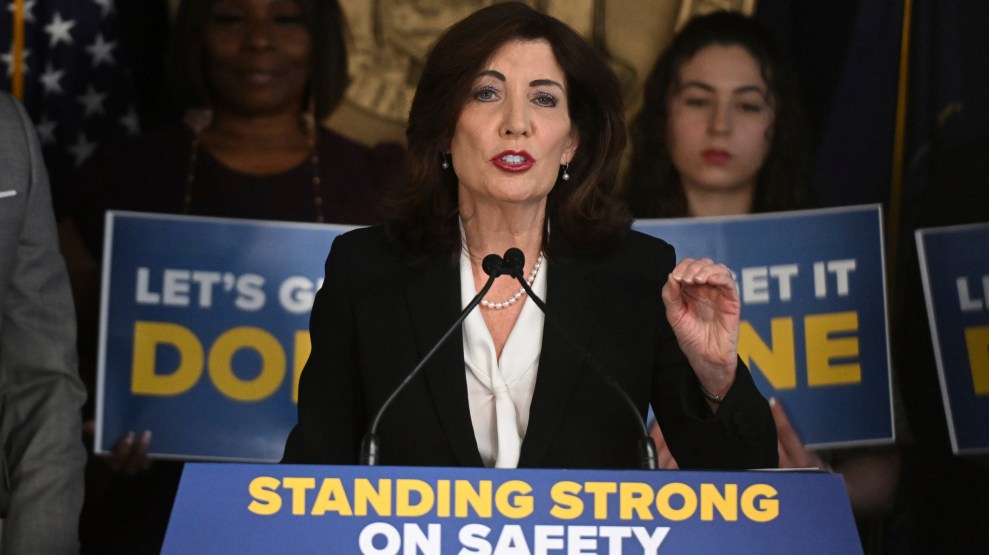
New York Governor Kathy Hochul signed into law a bill late Friday night that provides a remedy for victims of coerced debt—a kind of financial abuse where bad actors either take out lines of credit in another person’s name without them knowing or pressure someone into accruing debt.

The law, headed by Assemblymember Linda B. Rosenthal and Senator Cordell Cleare, is poised to help provide an avenue for survivors of intimate partner violence to leave abusive situations without being held down by debt they oftentimes didn’t even know they were accruing.

“This law will be transformative in providing financial relief for survivors, and I am thinking of so many clients this would have helped,” Naomi Mo Chee Young, a lawyer with the Brooklyn-based nonprofit CAMBA who advocated for the legislation, told me Monday. “We can’t wait to begin implementing, ensuring that survivors throughout New York will be advised of their rights.”

Related

Governor Kathy Hochul joins domestic violence service providers to discuss New York's discovery laws at the Office of the Governor on April 14, 2025 in New York City.Inside the Last Minute Fight on Legislation for Victims of Coerced Debt in New York

New York joins several other states across the country, including Texas, Maine, California, Minnesota, and Connecticut, that have passed versions of coerced debt legislation. The bill passed by Hochul this week will provide some of the most comprehensive protections in the nation for survivors of this kind of financial abuse.

The bill allows victims to petition creditors to have the debt in their name removed and transferred to the person who coerced them into the debt. The survivor must submit documentation showing that the debt was accrued either without their knowledge or through coercion. In turn, debt collectors would then be able to hold that person civilly liable for whatever money is still owed.

Across the country, forty-three percent of survivors report being pressured to take out credit in their own name when they did not want to, and 52 percent reported that an abusive partner put debt in their name through a fraudulent or forced transaction. This debt stays with victims by, for example, hurting their credit score and impacting their ability to gain access to housing.

Related

Portrait of red-haired woman sitting on a couch.She Escaped Her Abuser. But Not Before He Buried Her in Debt.

“Domestic violence is rarely limited to physical abuse and it is past time that our laws recognize this,” Assemblymember Rosenthal said in a statement after Hochul signed the bill. State Senator Cleare noted: “survivors must be given empowering support to rebuild their life, and to grow and heal.”

Hochul signed the bill with less than an hour before the slated deadline. It was a last-minute fight for the legislators and advocates to get the bill over the finish line as the financial industry, which did not make much noise during the voting process, were petitioning Hochul’s office to introduce several provisions that advocates worried would increase hurdles for victims of coerced debt.

As Lauren Schuster, vice president of government affairs at Urban Resource Institute, the largest provider of domestic violence shelter services in the country, told me last week, “The debt collectors have exceptionally deep pockets. They are well connected in ways that our survivors simply are not.”

Young told me on Monday that she will never take this law for granted. “I know we fought for it until the 11th hour,” she added, “facing major backlash from the financial services lobbies.”

CAMBA, where Young works, is a part of the Economic Justice for Survivors Collaborative, the leading advocacy group for the legislation. The group includes URI and CAMBA, along with Her Justice and the Legal Aid Society of New York.

“Money can’t buy this kind of dedication,” Young said, adding, “and I hope we all remember that, when we fight at a grassroots level, we win.”

Continue Reading…

Mother Jones

Mike Pence Poaches Heritage Foundation Staff After Tucker Carlson–Nick Fuentes Blowup

Former Vice President Mike Pence poached over a dozen senior officials from the Heritage Foundation to join his own conservative think tank in the latest sign that all is not well in right-wing politics.

The Heritage Foundation is arguably the most prominent conservative think tank in America. Pence, meanwhile, started his competing think tank, Advancing American Freedom, to promote “exactly what the Trump-Pence Administration did every day.” Many prominent Republicans framed this to the Wall Street Journal as a return to conservative fundamentals, blocking out “what they see online.”

As my colleague Anna Merlan recently reported, MAGA is eating itself alive. Pence’s move came after the Heritage Foundation’s leader, Kevin Roberts, defended Tucker Carlson for hosting white supremacist and Holocaust denier Nick Fuentes on his show, according to the Journal.

The Heritage Foundation notably published Project 2025, the policy document that detailed Trump 2.0’s slash-and-burn approach to governance. But this specific beef dates back to October, when Carlson, a high-profile conservative political commentator, interviewed Fuentes.

Fuentes asserted that we need “to be pro-white,” promoted conspiracy theories of “organized Jewry in America,” and decried Christian Zionism. There was immediate outrage within the right: US Ambassador to Israel Mike Huckabee and Sen. Ted Cruz (R-TX) to name a few. Roberts disagreed, describing the criticism as an attempt to cancel Carlson.

“Conservatives should feel no obligation to reflexively support any foreign government, no matter how loud the pressure becomes from the globalist class or from their mouthpieces in Washington,” he said.

Roberts’ remarks led to further fallout. Sen. Mitch McConnell (R-KY) countered, “Last I checked, ‘conservatives should feel no obligation’ to carry water for antisemites and apologists for America-hating autocrats.”

That’s when top Heritage Foundation members began resigning. John Blackman, who stepped down on Sunday, wrote that the think tank had abandoned its principles and conformed to President Trump and a coalition of the right’s “rising tide of antisemitism.”

“Heritage has always welcomed debate, but alignment on mission and loyalty to the institution are non-negotiable,” Andy Olivastro, the foundation’s chief advancement officer said in a statement to the Journal. “A handful of staff chose a different path.”

All of this calls into question what the future of the Republican Party will look like after Trump. Turning Point USA, which showed signs of unraveling during this past weekend’s convention, has its hopes pinned on JD Vance, but other factions of the political party may have a different idea come 2028.

Continue Reading…

Mother Jones

CBS Pulls “60 Minutes” Segment Critical of Trump’s Deportation of Venezuelans

CBS News’ editor-in-chief, Bari Weiss, pulled a “60 Minutes” segment featuring the accounts of Venezuelan men sent by the Trump administration to a maximum security prison in El Salvador, a last-minute move that has since been condemned as political.

The decision was announced just three hours before the story was expected to air on Sunday. The webpage for the episode has been removed. Promotional material of the segment has also been taken down.

According to the New York Times, Weiss asked for numerous changes to the segment, such as an interview with Stephen Miller, a White House deputy chief of staff and main architect of President Trump’s mass deportation plan, or another top government official. Weiss also reportedly disapproved of using the word “migrants” to characterize the Venezuelan men who were deported to CECOT, stressing that they had entered the United States illegally. NPR reported that Weiss told her colleagues they could not run the show without an on-the-record-comment from a Trump administration official.

Weiss also argued in a memo to “60 Minutes” staff on Sunday that they should include a voice “arguing that [Trump is] operating within the bounds of his authority.”

“There’s a genuine debate here,” she said.

Sharyn Alfonsi, the “60 Minutes” correspondent who reported the story, has since denounced the move as overtly political. In an email to colleagues, Alfonsi said that the story had been“screened five times and cleared by both CBS attorneys and Standards and Practices.” Alfonsi said that she had asked Weiss for a call to discuss her decision, but was rejected.

Alfonsi also said that she had reached out to the White House, State Department, and Department of Homeland Security but never received a response. “If the administration’s refusal to participate becomes a valid reason to spike a story, we have effectively handed them a ‘kill switch’ for any reporting they find inconvenient,” Alfonsi wrote.

“These men risked their lives to speak with us,” she continued in her email. “We have a moral and professional obligation to the sources who entrusted us with their stories.”

Many have since pointed to Weiss’ thin journalism resume despite occupying one of the most important positions in American newsrooms. In fact, Weiss has little to no actual reporting experience, only becoming CBS’s editor-in-chief after David Ellison, the owner of CBS’s parent company, Paramount Skydance, bought her news and opinion website, The Free Press, for $150 million. Before that, Weiss was an op-ed writer at the New York Times.

Mother Jones and other news organizations have reported extensively on the severe beatings, humiliations, and medical neglect endured by the men sent to CECOT, as well as the key detail that most of the men detained lack any significant criminal history. Instead, Noah Lanard and Isabela reported in March, these men were often targeted for their tattoos, none of which were related to the gangs the Trump administration accused them of being members of.

Continue Reading…

Mother Jones

Climate Change Is Coming for Christmas

This story was originally published by Inside Climate News and is reproduced here as part of the Climate Desk collaboration.

As snowflakes fall lazily from the sky, you cozy up by the fireplace and take a sip from a steaming cup of hot chocolate, humming the jaunty songs you can’t seem to get out of your head the entire month of December.

But as temperatures rise, this quintessential winter holiday scene is transforming (in the Northern Hemisphere at least). The snowstorm you were picturing is actually more likely to be a chilly rain in many areas. Cocoa crops around the world are failing, making chocolate drinks and desserts increasingly expensive. Global warming is even coming for Rudolph, recent research shows.

Climate change is threatening Christmas and winter traditions—and in some cases, holiday trends are fueling it.

Holiday spirit in December is underpinned by a multitude of global supply chains churning throughout the year. And I’m not just talking about markets that support presents like clothes and electronics; many of the most lucrative Christmas commodities are grown.

Take chocolate: As many as 6 million small-holder farmers in Africa, Asia and Latin America grow and harvest 90 percent of the world’s cocoa, which go into all sorts of holiday classics—from yule log cakes to marshmallow-topped cocoa. Cacao, the plant that is processed to make cocoa, thrives in tropical climates with warm temperatures and abundant rainfall. But in 2023 and 2024, the weather was too warm and wet—then too dry—in African countries like Côte d’Ivoire and Ghana for healthy cacao crops. Yields plummeted to record lows.

This extreme weather was caused partially by the El Niño weather pattern. But an analysis by the nonprofit Climate Central found that human-caused climate change added six weeks’ worth of days above 89 degrees Fahrenheit in 71 percent of cacao-producing areas across much of West Africa in 2024. The low output led to staggeringly high chocolate prices around the world, surging from about $2,500 to more than $10,000 per metric ton that year.

Though prices have since fallen a bit, scientists at Harvard University say this cocoa volatility likely represents a “new normal.” Unpredictable weather is affecting other holiday baking necessities like sugarcane and cinnamon crops—both essential for any snickerdoodle fan.

Long-term temperature rise and compounding weather disasters are also hurting the most iconic holiday crop: Christmas trees. As I reported in January, Oregon and North Carolina produce the most Christmas trees in the United States, but warmer winters and longer growing seasons are leading to stunted growth and a surge in pest outbreaks that can decimate supplies.

“When we grow Christmas trees, we typically are taking them out of their natural habitat, particularly with Fraser fir,” Justin Whitehill, a forestry researcher at North Carolina State University who studies Christmas trees, told me a year ago.

“Taking them out of their sort of natural range, we’re already putting a lot of stress on them,” and climate-fueled warming only adds to that, he added. Whitehill and other scientists—including an entire Christmas tree program at Oregon State University—are experimenting with new breeds or genetic modifications to help make the trees more resistant to pests and heat.

Pro tip: Researchers also told me that once the holiday season is over, you can donate your natural Christmas tree (after you’ve removed the ornaments and tinsel) to wildlife agencies around the country. They use them to help provide crucial habitats for freshwater fish.

The subjects of some of the most famous Christmas carols are also at risk as global temperatures rise. Reindeer—also known as caribou in North America—face over a 50 percent decline by the end of the century due to climate-fueled habitat loss and overheating, according to a study published in August.

These antlered creatures thrive in Arctic habitats such as tundra and boreal forests, where they help maintain vegetation and plant diversity. Using fossils and ancient DNA, researchers simulated how warming events over the past 21,000 years affected reindeer populations to help predict how they will do in the future under different warming scenarios.

They found that modern-day rates of temperature rise could decimate reindeer populations more than any of those in the past. “Continued losses will likely further exacerbate climatic warming through release of soil carbon to the atmosphere, which, of course, would further threaten reindeer and caribou, as well as ourselves,” study co-author Eric Post, a professor at the University of California, Davis, said in a statement. “For thousands of years, the well-being of our own species has benefited directly from healthy reindeer and caribou populations. Now more than ever, we need to ensure their well-being in turn.”

Meanwhile, Frosty the Snowman and the white Christmas you may be dreaming of are also disappearing amid rapid warming. The chances of having at least one inch of snow on Christmas Day—the metric for what the National Weather Service deems a “white Christmas”—are “gradually decreasing across the Southern United States, and this trend is slowly moving north,” according to the federal government. It’s important to note that snow was never that common on Christmas Day for many states, Time magazine reports.

“People tend to remember that one snowy Christmas, and they forget that it was surrounded by five Christmases that weren’t,” David Robinson, New Jersey’s state climatologist and a Rutgers University professor whose research focuses on snow cover, told Time.

But records reveal a clear trend of warming winters overall, with average temperatures rising nearly 4 degrees Fahrenheit in almost 250 US cities since 1970, according to an analysis of federal data by Climate Central. Holiday shopping may be accelerating this trend, with millions of emissions generated each year due to product manufacturing, packaging, shipping and waste.

It doesn’t end there: Roughly 15 percent of purchases made during the holiday season are returned. I reported on this “reverse supply chain” last year and was shocked to learn how returns’ carbon pollution compares to that of the initial deliveries.

As we enter the last-minute scramble to purchase gifts, environmentalists are urging consumers to reduce their impact by finding lower-waste options. Shopping local, buying secondhand or even giving experiences instead can help.

Continue Reading…

Mother Jones

Israel Approves 19 New Settlements in the Occupied West Bank

The Israeli government approved a proposal for 19 new settlements in the occupied West Bank in a blatant violation of international humanitarian law.

The country’s finance minister, Bezalel Smotrich, said on X that this increases the total number of new settlements to 69 in the past three years—a new record.

“On the ground, we are blocking the establishment of a Palestinian terror state,” he said in his announcement on Sunday.

According to the Associated Press, citing Peace Now, an Israeli watchdog group that works to prevent settlement expansion, there are now 210 settlements in the West Bank.

Ramiz Alakbarov, deputy special coordinator for the Middle East Peace Process in the United Nations, said on Tuesday that Israeli settlement expansion “fuels tensions, impedes Palestinian land access, and threatens the viability of a contiguous and sovereign Palestinian State.”

A Saturday report from the New York Times that tracked Israel’s assault on the West Bank described a general pattern that settlers have employed to take over the land: an outpost unauthorized by Israeli law is established in the form of a tent or trailer, military orders call for Palestinian communities to evacuate, and the outpost grows and eventually the Israeli government authorizes the settlement.

Prime Minister Benjamin Netanyahu’s far-right administration has accelerated this settlement expansion. According to Peace Now, in the past two years, Israelis have built around 130 new outposts—more than the number established in the previous two decades.

This settler campaign has led to attacks against Palestinians in the West Bank. According to the United Nations, in the first half of 2025, there were 757 settler attacks that caused casualties or property damage.

Between October 7, 2023, the day of the Hamas-led attack that sparked the war in Gaza, and this October, Israeli attacks in the occupied West Bank have killed around 1,001 Palestinians—with one in five being children, according to the UN.

Ajith Sunghay, the head of the UN’s office for human rights in Palestine, said that Israel “has a legal obligation to end the occupation and reverse the annexation” and demanded that member states “halt and reverse these policies and ensure accountability for decades of violations.”

Continue Reading…

Mother Jones

Trump Has Intercepted Two Oil Tankers Off Venezuela This Weekend

The United States stopped an oil tanker off the coast of Venezuela on Sunday, just a day after the Coast Guard boarded another oil vessel, according to a report from Bloomberg.

The operation, which is not approved by Congress, is part of President Trump’s “blockade of all sanctioned oil tankers going into, and out of, Venezuela” in a campaign to cut an essential export that accounts for more than half of Venezuela’s revenue. Some international treaties consider blockades as an act of war.

Trump has called Venezuela President Nicolás Maduro’s administration a “foreign terrorist organization” that is using sanctioned oil to fund drug trafficking.

The US is also continuing its strikes on boats allegedly holding illicit drugs in the Caribbean and eastern Pacific. According to the Trump administration, at least 104 people have been killed in 28 boat strikes. House Republicans rejected two Democratic-supported resolutions on Wednesday that would have forced Trump to get authorization from Congress to continue military attacks on these alleged terrorist organizations and its campaign against Venezuela.

Bloomberg reported that the most recent tanker, the Bella 1, was a Panamanian-flagged ship sanctioned by the US and was on its way to Venezuela for loading.

Officials did not disclose the specific location of where the ship was seized.

The Centuries tanker, the vessel intercepted on Saturday, did not appear on the US list of vessels under sanction and is registered in Panama, according to the New York Times. The ship belongs to a Chinese-based oil trading company that moves Venezuelan oil to Chinese refineries.

But White House Deputy Press Secretary Anna Kelly asserted on X that the tanker held Venezuela state-owned oil, which is sanctioned.

“It was a falsely flagged vessel operating as part of the Venezuelan shadow fleet to traffic stolen oil and fund the narcoterrorist Maduro regime,” Kelly wrote.

This blockade goes well beyond political battles—they have a true human cost in Venezuela. As my colleague, Katie Herchenroeder, cited from Francisco J. Monaldi, director of the Latin America Energy Program at Rice University on Wednesday, “Cutting off all oil revenue will lead to a massive reduction in food imports and is likely to trigger the first major famine in the Western Hemisphere in modern history.”

Continue Reading…

Mother Jones

Trump’s Epstein Coverup Is Just Getting Started

On Friday, the Trump-controlled Justice Department was mandated by a nearly unanimous act of Congress to release all government files related to Jeffrey Epstein and his crimes.

“What are they protecting?”

But the government has made just a portion of its holdings publically available, and among the 13,000 documents released, some are extensively or virtually totally redacted. While the law permits withholding information to protect victims, obscured portions include the names and faces of numerous Epstein associates, despite the law’s dictate that nothing be withheld “on the basis of embarrassment, reputational harm, or political sensitivity…to any government official [or] public figure.”

According to Rep. Thomas Massie, the Kentucky Republican who broke with his party to champion the Epstein Files Transparency Act, what the government has so far provided “grossly fails to comply with both the spirit and the letter of the law.”

Epstein’s victims have similar complaints. “They are proving everything we have been saying about corruption and delayed justice,” Jess Michaels told the New York Times. “What are they protecting? The coverup continues.”

The release is being overseen by Deputy Attorney General Todd Blanche, the president’s former personal defense attorney, who represented him in the criminal case related to Trump’s attempt to coverup his affair with Stormy Daniels, the adult film star. Blanche has said that the Justice Department remains at work preparing more files for disclosure in the “coming weeks,” in apparent violation of Friday’s deadline.

The law requires the department to prepare a report to Congress justifying any documents or names it may withhold, and submit it with 15 days of the “completion of the release.” But Massie and Rep. Ro Khanna, the Silicon Valley Democrat who moved the bill forward with the help of a handful of GOP colleagues, aren’t waiting to begin discussing how to bring about legal consequences for Trump officials who have or may still be violating their law requiring disclosure.

“The Justice Department’s document dump,” Khanna said in an online video, “does not comply… Pam Bondi has obfuscated for months.” He suggested that Congress consider impeaching officials or holding them in inherent contempt. “Attorney General Pam Bondi is withholding specific documents that the law required her to release by today,” Massie posted, pointedly adding that prosecutors in a future administration could eventually “convict the current AG” for breaking their law.

Friday’s release included many photos of Bill Clinton, a former president, but little new information on the current one. While Trump has variously claimed that he and Epstein “did not socialize together,” that “there was no relationship” between them, and that he “was not a fan of his,” this week a Times investigation found that “the two men forged a bond intense enough to leave others who knew them with the impression that they were each other’s closest friend.”

Continue Reading…

Mother Jones

This Climate Concern Is Way Out There

This story was originally published by Yale e360 and is reproduced here as part of the Climate Desk collaboration.

On a mid-November evening, at precisely 7:12 p.m., a SpaceX Falcon 9 rocket lifted off from Cape Canaveral Space Force Station on the Florida coast. It appeared to be a perfect launch. At an altitude of about 40 miles, the rocket’s first stage separated and fell back to Earth, eventually alighting in a gentle, controlled landing on a SpaceX ship idling in the Atlantic Ocean.

The mission’s focus then returned to the rocket’s payload: 29 Starlink communication satellites that were to be deployed in low-Earth orbit, about 340 miles above the planet’s surface. With this new fleet of machines, Starlink was expanding its existing mega-constellation so that it numbered over 9,000 satellites, all circling Earth at about 17,000 miles per hour.

Launches like this have become commonplace. As of late November, SpaceX had sent up 152 Falcon 9 missions in 2025—an annual record for the company. And while SpaceX is the undisputed leader in rocket launches, the space economy now ranges beyond American endeavors to involve orbital missions—military, scientific, and corporate—originating from Europe, China, Russia, India, Israel, Japan, and South Korea. This year the global total of orbital launches will near 300 for the first time, and there seems little doubt it will continue to climb.

“We are now in this regime where we are doing something new to the atmosphere that hasn’t been done before.”

Starlink has sought permission from the Federal Communications Commission to expand its swarm, which at this point comprises the vast majority of Earth’s active satellites, so that it might within a few years have as many as 42,000 units in orbit. Blue Origin, the rocket company led by Jeff Bezos, is in the early stages of helping to deploy a satellite network for Amazon, a constellation of about 3,000 units known as Amazon Leo. European companies, such as France’s Eutelsat, plan to expand space-based networks, too.

“We’re now at 12,000 active satellites, and it was 1,200 a decade ago, so it’s just incredible,” Jonathan MacDowell, a scientist at Harvard and the Smithsonian who has been tracking space launches for several decades, told me recently. MacDowell notes that based on applications to communications agencies, as well as on corporate projections, the satellite business will continue to grow at an extraordinary rate. By 2040, it’s conceivable that more than 100,000 active satellites would be circling Earth.

But counting the number of launches and satellites has so far proven easier than measuring their impacts. For the past decade, astronomers have been calling attention to whether so much activity high above might compromise their opportunities to study distant objects in the night sky. At the same time, other scientists have concentrated on the physical dangers. Several studies project a growing likelihood of collisions and space debris—debris that could rain down on Earth or, in rare cases, on cruising airplanes.

More recently, however, scientists have become alarmed by two other potential problems: the emissions from rocket fuels, and the emissions from satellites and rocket stages that mostly ablate (that is, burn up) on reentry. “Both of these processes are producing pollutants that are being injected into just about every layer of the atmosphere,” explains Eloise Marais, an atmospheric scientist at University College London, who compiles emissions data on launches and reentries.

As Marais told me, it’s crucial to understand that Starlink’s satellites, as well as those of other commercial ventures, don’t stay up indefinitely. With a lifetime usefulness of about five years, they are regularly deorbited and replaced by others. The new satellite business thus has a cyclical quality: launch, deploy, deorbit, destroy. And then repeat.

The cycle suggests we are using Earth’s mesosphere and stratosphere—the layers above the surface-hugging troposphere—as an incinerator dump for space machinery. Or as Jonathan MacDowell puts it: “We are now in this regime where we are doing something new to the atmosphere that hasn’t been done before.” MacDowell and some of his colleagues seem to agree that we don’t yet understand how—or how much—the reentries and launches will alter the air. As a result, we’re unsure what the impacts may be to Earth’s weather, climate, and (ultimately) its inhabitants.

To consider low-Earth orbit within an emerging environmental framework, it helps to see it as an interrelated system of cause and effect. As with any system, trying to address one problematic issue might lead to another. A long-held idea, for instance, has been to “design for demise,” in the argot of aerospace engineers, which means constructing a satellite with the intention it should not survive the heat of reentry.

“But there’s an unforeseen consequence of your solution unless you have a grasp of how things are connected,” according to Hugh Lewis, a professor of astronautics at the University of Birmingham in the United Kingdom. In reducing “the population of debris” with incineration, Lewis told me—and thus, with rare exceptions, saving us from encounters with falling chunks of satellites or rocket stages—we seem to have chosen “probably the most harmful solution you could get from a perspective of the atmosphere.”

We don’t understand the material composition of everything that’s burning up. Yet scientists have traced a variety of elements that are vaporizing in the mesosphere during the deorbits of satellites and derelict rocket stages; and they’ve concluded these vaporized materials—as a recent study in the Proceedings of the National Academy of Sciences put it—“condense into aerosol particles that descend into the stratosphere.” The PNAS study, done by high altitude air sampling and not by modeling, showed that these tiny particles contained aluminum, silicon, copper, lead, lithium, and more exotic elements like niobium.

“Emission plumes from the first few minutes of a mission, which disperse into the stratosphere, may…have a significant effect on the ozone layer.”

The large presence of aluminum, signaling the formulation of aluminum oxide nanoparticles, may be especially worrisome, since it can harm Earth’s protective ozone layers and may undo our progress in halting damage done by chlorofluorocarbons, or CFCs. A recent academic study in the journal Geophysical Research Letters concluded that the ablation of a single 550-pound satellite (a new Starlink unit is larger, at about 1,800 pounds) can generate around 70 pounds of aluminum oxide nanoparticles. This floating metallic pollution may stay aloft for decades.

The PNAS study and others, moreover, suggest the human footprint on the upper atmosphere will expand, especially as the total mass of machinery being incinerated ratchets up. Several scientists I spoke with noted that they have revised their previous belief that the effects of ablating satellites would not exceed those of meteorites that naturally burn up in the atmosphere and leave metallic traces in the stratosphere. “You might have more mass from the meteoroids,” Aaron Boley, an astronomer at the University of British Columbia, said, but “these satellites can still have a huge effect because they’re so vastly different [in composition].”

Last year, a group of researchers affiliated with NASA formulated a course of research that could be followed to fill large “knowledge gaps” relating to these atmospheric effects. The team proposed a program of modeling that would be complemented by data gleaned from in situ measurements. While some of this information could be gathered through high-altitude airplane flights, sampling the highest-ranging air might require “sounding” rockets doing tests with suborbital flights. Such work is viewed as challenging and not inexpensive—but also necessary. “Unless you have the data from the field, you cannot trust your simulations too much,” Columbia University’s Kostas Tsigaridis, one of the scientists on the NASA team, told me.

Tsigaridis explains that lingering uncertainty about NASA’s future expenditures on science has slowed US momentum for such research. One bright spot, however, has been overseas, where ESA, the European Space Agency, held an international workshop in September to address some of the knowledge gaps, particularly those relating to satellite ablations. The ESA meeting resulted in a commitment to begin field measurement campaigns over the next 24 months, Adam Mitchell, an engineer with the agency, said. The effort suggests a sense of urgency, in Europe, at least, that the space industry’s growth is outpacing our ability to grasp its implications.

A rocket blasts into a blue sky as the sun sets orange in the distance. A plume of smoke from the launch takes  up the left-hand fourth of the photo

A SpaceX Falcon 9 rocket takes off. SpaceX now has more than 9,000 Starlink satellites orbiting the Earth.SpaceX

The atmospheric pollution problem is not only about what’s raining down from above, however; it also relates to what happens as rockets go up. According to the calculations of Marais’ UCL team, the quantity of heat-trapping gases like CO2 produced during liftoffs are still tiny in comparison to, say, those of commercial airliners. On the other hand, it seems increasingly clear that rocket emission plumes from the first few minutes of a mission, which disperse into the stratosphere, may, like reentries, have a significant effect on the ozone layer.

The most common rocket fuel right now is a highly refined kerosene known as RP-1, which is used by vehicles such as SpaceX’s Falcon 9. When RP-1 is burned in conjunction with liquid oxygen, the process releases black carbon particulates into the stratosphere. A recent study led by Christopher Maloney of the University of Colorado used computer models to assess how the black carbon absorbs solar radiation and whether it can warm the upper atmosphere significantly. Based on space industry growth projections a few decades into the future, these researchers concluded that the warming effect of black carbon would raise temperatures in the stratosphere by as much as 1.5 degrees C, leading to significant ozone reductions in the Northern Hemisphere.

When satellite companies talk about sustainability, “what they mean is, we want to sustain this rate of growth.”

It may be the case that a different propellant could alleviate potential problems. But a fix isn’t as straightforward as it seems. Solid fuels, for instance, which are often used in rocket boosters to provide additional thrust, emit chlorine—another ozone-destroying element. Meanwhile, the propellant of the future looks to be formulations of liquefied natural gas (LNG), often referred to as liquid methane. Liquid methane will be used to power SpaceX’s massive Starship, a new vehicle that’s intended to be used for satellite deployments, moon missions, and, possibly someday, treks to Mars.

The amount of black carbon emissions from burning LNG may be 75 percent less than from RP-1. “But the issue is that the Starship rocket is so much bigger,” UCL’s Marais says. “There’s so much more mass that’s being launched.” Thus, while liquid methane might burn cleaner, using immense quantities of it—and using it for more frequent launches—could undermine its advantages. Recently, executives at SpaceX’s Texas factory have said they would like to build a new Starship every day, readying the company for a near-constant cycle of launches.

One worry amongst scientists is that if new research suggests that space pollution is leading to serious impacts, it may eventually resemble an airborne variation of plastics in the ocean. A more optimistic view is that these are the early days of the space business, and there is still time for solutions. Some of the recent work at ESA, for instance, focuses on changing the “design for demise” paradigm for satellites to what some scientists are calling “design to survive.”

Already, several firms are testing satellites that can get through an reentry without burning up; a company called Atmos, for instance, is working on an inflatable “atmospheric decelerator” that serves as a heat shield and parachute to bring cargo to Earth. Satellites might be built from safer materials, such as one tested in 2024 by Japan’s space agency, JAXA, made mostly from wood.

More ambitious plans are being discussed: Former NASA engineer Moriba Jah has outlined a design for an orbital “circular economy” that calls for “the development and operation of reusable and recyclable satellites, spacecraft, and space infrastructure.” In Jah’s vision, machines used in the space economy should be built in a modular way, so that parts can be disassembled, conserved, and reused. Anything of negligible worth would be disposed of responsibly.

Most scientists I spoke with believe that a deeper recognition of environmental responsibilities could rattle the developing structure of the space business. “Regulations often translate into additional costs,” says UCL’s Marais, “and that’s an issue, especially when you’re privatizing space.” A shift to building satellites that can survive reentry, for instance, could change the economics of an industry that, as astronomer Aaron Boley notes, has been created to resemble the disposable nature of the consumer electronics business.

Boley also warns that technical solutions are likely only one aspect of avoiding dangers and will not address all the complexities of overseeing low-Earth orbit as a shared and delicate system. It seems possible to Boley that in addition to new fuels, satellite designs, and reentry schemes, we may need to look toward quotas that require international management agreements. He acknowledges that this may seem “pie in the sky”; while there are treaties for outer space, as well as United Nations guidelines, they don’t address such governance issues. Moreover, the emphasis in most countries is on accelerating the space economy, not limiting it. And yet, Boley argues that without collective-action policy responses we may end up with orbital shells so crowded that they exceed a safe carrying capacity.

That wouldn’t be good for the environment or society—but it wouldn’t be good for the space business, either. Such concerns may be why those in the industry increasingly discuss a set of principles, supported by NASA, that are often grouped around the idea of “space sustainability.” University of Edinburgh astronomer Andrew Lawrence told me that the phrase can be used in a way that makes it unclear what we’re sustaining: “If you look at the mission statements that companies make, what they mean is, we want to sustain this rate of growth.”

But he doesn’t think we can. As one of the more eloquent academics arguing for space environmentalism, Lawrence perceives an element of unreality in the belief that in accelerating space activity we can “magically not screw everything up.” He thinks a goal in space for zero emissions, or zero impact, would be more sensible. And with recent private-sector startups suggesting that we should use space to build big data centers or increase sunlight on surface areas of Earth, he worries we are not entering an era of sustainability but a period of crisis.

Lawrence considers debates around orbital satellites a high-altitude variation on climate change and threats to biodiversity—an instance, again, of trying to seek a balance between capitalism and conservation, between growth and restraint. “Of course, it affects me and other professional astronomers and amateur astronomers particularly badly,” he concedes. “But it’s really that it just wakes you up and you think, ‘Oh, God, it’s another thing. I thought, you know—I thought we were safe.’” After a pause, he adds, “But no, we’re not.”

Continue Reading…

Mother Jones

Fancy Galleries, Fake Art

In the mid-’90s, two high-end New York art galleries began selling one fake painting after another–works in the style of Jackson Pollock, Andy Warhol, Mark Rothko and others. It was the largest art fraud in modern U.S. history, totaling more than $80 million. Our first story looks at how it happened and why almost no one ever was punished by authorities.

Our second story revisits an investigation into a painting looted by the Nazis during World War II. More than half a century later, a journalist helped track it down through the Panama Papers.

This is an update of an episode that originally aired in January 2020.

Continue Reading…

Mother Jones

MAGA Is Eating Itself Alive

Sometime this week in an undisclosed location, two powerful figures sat down for tense negotiations, hoping to end a cold war that had, in recent days, turned very hot. The talks were not a success, with one participant dubbing some of what the other side presented as “fake and gay.” Tensions, it’s fair to say, continued unabated.

In this case, the combatants were Turning Point USA CEO Erika Kirk and far-right one-woman chaos machine Candace Owens. They met to discuss Owen’s relentless trafficking of conspiracy theories about the murder of Kirk’s husband, TPUSA founder and leader Charlie. Owens, a former TPUSA communications director and close friend of the slain leader, has continued her descent into gutter antisemitism by suggesting that his assassination was orchestrated by the Israeli state, as well as suggesting that Egyptian military planes and France also may have been involved, before eventually tweeting that it’s “likely” that “the same people who killed JFK killed Charlie.” Turning Point staff have also merited her suspicion, and she tweeted last week, “I now can say with full confidence that I believe Charlie Kirk was betrayed by the leadership of Turning Point USA and some of the very people who eulogized him on stage.”

As The Bulwark’s Will Sommer wrote, all this conspiratorial churn has put Owens in the midst of an all-out war with virtually everyone else in right-wing media. Right-wing podcaster and diehard beanie-wearer Tim Pool, who is not known for consistently breaking ranks with right-wing extremists, spoke loudly for the group when he dubbed her a “fucking evil scumbag” and a “degenerate cunt.” After Erika Kirk’s four-hour meeting with Owens to try to tamp down her wild accusations, Kirk emerged describing it as being “very productive.” As CNN reported, she even brought in a lawyer to explain to Owens how the investigation of her husband’s death worked. Suspicious as ever, Owens emerged, dismissing a police affidavit outlining evidence in the Kirk shooting “fake and gay.”

Their war will likely continue, but it’s just one of dozens of feuds, internecine wars, and petty beefs rivening MAGA from top-to-bottom. As far-right British political activist Raheem Kaseem told Axios, the result of it all is a “cacophony of grifters.” The broad Trump coalition is ending its first year back in power more divided than ever. From the White House to the conspiracy media-verse, at what should be their moment of greatest strength, MAGA simply cannot stop both constant covert sniping and the occasional outright brawl.

From the White House to the conspiracy media-verse, at what should be their moment of greatest strength, MAGA simply cannot stop both constant covert sniping and the occasional outright brawl.

Aside from the ongoing Candace-Owens situation—a phrase that will surely become part of the national conversation in the years ahead —TPUSA also saw some robust infighting at their big AmericaFest gathering, where Politico reports that headline speakers Tucker Carlson and Ben Shapiro threw bitchy little digs at one another from onstage and off. “If you host a Hitler apologist, Nazi-loving, anti-American piece of refuse like Nick Fuentes, you ought to own it,” Shapiro said, a continuation of a particularly bleak piece of infighting on the right about how much antisemitism in the movement is too much.

Outside the malodorous confines of AmericaFest, the public squabbles and unseemly jockeying for position go all the way to the top. Chaos erupted this week after Vanity Fair published an explosive article featuring quotes from White House Chief of Staff Susie Wiles, who has, for reasons even she can’t seem to explain, been speaking to reporter Chris Whipple for eleven sit-down interviews. In those chats , which she fit in while managing various crises created by her boss, she called Vice President JD Vance “a conspiracy theorist,” said Attorney General Pam Bondi “completely whiffed” the handling of the Epstein files controversy, and said Trump himself has “an alcoholic’s personality,” an analysis the president, who famously doesn’t drink, told the New York Post he agreed with.

Wiles has responded by calling the article “a hit piece”—without exactly disputing any of its contents—and the White House has made a show of supporting her in public, even as the Washington Post reports they were taken by surprise by the splashy story. According to some reporting, Wiles may have thought she was speaking to Whipple for a book. Meanwhile, top administration officials cannot clearly explain why they posed for a photo to accompany the article, nor what they thought Vanity Fair was going to publish.

The president’s most relentless loyalty enforcer, Laura Loomer has ended her extremely a busy year of ferreting out perceived dissenters and getting people fired whom she deemed insufficiently loyal to the MAGA cause by tattling on them to the president and tweeting angrily about their ostensible betrayals. In Washington, the term “Loomered” has come to mean not just fired, but thoroughly exiled from both the government and the movement. (“Another LOOMERED SCALP!” she exulted on Twitter/X last week, celebrating the fact that the White House has withdrawn their selection for deputy NSA director.)

Loomering is the most targeted of MAGA infighting, as opposed to the more chaotic, impulsive set of feuds and implosions that are more commonly on display. In the ultimate conflict between giants that you’ve probably already forgotten about, Donald Trump and Elon Musk declared their friendship to be null and void earlier this year, and the current status of their bromance remains uncertain. Although Musk recently reappeared at a formal White House dinner to celebrate Saudi Crown Prince Mohammed bin Salman. (No one in the U.S. government is feuding with bin Salman, despite his reported approval of the brutal execution of journalist Jamal Khashoggi in 2021; some things apparently aren’t serious enough to merit a squabble.)

Meanwhile, one of Donald Trump’s strongest foot-soldiers, Rep. Marjorie Taylor Greene (R-GA) announced that she’ll be stepping down in January, after Trump dubbed her a “traitor” and a “lunatic.” Her unforgiveable transgression was that she objected to the administration’s handling of the Epstein files. “Loyalty should be a two-way street,” Greene declared in her resignation announcement. And elsewhere in the Trump administration, the FBI’s deputy director Dan Bongino is also stepping down, having made it clear that he hopes to return to a far more comfortable job as a right-wing talking head attacking the Deep State instead of working for it. Bongino spent much of his tenure feuding with Bondi over the handling of the Epstein files, when he wasn’t complaining about how hard it is to be required to go to an office.

Bongino and his boss, Kash Patel also found time to feud with Rep. Thomas Massie (R-Kentucky), who accused them of trying to ferret out and punish a whistleblower at the FBI. Massie—who has been unusually independent for a GOP member of Congress (which is not saying much, and should not be interpreted as praise, but still)—has said that the whistleblower has been trying to make a disclosure regarding the bureau’s ongoing investigation into pipe bombs that were placed at the Republican and Democratic national headquarters on January 5, 2021. A suspect in the case was arrested on December 4; Massie has made it clear that he believes the FBI arrested the wrong person, tweeting that his FBI source has no confidence that the suspect is “capable or motivated” of having committed the crime. Massie is one of several House Republicans who have baselessly suggested the pipe bombings were an inside job. As evidence, Massie shared a now-retracted story by The Blaze accusing a Capitol Police officer of being the bomber.

Outside the Trump administration and in the wilds of right-wing influencers, Charlie Kirk’s death has been the catalyst for a brushfire of altercations, far beyond the confines of the one between his widow and Owens. His absence has opened up a power vacuum that other far-right figures have been unsubtly jockeying to fill. Longtime Kirk nemesis Nick Fuentes, a white supremacist and vile weirdo, is attempting to expand his own influence, sitting down for a friendly interview in October with Tucker Carlson that immediately incited a broad and ongoing MAGA civil war. After the Heritage Foundation’s President Kevin Roberts defended the interview, the staff and board of the organization revolted; two more board members quit this week. As evidenced in the Shapiro-Carlson smackdown at AmericaFest, the hard feelings over Fuentes’ presence in the movement have not abated.

Needless to say, that’s not all.

In September, Owen Shroyer, one of the top hosts on the conspiracy network Infowars, left the company due to disagreements with founder Alex Jones. Shroyer, who previously served two months in prison on misdemeanor trespassing charges after being on the Capitol grounds on January 6, 2021, said he argued with Jones about whether Shroyer was “too anti-Trump” and “too negative.” But despite the acrimony, Shrowye said he will always respect the Infowars founder.

Jones did not agree, and has been posting wounded tweets for months, accusing Shroyer of just “mailing it in” when he’s not calling him an “evil agent.” Similarly, multiple staff members working for MAGA gossip blogger Jessice Reed Kraus, a.k.a. Houseinhabit, quit earlier this year and have been trading social media barbs with her ever since. (The drama that has frankly been both too boring and convoluted even for me to consider covering, but according to one former staffer named Emilie Hagen, it allegedly involves disagreements over how Kraus covered and befriended disgraced former New York magazine writer Olivia Nuzzi, who was involved inher own, extremely serious public feud recently.)

The names, allegations, fights, and feuds pile up; alliances shift, re-form, and then immediately collapse. And yet, somehow, MAGA staggers on, laying waste to the American political structure and doing horrifying real-world harm: children have died of cholera in South Sudan after devastating USAID cuts. Whooping cough and measles cases have surged in the United States amidst RFK Jr.’s continued campaign to install his friends and ideological fellow-travelers in positions of power at HHS. The siege on immigrants and Americans of color continues, with ICE and DHS presiding over a viciously, gleefully cruel set of mass deportations and various forms of broad-scale discrimination and psychological torture, with an able asisst from the Supreme Court. MAGA’s constant infighting is as hilarious as it is pointless —and yet, unlike their friendships, the true and lasting damage this exhausting group of people have wrought shows no signs of ending.

Continue Reading…

Mother Jones

Trump Seizes on Brown, MIT Shooting to Suspend More Legal Immigration

President Donald Trump has suspended a diversity green-card lottery program after authorities said that the suspected gunman in the Brown University and MIT shootings used the program to gain entrance to the United States.

Homeland Security Secretary Kristi Noem announced the move Thursday on social media. “This heinous individual should never have been allowed in our country,” Noem said on X. “I am immediately directing USCIS to pause the DV1 program to ensure no more Americans are harmed by this disastrous program.”

According to police, Claudio Manuel Neves Valente, a 48-year-old former Brown University graduate student, is the man behind two shootings in New England that killed Brown students Ella Cook and Mukhammad Aziz Umurzokov and MIT physics professor Nuno F.G. Loureiro. After a multi-day search for a suspect, authorities found him dead in a Salem, New Hampshire, storage unit. Valente was born in Portugal and was a legal permanent resident of the United States. He first arrived in the country in August 2000 as a graduate student at Brown under an F-1 visa for international students, before later returning in May 2017 under the “Diversity Visa.”

The program’s suspension has long been a goal for the president. In 2017, Trump attempted to push Congress to halt the same visa program after another recipient, Sayfullo Saipov of Uzbekistan, killed eight people and injured 18 others in Lower Manhattan in a terrorist attack.

Established over two decades ago in 1990, the lottery program offers 50,000 visas per year to people from countries with relatively low rates of immigration to the US. According to the State Department, for the 2026 lottery, 20,822,624 “qualified entries” were received during the 37-day application period this fall. Visa candidates must have at least a high school education or two years of work experience in a field that requires training. Those who make it to the application process are required to undergo a vetting process and an interview before getting a visa.

This isn’t the first time the Trump administration has used an act of violence by one immigrant to enact collective punishment for immigrants at large, documented or not. As Isabela Dias wrote last week, shortly after Rahmanullah Lakanwal, a 29-year-old Afghan national, was identified as the suspect in the shooting that killed one West Virginia National Guard member and injured another in late November, “the Trump administration moved fast, stopping the issuance of visas and asylum for nationals of Afghanistan.”

“Then,” Dias continued, “it went a step further: indefinitely halting all asylum decisions, regardless of nationality, ‘pending a comprehensive review.’ The Trump administration also paused the processing of immigration benefits for people from 19 countries targeted by the June travel ban.”

Trump justified that ban, which targeted citizens from 12 mainly African and Middle Eastern countries from traveling to the US, in part by referencing Mohamed Sabry Soliman, a 45-year-old Egyptian national, the suspect in an antisemitic attack in Boulder, Colorado that happened days earlier.

Egypt, however, was not one of the countries included in Trump’s ban.

While it’s not unusual for government leaders to push for legislative changes following violent acts, the continued response to restrict entire immigration systems points to a larger political project to decimate legal ways to be in this country, while painting immigrants as “drug lords,” or “from mental institutions” or “rapists” or people “poisoning the blood of our country.”

Continue Reading…

Mother Jones

Monster of 2025: US Soccer Commentator Alexi Lalas

The staff of Mother Jones is, once again, rounding up the heroes and monsters of the past year. This is a non-exhaustive and totally subjective list, giving our reporters a chance to write about something that brought joy, discontent, or curiosity. Happy holidays.

Viewers tuning in to Fox Sports to watch this summer’s North America–hosted World Cup will find themselves hearing from one the sport’s loudest and arguably most disliked voices: Alexi Lalas.

The soccer commentator and former US men’s national team player’s public persona centers on grandstanding nationalism, dumbed-down analysis, and incessantly controversial takes to generate buzz—an “edgelord,” per Politico’s apt description. For any NBA fan, Lalas is the annoying, redheaded younger brother of Stephen A. Smith. Both spray audiences with hot takes and relish the hate they get in return. It’s not creating division for rivalry or sport, it’s creating division for attention. It’s why a simple “Alexi Lalas is bad for US soccer” T-shirt had a viral moment earlier this year, designed in response to his contention that “diversity” has hurt the US men’s soccer team. (The claim was met by Eric Wynalda, another national team legend turned pundit, pointing out Lalas’ own background: His father is an immigrant from Greece, and his legal first name is Panayotis.)

For years, many, many, many writers have argued that Lalas has dumbed down public understanding of the sport and harmed its growth in the US, calling him “villainous and ultimately untrustworthy,” “the lowest common denominator,” and “a man who would power rank his own farts, if given the opportunity.” As a Guardian op-ed put it, “There can be no real improvement in the coverage of soccer in this country as long as [Alexi Lalas] continues to have a job.”

The future of the sport in this country and his own career prospects are intertwined.

Since that article ran in 2024, not only has Lalas continued to hold his job at Fox, but he even picked up a new gig helping advise President Donald Trump’s White House Task Force on the FIFA World Cup 2026. The role makes sense: He hasn’t exactly been shy about signaling his MAGA beliefs and how they set him apart. “I live in California, I work in soccer, I’m like a unicorn when it comes to politics,” he told Fox News in a radio interview while attending the 2024 Republican National Convention. (“A cool place to be,” he’s said.) Beyond attacking diversity in soccer, he’s lifted up anti-trans rhetoric around sports by advertising Clay Travis’ book Balls: How Trump, Young Men, and Sports Saved America and propped up Trump as the “soccer president” ahead of the first World Cup to be played in the US since 1994.

Despite this blatantly political rhetoric, Lalas criticizes the same behavior in others, most notably targeting the women’s national team—saying the players’ advocacy made the squad “unlikeable” after the four-time world champions were knocked out of the 2023 World Cup in early rounds. Former US women’s captain and Olympic gold medalist Megan Rapinoe, an advocate for LGBTQ rights and social justice issues, responded to Lalas’ comment in an Atlantic interview.

“One thing that America does really well is backlash. I think there’s a huge backlash against women happening right now. I think we see that with the overturning of Roe v. Wade. We’re seeing that with the trans argument in sports. Does Alexi know exactly what he’s saying? If I was saying stuff that anchors on Fox News are also saying,” she explained, “I would be worried about the co-sign.”

This wasn’t the first time Lalas publicly went after female players from the US. In 2020, Lalas tweeted about National Women’s Soccer League professionals who took a knee in protest of police brutality, claiming that it “takes courage to actually stand for the national anthem.” He later apologize for the “hurt” that tweet caused, but even in a 2023 post celebrating Rapinoe’s career and retirement, Lalas couldn’t keep from mentioning that he disagrees with her “on many things.”

Despite all this, Lalas may prove to be useful as the world’s game is forced to navigate the rubble dome of the White House. He confided in Politico that he told Trump, “This is on our watch, and so let’s not fuck it up.” He’s even raised concern about how news of ICE raids will deter people from coming to the cup—though his preference is not changing policy, but fighting the “perception out there that people have that it’s not going to be a welcoming environment.” For foreign fans considering visiting the US for the tournament, Lalas has said that if “you pass the vetting process, you are going to have a wonderful time.”

Of course, Lalas wants the 2026 World Cup to be a success, seeing as his bosses at the Murdoch-controlled Fox Sports shelled out some $400 million to secure airing rights for nearly 70 percent of the games, and given that the future of the sport in this country and his own career prospects are intertwined. But to those who see his voice as harmful to the game, the dynamic sets him up as US soccer’s parasite—he depends on its success to create his own, while being a force that stunts its growth.

The power, the politics, and the media might of Fox have set the stage for Lalas to emerge from the 2026 World Cup with more prominence than he went in. He’s laid the groundwork. He has his podcast. He has his own original patriotic music. He’s spoken about more formally carving out a profile in political commentary, as long as someone will “pay me to talk.” He just needs the ball to bounce his way.

Continue Reading…

Mother Jones

America’s Fossil Fuel Ambitions Are Driving Up Your Energy Bill

This story was originally published by Inside Climate News and is reproduced here as part of the Climate Desk collaboration.

During the 2024 campaign, President Donald Trump promised voters that his policies would lower their energy prices by 50 percent, repeating this pledge in speeches in New York, Pennsylvania and North Carolina. “We will cut energy and electricity prices in half within 12 months—not just for businesses but for all Americans and their families,” he wrote in a Newsweek op-ed.

That hasn’t happened. Nationwide, electricity bills are up 13 percent compared to last year, with some states facing steeper jumps than others. One of the reasons for those increases is the growing export of liquefied natural gas (LNG) and a corresponding spike in gas prices, argues a new report from Public Citizen, a nonprofit consumer advocacy organization.

The analysis, based on data from the US Energy Information Administration, found that Americans paid $12 billion more for natural gas between January and September 2025 than they did over the same period last year. Because natural gas is used to heat homes directly and to power the electric grid, its price has an outsized impact on Americans’ utility bills. Higher exports leave Americans more exposed to swings in the global market.

“They put the LNG industry on speed dial inside the Oval Office.”

LNG exports were up 22 percent this year, according to the report. While the US is already the world’s largest exporter of the fuel, the second Trump administration has made increasing LNG exports a priority.

“Trump’s prioritization of LNG exports is directly in the way of efforts to address energy affordability,” said Tyson Slocum, author of the report and the director of Public Citizen’s energy program. “Twenty-five percent of all of America’s natural gas production is being dedicated to natural gas exports.”

Millions of Americans are struggling to pay their utility bills, Slocum said. The latest Census Bureau data on the subject, from September 2024, showed that 23 percent of Americans reported not being able to pay at least one energy bill in full in the prior year.

In a statement to Inside Climate News, Taylor Rogers, a White House spokesperson said: “Fixing Joe Biden’s energy crisis has been a priority for President Trump since day one, and lowering energy costs for American families and businesses will continue to be a top priority in the new year.”

“High energy prices are a choice,” she said. Rogers blamed higher electricity bills in blue states like California on “green energy scam” projects and said red states have succeeded in “lowering energy costs for their residents by embracing President Trump’s ‘DRILL BABY DRILL’ agenda.”

While it’s true that California, Hawaii, and states in New England have higher prices on average, electricity prices in Missouri, North Dakota, Oklahoma, Nebraska and Wyoming—all Republican-leaning states—have gone up the most since Trump took office, an Inside Climate News analysis of EIA data through September shows. Missouri is contending with a nearly 42 percent increase since January.

The second Trump administration has championed LNG exports from the beginning. One of Trump’s first acts as president was to reverse former President Joe Biden’s pause on permitting for new LNG exports as part of an executive order, Unleashing American Energy. Last December, the Biden administration released a study that found increasing LNG exports could lead to significant greenhouse gas emissions and higher energy prices for American consumers.

The Trump-led Department of Energy says it has already approved applications from LNG projects authorized to export approximately 25 percent more than 2024 levels. “They put the LNG industry on speed dial inside the Oval Office,” Sen. Ed Markey (D-Mass.) said in a press briefing about the Public Citizen report. “Whatever they need, they’re getting.”

In June, Energy Secretary Chris Wright and Interior Secretary Doug Burgum announced four agreements between US producers and the Japanese company JERA to export up to 5.5 million tons of LNG per year over a two-decade period.

“What concerns me most is that affordability will become a buzzword, ” when many Americans can’t afford to heat their homes.

“This investment is a message to the world that American LNG is back thanks to President Trump and we’re leading on the world stage,” Burgum said in a press release at the time.

In September, Burgum and Wright traveled to Europe to attempt to persuade the European Union to reconsider a new regulation limiting methane emissions for imports beginning in 2027. The law would likely curtail the import of US LNG. Trump’s August trade deal with the EU included stipulations that the EU would “procure US liquified natural gas, oil, and nuclear energy products with an expected offtake valued at $750 billion through 2028.”

“European benchmark natural gas prices have been declining at the same exact time and rate that US prices are increasing. What this means is American families are subsidizing cheaper gas for Europeans,” Slocum said. In 2024, Europe was the leading destination for US LNG exports, accounting for 53 percent.

Elizabeth Marx, the executive director of the Pennsylvania Utility Law Project, testified at a public hearing about LNG exports and a proposed LNG terminal held last month by the Pennsylvania House Environmental & Natural Resource Protection Committee. Her legal aid organization helps Pennsylvanians struggling to pay their utility bills.

“We are deeply concerned about the impact of the rapidly expanding LNG export markets on the affordability of gas and electric service for Pennsylvania families—and the corresponding impact on the ability of economically vulnerable households to maintain energy service to their home,” she said there.

As of September, terminations for electricity service were up 27 percent year over year in Pennsylvania, and increasing LNG exports are one of the causes, she said. In addition to the electricity price increases triggered by the push to rapidly build and power more data centers, the shutdown and massive cuts within the federal government this year led to disruptions to benefits that typically help residents pay their utility bills and afford groceries, worsening the situation for people barely getting by, Marx said.

Marx’s work puts her on the frontlines of the energy affordability crisis, and she sees the profound impacts of rising electricity and gas prices on Pennsylvania’s families. Evictions. House fires caused by the electric space heaters that residents turn to when they can’t afford their heating bill. People cutting back on medication and oxygen that they need to control health conditions.

“These are real consequences that are happening because of utility insecurity and increasing costs,” she said in an interview.

“I’m hopeful about the conversation that’s unfolding about affordability, but what I’m very concerned about is that we’re not focusing enough on the overall drivers of the problem. I’m not seeing a willingness of regulators to regulate in the way that we need in order to address the fundamental problem,” she said. “What concerns me most is that affordability will become a buzzword, and we will lose sight of the reality that individual consumers are facing, which is they cannot afford to keep heat on in their homes at a safe temperature.”

Inside Climate News reporter Dan Gearino contributed to this article.

Continue Reading…

Mother Jones

Trump Just Announced His Own Hunger Games

It’s not a secret that Donald Trump has taken inspiration from several famous authoritarians of both the past and the present. Vladimir Putin, Hungary’s Viktor Orbán, and Xi Jinping, all of whom the president has openly praised, have shaped Trump’s leadership style in one way or another.

But I really didn’t think that The Hunger Games’ President Coriolanus Snow, leader of the fictional country of Panem, would eventually find his way onto that list.

In a video announcement Thursday, Trump declared that, to ring in the United States’ 250th birthday, the nation will host the first-ever “Patriot Games,” an “unprecedented four-day athletic event” featuring high school athletes, one boy and one girl, from each state and territory.

He also made sure to add in a dash of his signature transphobia: “But I promise there will be no men playing in women’s sports. You’re not going to see that.”

Now, if you think this sounds just like Suzanne Collins’ hit young adult novels, you’re not alone. All across social media, people are drawing comparisons between the dystopian young adult book series and the president’s latest bit of American pageantry.

"And so it was decreed that, each year, the various districts of Panem would offer up, in tribute, one young man and woman to fight to the death in a pageant of honor, courage and sacrifice." (The Hunger Games, 2012) https://t.co/fCx32lUMYb pic.twitter.com/3FJw4boQLv

— Democrats (@TheDemocrats) December 18, 2025

The games, will be hosted by Freedom250, a newly established subsidiary of the National Park Foundation, as part of a wider Trumpian 250th anniversary extravaganza, to include a prayer event at the National Mall—meant to “rededicate our country as one nation under God”—and the debut of an “Arc de Trump,” a landmark designed to resemble France’s Arc de Triomphe, only bigger.

I’m assuming that there will be no killing in Trump’s “Patriot Games,” but I guess we’ll have to wait until fall to see.

Relatedly, the Trump-appointed board of Washington’s Kennedy Center just voted to rename the famed theater the “Trump-Kennedy Center,” according to White House Press Secretary Karoline Leavitt.

With health care premiums on the verge of skyrocketing, unemployment rates rising, and the Trump administration still rapidly slashing social safety nets, I can’t imagine that any of the president’s passion projects are going to help his dwindling ratings.

Continue Reading…

Mother Jones

RFK Jr. Could Defund Your Hospital if He Doesn’t Get His Way on Trans Healthcare

The Department of Health and Human Services announced several different plans to further restrict gender affirming care to people under 18 across the country on Thursday. If finalized, these actions could effectively make it impossible for transgender minors to receive most affirming health care at hospitals.

These proposals are not legally binding. The government is required to go through a lengthy rulemaking process—including public comment—before the restrictions become permanent. The administration is also expected to face a wall of legal backlash.

HHS Secretary Robert F. Kennedy, Jr. began the department’s press conference by accusing medical professionals of “malpractice,” saying “they betrayed their Hippocratic Oath to do no harm.”

The most chilling of the new regulatory actions would include cutting off federal Medicaid and Medicare funding from hospitals that provide gender affirming care to children and prohibiting federal Medicaid dollars from being used to fund such procedures. Nearly every hospital in the country accepts this type of federal funding and relies on it to operate.

Kellan Baker, a Senior Advisor for Health Policy with the Movement Advancement Project, told Mother Jones that the Trump administration was putting politics ahead of science and patients.

“This administration does its policymaking by threats and this instance is no different,” said Moore.

The ACLU has already announced that it will challenge the proposals. Chase Strangio, who co-directs the organization’s LGBT & HIV Rights Project, called the proposals “gratuitous,” “cruel,” and “unconstitutional.”

“If this administration moves forward with this attempt to enact a national ban on our medical care through coercion, the ACLU will see them in court.”

While the speakers at Thursday’s announcement spent an outsized amount of time talking about surgery, the moves would also impact puberty blockers, hormone therapy, and chest binders. (A Harvard study from last year found that gender affirming surgeries are actually rarely performed on transgender youth.)

The officials at the press conference announcing the proposed changes cited President Donald Trump’s mandate in his January executive order “PROTECTING CHILDREN FROM CHEMICAL AND SURGICAL MUTILATION.” Days earlier, Trump claimed, defying science, that “the policy of the United States” was “to recognize two sexes, male and female.”

A 2022 statement from American Academy of Pediatrics reads, “There is strong consensus among the most prominent medical organizations worldwide that evidence-based, gender-affirming care for transgender children and adolescents is medically necessary and appropriate.” “It,” the statement continues, “can even be lifesaving.”

While Thursday’s proposals about federal funding for hospitals have a long road to being enacted, this move injects more confusion and fear into an already challenging—and sometimes nightmarish—reality for young transgender people trying to access care.

Health care for transgender youth already faces several restrictions around the country. According to the KFF, 27 states have enacted laws or policies limiting youth access to gender-affirming care, 24 states impose professional or legal penalties on providers who include this care in their practices, and half of of transgender youth ages 13-17 currently live in a state that has enacted a restrictions on gender affirming care.

“I think parents, families of trans young people, and those young people themselves are terrified because they are being literally attacked by their own government. That is not a position we should want any young person or any family to be in,” Baker, the policy analyst, noted.

On Thursday, the Food and Drug Administration also announced that it issued 12 warning letters to companies that market chest-binding vests and other equipment used by people with gender dysphoria. The letters alleged that these companies are illegally marketing to children. The FDA also threatened legal action these companies don’t comply with the agency’s directives. Officials also wrote a letter to health care providers, families, and policymakers on Thursday, claiming that gender-affirming care is dangerous.

Another regulation proposed by the Trump administration: remove gender dysphoria from being recognized as a disability under the civil rights law Section 504 of the Rehabilitation Act.

The move marked a new low in the administration’s treatment of people with disabilities, according to one advocate.

“The Trump administration’s attempt to carve out gender dysphoria from disability nondiscrimination protection is harmful, baseless, and cruel,” National Women’s Law Center senior counsel Ma’ayan Anafi told Mother Jones. “As numerous courts have recognized, laws like [these] which ensures disability nondiscrimination in federally funded programs, can protect people with gender dysphoria from discrimination.”

“I actually think they think more about trans people than trans people think about trans people.”

This move is not surprising, and it has precedent from Republican leadership. In a September 2024 lawsuit filed by 17 states, Texas Attorney General Ken Paxton tried to get the gender dysphoria proponents of Section 504 thrown out. The attorneys general originally claimed that Section 504 was unconstitutional, risking the fate of the law altogether, but that part of the lawsuit was dropped earlier this year. On October 31, a US district judge administratively closed the case but wrote that parties can refile.

Some lawmakers across the country are already pushing back on the announcement and promising to protect access to care.

New York Attorney General Letitia James spoke to families in a social media post on Thursday, “I won’t let this administration come for you, your doctors, or your lifesaving health care. Your health care is still legal and protected.”

To all the young people in New York and across our country who count on gender-affirming care:I won't let this administration come for you, your doctors, or your lifesaving health care. Your health care is still legal and protected. I'll always fight for you.

New York Attorney General Letitia James (@newyorkstateag.bsky.social) 2025-12-18T16:22:50.138Z

The Trump administration’s Thursday announcement comes one day after the House passed Rep. Marjorie Taylor Greene’s anti-trans bill, the “Protect Children’s Innocence Act.”

If enacted, the law would allow health care providers to face felony charges and up to 10 years in prison if they treat young people under the age of 18 with puberty blockers, hormones, and surgeries. It also provides an avenue to punish anyone who consents to or transports a minor to the care. This includes the parents of transgender minors, a diversion from the GOP’s continued stated interest to protect parental rights.

Before its passage, Rep. Sarah McBride (D-Del.) critiqued her Republican colleagues, saying they seemed “obsessed with trans people.”

“I actually think they think more about trans people than trans people think about trans people,” McBride, who is the first out transgender member of Congress, said in a more direct address than her usual remarks on the topic. “They are consumed with this, and they are extreme on it,” she said, adding that Republicans are “trying to politicize a misunderstood community and misunderstood care.”

In the Thursday press conference, top representatives from Trump’s administration laid out an extremely strict future for transgender health care in the country—one that purports to be led by “gold-standard science.”

For Baker, this phrase stands out.

“The fact that the administration continuously repeats the phrase ‘gold standard science’ has unfortunately come to be a marker of when it is doing exactly the opposite,” he told Mother Jones. “It’s a tell, if you will. It is an indication that what is happening is there is an intentional effort to destroy the very thing that they are claiming to uphold.”

Continue Reading…

Mother Jones

A Florida Sheriff Had a Message for Kyle Rittenhouse: “I Think You’re a Joke”

Earlier this year, it looked like the world had perhaps heard the last from Kyle Rittenhouse. After a jury acquitted him in November 2021, the famous teenage shooter, who killed two people and wounded a third in Kenosha, Wisconsin, during the Black Lives Matter protests, had tried to rebrand himself as a Second Amendment influencer. But in the summer of 2025, observers noted that he had quietly deleted all his social media accounts and disappeared from public life.

But not for long. Rittenhouse has returned this month, a resurrection that has only served to remind people of why he should have disappeared in the first place.

On December 10, Rittenhouse, now 22, reemerged from his self-imposed exile to announce on social media that he’d married his “best friend” and that he was back with big plans. “I stepped out of the public eye back in January— I needed peace, a fresh start, somewhere far from the constant noise and chaos. That decision changed my life,” he continued. “I met & married my best friend, and found more peace and purpose than I ever thought possible.” (His wife, it must be noted, is not the same girlfriend whose beauty he was gushing over while making cringey music videos three years ago.)

Rittenhouse then described how the assassination of Charlie Kirk “shook me to the core,” and he came to a momentous realization: “I couldn’t sit on the sidelines anymore. So, I’m back. Not quietly. Not halfway. I’m coming back in a big way.”

I stepped out of the public eye back in January — I needed peace, a fresh start, somewhere far from the constant noise and chaos. That decision changed my life… I met & married my best friend, and found more peace and purpose than I ever thought possible.

Then came the… pic.twitter.com/WPJpaQSmzL

— Kyle Rittenhouse (@rittenhouse2a) December 10, 2025

Rittenhouse promised a “big” announcement that would kick off his return from the sidelines. That announcement, however, proved to be as embarrassing as many of his previous attempts to call attention to himself.

Two days later, Rittenhouse posted a video of himself in a suit, standing outside the Walton County, Florida, jail where, according to Rittenhouse, Michael Rediker was being held without bond “for defending himself against three violent criminals who tried to take his life from him.” Claiming that Rediker would be exonerated because of Florida’s “Stand Your Ground” law, Rittenhouse insisted that “Michael did nothing wrong and he deserves all of our support.” He has started a GiveSendGo to raise money for Rediker, which had raised $802 as of Tuesday night.

Michael Rediker was violently attacked and forced to defend himself against 3 violent attackers. Michael used Florida's stand your ground law to lawfully defend himself when his life was put in jeopardy. Now Walton County is trying to make an example out of him. Thank you for… pic.twitter.com/9MZ8suPrEH

— Kyle Rittenhouse (@rittenhouse2a) December 12, 2025

Joining Rittenhouse in this campaign is perennial Florida candidate Anthony Sabatini, who has “taken the lead” on this case, according to his Facebook post. In 2020, the Orlando Sentinel described Sabatini, a self-proclaimed Christian nationalist who served in the Florida House from 2018 to 2022, as “the worst person in the Florida legislature.”

Walton County Sheriff Michael Adkinson, a Republican, was so outraged by the video that he took the rare move of releasing a video of his own to explain the facts of the case. “After 30-something years of doing this, I very rarely get personally offended,” he said, speaking into the camera, “but I’m actually just kind of disgusted with them.”

“A man lost his life yesterday,” he said. Rediker, he alleged, had driven his tractor to the victim’s property, where he proceeded to batter the man’s wife in front of witnesses. When the husband tried to help his wife up off the ground, Rediker allegedly shot the man in the face. “He was unarmed. There was no fight between them. There was no attack,” Adkinson continued. “I’ll bet my badge on this. Not only is that not a stand your ground, Mr. Rediker will face either the ultimate penalty in the state of Florida or, God willing, [spend] the rest of his natural life in prison. Because, come Christmas morning in two weeks, there are two little boys, elementary school age, two children, that are not going to have their father, and there’s a wife who is not going to have her husband.”

Adkinson didn’t end there. He addressed Rittenhouse and Sabatini, directly, “I think both of you are jokes, and I don’t think you should make a damn cent off the suffering of someone else.” He insisted the incident doesn’t have “a damn thing to do with the Second Amendment or Stand Your Ground,” concluding, “I hope that many of you will reach out and tell these two jack-wagons what you think about what they are doing to this family suffering. Don’t let them make a penny off a ‘like.’”

Rittenhouse, who has claimed to have immense respect for law enforcement, didn’t take the hint. He has continued to pester the sheriff’s office to release body-cam footage and other evidence that will be part of the criminal case against Rediker. Apparently, even Facebook has had enough of him—again. (The site had temporarily deplatformed him after the 2021 shooting and blocked searches for his name to tamp down on content glorifying the killings.)

Rittenhouse posted a few days later that “FB censorship is still very real in 2025. I’ve now received warnings for violating standards on every single post I’ve made and they say they are nolonger [sic] recommending the page.” Rittenhouse then declared himself done with Facebook, only a week after declaring he was back.

This isn’t the first time that Rittenhouse has teamed up with someone like Sabatini, who clearly did not have his best interests at heart. After the Kenosha shooting, the teenager was seized upon by any number of right-wing opportunists hoping to use his case for their own advancement.

“People who should have been protecting him used him for their own financial gain by raising money through him, then overpaying themselves exorbitant fees for useless court battles (such as extradition) or arranging behind my back—then over my strenuous objections— to have Kyle talk to the press from jail,” writes defense lawyer Mark Richards in the forward to Rittenhouse’s 2023 memoir, Acquitted. Richards represented Rittenhouse at his criminal trial and is now defending him from pending civil suits that were filed by his victims, and victims’ families.

Rittenhouse’s life didn’t have to end up like this. His acquittal gave him a second chance, and at first, it looked as if he even might embrace it. Four days after his not-guilty verdict, Rittenhouse, who was 17 at the time of the shooting, told NewsNation’s Ashleigh Banfield that he was considering changing his name, growing a beard, and losing some weight so people wouldn’t recognize him in public. “I just want to be a normal 18-year-old college student trying to better my future,” he said, “and get into a career in nursing.”

Instead of sticking with that plan, he followed the siren call of right-wing fame. He made a documentary with Tucker Carlson and spent the next three and a half years trying to become part of the far-right influencer crowd as a Second Amendment activist. He embarked on many embarrassing ventures, including launching a video game in which gamers could play him and shoot turkeys representing “fake news.”

He tried reviewing guns on YouTube and launched a legal fund to try to sue media outlets he thought had defamed him by calling him a “murderer.” It all flamed out in less than a year with no suits filed. Rittenhouse did appear on the right-wing lecture circuit, but as a 20-something kid without much to recommend him other than the fact that he’d killed some people, the effort was less than successful. Protests frequently got his appearances cancelled.

In 2023, Richards, his lawyer, told me, “Kyle’s got to make a living, but my advice is to crawl under a rock and live your life anonymously. Obviously, people don’t take my advice.”

Early this year, a gun store in Florida, Gulf Coast Gun & Outdoors, announced that it had hired Rittenhouse to work there. A few days later, the Santa Rosa sheriff’s department helped a company seize the store’s inventory to collect on a debt that had ballooned to more than half a million dollars, according to the Pensacola News Journal. The store closed in October.

This summer, it looked as if Rittenhouse finally might have come to his senses, taken his lawyer’s advice, and bowed out of the limelight. But by November, it was clear he couldn’t stay away. That month, a Republican group in Pennsylvania announced that he’d be headlining their “freedom event” rally in Luzerne County, an event for which he reportedly would have been paid between $20,000 and $25,000. It didn’t take long for local outrage to prompt the venue to cancel the rally, a common occurrence for Rittenhouse’s planned speaking engagements.

One group that apparently will still embrace the radioactive speaker is Turning Point USA, the organization founded by Charlie Kirk, who was murdered in Utah in September. Turning Point gave Rittenhouse a hero’s welcome at the group’s American Fest a month after he was acquitted in 2021. He reported on social media that he will be returning to the event in Phoenix this week. The man who shot and killed two people in an episode of political violence will help celebrate the life of a man shot and killed in an episode of political violence. As Mark Richards writes in the forward to Rittenhouse’s 2023 book, “He is a work in progress, like all of us.”

Continue Reading…

Mother Jones

Monster of 2025: AI Slop

The staff of Mother Jones is, once again, rounding up the heroes and monsters of the past year. This is a non-exhaustive and totally subjective list, giving our reporters a chance to write about something that brought joy, discontent, or curiosity. Happy holidays.

It was a busy year for Peyton Manning. The retired NFL quarterback saved a failing dog shelter, adopted an 8-year-old girl named Lily, bought a minivan for a single mom, encouraged a boy with Down syndrome to play piano, and took a teenage cancer patient to prom. Popular posts on Facebook boasted his heroism: “Cancer Took Her Hair. Peyton Manning Gave Her the Strength to Walk Down the Aisle Without It”; “She Survived Cancer Because of Peyton Manning—Then Took Off Her Wig on Live TV.”; “She Told Him Not to Come In—Because She Had No Hair. What Peyton Manning Did Next Left Everyone in Tears.”

AI data centers are straining electrical grids across the country so that our president can post an AI-generated video of himself dumping shit on protesters from a fighter jet.

Perhaps, as thousands of enthusiastic baby boomers have gushed in the comments, Manning really does have a heart of gold. Unfortunately, all of these stories—and their attendant uncanny images—are AI slop.

In 2025, slop is everywhere. Low-effort, low-quality, AI-generated nonsense is polluting our social media feeds, search engine results, scientific journals, music streaming services, eBook marketplaces, universities, legal filings, and more.

The phrase “AI slop” entered the zeitgeist last year. This year, it went mainstream. Already, there’s something called Slop Evader—a browser plugin that returns your internet search experience to a simulacrum of pre-ChatGPT bliss. The Economist, Australia’s Macquarie Dictionary, and Merriam-Webster have each crowned “slop” their word of the year. And while feel-good Facebook stories about a retired football star might be the slop du jour for retirees, slop writ large does not discriminate. It fools teens, the middle-aged, millennials, and Gen Z—and according to Bloomberg reporting, there is even bespoke AI slop for babies.

Is anybody actually hungry for the slop? Of course not! But you don’t get to pick what’s served up in your trough. In order to consume content on the internet now, you must shut up and down it with a side of slop, slop, slop.

The tech oligarchs are squandering our finite natural resources so I can log on to Instagram and talk with an AI-generated chatbot named “A Literal Horse.” (“Neigh,” it says, “neigh neighhh.”) Meanwhile, increasingly unpopular AI data centers are straining electrical grids across the country—triggering rate hikes offloaded onto the likes of you and me—so that our president can post an AI-generated video of himself dumping shit on protesters from a fighter jet. Or so he can post an AI-generated video of his golden effigy in a luxury Gaza resort. Or an AI-generated photo of himself as a Star Wars Jedi.

It’s been a banner year for slop, but the general phenomenon isn’t new. Before slop, there was brain rot: a phrase that describes both the mind-numbing content one encounters online, and the feeling of cerebral atrophy induced by endless scrolling. Not all brain rot is AI slop, but all AI slop is brain rot. What makes slop worse is that it’s totally devoid of humanity and proliferating at an exponential clip. At least when people wasted hours watching soap-cutting videos, there had to be real, live people, somewhere out in the world, cutting actual, physical soap. The logistical constraints of the corporeal realm introduced some limits on how many soap-cutting videos could feasibly be produced in a day. Not so for slop. One night on Instagram Reels, I watched four consecutive videos of disembodied hands wrenching apart various fruits to reveal the wriggling, hybrid “fruit pet” assigned to a birth month. (I got the Mango Gecko.)

Technology was supposed to make things better: the lightbulb was brighter than the candle, the car was faster than the (literal) horse. The long march of human innovation has largely been undergirded by a drive to eliminate friction, reduce inefficiencies, and solve the quotidian challenges of daily life.

But over the last 15 years or so, it’s become increasingly clear that the endless push for optimization and convenience has had adverse consequences. This has led some on the left to call for a neo-luddite revolution, but the desire is even more mainstream. There’s now a market for anti-technology technology—like Brick, which makes your phone harder to use, locking away your AI fruit pets and the powerfully addictive dopamine hits they provide. (“I Bricked My Phone for 2 Weeks. My Brain Feels Much Better,” reads a recent review in Wirecutter.)

Still, even if you do go offline, you’ll find the real world is now a lot like the AI experience on your phone: supposedly easy, but shitty, and decidedly vacant. DoorDash your dinner, have Chat write your essay, get your toothpaste delivered through Amazon Fresh. The drive for a frictionless existence has sloppified our offline lives, too—fast fashion brands like Shein and mediocre, efficiency-focused bowl restaurants like Chopt are also forms of slop, as Emma Goldberg wrote in the New York Times.

There is an irony in this. Thanks to AI slop, our online lives are now actually full of friction, under the guise of being frictionless. ChatGPT lies all the time if you ask it questions. Videos can’t be believed as real. Do you know if anything is true anymore? Do you trust anything? Are you having fun?

While I said AI was devoid of humanity, that’s not entirely true. It’s tempting to paint the technology as some powerful, preternatural force, but there are people behind all of this. There are the proletarian clickbait farmers asking chatbots to craft fake Peyton Manning stories, and there are the far more nefarious Silicon Valley executives lobbying the government for fewer AI guardrails.

But many of us don’t actually want the sleek, optimized, empty lives that are being shoved down our throats; we do not want AI to take our jobs, star in our movies, or sing our songs. If AI slop turns a profit, it is because we tolerate it. If we think AI can replace consciousness, it’s because we’ve failed to realize the breadth and strangeness of our own humanity. Big business wants that—and is trying to make slop the default way we live life. It doesn’t have to be. The best way to beat the slop is systemic change, regulatory overhaul. But the second best way is by rebelling against it in our everyday lives. That means sustained, active engagement with non-slop—real people, challenging art, new ideas—in the real world and online. In 2025, we hit a turning point: keep accepting the slop, or we risk becoming slop ourselves.

Continue Reading…

Mother Jones

This Brutal Mosquito-Borne Disease May Have a Cure—But There’s a Catch

This story was originally published by Vox and is reproduced here as part of the Climate Desk collaboration.

There’s a reason dengue infections are also called “breakbone fever.”

Along with a mild fever, symptoms of the mosquito-borne illness include bone-deep, aching pain in the joints and behind the eyes. In severe cases, blood vessels begin to leak. And in the worst cases, that can lead to organ failure.

More than 14 million people contracted dengue last year, and the real number is likely several times higher. While it remains most common in South Asia and Latin America, it’s no longer just a tropical disease. Warming temperatures are pushing dengue into southern Europe and the United States. Last year, Texas saw its highest case count in two decades, including locally acquired infections, meaning the virus is now circulating here, not just arriving with travelers.

The public health tools we have—the dengue vaccines, bed nets, fogging campaigns, public awareness to drain standing water—are all aimed at keeping mosquitos at bay and preventing infections in the first place. There’s nothing for after: no antivirals—nothing like Paxlovid for Covid, or Tamiflu for the flu, or artemisinin for malaria. Once you’re sick, the strategy is just supportive care and hope.

Earlier this month, though, that changed.

A new antiviral pill for dengue called mosnodenvir showed promising results in early phase 2 trials. In a study where volunteers were deliberately exposed to dengue, roughly half of those who received the highest dose never got sick at all. For a field that has struggled for decades to find an effective antiviral, it’s the clearest evidence yet that a drug can prevent dengue—and researchers believe the same pill could eventually treat people who are already infected.

But, even before the results were published, Johnson & Johnson, the American pharmaceutical giant that developed mosnodenvir, had already abandoned any efforts to bring the drug to market.

Last year J&J announced it would wind down its dengue antiviral work, with a “strategic reprioritization” of its research toward non-communicable diseases like cancer and obesity. What this means is that one of the most promising dengue drugs ever tested is now without a pharma sponsor, waiting for someone else to carry it forward.

André Siqueira, who heads the dengue program at the Drugs for Neglected Diseases Initiative (DNDi), said mosnodenvir is “very, very promising” and said he wants to see it pushed into further trials “as quickly as possible.”

But why—if the drug shows much promise—would its maker walk away?

J&J’s exit isn’t an outlier; it’s part of a broader retreat from infectious disease research across the pharmaceutical industry, as companies shift toward drugs for wealthier markets: cancer, obesity, autoimmune disorders.

Dengue already kills thousands every year, and it’s getting worse. By 2080, climate models suggest, nearly 60 percent of the world’s population could be living in areas where dengue spreads.

And, in this new world, watching the first antiviral pill that works against dengue get abandoned—while the disease spreads to new continents—reveals the gap between the drugs we need and the drugs the market will deliver.

A silhouetted figure surrounded by orange smoke in a hallway.

A worker fumigates a densely populated neighborhood in Dhaka, Bangladesh, to help kill the mosquitoes that can carry dengue, as well as chikungunya, yellow fever, and Zika.MD Abu Sufian Jewel/NurPhoto/Getty via Vox

To test whether mosnodenvir actually works, researchers did something uncommon: They deliberately infected people with dengue.

Over the past three years, 31 volunteers in Baltimore and Vermont, in what’s called a challenge trial, agreed to take a pill for several days and then get injected with a weakened dengue virus. It’s a faster way to get answers than waiting for people to get sick naturally, but it requires volunteers willing to sign up for a controlled case of dengue.

Among people who got the highest dose of mosnodenvir, 6 out of 10 never developed an infection at all. The other four had much lower levels of virus in their blood and milder symptoms than the placebo group, where everyone got sick. At lower doses, the drug delayed infection but didn’t prevent it—a clear signal that the higher dose was doing something real.

“It’s one of the most beautiful dose-response results I’ve seen,” Anna Durbin, the Johns Hopkins researcher who led the study, told Science last month.

Then, there’s the field data. In 2023, J&J launched a trial across more than 30 sites in South America and Asia to test whether the drug could protect people in the same household who are at high risk of getting bitten by the same mosquitoes. Among 265 people who received the highest dose, not a single person developed symptomatic dengue. In the placebo group, 60 percent did. (This data hasn’t been formally peer-reviewed yet, but it’s posted publicly.)

For Neelika Malavige, a prominent dengue researcher at the University of Sri Jayewardenepura in Sri Lanka, the significance goes beyond the numbers. “It’s a huge scientific breakthrough just doing the study,” she said, referring to the design of the challenge trial itself, which had never been done for a dengue antiviral before. For a disease with no approved treatment, this is as close to proof of concept as it gets.

“The dengue community may be closer than ever to a long-awaited treatment,” Xuping Xie of the University of Texas Medical Branch wrote in a commentary accompanying the paper.

The trial proved that mosnodenvir can prevent infection, a first for any dengue drug. But prevention isn’t what dengue doctors need most. What they need is a treatment, something to give patients who are already sick to keep them from getting worse.

That’s what makes an antiviral so valuable. Prevention strategies have a ceiling; you can reduce mosquito populations, but you can’t eliminate them, and warming temperatures keep pushing them into new territory. A drug that works after exposure would be the first tool that doesn’t depend on stopping the mosquito first.

The hope is that the same drug could do both. Mosnodenvir works by blocking the virus from replicating, and, in theory, that should help whether you take it before you’re infected or shortly after. The question is timing.

That’s where dengue gets tricky. Unlike malaria, where the parasite lingers, and you can kill it with drugs, the dengue virus moves through the body notoriously fast. By the time a patient feels sick enough to see a doctor—usually a few days into the fever—the virus is often already on its way out. The brutal symptoms that follow, the blood vessel leakage and organ damage, are driven largely by the body’s own immune response, not the virus itself.

This is why antivirals have been so hard to develop for dengue. The window to intervene can be narrow, and for many patients, it’s already closing by the time they show up.

The scientists who developed mosnodenvir believe it could work as a treatment. “If you reduce the amount of replicating virus, you will also reduce the likelihood that the patient evolves towards severe disease,” said Johan Neyts, a virologist at KU Leuven whose lab co-discovered the drug. The logic is in line with how antivirals for, say Covid, work, but this hypothesis hasn’t been tested in humans. Treatment trials were planned in Singapore, but the Covid pandemic made them impossible. By the time restrictions lifted, J&J had already decided to exit.

The dream, Malavige said, is simple, “You go to the doctor, get yourself tested, the test is positive, you’re given an antiviral, and that’s the end of the story.” The question is whether patients can get there early enough—and whether mosnodenvir can work.

There’s also the question of resistance. In the human challenge trial, genetic mutations emerged in the virus among nearly all the participants who took mosnodenvir—mutations that could, in theory, make the drug less effective over time. And some dengue strains already circulating in nature appear to be harder to treat with this type of drug.

This is a real limitation. Mosnodenvir alone probably isn’t a long-term solution, because, eventually, the virus might adapt. But that problem is a familiar one for drug makers. HIV and malaria both evolved resistance to early drugs, and the answer was combination therapy: multiple drugs that attack the virus in different ways, making it far harder to escape all of them at once.

For that strategy to work with dengue, though, we need more drugs to combine. Mosnodenvir may not be the whole puzzle, but it could be the first piece. “If people stopped at the first sign of seeing trouble,” Malavige said, “then the world will not progress.”

Johnson & Johnson’s exit follows a well-worn path for big pharma.

Over the past two decades, Bristol Myers Squibb, Novartis, AstraZeneca, and other major drugmakers have all scaled back or abandoned infectious disease research, judging that these drugs simply couldn’t compete with cancer and obesity blockbusters. A recent op-ed in the _Financial T_imes called it a “textbook market failure.” The public health impact is massive, but the financial returns for addressing them aren’t.

After J&J’s exit, ownership of mosnodenvir is being transferred back to KU Leuven, the Belgian university where the drug was first discovered before J&J licensed it for development. “We will do all we can to make sure that mosnodenvir is further developed in clinical trials as soon as possible,” said Patrick Chaltin, who directs the university’s drug discovery center. To do that, the university is working with the Wellcome Trust, a major global health funder, to find new partners and funding.

And fortunately, mosnodenvir isn’t the only dengue drug that the pharmaceutical industry is looking into. The Swiss drug maker Novartis is running a phase 2 treatment trial for a different antiviral, and the Serum Institute in India is testing a monoclonal antibody.

Drug development is expensive and uncertain, and the people who need dengue treatments most are not the people who can pay the most. But these steps are encouraging.

In countries where dengue has always circulated—India, Brazil, the Philippines, Sri Lanka—people have learned to live around it, says Malavige. Life bends around when the mosquitoes are biting, and then bends back.

But dengue isn’t locked in those places anymore. Warmer temperatures are carrying the mosquitoes—and the virus—somewhere new every year. And there’s no sign that this expansion is slowing down.

Continue Reading…

Mother Jones

A Federal Judge Nominee Said Disabled People Shouldn’t Be Wed. In Fact, Many Can’t.

On Wednesday, Justin Olson, a judicial nominee for the federal bench in the Southern District of Indiana, admitted that in a 2015 sermon, he had said marriage should not be for “our handicapped friends or our persons with physical disabilities that might prevent the robust marriage that we’re called to.”

Here's Trump judicial nominee Justin Olson today, admitting than in 2015, he gave a sermon in which he said that “marriage was not intended for all people,” including “our handicapped friends or our persons with physical disabilities that might prevent the robust marriage that we’re called to.”

[image or embed]

— Jay Willis (@jaywillis.net) December 17, 2025 at 2:01 PM

His statement is ridiculous for several reasons. First of all, it makes the assumption that disabled people cannot have fulfilling marriages and also have intercourse. That reflects outdated views. It is true that not all disabled people have sex or can consent to having sex, but that’s not everyone. Disabled people are frequently desexualized by society. As writer Summer Tao notes on the sexual education platform Scarleteen, “the biggest harm of desexualisation is that it deprives us of our bodily, sexual, and reproductive agency. “

It is also important to recognize that policies do exist that prohibit some disabled people from getting married, so Olson’s views are not so out on the periphery. Disabled people don’t have true marriage equality.

If a disabled person does get married, they risk losing federal benefits such as Supplemental Security Income or Disabled Adult Child, which provide funds they need to live independently with their disability, and at rates that are arguably not very livable.

In 2024, for NPR, Joseph Shapiro reported a story featuring a couple that got married without knowing that one partner, Amber, who lives with spinal muscular atrophy, would lose her SSI and Medicaid benefits. Amber’s Medicaid likely provided more than $100,000 per year for round-the-clock home aids and nurses.

“That’s not how marriage should be treated,” Amber told Shapiro. “It should be honored and celebrated. Not: You’re going to risk your life if you do this.”

According to the Disability Rights Education and Defense Fund, several pieces of legislation have been introduced recently to address this issue, including the Marriage Equality for Disabled Adults Act and the Eliminating the Marriage Penalty in SSI Act, but these bills haven’t gotten any traction.

In a nutshell, Olson’s comments are gross—but so is the situation for disabled people who want to marry their life partner.

Continue Reading…

Mother Jones

Trump’s Venezuela Blockade Is for “Our Oil.” Experts Say It Isn’t the US’s to Take.

President Donald Trump appears resolute to do anything in his power to acquire oil from Venezuela—even if it means sidestepping congressional approval. In a post on Truth Social on Tuesday night, President Donald Trump announced that he was ordering “A TOTAL AND COMPLETE BLOCKADE OF ALL SANCTIONED OIL TANKERS going into, and out of, Venezuela.” It’s an escalation in the administration’s military operations in the region.

Trump’s blockade, which is considered an act of war under some international treaties, did not undergo a congressional approval process.

The ongoing US operations against Venezuela—along with any potential checks and balances on those operations—is a quickly developing situation. On Wednesday, the Senate signed off on the annual defense policy bill that included provisions which “could force the Pentagon to turn over footage of strikes” on boats in the Caribbean and eastern Pacific, according to reporting from Politico.

It’s unclear if and how President Trump will address the blockade, the defense bill, or anything else about decisions regarding Venezuela during his speech to Americans at 9 p.m. ET tonight.

Trump’s escalation comes after US forces last week seized an oil tanker off the coast of Venezuela. At the time, the president said it was “seized for a very good reason” and, when asked what would become of the oil on board, Trump said, “Well, we keep it, I guess.”

“A naval blockade is unquestionably an act of war,” says Rep. Joaquin Castro

The US also hasn’t ceased its boat strikes in the Caribbean and eastern Pacific. On Monday, three targeted boat strikes killed eight people whom the administration alleges are drug smugglers. In total, this campaign, which has drawn bipartisan criticism, has killed at least 95 people in 25 known strikes on vessels so far.

During a new exclusive Vanity Fair interview with White House chief of staff Susie Wiles, she claimed that Trump “wants to keep on blowing boats up until Maduro cries uncle.”

In his Tuesday post, Trump referred to President Nicolás Maduro’s government as a “Hostile Regime” and accused it of using oil to “finance themselves” and commit crimes. The Maduro government, in a statement, said Trump’s actions were “grotesque” and “warmongering threats.”

“On his social media, he assumes that Venezuela’s oil, land, and mineral wealth are his property,” the statement said. “Consequently, he demands that Venezuela immediately hand over all its riches. The President of the United States intends to impose, in an utterly irrational manner, a supposed naval blockade on Venezuela with the aim of stealing the wealth that belongs to our nation.”

US lawmakers also expressed outrage.

“A naval blockade is unquestionably an act of war,” Representative Joaquin Castro (D-Texas) said on X following Trump’s post. “A war,” he added, “that the Congress never authorized and the American people do not want.” Castro is a part of a bipartisan group of congressmembers putting forth a resolution to be voted on Thursday in the House, directing the president to end “hostilities” with Venezuela.

A naval blockade is unquestionably an act of war.

A war that the Congress never authorized and the American people do not want.

On Thursday, the House will vote on @RepMcGovern, @RepThomasMassie, and my resolution directing the President to end hostilities with Venezuela.… https://t.co/9wp2iiZuYk

— Joaquin Castro (@JoaquinCastrotx) December 17, 2025

Venezuela is home to the largest known reserves of oil, and according to Francisco J. Monaldi, director of the Latin America Energy Program at Rice University in Houston, oil represents more than 90 percent of Venezuela’s exports and more than half of its fiscal revenue.

“In practice, this decision amounts to a full naval blockade of Venezuela,” Francisco Rodríguez, a Venezuelan economist at the University of Denver, told The Washington Post. “Cutting off all oil revenue will lead to a massive reduction in food imports and is likely to trigger the first major famine in the Western Hemisphere in modern history,” he added.

On Truth Social, Trump also said he would be designating “the Venezuelan Regime” as a “FOREIGN TERRORIST ORGANIZATION.” According to the Washington Post, that is a step that is legally taken by the State Department rather than the White House. If the president somehow follows through on this claim, it would make Venezuela the first entire country to be designated as a Foreign Terrorist Organization (FTO). (In rare past cases, the United States has designated an element of a foreign government a FTO, as the Trump administration did in his first term with the Iranian Revolutionary Guard Corps, an arm of the Iranian government.)

Trump claimed during his Tuesday evening declaration that the Venezuelan officials had stolen the oil in question from the US, writing that Maduro’s government needs to “return to the United States of America all of the Oil, Land, and other Assets that they previously stole from us.”

Like a number of other oil-producing nations, Venezuela, decades ago, nationalized its oil industry, which is operated by Petróleos de Venezuela, S.A., or PDVSA.

“Venezuela’s natural resources never belonged to the United States,” David Goldwyn, president of Goldwyn Global Strategies, an international energy advisory consultancy, told The Washington Post. “While there have been charges of expropriation, which have been arbitrated in an international tribunal, there is no basis for arguing that Venezuela’s oil was stolen from the United States.”

Continue Reading…

Mother Jones

Trump Administration to Dismantle Key Climate Research Center in Colorado

This story was originally published by the Guardian and is reproduced here as part of the Climate Desk collaboration.

The Trump administration is breaking up a research center praised as a “crown jewel” of climate research after accusing it of spreading “alarmism” about climate change.

Russell Vought, the director of the White House’s office and management budget, said the National Center for Atmospheric Research (NCAR) in Boulder, Colorado, would be dismantled under the supervision of the National Science Foundation.

“This facility is one of the largest sources of climate alarmism in the country,” he wrote in a social media post. “A comprehensive review is underway & any vital activities such as weather research will be moved to another entity or location.”

The announcement was the latest in a series of climate-skeptic moves by the administration, which has vowed to eliminate what it calls “green new scam research activities.”

It drew fierce condemnation from climate experts, who said the Colorado center was renowned for advances in the study of weather patterns, including tropical cyclones.

Roger Pielke Jr, a senior fellow at the American Enterprise Institute thinktank, told USA Today, which first reported the story, that the facility was “a crown jewel of the US scientific enterprise and deserves to be improved not shuttered.”

He added: “If the US is going to be a global leader in the atmospheric sciences, then it cannot afford to make petty and vindictive decisions based on the hot politics of climate change.”

The move was also criticized by Colorado’s governor, Jared Polis, who said it put “public safety at risk.”

“Climate change is real, but the work of NCAR goes far beyond climate science,” he said. “NCAR delivers data around severe weather events like fires and floods that help our country save lives and property, and prevent devastation for families.”

The center employs approximately 830 staff and includes the Mesa Laboratory in Boulder, which Vought said would be shut. It also operates two aircraft for atmospheric research and manages a government-owned supercomputing facility in Wyoming.

The decision to dismantle it is consistent with Donald Trump’s frequent characterisations of climate change as a “con job” or a “hoax.”

The White House has accused the centre of following a “woke direction” and identified several projects that administration officials say are wasteful and frivolous, USA Today reported.

These include a Rising Voices Center for Indigenous and Earth Sciences that seeks to “make the sciences more welcoming, inclusive, and justice-centered,” as well as research into wind turbines, an innovation that Trump has repeatedly denounced.

The administration has already proposed a 30 percent cut to the funding of the National Oceanic and Atmospheric Administration, slashing spending on its climate, weather and ocean laboratories, which work to improve forecasting and better understand weather patterns.

Continue Reading…

Mother Jones

Congress Might Vote on Health Care Subsidies, But First: Vacation

There may be hope for millions of Americans whose health insurance premiums are set to skyrocket in the new year, but not before Congress gets back from its two-week holiday vacation. Four moderate Republicans signed on to a Democratic petition to extend Affordable Care Act subsidies for three years on Wednesday, effectively giving Democrats the numbers they needed to force a floor vote in Congress.

Minority Leader Hakeem Jeffries (D-NY) led the petition, which allows a majority of House members (218 votes) to force a bill to a floor vote. The petition received support from all 214 Democrats and four Republicans who defied GOP leadership in signing —Reps. Brian Fitzpatrick (R-Pa.), Mike Lawler (R-NY), Rob Bresnahan (R-Pa.), and Ryan Mackenzie (R-Pa.).

The subsidies date back to 2010, when Congress passed the Affordable Care Act. The effort was a signature achievement of President Barack Obama’s first term, and became colloquially known as “Obamacare.” The law effectively created marketplaces where people could buy health insurance if they weren’t covered by their employers, Medicare, or Medicaid. Buyers were incentivized with tax credits, a type of subsidy. Those subsidies got a big boost in government funding under President Joe Biden in 2021 as part of the Inflation Reduction Act, and many more people became eligible for them. But the credit extended only through 2025.

ACA marketplace enrollment was 24.3 million people in 2025, hitting a record-high for the fourth consecutive year.

Now, unless Congress extends them again, many enrollees will experience dramatic spikes in their premium costs. According to Kaiser Family Foundation, a nonpartisan healthcare policy group, subsidized enrollees are estimated to pay more than double for premiums. They found that the average cost of $888 in 2025 would increase to $1,904 in 2026.

Even though House Speaker Mike Johnson (R-La.) acknowledged at a Tuesday press conference that around a dozen Republicans were working to reduce health care costs for their constituents, “many of them did not want to vote on this ObamaCare COVID-era subsidy the Democrats created.”

Rep. Fitzpatrick said he voted with Democrats because GOP leadership rejected compromise after he spent months offering ideas and amendments.

“The only policy that is worse than a clean three-year extension without any reforms, is a policy of complete expiration without any bridge,” Fitzpatrick said in a statement on Wednesday. “Unfortunately, it is House leadership themselves that have forced this outcome.”

Fitzpatrick is one of several Republicans who face competitive challenges in their electoral districts in 2026.

But all of this may be too little, too late. The ACA funding bill is not expected to go to the floor before the end-of-the-year deadline unless Johnson decides to speed up the vote, which doesn’t seem likely. House rules state a bill can only go to a floor vote at least seven legislative days after a discharge petition. The House will only be in session until Friday before a two-week holiday. House members come back on January 6, so a floor vote will most likely take place in the second week of January.

Continue Reading…

Mother Jones

Powerful Influencers Are Spreading a Vile Rumor About the Brown Shooting

Four days after a shooting at Brown University killed two students and wounded nine others, neither the shooter’s identity nor motive is known. But that hasn’t stopped internet sleuths from insisting that they know who did it. Now, powerful influencers are amplifying their claims.

Almost as soon as the shooting happened, conservative influencers were quick to blame the shooting on “leftist activists”—but as the days wore on and the details were still sparse, they latched on to a more specific narrative. By Tuesday evening, social media accounts began noting that Brown University had scrubbed the pages on its website that had referred to a third-year student who used they/them pronouns and was involved in pro-Palestine organizing on campus. It wasn’t long before internet sleuths went to work, even deploying AI gait monitors to attempt to match the grainy footage that exists of the shooter with the student in question.

Early Wednesday morning, an account with the handle @MadeleineCaseTweets claimed in a widely circulated tweet that the shooter’s physical attributes closely matched those of a third-year student at the university.

The account, which has 27,000 followers, also noted that the third-year student was involved in “activism” and included a photo of the student speaking into a bullhorn and wearing a keffiyeh, a checkered scarf often used as a symbol of solidarity with Palestine.

Those claims only added fuel to unconfirmed rumors already circulating that the shooter shouted “Allahu akbar,” Arabic for “God is great,” before opening fire.

It didn’t take long for a who’s who of powerful conservative influencers, including far-right activist Laura Loomer, podcasters Benny Johnson and Tim Pool, “Pizzagate” conspiracy theorist Jack Posobiec, and feminist-icon-turned-Covid-conspiracist Naomi Wolfe, to take the narrative and run with it. “In the video below, notice how he holds his hands behind his back in the surveillance video released by Providence, Rhode Island, police yesterday,” wrote Loomer. “This is common in Middle East culture, and witnesses said it sounded like the shooter was speaking Arabic, in addition to screaming Allahu Akbar!”

Other accounts on X have taken the rumors further still, calling the university itself “extremist” and baselessly suggesting that a professor of Palestinian Studies was also involved in the attack.

In a press conference on Tuesday, Rhode Island Attorney General Peter Neronha said there were “lots of reasons” that a university would take a page offline. He strongly rebuked the internet sleuths and influencers who were spreading rumors. “It’s easy to jump from someone saying words that were spoken, to what those words are, to a particular name, that reflects a motive targeting a particular person,” he said. “That’s a really dangerous road to go down.”

In a statement, Brown University echoed those concerns, noting, “Accusations, speculation, and conspiracies we’re seeing on social media and in some news reports are irresponsible, harmful, and in some cases dangerous for the safety of individuals in our community.”

Continue Reading…

Mother Jones

FEMA Downsizing Plan Is a Disaster, Survivors Say

This story was originally published by Inside Climate News and is reproduced here as part of the Climate Desk collaboration.

Flood, storm, and fire survivors gathered in Washington, DC, on Monday to express their alarm over a leaked report from the FEMA Review Council that proposes halving the agency’s workforce and scaling back federal disaster assistance.

Holding images of the devastation wrought by disasters in their communities, more than 80 survivors from 10 states and Puerto Rico gathered at a press conference in the historic Russell Senate Office Building on Capitol Hill.

There, Brandy Gerstner tearfully recounted the flash floods that destroyed her home and family farm in Sandy Creek, Texas, in July. With little help from the county or state, Gerstner said she and her family were left to navigate the flood’s aftermath on their own. “From the very beginning, it was neighbors and volunteers who showed up. Official help was scarce,” she said.

It took search and rescue three days to arrive in Sandy Creek. “By that time, it was search and recovery,” said Gerstner.”

Weeks later, after being told that FEMA could help pay for costs not already covered by a small flood insurance payout, her application for federal assistance was denied.

“‘Passing disaster management to the states’ is code-speak for letting people suffer and die.”

In DC, Gerstner was one of several survivors to condemn the Trump administration’s efforts to shrink FEMA’s scope. “We know what it feels like when emergency systems fall short. Proposals to weaken FEMA should further alarm every American,” said Gerstner.

Trump has repeatedly expressed his intention to shift FEMA’s responsibilities to states. In June, he told reporters assembled in the Oval Office that the administration wanted to “wean off of FEMA,” and move many of the agency’s responsibilities to the state level, “so the governors can handle it.”

Just weeks into his second term, Trump created the FEMA Review Council, calling for a “full-scale review” of the agency and citing “serious concerns of political bias in FEMA.”

Secretary of Homeland Security Kristi Noem and Secretary of Defense Pete Hegseth co-chair the council, which is composed almost entirely of Republican federal and state officials.

After nearly a year of deliberation, the committee was poised to vote on its final recommendations for the agency’s future at a meeting on Thursday in DC. But the meeting was abruptly cancelled after a draft of the council’s report leaked to news outlets.

The White House has not yet set a date for a rescheduled meeting, but the leaked report, which calls for sweeping reductions to FEMA’s staff and scope, sparked immediate backlash from advocacy groups, disaster survivors, and emergency management experts.

“This is absolutely appalling, and it makes an already difficult disaster process even more arduous.”

In addition to shifting greater responsibility for disaster response and recovery to the states, the report’s recommendations include cutting the FEMA workforce by 50 percent and moving employees out of Washington, DC, over the next two to three years.

The report also outlines a block grant system that would streamline the delivery of disaster aid to states within 30 days of a major federal disaster declaration, expediting cash flow while requiring a higher cost share from states.

However, fewer disasters might qualify for such federal assistance in the reimagined FEMA. “Federal assistance should only be reserved for truly catastrophic events that exceed [State, Local, Tribal and Territorial] capacity and capability,” the report states, according to CNN.

Restricting federal aid could have dire consequences to states already struggling to support disaster victims, said Amanda Devecka-Rinear, executive director of the New Jersey Organizing Project and senior at Organizing Resilience, which hosted the Monday press conference. “‘Passing disaster management to the states’ is code-speak for letting people suffer and die,” said Devecka-Rinear in a statement.

This weekend, tens of thousands of residents in Washington state were ordered to evacuate their homes amidst historic rainfall and flooding. Gov. Bob Ferguson declared a statewide emergency and has announced meetings with FEMA to expedite a federal disaster designation and secure critical funding and resources.

If the current precedent holds, that may take weeks. On average, it’s taken more than a month to approve requests for federal disaster designations during Trump’s second term, the Associated Press found.

Even once a federal disaster designation is granted, there’s no guarantee of rapid response under the current agency administration, said Abby McIlraith, an emergency management specialist at FEMA.

McIlraith has been on administrative leave since August, when she, along with current and former agency employees, signed the Katrina Declaration, condemning FEMA practices interfering with disaster recovery, including Secretary Noem’s policy of personally reviewing and approving all expenses over $100,000.

“This is absolutely appalling, and it makes an already difficult disaster process even more arduous for the people it serves,” said McIlraith at the Monday press conference.

McIlraith, Gerstner and other survivors called for a fully independent FEMA not based within the Department of Homeland Security.

“Disasters don’t discriminate, but disaster recovery does,” said Michael McLemore, a St. Louis-based electoral justice organizer and survivor of a deadly May 16 tornado.

During the St. Louis tornado, sirens failed to sound across northern parts of the city. The tornado caused $1.6 billion in immediate damage, yet was not declared a major federal disaster until nearly a month later, said McLemore.

“You’re here today because this building and this government have failed you,” said New Jersey senator Andy Kim, speaking to the assembled survivors. “There should be accountability, there should be change, there should be real effort. What is more important for our government than to be there for our people in their time of great need?”

Continue Reading…

Mother Jones

Why Trump Deemed Basic Sanitation Illegal DEI

For many Americans, proper sanitation and clean water seem like issues for developing countries. But much of rural America—and even parts of US cities—still struggles to provide the basics we all need to survive. And as infrastructure ages and strains under the threat of climate change, the problems will likely get worse.

Environmental justice activist Catherine Coleman Flowers has been on the forefront of these issues for decades. And she says that while a lack of sanitation is often found in poor, Black regions, especially in the Deep South, these basic environmental issues cut across racial lines.

“We have to expand the definition of environmental justice, because we can’t let people think that because if you are not Black and poor, you are not going to be victimized by this,” she says. “That’s not true.”

On this week’s More To The Story, Flowers sits down with host Al Letson to talk about her years working to achieve “sanitation justice” in the South, how biblical lessons apply to climate offenders, and her book of personal essays, Holy Ground: On Activism, Environmental Justice, and Finding Hope.

Find More To The Story on Apple Podcasts, Spotify, iHeartRadio, Pandora, or your favorite podcast app, and don’t forget to subscribe.

This following interview was edited for length and clarity. More To The Story transcripts are produced by a third-party transcription service and may contain errors.

Al Letson: So I want to zoom back a little bit because I think that if you do not live in a rural area, you can kind of not think about these issues. It feels like it’s a world away and not something that is happening in the United States, but in the United States, we are actually dealing … And not just in rural areas, but all across the United States. We’re dealing with issues with clean drinking water, open sewage, all of those things. As an environmental justice activist and someone who works in this field, can you kind of lay out big picture like what’s going on in America that we just don’t talk about enough?

Catherine Coleman Flowers: Well, first of all, let me just expand to talk about what’s happening in urban America. A lot of our wastewater treatment systems, the big pipe systems, have only been built to last for 50 years, and they’ve already gone beyond where they should be in the first place. So a lot of places are having problems now with sewage raining back in people’s homes. That’s true in Detroit. When it rains a lot in Detroit, people are having problems with sewage backing up in their basements.

We saw the same thing in Mount Vernon in New York, outside of New York City. We’ve been told, we’ve been contacted by people in the Bronx that talk about when weather events, they have sewage running back into their homes as well. So it’s not just in rural areas. Our infrastructure has not been designed to keep up with the demands of a changing climate. And some of them haven’t been built to keep up with the demands of population growth, and that’s a problem as well.
So we’re finding sanitation issues around the country, and we’re not just hearing from poor people in Lowndes County. We’re hearing from people in Malibu. We’re hearing from people in affluent areas in Florida. There are people in Atlanta metropolitan area that are on septic tanks. So a lot of people in metropolitan areas that are not deemed rural communities are also on septic tanks. But not only are we finding that as an environmental justice issue, but we recently went to East Palestine and Ohio where a train derailed two years ago, the area is probably about 95 to 97% white, but they’re poor. They’re powerless. And consequently, a lot of people that were exposed to the toxins from that derailment are complaining about their health. They’re complaining that they still feel that the land and air and water is contaminated. So what we saw there were people screening for help. They want the same kind of help that people in Lowndes County are asking for.

We talk about what’s happening in Memphis and what is happening there when they build a data center that did not deal with the environmental harms that is causing in that community. I think that we have to expand the definition of environmental justice because we can’t let people think that because if you are not Black and poor, you’re not going to be victimized by this. That’s not true. We all drink the same water. The people in Flint, when I went to Flint and I understood that environmental justice, we can’t narrowly look at environmental justice. If you’re white in Flint, you drank the same water. It didn’t treat you differently because you were white. Everybody is impacted by it. It’s just that the communities that have the greatest impact tend to be those communities that are poor.

And maybe if you’re not a billionaire and you only have a few meetings, you could be marginalized too.

Can you tell me, how did you come to this work?

I came to this work, it was kind of an evolution. Initially, I was a teacher. Well, first of all, I was an activist in high school, and at that time the issue was education, my education.

But can you take me back to where you were in high school? Because I feel like that’s an important part of it. It’s not just that you were an activist in high school. You were a Black girl who was an activist in the deep South.

Yeah. Also, I was living in Lowndes County, Alabama, which is between Selma and Montgomery. And my principal at the time would stop school at 12:00 so that we could have parties. And everybody was happy about that because that meant there was no class. I was unhappy about it because I wanted to go to college and I felt like my education was being short-changed. So I was approached by a group that was organized by the American Friends Service Committee who was at that time looking at education in the South because there were a lot of issues around the desegregation of public schools. And they approached me and started teaching me what the Alabama law was. And based on the Alabama law, I was documenting things in my high school that were in violation of that law. Based on the documentation of those violations, we were able to bring charges against the principal, saying that he had violated the Alabama code as related to education. And ultimately he was removed.

And then later I became a teacher. And then after I moved back to Alabama, I didn’t teach in Alabama. I started working doing economic development and found out it was not easy to do without having infrastructure. You can’t recruit businesses into a community that don’t have water infrastructure, sewage infrastructure. In some cases, natural gas, that’s one of the requirements. So in that process, I met a gentleman named Bob Woodson who was helping me with the economic development side. When he came to visit for the very first time he came to Lowndes County, a county commissioner called me and said,” You should take him by this family’s home. “When we went there, we saw raw sewage running down the side of the road from their compound where they live, and we found out that the husband and wife had been arrested because they could not afford onsite septic that worked. And that’s how I came to this work around sanitation. That was the beginning.

So sanitation isn’t sexy. When you’re talking to people about the sanitation issues in rural counties, specifically like in Lowndes County, how do you get people to engage in this?

Well, the way I get people to engage in sanitation issues, you’re right, it’s not sexy, but everybody has to use a bathroom. So whether it’s sexy or not, it’s a requirement that no matter where we go in the world, people, this is one thing we all have to do. And when we talk about it and we’re talking to rural communities, whether they’re rural communities of people that are Black, rural communities, people that are Hispanic, or whether we are talking to people from more affluent communities that are using septic, we hear the same complaint. It doesn’t work well, and nobody likes it coming back into their homes. Straight piping is one thing. Straight piping is when you flush your toilet and go straight out onto the ground, there’s no kind of treatment whatsoever. However, there are a lot of people that have paid for onsite septic and it doesn’t work.

And so can you just give me, before we dive deeper into that subject, can you give me an understanding of what Lowndes County is like right now?

So Lowndes County is still very rural. And when we talk about rural, I think when people think about a rural community, they think about people living five miles from the nearest house. That is not true. What we find in a lot of rural communities is that the settlement patterns are, if you look in Lowndes County right now, we were recently, last week we were in Lowndes County and we were on Macpherson Street. Everybody on Macpherson Street is related to each other. So the settlement patterns in these rural communities is that a lot of people that live in these areas, they know each other. They’ve been there for years. So there’s a special kinship to the land. There’s also pride in land ownership. There’s pride in the history of Lowndes County in that the original Black Panther Party was founded there. People there are very prideful, but they’re also very poor.
You have people there that are very poor and the septic systems that we were looking at while we were there last week averaged around $26,000 each.

Yeah. I used to be on a septic system in the house, an older house that I had, and maintaining septic systems are hard, but also just getting a septic system put in is really cost prohibitive, especially if you’re in an economically depressed area.

Yes, it is cost prohibitive. We’re trying to figure out ways in which we can fill that void that has been a void since I’ve been doing this work since 2002. It’s figuring out how to make sure families not only have access to septic systems, but septic systems that work because I think the popular narrative has been when they fail, the families are blame. So what we’re seeing is that it is that the climate change is impacting these septic systems, but the septic systems haven’t changed in terms of the designs to deal with the fact that the climate is also changing, that we’re getting more water.

In Lowndes County, what’s the regulation? Because earlier you said that you went to a house and you saw the sewage coming down and the family, the husband and wife were arrested because they did not have a septic tank. So what is the regulation? How long has that been in place and why hasn’t the state been able to help people get into a septic system?

Well, first of all, the regulations are written by the state and the state enforces them. The state is also responsible for training the installers. They train the people that pump the septic systems. The state is involved in every step of the process and it’s not free. You have to pay for it. And then the tank itself is a completely different animal that’s separate, but you have to pay for that as well. When we first moved to Lowndes County, people had outhouses and they went from outhouses to sex pools and from sex pools to septic tanks. And what we are finding is that the septic tanks, even if you have a septic tank, they fail. But when the septic tanks fail, it’s not the onus is on the homeowner. The liability is transferred to the homeowner. And I think that is part of what the problem is.

Now, the state itself, in Alabama, they don’t have money to put in septic systems, but we found that in other states they have revolving loan funds and so forth where they actually help people get septic systems and then they pay it back and then they help someone else get septic systems. That was not the case in Alabama. It was left up to the homeowner. And what we tried to do, first of all, is bring this to the attention of people beyond the state that forced the state to do something, which led to our filing the complaint. That was one of the reasons why we filed the complaint with DOJ and Health and Human Services against the State of Alabama over this issue.

And how did the State of Alabama respond to that?

We did a parasite study in 2017, and once it was peer reviewed and published in 2017, the Alabama Department of Public Health responded by putting on their website that our parasite said it was not valid because we used PCR technology, which had not been approved by the FDA. Now, keep in mind, three years later, PCR technology was used to diagnose COVID. I guess they were trying to minimize our findings. And we found during this parasite study, we found hookworm and other tropical parasites that were associated with raw sewage. And it was that that led to us filing this complaint because they get their funding. A lot of their funding came from Health and Human Services. And instead of them trying to mitigate the problem, they instead were trying to minimize our study that raw sewage was on the ground. And that led to an investigation by DOJ.

I got a call from them saying that they would investigate our complaint, which they did. And there was a resolution that was signed between the Department of Justice, Health and Human Service Services and the Alabama Department of Public Health. What was noteworthy about the complaint that this was the first time DOJ had used civil rights law to investigate environmental justice issues. It was also the first time ever in history that there was a mitigation of this where there was a resolution in that regard. And when that happened, the state started allocating funding to deal with as part of the resolution, allocating funding to deal with the problem in Lowndes County. That ended in February of this year when the current administration took office and put on their website for DOJ that they were backing out of the agreement because it was illegal DEI.

So the people in Lowndes County who desperately need this sanitation work done were denied it because the Trump administration has deemed this as DEI.

Yes, but I have to also give the state some credit because what the state’s response was, as long as we still have money, and I don’t know how much money they received, but they said as long as they still had money, they would continue to try to work on resolving the problem. So I have to give them credit for that.

I want to pivot back to your latest book, Holy Ground, and this book is a collection of very personal essays. What inspired you to write it?

When I wrote Holy Ground, I wanted to lead people with positive messages to talk about my own experiences and for people to know that at the end of the day, I was still hopeful because a lot of times people give up, especially young people. They give up when they run into adversity instead of trying to push through it. And that was the point. And also to show people that if you make a bad mistake, you don’t have to wally in it. You change, you move on. And I did that by showing examples of people in history that made mistakes, but they changed. And I wanted people to know that we didn’t have to stay in a state of wrongdoing or unrighteousness.

And the first chapter really struck me because it’s actually something I think about a lot, and that is the 30 pieces of silver. So I should say that I am the son of a Baptist preacher. I’m a PK.

So I know it resonated.

Exactly. Exactly. So the things that you were talking about how, for those of our listeners who are not preacher’s kids, Judas Iscariot took 30 pieces of silver to betray Jesus Christ in the Bible. He took the 30 pieces of silver and he betrayed Jesus with a kiss. And you take that metaphor at the beginning of your book to talk about the place that we are in America, not just in environmental justice. You focused on the problem of America, which I loved. Can you talk to me about that? Why does that metaphor seem to fit in so many different ways when we think about the issues that are plaguing America today?

The whole point of it was when I talked about America, not specifically about environmental justice, because sometimes when we talk just about environmental justice, people think we’re only talking about Black people when that’s not true, where the environmental injustices that are impacting people’s lives are happening around the country. And the one thing that they tend to have in common is that they’ve been marginalized primarily because they don’t have money. So I thought the best way to help people to see this was to use that common understanding of the story of Judas and then try to get them to apply it to what’s happening today.

Yeah. How did you feel on election day watching the country decide to put President Trump back in office?

I was confused. I was confused. But then I think back to the Old Testament where Moses led the Jewish people out of bondage, but they wandered in the desert for 40 years. Hopefully we won’t be wandering for 40 years, but maybe in the next four years, we decide we don’t want to be in the desert anymore.

I think that we have taken a lot of things for granted. We took democracy for granted, we took freedom, we took the right to vote for granted, and now people are seeing that we can’t take it for granted, that we can’t stand on the sidelines and let things happen. We thought we would never have a king. We thought that you could go to the courts for justice all of the time, but now other people are saying that it’s not just that when we talk about justice, you’re not just talking about black people, we’re talking about being an American citizen.

On the flip side, I think that a lot of people that voted for Trump would say the opposite, that they believe that Trump is acting on behalf of God, that he is the divine intervention that this country needed.

Well, I would tell them to read Revelations. I would also tell them that everybody that cloaks themselves in God are not of God. So I believe that a lot of those people now are questioning their own faith. They’re questioning their own decisions because it has not been consistent with the things that are Christlike. And recently we were in Italy and a lot of the conversations were around how we treat migrants. And it made me wonder, I’ve said it numerous times that if Christ were to come across the southern border right now, would ICE place him under arrest? And clearly, when I speak to people that are supposed to be part of the Christian family, I call upon them to question their faith if they believe that this is the right thing to do and the right way to do it.

In your opinion, what does environmental justice look like under the Trump administration? Is this a partisan issue under Trump?

I don’t think that environmental justice is a partisan issue. I think that environmental justice under the Trump administration is going to help people to understand why it’s not a partisan issue because a lot of people that will be impacted by no regulations will be those same people that thought that they would benefit from this presidency and the decisions that they’re making. I believe that we are going to see more people protesting environmental harms because they’re going to see the effects of making decisions without regulations being in place to protect the communities that they live in.

Who or what industries do you consider to be the biggest offenders against environmental justice?

Oh, wow. There’s so many of them. It depends on where you are in the country. Who are the biggest offenders? It depends on where you are. If I was in Eastern Carolina, I would say the factory farms, because they’re polluting the air, the water and the soil. If I was in Cancer Alley, I would say the multinational corporations that exist there that are producing lots of chemicals that are also contaminating the air to water and the soil. So it depends on where you’re located and the new kid on the block are the data centers. I don’t even think we know the impact of the data centers yet because that’s a new thing. So we’re going to have to revisit that to see. Unfortunately, we don’t really seem to wake up until the harms are already done and they’re irreversible.

Exactly. I think with the data centers, the only thing that may shine a little bit of light on it is that people are beginning to notice that their electric bills are significantly higher wherever these data centers are. And a lot of times when the middle class or when people who have money, their pocketbooks are affected, suddenly those issues kind of move to the forefront.

Yes. I think that whenever people’s, as you said, their pocketbooks are impacted, then of course they start asking questions and complaining because I read recently that the power that’s used to power a data center could power 80,000 homes. But I’m also seeing that there’s not an equal way in which they’re being built because there’s a data center that’s being built in Alabama where a lot of the power is being generated by solar.

That’s not what’s happening in Memphis. They’re using technologies differently based on who is negotiating, but apparently whoever was negotiating on behalf of the people in Memphis were the people that were living in those neighborhoods that are being impacted by it. And consequently, that’s why we got it. And I think that what’s going to be very important going forward in the future, no matter who’s in the White House is community engagement so that the communities can be a part of designing what it looks like. The communities would know firsthand what kind of jobs are coming out of this or are there jobs beyond construction jobs? Because the way they generally sell it to the community is all the jobs that are coming. But how many people are actually going to be employed working at these locations? And who’s going to pay the bill? As you’ve mentioned, in a lot of communities, people are seeing that their power bills are going up. Why? Why are they paying for this?

And if a data center is making your electric bill go up and they’re getting to make all the money off of it, they should be breaking you off. You should get a check as well. Why should they get all the profits and you get nothing?

Well, and again, it goes back to how we need to redesign what economic prosperity looks like. And part of that should go to the communities. I think they could still make billions of dollars and communities can prosper as well too.

Continue Reading…

Mother Jones

Susie Wiles Disavows Her Own On-the-Record Admissions Revealing White House Chaos

Hours after a Vanity Fair piece in which President Donald Trump’s chief of staff made a series of damaging, on-the-record remarks about the president, his policies, and allies, Susie Wiles appears to be attempting damage control.

“A disingenuously framed hit piece,” she said on X, claiming that it had been “done to paint an overwhelmingly chaotic and negative narrative about the President and our team.

But in disavowing the piece, Wiles did not specify which parts she took issue with. Nor did she deny or refute any of the many, oftentimes disparaging remarks she told Vanity Fair over the course of 11 interviews.

Condé Nast did not immediately respond to Mother Jones‘ request for comment on Wiles’ complaint.

The embarrassing remarks include Wiles’ assessment that Trump, who doesn’t drink and whose older brother died of complications of alcoholism, “has an alcoholic’s personality.”

Wiles also had choice words for other members of the Trump administration. She called Elon Musk an “avowed” ketamine user who slept in a sleeping bag in the Executive Office Building during the day. US Attorney General Pam Bondi? “Completely whiffed” on the Epstein Files, Wiles told the magazine, referring to Bondi’s handling of the Epstein investigation. As for Vice President JD Vance, Wiles claims that he’s been a “conspiracy theorist for a decade.”

Wiles’ candor also extended to Trump’s policies and legal actions, calling Charlie Kirk’s assassination the catalyst for Trump’s campaign of revenge and retribution against his perceived political enemies. Wiles also claimed shock when Musk, who led DOGE as a “special government employee,” shut down USAID. (The decision has led to hundreds of thousands of deaths from infectious diseases and malnutrition, according to Harvard T.H. Chan School of Public Health’s Atul Gawande.)

The two-part interview has since prompted speculation that Wiles could be planning her own exit from the White House amid tanking approval ratings and growing GOP dissent. Still, prominent people in the Trump administration condemned the interview and defended Wiles—including FBI Director Kash Patel, White House Press Secretary Karoline Leavitt, and Office of Management and Budget Director Russell Vought.

Hilarious. The WH had all the Cabinet members simultaneously put out statements supporting Susie Wiles after the Vanity Fair article came out. pic.twitter.com/sg7AyYNEcZ

— Ron Filipkowski (@RonFilipkowski) December 16, 2025

Continue Reading…

Mother Jones

“I’ve Never Seen So Many Police Cars”

On a dark November evening, I find myself outside one of the units at a garden-style apartment complex in Memphis, its parking lot alight in flashing blues and reds. The police are here—about a dozen cars—responding to reports of a violent crime. I’m accompanied by Mauricio Calvo, a 50-year-old local whose friend Diego lives here. Calvo knocks. “Soy yo,” he whispers at the door—“It’s me.”

“I told him not to open the door under any circumstance,” he informs me.

The door cracks open and Calvo nudges me through. I’m disoriented. It’s pitch-black inside, curtains drawn, lights off. Diego stands in the entryway, but I only see the outline of his body, not his face. Buenas noches, he whispers, and guides us to the living room. A little boy comes up beside me. “I wanna play!” he says in English, gesturing toward the TV and Xbox. Nobody turns it on.

This family has nothing to do with the situation outside, but still they are hiding. Diego, not his real name, explains that when the police pulled into the lot earlier that night, he instinctively hit the floor as though dodging bullets. “We were afraid, because what we are feeling these days is immigration is everywhere,” he tells me in Spanish, voice shaking.

He and his wife—a Dreamer whose parents brought her to the United States as a child—and three of their four kids, all US citizens, stayed that way about 10 minutes, flat on the ground in the dark. Then they called Calvo, who leads Latino Memphis, an organization that helps immigrants. “I got very scared they could start knocking on doors looking for the suspect and scared they would take him,” Diego’s wife says, nodding at her undocumented husband.

She knew that where police go in Memphis, lately at least, there will be immigration officers, too. On September 29, the Trump administration launched the Memphis Safe Task Force, deploying, according to the Washington Post, some 1,700 federal officers from a mix of agencies, ostensibly to help the Tennessee Highway Patrol, the Memphis Police Department (MPD), and the Shelby County Sheriff’s Office crack down on crime. It’s one of many such task forces the administration has launched, or plans to launch, nationally.

The MPD has reported success—large declines in serious crimes reported since the feds arrived. The feds are getting something out of the arrangement, too; local cops are chauffeuring Immigration and Customs Enforcement (ICE) officers around town, leaving many immigrant families afraid to leave their homes. Some refer to the task force as “the occupation” and say the feds are using the crime issue as a Trojan horse. “I feel nervous—I have to protect them and myself,” Diego’s 12-year-old daughter tells me as she sits beside her parents in the dark.

“I’ve lived here for a long time,” Diego adds, “and I’ve never seen so many police cars.”

Neither have I. Though I’m new to Memphis, I’ve been reporting on the criminal justice system for more than a decade and have spent time in cities with a lot of law enforcement. I’ve also lived in an authoritarian country overseas, yet I’ve never experienced a police presence like this. Some Memphians critical of the surge liken the city to a war zone, with helicopters circling over neighborhoods, National Guard officers patrolling downtown, and unmarked law enforcement vehicles in the streets. Immigrant citizens carry their US passports, lest they be detained. One volunteer I spoke with compared the vibe to 1930s Germany.

Tennessee Gov. Bill Lee, a Republican, has welcomed the task force, and Memphis Mayor Paul Young, a Democrat, has cooperated, crediting the effort for reducing 911 calls about gun violence. But Shelby County Mayor Lee Harris, another Democrat, compares occupied Memphis to a failed state. “Our risk is that [America is] gonna become a Yemen or a North Korea, or something else altogether, where there is an armed individual with a semi-automatic weapon and military fatigues on many corners,” he told me. “There may be zero crime, but we also won’t be leaving our houses. I know that’s a dark scenario, but that’s kind of where we are.”

My hours spent in the dark with Diego’s family—and talking with local activists, teachers, businesspeople, and residents—revealed how the militarized federal onslaught is reshaping daily life in blue cities like Memphis, keeping kids out of school and parents from work, and turning grocery shopping into a mission that risks one’s family being torn apart. When I finally left Diego’s complex that night, a police cruiser whipped past, lights and siren blaring, followed by another, and another—more than 20 in all—racing off to terrorize another neighborhood.

Andrea Morales/MLK50

I had arrived in town three days earlier, hoping to document a local surge of federal law enforcement that hadn’t received nearly as much attention as those in cities like Chicago, Portland, and Los Angeles. That’s partly because the residents of Memphis—a blue city in a deeply red state—have not responded with the same headline-grabbing protests. There are no inflatable frogs, no sandwich-hurling federal employees, no throngs of demonstrators trying to block ICE vehicles. The thinking, Calvo speculates, is that “less resistance will make these people less interested in being here, and they will just move on. It’s like, why poke the bear?”

But that doesn’t mean there’s no resistance, or that locals appreciate the expansive police presence. I meet up with Maria Oceja, 33, who recently quit her job at a court clerk’s office. She’s offered to drive me around to show me how pervasive the task force presence has become. It doesn’t take long. Shortly after we set out, we see two highway patrol vehicles on the side of the road. Then a police car, then another. “Look, we got an undercover over there,” she tells me, gesturing toward an unmarked car that’s pulled someone over.

Oceja, who sports a pink nose ring and has a rosary hanging from her rearview, co-leads Vecindarios 901, a neighborhood watch with a hotline to report ICE sightings. She’s exhausted: They’ve been averaging about 150 calls a day since the task force took shape in late September. The group has documented home raids, too, but traffic stops are the most common way ICE rounds people up. The highway patrol will pull over Black and Hispanic drivers for minor violations like expired tags or a broken taillight, or seemingly no violation at all: “‘You got over too slow. You’re going one or two miles over [the speed limit].’ Just anything!” says Tikeila Rucker of Free the 901, a local protest campaign. Then immigration officers, either riding shotgun or following behind in their own vehicles—or, occasionally, vehicles borrowed from the Tennessee Wildlife Resources Agency—swoop in.

In one stop I witnessed, three Black friends were pulled over for their car’s tinted windows; one of them, from the Bahamas, was sent to ICE detention. The car’s owner, Keven Gilles, was visiting from Florida. He told me that he’d been pulled over five times in a week and a half in Memphis, and “every time, there’s at least five more cars that come, whether that be federal agents, more troopers, or regular city [police] cars.”

Memphis is the nation’s largest majority-Black city, with more than 600,000 people in all. Ten percent are Latino and 7 percent are immigrants. The biggest contingent hails from Mexico—according to the Memphis Restaurant Association, the city has more Mexican restaurants than barbecue joints—but there are also well-established communities from China, El Salvador, Guatemala, Honduras, India, Vietnam, and Yemen, and more recently Nicaragua, Ukraine, and Venezuela.

Oceja, whose parents immigrated from Mexico, says the city’s undocumented population is relatively young—lots of families with school-age children. She takes me to Jackson Elementary, which she attended as a child, to ask employees about how the policing surge has affected this immigrant-heavy neighborhood. “I’ve been here 22 years, and I’ve never seen it this bad,” PE teacher Cassandra Rivers tells me.

Because people are afraid of being detained while dropping off their kids, the Memphis-Shelby County School Board has agreed to create more bus routes. Meanwhile, daily attendance is down at least 10 percent at Jackson, Rivers says. Some students are so anxious that she has started calling their homes in the afternoon just to assure them that their parents are safe and sound.

Earlier, on Jackson Avenue, we’d passed a parking lot with a few men standing around. “This is where the day laborers come and ask for work,” Oceja told me. There are fewer lately, now that officers are pulling over contractors’ trucks and arresting workers at construction sites. “Prior to the occupation,” she explains after we leave the school and turn onto Getwell Road, “you could see immigrant vendors every morning on this street selling food.”

We drive by shuttered fruit stands and yet another police car, then stop at a gas station, where I meet Jose Reynoso, a Guatemalan man selling tamales and arroz con leche out of a pickup truck. He says he doesn’t know how long his business will survive—customers are afraid to come out. At Supermercado Guatemala 502 on Summer Avenue, manager Rigoberto Cipriano Lorenzo gestures at empty aisles and recalls how packed his store used to be. Alex Lopez, a barber down the block, says many clients ask him to cut their hair at home now. Religious leaders are worried, too. A local imam told me members of his congregation are asking whether they must pray at the mosque, or can they do so from home?

The county courthouse is overwhelmed. In its first six weeks, the task force conducted nearly 30,000 traffic stops, issued 25,000 citations, and made more than 2,500 arrests—creating a six-month backlog in traffic court, one attorney told me. That’s not including stops made by federal agents operating solo. An FBI agent speaking to a local rotary club noted that as long as the task force is operating, just about everyone in Memphis can expect to be pulled over at some point. (The latest, just-released figures show more than 4,000 arrests and nearly 200 people charged by the feds.)

Jail overcrowding had resulted in detainees sleeping on mats on the floors, so the county declared a state of emergency and moved some of them to another location. “I don’t know how many times I have to say it, but the jail is at a horrific state right now,” Sheriff Floyd Bonner told ABC24 reporters during my visit. “We hear stories,” County Mayor Harris told me, of “individuals that are standing for 24 hours straight because there’s no room, or place for them to sit down. I don’t have the words for what’s happening over there.”

A group of federal agents and a Tennessee state trooper stand in a group at night.

Task force personnel near the intersection of Jackson Avenue and North Hollywood Street in Memphis, November 18, 2025.Andrea Morales/MLK50

In his darkened living room, blocked off from the glow of police cruisers outside, Diego speaks in hushed tones as he shares his story. I sit on a sofa beside his 6- and 16-year-old sons. He sits on another sofa, flanked by his wife and their 12-year-old daughter.

Diego grew up in a small town in Chiapas, Mexico, where he worked as a farmer. He moved to the United States in 2004, at age 20, for more money and “a better future.” His sister’s husband lived in Memphis, so he settled there too, finding a landscaping job. It paid much better than he was used to, though the weather could be brutal, “very cold,” and he missed the food from back home. In 2006, he met his future wife, also from Mexico, who was selling tamales outside a convenience store. Their first son was born in 2007.

Three years ago, they moved into this housing complex, eager for independence from their in-laws, with whom they’d been living. Today Diego works as a cook and janitor at a school where his wife is an assistant teacher.

The Memphis Safe Task Force has affected the family’s routines in too many ways to count. Diego has a heart condition and needs to see a doctor every three weeks for monitoring—he was hospitalized not long ago. But he’s afraid to go to his next appointment, drive his kids to school, or commute to work. He’s heard about people getting pulled over for nothing. Immigrants are getting picked up despite having work permits or pending green cards—even people a decade into the legal residency process with just one hearing to go. Diego would have little chance to avoid deportation if he were pulled over. “I get very nervous, like shaky and sweating,” he says of his drives.

His daughter, whom I’ll call Liliana, listens quietly as her father talks, gripping a blanket to her chest. Even though she’s a citizen, she has had to be vigilant about law enforcement, she says: “If I do a wrong movement, that would bring them here.”

It’s very tiring. At school recently, a teacher asked her to complete a project that involved sharing personal information like her age and why her parents came to Memphis. “I got worried. Why are they asking those types of questions? I feel like it was a trap and they are trying to take information to them”—ICE—she tells me. Liliana is an intelligent, curious kid. She wants to be a nurse someday, Diego told me, which requires doing well in school. But she decided not to turn in her project, just to be safe: “I feel kind of overprotective,” she explains.

As Liliana talks, I try to remember she’s only in sixth grade. I ask her what she likes to do for fun. “Exploring,” she says, and shopping at the mall, but lately she spends most of her time at home. It’s not always pleasant; there’s a clogged sewer line, so the toilet keeps overflowing and flooding the bedrooms, and the property manager hasn’t fixed it. She watches TV trying to fend off cabin fever, and dreams of going on outings with her whole family, maybe to the park, grilling some food. “Most of the time I can’t go out,” she says, “because I’ll be scared.”

Helicopter flying over protesters in Memphis.

A Customs and Border Patrol helicopter circles a community protest against an xAI data center development.Andrea Morales/MLK50

The Trump administration has used crime as a pretext to conduct its immigration operations, even in cities where crime is lower than it’s been in decades. In Memphis, it was at a 25-year low before the task force began.

But most locals I spoke with said it’s still a problem: In 2024, Memphis had one of the nation’s highest rates of violent crime, higher than similarly sized cities such as Detroit or Baltimore. In six weeks, the Memphis Safe Task Force said it seized 400 illegal guns, and that, compared with the same period in 2024, robberies had dropped 70 percent, and murders were down from 21 to 12.

The cops I encounter around town seem eager to emphasize the public safety aspect of their work, and markedly less eager to discuss immigration enforcement. At a gas station where I stop to refuel, I approach Sheriff’s Sgt. Jim Raddatz, a 32-year veteran who, along with federal task force officers, has just finished arresting someone—a criminal case, he says.

Sitting in his cruiser, Raddatz tells me he appreciates the expanded police presence, as the sheriff’s office has lost some 300 patrol deputies in recent years. MPD has about 2,000 officers, and 300 highway patrol officers were diverted to the task force. Given the roughly 1,700 officers from more than a dozen federal agencies participating, the total for Memphis proper—even without sheriff’s deputies, who also police Shelby County—would be about 6.5 cops per 1,000 residents, a ratio more than triple the average for cities of this size.

When I mention that I’ve heard the task force has made more than 300 noncriminal immigration arrests, he gets a tad defensive. “That might come from ICE. That’s not from us,” Raddatz says. He has neighbors who are immigrants, he explains, and wouldn’t want the sheriff’s office to target them: “All this ‘targeting, targeting, targeting’—we get sick of hearing about it, because we’re not,” he adds. “I understand they’re upset”—people see stuff on TikTok and other social media about immigration enforcement, and they get scared, “but it ain’t coming from us.”

The sheriff’s office and the MPD, unlike the highway patrol, cannot conduct immigration arrests independently; for that they would need a special type of 287(g) agreement, the arrangements that govern local law enforcement cooperation with ICE. (The sheriff’s office can hold immigrants inside the jail under another type of 287(g) agreement.) But even if they can’t arrest immigrants, the local agencies are assisting with Trump’s deportation agenda by allowing federal agents to tag along on crime-related work—during traffic stops, the feds can legally ask for proof of citizenship, which inevitably leads to noncriminal immigration arrests.

The federal officers I encountered while driving around town were similarly tight-lipped on immigration, and much chattier when talking about crime. At one point, I sat in my car watching some of them search for a sex offender at the end of a quiet cul-de-sac. One of the officers—who drove an unmarked vehicle—approached me. Don’t worry, he said, we’re just here “getting the bad guys.”

They didn’t find their culprit, but their presence had ripple effects. After they left, I met an 18-year-old Hispanic man who lived next door to the house where the alleged sex offender was believed to be staying. He told me his immigrant mom was still inside—terrified—after the officers, looking for the perpetrator, had pounded on her door. She didn’t open it, and thankfully they left her alone.

Federal agents gathered around a black pickup truck with its hood open.

A traffic stop at Jackson Avenue and North Hollywood Street, November 18, 2025:.Andrea Morales/MLK50

In another neighborhood, I meet an 11-year-old named Justin. He’s standing outside his house, his dog and a soccer ball in the front yard. His mom is inside. It’s time for school. He carries a black camo backpack with a little tag on it; whoever picks him up at the end of the day will need a matching tag, and it won’t be his mom.

Task force officers had come by the house a couple of weeks earlier with a warrant for a criminal suspect. That person no longer lived there, so instead they took Justin’s dad, an immigrant from Mexico who was undocumented. “A lot” changed after that, Justin tells me. As we talk, he squeezes some green slime that seems to function more as a stress ball than a toy. His mom, from Honduras, is afraid to emerge, even to shop for groceries. “She always stays at home,” he says quietly. “Before, she would usually go to the store.”

With many immigrants in this mother’s situation, local volunteers have started delivering food. On a single day in October, 120 families reached out to the Immigrant Pantry, a project of Indivisible Memphis that normally serves about 50 families a week. Some other food pantries, especially those that accept government funding, require ID. This one doesn’t. “It blew up a few weeks ago,” says volunteer Sandy Edwards, whose T-shirt reads “Have Mercy.” “It’s about as sad as you can possibly imagine.”

Edwards and her peers have seen a lot. There was the immigrant mother who resorted to feeding her baby sugar water—she didn’t have formula. Another was stuck in a motel room with four kids under 6, all citizens, and nothing to eat. Vecindarios 901, the neighborhood watch group, told me about a woman who called in tears because she couldn’t find her boyfriend; he’d been detained by ICE, leaving her in charge of his 3-year-old daughter. In another case, an undocumented mother begged agents outside a gas station to take her instead of her partner, who had a work permit, but they went for him anyway and left her with the baby and no means of support.

The pantry volunteers drop off onetime emergency food and supplies to these desperate caregivers: canned goods, tortillas, diapers, plus $50 per family worth of fresh produce and meat. They organize the deliveries on Signal, an encrypted messaging app, and vet potential drivers online; the goal is to ensure they’re not in cahoots with the feds, who could use the delivery addresses to arrest people. “This is a vulnerable population,” notes Jessica Wainfor, another volunteer. “We cannot make mistakes.”

A day before I visited, news broke that DHS was considering hiring private contractors to ferret out undocumented immigrants’ home and work addresses, bounty-hunter style—with bonuses for accuracy, volume, and timeliness. The volunteers asked me not to disclose their pantry location and said they were taking other precautions, like varying the stores where they shop and watching for unmarked vehicles that might be tailing them.

It’s not only low-income immigrants who are afraid. At a Palestinian-owned café, I met Amal Arafat, a naturalized citizen from Somalia who moved to the United States at age 4. Now she lives in Germantown, an affluent suburb, and carries her US passport with her in case she’s pulled over for having dark skin and wearing a hijab. When I ask how this makes her feel, she starts to cry. “It’s a scary time, because there are people with citizenship being snatched away,” she says. She wonders whether the task force will really reduce violence—or just people reporting it. If she were a crime victim, I ask Arafat, would she call 911 now? “It does blur the lines of who is here to protect me, and who is here to terrorize and target me,” she replies.

It’s a fair question. Back in October, Mayor Harris had told me that Latina survivors of domestic violence were not reaching out to a Shelby County program that helps them file for protective orders against their alleged assailants. “We know domestic violence hasn’t gone away, and we know Latina victims haven’t gone away,” he says. “What has gone away is their willingness to go to a public building and ask for help.” A Memphis pastor told me a story I have not corroborated about a local Guatemalan man who was beaten and stabbed but didn’t call 911 because he was afraid of being deported. Instead, he went home to heal, developed an infection, and died. It never made the papers.

Harris, like many task-force critics, suspects violent crime is down primarily because all the police activity has made people reluctant to get out and about, for fear of getting stopped and harassed. What happens when the feds pack up and the task force dissolves?

“I don’t think this is a long-term solution, and it’s making things really bad,” Calvo, Diego’s friend, told me. “You can pick your lane: This is really bad for the economy. Or this is really bad for our democracy. Or this is really bad for people’s wellbeing.”

We need “fully funded schools. Money for violence intervention programs. Money for the unhoused community. A better transportation system,” adds local activist Rucker. “There are a lot of things we need—not more bodies that are gonna inflict more harm, pain, and trauma on an already traumatized community.”

“This is not making us safer,” concurs Karin Rubnitz, who volunteers with Vecindarios 901 and shuttles Justin, the 11-year-old with the tag on his backpack, to school. “They are destabilizing the immigrant community.”

Memphis may be a harbinger. On my last day in town, the Trump administration announced a similar task force in Nashville, where the highway patrol teamed up with ICE in May to arrest nearly 200 immigrants in a week. Other task forces were dispatched around the same time in Indianapolis, Dallas, and Little Rock, Arkansas—all purportedly focused on crime but co-led by DHS. More than 1,000 local law enforcement agencies nationwide are collaborating with ICE through 287(g) agreements. And the feds have launched their own immigration enforcement operations in cities from Chicago to Minneapolis.

Tennessee Gov. Lee has said the task force in Memphis will continue indefinitely, despite the cost of bringing in hundreds of federal cops, housing them in hotels, and hiring extra judges to tackle the strain on local courts. (“We’re going to be millions of dollars in the red because of this,” Mayor Harris told the Washington Post.) Weeks into the occupation, so many immigrants are trying to self-deport that Calvo’s Latino Memphis now invites Mexican consulate officials to its office once a month to help process passports. “For the first time in the 17 years that I have worked here, we’re getting calls of people saying, How do I leave? And that is just devastating,” he says.

Arafat’s husband, Anwar, an imam, told me his family is considering a move to a different part of the United States. “The people that are supposedly eliminating crime are making the city unlivable,” he says.

“I really don’t want to leave,” their son Aiman, a high school freshman, told me. “I have a life here, a really good life.”

Andrea Morales/MLK50

Back in the dark living room, Diego has a question for me.

When will this all be over?

Almost everyone I meet in Memphis asks the same thing. I have no answer, of course. If the task force carries on much longer, Diego says, he may have to return to Mexico and take his family with him. I ask Liliana how she feels about that. “Kind of sad and kind of happy,” the girl says. “I kind of want to be somewhere I feel safer. I can explore more, go more places.”

It took a while, but my eyes have finally adjusted to the dark. Diego, clad in a T-shirt, is sitting beneath a joyous wedding portrait in which he sports a pink tuxedo and holds his wife’s hand. Now his hands are rubbing his head; he’s tense and exhausted. “I feel like my kids live here better than they would in Mexico, so I would like for them to stay, but if things continue to deteriorate, I don’t know what we will do,” he says.

“I am more scared in the last month than in the last 20 years,” he adds. When the cops came, “I thought they were gonna kick down the door and take me away.”

Diego suddenly realizes how long we’ve been talking. The police are still outside, but he figures maybe by now it’s safe to turn on a flashlight and make dinner for his family. He bids me a polite farewell, guides me out of the apartment, and closes the front door, upon which every knock brings a sense of dread.

Continue Reading…

Mother Jones

Gazans Face “Not Just a Humanitarian Catastrophe but an Ecological Collapse”

This story was originally published by Inside Climate News and is reproduced here as part of the Climate Desk collaboration.

Every day when Rajaa Musleh wakes up and checks her phone, she fears she will see news that another member of her family has been killed in Gaza.

Musleh, a nurse and humanitarian worker who evacuated from Gaza to Cairo last year, works at the charity organization Human Concern International delivering food, medicine and other essential aid. Her 75-year-old mother and other family members are still in Gaza, where they face constant dangers: bombing, disease, starvation, medication shortages, and environmental devastation.

“I feel that I am divided into two parts,” Musleh said. “My body is here in Cairo and my soul inside Gaza.”

Israeli forces have killed more than 70,000 Palestinians over the past two years and two months, according to official estimates. The United Nations estimates that 90 percent of Gaza’s population is displaced and that 1.5 million people are in urgent need of shelter.

Over the past two years, the UN and global medical and human rights authorities have continuously sounded the alarm on famine and forced starvation in Gaza, widespread environmental destruction, near-constant bombardment and violations of international law, deeming Israel’s assault a genocide. Israel has destroyed Gaza’s water, sewage, and hospital infrastructure and, the UN said, continues to restrict the entrance of food, tents, warm clothes, and life-saving medical supplies, leaving millions without basic necessities.

Now, as multiple reports show Israel violating the latest ceasefire, winter rains are flooding thousands of tents in Gaza amid plummeting temperatures. Escalating environmental destruction, from the impact of chemical weapons to heavily polluted water, make the scale of humanitarian devastation even more apocalyptic.

“When they announced the ceasefire, it’s just [a] lie. They attack every day, bombing the people in their tents.”

“This war, I call it a climate war,” Musleh said. “It has created catastrophe, an environmental health crisis…and I think this will affect Gaza for generations.”

The unusually heavy rains, strong winds, and floods Storm Byron brought to Israel and Gaza this week are making conditions for displaced families even more dire. One baby in Gaza died overnight last week in a cold and flooded tent.

“The storm is exacerbating the humanitarian crisis amid the destruction of infrastructure and a lack of resources,” Gaza City Mayor Yahya Al-Sarraj told Al Jazeera.

According to the UN Office for the Coordination of Humanitarian Affairs, nearly 850,000 people in Gaza are sheltering in 761 displacement sites particularly vulnerable to flooding expected from the storm.

Israeli officials have said they expect to see unprecedented rainfall and warned residents to stay inside and watch for signs of hypothermia.

Thousands of children in Gaza are experiencing acute malnutrition, while lacking shelter, sanitation, and warm clothing. Flooding rains and lack of access to safe water for drinking and even basic hygiene interventions like handwashing accelerate the rapid spread of disease. Cold weather also increases the body’s energy needs, putting malnourished children with insufficient reserves of fat and muscle at severe risk of hypothermia, according to the United Nations Children’s Fund.

Doctors Without Borders found that diseases linked to poor living conditions, including skin, eye, respiratory, and gastrointestinal diseases, make up 70 percent of outpatient consultations in the organization’s health care clinics in southern Gaza. As winter rains mix with sewage, winter exacerbates the spread of disease.

“Without immediate improvements to water, sanitation, shelter and nutrition, more people will die from entirely preventable causes,” the organization wrote in a statement denouncing bloodshed after Israeli strikes on November 19.

In an emailed statement, the Israel Defense Forces said allegations of genocide are “not only unfounded but also ignore Hamas’ violations of international law.” The IDF denied claims it is limiting the number of humanitarian aid trucks entering Gaza.

“The IDF remains committed to conducting its operations in accordance with international law,” the statement read, contending that Hamas is not fulfilling its part of the ceasefire agreement, including by killing three Israeli soldiers and not returning all hostages by the deadline. “The IDF is acting in response to threats, violations, and terror infrastructure.”

The BBC reported on November 11 that Israel has destroyed more than 1,500 buildings in Gaza since the ceasefire went into effect on Oct. 10, and Al Jazeera reported that Israeli forces have killed at least 360 Palestinians and injured more than 900 over the same period. The UN Children’s Fund said on November 21 that at least 67 children had been killed in Gaza since October 10, an average of almost two children slain per day.

Hamas has reportedly returned all but one deceased hostage, whose body has not yet been found. Hamas officials have said they have had difficulty locating the bodies of hostages under rubble following Israeli strikes. The UN adopted a resolution this month calling on Israel to comply with international law by ending its “unlawful” occupation in Palestine.

The US government continues to funnel billions of dollars to Israel. US and Israeli officials reportedly expect the second phase of the US-brokered Gaza peace plan to begin as soon as this month, while Hamas officials are calling for international pressure on Israel to first fully implement the terms of the plan’s initial phase, including ceasing attacks and ending the aid blockade.

Hala Sabbah, co-founder of The Sameer Project—a mutual-aid organization supplying emergency shelter, food and medical aid in Gaza—is based in London and coordinates donations to colleagues on the ground bringing tents and warm clothes to displaced Gazans. The Sameer Project’s doctors are treating displaced patients with severe injuries and chronic diseases, doing so without basic medical supplies and while also living in hazardous conditions themselves.

“Unless borders open really, really, really soon, we’re just basically seeing a slow genocide where people are dying because of the lack of infrastructure and the lack of aid coming in,” Sabbah said. “If this lasts even longer, that means more and more and more deaths.”

The Sameer Project is named after Sabbah’s uncle, who she said was killed in an Israeli bombing in 2024. The group is led by Gazans and members of the Palestinian diaspora, like Sabbah. The organization has about 100 team members on the ground, she said, but the scale of need far exceeds their capacity. “What we’re doing, really, is a drop in the ocean,” Sabbah said. “It’s really, really frustrating.”

Lena Dajani, who coordinates The Sameer Project’s medical aid work while based in California, described the impact of the rain on displaced families living in makeshift shelters. “They’re drowning in their tents,” Dajani said. “There’s no drainage…There are just rivers of dirty water now, raw sewage, chemicals flooding into tents and destroying the very little that anyone owns.”

The flooding with contaminated water is exacerbating gastrointestinal diseases, infections, and chronic coughs, and elevating hypothermia risks, which were already deadly last year.

“This winter is going to be catastrophic,” Dajani said.

View this post on Instagram

After the latest ceasefire went into effect on October 10, The Sameer Project saw a drop in donations, Sabbah said, but the dire circumstances on the ground have remained largely unchanged.

In late October, a Sameer Project staffer was killed along with 17 relatives in an Israeli airstrike on a residential building they were staying in, Dajani said.

Musleh, with Human Concern International, evacuated Gaza last year after spending 50 days trapped in Al-Shifa Hospital, where she worked as a nurse. Musleh is traumatized by the scenes of carnage she saw at Al-Shifa. When she evacuated in March 2024 she only planned to stay in Cairo for a month before returning to continue her work in Gaza, but she has not been able to get back in. She now coordinates aid to Gaza, including food, warm clothes and hygiene and medical supplies.

But aid is severely restricted. International human rights organizations and aid workers have criticized Israel for keeping healthy food, medical supplies and other essentials out of Gaza. This fall, Musleh said that Israeli authorities removed dates—high in nutrition desperately needed by malnourished children and adults—from Human Concern International’s food aid packages before letting them through.

“There is no electricity, no fans, no ACs, no cold water, no safe places.”

Musleh’s mother, who is still in Gaza, suffers from kidney disease, but Musleh’s attempts to send her basic medication have been blocked, she said. She pays $2,000 each month to secure her mother a place in a two-bedroom apartment where 20 people are currently living, just to keep her out of the rain and floods. But there’s nowhere safe from violence, she said.

“When they announced the ceasefire, it’s just [a] lie,” Musleh said. “They attack every day, bombing the people in their tents.”

Even before October 2023, 97 percent of Gaza’s groundwater was already considered unfit for human consumption, due to a depleted coastal aquifer, over-extraction, nitrate pollution from sewage disposal, saltwater intrusion and the flushing of agricultural fertilizer, according to the UN Environment Programme. Palestinians have long lacked sufficient water access, and in 2012, the UN warned that the Gaza Strip could be unlivable by 2020 if no action was taken to secure clean drinking water as well as energy and sanitation access.

Gaza has been under Israeli blockade for nearly two decades, with Israeli authorities significantly restricting residents’ freedom of movement, employment, and ability to access imported goods including food, medical supplies, and fuel. Israel has also restricted and undermined water access in Gaza for decades, including by restricting fuel used to operate desalination plants, overexploiting the coastal aquifer, and deliberately targeting and destroying water and sewage infrastructure, according to water and human rights organizations.

Today, none of Gaza’s wastewater treatment plants are operational, according to the UN, and just a fraction of the aid needed to sustain its population is allowed through the blockade.

Climate change is making the crisis even more acute, aid workers said. The rain came late and heavy this year, Musleh said, following scorching summer heat.

Palestine is in a region particularly vulnerable to climate change, and climate models predict increased temperature highs and lows, as well as exacerbated droughts and floods. Palestine is already seeing significant sea-level rise, which scientists have projected will cause coastal flooding and erosion and continued saltwater intrusion in groundwater aquifers.

In August, Gazan journalist Bisan Owda described the impact of brutal heat over 104 degrees. “There is no electricity, no fans, no ACs, no cold water, no safe places…because of climate issues and because of the intense bombings,” Owda said.

Groups like The Sameer Project are delivering truckloads of water, but once again, the need is far greater than their capacity. “Families have gotten used to drinking brackish water,” Dajani said. “We’re seeing a lot of problems with kidneys because they can’t identify the taste anymore of the salt water.”

Dajani added that her colleagues are seeing kidney inflammation, hepatitis, jaundice, and Guillain-Barré syndrome, a rare and potentially life-threatening condition that can result in paralysis and breathing problems and most commonly follows a viral infection.

In a briefing published on November 27, Amnesty International detailed the extent of the ongoing human rights crisis. “The ceasefire risks creating a dangerous illusion that life in Gaza is returning to normal,” said Agnès Callamard, secretary general of Amnesty International, in a statement. “The world must not be fooled. Israel’s genocide is not over.”

“Gaza’s aquifer is contaminated, farmland has been decimated, and sewage seeps into the soil.”

Amidst staggering immediate needs, aid workers are seeing widespread trauma and medical complications that will impact Gaza’s population for generations to come.

Dajani described a child named Ahmed Al Homs, who was hit with tear gas last year, and suffered asphyxiation and brain damage. Now, he is paralyzed, Dajani said. The Sameer Project has been providing care and medications for Al Homs, who lives in the Refaat Alareer Camp, an emergency medical aid site the organization operates in central Gaza.

Doctors are also seeing severe birth complications likely tied to continuous exposure to highly toxic air and water, Dajani and Musleh both said. In a report from September, the UN Environment Programme found that 78 percent of Gaza’s buildings have been destroyed, generating about 67 million tons of debris, including rubble that could contain high-risk contaminants like asbestos, industrial waste and heavy metals that Gazans living among the rubble are exposed to.

“That’s going to be a whole generation…that are not the proper size for their age, they’re not meeting cognitive milestones,” Dajani said. “An entire generation is going to be affected by this.”

In September, the Israel-based Arava Institute for Environmental Studies released a report on the scope of environmental damage in Gaza, detailing the destruction of croplands, desalination plants and wastewater treatment infrastructure, increased air pollution from the burning of solid waste and building materials—including through bombing—and a buildup of hazardous medical waste.

More than 80 percent of croplands have been damaged or destroyed, leaving more than 90 percent of Gaza’s population suffering crisis-level food insecurity, the report found.

Fuel shortages and a collapsed power grid further exacerbate water insecurity—experienced by at least 93 percent of households—and prohibit basic activities such as cooking and communication.

“What we are witnessing is not just a humanitarian catastrophe but an ecological collapse that threatens the very possibility of recovery,” said David Lehrer, director of the institute’s Center for Applied Environmental Diplomacy, in a statement at the report’s release. “Gaza’s aquifer is contaminated, farmland has been decimated, and sewage seeps into the soil, polluting shared groundwater and setting the stage for outbreaks of waterborne disease that could spread beyond Gaza’s borders.”

Masum Mahbub, CEO of Human Concern USA—the US affiliate of Human Concern International—emphasized that the depth of environmental devastation in Gaza will impact the humanitarian crisis for years to come. Mahbub described a cycle of harm: emissions from the war exacerbate the climate crisis, which impacts Gaza’s future livability, while the bombardment itself destroys its capacity for resilience. Any effort to rebuild Gaza’s infrastructure will have to prioritize the environment, he said.

“The world cannot rebuild Gaza without restoring its land, which takes a long time,” Mahbub said. “The recovery must prioritize environmental remediations, renewable energy, and sustainable agriculture…It’s about restoring the ecological foundation of life and dignity.”

Continue Reading…

Mother Jones

Rob Reiner Was a Mensch. In Death, He Showed Us Trump’s a Schmuck

In death, Rob Reiner, an accomplished actor and filmmaker and a passionate progressive advocate, landed one last blow on Donald Trump and showed us how small and indecent a man the president is.

Reiner was a star on many fronts. He was a comedy pioneer, writing with Steve Martin for the Smothers Brothers in the 1960s. He played a pivotal role in one of the most revolutionary television shows in the medium, All in the Family. He was one of the most successful directors in the history of Hollywood (This Is Spinal Tap, The Princess Bride, Stand By Me, When Harry Met Sally, A Few Good Men, and many more). His acting career ranged from sitcoms (That Girl) to serious films (The Wolf of Wall Street), with a wonderful recent stint on The Bear. His production company gave us The Shawshank Redemption and Seinfeld.

And Reiner was much more than your average LA liberal. He did the heavy lifting of leading campaigns—one overturned a ban on same-sex marriage in California, another created a program of early childhood development services in the state funded by a tax on tobacco products.

Above all, Rob was a mensch. We were friends. He was a big shot who did not act like a big shot. The son of Carl Reiner, he was a prince in Jewish comedy royalty. Yet online—and he was much online—he acted as if he were just another netizen concerned with the world. I’ll forever treasure our long and leisurely lunches at his favorite Italian restaurant where the conversation easily shifted from great comic bits to US history to California politics to tales of his father and his father’s pals (Mel Brooks, Norman Lear, Sid Caesar) to music and, inevitably in the past 10 years, to Donald Trump.

It was no secret that Rob despised Trump. He enthusiastically shared his unadulterated views regarding Trump on Twitter and Bluesky and during numerous cable television appearances. He considered Trump a serious threat to the nation, and he acted on that belief. In 2017, he established a nonprofit to investigate Vladimir Putin’s attack on the 2016 election, which helped Trump win the White House, and the contacts between Trump’s circle and Russia.

Here’s how Rob got one last poke at Trump.

On Sunday, Rob and his wife Michele, a photographer he met while shooting When Harry Met Sally, were killed in their Los Angeles home. Within hours, the police arrested their son Nick, who has had serious addiction troubles, and charged him with the murders. This brutal crime was yet another shocking tragedy, coming the same weekend as the shooting at Brown University that left two students dead and the terrorist attack in Australia in which at least 15 Jewish Australians were slain.

Trump responded with a level of despicableness that pegged the needle—even on a Trump-adjusted scale. He is a lout who has mocked a reporter with a physical disability, who has denigrated John McCain for having been captured by North Vietnamese forces, who has boasted about sexually assaulting women, and who has uttered numerous racist and misogynistic remarks. But he may have topped himself this time.

Following the news of the murder of Rob and Michele, on his flailing social media platform, Trump issued an ugly rant. He derided Rob and attributed his death “to the anger he caused others through his massive, unyielding, and incurable affliction with a mind crippling disease known as TRUMP DERANGEMENT SYNDROME.” He said Rob had “driven people CRAZY by his raging obsession of President Donald J. Trump.”

It was hard to follow Trump’s reasoning. Was he suggesting someone had killed Rob because of his opposition to Trump? Was he saying that Rob’s criticism of Trump had triggered psychosis in his murderer? Was he implying that Rob got what he deserved? All that was clear was that Trump was demonstrating yet again that not an iota of grace or decency exists within his dark soul.

Immediately, Trump was met with a backlash from the right. GOP Reps. Marjorie Taylor Greene and Thomas Massie—who have each tussled recently with Trump—lambasted him for his crass remarks. Right-wing podcaster Alex Stone called on Trump to delete his post. Conservative activist Robby Starbuck tweeted, “I don’t care what their politics were or how they felt about Trump, no law abiding human deserves this. We should pray for + send condolences to his loved ones and NOT make it political.” Commenters on Trump’s social media platform who claimed to be Trump supporters expressed dismay with their leader.

Trump, though, was unrepentant (of course). Asked by a reporter about his post, he offered an encore of his disgusting performance: “I wasn’t a fan of his at all. He was a deranged person as far as Trump is concerned….He was very bad for our country.”

Trump on Rob Reiner: He was a deranged person… Trump derangement syndrome. I was not a fan. I thought he was very bad for our country.

Acyn (@acyn.bsky.social) 2025-12-15T20:49:42.119Z

Though gone, Rob managed to contribute to this public shaming of Trump. Social media users found a clip of Rob discussing with Piers Morgan the shooting of Charlie Kirk. Rob called it an “absolute horror,” decried this act of political violence, and praised his widow Erika’s remarks at the memorial service that was held for Kirk. There was no bitterness. He put politics aside. He displayed the empathy and decency one expects from a normal person.

Rob Reiner on the murder of Charlie Kirk. Bookmark this.

Adam Parkhomenko (@adamparkhomenko.bsky.social) 2025-12-15T05:44:12.545Z

This clip, by comparison, highlighted Trump’s callousness and vileness. It cast a spotlight on Trump’s narcissistic pettiness and his profound lack of character.

Trump’s foul and hate-driven conduct is nothing new. But his post about Rob suggests that he might be losing the ability to restrain himself. At a time when his approval ratings are plummeting—and Republicans are paying a price at the polls for this—Trump appears to have no desire (or ability?) to improve his standing by addressing or appealing to Americans who are not part of his cultish base. This post was red meat for Trump supporters who buy all his bunk—who believe Trump is a heroic saint saving America from the clutches of an evil cabal of Democrats, radicals, antifa, commies, media outlets, progressives, and Hollywood elites and who relish his endeavors to own the libs. That is not a majority of Americans.

It’s not an opportune time for Trump to be offending or alienating anyone. It does not take a brilliant mind to know that dumping on a popular filmmaker and actor who has been tragically killed by his own son is not going to help a politician in a freefall. Is this another sign of Trump’s unraveling?

For decades, Rob sought to entertain and enlighten us with his television and film work and to improve the world with his activism. He fervently battled Trumpism, and with his death the resistance loses a smart and fierce voice. This loss is incalculable. But my hunch is that Rob would have gotten a kick out of causing Trump to show his worst.

——-

There is so much for which to remember Rob. In my family, we have long treasured this one bit he did with Carroll O’Connor on All in the Family. It has always made me laugh, no matter how many times I’ve watched it. And we all could use a good laugh these days:

Continue Reading…