Mother Jones: Posts

Mother Jones

We Know What’s Killing Loons and How to Stop It. So Why Are They Still Dying?

This story was originally published by bioGraphic and is reproduced here as part of the Climate Desk collaboration.

In 1987, wildlife veterinarian Mark Pokras was in his office at Tufts University in Massachusetts when a colleague from New Hampshire called. “I’ve got a dead loon here,” she said. “If I bring it down to you, can you tell me how it died?”

Understanding what’s killing wild animals is often the first step to saving them, and over the course of his career, Pokras has necropsied everything from whales to hummingbirds. Yet this was his first loon—in part because common loons (Gavia immer) had only recently begun repopulating New England after being nearly extirpated by 300 years of hunting, pollution, and habitat loss. European settlers so disliked these “ill-shap’d” birds that nature writer Henry David Thoreau described his neighbors on Walden Pond in Massachusetts shooting them just for fun. By the early 1900s, common loons—which winter on the coast and spend summers nesting along inland lakes—had disappeared from their breeding grounds in Massachusetts and much of New Hampshire, and been reduced to a fraction of their former abundance elsewhere in New England. Places with names like Loon Pond didn’t see nesting loons for more than a century.

With the banning of DDT and the passage of the US Clean Water Act in the 1970s, however, loons began returning to the region, and people came to see them as symbols of a recovering wildness. The birds’ red eyes and geometrically patterned black-and-white plumage are instantly recognizable, but loons are most beloved for their long, tremulous vocalizations. In the same way that a train whistle symbolizes the freedom and loneliness of travel, loon calls have come to represent a specific, nostalgic kind of northern wilderness: piney woods, the clean smell of a lake, perhaps a rustic cabin tucked away on shore. Flannel shirts, bug spray, an early morning fishing trip. Scientists say that smell is the sense most strongly connected to memory, but for people with a connection to such lakes, there’s nothing like the sound of a loon to conjure an entire place, an entire feeling. Some locals can identify individual birds by the sound of their voices.

Pokras witnessed loons’ rebranding firsthand. As a kid in the 1950s, he remembers occasionally seeing and hearing loons while canoeing with his dad, but loons were no more or less popular than any other wild animal. Today, homes across northern New England display loon flags and loon mailboxes, and gift shops sell loon blankets, loon sweatshirts, loon wine glasses, and nearly any other item you can imagine with a loon on it. Maine residents can get a license plate featuring a loon, and one New Hampshire resident told me that people who grow up there often get one of three tattoos: the state area code (603), the state motto (“Live Free or Die”), or a loon. She chose the loon.

Pokras doesn’t have a loon tattoo, nor any other tattoos for that matter. But he’d become enchanted by loons while volunteering to rescue seabirds after a series of oil spills in New Jersey, and when his colleague asked if he’d necropsy a dead loon on that otherwise ordinary day in 1987, he readily agreed.

Cutting into the bird, Pokras discovered that it had suffered from lead toxicosis, more commonly known as lead poisoning. Loons eat pebbles to help digest food in their gizzard, and this one may have mistaken a lead sinker left behind by a fisherman for a pebble, or perhaps eaten a fish with a lead sinker in its body. In Pokras’s X-ray, the sinker showed up as an unnaturally round ball amid a mess of partially digested fish and shellfish. After the bird ate it, the lead would have leached toxicants into the bloodstream, causing impaired vision, gastrointestinal distress, neurologic issues, and ultimately death.

“This is weird,” Pokras remembers telling his colleague. “We’ll probably never see this again. But if you ever find another dead loon, give me a call.”

“This is weird. We’ll probably never see this again. But if you ever find another dead loon, give me a call.”

That sentence changed the trajectory of his life.

Today, Pokras and his colleagues have necropsied nearly 5,000 dead loons, mostly from New England. Other scientists and veterinarians have necropsied more from across the species’ breeding range, which extends across most of Canada and the northern United States. In nearly every place—from the Maritimes to Minnesota to Washington State—lead poisoning is the leading cause of death for adult loons in freshwater habitat. A loon that ingests a single 28 gram (1 ounce) lead sinker left behind by a fisherman will likely die in two to four weeks.

The late poet Mary Oliver witnessed this loss. In a poem titled “Lead,” she wrote that “the loons came to our harbor / and died, one by one / of nothing we could see.”

In an era when many species are declining because of multipronged, seemingly intractable problems, the solution to protecting loons is relatively straightforward. Anglers simply need to swap their old lead jigs and sinkers for tackle made from tungsten, steel, tin, or bismuth. Given loons’ immense popularity, you might think that would be an easy sell. But although conservationists have tried educating the public for decades—and although Maine, New Hampshire, Vermont, and Massachusetts have laws regulating the use and sale of lead fishing tackle—lead is still responsible for around 25 to 30 percent of loon deaths in most states and provinces, and until recently, nearly 40 percent in New Hampshire. Why?

The answer, at least in the United States, is entangled with gun rights.

I meet up with Mark Pokras on a green, humid summer morning at the headquarters of the Loon Preservation Committee (LPC), a nonprofit based near Lake Winnipesaukee, the largest lake in New Hampshire. Though he retired from Tufts in 2015, Pokras facilitates an interorganizational effort to study loons and drives from his home in Maine to LPC’s wood-shingled building a few times a year to help run a summer research fellowship for graduate students. Today, two Tufts students, Brynn Ziel and Khangelani Mhlanga, are preparing to necropsy a female loon who had been brought to a wildlife rehabilitation center earlier. The loon had been alive but emaciated, with a length of fishing line emerging from her sinuous neck. Unable to save the bird, staff euthanized her, then sent her frozen body to LPC for examination.

Now, the body is splayed on a stainless steel grate above a large, shallow sink, like the kind that might be used for dog grooming. The loon’s organs—esophagus, gizzard, liver, intestines—glisten in the fluorescent lights, and the interns’ nitrile-gloved hands are smeared with blood. Ziel uses forceps to pluck pieces of shellfish from the gizzard, while Mhlanga works on severing the head. The loon is surprisingly large up close—about the size of a goose. The digits on her webbed feet look like long, gnarled human fingers topped with black nails.

Pokras occasionally chimes in with an observation, and Harry Vogel, LPC’s senior biologist and executive director since the late 1990s, looks on from across the room. We’re two hours into the necropsy, and the frozen bird is starting to thaw. The room smells a bit like roadkill.

“They’re a lot prettier on the outside,” Vogel comments.

“I’m biased,” Mhlanga says, “but I think they’re pretty on the inside, too.”

The interns continue disassembling the bird’s internal architecture in silence, then Mhlanga pulls out a fishing hook as long as her finger. “Huh,” Pokras says, examining it. “This is the CSI part—the detective work…I’m looking at this and asking, ‘Is that the reason the bird is emaciated?’”
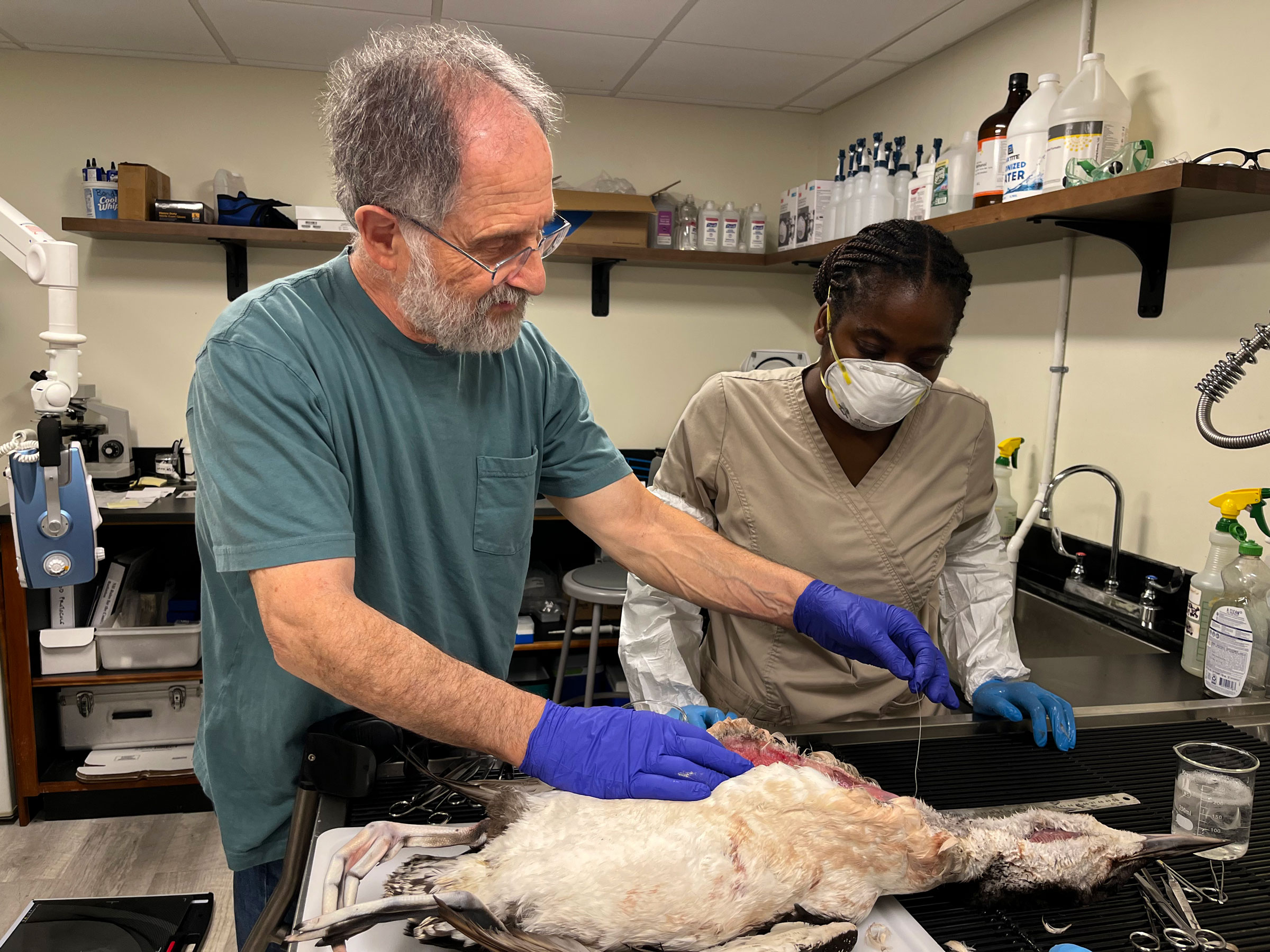
Two people look at a loon laying on a dissection table.

Wildlife veterinarian Mark Pokras and Tufts University veterinary student Khangelani Mhlanga necropsy a female loon with a length of fishing line emerging from her neck. Krista Langlois

Fishing hooks aren’t typically made of lead—it’s too pliable—so the team doesn’t suspect lead poisoning. Perhaps the hook inhibited the animal’s ability to hunt or swallow, leading to starvation. Still, the necropsy is valuable because it contributes to an ongoing record of the lives and deaths of New England loons across five decades.

When Pokras first realized the scope of lead poisoning while necropsying loons in the 1990s, he imagined the problem would be solved relatively quickly. After all, once Silent Spring author Rachel Carson publicized the harm that DDT was causing to birds and other wildlife in North America in the 1960s, legislators and the general public mobilized against the agrochemical industry and worked to ban DDT in much of the world, saving the lives of countless birds and ensuring that springtime still resonates with their songs.

Yet efforts by LPC and others to educate anglers about the dangers of lead tackle and convince them to switch to non-lead gear hardly moved the needle. And by the time conservationists took their work to Congress in the late 1990s, hoping for a federal ban, it was becoming harder to pass environmental legislation. Voters in the US were increasingly divided by party lines, and politicians were increasingly influenced by a powerful group: the National Rifle Association, or NRA.

As Pokras and his colleagues were spreading the word about the dangers of lead fishing tackle in the ’90s, it just so happened that other conservationists had begun noticing that piles of guts contaminated by lead bullets and left behind by hunters were poisoning scavengers, like bald eagles and California condors. (The US Fish and Wildlife Service had banned lead shot—a type of ammunition used for bird hunting that consists of a spray of small pellets rather than a single bullet—for hunting waterfowl in 1991, but other types of lead bullets were still used for hunting larger animals, and continue to be used today.) Conservation groups across the country began lobbying for a federal ban on lead bullets. And the NRA responded in force. As one NRA website currently states: “The use of traditional (lead) ammunition is currently under attack by many anti-hunting groups whose ultimate goal is to ban hunting.”

But how did the fight over lead bullets thwart efforts to regulate lead fishing tackle? Many hunting and fishing organizations have ties to the NRA, and they maintain that any effort to regulate tackle will open the door to regulating ammunition, and that any effort to regulate ammunition is an assault on Americans’ gun rights.

“One of the unusual things about lead is there are very few other toxic materials that have a huge public lobby in favor of them,” Pokras says. “You don’t see a lot of members of the public out there campaigning [for] more DDT or neonicotinoid pesticides. But with lead there’s a huge, wealthy, politically influential contingent supporting it.”

When Pokras retired in 2015, he had decades of data showing that lead fishing tackle was killing loons, along with some 7,500 peer-reviewed scientific papers that unequivocally show the dangers of lead for wildlife. When I asked why he continues to necropsy loons to amass new data despite this preponderance of proof, his answer is concise: “We haven’t solved the problem yet.”

Lead—an element found not just on Earth but throughout the solar system—has always been attractive for human industry. The earliest known case of metal smelting can be found in 7,000-year-old lead beads found in Asia Minor. The Roman empire produced 72,000 metric tons of lead at its peak, much of it was used to make vessels for eating and drinking and pipes for moving water; the word “plumbing” comes from the Latin word for lead, plumbum. And lead has been harming people and animals for nearly as long as we’ve used it. Lead seeping from a Greek mine was already polluting the environment some 5,300 years ago, while an Egyptian papyrus from 3,000 years ago depicts a case of homicide by lead poisoning.

Still, lead remains popular, used in everything from car batteries to computer screens.

Global lead production increases annually, with more than 4 million metric tons (some 10 billion pounds) mined or extracted through recycling in 2024 alone.

Before traveling to New Hampshire to seek out loons, I’d met with Elaine Leslie, the retired chief of biological resources for the National Park Service, at her home in rural southwestern Colorado. When Leslie was leading the Park Service’s biology department in the early 2010s under Barack Obama’s administration, she helped enact an internal ban on lead ammunition in all US national parks and preserves. Hunters and gun advocates weren’t thrilled—“I got death threats,” Leslie tells me matter-of-factly—but the US Fish and Wildlife Service followed suit by banning lead ammunition in certain national wildlife refuges, and began making moves toward a more comprehensive ban. The state of California also banned lead bullets in condor habitat in 2007, eventually followed by a statewide ban. For a while, it seemed as though scientists and conservationists were making progress.

But when President Donald Trump took office in 2017, his administration largely reversed the Park Service’s ban on lead bullets. (Rangers must still use non-lead bullets when dispatching an injured animal.) It also restricted the agency from spending money on research, education, or other efforts to reduce lead impacts to wildlife and people. Such pushback is bolstered by gun advocates who claim there’s no research proving that lead has population-level effects on wildlife. In the case of California condors, they say, California’s lead ban hasn’t reduced mortality rates, so the lead in condors’ blood must be coming from a different source. (Scientists say it’s because condors regularly cross into states like Arizona and Nevada and eat meat left by hunters who used lead bullets.) Critics also claim that non-lead ammunition is more expensive, which used to be true but is becoming less so. And they allege that non-lead ammunition is less effective—another argument that has been disproved in peer-reviewed research. Still, the backlash against regulating lead at the federal level has only grown in recent years, with federal legislators introducing bills to protect hunters’ and anglers’ right to lead tackle and bullets. California remains the only state with a complete ban on lead ammunition.

Sitting in the shade of her porch sipping iced tea, I asked Leslie, a wildlife biologist by training, if the science showing the dangers of lead to animals is well established. She let out an incredulous laugh. “There’s so much peer-reviewed science out there,” she said. “There’s study after study.”

“Those are the very top of the iceberg. Grizzly bears are impacted. Coyotes are impacted. Ravens are impacted. Any animal that eats another animal can be impacted.”

For months after our meeting, Leslie sends me those studies by email. Research has shown lead poisoning in doves, whooping cranes, eagles, owls, and many other birds. And as Leslie points out, those are only the animals that are monitored. “I mean, those are the very top of the iceberg,” she says. “Grizzly bears are impacted. Coyotes are impacted. Ravens are impacted. Any animal that eats another animal can be impacted.” While not every animal that absorbs lead dies from it, the bioaccumulation may lead an animal to become sluggish or disoriented and get struck by a car or fly into a power line it would have otherwise avoided. Lead poisoning, Leslie says, is an underreported issue.

While most animals killed by lead poisoning encounter the element from bullets, loons are predominantly killed by lead fishing tackle, which is theoretically less contentious to regulate—especially in progressive regions like New England. That’s why, beginning in the early 2000s, loon conservationists turned their focus to state-level laws. They also kept their efforts to ban lead tackle separate from efforts to ban lead ammo, in the hope that it might be an easier pill for lawmakers to swallow.

New Hampshire became the first to ban certain types of lead fishing tackle in 2000, and subsequently strengthened its laws to become some of the most stringent in the nation. Vermont, Massachusetts, and Maine followed, though the details differ so much from state to state that education and enforcement remain challenging. “We thought great, problem solved,” says Vogel, the LPC director. “But then we realized the problem was not solved.”

Today, even after the bans have been in place for years, LPC continues to receive loons each year who have died of lead poisoning. Vogel and his colleagues initially thought this was because the birds were swallowing old lead sinkers buried in the muck at the bottom of lakes. But after necropsies demonstrated that the months when most loons died of lead poisoning coincided with the months when freshwater fishing was at its peak, the team realized that the deaths came from current use. Fishermen were still using—and even purchasing—lead sinkers and spinners.

Back at the LPC’s headquarters on the shores of Lake Winnipesaukee, Pokras shows me a lead lure that he picked up at a fishing store in Maine a few weeks prior. “This is actually a good thing,” Vogel chimes in, with characteristic optimism. It means conservationists don’t have to figure out how to remove old tackle sunk at the bottom of lakes. If they can just figure out how to keep new lead tackle from getting into the environment, the benefit to birds should be almost immediate. And fortunately, they’ve found a promising solution.

After the interns finish taking samples of the dead loon’s organs to send off for testing, they seal what’s left of the body in a heavy-duty trash bag for disposal at the local dump. As they wrap up, I head upstairs to the education center and gift shop. A recording of loon calls plays softly, and educational exhibits share information about loons, including the fact that they can dive to depths of 60 meters (200 feet) to hunt for fish, and that their name comes from the Swedish word for clumsy, lom—a nod to loons’ notorious ineptitude on land.

On one wall, a taxidermied loon appears to be suspended mid-swim in a glass case, its neck stretched out and its webbed feet splayed behind it like propellers. Affixed to the glass is a placard: “This loon died after ingesting lead fishing tackle.” A table below displays a jar half full of lead sinkers: “This small Mason jar contains enough lead fishing tackle to kill every adult loon found in New Hampshire!” Nearby, a wooden bowl carved in the shape of—you guessed it—a loon holds non-lead tackle that visitors can take home for free. Brochures urge people to earn credit for more new tackle by turning in their old lead gear.

This is part of New Hampshire’s pioneering lead tackle buyback program. LPC gets generous donations from loon lovers, and along with support from the state’s department of fish and game, some of that money becomes $20 vouchers to sporting goods stores given to people who turn in lead tackle. Banners and flyers publicizing the lead buyback program are displayed at waste transfer stations, government offices, shops, and community lake associations, and Scouts can earn a badge for collecting lead tackle from their community. Since its launch in 2018, people have dropped off nearly 80,000 pieces of lead tackle; in 2024 alone, 78 kilograms (172 pounds) of lead tackle were turned in, marking a 119 percent increase over the prior year. Maine has taken the work a step further—in addition to buying tackle from individual anglers, the conservation nonprofit Maine Audubon buys stock directly from merchants, keeping lead tackle off the shelves and helping stores comply with newly tightened state regulations.

For loons, the combination of legislation, education, and buyback programs seems to be working. Lead poisoning is no longer the number one killer of loons in Maine. And in New Hampshire, lead-related deaths dropped 61 percent between the late 1990s and 2016, and fell another 34 percent since then. “I suppose you could see New Hampshire as a leader,” Vogel says, “But that’s also driven by necessity. The problem was the most severe here.”

Vogel is optimistic that states like Minnesota, Wisconsin, and Washington—all of which have significant loon habitat—will one day follow suit, along with his home country of Canada, where 94 percent of common loons breed. Canada already bans lead tackle and ammo in national parks and wildlife areas but allows it elsewhere. Resistance to a Canadian national ban seems to come from a more basic reluctance to change, rather than fear of losing gun rights, along with the fact that loons are so abundant in Canada that preventing lead poisoning feels less urgent.

Europe, meanwhile, is far ahead. The European Union, Norway, and Iceland already ban lead in all wetlands, and the EU is considering a proposal to ban lead from all fishing and hunting gear. Denmark already has a complete ban, and the United Kingdom will enact one beginning in 2026.

With the necropsy complete, I follow Vogel and Ashley Keenan, LPC’s field crew coordinator, to a small motorboat docked on Lake Winnipesaukee. The southern part of the lake bumps with party boats and Jet Skis, but these northern reaches are quieter, scattered with islands and ringed with coves where dark sweeps of pine forest feather the shore.

A woman stands in a creek looking through binoculars.

Ashley Keenan, field crew coordinator for the Loon Preservation Committee, checks on a loon nest on an island in Lake Winnipesaukee, New Hampshire. Krista Langlois

Vogel and Keenan are tracking this year’s loon chicks. Unlike ducks and many other waterfowl, loons hatch only one or two eggs per year and don’t typically reproduce until they’re six years old, making population-level growth slow. Out of 32 nesting pairs of loons scattered across Lake Winnipesaukee’s 179 square kilometers (69 square miles) in the spring of 2025, 12 chicks had survived as of August. The figure is slightly below average, although survival rates fluctuate. (One year, 23 chicks survived, Vogel tells me; a few years later, only three did.) During Keenan’s last patrol, the eggs in one nest perched on a tiny island hadn’t yet hatched, and today she’s trying to find out if the chicks have emerged.

Keenan steers toward the island, cuts the motor, and jumps into the shallows. She aims her binoculars at a cluster of lichen-splattered boulders. We wait in silence. Nothing.

“Goddamn it,” she says, climbing back into the boat. One egg might still be there, but there’s no sign of the second egg or a living chick. She guesses it was picked off by a predator, perhaps an eagle. Vogel speculates that unseasonably hot summer weather contributed to the lower-than-usual survival rate. Loon parents who need to cool down by going for a swim must leave their eggs unguarded, opening them to predation or overheating under the blazing sun.

Although common loon populations are holding steady or even growing slightly across their range, loons are increasingly susceptible to the impacts of climate change, as well as avian malaria, shoreline development, and collisions with recreational motorboats. And this region—one of the first in North America to be settled by colonists, and still one of the most densely developed on the continent—echoes with stories of species that have disappeared, from mountain lions to American chestnuts. People here know that survival is never guaranteed, and that keeping common species common requires effort, sacrifice, and care. For loons specifically, it means keeping as many adults of reproductive age alive as possible.

“This is probably the most intensely managed species in New Hampshire,” Vogel says. “And despite that, we’re still having trouble maintaining reproductive success.”

Just then, a white-haired woman in a kayak approaches our boat, waving her arms. “I’m just trying to find out what happened to my baby loon,” she calls out. Her name is Dotty Wysocki, and she’s been watching nesting loons near her summer cottage here for three decades. “We name ’em and everything,” she tells me in a thick Boston accent. “We really get involved. I’m constantly looking for them.”

Wysocki tells us that she saw a newly hatched chick alive earlier in the week but hasn’t spotted it since. When Keenan affirms that the chick is likely dead, Wysocki lowers her eyes. She wishes she could have done more; when she was younger, she and her friends used to watch the chicks in four-hour shifts to scare off eagles and other predators.

At the end of her poem about lead poisoning in loons, Mary Oliver wrote: “I tell you this to break your heart / by which I mean only / that it break open and never close again / to the rest of the world.”

As Wysocki paddles away and Keenan starts up our motor, both seem dispirited, perhaps even a little heartbroken. But their concern for the fate of this one tiny chick nonetheless fills me with hope. It’s the kind of love that can save a species, and indeed, the only thing that ever has.
Continue Reading…

Mother Jones

Monster of 2025: GLP-1 Ads

The staff of Mother Jones is, once again, rounding up the heroes and monsters of the past year. This is a non-exhaustive and totally subjective list, giving our reporters a chance to write about something that brought joy, discontent, or curiosity. Happy holidays.

My Instagram algorithm has decided that I am a woman, and, therefore, I must want to lose weight.

In 2025, that meant it was impossible for me to scroll through my feed without being visually assaulted by ingratiating marketing campaigns, encouraging me to shed those last few pesky pounds via drugs, specifically off-label GLP-1.

For a brief moment, companies found it profitable to showcase physical diversity and promote the idea of loving your body just the way it is. Not so anymore.

In one ad, I am being pitched “looser jeans.” In another, I am being patronized by a cake: “PSA for the girls,” states shoddily Photoshopped frosting. “You don’t need to be obese to start a GLP-1.”

In practice, though, you do—at least according to the US Food and Drug Administration, which has only approved GLP-1 drugs for people with clinical obesity or Type 2 diabetes and for people who are overweight with weight-related comorbidities. The companies that manufacture the name-brand GLP-1s like Ozempic, Zepbound, and Wegovy haven’t meaningfully tested the drugs on people with BMIs lower than 27.

The sponsored ads that bombard my feeds, from telehealth companies like Willow, Noom, Fridays, EllieMD, and Midi Health, are technically promoting another product: compounded GLP-1 injections and tablets. These are not FDA-approved; they are custom-made by pharmacists and usually include small doses of semaglutide, the active ingredient in Ozempic, along with other ingredients. EllieMD, for example, offers a “longevity microdose” that includes B12.

The FDA has been clear on this. “Compounded drugs should only be used in patients whose medical needs cannot be met by an FDA-approved drug,” states an FDA release warning against the use of unapproved GLP-1 drugs for weight loss.

But the ads I’ve seen overwhelmingly focus on cosmetic changes, not improved health. Some discuss quickly dropping a handful of pounds before a big event, like a wedding. To obtain a prescription, you still need to talk to a doctor, who is tasked with assessing your medical history and needs. Willow’s website is explicit about the end game here: “Proven medicine that powers fast cosmetic weight loss.”

Willow, Noom, Fridays, and EllieMD did not respond to requests for comment. Midi Health told me it takes a medically focused, clinician-led approach to prescribing GLP-1 medications. “When our clinicians prescribe these therapies, it is because there is a clear medical benefit and as part of a comprehensive care plan focused on a woman’s overall health. GLP-1s have FDA-approved indications beyond obesity, including diabetes, sleep apnea, and long-term weight maintenance…We also recognize that BMI is an imperfect tool designed for research, not individualized medical care,” said Midi Health.

To be fair, it isn’t just the off-label drugs that are getting backed by an aggressive marketing push. In 2023, when Ozempic went mainstream, more than 4,000 semaglutide ad campaigns flooded the internet. That same year, print ads for “a weekly shot to lose weight” swept the New York City subways. Ro, the company behind that campaign, now has a series of video ads with Serena Williams. It was depressing to have my TV-watching experience interrupted by a close-up shot of the indomitable tennis star injecting a drug that can cause muscle loss and fatigue.

All these ads are nauseating because they traffic in the assumption that weight loss is a universal goal; the question is just whether you’d like to lose 5, 10, or 50 pounds. But I do not want to lose weight. I have spent more than half of my life trying to squash my urge to lose weight—and be free of the deeply inscribed messaging that thinner is a better, more desirable form. It’s been many years since I’ve restricted calories or purged after a meal, habits I picked up before I was even through puberty. Still, sometimes I falter. I’ll find myself redownloading MyFitnessPal or using my finite attention to perform caloric mental math, calculating the damage done by a tablespoon of cooking oil or the splash of milk added to my morning coffee.

This disordered history probably makes me the perfect demographic for receiving targeted GLP-1 ads. It’s very possible that my attention lingers, subconsciously, when I come across them on my feed. And if that’s the case, the algorithm has almost certainly noticed, and taken it as an invitation to send me more—despite all of the times I’ve clicked “not interested.”

To research this piece, I decided to see if I’d actually be eligible to microdose the GLP-1 being promoted to me. I filled out two online quizzes from the companies Noom and Hers. I lied about past eating disorder history by checking a box.

Hers—a women’s telehealth company that launched in 2018 with a focus on sexual wellness and skincare and has since become better known for offering weight loss drugs—warned me that my prescription would not be “evaluated for safety, effectiveness, or quality by the FDA.” It asked me harrowing questions such as, “How disruptive would vomiting, constipation, and diarrhea be to your daily life?” And then, thank God, Hers told me I didn’t qualify.

Noom let me right in. After it thanked me for taking the “important (and hard) first step” of sharing my current weight, it prompted me to buy my “personalized plan” for shedding 10 pounds in seven weeks.

There’s still a lot we don’t know about the long-term side effects of GLP-1 drugs, but they do appear to be beneficial for those who medically need them. I am not one of those people. And as the multibillion-dollar semaglutide market explodes across the globe, it’s disappointing to see it stamp out the last remaining shreds of the mid-2010s “body positivity” movement.

For a brief moment, companies found it profitable to showcase physical diversity and promote the idea of loving your body just the way it is. Not so anymore. The resounding message—on social media, on TV, in the goddamn subways—is that thin is back in. And companies are doing what they’ve always done best: exploiting our insecurities to cash out.

Continue Reading…

Mother Jones

The Five Most Unhinged Climate Lies Trump Told in 2025

This story was originally published by Guardian and is reproduced here as part of the Climate Desk collaboration.

In the past decade at the forefront of US politics, Donald Trump has unleashed a barrage of unusual, misleading, or dubious assertions about the climate crisis, which he most famously called a “hoax”.

This year has seen Trump ratchet up his often questionable claims about the environment and how to deal, if at all, with the threats to it. In a year littered with lies and wild declarations, these are the five that stood out as the most startling.

1. “Putting people over fish”

Upon re-entering the White House in January, Trump revealed an unusual fixation would become an immediate priority for his administration—the fate of an endangered, three-inch-long fish that lives in California.
The unassuming delta smelt, Trump said rather uncharitably, is “an essentially worthless fish” which had been lavished with water flows that should instead go to nearby farmers or help fight the devastating wildfires that were raging hundreds of miles south in Los Angeles.

On his first day in office, Trump issued an eye-catching executive order titled “Putting people over fish” that demanded water be diverted from the smelt’s habitat and towards needy people.

Experts were quick to point out that water situated so far away would not aid the firefighting effort in LA, with the small amount of water provided to keep the Sacramento-San Joaquin delta ecosystem intact overshadowed by the much larger forces at play in California, such as the climate crisis, which has spurred monumental droughts in the region.

2. Wind energy is “driving the whales crazy”

Continuing on the aquatic theme, Trump’s first month in the most powerful office on the planet also included a bizarre tirade against offshore wind energy for its supposed impact upon whales.

The president said that “windmills” were “dangerous,” citing the example of whales being washed ashore in Massachusetts as proof that “the windmills are driving the whales crazy, obviously.”

While there was a spate of dead and sick whales becoming stranded ashore, Trump’s own federal government scientists have rejected the idea that wind turbines placed in the ocean are to blame.

“At this point, there is no scientific evidence that noise resulting from offshore wind site characterization surveys could potentially cause whale deaths,” the National Ocean and Atmospheric Administration states. “There are no known links between large whale deaths and ongoing offshore wind activities.”

The main threats to whales continue to be entanglement in fishing nets, boat strikes, and altered prey behavior due to a rapidly heating ocean from the climate crisis, which is causing whales to have to forage closer to land, experts say.

This hasn’t deterred Trump from enacting a long-held grudge against wind energy by halting planned projects and stating that “we don’t allow the windmills and we don’t want the solar panels” in August. The president has also claimed that wind is “the most expensive energy there is”—a false claim: wind and solar are, in fact, among the cheapest sources of power that have ever existed.

3. Clean, beautiful coal

In September, Trump delivered a remarkable, often fact-free speech to the United Nations, in which he said that climate change is the “greatest con job ever perpetrated on the world”, blaming “stupid people” for predictions that have hobbled countries with a costly “green scam.”

“I have a little standing order in the White House. Never use the word ‘coal’. Only use the words ‘clean, beautiful coal’. Sounds much better, doesn’t it?”

But perhaps the most unusual revelation in the speech was Trump outlining how he has sought to directly rebrand coal as a clean power source. “I have a little standing order in the White House,” he said. “Never use the word ‘coal’. Only use the words ‘clean, beautiful coal’. Sounds much better, doesn’t it?”

Coal is, in fact, far from clean. It is the dirtiest of all fossil fuels in terms of the carbon it emits when burned, which then heats up the planet, and gives off air pollutants that routinely harm the heart and lung health of those who live near coal power plants.

Black lung disease, meanwhile, is an affliction many coal miners have suffered after directly inhaling coal dust. The Trump administration axed a program that screened coal miners for the respiratory condition.

The federal government, across different administrations, has lavished funding for plans to install carbon capture facilities at coal plants to stop harmful emissions from escaping, but this has yet to be implemented in any meaningful way in the US.

4. Global cooling

In the same speech to beleaguered-looking diplomats at the UN, Trump scoffed at the scientific reality of global heating, instead claiming that scientists had just changed their minds from the planet cooling down.

“It used to be global cooling,” he said. “If you look back years ago in the 1920s and the 1930s, they said, global cooling will kill the world. We have to do something. Then they said global warming will kill the world. But then it started getting cooler.”

The world is not cooling down. It is heating up at the fastest rate in the history of humanity, due to the burning of fossil fuels and, to a lesser extent, deforestation. Scientists are unequivocal about this, as can anyone able to grasp a simple temperature graph.

In the 1920s and 1930s, the field of climate science wasn’t as developed as it is now, but even then there was an understanding of the greenhouse effect, and few scientists in the decades since have expressed concerns about “global coolingcompared with those warning of planetary heating.

The Earth is thought to have been in a long, gentle cooling pattern for thousands of years due to natural forces, but this was upended by the industrial revolution, with the vast amounts of heat-trapping gases emitted over the past 150 years setting us on a completely new and dangerous path. The world is now hotter than at any previous point in human civilization.

5. Climate change investigations

Last month, Trump announced new investigations related to the climate crisis. Not to find more about the severity of global heating and its implications—more to target those who have told the world about it.

“It’s a little conspiracy out there,” the president said at a US-Saudi investment forum in Washington. “We have to investigate them immediately. They probably are being investigated.”

It’s unclear who “they” are—scientists, Democratic politicians, the insurance companies pulling out of states because of the crushing cost of climate-driven disasters? But Trump pushed on.

“Their policies punish success, rewarded failure, and produced disaster, including the worst inflation in our country’s history,” he said.

While the Trump administration has fired scientists, hauled down mentions of the climate crisis from government websites, and banned federal employees from uttering verboten words such as “emissions” and “green”, the reality remains that the world is warming up, and past projections of this have been generally accurate.

Some of the most accurate forecasts of global heating came from the fossil fuel industry, which knew of the dangers from the 1950s onward and produced strikingly accurate projections of future heat in the 1970s.

Instead of informing the world of this peril, however, oil and gas companies instead set about a decades-long campaign to downplay and distort this science in order to maintain their lofty position in the global economy.

Trump has not called for an investigation of these companies, choosing instead to openly solicit campaign donations from them in return for rollbacks of clean air protections once he became president—a promise he has largely fulfilled.

Continue Reading…

Mother Jones

How a Climate Doomsayer Became an Unexpected Optimist

Bill McKibben isn’t known for his rosy outlook on climate change. Back in 1989, he wrote The End of Nature, which is considered the first mainstream book warning of global warming’s potential effects on the planet. Since then, he’s been an ever-present voice on environmental issues, routinely sounding the alarm about how human activity is changing the planet while also organizing protests against the fossil fuel industries that are contributing to climate change.

McKibben’s stark and straightforward foreboding about the future of the planet was once described as “dark realism.” But he has recently let a little light shine through thanks to the dramatic growth of renewable energy, particularly solar power. In his latest book, Here Comes the Sun: A Last Chance for the Climate and a Fresh Chance for Civilization, McKibben argues that the planet is experiencing the fastest energy transition in history from fossil fuels to solar and wind—and that transition could be the start of something big.

“We’re not talking salvation here,” McKibben says. “We’re not talking stopping global warming. But we are talking the first thing that’s happened in the 40 years that we’ve known about climate change that scales to at least begin taking a serious bite out of the trouble we’re in.”

On this week’s More To The Story, McKibben sits down with host Al Letson to examine the rise of solar power, how China is leapfrogging the United States in renewable energy use, and the real reason the Trump administration is trying to kill solar and wind projects around the country.

This is an update of an episode that originally aired in October 2025.

This following interview was edited for length and clarity. More To The Story transcripts are produced by a third-party transcription service and may contain errors.

Al Letson: Bill, how are you this morning?

Bill McKibben: I’m actually pretty darn good, which one feels bad about saying in the midst of planetary ecological trauma and the collapse of our democracy, but it’s a beautiful day in the mountains of Vermont and in the midst of all that bad stuff, I’ve got one piece of big good news, which it’s actually kind of fun to share.

Yeah, I think in the midst of all the stress and pressure and sadness about the way the world is heading at this moment, I think having joy is a revolutionary act and it’s good. I think when you come outside and the sun is shining and it feels good outside, I don’t know. I don’t think we should be ashamed of it. I think we should bask it and hold onto it as long as possible because good Lord, who knows what’s next?

Amen. One of the results of having spent my whole life working on climate change is I never take good weather for granted. If there’s a snowstorm, I make the most out of every flake. If there’s a beautiful cool fall-like morning like there was today, nobody’s out in it quicker than me. So I take your point 100%.

How long have you been working in the field of environmental justice and thinking about the environment?

Al, when I was 27, I wrote a book called The End of Nature, so this would’ve been 1989 because I’m an old person. So, wrote a book called The End of Nature that was the first book about what we now call the climate crisis, what we then call the greenhouse effect. And that book, well, that book did well, it came out in 24 languages and things, but more to the point, it just made me realize that this was not only the most important question in the world, what was going to happen to the Earth’s climate, but the most interesting, that it required some understanding of science, but also more importantly of economics, of politics, of sociology, of psychology, of theology, of pretty much everything you could imagine. And so for 38 years now, I guess, it’s been my work and at some level, I wish I’d been able to spend my life on something not quite so bleak. On the other hand, I have to confess, I haven’t been bored in any point in there.

Yeah. How would you describe the environmental causes in America since you’ve been watching it for so long? It seems to me that there’s a lot of one step forward, three steps back, one step forward, three steps back.

I’d say it’s been more like one step forward, three quarters of a step back over and over again. And that’s a big problem because it’s not only that we have to move, it’s that we have to move fast. Climate change is really probably the first great question we’ve ever come up against that has time limit. As long as I’ve been alive and as long as you’ve been alive, our country’s been arguing over should we have national healthcare? I think we should. I think it’s a sin that we don’t, people are going to die and go bankrupt every year that we don’t join all the other countries of the world in offering it, but it’s not going to make it harder to do it when we eventually elect Bernie and set our minds to it than if we hadn’t delayed all this time.

Climate change isn’t like that. Once you melt the Arctic, nobody has a plan for how you freeze it back up again. So we’re under some very serious time pressure, which is why it’s incredibly sad to watch our country pretty much alone among the world in reverse right now on the most important questions.

Yeah. Is that forward movement and regression tied to our politics, i.e., is it tied to a specific party? If the Democrats are in office, we move forward, if Republicans come in office, we move backwards?

Yeah, in the largest terms. The fossil fuel industry, more or less purchased the Republican Party 30, 35 years ago. Their biggest contributors have been the Koch brothers who are also the biggest oil and gas barons in America. And so it’s just been become party doctrine to pretend that physics and chemistry don’t really exist and we don’t have to worry about them. Democrats have been better, and in the case of Joe Biden actually, considerably better. His Inflation Reduction Act was the one serious attempt that America’s ever made to deal with the climate crisis, and it was far from perfect, and there were plenty of Democrats like Joe Manchin that got in the way and so on and so forth. But all in all, it was a good faith effort driven by extraordinary activism around the Green New Deal. And it’s a shame to see it now thrown into reverse in the Trump administration, especially because the rest of the world is at different paces, some of them very fast, starting to do the right thing here.

So given all of that where we are and kind of stepping back away from the progress we had made forward, you just wrote a new book that is pretty optimistic, which is a little bit different for you because you’ve been described as dark realism. Tell me why are you feeling optimistic in this moment?

About 36 months ago, the planet began an incredible surge of installation of renewable energy, solar panels, wind turbines, and the batteries to store that power when the sun goes down or the wind drops. That surge is not just the fastest energy transition play on the planet now. It’s the fastest energy transition in history and by a lot, and the numbers are frankly kind of astonishing. I mean, the last month we have good data for is May. In China, in May, they were putting up three gigawatts of solar panels a day. Now, a gigawatt is the rough equivalent of a big coal-fired power plant. So they were building the equivalent of one of those worth of solar panels every eight hours across China. Those kind of numbers are world-changing if we play it out for a few more years, and if everybody joins in. And you can see the same thing happening in parts of this country.

California has not done everything right, but it’s done more right than most places, and California has hit some kind of tipping point in the last 11 or 12 months. Now, most days, California generates more than a hundred percent of the electricity it uses from clean energy, which means that at night, when the sun goes down, the biggest source of supply on their grid is batteries that didn’t exist three years ago. And the bottom line is a 40% fall in fossil fuel use for electricity in the fourth-largest economy in the world is the kind of number that, adopted worldwide, begins to shave tenths of a degree off how hot the planet eventually gets. And we know that every 10th of a degree Celsius, that the temperature rises, moves another a hundred million of our brothers and sisters out of a safe climate zone and into a dangerous one. We’re not talking salvation here, we’re not talking stopping global warming, but we are talking the first thing that’s happened in the 40 years that we’ve known about climate change, that scales to at least begin taking a serious bite out of the trouble we’re in.

Yeah, so I own a home in Jacksonville, Florida.

In the Sunshine State.

In the Sunshine State. I was planning on getting solar panels for the house, but then I was told A, one, it would be really expensive, and then B, it wouldn’t save me that much on my bill because of the way some local ordinances are configured. And so for me, somebody who wants to have solar panels and wants to use solar power, it’s just not cost-effective. So how do we get past that?

Well, there’s a lot of ways. One of the ways was what Biden was doing in the IRA, which was to offer serious tax credits. And those, despite the Republican defeat of them, remain in effect through the end of this year through New Year’s Eve. So if people move quickly, they can still get those. Probably more important in the long run, and this was the subject of a long piece I wrote for Mother Jones this summer, we need serious reform in the way that we permit and license these things.

Putting solar panels on your roof in Florida is roughly three times more expensive than it is to put solar panels on your roof in say, Australia, to pick someplace with a similar climate, or Europe, someplace with a more difficult climate, costs three times as much here. A little bit of that’s because of tariffs on panels. Mostly it’s because every municipality in America, they send out their own team of inspectors, permits, on and on and on. It’s a bureaucratic mess, and that’s what drives the price up so dramatically.

There’s actually an easy way to do it. The National Renewable Energy Laboratory developed a piece of software called the Solar App Plus that allows contractors to just plug in the name of the type of equipment they’re going to put on the roof and the address that they’re doing it, and the computer quickly checks to see if it’s all compatible, and if it is, they get an instantaneous permit and get to work right away. And then, for apartment dwellers, because there’s almost as many apartment dwellers as homeowners in this country, who don’t have access to their own roof usually, we need another set of easy technology. We’re calling this balcony solar.

And across Europe over the last three years, three and a half, 4 million apartment dwellers have gone to whatever you call Best Buy in Frankfurt or Brussels and come home for a few hundred euros with solar panel design just to be hung from the railing of a apartment balcony and then plugged directly into the wall. No electrician needed nothing. That’s illegal every place in this country except that progressive bastion in the state of Utah where the state legislature unanimously passed enabling legislation earlier this year because some Libertarian Republican state senator who I’ve talked to, an interesting guy, he said, “Well, if people in Stuttgart can have it, why not people in Provo?” And no one had a good reason, so now there’s on YouTube lots of videos of Happy Utahns putting up their balcony solar arrays.

So let me just to clarify that because I never heard of this before. In overseas, in different countries, they can go to, I don’t know, an Ikea and grab a solar panel, come home and plug it in the wall to power their apartment?

It often powers 25% of the power that they’re using in their apartment. It’s a real amazing thing and it’s for a few hundred euros. And among other things, it really introduces people to the joy of all this. There was a big story in The Guardian a few months ago following all sorts of people who’d done this and almost to a person, they’d all become fascinated by the app on their phone showing how much power they were generating at any given moment.

Solar power is kind of a miracle. It exists in so many different sizes, from your balcony to big solar farms, all of which we need. But the thing that’s a miracle about it is precisely that it’s available to all of us. I mean, no one’s going to build a coal-fired power plant on their balcony. This is something that everybody can do, and it’s something that once you’ve got the panel, no one can control. We’re talking about energy that can’t be hoarded, that can’t be held in reserve, and that essentially the sun delivers for free every day when it rises above the horizon. So that is an extraordinary boon to especially poor people around the world and an extraordinary threat to the fossil fuel industry, which is why you’re seeing the crazy pushback that marks the Trump administration.

So with the Trump administration and this bill that they passed, The Big Beautiful Bill, that impacts tax credits for renewable projects like solar, how is that going to affect the solar power industry in the United States?

It’s going to decimate it. There are already companies laying people off and going out of business because that tax credit was important and it’s, since we can’t do anything in Washington at the moment, why we need state and local governments to step up big to change the rules here and try to keep this momentum going in the States. The United States accounts for about 11% of emissions in the world. The other 89%, things are going much better than they are here, not just in China, but in all the places that China touches.
In some ways, the most powerful story for me in the book was what happened in Pakistan last year. Now, Pakistan’s been hit harder by climate change than any country on earth. Its cities now routinely report temperatures of 125, 126 degrees. The two worst floods that really we’ve ever recorded on the planet happened in Pakistan over the last 15 years. Right now there’s big major, not quite as bad, but really serious flood across the Punjab. Pakistan also has an expensive and unreliable electric system. So about 18 months ago, people began importing in very large numbers, cheap Chinese solar panels from across their shared border. And within six months, eight months, Pakistanis, without government help, just basically using directions you can get on TikTok, had installed enough solar panels to equal half of the existing national electric grid in Pakistan. It’s the most amazing sort of citizen engineering project in history and of incredible value to people.

Farmers in Pakistan, I don’t know if you’ve traveled in rural Asia, but the soundtrack of at part of the world is the hum of diesel pumps, often the cough of diesel generators because you need to bring up this irrigation water from quite a great depth to wells that came with the green revolution. Often for farmers, that diesel is the biggest single input cost that they have. So farmers were very early adopters here. Many of them lacked the money to build the steel supports that we’re used to seeing to hold your solar panels up. They just laid them on the ground and pointed them at the sun. Pakistanis last year used 35% less diesel than they did the year before. Now the same thing is happening in the last six months across large parts of Africa. Pretty much any place where there’s really deep established trade relations with China, and it’s not just solar panels.

What the Chinese are also doing is building out the suite of appliances that make use of all that clean, cheap electricity. The most obvious example being electric vehicles and electric bikes. More than half the cars sold in China last month came with a plug dangling out the back, and now those are the top-selling cars in one developing nation after another around the world because they’re cheap and they’re good cars and because if you’re in Ethiopia or Djibouti or wherever you are, you have way more access to sunshine than you do to the incredibly long supply chain that you need to support a gasoline station.

But my understanding, and my understanding is definitely dated, which is why I’m glad I’m talking to you, but for a very long time, my understanding of solar power was that it wasn’t that efficient, that you wouldn’t be able to get enough power to really do much of anything versus fossil fuels. Is it true that the Chinese have really invested in the technology and really pushed it forward?

Yeah, I mean Chinese are now, you’ve heard of petro states, the Chinese are the first electro state in the world. This stuff works great and it works great here. I mean, I was telling you about what’s going on in California. In some ways, an even more remarkable story, given the politics, is that Texas is now installing clean energy faster than California because it’s the cheapest and it’s the fastest thing to put up. If you’re having to build data centers, and God knows, I’m not convinced we have to build as many data centers as we’re building, but if you do, the only thing that builds fast enough to get them up is solar or wind. You can put up a big solar farm in a matter of a few months as fast as you can build the dumb data center.

Your question’s really important because for a very long time, all my life, we’ve called this stuff alternative energy, and it’s sort of been there on the fringe like maybe it’s not real big boy energy the way that oil and gas is. I think we’ve tended to think of it as the Whole Foods of energy. It’s like nice, but it’s pricey. It’s the Costco of energy now. It’s cheap, it’s available in bulk, it’s on the shelf ready to go. 95% of new electric generation around the world and around the country last year came from clean energy, and that’s precisely why the fossil fuel industry freaked out. You remember a year ago, Donald Trump told oil executives, “If you give me a billion dollars, you can have anything you want.” They gave him about half a billion between donations and advertising and lobbying. That was enough because he’s doing things even they couldn’t have imagined. I mean, he’s shut down two almost complete big wind farms off the Atlantic seaboard. I mean, it’s craziness. We’ve never really seen anything like it.

Do you think we’ll be able to bounce back? As we’re watching all of these forward movements that have happened before Trump came back into office, it feels like he is burning it all down and not just burning it down, but salting the earth. Nothing’s going to grow there again.

Yeah, I completely hear you. Yeah. This one possibility. Look, 10 years from now, if we stay on the course that Trump has us on, any tourist who can actually get a visa to come to America, it’ll be like a Colonial Williamsburg of internal combustion. People will come to gawk at how people used to live back in the olden days. I don’t think that that’s what’s going to happen. I think that at some point, reality is going to catch up with this, and everyone’s going to start figuring out we’re paying way more for energy than else in the world, and that means our economy is always on the back foot. That means that our consumers are always strapped. I mean, electricity prices are up 10% this year so far around this country because he keeps saying, “We’re not going to build the cheapest, fastest way to make more electricity.”

I don’t see how that can last. But then I don’t see how any of this, none of it… I mean, I confess, I feel out of my depth now, the hatred of immigrants, the racial hatred, the insane economic policy around tariffs, none of it makes any real sense to me politically or morally. So I could be wrong, but I hope that America, which after all was where the solar cell was invented and where the first solar cell came out of Edison, New Jersey in 1954, the first commercial wind turbine in the world went up on a Vermont mountain about 30 miles south of where I’m talking from you speaking in the 1940s. That we’ve now gifted the future to China is just crazy no matter what your politics are.

The idea that we are ceding ground to China is not just about solar energy, but in all sorts of ways. The move of the Trump administration to be sort of isolationists is actually hurting us way more than being open and growing and advancing.

Yep, I couldn’t agree more. Look, I’ve been to China a bunch of times. I’m glad that I’m not a Chinese citizen because doing the work I do, I would’ve been in jail long ago, and I’m aware of that and understand the imperfections and deep flaws in that country. But I also understand that they have a deep connection to reason. They’ve elected engineers, or not elected, appointed engineers to run their country now for decades while we’ve been electing lawyers to run ours. And as a result, they’re not surprisingly better at building stuff. And so they have. And I think now, they’re using that to build a kind of moral legitimacy in the world. If the biggest problem the world faces turns out to be climate change, and I have no doubt that it is, then China’s going to be the global leader in this fight because we’ve just walked away from it.

Yes. The question that comes to mind when you say that is, it’s clear to me that what some climate change skeptics and renewable energy skeptics have been able to do is to wrap things like solar power and wind energy into the culture war. So now that it’s a part of the culture war, people just stand against it because, well, they’re on the wrong team. Instead of looking at the economic reality that their bills could go down significantly if they dived in.

It’s super true, but it’s also true that solar power is remarkably popular across partisan lines. The polling we have shows that yeah, the Republican voters are less enamored of it now because Trump’s been going so hard after it, but still like it by large margins and want more government support for it. I think the reason is that there are several ways to think about this. I’m concerned about climate change. I’m a progressive. I like the idea that we’re networking the groovy power of the sun to save our planet, but I’ve lived my whole life in rural America, much of it in red state, rural America. I have lots of neighbors who are very conservative. There’s lots of Trump flags on my road, and some of them fly in front of homes with solar panels on them because if you’re completely convinced that your home is your castle and that you’re going to defend with your AR-15, it’s a better castle if it has its own independent power supply up on the roof, and people have really figured that out.

So this can cut both ways, and I hope that it will. That’s that story from Utah about the balcony solar. That’s the one place where people have said, “Well, there’s no reason not to do this. Let’s do it.”

Yeah. So you’ve been doing this work for a really long time. I’m curious, when you started doing this work, could you have ever imagined the place that we are in right now as a country?

No. Remember I was 27 when I wrote this first book, so my theory of change was people will read my book and then they will change. Turns out that that’s not exactly how it works. It took me a while to figure out. Really the story of my life is first 10 years after that, I just kept writing more books and giving talks and things because I thought being a journalist that we were having an argument and that if we won the argument, then our leaders would do the right thing because why wouldn’t they? Took me too long, at least a decade, to figure out that we had won the argument, but that we were losing the fight because the fight wasn’t about data and reason and evidence. The fight was about what fights are always about, money and power. And the fossil fuel industry had enough money and power to lose the argument, but keep their business model rolling merrily along.

So that’s when I started just concluding that we needed to organize because if you don’t have billions of dollars, the only way to build power is to build movements. I started with seven college students, a thing called 350.org that became the first big global grassroots climate movement campaign. We’ve organized 20,000 demonstrations in every country on earth except North Korea. And in recent years, I’ve organized for old people like me, what we call Third Act, which now has about 100,000 Americans that work on climate and democracy and racial justice. And so this is a big sprawling fight, we don’t know how it’s going to come out. The reason I wrote this book, Here Comes the Sun, was just to give people a sense that all is not lost, that we do have some tools now that we can put to use.

Find More To The Story on Apple Podcasts, Spotify, iHeartRadio, Pandora, or your favorite podcast app, and don’t forget to subscribe.

Continue Reading…

Mother Jones

Doctors Without Borders Among Dozens of Aid Groups Israel Moves to Shut Down in Gaza

On Tuesday, the Israeli government announced that it would suspend the aid work of several humanitarian organizations that provide lifesaving aid to Palestinians in Gaza living through what Amnesty International and other groups labeled as a genocide.

Israel has claimed that the organizations failed to meet new vetting guidelines. However, as the Associated Press reported, some of the affected organizations have argued that Israel’s rules are arbitrary and could endanger people working for the non-governmental organizations.

The suspensions affect 37 organizations, including Doctors Without Borders/Médecins Sans Frontières, Humanity & Inclusion, the International Rescue Committee, and Action Aid. In addition to working to meet the healthcare and other needs of Palestinians, many of these organizations and those involved in them have been vocal about the horrible conditions Palestinians have endured, including in interviews with Mother Jones. A Humanity & Inclusion employee told Sophie Hurwitz and me in 2024 that “one of the saddest things we hear on a regular basis” is that some children who are now amputees “think that their legs may grow again.”

Following the announcement, foreign ministers of Canada, Denmark, Finland, France, Iceland, Japan, Norway, Sweden, Switzerland and the United Kingdom released a joint statement condemning this decision.

“Deregistration could result in the forced closure of [non-governmental organizations’] operations within 60 days in Gaza and the West Bank. This would have a severe impact on access to essential services, including healthcare,” they wrote. “Any attempt to stem their ability to operate is unacceptable. Without them, it will be impossible to meet all urgent needs at the scale required.”

Doctors Without Borders/Médecins Sans Frontières said in a statement to Mother Jones that while they have not gotten any official decision about their ongoing registration applications, if they are prevented from providing services, the impact will be devastating for Palestinians. “In Gaza, MSF supports around 20 percent of all hospital beds and supports the delivery of one in three babies,” said a spokesperson.

H&I told Mother Jones that its registration to operate in Palestine will be suspended, effectively tomorrow. “This decision comes amid an unprecedented humanitarian crisis, with massive and urgent needs among the civilian population, particularly in Gaza,” said an H&I spokesperson. “[H&I] is currently consulting with other affected humanitarian organizations to analyze the implications of this decision and determine the appropriate next steps.

While a ceasefire started on paper at the beginning of October that involved Hamas returning the remaining live hostages and bodies of the deceased to Israel, Palestinians in Gaza have still faced grim conditions. As of December 9, Palestinian officials have reported that 360 Palestinians have been killed since the start of the ceasefire.

This past October, the International Rescue Committee emphasized the importance of continuing aid into Gaza, with IRC CEO and President David Miliband saying that “with 55,000 Palestinian children suffering from acute malnutrition and 90 percent of the population displaced, what is needed now is a dramatic surge in the amount of aid going into Gaza.”

To top it all off, there has been intense rain and flooding in Gaza, displacing Palestinians living in tents who were already displaced from their homes.

Continue Reading…

Mother Jones

Trump’s Kennedy Center Takeover Plunges Further Into Chaos

More artists have canceled their performances at the Kennedy Center after its Trump-acolyte-dominated board’s recent vote to add the president’s name to the performing arts center earlier this month.

The latest includes The Cookers, a jazz ensemble, which called off their New Year’s Eve show on Monday.

The band did not explicitly mention the name change, but in a statement wrote, “Jazz was born from struggle and from a relentless insistence on freedom: freedom of thought, of expression, and of the full human voice. Some of us have been making this music for many decades, and that history still shapes us.”

“We are not turning away from our audience, and do want to make sure that when we do return to the bandstand, the room is able to celebrate the full presence of the music and everyone in it,” they continued. “We remain committed to playing music that reaches across divisions rather than deepening them.”

The group’s drummer, Billy Hart, told the New York Times that the Kennedy Center’s renaming “evidently” played a role in the decision. The move follows Chuck Redd’s decision to drop out of a Christmas Eve concert, prompting Richard Grenell, the center’s interim president and former acting director of national intelligence during Trump’s first term, to threaten a $1 million lawsuit against Redd over what Grenell blasted as a “political stunt.” Other artists to cancel upcoming events include folk singer Kristy Lee and Doug Varone and Dancers, a dance company based in New York City.

The center’s board, most of whom were handpicked by Trump, voted earlier this month to rename the Kennedy Center to “The Donald J. Trump and The John F. Kennedy Memorial Center for the Performing Arts.” The decision has proved deeply unpopular, with one poll of more than 1,500 US adults conducted from December 20–22 by the Economist and YouGov finding only 18 percent approved. It has since sparked legal concerns, with many pointing to President Lyndon Johnson’s signing of a law that designated the arts institution as a “living memorial” to the late President Kennedy. Rep. Joyce Beatty (D-Ohio), an ex officio member of the center’s board, has since filed a lawsuit against Trump, claiming that renaming required an act of Congress.

In a social media post, Doug Varone and Dancers said that though they had opposed Trump’s move to fire board members who didn’t align with the president’s views in February, they decided to move ahead with an April 2026 performance to honor the “dance audiences in DC.”

“However, with the latest act of Donald J. Trump renaming the Center after himself, we can no longer permit ourselves nor ask our audiences to step inside this once great institution,” the dance company wrote on Monday. “The Kennedy Center was named in honor of our 35th President, who fervently believed that the arts were the beating heart of our nation, as well as an integral part of international diplomacy.”

“The artists who are now canceling shows were booked by the previous far left leadership,” Grenell wrote in a lengthy rant on X posted on Monday. “Boycotting the Arts to show you support the Arts is a form of derangement syndrome.”

Continue Reading…

Mother Jones

Marjorie Taylor Greene Says Trump Turned on Her Over Epstein Survivors

Rep. Marjorie Taylor Greene (R-GA) said that her defense of survivors of sex offender Jeffrey Epstein and threat to disclose the identities of some of the men who abused them broke her relationship with President Donald Trump, who said his “friends will get hurt” if she went through with it.

Greene’s claim came in remarks from two long interviews published Monday in the New York Times Magazine. After a closed-door meeting with Epstein victims in September and a subsequent news conference where she made the threat to share the names of some of the men, Greene said Trump rebuked her.

“The Epstein files represent everything wrong with Washington,” the congresswoman told Robert Draper of New York Times Magazine, highlighting how Epstein went unpunished for decades and was allowed to continue to sexually assault girls and young women.

Greene announced in November that she would resign on January 5, 2026, a year before her term ends. “Standing up for American women who were raped at 14 years old, trafficked, and used by rich, powerful men should not result in me being called a traitor and threatened by the president of the United States, whom I fought for,” she stated in the video.

Greene told the Times that the last conversation she had with Trump was when she requested that he invite some of the survivors to the Oval Office. Trump, she recounted, replied that they did not deserve the opportunity.

The congresswoman committed to opposing Republican leadership in the House and Trump, joining Rep Ro Khanna (D-Calif.) and Thomas Massie (R-Ky.) in a bill that would force the Justice Department to release all of its documents on Epstein.

Another breaking point was the fallout following Charlie Kirk’s assassination. She was shocked when Trump gave the “worst statement” possible at Kirk’s memorial service. “I hate my opponent, and I don’t want the best for them,” Trump said, noting it as the right-wing political activist’s weakness.

This was un-Christian to Greene, and she realized that she was part of a “toxic culture” in Washington.

“Our side has been trained by Donald Trump to never apologize and to never admit when you’re wrong,” Greene told the Times earlier this month. “You just keep pummeling your enemies, no matter what.”

This was a stark contrast to many of her fellow public figures on the far right, who blamed the left for Kirk’s assassination. As my colleague Anna Merlan wrote earlier this month, this has led to a MAGA rift, along with conflicts over antisemitism that I reported about last week.

Since the disputes over Epstein and Kirk, Trump contributed to death threats made against her, she claims, including calling her “Marjorie ‘Traitor’ Green (sic)” in a November Truth Social post.

Greene told the Times that she understood that loyalty to Trump was just “a one-way street” that ends “whenever it suits him.”

All of this calls into question whether Greene’s departure from Trump is genuine. She told the Times that she remains a steadfast supporter of the policies on which Trump campaigned. But these clearly have not worked. Greene’s departure also calls into question the future of the Republican Party. Turning Point USA has endorsed JD Vance, but where other groups in the Republican Party go remains uncertain.

Greene’s rehabilitation has doubt attached to it, too, regardless of whether the angle is a campaign for another political position or not. As Mother Jones’ Julianne McShane reported, the congresswoman has still made attempts to reconcile with Trump. And as the Times pointed out, Greene admitted that she only spoke out against Trump when his attacks targeted her.

There’s also the fact that we still live in a political climate ruled by elites. Greene herself is a wealthy co-owner of a construction firm. It’s not a “big tent”—it’s still people at the top conversing with other people at the top on the direction of the country.

Continue Reading…

Mother Jones

Hey Jon Stewart, Jokes About Wearing Masks Aren’t Funny

Over the weekend, Covid-cautious individuals shared clips on social media of Jon Stewart punching down on people who are masking, who are presumably doing so to protect themselves from Covid, the flu, and other infectious diseases that are spreading across the United States.

On the December 11 episode of the podcast The Weekly Show With Jon Stewart, guest Tim Miller of The Bulwark said there have to be at least two people at fellow guest Jon Favreau’s workplace wearing masks because it’s a progressive organization. Stewart responded, “There’s always two, and you always say, ‘Oh, are you sick?’ And they go, ‘Uh, I don’t want to talk about it.'”

Disappointed to see Jon Stewart & co joke about masking in public. I do it for my medically fragile daughter (Batten Disease). People not masking properly led to her getting pneumonia, which led to her being on life support, which led to me getting price quotes on her cremation just in case.

[image or embed]

— Philip Palermo (@palermo.bsky.social) December 28, 2025 at 7:31 PM

First of all, asking people why they are masking is invasive behavior. No one randomly owes you information about their health, their loved one’s health, or, understandably, just wanting to avoid Covid, which is the only way to prevent Long Covid. As I’ve also previously reported, disabled people in New York’s Nassau County have reported being harassed after the county passed a mask ban. Cancer patients have also told their stories of being questioned about why they’re masking. Even before the start of the Covid pandemic, populations including cancer patients and organ transplant recipients have been encouraged to mask by healthcare professionals.

“Sad that Jon Stewart and friends have become just more white liberals who enjoy punching down at marginalized people who are just doing our best to survive,” Karistina Lafae, a disabled author and essayist, told me. “Those of us who have Long COVID, who have watched family and friends die of COVID, we are being mocked for taking common-sense precautions against illness and further disability.”

Research also shows that Long Covid is very much a working-class problem. A study looking at people in Spain found that workers who had close contact with colleagues at their job, did not mask, and took public transit to and from work are more likely to have Long Covid, thus also highlighting Covid as an occupational problem. The United States Census Bureau also reported in 2023 that Black and Latino adults were more likely to report experiencing Long Covid symptoms than white people.

Some people have also pointed out the hypocrisy of his work supporting 9/11 first responders and how he is talking about masking now. Epidemiologist Gabrielle A. Perry posted on BlueSky that Stewart has “some absolute fucking NERVE to be making fun of Long COVID survivors and people still masking” when “he’s seen UP CLOSE the government deny healthcare and resources for 9/11 survivors who breathed in toxic air and are suffering decades later.”

Jon Stewart has some absolute fucking NERVE to be making fun of Long COVID survivors and people still masking on his piece of shit podcast when he’s seen UP CLOSE the government deny healthcare and resources for 9/11 survivors who breathed in toxic air and are suffering decades later. What a psycho

— Gabrielle A. Perry, MPH (@geauxgabrielle.bsky.social) December 27, 2025 at 5:29 AM

Justine Barron worked a few blocks from the World Trade Center in 2001. “On top of exposure that day, I was exposed for a year and developed extremely severe breathing and skin issues, as well as immune dysfunction,” Barron told me. Barron acquired Long Covid in 2020, and her doctors believe that her 9/11-related conditions made her more susceptible to developing Long Covid.

Barron is part of a 25-year World Trade Center Health Commission study, including hundreds of thousands of participants. “More recently, there have been questions related to Covid and Long Covid indicating that the commission is also aware of this connection,” Barron said. “My point is that you can’t be supportive of the 9/11 responders without also being supportive of Long Covid. Both environmental harms cause similar issues in people, and there are many of us that are double victims.”

Continue Reading…

Mother Jones

Jan. 6 Pipe Bomb Suspect Says He Acted to “Speak Up” for Election Deniers

The man who allegedly planted two pipe bombs in Washington, DC, the night before the January 6 Capitol riot told investigators after his arrest earlier this month that someone needed to “speak up” for people who believed that the 2020 election was stolen, according to a court filing on Sunday.

Federal prosecutors said that the defendant, Brian Cole, felt “extreme acts of violence” were necessary as Cole told them he placed the bombs near the RNC and DNC headquarters because “they were in charge.”

The bombs were not discovered until the afternoon of January 6 and did not detonate. Following his arrest this December, Cole initially denied making or planting the bombs but later confessed to transporting and planting two improvised explosive devices when presented with evidence of himself on surveillance video. In the filing, the Justice Department requested that Cole be detained until his trial, as his offense is listed as a federal terrorism crime.

Cole told investigators that although he “has never really been an openly political person,” he felt “like something was wrong” in the 2020 election and began following discussions on YouTube and Reddit. He said that “the people up top,” including “people on both sides, public figures,” should not “ignore people’s grievances” or call them “conspiracy theorists,” “bad people,” “Nazis,” or “fascists.”

“If people feel that their votes are like just being thrown away, then…at the very least someone should address it,” Cole was quoted as telling investigators.

These events came as Trump repeatedly lied about winning the presidential election.

Cole denied that his actions were “directed toward Congress or related to the proceedings scheduled to take place on January 6.” The election was being certified that day when rioters stormed the Capitol building, halting the count of Electoral College ballots.

According to the court filing, Cole bought many items needed to construct the bombs between 2018 and 2020. He told investigators that the idea to use pipe bombs came from his interest in the Troubles, a three-decade conflict in Northern Ireland beginning in the 1960s over whether it would remain within the United Kingdom or unite with Ireland as a single state. Bombings of public places, including detonating pipe bombs, were common.

Cole drove about 25 miles to Washington from his home in Woodbridge, Virginia, on January 5, 2021, with the bombs. He said that he planted them at night because he did not want to kill or seriously injure people and was “pretty relieved” that they did not detonate.

“Ultimately, it was luck, not lack of effort, that the defendant failed to detonate one or both of his devices and that no one was killed or maimed due to his actions,” Assistant US Attorney Charles Jones wrote in the filing. “His failure to accomplish his objectives does not mitigate the profoundly dangerous nature of his crimes.”

Jones highlighted that “the Vice President-elect and Speaker of the House,” as well as law enforcement, first responders, and political leaders, drove by the pipe bombs before they were discovered.

Continue Reading…

Mother Jones

Kara Swisher Calls RFK Jr. a ‘Predator’

Kara Swisher, the veteran tech journalist who had a leading hand in uncovering the affair between then-presidential candidate Robert F. Kennedy Jr. and journalist Olivia Nuzzi, said in a Friday interview that RFK Jr. also needs to be held accountable given his long history as a “predator.”

“It’s crazy that people don’t care,” Swisher said, regarding how his well-documented allegations of sexual misconduct didn’t impact his confirmation as secretary of health and human services. “It’s because he’s lying about it.”

Eliza Cooney, a former babysitter for the Kennedy family, said that RFK Jr. sexually assaulted her when she was 23 years old and he was 45.

Kennedy reportedly sent a text to Cooney that deflected responsibility: “I have no memory of this incident but I apologize sincerely for anything I ever did that made you feel uncomfortable…If I hurt you, it was inadvertent.”

Before he was confirmed, his cousin Caroline Kennedy wrote to several Congress members that they shouldn’t approve his nomination, calling him a “predator” that was “unqualified” for the job.

“He lacks any relevant government, financial, management, or medical experience,” she said. “His views on vaccines are dangerous and willfully misinformed.”

RFK Jr. also appeared in Jeffrey Epstein flight records released in 2024.

But he was confirmed anyway.

“He’s murdering people with the vaccine stuff,” Swisher also told Miller.

The CDC voted earlier this month to limit hepatitis B vaccines for newborns, rolling back over 30 years of evidence that the vaccine lowers the probability of liver diseases caused by the virus. Models project that delaying the vaccine from birth to two months could lead to at least 1,400 infections and 480 deaths every year.

The detrimental impact of RFK Jr.’s confirmation is obvious, but as Nina Martin noted in our Heroes and Monsters series this month, Swisher is correct—not just about Nuzzi but also how men in power like RFK Jr. continue to go unpunished.

Continue Reading…

Mother Jones

In Complaining About Gag Order, DHS Violates Gag Order

The Department of Homeland Security’s complaint about being under a gag order on Saturday in its case against Kilmar Abrego Garcia, a Maryland man who the Trump administration illegally deported to a notorious prison in El Salvador earlier this year, likely violated the court order.

Tricia McLaughlin, the Assistant Secretary for Public Affairs at the DHS, said that Abrego Garcia being able to make viral TikTok posts was unfair in a rant on X: “American justice ceases to function when its arbiters silence law enforcement and give megaphones to those who oppose our legal system.”

So we, at @DHSgov, are under gag order by an activist judge and Kilmar Abrego Garcia is making TikToks.

American justice ceases to function when its arbiters silence law enforcement and give megaphones to those who oppose our legal system. https://t.co/11pNrHQUK6

— Tricia McLaughlin (@TriciaOhio) December 27, 2025

But this “gag order” isn’t specific to Abrego Garcia’s case. As a Saturday court filing states, local criminal rule in the Middle District of Tennessee already blocks DOJ and DHS employees from making extrajudicial remarks that will ‘have a substantial likelihood of materially prejudicing” a defendant’s right to a fair trial. In other words, it is not politically motivated.

McLaughlin’s post boosted another post calling Abrego Garcia an “MS-13 terrorist.” The Trump administration has accused Abrego Garcia of being a member of MS-13, which a federal judge has ruled as unfounded.

“For the Court to find that Abrego is member of or in affiliation with MS-13, it would have to make so many inferences from the Government’s proffered evidence in its favor that such conclusion would border on fanciful,” the district judge wrote in July.

Earlier this month, Abrego Garcia’s defense team accused the US government of violating the court order, citing that Chief Border Patrol Agent Gregory Bovino, who has overseen the immigration raids in Los Angeles and Chicago, called Abrego Garcia an “alien smuggler,” “wife beater,” and an “MS-13 gang member” on national news.

Abrego Garcia has no criminal record, yet the attempts to justify his deportation have continued for months.

Abrego Garcia was deported to the Salvadoran Terrorism Confinement Center in March, a prison that Mother Jones and other media organizations have reported on as inflicting torture, due to “an administrative error.” Following a court order and public backlash, the Trump administration brought him back to the US in June—but issued an arrest warrant against him on human smuggling charges in Tennessee.

Abrego Garcia has rejected the accusations and said that prosecutors were vindictively targeting him. A federal judge found that he has sufficient evidence to hold a hearing on the issue, which is scheduled to take place in late January.

Abrego Garcia’s case demonstrates that the Trump administration is pursuing policies such that no immigrant living in the country can feel safe. As my colleague Isabela Dias wrote earlier this month, “Every disturbing news report about a wrongful deportation or military-style raid of an apartment building should come as a reminder that the US government is using its prosecutorial discretion—it is choosing—to normalize casual cruelty and overt racism. And it’s doing so ostensibly in the name of “protecting” the American people.”

Continue Reading…

Mother Jones

First, the Heat Killed Maine’s Kelp. Then an Invasive Algae Sealed Its Fate.

This story was originally published by Inside Climate News and is reproduced here as part of the Climate Desk collaboration.

Shane Farrell has spent the better part of the last three years underwater, diving off the coast of Maine. The University of Maine Ph.D. student and his team at the Bigelow Laboratory for Ocean Sciences are surveying the rapid decline of kelp forests in the warming waters.

While the marine heatwaves killing the kelp ecosystem were alarming on their own, the researchers have discovered a new threat—the rise in red turf algae, a filamentous invasive species—that is taking over the place of the kelp that has collapsed from the heat.

The team published its findings in a recent study published in Science stating that the predatory algae were releasing waterborne, allelopathic chemicals into the water that prevented the regeneration of juvenile or baby kelp. These molecules were specifically affecting the gametophyte phase—when the kelp reproduces to produce gametes—which is particularly important for their recruitment and survival on the reefs.

“What was most shocking was that the types of chemicals found in the study are also found behind the lack of recovery in certain coral reefs and tropical rainforests,” Farrell said, alluding to the bigger impact of these invasive species.

One of the most abundant varieties of the red algae originally came from Asia. Doug Rasher, a senior research scientist heading Bigelow’s Rasher Lab, where Farrell works, points out that the warming waters of this part of the North Atlantic match the temperature of the red algae’s native habitat, which is why the algae does well compared to kelps, which are a cold-water species. Through underwater surveys and laboratory experiments, the team found the warming water had helped the proliferation of the red algae.

Even though they span all the way from Canada to certain regions of Massachusetts, the kelp forests are a foundational fixture on Maine’s coasts. The state remains one of the largest homes for this ecosystem on the East Coast. However, between 2004 and 2018, southern Maine experienced an 80 percent decline in kelp cover, mainly because the south is one of the warmest regions on the coast.

“This transition from kelp to turf algae is not just happening here in Maine. It’s happening in places of rapid ocean warming around the world,” Farrell said.

However, this is far from the only threat the kelp faces. A host of environmental and biological stressors continue to thwart the survival and regeneration of kelp, putting the alarming numbers about the steady decline in perspective. For instance, the sea urchin remains one of the main reasons for the decimation of abundant kelp cover in the country. “Sea urchins are locusts, they crawl across the substrate [and act as] underwater lawn mowers—they eat everything in their path,” said Jon Witman, a marine biologist who has taught at Brown University and spent most of his research life studying marine food webs across the Gulf of Maine, Galapagos Islands, and the reefs of Easter Island.

“Sea urchins are locusts, they crawl across the substrate [and act as] underwater lawn mowers—they eat everything in their path.”

Witman also said storm surges can destroy the kelp forests, with intense hurricanes uprooting and tossing up the fronds. When he was conducting his Ph.D. research in Maine, he remembers tens of thousands of plants washing ashore after a storm.

Such extreme weather events are known to leave dead corals, kelp, and fish in their wake. But with climate change, such events are becoming more frequent and intense. In 2024 alone, the country has faced 27 extreme weather events, ranging from heatwaves and droughts to both severe and tropical storms.

Scientists have predicted that by the end of the century, the world might potentially warm by 2.3 degrees C to 2.5 degrees C, leading to a surge in extreme weather events.

A map measuring marine heatwaves in the United States between 1982 and 2023 found that they have increased in intensity and duration. The Gulf of Maine in the last three decades has warmed at a rate of 0.06 degrees Celsius per year (0.11 degrees Fahrenheit), which is three times more than the global average. In 2019, the region suffered a marine heatwave that continued for over a month.

The impact of this thermal stress on the kelp is a complex process. They tend to do poorly in warming waters and begin to disintegrate when temperatures reach higher than 20 degrees Celsius (68 degrees Fahrenheit), Witman said.

Farrell attests to this. In the Gulf of Maine, at 16.5 degrees Celsius (62 degrees Fahrenheit), he says the kelp start to erode from the very tip of the plant, which limits the plant’s ability to release spores, which are vital for reproduction.

This makes Farrell concerned for the aquaculture industry. “[The kelp farmers] rely on wild kelp beds for their seed, and use the reproductive tissue of these kelp and use their spores to grow for seed,” he said. The loss of kelp can effect the seed bank and, in turn, the kelp aquaculture industry in Maine, which is leading kelp farming in the country.

Rasher’s team also found that two common or widespread fish species depend heavily on kelp forests, getting most of their energy from kelp. This is not to say the fish are herbivores directly feeding on the kelp, Rasher said. Instead, they benefit from a chain of interactions that move kelp-derived carbon up the food web and into their tissues. “[Before this study], people didn’t know that Maine’s kelp forests play an important role in creating energy that fuels the nearshore food web,” he added.

As kelp has been a viable habitat and nutrient deposit for fishes, their escalating loss can reduce the abundance of reef fish and potentially impact local fisheries, which has happened in California. But the authors don’t know just yet how this would play out for Maine’s fisheries.

Soon, however, they intend to tease out what the cascading impacts of the red turf algae invasion will mean for the state’s most economically viable crustacean—the lobster.

“Physical removal of invasive algae like Caulerpa in the Mediterranean does work with a lot of effort, but those plants are large and easy to target, compared to red algal turf, which is filamentous,” Witman said, which means one cannot really grab and pull it off the bottom, as a method of controlling it.

Rasher emphasized the need for more research into the long-term resilience of kelp forests. If the goal is to bring the kelp forests back, he said, improving the receptivity of reefs would involve not only getting rid of the turf algae but also identifying kelp cultivars that can withstand the warming ocean temperatures.

The research received funding from the National Science Foundation and the National Oceanic and Atmospheric Administration, both of which have undergone significant reductions in their funding during President Donald Trump’s second term. The cuts will reverberate across labs such as Rasher’s, which depended on the organizations to sustain their cutting-edge research.

However, Rasher is not deterred. He said his lab is further diversifying its funding sources by seeking foundational and philanthropic support, in addition to federal support.

Continue Reading…

Mother Jones

Elon Musk: The FDNY Veteran Who Worked 9/11 and Covid Isn’t Qualified to Lead the Department

Elon Musk took to his social media site on Friday to decry New York City mayor-elect Zohran Mamdani’s pick to lead the city’s fire department, claiming that she couldn’t do the job. The commissioner-to-be, Lillian Bonsignore, is a 31-year FDNY veteran who led the department’s emergency medical services during the Covid-19 pandemic. She will be the second woman to hold the position and the first openly gay person to lead the department.

That was enough for Musk to weigh in. “People will die because of this,” he wrote, adding, “Proven experience matters when lives are at stake.”

As Gothamist reported, before her retirement in 2022, Bonsignore was both the highest-ranking uniformed woman in FDNY history and the first woman to achieve a four-star rank. At the press conference announcing her appointment, Mamdani praised Bonsignore, saying that “her record speaks for itself,” before detailing her career in the city that spanned from before 9/11 through the worst of the pandemic.

“I know the job,” Bonsignore said this week. “I know what the firefighters need, and I can translate that to this administration that is willing to listen. I know what EMS needs. I have been EMS for 30-plus years.”

Musk is the richest person on the planet and a rabid opponent of diversity, equity, and inclusion measures, or DEI. He appeared to be claiming that the new head of the FDNY was a diversity hire. He’s written: “Time for DEI to DIE,” “DEI has caused people to DIE,” “DEI is a Civil Rights Act violation,” “DEI kills art,” “DEI puts the lives of your loved ones at risk,” and “DEI is just another word for racism,” amongst his other previous observations about these efforts.

DEI kills art https://t.co/LG9lmDSHjF

— Elon Musk (@elonmusk) October 19, 2024

This isn’t the first time Musk, who is not a resident of New York, has weighed in on Mamdani or his campaign.

A day before the mayoral election in November, Musk endorsed Mamdani’s leading opponent in the race, former New York Governor Andrew Cuomo. Cuomo had resigned in disgrace after the state’s attorney general reported that he had sexually harassed nearly a dozen women. (A later DOJ investigation put that number at 13.) In Musk’s endorsement post, he called the soon-to-be-mayor-elect “Mumdumi.”

Then, on the morning of Election Day, Musk shared a false claim that because Mamdani was listed under both the “Democratic” and “Working Families” party lines on the NYC ballot, the election was a “scam!” But in New York, candidates can appear more than once on a ballot if they are nominated by multiple political parties. Musk also pointed to the layout of the ballot as a problem, since Cuomo’s name appeared in a lower spot on the ballot than Mamdani’s. He failed to mention that this took place because the former governor lost in the Democratic primary and chose to run as an independent later in the election season.

The New York City ballot form is a scam!

– No ID is required
– Other mayoral candidates appear twice
– Cuomo’s name is last in bottom right pic.twitter.com/676VODWFRI

— Elon Musk (@elonmusk) November 4, 2025

Despite his recent interest in the FDNY’s leadership, Musk’s work during his time with the federal government imperiled some of NYC’s firefighters. His DOGE team threatened cancer research funding for firefighters who responded to the World Trade Center attacks and were exposed to toxins.

Back in February, Musk’s Department of Government Efficiency, or DOGE, tried to cancel a $257,000 contract for 9/11-related cancer research. At the time, according to CBS News, “FDNY confirmed researchers working on the career firefighter health study received notice of the CDC contract termination.” Days later, after public backlash, the Centers for Disease Control and Prevention restored the contract.

As he spoke about the FDNY during his commissioner announcement, Mamdani called the first responders, “the heroes of our five boroughs,” who “save lives at a moment’s notice.”

“They deserve a leader who cares about their work,” he continued, referring to Bonsignore, adding, “because she did it herself.”

Continue Reading…

Mother Jones

Trump’s Kennedy Center Chief Threatens Jazz Musician With $1M Suit Over Canceled Christmas Gig

The president of the John F. Kennedy Center for the Performing Arts is threatening legal action against a jazz musician who cancelled his Christmas Eve performance after the institution’s board of trustees, handpicked by President Donald Trump, voted last week to change the name of the performing arts institution.

The letter from Richard Grenell, the Kennedy Center president, to Chuck Redd, a drum and vibraphone player, says that they will seek $1 million in damages for “this political stunt.”

“Your decision to withdraw at the last moment—explicitly in response to the Center’s recent renaming, which honors President Trump’s extraordinary efforts to save this national treasure,” the letter, shared to the Associated Press, reads, “is classic intolerance.” And, Grenell continues, “Your action surrenders to the sad bullying tactics employed by certain elements on the left, who have sought to intimidate artists into boycotting performances.”

“Your action surrenders to the sad bullying tactics employed by certain elements on the left, who have sought to intimidate artists into boycotting performances.”

The move from Grenell, who was appointed by Trump earlier this year, comes after the center’s board of trustees voted to rename the institution the Trump-Kennedy Center. It took less than 24 hours from the board’s meeting in Palm Beach to workers showing up at the building to affix “THE DONALD J. TRUMP AND” above “THE JOHN F. KENNEDY MEMORIAL CENTER FOR THE PERFORMING ARTS.”

The institution’s website now shows: “The Trump Kennedy Center.” Members of the Kennedy family have denounced the action.

As The New York Times reported, “Even though Mr. Trump had already been calling it that for months in trollish posts online, he acted shocked that his handpicked board had thought to do this for him.” President Trump told reporters that he was “honored” and “surprised” by the vote.

Redd has hosted the annual “Jazz Jams” Christmas Eve concert since 2006. He told AP that once he saw the name change earlier this month, he “chose to cancel our concert.” According to the AP, Redd often included a student musician in the show, which, he said, is “one of the many reasons that it was very sad to have had to cancel.”

Grenell also took personal jabs at Redd in the letter, claiming that his show wasn’t popular. “The contrast between the public’s lack of interest in your show with the success we are experiencing under our new chairman is drastic,” Grenell wrote. Trump’s board elected him as chairman in February. “The most avant-garde and well-regarded performers in your genre will still perform regularly,” he added, “and unlike you, they’ll do it to sold**–**out crowds regardless of their political leanings.”

The center’s website still describes Redd as “an accomplished performer.”

Despite Grenell’s insistence that the Kennedy Center has experienced “drastic” success under new management, The Washington Post reports that even before the renaming, ticket sales had tanked. “Nearly nine months after Trump became chair of the center and more than a month into its main season,” the Post noted, “ticket sales for the Kennedy Center’s three largest performance venues are the worst they’ve been in years, according to a Washington Post analysis of ticketing data from dozens of recent shows as well as past seasons. Tens of thousands of seats have been left empty.”

Days after the renaming, Representative Joyce Beatty, a Democrat of Ohio, filed a lawsuit against President Trump and center representatives. The suit holds that the move was illegal because an act of Congress is required to rename the building. Representative Beatty is an ex officio member of the Kennedy Center’s board and called into the board meeting where the change was voted on.

“For the record. This was not unanimous,” she wrote on X. “I was muted on the call and not allowed to speak or voice my opposition to this move. Also, for the record, this was not on the agenda. This was not consensus. This is censorship.”

Continue Reading…

Mother Jones

A Decade of Reveal

The first pilot episode of Reveal exposed how the Department of Veterans Affairs was overprescribing opioids to veterans and contributing to an overdose crisis. Journalist Aaron Glantz explained how he received—surprisingly quickly—a decade’s worth of opioid prescription data from the federal government.

“Sometimes, you have to sue to get the records,” he said. “I have to think that there were some people over there in DC who were as concerned as we were about this.”

After that first show was made, host Al Letson didn’t know what to expect. “We weren’t sure if any public radio stations would even air it,” he said.

Reveal’s VA investigation sparked outrage. Congress held hearings during a government lockdown, and there’s been a sea change in the way veterans are prescribed painkillers. And today, the show is on more than 500 stations.

This week on Reveal, we celebrate our 10-year anniversary with a look back at some of our favorite stories, from investigations into water shortages in drought-prone California to labor abuses in the Dominican Republic. And we interview the journalists behind the reporting to explain what happened after the stories aired.

This is a rebroadcast of an episode that originally aired in March 2025.

Continue Reading…

Mother Jones

Trump Spent Christmas Posting Over a Hundred Times on Truth Social

As the clock struck midnight on Christmas morning at one Mar-a-Lago estate in Palm Beach, Florida, at least one someone was stirring.

Starting in the early hours of December 25 and ending in the evening, President Donald Trump posted over a hundred times on his social media site Truth Social.

Hours before Trump sat alongside first lady Melania Trump to answer the calls of children dialing into the North American Aerospace Defense Command, during which he told kids from Oklahoma that “we’re not infiltrating into our country a bad Santa,” the president shared posts attacking House Representative Nancy Pelosi, California Governor Gavin Newsom, and former president Joe Biden, amongst several others.

At 12:01, Trump began the spree by sharing an over eight minute long video by someone explaining “The DEMOCRAT FRAUD PYRAMID.”

Throughout the day, concluding around seven o’clock, the president repeated many times that the 2020 election was stolen. He also shared a post that praised White House Press Secretary Karoline Leavitt’s handling of the “fake news,” another of someone who called Democrats a “criminal organization,” and one where Trump said, of Rep. Ilhan Omar (D-Minn.), “Throw her out of the U.S., Now!”

Many times, Trump would post a photo or video to his platform and then immediately after post a screenshot of how a supporter responded to his post. For example, around one in the morning, Trump shared a video of White House Border Czar Tom Homan at a press conference, discussing the administration’s mass deportation campaign. Less than one minute later, there’s another Trump post of a user called “RWB_American” on X quoting the video and writing about “the success ICE is having at nabbing illegals that need to be departed.”

The official Christmas presidential message from the White House, though, had a different tone.

“The First Lady and I send our warmest wishes to all Americans as we share in the joy of Christmas Day and celebrate the birth of our Lord and Savior, Jesus Christ,” it began. The message contained religious messages about “the gift of God’s only begotten Son” and Trump’s vow to always remain one Nation under God. (There was a lot of religious messaging across the administration on the 25th, spurring critiques from those saying the various posts skirted the US’s separation of church and state.)

President Trump ended his posting spree with a Merry Christmas message to constituents. It read, in part, “Merry Christmas to all, including the many Sleazebags who loved Jeffrey Epstein, gave him bundles of money, went to his Island, attended his parties, and thought he was the greatest guy on earth, only to “drop him like a dog” when things got too HOT.”

Then, as a somewhat ominous sign off, Trump wrote: “Enjoy what may be your last Merry Christmas!”

Continue Reading…

Mother Jones

The Pentagon is Hoarding Critical Minerals That Could Power the Clean Energy Transition

This story was originally published by Grist and is reproduced here as part of the Climate Desk collaboration.

Pete Hegseth, who has taken to calling himself the Secretary of War, says the Defense Department “does not do climate change crap.” Just last week, he asserted that the agency “will not be distracted” by climate change or “woke moralizing.”

But a new report suggests that the Pentagon is engaging with the issue in one serious way: As it stockpiles dozens of critical minerals, it is threatening the energy transition by hoarding resources that could be used to decarbonize transportation, energy production, and other sectors.

President Donald Trump’s One Big Beautiful Bill Act allocated $7.5 billion to bolster the Pentagon’s reserves of critical minerals like cobalt, lithium, and graphite that are held in six depots nationwide, an effort supervised by the Defense Logistics Agency. Such materials are used in everything from jet engines to weapons systems and often are mined or processed in China or other nations. The materials in the stockpile are only accessible during times of declared war, or by order of the Undersecretary of War, a Defense Logistics Agency spokesperson said.

The report on potential peaceful uses for those materials was released by the Transition Security Project, which analyzes the economic, climate, and geopolitical threats posed by the US and British military. Lorah Steichen, a strategist who prepared the document, said America is essentially facing a choice between missiles and buses. The Pentagon’s planned cobalt and graphite stockpiles (7,500 metric tons and 50,000 metric tons, respectively) could electrify 102,896 buses — dwarfing the 6,000 or so currently operating in the US. Or they could be used to produce 80.2 gigawatt-hours of battery capacity, which is more than twice the energy storage the country has now.

The International Energy Agency also has said such minerals could be used for peaceful ends, like building batteries, wind turbines, and other technologies underpinning the green transition. But designating a mineral as “critical” allows the government to fast-track mining and procurement for military ends. “The term ‘critical minerals’ originates out of military stockpiling—the criticality of a mineral is linked, in part, to its significance to national security,” Steichen said.

“It creates an accountability gap and obscures a clear understanding of military resource use.”

The last time the Pentagon hoarded nonfuel materials was during the Cold War, when the government sought to create storehouses of industrial raw materials (like metals and agricultural supplies) and limit dependency on other nations. By the late 1990s, the United States began to see other countries—particularly those in the Caribbean—as generally reliable suppliers, and by 2003, the stockpile was reduced to nearly nothing. During Joe Biden’s presidency, there was some movement toward reviving the stockpile specifically to fight climate change. (That plan, according to a DLA spokesperson, never came to fruition.) This year, however, Trump’s One Big Beautiful Bill allocated $2 billion for expansion of the hoard, and $5.5 billion toward the supply chain infrastructure needed to secure those minerals.

Even some military and governmental experts have agreed that expanding the government’s stash is concerning. A Department of Defense report from 2021, for example, said that if the supply chain for rare earth elements—a subset of critical minerals—is disrupted, “the civilian economy would bear the brunt of harm.”

“The point here is to push back against some of the bellicose associations of critical minerals and the different assumptions that go into that,” Steichen said. “What are the materials that are actually necessary for the energy transition, compared to this other definition of criticality?”

Militaries aren’t required to report their greenhouse-gas emissions—and the US military, in particular, is the single largest institutional emitter of greenhouse gases in the world and accounts for about 80 percent of the US government’s overall emissions. They also generally aren’t required to report the quantities of minerals they’re procuring and using.

Julie Klinger, a geographer at the University of Wisconsin who studies extraction and resource frontiers, says these things deserve more scrutiny. “Particularly as we’re moving into a time where there is much more overt taxpayer-funded support of critical mineral mining and processing projects, the taxpayer does need to have quite a bit more information,” she said.

The Defense Logistics Agency made an unusual admission when it released exactly how much cobalt and graphite it is working to procure. Often, Steichen said, such information isn’t easily available to the public. Some numbers are known—for example, a single F-35 warplane reportedly requires about 920 pounds of rare earth minerals for its engines and weapons-tracking systems. But across the Pentagon’s vast web of suppliers, it’s not clear where all the minerals are going.

“It creates an accountability gap and obscures a clear understanding of military resource use,” Steichen said. “We know this is the amount they’re seeking to stockpile—but we don’t know the specific volume of those materials going into different military sectors, or to different military contractors.”

The Pentagon has been investing in mines that produce some of these minerals in places like Alaska, Idaho, and Saudi Arabia. Right-wing think tanks like the Heritage Foundation and Rand have spent the past five years urging the government to stockpile these materials to ease its reliance on adversaries like China, which currently dominates the global critical minerals market.

Researchers like Klinger question the federal decision to prioritize military stockpiling—in part because most critical minerals, like graphite, have the potential to be recycled when they’re used in batteries, but are lost when made into, say, bombs. One thing sustaining demand for fossil fuels is the fact that they are consumed through use, Klinger said. Critical minerals like lithium and cobalt, on the other hand, can, when used for civilian purposes, be reclaimed or recycled.

“The one application of critical minerals that destroys them through use is literally blowing them up,” she said. “Are these critical minerals going into energy technologies, which then have a whole host of societal benefits, or are they simply being dug out of the ground in one place to be blown up in another place?”

Continue Reading…

Mother Jones

The Bible Says So…or Does It?

Dan McClellan has spent much of his life learning—and relearning—what the Bible and its authors were trying to tell us. But the years he spent in graduate school studying Hebrew texts, Near Eastern cultures, and the concept of deity taught him something else: The way scholars talk about the Bible is much different from how churchgoers—or most people on social media—talk about it.

So several years ago, McClellan began pushing back against what he saw as misguided biblical interpretations online and found an audience. Today, he has almost 1 million followers on TikTok who look for his thoughts on topics like the “sin of empathy,” what the Bible says about slavery, or maybe just to see what graphic T-shirt he has decided to wear that day. (He confesses to also being a comic book nerd.) But one strand of thought that weaves through many of his videos is how Christian nationalists have recently used the Bible to gain political power.

“The hot new thing right now is to be a Christian nationalist,” says McClellan, who also wrote The Bible Says So: What We Get Right (and Wrong) About Scripture’s Most Controversial Issues. “And I think a lot of people are jumping at the opportunity to get on board this attempt to take over the government on the part of Christians. And unfortunately, it means hurting an awful lot of people along the way.”

On this week’s More To The Story, McClellan sits down with host Al Letson to talk about the ways people throughout history have used the Bible to serve their own interests and describes a time when his own perspective of the Bible was challenged.

This is an update of an episode that originally aired in July 2025.

This following interview was edited for length and clarity. More To The Story transcripts are produced by a third-party transcription service and may contain errors.

Al Letson: So you got a new book out, but wait, before we get to that, before we get to that, I should tell my listeners that I am such a huge fan of your work. I’ve been following you for a while and I think I came across your work because I’m the son of a preacher man, grew up in the church and definitely have my own religious beliefs. But what I love about the work that you do is you are just kind of demystifying the Bible and putting it in context. How did you end up doing this type of work, for lack of better term, fact-checking people’s conception of the Bible on TikTok and Instagram?

Dan McClellan: Yeah, that was definitely not what I was aimed at when I started graduate school. In fact, I think from an academic point of view, my career looks more like a failure than anything else. Because I have taught at some universities, but never on a full-time basis. I don’t have a tenure-track position or anything like that. But something that has always been a concern of mine, even when I was an undergraduate and then moving into graduate school was the fact that the way scholars and experts talk about the Bible and think about the Bible is very, very different from the way the folks on the street or in the pews think and talk about the Bible. There’s a very big gap between those two.

And the more I learned about the Bible and an academic approach to the Bible, the more that gap bothered me and the more I wanted to be able to share the insights that come from that expertise with the folks on the street and in the pews, which is not an easy thing to do, not only because it requires packaging frequently very complex concepts into things that are more easily digestible, but also because there tends to be a lot of pushback from the streets and the pews when you say, “Actually, that’s not what the Bible is like, it’s more like this.” Because of how deeply embedded in their worldviews their own understandings of the Bible are. And so I’ve always tried to engage on social media with the discourse about the Bible and religion.

And I’ve always tried to combat the spread of misinformation and speak out against hoaxes and fake artifacts that people try to pawn off as real, have been doing this for a long time on blogs and on message boards and on Facebook and things like that. And the reach is just not that great on those channels. And then for whatever reason, I stumble across TikTok and suddenly I’m able to find an audience that is interested in someone who is there to call balls and strikes rather than to try to defend one dogma or one identity over and against the other. And I’m very happy to be in a position where I say that I combat the spread of misinformation about the Bible and religion for a living. And I wouldn’t take a university position right now if somebody offered me one. So very happy to be in the position I am right now.

If any of our listeners have not seen you on TikTok or Instagram and they’re just listening to this conversation and they’re being introduced to you for the first time, I think they would be surprised to know that you’re also a huge pop culture nerd, like myself, a specific type of nerd though. You’re a comic book nerd. I mean, I’m sure you cover many nerddoms, but the one we definitely have in common is comic book and so which makes your videos fun.

I think, from what I gather, there are an awful lot of folks out there who find my work relatable precisely because I do not come across as some stuffed shirt, Ivory tower academic. I’m just another dude who likes to wear graphic tees and likes to read comic books and stuff like that. And so I mean, how much better off could things be for me that the things that I enjoy are things that my audience enjoys and that I get to just riff about?

So when I think about you on TikTok, I mean, basically you’re fact-checking people who are bending the message of the Bible for their own purposes. I mean, people have been doing this since the Bible was written. But today with social media, those interpretations are now being delivered in a new and really effective way.

Yeah. I think the Bible for a long time has been viewed as the highest authority, and particularly after the Reformation when a lot of Christians got rid of everything else and now all we have is the Bible. But if you have something, a text that is supposed to be God’s very word and inspired and inerrant and that is the ultimate authority, if you can leverage that in support of your identity markers, in support of your rhetorical goals and everything like that, that’s a powerful tool in structuring power and values and boundaries. And so it becomes the… That’s the holy grail. That’s what you need to have on your side.

But because it’s a text, it has no inherent meaning. It has to be interpreted, which then means whoever best interprets the text in support of their ideologies is going to be able to leverage that ultimate authority. And so I think an awful lot of people spend an awful lot of time trying to read their own ideologies and their own identity politics into the text because that is a very attractive instrument that they can then leverage to serve their own ends. And unfortunately, far too often that means powerful people using that as a tool against less powerful people and groups. And I think that’s particularly true today.

I would say that when we look at the way religion is being used to fight against things like homosexuality, the way the Bible is being used to reframe slavery. There was one clip where Charlie Kirk was a person that you were taking his, I wouldn’t say misinformation, I would say disinformation because I think that he actually knows the truth of what he’s saying, as someone that knows the Bible a little bit, even I can look at the things he’s saying and be like, “What are you talking about?”

Yeah, he’s an example of somebody I get tagged in his videos a lot and I try not to engage unless there’s a plausible case to be made that what he’s talking about overlaps with the Bible. That’s an example of somebody who right now is trying to leverage the Bible in defense of Christian nationalism because that’s the hot new thing right now is to be a Christian nationalist. And I think a lot of people are jumping at the opportunity to get on board this attempt to take over the government on the part of Christians.

And unfortunately, it means hurting an awful lot of people along the way and structuring everything to serve the interests of already privileged and powerful groups over and against the interests of already vulnerable groups. I think folks who love power more than they love people are the actual problem that is causing a lot of the social ills that we have today. And unfortunately, the Bible is very frequently one of the main instruments that we find in the hands of those people.

A couple months ago, the thing that I was hearing a lot on social media specifically from right wing religious folks is the idea that there’s the sin of empathy. And on its surface I thought it was laughable, but I have you here now. So my question is is there anywhere in the Bible that talks about the sin of empathy?

Certainly not. There are certainly times when in narratives God will say, “Show no mercy,” or something like that. And these are particularly problematic passages where God says, “You will go through the town and you will kill everything that breathes, men, women, children, the suckling baby. Show no mercy.” And so I think you could interpret that to mean there are times when God does not want you to be empathetic, at least there are times when the narrative calls for that. But I think we can point out that’s a bad narrative and that’s a bad message. There’s certainly no point where anyone says empathy is a sin just in general. And the notion of the sin of empathy is just an attempt to try to overturn the fact that we’re social creatures and we are evolutionarily and experientially predisposed to feel what other people are feeling.

That is what allows us to cooperate. That’s what allows us to build larger and more complex social groups without things breaking down. Empathy is important to the survival of humanity, but it has a negative byproduct because we all understand ourselves according to specific sets of social identities. And if you have a social identity, you have an in-group and then you have an out-group. And so empathy can be problematic when we empathize with the in-group to the degree that we then become antagonistic toward the out-group. We call that parochial empathy. If you are empathetic toward the people you identify with to the degree that you then antagonize and harm the out-group, that can be harmful.

But I don’t think that’s what people are talking about when they are talking about the sin of empathy because those are the people who are overwhelmingly trying to defend precisely parochial empathy because they’re trying to convince others it’s bad for us to empathize with undocumented immigrants. It’s bad for us to empathize with people from other nations. It’s bad for us to empathize with either conservatives or liberals. I think empathy that is outward looking is good. Empathy that is parochial, I mean, it serves a purpose. Smaller groups that are threatened, that are vulnerable, in order for those identities to survive, they have to kind of circle the wagons and you have to kind of be a little protective of your identity.

This is what the Judeans and the Jewish folks throughout history have had to do. And that’s necessary, I think, in certain contexts for the survival and the protection of vulnerable identities. But once you become the oppressor, once you become the empire, once you become the dominant group to then say the out-group is bad and to exercise that parochial empathy, I think that becomes phenomenally harmful. And so ironically, there can be a way that empathy is bad and the folks who talk about the sin of empathy are primarily defending the bad kind of empathy and criticizing the good kind of empathy. So I think they have it precisely backwards. And I think all they’re trying to do is protect their own privilege and power.

Yeah. I mean, I think they have it backwards, but I think they have it backwards purposefully so. I think that there are a lot of people who don’t know any better and they say things based in their ignorance, but I also think there are a lot of people who interpret the text in a way that justifies the things that they already believe to be right. It’s good for them to… I mean, sometimes when I’m listening to some folks talk about the Bible and Jesus, the image of Jesus that comes in my mind is Jesus riding horseback on a Tyrannosaurus Rex with two sub-machine guns in his hand.

With an AK, yeah.

Yeah, exactly. It’s like that’s not the Jesus that I see, but I understand how some people can twist their beliefs to fit that image.

Yeah. And you do, anytime you have these movements, you’ve got a lot of people who are there along for the ride. They’re convinced of things, but a lot of the thought leaders and a lot of the people who are driving the car are conscious of what they’re doing, are very intentionally doing it.

So tell me about your book. why’d you write it? All the things.

All the things. It’s called The Bible Says So: What We Get Right and Wrong About Scripture’s Most Controversial Issues. The framing that I came up with is the Bible says so because one of the most common things that I’m confronting in social media is the notion that the Bible says X, Y, and Z. And so that was the genesis of this manuscript that turned into this book, which has 18 different chapters, an intro, and then I give a little broad-level view of how we got the Bible. But then 18 different chapters, each one addresses a different claim about what the Bible says. So the Bible says homosexuality is an abomination. The Bible says God created the universe out of nothing. The Bible says you should beat your kids. A lot of different claims about what the Bible says.

And in each chapter I try to go through and share what the data actually indicate about what the authors and earliest audiences of these biblical texts understood the text to be doing and to be saying, where normally when people say the Bible says X, Y or Z, they’re sharing what makes the Bible meaningful and useful to them in their specific circumstances. And what I do is try to say, “I’m going to set that aside and I’m going to try to understand what would’ve made this text meaningful and useful to its authors and earliest audiences irrespective of how meaningful and useful that may make it to us.” And so I try to share what we think the authors were trying to say when they wrote whatever they did right in the Bible.

All of your studies that you’ve… And you’ve gone deep into all of this, is it fair to look at the Bible as a historical document or do you see the Bible more as a collection of stories that try to teach people, specifically people of that time how to live their lives, like how to be safe, how to create community, all of those things?

I think there’s a degree to which many parts of the Bible are historical, but I think that’s incidental. The Bible was certainly not written as a history book. And I think overwhelmingly, the Bible is a collection of texts from that time period that were intended to try to do certain things with the audiences. It wasn’t also always necessarily about how to live right. I think a lot of the times it’s about trying to establish who’s in control and what kind of understanding of our identity we should have and things like that. So there are a lot of different rhetorical goals going on, and sometimes one set of authors might be arguing against another set of authors. You see that particularly between Samuel and Kings and Chronicles.
You have a lot of things being changed because the editors of Chronicles were like, “I don’t like the way you do it. I’m going to do it this other way.” And they’re trying to make different points. But yeah, they’re definitely rhetorical texts.

They’re definitely to some degree propagandistic texts, and particularly a lot of the historical texts having to do with the Kings and things like that in the Hebrew Bible. Once we get into the New Testament, I think it’s probably a little more in line with texts intended to help people understand how to live according to the opinion of the authors.

Tell me if this categorization is fair. The God of the Old Testament is, my dad would kill me if he heard me say this, but the God of the Old Testament feels very much a God of get off my lawn, kids and very much like an angry wrathful God, like, “You step in line with me or I will smite you. I will burn whole cities down. And if you turn around and look at those cities, I will turn you into pillars of salt. I don’t mess around. There’s no mercy.” Then after Jesus is born and Jesus lives his life, the God we meet there is a much more generous and loving God, the God who hung out with tax collectors, who hung out with prostitutes, who told you to love your neighbor as you would love yourself, all of these things that are a much more softer and loving deity than what we see in the Old Testament. Would you agree that that’s true?

I would agree that that’s a very common interpretation. And I would agree that on the surface, if we’re not looking incredibly closely, it can seem like that. But I think there’s a problem with that perspective, and there are a few things going on here. Because you have an angry vindictive God in the New Testament as well, but it’s isolated to only a couple places and primarily like the Book of Revelation represents a deity that will bathe its sword in the blood of victims, and you also find a phenomenally merciful and long-suffering God in different parts of the Hebrew Bible.

And this is one of the reasons that I’ve tried to point out there’s no one God of the Bible. You have numerous different divine profiles being represented throughout both the Hebrew Bible and the New Testament. Different authors are going to represent God in whatever ways serve their own rhetorical interests and goals, but there is a chronological trajectory as well. As things are changing in the world in societies, you go from far more warfare, far more conflict between societies to a time period when there’s still war and conflict, but there’s a lot more advocacy for peace. And it’s not the division between the Hebrew Bible and the New Testament where that pivots, it’s actually before the end of the Hebrew Bible.

I think that that dichotomy of the vindictive and violent God of the Hebrew Bible and the loving merciful God of the New Testament also is problematic from an antisemitism point of view because that has taken up frequently to frame the God of the Jewish people as evil and the God of Christianity as good. And that facilitates, or it historically has facilitated a lot of problems. So I try to help people understand that you’ve got a mix of both in both sets of texts, and it’s really your choice what you choose to emphasize, give priority to and center.

This is exactly why I love your videos because I have a long-held belief that I’ve thought about over years. And then you come along and you blow it all up. You blow it all. Not only do you blow it up, you point out the places where that belief is problematic because until you said it, I never would’ve thought of it in the frame of like antisemitic. It’s the blind spot, I don’t see it like that, but when you frame it in that way, I get it. I get why that thinking is totally problematic, and I think that’s the power of what you do on social media.

And that’s something that it’s a lesson I had to learn myself as well. Because I saw somebody posted on Twitter many years ago a picture of Santa Claus in somebody’s living room, but he was angry and had an ax or something, and there’s a little kid on the stairs looking around the corner and says, “Oh, no, it’s Old Testament Santa.” And I was like, “Aha.” And I shared this and some of my Jewish scholar friends immediately were like, “Bad form. Here’s why this is bad.” And it had never occurred to me either, and then I couldn’t unsee it. Once I accepted that people with very different experiences are going to feel very differently about the joke and what’s being expressed there, I couldn’t unsee that.

It’s interesting to me growing up in the Baptist church that when I was in church and in the church that I went to, the Bible verse that I heard more than anything was that it is easier for a camel to pass through the eye of the needle than a rich man to enter the gates of heaven. And that was kind of a thing in the church that I was in, and most of the churches that I went to, that wealth did not equate that you were a pious and good person. It was more the opposite, that wealth meant that your actions had to be more because it was going to be hard for you to get through the gates of heaven. And it seems that that Bible verse is completely forgotten by, well, A, like a lot of these Christian nationalists or preachers who engage in the prosperity gospel.

Yeah, it’s a big issue. And I mean, there are ways that people try to get around that verse. They say that, “Oh, eye have the needle doesn’t mean an actual sewing needle. It refers to what’s called a wicked gate, a little door that is inside of the main door of the city gate.” And so it just means that you have to open the little door and the pack has to be taken off the camel and they have to shimmy through on their knees. And I don’t think these people have ever seen a camel in real life who are saying this because camels are not going to do that. But there were no such gates anywhere in, around or near Jerusalem, anywhere near the time of the composition of the New Testament.

And this is very clearly hyperbole that is coming at the end of a story about a rich young ruler comes to Jesus and says, “I’ve kept all the commandments since my youth. What do I have to do to inherit the kingdom of God?” And Jesus says, “Sell everything you own and give it to the poor.” And then it says the man went away sad because he had a lot of possessions. And that’s where Jesus goes, “Tsk, tsk. It’s going to be hard for a rich person to enter the kingdom of heaven,” and then gives this hyperbolic notion of a camel passing through the eye of a needle. And for people who try to endorse a prosperity gospel interpretation of this, not only is it incredibly hard to do and it’s never really convincing unless you are already there and just need to be made to feel like it’s not impossible.

But like everywhere else in the gospels, Jesus says, “You cannot serve God and mammon.” And Jesus says, “Blessed are the poor.” And you can look in the sermon on the Mount and in Matthew 5, and it says, “Blessed are the poor in spirit.” And so people say, “Aha. It doesn’t say… That’s not about economic poverty, that’s about humility.” But you can then go to the sermon on the plain in the Gospel of Luke and it just says, “Blessed are the poor.” Which very clearly is referring to economic poverty. As I said before, the Bible is a text. It has no inherent meaning. We create meaning in negotiation with the text, which means we’re bringing our experiences and our understanding to the text, and that’s generating the meaning.

And if you have experienced privilege and wealth your whole life, you’re going to interpret the Bible in a way that makes that okay. It’s very rare that we have someone in a position like that who comes to the text and can think critically enough to realize, “This is about me. This is saying that I am the problem. I better fix myself.” That’s phenomenally rare. What is far more common is for someone to bring their own experiences to the text and say, “I was right all along. The problem is everybody else. The problem is not me. I can find endorsement or validation of my own worldviews and my own perspectives and my own hatred and my own bigotry in the text and that authorizes and validates it.” And that’s what we see going on overwhelmingly in public discourse about the Bible.

Tough question that you’ve probably been asked a million times before, but the fact that you are doing such deep research on the Bible, how does that affect your religious belief? And I think for a long time I assumed that you are an atheist, that you didn’t believe in God, but then you did a video and you talked about being a Mormon, and I was like, “Wow, okay. That’s a wrinkle. That’s something there.” So yeah, talk to me about that. How do you balance the two things?

Well, and this is something I’ve for a long time said, I don’t talk about my personal beliefs on social media, so that’s a boundary that I try to maintain. But what I will say is that I have always tried very, very hard ever since I started formally studying the Bible to ensure that I was compartmentalizing my academic approach to the Bible from my devotional approach to the Bible, keeping them firmly separate, which is not an easy thing to do because I was raised more or less without religion. And like I mentioned earlier, I joined the LDS church as an adult. I was 20 years old. I didn’t really have much that I had to deconstruct when I started studying the Bible academically.

So I would say that a lot of people reach out to me for help with deconstruction, for help with trying to understand these things through a prism of faith. And that’s where I say, “That’s above my pay grade.” I don’t take a pastoral approach to this. I’m not here to hold anybody’s hand through faith crises and things like that. There are content creators out there who do that kind of thing. I’m just here to try to present the data and my own personal grappling with that is something that is private. So I do keep that separate.

Find More To The Story on Apple Podcasts, Spotify, iHeartRadio, Pandora, or your favorite podcast app, and don’t forget to subscribe.

Continue Reading…

Mother Jones

Trump Tried to Send the National Guard Into Chicago. The Supreme Court Said No.

The Supreme Court blocked President Trump on Tuesday from deploying National Guard troops in Chicago as part of his campaign to use the military to police the streets of Democratic-led cities.

The Trump administration had argued that Chicago was in chaos—referring to protests against immigration enforcement—but the Supreme Court’s order reads, “At this preliminary stage, the Government has failed to identify a source of authority that would allow the military to execute the laws in Illinois.”

In October, Trump called 300 members of the Illinois National Guard into federal service to protect federal agents enforcing immigration policies in Chicago under a federal law that allows the president to federalize members of the Guard if they are “unable with the regular forces to execute the laws of the United States” or if “there is a rebellion or danger of a rebellion.” He federalized members of the Texas National Guard the next day.

The state of Illinois and the city of Chicago challenged the deployment in court, arguing that Trump abused that federal law to punish his political opponents.

Lower courts ruled against Trump. On October 9, U.S. District Judge April Perry said she “found no credible evidence that there is a danger of rebellion” and issued a temporary restraining order in favor of the state.

The Supreme Court agreed with the decision, saying that the president can only call on the National Guard if regular military forces couldn’t restore order.

Justices Clarence Thomas, Samuel Alito and Neil Gorsuch dissented.

“There is no basis for rejecting the President’s determination that he was unable to execute the federal immigration laws using the civilian law enforcement resources at his command,” Alito wrote.

Trump has also tried to deploy the National Guard in Washington, D.C., Los Angeles, and Portland.

A federal appeals court ruled last week that the National Guard deployment in Washington can continue, but a federal judge blocked Trump from sending the National Guard to Portland in November, and another judge ordered the National Guard to leave Los Angeles earlier this month.

The Trump administration has often gone to the Supreme Court for help when its policies have been blocked by lower courts. In this case, Trump is trying to normalize military policing of protests against him.

This is the first time the high court has weighed in on the president’s use of the National Guard to enforce immigration policies. While the decision only applies to Illinois, it will likely support similar challenges from other cities.

Continue Reading…

Mother Jones

Millions of Student Loan Borrowers Are About to See Their Paychecks Shrink

The Department of Education said Monday that the Trump administration will begin to garnish earnings from student loan borrowers in January.

This is the first time borrowers’ paychecks will be at risk since pandemic-era policies paused payments in March 2020.

Starting the week of January 7, around 1,000 borrowers in default will get notices of their status. The number of notices will increase every month throughout 2026, according to an email from the Education Department reviewed by several news organizations.

According to quarterly reports from the Education Department, as of June 30, there were about 5.3 million borrowers in default.

An individual is in default on their student loans if they have not made a payment in over 270 days. After this deadline,the Treasury Department can collect the debt by ordering an employer to withhold up to 15 percent of a borrower’s pay and taking income tax refunds and federal payments like Social Security benefits. The Education Department must notify people in default 30 days before taking their wages. During that window, people can request a hearing to challenge the order or negotiate repayment terms.

Earnings can be withheld until the loan is paid in full or the individual is removed from default status, but the New York Times reported that the Monday email from the Education Department did not say how much would be deducted from wages.

This past April, when the department announced it would resume collecting defaulted student loans, it said that 4 million borrowers are in late-state delinquency, meaning they had not made a payment in 91–180 days. “As a result there could be almost 10 million borrowers in default in a few months.”

“American taxpayers will no longer be forced to serve as collateral for irresponsible student loan policies,” US Secretary of Education Linda McMahon said at the time.

In May, the Trump administration restarted taking tax refunds and Social Security benefits.

This comes at a horrible time for borrowers. As I reported last week, the 20 million–plus people enrolled in the Affordable Care Act’s health insurance marketplace will experience huge spikes in premium costs. Additionally, two weeks ago, the Education Department ended Biden’s student loan forgiveness program for being too generous.

But as McMahon said in April, the Department of Education will help “borrowers return to repayment—both for the sake of their own financial health and our nation’s economic outlook.”

Continue Reading…

Mother Jones

Trump Administration Bans Abortion Care for Veterans

In another assault on reproductive rights by the Trump administration, the US Department of Veterans Affairs sent out a memo on Monday announcing that it will no longer provide abortion or abortion counseling.

This change stems from a Department of Justice legal opinion on December 18 that reinstated exclusions on abortions and abortion counseling that the Biden administration had removed in 2022. That Biden-era ruling expanded abortion access for veterans in cases of rape, incest, or threats to life and health, even in states with bans.

The DOJ cited a rule the VA proposed in August that argued Biden demonstrated federal overreach by expanding abortion access just months after the Supreme Court’s decision to overturn Roe v. Wade. But, according to the VA, Biden’s decision forced taxpayer funding for abortion.

“Pregnant Veterans and VA beneficiaries deserve to have access to world-class reproductive care when they need it most,” Denis McDonough, Biden’s Secretary of Veterans Affairs, said in 2022, calling it “a patient safety decision.”

The new directive, obtained by Mother Jones, states that it won’t prohibit care to “pregnant women in life-threatening circumstances, including treatment for ectopic pregnancies or miscarriages.” However, these exceptions often do not work. According to Jessica Valenti, a writer on feminism and politics, exceptions “are deliberately crafted to be impossible to use” and only exist “to make Republicans seem a little less punishing.”

Half of the states in the country protect the right to abortion. The VA’s ban will also apply in those states.

The Department of Veterans Affairs did not respond to Mother Jones‘ questions about the removal of exceptions in cases of rape, incest, or health emergencies and the usurping of state laws.

The scale of this issue is significant. According to the VA’s own numbers, there are more than 700,000 family members who are eligible for its care. There are over 2.1 million women veterans and thousandsof transgender men and non-binary veterans who may need abortion care.

The VA’s memo also states that employees may request to opt out of providing “any aspect of clinical care based on their sincerely held moral and religious beliefs, observances, practices, or exercises,” which could leave the door open for more discriminatory lawmaking in health care access.

For the Trump administration, that is the point. Project 2025 recommended that the Veterans Health Administration “rescind all departmental clinical policy directives that are contrary to principles of conservative governance starting with abortion services and gender reassignment surgery.” Roughly half of the president’s judicial nominees have anti-abortion records.

Continue Reading…

Mother Jones

Trump’s Latest Climate Attack: Offshore Wind Farms

This story was originally published by the Guardian and is reproduced here as part of the Climate Desk collaboration.

The Trump administration has said it is immediately pausing all leases for offshore wind farms already under construction, in the heaviest blow yet to an industry that the administration has relentlessly targeted throughout the year.

Trump’s Department of the Interior said that it was halting the building of five wind projects due to “national security risks”. The department said it would work with the US Department of Defense to mitigate the risk of the wind turbine towers creating radar interference called “clutter” that could, in some way, hamper the US military.

“The prime duty of the United States government is to protect the American people,” said Doug Burgum, Secretary of the Interior. “Today’s action addresses emerging national security risks, including the rapid evolution of the relevant adversary technologies, and the vulnerabilities created by large-scale offshore wind projects with proximity near our east coast population centers.”

The halt will affect the Vineyard Wind 1 project off the coast of Massachusetts, Sunrise Wind and Empire Wind in New York, Revolution Wind off Rhode Island, and Coastal Virginia Offshore Wind in Virginia.

All of the projects were reviewed and approved under Joe Biden’s administration, which found there were no undue national security concerns raised by the developments. Democrats have pointed to two assessments by the Pentagon of Revolution Wind that found the project “would not have adverse impacts to DoD missions in the area”.

Wind developers and regional grid operators have warned that Trump’s attack on offshore wind will cost billions of dollars in investment, thousands of jobs, and a new supply of clean electricity that will help prop up grids facing heightened new power demand from the rapid advance of artificial intelligence.

Earlier this month, a federal judge in Massachusetts ruled that a Trump order to ban wind project permits was “arbitrary and capricious and contrary to law”. The judge struck down the order following a legal case brought by 17 states and Washington, DC.

However, in halting the under-construction wind farms, Trump has escalated his battle against a beleaguered wind industry that he has long reviled, since he objected to the sight of wind turbines from his Scottish golf course more than a decade ago.

“Wind is the worst,” the president said.

“Wind is the worst,” the president said at a Pennsylvania rally on 9 December. “That’s a scam. They ruin your valleys. They ruin your peaks. And [it’s] the most expensive energy.”

In fact, wind is among the cheapest energy sources, with costs falling sharply in recent years. Clean-energy advocates had hoped for a late blossoming of offshore wind in the US, which has lagged several countries in Europe, but this has been hampered by animosity from the Trump administration as well as some local opposition.

“For nearly a year, the Trump administration has recklessly obstructed the build-out of clean, affordable power for millions of Americans, just as the country’s need for electricity is surging,” said Ted Kelly, lead counsel at Environmental Defense Fund.

“We should not be kneecapping America’s largest source of renewable power, especially when we need more cheap, homegrown electricity. Instead, this administration has baselessly attacked wind energy with delays, freezes and cancellations, while propping up aging, expensive coal plants that barely work and pollute our air.”

Continue Reading…

Mother Jones

New York Is the Latest State to Provide Relief for Victims of Coerced Debt

New York Governor Kathy Hochul signed into law a bill late Friday night that provides a remedy for victims of coerced debt—a kind of financial abuse where bad actors either take out lines of credit in another person’s name without them knowing or pressure someone into accruing debt.

The law, headed by Assemblymember Linda B. Rosenthal and Senator Cordell Cleare, is poised to help provide an avenue for survivors of intimate partner violence to leave abusive situations without being held down by debt they oftentimes didn’t even know they were accruing.

“This law will be transformative in providing financial relief for survivors, and I am thinking of so many clients this would have helped,” Naomi Mo Chee Young, a lawyer with the Brooklyn-based nonprofit CAMBA who advocated for the legislation, told me Monday. “We can’t wait to begin implementing, ensuring that survivors throughout New York will be advised of their rights.”

Related

Governor Kathy Hochul joins domestic violence service providers to discuss New York's discovery laws at the Office of the Governor on April 14, 2025 in New York City.Inside the Last Minute Fight on Legislation for Victims of Coerced Debt in New York

New York joins several other states across the country, including Texas, Maine, California, Minnesota, and Connecticut, that have passed versions of coerced debt legislation. The bill passed by Hochul this week will provide some of the most comprehensive protections in the nation for survivors of this kind of financial abuse.

The bill allows victims to petition creditors to have the debt in their name removed and transferred to the person who coerced them into the debt. The survivor must submit documentation showing that the debt was accrued either without their knowledge or through coercion. In turn, debt collectors would then be able to hold that person civilly liable for whatever money is still owed.

Across the country, forty-three percent of survivors report being pressured to take out credit in their own name when they did not want to, and 52 percent reported that an abusive partner put debt in their name through a fraudulent or forced transaction. This debt stays with victims by, for example, hurting their credit score and impacting their ability to gain access to housing.

Related

Portrait of red-haired woman sitting on a couch.She Escaped Her Abuser. But Not Before He Buried Her in Debt.

“Domestic violence is rarely limited to physical abuse and it is past time that our laws recognize this,” Assemblymember Rosenthal said in a statement after Hochul signed the bill. State Senator Cleare noted: “survivors must be given empowering support to rebuild their life, and to grow and heal.”

Hochul signed the bill with less than an hour before the slated deadline. It was a last-minute fight for the legislators and advocates to get the bill over the finish line as the financial industry, which did not make much noise during the voting process, were petitioning Hochul’s office to introduce several provisions that advocates worried would increase hurdles for victims of coerced debt.

As Lauren Schuster, vice president of government affairs at Urban Resource Institute, the largest provider of domestic violence shelter services in the country, told me last week, “The debt collectors have exceptionally deep pockets. They are well connected in ways that our survivors simply are not.”

Young told me on Monday that she will never take this law for granted. “I know we fought for it until the 11th hour,” she added, “facing major backlash from the financial services lobbies.”

CAMBA, where Young works, is a part of the Economic Justice for Survivors Collaborative, the leading advocacy group for the legislation. The group includes URI and CAMBA, along with Her Justice and the Legal Aid Society of New York.

“Money can’t buy this kind of dedication,” Young said, adding, “and I hope we all remember that, when we fight at a grassroots level, we win.”

Continue Reading…

Mother Jones

Mike Pence Poaches Heritage Foundation Staff After Tucker Carlson–Nick Fuentes Blowup

Former Vice President Mike Pence poached over a dozen senior officials from the Heritage Foundation to join his own conservative think tank in the latest sign that all is not well in right-wing politics.

The Heritage Foundation is arguably the most prominent conservative think tank in America. Pence, meanwhile, started his competing think tank, Advancing American Freedom, to promote “exactly what the Trump-Pence Administration did every day.” Many prominent Republicans framed this to the Wall Street Journal as a return to conservative fundamentals, blocking out “what they see online.”

As my colleague Anna Merlan recently reported, MAGA is eating itself alive. Pence’s move came after the Heritage Foundation’s leader, Kevin Roberts, defended Tucker Carlson for hosting white supremacist and Holocaust denier Nick Fuentes on his show, according to the Journal.

The Heritage Foundation notably published Project 2025, the policy document that detailed Trump 2.0’s slash-and-burn approach to governance. But this specific beef dates back to October, when Carlson, a high-profile conservative political commentator, interviewed Fuentes.

Fuentes asserted that we need “to be pro-white,” promoted conspiracy theories of “organized Jewry in America,” and decried Christian Zionism. There was immediate outrage within the right: US Ambassador to Israel Mike Huckabee and Sen. Ted Cruz (R-TX) to name a few. Roberts disagreed, describing the criticism as an attempt to cancel Carlson.

“Conservatives should feel no obligation to reflexively support any foreign government, no matter how loud the pressure becomes from the globalist class or from their mouthpieces in Washington,” he said.

Roberts’ remarks led to further fallout. Sen. Mitch McConnell (R-KY) countered, “Last I checked, ‘conservatives should feel no obligation’ to carry water for antisemites and apologists for America-hating autocrats.”

That’s when top Heritage Foundation members began resigning. John Blackman, who stepped down on Sunday, wrote that the think tank had abandoned its principles and conformed to President Trump and a coalition of the right’s “rising tide of antisemitism.”

“Heritage has always welcomed debate, but alignment on mission and loyalty to the institution are non-negotiable,” Andy Olivastro, the foundation’s chief advancement officer said in a statement to the Journal. “A handful of staff chose a different path.”

All of this calls into question what the future of the Republican Party will look like after Trump. Turning Point USA, which showed signs of unraveling during this past weekend’s convention, has its hopes pinned on JD Vance, but other factions of the political party may have a different idea come 2028.

Continue Reading…

Mother Jones

CBS Pulls “60 Minutes” Segment Critical of Trump’s Deportation of Venezuelans

CBS News’ editor-in-chief, Bari Weiss, pulled a “60 Minutes” segment featuring the accounts of Venezuelan men sent by the Trump administration to a maximum security prison in El Salvador, a last-minute move that has since been condemned as political.

The decision was announced just three hours before the story was expected to air on Sunday. The webpage for the episode has been removed. Promotional material of the segment has also been taken down.

According to the New York Times, Weiss asked for numerous changes to the segment, such as an interview with Stephen Miller, a White House deputy chief of staff and main architect of President Trump’s mass deportation plan, or another top government official. Weiss also reportedly disapproved of using the word “migrants” to characterize the Venezuelan men who were deported to CECOT, stressing that they had entered the United States illegally. NPR reported that Weiss told her colleagues they could not run the show without an on-the-record-comment from a Trump administration official.

Weiss also argued in a memo to “60 Minutes” staff on Sunday that they should include a voice “arguing that [Trump is] operating within the bounds of his authority.”

“There’s a genuine debate here,” she said.

Sharyn Alfonsi, the “60 Minutes” correspondent who reported the story, has since denounced the move as overtly political. In an email to colleagues, Alfonsi said that the story had been“screened five times and cleared by both CBS attorneys and Standards and Practices.” Alfonsi said that she had asked Weiss for a call to discuss her decision, but was rejected.

Alfonsi also said that she had reached out to the White House, State Department, and Department of Homeland Security but never received a response. “If the administration’s refusal to participate becomes a valid reason to spike a story, we have effectively handed them a ‘kill switch’ for any reporting they find inconvenient,” Alfonsi wrote.

“These men risked their lives to speak with us,” she continued in her email. “We have a moral and professional obligation to the sources who entrusted us with their stories.”

Many have since pointed to Weiss’ thin journalism resume despite occupying one of the most important positions in American newsrooms. In fact, Weiss has little to no actual reporting experience, only becoming CBS’s editor-in-chief after David Ellison, the owner of CBS’s parent company, Paramount Skydance, bought her news and opinion website, The Free Press, for $150 million. Before that, Weiss was an op-ed writer at the New York Times.

Mother Jones and other news organizations have reported extensively on the severe beatings, humiliations, and medical neglect endured by the men sent to CECOT, as well as the key detail that most of the men detained lack any significant criminal history. Instead, Noah Lanard and Isabela reported in March, these men were often targeted for their tattoos, none of which were related to the gangs the Trump administration accused them of being members of.

Continue Reading…

Mother Jones

Climate Change Is Coming for Christmas

This story was originally published by Inside Climate News and is reproduced here as part of the Climate Desk collaboration.

As snowflakes fall lazily from the sky, you cozy up by the fireplace and take a sip from a steaming cup of hot chocolate, humming the jaunty songs you can’t seem to get out of your head the entire month of December.

But as temperatures rise, this quintessential winter holiday scene is transforming (in the Northern Hemisphere at least). The snowstorm you were picturing is actually more likely to be a chilly rain in many areas. Cocoa crops around the world are failing, making chocolate drinks and desserts increasingly expensive. Global warming is even coming for Rudolph, recent research shows.

Climate change is threatening Christmas and winter traditions—and in some cases, holiday trends are fueling it.

Holiday spirit in December is underpinned by a multitude of global supply chains churning throughout the year. And I’m not just talking about markets that support presents like clothes and electronics; many of the most lucrative Christmas commodities are grown.

Take chocolate: As many as 6 million small-holder farmers in Africa, Asia and Latin America grow and harvest 90 percent of the world’s cocoa, which go into all sorts of holiday classics—from yule log cakes to marshmallow-topped cocoa. Cacao, the plant that is processed to make cocoa, thrives in tropical climates with warm temperatures and abundant rainfall. But in 2023 and 2024, the weather was too warm and wet—then too dry—in African countries like Côte d’Ivoire and Ghana for healthy cacao crops. Yields plummeted to record lows.

This extreme weather was caused partially by the El Niño weather pattern. But an analysis by the nonprofit Climate Central found that human-caused climate change added six weeks’ worth of days above 89 degrees Fahrenheit in 71 percent of cacao-producing areas across much of West Africa in 2024. The low output led to staggeringly high chocolate prices around the world, surging from about $2,500 to more than $10,000 per metric ton that year.

Though prices have since fallen a bit, scientists at Harvard University say this cocoa volatility likely represents a “new normal.” Unpredictable weather is affecting other holiday baking necessities like sugarcane and cinnamon crops—both essential for any snickerdoodle fan.

Long-term temperature rise and compounding weather disasters are also hurting the most iconic holiday crop: Christmas trees. As I reported in January, Oregon and North Carolina produce the most Christmas trees in the United States, but warmer winters and longer growing seasons are leading to stunted growth and a surge in pest outbreaks that can decimate supplies.

“When we grow Christmas trees, we typically are taking them out of their natural habitat, particularly with Fraser fir,” Justin Whitehill, a forestry researcher at North Carolina State University who studies Christmas trees, told me a year ago.

“Taking them out of their sort of natural range, we’re already putting a lot of stress on them,” and climate-fueled warming only adds to that, he added. Whitehill and other scientists—including an entire Christmas tree program at Oregon State University—are experimenting with new breeds or genetic modifications to help make the trees more resistant to pests and heat.

Pro tip: Researchers also told me that once the holiday season is over, you can donate your natural Christmas tree (after you’ve removed the ornaments and tinsel) to wildlife agencies around the country. They use them to help provide crucial habitats for freshwater fish.

The subjects of some of the most famous Christmas carols are also at risk as global temperatures rise. Reindeer—also known as caribou in North America—face over a 50 percent decline by the end of the century due to climate-fueled habitat loss and overheating, according to a study published in August.

These antlered creatures thrive in Arctic habitats such as tundra and boreal forests, where they help maintain vegetation and plant diversity. Using fossils and ancient DNA, researchers simulated how warming events over the past 21,000 years affected reindeer populations to help predict how they will do in the future under different warming scenarios.

They found that modern-day rates of temperature rise could decimate reindeer populations more than any of those in the past. “Continued losses will likely further exacerbate climatic warming through release of soil carbon to the atmosphere, which, of course, would further threaten reindeer and caribou, as well as ourselves,” study co-author Eric Post, a professor at the University of California, Davis, said in a statement. “For thousands of years, the well-being of our own species has benefited directly from healthy reindeer and caribou populations. Now more than ever, we need to ensure their well-being in turn.”

Meanwhile, Frosty the Snowman and the white Christmas you may be dreaming of are also disappearing amid rapid warming. The chances of having at least one inch of snow on Christmas Day—the metric for what the National Weather Service deems a “white Christmas”—are “gradually decreasing across the Southern United States, and this trend is slowly moving north,” according to the federal government. It’s important to note that snow was never that common on Christmas Day for many states, Time magazine reports.

“People tend to remember that one snowy Christmas, and they forget that it was surrounded by five Christmases that weren’t,” David Robinson, New Jersey’s state climatologist and a Rutgers University professor whose research focuses on snow cover, told Time.

But records reveal a clear trend of warming winters overall, with average temperatures rising nearly 4 degrees Fahrenheit in almost 250 US cities since 1970, according to an analysis of federal data by Climate Central. Holiday shopping may be accelerating this trend, with millions of emissions generated each year due to product manufacturing, packaging, shipping and waste.

It doesn’t end there: Roughly 15 percent of purchases made during the holiday season are returned. I reported on this “reverse supply chain” last year and was shocked to learn how returns’ carbon pollution compares to that of the initial deliveries.

As we enter the last-minute scramble to purchase gifts, environmentalists are urging consumers to reduce their impact by finding lower-waste options. Shopping local, buying secondhand or even giving experiences instead can help.

Continue Reading…

Mother Jones

Israel Approves 19 New Settlements in the Occupied West Bank

The Israeli government approved a proposal for 19 new settlements in the occupied West Bank in a blatant violation of international humanitarian law.

The country’s finance minister, Bezalel Smotrich, said on X that this increases the total number of new settlements to 69 in the past three years—a new record.

“On the ground, we are blocking the establishment of a Palestinian terror state,” he said in his announcement on Sunday.

According to the Associated Press, citing Peace Now, an Israeli watchdog group that works to prevent settlement expansion, there are now 210 settlements in the West Bank.

Ramiz Alakbarov, deputy special coordinator for the Middle East Peace Process in the United Nations, said on Tuesday that Israeli settlement expansion “fuels tensions, impedes Palestinian land access, and threatens the viability of a contiguous and sovereign Palestinian State.”

A Saturday report from the New York Times that tracked Israel’s assault on the West Bank described a general pattern that settlers have employed to take over the land: an outpost unauthorized by Israeli law is established in the form of a tent or trailer, military orders call for Palestinian communities to evacuate, and the outpost grows and eventually the Israeli government authorizes the settlement.

Prime Minister Benjamin Netanyahu’s far-right administration has accelerated this settlement expansion. According to Peace Now, in the past two years, Israelis have built around 130 new outposts—more than the number established in the previous two decades.

This settler campaign has led to attacks against Palestinians in the West Bank. According to the United Nations, in the first half of 2025, there were 757 settler attacks that caused casualties or property damage.

Between October 7, 2023, the day of the Hamas-led attack that sparked the war in Gaza, and this October, Israeli attacks in the occupied West Bank have killed around 1,001 Palestinians—with one in five being children, according to the UN.

Ajith Sunghay, the head of the UN’s office for human rights in Palestine, said that Israel “has a legal obligation to end the occupation and reverse the annexation” and demanded that member states “halt and reverse these policies and ensure accountability for decades of violations.”

Continue Reading…

Mother Jones

Trump Has Intercepted Two Oil Tankers Off Venezuela This Weekend

The United States stopped an oil tanker off the coast of Venezuela on Sunday, just a day after the Coast Guard boarded another oil vessel, according to a report from Bloomberg.

The operation, which is not approved by Congress, is part of President Trump’s “blockade of all sanctioned oil tankers going into, and out of, Venezuela” in a campaign to cut an essential export that accounts for more than half of Venezuela’s revenue. Some international treaties consider blockades as an act of war.

Trump has called Venezuela President Nicolás Maduro’s administration a “foreign terrorist organization” that is using sanctioned oil to fund drug trafficking.

The US is also continuing its strikes on boats allegedly holding illicit drugs in the Caribbean and eastern Pacific. According to the Trump administration, at least 104 people have been killed in 28 boat strikes. House Republicans rejected two Democratic-supported resolutions on Wednesday that would have forced Trump to get authorization from Congress to continue military attacks on these alleged terrorist organizations and its campaign against Venezuela.

Bloomberg reported that the most recent tanker, the Bella 1, was a Panamanian-flagged ship sanctioned by the US and was on its way to Venezuela for loading.

Officials did not disclose the specific location of where the ship was seized.

The Centuries tanker, the vessel intercepted on Saturday, did not appear on the US list of vessels under sanction and is registered in Panama, according to the New York Times. The ship belongs to a Chinese-based oil trading company that moves Venezuelan oil to Chinese refineries.

But White House Deputy Press Secretary Anna Kelly asserted on X that the tanker held Venezuela state-owned oil, which is sanctioned.

“It was a falsely flagged vessel operating as part of the Venezuelan shadow fleet to traffic stolen oil and fund the narcoterrorist Maduro regime,” Kelly wrote.

This blockade goes well beyond political battles—they have a true human cost in Venezuela. As my colleague, Katie Herchenroeder, cited from Francisco J. Monaldi, director of the Latin America Energy Program at Rice University on Wednesday, “Cutting off all oil revenue will lead to a massive reduction in food imports and is likely to trigger the first major famine in the Western Hemisphere in modern history.”

Continue Reading…

Mother Jones

Trump’s Epstein Coverup Is Just Getting Started

On Friday, the Trump-controlled Justice Department was mandated by a nearly unanimous act of Congress to release all government files related to Jeffrey Epstein and his crimes.

“What are they protecting?”

But the government has made just a portion of its holdings publically available, and among the 13,000 documents released, some are extensively or virtually totally redacted. While the law permits withholding information to protect victims, obscured portions include the names and faces of numerous Epstein associates, despite the law’s dictate that nothing be withheld “on the basis of embarrassment, reputational harm, or political sensitivity…to any government official [or] public figure.”

According to Rep. Thomas Massie, the Kentucky Republican who broke with his party to champion the Epstein Files Transparency Act, what the government has so far provided “grossly fails to comply with both the spirit and the letter of the law.”

Epstein’s victims have similar complaints. “They are proving everything we have been saying about corruption and delayed justice,” Jess Michaels told the New York Times. “What are they protecting? The coverup continues.”

The release is being overseen by Deputy Attorney General Todd Blanche, the president’s former personal defense attorney, who represented him in the criminal case related to Trump’s attempt to coverup his affair with Stormy Daniels, the adult film star. Blanche has said that the Justice Department remains at work preparing more files for disclosure in the “coming weeks,” in apparent violation of Friday’s deadline.

The law requires the department to prepare a report to Congress justifying any documents or names it may withhold, and submit it with 15 days of the “completion of the release.” But Massie and Rep. Ro Khanna, the Silicon Valley Democrat who moved the bill forward with the help of a handful of GOP colleagues, aren’t waiting to begin discussing how to bring about legal consequences for Trump officials who have or may still be violating their law requiring disclosure.

“The Justice Department’s document dump,” Khanna said in an online video, “does not comply… Pam Bondi has obfuscated for months.” He suggested that Congress consider impeaching officials or holding them in inherent contempt. “Attorney General Pam Bondi is withholding specific documents that the law required her to release by today,” Massie posted, pointedly adding that prosecutors in a future administration could eventually “convict the current AG” for breaking their law.

Friday’s release included many photos of Bill Clinton, a former president, but little new information on the current one. While Trump has variously claimed that he and Epstein “did not socialize together,” that “there was no relationship” between them, and that he “was not a fan of his,” this week a Times investigation found that “the two men forged a bond intense enough to leave others who knew them with the impression that they were each other’s closest friend.”

Continue Reading…

Mother Jones

This Climate Concern Is Way Out There

This story was originally published by Yale e360 and is reproduced here as part of the Climate Desk collaboration.

On a mid-November evening, at precisely 7:12 p.m., a SpaceX Falcon 9 rocket lifted off from Cape Canaveral Space Force Station on the Florida coast. It appeared to be a perfect launch. At an altitude of about 40 miles, the rocket’s first stage separated and fell back to Earth, eventually alighting in a gentle, controlled landing on a SpaceX ship idling in the Atlantic Ocean.

The mission’s focus then returned to the rocket’s payload: 29 Starlink communication satellites that were to be deployed in low-Earth orbit, about 340 miles above the planet’s surface. With this new fleet of machines, Starlink was expanding its existing mega-constellation so that it numbered over 9,000 satellites, all circling Earth at about 17,000 miles per hour.

Launches like this have become commonplace. As of late November, SpaceX had sent up 152 Falcon 9 missions in 2025—an annual record for the company. And while SpaceX is the undisputed leader in rocket launches, the space economy now ranges beyond American endeavors to involve orbital missions—military, scientific, and corporate—originating from Europe, China, Russia, India, Israel, Japan, and South Korea. This year the global total of orbital launches will near 300 for the first time, and there seems little doubt it will continue to climb.

“We are now in this regime where we are doing something new to the atmosphere that hasn’t been done before.”

Starlink has sought permission from the Federal Communications Commission to expand its swarm, which at this point comprises the vast majority of Earth’s active satellites, so that it might within a few years have as many as 42,000 units in orbit. Blue Origin, the rocket company led by Jeff Bezos, is in the early stages of helping to deploy a satellite network for Amazon, a constellation of about 3,000 units known as Amazon Leo. European companies, such as France’s Eutelsat, plan to expand space-based networks, too.

“We’re now at 12,000 active satellites, and it was 1,200 a decade ago, so it’s just incredible,” Jonathan MacDowell, a scientist at Harvard and the Smithsonian who has been tracking space launches for several decades, told me recently. MacDowell notes that based on applications to communications agencies, as well as on corporate projections, the satellite business will continue to grow at an extraordinary rate. By 2040, it’s conceivable that more than 100,000 active satellites would be circling Earth.

But counting the number of launches and satellites has so far proven easier than measuring their impacts. For the past decade, astronomers have been calling attention to whether so much activity high above might compromise their opportunities to study distant objects in the night sky. At the same time, other scientists have concentrated on the physical dangers. Several studies project a growing likelihood of collisions and space debris—debris that could rain down on Earth or, in rare cases, on cruising airplanes.

More recently, however, scientists have become alarmed by two other potential problems: the emissions from rocket fuels, and the emissions from satellites and rocket stages that mostly ablate (that is, burn up) on reentry. “Both of these processes are producing pollutants that are being injected into just about every layer of the atmosphere,” explains Eloise Marais, an atmospheric scientist at University College London, who compiles emissions data on launches and reentries.

As Marais told me, it’s crucial to understand that Starlink’s satellites, as well as those of other commercial ventures, don’t stay up indefinitely. With a lifetime usefulness of about five years, they are regularly deorbited and replaced by others. The new satellite business thus has a cyclical quality: launch, deploy, deorbit, destroy. And then repeat.

The cycle suggests we are using Earth’s mesosphere and stratosphere—the layers above the surface-hugging troposphere—as an incinerator dump for space machinery. Or as Jonathan MacDowell puts it: “We are now in this regime where we are doing something new to the atmosphere that hasn’t been done before.” MacDowell and some of his colleagues seem to agree that we don’t yet understand how—or how much—the reentries and launches will alter the air. As a result, we’re unsure what the impacts may be to Earth’s weather, climate, and (ultimately) its inhabitants.

To consider low-Earth orbit within an emerging environmental framework, it helps to see it as an interrelated system of cause and effect. As with any system, trying to address one problematic issue might lead to another. A long-held idea, for instance, has been to “design for demise,” in the argot of aerospace engineers, which means constructing a satellite with the intention it should not survive the heat of reentry.

“But there’s an unforeseen consequence of your solution unless you have a grasp of how things are connected,” according to Hugh Lewis, a professor of astronautics at the University of Birmingham in the United Kingdom. In reducing “the population of debris” with incineration, Lewis told me—and thus, with rare exceptions, saving us from encounters with falling chunks of satellites or rocket stages—we seem to have chosen “probably the most harmful solution you could get from a perspective of the atmosphere.”

We don’t understand the material composition of everything that’s burning up. Yet scientists have traced a variety of elements that are vaporizing in the mesosphere during the deorbits of satellites and derelict rocket stages; and they’ve concluded these vaporized materials—as a recent study in the Proceedings of the National Academy of Sciences put it—“condense into aerosol particles that descend into the stratosphere.” The PNAS study, done by high altitude air sampling and not by modeling, showed that these tiny particles contained aluminum, silicon, copper, lead, lithium, and more exotic elements like niobium.

“Emission plumes from the first few minutes of a mission, which disperse into the stratosphere, may…have a significant effect on the ozone layer.”

The large presence of aluminum, signaling the formulation of aluminum oxide nanoparticles, may be especially worrisome, since it can harm Earth’s protective ozone layers and may undo our progress in halting damage done by chlorofluorocarbons, or CFCs. A recent academic study in the journal Geophysical Research Letters concluded that the ablation of a single 550-pound satellite (a new Starlink unit is larger, at about 1,800 pounds) can generate around 70 pounds of aluminum oxide nanoparticles. This floating metallic pollution may stay aloft for decades.

The PNAS study and others, moreover, suggest the human footprint on the upper atmosphere will expand, especially as the total mass of machinery being incinerated ratchets up. Several scientists I spoke with noted that they have revised their previous belief that the effects of ablating satellites would not exceed those of meteorites that naturally burn up in the atmosphere and leave metallic traces in the stratosphere. “You might have more mass from the meteoroids,” Aaron Boley, an astronomer at the University of British Columbia, said, but “these satellites can still have a huge effect because they’re so vastly different [in composition].”

Last year, a group of researchers affiliated with NASA formulated a course of research that could be followed to fill large “knowledge gaps” relating to these atmospheric effects. The team proposed a program of modeling that would be complemented by data gleaned from in situ measurements. While some of this information could be gathered through high-altitude airplane flights, sampling the highest-ranging air might require “sounding” rockets doing tests with suborbital flights. Such work is viewed as challenging and not inexpensive—but also necessary. “Unless you have the data from the field, you cannot trust your simulations too much,” Columbia University’s Kostas Tsigaridis, one of the scientists on the NASA team, told me.

Tsigaridis explains that lingering uncertainty about NASA’s future expenditures on science has slowed US momentum for such research. One bright spot, however, has been overseas, where ESA, the European Space Agency, held an international workshop in September to address some of the knowledge gaps, particularly those relating to satellite ablations. The ESA meeting resulted in a commitment to begin field measurement campaigns over the next 24 months, Adam Mitchell, an engineer with the agency, said. The effort suggests a sense of urgency, in Europe, at least, that the space industry’s growth is outpacing our ability to grasp its implications.

A rocket blasts into a blue sky as the sun sets orange in the distance. A plume of smoke from the launch takes  up the left-hand fourth of the photo

A SpaceX Falcon 9 rocket takes off. SpaceX now has more than 9,000 Starlink satellites orbiting the Earth.SpaceX

The atmospheric pollution problem is not only about what’s raining down from above, however; it also relates to what happens as rockets go up. According to the calculations of Marais’ UCL team, the quantity of heat-trapping gases like CO2 produced during liftoffs are still tiny in comparison to, say, those of commercial airliners. On the other hand, it seems increasingly clear that rocket emission plumes from the first few minutes of a mission, which disperse into the stratosphere, may, like reentries, have a significant effect on the ozone layer.

The most common rocket fuel right now is a highly refined kerosene known as RP-1, which is used by vehicles such as SpaceX’s Falcon 9. When RP-1 is burned in conjunction with liquid oxygen, the process releases black carbon particulates into the stratosphere. A recent study led by Christopher Maloney of the University of Colorado used computer models to assess how the black carbon absorbs solar radiation and whether it can warm the upper atmosphere significantly. Based on space industry growth projections a few decades into the future, these researchers concluded that the warming effect of black carbon would raise temperatures in the stratosphere by as much as 1.5 degrees C, leading to significant ozone reductions in the Northern Hemisphere.

When satellite companies talk about sustainability, “what they mean is, we want to sustain this rate of growth.”

It may be the case that a different propellant could alleviate potential problems. But a fix isn’t as straightforward as it seems. Solid fuels, for instance, which are often used in rocket boosters to provide additional thrust, emit chlorine—another ozone-destroying element. Meanwhile, the propellant of the future looks to be formulations of liquefied natural gas (LNG), often referred to as liquid methane. Liquid methane will be used to power SpaceX’s massive Starship, a new vehicle that’s intended to be used for satellite deployments, moon missions, and, possibly someday, treks to Mars.

The amount of black carbon emissions from burning LNG may be 75 percent less than from RP-1. “But the issue is that the Starship rocket is so much bigger,” UCL’s Marais says. “There’s so much more mass that’s being launched.” Thus, while liquid methane might burn cleaner, using immense quantities of it—and using it for more frequent launches—could undermine its advantages. Recently, executives at SpaceX’s Texas factory have said they would like to build a new Starship every day, readying the company for a near-constant cycle of launches.

One worry amongst scientists is that if new research suggests that space pollution is leading to serious impacts, it may eventually resemble an airborne variation of plastics in the ocean. A more optimistic view is that these are the early days of the space business, and there is still time for solutions. Some of the recent work at ESA, for instance, focuses on changing the “design for demise” paradigm for satellites to what some scientists are calling “design to survive.”

Already, several firms are testing satellites that can get through an reentry without burning up; a company called Atmos, for instance, is working on an inflatable “atmospheric decelerator” that serves as a heat shield and parachute to bring cargo to Earth. Satellites might be built from safer materials, such as one tested in 2024 by Japan’s space agency, JAXA, made mostly from wood.

More ambitious plans are being discussed: Former NASA engineer Moriba Jah has outlined a design for an orbital “circular economy” that calls for “the development and operation of reusable and recyclable satellites, spacecraft, and space infrastructure.” In Jah’s vision, machines used in the space economy should be built in a modular way, so that parts can be disassembled, conserved, and reused. Anything of negligible worth would be disposed of responsibly.

Most scientists I spoke with believe that a deeper recognition of environmental responsibilities could rattle the developing structure of the space business. “Regulations often translate into additional costs,” says UCL’s Marais, “and that’s an issue, especially when you’re privatizing space.” A shift to building satellites that can survive reentry, for instance, could change the economics of an industry that, as astronomer Aaron Boley notes, has been created to resemble the disposable nature of the consumer electronics business.

Boley also warns that technical solutions are likely only one aspect of avoiding dangers and will not address all the complexities of overseeing low-Earth orbit as a shared and delicate system. It seems possible to Boley that in addition to new fuels, satellite designs, and reentry schemes, we may need to look toward quotas that require international management agreements. He acknowledges that this may seem “pie in the sky”; while there are treaties for outer space, as well as United Nations guidelines, they don’t address such governance issues. Moreover, the emphasis in most countries is on accelerating the space economy, not limiting it. And yet, Boley argues that without collective-action policy responses we may end up with orbital shells so crowded that they exceed a safe carrying capacity.

That wouldn’t be good for the environment or society—but it wouldn’t be good for the space business, either. Such concerns may be why those in the industry increasingly discuss a set of principles, supported by NASA, that are often grouped around the idea of “space sustainability.” University of Edinburgh astronomer Andrew Lawrence told me that the phrase can be used in a way that makes it unclear what we’re sustaining: “If you look at the mission statements that companies make, what they mean is, we want to sustain this rate of growth.”

But he doesn’t think we can. As one of the more eloquent academics arguing for space environmentalism, Lawrence perceives an element of unreality in the belief that in accelerating space activity we can “magically not screw everything up.” He thinks a goal in space for zero emissions, or zero impact, would be more sensible. And with recent private-sector startups suggesting that we should use space to build big data centers or increase sunlight on surface areas of Earth, he worries we are not entering an era of sustainability but a period of crisis.

Lawrence considers debates around orbital satellites a high-altitude variation on climate change and threats to biodiversity—an instance, again, of trying to seek a balance between capitalism and conservation, between growth and restraint. “Of course, it affects me and other professional astronomers and amateur astronomers particularly badly,” he concedes. “But it’s really that it just wakes you up and you think, ‘Oh, God, it’s another thing. I thought, you know—I thought we were safe.’” After a pause, he adds, “But no, we’re not.”

Continue Reading…