Mother Jones: Posts

Mother Jones

RFK Jr. Just Flipped the Food Pyramid to Create a Funnel of Performative Masculinity

New dietary guidelines announced Wednesday by Health and Human Services Secretary RFK Jr. crank up the dials on red meat and full-fat dairy. The now-inverted food pyramid prominently features a steak, an entire chicken, and whole milk up top, relegating carbs to the bottom point—minor real estate compared to the portion they occupied before. Untethered from scientific research, the new recommendations seem more aligned with a burgeoning source of dietary advice: hypermasculine influencers.

The fairly recent obsession with protein isn’t limited to men. “Protein has sort of become like a default or de facto good food, because it hasn’t been vilified in the same way that these other nutrients have,” says Charlotte Biltekoff, a professor at UC Davis who studies food and culture. It’s a buzzword in wellness corners around the internet. Yet the new guidelines basically ignore menopause influencers discussing the benefits of cottage cheese in favor of the red-meat-forward “manosphere.”

Protein-maxxing obsessives can be found throughout MAGAville, ranging from Joe Rogan and Jordan Peterson—with his “all beef” diet—to the so-called Liver King. Alongside fitness shakes and supplement powders, these kinds of dudes are often peddling the notion that a high-protein diet is essential for masculinity.

“Most of us eat, actually, way too much protein. I do worry about the longer term health impacts of these kinds of recommendations.”

The association of gender with certain foods isn’t new, but the wholehearted embrace of these perceptions is a more recent phenomenon, says Elaine Power, a dietician and professor at Queen’s University who studies food, gender, and health. In studies about a decade ago, when people were asked if they thought foods were gendered, they’d say no, “but then you show them a salad, and they say, of course that’s women’s food. You show them a steak, and that’s men’s food.”

Her subjects, in other words, would initially deny that such perceptions existed. However,Power says she’s not sure she’d get that result if she repeated the experiment today.

And these perceptions affect what men eat. A 2023 study titled “Healthful Eating as a Manhood Threat” found that men often avoid foods viewed as feminine, often favoring meat. This seems to have particularly affected young men, a greater proportion of whom—recent research suggests—have been eating meat daily and taking protein supplements. When asked why, many cited their desire for a more muscular physique, the baseline of the aesthetics advertised by macho influencers—some of the most notable of whom have been embroiled in steroid controversies.

The ripped physiques influencers use to hawk carnivorous diets are hard to come by, of course, and consuming extra protein is often completely unnecessary. “Most of us eat, actually, way too much protein,” Power says. “I do worry about the longer term health impacts of these kinds of recommendations.”

Besides being terrible for the climate, excessive meat consumption has negative health effects, including an increased risk of cancer and heart disease, even in young people. While the American Heart Association praised the new pyramid’s suggestions to limit highly processed foods, the group stated its disagreement with the emphasis on meat and RFK’s aim of “ending the war on saturated fats.”

The contents of the pyramid are simply recommendations, with little to no direct policy influence. They may eventually be used to redesign school and other institutional lunches, but right now, “there’s no little to no infrastructure to act on this kind of dietary advice,” Biltekoff says. What’s more, the admonition to avoid processed foods and eat home-cooked meals are inaccessible to many.

“This is just another set of ideals that become moralized,” Biltekoff says. “Eating real food becomes a part of identity and status, and it becomes a way of signaling or symbolizing certain kinds of class-based and race-based identities and reinforcing social hierarchies rather than addressing them.”

And to the boys and men in the thrall of protein-maxxing, these new guidelines are just an affirmation that they’re headed in the right direction.

Continue Reading…

Mother Jones

The Trump Doctrine: Violence Is Us

The military assault on Venezuela, the shooting of a Minneapolis woman by an ICE agent, the launch of the White House’s new revisionist website about January 6—these three events convey a powerful and unsettling message from Donald Trump and his crew: Violence is ours to use, at home and abroad, to get what we want.

In each episode, the Trump administration has employed or embraced violence that seemingly violates the law and extends beyond ordinary state powers. The US military attack on Caracas and kidnapping of its repressive and fraudulently elected president, Nicolás Maduro, violated the Constitution and international law. Absent an imminent threat from Venezuela—and none existed—Trump did not have the constitutional authority to unilaterally launch an act of war against the country. Yet he deployed the tremendous force of the United States’ war machine to dethrone and abduct Maduro, contending that he was some sort of drug lord. But that’s not a legitimate justification for a military attack.

This was more than a hint: Mess with ICE, and this could happen to you.

The horrific killing in Minneapolis of 37-year-old Renee Nicole Good was unwarranted and arguably criminal. The initial videos make it look like murder. Yet the Department of Homeland Security, before it could investigate, quickly defended and justified the officer’s actions. It claimed that Good was one of a group of “violent rioters” who “weaponized her vehicle” and attempted to “run over our law enforcement officers in an attempt to kill them.” The department called this “an act of domestic terrorism” and maintained the ICE officer, “fearing for his life, the lives of his fellow law enforcement and the safety of the public, fired defensive shots.” In other words, this was right thing to do.

On those videos, though, it did not seem like Good was aiming to mow down ICE officers with her car. She was trying to flee the ICE agents. When the officer shot at her, the car was moving away from him. Initial reporting indicated the officer did not follow ICE protocol. Still, Secretary of Homeland Security Kristi Noem praised the officer for acting so fast and stated, “This goes to show the assaults that our ICE officers and law enforcement are under every single day.” That is, well done, sir.

Trump affirmed the sentiment in a social media post in which he falsely stated the victim was “a professional agitator” who “viciously ran over the ICE officer” and blamed the shooting on the “Radical Left.”

Neither Noem nor Trump expressed any concern or any sympathy for Good. They were saying that ICE had the authority and justification to use lethal force in this situation. It was more than a hint: Mess with ICE, and this could happen to you.

The day before the ICE shooting, the Trump White House honored—yes, honored—the January 6 rioters. It unveiled an official White House website that ranks as one of the most excessive acts of government gaslighting in modern American history. The site hails Trump for issuing “sweeping blanket pardons and commutations for nearly 1,600 patriotic Americans” who were in the mob that assaulted the Capitol to stop the certification of Joe Biden’s presidential victory. The site denounces Rep. Nancy Pelosi and the House select committee that investigated the riot for having fabricated “an ‘insurrection’ narrative” and pinning “all blame” on Trump.

This site is loaded with absurd falsehoods about January 6. It maintains that the “Democrats masterfully reversed reality after January 6, branding peaceful patriotic protesters as ‘insurrectionists’ and framing the event as a violent coup attempt orchestrated by Trump…In truth, it was the Democrats who staged the real insurrection by certifying a fraud-ridden election.” And it presents an utterly phony timeline of the day, asserting that when peaceful “patriots” marched to the Capitol, police officers responded with “provocative tactics” and “violent force” that “turned a peaceful demonstration into chaos”—and that Trump repeatedly called for calm. None of that is true. In fact, once the melee began, 187 minutes passed before Trump urged his supporters to withdraw from the Capitol.

The website is a laughable fraud. But it’s troubling beyond being an Orwellian assault on the truth. This site signals that Trump and his team not only accept the violence of that day; they celebrate the domestic terrorists who were part of the marauding horde. These are our people, the White House is declaring. These violent thugs are with us—and we’re with them.

The Trump gang’s embrace of violence is not subtle. On Monday night, Stephen Miller, the White House deputy chief of staff, spelled it out on CNN. Asked by host Jake Tapper if the Trump administration might use military force to seize Greenland, he refused to rule it out, and remarked, “Nobody’s going to fight the United States militarily over the future of Greenland.”

He then shared what might be called the Trump Doctrine: “We live in a world, in the real world, Jake, that is governed by strength, that is governed by force, that is governed by power. These are the iron laws of the world since the beginning of time.”

In short, might makes right. This was a not-too-veiled threat against…well, everyone, including foreign governments and all people within the United States. If the Trump administration has the power to do something, it will. Implied in this stance is the exercise of violence. Either in Greenland or in the homeland. Those who do not bend to Trump’s will—or Miller’s—can expect to feel their violent wrath.

In those two sentences, Miller was saying that there is no rule of law. The world, instead, is governed only by force. That means violence. This ugly and dark stance is an attack on the fundamental concept of rules-based civilization. It is profoundly anti-democratic. It ignores such niggling matters as rights, societal order, and the public good. All that counts is who has the bigger or better club to swing.

An essential element of a police state is the excessive use and threat of violence, and in the past few days the nation has seen such displays. As Trump reaches the end of the first year of his return to power, he and his lieutenants are demonstrating their willingness to deploy force beyond its legitimate use to achieve their aims. The warning is clear and intentional: We are violent. Beware.

If you appreciated this article, please check out David Corn’s Our Land newsletter at davidcorn.com.

Continue Reading…

Mother Jones

Trump’s Plans for Venezuelan Oil Are Rapidly Unfolding

President Trump’s plans for Venezuela’s oil industry, insofar as there are concrete plans, appear to be solidifying.

On Wednesday, Energy Secretary Chris Wright indicated that the United States will control the flow of Venezuelan oil “indefinitely.” The announcement came hours after President Trump revealed that Venezuela would be “turning over” up to 50 million barrels of oil to the US, with revenue he intended to personally control.

“The Oil will be sold at its Market Price, and that money will be controlled by me, as President of the United States of America, to ensure it is used to benefit the people of Venezuela and the United States,” he wrote on social media.

With oil trading at roughly $56 per barrel, the initial sale could be worth up to $2.8 billion.

Speaking at an energy event hosted by Goldman Sachs, Wright said that the US will first sell Venezuela’s stored oil—stuck in the country in part due to the US sanctions on its exports—and then market all oil coming out of Venezuela moving forward. The revenue from those sales will then be “deposited into accounts controlled by the US government” and then “flow back into Venezuela to benefit the Venezuelan people.”

“We’ll enable the importing of parts and equipment and services to kind of prevent the industry from collapsing, stabilize the production, and then as quickly as possible, start to see it growing again,” Wright explained. The plan signals a stark contrast to the strict US sanctions on Venezuela’s oilbefore the capture of Maduro.

The dual announcements came as the US military on Wednesday seized a Russian-flagged oil tanker and apprehended a “stateless” tanker it accused of“conducting illicit activities in the Caribbean Sea.”

Chevron, ConocoPhillips, and Exxon Mobil—the three largest US oil companies—are reportedly scheduled to meet Trump on Friday to discuss how to invest in Venezuela. (For context, according to the US Energy Information Administration, the US produced about 13 million barrels of oil per day in 2023, and world oil consumption was around 103 million barrels per day in 2024.)

Meanwhile, Secretary of State Marco Rubio is escalating Trump’s vision to take over Greenland despite international warnings to drop the threats, reportedly telling lawmakers on Monday that Trump intends to buy the territory. As I reported on Tuesday, European leaders have repeatedly defended Greenland in the wake of Maduro’s capture, writing that the country “belongs to its people.” Their joint statement, released Tuesday, named the United States as a NATO ally that must uphold “principles of the UN Charter, including sovereignty.”

But in Venezuela, the EU has largely been quiet. A joint statement issued on Sunday stopped short of condemning the Trump administration and even upheld its justification for attacking Venezuela: “The EU shares the priority of combating transnational organised crime and drug trafficking, which pose a significant security threat worldwide.”

So why the tepid response in regards to Venezuela? Read my colleague Inae Oh’s conversation with Abe Newman about neo-royalism for a potential answer.

Continue Reading…

Mother Jones

ICE Agent Shoots and Kills Woman in Minneapolis

A federal immigration agent shot and killed a woman in Minneapolis on Wednesday in a deadly escalation in the Department of Homeland Security’s increasing occupation in Minnesota. The woman, 37, was in her car at an active ICE operation when an agent fired multiple shots into the vehicle, according to videos of the shooting and statements from local officials.

“They are not here to cause safety in this city,” Minneapolis Mayor Jacob Frey said in a press conference following the shooting. “What they are doing is causing chaos and distrust,” he continued, “and in this case quite literally killing people.”

“To ICE,” he said, “get the fuck out of Minneapolis. We do not want you here.”

Several angles of the shooting quickly circulated on social media. These videos show the ICE agent firing shots into a vehicle on the scene of an immigration enforcement operation. The vehicle then crashes into a parked car seconds later as shouts of “murderer” are heard being directed toward the agent.

Emily Heller, a local resident who witnessed the shooting, told MPR News that she saw a car blocking the street that appeared to be part of a protest against federal law enforcement in the city. Heller said she heard ICE agents telling the driver to “get out of here.”

“She was trying to turn around, and the ICE agent was in front of her car, and he pulled out a gun and put it right in—like, his midriff was on her bumper—and he reached across the hood of the car and shot her in the face,” Heller said.

Minneapolis Police Chief Brian O’Hara said the shooting is being investigated jointly by the FBI and the Minnesota Bureau of Criminal Apprehension.

In a statement, Assistant DHS Secretary Tricia McLaughlin said that a “violent rioter” had “weaponized her vehicle” in an “an act of domestic terrorism.” She continued on to say the ICE agent “fearing for his life, the lives of his fellow law enforcement and the safety of the public, fired defensive shots.” DHS Secretary Kristi Noem also called it “an act of domestic terrorism” in a later statement. No ICE agents were killed.

McLaughlin blamed the shooting on “sanctuary politicians who fuel and encourage rampant assaults on our law enforcement.”

In a press conference on Wednesday, Frey disputed the federal response. “They are already trying to spin this as an action of self defense,” he said, “that is bullshit.”

“This was an agent recklessly using power that resulted in somebody dying,” Frey added.

Gov. Tim Walz called the federal response “propaganda.”

“I’ve seen the video. Don’t believe this propaganda machine. The state will ensure there is a full, fair, and expeditious investigation to ensure accountability and justice,” Walz wrote on X.

ICE officers have previously shot multiple people in their cars. Our colleague Noah Lanard reported in October on the dangers of ICE to civilians as DHS continues to point to rising threat against their own officers.

As Noah wrote:

A Mother Jones review shows that there is little evidence that ICE agents face such severe and widespread danger compared with other law enforcement agencies that they need military personnel to come to their aid or to break from centuries of public accountability by hiding behind masks.

The Trump administration has provided almost no information to back up its statements about rising assaults, which makes its claims hard to assess. But details about ICE officers who’ve died on the job are readily available on the agency’s website.

Those records show that none of ICE’s agents have ever been killed by an immigrant in the agency’s more than two-decade history. Instead, the leading cause of death by far among ICE officers is COVID-19. According to ICE’s data, the second leading cause of death is cancer linked to 9/11. (The pandemic and cancers connected to the September 11 terrorist attacks account for 75 percent of the deaths in ICE’s history.)

On Tuesday, the DHS announced that it would deploy 2,000 federal agents and officers to the Minneapolis area, linked in part to allegations of fraud involving Somali residents. Walz condemned the decision as “a war that’s being waged against Minnesota.” Throughout the past few weeks, immigration agents in the Twin Cities have used violent tactics in detainments and have been accused of profiling Somalis.

Following reports of the Wednesday shooting, a large crowd of protestors gathered at the scene, near the area of Portland Avenue and 34th Street in the city’s Powderhorn community, according to local reports. Several times in his address, Frey called on the Minneapolis community to respond peacefully, saying that the Trump administration may use this situation to deploy federal troops to the city. “Let’s show up with peace to march, to protest,” he said.

“They want us to respond in a way that creates a military occupation,” he said, “let’s not let them. Let’s rise to this occasion.” He instructed to “not take the bait.”

The area where Wednesday’s ICE shooting took place is around a mile away from where George Floyd was killed by police in 2020.

This is a developing story. Check back for updates.

Continue Reading…

Mother Jones

Experts: Trump Plan to Exploit Venezuela’s Oil Would Be “Terrible for the Climate”

This story was originally published by the Guardian and is reproduced here as part of the Climate Desk collaboration.

Donald Trump, by dramatically seizing Nicolás Maduro and claiming dominion over Venezuela’s vast oil reserves, has taken his “drill, baby, drill” mantra global. Achieving the president’s dream of supercharging the country’s oil production would be financially challenging—and if fulfilled, would be “terrible for the climate”, experts say.

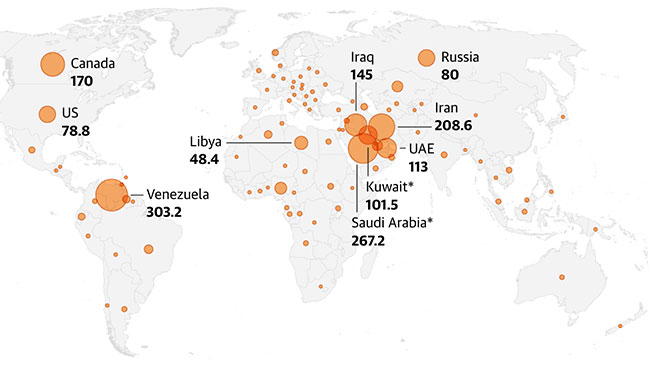
Trump has aggressively sought to boost oil and gas production within the US. Now, after the capture and arrest of Maduro and his wife, Cilia Flores, he is seeking to orchestrate a ramp-up of drilling in Venezuela, which has the largest known reserves of oil in the world—equivalent to about 300bn barrels, according to research firm the Energy Institute.

“The oil companies are going to go in, they are going to spend money, we are going to take back the oil, frankly, we should’ve taken back a long time ago,” the US president said after Maduro’s extraction from Caracas. “A lot of money is coming out of the ground, we are going to be reimbursed for everything we spend.”

A graphic showing oil reserves of producing natiions on a map

Source: The Oil & Gas Journal. Note: China and Taiwan and Sudan and South Sudan are combined in the data. *Estimates for the Saudi Arabian-Kuwaiti Neutral Zone are divided equally between the two countries.Guardian

US oil companies will “spend billions of dollars, fix the badly broken infrastructure… and start making money for the country,” Trump added, with his administration pressing Venezuela’s interim government to delete a law requiring oil projects to be half-owned by the state.

A 50 percent boost in Venezuelan oil production would result in more carbon pollution than major economies like the UK and Brazil emit.

Leading US oil businesses such as Exxon and Chevron have so far remained silent on whether they would spend the huge sums required to enact the president’s vision for Venezuela. But should Venezuela ramp up output to near its 1970s peak of 3.7 million barrels a day—more than triple current levels—it would further undermine the already faltering global effort to limit dangerous global heating.

Even raising production to 1.5 million barrels of oil a day from current levels of around 1 million barrels would produce around 550 million tons of carbon dioxide a year when the fuel is burned, according to Paasha Mahdavi, an associate professor of political science at the University of California, Santa Barbara. This is more carbon pollution than what is emitted annually by major economies such as the UK and Brazil.

“If there are millions of barrels a day of new oil, that will add quite a lot of carbon dioxide to the atmosphere and the people of Earth can’t afford that,” said John Sterman, an expert in climate and economics at the Massachusetts Institute of Technology.

The climate costs would be especially high because Venezuela produces some of the world’s most carbon-intensive oil. Its vast reserves of extra-heavy crude are particularly dirty, and its other reserves are “also quite carbon- and methane-intensive,” Mahdavi said.

The world is close to breaching agreed temperature increase limits – already suffering more severe heatwaves, storms and droughts as a result. Increased Venezuelan drilling would further lower global oil prices and slow the needed momentum towards renewable energy and electric cars, Sterman added.

“If oil production goes up, climate change will get worse sooner, and everybody loses, including the people of Venezuela,” he said. “The climate damages suffered by Venezuela, along with other countries, will almost certainly outweigh any short-term economic benefit of selling a bit more oil.”

During his first year back in the White House, Trump has demanded the world remain running on fossil fuels rather than “scam” renewables and has threatened the annexation of Canada, a major oil-producing country, and Greenland, an Arctic island rich with mineral resources.

Critics have accused Trump of a fossil fuel-driven “imperialism” that threatens to further destabilize the world’s climate, as well as upend international politics. “The US must stop treating Latin America as a resource colony,” said Elizabeth Bast, the executive director of Oil Change International. “The Venezuelan people, not US oil executives, must shape their country’s future.”

Patrick Galey, head of fossil fuel investigations at the climate and justice NGO Global Witness, said Trump’s aggression in Venezuela is “yet another conflict fuelled by fossil fuels, which are overwhelmingly controlled by some of the world’s most despotic regimes.”

“So long as governments continue to rely on fossil fuels in energy systems, their constituents will be hostage to the whims of autocrats,” he said.

towering oil derricks soar from the water and silouetted against an orange sky with a setting sun

Oil rigs at Maracaibo Lake in Venezuela’s Zulia state.Leslie Mazoch/AP

Though the president’s stated vision is for US-based oil companies to tap Venezuela’s oil reserves for profit, making good on that promise may be complicated by economic, historical and geological factors, experts say.

Oil companies may not be “eager to invest what’s needed because it will take a lot longer than the three years of President Trump’s term”, said Sterman. “That’s a lot of risk—political risk, project risk,” he said. “It seems very tricky.”

Upping production is “also just a bad bet generally”, said Galey. “Any meaningful increase in current production would require tens of billions of investment in things like repairs, upgrades and replacing creaking infrastructure,” he said. “That’s not even taking into account the dire security situation.”

“The heavy Venezuelan crude that could be refined in US Gulf coast installations is likely going to undercut domestic producers.”

Venezuela’s oil production has fallen dramatically from its historical highs—a decline experts blame on both mismanagement and US sanctions imposed by Barack Obama and escalated by Trump. By 2018, the country was producing just 1.3m barrels a day—roughly half of what it produced when Maduro took office in 2013, just over a third of what it produced in the 1990s, and about a third of its peak production in the 1970s.

Trump has said US companies will revive production levels and be “reimbursed” for the costs of doing so. But the economics of that expansion may not entice energy majors, and even if they choose to play along, it would take years to meaningful boost extraction, experts say.

Boosting Venezuela’s oil output by 500,000 barrels a day would cost about $10bn and take roughly two years, according to Energy Aspects. Production could reach between 2 million and 2.5 million barrels a day within a decade by tapping medium crude reserves, Mahdavi said. But returning to peak output would require developing the Orinoco Belt, whose heavy, sulfur-rich crude is far more costly and difficult to extract, transport and refine.

Returning to 2 million barrels per day by the early 2030s would require about $110 billion in investment, according to Rystad Energy, an industry consultancy.

“That is going to take much more time and much more money, to be able to get at or close to maybe 3, 4 or 5 million barrels a day of production,” said Mahdavi.

Increasing Venezuelan extraction amid booming US production may also be a hard sell. “The heavy Venezuelan crude that could be refined in US Gulf coast installations is likely going to undercut domestic producers, who until Trump kidnapped Maduro had been vocally supportive of sanctions on Venezuelan oil,” said Galey.

Some firms may be willing to “eat that uncertainty” because the US plans to provide companies with financial support to drill in Venezuela, said Mahdavi.

“If you’re willing to deal with the challenges…you are looking still at relatively cheap crude that will get you a higher profit margin than what you can do in the United States,” he said. “That’s why they’re still interested: It’s way more expensive to drill in, say, the US’s Permian Basin.”

Some US oil majors may be more receptive to Trump’s Venezuela strategy. Chevron, the only US company operating in the country, may be poised scale up production faster than its rivals. And ExxonMobil, which has invested heavily in oil production within neighboring Guyana, could benefit from the removal of Maduro, who staunchly opposes that expansion.

Overall, however, it remains unclear how US oil majors will respond to Trump’s plans of regime change and increased oil extraction in Venezuela. What is much clearer is that any expansion would be “terrible for the climate, terrible for the environment,” said Mahdavi.

Continue Reading…

Mother Jones

Tony Dokoupil Lavishes Praise on Marco Rubio in Lauding CBS Segment

Reporting from Miami on Tuesday, newly minted CBS Evening News anchor Tony Dokoupil dedicated a lauding segment to Secretary of State Marco Rubio.

Dokoupil, who started on the job this week after years as a co-anchor on CBS’s morning show, began the approximately one-minute segment by listing off all the roles that Rubio has assumed in the Trump administration. In addition to his job overseeing the Department of State, Rubio is also the interim national security adviser, the acting national archivist, and head of the now-gutted US Agency for International Development, or USAID, before handing it off to Office of Management and Budget Director Russell Vought. (Dokoupil didn’t mention USAID’s demise or the Vought handoff.)

“Whatever you think of his politics,” Dokoupil said on Tuesday, “you got to admit, it’s an impressive résumé.”

Marco Rubio has become one of the most influential figures in U.S. foreign policy and President Trump's point man on Venezuela. That's in addition to his roles as Secretary of State, interim National Security Advisor, acting National Archivist and USAID chief. Rubio's portfolio… pic.twitter.com/MglY7s4Zqw

— CBS Evening News with Tony Dokoupil (@CBSEveningNews) January 7, 2026

Stepping into the job this week, Dokoupil takes over a role that has been held by Walter Cronkite, Dan Rather, and Katie Couric. Dokoupil’s evening anchor position comes as CBS News continues to be reshaped by new Editor-in-Chief Bari Weiss. Since Weiss, an opinion writer who started the Free Press website, began her tenure, she has heavily altered the political tone of the network, and, most notably, pulled a 60 Minutes segment on Venezuelan men sent by the Trump administration to a torturous prison in El Salvador.

During his Rubio segment, Dokoupil referenced AI-generated images of the secretary that have been going viral online. “AI memes have added to that portfolio,” he continued after listing Rubio’s various government roles, “casting secretary Rubio as the new Governor of Minnesota, the new Shah of Iran, the Prime Minister of Greenland, the new manager of Manchester United, the head of Hilton Hotels, and highest of high honors of all, the new Michelin Man.”

Dokoupil shows the images and lists them in a seemingly comedic tone. He doesn’t, though, explain the context—or news—behind these jokes.

Minnesota Gov. Tim Walz announced this week that he would no longer seek reelection amid investigations into social service fraud and the Trump administration’s targeting of his state’s Somali population through immigration enforcement. Rubio is currently shepherding the president’s purported plan to acquire control over Greenland. Just this week, the Department of Homeland Security accused a Minneapolis Hilton hotel of refusing to accept the bookings of Immigration and Customs Enforcement agents—leading Hilton Worldwide Holdings to remove the local hotel from their system.

After listing the memes, Dokoupil said, “back in real life of course, these memes may not add up to much” before continuing, “but for Rubio’s hometown fans, who are many around here in Miami, it is a sign of how Florida, once an American punchline, has become a leader on the world stage.”

He ended the segment by speaking directly to the secretary. “Marco Rubio, we salute you,” he said, “you’re the ultimate Florida Man.” The White House’s rapid response X page then shared Dokoupil’s segment with a simple message: “WE LOVE @SecRubio!”

Continue Reading…

Mother Jones

They Fled Maduro and Cheered His Downfall. But They Fear Deportations, Too.

Word of the US military operation that captured Venezuelan President Nicolás Maduro reached Mayra Sulbaran while on vacation in Canada. Sulbaran—who fled Venezuela in September 2018 and lives in Washington, DC—was in Montreal to reunite with her brother, who she had not seen in nine years. “I was hugging him when we found out,” she told me over a Zoom on Monday morning.

Soon after Sulbaran heard the news, she joined other Venezuelans to celebrate what so many have prayed for and thought they might never see happen: the downfall of Maduro.

“Until there is true justice in Venezuela and the economic means to return and rebuild the country, I don’t believe Venezuelans can go back.”

Last weekend, US forces executed a months-in-the-making incursion into the presidential compound in Caracas to extract the Venezuelan strongman and his wife, Cilia Flores, who are now being held in a Brooklyn jail facing drug trafficking charges. President Donald Trump declared the United States would “run the country until such time as we can do a safe, proper, and judicious transition.” What happens next remains unclear. At first, Trump hinted at “boots on the ground,” while Secretary of State Marco Rubio talked of “leverage” to control the country.The US president also warned Maduro’s Vice President Delcy Rodríguez, who has been sworn in as interim leader, that she would pay a bigger “price” than the removed president “if she doesn’t do what’s right.”

For so many Venezuelans like Sulbaran—a lawyer and pro-democracy activist who founded Casa DC Venezuela, a cultural center for the Venezuelan diaspora in the Washington, DC area—this fraught moment is filled with a complex mix of relief, dread, and expectation.

“It’s a very contradictory situation because we understand that [President Donald Trump] has a goal and we appreciate it…,” she said, “but we’re also very afraid because we don’t know what’s coming and whether a democratic process will truly be respected.”

Sulbaran is one of 8 million Venezuelans who have fled the country since 2014, part of the largest exodus in Latin America’s recent history and one of the world’s worst forced displacement crises. For Venezuelans living in exile and scattered across the hemisphere and beyond, this juncture has sparked hope of one day returning to a Venezuela freed from Maduro’s oppressive grip. But it has also instilled anxiety among the thousands of Venezuelans—even those cheering the US operation—facing deportation to a nation now influx where their safety is all but guaranteed.

“Until there is true justice in Venezuela and the economic means to return and rebuild the country, I don’t believe Venezuelans can go back,” said Sulbaran, now a US permanent resident. “It’s not just about changing a government, it’s about addressing an economic, social, and moral structure.” With the Maduro regime’s chain of command still ruling the country, she said the United States should offer protection to Venezuelans.

Since retaking office, Trump has done the opposite. He has vilified and singled out Venezuelan migrants as a threat, accusing them of being gang members and taking over American cities.

Last year, his administration ended Temporary Protected Status (TPS)—a discretionary reprieve from deportation for immigrants from countries stricken by natural disasters, wars, and other circumstances—for Venezuela, claiming conditions in the country had improved and allowed for people’s safe return. As I wrote then, that move impacted more than 600,000 Venezuelans and represented the largest de-legalization campaign in modern US history. It threw thousands of people into a legal limbo, with many losing legal status and the ability to work.

Now, amidst the ousting of Venezuela’s sitting president and a nationwide crackdown by the regime, there appears to be no plan to halt the deportation of Venezuelans. In an appearance on Fox News on Sunday, Department of Homeland Security Secretary Kristi Noem was asked if the administration would continue to send Venezuelans back to the country. “Venezuela today is more free than it was yesterday,” Noem said, adding that the Venezuelans who were stripped of TPS have “the opportunity to apply for refugee status.”

But the refugee program, which the Trump administration has gutted, is intended for people who apply for protection from outside of the United States, not those present in the country already, like one-time Venezuelan TPS holders. In response to questions from Mother Jones, a DHS spokesperson conceded that “applicants are only eligible for refugee status prior to entering the country,” which excludes the people Noem said could qualify.

“Secretary Noem ended Temporary Protected Status for more than 500,000 Venezuelans and now they can go home to a country that they love,” the spokesperson said. “[Deportation] Flights are not paused.” (In 2025, the US government deported 14,310 Venezuelans back to their home country, according to a flight tracker initiative kept by Human Rights First.)

Adelys Ferro, executive director of the Venezuelan-American Caucus, called on the Trump administration to restore TPS for Venezuelans. “This is not the right time to keep deporting law-abiding Venezuelan immigrants,” she said. “All of these vulnerable people that have already been hunted, discriminated against, and victims of all of these xenophobic and racist immigration decisions are in more danger than ever before.”

Ferro pointed to a decree by the Venezuelan regime ordering the police to identify and arrest “everyone involved in the promotion or support for the armed attack by the United States.” There are reports of armed gangs patrolling streets and setting up checkpoints to question residents and look through their phones. On Monday, fourteen journalists were detained, according to the National Press Workers Union. If Venezuela descends into further instability, it could also push more people to leave the country.

In that climate, Ferro expressed concern about what might happen to Venezuelans who celebrated the operation on the streets of the United States if they were deported back. “People are more terrified than before,” she said. “The ultimate hope is that there is a real goal of bringing back democracy for Venezuela and, as a consequence, the Venezuelans that are willing to go back can do it in a safe manner. But that’s not the case right now.”

At first, Ferro said she felt relief, joy, and a “sense of justice” to see Maduro removed from power. But following President Trump’s initial press conference, and Rodríguez ascent, that was overtaken by “disbelief, shock, frustration, devastation.” She took issue with the US government’s sidelining of opposition leader and Nobel Peace Prize winner María Corina Machado and backing of Rodríguez. (Machado, who the Venezuelan regime barred from running in the 2024 presidential elections when Maduro declared victory despite evidence that the opposition candidate Edmundo González was the legitimate winner, has said she plans to return to Venezuela “as soon as possible.”)

“At the end of the day, we’re not free,” Ferro added. “The opposition leadership was asking for the construction of a transition to democracy, not a long-term negotiation with a dictatorship.” Ferro said she had questions about what it means for the United States to “run” Venezuela, too—even if temporarily, as Trump promised.

“What I know for sure is that the people of every country have the right to decide their own future,” she said. “Venezuelans have been waiting for more than a decade—if you talk about Chavismo, 27 years—and fighting to decide our own future. We have voted. We have protested. We have been killed. We have been persecuted. We have been imprisoned. We have been tortured. We have done everything in our power to have a path to democracy, and we deserve that opportunity.”

Nathaly Maestre, who lives in Maryland with her partner and six-month-old baby, said there’s “a lot of tension and fear” in Venezuela right now. Her mother avoids leaving the house in an area where the pro-government armed civilian groups known as colectivos are active. They worry about having their conversations monitored and have stopped exchanging messages over WhatsApp, using phone calls instead. “The situation is worrisome because they’re intimidating people,” she said.

After fleeing Venezuela, Maestre sought asylum in the United States and later applied for TPS as another layer of protection. Since the Trump administration ended the program, she’s now reliant on her pending asylum case. Some of her relatives lost their full-time jobs as a result of not having legal status. But despite their vulnerable position, she said they have no plans to leave because Venezuela isn’t safe, perhaps even less so now. “I think we’ve awakened a monster that will now turn against civil society and against anyone who expresses an opinion,” Maestre said. She thinks, at best, it’ll take time for the country to really change.

During our call, Sulbaran also rejected a simplistic narrative that paints the reactions of Venezuelans to Maduro’s capture in broad strokes. She described Chavismo—the political movement of socialist leader Hugo Chávez—and the authoritarian government of his successor as a “farce.” Maduro, she said, is a “dictator” who oversaw a money-laundering “narco-state” as the Venezuelan people fell into extreme poverty and faced political oppression and violence. “We experienced firsthand, as a couple and as a family, what it meant to leave Venezuela to preserve our lives and the lives of our children,” she said.

But Sulbaran also tries to remain clear-eyed about the risks that may lie ahead. She worries that the result of the United States’ intervention in Venezuela and ousting of Maduro could just be the exchange of one “executioner” for another. Her hope is that Rodríguez will engage in a peaceful transition period before handing the reigns of the country to the duly elected González. “Yes, we’re nervous,” she said. “But we’ve come from the worst, from rock bottom.”

Continue Reading…

Mother Jones

Punching Above Our Weight

It’s tough sometimes, when you’re a modestly sized, nonprofit newsroom, to look at the big dogs in journalism—the New York Times or CNN, with their thousands of journalists, or storied magazines like the New Yorker and the ­_Atlantic_—and not feel hopelessly outgunned. They can swarm dozens of journalists on a single story, or pay some $12,000 to duplicate a certain New York mayor’s luxe travel experience. They have fleets of publicists to make sure every success is amplified. Our staff has been known to couchsurf to get a story, air-gap computers with the help of epoxy glue, or enlist a relative to play the guitar for music on our sister radio show, Reveal.

Our newsroom is powered by the conviction of people who believe that journalism needs to exist.

Nevertheless, or maybe because of this, we’ve often punched above our weight when the time comes to hand out awards for the best work across our industry. But this year? This year we’re killing it. In the past several months we’ve won National Magazine Awards, Webbys, Polks, and duPonts; we’re a finalist for a Pulitzer and several Emmys—basically if there’s an honor to bestow on journalism, it has been bestowed upon us.

Each of those honors has a unique origin story, but they all have one thing in common: They are the result of the merger last year between Mother Jones and Reveal, a union that gave us the ability to dig deeper, tell stories more powerfully, and reach broader audiences.

At a dark time like this, it’s especially important to find reason for joy and celebration. And so we wanted to share ­details of some of those honors with you—­because, in a very real way, they belong to you. The Center for Investigative Reporting, which produces Mother Jones and Reveal, doesn’t have a corporate parent or billionaire sponsor. Our combined newsroom is powered by the conviction of many, many people who believe that journalism needs to exist, and who choose to support us with donations and subscriptions. So let’s look at some of the trophies we all earned together.

In May, we were selected as a finalist for the Pulitzer in Explanatory Reporting for “40 Acres and a Lie,” a years-in-the-making project in collaboration with the Center for Public Integrity. Reporters dug into a story that many ­Americans grew up hearing—that enslaved people were promised “40 acres and a mule” after the Civil War, something that never came to pass. We reported on a truth that was even more shocking: Many Black families were in fact given titles to land—across swaths of Georgia and the Carolinas—only to have it cruelly taken away and returned to their enslavers. The reporting team built an AI program to probe the handwritten records of the Freedmen’s Bureau, the federal agency charged with ensuring formerly enslaved people’s transition to freedom, to tell this story. Those records are a treasure trove of ancestral information for countless Americans, and this project has made them easily accessible and searchable for all.

This reporting also resulted in a three-part radio/podcast series, six in-depth features and essays, that AI ­database, a video, and a beautiful ­edition of this magazine. You can find them all right here.

The project also won a National Magazine Award “Ellie”—the Oscar of the magazine world. And it’s part of the reason that Mother Jones was chosen for General Excellence—think “Best Picture”—for coverage that also included our profile of a mass shooter’s mother and a full issue on American oligarchy, with Elon Musk, Mark Zuckerberg, Jeff Bezos, and Donald Trump cavorting on the cover much as they would at the inauguration a year later. (That cover was also a finalist for the “Cover of the Year” award.)

The merger also allowed us to bring sassy but truthful reporting to video platforms where so many Americans—especially younger people—get their news. The Webby Awards just named our video correspondent, Garrison Hayes, Best Creator—of them all!—on social media. And our feature film The Grab, which investigates the global power struggle over who controls our water, has been nominated for four Emmys.

Another of our projects, this one in collaboration with the Investigative Reporting Program at UC Berkeley, and focusing on how police pump families of people they have killed for information before they deliver the tragic news, received both a duPont and a Polk award, another of the highest honors in journalism.

Those are just the heaviest statuettes and paperweights we’ve collected of late. It’s a big haul, and amazing recognition for the hardest-working team, and the best community of support, in all of journalism. So here’s hoping that you’ll raise a glass to yourself. We’re so proud and honored to be part of this with you.

Continue Reading…

Mother Jones

Wildfire Smoke is Killing Tens of Thousands of Americans Every Year

This story was originally published by Grist and is reproduced here as part of the Climate Desk collaboration.

Wildfire smoke is an emerging nationwide crisis for the United States. Supercharged by climate change, blazes are swelling into monsters that consume vast landscapes and entire towns. A growing body of evidence reveals that these conflagrations are killing far more people than previously known, as smoke travels hundreds or even thousands of miles, aggravating conditions like asthma and heart disease. One study, for instance, estimated that last January’s infernos in Los Angeles didn’t kill 30 people, as the official tally reckons, but 440 or more once you factor in the smoke. Another recent study estimated that wildfire haze already kills 40,000 Americans a year, which could increase to 71,000 by 2050.

Two additional studies published last month paint an even grimmer picture of the crisis in the US and elsewhere. The first finds that emissions of greenhouse gases and airborne particles from wildfires globally may be 70 percent higher than once believed. The second finds that Canada’s wildfires in 2023 significantly worsened childhood asthma across the border in Vermont. Taken together, they illustrate the desperate need to protect public health from the growing threat of wildfire smoke, like better monitoring of air quality with networks of sensors.

The emissions study isn’t an indictment of previous estimates, but a revision of them based on new data. Satellites have spied on wildfires for decades, though in a somewhat limited way—they break up the landscape into squares measuring 500 meters by 500 meters, or about 1,600 feet by 1,600 feet. If a wildfire doesn’t fully fill that space, it’s not counted. This new study increases that resolution to 20 meters by 20 meters (roughly 66 feet by 66 feet) in several key fire regions, meaning it can capture multitudes of smaller fires.

Individually, tinier blazes are not producing as much smoke as the massive conflagrations that are leveling cities in the American West. But “they add up, and add up big time,” said Guido van der Werf, a wildfire researcher at Wageningen University & Research in the Netherlands and lead author of the paper. “They basically double the amount of burned area we have globally.”

Smaller fires may be less destructive then the behemoths, but they can still be catastrophic, pouring smoke into populated areas.

With the 500-meter satellite data, the previous estimate was around 400 million hectares charred each year. Adding the small fires bumps that up to 800 million hectares, roughly the size of Australia. In some parts of the world, such as Europe and Southeast Asia, burned area triples or even quadruples with this improved resolution. While scientists used to think annual wildfire emissions were around 2 gigatons of carbon, or about a fifth of what humanity produces from burning fossil fuels, that’s now more like 3.4 gigatons with this new estimate.

The type of fire makes a huge difference in the emissions, too. A forest fire has a large amount of biomass to burn—brushes, grasses, trees, sometimes even part of the soil—and turn into carbon dioxide and methane and particulate matter, but a grass fire on a prairie has much less. Blazes also burn at dramatically different rates: Flames can race quickly through woodland, but carbon-rich ground known as peat can smolder for days or weeks. Peat fires are so persistent, in fact, that when they ignite in the Arctic, they can remain hidden as snow falls, then pop up again as temperatures rise and everything melts. Scientists call them zombie fires. “It really matters where you’re burning and also how intense the fire can become,” van der Werf said.

But why would a fire stay small, when we’ve seen in recent years just how massive and destructive these blazes can get? It’s partly due to fragmentation of the landscape: Roads can prevent them from spreading, and firefighters stop them from reaching cities. And in general, a long history of fire suppression means they’re often quickly extinguished. (Ironically, this has also helped create some monsters, because vegetation builds up across the landscape, ready to burn. This shakes up the natural order of things, in which low-intensity fires from lightning strikes have cleared dead brush, resetting an ecosystem for new growth—which is why Indigenous tribes have long done prescribed burns.) Farmers, too, burn their waste biomass and obviously prevent the flames from getting out of hand.

Whereas in remote areas, like boreal forests in the far north, lightning strikes typically ignite fires, the study found that populated regions produce a lot of smaller fires. In general, the more people dotting the landscape, the more sources of ignition: cigarette butts, electrical equipment producing sparks, even chains dragging from trucks.

Yes, these smaller fires are less destructive than the behemoths, but they can still be catastrophic in a more indirect way, by pouring smoke into populated areas. “Those small fires are not the ones that cause the most problems,” van der Werf said. “But of course they’re more frequent, close to places where people live, and that also has a health impact.”

That is why the second study on asthma is so alarming. Researchers compared the extremely smoky year of 2023 in Vermont to 2022 and 2024, when skies were clearer. They were interested in PM 2.5, or particulate matter smaller than 2.5 millionths of a meter, from wildfire smoke pouring in from Quebec, Canada. “That can be especially challenging to dispel from lungs, and especially irritating to those airways,” said Anna Maassel, a doctoral student at the University of Vermont and lead author of the study. “There is research that shows that exposure to wildfire smoke can have much longer-term impacts, including development of asthma, especially for early exposure as a child.”

This study, though, looked at the exacerbation of asthma symptoms in children already living with the condition. While pediatric asthma patients typically have fewer attacks in the summer because they’re not in school and constantly exposed to respiratory viruses and other indoor triggers, the data showed that their conditions were much less controlled during the summer of 2023 as huge wildfires burned. (Clinically, “asthma control” refers to milder symptoms like coughing and shortness of breath as well as severe problems like attacks. So during that summer, pediatric patients were reporting more symptoms.) At the same time, climate change is extending growing seasons, meaning plants produce more pollen, which also exacerbates that chronic disease. “All of those factors compound to really complicate what health care providers have previously understood to be a safe time of year for children with asthma,” Maassel said.

Researchers are also finding that as smoke travels through the atmosphere, it transforms. It tends to produce ozone, for instance, that irritates the lungs and triggers asthma. “There’s also the potential for increased formation of things like formaldehyde, which is also harmful to human health. It’s a hazardous air pollutant,” said Rebecca Hornbrook, who studies wildfire smoke at the National Center for Atmospheric Research, but wasn’t involved in either study, though a colleague was involved in the emissions one. (Last month, the Trump administration announced plans to dismantle NCAR, which experts say could have catastrophic effects.)

As wildfires worsen, so too does the public health crisis of smoke, even in places that never had to deal with the haze before. Governments now have to work diligently to protect their people, like improving access to air purifiers, especially in schools. “This is no longer an isolated or geographically confined issue,” Maassel said. “It’s really spreading globally and to places that have never experienced it before.”

Continue Reading…

Mother Jones

A New Theory Explains Why Trump Keeps Threatening Global Takeovers

Since the capture of Venezuelan leader Nicolás Maduro and the ensuing claim by US leaders that “we’re in charge” of a sovereign nation, President Trump and his allies have gloated. “Cuba looks like it’s ready to fall,” Trump told reporters, implying that the island country was next on his takeover list as he flew back to Mar-a-Lago this weekend.

“Fuck around,” Secretary of War Pete Hegseth keeps warning other nations, and “find out.” Meanwhile, commenters on the right, who bask in hubris, are declaring that American might is the only international law of importance.

The parade of threats, which had seemed absurd until Friday, has prompted many to wonder: Why? What is the point of invading other countries? Could it really be as simple as oil? A play for a sphere of influence? Age-old imperialism? Is it because, as Chuck Schumer meekly suggested, that Republicans just aren’t “stepping up to the plate?”

If you’re in a system that is about rules, then this looks irrational because it’s not following the rules. But if it’s a system that’s about status and hierarchy dominance…then it makes perfect sense.

If you can’t help but shake the feeling that such theories don’t quite fit this moment, you’re not alone. On Bluesky, I noticed a new theory that popped up: neo-royalism, which argues that we’re talking about this moment all wrong. That the world order as we’ve known for the last century—let’s loosely call it Cold War liberalism—is disappearing. And in its place, a new order shaped by the private interests of individual men and their fiercest allies, not the interests, private or public, fair or foul, good or bad, of a nation.

“Neo-royalism says that the state, the country, is not the key actor,” Abe Newman, a political scientist at Georgetown who co-wrote a paper coining the term, told me. “It’s groups of elites that are organized around political leaders. That system doesn’t play by the same rules.”

If that sounds like a return to the era of kings, you’re on the right track. But neo-royalism expands this to a global structure, with American power dominating the world and King Trump attempting to reap profit across the globe. It’s through this lens that, suddenly, the tech CEOs and other countries groveling with golden gifts make more sense.

I caught up with Newman on the emerging theory and what it really means. Our conversation has been lightly edited.

For those who haven’t come across your paper, let’s loosely define neo-royalism and how this framework might explain Trump’s chaotic foreign policy.

Let me start by asking: What do we usually think of how international politics works? For the last 100 years or so, it was based on what people call the rules-based international order. The United Nations and the World Trade Organization interacted based on the idea that each state was sovereign. They could control their territory, and there were certain basic principles of interaction. These were kind of the rules of engagement.

What my co-author, Stacie Goddard, and I are saying is that the lens everybody uses to think about how international politics works is no longer functioning.

What we propose, neo-royalism, is basically just saying to begin with, the state is not the key actor like the country. It’s groups of elites that are organized around political leaders. That system doesn’t play by the same rules, but it is very inherent to how humans think about international politics.

So, I usually like to use Game of Thrones. Everybody relates to Game of Thrones. You watch it, you read it, and you’re like, “Oh, I understand how politics is working.” That is what we’re seeing in the international system. It’s groups of actors that are jockeying for their interests, and they’re trying to grab hold of the state to use its power to get what they want. It’s not national interests that are driving international affairs, but the interests of these different competing elite groups.

I struggle to believe that this decline in the international world order is happening in some kind of Trumpian vacuum. But I could be wrong! Is America’s embrace of neo-royalism singular to Trump? If not, what milestones led us to this moment?

Jeff Kopstein, a professor at UC Irvine, has this great book about the rise of what you would call patrimonial systems of government versus what we’ve seen over the last several decades. He documents the rapid disassembly of the internal, bureaucratic state. In the case of the US and the disassembly of that system here, it’s not only because of Trump. It’s because of many different polarizations and Supreme Court decisions, such as Citizens United. There’s been a whole bunch of things that have degraded the bureaucratic state, and it’s moved us into what the Supreme Court might call the unitary executive doctrine. It’s a version where there’s very little bureaucracy around the decisions of the leader, and instead, the leader can make decisions based on their personal interests. That’s not just a change in the United States; you see that in Russia, Hungary, Turkey, wherein many states have seen the same evolution away from what people will call the Weberian state, to this more patrimonial system. And what our argument is that has international consequences. It’s not just changes domestically; it’s also having this transformative effect globally.

Right now, actors are debasing themselves to this order, like the Swiss bringing gold bars and Rolexes to the White House to avoid being targets of tariffs.

How should this framework influence the way we view Trump’s actions right now?

I think a lot of people start with the idea that Trump is about spheres of influence balancing against China. Sometimes people call it America First. But that’s a red herring. But really, what you’re seeing is a set of foreign policy decisions that are about accumulating status and material wealth and then concentrating that in that group of insider elites. This is about status hierarchy, the relations of individuals.

Why does Trump have a big fight with India and put huge tariffs on India? It’s because Modi won’t recognize Trump for the Nobel Peace Prize. It’s not about competing against China. Why did we sell lots of semiconductors to the UAE? It doesn’t make a lot of sense from an America First perspective. So what’s going on there? It’s about the amount of money that the UAE is going to put into World Liberty Financial, the crypto company that’s associated with Steve Witkoff and their children. It’s about seeing the global chessboard as a site of status and material wealth. The same thing with Venezuela. People think it’s the oil companies that are pushing Trump to take over Venezuela. They’re not. That’s not the story. It’s about how Trump sees Venezuela as a resource that he can then distribute across his allies.

Right. I think there’s also an instinct to neatly explain this with, well, he’s just fucking crazy.

World leaders like the Danish prime minister have [expressed confusion], like, “This doesn’t make any sense, these threats over Greenland.” But that’s because people are using this old logic and viewing this as irrational based on the liberal international order, or that it’s not rational if we’re thinking about spheres of influence. But what my co-author and I argue is that what is rational depends on the ordering system. If you’re in a system that is about rules, then this looks irrational because it’s not following the rules. But if it’s a system that’s about status and hierarchy dominance, it’s if it’s Game of Thrones, then it makes perfect sense.

You’re reorganizing the chessboard in order to funnel resources, material, and status to your supporters. I think that once we can name it and describe it, then we can try to understand it and also offer an alternative. Because right now, too often, actors are debasing themselves to this order, like the Swiss bringing gold bars and Rolexes to the White House to avoid being targets of tariffs.

In your view, which characters, either in the administration or in his family, make up this theoretical clique? What do they stand to gain?

There’s the family, right? They’re clearly involved in these types of activities. Jared Kushner, not Marco Rubio, is at the table in Ukraine. So there’s the kind of familial characters and also what we would call loyalists and ideologues like Stephen Miller. Then you have economic actors, the kind of Elon Musks, the people who have a way to reorganize economic structures to their benefit.

In political science, we’re always thinking about power. There are different ways to accumulate it; sometimes it’s economic, and sometimes it’s status, and it’s often to maintain that power.

And they’re thinking beyond Trump, right? He is, after all, an elderly man.

Oh, definitely. Many of these actors are quite explicit about their long-term views. Just look at the advisers around all this. There’s Chris Buskirk, an adviser to JD Vance who runs the organization, 1789, and he talks about how we need to bring back an aristocratic system of governance. There’s an intellectual framework that is opposed to democracy and argues that elites should be in charge of this system. And I think it’s naive to think that when Trump retires, that will be the end of the system. There are multiple actors—whether it’s the family, loyalists, or economic leaders—and they’re all kind of vying for succession.

The US government doesn’t actually want to keep invading countries; it just wants people to give it stuff for free.

Supposing your theory is correct, what now? How should countries that oppose Trump’s neo-royalism respond? Because the current admonishments seem incredibly naive.

There has to be both a domestic and an international response. If you look at Sen. Chuck Schumer’s response recently, he was basically saying, “Well, Republicans should vote against this.” But there has to be a recognition that this is an attempt to transform how the international system works. I think a lot of times people are like, “I’m scratching my head. What’s Trump doing?” There’s a much larger agenda afoot, and it is basically degrading the norms and processes that we’ve based the international system on. Somebody needs to stay that rules are this way because they prevent violence, coercion, and corruption. If we get rid of rules, we’re likely to have violence and corruption—and we’re already seeing that play out. The stakes are very high.

If you’ve ever seen movies like _Heather_s or Mean Girls, we all know most of what we do in life is because of norms. It’s because of these tacit rules of how we’re supposed to behave. This isn’t just Trump. It’s transforming what the basic principles of international affairs are, and we at the domestic level have to push back, even if we think Maduro is a terrible guy and his whole regime is terrible.

Ultimately, the United States has the preponderance of military power. It can do things if it wants to. But the key is, what is the reaction to that? Do people say, “Okay, I guess you can do that.” Well, then the US will keep doing that. I think what’s important to remember is that using coercion is actually very difficult and costly. The US government doesn’t actually want to keep invading countries; it just wants people to give it stuff for free.

In April, Trump proposed very large tariffs, and the bond market freaked out. So he pulled it back and restructured the tariffs. So I think other actors have to say, “Look, you can’t keep doing this. We’re not just going to go along or get along. There will be a cost.

I’ve been particularly fascinated by the aesthetics of the Trump administration over the past year, specifically as to how they signal loyalty to the president. What are the traditional ways of doing this in the realm of neo-royalism?

There is a part of the piece where we ask: How do you create legitimacy when you’re not based on rules? In a neo-royalist system, it’s about exceptionalism. It’s about this notion that we’re so special, and so we get to do these things. That’s why traditional monarchs justified their behavior either by God or bloodline. The United States doesn’t have that as much. But we have Trump and these leaders who look for visuals and narratives that underscore exceptionalism. And so you saw, like the White House, they did a Time magazine cover. Look at his speeches. He doesn’t say that his power comes from us, the people. It is about “I alone can save you.” It’s never about whether we can do this. And so that the images and narratives are usually about something divine. As Trump has said, “God saved me from the assassination.” Or there’s the patriarchal, like the NATO Secretary General Mark Rutte calling Trump “Daddy.”

Since you mentioned it, I’ll end by asking which Game of Thrones house you’d liken Trump to.

I’m not sure if there’s a perfect house, but the Lancasters are the ones trying to dominate. I like that question. I’ll think about that.

Continue Reading…

Mother Jones

Wyoming Court Stops Abortion Bans

Abortion will remain legal in Wyoming following a Tuesday decision in the state’s Supreme Court that said its two abortion bans, including a block on abortion pills, were unconstitutional.

The court ruled that the bans violate a 2012 amendment to the Wyoming Constitution that protects an adult’s right to make their own healthcare decisions. One law banned abortion with few exceptions, such as in cases of rape or incest, and the other explicitly prohibited abortion pills. Wyoming was the only state in the country to implement an outright ban.

As Bolts, an organization that reports on local elections and policies, noted in 2023, this amendment was part of a conservative push against Barack Obama’s Affordable Care Act. Conservatives argued that the legislation was government interference. Progressives, meanwhile, including reproductive rights advocates in Wyoming, have used the amendment to protect abortion access.

“A woman has a fundamental right to make her own health care decisions, including the decision to have an abortion,” the ruling from Tuesday reads.

Wyoming’s only abortion clinic, Wellspring Health Access, was one of the plaintiffs in the case. In a statement, Julie Burkhart, president of the clinic, told Mother Jones that the decision “affirmed what we’ve always known to be true: abortion is essential health care, and the government should not interfere in personal decisions about our health.”

“While we celebrate today’s ruling, we know that anti-abortion politicians will continue their push to restrict access to health care in Wyoming with new, harmful proposals in the state legislature,” Burkhart added.

The decision also implies that anti-abortion lawmakers in Wyoming would need to amend the state constitution to ban abortion, rather than a majority vote in the Republican-dominated legislature.

Wyoming Gov. Mark Gordon immediately called for just that on Tuesday, saying in a statement: “It is time for this issue to go before the people for a vote, and I believe it should go before them this fall.”

A move to amend the constitution would be decided by voters in the 2026 election.

Continue Reading…

Mother Jones

The Erasure of January 6

A version of the below article first appeared in David Corn’s newsletter, Our Land_. The newsletter comes out twice a week (most of the time) and provides behind-the-scenes stories and articles about politics, media, and culture. Subscribing costs just $5 a month—but you can sign up for a free 30-day trial._

In 1984, George Orwell observed that a fascist state relies upon its ability to control—or obliterate—memory. As Winston Smith, the ill-fated protagonist, ponders the Party’s ability to manipulate reality and history, Orwell writes, “Everything faded into mist. The past was erased, the erasure was forgotten, the lie became the truth.” Another passage in the novel describes the Party’s relentless effort to construct the dominant narrative: “Every record has been destroyed or falsified, every book has been rewritten, every picture has been repainted, every statue and street and building has been renamed, every date has been altered. And that process is continuing day by day and minute by minute. History has stopped. Nothing exists except an endless present in which the Party is always right.”

Sound familiar?

It’s been five years since a mob of thousands of Donald Trump supporters—which included Christian nationalists, white supremacists, neo-Nazis, Confederate flag wavers, militia members, and other extremists—assaulted the US Capitol to try to halt the peaceful transfer of power from an outgoing president to an incoming president. The basic facts are well established: Trump refused to accept legitimate election results. He falsely claimed he had won the 2020 contest and spread baseless lies and conspiracy theories about the election. He spent weeks scheming to overturn the election and remain in power. Promoting these falsehoods, he incited that insurrectionist attack on Congress in which more than 140 law enforcement officers were injured. While the melee was occurring, he abandoned his duty to defend the Constitution and waited 187 minutes before calling on his brownshirts to leave the Capitol.

Like the Party in Orwell’s dystopia, Trump and the Republicans have sought to rewrite history and erase the stain of Trump’s profound betrayal of America.

This is all undeniable. Yet Trump and his cult refuse to accept these fundamentals. Like the Party in Orwell’s dystopia, Trump and the Republicans have sought to rewrite history and erase the stain of Trump’s profound betrayal of America. He pardoned the violent marauders, and his henchmen in charge of the FBI and Justice Department have fired agents and prosecutors who participated in the investigation and prosecution of these thugs. And Trump’s MAGA legions mounted a disinformation campaign that advanced various conspiracy theories—the FBI did it! Antifa did it!—to absolve Trump and his thugs.

More important, an entire political party and tens of millions of American voters memory-holed Trump’s war on American democracy and his embrace of political violence. What is perhaps the gravest transgression ever committed by a US president has been airbrushed out of the picture and the perp allowed (by a majority of voters) to return to the scene of the crime. This is one of the most worrisome turns in American history. If our democracy cannot protect itself from such peril and repel such a dangerous threat, can it survive?

Trump’s triumph over reality was made clear this past week. On New Year’s Eve—one of the deadest times for the news cycle—the Republicans on the House Judiciary Committee released the closed-doors testimony it had recently received from Jack Smith, the special counsel who led the investigations that indicted Trump for conspiring to overturn the 2020 election and for allegedly swiping highly sensitive White House documents. Both cases ended after Trump won the election in November. (Under Justice Department policy, a sitting president cannot be prosecuted for federal crimes.)

Smith insisted on a public appearance, apparently knowing he had the goods on Trump. The Republicans said no and questioned him in a private session—all the better for controlling the narrative.

Smith, as you know, has been repeatedly denounced by Trump as a lunatic who waged witch hunts and investigated hoaxes generated by his fellow Deep Staters, the Democrats, and the media. And Republicans hauled Smith in as part of their never-ending crusade to find (or concoct) evidence to bolster Trump’s paranoid fantasies and conspiracy theories—and to buttress their hyperbolic charge that Trump and Republicans have been the victims of what they call the “weaponization of government.”

Smith insisted on a public appearance, apparently knowing he had the goods on Trump. The Republicans said no and questioned him in a private session—all the better for controlling the narrative. The fact that they made public the transcript on a holiday night tells you what you need to know about who got the best of whom.

The 255-page transcript is an important document that every citizen should read. (I know, I’m being fanciful.) Smith ran circles around the GOP committee members and their staff. “Our investigation developed proof beyond a reasonable doubt that President Trump engaged in a criminal scheme to overturn the results of the 2020 election and to prevent the lawful transfer of power,” Smith said at the start. He added, “Our investigation also developed powerful evidence that showed that President Trump willfully retained highly classified documents after he left office in January of 2021, storing them at his social club, including in a ballroom and a bathroom. He then repeatedly tried to obstruct justice to conceal his continued retention of those documents.”

Trump tried to take advantage of this spasm of cop-beating violence to illegally remain in office. That foul deed should have disqualified him from ever holding any position of authority. Yet…

Smith patiently explained how Trump’s (alleged) crime related to January 6: “January 6th was an attack on the structure of our democracy in which over 140 heroic law enforcement officers were assaulted. Over 160 individuals later pled guilty to assaulting police that day. Exploiting that violence, President Trump and his associates tried to call Members of Congress in furtherance of their criminal scheme, urging them to further delay certification of the 2020 election.”

This is an accusation that sums up Trump’s perfidy: He tried to take advantage of this spasm of cop-beating violence to illegally remain in office. That foul deed should have disqualified Trump from ever holding any position of authority. Yet…

A key exchange occurred when a Republican staffer (whose name is redacted in the transcript) asked, “The President’s statements that he believed the election was rife with fraud, those certainly are statements that are protected by the First Amendment, correct?” This has been a central contention of the Trump cult: You cannot prosecute Trump for stating his opinion that the election was rigged against him. But Smith fired back: “Absolutely not. If [these false statements] are made to target a lawful government function and they are made with knowing falsity, no, they are not.” Statements made to promote a fraud are not protected by the First Amendment.

Later on in his testimony, Smith remarked that the elections case against Trump was much like an “affinity fraud”—that’s when, he said, “you try to gain someone’s trust, get them to trust you as a general matter, and then you rip them off, you defraud them.” Trump, he told the committee, “had people…who had built up trust in him, including people in his own party, and he preyed on that.” And once again, Smith reiterated, fraud is not covered by the First Amendment.

This Republican staffer took another shot at it and said, “There’s a long history of candidates speaking out about they believe there’s been fraud [in an election]…I think you would agree that those types of statements are sort of at the core of the First Amendment rights of a Presidential candidate, right?”

Not at all, Smith replied: “There is no historical analog for what President Trump did in this case. As we said in the indictment, he was free to say that he thought he won the election. He was even free to say falsely that he won the election. But what he was not free to do was violate federal law and use knowing—knowingly false statements about election fraud to target a lawful government function. That he was not allowed to do. And that differentiates this case from any past history.”

The Republicans kept trying to mount a theoretical defense for Trump. This staffer pointed out that during the hullabaloo over the 2020 election, Trump was receiving information on supposed election fraud from Rudy Giuliani, John Eastman, Jeffrey Clark, and Sidney Powell, and he asked, wasn’t Trump just “regurgitating what these people have told him?”

Smith had a sharp retort:

No. And, in fact, one of the strengths of our case and why we felt we had such strong proof is all witnesses were not going to be political enemies of the President. They were going to be political allies. We had numerous witnesses who would say, “I voted for President Trump. I campaigned for President Trump. I wanted him to win.” The speaker of the house in Arizona. The speaker of the house in Michigan. We had an elector in Pennsylvania who is a former congressman who was going to be an elector for President Trump who said that what they were trying to do was an attempt to overthrow the government and illegal. Our case was built on, frankly, Republicans who put their allegiance to the country before the party.

Call 911. There was a murder in this Capitol Hill office, as Smith decimated the various lines of defense Trump’s handmaids hurled at him. He forcibly denied Trump’s indictments were political acts or that his office had been “weaponized.” In an exchange with Rep. Pramila Jayapal (D-Wash.), he explained the importance of his investigation.

Jayapal: What happens if there is election interference and the people who are responsible for that are not held accountable?

Smith: It becomes the new norm, and that becomes how we—how we conduct elections.

Jayapal: And so the toll on our democracy, if you had to describe that, what would that be?

Smith: Catastrophic.

The Smith transcript generated headlines…for a day. Like most everything else in our information hypersphere, this story did not have much staying power. Trump’s attempt to blow up the constitutional order has become old news. Ho-hum. He got away with this allegedly criminal act because he won the election. His pardons of the violent criminals who attacked hundreds of cops is just one item on a long list of outrages that quickly come and go.

Many Americans, it seems, couldn’t hold on to a clear memory of January 6 for even a few years—or couldn’t be bothered to.

A high-profile public appearance in which Smith vigorously presented the case against Trump might not at this point change the overall public perception of Trump’s attempted power grab and the violent raid he triggered. But that would have drawn more attention and served the truth. Which is why Rep. Jim Jordan (R-Ohio), the chair of the committee, and his fellow Republicans made damn sure that did not happen.

Today is the fifth anniversary of January 6—a shameful day in American history. And in the last election, the nation—or about half of its voters—welcomed back into the house the arsonist who tried to burn it down. The past 10 years have sadly showed us that a wannabe authoritarian in the United States can succeed in denying reality and wiping away history. Trump did that with the Russian attack on the 2016 election, which he aided and abetted by echoing Vladimir Putin’s false claims that Moscow had not intervened and by insisting ad nauseum that it was a hoax. And he has done the same with January 6, hailing it a “day of love” and “a beautiful day” and calling the rioters “great patriots.”

Many Americans, it seems, couldn’t hold on to a clear memory of January 6 for even a few years—or couldn’t be bothered to. This demonstrates how susceptible people can be to what the Party did in 1984: Erase the past (even the most recent past) and then erase the erasure.

Trump is back in the White House, pushing his agenda of authoritarianism far beyond what he could only dream of during his first term. Future historians—if there is history in the future—will wonder about much in this era. But what might puzzle them the most is how the man who nearly annihilated our constitutional republic was able to worm his way back into the presidency. Gore Vidal once referred to the nation as the “United States of Amnesia.” On this dark anniversary, it’s good to remember that Trump is in power today because there’s been too much forgetting.

Continue Reading…

Mother Jones

Europe Tells Trump: Greenland Is Not for Sale

European leaders argued for Greenland’s sovereignty Tuesday amid President Trump’s continued threat to take over the island following his military operation in Venezuela to capture President Nicolás Maduro and his wife, Cilia Flores.

Greenland is an autonomous territory in Denmark. Citizens of Greenland are also citizens of Denmark and the European Union. In a joint statement released Tuesday, more than half a dozen European leaders wrote that “Greenland belongs to its people. It is for Denmark and Greenland, and them only, to decide on matters concerning Denmark and Greenland.”

The leaders asserted that security in the Arctic region must be “achieved collectively”—which includes NATO allies like the United States—by upholding the UN Charter that establishes “sovereignty, territorial integrity and the inviolability of borders.”

Since the US captured Maduro, Trump has threatened Colombia, Mexico, Greenland, Iran, and Cuba.

The president has repeatedly called for the US to take over Greenland since his first term. On Sunday, Trump noted that Greenland was a strategic territory for the US in regards to national security.

“Greenland is covered with Russian and Chinese ships all over the place,” Trump said.

The joint statement also comes after Katie Miller sent a post on X on Saturday that went viral, which showed a map of Greenland covered in the American flag. She captioned the image “SOON!” Miller, of course, is a conservative podcast host, former Trump administration official, and wife of White House Deputy Chief of Staff for Policy Stephen Miller, who has a significant role in pushing Trump’s mass deportation of immigrants.

On Tuesday, Greenland Prime Minister Jens-Frederik Nielsen thanked the European leaders for their joint statement and urged the US to “seek respectful dialogue through the correct diplomatic and political channels” instead of making threats. He added that “very basic international principles are being challenged” as Greenland’s sovereignty is “rooted in international law.”

So why is Trump so fixated on Greenland?

As Inside Climate News reported, in collaboration with Climate Desk, Trump has listed critical minerals, untapped oil reserves, military positioning, and new international trade routes as reasons for annexing Greenland.

And as Sophie Hurwitz wrote for Mother Jones last January, Ronald Lauder, a billionaire working in the cosmetics company Estée Lauder, reportedly introduced the idea of buying Greenland to Trump in 2019. While Lauder’s motives are still unclear, in 2021, Trump explained the idea as “not so different” from his method of real estate development in New York City. “I said, ‘Why don’t we have that?’ You take a look at a map. I’m a real estate developer, I look at a corner, I say, ‘I’ve got to get that store for the building that I’m building.”

Continue Reading…

Mother Jones

Trump’s Venezuela Move Could Deliver a Big Win for This MAGA Billionaire

This story was originally published by Popular Information, a substack publication to which you can subscribe here.

In a Saturday morning military raid ordered by President Trump, US forces captured Venezuelan President Nicolás Maduro. After Maduro was apprehended and transported to New York to face criminal charges, Trump announced that the United States would “run” Venezuela for the indefinite future.

The extraordinary attack, which legal experts said violated US and international law, has set up a potential windfall for a prominent Trump-supporting billionaire, investor Paul Singer.

In 2024, Singer, an 81-year-old with a net worth of $6.7 billion, donated $5 million to Make America Great Again Inc., Trump’s Super PAC. He donated tens of millions more in the 2024 cycle to support Trump’s allies, including $37 million to support the election of Republicans to Congress. He also donated an undisclosed amount to fund Trump’s second transition.

This past June, when Trump sought funds to bankroll a primary challenger to Thomas Massie (R-KY), who had raised his ire by supporting the release of the Epstein Files, Singer contributed $1 million, the largest contribution.

Since Trump was first elected in 2016, Singer has met personally with Trump at least four times. “Paul just left and he’s given us his total support,” Trump declared after meeting with Singer at the White House in February 2017. “I want to thank Paul Singer for being here and for coming up to the office. He was a very strong opponent, and now he’s a very strong ally.” (Singer had initially supported Marco Rubio, who is now Trump’s Secretary of State.)

In November 2025, Singer acquired Citgo, the US-based subsidiary of Venezuela’s state-run oil company. Singer, through his private investment firm, Elliott Investment Management, bought Citgo for $5.9 billion. The sale to Amber Energy, a subsidiary of Elliott Investment Management, was forced by creditors of Venezuela after the country defaulted on its bond payments.

Elliott Investment Management is known as a “vulture” fund because it specializes in buying distressed assets at rock bottom prices. Citgo owns three major refineries on the Gulf Coast, 43 oil terminals, and a network of over 4,000 independently owned gas stations. By all accounts, Singer acquired these assets at a major discount.

Advisors to the court that oversaw the sale valued Citgo at $13 billion, while Venezuelan officials said the assets were worth as much as $18 billion. Maduro’s government had sought to appeal the court’s approval of Singer’s bid for Citgo. But now that Maduro has been ousted, it seems unlikely that appeal will continue.

Singer acquired Citgo at a bargain price in large part due to the embargo, with limited exceptions, on Venezuela oil imports to the United States. Citgo’s refiners are purpose-built to process heavy-grade Venezuelan “sour” crude. As a result, Citgo was forced to source oil from more expensive sources in Canada and Colombia. (Oil produced in the United States is generally light-grade.) This made Citgo’s operations far less profitable.

Trump has sought to justify military action against Venezuela as an effort to disrupt narcotics trafficking. But Venezuela produces no fentanyl and is a minor source of cocaine that reaches the United States. Trump also recently pardoned Juan Orlando Hernández, the former president of Honduras, who was convicted of drug trafficking.

Further, Trump has long made clear that he was interested in Venezuela for the oil. In remarks to the North Carolina Republican Party in 2023, Trump said that when he left office in 2021, Venezuela was “ready to collapse.” Trump said, had he remained in office, the US “would have taken [Venezuela] over” and “gotten all that oil.”

In remarks on Fox News Saturday, Trump made clear that one of the motivations for Saturday’s attack was to increase the production and export of Venezuelan oil. Venezuela has the largest proven reserves of crude oil in the world. Trump said that, moving forward, the US would be “very strongly involved“ with the Venezuelan oil industry.

Industry observers anticipate “a rapid rerouting of Venezuelan oil exports, re-establishing the US as the major buyer of the country’s volumes.” Jaime Brito, an oil analyst at OPIS, said access to Venezuelan oil imports “will be a game changer for US Gulf Coast…refiners in terms of profitability.”

If that happens, Paul Singer, thanks to a well-timed transaction, will be one of the largest beneficiaries.

Continue Reading…

Mother Jones

US Reduces Number of Vaccines It Recommends For All Children

Federal health officials reduced the number of vaccines recommended for all children from 17 to 11 on Monday.

According to the new schedule, some routine vaccines are now only recommended for “high-risk” children, while others, like the flu shot, can be administered through “shared clinical decision-making” that is based on individual discussions between the health care provider and the patient or guardian.

An assessment that provided the scientific basis for the decision to revise the immunization schedule states that an “increased emphasis on shared clinical decision-making would help restore trust in public health recommendations made by CDC.” It cites that from 2020 to 2024, trust in health care declined, “coinciding with school closures, other lockdowns, mandatory face masks, COVID-19 vaccination mandates with their de facto denial of infection-acquired immunity, and other public health recommendations that lacked scientific rationale.”

The Department of Health and Human Services’ announcement comes in response to a presidential order from Donald Trump last month that directed HHS Secretary Robert F. Kennedy, Jr., and Acting CDC Director Jim O’Neill to update the vaccine schedule according to “peer, developed countries.” Trump’s memo said that at the beginning of 2025, the US “was a high outlier” in the number of vaccinations it recommended.

But, as STAT News reports, “some other wealthy countries, including those consulted by U.S. officials, actually have similar recommendations.”

HHS’ announcement said many of the peer nations that “recommend fewer routine vaccines achieve strong child health outcomes and maintain high vaccination rates through public trust and education rather than mandates.”

“We are aligning the U.S. childhood vaccine schedule with international consensus while strengthening transparency and informed consent,” Kennedy said in the announcement. “This decision protects children, respects families, and rebuilds trust in public health.”

This change to the vaccine schedule is the culmination of months of efforts by Kennedy, who has a long record of anti-vaccine activism, to alter the way vaccines are approved and recommended. CDC recommendations were also a target in Project 2025, which states, never again should CDC officials be allowed to say in their official capacity that school children ‘should be’ masked or vaccinated (through a schedule or otherwise).”

Last month, a panel appointed by Kennedy, the CDC’s Advisory Committee on Immunization Practices, voted to end universal hepatitis B recommendations for newborns.

According to NPR, officials said that the revision was made without formal public comment or response from vaccine makers, evading the usual process in which bodies like the CDC’s ACIP evaluate changes. Michael Osterholm, director of the University of Minnesota’s Center for Infectious Disease Research and Policy, told NPR that the decision “will sow further doubt and confusion among parents and put children’s lives at risk.”

Continue Reading…

Mother Jones

Trump Wants Venezuela’s Oil. Getting It Won’t Be So Simple.

This story was originally published by Wired and is reproduced here as part of the Climate Desk collaboration.

President Donald Trump has made it clear: His vision for Venezuela’s future involves the US profiting from its oil.

“We’re going to have our very large United States oil companies—the biggest anywhere in the world—go in, spend billions of dollars, fix the badly broken infrastructure, the oil infrastructure,” the president told reporters at a news conference Saturday, following the shocking capture of Venezuelan president Nicolás Maduro and his wife.

But experts caution that a number of realities—including international oil prices and longer-term questions of stability in the country—are likely to make this oil revolution much harder to execute than Trump seems to think.

Trump seems to view the situation almost like “a Settlers of Catan board—you kidnap the president of Venezuela and, ipso facto, you now control all the oil.”

“The disconnect between the Trump administration and what’s really going on in the oil world, and what American companies want, is huge,” says Lorne Stockman, an analyst with Oil Change International, a clean energy and fossil fuels research and advocacy organization.

Venezuela sits on some of the largest oil reserves in the world. But production of oil there has plummeted since the mid 1990s, after President Hugo Chávez nationalized much of the industry. The country was producing just 1.3 million barrels of oil each day in 2018, down from a high of more than 3 million barrels each day in the late 1990s. (The US, the top producer of crude oil in the world, produced an average of 21.7 million barrels each day in 2023.) Sanctions placed on Venezuela during the first Trump administration, meanwhile, have driven production even further down.

Trump has repeatedly implied that freeing up all that oil and increasing production would be a boon for the oil and gas industry—and that he expects American oil companies to take the lead. This kind of thinking—a natural offshoot of his “drill, baby, drill” philosophy—is typical for the president. One of Trump’s main critiques of the Iraq war, which he first voiced years before he ran for office, was that the US did not “take the oil” from the region to “reimburse ourselves” for the war.

The president views energy geopolitics “almost like the world is a Settlers of Catan board—you kidnap the president of Venezuela and, ipso facto, you now control all the oil,” says Rory Johnston, a Canadian oil market researcher. “I do think he legitimately, to a degree, believes that. It’s not true, but I think that’s an important frame for how he’s justifying and driving the momentum of his policy.”

Some Trump administration policies that were intended to boost American oil and gas have actually hurt the industry. US oil producers have repeatedly voiced concerns about how tariffs and a volatile market have contributed to a dramatic decline in global oil prices, which fell 20 percent in 2025—the biggest losses since 2020.

Oil and gas companies, like most big industries with a lot of capital invested in infrastructure, value long-term political and financial stability. Any more big, unpredictable shakeups—in supply, regulatory environments, tariffs, or otherwise—could not come at a worse time for American oil.

“Right now the oil market’s somewhat oversupplied,” Stockman says. “That’s hurting American companies. The last thing they want is for a massive oil reserve to suddenly be opened up.”

A number of both short- and long-term decisions could affect how the US invasion of Venezuela plays out for American oil. First there’s the question of what happens to all the oil Venezuela is currently sitting on. Over the past few months, the administration has significantly ramped up sanctions and blockades on Venezuela, creating a massive glut of oil that hasn’t been able to find its way out of the country.

If Trump decides to totally lift sanctions on Venezuela, that surplus could enter the wider market. The most likely buyers are US oil refineries in the Gulf of Mexico, which are close by and equipped to handle the type of oil produced in Venezuela. This could create investment opportunities for oil companies based there.

When it comes to developing even more of Venezuela’s oil capacity, things get trickier. While it’s tempting to draw direct lines between the Iraq invasion and Trump’s move against Maduro, the economic conditions for oil, both in the US and abroad, are much different than they were in 2002. Oil supply was tight when the US invaded Iraq, and the shale revolution—which flooded the market with cheap fracked gas and oil from American producers—was still several years away. Now, with oil prices sitting almost as low as they were in the pandemic, most big producers are not drilling with abandon, but picking and choosing where they spend their money. Renewable energy, meanwhile, has become astronomically cheaper than it was in the early 2000s.

“Lots of corruption, poor governance, nationalization… [It’s] gonna take time for companies to trust again.”

“We are entering a world where oil demand growth is slowing,” Stockman says. “Despite what the Trump administration wants, we are in the midst of a transition. No matter where you believe the peak is, whether it’s 2030 or beyond, the peak is coming.”

It’s not clear if restarting production in Venezuela will see a guaranteed return on investment for many years. Venezuela’s oil reserves are extra-heavy, requiring extra processing—and cost—to make the oil light enough for transport. Meanwhile, the infrastructure used to produce oil in Venezuela is falling apart after decades of disrepair and neglect. Significantly ramping up production in these circumstances, experts say, will likely take years and tens of millions of dollars.

Some major American companies seem poised to profit more immediately from a regime change. Chevron, the only company still operating in Venezuela, could have enough of a foothold to more quickly expand production. ExxonMobil, meanwhile, has poured money into oil fields in nearby Guyana; American control in Venezuela could be helpful in stabilizing those investments over the long term.

But as a whole, the industry has shown initial hesitation to a possibly open playing field in Venezuela. Politico reported Saturday that the Trump administration has told oil companies that it expects them to pour money into the country—but industry has been cautious. “The infrastructure currently there is so dilapidated that no one at these companies can adequately assess what is needed to make it operable,” an energy insider told Politico.

And oil reserves in a specific region don’t guarantee a stable environment for a massive influx of investment cash—and American oil employees. The New York Times reported Saturday that the Trump administration has for weeks eyed Venezuelan vice president Delcy Rodríguez to replace Maduro, based partly on her management of the oil industry since she was named the nation’s oil minister in 2020. But it’s far from clear if this administration will be able to control a regime change in a way that creates a stable investing environment for big oil companies for the next few decades.

That initial plan appears to be unraveling already. On Saturday, Rodríguez, who has been sworn in as Venezuela’s interim leader, denounced US actions there and said that Maduro is the country’s “only president.” Sunday morning, US secretary of state Marco Rubio said on ABC’s This Week that Rodríguez is not the “legitimate” president of Venezuela. “Ultimately,” he said, “legitimacy for their system of government will come about through a period of transition and real elections, which they have not had.”

“There’s a lot of history, and I mean that in, like, a capital H kind of weight to it, History,” says Johnston. “Lots of corruption, poor governance, nationalization…That is gonna take time for companies to trust again if they don’t have to. Step one is: Who is now president of Venezuela? We have no idea at this point.”

Still, there’s a chance some companies may choose to play ball in the short term. Investors have learned that acceding to Trump’s interests can present financial and regulatory wins, even when the market is not necessarily behind those decisions; companies that don’t follow along, by contrast, could face consequences. On Saturday, The Wall Street Journal reported that a group of hedge fund officials and asset managers were already planning a trip to Venezuela to explore investment opportunities, including ones in energy.

“I think there’s going to be a lot of that,” Johnston says. “Is that window dressing for investments, or is that window dressing for the White House? I think there’s gonna be a lot of people wanting to please Trump and say, ‘Yeah, yeah, yeah. It’s our oil industry now.’”

Continue Reading…

Mother Jones

Tim Walz Failed Minnesotans. Trump Is Revictimizing Them.

Minnesotans who lost years of access to state-administered social services amid a series of fraud scandals under Gov. Tim Walz’s watch are now facing federal cuts to many of those same services by the Trump administration.

Trump has made Walz the face of Minnesota’s fraud, boosting unsubstantiated conspiracy theories on Truth Social—one which accuses Walz of being behind the murders of Minnesota lawmaker Melissa Hortman and her husband, Mark Hortman, last summer.

While the conspiracies are false, Minnesota is being investigated for real fraud. The first case was over Feeding Our Future, a Minnesota nonprofit that claimed to be distributing meals to schoolchildren during the Covid pandemic. Instead, a federal investigation found that the group defrauded the government out of hundreds of millions of dollars, spending money that was meant for children on cars, houses, and real estate projects outside of Kenya and Turkey.

The investigation also uncovered fraud in programs assisting people at risk of homelessness and therapy for children with autism.

According to prosecutors, 78 of the 86 people charged in those three fraud cases are of Somali ancestry. The New York Times reported that most were American citizens. Over 60 people have been convicted, with federal prosecutors finding over $1 billion in public money stolen in the three cases.

The Minnesota Department of Education, which oversaw the food distribution program, did not stop funding after Feeding Our Future threatened it with lawsuits, alleging racism against the state’s Somali American community. The program did not shut down until federal indictments were issued in 2022. Kayesh Magan, a Somali American who was a former fraud investigator for the state’s attorney general’s office, suggested to the Times that the state wanted to avoid controversy since Somali Americans are a “core voting bloc” for Democrats.

Many on the right have used Minnesota’s fraud scandals to fuel racist rhetoric against immigrants and attack Gov. Walz’s administration.

In November, President Trump called Minnesota on Truth Social “a hub of fraudulent money laundering activity” and singled out Somali culprits, who should be sent “back to where they came from.” In the same post, the president announced that he would revoke the Temporary Protected Status of Somali residents in Minnesota with the justification that “Somali gangs are terrorizing the people of that great State.”

In July 2024, Magan, the former fraud investigator, wrote in the Minnesota Reformer that the state’s public programs do not effectively protect against organized fraud because they are designed to catch offenses made by recipients. Fraud among providers who collaborate with recipients is much more difficult to find and is the “most pervasive in the Somali community.”

Although that doesn’t excuse engagement in fraud, Magan wrote, many Somalis are also the victims of these cases as they are often targeted by Somali providers “based on clan ties and familial relations.”

“This relationship, which blurs the traditional boundaries between a recipient and a provider, can enable fraud,” Magan wrote.

Conservatives added further pressure on Walz following a video posted last month on X by independent journalist and YouTuber Nick Shirley that alleged fraud at Somali-run child care centers in Minnesota. Shirley’s video has received 138 million views as of Monday and led the United States Department of Homeland Security and the Federal Bureau of Investigation to launch a fraud investigation into the state’s child care late last month.

And the pressure has worked: Gov. Tim Walz announced Monday that he would drop his bid for reelection this year.

“Every minute that I spend defending my own political interests would be a minute I can’t spend defending the people of Minnesota against the criminals who prey on our generosity and the cynics who prey on our differences,” Walz said in a Monday press conference discussing the decision.

Walz said the right “want to poison our people against each other by attacking our neighbors” and that their “political gamesmanship” is making the state’s attempts to actually combat fraud more difficult.

The Trump administration has frozen federal funding for child care in all states, and the US Department of Health and Human Services announced Monday that it is rescinding rules from the Biden administration that “required states to pay providers before verifying any attendance and before care was delivered.” The announcement explicitly refers to the investigation in Minnesota.

“Loopholes and fraud diverted that money to bad actors instead,” Health and Human Services Secretary Robert F. Kennedy, Jr. said in the announcement. “Today, we are correcting that failure and returning these funds to the working families they were meant to serve.”

On Friday, Minnesota’s Department of Children, Youth, and Families said that investigators found that child care centers were operating normally.

Minnesota officials have until January 9 to provide the Trump administration with information about providers and parents who receive federal funds for child care, according to an email sent Friday by the state Department of Children, Youth, and Families to child care providers and shared with multiple news organizations.

Continue Reading…

Mother Jones

Even Republicans Are Challenging Trump’s Claim That His Venezuela Campaign Is About Drugs

Even some Republican lawmakers criticized the Trump administration’s assertion that it is engaging in a military campaign in Venezuela to block fentanyl trafficking into the US.

Rep. Marjorie Taylor Greene (R-GA), who is resigning from Congress on Monday following a split from Trump, said on Sunday that the president should target Mexico if he wants to stop fentanyl.

“The majority of American fentanyl overdoses and deaths come from Mexico. Those are the Mexican cartels that are killing Americans,” Greene told NBC’s Meet the Press. “If this was really about narco-terrorists and about protecting Americans from cartels and drugs being brought into America, the Trump administration would be attacking the Mexican cartels.”

Greene compared the capture of Venezuela president Nicolás Maduro and his wife, Celia Flores, to the US capturing Saddam Hussein and the war in Iraq, calling it the “same Washington playbook” that only “serves the big corporations, the banks, and the oil executives.”

According to the Drug Enforcement Administration’s 2025 National Drug Threat Assessment, Mexico is the primary mass producer and exporter of fentanyl into the US, while China is a leading manufacturer.

The UN Office of Drugs and Crime World Drug Report from 2025 only considers Venezuela as a minor transit center for cocaine.

Rep. Thomas Massie (R-KY) also condemned the Trump administration’s narrative on Venezuelan drugs on Sunday. “Wake up MAGA. VENEZUELA is not about drugs; it’s about OIL and REGIME CHANGE. This is not what we voted for,” Massie wrote on X.

But Vice President JD Vance defended Trump’s military operation, arguing that combating cocaine trafficking in Venezuela will weaken cartels.

“If you cut out the money from cocaine (or even reduce it) you substantially weaken the cartels overall,” Vance posted on X. “Also, cocaine is bad too!”

He also weakly maintained the link between Venezuela and fentanyl—“There is still fentanyl coming from Venezuela (or at least there was)”—and acknowledged Mexico’s role in fentanyl and considered it “a reason why President Trump shut the border on day one.”

But pinning fentanyl on Venezuela avoids a broader point on health policy. My colleague, Julia Lurie, wrote in April that the Trump administration was using the “name of reducing fentanyl overdoses” to levy tariffs against Canada, Mexico, and China and list cartels as terrorist organizations.

The dramatic proclamations gloss over a glaring reality: The administration is slashing funding for state and federal agencies that provide addiction treatment and overdose prevention programs. And these cuts are likely just the beginning.

And Julia was right.

Since then, Trump signed the One Big Beautiful Bill Act, which includes nearly $1 trillion in cuts to Medicaid, which provided coverage to about half of all non-elderly adults with opioid use disorder. Health care subsidies on Obamacare have also lapsed, more than doubling the average cost for health insurance premiums.

Trump’s attack on Venezuela is for himself and even his own party is beginning to realize it.

Continue Reading…

Mother Jones

The Lie of “Self-Financing” Oil Wars

The US attack on Venezuela relies on the same deception that justified the war in Iraq: the idea of self-financing wars with oil.

President Trump said Saturday that the US will run Venezuela following the capture of Venezuela President Nicolás Maduro and his wife, Cilia Flores. “It won’t cost us anything because the money coming out of the ground is very substantial,” he said at a Saturday press conference at Mar-a-Lago following news of the US attack. But we’ve been down this road before.

“There’s a lot of money to pay for this. It doesn’t have to be US taxpayer money,” Deputy Secretary of Defense Paul Wolfowitz claimed about Iraq in March 2003, the same month as the US invasion. “We are dealing with a country that can really finance its own reconstruction, and relatively soon.” He said oil revenues could bring $50-100 billion over the first years of the invasion.

That wasn’t the case, and just like what would happen in Iraq, the military campaign in Venezuela is likely to have steep costs.

On Saturday, General Dan Caine, chairman of the Joint Chiefs of Staff, described the operation to capture Maduro and Flores using more than 150 aircraft from 20 different bases. Members of law enforcement were involved in the extraction force, and according to Trump, ran through scenarios in a replica building of Maduro’s safe house. At the Saturday press conference, Defense Secretary Pete Hegseth said that the raid lasted less than 30 minutes—a smooth process following months of planning and preparation.

But, according to what a senior Venezuelan official told the New York Times, at least 80 people, including civilians and military personnel, were killed. The Times also reported that about half a dozen US soldiers were injured. Photos show massive damage from bombings in Venezuela’s capital of Caracas.

Removing Maduro from power could have been achieved by taking what then-vice president, and now-acting president Delcy Rodríguez and other senior Venezuelan government officials offered to the US as a “more acceptable” version to Maduro’s administration last year. According to an October 2025 report by the Miami Herald, Rodríguez would lead a peaceful transition by “preserving political stability without dismantling the ruling apparatus.” The Trump administration rejected the proposal and continued to carry out deadly strikes on alleged drug boats, killing at least 115 people.

Secretary of State Marco Rubio said on NBC’s “Meet the Press” on Sunday that the US continues to “reserve the right to take strikes against drug boats.” He also suggested that Cuba could be the Trump administration’s next target.

Previously, US war planners vastly underestimated the cost of fixing Iraq’s oil infrastructure to fund its invasion and occupation. Linda Bilmes, a public policy professor at Harvard University, wrote in a 2013 research paper investigating the financial costs of the wars in Iraq and Afghanistan thatone of the most significant challenges for future US national security policy “will not originate from any external threat” but “simply coping with the legacy of the conflicts we have already fought in Iraq and Afghanistan.”

Prior to the US invasion of Iraq, Bush’s economic adviser, Lawrence Lindsey, said that it may cost $100-200 billion. He was fired.

Lindsey was wrong, but in the opposite way than Bush anticipated—a more accurate number is around $2 trillion.

In her research, Bilmes pointed to long-term costs like medical care and disability compensation for service members, veterans, and their families, as well as debt servicing of borrowed funds.

Senate Minority Leader Chuck Schumer (D-NY) said on Sunday that the Senate will vote on whether to formally block Trump’s military campaign in Venezuela when Congress returns to session this week. But we are already paying dearly for the damage done.

Continue Reading…

Mother Jones

Democrat Senators on the Armed Services Committee Condemn Trump’s Capture of Venezuela’s President

Democratic members of the Committee on Armed Services, which helps oversee the nation’s military, denounced President Donald Trump’s announcement on Saturday that United States military forces struck Venezuela and captured the nation’s president, Nicolas Maduro, and his wife, Cilia Flores.

Trump did not seek congressional authority for the attack and said at a press conference that the US is “going to run the country.” Trump’s decision to move ahead without congressional approval may be a violation of the US constitution and amount to a criminal act, according to legal experts.

Senator Mark Kelly, a Democrat from Arizona and a veteran who served as a combat pilot and flew dozens of missions in the Gulf War with Iraq, said in a statement that Trump “doesn’t understand the risks and costs involved with these poorly thought-out decisions that don’t make Americans any safer today than they were yesterday.” Maduro, he added, “is a brutal, illegitimate dictator who deserves to face justice.”

“I want the people of Venezuela to be free to choose their own future,” Kelly continued, “but if we learned anything from the Iraq war, it’s that dropping bombs or toppling a leader doesn’t guarantee democracy, stability, or make Americans safer.”

In the early hours of Saturday, according to Trump, US military forces “successfully carried out a large scale strike against Venezuela and its leader” in an operation “done in conjunction with U.S. Law Enforcement.” The operation included a strike on Caracas, the Venezuelan capital, in the middle of the night. Early reports from Venezuelan officials and journalists indicate that there were civilian casualties.

During a press conference at Mar-a-Lago hours later, President Trump said the US would not hesitate to attack again, and signaled an indefinite occupation of Venezuela. During that address, Trump defended his decision to skirt congressional approval, saying that “Congress has a tendency to leak.” He has also neglected to get approval from Congress for the dozens of known strikes in South American waters against boats that the administration says are filled with drug smugglers. Those strikes have killed at least 115 people.

Other Democratic senators on the Armed Services Committee decried the Trump administration’s latest escalation in their ongoing military operation against Venezuela.

“This is ludicrous,” Sen. Jack Reed of Rhode Island, the top Democrat on the committee, said in a statement. He added that no plan has been presented for what the costs the US will have to bear to “run” Venezuela, as Trump has described. Reed, a decorated veteran and former West Point faculty member, continued, “History offers no shortage of warnings about the costs – human, strategic, and moral—of assuming we can govern another nation by force.”

“President Trump’s unilateral military action to attack another country and seize Maduro—no matter how terrible a dictator he is—is unconstitutional and threatens to drag the U.S. into further conflicts in the region,” Sen. Elizabeth Warren of Massachusetts wrote on X.

Sen. Tammy Duckworth, an Iraq war veteran and Purple Heart recipient, wrote on X that Trump’s “actions continue putting American troops, personnel and citizens at risk both in the region and around the globe.” “None of that,” the Illinois representative added, “serves our nation’s interests.”

Sen. Richard Blumenthal (D-Conn.) wrote in a series of posts on X, “Maduro is a cruel criminal dictator, but President Trump has never sought approval from Congress for war as the Constitution requires—& our military deserves.”

If we’re starting another endless war, with no clear national security strategy or need, count me out. Maduro is a cruel criminal dictator, but President Trump has never sought approval from Congress for war as the Constitution requires—& our military deserves. 1/ https://t.co/3kOFI1eI6B

— Richard Blumenthal (@SenBlumenthal) January 3, 2026

“If we’re starting another endless war, with no clear national security strategy or need,” Blumenthal, who enlisted in the Marine Corps Reserves in 1970, began, “count me out.”

Sen. Kirsten Gillibrand of New York also critiqued Maduro, calling him a “thuggish dictator.” But she also said the Constitution and international law are “not optional.” She called on the administration to justify this “act of war” to her committee and the American people.

According to the Trump administration, Maduro and his wife are en route to Manhattan to face several charges in an indictment filed with the Southern District of New York court by the Justice Department. The indictment, posted on social media by US Attorney General Pam Bondi, claims Maduro “allows cocaine-fueled corruption to flourish for his own benefit, for the benefit of members of his ruling regime, and for the benefit of his family members.” Amongst others allegations, he is being charged with narco-terrorism and conspiracy to import cocaine.

Since late summer, Trump has justified the US’s offensive against Venezuela as a way to curb the flow of drugs into the US, where fentanyl leads to the majority of overdose deaths. Yet the indictment doesn’t mention fentanyl. And, as The New York Times has reported, “Venezuela is not a major source of drugs in the United States.”

On Saturday, Trump repeated his claim about Venezuela playing an oversize role in the US drug trade. But he also spoke at length about obtaining control over oil in Venezuela—home to the largest known oil reserve in the world, which is currently controlled by a Venezuelan state-owned company.

Related

Government supporters display posters of Venezuelan President Nicolás Maduro, right, and former President Hugo Chávez in downtown Caracas, Venezuela, Saturday, Jan. 3, 2026, after U.S. President Donald Trump announced that Maduro had been captured and flown out of the country.Trump Says US Captured Venezuela’s President and Plans to “Run the Country”

Several Republican members of the Armed Services Committee on Saturday praised Trump’s decision to capture Maduro, without engaging with the likelihood that his actions may have violated the law.

Committee Chair Roger Wicker, a Senator from Mississippi who served in the Air Force, said in a statement, “I commend President Trump for ordering a successful mission to arrest illegitimate Venezuelan dictator Nicolas Maduro and bring him to the United States to face justice.”

“It’s a reminder to adversaries around the world of what our military is capable of when we have a commander-in-chief with the strength and resolution to deploy that military when necessary to defend vital US national interests,” Arkansas Senator Tom Cotton, a veteran who served two combat tours, said during an interview with Fox News.

Senator Jim Banks from Indiana, a Navy veteran who deployed to Afghanistan wrote on X: “Let this be a warning to every narcoterrorist in the Western Hemisphere. President Trump is doing exactly what Americans elected him to do, protect America and keep our people safe.”

During President Trump’s press conference at Mar-a-Lago, he issued a similar warning. “All political and military figures must realize,” he began, “that what happened to Maduro can happen to them.”

Continue Reading…

Mother Jones

Trump Says US Captured Venezuela’s President and Plans to “Run the Country”

In a steep escalation in the United States’ ongoing military offensive in the region, President Donald Trump said early Saturday that the US had captured Venezuelan President Nicolas Maduro and his wife Cilia Flores.

Trump did not seek congressional approval for this move.

In a Truth Social post, Trump wrote that the US had “successfully carried out a large scale strike against Venezuela and its leader” in an operation “done in conjunction with U.S. Law Enforcement.” Later, he posted a photo that he said was of a captured Maduro, blindfolded.

During a Saturday morning press conference at Mar-a-Lago, Trump said several times—without citing any international rule of law that would permit such an action—that the US was “going to run the country” until “we can do a safe, proper and judicious transition,” signaling an American occupation of Venezuela. The president, flanked by national security officials like Defense Secretary Pete Hegseth, Secretary of State Marco Rubio, and Stephen Miller, said the capture of Maduro and his wife was a “spectacular assault” like “people haven’t seen since WWII.”

Trump also warned that the US is prepared to attack Venezuela again if necessary, and claimed that if other leaders go against the US, they may face military action:“What happened to Maduro can happen to them,” he said.

In an earlier morning interview with Fox News, the president said that Maduro and Flores were taken to the U.S.S. Iwo Jima, one of the American warships that have been operating in the Caribbean. They are set to be taken to New York, where “he will face drugs and weapons charges in Manhattan federal court,” according to CNN.

Venezuela’s Vice President Delcy Rodríguez addressed the US’s actions on a state-run television station, calling it a “brutal attack” and adding that she does not know the whereabouts of Maduro or his wife. Rodríguez, who is next in line to step into power, demanded “proof of life” from Trump.

The Trump administration’s announcement on Saturday came after months of military action in the region with the purported goal of stifling drugs coming into the US. Starting in the late summer, US forces conducted 35 known strikes against alleged drug smuggling boats in South American waters, killing at least 115 people. Videos appearing to show these strikes—which also did not go through a congressional approval process—have been shared on social media by members of the Trump administration. The US has also seized multiple oil tankers off the country’s coast, conducted a CIA-led drone strike on a dock where drugs were allegedly being prepared for loading on boats, and, early on Saturday in connection with the capture operation, carried out several strikes throughout the Venezuelan capital.

During Trump’s Saturday interview with Fox News, he said the US is “going to be very strongly involved” in Venezuela’s oil reserves. The country is home to the largest known oil reserve in the world, controlled by a nationalized company called Petróleos de Venezuela, S.A., or PDVSA. For the US, greater control over that industry could be a boon. Following one of the US seizures of tankers off Venezuela’s coast last year, Trump was asked what the US planned to do with the oil on board. He answered: “Well, we keep it, I guess.”

Several leaders from around the region condemned Saturday’s US operation in Venezuela. Cuba’s President, Miguel Diaz-Canel, accused Washington of carrying out a “criminal attack,” President Claudia Sheinbaum posted an article in the UN Charter on refraining from threat or use of force, and Brazilian President Luiz Inacio Lula da Silva said that these moves recall the “worst moments of interference” by the United States into Latin American politics.

El Artículo 2, párrafo 4 de la Carta de las Naciones Unidas dice textualmente:

“Los Miembros de la Organización, en sus relaciones internacionales, se abstendrán de recurrir a la amenaza o al uso de la fuerza contra la integridad territorial o la independencia política de…

— Claudia Sheinbaum Pardo (@Claudiashein) January 3, 2026

Trump and others in his orbit have held that they do not need congressional approval for military actions in the region because they are part of a larger anti-drug operation. Yet, as The New York Times reports, “Venezuela is not a major source of drugs in the United States.” The nation “does not produce fentanyl” and the cocaine that passes through Venezuela “is grown and produced in Colombia, and then moves on to Europe.”

In a 2020 indictment in New York, the US charged President Maduro with participating in and supporting a narco-terrorism conspiracy. The investigation into him was overseen by Emil Bove III, a former criminal defense lawyer to President Trump. Per reporting from the Times, one of the prosecutors who was on that case, Amanda Houle, now leads the criminal division of the Southern District of New York—where Maduro and his wife’s current indictment will play out. Flores was not indicted in 2020.

In a scathing piece, The New York Times’ editorial board decried Saturday’s actions, saying Trump was violating US law. “We fear that the result of Mr. Trump’s adventurism is increased suffering for Venezuelans, rising regional instability and lasting damage for America’s interests around the world,” the board wrote, adding, “We know that Mr. Trump’s warmongering violates the law.”

Continue Reading…

Mother Jones

The Black Market for a Lifesaving Cat Drug

In 2023, Marlena Arjo adopted a one-eyed kitten with a penchant for destruction. She named him Otto, and over the next eight months, Otto grew into his own little chaotic personality.

“ He’s laying on houseplants, he’s tearing books out of the bookshelves, ripping the calendar off the wall…I wasn’t prepared for having a criminal in my home,” Arjo joked.

Within months, Otto got sick and stopped eating. Arjo rushed him to a vet and learned he had feline infectious peritonitis, better known as FIP, a disease that kills nearly all cats that contract it.

The vet said there was nothing the clinic could do. But there was something Arjo could do.

“I shouldn’t tell you this,” Arjo recalled the vet telling her. “But by the way, you can get drugs for this if you go to this Facebook group.”

This week on Reveal, in partnership with the Hyperfixed podcast, we tell the story of the cat drug black market, why it was even necessary, and how cat lovers fought for big changes to make the black market obsolete.

Continue Reading…

Mother Jones

We Know What’s Killing Loons and How to Stop It. So Why Are They Still Dying?

This story was originally published by bioGraphic and is reproduced here as part of the Climate Desk collaboration.

In 1987, wildlife veterinarian Mark Pokras was in his office at Tufts University in Massachusetts when a colleague from New Hampshire called. “I’ve got a dead loon here,” she said. “If I bring it down to you, can you tell me how it died?”

Understanding what’s killing wild animals is often the first step to saving them, and over the course of his career, Pokras has necropsied everything from whales to hummingbirds. Yet this was his first loon—in part because common loons (Gavia immer) had only recently begun repopulating New England after being nearly extirpated by 300 years of hunting, pollution, and habitat loss. European settlers so disliked these “ill-shap’d” birds that nature writer Henry David Thoreau described his neighbors on Walden Pond in Massachusetts shooting them just for fun. By the early 1900s, common loons—which winter on the coast and spend summers nesting along inland lakes—had disappeared from their breeding grounds in Massachusetts and much of New Hampshire, and been reduced to a fraction of their former abundance elsewhere in New England. Places with names like Loon Pond didn’t see nesting loons for more than a century.

With the banning of DDT and the passage of the US Clean Water Act in the 1970s, however, loons began returning to the region, and people came to see them as symbols of a recovering wildness. The birds’ red eyes and geometrically patterned black-and-white plumage are instantly recognizable, but loons are most beloved for their long, tremulous vocalizations. In the same way that a train whistle symbolizes the freedom and loneliness of travel, loon calls have come to represent a specific, nostalgic kind of northern wilderness: piney woods, the clean smell of a lake, perhaps a rustic cabin tucked away on shore. Flannel shirts, bug spray, an early morning fishing trip. Scientists say that smell is the sense most strongly connected to memory, but for people with a connection to such lakes, there’s nothing like the sound of a loon to conjure an entire place, an entire feeling. Some locals can identify individual birds by the sound of their voices.

Pokras witnessed loons’ rebranding firsthand. As a kid in the 1950s, he remembers occasionally seeing and hearing loons while canoeing with his dad, but loons were no more or less popular than any other wild animal. Today, homes across northern New England display loon flags and loon mailboxes, and gift shops sell loon blankets, loon sweatshirts, loon wine glasses, and nearly any other item you can imagine with a loon on it. Maine residents can get a license plate featuring a loon, and one New Hampshire resident told me that people who grow up there often get one of three tattoos: the state area code (603), the state motto (“Live Free or Die”), or a loon. She chose the loon.

Pokras doesn’t have a loon tattoo, nor any other tattoos for that matter. But he’d become enchanted by loons while volunteering to rescue seabirds after a series of oil spills in New Jersey, and when his colleague asked if he’d necropsy a dead loon on that otherwise ordinary day in 1987, he readily agreed.

Cutting into the bird, Pokras discovered that it had suffered from lead toxicosis, more commonly known as lead poisoning. Loons eat pebbles to help digest food in their gizzard, and this one may have mistaken a lead sinker left behind by a fisherman for a pebble, or perhaps eaten a fish with a lead sinker in its body. In Pokras’s X-ray, the sinker showed up as an unnaturally round ball amid a mess of partially digested fish and shellfish. After the bird ate it, the lead would have leached toxicants into the bloodstream, causing impaired vision, gastrointestinal distress, neurologic issues, and ultimately death.

“This is weird,” Pokras remembers telling his colleague. “We’ll probably never see this again. But if you ever find another dead loon, give me a call.”

“This is weird. We’ll probably never see this again. But if you ever find another dead loon, give me a call.”

That sentence changed the trajectory of his life.

Today, Pokras and his colleagues have necropsied nearly 5,000 dead loons, mostly from New England. Other scientists and veterinarians have necropsied more from across the species’ breeding range, which extends across most of Canada and the northern United States. In nearly every place—from the Maritimes to Minnesota to Washington State—lead poisoning is the leading cause of death for adult loons in freshwater habitat. A loon that ingests a single 28 gram (1 ounce) lead sinker left behind by a fisherman will likely die in two to four weeks.

The late poet Mary Oliver witnessed this loss. In a poem titled “Lead,” she wrote that “the loons came to our harbor / and died, one by one / of nothing we could see.”

In an era when many species are declining because of multipronged, seemingly intractable problems, the solution to protecting loons is relatively straightforward. Anglers simply need to swap their old lead jigs and sinkers for tackle made from tungsten, steel, tin, or bismuth. Given loons’ immense popularity, you might think that would be an easy sell. But although conservationists have tried educating the public for decades—and although Maine, New Hampshire, Vermont, and Massachusetts have laws regulating the use and sale of lead fishing tackle—lead is still responsible for around 25 to 30 percent of loon deaths in most states and provinces, and until recently, nearly 40 percent in New Hampshire. Why?

The answer, at least in the United States, is entangled with gun rights.

I meet up with Mark Pokras on a green, humid summer morning at the headquarters of the Loon Preservation Committee (LPC), a nonprofit based near Lake Winnipesaukee, the largest lake in New Hampshire. Though he retired from Tufts in 2015, Pokras facilitates an interorganizational effort to study loons and drives from his home in Maine to LPC’s wood-shingled building a few times a year to help run a summer research fellowship for graduate students. Today, two Tufts students, Brynn Ziel and Khangelani Mhlanga, are preparing to necropsy a female loon who had been brought to a wildlife rehabilitation center earlier. The loon had been alive but emaciated, with a length of fishing line emerging from her sinuous neck. Unable to save the bird, staff euthanized her, then sent her frozen body to LPC for examination.

Now, the body is splayed on a stainless steel grate above a large, shallow sink, like the kind that might be used for dog grooming. The loon’s organs—esophagus, gizzard, liver, intestines—glisten in the fluorescent lights, and the interns’ nitrile-gloved hands are smeared with blood. Ziel uses forceps to pluck pieces of shellfish from the gizzard, while Mhlanga works on severing the head. The loon is surprisingly large up close—about the size of a goose. The digits on her webbed feet look like long, gnarled human fingers topped with black nails.

Pokras occasionally chimes in with an observation, and Harry Vogel, LPC’s senior biologist and executive director since the late 1990s, looks on from across the room. We’re two hours into the necropsy, and the frozen bird is starting to thaw. The room smells a bit like roadkill.

“They’re a lot prettier on the outside,” Vogel comments.

“I’m biased,” Mhlanga says, “but I think they’re pretty on the inside, too.”

The interns continue disassembling the bird’s internal architecture in silence, then Mhlanga pulls out a fishing hook as long as her finger. “Huh,” Pokras says, examining it. “This is the CSI part—the detective work…I’m looking at this and asking, ‘Is that the reason the bird is emaciated?’”
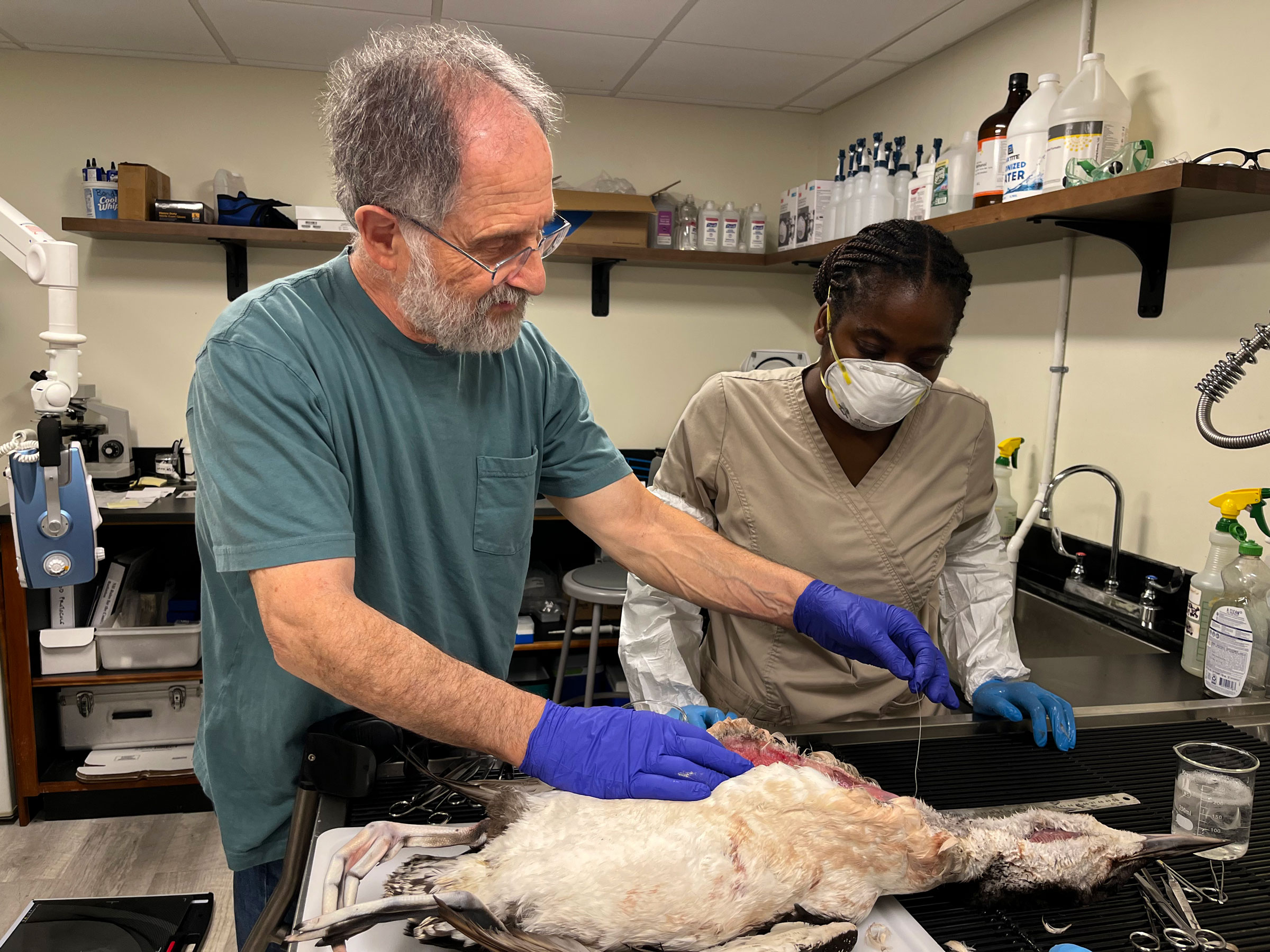
Two people look at a loon laying on a dissection table.

Wildlife veterinarian Mark Pokras and Tufts University veterinary student Khangelani Mhlanga necropsy a female loon with a length of fishing line emerging from her neck. Krista Langlois

Fishing hooks aren’t typically made of lead—it’s too pliable—so the team doesn’t suspect lead poisoning. Perhaps the hook inhibited the animal’s ability to hunt or swallow, leading to starvation. Still, the necropsy is valuable because it contributes to an ongoing record of the lives and deaths of New England loons across five decades.

When Pokras first realized the scope of lead poisoning while necropsying loons in the 1990s, he imagined the problem would be solved relatively quickly. After all, once Silent Spring author Rachel Carson publicized the harm that DDT was causing to birds and other wildlife in North America in the 1960s, legislators and the general public mobilized against the agrochemical industry and worked to ban DDT in much of the world, saving the lives of countless birds and ensuring that springtime still resonates with their songs.

Yet efforts by LPC and others to educate anglers about the dangers of lead tackle and convince them to switch to non-lead gear hardly moved the needle. And by the time conservationists took their work to Congress in the late 1990s, hoping for a federal ban, it was becoming harder to pass environmental legislation. Voters in the US were increasingly divided by party lines, and politicians were increasingly influenced by a powerful group: the National Rifle Association, or NRA.

As Pokras and his colleagues were spreading the word about the dangers of lead fishing tackle in the ’90s, it just so happened that other conservationists had begun noticing that piles of guts contaminated by lead bullets and left behind by hunters were poisoning scavengers, like bald eagles and California condors. (The US Fish and Wildlife Service had banned lead shot—a type of ammunition used for bird hunting that consists of a spray of small pellets rather than a single bullet—for hunting waterfowl in 1991, but other types of lead bullets were still used for hunting larger animals, and continue to be used today.) Conservation groups across the country began lobbying for a federal ban on lead bullets. And the NRA responded in force. As one NRA website currently states: “The use of traditional (lead) ammunition is currently under attack by many anti-hunting groups whose ultimate goal is to ban hunting.”

But how did the fight over lead bullets thwart efforts to regulate lead fishing tackle? Many hunting and fishing organizations have ties to the NRA, and they maintain that any effort to regulate tackle will open the door to regulating ammunition, and that any effort to regulate ammunition is an assault on Americans’ gun rights.

“One of the unusual things about lead is there are very few other toxic materials that have a huge public lobby in favor of them,” Pokras says. “You don’t see a lot of members of the public out there campaigning [for] more DDT or neonicotinoid pesticides. But with lead there’s a huge, wealthy, politically influential contingent supporting it.”

When Pokras retired in 2015, he had decades of data showing that lead fishing tackle was killing loons, along with some 7,500 peer-reviewed scientific papers that unequivocally show the dangers of lead for wildlife. When I asked why he continues to necropsy loons to amass new data despite this preponderance of proof, his answer is concise: “We haven’t solved the problem yet.”

Lead—an element found not just on Earth but throughout the solar system—has always been attractive for human industry. The earliest known case of metal smelting can be found in 7,000-year-old lead beads found in Asia Minor. The Roman empire produced 72,000 metric tons of lead at its peak, much of it was used to make vessels for eating and drinking and pipes for moving water; the word “plumbing” comes from the Latin word for lead, plumbum. And lead has been harming people and animals for nearly as long as we’ve used it. Lead seeping from a Greek mine was already polluting the environment some 5,300 years ago, while an Egyptian papyrus from 3,000 years ago depicts a case of homicide by lead poisoning.

Still, lead remains popular, used in everything from car batteries to computer screens.

Global lead production increases annually, with more than 4 million metric tons (some 10 billion pounds) mined or extracted through recycling in 2024 alone.

Before traveling to New Hampshire to seek out loons, I’d met with Elaine Leslie, the retired chief of biological resources for the National Park Service, at her home in rural southwestern Colorado. When Leslie was leading the Park Service’s biology department in the early 2010s under Barack Obama’s administration, she helped enact an internal ban on lead ammunition in all US national parks and preserves. Hunters and gun advocates weren’t thrilled—“I got death threats,” Leslie tells me matter-of-factly—but the US Fish and Wildlife Service followed suit by banning lead ammunition in certain national wildlife refuges, and began making moves toward a more comprehensive ban. The state of California also banned lead bullets in condor habitat in 2007, eventually followed by a statewide ban. For a while, it seemed as though scientists and conservationists were making progress.

But when President Donald Trump took office in 2017, his administration largely reversed the Park Service’s ban on lead bullets. (Rangers must still use non-lead bullets when dispatching an injured animal.) It also restricted the agency from spending money on research, education, or other efforts to reduce lead impacts to wildlife and people. Such pushback is bolstered by gun advocates who claim there’s no research proving that lead has population-level effects on wildlife. In the case of California condors, they say, California’s lead ban hasn’t reduced mortality rates, so the lead in condors’ blood must be coming from a different source. (Scientists say it’s because condors regularly cross into states like Arizona and Nevada and eat meat left by hunters who used lead bullets.) Critics also claim that non-lead ammunition is more expensive, which used to be true but is becoming less so. And they allege that non-lead ammunition is less effective—another argument that has been disproved in peer-reviewed research. Still, the backlash against regulating lead at the federal level has only grown in recent years, with federal legislators introducing bills to protect hunters’ and anglers’ right to lead tackle and bullets. California remains the only state with a complete ban on lead ammunition.

Sitting in the shade of her porch sipping iced tea, I asked Leslie, a wildlife biologist by training, if the science showing the dangers of lead to animals is well established. She let out an incredulous laugh. “There’s so much peer-reviewed science out there,” she said. “There’s study after study.”

“Those are the very top of the iceberg. Grizzly bears are impacted. Coyotes are impacted. Ravens are impacted. Any animal that eats another animal can be impacted.”

For months after our meeting, Leslie sends me those studies by email. Research has shown lead poisoning in doves, whooping cranes, eagles, owls, and many other birds. And as Leslie points out, those are only the animals that are monitored. “I mean, those are the very top of the iceberg,” she says. “Grizzly bears are impacted. Coyotes are impacted. Ravens are impacted. Any animal that eats another animal can be impacted.” While not every animal that absorbs lead dies from it, the bioaccumulation may lead an animal to become sluggish or disoriented and get struck by a car or fly into a power line it would have otherwise avoided. Lead poisoning, Leslie says, is an underreported issue.

While most animals killed by lead poisoning encounter the element from bullets, loons are predominantly killed by lead fishing tackle, which is theoretically less contentious to regulate—especially in progressive regions like New England. That’s why, beginning in the early 2000s, loon conservationists turned their focus to state-level laws. They also kept their efforts to ban lead tackle separate from efforts to ban lead ammo, in the hope that it might be an easier pill for lawmakers to swallow.

New Hampshire became the first to ban certain types of lead fishing tackle in 2000, and subsequently strengthened its laws to become some of the most stringent in the nation. Vermont, Massachusetts, and Maine followed, though the details differ so much from state to state that education and enforcement remain challenging. “We thought great, problem solved,” says Vogel, the LPC director. “But then we realized the problem was not solved.”

Today, even after the bans have been in place for years, LPC continues to receive loons each year who have died of lead poisoning. Vogel and his colleagues initially thought this was because the birds were swallowing old lead sinkers buried in the muck at the bottom of lakes. But after necropsies demonstrated that the months when most loons died of lead poisoning coincided with the months when freshwater fishing was at its peak, the team realized that the deaths came from current use. Fishermen were still using—and even purchasing—lead sinkers and spinners.

Back at the LPC’s headquarters on the shores of Lake Winnipesaukee, Pokras shows me a lead lure that he picked up at a fishing store in Maine a few weeks prior. “This is actually a good thing,” Vogel chimes in, with characteristic optimism. It means conservationists don’t have to figure out how to remove old tackle sunk at the bottom of lakes. If they can just figure out how to keep new lead tackle from getting into the environment, the benefit to birds should be almost immediate. And fortunately, they’ve found a promising solution.

After the interns finish taking samples of the dead loon’s organs to send off for testing, they seal what’s left of the body in a heavy-duty trash bag for disposal at the local dump. As they wrap up, I head upstairs to the education center and gift shop. A recording of loon calls plays softly, and educational exhibits share information about loons, including the fact that they can dive to depths of 60 meters (200 feet) to hunt for fish, and that their name comes from the Swedish word for clumsy, lom—a nod to loons’ notorious ineptitude on land.

On one wall, a taxidermied loon appears to be suspended mid-swim in a glass case, its neck stretched out and its webbed feet splayed behind it like propellers. Affixed to the glass is a placard: “This loon died after ingesting lead fishing tackle.” A table below displays a jar half full of lead sinkers: “This small Mason jar contains enough lead fishing tackle to kill every adult loon found in New Hampshire!” Nearby, a wooden bowl carved in the shape of—you guessed it—a loon holds non-lead tackle that visitors can take home for free. Brochures urge people to earn credit for more new tackle by turning in their old lead gear.

This is part of New Hampshire’s pioneering lead tackle buyback program. LPC gets generous donations from loon lovers, and along with support from the state’s department of fish and game, some of that money becomes $20 vouchers to sporting goods stores given to people who turn in lead tackle. Banners and flyers publicizing the lead buyback program are displayed at waste transfer stations, government offices, shops, and community lake associations, and Scouts can earn a badge for collecting lead tackle from their community. Since its launch in 2018, people have dropped off nearly 80,000 pieces of lead tackle; in 2024 alone, 78 kilograms (172 pounds) of lead tackle were turned in, marking a 119 percent increase over the prior year. Maine has taken the work a step further—in addition to buying tackle from individual anglers, the conservation nonprofit Maine Audubon buys stock directly from merchants, keeping lead tackle off the shelves and helping stores comply with newly tightened state regulations.

For loons, the combination of legislation, education, and buyback programs seems to be working. Lead poisoning is no longer the number one killer of loons in Maine. And in New Hampshire, lead-related deaths dropped 61 percent between the late 1990s and 2016, and fell another 34 percent since then. “I suppose you could see New Hampshire as a leader,” Vogel says, “But that’s also driven by necessity. The problem was the most severe here.”

Vogel is optimistic that states like Minnesota, Wisconsin, and Washington—all of which have significant loon habitat—will one day follow suit, along with his home country of Canada, where 94 percent of common loons breed. Canada already bans lead tackle and ammo in national parks and wildlife areas but allows it elsewhere. Resistance to a Canadian national ban seems to come from a more basic reluctance to change, rather than fear of losing gun rights, along with the fact that loons are so abundant in Canada that preventing lead poisoning feels less urgent.

Europe, meanwhile, is far ahead. The European Union, Norway, and Iceland already ban lead in all wetlands, and the EU is considering a proposal to ban lead from all fishing and hunting gear. Denmark already has a complete ban, and the United Kingdom will enact one beginning in 2026.

With the necropsy complete, I follow Vogel and Ashley Keenan, LPC’s field crew coordinator, to a small motorboat docked on Lake Winnipesaukee. The southern part of the lake bumps with party boats and Jet Skis, but these northern reaches are quieter, scattered with islands and ringed with coves where dark sweeps of pine forest feather the shore.

A woman stands in a creek looking through binoculars.

Ashley Keenan, field crew coordinator for the Loon Preservation Committee, checks on a loon nest on an island in Lake Winnipesaukee, New Hampshire. Krista Langlois

Vogel and Keenan are tracking this year’s loon chicks. Unlike ducks and many other waterfowl, loons hatch only one or two eggs per year and don’t typically reproduce until they’re six years old, making population-level growth slow. Out of 32 nesting pairs of loons scattered across Lake Winnipesaukee’s 179 square kilometers (69 square miles) in the spring of 2025, 12 chicks had survived as of August. The figure is slightly below average, although survival rates fluctuate. (One year, 23 chicks survived, Vogel tells me; a few years later, only three did.) During Keenan’s last patrol, the eggs in one nest perched on a tiny island hadn’t yet hatched, and today she’s trying to find out if the chicks have emerged.

Keenan steers toward the island, cuts the motor, and jumps into the shallows. She aims her binoculars at a cluster of lichen-splattered boulders. We wait in silence. Nothing.

“Goddamn it,” she says, climbing back into the boat. One egg might still be there, but there’s no sign of the second egg or a living chick. She guesses it was picked off by a predator, perhaps an eagle. Vogel speculates that unseasonably hot summer weather contributed to the lower-than-usual survival rate. Loon parents who need to cool down by going for a swim must leave their eggs unguarded, opening them to predation or overheating under the blazing sun.

Although common loon populations are holding steady or even growing slightly across their range, loons are increasingly susceptible to the impacts of climate change, as well as avian malaria, shoreline development, and collisions with recreational motorboats. And this region—one of the first in North America to be settled by colonists, and still one of the most densely developed on the continent—echoes with stories of species that have disappeared, from mountain lions to American chestnuts. People here know that survival is never guaranteed, and that keeping common species common requires effort, sacrifice, and care. For loons specifically, it means keeping as many adults of reproductive age alive as possible.

“This is probably the most intensely managed species in New Hampshire,” Vogel says. “And despite that, we’re still having trouble maintaining reproductive success.”

Just then, a white-haired woman in a kayak approaches our boat, waving her arms. “I’m just trying to find out what happened to my baby loon,” she calls out. Her name is Dotty Wysocki, and she’s been watching nesting loons near her summer cottage here for three decades. “We name ’em and everything,” she tells me in a thick Boston accent. “We really get involved. I’m constantly looking for them.”

Wysocki tells us that she saw a newly hatched chick alive earlier in the week but hasn’t spotted it since. When Keenan affirms that the chick is likely dead, Wysocki lowers her eyes. She wishes she could have done more; when she was younger, she and her friends used to watch the chicks in four-hour shifts to scare off eagles and other predators.

At the end of her poem about lead poisoning in loons, Mary Oliver wrote: “I tell you this to break your heart / by which I mean only / that it break open and never close again / to the rest of the world.”

As Wysocki paddles away and Keenan starts up our motor, both seem dispirited, perhaps even a little heartbroken. But their concern for the fate of this one tiny chick nonetheless fills me with hope. It’s the kind of love that can save a species, and indeed, the only thing that ever has.

Continue Reading…

Mother Jones

Monster of 2025: GLP-1 Ads

The staff of Mother Jones is, once again, rounding up the heroes and monsters of the past year. This is a non-exhaustive and totally subjective list, giving our reporters a chance to write about something that brought joy, discontent, or curiosity. Happy holidays.

My Instagram algorithm has decided that I am a woman, and, therefore, I must want to lose weight.

In 2025, that meant it was impossible for me to scroll through my feed without being visually assaulted by ingratiating marketing campaigns, encouraging me to shed those last few pesky pounds via drugs, specifically off-label GLP-1.

For a brief moment, companies found it profitable to showcase physical diversity and promote the idea of loving your body just the way it is. Not so anymore.

In one ad, I am being pitched “looser jeans.” In another, I am being patronized by a cake: “PSA for the girls,” states shoddily Photoshopped frosting. “You don’t need to be obese to start a GLP-1.”

In practice, though, you do—at least according to the US Food and Drug Administration, which has only approved GLP-1 drugs for people with clinical obesity or Type 2 diabetes and for people who are overweight with weight-related comorbidities. The companies that manufacture the name-brand GLP-1s like Ozempic, Zepbound, and Wegovy haven’t meaningfully tested the drugs on people with BMIs lower than 27.

The sponsored ads that bombard my feeds, from telehealth companies like Willow, Noom, Fridays, EllieMD, and Midi Health, are technically promoting another product: compounded GLP-1 injections and tablets. These are not FDA-approved; they are custom-made by pharmacists and usually include small doses of semaglutide, the active ingredient in Ozempic, along with other ingredients. EllieMD, for example, offers a “longevity microdose” that includes B12.

The FDA has been clear on this. “Compounded drugs should only be used in patients whose medical needs cannot be met by an FDA-approved drug,” states an FDA release warning against the use of unapproved GLP-1 drugs for weight loss.

But the ads I’ve seen overwhelmingly focus on cosmetic changes, not improved health. Some discuss quickly dropping a handful of pounds before a big event, like a wedding. To obtain a prescription, you still need to talk to a doctor, who is tasked with assessing your medical history and needs. Willow’s website is explicit about the end game here: “Proven medicine that powers fast cosmetic weight loss.”

Willow, Noom, Fridays, and EllieMD did not respond to requests for comment. Midi Health told me it takes a medically focused, clinician-led approach to prescribing GLP-1 medications. “When our clinicians prescribe these therapies, it is because there is a clear medical benefit and as part of a comprehensive care plan focused on a woman’s overall health. GLP-1s have FDA-approved indications beyond obesity, including diabetes, sleep apnea, and long-term weight maintenance…We also recognize that BMI is an imperfect tool designed for research, not individualized medical care,” said Midi Health.

To be fair, it isn’t just the off-label drugs that are getting backed by an aggressive marketing push. In 2023, when Ozempic went mainstream, more than 4,000 semaglutide ad campaigns flooded the internet. That same year, print ads for “a weekly shot to lose weight” swept the New York City subways. Ro, the company behind that campaign, now has a series of video ads with Serena Williams. It was depressing to have my TV-watching experience interrupted by a close-up shot of the indomitable tennis star injecting a drug that can cause muscle loss and fatigue.

All these ads are nauseating because they traffic in the assumption that weight loss is a universal goal; the question is just whether you’d like to lose 5, 10, or 50 pounds. But I do not want to lose weight. I have spent more than half of my life trying to squash my urge to lose weight—and be free of the deeply inscribed messaging that thinner is a better, more desirable form. It’s been many years since I’ve restricted calories or purged after a meal, habits I picked up before I was even through puberty. Still, sometimes I falter. I’ll find myself redownloading MyFitnessPal or using my finite attention to perform caloric mental math, calculating the damage done by a tablespoon of cooking oil or the splash of milk added to my morning coffee.

This disordered history probably makes me the perfect demographic for receiving targeted GLP-1 ads. It’s very possible that my attention lingers, subconsciously, when I come across them on my feed. And if that’s the case, the algorithm has almost certainly noticed, and taken it as an invitation to send me more—despite all of the times I’ve clicked “not interested.”

To research this piece, I decided to see if I’d actually be eligible to microdose the GLP-1 being promoted to me. I filled out two online quizzes from the companies Noom and Hers. I lied about past eating disorder history by checking a box.

Hers—a women’s telehealth company that launched in 2018 with a focus on sexual wellness and skincare and has since become better known for offering weight loss drugs—warned me that my prescription would not be “evaluated for safety, effectiveness, or quality by the FDA.” It asked me harrowing questions such as, “How disruptive would vomiting, constipation, and diarrhea be to your daily life?” And then, thank God, Hers told me I didn’t qualify.

Noom let me right in. After it thanked me for taking the “important (and hard) first step” of sharing my current weight, it prompted me to buy my “personalized plan” for shedding 10 pounds in seven weeks.

There’s still a lot we don’t know about the long-term side effects of GLP-1 drugs, but they do appear to be beneficial for those who medically need them. I am not one of those people. And as the multibillion-dollar semaglutide market explodes across the globe, it’s disappointing to see it stamp out the last remaining shreds of the mid-2010s “body positivity” movement.

For a brief moment, companies found it profitable to showcase physical diversity and promote the idea of loving your body just the way it is. Not so anymore. The resounding message—on social media, on TV, in the goddamn subways—is that thin is back in. And companies are doing what they’ve always done best: exploiting our insecurities to cash out.

Continue Reading…

Mother Jones

The Five Most Unhinged Climate Lies Trump Told in 2025

This story was originally published by Guardian and is reproduced here as part of the Climate Desk collaboration.

In the past decade at the forefront of US politics, Donald Trump has unleashed a barrage of unusual, misleading, or dubious assertions about the climate crisis, which he most famously called a “hoax”.

This year has seen Trump ratchet up his often questionable claims about the environment and how to deal, if at all, with the threats to it. In a year littered with lies and wild declarations, these are the five that stood out as the most startling.

1. “Putting people over fish”

Upon re-entering the White House in January, Trump revealed an unusual fixation would become an immediate priority for his administration—the fate of an endangered, three-inch-long fish that lives in California.
The unassuming delta smelt, Trump said rather uncharitably, is “an essentially worthless fish” which had been lavished with water flows that should instead go to nearby farmers or help fight the devastating wildfires that were raging hundreds of miles south in Los Angeles.

On his first day in office, Trump issued an eye-catching executive order titled “Putting people over fish” that demanded water be diverted from the smelt’s habitat and towards needy people.

Experts were quick to point out that water situated so far away would not aid the firefighting effort in LA, with the small amount of water provided to keep the Sacramento-San Joaquin delta ecosystem intact overshadowed by the much larger forces at play in California, such as the climate crisis, which has spurred monumental droughts in the region.

2. Wind energy is “driving the whales crazy”

Continuing on the aquatic theme, Trump’s first month in the most powerful office on the planet also included a bizarre tirade against offshore wind energy for its supposed impact upon whales.

The president said that “windmills” were “dangerous,” citing the example of whales being washed ashore in Massachusetts as proof that “the windmills are driving the whales crazy, obviously.”

While there was a spate of dead and sick whales becoming stranded ashore, Trump’s own federal government scientists have rejected the idea that wind turbines placed in the ocean are to blame.

“At this point, there is no scientific evidence that noise resulting from offshore wind site characterization surveys could potentially cause whale deaths,” the National Ocean and Atmospheric Administration states. “There are no known links between large whale deaths and ongoing offshore wind activities.”

The main threats to whales continue to be entanglement in fishing nets, boat strikes, and altered prey behavior due to a rapidly heating ocean from the climate crisis, which is causing whales to have to forage closer to land, experts say.

This hasn’t deterred Trump from enacting a long-held grudge against wind energy by halting planned projects and stating that “we don’t allow the windmills and we don’t want the solar panels” in August. The president has also claimed that wind is “the most expensive energy there is”—a false claim: wind and solar are, in fact, among the cheapest sources of power that have ever existed.

3. Clean, beautiful coal

In September, Trump delivered a remarkable, often fact-free speech to the United Nations, in which he said that climate change is the “greatest con job ever perpetrated on the world”, blaming “stupid people” for predictions that have hobbled countries with a costly “green scam.”

“I have a little standing order in the White House. Never use the word ‘coal’. Only use the words ‘clean, beautiful coal’. Sounds much better, doesn’t it?”

But perhaps the most unusual revelation in the speech was Trump outlining how he has sought to directly rebrand coal as a clean power source. “I have a little standing order in the White House,” he said. “Never use the word ‘coal’. Only use the words ‘clean, beautiful coal’. Sounds much better, doesn’t it?”

Coal is, in fact, far from clean. It is the dirtiest of all fossil fuels in terms of the carbon it emits when burned, which then heats up the planet, and gives off air pollutants that routinely harm the heart and lung health of those who live near coal power plants.

Black lung disease, meanwhile, is an affliction many coal miners have suffered after directly inhaling coal dust. The Trump administration axed a program that screened coal miners for the respiratory condition.

The federal government, across different administrations, has lavished funding for plans to install carbon capture facilities at coal plants to stop harmful emissions from escaping, but this has yet to be implemented in any meaningful way in the US.

4. Global cooling

In the same speech to beleaguered-looking diplomats at the UN, Trump scoffed at the scientific reality of global heating, instead claiming that scientists had just changed their minds from the planet cooling down.

“It used to be global cooling,” he said. “If you look back years ago in the 1920s and the 1930s, they said, global cooling will kill the world. We have to do something. Then they said global warming will kill the world. But then it started getting cooler.”

The world is not cooling down. It is heating up at the fastest rate in the history of humanity, due to the burning of fossil fuels and, to a lesser extent, deforestation. Scientists are unequivocal about this, as can anyone able to grasp a simple temperature graph.

In the 1920s and 1930s, the field of climate science wasn’t as developed as it is now, but even then there was an understanding of the greenhouse effect, and few scientists in the decades since have expressed concerns about “global coolingcompared with those warning of planetary heating.

The Earth is thought to have been in a long, gentle cooling pattern for thousands of years due to natural forces, but this was upended by the industrial revolution, with the vast amounts of heat-trapping gases emitted over the past 150 years setting us on a completely new and dangerous path. The world is now hotter than at any previous point in human civilization.

5. Climate change investigations

Last month, Trump announced new investigations related to the climate crisis. Not to find more about the severity of global heating and its implications—more to target those who have told the world about it.

“It’s a little conspiracy out there,” the president said at a US-Saudi investment forum in Washington. “We have to investigate them immediately. They probably are being investigated.”

It’s unclear who “they” are—scientists, Democratic politicians, the insurance companies pulling out of states because of the crushing cost of climate-driven disasters? But Trump pushed on.

“Their policies punish success, rewarded failure, and produced disaster, including the worst inflation in our country’s history,” he said.

While the Trump administration has fired scientists, hauled down mentions of the climate crisis from government websites, and banned federal employees from uttering verboten words such as “emissions” and “green”, the reality remains that the world is warming up, and past projections of this have been generally accurate.

Some of the most accurate forecasts of global heating came from the fossil fuel industry, which knew of the dangers from the 1950s onward and produced strikingly accurate projections of future heat in the 1970s.

Instead of informing the world of this peril, however, oil and gas companies instead set about a decades-long campaign to downplay and distort this science in order to maintain their lofty position in the global economy.

Trump has not called for an investigation of these companies, choosing instead to openly solicit campaign donations from them in return for rollbacks of clean air protections once he became president—a promise he has largely fulfilled.

Continue Reading…

Mother Jones

How a Climate Doomsayer Became an Unexpected Optimist

Bill McKibben isn’t known for his rosy outlook on climate change. Back in 1989, he wrote The End of Nature, which is considered the first mainstream book warning of global warming’s potential effects on the planet. Since then, he’s been an ever-present voice on environmental issues, routinely sounding the alarm about how human activity is changing the planet while also organizing protests against the fossil fuel industries that are contributing to climate change.

McKibben’s stark and straightforward foreboding about the future of the planet was once described as “dark realism.” But he has recently let a little light shine through thanks to the dramatic growth of renewable energy, particularly solar power. In his latest book, Here Comes the Sun: A Last Chance for the Climate and a Fresh Chance for Civilization, McKibben argues that the planet is experiencing the fastest energy transition in history from fossil fuels to solar and wind—and that transition could be the start of something big.

“We’re not talking salvation here,” McKibben says. “We’re not talking stopping global warming. But we are talking the first thing that’s happened in the 40 years that we’ve known about climate change that scales to at least begin taking a serious bite out of the trouble we’re in.”

On this week’s More To The Story, McKibben sits down with host Al Letson to examine the rise of solar power, how China is leapfrogging the United States in renewable energy use, and the real reason the Trump administration is trying to kill solar and wind projects around the country.

This is an update of an episode that originally aired in October 2025.

This following interview was edited for length and clarity. More To The Story transcripts are produced by a third-party transcription service and may contain errors.

Al Letson: Bill, how are you this morning?

Bill McKibben: I’m actually pretty darn good, which one feels bad about saying in the midst of planetary ecological trauma and the collapse of our democracy, but it’s a beautiful day in the mountains of Vermont and in the midst of all that bad stuff, I’ve got one piece of big good news, which it’s actually kind of fun to share.

Yeah, I think in the midst of all the stress and pressure and sadness about the way the world is heading at this moment, I think having joy is a revolutionary act and it’s good. I think when you come outside and the sun is shining and it feels good outside, I don’t know. I don’t think we should be ashamed of it. I think we should bask it and hold onto it as long as possible because good Lord, who knows what’s next?

Amen. One of the results of having spent my whole life working on climate change is I never take good weather for granted. If there’s a snowstorm, I make the most out of every flake. If there’s a beautiful cool fall-like morning like there was today, nobody’s out in it quicker than me. So I take your point 100%.

How long have you been working in the field of environmental justice and thinking about the environment?

Al, when I was 27, I wrote a book called The End of Nature, so this would’ve been 1989 because I’m an old person. So, wrote a book called The End of Nature that was the first book about what we now call the climate crisis, what we then call the greenhouse effect. And that book, well, that book did well, it came out in 24 languages and things, but more to the point, it just made me realize that this was not only the most important question in the world, what was going to happen to the Earth’s climate, but the most interesting, that it required some understanding of science, but also more importantly of economics, of politics, of sociology, of psychology, of theology, of pretty much everything you could imagine. And so for 38 years now, I guess, it’s been my work and at some level, I wish I’d been able to spend my life on something not quite so bleak. On the other hand, I have to confess, I haven’t been bored in any point in there.

Yeah. How would you describe the environmental causes in America since you’ve been watching it for so long? It seems to me that there’s a lot of one step forward, three steps back, one step forward, three steps back.

I’d say it’s been more like one step forward, three quarters of a step back over and over again. And that’s a big problem because it’s not only that we have to move, it’s that we have to move fast. Climate change is really probably the first great question we’ve ever come up against that has time limit. As long as I’ve been alive and as long as you’ve been alive, our country’s been arguing over should we have national healthcare? I think we should. I think it’s a sin that we don’t, people are going to die and go bankrupt every year that we don’t join all the other countries of the world in offering it, but it’s not going to make it harder to do it when we eventually elect Bernie and set our minds to it than if we hadn’t delayed all this time.

Climate change isn’t like that. Once you melt the Arctic, nobody has a plan for how you freeze it back up again. So we’re under some very serious time pressure, which is why it’s incredibly sad to watch our country pretty much alone among the world in reverse right now on the most important questions.

Yeah. Is that forward movement and regression tied to our politics, i.e., is it tied to a specific party? If the Democrats are in office, we move forward, if Republicans come in office, we move backwards?

Yeah, in the largest terms. The fossil fuel industry, more or less purchased the Republican Party 30, 35 years ago. Their biggest contributors have been the Koch brothers who are also the biggest oil and gas barons in America. And so it’s just been become party doctrine to pretend that physics and chemistry don’t really exist and we don’t have to worry about them. Democrats have been better, and in the case of Joe Biden actually, considerably better. His Inflation Reduction Act was the one serious attempt that America’s ever made to deal with the climate crisis, and it was far from perfect, and there were plenty of Democrats like Joe Manchin that got in the way and so on and so forth. But all in all, it was a good faith effort driven by extraordinary activism around the Green New Deal. And it’s a shame to see it now thrown into reverse in the Trump administration, especially because the rest of the world is at different paces, some of them very fast, starting to do the right thing here.

So given all of that where we are and kind of stepping back away from the progress we had made forward, you just wrote a new book that is pretty optimistic, which is a little bit different for you because you’ve been described as dark realism. Tell me why are you feeling optimistic in this moment?

About 36 months ago, the planet began an incredible surge of installation of renewable energy, solar panels, wind turbines, and the batteries to store that power when the sun goes down or the wind drops. That surge is not just the fastest energy transition play on the planet now. It’s the fastest energy transition in history and by a lot, and the numbers are frankly kind of astonishing. I mean, the last month we have good data for is May. In China, in May, they were putting up three gigawatts of solar panels a day. Now, a gigawatt is the rough equivalent of a big coal-fired power plant. So they were building the equivalent of one of those worth of solar panels every eight hours across China. Those kind of numbers are world-changing if we play it out for a few more years, and if everybody joins in. And you can see the same thing happening in parts of this country.

California has not done everything right, but it’s done more right than most places, and California has hit some kind of tipping point in the last 11 or 12 months. Now, most days, California generates more than a hundred percent of the electricity it uses from clean energy, which means that at night, when the sun goes down, the biggest source of supply on their grid is batteries that didn’t exist three years ago. And the bottom line is a 40% fall in fossil fuel use for electricity in the fourth-largest economy in the world is the kind of number that, adopted worldwide, begins to shave tenths of a degree off how hot the planet eventually gets. And we know that every 10th of a degree Celsius, that the temperature rises, moves another a hundred million of our brothers and sisters out of a safe climate zone and into a dangerous one. We’re not talking salvation here, we’re not talking stopping global warming, but we are talking the first thing that’s happened in the 40 years that we’ve known about climate change, that scales to at least begin taking a serious bite out of the trouble we’re in.

Yeah, so I own a home in Jacksonville, Florida.

In the Sunshine State.

In the Sunshine State. I was planning on getting solar panels for the house, but then I was told A, one, it would be really expensive, and then B, it wouldn’t save me that much on my bill because of the way some local ordinances are configured. And so for me, somebody who wants to have solar panels and wants to use solar power, it’s just not cost-effective. So how do we get past that?

Well, there’s a lot of ways. One of the ways was what Biden was doing in the IRA, which was to offer serious tax credits. And those, despite the Republican defeat of them, remain in effect through the end of this year through New Year’s Eve. So if people move quickly, they can still get those. Probably more important in the long run, and this was the subject of a long piece I wrote for Mother Jones this summer, we need serious reform in the way that we permit and license these things.

Putting solar panels on your roof in Florida is roughly three times more expensive than it is to put solar panels on your roof in say, Australia, to pick someplace with a similar climate, or Europe, someplace with a more difficult climate, costs three times as much here. A little bit of that’s because of tariffs on panels. Mostly it’s because every municipality in America, they send out their own team of inspectors, permits, on and on and on. It’s a bureaucratic mess, and that’s what drives the price up so dramatically.

There’s actually an easy way to do it. The National Renewable Energy Laboratory developed a piece of software called the Solar App Plus that allows contractors to just plug in the name of the type of equipment they’re going to put on the roof and the address that they’re doing it, and the computer quickly checks to see if it’s all compatible, and if it is, they get an instantaneous permit and get to work right away. And then, for apartment dwellers, because there’s almost as many apartment dwellers as homeowners in this country, who don’t have access to their own roof usually, we need another set of easy technology. We’re calling this balcony solar.

And across Europe over the last three years, three and a half, 4 million apartment dwellers have gone to whatever you call Best Buy in Frankfurt or Brussels and come home for a few hundred euros with solar panel design just to be hung from the railing of a apartment balcony and then plugged directly into the wall. No electrician needed nothing. That’s illegal every place in this country except that progressive bastion in the state of Utah where the state legislature unanimously passed enabling legislation earlier this year because some Libertarian Republican state senator who I’ve talked to, an interesting guy, he said, “Well, if people in Stuttgart can have it, why not people in Provo?” And no one had a good reason, so now there’s on YouTube lots of videos of Happy Utahns putting up their balcony solar arrays.

So let me just to clarify that because I never heard of this before. In overseas, in different countries, they can go to, I don’t know, an Ikea and grab a solar panel, come home and plug it in the wall to power their apartment?

It often powers 25% of the power that they’re using in their apartment. It’s a real amazing thing and it’s for a few hundred euros. And among other things, it really introduces people to the joy of all this. There was a big story in The Guardian a few months ago following all sorts of people who’d done this and almost to a person, they’d all become fascinated by the app on their phone showing how much power they were generating at any given moment.

Solar power is kind of a miracle. It exists in so many different sizes, from your balcony to big solar farms, all of which we need. But the thing that’s a miracle about it is precisely that it’s available to all of us. I mean, no one’s going to build a coal-fired power plant on their balcony. This is something that everybody can do, and it’s something that once you’ve got the panel, no one can control. We’re talking about energy that can’t be hoarded, that can’t be held in reserve, and that essentially the sun delivers for free every day when it rises above the horizon. So that is an extraordinary boon to especially poor people around the world and an extraordinary threat to the fossil fuel industry, which is why you’re seeing the crazy pushback that marks the Trump administration.

So with the Trump administration and this bill that they passed, The Big Beautiful Bill, that impacts tax credits for renewable projects like solar, how is that going to affect the solar power industry in the United States?

It’s going to decimate it. There are already companies laying people off and going out of business because that tax credit was important and it’s, since we can’t do anything in Washington at the moment, why we need state and local governments to step up big to change the rules here and try to keep this momentum going in the States. The United States accounts for about 11% of emissions in the world. The other 89%, things are going much better than they are here, not just in China, but in all the places that China touches.
In some ways, the most powerful story for me in the book was what happened in Pakistan last year. Now, Pakistan’s been hit harder by climate change than any country on earth. Its cities now routinely report temperatures of 125, 126 degrees. The two worst floods that really we’ve ever recorded on the planet happened in Pakistan over the last 15 years. Right now there’s big major, not quite as bad, but really serious flood across the Punjab. Pakistan also has an expensive and unreliable electric system. So about 18 months ago, people began importing in very large numbers, cheap Chinese solar panels from across their shared border. And within six months, eight months, Pakistanis, without government help, just basically using directions you can get on TikTok, had installed enough solar panels to equal half of the existing national electric grid in Pakistan. It’s the most amazing sort of citizen engineering project in history and of incredible value to people.

Farmers in Pakistan, I don’t know if you’ve traveled in rural Asia, but the soundtrack of at part of the world is the hum of diesel pumps, often the cough of diesel generators because you need to bring up this irrigation water from quite a great depth to wells that came with the green revolution. Often for farmers, that diesel is the biggest single input cost that they have. So farmers were very early adopters here. Many of them lacked the money to build the steel supports that we’re used to seeing to hold your solar panels up. They just laid them on the ground and pointed them at the sun. Pakistanis last year used 35% less diesel than they did the year before. Now the same thing is happening in the last six months across large parts of Africa. Pretty much any place where there’s really deep established trade relations with China, and it’s not just solar panels.

What the Chinese are also doing is building out the suite of appliances that make use of all that clean, cheap electricity. The most obvious example being electric vehicles and electric bikes. More than half the cars sold in China last month came with a plug dangling out the back, and now those are the top-selling cars in one developing nation after another around the world because they’re cheap and they’re good cars and because if you’re in Ethiopia or Djibouti or wherever you are, you have way more access to sunshine than you do to the incredibly long supply chain that you need to support a gasoline station.

But my understanding, and my understanding is definitely dated, which is why I’m glad I’m talking to you, but for a very long time, my understanding of solar power was that it wasn’t that efficient, that you wouldn’t be able to get enough power to really do much of anything versus fossil fuels. Is it true that the Chinese have really invested in the technology and really pushed it forward?

Yeah, I mean Chinese are now, you’ve heard of petro states, the Chinese are the first electro state in the world. This stuff works great and it works great here. I mean, I was telling you about what’s going on in California. In some ways, an even more remarkable story, given the politics, is that Texas is now installing clean energy faster than California because it’s the cheapest and it’s the fastest thing to put up. If you’re having to build data centers, and God knows, I’m not convinced we have to build as many data centers as we’re building, but if you do, the only thing that builds fast enough to get them up is solar or wind. You can put up a big solar farm in a matter of a few months as fast as you can build the dumb data center.

Your question’s really important because for a very long time, all my life, we’ve called this stuff alternative energy, and it’s sort of been there on the fringe like maybe it’s not real big boy energy the way that oil and gas is. I think we’ve tended to think of it as the Whole Foods of energy. It’s like nice, but it’s pricey. It’s the Costco of energy now. It’s cheap, it’s available in bulk, it’s on the shelf ready to go. 95% of new electric generation around the world and around the country last year came from clean energy, and that’s precisely why the fossil fuel industry freaked out. You remember a year ago, Donald Trump told oil executives, “If you give me a billion dollars, you can have anything you want.” They gave him about half a billion between donations and advertising and lobbying. That was enough because he’s doing things even they couldn’t have imagined. I mean, he’s shut down two almost complete big wind farms off the Atlantic seaboard. I mean, it’s craziness. We’ve never really seen anything like it.

Do you think we’ll be able to bounce back? As we’re watching all of these forward movements that have happened before Trump came back into office, it feels like he is burning it all down and not just burning it down, but salting the earth. Nothing’s going to grow there again.

Yeah, I completely hear you. Yeah. This one possibility. Look, 10 years from now, if we stay on the course that Trump has us on, any tourist who can actually get a visa to come to America, it’ll be like a Colonial Williamsburg of internal combustion. People will come to gawk at how people used to live back in the olden days. I don’t think that that’s what’s going to happen. I think that at some point, reality is going to catch up with this, and everyone’s going to start figuring out we’re paying way more for energy than else in the world, and that means our economy is always on the back foot. That means that our consumers are always strapped. I mean, electricity prices are up 10% this year so far around this country because he keeps saying, “We’re not going to build the cheapest, fastest way to make more electricity.”

I don’t see how that can last. But then I don’t see how any of this, none of it… I mean, I confess, I feel out of my depth now, the hatred of immigrants, the racial hatred, the insane economic policy around tariffs, none of it makes any real sense to me politically or morally. So I could be wrong, but I hope that America, which after all was where the solar cell was invented and where the first solar cell came out of Edison, New Jersey in 1954, the first commercial wind turbine in the world went up on a Vermont mountain about 30 miles south of where I’m talking from you speaking in the 1940s. That we’ve now gifted the future to China is just crazy no matter what your politics are.

The idea that we are ceding ground to China is not just about solar energy, but in all sorts of ways. The move of the Trump administration to be sort of isolationists is actually hurting us way more than being open and growing and advancing.

Yep, I couldn’t agree more. Look, I’ve been to China a bunch of times. I’m glad that I’m not a Chinese citizen because doing the work I do, I would’ve been in jail long ago, and I’m aware of that and understand the imperfections and deep flaws in that country. But I also understand that they have a deep connection to reason. They’ve elected engineers, or not elected, appointed engineers to run their country now for decades while we’ve been electing lawyers to run ours. And as a result, they’re not surprisingly better at building stuff. And so they have. And I think now, they’re using that to build a kind of moral legitimacy in the world. If the biggest problem the world faces turns out to be climate change, and I have no doubt that it is, then China’s going to be the global leader in this fight because we’ve just walked away from it.

Yes. The question that comes to mind when you say that is, it’s clear to me that what some climate change skeptics and renewable energy skeptics have been able to do is to wrap things like solar power and wind energy into the culture war. So now that it’s a part of the culture war, people just stand against it because, well, they’re on the wrong team. Instead of looking at the economic reality that their bills could go down significantly if they dived in.

It’s super true, but it’s also true that solar power is remarkably popular across partisan lines. The polling we have shows that yeah, the Republican voters are less enamored of it now because Trump’s been going so hard after it, but still like it by large margins and want more government support for it. I think the reason is that there are several ways to think about this. I’m concerned about climate change. I’m a progressive. I like the idea that we’re networking the groovy power of the sun to save our planet, but I’ve lived my whole life in rural America, much of it in red state, rural America. I have lots of neighbors who are very conservative. There’s lots of Trump flags on my road, and some of them fly in front of homes with solar panels on them because if you’re completely convinced that your home is your castle and that you’re going to defend with your AR-15, it’s a better castle if it has its own independent power supply up on the roof, and people have really figured that out.

So this can cut both ways, and I hope that it will. That’s that story from Utah about the balcony solar. That’s the one place where people have said, “Well, there’s no reason not to do this. Let’s do it.”

Yeah. So you’ve been doing this work for a really long time. I’m curious, when you started doing this work, could you have ever imagined the place that we are in right now as a country?

No. Remember I was 27 when I wrote this first book, so my theory of change was people will read my book and then they will change. Turns out that that’s not exactly how it works. It took me a while to figure out. Really the story of my life is first 10 years after that, I just kept writing more books and giving talks and things because I thought being a journalist that we were having an argument and that if we won the argument, then our leaders would do the right thing because why wouldn’t they? Took me too long, at least a decade, to figure out that we had won the argument, but that we were losing the fight because the fight wasn’t about data and reason and evidence. The fight was about what fights are always about, money and power. And the fossil fuel industry had enough money and power to lose the argument, but keep their business model rolling merrily along.

So that’s when I started just concluding that we needed to organize because if you don’t have billions of dollars, the only way to build power is to build movements. I started with seven college students, a thing called 350.org that became the first big global grassroots climate movement campaign. We’ve organized 20,000 demonstrations in every country on earth except North Korea. And in recent years, I’ve organized for old people like me, what we call Third Act, which now has about 100,000 Americans that work on climate and democracy and racial justice. And so this is a big sprawling fight, we don’t know how it’s going to come out. The reason I wrote this book, Here Comes the Sun, was just to give people a sense that all is not lost, that we do have some tools now that we can put to use.

Find More To The Story on Apple Podcasts, Spotify, iHeartRadio, Pandora, or your favorite podcast app, and don’t forget to subscribe.

Continue Reading…

Mother Jones

Doctors Without Borders Among Dozens of Aid Groups Israel Moves to Shut Down in Gaza

On Tuesday, the Israeli government announced that it would suspend the aid work of several humanitarian organizations that provide lifesaving aid to Palestinians in Gaza living through what Amnesty International and other groups labeled as a genocide.

Israel has claimed that the organizations failed to meet new vetting guidelines. However, as the Associated Press reported, some of the affected organizations have argued that Israel’s rules are arbitrary and could endanger people working for the non-governmental organizations.

The suspensions affect 37 organizations, including Doctors Without Borders/Médecins Sans Frontières, Humanity & Inclusion, the International Rescue Committee, and Action Aid. In addition to working to meet the healthcare and other needs of Palestinians, many of these organizations and those involved in them have been vocal about the horrible conditions Palestinians have endured, including in interviews with Mother Jones. A Humanity & Inclusion employee told Sophie Hurwitz and me in 2024 that “one of the saddest things we hear on a regular basis” is that some children who are now amputees “think that their legs may grow again.”

Following the announcement, foreign ministers of Canada, Denmark, Finland, France, Iceland, Japan, Norway, Sweden, Switzerland and the United Kingdom released a joint statement condemning this decision.

“Deregistration could result in the forced closure of [non-governmental organizations’] operations within 60 days in Gaza and the West Bank. This would have a severe impact on access to essential services, including healthcare,” they wrote. “Any attempt to stem their ability to operate is unacceptable. Without them, it will be impossible to meet all urgent needs at the scale required.”

Doctors Without Borders/Médecins Sans Frontières said in a statement to Mother Jones that while they have not gotten any official decision about their ongoing registration applications, if they are prevented from providing services, the impact will be devastating for Palestinians. “In Gaza, MSF supports around 20 percent of all hospital beds and supports the delivery of one in three babies,” said a spokesperson.

H&I told Mother Jones that its registration to operate in Palestine will be suspended, effectively tomorrow. “This decision comes amid an unprecedented humanitarian crisis, with massive and urgent needs among the civilian population, particularly in Gaza,” said an H&I spokesperson. “[H&I] is currently consulting with other affected humanitarian organizations to analyze the implications of this decision and determine the appropriate next steps.

While a ceasefire started on paper at the beginning of October that involved Hamas returning the remaining live hostages and bodies of the deceased to Israel, Palestinians in Gaza have still faced grim conditions. As of December 9, Palestinian officials have reported that 360 Palestinians have been killed since the start of the ceasefire.

This past October, the International Rescue Committee emphasized the importance of continuing aid into Gaza, with IRC CEO and President David Miliband saying that “with 55,000 Palestinian children suffering from acute malnutrition and 90 percent of the population displaced, what is needed now is a dramatic surge in the amount of aid going into Gaza.”

To top it all off, there has been intense rain and flooding in Gaza, displacing Palestinians living in tents who were already displaced from their homes.

Continue Reading…

Mother Jones

Trump’s Kennedy Center Takeover Plunges Further Into Chaos

More artists have canceled their performances at the Kennedy Center after its Trump-acolyte-dominated board’s recent vote to add the president’s name to the performing arts center earlier this month.

The latest includes The Cookers, a jazz ensemble, which called off their New Year’s Eve show on Monday.

The band did not explicitly mention the name change, but in a statement wrote, “Jazz was born from struggle and from a relentless insistence on freedom: freedom of thought, of expression, and of the full human voice. Some of us have been making this music for many decades, and that history still shapes us.”

“We are not turning away from our audience, and do want to make sure that when we do return to the bandstand, the room is able to celebrate the full presence of the music and everyone in it,” they continued. “We remain committed to playing music that reaches across divisions rather than deepening them.”

The group’s drummer, Billy Hart, told the New York Times that the Kennedy Center’s renaming “evidently” played a role in the decision. The move follows Chuck Redd’s decision to drop out of a Christmas Eve concert, prompting Richard Grenell, the center’s interim president and former acting director of national intelligence during Trump’s first term, to threaten a $1 million lawsuit against Redd over what Grenell blasted as a “political stunt.” Other artists to cancel upcoming events include folk singer Kristy Lee and Doug Varone and Dancers, a dance company based in New York City.

The center’s board, most of whom were handpicked by Trump, voted earlier this month to rename the Kennedy Center to “The Donald J. Trump and The John F. Kennedy Memorial Center for the Performing Arts.” The decision has proved deeply unpopular, with one poll of more than 1,500 US adults conducted from December 20–22 by the Economist and YouGov finding only 18 percent approved. It has since sparked legal concerns, with many pointing to President Lyndon Johnson’s signing of a law that designated the arts institution as a “living memorial” to the late President Kennedy. Rep. Joyce Beatty (D-Ohio), an ex officio member of the center’s board, has since filed a lawsuit against Trump, claiming that renaming required an act of Congress.

In a social media post, Doug Varone and Dancers said that though they had opposed Trump’s move to fire board members who didn’t align with the president’s views in February, they decided to move ahead with an April 2026 performance to honor the “dance audiences in DC.”

“However, with the latest act of Donald J. Trump renaming the Center after himself, we can no longer permit ourselves nor ask our audiences to step inside this once great institution,” the dance company wrote on Monday. “The Kennedy Center was named in honor of our 35th President, who fervently believed that the arts were the beating heart of our nation, as well as an integral part of international diplomacy.”

“The artists who are now canceling shows were booked by the previous far left leadership,” Grenell wrote in a lengthy rant on X posted on Monday. “Boycotting the Arts to show you support the Arts is a form of derangement syndrome.”

Continue Reading…

Mother Jones

Marjorie Taylor Greene Says Trump Turned on Her Over Epstein Survivors

Rep. Marjorie Taylor Greene (R-GA) said that her defense of survivors of sex offender Jeffrey Epstein and threat to disclose the identities of some of the men who abused them broke her relationship with President Donald Trump, who said his “friends will get hurt” if she went through with it.

Greene’s claim came in remarks from two long interviews published Monday in the New York Times Magazine. After a closed-door meeting with Epstein victims in September and a subsequent news conference where she made the threat to share the names of some of the men, Greene said Trump rebuked her.

“The Epstein files represent everything wrong with Washington,” the congresswoman told Robert Draper of New York Times Magazine, highlighting how Epstein went unpunished for decades and was allowed to continue to sexually assault girls and young women.

Greene announced in November that she would resign on January 5, 2026, a year before her term ends. “Standing up for American women who were raped at 14 years old, trafficked, and used by rich, powerful men should not result in me being called a traitor and threatened by the president of the United States, whom I fought for,” she stated in the video.

Greene told the Times that the last conversation she had with Trump was when she requested that he invite some of the survivors to the Oval Office. Trump, she recounted, replied that they did not deserve the opportunity.

The congresswoman committed to opposing Republican leadership in the House and Trump, joining Rep Ro Khanna (D-Calif.) and Thomas Massie (R-Ky.) in a bill that would force the Justice Department to release all of its documents on Epstein.

Another breaking point was the fallout following Charlie Kirk’s assassination. She was shocked when Trump gave the “worst statement” possible at Kirk’s memorial service. “I hate my opponent, and I don’t want the best for them,” Trump said, noting it as the right-wing political activist’s weakness.

This was un-Christian to Greene, and she realized that she was part of a “toxic culture” in Washington.

“Our side has been trained by Donald Trump to never apologize and to never admit when you’re wrong,” Greene told the Times earlier this month. “You just keep pummeling your enemies, no matter what.”

This was a stark contrast to many of her fellow public figures on the far right, who blamed the left for Kirk’s assassination. As my colleague Anna Merlan wrote earlier this month, this has led to a MAGA rift, along with conflicts over antisemitism that I reported about last week.

Since the disputes over Epstein and Kirk, Trump contributed to death threats made against her, she claims, including calling her “Marjorie ‘Traitor’ Green (sic)” in a November Truth Social post.

Greene told the Times that she understood that loyalty to Trump was just “a one-way street” that ends “whenever it suits him.”

All of this calls into question whether Greene’s departure from Trump is genuine. She told the Times that she remains a steadfast supporter of the policies on which Trump campaigned. But these clearly have not worked. Greene’s departure also calls into question the future of the Republican Party. Turning Point USA has endorsed JD Vance, but where other groups in the Republican Party go remains uncertain.

Greene’s rehabilitation has doubt attached to it, too, regardless of whether the angle is a campaign for another political position or not. As Mother Jones’ Julianne McShane reported, the congresswoman has still made attempts to reconcile with Trump. And as the Times pointed out, Greene admitted that she only spoke out against Trump when his attacks targeted her.

There’s also the fact that we still live in a political climate ruled by elites. Greene herself is a wealthy co-owner of a construction firm. It’s not a “big tent”—it’s still people at the top conversing with other people at the top on the direction of the country.

Continue Reading…

Mother Jones

Hey Jon Stewart, Jokes About Wearing Masks Aren’t Funny

Over the weekend, Covid-cautious individuals shared clips on social media of Jon Stewart punching down on people who are masking, who are presumably doing so to protect themselves from Covid, the flu, and other infectious diseases that are spreading across the United States.

On the December 11 episode of the podcast The Weekly Show With Jon Stewart, guest Tim Miller of The Bulwark said there have to be at least two people at fellow guest Jon Favreau’s workplace wearing masks because it’s a progressive organization. Stewart responded, “There’s always two, and you always say, ‘Oh, are you sick?’ And they go, ‘Uh, I don’t want to talk about it.'”

Disappointed to see Jon Stewart & co joke about masking in public. I do it for my medically fragile daughter (Batten Disease). People not masking properly led to her getting pneumonia, which led to her being on life support, which led to me getting price quotes on her cremation just in case.

[image or embed]

— Philip Palermo (@palermo.bsky.social) December 28, 2025 at 7:31 PM

First of all, asking people why they are masking is invasive behavior. No one randomly owes you information about their health, their loved one’s health, or, understandably, just wanting to avoid Covid, which is the only way to prevent Long Covid. As I’ve also previously reported, disabled people in New York’s Nassau County have reported being harassed after the county passed a mask ban. Cancer patients have also told their stories of being questioned about why they’re masking. Even before the start of the Covid pandemic, populations including cancer patients and organ transplant recipients have been encouraged to mask by healthcare professionals.

“Sad that Jon Stewart and friends have become just more white liberals who enjoy punching down at marginalized people who are just doing our best to survive,” Karistina Lafae, a disabled author and essayist, told me. “Those of us who have Long COVID, who have watched family and friends die of COVID, we are being mocked for taking common-sense precautions against illness and further disability.”

Research also shows that Long Covid is very much a working-class problem. A study looking at people in Spain found that workers who had close contact with colleagues at their job, did not mask, and took public transit to and from work are more likely to have Long Covid, thus also highlighting Covid as an occupational problem. The United States Census Bureau also reported in 2023 that Black and Latino adults were more likely to report experiencing Long Covid symptoms than white people.

Some people have also pointed out the hypocrisy of his work supporting 9/11 first responders and how he is talking about masking now. Epidemiologist Gabrielle A. Perry posted on BlueSky that Stewart has “some absolute fucking NERVE to be making fun of Long COVID survivors and people still masking” when “he’s seen UP CLOSE the government deny healthcare and resources for 9/11 survivors who breathed in toxic air and are suffering decades later.”

Jon Stewart has some absolute fucking NERVE to be making fun of Long COVID survivors and people still masking on his piece of shit podcast when he’s seen UP CLOSE the government deny healthcare and resources for 9/11 survivors who breathed in toxic air and are suffering decades later. What a psycho

— Gabrielle A. Perry, MPH (@geauxgabrielle.bsky.social) December 27, 2025 at 5:29 AM

Justine Barron worked a few blocks from the World Trade Center in 2001. “On top of exposure that day, I was exposed for a year and developed extremely severe breathing and skin issues, as well as immune dysfunction,” Barron told me. Barron acquired Long Covid in 2020, and her doctors believe that her 9/11-related conditions made her more susceptible to developing Long Covid.

Barron is part of a 25-year World Trade Center Health Commission study, including hundreds of thousands of participants. “More recently, there have been questions related to Covid and Long Covid indicating that the commission is also aware of this connection,” Barron said. “My point is that you can’t be supportive of the 9/11 responders without also being supportive of Long Covid. Both environmental harms cause similar issues in people, and there are many of us that are double victims.”

Continue Reading…