Mother Jones: Posts

Mother Jones

In the Eyes of Trump’s EPA, Human Health Is Now Literally Worthless

This story was originally published by Vox and is reproduced here as part of the Climate Desk collaboration.

The Environmental Protection Agency (EPA) is taking a major step toward changing its math to favor polluters over people: It’s going to stop tallying up the dollar value of lives saved and hospital visits avoided by air pollution regulations.

Instead, the agency will consider the effects of regulations without attaching a price tag to human life.

In particular, the EPA is changing how it conducts the cost-benefit analysis of regulations for two major pollutants, fine particulate matter smaller than 2.5 microns—usually referred to as PM2.5—and ozone. The change was buried in a document published this month analyzing the economic impacts of final pollution regulations for power plants, arguing that the way the EPA historically calculated the economic benefits of regulations had too much uncertainty and gave people “a false sense of precision.”

So to fix this, the EPA will stop tabulating the benefits altogether “until the Agency is confident enough in the modeling to properly monetize those impacts.”

The news was first reported by the New York Times. On X, EPA administrator Lee Zeldin pushed back on the reporting, calling it “another dishonest, fake news claim” and that the agency is still considering lives saved when setting pollution limits.

“You’re not able to compare the cost to the benefits unless you’re talking apples-to-apples, or in this case dollars-to-dollars.”

I spoke with several experts, including former EPA officials, and in fact, the change could lead to worsening air quality and harm public health.

The EPA exists to regulate pollution that harms people, and when it comes to things like ozone and tiny particles, there is robust evidence of the damage they can do, contributing to heart attacks and asthma attacks. Measured over populations, air pollution takes years off of people’s lives. Every year in the United States alone, air pollution pushes 135,000 people into early graves.

“There is a lot of science that shows very clearly that being exposed to increasing levels of PM2.5 has significant health impacts,” said Janet McCabe, who served as the EPA’s deputy administrator under President Joe Biden.

Anytime the EPA wants to issue a new regulation—say, revising how much mercury a power plant is allowed to emit—it looks at both the costs and the benefits before finalizing the rule. The EPA adds up how much companies would likely have to spend on things like installing upgraded scrubbers in smokestacks. Then the agency estimates the economic benefit of imposing the regulation, such as more days with cleaner air or fewer workers calling out sick. The biggest benefits usually come from improving health through things like avoiding hospital visits and reducing early deaths.

There is some fuzziness in the numbers on both sides of the ledger though. If a bunch of companies turn to a handful of suppliers for pollution control equipment, that could drive up compliance costs. And how exactly do you price a hypothetical emergency room trip that didn’t happen?

“In my experience at EPA, there’s never a perfect estimate of costs or benefits,” McCabe said. Yet even with imperfect calculations, regulators could get a decent sense of whether the juice was worth the squeeze when it comes to a new pollution standard, and the public would get a window into how the decision was made.

Under the Biden administration, the EPA found that enforcing the more stringent PM2.5 regulations it issued in 2024 would add up to $46 billion in health benefits by 2032, vastly more than the cost of complying with the rule.

The EPA now effectively wants to put receipts from the benefits side of the ledger through the shredder.

In theory, the EPA could still include the number of lives saved in how it considers the upside of a regulation without attaching a dollar value to it. But experts say that in practice, leaving the dollar costs of compliance in the equation and ignoring the economic value of the health benefits will likely skew the balance toward less regulation.

“You’re not able to compare the cost to the benefits unless you’re talking apples-to-apples, or in this case dollars-to-dollars,” said Christa Hasenkopf, director of the Clean Air Program at the University of Chicago’s Energy Policy Institute.

This change in math is part of a broader pattern at the EPA—and across the federal government—of just measuring and counting fewer things under the second Trump Administration. The EPA has already closed its Office of Research and Development, which was meant to provide the scientific basis for environmental regulations, like tracking the effects of toxic chemicals on the human body.

With less data on science and economics, agencies like the EPA have less accountability for their actions as they face more pressure from the White House to cut regulations and craft policies benefiting politically favored industries. It also sets the stage for taking the teeth out of other regulations, like the Clean Air Act. The EPA has already dismantled its legal foundation for addressing climate change.

Joseph Goffman, who served as assistant administrator of the EPA’s air and radiation office under Biden, said this change in how the EPA calculates health benefits is part of a broader campaign against air pollution regulations.

“It really illustrates what the ulterior motive is and that is to mute or mask the true impact of [particulate matter] exposure and the huge benefits that flow from reducing it,” Goffman said. “Suddenly deciding that you can’t ascribe a dollar value to reducing PM really is convenient to the point of being instrumental to Zeldin’s efforts to weaken PM standards.”

If the EPA never comes up with a new way to monetize the health benefits of regulations, it’s likely that improvements in air quality will stall, and air pollution could get worse. “One would anticipate that we could see PM 2.5 levels rising across the country,” Hasenkopf said.

Continue Reading…

Mother Jones

Mother Jones Sues the Bureau of Prisons for Ghislaine Maxwell Records

One of the oddest occurrences in the Trump administration’s handling of the Jeffrey Epstein imbroglio was the trip that Todd Blanche, the deputy attorney general, took in July to Tallahassee, Florida, to meet with Ghislaine Maxwell, who’s serving a 20-year sentence for procuring underage girls, some as young as 14, for Epstein to sexually abuse. Prior to being nominated by Trump to the No. 2 position in the Justice Department, Blanche was Trump’s criminal attorney in the porn-star-hush-money-forged-business-records case in New York, in which Trump was convicted of 34 felony counts.

Blanche never provided a compelling explanation for this unprecedented act. Why was Trump’s former personal lawyer and a top Justice Department official meeting with a sex offender whom the US government had previously assailed for her “willingness to lie brazenly under oath about her conduct”? Legal observers scratched their heads over this. Months later, Blanche said, “The point of the interview was to allow her to speak, which nobody had done before.” That didn’t make much sense. How often does the deputy attorney general fly 900 miles to afford a convicted sex offender a chance to chat? It was as if Blanche was trying to create fodder for conspiracy theorists.

What made all this even stranger is that after their tete-a-tete, Maxwell was transferred to a minimum-security, women-only, federal prison camp in Bryan, Texas, that houses mainly nonviolent offenders and white collar crooks. This facility—home to disgraced Theranos founder Elizabeth Holmes and Real Housewives of Salt Lake City star and fraduster Jen Shah—is a much cushier facility than the co-ed Tallahassee prison.

When the transfer was first reported in August, the Bureau of Prisons refused to explain the reason for the move, which Epstein abuse survivors protested. So I filed a Freedom of Information Act request with the BOP asking for information related to this relocation. Specifically:

all records mentioning or referencing Maxwell’s transfer to Federal Prison Camp Byran. This includes emails, memoranda, transfer orders, phone messages, texts, electronic chats, and any other communications, whether internal to BOP or between BOP personnel and any other governmental or nongovernmental personnel

Guess what? The BOP did not jump to and provide the information. After a months-long delay, the agency noted it would take up to nine months to fulfill this request.

We are suing. That is, the Reporters Committee for Freedom of the Press, a nonprofit that provides pro bono legal assistance to journalists, today filed a lawsuit in federal district court in Washington, DC, on behalf of the Center for Investigative Reporting (which publishes Mother Jones), to compel the BOP to provide the relevant records. The filing notes that the BOP violated the Freedom of Information Act by initially failing to respond in a timely manner.

We’re not the only ones after this information. In August, Sen. Sheldon Whitehouse (D-R.I.) sent a letter to William Marshall III, the BOP director, requesting similar material. “Against the backdrop of the political scandal arising from President Trump’s relationship with Jeffrey Epstein, Ms.Maxwell’s abrupt transfer raises questions about whether she has been given special treatment in exchange for political favors,” he wrote. Whitehouse asked for a response within three weeks. He received no reply—and, along with Sens. Richard Blumenthal (D-Conn.) and Adam Schiff (D-Calif.), filed a FOIA request.

In November, a whistleblower notified Democrats on the House Judiciary Committee that at Camp Bryan Maxwell was receiving preferential treatment that included customized meals brought to her cell, private meetings with visitors (who were permitted to bring in computers), email services through the warden’s office, after-hours use of the prison gym, and access to a puppy (that was being trained as a service dog). That month, Rep. Jamie Raskin (D-Md.), the senior Democrat on the committee, wrote Trump requesting that Blanche appear before the committee to answer questions about Maxwell’s treatment. That has not happened.

Given the intense public interest in the Epstein case—and the scrutiny it deserves—there ought to be no need to go to court to obtain this information about Maxwell. But with Trump’s Justice Department brazenly violating the Epstein Files Transparency Act, which mandated a release of the federal government’s Epstein records by December 19 (by which time only 1 percent of the cache had been made public), it’s no shocker that the Bureau of Prisons has not been more forthcoming regarding Maxwell’s prison upgrade.

Our in-house counsel, Victoria Baranetsky, says, “At a time when public trust in institutions is fragile, FOIA remains essential. Our lawsuit seeks to enforce the public’s right to know and to ensure that the government lives up to its obligation of transparency.” And Gunita Singh, a staff attorney for RCFP notes, “We’re proud to represent CIR and look forward to enforcing FOIA’s transparency mandate with respect to the actions of law enforcement in this matter.”

When might we get anything out of BOP? No idea. But we’ll keep you posted, and you can keep track of the case at this page.

Continue Reading…

Mother Jones

Sen. Patty Murray: GOP Abortion Pill Hearing Is “Really About” a Nationwide Ban

Sen. Patty Murray (D-Wash.) decried Republican efforts to discredit medication abortion in an interview Wednesday with Mother Jones, saying that “the only reason they’re going after mifepristone is because it is the way most women get their abortive care.”

Mifepristone is one of the pills used in medication abortion, which in 2023 accounted for 63 percent of all terminations in the United States.

On Wednesday morning, the Senate Committee on Health, Education, Labor and Pensions held a hearing on “protecting women” from the “dangers of chemical abortion drugs.”

Chaired by Louisiana Republican Sen. Bill Cassidy, the hearing centered on conservative demands for further regulation of abortion medication; two of its three witnesses were medication abortionopponents, including Louisiana Attorney General Liz Murrill, who on Tuesday pushed to extradite a California abortion provider on felony charges, accusing him of sending abortion pills into her state.

Democrats taking part, including Sen. Murray, argued that the hearing wasn’t geared toward protecting women but discrediting settled science. In November, Murray led the Senate Democratic Caucus in sending a letter to Health and Human Services Secretary Robert F. Kennedy Jr. and FDA Commissioner Martin Makary expressing concern over the Trump administration’s review of mifepristone.

“Republicans are holding this hearing to peddle debunked junk ‘studies’ by anti-abortion organizations which have no credibility and have been forcefully condemned by actual medical organizations,” Murray said in her opening statement. The hearing, she continued, was “really about the fact that Trump and his anti-abortion allies want to ban abortion nationwide.”

According to a New York Times review of more than 100 studies spanning 30 years, abortion medication is safe and effective; mifepristone, used both in medication abortion and to treat miscarriage, has had FDA approval for more than 25 years. In October, the FDA approved another generic version of the pill.

“You can see that they’re just pulling straws from absolutely everywhere, because they want to obscure the whole goal” to “ban abortion nationwide,” Murray said to me.

Republican officials insisted that medication abortion is too easy to get. Yet in 13 states, abortion is banned in nearly all circumstances. Another seven states have enacted time restrictions earlier than what was outlined in Roe v. Wade.

At the same time, maternity care deserts are expanding across the nation. According to a 2024 report by infant and maternal health nonprofit March of Dimes, more than a thousand US counties—together home to more than 2.3 million women of reproductive age—lack a single birthing facility or obstetric clinician. Since 2020, 117 rural hospitals have stopped delivering babies, or announced that they would stop before the end of 2025, according to a December report from the Center for Healthcare Quality and Payment Reform. A National Partnership for Women & Families analysis from June warned that 131 rural hospitals with labor and delivery units are at risk of closing altogether due to Republican-led cuts to Medicaid through President Trump’s “One Big Beautiful Bill.”

I asked Sen. Murray about requiring consultations for medication abortion—and why pregnant people aren’t going in person to seek out that route.

“It’s pretty stunning to watch these Republicans talk about this with a straight face,” she told me. “The reason many women don’t,” Murray continued, “is the abortion bans that in Republican states don’t give women the option to see a provider.”

Murray expressed concern, “especially after we have a hearing like this, where we heard so much misinformation,” that an already confusing landscape for those seeking abortion could be further obscured.

And a new study, published Monday in the leading medical journal JAMA, found that the FDA has repeatedly reviewed new evidence about mifepristone and reaffirmed its safety.

Abortion medication, Murray pointed out, is less deadly than both penicillin and Viagra.

“We didn’t have a hearing today on Viagra,” she told me. “We had a hearing on mifepristone, so their whole thing about safety and all this is just hogwash.”

Continue Reading…

Mother Jones

Trump Jeopardizes NATO Over a Lie

Trump’s pursuit of Greenland is becoming increasingly unpopular: Denmark, Greenland, many NATO allies, and even some Republican lawmakers are in direct opposition.

Denmark’s foreign minister, Lars Løkke Rasmussen, said there is a “fundamental disagreement” with the Trump administration after he and his Greenland counterpart met with JD Vance and Marco Rubio at the White House on Wednesday.

“Ideas that would not respect territorial integrity of the Kingdom of Denmark and the right of self-determination of the Greenlandic people are, of course, totally unacceptable,” Rasmussen continued. But they agreed to try to “accommodate the concerns of the president while we at the same time respect the red lines of the Kingdom of Denmark.”

Some GOP senators criticized the Trump administration’s actions toward Greenland on Wednesday.

“I have yet to hear from this Administration a single thing we need from Greenland that this sovereign people is not already willing to grant us,” Sen. Mitch McConnell (R-KY) said in a speech on the Senate floor. “The proposition at hand today is very straightforward: incinerating the hard-won trust of loyal allies in exchange for no meaningful change in U.S. access to the Arctic.”

A bipartisan group of senators also introduced a bill on Tuesday to prevent Trump from using Defense Department or State Department funding to occupy, annex, or otherwise assert control over Greenland without congressional approval.

“The mere notion that America would use our vast resources against our allies is deeply troubling and must be wholly rejected by Congress in statute,” Sen. Murkowski (R-AK) said in a statement.

Earlier on Wednesday, in a Truth Social post, the president insisted that NATO should be “leading the way” to help the US get Greenland, otherwise Russia or China would take the island. He added that the US getting Greenland would make NATO’s military might “far more formidable and effective.”

Following the meeting, Trump repeated the importance of acquiring Greenland for national security and to protect the territory and the Arctic region: “There’s not a thing that Denmark can do about it if Russia or China wants to occupy Greenland, but there’s everything we can do.”

But as former American military and diplomatic officials told the Wall Street Journal in a Monday report, the US already has a dominant group of overseas military bases—121 foreign bases in at least 51 countries—without taking over other land. There is also no evidence of a Russian or Chinese military presence just off Greenland’s coast.

In response to pressure from the Trump administration, Denmark’s defense ministry announced an increased Danish military presence—including receiving NATO-allied troops, bringing in ships, and deploying fighter jets—in and around Greenland, noting rising “security tensions.”

“Danish military units have a duty to defend Danish territory if it is subjected to an armed attack, including by taking immediate defensive action if required,” Tobias Roed Jensen, spokesperson for the Danish Defense Command, told The Intercept, referencing a 1952 royal decree that applies to the entire Kingdom of Denmark, including Greenland. Denmark’s defense ministry confirmed that the directive is still in effect.

Sweden Prime Minister Ulf Kristersson said Wednesday that several officers of their armed forces would be arriving in Greenland that same day as part of a multinational allied group to prepare for Denmark’s increased military presence. Germany will send 13 soldiers to Greenland on Thursday and Norway’s defense minister said they have already sent two military personnel.

The Trump administration’s threats make all of these moves necessary.

Continue Reading…

Mother Jones

Josh Hawley Asked “Can Men Get Pregnant?” 11 Times at Abortion Hearing

At the Senate Committee on Health, Education, Labor and Pensions’s abortion pills hearing on Wednesday, Sen. Josh Hawley of Missouri spent the whole of his allotted time reiterating disinformation about transgender people.

And, this isn’t the first time he’s utilized a hearing about reproductive healthcare to do so.

During an interaction at the hearing, Sen. Hawley asked Dr. Nisha Verma, who provides reproductive care in Georgia and Massachusetts, “Can men get pregnant?” Hawley asked this question over 10 times, repeatedly cutting her off when she attempted to answer.

Verma, along with Dr. Monique Wubbenhorst and Louisiana Attorney General Liz Murrill, was called on by the committee for the hearing. Wubbenhorst previously testified in support of anti-abortion initiatives, and AG Murrill just indicted a California abortion provider on felony charges, accusing him of sending abortion pills into her state.

Before Hawley had the chance to share his views on gender, Florida Sen. Ashley Moody kicked off the topic by asking, “Miss Verma, can men get pregnant?”

“Dr. Verma,” she corrected.

Moody repeated:“Dr. Verma, can men get pregnant?” Verma paused. Moody asked the other witnesses, who quickly replied “no.”

Later in the hearing, before handing off the mic to Sen. Hawley, Sen. Bill Cassidy (R-LA), who chairs the committee, said, “I think it’s science-based, by the way, that men can’t have babies.”

Then, it was Hawley’s turn.

“Since you bring it up, why don’t we start there,” he began. “Dr. Verma, I wasn’t sure I understood your answer to Sen. Moody a moment ago. Do you think that men can get pregnant?”

“I hesitated there because I wasn’t sure where the conversation was going or what the goal was,” Dr. Verma responded, adding, “I mean I do take care of patients with different identities, I take care of many women, I take care of people with different identities.”

“Well,” Hawley returned, “the goal is the truth, so can men get pregnant?” “Again,” Dr. Verma said, “the reason I pause there is I’m not really sure what the goal of the question is—” Hawley cut her off, in part saying, “the goal is just to establish a biological reality.”

“I take care of people with many identities—” Dr. Verma began, before being cut off by Hawley.

“Can men get pregnant?”

“I take care of many women, I do take care of people that don’t identify as women—”

“Can men get pregnant?”

“Again, as I’m saying—”

Hawley cut in. This tempo continued, with the senator at one point saying that he was “trying to test, frankly,” Dr. Verma’s “veracity as a medical professional and as a scientist” and “I thought we were passed all of this, frankly.”

Sen. Josh @HawleyMO: "Can men get pregnant?"

Dr. Nisha Verma: "I'm not really sure what the goal of the question is."

Hawley: "The goal is just to establish a biological reality…Can men get pregnant?" pic.twitter.com/4egtfZrPgB

— CSPAN (@cspan) January 14, 2026

Transgender men can and do get pregnant, as detailed in several different reports currently posted on The National Library of Medicine, which operates under the Department of Health and Human Services. Scientific research on this community is still limited, in part due to transgender men being hesitant to seek medical care in hospitals. Research out of Rutgers University found that about 44 percent of pregnant transgender men seek medical care outside of traditional care with an obstetrician, like with a nurse-midwife.

During the hearing, Republican members described abortion medication as dangerous and in need of further restriction. Their Democrat colleagues said that the hearing, entitled “Protecting Women: Exposing the Dangers of Chemical Abortion Drugs,” was a way to discredit settled science.

Mifepristone, one of the pills used in abortions with medication, has been approved by the US Food and Drug Administration for over 25 years and, just this past October, the FDA approved another generic version of the pill. A New York Times review of more than 100 studies on abortion medication found that it is safe and effective.

The current pushback against abortion medication, which accounted for 63 percent of all abortions in the US in 2023, is being spearheaded in part by Erin Hawley—the senator from Missouri’s wife. Erin Hawley works for the Alliance Defending Freedom and, in 2024, unsuccessfully argued for further restrictions on abortion medication in front of the Supreme Court. In December, the couple launched “The Love Life Initiative,” which aims to support anti-abortion ballot initiatives.

Back in 2022, at a different hearing on abortion access, Sen. Hawley focused on the same topic with another witness: law professor Khiara Bridges. Hawley began, as he did on Wednesday, by saying he “wants to understand.”

“You’ve referred to people with a capacity for pregnancy. Would that be women?” Hawley said. Bridges responded, explaining that some cis women can get pregnant while others can’t—and that people who don’t identify as women get pregnant, too. “So,” the senator returned, “this isn’t really a women’s rights issue.”

Bridges replied, smiling: “we can recognize that this impacts women while also recognizing that it impacts other groups. Those things are not mutually exclusive, Senator Hawley.”

Continue Reading…

Mother Jones

Federal Court Upholds California Congressional Map, Bolstering Dems’ Chances of Retaking the House

In a big win for Democrats, a federal court panel on Wednesday upheld a new voter-approved congressional map in California that was designed to give Democrats five new seats in the U.S. House, offsetting the mid-decade gerrymander passed by Texas Republicans over the summer.

Republicans challenged the map after voters overwhelmingly approved it last November, arguing that it was a racial gerrymander intended to benefit Hispanic voters. But Judge Josephine Staton, an appointee of President Barack Obama, and District Judge Wesley Hsu, an appointee of President Joe Biden, disagreed, finding that “the evidence of any racial motivation driving redistricting is exceptionally weak, while the evidence of partisan motivations is overwhelming.” They cited a 2019 opinion from the US Supreme Court ruling that partisan gerrymandering claims could not be challenged in federal court and concluded in this case that California “voters intended to adopt the Proposition 50 Map as a partisan counterweight to Texas’s redistricting.”

Judge Kenneth Lee, an appointee of President Donald Trump on the Ninth Circuit Court of Appeals, wrote a dissenting opinion, saying he would block the map because Democrats allegedly bolstered Hispanic voting strength in one district in the Central Valley, “as part of a racial spoils system to award a key constituency that may be drifting away from the Democratic party.”

Republicans will surely appeal to the Supreme Court, but may not have better luck there. When the Court upheld Texas’s congressional map in November after a lower court found that is discriminated against minority voters, Justice Samuel Alito wrote a concurring opinion maintaining that it was “indisputable that the impetus for the adoption of the Texas map (like the map subsequently adopted in California) was partisan advantage pure and simple.”

Though the Roberts Court has frequently sided with Republicans in election cases, it would be the height of hypocrisy for the Court to uphold Texas’s map, then strike down California’s.

The California map is a major reason why Democrats have unexpectedly pulled close to even with Republicans in the gerrymandering arms race started by Trump. But the Supreme Court could still give Republicans another way to massively rig the midterms if it invalidates the key remaining section of the Voting Rights Act in a redistricting case pending from Louisiana, which could shift up to 19 House seats in the GOP’s favor, making it very difficult, if not impossible, for Democrats to retake the House in 2026.

Continue Reading…

Mother Jones

ICE’s Violence Is “By Design” Under Trump

After a US Immigration and Customs Enforcement officer shot and killed Renée Good in Minneapolis last Wednesday, Trump administration officials were quick to come out in the agent’s defense.

Violent interactions with the public aren’t surprising, a former ICE official said of the agency under Trump. “That’s sort of by design.”

Homeland Security Secretary Kristi Noem said Jonathan Ross—a veteran officer with ICE’s Enforcement and Removal Operations arm who has been identified by multiple media reports as the shooter—followed his training and the agency’s protocol. Vice President JD Vance claimed Ross had reason to fear for his life and acted in self-defense. And press secretary Karoline Leavitt referred to Good as a “deranged lunatic woman” who tried to run over the office with her vehicle as a weapon. Officials repeatedly accused Good of perpetrating “domestic terrorism.”

The narrative put forward by the administration is largely disproved by available video evidence. And it has even been received with skepticism by some former ICE employees, who are condemning Ross’ use of force against the 37-year-old mother of three and warning that their one-time agency has lost its way.

Former ICE chief of staff Jason Hauser recently wrote in USA Today: “When enforcement is driven by messaging instead of mission, when optics outweigh judgment and when leadership substitutes spectacle for strategy, the risk to officers, civilian and public safety increases exponentially.”

The second Trump presidency has taken ICE off the leash. The agency is now the highest-funded law enforcement body in the United States, with a budget that eclipses that of some countries’ militaries. With its near-unlimited resources and aggressive directions from the White House, ICE is sending federal immigration agents not trained in community policing to make at-large arrests in cities across the country. (Days after the shooting, Noem announced DHS would deploy hundreds more agents to Minneapolis.)

Two ex-ICE workers I spoke with described an agency that, in pursuit of President Donald Trump’s mass deportation mandate, is engaging in reckless and risky behavior.

“They’re essentially operating now in a resource constraint-free environment and doing very dangerous things,” said Scott Shuchart, who previously worked at the Office for Civil Rights and Civil Liberties within DHS and more recently as ICE’s assistant director for regulatory affairs and policy under the Biden administration. Violent interactions with the public aren’t surprising, he added. “That’s sort of by design.”

Dan Gividen, an immigration lawyer who acted as deputy chief counsel for ICE’s Dallas field office between 2016 and 2019, compared what the agency is doing as akin to running into a crowded movie theater and yelling “fire.” “You’ve got these ICE officers that are pouring out of these vehicles, pointing guns at US citizens—people who’ve done absolutely nothing wrong—and causing chaos.”

ICE removal agents charged with doing administrative arrests, he said, lack the tactical training to safely do operations out in communities. “It’s not at all surprising that this is happening with these ICE ERO officers being sent out to basically treat people terribly,” he said, anticipating more escalation of violence.

Another former ICE trial attorney I spoke with said that, typically, removal officers weren’t trained in high-risk operations because the daily demands of the job didn’t require it. In the past, if such an encounter took place, local law enforcement might have gotten involved to help keep the situation under control. “What has changed is there has been an encouragement from the top to be much more aggressive in enforcement and ramp things up and get the job done,” the ex-counsel for the agency told me.

In Gividen’s view, the federal immigration agents didn’t have a reason to interact with Good to begin with. “He had no reason to believe she had committed any offense that he actually has the authority to investigate,” Gividen said of Ross. “They murdered her, plain and simple. That is all there is to it. The notion that they were in any way, shape, or form acting in self-defense to put three bullets in that woman is absolutely absurd.”

An ICE’s use of force and firearms policy directive from 2023 states that authorized officers should only use force when “no reasonably effective, safe, and feasible alternative” is available. It also mandates that the level of force be “objectively reasonable” given the circumstances and instructs officers to “de-escalate” the situation. The guidelines further state that an agent who uses deadly force should be placed on administrative leave for three consecutive days. (ICE didn’t respond to questions from Mother Jones about its policies and whether Ross had been put on leave.)

“They murdered her, plain and simple. That is all there is to it.”

“The question isn’t: Was he in any danger?” Shuchart said. “The question is: Was the use of force the only thing he could do to address the danger? And was the use of immediate deadly force the appropriate level of force?”

One of the videos shows that Ross appeared to move out of the way to avoid possible contact with the car. “I don’t understand how you get from there to the idea that deadly stop and force against the driver was necessary to protect the officer from serious bodily harm,” added Shuchart, who until January 2025 was part of a team that handles ICE-wide policy and regulations.

A DHS-wide 2023 policy on use of force generally prohibits deadly force “solely to prevent the escape of a fleeing subject” and the discharging of firearms to “disable moving vehicles.” But a recent Wall Street Journal investigation identified at least 13 instances since July where immigration agents fired at or into civilian cars, shooting eight people—including five US citizens—and leaving two dead.

Instead of de-escalating, Shuchart said, Ross only “exacerbated the danger.” Shuchart pointed to a number of errors Ross made that could have been avoided, starting with his decision to step in front of the car. “This officer was not just freshly coming across the scene when a vehicle lurches at him,” he said. “[He] had already violated policy creating a danger to himself by crossing in front of the vehicle that wasn’t in park. You have to assess what was reasonable in those circumstances from the fact that he had created the potential danger to himself.”

Prior to joining ERO, Ross did a stint with the Indiana National Guard in Iraq and worked as a field intelligence agent for the Border Patrol. His job as an ICE deportation officer in the Twin Cities area involved arresting “higher-value targets,” according to his own testimony from court records obtained by Wired, related to an accident last June when Ross was dragged by a car during an arrest.

“As a matter of what someone in law enforcement anywhere would be trained to do, and what someone would be trained to do under DHS policy, what he was doing was nuts,” Shuchart said of Ross’ actions last week. “He was so completely out of line with respect to what would have been safe for him and the other people on that operation. It was not at all how any kind of operation should go.”

“As a matter of what someone in law enforcement anywhere would be trained to do, and what someone would be trained to do under DHS policy, what he was doing was nuts.”

According to Shuchart, the agents at the scene also failed to follow protocol in the aftermath of the shooting by appearing to not immediately render medical assistance or confirm that, if the target was in fact a threat, they no longer presented danger.

Speaking to the New York Times, Trump appeared to try to justify Good’s killing by saying she had been “very, very disrespectful” to law enforcement. “

The fact that their feelings are hurt by US citizens disapproving of what they do loudly is completely irrelevant,” Shuchart said. “The point of the job is not to have your feelings well-cared for by the public.”

Under pressure to meet the administration’s goal of 3,000 daily arrests, ICE has been on a hiring spree. The agency is offering candidates signing bonuses and plans a $100 million “wartime recruitment” effort that includes geo-targeted ads and influencers targeting gun rights supporters and UFC fights attendees to bring in as many as 10,000 new hires. Earlier this month, DHS publicized the addition of 12,000 officers and agents—from a pool of 220,000 “patriotic” applicants who responded to the government’s “Defend the Homeland” calls—more than doubling ICE’s workforce.

So far, the result of that expansion drive has been less than optimal, with recruits failing fitness tests and not undergoing proper vetting. Experts have also raised concerns about the lowering of standards and reduced training times for new hires as the administration pushes to get more agents in the streets and rack up arrest numbers quickly.

“I would be skeptical of anyone who would take a job with an agency that is willing to defend behavior this unprofessional,” Shuchart said. “There are thousands of law enforcement agencies in this country. If you’re a decent recruit, go work for one of the others that has more reasonable standards and expectations.”

Continue Reading…

Mother Jones

Scary Findings on Microplastics in Our Bodies May Be Flawed. That’s Good—and Bad.

This story was originally published by the Guardianand is reproduced here as part of the Climate Desk collaboration.

High-profile studies reporting the presence of microplastics throughout the human body have been thrown into doubt by scientists who say the discoveries are probably the result of contamination and false positives. One chemist called the concerns “a bombshell.”

Studies claiming to have revealed micro- and nanoplastics in the brain, testes, placentas, arteries, and elsewhere were reported by media across the world, including the Guardian and Mother Jones. There is no doubt that plastic pollution of the natural world is ubiquitous, and present in the food and drink we consume and the air we breathe. But the health damage potentially caused by microplastics and the chemicals they contain is unclear, and an explosion of research has taken off in this area in recent years.

However, micro- and nanoplastic particles are tiny and at the limit of today’s analytical techniques, especially in human tissue. There is no suggestion of malpractice, but researchers told the Guardian of their concern that the race to publish results, in some cases by groups with limited analytical expertise, has led to rushed results and routine scientific checks sometimes being overlooked.

One scientist estimates there are serious doubts over “more than half of the very high impact papers” on microplastics in biological tissue.

The Guardian has identified seven studies that have been challenged by researchers publishing criticism in the respective journals, while a recent analysis listed 18 studies that it said had not considered that some human tissue can produce measurements easily confused with the signal given by common plastics.

There is an increasing international focus on the need to control plastic pollution but faulty evidence on the level of microplastics in humans could lead to misguided regulations and policies, which is dangerous, researchers say. It could also help lobbyists for the plastics industry to dismiss real concerns by claiming they are unfounded. While researchers say analytical techniques are improving rapidly, the doubts over recent high-profile studies also raise the questions of what is really known today and how concerned people should be about microplastics in their bodies.

“Levels of microplastics in human brains may be rapidly rising” was the shocking headline reporting a widely covered study in February. The analysis, published in a top-tier journal and covered by the Guardian, said there was a rising trend in micro- and nanoplastics (MNPs) in brain tissue from dozens of postmortems carried out between 1997 and 2024.

However, by November, the study had been challenged by a group of scientists with the publication of a “Matters arising” letter in the journal. In the formal, diplomatic language of scientific publishing, the scientists said: “The study as reported appears to face methodological challenges, such as limited contamination controls and lack of validation steps, which may affect the reliability of the reported concentrations.”

One of the team behind the letter was blunt. “The brain microplastic paper is a joke,” said Dr Dušan Materić, at the Helmholtz Centre for Environmental Research in Germany. “Fat is known to make false-positives for polyethylene. The brain has [approximately] 60 percent fat.” Materić and his colleagues suggested rising obesity levels could be an alternative explanation for the trend reported in the study.

Materić said: “That paper is really bad, and it is very explainable why it is wrong.” He thinks there are serious doubts over “more than half of the very high impact papers” reporting microplastics in biological tissue.

Matthew Campen, senior author of the brain study in question, told the Guardian: “In general, we simply find ourselves in an early period of trying to understand the potential human health impacts of MNPs and there is no recipe book for how to do this. Most of the criticism aimed at the body of work to date (ie from our lab and others) has been conjectural and not buffeted by actual data.

“We have acknowledged the numerous opportunities for improvement and refinement and are trying to spend our finite resources in generating better assays and data, rather than continually engaging in a dialogue.”

But the brain study is far from alone in having been challenged. One, which reported that patients with MNPs detected in carotid artery plaques had a higher risk of heart attacks and strokes than patients with no MNPs detected, was subsequently criticized for not testing blank samples taken in the operating room. Blank samples are a way of measuring how much background contamination may be present.

Another study reported MNPs in human testes, “highlighting the pervasive presence of microplastics in the male reproductive system.” But other scientists took a different view: “It is our opinion that the analytical approach used is not robust enough to support these claims.”

This study was by Campen and colleagues, who responded: “To steal/modify a sentiment from the television show Ted Lasso, ‘[Bioanalytical assays] are never going to be perfect. The best we can do is to keep asking for help and accepting it when you can and if you keep on doing that, you’ll always be moving toward better.’”

“This isn’t a dig…They use these techniques because we haven’t got anything better available to us.”

Further challenged studies include two reporting plastic particles in blood—in both cases the researchers contested the criticisms—and another on their detection in arteries. A study claiming to have detected 10,000 nanoplastic particles per liter of bottled water was called “fundamentally unreliable” by critics, a charge disputed by the scientists.

The doubts amount to a “bombshell,” according to Roger Kuhlman, a chemist formerly at the Dow Chemical Company. “This is really forcing us to re-evaluate everything we think we know about microplastics in the body. Which, it turns out, is really not very much. Many researchers are making extraordinary claims, but not providing even ordinary evidence.”

While analytical chemistry has long-established guidelines on how to accurately analyze samples, these do not yet exist specifically for MNPs, said Dr. Frederic Béen, at Vrije Universiteit Amsterdam: “But we still see quite a lot of papers where very standard good laboratory practices that should be followed have not necessarily been followed.”

These include measures to exclude background contamination, blanks, repeating measurements and testing equipment with samples spiked with a known amount of MNPs. “So you cannot be assured that whatever you have found is not fully or partially derived from some of these issues,” Béen said.

A key way of measuring the mass of MNPs in a sample is, perhaps counterintuitively, vaporizing it, then capturing the fumes. But this method, dubbed Py-GC-MS, has come under particular criticism. “[It] is not currently a suitable technique for identifying polyethylene or PVC due to persistent interferences,” concluded a January 2025 study led by Cassandra Rauert, an environmental chemist at the University of Queensland in Australia.

“I do think it is a problem in the entire field,” Rauert told the Guardian. “I think a lot of the concentrations [of MNPs] that are being reported are completely unrealistic.”

“This isn’t a dig at [other scientists],” she added. “They use these techniques because we haven’t got anything better available to us. But a lot of studies that we’ve seen coming out use the technique without really fully understanding the data that it’s giving you.”

She said the failure to employ normal quality control checks was “a bit crazy.”

“It’s really the nano-size plastic particles that can cross biological barriers,” but today’s instruments “cannot detect nano-size particles.”

Py-GC-MS begins by pyrolyzing the sample—heating it until it vaporizes. The fumes are then passed through the tubes of a gas chromatograph, which separates smaller molecules from large ones. Last, a mass spectrometer uses the weights of different molecules to identify them.

The problem is that some small molecules in the fumes derived from polyethylene and PVC can also be produced from fats in human tissue. Human samples are “digested” with chemicals to remove tissue before analysis, but if some remains, the result can be false positives for MNPs. Rauert’s paper lists 18 studies that did not include consideration of the risk of such false positives.

Rauert also argues that studies reporting high levels of MNPs in organs are simply hard to believe: “I have not seen evidence that particles between 3 and 30 micrometers can cross into the blood stream,” she said. “From what we know about actual exposure in our everyday lives, it is not biologically plausible that that mass of plastic would actually end up in these organs.”

“It’s really the nano-size plastic particles that can cross biological barriers and that we are expecting inside humans,” she said. “But the current instruments we have cannot detect nano-size particles.”

Further criticism came in July, in a review study in the Deutsches Ärzteblatt, the journal of the German Medical Association. “At present, there is hardly any reliable information available on the actual distribution of microplastics in the body,” the scientists wrote.

Plastic production has ballooned by 200 times since the 1950s and is set to almost triple again to more than a billion metric tons a year by 2060. As a result, plastic pollution has also soared, with 8 billion metric tons now contaminating the planet, from the top of Mount Everest to the deepest ocean trench. Less than 10 percent of plastic is recycled.

An expert review published in the Lancet in August called plastics a “grave, growing and underrecognised danger” to human and planetary health. It cited harm from the extraction of the fossil fuels they are made from, to their production, use and disposal, which result in air pollution and exposure to toxic chemicals.

Insufficiently robust studies might help lobbyists for the plastics industry downplay known risks of plastic pollution.

In recent years, the infiltration of the body with MNPs has become a serious concern, and a landmark study in 2022 first reported detection in human blood. That study is one of the 18 listed in Rauert’s paper and was criticized by Kuhlman.

But the study’s senior author, Marja Lamoree, at Vrije Universiteit Amsterdam, rejected suggestions of contamination. “The reason we focused on blood in the first place is that you can take blood samples freshly, without the interference of any plastics or exposure to the air,” she said.

“I’m convinced we detected microplastics,” she said. “But I’ve always said that [the amount estimated] could be maybe twice lower, or 10 times higher.” In response to Kuhlman’s letter, Lamoree and colleagues said he had “incorrectly interpreted” the data.

Lamoree does agree there is a wider issue. “It’s still a super-immature field and there’s not many labs that can do [these analyses well]. When it comes to solid tissue samples, then the difficulty is they are usually taken in an operating theatre that’s full of plastic.”

“I think most of the, let’s say, lesser quality analytical papers come from groups that are medical doctors or metabolomics [scientists] and they’re not driven by analytical chemistry knowledge,” she said.

Improving the quality of MNP measurements in the human body matters, the scientists said. Poor quality evidence is “irresponsible” and can lead to scaremongering, said Rauert: “We want to be able to get the data right so that we can properly inform our health agencies, our governments, the general population and make sure that the right regulations and policies are put in place.

“We get a lot of people contacting us, very worried about how much plastics are in their bodies,” she said. “The responsibility [for scientists] is to report robust science so you are not unnecessarily scaring the general population.”

“We do have plastics in us—I think that is safe to assume.”

Rauert called treatments claiming to clean microplastics from your blood “crazy”—some are advertised for £10,000 (about $13,400). “These claims have no scientific evidence,” she said, and could put more plastic into people’s blood, depending on the equipment used.

Materić said insufficiently robust studies might also help lobbyists for the plastics industry downplay known risks of plastic pollution.

The good news, said Béen, is that analytical work across multiple techniques is improving rapidly: “I think there is less and less doubt about the fact that MNPs are there in tissues. The challenge is still knowing exactly how many or how much. But I think we’re narrowing down this uncertainty more and more.”

Prof Lamoree said: “I really think we should collaborate on a much nicer basis—with much more open communication—and don’t try to burn down other people’s results. We should all move forward instead of fighting each other.”

In the meantime, should the public be worried about MNPs in their bodies?

Given the very limited evidence, Lamoree said she could not say how concerned people should be: “But for sure I take some precautions myself, to be on the safe side. I really try to use less plastic materials, especially when cooking or heating food or drinking from plastic bottles. The other thing I do is ventilate my house.”

“We do have plastics in us—I think that is safe to assume,” said Materić. “But real hard proof on how much is yet to come. There are also very easy things that you can do to hugely reduce intake of MNPs. If you are concerned about water, just filtering through charcoal works.” Experts also advise avoiding food or drink that has been heated in plastic containers.

Rauert thinks that most of the MNPs that people ingest or breath in probably expelled by their bodies, but said it can’t hurt to reduce your plastics exposure. Furthermore, she said, it remains vital to resolve the uncertainty over what MNPs are doing to our health: “We know we’re being exposed, so we definitely want to know what happens after that and we’ll keep working at it, that’s for sure.”

Continue Reading…

Mother Jones

This Is What ICE Descending on Minneapolis Looks Like

Even as Secretary of Homeland Security Kristi Noem has promised to deploy an even greater surge of federal agents into Minneapolis, ostensibly to investigate fraud, city residents have shown up in large numbers to express their desire for ICE to, as Minneapolis Mayor Jacob Frey said, “get the fuck out of Minneapolis.”

Defying the strong resistance to ICE in the community following the tragic shooting last week of 37-year-old Renée Good, federal agents appear to have become even more aggressive in their enforcement activities. Agents have gone door-to-door demanding entrance; they’ve pulled people from their cars, arrested them for supposed immigration violations or specious infractions such as interfering with operations while filming. If a person is caught protesting or simply turning down the wrong street while driving, they are likely to face a wall of masked and armed agents.

In addition to citizens with cellphones who diligently record the actions of DHS, local photographers have been joined by photojournalists from around the country and Canada to document federal agents and the stiff resistance they’ve faced from brave Minnesontans. Here are a few of their images from the past week.

Person flipping off a federal agent.

People react to the ICE agent killing of Minnesota resident, Renée Nicole Good, in Minneapolis.Cristina Matuozzi/Sipa USA/AP

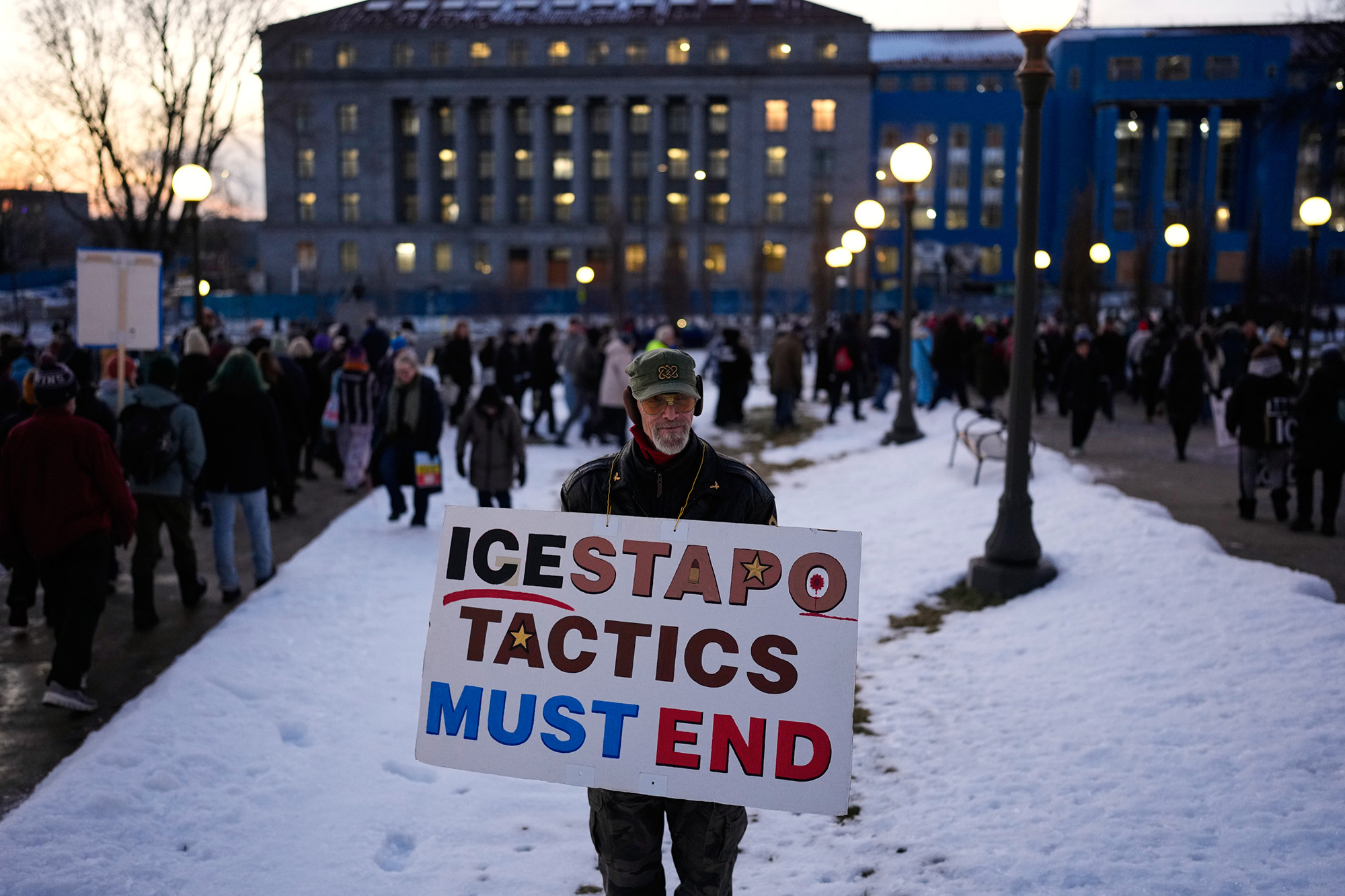
Man standing in the snow holding a sign that reads ICEStapo Tacitcs Must End"

Larry T., who did not want to give his last name, is at the Minnesota State Capitol in St. Paul, holding a sign during a vigil honoring Renée Good.John Locher/AP

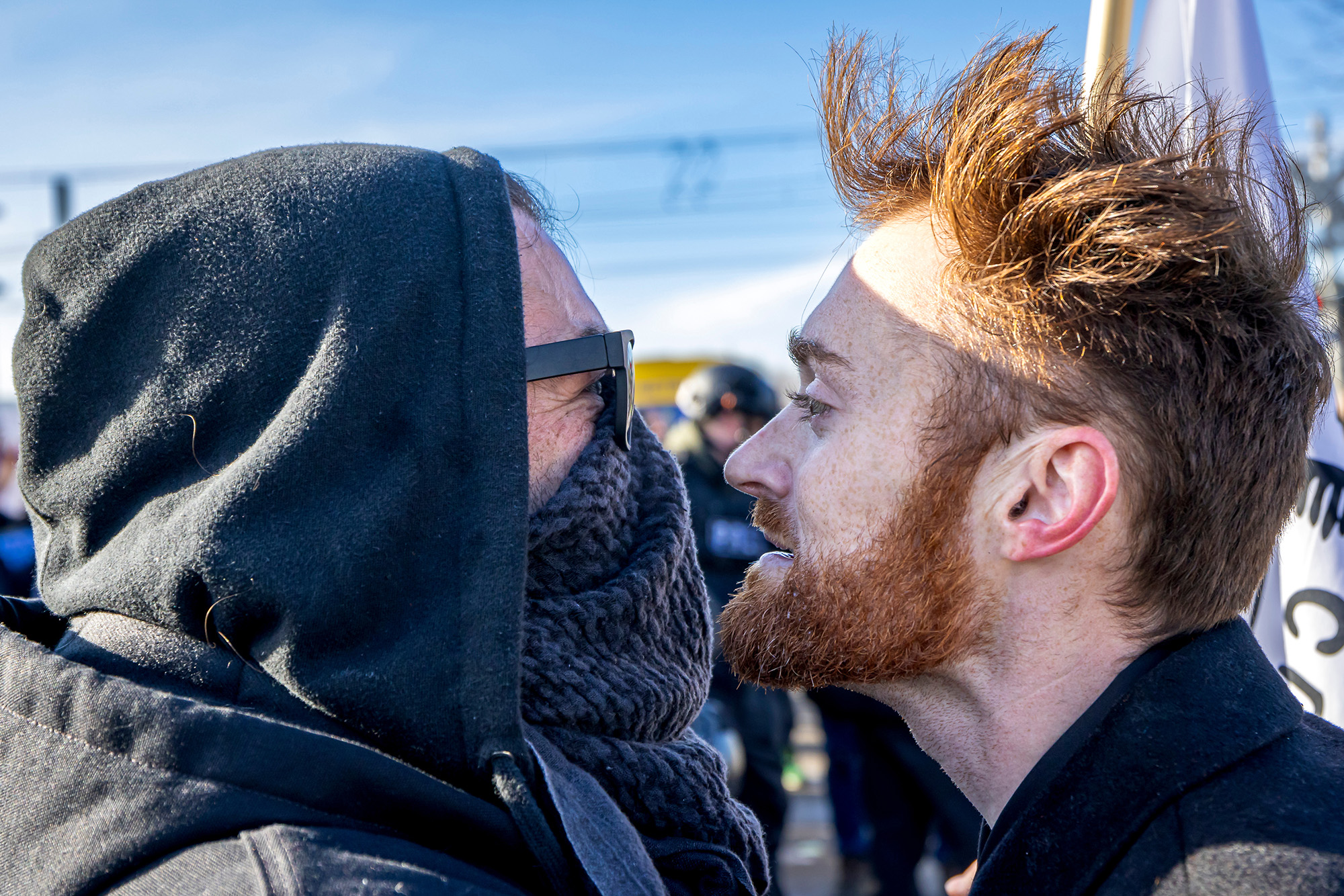
Two men, face-to-face, staring at each other.

Demonstrators confront counter-protesters during a protest outside the Bishop Henry Whipple Federal Building in Minneapolis. Michael Nigro/Sipa USA/AP

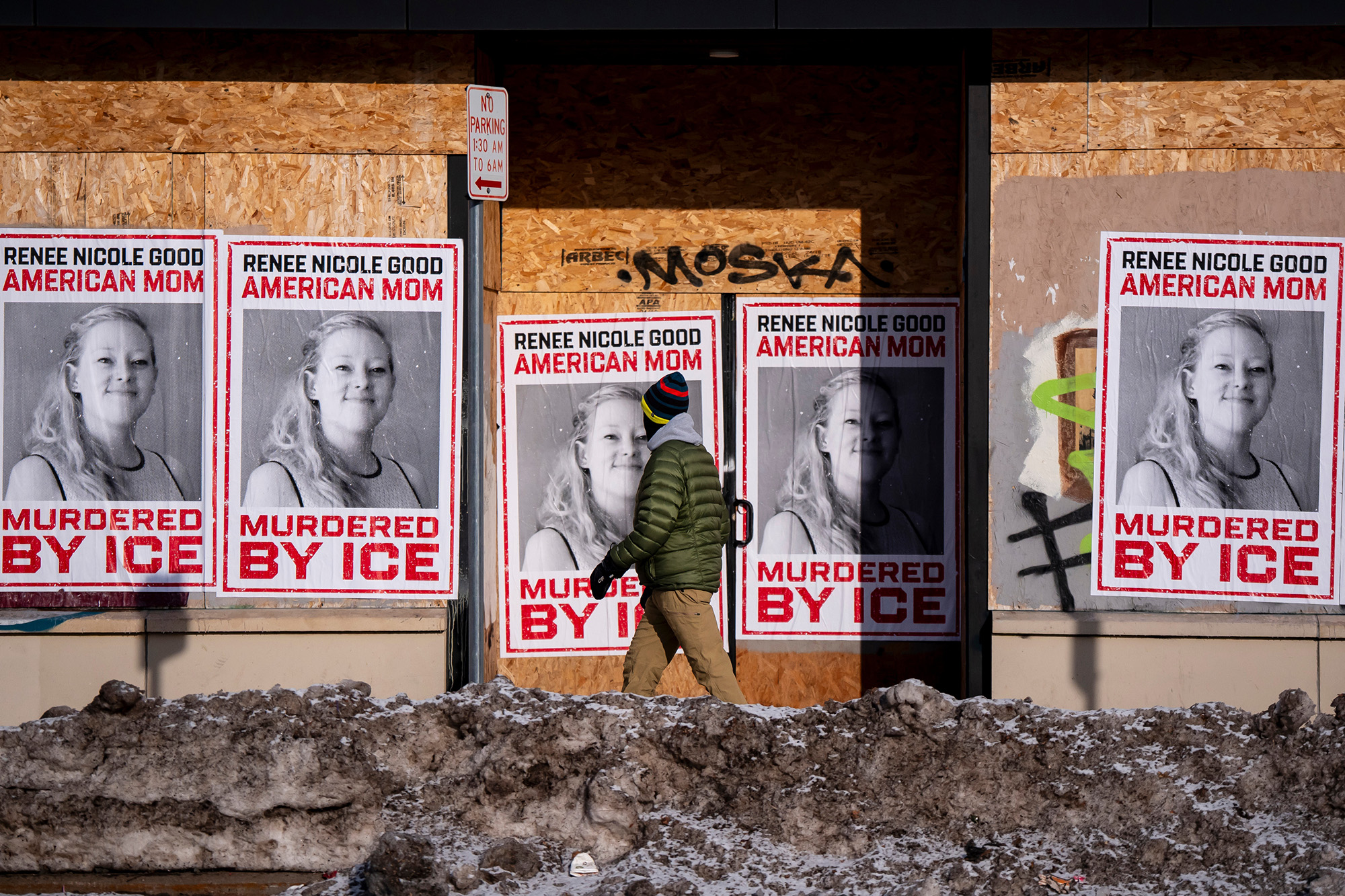
Person walks past large posters featuring Renee Good.

A person walks past signage memorializing Renée Good, who was fatally shot by an ICE officer earlier in the week.Christopher Katsarov/The Canadian Press/AP

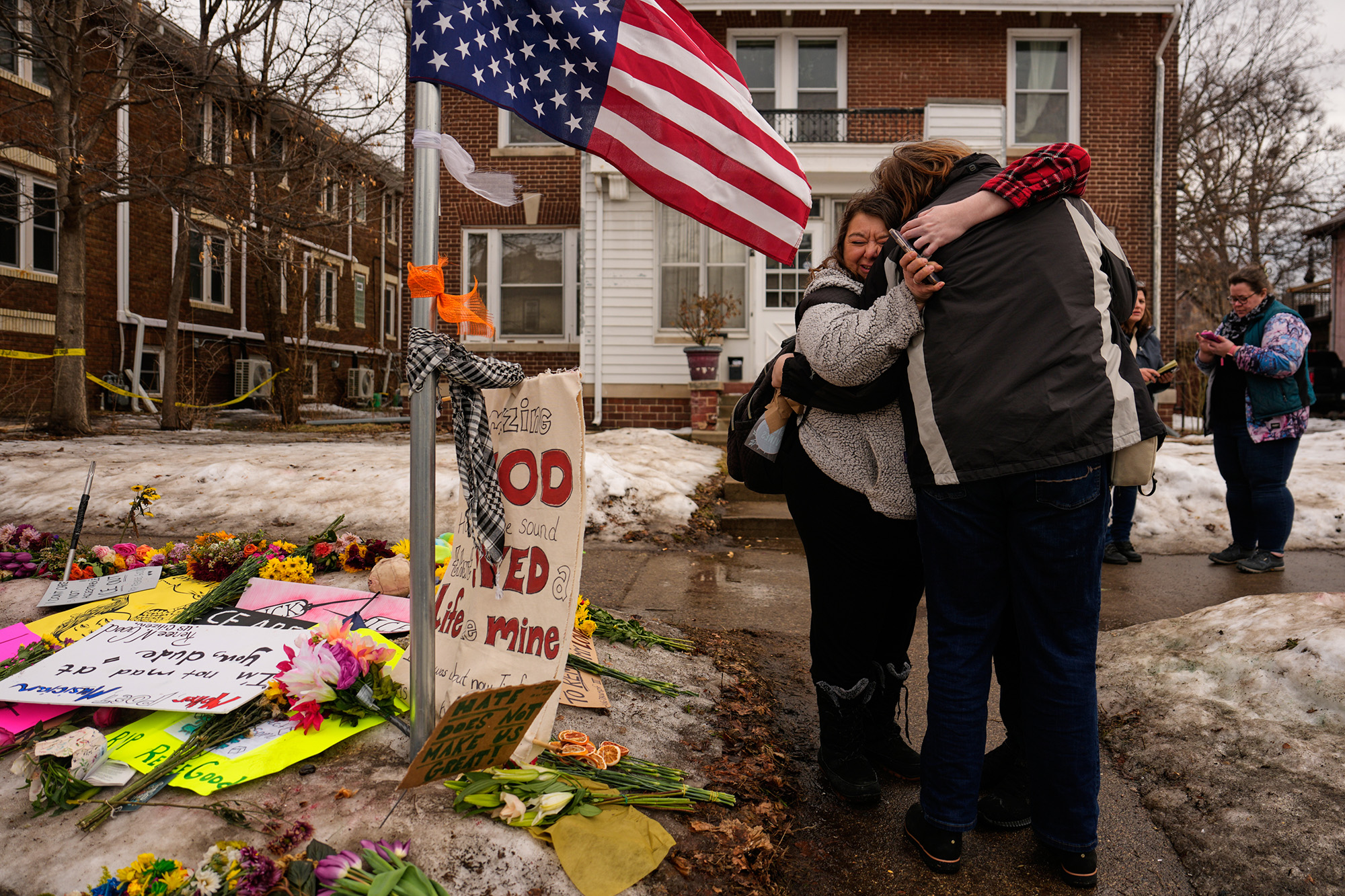
Two people hug under and American flag, next to a memorial for Renee Good.

People embrace while visiting a makeshift memorial for Renée Good.

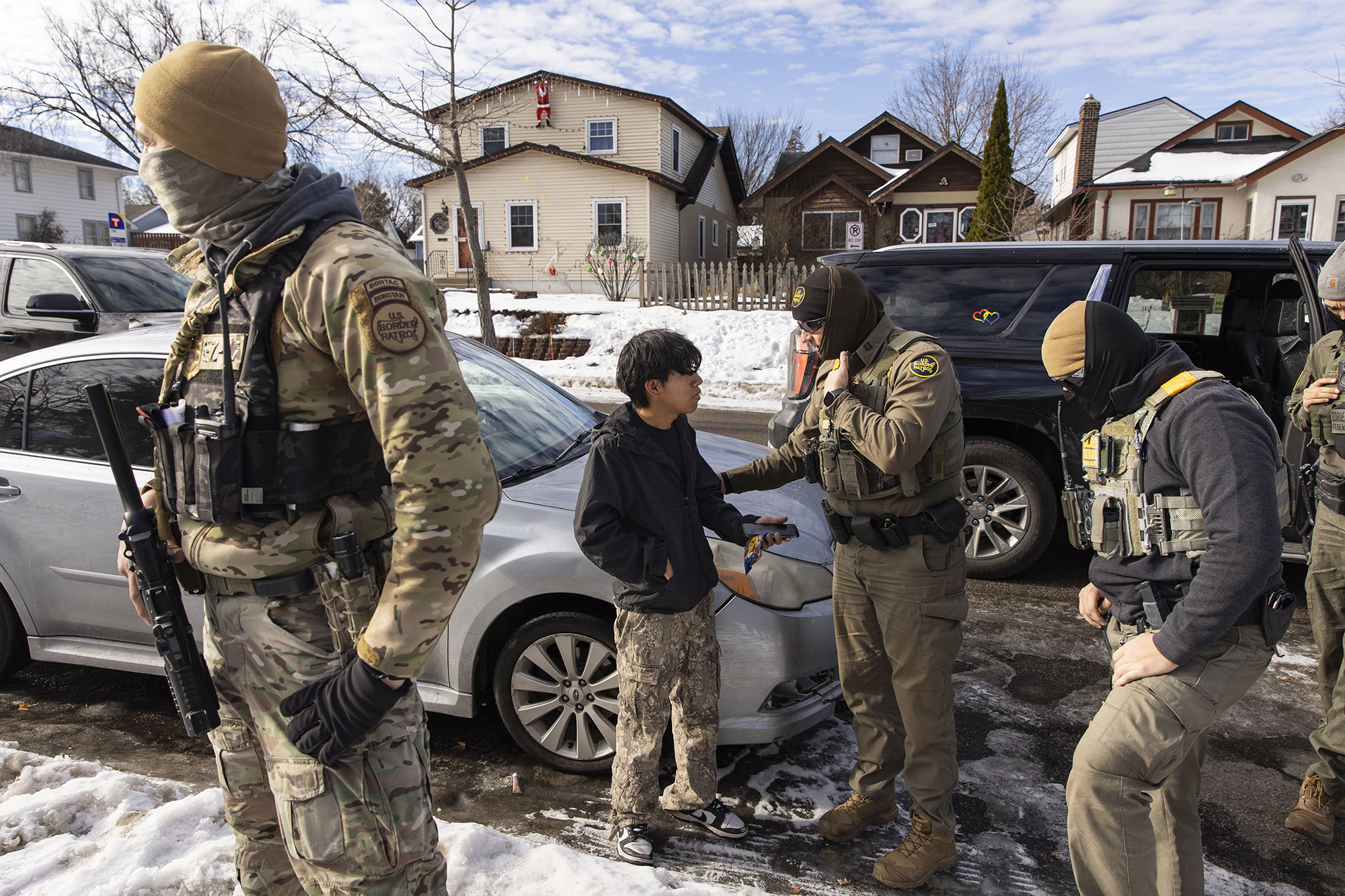
Border Patrol agents surround a young boy as another agent talks to him.

US Border Patrol agents question a minor before arresting him during immigration enforcement operations.Mostafa Bassim/Anadolu/Getty

A federal agent in a gas mask exits an SUV.

Federal Agents clash with community members during the ongoing immigration raids in Minneapolis.Mostafa Bassim/Anadolu/Getty

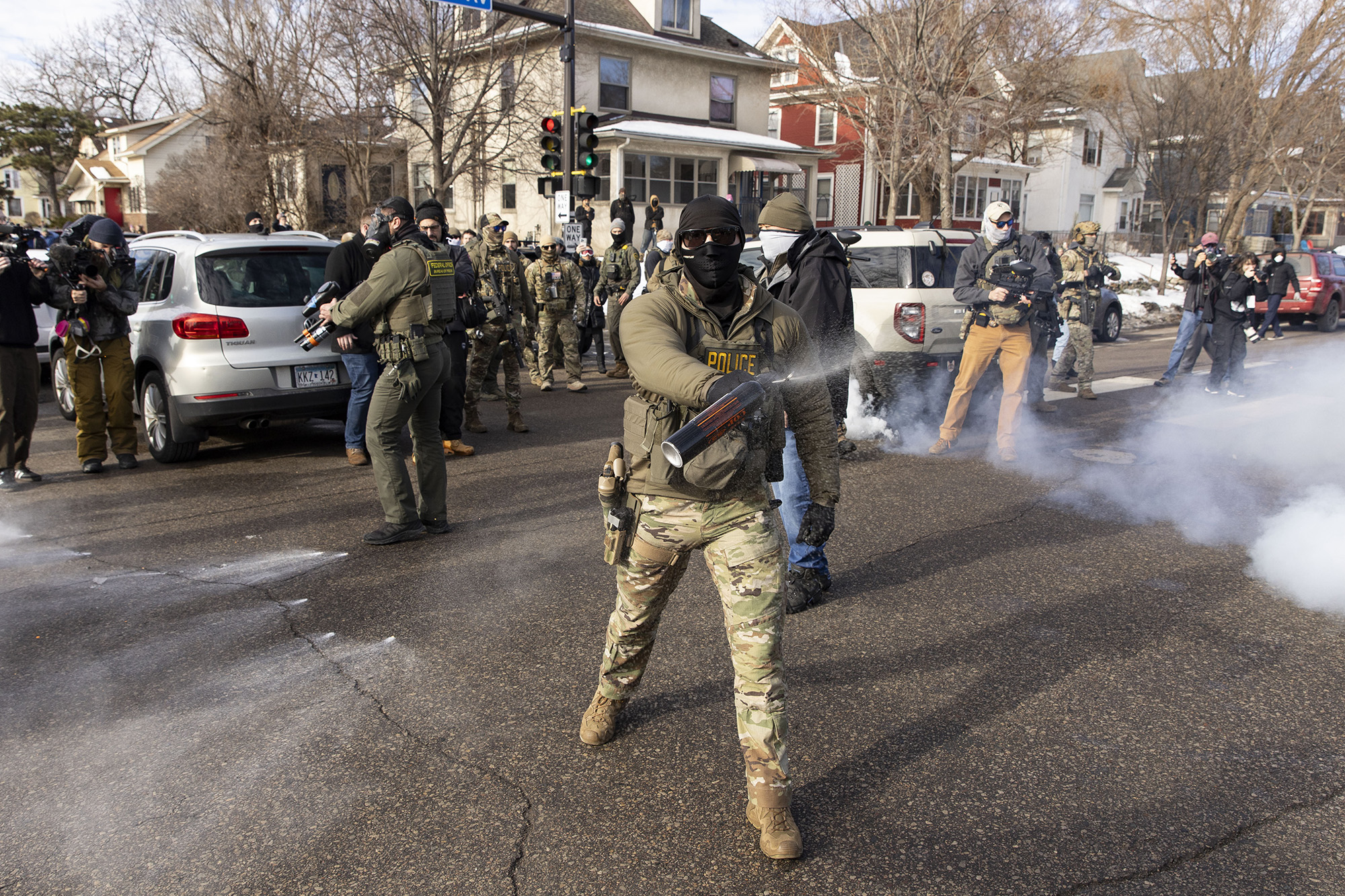
Federal agent sprays a crowd with pepper spray.

A Federal Agent deploys pepper spray against community members during the ongoing immigration raids in Minneapolis.Mostafa Bassim/Anadolu/Getty

A federal agent smashes a car window.

A federal officer breaks a car window as they remove a woman from her vehicle near an area where ICE was operating in Minneapolis. Octavio Jones/AFP/Getty

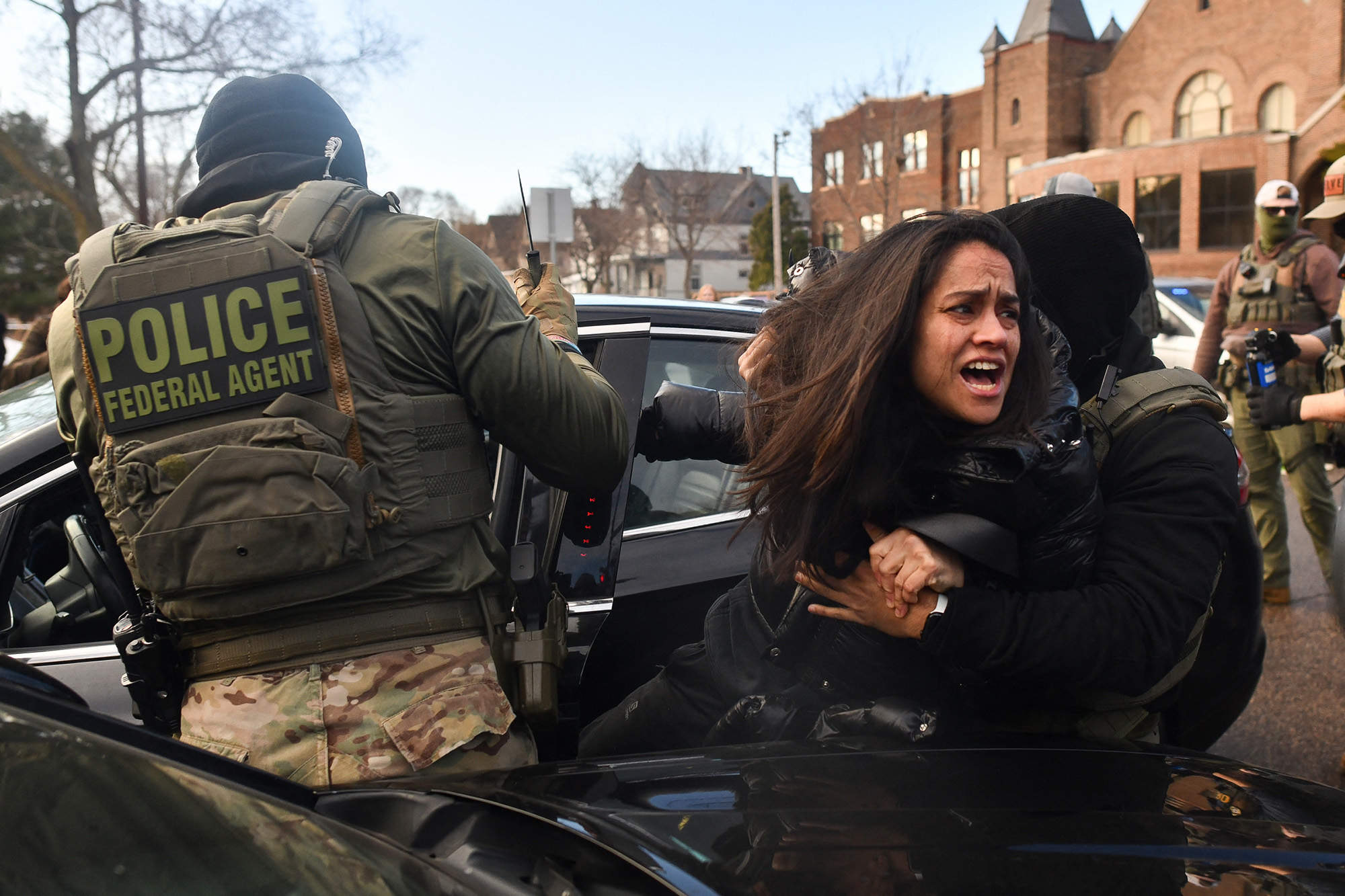
A frightened woman is pulled from her car by federal agents.

ICE and other federal officers pull a woman from her vehicle in Minneapolis. Hundreds more federal agents were heading to Minneapolis, the US homeland security chief said on January 11, brushing aside demands by the city’s Democratic leaders to leave after an immigration officer fatally shot a woman protester.Octavio Jones/AFP/Getty

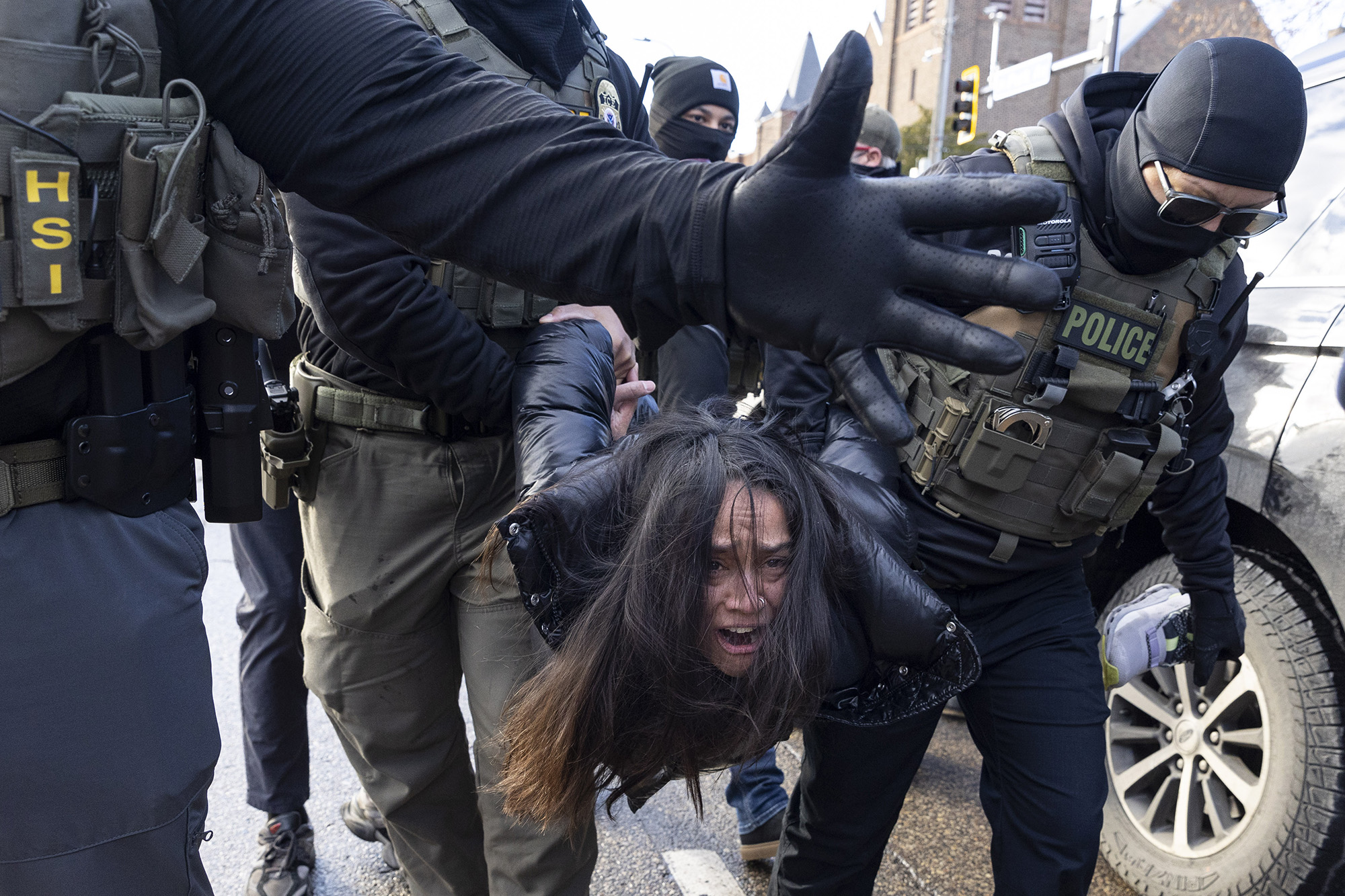
Federal agents carry a woman away.

Federal Agents arrest a woman after smashing her car windows for allegedly blocking the street during an Immigration Enforcement Operation in Minneapolis.Mostafa Bassim/Anadolu/Getty

Person holding a sign that reads, "Not Helping, ICE" in front of a line of federal agents.

Demonstrators confront federal agents as they protest outside the Whipple Federal Building in Minneapolis. Protests have popped up around the city after a federal agent fatally shot a woman in her car.Scott Olson/Getty

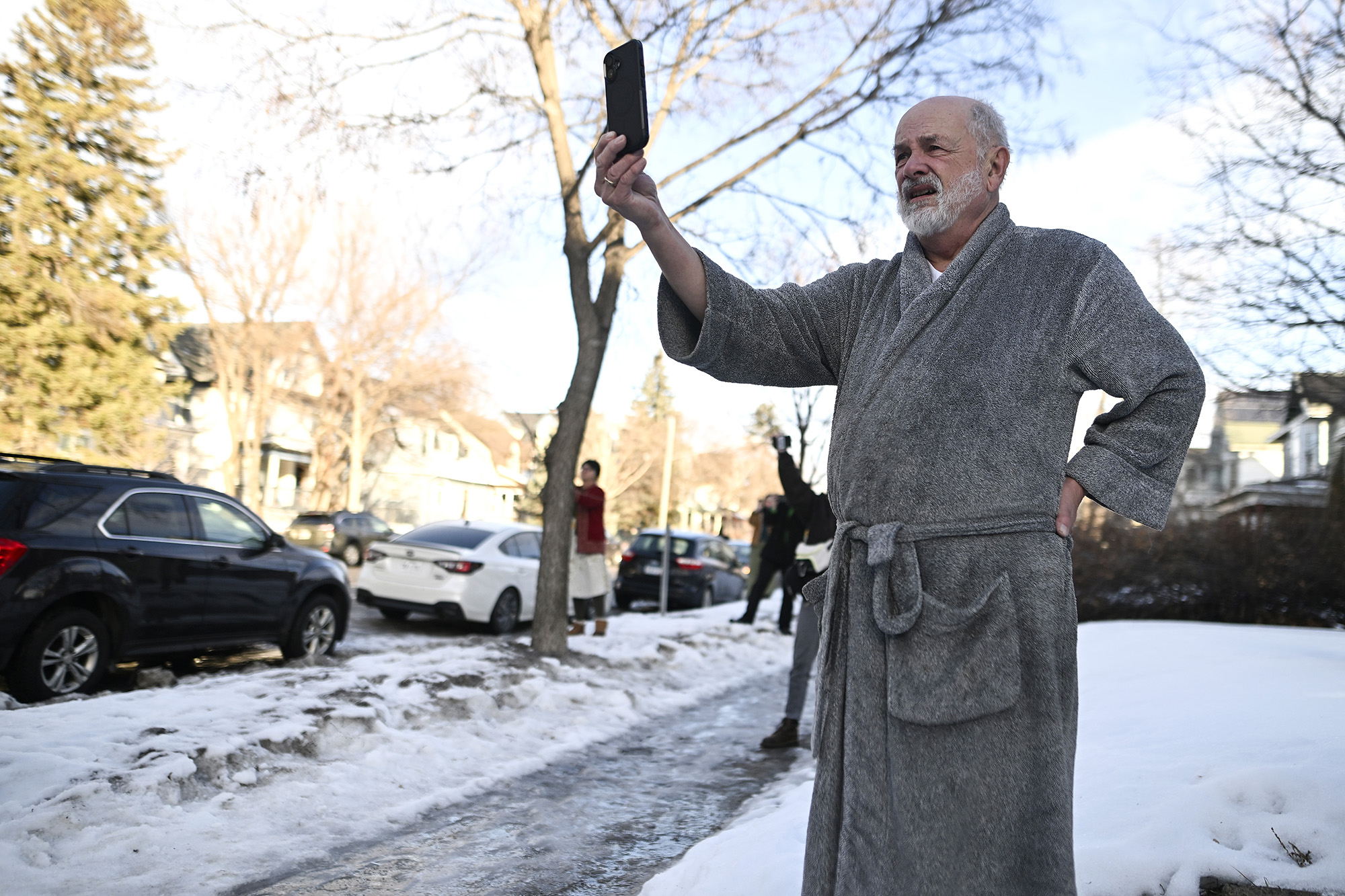
A man in a bathrobe standing in the snow films ICE agents.

A resident films as people gather to confront ICE agents after two people from a residence were detained. The Trump administration has deployed over 2,400 Department of Homeland Security agents to the state of Minnesota in a push to apprehend undocumented immigrants. Stephen Maturen/Getty

Two ICE agents hanging out of doors of an SUV hit with a snowball.

Agents are hit with snowballs while patrolling the streets in Minneapolis.Michael Nigro/Sipa USA/AP

Continue Reading…

Mother Jones

The Evangelicals Who Think Iran’s Protests Mean Jesus Is Returning

In Iran, millions of protesters have taken to the streets to protest the repressive religious regime that has ruled the country for more than four decades. The response of the government, led by Ayatollah Ali Khamenei, has been swift and brutal, with thousands of protesters reportedly killed. All over the world, onlookers are cheering the courage of the Iranian people who are risking their lives to fight for their freedom. In a video posted on X, Reza Pahlavi, the son of the shah who led the country for 38 years until he was ousted by the current regime in 1979, vowed, “We will completely bring the Islamic Republic and its worn-out, fragile apparatus of repression to its knees.” In a Tuesday post on Truth Social, President Donald Trump encouraged the Iranian people to “KEEP PROTESTING—TAKE OVER YOUR INSTITUTIONS!!!”

But for some Christians, the Iranian protests are more than just a popular uprising; they are the fulfillment of ancient Biblical prophecies that foretell the second coming of the Messiah. Last June, shortly after the United States bombed Iran, I wrote about the US evangelicals who were cheering that move:

Broadly speaking—though there are certainly exceptions—many of the most ardent supporters of Trump’s decision to bomb Iran identify as Christian Zionists, a group that believes that Israel and the Jewish people will play a key role in bringing about the second coming of the Messiah. As Christians, they are called to hasten this scenario, says Matthew Taylor, a senior scholar at the Institute for Islamic, Christian, and Jewish Studies in Baltimore and author of The Violent Take It by Force: The Christian Movement That Is Threatening Our Democracy. “The mission, so to speak, is to get the Jews back to Israel and to establish themselves within Israel,” he says. “Then you fulfill the preconditions, or one of the preconditions, for the second coming.”

The dark side of this theology, Taylor added, is that in this version of the end times, once the Messiah comes, the Jews will either convert to Christianity or perish.

Ben Lorber, a senior research associate with the far-right monitoring group Political Research Associates, explained via email this week that for Christian Zionists, Iran is “an embodiment of the satanic force of fundamentalist Islam, arrayed in a ‘clash of civilizations’ against the Judeo-Christian West, represented by America and Israel.” The uprising, therefore, is a good thing—but not only because of liberation from an oppressive regime. “An apocalyptic war between these players is often seen as a precondition and sure sign of the End Times,” and by extension, the second coming.

Christian Zionists agree on those broad strokes, but they’re a little fuzzier on the details—there is some disagreement as to exactly what part of the Bible predicts the current geopolitical situation. Some believe that God is using President Trump to protect Israel from Iran. As I wrote in June:

Hours before news of the bombing broke, Lance Wallnau, an influential [charismatic Christian] leader with robust ties to the Trump administration—last year, he hosted a Pennsylvania campaign event for JD Vance—warned his 129,000 followers on X, “Satan would love to crush Israel, humiliate the United States, destroy President Trump’s hope of recovery for America, and plunge the world into war.” But then he reassured them: “That’s not going to happen. Why? I was reminded again just a few moments ago what the Lord told me about Donald Trump in 2015.” He explained that he had received a message from God that Trump was a “modern-day Cyrus,” an Old Testament Persian king whom God used to free the Jews, his chosen people. In a video posted two days after the bombing, Wallnau concluded that the prophecy was coming true. “Jesus is coming back, and I believe this is all part of him setting the stage for his return,” he said.

For other evangelicals, current events echo the Old Testament book of Daniel, in which Michael, Israel’s guardian angel, battles a demon named the Prince of Persia. After a long period of suffering and much turmoil, God ultimately wins.

Others see yet another Bible story playing out—but with the same outcome. Last week, the Christian Zionist news site Israel365 News ran a story laying out the details of the prophecy. This particular prophecy can be found in the book of Jeremiah, in which God promises to wipe out the brutal military forces in the Iranian city of Elam before restoring order there.

Israel365’s article focuses on Marziyeh Amirizadeh, an Iranian Christian who fled to the United States when she was imprisoned and sentenced to death for her conversion. In it, she describes a 2009 dream she had when she was in prison. “God said that He is giving a chance to these people to repent, and if they do not, He will destroy them all,” she explains. And now, with the protests, “God’s justice against the evil rulers of Iran has already started, and he will destroy them all to restore his kingdom through Jesus.”

“The Bible can open the eyes of Iranians to the truth,” she adds. “Therefore, inviting Iranians to Christianity is very important because the majority of Iranians have turned their back on Islam and do not want to be Muslims anymore.”

“Inviting Iranians to Christianity is very important because the majority of Iranians have turned their back on Islam and do not want to be Muslims anymore.”

Her remarks refer to widespread claims that Muslims in Iran are converting to Islam in droves. In an article last year, for example, the Christian Broadcasting Network reported that “millions” of Iranian Muslims had recently converted to Christianity and that most of the country’s mosques had closed as a result.

The claims of the extent of the conversions are impossible to verify—there is scant hard evidence of a dramatic uptick in them. Practicing Christianity is illegal in Iran, and converts can face the death penalty.

But believers remain convinced that the uprising is part of a cosmic plan. Sean Feucht, a Christian nationalist musician who organizes prayer rallies at state capital buildings, told his 205,000 followers on X last week, “While they build mosques across Texas, they are burning them down in Iran!” He added a lion emoji, which some evangelical Christians use to symbolize Jesus.

In a blog post on Tuesday, Colorado evangelist Dutch Sheets, a key figure in the campaign to overturn the 2020 election and the lead-up to January 6, offered a prayer asking God to free the Iranian people “from Iran’s tyrannical government and the evil principality that controls it,” adding a plea for “an earth-shaking revival.”

Tim Ballard, who has been accused of sexual misconduct and is the leader of an anti-trafficking group, posted to his 166,000 followers earlier this month, “Jesus is also making a move in Iran.” Over the last few days, Trad West, an anonymous account on X with 430,000 followers, has repeatedly posted “Iran will be Christian.”

As the protests wear on, the government’s retaliation is intensifying. With information on the crackdown tightly controlled by the regime, and strictly curtailed citizen access to the internet, the precise death toll so far is unclear. According to reporting from CBS, the UK government estimates that 2,000 protesters have been killed, while some activists believe the total could be as much as 10 times that figure.

“Revolution is inevitable in Iran,” Feucht, the Christian musician, said in another tweet. “It’s prophecy, and it is going to happen.”

Continue Reading…

Mother Jones

America’s New Era of Violent Populism Is Here

A year ago this month, President Donald Trump granted clemency to nearly 1,600 people responsible for the January 6 insurrection at the US Capitol. When Robert Pape, a University of Chicago political science professor who studies domestic political violence, heard about the pardons, he says he immediately thought it was “going to be the worst thing that happened in the second Trump presidency.”

The first year of Trump’s second term has been a blizzard of policies and executive actions that have shattered presidential norms, been challenged in court as unlawful, threatened to remake the federal government, and redefined the limits of presidential power. But Pape argues that Trump’s decision to pardon and set free the January 6 insurrectionists, including hundreds who had been found guilty of assaulting police, could be the most consequential decision of his second term.

“There are many ways we could lose our democracy. But the most worrisome way is through political violence,” Pape says. “Because the political violence is what would make the democratic backsliding you’re so used to hearing about irreversible. And then how might that actually happen? You get people willing to fight for Trump.”

On this week’s More To The Story, Pape talks with host Al Letson about how America’s transformation to a white minority is fueling the nation’s growing political violence, the remarkable political geography of the insurrectionists, and the glimmers of hope he’s found in his research that democracy can survive this pivotal moment in history.

Find More To The Story on Apple Podcasts, Spotify, iHeartRadio, Pandora, or your favorite podcast app, and don’t forget to subscribe.

This following interview was edited for length and clarity. More To The Story transcripts are produced by a third-party transcription service and may contain errors.

Al Letson: Bob, how are you today?

Robert Pape: Oh, I’m great. I’m terrific. This is just a great time to be in Chicago. A little cold, but that’s Chicago.

I was about to say, great time for you. I’m a Florida boy, so I was just in Chicago, I was like, let me go home. So Bob, I thought I would kind of start off a little bit and kind of give you my background into why I’m really interested about the things that we’re going to be talking about today, right after Charlottesville happened. When I look back now, I feel like it was such a precursor for where we are today. And also I think in 2016 I was looking back and it felt like… Strangely, it felt like Oklahoma City, the bombing in Oklahoma City was a precursor for that. Ever since then, I’ve just really been thinking a lot about where we are as a society and political violence in America. The origins of it, which I think are baked deeply into the country itself. But I’m also very interested on where we’re going, because I believe that leadership plays a big role in that, right? And so when you have leaders that try to walk us back from the edge, we walk back from the edge. When you have leaders that say charge forward, we go over the edge. And it feels like in the last decade or so we’ve been see-sawing between the two things.

So let me just say that you are quite right, that political violence has been a big part of our country and this is not something that is in any way new to the last few years. And that’s also why you can think about this when you talk about 2016, going back to 1995, with the Oklahoma City bombing here and thinking about things from the right and militia groups and right-wing political violence. Because that in particular from the seventies through 2016, even afterwards of course, has been a big part of our country and what we’ve experienced. But I just have to say a big but here, it’s not just the same old story. Because starting right around 2016, it would’ve been hard to know this in 2016 and even really 2017, ’18 and ’19, you were there right at the beginning of a new layer, so to speak, of political violence that is growing.

It’s not that the old layer went away, which is why it’s been a little bit, I think, mystifying and confusing for some folks, and that’s folks who even cover this pretty closely, like the Southern Poverty Law Center and the Anti-Defamation League and so forth. Because it took a few years before they started to see that there was some new trends emerging, growing political violence. It was getting larger. The old profiles of who was doing the violent attacks were starting to widen. And in many ways that’s scarier and more dangerous than if they’re kind of narrow because we like our villains to be monsters who are far away from us and they couldn’t possibly be living next door to us. Whereas the closer they come, the more edgy it feels. So what you’re really experiencing there is the very beginning of where I date the beginning of our shift to the era of violent populism. We’re in a new world, but it’s a world on top of the old world. The old world didn’t go away.

No, no, no. It feels like the old world is really the foundation that this new house of violence has been raised around. All of that that happened in the past was the foundation. And then in 2016, 2017, some people would say 2014, in that timeframe, the scaffolding began to go up and then Trump gets into office and then suddenly it’s a full-blown house that now all of America is living in.

Well, if you look at the attacks on African-Americans, on Jews and Hispanics, except for going all the way back to the 1920 race time, except for that, these large-scale attacks have clustered since 2016. Then we have the Tree of Life Synagogue in 2018, that’s the largest attack killing, mass killing of Jews ever in the United States. And then we have August, 2019, the attack at the El Paso Walmart killing more Hispanics in a day than has ever been killed in our country. So there’s a pointed wave, if you see what I mean here. And race is certainly playing a role.

So when you say how does this tie to the old layer or the existing layer, one of the big foundations here is absolutely race. What’s really sad and really tragic is in this new era of violent populism, that’s a term I like to use because it’s not just the same old, but it’s not quite civil war. In this new era, we’ve seen things move from the fringe where they were bad but happened more or less rarely, to more the mainstream where they’re happening more and more. And our surveys show this, people feel very fearful right now, and there’s actual reason for that. That’s not just media hype. There have been more events. We see them and they are real. We really have a time here that people are, I’m sorry to say, concerned. And there’s reason to be concerned.

Yeah, as you say, the thing that pops up in my mind is the fact that white supremacy, which I think for a long time held sway over this country. And then I think that white supremacy in a lot of ways always held onto the power. But there was a time where being a racist was not cool and looked down upon. And so racism, while still evident, still holding people down, it’s built into institutions, all of that. I’m not saying that racism was away, I’m just saying that expressing it openly is now in the mainstream. I mean, we just heard President Trump recently talking about Somalis-

Absolutely, yeah.

In a very… I mean, just straight up, there is no difference between what he said about Somalis than what a Klansman in the forties in front of a burning cross would say about Black people, like zero difference.

Yeah. So the reason I think we are in this new era, because I think you’re right, putting your finger on the mainstreaming of fringe ideas, which we used to think would stay under rocks and so forth, and white supremacy clearly fits that bill. But what I think is important to know is that we are transitioning for the first time in our country’s history from a white majority democracy to a white minority democracy. And social changes like that in other countries around the world, so I’ve studied political violence for 30 years in many countries around the world. Big social changes like that Al, often create super issues with politics, make them more fragile and often lead to political violence. Now, what’s happening in our country is that we’ve been going through a demographic change for quite some time. America up through the 1960s was about 85% white as a country. There was ebbs and flows to be sure. Well, that really started to change bit by bit, drip by drip in the mid 1960s, whereas by 1990 we were 76% white as a country. Today we’re 57% white as a country.

In about 10 or 15 years, it depends on mass deportations, and you can see why then that could be an issue, we will become truly a white minority democracy for the first time. And that is one of the big issues we see in our national surveys that helps to explain support for political violence on the right. Because what you’re seeing Al, is the more we are in what I call the tipping point generation for this big demographic shift, the more there are folks on the right, and most of them Trump supporters, mega supporters, who want to stop and actually reverse that shift. Then there of course, once knowing that, there are folks on the left, not everybody on the left, but some on the left that want to keep it going or actually accelerate it a bit for fear that with the mega crowd you won’t get it, the shift will stop altogether. These are major issues and things that really rock politics and then can lead to political violence.

Talk to me a little bit about January 6th, when that happened, I’m sure you were watching it on TV.

Yeah.

What were you thinking as all of it was kind of coming into play?

Well, so I was not quite as surprised as some folks, Al. So on October 5th in Chicago, I was on the Talking Head show in Chicago, it’s called Chicago Tonight. So on October 5th, 2020, that was just after the Trump debate where he said to the Proud Boys, stand back, but stand by. Well, the Chicago folks brought me on TV to talk about that, and I said that this was really quite concerning because this has echoes of things we’ve seen in Bosnia with some other leaders that a lot of Americans are just not familiar with, but are really quite worrisome. And I said what this meant was we had to be worried about the counting of the vote, not just ballot day, the day of voting. And we had to be worried about that all the way through January 6th, the certification of the election. But you made a point earlier, Al, about the importance of leaders.

This is part of the reason why it’s hard to predict. It’s not a precise science, political violence. I like to use the idea, the analogy of a wildfire when I give talks. When we have wildfires, what we know as scientists is we can measure the size of the combustible material and we know with global warming, the combustible dry wood that could be set afire is getting larger. So you know you’re in wildfire season, but it’s not enough to predict a wildfire because the wildfire’s touched off by an unpredictable set of triggers, a lightning strike, a power line that came down unpredictably. Well, that is also a point about political leaders.

So it was really, I did see some sign of this that Donald Trump said too about the Proud Boys, stand back and stand by. And no other president had said anything like that ever before in our history, let’s be clear. And because of my background studying political violence, I could compare that to some playbooks from other leaders in other parts of the world. That said, even I wouldn’t have said, oh yeah, we’re 90% likely to have an event, because who would’ve thought Donald Trump would’ve given the speech at the Ellipse, not just call people to it, it will be wild. His speech at the Ellipse, Al, made it wild.

You co-authored a pretty remarkable study that looked at the political geography of January 6th insurrectionists. Can you break down the findings of that paper?

Yeah. So one of the things we know when we study as a scholar of political violence, we look at things other people just don’t look at because they just don’t know what’s important. We want to know, where did those people live, where’d they come from? And when you have indictments and then you have the court process in the United States, you get that as a fact. So now it does mean I had to have big research teams. There’s a hundred thousand pages of court documents to go through. But nonetheless, you could actually find this out. And we found out something stunning, Al, and it’s one of the reasons I came back to that issue of demographic change in America. What we found is that first of all, over half of those who stormed the capitol, that 1,576 were doctors, lawyers, accountants, white collar jobs, business owners, flower shop owners, if you’ve been to Washington DC, Al, they stayed at the Willard. I have never stayed at the Willard-

Yeah.

So my University of Chicago doesn’t provide that benefit.

That is crazy to me because I think the general knowledge or what you think is that most of the people that were there were middle class to lower, middle class to poor. At least that’s what I’ve always thought.

Yeah, it’s really stunning, Al. So we made some snap judgments on that day in the media that have just stayed with us over and over and over again. So the first is their economic profile. Whoa, these are people with something to lose. Then where did they come from? Well, it turned out they came from all 50 states, but huge numbers from blue states like California and New York. And then we started to look at, well, where are in the states are they coming from? Half of them came from counties won by Joe Biden, blue counties. So then we got even deeper into it. And what’s happening, Al, is they’re coming from the suburbs around the big cities. They’re coming from the suburbs around Chicago, Elmhurst, Schomburg. They’re not coming from the rural parts of Illinois. They’re coming… That’s why we call them suburban rage. They’re coming from the most diversifying parts of America, the counties that are losing the largest share of white population.

Back to that issue of population change, these are the people on the front lines of that demographic shift from America is a white majority democracy, to a white minority democracy. These are the counties that will impact where the leadership between Republican and Democrat have either just changed or are about to change. So they are right on the front lines of this demographic change and they are the folks with a lot to lose. And they showed up, some took private planes to get there. This is not the poor part, the white rural rage we’re so used to hearing about. This is well off suburban rage, and it’s important for us to know this, Al, because now we know this with definitiveness here. So it’s not like a hand-wavy guess. And it’s really important because it means you can get much more serious political violence than we’re used to thinking about.

Yeah. So what happens, let’s say if circumstances remain as they are, IE, the economy is not doing great, the middle class is getting squeezed and ultimately getting smaller, right? The affordability thing is a real issue. What wins?

The first big social change that’s feeding into our plight as a country is this demographic social change. There’s a second one, Al, which is that over the last 30 years, just as we’re having this demographic shift to a white minority democracy, we have been like a tidal wave flowing wealth to the top 1%. And we’ve been flowing wealth to the top 1% of both Republicans and Democrats. And that has been coming out of the bottom 90% of both Republicans and Democrats. Unfortunately, both can be poorer and worse off.

Whites can be worse off because of this shift of the wealth to the top 1%. And minorities can be worse off because of the shift. And you might say, well, wait a minute, maybe the American dream, we have social mobility. Well, sorry to say that at the same time, we’re shifting all this money to the top 1%, they’re spending that money to lock up and keep themselves to top 1%. It’s harder to get into that top 1% than it’s ever been in our society. And so what you see is, I just came back from Portland. What you see is a situation in Portland, which is a beautiful place, and wonderful place where ordinary people are constantly talking about how they’re feeling pinched and they’re working three jobs.

Yeah.

Just to make their middle, even lower middle class mortgages. I mean, this is what’s happening in America and why people have said, well, why does the establishment benefit me? Why shouldn’t I turn a blind eye if somebody’s going to attack the establishment viciously? Because it’s not working for a lot of folks, Al. And what I’m telling you is that you put these two together, you get this big demographic change happening, while you’re also getting a wealth shift like this and putting us in a negative sum society. Whoa, you really now have a cocktail where you’ve got a lot of people very angry, they’re not sure they want to have this shift and new people coming into power. And then on top of that, you have a lot of people that aren’t sure the system is worth saving.

I really wanted to dive in on the polls that you’ve been conducting, and one of those, there seems to be a small but growing acceptance of political violence from both Democrats and Republicans. What do you think is driving that?

I think these two social changes are underneath it, Al. So in our polls, just to put some numbers here, in 2025, we’ve done a survey in May and we did one in the end of September. So we do them every three or four months. We’ll do one in January I’m sure. And what we found is that on both sides of the political spectrum, high support for political violence. 30% in our most recent survey in September, 30% of Democrats support the use of force to prevent Trump from being president. 30%. 10% of Democrats think the death of Charlie Kirk is acceptable. His assassination was acceptable. These represent millions and millions of adults. That’s a lot of people, you see. What you’re saying is right, we’re seeing it. And I think what you’re really seeing here is as these two changes keep going, this era of violent populism is getting worse.

Yeah, I mean, so I’ve seen that Democrats and Republicans are accusing each other of using violent rhetoric. So in your research, what’s actually more common in this modern area where we are right now, is it right wing or left wing on the violent rhetoric, but also who’s actually doing it?

So we’ve had, just after the Kirk assassination, your listeners will probably remember and they can Google, we had these dueling studies come out almost instantly, because they’re kind of flash studies and they’re by think tanks in Washington DC. One basically saying there’s more right-wing violence than left. And one saying there’s more left-wing violence than right. Well, I just want your listeners to know that if you go under the hood, so my job is to be like the surgeon and really look at the data. You’re going to be stunned, maybe not so stunned, Al, because you live in the media, to learn the headlines and what’s actually in the content are very different.

Both studies essentially have the same, similar findings, although slightly different numbers, which is they’re both going up. They’re both going up. So it’s really not the world that it was either always been one side or now it’s newly the other. So the Trump administration’s rhetoric, JD Vance is wrong to say it’s all coming from the left, but it’s also wrong to say it’s all coming from the right. Now, what I think you’re also seeing, Al, is that the politicians, if left to their own devices, rarely, I’m sorry to say do the right thing, they cater to their own constituents. But there’s some exceptions and they’ve been helpful, I think. There’s two exceptions I want to draw attention to, one who’s a Republican and one who’s a Democrat.

On the Democratic side, the person who’s been just spectacular at trying to lower the temperature is Governor Shapiro. He’s a Democrat, the Governor of Pennsylvania. Josh Shapiro has given numerous interviews public, where he has condemned violence on all sides. He’s recognizing, as very few others are, that it’s a problem on both sides. He personally was almost burned to death, only minutes from being burned to death with his family here back in April. So he knows this personally about what’s at stake and he has done a great job, I think in recognizing that here.

Now on the Republican side, we have Erika Kirk and what Erika Kirk, of course the wife of Charlie Kirk who was assassinated did, was at Kirk’s funeral, she forgave the shooter. But let’s just be clear, she’s a very powerful voice here. Now, I think we need more of those kind of voices, Al, because you see, they really are figures people pay attention to. They’re listening to people like that. They have personal skin in the game and they can speak with sort of a lens on this few others can. But we need more people to follow in that wake and I wish we had that, and that can actually help as we go forward. And I’m hoping they, both of those people will do more and more events, and others who have been the targets of political violence will come out and do exactly the same thing.

I want to go back a little bit to January 6th and just talk about those insurrectionists. So when President Trump pardoned them, what was going through your mind?

That it was probably going to be the worst thing that happened in the second Trump presidency. And I know I’m saying quite a bit. I know that he’s insulted every community under the sun many, many, many times. But the reason I’m so concerned about this, Al, is that there are many ways we could lose our democracy, but the most worrisome way is through political violence. You see, because the political violence is what would make the democratic backsliding you’re so used to hearing about, irreversible. And then how might that actually happen? You get people willing to fight for Trump.

And already on January 6th, we collected all the public statements on their social media videos, et cetera, et cetera, in their trials about why those people did it. And the biggest reason they did it was Trump told them so, and they say this over and over and over again, I did it because Trump told me to do it. Well, now Trump has not forgiven them, he’s actually helping them. They may be suing the government to get millions of dollars in ‘restitution’. So this is going in a very bad way if you look at this in terms of thinking you’re going to deter people from fighting for Trump. And now of course others are going to know that as well on the other side. So again, this is a very dangerous move. Once he pardoned it, no president in history has ever pardoned people who use violence for him.

Yeah. So you have the insurrectionist bucket. But there’s another bucket that I’ve been thinking about a lot and I haven’t heard a lot of people talk about this, and that is that under President Trump, ICE has expanded exponentially.

Yep.

The amount of money that they get in the budget is-

Enormous.

Enormous. I’ve never seen an agency ramp up, A, within a term, like so much money and so many people-

It is about to become its own army.

Right.

And Al, what this means concretely is, we really don’t want any ICE agents in liberal cities in October, November, December. We don’t want to be in this world of predicting, well, Trump would never do X, he would never do Y. No, we’ve got real history now to know these are not good ways to think. What we just need to do is we need to recognize that when we have national elections that are actually going to determine the future of who governs our country, you want nothing like those agents who, many of them going to be very loyal to Trump, on the ground.

We should already be saying, look, we want this to stop on October 1st to December 31st, 2026, and we want to have a clean separation, so there’s no issue here of intimidation. And why would you say that? It’s because even President Trump, do you really want to go down in history as having intimidated your way to victory? So I think we really need to talk about this as a country, Al. And we really want a clean break here in the three months that will be the election, the run-up to the election, the voting, and then the counting of the vote.

In closing, one of the major themes of this conversation has been that America is changing into a white minority. The question that just keeps coming to mind to me is, as somebody who studies this, do you think that America can survive that transition?

Well, I am going to argue, and I’m still a little nervous about it, but we are in for a medium, soft landing.

Okay.

One of the things we see is that every survey we’ve done, 70% to 80% of Americans abhor political violence. And that’s on both sides of the aisle. And I think in many ways there are saving grace and it’s why, Al, when we have public conversations about political violence, what we see in our surveys is that helps to take the temperature down. Because you might worry that, oh, we’ll talk about it, we’ll stir people up and they’ll go… It seems to be the other way around, Al, as best we can tell. That there’s 70% to 80% of the population that really, really doesn’t want to go down this road. They know intuitively this is just a bad idea. This is not going to be good for the country, for their goals. And so they are the anchor of optimism that I think is going to carry us to that medium soft landing here.

I think we could help that more if we have some more politicians joining that anchor of optimism. They’re essentially giving voice to the 70%, 80%. And if you look at our no Kings protests, the number of people that have shown up and how peaceful they have been, how peaceful they have been, those are the 70% to 80%, Al. And I think that gives me a lot of hope for the future that we can navigate this peacefully. But again, I’m saying it’s a medium soft landing, doesn’t mean we’re getting off the hook without some more… I’m sorry to say, likely violence, yeah.

Listen, I’ll take a medium. I would prefer not at all, but the way things are going, I’ll take the medium. Thank you very much. Bob, Professor Robert Pape, it has been such a delight talking to you. Thank you so much for taking the time out.

Well, thank you Al, and thanks for such a thoughtful, great conversation about this. It’s just been wonderful. So thank you very much.

Continue Reading…

Mother Jones

The Supreme Court Looks Likely to Uphold Transgender School Sports Bans

A Republican-appointed majority of Supreme Court justices appeared ready to uphold two state laws that ban transgender women and girls from participating on girls and women’s school sports teams. Though the scope of the rulings and how sweeping its implications will be both remain unclear, oral arguments on Tuesday showed there are likely at least five votes for upholding transgender sports bans in Idaho and West Virginia.

Justice Kavanaugh called sports a “zero-sum game” where trans players inevitably cost cis players.

The justices heard two cases on Tuesday, one brought by a college student in Idaho and one brought by a now-high school student in West Virginia. Going into oral arguments, there were fears that the justices—who have amassed a recent track record of ruling against the rights of trans people—might use the occasion to broadly undermine transgender rights, and not just in school sports. And in both cases, a majority of the court’s right wing appeared ready to rule in favor of the laws and against exceptions for either plaintiff. But whether or not the rulings would have further impact remained unclear. A decision in the cases is likely to come at the end of the term in June.

One key vote appears to be Chief Justice John Roberts, who six years ago joined the landmark Bostock decision finding that discrimination against gay and transgender people in employment contexts is illegal sex discrimination under Title VII of the 1964 Civil Rights Act. Bostock was a 6-3 decision authored by Justice Neil Gorsuch, and joined by Roberts as well as four Democratic appointees. There are now just three Democratic appointees, lowering the current Bostock majority down to five. But on Tuesday, when it comes to whether to allow banning trans students from sports, Roberts’ comments indicated that he was switching teams.

“In terms of Bostock, I understand that to say that discrimination on the basis of transgender status is discrimination on the basis of sex,” Roberts said Tuesday. “But the question here is whether or not a sex-based classification is necessarily a transgender classification.”

The idea put forth by Roberts here is that while transgender discrimination is part of the sex discrimination Venn diagram, rules limiting team membership to a single-sex do not necessarily target transgender people. This may be technically true, but it’s too cute in this context. It allows Roberts to ignore the obvious, purposeful effect of discriminating against trans people by using terms like biological sex rather than the term transgender. There is a long history of discriminating against classes of people without specifically naming the target—literacy tests and grandfather clauses come to mind.

Roberts’ comments are unsurprising. He made essentially the same argument last year in authoring the Skrmetti decision_,_ in which the court allowed states to ban gender affirming medical care for transgender minors on the grounds that the prohibitions were based on age and on medical use—even though it was clear that the laws were targeted at transgender kids. In this way, Roberts’ logic provides a door to more anti-trans discrimination under the guise of legitimate purposes.

Gorsuch, who authored Bostock, was harder to pin down during oral argument, but he too indicated that he sees school sports as different from Bostock‘s workplace context. Even if Gorsuch were to surprise courtwatchers and side with the plaintiffs, it appeared unlikely that there is a fifth vote to either strike down the laws or, as the three Democratic appointees were pushing for, allow exceptions for transgender athletes who prove they do not have a biological advantage over their cisgender teammates.

Justice Brett Kavanaugh raised the possibility using the case to ban trans students’ participation in sports in states where they are currently allowed to join girls and women’s teams, and even repeatedly asked whether allowing transgender women and girls to play alongside cis women and girls actually violated the rights of those cis teammates under Title IX, which requires equal opportunities in education. He called sports a “zero-sum game” in which a trans player inevitably costs a cis player a spot on the team, or the podium, or a college recruitment offer. The ACLU’s Joshua Block, arguing for transgender teen Becky Pepper-Jackson of West Virginia, responded that girls lose these opportunities to other girls all the time. If they lose them to a trans girl whose medical transition has erased any biological advantage, then there’s no real difference.

As Block points out, the question of whether trans athletes have an advantage animates the arguments on both sides. The science is unclear. The plaintiffs argue that if they can show there is no unfair advantage, then they should be allowed to play.The states, as well as the Trump administration, argue there should not be exceptions.

The question of whether the biological sex requirement should be waived for trans athletes who can demonstrate no advantage was a long and technical part of oral argument, but it also was particularly revealing. One side says if there’s no advantage, let them play. The other side still says no.

Continue Reading…

Mother Jones

Trump Urges Protesters in Iran to “Take Over Your Institutions” As Death Toll Reaches Thousands

With the death toll reportedly surging in the thousands as Iran continues to brutally suppress the nationwide demonstrations over the country’s economic collapse, President Donald Trump on Tuesday urged Iranians to keep protesting the regime.

“Iranian Patriots, KEEP PROTESTING,” he posted on social media. “TAKE OVER YOUR INSTITUTIONS!!! Save the names of the killers and abusers. They will pay a big price.”

In perhaps the strongest signal yet that the US could be planning to intervene, Trump added, “HELP IS ON ITS WAY. MIGA!!!”

The president’s message came as the number of dead is estimated to be as many as 2,000 to 3,000. According to a report by the Associated Press, Iranian state TV first recognized the devastating death toll on Tuesday. Reports from inside the brutal crackdown have been limited after Iran shut down internet service last Thursday and blocked calls from outside the country.

The unrest, which started in December after the country’s currency collapsed, has prompted the Trump administration to threaten military strikes against Iran if it continues to kill protesters. “Diplomacy is always the first option for the president,” White House press secretary Karoline Leavitt said on Monday. “However, with that said, the president has shown he is not afraid to use military options if he deems it necessary.” On Monday, Trump imposed a 25 percent tariff on any country that does business with Iran, potentially leading to further economic turmoil for Iran.

Iran’s head of the country’s Supreme National Security Council also shot back at Trump’s message on Tuesday with the following:

We declare the names of the main killers of the people of Iran:
1- Trump
2- Netanyahu pic.twitter.com/CqcQYKHbDJ

— Ali Larijani | علی لاریجانی (@alilarijani_ir) January 13, 2026

Trump’s encouraging words for protesters in Iran come as his administration cracks down on protesters at home after the killing of Renée Good, the 37-year-old woman who was shot multiple times and killed by an ICE officer in Minneapolis last week. The glaring dissonance has been especially evident in the administration’s accusation that Good was guilty of “domestic terrorism,” as well as its apparent approval of federal agents continuing to brutalize, and sometimes shoot, at protesters.

You don't get to change the facts because you don't like them. What happened in Minneapolis was an act of domestic terrorism.

Acts of domestic terrorism like this should be condemned by every politician and elected official. It shouldn’t be hard or remotely controversial. pic.twitter.com/AmZLCyRiMo

— Secretary Kristi Noem (@Sec_Noem) January 11, 2026

As my colleague Jeremy Schulman wrote on Sunday, Trump’s second-term crackdown on dissent started with pro-Palestinian activists, and never stopped.

Early last year, ICE began arresting and attempting to deport people with legal immigration status—such as Mahmoud Khalil and Rümeysa Öztürk—who had engaged in pro-Palestinian activism or expressed pro-Palestinian views. The administration was explicit about the new policy. Troy Edgar, Trump’s deputy secretary of Homeland Security, made clear that the government was seeking to remove Khalil in large part because he’d chosen to “protest” against Israel.

Continue Reading…

Mother Jones

Why You Should Care About Trump’s War on the Fed

On Sunday night, news broke that the Justice Department has commenced a criminal investigation into Federal Reserve chair Jerome Powell, an unprecedented move that marked an aggressive escalation of Donald Trump’s ongoing effort to seize more control of the historically independent Fed, which sets monetary policy for the US economy.

For months, Trump has expressed frustration with Powell because the Fed has refused to decidedly lower interest rates. The administration claims that this investigation is not retaliation for the president’s dissatisfaction with the Fed, but rather about lies Powell allegedly has told about the $2.5 billion renovation of the Fed’s office building in Washington, DC. In a rare public statement on Sunday night, the usually reserved Powell called out this framing: “The threat of criminal charges is a consequence of the Federal Reserve setting interest rates based on our best assessment of what will serve the public, rather than following the preferences of the President,” he said.

Video message from Federal Reserve Chair Jerome H. Powell: https://t.co/5dfrkByGyX pic.twitter.com/O4ecNaYaGH

— Federal Reserve (@federalreserve) January 12, 2026

The investigation has raised concerns among economists and the business world about the potential impact to the US economy if a first-in-history DOJ prosecution against the Fed chair is allowed to move forward—and how it might compare to cases of political intimidation or prosecution of central bankers in other countries, from Turkey to Argentina.

What can history teach us about what happens when a populist strongman with an idiosyncratic taste for low interest rates undermines central bank independence?

Justin Wolfers (@justinwolfers.bsky.social) 2026-01-12T01:44:26.533Z

I spoke to Jason Furman about these questions. A Harvard economist, Furman previously served as President Barack Obama’s chief economist, leading his Council of Economic Advisers (CEA) during Obama’s second term. On Monday, Furman signed on to a statement decrying the Powell investigation that is cosigned by every living former Fed chair, as well as former Treasury secretaries and CEA chairs who’ve served both Democratic and Republican presidents.

Our conversation below, edited for length and clarity, explores the importance of central bank independence to strong economies, and the grave consequences that have arisen around the globe when that independence has been compromised.

Let’s back up for a second: Why is central bank independence important?

If you don’t have an independent central bank, you’re investing enormous power in a president who can abuse it and follow their whims.

There are also two broader arguments: Number one is that we have fiat money, which means you can print as much as you want, whenever you want. That is a wonderful, amazing thing to help respond to recessions and prevent depressions, but it also can be really abused and cause a lot of inflation. So, we need some way to make sure that it’s limited. An independent central bank is the way to have your cake and eat it too—a fiat currency that you can use aggressively to respond to recessions, without a huge amount of inflation.

Finally, there’s been an awful lot of economics research for several decades now which has documented that the more independent your central bank, the lower your inflation, the lower your interest rates, at no cost at all, in terms of recessions or higher unemployment and the like. So, it really does empirically seem to be a free lunch.

The statement you signed on Monday, along with other economists who’ve served at the highest levels of government, is short—just four sentences. One of them says that this attack on Powell is akin to what happens in nations that have far less developed economies than America’s—what you call “emerging markets with weak institutions.” What are some of them?

There are examples in other places, though many of them get complicated. In Zimbabwe, they prosecuted the central banker. The central banker probably had messed up pretty badly the way they handled monetary policy, but they also messed it up badly because they listened to the government. So they listened to the government, caused a lot of inflation, and then got prosecuted for it. Indonesia had a case like this, though it’s possible that the central bank actually was somewhat corrupt and had misused money.

So when you start looking at cases in emerging markets with weaker institutions, you know, there’s a certain amount of messiness and complexity that differs from the unfortunately simple, clear-cut thing happening the United States right now: Jay Powell is not corrupt. The people prosecuting him are.

What happened in these other markets once central bank independence was compromised?

“I don’t think the United States is going to be like Zimbabwe anytime soon, but the reason it’s not going to be is precisely if we know about those examples, talk about them, and make sure that they don’t happen here.”

In Argentina, they ended up with so much inflation they stopped publishing the data. They had a massive default, a very, very deep recession, and ended up with the largest bailout program in the history of the International Monetary Fund. The poverty rate went up. The unemployment rate went up. This was in 2015, but in 2001, Argentina had a similar recession, and dozens of people were killed in demonstrations related to it. Zimbabwe ended up with inflation in the trillions of percent—just absolutely mind-boggling—and almost complete economic collapse.

So these, to me, are very, very extreme warnings for the United States. Of course, I don’t think the United States is going to be like Zimbabwe anytime soon, but the reason it’s not going to be is precisely if we know about those examples, talk about them, and make sure that they don’t happen here.

You also mentioned these countries in a post on Bluesky, where you listed governments that have either prosecuted or threatened to prosecute central bankers as political intimidation or punishment for monetary policy. It’s a long list! Is there one country that is a particularly relevant example for what seems to be starting here?

The closest analogy to what President Trump is trying to do is what President Recep Erdogan did in Turkey.

So Turkey had a relatively high inflation rate. It was in the low double digits, and President Erdogan thought that the way to reduce inflation was to cut interest rates. When his central banker refused, the person was fired. In another case, a central banker was threatened with criminal prosecution and investigated for officially unrelated things—but it was obviously about the choice of monetary policy. That central banker was forced out in the face of this investigation.

Then Erdogan got someone along the lines of what he wanted: They cut interest rates dramatically. Inflation took off and rose to 85 percent. There has been a lot of suffering in Turkey in the years since, and a lot of political discontent. The systems that are meant to protect central banks from being overly politicized failed in Turkey, and the result was a very serious crisis for people there.

So Erdogan prosecuted central bankers for something unrelated—but it was clearly a punishment for monetary policy the leader didn’t like. That rings true with what is now happening with Powell, where the investigation is ostensibly into his statements about the renovation of the Fed’s DC headquarters. But how far does that analogy extend? How likely is it that the chain of events turns out like they did in Turkey?

I do think the United States is very different from Turkey, and so Trump is much less likely to succeed. There are a few protections here. One is that monetary policy is made by the votes of 12 people on a committee (the Federal Open Market Committee, the Fed’s primary policymaking body), and the chair of that committee is just one of the 12. I think that those 12 people historically often did what the chair told them to do. But they are getting increasingly independent. And if they thought it was Donald Trump trying to tell them what to do, they would get more independent.

“What Donald Trump would love is to be able to change the independence of the Central Bank tomorrow. To do that, he would need to be able to fire people or intimidate them into leaving with criminal prosecution.”

The second protection is the Senate, which has had way too little backbone over the last year, but when it comes to things that might mess with financial markets and the stock market, you’re seeing a little bit of backbone: Two senators have already come out strongly critical of this, talking about concrete actions they’re going to take to not confirm anyone else to the Fed as long as this [Powell investigation] is going on.

And then finally, it’s just hard for me to imagine that US courts would follow through. With [the Justice Department prosecutions of] James Comey and Leticia James, the courts threw those cases out. And if there was a really, truly spurious case here—and this looks like a really, truly spurious case—I have enough faith in the legal system, which has placed some constraints on Trump in general and looks like it’s going to place more constraints when business and the economy are at stake.

This is the latest and most dramatic turn in a list of actions the administration has taken to assert more control over the Fed—like Trump’s ongoing court battle to fire Fed Governor Lisa Cook. Why do you think the Trump administration is doing this?

I think Trump has a deep-seated conviction from decades in the real estate industry that low interest rates let you do more. My guess is the low interest rates help him personally. But I actually don’t think that’s the essential motive here. I think he is capable of all sorts of personal corruption, but in this case, it’s much more a mindset of: You think it’s good for you, you think it’s good for the world, and you think it’s good for a lot of the people around you.

So what Donald Trump would love is to be able to change the independence of the Central Bank tomorrow. To do that, he would need to be able to fire people or intimidate them into leaving with criminal prosecution. My guess is the courts will stop that from happening. So then, the threat here is not a sort of instant decapitation—it is a longer-term, patient effort.

Even if the courts stop a prosecution from happening, Trump does get one appointment to a vacancy, both Fed governor and chair slot this year. He gets another appointment two years from now. Maybe someone else leaves early, and he gets another appointment. Over six years President Trump and his successor could appoint multiple people and basically use that to take over.

If that longer-term takeover happens, how much closer do you think monetary policy gets to some of these extreme emerging market situations that you’ve talked about?

I don’t think it’s something that would happen super-fast, but it could last a long time: You know, Argentina was a great economy, and now it’s very different than the United States. And central bank independence really is one of those few items you’d have on the list as to why those two countries are so different.

So I don’t know how much closer it gets. It depends on just how rigid the people appointed are. And just how much they’re willing to ignore warning signs in markets—and their own appearance with the public that they would be failing.

Continue Reading…

Mother Jones

This Bill Could Add to Mobile Home Residents’ Already Outsize Energy Costs

This story was originally published by Grist and is reproduced here as part of the Climate Desk collaboration.

On Friday morning, the US House of Representatives approved a bill that would get the Department of Energy (DOE) out of the business of energy standards for mobile homes, also known as manufactured homes, and could set the efficiency requirements back decades.

Advocates say the changes will streamline the regulatory process and keep the upfront costs of manufactured homes down. Critics argue that less efficient homes will cost people more money overall and mostly benefit builders.

“This is not about poor people. This is not about working people,” said Rep. Melanie Stansbury (D-N.M.), who grew up in a manufactured home, on the House floor before the vote. “This is about doing the bidding of corporations.”

The average income of a manufactured home resident is around $40,000, and they “already face disproportionately high energy costs and energy use,” said Johanna Neumann, senior director of the Campaign for 100% Renewable Energy at Environment America. That, she said, is why more stringent energy codes are so important. But the Energy Department, which oversees national energy policy and production, didn’t always have a say over these standards.

Starting in 1974, the Department of Housing and Urban Development, became tasked with setting building codes for manufactured homes. But HUD last updated the relevant energy-efficiency standards in 1994, and they have long lagged behind modern insulation and weatherization practices. So in 2007, Congress assigned that task to the DOE. It still took 15 years and a lawsuit before President Joe Biden’s administration finalized new rules in 2022 that were projected to reduce utility bills in double-wide manufactured homes by an average of $475 a year. Even with higher upfront costs taken into account, the government predicted around $5 billion in avoided energy bills over 30-years.

At the time, the manufactured housing industry argued that DOE’s calculations were wrong and that the upfront cost of the home should be the primary metric of affordability. Both the Biden and now Trump administrations have delayed implementation of the rule and compliance deadlines, which still aren’t in effect.

This House legislation would eliminate the DOE rule and return sole regulatory authority to HUD. Lesli Gooch, CEO of the Manufactured Housing Institute, a trade organization, describes it as essentially a process bill aimed at removing bureaucracy that has stood in the way of action. “The paralysis is because you have two different agencies that have been tasked with creating energy standards,” Gooch said. “You can’t build a house to two different sets of blueprints.”

Rep. Jake Auchincloss (D-Mass.), agreed and called the move “commonsense regulatory reform” in a letter urging his colleagues to support the bill. Ultimately, 57 Democrats joined 206 Republicans in voting for the bill, and it now moves to the Senate, where its prospects are uncertain.

If the bill becomes law, however, the only operative benchmark would be HUD’s 1994 code and it could take years to make a new one. While more than half of the roughly 100,000 homes sold in the US each year already meet or exceed the DOE’s 2022 efficiency rules, the nonprofit American Council for an Energy-Efficient Economy estimates that tens of thousands are still built to just the outdated standard. “Families are struggling,” said Mark Kresowik, senior policy director at the council, and he does not expect HUD under Trump to move particularly quickly on a fix. “I have not seen this administration lowering energy bills.”

For now, though, it’s the Senate’s turn to weigh in.

Continue Reading…

Mother Jones

An Expert Weighs in on Hurdles to Suing the ICE Officer Who Fatally Shot Renée Good

If the ICE officer who shot and killed Renée Nicole Good in Minneapolis last week is not prosecuted criminally, or even if he is, can he also be sued?

Legal experts have different takes. Last week I spoke with a police misconduct attorney in Minnesota who seemed hopeful about the odds that Good’s family might face in court. Others I spoke with were somewhat less optimistic. Winning lawsuits against cops who kill “is challenging by design,” as Michelle Lapointe, legal director of the American Immigration Council, an immigrant rights advocacy group, wrote on the group’s website.

To flesh that out, Icaught up with Lauren Bonds of the National Police Accountability Project, a nationalgroup that works with civil rights attorneys to file lawsuits over police misconduct. Our conversation below, edited for length and clarity, explores the legal hurdles to beating an ICE officer like Good’s killer, Jonathan Ross, in civil court.

It’s notoriously tough to sue police, but it’s even harder when the officer is federal. What are the challenges?

You’re absolutely right: All the problems you have with suing a regular law enforcement officer exist, and then you have additional barriers. There are two distinct pathways to sue a federal officer for misconduct or excessive force: One is a Bivens action—a court-created pathway that allows you to sue federal agents for constitutional violations. And then there’s the Federal Tort Claims Act, a statutory provision that allows for these lawsuits to move forward.

The problem with Bivens is it’s been really, really narrowed in recent years by this particular Supreme Court. First there was Hernandez v. Mesa, a 2020 case where a Border Patrol agent shot and killed a child on the other side of the border in Mexico. And the court said it didn’t fit within the narrow confines of Bivens. And then there was a case in 2022, Egbert v. Boule, that foreclosed any new Bivens action: Basically the court said that this type of civil rights violation is something you can pursue under Bivens, but if it’s anything new, we’re not going that far.

The Federal Torts Claims Act (FTCA) is where more people are going to get relief for violations by federal officers. It basically says that any tort that you would suffer under state law [such as false arrest, assault, or battery] you can sue the federal government for—with vast exceptions: There’s one that comes up a lot for law enforcement cases, the “discretionary function” exception, which says an officer can’t be sued for anything that he or she needs to use discretion for. Courts have done a good job of interpreting that to mean discretion in terms of policymaking decisions, but some courts get it wrong. So those are the two pathways—they’re both narrow, and they’re both complicated.

There’s the issue of qualified immunity for police officers, or even sovereign immunity for the federal government, right?

Sovereign immunity [a legal principle that says the federal government can’t be sued without its consent] wouldn’t come up in an FTCA case, because it’s a statute in which Congress waived sovereign immunity and agreed to be sued under certain circumstances. It does come up as a defense when [the government is] saying, Oh, this case falls within an exception, but they can’t assert it otherwise.

If you were to file a constitutional claim under Bivens, they could invoke qualified immunity, another protection that law enforcement officers have; it asks whether there is case law in the circuit that would have put the officer on notice that their conduct was unconstitutional. [If not, the officer is essentially off the hook.]

A lot of courts have taken that requirement to an extreme place, basically saying it’s got to be identical facts—like there are cases that have been thrown out on qualified immunity because a person was sitting with their hands up versus standing with their hands up. That level of granularity has been applied to defeat civil rights claims. And so it’s a difficult barrier to overcome.

Given how hard it can be to sue, what about criminal charges?

It’s definitely possible. There isn’t any immunity from criminal prosecution that federal officers are entitled to, none that I’m aware of anyway. I know this issue came up when some ICE raids were planned to take place in San Francisco back in early fall, with the DA of San Francisco asserting that she did have authority to pursue criminal action against ICE agents if they broke California laws.

What about the Supremacy Clause? It protects federal officers from state prosecution if they were performing their federal duties, right?

The Supremacy Clause protects federal officers when they’re engaged in legal activity, and so if their conduct is illegal, they wouldn’t be protected. So in Minneapolis, if the officer engaged in a Fourth Amendment violation, he’d be beyond the protection of the Supremacy Clause.

This issue has come up with California, too. The Trump administration is suing California over new state legislation that would create a crime for wearing a mask and obscuring your identity if you’re a law enforcement officer. And it’s suing Illinois [for a state law that allows residents to sue ICE agents in certain circumstances]. Those lawsuits have asserted that the Supremacy Clause makes these [state] laws unconstitutional—that you can’t take any action against federal law enforcement officers under state law.

Have you heard of cases in this past year of ICE officers being sued or prosecuted for misconduct?

I haven’t seen any prosecutions yet. In terms of lawsuits, we’ve seen an increase in FTCA cases against DHS agents.

Regarding the recent killing in Minneapolis, what do you see as the main path to accountability, and the main challenges?

There’s going to be all the standard barriers that we talked about, including the Supremacy Clause defense, particularly because you have so many high-ranking federal officials, including the president and Secretary Noem, who are saying that this shooting was the right thing to do and was consistent with him carrying out his obligations.

On the civil side, this could be a potentially difficult Bivens or FTCA case. I would note, since we’re on the heels of January 6: Ashli Babbitt, the woman who died during the Capital insurrection, filed a FTCA case, or her family did, and got a $5 million settlement from the government. It’s hard to factually distinguish these cases.

The federal government has authority to settle a case like that, but since the Trump administration is taking a very opposing position against Good, the woman who died in Minneapolis, I would be surprised if they would be willing to put money on the table.

Continue Reading…

Mother Jones

Scenes of Escalating Violence, Chaos, and Resistance in Minneapolis

Minneapolis remains on edge after the ICE killing of Renée Good last Wednesday. As ICE and Border Patrol operations intensify—Homeland Security Secretary Kristi Noem said Sunday that “hundreds more” agents are being sent to the city—residents continue to spill into the streets, filming, heckling, and tracking federal vehicles, block by block.

Following this drama closely is reporter Amanda Moore, who puts it simply: “Yeah, it’s chaos.” Over the weekend she captured confrontations she describes as “extremely violent,” including a St. Paul gas station scene where agents “busted out the window of a car.” (According the DHS, the man driving the car was a Honduran national with a final removal order.)

Amanda says the mood is a mix of fear and fury, with residents watching arrests unfold up close and, at times, finding themselves surrounded by “masked men… banging on your windows carrying guns.” Her bottom line on the enforcement posture: “Everything is very aggressive.”

Even the timing, she notes, might be a signal of escalation. Amanda says Sundays were normally a day off from the front lines—“you could do your laundry and watch TV.” With the ramp-up of federal agents, “I guess not anymore.”

Check out her latest dispatch.

Continue Reading…

Mother Jones

Thank the Supreme Court for Trump’s Latest Attack on the Federal Reserve

In their swift march toward installing a kind of Oval Office monarchy over the past year, the Supreme Court’s Republican-appointed majority has signaled that it would give the president unfettered power over federal agencies, even ones Congress tried to carve out as independent from partisan politics. But last spring, the GOP wing attempted to insulate the Federal Reserve, whose independence is a cornerstone of retirement accounts and the global economy, from presidential manipulation. In a mere sentence in a shadow docket order, they assured investors that the Fed was simply different from all other agencies, and so President Donald Trump could not fire its leaders at will.

The GOP-appointed justices foolishly thought they could secure the Fed’s independence.

The idea that the justices could empower Trump but also contain that power is a folly we see repeated throughout history. It is the hubris of a group of people who think they can control a would-be authoritarian; that he will be useful to their purposes without ever turning on them. If you give someone like Trump every power but one, he will find a way to take the last one too.

And so late Sunday, news broke that the Justice Department has launched a criminal investigation into the chairman of the Federal Reserve, Jerome Powell, over testimony he gave to Congress about the renovation of the Fed’s Washington headquarters. On Sunday night, Powell, who has tried to avoid a confrontation with Trump for months, released a defiant video accusing the administration of using the Justice Department investigation as a back-door means to control interest rates. “This unprecedented action should be seen in the broader context of the administration’s threats and ongoing pressure,” Powell said. “This is about whether the Fed will be able to continue to set interest rates based on evidence and economic conditions—or whether instead monetary policy will be directed by political pressure or intimidation.”

That is exactly right. The GOP-appointed justices foolishly thought that if they insulated the governors of the Fed from presidential removal without cause, that would be enough to secure the board’s independence, and with it the economic stability that comes with an independent body setting monetary policy. But the court’s rapid expansion of presidential power elsewhere had already swallowed that possibility.

In 2024, as Trump was staring down a criminal trial for trying to overturn the 2020 election results while running for president, the Republican-appointees rode to his rescue with a shocking new doctrine of presidential immunity. In an opinion by Chief Justice John Roberts, the court’s rightwing majority announced that presidents could not be prosecuted for criminal acts that are within their core powers, and have near total immunity for other official acts. What counts as a core power is not entirely clear, but one of them is: the power to investigate and prosecute. Roberts’ infamous decision in Trump v. United States did not just protect Trump from prosecution, it gave him the power to use criminal investigation and prosecution to harass, intimidate, impoverish, and coerce anyone—even with sham prosecutions ginned up for political purposes.

With the immunity case, Roberts handed Trump a loaded weapon. Now, he is using that weapon to take control of the Fed. Even though the norm of prosecutorial independence was not ironclad, Trump v. United States discarded the idea that the attorney general serves the people rather than the president. Further, it okayed the use of the DOJ’s prosecutorial functions in the furtherance of a presidential crime. “The Trump Court said explicitly that the president’s exclusive and preclusive power over investigation and prosecution includes the power to direct sham investigations and prosecutions, i.e., ones that have no lawful basis,” former New York University School of Law dean Trevor Morrison told me last year. Prosecutions no longer need to be tethered to reality.

Back in office, Trump’s administration has taken the decision to heart: the president himself is unconstrained, while politically-motivated prosecutions hound his critics. You can see that in Trump’s October directive to Attorney General Pam Bondi, which he accidentally shared publicly, to investigate three people he doesn’t like: former FBI Director James Comey, New York Attorney General Leticia James, and Sen. Adam Schiff, a Democrat from California who oversaw Trump’s first impeachment in 2019. While there is no such public directive from Trump to Bondi or his longtime toady Jeanine Pirro, the US attorney in DC, ordering up an investigation into Powell, it’s clear that the prosecution is Trump’s brainchild. Trump has spent months contemplating Powell’s removal while criticizing the expensive renovation project.

Powell isn’t the first member of the Federal Reserve that Trump has targeted. Next week, the Supreme Court will hear oral arguments over Trump’s attempt to fire Fed governor Lisa Cook while a criminal case against her proceeds—one that likewise appears to be bogus and inspired by a desire to take control of the Fed.

“The Trump Court said explicitly that the president… includes the power to direct sham investigations .”

Frighteningly, the Fed does much more than set interest rates, and control of its bottomless money supply and other powers could transform it into a slush fund to reward loyalists and family members and to de-bank and financially destroy Trump’s enemies. Moreover, access to the Fed’s coffers could allow Trump to circumvent Congress’ spending authority, transforming Trump into a government of one. What could be more tempting to a wannabe king?

The idea that the justices could give Trump such a weapon but control where he aimed it was always absurd. The immunity decision built upon a series of rulings issued by Roberts which embraced the so-called unitary executive theory, the idea that the president must have total control over the executive branch. This theory has been a hobbyhorse of the right since the 1980s, used to circumvent Congress and agency expertise in favor of deregulation. Since Trump’s return to office, the justices have deployed the theory to greenlight Trump’s power grabs, including his assertions of complete control over independent agencies—the ones the justices promised were somehow different from the Fed.

In recent years, critics have warned that the unitary executive theory is a fast-track to autocracy, because agency expertise and independence are key elements of modern democracies. The all-powerful presidency envisioned by the unitary executive theory, by contrast, mimics authoritarian takeovers in countries like Turkey and Hungary where democracy has recently eroded, giving an intellectual gloss to what looks, under Trump, to be a constitutional coup. But Roberts and his colleagues have plowed ahead, using Trump’s power grabs to create their long-sought uber-powerful presidency. Roberts’ opinions justified this expansion of presidential power on the grounds that the president was uniquely democratically accountable; but predictably, the more power he has given Trump, the less accountable he has become.

The criminal investigation of Powell demonstrates Trump’s insatiable desire to control the levers of the economy. It also shows how silly Trump’s allies in robes have been in assuming that Trump would stay within the limits they set for him. A thoughtful court would have surely realized that handing the president control over almost every lever of power would give him the tools to take over the rest. But this court’s GOP-appointed majority has rushed breathlessly forward, not willing to contemplate either the ramifications of their own actions or the limits of their power.

Continue Reading…

Mother Jones

Trump’s War Against Jerome Powell Enters a Dark New Chapter

Anger is mounting among Republicans after Federal Reserve Chair Jerome Powell revealed on Sunday that the Justice Department had opened a criminal investigation into him, marking an extraordinary escalation in President Trump’s public efforts to coerce Powell into lowering interest rates.

“If there were any remaining doubt whether advisers within the Trump Administration are actively pushing to end the independence of the Federal Reserve, there should now be none,” Sen. Thom Tillis (R-NC), a member of the Senate Banking Committee, said in a scathing statement on Sunday. “It is now the independence and credibility of the Department of Justice that are in question.”

Tillis then vowed to oppose the confirmation of any nominee for the Fed until the legal matter is “fully resolved.” This includes the upcoming Chair vacancy as Powell is due to step down as Chair in May, though he may continue to serve on the board afterward.

Calling the investigation “nothing more than an attempt at coercion,” Sen. Lisa Murkowski (R-AK) appeared to go a step further, suggesting that it is the Justice Department that should be investigated—not Powell. “If the Department of Justice believes an investigation into Chair Powell is warranted based on project cost overruns—which are not unusual—then Congress needs to investigate the Department of Justice,” she added.

According to Powell, the Justice Department’s investigation relates to testimony he gave before the Senate Banking Committee last June about renovations of the Federal Reserve’s office headquarters in Washington. The costly renovations have prompted the president and his allies to baselessly suggest that fraud may have been committed. As Powell said in his video statement on Sunday, such assertions are widely viewed as a cover for Trump’s campaign to pressure Powell to cut interest rates and lower the cost of federal debt.

“This is about whether the Fed will be able to continue to set interest rates based on evidence and economic conditions—or whether instead monetary policy will be directed by political pressure or intimidation,” Powell said in a rare video message.

Powell, a Republican who was first nominated as a member of the Federal Reserve board by Barack Obama and later promoted to Chair by Trump during his first term, vowed to continue his duty of public service, which “sometimes requires standing firm in the face of threats.”

News of the criminal investigation comes as the Fed’s rate-setting meeting is scheduled to take place later this month, where it is expected to halt its recent rate cuts.

Shortly after Powell’s announcement, Trump claimed in an interview with NBC News on Sunday that he did not have any knowledge of the DOJ’s investigation into the Federal Reserve. The president also denied that the subpoenas had anything to do with pressuring Powell on interest rates.

“What should pressure him is the fact that rates are far too high,” Trump said. “That’s the only pressure he’s got.”

But Trump’s own words leading up to the subpoenas appear to contradict his denials. In fact, it was as recently as December 29 when Trump publicly suggested that he may pursue legal action against Powell about the Federal Reserve building renovations.

“It’s going to end up causing more than $4 billion—$4 billion!” Trump said in a press conference with Israeli Prime Minister Benjamin Netanyahu, insisting it was the “highest price of construction per square foot in the history of the world.”

“He’s just a very incompetent man, but we’re going to probably bring a lawsuit against him,” Trump added.

Rep. Mike Lawler (R-NY), who sits on the House Financial Services Committee, told Politico that “the independence of the Federal Reserve is paramount and I oppose any effort to pressure them into action.”

The Department of Justice did not immediately respond to a request for comment about Powell’s statement or criticism from Republican lawmakers.

The dollar has since dropped, with the price of gold jumping to a record price after news of the DOJ’s investigation broke.

Trump’s attacks on the Federal Reserve go well beyond Powell. In August, the president attempted to fire Lisa Cook, a member of the board, based on unproven allegations of mortgage fraud, as part of the same campaign to pressure the Fed into lowering rates. The Supreme Court temporarily blocked Trump’s move, and it is scheduled to hear arguments next week. The case will decide whether the president has the power to fire a board member of the Federal Reserve for any reason.

Continue Reading…

Mother Jones

Protesters Decrying the Killing of Renée Good Know What They Saw with Their Own Eyes

In the immediate aftermath of the ICE killing of Renée Good in Minneapolis last week, the Trump administration smeared her as a “domestic terrorist,” claiming that she had weaponized her vehicle. They labeled Good a “violent rioter” and insisted every new video angle proved their version of the truth: Good was a menace and the ICE agent a potential victim. That’s despite video evidence to the contrary, showing Good, by all appearances, trying to leave the scene of the altercation, while ICE agents acted aggressively. Kristi Noem, the Secretary of Homeland Security, spent Sunday doubling down, insisting that Good had supposedly been “breaking the law by impeding and obstructing a law enforcement operation.”

Last Thursday, Minnesota Governor Tim Walz invoked Orwell’s 1984 to describe this break between what millions of people saw, and what Trump and his allies insisted had taken place: “The party told you to reject the evidence of your eyes and ears,” he quoted. “It was their final, most essential command.”

So, on Sunday, I joined the throng in Manhattan for one of many dozens of protests held around the country this past weekend. In the middle of Fifth Avenue, surrounded by raucous, defiant New Yorkers, I asked protesters the simple question: What did you see?

“I mean, it seems like the bottomless, self-radicalizing thing that the government is going through,” said Anne Perryman, 85, a former journalist. “Is there any point when they’re actually at the bottom, and they’re not going to get any worse? I don’t think so.”

“I think there’s a small minority of Americans who are buying that,” said Kobe Amos, a 29-year-old lawyer, describing reactions to the government’s gaslighting. “It’s obviously enough to do a lot of damage. But if you look around, people are angry.”

“I saw an agent that overreacted,” he added, “and did something that was what—I think it’s murder.”

Protesters also described a growing resolve amid the anger sweeping the country. “This moment has been in the works for too long,” said Elizabeth Hamby, a 45-year-old public servant and mom. “But it is our time now to say this ends with us…Because we want to be a part of the work of turning this tide in a different direction.”

Continue Reading…

Mother Jones

Trump Invaded Venezuela to Restore an Oil Industry He Helped Destroy

This story was originally published by Grist and is reproduced here as part of the Climate Desk collaboration.

The middle-of-the-night kidnapping of Venezuelan President Nicolás Maduro shocked the world on Saturday. Military helicopters bombed Caracas, Venezuela’s capital, as U.S. special forces breached Maduro’s residence, captured him, and flew him to New York to stand trial on unproven charges of narcoterrorism. President Donald Trump has offered several justifications for Maduro’s ouster, including the collapse of Venezuela’s oil industry. But the very conditions Trump has been pointing to were exacerbated by the actions of past US presidents—including Trump himself. If the Venezuelan oil industry is in tatters, it’s at least partially because of US policies dating back at least a decade.

On Wednesday, Trump’s Department of Energy put out a “fact sheet” stipulating that the US is “selectively rolling back sanctions to enable the transport and sale of Venezuelan crude and oil products to global markets.” This outcome is doubly ironic because U.S. sanctions are one of the reasons the Venezuelan oil industry is diminished in the first place. The announcement also states that the US will market Venezuelan oil, bank the proceeds, and disburse the revenue “for the benefit of the American people and the Venezuelan people at the discretion of the US government.”

“They were pumping almost nothing by comparison to what they could have been pumping.”

Maduro first drew the ire of President Trump in 2017 after the Venezuelan government stripped powers from the opposition-controlled legislature and violently suppressed mass protests. Trump responded by imposing sanctions on Maduro, several senior officials, and Venezuela’s state-owned oil company, significantly broadening the targeted sanctions that the Obama administration first imposed in 2015. Speaking to reporters at his golf club in Bedminster, New Jersey, that August, Trump said he would not rule out a “military option” in Venezuela.

Two years later, after Maduro secured a second term in a contested election, the Trump administration dramatically escalated its pressure campaign, announcing a full oil embargo on the country. Venezuela holds the world’s largest proven oil reserves and produces a kind of heavy crude used to make diesel fuel and petrochemicals. At the time, the United States received roughly 40 percent of Venezuelan oil exports. The embargo severed not only that trade but also exports to European Union countries, India, and other US allies. Suddenly, Venezuela was largely cut off from global markets.

By the time sanctions kicked in, Venezuela’s oil production was already slipping. Low oil prices in the early 2010s caused instability for an industry that had long been plagued by mismanagement, corruption, and underinvestment. But the sanctions delivered a devastating blow.

“When they cut off the ability of the government to export their oil and access international finance, it was all downhill from there,” said Mark Weisbrot, co-director of the Center for Economic and Policy Research, an economic policy think tank. “It was economic violence to punish Venezuelans.”

Even as global oil prices rose again, the sanctions had limited Venezuelan exports and prevented the country from rebuilding its oil sector. With few buyers and little access to financing or technology, oil output collapsed by nearly 80 percent by the end of the decade, compared to its 2012 peak. Most of those sanctions remained in place under the Biden administration, and experts say the cumulative effect was the near-total collapse of Venezuelan oil production—damage that President Trump is now using as justification for his military strike against the country this week.

While the Trump administration’s precise motivations are not entirely clear, the president has described Venezuela’s oil industry as a “total bust” in interviews following the US capture of Maduro.

“They were pumping almost nothing by comparison to what they could have been pumping and what could have taken place,” Trump said on Saturday. He added that US oil companies will spend billions of dollars to “fix the badly broken infrastructure, the oil infrastructure, and start making money for the country.”

But there are few signs that oil companies are eager to return. For one, prices are hovering around $60 a barrel, which is roughly the break-even point for many companies. And without political stability, oil majors are unlikely to commit the billions of dollars necessary to restart production in Venezuela’s oil fields. The Trump administration has reportedly scheduled a meeting with oil companies for later this week to discuss a possible reentry. For now, Chevron is the only US company with active operations in the country.

The sanctions reshaped the global flow of oil. When the United States banned Venezuelan oil, the US Gulf Coast refiners who specialize in heavy crude turned to new suppliers in Colombia, Mexico, and Argentina. Elsewhere, countries that had depended on Venezuelan oil increasingly turned to Russia. Other oil-producing countries also increased their production to make up for the declining exports from Venezuela.

The sanctions also had ripple effects far beyond the oil sector. By cutting off Venezuela’s ability to access international finance, they dealt a huge blow to an economy highly dependent on imports. Unable to borrow, the country struggled to purchase basic necessities such as food and medicine. At the same time, the oil embargo blocked the export of its most profitable asset. The result was a stranglehold on the country’s economy that drove poverty and deaths. Patients with HIV, diabetes, and hypertension were not able to access life-saving drugs. One study at the time estimated that some 40,000 additional deaths could be attributed to the economic conditions caused by the sanctions.

“When you can’t get the things that you need to produce electricity and clean water, all kinds of diseases get worse,” said Weisbrot.

Even before the latest attacks against Venezuela, the United States’ sanctions against the country were described as “economic warfare” by a former United Nations rapporteur and other international law experts. While it’s unclear how the Trump administration plans to proceed, restoring the semblance of a functional economy in Venezuela and undoing the damage of past US policy may take decades.

Continue Reading…

Mother Jones

Kristi Noem Claims Trump Is Enforcing the Law Equally. That’s Obviously False.

Kristi Noem spent Sunday defending the actions of ICE agent Jonathan Ross, who shot and killed Renée Nicole Good in Minneapolis last week. The Trump administration, she asserted, was fully committed to ensuring that laws are enforced evenhandedly.

But it quickly became clear that wasn’t true.

During the Sunday interview on CNN’s State of the Union, the Secretary of Homeland Security reiterated the Trump administration’s position on the shooting, insisting that Good had supposedly been “breaking the law by impeding and obstructing a law enforcement operation.” Noem repeated the extremely dubious allegation that Good had “weaponized” her vehicle to “attack” Ross in “an act of domestic terrorism.” And she said that Good had “harassed” law enforcement at additional locations throughout the morning.

“These officers were doing their due diligence—what their training had prepared them to do—to make sure they were handling it appropriately,” Noem insisted.

But when anchor Jake Tapper played video of the January 6 insurrection, Noem struggled to explain how Trump’s mass pardons for the Capitol rioters could be reconciled with the administration’s current support for federal law enforcement.

“Every single situation is going to rely on the situation those officers are on,” she said, without directly mentioning the Capitol attack. “But they know that when people are putting hands on them, when they are using weapons against them, when they’re physically harming them, that they have the authority to arrest those individuals.”

Tapper to Noem: "I just showed you video of people attacking law enforcement officers on January 6. Undisputed evidence, and I just said, President Trump pardoned all of them. You said that President Trump is enforcing all the laws equally. That's just not true. There's a… pic.twitter.com/WjZPqgCVhj

— Aaron Rupar (@atrupar) January 11, 2026

As Tapper pointed out, Trump pardoned or commuted the sentences of every single January 6 defendant on his first day back in office—suggesting that the president is willing to tolerate some assaults on federal law enforcement. But Noem, improbably, maintained that the Trump administration was consistent. “When we’re out there, we don’t pick and choose which situations and which laws are enforced and which ones aren’t,” she said. “Every single one of them is being enforced under the Trump administration.”

“That’s just not true,” Tapper responded. “There’s a different standard for law enforcement officials being attacked if they’re being attacked by Trump supporters.”

Later in the show, Minneapolis Mayor Jacob Frey rejected Noem’s allegation that Good was intentionally attacking Ross and said that the Trump administration’s portrayal of Minneapolis as an unsafe city that requires more federal law enforcement is unfounded.

“You know how many shootings we’ve had this year? Two. And one of them was ICE,” Frey said. “ICE and Kristi Noem and everything they’re doing is making it far less safe.”

According to an analysis of Minneapolis crime data by the Minnesota Star Tribune, gun violence peaked during pandemic lockdown, but shootings have declined since then in all but one of the city’s five police precincts.

As Noah Lanard reported on Thursday, immigration agents across the country have shot at least nine people since September. All of them were in cars, despite cops being trained not to shoot at moving vehicles and, instead, to get out of the way. Noah spoke with Seth Stoughton, a professor of law and criminal justice at the University of South Carolina and a former Florida police officer, who cited the long history of people getting hurt when police shoot at moving vehicles.

Meanwhile, many Democrats have called for new rules to curb abuses by federal immigration officers, including a requirement to show warrants prior to making arrests. Sen. Chris Murphy (D-Conn.) is expected to introduce legislation to push these changes.

“In many ways they’ve become lawless at this point,” one House Democrat said Friday, according to the Hill. “No search warrants. Masks. Refusing to tell people why they’re being picked up. Deporting people to places without telling their family. You can’t have that.”

On Sunday’s Meet the Press on NBC, Murphy said that his proposal is not a “sweeping” reform but simply aims to return to when ICE “cared about legality.”

“It’s reasonable for Democrats, speaking on behalf of the majority of the American public who don’t approve of what ICE is doing, to say, ‘If you want to fund DHS, I want to fund a DHS that is operating in a safe and legal manner,’” Murphy said.

Continue Reading…

Mother Jones

They Want You to “Quit Demonstrating”

Two days after an ICE agent shot and killed Renée Good in Minneapolis, Rep. Roger Williams issued an ultimatum to the Trump administration’s critics in Minnesota and beyond.

“People need to quit demonstrating, quit yelling at law enforcement, challenging law enforcement, and begin to get civil,” the Texas Republican told NewsNation. “And until we do that, I guess we’re going to have it this way. And the people that are staying in their homes or doing the right thing need to be protected.”

Rep. Roger Williams: "People need to quit demonstrating, quit yelling at law enforcement, challenging law enforcement, and begin to get civil." pic.twitter.com/r5TFLgFHy1

— Aaron Rupar (@atrupar) January 9, 2026

That’s a pretty clear encapsulation of MAGA-world’s views on dissent these days. You aren’t supposed to protest. You aren’t supposed to “yell at” or “challenge” the militarized federal agents occupying your city. And anyone who wants to be “protected” should probably just stay “in their homes.” Williams isn’t some fringe backbencher; he’s a seven-term congressman who chairs the House Small Business Committee. He is announcing de facto government policy.

For nearly a year, President Donald Trump and his allies have been engaged in an escalating assault on the First Amendment. The administration has systematically targeted or threatened many of Trump’s most prominent critics: massive law firms, Jimmy Kimmel, even, at one point, Elon Musk. But it’s worth keeping in mind that some of the earliest victims of the president’s second-term war on speech were far less powerful.

Early last year, ICE began arresting and attempting to deport people with legal immigration status—such as Mahmoud Khalil and Rümeysa Öztürk—who had engaged in pro-Palestinian activism or expressed pro-Palestinian views. The administration was explicit about the new policy. Troy Edgar, Trump’s deputy secretary of Homeland Security, made clear that the government was seeking to remove Khalil in large part because he’d chosen to “protest” against Israel. Asked about such cases, White House Press Secretary Karoline Leavitt said that engaging in “anti-American, antisemitic, pro-Hamas protest will not be tolerated.”

It should have been obvious at the time that Trump allies were laying the groundwork for an even broader crackdown. “When it comes to protesters, we gotta make sure we treat all of them the same: Send them to jail,” said Sen. Tommy Tuberville (R-Ala.) in March, discussing Khalil’s arrest on Fox Business Network. “Free speech is great, but hateful, hate, free speech is not what we need in these universities.”

That’s pretty close to Williams’ demand on Friday that “people need to quit demonstrating.” It also sounds a lot like Attorney General Pam Bondi’s widely derided threat in September that the DOJ “will absolutely target you, go after you, if you are targeting anyone with hate speech.”

Hate speech—regardless of what the Trump administration thinks that means—is protected by the First Amendment. Bondi can’t prosecute people for expressing views she dislikes. And ICE can’t deport US citizens like Good.

But of course, federal law enforcement has more direct ways to exert control. “The bottom line is this,” said Rep. Wesley Hunt, a Texas Republican running for US Senate, in the wake of Good’s death. “When a federal officer gives you instructions, you abide by them and then you get to keep your life.”

Rep. Wesley Hunt: "The bottom line is this: when a federal officer gives you instructions, you abide by them and then you get to keep you life" pic.twitter.com/JhA09qoT8r

— Aaron Rupar (@atrupar) January 7, 2026

Moment’s later, Newsmax anchor Carl Higbie complained to Hunt that Minnesota Gov. Tim Walz (D) had “literally told Minnesotans to get out and protest and that it is, quote, ‘a patriotic duty.'”

“People are going to go out there,” Higbie warned ominously. “And what do you think is going to happen when you get 3, 4, 5,000 people—some of which are paid agitators—thinking it’s their ‘patriotic duty’ to oppose ICE?”

Continue Reading…

Mother Jones

LA Wildfire Victims Remain Stuck in Toxic Homes: “We Have Nowhere Else to Go”

This story was originally published by the Guardian and is reproduced here as part of the Climate Desk collaboration.

One year on from the Eaton Fire, long after the vicious winds that sent embers cascading from the San Gabriel mountains and the flames that swallowed entire streets, a shadow still hangs over Altadena.

Construction on new properties is under way, and families whose homes survived the fire have begun to return. But many are grappling with an urgent question: is it safe to be here?

The fire upended life in this part of Los Angeles county. By the time firefighters brought it under control, 19 people were dead, tens of thousands displaced and nearly 9,500 structures destroyed, primarily in Altadena but also in Pasadena and Sierra Madre.

A black-and-white graphic showing the extent of the Eaton fire in orange.

Guardian graphic. Fire extent source: Cal Fire. Building damage source: analysis of Copernicus Sentinel-1 satellite data by Corey Scher of CUNY Graduate Center and Jamon Van Den Hoek of Oregon State University. Using building data from Oak Ridge National Laboratory and fire perimeters from NIFC/FIRIS. All times are localGuardian graphic. Fire extent source: Cal Fire. Building damage source: analysis of Copernicus Sentinel-1 satellite data by Corey Scher of CUNY Graduate Center and Jamon Van Den Hoek of Oregon State University. Using building data from Oak Ridge National Laboratory and fire perimeters from NIFC/FIRIS. Note: all times are local

The flames incinerated many older homes and businesses filled with lead paint and asbestos. They showered the community with toxins, leaving tall piles of ash and unseen traces of heavy metals in the soil and along and inside standing structures. Research has indicated some hazards remain even after properties have undergone remediation, the clean-up process that is supposed to restore homes and ensure they are safe to occupy.

As Altadena fights to return, residents—some eager to stay in the community and others who simply can’t afford to go anywhere else—are facing immense challenges while trying to rebuild their lives and come back home.

Official information about the health risks was limited early on and those returning often only learned about the dangers as they went. Some people have developed health concerns such as migraines and respiratory issues. Many are still battling their insurance companies to fully cover their costs, and make certain their homes are habitable.

Their predicament highlights the increased dangers that come with urban fires, and shows how Altadena has come to serve as a sort of living laboratory with scientists and residents learning in real time.

Nicole Maccalla, a data scientist, and her family moved back into their Altadena home over the summer after their property underwent an extensive cleanup process, but their air purifiers still register high levels of particulate matter, heavy sediment appears when they vacuum and when it rains the distinctive smell from the fire returns.

“The toll of displacement was really high on my family. And I just had to move home and try [to] mitigate risk and keep fighting the good fight,” she said. “There’s always that back-of-your-mind concern: Did I make the right choice? But I also don’t have other choices.”

Early on in those first careening hours of the fire, as thick smoke and ash fell like snow over her yard, Dawn Fanning was sure her home would not be spared. The wind was blowing from the fire straight to the Spanish bungalow the producer shared with her adult son, and it seemed there was no way to stop it.

A woman leans against a wooden pillar, posing for a portrait.

Dawn Fanning outside her home in Pasadena, California, on December 28 2025. The interior of her home has been found to have lead and asbestos after the Eaton Fire.Stella Kalinina/Guardian

Fanning’s home, miraculously, escaped the flames. But, while the stucco structure was intact—clothes still hanging undisturbed in her closet and her son’s baby photos packed carefully in bins in the garage—it hadn’t been unscathed either. Virtually nothing in Altadena was.

“It’s dusty and there’s piles of ash in the windowsills and on the floor. At first glance, it doesn’t look any different,” Fanning said. “Your house looks the same—but it’s not. There’s toxicity in your attic and in your crawlspace and on your mattresses and on all the things.”

Confused and frustrated with the local government’s handling of health concerns, Maccalla and Fanning joined other fire survivors to form Eaton Fire Residents United in hopes of ensuring the impacted areas recover safely. The community group is developing testing and remediation guidelines, gathered hygienic testing reports of hundreds of homes, and advocated for fire survivors and workers.

“When she awoke at 3 a.m., the blaze had formed a horseshoe shape around her house, and smoke filled the room.”

“There [have been] huge threats to the health and safety of residents, children in schools, elderly and immunocompromised, workers that are coming into this area that are being exposed to hazards in the workplace,” Maccalla said. “We’re still trying to work on that and get the protections people need.”

Barely 15 miles north-east of downtown Los Angeles, Altadena at the start of last year was home to some 43,000 people, many lured by the affordable home prices, proximity to the mountains and bucolic feel. It has long been one of the most diverse cities in the region with a thriving Black community that began to grow during the great migration.

In the early evening on January 7 2025, Fanning, who had lived in her home in the area for two decades, had a feeling she couldn’t shake that something could go very wrong. There were treacherous winds that forecasters warned posed a serious fire risk. Already, a fire was spreading rapidly on the other side of the county in the Pacific Palisades, where frantic residents were trying to evacuate and firefighters were clearing the area.

Some 35 miles away, Fanning and her son were watching coverage of the unfolding fire while readying their property. Then came an alert—not from officials—but from a local meteorologist who was telling his followers to get out now_._ Fanning spotted flames several blocks away and she and her son decided it was time to leave.

A few miles to the east, Rosa Robles was evacuating with her grandchild in tow, leaving her husband and adult children. She wanted them to go—but they were protecting the home. Armed with garden hoses, they tried to save the residence and the other houses on their block. Sometimes the wind was so strong it blew the water back in their faces, Robles said.

Maccalla’s power had gone out that morning, and she and her children were sitting around watching the TV drama Fire Country on an iPad in the dark when they got the call about the fire. It seemed far away at the time, Maccalla recalled, and she felt prepared as a member of a community emergency response team.

They got out lamps and began packing in case they needed to leave. She set alarms hourly to monitor the progress of the fire while her children slept.

When she awoke at three, the blaze had formed a horseshoe shape around her house, and smoke filled the room. The family evacuated with their two dogs and two cats.

Tamara Artin had returned from work to see chaos on the street, with fierce winds and billowing smoke all around the house she rented with her husband. Artin, who is Armenian by way of Iran and has lived in Los Angeles for about six years, always loved the area. She enjoyed the history and sprawling green parks, and had been excited to live here.

Now the pair was quickly abandoning the home they had moved into just three months earlier, heading toward a friend’s house with their bags and passports.

Fanning and her son had gone to a friend’s home too. As they stayed up late listening to the police scanner, they heard emergency responders call out addresses where flames were spreading. These were friends’ homes. She waited to hear her own.

“We were worried, of course, because we were inhaling all those chemicals without knowing what it is.”

In the first days after the fire began, the risk remained and there was little help available with firefighting resources spread across Los Angeles. Maccalla and her son soon returned to their property to try to protect their home and those of their neighbors.

“I was working on removing a bunch of debris that had flown into the yard and all these dry leaves. I didn’t know at the time that I shouldn’t touch any of that,” she said.”

The devastation in Altadena, as in the Palisades, was staggering. Many of the 19 people who died were older adults who hadn’t received evacuation warnings for hours after people in other areas of town, if at all.

Physically, parts of Altadena were almost unrecognizable. In the immediate aftermath of the fire, bright red flame retardant streaked the hillsides. Off Woodbury Road, not far from where Robles and Artin lived, seemingly unblemished homes stood next to blackened lots where nothing remained but fireplaces and charred rubble—scorched bicycles, collapsed beds and warped ovens. The pungent smell of smoke seemed to embed itself in the nose.

Robles would sometimes get lost in the place she had lived her whole life as she tried to navigate streets that had been stripped of any identifiable landmarks. Fire scorched the beloved community garden, the country club, an 80-year-old hardware store, the Bunny Museum and numerous schools and houses of worship.

Artin and her husband returned to their home, which still stood, after a single night. They had no family in the area and nowhere else to go—hotels were packed across the county. For nearly two weeks they lived without water or power as they tried to clean up, throwing away most of their furniture and belongings, even shoes, and all of the food in the fridge and freezer.

“We were worried, of course, because we were inhaling all those chemicals without knowing what it is, but we didn’t have a choice,” Artin recalled.

As fires burn through communities, they spread particulate matter far and wide, cause intense smoke damage in standing structures and cars, and release chemicals even miles beyond the burned area.

After one round of remediation, “six out of 10 homes were still coming back with lead and or asbestos levels that exceeded EPA safety thresholds.”

When Fanning saw her home for the first time, thick piles of ash covered the floors. She was eager to return, but as she tried to figure out her next steps, reading scientific articles and guides, and joining Zoom calls with other concerned residents, it was clear she needed to learn more about precisely what was in the ash. Asbestos was found in her home, meaning all porous items, clothing and furniture, were completely ruined.

“You can’t wash lead and asbestos out of your clothing. I was like, OK, this is real and I need to gather as much evidence [as I can] to find out what’s in my house.”

In Altadena, more than 90 percent of homes had been built before 1975 and likely had lead-based paint and toxic asbestos, both of which the EPA has since banned, according to a report from the California Institute of Technology. All sorts of things burned along with the houses, Fanning said: plastic, electric cars, lithium batteries. “The winds were shoving this into our homes,” she said.

The roof on Maccalla’s home had to be rebuilt, and significant cleanup was required for the smoke damage and layers of ash that blanketed curtains and beds.

Despite these concerns, residents grew increasingly frustrated about what they viewed as a lack of official information about the safety of returning to their homes. Many also encountered pushback from their insurance providers that said additional testing for hazards, or more intensive remediation efforts recommended by experts, were unnecessary and not covered under their policies.

So earlier this year a group of residents, including Fanning and Maccalla, formed Eaton Fire Residents United (EFRU). The group includes scientists and people dedicated to educating and supporting the community, ensuring there is data collection to support legislation, and assembling an expert panel to establish protocols for future fires, Fanning said. They’ve published research based on testing reports from hundreds of properties across the affected area, and advocated that homes should receive a comprehensive clearance before residents return.

Research released by EFRU and headed by Maccalla, who has a doctorate in education and specializes in research methodology, found that more than half of homes that had been remediated still had levels of lead and/or asbestos that rendered them uninhabitable.

“There’s still widespread contamination and that one round of remediation was not sufficient, the majority of the time. Six out of 10 homes were still coming back with lead and or asbestos levels that exceeded EPA safety thresholds,” said Maccalla, who serves as EFRU’S director of data science and educational outreach.

A blue sign with a yellow border and white text rests on a window sill; it reads, "Eaton fire residents united," with a URL below.

The interior of Dawn Fanning’s home has been found to have lead and asbestos after the Eaton Fire.Stella Kalinina/The Guardian

Maccalla moved back home in June after what she viewed as a decent remediation process. But she hasn’t been able to get insurance coverage for additional testing, and worries about how many people are having similar experiences.

“We’re putting people back in homes without confirming that they’re free of contamination,” she said. “It feels very unethical and a very dangerous game to be playing.”

She couldn’t afford not to come home, and the family couldn’t keep commuting two hours a day each way from their temporary residence to work and school or their Altadena property where Maccalla was overseeing construction. But she’s experienced headaches, her daughter’s asthma is more severe, and her pets have become sick.

“I don’t think anybody that hasn’t gone through it can really comprehend what [that is like],” she said. “For everything in your environment that was so beloved to now become a threat is mentally a really hard switch,” she said.

Robles settled back to the home she’s lived in for years with a few new additions. Seven of her relatives lost their homes, including her daughter who now lives with her. “I thank God there’s a place for them. That’s all that matters to me.”

A woman kneels down in the grass, wrapping her arms around a white and brown dog.

Nicole Maccalla with her dog, Cami, outside her home in Altadena. Stella Kalinina/The Guardian

After the fire, she threw away clothes, bed sheets and pillows. The family mopped and washed the walls. Her insurance was helpful, she said, and covered the cleanup work. Robles tries not to think about the toxic contamination and chemicals that spread during the fire. “You know that saying, what you don’t know?” she said, her voice trailing off.

Artin said she received some assistance from her renter’s insurance, but that her landlord hadn’t yet undertaken more thorough remediation. She’s still trying to replace some of the furniture she had to throw away. The fire had come after an already difficult year in which her husband had been laid off, and their finances were stretched.

“I don’t know if I’ll ever feel safe again.”

She shudders when she recalls the early aftermath of the fire, a morning sky as dark as night. “It was hell, honestly.”

Her rent was set to increase in the new year, and while she fears exposure to unseen dangers, moving isn’t an option. “We don’t have anywhere else to go. We can’t do anything,” Artin said.

Fanning has been battling her insurance company to cover the work that is necessary to ensure her house is safely habitable, she said. Her provider is underplaying the amount of work that needs to be done and underbidding the costs, Fanning said. She and her son have been living in a short-term rental since late summer, and she expects they won’t be able to return home before the fall.

Sometimes she wonders if she’ll be up to returning at all. Even now, when Fanning drives through the area to come get her mail or check on the house, she gets headaches. “I don’t know if I’ll ever feel safe, no matter all the things that I know and all the things that I’m gonna do. I don’t know if I’ll ever feel safe again.”

In between trying to restore her home, she’s focused on advocacy with EFRU, which has become her primary job, albeit unpaid. “There are so many people that don’t have enough insurance coverage, that don’t speak English, that are renters, that don’t have access like I do … I feel it’s my duty as a human.”

There’s much work to do, Fanning said, and it has to be done at every single property.

“It’s a long road to recovery. And if we don’t do it right, safely, it’s never gonna be what it was before.”

Continue Reading…

Mother Jones

Hundreds of Anti-ICE Protests Are Happening Across the Nation This Weekend

Scores of people are once again taking to their streets this weekend to protest the Trump administration’s ongoing offensive against immigrants and those who attempt to stand up for them.

More than 1,000 demonstrations are slated for Saturday and Sunday after federal immigration agents shot three people in the past week. On Wednesday, ICE agent Jonathan Ross shot and killed Renée Nicole Good in Minneapolis in her vehicle, and on Thursday US Border Patrol shot a man and a woman in a car in Portland.

“The murder of Renée Nicole Good has sparked outrage in all of us,” Leah Greenberg, co-executive director of Indivisible, one of the organizations spearheading the nationwide demonstrations, told Mother Jones. “Her death, and the horrific nature of it, was a turning point and a call to all of us to stand up against ICE’s inhumane and lawless operations that have already killed dozens before Renee.”

Just got home from our local ICE OUT protest. 24 degrees and snowing, hundreds came out. Others were in the next town over responding to ICE trapping roofers.

Ashley 🐓🌱 (@coyotebee.bsky.social) 2026-01-10T19:08:06.443Z

The weekend protests are happening or poised to happen in blue cities like New York and Chicago, as well as Republican strongholds like Lubbock, Texas, and Danville, Kentucky.

The demonstrations are being organized by the ICE Out For Good Coalition, which in addition to Indivisible, includes groups like the American Civil Liberties Union, Voto Latino, and United We Dream.

“For a full year, Trump’s masked agents have been abducting people off the streets, raiding schools, libraries, and churches,” Katie Bethell, the civic action executive director for MoveOn, another organization in the coalition, said. “None of us want to live in a country where federal agents with guns are lurking and inciting violence at schools and in our communities.”

According to tracking from The Guardian, 32 people died in ICE custody in 2025—the most of any year in more than two decades.

Additionally, The Trace reports that since June 2025, there have been 16 incidents in which immigration agents opened fire and another 15 incidents in which agents held someone at gunpoint. The outlet writes that, in these incidents, four people werekilled and seven injured. The Trace noted that the number of incidents involving guns could likely be higher, “as shootings involving immigration agents are not always publicly reported.”

Members of Concord Indivisible gathered outside First Parish in Concord, Massachusetts, to protest the killing of Renée Nicole Good by ICE agent Jonathan Ross.

Members of Concord Indivisible gathered outside First Parish in Concord, Massachusetts, to protest the killing of Renée Nicole Good by ICE agent Jonathan Ross.Dave Shrewsbury/ZUMA

Since Wednesday, an already tense situation in Minneapolis—and in other cities—boiled over. In the immediate aftermath of the shooting, officers on the scene met protesters with chemical irritants. In the days since, border patrol agents outside the Whipple Building in Minneapolis have used violent tactics against protesters, including using chemical agents on demonstrators.

Online, some videos show escalating moments between immigration agents and those resisting them. In one instance, a border patrol agent is seen telling multiple women sitting in cars in Minneapolis: “Don’t make a bad decision today.” The women were seemingly attempting to interrupt immigration agents by taking up road space.

The coalition hosting the protests said in its list of stated goals that the groups hope to “Demand accountability, transparency, and an immediate investigation into the killing of Renee Nicole Good,” “Build public pressure on elected officials and federal agencies,” and “Call for ICE to leave our communities,” among other aims.

Huge turnout for anti-ICE protest in Newport News. They’re along a street so hard to get everyone in one photo. Hampton Roads does not often see these sorts of numbers. #ReneeGood

Zach D Roberts (@zdroberts.bsky.social) 2026-01-10T19:09:00.009Z

These are just the latest protests to take over cities since President Donald Trump was sworn in for the second time. In April, it was the “Hands Off!” protest against Trump and Elon Musk’s gutting of government spending and firing of federal workers. Months later, in October, the “No Kings” demonstrations sought to call out Trump’s growing, often unchecked executive power. According to organizers, each saw millions of protesters. And now, only the second weekend of the new year, people are once again angry and outside.

“The shootings in Minneapolis and Portland were not the beginning of ICE’s cruelty, but they need to be the end,” Deirdre Schifeling, chief political and advocacy officer with the ACLU, said. “These tragedies are simply proof of one fact: the Trump administration and its federal agents are out of control, endangering our neighborhoods, and trampling on our rights and freedom. This weekend Americans all across the country are demanding that they stop.”

Continue Reading…

Mother Jones

Out of Spite, Trump Used Veto Power to Punish Florida Tribe That Opposed “Alligator Alcatraz”

This story was originally published by Grist and is reproduced here as part of the Climate Desk collaboration.

On Thursday, Republicans in the House failed to override President Donald Trump’s first two vetoes in office: a pipeline project that would bring safe drinking water to rural Colorado, and another that would return land to the Miccosukee Tribe of Indians in Florida. Their inability to block the president’s move signals their commitment to the White House over their prior support for the measures.

The Miccosukee have always considered the Florida Everglades their home. So when Republicans in Congress voted to expand the tribe’s land base under the Miccosukee Reserved Area Act—legislation that would transfer 30 acres of land in the Everglades to tribal control—the Miccosukee were thrilled. After years of work, the move would have allowed the tribe to begin environmental restoration activities in the area and better protect it from climate change impacts as extreme flooding and tropical storms threaten the land.

“The measure reflected years of bipartisan work and was intended to clarify land status and support basic protections for tribal members who have lived in this area for generations,” wrote Chairman Cypress in a statement last week, “before the roads and canals were built, and before Everglades National Park was created.”

The act was passed on December 11, but on December 30, President Donald Trump vetoed it; one of only two vetoes made by the administration since he took office. In a statement, Trump explained that the tribe “actively sought to obstruct reasonable immigration policies that the American people decisively voted for when I was elected,” after the tribe’s July lawsuit challenging the construction of “Alligator Alcatraz,” an immigration detention center in the Everglades.

“It is rare for an administration to veto a bill for reasons wholly unrelated to the merits of the bill,” said Kevin Washburn, a law professor at University of California Berkeley Law and former assistant secretary of Indian affairs for the Department of the Interior. Washburn added that while denying land return to a tribe is a political act, Trump’s move is “highly unusual.”

When a tribe regains land, the process can be long and costly. The process, known as “land into trust” transfers a land title from a tribe to the United States, where the land is then held for the benefit of the tribe and establishes tribal jurisdiction over the land in question. When tribal nations signed treaties in the 19th century ceding land, any lands reserved for tribes—generally, reservations—were held by the federal government “in trust” for the benefit of tribes, meaning that tribal nations don’t own these lands despite their sovereign status.

Trump’s veto “makes absolutely no sense other than the interest in vengeance.”

Almost all land-into-trust requests are facilitated at an administrative level by the Department of Interior. The Miccosukee, however, generally must follow a different process. Recognized as a tribal nation by the federal government in 1962, the Miccosukee navigate a unique structure for acquiring tribal land where these requests are made through Congress via legislation instead of by the Interior Department.

“It’s ironic, right?” said Matthew Fletcher, a law professor at the University of Michigan. “You’re acquiring land that your colonizer probably took from you a long time ago and then gave it away to or sold it to someone else, and then years later, you’re buying that land back that was taken from you illegally, at a great expense.”

While land-into-trust applications related to tribal gaming operations often meet opposition, Fletcher says applications like the Miccosukee’s are usually frictionless. And in cases like the Miccosukee Reserved Area Act, which received bipartisan support at the state and federal levels, in-trust applications are all but guaranteed.

On the House floor on Thursday before the vote, Florida’s Democratic Representative Debbie Wasserman Schultz said, “This bill is so narrowly focused that [the veto] makes absolutely no sense other than the interest in vengeance that seems to have emanated in this result.”

The bill’s sponsor, Rep. Carlos Gimenez (R-Fla.), did not respond to requests for comment. In July last year, Gimenez referred to the Miccosukee Tribe as stewards of the Everglades, sponsoring the bill as a way to manage water flow and advance an elevation project, under protection from the Department of the Interior, for the village to avert “catastrophic flooding.”

“What you’re asking is for people in the same political party of the guy who just vetoed this thing to affirmatively reject the political decision of the president,” Fletcher said.

The tribe is unlikely to see its village project materialize under Trump’s second term unless the outcome of this year’s midterms results in a Democratic-controlled House and Senate. Studies show that the return of land to tribes provides the best outcomes for the climate.

Continue Reading…

Mother Jones

What Police Weren’t Told About Tasers

Kansas City police Officer Matt Masters first used a Taser in the early 2000s. He said it worked well for taking people down; it was safe and effective.

“At the end of the day, if you have to put your hands on somebody, you got to scuffle with somebody, why risk that?” he said. “You can just shoot them with a Taser.”

Masters believed in that until his son Bryce was pulled over by an officer and shocked for more than 20 seconds. The 17-year-old went into cardiac arrest, which doctors later attributed to the Taser. Masters’ training had led him to believe something like that could never happen.

This week on Reveal, we partner with Lava for Good’s podcast Absolute: Taser Incorporated and its host, Nick Berardini, to learn what the company that makes the Taser knew about the dangers of its weapon and didn’t say.

This is an update of an episode that originally aired in August 2025.

Continue Reading…

Mother Jones

A New Clip of the Minneapolis ICE Killing Was Leaked to a Site Sympathetic to Derek Chauvin

A video reportedly filmed by the federal agent who shot and killed Renée Nicole Good in Minneapolis earlier this week was released on Friday by a conservative Minnesota outlet whose most prominent reporter is married to the city’s former police union head.

Alpha News—notable in part for its sympathetic coverage of Derek Chauvin, the Minneapolis police officer convicted in 2021 of murdering George Floyd—has since Wednesday published a flurry of articles including “ICE shooting in Minneapolis: Minnesota attorney explains how presumed innocence has been ignored again” and “REPORT: Woman killed by ICE agent was member of ‘ICE Watch’ group working to disrupt immigration arrests.”

Conservative commentators have seized on the 47-second clip to argue that it exculpates Ross and shows Good driving towards him.

100 percent confirms they were left wing agitators intentionally trying to provoke an altercation with law enforcement, and then they drove right at him.

Any “conservative” who bought the media narrative on this case is permanently discredited and there’s no coming back from it https://t.co/mTvu5KBOUi

— Matt Walsh (@MattWalshBlog) January 9, 2026

Other viewers see the clip as further evidence against Ross.

I synced up the video from the Johnathan Ross and a bystander to help show what was happening when he fumbled his camera. He was already out of the way at that point and already had his gun drawn. It wasn't him being hit, it was him shooting Renee Good.

RagnarokX (@ragnarokx.bsky.social) 2026-01-09T19:20:37.388Z

Vice President JD Vance has shared the Alpha News video multiple times as of early Friday evening, writing in one post, “What the press has done in lying about this innocent law enforcement officer is disgusting. You should all be ashamed of yourselves.” The Trump administration has maintained that Good was a “violent rioter” who “weaponized her vehicle” in order to carry out “domestic terrorism.”

Visual investigations by publications including the New York Times, Bellingcat, and the Washington Post have refuted that account.

Yet the fact that the video from the shooter’s perspective was released at all, and with such speed, is remarkable—as is who it was leaked to.

Alpha News, founded in 2015, is a Minnesota outlet that has distinguished itself for years by running pieces that suggest Derek Chauvin suffered a miscarriage of justice. Its highest-profile reporter, Liz Collin, is married to former Minneapolis police union president Bob Kroll; in 2022, Collin published a book titled They’re Lying: The Media, The Left, and The Death of George Floyd.

In 2020, the ACLU of Minnesota sued Kroll in connection with claims that Minneapolis police used excessive force against protesters, according to Minnesota Public Radio, leading to a settlement that barred Kroll from serving as a police officer in Hennepin County, where Minneapolis is located, and two neighboring counties, Ramsey and Anoka, for the next decade.

A 2020 article by Mother Jones‘ Samantha Michaels details decades of allegations against Kroll of extreme brutality, as well as another lawsuit—filed by Medaria Arradondo, then the city’s chief of police—who accused Kroll of wearing a white power patch and referring to a Muslim congressman as a “terrorist.” (Collin’s book, in an excerpt published by Alpha News, decries protests against her husband: “‘Bob Kroll is a racist’ was a popular theme,” Collin writes.)

It’s unclear how Alpha News obtained the video apparently taken by Ross as he killed Good. Collin and Alpha News’ editor-in-chief did not immediately respond to a request for comment.

In the video, Ross exits a vehicle and begins circling Good’s SUV before pointing the camera at Good, who says, “That’s fine, dude, I’m not mad at you.” Ross films the rear of the vehicle and the license plate. The camera pans to Good’s wife, also filming, who speaks to Ross—saying, among other things, “Go home.” An agent instructs Good to “get out of the car.” Good reverses before appearing to turn away from Ross and drive away. Simultaneously, the angle of the video shifts quickly, no longer pointing at Good, and several gunshots are audible. The camera briefly refocuses on Good’s car, turning away moments before it runs into a nearby vehicle.

In the background, a voice says, “Fucking bitch.”

Continue Reading…

Mother Jones

Outrage and Mistrust Mount as Federal Agents Shoot Two People in Portland One Day After Renee Good’s Killing

US Border Patrol shot and injured two people in Portland on Thursday, just one day after an Immigration and Customs Enforcement agent named Jonathan Ross shot and killed US citizen Renee Nicole Good in Minneapolis.

People in Portland were already protesting the latter when they heard another shooting had happened in their city.

Local and federal authorities have said it was a man and a woman who were in a vehicle together, and, according to Portland police dispatcher reports, the man was shot in the arm while the woman was shot in the chest.

“We cannot sit by while constitutional protections erode and bloodshed mounts,” Portland Mayor Keith Wilson said in a statement, adding that the city is “not a ‘training ground’ for militarized agents, and the ‘full force’ threatened by the administration has deadly consequences.”

Wilson called on immigration officials “to end all operations in Portland until a full investigation can be completed.”

On Friday morning, the Department of Homeland Security released the names of who they say are the two individuals who immigration enforcement shot—Luis David Nico Moncada and Yorlenys Betzabeth Zambrano-Contreras. DHS says they are in the country without documentation from Venezuela and are “suspected Tren de Aragua gang associates.” The department did not provide evidence for these claims.

Earlier on Thursday, spokeswoman Tricia McLaughlin said the shooting involved Border Patrol agents who “were conducting a targeted vehicle stop” of someone from Venezuela. She continued: “When agents identified themselves to the vehicle occupants, the driver weaponized his vehicle and attempted to run over the law enforcement agents.”

Prior to the names being released, at a gathering outside City Hall Thursday evening, Mayor Wilson called McLaughlin’s description of what happened into question.

“We know what the federal government says happened here,” Wilson said. “There was a time when we could take them on their word. That time has long passed. We are calling on ICE to halt all operations in Portland until a full investigation can take place.”

On Thursday, hundreds gathered outside City Hall for a vigil. Hundreds more—nearly 500 according to Oregon Public Broadcasting—protested outside the Portland ICE facility. Six people had been arrested during the protest, per police.

Protesters standoff against law enforcement outside the U.S. Immigration and Customs Enforcement facility on Thursday, Jan. 8, 2026, in Portland, Ore.

Protesters standoff against law enforcement outside the U.S. Immigration and Customs Enforcement facility on Thursday, Jan. 8, 2026, in Portland, Ore.Jenny Kane/AP

Oregon Attorney General Dan Rayfield announced Thursday evening that his office is opening an investigation into the shooting. “We have been clear about our concerns with excessive use of force by federal agents in Portland and nationally,” Rayfield said, adding, “Our office will take every step necessary to ensure that the rights and security of Oregonians are protected.”

One day earlier, in Minneapolis, DHS had also said that Good, the 37-year-old woman shot and killed, had “weaponized her vehicle” in an “act of domestic terrorism.” In that case, though, there were several angles of video footage that disputed the federal response. Visual investigations by Bellingcat and the New York Times have since contradicted the official message being presented by President Donald Trump and his administration.

Following the shooting of Good, Minneapolis Mayor Jacob Frey told ICE to “get the fuck out of Minneapolis. We do not want you here.”

Oregon Senate Majority Leader Kayse Jama, who arrived in the US as a refugee from Somalia, echoed that sentiment on Thursday, telling federal immigration agents to “get the hell out of our community.”

Continue Reading…

Mother Jones

“Garbage”: How Trump Used to Talk About Venezuelan Oil

Not long ago, President Donald Trump had a clear opinion of Venezuelan oil.

Throughout his 2024 presidential campaign, he called the country’s crude “horrible,” “tar,” “the dirtiest stuff you can imagine,” and the “worst oil probably anywhere in the world.” But, less than two years later, President Trump has framed his move to depose Nicolás Maduro in large part as a move to seize this “garbage” oil.

Trump used to regularly disparage Venezuelan oil. Now he’s sent the American military in to capture it.

His reservations about the quality of the fossil fuels he plans to acquire have disappeared. Instead, the president has suggested he may be willing to send in more US troops to keep control of it and that he’s not “afraid of boots on the ground.” Gone, too, are Trump’s warnings that Venezuelan heavy crude will pollute the air in American communities when it’s refined stateside.

Trump’s disparaging remarks about Venezuelan oil were not a one-off. He made a version of the same argument at least five times between June 2023 and August 2024. The typical pitch went something like this: When I was president, we drilled top-tier American oil. Now we import tar from Venezuela and pollute our country in the process_._

Here’s a longer version from a speech to North Carolina Republicans in June 2023:

When I left Venezuela was ready to collapse. We would have taken it over. We would have gotten all that oil. It would have been right next door. But now we’re buying oil from Venezuela. So we’re making a dictator very rich. Can you believe this? Nobody can believe this.

Their oil is garbage. It’s horrible. The worst you can get. Tar. It’s like tar. And to refine it you need special plants … We have liquid gold. The best, most beautiful stuff you can get. Liquid gold. Better than gold. Right under our feet … But with Venezuela, they put their oil and they refine it in Houston! So all those pollutants go right up in the air So, we lose economically. And we also lose from an environmental standpoint. Because it is really dirty stuff. The dirtiest stuff you can imagine.

The bit has a typically Trumpian cognitive dissonance to it. If he’d been re-elected in 2020, America would have benefited greatly by taking control of Venezuela’s oil_,_ he claimed. At the same time, Democrats were idiots for using such horrible, polluting oil.

Since capturing Maduro, Trump’s estimation of Venezuela’s fossil fuel reserves appears to have shifted. As he stated in a Tuesday post on social media, Venezuelan authorities are set to send the United States up to 50 million barrels of their “High Quality” oil.

The new plan, as Trump laid out in announcing Maduro’s capture on Saturday, is for American oil companies to spend “billions of dollars” rehabilitating Venezuela’s oil infrastructure. As the Wall Street Journal reported on Wednesday, Trump and his team are now developing a “sweeping initiative to dominate the Venezuelan oil industry for years to come.” That would include “acquiring and marketing the bulk” of the oil from Venezuela’s state-run oil giant. The goal is reportedly to lower the price of oil to Trump’s preferred number of $50 a barrel, a level so low that it could imperil US production of the “liquid gold” Trump celebrated on the campaign trail.

“Their oil is garbage. It’s horrible. The worst you can get. Tar. It’s like tar.”

There are many potential roadblocks. Unlike Trump, fossil fuel companies, which have been notably quiet about any plans to expand production in Venezuela, remain fully aware of the risks of investing in a politically unstable country to get heavy oil at a time when prices are already low. They are now reportedly discussing seeking financial guarantees from the Trump administration before investing in Venezuela. Trump has similarly floated the possibility of reimbursing oil companies for the money they spend rebuilding infrastructure in the country.

Nor does there appear to be any near-term exit plan. Earlier this week, the New York Times asked Trump how long the United States is likely to assert control over Venezuela. Six months? A year?

“I would say much longer,” Trump responded.

Continue Reading…