Mother Jones: Posts

Mother Jones

What’s the Deal With That Scary-Looking Green Gas ICE Is Using in Minneapolis?

Immigration officers in Minneapolis are now using a weapon that’s unfamiliar to many protesters: grenades that spew a noxious green gas. On Wednesday, Border Patrol chief Greg Bovino made headlines when he hurled a canister of it at a crowd that had gathered at Mueller Park.

U.S. Customs and Border Patrol Cmdr. Greg Bovino is seen deploying a gas canister at Mueller Park in south Minneapolis this afternoon.Video by Ben Luhmann.

Minnesota Star Tribune (@startribune.com) 2026-01-21T23:57:11Z

“I’m gonna gas. Get back. Gas is coming,” Bovino says in the video, filmed by activist Ben Luhmann.

The gas has been used repeatedly by Immigration and Customs Enforcement in the Twin Cities, according to Andrew Fahlstrom, who helps lead Defend the 612, a community group opposed to the federal surge. “People are sharing images of” it, he said. “I don’t know the name, but they say it’s more toxic than regular tear gas.”

The gas, according to the Minnesota Star Tribune, appears to be made by the company Defense Technology. I reached out to experts to see what they knew about it and whether it really is more dangerous than other chemical munitions. Sven-Eric Jordt, a professor at the Duke University School of Medicine who studies tear gas and its health effects, had an answer for me.

The Defense Technology website, he said, includes a link for each product that is supposed to go to a “safety data sheet,” which should provide safety information. Unfortunately, Jordt discovered, the links were broken. But he found a working link using Archive.org.

The green smoke grenade used in Minneapolis is missing from the archive, but Jordt located another product that appears the same—another smoke pocket grenade—except it uses uncolored smoke. He also found a military-style green smoke grenade “that is equivalent but bigger.”

These grenades contain worrisome chemicals. “The potassium perchlorate is a significant toxicant and some of it may expose bystanders, but most of it is likely burned,” he says. “The lead and chromium are highly toxic—listed as reproductive toxicants and carcinogens. Again, the amounts are small, but are of concern.”

But compared with the CS tear gas pocket grenade, which deploys the kind of tear gas protesters are likely more familiar with, the green gas grenades have a smaller number of toxic constituents. “If exposures are equal, I would consider the CS tear gas pocket grenade to be more toxic than the smoke pocket grenade,” he said.

“The green dyed smoke suggests high toxicity to protesters,” he adds, “but the effect is more psychological.”

Continue Reading…

Mother Jones

In Helene’s Wake, Rural North Carolina Turns to Solar and Battery Hubs

This story was originally published by Canary Media and is reproduced here as part of the Climate Desk collaboration.

The Double Island Volunteer Fire Department in Yancey County, North Carolina, is the beating heart of this remote community in the shadow of Mount Mitchell, about 50 miles northeast of Asheville. Once home to a schoolhouse that doubled as a church, the red-roofed building still hosts weddings, parties, and other events.

“It was built to serve as a community center,” said Dan Buchanan, whose family has lived in the area since 1747 and whose mother attended the school as a young girl. ​“A place to gather.”

Sixteen months ago, when Hurricane Helene hit this rugged corner of countryside with catastrophic floods, Double Island’s fire department was where locals turned for help.

“This is [our] ​‘downtown,’” said Buchanan, who serves as the assistant fire chief. ​“In the wake of the storm, people were like, ​‘Let’s get to the fire station.’ That was the goal of everybody.”

“We aren’t only preparing for a disaster; we’re also helping utility diversification, cost savings, and normalization of the technology.”

Fresh out of retirement and living back in his hometown to care for his ailing mother, Buchanan drew on his long career in emergency response to spring into action. With the station, powered by generators, serving as their command center, he and his neighbors gathered and distributed food, water, and other provisions to those in need. They hacked through downed limbs and sent out search teams.

“By the end of the fourth day, we had accounted for all the residents of the Double Island community,” Buchanan said. And while no one in the enclave died because of the hurricane, some suffered while they waited for medications like insulin.

A lack of drinking water and limited forms of communication were also huge obstacles. ​“When we finally got the roads cleared, and people could get in here, we were literally writing down our needs on a notepad and giving it to whomever, and then they would ferry supplies,” Buchanan said. ​“A carrier pigeon would have been nice.”

Helene was a ​“once in 10 lifetimes” storm, Buchanan said, with devastation he and the community hope to never see again. But more extreme weather events are all but certain thanks to climate change, and today Double Island is better prepared.

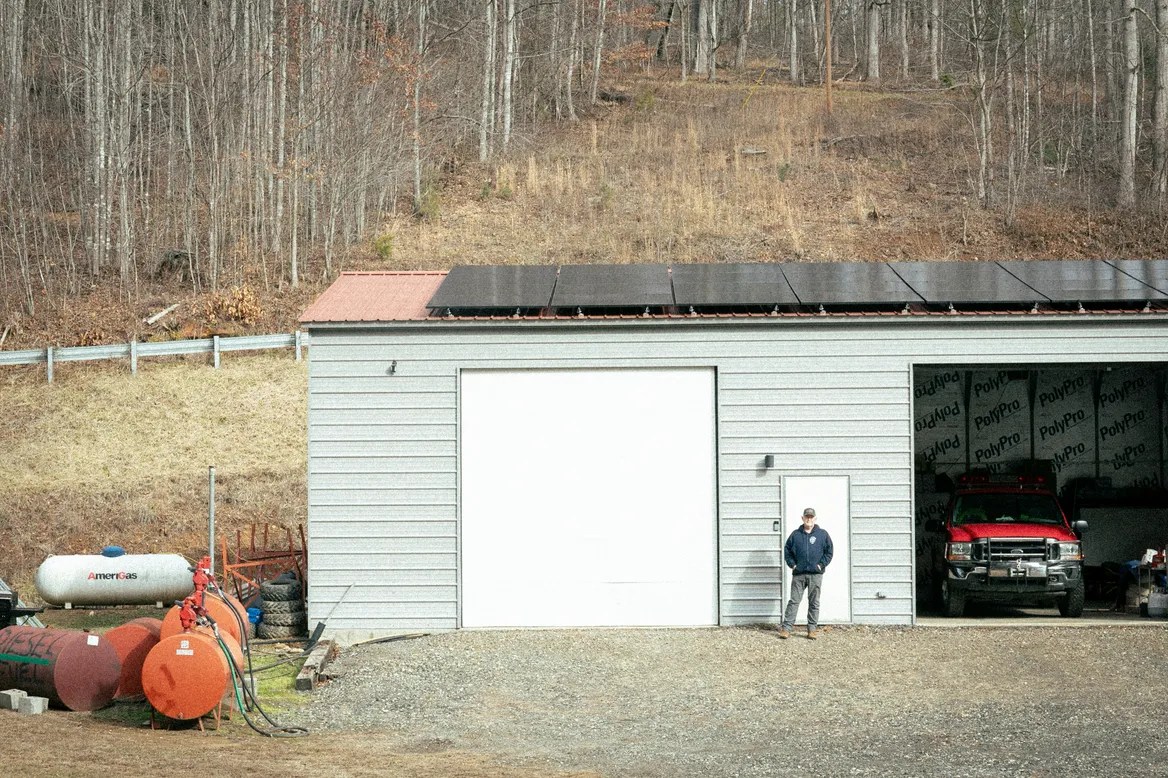
The station is equipped with a microgrid of 32 solar panels and a pair of four-hour batteries. The donated equipment will shave about $100 off the fire department’s monthly electric bill, meaningful savings for an organization with an annual operating budget of just $51,000.

When storms inevitably hit, felling trees and downing power lines, the self-sustaining microgrid can provide some electricity and an internet signal.

A man stands in front of a grey building adorned with solar panels.

Dan Buchanan, the Double Island Volunteer Fire Department’s assistant fire chief, in front of the station’s new solar panels.Footprint Project

“We’ll have at least a way to run our radio equipment, run our well and basic lighting and refrigeration,” Buchanan said, adding that the latter was vital for medication. ​“It may not seem like much—but that’s the Willy Wonka golden ticket.”

Communication, he stressed, was key. ​“If you can’t communicate, you can’t get the help you need.”

The microgrid project, called a resilience hub, was made possible by a network of government and nonprofit groups that came together after Helene to help fire departments like Double Island and other community centers with long-term recovery. Now, a state grant program is injecting a burst of funds into their efforts. Using both public and private time, know-how, and money, the program aims to create a model for resilience that can be replicated nationwide.

“We aren’t only preparing for a disaster; we’re also helping utility diversification, cost savings, and normalization of the technology,” said Jamie Trowbridge, a senior program manager at Footprint Project, a leading nonprofit in the initiative. Those benefits aren’t unique to Yancey County, he said. ​“We’d like to see this be a pilot for us on what scalable microgrid technology could be across all of western North Carolina—and maybe the country.”

The Double Island experience was common in the immediate aftermath of Helene. Across the region, communities isolated by closed roads and mountainous terrain turned to their fire departments for help.

That’s part of how Kristin Stroup got involved in the resilience hub effort. Based in Black Mountain, a popular tourist destination 15 miles east of Asheville, Stroup helped start a corps of volunteers who gathered at the town’s visitor center. In coordination with an emergency operations center based at Black Mountain’s main fire station, she led over 200 volunteers in doing whatever they could, from cooking and doling out food to making the country roads passable.

“People [were] just driving around the town with chain saws,” said Stroup, today a senior manager in energy and climate resilience with the nonprofit Appalachian Voices. The weekend after Helene hit, she said, ​“Footprint rolled into town with a bunch of solar panels. I became an instant part of their family.”

With founders who cut their teeth in international aid, the New Orleans–based Footprint Project had teamed up with the North Carolina Sustainable Energy Association, Greentech Renewables Raleigh, and others to pool donations of batteries, solar panels, and other equipment to deploy microgrids to dozens of sites in the region before the end of 2024. From Lake Junaluska to Linville Falls, recipients included fire stations such as the one in Double Island and an art collective in West Asheville.

By February 2025, Footprint had hired Trowbridge and another staff person to work in the area permanently. Footprint continued to cycle microgrid equipment throughout the region from its base of operations in Mars Hill, a tiny college town 20 miles north of Asheville that was virtually untouched by Helene. It launched the WNC Free Store, which donates solar panels and other supplies to residents still far from recovery—like those living out of RVs and school buses after losing their homes.

From the outset, Footprint had a critical local ally in Sara Nichols, the energy and economic development manager at the Land of Sky Regional Council, a local government partnership encompassing four counties that stretch from Tennessee to South Carolina.

“A lot of the other organizations we saw come through in the same way Footprint did, most of them did not stay. They leverage resources to do really important work, and when that work feels done, they go home,” Nichols said. ​“The fact that Footprint is working thoughtfully to figure out how our recovery and resiliency can be taken care of—while also thinking about their own organizational strategic growth—means a lot to me. They’ve been incredible partners.”

To be sure, assistance and rebuilding in the region are ongoing, and many systemic inequities exacerbated by the storm can’t be solved with a solar panel. But the power is back on. The cell towers are functioning. The roads are open. Piles of debris, from fallen limbs to moldy furniture, have been cleared. In relief parlance, western North Carolina is beginning to see ​“blue skies.”

That’s why it’s all the more important that Footprint, Appalachian Voices, and other local collaborators haven’t let up in their efforts. The web of organizations involved is thick and, seemingly, ever expanding. Last fall, the network announced it was deploying five resilience hubs around the region, including the Double Island project and a permanent microgrid at a community center in Yancey County.

“These projects, driven by a small group of determined partners, have accelerated Appalachia’s long-term resilience and preparedness,” Invest Appalachia, another nonprofit partner, said in a news release.

Now, the local public-private effort is getting a boost from the state of North Carolina. Under the administration of Gov. Josh Stein, a Democrat who has made Helene recovery a centerpiece of his first-term agenda, the State Energy Office will deploy $5 million from the Biden-era Bipartisan Infrastructure Law to install up to 24 microgrids across six western counties impacted by Helene.

The money will also go to two mobile aid units for rural counties on either end of state—one in the east and one in the west. Dubbed ​“Beehives” by Footprint, these solar-powered portable units will be full of equipment that can be deployed to purify water, set up temporary microgrids, and otherwise respond to storms and extreme weather.

Expected recipients of the stationary microgrids could include first responders like the Double Island Fire Department and second responders like community centers. Peer-to-peer facilities and small businesses are also encouraged to apply.

Land of Sky and other stakeholders are choosing grantees on a rolling basis through next summer. There’s already been an inundation of applicants, and six grantees have been selected, including a community center about a dozen miles up the road from Double Island in Mitchell County. But organizers say they need more interest from outside the Land of Sky region, especially in Avery County, north of Yancey on the Tennessee border; and Rutherford County, east of Asheville, which includes Chimney Rock, a village that was infamously devastated by Helene and is slowly rebuilding.

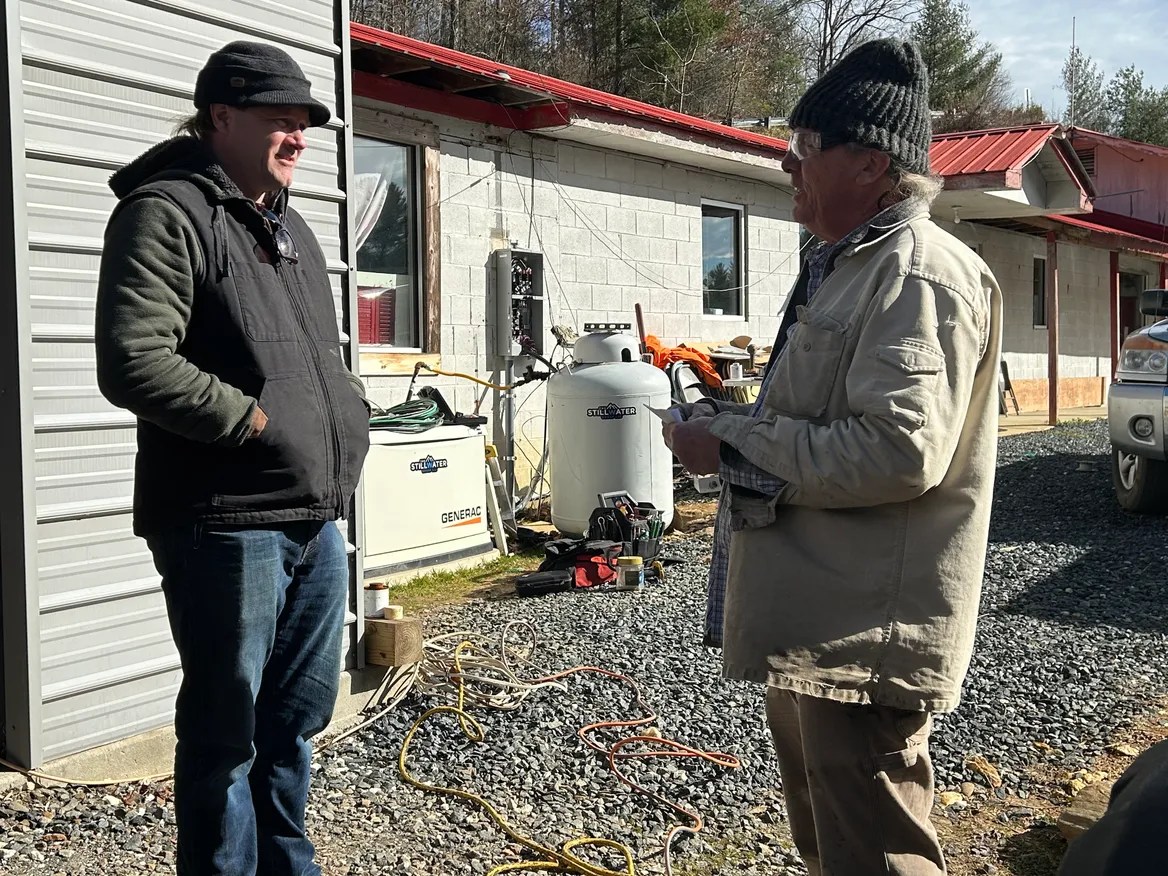
Two men wearing jackets and hats speak on a gravel road in front of a grey and red building.

Footprint Project’s Jamie Trowbridge, left, and Dave Wilson, of Atomic Solar Energy, discuss the microgrid installation at Double Island Volunteer Fire Department. Elizabeth Ouzts/Canary Media

Geographic distribution isn’t the only problem organizers have faced. Some entities—while undoubtedly deserving of assistance—aren’t appropriate for the government grant because they are located in areas at risk of future flooding.

“A battery underwater is not that useful,” Trowbridge said, ​“so if your site is in a floodplain, maybe this isn’t the right fit for you. But we definitely want you to know about the Beehive.”

Above all, organizers like Nichols, a passionate promoter of the Appalachian Region, are determined to ensure that the state’s effort is not the be-all and end-all of resilience.

“What we’re being tasked with as recipients of this money is to try and figure out how we make this a much bigger project,” she said. ​“That means we’ve brought in other partners like Invest Appalachia. We’ve been seeking other kinds of money. We’re using this state money to successfully build what could be a much more comprehensive resiliency hub model.”

She added that communities across the country—even if they think they’re safe from extreme weather and climate disaster—could take cues from the western North Carolina example.

“We were a place that was not supposed to get a storm,” Nichols said. ​“We were a climate haven.”

Continue Reading…

Mother Jones

How Sports Became a Battleground Over Trans Rights

During an NCAA women’s swimming championship in March 2022, two seniors tied for fifth place. The race was unremarkable except for one fact: One of the swimmers, Lia Thomas, was a transgender woman. The swimmer she tied with, Riley Gaines, believed the NCAA never should have allowed her to participate.

The matchup, and Gaines’ subsequent transformation into a leading anti-trans activist, has fueled a growing movement to “save women’s sports” from trans women—and a conservative crusade against trans rights more broadly.

This week on Reveal, we examine Gaines’ rise and radicalization, as her rhetoric shifts from calling out NCAA policy to calling trans women sexual predators.

Over the last year, the anti-trans movement has reached a tipping point. Trans girls are banned from girls’ school sports in the majority of states. The NCAA and US Olympic and Paralympic committees have banned trans women from women’s competitions. The Supreme Court is currently considering the issue, too.

Then we dive into the science to understand how gender-affirming hormone therapy affects trans women’s performance—and what questions science still has not answered around fairness in women’s sports.

Finally, we return to the swimming pool, as reporter Imogen Sayers speaks with Meghan Cortez-Fields, one of the last transgender swimmers to compete as a woman in the NCAA.

Continue Reading…

Mother Jones

Trump DOJ Uses Anti-KKK Law to Charge ICE Protesters With Felony

The Trump administration is using an anti-Ku Klux Klan law to prosecute Minnesota activists for demonstrating against ICE at a St. Paul church. On Thursday, Attorney General Pam Bondi announced that the Department of Homeland Security and the Federal Bureau of Investigation had arrested Chauntyll Allen, Nekima Levy Armstrong, and William Kelly for their alleged involvement in a January 18 anti-ICE demonstration. The three protesters were charged with conspiracy to deprive rights—a federal felony under Section 241, a Reconstruction-era statute enacted to safeguard the rights of Black Americans to vote and engage in public life amid the KKK’s racial violence.

Levy Armstrong and Allen are both prominent Black community organizers. Levy Armstrong leads the grassroots civil rights nonprofit Racial Justice Network and once served as the president of the Minneapolis chapter of the NAACP. Allen is a member of the St. Paul School Board and a founder of Black Lives Matter Twin Cities. (The DOJ did not immediately respond to requests for comment, nor did lawyers for Levy Armstrong, Allen, or Kelly.)

An affidavit filed in support of the government’s case by a special agent with ICE’s Homeland Security Investigations (HSI) also claims that the protesters sought to violate the “free exercise of religion at a place of religious worship secured by the FACE Act,” a 1994 federal law designed to protect people seeking abortion services. The affidavit appears to name several other redacted defendants as participants in the conspiracy.

Videos showed the group of activists disrupting the St. Paul church service with chants of “ICE out” and “Justice for Renee Good,” a reference to the 37-year-old mother of three who was fatally shot by an ICE agent in Minneapolis earlier this month. Protesters selected the church because they say one of its pastors, David Easterwood, leads a local ICE field office. Reporting from PBS found that the church pastor’s personal information matches that of the acting director of the ICE St. Paul field office, and that Easterwood “appeared alongside DHS Secretary Kristi Noem at a Minneapolis press conference last October.”

The HSI agent’s affidavit designates Easterwood as “Victim 1.” The document also lists several chants made by “agitators” that “terrorized the parishioners,” including “this is what community looks like” and “hands up, don’t shoot.” (According to the affidavit, one churchgoer only heard the word “shoot” and therefore feared the protesters could have guns.) The agent also characterizes Good’s death as “an officer-involved shooting as a result of her assault on an immigration officer.”

A press release published by DHS on Friday called the three arrested activists “ringleaders” of a “church riot” and alleged that their actions amounted to an “attack on churchgoers’ religious freedom.” But a legal filing from Levy Armstrong’s lawyer arguing for his client’s pretrial release notes that Levy Armstrong herself is a Christian reverend.

“Contrary to the charges, there was no intent to deprive anyone of their right to worship, but the desire was to initiate a debate about religious values,” her lawyer wrote. “It was a non-violent protest, which under a normal government, would not lead to criminal charges, much less federal felony charges.” All three organizers were released from federal custody on Friday.

The extraordinary decision to charge the protesters with felonyfederal conspiracy against civil rightscomes after footage of the event sparked days of viral outrage among Trump’s supporters, with right-wing websites calling the protest a “mob,” “riot,” and “attack.” The DOJ also sought to bring conspiracy charges against journalist Don Lemon, a former CNN host who was present at the protest, an effort rejected by a federal magistrate judge.

“Don Lemon himself has come out and said he knew exactly what was going to happen inside that facility,” Assistant Attorney General Harmeet K. Dhillon told far-right influencer Benny Johnson during a podcast appearance on Monday. “He went into the facility, and then he began ‘committing journalism,’ as if that’s sort of a shield from being a part, an embedded part, of a criminal conspiracy. It isn’t.”

The Trump administration evidently hopes to make an example of Allen, Levy Armstrong, and Kelly: “Listen loud and clear: WE DO NOT TOLERATE ATTACKS ON PLACES OF WORSHIP,” Bondi posted on X on Thursday.

One of Trump’s first actions as president was to overturn a longstanding policy that restricted ICE enforcement at “sensitive areas,” including places of worship.

Continue Reading…

Mother Jones

This Minneapolis Church is Feeding Thousands of Families Fearing ICE

In December, Pastor Sergio Amezcua put out a sign-up for Minnesotans who were afraid to leave their homes and needed grocery deliveries. He thought 10 or 20 families would sign up. Since then, his church, Dios Habla Hoy, has delivered food to 17,000 families.

“It’s really evil what’s going on,” says Amezcua. “And coming from the conservative government, ‘Christian’ government, I just think they’re reading their Bible backwards.”

Mother Jones senior reporter Julia Lurie spent the week in Minneapolis talking to clergy, protesters, and people confronted by ICE. Watch the video for more and follow along for updates.

Continue Reading…

Mother Jones

Documents Prove The Trump Administration Arrested Students for Criticizing Israel

Documents unsealed by a federal judge this week confirm the federal government’s attempts to target, arrest, and deport students for pro-Palestine speech on college campuses last year. The court records also make clear the methods of investigation. The government looked to unverified accounts shared on social media and utilized Canary Mission—a shadowy online blacklist created by anonymous authors to smear pro-Palestine activists—to gather evidence against student protestors.

The documents were unsealed only after sustained pressure from journalists and press-freedom groups. News organizations, including the Center for Investigative Reporting, challenged the government’s efforts to keep large portions of the record secret, arguing that the public had a right to understand how speech was being scrutinized and punished. In unsealing the documents, US District Judge William G. Young sharply rebuked the Trump administration and called the government’s actions against pro-Palestinian speech an unconstitutional attempt to twist laws to intimidate students.

The new materials confirm previous accounts and reporting about the Department of Homeland Security’s targeting of students. In 2025, after Mahmoud Khalil and Rümeysa Öztürk were taken into custody by Immigration and Customs Enforcement officials, speculation spread quickly among advocacy groups that government officials were collecting names by looking at pro-Israel monitoring websites like Canary Mission.

The documents unsealed provide the clearest timeline of how this happened. And they make clear how quickly a case escalated, with Canary Mission’s help. Öztürk’s case is indicative. In March of 2024, Öztürk was one of four names published as part of a campus op-ed that criticized the Tufts University administration for failing to honor three student-led resolutions that had recently passed, including one calling for recognition of genocide in Gaza and another for divestment from the state of Israel.

Almost a year later, a profile of Rumeysa Öztürk appeared on Canary Mission. A month after that, according to the documents, government officials compiled a report on Öztürk. A week later, on March 25, 2025, Öztürk was arrested by United States Immigration and Customs Enforcement officials.

The new records make clear what happened: Öztürk’s participation in the op-ed was cited as the cause for her removal. (DHS and ICE did not show Öztürk had participated in any antisemitic activity.)

Related

Photo illustration featuring a black-and-white portrait of student activist Mahmoud Khalil; overlaid on his face, covering one eye and his mouth, are excerpts from a lawsuit, colored with a red background.How a Shadowy Online Blacklist Became a Legal Threat to Pro-Palestinian Activists

The documents show that federal agencies, such as Homeland Security Investigations (HSI) within the Department of Homeland Security, relied on “publicly available information,” including social media posts and third-party websites, to assess students’ eligibility for visas and residency.

And they confirm previous public testimony. In July 2025, Peter Hatch, an ICE official who was part of HSI’s division that compiled background reports on students, testified during the lawsuit’s hearings that “the direction [for his team] was to look at the website [Canary Mission].” Hatch says his team compiled more than 100 reports from a list of 5,000 names.

“Many of us have long been trying to raise alarm bells about the dangers of privately-funded, hate groups such as Canary Mission,” said Nadia Abu El Hajj, an anthropology professor at Barnard and Columbia University. “As testimony at the trial and the trove of newly released documents clearly demonstrate, Canary Mission’s blacklist has serious, material consequences: they have played a central role in providing names of Palestinian and pro-Palestinian students to the federal government, calling for their deportation.”

Related

A collage featuring three black-and-white portraits of young men on the left, a central orange-tinted image of ICE officers in police jackets peering into a doorway, and on the right, a close-up of a tattoo on someone’s leg.Trump’s Deportation Black Hole

Internal reports also show that social posts; news articles from sources like the New York Post; and unverified information from Canary Mission were used to justify the deportation of Khalil, Öztürk, and a slew of others, including Mohsen Mahdawi, Badar Khan Suri, and Yunseo Chung. The files for Khalil, Öztürk, and Mahdawi all specifically cite Canary Mission. The reports also include posts from X accounts like @CampusJewHate, which describes itself as an account to “put pressure on academic institutions to oppose Jew-hatred by exposing toxic anti-Israel climate on their campuses.”

“Secretaries Noem and Rubio and their several agents and subordinates acted in concert to misuse the sweeping powers of their respective offices to target non-citizen pro-Palestinians for deportation primarily on account of their First Amendment-protected political speech,” wrote Judge Young in his court order. “Moreover, the effect of these targeted deportation proceedings continues unconstitutionally to chill freedom of speech to this day.”

The State Department, in a statement, was unapologetic. “The Trump Administration is using every tool available to get terrorist-supporting aliens out of our country,” a spokesperson said. “A visa is a privilege, not a right. We abide by all applicable laws to ensure the United States does not harbor aliens who pose a threat to our national security.”

The documents have been released as the US pushes once again to deport Khalil. Earlier this month, a US Appeals court overturned a lower court decision that blocked the Columbia former graduate student’s deportation. Following that ruling, a DHS Assistant Secretary Tricia McLaughlin went on NewsNation and promised to send Khalil to Algeria.

In a statement, McLaughlin told the Center for Investigating that “there is no room in the United States for the rest of the world’s terrorist sympathizers, and we are under no obligation to admit them or let them stay here. The framers of our Constitution and its Bill of Rights never contemplated a world where foreign citizens could come here as guests and hide behind the First Amendment to advocate for anti-American and anti-Semitic violence and terrorism.”

Continue Reading…

Mother Jones

America’s Reading Crisis That No One Wants to Talk About

This article was co-published with EdSurge, a nonprofit newsroom that covers education through original journalism and research. Sign up for their newsletters.

A little girl stared at a list of test questions in her science class, unable to answer the majority. Resigned, she wrote at the top, “I failed badly”—although she misspelled it, instead writing, “I felled bedly.”

She was not in a lower-level grade or even elementary school. She was a student of Laurie Lee’s sixth-grade class, more than two decades ago.

Lee never forgot the reading difficulties she witnessed while teaching fifth and sixth graders.

“It becomes clear pretty quickly how they’re struggling,” says Lee, now a senior research associate at the Florida Center for Reading Research. Beyond test scores, she says the struggle was also evident in the questions her students would ask their classmates in response to assigned reading: “It’s often not because of content areas; it’s because they can’t read.”

Lee was not the only education leader grappling with older students’ lack of reading skills. Rebecca Kockler saw similar issues when she worked as the assistant superintendent of academic content at the Louisiana Department of Education. Recently, the state was the second most improved in the nation for fourth-grade reading results, rising from the 50th in 2019 to the 16th in 2025, with high scores measured in 2024. But, despite the strides Kockler’s fourth-grade students were making, it was all but erased by the time they hit eighth grade.

“It was just, ‘What is going on?’” says Kockler, now the executive director at the Advanced Education Research and Development Fund’s Reading Reimagined program. “What was frustrating for me was that I could not touch my middle school reading results.”

According to the 2024 National Assessment of Educational Progress results, only 30 percent of eighth-grade students are reading at a NAEP “proficient” level. Fourth-grade students had similar scores, at 31 percent. Both fourth and eighth- grade scores were not significantly different from when the data collection first began in 1992.

Many states, similarly to Louisiana, are focusing on deploying research-backed reading programs for their younger students. But, despite a stagnant reading comprehension rate for older students, they are continually left out of the conversation about improving literacy.

“There’s this focus on K-3 without a lot of resources dedicated to helping the kids in secondary school that fell through the cracks.”

“There’s this focus on K-3 without a lot of resources dedicated to helping the kids in secondary school that fell through the cracks,” says Anna Shapiro, associate policy researcher for the RAND Corporation, a nonprofit public policy research firm. “Starting early makes a lot of sense in a lot of ways, but there’s also all these kids in the school system that didn’t benefit from that and do need intervention as well.”

Research-Backed Reading Laws

The phrase “science of reading” has cropped up more and more over the last few years. Simply put, it looks into the research behind how one learns the foundations of reading, such as sounding out letters, forming words, and making basic sentence structures.

The research is not particularly new. Congress convened a 14-person panel in 1999, dubbed the National Reading Panel, which submitted a 480-page report in 2000 with its science of reading findings. It found that students need explicit instruction in five pillars of reading: phonics, phonological awareness (or sound structure of spoken words), fluency, vocabulary, and reading comprehension.

But the last two decades have been dotted with various methods for improving— and teaching—reading skills. There’s phonics, or sounding out the letters of words, which was lauded in the National Reading Panel report. “Whole language” style of reading, which had readers focus on context clues and guess the word that would accurately fit the scenario, was widely popular in the middle of the 20th century, despite not being studied or recommended in the National Reading Panel report.

The modern science of reading push began to inch into the mainstream in 2019, after Mississippi overhauled the way its school systems taught reading starting in 2013—and saw drastic test result improvements six years later, catapulting to No. 9 in the nation for fourth-grade reading skills on the NAEP assessment. The state was number 1 for reading and math gains since 2013. Some dubbed it the “Mississippi Miracle,” with those in the state calling it a “Mississippi Marathon.” It was a model that Louisiana followed quickly after.

Then, the science of reading was flung into the general public’s consciousness with the hit podcast “Sold a Story: How Teaching Kids to Read Went So Wrong,” which details the history and debates behind teaching children to read.

By 2025, roughly 40 states had passed laws that either mandated or referenced using evidence-based methods for teaching reading, though what that specifically means, and how many resources are actually financially backing those methods, varies from state to state.

Some laws are more detailed than others, with most focusing on “foundational” —or lower-level—grades. Most, if they did specify, target kindergarten through third grades, requiring teachers of those grades to go through the science of reading training, and students that age to undergo screening practices. Others, including laws in North Carolina and Connecticut, expanded those efforts to K-5, with Iowa as a standout requiring personalized reading plans to struggling students through sixth grade. Some states, including New Mexico and Nevada, require all first graders to be screened for dyslexia.

But the change in student outcomes has been slow. According to a new study by EdWeek Research Center, more than half of the 700 polled educators said at least a quarter of their middle and high school students had difficulty with basic reading skills. More than 20 percent said half to three-quarters of their students struggle.
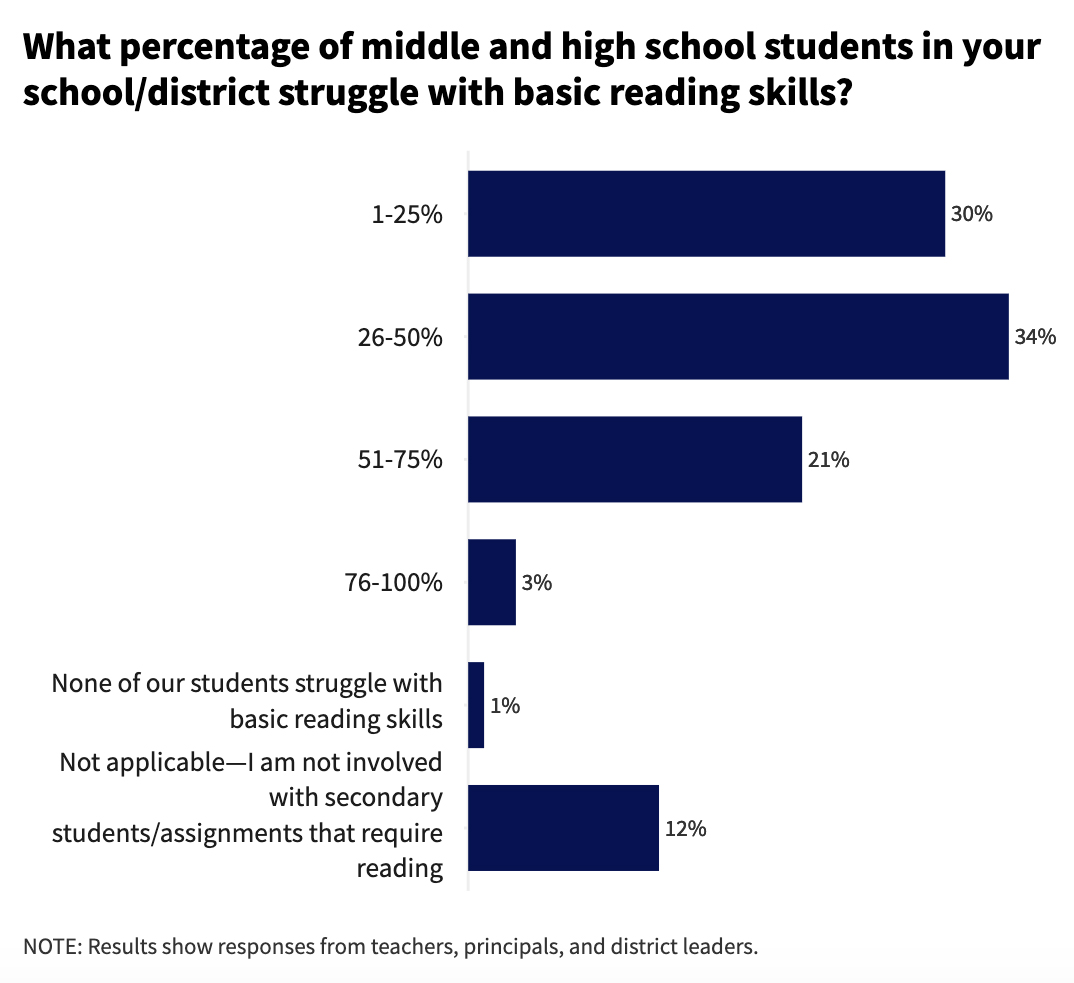
A bar chart displaying the percentage of middle and high school students in a school district struggle with basic reading skills, based on responses from teachers, principals, and district leaders. 30% of respondents said that a quarter of their student struggle, 34% of respondents said that half of their students struggle, 21% of respondents said that 3/4th of their students struggle, and 3% of respondents said that all of their students struggle. 1% of respondents said that none of their student struggle, while 12% said they are not involved with secondary students/assignments that require reading.

At least a quarter of middle school students struggle with basic reading skills, according to middle and high school teachers.

It’s affecting teachers too. According to a 2024 RAND survey, more than a quarter of middle school English teachers reported frequently teaching foundational reading skills like phonics and word recognition—“things that should be mastered in lower grades,” according to Shapiro.

A RAND graph showcasing the percentage of K-12 ELA teachers who reported frequently engaging students in foundational reading activities, by grade band.

More than a quarter of middle school teachers reported having to stop their lessons at least three times a week to teach foundational reading skills, like phonics. Source: RAND.

Older Students Left Behind

By middle school, the consequences of poor literacy skills pop up across academic disciplines, like in Lee’s middle school science class.

“If they have trouble reading independently, they’ll have problems with other things as well; it’s not just language arts teachers, it impacts everyone,” Shapiro explains.

“If they have trouble reading independently, they’ll have problems with other things as well; it’s not just language arts teachers, it impacts everyone.”

Many reading experts have used the same example: a young child learns to read and understand the word “cat,” but that same child struggles when he gets older and comes across that same set of letters—c-a-t—in new, more complex words like “vacation” and “education.”

“It’s that application into complex words that we basically didn’t teach kids anywhere in our system, in the same explicit way we do with younger kids,” Kockler says.

Ideally, no child would arrive in middle school unable to keep up with his or her assigned reading. Some states are taking efforts to ensure that does not happen, with Louisiana, for example, passing a law in 2023 requiring students to be held back if they do not pass their state reading test unless they qualify for an exemption.

In the interim, though, older students with reading issues are still getting neglected. And researchers are at a loss about how it happens.

“From our research, we don’t really know exactly how these kids are getting to middle and high school and struggling with reading,” Shapiro says of RAND’s findings. “There’s this focus on K-3, without a lot of resources dedicated to helping the kids in secondary school that fell through the cracks.”

Identifying struggling students can be challenging. And there seems to be a major disconnect between what parents think about their children’s literacy skills and the reality. While 88 percent of parents believe their child is reading at grade level, only roughly 30 percent of students fall into that camp, according to a 2023 Gallup poll.

Most older students, once they hit a certain age, read independently—making it difficult for parents to know how well their child is grappling with the content. Meanwhile, some students with poor reading skills are able to cobble together their own tactics to understand assignments and may not be initially flagged as reading below grade level.

Time and Training Needed

For older students who have been flagged as weak readers, there are traditional protocols to offer them additional support. Kevin Smith, who, along with Lee, co-founded the Adolescent Literacy Alliance, says in most schools, struggling students will leave their home classroom to work with a reading interventionist in the day, if the school has one. Other students get more intensive training, focusing on fewer skills for a longer period of time.

The missing piece: Implementing reading strategies in every class, across all grade levels—not just language arts classrooms.

“We can’t intervene our way out of instruction. There’s not enough time in the world to get caught up if they’re not getting help throughout the day.”

“We can’t intervene our way out of instruction,” Smith says. “There’s not enough time in the world to get caught up if they’re not getting help throughout the day.”

Most of that instruction tends to happen in the earlier grades.

“There’s learning to read, then reading to learn,” Tim Rasinki says, quoting an oft-used phrase. He taught middle school students before becoming a reading interventionist. “Even beyond grades three and four, there are still things you need to learn about reading. Critical thinking is a huge thing, but those [reading skills] need to be taught as well. I’m not sure the extent they are.”

Yet according to the EdWeek survey, 38 percent of educators said they are getting no training in how to handle older students reading below grade level, with roughly a quarter teaching themselves. The remaining 38 percent stated they are receiving training, from either their school, district, or state agency.
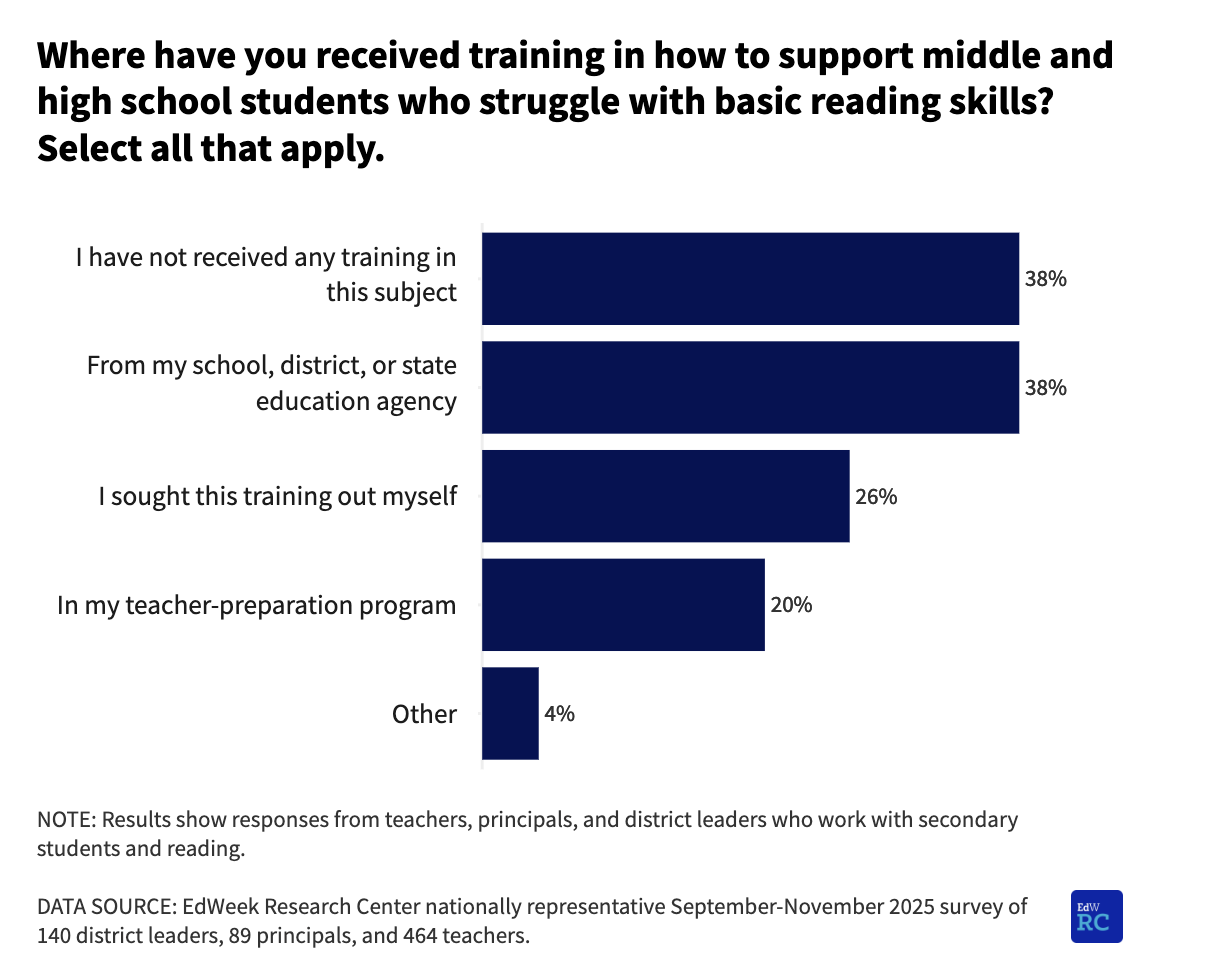
A EdWeek Research Center graph that showcases survey responses from 140 district leaders, 89 principals, and 464 teachers on where they received their training in how to support middle and high school students who struggled with basic reading skills.

While more lower-level schools are receiving time and money to teach their young students the foundations of reading, that training largely disappears in middle school. Source: EdWeek Research Center.

Many of the dozens of new state laws explicitly discuss teacher training, with California going so far as to mandate that universities change their teacher training programs. Other organizations, like the Reading Institute, have rolled out a free, 10-hour “Intro to the Science of Reading Course” for all New York City-based teachers.

But, teachers say they have an increasingly loaded plate juggling stressors, including test scores, and keeping curriculum on a set schedule.

As for building in more time for improved literacy teaching, “We’ve heard, ‘Look, Lincoln has to be dead by Christmas; how can we do that?’” Smith says. He advises teachers to focus on implementing evidence-based reading strategies on texts that are most challenging.

Katey Hills, the assistant superintendent for Governor Wentworth Regional School District in New Hampshire, said there was some pushback when her district initially began requiring professional development to teach science of reading techniques. Each of the kindergarten through sixth-grade teachers had to undergo training, along with seventh and eighth-grade English teachers.

“If you’re waiting, you’re a bit behind the times,” she says. “It is a lot of change and change is hard, but it can be done. It’s really important that teachers are trained and you give them the support, but it can be done. Once teachers start seeing the results, it sells itself.”

She recommends creating a task force to hear from teachers on the best adaptations for the material.

The district just put the program into place widely last year, but already, one first- grade classroom is 100 percent literate.

Meanwhile, Lee and Kockler both say they are optimistic about the future of literacy for older students.

“Mississippi and Louisiana are incredible examples of when you have good research and tools to deploy, you can see real results,” Kockler says, adding that the next step is to get more clarity and better tools focused on helping older children’s literacy. “I feel very hopeful. But there’s a lot of work to do, for sure.”

Continue Reading…

Mother Jones

Arizona Governor Moves to Rein in Groundwater-Guzzling Saudi Megafarms

Arizona Gov. Katie Hobbs has taken a major step to stabilize water use in the state’s rural desert, where a Saudi-owned company established a massive farming operation more than a decade ago.

During her State of the State Address earlier this month, Hobbs announced she was placing the Saudi alfalfa farm within an “active management area,” a technical designation that allows Arizona to slow and possibly even reverse the growth of groundwater use in a remote desert area of western Arizona.

The megafarm near Vicksburg—owned by the Riyadh-based dairy company Almarai—began pumping massive amounts of groundwater in 2014 to grow hay for export to feed the Kingdom’s dairy cows.

The Center for Investigative Reporting first broke news about the desert farm in 2015, drawing attention to a growing trend: Companies connected to foreign governments—Almarai was founded and is currently chaired by a member of the Saudi Royal family—were effectively exporting massive amounts of American groundwater in the form of hay, a water-intensive crop, to help their own countries cope with severe shortages.

But one country’s solution would become another’s problem, as the wells of Arizonans living in La Paz County near the farm began running dry.

The situation attracted international news coverage as awareness grew about the increasing global competition for groundwater, and other Arizona megafarms exporting desert water in the guise of agricultural products. The water grab would become a key issue in the state’s 2022 gubernatorial election.

The Grab, an Emmy-winning documentary based on our reporting, followed rural La Paz County supervisor Holly Irwin as she fought to protect residents’ precious water. Watch the trailer:

After the film’s release, Hobbs canceled some of the Saudi farm’s contracts to grow hay on land owned by the state. Attorney General Kris Mayes then sued Fondomonte, a wholly owned subsidiary of Almarai, seeking compensation for the locals whose wells were kaput.

Hobbs’ designation of the Ranegras Plain Groundwater Basin, located in western Arizona, as an “active management area,” allows regulators to curtail additional water use, effectively limiting the withdrawals to the people and entities pumping it today.

In the short term, the designation by itself cannot reduce the amount of water being used by foreign megafarms, but it can at least stop new ones from coming in—and current ones from expanding their operations—in addition to encouraging farms to reducetheir withdrawals. “This is huge,” said Irwin, the county supervisor. “It prevents any future companies from being able to purchase land and come here to extract water.”

The global scramble for freshwater supplies is only increasing, according to a UN report released this week, which noted the world has entered an “era of water bankruptcy.”

Continue Reading…

Mother Jones

Hundreds of Businesses Join General Strike Against ICE

A breakfast restaurant, a bike shop, and a brewery: these are some of the hundreds of businesses across Minnesota closing their doors Friday as part of a general strike to push Immigration and Customs Enforcement out of the state.

“There’s a time to stand up for things, and this is it,” Alison Kirwin, the owner of Al’s Breakfast in Minneapolis, told the New York Times. Kirwin is closing up shop for the day as part of the wider strike to push “ICE out of Minnesota”—the motto for the protest. “If it takes away from a day of our income,” Kirwin said, “that is worthwhile.”

The general strike, along with planned demonstrations and a march, is a part of what organizers are calling a “Day of Truth and Freedom.” The event will involve protests, prayers, and fasting—whether it be from food, work, or economic activity. The day is being organized by a coalition of clergy members and supported by many businesses, movement leaders, labor organizers, and even the entire Minneapolis City Council.

According to Christa Sarrack, president of a labor union that includes about 6,000 of Minnesota’s hospitality workers, Friday may be the largest worker action in Minnesota’s history. “We cannot simply sit by and allow this to continue,” Sarrack told the Times. “We must use every tool that we have to fight back.”

The day of actions will crescendo with a march leading to the Target Center, an arena downtown. Minnesotans coming out to protest are facing extremely cold weather conditions—with temperatures in the negatives all day.

Incredible. It’s -12° (-24.4° C) at MSP airport right now.💪

Sanho Tree (@sanho.bsky.social) 2026-01-23T16:31:49.271Z

Chelsie Glaubitz Gabiou, president of the Minnesota Regional Labor Federation, AFL-CIO, told The Guardian she is not concerned: Minnesotans are “built for the cold.”

“And we are going to show up,” Gabiou continued, “but folks are going to need to pay attention to not just the march, but what people are doing, the individual stories of solidarity.”

In the days that have followed ICE agent Jonathan Ross shooting and killed Renée Nicole Good in her car, federal immigration agents have ramped up their operations. The government agents shot another person, deployed chemical weapons on protesters (including minors), detained several kids from one school district, and dragged a naturalized US citizen out into the cold in only his underwear, among many other violent incidents.

Sen. Amy Klobuchar (D-Minn.) posted on Friday in support of the day of protest, writing, “Today people across Minnesota are coming together to send a message: ‘ICE Out of Minnesota.’ Minnesotans’ rights are under attack, and ICE needs to leave our streets.”

While general strikes, or work stoppages across industries, are rare in the United States today, that wasn’t always the case. As the Minnesota Reformer pointed out, these strikes were once a key staple of protest politics in this country but have been less common due to the stifling of labor rights by those in power. In Minnesota today, with hundreds of businesses across different sectors deciding to cede profits to send a message, organizers are showing it can be done again.

“It’s tense and emotional, and folks are hurting,” Bishop Dwayne Royster, the executive director of Faith in Action, one of the leading religious organizations planning the day of prayer and protest, said. But he applauded the people of Minnesota for a “deep resilience and willingness to stand together in ways I haven’t seen folks do in a very long time.”

Continue Reading…

Mother Jones

They Want to Tell You a Kid With a Spider-Man Backpack Is Evil

Anyone with a child in the spitting distance age of a preschooler is likely to be familiar with Spidey and His Amazing Friends, the 2021 animated TV series that follows grade-school versions of Peter Parker, Miles Morales, and Gwen Stacy as they take on baddies across New York City. Their kiddo fans might even break out in song and try to talk to you about Patrick Stump.

Such is the intense patronage that Spidey inspires among today’s youngest kids, and by extension, their parents, willingly or not. So when news emerged that ICE had detained Liam Ramos, a 5-year-old Minnesota boy, it was the photos that broke me. Here is a literal preschooler wearing a Spider-Man backpack, just like all of our kids, as the hand of a much larger masked ICE agent holds onto his backpack, as if he were a flight risk. An oversized blue hat with bunny ears partially covers his face as he stares ahead blankly. Liam and his father will eventually be sent to an immigration detention center just outside San Antonio, but not before, as school officials reported, federal officers attempted to turn the child into “bait” by persuading him to knock on his own front door to see if there were other family members they could apprehend inside. Speaking to federal agents in a closed-door meeting, JD Vance defended ICE’s actions.

The flimsy politics of citizenship might seem like what distinguishes Liam’s story from the stories of our own offspring. But his innocence, like the innocence of all children, is unimpeachable. We know this child: his goodness, his go-to superheroes, his goofy hat. In Minneapolis, Liam is one of at least four children who have been detained in the last month. All of them attend the same school district, where half of the students are Latino. Similarly grotesque incidents involving kids are taking place across the country, including in Portland, Maine, where huge swaths of school populations are no longer attending out of fear of ICE. A recent analysis from the Marshall Project estimated that at least 3,800 kids, including 20 infants, have been detained since Donald Trump returned to office.

Something is deeply wrong if we, as a society, cannot agree that an administration that snatches up children, uses them as bait to hunt down others is not morally repulsive.

But, as with so much that has unfolded over the past year, reports of these horrors barely seem to break into our collective consciousness. We read them with disgust and protest in some shape, while the infinite loop of our paralysis ticks on. But excruciating images like Liam’s demand more.

To be clear, one does not need to see a Spider-Man backpack to evince the atrocities at play here. Nor do I need some kind of parenting parallel to understand that this child is like every child. But the power of these optics, their unique ability to clarify with a terrifying precision, that these kids could be any one of our own, should puncture some well-fortified defenses. Because something is deeply wrong if we, as a society, cannot agree that an administration that snatches up children, uses them as bait to hunt down others, is not morally repulsive.

So what now? Democrats, occupied with writing angry letters and demanding that mean tweets be taken down, are proving to be feckless. But the people of Minneapolis are resisting in ways that we can all learn from: showing up in the thousands every day to say that enough is enough. Putting down our capitalistic instincts to stage large-scale economic blackouts. Tailing ICE and making it clear that their fascist levels of terror won’t go unwitnessed, with the hope that it may not continue to go unpunished.

As for the rest of us who don’t live in Minneapolis, bearing witness to these images of Liam is the least we can do.

Continue Reading…

Mother Jones

No, Antidepressants Do Not Cause Mass Shootings

As US health secretary, Robert F. Kennedy Jr. has drawn a lot of attention for promoting pseudoscience and disproven theories, especially on vaccines. He is using that playbook on another major public health issue: gun violence, which remains the leading cause of death for kids in America. When it comes to school shootings and other mass shootings, here’s what RFK Jr. wants you to believe: It’s not the guns, he argues, it’s the pills.

The fringe theory that antidepressants can cause people to turn violent has been around for decades, focused primarily on selective serotonin reuptake inhibitors, or SSRIs, which are the most common class of these drugs. But extensive research by mental health and violence prevention experts has found no credible evidence that antidepressants cause or contribute to mass shootings.

As I wrote recently, the history of how this failed theory gained attention online is also telling:

The generalized claim that SSRIs can make people violent—and that they supposedly gave rise to the shootings epidemic—traces in part to an unscientific anti-Prozac campaign in the 1990s from the Church of Scientology and gained some traction in online forums after the Columbine High School massacre in 1999. Disgraced conspiracy theorist Alex Jones, who helped create a miasma of lies claiming that the 2012 mass shooting at Sandy Hook Elementary School was faked, has also peddled the theory.

Proponents of the SSRI theory use anecdotal, often unconfirmed details about shooters’ health histories to argue causation. But multiple studies from experts in psychiatry, law enforcement, and public health show that the theory has no merit. Data on shooters spanning more than a decade from the FBI’s Behavioral Analysis Unit has been used specifically to examine the claim that psychiatric drugs are at the root of school shootings; independent researchers concluded from the FBI data that “most school shooters were not previously treated with psychotropic medications—and even when they were, no direct or causal association was found.”

In the above video, I show how RFK, Jr. has been using his top government post to continue spreading the failed theory—a misinformation campaign in which he makes at least a half dozen false or misleading claims about guns, psychiatric drugs, and mass shootings.

Continue Reading…

Mother Jones

California Senate Bill Would Grease the Skids for Balcony Solar

This story was originally published by Canary Media and is reproduced here as part of the Climate Desk collaboration.

California lawmakers are considering two bills that would slash red tape for households looking to add certain types of clean tech.

Earlier this month, Democratic state Sen. Scott Wiener, whose district includes San Francisco, introduced legislation that would make it easier for individuals to adopt all-electric, super-efficient heat pumps (SB 222) and plug-in solar panels (SB 868).

“The cost of energy is too high,” Wiener told Canary Media. ​“We want to lower people’s utility bills; we want people to be able to participate in the clean energy economy; and we want people to be able to take control of their energy future. And that’s what these bills do.”

The proposals come as Americans are in the grip of a worsening cost-of-living crisis—of which energy is a key driver.

“We should empower people to use this technology. And right now, it’s too hard.”

Electricity costs have grown at about 2.5 times the pace of persistent inflation, and home heating costs are expected to surge this winter. In California, which has the second-highest electricity rates in the nation, the problem is particularly pressing. Heat pumps and plug-in solar panels could help.

Heat pumps—air conditioners that also provide all-electric heat—are about two to five times as efficient as gas furnaces without those appliances’ planet-warming and health-harming pollution. Even in California, where gas is relatively inexpensive compared with electricity, a heat pump’s high efficiency can enable households to save on their energy bills, especially when tapping the sun for cheap, abundant power.

Enter portable, plug-and-play solar panels. These modest systems, which users can drape over balcony railings or prop up in backyards, allow renters, apartment dwellers, and others who can’t put panels on their roofs to harvest enough of the sun’s rays to power a fridge or a few small appliances for a fraction of the day. A connected battery can save solar energy for use at night.

The tech is booming in Europe. In Germany, for example, where people can order kits via Ikea, as many as 4 million households have hung up Balkonkraftwerke, or ​“balcony power plants.” There, households can cover as much as one-fifth of their energy needs using these systems.

In the US, an 800-watt unit for $1,099 can save a household as much as $450 annually in states with higher electricity prices like California, according to the Washington Post.

But unlike those in Germany, US households typically need to apply for an interconnection agreement with their utility before they can install these systems—just as they would for adding a rooftop solar array. That process often requires fees, permits, and an inspection, and it can take weeks to months. Only one state allows residents to install plug-in solar without a utility’s permission: deep-red Utah.

Permitting in some cities ​“is way too lengthy and onerous and expensive.”

Lawmakers elsewhere are now stampeding to make plug-in solar available to their constituents.

Besides Utah and now California, legislatures in more than a dozen states want to unleash the tech: Hawaii, Illinois, Indiana, Maine, Maryland, Missouri, New Hampshire, New Jersey, New York, Pennsylvania, South Carolina, Vermont, Virginia, and Washington have all introduced bills, according to Cora Stryker, co-founder of plug-in solar nonprofit Bright Saver, which has been advising some states on their proposals. Based on conversations the organization has had with state representatives, Stryker said she expects a whopping half of US states to introduce bills this year.

“We should empower people to use this technology,” Wiener said. ​“And right now, it’s too hard. The idea that you have to get an interconnection agreement with the utility to put…plug-in solar on your balcony—it makes no sense.”

Administrative hurdles are also holding back heat pumps. “The current permitting process is difficult,” Aaron Gianni, president of Larratt Brothers Plumbing in San Francisco, told state policymakers on January 6. ​“As a contractor dealing with more than 109 different building departments in the Bay Area, we must navigate the nuances of each: different inspectors, changing paperwork requirements, high fees, and strict setbacks [that] sometimes make installation impossible.”

The situation can be even worse when a customer lives in a unit governed by a homeowners association, Gianni said. ​“Many HOAs have outright prevented new electric equipment from being installed.”

Wiener, who is running for US Rep. Nancy Pelosi’s seat and boasts a tongue-in-cheek MAGA fan club, put it bluntly. Permitting in some cities ​“is way too lengthy and onerous and expensive.”

“The [heat-pump] bill creates a streamlined path to be able to get a quick, automatic permit,” he explained. It would also loosen restrictions on equipment placement, cap permit fees at $200, and make it illegal to ban heat pumps.

Wiener’s heat-pump legislation, which has some industry detractors as well as grassroots supporters, has already passed out of the California Senate’s housing and local-government committees.

The plug-in solar bill has yet to come up for any votes. Still, with energy affordability shaping up to be a decisive issue in the 2026 midterm elections, both proposals ​“have, I think, a real possibility of passing,” Wiener said.

“These technologies are a win-win-win, and enabling access to them is simply good government.”

Continue Reading…

Mother Jones

They Fled Venezuela to Escape a Regime of Fear, Only to Relive It in Trump’s America

A little girl can’t go to the park with her parents. A mother trembles while taking out the trash. A father peeks through the blinds to see if anyone is watching. Years earlier, this family faced persecution in Venezuela, but now they’re living in terror in the United States.

They traveled thousands of miles on the most treacherous migration path in the world to seek asylum in the US, but following the legal pathways didn’t matter amid Trump’s anti-immigrant crackdown. Jose, one of the primary providers for the extended family, was taken by ICE. For the safety of the family, we’ve changed their names and concealed identifying details.

Like many Venezuelan asylum seekers, they are stuck in a lose-lose situation. The Trump administration has specifically targeted Venezuelan immigrants for deportation, while simultaneously bombing their home country, abducting Venezuelan President Nicolás Maduro, and leaving behind a nation of instability.

It’s true that many Venezuelans loathe Maduro for his brutal regime that weaponized fear and terror to horde power. However, despite Trump’s claims that US intervention is helping Venezuelan people, Maduro’s allies remain in power and have already started to crack down on civilians.

The Trump administration continues to claim that it is safe to return back to Venezuela after its illegal attack. But in reality little has changed, and the threat of persecution remains, as does the crippling US naval blockade. There’s no certainty for immigrants back in Venezuela, but there is one thing for certain: They escaped one regime of terror for another.

“I depend so much on him,” Maria says of her husband Jose, the man who was taken. “We were a team. If he was here, he could take care of my son. I could go to work. It has been very complicated and I am so scared to go outside.”

Jose was sent more than 1,000 miles away from his family and spent months in detention. He describes being treated like an animal: Detainees were left to soil themselves while shackled in transit, and were medically neglected at the detention facility. Detainees were obliged to climbonto top bunks despite serious back pain, and were left completely in the dark as to what might be in store for them.

Meanwhile, the family struggles to survive. Maria faced debilitating mental health episodes after Jose’s abduction, kids are missing out on school, and they can barely leave the house to take out the trash for fear they could be snatched at any moment. They also say their family back in Venezuela still relies on them to send money back—between Jose’s abduction and the extreme fear of going outside, that’s become increasingly difficult.

His family, meanwhile, struggles to survive. Maria faced debilitating mental health episodes after Jose’s abduction, theirkids are missing out on school, and they can barely leave the house, even to take out the trash, for fear they could be snatched at any moment. Their family back in Venezuela still relies on them to send money back, butbetween Jose’s abduction and their limited mobility, that’s become increasingly difficult.

Maria and the others held out hope for his release, as they had followed the proper legal pathways to obtain asylum, but the Department of Homeland Security had Jose deportedto Mexico the day before the US military attacked Venezuela. For days, he had nothing but the clothes he’dworn in detention, and hasbeenstruggling to survive in a country where he has no connections.

His family has stayed put despite the constant threat of further separation and deportation. Returning to Venezuela now would put them at the mercy of a government that considers them traitors. It would mean walking right into the chaos the Trump administration has inflamed.

“We were happy people,” Maria says. “We didn’t have any doubt in the process. But now that we’re going through this, we feel terror.”

Continue Reading…

Mother Jones

ICE Detained a 5-Year-Old Minnesota Boy and Used Him As “Bait”

Immigration and Customs Enforcement agents detained a 5-year-old on his way home from school on Tuesday and used him as “bait” to knock on his front door to see if anyone was home, according to school officials in Minnesota.

Liam Conejo Ramos, a preschooler, is one of at least four children from the Columbia Heights Public Schools district in suburban Minneapolis who have been detained this month, Zena Stenvik, the superintendent for the district, saidin a press conference on Wednesday.

“Why detain a 5-year-old?” Stenvik asked. “You can’t tell me that this child is going to be classified as a violent criminal.”

Liam and his father were arriving home on Tuesday when ICE agents approached them and detained the father, according to a recounting of the incident by school officials. In situations where a parent is being detained and a child is present, the Department of Homeland Security has claimed that ICE’s policy is to see if parents want to be removed with their children or, if not, agents then place the child with someone the parent advises. According to school officials, that’s not what happened on Tuesday.

“Another adult living in the home was outside and begged the agents to let him take care of the small child and was refused,” Stenvik told reporters. Instead, an agent “took the child out of the still-running car, led him to the door, and directed him to knock on the door asking to be let in in order to see if anyone else was home, essentially using a 5-year-old as bait.”

According to the family’s lawyer, Liam and his father are now in DHS custody in San Antonio, Texas. Family members said they didn’t know where the boy was for around 24 hours.

DHS claims that the father attempted to flee when approached before being detained. In a social media post, the ICE account wrote that Liam was “ABANDONED by their criminal illegal alien parent.”

A 5-year-old preschool student was taken with his father by federal immigration agents shortly after arriving home from school, Columbia Heights school leaders said Jan. 21.

Minnesota Star Tribune (@startribune.com) 2026-01-22T00:50:21.734Z

Since federal immigration agents descended on the Twin Cities en masse over a month ago, the Columbia Heights district, where more than half the students are Latino, has seen a steep decrease in student attendance, including on one recent day when a third of students didn’t show up. Administrators say they are worried about the safety of their students to be outside during recess or to attend after-school events like basketball games, as ICE has repeatedly approached or been near campus.

And it’s not just Columbia Heights.

After ICE agent Jonathan Ross shot and killed Renée Nicole Good in her car earlier this month, schools in and around Minneapolis have cancelled classes or shifted to online learning. Minneapolis Public Schools is allowing for remote learning through at least February 12 after a district spokesperson said they had received “multiple threats impacting several MPS schools.” The decision came shortly after US Border Patrol agents, hours after Good was killed, went to a high school, tackled people, and sprayed a chemical weapon. The charter school where one of Good’s children attends also decided to switch to online learning, according to reporting from Sahan Journal, after people on the right started attacking the school and claiming it pushed a left-wing agenda.

The recent apprehensions of children near Minneapolis are just one part of a massive detention campaign involving minors since President Donald Trump returned to office. According to reporting from ProPublica based on government data, ICE placed around 600 immigrant children in federal shelters in 2025. That’s more than the previous four years combined.

Liam and his father were sent to Texas likely within hours of their arrest, their lawyer said. For the preschooler, according to reporting from Sahan Journal, that meant leaving behind his things in his school cubby, where he kept a winter hat, a blanket, and a small stuffed turtle.

Continue Reading…

Mother Jones

The List of Impeachable Offenses Keeps Growing

A version of the below article first appeared in David Corn’s newsletter, Our Land_. The newsletter comes out twice a week (most of the time) and provides behind-the-scenes stories and articles about politics, media, and culture. Subscribing costs just $5 a month—but you can sign up for a free 30-day trial._

On July 27, 1974, the House Judiciary Committee approved three articles of impeachment against Richard Nixon. One accused him of obstructing justice and mounting a cover-up to impede the investigation of the Watergate break-in. Another charged him with defying congressional subpoenas requesting documents for the Watergate investigation. A third alleged he had abused his executive power by interfering with and misusing the FBI, the Justice Department, and other federal agencies. All three articles were approved on bipartisan votes. The article on abuse of power received the most votes.

When it comes to using government agencies for corrupt purposes, Donald Trump outdoes Nixon. He has turned the Justice Department and the FBI into his personal revenge police. It’s tough to keep track of the many ways Trump has sicced the bureau and the DOJ on his foes and critics. The targets include former FBI Director Jim Comey; Federal Reserve chair Jerome Powell; Fed governor Lisa Cook; Sen. Adam Schiff (D-Calif.); New York Attorney General Letitia James; Sen. Elissa Slotkin (D-Calif.); Rep. Jason Crow (D-Colo.); Rep. Maggie Goodlander (D-N.H.); Rep. Chris Deluzio (D-Penn.); Rep. Chrissy Houlahan (D-Penn.); Gov. Tim Walz (D-Minn.); Minneapolis Mayor Jacob Frey, a Democrat; Christopher Krebs, the former head of the Cybersecurity and Infrastructure Security Agency; and John Bolton, who was national security adviser during Trump’s first term.

Using a grand jury in Florida—under the supervision of US District Court Judge Aileen Cannon, a total Trump lackey—a Trump-appointed US attorney is trying to mount a criminal conspiracy case against former CIA director John Brennan that could rope in other past Obama and Biden officials, as well as former special counsel Jack Smith. The goal reportedly is to prove there was a never-ending Deep State conspiracy waged by government officials to destroy Trump, stretching from the Russia investigation to Smith’s investigations of Trump’s alleged theft of White House documents and his attempt to overturn the 2020 election. Brennan’s lawyer has accused the Justice Department of engaging in “irregular activity” to kickstart this criminal inquiry.

Nixon could not have dreamed of such a revenge-fest.

Trump and his aides have identified other targets for possible federal prosecution, including Rep. Eric Swalwell (D-Calif.); Andrew Weissmann, who was a prosecutor for special counsel Robert Mueller; and Lisa Monaco, who was deputy attorney general in the Biden administration. Sen. Mark Kelly (D-Ariz.) is being investigated by the Defense Department.

This is some rundown. Nixon could not have dreamed of such a revenge-fest. All these cases are bullshit—except perhaps for Bolton, who is accused of mishandling classified information. Trump has turned the Justice Department and the FBI into his private retribution squads, ordering investigations of his foes in a manner unprecedented in American history. As those Watergate-era legislators noted, this is impeachable conduct.

Trump is running the government like a mafioso, utilizing its power to intimidate and, if possible, take out his perceived enemies. There’s been some resistance with US attorneys refusing to handle some of these cases. But those folks have been shoved aside, as Attorney General Pam Bondi has been delighted to serve as both Trump’s consigliere and lawfare hitman. (Hit-woman?)

Trump’s use of the Justice Department and FBI might even be criminal. It’s a federal felony to “defraud the United States or any agency thereof.” (Look up 18 U.S.C. § 371.) Usually fraud involves conning someone out of money or property. But the Justice Department website helpfully informs us that fraud extends beyond pocketing ill-gotten gains. It cites Hammerschmidt v. United States, a 1924 Supreme Court case in which Chief Justice William Taft defined “defraud” this way:

To conspire to defraud the United States means primarily to cheat the Government out of property or money, but it also means to interfere with or obstruct one of its lawful governmental functions by deceit, craft or trickery, or at least by means that are dishonest. It is not necessary that the Government shall be subjected to property or pecuniary loss by the fraud, but only that its legitimate official action and purpose shall be defeated by misrepresentation, chicane or the overreaching of those charged with carrying out the governmental intention.

Interfere with…one of [government’s] lawful governmental functions. I’m no constitutional (or criminal) lawyer, but ordering up phony or baseless criminal investigations might fit that description.

Of course, Trump is beyond federal prosecution. Justice Department policy is that a sitting president cannot be federally indicted. And two years ago, Chief Justice John Roberts and his conservative comrades granted Trump (and future presidents) broad immunity for official actions. Moreover, let’s be real: How could a corrupt Justice Department investigate the guy who’s corrupting it?

Trump is crime-ing 24/7—a-griftin’ and a-graftin’.

But Trump’s perversion of the Justice Department ought to be near the top of a (metaphorical) bill of indictment—and a possible line of inquiry for any future impeachment proceedings.

That is, admittedly, a crowded category. Trump is crime-ing 24/7—a-griftin’ and a-graftin’. One example: He and his crew are clearly selling pardons—which might also be considered a defrauding of the government. One of the most recent outrageous pardons went to Julio Herrera Velutini, a Venezuelan-Italian banker, facing felony charges for allegedly bribing the governor of Puerto Rico. His daughter donated $3.5 million to MAGA Inc., a Trump super-PAC, and—presto!—Trump hands daddy a get-out-of-jail-free card.

On his last day in office, President Bill Clinton pardoned fugitive financier Marc Rich, a sleazebag who owed $48 million in taxes. Rich’s ex-wife had made hefty donations to the Clinton library and the Democratic National Committee. The Rich pardon triggered outrage; even some of the Clintons’ most prominent supporters denounced it. A federal investigation was launched, but it yielded no charges. Trump is doing the equivalent of this over and over—and spurring much less of an uproar.

And he has violated international and US law with his attacks on suspected drug boats in the Caribbean and his assault on Venezuela. He and his Pentagon even stand accused of a war crime called “perfidy”—using civilian-looking aircraft as bombers.

Words have no meaning for the Trump crew. Let me rephrase that: Laws and the Constitution have no meaning for them.

You can’t swing a dead cat in the White House without hitting an illegal action. Take the Mad King’s absurd but dangerous threat to impose tariffs on European countries if Denmark doesn’t hand him Greenland. The Constitution clearly states that the power to impose tariffs resides with Congress, not the president. Trump claims the International Emergency Economic Powers Act of 1977 allows him in emergency situations to slap other nations with tariffs. But that legislation doesn’t mention tariffs, and no president before has sought to use it to justify tariffs. Besides, what was the emergency that demanded his earlier tariffs or these new ones?

Trump’s authority to apply tariffs is now before the Supreme Court, and a decision could come any day—maybe even before you read this. But one thing seems rather obvious: The acquisition of Greenland is not an emergency. When Treasury Secretary Scott Bessent was asked about this by Kristen Welker on Meet the Press on Sunday, he said, “the national emergency is avoiding a national emergency.” This was ridiculous. A national emergency usually means an imminent threat or danger. Under Bessent’s definition, anything can be a national emergency. Words have no meaning for the Trump crew. Let me rephrase that: Laws and the Constitution have no meaning for them.

Trump is a crime boss, and this is a lawless regime. With his purposefully cruel deportation crusade, he has turned ICE into a violent secret police. In recent weeks, he has been trying to rally his base for the midterms, declaring that he expects to be impeached if the Democrats win control of the House. Let’s hope someone is keeping a list. It gets longer every day.

Continue Reading…

Mother Jones

The Justices Undermined the Federal Reserve’s Independence. Now They Want Backsies.

On Wednesday, the Supreme Court sat for oral arguments over whether the all-powerful president the justices have created in recent years can control the Federal Reserve. The end of Federal Reserve independence would reset the global financial order, tank retirement accounts, and give the White House vast new powers. After a two hour hearing, the answer seems to be that the court will craft some carveout to protect Fed independence, but how robust and meaningful it will be remains to be seen.

The problem facing the court is its creation of an all-powerful president who can remove independent commissioners, like Fed governors, at will.

The case, Trump v. Cook, comes from President Donald Trump’s attempt to fire Fed governor Lisa Cook. Federal Reserve governors serve fixed 14-year terms and can only be removed by the president for cause. Trump’s attempted removal came amid his push to coerce the financial regulator into lowering interest rates, but the purported cause is mortgage fraud; in reality, Cook’s supposed misdeed looks like a clerical error at worst. Cook sued and a district court judge ordered that she remain in her job as her case plays out. The question before the justices was whether to let the ruling keeping her at work stand. This led to follow-on questions including: Does she need proper notice and a hearing to be fired? What does that look like? Can the courts even decide if there was sufficient cause? And if they can, can a judge order the president not to fire her?

But all these questions really boil down to just one: Will there be meaningful independence for the Fed? If a president can send a lackey to dig up dirt on a Fed governor and claim it shows sufficient cause, and the courts have no way to intervene, then Trump controls the Fed. That is an outcome that economists, most politicians, the rest of the world, and the justices don’t want.

The problem facing the Republican wing of the court is that they have spent the past several years creating the legal basis for an all-powerful president who can indeed remove independent agency commissioners, like Federal Reserve Board Governors, at will. In case after case, they have decreed that the president must control the entire executive branch, which must operate as an extension of his will. The Republican appointees have let Trump get away with illegal firings at other agencies on the theory that the president suffers an irreparable harm when he is blocked from wielding executive power as he sees fit. Beyond that, the court is currently deliberating a case, Trump v. Slaughter, over whether independent agencies are even constitutional—and the GOP appointees seem ready to rule them out, overturning a 90-year old precedent, Humphrey’s Executor, that blessed independent agencies, including the Fed.

The Roberts’ Court’s destruction of independent agencies, which are led by bipartisan commissions given for-cause removal protections, is a longtime Republican goal. Without any independence, the president can circumvent Congress and the laws it enacts and instead rule by fiat through administrative agencies that would act at his behest. To justify this reordering of American government, the GOP appointees have embraced the “unitary executive theory,” the idea that all executive power is vested in the president. This has animated decision after decision by the Roberts Court to grow the powers of the presidency.

Despite their zeal for presidential power, the justices, including the GOP-appointees, are clearly uncomfortable with handing the Fed over to Trump. In May, when the court allowed Trump to fire independent commissioners from two other agencies, it went out of its way to explain that its decision did not implicate the Fed, dubbing it a “uniquely structured, quasi-private entity that follows in the distinct historical tradition of the First and Second Banks of the United States.” Legal experts quickly pointed out that this distinction was nonsense: the Fed is not uniquely structured, it’s not private in any sense, and rather than being a descendent of private banks, it’s a bank regulator. But on Monday, the justices continued their tortured attempts to exempt the Fed from the unitary executive mess they’ve made.

Indeed, today's argument could be framed in at least some respects as the Court having to face (and stretch existing doctrinal understandings to account for) the consequences of its own incoherent jurisprudence.

Steve Vladeck (@stevevladeck.bsky.social) 2026-01-21T17:27:29.822Z

One of the most telling moments came when Justice Amy Coney Barrett explicitly asked Paul Clement, who represented Cook, whether the unitary executive theory simply might not apply to the Fed in the same way. Barrett wanted to know if the court could get out of its logic blessing Trump’s firings elsewhere in this case and keep Cook in office given that “the president doesn’t have the same control over the Fed.”

Clement happily helped her flesh this out: If the president doesn’t have the same power to remove a Fed governor over a policy disagreement as he would the head of a different agency, then he is not harmed in the same way by a court order keeping Cook in her job, at least temporarily. But that exact same logic would apply to other independent agencies, because there’s no way to make the Fed carveout Barrett discussed coherent.

Even as the justices tried to insulate the Fed from the worst effects of the unitary executive theory, the theory undermined them at every turn. When discussing what would count as sufficient notice and hearing under for-cause removal protection, Clement noted that such hearings should be adjudicated by someone who has not prejudged the facts. “How can it not be the president?” Gorsuch asked, since it is, after all, his removal power. To which Clement responded, “if you believe in the unitary executive theory, then anybody that makes the removal decision is acting on the president’s power.” The exchange shows how unitary executive theory undermines the very concept of an evidentiary hearing, replacing it with the equivalent of an exit interview.

The unitary executive theory also complicates how the president is supposed to determine cause—even though Cook’s alleged crime falls short of almost any definition of cause for removal. Under the court’s ruling in Trump v. United States, the infamous immunity decision that let Trump commit crimes in office with impunity, Trump can direct sham investigations against political rivals. Just to bring home how this power is already infecting Fed independence, Trump’s DOJ has launched a criminal investigation into Fed Chairman Jerome Powell, in what is a clear attempt to get him off of the board and take control of the Fed. Whereas a criminal probe might have once signaled sufficient cause, it may now appear pretextual. It’s just another way that the court has already created the circumstances for a Fed takeover and now must find a way to pare it back.

In other words, attempts to bring order and process to the Fed’s removal protections start to fall apart under the unitary executive theory. We’re seeing “the justices discovering just how dangerous and problematic this theory could potentially be,” warned Lev Menand, a Columbia law professor and former Treasury Department official, on a call with reporters prior to oral argument. “They’ve allowed the president to proceed with scores of illegal removals and effectively abrogated precedent on their emergency docket, biding themselves time in some sense, but also allowing the president to basically suspend much of American administrative law for the first year of his administration. And now the rubber is gonna meet the road.”

At the arguments on Wednesday, several conservative justices seemed to embrace the kind of consequentialist thinking that was completely lacking in the Slaughter case just last month. “We have amicus briefs from economists who tell us that if Governor Cook is—if we grant you your stay, that it could trigger a recession,” Barrett said to Solicitor General John Sauer. “How should we think about the public interest in a case like this?”

“ Now the rubber is gonna meet the road.”

Justice Brett Kavanaugh wanted to discuss the “real-world downstream effects” and the “big picture.” Sauer’s contention that Trump’s removal power is unreviewable by the courts would reduce the for-cause requirement to effectively at-will employment, Kavanaugh argued: “All of the current president’s appointees would likely be removed for cause on January 20th, 2029, if there’s a Democratic President, or January 20th, 2033. And then we’re really at at-will removal. So what are we doing here?”

The court’s Democratic appointees have written dissent after dissent standing up to the president over the last year, but have been overruled by the GOP-appointed majority, which has shown extraordinary deference to Trump—firing officials, ignoring various laws, withholding funds appropriated by Congress, gutting federal agencies, and blessing ICE’s racially-targeted terror. One way to understand the majority’s recent decisions is to view them as facilitating Trump’s power grabs so as to avoid a confrontation with a would-be authoritarian, while trying to maintain the appearance of normalcy that is critical to financial markets and the broader economy. After all, the justices are just as beholden to the capitalist billionaires who helped seat them on the bench as they are to the president. These dynamics help explain why they appear ready to cabin Trump’s chaotic and uninhibited tariff regime and wince at the idea of him controlling the Fed, but have still decided to go ahead and let him blow past numerous acts of Congress.

If this is the majority’s M.O., then the outcome in the Cook case—and the future of Fed independence more broadly—will depend on how far the justices are willing to go to defy Trump. The simplest way to resolve the case for now is to keep Cook in office while her challenge to her removal plays out in the lower courts. This would maintain the status quo and show that the justices are committed to treating the Fed differently—although how differently would remain unclear.

Another option Chief Justice John Roberts discussed Wednesday is to find that the alleged cause in this case—a possible paperwork error—does not rise to the level of cause required by law. That would certainly be more reassuring, but it may not insulate Powell from a removal effort unless their ruling was specific and forceful about what constituted sufficient cause.

It’s not obvious how the justices will outrun their unitary executive theory in the end, but after oral argument, it appears clear they are going to try—at least in some ways—to carve out the Fed. What’s unclear is whether it’s even possible to insulate the Fed, and how much power Trump could gain over the uber-powerful bank agency. Trump would surely use any leverage to lower interest rates—as he’s already been haranguing the Board to do for months—to juice the economy ahead of elections. But the more influence he has over the agency, the more dystopian his power grows. The Fed can print endless money, provide repayment-free loans, and essentially cut off access to the financial system to any individual, business, or organization. Its powers would allow Trump to enrich himself and his allies, punish critics, and circumvent Congress’ power of the purse by instead drawing on the Fed’s limitless coffers.

Trump is determined to seize these reins one way or another. The Supreme Court has boxed itself in when it comes to protecting the Fed. It remains to be seen how much they will stand up to Trump and how effectively they can wall off the Fed through rulings that are logically incoherent at best, and undermined by the rest of their judicial agenda at worst.

Continue Reading…

Mother Jones

Hakeem Jeffries Says No to Funding ICE. Democrats Still Aren’t United.

House Democratic Leader Hakeem Jeffries (D-NY) said on Wednesday that he would reject a bill to fund the Department of Homeland Security for the rest of the fiscal year over concerns that it did not sufficiently curb Immigration and Customs Enforcement operations.

The announcement came in a closed-door meeting with Democratic caucus members, following continued ICE violence in Minnesota as part of Operation Metro Surge.

“We’ve heard our members speak loudly that ICE isn’t doing enough, these reforms aren’t doing enough. This lawlessness has to stop,” Democratic Caucus Chairman Pete Aguilar (D-CA) told reporters after the meeting on Wednesday. “They are only doing this because they can. They are only doing this because the president of the United States wants to use them to terrorize communities, to terrorize U.S. citizens.”

But, according to NBC News, Democratic leaders did not state they would whip a vote to push all members to follow their “no” vote. This leaves the door open for Democrats, many of whom are facing close elections this year, to vote in favor of the appropriation bill.

The House Appropriations Committee released the DHS funding bill on Tuesday with three other appropriation bills for the departments of Defense, Labor, Health and Human Services, Education, Transportation, Housing and Urban Development, and other related agencies. Those three bills are grouped into a single vote, while the DHS bill is separate.

Rep. Henry Cuellar (D-TX), a conservative who participated in negotiations with Republicans on the legislation as the lead Democrat on the Appropriations Subcommittee on Homeland Security, voiced support for the bill in the meeting, NBC News reported.

The bill maintains funding for ICE at $10 billion. Still, it includes some guardrails, including allocating $20 million of the budget to body cameras for ICE and CBP officers, and reducing $115 million from ICE enforcement and removal operations. It also cuts Border Patrol funding by $1.8 billion and provides $20 million for mandated, independent oversight of detention facilities

According to House Appropriations Committee Ranking Member Rosa DeLauro (D-CT), the bill doesn’t include “broader reforms proposed by Democrats, including preventing U.S. citizens from being detained or deported and preventing non-ICE personnel from conducting interior enforcement.”

DeLauro acknowledged the bill would frustrate many Democratic lawmakers, but said it was necessary to fund numerous agencies, such as FEMA, the US Coast Guard, and the Cybersecurity and Infrastructure Security Agency. She also noted that ICE received $75 billion from the One Big Beautiful Bill Act, so if no appropriations legislation passed, ICE would still be able to function for years while other agencies would struggle.

This vote is expected to take place on Thursday, amid despicable cruelty being inflicted on individuals, families, and communities. As my colleague Isabela Dias wrote last week, the policies behind ICE’s violence are intentional. It will take more to stop it.

Continue Reading…

Mother Jones

Clergy Are Raising Holy Hell About ICE

Over 2,000 clergy members from around the country signed onto a letter to Congress, demanding an investigation into ICE agent Jonathan Ross’s killing of Renée Nicole Good in Minneapolis, calling for federal agents to be removed from that city, and urging “moral accountability” and “urgent action” to address “ongoing abuse of power at the hands of ICE,” according to a statement from the national organization Faith in Action.

“We’re here today as clergy across the country to hand deliver a letter from our siblings in Minneapolis, Minnesota, and to stand in solidarity with them to tell Speaker Johnson that the blood of Renée Good is on his hands,” Pastor Delonte Gholston, who leads Peace Fellowship Church in Washington, DC, said in a video posted by the organization on social media in front of Speaker of the House Mike Johnson’s office. “And that the blood of the ground is crying out, as it did in our sacred scriptures, crying out for justice. And crying out to end state-sponsored terror,” he continued, surrounded by other faith leaders.

View this post on Instagram

The letter is the latest instance of faith leaders from across the country calling on President Donald Trump’s administration to cease its violent mass deportation campaign. Clergy have shown up at protests attempting to halt or delay federal agents’ operations. And sometimes, they’ve been targeted for speaking out—like the pastor who was shot in the head with a chemical agent outside of an ICE detention facility in Illinois.

The group of faith leaders that delivered the letter to Johnson on Wednesday is calling for a “Day of Truth and Freedom” on Friday to draw attention to ICE’s actions in Minnesota and other cities in the US. The clergy are planning a march and rally in downtown Minneapolis that day. In an address before the letter was delivered, Bishop Dwayne Royster, Faith in Action’s executive director, called on people “not to eat, not to buy, and not to support anything that causes tyranny in this country” on Friday and to spend the day, instead, praying and fasting.

“We are here to make sure that we can protect our freedoms and get ICE out of Minnesota.”That’s right.📅 Friday, January 23✊🏽 #DayOfTruthAndFreedom❌ No Work. ❌ No School. ❌ No Shopping.#ICEOutOfMN #ICEOutForGood #BeGood

ISAIAH (@isaiahmn.org) 2026-01-21T17:29:41.136Z

Bishop Royster then led the clergy members in a prayer.

“Hear us oh God for our siblings across this land who are in fear and trembling even at this moment and hour, for the young folk that are not in schools because they are afraid today, for the people that can’t go to their jobs to provide for their families because they are afraid today,” he said, eyes closed. “God, for the folk that are afraid to answer their doors because they’re not sure who is knocking. God, we pray that people of faith and moral courage will go stand in the gap.”

Continue Reading…

Mother Jones

Grok’s Leering Pictures Are the Newest Version of an Old Problem

There’s a picture of myself that I had saved on my desktop for years; I suppose we could call it a caricature. A little more than a decade ago, someone on a Nazi messageboard pulled a photo of me from social media, then updated it with some antisemitic flair: a little cartoon rat sitting on my shoulder, a yellow Judenstern pinned on its tiny body. Referencing what Jews were forced to wear during the Holocaust is meant to be a humiliation; the goal isn’t hard to figure out, given that the whole star patch thing is near-medieval in both its imagery and its aims. Unfortunately for the messageboard user, the rat was adorable, making the overall effect of the illustration really, really cute—like I had a lovable ratty little sidekick. I kept the image for a long time, until I eventually lost it to the sands of time and the need to clean my computer’s desktop.

“Generative AI has fueled a surge in deepfake abuse.”

Of course, there have been other, much worse, manipulated images of me out there, which I’m deliberately not describing because it would probably please their creators. As long as the social internet has existed, some of its users have wanted to deface, sully, and degrade images of women. The methods used to effect that outcome range from the slapstick—hello, Herr Rat—to the truly vile. When I first started working at the feminist website Jezebel, a semi-common practice from troll messageboard users was to masturbate on a writer’s photo, then email her a picture of the results. In 2014, the site dealt with a barrage of disgusting and graphic photos in our comments, often featuring pictures of female corpses. The same year, scores of celebrity nude photos were hacked and leaked online, with a subreddit dedicated to sharing the photos left up for almost a full week—making violation of both the living and the dead an ongoing theme.

Websites that produce deepfake nude images have also existed for several years. In 2024, a Guardian investigation found that these sites contained faked images of thousands of celebrities and other women, which were then often uploaded to porn sites. The problem was clearly snowballing, the paper wrote: “In 2016, researchers identified one deepfake pornography video online. In the first three-quarters of 2023, 143,733 new deepfake porn videos were uploaded to the 40 most used deepfake pornography sites—more than in all the previous years combined.”

And now, of course, there’s Grok, the generative AI tool created by Elon Musk’s X, which has been embroiled in a scandal over users using its new graphics-editing feature to create gross images of women—and, crucially, to put those manipulated images on Twitter, where other people can see them, because attempted public humiliation is the goal. Those manipulated images have reportedly included one of the dead body of Renée Nicole Good, the woman killed by ICE agent Jonathan Ross in Minneapolis, slumped over the wheel of her car, in a bikini.

All of this adds up to a chilling and global picture, experts say, one sometimes referred to as “technology-facilitated gender-based violence.” And while the problem is very old, generative AI is making things much worse, said Kalliopi Mingeirou, the chief of UN Women’s Ending Violence Against Women section.

“Generative AI has fueled a surge in deepfake abuse,” she told me in a statement, “with women comprising the overwhelming majority of victims.” Mingeirou added that a December 2025 UN Women report found that almost one in four women working as human rights defenders, activists, or journalists had “reported experiences of AI-assisted online violence.”

“Urgent regulation and safety-by-design are essential,” Mingeirou added, “to ensure AI advances women’s rights rather than undermining their safety and participation.”

“Many of the victims are feminists who dare criticize the phenomenon.”

Carrie Goldberg, an attorney who often represents victims of sexual abuse, trolling, stalking, and revenge porn, says deepfaked images come up regularly in her practice. The earliest iteration were images of actresses being turned into deepfaked porn, but the problem didn’t stop there. Today, “the main sets of victims coming to us are kids deepfaking kids,” she told me, “and then anonymous trolls creating deepfakes to sextort their target into giving them actual nudes. I know of one case on Discord where a targeted child was coerced down a very dark road that began with somebody threatening her with a deepfake he’d made.”

“We have observed popular online personalities getting targeted a lot,” Goldberg adds, “and of course this recent spate on X, many of the victims are feminists who dare criticize the phenomenon.”

In the United States, there are both state and federal laws designed to address the harms caused by “nonconsensual intimate imagery” (NCII), another common term to describe both real nudes and deepfakes distributed online. In March 2025, President Trump signed the “Take It Down Act,” a bipartisan bill criminalizing the distribution of NCII and requiring platforms to remove such images within 48 hours of a victim’s request. The bill was introduced by Senators Ted Cruz (R-Texas) and Amy Klobuchar (D-Minn.), after an incident in Texas where a high schooler took images of his classmates, manipulated them to appear nude, and posted them on Snapchat. California’s AB 621, also passed last year, strengthen the legal enforcements available against people who distribute—and not just create—deepfake images.

“The law has been dealing with false information and bad information for a long time,” points out David Greene. He’s the senior counsel at the Electronic Frontier Foundation, the preeminent digital rights and privacy group in the United States. “We have structures in place for balancing the competing free speech and harm interests when dealing with false information.”

But law isn’t the only response. It’s always advisable, Greene says, “to urge the companies to look for tech solutions… some way they can do something to make it harder to make these images.” Other AI image generators, he points out, “do have filters in place,” more than Grok seems to.

When it comes to tech companies fixing the very problems they’ve created, Greene doesn’t see “relying on their good faith” as the sole solution. “As with any bad actions by a company, consumers and users only have so many points of leverage,” he says. “People fleeing the site, or other ways of exerting financial pressure on the company, those will probably be more effective than trying to appeal to [Musk’s] feelings, and certainly to his ethics.”

With sexualized deepfakes, Greene adds, it’s important not to lose sight of why they’re being created in the first place. If “women tend to disproportionately be victims, then it’s probably part of a larger sociological phenomenon,” he says, of harm to women not being “evaluated as being as harmful as it actually is.”

True to form, tech companies aren’t leading the way to a less disgusting future. In recent tweets, Musk clarified that Grok should, as he put it, “allow upper body nudity of imaginary adult humans (not real ones) consistent with what can be seen in R-rated movies on Apple TV.”

In a cryptic post, Musk also recently declared that Grok should “have a moral constitution.” He didn’t elaborate.

Continue Reading…

Mother Jones

Trump Rules Out Force. But His Greenland Demands Are Only Escalating.

President Donald Trump just gave a preview of how he plans to acquire Greenland: economic warfare.

That was the unmistakable warning embedded in Trump’s rambling, complaint-heavy speech at the World Economic Forum in Davos, Switzerland, on Wednesday, where he blasted European leaders and appeared to threaten retaliation if the US does not acquire Greenland.

“We want a piece of ice for world protection, and they won’t give it,” Trump told the audience, before warning, “They have a choice. You can say yes, and we will be very appreciative. Or you can say no, and we will remember.”

While Trump said that he wouldn’t “use force” to seize Greenland, he justified his ongoing demands to acquire the territory because the US keeps “the whole world afloat.”

“Without us, right now, you’d all be speaking German and a little Japanese, perhaps,” he said. “After the war, we gave Greenland back to Denmark. How stupid were we to do that? But we did it. But we gave it back. But how ungrateful are they now?”

The president then shared a startling anecdote, which many viewed as an implicit warning of how the US could retaliate if it did not acquire Greenland. Trump told the audience that after initially planning to slap a 30 percent tariff on Switzerland’s exports to the US, he ultimately went up to 39 percent because Switzerland’s president at the time, Karin Keller-Sutter, had rubbed him “the wrong way.”

“She just rubbed me the wrong way, I’ll be honest with you,” Trump told the audience. “And I made it 39 percent.” The US later reduced the tariff on Switzerland to 15 percent, which Trump described on Wednesday as evidence of his compassion: “I don’t want to hurt people.”

The remarks appeared to underscore the exact warnings Canadian Prime Minister Mark Carney shared at the World Economic Forum just the day before.

“You cannot live within the lie of mutual benefit through integration when integration becomes the source of your subordination,” Carney said on Tuesday, stressing that “great powers” like the US have used “tariffs as leverage” and “financial infrastructure as coercion.”

Now, some leaders in Europe seem to be taking Carney’s approach.

In response to the Trump administration’s continued threats to take Greenland, the chair of the European Parliament’s international trade committee announced on Wednesday that it would pause a EU-US trade deal that would have, in part, suspended tariffs on all industrial goods.

Continue Reading…

Mother Jones

The Canadian PM’s Davos Speech Is Unmissable in a Time of “Rupture”

President Donald Trump famously doesn’t like to read. And if his increasingly frequent public naps are any indication, his attention span is only getting shorter. But he did claim to watch what one historian praised as a “riveting, extraordinary and brutally honest” speech by Prime Minister Mark Carney of Canada yesterday in Davos, Switzerland. And Trump’s reaction was typically petulant.

Imploring an audience chock-full of European officials at the annual World Economic Forum to recognize that “nostalgia is not a strategy,” Carney rallied middle powers—countries with economies similar to Canada—to bind together in the face of unilateral military and economic coercion by bigger powers. (Unspoken but clear among them: Trump’s America.) In doing so, Carney painted a stark view of a new world in which old rules have been torn up, and countries should stop pretending otherwise. “We are in the midst of a rupture,” he said. “Not a transition.”

His call to the world: Resist subordination to the “great powers” who “have the market size, the military capacity and the leverage to dictate terms.”

“The middle powers must act together because if we’re not at the table, we’re on the menu,” Carney said.

Trump was clearly irked. “Canada gets a lot of freebies from us,” he said on Wednesday. “They should be grateful but they’re not.”

“Canada lives because of the United States,” Trump said. “Remember that, Mark, the next time you make your statements.”

Carney’s speech, which received a standing ovation, is rooted in Carney’s personal experience after winning an election fought on protecting Canada’s sovereignty against economic attack from the United States in the form of tariffs and bellicose threats that Canada should be the 51st state of America. At Davos, Carney framed Trump’s attempts to “buy” Greenland as part of the same intimidation campaign: “Great powers began using economic integration as weapons,” he said. “Tariffs as leverage. Financial infrastructure as coercion. Supply chains as vulnerabilities to be exploited.”

“We know the old order is not coming back,” he added. “But we believe that from the fracture, we can build something better, stronger, more just.”

Read the full transcript here. And watch the speech below.

Continue Reading…

Mother Jones

RFK Jr.’s Proteinaceous Food Pyramid Is a Land Hog and a Climate Disaster

This story was originally published by the Guardian and is reproduced here as part of the Climate Desk collaboration.

The Trump administration’s new dietary guidelines urging Americans to eat far more meat and dairy products will, if followed, come at a major cost to the planet via huge swathes of habitat razed for farmland and millions of tons of extra planet-heating emissions.

A new inverted food pyramid recently released by Donald Trump’s health department emphasizes pictures of steak, poultry, ground beef, and whole milk, alongside fruits and vegetables, as the most important foods to eat.

The new guidelines are designed to nearly double the amount of protein currently consumed by Americans. “Protein and healthy fats are essential and were wrongly discouraged in prior dietary guidelines,” said Robert F Kennedy Jr, the US health secretary. “We are ending the war on saturated fats.”

But a surge in meat-eating by Americans would involve flattening vast tracts of ecosystems such as forests to make way for the hefty environmental hoofprint of raised livestock, emitting large quantities of greenhouse gases in the process, experts have warned.

Choosing beef over protein sources like beans and lentils is “a big choice we make that has real consequences.”

Even a 25 percent increase in the amount of protein consumed in this way in the US would require about 100 million acres of additional agricultural land each year, an area about the size of California, and add hundreds of millions of tons of extra pollution to an already overheating planet, according to an estimate by the World Resources Institute (WRI), a nonprofit research body.

“We are seeing millions of acres of forest cut down and agricultural expansion is the lead driver of that—adding 100 million acres to that to feed the US means additional pressure on the world’s remaining ecosystems,” said Richard Waite, the director of agriculture initiatives at WRI. “It’s already hard to feed the global population while reducing emissions and stopping deforestation, and a shift in this direction would make the challenge even harder. We need to reduce the impact of our food systems urgently and the US is an important piece of the puzzle in doing that.”

While many Americans will simply ignore the guidelines, the new framework will probably influence institutions such as schools and federal workplaces. The average American already eats about 317 pounds of meat and seafood a year, second globally only to Portugal, and ingests more protein than previous federal government guidelines recommended.

Any further increase will be felt in places such as the Amazon rainforest, which is already being felled at a rapid rate for cattle ranches and to grow livestock feed.

Red meat, in particular, has an outsized impact upon the planet—beef requires 20 times more land and emits 20 times more greenhouse gases per gram of protein than common plant proteins, such as beans. The raising of cows, pigs, lamb and other animals for slaughter is also associated with significant localized air and water pollution.

“To the extent that people follow these guidelines and eat more animal protein foods, particularly beef and dairy, they will negatively impact our environment, since the production of these foods emits way more greenhouse gases than vegetable protein foods, or even other animal foods,” said Diego Rose, a director of nutrition at Tulane University.

Choosing beef over beans and lentils is “a big choice we make that has real consequences,” said Waite. “If people want more protein there are ways to do that via eating plant-based foods without the environmental impacts. We can have our protein and our forests, too.”

“Americans already eat a lot of meat, so this promotion of more meat and things like beef tallow is puzzling to me.”

Animal agriculture is responsible for about a fifth of global emissions, with little progress made in recent years to reduce its impact as more of the world starts to demand meat products. Worldwide consumption of pork, beef, poultry and meat is projected to reach over 500 metric tons by 2050—double what it was in 2000.

In the US, much of this meat-eating is concentrated in a relatively small group of avid carnivores—just 12 percent of Americans consume nearly half of the country’s beef, a 2024 study found. But plant-based options, including “fake meat” burgers, have suffered a slump in sales in recent years amid a resurgent trend in meat-eating fueled by online “meatfluencers” and a broader desire to consume more protein.

The environmental problems associated with the meat industry were previously highlighted by Kennedy himself, when he was a campaigner on green issues. At one point, Kennedy even said the pork industry was an even bigger threat to the US than Osama bin Laden, the terrorist mastermind.

“The factory meat industry has polluted thousands of miles of America’s rivers, killed billions of fish, pushed tens of thousands of family farmers off their land, sickened and killed thousands of US citizens, and treated millions of farm animals with unspeakable and unnecessary cruelty,” Kennedy wrote in 2004.

However, since becoming Trump’s health secretary, Kennedy has sought to elevate meat-eating, dismissing an independent scientific committee’s advice to emphasize plant-based proteins to instead favor meat.

“The Trump administration will no longer weaponize federal food policy to destroy the livelihoods of hard-working American ranchers and protein producers under the radical dogma of the Green New Scam,” a spokesperson for the Department of Health and Human Services said in response to questions about the knock-on environmental impacts of the new guidelines.

“Americans already eat a lot of meat, so this promotion of more meat and things like beef tallow is puzzling to me,” said Benjamin Goldstein, a researcher at the University of Michigan who has studied the huge emissions associated with meat-eating by city-dwellers in the US.

“We needed to be addressing climate change two decades ago and we are still not doing enough now. If we are adding more greenhouse gases to impose unnecessary ideas of protein intake, that’s going to destabilize the climate further. It’s going to have a big impact.”

Continue Reading…

Mother Jones

How ICE Became Trump’s Very Own Paramilitary Force

Over the last few weeks, Minneapolis has looked like a city under siege. The Trump administration has sent roughly 3,000 federal agents to Minnesota in what Todd Lyons, acting director of Immigration and Customs Enforcement, has called the “largest immigration operation ever.”

This comes as protests have spread around Minneapolis and across the country demanding that ICE leave Minnesota and other states following the death of Renée Good, a 37-year-old Minneapolis resident and US citizen who was killed by an ICE officer as she observed federal agents. While the Trump administration has labeled her a “domestic terrorist” who tried to run over the agent with her car, multiple videos show Good appearing to drive away.

As protests continue, Minnesota Gov. Tim Walz has mobilized the state National Guard, while President Donald Trump has threatened to use the Insurrection Act to send in the military. The Pentagon has since readied 1,500 soldiers for deployment.

ICE and other immigration agents are operating in ways we’ve never seen before in this country. But their tactics and weapons are not entirely new. Investigative journalist Radley Balko is the author of Rise of the Warrior Cop and host of Collateral Damage, a podcast about America’s war on drugs. He’s been tracking police militarization for decades and how it’s tied to America’s long-running drug war. On this week’s More To The Story, Balko describes what he’s seeing today from law enforcement as one of his “worst fever dreams.”

“Law enforcement leaders around the country are horrified by what they’re seeing,” Balko says. “Nobody thinks that how Trump is using law enforcement right now is appropriate or consistent with the principles of a free society.”

Find More To The Story on Apple Podcasts, Spotify, iHeartRadio, Pandora, or your favorite podcast app, and don’t forget to subscribe.

Continue Reading…

Mother Jones

ICE Has Stopped Paying Contractors for Detainee Medical Treatment

This story was originally published by Popular Information, a substack publication to which you can subscribe here.

During the second Trump administration, the population of migrants held at US Immigration and Customs Enforcement facilities has exploded—from below 40,000 in January 2025 to over 73,000 today. Under the law, ICE is required to provide necessary medical care for this population.

While ICE employs some of its own medical staff, it often uses third-party providers. ICE’s Buffalo Federal Detention Facility, for example, houses over 500 detainees and has no doctor or dentist on staff.

ICE, however, has not paid any third-party providers for medical care for detainees since October 3, 2025. Last week, ICE posted a notice on an obscure government website announcing it will not begin processing such claims until at least April 30. Until then, medical providers are instructed “to hold all claims submissions.”

Screenshot of a webpage that says "Jan 13: The landing page for Acentra Health, IHSC's new claims processing third party administrator is live at ihsc-dhs.acentra.com. –Please visit ihsc-dhs.acentra.com for all upcoming updates, FAQs, and future links for provider portal login. –IHSC estimates claims and processing will launch April 30, 2026. Please continue to hold all claim submissions while IHSC works to bring the new system online in the interim."

Screenshot by Popular Info

ICE’s failure to pay its bills for months has caused some medical providers to deny services to ICE detainees, an administration source who requested anonymity because they were not authorized to speak to the press told Popular Information. In other cases, detainees have allegedly been denied essential medical care by ICE.

ICE has not yet responded to a request for comment they received on Monday.

In lawsuits, numerous ICE detainees with severe illnesses allege that they cannot obtain treatment. For example, Viera Reyes, a detainee being held at ICE’s California City Detention Facility, has symptoms and test results that suggest he has prostate cancer.

But despite often being in excruciating pain, Reyes cannot obtain a biopsy. All of his requests to see a urologist have been ignored. Without a biopsy, Reyes has no formal diagnosis and cannot begin chemotherapy or take other steps to slow the cancer’s progression. Reyes was one of seven ICE detainees to sue over inhumane conditions at the California City facility.

How did this health crisis inside ICE detention facilities begin?

Beginning in 2002, the Department of Veterans Affairs played a small but critical role in providing essential medical care to ICE detainees. When a detainee needed medication or treatment that the ICE facility could not directly provide, the VA Financial Services Center processed reimbursement claims from pharmacies and third-party medical providers. ICE paid the VA for this service—no resources were diverted from veterans.

Beginning in 2023, however, the VA’s role in administering these claims from ICE was subject to criticism by Republican officials and right-wing media outlets. Senator Tommy Tuberville (R-Ala.), who introduced legislation to end the practice, falsely claimed Biden was “robbing veterans to pay off illegals.”

After Trump’s election, criticism of the VA’s role quieted down until, on September 30, 2025, the Center to Advance Security in America, a small right-wing nonprofit, filed a lawsuit. The CASA lawsuit sought to compel the Trump administration to respond to a public records request for documents regarding the VA’s role in administering medical claims from ICE.

According to government documents first reported by Popular Information, the VA “abruptly and instantly terminated” its agreement with ICE on October 3. That cancellation, according to the documents, left ICE with “no mechanism to provide prescribed medication” and unable to “pay for medically necessary off-site care.” Among the services ICE said it could not provide were “dialysis, prenatal care, oncology, [and] chemotherapy.” The documents were posted to SAM.gov on November 12 as part of ICE’s effort to hire a private contractor to process medical claims in place of the VA.

The situation was described by ICE as an “absolute emergency” that needed to be resolved “immediately” to “prevent any further medical complications or loss of life.”

Screenshot of a document from US Immigration and Customs Enforcement, from the Office of Acquisition Management that reads, "Justification for other than full and open competition: claims for medications. It is an absolute emergency for ICE to immediately procure PBM support because lack of this support will delay critical prescriptions and life-saving medications for IAs. Due to the criticality of PBM support, it is imperative that ICE instantly restore service to ensure there is mechanism in place for ICE to acquire prescriptions for IAs to prevent any further medical complications or loss of life. Additionally, since there is no coverage for prescription medications, there will be delays in pharmacy provider payments. Providers who are not paid timely may not accept new prescription requests or provide vital medications. This could reduce current and future provider participation in the IHSC community provider network which is central to the success fo the ICE and CBP mission.

Screenshot by Popular Info

More than three months later, the situation is not resolved, and it is expected to last until the end of April, if not longer. The process of replacing the VA, according to the administration source, has proven very complex. Acentra, one of the companies that won the ICE contract to replace the VA, says it will not be ready to process claims until at least April 30. Even if Acentra meets that target date, which is not a guarantee, claims filed on the first day may not be paid until May 30.

In the meantime, the situation with ICE detainees has grown so dire that the VA is now working to potentially bring its claims processing back online temporarily, the administration source said.

Internal administration data obtained by Popular Information reveals a massive gap in essential medical treatment for ICE detainees. The data shows that, in 2024, the VA processed $246.4 million in medical claims related to the treatment of ICE detainees by third parties. In 2025, despite an 83 percent increase in the daily detained population, the VA processed just $157.2 million in claims. (These figures include medical reimbursements from a much smaller number of detainees held by US Customs and Border Protection.)

Assuming the medical needs of a typical ICE detainee remain constant, the data suggests a nearly $300 million gap between needed care from third-party providers and what ICE paid. This gap is a combination of unpaid bills since October 3 and ICE detainees who are simply being denied necessary medical treatment.

An investigation by Sen. Jon Ossoff (D-Ga.) identified “85 credible reports of medical neglect, including cases that reportedly led to life-threatening injuries and complications,” among ICE detainees between January 20 and August 5, 2025. The incidents included “a heart attack after days of untreated chest pain, complications from untreated diabetes, and denial of necessary medications and associated complications.”

After October 3, medical care for ICE detainees almost certainly became much worse. And it is not likely to improve anytime soon.

Continue Reading…

Mother Jones

Congressional Compromise Bill Rejects Trump’s Worst Environmental Cuts

This story was originally published by High Country News and is reproduced here as part of the Climate Desk collaboration.

The US Senate passed a limited spending package on Thursday that will largely fund several science- and land-related agencies, including the Department of Interior, the US Forest Service, the National Oceanic and Atmospheric Administration, and the US Environmental Protection Agency, at current levels. Having passed the House on January 8, the bill now heads to President Donald Trump, who is expected to sign it.

The bill was, in many ways, a congressional rebuke of Trump’s request to drastically cut critical federal services related to the environment.

“It really shows that our public lands are meant to be managed for everyone in this country and not just private industry looking to turn a profit,” said Miranda Badgett, senior government relations representative for The Wilderness Society. “This bill really rejected some of the reckless budget cuts we saw proposed by the administration that would impact our national public-land agencies.”

Still, to conservation and science advocates, the bill is a compromise between Republican and Democratic priorities: It trims slightly 2025 budget numbers, including millions of dollars cut from NASA, the EPA and the US Geological Survey. It also doesn’t account for inflation, said Jacob Malcom, executive director of Next Interior, which advocates for the Interior Department.

“This is part of that long-running plan: ‘We’ll make services worse and then they won’t have popular support.’”

The Senate also rejected nearly 150 budget riders placed by the House that would have dramatically hamstrung agencies, Badgett said. Rejected riders included prohibiting the Bureau of Land Management from spending money to enforce the Public Lands Rule that was finalized in 2024 (which the Trump administration is currently trying to repeal), requiring quarterly oil and gas lease sales in at least nine states, and prohibiting any implementation of the BLM’s Onshore Oil and Gas Leasing Rule that, among other things, boosted the royalty rates oil and gas companies must pay the federal government.

The biggest blow to the West, climate science and the nation’s health and safety, however, are potential cuts to the National Center for Atmospheric Research, based in Boulder, Colorado. The center creates the modeling and analysis that underpins the weather forecasting people around the world depend on for their lives and work. But instead of including a line item to fund NCAR in this budget, the bill simply tells the National Science Foundation, which oversees the center, to continue its functions.

This leaves the center with a shaky future in light of the administration’s stated desire to dissolve it, said Hannah Safford, associate director of climate and environment for the Federation of American Scientists. Colorado Senators Michael Bennet and John Hickenlooper fought unsuccessfully to include NCAR-specific funding in the bill.

Unless politicians find a workaround, climate science at the center will be destabilized, Safford added, but what that will look like on the ground is still uncertain. “It’s unlikely to manifest as a sudden loss of a particular service, but it might cause weather forecasting to be more unreliable,” she said.

It’s unclear if the current administration will follow the will of Congress and implement the budget as it’s written, Badgett said, though it includes directives that require federal agencies to receive approval from the House and Senate Appropriations Committees if they significantly change staffing or how the money is spent.

“I personally have concerns,” she said. “But I’m glad to see there are various guardrails to safeguard the agencies and our public lands and the folks who work hard to do the work at the agencies.”

In addition, Malcom said, most environmental agencies were already chronically underfunded. An agency like the US Fish and Wildlife Service, for example, only receives a fraction of the money that’s needed to recover threatened and endangered species. And that’s been the case for years. When agencies are underfunded and under resourced, he said, the public lands and water they oversee will continue to suffer along with the critical research done to prepare people for climate change.

In other words, the budget is, he said, “not as bad as it could be, but it’s also not as good as it needs to be.”

Jonathan Gilmour, cofounder of The Impact Project, a data and research platform focused on the value of public service, worries that agencies won’t have the staffing after last year’s layoffs and deferred resignations to continue necessary projects. He hopes the new budget will allow them to rehire or hire new employees to fill critical roles, though whether that happens remains to be seen.

While this bill doesn’t include draconian cuts, those who live, work and recreate in the West will likely continue to notice services decline, Malcom said. “Watch for things to get worse. This is part of that long-running plan at least since the Reagan years of, ‘We’ll make services worse and then they won’t have popular support, and then it will make it easier to cut further because there’s not popular support,’” he said. “This will just be heading in that direction.”

Continue Reading…

Mother Jones

She Fought for Indigenous Voices at the UN. Now She’s in a Russian Jail Cell.

This story was originally published by Grist and is reproduced here as part of the Climate Desk collaboration.

Russian authorities have detained an Indigenous climate advocate, accusing her of participating in a terrorist organization in what international observers are calling “retribution” for her United Nations advocacy on behalf of Indigenous peoples.

Daria Egereva, an Indigenous Selkup woman from the city of Tomsk in western Siberia, has been involved in international advocacy at the United Nations for several years and has been a co-chair of the International Indigenous Peoples Forum on Climate Change since 2023—an official forum that facilitates the participation of Indigenous peoples in UN meetings and gatherings, including the annual Conference of the Parties climate change conventions. During COP30 in Brazil, Egereva advocated for the inclusion of Indigenous women in climate negotiations. “If we don’t protect women, we don’t have a future,” she said in a video published on social media on November 21.

In addition to her work at COP, Egereva advocated for better inclusion of Indigenous peoples at the United Nations and researched the effects of the green transition on Indigenous communities. “The transition to a green economy without an appropriate framework or with disregard for the rights of Indigenous peoples will continue to result in historical injustices, marginalization, discrimination, and dispossession of their lands and resources,” she wrote in a 2024 report that criticized the lack of inclusion of Indigenous peoples in the green transition.

According to the International Indigenous Peoples Forum on Climate Change, on December 17, Russian authorities searched Egereva’s home, confiscated her digital devices, and arrested her, in what the organization called “a direct retaliation for her Indigenous rights advocacy,” which included her work at COP30.

“These reprisals are part of a broader pattern of repression affecting Indigenous peoples across the globe, and are an unacceptable attack on the right of Indigenous peoples to engage in the global human rights and climate change processes,” said Sineia Do Vale, who is Wapichana from Brazil and co-chairs the International Indigenous Peoples Forum on Climate Change along with Egereva.

“I believe I am being persecuted for my activism.”

A 2023 UN report concluded that advocates from multiple countries have been discouraged from participating in UN processes because of fear of reprisals. In 2024, the Indigenous Peoples and Minorities Section at the Office of the United Nations High Commissioner for Human Rights reported an increase in the number of cases of reprisals, but did not publish specific numbers. More than 2,000 environmental and land defenders were killed or disappeared for their work between 2012 and 2024, nearly a third of them Indigenous, according to Global Witness.

In October, the UN Human Rights Council passed a resolution criticizing the Russian Federation’s designation of 55 Indigenous organizations and other groups as “extremist organizations,” and calling on the country to abide by international human rights law.

Luda Kinok, a Yupik woman from Russia who spoke to Grist as a friend of Egereva’s, said that Egereva is expected to be detained until her next court hearing on February 17, after which she could be sentenced to as long as 20 years in prison.

Kinok said Egereva was targeted in part because of her affiliation with the Aborigen Forum network, a group of Indigenous advocates that was designated as an “extremist” organization by the Russian Federation in July 2024. The forum advocated for the protection of Indigenous peoples’ rights as countries sought to develop the Arctic. Egereva was also a member of the Centre for Support of Indigenous Peoples of the North, which Russian authorities shut down in 2019.

Valentina Vyacheslavovna Sovkina, a Saami advocate based in Russia and one of 16 members of the UN Permanent Forum on Indigenous Issues, said through an interpreter that she was also subjected to a search by Russian authorities the same week that Egereva was arrested.

“During the search, they seized technical equipment and searched the premises, folders, books, and boxes for four hours. They compiled a report without leaving a copy and without allowing me to call a lawyer,” she said. “I believe I am being persecuted for my activism and my steadfast commitment to protecting the rights of Indigenous peoples.”

Egereva’s arrest has been decried by several Indigenous international organizations, including Cultural Survival, the SIRGE Coalition, and the International Indian Treaty Council. The IITC called the situation “a grave case of intimidation and reprisal against an Indigenous leader in direct connection with her participation in the UNFCCC process,” referring to the UN Framework Convention on Climate Change.

The Basmanny District Court of Russia and the United Nations did not respond to messages seeking comment on Egereva’s case.

Continue Reading…

Mother Jones

More Immigrants Detained by ICE Recount Harsh and Cruel Treatment

As the Trump administration’s deportation campaign continues to bring fear and upheaval to Minneapolis, more immigrants are sharing their stories of detainment and harsh treatment when being apprehended at their homes, while driving, and at work. Tensions continue to rise as federal immigration agents target people who they claim are in the country without legal status, as well as protestors filling the streets to demand accountability for Homeland Security’s often violent tactics, including ICE agent Jonathan Ross’ killing of Renée Good in her car.

This week, according to reporting from the Minnesota Star Tribune, federal agents detained three workers from a family-owned Mexican restaurant hours after the agents themselves dined at the establishment. The agents reportedly followed the workers after the workers closed up for the night and took them into custody. That was not the first time ICE agents have gone to a local business as customers before arresting someone who works there.

“They took trophy pictures with their personal phones,” a man detained by ICE says.

During a Saturday press conference, a recently released man described a different form of callousness by ICE. Garrison Gibson, 38, said that agents showed up to his house multiple times, eventually smashing open the door with a battering ram. After armed agents took him from his home Gibson says, they reveled in his detainment.

“They took trophy pictures with their personal phones,” he said, adding, “like one stood by me on the right side of me. One stood on the left side of me. And they went, like, thumbs up and took pictures with their personal phones.”

According to reporting from Minnesota Public Radio, the federal agents “did not let Gibson change into warm clothing or put on a coat before taking him out into the 16-degree winter air.” Gibson was sent to El Paso, Texas, before being returned to Minnesota, due to a federaljudge’s intervention.

He made it back home just in time for his daughter’s birthday, but Gibson is still fighting the government’s efforts to deport him to Liberia, “a country he hasn’t visited since he fled a civil war there when he was 6 years old,” reported MPR.

Another troubling account comes from a husband and wife who were pulled over by federal agents while on the way to the hospital. According to reporting from Sahan Journal, Bonfilia Sanchez Dominguez was experiencing back pain and was being driven to the emergency room by her husband, Liborio Parral Ortiz, when ICE agents stopped the car. The couple’s daughter, who says she was on the phone with Ortiz duringthe interaction, said that ICE “started opening their doors and pulling them. They were not asking them any questions, they just started grabbing them.”

Ortiz was taken into custody and quickly sent to El Paso, Texas, according to the family and ICE’s detainee locator system. According to the daughter, ICE agents and hospital staff have been restricting access to her mother at the hospital, even turning away the family’s pastor and lawyer.

“They were just racially profiled and picked up and kidnapped without a destination,” the daughter told Sahan Journal.

Continue Reading…

Mother Jones

Top Trump Official Says FBI Won’t Investigate Killing by ICE Agent

In an interview on Fox News Sunday, US Deputy Attorney General Todd Blanche told Shannon Bream that the Federal Bureau of Investigation is not, nor are they planning to, investigate Jonathan Ross—the Immigration and Customs Enforcement agent who shot and killed Renée Nicole Good in her car in Minneapolis earlier this month.

“We don’t just go out and investigate every time an officer is forced to defend himself against somebody or putting his life in danger,” Blanche, formerly Donald Trump’s personal attorney, said. The Trump administration began asserting immediately after the killing that Good was a “rioter” who committed an “act of domestic terrorism,” continuing a long pattern of responding to deadly tragedies by making baseless and false claims.

“We investigate when it’s appropriate to investigate and that is not the case here, it wasn’t the case when it happened, and it’s not the case today,” Blanche insisted. “If circumstances change, and there’s something that we do need to investigate around that shooting or any other shooting, we will,” he said, adding, “but we are not going to bow to pressure from the media, bow to pressure from politicians.”

BREAM: Is the FBI investigating the ICE agent who shot Renee Good?BLANCHE: What happened has been reviewed by millions of Americans bc it was recorded. We investigate when it's appropriate. That is not the case here. We are not going to bow to pressure. So no, we are not investigating.

Aaron Rupar (@atrupar.com) 2026-01-18T16:24:27.784Z

Blanche used a remarkable rationale. Hesaid that the FBI didn’t need to investigate, in part, because “what happened on that day has been reviewed by millions of Americans because it was recorded on phones when it happened.”

Such footage appears in video investigations, including from the New York Times and Bellingcat, that undercut the administration’s message that Ross was acting in self-defense. The Times found that “the visual evidence shows no indication that the agent who fired the shots, Jonathan Ross, had been run over” and “also establishes how Mr. Ross put himself in a dangerous position near her vehicle in the first place.” As Mother Jones reported last week, many Americans do not buy the Trump party line about what eyewitness videos show.

While the Department of Justice and FBI decline to investigate Ross, they have reportedlybeen investigating Good’s wife, Becca Good, as well as Minnesota Gov. Tim Walz and Minneapolis Mayor Jacob Frey. And they also shut out state and local law enforcement:The day after Ross killed Good, Minnesota’s Bureau of Criminal Apprehension announced that the US attorney’s office was preventing it from participating in any investigation.

The Trump administration’s investigation into Good’s family—and lack thereof into the shooter—prompted the resignation of several federal prosecutors in Minnesota, with more poised to resign soon, according to reporting from my colleague Samantha Michaels.

On Friday, the DOJ announced it is investigating Gov. Tim Walz and Mayor Jacob Frey, alleging that they are conspiring to impede federal immigration agents.

“This is an obvious attempt to intimidate me for standing up for Minneapolis, our local law enforcement, and our residents against the chaos and danger this Administration has brought to our streets,” Frey said in a statement to CBS News. “I will not be intimidated. My focus will remain where it’s always been: keeping our city safe.”

Days earlier, Blanche had accused the two men of “terrorism.”

“Minnesota insurrection is a direct result of a FAILED governor and a TERRIBLE mayor encouraging violence against law enforcement. It’s disgusting,” he wrote on X on Wednesday. “Walz and Frey – I’m focused on stopping YOU from your terrorism by whatever means necessary. This is not a threat. It’s a promise.”

On Friday, Walz responded to the DOJ probes into him and Frey: “Weaponizing the justice system against your opponents is an authoritarian tactic.”

“The only person not being investigated for the shooting of Renee Good,” Walz continued, “is the federal agent who shot her.”

Continue Reading…

Mother Jones

A Flood-Plagued African City Sets Out to Reengineer Its Wetlands

This story was originally published byYale e360 and is reproduced here as part of the Climate Desk collaboration.

Maurice Manishimwe runs a small garage beside a fuel station in Musango village, just outside the Rwandan capital of Kigali, in a nation known as the land of a thousand hills. Sandwiched between one of those hills and the Nyabugogo River, his workshop hums with activity as people arrive with cars and equipment to be tested and repaired.

But this busy location comes at a cost: When rainstorms hit, water running off the hillsides and rising river levels flood the streets and spill into Manishimwe’s workplace. “Our shops were submerged and our goods were destroyed,” says the 30-year-old, speaking about a December 2023 storm that surrounded his garage with knee-high water. He says the flood cost him thousands of dollars in lost inventory and tools.

Manishimwe built a higher step into his workshop to protect his brake pads and taillights, laid new tiles, and replaced his wooden shelves. Still, he worries that heavy rains could once again wreck his shop.

“The project represents a rare, citywide effort to rebuild nature-based infrastructure.

Kigali, a city of 1.7 million, has historically seen an average of nearly 40 inches of rain a year. But rainy seasons in Rwanda are becoming both “shorter and more intense,” according to the Rwanda Environment Management Authority (REMA). Since 2017, East Africa’s spring rains have shown record-breaking extremes as warmer air and ocean surfaces load storms with more moisture.

Forty years ago, Kigali was protected from stormwaters by extensive wetlands at the base of its many hills. The wetlands soaked up rain, slowed floods, and filtered runoff. But decades of degradation, including informal agriculture, sand mining, and industrial dumping in these areas have reduced the wetlands’ ability to perform these essential ecological functions.

Rapid urban growth has placed additional pressure on the wetlands. The city’s population has risen by 4 percent each year since 2020, and open space continues to be replaced with impermeable concrete, which sends ever more runoff downhill. The flooding erodes soil, destroys buildings and infrastructure, and causes tens of millions of dollars’ worth of damage a year, according to Teddy Kaberuka, a Rwandan economist.

Eager to protect its citizens and property, create green space for communities and wildlife, and curb financial losses, Kigali began working nearly a decade ago to restore its natural defenses. In just a three-year period, the city converted a degraded swamp into a functioning wetland—featuring a series of ponds, a riverine forest, and a savanna—that stores carbon, controls floods, filters pollutants, and enhances biodiversity. Building on that success, the city is now reforesting hillsides and restoring an integrated wetland system that will eventually span more than 18,000 acres. The ambitious project will ultimately reshape one of Africa’s fastest growing capitals.

As wetland loss accelerates worldwide, few cities have the space, resources, or political will to restore nature at this scale. Kigali’s project cannot stop floods on its own or reverse climate change, but it represents a rare, citywide effort to rebuild nature-based infrastructure—offering one of the continent’s clearest models for urban areas seeking to boost their resilience.

Kigali sits within what was once an exceptionally soggy and verdant landscape, with 37 interconnectedwetlands covering almost 23,000 acres, or 12.5 percent of the city’s land mass. These weren’t small urban ponds with patches of swampland but broad, saturated expanses teeming with vegetation that supported birds, reptiles, amphibians, and small mammals.

The city’s wetlands functioned as a vast natural sponge, soaking up excess water, reducing flooding, trapping sediment, and filtering pollutants before they reached streams and rivers. Wetlands also cool surrounding neighborhoods through moisture release and shading and, according to the US Environmental Protection Agency, support a diverse array of wildlife in their reedbeds and grasslands, and store carbon in their soils and vegetation.

But in Kigali, explained Gloriose Umuziranenge, a senior lecturer in the Department of Urban and Environmental Management at Protestant University Rwanda, urban expansion—including the construction of new roads, housing estates, commercial developments, and hillside settlements—as well as the pasturing of livestock and dumping of waste gradually degraded the city’s wetlands.

At least 50 percent of Kigali’s wetlands have lost their ecological character, according to the World Bank, meaning these wetlands have lost their “capacity to absorb and store excess rainwater,” Umuziranenge said. This local trend reflects a global pattern: about 22 percent of the world’s wetlands, around 1 billion acres, have been lost since 1970, and 25 percent of the remainder are degraded.

Eastern Kigali’s Nyandungu wetland is a case in point. The formerly lush area had been despoiled by decades of sand mining, stony quarrying, and cattle grazing. It frequently flooded the nearby roadway, jamming up traffic and endangering lives. In response, REMA—with support from the World Bank, Global Environment Facility, and Rwanda Green Fund—began in 2016 to transform this wasteland, at a cost of $5 million, into a biologically productive landscape.

Today, the 400-acre Nyandungu Eco-Park is alive with marshes, ponds, and more than 200 species of birds. “From the time [the wetland] was restored,” said park manager Ildephonse Kambogo, “there was no more flooding.”

The success of the Nyandungu pilot project reshaped national thinking about other wetlands, said Richard Mind’je, an environmental studies lecturer at the University of Lay Adventists of Kigali. “After having this benefit, Rwanda said, ‘Why can’t we now restore other wetlands from Kigali so that we can keep benefiting from these services?’”

Today, cranes and diggers are working amid the bustle of Kigali’s streets— crowded with buses, moto taxis, shops, and homes—to restore and reshape five more degraded wetlands, covering 1,200 acres. Hundreds of workers are reshaping the land, creating islands, lakes, and ponds, clearing water channels, planting indigenous species, removing invasives, and establishing reed beds.

“If you’re deforesting the catchment, no amount of wetland is going to make much difference.”

By mid-2026, according to the city’s restoration blueprint, the restored sites—Gikondo, Rwamperu, Kibumba, Nyabugogo, and Rugenge-Rwintare—will link up, forming a continuous ribbon of wildlife corridors, parks that contain 36 miles of walkways and bike lanes, and wetlands that guide stormwater safely downstream. With wetlands under threat across the continent, the project has the potential to serve as a model for other African cities, said Julie Mulonga, East Africa director for Wetlands International. Its design, financing, and community engagement are all elements “that can be replicated,” she said.

Yet challenges remain as Kigali expands. The city must balance new green spaces for flood protection and climate resilience with residents’ need for agricultural land. Many of the areas now set aside for restoration have been used informally for generations—to grow food, graze cattle, and fish. According to a 2019 report by the Albertine Rift Conservation Society, 53 percent of Rwanda’s wetlands had, by 2015, been converted to agriculture. The land is government-owned, and its use has, so far, been tolerated, as these wetlands are clearly spaces that people have come to depend on.

The Kigali Master Plan 2050 aims to restore and protect 18,000 acres of wetlands that thread between the city’s hills, said Emma Claudine Ntirenganya, a spokesperson for the City of Kigali, but more than 14,000 farming households could lose access to these areas if the city’s restoration ambitions proceed as planned. Nyandungu, for example, no longer allows agricultural activity, its grounds are fenced, and entry now requires a fee.

Park manager Kambogo acknowledged that informal use has continued in Nyandungu, including illegal fishing and collecting grass for cattle. He said some breaches, such as fence cutting, incurred fines and that it was important to engage with and educate the local community until they “understand the importance of having the wetlands.”

Emphasizing conservation and tourism over agriculture, said Alan Dixon, a professor of sustainable development at the University of Worcester, in the UK, risks creating “spaces of exclusion.” Ultimately, he said, “people have just got to feed themselves. Everywhere else is drying up, the weather is becoming less predictable, so wetlands are the last place in the catchment that people can [use].” The dilemma for governments, planners, and conservationists, he added, is “how do you allow people to use these areas while also retaining the environmental integrity?”

Christian Benimana, a Rwandan architect and the founding director of the African Design Centre, emphasized the importance of monitoring social impacts as Kigali restores its wetlands. So far, among the six wetlands restored to date, he said, displacement hasn’t yet occurred, “but it’s something that might happen.” Gentrification is also a concern. “Before, you were living close to makeshift car shops, and all of a sudden it’s a beautiful park,” he said. “Is it bad that it makes these people’s property more valuable? I don’t think so. Is it bad if it leads to some form of negative gentrification? I think so.”

For some residents, relocating from the wetlands has been a relief rather than a loss. Athanase Segatsinzi, 60, head of Runyonza Village in Nyandungu, spent decades farming and grazing cattle in the flood-prone area.

“When heavy rains came, the wetland overflowed and destroyed our crops,” he recalled. “Even after the water receded, everything was ruined.” In 2019, he says, farmers and herders using the wetland were resettled in Rwanda’s Eastern Province, where the government gave his family 15 acres to farm. “Milk production increased because my cows now graze on a much larger area without the risk of losing pasture to floods,” he said.

But wetlands alone cannot protect the capital from flooding as temperatures rise, rainfall intensifies, and deforestation of the city’s slopes compounds the city’s challenges. “If you’re deforesting the catchment,” Dixon said, “no amount of wetland is going to make much difference.”

In response, the City of Kigali last year launched a community campaign that aims to plant 3 million trees over five years, creating a continuous network of forest that links the restored wetlands.

Gatsata Hill, the steep slope that channels torrents of water into Maurice Manishimwe’s workplace, is currently being reforested, and the wetland in front of his garage is being restored. Together, these interventions will create a buffer that fills him with optimism.

“Once the reforestation is complete and the trees take root, the water that used to rush downhill will slow,” he said. “And when the Nyabugogo wetland restoration is finished, the flooding problem will be solved for good.”

Continue Reading…

Mother Jones

A Wave of New Polls Shows Trump’s Support Cratering Across the Board

As President Donald Trump wraps up the first year of his second term—one marked by US aggression abroad and rising political violence at home—a wave of new polls released this week shows him and his policies at remarkably high, and in some cases record, levels of unpopularity. Across nearly every major measure, Trump is generating more backlash than loyalty, deepening distrust as his personal standing continues to slide.

A new CNN poll released Friday found that nearly 60 percent of Americans describe Trump’s first year back in office as a failure. Trump is faltering even on issues that have historically been his strongest, like the economy. A majority of Americans (55 percent) say he has made the economy worse, while just 36 percent believe he has focused on the right priorities—a nine-point drop since the start of his term. CNN also found Trump’s overall job approval rating languishing at 39 percent, down from 48 percent last February.A clear majority say he has gone too far in using presidential power. You can read the full results here.

New from us: Public opinion on nearly every aspect of President Donald Trump’s first year back in the White House is negative, a new CNN poll conducted by SSRS finds.www.cnn.com/2026/01/16/p…

Ariel Edwards-Levy (@aedwardslevy.bsky.social) 2026-01-16T15:09:44.022Z

CNN’s numbers are not outliers. A new Associated Press–NORC poll, released on Thursday, shows erosion even within Trump’s own party. Only 16 percent of Republicans say the president has helped “a lot” with the cost of living, down sharply from 49 percent in April 2024. Trump’s approval on immigration—still one of his strongest issues among Republicans—has slipped as well, falling from 88 percent in March to 76 percent in the latest survey. Overall, just 38 percent of Americans approve of Trump’s handling of immigration, a marked decline, while 61 percent disapprove. Across the poll, voters say Trump is focused on the wrong priorities, abusing power, hurting the economy, and leaving the country worse off. The survey marked his lowest approval ratings on the economy reported by AP pollsters during both stints in the White House.

Other surveys this week echoed the same themes. A recent Reuters/Ipsos poll shows Trump deeply underwater overall, with 58 percent disapproving of his job performance and just 36 percent approving of his handling of the economy. The poll also found overwhelming opposition to Trump’s foreign adventurism, with 71 percent saying the use of military force against Greenland would be a bad idea. Meanwhile, a Marist poll released Friday found that 56 percent of Americans oppose the United States taking military action in Venezuela.

Continue Reading…