Mother Jones: Posts

Mother Jones

Jeffrey Epstein Couldn’t Stop Emailing People About Eugenics

Why was Jeffrey Epstein obsessed with genes? In the latest tranche of Epstein records and emails made available by the Department of Justice, themes of genes, genetics, and IQ—alongside more explicit threads of white supremacy—keep cropping up, often adjacent to Epstein’s fascination with steering research in the biological sciences.

Those newly released emails include a February 2016 correspondence with Noam Chomsky in which Epstein insists on a genetic basis for Black and white differences in test scores—using it as a springboard to advocate for wider genetic editing. Practically impossible, Chomsky replies—and if it could be done, the best use would be “changing the genes for dedicated savagery and lack of concern for the welfare or even security of the population on the part of that [sector] of educated elite that reaches positions of power.”

“Agreed,” Epstein wrote. “Genetic altruism.”

Epstein’s language, perhaps influenced by that of biologist Richard Dawkins—whose own interest in eugenics, altruism, and selfishness shows some compatibility—echoes of Silicon Valley’s beloved “effective altruism,” another faux “altruism” built on dreams of harem bunkers for the super-rich. But then, Epstein had ideas in common with the billionaire circles in which he moved. I’ve covered his former friend Donald Trump’s fixation on race and genetics:

There’s a pattern to [Trump’s] comments about intelligence (or lack thereof), his intense hostility towards disabled people (including reputed public use of the r-word stretching back decades), and his preoccupation with “good” genes: it’s inseparable from his constant promotion of Afrikaner and Northern European immigration, sympathy to claims of “white genocide,” and promotion of close advisors like Stephen Miller and Elon Musk.

And those of Epstein correspondents Peter Thiel and Elon Musk:

Musk’s fantasies of superiority connect deeply to his twin obsessions with genetics and reproduction—especially his own. “He really wants smart people to have kids,” Musk’s colleague Shivon Zilis, mother to four of his 14 publicly reported children, told the journalist Walter Isaacson.

Evil men like Epstein are, in the simplest form, obsessed with eugenics because they believe that their ill-gotten gains are the product of some innate superiority. His personal eugenicist beliefs have been previously reported on: A 2019 New York Times investigation, for instance, found that he “hoped to seed the human race with his DNA by impregnating women at his vast New Mexico ranch.” He was talking about those plans with scientists in the early 2000s, which, to public knowledge, fortunately did not happen.

But the new emails reveal a previously unappreciated range of public intellectuals and scientists implicitly tolerating those ideas—treating race science and eugenics as acceptable conversation even if, as Chomsky does in that discourse, contesting them. Epstein’s passion for injecting eugenics into conversation after conversation in his emails should shape the way we think about his role in funding scientific research and development—and steering richer men’s money in that world.

Epstein’s fascination with eugenics also puts his funding of health research in a disturbing light.

In a 2017 interview with Science, Epstein diminished the work of the Gates Foundation, which he said “doesn’t search for smart people”: unlike Gates, Epstein said, he was “interested in the rarefied peaks” and in “new theories of biology,” cultivating relationships with sympathetic scientists like virologist and former Stanford University professor Nathan Wolfe, a close Epstein ally and comrade in misogyny.

Some of Epstein’s conversations about genes, I found when parsing through the newest batch of emails, are just weird. In one email to a “Jabor Y,” Epstein wrote that he was “looking forward to your DNA test. to see how many genes we share.”

An unknown sender asked Epstein if he’d had his genome sequenced. Knowing what he’s done, it feels horrific to read Epstein jokingly respond that he has “two recessive genes that cause hyper fucking.”

In a 2013 email, Epstein remarked approvingly on “iq tests for children”—presumably not because the billionaire eugenics class particularly care about some disabled kids getting diagnoses they need for adequate accommodations in school.

Some of his correspondents took it even further. Racist AI researcher and Epstein grantee Joscha Bach said, as reported in MS NOW, that Black children’s brains “are slower at learning high-level concepts” and better suited to a “more hunting/running style of life.”

In a separate email with Bach—in which Bach also discusses the “Ashkenazi mutation”—Epstein reimagines Ancient Rome as a eugenicist paradise, a favorite theme of right-wing eugenicist tech billionaires like Musk: “it seems that Greece and Rome had a class society that allowed the upper classes to have more offspring than the lower classes, and larger social mobility based on IQ than our current arrangement,” Epstein writes approvingly.

And like Rome, it would be nice if the eugenicist billionaire empire fell.

Continue Reading…

Mother Jones

The Political World of Caregiving

It’s an old adage: when people get married, they promise to stick together “in sickness and in health.” But that’s easier said than done when you’re caregiving for a spouse or long-term partner, when systemic failures often lead to burnout.

In her new book, In Sickness and in Health: Love Stories from the Front Lines of America’s Caregiving Crisis, University of Connecticut professor Laura Mauldin explores the relationships between caregivers and their disabled and sick spouses, and the underlying lack of structural support in the US that makes unpaid care an inescapable feature of most such relationships.

The topic is personal for her: Maudlin’s partner leukemia came out of remission as they were getting closer in 2006. “Falling in love with J had called upon me to increasingly fill a role that required meeting nearly every one of her needs,” Mauldin writes in her introduction. “This was more than just providing emotional support when the person you love is suffering.” J passed away in 2010.

I spoke to Mauldin about crafting this book based on her lived experiences, how systems fail both disabled people and their caregivers, and what is at stake with Medicaid cuts exacerbating the damage to an already broken system.

This interview has been edited for length and clarity.

What led you to write a book about spousal caregiving?

“What’s really important is for disabled people to understand that their situation is political, and for caregivers to understand that their situation is political.”

I had this experience of being a caregiver for my partner, and while I was doing that, I was also being trained as a sociologist. I was in graduate school, and I was focused on the social and political aspects of illness and disability from an academic perspective. I had this deeply emotional, traumatizing, transformative experience as a human, and then at the same time, I was being trained to think about and understand the world in particular ways, through theories of disability, through disability studies, with an emphasis on the politics of disability.

I processed the experience and tried to make sense of what happened to me, but also understanding that it was nothing unusual—that this is happening to millions of people all over the country all the time, and that I could both speak about this from personal experience and as someone who had been academically trained to think about the world in particular ways.

I started out this project as a kind of standard academic project. I began the research process and thought, Okay, I’m going to gather data. As soon as I started talking to people, I realized that I could not treat this as some kind of disconnected or depersonalized idea of data, and that I had to go ahead and bring the full force of my emotional experience into this matter, and write about that alongside other people’s stories. So it became a book of stories.

My main goal is to help people feel less alone. This is not a fringe experience. The second goal with the book was to write something that was emotionally accessible, so that people could gain a new understanding of the ways that their experience is shaped by social and political decisions.

How did you cope with being a caregiver of someone who lived with and eventually died from cancer?

I think I coped with it by writing this book. I have a long history with C-PTSD. For me, writing is the only way I can ground myself in the world. I had piles and piles of journals, so a lot of the material in the book actually wasn’t just from memory, particularly at the end of the book, where I have this love letter to everyone.

It’s really a love letter to them as well as myself—that if I can use this book as an act of care for other people, I am, by nature, sort of reciprocating that to myself: that we can tell each other that you’re okay, you aren’t worthless, you’ve done your best, you can forgive yourself—all these kinds of things, in a society that tells us that disabled people are worthless and caregivers are devalued. I don’t know that I actually coped well in the years that I was a caregiver. I think I coped by intellectualizing because I was in graduate school.

Disabled people are often taught to feel like burdens by society. How can we talk about caregiver burnout in a way that doesn’t add to that?

During those years, it was deeply difficult; it was traumatic. And that is every caregiver’s experience, because there is no system, and we have to stand in for an absent system. The result of that is profoundly negative mental health effects on caregivers. There is no alternative narrative available to caregivers, that if this person just didn’t have this disability, my life would be okay. Or it’s this person’s terrible illness.

“One of the key ideas in the book is that the state uses marriage to abandon disabled people…we have this myth-making around what love can do.”

Disabled people often feel, “Oh, well, I’m the person with the illness or the disability, therefore I’m the problem, right?” That narrative is very common. What I’m trying to do with this book is show how these social and political and cultural sort of systems and beliefs and practices essentially are a system of ableism, where we don’t invest in or value disabled people, so we don’t invest.

When we don’t invest in their care, we’re actually also not investing in caregivers’ lives either, because they’re the ones who have to pick up the slack. So many people I spoke to would be in a nursing home if their partner didn’t stay and take on this role. Once,when my partner was being discharged from the hospital, the nurse said, “Are you sure you want her to come home? Because this is nursing home–level care.” What am I supposed to say to that, you know? And of course, I say yes, she needs to come home, realizing that if I didn’t say yes, as for many people across the country, there’s nowhere else for them to go.

What’s really important is for disabled people to understand that their situation is political, and for caregivers to understand that their situation is political, and that the same system of ableism that’s entrenched in every care policy we have is entrapping both people. But people tend to see illness or disability as this tragic, rare thing that’s not supposed to happen. It’s just what it is to be alive, and we’re going to have care needs, so we need a system for that. We need infrastructure for that, but we don’t have it. So again, without understanding both of those positions as inherently political, people don’t have an alternate narrative other than “That person got this horrible, terrible disease, or has this disability, and that’s just so burdensome,” and then the person internalizes that.

One story that stood out to me was Tina’s. She and her now-spouse Ben got together when she was living with symptomatic multiple sclerosis, but they now seem to exist in a marriage where Ben seems incredibly burned out. What does that tell us?

I don’t think that [Ben] understood that this was lifelong and would kind of transform into a progressive, degenerative form of MS, rather than an episodic, relapsing remitting. One of his key quotes to me was, “People assume that there are programs and resources and there aren’t.” He didn’t understand what the sort of trajectory was going to be.

“There’s no shortage of people who love their partner and want to take care of them, but in the absence of supports…they literally can’t do it.”

Decades of literally not being able to leave his house because Tina was unable to be safely left alone—yet he had to work, because if he didn’t work, then they didn’t have money to pay rent, money [for] food, health insurance.

Because we attach health insurance to employment, he had no choice but to go to work and often leave her at home in a very perilous, dangerous, dehumanizing situation and over a number of decades of just being trapped in debt, having to eventually file for bankruptcy, not being able to find accessible housing, just one thing after another, after another. It tells you how many gaps there are, from housing, to wages, to the lack of programs to support the care needs of people living at home.

A lot of people think that there are long-term care [programs] like that. The only place you can get that is Medicaid, and Medicaid is a poverty program, but Ben had a job, so they were disqualified.

The reason why Ben’s income counted against Tina is that they were married: One of the key ideas in the book is that the state uses marriage as a tool to abandon disabled people. It is a tool where we have this myth-making around what love can do, and that marriage is about “in sickness and in health,” which absolves the state—this vow that makes you the responsible party.

What was it like finishing the book last year, as Republicans voted to gut Medicaid, which means that existing infrastructure, like home-and community-based services, could be even weaker?

It was mind-boggling, horrifying, demoralizing, rage-inducing, because so many people I talked to, even if they had Medicaid, had a hard time using Medicaid services because Medicaid had been cut so much. The wages are terrible, and people, including Ben and Tina, couldn’t find people to do the home health aide work that they needed.

We’re already at a crisis point, and now we’re just going to make it worse, so that more disabled people are going to be forced into institutions. There’s no shortage of people who love their partner and want to take care of them, but in the absence of supports and systems and infrastructure like the life-saving infrastructure of Medicaid, they literally can’t do it. They lose wages, which means they lose retirement, they lose Social Security, they lose all these things that you’re paying into when you are employed. But if we understand that we’re not alone, then new opportunities for conversations, for alliances, for support, for networks and community, all those things start to become possible.

Continue Reading…

Mother Jones

Immigration Court Blocks Trump from Deporting Pro-Palestine Tufts Student

An immigration judge dropped a deportation case against Rümeysa Öztürk, the Tufts University doctoral student who was arrested by masked and plainclothes federal agents nearly a year ago, according to a letter from her lawyers on Monday.

In March 2024, Öztürk was one of four authors of an op-ed in Tufts’ student newspaper, Tufts Daily, that criticized the university’s administration for failing to act on three student-led resolutions that passed—including calling for the acknowledgement of the ongoing genocide in Gaza and divesting from Israel.

The Trump administration cited the op-ed as grounds for removing Öztürk from the US and revoked her student visa.

But the letter, addressed to a federal appeals court, said that the Department of Homeland Security failed to prove that Öztürk had to be deported from the US. The immigration court thus terminated the removal proceedings. Filings from the termination are not available publicly, according to the lawyers.

Related

Collage featuring clips from an unsealed document describing the Department of Homeland Security’s targeting of students overlaid with images of three Palestinian protestors.Documents Prove The Trump Administration Arrested Students for Criticizing Israel

The lawyers said that the DHS’ legal case against Öztürk is a dangerous interpretation of the Immigration and Nationality Act, which in part states that the Secretary of State can consider someone removable from the US if their actions pose a threat to foreign policy.

According to the government’s perspective on immigration law and Öztürk’s case, “it could punitively detain any noncitizen in retaliation for her speech for many months,” the lawyers wrote in the Monday letter.

As Sophie Hurwitz wrote in Mother Jones, the Trump administration was actively pursuing the deportation of students like Öztürk and Mahmoud Khalil to silence dissent—all without providing credible evidence for how they took part in antisemitic activity.

My colleague Najib Aminy examined unsealed court records last month on the case against Öztürk that revealed how the government used unverified accounts spread on social media and blacklists like Canary Mission, anonymously created to smear pro-Palestine activists as evidence. This allows groups like Canary Mission, which receives at least part of its money from major private American foundations, to contribute to targeting by the Trump administration.

“Visas provided to foreign students to live, study, and work, in the United States are a privilege, not a right—no matter what this or any other activist judicial ruling says,” a DHS spokesperson said in a statement on Monday. “And when you advocate for violence, glorify and support terrorists that relish the killing of Americans, and harass Jews, that privilege should be revoked, and you should not be in this country.”

Öztürk—who researches how adolescents and young adults use social media in a positive, prosocial manner—summed up people’s pursuit of justice in a piece last month in the Cut, reflecting on the past year: “I know that speaking up is essential to prevent people from ending up in a state of screaming fear…Because my scream is not about me, it is bigger than me—it is about us.”

“Though the pain that I and thousands of other women wrongfully imprisoned by ICE have faced cannot be undone, it is heartening to know that some justice can prevail after all,” Rümeysa Öztürk said on Monday.

“I grieve for the many human beings who do not get to see the mistreatment they have faced brought into the light,” she continued, also recognizing immigrants and allies who have been targeted and detained in for-profit ICE prisons.

Continue Reading…

Mother Jones

The United States Sacrificed $35 Billion in Clean Energy Projects Last Year

_This story was originally published b_y Grist and is reproduced here as part of the Climate Desk collaboration.

For more than a decade, the clean energy economy has been on a steep growth trajectory. Companies have poured billions of dollars into battery manufacturing, solar and wind generation, and electric vehicle plants in the US, as solar costs fell sharply and EV sales surged. That momentum is set to continue surging in much of the world—but in the United States, it’s starting to stall.

According to a new report from the clean energy think tank E2, new investment in clean energy projects last year was dwarfed by a cascade of cancellations for projects already in progress. For every dollar announced in new clean energy projects, companies canceled, closed, or downsized roughly three dollars’ worth. In total, at least roughly $35 billion in projects were abandoned last year, compared to just $3.4 billion in cancellations in 2023 and 2024 combined.

Trump’s policies discourage private investment: “No one knows what six months from now will look like.”

“That’s pretty jarring considering how much progress we made in previous years,” said Michael Timberlake, a director of research and publications at E2. “The rest of the world is generally doubling down or transitioning further, and the US is now becoming increasingly combative and antagonistic towards clean energy industries.”

Timberlake said the Trump administration’s attacks on renewable energy are the main driver of the slowdown. Companies began pulling back their investments shortly after the November 2024 election, when a victorious Trump telegraphed that he would promote fossil fuels over solar, wind, and other clean energy technologies. For instance, TotalEnergies, the French oil-and-gas giant, paused development of two offshore wind projects in late November 2024, citing uncertainty after Trump’s election. The company has not restarted the projects since.

Trump followed through on those promises once in office: One of his first actions in office was to pause leasing and permitting for offshore wind. The freeze resulted in several wind developers indefinitely pausing or abandoning their projects while lawsuits trickled through the courts. (Federal judges have issued judgments in favor of the wind companies in recent months.)

Trump’s administration also pulled billions of dollars in funding for a range of clean energy projects and cancelled or retooled Biden-era policies favorable to the industry, such as energy-efficiency measures, IRS tax guidance, and loans for a transmission line expected to carry solar and wind power.

Congress, at the behest of Trump, also passed the “One Big Beautiful Act” over the summer. In addition to sunsetting lucrative tax credits for renewable energy production, the law hammered the electric vehicle industry from multiple sides: It ended investment credits supporting the buildout of battery manufacturers, and simultaneously nixed the $7,500 tax credit available to American consumers who purchase EVs.

Timberlake cautioned against pinning clean energy’s disappointing year on any one policy. While the One Big Beautiful Act was the “biggest signifier” of the shift, “the overall policy and regulatory attack” is to blame for the glut of project cancellations, he said. “It’s not an environment that encourages more investment because no one knows what six months from now will look like.”

Electric vehicle and battery manufacturing have been hit the hardest over the past year. Each sector lost roughly $21 billion in investment over the past year, according to E2’s analysis, which includes some overlapping projects that serve both purposes. The industries also lost an estimated 48,000 potential jobs.

These two industries likely lost the most investments because they had been growing the fastest in recent years, meaning they had more projects in the pipeline to cancel or downsize once President Trump was elected. The EV industry’s outlook, in particular, changed once Congress repealed consumer tax credits made available by former President Joe Biden. That, along with the general policy uncertainty, led to automakers revising their expectations for EV demand in the US and reallocating their investments accordingly.

Some states were hit harder than others. In 2025 alone, Michigan lost 13 clean energy projects worth $8.1 billion—more than twice as many as any other state, due to its role as the capital of the U.S. auto industry. Illinois, Georgia, and New York also lost billions of dollars in investments.

Many automakers that scaled back electric vehicle plans last year redirected those investments rather than abandoning them outright. Ford, for example, had originally planned to build all-electric commercial vehicles at its $1.5 billion Ohio Assembly Plant in Avon Lake. But after revising its EV ambitions, the company pivoted the facility toward gas-powered and hybrid vans. Because Ford did not scrap the plant altogether, Timberlake said, facilities like Avon Lake could still be retrofitted for electric vehicle production if market conditions and policy outlooks improve.

“The silver lining view is they’re hopefully maintaining those facilities so that when there is certainty, those factories will still be available for making EVs down the road,” said Timberlake.

Continue Reading…

Mother Jones

Tens of Thousands of New Mothers Have Been Flagged to Police Over Unreliable Drug Tests

This article was published in partnership with the Marshall Project, a nonprofit news organization covering the US criminal justice system.

Ayanna Harris-Rashid was sitting up in bed, her newborn son latched to her breast, one hand scrolling on her phone, when the police called. She was wanted on a felony charge of child neglect.

Harris-Rashid had just had her third child in March 2021. To ease pain and frequent nausea, she had used legal CBD gummies and a topical hemp-based ointment throughout her pregnancy. But at the hospital, she and the baby tested positive for marijuana, prompting providers to file a report with the South Carolina Department of Social Services, which forwarded the information to police, records show. Now an officer was demanding that Harris-Rashid turn herself in.

Harris-Rashid said goodbye to her children and husband. “I’m so sorry,” she whispered to her newborn son. A friend drove her to the sheriff’s office, where she was handcuffed, strip-searched and placed for the night in a cold and crowded cell. By the time she left the jail the following morning, her milk supply had decreased and she found she could no longer breastfeed. The charge was eventually dropped.

“They shook me bare. They made me feel very indecent and inhumane,” she said, adding, “This is a person, a woman, a mother, an actual individual. What justifies this?”

What happened to Harris-Rashid is happening to women across the country with staggering frequency. In at least 70,000 cases in 21 states, parents were referred to law enforcement agencies over allegations of substance use during pregnancy, according to six years of state and federal data obtained and published for the first time by the Marshall Project. In many cases, the referrals began with false positive results from flawed drug tests—sometimes triggered by women’s prescribed medications.

A portrait shows a Black woman, with red dyed hair and a white sweater, smiling as she holds onto her young son.

Harris-Rashid with her third child, Rai. Harris-Rashid used legal CBD gummies and a topical hemp-based ointment to ease frequent nausea and pain while she was pregnant with Rai in 2021.Kathryn Gamble for the Marshall Project

The sheer number of people whom law enforcement is tracking is far higher than experts previously knew, including academics and reproductive rights organizations monitoring what they call pregnancy criminalization. Even so, the numbers the Marshall Project compiled represent a significant undercount.

“My initial genuine reaction is, frankly, shock and dismay,” said Dana Sussman, senior vice president of the legal advocacy organization Pregnancy Justice, which counted more than 1,800 pregnancy-related arrests and prosecutions from 2006 through 2024. She added, “This represents an incredibly regressive and counterproductive approach.”

The Marshall Project spent a year collecting and analyzing data on referrals to law enforcement. Reporters began with a request for federal data, then asked state child welfare agencies to verify the numbers and provide state policies. The totals reflect the number of newborn cases that those agencies shared with police or prosecutors.

Although most of those referrals did not lead to criminal investigations, many women were threatened with arrest or criminally charged. Others were confronted by police in their hospital rooms or homes and forced to turn over their children.

Read an in-depth methodology showing how the Marshall Project obtained the data and conducted its analysis.

In Oklahoma, armed sheriff’s deputies took two children from their parents after the mother tested positive for meth, a false result triggered by an acid reflux medication the hospital had given her during labor, according to court records and her lawyer. In South Carolina, police interrogated a mother after she tested positive for the fentanyl from her epidural, as well as marijuana, according to police records.

And after a Virginia couple insisted on having an attorney present for a child welfare interview, a police officer threatened them with arrest if they didn’t surrender their newborn. “When we step in, that’s when we start charging people,” the officer told the parents, according to an audio recording of the meeting. “You got about three seconds.” The mother had tested positive for methadone, the medication prescribed to treat her opioid addiction. The parents were forced to leave their newborn in the hospital and police escorted them out, records show.

The Marshall Project and other news organizations have previously reported on prosecutions of people accused of using drugs during pregnancy. But this new investigation shows a much broader swath of patients being surveilled by hospitals, child welfare authorities, and law enforcement than previously known—even while the underlying evidence for those allegations is unreliable, easy to misinterpret, and sometimes flat-out wrong.

A Black woman's hand with purple nails holds a phone. The phone displays a picture of the woman lying in a hospital bed and her husband, a Black man wearing a green hooded sweatshirt, cutting the umbilical cord of their baby after she gave birth.

After Harris-Rashid gave birth, hospital staff administered drug tests, and she and her child tested positive for marijuana. Kathryn Gamble for the Marshall Project

Many of the women who tested positive likely used illicit drugs. But data from three states that specifically track cases involving prescriptions show that thousands of new mothers were referred to law enforcement based solely on medications their doctors gave them.

In many states, referrals to police occurred even though some child welfare agencies ended up dismissing the allegations or never accepted the reports in the first place.

The Marshall Project received data from 15 states about the outcomes of child welfare investigations. More than half of the cases referred to law enforcement in those states—about 22,000—were found not to involve child abuse or neglect. Yet police sometimes launched criminal probes that continued well after child welfare authorities declined to take further action.

Some states are making few referrals to law enforcement. In Michigan, child welfare officials send cases to police only in specific circumstances—for example, if there are concerns for a caseworker’s safety or allegations of serious physical harm to a child. Fewer than 1 percent of reports in the state were shared with law enforcement, the Marshall Project’s analysis found.

But in 13 states, child welfare agencies automatically share all such reports, according to a Marshall Project review of policies in 50 states. They span blue states like Minnesota to red states like Oklahoma, where a case is referred to law enforcement in 1 out of 24 births, a higher ratio than in any other state in the analysis.

Federal law requires states to refer families to services and ensure that they have plans to care for newborns exposed to substances. States that automatically send every report to police are far exceeding federal requirements, experts said.

The law “does not call for any criminal justice response,” said Nancy Young, executive director of Children and Family Futures, a nonprofit that helps child welfare agencies implement federal requirements. “It doesn’t help in the long run. And it doesn’t help the baby.”

Decades of research suggest that using certain substances during pregnancy may harm the baby. Some illegal drugs are associated with early birth or stillbirth and can cause babies to experience withdrawal symptoms. Chronic use of cigarettes and alcohol can cause low birth weight and developmental delays. But studies show that punishments are ineffective at reducing substance use and can lead to poorer health outcomes for women, newborns, and families. Recognizing the potential for lasting harm, Illinois legislators in 2024 ended the requirement that child welfare authorities notify law enforcement.

Some states have set up alternative responses to offer services to families and steer them away from child abuse investigations. Yet several of these states also file automatic referrals with police, undermining what experts view as years of progress.

“I’m flabbergasted,” said Deborah Cohen, a professor at Oregon Health & Science University who studies the treatment of pregnant women with substance use disorders. Cohen said she had no idea state authorities forwarded reports of such patients to law enforcement. “I do not see how that’s helpful.”


The referrals are not always made for the purpose of filing criminal charges. In some states, they are a matter of administrative routine, required for any child abuse and neglect report. Child welfare authorities also call police to assist with emergency foster care removals, or to go with a worker on a home or hospital visit. In many states with automatic referral policies, police or prosecutors review the reports and file them away.

But criminal prosecutions of pregnant women have been rising for years, with a significant jump following the Supreme Court’s Dobbs decision in 2022, which overturned Roe v. Wade. In anti-abortion states such as South Carolina and Oklahoma, women are particularly vulnerable to prosecution, and the decision to pursue a criminal case often comes down to the discretion of a single officer or prosecutor. At a time of increasing pregnancy surveillance, civil rights attorneys and advocates for women’s rights warn that the referrals significantly increase the risk that more people will face criminal investigation and charges.

“The states that are doing these automatic referrals, that makes the women in those states incredibly vulnerable,” Sussman said. “It opens the door—even when there’s no basis in law—to actually bring these prosecutions.”

For decades, state and federal laws have required hospitals to identify newborns affected by drugs in the womb and to alert child welfare services. In part to comply, many hospitals routinely drug test patients or babies to check if a mother might have used substances.

But the tests, which start typically with urine samples, are easy to misinterpret and often wrong. They do not show how often or for how long someone may have used drugs. Most tests cannot distinguish between a positive result caused, for instance, by marijuana—illegal in many states—or a legal substance, such as CBD products. Without confirmation testing and review, positive results often lead hospitals to accuse parents of drug use, even if the substance used was a prescribed medication.

Some law enforcement agencies may conduct additional investigations, but many do not. The Marshall Project reviewed records from two police agencies in South Carolina—one of the states most aggressively prosecuting women for pregnancy drug use—and found more than a dozen mothers were arrested solely on positive drug test results, without interviewing the accused or collecting more definitive evidence.

One of those cases was a first-time mom newly pregnant in 2024, who began to experience extreme morning sickness. She asked to be identified by her nickname, Maddie, because her court record has been expunged. Her symptoms were so severe that she could not keep down even water. The medication prescribed to many pregnant women, Zofran, did not work for her. “It was really bad,” she said, recalling her worries for her baby girl. “How is she going to be OK and grow and be fine?”

On a family member’s suggestion, Maddie tried marijuana gummies, which stopped the vomiting. But when she gave birth, she and the baby tested positive for THC.

A small amount of THC is legal under South Carolina and federal law, and many legal CBD products contain the compound. Maddie’s drug test results didn’t distinguish which product she had consumed or how much. But the hospital reported her to the Department of Social Services. She was barred from breastfeeding, she said, and from being alone with her newborn. The following month, she was arrested on a felony charge of harming her child or placing her at risk.

“I have never in my life been in trouble. I’ve never been arrested. Nothing,” she said. Now she was facing up to 10 years in prison under state law. “That would have been more detrimental to my daughter than me doing gummies pregnant.”

Eventually, Maddie hired an attorney and the prosecutor dismissed the charge.

Some law enforcement agencies are aware of the pitfalls of drug test evidence. At the Loris Police Department, north of Myrtle Beach, at least half of the newborn reports involve drug tests triggered by false positives, prescribed medications, or legal hemp products, said Lieutenant Larry Williams.

His department declined to file charges in six of 11 cases it received in 2024 due to faulty drug test results, including positives triggered by legal CBD, he said. The department has also received reports of positive tests caused by medications, such as those prescribed for ADHD, depression, and pain relief during labor.

But Williams said it can be difficult to prove a false positive result. When investigators are not sure, the department often decides to make the arrest.

“We always try to err on the side of the baby,” he said, adding that positive drug tests are sufficient enough to build a case. “My level of proof is, is it more likely than not? Is there probable cause enough to believe that you did this?” Many of the women arrested may not actually struggle with addiction. Only about 10 percent of charged cases involve “frequent flyers”—women with serious drug problems, Williams said.

The Marshall Project data shows that South Carolina is not the only state referring reports of positive tests caused by prescribed medications.

In Georgia, there were more than 3,000 of these reports from 2018 through 2024. State child welfare workers declined to open investigations into abuse or neglect in these instances, yet referred them to law enforcement anyway.

In Idaho alone, more than 1,000 mothers were accused of child abuse and referred to law enforcement for marijuana use during pregnancy, including the illegal drug as well as topical CBD oils and creams, according to records disclosed in a lawsuit against the state. The lawsuit is challenging a requirement that these parents be placed on a state registry, barring them from certain jobs. One woman on the list told investigators that she ate a brownie from a relative’s kitchen that she later learned contained cannabis. The relative lived in Oregon, where marijuana is legal. Another woman had taken prescribed medical marijuana while living in Washington state—where it is legal—because she preferred it over the side effects from a prescription medication to curb nausea.

In Oklahoma, where medical marijuana is legal, women have been arrested and prosecuted for taking prescribed marijuana during their pregnancies.

Erin Bailey, a defense attorney in South Carolina who represented Maddie and others, said women should not be punished for taking matters into their own hands.

“Women who are experiencing the side effects of pregnancy—which are very real and very much diminished by our society—should have the ability to make informed decisions about products that might be able to help them,” she said. Policing these actions is a slippery slope, she said, since many daily activities, such as driving too fast, can also cause potential harm to a fetus. “Am I going to be subject to arrest if I’m speeding while pregnant?”

A Black woman sits on a red couch surrounded by her four young children.

Harris-Rashid with her four children in their home in Iowa City, IowaKathryn Gamble for the Marshall Project

Even without criminal charges, a police officer’s presence can be traumatic and frightening for someone who has just given birth.

In Idaho, which refers all reports of illegal drug use during pregnancy to law enforcement, child welfare workers coordinate with police to investigate. Officers can file criminal charges, such as misdemeanor injury to child, which carries a sentence of up to 10 years in prison, and can take a child into emergency custody without a judge’s order.

Surrounded by uniformed officers and a state worker who can take their newborn, many women feel they have no choice but to answer questions despite their right not to do so, attorneys and health care providers said. They added that some women were questioned while still under the influence of medications they received during childbirth. Attorney Brigette Borup, a public defender in Canyon County, said many of her clients have no recollection of those interactions with police.

“When they get told, ‘Well, we’re going to remove your baby,’ it’s just—nothing past that point gets absorbed,” Borup said. She added: “The common story I get is, ‘I barely remember anything that happened or anything that was said.’”

Even when women have used illicit drugs, attorneys said officers’ presence may be a violation of patients’ due process rights. During those initial encounters, officers don’t typically offer a Miranda warning to new parents that describes the right to remain silent or disclose the possibility that women may be arrested if they admit to drug use, according to three other attorneys who have represented women in criminal and child welfare cases in the state. Many women don’t realize that their answers could be used against them, said defense attorney Bob Eldredge, who practices in Pocatello.

“You’ve got your weapon, your uniform, you look like Batman, the mother is feeling guilty in bed anyway—you get a confession out of her,” Eldredge said. “They treat law enforcement officers like that’s their pastor, preacher, bishop coming in, and they come clean.”

Eldredge said it’s difficult to prepare a strong defense for clients who are despondent because of the removal of their children. “You have a hard time not breaking down and weeping in front of those women,” he said, choking up. “It’s so cruel what we’re doing.”

The data the Marshall Project obtained nationwide doesn’t track what law enforcement does with the referrals and whether charges were ever filed. Many women may not be aware at all that private details of their childbirths were shared with law enforcement.

Michelle Hansford, a peer support advocate at an addiction treatment program for pregnant women in Texas, said one of her patients was reported to child welfare authorities due to a positive test caused by the fentanyl in her epidural. That disturbed Hansford enough. But she had no idea that the report also went to law enforcement.

“That would worry me,” she said, adding that if her client had a later encounter with law enforcement, officers would be able to see the report on her record. “They’re automatically going to be biased against her.”

The referrals could also have broader repercussions for pregnant people across the country.

Anti-abortion activists have said they want to bring a case to the US Supreme Court to establish constitutional protections for the fetus. Criminal cases against women for drug use during pregnancy have already helped to establish case law for fetal personhood in multiple states. The referrals of positive drug tests to law enforcement agencies could help build the case for recognizing a fetus as a separate person entitled to equal protection, said University of California, Davis, law professor Mary Ziegler.

“The stockpiling of information like that is concerning, even if no one is acting on it in the near term,” Ziegler said in reference to the referrals to law enforcement. She said the policies do not actually help babies. “It’s literally about punishing people who are pregnant.”

The broader legality of such referrals is an open question. In 2001, the Supreme Court ruled that it was a violation of privacy for a public hospital in South Carolina to drug test pregnant patients without consent for the purposes of sharing the results with law enforcement. The ruling did not mention child welfare agencies, but some attorneys said the decision should apply to those agencies, too.

“Essentially, child welfare has become the pass-through,” Sussman said. “The child welfare agency is acting as an agent of the police. There’s no distinction between the two.”

Continue Reading…

Mother Jones

Who Paid for the Super Bowl ICE Ad?

On Sunday during the Super Bowl, you may have encountered a particularly saccharine bit of propaganda: a pro-ICE ad describing agents from US Immigration and Customs Enforcement as “friends” and “neighbors”—local heroes, deporting “violent criminals” from the homeland. (Only 14 percent of those arrested by ICE, according to CBS News, have been charged with violent crimes.)

The commercial wasn’t the work of the Trump administration—or even a political candidate or a well-known advocacy organization. The pro-ICE advertisement was placed by a group called American Sovereignty, which is brand new, seems to be a nonprofit or political entity, and has almost no public presence—save for half-a-dozen tweets over the last couple weeks.

ICE has one mission: to make America a safer place to live. And that’s what they’re doing.

THIS is law enforcement. THIS is ICE. pic.twitter.com/SyrWC1KHO1

— American Sovereignty (@AmSovereignty) January 31, 2026

American Sovereignty has a bare-bones website created in January, where you can sign up for a mailing list and read its privacy policy. But, otherwise, basically nothing is known.

I couldn’t find any publicly available corporate registration documents, and I got no response today when I reached out to the email address on the website to ask about the background of the group. It’s been the same for other news outlets: After American Sovereignty put up a pro-ICE billboard in San Francisco in the run-up to the Super Bowl, multiple journalists reached out to the group but didn’t get a response.

It’s an odd situation. Somehow, a group with virtually no public information seems to have been set up in recent weeks to buy millions of dollars worth of ads to promote the work of ICE—at precisely the moment when violence perpetrated by federal immigration agents has sparked a massive backlash and placed funding for the Department of Homeland Security in jeopardy. (DHS also did not respond to a request for comment.)

There are a few clues as to what’s happening.

According to documents filed with the Federal Communications Commission, the official name of the organization that placed the Super Bowl ad is “American Sovereignty PAC.” That paperwork lists Daniel Scarpinato as a contact for American Sovereignty. Scarpinato, who served as chief of staff to former Arizona Gov. Doug Ducey (R), did not respond to a request for comment.

Scarpinato runs what appears to be a public relations group called Winged Victory: The Agency. The firm bills itself as helping clients with “crafting the right message, rolling out an idea, running a large-scale campaign, or prepping you for that tough interview.” Winged Victory didn’t respond to a request for comment.

So it remains a bit of a mystery. (If you have information, let us know.)

Someone created a group (a nonprofit, a political action committee, or something similar) with basically no public presence except for a bland website and a few tweets. It has launched millions in pro-ICE ads, and, at least so far, no one behind the venture has been willing to talk about it.

Ideally, in a democracy, we’d know who is spending millions trying to change public opinion on the secret police. But, in the American system, that’s just not how it works.

Continue Reading…

Mother Jones

Here’s the Thing About Bad Bunny’s Light Poles

While watching Bad Bunny’s Super Bowl halftime show on Sunday, you may have noticed the artist climbing electrical poles with other performers while singing “El Apagón.”

The song comes from the artist’s fifth studio album Un Verano Sin Ti, the most-streamed album globally on Spotify back in 2022. The album, which translates to A Summer Without You, is an exploration of a metaphorical absence in Bad Bunny’s life and the resulting feelings that stem from Puerto Rican experience. His song “El Apagón” does just this, literally translating to “the blackout” and referencing the devastating and ongoing power outages in Puerto Rico.

According to the US Energy Information Administration, Puerto Rico residents lost about 27 hours of power each year from 2021 to 2024—all without accounting for electricity failures from hurricanes or other major disasters. Over the past ten years, four hurricanes have dealt damage exceeding $1 billion in Puerto Rico. In comparison, residents in the mainland US experience about two hours of power loss each year.

The nearly yearlong blackout in Puerto Rico after Hurricane Maria in 2017 was the longest in American history. As a result of the damage, the Puerto Rico Electric Power Authority, the territory’s publicly-owned utility, declared bankruptcy. PREPA had a decades-long history of corruption. According to the Institute for Energy Economics and Financial Analysis, PREPA bought low-quality oil from suppliers for high-quality prices to fuel its power plants. The contracts allowed money to pass through executives and politicians, while residents continued to get service from a crumbling grid.

Puerto Rico then began to privatize power. In 2021, Luma Energy, a private Canadian-American company, took control of electric power transmission. But power outages grew worse as cuts increased on average by 30 to 35 percent since Luma came in, according to Luis Raúl Torres Cruz, a former member of the Puerto Rico House of Representatives. Last December, Puerto Rico’s government sued Luma Energy over allegedly making false promises to improve the electrical grid, all while raising costs.

In “El Apagón,” Bad Bunny delivers the verse “Maldita sea, otro apagón / Vamo’ pa’ lo’ bleacher a prender un blunt / Antes que a Pipo le dé un bofetón.” According to Gizmodo’s breakdown of the track, the verse roughly translates to “Damn it, another blackout. Let’s go to the bleachers and light up a blunt, before I give Pipo a slap.” Pipo refers to Puerto Rico’s former governor, Pedro Pierluisi, who helped sign the island’s electric grid to Luma, but never made good on his promises of fewer energy disruptions.

But it’s not just Puerto Rico. The Trump administration has taken back federal funding designated to modernize the territory’s electrical grid. In January, the Department of Energy canceled $450 million for grid resilience programs, according to Latitude Media.

Bad Bunny summed it up last April: “¿Cuando vamos a hacer algo?” or “When are we going to do something?”

Yet his song “El Apagón” also contains the lyrics “Puerto Rico está bien cabrón” or, according to Genius’ translation, “Puerto Rico is fucking great.” There is tangible pride and joy from being part of the island’s people, despite the continued power outages that contribute to increased economic hardship. That was obvious for all to see on Sunday.

Continue Reading…

Mother Jones

The Biggest Thing Missing from TPUSA’s Halftime Show: Joy

Turning Point USA’s “All-American Halftime Show,” an event created to compete with Bad Bunny’s Super Bowl performance, was an all-around bummer. So down on its own purpose, in fact, that it appears not even President Donald Trump tuned in, opting instead to complain about Bad Bunny’s performance on social media.

But what exactly took place at MAGA’s halftime show? Outside of Kid Rock, the lineup was unlikely to be familiar to many Americans. It included third-place American Idol winner Gabby Barrett, a country singer named Lee Brice, and Brantley Gilbert, whose biggest claim to fame before Sunday’s event was a 2023 concert where he smashed a Bud Light can in solidarity with transphobes. The moments that did get shared widely were not positive and included footage of Kid Rock hopping around with his backing track out of sync. I also appreciated Kid Rock’s costume change from party jorts to serious pants during a memorial for Charlie Kirk.

But overall, it was what was missing—semblances of joy—that seemed to overshadow all of that. That it resonated like a gathering united by a disdain for others was unsurprising, given that it was born out of anger that Bad Bunny was performing the biggest show on the planet. This outrage was reflected in the YouTube livestream’s comment section, where endless praise for the show’s English-language songs flowed, and keyboard warriors furiously typed that Bad Bunny sucked in all caps. Others insisted that TPUSA’s show was attracting a larger audience than Bad Bunny’s show. (It didn’t.) Outside the comments section, a preachy vibe emanated throughout the show, including the reminder that outside of God, one “should be getting married, having children.”

Meanwhile, Bad Bunny’s performance erupted as one big party with everyone welcome. Each feature achieved a goal to enhance the show’s celebratory atmosphere: the piragua stand, Benito giving his Grammy to a younger version of himself, and the inclusion of Lady Gaga, who did a salsa-inspired version of “Die With a Smile.” As for the topic of marriage, Bad Bunny’s performance did include a real-life wedding. But there was no preaching. No judgment against those who aren’t married. No instructions. Just an invitation for all of America to join this happy couple in a heart-warming and memorable moment that they’ll surely remember.

As my cousin texted, Benito’s show reminded both of us of the parties my Panamanian grandparents used to throw while growing up, nudging the distant memories of when we both were, at some point, the child sleeping at the function, as Bad Bunny cleverly referenced during his set.

Continue Reading…

Mother Jones

He Fled Torture in Uganda. ICE Is Trying to Send Him Back.

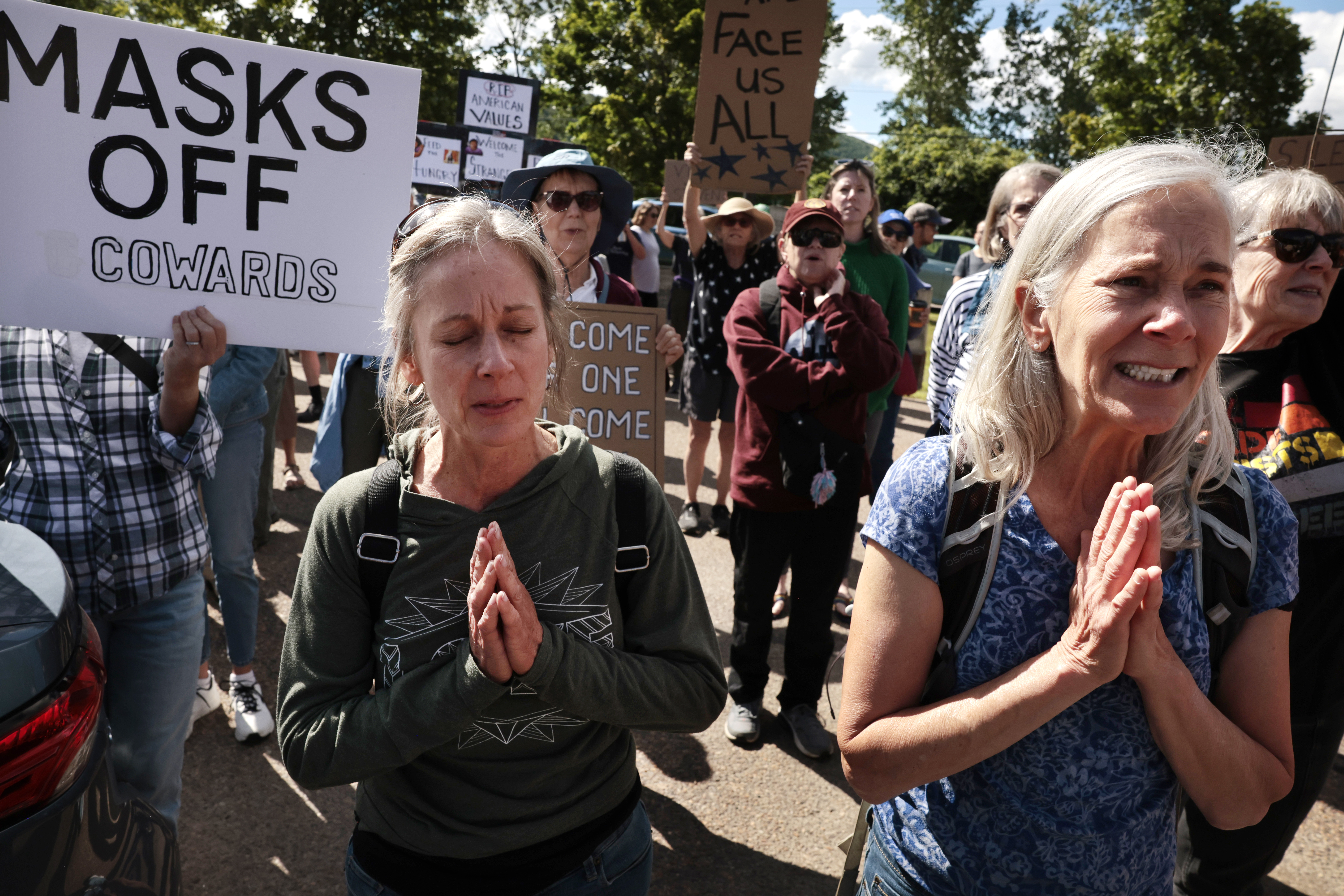
Last December, Steven Tendo stood on the steps of the First Unitarian Universalist Society of Burlington, Vermont, speaking to a crowd holding a candlelight vigil for immigrant justice.

“I believe that when we gather like this,” said Tendo, an ordained minister and asylum seeker from Uganda who fled torture and political persecution, “we are not only raising our voices, we are building a sanctuary in the public square—a sanctuary where immigrants can feel seen, heard and valued, a sanctuary where policies are challenged, but more importantly, where hearts are changed.”

Tendo thanked the community members who have been accompanying him to his regular check-in appointments with US Immigration and Customs Enforcement (ICE) in St. Albans. “I hold you dear in my heart when I walk out of my house to go to work at the hospital, not knowing whether I’ll be back or not,” he said.

Tendo’s words proved prescient. On Wednesday morning, he was arrested by immigration officers outside a Shelburne medical facility where he works as a licensed nursing assistant, just two days before a scheduled routine appointment with the agency.

“Everything seemed okay,” Tendo told me during a phone call on Sunday night from the Strafford County jail in Dover where he’s being detained. “And to my dismay, they came to my place of work and did all that kind of chaos there, shouting and yelling. The patients were like, ‘What’s going on?’ Everyone was scared.” Tendo said the officers “brutally” arrested him at gunpoint while his car was in motion and handcuffed his hands behind his back. “It was so scary,” he said. “I never expected that to happen in the United States. It happens in Uganda, but not here.”

“I followed the rules. I’ve done great in the community. I’ve never abused any of the conditions of the stay or of my supervision…I’m so scared, I cannot go back [to Uganda].”

Tendo came to the United States in 2018 seeking political asylum after becoming a target of the Ugandan government for his organization’s civic education and voter registration work. On one occasion, he was abducted by armed men and says he was taken to a secret facility where he was interrogated, beaten, and tortured. Some of his fingers were cut off. Another time, Tendo says he was placed in an underground room for hours with a python snake.

After fleeing to the United States, Tendo spent two years at the Port Isabel Detention Center in Los Fresnos, Texas. Despite ample evidence of the harm Tendo endured in his home country and the risk to his life if he were sent back to Uganda, an immigration judge rejected his asylum claim in 2019, citing inconsistencies in his account. Tendo’s lawyers appealed the judge’s decision without success. His case drew attention and support from Amnesty International and other human rights organizations, as well as US lawmakers. In 2021, Tendo was released from detention and settled in Vermont as he continued to fight his case.

Tendo has an outstanding order of removal. But, until now, he has benefited from ICE’s discretion to temporarily halt efforts to remove him through what’s called a stay of removal. During the Biden administration, Tendo said he only had to check in once a year. After President Donald Trump returned to power, the appointments became more regular, first every six months and then every three months.

“Under the new administration they were less willing to continue agreements like that,” said Brett Stokes, an assistant professor of law and director of the Vermont Law and Graduate School’s Center for Justice Reform Clinic who works on Tendo’s case. The day after President Donald Trump’s inauguration for a second term, Tendo received a letter instructing him to report to ICE sooner than expected, which raised fears of deportation.

A rally outside the office of Immigration and Customs Enforcement (ICE) on July 21, 2025. The community members gathered to support Steven Tendo.Boston Globe/Getty

At the time of his arrest on February 4, Tendo said his legal team had already communicated to the agency that they would be filing a new stay of removal request soon. “I’m so sad because I tried to do everything by the book,” he told me. “I followed the rules. I’ve done great in the community. I’ve never abused any of the conditions of the stay or of my supervision.” He added: “I’m so scared, I cannot go back.”

Tendo’s lawyers are also trying to reopen his case based on changed circumstances in Uganda and the increased harm he might face if deported due to his opposition to the ruling government. In the past, Stokes said, that might have been enough to dissuade ICE from taking a negative action against somebody—but not anymore. Stokes said the legal team was not informed of any changes to Tendo’s order of supervision that required him to report to the agency on a regular basis or of ICE’s intention to enact a removal order against him. They have filed a habeas petition seeking his release from detention and an emergency motion to stop his transfer.

“I think the most disturbing aspect of all of this is the fact that he had an ICE check-in scheduled for Friday and, all things being equal, was not necessarily expecting it to go differently than prior check-ins since his case has stayed the same,” Stokes said.

Tendo told me that while in custody ICE initially refused to give him his medication for diabetes for three days. “I never thought I would ever [be here] again,” he said. “I just have to be strong and pray that it will end soon. I don’t want to die here.” Chris Worth, one of Tendo’s lawyers, told a local news outlet that the government hadn’t acted on emails and calls about his client’s health condition. Tendo previously filed a civil complaint against the US government alleging “negligence, battery, assault, and intentional infliction of emotional distress” during his time in immigration detention.

“People like Pastor Tendo are exactly who our asylum system is meant to protect,” Democrat Sens. Bernie Sanders and Peter Welch and Rep. Becca Balint of Vermont said in a statement. Vermont AFL-CIO, the union Tendo is a member of, called his arrest “unnecessary, disruptive, and harmful to both workers and the communities that rely on them.” A crowdfunding campaign to help supplement Tendo’s income while in detention has raised more than $27,000, and some community members have been keeping watch outside the Strafford County jail.

“It’s just an unprecedented level of surveillance, harassment, and detentions, and we expect that to continue to increase.”

“It certainly seems quite plausible that ICE decided to detain him at his workplace, rather than at the check-in, to try to minimize the chance of community response,” said Will Lambek with the Migrant Justice organization. He estimated that about 50 people had shown up to an emergency rally on Wednesday to protest Tendo’s arrest, which coincided with the release of a Somali taxi driver who had been detained in January.

“That was a really jubilant moment that happened right on the heels of this very difficult moment of Steven’s detention,” Lambek said. “These two cases are part of this pattern of increasing enforcement from ICE and border patrol in Vermont. We’ve seen at least a tenfold increase in detentions in the state in 2025 compared to 2024. It’s just an unprecedented level of surveillance, harassment, and detentions, and we expect that to continue to increase.”

Tendo has called Vermont home for the past five years. He works as a licensed nursing assistant with the University of Vermont Medical Center and at an assisted living facility. He was also attending Vermont State University for his nursing degree.

“I don’t believe that what happened with Pastor Steven had anything to do with him as a person,” said Melissa Battah, executive director of the Vermont Interfaith Action. “I really believe that it was meant to instill fear into the immigrant community in Vermont…If the current administration thinks that they are just going to take this lying down, they have another thing coming for them. And if they think that the rest of the Vermonters that live here are going to allow our neighbors to disappear without us saying anything, they have another thing coming for them.”

Marybeth Redmond, an interfaith minister who spoke with Tendo on Wednesday, said he has left a deep imprint on the community. “He’s just a very deeply caring man,” she said. “He’s lived such a challenged life and yet to have the hopefulness and resilience that he has is nothing short of miraculous. I think most people would have crumbled under the things that he has had to navigate.”

Prior to Tendo’s unexpected arrest, Redmond had organized a group to show up at the Friday check-in outside the local ICE field office in his support. The plan was to send him in for the appointment with a blessing. Instead, a vigil took place without him. Redmond said somewhere between 150 and 175 people joined. “Steven, you’re not alone,” Tendo’s supporters chanted.

Continue Reading…

Mother Jones

Trump’s NIH Slashed Research on Chronic Diseases in 2025. Will It Happen Again?

As disease researchers around the country received letters last year that their grants had been cancelled, National Institutes of Health (NIH) director Jay Bhattacharya declared his agency was merely clearing out the clutter. Those terminated grants do “not actually have anything to do with promoting the health of the American people,” he told Science.

Experts weren’t buying that explanation at the time, and now they have the data to rebut it. A new report from the Senate health committee details deep cuts into research on some of the leading causes of death in the United States.

Over the last 12 months, the NIH has slashed hundreds of grants for research related to Alzheimer’s, cancer, diabetes, and heart disease. These conditions also happen to be among the favorite talking points of the Make America Healthy Again (MAHA) movement. In his 2025 inauguration speech, Donald Trump vowed to “end the chronic disease epidemic,” a promise repeated by Health and Human Services Secretary RFK Jr., who has zeroed in on nutrition and environment as key factors.

Given RFK Jr.’s focus on “diet-related chronic disease”—a phrase he repeated as he unveiled his new food pyramid—one might expect he’d be a fan of Lisa Goldman Rosas, a Stanford epidemiologist who, last spring, received one of those emails saying her funding no longer aligned with the administration priorities and was therefore terminated. Rosas, who studies how diet affects human health, estimates that at least 1 million US deaths could be prevented each year if every American ate a healthy diet. But how to accomplish that is where she and the administration diverge.

That’s because Rosas focuses on Hispanic families, who are more than twice as likely as the average US family to experience food insecurity—a major risk factor for several chronic conditions. “There’s really strong evidence that programs that promote healthy eating and active living need to be tailored to people’s cultural backgrounds. It’s not a one size fits all,” she told me.

This evidence-based observation was how her work got entangled in Trump’s anti-DEI trap, even though “it’s really just implementing patient-centered care,” Rosas says.

Lots of studies have been cancelled for perceived connections to DEI, even the most tangential. “Anyone doing community outreach could have their research cut regardless of subject,” says an NIH employee who asked not to be named for fear of retaliation. Such cuts affect everyone, the employee adds, by limiting our broader understanding of human health and disease: “If you’ve been to the doctor, you’ve been impacted by NIH research.”

Rosas’ work was cited in the Senate report alongside other major investigations into chronic disease the administration has defunded. Those include a 35-year study of Alzheimer’s risk, a cancer vaccine development program, and an NIH scientist’s work that another expert called, “the most important study in nutrition that’s been done since vitamins.”

In the wake of her grant cancellation, Rosas had to stop recruiting patients and scrape together what remained to keep paying her team. The lapse also disrupted her relationships with farms that supplied food for her study. “It’s a waste of money to cut funding partway through a study,” the NIH employee told me. And for patients midway through a course of treatment during a clinical trial, it poses serious safety issues.

Many of the hundreds of clinical trials cancelled last year involved chronic disease interventions, a separate analysis found, and about a third of them pertained to cancer treatment and prevention. The journal Nature reported that some of the highest dollar-value grant terminations were for cancer centers, which can provide cutting-edge treatments often not available at smaller hospitals.

Rosas eventually got her funding back by working with the program officer who’d been managing the grant at NIH. But due to staffing cuts and a hiring freeze, “every program officer is doing the work of multiple people,” the NIH employee told me. Researchers looking for help with getting their grants back may be reaching out to empty offices or waiting a long time for the overburdened employees who remain to get back to them. By the time Rosas’ grant was reinstated, she says, “a lot of the damage was unfortunately done.”

Another 2,000 NIH grants were restored by a federal judge’s order, but more than $700 million in grant money remains in limbo. Bhattacharya doesn’t seem inclined to dish those funds back out. In the past, grants for ongoing work were renewed periodically, and it was typically far easier to extend existing grants than secure new ones. Going forward, Bhattacharya has declared, “we won’t renew them.”

This move will compound the effects of reduced support for new grants. New funding for research on the above-mentioned diseases declined 16 percent overall in 2025 per the Senate report, with Alzheimer’s studies hit the hardest. That’s notable, because the number of people afflicted is expected to grow drastically as the the population ages over the next few decades.

The administration’s drastic cutshave not gone unnoticed. In the budget bill Congress passed last week, lawmakers rejected the president’s proposed budget, which would have cut spending on biomedical research in half. The NIH got $47 billion for the upcoming year—a slight increase over 2025.

Still, the NIH staffer I spoke with doesn’t foresee an end to the administration’s meddling. “It’s no longer about what’s being cut but what’s being politicized and restricted now,” the employee explains. “We got this full budget through, but how is that money going to be spent?”

Maybe not on improving the lives of the people with chronic conditions. “Those of us who focus on nutrition and chronic disease are hearing from this administration many messages that are aligned with what we’re doing,” Rosas told me. Yet its actions are “really confusing, not just for us, but for the people we serve.”

Continue Reading…

Mother Jones

Can He Really Do That? Black History Month in the Age of Trump

Last year, shortly after his second inauguration, President Donald Trump issued a proclamation on January 31 to mark the start of Black History Month the next day—just as presidents before him had done, beginning with Gerald Ford in the bicentennial year of 1976. He invoked “heroes such as Frederick Douglass, Harriet Tubman, Thomas Sowell, Justice Clarence Thomas, and countless others [who] represent what is best in America and her citizens.” A well-known golf enthusiast, he paid special tribute to Tiger Woods, one of many “who have pushed the boundaries of excellence in their respective fields.” Hailing the arrival of “a historic Golden Age,” Trump extended gratitude to “black Americans” (notably a lower case “B”) “for all they have done to bring us to this moment.”

A few weeks later, Trump hosted a Black History Month reception at the White House. Tiger Woods, wearing his Presidential Medal of Freedom (2019), was the guest of honor and gave brief remarks. The president acknowledged other attendees, including Senator Tim Scott (R-SC) and former NFL player Scott Turner, newly confirmed as the Secretary of Housing and Urban Development. The president touted his connections to the African-American community and paid tribute to “the generations of black legends, champions, warriors, and patriots who helped drive our country forward to greatness.”

Though nobody there mentioned it, Trump’s 2025 Black History Month reception took place in the shadow of a previous order from January 20, terminating “illegal” Diversity, Equity, Inclusion, and Accessibility offices and initiatives across all agencies of the federal government. According to the president, Americans deserved a government that hired and fired solely based on merit. Previous DEIA programs, the order stated, had not only been “[an] immense public waste,” but also an example of “shameful discrimination.” On the same day Trump proclaimed the start of Black History Month, his Secretary of Defense, Pete Hegseth, issued his own stark directive: “Identity Months Dead at DoD.”

Fast forward to February 2026, and Trump’s latest Black History Month proclamation is something vastly different, both at the rhetorical level and in its deeper meaning. It begins in the usual way, by recognizing America’s Black heroes and “legends” (used, unironically, in its colloquial form), but then it veers into subtle diatribe. “As president, I proclaim that ‘black history’ is not distinct from American history—rather, the history of black Americans is an indispensable chapter in our grand American story.” Sticking with the lower case “B” in all references to Black people and Black history,Trump has further twisted the shape and meaning of Black History Month. What other presidents have recognized as a month for community education and public acknowledgement—a celebration of African-American achievements, but also an observance of past injustices—Trump has harnessed for his own purposes. Black History Month, perhaps unsurprisingly, has become a battleground of memory and a new front in MAGA’s broader culture war.

Presidents make history at two levels: first, by taking decisions and implementing policies that change the lives of millions (or billions), but also by invoking and narrating the past in their own, often idiosyncratic, ways.

From a historian’s perspective, Trump’s attempt to co-opt and reconstrue Black History Month isn’t surprising. In the courses I teach on “History and Memory” and “The Politics of History,” students learn that presidents have always taken a role in the construction of American collective memory. Presidents make history at two levels: first, by taking decisions and implementing policies that change the lives of millions (or billions), but also by invoking and narrating the past in their own, often idiosyncratic, ways. They do this to influence how they will be seen in the future, but also to legitimate (and lubricate) the exercise of power while still in office.

Whether Democrat or Republican, progressive or conservative, presidents have always instrumentalized the past to advance their political agendas. On the way to the 1776 Bicentennial, Presidents Johnson and Nixon both tried to orchestrate the celebration to calm and manage the crises of the day: Vietnam, the struggle for civil rights, urban unrest, student protests, and economic recession. In their inaugural speeches and State of the Union Addresses, presidents spin historical yarns and elaborate their platforms through historical analogies and homespun presentations of the past. All of that is normal, even if, for historians, these presidential forays into history can be exasperating.

Trump’s efforts to change the shape and meaning of Black History Month are something different. The production of historical knowledge, whether by presidents or academics, always reveals and depends on the existing power structure. It always entails distillation, sanitization, selectivity, and, of course, who gets a say when it comes to giving the past its meaning. No interpretation of the past is apolitical, but the question of power also begs the question of moral vision and practical outcomes.

To what purpose and in support of what principles and values do we put our investigations of the past? When we explain and interpret the past, we do so in pursuit of knowledge and understanding—but to what end? What other goals shape and drive historical inquiry besides familiarity with the facts? Facilitating justice by accepting responsibility for past violations and abuses committed in our names? Or is the purpose of the past merely to maintain the hierarchies of knowledge, opportunity, and citizenship that deliver benefits to some while sidelining and brutalizing others?

It isn’t Trump’s sophomoric dabbling in history that is unusual; it is his determination to use the past for baldly illiberal purposes. Not for the purpose of affirming the uniqueness and dignity of all individuals and groups, but to force all Americans into a framework that appears to be neutral on the outside, even as it gives credence and political standing to some groups more than others. What makes Trump’s history dangerous is how it camouflages identity politics with a slick veneer of group neutrality. Not the identity politics of the last 40 years, for which MAGA has so much contempt, but the identity politics of an earlier age, when Black equality may have existed on paper, but Black Americans faced cruel and violent barriers to full citizenship, and American history, where it featured Black bodies, rarely incorporated Black voices.

An African American man in a suit and tie stands with arms held wide behind the presidential podium. Donald Trump stands behind him in front of a row of alternating flags. TIger Woods with a medal around his neck, stands to the far right. A crowd of people hold up their camera phones to capture the moment.

President Donald Trump listens as White House Opportunity and Revitalization Council Executive Director Scott Turner speaks during a reception in honor of Black History Month at the White House in February of 2025.Oliver Contreras/Sipa/AP

Consider, again, Trump’s use of language in his 2026 Black History Month proclamation. At first, he sticks with familiar tropes that recall the nation’s origins: “America’s founding was rooted in the belief that every man, woman, and child is created equal, ‘endowed by their Creator with certain unalienable Rights,’ and free to live […] in ‘pursuit of Happiness.’” But things soon take a dark and radical turn. “For decades, the progressive movement and far-left politicians have sought to needlessly divide our citizens on the basis of race, painting a toxic, and distorted, and disfigured vision of our history, heritage, and heroes.” Yes, this certainlysounds dire, but fear not, Trump will correct the nation’s course, as only he can. “This month […] we do not celebrate our differences. Instead, we celebrate the contributions of black Americans to our national greatness and their enduring commitment to the American principles of liberty, justice, and equality.”

It isn’t Trump’s sophomoric dabbling in history that is unusual; it is his determination to use the past for baldly illiberal purposes.

Throughout the proclamation, Trump pulls in two opposite directions. On the one hand, there isan inclusive, even charitable, aspect. Black history is seemingly accepted and embraced here. It should be viewed, Trump declares, as “indispensable.” His language melds Black history with American history, imbuing it with grandeur. Black patriots, he says, have been “the vanguards of our freedom” and are “some of the most heroic Americans to have ever lived.” The emphasis is on the unum in our nation’s oft-cited motto: e pluribus unum (out of many, one).

On the other hand, for many African-Americans, it will be hard not to feel slighted. Trump frames Black history in language that suggests it does not—indeed, by implication, it cannot**—**stand on its own. It exists to be subsumed into something broader and deeper. There is no singular Black experience in America’s past, it seems, except what Trump and MAGA choose to remember. You can see this in Trump’s 1776 history project, where Martin Luther King, Jr., appears, unfathomably, as a warrior in the fight against reverse racism.

The scare quotes around “black history” (“I proclaim that ‘black history’ is not distinct from American history…”) are also telling. Black history isn’t history at all, but only a kind of pseudo “history.” It may entail real events and real people, but, until it is absorbed into the MAGA past, it holds no real value. When Trump said, during a Black History Month event in 2017, that the 19th century abolitionist Frederick Douglass was “an example of somebody who’s done an amazing job and is being recognized more and more,” some saw his framing as yet another product of his narcissism. But it is also an example of how Trump appeals to the past while simultaneously ransacking and appropriating it for his own purposes. If Trump could copyright or affix a trademark to the past—not to mention monetize it—does anyone believe he would miss that chance?

In the next section, the president invokes that hardy perennial, the Declaration of Independence—2026 being the country’s Semiquincentennial—and he cites America’s “bedrock belief in equality.” The word “bedrock” does a lot of heavy lifting here, signaling something consolidated and foundational. For Trump, equality is enmeshed deep in America’s historical DNA. The nation’s history is the story of its genomic expression, and in Trump’s world, that DNA must remain pure. Anything that doesn’t fit must be excised. The text continues: “The source of our strength is rooted not in our differences, but in our shared commitment to freedom under one beautiful American flag.” One people, one nation, one history. Every strand of the past must be smoothed, with no ends left frayed. You can almost imagine Trump in the archives, sorting through America’s messy past with a hot iron and a pair of golden scissors.

A middle-aged woman and two children walk past a sign that reads "The Dirty Business of Slavery." There's smaller type beneath that header and colorful historical artwork titled "The Old Plantation," of enslaved people working the soil.

People walk past a panel on American slavery at the President’s House Site in Philadelphia in August of last year. The panel has since been removed.Matt Rourke/AP

Perhaps the best example of MAGA revisionism can be seen in the series of outsized claims Trump makes regarding America’s lead role in a story of liberation, technological achievement, and moral progress. America, he announces, “wrested the Western Hemisphere from monarchies and empires, ended slavery, saved Europe, put a man on the moon, and” (cough) “built the freest, most just, and most prosperous society ever known to mankind.” It’s not as if Black Americans aren’t present in the proclamation; indeed, they are remembered and honored for their contributions to a sweeping and triumphal story. But, at the same time, they are wrestled into place. They appear and attain their meaning in the distorted role Trump haschosen for them. Theymust live within a history that is imposed on them.

Clearly, Black Americans contributed enormously to their own emancipation and the writing of their own history. From the end of slavery to the civil rights movement to the 1619 Project—whatever one thinks of it—the story of Black Americans is fundamentally a story of the vast and complicated tapestry of Black memory. How could Donald Trump, or anyone for that matter, have the final say over Black memory? How can Black History Month ever be aligned with MAGA’s ideological project? Can it really be, as this year’s proclamation wants us to believe, that slavery was “ended” in the United States without ever having started—that is, without having been deliberately created and propagated and profited from by our patriots of yore?

The importance of Black History Month isn’t the way it can instill patriotic pride or paper over glaring inequalities and differences in lived experience. It is its ability to fill the voids in official accounts of the past and un-silence the voices that have too often gone unheard.

Since its observance began, Black History Month has been an opportunity to explore the nation’s past through new sources and to enrich our collective self-understanding through the cultivation and inclusion of new perspectives. The importance of Black History Month isn’t the way it can instill patriotic pride or paper over glaring inequalities and differences in lived experience. It is its ability to fill the voids in official accounts of the past and unsilence the voices that have too often gone unheard. We can, of course, celebrate and admire Black achievement and Black accomplishment and what Black excellence has added to America’s historical ledger. That was part of what led Carter G. Woodson to launch the first Black History Week in 1915. But Black history cannot be made to serve Trump’s memory of America except through deliberate and, I’ll say it, violent acts of erasure.

Before he was president and well before he became a fixture on our screens and in our feeds, Trump was a swaggering playboy New Yorker who fancied himself a builder. Recently, he has returned to form, demolishing the East Wing of the White House to build a giant ballroom and, more recently, announcing the closure of the Kennedy Center for the purpose of a major renovation. (Also, since he slapped his name on it, the collapse of ticket sales and artists refusing to perform there has made this important cultural venue unsupportable.) He appears to think obsessively about his legacy and how to leave an architectural imprint on the future.

On the National Mall, or perhaps the banks of the Potomac, Trump has proposed to raise a massive “Independence Arch” to commemorate the semiquincentennial. A 250-foot behemoth for our 250 years of self-governance. Elsewhere on the Mall, Trump has viciously attacked other monuments and sites of memory. Last summer, he railed against the National Museum of African-American History and Culture for having betrayed its mission. Instead of our country’s great success, he said, the museum was overly focused on “how horrible our Country is” and “how bad slavery was.” American history, Trump has said many times, should always be patriotic, and museums should not dwell on or stir up negative aspects of the past. There is only one American history for Trump; all others are untruthful and insane.

So, what is it he sees in his arch that is missing from the African-American history museum? Why is the Smithsonian’s cutting-edge museum of Black history and culture in the MAGA crosshairs while Trump’s monstrous arch is thought to embody the nation’s full glory?

The answers seem clear.

One remembers pain and broken promises, while the other erases them. One points to a multitude of experiences and perspectives, while the other flattens everything into a single unified plane. One demands moral reflection and soul searching, while the other hawks untarnished greatness. One is a space for civic dialogue, while the other dictates meaning and broaches no dissent. One is a story of democracy, imperfect but hopeful, while the other is a story of raw and ravenous power.

The Czech novelist Milan Kundera wrote, famously: “The struggle of man against power is the struggle of memory against forgetting.” But sometimes it’s the struggle of memory against counter-memory, remembering against remembering otherwise. When it gathers up a selection of perspectives and discards others, when it engraves certain stories and sands down others, memory is a form of power. With power comes great responsibility.

That’s the struggle over Black History Month right now. In many ways, however, it has become a microcosm of a far greater struggle, even an existential one in the face of an authoritarian’s fever dream. Trump so desperately wants his monolith. All Americans need to fight now more than ever, for a complex, democratic past. In the end, that may become the real meaning of Black History Month in our semiquincentennial year.

Top image: Mother Jones illustration; PHOTO12/ZUMA; COVER Images/ZUMA; Molly Roberts/White House/Planet Pix/ZUMA; Tony Vaccaro/Getty; Wikimedia

Continue Reading…

Mother Jones

Native Families Were Promised Free Solar. Trump Took It Away.

This story is published in partnership with The Daily Yonder.

It was sunny and warm for the end of November on the Rocky Boy’s Reservation in northern Montana. Joseph Eagleman was standing on a grassy hill, looking at a 20-panel solar array in the backyard of a Chippewa Cree elder.

It was built under the Solar for All program, a Biden-era Inflation Reduction Act-funded project that distributed $7 billion to build residential solar across the country. Here on Rocky Boy’s, around 200 homes would have received solar funded by the federal dollars.

This was the first to get panels in Queensville, a small community of modest homes in one of the reservation’s valleys. The home is brown, two stories, and fully electric, which is one of the requirements to qualify for Solar for All funding. Eagleman met me there to give me a tour of the panels that all but eliminated the resident’s $200–$300 monthly electricity bills, according to Eagleman.

Eagleman is the CEO of the Chippewa Cree Energy Corporation, an organization that manages energy development for the tribe. Here in the Northern Plains, a coalition of 14 tribes received a $135 million grant. The money would have provided around $7.6 million for each reservation to build residential solar, and Eagleman would have managed the Solar for All funds for the Chippewa Cree.

Then came President Donald Trump. His administration cut Solar for All in August.

“It’s terrible. We were getting ready to take off,” Eagleman said.

Residents had seen this solar array, which was built in the fall of 2024, and were excited about the possibility of free solar. Eagleman had a list of 40 households that were applying for the first round of the project. But only this house got a completed array before the program was stopped.

“It was a gut punch,” Eagleman said.

Listen to this story, featured in a recent episode of Reveal, in the player below.

The reservation is about an hour and a half from the closest city, Great Falls, Montana, and has a population of 3,300. Driving down to meet Eagleman, I passed a cafe/casino/bar/gas station, a school, a skate park, and many residences, but little else. “There’s not a lot of opportunities, except for leaving the reservation,” Eagleman said.

Electricity costs are high on the reservation, as they are across rural America. Building and maintaining infrastructure without density drives up costs for these areas. Applicants showed Eagleman their bills to demonstrate why they wanted solar so badly, and some were up to $900 a month. Around 35 percent of the reservation’s residents live below the poverty line, more than double the rate for the United States. Solar installations like these cost thousands of dollars—money that most residents don’t have.

Eagleman had hired Zane Patacsil, a local resident who had experience installing solar, a month before the cuts. Patacsil joined us in the sunny backyard, overlooking the hills and valleys that make up the Rocky Boy’s Reservation.

He said Solar for All would have brought some economic development to Rocky Boy’s and the other reservations that received the grant: an office and people to manage it, as well as training and hiring solar installers to do the labor.

“There were even members who were talking about starting their own solar businesses so they could be installing,” Patacsil said. “It was very disheartening to hear that news, because we lost all of that with it.”

A man, visible but cast in shadow, stares out over grassy plains from beneath a solar array. A tree stands in the near distance.

Eagleman, standing beneath the solar array, looks out onto the Rocky Boy’s Reservation. Ilana Newman/The Daily Yonder

When protests raged against the Dakota Access Pipeline in 2016, Cody Two Bears was on the tribal council for the Standing Rock Sioux. He saw another layer to the dispute: energy extraction on tribal land that not only hurt residents, but also brought no relief for high energy bills.

Two Bears wanted to bring energy sovereignty to his community and other tribal nations. He started the nonprofit Indigenized Energy in 2017. “I do this because of energy and energy sovereignty as well, but it creates a sense of hope for our tribal nations,” he said.

Sovereignty and self-governance are what tribes allegedly gained in exchange for giving up traditional homelands when treaties were signed over the past centuries. Tribal sovereignty is about not only protecting culture and traditions, but also self-sufficiency. It’s also legally protected by the US Constitution. But that’s easier said than done without the resources to support true independence, which have been systemically removed by the US government.

Native Americans are more food insecure and rely on Medicaid at higher rates than their white counterparts, depending on the US government for subsidies while desiring the sovereignty that was promised. Energy independence is a way to regain a degree of that sovereignty, and Two Bears has made that his goal with Indigenized Energy.

“My ultimate goal is to work myself out of a job,” he said. “I want to build so much capacity into these tribes where they don’t need Indigenized Energy anymore.”

But the funding picture changed dramatically when Trump’s administration slashed solar spending.

Indigenized Energy had already been building residential solar on the Northern Cheyenne Reservation for a few years, and it ramped up to prepare for more work through Solar for All. But when the program was cut, Indigenized Energy laid off around half its staff, including Donica Brady, the coordinator for the Northern Cheyenne Reservation in southeastern Montana.

A red pickup truck drives down a desolate highway on a sunny day. A road sign pointing to the right reads, "Rocky Boy Agency."

Turning off of Highway 87 in Box Elder, Montana, to the Rocky Boy’s Reservation, there’s not much around.Ilana Newman/The Daily Yonder

I first met Brady in September 2025, about a month after the layoff, and the pain of losing a job she loved was evident. Brady had spent the past couple of years building trust in a community where promises have been made and broken over and over again. Solar for All became yet another one.

Part of programs like Solar for All is job development within the solar industry. Brady was part of a training program through Red Cloud Renewable, funded by previous grants for solar on reservations. Solar for All would also have funded training and trade development on these reservations.

When I caught up with Brady again at her house in Busby, she was working two jobs, and the only time she had for me was at 9 p.m. on a Tuesday, after her daughter’s choir recital. I found her in the garage with a kitchen knife in hand, skinning a deer her wife had shot a few days previously. She asked if I wanted to help and handed me a knife.

 A woman smiles for a portrait, standing outside on a sunny day. A valley of green grass and distant hills are visible behind her.

Donica Brady in September 2025 outside Busby, Montana, on the Northern Cheyenne Reservation. Ilana Newman/The Daily Yonder

We chatted as we worked on the deer skin, cutting fat and sinew away from the dark red meat. She’d returned to her previous job as a bus driver and was hired by Freedom Forever, a solar installation company based in California. She’s still working in renewable energy, and Freedom Forever does work on reservations at times, but Brady’s job is no longer on the ground working with her community like she craves.

“I want my people to be able to be self-sufficient, not have to rely on funding or things like that that can be taken away,” Brady said. I heard this over and over: People don’t want to have to depend on the federal government for “handouts.”

As Brady cut out the tender backstraps and set them aside to give to her auntie, she talked about solar’s deeper meaning. “People call it progress, but I see it as going back to what we were taught, but in a new way,” she said. It’s more than just energy; it’s harnessing the sun, an important reflection of Northern Cheyenne culture.

The deer we were cutting up felt like a symbol summarizing everything we talked about. It was one way Brady could become self-sufficient and support those she loves. If only the power of the sun could be harnessed as easily as a deer skinned in a garage.

Some time later, just outside Lame Deer, Montana, the tribal headquarters of the Northern Cheyenne, I got lost looking for Thomasine Woodenlegs’ house. My phone had no service, so all I had was Woodenlegs’ instructions: Look for a bright-green house at the end of the road. Many U-turns later, Woodenlegs welcomed me into her kitchen, where photos of loved ones covered the walls and two cats, one orange and one black, lounged on the couch.

Woodenlegs works for her tribe, and she has lived in this house for 50 years. She plans to pass it down to her family. But she knows she will be saddling them with a financial burden, too.

“How am I going to survive after I retire? And how is whoever inherits my house?” Woodenlegs asked. “I’ll need to warn them that the electricity runs like $400 or $500, and they’d have to have a really secure income to live here. Otherwise, they’d be without lights.”

A faint rainbow and dark clouds hang over a golden field. Three power-line poles stand in the distance.

Power lines cross the short grass prairie on the Northern Cheyenne Reservation.Ilana Newman/The Daily Yonder

Woodenlegs saw solar panels from previous grant programs like the White River Community Solar Project, funded by the Department of Energy, going up around the reservation in 2020 and 2021. Solar for All’s big allocation for Indigenous communities brought more hope. She put in her own applications, feeling jealous of friends and acquaintances who received them, wondering when it would be her turn. She’s still waiting.

Tina Cady, another Northern Cheyenne resident, lives just outside Busby and has applied for solar panels multiple times. She worked for the Indian Health Service for 25 years until she went on disability. Now she lives on a fixed income of about $1,000 a month, and her husband picks up as many hours as he can as an adjunct professor at the tribal college. She showed me her October electric bill, which was $225.13.

Brady handled her application and told Cady what she’d learned in the field so far: Cady was a prime applicant for solar panels and she should be at the top of the list. “I’m an elder, and I’m disabled,” Cady said. Plus, she owns her own land. But Cady never heard anything more about it.

I asked whether she felt betrayed by the funding cuts, after so many previous letdowns to tribal communities. Cady said no, because it wasn’t her money to be betrayed. But she was disappointed and disenchanted: “I have seen them do this before. You get so you don’t trust anybody anymore.”

Four different lawsuits have been filed in federal courts against the Trump administration for ending Solar for All. It was terminated after the One Big Beautiful Bill Act rescinded “unobligated funds for the Greenhouse Gas Reduction Fund,” which had provided the funding for Solar for All.

The lawsuits claim that Solar for All was already a year into operation, so the funds were obligated, and that taking away already obligated funds is illegal.

All the lawsuits are still active. One from Climate United will move into oral arguments this month. Another from a coalition of 22 states is seeking an injunction to keep the Solar for All funds available.

But even without results from the lawsuits, solar installers like Two Bears and Eagleman plan to continue to fight for solar development on Northern Plains reservations.

Eagleman said he’s going to keep looking for funding to help bring affordable electricity to the Chippewa Cree on the Rocky Boy’s Reservation. He’s been looking at other public funding through the Department of Energy, as well as private philanthropic options.

Two Bears said he is moving forward with his company’s list of families awaiting solar. Indigenized Energy is ready to break ground on a project on the Menominee Reservation in Wisconsin, which was next in line when the funding was cut. He said it found private funding for that project, as well as another solar array for the Rosebud Sioux.

“So even though the money is not there, we’re still finding alternative resources and funding to make these possible and make’em feasible,” Two Bears said. It’s just going to take longer.”

Continue Reading…

Mother Jones

The Right Is Terrified of Bad Bunny

Bad Bunny, the “King of Latin Trap,” will perform the halftime show at the Super Bowl, promising a “huge party.” But his opposition to the Trump administration’s Immigration and Customs Enforcement (ICE) crackdown has led MAGA politicos and media stars to spread rumors in an effort to stoke a backlash against the artist.

Let’s take a look at some of them:

  • “He’s not an American artist,” said conservative political commentator Tomi Lahren on her show Tomi Lahren is Fearless last September.

Actually, Bad Bunny is a Puerto Rican native and therefore he’s legally a US citizen. When Lahren was called out for missing this fact, she clarified that she believes he is un-American due to his remarks against ICE and due to his refusal to tour in the US. (The artist has cited his concerns over ICE agents gathering outside his concerts to target his fans.)

  • “He’s not someone who appeals to a broader audience,” House Speaker Mike Johnson told the immigration newsletter Migrant Insider in an interview posted on February 3. “There’s so many eyes on the Super Bowl—a lot of young impressionable children. I think in my view you would have Lee Greenwood or role models doing that,” he said, referring to the American country music singer. (Greenwood’s song “God Bless the USA” is Trump’s walkout song.)

Wake up, Mike. Bad Bunny is in fact immensely popular. He was the top artist on Spotify’s global charts from 2020-2022 and 2025. In 2025, he had about 19.8 billion streams on the platform. And he just made history to become the first artist to win the Grammy for Best Album for a record sung entirely in Spanish.

NFL Commissioner Roger Goodell backed Bad Bunny the day after his success at the Grammys, noting his popularity. “It’s one of the reasons we chose him,” Goodell said last Monday. “The other reason is he understood the platform he was on. This platform is used to unite people.”

He continued: “I think artists in the past have done that. Bad Bunny understands that and I think he’ll have a great show.”

  • “All it does is sow hatred,” President Trump told the New York Post last month to explain that he planned to skip the Super Bowl due in large part to Bad Bunny’s appearance in the halftime show.

This “hatred” is Bad Bunny’s criticism of Trump and his administration’s violence against immigrants, communities of color, and protesters. And this criticism has often been far from hateful. During the artist’s Grammy acceptance speech, he said, “If we fight, we have to do it with love. We don’t hate them. We love our people. We love our family.”

Criticism of ICE is popular—65 percent of Americans said the federal agency has “gone too far” in its brutal enforcement of immigration laws in polls conducted late last month.

“We don’t hate them. We love our people. We love our family.”

And in fact, as my colleague Isabela Dias wrote last month, the push to “sow hatred” could better describe Trump’s campaign of terror to redefine who belongs in the US.

Last October, Homeland Security Secretary Kristi Noem said ICE agents would be at the Super Bowl. “There is nowhere that you can provide safe haven to people who are in this country illegally,” Corey Lewandowski, senior adviser to the Department of Homeland Security and Trump’s first campaign manager in his 2016 presidential campaign, said that same week. “Not the Super Bowl and nowhere else.”The NFL insisted on Tuesday that ICE officers would not be present at the game.
“There are no planned ICE enforcement activities. We are confident of that,” Lanier, the league’s chief security officer said at a security briefing. As of Sunday early afternoon, there have been no reports of ICE presence at the stadium.

The right has put together an alternative Super Bowl performance featuring Kid Rock. On Thursday, White House Press Secretary Karoline Leavitt said that Donald Trump would “much prefer to watch” Kid Rock over Bad Bunny.

But this attempt to replace Bad Bunny with who they consider a more “American” artist is clearly not working. Kid Rock’s televised performance of “The All-American Halftime Show,” which is sponsored by the late Charlie Kirk’s conservative group Turning Point USA, has lost multiple performers in the lead-up to the Super Bowl. The rock band Shinedown announced on Friday that it would drop out as taking part would “create further division.”

Continue Reading…

Mother Jones

Watch the Epstein Survivors’ Powerful Super Bowl Sunday Ad

A group of survivors of abuse by Jeffrey Epstein released an advertisement that will air during the Super Bowl imploring for the full release of millions of government files revealing the connections between Epstein and many famous politicians and celebrities.

BREAKING: The Epstein survivors are releasing this ad on this Super Bowl Sunday to send the message that they will not “move on” from the largest sex trafficking scandal in the world. #standwithsurvivors pic.twitter.com/JehYZa1hGw

— Jim Acosta (@Acosta) February 8, 2026

The ad was posted on X by journalist Jim Acosta. It comes a day before Congress is expected to be able to finally read unredacted versions of the Epstein files, according to a letter by a Justice Department official obtained by MS Now.

Continue Reading…

Mother Jones

The President’s Lawyers Submitted False Information About a “Law & Order” Plot to the Supreme Court

President Donald Trump’s legal team submitted false information to the Supreme Court in his ongoing legal battle against author E. Jean Carroll—who he was found liable for sexually assaulting in a Bergdorf Goodman dressing room in 1996—according to documents reviewed by Mother Jones.

Justin D. Smith, Trump’s lawyer in the case, misrepresented the plot of an episode of Law & Order: Special Victims Unit in a November 2025 petition to the court. Trump, along with some of his supporters, has for years claimed that Carroll’s account of him raping and sexually assaulting her was copied from the 2012 SVU episode.

Friends of Carroll confirm she told them about Trump’s assault years before the episode was filmed.

Trump is asking the Supreme Court to overturn a $5 million judgment from 2023, when a federal jury held that he sexually abused Carroll and then defamed her. (A separate $83.3 million defamation judgement against him from 2024 is not directly at issue, but could be in the future if the Court sides with Trump.) The justices’ are scheduled to review Trump’s petition on February 20.

In the Supreme Court petition, Smith describes the episode as featuring “a business mogul” who “fantasizes about raping a victim in a Bergdorf Goodman dressing room.” He writes that the “plotline is virtually identical to the false allegations that Carroll launched against President Trump.”

In the episode from season 13, entitled “Theatre Tricks,” there is a small plotline about a sexual encounter in a Bergdorf Goodman dressing room. But the man involved is a prominent New York City judge, not, as Smith claimed, a “business mogul.” And what happened in the dressing room, which is discussed but not shown in the episode, was pre-planned and by all accounts consented to. A person with knowledge of how the SVU episode came together told CNN in 2019 that there’s “no correlation—none whatsoever” between “Theatre Tricks” and Carroll’s allegations against Trump. Carroll has repeatedly denied she made up her allegation based on the episode. At least two friends of Carroll have confirmed the author told them about the assault shortly after it took place and years before the episode was filmed or broadcast.

Smith did not respond to a request for comment from Mother Jones on the false information included in the petition. Roberta Kaplan, Carroll’s lawyer in the case, also did not respond to a request for comment.

The Rules of the Supreme Court say that petitioners must present information with “accuracy, brevity, and clarity.” Failure to do so, per Rule 14.4, “is sufficient reason for the Court to deny a petition.” It is unclear if Trump’s lawyer knowingly included inaccurate information or failed to confirm the details of the episode in question.

E. Jean Carroll (L) and her lawyer Roberta Kaplan (R) leave Manhattan Federal Court following the conclusion of the civil defamation trial against former President Donald Trump on January 26, 2024 in New York City.

Carroll leaves a New York City court following the 2024 conclusion of her civil defamation trial against Trump.Michael M. Santiago/GETTY

The plot of “Theatre Tricks” involves a struggling young actress who seeks out sex work on a sugar daddy website, where she meets a judge who she helps fulfill a “stranger rape fantasy” that involves invading a Bergdorf Goodman dressing room while a woman tries on lingerie. It is one of over 550 SVU episodes spread across more than two dozen seasons containing hundreds of different examples of sexual violence—from harassment all the way to murder. The dressing room meet-up with the judge is mentioned for less than one minute in “Theatre Tricks,” which centers on a separate, nonconsensual sexual assault experienced by another character.

Carroll’s first public account of what happened with Trump in that dressing room around three decades ago came in a 2019 New York magazine article, excerpting her upcoming book. She detailed running into Trump when he asked her to advise him on a gift for, as she quoted him, “a girl.” They went around the store before he led them to the lingerie section, she wrote.

What unfolded next, as Carroll has since described many times, was Trump leading her into the dressing room, lunging at her, pushing her against the wall, pulling down her tights, using his fingers on her sexually, and penetrating her with his penis. Carroll wrote that she was eventually able to push him off and run out.

Carroll later sued Trump in 2022 for sexual battery and for defaming her by denying it through New York’s Adult Survivors Act. While Carroll has maintained that Trump used his fingers and penis in the assault, the jury, which ultimately awarded her $5 million, stopped short of finding Trump liable for rape under penile penetration. They found that Trump had “forcibly penetrated Ms. Carroll’s vagina with his fingers, causing immediate pain and long lasting emotional and psychological harm,” according to District Judge Lewis Kaplan, who presided over the case.

The legal definition for rape differs by state and, at the time, New York’s law required penile penetration. (In January 2024, New York broadened its rape law to include other kinds of nonconsensual anal, oral, and vaginal sexual contact.) Despite that, Judge Kaplan wrote in 2023 that the jury’s decision “does not mean” that Carroll “failed to prove that Mr. Trump ‘raped’ her as many people commonly understand the word ‘rape.’” “Indeed,” he continued, “the jury found that Mr. Trump in fact did exactly that.”

Trump has consistently denied the claims, saying over the years that Carroll is a “nut job,” “mentally sick,” and “not my type.” He has posted on social media more than 100 times about her accusations.

Smith’s faulty description of the SVU episode was detailed by David Boyle, a California lawyer with a habit of filing amicus briefs on major Supreme Court cases. In his early January submission in support of Carroll, Boyle writes of “Trump’s disrespect for rape victims,” and calls out how the president’s filling “makes up a television-show character, or at least the character’s profession, to discredit Carroll.”

Why did Boyle write the brief? “It’s a famous case, and I don’t like rapists,” he says, “even if it’s quote-unquote ‘just’ a digital rapist,” dryly noting Judge Kaplan’s holding about penetration.

“This is the Supreme Court. People are supposed to be on good behavior, their best behavior, and do things in good faith,” Boyle says. “He’s the president. We’re paying him a salary to be president. He’s supposed to be—laugh as you will, knowing who he is—a role model.”

Boyle’s amicus brief was one of five submitted to the court. The other four are in support of Donald Trump and his argument that certain evidence used in the previous trial was inadmissible. Those briefs do not mention the SVU episode.

In this courtroom sketch, Donald Trump's defense attorney Joe Tacopina, left, presents his closing arguments to the jury as E. Jean Carroll turns in her chair to watch in Manhattan federal court, Monday, May 8, 2023, in New York.

In this 2023 courtroom sketch, Trump defense attorney Joe Tacopina presents closing arguments as Carroll watches.Elizabeth Williams/AP

Trump, members of his legal teams, and some of his supporters have called on the SVU episode for years while attempting to discredit Carroll.

Within days of Carroll’s account originally being published in New York, a short clip from “Theatre Tricks” started circulating online. “Looks like that lunatic E. Jean Caroll got the idea about getting ‘raped’ by Trump in a dressing room at Burgdorfs while trying on lingerie from an episode of Law and Order SVU,” Mark Dice, a right-wing commentator with nearly 2 million YouTube subscribers, asserted. David J. Harris Jr, now host of The Pulse on Newsmax, wrote a post entitled, “Proof That Trump Accuser is a Fraud…Story Came From Law and Order SVU.” Conspiracy theorist Alex Jones also amplified the claim on his website InfoWars. Even Donald Trump Jr., the president’s son, retweeted the clip, according to a CNN report from 2019.

During Carroll’s 2023 civil trial against Trump, his lawyer, Joe Tacopina, brought up the episode. While testifying in that trial, Carroll’s lawyer Michael Ferrara asked her if she was “making up your allegation based on a popular TV show?”

“No,” Carroll responded. “No.”

Continue Reading…

Mother Jones

JD Vance Booed at Winter Olympics Amid Anti-ICE Protests

Vice President JD Vance, standing alongside Second Lady Usha Vance, was met with a chorus of boos at Friday’s Winter Olympics opening ceremony in Milan. As team USA entered San Siro Stadium, the crowd cheered—but that was cut short when the Vances came on the big screen.

As the New York Times reported, “Their appearance on the screens lasted for only a few seconds,” but the boos “were audible despite the loud music playing for the parade.”

Hours before the ceremony, hundreds of protestors took part in a student-led demonstration against the presence of US immigration agents at the winter games. Officials from Immigration and Customs Enforcement’s Homeland Security Investigations team are in Milan to “vet and mitigate risks from transnational criminal organizations,” according to the Department of Homeland Security. Italy’s Interior Minister Matteo Piantedosi has said that the ICE personnel in the country “are not operational agents.” Protestors called for the removal of ICE, along with Vance and Secretary of State Marco Rubio, who is also attending, from the games.

When asked about Vance’s icy welcome on Air Force One, President Donald Trump said it was “surprising.”

“Is that true? That’s surprising because people like him,” he said. “I mean, he is in a foreign country in all fairness. He doesn’t get booed in this country.”

Trump is seen with his mouth slightly open as reporters put microphones near his face on Air Force One.

Trump reacts after a reporter tells him Vance was booed in Milan.Samuel Corum/GETTY

Except, Vance has been booed at events multiple times in the US.

While on the campaign trail in August 2024, Vance was booed at a firefighters convention in Boston after claiming that he and Trump were the “most pro-worker Republican ticket in history.” In March, the vice president received screaming boos as he attended a Kennedy Center symphony performance. A few months later, in August, Vance, Homeland Security Advisor Stephen Miller, and Secretary of Defense Pete Hegseth were all heckled and booed in Washington, DC’s Union Station as they went to meet National Guard troops deployed to the city.

At the opening ceremony, some in the crowd noted that the boos appeared to clearly be directed at the Vances—and not at the athletes competing for the US.

“It was quick but noticeable,” wrote Juliette Kayyem, an Obama-era DHS official who is attending the games, of the Vances’ booing. “But,” she continued, “I want to point out that the crowd was loud and supportive when Team USA came out. It was lovely to hear. And quite a juxtaposition.”

Continue Reading…

Mother Jones

Japan Embarks on a Deep-Sea Mining Experiment With Unknown Consequences

This story was originally published by Grist and is reproduced here as part of the Climate Desk collaboration.

The year 2010 was a reckoning for Japan’s economic security.

On September 7, the Chinese fishing trawler Minjinyu 5179 refused an order by Japan’s coast guard to leave disputed waters near the Senkaku Islands, which are known in China as Diaoyu. The vessel then rammed two patrol boats, escalating a decades-long territorial feud.

Japan responded by arresting the captain, Zhan Qixiong, under domestic law, a move Beijing considered an unacceptable assertion of Japanese sovereignty. Amid mounting protests in both countries and the collapse of high-level talks, China cut exports of rare earth elements to Japan, which relied upon its geopolitical adversary for 90 percent of its supply. The move reverberated throughout the global economy as companies like Toyota and Panasonic were left without materials crucial to the production of everything from hybrid cars to personal electronics.

It wasn’t long before Japan gave in and let Qixiong go. The crisis, which garnered worldwide attention, became a catalyst for Japan’s push to secure a reliable supply of critical minerals. “That was the turning point,” said Takahiro Kamisuna, a research associate at the International Institute for Strategic Studies in London.

Fifteen years later, that reckoning has only deepened.

China still provides 60 percent of Japan’s critical minerals, a reliance that has grown riskier as Beijing asserts its position as the world’s dominant supplier. Last month, Japan took a bold step to break that dependence when it launched a five-week deep-sea mining test off Minamitorishima Island. A crew of 130 researchers aboard the Chikyu—Japanese for “earth”—will use what is essentially a robotic vacuum cleaner to collect mud from a depth of 6,000 meters, marking the world’s first attempt at prolonged collection of minerals from great depths.

“I think that they’re both pretty much going to destroy the habitat directly affected.”

Seabed mud off the coast of that uninhabited island, which sits 1,180 miles southeast of Tokyo, is rich in rare earths like neodymium and yttrium—distinct from the potato-shaped polymetallic nodules often associated with marine extraction. Such materials are essential for electric vehicles, solar panels, advanced weapons systems, and other technology.

The expedition, which is expected to end February 14, is being led by the Japan Agency for Marine Earth Science and Technology, which did not respond to a request for comment. It comes three months after the country signed an agreement with the United States to collaborate on securing a supply of critical minerals. It also propels Japan to the forefront of a growing debate over how far nations should go to secure these materials. Deep-sea mining “is not a new thing,” Kamisuna said, “it’s just gaining more attention mainly because of geopolitical tensions.”

The trawler incident highlighted a vulnerability that successive governments vowed to alleviate. Many criticized then-prime minister Naoto Kan of the country’s center-left party for capitulating to China, but he pledged to never again let Japan’s industrial future hinge on a single supplier. His successor, Shinzo Abe of the center-right party, was more aggressive and saw critical minerals as not just an economic issue, but a matter of national security that must be addressed even if it meant exploiting the deep sea.

Establishing a domestic supply could help Japan reach its goal of achieving carbon neutrality by 2050, a high priority for Yoshihide Suga, who succeeded Abe. Although Prime Minister Sanae Takaichi, an Abe protégé who assumed office late last year, supports the 2050 timeline, she has said the transition must not risk Japan’s industrial competitiveness and energy stability.

Takaichi has proposed slashing subsidies for large-scale solar projects or batteries, largely because so much of that technology is imported from China. Instead, she has hailed nuclear power as the path toward carbon neutrality. With the mining experiment unfolding in the Pacific, Takaichi hopes to secure a strategic reserve of minerals to protect key industries.

But Japan doesn’t face an either-or choice, said Jane Nakano, a senior fellow at the Center for Strategic and International Studies in Washington, DC. “Energy security and energy transition are closely tied,” she said.

“To me, it’s much more about the pace, not so much the direction,” said Nakano, who has worked for the US Department of Energy and for the energy attaché at the US embassy in Tokyo. “I don’t find Takaichi’s way of framing this dual challenge—energy security and decarbonization—unique to Japan. A lot of G7 countries are starting to recalibrate again, so they do have to think about international competitiveness. Direction-wise, [Japan] is just aligning itself with the political establishment and the industry.”

Unlike China, Japan lacks the sedimentary geology associated with rare earth deposits, requiring it to look toward the waters within its exclusive economic zones. Under the United Nations Convention on the Law of the Sea, Japan has the right to exploit the resources within 200 nautical miles of its coastline, which includes the atoll island of Minamitorishima.

Although the minerals to be found there lie nearly 20,000 feet beneath the surface, proponents of digging them up argue the challenge of extracting them and the cost of refining them is justified by mounting geopolitical tension. With Takaichi’s recent political jabs at Beijing, China has begun choking off its exports to Japan. Nakano said Japanese officials seem “confident” in the outcome of the experiment. “They’ve determined that it merits to have this demonstration of technologies and equipment this time around,” she said.

Japan’s foray into deep-sea mining comes amid mounting concern about the ecological cost of such technology. Scientists and environmental groups warn that marine extraction is racing ahead of our understanding of the impacted ecosystems. They are particularly concerned about sediment plumes, noise and light pollution, and damage to habitats and food webs, noting that scars left by equipment could render the seafloor uninhabitable for decades, even centuries.

“A tiny little nudge, and the whole seafloor is disturbed,” said Travis Washburn, a marine biologist at Texas A&M University in Corpus Christi. He studies deep-sea environments and human impacts on marine ecosystems, and he has analyzed the waters around Minamitorishima Island and represented Japan at International Seabed Authority workshops. He believes that mining rare earths from mud could have the same impact as mining nodules. “I think that they’re both pretty much going to destroy the habitat directly affected.”

Government officials insist the ecological impacts will be closely monitored. But assessing them could be difficult, because the seafloor around the island, home to sea cucumbers, sponges, corals, and potentially rare endemic species—remains the subject of intense study. Scientists fear these ecosystems may be permanently altered before anyone assesses them. As with many extractive industries, Washburn noted, technology is often deployed before anyone fully understands its environmental impacts.

Shigeru Tanaka, deputy director general of the Pacific Asia Resource Center, is an outspoken critic of deep-sea mining. He argues that the industry as a whole disregards international law and that exploiting the seafloor will harm fisheries and trample upon the rights of Pacific Islanders who consider the sea as sacred. (The Indigenous people of the Mariana Islands have raised such concerns in opposing Trump administration plans to open the waters there to mining.) He also believes that some of the experts involved in Japan’s project “are not really taking seriously the risks to the environment and how irreversible it may be.”

Even some government officials have expressed concern. Yoshihito Doi of the Agency for Natural Resources and Energy has said Japan should mine only “if we can establish a robust system that properly takes environmental impacts into account.”

It remains unclear what exactly is unfolding beneath the waves during this current test, but based upon his experience working with the Japanese government on similar research, Washburn said the top priority will be assessing whether the technology works. Researchers also will monitor how much material the system can hold and if the machinery can keep the sea mud contained without releasing a massive sediment plume on the seafloor or in the water column.

If Japan can successfully deploy a 6,000-meter pipe that can suck up 35 metric tons of mud under extreme pressure—about 8,700 pounds per square inch, or 600 times the pressure at sea level—government officials say a broader trial, which may include polymetallic nodules, could begin in February 2027.

One longer-term goal is to develop what’s called “hybrid mining.” Because deep-sea polymetallic nodules sit atop the rare-earth mud around Minamitorishima Island, researchers are exploring whether both could be collected and separated in a single operation.

Kamisuna said Japan faces another challenge: The energy needed to acquire and refine a stockpile. “If we want to create a sufficient reserve for rare earth [minerals], either using domestic or export, a large amount of electricity is required,” he said. “And the question is, What are we going to use, liquified natural gas or coal? What is the environmental cost?”

Using more environmentally friendly methods of extraction and processing can be expensive, he said—which is one reason many countries turn to China as a cheaper option.

For now, Japan’s deep-sea mining experiment seems to have drawn little public opposition at home, unlike in the United States and Australia where environmental activists and Indigenous communities have pushed back against such operations, particularly around the Pacific Islands. In the meantime, the country’s test moves forward, even as the implications of success, and questions about its long-term impact, remain unresolved.

“We are not prepared,” Tanaka said. “My personal take is that by the time we are ready, when the technology and the science is set, I really do not think there would be a demand for it.”

Continue Reading…

Mother Jones

How Minneapolis Taught America to Fight Back

In a Minnesota town outside the Twin Cities, Emily is a nurse who treats many immigrant patients. She can’t locate a patient who just had a test result that shows they might have cancer. The patient was recently detained by ICE; situations like these have forced the clinic to adapt, making house calls and triaging care.

“I’d love to know how well somebody’s kidneys are functioning today,” Emily said, but “I’m gonna wait till three months because I don’t want them to come in for a lab appointment that’s not critical.”

Emily is one of many Minnesotans mounting a quiet, secretive resistance to the Trump administration’s hard-nosed and often violent immigration agenda. Across the state, neighbors are helping neighbors and communities are building grassroot systems to support immigrant families.

This week on Reveal, our Minnesotan reporters Nate Halverson and Artis Curiskis report on how Minnesota is teaching the country to resist federal agents who have arrested children, killed citizens in the street, and pepper-sprayed high schoolers.

Continue Reading…

Mother Jones

Trump Posts Video That Depicts Obamas as Apes

Late Thursday night, President Donald Trump shared a video on Truth Social that depicts former President Barack Obama and former first lady Michelle Obama as apes.

The post, which was online all of Friday morning, appears to have been removed from the president’s page.

Toward the end of an unrelated video alleging interference in the 2020 presidential election, a clip that is around 2 seconds long features the first Black president and his wife on the bodies of apes as “The Lion Sleeps Tonight” plays in the background. That clip comes from a longer video that a meme account posted in October.

Mother Jones asked the White House a list of questions, including how Trump found the video, if he was aware that the 2020 election video contained that imagery when he posted it, and if the video depicting the Obamas was playing on the president’s device. The press office did not respond to specific questions but instead sent over a statement from White House Press Secretary Karoline Leavitt.

“This is from an internet meme video depicting President Trump as the King of the Jungle and Democrats as characters from The Lion King,” Leavitt said. “Please stop the fake outrage and report on something today that actually matters to the American public.”

The video clip posted by the president just before midnight on the East Coast drew immense backlash, including from some Republicans.

Sen. Tim Scott, a Republican from South Carolina, wrote on X: “Praying it was fake because it’s the most racist thing I’ve seen out of this White House. The President should remove it.”

The Democrats X page also condemned the video, writing, “This is who Trump is: Sick, racist, and completely deranged.”

The original video of the Obamas was seemingly created by the same account that made the AI-generated video of President Trump flying a fighter jet and dropping feces on “No Kings” protesters. The user’s bio reads “God First | Trump ‘Fighter Jet Poop’ Guy.” In the full version of the video that Trump posted on Thursday, prominent Democrats are depicted as various animals, and President Trump’s head is on a lion with the caption “King of the Jungle.” The Obamas are not the only Democrats included in this video. Former presidential candidate Hillary Clinton, Rep. Alexandria Ocasio-Cortez, New York City Mayor Zohran Mamdani, former President Joe Biden, and former Vice President Kamala Harris all appear, among others.

The president’s post is the latest in a decades-long history of sharing or amplifying racist claims, from taking out a full-page ad in 1989 calling for the death penalty for the young Black and brown Central Park Five to boosting the Obama birtherism conspiracy theory for years. He has also not restricted this behavior to social media; during both of his terms, he has enacted policies that uniquely target Black people, such as a comprehensive attack on diversity, equity, and inclusion efforts in the federal government and private sector that began with an executive order on his first day in office.

It’s unclear how the video came across the president’s screen, but the original creator is celebrating. Under his initial post of the video, he shared a screenshot of Thursday’s Truth Social post.

Minutes before and minutes after sharing the video, which included the racist imagery of the former first family, Trump had posted two videos about how the Republican Party is the best political home for Black people.

Continue Reading…

Mother Jones

How to Resist Like Minneapolis

In the chaos of 2020, Minneapolis got angry and brave and tired and jittery (Was that shots or fireworks? Unclear, check the Signal chat). Many of us got comfortable with the idea of direct giving (Just, like, to a Venmo account? Yep. How do you deduct it? Can’t). Under nightly curfews and circling helicopters, the city was flooded with cortisol, and residents began to organize themselves in small groups to try to stay safe, register dissent, and figure out what the hell was going on.

Again in 2026, Minneapolis is the stitch in the center of the bullseye.

Again in 2026, Minneapolis is the stitch in the center of the bullseye—the focal point of national conversations about the unchecked use of force by state agents and the swells of protests against it. The enormous resistance that the city has mounted against Immigration and Customs Enforcement’s Operation Metro Surge was built on those foundations laid after the murder of George Floyd.

I grew up in South Minneapolis. I travel a lot as a touring musician, but still stay in a rented apartment in Uptown, not too far from where George Floyd, Renée Good, and Alex Pretti were killed. As the footage from the ground went around the world, friends and I received words of encouragement from Northern Ireland, Turkey, and Iran—keep marching, keep fighting. Before falling asleep at night, I got verklempt watching protesters in other American cities name-check Minnesota on their signs and in their chants, as a model to emulate. In that spirit, here is a short list of best practices to help your town respond quickly, should the need arise. It’s not exhaustive or absolute, and it’s definitely just not mine, but the product of a collective intelligence that’s coalesced in a city under duress.

The Minneapolis Model
Actionable steps today to be ready to resist tomorrow:

1. Mutual aid networks are made of neighbors who know each other. Ask to borrow a screwdriver from the new family in the apartment down the hall—find any excuse to meet your neighbors and trade numbers.

These will be the people in the encrypted chat.

2. Small businesses don’t have shareholders to answer to or boards to consult, so they can act on conscience quickly. Shop local when you can; visit immigrant-owned restaurants; chat at the register.

These will be the drop sites for food and supplies.

3. In a crisis, information must be shared quickly. Curate your online feeds now by following at least a few local non-profits, neighborhood groups, activists, and local reporters.

These will be your trusted sources to mobilize protests quickly and warn of new dangers to avoid.

4. Consider how the role you play in daily life can be useful in a crisis. Graphic designers can share signs to post in windows. Cooks can make soup to warm protesters. People with minivans can take cans to the food drive and children to school. The brewer’s empty beer boxes can be collapsed to make signs for the march. The affluent can donate money and ask their friends to do the same. Take stock of your personal skillset and assets.

These will be the resources that you can leverage without instruction.

5. Your community includes the people that you don’t like. Engage in conflict responsibly. Keep public arguments issues-focused, avoid trolling. The pay-what-you-can vegan cafe might not have much to say to the gun club during ordinary circumstances, yet find themselves partnered in exceptional times.

These will be the members of your coalition, even if they are not your friends.

6. The circumstances that call for a surge of public resistance are necessarily confusing, infuriating, painful, and surreal. You will be working tired, texting with shaking hands, possibly crying in the car. It’s easy to get spun up past the point of being useful to anybody. Check in on people you’re closest to—including yourself. Eat a vegetable, stretch your hamstrings, maybe get together with the crew for a few small beers.

This will be the rule that is most impossible to follow.

Because it all comes in too quickly to be filed in the mind. The local reporter will be tear gassed, a fellow musician will be tear gassed, a baby will be tear gassed. A Somali friend tells of rumors of denaturalization, wherein citizenship will be revoked. The mayor says agents have started going door to door, asking where the Asian people live. Cars are left running on the streets after their drivers have been pulled out and detained. Volunteers delivering food to families in hiding will be told not to use their phones to navigate—better to write the addresses on paper and if pulled over, eat it. There will be a video. And then another. There will be a pink jacket and a rabbit-eared hat.

Your nervous system feels like a toaster dropped into the bath.

So everyone gets a whistle to bring to the gun fight. They’re 3-D printed now and people wear them around their necks. At the big march, a man’s eyelashes freeze together. Friends volunteer to watch strangers’ kids. The sex shop receives so many donations on the sales floor that employees refer to it as Diaper Mountain. People place candles on the frozen surface of Lake Nokomis to spell ICE OUT in the flight path into MSP.

Yours may be the easiest part to play—blue passport, light skin, some folding money in your pocket. Still, your nervous system feels like a toaster dropped into the bath. The loud dinging says you’ve forgotten to buckle your seatbelt again and this is no time for unforced errors—everyone must cultivate fortitude alongside their resolve. At home, your pee is much too yellow, so you drink a full glass of water standing at the sink. Brush your teeth, you need to keep those. Go to bed without your phone beside you on the pillow. But then a remembered errand has you up again and putting on your shoes to return the screwdriver to the neighbor down the hall; your knuckles hit the door and your heart knocks against your sternum, hoping there is still someone safe inside to hear it.

The arc of history is not self-bending, but mittened hands with simple tools are working on the moral side.

Continue Reading…

Mother Jones

Michigan Lawsuit Calls Big Oil a “Cartel” That’s Driving High Energy Bills

_This story was originally published b_y the Guardian and is reproduced here as part of the Climate Desk collaboration.

Amid rising concern about global heating and soaring energy costs, Michigan has sued big oil for allegedly fueling both crises—a move experts have hailed as groundbreaking.

In a first-of-its-kind complaint, the state’s attorney general, Dana Nessel, accused four fossil fuel majors and the top US oil lobbying group last month of acting as a “cartel” to stifle the growth of renewable energy and electric vehicles (EVs), while suppressing information about the dangers of the climate crisis. The conduct, the lawsuit alleged, violates federal and state antitrust laws.

The companies’ “collusion” drove up Michigan utility costs and slowed the transition away from gas-powered cars, according to the filing. Absent the industry’s efforts to repress clean technology, EVs “would be a common sight in every neighborhood—rolling off assembly lines in Flint, parked in driveways in Dearborn, charging outside grocery stores in Grand Rapids, and running quietly down Woodward Avenue,” it said.

“The Big Oil cartel conspired to deny Americans cleaner and cheaper energy choices and make life less affordable.”

Electricity costs in Michigan have surged, with average residential rates increasing by nearly 120 percent in the last two decades. And though electric car adoption is increasing, EVs and hybrids accounted for less than 4 percent of total registered vehicles statewide last year.

“Michigan is facing an energy affordability crisis as our home energy costs skyrocket and consumers are left without affordable options for transportation,” Nessel said in a statement. “These out-of-control costs are not the result of natural economic inflation, but due to the greed of these corporations who prioritized their own profit and marketplace dominance over competition and consumer savings.”

Michigan’s case specifically targets BP, Shell, Chevron, and ExxonMobil, as well as the largest US oil lobby group, the American Petroleum Institute (API).

“This is yet another legally incoherent effort to regulate by lawsuit,” an ExxonMobil spokesperson said. “It won’t reduce emissions, it won’t help consumers and it won’t stand up to the law.”

Ryan Meyers, general counsel for the API, said: “These baseless lawsuits are a coordinated campaign against an industry that powers everyday life, drives America’s economy and is actively reducing emissions. We continue to believe that energy policy belongs in Congress, not a patchwork of courtrooms.”

BP declined to comment on the pending litigation. The Guardian has contacted all defendants for comment.

The oil industry has long attempted to have lawsuits voided by saying they are pre-empted by policies, but plaintiffs say climate accountability lawsuits focus on business practices and the distribution of misleading information, not emissions regulations.

The 126-page lawsuit was brought by Nessel’s office alongside Sher Edling—a California-based law firm that is representing a slew of municipalities in climate accountability litigation—and two other firms, DiCello Levitt and Hausfeld, which have also handled climate complaints and are based in Chicago and Washington DC, respectively.

The new challenge accuses the defendants of engaging in a vast “conspiracy,” starting almost 50 years ago when a 1979 Exxon internal report predicted the world would see catastrophic global heating without a massive shift to renewable energy.

“Rather than compete as leading producers of renewable energy products, the defendants and their co-conspirators conspired to suppress their own output of renewable energy, and restrain output by others,” the lawsuit said.

To do so, the firms used an array of tactics, including employing patent lawsuits to stop their competitors, hiding information about fossil fuels’ dangers and the viability of renewables, using trade associations to coordinate “market-wide efforts” to skew investments toward oil and gas, and even hiring hackers to “surveil, intimidate and disrupt” journalists and activists, it claimed.

“Michigan’s groundbreaking case reveals how the Big Oil cartel conspired to deny Americans cleaner and cheaper energy choices and make life less affordable by keeping consumers hooked on their dirty fossil fuel products,” said Richard Wiles, president of the Center for Climate Integrity, a nonprofit that tracks and supports climate litigation.

With the challenge, Michigan joins 10 other states and about 60 local governments that have sued Big Oil for alleged climate deception in recent years. Together, the cases represent jurisdictions that are home to more than a quarter of the US population.

Nessel first announced plans to launch climate accountability litigation in 2024, stating concerns with the cost of climate damages in her state. The January 23 filing came despite attempts to thwart climate accountability litigation from the Trump administration. Last year, the Department of Justice took the unusual step of suing Michigan and Hawaii over the states’ plans to file such cases; despite the attack, Hawaii filed its lawsuit the following day.

In a blow to the Trump administration, one day after Michigan filed its lawsuit, a federal judge tossed out the justice department’s filing against the state.

But the oil industry and its allies are continuing their attempts to kill off climate accountability lawsuits. The fossil fuel industry is lobbying Congress to obtain immunity from climate-focused litigation and policies, and last month the API listed defeating climate accountability lawsuits as a top priority for 2026.

The sector and its allies have also been pushing the Supreme Court to weigh in on the legitimacy of climate lawsuits. Soon, the high court is expected to decide if it will hear arguments over a petition by ExxonMobil and energy giant Suncor seeking to end a lawsuit brought by the city and county of Boulder, Colorado.

Continue Reading…

Mother Jones

Illinois Representative Asks God to Get Trump to “Do What Is Right”

During his address to God at the National Prayer Breakfast on Thursday, Rep. Jonathan Jackson, a democrat from Illinois, called on President Donald Trump to be “invested in the elevation of suffering” of people in this country, including “the families preparing to bury their loved ones in Minneapolis.”

Rep. Jackson, son of civil rights leader Rev. Jesse Jackson, asked God to “remind” the president “that he has the power to turn mourning into dancing or to reduce the country into a cosmic elegy of chaos and suffering” as Trump stood just feet away, his eyes fluttering open and shut during the prayer.

The representative’s prayer provided an uninterrupted moment in a crowded room to call attention to the ongoing and violent federal immigration operation in Minneapolis, which, as Jackson noted, included agents fatally shooting two US citizens: Renée Good and Alex Pretti.

Both men were on stage for the 74th National Prayer Breakfast, an event that every president has attended since Dwight D. Eisenhauer. It was Trump’s sixth time speaking at the breakfast, and his address lasted over an hour and 15 minutes.

In that address, Trump falsely claimed that he won the popular vote in the 2016 election, joked that “I really think I probably should make it” into heaven, and defended his Secretary of Homeland Security Kristi Noem, who is facing increasing calls for her to be fired or impeached, among other boilerplate talking points for the president.

Rep. Jackson has been a critic of Immigration and Customs Enforcement’s operations and was a part of the group of Illinois lawmakers who were denied entry into an ICE processing facility during the summer, before being granted access late last year. He’s faced pushback, though, for buying stock in Palantir, a major ICE contractor. The representative, according to NOTUS, “regretted buying this stock and that he asked his financial adviser to get rid of his Palantir holdings.”

Elsewhere in Rep. Jackson’s prayer about Trump, he asked God to “increase the stature of his wisdom,” to “lead this president into greater levels of compassion,” and to “give him greater clarity, greater courage, and greater capacity to do what is right.”

“For the sake of this nation, for the sake of this world, we pray that goodness and mercy would announce themselves in his life in new and powerful ways,” Rep. Jackson said, adding, “remind him that we are all Americans, all made in the image of God and that none of us are free unless all of us have our freedoms protected.”

Continue Reading…

Mother Jones

Health Department Will Mine Unverified Vaccine Injury Claims With New AI Tool

_This story was originally published b_y WIRED and is reproduced here as part of the Climate Desk collaboration.

The US Department of Health and Human Services (HHS) is developing a generative artificial intelligence tool to find patterns across data reported to a national vaccine monitoring database and to generate hypotheses on the negative effects of vaccines, according to an inventory released last week of all use cases the agency had for AI in 2025.

The tool has not yet been deployed, according to the HHS document, and an AI inventory report from the previous year shows that it has been in development since late 2023. But experts worry that the predictions it generates could be used by HHS secretary Robert F. Kennedy Jr. to further his anti-vaccine agenda.

A long-standing vaccine critic, Kennedy has upended the childhood vaccination schedule in his year in office, removing several shots from a list of recommended immunizations for all children, including those for Covid-19, influenza, hepatitis A and B, meningococcal disease, rotavirus, and respiratory syncytial virus (RSV).

Kennedy has also called for overhauling the current safety monitoring system for vaccine injury data collection, known as Vaccine Adverse Event Reporting System (VAERS), claiming that it suppresses information about the true rate of vaccine side effects. He has also proposed changes to the federal Vaccine Injury Compensation Program that could make it easier for people to sue for adverse events that haven’t been proven to be associated with vaccines.

Jointly managed by the Centers for Disease Control and Prevention (CDC) and the Food and Drug Administration, VAERS was established in 1990 as a way to detect potential safety issues with vaccines after their approval. Anyone, including health care providers and members of the public, can submit an adverse reaction report to the database. Because these claims are not verified, VAERS data alone can’t be used to determine if a vaccine caused an adverse event.

“I would expect, depending on the approaches used, a lot of false alerts and a need for a lot of skilled human follow-through.”

“VAERS, at best, was always a hypothesis-generating mechanism,” says Paul Offit, a pediatrician and director of the Vaccine Education Center at Children’s Hospital of Philadelphia who was previously a member of the CDC’s Advisory Council on Immunization Practices. “It’s a noisy system. Anybody can report, and there’s no control group.”

Offit says the system only shows adverse events that happened at some point following immunization; it doesn’t prove that a vaccine caused those reactions. CDC’s own website says that a report to VAERS does not mean that a vaccine caused an adverse event. Despite this, anti-vaccine activists have misused VAERS data over the years to argue that vaccines are not safe.

Leslie Lenert, previously the founding director of the CDC’s National Center for Public Health Informatics, says government scientists have been using traditional natural language processing AI models to look for patterns in VAERS data for several years, so it’s not surprising that HHS would move toward the adoption of more advanced large language models.

One major limitation of VAERS is that it doesn’t include data on how many people received a vaccine, which can make events logged in the database seem more common than they actually are. For that reason, Lenert says it’s important to pair information from VAERS with other data sources to determine the true risk of an event.

LLMs are also famously good at producing convincing hallucinations, underscoring the need for humans to follow up on any hypotheses generated by an LLM. “VAERS is supposed to be very exploratory. Some people in the FDA are now treating it as more than exploratory,” says Lenert, who is currently the director of the Center for Biomedical Informatics and Health Artificial Intelligence at Rutgers University.

Vinay Prasad, director of the FDA’s Center for Biologics Evaluation and Research, reportedly proposed stricter vaccine regulation in a recent memo sent to staff in which he blamed the deaths of at least 10 children on the Covid-19 vaccine without citing evidence. The deaths were reported to VAERS and had previously been reviewed by FDA staff. More than a dozen former FDA commissioners responded with a letter in The New England Journal of Medicine, expressing concern about Prasad’s proposed guidelines. The changes, they wrote, would “dramatically change vaccine regulation on the basis of a reinterpretation of selective evidence.”

Jesse Goodman, an infectious disease physician and professor of medicine at Georgetown University, says that the use of LLMs could potentially detect previously unknown safety issues with vaccines. But since VAERS can contain inaccurate and incomplete data, he says it’s important that any leads are thoroughly investigated first.

“I would expect, depending on the approaches used, a lot of false alerts and a need for a lot of skilled human follow-through by people who understand vaccines and possible adverse events, as well as statistics, epidemiology, and challenges with LLM output,” he says.

With deep staffing cuts at the CDC, Goodman says it would be important to have plans and capacity in place to deal with any emerging data, including screening it and deciding what may need to be studied further and how.

In the past, VAERS has flagged legitimate safety issues, including instances of a rare clotting disorder among some people who received the Johnson & Johnson Covid-19 vaccine and rare cases of myocarditis, particularly among younger males, who got the mRNA Covid-19 vaccines.

HHS did not respond to a request for comment.

Continue Reading…

Mother Jones

Minneapolis Is the Violent Reckoning the Gun Rights Movement Has Long Wanted

This story was co-published with The Trace, a nonprofit newsroom covering gun violence in America.

On December 31, in the waning hours of 2025, the Washington Post reported on an internal ICE document that concerned the agency’s “wartime recruitment” strategy, or rather its attempt to expeditiously swell its ranks of deportation officers. The memo, according to the Post, had in mind a pool of ideal candidates who lead a “patriotic” lifestyle and have an interest in “military and veterans affairs,” “physical training,” “gun rights organizations,” and “tactical gear brands.”

The memo’s logic was easy enough to understand, since what it described, if you read between the lines, was an informal paramilitary that was waiting to be tapped. Over the last month—as a violent federal occupation has unfolded in Minneapolis, where veteran immigration agents brutally killed two American citizens, Renee Good and Alex Pretti—both the memo and the new recruits it would draw into the fold began to take up outsized space in my mind. For a long time now, the gun rights movement has been animated by the promise of a violent reckoning, a sentiment nurtured by the groups that represent it and Republican politicians, who seek to channel a wild, truculent energy into votes and profits. It seemed the promise was being fulfilled in Minneapolis, like the fatal denouement of a production that had one harbinger after another.

“Any mission, any condition, any foes, at any range.”

During the 2016 election cycle, when as a reporter I attended my first National Rifle Association annual meeting, I began to see that the promised reckoning could not be delayed forever. At the convention, in Louisville, Kentucky, there was the tradeshow floor, akin to a medieval arms bazaar and containing some 520,000 square feet of guns and tactical accessories. There were seminars covering “Defensive Shooting Skills Development,” “Methods of Concealed Carry,” “Current and Emerging Threats,” and “The Bulletproof Mind For The Armed Civilian.” And there was a line of some 7,000 people, leading into an arena called “Freedom Hall,” where there would be speeches by the emerging Republican presidential candidate, Donald Trump, and Mark “Oz” Geist, a member of the Benghazi diplomatic compound’s security team that had come under siege in 2012.

Three middle-aged white men stood in line in front of me making confident assertions about Barack Obama and “government cover-ups.” One informed the others that Obama, still president, had purchased a “$10 million mansion in Saudi Arabia,” where he and his family would flee after leaving the White House to “evade charges.” Trump would of course chase him down, the man assured everyone, while the United States reembraced frontier justice and flourished under his rule.

The line then moved inside, 7,000 people took their seats, and the Republican presidential candidate promised them: “I will never let you down.” Based on the ecstatic response from the crowd, it seemed to me that the message Trump had transmitted was about power—raw power—and who would wield it during his administration.

Going back to at least the early nineties, when President Bill Clinton, a Democrat, was in office, gun rights organizations, led by the NRA, and various prominent Republicans pushed an argument for the Second Amendment that was disguised as a historical one. The right to bear arms, they said, was intended to be unfettered because its purpose was to provide citizens with the means to fight a tyrannical government that had turned against its own people. Federal agents, under Clinton, were “jack-booted government thugs,” according to a notorious fundraising letter signed by former NRA CEO Wayne LaPierre. These thugs, he said, had the power to “take away our Constitutional rights, break in our doors, seize our guns, destroy our property, and even injure or kill us.”

It was often implied that such arguments, which grew in prominence during Barack Obama’s tenure, applied only to the Democratic Party, which posed a vague yet persistent threat to “freedom,” while the Republican party would preserve it. Republican values were antithetical to tyranny, whereas Democrats were inherently tyrannical, and therefore any actions taken by the former were in service of saving the country from the latter.

In 2016, while sitting in “Freedom Hall,” I began to feel a sense of alarm that I’d never before felt. Under Trump, this contingent would feel it had permission to act against the enemy. The carrot that was dangled during each election cycle—in fundraising pitches by gun rights groups and the sale of military-style firearms to civilians—was finally being fed to the horse. There would be no more “couch commandos,” as gun industry executives referred to their most enthusiastic customers in the years after 9/11. This was the period in which soldiers were in American streets, and the industry, en masse, had seized on a marketing opportunity to blur the line between soldier and civilian.

What the industry was selling was theatrical participation, the thrill of COSPLAY, except the props were real. “As close as you can get without enlisting,” one gun company, in 2010, boasted as it advertised its “semi-auto only version of the U.S. Special Operations Command’s newest rifle.” “Any mission, any condition, any foes, at any range,” said another manufacturer about its latest assault weapon. In the ad it was equipped with a scope and propped on a tripod, as if intended for a sniper, which of course was the point. Companies were selling military-style weapons with a “combat-proven design,” that provided “versatility on the range or during patrol,” and were a symbol of “bravery on duty.” To enhance the feeling of a simulated combat experience, manufacturers of AR-style firearms cut product placement deals with video game designers. An executive at the gun company Sig Sauer told authors Cameron McWhirter and Zusha Elinson, who co-wrote the book American Gun, that featuring the weapons in games was tantamount to “seed planting.”

Buying a gun had become a way to serve at home, and serving at home came to mean preparing for Democratic tyranny. In 2015, for instance, while Obama was still president, the Pentagon prepared for a training exercise across the American Southwest called Jade Helm 15. It was here that the performative, paranoid politics of the right during the Obama years reached something of a fever pitch. Conservative bloggers and commentators created widespread hysteria by alleging that the exercise was a veil for imposing martial law, confiscating firearms, arresting dissidents, and taking over Texas. The state’s Republican governor, Greg Abbott, called on the Texas State Guard to monitor developments. It was “important,” he said, that Texans know their “rights” and “liberties” would not be “infringed.” The last word did not seem like an accidental allusion to the Second Amendment.

For conservative elites, the preservation of power requires giving those beneath them a taste of it, without actually surrendering anything substantial, such as higher tax payments. In the meantime, they have created a shadow army, empowering them not with wealth but with the alluring prospect of crushing their opponents. A few months after the 2016 NRA convention, Trump said at a rally that Hillary Clinton “wants to abolish” the Second Amendment. “If she gets to pick her judges, nothing you can do, folks,” he went on. “Although the Second Amendment people, maybe there is.” Trump for much of his career had been the paragon of vapid wealth, but unlike other leaders of the right who came before him, he was signaling that he would take the army off standby, out of the realm of theater, and move the violent plot forward.

The 2020 anti-lockdown Covid protests were a stark indicator of the new paradigm under Trump, who directed blame for restrictions toward Democrats such as Michigan’s governor, Gretchen Whitmer. After state lawmakers voted to extend her state of emergency, a large group of men carrying assault rifles packed the Michigan Capitol rotunda and attempted to barge into the legislature, where a line of police guarded the doors. They screamed in the faces of the officers, who looked on impassively.

The lurid fantasy at the heart of the gun rights movement is playing out, but the leading roles, as they were previously imagined, have been reversed.

As the year wore on, Trump told the Proud Boys during a televised presidential debate to “stand back and stand by.” His loss to Joe Biden then set into motion the January 6 insurrection. Oath Keepers stashed an arsenal of weapons at a hotel in Arlington, Virginia. One member imagined a scenario in which “millions die resisting the death of the 1st and 2nd amendment.” A week later, a middle-aged white man named Ian Rogers, a California resident and proud NRA member, was arrested with his best friend for planning to attack the state’s Democratic headquarters. He owned roughly 50 firearms, including four illegal automatic weapons, and had stockpiled 15,000 rounds of ammunition. Writing to me from prison last year, he said that the Democratic Party was “the greatest threat facing the United States today.” He went on, “Just as Rome was brought down by enemies within, we have such traitors amongst us now,” adding, “These people fundamentally hate the country and they will do anything to impose their vision on the nation.”

Now, in Minneapolis, masked federal agents, dressed as soldiers, have fatally shot two American citizens. Both were victims of an occupation, in which the Trump administration has unleashed a savage campaign of terror against civilians. The lurid fantasy at the heart of the gun rights movement is playing out, but the leading roles, as they were previously imagined, have been reversed. The party in power is not a Democratic regime, but a Republican one, prompting accusations of hypocrisy against gun rights organizations, who have had little to say and have not called on their followers to face down tyranny in Minneapolis.

Following the merciless second killing, of Alex Pretti, a 37-year-old nurse, federal officials, led by Stephen Miller and Department of Homeland Security Secretary Kristi Noem, concocted a false narrative alleging that Pretti had murderous intentions. Pretti had a sidearm on his waist, and they shamelessly pointed to it as evidence, even though the gun was holstered, he was legally carrying it, and agents shot him after they had removed the weapon.

Officials also tried to argue that, owing to the firearm’s presence, Pretti’s death was justified. This assertion presented an existential quandary for gun rights organizations, which have spent decades working to dismantle carry restrictions. One by one, the groups issued statements about how a holstered handgun did not give law enforcement the right to kill a person. That was the wrong message, the groups said, but the tyranny of the occupation itself was treated as legitimate. Gun Owners of America stated that “the Left must stop antagonizing @ICEgov and @CBP agents who are taking criminals off the streets and play a crucial role in protecting communities and upholding the rule of law.” The NRA similarly declared, “For months, radical progressive politicians like Tim Walz have incited violence against law enforcement officers who are simply trying to do their jobs.”

What is happening now, in other words, is a reminder that the argument about government tyranny was always a canard. Beneath it lurked what was really at stake, which was the right to assert control through force. Over and over, conservatives and Second Amendment stalwarts have claimed that right as their own, with Minneapolis being the latest example. The story they have told for decades is a binary one—good versus evil. In that framing, they are righteous and have but one job: Vanquish the enemy. Hold power. Save America.

The same day Pretti was shot, video surfaced of federal agents pointing their weapons at civilians. “It’s like ‘Call of Duty,’” someone could be heard saying, referencing the blockbuster military-style video game series. Since then, Trump has suggested he will deescalate in Minneapolis. But whatever happens, the players have had a taste of the real thing, and there’s no going back.

Continue Reading…

Mother Jones

700 Immigration Officers Are Leaving Minneapolis. The Rest Will Depend on “Cooperation.”

President Trump’s Border czar, Tom Homan, announced Wednesday that the Trump administration will remove 700 federal immigration officers from Minneapolis. The decision, effective immediately, still leaves over 2,000 agents in the area, nearly four times the number of officers in the Minneapolis Police Department.

Homan claimed that although he and the president shared the goal “to achieve a complete drawdown and end this surge, as soon as we can,” such a complete withdrawal would depend on the “continued cooperation from state and local law enforcement and the decrease of the violence, the rhetoric, and the attacks” against immigration officials.

The plan marked a stark contrast to ICE’s retreat in Maine, after Sen. Susan Collins, a Republican up for re-election this year, abruptly announced last week that ICE was ending its surge in the state, citing a conversation she had with DHS Secretary Kristi Noem.

In his press conference, Homan also said that Wednesday’s reduction did not signal a pause in Trump’s overarching goal of mass deportations.

“Let me be clear: President Trump fully intends to achieve mass deportations during this administration, and immigration enforcement actions will continue every day throughout this country, “Homan said. “President Trump made a promise. And we have not directed otherwise.”

Homan was sent to Minneapolis to take over what the administration calls “Operation Metro Surge,” replacing Border Patrol “commander-at-large” Greg Bovino after the fatal shootings of US citizens, Renée Good and Alex Pretti, by federal agents.

The presence of immigration officers over the last month has seen repeated use of chemical irritants on protestors, the targeting of children at school, the separation of families, and the detention of people here legally—all of which have created an environment of intense fear.

Continue Reading…

Mother Jones

Donald Trump’s Plan to Be King of the World

A version of the below article first appeared in David Corn’s newsletter, Our Land_. The newsletter comes out twice a week (most of the time) and provides behind-the-scenes stories and articles about politics, media, and culture. Subscribing costs just $5 a month—but you can sign up for a free 30-day trial._

With so much going on these days—ICE murders, Venezuela, Epstein documents, and Melania—one development has not gotten enough attention: Donald Trump’s plan to become king of the world.

Last month, Trump announced he was establishing a so-called Board of Peace to oversee the rebuilding of Gaza, and the chair of this august group would be…him. And the executive board would include Trump envoy Steve Witkoff, Trump son-in-law Jared Kushner, Trump Secretary of State Marco Rubio, Trump Deputy National Security Adviser Robert Gabriel, and Trump donor and billionaire investment banker Marc Rowan, as well as former British Prime Minister Tony Blair and World Bank head Ajay Banga.

Not a very independent board, is it? By the way, the latest release of Jeffrey Epstein documents shows that Rowan, the CEO of Apollo Global Management, according to the Financial Times, had “wide-ranging discussions” with Epstein, though Apollo previously insisted it had not done any business with the sex criminal. (Former Apollo chief Leon Black resigned his position in 2021 after an independent review showed he paid $158 million to Epstein for financial services.) And fun fact about Gabriel: During the January 6 riot, when he was a White House speechwriter, he sent a text message saying, “Potus im sure is loving this.”

Each member of the executive board, the White House said, will oversee “a defined portfolio critical to Gaza’s stabilization and long-term success,” and a Gaza Executive Board within the Board of Peace will also be set up, with Kushner, Witkoff, Blair, and Rowan as members, along with several others, including a Cypriot-Israeli billionaire, an Egyptian intelligence official, and a UN official. No Palestinians were recruited for either of these boards.

So it looked as if this Board of Peace would be a Trump-dominated, crony-ish operation deciding the fate of 2 million Gazans. Not surprising. But it’s turning out to be much more.

The opportunities for graft and grift are immense.

Shortly after the White House unveiled this outfit, it released the charter for the Board of Peace. Oddly, the document said nothing about Gaza. It proclaimed that the Board of Peace would seek to “promote stability, restore dependable and lawful governance, and secure enduring peace in areas affected or threatened by conflict.” That is, anywhere in the world. Under the rules presented in the charter, Trump would be the chairman and the US representative to the Board of Peace…forever. That is, until he resigns or is booted due to “incapacity”—which would require a unanimous vote by the executive board. And, according to the charter, he decides who’s on the executive board. Each member serves entirely at his pleasure (and whim).

Even after he leaves the White House, Trump will rule this competitor to the United Nations (which now is in danger of financial collapse). And the charter gives him “exclusive authority” to “appropriate,” which seems to mean total control over the funds. Also, he determines what nations can join. Nations can only serve a three-year term, subject to renewal by, of course, Trump. But if a country ponies up $1 billion (in cash) to the Board of Peace, the three-year limit is waived.

Trump is essentially cooking up a global slush fund over which he will exert complete control. Countries that get in early—while he’s president—will certainly be in a strong position to request preferential treatment in state affairs. The opportunities for graft and grift are immense. He will probably ask Congress to kick in the $1 billion pay-to-play membership fee to guarantee he’ll have a pot of money to spend (or pocket) at his fancy.

What’s to prevent him from naming Ivanka Trump his successor? Or Don Jr.? Or Jared? (Talk about a succession battle!) Under this charter, Trump could establish an international monarchy of sorts. Hail King Barron!

That’s not all. How will Trump’s successor as chair be picked? Silly to ask, right? By Trump, naturally. Per the charter, he will designate a successor who “shall immediately assume the position” if Trump leaves or is—ha ha ha—pushed out because he cannot do the job. The charter, as I read it, doesn’t say how long the successor will reign—presumably, under the same terms as Trump. What’s to prevent him from naming Ivanka Trump his successor? Or Don Jr.? Or Jared? (Talk about a succession battle!) Under this charter, Trump could establish an international monarchy of sorts. Hail King Barron!

At the recent World Economic Forum shindig in Davos, Trump held a charter signing ceremony for the Board of Peace, with representatives from Argentina, Turkey, Hungary, Bulgaria, Bahrain, Kazakhstan, Kosovo, Qatar, Armenia, Azerbaijan, Morocco, Paraguay, and Pakistan. Not to be condescending, but this is not the A-team, and many of these nations have assorted human rights problems—an issue absent from the charter. Israeli Prime Minister Benjamin Netanyahu, who backs this Trump venture, couldn’t be there because he’s subject to an arrest warrant from the International Criminal Court for alleged war crimes in Gaza. He was present in spirit, no doubt. Conspicuously missing from the lineup were the United States’ most important allies.

To add to the absurdity, Trump has invited Russia and China to join. Offering a spot on the Board of Peace to Vladimir Putin while his invasion force is killing civilians in Ukraine is quite a bad joke—and an insult to those Ukrainians losing their lives and their loved ones to combat Russia’s aggression.

Trump’s Board of Peace is another Trump scam—though much grander than Trump Steaks or Trump’s meme coin (which has dropped about 90 percent in value since being launched a year ago).

In fact, the whole thing is a bit of a joke. As Charbel Antoun, a writer who specializes in foreign policy, points out, “The Board of Peace lacks the basic components of a functioning international institution: no defined legal status within existing international law; no enforcement tools or dispute resolution procedures; no accountability mechanisms; a mandate that drifts from Gaza reconstruction into a vague promise to ‘address global crises.’” It can’t really do anything. Except be a platform for you-know-who.

Meanwhile, it’s unclear what the Board of Peace will be doing about Gaza. At Davos, Kushner unveiled a Gaza development plan that called for glittering high-rises on the coastline and gigantic data centers and industrial parks inland. He had a nifty PowerPoint presentation but apparently had not consulted with any Palestinians. He arrogantly signaled this scheme was not open to discussion, remarking, “There is no Plan B.” Kushner did not say who would finance this makeover—or profit from it.

Trump’s Board of Peace is another Trump scam—though much grander than Trump Steaks or Trump’s meme coin (which has dropped about 90 percent in value since being launched a year ago). Trump is looking to shake down nations that want to earn his favor—it’s only a billion bucks!—and set up an outfit he can exploit once he has wrung the Oval Office dry. The charter calls for an official seal for the organization—and the logo Trump approved shows only half the world—but it left out what Trump really wants: a crown.

Continue Reading…

Mother Jones

Kristi Noem’s Throttling of FEMA Funds Constitutes a Preventable Disaster

This story was originally published by Grist and is reproduced here as part of the Climate Desk collaboration.

Kristi Noem faces intensifying public scrutiny over her leadership of the Department of Homeland Security. Criticism of the former South Dakota governor has focused on her handling of the killing of Alex Pretti by a federal immigration agent and her oversight of the Federal Emergency Management Agency. The controversies have prompted calls from Democratic lawmakers—and a small but noteworthy group of Republicans—for her resignation or impeachment.

The immediate flashpoint has been the January 24 killing of Pretti, which occurred during ongoing protests in Minneapolis. Noem initially described Pretti, a 37-year-old nurse, as a “domestic terrorist,” a narrative repeated by others in the Trump administration. Her account was almost immediately contradicted by numerous videos that showed Pretti was unarmed and restrained when federal agents shot him repeatedly.

“She should be out of a job,” Sen. Thom Tillis (R-N.C.) said after the videos emerged. While President Donald Trump has publicly said Noem’s position is secure, a number of potential successors have reportedly emerged, including Virginia Gov. Glenn Youngkin and Lee Zeldin, who leads the Environmental Protection Agency.

“It’s magic-wand policymaking, where you need a crisis in order for something to happen.”

Noem’s handling of the killing—which came two weeks after a federal immigration agent in Minneapolis fatally shot protestor Renée Good—follows sustained criticism of her management of FEMA. Lawmakers, disaster response experts, and disaster survivors say her policies have slowed emergency response and delayed recovery funding. Long before the crisis in Minnesota, concerns were building over her approach to FEMA preparedness and spending and its response to calamities like last year’s devastating floods in the Texas Hill Country.

“It’s a policy of chaotic austerity,” said Sarah Labowitz, a senior fellow at the Carnegie Endowment for International Peace who studies disasters and adaptation. “It’s magic-wand policymaking, where you need a crisis in order for something to happen.”

FEMA helps coordinate the response to major disasters like last year’s Los Angeles wildfires, but the agency more often acts like a bank, reimbursing states and cities for their disaster preparedness and recovery spending. When Noem took office, she throttled that spending by, among other things, requiring her personal sign-off on all expenses over $100,000. The pace of disbursements has since slowed to a trickle.

Those restrictions reportedly hindered the agency’s response to emergencies like July’s floods in Texas because officials could not pre-position search and rescue teams. The acting head of FEMA at the time, David Richardson, was reportedly unreachable for several hours, and the agency did not answer two-thirds of calls to its hotline. More than 130 people died in the floods.

On Thursday, a coalition of disaster survivors released a “report card” that gave Noem’s leadership an “F.” Brandy Gerstner, a member of that coalition, lost her home and belongings in the Texas flood. She and her family live in the rural community of Sandy Creek and spent three days without power or water waiting for federal assistance.

“Official help was scarce,” she said. “Despite that, Kristi Noem and Texas Gov. [Greg] Abbott have described the response as exceptional, a lie that insults the memory of those lost in the floods.”

Beyond floods in Texas and fires in Southern California, the United States experienced relatively few major disasters last year. Even so, Noem’s restrictions on FEMA spending has also slowed payments to local governments still recovering from past catastrophes. The reimbursement backlog has reached $17 billion, according to the New York Times—more than the agency spends on such things in a typical year.

Delays have also affected FEMA’s efforts to reduce the impact of future catastrophes. A Grist analysis found that the agency’s net spending on resilience grants declined over the past three quarters, even as climate-driven disasters intensified nationwide. The nonprofit news outlet NOTUS identified a $1.3 billion backlog of such allocations, the primary source of federal funding for states and cities seeking to harden infrastructure. FEMA terminated another climate resilience program last year, though a court has ordered it to reinstate that program.

Former FEMA chief of staff Michael Coen Jr. said Noem’s departure could ease the logjam. “I don’t see another secretary coming in that is going to want to review every single grant,” said Coen, who served in the Obama and Biden administrations. “I would think that most executive leaders…are gonna find that that is micromanagement.”

“There’s plenty of towns in Vermont that would still say they’re waiting.”

Beyond Noem’s leadership lie other questions about the agency’s direction. The Trump administration has yet to nominate a permanent administrator, leaving Karen Evans, a former cybersecurity official, in charge since Richardson departed in November. Agency leaders have suggested firing more than 11,000 employees, many of them contract workers involved in local response and recovery efforts.

The Trump administration’s touted “review council” was set to produce a report on FEMA’s future, but Noem reportedly pared the council’s final report to a fraction of its original length. The panel abruptly cancelled its plans to present the findings in December, and its deadline has been pushed to March.

“I think whether she stays or goes, there are huge issues that have been created in the last year at FEMA that have to be resolved quickly ahead of hurricane season,” Labowitz, said, referring to the season to come.

Noem appeared to soften her approach last week. The agency paused its planned terminations, and Noem hosted her first in-person briefing with agency employees, whom she attempted to rally ahead of Winter Storm Fern. She also appeared to respond to mounting criticism on Thursday when she announced the release of $2.2 billion in disaster response funds.

The money will reimburse states and local governments for repair costs associated with events like Hurricane Helene, the 2023 floods in Vermont, and coastal erosion in Louisiana. A press release frames the allocation as “additional” recovery money, but recipients told Grist that FEMA is merely following standard procedure in granting reimbursements.

“We were all quite surprised yesterday when we were informed that the payment was coming as quickly as it came,” said Joe Flynn, secretary of the Vermont Agency of Transportation. FEMA told his agency that it would provide $22 million to help rebuild a fleet garage destroyed in the 2023 floods. “There’s plenty of towns in Vermont that would still say they’re waiting.”

The offer was less than the state had requested, but Flynn accepted it given uncertainty about future funding. “With everything going on in the federal government, an adequately granted award is a bird in the hand,” he said.

The press release appeared to have been composed in haste. It contained multiple typos, including a misspelling of Louisiana as “Louisianna.” The director of the Greeneville Water Commission, after confirming that FEMA will reimburse the cost of rebuilding infrastructure lost to Helene, noted that her own town’s name was spelled wrong as well.

“By the way,” said commission director Laura White, “they spelled Greeneville wrong!”

Continue Reading…

Mother Jones

Bad Bunny, Billionaires, and the Business of Sports

From financial scandals to transgender rights, DEI, and Bad Bunny performing in this weekend’s Super Bowl, there’s no shortage of sports stories to tell. However, investigative sports journalism is a shell of its former self. That’s where Pablo Torre comes in.

A longtime sports journalist and now host of the podcast Pablo Torre Finds Out, Torre prides himself on digging into the important stories that affect not only sports, but American culture and politics. And that often means investigating the intersection of money and sports. “In sports, unlike in business, you can even argue, there is something resembling a meritocracy that is enforced and cared about by fans, let alone the officials that are meant to tend the store of what it is to have integrity in professional sports,” he says.

Torre’s reporting has shined a light on many stories that have gone unnoticed or underreported, like his investigation into LA Clippers owner Steve Ballmer potentially violating the NBA salary cap. He also recently collaborated with Mother Jones reporter Madison Pauly on a story about former college swimmer Riley Gaines’ rise to MAGA prominence through anti-trans activism. Gaines, Torre says, turned her grievance against one trans athlete into a career and political platform, “such that she is in real intimate connection with not just the White House, but the superstructure of political organizations that crop up to turn her cause as this supposed victim into a way to truly victimize trans people in America.”

On this week’s More To The Story, Torre sits down with host Al Letson to discuss what it’s like investigating the complicated world of sports.

Find More To The Story on Apple Podcasts, Spotify, iHeartRadio, Pandora, or your favorite podcast app, and don’t forget to subscribe.

Continue Reading…

Mother Jones

Federal Judge Calls Out the Racism of Trump Admin’s Plan to End TPS for Haitians

A federal judge issued a last-minute temporary stay on Monday to block the Trump administration’s attempt to remove temporary legal protections for up to 350,000 Haitian immigrants across the United States.

In a brutal 83-page takedown, Judge Ana C. Reyes of the US District Court for DC specifically laid into a December X post from Homeland Security Secretary Kristi Noem that claimed foreign “killers, leeches, and entitlement junkies” are ruining the vision of the founding fathers.

“The plaintiffs are five Haitian TPS holders,” Reyes wrote. “They are not, it emerges, ‘killers, leeches, or entitlement junkies.’ They are instead: Fritz Emmanuel Lesly Miot, a neuroscientist researching Alzheimer’s disease, Rudolph Civil, a software engineer at a national bank, Marlene Gail Noble, a laboratory assistant in a toxicology department, Marica Merline Laguerre, a college economics major, id., and Vilbrun Dorsainvil, a full-time registered nurse.”

I just met with the President.

I am recommending a full travel ban on every damn country that's been flooding our nation with killers, leeches, and entitlement junkies.

Our forefathers built this nation on blood, sweat, and the unyielding love of freedom—not for foreign…

— Kristi Noem (@KristiNoem) December 1, 2025

“One of those (her word) ‘damn’ countries is Haiti,” Reyes continued. “Three days before making the above post, Secretary Noem announced she would terminate Haiti’s TPS designation as of February 3, 2026.”

Reyes said that it was therefore “substantially likely” that Noem had moved to end TPS status for Haitians due to “hostility to nonwhite immigrants.”

Temporary Protected Status is a designation that allows people who have moved to the US from countries enduring ongoing armed conflicts, environmental disasters, or epidemics to legally work and reside in the US. It was set to expire on Tuesday, meaning many Haitian immigrants who came to the US legally would be subject to deportation.

As of March 2025, the US provides TPS protections to roughly 330,000 Haitians, according to the National Immigration Forum. Former President Barack Obama designated Haiti for TPS after a magnitude-7.0 earthquake struck the country in January 2010, in which an estimated 220,000 people died and over 300,000 were injured.

As Isabela Dias wrote last year: “The Trump administration has moved to end TPS for Haitians, Nicaraguans, and Hondurans and canceled a humanitarian parole initiative, known as CHNV, that had allowed more than 500,000 migrants from four countries, including Venezuela, to come to the United States and work for up to two years.” In fact, as Reyes notes, “Noem has terminated every TPS country designation to have reached her desk—twelve countries up, twelve countries down.”

Bigotry toward immigrants has long been a cornerstone for Donald Trump and his followers. During his 2024 presidential campaign, Trump repeated unfounded claims that Haitian immigrants in Springfield, Ohio, were eating other residents’ pets. The rhetoric resulted in dozens of bomb threats [link please]. Springfield, a city with fewerthan 60,000, is home to about 15,000 Haitians. In 2018, Trump called Haiti, El Salvador, and African nations “shithole” countries.

Since Reyes’ ruling, Tricia McLaughlin, the assistant secretary for public affairs at the DHS, posted on X that the department would take the case to the Supreme Court.

“Haiti’s TPS was granted following an earthquake that took place over 15 years ago, it was never intended to be a de facto amnesty program, yet that’s how previous administrations have used it for decades,” McLaughlin wrote. “Temporary means temporary and the final word will not be from an activist judge legislating from the bench.”

Continue Reading…

Mother Jones

Snowstorms Are Hell for Wheelchair Users—But They Don’t Have to Be

It took over a week for Mia Ives-Rublee, a wheelchair user and senior director of the Center for American Progress’s disability justice initiative, to be able to move more than a block past her home after one of the country’s most extensive winter storms in years hit her home of Washington, DC, at the end of January.

“Living in a city that you know has the resources, and still dealing with these issues, shows just how poorly cities are ready to deal with accessibility issues,” Ives-Rublee told me.

When sidewalks in her area were cleared, she said, the snow was moved into curb cuts, making it practically impossible for people with mobility devices to cross the street.

Disabled people are uniquely impacted by climate events, including that system of snowstorms, which impacted more than half the United States. ~~i~~The failure of even some of the best-resourced cities to adequately clear snow so that disabled people with mobility devices can safely get around is both an infrastructure failure and a policy choice, leaving those people stuck in one area and stripping them of their autonomy.

“People with a range of disabilities need clean sidewalks for safe mobility, and many in the disability community experience restricted access to food and healthcare when public infrastructure becomes unusable in the aftermath of extreme weather events,” sociologist Angela Frederick, the author of Disabled Power, told me. “For community members with disabilities, the impact of extreme weather can go on and on, even after life has returned to normal for others.”

A 2015 study published in the Archives of Physical Medicine and Rehabilitation looked at the challenges that Canadians with wheeled mobility devices faced during the winter months. More than 90 percent reported that their devices got stuck in the snow, that they slipped on the ice, and that they had difficulty using ramps. 99 percent said that using sidewalks and roads became problematic.

Living in Arkansas, Bailey Hunter, a wheelchair user, is less used to dealing with the snow. Hunter has not always used a wheelchair, and January’s snowstorm was the first time she had to be out and about with one in winter weather. She was unable to go to work for five days because the snow was not properly cleared.

“You have no autonomy, because you can’t physically move on the snow,” Hunter told me. “You can’t push yourself, you can’t do anything.”

And while losing access to the community can be burden enough, being snowed in can also be dangerous for disabled people.

“This isn’t just about us being able to get outside, but it’s actually a safety hazard,” Ives-Rublee continued. “If I need to go to the hospital, or if I need to go to the doctor’s office, I can’t do that with the snow being how it is.”

Continue Reading…