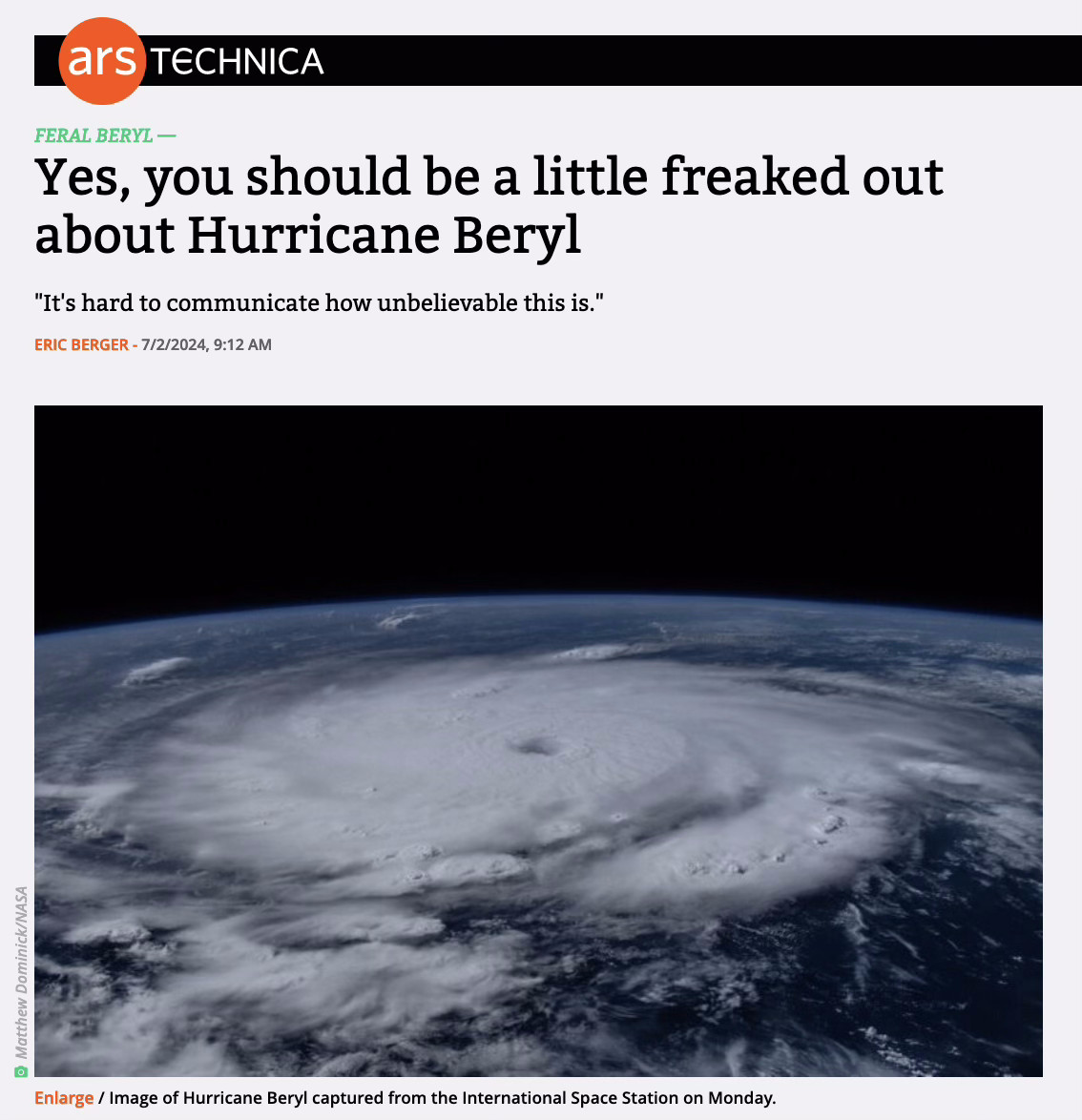
A meteorologist informs us just how frightening Hurricane Beryl really is...
_________________________
Officially, the Atlantic hurricane season begins on June 1. But most years, the tropics remain fairly sleepy for the first month or two. The really big and powerful hurricanes do not spin up until August or September when seas reach their peak temperatures.
Not so this year, in which the Atlantic Ocean is boiling already. The seas in the main development region of the Atlantic have already reached temperatures not normally seen until August or September.
This has led to the rapid intensification of Hurricane Beryl, which crashed through the Windward Islands on Monday and is now traversing the Caribbean Sea toward Jamaica.
Beryl is, to put it mildly, a freak storm.
It intensified on Monday night into a Category 5 hurricane, with sustained winds of 165 mph. Like other meteorologists, I had to check my calendar to verify that it really just was the first day of July. Remember, we're still in the traditionally "sleepy" part of hurricane season. Prior to Beryl, in more than a century of hurricane records, the earliest a Category 5 hurricane has ever developed in the Atlantic was July 16. That was Hurricane Emily, in 2005, the notorious hurricane season that delivered Katrina to New Orleans about a month later.
The point here is not to discuss the threat of Beryl to the United States, which seems in the modest-to-minimal range. Rather, it's the implications of Beryl both for the rest of the Atlantic season and as a harbinger for what to expect from the tropics in a world where we see warmer seas on the regular.
For this year, forecasters have been consistently predicting a hyperactive season due to the combination of roasting sea surface temperatures and the onset of La Niña during the critical months of August, September, and October. That forecast seems to be right on track and will be of concern to all coastal residents in the United States, Mexico, and the Caribbean islands.
Longer term, the implications are sobering for hurricanes in a world modified by climate change. The emerging consensus from scientists has been that there will be an increase in tropical cyclone intensities and that the proportion of major hurricanes will increase. But even in such a world, Beryl would be an outlier. That we're already seeing superstorms develop in late June and early July should concern everyone everywhere.
_________________________
FULL ARTICLE -- https://arstechnica.com/science/2024/07/yes-you-should-be-a-little-freaked-out-about-hurricane-beryl/
#Science #Environment #Climate #ClimateChange #ClimateCrisis
 Mastodon Feed