Mastodon Feed
adam@social.lol ("Adam Newbold") wrote:
What the actual fuck https://www.regenerator1.com/p/building-our-native-ai-newsroom
Mastodon Feedadam@social.lol ("Adam Newbold") wrote:
What the actual fuck https://www.regenerator1.com/p/building-our-native-ai-newsroom
Mastodon FeedBoosted by cstanhope@social.coop ("Your friendly 'net denizen"):
steve@mastodon.cooleysekula.net ("Stephen Sekula") wrote:
NASA’s Lucy Spacecraft Images Asteroid Donaldjohanson
https://science.nasa.gov/image-article/nasas-lucy-spacecraft-images-asteroid-donaldjohanson/
Mastodon FeedBoosted by taral ("JP Sugarbroad"):
elfin@mstdn.social ("`Da Elf") wrote:
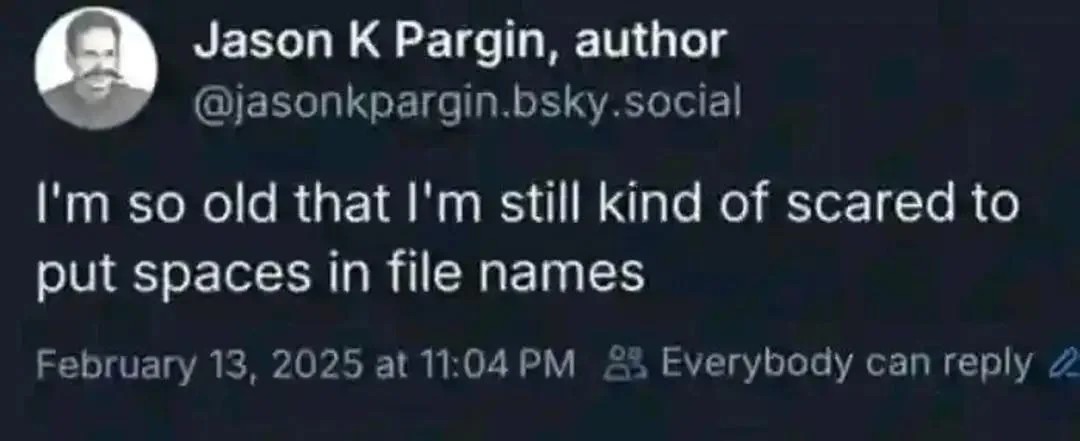
Me too.
Mastodon FeedBoosted by adam@social.lol ("Adam Newbold"):
goblinhugger.bsky.social@bsky.brid.gy ("Gobsy") wrote:
Hey, this age verification thing they're trying to do on Discord for 18+ content? Don't fuckin' do that. Don't EVER give a social media platform your fucking ID. That's the first step to them ratting out queer people to the folks who want us dead because they see our whole existence as pornographic.
Mastodon Feedmattblaze@federate.social ("Matt Blaze") wrote:
Anyway, the process is not terribly difficult. It involves unscrewing the front and rear elements of the lens from the old shutter, removing some retaining rings and spacers, and putting them all on the working shutter. Keeping dust out, and screwing everything back together sufficiently tightly, are the main things that require care.
Anyway, a nice thing about the larger-format world is that you can do stuff like this.
Mastodon Feedmattblaze@federate.social ("Matt Blaze") wrote:
Fortunately, there are a LOT of old lenses out there with the old clockwork Copal shutters, and because they're standardized, it's not terribly hard to take them out of one lens and put them into another. (There's an aperture calibration plate that's lens-specific, but you can generally salvage that from the original shutter). It's often possible to find a lens in really awful shape (fungus, scratches, whatever) with a perfectly good shutter to use as a donor.
Mastodon Feedmattblaze@federate.social ("Matt Blaze") wrote:
For many decades, mechanical clockwork leaf shutters were made primarily by a company called Copal in Japan in standard sizes used by all the major lens makers. About 15 years ago, they stopped making them, and the backstock of shutters ran out about 6 or 7 years ago. No more fully mechanical leaf shutters.
A couple manufacturers are starting to make electromechanical (vs clockwork) leaf shutters, but they're proprietary, expensive, and not fully standardized or backward compatible.
Mastodon Feedmattblaze@federate.social ("Matt Blaze") wrote:
Larger format cameras generally use a "leaf shutter" built in to the lens instead. These are more complicated. They have multiple blades around the aperture that open and close, much like the f-stop control. But a leaf shutter closes the aperture entirely, opening up for whatever the exposure time is. This avoids motion distortion, and also allows faster sync with flash. But you need a shutter built in to each lens, making lenses bigger and more expensive. And they can wear out.
Mastodon Feedmattblaze@federate.social ("Matt Blaze") wrote:
Most 35 mm and smaller (film and digital) cameras use focal plane shutters. They generally consist of a "curtain" that slides across the sensor, briefly exposing it to light and then closing (usually with a second curtain going the same direction) Because they're built in to the camera, they simplify the lenses, and they're pretty reliable. But they have the disadvantage that at high shutter speeds, they can distort motion (because different parts of the sensor are exposed at different times).
Mastodon Feedmattblaze@federate.social ("Matt Blaze") wrote:
Some background. There are two main kinds of mechanical shutters used to control exposure time in still cameras: "focal plane" shutters, which are built in to the camera and cover the sensor or film plane, and "leaf" shutters, built in to the lens right at the aperture (f-stop) iris. Digital cameras sometimes have a third kind, "electronic", in which the sensor is turned on for a controlled duration with no mechanical cover to open and close.
There are advantages and disadvantages to each.
Mastodon Feedmattblaze@federate.social ("Matt Blaze") wrote:
Photo nerditry: I just transplanted a leaf shutter from a cheap used junk lens from ebay into a nice lens with a broken shutter and I'm feeling unreasonably happy with myself.
Mastodon FeedBoosted by mattblaze@federate.social ("Matt Blaze"):
mattblaze@federate.social ("Matt Blaze") wrote:
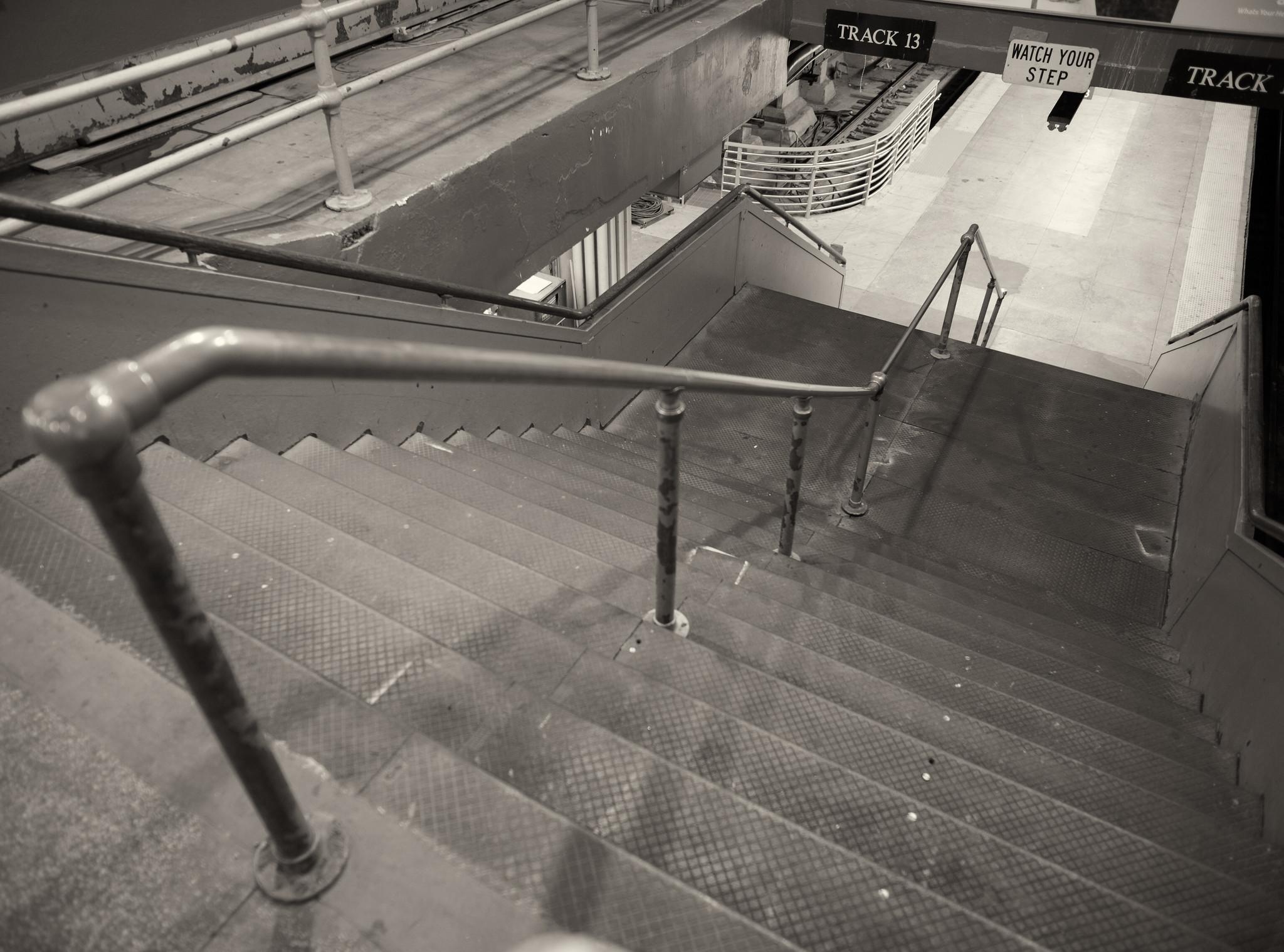
Captured with a full-frame mirrorless camera and 21mm lens.
This is mostly a study of lines, particularly the handrail (which provides an anchor for the eye to follow), but also the curved railing at the bottom of the stairs at left. I was attracted to the austere, utilitarian design, yet the curved pipe railing by the tracks has an elegant, art deco look to it.
The top of the stairs was a difficult place to work. A tripod was essential for framing, but people were moving around behind me.
Mastodon FeedBoosted by mattblaze@federate.social ("Matt Blaze"):
mattblaze@federate.social ("Matt Blaze") wrote:
Track 13 - Watch Your Step, Grand Central Terminal, NYC, 2013.
Enough pixels to accommodate everyone at rush hour at https://www.flickr.com/photos/mattblaze/10101066135
Mastodon Feedmattblaze@federate.social ("Matt Blaze") wrote:
We went from 0 to "due process of law is bad, actually" in three months.
Mastodon Feedslightlyoff@toot.cafe ("Alex Russell") wrote:
"Why is CSS-in-JS terrible for performance?" is a great interview question, actually.
Mastodon FeedBoosted by mattblaze@federate.social ("Matt Blaze"):
mattblaze@federate.social ("Matt Blaze") wrote:
@RandomDamage @scotclose Maybe. But “human error” is an easy excuse in defense of poor designs.
Mastodon FeedBoosted by mattblaze@federate.social ("Matt Blaze"):
mattblaze@federate.social ("Matt Blaze") wrote:
@RandomDamage @scotclose The mistake here was using Signal AT ALL in a classified environment, not making a "user error" (that's extremely easy to make).
Mastodon FeedBoosted by mattblaze@federate.social ("Matt Blaze"):
mattblaze@federate.social ("Matt Blaze") wrote:
@RandomDamage @scotclose Yes it absolutely would be, if it were intended for protecting classified information. Systems designed for classified communication don't allow this kind of mistake.
People seem to want to hype up Signal at all costs for some reason, but it's simply not suitable for protecting classified material. Nor is it designed to be.
Mastodon Feedjscalzi@threads.net ("John Scalzi") wrote:
Oh look, an ARC of @joe_hill's latest just arrived at the house, yes, you can be jealous

Mastodon FeedBoosted by adam@social.lol ("Adam Newbold"):
macmanx@social.lol ("James Huff :prami_pride_pan:") wrote:
Now would be a good time to support The Trevor Project: https://www.thetrevorproject.org/be-the-one/
Mastodon FeedBoosted by adam@social.lol ("Adam Newbold"):
nsmsn@social.lol ("Nick Simson") wrote:
I did some spring cleaning and _resurrected_ the blog out of hibernation: https://www.nicksimson.com/posts/2025-slow-renewal
(Or whatever metaphor you prefer)
Mastodon Feedjscalzi@threads.net ("John Scalzi") wrote:
Agreed
Mastodon FeedBoosted by adam@social.lol ("Adam Newbold"):
popcornreel@mas.to ("Omar Moore") wrote:
Pope Francis before he became pope, riding the subways amongst the people.

Mastodon FeedBoosted by adam@social.lol ("Adam Newbold"):
hazelweakly@hachyderm.io ("Hazel Weakly") wrote:
The year is 2033. I press my fingerprint to the scanner to verify that I am a human; it pricks the finger, scans the blood, then chirps happily: "human detected".
Relieved, I tell the AI "okay, generate the resume and submit it for me please".
InterviewGPT works for a moment.
"Done" it purrs
I sigh and wonder why did it come to this. I went to a good University, I got a degree. I even verified my LinkedIn and Website with HumanID fingerprints. None of my applications get looked at; I've sent hundreds of hand crafted ones.
They get rejected instantly, seconds after I send them.
It's the same every time: Two paragraphs of bla bla bla, and then oh by the way, they think I'm an AI. Whatever
So I caved. I got the premium subscription to InterviewGPT. "Guaranteed interviews" or your money back
Well, we go on food stamps next week, so fuck it; dignity is for the employed.
The premium subscription is pretty slick. It finds the jobs for you, creates the resume, a profile picture, and even changes your name and gender. Algorithmically detecting who the company is most likely to hire
This company wants a "Fred McCane" who knows C# and GitOps, apparently.
Whatever
"Guess that subscription is worth the ridiculous fee," I mumble, reading the hrGPT acceptance letter. It invites me to take a code exam. Proctored by KnowledgeAI.
Do I consent to the interview?
"Fuck you, of course not" I say to myself.
I hit "yes", and prick my finger.
Curious, I look up who owns KnowledgeAI. After some digging, I find it's owned by the same firm that does InterviewGPT
I'm not sure why I bothered looking that up
Oh, it's because the premium tier of InterviewGPT has advanced detection avoidance *and* signal obfuscation. That seemed odd
heh
I remember an adage: "The only winners of war are mercenaries because they get to play both sides"
I prick my finger. The test starts.
I don't even bother looking into the sensors. They're overridden by InterviewGPT anyway. If a human reviews this (they won't), I'm the perfect Fred
Whatever
1/2
Mastodon FeedBoosted by jwz:
mttaggart@infosec.exchange ("Taggart :donor:") wrote:
- const tantinople;
+ int stanbul;
Mastodon FeedBoosted by mattblaze@federate.social ("Matt Blaze"):
mattblaze@federate.social ("Matt Blaze") wrote:
@worik @bzdev There is a mature body of work specifically on obtaining measurable and arbitrarily high confidence in (unreliable) computer-tallied election outcomes in a mathematically rigorous way. Google “Risk Limiting Audits” (see Stark’s work in particular). No need to re-invent this from scratch.
Mastodon FeedBoosted by jwz:
patricbates ("Patric Bates") wrote:
a little clay sculpture that I made #art

Mastodon FeedBoosted by adam@social.lol ("Adam Newbold"):
b0rk@jvns.ca ("Julia Evans") wrote:
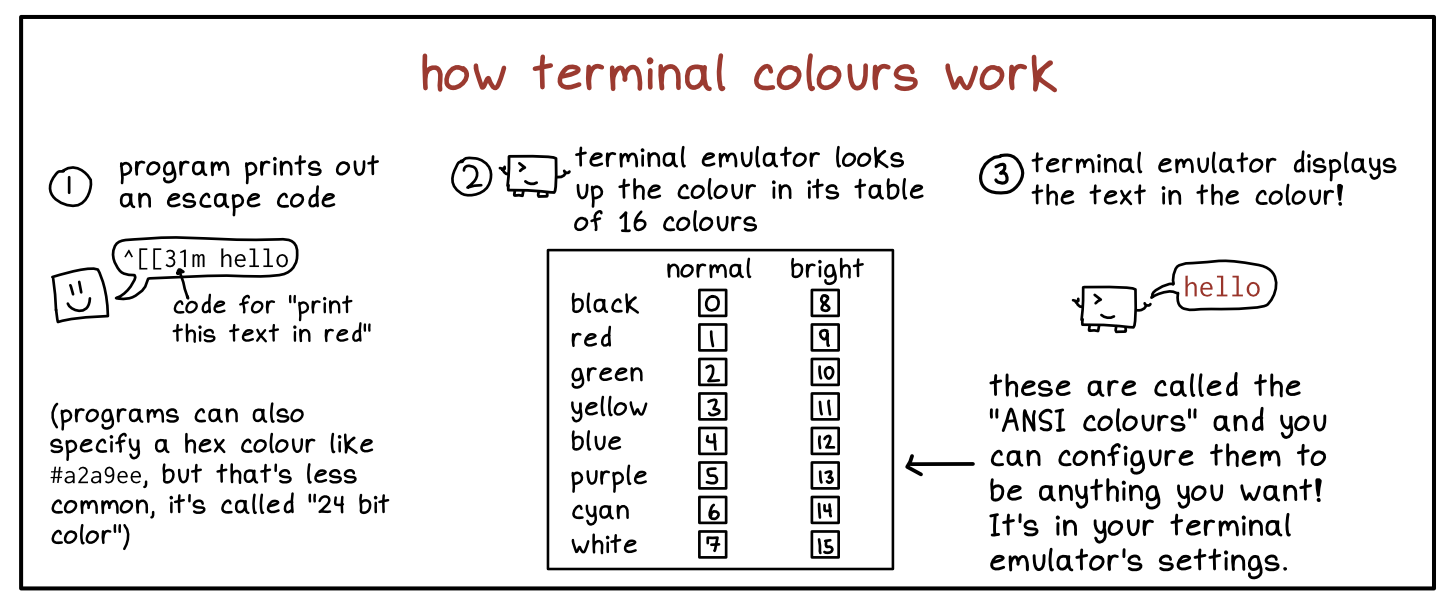
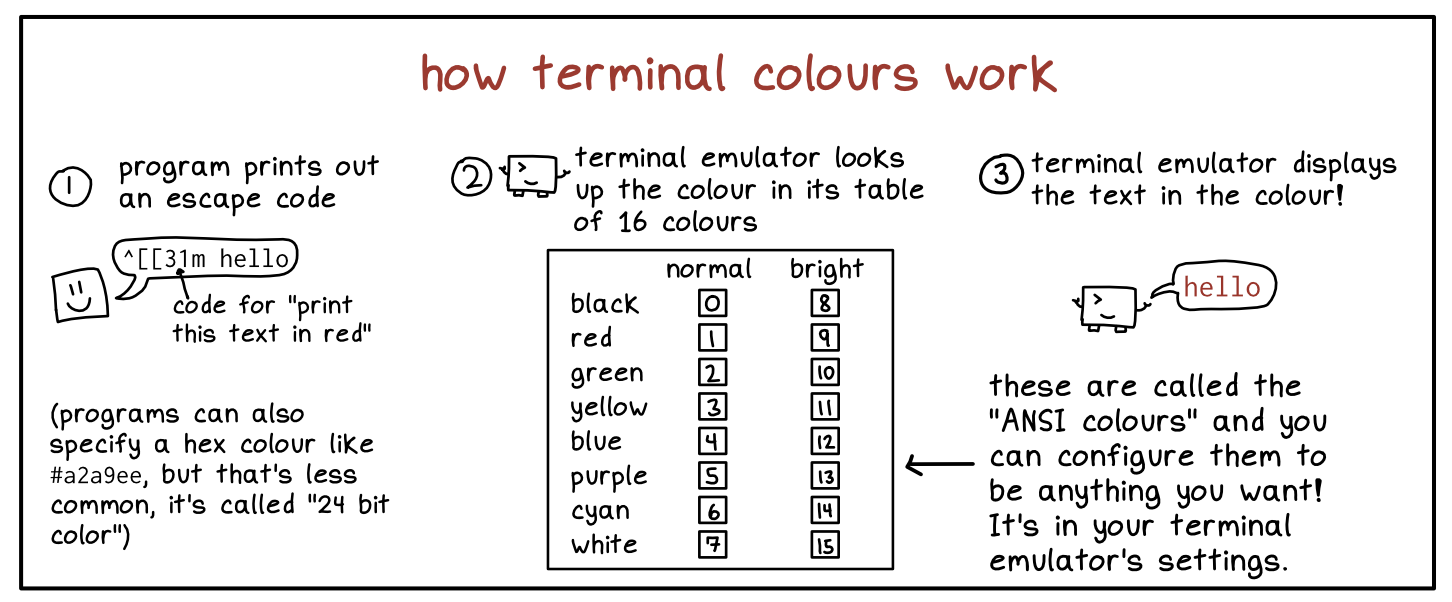
how terminal colours work
[![1. program prints out an escape code ^[31m hello code for "print this text in red" (programs can also specify a hex colour like #a2a9ee, but that's less common, it's called "24 bit color") 2. terminal emulator looks up the colour in its table of 16 colours 3. terminal emulator displays the text in the colour! these are called the "ANSI colours" and you can configure them to be anything you want! It's in your terminal emulator's settings.]4
Mastodon FeedBoosted by adam@social.lol ("Adam Newbold"):
dandylover1@friendica.world ("Georgiana Brummell") wrote:
Anyone who is blind, or who has worked with the blind, knows how expensive our technology can be. This couldn't be more true with relation to braille displays. Even the cheapest costs at least $799, and it's already behind the newest in that line, at $899. This is the Orbit Reader 20 and 20+. Now, a student in India wants to change that by creating a display that is truly affordable (under $50)! Please pass this on, so that we can give him greater recognition within the blind community. Even if it costs a bit more than he initially suspected it would, there is no excuse for the $2,000 to $5,000 average price of such technology when cheaper alternatives can be designed! He is determined to bring this to market, so let's help him do it and show our appreciation for his hard work on this life-changing project!
forbes.com/sites/kevinanderton…
#access #ACB #accessibility #affordability #blind #braille #BrailleDisplays #children #education #employment #independence #India #learning #NFB #ocr #parent #reading #science #school #students #teachers #technology #work #writing
Mastodon FeedBoosted by cstanhope@social.coop ("Your friendly 'net denizen"):
jasongorman@mastodon.cloud ("Jason Gorman") wrote:
I counter your "Every software developer should have side projects" with "Every employer should give developers time in the working week to learn proactively and try new stuff". Otherwise we end up with a monoculture.
And... well... we don't need to imagine what that might look like.