Mastodon Feed
Reblogged by slightlyoff@toot.cafe ("Alex Russell"):
LukeBornheimer@sfba.social ("Luke Bornheimer") wrote:
Attachments:
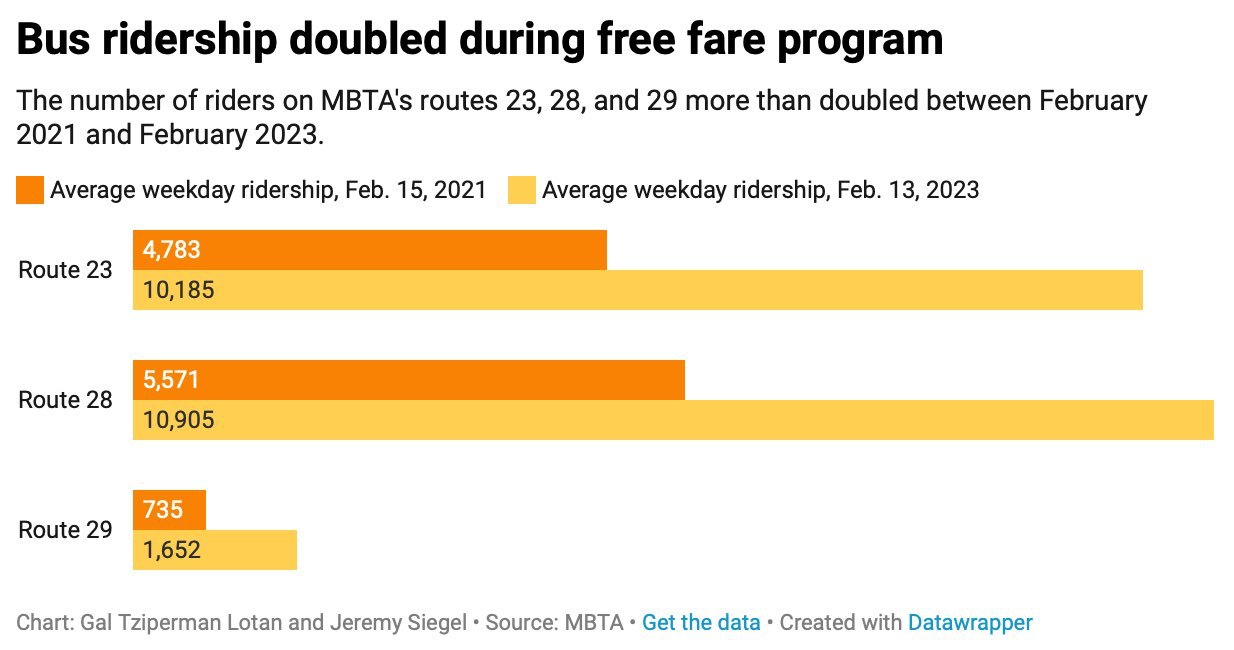
- Bus ridership doubled during free fare program The number of riders on MBTA's routes 23, 28, and 29 more than doubled between February 2021 and February 2023. A bar graph showing how bus ridership increased under the MBTA's free fare program. It compares the number of riders the week of 2/15/21 with the number of riders the week of 2/13/23. On Route 23: 4,783 before, 10185 after (2.12 times as large) 28: 5,417 before, 10905 after (2.01 times as large) 29: 797 before, 1,652 after (2.07 times as large) Average weekday ridership, Feb. 15, 2021Average weekday ridership, Feb. 13, 2023 Route 23 4,783 10,185 Route 28 5,571 10,905 Route 29 735 1,652 Chart: Gal Tziperman Lotan and Jeremy Siegel Source: MBTA Get the data Created with Datawrapper (remote)
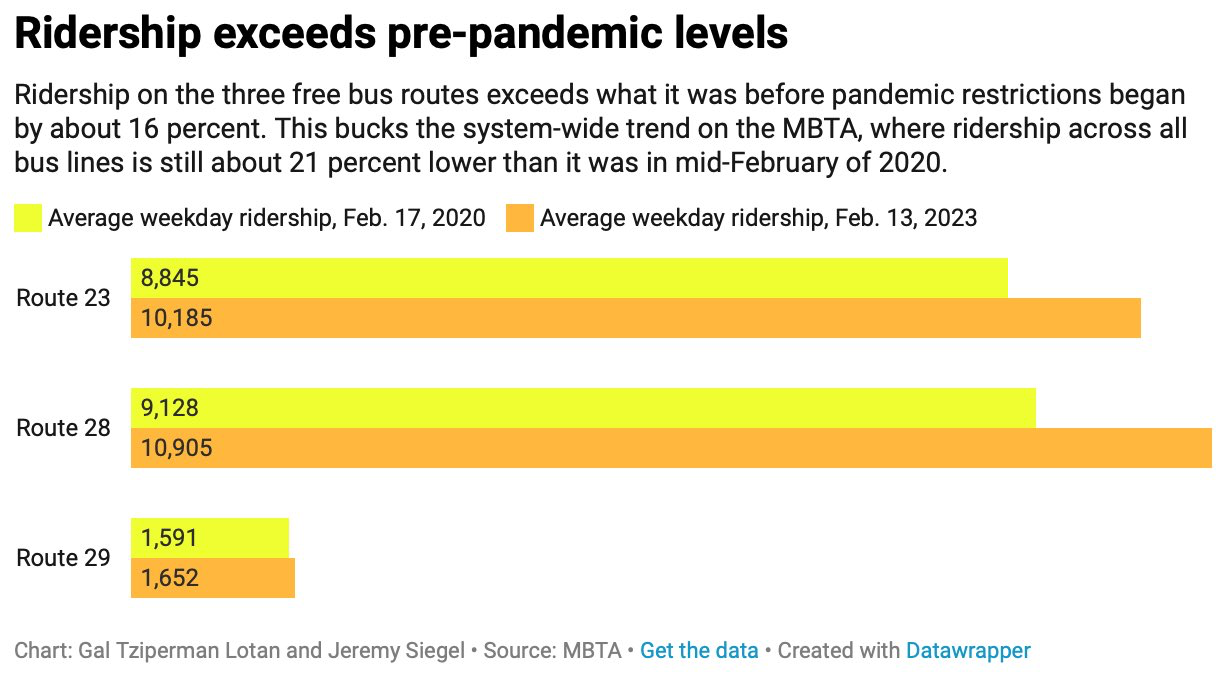
- Ridership exceeds pre-pandemic levels Ridership on the three free bus routes exceeds what it was before pandemic restrictions began by about 16 percent. This bucks the system-wide trend on the MBTA, where ridership across all bus lines is still about 21 percent lower than it was in mid-February of 2020. A bar graph showing how bus ridership increased under the MBTA's free fare program. It compares the number of riders the week of Feb. 17, 2020 with the number of riders the week of Feb. 13, 2023. On Route 23: 8,845 before, 10185 after. 28: 9,128 before, 10905 after. 29: 1,591 before, 1,652 after. Average weekday ridership, Feb. 17, 2020Average weekday ridership, Feb. 13, 2023 Route 23 8,845 10,185 Route 28 9,128 10,905 Route 29 1,591 1,652 Chart: Gal Tziperman Lotan and Jeremy Siegel Source: MBTA Get the data Created with Datawrapper (remote)
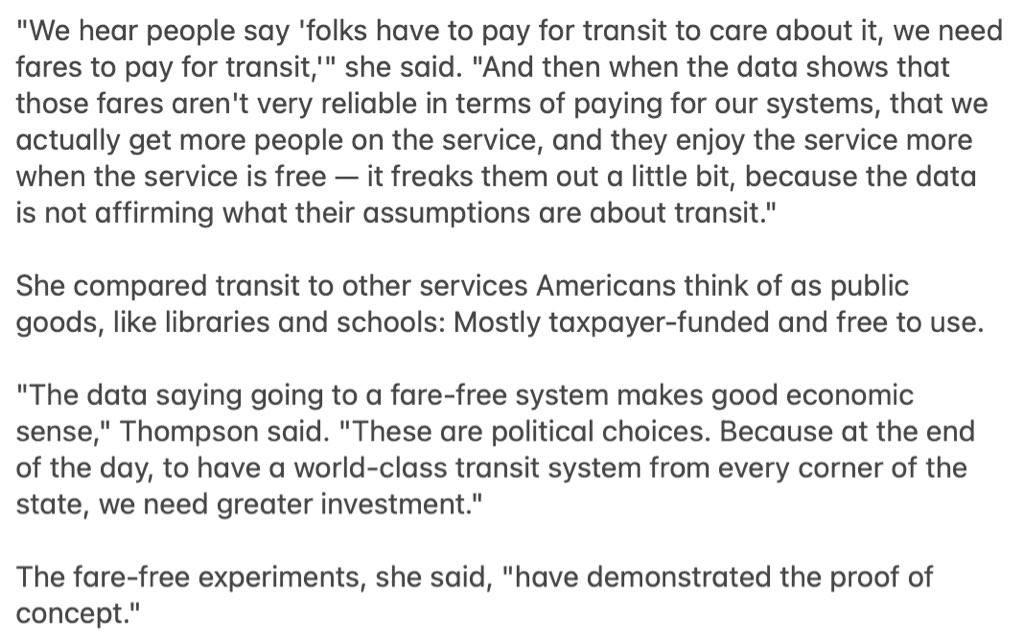
- The city of Boston is preparing to release a report on the fare-free programs in the coming weeks. But a GBH analysis of data from the T shows that ridership more than doubled between the week of Feb. 15, 2021, before the program started, and the same week this year. Ridership on these lines is also up about 16 percent from before the pandemic, unlike other MBTA bus lines, where ridership is about 21 percent lower systemwide compared to mid-February 2020. Stacy Thompson, executive director of the transit advocacy group Livable Streets, said it isn't just the number of riders that shows the fare-free pilot has been a success so far. "I think what's so exciting about this is that it doesn't look all that different. But for the people who are using free buses, it feels very different," Thompson said. "And what that means is that when it is pouring rain outside, when it's snowing, you can get on the bus faster; the bus moves faster; there's more money in your pocket if you're not making a transfer and that's your only ride." (remote)
- The city of Boston is preparing to release a report on the fare-free programs in the coming weeks. But a GBH analysis of data from the T shows that ridership more than doubled between the week of Feb. 15, 2021, before the program started, and the same week this year. Ridership on these lines is also up about 16 percent from before the pandemic, unlike other MBTA bus lines, where ridership is about 21 percent lower systemwide compared to mid-February 2020. Stacy Thompson, executive director of the transit advocacy group Livable Streets, said it isn't just the number of riders that shows the fare-free pilot has been a success so far. "I think what's so exciting about this is that it doesn't look all that different. But for the people who are using free buses, it feels very different," Thompson said. "And what that means is that when it is pouring rain outside, when it's snowing, you can get on the bus faster; the bus moves faster; there's more money in your pocket if you're not making… (remote)