Mastodon Feed
Reblogged by rmrenner ("The Old Gay Gristle Fest"):
Finally, a solution to the unfairness of authorship ordering in scientific papers! 😂
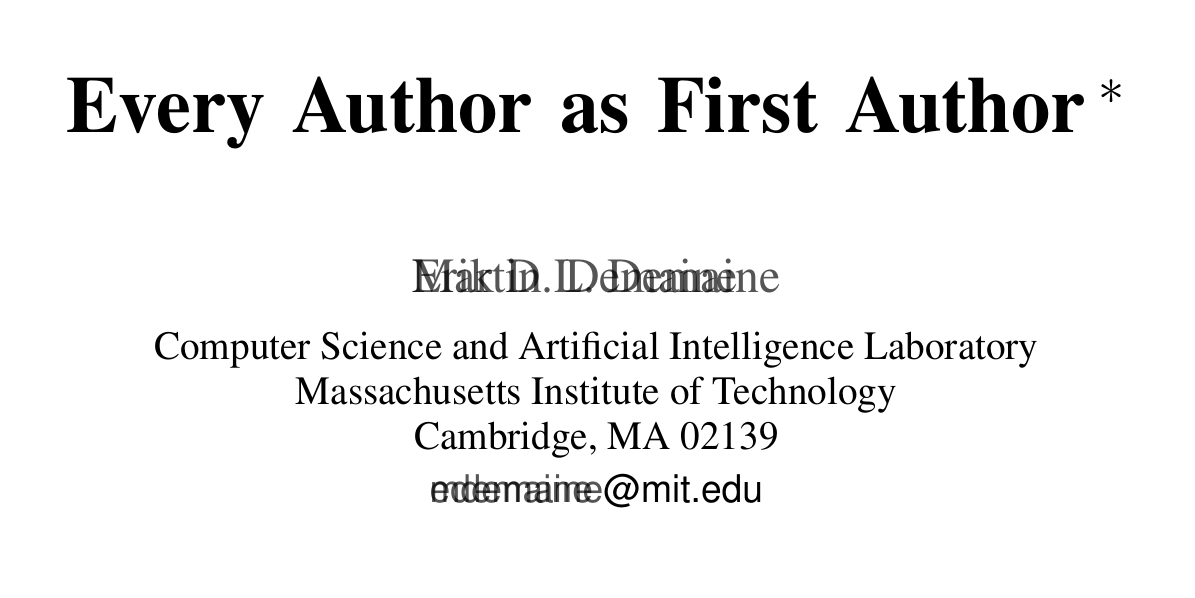
"Every Author as First Author"
Attachments:
- Title of a LaTeX paper: Every Author as First Author (Two almost unreadable author names overlaid on top of each other.) Computer Science and Artificial Intelligence Laboratory Massachusetts Institute of Technology Cambridge, MA 02139 (Email address with overlaid names before the domain) (remote)
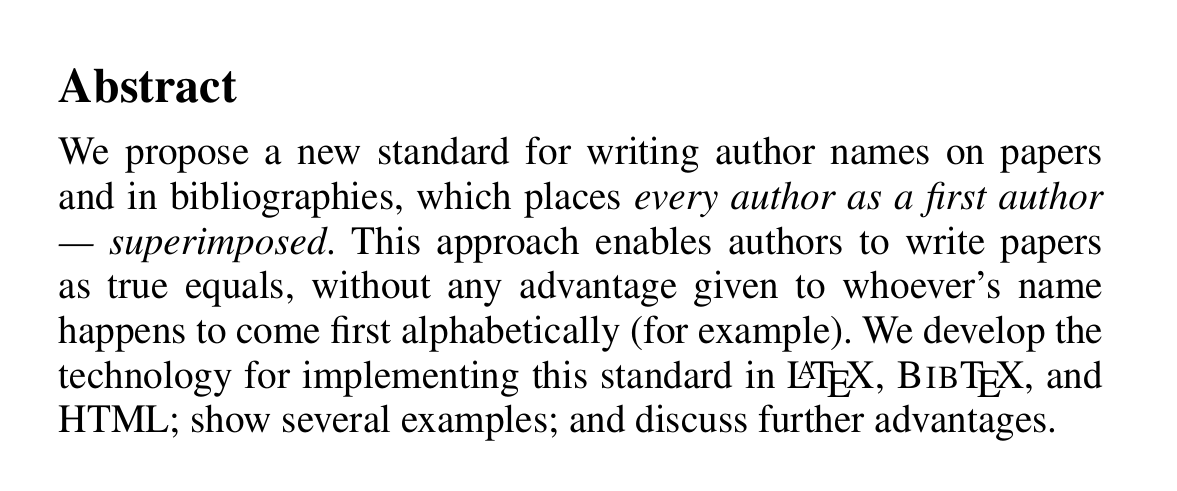
- Abstract We propose a new standard for writing author names on papers and in bibliographies, which places every author as a first author — superimposed. This approach enables authors to write papers as true equals, without any advantage given to whoever’s name happens to come first alphabetically (for example). We develop the technology for implementing this standard in LATEX, BIBTEX, and HTML; show several examples; and discuss further advantages. (remote)
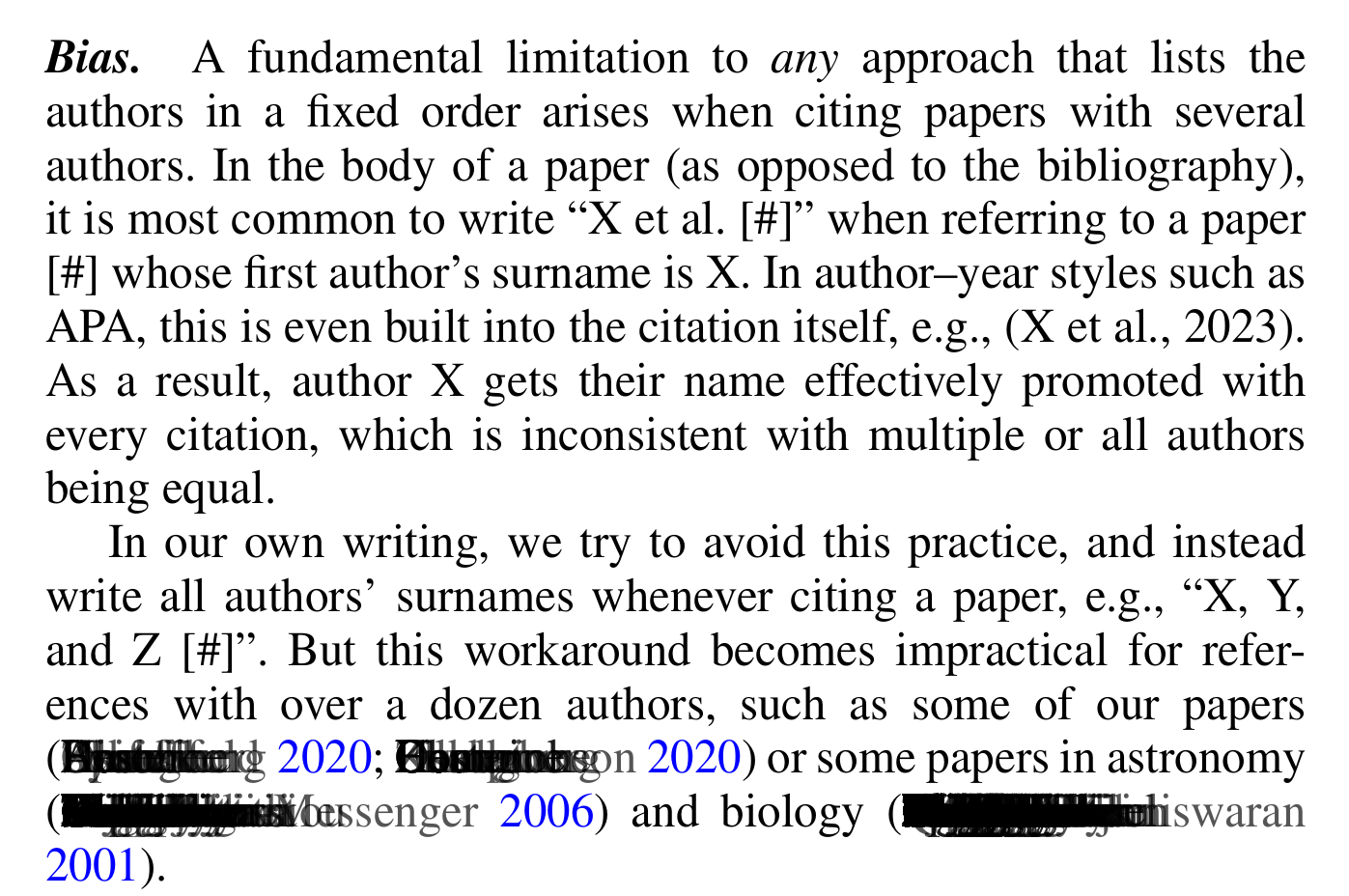
- Bias. A fundamental limitation to any approach that lists the authors in a fixed order arises when citing papers with several authors. In the body of a paper (as opposed to the bibliography), it is most common to write “X et al. [#]” when referring to a paper [#] whose first author’s surname is X. In author—year styles such as APA, this is even built into the citation itself, e.g., (X et al., 2023). As a result, author X gets their name effectively promoted with every citation, which is inconsistent with multiple or all authors being equal. In our own writing, we try to avoid this practice, and instead write all authors’ surnames whenever citing a paper, e.g., “X, Y, and Z [#]”. But this workaround becomes impractical for refer- ences with over a dozen authors, such as some of our papers (four examples with a lot of author names overlaid on top of each other, with publication years.) (remote)
- Figure 3. Circular arrangements of the authors of Fisimindon (2020). Drawn in Inkscape using Circular Align and Distribute, onto a circle of radius 50 (left) or 200 (right); followed by 90° rotation (left); and rotating 180° to make names upright (bottom). 4. Future Work A final issue is that overlapping name stacks are not easy to read. It may be possible to write names in a way that has no first name but still makes all names clearly readable. For example, a circle has no beginning or end, so arranging the names in a circular pattern avoids arranging any author “first”. Figure 3 shows some initial experiments in this direction. Related, traditional round- robin documents (Wikipedia 2022) are signed by authors in a circle to prevent identification of a ringleader (such as mutineer sailors). It remains unsolved how to fit such circular arrangements in with the rest of a text document, which feels inherently sequential. Circular arrangements also seem difficult to apply to small numbers of authors such as 2. (remote)


![Bias. A fundamental limitation to any approach that lists the authors in a fixed order arises when citing papers with several authors. In the body of a paper (as opposed to the bibliography), it is most common to write “X et al. [#]” when referring to a paper [#] whose first author’s surname is X. In author—year styles such as APA, this is even built into the citation itself, e.g., (X et al., 2023). As a result, author X gets their name effectively promoted with every citation, which is inconsistent with multiple or all authors being equal. In our own writing, we try to avoid this practice, and instead write all authors’ surnames whenever citing a paper, e.g., “X, Y, and Z [#]”. But this workaround becomes impractical for refer- ences with over a dozen authors, such as some of our papers (four examples with a lot of author names overlaid on top of each other, with publication years.)](https://files.mastodon.social/cache/media_attachments/files/110/339/450/157/846/041/original/64724ab4794a4d2e.png)