Mastodon Feed
Reblogged by cstanhope@social.coop ("Your friendly 'net denizen"):
th@v.st ("Trammell Hudson") wrote:
Attachments:
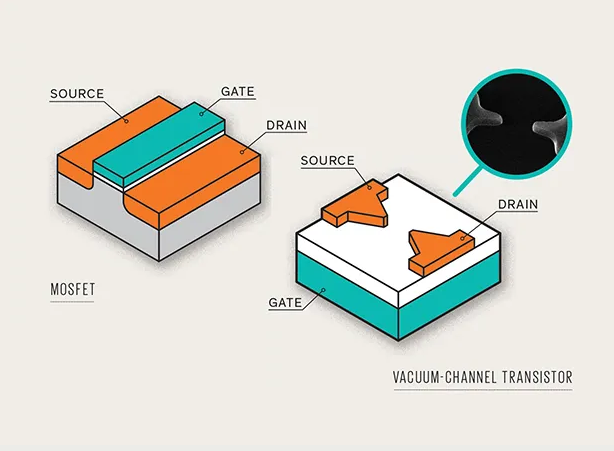
- Transistorizing the Vacuum Tube: A vacuum-channel transistor closely resembles an ordinary metal-oxide semiconductor field-effect transistor or MOSFET (left). In a MOSFET, voltage applied to the gate sets up an electric field in the semiconductor material below. This field in turn draws charge carriers into the channel between the source and drain regions, allowing current to flow. No current flows into the gate, which is insulated from the substrate below it by a thin oxide layer. The vacuum-channel transistor the authors developed (right) similarly uses a thin layer of oxide to insulate the gate from the cathode and anode, which are sharply pointed to intensify the electric field at the tips.Illustration: James Provost; Inset Image: NASA Ames Research Center (remote)