Mastodon Feed
Reblogged by rmrenner ("The Old Gay Gristle Fest"):
richardmedh@famichiki.jp ("Richard Medhurst") wrote:
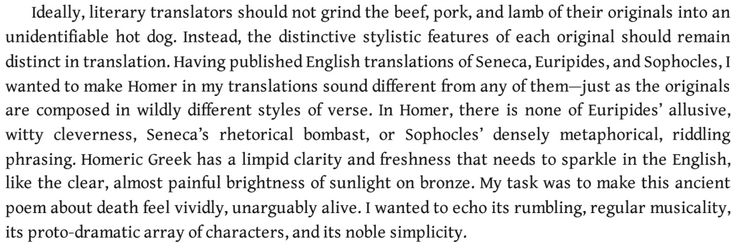
A meaty metaphor from Emily Wilson in her translator's introduction to The Iliad.
Attachments:
- Ideally, literary translators should not grind the beef, pork, and lamb of their originals into an unidentifiable hot dog. Instead, the distinctive stylistic features of each original should remain distinct in translation. Having published English translations of Seneca, Euripides, and Sophocles, I wanted to make Homer in my translations sound different from any of them—just as the originals are composed in wildly different styles of verse. In Homer, there is none of Euripides’ allusive, witty cleverness, Seneca’s rhetorical bombast, or Sophocles’ densely metaphorical, riddling phrasing. Homeric Greek has a limpid clarity and freshness that needs to sparkle in the English, like the clear, almost painful brightness of sunlight on bronze. My task was to make this ancient poem about death feel vividly, unarguably alive. I wanted to echo its rumbling, regular musicality, its proto-dramatic array of characters, and its noble simplicity. (remote)