Rust Blog: Posts

Rust Blog

Enabling the next iteration of the borrow checker on nightly

TL;DR We are enabling the next iteration of the borrow checker (coined Polonius Alpha) on nightly in preparation for stabilization in the next few months.

Whaaaaaat?

Yes! You heard it right! The next iteration of the Rust borrow checker is coming! Rust's first borrow checker ("AST borrowck") was very limited and was phased out in 2019 in favor of NLL, other than a "migrate mode" that was used to provide nice error messages. That migrate mode was finally removed in 2022.

The Polonius borrow checker spun out of the NLL effort in 2018. The initial formulation passed the NLL test suite and accepted (sound) code that NLL did not. However, performance was a critically-limiting factor; generally borrow check was slower than NLL, but certain programs were considerably slower than NLL to the extent that using that implementation/formulation of Polonius was a non-starter. Attempts were made over the years to implement the Polonius formulation in a performant manner, without much luck in addressing the core issues.

In 2023, a new formulation of a Polonius-style borrow checker was imagined that required minimal rearchitecture of the existing NLL implementation and could be extended to allow more code to compile. We had hoped, to try to stabilize this new formulation in 2024; but, various things popped up that delayed this.

But! We're nearly there now! At this point, there are no known remaining issues with the subset coined Polonius Alpha that we intend to stabilize. And, performance is generally acceptable for stabilization (will discuss that a bit below).

So, we are enabling the Polonius Alpha borrow checker on nightly for testing until we stabilize fully later in the year. We're doing this in order to help find:

  • Any serious performance regressions we're unaware of
  • Unsoundness in the formulation that we haven't thought about
  • Any weird diagnostic issues that we need to improve
    • Note: we have not yet seen any diagnostic changes

You can report any issues on Github or on Zulip.

Okay, what's new?

The key thing that Polonius Alpha enables that NLL does not is flow-sensitive borrow checking of lifetime outlives relationships.

Perhaps the smallest example demonstrating what will pass with Polonius Alpha but not the current NLL is:

fn reborrow(a: &mut u8) -> &mut u8 {
    let b = &mut *a;
    if true { b } else { a }
}

However, the example you will see more often is:

fn get_mut_or_default<'r, K: Hash + Eq + Copy, V: Default>(
    map: &'r mut HashMap<K, V>,
    key: K,
) -> &'r mut V {
    match map.get_mut(&key) {
        Some(value) => value,
        None => {
            map.insert(key, V::default());
            map.get_mut(&key).unwrap()
        }
    }
}

The issue is that the Some(value) => value branch causes the borrow checker to think that the borrow returned by map.get_mut(&key) lives for the entire function (because of the &'r mut V return type), even though that borrow isn't live in the None branch. NLL's analysis is flow-insensitive.

Polonius Alpha passes this because its analysis is flow-sensitive, and it knows that the borrow isn't live in the None branch.

Now, Polonius Alpha is not perfect; some programs that would compile under legacy Polonius (the slow original implementation) don't compile with Polonius Alpha. (This is of course why we call it "Polonius Alpha"). For example:

struct X { next: Option<Box<X>> }

fn conditional() {
    let mut b = Some(Box::new(X { next: None }));
    let mut p = &mut b;
    while let Some(now) = p {
        if true {
            p = &mut now.next;
        }
    }
}

(As a slight note: we have also found programs that compile with Polonius Alpha but not legacy Polonius, so it's not really a full subset.)

So, what about performance?

Polonius Alpha currently does strictly equal or more work compared to NLL, so we have been paying particular attention to potential performance regressions.

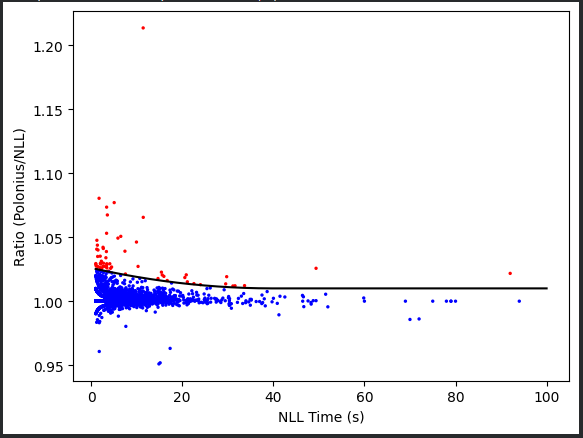
From the top ten thousand crates by downloads on crates.io, we have seen relatively few "significant" regressions, and even crates that have a "significant" regression are typically relatively minimal:

top10k_leaf_graph

Each point represents a crate within the 10,000 most-downloaded crates. The black line is an arbitrary threshold of significance, set to a 1% regression and quadratically scaled below 30 seconds. Red points are crates that pass this arbitrary regression threshold. X-axis is compile time (for the leaf crate only without dependencies) under NLL; Y-axis is the ratio of compile time under Polonius Time compared to NLL.

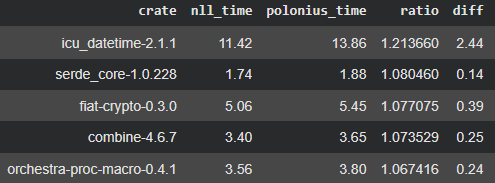
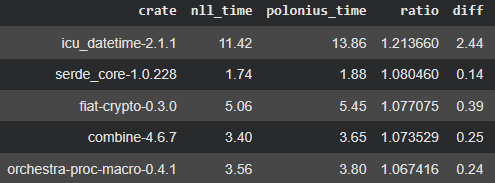
If you look at the top five crates, they are:

top10k_leaf_table

Outside the top ten thousand crates, we have focused mainly on crates with many borrows. The worst case we've seen is a 2-3x regression.

We have done some initial triage of the causes of these regressions and are thinking about the best way to fix them. Though, overall we think these regressions are fairly reasonable even if we can't fix them, given how rare and relatively minimal they are compared to the additional power Polonius Alpha brings over NLL.

I really don't want this. How do I opt-out?

To reiterate: this is only being enabled on nightly. But if you want to disable Polonius Alpha, and only use the stable NLL, you can pass -Zpolonius=off to rustc, use RUSTFLAGS=-Zpolonius=off, or with a project's .cargo/config.toml configuration file:

[target.x86_64-unknown-linux-gnu]
rustflags = ["-Zpolonius=off"]

If you have to do this, for some reason, please do tell us why on Github or on Zulip.

What's next?

Over the next few months, we will be monitoring Github and Zulip for any reported issues about Polonius Alpha. We will also be working to address known performance regressions. Finally, we will be working on internal documentation about the implementation. All prior to stabilization. Then, we are aiming to stabilize prior to the end of the year!

Although some programs that we want to compile don't work with Polonius Alpha (nor NLL today), we don't currently have any concrete plans to continue active feature work on the Polonius implementation after the stabilization of Polonius Alpha. We expect to continue to optimize the implementation and address any performance regressions for a little while. We will likely come back to Polonius feature-work at some point, but given that Polonius Alpha solves the most-encountered borrow-check issues, we are shifting our time to other high-priority work for the near future.

Rust Blog

Enabling the next iteration of the borrow checker on nightly

TL;DR We are enabling the next iteration of the borrow checker (coined Polonius Alpha) on nightly in preparation for stabilization in the next few months.

Whaaaaaat?

Yes! You heard it right! The next iteration of the Rust borrow checker is coming! Rust's first borrow checker ("AST borrowck") was very limited and was phased out in 2019 in favor of NLL, other than a "migrate mode" that was used to provide nice error messages. That migrate mode was finally removed in 2022.

The Polonius borrow checker spun out of the NLL effort in 2018. The initial formulation passed the NLL test suite and accepted (sound) code that NLL did not. However, performance was a critically-limiting factor; generally borrow check was slower than NLL, but certain programs were considerably slower than NLL to the extent that using that implementation/formulation of Polonius was a non-starter. Attempts were made over the years to implement the Polonius formulation in a performant manner, without much luck in addressing the core issues.

In 2023, a new formulation of a Polonius-style borrow checker was imagined that required minimal rearchitecture of the existing NLL implementation and could be extended to allow more code to compile. We had hoped, to try to stabilize this new formulation in 2024; but, various things popped up that delayed this.

But! We're nearly there now! At this point, there are no known remaining issues with the subset coined Polonius Alpha that we intend to stabilize. And, performance is generally acceptable for stabilization (will discuss that a bit below).

So, we are enabling the Polonius Alpha borrow checker on nightly for testing until we stabilize fully later in the year. We're doing this in order to help find:

  • Any serious performance regressions we're unaware of
  • Unsoundness in the formulation that we haven't thought about
  • Any weird diagnostic issues that we need to improve
    • Note: we have not yet seen any diagnostic changes

You can report any issues on Github or on Zulip.

Okay, what's new?

The key thing that Polonius Alpha enables that NLL does not is flow-sensitive borrow checking of lifetime outlives relationships.

Perhaps the smallest example demonstrating what will pass with Polonius Alpha but not the current NLL is:

fn reborrow(a: &mut u8) -> &mut u8 {
    let b = &mut *a;
    if true { b } else { a }
}

However, the example you will see more often is:

fn get_mut_or_default<'r, K: Hash + Eq + Copy, V: Default>(
    map: &'r mut HashMap<K, V>,
    key: K,
) -> &'r mut V {
    match map.get_mut(&key) {
        Some(value) => value,
        None => {
            map.insert(key, V::default());
            map.get_mut(&key).unwrap()
        }
    }
}

The issue is that the Some(value) => value branch causes the borrow checker to think that the borrow returned by map.get_mut(&key) lives for the entire function (because of the &'r mut V return type), even though that borrow isn't live in the None branch. NLL's analysis is flow-insensitive.

Polonius Alpha passes this because its analysis is flow-sensitive, and it knows that the borrow isn't live in the None branch.

Now, Polonius Alpha is not perfect; some programs that would compile under legacy Polonius (the slow original implementation) don't compile with Polonius Alpha. (This is of course why we call it "Polonius Alpha"). For example:

struct X { next: Option<Box<X>> }

fn conditional() {
    let mut b = Some(Box::new(X { next: None }));
    let mut p = &mut b;
    while let Some(now) = p {
        if true {
            p = &mut now.next;
        }
    }
}

(As a slight note: we have also found programs that compile with Polonius Alpha but not legacy Polonius, so it's not really a full subset.)

So, what about performance?

Polonius Alpha currently does strictly equal or more work compared to NLL, so we have been paying particular attention to potential performance regressions.

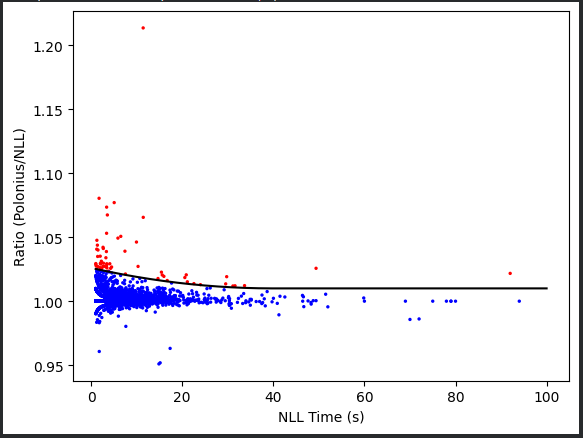
From the top ten thousand crates by downloads on crates.io, we have seen relatively few "significant" regressions, and even crates that have a "significant" regression are typically relatively minimal:

top10k_leaf_graph

Each point represents a crate within the 10,000 most-downloaded crates. The black line is an arbitrary threshold of significance, set to a 1% regression and quadratically scaled below 30 seconds. Red points are crates that pass this arbitrary regression threshold. X-axis is compile time (for the leaf crate only without dependencies) under NLL; Y-axis is the ratio of compile time under Polonius Time compared to NLL.

If you look at the top five crates, they are:

top10k_leaf_table

Outside the top ten thousand crates, we have focused mainly on crates with many borrows. The worst case we've seen is a 2-3x regression.

We have done some initial triage of the causes of these regressions and are thinking about the best way to fix them. Though, overall we think these regressions are fairly reasonable even if we can't fix them, given how rare and relatively minimal they are compared to the additional power Polonius Alpha brings over NLL.

I really don't want this. How do I opt-out?

To reiterate: this is only being enabled on nightly. But if you want to disable Polonius Alpha, and only use the stable NLL, you can pass -Zpolonius=off to rustc, use RUSTFLAGS=-Zpolonius=off, or with a project's .cargo/config.toml configuration file:

[target.x86_64-unknown-linux-gnu]
rustflags = ["-Zpolonius=off"]

If you have to do this, for some reason, please do tell us why on Github or on Zulip.

What's next?

Over the next few months, we will be monitoring Github and Zulip for any reported issues about Polonius Alpha. We will also be working to address known performance regressions. Finally, we will be working on internal documentation about the implementation. All prior to stabilization. Then, we are aiming to stabilize prior to the end of the year!

Although some programs that we want to compile don't work with Polonius Alpha (nor NLL today), we don't currently have any concrete plans to continue active feature work on the Polonius implementation after the stabilization of Polonius Alpha. We expect to continue to optimize the implementation and address any performance regressions for a little while. We will likely come back to Polonius feature-work at some point, but given that Polonius Alpha solves the most-encountered borrow-check issues, we are shifting our time to other high-priority work for the near future.

Rust Blog

Announcing Rust 1.97.1

The Rust team has published a new point release of Rust, 1.97.1. Rust is a programming language that is empowering everyone to build reliable and efficient software.

If you have a previous version of Rust installed via rustup, getting Rust 1.97.1 is as easy as:

rustup update stable

If you don't have it already, you can get rustup from the appropriate page on our website.

What's in 1.97.1

Rust 1.97.1 fixes a miscompilation in an LLVM optimization.

We have backported both an LLVM fix and a disable of the underlying change in Rust 1.97.0 of Rust's generated IR that increased the likelihood of this happening. However, note that the underlying miscompilation has been present since at least Rust 1.87.

If you'd like to help us out by testing future releases, you might consider running your code's CI or locally using the beta channel (rustup default beta) or the nightly channel (rustup default nightly). Pleasereport any bugs you might come across!

Contributors to 1.97.1

Many people came together to create Rust 1.97.1. We couldn't have done it without all of you. Thanks!

Continue Reading…

Rust Blog

crates.io: development update

Another six months have passed since our last development update, and the crates.io team has been busy. Here's a summary of the most notable changes and improvements made to crates.io since then.

Source Code Viewer

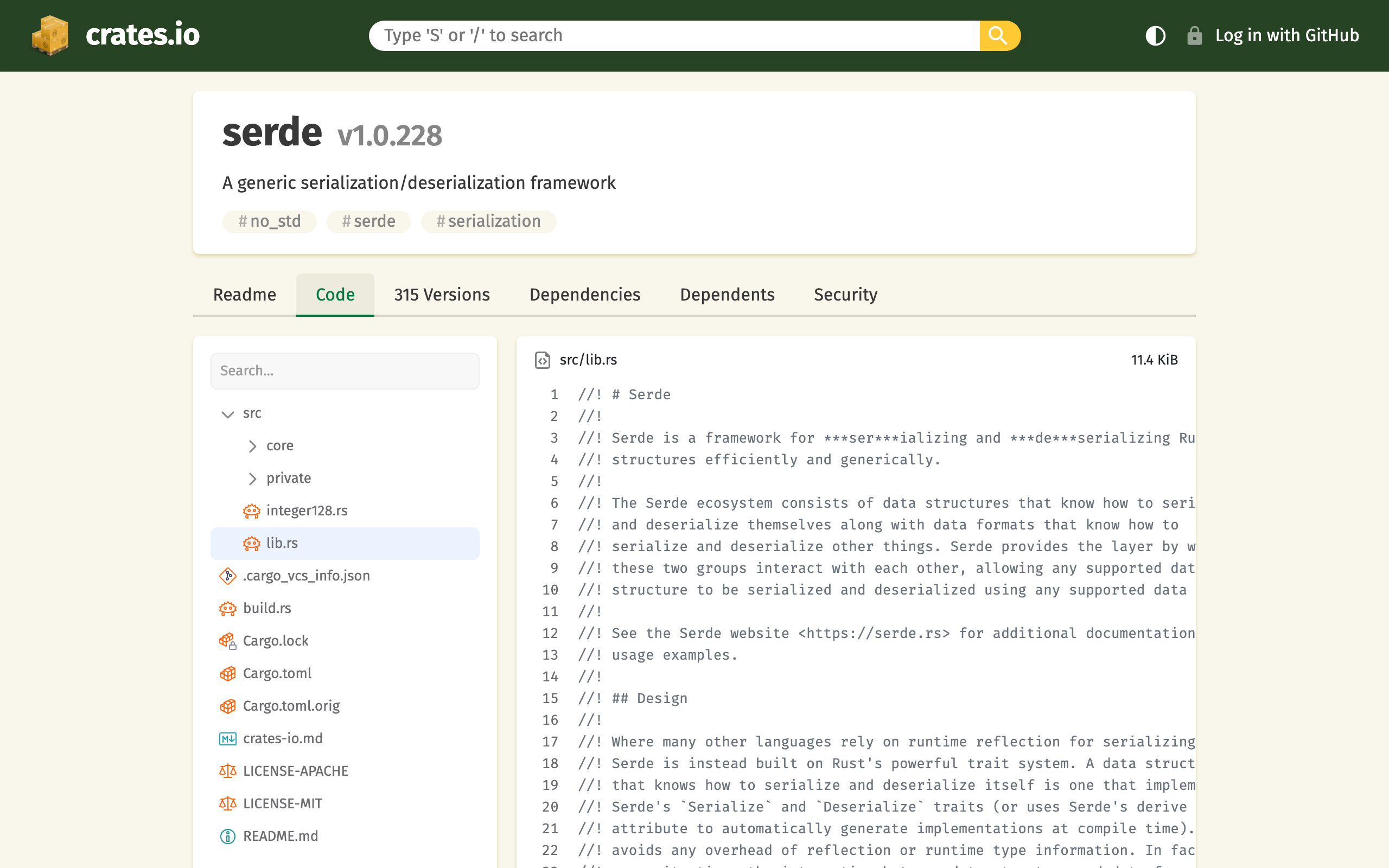
Crate pages now have a "Code" tab that lets you browse the contents of published crate versions directly on crates.io. This shows you the exact files that cargo downloads when you add a crate as a dependency, which might differ from the linked repository. This makes it much easier to audit your dependencies, including files that never appear in the repository, like the normalized Cargo.toml files that cargo generates.

Source code viewer showing the "Code" tab of the serde crate

The viewer comes with a file tree sidebar with search functionality, syntax highlighting, and GitHub-style line selection, where clicking or dragging line numbers produces shareable #L10-L20 URLs.

Under the hood, the server now builds a zip file for every published version. Since the .crate files that cargo consumes are gzipped tarballs without random access support, a background job re-packs each of them into a seekable zip archive plus a JSON manifest describing the contained files. Both are served from our static CDN. The frontend then fetches only the manifest and loads each file on demand with an HTTP range request. Because of this architecture, browsing crate sources essentially adds no load on the crates.io API servers. Existing crate versions have been backfilled, so this works for old releases too.

The rendering library behind the code viewer is a diff renderer at heart, and that's no accident: a version-to-version diff viewer built on the same infrastructure is currently in the works. This will allow you to review exactly what changed between two published versions, right on crates.io. Stay tuned!

Untangling crates.io Accounts from GitHub

At the end of May, the crates.io team accepted RFC #3946. Crates.io accounts always have been tightly coupled to GitHub: signing in means "Log in with GitHub", and your crates.io identity is your GitHub username. The RFC changes that. It introduces usernames that are native to crates.io and independent of linked GitHub accounts, as a prerequisite for eventually supporting login via other identity providers.

The implementation of crates.io usernames has started, but there is still a lot left to do, most visibly the ability to change your crates.io username. After that is complete, there will be future RFCs and implementation for signing in with identity providers other than GitHub. Since all of this touches authentication and account security, we are deliberately taking it slow and rolling these changes out in small, carefully reviewed steps.

Advisories and Suggestions

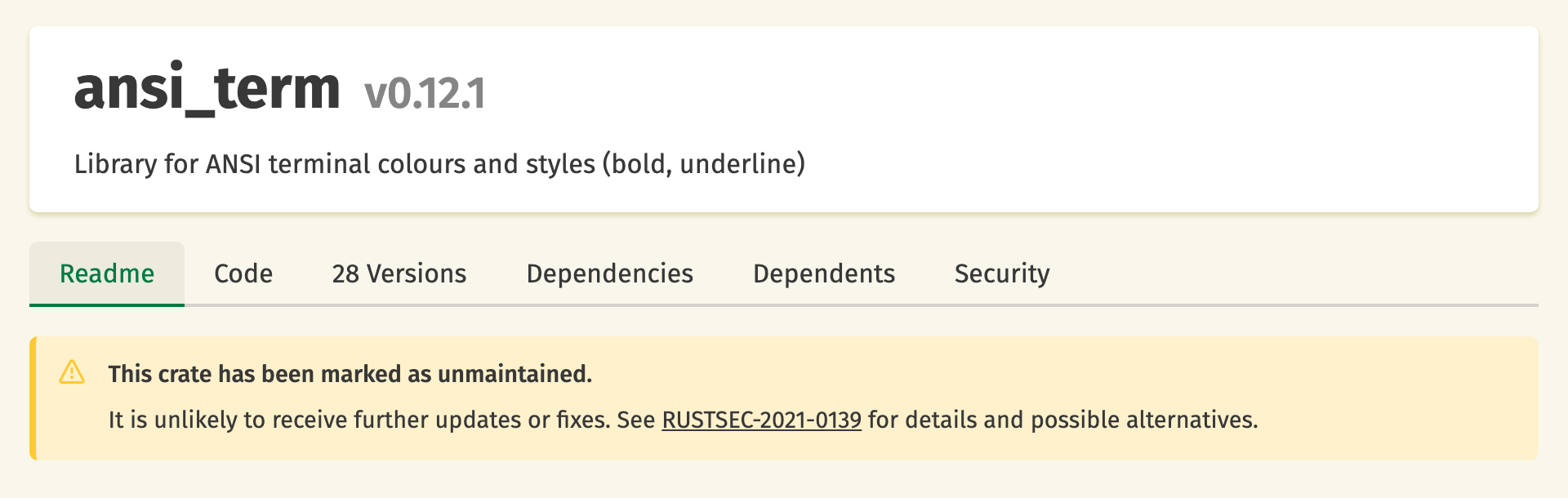
In our January update we introduced the "Security" tab, which shows security advisories from the RustSec database. We have since taken this integration one step further: crates that RustSec has flagged as unmaintained now show a warning banner directly on their crate pages, linking to the corresponding advisory for details and possible alternatives. Thanks to Dirkjan Ochtman for implementing this feature!

Unmaintained warning banner on the ansi_term crate page

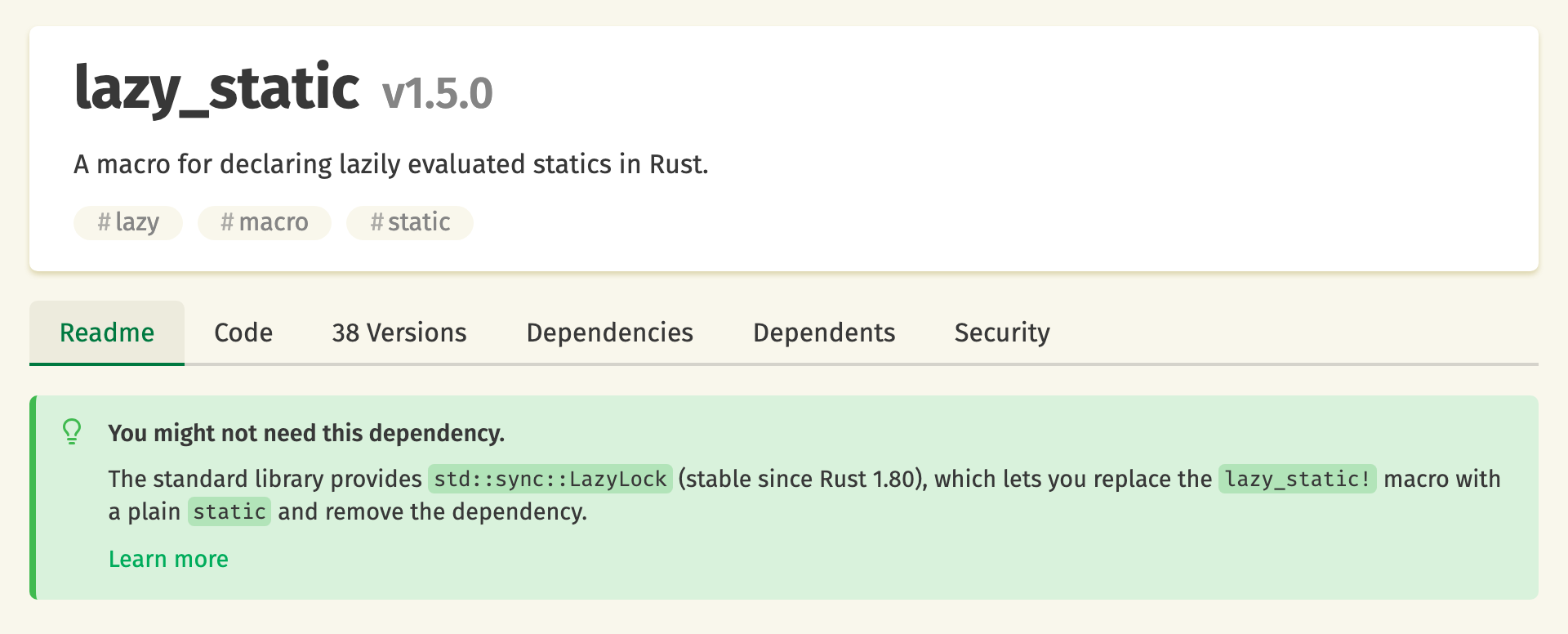
Related to this, some popular crates have been largely absorbed into the Rust standard library over the years, like lazy_static, which has been superseded by std::sync::LazyLock since Rust 1.80. Crate pages of such crates now show a friendly "You might not need this dependency" banner describing the standard library replacement, and superseded crates in dependency lists get a small light bulb icon with a similar hint.

"You might not need this dependency" banner on the lazy_static crate page

The dataset behind this feature lives in the new rust-lang/std-replacement-data repository, together with a documented inclusion policy: standard library replacements only, every entry must cite the stable std, core, or alloc API and Rust version, and crate maintainers get a notice-and-comment window before an entry is added. New entries can be proposed upstream and can benefit other tools too.

Ferris

The most delightful change of this cycle: the Ferris on our error pages now follows your mouse cursor with its eyes:

Ferris' eyes following the mouse cursor on the error page

Getting a 404 error on crates.io is now slightly less sad.

Svelte Frontend Migration Completed

In our January update, we announced that we were experimenting with porting the crates.io frontend from Ember.js to Svelte. This experiment has concluded successfully: the new frontend reached feature parity, went through a public testing phase in April, became the default at the beginning of May, and the Ember.js app has been removed from our repository.

We designed this change to be invisible for our users, since the new frontend is a 1:1 port of the previous design and functionality. For the team and our contributors, however, it is a big deal: the frontend is now built on a more modern framework, which should make it easier for new contributors to get started. It also allows us to iterate faster, as the source code viewer above demonstrates.

We want to thank the Ember.js team for a framework that served crates.io well for many years, and the Svelte team for making the transition so enjoyable.

Miscellaneous

These were some of the more visible changes to crates.io over the past six months, but a lot has happened "under the hood" as well:

  • Search performance: Relevance-sorted search queries previously ranked every crate matching the query, which could take 1-2 seconds for short or common search terms. Ranking is now bounded to the 1,000 matching crates with the highest recent download counts.
  • Reverse dependencies performance: The reverse dependencies endpoint no longer recomputes the full dependent set on every request. It is now served from a precomputed table kept in sync by database triggers, turning an expensive join into a bounded index scan and greatly reducing the chance of getting a timeout error.
  • New ARCHITECTURE.md: If you've ever wondered how crates.io actually works, our ARCHITECTURE.md document got a complete rewrite. It is now organized around the high-level systems that make up crates.io and how they fit together, and includes walkthroughs of what happens when you run cargo publish, why a typical crate download never touches our API servers, and how download counts are derived from CDN access logs.
  • Definition lists: READMEs now render Markdown definition lists, a widely used Markdown extension. Our markdown renderer comrak already supported them, the extension just wasn't enabled yet. Thanks to @mistaste for this contribution!
  • CDN cache tags: Files uploaded to our static CDN now carry cache-tag metadata, allowing us to invalidate all cached files of a crate or a specific release in a single operation, instead of issuing one invalidation per file URL.
  • Caching improvements: We removed a global Vary: Cookie response header that was preventing our CDNs from caching public API responses and frontend assets effectively. Per-user responses now use Cache-Control: no-store instead, resulting in better cache hit rates at the CDN edge.
  • Accessibility: We have made crates.io friendlier to screen readers: decorative icons are now hidden from the accessibility tree, heading hierarchies have been fixed, and lists are marked up as proper lists. ARIA snapshot tests now ensure that regressions can't slip in unnoticed. We plan to continue to improve crates.io accessibility over the coming months.
  • Git index performance: The background worker's local clone of the git index is now a bare and shallow repository, eliminating roughly 250,000 checked-out files and the full commit history from its disk, improving its performance as we see increased rates of crate publication. The periodic index squashing now goes through the GitHub API instead of generating large git packs locally, which had previously caused out-of-memory failures on the production worker.

Feedback

We hope you enjoyed this update on the development of crates.io. If you have any feedback or questions, please let us know on Zulip or GitHub. We are always happy to hear from you and are looking forward to your feedback!

Rust Blog

Announcing Rust 1.97.0

The Rust team is happy to announce a new version of Rust, 1.97.0. Rust is a programming language empowering everyone to build reliable and efficient software.

If you have a previous version of Rust installed via rustup, you can get 1.97.0 with:

$ rustup update stable

If you don't have it already, you can get rustup from the appropriate page on our website, and check out the detailed release notes for 1.97.0.

If you'd like to help us out by testing future releases, you might consider updating locally to use the beta channel (rustup default beta) or the nightly channel (rustup default nightly). Please report any bugs you might come across!

What's in 1.97.0 stable

Symbol mangling v0 enabled by default

When Rust is compiled into object files and binaries, each item (functions, statics, etc) must have a globally unique "symbol" identifying it. To avoid conflicts when linking together different Rust programs, Rust mangles the original name of items to include additional context such as the module path, defining crate, generics, and more. Historically, this mangling was based on the Itanium ABI, also (sometimes) used by C++.

The new mangling scheme resolves a number of drawbacks from the previous one:

  • Generic parameter instantiations preserve their values, rather than being tracked solely behind a hash
  • Inconsistencies: not all parts used the Itanium ABI, meaning that custom demangling was still necessary

Since Rust 1.59, the compiler has supported opting into a Rust-specific mangling scheme via -Csymbol-mangling-version=v0. Since November 2025, this scheme has been enabled by default on nightly, and 1.97 is now enabling it on stable Rust. The legacy mangling scheme can only be enabled on nightly, and the current plan is to fully remove it.

See the previous blog post for more details.

Cargo support for denying warnings

It's common practice to deny warnings in CI. Historically, doing so is typically done through RUSTFLAGS=-Dwarnings. With Rust 1.97, Cargo controls how warnings interact with build success: either silencing them (via allowlevel), rendering without failing (default, warn), or denying them (via deny).

As a result of Cargo configuration determining the behavior, using this feature doesn't invalidate the underlying build cache, meaning that it's easy to temporarily opt-in. For example, if warnings are adding unwanted noise while working through fixing errors after a refactor, you can runCARGO_BUILD_WARNINGS=allow cargo check, temporarily silencing them.

In CI, jobs can instead set CARGO_BUILD_WARNINGS=deny to deny warnings. This can be combined with --keep-going to collect all errors and warnings rather than stopping on the first failing package.

See the documentation for more details.

Linker output no longer hidden by default

rustc invokes a linker on behalf of users. Historically, rustc has silenced linker output by default if the link completes successfully. This can mask real problems, though, so in Rust 1.97 we are enabling linker messages by default. These are emitted as a warning lint, for example:

warning: linker stderr: ignoring deprecated linker optimization setting '1'
  |
  = note: `#[warn(linker_messages)]` on by default

Common linker messages that have been diagnosed as false positives or intentional behavior are filtered out by rustc. Several defects have already been fixed as a result of no longer hiding this output on nightly.

Note that currently, linker_messages is a special lint that is not affected by the warnings lint group. This is intentional as rustc generally doesn't control linker output as precisely, and it's not uncommon for output to only appear on some platforms. If you are seeing what you think is a false positive output from the linker, please file an issue.

To silence the warning in the mean time, you can configure the lint level to allow. This can be done through Cargo.toml by adding a lints section like this:

[lints.rust]
linker_messages = "allow"

Stabilized APIs

These previously stable APIs are now stable in const contexts:

Other changes

Check out everything that changed in Rust, Cargo, and Clippy.

Contributors to 1.97.0

Many people came together to create Rust 1.97.0. We couldn't have done it without all of you. Thanks!

Continue Reading…

Rust Blog

Announcing Rust 1.96.1

The Rust team has published a new point release of Rust, 1.96.1. Rust is a programming language that is empowering everyone to build reliable and efficient software.

If you have a previous version of Rust installed via rustup, getting Rust 1.96.1 is as easy as:

rustup update stable

If you don't have it already, you can get rustup from the appropriate page on our website.

What's in 1.96.1

Rust 1.96.1 fixes:

It also fixes three CVEs affecting libssh2 (which is compiled into Cargo):

Contributors to 1.96.1

Many people came together to create Rust 1.96.1. We couldn't have done it without all of you. Thanks!

Continue Reading…

Rust Blog

The many journeys of learning Rust

This is another post in our series covering what we learned through the Vision Doc process. We previously described the overall approach and what we learned about doing user research, we explored what people love about Rust, dug into what it takes to ship safety-crticial Rust, and described some of the major challenges that people face when using Rust.

In this post we walk through what folks have found on their journey to learn the Rust programming language with ups and downs covered.

As a disclaimer, LLMs (Large Language Models) come up in this post because our interviewees brought them up. We're scoping discussion to their use as a learning tool, covering research and example generation, not broader questions about AI (Artificial Intelligence) in software development.

Many paths to needing Rust

The interviews surfaced several different paths into Rust: curiosity, embedded work, job-market pressure, organizational adoption, and reassignment after a team or company chose Rust. That last path matters because many learners are not evaluating Rust from a blank slate; they are trying to become productive after Rust has already arrived in their work.

"Funny enough, I've advocated for more niche languages than Rust in the past. Rust has pretty much stopped being as much of a niche language as it was, but it's not Java." -- Fractional CTO

Rust learning resources

Likely as expected, the folks that we talked to reach for a range of resources to learn Rust. Some reach for official documentation, such as The Rust Programming Language Book and find that sufficient to build on what the compiler was already showing them.

"I started with the official Rust documentation because there are a lot of great examples of how features like the borrow checker work." -- Software engineer at an Automotive supplier

Others needed more passes and more formats, sometimes reaching for resources the community maintains, such as Rustlings, The Little Book of Rust Macros, and Learn Rust With Entirely Too Many Linked Lists.

"The first time I went through the chapter in [The Rust Programming Language] on borrow checking, I was like, what is this? I read it again, then I watched a YouTube video of someone explaining the chapter." -- Rust freelance consultant

"Rust book, Rustlings, Zero to Production in Rust, Jon Gjengset tutorials. A bunch of books. It's not a one-pass reading. Can't say how many times I've gone through it." -- Software engineer working on video streaming and storage

These resources have brought up an entire generation of Rust programmers. But, to some, there is a perception that these resources have trouble keeping pace with the language.

"We'd like to use [The Rust Programming Language/'the book'], but we've found that it's out of date, unfortunately. We've looked at the GitHub repo and found it's got a lot of unresolved issues and unmerged PRs" -- Principal Software Engineering work on Rust adoption in a regulated industry

Whether or not this is factually true, Rust's growth has nonetheless put more scrutiny on these materials. Companies evaluating adoption and engineers getting reassigned to Rust teams are looking at them with fresh eyes and finding the gaps that affect their own evaluation.

Beginner stumblings and unlearning habits

It's pretty typical for Rust to be the 2nd, 3rd or Nth programming language that someone picks up. They'd end up writing their most familiar language in Rust, whether C++ patterns, Java patterns, or whatever they knew, for months or even years. Eventually they got comfortable enough to start writing idiomatic Rust.

"There's a bit of a drop in productivity compared to C if you're already familiar with it just because you're learning new rules, new syntax." -- Principal Firmware Engineer (mobile robotics)

"In the beginning it was more poking around the code and adding and removing some ampersands and asterisks to try to make sense of mut and not mut and whatever." -- Senior engineer with 20 years of Java experience in cloud and IoT

We also spoke with someone who found that not having much of a programming background seemed to benefit people picking up Rust. Not having worn-in grooves from other languages may play a role here, and it's worth investigating further.

"I had someone who had never programmed much before start working on the internals of [our Rust project]. She was just fine with getting into Rust. It's more of the senior people that struggle as they need to unlearn practices which may work in other languages, but it's not the 'Rust' way." -- Researcher, Automotive OEM R&D Lab

Learning to work with the borrow checker

We heard a lot about learning to work with the borrow checker instead of against it. People get there through different paths, but a few patterns came up repeatedly.

The compiler as teacher

Rust's diagnostics did the teaching on their own, especially around lifetimes.

"If you mess up the lifetimes in a piece of code that you've written by hand, I usually find that Rust's diagnostics are very helpful" -- Researcher working on static analysis of Rust programs

"Whatever's missing, the compiler usually fills in: it tells me 'you need to declare the lifetime of this reference', so I know and can figure it out. That all generally works pretty well." -- Senior Software Engineer

Learning by doing

Others felt like they only really internalized the borrow checker after writing a lot of Rust. It took projects, coding challenges, prototyping and so on until at some point it clicked.

"I actually did not understand the borrow checker until I spent a lot of time writing Rust" -- Founder of a startup built on Rust

"Besides the prototyping work, I also did coding-challenge-type stuff to get familiar with Rust for Advent of Code. [..] It eventually clicked to the point where I wasn't fighting with Rust, it was working for me. I had that experience other people describe: when I managed to get my program to fit with Rust, it worked. I didn't spend time debugging." -- Principal Software Engineer, large SaaS provider

Letting go of "clone guilt"

Some learners arrive with the assumption that good Rust means zero clones, zero copies, lifetimes threaded through everything. They set the bar at optimal before they've learned how to write idiomatic Rust, and it makes the borrow checker feel harder than it needs to be at the outset.

"On one of my first projects, I was like, 'I don't ever want to copy or clone anything,' so I carefully wove through all the lifetimes and got myself into a bit of a bind. Then I saw someone else just cloning the struct I was working with, and it was super cheap. Sometimes you can just clone and it's going to be okay." -- Researcher at a university

The experienced Rust developers we spoke with consistently said the same thing: clone freely while you're learning, then optimize when you understand the problem. Rust's reputation for performance and correctness feeds this. Newcomers assume anything less than optimal is wrong before they've written a first working program, and clone guilt is how that shows up.

We think it could be an interesting area of future study to check into the patterns Rust programmers employ at different levels of experience and under which circumstances. One member of the Rust Vision doc team that's very experienced with Rust noted that there's kind of an "expected shape" they understand as passing the compiler. This knowledge influences how they approach writing code which wouldn't take that shape and they naturally find themselves understanding when to use so-called workarounds, such as passing around indices into arrays or Vecs.

Multi-paradigm, but not the OOP some are used to

The Rust programming language is multi-paradigm, and how that lands depends on what you're coming from. We heard some that came from a functional background were delighted with digging into learning how much Rust inherits from that lineage. Some others noted that they and others on their teams struggled to unlearn the object-oriented style they'd come to use heavily in other languages like C++ and Java.

"Developers coming from C++ tend to think object-oriented. I think that's a difference between C++ and Rust." -- Architect at Automotive OEM

"I had exactly that thing, where I would apply all my years of Java and JS thinking, where I could just create some object, not care about it, return it, have it sloshing around between various functions. Found myself reaching for these patterns and then being told 'no, you cannot do that'." -- Principal Engineer at a SaaS company

Developers coming from functional programming had less to unlearn: strong typing, pattern matching, and an expression-oriented style were already familiar.

"My background has been more functional programming, strong typing. That originated for me as a Lisper: once a Lisper, always a Lisper." -- Principal Software Engineer working on Rust tooling for safety-regulated industries

"The languages I primarily used before Rust were things like OCaml. Way back, I came from C and C++, the classic languages, and then I spent quite a long time doing primarily pure functional stuff. These days I've ended up back in what I like to think of as a pragmatic center ground [with Rust]." -- Fractional CTO

Teaching Rust in academia

We spoke with a university professor that's been teaching Rust generally. In the academic environment, they were able to use proxies for some things such as "traits are like interfaces in Java" because the students had already gone through a set of courses in their first and second years that taught them Java. They introduced concepts slowly throughout the course, choosing to deal with some more complex topics like generics later. The outcome generally was that students had no problem picking up Rust in this setting.

"I couldn't see any big difference on the embedded side. We also teach an embedded class, and we did an experiment. Half of the students' feedback was worse on the Rust class, mostly because they needed to build the project themselves. The C students just got one from [an LLM], absolutely no problem." -- University Professor, on teaching Rust

The C cohort leaned on LLMs for the project in ways the Rust cohort couldn't. We don't yet have a clear answer for why.

What did come through clearly was the Rust cohort's experience with the community. Some students needed to figure out which drivers to use for the embedded project and how to use them. Their professor encouraged them to open issues and ask questions directly on GitHub, and the maintainers responded. Students who had never contributed to open source before were getting answers from the people who wrote the code.

Learning using LLMs

Some experienced folks shared that they saw LLMs as a tool that can help someone come up to speed quickly, either as a research tool or for generating example Rust code to understand concepts.

"I'm optimistic that there's a way to work [LLMs] in that will cut down that learning curve. One of the big things these tools bring is reducing the learning curve in general; these are very good tools to help you navigate a space that you don't know yet." -- Maintainer of large open source Rust crate

"I try [LLMs] out once a month, usually for generating an example or something like this. Just like with Stack Overflow: when you read an example, you should read it carefully and try to understand it. Not copy and paste it, but type it in your own words in code and then check it, because that's where the teeny tiny little mistakes are." -- Founder of startup built on Rust

For some learners, an LLM is just another way to find answers, no different than a search engine.

"So for the most part, picking up Rust - how do I learn? I'll [use web search for] things, I'll ask [an LLM], I'll just poke around and read the code." -- Senior Software Engineer working in a regulated space

One founder went further and claimed that LLMs change who can become a Rust developer. One consulting company founder described hiring high school graduates with no systems programming background and training them as Rust developers, with LLMs filling in the learning gaps that would previously have required years of experience.

"At the beginning, I was worried, but now that we have [LLMs] supporting development, the difficulty of the language doesn't matter. I'm seeing a huge opportunity behind strong runtime languages like Rust. [..] In [Developing Country] we hire 20-25 high school graduates, train them to be Rust programmers, then they enhance our workforce worldwide." -- Founder of a consulting company

We heard this from one organization. This is a claim that the combination of Rust's compiler and LLM tooling can dramatically shorten the path from beginner to working developer. Whether it generalizes depends on questions we can't answer from a single interview: how long these developers stay, what kind of code they can maintain independently, and whether this training/learning model works outside this company's particular structure. If it holds up, the pool of people who can become Rust developers is much larger than the usual hiring profile suggests.

Organizational considerations for Rust learners

We spoke with a number of folks on teams that are using Rust in larger organizations. Teams wanted to know that everyone would end up at roughly the same level of competence, which led a good number to invest in training courses to get there. Some leaders found that staff was able to ramp well enough by reading The Rust Programming Language, going through Rustlings, and then picking up lower risk and priority tickets to work on. Having a sense of community was also important within companies; it helps people know they are not alone when they are asked to work on Rust after, say, a reorganization happens.

"[..] the idea with the class as opposed to 'just read the Rust book on your own' was that this gives everyone kind of the same baseline going in." -- Principal Firmware Engineer (mobile robotics)

"So typically we're going to have people work through Rustlings, work through The Rust Programming Language. We have them then start to pick up lower risk tickets to work on." -- Principal Engineer at a large SaaS provider

"We've got an internal Slack channel for Rust learning where people can drop questions and others will come in and answer them. That helps build up understanding and community." -- Software Engineer at a large corporation

Some organizations found that while the person they'd hire would need to learn Rust, it was still preferable to the alternative of hiring someone for a critical piece of software written in another language.

"They needed to grow and maintain this C++ codebase. They had a C++ wizard, and they tried for about two years to find someone with the same level of expertise. They ended up hiring people that didn't know Rust and ramping them up, creating FFI bindings from the C++ side so they could work in Rust. And you can feel it: the borrow checker is teaching these people the right way to handle their systems." -- Principal Engineer at an Automotive OEM

The community and helping each other aspect seems to grow bonds as organizations mature.

"Our team is [all about] mentorship. I've mentored people coming up to speed on Rust, and people help each other hugely." -- Principal Software Engineer at a large SaaS company

Silent attrition

We identified some cases where people have approached Rust and bounced off of it, for one reason or another. In the below case, someone with a background in a language with fewer guardrails found themselves frustrated enough with Rust to walk away.

"All of that means that that embedded ecosystem is very frustrating to somebody who comes from C and is like, why can't I just get a pointer to this peripheral and then write into the registers. What are you doing to me? [..] My friend never got over that. He looked at it and said, I'm not going to deal with this and walked away." -– A second University Professor

There may be language features that for a particular domain are not seen as comfortable or usable yet, such as async Rust usage in a safety domain. We'd like to map which language features feel off-limits in which domains; async in safety-critical work probably isn't the only case.

"We're not fully sure how async [Rust] will work out in the long run in our domain. [..] People don't feel comfortable yet since C++14 doesn't provide such concepts. [..] It's the chicken-and-egg problem again: we probably need to gain some experience to see whether we can actually benefit from these new concepts in the automotive and safety domains." -- Team Lead at Automotive Supplier (ASIL D target)

We heard in at least one case, that while the language was challenging and there was a near bounce, the tooling helped keep them coming back and trying.

"Well, I think my early impressions of Rust - one is I find C++ so intimidating, and I think a big part of why I was able to succeed at [..] learning Rust is the tooling. I mean, all this makes sense [..] but it's like, for me, getting started with Rust, the language was challenging, but the tooling was incredibly easy." -- Founder of another startup built on Rust

While it might be considered more of a community concern, if there are interactions online and in spaces that point to learners having so-called "skill issues" this feeds into the narrative that Rust must be hard to learn. We may be unintentionally turning away Rust Project contributors and maintainers due to the vibes being put out when new learners show up in certain spaces.

"People are very helpful, but generally the attitude is: if your program is very complicated, it's mostly a skill issue. There's not that much empathy when people get stuck learning, and a lot of people are just pushed away by it. There's probably a huge number of people who silently stop wanting to write Rust, because at some point it gets complicated and the feedback they get is 'you just need to be a better programmer, obviously'." -- Software Engineer at a SaaS Provider

Feedback on near-bounces from survey

We found a few interesting perspectives collected in the Rust Vision doc survey which we administered with examples of bouncing and coming back:

"I started before 1.0, got stuck very soon when trying to translate patterns from C++ to Rust (due to borrow checking). I tried again after 1.0 and it stuck. [..]" -- Survey Respondent A

Survey Respondent A went on to share in a more detailed response about a perceived weakness in Rust learning materials related to lifetimes and the borrow checker are explained. There was an observation that it's fairly easy to run into more complex situations with lifetimes and the borrow checker. They felt that the current state of this sort of material and tutorials is fairly superficial and can leave learners stuck when they run into those more complex situations.

One respondent that bounced once and came back shared challenges around usage of async. In concert with Rust's memory-safety and the borrow checker, they found some of the nitty-gritty details of async were difficult to learn. While we're aware of the Rust Project's continuous efforts to improve Rust's async story, this is another data point of a user that faced challenges.

Another survey respondent shared how they had multiple times bounced in trying to learn Rust. They returned after a year or so and found Rustlings to be highly motivating. We note that having multiple pathways for folks to learn Rust opens up more possibilities for those that nearly bounced, just like this person.

Need more focused work on silent attritrion

The thing that stood out most to us was the lack of real, first-hand knowledge of having bounced when learning Rust. While this is an obvious effect of soliciting answers to our survey and opportunities to interview through Rust channels and our networks, this cohort is good future candidate where interviews could start.

Conclusions

Across these conversations, the experience of learning Rust depended heavily on context. Why someone was learning and what support they had mattered as much as the borrow checker. The same kinds of examples kept coming up: a training course that got a team to a shared baseline, a maintainer answering a student's first GitHub issue, and a colleague whose code showed that cloning was okay.

That context is largely something the community has a hand in. With that in mind, here is what we take away from what we heard, and what we still don't know.

What seems worth trying

Learning materials aimed at unlearning. Syntax barely came up when people described their struggles. People struggled with unlearning habits from previous languages, whether OOP structuring from C++ and Java or the instinct to grab a raw pointer to a peripheral. Most of our learning materials teach Rust from first principles, and that works. What we didn't come across is much written for, say, the engineer with ten years of Java who lands on a Rust team after a reorg: material that names the patterns they'll reach for that won't transfer, and shows what to do instead. The professor we spoke with did a version of this in the classroom, leaning on "traits are like interfaces in Java" and saving generics for later in the course, and the students did fine. Something similar could work outside the classroom too.

Put the "clone freely while you're learning" advice somewhere official. Every experienced developer we spoke with gave the same advice, but learners seem to mostly pick it up by accident, like the researcher who happened to see someone else cloning the struct they had been carefully threading lifetimes through. Saying it early in official materials would take some of the steepness out of the curve. The broader version belongs there too: idiomatic Rust doesn't have to mean optimal Rust, especially on a first project.

Diagnostics are already a primary learning resource: several people told us the compiler taught them lifetimes before any documentation did. Diagnostics reach learners right at the moment they're stuck. When writing new ones, it seems worth keeping the confused newcomer in mind alongside the expert, because for a lot of people this is where the learning happens.

Is "the book" actually out of date? Whether or not The Rust Programming Language or other materials are actually behind, a team evaluating Rust looked at its repository, saw unresolved issues and unmerged PRs, and moved on. As more companies evaluate adoption, more people will look at these materials with the same fresh eyes. Visible issue triage and some communication about what's current and what's planned would address the perception, separately from whatever content work may or may not be needed.

How stuck learners get treated is shaping who stays. We heard about students getting answers on GitHub from the maintainers who wrote the code, and we heard about learners being told their struggles were a skill issue. The first group came away with a lasting good impression of Rust. Some of the second group walked away entirely, and because they leave quietly, it's easy to underestimate how many of them there are. The welcoming side of the community came up unprompted as a reason people stayed, so we know it makes a difference when we get this right.

Every organization we spoke with described essentially the same ramp-up for bringing a team to Rust. Teams that brought groups of developers to Rust described roughly the same approach: get everyone to a shared baseline with a training course or with The Rust Programming Language and Rustlings, start people on lower-risk tickets, and give them somewhere internal to ask questions. Several organizations also found that hiring developers without Rust experience and ramping them up worked out better than continuing to search for rare expertise in another language. None of this is complicated, and teams weighing adoption don't need to invent a training program from scratch.

What we still don't know

The biggest gap is the people we didn't reach. Nearly everyone we spoke with stuck with Rust long enough to be reachable through Rust channels, so the stories of bouncing off came to us second-hand: a friend who walked away from embedded Rust, colleagues who quietly stopped after the responses they got. As we wrote in our first post, finding people who decided against Rust takes targeted outreach. If the proposed User Research team comes together, talking with learners who bounced would make a good early project, and learning is probably the area where that research would teach us the most.

We also don't know what to make of LLMs as a learning tool yet. They came up as a search engine, as an example generator, and in one organization's case as something that makes training high school graduates into working Rust developers possible. We saw a classroom where the C cohort leaned on LLMs in ways the Rust cohort couldn't, and we don't have an explanation for it. All of this comes from a handful of conversations, so we treat it as a set of leads to follow up on. Given how quickly the tools are changing, it seems better to study this deliberately than to wait and see what folklore develops.

The folks we spoke with showed that people do get there: with enough passes through the materials and enough code written, it eventually clicks. The opportunities above are mostly about making it work for the people who didn't pick Rust on purpose, and for the ones who would have stuck around if their early experience had gone a little differently.

Continue Reading…

Rust Blog

Launching the Rust Foundation Maintainers Fund

If you want to financially support the development of Rust, please consider donating to the Rust Foundation Maintainers Fund.

A few months ago, the Rust Foundation announced the Rust Foundation Maintainers Fund (RFMF). Since then, the Rust Project has been closely cooperating with the Rust Foundation to determine how exactly this fund will be used to support Rust maintainers. This resulted in the acceptance of RFC #3931, which established the Funding team and the Maintainer in Residence program.

The primary goal of the Funding team is to ensure that maintainers who work on Rust and its toolchain will be properly supported. We will talk to Rust Project members to figure out their funding situation, meet Rust team leads to learn about their maintenance needs, approach companies to find opportunities for them to invest into Rust by supporting Rust maintainers, coordinate various funding efforts and ensure that the beneficial effects of funded maintenance are visibly promoted, with the help of the Content team.

Maintainer in Residence is a new program dedicated to financially supporting existing Rust Project maintainers1. Each Maintainer in Residence will be funded to maintain one or more critical parts of Rust, such as the compiler, the standard library, Cargo, Clippy or one of many other projects that the Rust Project develops and maintains. The funded work will include activities such as performing large-scale refactorings, code reviews, unblocking new features, issue triaging, mentoring other contributors and more, and will be split between priorities guided by the teams they are supporting and priorities of their own choosing within the Project. Where applicable, Maintainers in Residence are also encouraged to propose, champion, and drive forward Rust Project Goals.

The goal of this program is to provide stable and long-term funding so that maintainers can focus on important work that ensures the long-term health of Rust. The funding team will select Maintainers in Residence based on funding availability and maintenance needs within the Rust Project, and help ensure that they are successful. We expect that this will usually be a (near) full-time position, but that will depend on the nature of the work and the area of maintenance.

This program extends our existing support for Rust maintainers, such as the program management program and the compiler-ops program. An important development is that we now have a centralized mechanism for gathering donations from both individuals and companies, and a dedicated team that will help direct those funds to specific maintainers. You can find more details about the funding team and the Maintainer in Residence program in the RFC.

We expect to hire the first Maintainer in Residence in the upcoming months and announce it on this blog, so stay tuned!

How to contribute funds

If you are an individual who wants to help Rust succeed and thrive, you can donate to the RFMF through GitHub Sponsors2. Companies who would like to invest in better maintenance of Rust can also donate through GitHub Sponsors or they can contact the Rust Foundation directly.

The important thing is that all proceeds from this fund will be directly used to support Rust Project maintainers. We currently expect that to happen primarily through the Maintainer in Residence program, but it can also be done in the form of smaller-scale grants or other mechanisms, as determined by the Funding team. We will figure this out on the go, as this is also quite new for us.

We really appreciate each donation, however small, because with more money we can hire more maintainers to ensure that we can continue to develop Rust and that important improvements are not blocked on maintenance tasks. This is especially important at this time, where Rust is starting to get used more and more in the industry in various application areas, which increases the need for sustained maintenance. The importance of multiple funding sources is underscored by an unfortunate trend we currently observe, where key Rust maintainers are losing their funding for Rust work due to budget shifts. The Rust Foundation Maintainers Fund is designed to provide stable funding for Rust maintainers that is less dependent on sudden shifts in the job market and the IT industry.

As with most things, there is no one-size-fits-all solution, so there are multiple ways to support Rust financially. The RustNL Maintainers Team recently hired several Rust Project maintainers. Previously, we wrote about how you can support specific individuals working on Rust. And there are also Rust Project Goals in search of funding. We welcome all efforts that can help support Rust Project maintainers, who often do work that is near invisible and thankless, while at the same time incredibly important and necessary, on a volunteer basis.

Thank you for considering sponsoring the development and maintenance of Rust! You can find more information about funding Rust on our Funding page.

  1. This program was inspired by the Developer in Residence concept used by the Python Software Foundation (PSF), with which we led several helpful discussions. Thank you, PSF!
  2. Note that the fact that GitHub Sponsors is currently enabled on the rustfoundation GitHub organization, and not the rust-lang organization, is an implementation detail that might change in the future. All donations raised on this Sponsors page will be routed to the Rust Foundation Maintainers Fund and will be spent on directly supporting Rust Project maintainers.

Continue Reading…

Rust Blog

Announcing Rust 1.96.0

The Rust team is happy to announce a new version of Rust, 1.96.0. Rust is a programming language empowering everyone to build reliable and efficient software.

If you have a previous version of Rust installed via rustup, you can get 1.96.0 with:

$ rustup update stable

If you don't have it already, you can get rustup from the appropriate page on our website, and check out the detailed release notes for 1.96.0.

If you'd like to help us out by testing future releases, you might consider updating locally to use the beta channel (rustup default beta) or the nightly channel (rustup default nightly). Please report any bugs you might come across!

What's in 1.96.0 stable

New Range* types

Many users expect Range and related core::ops types to be Copy, but this is not the case: they implement Iterator directly, and it is a footgun to implement both Iterator and Copy on the same type so this has been avoided. RFC3550 proposed a set of replacement range types that implement IntoIterator rather than Iterator, meaning they can also be Copy. The standard library portion of that RFC is now stable, introducing:

  • core::range::Range
  • core::range::RangeFrom
  • core::range::RangeInclusive
  • Associated iterators

A Rust version in the near future will also add core::range::RangeFull and core::range::RangeTo as re-exports from core::ops (these do not implement Iterator and already implement Copy), and core::range::legacy::* as the new home for the current ranges. Range syntax like 0..1 still produces the legacy types for now, but will be updated to core::range types in a future edition.

With these stabilizations, it is now possible to store slice accessors in Copy types without splitting start and end:

use core::range::Range;

#[derive(Clone, Copy)]
pub struct Span(Range<usize>);

impl Span {
    pub fn of(self, s: &str) -> &str {
        &s[self.0]
    }
}

The new RangeInclusive also makes its fields public, unlike the legacy version which avoided exposing the exhausted iterator state. This isn't a concern with the new type since it must be converted to begin iteration.

Library authors should consider making use of impl RangeBounds in public API, which accepts both legacy and new range types. If a concrete type is needed, prefer using new ranges as this will eventually become the default.

Assert matching patterns

The new macros assert_matches! and debug_assert_matches! check that a value matches a given pattern, panicking with a Debug representation of the value otherwise. These are essentially the same as assert!(matches!(..)) and debug_assert!(matches!(..)), but the printed value improves the possibility of diagnosing the failure.

These new macros have not been added to the standard prelude, because they would collide with popular third-party crates that provide macros with the same name. Instead, they should be manually imported from core or std before use.

use core::assert_matches;

/// [Random Number](https://xkcd.com/221/)
fn get_random_number() -> u32 {
    // chosen by a fair dice roll.
    // guaranteed to be random.
    4
}

fn main() {
    assert_matches!(get_random_number(), 1..=6);
}

Changes to WebAssembly targets

WebAssembly targets no longer pass --allow-undefined to the linker which means that undefined symbols when linking are now a linker error instead of being converted to WebAssembly imports from the "env" module. This change prevents modules from linking unless all linking-related symbols are defined to catch bugs earlier and prevent accidental issues with symbol naming or similar.

Undefined linking-related symbols are often indicative of build-time related bugs or misconfiguration. If, however, the old behavior is intended then it can be re-enabled with RUSTFLAGS=-Clink-arg=--allow-undefined or by editing the source code and using #[link(wasm_import_module = "env")] on the block defining the symbol.

This change was previously announced on this blog, and now takes effect in Rust 1.96.

Stabilized APIs

Two Cargo advisories

Rust 1.96 contains fixes for two vulnerabilities for users of third-party registries.

  • CVE-2026-5223 is a medium severity vulnerability regarding extraction of crate tarballs with symlinks.
  • CVE-2026-5222 is a low severity vulnerability regarding authentication with normalized URLs.

Users of crates.io are not affected by either vulnerability.

Other changes

Check out everything that changed in Rust, Cargo, and Clippy.

Contributors to 1.96.0

Many people came together to create Rust 1.96.0. We couldn't have done it without all of you. Thanks!

Continue Reading…

Rust Blog

Security Advisory for Cargo (CVE-2026-5222)

The Rust Security Response Team was notified that Cargo incorrectly normalized the URLs of third-party registries using the sparse index protocol. If a hosting provider allowed multiple registries to be hosted with arbitrary names within the same domain, an attacker able to publish crates in a registry could obtain the credentials of others users of the same registry.

This vulnerability is tracked as CVE-2026-5222. The severity of the vulnerability is low, due to the extremely niche requirements needed to achieve the attack.

Overview

Originally Cargo only supported storing a registry's index within git repositories. Most git hosting solutions allow accessing a git repository with or without the .git suffix, so Cargo mirrored this behavior when normalizing registry URLs. This allowed credentials for https://example.com/index to be used for https://example.com/index.git.

This normalization was unintentionally applied to the new sparse indexes too. Sparse indexes can be hosted on any HTTPS server, which treat URLs ending with.git as different URLs than those without the suffix.

If the following conditions apply:

  • https://example.com/index is a sparse index.
  • https://example.com/index allows crates to depend on crates from any other registry.
  • The attacker is able to publish crates on https://example.com/index.
  • The attacker is able to upload arbitrary files tohttps://example.com/index.git.

...the attacker could configure https://example.com/index.git to be a Cargo sparse registry requiring authentication for downloads, and with a download URL pointing to a server recording any credentials set to it.

When the attacker then publishes a crate foo to https://example.com/indexdepending on a crate bar from https://example.com/index.git, and tricks the victim into downloading foo, Cargo will think the two registries share the same credential and send the victim's Cargo token to the malicious registry.

Mitigations

Rust 1.96, to be released on May 28th, 2026, will update Cargo to only strip the.git suffix from registry URLs using the git protocol. No mitigations are available for users of older versions of Cargo.

Affected versions

All versions of Cargo shipped between Rust 1.68 (the stabilization of sparse registries) and 1.96 are affected.

Acknowledgements

We'd like to thank Christos Papakonstantinou for reporting this to us according to the Rust security policy.

We also want to thank the members of the Rust project who helped us address the vulnerability: Arlo Siemens for developing the fix; Weihang Lo, Eric Huss and Emily Albini for reviewing the fix; Emily Albini for writing this advisory; Emily Albini, Josh Stone and Manish Goregaokar for coordinating the disclosure.

Continue Reading…

Rust Blog

Security Advisory for Cargo (CVE-2026-5223)

The Rust Security Response Team was notified that Cargo incorrectly handled symlinks inside of crate tarballs downloaded from third-party registries, allowing a malicious crate to override the source code of another crate from the same registry.

This vulnerability is tracked as CVE-2026-5223. The severity of the vulnerability is medium for users of third-party registries. Users of crates.io are not affected, as crates.io forbids uploading crates containing any symlink.

Overview

When building a crate, Cargo extracts its source code in a local cache (stored within ~/.cargo), reusing it for any future build. Cargo includes protections to prevent any file from being extracted outside of the crate's own cache directory.

It was discovered that it's possible to craft a malicious tarball able to extract files one level below the crate's own cache directory. With the way the cache is structured, that allowed the malicious crate to override the cache of other crates belonging to the same registry.

Mitigations

Rust 1.96.0, to be released on May 28th, 2026, will update Cargo to reject extracting any symlink within crate tarballs, regardless of whether they come from crates.io (which already forbids them) or third-party registries. Note that Cargo never added symlinks when running cargo package or cargo publish, so the impact of this should be minimal.

Users who are not able to upgrade to the most recent Rust version are recommended to audit the contents of their registry for the presence of any symlink, and to configure their registry to reject symlink (if such option is available).

Affected versions

All versions of Cargo shipped before Rust 1.96.0 are affected.

Acknowledgements

We'd like to thank Christos Papakonstantinou for reporting this to us according to the Rust security policy.

We also want to thank the members of the Rust project who helped us address the vulnerability: Josh Triplett for developing the fix; Arlo Siemsen for reviewing the fix; Emily Albini for writing this advisory; Emily Albini, Josh Stone and Manish Goregaokar for coordinating the disclosure; Ed Page and Eric Huss for advising during the disclosure.

Continue Reading…

Rust Blog

Rust is participating in Outreachy

The Rust Project has been building up a good history of participating in various open-source mentorship programs, including Google Summer of Code for three years (including this year) and previously OSPP. We're happy to announce that this year we are also participating in Outreachy starting in the May 2026 cohort.

Each of these mentorship programs has different criteria for eligibility depending on who they target and the motivations of the program. Outreachy provides internships in open source, to people from any background who face underrepresentation, systemic bias, or discrimination in the technical industry where they are living. You can learn more about the Outreachy program on their website.

What is Outreachy and how is it different than Google Summer of Code

Outreachy is similar to Google Summer of Code (GSoC) in some aspects, but different in others. First off, unlike GSoC, Outreachy interns first apply to the overall program and only then can apply to specific communities. Second, while oftentimes GSoC applicants submit various contributions prior to their application, Outreachy has a dedicated period where contributions are not just optional, but required. Finally, Outreachy applicants submit an application similar to GSoC applications and communities pick interns based on those applications and the interns' contributions. Outreachy has two internship periods per year, one running from May to August (in which we are currently participating) and one from December to March.

The other major difference between Google Summer of Code and Outreachy is the source of intern stipends. For GSoC, Google graciously covers contributor stipends and overhead. For Outreachy, communities instead cover the interns' stipends and overhead.

We are mentoring 4 interns for the May 2026 cohort

Because of limited funding availability and mentoring capacity, the Rust Project decided to select four interns for mentorship. We'll briefly share these projects below.

Calling overloaded C++ functions from Rust

Ajay Singh has been selected, mentored by teor, Taylor Cramer, and Ethan Smith.

This project aims to implement an experimental feature for calling overloaded C++ functions from Rust, and to begin testing that feature in a few representative use cases.

Code coverage of the Rust compiler at scale

Akintewe Oluwasola has been selected, mentored by Jack Huey.

This project aims to develop the workflows to run and analyze code coverage of the compiler at the scale of the entire compiler test suite and on ecosystem crates detected by crater. The hope is to be able to detect when the compiler is inadequately tested, both within the compiler and in the ecosystem, and to build tools to do continuous analysis on this.

Fuzzing the a-mir-formality type system implementation

Tunde-Ajayi Olamiposi has been selected, mentored by Niko Matsakis, Rémy Rakic, and tiif.

This project aims to implement fuzzing for a-mir-formality, an in-progress model for Rust's type and trait system. The goal is to generate programs in order to identify rules with underspecified semantics in a-mir-formality.

Improve the security of GitHub Actions of the Rust Project

oghenerukevwe Sandra Idjighere has been selected, mentored by Marco Ieni and Ubiratan Soares.

This project aims to improve the security of GitHub Actions workflows of the repositories owned by the Rust Project. It will develop tools and workflows, integrating with existing software, to analyze Github repositories and detect if they follow the best security practices, fix existing issues, and ensure that good security practices are followed in the future.

What's next

Over the next 3 months, the interns will work closely with their mentors to make progress on their projects. When the internship period is over, we'll write another blog post to share the results! See you then!

We also want to thank all the people that submitted applications and made contributions. It was quite tough to decide which applicants to select. Hopefully we will participate in Outreachy again in the future and there are other opportunities to participate. We also very much welcome you to stick around and continue being involved - there is a ton of places in the Rust Project with opportunities to be involved.

Continue Reading…

Rust Blog

Raising the baseline for the `nvptx64-nvidia-cuda` target

The nvptx64-nvidia-cuda target is a compilation target for NVIDIA GPUs. When using this target, the final output is PTX. Two version choices shape that output:

  • a GPU architecture (for example, sm_70, sm_80, …), which determines which GPUs can run the PTX, and
  • a PTX ISA version, which determines which CUDA driver versions can load (and JIT-compile) the PTX.

In Rust 1.97 (scheduled for release on July 9, 2026), the baseline PTX ISA version and GPU architecture for nvptx64-nvidia-cuda will be increased. These changes affect both the Rust compiler (rustc) and related host tooling, and they make it impossible to generate PTX artifacts compatible with older GPUs and older CUDA drivers.

The new minimum supported versions will be:

  • PTX ISA 7.0 (requires a CUDA 11 driver or newer)
  • SM 7.0 (GPUs with compute capability below 7.0 are no longer supported)

Why are the requirements being changed?

Until now, Rust has supported emitting PTX for a wide range of GPU architectures and PTX ISA versions. In practice, several defects existed that could cause valid Rust code to trigger compiler crashes or miscompilations. Raising the baseline addresses these issues and enables more complete support for the remaining supported hardware.

Removing support affects users of the architectures being removed. In this case, the most recent affected GPU architectures date back to 2017 and are no longer actively supported by NVIDIA. We therefore expect the overall impact of this change to be limited.

Maintaining support for these architectures would require substantial effort. These removals let us focus development efforts on improving correctness and performance for currently supported hardware.

What happens when I update to Rust 1.97?

If you need to target a CUDA driver that does not support PTX ISA 7.0 (CUDA 10-era drivers and older), Rust 1.97 will no longer be able to generate PTX compatible with that environment. Similarly, if you need to run on GPUs with compute capability below 7.0 (for example, Maxwell or Pascal), Rust 1.97 will no longer be able to generate compatible PTX for those GPUs.

Assuming you are targeting a CUDA driver compatible with CUDA 11 or newer and using GPUs with compute capability 7.0 or newer:

  • If you do not specify -C target-cpu, the new default will be sm_70, and your build should continue to work (but will no longer be compatible with pre-Volta GPUs).
  • If you currently specify an older -C target-cpu (for example, sm_60), you will need to either:
    • remove that flag and let it default to sm_70, or
    • update it to sm_70 or a newer architecture.
  • If you already specify -C target-cpu=sm_70 (or newer), there should be no behavioral changes from this update.

For more details on building and configuring nvptx64-nvidia-cuda, see the platform support documentation.

Continue Reading…

Rust Blog

Announcing Google Summer of Code 2026 selected projects

As previously announced, the Rust Project is participating in Google Summer of Code (GSoC) 2026. GSoC is a global program organized by Google that is designed to bring new contributors to the world of open source.

A few months ago, we published a list of GSoC project ideas, and started discussing these projects with potential GSoC applicants on our Zulip. We had many interesting discussions with the potential contributors, and even saw some of them making non-trivial contributions to various Rust Project repositories before GSoC officially started!

The applicants prepared and submitted their project proposals by the end of March. This year, we received 96 proposals, which is a 50% increase from last year. We are glad that there was again a lot of interest in our projects! Like many other GSoC organizations this year, we somewhat struggled with some AI-generated proposals and low-quality contributions generated using AI agents, but it stayed manageable.

GSoC requires us to produce an ordered list of the best proposals, which is always challenging, as Rust is a big project with many priorities. Our mentors examined the submitted proposals and evaluated them based on their prior interactions with the given applicant, their contributions so far, the quality of the proposal itself, but also the importance of the proposed project for the Rust Project and its wider community. We also had to take mentor bandwidth and availability into account. Unfortunately, we had to cancel some projects due to several mentors losing their funding for Rust work in the past few weeks.

As is usual in GSoC, even though some project topics received multiple proposals1, we had to pick only one proposal per project topic. We also had to choose between proposals targeting different work to avoid overloading a single mentor with multiple projects. In the end, we narrowed the list down to the best proposals that we could still realistically support with our available mentor pool. We submitted this list and eagerly awaited how many of them would be accepted into GSoC.

Selected projects

On the 30th of April, Google has announced the accepted projects. We are happy to share that 13 Rust Project proposals were accepted by Google for Google Summer of Code 2026. That is a lot of projects! We are really happy and excited about GSoC 2026!

Below you can find the list of accepted proposals (in alphabetical order), along with the names of their authors and the assigned mentor(s):

Congratulations to all applicants whose project was selected! Our mentors are looking forward to working with you on these exciting projects to improve the Rust ecosystem. You can expect to hear from us soon, so that we can start coordinating the work on your GSoC projects.

We are excited to mentor three contributors who already experienced GSoC with us in the previous year. Welcome back, Kei, Marcelo and Shourya!

We would like to thank all the applicants whose proposal was sadly not accepted, for their interactions with the Rust community and contributions to various Rust projects. There were some great proposals that did not make the cut, in large part because of limited mentorship capacity. However, even if your proposal was not accepted, we would be happy if you would consider contributing to the projects that got you interested, even outside GSoC! Our project idea list is still current and could serve as a general entry point for contributors that would like to work on projects that would help the Rust Project and the Rust ecosystem. Some of the Rust Project Goals are also looking for help.

There is a good chance we'll participate in GSoC next year as well (though we can't promise anything at this moment), so we hope to receive your proposals again in the future!

The accepted GSoC projects will run for several months. After GSoC 2026 finishes (in autumn of 2026), we will publish a blog post in which we will summarize the outcome of the accepted projects.

  1. The most popular project topic received fourteen different proposals!

Continue Reading…

Rust Blog

Announcing Rust 1.95.0

The Rust team is happy to announce a new version of Rust, 1.95.0. Rust is a programming language empowering everyone to build reliable and efficient software.

If you have a previous version of Rust installed via rustup, you can get 1.95.0 with:

$ rustup update stable

If you don't have it already, you can get rustup from the appropriate page on our website, and check out the detailed release notes for 1.95.0.

If you'd like to help us out by testing future releases, you might consider updating locally to use the beta channel (rustup default beta) or the nightly channel (rustup default nightly). Please report any bugs you might come across!

What's in 1.95.0 stable

cfg_select!

Rust 1.95 introduces acfg_select!macro that acts roughly similar to a compile-time match on cfgs. This fulfills the same purpose as the popularcfg-if crate, although with a different syntax. cfg_select! expands to the right-hand side of the first arm whose configuration predicate evaluates to true. Some examples:

cfg_select! {
    unix => {
        fn foo() { /* unix specific functionality */ }
    }
    target_pointer_width = "32" => {
        fn foo() { /* non-unix, 32-bit functionality */ }
    }
    _ => {
        fn foo() { /* fallback implementation */ }
    }
}

let is_windows_str = cfg_select! {
    windows => "windows",
    _ => "not windows",
};

if-let guards in matches

Rust 1.88 stabilized let chains. Rust 1.95 brings that capability into match expressions, allowing for conditionals based on pattern matching.

match value {
    Some(x) if let Ok(y) = compute(x) => {
        // Both `x` and `y` are available here
        println!("{}, {}", x, y);
    }
    _ => {}
}

Note that the compiler will not currently consider the patterns matched in if let guards as part of the exhaustiveness evaluation of the overall match, just like if guards.

Stabilized APIs

These previously stable APIs are now stable in const contexts:

Destabilized JSON target specs

Rust 1.95 removes support on stable for passing a custom target specification to rustc. This should not affect any Rust users using a fully stable toolchain, as building the standard library (including just core) already required using nightly-only features.

We're also gathering use cases for custom targets on the tracking issueas we consider whether some form of this feature should eventually be stabilized.

Other changes

Check out everything that changed in Rust, Cargo, and Clippy.

Contributors to 1.95.0

Many people came together to create Rust 1.95.0. We couldn't have done it without all of you. Thanks!

Continue Reading…

Rust Blog

Changes to WebAssembly targets and handling undefined symbols

Rust's WebAssembly targets are soon going to experience a change which has a risk of breaking existing projects, and this post is intended to notify users of this upcoming change, explain what it is, and how to handle it. Specifically, all WebAssembly targets in Rust have been linked using the --allow-undefined flag to wasm-ld, and this flag is being removed.

What is --allow-undefined?

WebAssembly binaries in Rust today are all created by linking with wasm-ld. This serves a similar purpose to ld, lld, and mold, for example; it takes separately compiled crates/object files and creates one final binary. Since the first introduction of WebAssembly targets in Rust, the--allow-undefined flag has been passed to wasm-ld. This flag is documented as:

  --allow-undefined       Allow undefined symbols in linked binary. This options
                          is equivalent to --import-undefined and
                          --unresolved-symbols=ignore-all

The term "undefined" here specifically means with respect to symbol resolution in wasm-ld itself. Symbols used by wasm-ld correspond relatively closely to what native platforms use, for example all Rust functions have a symbol associated with them. Symbols can be referred to in Rust through extern "C" blocks, for example:

unsafe extern "C" {
    fn mylibrary_init();
}

fn init() {
    unsafe {
        mylibrary_init();
    }
}

The symbol mylibrary_init is an undefined symbol. This is typically defined by a separate component of a program, such as an externally compiled C library, which will provide a definition for this symbol. By passing --allow-undefinedto wasm-ld, however, it means that the above would generate a WebAssembly module like so:

(module
    (import "env" "mylibrary_init" (func $mylibrary_init))

    ;; ...
)

This means that the undefined symbol was ignored and ended up as an imported symbol in the final WebAssembly module that is produced.

The precise history here is somewhat lost to time, but the current understanding is that --allow-undefined was effectively required in the very early days of introducing wasm-ld to the Rust toolchain. This historical workaround stuck around till today and hasn't changed.

What's wrong with --allow-undefined?

By passing --allow-undefined on all WebAssembly targets, rustc is introducing diverging behavior between other platforms and WebAssembly. The main risk of--allow-undefined is that misconfiguration or mistakes in building can result in broken WebAssembly modules being produced, as opposed to compilation errors. This means that the proverbial can is kicked down the road and lengthens the distance from where the problem is discovered to where it was introduced. Some example problematic situations are:

  • If mylibrary_init was typo'd as mylibraryinit then the final binary would import the mylibraryinit symbol instead of calling the linkedmylibrary_init C symbol.
  • If mylibrary was mistakenly not compiled and linked into a final application then the mylibrary_init symbol would end up imported rather than producing a linker error saying it's undefined.
  • If external tooling is used to process a WebAssembly module, such as wasm-bindgen or wasm-tools component new, these tools don't know what to do with "env" imports by default and they are likely to provide an error message of some form that isn't clearly connected back to the original source code and where the symbols was imported from.
  • For web users if you've ever seen an error along the lines of Uncaught TypeError: Failed to resolve module specifier "env". Relative references must start with either "/", "./", or "../". this can mean that "env" leaked into the final module unexpectedly and the true error is the undefined symbol error, not the lack of "env" items provided.

All native platforms consider undefined symbols to be an error by default, and thus by passing --allow-undefined rustc is introducing surprising behavior on WebAssembly targets. The goal of the change is to remove this surprise and behave more like native platforms.

What is going to break, and how to fix?

In theory, not a whole lot is expected to break from this change. If the final WebAssembly binary imports unexpected symbols, then it's likely that the binary won't be runnable in the desired embedding, as the desired embedding probably doesn't provide the symbol as a definition. For example, if you compile an application for wasm32-wasip1 if the final binary imports mylibrary_initthen it'll fail to run in most runtimes because it's considered an unresolved import. This means that most of the time this change won't break users, but it'll instead provide better diagnostics.

The reason for this post, however, is that it's possible users could be intentionally relying on this behavior. For example your application might have:

unsafe extern "C" {
    fn js_log(n: u32);
}

// ...

And then perhaps some JS code that looks like:

let instance = await WebAssembly.instantiate(module, {
    env: {
        js_log: n => console.log(n),
    }
});

Effectively it's possible for users to explicitly rely on the behavior of--allow-undefined generating an import in the final WebAssembly binary.

If users encounter this then the code can be fixed through a #[link] attribute which explicitly specifies the wasm_import_module name:

#[link(wasm_import_module = "env")]
unsafe extern "C" {
    fn js_log(n: u32);
}

// ...

This will have the same behavior as before and will no longer be considered an undefined symbol to wasm-ld, and it'll work both before and after this change.

Affected users can also compile with -Clink-arg=--allow-undefined as well to quickly restore the old behavior.

When is this change being made?

Removing --allow-undefined on wasm targets is being done inrust-lang/rust#149868. That change is slated to land in nightly soon, and will then get released with Rust 1.96 on 2026-05-28. If you see any issues as a result of this fallout please don't hesitate to file an issue onrust-lang/rust.

Continue Reading…

Rust Blog

docs.rs: building fewer targets by default

Building fewer targets by default

On 2026-05-01, docs.rs will make a breaking change to its build behavior.

Today, if a crate does not define a targets list in itsdocs.rs metadata, docs.rs builds documentation for a default list of five targets.

Starting on 2026-05-01, docs.rs will instead build documentation for only the default target unless additional targets are requested explicitly.

This is the next step in a change we first introduced in 2020, when docs.rs added support for opting into fewer build targets. Most crates do not compile different code for different targets, so building fewer targets by default is a better fit for most releases. It also reduces build times and saves resources on docs.rs.

This change only affects:

  1. new releases
  2. rebuilds of old releases

How is the default target chosen?

If you do not set default-target, docs.rs uses the target of its build servers: x86_64-unknown-linux-gnu.

You can override that by setting default-target in yourdocs.rs metadata:

[package.metadata.docs.rs]
default-target = "x86_64-apple-darwin"

How do I build documentation for additional targets?

If your crate needs documentation to be built for more than the default target, define the full list explicitly in your Cargo.toml:

[package.metadata.docs.rs]
targets = [
    "x86_64-unknown-linux-gnu",
    "x86_64-apple-darwin",
    "x86_64-pc-windows-msvc",
    "i686-unknown-linux-gnu",
    "i686-pc-windows-msvc"
]

When targets is set, docs.rs will build documentation for exactly those targets.

docs.rs still supports any target available in the Rust toolchain. Only the default behavior is changing.

Continue Reading…

Rust Blog

Announcing Rust 1.94.1

The Rust team has published a new point release of Rust, 1.94.1. Rust is a programming language that is empowering everyone to build reliable and efficient software.

If you have a previous version of Rust installed via rustup, getting Rust 1.94.1 is as easy as:

rustup update stable

If you don't have it already, you can get rustup from the appropriate page on our website.

What's in 1.94.1

Rust 1.94.1 resolves three regressions that were introduced in the 1.94.0 release.

And a security fix:

Contributors to 1.94.1

Many people came together to create Rust 1.94.1. We couldn't have done it without all of you. Thanks!

Continue Reading…

Rust Blog

Security advisory for Cargo

The Rust Security Response Team was notified of a vulnerability in the third-party crate tar, used by Cargo to extract packages during a build. The vulnerability, tracked as CVE-2026-33056, allows a malicious crate to change the permissions on arbitrary directories on the filesystem when Cargo extracts it during a build.

For users of the public crates.io registry, we deployed a change on March 13th to prevent uploading crates exploiting this vulnerability, and we audited all crates ever published. We can confirm that no crates on crates.io are exploiting this.

For users of alternate registries, please contact the vendor of your registry to verify whether you are affected by this. The Rust team will release Rust 1.94.1 on March 26th, 2026, updating to a patched version of the tar crate (along with other non-security fixes for the Rust toolchain), but that won't protect users of older versions of Cargo using alternate registries.

We'd like to thank Sergei Zimmerman for discovering the underlying tar crate vulnerability and notifying the Rust project ahead of time, and William Woodruff for directly assisting the crates.io team with the mitigations. We'd also like to thank the Rust project members involved in this advisory: Eric Huss for patching Cargo; Tobias Bieniek, Adam Harvey and Walter Pearce for patching crates.io and analyzing existing crates; Emily Albini and Josh Stone for coordinating the response; and Emily Albini for writing this advisory.

Continue Reading…

Rust Blog

What we heard about Rust's challenges, and how we can address them

When we set out to understand Rust's challenges, we expected to hear about the borrow checker learning curve and maybe some ecosystem gaps. Of course, we did. A lot. But, of course, it's more nuanced.

The conventional wisdom is that Rust has a steep learning curve, but once you "get it," smooth sailing awaits. We found that while some challenges disappear with experience, they are replaced with others. Beginners struggle with ownership concepts, experts face domain-specific challenges: async complexity for network developers, certification gaps for safety-critical teams, ecosystem maturity issues for embedded developers.

This isn't all doom and gloom though: we ultimately found that despite Rust's challenges, it remains necessary and desired:

If all the things laid out [to make Rust better] were done, I'd be a happy Rust programmer. If not, I'd still be a Rust programmer. -- Engineering manager adopting Rust for performance

The universal challenges that affect everyone

Across every interview, regardless of experience level or domain, we heard about the same core set of challenges. These aren't beginner problems that go away—they're fundamental friction points that manifest differently as developers grow.

Compilation performance: the universal productivity tax

Every single cohort we analyzed—from novices to experts, from embedded developers to web developers—cited compilation times as a significant barrier to productivity:

"Java takes about 100 milliseconds, Rust anywhere from 5 seconds to a minute depending on what you changed" -- Distinguished engineer working on backend systems at a large company

"8 to 10s iteration cycle... when you want to tweak the padding on a box" -- GUI development team

The impact varies by domain, but the pattern is consistent. CLI tool and GUI developers, who need rapid iteration cycles, are hit hardest. Safety-critical developers with 25-30 minute build times face workflow disruption. Size-constrained embedded developers are forced into optimized builds that take longer to compile and complicate debugging.

What's particularly important to note, is that this isn't just about absolute build times; it's about the development velocity tax that compounds over time. Long compile times can have strong negative impact on code iteration time. Anything that can reduce this code iteration time - hot reloading, fast debug builds, faster linking - will have an outsized impact on development velocity.

Moreover, the compilation performance tax compounds at scale. Individual developers might tolerate 5-10 second builds, but teams with CI/CD pipelines, large codebases, and frequent iterations face exponentially worse impacts. One participant noted 25-30 minute builds that create "wait for 30 minutes before the tool finds out I made a mistake" cycles.

The borrow checker: first it's sour, then it's sweet

The borrow checker is often touted as a "beginner problem", and we found that this is largely true: Novices are most strongly impacted by the borrow checker, but this often extends even into the stage where a developer is comfortable writing Rust where they still get tripped by the borrow checker sometimes.

However, highly-experienced Rust developers basically never cite the borrow checker itself as a frustration for them.

Ownership: The first time I went through the chapter, I was really like, what is this? - Developer learning Rust as a first language

I actually did not understand the borrow checker until I spent a lot of time writing Rust - Executive at a developer tools company

Async complexity: the "Three Horsemen" problem

Multiple participants identified async as a pain point. Many people, not just beginners, often choose to completely avoid it, instead focusing on solely on sync Rust. This is because, for many, async Rust feels completely different.

My biggest complaint with Rust is async. If we want to use [a tool], we're forced into that model...not just a different language, but a different programming model...I have zero [experience], I've been avoiding it. - Developer working on a security agent at a large company

Of course, those who do use it often share how complex it is, how it can feel incomplete in ways, or how it is difficult to learn.

"When you got Rust that's both async and generic and has lifetimes, then those types become so complicated that you basically have to be some sort of Rust god" -- Software engineer with production Rust experience

"My general impression is actually pretty negative. It feels unbaked... there is a lot of arcane knowledge that you need" -- Research software engineer

"There's a significant learning gap between basic Rust and async programming... creating a 'chasm of sadness' that requires substantial investment to cross." -- Professional developer

The async complexity isn't just about individual developer experience: it is exacerbated by ecosystem fragmentation and architectural lock-in:

"the fact that there is still plenty of situations where you go that library looks useful I want to use that library and then that immediately locks you into one of tokio or one of the other runtimes" -- Community-focused developer

This fragmentation forces architectural decisions early and limits library compatibility, creating a unique challenge among programming languages.

Of course, it would remiss to clarify that plenty of people do express positive sentiments of async, often despite the mentioned challenges.

Ecosystem navigation: choice paralysis and tacit knowledge

The Rust ecosystem shows uneven maturity across domains: excellent for CLI tools and web backends, but significantly lacking in other domains such as embedded and safety-critical applications. This creates a fragmented adoption landscape where Rust's reputation varies dramatically depending on your domain.

"Biggest reason people don't use Rust is that the ecosystem they'd be entering into is not what they expect. It doesn't have the tooling that C++ has nor the libraries." -- Developer for a large tech company

"I think the amount of choice you can have often makes it difficult to make the right choice" -- Developer transitioning from high-level languages

"the crates to use are sort of undiscoverable... There's a layer of tacit knowledge about what crates to use for specific things that you kind of gather through experience" -- Web developer

The problem isn't lack of libraries—it's that choosing the right ones requires expertise that newcomers don't have.

The Rust Project has made this choice mostly intentionally though: it has chosen not to bless certain crates in order to not unduly stifle innovation. The expectation is that if a newer crate ends up being "better" than some well-established crate, then that newer crate should be become more popular; but, if the Project recommends using the more established crate, then that is less likely to happen. This is a tradeoff that might be worth reevaluating, or finding clever solutions to.

How challenges amplify differently across domains

While the core challenges are universal, different domains have unique challenges that ultimately must be either adoption blockers or acceptable trade-offs.

Embedded systems: where every constraint matters

Embedded developers face the most constrained environment for resources, which can amplify other challenges like learning.

"if you pull in a crate, you pull in a lot of things and you have no control" -- Embedded systems researcher

"can't use standard collections like hashmaps" -- Embedded software engineer

Debug builds become too large for small controllers, forcing developers into optimized builds that complicate debugging. Cross-compilation adds another layer of complexity. The "no-std" ecosystem, while growing, still has significant gaps.

Safety-critical systems: stability vs. innovation tension

Safety-critical developers need Rust's memory safety guarantees, but face unique challenges around certification and tooling:

"we don't have the same tools we have to measure its safety criticality as we do in C++ and I think it's a worry point" -- Safety systems engineer

"not a lot of people know Rust not a lot of managers actually trust that this is a technology that's here to stay" -- Safety-critical developer on organizational barriers

The tension between Rust's rapid evolution and safety-critical requirements for stability creates adoption barriers even when the technical benefits are clear.

To note, we previously wrote a blog post all about safety-critical Rust. Check it out!

GUI development: compile times inhibit iteration speed

GUI developers need rapid visual feedback, making compilation times particularly painful:

We've got a UI framework that's just Rust code so when you want to tweak the padding on a box ... it's a pain that we just kind of accept a 10 seconds or more iteration cycle. -- Developer working on a GUI app

Background-dependent learning paths

One important insight gained from this work, and it seems obvious if you think about it, is that learning Rust isn't a universal experience: it depends heavily on your background:

High-level language developers must learn systems concepts alongside Rust:

The challenge for me was I needed to grasp the idea of a lower-level computer science ideas and Rust at the same time. -- Developer with Typescript background

Low-level developers often struggle to unlearn patterns and concepts:

I'm coming from C++ world so I had the big class that does everything. Taken a while for me to internalize that "dude you gotta go down a level". -- Developer with C++ background

Rust tried to hide away notion of pointers - Just tell me it's a pointer -- System-level developer

Interestingly though, learning Rust alongside C++ can help students understand both better:

Students learn smart pointers in C++ and then 'we're just now learning smart pointers with Rust as well' — learning both at the same time makes it easier. -- Community organizer

Recommendations

Invest in compilation performance as a first-class concern

Given that compilation performance affects every single user group, we recommend treating it as a first-class language concern, not just an implementation detail. This could include:

  • Incremental compilation improvements that better match developer workflows
  • Build system innovations that reduce the iteration cycle tax
  • Tooling integration that makes build times less disruptive

We do want to quickly shout a couple of neat community projects that have this goal in mind:

  • The subsecond crate by the Dioxius team allows hot-reloading, which can make workflows like those found in GUI development more seamless
  • The Wild linker aims to be a fast linker for Linux, with plans for incremental linking

Invest in ecosystem guidance and compatibility

We previously made some suggestions in this area, and they still hold true. Finding ways to not only help users find crates that are useful to them, but also enable better compatibility between crates will surely have a net-positive benefit to the Rust community.

Address learning diversity

When someone is learning Rust, their programming language background, level of experience, and domain in which they are trying to work in, all influence the challenges they face. We recommend that the Rust Project and the community find ways to tailor learning paths to individuals' needs. For example, for someone with a C or C++ background, it might be useful to be able to directly compare references to pointers.

Similarly, having domain-specific learning materials can help newcomers focus on the problems they are facing more specifically than a general "Rust tutorial" might. The Embedded Rust Book does this, for example.

Close the gap between sync and async Rust

This is a tall order -- there are a lot of moving parts here, but it's clear that many people struggle. On one hand, async Rust feels often "incomplete" in some language features compared to sync Rust. On the other, documentation is often focused on sync Rust (for example, much of The Rust Programming Language Book is focused on sync code patterns).

Within the Rust Project, we can work towards stabilizing long-awaited features such as async functions in dyn traits, or improving compiler errors for issues with, for example, lifetimes and async code. We can include fundamental async library traits and functions within std, enabling a more cohesive async ecosystem.

Of course, as much as can be done within the Rust Project, even getting more community involvement in producing tutorials, example code, and otherwise just sharing knowledge, can go a long way to closing the gap.

Conclusion

Rust's challenges are more nuanced than the conventional "steep learning curve" narrative suggests. They are domain-specific and evolve with experience.

Understanding these patterns is crucial for Rust's continued growth. As we work to expand Rust's reach, we need to address not just the initial learning curve, but the ongoing friction that affects productivity across all experience levels.

The good news is that recognizing these patterns gives us recommendations for improvement. By acknowledging the expertise gradient, prioritizing compilation performance, creating better ecosystem navigation, and addressing background-dependent challenges, we can help Rust fulfill its promise of empowering everyone to build reliable, efficient software.

Rust Blog

What we heard about Rust's challenges, and how we can address them

When we set out to understand Rust's challenges, we expected to hear about the borrow checker learning curve and maybe some ecosystem gaps. Of course, we did. A lot. But, of course, it's more nuanced.

The conventional wisdom is that Rust has a steep learning curve, but once you "get it," smooth sailing awaits. We found that while some challenges disappear with experience, they are replaced with others. Beginners struggle with ownership concepts, experts face domain-specific challenges: async complexity for network developers, certification gaps for safety-critical teams, ecosystem maturity issues for embedded developers.

This isn't all doom and gloom though: we ultimately found that despite Rust's challenges, it remains necessary and desired:

If all the things laid out [to make Rust better] were done, I'd be a happy Rust programmer. If not, I'd still be a Rust programmer. -- Engineering manager adopting Rust for performance

The universal challenges that affect everyone

Across every interview, regardless of experience level or domain, we heard about the same core set of challenges. These aren't beginner problems that go away—they're fundamental friction points that manifest differently as developers grow.

Compilation performance: the universal productivity tax

Every single cohort we analyzed—from novices to experts, from embedded developers to web developers—cited compilation times as a significant barrier to productivity:

"Java takes about 100 milliseconds, Rust anywhere from 5 seconds to a minute depending on what you changed" -- Distinguished engineer working on backend systems at a large company

"8 to 10s iteration cycle... when you want to tweak the padding on a box" -- GUI development team

The impact varies by domain, but the pattern is consistent. CLI tool and GUI developers, who need rapid iteration cycles, are hit hardest. Safety-critical developers with 25-30 minute build times face workflow disruption. Size-constrained embedded developers are forced into optimized builds that take longer to compile and complicate debugging.

What's particularly important to note, is that this isn't just about absolute build times; it's about the development velocity tax that compounds over time. Long compile times can have strong negative impact on code iteration time. Anything that can reduce this code iteration time - hot reloading, fast debug builds, faster linking - will have an outsized impact on development velocity.

Moreover, the compilation performance tax compounds at scale. Individual developers might tolerate 5-10 second builds, but teams with CI/CD pipelines, large codebases, and frequent iterations face exponentially worse impacts. One participant noted 25-30 minute builds that create "wait for 30 minutes before the tool finds out I made a mistake" cycles.

The borrow checker: first it's sour, then it's sweet

The borrow checker is often touted as a "beginner problem", and we found that this is largely true: Novices are most strongly impacted by the borrow checker, but this often extends even into the stage where a developer is comfortable writing Rust where they still get tripped by the borrow checker sometimes.

However, highly-experienced Rust developers basically never cite the borrow checker itself as a frustration for them.

Ownership: The first time I went through the chapter, I was really like, what is this? - Developer learning Rust as a first language

I actually did not understand the borrow checker until I spent a lot of time writing Rust - Executive at a developer tools company

Async complexity: the "Three Horsemen" problem

Multiple participants identified async as a pain point. Many people, not just beginners, often choose to completely avoid it, instead focusing on solely on sync Rust. This is because, for many, async Rust feels completely different.

My biggest complaint with Rust is async. If we want to use [a tool], we're forced into that model...not just a different language, but a different programming model...I have zero [experience], I've been avoiding it. - Developer working on a security agent at a large company

Of course, those who do use it often share how complex it is, how it can feel incomplete in ways, or how it is difficult to learn.

"When you got Rust that's both async and generic and has lifetimes, then those types become so complicated that you basically have to be some sort of Rust god" -- Software engineer with production Rust experience

"My general impression is actually pretty negative. It feels unbaked... there is a lot of arcane knowledge that you need" -- Research software engineer

"There's a significant learning gap between basic Rust and async programming... creating a 'chasm of sadness' that requires substantial investment to cross." -- Professional developer

The async complexity isn't just about individual developer experience: it is exacerbated by ecosystem fragmentation and architectural lock-in:

"the fact that there is still plenty of situations where you go that library looks useful I want to use that library and then that immediately locks you into one of tokio or one of the other runtimes" -- Community-focused developer

This fragmentation forces architectural decisions early and limits library compatibility, creating a unique challenge among programming languages.

Of course, it would remiss to clarify that plenty of people do express positive sentiments of async, often despite the mentioned challenges.

Ecosystem navigation: choice paralysis and tacit knowledge

The Rust ecosystem shows uneven maturity across domains: excellent for CLI tools and web backends, but significantly lacking in other domains such as embedded and safety-critical applications. This creates a fragmented adoption landscape where Rust's reputation varies dramatically depending on your domain.

"Biggest reason people don't use Rust is that the ecosystem they'd be entering into is not what they expect. It doesn't have the tooling that C++ has nor the libraries." -- Developer for a large tech company

"I think the amount of choice you can have often makes it difficult to make the right choice" -- Developer transitioning from high-level languages

"the crates to use are sort of undiscoverable... There's a layer of tacit knowledge about what crates to use for specific things that you kind of gather through experience" -- Web developer

The problem isn't lack of libraries—it's that choosing the right ones requires expertise that newcomers don't have.

The Rust Project has made this choice mostly intentionally though: it has chosen not to bless certain crates in order to not unduly stifle innovation. The expectation is that if a newer crate ends up being "better" than some well-established crate, then that newer crate should be become more popular; but, if the Project recommends using the more established crate, then that is less likely to happen. This is a tradeoff that might be worth reevaluating, or finding clever solutions to.

How challenges amplify differently across domains

While the core challenges are universal, different domains have unique challenges that ultimately must be either adoption blockers or acceptable trade-offs.

Embedded systems: where every constraint matters

Embedded developers face the most constrained environment for resources, which can amplify other challenges like learning.

"if you pull in a crate, you pull in a lot of things and you have no control" -- Embedded systems researcher

"can't use standard collections like hashmaps" -- Embedded software engineer

Debug builds become too large for small controllers, forcing developers into optimized builds that complicate debugging. Cross-compilation adds another layer of complexity. The "no-std" ecosystem, while growing, still has significant gaps.

Safety-critical systems: stability vs. innovation tension

Safety-critical developers need Rust's memory safety guarantees, but face unique challenges around certification and tooling:

"we don't have the same tools we have to measure its safety criticality as we do in C++ and I think it's a worry point" -- Safety systems engineer

"not a lot of people know Rust not a lot of managers actually trust that this is a technology that's here to stay" -- Safety-critical developer on organizational barriers

The tension between Rust's rapid evolution and safety-critical requirements for stability creates adoption barriers even when the technical benefits are clear.

To note, we previously wrote a blog post all about safety-critical Rust. Check it out!

GUI development: compile times inhibit iteration speed

GUI developers need rapid visual feedback, making compilation times particularly painful:

We've got a UI framework that's just Rust code so when you want to tweak the padding on a box ... it's a pain that we just kind of accept a 10 seconds or more iteration cycle. -- Developer working on a GUI app

Background-dependent learning paths

One important insight gained from this work, and it seems obvious if you think about it, is that learning Rust isn't a universal experience: it depends heavily on your background:

High-level language developers must learn systems concepts alongside Rust:

The challenge for me was I needed to grasp the idea of a lower-level computer science ideas and Rust at the same time. -- Developer with Typescript background

Low-level developers often struggle to unlearn patterns and concepts:

I'm coming from C++ world so I had the big class that does everything. Taken a while for me to internalize that "dude you gotta go down a level". -- Developer with C++ background

Rust tried to hide away notion of pointers - Just tell me it's a pointer -- System-level developer

Interestingly though, learning Rust alongside C++ can help students understand both better:

Students learn smart pointers in C++ and then 'we're just now learning smart pointers with Rust as well' — learning both at the same time makes it easier. -- Community organizer

Recommendations

Invest in compilation performance as a first-class concern

Given that compilation performance affects every single user group, we recommend treating it as a first-class language concern, not just an implementation detail. This could include:

  • Incremental compilation improvements that better match developer workflows
  • Build system innovations that reduce the iteration cycle tax
  • Tooling integration that makes build times less disruptive

We do want to quickly shout a couple of neat community projects that have this goal in mind:

  • The subsecond crate by the Dioxus team allows hot-reloading, which can make workflows like those found in GUI development more seamless
  • The Wild linker aims to be a fast linker for Linux, with plans for incremental linking

Invest in ecosystem guidance and compatibility

We previously made some suggestions in this area, and they still hold true. Finding ways to not only help users find crates that are useful to them, but also enable better compatibility between crates will surely have a net-positive benefit to the Rust community.

Address learning diversity

When someone is learning Rust, their programming language background, level of experience, and domain in which they are trying to work in, all influence the challenges they face. We recommend that the Rust Project and the community find ways to tailor learning paths to individuals' needs. For example, for someone with a C or C++ background, it might be useful to be able to directly compare references to pointers.

Similarly, having domain-specific learning materials can help newcomers focus on the problems they are facing more specifically than a general "Rust tutorial" might. The Embedded Rust Book does this, for example.

Close the gap between sync and async Rust

This is a tall order -- there are a lot of moving parts here, but it's clear that many people struggle. On one hand, async Rust feels often "incomplete" in some language features compared to sync Rust. On the other, documentation is often focused on sync Rust (for example, much of The Rust Programming Language Book is focused on sync code patterns).

Within the Rust Project, we can work towards stabilizing long-awaited features such as async functions in dyn traits, or improving compiler errors for issues with, for example, lifetimes and async code. We can include fundamental async library traits and functions within std, enabling a more cohesive async ecosystem.

Of course, as much as can be done within the Rust Project, even getting more community involvement in producing tutorials, example code, and otherwise just sharing knowledge, can go a long way to closing the gap.

Conclusion

Rust's challenges are more nuanced than the conventional "steep learning curve" narrative suggests. They are domain-specific and evolve with experience.

Understanding these patterns is crucial for Rust's continued growth. As we work to expand Rust's reach, we need to address not just the initial learning curve, but the ongoing friction that affects productivity across all experience levels.

The good news is that recognizing these patterns gives us recommendations for improvement. By acknowledging the expertise gradient, prioritizing compilation performance, creating better ecosystem navigation, and addressing background-dependent challenges, we can help Rust fulfill its promise of empowering everyone to build reliable, efficient software.

Rust Blog

Call for Testing: Build Dir Layout v2

We would welcome people to try and report issues with the nightly-onlycargo -Zbuild-dir-new-layout. While the layout of the build diris internal-only, many projects need to rely on the unspecified details due to missing features within Cargo. While we've performed a crater run, that won't cover everything and we need help identifying tools and process that rely on the details, reporting issues to these projects so they can update to the new layout or support them both.

How to test this?

With at least nightly 2026-03-10, run your tests, release processes, and anything else that may touch build-dir/target-dir with the -Zbuild-dir-new-layout flag.

For example:

$ cargo test -Zbuild-dir-new-layout

Note: if you see failures, the problem may not be isolated to just -Zbuild-dir-new-layout. With Cargo 1.91, users can separate where to store intermediate build artifacts (build-dir) and final artifacts (still in target-dir). You can verify this by running with only CARGO_BUILD_BUILD_DIR=build set. We are evaluating changing the default for build-dir in #16147.

Outcomes may include:

Known failure modes:

  • Inferring a [[bin]]s path from a [[test]]s path:
  • Build scripts looking up target-dir from their binary or OUT_DIR: see Issue #13663
    • Update current workarounds to support the new layout
  • Looking up user-requested artifacts from rustc, see Issue #13672
    • Update current workarounds to support the new layout

Library support status as of publish time:

What is not changing?

The layout of final artifacts within target dir.

Nesting of build artifacts under the profile and the target tuple, if specified.

What is changing?

We are switching from organizing by content type to scoping the content by the package name and a hash of the build unit and its inputs.

Here is an example of the current layout, assuming you have a package named lib and a package named bin, and both have a build script:

build-dir/
├── CACHEDIR.TAG
└── debug/
    ├── .cargo-lock                       # file lock protecting access to this location
    ├── .fingerprint/                     # build cache tracking
    │   ├── bin-[BUILD_SCRIPT_RUN_HASH]/*
    │   ├── bin-[BUILD_SCRIPT_BIN_HASH]/*
    │   ├── bin-[HASH]/*
    │   ├── lib-[BUILD_SCRIPT_RUN_HASH]/*
    │   ├── lib-[BUILD_SCRIPT_BIN_HASH]/*
    │   └── lib-[HASH]/*
    ├── build/
    │    ├── bin-[BIN_HASH]/*             # build script binary
    │    ├── bin-[RUN_HASH]/out/          # build script run OUT_DIR
    │    ├── bin-[RUN_HASH]/*             # build script run cache
    │    ├── lib-[BIN_HASH]/*             # build script binary
    │    ├── lib-[RUN_HASH]/out/          # build script run OUT_DIR
    │    └── lib-[RUN_HASH]/*             # build script run cache
    ├── deps/
    │   ├── bin-[HASH]*                   # binary and debug information
    │   ├── lib-[HASH]*                   # library and debug information
    │   └── liblib-[HASH]*                # library and debug information
    ├── examples/                         # unused in this case
    └── incremental/...                   # managed by rustc

The proposed layout:

build-dir/
├── CACHEDIR.TAG
└── debug/
    ├── .cargo-lock                       # file lock protecting access to this location
    ├── build/
    │   ├── bin/                          # package name
    │   │   ├── [BUILD_SCRIPT_BIN_HASH]/
    │   │   │   ├── fingerprint/*         # build cache tracking
    │   │   │   └── out/*                 # build script binary
    │   │   ├── [BUILD_SCRIPT_RUN_HASH]/
    │   │   │   ├── fingerprint/*         # build cache tracking
    │   │   │   ├── out/*                 # build script run OUT_DIR
    │   │   │   └── run/*                 # build script run cache
    │   │   └── [HASH]/
    │   │       ├── fingerprint/*         # build cache tracking
    │   │       └── out/*                 # binary and debug information
    │   └── lib/                          # package name
    │       ├── [BUILD_SCRIPT_BIN_HASH]/
    │       │   ├── fingerprint/*         # build cache tracking
    │       │   └── out/*                 # build script binary
    │       ├── [BUILD_SCRIPT_RUN_HASH]/
    │       │   ├── fingerprint/*         # build cache tracking
    │       │   ├── out/*                 # build script run OUT_DIR
    │       │   └── run/*                 # build script run cache
    │       └── [HASH]/
    │           ├── fingerprint/*         # build cache tracking
    │           └── out/*                 # library and debug information
    └── incremental/...                   # managed by rustc

For more information on these Cargo internals, see the mod layout documentation.

Why is this being done?

ranger-ross has worked tirelessly on this as a stepping stone to cross-workspace cachingwhich will be easier when we can track each cacheable unit in a self-contained directory.

This also unblocks work on:

Along the way, we found this helps with:

While the Cargo team does not officially endorse sharing a build-dir across workspaces, that last item should reduce the chance of encountering problems for those who choose to.

Future work

We will use the experience of this layout change to help guide how and when to perform any future layout changes, including:

  • Efforts to reduce path lengths to reduce risks for errors for developers on Windows
  • Experimenting with moving artifacts out of the --profile and --target directories, allowing sharing of more artifacts where possible

In addition to narrowing scope, we did not do all of the layout changes now because some are blocked on the lock change which is blocked on this layout change.

We would also like to work to decouple projects from the unspecified details of build-dir.

Continue Reading…

Rust Blog

Announcing rustup 1.29.0

The rustup team is happy to announce the release of rustup version 1.29.0.

Rustup is the recommended tool to install Rust, a programming language that empowers everyone to build reliable and efficient software.

What's new in rustup 1.29.0

Following the footsteps of many package managers in the pursuit of better toolchain installation performance, the headline of this release is that rustup has been enabled to download components concurrently and unpack during downloads in operations such as rustup update or rustup toolchain and to concurrently check for updates in rustup check, thanks to a GSoC 2025 project. This is by no means a trivial change so a long tail of issues might occur, please report them if you have found any!

Furthermore, rustup now officially supports the following host platforms:

  • sparcv9-sun-solaris
  • x86_64-pc-solaris

Also, rustup will start automatically inserting the right $PATH entries during rustup-init for the following shells, in addition to those already supported:

  • tcsh
  • xonsh

This release also comes with other quality-of-life improvements, to name a few:

  • When running rust-analyzer via a proxy, rustup will consider therust-analyzer binary from PATH when the rustup-managed one is not found.
    • This should be particularly useful if you would like to bring your ownrust-analyzer binary, e.g. if you use Neovim, Helix, etc. or are developing rust-analyzer itself.
  • Empty environment variables are now treated as unset. This should help with resetting configuration values to default when an override is present.
  • rustup check will use different exit codes based on whether new updates have been found: it will exit with 100 on any updates or 0 for no updates.

Furthermore, @FranciscoTGouveia has joined the team. He has shown his talent, enthusiasm and commitment to the project since the first interactions with rustup and has played a significant role in bring more concurrency to it, so we are thrilled to have him on board and are actively looking forward to what we can achieve together.

Further details are available in the changelog!

How to update

If you have a previous version of rustup installed, getting the new one is as easy as stopping any programs which may be using rustup (e.g. closing your IDE) and running:

$ rustup self update

Rustup will also automatically update itself at the end of a normal toolchain update:

$ rustup update

If you don't have it already, you can get rustup from the appropriate page on our website.

Rustup's documentation is also available in the rustup book.

Caveats

Rustup releases can come with problems not caused by rustup itself but just due to having a new release.

In particular, anti-malware scanners might block rustup or stop it from creating or copying files, especially when installing rust-docs which contains many small files.

Issues like this should be automatically resolved in a few weeks when the anti-malware scanners are updated to be aware of the new rustup release.

Thanks

Thanks again to all the contributors who made this rustup release possible!

Continue Reading…

Rust Blog

Announcing Rust 1.94.0

The Rust team is happy to announce a new version of Rust, 1.94.0. Rust is a programming language empowering everyone to build reliable and efficient software.

If you have a previous version of Rust installed via rustup, you can get 1.94.0 with:

$ rustup update stable

If you don't have it already, you can get rustup from the appropriate page on our website, and check out the detailed release notes for 1.94.0.

If you'd like to help us out by testing future releases, you might consider updating locally to use the beta channel (rustup default beta) or the nightly channel (rustup default nightly). Please report any bugs you might come across!

What's in 1.94.0 stable

Array windows

Rust 1.94 adds array_windows, an iterating method for slices. It works just like windows but with a constant length, so the iterator items are &[T; N] rather than dynamically-sized &[T]. In many cases, the window length may even be inferred by how the iterator is used!

For example, part of one 2016 Advent of Code puzzle is looking for ABBA patterns: "two different characters followed by the reverse of that pair, such as xyyx or abba." If we assume only ASCII characters, that could be written by sweeping windows of the byte slice like this:

fn has_abba(s: &str) -> bool {
    s.as_bytes()
        .array_windows()
        .any(|[a1, b1, b2, a2]| (a1 != b1) && (a1 == a2) && (b1 == b2))
}

The destructuring argument pattern in that closure lets the compiler infer that we want windows of 4 here. If we had used the older .windows(4) iterator, then that argument would be a slice which we would have to index manually, hoping that runtime bounds-checking will be optimized away.

Cargo config inclusion

Cargo now supports the include key in configuration files (.cargo/config.toml), enabling better organization, sharing, and management of Cargo configurations across projects and environments. These include paths may also be marked optional if they might not be present in some circumstances, e.g. depending on local developer choices.

# array of paths
include = [
    "frodo.toml",
    "samwise.toml",
]

# inline tables for more control
include = [
    { path = "required.toml" },
    { path = "optional.toml", optional = true },
]

See the full include documentation for more details.

TOML 1.1 support in Cargo

Cargo now parses TOML v1.1 for manifests and configuration files. See the TOML release notes for detailed changes, including:

  • Inline tables across multiple lines and with trailing commas
  • \xHH and \e string escape characters
  • Optional seconds in times (sets to 0)

For example, a dependency like this:

serde = { version = "1.0", features = ["derive"] }

... can now be written like this:

serde = {
    version = "1.0",
    features = ["derive"],
}

Note that using these features in Cargo.toml will raise your development MSRV (minimum supported Rust version) to require this new Cargo parser, and third-party tools that read the manifest may also need to update their parsers. However, Cargo automatically rewrites manifests on publish to remain compatible with older parsers, so it is still possible to support an earlier MSRV for your crate's users.

Stabilized APIs

These previously stable APIs are now stable in const contexts:

Other changes

Check out everything that changed in Rust, Cargo, and Clippy.

Contributors to 1.94.0

Many people came together to create Rust 1.94.0. We couldn't have done it without all of you. Thanks!

Continue Reading…

Rust Blog

2025 State of Rust Survey Results

Hello, Rust community!

Once again, the survey team is happy to share the results of the State of Rust survey, this year celebrating a round number - the 10th edition!

The survey ran for 30 days (from November 17th to December, 17th 2025) and collected 7156 responses, a slight decrease in responses compared to last year. In this blog post we will shine a light on some specific key findings. As usual, the full report is available for download.

| Survey | Started | Completed | Completion rate | Views | | ---------- | ----------- | ------------- | ------------------- | --------- | | 2024 | 9 450 | 7 310 | 77.4% | 13 564 | | 2025 | 9 389 | 7 156 | 76.2% | 20 397 |

Overall, the answers we received this year pretty closely match the results of last year, differences are often under a single percentage point. The number of respondents decreases slightly year over year. In 2025, we published multiple surveys (such as the Compiler Performance or Variadic Generics survey), which might have also contributed to less people answering this (longer) survey. We plan to discuss how (and whether) to combine the State of Rust survey with the ongoing work on the Rust Vision Doc.

Also to be noted that these numbers should be taken in context: we cannot extrapolate too much from a mere 7 000 answers and some optional questions have even less replies.

Let's point out some interesting pieces of data:

Screenshotting Rust use

Confirmed that people develop using the stable compiler and keep up with releases, trusting our stability and compatibility guarantees. On the other hand, people use nightly out of "necessity" (for example, something not yet stabilized). Compared to last year (link) we seem to have way less nightly users. This may not be a significant data point because we are looking at a sliding window of releases and differences could depend on many factors (for example, at a specific point in time we might have more downloads of the nightly compiler because of a highly anticipated feature).

One example might be the very popular let chains and async closures features, which were stabilized last year.

[PNG] [SVG] [Wordcloud of open answers]

[PNG] [SVG]

We are also interested to hear from (and grateful to) people not using Rust (or not anymore) when they tell us why they dropped the language. In most cases it seems to be a "see you again in the future" rather than a "goodbye".

[PNG] [SVG]

[PNG] [SVG] [Wordcloud of open answers]

Some specific topic we were interested in: how often people download crates using a git repository pinned in the Cargo.toml (something like foo = { git = "https://github.com/foo/bar" }).

[PNG] [SVG] [Wordcloud of open answers]

and if people actually find the output of --explain useful. Internal discussions hinted that we were not too sure about that but this graph contradicts our prior assumption. Seems like many Rust users actually do find compiler error code explanations useful.

[PNG] [SVG] [Wordcloud of open answers]

Challenges and wishes about Rust

We landed long-awaited features in 2025 (let chains and async closures) and the survey results show that they are indeed very popular and often used. That's something to celebrate! Now generic const expressions and improved trait methods are bubbling up in the charts as the most-wanted features. Most of the other desired features didn't change significantly.

[PNG] [SVG] [Wordcloud of open answers]

When asked about which non-trivial problems people encounter, little changes overall compared to 2024: resource usage (slow compile times and storage usage) is still up there. The debugging story slipped from 2nd to 4th place (~2pp). We just started a survey to learn more about it!

[PNG] [SVG] [Wordcloud of open answers]

Learning about Rust

Noticeable (within a ~3pp) flection in attendance for online and offline communities to learn about Rust (like meetups, discussion forums and other learning material). This hints at some people moving their questions to LLM tooling (as the word cloud for open answers suggests). Still, our online documentation is the preferred canonical reference, followed by studying the code itself.

[PNG] [SVG] [Wordcloud of open answers]

[PNG] [SVG]

Industry and community

Confirmed the hiring trend from organisations looking for more Rust developers. The steady growth may indicate a structural market presence of Rust in companies, codebases consolidate and the quantity of Rust code overall keeps increasing.

[PNG] [SVG]

As always we try to get a picture of the concerns about the future of Rust. Given the target group we are surveying, unsurprisingly the majority of respondents would like even more Rust! But at the same time concerns persist about the language becoming more and more complex.

Slight uptick for "developer and maintainers support". We know and we are working on it. There are ongoing efforts from RustNL (https://rustnl.org/fund) and on the Foundation side. Funding efforts should focus on retaining talents that otherwise would leave after some time of unpaid labor.

This graph is also a message to companies using Rust: please consider supporting Rust project contributors and authors of Rust crates that you use in your projects. Either by joining the Rust Foundation, by allowing some paid time of your employees to be spent on Rust projects you benefit from or by funding through other collect funds (like https://opencollective.com, https://www.thanks.dev and similar) or personal sponsorships (GitHub, Liberapay or similar personal donation boxes).

Trust in the Rust Foundation is improving, which is definitively good to hear.

[PNG] [SVG] [Wordcloud of open answers]

As a piece of trivia we ask people which tools they use when programming in Rust. The Zed editor did a remarkable jump upward in the preferences of our respondents (with Helix as a good second). Editors with agentic support are also on the rise (as the word cloud shows) and seems they are eroding the userbase of VSCode and IntelliJ, if we were to judge by the histogram.

We're happy to meet again those 11 developers still using Atom (hey 👋!) and we salute those attached to their classic editors choice like Emacs and Vim (or derivatives).

[PNG] [SVG] [Wordcloud of open answers]

And finally a small group photo (17%) of what some respondents wanted to share about themselves. These numbers should be read in context: 8% of the respondents to this survey identify as LGBTQ+ folks, 6% as women and so on. Even if these numbers are just slightly better than last year, taken in context they show a picture that a very very small percentage of marginalized groups of people make it to our project (we are doing still better than other tech communities!) and is a reminder that one of our core values is to strive to be a diverse and welcoming FOSS community for everyone. But this only comes if we work hard on effective outreach programs.

[PNG] [SVG]

Conclusions

Overall, no big surprises and a few trends confirmed.

If you want to dig more into details, feel free to download the PDF report.

We want once again to thank all the volunteers that helped shaping and translating this survey and to all the participants, who took the time to provide us a picture of the Rust community.

A look back

Since this year we publish a round number, if you fancy a trip down the memory lane here the blog posts with the past years' survey results:

Rust Blog

Rust debugging survey 2026

We're launching a Rust Debugging Survey.

Various issues with debugging Rust code are often mentioned as one of the biggest challenges that annoy Rust developers. While it is definitely possible to debug Rust code today, there are situations where it does not work well enough, and the quality of debugging support also varies a lot across different debuggers and operating systems.

In order for Rust to have truly stellar debugging support, it should ideally:

  • Support (several versions!) of different debuggers (such as GDB, LLDB or CDB) across multiple operating systems.
  • Implement debugger visualizers that are able to produce quality presentation of most Rust types.
  • Provide first-class support for debugging async code.
  • Allow evaluating Rust expressions in the debugger.

Rust is not quite there yet, and it will take a lot of work to reach that level of debugger support. Furthermore, it is also challenging to ensure that debugging Rust code keeps working well, across newly released debugger versions, changes to internal representation of Rust data structures in the standard library and other things that can break the debugging experience.

We already have some plans to start improving debugging support in Rust, but it would also be useful to understand the current debugging struggles of Rust developers. That is why we have prepared the Rust Debugging Survey, which should help us find specific challenges with debugging Rust code.

You can fill out the survey here.

Filling the survey should take you approximately 5 minutes, and the survey is fully anonymous. We will accept submissions until Friday, March 13th, 2026. After the survey ends, we will evaluate the results and post key insights on this blog.

We would like to thank Sam Kellam (@hashcatHitman) who did a lot of great work to prepare this survey.

We invite you to fill the survey, as your responses will help us improve the Rust debugging experience. Thank you!

Continue Reading…

Rust Blog

Rust participates in Google Summer of Code 2026

We are happy to announce that the Rust Project will again be participating in Google Summer of Code (GSoC) 2026, same as in the previous two years. If you're not eligible or interested in participating in GSoC, then most of this post likely isn't relevant to you; if you are, this should contain some useful information and links.

Google Summer of Code (GSoC) is an annual global program organized by Google that aims to bring new contributors to the world of open-source. The program pairs organizations (such as the Rust Project) with contributors (usually students), with the goal of helping the participants make meaningful open-source contributions under the guidance of experienced mentors.

The organizations that have been accepted into the program have been announced by Google. The GSoC applicants now have several weeks to discuss project ideas with mentors. Later, they will send project proposals for the projects that they found the most interesting. If their project proposal is accepted, they will embark on a several months long journey during which they will try to complete their proposed project under the guidance of an assigned mentor.

We have prepared a list of project ideas that can serve as inspiration for potential GSoC contributors that would like to send a project proposal to the Rust organization. However, applicants can also come up with their own project ideas. You can discuss project ideas or try to find mentors in the #gsoc Zulip stream. We have also prepared a proposal guide that should help you with preparing your project proposals. We would also like to bring your attention to our GSoC AI policy.

You can start discussing the project ideas with Rust Project mentors and maintainers immediately, but you might want to keep the following important dates in mind:

  • The project proposal application period starts on March 16, 2026. From that date you can submit project proposals into the GSoC dashboard.
  • The project proposal application period ends on March 31, 2026 at 18:00 UTC. Take note of that deadline, as there will be no extensions!

If you are interested in contributing to the Rust Project, we encourage you to check out our project idea list and send us a GSoC project proposal! Of course, you are also free to discuss these projects and/or try to move them forward even if you do not intend to (or cannot) participate in GSoC. We welcome all contributors to Rust, as there is always enough work to do.

Our GSoC contributors were quite successful in the past two years (2024, 2025), so we are excited what this year's GSoC will bring! We hope that participants in the program can improve their skills, but also would love for this to bring new contributors to the Project and increase the awareness of Rust in general. Like last year, we expect to publish blog posts in the future with updates about our participation in the program.

Continue Reading…

Rust Blog

crates.io: an update to the malicious crate notification policy

The crates.io team will no longer publish a blog post each time a malicious crate is detected or reported. In the vast majority of cases to date, these notifications have involved crates that have no evidence of real world usage, and we feel that publishing these blog posts is generating noise, rather than signal.

We will always publish a RustSec advisory when a crate is removed for containing malware. You can subscribe to the RustSec advisory RSS feed to receive updates.

Crates that contain malware and are seeing real usage or exploitation will still get both a blog post and a RustSec advisory. We may also notify via additional communication channels (such as social media) if we feel it is warranted.

Recent crates

Since we are announcing this policy change now, here is a retrospective summary of the malicious crates removed since our last blog post and today:

  • finch_cli_rust, finch-rst, and sha-rst: the Rust security response working group was notified on December 9th, 2025 by Matthias Zepper of National Genomics Infrastructure Sweden that these crates were attempting to exfiltrate credentials by impersonating the finch and finch_cli crates. Advisories: RUSTSEC-2025-0150, RUSTSEC-2025-0151, RUSTSEC-2025-0152.
  • polymarket-clients-sdk: we were notified on February 6th by Socket that this crate was attempting to exfiltrate credentials by impersonating the polymarket-client-sdk crate. Advisory: RUSTSEC-2026-0010.
  • polymarket-client-sdks: we were notified on February 13th that this crate was attempting to exfiltrate credentials by impersonating the polymarket-client-sdk crate. Advisory: RUSTSEC-2026-0011.

In all cases, the crates were deleted, the user accounts that published them were immediately disabled, and reports were made to upstream providers as appropriate.

Thanks

Once again, our thanks go to Matthias, Socket, and the reporter of polymarket-client-sdks for their reports. We also want to thank Dirkjan Ochtman from the secure code working group, Emily Albini from the security response working group, and Walter Pearce from the Rust Foundation for aiding in the response.

Continue Reading…

Rust Blog

Announcing Rust 1.93.1

The Rust team has published a new point release of Rust, 1.93.1. Rust is a programming language that is empowering everyone to build reliable and efficient software.

If you have a previous version of Rust installed via rustup, getting Rust 1.93.1 is as easy as:

rustup update stable

If you don't have it already, you can get rustup from the appropriate page on our website.

What's in 1.93.1

Rust 1.93.1 resolves three regressions that were introduced in the 1.93.0 release.

Contributors to 1.93.1

Many people came together to create Rust 1.93.1. We couldn't have done it without all of you. Thanks!

Continue Reading…

Rust Blog

Announcing Rust 1.93.0

The Rust team is happy to announce a new version of Rust, 1.93.0. Rust is a programming language empowering everyone to build reliable and efficient software.

If you have a previous version of Rust installed via rustup, you can get 1.93.0 with:

$ rustup update stable

If you don't have it already, you can get rustup from the appropriate page on our website, and check out the detailed release notes for 1.93.0.

If you'd like to help us out by testing future releases, you might consider updating locally to use the beta channel (rustup default beta) or the nightly channel (rustup default nightly). Please report any bugs you might come across!

What's in 1.93.0 stable

Update bundled musl to 1.2.5

The various *-linux-musl targets now all ship with musl 1.2.5. This primarily affects static musl builds for x86_64, aarch64, and powerpc64le which bundled musl 1.2.3. This update comes with several fixes and improvements, and a breaking change that affects the Rust ecosystem.

For the Rust ecosystem, the primary motivation for this update is to receive major improvements to musl's DNS resolver which shipped in 1.2.4 and received bug fixes in 1.2.5. When using musltargets for static linking, this should make portable Linux binaries that do networking more reliable, particularly in the face of large DNS records and recursive nameservers.

However, 1.2.4 also comes with a breaking change: the removal of several legacy compatibility symbols that the Rust libc crate was using. A fix for this was shipped in libc 0.2.146 in June 2023 (2.5 years ago), and we believe has sufficiently widely propagated that we're ready to make the change in Rust targets.

See our previous announcement for more details.

Allow the global allocator to use thread-local storage

Rust 1.93 adjusts the internals of the standard library to permit global allocators written in Rust to use std's thread_local! andstd::thread::current without re-entrancy concerns by using the system allocator instead.

See docs for details.

cfg attributes on asm! lines

Previously, if individual parts of a section of inline assembly needed to be cfg'd, the full asm!block would need to be repeated with and without that section. In 1.93, cfg can now be applied to individual statements within the asm! block.

asm!( // or global_asm! or naked_asm!
    "nop",
    #[cfg(target_feature = "sse2")]
    "nop",
    // ...
    #[cfg(target_feature = "sse2")]
    a = const 123, // only used on sse2
);

Stabilized APIs

Other changes

Check out everything that changed in Rust, Cargo, and Clippy.

Contributors to 1.93.0

Many people came together to create Rust 1.93.0. We couldn't have done it without all of you. Thanks!

Continue Reading…