Mother Jones: Posts

Mother Jones

Anti-Vax Activists Staged a Rally Exactly Where an Anti-Vax Gunman Killed an Officer Last Month

On Friday morning, a group of about 20 anti-vaccine activists gathered across the street from the Atlanta headquarters of the Centers for Disease Control and Prevention in support of Health and Human Services Secretary Robert F. Kennedy Jr., and promoted by Children’s Health Defense, the anti-vaccine advocacy group he led before he entered politics. The rally attendees showed up to support Kennedy during a week when he came under fire for a particularly rambling press conference, where he and President Trump blamed the over-the-counter painkiller Tylenol for what they described as an autism epidemic.

The location of the event was significant; it took place in front of the CVS pharmacy where a gunman opened fire last month, killing police officer David Rose. The shooter, who died of a self-inflicted gunshot wound, reportedly was targeting CDC headquarters because he blamed Covid vaccines for his mental illness.

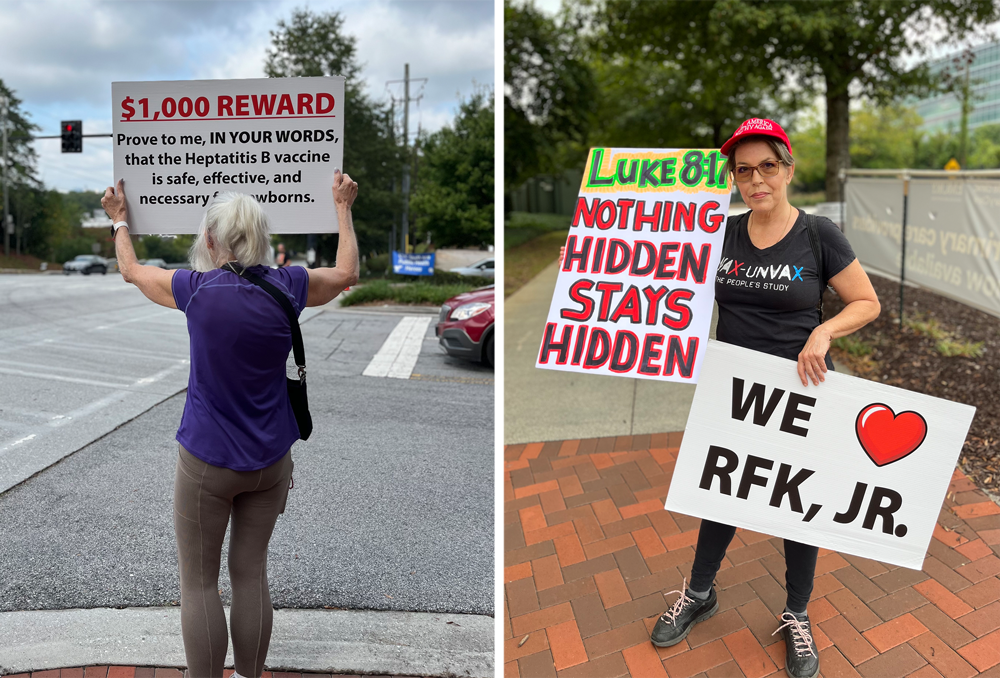
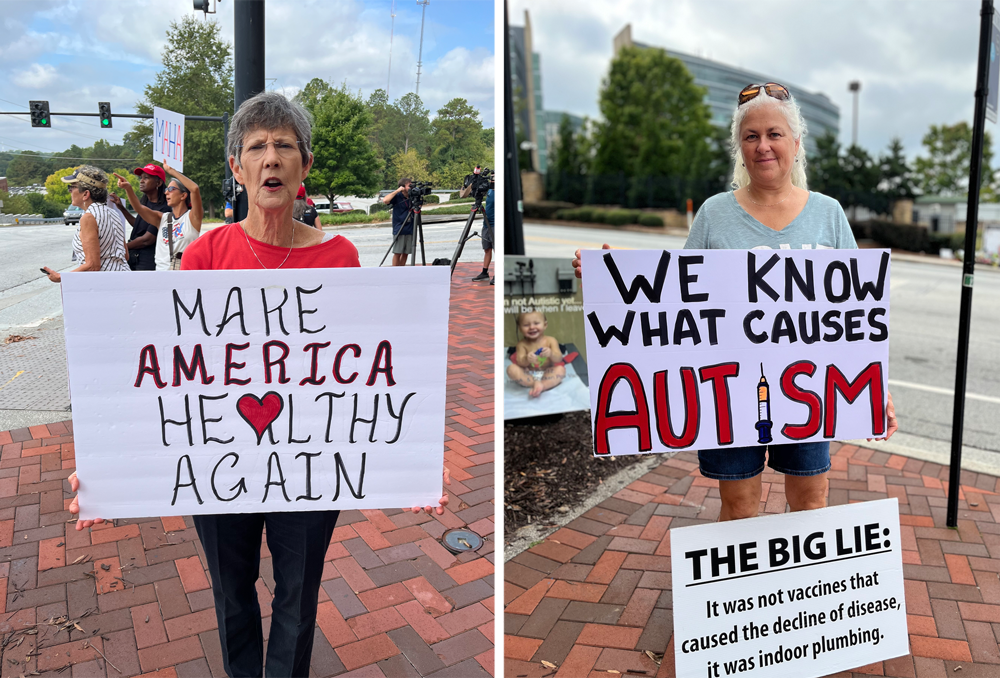
Some of the messages on the attendees’ signs were simple expressions of anodyne support—“Make America Healthy Again”, for instance, and “Thank You, RFK Jr.” But others were more unusual. One woman carried a sign announcing, “I am Charlie Kirk,” a reference to the conservative activist who was assassinated in Utah earlier this month and has become a symbol of free speech activism on the right. Other signs referenced bible verses, and one said “Anti-Science, Pro-Informed Consent.”

A diptych of two women holding signs on a street corner in Washington, D.C. One sign reads "We (heart emoji) RFK, Jr.

MAHA rally attendees outside the CDC headquarters in Atlanta, Georgia, on September 26.Kiera Butler

Two of the attendees told me they worked with autistic children. Christy Kennedy, an occupational therapist in Decatur, Georgia, said she came to the rally because she believed “we have children that are in dire need to get help, but not pharmaceutical help.” Sometimes, she said, she brings up the dangers of vaccines with families in her practice. “This is a very, very sensitive topic because it’s become so politicized,” she said. “If I feel that a parent is open to the idea, then I will broach the concept.”

“Once you learn that truth, you become less resistant to learning more truth, so I learned about fluoride and chemtrails.”

Mike Arnold, who explained that he worked as a therapist with autistic children but declined to say in what capacity, said he had protested outside the CDC every day for seven years, carrying signs bearing slogans about the supposed link between vaccines and autism. Not that the issue had always interested him. His journey “down the truth rabbit hole” began around 2008, on internet forums where he became convinced that the 9/11 attacks were the work of the US government. “Once you learn that truth, you become less resistant to learning more truth, so I learned about fluoride and chemtrails,” he said. “I learned that story—the Rothschilds and the Rockefellers, and how they funded the UN. Elon Musk is not the richest person in the world. He has nothing compared to the Rothschilds. They basically own the Federal Reserve.” (The Rothschilds are the Jewish family at the center of a modern antisemitic conspiracy theory, and they do not have any influence on the Federal Reserve.) His research led him to believe that many other supposed conspiracy theories were actually true. “Let’s just say I’m Jewish, and I can get away with saying certain things that other people would call antisemitic,” he said. “Yeah, some of those things are true.”

Most of the attendees I spoke to approved of Trump’s message that pregnant women shouldn’t use Tylenol, despite the fact that it is the only safe way to prevent birth defects caused by maternal fever.

A diptych of two women holding signs that read "Make America Healthy Again," and "We Know What Causes Autism" on a street corner in Washington, D.C.

Rally-goers oppose vaccines outside the CDC headquarters in Atlanta, Georgia, on September 26.Kiera Butler

Kendra Foltz Biegalski, the chair of DeKalb County Republican Party, said she had come to the rally because she is “a big fan of RFK Jr. and his program to make America healthy again.” Though she was a bit fuzzy on the details, Trump’s announcement about Tylenol causing autism seemed important to her. “I hope that women take the recommendations to heart,” she said, “and just try to be healthy when you’re pregnant, eat whole foods, and reduce any type of chemicals or man-made products that you’re putting in your body.”

Biegalski wasn’t the only attendee involved in local politics. Phoebe Eckhardt, who lost a bid to represent Georgia’s 47th Congressional district last year, said she came to the rally because she didn’t want children to be “harmed by vaccinations and wrong medical procedures.” She wasn’t worried about the return of infectious diseases like measles and polio, and, like Trump, cited the example of the Amish. They “don’t have any of these diseases at all, because they don’t get vaccinations,” she said. “They don’t take any of this medication from all of these doctors, they trust God.” (The assertion that there is no autism in the Amish community, a common anti-vaccine talking point, is demonstrably false.) Eckhardt’s voice swelled with emotion as she talked about what she considered to be a campaign by the pharmaceutical industry to lie to Americans. “Television has been programming Americans for 50 years, and I’ve been one of them, but I’m not anymore—so wake up and smell the roses of what real life is all about!” she said. “I am Charlie Kirk!”

About an hour into the rally, no counter-protesters had shown up, though some drivers who passed by rolled down their windows to boo the people who had assembled. Across the street at the CDC Headquarters was a small memorial to Officer David Rose and homemade signs expressing support for some 600 workers who had been laid off or placed on administrative leave during the upheaval and massive shrinking of the agency under Robert F. Kennedy Jr. “The CDC must restore public trust,” Kennedy wrote in a recent Wall Street Journal op-ed. “And that restoration has begun.”

Continue Reading…

Mother Jones

How One Word Could Make the Difference in the Revenge Case Against James Comey

President Donald Trump finally realized one of his many revenge fantasies. The Department of Justice that he has pressed to pursue his critics and political opponents on Thursday indicted former FBI Director Jim Comey. A wildly unqualified lackey Trump appointed US attorney for the Eastern District of Virginia brought charges against Comey after her predecessor—who was forced out by Trump—and career prosecutors found there was no solid case against Comey.

The brief, five-paragraph indictment is unusually vague. It alleges that Comey on September 30, 2020, lied to Congress and obstructed an investigation by “falsely stating to a U.S. Senator during a Senate Judiciary Committee hearing that he…had not ‘authorized someone else at the FBI to be an anonymous source in news reports’ regarding an FBI investigation.”

That’s it. But there’s a big problem with this indictment: That’s not what exactly Comey said.

First, some background. This alleged false statement supposedly occurred when Comey testified to the Senate Judiciary Committee during a hearing held by Republicans as part of their ongoing crusade to depict the Trump-Russia investigation as an illegitimate Deep State plot against the president. But his remark was not about the main subject at hand. While questioning Comey, Sen. Ted Cruz (R-Texas) asked him about something else: the investigation of an FBI leak. That’s the portion of Comey’s testimony that appears to be at the center of this case.

This leak occurred in 2016 when Andrew McCabe, then the FBI deputy director, authorized other FBI officials to tell a Wall Street Journal reporter about a meeting in 2016 in which McCabe had disagreed with Justice Department officials about the handling of an investigation of the Clinton Foundation. (FBI agents had continued the inquiry after Justice Department officials had concluded there wasn’t much to case, and McCabe had believed continuing the inquiry was warranted. Eventually, no prosecutions ever materialized.) A Wall Street Journal piece that included a description of this meeting was published on October 30, 2016, shortly before the election.

Later, the Justice Department inspector general investigated the leak and released a report in February 2018. According to the IG, McCabe had told IG investigators that Comey had approved of this leak. Comey, though, said otherwise. There was no hard-and-fast evidence that resolved the conflict between their accounts, but the IG, citing a long list of circumstantial evidence, concluded that McCabe did not tell Comey that he had authorized others to share that information with the Wall Street Journal. It noted, “Had McCabe done so, we believe that Comey would have objected to the disclosure.” The IG said that McCabe had exhibited a “lack of candor” with Comey and with the IG investigators.

Comey, according the IG, had done nothing wrong in this episode. Still at the 2020 hearing Cruz pressed the former FBI director on this. Here’s the full exchange.

Cruz: On May 3rd, 2017, in this committee, Chairman [Chuck] Grassley asked you point blank, “Have you ever been an anonymous source in news reports about matters relating to the Trump investigation or the Clinton investigation?” You responded under oath, “Never.” He then asked you, “Have you ever authorized someone else at the FBI to be an anonymous source in news reports about the Trump investigation or the Clinton administration?” You responded again under oath, “No.”

As you know, Mr. McCabe, who worked for you, has publicly and repeatedly stated that he leaked information to the Wall Street Journal and that you were directly aware of it and that you directly authorized it. Now, what Mr. McCabe is saying and what you testified to this committee cannot both be true. One or the other is false. Who’s telling the truth?

Comey: I can only speak to my testimony. I stand by the testimony you summarized that I gave in May of 2017.

Cruz: So you our testimony is you’ve never authorized anyone to leak, and Mr. McCabe, if he says contrary is not telling the truth.

Comey: Again, I’m not going to characterize Andy’s testimony. But mine is the same today.

That’s it. The indictment gives the impression that Comey made a remark during this testimony in which he said he had not “authorized someone else at the FBI to be an anonymous source in news reports.” But Comey never directly said those words. His response was: “I stand by the testimony you summarized.” The indictment, drawing on the question that Comey was asked at that earlier hearing, is putting words in his mouth.

There’s another problem for the prosecution. According to the IG report, McCabe said he spoke to Comey after the Wall Street Journal article appeared and this is supposedly when Comey approved of the disclosure. The IG concluded Comey did no such thing. But if he had, would an after-the-fact approval count as an authorization? That’s a tough argument to make.

And there’s more. That question which Grassley presented to Comey in 2017 that Cruz cited was specific, referring only to “news reports about the Trump investigation or the Clinton administration.” Note that Grassley had mentioned the Clinton administration, not the Clinton Foundation. His query technically did not cover whatever had happened regarding the leak to the Wall Street Journal about the Clinton Foundation investigation.

So when Comey told Cruz that he stood by his previous testimony he was not truly addressing the leak issue related to the Wall Street Journal article. So how could he have lied about it? Consequently, it could be hard to convict him by showing that he had approved of that particular leak—which, according to the Justice Department IG, he did not.

In a video he posted on social media Thursday night, Comey said, “My heart is broken for the Department of Justice but I have great confidence in the federal judicial system and I’m innocent.”

At this point, it’s hard to have a full understanding of the case. Because the indictment is so vague, it is not yet publicly known that the charges are indeed based on the Wall Street Journal leak. That’s a reasonable assumption, and the media reporting at the moment is focused on the McCabe leak. But perhaps there could be another disclosure of sensitive information involved. Still, the problems with the indictment would remain.

This case is likely destined to be bogged down in word games. But words and precision are crucial to indictments that accuse a person of lying to Congress. And in this instance, it is no surprise that the indictment is sloppy, vague, and misleading, for this is an act of vengeance and not justice—which is what makes the case so dangerous.

Continue Reading…

Mother Jones

When Home Isn’t Safe: Immigration Enforcement Meets Housing Discrimination

This story is published in partnership with the Investigative Reporting Workshop at American University.

For one California mother, public housing has been a lifeline for her household of five—her two young adult daughters, husband, and young nephew. She could not afford rent without the federally subsidized housing that they all share.

It’s also a lifeline for another reason: She doesn’t feel comfortable leaving the safe haven of her home amid increased immigration enforcement. An undocumented immigrant herself, she fears she could be targeted by federal agents any time she leaves to work or shop. Her family is known as “mixed-status” by the government—some people in her household are documented, but others are not. Now, a proposed rule by the Trump administration would end eligibility for mixed-status families such as hers.

Even as she acknowledges that she does not feel threatened in her home, like many of her neighbors, she worries about losing federal housing aid. She’s worked hard since she came to the United States in 1989, she said, but without a stable income, she hasn’t been able to cover the full month’s rent—she contributes 30 percent to the total—without help. Though now, since she relies on subsidies, she is far less comfortable engaging with public housing employees. Given her family’s status, she worries that they’ll share her information with immigration enforcement officers.

“I don’t feel as confident as I did before,” she said in her native Spanish during an interview with a translator. “They tell you they’re not going to share it, and then it turns out they did share the information. The employees are lying.” She asked that her name not be used because of concerns about being evicted or deported.

As the law now stands, any assistance received by these families is prorated based on how many family members are eligible. But the Department of Housing and Urban Development under President Trump is seeking to end this policy, re-upping a rule that he had proposed in 2019 during his first administration. The policy is currently under review by the Office of Information and Regulatory Affairs, but if enacted, it would require that all members of a household must be eligible for housing assistance, or the entire household would be disqualified.

On March 24, 2025, Secretary of Housing and Urban Development Scott Turner and Secretary of Homeland Security Kristi Noem signed a “memorandum of understanding”—a nonbinding agreement between the two agencies—promising to “end the wasteful misappropriation of taxpayer dollars to benefit illegal aliens instead of American citizens.” In short, Turner and Noem’s agreement aims to exclude undocumented residents and non-citizens from accessing any federal housing programs, including public housing and housing choice vouchers.

In an email response from Homeland Security, Noem wrote, “If you are an illegal immigrant, you should leave now.” The Department of Housing and Urban Development did not respond to a request for comment.

“What differentiates then from now is the very aggressive and lawless nature of their deportation and general anti-immigrant agenda,” said Marie Claire Tran-Leung, evictions initiative project director at the National Housing Law Project. She added that all families are being forced to calculate their risks—whether they live in subsidized housing or not.

In 2019, the Congressional Research Service estimated that Trump’s proposed “rule would likely result in the displacement from HUD-assisted housing of over 25,000 families, including 55,000 children.” CRS noted that in total, around 110,000 people would have been affected by the rule change, but the Biden administration rescinded the policy in 2021 before it went into effect. While a similar estimate on this rule does not exist for 2025, the Center for Migration Studies estimates that there are around 4.7 million mixed-status households in America.

In commenting about the situation, Noem wrote in the email, “The Biden Administration prioritized illegal aliens over our own citizens, including by giving illegal aliens taxpayer-funded housing at the expense of Americans. Not anymore. The entire government will work together to identify abuse and exploitation of public benefits and make sure those in this country illegally are not receiving federal benefits or other financial incentives to stay illegally.”

This year’s version of the rule has yet to go into effect, but the potential change is forcing some families to preemptively relocate.

“We’re trying to spread the message that the administration is going to say all sorts of things that are untrue, but you still have the right to stay where you are.”

“We’re trying to spread the message that the administration is going to say all sorts of things that are untrue, but you still have the right to stay where you are,” Tran-Leung said. “You don’t have to move.” She added that preemptive moves also occurred in 2019 when the rule was first proposed.

As of May this year, more than 2.3 million units nationwide were leased using housing choice vouchers, and by mid-August nearly 790,000 public housing units were being leased across the country. That means millions of Americans rely on federal rental or housing assistance.

Already, non-citizens are largely excluded from accessing any of these programs and are only eligible for federal housing vouchers if they are in the United States with specific designations, if they are refugees, for instance, or have parole status, which is a temporary status provided for “urgent humanitarian reasons or significant public benefit,” according to HUD guidelines.

Although these changes do not substantially alter existing laws, immigration advocates, fair housing nonprofit leaders, and housing lawyers with whom I spoke say that the most significant impact is likely to be the chilling effect not only for undocumented or non-citizen residents, but also for those who are legally eligible for federal rental assistance.

“What we’re seeing is people are terrified, and it’s deliberate,” said Nicole Smith, communications manager at the Protecting Immigrant Families Coalition, a national group of organizations advocating for immigrants’ rights. “Now that we’ve got this data sharing happening between service providers and the federal government, people are just terrified to access anything.”

This pervasive reluctance to engage with federal housing resources also includes not reporting incidents of housing discrimination or violations of fair housing law, according to multiple advocates at fair housing enforcement and education nonprofits.

“Because these individuals have now been put in such a state of fear, if you’re an undocumented individual, putting your name in any federal system is the last thing on your mind,” said a leader at one Rocky Mountains nonprofit. “You’re going to accept the little conditions that are presented to you until you find something better—if you find something better,” he added, asking that his name not be used because of concern about future retaliation against his organization. “So these people are now going to be living in inappropriate conditions, in illegal circumstances.”

Advocates with several nonprofits tasked with assisting in fair housing enforcement noted that they did not have any specific cases related to immigration-based discrimination—not because there was no such discrimination, but because, as Michael Chavarria, executive director of the HOPE Fair Housing Center in Illinois, wrote in an email, “of the fear and anxiety that exists at this time. I do not think anyone feels safe reporting the housing discrimination they experience, even if it is a violation of their federal or state civil rights.”

“I do not think anyone feels safe reporting the housing discrimination they experience, even if it is a violation of their federal or state civil rights.”

That distrust even extends to nonprofits themselves.

Carole Conn, executive director of Project Sentinel, a fair housing organization in Santa Clara, California, reminds everyone she works with that the data they collect is protected and should not be shared outside of their organization. They also won’t ask for someone’s immigration status. But even in a state with legal protections against landlords threatening immigration enforcement against tenants, she still sees distrust among people seeking help. Once more, the recurring theme, she said, “is the fear, unquestionably and justifiably.”

“Some of this is just rooted in the fact that not only are they fearful of anything that has a whiff of government,” Conn added. But that includes people who work in her organization. It was like, “ ‘How can I trust you, you’re taking vital information from me?’ ”

Some of these nonprofits lost funding earlier this year amid grant cancellations for the Fair Housing Initiatives Program. A significant proportion of those cuts were meant to educate residents on their rights as tenants and how they could determine what constituted housing discrimination, regardless of their legal status.

And this chilling effect goes beyond immigrants or those who are undocumented. Tenants from Latino or Hispanic backgrounds, even if they are American citizens, are significantly more likely to face threats of immigration action. Smith said she believes that the fear associated with immigration enforcement is intentionally targeted to harm these communities.

“It is to intimidate the largest immigrant groups in this country. It’s full racism. It’s shameless racism,” she said. “There is no way to deny, and it’s absolutely deliberate.”

The impacts of Trump’s rhetoric remain to be seen. Only eight months after his inauguration, data on housing discrimination claims regarding immigration status or national origin are not yet available. Advocates from across the country, however, said that anecdotally, they have seen the number of fair housing concerns about immigration enforcement increase.

“With the direction that the administration is taking, I think we’ve seen, even since January, a lot more instances of targeted discrimination where maybe we hadn’t seen before,” said Courtney Arthur, the program manager for Mid-Minnesota Legal Aid’s Housing Discrimination Law Project, a fair housing nonprofit. She said landlords have started to call ICE to report people whom they think may be undocumented.

A December 2024 study by the Urban Institute found that, even before Trump’s inauguration, 29 percent of adults in all immigrant families and 60 percent in mixed-status families worried “a lot” or “some” about participating in essential activities, such as going to work, sending children to school, and driving a car.

“So many people who are afraid of ICE enforcement, at work or at schools, are staying at home as a refuge,” Tran-Leung said.

But if federal assistance to that housing is in jeopardy, so is that refuge—especially if there is additional discriminatory behavior coming from the landlords themselves.

“They might be subject to harassment by their landlord, or subject to weaponized threats to call ICE on them,” Tran-Leung added. “It has made a lot of immigrant families just far less likely to access the resources that are legally available to them because a lot of folks live in fear of being entrapped.”

Some of the fear around engaging with federal housing resources comes from a concern about data-sharing practices. Multiple federal laws, the Privacy Act of 1974, for example, of the more recent Federal Information Security Modernization Act and E-Government Act, allow agencies to maintain records that are relevant and necessary to their agency work. But under Trump, agencies have regularly shared what was once privileged and sensitive personal information.

The Electronic Privacy Information Center and Democracy Forward organizations filed a lawsuit against the Department of Government Efficiency, or DOGE, in February for “its illegal seizure of personnel records and payment system data” in the Department of the Treasury and Office of Personnel Management databases. And later that month, ProPublica reported that DOGE gained access to the HUD Enforcement Management System, which contains confidential information about those who have reported housing discrimination claims—a database consisting of hundreds of thousands of people. Though a HUD spokesperson told ProPublica after publication that, in fact, DOGE did not have access to that system, just the possibility that information could be shared was sufficient to dissuade someone from reporting discrimination.

This has all resulted in a climate where the fear of losing one’s housing or having personal information used against them by immigration enforcement is omnipresent for many people, even those with legal residency status.

“There is no word that captures the cruelty of putting families in such precarious, isolated, and unsafe situations,” Chavarria wrote.

Continue Reading…

Mother Jones

Trump’s Energy Secretary Aims to Claw Back Billions Slated for Clean Energy Projects

This story was originally published by the Guardian and is reproduced here as part of the Climate Desk collaboration.

The US energy secretary, Chris Wright, on Wednesday announced that his department will return to the treasury billions of dollars set aside for green projects, while dodging questions about affordability and grid reliability and claiming international climate policy has not lowered emissions.

“The more people have gotten into so-called climate action, the more expensive their energy has become,” Wright said. “That lowers people’s quality of lives and reduces their life opportunities.”

The Trump administration aims to end “cancel culture,” Wright said, wherein “you can’t say anything about climate change” without being “shouted down.” He also defended a widely criticized Energy Department report that experts say was full of climate misinformation, claiming it only contained one figure that was out of line with a recent National Academies report on climate science.

Asked about concerns that the administration’s widespread attacks on climate policy, Wright said climate action had not delivered. “We’ve had 30 years, more than 30 years, since the Kyoto protocol,” he said “We haven’t even changed the trajectory of global greenhouse gas emissions.”

However, since the adoption of the Paris agreement, the projected rise in global warming has been dramatically reduced, from over four degrees celsius of temperature rise expected by the century’s end to 2.6C if climate action plans are fully implemented, according to the UN secretary general.

Wright also announced plans to return $13 billion in Biden-era funding for green projects, which his department said were “initially appropriated to advance the previous administration’s wasteful ‘Green New Scam’ agenda.” He did not clarify which green projects would be targeted.

Questioned about his administration’s attempts to halt wind farm construction, including ones that are already permitted, Wright said the administration is merely investigating widespread concerns about the projects’ impacts, including on whale populations. Scientists say there is no credible evidence that wind turbines pose a major danger to whales.

Asked if future presidential administrations should be able to launch similar attacks on already permitted fossil-fuel projects, he said they already have, citing Biden’s revocation of a permit for the controversial Keystone XL oil pipeline.

The president has pledged to slash electricity bills by half. Yet grid operators have said the Trump administration’s efforts to halt renewable energy while keeping costly coal plants online have forced them to increase utility bills. Wright dodged a question about those rising costs, claiming that Biden’s efforts to close coal plants raised the price of electricity.

Asked if he plans to go to Cop30, the United Nations climate talks in Brazil, in November, Wright said no. “I don’t have any plans to go there,” he said.

Continue Reading…

Mother Jones

The Charter School Pressuring Teachers to Get Involved In Politics

A few days before a September 18th pro-charter school rally, Eva Moskowitz, the CEO of Success Academy—New York City’s largest charter school network—dropped in at a new teacher training. The visit was unannounced. Moskowitz had an urgent message for her employees that had nothing to do with pedagogy or classroom management: You need to help push the charter school agenda.

In a recording of the meeting obtained by Mother Jones, and first reported by Gothamist, Moskowitz told her workers this was a moment of “heightened risk, policy risk, political risk,” and sternly reminded them about the march for charters set to come. “You’re gonna need to get up early,” Moskowitz explained. The employees would march across the Brooklyn Bridge and rally in Cadman Plaza, she said. “You guys think you don’t have a lot of time to organize your rally? I’m sorry. Wah, wah, wah. We had eight days to organize the rally in Albany,” she said, referring to a 2014 action. “We’re facing a very serious threat.”

“I think we’re getting a little democratic here,” the CEO of Success Academy scolded. “When your boss asks you to do something, assuming it’s not unethical or a question of conscience, you do the task.”

During the meeting, Moskowitz also vented about low participation in the organization’s “Phone 2 Action” campaign, which requires every employee to reach out to New York elected officials five times, sending pre-written messages supporting charter schools.

One prospective teacher who was present at the meeting, Anita, says Moskowitz’s speech made it clear that “this [job] wasn’t about school and education at all—it felt like she was just trying to push politics onto us.” Frustrated and disappointed, Anita did not return for the remainder of her training.

Mother Jones spoke with eight current and former teachers and staff across Success Academy, who described political coercion and repression inside the network of schools. (Out of concern that Success would retaliate against them for speaking with the press, all requested that their names be changed.) The employees described an atmosphere in which they feared that to keep their jobs they needed to publicly advocate for charter schools.

Employees told Mother Jones they had been pressured to participate in the September 18th rally and conduct outreach as part of a public campaign for charters in New York City. These demands were followed up with check-ins: Leaders asked employees in public Slack channels to confirm via emoji reaction when they’d completed outreach to elected officials, demanded screenshots as evidence, called teachers after hours, and cornered educators in classrooms to check if they had sent the messages.

Erin, a teacher in her second year, says she was asked to call parents and encourage them to attend the rally. Blake, a third-year teacher, was almost daily told to send flyers home to families. Zakiyah Shaakir-Ansari, Co-Executive Director of the Alliance for Quality Education (AQE), says pressure to attend a midday political event creates an undue burden for families.

Success Academy did not respond to a request for comment and questions about the pressure to participate in politics. In a statement to Gothamist, a spokesperson said that Success has organized marches for years and no one working there should be “surprised by this or should object to standing up for charter schools.” Success did not respond to specific questions about whether there had been retaliation or firings for non-participation in pro-charter political activities.

After last week’s rally, state lawmakers called for an investigation into potential violations of state law. “Canceling classes during a school day and forcing families and students to engage in a political rally is an egregious misuse of instructional time and state funds,” State Sens. John Liu and Shelley Meyer wrote in a letter to the New York State Education Department. “Our state provides public dollars to charter schools to educate students, not for political activism or for influencing elections.” (Charter schools responded, according to the New York Post, with a letter saying the event was “not a partisan display.”)

Success has a history of involving its staff, students, and families in political actions. This year, these efforts have taken on a more prominent role after New York City nominee for mayor Zohran Mamdani won the Democratic primary.

Casey, in his fifth year at Success, says the pressure has never been so intense—and it’s been largely focused on Mamdani. “This year, in training, they explicitly started with naming Mamdani and how he is the villain in our story,” says Casey.

“They started the year off by being like ‘We’re anti-Zohran, and here’s why,” Erin says.

Success in public statements has said its political work is strictly advocacy for charters, and not about the mayoral race or specific politicians. But Moskowitz was also quoted in a recent Wall Street Journal op-ed entitled “Zohran Mamdani Threatens Charter Schools,” emphasizing the need for a mayor who is friendly to charter school interests.

Mamdani has said that he opposes raising the charter cap (which determines how many charter schools can operate in New York City), the mandated expansion of charter school operations in the city, and the placement of more charter schools inside public school buildings. As mayor, he has said he would audit existing co-located schools to review uneven funding, overcharged rent, and legal entitlements.

New York Civil Liberties Union Director of Education Policy Johanna Miller said requiring employees to participate in an anti-Mamdani campaign would be “directly undermining democratic values and diversity of thought” and “feels like coerced speech.”

“The political coercion is a form of threat under the [National Labor Relations Act] (NLRA),” said Lorena Roque, Interim Director of Education, Labor and Worker Justice at the Center for Law and Social Policy. “Being forced to do any of these things is an unfair labor practice, and then when you throw the political element in there, I think the [National Labor Relations Board] (NLRB) would be very upset.”

Although charters straddle a careful divide as privately run schools receiving public funding, they’re within the jurisdiction of the NLRB. Under nonprofit law in New York, charters can require staff to advocate for the school, but not for or against specific political candidates.

“I’m frustrated. I’m nervous all the time.”

Lee Howard Adler, a professor of critical labor and employment law at Cornell University’s School of Industrial and Labor Relations, says the political advocacy Success requires its employees sounds inappropriate, nonprofit or otherwise, if it is in reaction to “the educational ideas and political candidacy of Zohran Mamdani.”

In the recorded meeting, Moskowitz presented her demands as typical work tasks and herself as a boss simply doing what was needed.

“I think we’re getting a little democratic here,” she scolded. “We are quite hierarchical. There is a chain of command, and when your boss asks you to do something, assuming it’s not unethical or a question of conscience, you do the task.” Those who lived in New Jersey were told to list the company’s office as their address when contacting elected officials. Under Moskowitz’s watchful eye, employees were ordered to send the messages then and there.

Success board members and leaders, including co-founder Joel Greenblatt, have donated a total of $935,700 to independent mayoral candidate Andrew Cuomo directly and to a supportive super PAC, Fix the City.

Keisha, who’s been with Success for multiple years, says when she first started, she “drank the Kool-aid,” but “in recent months I’ve become more clear-eyed and realized there’s a lot of unethical and sort of inappropriate stuff happening.”

Blake, another teacher, says at his back-to-school orientation, staff were told “the current Democratic nominee represents the biggest danger to our existence since [former] Mayor Bill de Blasio.”

During de Blasio’s tenure as mayor, Success Academy opened 21 new schools and more than doubled its revenue. Joseph Viteritti, PhD, a professor of public policy at Hunter College and author of a recent book about the school choice movement, disagrees that a Mamdani mayoral win spells doom for charters. “The issue with charter schools now is whether or not you’re going to raise the cap [and] it’s not Mamdani who’s going to make that stop or go.”

Keisha said this has not stopped Success from hammering home the urgency. “I voted for Zohran, and to have the CEO state that his policies threaten our mission and if we work here we have to align with the mission…it makes me feel like we will be fired if we don’t participate,” she says.“I’m frustrated. I’m nervous all the time.”

Every long-time employee at Success with whom Mother Jones spoke described an environment of frequent, sudden, and often seemingly unjustified firings.

Keisha says a new member of her team was fired unexpectedly just weeks after starting. “Over the last six months, people are just fired left and right for no good reason,” she said.

Blake said that “you learn pretty quickly not to question anything. Just nod your head yes, so that way you don’t get hit with the big stick.”

Blake says he thinks Success makes changes to its employee handbook to justify disciplinary actions after the fact. Employees sign the handbook at the beginning of each new year, but last year was the first time they were told what changes had been made to it. Because the handbook can’t be downloaded or printed due to permission settings, Blake says, it’s often hard to compare versions to check for differences. “It’s like the Berenstein-Berenstain effect. People will say they’re pretty sure something is in the handbook, but then they go and try to find it and can’t,” he notes.

Feeling increasingly uncomfortable about the pressure to participate in the rally and Phone 2 Action campaign to contact elected officials, Casey shared his concerns with a team leader. In response, the leader pointedly turned the conversation to his job and future with Success, he said. Intimidated, Casey walked back his concerns—after which the conversation was “very positive, all smiles.” The leader told him if he knew anyone else with doubts, he should pass their name along.

“I started playing the game inside because I don’t want to lose my job and I don’t want to be targeted,” says Casey.

Viteritti says he knows Success for both its consistent high test scores, and for being “controversial,” and “very aggressive politically.” This means Success or Moskowitz should not be used as a barometer for the larger landscape of New York City charter schools, he explains. Still, asked about the political pressure, he says, “if it’s happening, it’s a problem.”

As the school year has progressed, teachers and staff say the messaging around the rally has focused less on Mamdani. But Moskowitz and other leaders have continued emphasizing the “political risk” posing “an existential threat” to Success Academy, school choice, and, by extension, their jobs.

Earlier this month, some employees received an email from an unknown sender emphasizing their labor protections and encouraging them not to attend the rally. About an hour after the message appeared, it vanished.

“I know we do have monitoring software on our laptops that allows the company to view our screens,” says Blake. “Some people were saying that while they had the email on their screen they saw a little message on the top saying that the screen was currently being viewed.”

Many Success teachers are fresh out of college, and as Moskowitz was quick to remind them during the recorded training, “most of you would not be able to be hired in [Department of Education] schools,” because they lack the necessary credentials. “We are very deliberately not unionized,” she said.

“After the conversation I had, I said to myself, ‘They’re gonna be out to get me this year. I need to make zero reason for them to fire me,’” says Casey. “​​In the beginning, I was a little bit more confident in like, ‘Oh, whatever happens, I’ll find another job.’ But I really am not in a position to lose my job.”

When he was first told about the rally, he planned on refusing to attend. But on September 18th, he found himself in Cadman Plaza. He felt he had no choice.

Continue Reading…

Mother Jones

The Dismantling of the US Forest Service Is Imminent

This story was originally published by High Country News and is reproduced here as part of the Climate Desk collaboration.

In the 1880s, giant cattle companies turned thousands of cattle out to graze on the “public domain”—i.e., the Western lands that had been stolen from Indigenous people and then opened up for white settlement. In remote southeastern Utah, this coincided with a wave of settlement by members of the Church of Jesus Christ of Latter-day Saints. The region’s once-abundant grasslands and lush mountain slopes were soon reduced to denuded wastelands etched with deep flash-flood-prone gullies. Cattlemen fought, sometimes violently, over water and range.

The local citizenry grew sick and tired of it, sometimes literally: At one point, sheep feces contaminated the water supply of the town of Monticello and led to a typhoid outbreak that killed 11 people. Yet there was little they could do, since there were few rules on the public domain and fewer folks with the power to enforce them.

That changed in 1891, when Congress passed the Forest Reserve Act, which authorized the president to place some unregulated tracts under “judicious control,” thereby mildly restraining extractive activities in the name of conservation. In 1905, the Forest Service was created as a branch of the US Agriculture Department to oversee these reserves, and Gifford Pinchot was chosen to lead it. A year later, the citizens of southeastern Utah successfully petitioned the Theodore Roosevelt administration to establish forest reserves in the La Sal and Abajo Mountains.

Since then, the Forest Service has gone through various metamorphoses, shifting from stewarding and conserving forests for the future to supplying the growing nation with lumber to managing forests for multiple uses and then to the ecosystem management era, which began in the 1990s. Throughout all these shifts, however, it has largely stayed true to Pinchot and his desire to conserve forests and their resources for future generations.

But now, the Trump administration is eager to begin a new era for the agency and its public lands, with a distinctively un-Pinchot-esque structure and a mission that maximizes resource production and extraction while dismantling the administrative state and its role as environmental protector. Over the last nine months, the administration has issued executive orders calling for expanded timber production and rescinding the 2001 Roadless Rule, declared “emergency” situations that enable it to bypass regulations on nearly 60 percent of the public’s forests, and proposed slashing the agency’s operations budget by 34 percent.

The most recent move, which is currently open to public comment, involves a proposal by Agriculture Secretary Brooke Rollins to radically overhaul the entire US Department of Agriculture. Its stated purposes are to ensure that the agency’s “workforce aligns with financial resources and priorities,” and to consolidate functions and eliminate redundancy. This will include moving at least 2,600 of the department’s 4,600 Washington, DC, employees to five hub locations, with only two in the West: Salt Lake City, Utah, and Fort Collins, Colorado. (The others will be in North Carolina, Missouri, and Indiana.)

The goal, according to Rollins’ memorandum, is to “bring the USDA closer to its customers.” The plan is reminiscent of Trump’s first-term relocation of the Bureau of Land Management’s headquarters to Grand Junction, Colorado, in 2019. That relocation resulted in a de facto agency housecleaning; many senior staffers chose to resign or move to other agencies, and only a handful of workers ended up in the Colorado office, which shared a building with oil and gas companies.

Using an emergency declaration, Trump’s timber production executive order would ease environmental protections so as to greatly expand logging in the national forests.

Though Rollins’ proposal is aimed at decentralizing the department, it would effectively re-centralize the Forest Service by eliminating its nine regional offices, six of which are located in the West. Each regional forester oversees dozens of national forests within their region, providing budget oversight, guiding place-specific implementation of national policies, and facilitating coordination among the various forests.

Rollins’ memo does not explain why the regional offices are being axed, or what will happen to the regional foresters’ positions and their functions, or how the change will affect the agency’s chain of command. When several US senators asked Deputy Secretary Stephen Vaden for more specifics, he responded that “decisions pertaining to the agency’s structure and the location of specialized personnel will be made after” the public comment period ends on September 30.

Curiously, the administration’s forest management strategy, published in May, relies on regional offices to “work with the Washington Office to develop tailored strategies to meet their specific timber goals.” Now it’s unclear that either the regional or Washington offices will remain in existence long enough to carry this out.

The administration has been far more transparent about its desire to return the Forest Service to its timber plantation era, which ran from the 1950s through the ’80s. During that time, logging companies harvested 10 billion to 12 billion board-feet per year from federal forests, while for the last 25 years, the annual number has hovered below 3 billion board-feet. Now, Trump, via his Immediate Expansion of American Timber Production order, plans to crank up the annual cut to 4 billion board-feet by 2028. This will be accomplished—in classic Trumpian fashion—by declaring an “emergency” on national forest lands that will allow environmental protections and regulations, including the National Environmental Protection Act, Endangered Species Act and Clean Water Act, to be eased or bypassed.

In April, Rollins issued a memorandum doing just that, declaring that the threat of wildfires, insects and disease, invasive species, overgrown forests, the growing number of homes in the wildland-urban interface, and more than a century of rigorous fire suppression have contributed to what is now “a full-blown wildfire and forest health crisis.”

Emergency determinations aren’t limited to Trump and friends; in 2023, the Biden administration identified almost 67 million acres of national forest lands as being under a high or very high fire risk, thus qualifying as an “emergency situation” under the Infrastructure Investment and Jobs Act.

Rollins, however, vastly expanded the “emergency situation” acreage to almost 113 million acres, or 59 percent of all Forest Service lands. This allows the agency to use streamlined environmental reviews and “expedited” tribal consultation time frames to “carry out authorized emergency actions,” ranging from commercial harvesting of damaged trees to removing “hazardous fuels” to reconstructing existing utility lines. Meanwhile, the administration has announced plans to consolidate all federal wildfire fighting duties under the Interior Department. This would completely zero out the Forest Service’s $2.4 billion wildland fire management budget, sowing even more confusion and chaos.

The administration also plans to slash staff and budgets in other parts of the agency, further compromising its ability to carry out its mission. The so-called Department of Government Efficiency fired about 3,400 Forest Service employees, or more than 10 percent of the agency’s total workforce, earlier this year. And the administration has proposed cutting the agency’s operations budget, which includes salaries, by 34 percent in fiscal 2026, which will most likely necessitate further reductions in force. It would also cut the national forest system and capital improvement and maintenance budgets by 21 percent and 48 percent respectively.

The goal, it seems, is to cripple the agency with both direct and indirect blows. The result, if the administration succeeds, will be a diminished Forest Service that would be unrecognizable to Gifford Pinchot.

Continue Reading…

Mother Jones

Anti-Vax Groups Struggle to Explain How Tylenol Fits In With Their Whole Thing

Since President Trump’s rambling Monday announcement about the supposed cause of autism and a purported new treatment, anti-vaccine groups have grappled with what the administration’s latest revelations mean for their movement. While some MAHA activists appeared to be overjoyed that the president had brought their cause to a national stage, others were frustrated that it was Tylenol, and not vaccines, that took the brunt of the blame.

The messaging of the press conference was wildly mixed. Trump and HHS Secretary Robert F. Kennedy Jr. claimed that Tylenol and folate deficiency could cause autism, a conclusion that has not been reached by any credible medical body. At the same time, Kennedy also implied that further studies could also implicate vaccines and suggested such research was underway at HHS.

Many anti-vax groups were confused that vaccines weren’t explicitly blamed.

Trump also spent a great deal of apparently unscripted time demonizing Tylenol, while struggling to pronounce Acetaminophen, its generic name. But he also rambled on against vaccines: advocating for parents to visit the doctor “four or five times” for immunizations and further spread out their children’s injections. (This is nonsense; getting multiple vaccinations in a single visit is completely safe and well-studied, and not vaccinating a child on an established schedule carries its own serious risks. More broadly, experts believe autism is likely caused by a mix of environmental and genetic factors—actual research remains ongoing.)

Some longtime anti-vaccine activists reacted to the press conference with unalloyed joy. John Gilmore, who runs a website called the Autism Action Network, wrote in his newsletter, “The President couldn’t have made it clearer that he and his administration believe vaccines are a major, if not the major, cause of autism. No doubt, there will be much more to come.”

Nicole Shanahan, Robert F. Kennedy Jr.’s former running mate, has sometimes been critical of the administration’s appointments at HHS. But she lavished praise on every official taking part in the press conference.

“Today was incredibly bold,” she tweeted. “@POTUS you have exceeded my expectations in truth telling – we were only expecting to hear about the published work on Acetaminophen (pronounced AH-SEE-TOE-MET-O-FIN — you killed it btw).”

“Instead,” Shanahan continued, invoking assassinated MAGA commentator Charlie Kirk, “you channeled Charlie and spoke the truth that haunts millions of us on a daily basis: our nation’s approach to childhood vaccinations is reckless and is causing immense suffering.”

Others were less sure. As Ars Technica was first to point out, the focus on Tylenol led some anti-vaccine groups to push back. Many were confused about why vaccines weren’t explicitly blamed for autism, a central belief in their movement, albeit one that has been repeatedly and roundly debunked.

The discontented included, to a certain extent, Children’s Health Defense, where Kennedy served as chairman for many years before becoming HHS secretary. Mary Holland, CHD’s president and general counsel, said on Steve Bannon’s War Room podcast that the announcement was “something of a sideshow,” adding, “Tylenol is not the primary cause. Vaccines are the primary cause.” Bannon agreed, declaring, “This Tylenol thing stinks to high heaven.”

CHD wasn’t alone. Dr. Ben Tapper, a chiropractor and longtime anti-vaccine activist with 120,000 followers on X, posted, “The reason we have a huge increase in autism rates is not becuse of Tylenol. It’s when Tylenol is given to a child POST vaccination creating the perfect storm. In other words, the vaccines are to blame. The vaccines light the fire and tylenol throws the fuel.”

Dr. Simone Gold, the founder of America’s Frontline Doctors, a group that energetically spread Covid misinformation early in the pandemic, tweeted, “The Tylenol–autism link is real enough to warrant urgent concern—especially when used in pregnancy.” But, she added, “[L]et’s be clear: autism’s rise cannot be reduced to Tylenol alone. Toxins, vaccine ingredients/adjuvants, and Pharma’s disregard for safety must all be investigated.”

Others saw the focus on Tylenol as an insult to—or even a way to blame—the mothers of autistic kids who make up a large portion of the anti-vaccine world’s most devoted foot soldiers. Jessica Rojas, an anti-vaccine activist who describes herself on X as an “American WOMAN, Mother and critical thinker,” told her 213,000 followers, “Gaslighting ends here. It’s NOT the Tylenol. You’re not to blame, mamas. We believe you.”

“Tylenol is not the primary cause. Vaccines are the primary cause.”

One group seized on the confusion as an opportunity to promote products. Dr. Peter McCullough, a cardiologist who rose to prominence opposing Covid vaccines during the pandemic, told his 1.2 million followers on X that the “pathway to developmental regression begins with vaccines, not acetaminophen.” McCullough is the chief scientific officer of The Wellness Company, a business that sells supplements it says can detox the body from vaccines. In an email newsletter earlier this week, the Wellness Company derided Trump’s announcement of a new autism treatment, a form of Vitamin B called leucovorin, as “a sales pitch.” The email urged readers to “Stay sharp, stay skeptical, and don’t let headlines decide your health,” while providing a sales link and noting that “our Vitamin B Complex delivers the full spectrum of B vitamins—including folate—to support energy, mood, and cognitive clarity.”

Some activists appear to be shifting the blame for the Tylenol announcement away from Trump. One of those people is Derrick Evans, a 2020 election denier from West Virginia who was convicted of a felony after he admitted in court to unlawfully entering the Capitol on January 6, 2021 while yelling “Derrick Evans is in the Capitol!” (He was pardoned earlier this year by Trump.) On Tuesday, Evans tweeted to his 838,000 followers, “Neither Trump or RFK Jr. linked Tylenol with Autism. The dean of Harvard’s School of Public Health did.” (According to the New York Times, the dean in question, Andrea Baccarelli, was paid $150,000 in 2023 for his work as an expert witness on behalf of plaintiffs who sued Tylenol’s parent company, Kenvue, because they believed the drug had caused neurodevelopmental problems in their children. A federal judge dismissed the case, finding the evidence did not support their claims.)

The federal government, meanwhile, doubled down what Trump and Kennedy said about Tylenol during Monday’s press conference. On Wednesday, HHS reposted a now-viral 2017 tweet from Tylenol’s brand account where the company told a user that it doesn’t recommend taking the drug while pregnant. HHS didn’t mention in its repost the fact that guidelines for Tylenol, like those of practically all drugs, recommends that pregnant women consult their doctors before using it.

The anti-vaccine and “health freedom” movements have always held multiple, and sometimes conflicting, beliefs about the causes of autism and other conditions they blame on pharmaceuticals. Some lay the fault entirely on vaccines, while others also blame products like the weed-killer glyphosate. In the past, anti-vaccine groups have resolved these ideological differences by being vague about the causation and mechanisms to blame and instead foregrounding suspicion of the broader medical establishment. A 2020 study in the American Journal of Public Health found that anti-vaccine groups had shifted away from making specific medical arguments on social media and towards the message that rejecting vaccines is a civil liberties and freedom of choice issue.

While anti-vaccine groups have spent the last few days trying to figure out their messaging—and whether Tylenol is now among their targets—autism experts expressed shock and concern about the damage unleashed by the press conference.

“Any association between acetaminophen and autism is based on limited, conflicting, and inconsistent science and is premature,” warns Dr. Alycia Halladay in a statement; she’s chief science officer at the Autism Science Foundation, which tries to guide families towards safe, evidence-based treatments for autism. “This claim risks undermining public health while also misleading families who deserve clear, factual information. For many years, RFK and President Trump have shared their belief that vaccines cause autism, but this is also not supported by the science, which has shown no relationship between vaccines and autism.”

“We are unsure why this announcement came today and how the conclusions were drawn,” added Alison Singer, the foundation’s president, in the same statement. “No new data or scientific studies were presented or shared. No new studies have been published in the literature. No new presentations on this topic were made at scientific or medical conferences. Instead, President Trump talked about what he thinks and feels without offering scientific evidence. He said ‘tough it out,’ meaning don’t take Tylenol or give it to your child. It took me straight back to when moms were blamed for autism. If you can’t take the pain or deal with a fever, then it’s your fault if your child has autism. That was shocking. Simply shocking.”

Continue Reading…

Mother Jones

The Wildly Unqualified Lawyer Trump Just Named to Prosecute His Enemies

The US Attorney for the Eastern District of Virginia is one of the most significant positions in the Department of Justice.

Erik Siebert, the federal prosecutor whom President Donald Trump pushed out last Friday for declining to prosecute his political enemies, had extensive experience. He is listed as an attorney on 675 federal cases. His replacement, Lindsey Halligan, a 36-year-old former Florida insurance lawyer, has worked on only three.

But for an administration in which loyalty reigns supreme, what matters is who Halligan has represented in each of those federal cases: Donald Trump.

An attorney in Florida remembered Halligan as nice and professional, but was “kind of shocked, frankly” when she began to work for Trump.

The decision to make Halligan one of the country’s top prosecutors is a major escalation in Trump’s efforts to weaponize the Justice Department. Halligan, who was previously tasked with helping to rid the Smithsonian of “improper ideology,” was sworn in on an interim basis on Monday. Her predecessor, Siebert, was installed by Trump in January and officially nominated by the president in May. He was forced out after he declined to bring charges against two of Trump’s enemies: New York Attorney General Letitia James and former FBI Director James Comey.

James is facing unsubstantiated allegations related to mortgage fraud, while Comey is facing similarly weak claims about lying to Congress. People familiar with the cases told the Washington Post that there was not enough evidence to move forward with either.

Instead of accepting the lack of evidence, Trump is trying to make Halligan—his former lawyer and White House aide—into the legal equivalent of a contract killer. She has zero experience as a prosecutor. Her mandate from the president is not to pursue what is normally considered justice but to subject people who have gone after Trump to legal harassment.

Trump made that clear in a Saturday evening post on Truth Social that was addressed to his attorney general, Pam Bondi. “Pam,” the president wrote. “I have reviewed over 30 statements and posts saying that, essentially, ‘same old story as last time, all talk, no action. Nothing is being done. What about Comey, Adam ‘Shifty’ Schiff, Leticia??? They’re all guilty as hell, but nothing is going to be done.’”

“We can’t delay any longer, it’s killing our reputation and credibility,” Trump added. “They impeached me twice, and indicted me (5 times!), OVER NOTHING. JUSTICE MUST BE SERVED, NOW!!!”

Three hours later, Trump put up another post stating that it was his “honor to appoint Lindsey Halligan” to be the US Attorney for the Eastern District of Virginia. In that role, the Washington Post has reported that Halligan will hold “one of the most sensitive posts in the Justice Department, leading around 300 lawyers and staff, overseeing complex national security investigations and representing federal agencies such as the Defense Department and CIA in court.”

Halligan joins other underqualified appointees using top prosecutorial positions to push seemingly questionable criminal investigations of political opponents.

Alina Habba, another former Trump defense attorney, was installed as interim US Attorney for New Jersey in March. In that role, she quickly charged Democratic Congresswoman LaMonica McIver with assaulting and interfering with law enforcement officials outside an oversight visit to an immigration detention facility in Newark. McIver pleaded not guilty and dubbed the prosecution “political intimidation.” Following a battle over Habba’s appointment, a federal judge last month ruled that she was not legally serving as US Attorney.

In January, Ed Martin, a former Stop the Steal organizer, was made acting US Attorney in DC. In that role, he threatened to prosecute various Democrats, including Senate Minority Leader Chuck Schumer. Trump selected him for the permanent position in March but pulled his nomination in the face of bipartisan opposition in the Senate. But Martin has stuck around. He now leads a DOJ task force pursuing Trump foes, including New York Attorney General James. (Martin even posed for photographs outside James’ home in August, while wearing a trench coat.)

Halligan is similarly close to the president. Trump has claimed that she would be qualified for her role partly because she was a “Partner at the biggest Law Firm in Florida,” where she “proved herself to be a tremendous trial lawyer.” But her legal background is less distinguished than Trump’s post might suggest.

After graduating from the University of Miami School of Law in 2013, the new US Attorney for the Eastern District of Virginia went on to become a partner at one of the Fort Lauderdale offices of Cole, Scott & Kissane in 2018. That distinction, according to CSK’s website, can be claimed by more than 260 people who are currently partners at the firm. (Before joining the firm, Halligan reportedly interned at the Innocence Project, as well as the Miami-Dade County public defender’s office.)

At CSK, South Florida court records show that Halligan largely defended insurance companies that were being sued by homeownerswho believed they were entitled to better coverage. In many cases, Halligan also represented home insurance companies against relatively small-time corporate plaintiffs with names like Water Dryout, Moisture Rid, and Water Restoration Guys. These cases—some of which were filed as small claims—were often resolved without the need for a trial. (Halligan’s name appears on her former law firm’s website only once—in a press release that notes that she and another attorney had achieved a “complete defense verdict in a denied roof leak case in Broward County” involving more than $500,000 of claimed damages.)

David Comras, the founding attorney at Comras & Comras in Fort Lauderdale, said he handled a few cases in which Halligan represented the companies his clients were suing. He remembered Halligan being nice and professional, but was “kind of shocked, frankly” when she leapt from that work to Trump’s legal team. He was similarly surprised that someone who handled Florida home insurance cases was now a top federal prosecutor in Virginia.

Halligan told the Washington Postthat she met Trump at a November 2021 event at his golf club in West Palm Beach. A former contestant in Miss Colorado USA pageants, Halligan has said that she probably stood out to Trump during their initial meeting because—unlike other women at the event—she was wearing a suit. Trump hired her as a lawyer soon after.

Halligan was at Mar-a-Lago during the FBI’s 2022 raid of the club. And she went on to represent Trump in a civil suit related to the raid. According to court records, it was the first time she had represented a client in a federal litigation.

At the start of the case in August 2022, Judge Aileen Cannon rejected two filings Halligan submitted for failing to comply with local procedures. The judge directed Halligan to the court’s website for instructions on how to file the documents correctly.

Two days later, Halligan submitted a notice updating her contact information. That filing was similarly rejected by the court. “Attorney has not followed the required procedures for updating their address with the Court…” a court notice explained. “See the Court’s website for detailed instructions.”

Lawyers who worked with Halligan on the case have defended her legal work. Tim Parlatore told the New York Times that he “found her to be very hard-working, intelligent and also with a deep understanding not only of what was going on in the case but what the president’s priorities were.”

Halligan also actively defended Trump on camera in appearances on Fox News, Newsmax, and Bill O’Reilly’s show. During the 2024 campaign, she was awarded a front-row seat in Trump’s box at the Republican National Convention. After Trump won in November, Halligan joined the president in the White House.

In March, Trump named Halligan in an executive order that claimed to seek to “restore the Smithsonian Institution to its rightful place as a symbol of inspiration and American greatness.” (The order listed Halligan’s title as “Assistant to the President for Domestic Policy and the Special Assistant to the President and Senior Associate Staff Secretary.”) The order said Halligan would work to “remove improper ideology” from Smithsonian facilities, including the National Zoo.

Now Halligan has been given a far more important role after her predecessor was forced out for not prosecuting Trump’s foes. As Trump put it in his post announcing her appointment, he expects her to do “GREAT things for JUSTICE.” There is little doubt about what he means by that.

Continue Reading…

Mother Jones

Jimmy Kimmel Hits Back at “Bully” Trump

Jimmy Kimmel returned to late-night on Tuesday to a powerful standing ovation before using his opening monologue to directly condemn President Trump’s aggressive efforts to bring his critics and the larger media to heel.

“We have to speak out against this bully,” Kimmel said. “He’s not stopping, and it’s not just comedy. He’s gunning for our journalists, too. He’s suing them, he’s bullying them.”

The return capped off an intense week of protest after ABC executives abruptly pulled Kimmel off the air “indefinitely” over his criticism that MAGA personalities were using the murder of Charlie Kirk to “score political points.”

“It was never my intention to make light of the murder of a young man,” Kimmel said on Tuesday, appearing emotional.

Shortly before Kimmel’s return, the president, in typical Trump fashion, took to Truth Social to air his grievances and vow retribution against ABC.

“I think we’re going to test ABC out on this,” Trump wrote. “Let’s see how we do. Last time I went after them, they gave me $16 Million Dollars. This one sounds even more lucrative. A true bunch of losers!”

“This show is not important,” Kimmel said. “What’s important is that we get to live in a country that allows us to have a show like this.”

Continue Reading…

Mother Jones

“Godsend” or “Concentration Camp”? A Lucrative ICE Deal Divides a Colorado Town

In January 2010, the private prison operator now known as CoreCivic announced the closure of a 752-bed facility in Walsenburg, Colorado. At the time, the Huerfano County Correctional Center was the second-largest employer in the county. Its shutdown caused a “major hit” to the economy, said John Galusha, then the county’s administrator. The town estimated a loss of $300,000 in revenue as almost 190 jobs disappeared, helping spike the county unemployment rate to 10.2 percent, above the state average. Without the contract that paid 25 cents a day per inmate into local coffers, Galusha said, “we had a hard time keeping up with the demand from social services.”

For the last 15 years, the facility has lain dormant. But that may soon change. Vested with a $45 billion immigration detention budget courtesy of President Donald Trump’s One Big Beautiful Bill, US Immigration and Customs Enforcement plans to open or expand at least 125 facilities, with the goal of scaling up to more than 107,000 beds by the end of 2025, according to the Washington Post. Under ICE’S ambitious blueprint, the 200,000-square-foot Walsenburg prison would not only be reactivated, but used to hold double the number of people it previously detained.

A squat prison surrounded by a barbed-wire fence, with a large, dark cloud hovering above it.

The Huerfano County Correctional Center has lain dormant for 15 years. It could soon turn into an ICE detention center.Rachel Woolf

Trump’s ballooning of what already is the world’s largest immigration detention system has unleashed a gold rush among federal contractors eager to cash in. And nowhere are the economic incentives to take advantage greater than in struggling communities with empty prison beds.

“It’s a very hungry machine,” said Nancy Hiemstra, co-author with Deirdre Conlon of Immigration Detention Inc.: The Big Business of Locking Up Migrants. “These webs of dependency, they want to keep being fed.” For an old coal mining town like Walsenburg—with an aging population and a median household income about half that of the state—the money detention offers can seem like a matter of survival. “It’s easy pickings,” Hiemstra said. “All of a sudden, immigration detention seems to be this beacon on a hill.”

But the prospect of a privately run ICE facility has divided Walsenburg. Some locals and public officials have welcomed the potential influx of money and jobs. “It’s a godsend,” Mayor Gary Vezzani told a TV reporter in early July. “If they use it for ICE or use it for a prison or use it for whatever they use it for, we really don’t care…It’s a pretty big paying customer for us. We’re not big enough, nor [is] anybody here big enough to stop it. So, we may as well take advantage.”

The mayor’s comments sparked fierce backlash. At a July 15 county commissioners meeting, one resident succinctly shot back: “We don’t want to be known as a town with a concentration camp.” At a city council meeting the same day, a speaker argued that “what’s happening in Walsenburg isn’t just corrupt. It’s fascist. It’s a blueprint for authoritarianism wrapped in barbed wire and dressed up as local revival.”

Protesters carry large flags as they cross a street on a sunny day. A black-and-white flag reads, "No justice, no peace." Two more flags read, "Fuck Trump."

The potential reopening of the Huerfano County prison as an immigration detention center has divided Walsenburg.Rachel Woolf

Since February, a local group, Speak Up Southern Colorado, has been gathering weekly outside Walsenburg’s historic downtown courthouse to protest Trump’s policies. Lately, members have focused on fending off the potential deal between ICE and CoreCivic. “The day we become silent about things that matter is the day we begin to die,” organizer Dee Maes-­Sandoval told me, paraphrasing Martin Luther King Jr. “And I am not at that day.”

During the first Trump administration, the now-66-year-old retired mortgage operations manager drove to the Southern border to volunteer at migrant camps that had formed in ­Mexico as a result of US policies. Now, she’s taken up the fight in her own hometown. “It’s a money-making thing,” Maes-Sandoval explained. “That’s what it’s all about: money and power.”

She’s right that big bucks are on the line. During a May earnings call, CoreCivic executives reveled in the likely profit. “This is such a significant moment,” said outgoing CEO Damon Hininger. “Never in our 42-year company history have we had so much activity and demand for our services.”

In the second quarter of 2025, about half of the company’s revenue came from federal contracts, primarily from work with ICE and the US Marshals Service. Over that period, CoreCivic brought in $176.9 million from ICE, a 17.2 percent increase over the year before. If the agency’s expansion plans are fully realized, it is estimated that CoreCivic could rake in an additional $500 million in annual revenue.

Dee Maes-Sandoval, wearing sunglasses, holds a speaker and  a megaphone to her mouth.

“It’s a money-making thing,” Dee Maes-Sandoval said of the potential reopening of the prison. “That’s what it’s all about: money and power.”Rachel Woolf

Company executives have prioritized reopening idle prisons and have identified nine with a combined capacity of more than 13,400 beds. On the investors’ call, CoreCivic boasted that ICE officials had already visited several facilities and highlighted the Huerfano County Correctional Center as “attractive” to the agency, even “top of the list.”

While CoreCivic may be enthusiastic when speaking to investors, it’s been tight-lipped around Walsenburg, leaving even local officials in the dark. Carl Young, Huerfano County’s current administrator, says he knows little other than that ICE toured the prison earlier this year. “We’re along for the ride,” he said, explaining that the county has no say in what happens with the privately owned facility. “The thing is already built,” Young said. “There’s really not much we can do one way or the other.”

CoreCivic’s senior director of public affairs, Ryan Gustin, wrote that the company’s staff are “trained and held to the highest ethical standards” and referred questions about new contracts to ICE. As of late August, an agency spokesperson said no decision had been made about the Walsenburg facility, but noted that ICE “is exploring all options to meet the nation’s current and future detention requirements.”

Jason Valdez, another organizer with Speak Up Southern Colorado, said the group first caught wind something might happen in June, after CoreCivic asked officials about utility infrastructure near the facility. “People around here started putting two and two together,” he said, “because we knew that ICE was looking for new places.”

Suspicion grew when the group found a CoreCivic job listing for detention officers at $31.50 an hour in Walsenburg, contingent on the company winning an unspecified contract. Official confirmation came in July, when the ACLU of Colorado won a public records lawsuit seeking information submitted by potential contractors to ICE’s Denver field office about “possible detention facilities.” The 115 pages of heavily redacted documents that were released revealed several companies, including CoreCivic and GEO Group, offering six locations. CoreCivic’s proposal said ICE could have the Huerfano County Correctional Center’s “total capacity” and suggested it could begin “a staged ramp 120 days after contract commencement.”

“They’re not providing information to the public,” said Tim Macdonald, legal director of the ACLU of Colorado. “People have no idea what the actual plans are.” He’s especially concerned about increasing private immigration detention in the state, given complaints of dehumanizing treatment at GEO Group’s existing Aurora location. (The company said its services meet ICE’s “strict requirements.”) “It’s the wrong thing to be doing—to expand in secret and add to these deplorable conditions and spending billions of dollars to do so,” Macdonald said.

The lack of transparency is just one issue infuriating locals. On August 15, Maes-Sandoval and Valdez were among an estimated 300 protesters who turned up outside the facility and along a nearby interstate overpass. They waved signs that read “Keep ICE Out of Our Burg” and “No Concentration Camp,” as supportive honks and cheers from passing cars lifted their spirits.

Valdez has a different vision to remake the scenic town’s economy, by creating incentives for new businesses to flourish in empty storefronts, luring tourists and hikers making their way to the nearby Spanish Peaks wilderness. “Our focus should be improving the town,” he said, “not putting all of our hopes and dreams into making money off of kidnapping people who are just out there trying to earn a living for their families.”

Jason Valdez, shouting, holds his hands in the air. A flag waves in his right hand as he forms a fist with his left.

Jason Valdez, an organizer with the group Speak Up Southern Colorado, joins a weekly protest against the potential deal between CoreCivic and ICE.Rachel Woolf

As mayor when the Huerfano County Correctional Center shut down in 2010, Bruce Quintana tried to keep the prison open. Now, he thinks turning it over to ICE will only polarize the community without a positive long-term impact.

“I say, go somewhere else,” he told me. “Let somebody else have that kind of left and right battle. It’s not going to bring us permanent jobs. It’s a very temporary thing. Why would we want to go up, just to come back down again?”

Quintana also worries about the conditions to which detainees would be subjected. “I think that there’s a temptation there to house them in less than pristine ways,” he said. “It’s all about the almighty dollar…And if they don’t do it right, somebody’s going to either get hurt or die.”

It still remains unclear when, or if, the prison will be reactivated. Galusha, who is now Walsenburg’s interim administrator, said that as of late August, he had heard ICE was still considering the site. If it does reopen, Galusha anticipates a “natural uptick in economic activity,” estimating an annual infusion of $1 million into the city from salaries and related consumer spending.

When asked whether there was any other revenue source the town could turn to, Galusha cut to the chase: “No, nothing short term…This is really the only thing.”

Continue Reading…

Mother Jones

Big Utilities Are Even Worse on Climate Than They Were Five Years ago

This story was originally published by Canary Media and is reproduced here as part of the Climate Desk collaboration.

Since 2021, the Sierra Club has been grading US utilities on their commitment to a clean-energy transition. While most utilities have not earned high marks on the group’s annual scorecards, as a whole they had been showing some progress.

That’s over now. The latest edition of the Sierra Club’s ​“The Dirty Truth” report finds that the country’s biggest electric utilities are collectively doing worse on climate goals than when the organization started tracking their progress five years ago. This year they earned an aggregate grade of ​“F” for the first time.

With only a handful of rare exceptions, US utilities have shed the gains they made during the Biden administration. Almost none are on track to switch from fossil fuels to carbon-free energy at the speed and scale needed to combat the worst harms of climate change. “It’s very disappointing to find we’re at a lower score than in the first year,” said Cara Fogler, managing senior analyst at the Sierra Club, who coauthored the report. But it’s not entirely unexpected.

Utilities had already begun slipping on their carbon commitments last year, in the face of soaring demand for electricity, according to the 2024 ​“Dirty Truth” report, largely in response to the boom in data centers being used to power tech giants’ AI goals. But the anti-renewables, pro–fossil fuels agenda of the Trump administration and Republicans in Congress has pushed that reversal into overdrive.

The thirst for new gas-fired plants is driven in part by soaring demand forecasts based on expected new data centers that might never be built.

“We have a new federal administration that’s doing everything in their power to send utilities in a direction away from cleaner power,” Fogler said. ​“They’re doing away with everything in the Inflation Reduction Act that supported clean energy. They’re straight-up challenging clean energy, as we’ve seen with Revolution Wind,” the New England offshore wind farm that’s now under a stop-work order. ​“And they’re doing everything in their power to keep fossil fuels online”—for example, through Department of Energy actions that force coal, oil, and gas plants to keep running even after their owners and regulators had agreed on retirement dates.

But utilities also bear responsibility for not doing more to embrace technologies that offer both cleaner and cheaper power, Fogler said. ​“From a cost perspective, from a health perspective, from a pollution perspective, there are so many reasons to build more clean energy and fewer fossil fuels. Unfortunately, we’re seeing that utilities are much less concerned about doing the right thing for the climate and their customers.”

For its new report, the Sierra Club analyzed 75 of the nation’s largest utilities, which together own more than half the country’s coal and fossil-gas generation capacity. The report measures utilities’ plans against three benchmarks: whether they intend to close all remaining coal-fired power plants by 2030, whether they intend to build new gas plants, and how much clean-energy capacity they intend to build by 2035.

As of mid-2025, the utilities had plans to build only enough solar and wind capacity to cover 32 percent of what’s forecast to be needed by 2035 to replace fossil-fuel generation and satisfy new demand. While 65 percent of the utilities have increased their clean-energy deployment plans since 2021, 31 percent have reduced them.

Meanwhile, commitments to reduce reliance on fossil fuels have taken a big step backward as utilities have turned to keeping old coal plants running and are planning to build more gas plants to meet growing demand. As of mid-2025, the utilities had plans to close only 29 percent of coal generation capacity by 2030, down from 30 percent last year and 35 percent in 2023.

And the amount of gas-fired generation capacity the utilities plan to build by 2035 spiked to 118 gigawatts as of mid-2025. That’s up from 93 gigawatts in 2024, and more than twice the 51 gigawatts planned in 2021.

“Their high-load-growth scenario calls for all new gas. There should be more clean options.”

That expanding appetite for new gas-fired power has been supercharged by the surge in forecasted electricity demand across much of the country—data centers are the primary driver of that growth. But much of that expected data-center demand is speculative. And the lion’s share of it is premised on the idea that the hundreds of billions of dollars in AI investments from tech giants like Amazon, Google, Meta, and Microsoft, as well as AI leaders like OpenAI and Anthropic will end up earning those companies enough money to pay off their costs—a risky bet.

The Sierra Club is among a growing number of groups demanding that utilities and regulators proceed with caution in building power plants to serve data centers that may never materialize. Forecasted data-center power demand is already driving up utility rates for everyday customers in some parts of the country, and the new gas power plants now in utility plans aren’t even built yet.

“There is some load we’re naturally going to see—there’s population growth, lots of beneficial electrification we want to see happen,” said Noah Ver Beek, senior energy campaigns analyst at the Sierra Club and another coauthor of the report. ​“But we also want utilities to be realistic about load-growth projections.”

Unfortunately, booming demand growth gives utilities ​“more cover” to invest in polluting assets, Fogler said. Utilities earn guaranteed profits on the money they spend building power plants and grid infrastructure, which gives them an incentive to avoid questioning high-growth forecasts or seeking out lower-cost or less-polluting alternatives.

Some of the most aggressive fossil fuel expansions are planned for the Midwest and Southeast, including by Dominion Energy in Virginia, Duke Energy in North Carolina, and Georgia Power.

Even the handful of utilities that have previously earned high marks for clean-energy and coal-closure commitments in past ​“Dirty Truth” reports have slipped. Fogler highlighted the example of Indiana utility NIPSCO, which earned an ​“A” in the past four reports but only a ​“B” in the latest, largely due to its plan to rely on gas power plants to meet expected data-center demand.

NIPSCO has ​“no plans to pursue the high-load-growth scenario until they see contracts signed and progress made,” Fogler said—a prudent approach that avoids burdening customers with the costs of new power plants built for data centers that may never come online, she said. ​“The problem? Their high-load-growth scenario calls for all new gas. There should be more clean options.”

Most utilities are not capitalizing on the solar and wind tax credits that are set to disappear in mid-2026 under the megalaw passed by Republicans in Congress this summer, she said. Only a handful of utilities, such as Xcel Energy in Colorado and Minnesota, are accelerating their clean-energy deployments to take advantage of those tax credits. ​“We want more utilities to take that period of certainty and speed up what they’ve already planned.”

Going big on clean energy is also the only way to quickly add enough generation capacity to meet growing demand forecasts and contain rising utility costs, Ver Beek noted. Utilities and major tech companies are pinning their near-term capacity expansion plans on new gas plants, despite the yearslong manufacturing backlogs for the turbines that power those plants and rapidly rising turbine costs.

“From a cost perspective, from a climate perspective, we want to see utilities advocating for getting as much clean energy online as they can,” he said.

Continue Reading…

Mother Jones

Baltimore Mayor to Trump: Don’t Send Your Troops

When Brandon Scott took office in late 2020 as one of the youngest mayors in Baltimore’s history, he pledged to reduce the number of homicides and incidents of gun violence. That year, there were 335 reported homicides in the city of roughly 600,000 people, making it one of the most dangerous cities per capita in the US.

Scott began implementing a violence prevention strategy designed to get at the root causes of gun violence. It was a program he helped pass previously as city council president. And in the last few years, it’s worked.

Baltimore has been witnessing a remarkable drop in violent crime, especially homicides, since 2022. This year, the city has recorded fewer than 100 murders and violent crime rates are approaching all-time lows. But that progress doesn’t seem to matter to the White House. Last month, President Donald Trump listed the city as one of several led by Democratic mayors where he’s considering sending the National Guard, saying it’s needed to help address crime. So far, he’s sent troops to Los Angeles and Washington, and he recently announced plans to send them to Memphis. Baltimore could be next.

It’s a move that Scott says is not only unnecessary, but a distraction from the violence prevention strategy he helped set in motion.

“It’s very peculiar that this is when the president is choosing to say he needs to come in and save the city because it’s so unsafe, when in fact, when the president was in office during his first term, we had a lot more violence,” Scott says. “But the president didn’t say he was gonna send in troops then. The president didn’t say he was gonna help the city out then.”On this week’s episode of More To The Story, Scott talks to host Al Letson about what he thinks is really driving the Trump administration to send troops to Democratic-led cities, why Baltimore’s strategy to reduce gun violence appears to be working, and what his political future might look like.

This following interview was edited for length and clarity. More To The Story transcripts are produced by a third-party transcription service and may contain errors.

Al Letson: Mayor Scott, how are you doing today?

Mayor Brandon Scott: I’m doing all right, brother. How are you today?

I am good, I am good. Let me tell you before we get started, I have such a deep, deep love of Baltimore, and I love the city, and the thing about Baltimore, especially when I was there a lot, The Wire had either was still on or it was going off. But I think that The Wire, which I think is one of the greatest TV shows ever made, but I think it had a specific viewpoint of Baltimore that after being there as long as I was, I just saw a completely different side that I think that people on the outside of Baltimore don’t really know, the joy, the people. It was just such a great time in my life. I’m wondering, as the mayor of it, do you feel like you are constantly fighting a misconception of the city from people outside of it?

Well, if I had a dollar for every time someone asked me about The Wire, I’d be the richest man in the world. But the truth is that we’ve always had to battle those kind of narratives, whether it be The Wire or homicide life on the street or the corner or whatever TV show that was filmed here. But I think it’s tied to something deeper, because when you think about Baltimore as this majority Black city, and you tie in to the history of this being the first place to have racial redlining, with the first redlining bill being passed literally in the office that I sit in every day, you have to understand it in a very different way. Because no one looks at New York, and the first thing that they think about in New York is NYPD Blue or New York Undercover or one of the 20,000 different mayor’s regions of Law & Order. But for Baltimore, that has always been what people have known because that’s what’s been fed to them about the city.

Yeah. And I mean you said this, but I think something we should talk about a little bit is that you were born and raised in Baltimore. Did you always know that you wanted to go into politics because it sounds like you were working in city hall when you were pretty young.

Yeah. I’m 41. This is my 18th year in city hall. I came to city hall at the age of 23 years old. First, as a staffer and then as an elected official at 27 on the city council. So I can actually retire from city government if I wanted to today. But I always knew that I wanted to be the mayor of Baltimore, and that’s really, it comes from my upbringing. I was a very, very young child. I saw my first shooting before my seventh birthday. Being that young and seeing something like that happen, it happened in my neighborhood, really changed my life.

So imagine growing up in the neighborhood where your neighborhood, it’s the center of the sports world. Every third Saturday in May for a horse race known as the Preakness, and then every other day of the year you’re not treated as human. That was my life, and said at a very young age. And why no one cared about what happened in our neighborhood. And my mom is only a Black mom can say to shut their child up, said, “If you want it to change, you have to do it yourself.” So I set out my life to do that at a very, very young age.

Yeah. Let’s talk about the change that has happened in Baltimore since you became mayor. How did you reduce crime rates? Because my understanding is that right now the data shows us that there is a 29.5% decline in homicides, and a 21% decrease in non-fatal shootings compared to last year. And if those numbers hold, this would be the third consecutive year of declining gun violence in the city.

Yeah, I think that what we laid out in 2021 was that we were going to look at gun violence in Baltimore in a different way. Because you know, were here for many years, we were under the zero tolerance era where basically if you were Black and breathing outside, then you could be arrested for basically just being there.
And when you think about Baltimore, for example, in 2003 when we had 91,000 arrests, we had 278 homicides. But the last year when we had significantly fewer arrests, we had 201 homicides, right? So you think about 278 homicides in 2004 with 91,000 arrests in the city of 600,000 versus 201 homicides in 2024 with 17,000 arrests because it’s never been about how many, but who and for what. And we understood that we had to look at gun violence in a different way, or what we were able to do is say that gun violence is a public health issue, and we will approach it as such.

No longer were we going to put the sole responsibility of curing gun violence on the backs of the women and men of our police department. Every agency would be involved, all the community would have to be involved if we were going to truly deal with this issue. It just so happened to be that as a council person, I passed a law that said that Baltimore had to have a comprehensive violence prevention plan and released that plan in 2021.

And when I said that we would reduce homicides by 15% from one year to the next, people literally laughed at me, said, “It was impossible.” And we did it through many different ways. First and foremost, we created and set up our group Violence Reduction Strategy, which is a focused deterrence model where we actually identified the small group of people who are the most likely to be the victim or perpetrator of gun violence and we focus on them.

We first go to them and give them a actual letter directly from me that says, “We know who you are, we know what you do. We want you to stay alive and be able to provide for you and your family, but you cannot do that doing what you are doing, and we will not allow you to continue to drive violence in our city.” Many of those individuals have taken us up on that, and some of them work for city government, some of them work for private companies and they’re doing well for their families.

Others did not heed that mandate to stop the violence. And then through my police department, and we went out and made arrest, turned them over to our state’s attorney and our attorney general for prosecution. But at the same time, we’re also having a historic investment into community violence intervention work where we pay people who used to be involved in their life of crime and violence to intercede and mediate conflicts to make sure that they don’t arise to a violent conflict.

We put $50 million of offer funding into that, and at the same time, we’re focused on guns in every way, going after gun traffickers. If you are trafficking weapons into the city of Baltimore, then we are going to go after you. If you are a gun store, we just won a historic lawsuit on a gun store, a $62 million judgment in favor of the city of Baltimore because this gun store was selling weapons, ghost guns to people without ID, without background checks into residents and individuals in Baltimore that were committing crimes. We sued Polymer80, the nation’s largest ghost gun company, ending their business not just in Baltimore, Maryland. And now the company itself is going out of business because we are focused on all of it. And then we’re also making the historic investments into our recreation and parks department growing their budget by 40% and putting more money into Baltimore City Public Schools than any administration before.

So what you’re laying out is such a comprehensive plan that usually, I mean the thing that you hear when it comes to violent cities or crime rates going up is basically like zero tolerance and law and order, and we’re just going to come down harder and arrest more people. But the version that you’ve laid out is more comprehensive and looking at… It feels like what you’re trying to get at is the reason why crime goes up and not necessarily crime itself. If you can figure out the reason, then you can stop the crime itself.

Yeah, it’s about understanding that there’s all and above, that there is no one solution. We have to, and we will hold people accountable who are committing acts of violence, who are trafficking weapons, who are peddling poison, doing all of those things. But we do not have to live under this false pretense that everybody that lives in these communities is violent, that everybody that lives in these communities is a criminal, but also because we know better, we have to do better. The numbers don’t lie.

They arrested everybody for anything for all those many years, but the numbers didn’t move, they didn’t budge. We now have significantly less violence with significantly less arrests because as my deputy mayor for public safety, who used to be the deputy police commissioner and acting police commissioner would say, “All arrests are equal.” One arrest of one gun offender who we know is a shooter, who we know commits acts of violence is worth a thousand times more than some simple arrest for someone for some minor infraction. And that’s what folks have to understand. That is never been about how many arrests, but about who and for what, and also that the conditions of these neighborhoods. That you have to invest in the people and the places that have been disinvested in on purpose because that’s how you get at the root of the issue.

Yeah. I’m curious, how did the different department heads, and I’m thinking specifically about the police and the police union, how did they respond to this drastic change in policing that you are championing?

Well, the good thing for us is that our police department had already moved away from zero tolerance. And really what they were looking for was someone to come up with a plan for how we were going to take it to the next level. I just happened to be the person to bring that, and being someone that’s been in city hall as long as I have, and who started out with many of the folks that are now in management and leadership in the police department, we started out as staffers together. So for example, my police commissioner and I have known and worked with each other now since 2010. So it was an easy sell for them, and quite frankly, it wouldn’t have been easy if it wasn’t because I’m the commander in chief. They have to follow my direct orders.

So tell me, how was it working with former governor Larry Hogan? My understanding is that at first he wasn’t quite sure of the young man from Baltimore.

Well, I obviously knew Governor Hogan before I got elected as mayor. I knew him as a council person, obviously, and as a city council president. The frustration for me was it took a long time for me to actually get a meeting with Governor Hogan. I reached out to Governor Hogan after winning the primary, which is because you lived there, is the only election that matters in Baltimore, and was told that, “Oh, he couldn’t talk to me about anything until after the general election.” And then after the general election, I still didn’t get a meeting with him until that January or February.

That was disappointing because all the while he’s talking about how the city doesn’t have a plan for violence and all of these things, but he’s refusing to meet with me about those things. Once he actually met with me about them, he committed the resources of the state to be partners in that work. But that was at the tail end of his time as governor, unfortunately. But now it’s a new day because I’ll be with my governor later today about violence. I talk to him every day. And the most important thing, the thing that we talk about the most is how to keep this work moving because it is the North Star for me, driving down violence in Baltimore.

The whole country is entering an unprecedented period where the President of the United States is sending the National Guard into cities, partly to back up ICE, but also because he believes that the only way to trample down violence is by sending in the military. It’s very obvious to me that all the places that he is targeting to send military action in the National Guard are cities that are governed by African-American mayors. And definitely Baltimore is on his list. I mean, several years ago he said something about Baltimore, as in no one wanted to live there in 2019, he trashed the city. And so with that knowledge, and what he is saying from the Oval Office in present day about Baltimore and threatening to come in, how are you preparing for that?

Listen, well, this is not new for Baltimore, right? The president has an obsession with the city of Baltimore for whatever reason. And what we know here, what we have to do is be prepared. We’ve been very clear and letting him know that we don’t need or want the National Guard. The governor said, “He’s not sending the Maryland National Guard here to Baltimore,” but we’ve also laid out very clearly what the president can do to help us continue these historic reductions.
I don’t want to lose that point because even though we had August that had the fewest amount of homicides in any August on record, and through today’s date that you and I are talking, we have the fewest amount of homicides of any year on record. You don’t hear me having a celebratory ways of remarks because we are focused on driving it down even further because those seven are seven too many for us, we still have two months violence in the city of Baltimore, and we want to continue to work it down so that one day it’s at zero. But it’s very peculiar that this is when the president is choosing to say he needs to come in and save the city because it’s so unsafe. When in fact, when the president was in office during his first term, we had a lot more violence.

We had over 300 homicides in those years, ’16, ’17, ’18, ’19, and ’20. But the president didn’t say he was going to send in troops then. The president didn’t say he was going to help the city out then, none of that happened during his first term, right? And I want folks to be very aware that they’re attacking these Black-leg cities, not just Baltimore, D.C., Chicago, all of them Oakland, that have historic reductions in violent crime because a few things is happening here.
One, they think that the American people are stupid and that he’ll come in and tag along to these already historic violence reductions and say, “Look what I did,” and that people will fall for it and say that he did it. Also, they are testing the limits of what the American people will allow them to do, when they give them an enemy, when they give them an issue, when they give them people to hate. And that’s what they’re doing here.

And we’ll be prepared for whatever legal action that we need to take and otherwise, but people need to see exactly what they’re doing here because why now? Why when we have historic lows in all of these places and let’s be very honest. And why is it that every one of us happens to be a Democratic Black mayor when there are Republican mayors in cities and Republican-led states that have higher amounts of violence that they’re just not talking about.

We have to be very mindful of what is happening right now because this is important to American democracy. But we’ve also offered up solutions that they could help us with right now. One, restoring the grants that they have cut to organizations and governments for violence reduction programs. Two, joining the fight and call for myself and mayors around this country to ban those guns, to ban Glock switches. And three, they could very well just say, “They’re going to repeal the Tiahrt Amendment that will allow local leaders to be able to”-

So the mayor’s call dropped right here as he was advocating for the repeal of the Tiahrt Amendment, which prohibits the ATF from releasing firearms information to local leaders.

I’m sorry. I don’t even know the last thing you heard, man, I’m so sorry. I was telling-

Yeah. Let me move to another question that works with all that other stuff, and that is, so I hear you on all the things that you’re doing, all the crime prevention, and how you are lowering the murder rates and lowering shootings, all of these amazing things that are happening in the city right now. How do you combat the misinformation and the disinformation about the city in a way that reaches people beyond the city? Because I guess what I’m getting at here is that from the biggest bully pulpit in the country, people who live in rural parts of the country or don’t live in Baltimore, they’re hearing that Baltimore is basically a hellhole, right?

I think that the irony of this is that prior to the president going off in August, on August 11th, actually my anniversary day, which is kind of funny, we actually had been going viral in Baltimore for their homicide reduction. His remarks have actually caused a lot of more people to even start sharing that information. And it’s really about communicating that out in many ways. Obviously now we have social media, obviously now we have the ability to do ads and all of those things in places so that people can see what’s happening here and then telling our own story. No longer are we going to let HBO or some other TV show or the president tell our story. We’re going to tell our own story. We’re going to acknowledge that we have a lot of work to do. But we’re also going to say, “We want y’all to know how much better we are today than we were 4, 5, 6, 7, 8, 9, 10, 20 years ago.”

I think recently there’s been a, it’s a non-news story, but the news story about Governor Westmore going on vacation and things are happening in Maryland, and he’s not around. And so when I say, “It’s a non-story,” because I think it’s just so-

Ridiculous.

And ridiculous in the sense that we’re having conversation and the vice president, JD Vance like has gone on, I think at least four vacations, and nobody says anything about that. But if Westmore goes on vacation, it becomes a big story. If you are a Black leader, and if you are a Black city, there’s no level of excellence that you can reach that will keep you out of the crosshairs of people that want to bring you down.

No, it isn’t. I preached that to young, Black elected officials all the time, right? It’s actually, I don’t even tell people when I’m going on vacation. Ironically, when the president made his first statements about Baltimore, my wife and I were celebrating our anniversary in Mexico, and no one knew because we know what happens here, and it’s crazy. The governor went on vacation. Oh, my God. Oh, the conspiracy, oh, okay. People go on vacation. But this is directly tied to, unfortunately, there’s still deep levels of racism in this country because folks still think that if you’re a Black elected official, if you’re a woman, like, oh no, you don’t get to go on vacation, but it’s okay for the vice president to golf all the time. It’s okay for the president to golf all the time because the image of them golfing is what they expect of their white executives.

But Black people, Black men are supposed to work all day, every day, and it goes through all levels, right? Most notably, Sinclair Broadcasting Station here in Baltimore followed me to my flag football game and recorded and said, “Well, Mr. Mayor, things are going on in the city, and you’re playing flag football.” And I remember asking the reporter like, “Well, do you follow Governor Hogan when he goes to a bar or a restaurant? Did you follow any of the mayors a long time ago and ask them.”

For example, Governor O’Malley was in a band when he went to play at a local bar, did y’all follow them there? And they’re like, “No.” I’m like, “Well, why is this any different?” You should actually be proud that your mayor isn’t drinking. I don’t drink. I don’t eat meat, but I’m actually out here trying to keep myself in good shape.

But the reality is, is that for them, it’s about that I’m not supposed to be in the position in the first place. They’re supposed to be able to sit in a room, some rich white guys and determine who becomes the mayor of Baltimore. And now I’ve defeated them in that twice. And for me, I know every day I wake up, they are never going to stop trying to tear me down because they don’t think I should be here. They’re really jealous of the success that we’ve been able to have despite them, and I think the governor knows it very well. And he knows that he just has to ignore the foolishness and focus on making sure that he continues to be a great governor. Like the same thing that I’ll do as being a great mayor.

What’s your dream for Baltimore?

My dream for Baltimore is for Baltimore to be the best Baltimore it can be. And by that I mean a city that has significantly continued to reduce its gun violence problem, that has dealt with the inequities that we’ve had in our city, that keeps its authenticity, especially as we go through our projects and plan to eliminate vacant housing in Baltimore. We don’t want to push out a whole bunch of folks. We want to keep that Baltimore, this beautiful, Black diverse place where we are a little gritty. We’re not fancy. We want to keep all of that and just grow so this next generation, my children’s generation, are able to experience a Baltimore that no one in my generation has.

What’s next for you politically, after your time is done with being the mayor of Baltimore, where does that path lead you?

We don’t know. Right now that path is focused on being the best mayor I can be for Baltimore, the best husband I can be to my wife, the best father I can be to my children. We shall see. When folks ask me, “What will you run? What will you run for?” If you ask me what’s the thing I’m most likely to do, everyone knows that my congressman, Congressman Mfume literally gave me the confidence in my voice you need to speak. As a young child after having some surgeries on my throat when I really didn’t like talking anymore. And in the event that he would go off into the sunset, that is the position politically that I’m most likely to run for. But I don’t limit myself to that.

I don’t limit myself to elected office at all. I limit myself into being someone that’s always going to be working to benefit my people in my city and helping to improve lives. That could be me teaching. I could be running a school, teaching in Morgan State or copping, working strictly on gun violence, being a congressman, but as right now, it’s about being the mayor. And as you and I are talking today, that includes running for mayor again, but that could change.

Continue Reading…

Mother Jones

If Only Pete Hegseth’s Military Shaving Crusade Was Just Stupid

On September 17,Pete Hegseth—newly dubbed our Secretary of War—announced that any member of the US military who needs a shaving exemption for more than a year will be forced out of the service, tossing out a decades-old policy created for mainly Black and browntroops with pseudofolliculitis barbae, a skin condition that makes daily shaving lead to cuts, sores, and scarring.

“The Department must remain vigilant in maintaining the grooming standards which underpin the warrior ethos,” wrote Hegseth in an August 20 memo made public last week.

For years, the US military required members to have clean-shaven faces as a condition of service. However, amid the extensive drafting and recruitment of Black troops during the Vietnam War, the armed forces saw growing demand for “no-shave chits,” shaving waivers that covered pseudofolliculitis barbae, colloquially known as PFB or “razor bumps.” The condition affects at least 60 percent of Black men and causes painful pustules on a person’s face. If untreated, it can lead to infection, and in some cases, permanent scarring.

Hegseth’s order states that any service members in need of a shaving waiver will be required to start a medical treatment plan to “resolve” their PFB—and if they still need a waiver after a year of treatment, the US military will discharge them.

However, medical and military sources generally concur that the only reliable treatment for PFB is not shaving. Hegseth’s new policy practically guarantees an unfathomable wave of terminations, with Black service members likely to face the brunt. Does the secretary know who mainly benefits from the waivers? There’s almost no way he doesn’t.

For years, Black troops fought for policies that allowed them to thrive in the service—including around grooming. To Hegseth and the White House he serves, that’s the whole problem: a military with Black leadership, with women in senior roles, and without obstacles to a diverse officer corps is one in which white men have to take orders from the wrong kind.

The initiative falls in line with the Trump administration’s wider campaign to purge any inkling of diversity from federal ranks. As the Guardian recently reported, Trump’s layoffs of federal workers have disproportionately hit Black women, who—despite only making up 6 percent of the workforce—constitute 12 percent of reported federal government layoffs.

With more than 200,000 Black active-duty members serving in the military—historically one of the country’s few avenues of social mobility for the Black community—Hegseth grooming policy will no doubt have a devastating impact. That’s no accident.

Continue Reading…

Mother Jones

Who’s Part of Trump’s “Radical Left”? Maybe You.

A version of the below article first appeared in David Corn’s newsletter, Our Land_. The newsletter comes out twice a week (most of the time) and provides behind-the-scenes stories and articles about politics, media, and culture. Subscribing costs just $5 a month—but you can sign up for a free 30-day trial._

Following the horrific murder of MAGA influencer Charlie Kirk, Donald Trump has blamed what he calls the “radical left” for political violence in the United States and has vowed to demolish it. Of course, Trump is peddling BS when he insists the left bears sole responsibility for violence while any emerging from the right is excusable. But his rhetoric never clarifies: Who is this “radical left” Trump seeks to stamp out? His use of this term has been rather elastic, affording him the leeway to pursue anyone he considers an opponent or detractor.

Even, possibly, you.

I asked Perplexity AI to help me determine when Trump first began assailing the “radical left.” It could not pinpoint the original instance, but the chatbot noted that during a press conference after the 2017 white supremacist rally in Charlottesville in which one woman was killed—the event had prompted Trump to refer to “very fine people on both sides”—he remarked, “What about the alt-left that came charging at, as you say, at the alt-right? Do they have any assemblage of guilt?” At the time, ABC News reported, “It’s unclear what he meant by the ‘alt-left.’”

Before this audience of Kirk devotees, Trump insisted Democrats in charge of big cities were aligned with the “radical agenda” of the “radical left.”

During a June 22, 2020, speech at a conference held by Kirk’s Turning Point USA—in the wake of protests against police brutality that erupted across the country following the killing of George Floyd—Trump repeatedly referred to the “radical left.” He hailed the attendees for refusing “to kneel to the radical left.” He declared, “The radical left demands absolute conformity from every professor, researcher, reporter, journalist, corporation, entertainer, politician, campus speaker, and private citizen.” He asserted the “radical left” hate “our history, they hate our values, and they hate everything we prize as Americans.” And the “radical left,” he maintained, was “waging war on timeless American values like freedom of speech, which is what we’re just talking about. Anyone who dares to speak the truth is canceled, censored, de-platformed, fired, expelled, harassed, abused, boycotted, deprived of a livelihood, or even physically assaulted.”

Before this audience of Kirk devotees, Trump insisted Democrats in charge of big cities were aligned with the “radical agenda” of the “radical left.” Bedlam, he said, “will come to every city near you, every suburb and community in America, if the radical-left Democrats are put in charge.”

As he campaigned for reelection, he turned the “radical left” into his chief boogeyman. A few months later, in his acceptance speech at the GOP convention, Trump, looking to exploit the Floyd protests, which in some cities had been accompanied by looting and violence, once more leaned heavy into this “radical left” pitch. He brayed that the “election will decide whether we will defend the American way of life, or whether we allow a radical movement to completely dismantle and destroy it.” He excoriated Joe Biden, the Democrats’ nominee, for not possessing “the strength to stand up to wild-eyed Marxists like Bernie Sanders and his fellow radicals.” He warned that Biden was a partner of the “radical left” and that “if the radical left takes power, they will apply their disastrous policies to every city, town, and suburb in America.” Trump was essentially saying the Democrats were a key component of the “radical left.” And it was everywhere!

In four years, according to Trump, the Democrats had shifted from being lapdogs for 1-percenters to being in cahoots with communists. Quite the 180.

Trump’s conflation of the Democratic Party with the “radical left” was a dramatic shift from his 2016 acceptance speech, when he had lashed out at Hillary Clinton for being the “puppet” of “big business, elite media, and major donors.” In four years, according to Trump, the Democrats had shifted from being lapdogs for 1-percenters to being in cahoots with communists. Quite the 180.

During the post-2020 election stretch, when Trump was conniving to overturn the election results and subvert the republic, he relied on this trope to whip up his base and sell his lie. He blamed the “radical left” for having rigged the contest against him. At the speech he gave on January 6, 2021, which incited the insurrectionist attack on the Capitol, he proclaimed, “All of us here today do not want to see our election victory stolen by emboldened radical-left Democrats, which is what they’re doing. And stolen by the fake news media.” Fact-checkers who vetted his social media posts were also part of the “radical left,” he said. And he told the crowd, “The radical left knows exactly what they’re doing. They’re ruthless and it’s time that somebody did something about it.” Put simply, anyone who had a role in the free and fair election that he lost was a member of the “radical left.”

Demonizing an amorphous “radical left” and linking it to the Democrats did not win the election for Trump, but he stuck to this line of attack when he ran for the White House again. On Veterans Day in 2023, at a rally in New Hampshire, he gave a speech that historians compared to those of Hitler and Mussolini. “We pledge to you,” he bellowed, “that we will root out the communists, Marxists, fascists and the radical left thugs that live like vermin within the confines of our country.” He added, “The real threat is not from the radical right. The real threat is from the radical left. It’s growing every day, every single day. The threat from outside forces is far less sinister, dangerous and grave than the threat from within.”

After Vice President Kamala Harris replaced Biden as the Democratic presidential nominee in the summer of 2024, Trump blasted her as a “radical left lunatic.” Months later in an interview with Fox News, he raised the prospect of “radical left lunatics” disrupting the election and noted they could be “easily handled” by the National Guard or US military. He also branded Democrats like then-Rep. Adam Schiff (D-Calif.), who led the first impeachment against Trump, as “lunatics” and part of “the enemy within.” He called them “more dangerous than China, Russia and all these countries.”

Trump’s goal is to cast as wide a net as possible to vilify his critics and political foes. If Kamala Harris is a radical leftist, then just about every Democrat is a radical leftist—and a prime target for their new Red Scare.

It’s no shocker that Trump’s use of derogatory and dangerous language is imprecise. He and his MAGA henchmen rail against antifa—but they can’t define it. (Does it even have an office or PO box?) Last week, he proclaimed that it was a “major terrorist organization” and should be designated as such. On Monday, Trump signed an executive order labeling antifa a “domestic terrorist organization.” But the significance of this was unclear, given that antifa is not an organized group and the president does not have the legal authority to declare a domestic entity a terrorist group.

Obviously, Trump’s goal is to cast as wide a net as possible to vilify his critics and political foes. If Kamala Harris is a radical leftist, then just about every Democrat is a radical leftist—and a prime target for their new Red Scare. Trump is trying mightily to delegitimize the Democrats and all political opposition. White House aide Stephen Miller recently snarled on Fox that the Democratic Party “is not a political party. It is a domestic extremist organization.” He called Democrats “evil.” Anyone associated with the party is the enemy deserving of Trump’s wrath.

This is an old playbook. Since the days of McCarthyism, the right has endeavored to portray liberals and Democrats as intimately tied to radicalism or godless communism. Nixon did that in the 1960s. During the 1980s, there was a cottage industry of conservative media outlets and nonprofits that concocted elaborate wire diagrams seeking to show that Soviet-funded organizations were connected to left-wing groups in the US that were tied to mainstream liberals and Democrats.

Right-wing commentator Glenn Beck did something similar during the Obama years, with chaotic chalkboard scribbles and flow charts that supposedly depicted a vast left-wing conspiracy that ran from the far left straight into the Oval Office with predictable detours involving billionaire philanthropist George Soros. (A gunman on his way to attack the offices of a foundation at the center of Beck’s byzantine conspiracy theory was stopped by police officers and apprehended after a furious shootout.) And Sarah Palin claimed Obama had been “palling around with terrorists.” Now Trump, Vice President JD Vance, and their MAGA conspirators claim they are going to smash the networks of the “radical left” and everyone to which it is linked.

Trump grouses that he’s the victim of witch hunts every time he’s the subject of an investigation. He now seems determined to launch his own, as part of a huge smear campaign that equates Democrats with violent extremists. When anyone he considers a political threat can be called the “radical left,” anyone can become a target of the assault to come.

Continue Reading…

Mother Jones

Disgust, Horror, and “Elimination”: Trump and RFK Jr.’s Eugenicist Autism Conference

On Monday, President Donald Trump and Health and Human Services Secretary Robert F. Kennedy Jr. held a press conference on their attempts to divine the causes of autism—much to the chagrin of many autistic adults, who were completely excluded from the process. The two, alongside administration officials including Centers for Medicare and Medicaid Services Administrator Mehmet Oz, claimed without definitive scientific evidence that Tylenol during pregnancy, one of the only means to treat fever, was a leading factor in children becoming autistic—demanding, in Trump’s case, that women discontinue its use.

Trump announced within the first ten minutes of the conference that the National Institutes of Health, “to help reach the ultimate goal of ending the autism,” would launch some 13 research grants to address what Kennedy called the “autism epidemic” and “how patients and parents can prevent and reverse this alarming trend.”

“The long history of trying to ‘cure’ or eliminate autism has been a history of terrible abuse and dangerous sham treatments.”

Trump’s long history of being obsessed with eugenics, and of ableist statements, set the tone for a press conference that rejected the idea of autistic self-advocacy: Throughout the conference, Trump, Kennedy, and their allies framed autism as something to eliminate—an “epidemic,” disturbing, and “hard to watch”—rather than what scientists agree it is: a spectrum of neurological differences with a wide range of symptoms.

“Saying that the goal of this project is to ‘end autism’ is only going to further terrify autistic people and our families, and make it even harder for us to get the services and supports we need,” said Greg Robinson, director of public policy at the Autistic Self-Advocacy Network. “Our autism is an inherent part of who we are, and the long history of trying to ‘cure’ or eliminate autism has been a history of terrible abuse and dangerous sham treatments.”

“Autistic people are a natural part of the human experience and society needs to affirm the value of people, even with significant disabilities,” said Steven Kapp, a senior lecturer in psychology at the University of Portsmouth, who is autistic. “I don’t think eugenics is ethical or warranted in science or research.”

Kapp is wary of research driven by grants from the Trump administration’s supposed new autism research initiave. “Whether they’re awarded to qualified people, whether people competitively bid for them, whether there are any ethical safeguards, and protecting anonymous data, that’s all unclear,” Kapp said.

Kapp questions the administration’s push for research grounded in assumptions that autism can or should be eliminated—or that there simply are more autistic people, rather than better, broader diagnoses. “We live in a society that would much rather just get rid of autism and autistic people for the benefit of other people,” Kapp said.

Linking autism to environmental factors, as Kennedy has often done in public—and which much of the administration’s new research might also seek to do—is a waste of time, Kapp argues.

“Pollution isn’t good for anyone, but it doesn’t cause autism,” Kapp said. “We should be trying to take care of the environment and our health—but I don’t think the administration has shown a commitment to either.”

Meanwhile, the one federal body that does offer autistic input into Health and Human Services practices, the Interagency Autism Coordinating Committee, has not convened once under the Trump administration. The committee should have input on federal autism research and care funding, Robinson said—which Secretary Kennedy hasn’t made possible.

“While we think even this work has historically itself been pretty imbalanced towards causation and other biomedical research that we believe to be of limited benefit to our community,” Robinson said, “we also think an expert-driven, transparent process with stakeholder participation, as mandated by law, needs to be the bare minimum here.”

Continue Reading…

Mother Jones

Charlie Kirk’s Memorial Was Christian Nationalism’s Biggest Moment

On Sunday, a crowd of 80,000 people — plus scores more watching online — memorialized Charlie Kirk. The event, held at a State Farm Stadium, home to the NFL’s Arizona Cardinals, brought together the biggest names in Christian music while also featuring a predictable lineup of MAGA loyalists. There were declarations that Donald Trump was chosen by God himself to punish evildoers, capped off with a rousing speech by Trump himself that seethed in hatred for his political opponents. The event was bizarre — unless you’re acquainted with the liturgy and theology of Christian nationalism.

In many ways, this was one of Christian nationalism’s biggest and loudest days. It was clear that in Kirk, this movement had found its icon — an exemplar of their brand of nationalistic faith. In life, Kirk tried to set himself apart from the movement that’s come to define his legacy. “I’ve never described myself as a Christian nationalist,” he said during one campus debate months before his assassination. “I”m a Christian, and I’m a nationalist.” But it’s a distinction without a difference. Kirk followed his own rebuttal by citing scripture to justify a faith-infused nationalism. The memorial of his life followed a similar pattern; gesturing at scripture, and dripping in the nationalistic fervor that’s come to define modern conservative politics.

There was a sermonby Pastor Rob McCoy, which culminated in a callfor people to accept Jesus as their personal savior. But what followed wasn’t a moment of solemn, lingering, prayer. Instead, the crowd was called to stand for the national anthem.

In this video, I point out how this is the Christian nationalist hallmark: fusing the sacred and the secular, where praise and partisanship become strange bedfellows.

Watch:

Continue Reading…

Mother Jones

Secret Service: Meet the Posters Behind Instagram’s Federal Agency Alt Accounts

Rachel, as she puts it, is the kind of person who rushes in to help. That’s why she used to work at USAID, and why, just 10 days into President Donald Trump’s second administration, she rented a room in a Washington bar for her former colleagues to gather. That evening, Rachel recalls, they shared drinks and “crazy stories” of wandering into “deserted ­office buildings with no art on the walls, with empty picture frames, trying to figure out what to do.”

Rachel felt compelled to do something to stop Elon Musk’s DOGE from dismantling the agency. That night, she gathered photos like the ones that had once adorned USAID’s walls, showcasing its lifesaving accomplishments, and sent them to others to post online. When Rachel forwarded them to another USAID alum, Veronica, she responded with some ideas for next steps, and to say she “would love to help in whatever way I can.”

The two had crossed paths at USAID but now were both busy moms who might struggle to find time to shower, much less save a federal agency. Still, they grabbed the @FriendsofUSAID Instagram handle and started posting: scripts for voters to call their representatives, data showing how USAID boosted individual state economies, and “very scary” ways Americans are endangered by cuts to foreign aid.

“Do we really want to go back to polio and measles? They’re trying to warn people that this is what’s coming.”

A week into their new project, rumors began to circulate that Musk would drop $40 million on a Super Bowl ad smearing USAID. Rachel and Veronica sent a simple question across the many Signal channels they were using to communicate with the USAID community: What would you have done with that money at USAID? A Musk ad never aired, but they received hundreds of responses and on game day released their own video, racking up more than 1 million views. Their account jumped to 10,000 followers and got a mention in the New York Times.

@FriendsofUSAID continued to grow and soon began to nurture a network of other Instagram accounts anonymously run by federal workers or alumni. Since Trump’s return to power, similar accounts have proliferated across many platforms—a reprise from his first administration, when more than 100 “alt” or “rogue” agency accounts were documented on Twitter alone. It has always been difficult for other users to ascertain whether federal workers actually run such handles; genuine operators, especially those who remain in government, may have good reason to fear reprisal. The people I spoke with asked that their names be changed for this story, but they are known to each other and coordinate in a Signal chat, where they’ve found solidarity in work that might otherwise fizzle under stress and isolation.

If USAID was the first to fall, the Office of Personnel Management wasn’t far behind, as Alex, an employee there, expected. As the government’s human resources agency, OPM stands for merit-based civil service over the kind of personal loyalty Trump favors. And it has a view into every other agency and every federal employee, making it a data-rich target, as a 2014 Chinese hack underscored.

About a decade later, the DOGE bros were after the same stuff. “I remember seeing these younger-looking men wearing walkie-talkies and khakis,” Alex recalls. “It literally did feel like a siege.” Looking to do something, anything, Alex registered the Instagram handle @altusopm. “Marked safe from the purge,” its first post on February 20 read, mimicking Facebook messages letting loved ones know you’ve survived a deadly event.

At the National Institutes of Health, where Sam works as a researcher, a spending freeze meant scientists couldn’t finish experiments and the agency’s research hospital couldn’t complete medical trials, leaving sick patients who had volunteered to help fight diseases in the lurch. On May 5, Sam launched @SaveHealthResearch.

It’s a group effort led by a dozen posters, including NIH workers and alums, who publish contributions from more than 100 people, many of whom also still work in government. They use memes, videos of NIH scientists, and protest ­livestreams to call attention to the gutting of lifesaving science.

Princeton University sociologist Kim Lane Scheppele, an expert in authoritarian takeover, says the accounts serve as powerful reminders of what’s being uprooted by Trump. “Democracies run on popular support and on expertise, both at the same time,” Scheppele ­explains. “What these alt accounts seem to be doing is trying to keep alive the other pillar on which democracy relies.”

“Do we really want to go back to polio and measles?” Scheppele asks. “They’re trying to warn people that this is what’s coming.”

The Signal chat uniting the account administrators emerged after Saul Levin, a former congressional staffer who had helped unionize Capitol Hill workers, was put in touch with Veronica. Together, they vet new members, who now include administrators of alternative accounts from the departments of Energy, State, and Transportation; FEMA; NASA; NIH; OPM; USAID; AmeriCorps; Centers for Disease Control and Prevention; Voice of America; the US Digital Service; and Resistance Rangers, a group representing national park workers. (That’s not to be confused with AltNationalParkService, which claims to be the agency’s “official ‘Resistance’ team” but has been criticized for posting cryptic messages that stoke conspiracies. The account didn’t respond to a message seeking comment and the people I spoke with for this story don’t know who’s behind it and consider it an impostor.)

Now, the effort is less lonely, even joyful. “I’ve never worked in a workplace that is this positive and inspiring,” Rachel says. A June Zoom gathering led to their first joint project, a video released on the Fourth of July of current and former federal ­workers reciting their oath of office. “Just by talking to each other, I think we’re able to produce something a lot better,” says Sam, who credits the people behind the ­@FriendsofUSAID­ account. “Maybe just because of who they are as an agency, they’re very generous, very thoughtful, very organized, and they’ve been giving everyone a lot of advice.”

After the DOGE bros arrived with their walkie-talkies and khakis, Alex, looking to do something, anything, registered an Instagram handle.

“There’s such powerful forces trying to irreparably damage our basic public services and institutions,” Levin says. “It’s really sad—and it’s really beautiful to see the way that these folks are just like, ‘Well, I’m really busy, but I’m going to spend my evenings trying to share with the world what’s really going on.’”

It’s all too familiar to Scheppele, who lived in Hungary in the 1990s, studying its constitutional court as the country built a post–Cold War democracy. After autocrat Viktor Orbán came to power in 2010, Scheppele’s old friends on the court tried to push back. When the majority caved, dissenting judges and staff published articles in the remaining independent press laying out how a true constitutional court would have ruled. “The goal was to ensure that people didn’t forget what the court had once stood for, to keep the ideas alive in case they could still come back,” Scheppele says. That lasted until Orbán consolidated his hold over the court and then nullified its precedents in 2013. Needing income and with nothing left to write, the dissenting authors had to find new work.

Rachel and Veronica hope it doesn’t come to that. When they launched @FriendsofUSAID, the task felt urgent and they believed the agency could be saved. Rachel’s husband took on child care duties because, she kept reassuring him, it would only be another week before Congress or the courts stepped in. “He was fine with it for a little bit, and then it got to the point where he’s like…‘Oh, you’re not getting paid?’”

“We’ve had some really hard conversations in my house,” says Veronica, chuckling about how they’ve had to shell out more for therapy over unpaid work. But, she adds, “my husband sees how much joy this work has brought me and sense of purpose, and so he, begrudgingly, is very supportive.”

In May, Rachel and Veronica pitched major foundations and donors, which netted them praise, but no checks. But the real payoffs are emotional. Last spring, Veronica was at a gathering of ex–federal workers when she recognized a former USAID mission director. She introduced herself and confided that she was helping run @FriendsofUSAID. “She immediately leapt up from her chair, embraced me in the biggest bear hug, and started to cry,” Veronica recalls. “It made her feel like somebody was in her corner fighting for her at a time when there was just utter and complete silence.”

“I want to be able to tell my kids that I tried,” Veronica says. “In 20, 30 years, when they ask me, ‘Mom, what did you do when our democracy came under fire and rights were being taken away and agencies were being closed? What did you do?’ And I want to be able to give them an answer that I’m proud of.”

Continue Reading…

Mother Jones

TikTok’s Algorithm Will Soon Be “Controlled By America”

After years of bipartisan warnings about TikTok’s potential national security risks, users may soon confront a different kind of threat, perhaps even worse: an algorithm “controlled by America.”

White House press secretary Karoline Leavitt confirmed the detail on Saturday, a key aspect of the emerging agreement announced by the Trump administration last week between the United States and China. The deal could finally settle TikTok’s fate in the US following months of uncertainty with a brief ban, reversal by the Trump administration, and shifting, self-imposed deadlines for an agreement.

“There will be seven seats on the board that controls the app in the US, and six of those seats will be Americans,” Leavitt told Fox News. “The data and privacy will be led by one of America’s greatest tech companies, Oracle, and the algorithm will also be controlled by America.”

It’s unclear what exactly a US-controlled algorithm will involve. Right-wing conspiracy theories? Charlie Kirk memorials? Coupons for MAGA swag? Nor did Leavitt specify which American individuals would be involved in determining an algorithm. We also have little details on how Oracle CEO Larry Ellison, a Trump loyalist, intends to approach the responsibility for managing TikTok’s data and security while the Trump administration weaponizes everything from voting data to confidential Social Security records. Similarly, it’s important to note that a deal between the US and China hasn’t actually been finalized, regardless of the Trump administration’s celebratory mood and insistence that one will be signed “in the coming days.” (China appears far more restrained on the impending deal.) But should TikTok go the way of Truth Social, where janky ads are interlaced with state media-like announcements, or other billionaire takeovers that have transformed popular social media platforms into antisemitic AI hellholes, the outlook for TikTok is grim. It portends the destruction of another public square in Trump’s quest to ruin the culture for us all.

Of course, there’s always the option of ditching the machines and resisting whatever bad place an algorithm “controlled by America” promises to be. We might even get our attention spans back.

Continue Reading…

Mother Jones

The Justice Department Is Basically Trump’s Personal Law Firm Now

Should historians now and in the future need to identify a moment illustrating President Donald Trump’s unabashed attempts to politicize the Justice Department, they could easily look to the events of the past few days.

Let’s start with Trump publicly calling on Attorney General Pam Bondi to use the powers of the department to go after his perceived political enemies—James Comey, Adam Schiff, and Letitia James—individuals he claimed were “guilty as hell” and the Justice Department had yet to take action against. “All talk, no action,” Trump complained on Saturday.

In a subsequent post, Trump then announced plans to appoint his former personal attorney, Lindsey Halligan, to replace US Attorney for the Eastern District of Virginia Erik Siebert, who on Friday resigned amid intense pressure from the president to prosecute James, the attorney general of New York. Siebert had declined, citing insufficient evidence to pursue a mortgage fraud indictment against James. (Trump claims he fired Siebert, not the other way around.) The case was being pushed by William Pulte, director of the Federal Housing Finance Agency, the same Trump official who has seized on highly questionable accusations of mortgage fraud to go after Lisa Cook, the Federal Reserve governor Trump is trying to fire.

But just as he was sounding off on social media, MSNBC reported that in recent weeks, the Justice Department closed a previously undisclosed case launched under the Biden administration involving border czar Tom Homan. FBI agents, MSNBC reports, had recorded Homan accepting $50,000 in cash from undercover agents, who had been posing as business executives, promising to secure government contracts related to Trump’s border security agenda.

Together, the posts and the Homan report crystallized Trump’s indisputable attempts to politicize the Justice Department and effectively use it as his personal law firm by stacking it with political loyalists, including Halligan, who until now had been tasked with leading the White House effort to rid the Smithsonian of “improper ideology.”

Continue Reading…

Mother Jones

These Texas Scientists Are Doing Their Best to Thwart Scary Mosquito-Borne Diseases

This story was originally published by Vox and is reproduced here as part of the Climate Desk collaboration.

Under a microscope, a mosquito can look stunning. Their blue-green iridescent scales, purple bands, and attractive spotted wings shimmer—dazzling enough to forget, for a moment, the insect lives to take a sip of your blood.

Mosquitoes range in size, from smaller than your pinky fingernail to a commanding presence in your palm, but it takes a skilled eye and a steady hand to sort the most dangerous species.

At the Arbovirus-Entomology Laboratory of the Texas Department of State Health Services (DSHS), getting a close-up look is a key step in an active statewide effort to keep vector-borne diseases at bay—and alert the rest of the country when a major outbreak is looming.

A finger pointing to a white petri dish.

Dr. Bethany Bolling points out different mosquito species submitted to the state arbovirus entomology lab for analysis.Umair Irfan/Vox

The US has proved successful in driving away some of the most common mosquito-borne diseases, like malaria and yellow fever, during the 20th century. With less worries about insect-borne illnesses, there are few local and state health agencies in the US investing in active efforts to find and eliminate dangerous insects. Now, these old diseases are starting to creep back in, and new ones are lurking in stagnant puddles, garbage dumps, and culverts. The Centers for Disease Control and Prevention (CDC) reports that the rates of infections spread by animals has more than doubled over the past 20 years. Yet, the picture of these illnesses across the US is spotty at best, and they are likely far more prevalent than we may realize.

However, Texas has been looking out for mosquitoes since 1954, and it’s still a priority. “Texas and Florida are the most vulnerable…A lot of times, we’re the ones that see the first human cases of emerging diseases because of our climate, the vectors that we have, and the population levels,” said Bethany Bolling, who manages the zoonotic virology group at DSHS. “We have active programs throughout Texas that are weekly collecting mosquitoes. We’re monitoring the population levels. We monitor the species, where they are. And then we’re also looking for pathogens.” The state spends $755,000 per year on its arbovirus surveillance program and employs seven molecular biologists on the team.

But the US as a whole is not investing enough to contain the threat, and even Texas is scrambling to keep up. This year, West Nile virus, which is mainly spread by mosquitoes from the Culex genus, has been detected in 37 states—including Texas, Massachusetts and Utah—causing at least one death. The CDC has tallied at least 500 cases across the country this year so far.

A blond woman looks at a petri dish.

Dr. Bolling holds up a container of mosquito specimens. Umair Irfan/Vox

The US is also contending with a dengue outbreak in Puerto Rico and the US Virgin Islands that began last year. The disease is spread by Aedes mosquitoes, and since 2024, health officials have detected locally acquired cases in Texas, California, and Florida.

There have been at least 60 cases of Chikungunya found in travelers returning to the US this year but no local spread so far. The disease, also transmitted by Aedes mosquitoes, arrived in the Americas in 2013.

The US typically sees about 2,000 malaria cases per year in travelers coming into the country, but in 2023, health officials identified the first locally acquired malaria cases in 20 years in Florida and Texas.

Many of these infections don’t have cures, so preventing them in the first place remains the most effective tactic. Yet, at a time when the US public health system needs more money, staff, and research to stay ahead of these diseases, the Trump administration is pulling it apart, with across-the-board job cuts at the CDC, and more targeted cuts aimed at global vector-borne disease monitoring and research into the role of climate change. Federal health officials are also undermining confidence in vaccines, a critical tool that could help limit the damage from vector-borne disease.

And as the researchers in Austin have learned, there’s only so much they can do from the lab.

Containing disease-spreading mosquitoes demands a holistic strategy that includes maintaining natural ecosystems that house natural mosquito predators, improving the housing stock to prevent indoor bites, and training a new generation of insect-borne pathogen specialists to carry on this work.

A hand holds a test tube.

A tube containing Culex quinquefasciatus is prepared for a virus screening.Umair Irfan/Vox

The words “vector-borne disease” might evoke images of humid, tropical jungles and scenes of poverty. So Texas might not be the first place that comes to mind. But the state has a long history with these illnesses, and many of the factors that worsen them intersect in the Lone Star State: year-round mosquito weather, rising average temperatures, more severe rainfall, a growing population, plenty of travelers and migrants, and expanding urban and suburban sprawl.

That’s why I was so interested in seeing how Texas is managing these threats and what lessons the rest of the country can learn.

In Austin, the DSHS operates a laboratory at the northwest corner of town to keep an eye on diseases spread by animals — not just mosquitoes, but ticks, midges, and kissing bugs. (Lyme disease, spread by ticks, is actually the most common vector-borne disease in the US, and the State of Texas tests and tracks ticks, as well). They also monitor diseases, like rabies, that are spread by mammals. Local health departments across the state send suspected insects, bats, and dogs to Austin to see if they’re carrying anything dangerous. “We get animal heads from all over the state for rabies testing,” Bolling said.

A poster on the back of a door.

Anatomy of a mosquito chart on the back of a door.Umair Irfan/Vox

Often, the initial outbreaks of vector-borne disease occur in rural or remote areas, and the origins are discovered long after an outbreak is underway. Some cities like Brownsville, right on the US-Mexico border, have built their own in-house system for trapping, tracking, and spraying for mosquitoes.

But most of the Lone Star State’s 254 counties aren’t looking at all. “Only about 20 percent of Texas counties do active surveillance,” said Bolling. “We wish we had eyes on more parts of Texas and knew what mosquitoes were there and what pathogens were circulating.” That means, most often, local officials start collecting vectors after people are already getting sick, and since they don’t have the tools to see what’s being spread, they send their mosquitoes to Austin.

Two hands grip a coffee filter

A coffee filter that has been used to collect Aedes aegypti eggs from a colony at the Texas arbovirus laboratory. The colony serves as susceptible control mosquitoes for insecticide resistance testing.Umair Irfan/Vox

On a map, Bolling pointed out that most of the mosquitoes sent to the lab come from major metro areas like Dallas and San Antonio. “It’s kind of centered around where there’s more people, more money, more resources to participate in our program,” Bolling said. “We offer our test services free of charge, but the [local] programs have to have their own mosquito traps. They have to have people to put them out, and they have to pay to ship us the mosquitoes.” That means some of the more remote and lower-income parts of the state, where outbreaks often start, may not realize what they’re dealing with right away when people start falling ill.

Bolling walked me through two sets of double doors into a series of air-pressure controlled laboratories kitted out with fume hoods, microscopes, and PCR machines. Scientists in lab coats, googles, and gloves carefully took mosquitoes out of minus 80 degree Fahrenheit freezers and sorted them, getting a close look at the species buzzing around from far-flung corners of the state. “We do have beautiful mosquitoes,” said Bolling, who said one of her favorites is Culex tarsalis, which looks like it has racing stripes.

Circular lab equipment on a lab bench.

A row of automated extraction instruments used to extract and purify viral RNA from homogenized mosquito pools. Umair Irfan/Vox

The goal is to put together a picture of which diseases are circulating, which bugs are spreading them, and which tactics could break the cycle.

Why go through all this trouble? Why not just saturate a city in insecticide when an outbreak starts?

For one thing, spraying is expensive, and it’s not always effective. Local governments facing a mosquito outbreak want to make sure they’re spending their limited dollars wisely. Also, mosquitoes can develop a resistance to repeated exposures, kind of like how bacteria can develop resistance to antibiotics. These chemicals can also be detrimental to other insects that are critical pollinators, like bees, or important food for other animals, like bats, so it’s important to tailor the right chemicals to specific mosquitoes in the proper quantities.

There are even some mosquitoes that are “good,” like Toxorhynchites, also known as the elephant mosquito. “What’s nice about it, it’s a really large mosquito and it doesn’t feed on humans, so it’s not a concern as far as vector-borne diseases,” Bolling said. Plus, “they’re predacious on other mosquito larvae, so they can be used as a biocontrol.”

The mosquito surveillance work in states like Texas, Florida, and California can raise the alarm for the rest of the country during a vector-borne disease outbreak. And by filling in the blanks, scientists hope to find patterns in mosquito disease outbreaks that they can use to predict the next ones.

“We still don’t have good forecasting tools for that, but there do seem to be triggers like shorter winters, earlier springs, and more rainfall, particularly,” said Ben Beard, deputy director of CDC’s Division of Vector-Borne Diseases.

A finger points to a computer screen with a chart.

The results of a PCR test can determine whether a specific pathogen is present in a mosquito sample, but only if scientists know what to look for.Umair Irfan/Vox

The challenge is acting on warnings, particularly when it comes to a danger that a city or state hasn’t seen before. The public health system tends to be reactive and based on finding already known threats. It’s especially hard for local and state governments to muster the resources to deal with intermittent problems like vector-borne disease outbreaks, where years can go by without big spikes in infection rates. That makes it difficult to secure funding for surveillance, research, and personnel to stay ahead of established perils, let alone deal with invasive mosquito species bringing never-before-seen diseases into new areas.

For instance, PCR tests can amplify the genetic material of a virus in a mosquito sample, but the technique requires knowing a part of the genome of the target. You have to already know what’s in the realm of possibility before you can see if it’s there or not.

To find new, previously unknown diseases spread by mosquitoes, scientists have to do something much more complex: a cell culture assay. That means growing a population of cells and trying to see if there are any germs inside a mosquito that can infect them. It’s an involved and expensive process, and few labs in the US are set up to do it.

But this work is currently paused in Texas. “We’re short-staffed a couple of people right now, so we had to put that on hold,” Bolling said. “It’s unfortunate because that’s an important part of our program.”

The problems for vector-borne disease surveillance aren’t limited by the technology and funding; it’s the expertise. It’s hard to get more people into this career since the job prospects can be spotty. “We need more public health insect researchers,” said Beard, from the CDC.

A person wearing a lab coat pipets something in a lab hood.

Molecular biologist Jeffrey Moore transfers extracted mosquito RNA to a plate for arbovirus PCR testing.Umair Irfan/Vox

Erika Machtinger, an associate professor of entomology at Pennsylvania State University, recently helped organize a crash course workshop to train health workers to spot dangerous bugs. In a hotel conference room in Baltimore, Maryland, she and her colleagues invited local health officials from around the country to rotate between stations to identify mosquitoes, ticks, and parasites. They practiced collection methods, like setting up mosquito traps, and went over safety precautions, like tucking pants into socks.

The goal is to help health departments build more connections with their natural environment and understand how changes in forests, wetlands, and deserts can alter the landscape of health risks. “Vector biology surveillance and management training is more necessary now for public health,” Machtinger said.

This is encapsulated in the idea of “one health,” a philosophy that links the integrity of the natural world to human health. In the case of vector-borne disease, the goal is not necessarily to eradicate mosquitoes or disease but to anticipate them and reduce their harm to people. That means spotting dangerous mosquitoes as well as rethinking how we plan neighborhoods, to creating habitats for mosquito predators, to using porous materials to prevent standing water.

It also requires building a more sophisticated operation to proactively look for disease. The CDC set up ArboNET, which it describes as a “passive surveillance system.” “It is dependent on clinicians considering the diagnosis of an arboviral disease and obtaining the appropriate diagnostic test, and reporting of laboratory-confirmed cases to public health authorities,” according to the CDC’s website. “Diagnosis and reporting are incomplete, and the incidence of arboviral diseases is underestimated.”

In 2023, the CDC also set up regional training and evaluation centers to build up capacity to anticipate, prevent, and manage vector-borne disease outbreaks.

Someone wearing a lab coat looks through a microscope.

Molecular biologist Kim McNair identifies and sorts mosquito trap collections on a chill table, separating species and collecting vectors for further testing. Umair Irfan/Vox

But, as the need for more mosquito control tactics is growing, resources are drying up. Many state and local governments are facing a cash crunch—not just for public health, but for all government services. The Trump administration is undermining this work, too, with deep cuts to staffing and budgets across the board in public health, including 2,400 personnel at the CDC, about one-fifth of the agency’s workforce.

The administration has directed much of its ire to research on climate change and public health, drawing down research dollars at the National Institutes of Health for things like developing models for mosquito-borne disease transmission. Officials like Health and Human Services Secretary Robert F. Kennedy Jr. are also undermining confidence in vaccines. There are few vector-borne disease vaccines available for US residents, but there are several under development that health officials were hoping could be a key way to contain the danger. Now, those efforts are stalled.

For many local and state health departments, it means they’re on their own when it comes to facing the specter of vector-borne disease. It’s all the more frustrating knowing that many of these problems are manageable with simple interventions like dumping standing water, wearing repellents, and carefully applying insecticides.

Tiny as they may be, mosquitoes are a danger that we can see coming, and the infections they carry can be stopped. Turning a deadly menace into merely an itchy annoyance demands foresight, planning, money, and people dedicated to containing these pretty little biters.

Continue Reading…

Mother Jones

Colin Kaepernick Pays for Autopsy of Black Student Found Hanging From Tree

NFL star and noted activist Colin Kaerpernick is paying for an independent second autopsy for a Mississippi college student who was found hanging from a tree.

Demartravion “Trey” Reed, 21, was a student at Delta State University whose body was found on campus a week ago. The state’s medical examiner ruled it a suicide, but the manner in which he died has sparked suspicion amid heighened racial tension across the country.

“Trey’s death evoked the collective memory of a community that has suffered a historic wound over many, many years and many, many deaths,” Attorney Benjamin Crump, who’s representing the family, wrote in a statement. “Peace will come only by getting to the truth. We thank Colin Kaepernick for supporting this grieving family and the cause of justice and truth.”

Immediately after reports of Reed’s death circulated, civil rights activists pushed for a thorough investigation, citing Mississippi’s long and bloody history of lynchings, including the brutal death of Emmett Till in 1955.

On Wednesday, the Mississippi state examiner conducted an autopsy that ruled out foul play in Reed’s death. The Cleveland City Police Department has reportedly handed their findings over the FBI, which said they’re willing to investigate further if evidence “if, during the course of the local investigation, information comes to light of a potential federal violation.”

On Friday, Crump announced that Kaepernick, a vocal advocate against police brutality and racial injustice, will be paying for an independent autopsy on Reed’s body as soon as it’s released from the state medical examiner. The money will be coming from Kaepernick’s Know Your Rights Camp’s Autopsy Initiative, which provides free, second autopsies for those whose loved ones have died in police custody or under other suspicious circumstances.

Other than the second autopsy, the family has also demanded that law enforcement release all video related to Reed’s death. On Wednesday, Delta State Director of Public Safety confirmed that there was security footage that they’re investigating, but did not comment on whether or not it showed Reed before his death.

“Trey’s family deserves answers they can trust,” Crump wrote in statement. “We cannot accept rushed conclusions when the stakes are this high.”

Continue Reading…

Mother Jones

JD Vance Jokes About Killing Civilians as Kimmel Gets Yanked Off Air

The Republican party apparently thinks that making fun of people’s deaths is absolutely abhorrent, unless the people dying are your perceived political enemies.

Over the past two weeks, the Trump administration has deployed two lethal, and highly contested military strikes on boats in international waters, claiming that the passengers were members of Tren de Aragua and were carrying “big bags of cocaine and fentanyl.”

On Wednesday, Vice President JD Vance, while speaking of the attacks, appeared to make a joke about the US potentially killing civilians while speaking at a rally in Michigan.

“I was talking to Secretary Hegseth, and you know what he said? He said, you know what, Mr. Vice President? We don’t see any of these drug boats coming into our country. They’ve completely stopped,” Vance said.

He added: “And I said, I know why. I would stop, too. Hell, I wouldn’t go fishing right now in that area of the world.”

The joke sparked a flurry of criticism online, with many pointing out the blatant double standard between Vance’s comments and the GOP’s current crackdown on Charlie Kirk’s detractors in the wake of the conservative activist’s death.

Get it? The joke is that we might kill some totally innocent people! Haha that’s funny, right? https://t.co/D3RmVB5Q2h

— Aaron Reichlin-Melnick (@ReichlinMelnick) September 17, 2025

Shortly after Kirk was murdered, several Republicans declared that they will use the full extent of their power to punish anyone who speaks ill of the Turning Point USA founder, whose own history of hateful rhetoric has been well-documented.

As my colleague Anna Merlan, reported, several private companies including MSNBC, the Washington Post, and Fox Sports Las Vegas have terminated employees who criticized Kirk’s legacy in the wake of his death. That includes ABC’s abrupt suspension of Jimmy Kimmel Live! The decision was made hours after Brendan Carr, Trump’s head of the FCC, threatened to take action against ABC while appearing on a podcast. (Nextstar, ABC’s station owner, stated that the FCC’s comments had no impact on their decision to pull Kimmel’s show.)

This blatant double standard reveals that the GOP’s crackdown on Kirk’s detractors has nothing to do with decorum or respect for the dead, and everything to do with political retribution against their rivals.

As my colleague, Mark Follman, recently said in a interview on Reveal‘s “More To The Story:” [Trump] is “immediately casting blame on his political opponents, demonizing and turning the heat up. And that is a recipe for more violence. The very top of our political leadership is stoking a political and cultural war.”

Continue Reading…

Mother Jones

Kids Under Fire in Gaza

When Dr. Mimi Syed returned from her first volunteer trip to Gaza in the summer of 2024, she started flipping through her notes and came to a shocking conclusion: In one month, the ER physician had treated at least 18 children with gunshots to the head or chest. And that’s only the patients she had time to make a note of.

“They were children under the age of 12,” she says. “That’s something I saw every single day, multiple times a day, for the whole four weeks that I was there.”

Syed’s not the only one. Other physicians who’ve worked in Gaza report seeing similar cases on a regular basis, suggesting a disturbing pattern. The doctors allege that members of the Israeli military may be deliberately targeting children.

This week on Reveal, in partnership with Al Jazeera’s Fault Lines, we follow Syed from Gaza to the halls of Congress and the United Nations, as she joins a movement of doctors appealing to US and international policymakers to address the humanitarian crisis in Gaza.

This is an update of an episode that originally aired in May 2025.

Continue Reading…

Mother Jones

Report: Two-Thirds of Heat Deaths in Europe This Year Were the Result of Climate Change

This story was originally published by the Guardian and is reproduced here as part of the Climate Desk collaboration.

Human-made global heating caused two in every three heat deaths in Europe during this year’s scorching summer, an early analysis of mortality in 854 big cities has found.

Epidemiologists and climate scientists attributed 16,500 out of 24,400 heat deaths from June to August to the extra hot weather brought on by greenhouse gases.

The rapid analysis, which relies on established methods but has not yet been submitted for peer review, found climate breakdown made the cities 2.2C hotter on average, greatly increasing the death toll from dangerously warm weather.

“The causal chain from fossil fuel burning to rising heat and increased mortality is undeniable,” said Friederike Otto, a climate scientist at Imperial College London and a co-author of the report. “If we had not continued to burn fossil fuels over the last decades, most of the estimated 24,400 people in Europe wouldn’t have died this summer.”

“No one would expect someone to risk their life working in torrential rain or hurricane winds, but dangerous heat is still treated too casually.”

The scientists used local relationships between temperature and death to model excess mortality during the hottest months of the year, and compared their results—which cover cities where almost one-third of the European population lives—with a hypothetical world without any climate change.

They found the extra heat was responsible for about 68 percent of the estimated deaths. Older people were hit hardest by punishing temperatures, the study found, with 85 percent of the dead over the age of 65, and 41 percent over the age of 85.

“The vast majority of heat deaths happen in homes and hospitals, where people with existing health conditions are pushed to their limits,” said Garyfallos Konstantinoudis, an epidemiologist at Imperial College London and co-author of the study. “But heat is rarely mentioned on death certificates.”

A handful of victims who died outside were named by local newspapers. Manuel Ariza Serrano, a 77-year-old former councillor in La Rambla, Spain, died after collapsing during a walk in August, according to the town council and former colleagues in the Córdoba region, which had highs of 113F that weekend.

Brahim Ait El Hajjam, a 47-year-old father of four who ran a flooring company in northern Italy, died while laying the concrete of a school building near Bologna, where temperatures exceeded 100F that day. He died two days before a regional order to stop outdoor construction work in the early afternoon was set to take effect.

“He called my mother to tell her that he’d come home to prepare lunch,” his 19-year-old son, Salah, told the Italian TV station Antena 3 after his death. “That he’d be home by noon.”

Konstantinoudis said the public health risk from heat was still being underestimated, despite the dangers. “No one would expect someone to risk their life working in torrential rain or hurricane winds,” he said. “But dangerous heat is still treated too casually.”

Europe’s cities are better prepared to deal with extreme heat than in 2003, when a devastating heatwave killed 70,000 people, but emergency services are struggling to keep pace with rising temperatures and an aging population.

Doctors have called for local action plans when heatwaves hit, more green space in cities—which are hotter than their rural surroundings—and air-conditioning for vulnerable groups, such as residents of retirement homes.

Madeleine Thomson, an adaptation expert at Wellcome, a nonprofit health group, who was not involved in the study, said the new data showed that “no city in Europe is immune” to deaths from extreme heat. “If we don’t act now, the toll will rise,” she said. “We must urgently phase out fossil fuels and implement policies that protect those most at risk from increasingly deadly heatwaves.”

Continue Reading…

Mother Jones

The Forgotten History of Disabled Children under Nazism

From The Devil’s Castle: Nazi Eugenics, Euthanasia, and How Psychiatry’s Troubled History Reverberates Today, Counterpoint Press.

The prosecutor at the Treblinka trials, Alfred Spiess, described his defendants to filmmaker Claude Lanzmann this way: “They weren’t SS men; they came from the euthanasia project, became accustomed to killing, were kept together during the winter of the war 1941/42 in order to be brought into the extermination camps. That was the long-term plan of the Nazi regime…And this circle of people became accustomed to killing within the scope of the euthanasia project.” Treblinka had the second highest death count among the Nazi camps, at least eight hundred thousand and as many as nine hundred and twenty-five thousand, second to Auschwitz’s approximate count of 1.1 million.

We should collectively want to understand the euthanasia program that enabled so many ordinary German workers and doctors to kill so many. For far too long, we’ve barely looked—especially now, in the wake of historic antisemitism.

The official euthanasia program began with an order from Adolf Hitler, the only genocide order Hitler himself signed. The brief note, written in October of 1939, was backdated to September to tie it to the start of the war. Many institutions already had practiced ad-hoc euthanasia. Hitler’s phrasing suggests little of what they were about to do, little of what they were already doing. The euthanasia order went to the Führer’s traveling physician Karl Brandt, and to Philipp Bouhler, the head of Hitler’s private Chancellery. Hitler instructed Brandt and Bouhler to “broaden the authority of certain doctors to the extent that persons suffering from illnesses judged to be incurable may, after a humane, most careful assessment of their condition, be granted a mercy death.”

The words that matter here are “doctors” and “death”: “humane,” “careful assessment,” and “mercy” give pointless ornamentation, scrollwork on the death certificate. In 1935, Hitler told the Reich health leader that he intended to use the war as cover to rid Germany of the mentally ill. He’d considered putting euthanasia for mental illness into an earlier law, though he dropped the idea as likely to cause “too great a sensation.” At the time Hitler gave the order, mental patients were being killed in Poland, mostly by gun, but a few by gas.

Hitler’s note still exists, a few sentences of blotchy type on private stationery—just his name with a swastika and Nazi eagle. Euthanasia actions would take the lives of about two hundred thousand within the Reich, three hundred thousand including occupied territories. The figure includes between five and ten thousand children. Euthanasia would kill mostly non-Jews but initiate and make routine the practice of targeting Jews for death. At least one child was euthanized even during the Allied occupation.

In the words of a historian, before the Final Solution, “Himmler outsourced mass killings to the euthanasia department.”

“Himmler outsourced mass killings to the euthanasia department.”

I make a point here first made to me by historian Cameron Munro, head of the Tiergarten 4 Association in Berlin: there are no terms that fully capture the evolving sphere that was Nazi euthanasia. It began with children, then became the much larger, adult Aktion T4. T4 refers primarily to the killings that happened in gas chambers built into six asylums across Germany and Austria in 1939. After T4 came wild euthanasia, and in the midst of it all, sub-action 14f13, which brought T4 “assessing” doctors to the concentration camps. Ongoing psychiatric murders happened in occupied countries by Nazi roving military forces called Einsatzgruppen. In 1944, came Aktion Brandt, which murdered, among others, shellshocked German women after the bombings.

The children’s action launched with an infant known as Baby K. Baby K was born blind, with one leg and part of an arm missing. His parents called him “the monster.” In 1939, the parents of K petitioned Hitler to allow them to have the child killed. Hitler sent his own physician, Karl Brandt, to examine the boy. With Brandt’s blessing, Baby K died at five months of a lethal overdose.

Baby K’s death started a program of murdering children born with physical disabilities. By August of 1939, doctors and midwives were required to report “deformed” infants, the reporters often compensated. Most would die as Baby K did, in a hospital. The means were drugs and starvation. Hospitals in the program set up killing units, called by a euphemism like “special wards” or “children’s wards.” The word “special” haunts Nazi killing programs, in which Sonderbehandlung or “special handling” meant death, Sonderkost or “special diet” starvation. Frequently, nurses, sometimes members of a religious order, administered the drugs. Often, doctors gave drugs like barbiturates slowly, so the cause of death would be pneumonia, which sets in when the lungs slow.

The Nazi government officially kept the programs secret. But it barraged the population with propaganda about the “inferior” and the value of euthanizing them. Films, posters, and news reports focused on the high cost of hospitalization and even the desire of the disabled to die. Institutions gave tours. One propaganda film, Dasein Ohne Leben or “Existence Without Life,” was filmed at Sonnenstein, though never released, as soon after the program shifted to the camps. Narrated by Paul Nitsche, among others, the film concluded, “The face of an unfortunate being, distorted and tormented by incurable mental illness and inhuman existence, is smoothed by the peace of a gentle death, which finally brought help, the redemption.”

School textbooks offered children problems like these: “The construction of a mental asylum required 6 million Reichsmarks. How many settlement houses at 15,000 Reichsmarks each could have been built for this?” Or “A mentally ill person costs 4 RM a day, a cripple 5.5 RM, a criminal 3.5 RM. In how many cases does a civil servant only have around 4 RM [in salary] per day…Visualize these numbers.”

A touring SS officer at Eglfing said the institution should set up a machine gun at the entrance, a joke that amused director Hermann Pfannmüller. Pfannmüller was a psychiatrist and neurologist, an aloof man with thick, round glasses. If I showed you his photo and called him an early twentieth-century German psychiatrist, you’d probably guess a follower of Freud. Actually, he was a fanatical National Socialist and a strong believer in child euthanasia. A teacher named Ludwig Lehner toured Eglfing and testified later that Pfannmüller bragged about using the “natural” means of starvation to kill his patients, lifting a skeletal child “like a hare” and predicting the child would die in another two to three days. Lehner described his disgust at “this fat and smirking man with the whimpering skeleton in his fleshy hand.” Later, hearing this statement at trial, Pfannmüller responded that he “never grinned” at such moments, and that he’d never had fleshy hands.

Pfrannmüller caused the deaths of several hundred children and exported more than two thousand patients to be killed at asylum death centers. He was tried in 1951 and served four years. In the end, the court agreed with the doctor’s logic, declaring that, as he used starvation, he was not a murderer “in the classical sense.”

Euthanasia quickly expanded to Aktion T4 and adults. Its leaders set the goal of ending 70,000 disabled, mostly neuropsychiatric, lives within Germany’s borders, probably a rough estimate of the number of people institutionalized. This goal would take more than discrete hospital wards. Aktion T4 set up offices at 4 Tiergartenstrasse, in a home stolen from a Jewish family named Liebermann—a city villa in an elegant neighborhood of Berlin. Number 4 Tiergartenstrasse no longer exists. In photos, it looks a bit eerily like my Victorian house, upright, with bay windows and much trim.

But to separate German euthanasia from the Holocaust is false. The latter was not a switch but a terrible evolution.

Eugenic euthanasia had the international support that future Nazi killing programs would not. But to separate German euthanasia from the Holocaust is false. The latter was not a switch but a terrible evolution. T4 was the first Nazi program targeting a specific “undesirable” group. Even within the careless T4 selection process, Jews had a special status—not spared by ability to work, frequently not examined at all. By the summer of 1940, all Jewish psychiatric patients were killed. Their deaths didn’t even warrant one of T4’s fake condolence letters.

The scripts and rationale for the Holocaust came from this first wave of mechanized killing. So did the technology and the personnel. The majority of T4 doctors left the program for the Holocaust.

In fall of 1941, T4 ended as an official program, and attention shifted to the Holocaust. The Wannsee conference that determined “the final solution to the Jewish question” convened in January 1942. Then, a program called Aktion Reinhardt launched the death camps, the first camps built only for killing. The first three of these—Belzec, Sobibor, and Treblinka—went up in Poland. These camps would take the lives of one and a half million people. The largest number died at Treblinka.

T4 provided personnel for the death camps—doctors, builders, operations staff, and directors. All these workers had to find death camps tolerable, or more than tolerable, workplaces. Of course, a larger operation drew in more workers; much camp business was conducted by the Nazi Schutzstaffel or SS. But T4 brought the medical and gas chamber expertise and much of the camp leadership. Many T4 doctors also transferred to camps like Auschwitz, a concentration camp that evolved into a death camp.

It’s a natural assumption that pre-war Nazi medicine was cruel and crude, given where it led. But it was not. In the 1920s and 1930s, Germany had the world’s largest number of Nobel laureates and led the world in many areas of science and medicine: cancer research, technology, aircraft development, to name a few. German medicine first recognized and tried to prevent the dangers of substances like asbestos. It moved into areas that feel contemporary, like eating whole grains and using plant-based medicines. Dachau held a concentration camp and also a field of medicinal botanicals. Germany had an unusually large number of female doctors, one of whom would be tried at Nuremberg.

In some ways, German success set up German evils. Public awareness of issues like cancer and asbestos poisoning made the language of tiny and undetectable toxins infiltrating the body frightening. Jews and the Roma and Sinti became the virus, the bacillus, the poison in the flesh. To paraphrase historian Robert Jay Lifton, essential to euthanasia and the Holocaust was the idea that killing could represent not destruction, but a supreme expression of healing—by killing the individual, doctors cleansed the state. The extremes were new and unspeakable. The ideas were not.

Germany also had laws governing medical ethics, ethics courses at medical schools, and ethics discussions in medical textbooks. Their ethical standards were among the strictest in the West. A 1900 law banned medical experimentation without consent, on minors, or on anyone incapable of giving consent. A 1931 law, passed two years before the Law for the Prevention of Hereditary Diseases, tightened up sanctions against experimenting on children. Some aspects of these laws exceed the standards of the Nuremberg Code. No one I’ve found in my extensive reading about Nazi medicine came out during the euthanasia period and said the rules should be suspended. They were simply flattened under the wheels of ambition, greed, and the idea that service to the state trumped all.

T4’s influence was also psychological. German historian Götz Aly writes, “I am convinced that even limited protests against the euthanasia murders in 1940 would have hindered the development of systematic genocide in 1941…If people did not protest even when their own relatives were murdered, they could hardly be expected to object to the murder of Jews, Gypsies, Russians, and Poles.”

Alfred Spiess, chief prosecutor of the Treblinka trials, spent months with the men who ran Germany’s second most lethal camp. He left certain that euthanasia programs formed a strategy not just to eliminate the “sick” but to get doctors and other personnel used to mass murder. Kurt Franz, who rose from working as a cook at Sonnenstein to the deputy head of Treblinka, put it more bluntly in a letter: T4 showed that ordinary people could be persuaded to do terrible things, “without scruples.”

“I am convinced that even limited protests against the euthanasia murders in 1940 would have hindered the development of systematic genocide in 1941…If people did not protest even when their own relatives were murdered, they could hardly be expected to object to the murder of Jews, Gypsies, Russians, and Poles.”

Most euthanasia doctors rose through party channels, joining the NSDAP (National Socialist German Workers’ Party, the Nazi party’s official name), and often, the SS. Medicine was the most Nazified profession in Germany; half of all German doctors joined the NSDAP during the 1920s. Doctors were seven times more likely to belong to the SS than other professionals. Illness became a language of the Reich; Hitler “the country’s doctor.” Nazi propaganda also created a mission for psychiatry, associating Jews with mental illness, building on the theories of men like German psychiatrist Emil Kraepelin that Jews were mentally unstable and prone to psychopathy.

Before the NSDAP came to power, Berlin had Germany’s highest concentration of Jewish doctors—about half of all doctors practicing there. But Jewish doctors worked throughout Germany. The heavily Nazified German medical association and Nazi race laws drove them out of their practices, a large-scale process but not an overnight one. Hitler began his relationship with mistress Eva Braun around 1931, and by 1936, he’d ensconced Eva in his mountain retreat, the Berghof. Braun’s sister Ilse worked for a Jewish doctor named Marx in Munich until 1938. Ilse and her boss were friends, and Ilse stayed with Marx’s practice until he had to flee. The doctor vacuum created upward mobility for Aryan doctors, along with higher salaries. Many doctors in the NSDAP, at least in urban practices, actively or complicitly threw former colleagues and former teachers out of their jobs.

Karl Brandt, who started T4 and would later oversee medical experiments at the camps, was an exception to the rule of doctors rising through the ranks. Still in his late twenties, Brandt got Hitler’s attention when he treated Hitler’s adjutant, Wilhelm Bruckner, after a car crash. Some sources also place Geli Raubal at the scene of the accident. Geli Raubal was the daughter of Hitler’s half-sister, nineteen years his junior. Hitler adored her with an intensity he never had for another woman, including long-term mistress Braun. In 1929, Hitler moved twenty-one-year-old Raubal into his Munich apartment. Almost certainly, the relationship was consummated. Raubal died in the apartment at twenty-three, by gunshot—either a suicide, because she wanted to get away from Hitler’s obsessive attention, or a murder, perhaps because he knew she wanted to leave. In the meantime, Brandt impressed Hitler so much that Hitler invited him to be his escort doctor, accompanying the leader when he traveled.

Brandt was handsome, courtly, and popular at Nazi gatherings. Though devoted to party and Führer, he remained in his own mind a doctor who acted medically, whether opting for treatment or death. Brandt admired Nobel Peace Prize winner Albert Schweitzer, and at one time thought of joining Schweitzer as a medical missionary. At first, Brandt objected to gas, because he believed a euthanasia “treatment” should be medical, as in an injection.

Philipp Bouhler, the other recipient of Hitler’s “Führer order,” wasn’t a doctor but a high-ranking functionary. Bouhler had round glasses and looked bookish and boyish, like a person inclined to study philosophy, which he had. He’d written a flattering biography of Napoleon, maybe why Hitler tapped him to write his own hagiography, Adolf Hitler: A Short Sketch of His Life. The booklet was meant for international consumption and filled with phrases like “broadminded and big-hearted and just.”

Brandt and Bouhler brought in Viktor Brack, another bureaucrat (German has the useful term Schreibtischtäter, which can be loosely translated as “desk murderer”) who worked with Bouhler at the Chancellery. Brack had had a run of jobs before rising in the party, from farming to racing BMWs to the source of his upward mobility–he served Reichsführer Heinrich Himmler, who ran Germany’s genocidal operations, as chauffeur. Like many others, Brack would “graduate” from the T4 program to help build the death camps, bringing his expertise with gas chambers. He also experimented with sterilization, proposing to Himmler the creation of an enslaved workforce of three million sterilized Jews.

These men assigned medical leadership to psychiatrists Werner Heyde and Paul Nitsche, director of Sonnenstein. Heyde, who would be charged with one hundred thousand deaths by a very unpopular Jewish prosecutor, was bisexual or gay. Nazis targeted men like him; between ten and fifteen thousand gay men died in the camps. In photos, Heyde’s face is unexpressive: the face of a man with no secrets or with many. Other than that, Heyde resembled many other men committed to the Reich, once described by another doctor as “a real Nazi who had no inhibitions.” Despite his past, Heyde lived and practiced openly in Germany for decades after the war, using a flimsy and winked-at pseudonym.

Twice, the SS investigated Heyde’s sexuality, tipped off by a man who claimed Heyde tried to seduce him. The first investigation didn’t go anywhere, due to the bungled handling of the files and Heyde’s powerful friends. One such friend was an SS officer and former patient of Heyde’s named Theodor Eicke. Heinrich Himmler had known Eicke, whose motto was “tolerance is a sign of weakness,” since the foundation of the SS. Himmler wanted Eicke to take over the Dachau concentration camp, which at the time held mostly political prisoners. Standing in the way was Eicke’s psychiatric hospitalization. Eicke got into a power struggle with a senior Nazi official, who declared him a “lunatic” and got him locked up. Those who knew him described Eicke as violent and disruptive, qualities that made him lunatic in one context and the right person for the state in another. Only Heyde accepted Eicke’s sanity. Eicke shared his gratitude with Himmler, saying he “could have hugged” Heyde.

Himmler was so pleased by Heyde’s approval that he sent the doctor a cash tip. The pre-Eicke Dachau released many of its prisoners. It could be a brutal place, but not the hell that would characterize later concentration camps. Eicke’s so-called “Dachau spirit”—meting out violent punishments and death for the slightest infractions—impressed Himmler so much he put Eicke in charge of the entire Nazi camp system. The camps’ daily brutality owed more to Eicke, and indirectly to Heyde, than to anyone else.

T4 launched with paper: so much paper. The centralized review process at 4 Tiergartenstrasse was more complex than that of the children’s action. In 1939 questionnaires went from Berlin to institutions across Germany and Austria and poured back in, where they were copied and distributed. T4 had a bureaucracy’s letters, memos, and personnel paperwork, along with its questionnaires, transport lists, requests for drugs and gas cannisters, victim photos and medical charts.

T4 sites had secretarial staff and rooms of files. A document found at Hartheim after the war included calculations like the costs of euthanizing seventy thousand people as opposed to ten years of feeding them. Perhaps another math problem for the children’s textbooks.

For the questionnaires, called Meldebogen, medical staff had to report anyone hospitalized for five years or longer, with schizophrenia or another “hopeless” mental condition, syphilitic mental disease, epilepsy, “feeblemindedness,” or dementia. Doctors could and did report outside of these suggested categories. They reported the patients’ citizenship, along with yes or no on “German blood.” By far the most crucial category, in keeping with Binding and Hoche, was the ability to work. “Useless eaters” were generally destroyed.

T4 headquarters employed about thirty reviewers. Three doctors responded to each form with a symbolic double-speak: a blue minus sign for life, a red plus sign for death. These marks got scribbled in a black box on the side of the form, along with initials. The speed of each reviewer mattered; they were paid piecework per form, rather than by salary. One reviewer did fifteen hundred forms in a month. Head doctors like Nitsche also scanned the forms. Death required the agreement of two of the three reviewers, though the review process always tended toward death. Doctors elsewhere did assessments, fitting in Meldebogen while working long hours at another job. Hermann Pfannmüller at Eglfing-Haar sometimes processed over a hundred forms a day.

In the beginning, most workers at health care facilities didn’t know the reason for reporting. Some responders exaggerated patients’ symptoms, thinking the program aimed to remove the healthier for war labor.

T4 set its goal of seventy thousand dead with no obvious means of getting there. Karl Brandt tried injections, but death was slow and could take multiple shots. Himmler had become interested in gas as a quick, cheap method of killing, one less stressful for soldiers, who often broke down psychologically when killing so many by gun. In 1939, Nazi troops received orders to empty asylums in the East, getting rid of “useless eaters” in occupied lands. At first, patients were shot, standing in front of a large pit—some fell forward still in their straitjackets. Reports went to Himmler about badly shaken troops. Guns also used up valuable ammunition.

And so the first gas chamber for the purpose of mass death was built and tested in January of 1940 near Berlin. Attached to the site was the first oven built to dispose of quantities of bodies and bespoke stretchers to convey those bodies without too much handling. These were built in Viktor Brack’s office. The site was an old prison in Brandenburg. T4 administrator Christian Wirth, a cooper’s son, managed the actual construction. Wirth would move on to help run T4 site Grafeneck and then head death camps Sobibor and Treblinka—a man in the Eicke mold whose nickname was “savage Christian.”

Philipp Bouhler had the idea of disguising the room as a shower, possibly with Brandt and Reich chemist Albert Widmann’s input. Patients going in groups, nude, into a large shower would seem plausible to victims. So did the sealed-up room. Workers tiled the chamber with bathroom tile and built in shower benches. Victims were handed towels on the way in. An unobtrusive opening let in carbon monoxide through a pipe, again coming from a car. Between eighteen and twenty patients were brought from a nearby asylum for the test. Observers watched through small viewing windows. The shower ruse worked. Victims went in willingly and died quietly, their bodies discreetly burned.

Brandt’s scruples were overcome. He called the results a “major advance” in medicine. Brandt predicted that countries around the world would adopt the technology, as Ernst Rüdin predicted that after Nazism’s success, the world would euthanize.

Most people have become so used—so terribly used—to the story of the Holocaust that it’s hard to teeter at this moment: the men at the viewing windows, waiting to see if a gas chamber would work. Much detail is lost; many of these men were dead by the war’s end or soon after. Some, like Brack, had already decided on using gas in some form, even if Brandt had not. Still, if patients had balked badly, or if Bouhler hadn’t come up with the shower idea. Or if someone had talked him out of it. If enough went wrong, Brandt’s skepticism might have prevailed. Brandt later discussed the successful test gassing with his Führer.

With Brandenburg came a profound pivot, a moment in which a long, long future, still with us, began to unfold.

Another pivot, another future, opened at Brandenburg. For T4 to establish killing sites, Germans would have to consent to the killing of Germans. Or at least, not mind too much. While T4 killed Jewish patients disproportionately, victims were still mostly Aryan. That many deaths couldn’t be disguised forever. Most Germans made a keen distinction between killing their own citizens and killing non-Germans. I doubt anyone felt certain that the stigma of disability and neurodivergence would overcome qualms about killing Aryan citizens.

If the public tolerated this killing, its qualms about killing non-Aryan non-citizens couldn’t be very great. Late in the war, a guard at the death camp Treblinka, who must have been used to almost anything, expressed disbelief that Operation Brandt killed adult, Aryan Germans in Germany. Apparently, Hitler’s “great sensation” of resistance to mass death could be overcome.

Continue Reading…

Mother Jones

Where’s Black MAGA while Trump Wipes Black History?

Last summer, vying for the White House, Trump hailed himself as “the best president for the Black population.” A little more than a year later, this claim has become downright unbelievable, precisely because of what he’s done.

In this video, I highlight this week’s Washington Post report on the Trump administration’s decision to remove Black historical images and markers from national parks and museums. As someone who has covered the rise of Black support for MAGA extensively, it hit me hard: Where are those voters now Trump is wiping this history from the books?

Watch:

Continue Reading…

Mother Jones

Late-Night Rallies Around Jimmy Kimmel

From Jon Stewart to Stephen Colbert, late-night hosts sounded off on the sudden suspension of Jimmy Kimmel Live! after ABC executives caved under pressure from the Trump administration.

“With an autocrat, you cannot give an inch,” Colbert said in his opening monologue on Thursday. “If ABC thinks that this is going to satisfy the regime, they are woefully naive. Clearly, they’ve never read the children’s book If You Give a Mouse a Kimmel.”

In a more satirical bent, Stewart went full state media, projecting pictures of the White House’s gaudy interiors onto the background of his set while sarcastically shivering in fear. “We have another fun, hilarious, administration-compliant show,” said Stewart. He then showered President Trump with fake flattery that included praise for Trump’s “undeniable sexual charisma.”

Over at NBC, Seth Meyers and Jimmy Fallon similarly nodded to state media.
“I just want to say, before we get started here, that I’ve always admired and respected Mr. Trump,” Meyers said.

He added, “And if you’ve ever seen me say anything negative about him, that’s just AI.”

Together, the hosts deployed their usual blend of mockery and sobering commentary to condemn Kimmel’s suspension. The message was clear: ABC’s shocking move is yet another canary in the coal mine, a warning of the Trump administration’s autocratic rule.

Continue Reading…

Mother Jones

This Republican Attempt to Scuttle Federal Land Plans Could Cause Great Upheaval

This story was originally published by Grist and is reproduced here as part of the Climate Desk collaboration.

In the spring of 1996, lawmakers quietly buried a rider in a humdrum bill meant to make life easier for small businesses. That addition, the Congressional Review Act, granted Congress the power to kill new federal regulations with a simple majority vote. Thirty years later, Republican lawmakers are wielding it to quietly upend how the country manages public lands.

One of the act’s sponsors was Ted Stevens, an irascible Republican from Alaska. Known on Capitol Hill for his temper and the Incredible Hulk tie he sometimes wore, Stevens framed the measure, known as the CRA, as a way to reclaim legislative authority from an overreaching executive branch. Stevens soon collided with scandal: He and other Alaska politicians proudly dubbed themselves the “Corrupt Bastards Club,” after a federal investigation uncovered cash bribes and secret tapes of debauchery with oil executives. The saga exposed the sway that extractive industries hold over political decision-making—a grip soon to tighten as lawmakers use Stevens’ law to wipe out federal land-use plans nationwide.

The Congressional Review Act allows Congress to overturn rules finalized in the previous 60 legislative days with a simple majority. This prevents federal agencies from ever creating similar regulations. In its first two decades, the oversight law was used just once. But when Donald Trump took office in 2017, a Republican-led Congress swiftly used the CRA to repeal 16 Obama-era regulations, ranging from environmental protections to labor and financial rules. (Congress also used it three times during President Joe Biden’s first term.)

The new legal precedent “should be scary to oil and gas companies, to anybody who farms, grazes, or uses timber on public lands.”

Now, conservatives want to use it to advance President Trump’s extraction agenda in a way that tests the bounds of the law. In July, Alaska Representative Nick Begich proposed a bill to overturn the federal management plan for 13 million acres—an area four times the size of New York—across his state’s northwest flank. The region includes land near the proposed Ambler road, which would cross 211 miles and through Gates of the Arctic National Park to mineral deposits. The plan provides environmental protections for important salmon spawning grounds, where runs have recently dwindled, and critical caribou habitat.

The move comes amid an ongoing campaign by the Trump administration to radically remake how the nation’s resources are managed. The Bureau of Land Management (BLM), for example, just announced plans to rescind a Biden-era rule that placed conservation on equal footing with other uses of federal land. It also follows nationwide outcry over a proposed giveaway of public lands; Representative Ryan Zinke, who opposed the transfer of Western lands this summer, nevertheless voted in favor of the Central Yukon’s resource management plan. (Zinke did not respond to requests for comment.)

Begich made clear that he intends to streamline development of the region. “It is federal overreach that is ensuring that Alaska’s wealth stays in the ground, unavailable to the people of one of America’s most impoverished regions,” he said on the House floor.

Caribou on snow

Critics of a Republican plan to roll back protections for the Central Yukon region of Alaska worry it will, among other things, disrupt caribou migration. Bonnie Jo Mount/The Washington Post via Getty via Grist

The BLM finalized Central Yukon’s latest resource management plan last year after more than a decade of extensive public engagement involving tribes, local communities, and state and federal agencies. It concluded that over 3 million acres should be considered areas of critical environmental concern, and protected. Contrary to Begich’s claims, Alaskans largely supported this decision. The process cost the federal government $6.7 million. Ignoring it, said Mollie Busby, who lives in the affected area in the small town of Wiseman, ignores the voices of those directly impacted by the plan. She worries that without the plan’s protections, the natural resources her family and neighbors depend upon will disappear. “This plan should not be overturned on a whim by Congress,” she said.

Should the legislation—which passed the House on September 3 and is now before the Senate—become law, resource management plans nationwide could be at risk. Republican lawmakers have introduced bills to upend plans regulating fossil fuel and mining in the Powder River Basin in Montana, and swaths of North Dakota. “We are in uncharted territory here,” Representative Sarah Elfreth, a Democrat from Maryland, said during a House Rules Committee hearing in July. “Congress has never used the Congressional Review Act to overturn a resource management plan, or any other similar land use plan in our history.”

“We’re seeing the CRA being applied much, much more broadly than we ever have before.”

Because the Department of the Interior has never considered these plans eligible for review under the CRA, it never submitted them to Congress. The CRA requires that before a “rule” can take effect and the 60-day look-back period begins. After the Government Accountability Office, or GAO, determined in June that the Central Yukon resource management plan qualifies as a “rule,” Congress may now rescind it.

This precedent may unravel decades of land policy. “Hundreds of resource management plans that have been finalized since 1996 will never have technically taken effect,” says Justin Meuse, government relations director for The Wilderness Society. That, he said, calls into question everything built on them—“oil and gas leases, drilling permits, rights of way, timber allotments.”

The likely result, he argued, is a cascade of uncertainty for the industries Republicans champion. “It should be scary to oil and gas companies, to anybody who farms, grazes, or uses timber on public lands,” Meuse said. A letter sent to Congress by 31 law professors concludes the move “threatens to paralyze public land management nationwide.”

This summer, the GAO also determined that the Biden’s administration’s 2022 decision to close 11 million acres of Alaska’s National Petroleum Reserve to oil leases was subject to the CRA, opening it up to repeal. By pushing the CRA beyond its customary look-back window, lawmakers could begin unraveling hard-won protections long after they were thought secure.

Meuse called these determinations a dangerous expansion of the Congressional Review Act’s scope, one that may have sweeping implications beyond conservation. “We’re seeing the CRA being applied much, much more broadly than we ever have before,” he said. Other federal agencies—such as the Environmental Protection Agency or the Department of Transportation—could face challenges to long-standing regulations never previously treated as “rules,” potentially sparking litigation and halting years of carefully planned programs.

As the House passed Begich’s bill to repeal the Central Yukon plan in early September, Jack Reakoff watched in disbelief. A longtime Wiseman resident, he fears scuttling the plan will open the door to a transfer of federal land to the state.

The lands at stake are not empty wilderness, as they are often portrayed, but a vibrant network of rivers, migration corridors, and food for residents. They are managed for a variety of uses under federal rules that prioritize rural food security, and give those communities a voice through the Federal Subsistence Board. The 2024 Central Yukon plan maintained federal oversight over millions of acres, including federal subsistence protections for residents like Reakoff that are not allowed under the state constitution.

The use of the CRA is just one of many avenues the state is pursuing to seize control of millions of acres of federal land to benefit extractive industries. Bruce Westerman, a forester and the chair of the House Committee on Natural Resources, explicitly cited the Ambler Industrial Access road as a reason to overturn the management plan. The unpopular road, which the Biden administration scuttled, would threaten North America’s largest protected region, disrupt caribou migration, and pollute waterways—while using state funds to subsidize a road that would primarily benefit mining companies.

“It is not all about Ambler and the utility corridor, but the entire district,” Reakoff says, adding that using the CRA “throws the baby out with the bathwater.” Reakoff says the state doesn’t have the resources to appropriately manage the lands it already controls, and he fears the state will open the area to ATVs that tear up fragile tundra and non-resident rifle hunting that could decimate wildlife already threatened by climate change. He’s also concerned about additional industrial traffic, and whether the state will have the budget to maintain the road.

The Busbys, meanwhile, say using the CRA ignores the voices of many small businesses that currently have federal permits to access Gates of The Arctic and surrounding BLM land, plunging their operations into limbo.

Legal experts remain uncertain about the broader implications of this unprecedented move. If the bill passes the Senate, where a vote is expected this week, it’s still unclear what will replace the 2024 plan. It could potentially revert to resource management plans approved in 1986 and 1991, over the objections of six tribal councils. It’s also uncertain what the CRA’s restriction on issuing a “substantially similar” plan may mean and could make crafting a modern replacement might never be possible.

This legal ambiguity carries serious consequences for communities across Alaska. Karma Ulvi, chief of the Native Village of Eagle, said the repeal threatens the ability of tribes to have a meaningful voice in managing the lands they rely on. “It’s going to have an impact on our culture, our food sovereignty,” she said. The central Yukon salmon populations have already crashed, she says, and mining or additional infrastructure could harm their chances of recovery. “Our Congressmen need to consult with the tribes, and ask how this could impact us,” she says. “I’m really afraid that the priorities now are just extraction and money.”

Continue Reading…

Mother Jones

The Global Far-Right Is Making Charlie Kirk a Martyr

After last week’s murder of MAGA influencer Charlie Kirk, hundreds of people gathered in front of Berlin’s American embassy to honor him with a candlelight vigil, at least one of them in a red MAGA hat. The group included several members of Germany’s far-right AfD party, including Beatrix von Storch, its deputy parliamentary leader. Von Storch told the crowd that Kirk’s “compass was God,” and that it was on them to carry his work forward. On Facebook, she shared a photograph of Kirk, overlaid with the words, in German, “The death of Charlie Kirk is a turning point in our fight for civilization.” Afterwards, the AfD uploaded video of the rally to YouTube, helpfully dubbed into English, which offered praise for Kirk’s fight against “mass migration” and “left-wing ideology.”

“The death of Charlie Kirk is a turning point in our fight for civilization.”

Across the world, and especially in the European Union, far-right parties are using the murder of Kirk as a recruitment tool, a rallying cry, and a symbol of everything they claim to be fighting against. As the Guardian pointed out, few far-right leaders outside the United State had ever used Kirk’s name before his death; but now he’s on all of their lips, memorialized as a martyr—and used as a potent and highly effective way to unite their bases. Far-right leaders like Italian Prime Minister Giorgia Meloni and Hungary’s Viktor Orbán have expressed mourning and outrage over the killing, with Orbán explicitly blaming “the hate-mongering left.” As the week continued, the news site Euractiv noted that ultra-nationalist parties across the EU were using Kirk’s murder as a central messaging strategy, “piling pressure on the centre-right parties that dominate national governments.”

Many of those nationalist parties were gathered in Madrid over the past weekend for Europe Viva 2025, a conference of so-called “patriots” groups; there, André Ventura, the leader of Portugal’s far-right Chega party, told the New York Times that Kirk’s murder is “mobilizing.” In London this past weekend, Elon Musk was among those participating in a huge far-right rally where Kirk was honored, telling the crowd in a virtual address that “the left” is “the party of murder, and celebrating murder.” He later added that “whether you choose violence or not, violence is coming to you. You either fight back, or you die.” In Bordeaux, France, Kirk was memorialized with a standing ovation at an event supporting the right-wing National Rally party. In Paris, members of a conservative student group wheat-pasted a photo of Kirk raising his fist onto a wall, below the word, in English, “FIGHT.”

Outside of Europe, conservative and far-right groups have also found ways to graft Kirk’s murder to their country’s politics, even where it may be an awkward fit. In Orania, South Africa, often described as a whites-only Afrikaner enclave, the town council flew their flag at half-mast to pay respect to Kirk and to draw attention to what they described in a Facebook video as “the plight of Christians worldwide.” The same video drew attention to the murder of Iryna Zarutska, a white Ukrainian refugee who was stabbed to death in North Carolina in August in an unprovoked attack by Decarlos Brown Jr., who is Black. Her killing, too, has been held up by ultra-nationalist and white supremacists worldwide as a symbol of what they see as an attack on white people.

Yet as columnist Rebecca Davis of South Africa’s Daily Maverickpointed out, many of the issues that Kirk focused on have no real relevance in that country. “How could the exhausting debate about trans people in male and female bathrooms even get off the ground in a country where there are still 141 schools with only pit toilets?,” she wrote. “How could the ‘war on woke’ have any possible meaning in a country where elderly women with dementia are beaten to death on suspicion of being witches?”

The irony here is hard to ignore: ultra-nationalist groups that often decry globalization are adopting an international message based on American politics. Yet Kirk, too, had begun to see the international potential of his efforts. Days before his murder, he had been working to build relationships in other countries by attending conservative gatherings in Tokyo and Seoul. In Seoul, he cheered “the phenomenon of young people, especially men, turning conservative” which he said “is occurring simultaneously across multiple continents.” In Tokyo, he spoke at an event hosted by the Sanseito party, a far-right anti-immigrant grouping that has promised to fight a “silent invasion of foreigners.” After his death, Sanseito leader Sohei Kamiya, who has promoted Covid and vaccine skepticism and anti-LGBT rhetoric among other inflammatory ideas, called Kirk a “comrade committed to building the future with us” in a Twitte​​r/X post that portrayed him as a budding collaborator: “We had promised to meet again at his year-end event and had begun to imagine the work we would take on together.”

“Charlie left us with a wealth of vital messages,” Kamiya continued. “Though his life was taken, no one can take his convictions or silence the message he carried.”

Continue Reading…

Mother Jones

Gov. Spencer Cox Has Been Preaching Calm in a Violent Moment—But There’s Something Missing

Since the murder of MAGA influencer Charlie Kirk last week in Utah, the state’s Republican governor, Spencer Cox, has won plaudits for his general moderation. In his press conferences and TV appearances, he was perhaps the lone member of his party to remind Americans that the person most responsible for killing Kirk was the young man who shot him.

“We can return violence with violence. We can return hate with hate, and that’s the problem with political violence—is it metastasizes,” he said in a Friday press conference after Kirk’s alleged shooter was apprehended. “Because we can always point the finger at the other side. And at some point, we have to find an off-ramp, or it’s going to get much, much worse.”

Stepping into the role of national mediator has been a natural fit for Cox. He has spent the past couple of years trying to get Americans to find common ground through his “Disagree Better” initiative at the National Governors’ Association. He toured the country touting volunteering as an antidote to our social and political polarization while promoting conflict resolution tools for people to use around the dinner table and in political conversations. And he helped organize events with ideological opposites like Supreme Court justices Sonia Sotomayor and Amy Coney Barrett to model respectful disagreement as a defense against political violence.

Cox sees in the aftermath of the Kirk shooting a chance for his Mormon-dominated state to lead the country away from the brink. “Maybe, just maybe, there’s a path forward for our country that comes through the great people of Utah,” he told the Atlantic’s McKay Coppins over the weekend.

Showing the country how to pull back from the brink, however, will require more concrete action than just calling on people to put down their phones and “touch grass,” as he said on Friday. “Interventions to reduce affective polarization will be ineffective if they operate only at the individual, emotional level,” wrote Rachel Kleinfeld, a senior fellow at the Carnegie Endowment for International Peace, in a September 2023 essay reviewing the existing studies on the subject. She explains that the country’s current divisions often stem less from individual polarization than from structural issues and “partisan incentive structures to win at all costs in order to win ultimate power.”

“Political violence is not random,” Barbara Walter, international affairs professor at UC San Diego and the author of How Civil Wars Start and How to Stop Them, told Politico recently. “Research shows it becomes far more likely under four conditions: when democracy is declining rapidly, when societies are divided by race, religion or ethnicity, when political leaders tolerate or encourage violence, and when citizens have easy access to guns.”

Like much of the country, Utah, with an increasingly diverse population and its famously lax gun laws, checks all of those boxes.And while Cox neither tolerates nor encourages violence, he has helped undermine democracy through one of the state’s most divisive political controversies: partisan gerrymandering.

Starting with Texas, Republicans across the country have recently launched an arms race of mid-cycle partisan redistricting to respond to President Donald Trump’s request to further suppress Democratic representation in Congress. Utah, however, doesn’t need to take such drastic measures because Republicans have already spent 25 years crushing the ability of Democrats and independents to have a meaningful voice in state politics.

“The American political process at its ugliest, meanest, and most selfish, where legislators are picking their voters, instead of having the voters pick the legislators.”

Former state Rep. Jim Dabakis, who was chair of the Utah Democratic Party during the 2011 redistricting, once described it as “the American political process at its ugliest, meanest, and most selfish, where legislators are picking their voters, instead of having the voters pick the legislators.”

Republicans make up about half of all 2 million registered voters in Utah. The last time the state elected a Democratic governor was in 1980. But nearly 600,000 voters aren’t affiliated with either party. Many of them vote like the state’s 280,000 registered Democrats. In 2024, while only about 15 percent of voters were registered as Democrats, nearly 40 percent of statewide voters pulled the lever for Kamala Harris for president. Most of those liberals are concentrated in Salt Lake County, where Harris actually beat Trump, winning 53 percent of the vote.

Yet those numbers aren’t reflected in the state’s congressional representation, which is solidly Republican (and male). The state legislature draws electoral boundaries and, for more than two decades, Republicans have maintained a veto-proof supermajority. The legislature is 80 percent Republican and 98 percent white in a state that’s now nearly 17 percent Hispanic. Nine out of every ten seats are also held by Mormons, even though only 60 percent of Utah residents today are LDS.

Cox served briefly in the state legislature before being appointed lieutenant governor in 2013, and then elected governor in 2020. He seems to understand why people in his state are unhappy about gerrymandering. “There is nothing in the history of our country that makes people angrier and makes them lose trust than when they feel like the government is not being responsive to them,” he said at an event recently. That doesn’t mean he’s done anything to change the situation. In fact, he’s supported it.

The case of Rep. Jim Matheson is instructive. Back in 2000, he was Utah’s sole Democrat in Congress, and his district consisted entirely of Salt Lake County. But the following year, Republicans who couldn’t beat him at the ballot box tried to get rid of him by redrawing his district. The new district’s configuration predicted that a generic Republican should be able to win it by at least 15 points. But Matheson was a Blue Dog and the popular son of the state’s last Democratic governor, Scott Matheson. He continued to get reelected.

Because of its rapid population growth, Utah earned a fourth congressional seat after the 2010 census. So, in 2011, the legislature once again tried to redistrict Matheson out of office, this time changing his district boundaries to cover even less of Salt Lake County and more rural areas. In 2012, Matheson switched to the new district, which was heavily Republican but covered more of Salt Lake City. He narrowly won that race, too.

Matheson retired in 2014, and the seat passed to the late Republican Mia Love. But the district proved remarkably competitive, and in 2018, Democrat Ben McAdams bumped off Love. He was defeated in 2020 by the current office holder, former NFL player Burgess Owens.

After all these GOP efforts to consolidate their power, many Utah voters were fed up. In 2018, they narrowly passed a ballot initiative that banned partisan gerrymandering and created an independent redistricting commission charged with drawing up nonpartisan election districts. The state legislature, however, quickly repealed the new law in 2020. The following year, after only 90 minutes of floor debate, they passed an egregious new congressional map that cracked the Salt Lake area into four districts, ensuring that Democratic voters didn’t make up more than about 22 percent of any of them.

By this time, Cox was governor, and state residents protested at the Capitol and called on him to veto the map. He approved it anyway, arguing that the legislature would simply overrule him if he did otherwise. “I’m a very practical person. I’m not a bomb-thrower, and I believe in good governance,” he said at the time. “I’ve been told that a veto just for the sake of a veto is something that I should do. I just think that that’s a mistake.”

Cox’s failure to defy his party for the sake of democracy is one reason why many state voters saw his “Disagree Better” campaign as disingenuous at best. After all, it’s hard to disagree better when you’re not even allowed a seat at the table.

But that could soon change.

Good government groups who’d help pass the 2018 ballot initiative sued over the new maps in 2022, arguing that the legislature had violated Utahns’ rights to participate in free elections. The state legislature asked the Utah Supreme Court to block the lawsuit. Cox filed an amicus brief supporting the GOP-led legislature. In 2024, the court ruled that the legislature had overstepped its authority in thwarting the will of the people expressed in the 2018 ballot initiative and allowed the case to move forward.

On August 25, 2025, 3rd District Judge Dianna Gibson, who was appointed by Cox’s predecessor, Republican Gary Herbert, threw out partisan redistricting maps and ordered legislators to come up with fair, nonpartisan redistricting in keeping with the 2018 ballot initiative. The legislators have until September 25 to comply so that fair maps are in place for the 2026 midterm elections.

After Gibson issued her August order, furious Republican legislators began looking for any way to avoid following the order, up to and including threats to remove Gibson from the bench. Even Trump weighed in on the decision.

“Monday’s Court Order in Utah is absolutely Unconstitutional,” he wrote on Truth Social. “How did such a wonderful Republican State like Utah, which I won in every Election, end up with so many Radical Left Judges? All Citizens of Utah should be outraged at their activist Judiciary, which wants to take away our Congressional advantage, and will do everything possible to do so. This incredible State sent four great Republicans to Congress, and we want to keep it that way. The Utah GOP has to STAY UNITED, and make sure their four terrific Republican Congressmen stay right where they are!”

Cox also opposed the judge’s decision to throw out the partisan maps, suggesting that it was now Democrats who wanted to win an unfair advantage. “Democrats in our state desperately want a district, even though Republicans outnumber them three to one in the state,” he said. “The only way to get a Democratic district in the state is to gerrymander.”

In fact, nonpartisan maps proposed by an independent commission would give Democrats a much better shot at winning a single congressional seat, but mostly the new maps would make all the districts more competitive, which democracy advocates say is the preferred way to force partisans to compromise for the public good.

“Utah is a special place. I am optimistic that the legislature and governor will show the country that the ‘Utah way’ still exists in such a polarized world by finally enacting the fair maps that Utahns voted for.”

Late Monday, the Utah Supreme Court ruled against the legislators and upheld Gibson’s order, raising the possibility that after the long fight for better democracy, Utah voters might prevail. Elizabeth Rasmussen, executive director of Better Boundaries, one of the groups that helped pass the ballot initiative, thinks it’s possible. “Utah is a special place,” she told me. “I am optimistic that the legislature and governor will show the country that the ‘Utah way’ still exists in such a polarized world by finally enacting the fair maps that Utahns voted for.”

Given its history, though, the state GOP is clearly not going to give up without a fight. Like many places, Utah has a vocal minority of GOP extremists and conflict entrepreneurs who have steadily been pushing the state to the right. They have been a persistent problem for more moderate Republicans like Cox.

When he appeared at Utah’s GOP nominating convention in the spring of 2024, Cox was booed by the state’s radical, MAGA diehards who made up most of the delegates. He lost the vote to Phil Lyman, a Republican state representative who was pardoned by former President Donald Trump for a trespassing charge he picked up for driving an ATV in an illegal protest on public lands in 2014. Cox had to get on the ballot through statewide signature collections the same way Mitt Romney did in 2018.

He was reelected last year with only 53 percent of the statewide vote, underperforming Trump by 7 points. Going so far as to buck his own party to support fair redistricting may be even more fraught for Cox than pushing back on the president, which he has also refused to do.

Yet, in a sign of the volatility of the current situation, even Cox’s mild calls for calm over the past week have been met with outrage from the far right nationally. “Cox represents the dead Republican Party that is just too gutless to engage here and wants to look the other way,” MAGA luminary Steve Bannon fumed on his War Room podcast Monday. He accused Cox of upstaging FBI director Kash Patel and harboring too much sympathy for LGBTQ people. “Cox is part of the problem.”

Facing down such criticism isn’t for the faint of heart. But conflict researchers say such leadership is critical to de-escalating a highly polarized situation, and that even changing the language of the debate, as Cox seems to be trying to do, is an important step.

Robert Pape is director of the Chicago Project on Security and Threats (CPOST) at the University of Chicago. “Political violence is like a wildfire,” he told me last year. “You need both combustible mass material—dry wood—and you also need a trigger, like a lightning strike or a cigar butt.” The Kirk murder certainly qualifies as a trigger. But Pape said violence isn’t inevitable. The outcome depends heavily on what political leaders do. “Leaders can act either as a trigger or a damper.”

Continue Reading…