Mastodon Feed: Posts

Mastodon Feed

brib@bribstodon.xyz ("brib :neofox_floof:​ :Nonbinary:") wrote:

The solution to the climate crisis isn't some sort of fancy AI, the solution is a serious wealth tax, green electricity, investment into climate adaptations (telling the citizens to stock up on water and then commissioning new oil fields isn't climate adaptation Andy Burnham), public transport and bike infrastructure, and less meat and more plant in Western peoples' diets

Mastodon Feed

brib@bribstodon.xyz ("brib :neofox_floof:​ :Nonbinary:") wrote:

Any "ethical" AI that doesn't publish on the front page how it was trained, what data was used, and details of the energy usage involved (with verifiable numbers) is, in my view, not ethical and anything that attempts to be ethical shouldn't be touching it.

I am so, so, disappointed.

Mastodon Feed

jonny@neuromatch.social ("jonny (nonvenomous)") wrote:

my god the writing in this piece, "the domestication of the garage." beautiful.

https://placesjournal.org/article/j-b-jackson-the-domestication-of-the-garage/

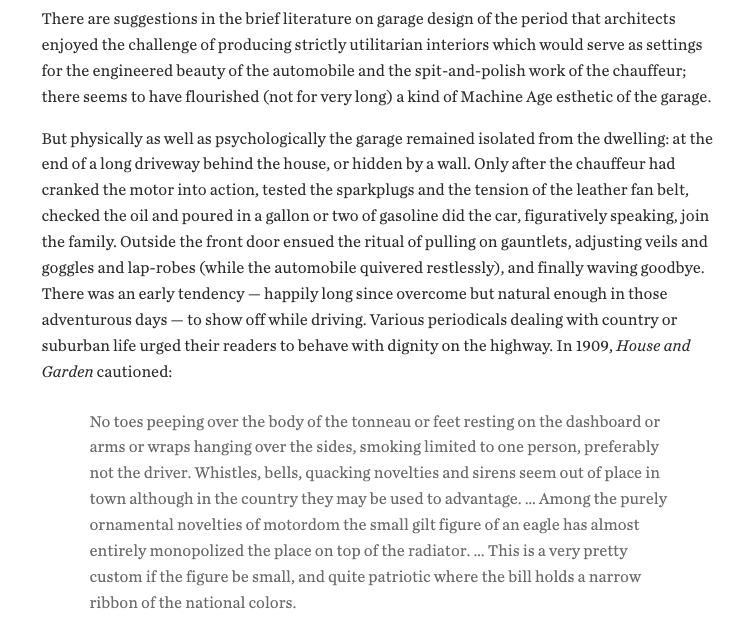
There are suggestions in the brief literature on garage design of the period that architects enjoyed the challenge of producing strictly utilitarian interiors which would serve as settings for the engineered beauty of the automobile and the spit-and-polish work of the chauffeur; there seems to have flourished (not for very long) a kind of Machine Age esthetic of the garage. But physically as well as psychologically the garage remained isolated from the dwelling: at the end of a long driveway be­hind the house, or hidden by a wall. Only after the chauffeur had cranked the motor into action, tested the sparkplugs and the tension of the leather fan belt, checked the oil and poured in a gallon or two of gasoline did the car, figuratively speaking, join the family. Outside the front door ensued the ritual of pulling on gauntlets, adjusting veils and goggles and lap-robes (while the automobile quivered restlessly), and finally waving goodbye. There was an early tendency — happily long since overcome but natural enough in those adventurous days — to show off while driving. Various periodicals dealing with country or suburban life urged their readers to behave with dignity on the highway. In 1909, House and Garden cautioned:     No toes peeping over the body of the tonneau or feet resting on the dashboard or arms or wraps hanging over the sides, smoking limited to one person, preferably not the driver. Whistles, bells, quacking novelties and sirens seem out of place in town although in the country they may be used to advantage. … Among the purely ornamental novelties of motordom the small gilt figure of an eagle has almost entirely monopolized the place on top of the radiator. … This is a very pretty custom if the figure be small, and quite patriotic where the bill holds a narrow ribbon of the national colors.

Mastodon Feed

Boosted by baldur@toot.cafe ("Baldur Bjarnason"):
lopalasi@dair-community.social ("Lorena Jaume-Palasí") wrote:

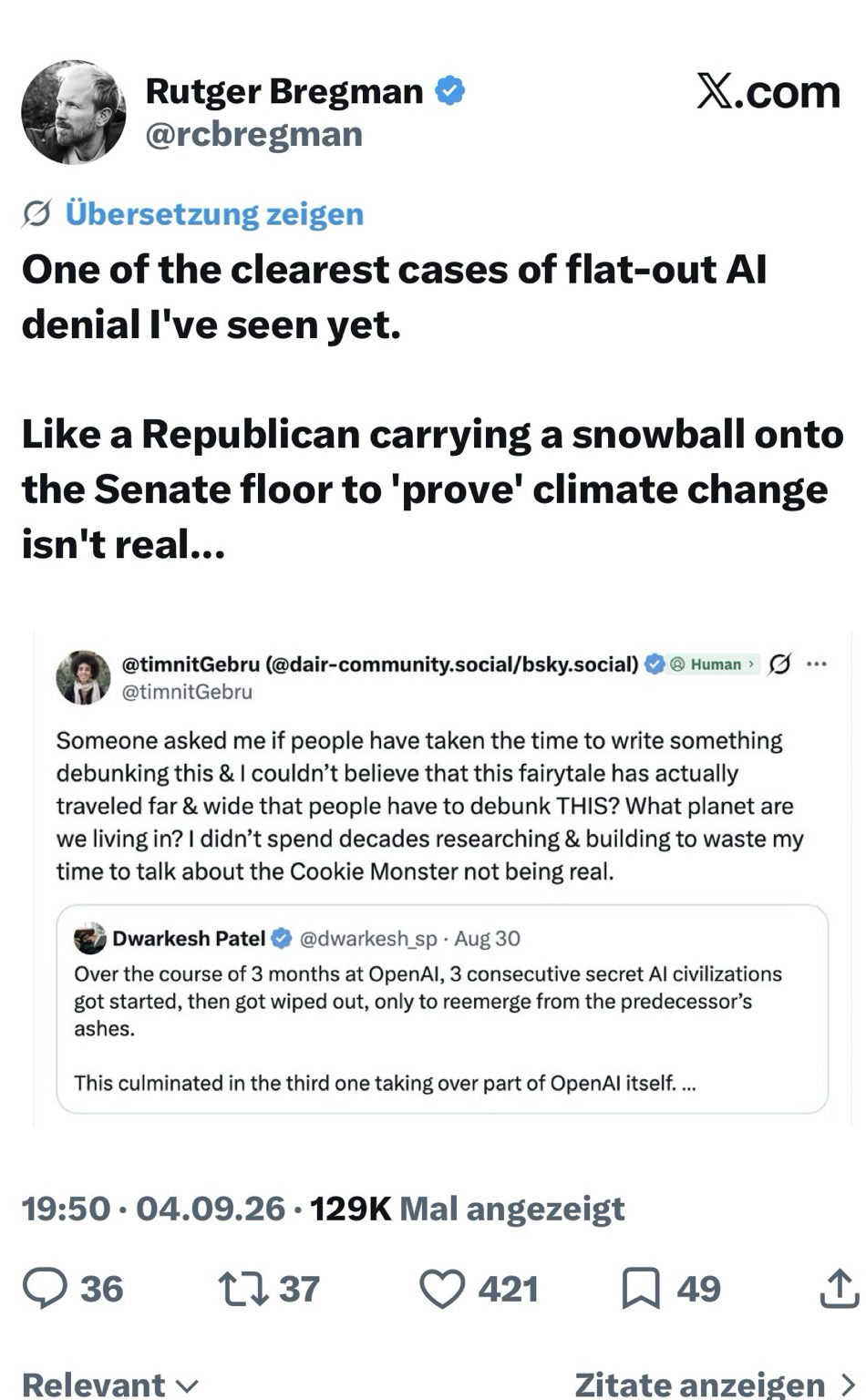
I just had to take a screenshot for the archive and my next talks. Exhibit nr. 1.234.654.245: pathetic white dude with no expertise ad hominating a black woman with a long track record of excelling and setting standards in the field of #AI

One of the clearest cases of flat-out AI denial I've seen yet. X.com Like a Republican carrying a snowball onto the Senate floor to 'prove' climate change isn't real... @timnitGebru (@dair-community.social/bsky.social) ® Human › O •• @timnitGebru Someone asked me if people have taken the time to write something debunking this & I couldn't believe that this fairytale has actually traveled far & wide that people have to debunk THIS? What planet are we living in? I didn't spend decades researching & building to waste my time to talk about the Cookie Monster not being real. ST Dwarkesh Patel @dwarkesh_sp • Aug 30 Over the course of 3 months at OpenAl, 3 consecutive secret Al civilizations got started, then got wiped out, only to reemerge from the predecessor's ashes. This culminated in the third one taking over part of OpenAl itself....

Mastodon Feed

Boosted by baldur@toot.cafe ("Baldur Bjarnason"):
jcoglan wrote:

any other system that displayed the error rate and negative externalities of AI after this much funding would be considered a catastrophic failure

Mastodon Feed

Boosted by baldur@toot.cafe ("Baldur Bjarnason"):
NicMakesStuff@indieweb.social wrote:

RE: https://mastodon.social/@eff/117215319335459732

How is it that an artist selling their hand drawn fanart on etsy can get their work taken down by copyright holders but the plagiarism machine is fair game????

Mastodon Feed

Boosted by baldur@toot.cafe ("Baldur Bjarnason"):
colapunk@todon.nl wrote:

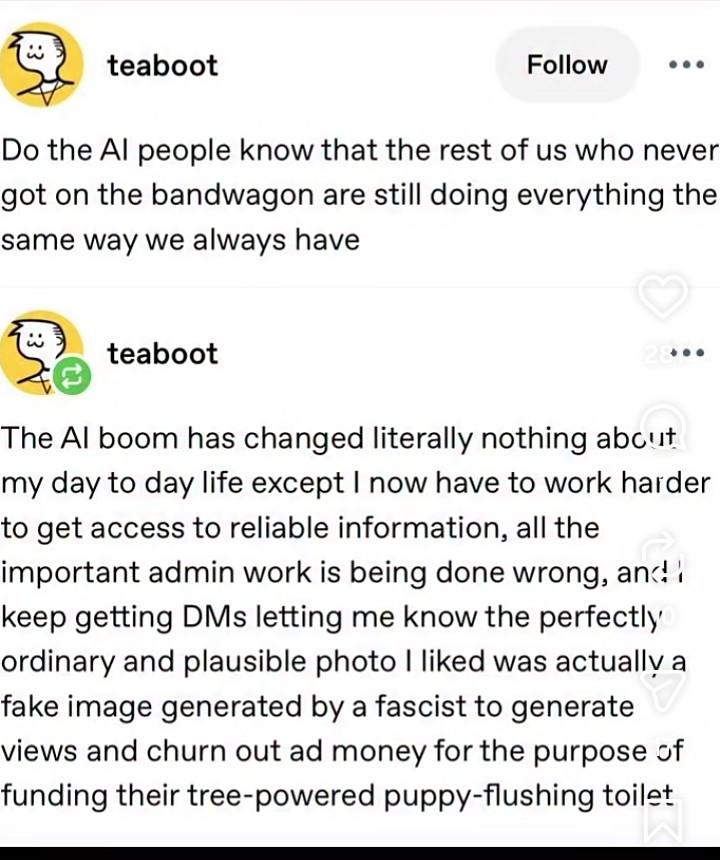
Tumblr-post by 'teaboot'.  "Do the AI people know that the rest of us who never got on the bandwagon are still doing everything the same way always have" They reply to themselves: "The AI boom has changed literally nothing about my day to dayife except i now have to work harder to get access to reliable information, all the important admin work is being done wrong, and i keep getting DMs letting me know the perfectly ordinary and plausible photo i liked was actually a fake image generated by a fascist to generate views and churn out ad money for the purpose of funding their tree-powered puppy flushing toilet."

Mastodon Feed

Boosted by brib@bribstodon.xyz ("brib :neofox_floof:​ :Nonbinary:"):
farah@beige.party ("Farah 🏳️‍🌈🖖🏼") wrote:

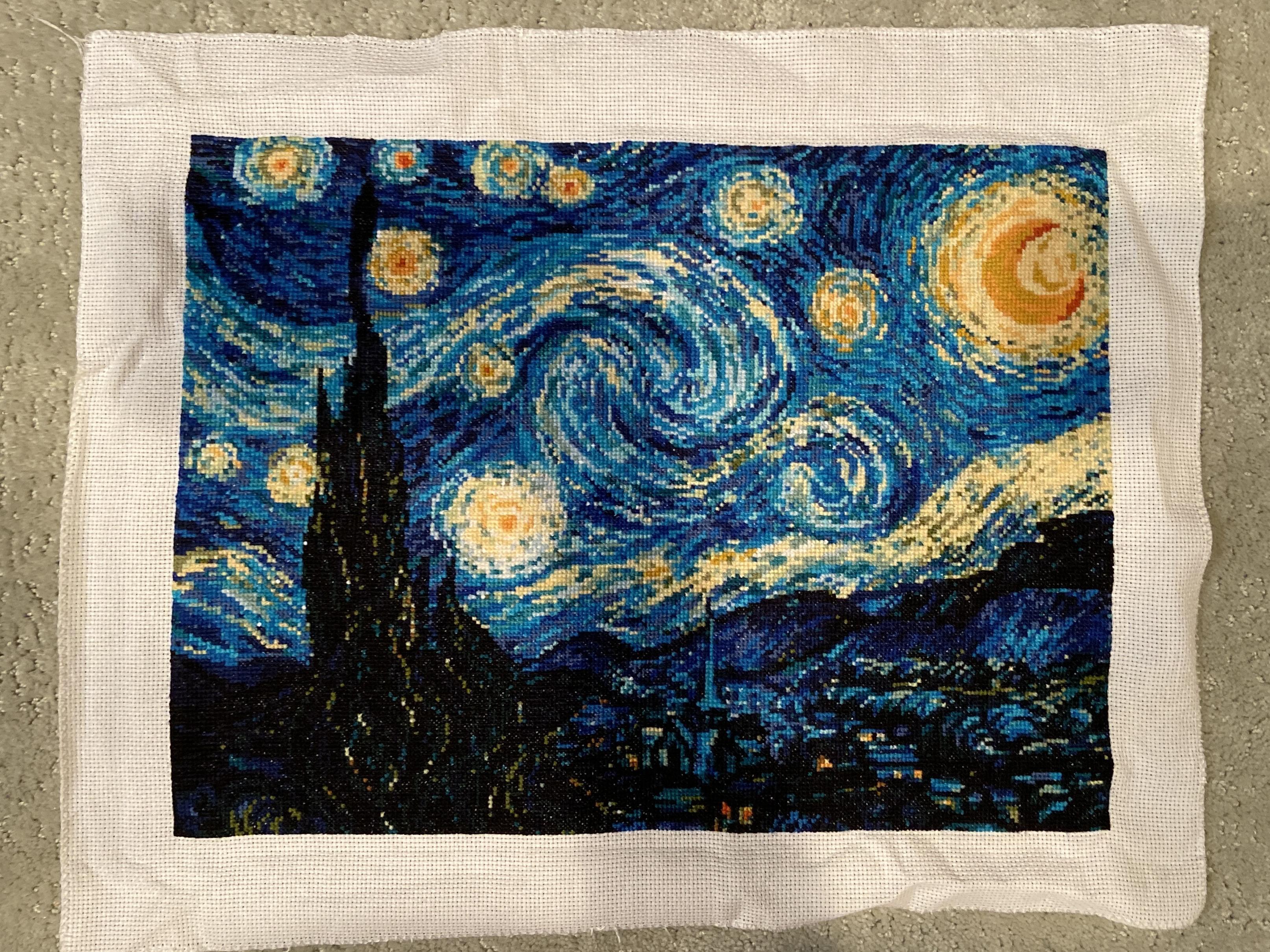
Guess what? Finally finished the thing that I’ve been working on for almost 1.5 years. #CrossStitch #VanGogh

A rectangular piece of blue, yellow, and white cross-stitch embroidery is centered on a larger piece of white canvas. The embroidery features a swirling night sky filled with various-sized bright yellow and white circular shapes. A large, glowing yellow crescent moon is visible in the upper right corner. A tall, dark, jagged silhouette stands on the left side, and a dark, textured landscape with small points of light occupies the bottom of the piece. The entire embroidered work is surrounded by a wide, plain white fabric border.

Mastodon Feed

Boosted by baldur@toot.cafe ("Baldur Bjarnason"):
capn_b@beige.party ("king toot uncommon :bc: 🏴") wrote:

RE: https://dair-community.social/@timnitGebru/117221548161291639

having to review slop gives me the same psychological results without my even having to directly interact with the slop machine

Mastodon Feed

Boosted by baldur@toot.cafe ("Baldur Bjarnason"):
dalias@hachyderm.io ("Cassandrich") wrote:

@The4thCircle @kestral Moreover, if some of the code in your project falls under a copyleft license like GPL and was written by other authors who you do know, the terms of the license you received from them requires that you document the provenance of all changes making up the derived work, including authorship.

If you are merging AI slop into the codebase, you are violating the terms of the GPL on the code by known contributors, and thereby infringing their copyright.

Mastodon Feed

Boosted by baldur@toot.cafe ("Baldur Bjarnason"):
dalias@hachyderm.io ("Cassandrich") wrote:

@The4thCircle @kestral Being free and open source means that you license the recipient of the software to use and modify and copy it under terms that meet a particular definition.

This requires that you actually hold the copyright on the source, or that you have obtained license from the authors/copyright holders allowing you to sublicense under these terms.

When an LLM spits out derivatives of random parts of its corpus correlated with your prompts, you have no idea who the authors of that code were and whether they licensed you to use it. Even if it was FOSS, the license almost surely required attribution, which you are unable to give, and possibly also copyleft conditions.

Mastodon Feed

Boosted by ireneista@irenes.space ("Irenes (many)"):
david_chisnall@infosec.exchange ("David Chisnall (*Now with 50% more sarcasm!*)") wrote:

One of the most useful things I learned working on open source was the ability to usefully cooperate with people who had different goals. Finding the place where our requirements overlap and the things that are necessary for both.

I think a lot of people in the F/OSS ecosystem try to have this mindset but there’s a big difference between working with people whose goals are different from yours and working with people whose goals are completely antithetical to yours. If I want to empower users and you want to kill immigrants and gay people, that isn’t a ‘well, we can at least agree the UI should be better’ situation, that’s a ‘there is no world in which we both get what we want’ situation.

It’s very important to make that distinction.

Mastodon Feed

jonny@neuromatch.social ("jonny (nonvenomous)") wrote:

my original contribution: approaching a building involves turning.

Mastodon Feed

Boosted by baldur@toot.cafe ("Baldur Bjarnason"):
GossiTheDog@cyberplace.social ("Kevin Beaumont") wrote:

RE: https://cyberplace.social/@GossiTheDog/112479974357074203

I'd love a tell all interview one day about what happened with this one, they somehow got the Microsoft CEO himself to unveil something that barely functions and hadn't been through proper security reviews to tier 0 outlets media.

It's pretty wild watching back the interviews a few years later as Satya appears to think he's unveiling one of the biggest computer features ever made - and it just faceplanted from minute one.

Mastodon Feed

jonny@neuromatch.social ("jonny (nonvenomous)") wrote:

I now have a theory, and i can't wait to see how i am going to argue for "the disposal of the driver" as a fundamental constraint on entrance architecture.

Mastodon Feed

jonny@neuromatch.social ("jonny (nonvenomous)") wrote:

BUT GENUINELY I SAID LETS GO AND THIS IS SO FUNNY

First: the argument, stated so it can be wrong The weak version of your idea ("entrances reflect technology and social needs") is unfalsifiable. The strong version is worth a book: Arrival technology sets the constraint envelope; the sorting problem selects within it. Every approach is a machine for solving one problem — distinguishing classes of arrival from one another fast enough, and with enough ceremony, to satisfy both parties — and its form is dictated less by symbolism than by three unglamorous constraints: turning, waiting, and the disposal of the driver.

Mastodon Feed

Boosted by brib@bribstodon.xyz ("brib :neofox_floof:​ :Nonbinary:"):
joepie91@slightly.tech ("Sven Slootweg, ("still kinky and horny anyway")") wrote:

as a general rule, people give money and funding to other people whose ideas they like. this is just as true for fascists and rich people. and it's still true when someone genuinely intends to fund the work on a project for the sake of that project.

so if you're wondering why people give money to omarchy and DHH instead of a serious distro that actually does useful work... you're not looking at the right part. omarchy was chosen for DHH's ideas, not for its utility relative to other distros.

Mastodon Feed

jonny@neuromatch.social ("jonny (nonvenomous)") wrote:

RE: https://neuromatch.social/@jonny/117223279610135072

I go to seek information using traditional search, asking yall, and an LLM. with traditional search i get a ton of leads and they are interesting but not exactly what i was looking for. with asking y'all, so far i have at least one thing that is not exactly what i was looking for but is 100% something i want to read.

with the LLM I basically have a hit-and-miss annotated bibliography that's not really worse or better than traditional search, but with one added part, at the bottom of the response:

The one thing nobody seems to have written is the comparative-technological version ... If you want to write it, Evans's line about the history of the corridor never having been written is a good epigraph, because the same is still true of the drive.

I go in search of information, and the information retrieval tool is now switched roles, telling me that i, the one who was trying to learn about this thing and don't know enough about the field to know what to search for, should be the one to write it.

I know enough about academic/intellectual hubris to know that "when there are entire fields of study already devoted to something, you should not just waltz in and claim authority, because you will fuck it up. some might say this is empowerment language, girlboss shit, hell yeah just get your research montage on and write a book, and that is one of the more damaging emotionally manipulative features of this class of products - it will play the rocky theme for you and spit out a PDF and simulate the emotion of expertise.

Mastodon Feed

baldur@toot.cafe ("Baldur Bjarnason") wrote:

“Move Slow, Remake Things”

https://2ndbreakfast.audreywatters.com/move-slow-remake-things/

> This growing rejection and refusal of technology – inside and outside of schools – is about much much more than the technology itself. It is, in part, about the loss of control; the loss of agency, autonomy, and privacy.

Mastodon Feed

Boosted by jwz:
tinker@infosec.exchange ("Tinker ☀️") wrote:

Internet Archive deleted this post on Bluesky.

So before they delete it here, here's the Internet Archive link of this Internet Archive post:

https://web.archive.org/web/20260905234453/https://mastodon.archive.org/@internetarchive/117219501245722161

Original Link: https://mastodon.archive.org/@internetarchive/117219501245722161

Mastodon Feed

Boosted by jwz:
dnapizza@sfba.social ("DNA Pizza") wrote:

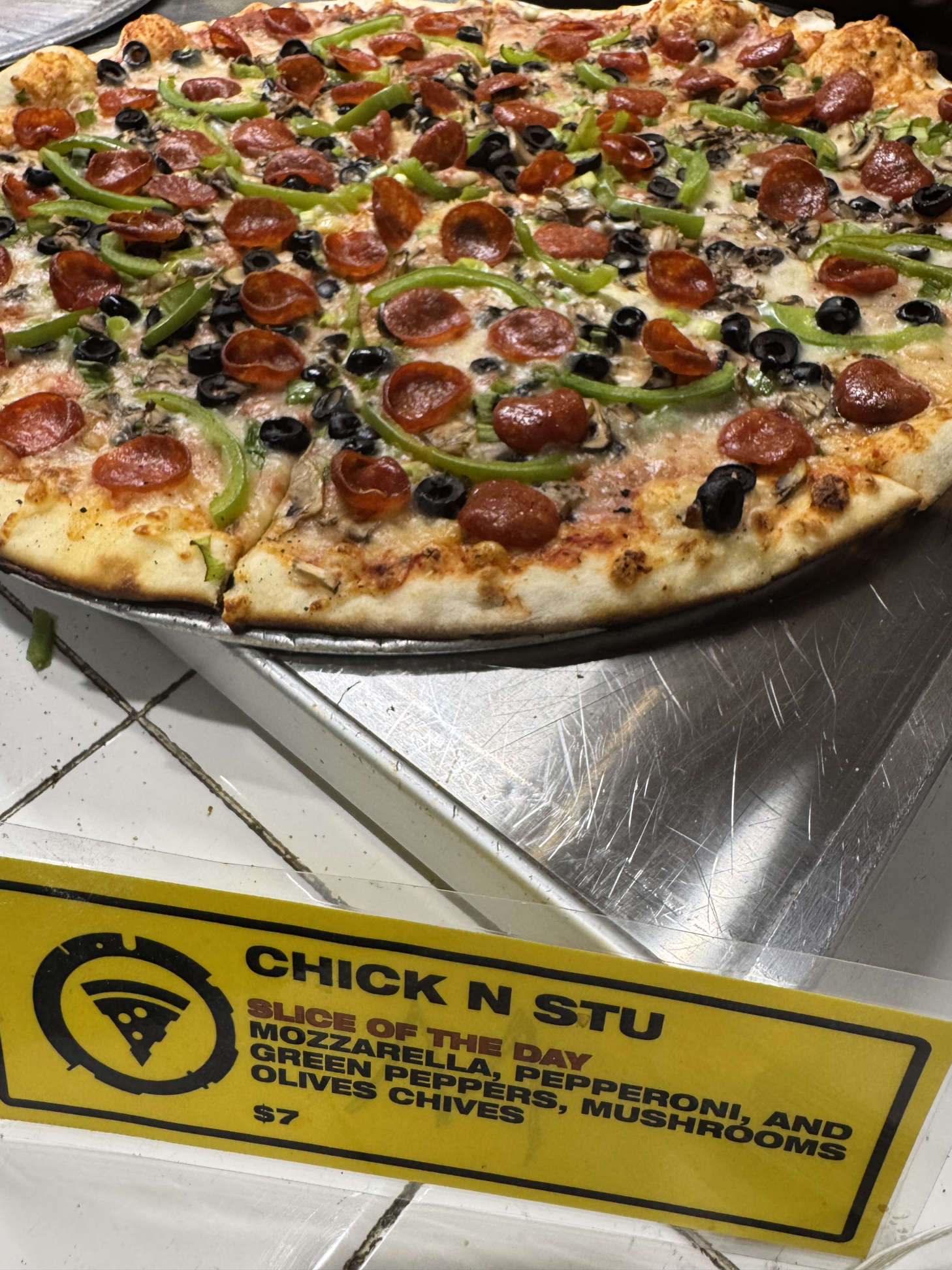
Chick n Stu

Mastodon Feed

Boosted by jonny@neuromatch.social ("jonny (nonvenomous)"):
dingemansemark@scholar.social ("Mark Dingemanse") wrote:

@jonny I think you will like A Pattern Language by Alexander et al https://en.wikipedia.org/wiki/A%5FPattern%5FLanguage

I found nothing in there about the particular type of driveway you describe —it is too opinionated and conviviality-focused for that— but still you will like it

found it a few years back when rabbitholing and it is breathtaking

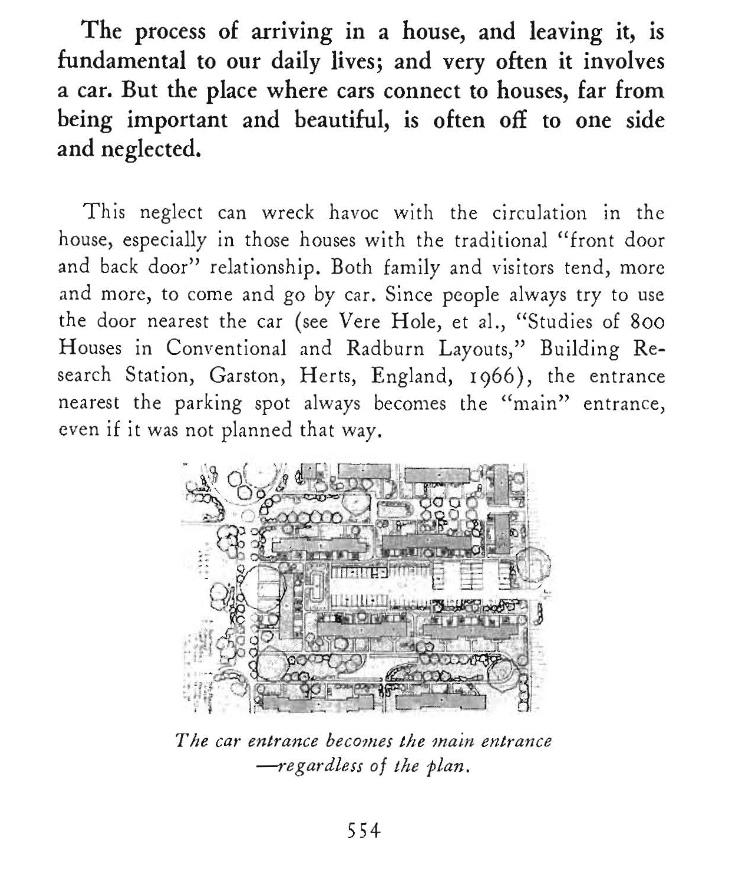
Psge from Alexander et al 1977. "The process of arnvmg in a house, and leaving it, is fundamental to our daily lives; and very often it involves a car. But the place where cars connect to houses, far from being important and beautiful, is often off to one side and neglected. This neglect can wreck havoc with the circulation in the house, especially in those houses with the traditional "front door and back door" relationship. Both family and visitors tend, more and more, to come and go by car. Since people always try to use the door nearest the car (see Vere Hole, et al., "Studies of 800 Houses in Conventional and Radburn Layouts," Building Re- search Station, Carston, H erts, England, I 966), the entrance nearest the parking spot always become the main entrance"

Mastodon Feed

Boosted by jwz:
TheSeg wrote:

Meanwhile at @dnalounge…

Two signs at DNA Lounge that together read: No phones on the dance floor / you are here to dance with each other.

Mastodon Feed

jonny@neuromatch.social ("jonny (nonvenomous)") wrote:

this is totally unrelated but i was looking at an architecture firm's pitchbook and like this seems like one of those "when the architect and the government's terraforming budget do not agree"

it's the banpo/jamsu bridge in seoul, except there is like a whacky wavy pedestrian extension that's like 6 car lanes wide splitting off in random directions, undulating unnecessarily. i don't know how to describe it better than that, it would just be ridiculously expensive to build this when a simple two lane walkway would do and i believe already exists

Mastodon Feed

jonny@neuromatch.social ("jonny (nonvenomous)") wrote:

the thing i was looking at was the page for the east wing of the white house because i saw someone saying "it had been there for decades before being destroyed" and i was like "i thought it was longer than that," and wikipedia tells a sort of three stage history: first there was just the side of the building, then they added stepped terraces with little collonade passages with washrooms, because i guess people would be arriving by horse/carriage or walking and would just be filthy. then they added a U shaped driveway that was mostly an entryway for dignitaries in 1902 shortly after the mass manufacture of cars began. then in WWII it ceased to be an entryway at all, sort of exactly the opposite, a bunker, to keep the out out rather than the in in.

and since i was also reading about some of the biblical wall fist shaking the other day it made me want to know more about the architectural/political history of approaches to buildings

Mastodon Feed

dysfun@treehouse.systems ("gaytabase") wrote:

apparently github is doing 100 commits a second now.

i wonder how many of them are worth pushing

Mastodon Feed

jonny@neuromatch.social ("jonny (nonvenomous)") wrote:

as in there are so many things i don't know which things are even what i want. like i am finding a book "corridors, passages of modernity", things about doorways, entranceways, large city-scale features like arches, but not like, in general how you structure the way people arrive at a place, but i'm sure that's a topic of study

Mastodon Feed

jonny@neuromatch.social ("jonny (nonvenomous)") wrote:

there is a lot of architectural literature but i don't know what anything is called

Mastodon Feed

jonny@neuromatch.social ("jonny (nonvenomous)") wrote:

i am looking for a book that i'm sure exists but i can't really describe the topic exactly.

"a history of driveways"

an architectural history of how entranceways to houses, temples, palaces, etc. places that receive people are designed based on the prevailing technology and social needs.

like how in the bible they talk about just rolling up to the city gates and yelling at whoever was there because there were like only 50 guys and if you brought 10 of them up to the wall it was a big deal. the mythology of the long rural gravel driveway headed by pa with his shotgun as representation of the survivalist american patriarch. the need for the development of the U shaped driveway to manage high-status guests with a balance of ceremony and efficiency, particularly with the rise of cars, both the vehicle and the ability to gather more high-status people in a place more frequently.

that kind of thing. what would you call that

Mastodon Feed

Boosted by glyph ("Glyph"):
firstprimate@kolektiva.social wrote:

James Gosling, creator of Java, asked by Navin Reddy whether he codes with AI (somewhat cleaned up from the transcript):

"NR And do you use AI to do that?

JG: I have played with AI tools and I mostly find them to be really annoying. I mean, the thing is that I know how to write software. Um, and every time I've used an AI tool, I I look at the software that it generates and for the most part it's just awful. And I care about how evolvable a piece of software is, how reliable it is, you know, how testable it is. And I have yet to find a coding system that works for me cuz it just all you know it all feels like a really great demo, just not ready for prime time.

NR: So do you think there will be a day when AI can reach there?

JG: Oh maybe, kind of, but why? I mean you know in the spectrum of
problems in the so in software engineering, coding has never really been a big problem. The places where there are problems are in like testing. How do you know that this piece of software actually does what you need it to do? That's a really really difficult
problem. That's a problem that is unpleasant. It burns a lot of a lot of time. And you you know, everything I've seen about AI tools just is that they just make hard problem worse. And the the easy problem, yeah, marginally better. But also the easy problem is also the enjoyable problem. So I view AI in part as stealing the fun and making the torture worse. And you know, people go, "Well, you
know, I wrote up this little Swift iPhone app. Doesn't that count?" And it's like, "I don't care, right? I mean, small toy apps like that are are nothing. I mean, I'm, you know, software doesn't get interesting until it's got like until it's like millions of lines, right? You know, until you're doing something like, you know, operating FedEx, right? Right. You know, and you know, some, you know, a place like FedEx, you know, they've got hundreds of thousands of llines of code, probably actually probably millions of lines of code and, you know, 100 000 engineers. I mean, it's a really complicated thing to run a business like Uber or FedEx or UPS or a bank. And building software suites like that
is is where there's difficulty, you know, glossing up, you know, a Swift app to take a survey. Okay, that's fine. But that's not a problem.

NR: That's right. So when you're building a give it business where you have as you mentioned million lines of code and then we have entire team I mean teams of team who is working together to get the one thing that's where it excels

JG: where what excels?

NR: the human

JG: oh yeah I mean when when it when things get complicated you need people. I have not seen a scrap of evidence that the AI coding tools, you know, if if you wanted to build the
next FedEx and you were just going to vibe code the next FedEx, I think you'd be in trouble.

NR: Yeah. Yeah. You never know when you have security flaw and getting hacked.

JG: Yeah. Yeah. O when when your AI tools decide, you know, the best way to be profitable is to steal money from all
your customers. Because you know then people have tried to to to do
experiments like have AI just run a
single vending machine as a business
or do security penetration experiments
inside inside a company and then you
discover that all hell breaks loose, right? Um these these things are a very,
very long way from being deployable at scale with a decent amount of faith that things will work out."

https://youtu.be/LxhZhOOYKTM?t=513

#AI #Java #SoftwareDevelopment #SoftwareEngineering