Mastodon Feed: Post

Mastodon Feed

Boosted by dysfun@treehouse.systems ("gaytabase"):
johncarlosbaez@mathstodon.xyz ("John Carlos Baez") wrote:

Wow: you can knock out a plant with anesthetics - the same anesthetics that work on people!

It's easist to see for plants that move, like a Venus fly trap. But experiments have shown it's true for others too.

We're still struggling to figure out what this means. We don't really know how anesthetics like ether and chloroform work, but here's a clue: you don't need to have neurons to get anesthetized!

Details here: https://pmc.ncbi.nlm.nih.gov/articles/PMC11586303/
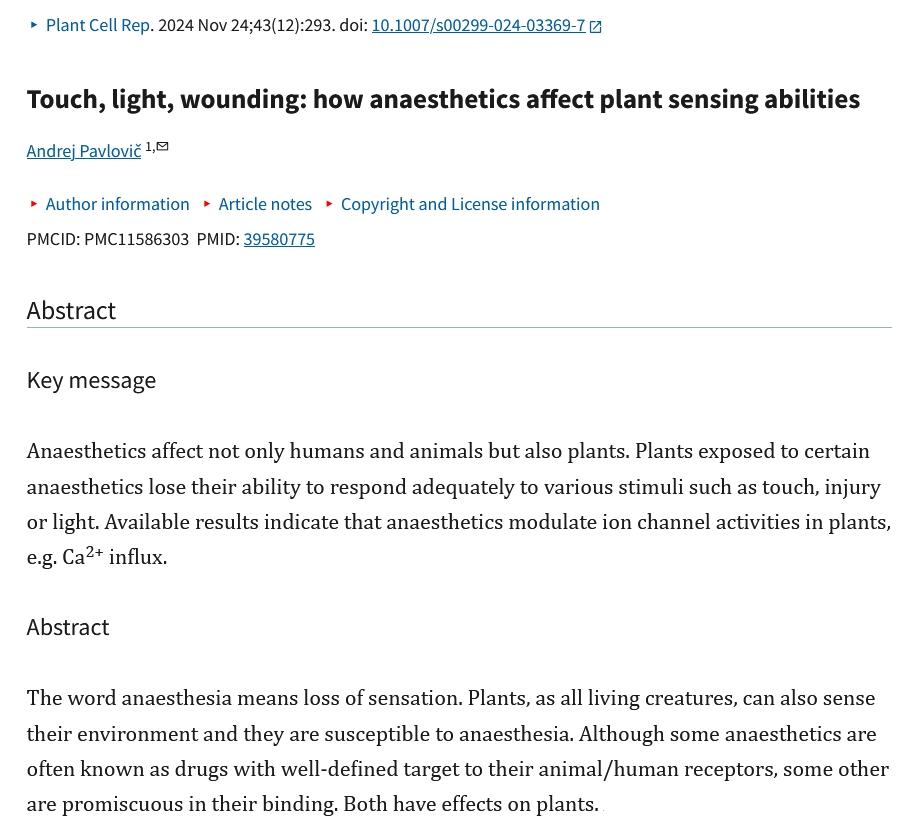
Plant Cell Rep 2024 Nov 24;43(12):293. doi: 10.1007/s00299-024-03369-7 Touch, light, wounding: how anaesthetics affect plant sensing abilities Andrej Pavlovič  PMCID: PMC11586303  PMID: 39580775 Key message Anaesthetics affect not only humans and animals but also plants. Plants exposed to certain anaesthetics lose their ability to respond adequately to various stimuli such as touch, injury or light. Available results indicate that anaesthetics modulate ion channel activities in plants, e.g. Ca2+ influx. Abstract The word anaesthesia means loss of sensation. Plants, as all living creatures, can also sense their environment and they are susceptible to anaesthesia. Although some anaesthetics are often known as drugs with well-defined target to their animal/human receptors, some other are promiscuous in their binding. Both have effects on plants.