Mastodon Feed: Post

Mastodon Feed

Boosted by pixxl:
johncarlosbaez@mathstodon.xyz ("John Carlos Baez") wrote:

Did you hear about the UK government report on ecosystem collapse? It was created not only by the environment department but also intelligence agencies like MI5 and MI6. Reporters were invited to see the unveiling of this report in October 2025 - but at the last minute the Prime Minister blocked it!

Luckily the Greens forced the release of a 14-page redacted version.

๐—ง๐—ต๐—ฒ ๐—ธ๐—ฒ๐˜† ๐—ท๐˜‚๐—ฑ๐—ด๐—ฒ๐—บ๐—ฒ๐—ป๐˜: ๐—ถ๐˜ ๐—ฎ๐˜€๐˜€๐—ฒ๐˜€๐˜€๐—ฒ๐˜€ ๐˜„๐—ถ๐˜๐—ต ๐—ต๐—ถ๐—ด๐—ต ๐—ฐ๐—ผ๐—ป๐—ณ๐—ถ๐—ฑ๐—ฒ๐—ป๐—ฐ๐—ฒ ๐˜๐—ต๐—ฎ๐˜ ๐—ฒ๐˜ƒ๐—ฒ๐—ฟ๐˜† ๐—ฐ๐—ฟ๐—ถ๐˜๐—ถ๐—ฐ๐—ฎ๐—น ๐—ฒ๐—ฐ๐—ผ๐˜€๐˜†๐˜€๐˜๐—ฒ๐—บ ๐—ถ๐˜€ ๐—ผ๐—ป ๐—ฎ ๐—ฝ๐—ฎ๐˜๐—ต๐˜„๐—ฎ๐˜† ๐˜๐—ผ ๐—ฐ๐—ผ๐—น๐—น๐—ฎ๐—ฝ๐˜€๐—ฒ - ๐—ถ๐—ฟ๐—ฟ๐—ฒ๐˜ƒ๐—ฒ๐—ฟ๐˜€๐—ถ๐—ฏ๐—น๐—ฒ ๐—น๐—ผ๐˜€๐˜€ ๐—ผ๐—ณ ๐—ณ๐˜‚๐—ป๐—ฐ๐˜๐—ถ๐—ผ๐—ป ๐—ฏ๐—ฒ๐˜†๐—ผ๐—ป๐—ฑ ๐—ฟ๐—ฒ๐—ฝ๐—ฎ๐—ถ๐—ฟ.

Here's the redacted version: https://assets.publishing.service.gov.uk/media/696e0eae719d837d69afc7de/National%5Fsecurity%5Fassessment%5F-%5Fglobal%5Fbiodiversity%5Floss%5F%5Fecosystem%5Fcollapse%5Fand%5Fnational%5Fsecurity.pdf

(1/2)
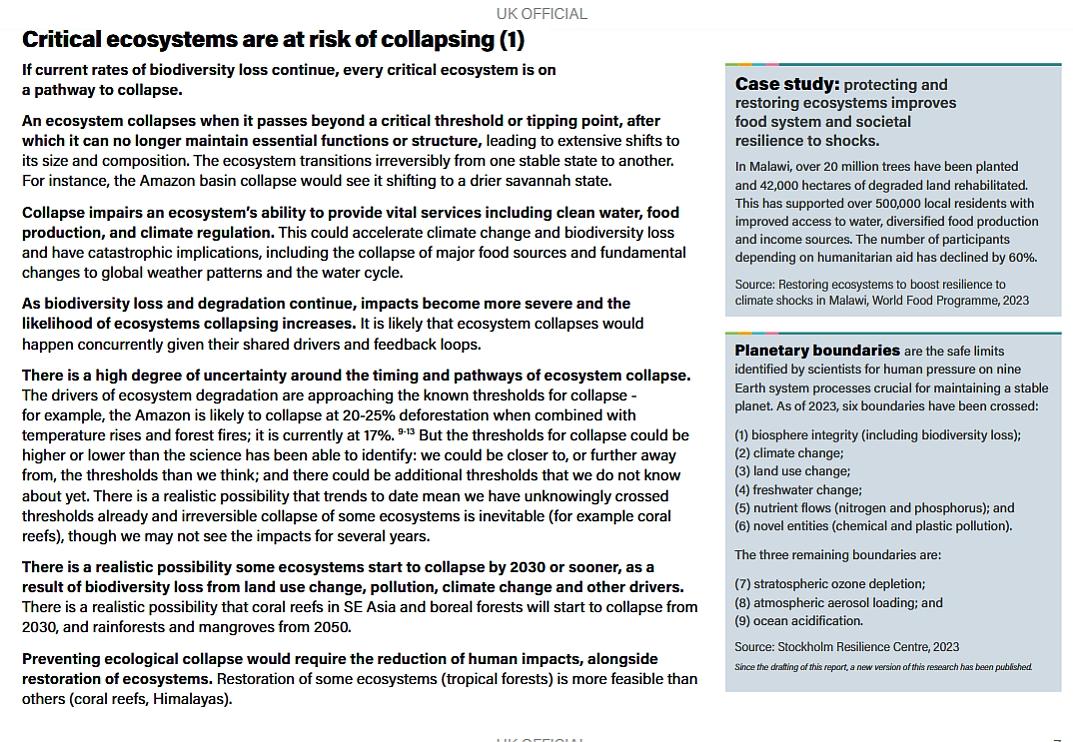
Critical ecosystems are at risk of collapsing (1) If current rates of biodiversity loss continue, every critical ecosystem is on a pathway to collapse. An ecosystem collapses when it passes beyond a critical threshold or tipping point, after which it can no longer maintain essential functions or structure, leading to extensive shifts to its size and composition. The ecosystem transitions irreversibly from one stable state to another. For instance, the Amazon basin collapse would see it shifting to a drier savannah state. Collapse impairs an ecosystemโ€™s ability to provide vital services including clean water, food production, and climate regulation. This could accelerate climate change and biodiversity loss and have catastrophic implications, including the collapse of major food sources and fundamental changes to global weather patterns and the water cycle. As biodiversity loss and degradation continue, impacts become more severe and the likelihood of ecosystems collapsing increases. It is likely that ecosystem collapses would happen concurrently given their shared drivers and feedback loops. There is a high degree of uncertainty around the timing and pathways of ecosystem collapse. The drivers of ecosystem degradation are approaching the known thresholds for collapse - for example, the Amazon is likely to collapse at 20-25% deforestation when combined with temperature rises and forest fires; it is currently at 17%. 9-13 But the thresholds for collapse could be higher or lower than the science has been able to identify: we could be closer to, or further away from, the thresholds than we think; and there could be additional thresholds that we do not know about yet. There is a realistic possibility that trends to date mean we have unknowingly crossed thresholds already and irreversible collapse of some ecosystems is inevitable (for example coral reefs), though we may not see the impacts for several years. There is a realistic possibility some ecosystems start to collapse by 2030 or sooner, as a result of biodiversity loss from land use change, pollution, climate change and other drivers. There is a realistic possibility that coral reefs in SE Asia and boreal forests will start to collapse from 2030, and rainforests and mangroves from 2050. Preventing ecological collapse would require the reduction of human impacts, alongside restoration of ecosystems. Restoration of some ecosystems (tropical forests) is more feasible than others (coral reefs, Himalayas). In Malawi, over 20 million trees have been planted and 42,000 hectares of degraded land rehabilitated. This has supported over 500,000 local residents with improved access to water, diversified food production and income sources. The number of participants depending on humanitarian aid has declined by 60%. Source: Restoring ecosystems to boost resilience to climate shocks in Malawi, World Food Programme, 2023 Case study: protecting and restoring ecosystems improves food system and societal resilience to shocks. Planetary boundaries are the safe limits identified by scientists for human pressure on nine Earth system processes crucial for maintaining a stable planet. As of 2023, six boundaries have been crossed: (1) biosphere integrity (including biodiversity loss); (2) climate change; (3) land use change; (4) freshwater change; (5) nutrient flows (nitrogen and phosphorus); and (6) novel entities (chemical and plastic pollution). The three remaining boundaries are: (7) stratospheric ozone depletion; (8) atmospheric aerosol loading; and (9) ocean acidification. Source: Stockholm Resilience Centre, 2023 Since the drafting of this report, a new version of this research has been published.