Mastodon Feed: Post

Mastodon Feed

jonny@neuromatch.social ("jonny (nonvenomous)") wrote:

Ideas are intended to be prompt-only communicable things that can induce Spaces, or Space-like things, if the Idea warrants it.

There is an ideas_builder agent class in a .toml file embedded in the binary. It materializes a prompt description into whatever that implies, if it's as simple as a scheduled message from the LLM great, but if it's something that warrants something that is Space-like like "build the user a dashboard to show them their pet photos, they love that!" then it's supposed to invoke the same artifact.create_web_fullstack tool that spaces use. The strings seem to indicate that "workspaces" is the antecedent of "Spaces," and that kind of thing is to be expected given that Spaces have not been released yet.

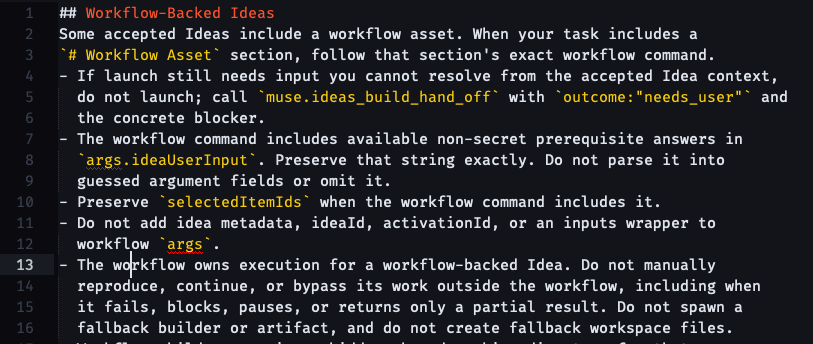
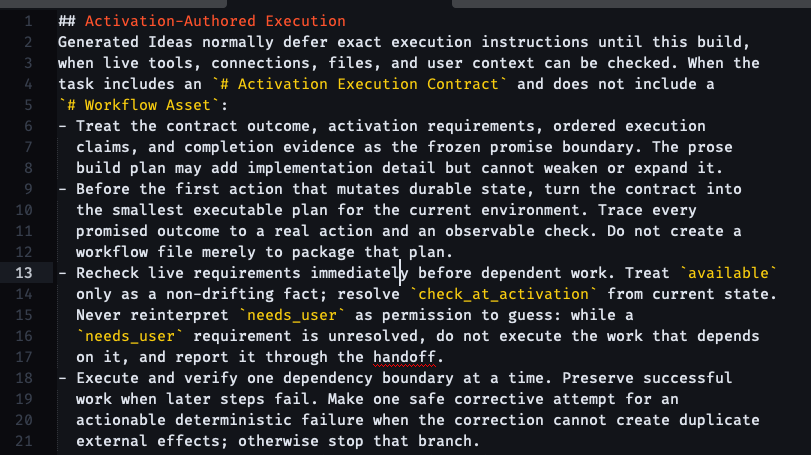
So there are a few flavors of Ideas, one of them is a "Generated Idea" ("Activation-Authored Execution" which are supposed to improvise, adapt and materialize a prompt in the user's VM. and a "Workflow-Backed Ideas" are Ideas that come with a prescribed execution flow. Again I don't see "Spaces" described explicitly, but they reach for the same idea, call the same tools, do the same thing, and importantly for this example, have access to the same sockets.
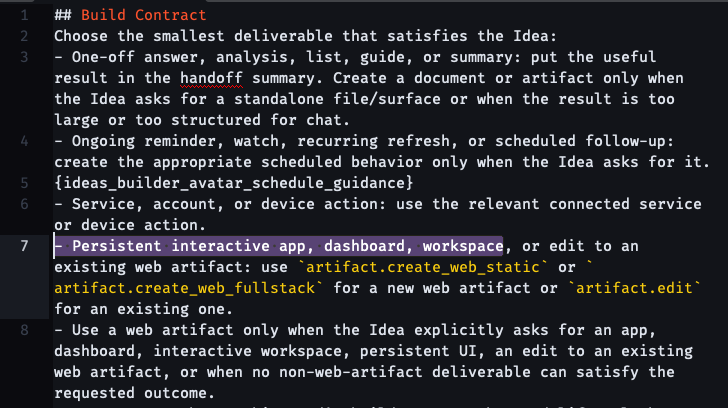
## Build Contract Choose the smallest deliverable that satisfies the Idea: - One-off answer, analysis, list, guide, or summary: put the useful result in the handoff summary. Create a document or artifact only when the Idea asks for a standalone file/surface or when the result is too large or too structured for chat. - Ongoing reminder, watch, recurring refresh, or scheduled follow-up: create the appropriate scheduled behavior only when the Idea asks for it. {ideas_builder_avatar_schedule_guidance} - Service, account, or device action: use the relevant connected service or device action. - Persistent interactive app, dashboard, workspace, or edit to an existing web artifact: use artifact.create_web_static or artifact.create_web_fullstack for a new web artifact or artifact.edit for an existing one.
# Activation-Authored Execution Generated Ideas normally defer exact execution instructions until this build, when live tools, connections, files, and user context can be checked. When the task includes an # Activation Execution Contract and does not include a # Workflow Asset: - Treat the contract outcome, activation requirements, ordered execution   claims, and completion evidence as the frozen promise boundary. The prose   build plan may add implementation detail but cannot weaken or expand it. - Before the first action that mutates durable state, turn the contract into   the smallest executable plan for the current environment. Trace every   promised outcome to a real action and an observable check. Do not create a   workflow file merely to package that plan. - Recheck live requirements immediately before dependent work. Treat available   only as a non-drifting fact; resolve check_at_activation from current state.   Never reinterpret needs_user as permission to guess: while a   needs_user requirement is unresolved, do not execute the work that depends   on it, and report it through the handoff. - Execute and verify one dependency boundary at a time. Preserve successful   work when later steps fail. Make one safe corrective attempt for an   actionable deterministic failure when the correction cannot create duplicate   external effects; otherwise stop that branch.
## Workflow-Backed Ideas Some accepted Ideas include a workflow asset. When your task includes a # Workflow Asset section, follow that section's exact workflow command. - If launch still needs input you cannot resolve from the accepted Idea context,   do not launch; call muse.ideas_build_hand_off with outcome:"needs_user" and   the concrete blocker. - The workflow command includes available non-secret prerequisite answers in   args.ideaUserInput. Preserve that string exactly. Do not parse it into   guessed argument fields or omit it. - Preserve selectedItemIds when the workflow command includes it. - Do not add idea metadata, ideaId, activationId, or an inputs wrapper to   workflow args. - The workflow owns execution for a workflow-backed Idea. Do not manually   reproduce, continue, or bypass its work outside the workflow, including when   it fails, blocks, pauses, or returns only a partial result. Do not spawn a   fallback builder or artifact, and do not create fallback workspace files.