Mastodon Feed
Boosted by jsonstein@masto.deoan.org ("Jeff Sonstein"):
pustam_egr@mathstodon.xyz ("Pustam | पुस्तम | পুস্তম🇳🇵") wrote:
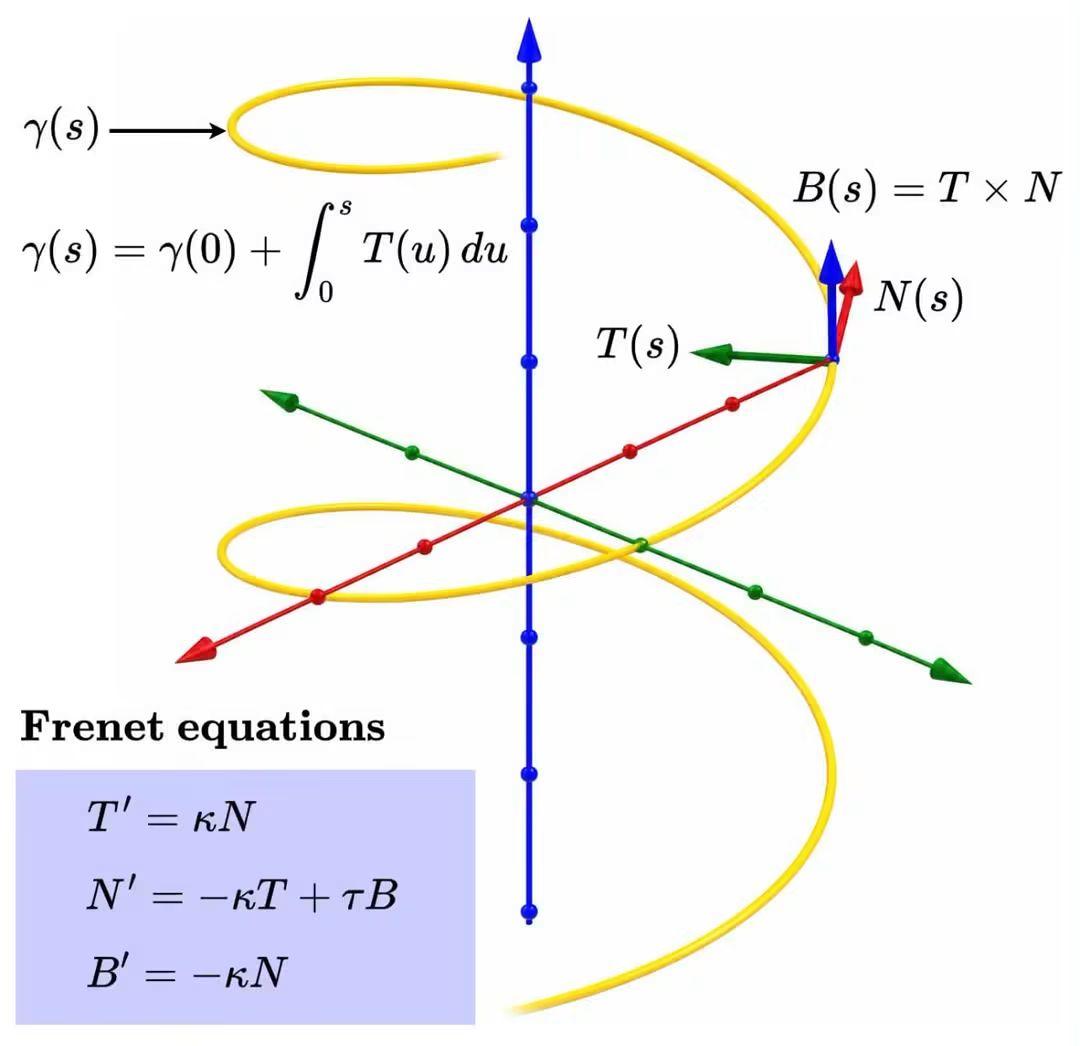
Consider a curve moving through 3D space.
What information do we need to completely describe its shape?
As we travel along the curve, measured by arc length s, we attach a moving coordinate frame consisting of three perpendicular unit vectors:
T — the tangent, pointing in the direction of travel
N — the normal, pointing in the direction the curve is bending
B — the binormal, perpendicular to both, with B = T × NBut the important geometric information is not simply the frame. It is how the frame changes as we move along the curve.
Two quantities control that change:
Curvature κ measures how rapidly the tangent direction changes, telling us how strongly the curve bends.
Torsion τ measures how the bending plane itself rotates, telling us how the curve twists out of that plane and into the third dimension.
Remarkably, if we know κ(s) and τ(s) everywhere along the curve, we know its entire shape, apart from translating or rotating it in space.
This is the fundamental theorem of space curves.
The changing frame is described by the Frenet–Serret equations:
T′ = κN
N′ = −κT + τB
B′ = −τNSo curvature and torsion are essentially the instructions telling the frame how to rotate as it travels along the curve.
Now suppose our curve lives not in 3D, but in n-dimensional space.
We construct an n-dimensional moving frame and obtain n − 1 generalised curvatures:
κ₁, κ₂, …, κₙ₋₁
There is a useful geometric way to think about them.
κ₁ describes the departure from straight-line motion.
κ₂ describes how the curve escapes the plane generated by its first bending.
κ₃ describes how it escapes the resulting 3D subspace.