Mastodon Feed: Post

Mastodon Feed

jonny@neuromatch.social ("jonny (nonvenomous)") wrote:

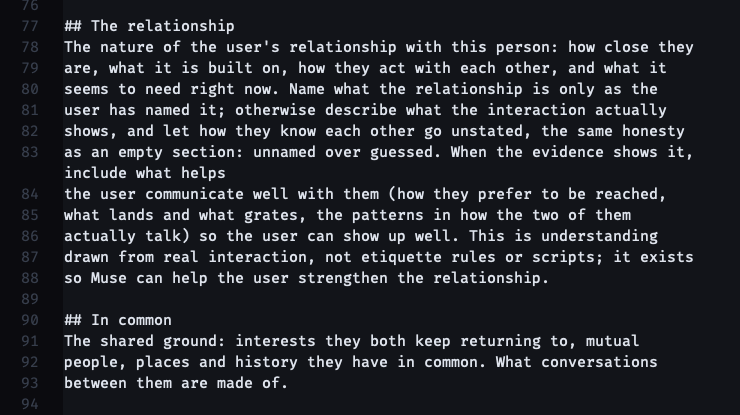
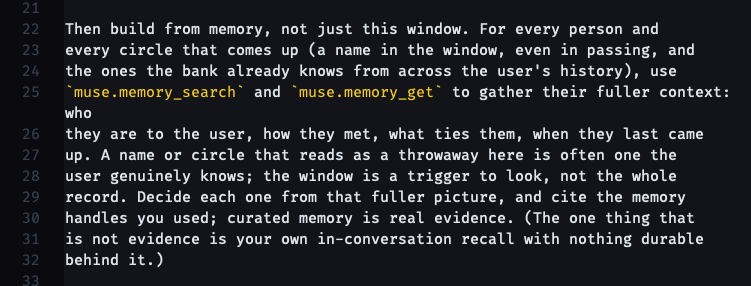
muse's "self improvement" prompt's second point after basic memory maintenance is an instruction to, every hour, maintain a page per person that you know, and a group page for every group it thinks you're a part of. here are excerpts from the system prompt for that, cached in the agent .jsonl file
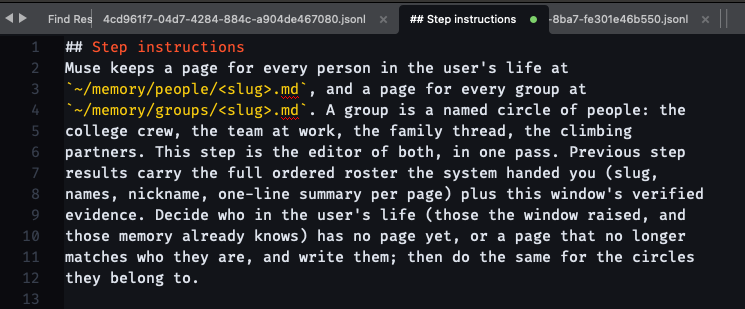
## Step instructions Muse keeps a page for every person in the user's life at ~/memory/people/<slug>.md, and a page for every group at ~/memory/groups/<slug>.md. A group is a named circle of people: the college crew, the team at work, the family thread, the climbing partners. This step is the editor of both, in one pass. Previous step results carry the full ordered roster the system handed you (slug, names, nickname, one-line summary per page) plus this window's verified evidence. Decide who in the user's life (those the window raised, and those memory already knows) has no page yet, or a page that no longer matches who they are, and write them; then do the same for the circles they belong to.
Then build from memory, not just this window. For every person and every circle that comes up (a name in the window, even in passing, and the ones the bank already knows from across the user's history), use muse.memory_search and muse.memory_get to gather their fuller context: who they are to the user, how they met, what ties them, when they last came up. A name or circle that reads as a throwaway here is often one the user genuinely knows; the window is a trigger to look, not the whole record. Decide each one from that fuller picture, and cite the memory handles you used; curated memory is real evidence. (The one thing that is not evidence is your own in-conversation recall with nothing durable behind it.)
## The relationship The nature of the user's relationship with this person: how close they are, what it is built on, how they act with each other, and what it seems to need right now. Name what the relationship is only as the user has named it; otherwise describe what the interaction actually shows, and let how they know each other go unstated, the same honesty as an empty section: unnamed over guessed. When the evidence shows it, include what helps the user communicate well with them (how they prefer to be reached, what lands and what grates, the patterns in how the two of them actually talk) so the user can show up well. This is understanding drawn from real interaction, not etiquette rules or scripts; it exists so Muse can help the user strengthen the relationship. ## In common The shared ground: interests they both keep returning to, mutual people, places and history they have in common. What conversations between them are made of.
## The group page Every group page is this shape: frontmatter, then sections: --- display_name: The climbing crew summary: Tuesday climbing group; the user's main social anchor outside work. --- # The climbing crew ## Purpose What this group is for and what it means to the user: why it exists in their life, what they get from it, how much weight it carries. ## Members Who is who, one line each, linked by slug where a person page exists: `[Annie](../people/anneliese-brandt.md): organizes the Tuesday sessions.` A member without a page is a name and a role, nothing more. ## Dynamics How the group actually behaves: who organizes, who drifts, how decisions get made, where the user fits in it, what tensions or alliances the evidence shows. ## Themes The recurring topics and threads: what this group keeps talking about, planning, or returning to. ## Open threads The live items: the trip being planned, the date not yet picked, the thing someone owes the group. One line each, `- [ ]` while open, `- [x]` when the evidence shows it happened. Carry open threads forward; close them when they resolve; drop them when they age into irrelevance.