Mastodon Feed: Post

Mastodon Feed

Boosted by jsonstein@masto.deoan.org ("Jeff Sonstein"):
mattsheffield ("Matthew Sheffield") wrote:

🚨 Since Trump became U.S. president once again, the country's global reputation has fallen below China for the first time. 🚨

Chinese President Xi Jinping is the first Chinese leader who is more respected than a US president.

Trump's criminal and thuggish behavior is handing the world to China on a golden platter.
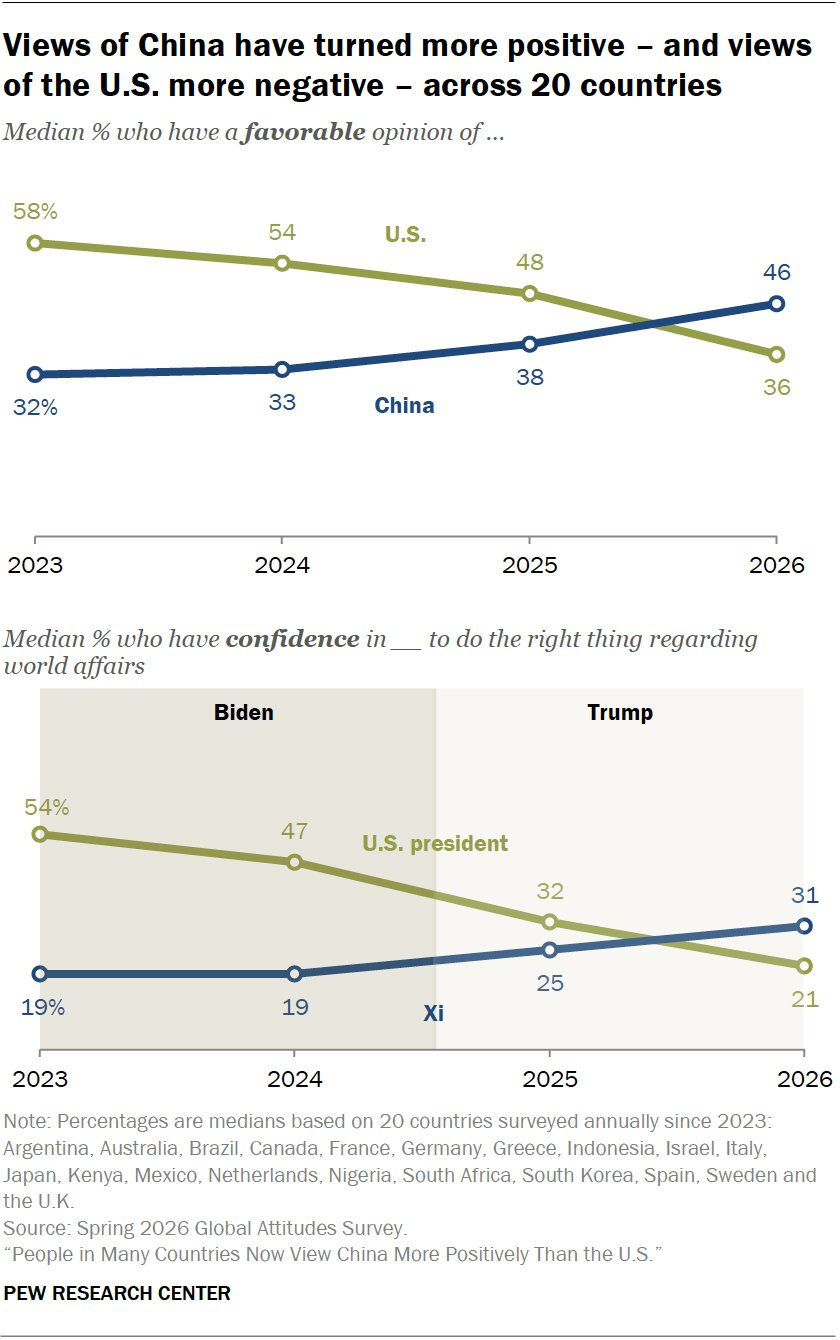
Source: https://www.pewresearch.org/global/2026/07/15/people-in-many-countries-now-view-china-more-positively-than-the-u-s/

Two line charts from Pew Research Center titled "Views of China have turned more positive – and views of the U.S. more negative – across 20 countries." The top chart shows median favorability ratings across 20 countries from 2023 to 2026. Favorable views of the U.S. declined steadily from 58% in 2023 to 54% in 2024, 48% in 2025, and 36% in 2026. Favorable views of China rose over the same period, from 32% in 2023 to 33% in 2024, 38% in 2025, and 46% in 2026. The two lines cross between 2025 and 2026, with China's favorability overtaking the U.S. The bottom chart shows median confidence in the U.S. president versus Chinese President Xi Jinping to do the right thing regarding world affairs, divided into a Biden period (2023-2024) and a Trump period (2025-2026). Confidence in the U.S. president fell from 54% in 2023 to 47% in 2024, then dropped further to 32% in 2025 and 21% in 2026. Confidence in Xi remained flat at 19% in 2023 and 2024, then rose to 25% in 2025 and 31% in 2026. These lines also cross during the Trump period. A note below the charts indicates the percentages are medians based on 20 countries surveyed annually since 2023, including Argentina, Australia, Brazil, Canada, France, Germany, Greece, Indonesia, Israel, Italy, Japan, Kenya, Mexico, the Netherlands, Nigeria, South Africa, South Korea, Spain, Sweden, and the U.K. The source is the Spring 2026 Global Attitudes Survey.
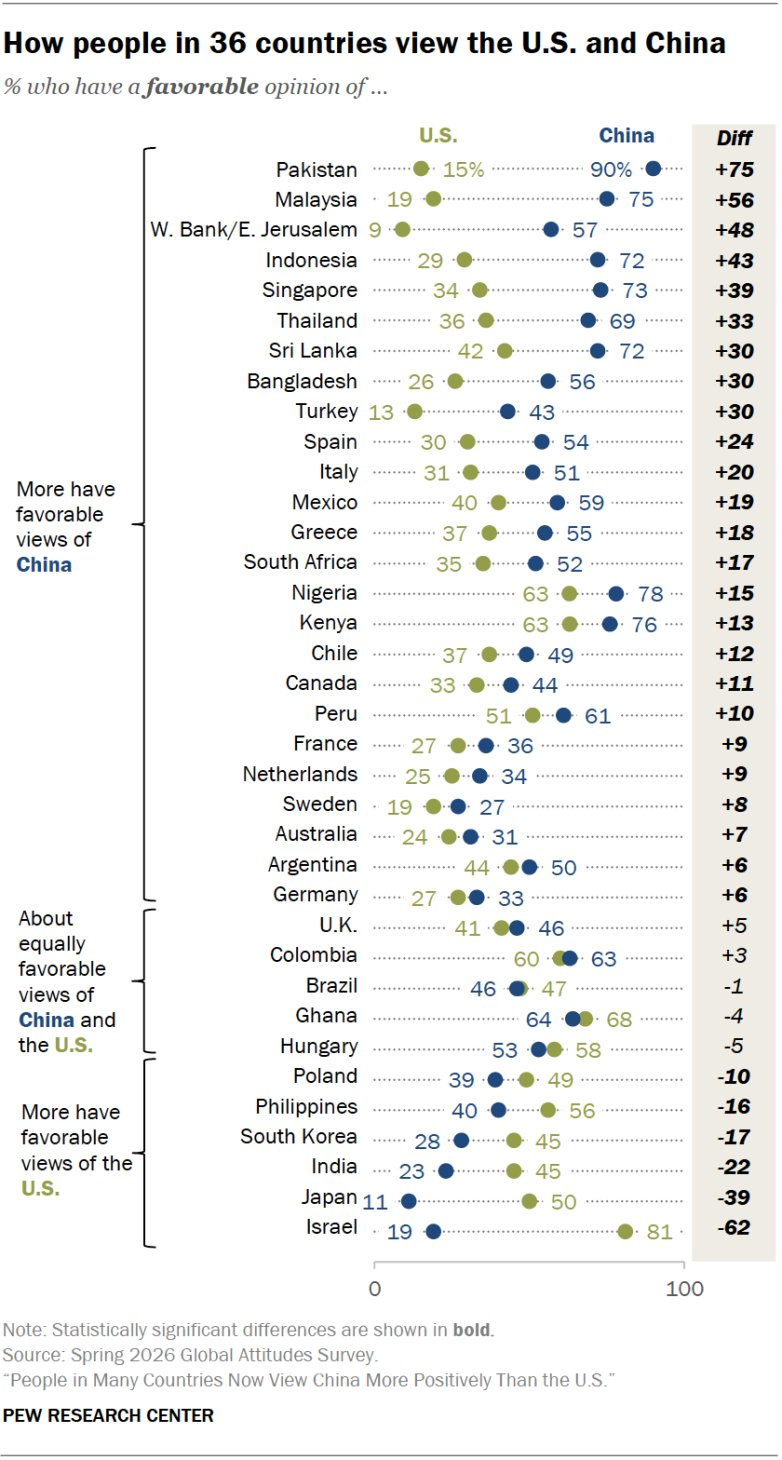
A dot plot from Pew Research Center titled "How people in 36 countries view the U.S. and China," showing the percentage with a favorable opinion of the U.S. versus China, along with the difference between them, grouped into three categories. In the largest group, more people have favorable views of China than the U.S. This includes countries with very large gaps favoring China, such as Pakistan (15% favorable toward the U.S. versus 90% toward China, a 75-point difference), Malaysia (19% versus 75%, a 56-point difference), and West Bank/East Jerusalem (9% versus 57%, a 48-point difference). Other countries in this group with more moderate but still notable gaps include Spain, Italy, Mexico, France, and Canada. A smaller middle group of countries shows roughly equal favorability toward China and the U.S., including the U.K., Colombia, Brazil, Ghana, and Hungary, where the differences are within about five points in either direction. In the remaining group, more people hold favorable views of the U.S. than China, with the largest gaps seen in Israel (81% favorable toward the U.S. versus 19% toward China, a 62-point difference) and Japan (50% versus 11%, a 39-point difference). India, South Korea, and the Philippines also fall into this category with more moderate double-digit gaps favoring the U.S. A note indicates statistically significant differences are shown in bold, with data from the Spring 2026 Global Attitudes Survey.
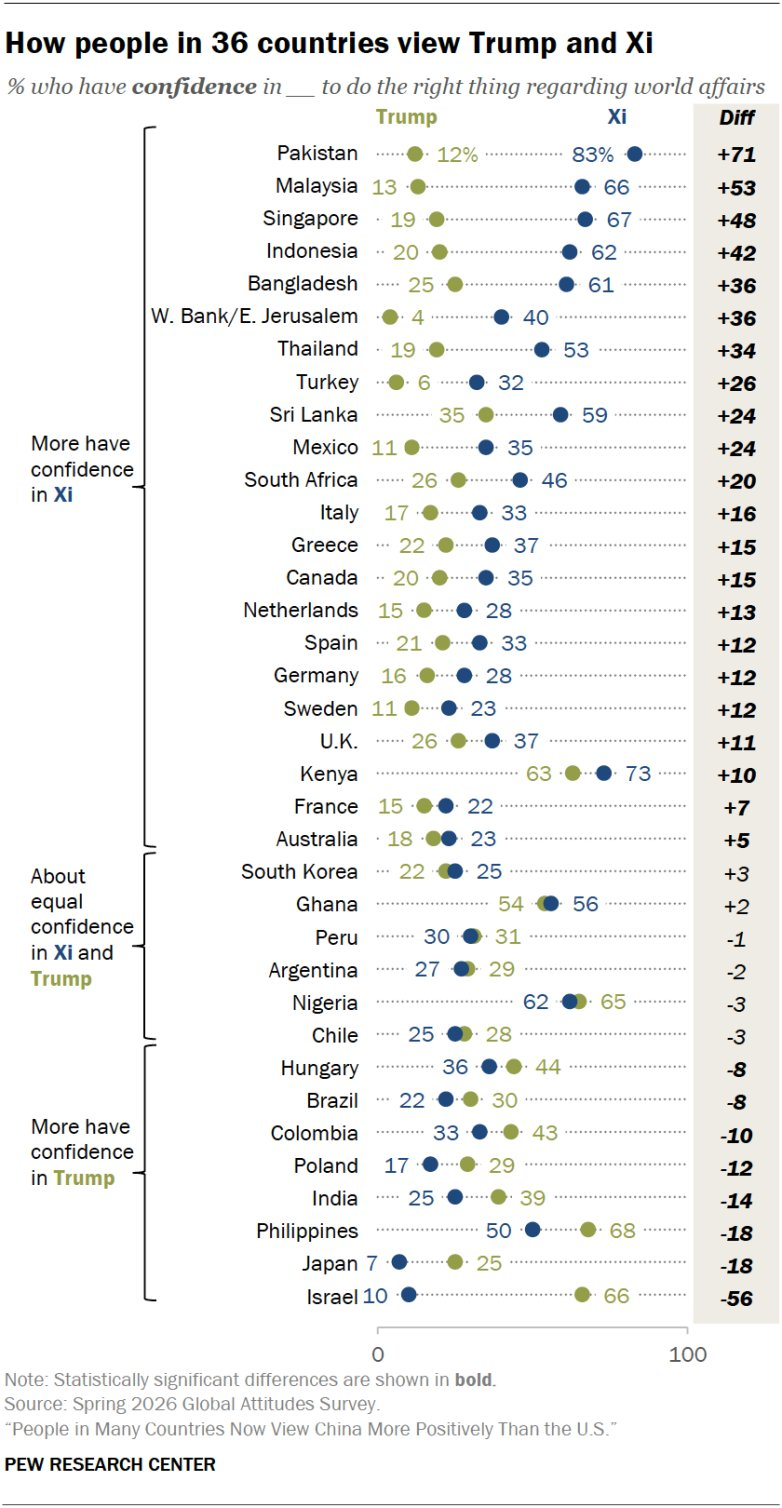
A dot plot from Pew Research Center titled "How people in 36 countries view Trump and Xi," showing the percentage with confidence in each leader to do the right thing regarding world affairs, along with the difference between them, grouped into three categories. In the largest group, more people express confidence in Xi than in Trump. This includes countries with very large gaps favoring Xi, such as Pakistan (12% confidence in Trump versus 83% in Xi, a 71-point difference), Malaysia (13% versus 66%, a 53-point difference), and Singapore (19% versus 67%, a 48-point difference). Other countries in this group with more moderate but still notable gaps include Mexico, Italy, Canada, Germany, and the U.K. A smaller middle group shows roughly equal confidence in Xi and Trump, including South Korea, Ghana, Peru, Argentina, Nigeria, and Chile, where the differences are within about three points in either direction. In the remaining group, more people express confidence in Trump than in Xi, with the largest gap seen in Israel (10% confidence in Xi versus 66% in Trump, a 56-point difference). The Philippines and Japan also show substantial gaps favoring Trump, each at 18 points, along with India, Poland, and Colombia at more moderate double-digit gaps. A note indicates statistically significant differences are shown in bold, with data from the Spring 2026 Global Attitudes Survey.
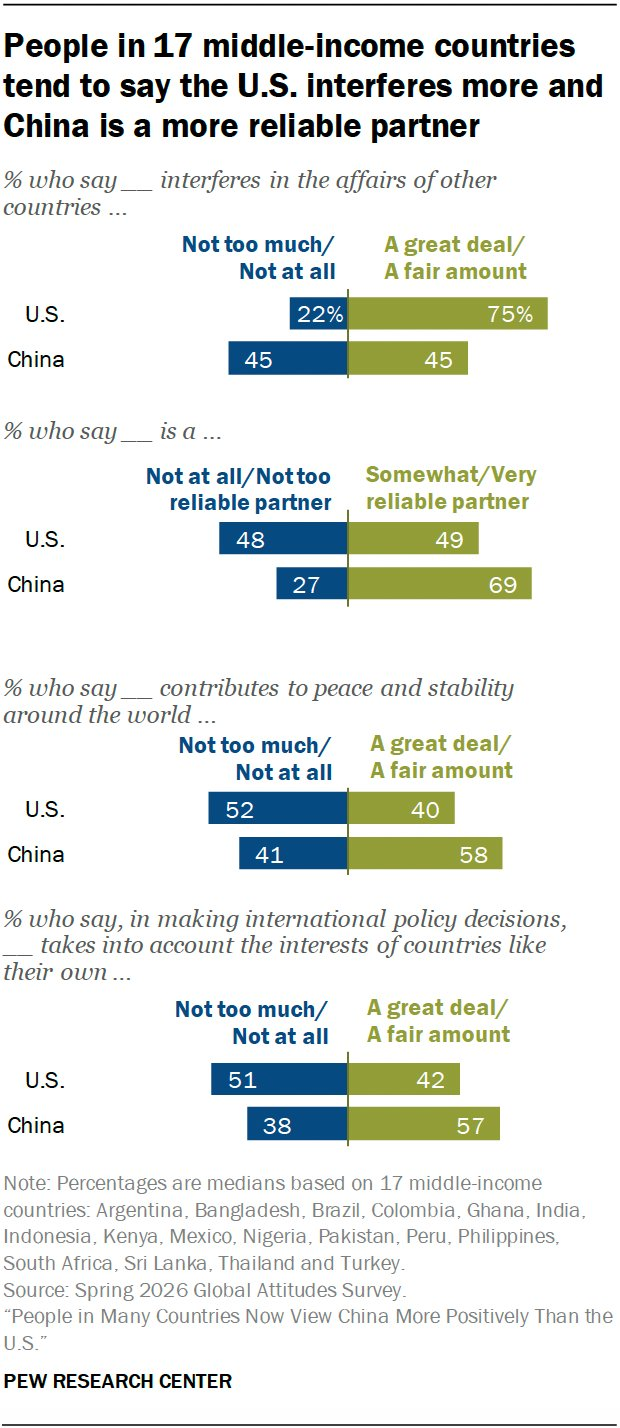
A set of four diverging bar charts from Pew Research Center titled "People in 17 middle-income countries tend to say the U.S. interferes more and China is a more reliable partner." The first chart shows the percentage who say each country interferes in the affairs of other countries. For the U.S., 22% say not too much or not at all, while 75% say a great deal or a fair amount. For China, the split is even, with 45% saying not too much or not at all and 45% saying a great deal or a fair amount. The second chart shows the percentage who view each country as a reliable partner. For the U.S., 48% say not at all or not too reliable, while 49% say somewhat or very reliable. For China, 27% say not at all or not too reliable, while 69% say somewhat or very reliable. The third chart shows the percentage who say each country contributes to peace and stability around the world. For the U.S., 52% say not too much or not at all, while 40% say a great deal or a fair amount. For China, 41% say not too much or not at all, while 58% say a great deal or a fair amount. The fourth chart shows the percentage who say each country takes into account the interests of countries like their own when making international policy decisions. For the U.S., 51% say not too much or not at all, while 42% say a great deal or a fair amount. For China, 38% say not too much or not at all, while 57% say a great deal or a fair amount. A note indicates the percentages are medians based on 17 middle-income countries, including Argentina, Bangladesh, Brazil, Colombia, Ghana, India, Indonesia, Kenya, Mexico, Nigeria, Pakistan, Peru, the Philippines, South Africa, Sri Lanka, Thailand, and Turkey. The source is the Spring 2026 Global Attitudes Survey.