 Mastodon Feed
kevinevans@hachyderm.io ("Kevin") wrote:
Yeah... I think this got mistranslated.

Mastodon Feedkevinevans@hachyderm.io ("Kevin") wrote:
Yeah... I think this got mistranslated.
Mastodon FeedBoosted by jsonstein@masto.deoan.org ("Jeff Sonstein"):
DrOinOR ("OhSnap!Dragon") wrote:
📽️ 🎞️ 🍿
"The Linguini Incident"

Mastodon FeedBoosted by jsonstein@masto.deoan.org ("Jeff Sonstein"):
brianvastag@mas.to ("Brian Vastag") wrote:
Jim Bakker was still alive? Who knew. Not me.
He outlived his nemesis, Frank Zappa, by over 30 years: Proof there is no god.
Mastodon Feedjsonstein@masto.deoan.org ("Jeff Sonstein") wrote:
RE: https://mastodon.social/@Lazarou/117396931893197331
this made me larf out loud
https://ua.news/en/war-vs-rf/shist-kotiv-iz-oleshok-evakuiuvali-cherez-dnipro-dronom
Mastodon FeedBoosted by jsonstein@masto.deoan.org ("Jeff Sonstein"):
akamran@indieweb.social ("Annelies") wrote:
I think I missed #PortfolioDay, so I'm just going to pin these ;-)




Mastodon FeedBoosted by pixxl:
baldur@toot.cafe ("Baldur Bjarnason") wrote:
"Software developers are not okay"
https://www.baldurbjarnason.com/2026/05-software-developers-are-not-okay/
The software industry is becoming increasingly hostile to those who work in it. The uncertainty is affecting even those who believe in the promises of tech.
Direct link to the essay: https://www.baldurbjarnason.com/2026/05-software-developers-are-not-okay/#software-developers-are-not-doing-well
Mastodon FeedBoosted by pixxl:
bpaassen@bildung.social ("Benjamin Paassen") wrote:
Well, it turns out, it has. The journal "Technology, Mind, and Behavior" just published our paper under the new title "Exploring the Limits of Large Language Models as a Reflection of Human Cognition: An Illustration in the Context of Moral Judgment".
Mastodon FeedBoosted by pixxl:
bpaassen@bildung.social ("Benjamin Paassen") wrote:
Over one year ago, we got a lot of response for our preprint "Large language models do not simulate human psychology". While psychologists seemed to be somewhat puzzled that such claims are made in the first place, some colleagues from computer science or application reacted quite skeptically to our claim - we even got some comments that our paper would never make it through peer review.
Mastodon FeedBoosted by glyph ("Glyph"):
Hex@kolektiva.social ("hex") wrote:
A couple of billion years ago, cyanobacteria evolved the ability to photosynthesize. Suddenly they could turn the abundant atmospheric C02 into carbon for replicating themselves. The only side effect was the release of oxygen.
It was a monumental success, but it ended up turning Earth's C02 centered atmosphere into an Oxygen centered one, leading to what may have been the first great extinction event. Cyanobacteria still exist, but they are no longer the dominant life on Earth.
Some things that thrive in one environment also change that environment such that they destroy the resource they need to thrive. We're seeing this today with #LLMs They were only possible to create given massive amounts of clean human-generated content. As they dump their memetic effluent back into the data they feed from, they produce statistical distortions that degrade models trained on the same data. Like the cyanobacteria, they poison the air they breathe.
I encourage everyone to think in terms of systems, not simply components. Because, though this lens, it becomes obvious that some systems include within themselves the logic of their own collapse. And, like a Greek tragedy, it is often precisely a system's strength that leads to its collapse.
Mastodon FeedBoosted by glyph ("Glyph"):
jplebreton ("JP") wrote:
also a lot of these projects don't even disclose they're using LLMs (probably because they know gamers hate it!) so they're sowing distrust and cynicism in what were previously communities that people participated in because they were passionate about it. some communities (eg the Doomworld forums) have understandably already banned posts of such projects.
Mastodon FeedBoosted by glyph ("Glyph"):
jplebreton ("JP") wrote:
the entire point of doing an open source port / reverse engineer of a game is to make a previously locked off proprietary thing more of a public good, that can be studied and modified and preserved into the indefinite future. a codebase that's just an inscrutable alien artifact that no one understands or wants to touch does not advance any of those goals. it's a novelty for grabbing momentary attention and a waste of everyone's time. pathetic.
Mastodon FeedBoosted by glyph ("Glyph"):
jplebreton ("JP") wrote:
survey of the recent rash of vibecoded mods / ports / decomps:
- undisclosed repackage of an existing, mature emulator (Ridge Racer 5 "PC port" actually just PCSX2)
- easter egg for a 20+ year old game passed off as something new (MGS2 skateboarding)
- extremely silly not-at-all-a-game demo ("Spider-Man web swinging in Gotham" just a render overlay, player can't even go behind buildings)
- unmaintainable pile of shit abandoned in 2 months (most of the rest)
Mastodon FeedBoosted by glyph ("Glyph"):
btanderson@infosec.exchange ("Brian Anderson (He/Him)") wrote:
The silent and careless ubiquity of AI is such that “go to primary sources” as data validation is limited by the fact that primary sources are also written by AI. Insanity at scale.
Mastodon FeedBoosted by glyph ("Glyph"):
Garwboy@ohai.social ("Dean Burnett (that brains guy)") wrote:
"By using AI, tasks like essays that used to take hours can be completed in minutes!"
Sure, like how if I arrive at the gym and immediately go for a shower, my workout is done in record time. And if I throw my sandwiches straight in the bin, I can finish my lunch in under 10 seconds.
Mastodon Feedjonny@neuromatch.social ("jonny (nonvenomous)") wrote:
just fuck me up
https://youtu.be/XAVefPw-mps
Mastodon Feeddysfun@treehouse.systems ("gaytabase") wrote:
that is, i didn't know about those til they won prizes. and they're cool as. not like that disastrous AI award.
Mastodon Feeddysfun@treehouse.systems ("gaytabase") wrote:
personally i think they should do more things i don't already know about. like quantum dots and laser tweezers.
Mastodon Feeddysfun@treehouse.systems ("gaytabase") wrote:
i guess the nobel committee are worried they're picking things people haven't heard of again.
Mastodon Feeddysfun@treehouse.systems ("gaytabase") wrote:
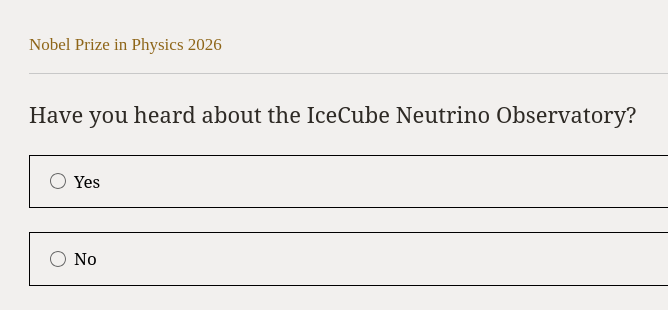
ice cube is an interesting experiment. most neutrino experiments use heavy water or liquiified gases. ice cube uses the antarctic ice. so there's no massive cost for the liquid, just the massive cost of instrumenting the antartic ice deeply instead.
Mastodon Feeddysfun@treehouse.systems ("gaytabase") wrote:
so neutrino oscillations proved to be real, proving neutrinos a) change flavour b) have mass (albeit not much). meanwhile the sterile neutrino looks like it's not a thing. and neutrinos could still be majorana particles (their own antiparticles). plus a whole pile of other cool stuff.
Mastodon Feeddysfun@treehouse.systems ("gaytabase") wrote:
the physics nobel went to someone from the IceCube neutrino experiment.
quite reasonable tbh, neutrinos are basically frontier physics right now.
Mastodon Feedbaldur@toot.cafe ("Baldur Bjarnason") wrote:
And 12 more comments appeared in the past five minutes 😬

Mastodon Feeddysfun@treehouse.systems ("gaytabase") wrote:
i've just finished s2 of breaking bad in this rewatch. not honestly sure i'm going to make it to the end. especially knowing some of the shit episodes ahead.
Mastodon Feedbaldur@toot.cafe ("Baldur Bjarnason") wrote:
Well, that's a much bigger reaction than I expected 😲
And a bit intimidating, so I'm declaring temporary YouTube comment bankruptcy until tomorrow. 😝

Mastodon FeedBoosted by pixxl:
tk@f.kawa-kun.com ("Neil E. Hodges") wrote:
Just going to leave this here before disappearing again for a while.
Software engineers are not okay — Baldur Bjarnason
We’re not doing well in the software industry.
We’ve all sensed it. Things are a bit off.
It’s not just the “AI” financial bubble, or the debates that have been taking place – arguments, more properly – or the ongoing shift in public sentiment regarding the software industry.
I’m talking the fact that people who work in software – specifically developers and user experience designers – are not doing great.
I keep coming across videos of people talking about burning out, being unable to work, and in some cases fairly serious mental health issues. And, obviously, people are getting fired. But often in these videos, those who are doing videos and announcing they’ve been laid off mention that they were thinking about quitting anyway and are now planning on leaving tech entirely.
It’s not just senior people who might have memories and a fondness for how things used to be – stress mixed with nostalgia. It’s also students. I’ve found several videos of students who announced that they had switched majors, had been studying user experience design, but now decided to switch to something else.
With a few notable exceptions, these generally aren’t people who are against “AI” – or, at least, they weren’t against “AI” until very recently.
These aren’t people who disliked the technology from the start, who have had very severe criticisms about the way it’s made, the way it’s forced on people, or have severe doubts about the long-term benefits of applying this technology to our industry.
They seem to have all embraced “AI” at some point and assumed that what they were told was true, that this was the future. “This is where things are going.” This is what software development will be like, now and forever.
After all that, one of the reasons why quite a few of them are leaving, is that they believe this promise. When they’re told that this is the future of the industry, they accept that statement as true. They’ve tried it; understand it and think to themselves: “I see your point, but this isn’t fun any more. This isn’t enjoyable. This is bad for me.”
And decide to leave.
There are a number of systemic factors for why this is happening to them, for why the software industry is an increasingly inhospitable work environment.
What software developers are facing is a case of “incentives”.
Namely, managerial and executive incentives, specifically. The industry’s incentives for those who run the industry give them a strong motivation to try to undercut labour and their workforce at every turn.
And they have been giving it their honest best.
Facebook attempted, for example, to replace a number of their software developers directly with AI tools.
They had to dial that down because the technology simply isn’t capable of what they believed it could do.
But the intent has always been there to reduce the headcount of the industry. A number of incentives for managers and executives that are lined up to push them in that direction.
The fewer people you have working for you, the fewer stock options you have to pay out, the less resistance there will be to watering down the product, collaborating with the military-industrial complex, or helping authoritarian governments control and murder their citizens. Over the past two decades, one of the more effective forces for keeping tech companies in line have been the tech workers themselves who have tried resist corrupt and unethical behaviour. It hasn’t always worked. There wasn’t enough of it. But what little there was it added meaningful friction at several important moments in tech history.
The less influence and power the labour force has, the more power goes to the executive class and the bigger their share of the pie.
If they lay people off that means there are few people working in any given organization doing the same amount of work. That means more stress and more pressure.
As bad as the added workload and burnout is, that isn’t the only change to the job.
There’s also less novelty.
I’ve noticed that even though there’s an increasing number of apps or software being deployed, they’re all either the same “AI” products or “AI” features released everywhere. Or, they are agent-generated clones of existing software.
None of it is novel. It’s almost exclusively old ideas poured into new containers.
One of the problem we have as software developers, and I definitely count myself as somebody with this problem, is that we are a novelty-seeking group.
These changes mean we’re doing more with less time, probably less reward as well, and the job itself is less interesting.
It’s also the nature of the agent automation to feel more like delegation to a clueless junior developer than automation, and that changes your relationship to the work.
In woodworking, the power tools didn’t reduce the woodworker’s emotional investment in what they made. The worker still felt like they’d made that thing out of wood themselves.
Some woodworkers might still use hand tools for a variety of reasons – some of them romantic, some of them, you know, just because it’s more fun.
But having a table saw doesn’t make you feel like you’ve asked somebody else to make the shelf, or table, or chair.
The nature of automation with Large Language Model tools feels substantially different from prior attempts at automation in coding. It’s an abstraction that feels like a delegation, not an automation, and separates you from the output.
That has an effect of making you feel less invested in the output and that takes away much the joy of coding. The flow state is also gone, the sort of focused state of mind that you get into when you’re really deep into solving a problem.
On top of the changes to the job itself, the industry itself has changed as well.
There is more uncertainty. People know there are layoffs every quarter. They know they’re probably next on the block. Or, if they aren’t, they’ll be on the block next quarter instead. They know the reasons for dismissal are going to be arbitrary. They know they generally aren’t going to be able to do anything to improve their odds.
And if they talk about how bad all of this makes them feel, the “AI” true believers will turn around and say that it’s a skill issue. It’s your fault.
There’s a lot of stress, and worry, and pressure in the industry that wasn’t there before.
I suspect that everybody’s suffering. Some are just better at pretending.
This makes people want to get ahead of the lay-offs and quit. Especially those who have some savings.
But even that lines up with the incentives of the executives who are running these companies. People who quit don’t get a nice severance package. People who quit might not be fully vested.
And even if you have savings, you can’t time your quitting based on your finances if you have to get out to preserve your mental health.
Once you’re gone, the company can hire somebody to replace you out of the vast pool of now unemployed software developers at what will probably be lower pay.
Executive incentives are aligned to perpetuate the situation and even to make it worse. From the perspective of the executives who are running a software company, this perpetually precarious situation for their employees makes up for their inability to replace software developers completely with “AI”.
Instead of being able to outsource all your software development to an “AI”, they can effectively semi-outsource it to “AI” and have the automated shitstorm managed by a group of people in a perpetually vulnerable state, who are unable to ask for a higher pay, unable to negotiate for a better position, and unable to say no to unreasonable demands.
It lets management lower costs and strengthens their bargaining position versus the labour class that they’re dominating.
This isn’t a situation that will fix itself when the “AI” financial bubble collapses.
The bubble will pop. It’s much too big to be sustainable.
But that won’t fix software industry employment because the Large Language Models don’t really need to work that well for this process. They only need to sort of work.
As long as you can find more overworked software developers, and push them hard until they burn out trying to maintain a minimum standard of quality, you can keep the “AI”-driven labour alienation going. They can use cheaper Chinese models. Or, if they switch to local models, they can make owning a high-end laptop a job requirement.
“You need to spend $5000 USD on a laptop before you apply for this job. That filters out the ‘AI’-generated resumes, you see.”
Why take on the massive costs RAM when you can use that cost to lower developer pay by proxy?
The overall dynamic doesn’t change once the costs increase for the hosted models. Those models will just get more stagnant; they might not get updated as often; the training data will be stale; the code it generates will be perpetually on the verge of outdated; and they’ll be run with more errors.
Management won’t care.
The work of making up for that is going to be pushed on the developer adding to their load and pressure.
My worry, based on the research I’ve been doing and looking at the systemic incentives of the companies in the software industry, is that this is probably about as good as it’s going to get for a software developer at a large company in the tech industry.
This misery, this pressure, the overwork, the underpayment, the detachment from the work – this is probably what making mainstream software is going to feel like from now on.
It doesn’t surprise me that the people within the software industry who seem to be spotting the issue and leaving preemptively seem to be user experience designers.
Designers have slightly more training in looking at the system within which the user operates, and it doesn’t take that much of a shift in framing for them to understand where they stand themselves.
But software developers are coming to this conclusion as well, especially students. There was a new story recently here in Iceland that year-on-year, sign-ups for computer science at the universities here in Iceland had declined on the order of 30% decreases every year.
And Iceland doesn’t seem to be alone in this.
People are realising that this is a bad career to be in and an industry that’s hostile to its workers.
I suspect many more people over the next few years are going to be having identity crises on top of the career issues.
“Who am I if I’m not in tech? If I’m not a software developer?”
Because if you’ve built your entire identity around software and tech, around being a programmer, around being a tech person who works to enable “progress” and drive the world to the future, you’re going to have a bad time after being pushed out of that role and seeing your former industry studiously dismantle everything you thought you were building.
I don’t know what we can do, except understand and accept that this is happening.
It’s a horrible thought, but you can’t deal with change if you stay in denial.
I think it might be time – if you’re working in software – to think about a possible future outside the tech industry proper.
Mastodon FeedBoosted by neatnik@social.lol ("Treatnik 🎃"):
robb@social.lol ("Robb Knightmare") wrote:
You only have a few hours left to grab our sticker pack for this year https://stjude.omg.lol
Mastodon FeedBoosted by pixxl:
Grueproof@dice.camp ("Chris Miller") wrote:
Intend your puns, cowards.
Mastodon FeedBoosted by jsonstein@masto.deoan.org ("Jeff Sonstein"):
xahteiwi ("Florian Haas") wrote:
Look, an aging society that's increasingly childless but wants to retain its old-age pension and retirement scheme, must rely on immigration to sustain itself.
Don't like that?
Well, fuck.
Mastodon Feeddysfun@treehouse.systems ("gaytabase") wrote:
a triscuit is 50% larger than a biscuit
Mastodon Feedjsonstein@masto.deoan.org ("Jeff Sonstein") wrote: