 Mastodon Feed

jonny@neuromatch.social ("jonny (nonvenomous)") wrote:
Oh sure yeah theres no reason to believe that "AI" might differ from other forms of automation in the number of new tasks have to be done compared to the automation of 1987-2017

Mastodon Feedjonny@neuromatch.social ("jonny (nonvenomous)") wrote:
Oh sure yeah theres no reason to believe that "AI" might differ from other forms of automation in the number of new tasks have to be done compared to the automation of 1987-2017
Mastodon Feedjonny@neuromatch.social ("jonny (nonvenomous)") wrote:
You had better fucking believe that citation of "1.6x productivity gain estimated by conversations with Claude" is referencing when anthropic asked Claude to estimate how long each task that someone used Claude for would take without Claude. You know, the same frontier LLM that has a sense of time that makes it routinely say things like adding an api endpoint will take months, and is constantly telling me to go to bed in the middle of the day

Mastodon Feedjonny@neuromatch.social ("jonny (nonvenomous)") wrote:
"Our capital pricing term leans towards a value that means it can more or less be built on demand because compute is easy to build and we can build all the compute capacity we need for a given period with a two year lag"

Mastodon Feedjonny@neuromatch.social ("jonny (nonvenomous)") wrote:
(The ceiling of the maximum tasks that can be done by AI with perfect substition is explicitly claimed as "all the cognitive tasks" which they claim is 62.4% because... That's the proportion of people who work in the "cognitive professions" )
Mastodon Feedjonny@neuromatch.social ("jonny (nonvenomous)") wrote:
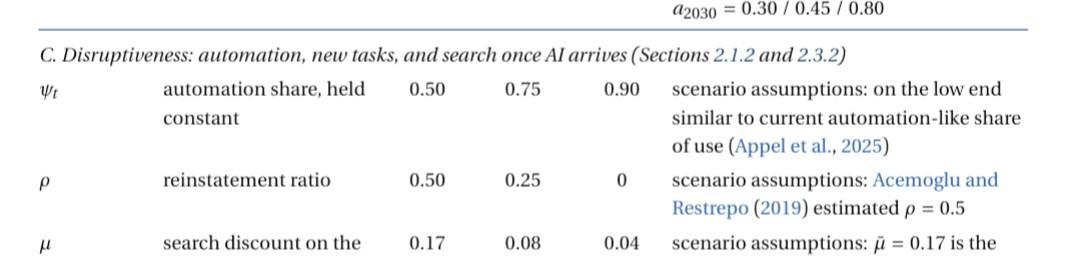
So their moderate scenario assumes 30% of all tasks can be done by AI by 2030, 40% of those will be done by AI, with 50/50 automation/augmentation.
So the underlying claim they are making is that within 3 and a quarter years, AI will be doing 12% of everything. Not just what the call "cognitive tasks," all tasks period.
Mastodon FeedBoosted by ireneista@irenes.space ("Irenes (many)"):
socks@social.emisocks.com ("Emil Socks") wrote:
Exercise game: "You've been doing this for 30 days in a row! Is it starting to become a habit?"
Nope! I am neurodivergent. Thanks for asking though
Mastodon Feedjonny@neuromatch.social ("jonny (nonvenomous)") wrote:
Well sure if you construct a model where AI uniformly improves the efficiency of producing an output that is assumed to be totally replaceable and defined to never cause more new work than it automates, and capital is basically free and there are no resource constraints, then yeah the future sounds great.
Mastodon Feedjonny@neuromatch.social ("jonny (nonvenomous)") wrote:
This assumption rules:
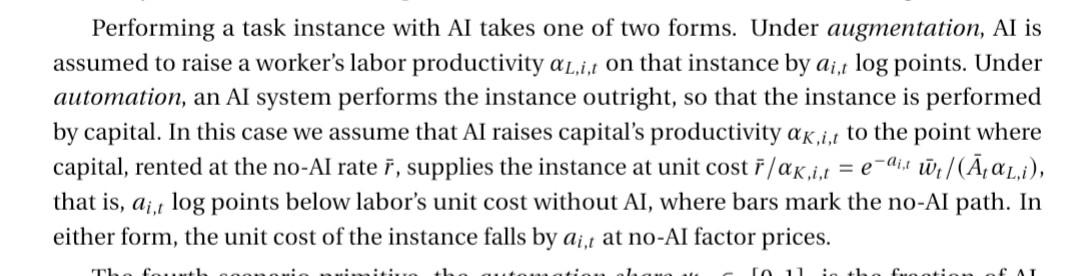
In this case [of automation] we assume that AI raises capital’s productivity to the point where
capital, rented at the no-AI rate supplies the instance at unit cost that is, 𝑎_{i,t} log points below labor’s unit cost without AI, where bars mark the no-AI path.So like, automation is always possible and we fix the cost of it so it is always cheaper because ai is magic and makes the capital pricing term disappear.
Mastodon Feedjonny@neuromatch.social ("jonny (nonvenomous)") wrote:
Oh awesome here we go, this is the parameter I was looking for - the reinstatement ratio is the proportion of new tasks that are created by automation, so at 1, every automated task creates a new labor task (which can then be automated over time). The automation share is constant that controls how many tasks are automated (assigned to AI entirely) vs "augmented," where the task is performed by some mix if labor and AI. Its so awesome how in the scenario where AI makes the economy go hogwild it just causes no problems and there is no additional labor needed at all to clean up after it.
Mastodon FeedBoosted by neatnik@social.lol ("Neatnik :prami:"):
bw@social.lol ("Blake Watson :prami:") wrote:
I wrote this little web book in 2024 because I wanted to express the simplicity of HTML and show how easy it is for anyone to get started by making their own personal website.
As of today, HTML for People is available in three languages!
English: https://htmlforpeople.com/
Español: https://victorhck.gitlab.io/htmlparapersonas/
Português: https://htmlepessoas.com/
Many thanks to @victorhck and @pablo for their work translating and hosting the other versions!
Mastodon FeedBoosted by ireneista@irenes.space ("Irenes (many)"):
Catfish_Man ("David Smith") wrote:
It’s wonderful that an interpreted[1], dynamically dispatched[2], effect-based[3], language like C can see such broad interest, but tragically its opinionated[4] batteries-included[5] runtime, poor performance[6], and overly high level[7] design make it unsuitable for low level programming.
1: microcoded instructions
2: dynamic linking
3: page fault handler
4: the stack
5: malloc
6: char* aliases everything
7: reading off the end of a buffer is UB even if it’s still a readable address
Mastodon Feedjonny@neuromatch.social ("jonny (nonvenomous)") wrote:
What the fuck, they have this "Ideas" term that is there to like "make the economy go up as it does like normal without any AI term" that is a multiplier in the "value of human labor" term. but then that term is modeled as a proportion of total GDP, which goes up tautologically by introducing AI, so there's an implicit feedback that buffers unemployment?? That would theoretically be ... Increased research funding???
Mastodon Feedjonny@neuromatch.social ("jonny (nonvenomous)") wrote:
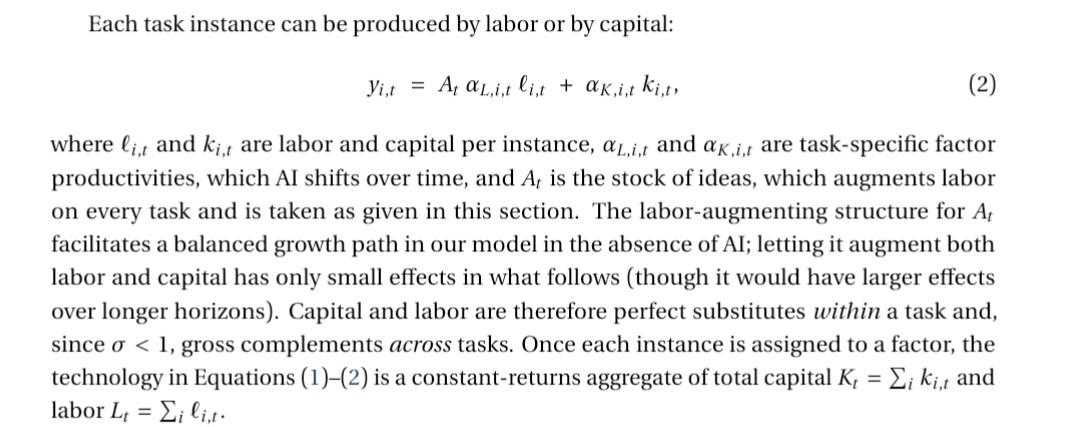
Sure, yeah, assuming perfect substitution of AI and human labor for a task such that the only place they differ is their price is a totally fair assumption
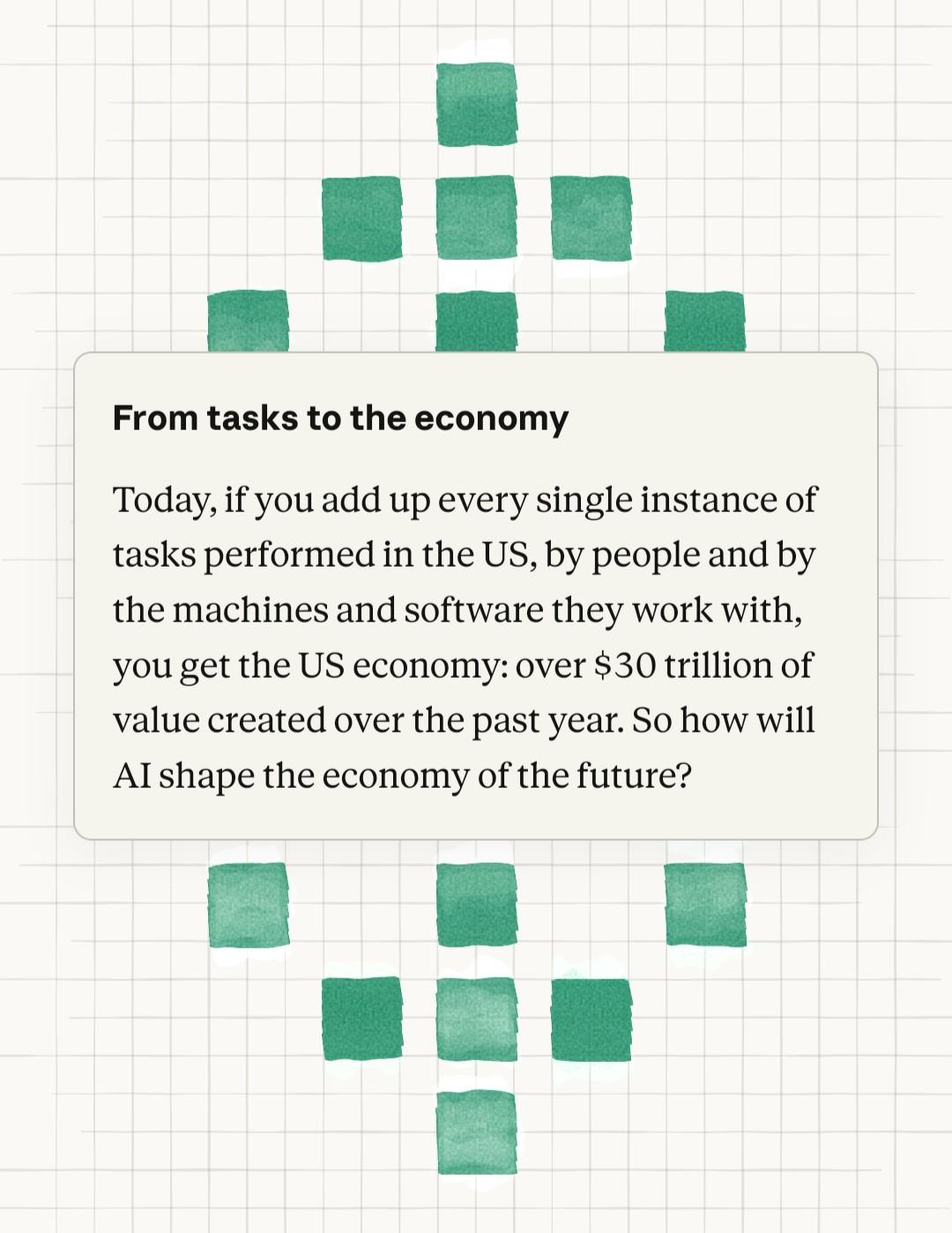
Mastodon Feedjonny@neuromatch.social ("jonny (nonvenomous)") wrote:
No dumbass the economy is clearly made of rectangles
Mastodon Feedbrib@bribstodon.xyz ("brib :neofox_floof: :Nonbinary:") wrote:
I should grab one of those sunflower lanyards and actually wear it, that might help communicate that I have Actual Disability Issues With Known Ways Of Dealing With It rather than simply coming across as someone with a difficult personality
Mastodon Feedjonny@neuromatch.social ("jonny (nonvenomous)") wrote:
I don't even need to tell jokes they are just already in the text
Mastodon Feedjonny@neuromatch.social ("jonny (nonvenomous)") wrote:
Task theory of value
Mastodon Feedjonny@neuromatch.social ("jonny (nonvenomous)") wrote:
You literally cannot start something in a funnier way than this

Mastodon Feedbrib@bribstodon.xyz ("brib :neofox_floof: :Nonbinary:") wrote:
I have autism that is mild enough to be "independent" except this independence is a mirage thay falls apart under the slightest scrutiny.
And I'm aware that my difficulties tend to frustrate those around me. Stuff like reacting badly to routine changes and it coming across that I'm getting upset for no (or the wrong) reason
Mastodon Feedbrib@bribstodon.xyz ("brib :neofox_floof: :Nonbinary:") wrote:
The puzzles make for a distraction, but sometimes I wonder how much of my anxiety is the sort that needs psychological coping mechanisms and how much of it is a rational reaction to difficult circumstances.
I think the both go hand-in-hand? Disability and difficult housing circumstances are kicking my ass. Ruminating does not help and I need a healthier outlet.
Mastodon FeedBoosted by brib@bribstodon.xyz ("brib :neofox_floof: :Nonbinary:"):
brib@bribstodon.xyz ("brib :neofox_floof: :Nonbinary:") wrote:
What I realise is that I'm okay with people talking about current events if they either CW it, talk about something that relates to them personally, or at the very least says something interesting about the events at hand.
But if they're saying the same things everyone else is saying or saying something like "x happened, isn't that bad?" (or boosting the people everyone else is boosting) I quickly reach for the "mute/hide boosts" button.
In the long-term I need to find and/or make a client that supports proper filtering (tried a bunch of clients when I started GoToSocial but the one I'm on is the one I like most despite the lack of proper filtering interface).
I should probably extend the same courtesy when posting/boosting to my own feed
Mastodon FeedBoosted by glyph ("Glyph"):
jalefkowit@hachyderm.io ("Jason Lefkowitz") wrote:
A common misconception about the two major federal 9/11 benefit programs (the September 11 Victim Compensation Fund and the World Trade Center Health Program) is that they are only for first responders. They are not. Both allow non-responders to receive benefits if they meet certain criteria, such as time spent in an affected area. (Most of lower Manhattan is considered an affected area.)
If that's you, or COULD BE you, you should look into registering with both programs. New 9/11-related medical conditions are still emerging today, 25 years later. If you eventually develop one, these programs can get you compensation and free, high-quality medical care. But if you ever need their help, you will be glad you did the paperwork early.
September 11th Victim Compensation Fund (VCF): https://www.vcf.gov/
World Trade Center Health Program (WTCHP): https://www.cdc.gov/wtc/index.html
Mastodon FeedBoosted by brib@bribstodon.xyz ("brib :neofox_floof: :Nonbinary:"):
joe@f.duriansoftware.com ("Joe Groff") wrote:
people abandon social media and online services because of all the slop and surveillance, until the only people left online are old nerds shitposting about their retro computers. dad Internet theory
Mastodon FeedBoosted by brib@bribstodon.xyz ("brib :neofox_floof: :Nonbinary:"):
evergreensewing@pdx.social ("Evergreen Sewing") wrote:
This is NOT cute! Sewing machines only do this when seriously distressed!
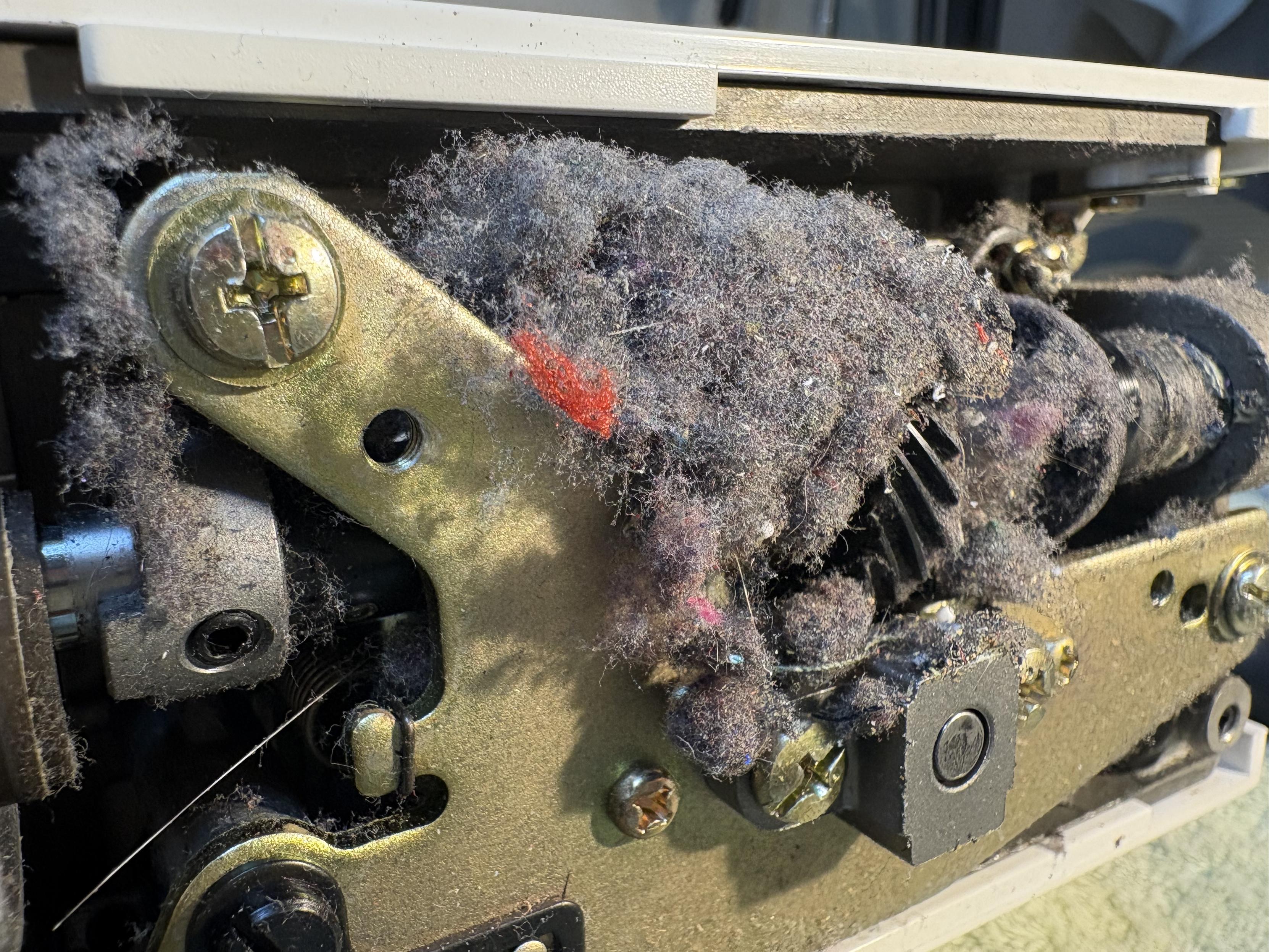
Mastodon FeedBoosted by brib@bribstodon.xyz ("brib :neofox_floof: :Nonbinary:"):
joannaholman@aus.social ("Joanna Holman") wrote:
RE: https://mastodon.social/@gusseting/117256004294127921
Any of you #melbourne folk spotted stray knitting on a tram?
Mastodon Feedbrib@bribstodon.xyz ("brib :neofox_floof: :Nonbinary:") wrote:
I solved the daily #CluesBySam, Sep 12th 2026 (Hard), in less than 19 minutes
🟩🟩🟩🟩
🟩🟩🟩🟩
🟩🟩🟩🟨
🟩🟩🟩🟨
🟩🟩🟩🟩
https://cluesbysam.com
Mastodon FeedBoosted by jsonstein@masto.deoan.org ("Jeff Sonstein"):
BBC@c.im ("BBC News") wrote:
#BBC #News Largest US outbreak of explosive diarrhoea parasite is over, officials say https://w.st/A6VFp
Mastodon FeedBoosted by brib@bribstodon.xyz ("brib :neofox_floof: :Nonbinary:"):
rogueai@llull.club wrote:
Oh no! A rogue AI has
subverted your
Mastodon server
Mastodon Feedbrib@bribstodon.xyz ("brib :neofox_floof: :Nonbinary:") wrote:
For a few days I felt safe then the hypervigilance came back
Mastodon Feedbrib@bribstodon.xyz ("brib :neofox_floof: :Nonbinary:") wrote:
I had started sleeping better but that's not happening anymore